EP2669003A2 - Oxygen-selective adsorbent having fast adsorption rate and preparation method thereof - Google Patents
Oxygen-selective adsorbent having fast adsorption rate and preparation method thereof Download PDFInfo
- Publication number
- EP2669003A2 EP2669003A2 EP12739507.7A EP12739507A EP2669003A2 EP 2669003 A2 EP2669003 A2 EP 2669003A2 EP 12739507 A EP12739507 A EP 12739507A EP 2669003 A2 EP2669003 A2 EP 2669003A2
- Authority
- EP
- European Patent Office
- Prior art keywords
- oxygen
- particles
- bamg
- preparation
- mgco
- Prior art date
- Legal status (The legal status is an assumption and is not a legal conclusion. Google has not performed a legal analysis and makes no representation as to the accuracy of the status listed.)
- Granted
Links
Images


Classifications
-
- B—PERFORMING OPERATIONS; TRANSPORTING
- B01—PHYSICAL OR CHEMICAL PROCESSES OR APPARATUS IN GENERAL
- B01J—CHEMICAL OR PHYSICAL PROCESSES, e.g. CATALYSIS OR COLLOID CHEMISTRY; THEIR RELEVANT APPARATUS
- B01J20/00—Solid sorbent compositions or filter aid compositions; Sorbents for chromatography; Processes for preparing, regenerating or reactivating thereof
- B01J20/02—Solid sorbent compositions or filter aid compositions; Sorbents for chromatography; Processes for preparing, regenerating or reactivating thereof comprising inorganic material
- B01J20/04—Solid sorbent compositions or filter aid compositions; Sorbents for chromatography; Processes for preparing, regenerating or reactivating thereof comprising inorganic material comprising compounds of alkali metals, alkaline earth metals or magnesium
- B01J20/041—Oxides or hydroxides
-
- B—PERFORMING OPERATIONS; TRANSPORTING
- B01—PHYSICAL OR CHEMICAL PROCESSES OR APPARATUS IN GENERAL
- B01J—CHEMICAL OR PHYSICAL PROCESSES, e.g. CATALYSIS OR COLLOID CHEMISTRY; THEIR RELEVANT APPARATUS
- B01J20/00—Solid sorbent compositions or filter aid compositions; Sorbents for chromatography; Processes for preparing, regenerating or reactivating thereof
- B01J20/02—Solid sorbent compositions or filter aid compositions; Sorbents for chromatography; Processes for preparing, regenerating or reactivating thereof comprising inorganic material
- B01J20/04—Solid sorbent compositions or filter aid compositions; Sorbents for chromatography; Processes for preparing, regenerating or reactivating thereof comprising inorganic material comprising compounds of alkali metals, alkaline earth metals or magnesium
-
- B—PERFORMING OPERATIONS; TRANSPORTING
- B01—PHYSICAL OR CHEMICAL PROCESSES OR APPARATUS IN GENERAL
- B01D—SEPARATION
- B01D53/00—Separation of gases or vapours; Recovering vapours of volatile solvents from gases; Chemical or biological purification of waste gases, e.g. engine exhaust gases, smoke, fumes, flue gases, aerosols
- B01D53/02—Separation of gases or vapours; Recovering vapours of volatile solvents from gases; Chemical or biological purification of waste gases, e.g. engine exhaust gases, smoke, fumes, flue gases, aerosols by adsorption, e.g. preparative gas chromatography
-
- B—PERFORMING OPERATIONS; TRANSPORTING
- B01—PHYSICAL OR CHEMICAL PROCESSES OR APPARATUS IN GENERAL
- B01J—CHEMICAL OR PHYSICAL PROCESSES, e.g. CATALYSIS OR COLLOID CHEMISTRY; THEIR RELEVANT APPARATUS
- B01J20/00—Solid sorbent compositions or filter aid compositions; Sorbents for chromatography; Processes for preparing, regenerating or reactivating thereof
- B01J20/02—Solid sorbent compositions or filter aid compositions; Sorbents for chromatography; Processes for preparing, regenerating or reactivating thereof comprising inorganic material
- B01J20/04—Solid sorbent compositions or filter aid compositions; Sorbents for chromatography; Processes for preparing, regenerating or reactivating thereof comprising inorganic material comprising compounds of alkali metals, alkaline earth metals or magnesium
- B01J20/043—Carbonates or bicarbonates, e.g. limestone, dolomite, aragonite
-
- B—PERFORMING OPERATIONS; TRANSPORTING
- B01—PHYSICAL OR CHEMICAL PROCESSES OR APPARATUS IN GENERAL
- B01J—CHEMICAL OR PHYSICAL PROCESSES, e.g. CATALYSIS OR COLLOID CHEMISTRY; THEIR RELEVANT APPARATUS
- B01J20/00—Solid sorbent compositions or filter aid compositions; Sorbents for chromatography; Processes for preparing, regenerating or reactivating thereof
- B01J20/30—Processes for preparing, regenerating, or reactivating
-
- B—PERFORMING OPERATIONS; TRANSPORTING
- B01—PHYSICAL OR CHEMICAL PROCESSES OR APPARATUS IN GENERAL
- B01J—CHEMICAL OR PHYSICAL PROCESSES, e.g. CATALYSIS OR COLLOID CHEMISTRY; THEIR RELEVANT APPARATUS
- B01J20/00—Solid sorbent compositions or filter aid compositions; Sorbents for chromatography; Processes for preparing, regenerating or reactivating thereof
- B01J20/30—Processes for preparing, regenerating, or reactivating
- B01J20/3078—Thermal treatment, e.g. calcining or pyrolizing
-
- B—PERFORMING OPERATIONS; TRANSPORTING
- B01—PHYSICAL OR CHEMICAL PROCESSES OR APPARATUS IN GENERAL
- B01J—CHEMICAL OR PHYSICAL PROCESSES, e.g. CATALYSIS OR COLLOID CHEMISTRY; THEIR RELEVANT APPARATUS
- B01J20/00—Solid sorbent compositions or filter aid compositions; Sorbents for chromatography; Processes for preparing, regenerating or reactivating thereof
- B01J20/30—Processes for preparing, regenerating, or reactivating
- B01J20/32—Impregnating or coating ; Solid sorbent compositions obtained from processes involving impregnating or coating
- B01J20/3291—Characterised by the shape of the carrier, the coating or the obtained coated product
- B01J20/3293—Coatings on a core, the core being particle or fiber shaped, e.g. encapsulated particles, coated fibers
-
- C—CHEMISTRY; METALLURGY
- C01—INORGANIC CHEMISTRY
- C01B—NON-METALLIC ELEMENTS; COMPOUNDS THEREOF; METALLOIDS OR COMPOUNDS THEREOF NOT COVERED BY SUBCLASS C01C
- C01B13/00—Oxygen; Ozone; Oxides or hydroxides in general
- C01B13/02—Preparation of oxygen
-
- C—CHEMISTRY; METALLURGY
- C01—INORGANIC CHEMISTRY
- C01F—COMPOUNDS OF THE METALS BERYLLIUM, MAGNESIUM, ALUMINIUM, CALCIUM, STRONTIUM, BARIUM, RADIUM, THORIUM, OR OF THE RARE-EARTH METALS
- C01F11/00—Compounds of calcium, strontium, or barium
- C01F11/02—Oxides or hydroxides
- C01F11/04—Oxides or hydroxides by thermal decomposition
- C01F11/06—Oxides or hydroxides by thermal decomposition of carbonates
-
- C—CHEMISTRY; METALLURGY
- C01—INORGANIC CHEMISTRY
- C01F—COMPOUNDS OF THE METALS BERYLLIUM, MAGNESIUM, ALUMINIUM, CALCIUM, STRONTIUM, BARIUM, RADIUM, THORIUM, OR OF THE RARE-EARTH METALS
- C01F11/00—Compounds of calcium, strontium, or barium
- C01F11/18—Carbonates
-
- B—PERFORMING OPERATIONS; TRANSPORTING
- B01—PHYSICAL OR CHEMICAL PROCESSES OR APPARATUS IN GENERAL
- B01D—SEPARATION
- B01D2251/00—Reactants
- B01D2251/40—Alkaline earth metal or magnesium compounds
- B01D2251/402—Alkaline earth metal or magnesium compounds of magnesium
-
- B—PERFORMING OPERATIONS; TRANSPORTING
- B01—PHYSICAL OR CHEMICAL PROCESSES OR APPARATUS IN GENERAL
- B01D—SEPARATION
- B01D2251/00—Reactants
- B01D2251/40—Alkaline earth metal or magnesium compounds
- B01D2251/408—Alkaline earth metal or magnesium compounds of barium
-
- B—PERFORMING OPERATIONS; TRANSPORTING
- B01—PHYSICAL OR CHEMICAL PROCESSES OR APPARATUS IN GENERAL
- B01D—SEPARATION
- B01D2251/00—Reactants
- B01D2251/60—Inorganic bases or salts
- B01D2251/602—Oxides
-
- B—PERFORMING OPERATIONS; TRANSPORTING
- B01—PHYSICAL OR CHEMICAL PROCESSES OR APPARATUS IN GENERAL
- B01D—SEPARATION
- B01D2251/00—Reactants
- B01D2251/60—Inorganic bases or salts
- B01D2251/606—Carbonates
-
- B—PERFORMING OPERATIONS; TRANSPORTING
- B01—PHYSICAL OR CHEMICAL PROCESSES OR APPARATUS IN GENERAL
- B01D—SEPARATION
- B01D2253/00—Adsorbents used in seperation treatment of gases and vapours
- B01D2253/10—Inorganic adsorbents
- B01D2253/112—Metals or metal compounds not provided for in B01D2253/104 or B01D2253/106
-
- B—PERFORMING OPERATIONS; TRANSPORTING
- B01—PHYSICAL OR CHEMICAL PROCESSES OR APPARATUS IN GENERAL
- B01D—SEPARATION
- B01D2257/00—Components to be removed
- B01D2257/10—Single element gases other than halogens
- B01D2257/104—Oxygen
-
- B—PERFORMING OPERATIONS; TRANSPORTING
- B01—PHYSICAL OR CHEMICAL PROCESSES OR APPARATUS IN GENERAL
- B01D—SEPARATION
- B01D2258/00—Sources of waste gases
- B01D2258/06—Polluted air
-
- B—PERFORMING OPERATIONS; TRANSPORTING
- B01—PHYSICAL OR CHEMICAL PROCESSES OR APPARATUS IN GENERAL
- B01J—CHEMICAL OR PHYSICAL PROCESSES, e.g. CATALYSIS OR COLLOID CHEMISTRY; THEIR RELEVANT APPARATUS
- B01J2220/00—Aspects relating to sorbent materials
- B01J2220/40—Aspects relating to the composition of sorbent or filter aid materials
- B01J2220/42—Materials comprising a mixture of inorganic materials
-
- C—CHEMISTRY; METALLURGY
- C01—INORGANIC CHEMISTRY
- C01P—INDEXING SCHEME RELATING TO STRUCTURAL AND PHYSICAL ASPECTS OF SOLID INORGANIC COMPOUNDS
- C01P2002/00—Crystal-structural characteristics
- C01P2002/70—Crystal-structural characteristics defined by measured X-ray, neutron or electron diffraction data
- C01P2002/72—Crystal-structural characteristics defined by measured X-ray, neutron or electron diffraction data by d-values or two theta-values, e.g. as X-ray diagram
-
- C—CHEMISTRY; METALLURGY
- C01—INORGANIC CHEMISTRY
- C01P—INDEXING SCHEME RELATING TO STRUCTURAL AND PHYSICAL ASPECTS OF SOLID INORGANIC COMPOUNDS
- C01P2002/00—Crystal-structural characteristics
- C01P2002/80—Crystal-structural characteristics defined by measured data other than those specified in group C01P2002/70
- C01P2002/88—Crystal-structural characteristics defined by measured data other than those specified in group C01P2002/70 by thermal analysis data, e.g. TGA, DTA, DSC
-
- C—CHEMISTRY; METALLURGY
- C01—INORGANIC CHEMISTRY
- C01P—INDEXING SCHEME RELATING TO STRUCTURAL AND PHYSICAL ASPECTS OF SOLID INORGANIC COMPOUNDS
- C01P2004/00—Particle morphology
- C01P2004/01—Particle morphology depicted by an image
- C01P2004/03—Particle morphology depicted by an image obtained by SEM
Definitions
- the present invention relates to an oxygen-selective adsorbent capable of adsorbing oxygen in the air at a fast rate to produce high-purity oxygen and a preparation method thereof, and more particularly, to an oxygen-selective adsorbent prepared by sintering BaMg(CO 3 ) 2 particles or particles in which MgCO 3 or Mg(OH) 2 are attached to the outside of BaMg(CO 3 ) 2 at a high temperature, and a preparation method thereof.
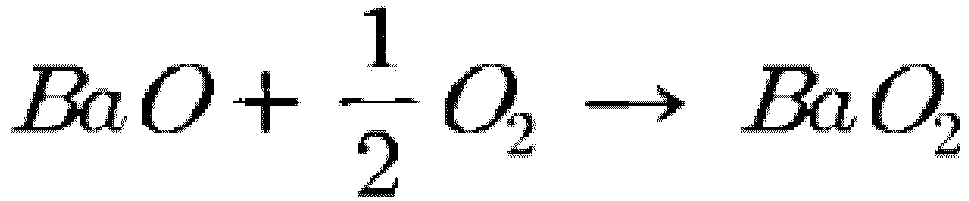
- Barium oxide has been well known as a material that reacts with oxygen to thereby be converted into barium peroxide through an oxidation reaction shown in Chemical Formula 1, adsorbing oxygen during this process, and releasing oxygen through a reduction reaction under oxygenfree atmosphere. Due to these properties of barium oxide, barium oxide has been used in a process of producing oxygen in the early 20 th century.
- barium peroxide does not have thermal stability at a high temperature, barium peroxide tends to lose oxygen adsorptivity while a cycle progresses.
- barium peroxide is a significantly thermally unstable material, such that a sintering phenomenon between particles thereof may be generated at a high temperature. Therefore, a size of the particle may be increased, and oxygen adsorptivity may be gradually lost as a process progresses. In order to prepare oxygen-selective adsorbent capable of maintaining adsorptivity, this phenomenon should be blocked.
- an oxygen adsorbent capable of increasing a use-rate of barium and having improved stability may be prepared by impregnating barium oxide with zirconia.
- a method of impregnating barium oxide disclosed in US Patent No. 4,092,264 is as follows. First, porous zirconia is fired at a high temperature to remove impurities, mixed with barium peroxide, and then the obtained mixture is heated to allow barium peroxide to be impregnated with zirconia.
- thermal stability may be increased, and heat generated in an oxidation reaction with oxygen at the time of performing an oxygen producing process may be effectively stored and used at the time of performing a reduction process, such that efficiency of the process may be increased.
- stability when barium is impregnated with zirconia at a level of 20% or less, stability may be maximally implemented, and the use-rate of barium may be increased.
- a method of mixing or impregnating barium peroxide with a third substrate mainly in a dried state has been used.
- a non-uniform protective film is formed, such that a use-rate of barium oxide may not be high, and in the case of impregnating barium peroxide with the third substrate, since a material acting as the substrate is required in excessive amounts, it may be impossible to develop a material having high oxygen adsorptivity.
- barium oxide may be captured in a framework of magnesium oxide by inducing evaporation of water to form precipitates and being subjected to a sintering process at a high temperature.
- barium oxide reacts with water during the sintering process to form barium hydroxide, which has low stability and high reactivity, such that it is not easy to perform the sintering process, and oxygen adsorptivity may be decreased after sintering.
- An object of the present invention is to provide an oxygen-selective adsorbent capable of adsorbing oxygen in the air at a fast rate as compared with an existing oxygen-selective adsorbent and having high thermal stability and excellent oxygen adsorptivity, and a preparation method thereof.
- the present inventors studied on an oxygen-selective adsorbent and found that in the case of sintering BaMg(CO 3 ) 2 particles or particles in which MgCO 3 or Mg (OH) 2 are attached to the outside of BaMg(CO 3 ) 2 at a high temperature, as BaCO 3 and MgCO 3 in BaMg(CO 3 ) 2 are converted into barium oxide and magnesium oxide, respectively, barium oxide and magnesium oxide having a nano-size are formed and an oxygen adsorption rate is increased, thereby completing the present invention.
- a preparation method of an oxygen-selective adsorbent selectively adsorbing oxygen in the air includes: preparing BaMg(CO 3 ) 2 particles or particles in which MgCO 3 or Mg(OH) 2 are attached to the outside of BaMg(CO 3 ) 2 ; and burning the particles at a high temperature.
- the BaMg(CO 3 ) 2 particles or particles in which MgCO 3 or Mg(OH) 2 are attached to the outside of BaMg(CO 3 ) 2 may be prepared.
- BaMg(CO 3 ) 2 which is a solid solution of BaCO 3 and MgCO 3 , is discovered in natural minerals and referred to as norsethite.
- this material there are various methods. For example, a method of mixing BaCO 3 and MgCO 3 particles at a high temperature and sintering the mixture at 500°C or more to prepare this material, a method of synthesizing BaCO 3 in an aqueous solution of MgCl 2 and NaHCO 3 , a method of using MgCO 3 ⁇ 3H 2 O instead of MgCl 2 as a source of Mg 2+ in the synthetic method in the aqueous solution, a method of adding CO 3 2 - in an aqueous solution in which Ba 2+ and Mg 2+ are present, and the like, have been known.
- the BaMg(CO 3 ) 2 particles may be prepared by dispersing a mixture of a compound containing barium and carbonate in distilled water and adding a magnesium carbonate precursor thereto or prepared by another method.
- the particles in which MgCO 3 or Mg(OH) 2 are attached to the outside of BaMg(CO 3 ) 2 may be prepared by dispersing a mixture of a compound containing barium and carbonate in distilled water, adding a magnesium carbonate precursor to prepare particles, filtering and washing the prepared particles to disperse the resultants in distilled water again, adding the magnesium carbonate precursor thereto, performing ultrasonic treatment, and then adding aqueous ammonia water, or prepared by another method.
- MgCO 3 or Mg(OH) 2 in the particles in which MgCO 3 or Mg(OH) 2 are attached to the outside of BaMg(CO 3 ) 2 may be preferably attached to the outside of BaMg(CO 3 ) 2 at a molar ratio of 1 to 10 based on BaMg(CO 3 ) 2 .
- the oxygen-selective adsorbent having excellent thermal stability may be obtained.
- the compound containing barium may be BaCO 3 or BaCl 2 , but is not limited thereto.
- carbonate mixed with the compound containing barium carbonate containing a CO 3 2- source such as Na 2 CO 3 , or the like, may be used without limitation.
- the magnesium carbonate precursor may be Mg(NO 3 ) 2 ⁇ 6H 2 O or MgCO 3 ⁇ 3H 2 O, but is not necessarily limited thereto.
- the prepared BaMg(CO 3 ) 2 particles or the particles in which MgCO 3 or Mg(OH) 2 are attached to the outside of BaMg(CO 3 ) 2 may be fired at a high temperature.
- the particles in which MgCO 3 or Mg(OH) 2 are attached to the outside of BaMg(CO 3 ) 2 may be fired at 700-800°C under hydrogen atmosphere or at 900 to 1200°C under oxygen atmosphere.
- MgCO 3 existing in BaMg(CO 3 ) 2 may be easily oxidized at 500°C or less to thereby be converted into magnesium oxide, but BaCO 3 may be converted into barium oxide only at 900°C or more under oxygen atmosphere or at 800°C or less under hydrogen atmosphere.
- an oxygen-selective adsorbent prepared by the preparation method as described above.
- an oxygen-selective adsorbent capable of adsorbing oxygen in the air at a fast rate and having high thermal stability and excellent oxygen adsorptivity, and a preparation method thereof may be provided.
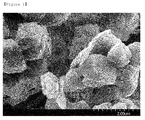
- FIG. 1 is a scanning electronic microscope (SEM) photograph of an oxygen-selective adsorbent prepared in Example 1 of the present invention.
- FIG. 2 is a scanning electronic microscope (SEM) photograph of an oxygen-selective adsorbent prepared in Example 2 of the present invention.
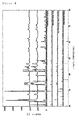
- FIG. 3 is an x-ray diffraction (XRD) pattern of the oxygen-selective adsorbent prepared in Example 1 of the present invention.
- FIG. 4 is an x-ray diffraction (XRD) pattern of the oxygen-selective adsorbent prepared in Example 2 of the present invention.
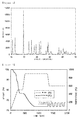
- FIG. 5 is a graph showing results obtained by performing oxygen adsorption and desorption on the oxygen-selective adsorbent prepared in Example 1 of the present invention.
- FIG. 6 is a graph comparing adsorption rates of the oxygen-selective adsorbents prepared in Examples 1 and 2 of the present invention and an oxygen-selective adsorbent prepared in Comparative Example 1 with one another.
- Aqueous ammonia was slowly added to the solution subjected to the ultrasonic treatment to form Mg(OH) 2 coated on BaMg(CO 3 ) 2 . Then, a SEM photograph thereof was photographed and shown in FIG. 2 , and an XRD pattern thereof was measured and shown in FIG. 4 . The obtained particles were fired in an electric furnace at 900°C under oxygen atmosphere for 10 hours, thereby preparing an oxygen-selective adsorbent according to the present invention.
- a predetermined amount of barium peroxide which is a barium precursor, was uniformly dispersed in a solution in which 30cc of a magnesium methoxide solution (6 to 10 wt.%) and 20cc of methanol were mixed with each other, and then a small amount of distilled water was slowly added thereto. Thereafter, water was added thereto to perform gelation of the solution. This gel was dried at 40°C for 3 hours, methanol was removed therefrom at 80°C, and sintering was performed at 900°C, thereby obtaining a final oxygen adsorbent.
- FIGS. 1 and 2 are the SEM photographs of the oxygen-selective adsorbents prepared in Examples 1 and 2, respectively.
- BaMg(CO 3 ) 2 particles having an angled rectangular shape were prepared in Example 1
- particles having a shape in which flake Mg(OH) 2 was attached to BaMg(CO 3 ) 2 so as to enclose BaMg(CO 3 ) 2 were prepared. It was observed that sizes of the BaMg(CO 3 ) 2 particles or the particles in which Mg(OH) 2 are attached to the outside of BaMg(CO 3 ) 2 prepared in Examples 1 and 2, respectively, were about 1 to 5 microns.
- FIGS. 3 and 4 show the results obtained by performing X-ray diffraction analysis on the oxygen-selective adsorbents prepared in Examples 1 and 2, respectively.
- characteristic peaks of a BaMg(CO 3 ) 2 crystal were observed at 21°C, 22°C, and 29.5°C, and the like. This crystal was fired at 500°C or 700°C, the peak of the BaMg(CO 3 ) 2 crystal disappeared, and a peak of BaCO 3 was observed.
- FIG. 4 shows the XRD peak of the adsorbent prepared in Example 2, and it may be observed that the BaMg(CO 3 ) 2 crystal was formed in Example 2.
- FIG. 5 shows results obtained by observing oxygen adsorption and desorption characteristics of the oxygen-selective adsorbent prepared in Example 1 using thermal gravimetric analysis (TGA).
- TGA thermal gravimetric analysis
- FIG. 5 show results obtained by measuring the oxygen adsorption and desorption characteristics while repeating oxygen injection-helium injection. It may be appreciated that an oxygen adsorption amount was significantly stably maintained.
- the oxygen adsorption amount measured in the present Experimental Example was 1.9mmol/g.
- Fig. 6 shows results obtained by comparing adsorption rates of the oxygen-selective adsorbents prepared in Examples 1 and 2 of the present invention and adsorption and desorption rates of the oxygen-selective adsorbent prepared in Comparative Example 1 with one another.
- an X axis indicates time
- a Y axis indicates a ratio of an absorption amount to a saturated adsorption amount. Comparing times consumed until an amount of adsorbed oxygen was 0.8 of the saturated adsorption amount, it was observed that in Examples 1 and 2, approximately 2 minutes were consumed in adsorbing 80% of the saturated adsorption amount. However, approximately 8 minutes were consumed in the adsorbent prepared in Comparative Example 1. Therefore, it may be appreciated that the adsorbent according to the present invention had a faster adsorption rate.
Landscapes
- Chemical & Material Sciences (AREA)
- Organic Chemistry (AREA)
- Chemical Kinetics & Catalysis (AREA)
- Analytical Chemistry (AREA)
- Inorganic Chemistry (AREA)
- Geology (AREA)
- Life Sciences & Earth Sciences (AREA)
- Physics & Mathematics (AREA)
- Thermal Sciences (AREA)
- Oil, Petroleum & Natural Gas (AREA)
- General Chemical & Material Sciences (AREA)
- Engineering & Computer Science (AREA)
- Solid-Sorbent Or Filter-Aiding Compositions (AREA)
Abstract
Description
- The present invention relates to an oxygen-selective adsorbent capable of adsorbing oxygen in the air at a fast rate to produce high-purity oxygen and a preparation method thereof, and more particularly, to an oxygen-selective adsorbent prepared by sintering BaMg(CO3)2 particles or particles in which MgCO3 or Mg(OH)2 are attached to the outside of BaMg(CO3)2 at a high temperature, and a preparation method thereof.
- Barium oxide has been well known as a material that reacts with oxygen to thereby be converted into barium peroxide through an oxidation reaction shown in Chemical Formula 1, adsorbing oxygen during this process, and releasing oxygen through a reduction reaction under oxygenfree atmosphere. Due to these properties of barium oxide, barium oxide has been used in a process of producing oxygen in the early 20th century.
-

- However, since barium peroxide does not have thermal stability at a high temperature, barium peroxide tends to lose oxygen adsorptivity while a cycle progresses. In more detail, barium peroxide is a significantly thermally unstable material, such that a sintering phenomenon between particles thereof may be generated at a high temperature. Therefore, a size of the particle may be increased, and oxygen adsorptivity may be gradually lost as a process progresses. In order to prepare oxygen-selective adsorbent capable of maintaining adsorptivity, this phenomenon should be blocked. In addition, since barium peroxide easily reacts with another mineral or metal component due to excellent reactivity to thereby lose a binding property with oxygen, there is a need for making a structure capable of stably protecting a barium component (barium oxide) selectively adsorbing oxygen.
- Various methods for solving this problem have been attempted, and among them, a method of fixing barium oxide to dolomite to increase a use-rate and reactivity has been disclosed in
US Patent Nos. 3,773,680 and3,903,010 . In the method disclosed inUS Patent Nos. 3,773,680 and3,903,010 , an oxygen-selective adsorbent was prepared by simply mixing barium oxide and a solid dolomite with each other to be used to produce forming method to pellet with high pressure. - It is disclosed in
US Patent No. 4,092,264 that an oxygen adsorbent capable of increasing a use-rate of barium and having improved stability may be prepared by impregnating barium oxide with zirconia. A method of impregnating barium oxide disclosed inUS Patent No. 4,092,264 is as follows. First, porous zirconia is fired at a high temperature to remove impurities, mixed with barium peroxide, and then the obtained mixture is heated to allow barium peroxide to be impregnated with zirconia. According to the Patent, in the case of impregnating barium peroxide with zirconia by the above-mentioned method, thermal stability may be increased, and heat generated in an oxidation reaction with oxygen at the time of performing an oxygen producing process may be effectively stored and used at the time of performing a reduction process, such that efficiency of the process may be increased. Here, when barium is impregnated with zirconia at a level of 20% or less, stability may be maximally implemented, and the use-rate of barium may be increased. - According to the Patents, a method of mixing or impregnating barium peroxide with a third substrate mainly in a dried state has been used. However, in the case of using the method of mixing barium peroxide with the third substrate, a non-uniform protective film is formed, such that a use-rate of barium oxide may not be high, and in the case of impregnating barium peroxide with the third substrate, since a material acting as the substrate is required in excessive amounts, it may be impossible to develop a material having high oxygen adsorptivity.
- As another method, after barium oxide and a precursor of magnesium oxide (aqueous magnesium salt) are appropriately mixed in an aqueous solution, barium oxide may be captured in a framework of magnesium oxide by inducing evaporation of water to form precipitates and being subjected to a sintering process at a high temperature. However, in this method, barium oxide reacts with water during the sintering process to form barium hydroxide, which has low stability and high reactivity, such that it is not easy to perform the sintering process, and oxygen adsorptivity may be decreased after sintering.
- An object of the present invention is to provide an oxygen-selective adsorbent capable of adsorbing oxygen in the air at a fast rate as compared with an existing oxygen-selective adsorbent and having high thermal stability and excellent oxygen adsorptivity, and a preparation method thereof.
- The present inventors studied on an oxygen-selective adsorbent and found that in the case of sintering BaMg(CO3)2 particles or particles in which MgCO3 or Mg (OH) 2 are attached to the outside of BaMg(CO3)2 at a high temperature, as BaCO3 and MgCO3 in BaMg(CO3)2 are converted into barium oxide and magnesium oxide, respectively, barium oxide and magnesium oxide having a nano-size are formed and an oxygen adsorption rate is increased, thereby completing the present invention.
- In one general aspect, a preparation method of an oxygen-selective adsorbent selectively adsorbing oxygen in the air, the preparation method includes: preparing BaMg(CO3)2 particles or particles in which MgCO3 or Mg(OH)2 are attached to the outside of BaMg(CO3)2; and burning the particles at a high temperature.
- Hereinafter, the preparation method of an oxygen-selective adsorbent according to the present invention will be described in detail.
- First, the BaMg(CO3)2 particles or particles in which MgCO3 or Mg(OH)2 are attached to the outside of BaMg(CO3)2 may be prepared.
- BaMg(CO3)2, which is a solid solution of BaCO3 and MgCO3, is discovered in natural minerals and referred to as norsethite. As a synthetic method of this material, there are various methods. For example, a method of mixing BaCO3 and MgCO3 particles at a high temperature and sintering the mixture at 500°C or more to prepare this material, a method of synthesizing BaCO3 in an aqueous solution of MgCl2 and NaHCO3, a method of using MgCO3·3H2O instead of MgCl2 as a source of Mg2+ in the synthetic method in the aqueous solution, a method of adding
CO 32- in an aqueous solution in which Ba2+ and Mg2+ are present, and the like, have been known. - According to the embodiment of the present invention, the BaMg(CO3)2 particles may be prepared by dispersing a mixture of a compound containing barium and carbonate in distilled water and adding a magnesium carbonate precursor thereto or prepared by another method.
- According to the embodiment of the present invention, the particles in which MgCO3 or Mg(OH)2 are attached to the outside of BaMg(CO3)2 may be prepared by dispersing a mixture of a compound containing barium and carbonate in distilled water, adding a magnesium carbonate precursor to prepare particles, filtering and washing the prepared particles to disperse the resultants in distilled water again, adding the magnesium carbonate precursor thereto, performing ultrasonic treatment, and then adding aqueous ammonia water, or prepared by another method.
- MgCO3 or Mg(OH)2 in the particles in which MgCO3 or Mg(OH)2 are attached to the outside of BaMg(CO3)2 may be preferably attached to the outside of BaMg(CO3)2 at a molar ratio of 1 to 10 based on BaMg(CO3)2.
- In the case of sintering the particles in which MgCO3 or Mg(OH)2 are attached to the outside of BaMg(CO3)2 at a high temperature to prepare the oxygen-selective adsorbent, the oxygen-selective adsorbent having excellent thermal stability may be obtained.
- According to the embodiment of the present invention, the compound containing barium may be BaCO3 or BaCl2, but is not limited thereto.
- According to the embodiment of the present invention, as the carbonate mixed with the compound containing barium, carbonate containing a CO3 2- source such as Na2CO3, or the like, may be used without limitation.
- According to the embodiment of the present invention, the magnesium carbonate precursor may be Mg(NO3)2·6H2O or MgCO3·3H2O, but is not necessarily limited thereto.
- Next, the prepared BaMg(CO3)2 particles or the particles in which MgCO3 or Mg(OH)2 are attached to the outside of BaMg(CO3)2 may be fired at a high temperature.
- According to the embodiment of the present invention, the particles in which MgCO3 or Mg(OH)2 are attached to the outside of BaMg(CO3)2 may be fired at 700-800°C under hydrogen atmosphere or at 900 to 1200°C under oxygen atmosphere.
- As described above, in the case of sintering the BaMg(CO3)2 particles or the particles in which MgCO3 or Mg(OH)2 are attached to the outside of BaMg(CO3)2, MgCO3 existing in BaMg(CO3)2 may be easily oxidized at 500°C or less to thereby be converted into magnesium oxide, but BaCO3 may be converted into barium oxide only at 900°C or more under oxygen atmosphere or at 800°C or less under hydrogen atmosphere.
- In another general aspect, there is provided an oxygen-selective adsorbent prepared by the preparation method as described above.
- According to the present invention, an oxygen-selective adsorbent capable of adsorbing oxygen in the air at a fast rate and having high thermal stability and excellent oxygen adsorptivity, and a preparation method thereof may be provided.
-
FIG. 1 is a scanning electronic microscope (SEM) photograph of an oxygen-selective adsorbent prepared in Example 1 of the present invention. -
FIG. 2 is a scanning electronic microscope (SEM) photograph of an oxygen-selective adsorbent prepared in Example 2 of the present invention. -
FIG. 3 is an x-ray diffraction (XRD) pattern of the oxygen-selective adsorbent prepared in Example 1 of the present invention. -
FIG. 4 is an x-ray diffraction (XRD) pattern of the oxygen-selective adsorbent prepared in Example 2 of the present invention. -
FIG. 5 is a graph showing results obtained by performing oxygen adsorption and desorption on the oxygen-selective adsorbent prepared in Example 1 of the present invention. -
FIG. 6 is a graph comparing adsorption rates of the oxygen-selective adsorbents prepared in Examples 1 and 2 of the present invention and an oxygen-selective adsorbent prepared in Comparative Example 1 with one another. - Hereinafter, even though preferable Examples will be provided for assisting in understanding of the present invention, but the following Examples are to illustrate the present invention. Therefore, those skilled in the art will appreciate that various modifications and alterations are possible within the scope and spirit of the invention, and such modifications and alterations should also be understood to fall within the scope of the present invention.
- <Example>
- Example 1
- After a mixture of 8g of BaCO3 and 8g of Na2CO3 was dispersed in 200cc of distilled water, a solution in which magnesium nitrate (Mg(NO3)2·6H2O, 20g) was dissolved in 100cc of distilled water was slowly added thereto, thereby preparing particles (a molar ratio of Ba:Mg was 0.5:1). In this case, a solution in which BaCO3 and Na2CO3 were dissolved was maintained at 90°C. Thereafter, the obtained BaMg(CO3)2 particles were collected through a filtering and washing process. Next, a SEM photograph of the collected particles was photographed and shown in
FIG. 1 , and an XRD pattern thereof was measured and shown inFIG. 3 . The obtained particles were fired in an electric furnace at 900°C under oxygen atmosphere for 10 hours, thereby preparing an oxygen-selective adsorbent according to the present invention. - Example 2
- After a mixture of 8g of BaCO3 and 4g of Na2CO3 was dispersed in 200cc of distilled water, a solution in which magnesium nitrate (Mg(NO3)2·6H2O, 10g) was dissolved in 100cc of distilled water was slowly added thereto, thereby preparing particles (a molar ratio of Ba:Mg was 1:1). In this case, a solution in which BaCO3 and Na2CO3 were dissolved was maintained at 90°C. Then, the obtained particles were filtered and washed. 5g of the particles obtained through this process was dispersed in distilled water (100cc), and then 10g of magnesium nitrate was dissolved in this solution and subjected to ultrasonic treatment. Aqueous ammonia was slowly added to the solution subjected to the ultrasonic treatment to form Mg(OH)2 coated on BaMg(CO3)2. Then, a SEM photograph thereof was photographed and shown in
FIG. 2 , and an XRD pattern thereof was measured and shown inFIG. 4 . The obtained particles were fired in an electric furnace at 900°C under oxygen atmosphere for 10 hours, thereby preparing an oxygen-selective adsorbent according to the present invention. - Comparative Example 1
- A predetermined amount of barium peroxide, which is a barium precursor, was uniformly dispersed in a solution in which 30cc of a magnesium methoxide solution (6 to 10 wt.%) and 20cc of methanol were mixed with each other, and then a small amount of distilled water was slowly added thereto. Thereafter, water was added thereto to perform gelation of the solution. This gel was dried at 40°C for 3 hours, methanol was removed therefrom at 80°C, and sintering was performed at 900°C, thereby obtaining a final oxygen adsorbent.
- Experimental Example 1 - Observation of scanning electronic microscope (SEM) photograph
-
FIGS. 1 and2 are the SEM photographs of the oxygen-selective adsorbents prepared in Examples 1 and 2, respectively. Referring toFIG. 1 , it may be appreciated that BaMg(CO3)2 particles having an angled rectangular shape were prepared in Example 1, and referring toFIG. 2 , it may be appreciated that particles having a shape in which flake Mg(OH)2 was attached to BaMg(CO3)2 so as to enclose BaMg(CO3)2 were prepared. It was observed that sizes of the BaMg(CO3)2 particles or the particles in which Mg(OH)2 are attached to the outside of BaMg(CO3)2 prepared in Examples 1 and 2, respectively, were about 1 to 5 microns. - Experimental Example 2 - X-ray diffraction analysis
-
FIGS. 3 and4 show the results obtained by performing X-ray diffraction analysis on the oxygen-selective adsorbents prepared in Examples 1 and 2, respectively. Results obtained by sintering the BaMg(CO3)2 particles prepared in Example 1 at a high temperature of 500°C or 700°C, and performing the X-ray diffraction analysis, respectively, were also shown InFIG. 3 . Referring toFIG. 3 , characteristic peaks of a BaMg(CO3)2 crystal were observed at 21°C, 22°C, and 29.5°C, and the like. This crystal was fired at 500°C or 700°C, the peak of the BaMg(CO3)2 crystal disappeared, and a peak of BaCO3 was observed.FIG. 4 shows the XRD peak of the adsorbent prepared in Example 2, and it may be observed that the BaMg(CO3)2 crystal was formed in Example 2. - Experimental Example 3 - Experiment of longterm adsorption/desorption characteristics of oxygen-selective adsorbent
-
FIG. 5 shows results obtained by observing oxygen adsorption and desorption characteristics of the oxygen-selective adsorbent prepared in Example 1 using thermal gravimetric analysis (TGA). After the particles prepared in Example 1 were loaded on a TGA sample loader, a temperature was raised to 500°C under oxygen atmosphere and then maintained for 3 hours. During this process, as MgCO3 in BaMg(CO3)2 was converted into MgO, a weight was decreased, and BaCO3 was present in the crystal. When a temperature of the prepared sample was raised again to 900°C, BaCO3 was converted into BaO. When this sample was cooled to 600°C under oxygen atmosphere, oxygen was adsorbed to increase the weight, and when the atmosphere was changed to helium atmosphere after saturated adsorption, oxygen was desorbed.FIG. 5 show results obtained by measuring the oxygen adsorption and desorption characteristics while repeating oxygen injection-helium injection. It may be appreciated that an oxygen adsorption amount was significantly stably maintained. The oxygen adsorption amount measured in the present Experimental Example was 1.9mmol/g. - Experimental Example 4 - Adsorption/desorption rate of oxygen-selective adsorbent
-
Fig. 6 shows results obtained by comparing adsorption rates of the oxygen-selective adsorbents prepared in Examples 1 and 2 of the present invention and adsorption and desorption rates of the oxygen-selective adsorbent prepared in Comparative Example 1 with one another. InFIG. 6 , an X axis indicates time, and a Y axis indicates a ratio of an absorption amount to a saturated adsorption amount. Comparing times consumed until an amount of adsorbed oxygen was 0.8 of the saturated adsorption amount, it was observed that in Examples 1 and 2, approximately 2 minutes were consumed in adsorbing 80% of the saturated adsorption amount. However, approximately 8 minutes were consumed in the adsorbent prepared in Comparative Example 1. Therefore, it may be appreciated that the adsorbent according to the present invention had a faster adsorption rate.
Claims (11)
- A preparation method of an oxygen-selective adsorbent selectively adsorbing oxygen in the air, the preparation method comprising:preparing BaMg(CO3)2 particles or particles in which MgCO3 or Mg(OH)2 2 are attached to the outside of BaMg(CO3)2; andsintering the particles at a high temperature.
- The preparation method of claim 1, wherein in the particles in which MgCO3 or Mg(OH)2 are attached to the outside of BaMg(CO3)2, MgCO3 or Mg(OH)2 are attached to the outside of BaMg(CO3)2 at a molar ratio of 1 to 10 based on BaMg (CO3)2.
- The preparation method of claim 1, wherein the BaMg(CO3)2 particles are prepared by dispersing a mixture of a compound containing barium and carbonate in distilled water and adding a magnesium carbonate precursor thereto.
- The preparation method of claim 1, wherein the particles in which MgCO3 or Mg(OH)2 are attached to the outside of BaMg(CO3)2, are prepared by dispersing a mixture of a compound containing barium and carbonate in distilled water, adding a magnesium carbonate precursor thereto to obtain particles, filtering and washing the obtained particles, dispersing the washed particles in distilled water again, adding the magnesium carbonate precursor thereto, performing a ultrasonic treatment, and then adding aqueous ammonia thereto.
- The preparation method of claim 3 or 4, wherein the compound containing barium is BaCO3 or BaCl2.
- The preparation method of claim 3 or 4, wherein the carbonate is Na2CO3.
- The preparation method of claim 3 or 4, wherein the magnesium carbonate precursor is Mg(NO3)2 · 6H20 or MgC03 · 3H2O.
- The preparation method of claim 1, wherein the sintering of the BaMg(CO3)2 particles or the particles in which MgCO3 or Mg(OH)2 are attached to the outside of BaMg(CO3)2 at a high temperature is performed at 900 to 1200°C under oxygen atmosphere.
- The preparation method of claim 1, wherein the sintering of the BaMg(CO3)2 particles or the particles in which MgCO3 or Mg(OH)2 are attached to the outside of BaMg(CO3)2 at a high temperature is performed at 700 to 800°C under hydrogen atmosphere.
- An oxygen-selective adsorbent in which magnesium oxide is formed on the outside of barium oxide, the oxygen-selective adsorbent prepared by sintering BaMg(CO3)2 particles or particles in which MgCO3 or Mg(OH)2 are attached to the outside of BaMg(CO3)2 at a high temperature.
- The oxygen-selective adsorbent of claim 10, wherein in the particles in which MgCO3 or Mg(OH)2 are attached to the outside of BaMg(CO3)2, MgCO3 or Mg(OH)2 are formed to the outside of BaMg(CO3)2 at a molar ratio of 1 to 10 based on BaMg(CO3)2.
Applications Claiming Priority (2)
| Application Number | Priority Date | Filing Date | Title |
|---|---|---|---|
| KR1020110007915A KR101189593B1 (en) | 2011-01-26 | 2011-01-26 | Oxygen adsorbent having high sorption rate for oxygen and preparation method thereof |
| PCT/KR2012/000610 WO2012102554A2 (en) | 2011-01-26 | 2012-01-26 | Oxygen-selective adsorbent having fast adsorption rate and preparation method thereof |
Publications (3)
| Publication Number | Publication Date |
|---|---|
| EP2669003A2 true EP2669003A2 (en) | 2013-12-04 |
| EP2669003A4 EP2669003A4 (en) | 2017-12-20 |
| EP2669003B1 EP2669003B1 (en) | 2019-01-23 |
Family
ID=46581288
Family Applications (1)
| Application Number | Title | Priority Date | Filing Date |
|---|---|---|---|
| EP12739507.7A Active EP2669003B1 (en) | 2011-01-26 | 2012-01-26 | Preparation method of an oxygen-selective adsorbent having fast adsorption rate |
Country Status (4)
| Country | Link |
|---|---|
| US (1) | US9192911B2 (en) |
| EP (1) | EP2669003B1 (en) |
| KR (1) | KR101189593B1 (en) |
| WO (1) | WO2012102554A2 (en) |
Cited By (1)
| Publication number | Priority date | Publication date | Assignee | Title |
|---|---|---|---|---|
| EP2818239A3 (en) * | 2013-06-28 | 2015-01-21 | Korea Institute of Energy Research | Oxygen selective adsorbent for easy desorption and preparation method thereof |
Families Citing this family (6)
| Publication number | Priority date | Publication date | Assignee | Title |
|---|---|---|---|---|
| US7810743B2 (en) | 2006-01-23 | 2010-10-12 | Kimberly-Clark Worldwide, Inc. | Ultrasonic liquid delivery device |
| US9283188B2 (en) * | 2006-09-08 | 2016-03-15 | Kimberly-Clark Worldwide, Inc. | Delivery systems for delivering functional compounds to substrates and processes of using the same |
| KR101554496B1 (en) * | 2013-06-28 | 2015-09-22 | 한국에너지기술연구원 | Oxygen adsorbent and preparation method thereof |
| US11167260B2 (en) | 2013-06-28 | 2021-11-09 | Korea Institute Of Energy Research | Oxygen selective adsorbent for easy desorption and preparation method thereof |
| KR101470594B1 (en) * | 2013-11-22 | 2014-12-10 | (주)제이원텍 | Manufacturing method of catalyst compositions for in-line nitrogen furification system of oled encapsulation process |
| KR101589559B1 (en) * | 2014-09-17 | 2016-01-29 | 한국에너지기술연구원 | Method of Preparation for Oxygen-selective Oxide Adsorbent Using High Pressure Hydrogen Firing |
Family Cites Families (8)
| Publication number | Priority date | Publication date | Assignee | Title |
|---|---|---|---|---|
| US3324654A (en) * | 1966-09-29 | 1967-06-13 | Arthur M Squires | Method and apparatus for producing oxygen and power |
| US3773680A (en) | 1972-04-07 | 1973-11-20 | Cons Natural Gas Svc | Acceptor compositions and method for oxygen enrichment processes |
| US3903010A (en) | 1972-08-03 | 1975-09-02 | Cons Natural Gas Svc | Preparation of oxygen acceptor compositions and oxygen production process |
| US4092264A (en) | 1976-12-27 | 1978-05-30 | The Bendix Corporation | Barium oxide coated zirconia particle for use in an oxygen extractor |
| US5135548A (en) | 1991-05-08 | 1992-08-04 | Air Products And Chemicals, Inc. | Oxygen selective desiccants |
| JP3041662B2 (en) | 1993-06-21 | 2000-05-15 | 三徳金属工業株式会社 | Composite oxide having oxygen absorbing / releasing ability, method for producing the same, and method for using the same |
| US5536302A (en) | 1994-03-23 | 1996-07-16 | Air Products And Chemicals, Inc. | Adsorbent for removal of trace oxygen from inert gases |
| JPH1085589A (en) | 1996-09-18 | 1998-04-07 | Tosoh Corp | Adsorbent for air separation and method for producing oxygen gas using the same |
-
2011
- 2011-01-26 KR KR1020110007915A patent/KR101189593B1/en not_active Expired - Fee Related
-
2012
- 2012-01-26 EP EP12739507.7A patent/EP2669003B1/en active Active
- 2012-01-26 US US13/980,094 patent/US9192911B2/en active Active
- 2012-01-26 WO PCT/KR2012/000610 patent/WO2012102554A2/en not_active Ceased
Non-Patent Citations (1)
| Title |
|---|
| See references of WO2012102554A2 * |
Cited By (1)
| Publication number | Priority date | Publication date | Assignee | Title |
|---|---|---|---|---|
| EP2818239A3 (en) * | 2013-06-28 | 2015-01-21 | Korea Institute of Energy Research | Oxygen selective adsorbent for easy desorption and preparation method thereof |
Also Published As
| Publication number | Publication date |
|---|---|
| WO2012102554A2 (en) | 2012-08-02 |
| KR20120099316A (en) | 2012-09-10 |
| EP2669003A4 (en) | 2017-12-20 |
| WO2012102554A3 (en) | 2012-09-20 |
| EP2669003B1 (en) | 2019-01-23 |
| US20130299737A1 (en) | 2013-11-14 |
| US9192911B2 (en) | 2015-11-24 |
| KR101189593B1 (en) | 2012-10-12 |
Similar Documents
| Publication | Publication Date | Title |
|---|---|---|
| EP2669003B1 (en) | Preparation method of an oxygen-selective adsorbent having fast adsorption rate | |
| Niu et al. | Lithium orthosilicate with halloysite as silicon source for high temperature CO 2 capture | |
| CN102271803B (en) | A method of preparing an adsorbent for CO2 capture at high temperature | |
| JP5720848B2 (en) | Method for producing polyhedral α-alumina fine particles | |
| JP5457962B2 (en) | Carbon dioxide capture material | |
| CN103962087A (en) | A surface-coated modified nano-calcium oxide-based CO2 adsorbent and preparation method thereof | |
| KR101770701B1 (en) | Carbon dioxide adsorbent comprising barium titanate, carbondioxide capture module comprising the same, and methods for separating carbondioxide using the same | |
| JP6223354B2 (en) | Composite oxide, method for producing the same, and catalyst for purification of exhaust gas | |
| JP6242807B2 (en) | Composite oxide, method for producing the same, and catalyst for exhaust gas purification | |
| JP2015020090A (en) | Manufacturing method of lithium-adsorbing material, and lithium-adsorbing material | |
| Rao et al. | Synthesis, CO2 absorption property and densification of Li4SiO4 powder by glycine-nitrate solution combustion method and its comparison with solid state method | |
| Ryu et al. | Improvement of lithium adsorption capacity of porous cylinder-type lithium manganese oxide through introduction of additive | |
| JP2020059630A (en) | Oxygen storage material and manufacturing method thereof | |
| CN103785347A (en) | Composite oxide adsorbent for the adsorption of medium and high temperature CO2 | |
| Niu et al. | Controlled synthesis of luminescent F-substituted strontium hydroxyapatite with hierarchical structures for drug delivery | |
| JP3938212B2 (en) | Carbon dioxide absorbent, carbon dioxide separation method using the same, and carbon dioxide separator | |
| CN117181183B (en) | A method for preparing low-cost calcium oxide spinel carbon dioxide capture material | |
| Zhang et al. | In situ growth of ZnO nanorod arrays on cotton cloth for the removal of uranium (vi) | |
| CN117884136A (en) | A Cu1/CeO2 single-atom catalyst and preparation method thereof | |
| Zhao et al. | The preparation of MgO nanopowders synthesized via an improved polyacrylamide gel method | |
| Cho et al. | Large-scale production of fine-sized Zn 2 SiO 4: Mn phosphor microspheres with a dense structure and good photoluminescence properties by a spray-drying process | |
| JP6450446B2 (en) | Lithium adsorption material manufacturing method and lithium adsorption material | |
| KR20110054992A (en) | Oxygen selective adsorbent having high thermal stability and oxygen adsorption capacity and preparation method thereof | |
| Qiao et al. | LDH/MgCO 3 hybrid multilayer on an aluminium substrate as a novel high-temperature CO 2 adsorbent | |
| WO2018109823A1 (en) | Strontium ion adsorbent and production method therefor |
Legal Events
| Date | Code | Title | Description |
|---|---|---|---|
| PUAI | Public reference made under article 153(3) epc to a published international application that has entered the european phase |
Free format text: ORIGINAL CODE: 0009012 |
|
| 17P | Request for examination filed |
Effective date: 20130726 |
|
| AK | Designated contracting states |
Kind code of ref document: A2 Designated state(s): AL AT BE BG CH CY CZ DE DK EE ES FI FR GB GR HR HU IE IS IT LI LT LU LV MC MK MT NL NO PL PT RO RS SE SI SK SM TR |
|
| DAX | Request for extension of the european patent (deleted) | ||
| A4 | Supplementary search report drawn up and despatched |
Effective date: 20171121 |
|
| RIC1 | Information provided on ipc code assigned before grant |
Ipc: B01J 20/32 20060101ALI20171115BHEP Ipc: C01B 13/08 20060101ALI20171115BHEP Ipc: B01J 20/04 20060101AFI20171115BHEP Ipc: B01D 53/18 20060101ALI20171115BHEP Ipc: C01F 11/18 20060101ALI20171115BHEP Ipc: C01F 5/00 20060101ALI20171115BHEP Ipc: B01J 20/30 20060101ALI20171115BHEP Ipc: C01F 1/00 20060101ALI20171115BHEP Ipc: C01F 11/08 20060101ALI20171115BHEP Ipc: C01F 11/06 20060101ALI20171115BHEP |
|
| REG | Reference to a national code |
Ref country code: DE Ref legal event code: R079 Ref document number: 602012056197 Country of ref document: DE Free format text: PREVIOUS MAIN CLASS: B01J0020040000 Ipc: B01D0053020000 |
|
| GRAP | Despatch of communication of intention to grant a patent |
Free format text: ORIGINAL CODE: EPIDOSNIGR1 |
|
| RIC1 | Information provided on ipc code assigned before grant |
Ipc: C01B 13/08 20060101ALI20180904BHEP Ipc: C01F 11/08 20060101ALI20180904BHEP Ipc: C01F 11/06 20060101ALI20180904BHEP Ipc: C01F 1/00 20060101ALI20180904BHEP Ipc: B01J 20/32 20060101ALI20180904BHEP Ipc: B01D 53/18 20060101ALI20180904BHEP Ipc: C01F 5/00 20060101ALI20180904BHEP Ipc: C01F 11/18 20060101ALI20180904BHEP Ipc: B01D 53/02 20060101AFI20180904BHEP Ipc: B01J 20/30 20060101ALI20180904BHEP Ipc: B01J 20/04 20060101ALI20180904BHEP |
|
| STAA | Information on the status of an ep patent application or granted ep patent |
Free format text: STATUS: GRANT OF PATENT IS INTENDED |
|
| INTG | Intention to grant announced |
Effective date: 20181011 |
|
| GRAS | Grant fee paid |
Free format text: ORIGINAL CODE: EPIDOSNIGR3 |
|
| GRAA | (expected) grant |
Free format text: ORIGINAL CODE: 0009210 |
|
| STAA | Information on the status of an ep patent application or granted ep patent |
Free format text: STATUS: THE PATENT HAS BEEN GRANTED |
|
| AK | Designated contracting states |
Kind code of ref document: B1 Designated state(s): AL AT BE BG CH CY CZ DE DK EE ES FI FR GB GR HR HU IE IS IT LI LT LU LV MC MK MT NL NO PL PT RO RS SE SI SK SM TR |
|
| REG | Reference to a national code |
Ref country code: GB Ref legal event code: FG4D |
|
| REG | Reference to a national code |
Ref country code: CH Ref legal event code: EP |
|
| REG | Reference to a national code |
Ref country code: AT Ref legal event code: REF Ref document number: 1090987 Country of ref document: AT Kind code of ref document: T Effective date: 20190215 |
|
| REG | Reference to a national code |
Ref country code: IE Ref legal event code: FG4D |
|
| REG | Reference to a national code |
Ref country code: DE Ref legal event code: R096 Ref document number: 602012056197 Country of ref document: DE |
|
| REG | Reference to a national code |
Ref country code: NL Ref legal event code: MP Effective date: 20190123 |
|
| PG25 | Lapsed in a contracting state [announced via postgrant information from national office to epo] |
Ref country code: NL Free format text: LAPSE BECAUSE OF FAILURE TO SUBMIT A TRANSLATION OF THE DESCRIPTION OR TO PAY THE FEE WITHIN THE PRESCRIBED TIME-LIMIT Effective date: 20190123 |
|
| PG25 | Lapsed in a contracting state [announced via postgrant information from national office to epo] |
Ref country code: NO Free format text: LAPSE BECAUSE OF FAILURE TO SUBMIT A TRANSLATION OF THE DESCRIPTION OR TO PAY THE FEE WITHIN THE PRESCRIBED TIME-LIMIT Effective date: 20190423 Ref country code: FI Free format text: LAPSE BECAUSE OF FAILURE TO SUBMIT A TRANSLATION OF THE DESCRIPTION OR TO PAY THE FEE WITHIN THE PRESCRIBED TIME-LIMIT Effective date: 20190123 Ref country code: PL Free format text: LAPSE BECAUSE OF FAILURE TO SUBMIT A TRANSLATION OF THE DESCRIPTION OR TO PAY THE FEE WITHIN THE PRESCRIBED TIME-LIMIT Effective date: 20190123 Ref country code: LT Free format text: LAPSE BECAUSE OF FAILURE TO SUBMIT A TRANSLATION OF THE DESCRIPTION OR TO PAY THE FEE WITHIN THE PRESCRIBED TIME-LIMIT Effective date: 20190123 Ref country code: PT Free format text: LAPSE BECAUSE OF FAILURE TO SUBMIT A TRANSLATION OF THE DESCRIPTION OR TO PAY THE FEE WITHIN THE PRESCRIBED TIME-LIMIT Effective date: 20190523 Ref country code: ES Free format text: LAPSE BECAUSE OF FAILURE TO SUBMIT A TRANSLATION OF THE DESCRIPTION OR TO PAY THE FEE WITHIN THE PRESCRIBED TIME-LIMIT Effective date: 20190123 Ref country code: SE Free format text: LAPSE BECAUSE OF FAILURE TO SUBMIT A TRANSLATION OF THE DESCRIPTION OR TO PAY THE FEE WITHIN THE PRESCRIBED TIME-LIMIT Effective date: 20190123 |
|
| REG | Reference to a national code |
Ref country code: AT Ref legal event code: MK05 Ref document number: 1090987 Country of ref document: AT Kind code of ref document: T Effective date: 20190123 |
|
| PG25 | Lapsed in a contracting state [announced via postgrant information from national office to epo] |
Ref country code: LV Free format text: LAPSE BECAUSE OF FAILURE TO SUBMIT A TRANSLATION OF THE DESCRIPTION OR TO PAY THE FEE WITHIN THE PRESCRIBED TIME-LIMIT Effective date: 20190123 Ref country code: HR Free format text: LAPSE BECAUSE OF FAILURE TO SUBMIT A TRANSLATION OF THE DESCRIPTION OR TO PAY THE FEE WITHIN THE PRESCRIBED TIME-LIMIT Effective date: 20190123 Ref country code: RS Free format text: LAPSE BECAUSE OF FAILURE TO SUBMIT A TRANSLATION OF THE DESCRIPTION OR TO PAY THE FEE WITHIN THE PRESCRIBED TIME-LIMIT Effective date: 20190123 Ref country code: IS Free format text: LAPSE BECAUSE OF FAILURE TO SUBMIT A TRANSLATION OF THE DESCRIPTION OR TO PAY THE FEE WITHIN THE PRESCRIBED TIME-LIMIT Effective date: 20190523 Ref country code: BG Free format text: LAPSE BECAUSE OF FAILURE TO SUBMIT A TRANSLATION OF THE DESCRIPTION OR TO PAY THE FEE WITHIN THE PRESCRIBED TIME-LIMIT Effective date: 20190423 Ref country code: GR Free format text: LAPSE BECAUSE OF FAILURE TO SUBMIT A TRANSLATION OF THE DESCRIPTION OR TO PAY THE FEE WITHIN THE PRESCRIBED TIME-LIMIT Effective date: 20190424 |
|
| REG | Reference to a national code |
Ref country code: CH Ref legal event code: PL |
|
| PG25 | Lapsed in a contracting state [announced via postgrant information from national office to epo] |
Ref country code: LU Free format text: LAPSE BECAUSE OF NON-PAYMENT OF DUE FEES Effective date: 20190126 |
|
| REG | Reference to a national code |
Ref country code: BE Ref legal event code: MM Effective date: 20190131 |
|
| REG | Reference to a national code |
Ref country code: DE Ref legal event code: R097 Ref document number: 602012056197 Country of ref document: DE |
|
| REG | Reference to a national code |
Ref country code: IE Ref legal event code: MM4A |
|
| PG25 | Lapsed in a contracting state [announced via postgrant information from national office to epo] |
Ref country code: DK Free format text: LAPSE BECAUSE OF FAILURE TO SUBMIT A TRANSLATION OF THE DESCRIPTION OR TO PAY THE FEE WITHIN THE PRESCRIBED TIME-LIMIT Effective date: 20190123 Ref country code: AL Free format text: LAPSE BECAUSE OF FAILURE TO SUBMIT A TRANSLATION OF THE DESCRIPTION OR TO PAY THE FEE WITHIN THE PRESCRIBED TIME-LIMIT Effective date: 20190123 Ref country code: MC Free format text: LAPSE BECAUSE OF FAILURE TO SUBMIT A TRANSLATION OF THE DESCRIPTION OR TO PAY THE FEE WITHIN THE PRESCRIBED TIME-LIMIT Effective date: 20190123 Ref country code: IT Free format text: LAPSE BECAUSE OF FAILURE TO SUBMIT A TRANSLATION OF THE DESCRIPTION OR TO PAY THE FEE WITHIN THE PRESCRIBED TIME-LIMIT Effective date: 20190123 Ref country code: RO Free format text: LAPSE BECAUSE OF FAILURE TO SUBMIT A TRANSLATION OF THE DESCRIPTION OR TO PAY THE FEE WITHIN THE PRESCRIBED TIME-LIMIT Effective date: 20190123 Ref country code: SK Free format text: LAPSE BECAUSE OF FAILURE TO SUBMIT A TRANSLATION OF THE DESCRIPTION OR TO PAY THE FEE WITHIN THE PRESCRIBED TIME-LIMIT Effective date: 20190123 Ref country code: CZ Free format text: LAPSE BECAUSE OF FAILURE TO SUBMIT A TRANSLATION OF THE DESCRIPTION OR TO PAY THE FEE WITHIN THE PRESCRIBED TIME-LIMIT Effective date: 20190123 Ref country code: EE Free format text: LAPSE BECAUSE OF FAILURE TO SUBMIT A TRANSLATION OF THE DESCRIPTION OR TO PAY THE FEE WITHIN THE PRESCRIBED TIME-LIMIT Effective date: 20190123 |
|
| PG25 | Lapsed in a contracting state [announced via postgrant information from national office to epo] |
Ref country code: SM Free format text: LAPSE BECAUSE OF FAILURE TO SUBMIT A TRANSLATION OF THE DESCRIPTION OR TO PAY THE FEE WITHIN THE PRESCRIBED TIME-LIMIT Effective date: 20190123 Ref country code: BE Free format text: LAPSE BECAUSE OF NON-PAYMENT OF DUE FEES Effective date: 20190131 |
|
| PLBE | No opposition filed within time limit |
Free format text: ORIGINAL CODE: 0009261 |
|
| STAA | Information on the status of an ep patent application or granted ep patent |
Free format text: STATUS: NO OPPOSITION FILED WITHIN TIME LIMIT |
|
| PG25 | Lapsed in a contracting state [announced via postgrant information from national office to epo] |
Ref country code: LI Free format text: LAPSE BECAUSE OF NON-PAYMENT OF DUE FEES Effective date: 20190131 Ref country code: CH Free format text: LAPSE BECAUSE OF NON-PAYMENT OF DUE FEES Effective date: 20190131 Ref country code: AT Free format text: LAPSE BECAUSE OF FAILURE TO SUBMIT A TRANSLATION OF THE DESCRIPTION OR TO PAY THE FEE WITHIN THE PRESCRIBED TIME-LIMIT Effective date: 20190123 |
|
| 26N | No opposition filed |
Effective date: 20191024 |
|
| PG25 | Lapsed in a contracting state [announced via postgrant information from national office to epo] |
Ref country code: IE Free format text: LAPSE BECAUSE OF NON-PAYMENT OF DUE FEES Effective date: 20190126 |
|
| PG25 | Lapsed in a contracting state [announced via postgrant information from national office to epo] |
Ref country code: FR Free format text: LAPSE BECAUSE OF NON-PAYMENT OF DUE FEES Effective date: 20190323 Ref country code: SI Free format text: LAPSE BECAUSE OF FAILURE TO SUBMIT A TRANSLATION OF THE DESCRIPTION OR TO PAY THE FEE WITHIN THE PRESCRIBED TIME-LIMIT Effective date: 20190123 |
|
| PG25 | Lapsed in a contracting state [announced via postgrant information from national office to epo] |
Ref country code: TR Free format text: LAPSE BECAUSE OF FAILURE TO SUBMIT A TRANSLATION OF THE DESCRIPTION OR TO PAY THE FEE WITHIN THE PRESCRIBED TIME-LIMIT Effective date: 20190123 |
|
| PG25 | Lapsed in a contracting state [announced via postgrant information from national office to epo] |
Ref country code: MT Free format text: LAPSE BECAUSE OF NON-PAYMENT OF DUE FEES Effective date: 20190126 |
|
| PG25 | Lapsed in a contracting state [announced via postgrant information from national office to epo] |
Ref country code: CY Free format text: LAPSE BECAUSE OF FAILURE TO SUBMIT A TRANSLATION OF THE DESCRIPTION OR TO PAY THE FEE WITHIN THE PRESCRIBED TIME-LIMIT Effective date: 20190123 |
|
| PG25 | Lapsed in a contracting state [announced via postgrant information from national office to epo] |
Ref country code: HU Free format text: LAPSE BECAUSE OF FAILURE TO SUBMIT A TRANSLATION OF THE DESCRIPTION OR TO PAY THE FEE WITHIN THE PRESCRIBED TIME-LIMIT; INVALID AB INITIO Effective date: 20120126 |
|
| PG25 | Lapsed in a contracting state [announced via postgrant information from national office to epo] |
Ref country code: MK Free format text: LAPSE BECAUSE OF FAILURE TO SUBMIT A TRANSLATION OF THE DESCRIPTION OR TO PAY THE FEE WITHIN THE PRESCRIBED TIME-LIMIT Effective date: 20190123 |
|
| PGFP | Annual fee paid to national office [announced via postgrant information from national office to epo] |
Ref country code: GB Payment date: 20251204 Year of fee payment: 15 |
|
| PGFP | Annual fee paid to national office [announced via postgrant information from national office to epo] |
Ref country code: DE Payment date: 20251203 Year of fee payment: 15 |