EP2666610A1 - Method of manufacturing a shape with a lenticular stereoscopic image from plastic materials on a plastic substrate - Google Patents
Method of manufacturing a shape with a lenticular stereoscopic image from plastic materials on a plastic substrate Download PDFInfo
- Publication number
- EP2666610A1 EP2666610A1 EP12460024.8A EP12460024A EP2666610A1 EP 2666610 A1 EP2666610 A1 EP 2666610A1 EP 12460024 A EP12460024 A EP 12460024A EP 2666610 A1 EP2666610 A1 EP 2666610A1
- Authority
- EP
- European Patent Office
- Prior art keywords
- mould
- lenticular
- shape
- transparent
- plastic
- Prior art date
- Legal status (The legal status is an assumption and is not a legal conclusion. Google has not performed a legal analysis and makes no representation as to the accuracy of the status listed.)
- Withdrawn
Links
- 239000000463 material Substances 0.000 title claims abstract description 40
- 229920003023 plastic Polymers 0.000 title claims abstract description 22
- 239000004033 plastic Substances 0.000 title claims abstract description 20
- 238000004519 manufacturing process Methods 0.000 title claims abstract description 8
- 239000000758 substrate Substances 0.000 title 1
- 238000007639 printing Methods 0.000 claims abstract description 22
- 239000011888 foil Substances 0.000 claims abstract description 20
- 238000000034 method Methods 0.000 claims abstract description 14
- 239000012780 transparent material Substances 0.000 claims abstract description 9
- 229920006352 transparent thermoplastic Polymers 0.000 claims abstract description 5
- 239000012815 thermoplastic material Substances 0.000 claims abstract description 4
- 238000002347 injection Methods 0.000 abstract description 11
- 239000007924 injection Substances 0.000 abstract description 11
- 238000004806 packaging method and process Methods 0.000 abstract description 8
- 239000000243 solution Substances 0.000 abstract description 5
- 229920001169 thermoplastic Polymers 0.000 abstract description 3
- 238000001746 injection moulding Methods 0.000 abstract description 2
- 239000004416 thermosoftening plastic Substances 0.000 abstract 1
- 230000000694 effects Effects 0.000 description 6
- 239000004743 Polypropylene Substances 0.000 description 4
- 239000012634 fragment Substances 0.000 description 4
- -1 polypropylene Polymers 0.000 description 4
- 239000010410 layer Substances 0.000 description 3
- 239000007787 solid Substances 0.000 description 3
- 239000004793 Polystyrene Substances 0.000 description 2
- 229920003229 poly(methyl methacrylate) Polymers 0.000 description 2
- 239000004417 polycarbonate Substances 0.000 description 2
- 239000005020 polyethylene terephthalate Substances 0.000 description 2
- 229920000139 polyethylene terephthalate Polymers 0.000 description 2
- 239000004926 polymethyl methacrylate Substances 0.000 description 2
- 229920001155 polypropylene Polymers 0.000 description 2
- 239000004800 polyvinyl chloride Substances 0.000 description 2
- 229920000915 polyvinyl chloride Polymers 0.000 description 2
- 239000002966 varnish Substances 0.000 description 2
- 238000009825 accumulation Methods 0.000 description 1
- 230000015556 catabolic process Effects 0.000 description 1
- 238000006731 degradation reaction Methods 0.000 description 1
- 238000005516 engineering process Methods 0.000 description 1
- 230000002349 favourable effect Effects 0.000 description 1
- 239000000203 mixture Substances 0.000 description 1
- 230000035699 permeability Effects 0.000 description 1
- 229920000515 polycarbonate Polymers 0.000 description 1
- 229920002223 polystyrene Polymers 0.000 description 1
- 239000011241 protective layer Substances 0.000 description 1
- 238000000926 separation method Methods 0.000 description 1
- 239000007858 starting material Substances 0.000 description 1
- 230000009466 transformation Effects 0.000 description 1
- 230000007704 transition Effects 0.000 description 1
- 230000000007 visual effect Effects 0.000 description 1
Images



Classifications
-
- B—PERFORMING OPERATIONS; TRANSPORTING
- B29—WORKING OF PLASTICS; WORKING OF SUBSTANCES IN A PLASTIC STATE IN GENERAL
- B29C—SHAPING OR JOINING OF PLASTICS; SHAPING OF MATERIAL IN A PLASTIC STATE, NOT OTHERWISE PROVIDED FOR; AFTER-TREATMENT OF THE SHAPED PRODUCTS, e.g. REPAIRING
- B29C45/00—Injection moulding, i.e. forcing the required volume of moulding material through a nozzle into a closed mould; Apparatus therefor
- B29C45/14—Injection moulding, i.e. forcing the required volume of moulding material through a nozzle into a closed mould; Apparatus therefor incorporating preformed parts or layers, e.g. injection moulding around inserts or for coating articles
- B29C45/14065—Positioning or centering articles in the mould
-
- B—PERFORMING OPERATIONS; TRANSPORTING
- B29—WORKING OF PLASTICS; WORKING OF SUBSTANCES IN A PLASTIC STATE IN GENERAL
- B29C—SHAPING OR JOINING OF PLASTICS; SHAPING OF MATERIAL IN A PLASTIC STATE, NOT OTHERWISE PROVIDED FOR; AFTER-TREATMENT OF THE SHAPED PRODUCTS, e.g. REPAIRING
- B29C45/00—Injection moulding, i.e. forcing the required volume of moulding material through a nozzle into a closed mould; Apparatus therefor
- B29C45/14—Injection moulding, i.e. forcing the required volume of moulding material through a nozzle into a closed mould; Apparatus therefor incorporating preformed parts or layers, e.g. injection moulding around inserts or for coating articles
- B29C45/14688—Coating articles provided with a decoration
-
- B—PERFORMING OPERATIONS; TRANSPORTING
- B29—WORKING OF PLASTICS; WORKING OF SUBSTANCES IN A PLASTIC STATE IN GENERAL
- B29D—PRODUCING PARTICULAR ARTICLES FROM PLASTICS OR FROM SUBSTANCES IN A PLASTIC STATE
- B29D11/00—Producing optical elements, e.g. lenses or prisms
- B29D11/00009—Production of simple or compound lenses
- B29D11/00278—Lenticular sheets
-
- B—PERFORMING OPERATIONS; TRANSPORTING
- B29—WORKING OF PLASTICS; WORKING OF SUBSTANCES IN A PLASTIC STATE IN GENERAL
- B29C—SHAPING OR JOINING OF PLASTICS; SHAPING OF MATERIAL IN A PLASTIC STATE, NOT OTHERWISE PROVIDED FOR; AFTER-TREATMENT OF THE SHAPED PRODUCTS, e.g. REPAIRING
- B29C45/00—Injection moulding, i.e. forcing the required volume of moulding material through a nozzle into a closed mould; Apparatus therefor
- B29C45/14—Injection moulding, i.e. forcing the required volume of moulding material through a nozzle into a closed mould; Apparatus therefor incorporating preformed parts or layers, e.g. injection moulding around inserts or for coating articles
- B29C45/14065—Positioning or centering articles in the mould
- B29C2045/14106—Positioning or centering articles in the mould using electrostatic attraction or static electricity
-
- B—PERFORMING OPERATIONS; TRANSPORTING
- B29—WORKING OF PLASTICS; WORKING OF SUBSTANCES IN A PLASTIC STATE IN GENERAL
- B29C—SHAPING OR JOINING OF PLASTICS; SHAPING OF MATERIAL IN A PLASTIC STATE, NOT OTHERWISE PROVIDED FOR; AFTER-TREATMENT OF THE SHAPED PRODUCTS, e.g. REPAIRING
- B29C45/00—Injection moulding, i.e. forcing the required volume of moulding material through a nozzle into a closed mould; Apparatus therefor
- B29C45/14—Injection moulding, i.e. forcing the required volume of moulding material through a nozzle into a closed mould; Apparatus therefor incorporating preformed parts or layers, e.g. injection moulding around inserts or for coating articles
- B29C45/14688—Coating articles provided with a decoration
- B29C2045/14696—Coating articles provided with a decoration transparent decorated inserts
-
- B—PERFORMING OPERATIONS; TRANSPORTING
- B29—WORKING OF PLASTICS; WORKING OF SUBSTANCES IN A PLASTIC STATE IN GENERAL
- B29C—SHAPING OR JOINING OF PLASTICS; SHAPING OF MATERIAL IN A PLASTIC STATE, NOT OTHERWISE PROVIDED FOR; AFTER-TREATMENT OF THE SHAPED PRODUCTS, e.g. REPAIRING
- B29C45/00—Injection moulding, i.e. forcing the required volume of moulding material through a nozzle into a closed mould; Apparatus therefor
- B29C45/14—Injection moulding, i.e. forcing the required volume of moulding material through a nozzle into a closed mould; Apparatus therefor incorporating preformed parts or layers, e.g. injection moulding around inserts or for coating articles
- B29C45/14688—Coating articles provided with a decoration
- B29C2045/14729—Coating articles provided with a decoration decorations not in contact with injected material
-
- B—PERFORMING OPERATIONS; TRANSPORTING
- B29—WORKING OF PLASTICS; WORKING OF SUBSTANCES IN A PLASTIC STATE IN GENERAL
- B29C—SHAPING OR JOINING OF PLASTICS; SHAPING OF MATERIAL IN A PLASTIC STATE, NOT OTHERWISE PROVIDED FOR; AFTER-TREATMENT OF THE SHAPED PRODUCTS, e.g. REPAIRING
- B29C45/00—Injection moulding, i.e. forcing the required volume of moulding material through a nozzle into a closed mould; Apparatus therefor
- B29C45/16—Making multilayered or multicoloured articles
- B29C45/1671—Making multilayered or multicoloured articles with an insert
Definitions
- the subject of the invention is the method of the manufacture of a shape with lenticular stereoscopic image from plastic materials on a plastic material, intended especially for the manufacture of information, advertising, packaging, decorative and toy elements based on injection moulding of shapes with lenticular stereoscopic image from plastic materials in injection moulds.
- lenticular stereogram in which two stereoscopic half images intended for both eyes (or a bigger number of indirect images) are placed on a carrier alternately in the form of stripes of microscopic width.
- Transparent foil with embossed halftone in the form of cylindrical convex lens on the one side is placed on the carrier. Due to the halftone viewer's eyes can see the image of only some stripes of the picture. If the starting material for such a stereogram consists of only two stereoscopic half images, the right eye can see only the right half image, and the left eye can see only the left half image. If there is more half images, a still more perfect illusion of space is achieved when looking at a changing angle.
- the aim of the invention is the method of proceeding allowing the manufacture of a shape with stereoscopic image, in any graphic form, placed on material accumulating electric charges, especially on foil used for the manufacture of information, advertising, packaging, decorative and toy elements, on packagings or their closures.
- the essence of the invention consists in the fact that the transparent material accumulating electric charges, especially the foil with embossed lenticular halftone printing, especially from the underside, turned by 180° along vertical or horizontal axis, is placed inside the mould, and the whole is joined in a permanent way by the injection of transparent thermoplastic plastic material into the mould.
- the formed element with lenticular stereogram is subjected to overmoulding in a mould with thermoplastic plastic material of any colour.
- the formed element with lenticular stereogram is fully made from transparent plastic material.
- the accumulation of electric charges additionally facilitates precise placing of transparent foil with embossed stereogram into the mould due to electrostatics; especially when the nest is situated vertically, the foil is attracted by the mould due to potential difference. Gravitational and vacuum methods of placing are also acceptable.
- thermoplastic plastic material favourably the same as the material of the graphic carrier, and due to reproduced negative linear lenses lenticular plate is formed, due to which formerly prepared graphic element is visible as an illusory spatial image, or other visual effect, which is schematically illustrated by Fig. 7 .
- the adopted procedure allows to produce image elements and obtain the effect of binocular vision, giving the impression of depth.
- the injection of transparent, thermoplastic plastic material is made above the surface of the label.
- the injection of the material may be made centrally, from the side, or at any place above the label; the thickness of the injected transparent material is strictly determined and depends on LPI and the angle of view determining the curvature of the focal length, which defines the thickness.
- the injected transparent thermoplastic plastic material favourably the same as the transparent halftone carrier of graphic printing, guarantees homogeneous and durable structure of the shape.
- the following plastic materials may be used, for example, for the purpose: polystyrene PS, polypropylene PP, polymethyl methacrylate PMMA, polyethylene terephthalate PET, polyvinyl chloride PVC, polycarbonate PC.
- FIG. 14 shows an example of an embodiment of the shape in the form of cylinder, where the above described graphic material is placed inside the cylinder.
- multicolour shape in the following way: a part with the reproduction of the linear lens and the above described nest for graphic material is injected with transparent material in order to retain the possibility of obtaining a stereoscopic image, and the remaining part of the shape of the polyhedron, being, e.g., a box cover, is injected in the second phase with another colour, which is illustrated in Fig. 13 .
- the essence of multicolour injection consists in simultaneous injecting of plastic materials into a mould fixed to a revolving or sliding plate from a number of systems - the material of different colour from each system.
- Fig. 1 presents lenticular stereogram
- Fig. 2 presents a bigger number of indirect images when looking at the changing angle, which gives still more perfect illusion of space
- Fig. 3 presents a schema of imprint on transparent material (foil), where (1) - means transparent foil being the proper side of the label, (2) - halftone printing turned along horizontal or vertical axis by 180°, (3) - means a uniform colour background for the printing in any colour.
- the fourth layer securing the printing additionally, in the form of, e.g., varnish; Fig.
- Fig. 4 shows, in a big enlargement, prepared halftone graphic material in the form of lenticular stereogram printed on the foil and turned by 180° from the underside in such a way that, after turning, the proper image of the imprint shall be on the underside;
- Fig. 5 shows lenticular stereogram (in a big enlargement) from the upper side, where the imprint is on the underside and the transparent foil is on the upper side, and the graphic material is placed in the mould in this form.
- Fig. 6 shows a scheme of a not closed injection mould, where the upper side is a negative of linear lens, and the underside is a nest for graphic material presented schematically like in Fig. 2 ;
- FIG. 7 presents, in a big close-up, the way of making the image and the difference between the imprint and the lenticular lens, partly transferred on the imprint.
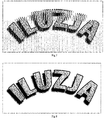
- Figure 8 shows the view of the effect of optical illusion after injecting transparent material into the mould, where the reproduced lens transforms the graphic material from Fig. 5 into optical illusion.
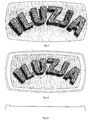
- Fig. 9 presents an example of the embodiment of the invention in the form of a shape being a fragment of the plane;
- Fig. 10 presents an example of the embodiment of the shape in the form of a polyhedron - the view from above; Fig.
- FIG. 11 presents a cross section of an example of the embodiment of the shape in the form of a polyhedron
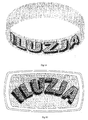
- Fig. 12 presents an example of the embodiment of the shape in the form of a section of a cylinder
- the negative of linear lens may be reproduced on an arbitrary solid of revolution or polyhedron
- Fig. 13 presents a multicolour shape
- Fig. 14 illustrates an example of a shape in the form of a cylinder.
- Fig. 3 presents a schema of graphic material, where the transparent material (foil) is the electrostatic material (1), the line, on the underside of the transparent foil there is printed halftone stereogram (2), covered with uniform colour background (3).
- graphic carrier with halftone printing is placed in the mould, then thermoplastic material shaped as the graphic carrier is injected, and then the remaining part of the shape is overmoulded with the plastic material as a result of rotation or sliding ( Fig. 13 ).
Landscapes
- Engineering & Computer Science (AREA)
- Manufacturing & Machinery (AREA)
- Mechanical Engineering (AREA)
- Health & Medical Sciences (AREA)
- Ophthalmology & Optometry (AREA)
- Stereoscopic And Panoramic Photography (AREA)
- Toys (AREA)
Abstract
Description
- The subject of the invention is the method of the manufacture of a shape with lenticular stereoscopic image from plastic materials on a plastic material, intended especially for the manufacture of information, advertising, packaging, decorative and toy elements based on injection moulding of shapes with lenticular stereoscopic image from plastic materials in injection moulds.
- From the Polish patent application no. P.
385696 - In the known method of proceeding the joining of the label with a drawing on its surface inside the mould does not result in a monolithic unification of particular layers, with simultaneous degradation of printing, especially in the place of injection.
- There is known halftone printing, in which pictures consist of stripes of the right and left image alternately, and the transparent foils with linear cylindrical or prismatic lens placed upon them guarantee the separation of images.
- There is also known lenticular stereogram, in which two stereoscopic half images intended for both eyes (or a bigger number of indirect images) are placed on a carrier alternately in the form of stripes of microscopic width. Transparent foil with embossed halftone in the form of cylindrical convex lens on the one side is placed on the carrier. Due to the halftone viewer's eyes can see the image of only some stripes of the picture. If the starting material for such a stereogram consists of only two stereoscopic half images, the right eye can see only the right half image, and the left eye can see only the left half image. If there is more half images, a still more perfect illusion of space is achieved when looking at a changing angle.
- There is also known overmoulding of a transparent smooth central part with plastic material in any colour.
- The aim of the invention is the method of proceeding allowing the manufacture of a shape with stereoscopic image, in any graphic form, placed on material accumulating electric charges, especially on foil used for the manufacture of information, advertising, packaging, decorative and toy elements, on packagings or their closures.
- The essence of the invention consists in the fact that the transparent material accumulating electric charges, especially the foil with embossed lenticular halftone printing, especially from the underside, turned by 180° along vertical or horizontal axis, is placed inside the mould, and the whole is joined in a permanent way by the injection of transparent thermoplastic plastic material into the mould.
- According to the invention the formed element with lenticular stereogram is subjected to overmoulding in a mould with thermoplastic plastic material of any colour.
- Following the invention, when obtaining the shape with stereoscopic image on information, advertising, packaging, decorative and toy materials, in the nest of the mould there is placed graphic material from transparent plastic material accumulating electric charges (especially polypropylene PP) in the form of transparent foil with embossed lenticular halftone printing, especially from the underside, turned by 180° along vertical or horizontal axis (
Fig. 5 ). From the injection side of the mould there is installed an element which is a negative reproduction of the configuration of linear lenses (Fig. 6 ); the number of lines of negative lenses corresponds to the number of printing lines of lenticular halftones on the underside of the foil placed on the opposite side of the closing, and is generally called LPI (lines per inch). On the underside of the foil with halftone printing there may be placed a uniform colour background of any colour, being a background for halftone printing. - According to the invention, the formed element with lenticular stereogram is fully made from transparent plastic material.
- In the solution according to the invention the accumulation of electric charges additionally facilitates precise placing of transparent foil with embossed stereogram into the mould due to electrostatics; especially when the nest is situated vertically, the foil is attracted by the mould due to potential difference. Gravitational and vacuum methods of placing are also acceptable.
- On the graphic element into the mould there is injected transparent thermoplastic plastic material, favourably the same as the material of the graphic carrier, and due to reproduced negative linear lenses lenticular plate is formed, due to which formerly prepared graphic element is visible as an illusory spatial image, or other visual effect, which is schematically illustrated by
Fig. 7 . - In the solution according to the invention the adopted procedure allows to produce image elements and obtain the effect of binocular vision, giving the impression of depth. The injection of transparent, thermoplastic plastic material is made above the surface of the label. The injection of the material may be made centrally, from the side, or at any place above the label; the thickness of the injected transparent material is strictly determined and depends on LPI and the angle of view determining the curvature of the focal length, which defines the thickness. The injected transparent thermoplastic plastic material, favourably the same as the transparent halftone carrier of graphic printing, guarantees homogeneous and durable structure of the shape. The following plastic materials may be used, for example, for the purpose: polystyrene PS, polypropylene PP, polymethyl methacrylate PMMA, polyethylene terephthalate PET, polyvinyl chloride PVC, polycarbonate PC.
- Following the method according to the invention there are manufactured information, advertizing, packaging, decorative and toy elements with image giving the impression of illusory space or animation due to the use and combination of technology of obtaining lenticular stereograms by halftone printing and overmoulded lenticular plate with properly shaped lenses or linear prisms. The achieved effect of optical illusion depends on a precise and properly prepared printing on the underside of the transparent graphic carrier. The effect may give an impression of 3D depth, if the lines of the lenses are arranged vertically and the spatial image appears. Acting in accordance with the invention the impression of movement is obtained by changes (flip); depending on the number of images and the angle of view different images can be seen alternately. A favourable effect is achieved when the lines are arranged horizontally in relation to the viewer. It is also possible to achieve the impression of movement by transformation (morphing), i.e., smooth transition from one image into another one, or by animation - showing some phases of movement, or zooming in and out (zoom). The mix of the above mentioned techniques giving the impression of movement is also possible. The schematic illustration of the effect of the appearance of the image, where a fragment of halftone printing is visible in the upper part, and the effect after the injection of the lenticular is visible in the lower part, is presented in
Fig. 7 - Following the method according to the invention, it is possible to obtain different shapes on the plane and on solids, e.g., cylinders or their sections, cones or their fragments, and polyhedrons or their fragments, containing stereoscopic image on the outside at the imprint of any image fixed at the underside of the shape; it is worth stressing that the image with linear lens may be made only by a part of the shape (
Fig. 9 ), the remaining part being an arbitrary polyhedron, e.g., the covering of the box (Fig. 10 ). The reproduction of the negative of linear lens may have the shape of an arbitrary solid of revolution or polyhedron.Fig. 12 shows an example of an embodiment on a section of a cylinder;Fig. 14 shows an example of an embodiment of the shape in the form of cylinder, where the above described graphic material is placed inside the cylinder. With properly constructed injection form it is possible to obtain multicolour shape in the following way: a part with the reproduction of the linear lens and the above described nest for graphic material is injected with transparent material in order to retain the possibility of obtaining a stereoscopic image, and the remaining part of the shape of the polyhedron, being, e.g., a box cover, is injected in the second phase with another colour, which is illustrated inFig. 13 . The essence of multicolour injection consists in simultaneous injecting of plastic materials into a mould fixed to a revolving or sliding plate from a number of systems - the material of different colour from each system. The solution according to the invention has been presented on illustrations and examples of embodiments not limiting the application of the invention. On the enclosed illustrations,Fig. 1 presents lenticular stereogram;Fig. 2 presents a bigger number of indirect images when looking at the changing angle, which gives still more perfect illusion of space;Fig. 3 presents a schema of imprint on transparent material (foil), where (1) - means transparent foil being the proper side of the label, (2) - halftone printing turned along horizontal or vertical axis by 180°, (3) - means a uniform colour background for the printing in any colour. In the solution according to the invention there may also appear the fourth layer securing the printing additionally, in the form of, e.g., varnish;Fig. 4 shows, in a big enlargement, prepared halftone graphic material in the form of lenticular stereogram printed on the foil and turned by 180° from the underside in such a way that, after turning, the proper image of the imprint shall be on the underside;Fig. 5 shows lenticular stereogram (in a big enlargement) from the upper side, where the imprint is on the underside and the transparent foil is on the upper side, and the graphic material is placed in the mould in this form.Fig. 6 shows a scheme of a not closed injection mould, where the upper side is a negative of linear lens, and the underside is a nest for graphic material presented schematically like inFig. 2 ;Fig. 7 presents, in a big close-up, the way of making the image and the difference between the imprint and the lenticular lens, partly transferred on the imprint. On the figure the compliance of LPI (lines per inches) between the number of halftones on the graphic material and the number of cylinders or prisms on the plate of the linear lens is visible.Figure 8 shows the view of the effect of optical illusion after injecting transparent material into the mould, where the reproduced lens transforms the graphic material fromFig. 5 into optical illusion.Fig. 9 presents an example of the embodiment of the invention in the form of a shape being a fragment of the plane;Fig. 10 presents an example of the embodiment of the shape in the form of a polyhedron - the view from above;Fig. 11 presents a cross section of an example of the embodiment of the shape in the form of a polyhedron;Fig. 12 presents an example of the embodiment of the shape in the form of a section of a cylinder; the negative of linear lens may be reproduced on an arbitrary solid of revolution or polyhedron;Fig. 13 presents a multicolour shape;Fig. 14 illustrates an example of a shape in the form of a cylinder. - In the nest of the mould there is placed graphic material accumulating electric charges in the form of lenticular stereogram with the use and application of halftone printing. The upper part of the transparent material accumulating electric charges is made of foil, on its underside an adequately prepared halftone printing is made, which is turned along the horizontal axis by 180° and which may be covered, as the next layer, with uniform colour background in any colour as a background for halftone printing. It is also possible to apply another protective layer, e.g., varnish.
Fig. 3 presents a schema of graphic material, where the transparent material (foil) is the electrostatic material (1), the line, on the underside of the transparent foil there is printed halftone stereogram (2), covered with uniform colour background (3). - Acting as in example 1, the realization of halftone printing from the side of the uniform colour background is presented in
Fig. 4 . - Acting as in example 1, on the transparent graphic carrier (foil) horizontal halftone printing and the reproduction of horizontal negative of lens are made in order to obtain the stereogram giving the illusion of the change of the image (flip, morphing) (
Fig. 15 ). - Acting as in example 1, graphic carrier with halftone printing is placed in the mould, then thermoplastic material shaped as the graphic carrier is injected, and then the remaining part of the shape is overmoulded with the plastic material as a result of rotation or sliding (
Fig. 13 ).
Claims (2)
- The method of the manufacture of the shape with stereoscopic lenticular image from plastic materials on a plastic material by placing the foil with a drawing in the mould, injecting plastic material and joining the label with the mould in a permanent way, characterized by the fact that transparent material accumulating electric charges (1) particularly the foil with lenticular halftone printing particularly from the underside, turned by 180° along vertical or horizontal axis, is placed inside the mould (2), and the whole is joined in a permanent way by injecting transparent thermoplastic material into the mould.
- The method according to the claim 1 characterized by the fact that the formed element with lenticular stereogram is subjected to overmoulding in a mould with thermoplastic material of any colour.
Priority Applications (1)
| Application Number | Priority Date | Filing Date | Title |
|---|---|---|---|
| EP12460024.8A EP2666610A1 (en) | 2012-05-24 | 2012-05-24 | Method of manufacturing a shape with a lenticular stereoscopic image from plastic materials on a plastic substrate |
Applications Claiming Priority (1)
| Application Number | Priority Date | Filing Date | Title |
|---|---|---|---|
| EP12460024.8A EP2666610A1 (en) | 2012-05-24 | 2012-05-24 | Method of manufacturing a shape with a lenticular stereoscopic image from plastic materials on a plastic substrate |
Publications (1)
| Publication Number | Publication Date |
|---|---|
| EP2666610A1 true EP2666610A1 (en) | 2013-11-27 |
Family
ID=46551470
Family Applications (1)
| Application Number | Title | Priority Date | Filing Date |
|---|---|---|---|
| EP12460024.8A Withdrawn EP2666610A1 (en) | 2012-05-24 | 2012-05-24 | Method of manufacturing a shape with a lenticular stereoscopic image from plastic materials on a plastic substrate |
Country Status (1)
| Country | Link |
|---|---|
| EP (1) | EP2666610A1 (en) |
Cited By (3)
| Publication number | Priority date | Publication date | Assignee | Title |
|---|---|---|---|---|
| EP2878441A1 (en) * | 2013-12-02 | 2015-06-03 | Axxel Sp. z o.o. | A multi-layer lenticular film |
| FR3066139A1 (en) * | 2017-05-15 | 2018-11-16 | Automotive Lighting Rear Lamps France | METHOD FOR MANUFACTURING A HULL COMPRISING A DECORATIVE FILM |
| CN111216386A (en) * | 2020-03-10 | 2020-06-02 | 江苏全真光学科技股份有限公司 | Preparation method and process of blue-light-resistant photochromic resin lens |
Citations (5)
| Publication number | Priority date | Publication date | Assignee | Title |
|---|---|---|---|---|
| GB2377201A (en) * | 2001-06-08 | 2003-01-08 | David Gifford Burder | Moulded lenticulated articles |
| WO2003106134A1 (en) * | 2002-06-18 | 2003-12-24 | Imperial Chemical Industries Plc | Improvements in or relating to decoration of plastics articles |
| PL385696A1 (en) | 2008-07-18 | 2010-02-01 | Marek Adamczewski | Method of obtaining of the labels or packagings three-dimensional drawings |
| CN101954703A (en) * | 2010-07-20 | 2011-01-26 | 圣美精密工业(昆山)有限公司 | Injection molding method for in-mold ornament |
| WO2011095932A1 (en) * | 2010-02-02 | 2011-08-11 | Hasan Hakan Artun | A package having three dimensional label and production method thereof |
-
2012
- 2012-05-24 EP EP12460024.8A patent/EP2666610A1/en not_active Withdrawn
Patent Citations (5)
| Publication number | Priority date | Publication date | Assignee | Title |
|---|---|---|---|---|
| GB2377201A (en) * | 2001-06-08 | 2003-01-08 | David Gifford Burder | Moulded lenticulated articles |
| WO2003106134A1 (en) * | 2002-06-18 | 2003-12-24 | Imperial Chemical Industries Plc | Improvements in or relating to decoration of plastics articles |
| PL385696A1 (en) | 2008-07-18 | 2010-02-01 | Marek Adamczewski | Method of obtaining of the labels or packagings three-dimensional drawings |
| WO2011095932A1 (en) * | 2010-02-02 | 2011-08-11 | Hasan Hakan Artun | A package having three dimensional label and production method thereof |
| CN101954703A (en) * | 2010-07-20 | 2011-01-26 | 圣美精密工业(昆山)有限公司 | Injection molding method for in-mold ornament |
Non-Patent Citations (2)
| Title |
|---|
| "IM FORMNEST FIXIERT", PLASTVERARBEITER, HUETHIG GMBH, HEIDELBERG, DE, vol. 48, no. 3, 1 March 1997 (1997-03-01), pages 43/44, XP000659994, ISSN: 0032-1338 * |
| BOECKLEIN M: "DEKORIEREN DURCH HINTERSPRITZEN VON FOLIEN", PLASTVERARBEITER, HUETHIG GMBH, HEIDELBERG, DE, vol. 37, no. 7, 1 July 1986 (1986-07-01), pages 84/85,88 - 90, XP001173687, ISSN: 0032-1338 * |
Cited By (7)
| Publication number | Priority date | Publication date | Assignee | Title |
|---|---|---|---|---|
| EP2878441A1 (en) * | 2013-12-02 | 2015-06-03 | Axxel Sp. z o.o. | A multi-layer lenticular film |
| FR3066139A1 (en) * | 2017-05-15 | 2018-11-16 | Automotive Lighting Rear Lamps France | METHOD FOR MANUFACTURING A HULL COMPRISING A DECORATIVE FILM |
| WO2018210882A1 (en) * | 2017-05-15 | 2018-11-22 | Automotive Lighting Rear Lamps France | Process for manufacturing a shell comprising a decorative film |
| CN110650832A (en) * | 2017-05-15 | 2020-01-03 | 汽车照明后灯法国有限公司 | Process for manufacturing a shell including a decorative film |
| CN110650832B (en) * | 2017-05-15 | 2022-03-08 | 汽车照明后灯法国有限公司 | Process for manufacturing a shell including a decorative film |
| US11383412B2 (en) | 2017-05-15 | 2022-07-12 | Marelli Automotive Lighting France | Process for manufacturing a shell comprising a decorative film |
| CN111216386A (en) * | 2020-03-10 | 2020-06-02 | 江苏全真光学科技股份有限公司 | Preparation method and process of blue-light-resistant photochromic resin lens |
Similar Documents
| Publication | Publication Date | Title |
|---|---|---|
| KR101764154B1 (en) | Printed lenticules for lenticular printing | |
| JP5934388B2 (en) | Injection product with three-dimensional security element and its manufacturing method | |
| US6635196B1 (en) | Molded articles having a surface bearing a lenticular image | |
| US20090168165A1 (en) | System and Method for Combined 3-D Imaging and Full Video Using a Single Lenticular Lens Sheet | |
| EP2666610A1 (en) | Method of manufacturing a shape with a lenticular stereoscopic image from plastic materials on a plastic substrate | |
| US20150298483A1 (en) | Counterfeit-proof label having security features for consumers identificaton and verification | |
| WO2015018941A1 (en) | Autostereoscopic prismatic printing rasters | |
| US9329396B2 (en) | Image displaying sheet | |
| CA2647739C (en) | Microlens windows and interphased images for packaging and printing and methods for manufacture | |
| CN107340603A (en) | 3d display device | |
| SE2150453A1 (en) | Synthetic images with animation of perceived depth | |
| JPH1149175A (en) | Container with lenticular display | |
| PL218615B1 (en) | Method for producing a molding with a stereoscopic lenticular of plastic on the plastic | |
| CN104406357A (en) | Composite panel and refrigerator | |
| JPH0766155B2 (en) | Method for producing printed matter with lens and printed matter with lens | |
| CN103465719A (en) | Production method of multi-scenario grating stereograph | |
| KR101167708B1 (en) | Stereoscopic lens sheet comprising injection resin that lens and patterns are formed at top and bottom surfaces of and method for fabricating the same lens sheet | |
| KR102134222B1 (en) | Optical film for 3D image, apparatus for manufacturing optical film, and method for manufacturing optical film, Advertising board made of optical film | |
| KR101666819B1 (en) | Security image film manufacturing method with micron unit of thickness based on lanticular lenz | |
| CN110561936A (en) | Preparation method of 3D direct printing grating printed matter | |
| JP7107865B2 (en) | beverage container | |
| EP3325277B1 (en) | Printed facets | |
| KR101051879B1 (en) | Fine pattern mold, three-dimensional sheet using the mold and its manufacturing method | |
| JP2014523539A (en) | Method for creating iridescent image, resulting image, device with iridescent image and associated program | |
| RU2818676C1 (en) | Micro-optical protective device with layers of phase-synchronized images |
Legal Events
| Date | Code | Title | Description |
|---|---|---|---|
| PUAI | Public reference made under article 153(3) epc to a published international application that has entered the european phase |
Free format text: ORIGINAL CODE: 0009012 |
|
| AK | Designated contracting states |
Kind code of ref document: A1 Designated state(s): AL AT BE BG CH CY CZ DE DK EE ES FI FR GB GR HR HU IE IS IT LI LT LU LV MC MK MT NL NO PL PT RO RS SE SI SK SM TR |
|
| AX | Request for extension of the european patent |
Extension state: BA ME |
|
| 17P | Request for examination filed |
Effective date: 20140822 |
|
| RBV | Designated contracting states (corrected) |
Designated state(s): AL AT BE BG CH CY CZ DE DK EE ES FI FR GB GR HR HU IE IS IT LI LT LU LV MC MK MT NL NO PL PT RO RS SE SI SK SM TR |
|
| 17Q | First examination report despatched |
Effective date: 20150527 |
|
| STAA | Information on the status of an ep patent application or granted ep patent |
Free format text: STATUS: THE APPLICATION IS DEEMED TO BE WITHDRAWN |
|
| 18D | Application deemed to be withdrawn |
Effective date: 20160609 |