EP2663754B1 - Abgasturbolader mit einem verdichtergehäuse mit integriertem wastegate-steller - Google Patents
Abgasturbolader mit einem verdichtergehäuse mit integriertem wastegate-steller Download PDFInfo
- Publication number
- EP2663754B1 EP2663754B1 EP12700108.9A EP12700108A EP2663754B1 EP 2663754 B1 EP2663754 B1 EP 2663754B1 EP 12700108 A EP12700108 A EP 12700108A EP 2663754 B1 EP2663754 B1 EP 2663754B1
- Authority
- EP
- European Patent Office
- Prior art keywords
- gas turbocharger
- exhaust gas
- compressor housing
- wastegate
- wastegate actuator
- Prior art date
- Legal status (The legal status is an assumption and is not a legal conclusion. Google has not performed a legal analysis and makes no representation as to the accuracy of the status listed.)
- Active
Links
Images


Classifications
-
- F—MECHANICAL ENGINEERING; LIGHTING; HEATING; WEAPONS; BLASTING
- F02—COMBUSTION ENGINES; HOT-GAS OR COMBUSTION-PRODUCT ENGINE PLANTS
- F02B—INTERNAL-COMBUSTION PISTON ENGINES; COMBUSTION ENGINES IN GENERAL
- F02B37/00—Engines characterised by provision of pumps driven at least for part of the time by exhaust
- F02B37/12—Control of the pumps
- F02B37/18—Control of the pumps by bypassing exhaust from the inlet to the outlet of turbine or to the atmosphere
- F02B37/183—Arrangements of bypass valves or actuators therefor
-
- F—MECHANICAL ENGINEERING; LIGHTING; HEATING; WEAPONS; BLASTING
- F01—MACHINES OR ENGINES IN GENERAL; ENGINE PLANTS IN GENERAL; STEAM ENGINES
- F01D—NON-POSITIVE DISPLACEMENT MACHINES OR ENGINES, e.g. STEAM TURBINES
- F01D17/00—Regulating or controlling by varying flow
- F01D17/20—Devices dealing with sensing elements or final actuators or transmitting means between them, e.g. power-assisted
- F01D17/22—Devices dealing with sensing elements or final actuators or transmitting means between them, e.g. power-assisted the operation or power assistance being predominantly non-mechanical
- F01D17/24—Devices dealing with sensing elements or final actuators or transmitting means between them, e.g. power-assisted the operation or power assistance being predominantly non-mechanical electrical
-
- F—MECHANICAL ENGINEERING; LIGHTING; HEATING; WEAPONS; BLASTING
- F02—COMBUSTION ENGINES; HOT-GAS OR COMBUSTION-PRODUCT ENGINE PLANTS
- F02B—INTERNAL-COMBUSTION PISTON ENGINES; COMBUSTION ENGINES IN GENERAL
- F02B37/00—Engines characterised by provision of pumps driven at least for part of the time by exhaust
- F02B37/12—Control of the pumps
- F02B37/18—Control of the pumps by bypassing exhaust from the inlet to the outlet of turbine or to the atmosphere
- F02B37/183—Arrangements of bypass valves or actuators therefor
- F02B37/186—Arrangements of actuators or linkage for bypass valves
-
- F—MECHANICAL ENGINEERING; LIGHTING; HEATING; WEAPONS; BLASTING
- F02—COMBUSTION ENGINES; HOT-GAS OR COMBUSTION-PRODUCT ENGINE PLANTS
- F02B—INTERNAL-COMBUSTION PISTON ENGINES; COMBUSTION ENGINES IN GENERAL
- F02B39/00—Component parts, details, or accessories relating to, driven charging or scavenging pumps, not provided for in groups F02B33/00 - F02B37/00
-
- F—MECHANICAL ENGINEERING; LIGHTING; HEATING; WEAPONS; BLASTING
- F02—COMBUSTION ENGINES; HOT-GAS OR COMBUSTION-PRODUCT ENGINE PLANTS
- F02C—GAS-TURBINE PLANTS; AIR INTAKES FOR JET-PROPULSION PLANTS; CONTROLLING FUEL SUPPLY IN AIR-BREATHING JET-PROPULSION PLANTS
- F02C6/00—Plural gas-turbine plants; Combinations of gas-turbine plants with other apparatus; Adaptations of gas-turbine plants for special use
- F02C6/04—Gas-turbine plants providing heated or pressurised working fluid for other apparatus, e.g. without mechanical power output
- F02C6/10—Gas-turbine plants providing heated or pressurised working fluid for other apparatus, e.g. without mechanical power output supplying working fluid to a user, e.g. a chemical process, which returns working fluid to a turbine of the plant
- F02C6/12—Turbochargers, i.e. plants for augmenting mechanical power output of internal-combustion piston engines by increase of charge pressure
-
- F—MECHANICAL ENGINEERING; LIGHTING; HEATING; WEAPONS; BLASTING
- F05—INDEXING SCHEMES RELATING TO ENGINES OR PUMPS IN VARIOUS SUBCLASSES OF CLASSES F01-F04
- F05D—INDEXING SCHEME FOR ASPECTS RELATING TO NON-POSITIVE-DISPLACEMENT MACHINES OR ENGINES, GAS-TURBINES OR JET-PROPULSION PLANTS
- F05D2220/00—Application
- F05D2220/40—Application in turbochargers
-
- F—MECHANICAL ENGINEERING; LIGHTING; HEATING; WEAPONS; BLASTING
- F05—INDEXING SCHEMES RELATING TO ENGINES OR PUMPS IN VARIOUS SUBCLASSES OF CLASSES F01-F04
- F05D—INDEXING SCHEME FOR ASPECTS RELATING TO NON-POSITIVE-DISPLACEMENT MACHINES OR ENGINES, GAS-TURBINES OR JET-PROPULSION PLANTS
- F05D2240/00—Components
- F05D2240/10—Stators
- F05D2240/14—Casings or housings protecting or supporting assemblies within
-
- Y—GENERAL TAGGING OF NEW TECHNOLOGICAL DEVELOPMENTS; GENERAL TAGGING OF CROSS-SECTIONAL TECHNOLOGIES SPANNING OVER SEVERAL SECTIONS OF THE IPC; TECHNICAL SUBJECTS COVERED BY FORMER USPC CROSS-REFERENCE ART COLLECTIONS [XRACs] AND DIGESTS
- Y02—TECHNOLOGIES OR APPLICATIONS FOR MITIGATION OR ADAPTATION AGAINST CLIMATE CHANGE
- Y02T—CLIMATE CHANGE MITIGATION TECHNOLOGIES RELATED TO TRANSPORTATION
- Y02T10/00—Road transport of goods or passengers
- Y02T10/10—Internal combustion engine [ICE] based vehicles
- Y02T10/12—Improving ICE efficiencies
Definitions
- the invention relates to an exhaust gas turbocharger, which is equipped with a so-called wastegate.
- Exhaust gas turbochargers serve to improve the efficiency of an internal combustion engine and thus to increase its performance.
- the exhaust gas turbocharger has a turbine with a turbine wheel and a compressor with a compressor wheel, wherein the two wheels are arranged on a common shaft.
- the turbine wheel is in this case driven via an exhaust gas mass flow of a connected internal combustion engine and in turn drives the compressor wheel.
- the compressor compresses fresh air sucked in and feeds it to the internal combustion engine.
- the common shaft is mounted in a bearing housing of the turbocharger.
- the turbine wheel of the turbine is arranged in a turbine housing and the compressor wheel of the compressor in a compressor housing.
- Such an exhaust gas turbocharger has to fulfill various requirements during operation on the internal combustion engine or a connected engine.
- One of these requirements is to accommodate the high temperatures that may arise, for example, due to the hot exhaust gas mass flow in the turbocharger housing.
- the usual construction of an exhaust-gas turbocharger thereby provides individual housings which each consist of a material adapted to the prevailing temperature there.
- the compressor housing is usually made of aluminum, while the bearing housing is made of gray cast iron, wherein the bearing housing can also be designed to be water cooled.
- the turbine housing is generally made of high-grade materials due to the high temperatures prevailing in that area Nickel content. Due to the adapted, different materials for the individual housing, these housings are designed as separate parts which are connected to one another and must also be sealed against each other.
- Such a regulation of an exhaust gas turbocharger can be carried out using a wastegate, which is also referred to as a bypass valve.
- a wastegate has a flap connected to the turbine housing of the exhaust gas turbocharger, which can be opened as needed to direct a more or less large part of the hot exhaust gas past the turbine directly into the exhaust of the vehicle, depending on the opening position of the flap , As a result, a further increase in the turbine speed is prevented.
- an electrical wastegate actuator offers advantages compared to a pneumatic wastegate actuator. These include a high positioning speed, good positioning accuracy and large actuating forces. Due to these large actuating forces, a firm closing of the wastegate flap in the associated flap seat is ensured.
- an electrical wastegate actuator also has disadvantages. These include an increased weight, an increased space requirement and a self-heating.
- the thermal design of an electric wastegate actuator prepares problems in practice. In the engine compartment of a motor vehicle, temperatures of up to 140 ° C prevail. In the immediate vicinity of an exhaust gas turbocharger, far higher temperatures can occur.
- an electric wastegate actuator During operation of an electric wastegate actuator, it is additionally heated by the current flowing through it. In unfavorable ambient conditions, especially at high temperatures and low flow, the performance of the actuator may be reduced. It can even lead to a failure of the wastegate system.
- Another challenge with using an electric wastegate actuator is the increased demands on the connection between the wastegate actuator and the wastegate flap due to the larger actuating forces. If this connection is not carried out sufficiently stable, then it can lead to an undesirable deformation of force-transmitting components. Also, due to this undesirable deformation of power transmitting components may lead to failure of the wastegate system.
- wastegate actuator forms part of the turbine housing.
- the wastegate actuator or actuator is usually attached to the compressor housing or to a holder on the compressor housing. This holder is either a separate component, which is fastened by means of screws to the compressor housing, for example, or a component which is already produced during the casting process together with the compressor housing. Background of this integration of the wastegate controller in the compressor housing are primarily cost advantages and packaging advantages.
- the bearing housing is arranged between the turbine housing and the compressor housing. Consequently, in known exhaust gas turbochargers, the wastegate actuator and the wastegate are themselves interconnected by a comparatively long tolerance chain.
- An electric wastegate actuator must be chosen according to its design accordingly strong, so that he can muster the required restoring forces, even if he is very hot himself, and that he can handle the load cycles occurring without overheating. Furthermore, during assembly in a final assembly step, the accumulated tolerances must be compensated by a suitable compensating device in the coupling element or by a suitable assembly process of the coupling element. This is associated with a considerable effort and thus also with considerable costs.
- a compressor housing for a compressor of a turbocharger which has a receiving area for receiving at least parts of an actuator.
- This receiving area may be provided on a cover of the compressor housing or within the compressor housing.
- the exhaust gas turbocharger for an internal combustion engine with a variable turbine geometry having exhaust gas turbine and an electric actuator for changing the turbine geometry known.
- the exhaust gas turbocharger further includes a compressor having a compressor housing.
- the intended for changing the turbine geometry actuator has a removable housing cover and a housing which forms an integral part of the compressor housing.
- a cooled turbocharger housing which comprises one or more electronic devices having.
- One of these electronic devices may be a wastegate actuator.
- the cooling is done using a cooling medium, which is water or oil.
- the cooling medium is conducted in such a way that it flows past in the region of the respective electronic device.
- an actuator for actuating a switching element of an internal combustion engine with an electric motor actuator which acts via a gear on the switching element, which may be wastegate valve on the exhaust side of an exhaust gas turbocharger.
- the actuator is arranged on the fresh air side of the exhaust gas turbocharger and connected via the transmission with the wastegate valve on the exhaust side.
- the object of the invention is to provide a equipped with an electric wastegate actuator exhaust gas turbocharger, in which the likelihood of overheating of the DC motor of the electric wastegate actuator is reduced.
- the advantages of the invention are, in particular, that the electric wastegate actuator of the exhaust gas turbocharger is integrated into the compressor housing, on the one hand the heat flow from the DC motor of the wastegate actuator is improved to the environment and further that a space-saving arrangement of the components of the wastegate Stellers is ensured in the compressor housing.
- all force-carrying components of the wastegate actuator in particular the DC motor, the transmission and the output shaft, are connected directly to the compressor housing. This further reduces the likelihood of heat-related damage to these components or a heat-related failure of the wastegate system.
- the electrical wastegate actuator is integrated into the compressor housing in such a way that there is a strong thermal coupling between the DC motor and the fresh air inlet duct of the compressor housing.
- an improved heat dissipation is achieved because this area of the compressor housing is constantly flowed through during operation of cold fresh air. This reduces the requirements on the components of the electric wastegate actuator, whereby the entire wastegate system can be sized smaller and correspondingly less expensive.
- An exhaust gas turbocharger comprises a compressor housing having a fresh air inlet passage and an electric wastegate actuator integrated in the compressor housing, the electrical wastegate actuator being thermally coupled to the fresh air inlet passage.
- FIG. 1 shows a perspective sketch to illustrate such an exhaust gas turbocharger, wherein in this illustration an external view of the exhaust gas turbocharger is shown.
- the exhaust gas turbocharger shown has a compressor housing 5, a bearing housing 6 and a turbine housing 7.
- compressor housing 5 a arranged on a common shaft compressor wheel is provided in a conventional manner.
- turbine housing 7 a turbine wheel is arranged in the usual manner on the common shaft.
- the common shaft is mounted in the bearing housing 6, which is positioned between the compressor housing 5 and the turbine housing 7.
- the turbine wheel is driven via an exhaust gas mass flow of a connected internal combustion engine and, in turn, drives it via the common shaft Compressor wheel on.
- the compressor compresses fresh air sucked in and feeds it to the internal combustion engine.
- the compressor housing 5 has a fish air inlet channel 1, through which fresh air from the environment is sucked into the exhaust gas turbocharger, and a fresh air outlet channel 2, through which compressed fresh air is output for forwarding to the internal combustion engine.
- the compressor housing 5 has an integrated wastegate actuator 8.
- This wastegate actuator 8 acts via a driven lever 9 and a coupling rod 10 on a wastegate lever 11, which opens or closes a wastegate valve disposed in the turbine housing 7 more or less depending on the current need.
- the compressor housing is open at the top and is closed after said assembly by means of a plastic cover 12.
- the bearing housing 6 has an oil inlet, not shown, and an oil outlet, also not shown. Due to the oil ingress occurs during operation of the exhaust gas turbocharger oil, which is used to lubricate the common shaft.
- the turbine housing 7 has exhaust gas inlet channels 3 and an exhaust gas outlet channel 4.
- the exhaust gas inlet ducts 3 are connected to exhaust gas exits of the internal combustion engine, so that the hot exhaust gas of the internal combustion engine reaches the interior region of the turbine housing 7 through the exhaust gas inlet ducts 3.
- the hot exhaust gas drives the turbine wheel arranged in the turbine housing, which in turn drives the compressor shaft arranged in the compressor housing via the common shaft.
- the exhaust gas outlet channel 4 which is connected to the catalyst of the motor vehicle, the exhaust gas exits from the turbine housing 7 again.
- a wastegate is integrated in the turbine housing. This has a wastegate flap, by means of the in the Compressor housing integrated electric wastegate actuator can be opened more or less wide depending on current needs to direct a desired portion of the hot exhaust gas, bypassing the turbine directly to the exhaust gas outlet channel.
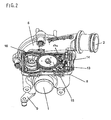
- FIG. 2 shows a perspective sketch of the compressor housing 5 with integrated electric wastegate actuator 8 as an assembly, in which sketch the plastic cover 12 is removed.
- the electric wastegate actuator 8 has a DC motor 13 which is provided with a motor output shaft 13a. With this motor output shaft 13a, a driven gear 14 of the DC motor is connected.
- This output gear 14 of the DC motor 13 acts via an intermediate gear 15 on a drive gear 16, which is connected to an output shaft 18 of the electric wastegate actuator.
- the output shaft 18 of the electric wastegate actuator acts on the output lever 9, via the in the FIG. 1 shown coupling rod 10 and the wastegate lever 11, if necessary, the wastegate flap adjusted.
- the fresh air inlet duct 1 and the fresh air outlet duct 2 illustrated.
- two-stage transmission can also be integrated into the compressor housing have electrical wastegate actuator one, three, four or even more gear stages.
- FIG. 3 shows a cross-sectional view of the compressor housing 5 with integrated electric wastegate actuator.
- the fresh air intake passage 1 is shown, through which the sucked fresh air flows to the compressor wheel.
- the DC motor 13 of the electric wastegate actuator is positioned.
- the output shaft 18 of the electric wastegate actuator is positioned on the DC motor 13 opposite side of the fresh air intake passage 1.
- the DC motor 13 has an output shaft 13a on which the output gear 14 of the DC motor 13 is mounted.
- This output gear 14 acts via the intermediate gear 15 on the drive gear 16, which is mounted on the output shaft 18 of the electric wastegate actuator.
- the output shaft 18 of the electric wastegate actuator is rotatably mounted in a roller bearing 19 and actuates the output lever 9.
- a torsion spring 17 supports the rotational movement in the case of closing the wastegate flap.
- the arrangement of the components of the electric wastegate actuator is such that all parts that are involved in the transmission of forces or moments are stored directly in the compressor housing 5.
- the DC motor 13, the gear 14, 15, 16 and the output shaft 18 of the electric wastegate actuator are placed in a U-shape around the fresh air inlet duct 1 ,
- the output shaft 18, which extends in the FIG. 3 is shown to the left of the fresh air intake passage 1, through almost the entire compressor housing to the output lever 9, so that the length l of the output shaft 18 is greater than the diameter d of the fresh air intake passage first
Landscapes
- Engineering & Computer Science (AREA)
- Mechanical Engineering (AREA)
- General Engineering & Computer Science (AREA)
- Chemical & Material Sciences (AREA)
- Combustion & Propulsion (AREA)
- Chemical Kinetics & Catalysis (AREA)
- General Chemical & Material Sciences (AREA)
- Supercharger (AREA)
Description
- Die Erfindung betrifft einen Abgasturbolader, der mit einem sogenannten Wastegate ausgestattet ist.
- Abgasturbolader dienen dazu, den Wirkungsgrad eines Verbrennungsmotors zu verbessern und damit dessen Leistung zu steigern. Der Abgasturbolader weist hierzu eine Turbine mit einem Turbinenrad und einen Verdichter mit einem Verdichterrad auf, wobei die beiden Laufräder auf einer gemeinsamen Welle angeordnet sind. Das Turbinenrad wird hierbei über einen Abgasmassenstrom einer angeschlossenen Brennkraftmaschine angetrieben und treibt wiederum das Verdichterrad an. Der Verdichter verdichtet angesaugte Frischluft und führt diese der Brennkraftmaschine zu. Die gemeinsame Welle ist in einem Lagergehäuse des Turboladers gelagert. Des Weiteren ist das Turbinenrad der Turbine in einem Turbinengehäuse angeordnet und das Verdichterrad des Verdichters in einem Verdichtergehäuse.
- Ein solcher Abgasturbolader hat im Betrieb an der Brennkraftmaschine bzw. einem angeschlossenen Motor verschiedenste Anforderungen zu erfüllen. Eine dieser Anforderungen besteht darin, die hohen Temperaturen aufzunehmen, die beispielsweise aufgrund des heißen Abgasmassenstroms in dem Turboladergehäuse entstehen können.
- Die übliche Konstruktion eines Abgasturboladers sieht dabei einzelne Gehäuse vor, die jeweils aus einem an die dort herrschende Temperatur angepassten Werkstoff bestehen. Dabei ist das Verdichtergehäuse üblicherweise aus Aluminium, während das Lagergehäuse aus Grauguss ist, wobei das Lagergehäuse zusätzlich auch wassergekühlt ausgeführt sein kann. Das Turbinengehäuse besteht im Allgemeinen aufgrund der hohen Temperaturen, die in diesem Bereich herrschen, aus Werkstoffen mit einem hohen Nickelanteil. Aufgrund der angepassten, unterschiedlichen Werkstoffe für die einzelnen Gehäuse sind diese Gehäuse als separate Teile ausgebildet, die miteinander verbunden sind und dabei außerdem gegeneinander abgedichtet sein müssen.
- Je mehr die Motordrehzahl steigt, desto schneller dreht sich durch die antreibende Abgasmenge das Turbinenrad der Turbine und mit diesem auch die Welle des Abgasturboladers, auf welcher sich weiterhin das Verdichterrad des Verdichters befindet. Durch die schnellere Drehung der Welle und damit auch des Verdichterrades erhöht sich die Luftfördermenge des Verdichters. Dies führt zu einer wachsenden Abgasmenge des Motors und damit wiederum zu einem schnelleren Antreiben des Turbinenrades. Um die jeweils gegebenen mechanischen und thermischen Grenzen des Motors nicht zu überschreiten, ist eine Regelung des Abgasturboladers notwendig.
- Eine derartige Regelung eines Abgasturboladers kann unter Verwendung eines Wastegates erfolgen, das auch als Bypassventil bezeichnet wird. Ein derartiges Wastegate weist eine mit dem Turbinengehäuse des Abgasturboladers verbundene Klappe auf, die bei Bedarf geöffnet werden kann, um in Abhängigkeit von der Öffnungsstellung der Klappe einen mehr oder weniger großen Teil des heißen Abgases an der Turbine vorbei direkt in den Auspuff des Fahrzeugs zu leiten. Dadurch wird ein weiteres Ansteigen der Turbinendrehzahl unterbunden.
- Ein derartiges Wastegate unterliegt aufgrund seiner Position im heißen Abgasstrom einer hohen thermischen und mechanischen Belastung.
- Es ist bereits bekannt, Wastegate-Klappen unter Verwendung eines pneumatischen Aktuators zu verstellen. Derartige pneumatische Aktuatoren werden oftmals auch als Druckdosen bezeichnet.
- Bei neueren Anwendungen gibt es nun vermehrt Bestrebungen, die genannten pneumatischen Aktuatoren durch elektrische Aktuatoren zu ersetzen. Ein derartiger elektrischer Wastegate-Steller bietet im Vergleich zu einem pneumatischen Wastegate-Steller Vorteile. Dazu gehören eine hohe Stellgeschwindigkeit, eine gute Stellgenauigkeit und große Stellkräfte. Aufgrund dieser großen Stellkräfte wird ein festes Schließen der Wastegate-Klappe im zugehörigen Klappensitz gewährleistet. Ein elektrischer Wastegate-Steller weist aber auch Nachteile auf. Dazu gehören ein erhöhtes Gewicht, ein vergrößerter Bauraumbedarf und eine Eigenerwärmung. Insbesondere die thermische Auslegung eines elektrischen Wastegate-Stellers bereitet in der Praxis Probleme. Im Motorraum eines Kraftfahrzeugs herrschen Temperaturen von bis zu 140° C. Im unmittelbaren Umfeld eines Abgasturboladers können noch weit höhere Temperaturen auftreten. Im Betrieb eines elektrischen Wastegate-Stellers wird dieser durch den hindurchfließenden Strom zusätzlich erwärmt. Bei ungünstigen Umgebungsbedingungen, insbesondere bei hohen Temperaturen und einer geringen Anströmung, kann die Leistungsfähigkeit des Stellgliedes reduziert sein. Es kann sogar zu einem Ausfall des Wastegate-Systems kommen. Eine weitere Herausforderung bei einer Verwendung eines elektrischen Wastegate-Stellers sind die gesteigerten Anforderungen an die Verbindung zwischen dem Wastegate-Steller und der Wastegate-Klappe aufgrund der größeren Stellkräfte. Ist diese Verbindung nicht hinreichend stabil ausgeführt, dann kann es zu einer unerwünschten Verformung von kraftübertragenden Bauteilen kommen. Auch aufgrund dieser unerwünschten Verformung von kraftübertragenden Bauteilen kann es zu einem Ausfall des Wastegate-Systems kommen.
- Ein weiteres in der Praxis auftretendes Problem ist die Positionierung des jeweiligen Wastegate-Stellers. In der Regel bildet das Wastegate einen Teil des Turbinengehäuses. Der Wastegate-Steller bzw. Aktuator ist hingegen in der Regel am Verdichtergehäuse oder an einem Halter am Verdichtergehäuse befestigt. Bei diesem Halter handelt es sich entweder um ein separates Bauteil, das beispielsweise mittels Schrauben am Verdichtergehäuse befestigt ist, oder um ein Bauteil, das bereits beim Gießprozess zusammen mit dem Verdichtergehäuse hergestellt wird. Hintergrund dieser Integration des Wastegate-Stellers in das Verdichtergehäuse sind vornehmlich Kostenvorteile und Packaging-Vorteile.
- Zwischen dem Turbinengehäuse und dem Verdichtergehäuse ist das Lagergehäuse angeordnet. Folglich sind bei bekannten Abgasturboladern der Wastegate-Steller und das Wastegate selbst durch eine vergleichsweise lange Toleranzkette miteinander verbunden.
- Ein elektrischer Wastegate-Steller muss in Bezug auf seine Auslegung entsprechend stark gewählt werden, so dass er auch dann die geforderten Stellkräfte aufbringen kann, wenn er selbst sehr heiß ist, und dass er die auftretenden Lastzyklen bewältigen kann, ohne sich zu überhitzen. Des Weiteren müssen beim Zusammenbau in einem letzten Montageschritt durch eine geeignete Ausgleichsvorrichtung im Koppelelement bzw. durch einen geeigneten Montageprozess des Koppelelementes die aufsummierten Toleranzen ausgeglichen werden. Dies ist mit einem erheblichen Aufwand und damit auch mit erheblichen Kosten verbunden.
- Aus der
DE 10 2007 017 825 A1 ist bereits ein Verdichtergehäuse für einen Verdichter eines Turboladers bekannt, welches einen Aufnahmebereich zum Aufnehmen zumindest von Teilen eines Aktors aufweist. Dieser Aufnahmebereich kann an einem Deckel des Verdichtergehäuses oder innerhalb des Verdichtergehäuses vorgesehen sein. - Aus der
EP 1 881 162 A2 ist ein Abgasturbolader für eine Brennkraftmaschine mit einer eine veränderbare Turbinengeometrie aufweisenden Abgasturbine und einem elektrischen Stellantrieb zum Verändern der Turbinengeometrie bekannt. Der Abgasturbolader umfasst des Weiteren einen Verdichter, der ein Verdichtergehäuse aufweist. Der zum Verändern der Turbinengeometrie vorgesehene Stellantrieb weist einen abnehmbaren Gehäusedeckel und ein Gehäuse auf, welches einen integralen Bestandteil des Verdichtergehäuses bildet. - Aus der
WO 2010/009945 A2 ist ein gekühltes Turboladergehäuse bekannt, welches eine oder mehrere Elektronikeinrichtungen aufweist. Bei einer dieser Elektronikeinrichtungen kann es sich um eine Wastegate-Betätigungseinrichtung handeln. Die Kühlung erfolgt unter Verwendung eines Kühlmediums, bei dem es sich um Wasser oder Öl handelt. Das Kühlmedium wird derart geleitet, dass es im Bereich der jeweiligen Elektronikeinrichtung vorbeiströmt. - Aus der
JP 63205419 A - Aus der
DE 10 2008 014 609 A1 ist ein Aktuator zum Betätigen eines Schaltelementes einer Verbrennungskraftmaschine mit einem elektromotorischen Stellantrieb bekannt, der über ein Getriebe auf das Schaltelement wirkt, bei dem es sich um Wastegateventil auf der Abgasseite eines Abgasturboladers handeln kann. Der Stellantrieb ist auf der Frischluftseite des Abgasturboladers angeordnet und über das Getriebe mit dem Wastegate-Ventil auf der Abgasseite verbunden. - Bei allen bekannten Vorschlägen zur Positionierung eines elektrischen Wastegate-Stellers in einem Abgasturbolader besteht das Problem, dass es zu einer Überhitzung des Gleichstrommotors des elektrischen Wastegate-Stellers kommen kann.
- Die Aufgabe der Erfindung besteht darin, einen mit einem elektrischen Wastegate-Steller ausgestatteten Abgasturbolader anzugeben, bei dem die Wahrscheinlichkeit einer Überhitzung des Gleichstrommotors des elektrischen Wastegate-Stellers reduziert ist.
- Diese Aufgabe wird durch einen Abgasturbolader mit den im Anspruch 1 angegebenen Merkmalen gelöst. Vorteilhafte Ausgestaltungen und Weiterbildungen der Erfindung sind in den abhängigen Ansprüchen angegeben.
- Die Vorteile der Erfindung bestehen insbesondere darin, dass der elektrische Wastegate-Steller des Abgasturboladers derart in das Verdichtergehäuse integriert ist, dass einerseits der Wärmeabfluss vom Gleichspannungsmotor des Wastegate-Stellers an die Umgebung verbessert ist und dass des Weiteren eine platzsparende Anordnung der Komponenten des Wastegate-Stellers im Verdichtergehäuse gewährleistet ist.
- Des Weiteren sind bei einem erfindungsgemäßen Abgasturbolader alle kraftführenden Bauteile des Wastegate-Stellers, insbesondere der Gleichspannungsmotor, das Getriebe und die Abtriebswelle, direkt mit dem Verdichtergehäuse verbunden. Dies reduziert die Wahrscheinlichkeit einer hitzebedingten Schädigung dieser Bauteile bzw. eines hitzebedingten Ausfalls des Wastegate-Systems weiter.
- Diese Vorteile werden im Wesentlichen dadurch erreicht, dass der elektrische Wastegate-Steller derart in das Verdichtergehäuse integriert ist, dass eine starke thermische Kopplung zwischen dem Gleichstrommotor und dem Frischlufteinlasskanal des Verdichtergehäuses vorliegt. Dadurch wird eine verbesserte Wärmeabfuhr erreicht, da dieser Bereich des Verdichtergehäuses im Betrieb ständig von kalter Frischluft durchströmt wird. Dies reduziert die Anforderungen an die Bauteile des elektrischen Wastegate-Stellers, wodurch das gesamte Wastegate-System kleiner und entsprechend kostengünstiger dimensioniert werden kann.
- Weitere Vorteile im Hinblick auf Packaging und den Kräftefluss werden durch eine optimierte Platzierung und eine verbesserte Dimensionierung der weiteren Bauteile des elektrischen Wastegate-Stellers im Verdichtergehäuse erreicht. Nachfolgend wird ein Abgasturbolader gemäß der vorliegenden Erfindung anhand der Zeichnungen beispielhaft erläutert. Es zeigt
- Figur 1
- eine perspektivische Skizze eines Abgasturboladers mit in das Verdichtergehäuse integriertem elektrischen Wastegate-Steller,
- Figur 2
- eine perspektivische Skizze des Verdichtergehäuses mit integriertem elektrischen Wastegate-Steller als Baugruppe und
- Figur 3
- eine Querschnittsdarstellung des Verdichtergehäuses mit integriertem elektrischen Wastegate-Steller.
- Ein Abgasturbolader gemäß der Erfindung enthält ein einen Frischlufteinlasskanal aufweisendes Verdichtergehäuse und einen in das Verdichtergehäuse integrierten elektrischen Wastegate-Steller, wobei der elektrische Wastegate-Steller mit dem Frischlufteinlasskanal thermisch gekoppelt ist.
- Die
Figur 1 zeigt eine perspektivische Skizze zur Veranschaulichung eines derartigen Abgasturboladers, wobei in dieser Darstellung eine Außenansicht des Abgasturboladers gezeigt ist. - Der dargestellte Abgasturbolader weist ein Verdichtergehäuse 5, ein Lagergehäuse 6 und ein Turbinengehäuse 7 auf.
- Im Verdichtergehäuse 5 ist in üblicher Weise ein auf einer gemeinsamen Welle angeordnetes Verdichterrad vorgesehen. Im Turbinengehäuse 7 ist in üblicher Weise auf der gemeinsamen Welle ein Turbinenrad angeordnet. Die gemeinsame Welle ist im Lagergehäuse 6, welches zwischen dem Verdichtergehäuse 5 und dem Turbinengehäuse 7 positioniert ist, gelagert. Im Betrieb des Abgasturboladers wird das Turbinenrad über einen Abgasmassenstrom einer angeschlossenen Brennkraftmaschine angetrieben und treibt seinerseits über die gemeinsame Welle das Verdichterrad an. Der Verdichter verdichtet angesaugte Frischluft und führt diese der Brennkraftmaschine zu.
- Das Verdichtergehäuse 5 weist einen Fischlufteinlasskanal 1, durch welchen Frischluft aus der Umgebung in den Abgasturbolader eingesaugt wird, und einen Frischluftaustrittskanal 2 auf, durch welchen verdichtete Frischluft zur Weiterleitung an die Brennkraftmaschine ausgegeben wird.
- Des Weiteren weist das Verdichtergehäuse 5 einen integrierten Wastegate-Steller 8 auf. Dieser Wastegate-Steller 8 wirkt über einen Abtriebshebel 9 und eine Koppelstange 10 auf einen Wastegate-Hebel 11 ein, welcher eine im Turbinengehäuse 7 angeordnete Wastegate-Klappe je nach momentanem Bedarf mehr oder weniger weit öffnet oder schließt. Um eine einfache Montage der Bauteile des elektrischen Wastegate-Stellers 8 im Verdichtergehäuse 5 zu ermöglichen, ist das Verdichtergehäuse nach oben hin offen ausgebildet und wird nach der genannten Montage mittels eines Kunststoffdeckels 12 verschlossen.
- Das Lagergehäuse 6 weist einen nicht dargestellten Öleintritt und einen ebenfalls nicht dargestellten Ölaustritt auf. Durch den Öleintritt tritt im Betrieb des Abgasturboladers Öl ein, das zur Schmierung der gemeinsamen Welle verwendet wird.
- Das Turbinengehäuse 7 weist Abgaseintrittskanäle 3 und einen Abgasaustrittskanal 4 auf. Die Abgaseintrittskanäle 3 sind mit Abgasausgängen der Brennkraftmaschine verbunden, so dass durch die Abgaseintrittskanäle 3 das heiße Abgas der Brennkraftmaschine in den Innenbereich des Turbinengehäuses 7 gelangt. Dort treibt das heiße Abgas das im Turbinengehäuse angeordnete Turbinenrad an, welches wiederum über die gemeinsame Welle das im Verdichtergehäuse angeordnete Verdichterrad antreibt. Durch den Abgasaustrittskanal 4, der mit dem Katalysator des Kraftfahrzeugs verbunden ist, tritt das Abgas wieder aus dem Turbinengehäuse 7 aus. Zur Regelung der Leistung des Turbinenrades ist in das Turbinengehäuse ein Wastegate integriert. Dieses weist eine Wastegate-Klappe auf, die mittels des in das Verdichtergehäuse integrierten elektrischen Wastegate-Stellers je nach momentanem Bedarf mehr oder weniger weit geöffnet werden kann, um einen gewünschten Teil des heißen Abgases unter Umgehung des Turbinenrades direkt dem Abgasaustrittskanal zuzuleiten.
- Die
Figur 2 zeigt eine perspektivische Skizze des Verdichtergehäuses 5 mit integriertem elektrischen Wastegate-Steller 8 als Baugruppe, wobei in dieser Skizze der Kunststoffdeckel 12 abgenommen ist. - Aus der
Figur 2 ist ersichtlich, dass der elektrische Wastegate-Steller 8 einen Gleichstrommotor 13 aufweist, der mit einer Motorabtriebswelle 13a versehen ist. Mit dieser Motorabtriebswelle 13a ist ein Abtriebszahnrad 14 des Gleichstrommotors verbunden. - Dieses Abtriebszahnrad 14 des Gleichstrommotors 13 wirkt über ein Zwischenzahnrad 15 auf ein Antriebszahnrad 16 ein, das mit einer Abtriebswelle 18 des elektrischen Wastegate-Stellers verbunden ist. Die Abtriebswelle 18 des elektrischen Wastegate-Stellers wirkt auf den Abtriebshebel 9 ein, der über die in der
Figur 1 gezeigte Koppelstange 10 und den Wastegate-Hebel 11 bei Bedarf die Wastegate-Klappe verstellt. Des Weiteren sind in derFigur 2 der Frischlufteinlasskanal 1 und der Frischluftaustrittskanal 2 veranschaulicht. - Bei der in der
Figur 2 gezeigten Vorrichtung wird das Drehmoment des Abtriebszahnrades 14 des Gleichstrommotors 13 an das Zwischenzahnrad 15 übertragen. Dieses wiederum gibt die Drehbewegung weiter an das Antriebszahnrad 16 der Abtriebswelle 18 des elektrischen Wastegate-Stellers. Die Abtriebswelle 18 wirkt schließlich über den Abtriebshebel 9, die Koppelstange 10 und den Wastegate-Hebel 11 auf die im Turbinengehäuse 7 angeordnete Wastegate-Klappe ein. - Alternativ zu dem anhand der
Figur 2 beschriebenen zweistufigen Getriebe kann auch ein in das Verdichtergehäuse integrierter elektrischer Wastegate-Steller eine, drei, vier oder noch mehr Getriebestufen aufweisen. - Die
Figur 3 zeigt eine Querschnittsdarstellung des Verdichtergehäuses 5 mit integriertem elektrischen Wastegate-Steller. In der Mitte dieser Darstellung ist der Frischlufteinlasskanal 1 gezeigt, durch den die angesaugte Frischluft zum Verdichterrad strömt. In derFigur 3 rechts neben dem Frischlufteinlasskanal 1 ist der Gleichstrommotor 13 des elektrischen Wastegate-Stellers positioniert. Auf der dem Gleichstrommotor 13 gegenüberliegenden Seite des Frischlufteinlasskanals 1 ist die Abtriebswelle 18 des elektrischen Wastegate-Stellers positioniert. - Aus der
Figur 3 ist des Weiteren ersichtlich, dass der Gleichstrommotor 13 eine Abtriebswelle 13a aufweist, auf welcher das Abtriebszahnrad 14 des Gleichstrommotors 13 befestigt ist. Dieses Abtriebszahnrad 14 wirkt über das Zwischenzahnrad 15 auf das Antriebszahnrad 16 ein, welches auf der Abtriebswelle 18 des elektrischen Wastegate-Stellers befestigt ist. Die Abtriebswelle 18 des elektrischen Wastegate-Stellers ist in einem Wälzlager 19 drehbar gelagert und betätigt den Abtriebshebel 9. Eine Torsionsfeder 17 unterstützt die Drehbewegung im Falle eines Schließens der Wastegate-Klappe. - Die Anordnung der Bauteile des elektrischen Wastegate-Stellers ist derart, dass alle Teile, die an der Kräfte- bzw. Momentenübertragung beteiligt sind, direkt im Verdichtergehäuse 5 gelagert sind. Um dies mit einem minimierten Platzbedarf zu realisieren und um eine gute thermische Kopplung mit dem Frischlufteinlasskanal 1 zu erreichen, sind der Gleichstrommotor 13, das Getriebe 14, 15, 16 und die Abtriebswelle 18 des elektrischen Wastegate-Stellers U-förmig um den Frischlufteinlasskanal 1 platziert. Dabei verläuft die Abtriebswelle 18, die in der
Figur 3 links vom Frischlufteinlasskanal 1 dargestellt ist, durch fast das gesamte Verdichtergehäuse bis zum Abtriebshebel 9, so dass die Länge l der Abtriebswelle 18 größer ist als der Durchmesser d des Frischlufteinlasskanals 1.
Claims (8)
- Abgasturbolader, der ein einen Frischlufteinlasskanal (1) aufweisendes Verdichtergehäuse (5) und einen in das Verdichtergehäuse (5) integrierten elektrischen Wastegate-Steller (8) enthält, wobei der elektrische Wastegate-Steller (8) mit dem Frischlufteinlasskanal (1) thermisch gekoppelt ist und Bauteile aufweist, die dem Frischlufteinlasskanal (1) benachbart angeordnet sind, dadurch gekennzeichnet, dass die Bauteile des elektrischen Wastegate-Stellers (8) den Frischlufteinlasskanal (1) U-förmig umgeben.
- Abgasturbolader nach Anspruch 1, dadurch gekennzeichnet, dass zu den Bauteilen des elektrischen Wastegate-Stellers (8) ein Gleichstrommotor (13), ein Getriebe (14,15,16) und eine Abtriebswelle (18) gehören.
- Abgasturbolader nach Anspruch 2, dadurch gekennzeichnet, dass das Getriebe ein mit dem Gleichstrommotor (13) verbundenes Abtriebszahnrad (14) und ein mit der Abtriebswelle (18) verbundenes und mit dem Abtriebszahnrad (14) gekoppeltes Antriebszahnrad (16) aufweist.
- Abgasturbolader nach Anspruch 3, dadurch gekennzeichnet, dass das Antriebszahnrad (16) der Abtriebswelle (18) mit dem Abtriebszahnrad (14) des Gleichstrommotors (13) über ein Zwischenzahnrad (15) gekoppelt ist.
- Abgasturbolader nach einem der Ansprüche 2 bis 4, dadurch gekennzeichnet, dass die Abtriebswelle (18) in einem Wälzlager (19) gelagert ist.
- Abgasturbolader nach einem der Ansprüche 2 bis 5, dadurch gekennzeichnet, dass die Abtriebswelle (18) auf einen Abtriebshebel (9) einwirkt.
- Abgasturbolader nach einem der Ansprüche 2 bis 6, dadurch gekennzeichnet, dass der Gleichstrommotor (13) und die Abtriebswelle (18) auf einander gegenüberliegenden Seiten des Frischlufteinlasskanals (1) angeordnet sind.
- Abgasturbolader nach einem der Ansprüche 2 bis 7, dadurch gekennzeichnet, dass die Länge (1) der Abtriebswelle (18) größer ist als der Durchmesser (d) des Frischlufteinlasskanals (1).
Applications Claiming Priority (2)
| Application Number | Priority Date | Filing Date | Title |
|---|---|---|---|
| DE102011002627A DE102011002627A1 (de) | 2011-01-13 | 2011-01-13 | Abgasturbolader mit einem Verdichtergehäuse mit integriertem Wastegate-Steller |
| PCT/EP2012/050226 WO2012095383A1 (de) | 2011-01-13 | 2012-01-09 | Abgasturbolader mit einem verdichtergehäuse mit integriertem wastegate-steller |
Publications (2)
| Publication Number | Publication Date |
|---|---|
| EP2663754A1 EP2663754A1 (de) | 2013-11-20 |
| EP2663754B1 true EP2663754B1 (de) | 2015-04-01 |
Family
ID=45464598
Family Applications (1)
| Application Number | Title | Priority Date | Filing Date |
|---|---|---|---|
| EP12700108.9A Active EP2663754B1 (de) | 2011-01-13 | 2012-01-09 | Abgasturbolader mit einem verdichtergehäuse mit integriertem wastegate-steller |
Country Status (5)
| Country | Link |
|---|---|
| US (1) | US20130291539A1 (de) |
| EP (1) | EP2663754B1 (de) |
| CN (1) | CN103328784B (de) |
| DE (1) | DE102011002627A1 (de) |
| WO (1) | WO2012095383A1 (de) |
Cited By (1)
| Publication number | Priority date | Publication date | Assignee | Title |
|---|---|---|---|---|
| WO2022156886A1 (en) | 2021-01-20 | 2022-07-28 | HELLA GmbH & Co. KGaA | Arrangement comprising a pin and a crank and turbocharger with such an arrangement |
Families Citing this family (10)
| Publication number | Priority date | Publication date | Assignee | Title |
|---|---|---|---|---|
| CN103003549B (zh) * | 2010-08-20 | 2015-07-01 | 三菱电机株式会社 | 电控制致动器 |
| CN103628975A (zh) * | 2012-08-21 | 2014-03-12 | 株式会社万都 | 用于可变几何涡轮增压器的电致动器 |
| FR3014616B1 (fr) | 2013-12-05 | 2016-01-08 | Continental Automotive France | Procede de regulation d'une commande d'un actionneur electrique de wastegate par mesure du courant traversant l'actionneur electrique |
| DE102014106513A1 (de) | 2014-05-09 | 2015-11-12 | Pierburg Gmbh | Abgasturbolader mit einem Waste-Gate-Ventil |
| DE102014106517A1 (de) | 2014-05-09 | 2015-11-12 | Pierburg Gmbh | Abgasturbolader mit einem Waste-Gate-Ventil |
| DE102014106515A1 (de) | 2014-05-09 | 2015-11-12 | Pierburg Gmbh | Abgasturbolader mit einem Waste-Gate-Ventil |
| DE102015201805B4 (de) * | 2015-02-03 | 2024-05-29 | Borgwarner Inc. | Abgasturbolader |
| JP6330850B2 (ja) * | 2015-06-18 | 2018-05-30 | 株式会社デンソー | 電動アクチュエータおよびその製造方法 |
| DE102018221554A1 (de) * | 2018-12-12 | 2020-06-18 | BMTS Technology GmbH & Co. KG | Abgasturbolader |
| DE102022132434A1 (de) | 2022-12-07 | 2024-06-13 | Bayerische Motoren Werke Aktiengesellschaft | Bypassventileinrichtung für einen Abgasturbolader, Abgasturbolader und Kraftfahrzeug |
Family Cites Families (21)
| Publication number | Priority date | Publication date | Assignee | Title |
|---|---|---|---|---|
| JPS5554634A (en) * | 1978-10-16 | 1980-04-22 | Nissan Motor Co Ltd | Apparatus for actuating waste gate valve of internal combustion engine with exhaust turbosupercharger |
| US4656834A (en) * | 1985-12-24 | 1987-04-14 | The Garrett Corporation | Electronic turbocharger control |
| JPS63205419A (ja) | 1987-02-20 | 1988-08-24 | Hitachi Ltd | 排気タ−ビン過給機 |
| US5904471A (en) * | 1996-12-20 | 1999-05-18 | Turbodyne Systems, Inc. | Cooling means for a motor-driven centrifugal air compressor |
| US6435169B1 (en) * | 2000-03-17 | 2002-08-20 | Borgwarner Inc. | Integrated motor and controller for turbochargers, EGR valves and the like |
| GB0111681D0 (en) * | 2001-05-11 | 2001-07-04 | Holset Engineering Co | Turbo charger with waste gate |
| US6683429B2 (en) * | 2002-04-24 | 2004-01-27 | Borgwarner Inc. | Electric positional actuator |
| CN1854482A (zh) * | 2005-01-25 | 2006-11-01 | 博格华纳公司 | 用于一种设备的控制和互连装置 |
| JP4605380B2 (ja) * | 2005-08-08 | 2011-01-05 | 株式会社Ihi | 電動過給機 |
| US7448212B2 (en) * | 2006-02-27 | 2008-11-11 | International Engine Intellectual Property Company, Llc | Engine bleed air passage and method |
| BRPI0709128A2 (pt) * | 2006-03-24 | 2011-06-28 | Siemens Ag | unidade compressora |
| DE102006033976A1 (de) | 2006-07-22 | 2008-01-31 | Dr.Ing.H.C. F. Porsche Ag | Abgasturbolader für eine Brennkraftmaschine |
| KR20090087884A (ko) * | 2006-12-11 | 2009-08-18 | 보르그워너 인코퍼레이티드 | 터보차저 |
| DE102007017825A1 (de) | 2007-04-16 | 2008-10-23 | Continental Automotive Gmbh | Verdichtergehäuse und Turbolader |
| DE102007055630A1 (de) * | 2007-11-21 | 2009-05-28 | Bosch Mahle Turbo Systems Gmbh & Co. Kg | Ladeeinrichtung |
| DE102008014609A1 (de) | 2008-03-17 | 2009-09-24 | Continental Automotive Gmbh | Aktuator für Schaltelement einer Verbrennungskraftmaschine |
| DE102008034680A1 (de) * | 2008-07-25 | 2010-06-10 | Continental Mechanical Components Germany Gmbh | Gekühltes Turboladergehäuse mit einer oder mehreren Elektronikeinrichtungen |
| WO2011087939A2 (en) * | 2010-01-16 | 2011-07-21 | Borgwarner Inc. | Turbocharger control linkage with reduced heat flow |
| DE102010064233A1 (de) * | 2010-12-28 | 2012-06-28 | Continental Automotive Gmbh | Abgasturbolader mit wassergekühltem Turbinengehäuse mit integriertem elektrischen Wastegate-Steller |
| DE102010064226A1 (de) * | 2010-12-28 | 2012-06-28 | Continental Automotive Gmbh | Abgasturbolader mit einem Turbinengehäuse mit integriertem Wastegate-Steller |
| US8641363B2 (en) * | 2010-12-29 | 2014-02-04 | Honeywell International Inc. | Turbocharger with integrated actuator |
-
2011
- 2011-01-13 DE DE102011002627A patent/DE102011002627A1/de not_active Withdrawn
-
2012
- 2012-01-09 WO PCT/EP2012/050226 patent/WO2012095383A1/de not_active Ceased
- 2012-01-09 CN CN201280005304.6A patent/CN103328784B/zh active Active
- 2012-01-09 EP EP12700108.9A patent/EP2663754B1/de active Active
- 2012-01-09 US US13/979,687 patent/US20130291539A1/en not_active Abandoned
Cited By (1)
| Publication number | Priority date | Publication date | Assignee | Title |
|---|---|---|---|---|
| WO2022156886A1 (en) | 2021-01-20 | 2022-07-28 | HELLA GmbH & Co. KGaA | Arrangement comprising a pin and a crank and turbocharger with such an arrangement |
Also Published As
| Publication number | Publication date |
|---|---|
| DE102011002627A1 (de) | 2012-07-19 |
| CN103328784A (zh) | 2013-09-25 |
| WO2012095383A1 (de) | 2012-07-19 |
| CN103328784B (zh) | 2015-11-25 |
| EP2663754A1 (de) | 2013-11-20 |
| US20130291539A1 (en) | 2013-11-07 |
Similar Documents
| Publication | Publication Date | Title |
|---|---|---|
| EP2663754B1 (de) | Abgasturbolader mit einem verdichtergehäuse mit integriertem wastegate-steller | |
| EP2659097B1 (de) | Abgasturbolader mit wassergekühltem turbinengehäuse mit integriertem elektrischen wastegate-steller | |
| EP2659105B1 (de) | Abgasturbolader mit einem turbinengehäuse mit integriertem wastegate-steller | |
| EP3198124B1 (de) | Brennkraftmaschine | |
| EP3140529B1 (de) | Abgasturbolader mit einem waste-gate-ventil | |
| EP3140531B1 (de) | Abgasturbolader mit einem waste-gate-ventil | |
| DE102011105041B4 (de) | Schmiervorrichtung für einen Turbolader eines Motors für ein Fahrzeug | |
| WO2012107479A1 (de) | Abgasturbolader mit gekühltem turbinengehäuse | |
| EP3140530B1 (de) | Agbasturbolader mit einem waste-gate-ventil | |
| DE102011002562A1 (de) | Aufgeladene flüssigkeitsgekühlte Brennkraftmaschine | |
| DE102011007072A1 (de) | Abgasturbolader mit einem Wastgatekanal und geschlitzter Regelstange | |
| DE102011007185A1 (de) | Abgasturbolader mit einem Wastegatekanal und verdrehgesichertem Schließelement | |
| DE102014218782B4 (de) | Aufgeladene Brennkraftmaschine mit flüssigkeitsgekühlter Turbine und Lagergehäuse | |
| EP2602449B1 (de) | Verbrennungskraftmaschine mit Abgasturbolader und Abgaskühler sowie Verfahren zur Steuerung/Regelung der Betriebstemperatur des Abgasturboladers | |
| EP3879087B1 (de) | Pneumatische druckdosenvorrichtung für abgasturbolader-wastegate sowie verbrennungsmotor | |
| DE202014104463U1 (de) | Flüssigkeitsgekühlte Turbine mit Lagergehäuse | |
| DE102017114506A1 (de) | Klappenvorrichtung | |
| DE102018200662B4 (de) | Abgaskrümmer mit Doppelgehäuse, Brennkraftmaschine mit einem solchen Abgaskrümmer und Verfahren zum Betreiben einer solchen Brennkraftmaschine | |
| CH717223A1 (de) | Druckdosenvorrichtung für Abgasturbolader sowie Verbrennungsmotor. | |
| DE102017120186A1 (de) | Verfahren zum Betreiben eines Verbrennungsmotors sowie Verbrennungsmotor | |
| DE102014218783A1 (de) | Flüssigkeitsgekühlte Turbine mit Lagergehäuse | |
| DE102012023802A1 (de) | Abgasturbolader mit einer Abgasleitvorrichtung | |
| DE102011121682A1 (de) | Kraftwagen, mit wenigstens einemAbgasturbolader |
Legal Events
| Date | Code | Title | Description |
|---|---|---|---|
| PUAI | Public reference made under article 153(3) epc to a published international application that has entered the european phase |
Free format text: ORIGINAL CODE: 0009012 |
|
| 17P | Request for examination filed |
Effective date: 20130813 |
|
| AK | Designated contracting states |
Kind code of ref document: A1 Designated state(s): AL AT BE BG CH CY CZ DE DK EE ES FI FR GB GR HR HU IE IS IT LI LT LU LV MC MK MT NL NO PL PT RO RS SE SI SK SM TR |
|
| DAX | Request for extension of the european patent (deleted) | ||
| GRAP | Despatch of communication of intention to grant a patent |
Free format text: ORIGINAL CODE: EPIDOSNIGR1 |
|
| INTG | Intention to grant announced |
Effective date: 20141023 |
|
| GRAS | Grant fee paid |
Free format text: ORIGINAL CODE: EPIDOSNIGR3 |
|
| GRAA | (expected) grant |
Free format text: ORIGINAL CODE: 0009210 |
|
| AK | Designated contracting states |
Kind code of ref document: B1 Designated state(s): AL AT BE BG CH CY CZ DE DK EE ES FI FR GB GR HR HU IE IS IT LI LT LU LV MC MK MT NL NO PL PT RO RS SE SI SK SM TR |
|
| REG | Reference to a national code |
Ref country code: GB Ref legal event code: FG4D Free format text: NOT ENGLISH |
|
| REG | Reference to a national code |
Ref country code: CH Ref legal event code: EP |
|
| REG | Reference to a national code |
Ref country code: IE Ref legal event code: FG4D Free format text: LANGUAGE OF EP DOCUMENT: GERMAN |
|
| REG | Reference to a national code |
Ref country code: AT Ref legal event code: REF Ref document number: 719227 Country of ref document: AT Kind code of ref document: T Effective date: 20150515 |
|
| REG | Reference to a national code |
Ref country code: DE Ref legal event code: R096 Ref document number: 502012002690 Country of ref document: DE Effective date: 20150521 |
|
| REG | Reference to a national code |
Ref country code: NL Ref legal event code: VDEP Effective date: 20150401 |
|
| REG | Reference to a national code |
Ref country code: LT Ref legal event code: MG4D |
|
| PG25 | Lapsed in a contracting state [announced via postgrant information from national office to epo] |
Ref country code: NL Free format text: LAPSE BECAUSE OF FAILURE TO SUBMIT A TRANSLATION OF THE DESCRIPTION OR TO PAY THE FEE WITHIN THE PRESCRIBED TIME-LIMIT Effective date: 20150401 |
|
| PG25 | Lapsed in a contracting state [announced via postgrant information from national office to epo] |
Ref country code: FI Free format text: LAPSE BECAUSE OF FAILURE TO SUBMIT A TRANSLATION OF THE DESCRIPTION OR TO PAY THE FEE WITHIN THE PRESCRIBED TIME-LIMIT Effective date: 20150401 Ref country code: HR Free format text: LAPSE BECAUSE OF FAILURE TO SUBMIT A TRANSLATION OF THE DESCRIPTION OR TO PAY THE FEE WITHIN THE PRESCRIBED TIME-LIMIT Effective date: 20150401 Ref country code: ES Free format text: LAPSE BECAUSE OF FAILURE TO SUBMIT A TRANSLATION OF THE DESCRIPTION OR TO PAY THE FEE WITHIN THE PRESCRIBED TIME-LIMIT Effective date: 20150401 Ref country code: PT Free format text: LAPSE BECAUSE OF FAILURE TO SUBMIT A TRANSLATION OF THE DESCRIPTION OR TO PAY THE FEE WITHIN THE PRESCRIBED TIME-LIMIT Effective date: 20150803 Ref country code: NO Free format text: LAPSE BECAUSE OF FAILURE TO SUBMIT A TRANSLATION OF THE DESCRIPTION OR TO PAY THE FEE WITHIN THE PRESCRIBED TIME-LIMIT Effective date: 20150701 Ref country code: LT Free format text: LAPSE BECAUSE OF FAILURE TO SUBMIT A TRANSLATION OF THE DESCRIPTION OR TO PAY THE FEE WITHIN THE PRESCRIBED TIME-LIMIT Effective date: 20150401 Ref country code: CZ Free format text: LAPSE BECAUSE OF FAILURE TO SUBMIT A TRANSLATION OF THE DESCRIPTION OR TO PAY THE FEE WITHIN THE PRESCRIBED TIME-LIMIT Effective date: 20150401 |
|
| PG25 | Lapsed in a contracting state [announced via postgrant information from national office to epo] |
Ref country code: RS Free format text: LAPSE BECAUSE OF FAILURE TO SUBMIT A TRANSLATION OF THE DESCRIPTION OR TO PAY THE FEE WITHIN THE PRESCRIBED TIME-LIMIT Effective date: 20150401 Ref country code: GR Free format text: LAPSE BECAUSE OF FAILURE TO SUBMIT A TRANSLATION OF THE DESCRIPTION OR TO PAY THE FEE WITHIN THE PRESCRIBED TIME-LIMIT Effective date: 20150702 Ref country code: IS Free format text: LAPSE BECAUSE OF FAILURE TO SUBMIT A TRANSLATION OF THE DESCRIPTION OR TO PAY THE FEE WITHIN THE PRESCRIBED TIME-LIMIT Effective date: 20150801 Ref country code: LV Free format text: LAPSE BECAUSE OF FAILURE TO SUBMIT A TRANSLATION OF THE DESCRIPTION OR TO PAY THE FEE WITHIN THE PRESCRIBED TIME-LIMIT Effective date: 20150401 |
|
| REG | Reference to a national code |
Ref country code: DE Ref legal event code: R097 Ref document number: 502012002690 Country of ref document: DE |
|
| REG | Reference to a national code |
Ref country code: FR Ref legal event code: PLFP Year of fee payment: 5 |
|
| PG25 | Lapsed in a contracting state [announced via postgrant information from national office to epo] |
Ref country code: EE Free format text: LAPSE BECAUSE OF FAILURE TO SUBMIT A TRANSLATION OF THE DESCRIPTION OR TO PAY THE FEE WITHIN THE PRESCRIBED TIME-LIMIT Effective date: 20150401 Ref country code: DK Free format text: LAPSE BECAUSE OF FAILURE TO SUBMIT A TRANSLATION OF THE DESCRIPTION OR TO PAY THE FEE WITHIN THE PRESCRIBED TIME-LIMIT Effective date: 20150401 |
|
| PLBE | No opposition filed within time limit |
Free format text: ORIGINAL CODE: 0009261 |
|
| STAA | Information on the status of an ep patent application or granted ep patent |
Free format text: STATUS: NO OPPOSITION FILED WITHIN TIME LIMIT |
|
| PG25 | Lapsed in a contracting state [announced via postgrant information from national office to epo] |
Ref country code: SK Free format text: LAPSE BECAUSE OF FAILURE TO SUBMIT A TRANSLATION OF THE DESCRIPTION OR TO PAY THE FEE WITHIN THE PRESCRIBED TIME-LIMIT Effective date: 20150401 Ref country code: PL Free format text: LAPSE BECAUSE OF FAILURE TO SUBMIT A TRANSLATION OF THE DESCRIPTION OR TO PAY THE FEE WITHIN THE PRESCRIBED TIME-LIMIT Effective date: 20150401 Ref country code: RO Free format text: LAPSE BECAUSE OF NON-PAYMENT OF DUE FEES Effective date: 20150401 |
|
| 26N | No opposition filed |
Effective date: 20160105 |
|
| PG25 | Lapsed in a contracting state [announced via postgrant information from national office to epo] |
Ref country code: SI Free format text: LAPSE BECAUSE OF FAILURE TO SUBMIT A TRANSLATION OF THE DESCRIPTION OR TO PAY THE FEE WITHIN THE PRESCRIBED TIME-LIMIT Effective date: 20150401 Ref country code: BE Free format text: LAPSE BECAUSE OF NON-PAYMENT OF DUE FEES Effective date: 20160131 |
|
| PG25 | Lapsed in a contracting state [announced via postgrant information from national office to epo] |
Ref country code: LU Free format text: LAPSE BECAUSE OF FAILURE TO SUBMIT A TRANSLATION OF THE DESCRIPTION OR TO PAY THE FEE WITHIN THE PRESCRIBED TIME-LIMIT Effective date: 20160109 |
|
| REG | Reference to a national code |
Ref country code: CH Ref legal event code: PL |
|
| GBPC | Gb: european patent ceased through non-payment of renewal fee |
Effective date: 20160109 |
|
| PG25 | Lapsed in a contracting state [announced via postgrant information from national office to epo] |
Ref country code: MC Free format text: LAPSE BECAUSE OF FAILURE TO SUBMIT A TRANSLATION OF THE DESCRIPTION OR TO PAY THE FEE WITHIN THE PRESCRIBED TIME-LIMIT Effective date: 20150401 |
|
| PG25 | Lapsed in a contracting state [announced via postgrant information from national office to epo] |
Ref country code: LI Free format text: LAPSE BECAUSE OF NON-PAYMENT OF DUE FEES Effective date: 20160131 Ref country code: CH Free format text: LAPSE BECAUSE OF NON-PAYMENT OF DUE FEES Effective date: 20160131 Ref country code: GB Free format text: LAPSE BECAUSE OF NON-PAYMENT OF DUE FEES Effective date: 20160109 |
|
| REG | Reference to a national code |
Ref country code: IE Ref legal event code: MM4A |
|
| REG | Reference to a national code |
Ref country code: FR Ref legal event code: PLFP Year of fee payment: 6 |
|
| PG25 | Lapsed in a contracting state [announced via postgrant information from national office to epo] |
Ref country code: IE Free format text: LAPSE BECAUSE OF NON-PAYMENT OF DUE FEES Effective date: 20160109 |
|
| PG25 | Lapsed in a contracting state [announced via postgrant information from national office to epo] |
Ref country code: SE Free format text: LAPSE BECAUSE OF FAILURE TO SUBMIT A TRANSLATION OF THE DESCRIPTION OR TO PAY THE FEE WITHIN THE PRESCRIBED TIME-LIMIT Effective date: 20150401 |
|
| PG25 | Lapsed in a contracting state [announced via postgrant information from national office to epo] |
Ref country code: MT Free format text: LAPSE BECAUSE OF FAILURE TO SUBMIT A TRANSLATION OF THE DESCRIPTION OR TO PAY THE FEE WITHIN THE PRESCRIBED TIME-LIMIT Effective date: 20150401 |
|
| REG | Reference to a national code |
Ref country code: FR Ref legal event code: PLFP Year of fee payment: 7 |
|
| REG | Reference to a national code |
Ref country code: AT Ref legal event code: MM01 Ref document number: 719227 Country of ref document: AT Kind code of ref document: T Effective date: 20170109 |
|
| PG25 | Lapsed in a contracting state [announced via postgrant information from national office to epo] |
Ref country code: SM Free format text: LAPSE BECAUSE OF FAILURE TO SUBMIT A TRANSLATION OF THE DESCRIPTION OR TO PAY THE FEE WITHIN THE PRESCRIBED TIME-LIMIT Effective date: 20150401 Ref country code: CY Free format text: LAPSE BECAUSE OF FAILURE TO SUBMIT A TRANSLATION OF THE DESCRIPTION OR TO PAY THE FEE WITHIN THE PRESCRIBED TIME-LIMIT Effective date: 20150401 Ref country code: AT Free format text: LAPSE BECAUSE OF NON-PAYMENT OF DUE FEES Effective date: 20170109 Ref country code: HU Free format text: LAPSE BECAUSE OF FAILURE TO SUBMIT A TRANSLATION OF THE DESCRIPTION OR TO PAY THE FEE WITHIN THE PRESCRIBED TIME-LIMIT; INVALID AB INITIO Effective date: 20120109 |
|
| PG25 | Lapsed in a contracting state [announced via postgrant information from national office to epo] |
Ref country code: TR Free format text: LAPSE BECAUSE OF FAILURE TO SUBMIT A TRANSLATION OF THE DESCRIPTION OR TO PAY THE FEE WITHIN THE PRESCRIBED TIME-LIMIT Effective date: 20150401 Ref country code: MK Free format text: LAPSE BECAUSE OF FAILURE TO SUBMIT A TRANSLATION OF THE DESCRIPTION OR TO PAY THE FEE WITHIN THE PRESCRIBED TIME-LIMIT Effective date: 20150401 |
|
| PG25 | Lapsed in a contracting state [announced via postgrant information from national office to epo] |
Ref country code: BG Free format text: LAPSE BECAUSE OF FAILURE TO SUBMIT A TRANSLATION OF THE DESCRIPTION OR TO PAY THE FEE WITHIN THE PRESCRIBED TIME-LIMIT Effective date: 20150401 |
|
| PG25 | Lapsed in a contracting state [announced via postgrant information from national office to epo] |
Ref country code: AL Free format text: LAPSE BECAUSE OF FAILURE TO SUBMIT A TRANSLATION OF THE DESCRIPTION OR TO PAY THE FEE WITHIN THE PRESCRIBED TIME-LIMIT Effective date: 20150401 |
|
| PGFP | Annual fee paid to national office [announced via postgrant information from national office to epo] |
Ref country code: FR Payment date: 20190322 Year of fee payment: 13 |
|
| REG | Reference to a national code |
Ref country code: DE Ref legal event code: R081 Ref document number: 502012002690 Country of ref document: DE Owner name: VITESCO TECHNOLOGIES GMBH, DE Free format text: FORMER OWNER: CONTINENTAL AUTOMOTIVE GMBH, 30165 HANNOVER, DE |
|
| PG25 | Lapsed in a contracting state [announced via postgrant information from national office to epo] |
Ref country code: FR Free format text: LAPSE BECAUSE OF NON-PAYMENT OF DUE FEES Effective date: 20200131 |
|
| PG25 | Lapsed in a contracting state [announced via postgrant information from national office to epo] |
Ref country code: IT Free format text: LAPSE BECAUSE OF NON-PAYMENT OF DUE FEES Effective date: 20200109 |
|
| REG | Reference to a national code |
Ref country code: DE Ref legal event code: R084 Ref document number: 502012002690 Country of ref document: DE |
|
| REG | Reference to a national code |
Ref country code: DE Ref legal event code: R081 Ref document number: 502012002690 Country of ref document: DE Owner name: VITESCO TECHNOLOGIES GMBH, DE Free format text: FORMER OWNER: VITESCO TECHNOLOGIES GMBH, 30165 HANNOVER, DE Ref country code: DE Ref legal event code: R081 Ref document number: 502012002690 Country of ref document: DE Owner name: SCHAEFFLER TECHNOLOGIES AG & CO. KG, DE Free format text: FORMER OWNER: VITESCO TECHNOLOGIES GMBH, 30165 HANNOVER, DE |
|
| P01 | Opt-out of the competence of the unified patent court (upc) registered |
Effective date: 20230530 |
|
| REG | Reference to a national code |
Ref country code: DE Ref legal event code: R081 Ref document number: 502012002690 Country of ref document: DE Owner name: SCHAEFFLER TECHNOLOGIES AG & CO. KG, DE Free format text: FORMER OWNER: VITESCO TECHNOLOGIES GMBH, 93055 REGENSBURG, DE |
|
| PGFP | Annual fee paid to national office [announced via postgrant information from national office to epo] |
Ref country code: DE Payment date: 20260131 Year of fee payment: 15 |