EP2663243B1 - Side to side anastomosis - Google Patents
Side to side anastomosis Download PDFInfo
- Publication number
- EP2663243B1 EP2663243B1 EP11701880.4A EP11701880A EP2663243B1 EP 2663243 B1 EP2663243 B1 EP 2663243B1 EP 11701880 A EP11701880 A EP 11701880A EP 2663243 B1 EP2663243 B1 EP 2663243B1
- Authority
- EP
- European Patent Office
- Prior art keywords
- graft vessel
- ring
- pins
- wall
- connector
- Prior art date
- Legal status (The legal status is an assumption and is not a legal conclusion. Google has not performed a legal analysis and makes no representation as to the accuracy of the status listed.)
- Active
Links
Images




Classifications
-
- A—HUMAN NECESSITIES
- A61—MEDICAL OR VETERINARY SCIENCE; HYGIENE
- A61F—FILTERS IMPLANTABLE INTO BLOOD VESSELS; PROSTHESES; DEVICES PROVIDING PATENCY TO, OR PREVENTING COLLAPSING OF, TUBULAR STRUCTURES OF THE BODY, e.g. STENTS; ORTHOPAEDIC, NURSING OR CONTRACEPTIVE DEVICES; FOMENTATION; TREATMENT OR PROTECTION OF EYES OR EARS; BANDAGES, DRESSINGS OR ABSORBENT PADS; FIRST-AID KITS
- A61F2/00—Filters implantable into blood vessels; Prostheses, i.e. artificial substitutes or replacements for parts of the body; Appliances for connecting them with the body; Devices providing patency to, or preventing collapsing of, tubular structures of the body, e.g. stents
- A61F2/02—Prostheses implantable into the body
- A61F2/04—Hollow or tubular parts of organs, e.g. bladders, tracheae, bronchi or bile ducts
- A61F2/06—Blood vessels
- A61F2/064—Blood vessels with special features to facilitate anastomotic coupling
-
- A—HUMAN NECESSITIES
- A61—MEDICAL OR VETERINARY SCIENCE; HYGIENE
- A61B—DIAGNOSIS; SURGERY; IDENTIFICATION
- A61B17/00—Surgical instruments, devices or methods
- A61B17/064—Surgical staples, i.e. penetrating the tissue
-
- A—HUMAN NECESSITIES
- A61—MEDICAL OR VETERINARY SCIENCE; HYGIENE
- A61B—DIAGNOSIS; SURGERY; IDENTIFICATION
- A61B17/00—Surgical instruments, devices or methods
- A61B17/11—Surgical instruments, devices or methods for performing anastomosis; Buttons for anastomosis
-
- A—HUMAN NECESSITIES
- A61—MEDICAL OR VETERINARY SCIENCE; HYGIENE
- A61F—FILTERS IMPLANTABLE INTO BLOOD VESSELS; PROSTHESES; DEVICES PROVIDING PATENCY TO, OR PREVENTING COLLAPSING OF, TUBULAR STRUCTURES OF THE BODY, e.g. STENTS; ORTHOPAEDIC, NURSING OR CONTRACEPTIVE DEVICES; FOMENTATION; TREATMENT OR PROTECTION OF EYES OR EARS; BANDAGES, DRESSINGS OR ABSORBENT PADS; FIRST-AID KITS
- A61F2/00—Filters implantable into blood vessels; Prostheses, i.e. artificial substitutes or replacements for parts of the body; Appliances for connecting them with the body; Devices providing patency to, or preventing collapsing of, tubular structures of the body, e.g. stents
- A61F2/02—Prostheses implantable into the body
- A61F2/04—Hollow or tubular parts of organs, e.g. bladders, tracheae, bronchi or bile ducts
- A61F2/06—Blood vessels
- A61F2/062—Apparatus for the production of blood vessels made from natural tissue or with layers of living cells
-
- A—HUMAN NECESSITIES
- A61—MEDICAL OR VETERINARY SCIENCE; HYGIENE
- A61B—DIAGNOSIS; SURGERY; IDENTIFICATION
- A61B17/00—Surgical instruments, devices or methods
- A61B17/08—Wound clamps or clips, i.e. not or only partly penetrating the tissue ; Devices for bringing together the edges of a wound
- A61B17/083—Clips, e.g. resilient
-
- A—HUMAN NECESSITIES
- A61—MEDICAL OR VETERINARY SCIENCE; HYGIENE
- A61B—DIAGNOSIS; SURGERY; IDENTIFICATION
- A61B17/00—Surgical instruments, devices or methods
- A61B2017/00743—Type of operation; Specification of treatment sites
- A61B2017/00778—Operations on blood vessels
-
- A—HUMAN NECESSITIES
- A61—MEDICAL OR VETERINARY SCIENCE; HYGIENE
- A61B—DIAGNOSIS; SURGERY; IDENTIFICATION
- A61B17/00—Surgical instruments, devices or methods
- A61B17/11—Surgical instruments, devices or methods for performing anastomosis; Buttons for anastomosis
- A61B2017/1107—Surgical instruments, devices or methods for performing anastomosis; Buttons for anastomosis for blood vessels
-
- A—HUMAN NECESSITIES
- A61—MEDICAL OR VETERINARY SCIENCE; HYGIENE
- A61B—DIAGNOSIS; SURGERY; IDENTIFICATION
- A61B17/00—Surgical instruments, devices or methods
- A61B17/11—Surgical instruments, devices or methods for performing anastomosis; Buttons for anastomosis
- A61B2017/1139—Side-to-side connections, e.g. shunt or X-connections
Definitions
- the invention relates to the field of side-to-side (abbreviated as STS) anastomosing.
- STS side-to-side
- a STS-anastomosis is a in the medical field a connection between two channels, in general blood vessels, which are connected with their sides against each other. In the region where the sides of the vessels lie against each other there is an aperture allowing blood to flow from the one vessel into the other vessel. STS-anastomoses are frequently used in the field of bypass surgery for example on the heart.
- the object of the invention is to provide a reliable manner for making an anastomosis. According to a first aspect, this object is achieved by providing an assembly of a graft vessel and an anastomosis connector according to claim 1. According to a second aspect, this object is achieved by providing a method of making (such) an assembly according to claim 12.
- an "anastomosis connector of the type comprising a ring and two pins" wherein each pin has a free end and a fixed end connected to the ring, wherein the pins extend, viewed from the fixed end towards the free end, next to and set apart from each other; and wherein each pin has an overlap section where the pin, viewed in axial direction of the ring, overlaps the plane bounded by the outer contour of the ring.
- An assembly according to claim 1 enables making a side-to-side anastomosis connection in an easy manner which requires relative little time and results in a very safe and reliable anastomosis.
- the graft vessel can be an artificial vessel or a biological vessel.
- the graft vessel can also be made from a combination of biological and artificial material.
- a biological vessel it is noted that this can originate from a human or animal donor - other than the patient itself -, but it can also originate from the patient itself, like a saphenous vein from the leg or an internal mammary artery from the chest.
- the graft vessel can according to the invention also be a vessel having a biologically cultured cell layer grown onto a supporting tube, like a harness or gauze structure.
- the assembly according to the invention also in case a graft vessel originating from the patient itself, is prepared completely outside the patient and without being connected in any manner to the patient.
- the assembly according to the invention can of course be made in the operation room during the operation just beside he patient itself, but it can also be made remote from the patient in a laboratory, factory or other suitable facility during or before the operation.
- the wall of the graft vessel is provided with an opening surrounded by the ring.
- this opening can have been formed by laser cutting an opening into the wall of the graft vessel.
- the connector is attached to the graft vessel by sutures attaching the ring onto the wall of the graft vessel.
- the connector is attached to the graft vessel by adhesive adhering the ring onto the wall of the graft vessel.
- This attachment by adhesive can according to the invention also be combined with the above mentioned attachment by sutures but the attachment with adhesive can also be without attachment by sutures.
- the connector is attached to the graft vessel by the pins piercing through the wall of the graft vessel.
- This attachment by the pins can according to the invention also be combined with the above mentioned attachment by sutures and/or adhesive, but the attachment with the pins can also be without attachment by sutures and/or adhesive.
- Using the pins for attachment of the connector to the graft vessel may allow, after attachment of the assembly according to the invention to the recipient vessel, wall tissue of both the recipient vessel and the graft vessel being clamped between the pins and the ring of the connector. This may improve the tightness of the connection as well the connection being leak free. Further this may support - after the operation - growth of the tissue of the graft vessel and recipient vessel into integral new tissue.
- the pins extend in the longitudinal direction of the graft vessel. This allows the pins to be longer than the diameter of the ring. Pins longer than the diameter of he ring may be practical when attaching the assembly according to the invention to the recipient vessel.
- the ring lies against the outer surface of the wall of the graft vessel. This is easy to establish. Further it allows the operator when attaching the assembly to the recipient vessel a good view on the location of attachment.
- the a part of the wall of the graft vessel lying inside the region surrounded by the ring covers the inside of the ring.
- the pins might stay uncovered. It might even be folded over 180° around the ring to fully cover the ring whilst leaving the pins uncovered. In this way, internal wall tissue of the graft vessel will prevent blood, flowing through the anastomotic connection, from contacting the ring.
- the ring lies against the inner surface of the wall of the graft vessel and the pins lie outside the graft vessel and extend parallel to the outer surface of the wall of the graft vessel.
- this may allow, after attachment of the assembly according to the invention to the recipient vessel, wall tissue of both the recipient vessel and the graft vessel being clamped between the pins and the ring of the connector. This may improve the tightness of the connection as well the connection being leak free. Further this may support - after the operation - growth of the tissue of the graft vessel and recipient vessel into integral new tissue.
- the graft vessel has a first end and a second end; wherein the pins, viewed from the fixed ends towards the free ends of the pins, extend towards the second end; and wherein the distance from the connector to the first end of the graft vessel is smaller than the distance from the connector to the second end.
- the distance from the connector to the first end is at least 0.5 cm.
- the distance from the connector to the first end is at least 1.0 cm.
- a rod like application member could be inserted through an end of the graft vessel into the lumen of the graft vessel.
- the invention provides a method of making an assembly comprising on the one hand a graft vessel and on the other hand an anastomosis connector; wherein the graft is during the complete method of making the assembly, separated from human or animal body; wherein the connector comprises a ring and two pins; each pin having a free end and a fixed end connected to the ring; the pins extending, viewed from the fixed end towards the free end, next to and set apart from each other; each pin having an overlap section where the pin, viewed in axial direction of the ring, overlaps the plane bounded by the outer contour of the ring; wherein the method comprises the step of:
- the step of making said opening can comprise burning with a laser, such as an Excimer laser, an opening through the wall of the graft vessel.
- the step of attaching the connector to the graft vessel comprises:
- the step of attaching the connector to the graft vessel comprises:
- the ring is placed against the outside of the graft vessel when performing the step of attaching the connector to the graft vessel.
- the step of attaching the connector to the graft vessel can comprise the step of covering the inside of the ring with a part of the wall of the graft vessel lying inside the region surrounded by the ring.
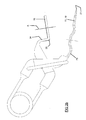
- Figure 1 shows schematically a human heart 1.
- No. 2 indicates the aorta and no. 3 and no. 4 are both a coronary artery which is blocked at 5 respectively 6.
- a bypass 7 has been made to bypass blockage 5 and a bypass 8 has been made to bypass blockage 6.
- graft vessel 9 is prepared according to the invention completely outside and separated from the body of the patient. This preparation can for example take place at a location where the patient is not present, but it can also take place close to the patient in the operating room.
- the term 'the graft vessel being separated from a human or animal body' and the term 'the graft vessel being separated from the body of the patient' as used in this application means that the graft vessel is a separate entity not attached to a human/animal/patient body. Of coarse these term(s) do not exclude that somebody can keep it in his hand or manipulate it. These term(s) mean that the graft is, when separated, not part of the biological system of a body of a human/animal/patient.
- graft vessel 12 For bypass 8 an internal mammary artery from the chest has been used as graft vessel 12. At location 13 this graft vessel has a natural connection to the aorta. Thus at this location no artificial anastomotic connection is required. At location 14 an exemplary anastomotic connection has been made. Graft vessel 12 may be prepared inside the body of the patient or completely outside the body of the patient, but graft vessel 12 will stay connected at location 13 with the patient.
- coronary artery 4 is the recipient vessel with respect to graft vessel 12 and coronary artery 3 and aorta 2 are each a recipient vessels with respect to graft vessel 9.
- FIG. 2a shows schematically a connector 15 that can be used according to the invention.
- This connector 15 comprises a ring 16 and two pins 17, 18 which are with the so called fixed end 22 attached to the ring 16 at 20, and extend from the fixed end 20 towards the pointed free end 21, next to and set apart from each other in the same direction.
- the pins 17, 18 have an overlap section 19 in which they overlap the plane bounded by the ring.
- the plane bounded by the ring is as such defined as the plane 'surface' lying inside the ring and the ring itself. The plane bounded by the ring thus does not extend outside the ring.
- Axis A is the axial axis of the ring.
- a connector 15 like the one as shown in figure 2a is also known from WO 2009/123434 . All the securing devices as disclosed in WO 2009/12434 can be used as a connector for the present invention.
- connector 15 shown in figure 2a is also shown in the figures 3 , 4 and 5 - to be discussed below, it is noted that connectors of the according to the invention can also be of different design, as follows from the example of the connector shown in figure 2b .
- FIG. 2b For details of figure 2b reference is made to WO 2011/062495 .
- Figure 3 illustrates a first method of making an assembly according to the invention.
- Figure 3a shows a graft vessel 30, the connector 15 of figure 2a and the gripper end of a forceps 32.
- the forceps 32 holds the connector 15 and inserts the connector 15 in the direction of arrow B into the lumen 33 of graft vessel 30.
- Figure 3b shows that the pins 17 and 18 are pierced from inside the lumen of graft vessel 30 through the wall 34 of the graft vessel 30 to outside the graft vessel 30.
- the insertion movement in the direction B is continued to shift the connector further in the direction of insertion B up to the pins fully passed through the wall 34 of the graft vessel, see figure 3c .
- the pins have fully passed through the wall 34 of the graft vessel 30 and lie essentially parallel to the wall of the graft vessel 30.
- the ring 16 of the connector lies inside the graft vessel and is shown by dashed line for illustrative purpose.
- FIG. 3d shows that, in the region surrounded by the ring 16, an opening 35 has been made through the wall 34 of the graft vessel 30.
- This opening serves to allow blood to enter or leave the graft vessel at this place in order to allow blood flowing into or from the recipient vessel.
- This opening 35 can be made with an Excimer laser as mentioned earlier several times. The opening can also be made with another tool like a knife.
- Figure 3d further shows that sutures 36 can be used to attach the ring 16 against the inner side of the wall 34 of the graft vessel 30.
- the sutures 36 can be provided before or after making the opening 35.
- the opening 35 does not need to be made at this stage, it is also conceivable to make the opening after attaching the assembly of graft vessel 30 and connector 15 to the recipient vessel.
- Figure 4 illustrates a second method of making an assembly according to the invention.
- the main difference between the method illustrated with figure 3 and the method illustrated with figure 4 is that in the method of figure 3 the ring of the connector is arranged inside the graft vessel and the pins 17, 18 of the connector are arranged outside the graft vessel, whilst in the method of figure 4 the ring and pins are both arranged outside the graft vessel.
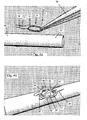
- Figure 4a shows a graft vessel 30, the connector 15 of figure 2a and the gripper end of a forceps 32.
- the forceps 32 holds the connector 15 and places the connector 15 in the direction of arrow C against the graft vessel 30 so that the ring 16 lies between the wall of the graft vessel 30 and the pins 17, 18.
- Fig 4b shows as a next step that an opening 35 has been made in the region of the wall of the graft vessel which surrounded by the ring.
- This opening 35 will later allow blood flow between the graft vessel and recipient vessel.
- the wall tissue of the graft vessel 30 in said region surrounded by the ring 16 is not removed, at least not fully removed.
- Parts 37, 38, and 39 of the wall tissue in said region are used to cover the inner side of the ring 16. Doing so the internal surface 40 of the parts 37, 38, 39 of wall tissue will face inwardly. After completing the anastomotic connection, it will be this internal surface 40 which contacts blood flowing through the anastomotic connection. This is favourable as this internal surface is the natural surface for contacting blood.
- sutures 36 are used on the one hand to attach the ring 16 to the graft vessel and on the other hand to keep the parts 37, 38 and 39 against the inner side of the ring. It is noted that in case the parts 37, 38, 39 have, in radial direction of the ring, sufficient length, they might be folded around the ring and inserted into the gap between the ring 16 and pins 17, 18.
- Figure 5 shows how to use an assembly according to the invention for attachment to a recipient vessel in order to accomplish a side-to-side anastomosis.
- the assembly shown in figure 5 is an assembly made according to figure 4
- an assembly made according to figure 3 can also be attached to the recipient vessel in the manner as illustrated in figure 5 .
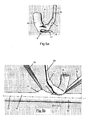
- the parts 41 and 42 of the graft vessel 30, which lie adjacent the connector 15, may be folded towards the axial axis A of the ring 16, or said differently these parts 41 and 42 may be folded towards each other. This may provide the operator, who has to make the exemplary anastomotic connection, a better view onto the connector 15.
- Figure 5b shows in addition a recipient vessel 50 and two forceps 32.
- One of the forceps holds the connector 15 at its ring.
- the other foreceps grips a part 51 of the vessel wall 52 of the recipient vessel and pulls this part 51 away from the longitudinal axis 53 of the recipient vessel 50.
- this gripping and pulling of the part 51 is optional, it makes it easier to pierce the pins 17 and 18 into the wall of the recipient vessel.
- the assembly of graft vessel 30 and connector 15 may be shifted in the direction of arrow D. Once the pointed free ends of the pins passed from the outside through the vessel wall 52, the connector may be shifted further in the direction of arrow D. At the end of this shifting movement, the free ends of the pins 17, 18 can be pierced again through the vessel wall, but now from the inside to the outside. This condition is shown in figure 5d .
- Figure 5d further shows that a laser catheter 60 may be inserted into the part 42 of the graft vessel 40 to burn away that part of the wall of the recipient vessel lying in the region surrounded by the ring 16.
- a laser catheter 60 may be inserted into the part 42 of the graft vessel 40 to burn away that part of the wall of the recipient vessel lying in the region surrounded by the ring 16.
- US 5,964,750 show in more detail the manner of function of the laser catheter tip during application of laser light.
- a ring shaped cut is burnt and the vessel part lying inside this cut may be suctioned against a grid to remove it.
- the laser catheter may be withdrawn in direction E and the part 42 may be provided with a clip to prevent leakage of blood.
- Part 42 can also be closed by suturing, burning or other means in order to prevent blood from flowing out this end.
- the part 41 of the graft vessel might be temporarily closed, for example by a clip.
- graft vessel has sufficient length
- a double bypass also called a jump.
Landscapes
- Health & Medical Sciences (AREA)
- Life Sciences & Earth Sciences (AREA)
- Engineering & Computer Science (AREA)
- Biomedical Technology (AREA)
- Surgery (AREA)
- Veterinary Medicine (AREA)
- Public Health (AREA)
- General Health & Medical Sciences (AREA)
- Heart & Thoracic Surgery (AREA)
- Animal Behavior & Ethology (AREA)
- Nuclear Medicine, Radiotherapy & Molecular Imaging (AREA)
- Medical Informatics (AREA)
- Molecular Biology (AREA)
- Vascular Medicine (AREA)
- Transplantation (AREA)
- Oral & Maxillofacial Surgery (AREA)
- Cardiology (AREA)
- Pulmonology (AREA)
- Gastroenterology & Hepatology (AREA)
- Surgical Instruments (AREA)
- Prostheses (AREA)
Description
- The invention relates to the field of side-to-side (abbreviated as STS) anastomosing.
- A STS-anastomosis is a in the medical field a connection between two channels, in general blood vessels, which are connected with their sides against each other. In the region where the sides of the vessels lie against each other there is an aperture allowing blood to flow from the one vessel into the other vessel. STS-anastomoses are frequently used in the field of bypass surgery for example on the heart.
- According to the older medical prior art these kind of anastomoses with a graft vessel and recipient vessel are made as follows: in each vessel an opening is made in the vessel wall; these openings are laid onto each other with the openings overlapping each other; and subsequently the graft and recipient vessels are attached to each other by suturing. This is a time consuming operation and in order to prevent spillage of blood the recipient vessel need to be shut off from blood flow - like by clipping -. According to more recent medical prior art connector devices have been developed to simplify making the STS-anastomosis. Up to now, these connector devices do not seem to be used widely spread. Apparently, these connector devices still do not fulfil the needs and requirements of safety and reliability.
- The object of the invention is to provide a reliable manner for making an anastomosis. According to a first aspect, this object is achieved by providing an assembly of a graft vessel and an anastomosis connector according to
claim 1. According to a second aspect, this object is achieved by providing a method of making (such) an assembly according toclaim 12. - All these aspects of the invention have in common, that use is made of an "anastomosis connector of the type comprising a ring and two pins"; wherein each pin has a free end and a fixed end connected to the ring, wherein the pins extend, viewed from the fixed end towards the free end, next to and set apart from each other; and wherein each pin has an overlap section where the pin, viewed in axial direction of the ring, overlaps the plane bounded by the outer contour of the ring.
- An "anastomosis connector of the type comprising a ring and two pins" is as such known from
WO 2009/123434 the two part form ofindependent claim 1 is based on this document. Also documentWO 2011/062495 describes an anastomosis connector of this type. With respect to these PCT publications, it is noted that the applicant AMJ B.V. of this application is also the applicant ofWO 2009/123434 andWO 2011/062495 . - Like in
WO 2009/123434 and/orWO 2011/062495 , also in the "anastomosis connector of the type comprising a ring and two pins" as used in the present invention: - at least part of said overlap sections can extend parallel to the ring, in a first position of the pins with respect to the ring; and/or
- the pins can be rigidly connected to the ring; and/or
- the pins can extend in the same direction;
- the pins, can with respect to the ring, be moveable from a first position to a second position in order to form between on the one hand the ring and on the other hand the pins an opened jaw; and in which the pins are moveable from the second position to the first position towards the ring in order to close the jaw; and/or
- in the second position, the overlap sections of the pins can be at an angle with respect to the plane defined by the ring in order to form a sad jaw which, viewed from the fixed end towards the free end, widens, and wherein the pins are swivelable, with respect to the ring, from the second position to the first position; and/or
- the anastomosis connector can further comprises a tensioning member which, when the pins are in the second position, pretensions the pins towards the first position; and/or
- the free ends of the pins can be are arranged at a distance from the overlap section, which distance is at least 50% of the radius of the ring, in particular at least 100% of the radius of the ring; and/or
- the sections of the pins between the overlap section and the free end of each pin, can extend essentially parallel to each other.
- An assembly according to
claim 1 enables making a side-to-side anastomosis connection in an easy manner which requires relative little time and results in a very safe and reliable anastomosis. - With respect to the graft vessel it is to be noted that according to the invention this can be an artificial vessel or a biological vessel. According to the invention, the graft vessel can also be made from a combination of biological and artificial material. In case of a biological vessel, it is noted that this can originate from a human or animal donor - other than the patient itself -, but it can also originate from the patient itself, like a saphenous vein from the leg or an internal mammary artery from the chest. The graft vessel can according to the invention also be a vessel having a biologically cultured cell layer grown onto a supporting tube, like a harness or gauze structure.
- Further it is noted that the assembly according to the invention, also in case a graft vessel originating from the patient itself, is prepared completely outside the patient and without being connected in any manner to the patient. The assembly according to the invention can of course be made in the operation room during the operation just beside he patient itself, but it can also be made remote from the patient in a laboratory, factory or other suitable facility during or before the operation.
- According to a further embodiment of the assembly according to the invention, the wall of the graft vessel is provided with an opening surrounded by the ring. According to the invention this opening can have been formed by laser cutting an opening into the wall of the graft vessel.
- According to a further embodiment of the assembly according to the invention, the connector is attached to the graft vessel by sutures attaching the ring onto the wall of the graft vessel.
- According to a further embodiment of the assembly according to the invention, the connector is attached to the graft vessel by adhesive adhering the ring onto the wall of the graft vessel. This attachment by adhesive can according to the invention also be combined with the above mentioned attachment by sutures but the attachment with adhesive can also be without attachment by sutures.
- According to a further embodiment of the assembly according to the invention, the connector is attached to the graft vessel by the pins piercing through the wall of the graft vessel. This attachment by the pins can according to the invention also be combined with the above mentioned attachment by sutures and/or adhesive, but the attachment with the pins can also be without attachment by sutures and/or adhesive. Using the pins for attachment of the connector to the graft vessel may allow, after attachment of the assembly according to the invention to the recipient vessel, wall tissue of both the recipient vessel and the graft vessel being clamped between the pins and the ring of the connector. This may improve the tightness of the connection as well the connection being leak free. Further this may support - after the operation - growth of the tissue of the graft vessel and recipient vessel into integral new tissue.
- According to a further embodiment of the assembly according to the invention, the pins extend in the longitudinal direction of the graft vessel. This allows the pins to be longer than the diameter of the ring. Pins longer than the diameter of he ring may be practical when attaching the assembly according to the invention to the recipient vessel.
- According to a further embodiment of the assembly according to the invention, the ring lies against the outer surface of the wall of the graft vessel. This is easy to establish. Further it allows the operator when attaching the assembly to the recipient vessel a good view on the location of attachment.
- According to a further embodiment of the assembly according to the invention, the a part of the wall of the graft vessel lying inside the region surrounded by the ring covers the inside of the ring. The pins might stay uncovered. It might even be folded over 180° around the ring to fully cover the ring whilst leaving the pins uncovered. In this way, internal wall tissue of the graft vessel will prevent blood, flowing through the anastomotic connection, from contacting the ring.
- According to a further embodiment of the assembly according to the invention, the ring lies against the inner surface of the wall of the graft vessel and the pins lie outside the graft vessel and extend parallel to the outer surface of the wall of the graft vessel. As indicated above, this may allow, after attachment of the assembly according to the invention to the recipient vessel, wall tissue of both the recipient vessel and the graft vessel being clamped between the pins and the ring of the connector. This may improve the tightness of the connection as well the connection being leak free. Further this may support - after the operation - growth of the tissue of the graft vessel and recipient vessel into integral new tissue.
- According to a further embodiment of the assembly according to the invention, the graft vessel has a first end and a second end; wherein the pins, viewed from the fixed ends towards the free ends of the pins, extend towards the second end; and wherein the distance from the connector to the first end of the graft vessel is smaller than the distance from the connector to the second end. This allows when, an applicator is inserted through the same end of the graft vessel as through which the connector has been inserted, good manipulation of the assembly according to the invention as one has a good view onto the pins. Insertion of the applicator and the connector through the same end of the graft vessel, prevents the inner tissue of the graft vessel at the other side of the connector being damaged. In order to allow sufficient vessel length for closing the first end of the graft vessel after establishing the anastomosis connection, the distance from the connector to the first end is at least 0.5 cm. When a catheter - like an Excimer laser catheter as is for example disclosed in
EP-750476 US 5964750 - is used for making the fluid connection between the lumens of the graft vessel and recipient vessel, the distance from the connector to the first end is at least 1.0 cm. - According to a further embodiment of the assembly according to the invention, a rod like application member could be inserted through an end of the graft vessel into the lumen of the graft vessel.
- According to the second aspect, the invention provides a method of making an assembly comprising on the one hand a graft vessel and on the other hand an anastomosis connector; wherein the graft is during the complete method of making the assembly, separated from human or animal body; wherein the connector comprises a ring and two pins; each pin having a free end and a fixed end connected to the ring; the pins extending, viewed from the fixed end towards the free end, next to and set apart from each other; each pin having an overlap section where the pin, viewed in axial direction of the ring, overlaps the plane bounded by the outer contour of the ring;
wherein the method comprises the step of: - arranging the ring to lie, with its full circumference against the wall of the graft vessel and with its axial axis transverse to the wall of the graft vessel; and
- attaching the connector to the graft vessel.
- With this method an assembly according to the invention can be made.
- According to a further embodiment of the method of the second aspect of the invention, further comprising the step of making an opening through the wall of the graft vessel in the region surrounded by the ring. As already indicated above, the step of making said opening can comprise burning with a laser, such as an Excimer laser, an opening through the wall of the graft vessel.
- According to a further embodiment of the method of the second aspect of the invention, the step of attaching the connector to the graft vessel comprises:
- suturing the ring onto the wall of the graft vessel; and/or
- adhering the ring onto the wall of the graft vessel; and/or
- piercing the pins through the wall of the graft vessel.
- According to a further embodiment of the method of the second aspect of the invention, the step of attaching the connector to the graft vessel comprises:
- inserting the connector into the lumen of the graft vessel with the free ends of the pins pointing in the direction of insertion;
- piercing the free ends of the pins from the inside of the graft vessel through the wall of the graft vessel to outside the graft vessel and subsequently shifting the connector further in the direction of insertion up to the pins fully passed through the wall of the graft vessel and the ring lies against the inner surface of the wall of the graft vessel.
- According to a further embodiment of the method of the second aspect of the invention the ring is placed against the outside of the graft vessel when performing the step of attaching the connector to the graft vessel. In this embodiment, the step of attaching the connector to the graft vessel can comprise the step of covering the inside of the ring with a part of the wall of the graft vessel lying inside the region surrounded by the ring.
- The invention will now be further elucidated with reference to the drawings. In these drawings:
-
Figure 1 shows a schematic view of a human heart with two bypasses; -
Figure 2 shows a schematic perspective view of two connector as can be used with the invention;figure 2a shows one example andfigure 2b shows another example; -
Figure 3 illustrates with schematic perspective views a first method of making an assembly according to the invention, thefigures 3a, 3b ,3c and 3d each illustrate subsequent steps; -
Figure 4 illustrates with schematic perspective views a second method of making an assembly according to the invention, thefigures 4a and 4b each illustrate subsequent steps; and -
Figure 5 illustrates with schematic perspective views of an exemplary method of making a side to side anastomosis, thefigures 5a, 5b ,5c and5b each illustrate subsequent steps. -
Figure 1 shows schematically ahuman heart 1. No. 2 indicates the aorta and no. 3 and no. 4 are both a coronary artery which is blocked at 5 respectively 6. In order to restore circulation through the blockedcoronary arteries bypass 7 has been made to bypassblockage 5 and abypass 8 has been made to bypassblockage 6. - For bypass 7 a saphenous vein from the leg has been used as
graft vessel 9. The anastomotic connections at 10 and 11 are made and will be described further below.Graft vessel 9 is prepared according to the invention completely outside and separated from the body of the patient. This preparation can for example take place at a location where the patient is not present, but it can also take place close to the patient in the operating room. - The term 'the graft vessel being separated from a human or animal body' and the term 'the graft vessel being separated from the body of the patient' as used in this application means that the graft vessel is a separate entity not attached to a human/animal/patient body. Of coarse these term(s) do not exclude that somebody can keep it in his hand or manipulate it. These term(s) mean that the graft is, when separated, not part of the biological system of a body of a human/animal/patient.
- For
bypass 8 an internal mammary artery from the chest has been used asgraft vessel 12. Atlocation 13 this graft vessel has a natural connection to the aorta. Thus at this location no artificial anastomotic connection is required. Atlocation 14 an exemplary anastomotic connection has been made.Graft vessel 12 may be prepared inside the body of the patient or completely outside the body of the patient, butgraft vessel 12 will stay connected atlocation 13 with the patient. - In
figure 1 thecoronary artery 4 is the recipient vessel with respect to graftvessel 12 andcoronary artery 3 andaorta 2 are each a recipient vessels with respect to graftvessel 9. -
Figure 2a shows schematically aconnector 15 that can be used according to the invention. Thisconnector 15 comprises aring 16 and twopins fixed end 22 attached to thering 16 at 20, and extend from the fixedend 20 towards the pointedfree end 21, next to and set apart from each other in the same direction. Thepins overlap section 19 in which they overlap the plane bounded by the ring. The plane bounded by the ring is as such defined as the plane 'surface' lying inside the ring and the ring itself. The plane bounded by the ring thus does not extend outside the ring. Axis A is the axial axis of the ring. - A
connector 15 like the one as shown infigure 2a is also known fromWO 2009/123434 . All the securing devices as disclosed inWO 2009/12434 - Although the
connector 15 shown infigure 2a is also shown in thefigures 3 ,4 and5 - to be discussed below, it is noted that connectors of the according to the invention can also be of different design, as follows from the example of the connector shown infigure 2b . For details offigure 2b reference is made toWO 2011/062495 . - Referring to
figure 2b of the present application, it might be considered to extend 23 and to arrange at 25 between thering 16 and leg 24 a similar extension about parallel to 23 in order to create more distance between thering 16 and pins 17, 18 and theleg 24. -
Figure 3 illustrates a first method of making an assembly according to the invention. -
Figure 3a shows agraft vessel 30, theconnector 15 offigure 2a and the gripper end of aforceps 32. Theforceps 32 holds theconnector 15 and inserts theconnector 15 in the direction of arrow B into thelumen 33 ofgraft vessel 30. -
Figure 3b shows that thepins graft vessel 30 through thewall 34 of thegraft vessel 30 to outside thegraft vessel 30. The insertion movement in the direction B is continued to shift the connector further in the direction of insertion B up to the pins fully passed through thewall 34 of the graft vessel, seefigure 3c . - In
figure 3c , the pins have fully passed through thewall 34 of thegraft vessel 30 and lie essentially parallel to the wall of thegraft vessel 30. Thering 16 of the connector lies inside the graft vessel and is shown by dashed line for illustrative purpose. -
Figure 3d shows that, in the region surrounded by thering 16, anopening 35 has been made through thewall 34 of thegraft vessel 30. This opening serves to allow blood to enter or leave the graft vessel at this place in order to allow blood flowing into or from the recipient vessel. Thisopening 35 can be made with an Excimer laser as mentioned earlier several times. The opening can also be made with another tool like a knife. -
Figure 3d further shows thatsutures 36 can be used to attach thering 16 against the inner side of thewall 34 of thegraft vessel 30. Thesutures 36 can be provided before or after making theopening 35. - It is to be noted that the
opening 35 does not need to be made at this stage, it is also conceivable to make the opening after attaching the assembly ofgraft vessel 30 andconnector 15 to the recipient vessel. -
Figure 4 illustrates a second method of making an assembly according to the invention. The main difference between the method illustrated withfigure 3 and the method illustrated withfigure 4 , is that in the method offigure 3 the ring of the connector is arranged inside the graft vessel and thepins figure 4 the ring and pins are both arranged outside the graft vessel. -
Figure 4a shows agraft vessel 30, theconnector 15 offigure 2a and the gripper end of aforceps 32. Theforceps 32 holds theconnector 15 and places theconnector 15 in the direction of arrow C against thegraft vessel 30 so that thering 16 lies between the wall of thegraft vessel 30 and thepins -
Fig 4b shows as a next step that anopening 35 has been made in the region of the wall of the graft vessel which surrounded by the ring. Thisopening 35 will later allow blood flow between the graft vessel and recipient vessel. Further the wall tissue of thegraft vessel 30 in said region surrounded by thering 16 is not removed, at least not fully removed.Parts ring 16. Doing so theinternal surface 40 of theparts internal surface 40 which contacts blood flowing through the anastomotic connection. This is favourable as this internal surface is the natural surface for contacting blood. As shown sutures 36 are used on the one hand to attach thering 16 to the graft vessel and on the other hand to keep theparts parts ring 16 and pins 17, 18. -
Figure 5 shows how to use an assembly according to the invention for attachment to a recipient vessel in order to accomplish a side-to-side anastomosis. Although the assembly shown infigure 5 is an assembly made according tofigure 4 , it is noted that an assembly made according tofigure 3 can also be attached to the recipient vessel in the manner as illustrated infigure 5 . - In
figure 5a , theparts graft vessel 30, which lie adjacent theconnector 15, may be folded towards the axial axis A of thering 16, or said differently theseparts connector 15. -
Figure 5b shows in addition arecipient vessel 50 and twoforceps 32. One of the forceps holds theconnector 15 at its ring. The other foreceps grips apart 51 of thevessel wall 52 of the recipient vessel and pulls thispart 51 away from thelongitudinal axis 53 of therecipient vessel 50. Although this gripping and pulling of thepart 51 is optional, it makes it easier to pierce thepins - In order to pierce the
pins recipient vessel 50 through thewall 52 of the recipient vessel into the lumen of the recipient vessel, the assembly ofgraft vessel 30 andconnector 15 may be shifted in the direction of arrow D. Once the pointed free ends of the pins passed from the outside through thevessel wall 52, the connector may be shifted further in the direction of arrow D. At the end of this shifting movement, the free ends of thepins figure 5d . -
Figure 5d further shows that alaser catheter 60 may be inserted into thepart 42 of thegraft vessel 40 to burn away that part of the wall of the recipient vessel lying in the region surrounded by thering 16. For details of asuitable laser catheter 60 reference can be made to the earlier mentionedUS 5,964,750 .US 5,964,750 show in more detail the manner of function of the laser catheter tip during application of laser light. A ring shaped cut is burnt and the vessel part lying inside this cut may be suctioned against a grid to remove it. After the opening for connection of the lumens of the graft vessel and recipient vessel have been made, the laser catheter may be withdrawn in direction E and thepart 42 may be provided with a clip to prevent leakage of blood.Part 42 can also be closed by suturing, burning or other means in order to prevent blood from flowing out this end. During use of thelaser catheter 60 also thepart 41 of the graft vessel might be temporarily closed, for example by a clip. - It is noted that in an exemplary case where the graft vessel has sufficient length, it may be also possible to use one graft vessel for a double bypass, also called a jump. Referring to
figure 1 , it may be for example conceivable to connect one end of the graft vessel at 10 to the aorta, the other end at 14 to thecoronary artery 4 and to connect the graft vessel somewhere in between its ends at thelocation 11 withcoronary artery 3.
Claims (16)
- Assembly comprising a graft vessel (30) and an anastomosis connector (15);
wherein the graft vessel (30) is separated from a human or animal body;
wherein the connector (15) comprises a ring (16) and two pins (17, 18);
each pin (17, 18) having a free end (21) and a fixed end (22) connected to the ring (16);
the pins (17, 18) extending, viewed from the fixed end (22) towards the free end (21), next to and set apart from each other;
each pin (17, 18) having an overlap section (19) where the pin, viewed in axial direction of the ring (16), overlaps the plane bounded by the outer contour of the ring (16);
wherein the connector (15) is attached to the graft vessel (30);
wherein the pins (17, 18) are arranged outside the graft vessel (30); and
wherein the ring (16) lies, with its full circumference, against the wall (34) of the graft vessel (30);
characterized, in that the axial axis of the ring (16) extends transverse to the wall (34) of the graft vessel (30). - Assembly according to claim 1, wherein the wall (34) of the graft vessel (30) is provided with an opening (35) surrounded by the ring (16), and wherein the opening (35) preferably has been formed by laser cutting an opening (35) into the wall (34) of the graft vessel (30).
- Assembly according to one of the preceding claims, wherein the connector (15) is attached to the graft vessel (30) by sutures (36) attaching the ring (16) onto the wall (34) of the graft vessel (30), and/or by adhesive adhering (16) the ring (16) onto the wall (34) of the graft vessel (30), and/or by the pins (17, 18) piercing through the wall (34) of the graft vessel (30).
- Assembly according to one of the preceding claims, wherein the pins (17, 18) extend in the longitudinal direction of the graft vessel (30).
- Assembly according to one of the preceding claims, wherein the ring (16) lies against the outer surface of the wall (34) of the graft vessel (30), and wherein a part of the wall (34) of the graft vessel (30) lying inside the region surrounded by the ring (16) is folded outwardly to cover the inner side of the ring (16).
- Assembly according to one of the preceding claim 1-4, wherein the ring (16) lies against the inner surface of the wall (34) of the graft vessel (30) and wherein the pins (17, 18) lie outside the graft vessel (30) and extend parallel to the outer surface of the wall (34) of the graft vessel (30).
- Assembly according to one of the preceding claims, wherein the graft vessel (30) has a first end and a second end; wherein the pins (17, 18), viewed from the fixed ends (22) towards the free ends (21), extend towards the second end of the graft vessel (30), and wherein the distance from the connector (15) to the first end of the graft vessel (30) is smaller than the distance from the connector (15) to the second end, and wherein this distance from the connector (15) to the first end is preferably at least 0.5 cm, such 1.0 cm or more.
- Assembly according to one of the preceding claims, wherein, in a first position of the pins (17, 18) with respect to the ring (16), at least part of the overlap sections (19) extend parallel to the ring (16).
- Assembly according to one of the preceding claims, wherein the pins (17, 18) are rigidly connected to the ring (16).
- Assembly according to one of the claims 1-8, wherein the pins (17, 18) are with respect to the ring (16) moveable from a first position to a second position in order to form between the ring (16) and the pins (17, 18) an opened jaw; and in which the pins (17, 18) are moveable from the second position to the first position towards the ring (16) in order to close the jaw; and
wherein preferably
in the second position the overlap sections (19) of the pins (17, 18) are angled with respect to the plane defined by the ring (16) in order to form said jaw which, viewed from the fixed end (22) towards the free end (21), widens, and wherein the pins (17, 18) are swivelable, with respect to the ring (16), from the second position to the first position;
and/or
wherein the connector (15) further comprises a tensioning member which, when the pins (17, 18) are in the second position, pretensions the pins (17, 18) towards the first position. - Assembly according to one of the preceding claims, wherein the free ends (21) of the pins (17, 18) are arranged at a distance from the overlap section (19), wherein said distance is at least 50% of the radius of the ring (16), preferably at least 100% of the radius of the ring (16); and wherein the sections of the pins (17, 18) between the overlap section (19) and the free end (21) of each pin, are preferably substantially parallel to each other.
- Method of making an assembly comprising a graft vessel (30) and an anastomosis connector (15);
wherein the graft is, during the complete method, of making the essembly separated from human or animal body;
wherein the connector (15) comprises a ring (16) and two pins (17, 18); each pin (17, 18) having a free end (21) and a fixed end (22) connected to the ring (16); the pins (17, 18) extending, viewed from the fixed end (22) towards the free end (21), next to and set apart from each other; each pin (17, 18) having an overlap section (19) where the pin, viewed in axial direction of the ring (16), overlaps the plane bounded by the outer contour of the ring (16);
wherein the method comprises the step of:• arranging the ring (16) to lie, with its full circumference against the wall (34) of the graft vessel (30) and with its axial axis transverse to the wall (34) of the graft vessel (30); and• attaching the connector (15) to the graft vessel (30). - Method according to claim 12, further comprising the step of:• making an opening (35) through the wall (34) of the graft vessel (30) in the region surrounded by the ring (16);wherein the step of making said opening (35) is preferably made by burning with a laser, such as an Excimer laser, an opening (35) through the wall (34) of the graft vessel (30).
- Method according to one of claims 13-15, wherein the step of attaching the connector (15) to the graft vessel (30) comprises suturing (16) the ring (16) onto the wall (34) of the graft vessel (30); and/or adhering (16) the ring (16) onto the wall (34) of the graft vessel (30); and/or piercing the pins (17, 18) through the wall (34) of the graft vessel (30).
- Method according to one of claims 12-14, wherein the step of attaching the connector (15) to the graft vessel (30) comprises:• inserting the connector (15) into the lumen of the graft vessel (30) with the free ends (21) of the pins (17, 18) pointing in the direction of insertion;• piercing the free ends (21) of the pins (17, 18) from the inside of the graft vessel (30) through the wall (34) of the graft vessel (30) to outside the graft vessel (30) and subsequently shifting the connector (15) further in the direction of insertion up to the pins (17, 18) fully passed through the wall (34) of the graft vessel (30) and the ring (16) lies against the inner surface of the wall (34) of the graft vessel (30).
- Method according to one of claims 12-14, wherein, in the step of attaching the connector (15) to the graft vessel (30), the ring (16) is placed against the outside of the graft vessel (30); and the step of attaching the connector (15) to the graft vessel (30) further comprises covering (16) the inside of the ring (16) with a part of the wall (34) of the graft vessel (30) lying inside the region surrounded by the ring (16).
Applications Claiming Priority (1)
| Application Number | Priority Date | Filing Date | Title |
|---|---|---|---|
| PCT/NL2011/050019 WO2012096563A1 (en) | 2011-01-12 | 2011-01-12 | Side to side anastomosis |
Publications (3)
| Publication Number | Publication Date |
|---|---|
| EP2663243A1 EP2663243A1 (en) | 2013-11-20 |
| EP2663243B1 true EP2663243B1 (en) | 2015-10-21 |
| EP2663243B8 EP2663243B8 (en) | 2015-11-25 |
Family
ID=44583596
Family Applications (1)
| Application Number | Title | Priority Date | Filing Date |
|---|---|---|---|
| EP11701880.4A Active EP2663243B8 (en) | 2011-01-12 | 2011-01-12 | Side to side anastomosis |
Country Status (5)
| Country | Link |
|---|---|
| US (1) | US20130345499A1 (en) |
| EP (1) | EP2663243B8 (en) |
| JP (1) | JP2014507980A (en) |
| CN (1) | CN203597993U (en) |
| WO (1) | WO2012096563A1 (en) |
Families Citing this family (4)
| Publication number | Priority date | Publication date | Assignee | Title |
|---|---|---|---|---|
| CN109803607B (en) * | 2016-06-13 | 2021-07-20 | 主动脉公司 | Systems, devices and methods for marking and/or reinforcing fenestrations in prosthetic implants |
| CN115813605A (en) | 2017-09-25 | 2023-03-21 | 波尔顿医疗公司 | Systems, devices and methods for coupling prosthetic implants to fenestrations |
| NL2032224B1 (en) | 2022-06-20 | 2024-01-08 | Amt Medical B V | anastomosis clip |
| NL2039193B1 (en) | 2024-11-28 | 2026-06-19 | Amt Medical B V | Catheter assembly for making a connection passage in an ETS and/or STS anastomotic surgery. |
Family Cites Families (8)
| Publication number | Priority date | Publication date | Assignee | Title |
|---|---|---|---|---|
| US5964750A (en) | 1994-03-15 | 1999-10-12 | Medolas Gesellschaft Fuer Medizintechnik Gmbh | Laser catheter for bypass surgery |
| DE4408746C2 (en) | 1994-03-15 | 1997-06-05 | Medolas Ges Fuer Medizintechni | Laser catheter for bypass surgery |
| US6458140B2 (en) * | 1999-07-28 | 2002-10-01 | Vasconnect, Inc. | Devices and methods for interconnecting vessels |
| SI1628702T1 (en) * | 2003-04-28 | 2013-10-30 | Winter Erwin De | Anchoring screw device |
| EP1547526A1 (en) * | 2003-12-23 | 2005-06-29 | UMC Utrecht Holding B.V. | Operation element, operation set and method for use thereof |
| US8777971B2 (en) * | 2006-10-17 | 2014-07-15 | Amj Bv | Device and method for joining vessels in anastomosis |
| CA2693371C (en) | 2007-07-19 | 2013-12-10 | Telcordia Technologies, Inc. | Method for a public-key infrastructure providing communication integrity and anonymity while detecting malicious communication |
| CN101977554B (en) * | 2008-04-03 | 2014-03-19 | Amj公司 | Fastening device and assembly comprising such fastening device |
-
2011
- 2011-01-12 EP EP11701880.4A patent/EP2663243B8/en active Active
- 2011-01-12 WO PCT/NL2011/050019 patent/WO2012096563A1/en not_active Ceased
- 2011-01-12 JP JP2013549378A patent/JP2014507980A/en active Pending
- 2011-01-12 CN CN201190001047.XU patent/CN203597993U/en not_active Expired - Fee Related
- 2011-01-12 US US13/978,115 patent/US20130345499A1/en not_active Abandoned
Also Published As
| Publication number | Publication date |
|---|---|
| JP2014507980A (en) | 2014-04-03 |
| EP2663243B8 (en) | 2015-11-25 |
| EP2663243A1 (en) | 2013-11-20 |
| WO2012096563A1 (en) | 2012-07-19 |
| CN203597993U (en) | 2014-05-21 |
| US20130345499A1 (en) | 2013-12-26 |
Similar Documents
| Publication | Publication Date | Title |
|---|---|---|
| US6673085B1 (en) | Anastomosis techniques | |
| US9566146B2 (en) | Cardiovascular valve and valve housing apparatuses and systems | |
| AU2011268411B2 (en) | Systems and methods for creating arteriovenous (AV) fistulas | |
| US6699245B2 (en) | Anastomosis system and related methods | |
| US8734436B2 (en) | Laser catheter for bypass surgery and assembly comprising said catheter | |
| US6596003B1 (en) | Vascular anastomosis device | |
| US20080009889A1 (en) | Conduit cuff | |
| US20040133221A1 (en) | Connector assembly for joining a graft vessel to a side of a target vessel | |
| CN119033502B (en) | Aortic tectorial stent and abdominal aortic tectorial stent assembly | |
| US20040181244A1 (en) | Vascular anastomosis device | |
| WO2025049943A1 (en) | Device and assembly for tissue attachment | |
| US20130345499A1 (en) | Side to side anastomosis | |
| EP2265191B1 (en) | Securing device and assembly comprising such a securing device | |
| CN117695050B (en) | A multi-release covered stent and covered stent system thereof | |
| CA3055580C (en) | Endoscopic transluminal stent access and delivery system | |
| US20240315725A1 (en) | Method for forming an end-to-side anastomosis | |
| EP1576928A1 (en) | Flanged graft for vascular anastomosis and bypass |
Legal Events
| Date | Code | Title | Description |
|---|---|---|---|
| PUAI | Public reference made under article 153(3) epc to a published international application that has entered the european phase |
Free format text: ORIGINAL CODE: 0009012 |
|
| 17P | Request for examination filed |
Effective date: 20130709 |
|
| AK | Designated contracting states |
Kind code of ref document: A1 Designated state(s): AL AT BE BG CH CY CZ DE DK EE ES FI FR GB GR HR HU IE IS IT LI LT LU LV MC MK MT NL NO PL PT RO RS SE SI SK SM TR |
|
| GRAP | Despatch of communication of intention to grant a patent |
Free format text: ORIGINAL CODE: EPIDOSNIGR1 |
|
| INTG | Intention to grant announced |
Effective date: 20140806 |
|
| 19U | Interruption of proceedings before grant |
Effective date: 20140723 |
|
| 19W | Proceedings resumed before grant after interruption of proceedings |
Effective date: 20141201 |
|
| RAP1 | Party data changed (applicant data changed or rights of an application transferred) |
Owner name: CORVASCO MEDICAL B.V. |
|
| GRAC | Information related to communication of intention to grant a patent modified |
Free format text: ORIGINAL CODE: EPIDOSCIGR1 |
|
| INTG | Intention to grant announced |
Effective date: 20150512 |
|
| GRAS | Grant fee paid |
Free format text: ORIGINAL CODE: EPIDOSNIGR3 |
|
| GRAA | (expected) grant |
Free format text: ORIGINAL CODE: 0009210 |
|
| AK | Designated contracting states |
Kind code of ref document: B1 Designated state(s): AL AT BE BG CH CY CZ DE DK EE ES FI FR GB GR HR HU IE IS IT LI LT LU LV MC MK MT NL NO PL PT RO RS SE SI SK SM TR |
|
| REG | Reference to a national code |
Ref country code: GB Ref legal event code: FG4D Ref country code: NL Ref legal event code: MP Effective date: 20151021 |
|
| REG | Reference to a national code |
Ref country code: CH Ref legal event code: EP |
|
| RAP2 | Party data changed (patent owner data changed or rights of a patent transferred) |
Owner name: AMT MEDICAL B.V. |
|
| REG | Reference to a national code |
Ref country code: AT Ref legal event code: REF Ref document number: 756041 Country of ref document: AT Kind code of ref document: T Effective date: 20151115 |
|
| REG | Reference to a national code |
Ref country code: IE Ref legal event code: FG4D |
|
| REG | Reference to a national code |
Ref country code: DE Ref legal event code: R096 Ref document number: 602011020774 Country of ref document: DE |
|
| REG | Reference to a national code |
Ref country code: DE Ref legal event code: R081 Ref document number: 602011020774 Country of ref document: DE Owner name: AMT MEDICAL B.V., NL Free format text: FORMER OWNER: CORVASCO MEDICAL B.V., UTRECHT, NL |
|
| REG | Reference to a national code |
Ref country code: FR Ref legal event code: PLFP Year of fee payment: 6 |
|
| REG | Reference to a national code |
Ref country code: LT Ref legal event code: MG4D |
|
| REG | Reference to a national code |
Ref country code: AT Ref legal event code: MK05 Ref document number: 756041 Country of ref document: AT Kind code of ref document: T Effective date: 20151021 |
|
| PG25 | Lapsed in a contracting state [announced via postgrant information from national office to epo] |
Ref country code: ES Free format text: LAPSE BECAUSE OF FAILURE TO SUBMIT A TRANSLATION OF THE DESCRIPTION OR TO PAY THE FEE WITHIN THE PRESCRIBED TIME-LIMIT Effective date: 20151021 Ref country code: NL Free format text: LAPSE BECAUSE OF FAILURE TO SUBMIT A TRANSLATION OF THE DESCRIPTION OR TO PAY THE FEE WITHIN THE PRESCRIBED TIME-LIMIT Effective date: 20151021 Ref country code: NO Free format text: LAPSE BECAUSE OF FAILURE TO SUBMIT A TRANSLATION OF THE DESCRIPTION OR TO PAY THE FEE WITHIN THE PRESCRIBED TIME-LIMIT Effective date: 20160121 Ref country code: HR Free format text: LAPSE BECAUSE OF FAILURE TO SUBMIT A TRANSLATION OF THE DESCRIPTION OR TO PAY THE FEE WITHIN THE PRESCRIBED TIME-LIMIT Effective date: 20151021 Ref country code: LT Free format text: LAPSE BECAUSE OF FAILURE TO SUBMIT A TRANSLATION OF THE DESCRIPTION OR TO PAY THE FEE WITHIN THE PRESCRIBED TIME-LIMIT Effective date: 20151021 Ref country code: IT Free format text: LAPSE BECAUSE OF FAILURE TO SUBMIT A TRANSLATION OF THE DESCRIPTION OR TO PAY THE FEE WITHIN THE PRESCRIBED TIME-LIMIT Effective date: 20151021 Ref country code: IS Free format text: LAPSE BECAUSE OF FAILURE TO SUBMIT A TRANSLATION OF THE DESCRIPTION OR TO PAY THE FEE WITHIN THE PRESCRIBED TIME-LIMIT Effective date: 20160221 |
|
| PG25 | Lapsed in a contracting state [announced via postgrant information from national office to epo] |
Ref country code: BE Free format text: LAPSE BECAUSE OF NON-PAYMENT OF DUE FEES Effective date: 20160131 Ref country code: PL Free format text: LAPSE BECAUSE OF FAILURE TO SUBMIT A TRANSLATION OF THE DESCRIPTION OR TO PAY THE FEE WITHIN THE PRESCRIBED TIME-LIMIT Effective date: 20151021 Ref country code: SE Free format text: LAPSE BECAUSE OF FAILURE TO SUBMIT A TRANSLATION OF THE DESCRIPTION OR TO PAY THE FEE WITHIN THE PRESCRIBED TIME-LIMIT Effective date: 20151021 Ref country code: AT Free format text: LAPSE BECAUSE OF FAILURE TO SUBMIT A TRANSLATION OF THE DESCRIPTION OR TO PAY THE FEE WITHIN THE PRESCRIBED TIME-LIMIT Effective date: 20151021 Ref country code: RS Free format text: LAPSE BECAUSE OF FAILURE TO SUBMIT A TRANSLATION OF THE DESCRIPTION OR TO PAY THE FEE WITHIN THE PRESCRIBED TIME-LIMIT Effective date: 20151021 Ref country code: PT Free format text: LAPSE BECAUSE OF FAILURE TO SUBMIT A TRANSLATION OF THE DESCRIPTION OR TO PAY THE FEE WITHIN THE PRESCRIBED TIME-LIMIT Effective date: 20160222 Ref country code: LV Free format text: LAPSE BECAUSE OF FAILURE TO SUBMIT A TRANSLATION OF THE DESCRIPTION OR TO PAY THE FEE WITHIN THE PRESCRIBED TIME-LIMIT Effective date: 20151021 Ref country code: GR Free format text: LAPSE BECAUSE OF FAILURE TO SUBMIT A TRANSLATION OF THE DESCRIPTION OR TO PAY THE FEE WITHIN THE PRESCRIBED TIME-LIMIT Effective date: 20160122 Ref country code: FI Free format text: LAPSE BECAUSE OF FAILURE TO SUBMIT A TRANSLATION OF THE DESCRIPTION OR TO PAY THE FEE WITHIN THE PRESCRIBED TIME-LIMIT Effective date: 20151021 |
|
| REG | Reference to a national code |
Ref country code: DE Ref legal event code: R097 Ref document number: 602011020774 Country of ref document: DE |
|
| PG25 | Lapsed in a contracting state [announced via postgrant information from national office to epo] |
Ref country code: CZ Free format text: LAPSE BECAUSE OF FAILURE TO SUBMIT A TRANSLATION OF THE DESCRIPTION OR TO PAY THE FEE WITHIN THE PRESCRIBED TIME-LIMIT Effective date: 20151021 |
|
| PLBE | No opposition filed within time limit |
Free format text: ORIGINAL CODE: 0009261 |
|
| STAA | Information on the status of an ep patent application or granted ep patent |
Free format text: STATUS: NO OPPOSITION FILED WITHIN TIME LIMIT |
|
| PG25 | Lapsed in a contracting state [announced via postgrant information from national office to epo] |
Ref country code: SM Free format text: LAPSE BECAUSE OF FAILURE TO SUBMIT A TRANSLATION OF THE DESCRIPTION OR TO PAY THE FEE WITHIN THE PRESCRIBED TIME-LIMIT Effective date: 20151021 Ref country code: LU Free format text: LAPSE BECAUSE OF FAILURE TO SUBMIT A TRANSLATION OF THE DESCRIPTION OR TO PAY THE FEE WITHIN THE PRESCRIBED TIME-LIMIT Effective date: 20160112 Ref country code: RO Free format text: LAPSE BECAUSE OF FAILURE TO SUBMIT A TRANSLATION OF THE DESCRIPTION OR TO PAY THE FEE WITHIN THE PRESCRIBED TIME-LIMIT Effective date: 20151021 Ref country code: EE Free format text: LAPSE BECAUSE OF FAILURE TO SUBMIT A TRANSLATION OF THE DESCRIPTION OR TO PAY THE FEE WITHIN THE PRESCRIBED TIME-LIMIT Effective date: 20151021 Ref country code: DK Free format text: LAPSE BECAUSE OF FAILURE TO SUBMIT A TRANSLATION OF THE DESCRIPTION OR TO PAY THE FEE WITHIN THE PRESCRIBED TIME-LIMIT Effective date: 20151021 Ref country code: SK Free format text: LAPSE BECAUSE OF FAILURE TO SUBMIT A TRANSLATION OF THE DESCRIPTION OR TO PAY THE FEE WITHIN THE PRESCRIBED TIME-LIMIT Effective date: 20151021 |
|
| REG | Reference to a national code |
Ref country code: CH Ref legal event code: PL |
|
| 26N | No opposition filed |
Effective date: 20160722 |
|
| PG25 | Lapsed in a contracting state [announced via postgrant information from national office to epo] |
Ref country code: MC Free format text: LAPSE BECAUSE OF FAILURE TO SUBMIT A TRANSLATION OF THE DESCRIPTION OR TO PAY THE FEE WITHIN THE PRESCRIBED TIME-LIMIT Effective date: 20151021 |
|
| PG25 | Lapsed in a contracting state [announced via postgrant information from national office to epo] |
Ref country code: LI Free format text: LAPSE BECAUSE OF NON-PAYMENT OF DUE FEES Effective date: 20160131 Ref country code: CH Free format text: LAPSE BECAUSE OF NON-PAYMENT OF DUE FEES Effective date: 20160131 |
|
| REG | Reference to a national code |
Ref country code: IE Ref legal event code: MM4A |
|
| PG25 | Lapsed in a contracting state [announced via postgrant information from national office to epo] |
Ref country code: SI Free format text: LAPSE BECAUSE OF FAILURE TO SUBMIT A TRANSLATION OF THE DESCRIPTION OR TO PAY THE FEE WITHIN THE PRESCRIBED TIME-LIMIT Effective date: 20151021 |
|
| PG25 | Lapsed in a contracting state [announced via postgrant information from national office to epo] |
Ref country code: BE Free format text: LAPSE BECAUSE OF FAILURE TO SUBMIT A TRANSLATION OF THE DESCRIPTION OR TO PAY THE FEE WITHIN THE PRESCRIBED TIME-LIMIT Effective date: 20151021 |
|
| REG | Reference to a national code |
Ref country code: FR Ref legal event code: PLFP Year of fee payment: 7 |
|
| PG25 | Lapsed in a contracting state [announced via postgrant information from national office to epo] |
Ref country code: IE Free format text: LAPSE BECAUSE OF NON-PAYMENT OF DUE FEES Effective date: 20160112 |
|
| PG25 | Lapsed in a contracting state [announced via postgrant information from national office to epo] |
Ref country code: MT Free format text: LAPSE BECAUSE OF FAILURE TO SUBMIT A TRANSLATION OF THE DESCRIPTION OR TO PAY THE FEE WITHIN THE PRESCRIBED TIME-LIMIT Effective date: 20151021 |
|
| REG | Reference to a national code |
Ref country code: FR Ref legal event code: PLFP Year of fee payment: 8 |
|
| PG25 | Lapsed in a contracting state [announced via postgrant information from national office to epo] |
Ref country code: HU Free format text: LAPSE BECAUSE OF FAILURE TO SUBMIT A TRANSLATION OF THE DESCRIPTION OR TO PAY THE FEE WITHIN THE PRESCRIBED TIME-LIMIT; INVALID AB INITIO Effective date: 20110112 Ref country code: CY Free format text: LAPSE BECAUSE OF FAILURE TO SUBMIT A TRANSLATION OF THE DESCRIPTION OR TO PAY THE FEE WITHIN THE PRESCRIBED TIME-LIMIT Effective date: 20151021 |
|
| PG25 | Lapsed in a contracting state [announced via postgrant information from national office to epo] |
Ref country code: MT Free format text: LAPSE BECAUSE OF FAILURE TO SUBMIT A TRANSLATION OF THE DESCRIPTION OR TO PAY THE FEE WITHIN THE PRESCRIBED TIME-LIMIT Effective date: 20160131 Ref country code: TR Free format text: LAPSE BECAUSE OF FAILURE TO SUBMIT A TRANSLATION OF THE DESCRIPTION OR TO PAY THE FEE WITHIN THE PRESCRIBED TIME-LIMIT Effective date: 20151021 Ref country code: MK Free format text: LAPSE BECAUSE OF FAILURE TO SUBMIT A TRANSLATION OF THE DESCRIPTION OR TO PAY THE FEE WITHIN THE PRESCRIBED TIME-LIMIT Effective date: 20151021 |
|
| PG25 | Lapsed in a contracting state [announced via postgrant information from national office to epo] |
Ref country code: BG Free format text: LAPSE BECAUSE OF FAILURE TO SUBMIT A TRANSLATION OF THE DESCRIPTION OR TO PAY THE FEE WITHIN THE PRESCRIBED TIME-LIMIT Effective date: 20151021 |
|
| PG25 | Lapsed in a contracting state [announced via postgrant information from national office to epo] |
Ref country code: AL Free format text: LAPSE BECAUSE OF FAILURE TO SUBMIT A TRANSLATION OF THE DESCRIPTION OR TO PAY THE FEE WITHIN THE PRESCRIBED TIME-LIMIT Effective date: 20151021 |
|
| P01 | Opt-out of the competence of the unified patent court (upc) registered |
Effective date: 20230509 |
|
| PGFP | Annual fee paid to national office [announced via postgrant information from national office to epo] |
Ref country code: GB Payment date: 20260122 Year of fee payment: 16 |
|
| PGFP | Annual fee paid to national office [announced via postgrant information from national office to epo] |
Ref country code: DE Payment date: 20260120 Year of fee payment: 16 |
|
| PGFP | Annual fee paid to national office [announced via postgrant information from national office to epo] |
Ref country code: FR Payment date: 20260121 Year of fee payment: 16 |