EP2661437B1 - 2,4-DIAMINO-6,7-DIHYDRO-5H-PYRROLO[2,3]PYRIMIDINE DERIVATIVES AS FAK/Pyk2 INHIBITORS - Google Patents
2,4-DIAMINO-6,7-DIHYDRO-5H-PYRROLO[2,3]PYRIMIDINE DERIVATIVES AS FAK/Pyk2 INHIBITORS Download PDFInfo
- Publication number
- EP2661437B1 EP2661437B1 EP12732345.9A EP12732345A EP2661437B1 EP 2661437 B1 EP2661437 B1 EP 2661437B1 EP 12732345 A EP12732345 A EP 12732345A EP 2661437 B1 EP2661437 B1 EP 2661437B1
- Authority
- EP
- European Patent Office
- Prior art keywords
- disclosure
- mmol
- additional embodiments
- dihydro
- pyrrolo
- Prior art date
- Legal status (The legal status is an assumption and is not a legal conclusion. Google has not performed a legal analysis and makes no representation as to the accuracy of the status listed.)
- Not-in-force
Links
- 101150094745 Ptk2b gene Proteins 0.000 title description 36
- YKSDWSANIALJBM-UHFFFAOYSA-N 6,7-dihydro-5h-pyrrolo[3,2-d]pyrimidine-2,4-diamine Chemical class NC1=NC(N)=NC2=C1NCC2 YKSDWSANIALJBM-UHFFFAOYSA-N 0.000 title description 5
- 239000003112 inhibitor Substances 0.000 title description 4
- 150000001875 compounds Chemical class 0.000 claims description 229
- 206010028980 Neoplasm Diseases 0.000 claims description 178
- 201000011510 cancer Diseases 0.000 claims description 113
- 150000003839 salts Chemical class 0.000 claims description 76
- 208000037265 diseases, disorders, signs and symptoms Diseases 0.000 claims description 70
- 239000012453 solvate Substances 0.000 claims description 53
- 239000003814 drug Substances 0.000 claims description 43
- 208000035475 disorder Diseases 0.000 claims description 36
- 239000008194 pharmaceutical composition Substances 0.000 claims description 30
- 238000011282 treatment Methods 0.000 claims description 18
- 230000002062 proliferating effect Effects 0.000 claims description 17
- 208000027866 inflammatory disease Diseases 0.000 claims description 13
- 239000000546 pharmaceutical excipient Substances 0.000 claims description 8
- 208000023275 Autoimmune disease Diseases 0.000 claims description 5
- 230000001028 anti-proliverative effect Effects 0.000 claims description 5
- 239000003085 diluting agent Substances 0.000 claims description 5
- 239000003937 drug carrier Substances 0.000 claims description 5
- 208000015181 infectious disease Diseases 0.000 claims description 4
- 230000000861 pro-apoptotic effect Effects 0.000 claims description 3
- 208000035473 Communicable disease Diseases 0.000 claims description 2
- 230000002458 infectious effect Effects 0.000 claims description 2
- HEDRZPFGACZZDS-MICDWDOJSA-N Trichloro(2H)methane Chemical compound [2H]C(Cl)(Cl)Cl HEDRZPFGACZZDS-MICDWDOJSA-N 0.000 description 344
- 238000005160 1H NMR spectroscopy Methods 0.000 description 263
- 239000000203 mixture Substances 0.000 description 131
- 239000000543 intermediate Substances 0.000 description 115
- 239000007787 solid Substances 0.000 description 112
- IAZDPXIOMUYVGZ-WFGJKAKNSA-N Dimethyl sulfoxide Chemical compound [2H]C([2H])([2H])S(=O)C([2H])([2H])[2H] IAZDPXIOMUYVGZ-WFGJKAKNSA-N 0.000 description 92
- KDLHZDBZIXYQEI-UHFFFAOYSA-N Palladium Chemical compound [Pd] KDLHZDBZIXYQEI-UHFFFAOYSA-N 0.000 description 81
- XEKOWRVHYACXOJ-UHFFFAOYSA-N Ethyl acetate Chemical compound CCOC(C)=O XEKOWRVHYACXOJ-UHFFFAOYSA-N 0.000 description 77
- DTQVDTLACAAQTR-UHFFFAOYSA-N Trifluoroacetic acid Chemical compound OC(=O)C(F)(F)F DTQVDTLACAAQTR-UHFFFAOYSA-N 0.000 description 76
- 239000000243 solution Substances 0.000 description 74
- 210000004027 cell Anatomy 0.000 description 70
- 239000000047 product Substances 0.000 description 65
- 108010067715 Focal Adhesion Protein-Tyrosine Kinases Proteins 0.000 description 61
- 102000016621 Focal Adhesion Protein-Tyrosine Kinases Human genes 0.000 description 61
- -1 nitro, hydroxy Chemical group 0.000 description 59
- OKKJLVBELUTLKV-UHFFFAOYSA-N Methanol Chemical compound OC OKKJLVBELUTLKV-UHFFFAOYSA-N 0.000 description 54
- 125000004432 carbon atom Chemical group C* 0.000 description 52
- YMWUJEATGCHHMB-UHFFFAOYSA-N Dichloromethane Chemical compound ClCCl YMWUJEATGCHHMB-UHFFFAOYSA-N 0.000 description 51
- FJDQFPXHSGXQBY-UHFFFAOYSA-L caesium carbonate Chemical compound [Cs+].[Cs+].[O-]C([O-])=O FJDQFPXHSGXQBY-UHFFFAOYSA-L 0.000 description 49
- 229910000024 caesium carbonate Inorganic materials 0.000 description 49
- 239000000651 prodrug Substances 0.000 description 49
- 229940002612 prodrug Drugs 0.000 description 49
- 230000002829 reductive effect Effects 0.000 description 48
- 239000001257 hydrogen Substances 0.000 description 47
- 229910052739 hydrogen Inorganic materials 0.000 description 47
- LFQSCWFLJHTTHZ-UHFFFAOYSA-N Ethanol Chemical compound CCO LFQSCWFLJHTTHZ-UHFFFAOYSA-N 0.000 description 39
- QAOWNCQODCNURD-UHFFFAOYSA-N sulfuric acid Substances OS(O)(=O)=O QAOWNCQODCNURD-UHFFFAOYSA-N 0.000 description 39
- KHBQMWCZKVMBLN-UHFFFAOYSA-N Benzenesulfonamide Chemical compound NS(=O)(=O)C1=CC=CC=C1 KHBQMWCZKVMBLN-UHFFFAOYSA-N 0.000 description 38
- 125000001072 heteroaryl group Chemical group 0.000 description 38
- 238000000034 method Methods 0.000 description 38
- XLYOFNOQVPJJNP-UHFFFAOYSA-N water Substances O XLYOFNOQVPJJNP-UHFFFAOYSA-N 0.000 description 38
- 125000005842 heteroatom Chemical group 0.000 description 37
- RTZKZFJDLAIYFH-UHFFFAOYSA-N Diethyl ether Chemical compound CCOCC RTZKZFJDLAIYFH-UHFFFAOYSA-N 0.000 description 36
- 238000010898 silica gel chromatography Methods 0.000 description 36
- 125000000623 heterocyclic group Chemical group 0.000 description 35
- 201000010099 disease Diseases 0.000 description 34
- 125000003118 aryl group Chemical group 0.000 description 32
- 229940124597 therapeutic agent Drugs 0.000 description 31
- 150000002431 hydrogen Chemical class 0.000 description 30
- 125000004169 (C1-C6) alkyl group Chemical group 0.000 description 28
- PMZURENOXWZQFD-UHFFFAOYSA-L Sodium Sulfate Chemical compound [Na+].[Na+].[O-]S([O-])(=O)=O PMZURENOXWZQFD-UHFFFAOYSA-L 0.000 description 26
- ZMANZCXQSJIPKH-UHFFFAOYSA-N Triethylamine Chemical compound CCN(CC)CC ZMANZCXQSJIPKH-UHFFFAOYSA-N 0.000 description 26
- 230000000694 effects Effects 0.000 description 26
- 235000019439 ethyl acetate Nutrition 0.000 description 26
- 230000035755 proliferation Effects 0.000 description 23
- 230000012010 growth Effects 0.000 description 22
- 108091000080 Phosphotransferase Proteins 0.000 description 21
- 102000020233 phosphotransferase Human genes 0.000 description 21
- WYURNTSHIVDZCO-UHFFFAOYSA-N Tetrahydrofuran Chemical compound C1CCOC1 WYURNTSHIVDZCO-UHFFFAOYSA-N 0.000 description 20
- 229910052760 oxygen Inorganic materials 0.000 description 19
- 229910052717 sulfur Inorganic materials 0.000 description 19
- 0 CCOC([C@](C)c(c(O)n1)c(*)nc1O)=O Chemical compound CCOC([C@](C)c(c(O)n1)c(*)nc1O)=O 0.000 description 18
- YXFVVABEGXRONW-UHFFFAOYSA-N Toluene Chemical compound CC1=CC=CC=C1 YXFVVABEGXRONW-UHFFFAOYSA-N 0.000 description 18
- 239000012267 brine Substances 0.000 description 18
- 229910052799 carbon Inorganic materials 0.000 description 18
- BWHMMNNQKKPAPP-UHFFFAOYSA-L potassium carbonate Chemical compound [K+].[K+].[O-]C([O-])=O BWHMMNNQKKPAPP-UHFFFAOYSA-L 0.000 description 18
- 239000011541 reaction mixture Substances 0.000 description 18
- HPALAKNZSZLMCH-UHFFFAOYSA-M sodium;chloride;hydrate Chemical compound O.[Na+].[Cl-] HPALAKNZSZLMCH-UHFFFAOYSA-M 0.000 description 18
- 125000005913 (C3-C6) cycloalkyl group Chemical group 0.000 description 17
- UFHFLCQGNIYNRP-UHFFFAOYSA-N Hydrogen Chemical compound [H][H] UFHFLCQGNIYNRP-UHFFFAOYSA-N 0.000 description 17
- 238000001914 filtration Methods 0.000 description 17
- 125000004191 (C1-C6) alkoxy group Chemical group 0.000 description 16
- 125000006552 (C3-C8) cycloalkyl group Chemical group 0.000 description 16
- 125000004429 atom Chemical group 0.000 description 16
- 238000006243 chemical reaction Methods 0.000 description 16
- 239000012074 organic phase Substances 0.000 description 16
- MDXWDBHTSVUSHC-UHFFFAOYSA-N 4-chloro-n-(2-methoxy-4-morpholin-4-ylphenyl)-7-[(4-methoxyphenyl)methyl]-5,6-dihydropyrrolo[2,3-d]pyrimidin-2-amine Chemical compound C1=CC(OC)=CC=C1CN1C(N=C(NC=2C(=CC(=CC=2)N2CCOCC2)OC)N=C2Cl)=C2CC1 MDXWDBHTSVUSHC-UHFFFAOYSA-N 0.000 description 15
- 241000124008 Mammalia Species 0.000 description 15
- KIMWOULVHFLJIU-UHFFFAOYSA-N N-Methylanthranilamide Chemical compound CNC(=O)C1=CC=CC=C1N KIMWOULVHFLJIU-UHFFFAOYSA-N 0.000 description 15
- 239000000706 filtrate Substances 0.000 description 15
- VCPKBWQEVLNIOP-UHFFFAOYSA-N 2,4-dichloro-7-[(4-methoxyphenyl)methyl]-5,6-dihydropyrrolo[2,3-d]pyrimidine Chemical compound C1=CC(OC)=CC=C1CN1C(N=C(Cl)N=C2Cl)=C2CC1 VCPKBWQEVLNIOP-UHFFFAOYSA-N 0.000 description 14
- ZCEUVVWWTOBRJV-UHFFFAOYSA-N 4-chloro-n-(2-methoxy-4-morpholin-4-ylphenyl)-7-[(4-methoxyphenyl)methyl]-5-methyl-5,6-dihydropyrrolo[2,3-d]pyrimidin-2-amine Chemical compound C1=CC(OC)=CC=C1CN1C(N=C(NC=2C(=CC(=CC=2)N2CCOCC2)OC)N=C2Cl)=C2C(C)C1 ZCEUVVWWTOBRJV-UHFFFAOYSA-N 0.000 description 14
- QRXMUCSWCMTJGU-UHFFFAOYSA-N 5-bromo-4-chloro-3-indolyl phosphate Chemical compound C1=C(Br)C(Cl)=C2C(OP(O)(=O)O)=CNC2=C1 QRXMUCSWCMTJGU-UHFFFAOYSA-N 0.000 description 14
- 238000011374 additional therapy Methods 0.000 description 14
- 125000000217 alkyl group Chemical group 0.000 description 14
- 239000012298 atmosphere Substances 0.000 description 14
- 230000037396 body weight Effects 0.000 description 14
- 229910052736 halogen Inorganic materials 0.000 description 14
- 150000002367 halogens Chemical class 0.000 description 14
- 230000002401 inhibitory effect Effects 0.000 description 14
- 125000000547 substituted alkyl group Chemical group 0.000 description 14
- 125000000882 C2-C6 alkenyl group Chemical group 0.000 description 13
- 125000003601 C2-C6 alkynyl group Chemical group 0.000 description 13
- VEXZGXHMUGYJMC-UHFFFAOYSA-N Hydrochloric acid Chemical compound Cl VEXZGXHMUGYJMC-UHFFFAOYSA-N 0.000 description 13
- ZMXDDKWLCZADIW-UHFFFAOYSA-N N,N-Dimethylformamide Chemical compound CN(C)C=O ZMXDDKWLCZADIW-UHFFFAOYSA-N 0.000 description 13
- 150000001721 carbon Chemical group 0.000 description 13
- 239000003054 catalyst Substances 0.000 description 13
- 235000019441 ethanol Nutrition 0.000 description 13
- 230000005764 inhibitory process Effects 0.000 description 13
- IJGRMHOSHXDMSA-UHFFFAOYSA-N nitrogen Substances N#N IJGRMHOSHXDMSA-UHFFFAOYSA-N 0.000 description 13
- QTBSBXVTEAMEQO-UHFFFAOYSA-N Acetic acid Chemical compound CC(O)=O QTBSBXVTEAMEQO-UHFFFAOYSA-N 0.000 description 12
- WEVYAHXRMPXWCK-UHFFFAOYSA-N Acetonitrile Chemical compound CC#N WEVYAHXRMPXWCK-UHFFFAOYSA-N 0.000 description 12
- 229940034982 antineoplastic agent Drugs 0.000 description 12
- 239000002246 antineoplastic agent Substances 0.000 description 12
- 239000003795 chemical substances by application Substances 0.000 description 12
- XHXFXVLFKHQFAL-UHFFFAOYSA-N phosphoryl trichloride Chemical compound ClP(Cl)(Cl)=O XHXFXVLFKHQFAL-UHFFFAOYSA-N 0.000 description 12
- BASFCYQUMIYNBI-UHFFFAOYSA-N platinum Chemical compound [Pt] BASFCYQUMIYNBI-UHFFFAOYSA-N 0.000 description 12
- 238000002360 preparation method Methods 0.000 description 12
- 239000000725 suspension Substances 0.000 description 12
- UIIMBOGNXHQVGW-UHFFFAOYSA-M Sodium bicarbonate Chemical compound [Na+].OC([O-])=O UIIMBOGNXHQVGW-UHFFFAOYSA-M 0.000 description 11
- 230000001404 mediated effect Effects 0.000 description 11
- KXDAEFPNCMNJSK-UHFFFAOYSA-N Benzamide Chemical compound NC(=O)C1=CC=CC=C1 KXDAEFPNCMNJSK-UHFFFAOYSA-N 0.000 description 10
- 102000004190 Enzymes Human genes 0.000 description 10
- 108090000790 Enzymes Proteins 0.000 description 10
- DGAQECJNVWCQMB-PUAWFVPOSA-M Ilexoside XXIX Chemical compound C[C@@H]1CC[C@@]2(CC[C@@]3(C(=CC[C@H]4[C@]3(CC[C@@H]5[C@@]4(CC[C@@H](C5(C)C)OS(=O)(=O)[O-])C)C)[C@@H]2[C@]1(C)O)C)C(=O)O[C@H]6[C@@H]([C@H]([C@@H]([C@H](O6)CO)O)O)O.[Na+] DGAQECJNVWCQMB-PUAWFVPOSA-M 0.000 description 10
- YNAVUWVOSKDBBP-UHFFFAOYSA-N Morpholine Chemical compound C1COCCN1 YNAVUWVOSKDBBP-UHFFFAOYSA-N 0.000 description 10
- 238000001816 cooling Methods 0.000 description 10
- 239000003102 growth factor Substances 0.000 description 10
- 208000032839 leukemia Diseases 0.000 description 10
- 239000011734 sodium Substances 0.000 description 10
- 229910052708 sodium Inorganic materials 0.000 description 10
- 239000002904 solvent Substances 0.000 description 10
- 125000000041 C6-C10 aryl group Chemical group 0.000 description 9
- KWYUFKZDYYNOTN-UHFFFAOYSA-M Potassium hydroxide Chemical compound [OH-].[K+] KWYUFKZDYYNOTN-UHFFFAOYSA-M 0.000 description 9
- 239000005457 ice water Substances 0.000 description 9
- 230000000670 limiting effect Effects 0.000 description 9
- VLKZOEOYAKHREP-UHFFFAOYSA-N n-Hexane Chemical compound CCCCCC VLKZOEOYAKHREP-UHFFFAOYSA-N 0.000 description 9
- 229910052757 nitrogen Inorganic materials 0.000 description 9
- 229910000027 potassium carbonate Inorganic materials 0.000 description 9
- 239000002244 precipitate Substances 0.000 description 9
- 238000011321 prophylaxis Methods 0.000 description 9
- 238000000746 purification Methods 0.000 description 9
- 238000010992 reflux Methods 0.000 description 9
- 239000000126 substance Substances 0.000 description 9
- 125000005346 substituted cycloalkyl group Chemical group 0.000 description 9
- YLQBMQCUIZJEEH-UHFFFAOYSA-N tetrahydrofuran Natural products C=1C=COC=1 YLQBMQCUIZJEEH-UHFFFAOYSA-N 0.000 description 9
- 208000003174 Brain Neoplasms Diseases 0.000 description 8
- 206010006187 Breast cancer Diseases 0.000 description 8
- 208000026310 Breast neoplasm Diseases 0.000 description 8
- 206010009944 Colon cancer Diseases 0.000 description 8
- 208000001333 Colorectal Neoplasms Diseases 0.000 description 8
- 208000008839 Kidney Neoplasms Diseases 0.000 description 8
- 206010033128 Ovarian cancer Diseases 0.000 description 8
- 206010061535 Ovarian neoplasm Diseases 0.000 description 8
- 206010061902 Pancreatic neoplasm Diseases 0.000 description 8
- 206010060862 Prostate cancer Diseases 0.000 description 8
- 208000000236 Prostatic Neoplasms Diseases 0.000 description 8
- 206010038389 Renal cancer Diseases 0.000 description 8
- XSQUKJJJFZCRTK-UHFFFAOYSA-N Urea Chemical compound NC(N)=O XSQUKJJJFZCRTK-UHFFFAOYSA-N 0.000 description 8
- 239000012043 crude product Substances 0.000 description 8
- 125000004093 cyano group Chemical group *C#N 0.000 description 8
- 239000000284 extract Substances 0.000 description 8
- 201000010982 kidney cancer Diseases 0.000 description 8
- 208000015486 malignant pancreatic neoplasm Diseases 0.000 description 8
- 201000002528 pancreatic cancer Diseases 0.000 description 8
- 208000008443 pancreatic carcinoma Diseases 0.000 description 8
- 125000001424 substituent group Chemical group 0.000 description 8
- 125000003107 substituted aryl group Chemical group 0.000 description 8
- 208000024891 symptom Diseases 0.000 description 8
- 229940086542 triethylamine Drugs 0.000 description 8
- YNNUSGIPVFPVBX-UHFFFAOYSA-N 2-[2-[1-(4-chlorophenyl)-1-phenylethoxy]ethyl]-1-methylpyrrolidine Chemical compound CN1CCCC1CCOC(C)(C=1C=CC(Cl)=CC=1)C1=CC=CC=C1 YNNUSGIPVFPVBX-UHFFFAOYSA-N 0.000 description 7
- BQTMHUUWYHEPNQ-UHFFFAOYSA-N 2-methoxy-4-morpholin-4-ylaniline Chemical compound C1=C(N)C(OC)=CC(N2CCOCC2)=C1 BQTMHUUWYHEPNQ-UHFFFAOYSA-N 0.000 description 7
- 101000878540 Homo sapiens Protein-tyrosine kinase 2-beta Proteins 0.000 description 7
- JGFZNNIVVJXRND-UHFFFAOYSA-N N,N-Diisopropylethylamine (DIPEA) Chemical compound CCN(C(C)C)C(C)C JGFZNNIVVJXRND-UHFFFAOYSA-N 0.000 description 7
- 102100037787 Protein-tyrosine kinase 2-beta Human genes 0.000 description 7
- 239000008346 aqueous phase Substances 0.000 description 7
- 238000001802 infusion Methods 0.000 description 7
- 238000007918 intramuscular administration Methods 0.000 description 7
- 238000001990 intravenous administration Methods 0.000 description 7
- 239000003208 petroleum Substances 0.000 description 7
- 238000007920 subcutaneous administration Methods 0.000 description 7
- AENMQFPEVXTSEI-UHFFFAOYSA-N 2-amino-n-cyclobutylbenzenesulfonamide Chemical compound NC1=CC=CC=C1S(=O)(=O)NC1CCC1 AENMQFPEVXTSEI-UHFFFAOYSA-N 0.000 description 6
- SSEZSHJJNNLTQI-UHFFFAOYSA-N 2-amino-n-methylbenzenesulfonamide Chemical compound CNS(=O)(=O)C1=CC=CC=C1N SSEZSHJJNNLTQI-UHFFFAOYSA-N 0.000 description 6
- HBAQYPYDRFILMT-UHFFFAOYSA-N 8-[3-(1-cyclopropylpyrazol-4-yl)-1H-pyrazolo[4,3-d]pyrimidin-5-yl]-3-methyl-3,8-diazabicyclo[3.2.1]octan-2-one Chemical class C1(CC1)N1N=CC(=C1)C1=NNC2=C1N=C(N=C2)N1C2C(N(CC1CC2)C)=O HBAQYPYDRFILMT-UHFFFAOYSA-N 0.000 description 6
- WFDIJRYMOXRFFG-UHFFFAOYSA-N Acetic anhydride Chemical compound CC(=O)OC(C)=O WFDIJRYMOXRFFG-UHFFFAOYSA-N 0.000 description 6
- OKKJLVBELUTLKV-MZCSYVLQSA-N Deuterated methanol Chemical compound [2H]OC([2H])([2H])[2H] OKKJLVBELUTLKV-MZCSYVLQSA-N 0.000 description 6
- 206010058467 Lung neoplasm malignant Diseases 0.000 description 6
- 241001465754 Metazoa Species 0.000 description 6
- BAVYZALUXZFZLV-UHFFFAOYSA-N Methylamine Chemical compound NC BAVYZALUXZFZLV-UHFFFAOYSA-N 0.000 description 6
- 229930012538 Paclitaxel Natural products 0.000 description 6
- HEMHJVSKTPXQMS-UHFFFAOYSA-M Sodium hydroxide Chemical compound [OH-].[Na+] HEMHJVSKTPXQMS-UHFFFAOYSA-M 0.000 description 6
- 125000003342 alkenyl group Chemical group 0.000 description 6
- 239000002168 alkylating agent Substances 0.000 description 6
- 229940100198 alkylating agent Drugs 0.000 description 6
- 239000004037 angiogenesis inhibitor Substances 0.000 description 6
- 230000003388 anti-hormonal effect Effects 0.000 description 6
- 230000000340 anti-metabolite Effects 0.000 description 6
- 229940100197 antimetabolite Drugs 0.000 description 6
- 239000002256 antimetabolite Substances 0.000 description 6
- 230000008901 benefit Effects 0.000 description 6
- GXJABQQUPOEUTA-RDJZCZTQSA-N bortezomib Chemical compound C([C@@H](C(=O)N[C@@H](CC(C)C)B(O)O)NC(=O)C=1N=CC=NC=1)C1=CC=CC=C1 GXJABQQUPOEUTA-RDJZCZTQSA-N 0.000 description 6
- 229960001467 bortezomib Drugs 0.000 description 6
- 238000002512 chemotherapy Methods 0.000 description 6
- 229940127089 cytotoxic agent Drugs 0.000 description 6
- 239000002254 cytotoxic agent Substances 0.000 description 6
- 231100000599 cytotoxic agent Toxicity 0.000 description 6
- 239000003534 dna topoisomerase inhibitor Substances 0.000 description 6
- BBZKVKDEGXYGDA-UHFFFAOYSA-N ethyl 2-(2,4,6-trichloropyrimidin-5-yl)acetate Chemical compound CCOC(=O)CC1=C(Cl)N=C(Cl)N=C1Cl BBZKVKDEGXYGDA-UHFFFAOYSA-N 0.000 description 6
- 239000003966 growth inhibitor Substances 0.000 description 6
- 230000003394 haemopoietic effect Effects 0.000 description 6
- 230000003054 hormonal effect Effects 0.000 description 6
- 239000000367 immunologic factor Substances 0.000 description 6
- 201000005202 lung cancer Diseases 0.000 description 6
- 208000020816 lung neoplasm Diseases 0.000 description 6
- 229960001592 paclitaxel Drugs 0.000 description 6
- 125000001997 phenyl group Chemical group [H]C1=C([H])C([H])=C(*)C([H])=C1[H] 0.000 description 6
- 229910052697 platinum Inorganic materials 0.000 description 6
- 238000001959 radiotherapy Methods 0.000 description 6
- 238000003756 stirring Methods 0.000 description 6
- 125000002456 taxol group Chemical group 0.000 description 6
- 229940044693 topoisomerase inhibitor Drugs 0.000 description 6
- VONSTPBDTFURKQ-UHFFFAOYSA-N 1-(3-morpholin-4-ylpropyl)indol-4-amine Chemical compound C1=CC=2C(N)=CC=CC=2N1CCCN1CCOCC1 VONSTPBDTFURKQ-UHFFFAOYSA-N 0.000 description 5
- TUENGZHHNXAVMJ-UHFFFAOYSA-N 2-amino-n-cyclohexylbenzenesulfonamide Chemical compound NC1=CC=CC=C1S(=O)(=O)NC1CCCCC1 TUENGZHHNXAVMJ-UHFFFAOYSA-N 0.000 description 5
- GFXIUBNXOUNPOL-UHFFFAOYSA-N 2-amino-n-cyclopentylbenzenesulfonamide Chemical compound NC1=CC=CC=C1S(=O)(=O)NC1CCCC1 GFXIUBNXOUNPOL-UHFFFAOYSA-N 0.000 description 5
- GDVUXHSYKLWUQW-UHFFFAOYSA-N 2-amino-n-propylbenzenesulfonamide;hydrochloride Chemical compound Cl.CCCNS(=O)(=O)C1=CC=CC=C1N GDVUXHSYKLWUQW-UHFFFAOYSA-N 0.000 description 5
- WPHUUIODWRNJLO-UHFFFAOYSA-N 2-nitrobenzenesulfonyl chloride Chemical compound [O-][N+](=O)C1=CC=CC=C1S(Cl)(=O)=O WPHUUIODWRNJLO-UHFFFAOYSA-N 0.000 description 5
- HRNLLGSBOSLOIU-UHFFFAOYSA-N 4-amino-n-methyl-1,3-benzodioxole-5-carboxamide Chemical compound CNC(=O)C1=CC=C2OCOC2=C1N HRNLLGSBOSLOIU-UHFFFAOYSA-N 0.000 description 5
- 125000001313 C5-C10 heteroaryl group Chemical group 0.000 description 5
- OKTJSMMVPCPJKN-UHFFFAOYSA-N Carbon Chemical compound [C] OKTJSMMVPCPJKN-UHFFFAOYSA-N 0.000 description 5
- IAZDPXIOMUYVGZ-UHFFFAOYSA-N Dimethylsulphoxide Chemical compound CS(C)=O IAZDPXIOMUYVGZ-UHFFFAOYSA-N 0.000 description 5
- 241001024304 Mino Species 0.000 description 5
- CZPWVGJYEJSRLH-UHFFFAOYSA-N Pyrimidine Chemical compound C1=CN=CN=C1 CZPWVGJYEJSRLH-UHFFFAOYSA-N 0.000 description 5
- 239000002253 acid Substances 0.000 description 5
- 125000000304 alkynyl group Chemical group 0.000 description 5
- 230000000118 anti-neoplastic effect Effects 0.000 description 5
- 239000000872 buffer Substances 0.000 description 5
- 125000004122 cyclic group Chemical group 0.000 description 5
- 125000004435 hydrogen atom Chemical group [H]* 0.000 description 5
- ASXQPCGJFUAKTE-UHFFFAOYSA-N n-cyclopentyl-2-[[2-(2-methoxy-4-morpholin-4-ylanilino)-5-methyl-6,7-dihydro-5h-pyrrolo[2,3-d]pyrimidin-4-yl]amino]benzenesulfonamide Chemical compound COC1=CC(N2CCOCC2)=CC=C1NC(N=1)=NC=2NCC(C)C=2C=1NC1=CC=CC=C1S(=O)(=O)NC1CCCC1 ASXQPCGJFUAKTE-UHFFFAOYSA-N 0.000 description 5
- 239000003921 oil Substances 0.000 description 5
- 206010039073 rheumatoid arthritis Diseases 0.000 description 5
- ZCEUVVWWTOBRJV-QGZVFWFLSA-N (5s)-4-chloro-n-(2-methoxy-4-morpholin-4-ylphenyl)-7-[(4-methoxyphenyl)methyl]-5-methyl-5,6-dihydropyrrolo[2,3-d]pyrimidin-2-amine Chemical compound C1=CC(OC)=CC=C1CN1C(N=C(NC=2C(=CC(=CC=2)N2CCOCC2)OC)N=C2Cl)=C2[C@H](C)C1 ZCEUVVWWTOBRJV-QGZVFWFLSA-N 0.000 description 4
- IDPURXSQCKYKIJ-UHFFFAOYSA-N 1-(4-methoxyphenyl)methanamine Chemical compound COC1=CC=C(CN)C=C1 IDPURXSQCKYKIJ-UHFFFAOYSA-N 0.000 description 4
- BZHBEKCXIYCPPW-UHFFFAOYSA-N 1-benzofuran-7-amine;hydrochloride Chemical compound Cl.NC1=CC=CC2=C1OC=C2 BZHBEKCXIYCPPW-UHFFFAOYSA-N 0.000 description 4
- OPNMIQUXAZSURR-INIZCTEOSA-N 1-o,1-o-dibenzyl 2-o-ethyl (2s)-propane-1,1,2-tricarboxylate Chemical compound C=1C=CC=CC=1COC(=O)C([C@H](C)C(=O)OCC)C(=O)OCC1=CC=CC=C1 OPNMIQUXAZSURR-INIZCTEOSA-N 0.000 description 4
- DMLRSJNZORFCBD-UHFFFAOYSA-N 2,3-dihydro-1,4-benzodioxin-5-amine Chemical compound O1CCOC2=C1C=CC=C2N DMLRSJNZORFCBD-UHFFFAOYSA-N 0.000 description 4
- VAJYLCBARUDUAV-UHFFFAOYSA-N 2,4-dichloro-7-[(4-methoxyphenyl)methyl]-5,5-dimethyl-6h-pyrrolo[2,3-d]pyrimidine Chemical compound C1=CC(OC)=CC=C1CN1C(N=C(Cl)N=C2Cl)=C2C(C)(C)C1 VAJYLCBARUDUAV-UHFFFAOYSA-N 0.000 description 4
- USSSVPFFRWTEIB-MRXNPFEDSA-N 2-[[(5s)-2-(2-methoxy-4-morpholin-4-ylanilino)-5-methyl-6,7-dihydro-5h-pyrrolo[2,3-d]pyrimidin-4-yl]amino]-n-methylbenzamide Chemical compound CNC(=O)C1=CC=CC=C1NC1=NC(NC=2C(=CC(=CC=2)N2CCOCC2)OC)=NC2=C1[C@H](C)CN2 USSSVPFFRWTEIB-MRXNPFEDSA-N 0.000 description 4
- MUBVZLPDQPWIEC-UHFFFAOYSA-N 2-[[2-(2-methoxy-4-morpholin-4-ylanilino)-6,7-dihydro-5h-pyrrolo[2,3-d]pyrimidin-4-yl]amino]-n-methylbenzamide Chemical compound CNC(=O)C1=CC=CC=C1NC1=NC(NC=2C(=CC(=CC=2)N2CCOCC2)OC)=NC2=C1CCN2 MUBVZLPDQPWIEC-UHFFFAOYSA-N 0.000 description 4
- LLWWNJSCFDLKFR-UHFFFAOYSA-N 2-[[2-(2-methoxy-4-morpholin-4-ylanilino)-6,7-dihydro-5h-pyrrolo[2,3-d]pyrimidin-4-yl]amino]-n-methylbenzenesulfonamide Chemical compound CNS(=O)(=O)C1=CC=CC=C1NC1=NC(NC=2C(=CC(=CC=2)N2CCOCC2)OC)=NC2=C1CCN2 LLWWNJSCFDLKFR-UHFFFAOYSA-N 0.000 description 4
- YTPJFWHOEXCSPL-UHFFFAOYSA-N 2-[[2-(2-methoxy-4-morpholin-4-ylanilino)-6,7-dihydro-5h-pyrrolo[2,3-d]pyrimidin-4-yl]amino]-n-propylbenzenesulfonamide Chemical compound CCCNS(=O)(=O)C1=CC=CC=C1NC1=NC(NC=2C(=CC(=CC=2)N2CCOCC2)OC)=NC2=C1CCN2 YTPJFWHOEXCSPL-UHFFFAOYSA-N 0.000 description 4
- GDCGEFANXTYXCM-UHFFFAOYSA-N 2-[[2-(2-methoxy-4-morpholin-4-ylanilino)-7-[(4-methoxyphenyl)methyl]-5,6-dihydropyrrolo[2,3-d]pyrimidin-4-yl]amino]-n-methylbenzamide Chemical compound CNC(=O)C1=CC=CC=C1NC1=NC(NC=2C(=CC(=CC=2)N2CCOCC2)OC)=NC2=C1CCN2CC1=CC=C(OC)C=C1 GDCGEFANXTYXCM-UHFFFAOYSA-N 0.000 description 4
- QZZIHNRXTQYUSB-UHFFFAOYSA-N 2-[[2-[2-(hydroxymethyl)-4-morpholin-4-ylanilino]-6,7-dihydro-5h-pyrrolo[2,3-d]pyrimidin-4-yl]amino]-n-methylbenzamide Chemical compound CNC(=O)C1=CC=CC=C1NC1=NC(NC=2C(=CC(=CC=2)N2CCOCC2)CO)=NC2=C1CCN2 QZZIHNRXTQYUSB-UHFFFAOYSA-N 0.000 description 4
- QCNUOKGOZAGOHJ-UHFFFAOYSA-N 2-[[5,5-dimethyl-2-(3,4,5-trimethoxyanilino)-6,7-dihydropyrrolo[2,3-d]pyrimidin-4-yl]amino]-n-methylbenzamide Chemical compound CNC(=O)C1=CC=CC=C1NC1=NC(NC=2C=C(OC)C(OC)=C(OC)C=2)=NC2=C1C(C)(C)CN2 QCNUOKGOZAGOHJ-UHFFFAOYSA-N 0.000 description 4
- XPNJCNUKJJFSPX-UHFFFAOYSA-N 2-[[tert-butyl(dimethyl)silyl]oxymethyl]-4-morpholin-4-ylaniline Chemical compound C1=C(N)C(CO[Si](C)(C)C(C)(C)C)=CC(N2CCOCC2)=C1 XPNJCNUKJJFSPX-UHFFFAOYSA-N 0.000 description 4
- HPQCFVFWFVXMCH-UHFFFAOYSA-N 2-n-(2-methoxy-4-morpholin-4-ylphenyl)-7-[(4-methoxyphenyl)methyl]-5-methyl-4-n-(6-methylpyridin-2-yl)-5,6-dihydropyrrolo[2,3-d]pyrimidine-2,4-diamine Chemical compound C1=CC(OC)=CC=C1CN1C(N=C(NC=2C(=CC(=CC=2)N2CCOCC2)OC)N=C2NC=3N=C(C)C=CC=3)=C2C(C)C1 HPQCFVFWFVXMCH-UHFFFAOYSA-N 0.000 description 4
- XEFRNCLPPFDWAC-UHFFFAOYSA-N 3,4,5-trimethoxyaniline Chemical compound COC1=CC(N)=CC(OC)=C1OC XEFRNCLPPFDWAC-UHFFFAOYSA-N 0.000 description 4
- YHKWFDPEASWKFQ-UHFFFAOYSA-N 3-nitrobenzene-1,2-diol Chemical compound OC1=CC=CC([N+]([O-])=O)=C1O YHKWFDPEASWKFQ-UHFFFAOYSA-N 0.000 description 4
- IYVATGBLYSMJMN-UHFFFAOYSA-N 4-[[2-(2-methoxy-4-morpholin-4-ylanilino)-6,7-dihydro-5h-pyrrolo[2,3-d]pyrimidin-4-yl]amino]-n-methyl-1,3-benzodioxole-5-carboxamide Chemical compound CNC(=O)C1=CC=C2OCOC2=C1NC(C=1CCNC=1N=1)=NC=1NC(C(=C1)OC)=CC=C1N1CCOCC1 IYVATGBLYSMJMN-UHFFFAOYSA-N 0.000 description 4
- BDNFOBFVYTZUCO-UHFFFAOYSA-N 4-chloro-7-[(4-methoxyphenyl)methyl]-n-(5-morpholin-4-yl-2,3-dihydro-1,4-benzodioxin-8-yl)-5,6-dihydropyrrolo[2,3-d]pyrimidin-2-amine Chemical compound C1=CC(OC)=CC=C1CN1C(N=C(NC=2C=3OCCOC=3C(N3CCOCC3)=CC=2)N=C2Cl)=C2CC1 BDNFOBFVYTZUCO-UHFFFAOYSA-N 0.000 description 4
- RGJCJWXNNDARPQ-UHFFFAOYSA-N 5-amino-2,3-dihydroisoindol-1-one Chemical compound NC1=CC=C2C(=O)NCC2=C1 RGJCJWXNNDARPQ-UHFFFAOYSA-N 0.000 description 4
- GFZYGHGXTFCOQM-UHFFFAOYSA-N 5-morpholin-4-yl-2,3-dihydro-1,4-benzodioxin-8-amine Chemical compound C1=2OCCOC=2C(N)=CC=C1N1CCOCC1 GFZYGHGXTFCOQM-UHFFFAOYSA-N 0.000 description 4
- YVCXMAPXEZKATL-UHFFFAOYSA-N 7-amino-1-ethyl-6-methoxy-4,5-dihydro-3h-1-benzazepin-2-one;hydrochloride Chemical compound Cl.C1CCC(=O)N(CC)C2=CC=C(N)C(OC)=C21 YVCXMAPXEZKATL-UHFFFAOYSA-N 0.000 description 4
- QGZKDVFQNNGYKY-UHFFFAOYSA-N Ammonia Chemical compound N QGZKDVFQNNGYKY-UHFFFAOYSA-N 0.000 description 4
- HEDRZPFGACZZDS-UHFFFAOYSA-N Chloroform Chemical compound ClC(Cl)Cl HEDRZPFGACZZDS-UHFFFAOYSA-N 0.000 description 4
- AMQJEAYHLZJPGS-UHFFFAOYSA-N N-Pentanol Chemical compound CCCCCO AMQJEAYHLZJPGS-UHFFFAOYSA-N 0.000 description 4
- JUJWROOIHBZHMG-UHFFFAOYSA-N Pyridine Chemical compound C1=CC=NC=C1 JUJWROOIHBZHMG-UHFFFAOYSA-N 0.000 description 4
- 206010039710 Scleroderma Diseases 0.000 description 4
- VYPSYNLAJGMNEJ-UHFFFAOYSA-N Silicium dioxide Chemical compound O=[Si]=O VYPSYNLAJGMNEJ-UHFFFAOYSA-N 0.000 description 4
- CDBYLPFSWZWCQE-UHFFFAOYSA-L Sodium Carbonate Chemical compound [Na+].[Na+].[O-]C([O-])=O CDBYLPFSWZWCQE-UHFFFAOYSA-L 0.000 description 4
- MMAIJAPYNFQRCZ-UHFFFAOYSA-N [2-[[2-(2-methoxy-4-morpholin-4-ylanilino)-5-methyl-6,7-dihydro-5h-pyrrolo[2,3-d]pyrimidin-4-yl]amino]phenyl]-pyrrolidin-1-ylmethanone Chemical compound COC1=CC(N2CCOCC2)=CC=C1NC(N=1)=NC=2NCC(C)C=2C=1NC1=CC=CC=C1C(=O)N1CCCC1 MMAIJAPYNFQRCZ-UHFFFAOYSA-N 0.000 description 4
- JFSJZQPHPNHEGK-UHFFFAOYSA-N [2-[[2-(2-methoxy-4-morpholin-4-ylanilino)-6,7-dihydro-5h-pyrrolo[2,3-d]pyrimidin-4-yl]amino]phenyl]-pyrrolidin-1-ylmethanone Chemical compound COC1=CC(N2CCOCC2)=CC=C1NC(N=1)=NC=2NCCC=2C=1NC1=CC=CC=C1C(=O)N1CCCC1 JFSJZQPHPNHEGK-UHFFFAOYSA-N 0.000 description 4
- 150000001412 amines Chemical class 0.000 description 4
- 239000002585 base Substances 0.000 description 4
- 230000004071 biological effect Effects 0.000 description 4
- 230000015572 biosynthetic process Effects 0.000 description 4
- 239000004202 carbamide Substances 0.000 description 4
- 230000002708 enhancing effect Effects 0.000 description 4
- 150000002148 esters Chemical class 0.000 description 4
- 238000009472 formulation Methods 0.000 description 4
- 230000003463 hyperproliferative effect Effects 0.000 description 4
- 229910052740 iodine Inorganic materials 0.000 description 4
- 239000002207 metabolite Substances 0.000 description 4
- YPMKIXADVWKELK-UHFFFAOYSA-N n-(2-aminophenyl)-n-methylmethanesulfonamide Chemical compound CS(=O)(=O)N(C)C1=CC=CC=C1N YPMKIXADVWKELK-UHFFFAOYSA-N 0.000 description 4
- HOZKSOYMOBLWKZ-UHFFFAOYSA-N n-[2-(aminomethyl)phenyl]-n-methylmethanesulfonamide Chemical compound CS(=O)(=O)N(C)C1=CC=CC=C1CN HOZKSOYMOBLWKZ-UHFFFAOYSA-N 0.000 description 4
- ZNVGFVVSADOXEX-UHFFFAOYSA-N n-[2-(aminomethyl)phenyl]-n-methylmethanesulfonamide;hydrochloride Chemical compound Cl.CS(=O)(=O)N(C)C1=CC=CC=C1CN ZNVGFVVSADOXEX-UHFFFAOYSA-N 0.000 description 4
- GYQNTABGNFGHNP-UHFFFAOYSA-N n-[2-[[2-(2-methoxy-4-morpholin-4-ylanilino)-5-methyl-6,7-dihydro-5h-pyrrolo[2,3-d]pyrimidin-4-yl]amino]phenyl]-n-methylmethanesulfonamide Chemical compound COC1=CC(N2CCOCC2)=CC=C1NC(N=1)=NC=2NCC(C)C=2C=1NC1=CC=CC=C1N(C)S(C)(=O)=O GYQNTABGNFGHNP-UHFFFAOYSA-N 0.000 description 4
- LUMOGDSPGPWXNQ-UHFFFAOYSA-N n-[2-[[2-(2-methoxy-4-morpholin-4-ylanilino)-5-methyl-6,7-dihydro-5h-pyrrolo[2,3-d]pyrimidin-4-yl]amino]phenyl]acetamide Chemical compound COC1=CC(N2CCOCC2)=CC=C1NC(N=1)=NC=2NCC(C)C=2C=1NC1=CC=CC=C1NC(C)=O LUMOGDSPGPWXNQ-UHFFFAOYSA-N 0.000 description 4
- VMIIRMVFBAQZHM-UHFFFAOYSA-N n-[2-[[2-(2-methoxy-4-morpholin-4-ylanilino)-6,7-dihydro-5h-pyrrolo[2,3-d]pyrimidin-4-yl]amino]phenyl]-n-methylmethanesulfonamide Chemical compound COC1=CC(N2CCOCC2)=CC=C1NC(N=1)=NC=2NCCC=2C=1NC1=CC=CC=C1N(C)S(C)(=O)=O VMIIRMVFBAQZHM-UHFFFAOYSA-N 0.000 description 4
- WBEIXRAQIMQJAD-UHFFFAOYSA-N n-[2-[[2-(2-methoxy-4-morpholin-4-ylanilino)-6,7-dihydro-5h-pyrrolo[2,3-d]pyrimidin-4-yl]amino]phenyl]acetamide Chemical compound COC1=CC(N2CCOCC2)=CC=C1NC(N=1)=NC=2NCCC=2C=1NC1=CC=CC=C1NC(C)=O WBEIXRAQIMQJAD-UHFFFAOYSA-N 0.000 description 4
- AFWWHLOJHKPYKP-UHFFFAOYSA-N n-[2-[[[2-(2-methoxy-4-morpholin-4-ylanilino)-5-methyl-6,7-dihydro-5h-pyrrolo[2,3-d]pyrimidin-4-yl]amino]methyl]phenyl]-n-methylmethanesulfonamide Chemical compound COC1=CC(N2CCOCC2)=CC=C1NC(N=1)=NC=2NCC(C)C=2C=1NCC1=CC=CC=C1N(C)S(C)(=O)=O AFWWHLOJHKPYKP-UHFFFAOYSA-N 0.000 description 4
- MLYQWCVFYNSALM-UHFFFAOYSA-N n-[2-[[[2-(2-methoxy-4-morpholin-4-ylanilino)-6,7-dihydro-5h-pyrrolo[2,3-d]pyrimidin-4-yl]amino]methyl]phenyl]-n-methylmethanesulfonamide Chemical compound COC1=CC(N2CCOCC2)=CC=C1NC(N=1)=NC=2NCCC=2C=1NCC1=CC=CC=C1N(C)S(C)(=O)=O MLYQWCVFYNSALM-UHFFFAOYSA-N 0.000 description 4
- IFQRXMJSYDULOW-UHFFFAOYSA-N n-cyclohexyl-2-[[2-(2-methoxy-4-morpholin-4-ylanilino)-6,7-dihydro-5h-pyrrolo[2,3-d]pyrimidin-4-yl]amino]benzenesulfonamide Chemical compound COC1=CC(N2CCOCC2)=CC=C1NC(N=1)=NC=2NCCC=2C=1NC1=CC=CC=C1S(=O)(=O)NC1CCCCC1 IFQRXMJSYDULOW-UHFFFAOYSA-N 0.000 description 4
- GDLYZPXKBMZPKT-UHFFFAOYSA-N n-cyclopentyl-2-[[2-(2-methoxy-4-morpholin-4-ylanilino)-6,7-dihydro-5h-pyrrolo[2,3-d]pyrimidin-4-yl]amino]benzenesulfonamide Chemical compound COC1=CC(N2CCOCC2)=CC=C1NC(N=1)=NC=2NCCC=2C=1NC1=CC=CC=C1S(=O)(=O)NC1CCCC1 GDLYZPXKBMZPKT-UHFFFAOYSA-N 0.000 description 4
- VXGJVAWBHDWLJR-UHFFFAOYSA-N n-methyl-2-[[2-(3,4,5-trimethoxyanilino)-6,7-dihydro-5h-pyrrolo[2,3-d]pyrimidin-4-yl]amino]benzamide Chemical compound CNC(=O)C1=CC=CC=C1NC1=NC(NC=2C=C(OC)C(OC)=C(OC)C=2)=NC2=C1CCN2 VXGJVAWBHDWLJR-UHFFFAOYSA-N 0.000 description 4
- GMWQBALBFOYABZ-UHFFFAOYSA-N n-methyl-2-[[2-[(5-morpholin-4-yl-2,3-dihydro-1,4-benzodioxin-8-yl)amino]-6,7-dihydro-5h-pyrrolo[2,3-d]pyrimidin-4-yl]amino]benzamide Chemical compound CNC(=O)C1=CC=CC=C1NC1=NC(NC=2C=3OCCOC=3C(N3CCOCC3)=CC=2)=NC2=C1CCN2 GMWQBALBFOYABZ-UHFFFAOYSA-N 0.000 description 4
- FGIUAXJPYTZDNR-UHFFFAOYSA-N potassium nitrate Chemical compound [K+].[O-][N+]([O-])=O FGIUAXJPYTZDNR-UHFFFAOYSA-N 0.000 description 4
- 108090000765 processed proteins & peptides Proteins 0.000 description 4
- 125000006413 ring segment Chemical group 0.000 description 4
- 229910000030 sodium bicarbonate Inorganic materials 0.000 description 4
- 235000017557 sodium bicarbonate Nutrition 0.000 description 4
- MFRIHAYPQRLWNB-UHFFFAOYSA-N sodium tert-butoxide Chemical compound [Na+].CC(C)(C)[O-] MFRIHAYPQRLWNB-UHFFFAOYSA-N 0.000 description 4
- 238000003786 synthesis reaction Methods 0.000 description 4
- 230000001225 therapeutic effect Effects 0.000 description 4
- WTLNOANVTIKPEE-GSVOUGTGSA-N (2r)-2-acetyloxypropanoic acid Chemical compound OC(=O)[C@@H](C)OC(C)=O WTLNOANVTIKPEE-GSVOUGTGSA-N 0.000 description 3
- UELXETVAFCZEID-SECBINFHSA-N (5s)-2,4-dichloro-7-[(4-methoxyphenyl)methyl]-5-methyl-5,6-dihydropyrrolo[2,3-d]pyrimidine Chemical compound C1=CC(OC)=CC=C1CN1C(N=C(Cl)N=C2Cl)=C2[C@H](C)C1 UELXETVAFCZEID-SECBINFHSA-N 0.000 description 3
- 125000006645 (C3-C4) cycloalkyl group Chemical group 0.000 description 3
- HZXMMBPRQGKMSW-UHFFFAOYSA-N 1,2,3-trimethoxy-5-nitrobenzene Chemical compound COC1=CC([N+]([O-])=O)=CC(OC)=C1OC HZXMMBPRQGKMSW-UHFFFAOYSA-N 0.000 description 3
- KQMXPHISFRKBJP-UHFFFAOYSA-N 1,3-benzodioxol-4-amine Chemical compound NC1=CC=CC2=C1OCO2 KQMXPHISFRKBJP-UHFFFAOYSA-N 0.000 description 3
- OQFDCKVKBNQFEV-UHFFFAOYSA-N 1-(3-bromopropyl)-4-nitroindole Chemical compound [O-][N+](=O)C1=CC=CC2=C1C=CN2CCCBr OQFDCKVKBNQFEV-UHFFFAOYSA-N 0.000 description 3
- OLUDMAVXPOOFCC-UHFFFAOYSA-N 1-ethyl-6-methoxy-7-nitro-4,5-dihydro-3h-1-benzazepin-2-one Chemical compound C1CCC(=O)N(CC)C2=CC=C([N+]([O-])=O)C(OC)=C21 OLUDMAVXPOOFCC-UHFFFAOYSA-N 0.000 description 3
- KMALJGDIZJFTME-UHFFFAOYSA-N 2,4-dichloro-7-[(4-methoxyphenyl)methyl]-5,5-dimethylpyrrolo[2,3-d]pyrimidin-6-one Chemical compound C1=CC(OC)=CC=C1CN1C(N=C(Cl)N=C2Cl)=C2C(C)(C)C1=O KMALJGDIZJFTME-UHFFFAOYSA-N 0.000 description 3
- UELXETVAFCZEID-UHFFFAOYSA-N 2,4-dichloro-7-[(4-methoxyphenyl)methyl]-5-methyl-5,6-dihydropyrrolo[2,3-d]pyrimidine Chemical compound C1=CC(OC)=CC=C1CN1C(N=C(Cl)N=C2Cl)=C2C(C)C1 UELXETVAFCZEID-UHFFFAOYSA-N 0.000 description 3
- ZFDGMMZLXSFNFU-UHFFFAOYSA-N 2,5-dimethylpyrazol-3-amine Chemical compound CC=1C=C(N)N(C)N=1 ZFDGMMZLXSFNFU-UHFFFAOYSA-N 0.000 description 3
- GSHMPGHQXQWRHC-UHFFFAOYSA-N 2-(2,4,6-trichloropyrimidin-5-yl)ethanol Chemical class OCCC1=C(Cl)N=C(Cl)N=C1Cl GSHMPGHQXQWRHC-UHFFFAOYSA-N 0.000 description 3
- DIFXNVWJJDJCCO-UHFFFAOYSA-N 2-(5-chloro-2-nitrophenyl)-1,3-dioxolane Chemical compound [O-][N+](=O)C1=CC=C(Cl)C=C1C1OCCO1 DIFXNVWJJDJCCO-UHFFFAOYSA-N 0.000 description 3
- YVUWHLLNEIQHNZ-JOCHJYFZSA-N 2-[[(5s)-2-(2-methoxy-4-morpholin-4-ylanilino)-7-[(4-methoxyphenyl)methyl]-5-methyl-5,6-dihydropyrrolo[2,3-d]pyrimidin-4-yl]amino]-n-methylbenzamide Chemical compound CNC(=O)C1=CC=CC=C1NC1=NC(NC=2C(=CC(=CC=2)N2CCOCC2)OC)=NC2=C1[C@H](C)CN2CC1=CC=C(OC)C=C1 YVUWHLLNEIQHNZ-JOCHJYFZSA-N 0.000 description 3
- JLXKKVXRHINYCX-UHFFFAOYSA-N 2-[[2-(1-benzofuran-7-ylamino)-6,7-dihydro-5h-pyrrolo[2,3-d]pyrimidin-4-yl]amino]-n-methylbenzamide Chemical compound CNC(=O)C1=CC=CC=C1NC1=NC(NC=2C=3OC=CC=3C=CC=2)=NC2=C1CCN2 JLXKKVXRHINYCX-UHFFFAOYSA-N 0.000 description 3
- OWTIGXQTQXLMFR-UHFFFAOYSA-N 2-[[2-(1-benzofuran-7-ylamino)-7-[(4-methoxyphenyl)methyl]-5,6-dihydropyrrolo[2,3-d]pyrimidin-4-yl]amino]-n-methylbenzamide Chemical compound CNC(=O)C1=CC=CC=C1NC1=NC(NC=2C=3OC=CC=3C=CC=2)=NC2=C1CCN2CC1=CC=C(OC)C=C1 OWTIGXQTQXLMFR-UHFFFAOYSA-N 0.000 description 3
- XJZKCWXRHTUCEA-UHFFFAOYSA-N 2-[[2-(2,3-dihydro-1,4-benzodioxin-5-ylamino)-7-[(4-methoxyphenyl)methyl]-5,6-dihydropyrrolo[2,3-d]pyrimidin-4-yl]amino]-n-methylbenzamide Chemical compound CNC(=O)C1=CC=CC=C1NC1=NC(NC=2C=3OCCOC=3C=CC=2)=NC2=C1CCN2CC1=CC=C(OC)C=C1 XJZKCWXRHTUCEA-UHFFFAOYSA-N 0.000 description 3
- YFDDPMICSSYHSW-UHFFFAOYSA-N 2-[[2-(2-methoxy-4-morpholin-4-ylanilino)-5,5-dimethyl-6,7-dihydropyrrolo[2,3-d]pyrimidin-4-yl]amino]-n-methylbenzenesulfonamide Chemical compound CNS(=O)(=O)C1=CC=CC=C1NC1=NC(NC=2C(=CC(=CC=2)N2CCOCC2)OC)=NC2=C1C(C)(C)CN2 YFDDPMICSSYHSW-UHFFFAOYSA-N 0.000 description 3
- IRTCFISZSWWUJC-UHFFFAOYSA-N 2-[[2-(2-methoxy-4-morpholin-4-ylanilino)-6,7-dihydro-5h-pyrrolo[2,3-d]pyrimidin-4-yl]amino]benzoic acid Chemical compound COC1=CC(N2CCOCC2)=CC=C1NC(N=1)=NC=2NCCC=2C=1NC1=CC=CC=C1C(O)=O IRTCFISZSWWUJC-UHFFFAOYSA-N 0.000 description 3
- VAWTZDWIBVINIB-UHFFFAOYSA-N 2-[[2-(2-methoxy-4-morpholin-4-ylanilino)-7-[(4-methoxyphenyl)methyl]-5,5-dimethyl-6h-pyrrolo[2,3-d]pyrimidin-4-yl]amino]-n-methylbenzamide Chemical compound CNC(=O)C1=CC=CC=C1NC1=NC(NC=2C(=CC(=CC=2)N2CCOCC2)OC)=NC2=C1C(C)(C)CN2CC1=CC=C(OC)C=C1 VAWTZDWIBVINIB-UHFFFAOYSA-N 0.000 description 3
- KROHNEJXNUVFAV-UHFFFAOYSA-N 2-[[2-(2-methoxy-4-morpholin-4-ylanilino)-7-[(4-methoxyphenyl)methyl]-5,6-dihydropyrrolo[2,3-d]pyrimidin-4-yl]amino]-n-methylbenzenesulfonamide Chemical compound CNS(=O)(=O)C1=CC=CC=C1NC1=NC(NC=2C(=CC(=CC=2)N2CCOCC2)OC)=NC2=C1CCN2CC1=CC=C(OC)C=C1 KROHNEJXNUVFAV-UHFFFAOYSA-N 0.000 description 3
- ABHCKRKHRNVVKS-UHFFFAOYSA-N 2-[[2-(2-methoxy-4-morpholin-4-ylanilino)-7-[(4-methoxyphenyl)methyl]-5,6-dihydropyrrolo[2,3-d]pyrimidin-4-yl]amino]-n-propylbenzenesulfonamide Chemical compound CCCNS(=O)(=O)C1=CC=CC=C1NC1=NC(NC=2C(=CC(=CC=2)N2CCOCC2)OC)=NC2=C1CCN2CC1=CC=C(OC)C=C1 ABHCKRKHRNVVKS-UHFFFAOYSA-N 0.000 description 3
- YVUWHLLNEIQHNZ-UHFFFAOYSA-N 2-[[2-(2-methoxy-4-morpholin-4-ylanilino)-7-[(4-methoxyphenyl)methyl]-5-methyl-5,6-dihydropyrrolo[2,3-d]pyrimidin-4-yl]amino]-n-methylbenzamide Chemical compound CNC(=O)C1=CC=CC=C1NC1=NC(NC=2C(=CC(=CC=2)N2CCOCC2)OC)=NC2=C1C(C)CN2CC1=CC=C(OC)C=C1 YVUWHLLNEIQHNZ-UHFFFAOYSA-N 0.000 description 3
- RHFUGWDBQOIRGD-UHFFFAOYSA-N 2-[[2-(2-methoxy-4-morpholin-4-ylanilino)-7-[(4-methoxyphenyl)methyl]-5-methyl-5,6-dihydropyrrolo[2,3-d]pyrimidin-4-yl]amino]-n-methylbenzenesulfonamide Chemical compound CNS(=O)(=O)C1=CC=CC=C1NC1=NC(NC=2C(=CC(=CC=2)N2CCOCC2)OC)=NC2=C1C(C)CN2CC1=CC=C(OC)C=C1 RHFUGWDBQOIRGD-UHFFFAOYSA-N 0.000 description 3
- NEGMXDSQAWAOLF-UHFFFAOYSA-N 2-[[2-(2-methoxy-4-morpholin-4-ylanilino)-7-[(4-methoxyphenyl)methyl]-5-methyl-5,6-dihydropyrrolo[2,3-d]pyrimidin-4-yl]amino]-n-propylbenzenesulfonamide Chemical compound CCCNS(=O)(=O)C1=CC=CC=C1NC1=NC(NC=2C(=CC(=CC=2)N2CCOCC2)OC)=NC2=C1C(C)CN2CC1=CC=C(OC)C=C1 NEGMXDSQAWAOLF-UHFFFAOYSA-N 0.000 description 3
- RDRAGFPXKDDPQU-UHFFFAOYSA-N 2-[[2-[(1-ethyl-6-methoxy-2-oxo-4,5-dihydro-3h-1-benzazepin-7-yl)amino]-6,7-dihydro-5h-pyrrolo[2,3-d]pyrimidin-4-yl]amino]-n-methylbenzamide Chemical compound COC1=C2CCCC(=O)N(CC)C2=CC=C1NC(N=1)=NC=2NCCC=2C=1NC1=CC=CC=C1C(=O)NC RDRAGFPXKDDPQU-UHFFFAOYSA-N 0.000 description 3
- NKASIIBRPYKHCJ-UHFFFAOYSA-N 2-[[2-[(1-ethyl-6-methoxy-2-oxo-4,5-dihydro-3h-1-benzazepin-7-yl)amino]-7-[(4-methoxyphenyl)methyl]-5,6-dihydropyrrolo[2,3-d]pyrimidin-4-yl]amino]-n-methylbenzamide Chemical compound COC1=C2CCCC(=O)N(CC)C2=CC=C1NC(N=C(NC=1C(=CC=CC=1)C(=O)NC)C=1CC2)=NC=1N2CC1=CC=C(OC)C=C1 NKASIIBRPYKHCJ-UHFFFAOYSA-N 0.000 description 3
- WAJLXUAJVOTCNS-UHFFFAOYSA-N 2-[[2-[(2,5-dimethylpyrazol-3-yl)amino]-6,7-dihydro-5h-pyrrolo[2,3-d]pyrimidin-4-yl]amino]-n-methylbenzamide Chemical compound CNC(=O)C1=CC=CC=C1NC1=NC(NC=2N(N=C(C)C=2)C)=NC2=C1CCN2 WAJLXUAJVOTCNS-UHFFFAOYSA-N 0.000 description 3
- DKWBTWKMNZLGEZ-UHFFFAOYSA-N 2-[[2-[2-[[tert-butyl(dimethyl)silyl]oxymethyl]-4-morpholin-4-ylanilino]-7-[(4-methoxyphenyl)methyl]-5,6-dihydropyrrolo[2,3-d]pyrimidin-4-yl]amino]-n-methylbenzamide Chemical compound CNC(=O)C1=CC=CC=C1NC1=NC(NC=2C(=CC(=CC=2)N2CCOCC2)CO[Si](C)(C)C(C)(C)C)=NC2=C1CCN2CC1=CC=C(OC)C=C1 DKWBTWKMNZLGEZ-UHFFFAOYSA-N 0.000 description 3
- JJFCYMRBNDZVHN-UHFFFAOYSA-N 2-[[7-[(4-methoxyphenyl)methyl]-2-[(1-oxo-2,3-dihydroisoindol-5-yl)amino]-5,6-dihydropyrrolo[2,3-d]pyrimidin-4-yl]amino]-n-methylbenzamide Chemical compound CNC(=O)C1=CC=CC=C1NC1=NC(NC=2C=C3CNC(=O)C3=CC=2)=NC2=C1CCN2CC1=CC=C(OC)C=C1 JJFCYMRBNDZVHN-UHFFFAOYSA-N 0.000 description 3
- WPQNYMIOTFJXMM-UHFFFAOYSA-N 2-[[7-[(4-methoxyphenyl)methyl]-2-[(5-morpholin-4-yl-2,3-dihydro-1,4-benzodioxin-8-yl)amino]-5,6-dihydropyrrolo[2,3-d]pyrimidin-4-yl]amino]-n-methylbenzamide Chemical compound CNC(=O)C1=CC=CC=C1NC1=NC(NC=2C=3OCCOC=3C(N3CCOCC3)=CC=2)=NC2=C1CCN2CC1=CC=C(OC)C=C1 WPQNYMIOTFJXMM-UHFFFAOYSA-N 0.000 description 3
- ZNBHGSBOESHNNE-UHFFFAOYSA-N 2-[[7-[(4-methoxyphenyl)methyl]-2-[[1-(3-morpholin-4-ylpropyl)indol-4-yl]amino]-5,6-dihydropyrrolo[2,3-d]pyrimidin-4-yl]amino]-n-methylbenzamide Chemical compound CNC(=O)C1=CC=CC=C1NC1=NC(NC=2C=3C=CN(CCCN4CCOCC4)C=3C=CC=2)=NC2=C1CCN2CC1=CC=C(OC)C=C1 ZNBHGSBOESHNNE-UHFFFAOYSA-N 0.000 description 3
- NUGOTBXFVWXVTE-UHFFFAOYSA-N 2-hydroxy-3-nitrobenzaldehyde Chemical compound OC1=C(C=O)C=CC=C1[N+]([O-])=O NUGOTBXFVWXVTE-UHFFFAOYSA-N 0.000 description 3
- GBIOJNIJSKWRRE-UHFFFAOYSA-N 2-n-(2-methoxy-4-morpholin-4-ylphenyl)-5-methyl-4-n-(6-methylpyridin-2-yl)-6,7-dihydro-5h-pyrrolo[2,3-d]pyrimidine-2,4-diamine Chemical compound COC1=CC(N2CCOCC2)=CC=C1NC(N=1)=NC=2NCC(C)C=2C=1NC1=CC=CC(C)=N1 GBIOJNIJSKWRRE-UHFFFAOYSA-N 0.000 description 3
- ACOSRAUGLQAPTG-UHFFFAOYSA-N 2-nitro-n-propylbenzenesulfonamide Chemical compound CCCNS(=O)(=O)C1=CC=CC=C1[N+]([O-])=O ACOSRAUGLQAPTG-UHFFFAOYSA-N 0.000 description 3
- JLQFNUGJEYSEIJ-UHFFFAOYSA-N 4-(3,4-difluorophenyl)-2-N-(2-methoxy-4-morpholin-4-ylphenyl)-7-[(4-methoxyphenyl)methyl]-5,6-dihydro-1H-pyrrolo[2,3-d]pyrimidine-2,4-diamine Chemical compound FC=1C=C(C=CC=1F)C1(C2=C(N=C(N1)NC1=C(C=C(C=C1)N1CCOCC1)OC)N(CC2)CC1=CC=C(C=C1)OC)N JLQFNUGJEYSEIJ-UHFFFAOYSA-N 0.000 description 3
- YMXOMWAFFGHJFC-UHFFFAOYSA-N 4-(3-methoxy-4-nitrophenyl)morpholine Chemical compound C1=C([N+]([O-])=O)C(OC)=CC(N2CCOCC2)=C1 YMXOMWAFFGHJFC-UHFFFAOYSA-N 0.000 description 3
- RSWPJUAYUBRSOA-UHFFFAOYSA-N 4-[3-(4-nitroindol-1-yl)propyl]morpholine Chemical compound C1=CC=2C([N+](=O)[O-])=CC=CC=2N1CCCN1CCOCC1 RSWPJUAYUBRSOA-UHFFFAOYSA-N 0.000 description 3
- PCXYYXCMLMEUKM-UHFFFAOYSA-N 4-[[2-(2-methoxy-4-morpholin-4-ylanilino)-7-[(4-methoxyphenyl)methyl]-5,6-dihydropyrrolo[2,3-d]pyrimidin-4-yl]amino]-n-methyl-1,3-benzodioxole-5-carboxamide Chemical compound CNC(=O)C1=CC=C2OCOC2=C1NC(C=1CCN(CC=2C=CC(OC)=CC=2)C=1N=1)=NC=1NC(C(=C1)OC)=CC=C1N1CCOCC1 PCXYYXCMLMEUKM-UHFFFAOYSA-N 0.000 description 3
- OCSGIDLYRKXFLD-UHFFFAOYSA-N 4-chloro-7-[(4-methoxyphenyl)methyl]-n-(3,4,5-trimethoxyphenyl)-5,6-dihydropyrrolo[2,3-d]pyrimidin-2-amine Chemical compound C1=CC(OC)=CC=C1CN1C(N=C(NC=2C=C(OC)C(OC)=C(OC)C=2)N=C2Cl)=C2CC1 OCSGIDLYRKXFLD-UHFFFAOYSA-N 0.000 description 3
- YVSHTAZYLCQBSS-UHFFFAOYSA-N 4-chloro-7-[(4-methoxyphenyl)methyl]-n-[1-(3-morpholin-4-ylpropyl)indol-4-yl]-5,6-dihydropyrrolo[2,3-d]pyrimidin-2-amine Chemical compound C1=CC(OC)=CC=C1CN1C(N=C(NC=2C=3C=CN(CCCN4CCOCC4)C=3C=CC=2)N=C2Cl)=C2CC1 YVSHTAZYLCQBSS-UHFFFAOYSA-N 0.000 description 3
- USGBNDLDTOVYDN-UHFFFAOYSA-N 4-chloro-n-(2-methoxy-4-morpholin-4-ylphenyl)-7-[(4-methoxyphenyl)methyl]-5,5-dimethyl-6h-pyrrolo[2,3-d]pyrimidin-2-amine Chemical compound C1=CC(OC)=CC=C1CN1C(N=C(NC=2C(=CC(=CC=2)N2CCOCC2)OC)N=C2Cl)=C2C(C)(C)C1 USGBNDLDTOVYDN-UHFFFAOYSA-N 0.000 description 3
- IPWNXVMLQBPVEE-UHFFFAOYSA-N 4-n-(3,4-difluorophenyl)-2-n-(2-methoxy-4-morpholin-4-ylphenyl)-7-[(4-methoxyphenyl)methyl]-5-methyl-5,6-dihydropyrrolo[2,3-d]pyrimidine-2,4-diamine Chemical compound C1=CC(OC)=CC=C1CN1C(N=C(NC=2C(=CC(=CC=2)N2CCOCC2)OC)N=C2NC=3C=C(F)C(F)=CC=3)=C2C(C)C1 IPWNXVMLQBPVEE-UHFFFAOYSA-N 0.000 description 3
- FVGROLQRSPXAHI-UHFFFAOYSA-N 4-nitro-1,3-benzodioxole Chemical compound [O-][N+](=O)C1=CC=CC2=C1OCO2 FVGROLQRSPXAHI-UHFFFAOYSA-N 0.000 description 3
- QCWNKCXXOHKXQR-UHFFFAOYSA-N 5-[[4-chloro-7-[(4-methoxyphenyl)methyl]-5,6-dihydropyrrolo[2,3-d]pyrimidin-2-yl]amino]-2,3-dihydroisoindol-1-one Chemical compound C1=CC(OC)=CC=C1CN1C(N=C(NC=2C=C3CNC(=O)C3=CC=2)N=C2Cl)=C2CC1 QCWNKCXXOHKXQR-UHFFFAOYSA-N 0.000 description 3
- SWGPIDCNYAYXMJ-UHFFFAOYSA-N 5-chloro-2-nitrobenzaldehyde Chemical compound [O-][N+](=O)C1=CC=C(Cl)C=C1C=O SWGPIDCNYAYXMJ-UHFFFAOYSA-N 0.000 description 3
- XDHJIJSXCHOQQI-UHFFFAOYSA-N 5-nitro-2,3-dihydro-1,4-benzodioxine Chemical compound O1CCOC2=C1C=CC=C2[N+](=O)[O-] XDHJIJSXCHOQQI-UHFFFAOYSA-N 0.000 description 3
- CZXUANYPXDFFOG-UHFFFAOYSA-N 5-nitro-2,3-dihydroisoindol-1-one Chemical compound [O-][N+](=O)C1=CC=C2C(=O)NCC2=C1 CZXUANYPXDFFOG-UHFFFAOYSA-N 0.000 description 3
- NEMWEYAZCVDHEF-UHFFFAOYSA-N 6-methoxy-1,3,4,5-tetrahydro-1-benzazepin-2-one Chemical compound N1C(=O)CCCC2=C1C=CC=C2OC NEMWEYAZCVDHEF-UHFFFAOYSA-N 0.000 description 3
- GKCSRHNEAHHYQM-UHFFFAOYSA-N 6-methoxy-7-nitro-1,3,4,5-tetrahydro-1-benzazepin-2-one Chemical compound C1CCC(=O)NC2=CC=C([N+]([O-])=O)C(OC)=C21 GKCSRHNEAHHYQM-UHFFFAOYSA-N 0.000 description 3
- QIIOWRACDPKDIL-UHFFFAOYSA-N 7-[[4-chloro-7-[(4-methoxyphenyl)methyl]-5,6-dihydropyrrolo[2,3-d]pyrimidin-2-yl]amino]-1-ethyl-6-methoxy-4,5-dihydro-3h-1-benzazepin-2-one Chemical compound COC1=C2CCCC(=O)N(CC)C2=CC=C1NC(N=C(Cl)C=1CC2)=NC=1N2CC1=CC=C(OC)C=C1 QIIOWRACDPKDIL-UHFFFAOYSA-N 0.000 description 3
- CSCPPACGZOOCGX-UHFFFAOYSA-N Acetone Chemical compound CC(C)=O CSCPPACGZOOCGX-UHFFFAOYSA-N 0.000 description 3
- GRNBODFTNWRSPQ-UHFFFAOYSA-N COC1=C(C=CC(=C1)N1CCOCC1)C1(N=C(C2=C(N1)N(CC2)CC1=CC=C(C=C1)OC)NC1=NC(=CC=C1)C)N Chemical compound COC1=C(C=CC(=C1)N1CCOCC1)C1(N=C(C2=C(N1)N(CC2)CC1=CC=C(C=C1)OC)NC1=NC(=CC=C1)C)N GRNBODFTNWRSPQ-UHFFFAOYSA-N 0.000 description 3
- 239000004215 Carbon black (E152) Substances 0.000 description 3
- 201000009030 Carcinoma Diseases 0.000 description 3
- LYCAIKOWRPUZTN-UHFFFAOYSA-N Ethylene glycol Chemical compound OCCO LYCAIKOWRPUZTN-UHFFFAOYSA-N 0.000 description 3
- 229910052693 Europium Inorganic materials 0.000 description 3
- 208000029523 Interstitial Lung disease Diseases 0.000 description 3
- OUYCCCASQSFEME-QMMMGPOBSA-N L-tyrosine Chemical compound OC(=O)[C@@H](N)CC1=CC=C(O)C=C1 OUYCCCASQSFEME-QMMMGPOBSA-N 0.000 description 3
- AFVFQIVMOAPDHO-UHFFFAOYSA-N Methanesulfonic acid Chemical compound CS(O)(=O)=O AFVFQIVMOAPDHO-UHFFFAOYSA-N 0.000 description 3
- GRYLNZFGIOXLOG-UHFFFAOYSA-N Nitric acid Chemical compound O[N+]([O-])=O GRYLNZFGIOXLOG-UHFFFAOYSA-N 0.000 description 3
- 201000004681 Psoriasis Diseases 0.000 description 3
- RWRDLPDLKQPQOW-UHFFFAOYSA-N Pyrrolidine Chemical compound C1CCNC1 RWRDLPDLKQPQOW-UHFFFAOYSA-N 0.000 description 3
- NPXOKRUENSOPAO-UHFFFAOYSA-N Raney nickel Chemical compound [Al].[Ni] NPXOKRUENSOPAO-UHFFFAOYSA-N 0.000 description 3
- XUIMIQQOPSSXEZ-UHFFFAOYSA-N Silicon Chemical compound [Si] XUIMIQQOPSSXEZ-UHFFFAOYSA-N 0.000 description 3
- NINIDFKCEFEMDL-UHFFFAOYSA-N Sulfur Chemical compound [S] NINIDFKCEFEMDL-UHFFFAOYSA-N 0.000 description 3
- ATJFFYVFTNAWJD-UHFFFAOYSA-N Tin Chemical compound [Sn] ATJFFYVFTNAWJD-UHFFFAOYSA-N 0.000 description 3
- UKOTXVDEVNJZHZ-UHFFFAOYSA-N [2-[[2-(2-methoxy-4-morpholin-4-ylanilino)-7-[(4-methoxyphenyl)methyl]-5,6-dihydropyrrolo[2,3-d]pyrimidin-4-yl]amino]phenyl]-pyrrolidin-1-ylmethanone Chemical compound C1=CC(OC)=CC=C1CN1C(N=C(NC=2C(=CC(=CC=2)N2CCOCC2)OC)N=C2NC=3C(=CC=CC=3)C(=O)N3CCCC3)=C2CC1 UKOTXVDEVNJZHZ-UHFFFAOYSA-N 0.000 description 3
- LDBSZZLGDLSZDR-UHFFFAOYSA-N [2-[[2-(2-methoxy-4-morpholin-4-ylanilino)-7-[(4-methoxyphenyl)methyl]-5-methyl-5,6-dihydropyrrolo[2,3-d]pyrimidin-4-yl]amino]phenyl]-pyrrolidin-1-ylmethanone Chemical compound C1=CC(OC)=CC=C1CN1C(N=C(NC=2C(=CC(=CC=2)N2CCOCC2)OC)N=C2NC=3C(=CC=CC=3)C(=O)N3CCCC3)=C2C(C)C1 LDBSZZLGDLSZDR-UHFFFAOYSA-N 0.000 description 3
- 230000004913 activation Effects 0.000 description 3
- 239000004480 active ingredient Substances 0.000 description 3
- 125000002723 alicyclic group Chemical group 0.000 description 3
- 125000005422 alkyl sulfonamido group Chemical group 0.000 description 3
- 125000001091 aminosulfinyl group Chemical group [H]N([H])S(*)=O 0.000 description 3
- 125000004397 aminosulfonyl group Chemical group NS(=O)(=O)* 0.000 description 3
- 125000001769 aryl amino group Chemical group 0.000 description 3
- QVGXLLKOCUKJST-UHFFFAOYSA-N atomic oxygen Chemical compound [O] QVGXLLKOCUKJST-UHFFFAOYSA-N 0.000 description 3
- XJHCXCQVJFPJIK-UHFFFAOYSA-M caesium fluoride Chemical compound [F-].[Cs+] XJHCXCQVJFPJIK-UHFFFAOYSA-M 0.000 description 3
- 125000004452 carbocyclyl group Chemical group 0.000 description 3
- 239000013522 chelant Substances 0.000 description 3
- 208000019425 cirrhosis of liver Diseases 0.000 description 3
- 125000004663 dialkyl amino group Chemical group 0.000 description 3
- LONGCUIECIAYIP-RXMQYKEDSA-N ethyl (2r)-2-methylsulfonyloxypropanoate Chemical compound CCOC(=O)[C@@H](C)OS(C)(=O)=O LONGCUIECIAYIP-RXMQYKEDSA-N 0.000 description 3
- LONGCUIECIAYIP-YFKPBYRVSA-N ethyl (2s)-2-methylsulfonyloxypropanoate Chemical compound CCOC(=O)[C@H](C)OS(C)(=O)=O LONGCUIECIAYIP-YFKPBYRVSA-N 0.000 description 3
- XOYRAMZHBDKBPB-UHFFFAOYSA-N ethyl 2-(2,4,6-trioxo-1,3-diazinan-5-yl)acetate Chemical compound CCOC(=O)CC1C(=O)NC(=O)NC1=O XOYRAMZHBDKBPB-UHFFFAOYSA-N 0.000 description 3
- QXDKWPKOWISHSL-UHFFFAOYSA-N ethyl 2-(6-hydroxy-2,4-dioxo-1h-pyrimidin-5-yl)propanoate Chemical compound CCOC(=O)C(C)C1=C(O)N=C(O)N=C1O QXDKWPKOWISHSL-UHFFFAOYSA-N 0.000 description 3
- ZBKURTUCNHUIRZ-UHFFFAOYSA-N ethyl 2-[2,4-dichloro-6-[(4-methoxyphenyl)methylamino]pyrimidin-5-yl]acetate Chemical compound CCOC(=O)CC1=C(Cl)N=C(Cl)N=C1NCC1=CC=C(OC)C=C1 ZBKURTUCNHUIRZ-UHFFFAOYSA-N 0.000 description 3
- 125000001495 ethyl group Chemical group [H]C([H])([H])C([H])([H])* 0.000 description 3
- OGPBJKLSAFTDLK-UHFFFAOYSA-N europium atom Chemical compound [Eu] OGPBJKLSAFTDLK-UHFFFAOYSA-N 0.000 description 3
- 230000001842 fibrogenetic effect Effects 0.000 description 3
- 239000007789 gas Substances 0.000 description 3
- 125000005843 halogen group Chemical group 0.000 description 3
- 125000005241 heteroarylamino group Chemical group 0.000 description 3
- 125000004476 heterocycloamino group Chemical group 0.000 description 3
- BHEPBYXIRTUNPN-UHFFFAOYSA-N hydridophosphorus(.) (triplet) Chemical compound [PH] BHEPBYXIRTUNPN-UHFFFAOYSA-N 0.000 description 3
- 229930195733 hydrocarbon Natural products 0.000 description 3
- 150000002430 hydrocarbons Chemical class 0.000 description 3
- 208000026278 immune system disease Diseases 0.000 description 3
- 239000007924 injection Substances 0.000 description 3
- 238000002347 injection Methods 0.000 description 3
- 102000006495 integrins Human genes 0.000 description 3
- 108010044426 integrins Proteins 0.000 description 3
- 201000006334 interstitial nephritis Diseases 0.000 description 3
- 125000000959 isobutyl group Chemical group [H]C([H])([H])C([H])(C([H])([H])[H])C([H])([H])* 0.000 description 3
- 208000011379 keloid formation Diseases 0.000 description 3
- 206010025135 lupus erythematosus Diseases 0.000 description 3
- 230000003211 malignant effect Effects 0.000 description 3
- 238000004519 manufacturing process Methods 0.000 description 3
- PGNKFDOPHHNVNF-UHFFFAOYSA-N methyl 2-(bromomethyl)-4-nitrobenzoate Chemical compound COC(=O)C1=CC=C([N+]([O-])=O)C=C1CBr PGNKFDOPHHNVNF-UHFFFAOYSA-N 0.000 description 3
- PQGBOQMEUQWTTH-UHFFFAOYSA-N methyl 7-nitro-1-benzofuran-2-carboxylate Chemical compound C1=CC([N+]([O-])=O)=C2OC(C(=O)OC)=CC2=C1 PQGBOQMEUQWTTH-UHFFFAOYSA-N 0.000 description 3
- 125000002496 methyl group Chemical group [H]C([H])([H])* 0.000 description 3
- 150000007522 mineralic acids Chemical class 0.000 description 3
- DXLDFWAWEWOKIW-UHFFFAOYSA-N n-(2,3-dihydro-1,4-benzodioxin-5-yl)acetamide Chemical compound O1CCOC2=C1C=CC=C2NC(=O)C DXLDFWAWEWOKIW-UHFFFAOYSA-N 0.000 description 3
- MPXAYYWSDIKNTP-UHFFFAOYSA-N n-(2-aminophenyl)acetamide Chemical compound CC(=O)NC1=CC=CC=C1N MPXAYYWSDIKNTP-UHFFFAOYSA-N 0.000 description 3
- YGLLSQHKTQOHIF-UHFFFAOYSA-N n-(2-cyanophenyl)-n-methylmethanesulfonamide Chemical compound CS(=O)(=O)N(C)C1=CC=CC=C1C#N YGLLSQHKTQOHIF-UHFFFAOYSA-N 0.000 description 3
- JFGLSCQEECZORR-UHFFFAOYSA-N n-(5-bromo-2,3-dihydro-1,4-benzodioxin-8-yl)acetamide Chemical compound O1CCOC2=C1C(Br)=CC=C2NC(=O)C JFGLSCQEECZORR-UHFFFAOYSA-N 0.000 description 3
- QEWKILRZTPVRTA-UHFFFAOYSA-N n-(5-morpholin-4-yl-2,3-dihydro-1,4-benzodioxin-8-yl)acetamide Chemical compound C1=2OCCOC=2C(NC(=O)C)=CC=C1N1CCOCC1 QEWKILRZTPVRTA-UHFFFAOYSA-N 0.000 description 3
- JSGHRYWQTNAZGI-UHFFFAOYSA-N n-[2-[[2-(2-methoxy-4-morpholin-4-ylanilino)-7-[(4-methoxyphenyl)methyl]-5,6-dihydropyrrolo[2,3-d]pyrimidin-4-yl]amino]phenyl]-n-methylmethanesulfonamide Chemical compound C1=CC(OC)=CC=C1CN1C(N=C(NC=2C(=CC(=CC=2)N2CCOCC2)OC)N=C2NC=3C(=CC=CC=3)N(C)S(C)(=O)=O)=C2CC1 JSGHRYWQTNAZGI-UHFFFAOYSA-N 0.000 description 3
- NSVWOMLFANIYQJ-UHFFFAOYSA-N n-[2-[[2-(2-methoxy-4-morpholin-4-ylanilino)-7-[(4-methoxyphenyl)methyl]-5,6-dihydropyrrolo[2,3-d]pyrimidin-4-yl]amino]phenyl]acetamide Chemical compound C1=CC(OC)=CC=C1CN1C(N=C(NC=2C(=CC(=CC=2)N2CCOCC2)OC)N=C2NC=3C(=CC=CC=3)NC(C)=O)=C2CC1 NSVWOMLFANIYQJ-UHFFFAOYSA-N 0.000 description 3
- MTLYQEUIXCIGQH-UHFFFAOYSA-N n-[2-[[2-(2-methoxy-4-morpholin-4-ylanilino)-7-[(4-methoxyphenyl)methyl]-5-methyl-5,6-dihydropyrrolo[2,3-d]pyrimidin-4-yl]amino]phenyl]-n-methylmethanesulfonamide Chemical compound C1=CC(OC)=CC=C1CN1C(N=C(NC=2C(=CC(=CC=2)N2CCOCC2)OC)N=C2NC=3C(=CC=CC=3)N(C)S(C)(=O)=O)=C2C(C)C1 MTLYQEUIXCIGQH-UHFFFAOYSA-N 0.000 description 3
- VUJFARBBIFQHON-UHFFFAOYSA-N n-[2-[[2-(2-methoxy-4-morpholin-4-ylanilino)-7-[(4-methoxyphenyl)methyl]-5-methyl-5,6-dihydropyrrolo[2,3-d]pyrimidin-4-yl]amino]phenyl]acetamide Chemical compound C1=CC(OC)=CC=C1CN1C(N=C(NC=2C(=CC(=CC=2)N2CCOCC2)OC)N=C2NC=3C(=CC=CC=3)NC(C)=O)=C2C(C)C1 VUJFARBBIFQHON-UHFFFAOYSA-N 0.000 description 3
- KYAOWMCPALCCGJ-UHFFFAOYSA-N n-[2-[[[2-(2-methoxy-4-morpholin-4-ylanilino)-7-[(4-methoxyphenyl)methyl]-5,6-dihydropyrrolo[2,3-d]pyrimidin-4-yl]amino]methyl]phenyl]-n-methylmethanesulfonamide Chemical compound C1=CC(OC)=CC=C1CN1C(N=C(NC=2C(=CC(=CC=2)N2CCOCC2)OC)N=C2NCC=3C(=CC=CC=3)N(C)S(C)(=O)=O)=C2CC1 KYAOWMCPALCCGJ-UHFFFAOYSA-N 0.000 description 3
- WHEWAZOARGIQJF-UHFFFAOYSA-N n-[2-[[[2-(2-methoxy-4-morpholin-4-ylanilino)-7-[(4-methoxyphenyl)methyl]-5-methyl-5,6-dihydropyrrolo[2,3-d]pyrimidin-4-yl]amino]methyl]phenyl]-n-methylmethanesulfonamide Chemical compound C1=CC(OC)=CC=C1CN1C(N=C(NC=2C(=CC(=CC=2)N2CCOCC2)OC)N=C2NCC=3C(=CC=CC=3)N(C)S(C)(=O)=O)=C2C(C)C1 WHEWAZOARGIQJF-UHFFFAOYSA-N 0.000 description 3
- KWXFCDXMZHUEKW-UHFFFAOYSA-N n-[2-[[tert-butyl(dimethyl)silyl]oxymethyl]-4-morpholin-4-ylphenyl]-4-chloro-7-[(4-methoxyphenyl)methyl]-5,6-dihydropyrrolo[2,3-d]pyrimidin-2-amine Chemical compound C1=CC(OC)=CC=C1CN1C(N=C(NC=2C(=CC(=CC=2)N2CCOCC2)CO[Si](C)(C)C(C)(C)C)N=C2Cl)=C2CC1 KWXFCDXMZHUEKW-UHFFFAOYSA-N 0.000 description 3
- HDMVWFNQIJVQKZ-GOSISDBHSA-N n-cyclobutyl-2-[[(5s)-2-(2-methoxy-4-morpholin-4-ylanilino)-5-methyl-6,7-dihydro-5h-pyrrolo[2,3-d]pyrimidin-4-yl]amino]benzenesulfonamide Chemical compound C=1([C@H](C)CNC=1N=C(N=1)NC2=CC=C(C=C2OC)N2CCOCC2)C=1NC1=CC=CC=C1S(=O)(=O)NC1CCC1 HDMVWFNQIJVQKZ-GOSISDBHSA-N 0.000 description 3
- FANCCKJZCKFYGC-XMMPIXPASA-N n-cyclobutyl-2-[[(5s)-2-(2-methoxy-4-morpholin-4-ylanilino)-7-[(4-methoxyphenyl)methyl]-5-methyl-5,6-dihydropyrrolo[2,3-d]pyrimidin-4-yl]amino]benzenesulfonamide Chemical compound C1=CC(OC)=CC=C1CN1C(N=C(NC=2C(=CC(=CC=2)N2CCOCC2)OC)N=C2NC=3C(=CC=CC=3)S(=O)(=O)NC3CCC3)=C2[C@H](C)C1 FANCCKJZCKFYGC-XMMPIXPASA-N 0.000 description 3
- HDMVWFNQIJVQKZ-UHFFFAOYSA-N n-cyclobutyl-2-[[2-(2-methoxy-4-morpholin-4-ylanilino)-5-methyl-6,7-dihydro-5h-pyrrolo[2,3-d]pyrimidin-4-yl]amino]benzenesulfonamide Chemical compound COC1=CC(N2CCOCC2)=CC=C1NC(N=1)=NC=2NCC(C)C=2C=1NC1=CC=CC=C1S(=O)(=O)NC1CCC1 HDMVWFNQIJVQKZ-UHFFFAOYSA-N 0.000 description 3
- SOGQGBXOACQKLD-UHFFFAOYSA-N n-cyclobutyl-2-[[2-(2-methoxy-4-morpholin-4-ylanilino)-7-[(4-methoxyphenyl)methyl]-5,6-dihydropyrrolo[2,3-d]pyrimidin-4-yl]amino]benzenesulfonamide Chemical compound C1=CC(OC)=CC=C1CN1C(N=C(NC=2C(=CC(=CC=2)N2CCOCC2)OC)N=C2NC=3C(=CC=CC=3)S(=O)(=O)NC3CCC3)=C2CC1 SOGQGBXOACQKLD-UHFFFAOYSA-N 0.000 description 3
- FANCCKJZCKFYGC-UHFFFAOYSA-N n-cyclobutyl-2-[[2-(2-methoxy-4-morpholin-4-ylanilino)-7-[(4-methoxyphenyl)methyl]-5-methyl-5,6-dihydropyrrolo[2,3-d]pyrimidin-4-yl]amino]benzenesulfonamide Chemical compound C1=CC(OC)=CC=C1CN1C(N=C(NC=2C(=CC(=CC=2)N2CCOCC2)OC)N=C2NC=3C(=CC=CC=3)S(=O)(=O)NC3CCC3)=C2C(C)C1 FANCCKJZCKFYGC-UHFFFAOYSA-N 0.000 description 3
- JOLGPSZHNCIGDY-UHFFFAOYSA-N n-cyclobutyl-2-nitrobenzenesulfonamide Chemical compound [O-][N+](=O)C1=CC=CC=C1S(=O)(=O)NC1CCC1 JOLGPSZHNCIGDY-UHFFFAOYSA-N 0.000 description 3
- AHBOSBDSHRVZCP-UHFFFAOYSA-N n-cyclohexyl-2-[[2-(2-methoxy-4-morpholin-4-ylanilino)-5-methyl-6,7-dihydro-5h-pyrrolo[2,3-d]pyrimidin-4-yl]amino]benzenesulfonamide Chemical compound COC1=CC(N2CCOCC2)=CC=C1NC(N=1)=NC=2NCC(C)C=2C=1NC1=CC=CC=C1S(=O)(=O)NC1CCCCC1 AHBOSBDSHRVZCP-UHFFFAOYSA-N 0.000 description 3
- IOAKOLYRCGYVFG-UHFFFAOYSA-N n-cyclohexyl-2-[[2-(2-methoxy-4-morpholin-4-ylanilino)-7-[(4-methoxyphenyl)methyl]-5,6-dihydropyrrolo[2,3-d]pyrimidin-4-yl]amino]benzenesulfonamide Chemical compound C1=CC(OC)=CC=C1CN1C(N=C(NC=2C(=CC(=CC=2)N2CCOCC2)OC)N=C2NC=3C(=CC=CC=3)S(=O)(=O)NC3CCCCC3)=C2CC1 IOAKOLYRCGYVFG-UHFFFAOYSA-N 0.000 description 3
- RKJDABDWWFAJCI-UHFFFAOYSA-N n-cyclohexyl-2-[[2-(2-methoxy-4-morpholin-4-ylanilino)-7-[(4-methoxyphenyl)methyl]-5-methyl-5,6-dihydropyrrolo[2,3-d]pyrimidin-4-yl]amino]benzenesulfonamide Chemical compound C1=CC(OC)=CC=C1CN1C(N=C(NC=2C(=CC(=CC=2)N2CCOCC2)OC)N=C2NC=3C(=CC=CC=3)S(=O)(=O)NC3CCCCC3)=C2C(C)C1 RKJDABDWWFAJCI-UHFFFAOYSA-N 0.000 description 3
- MLDBPBAIRZLOJF-UHFFFAOYSA-N n-cyclohexyl-2-nitrobenzenesulfonamide Chemical compound [O-][N+](=O)C1=CC=CC=C1S(=O)(=O)NC1CCCCC1 MLDBPBAIRZLOJF-UHFFFAOYSA-N 0.000 description 3
- BWDMWYVXBSDKJL-UHFFFAOYSA-N n-cyclopentyl-2-[[2-(2-methoxy-4-morpholin-4-ylanilino)-7-[(4-methoxyphenyl)methyl]-5,6-dihydropyrrolo[2,3-d]pyrimidin-4-yl]amino]benzenesulfonamide Chemical compound C1=CC(OC)=CC=C1CN1C(N=C(NC=2C(=CC(=CC=2)N2CCOCC2)OC)N=C2NC=3C(=CC=CC=3)S(=O)(=O)NC3CCCC3)=C2CC1 BWDMWYVXBSDKJL-UHFFFAOYSA-N 0.000 description 3
- GWKVPZHXTWKFNK-UHFFFAOYSA-N n-cyclopentyl-2-[[2-(2-methoxy-4-morpholin-4-ylanilino)-7-[(4-methoxyphenyl)methyl]-5-methyl-5,6-dihydropyrrolo[2,3-d]pyrimidin-4-yl]amino]benzenesulfonamide Chemical compound C1=CC(OC)=CC=C1CN1C(N=C(NC=2C(=CC(=CC=2)N2CCOCC2)OC)N=C2NC=3C(=CC=CC=3)S(=O)(=O)NC3CCCC3)=C2C(C)C1 GWKVPZHXTWKFNK-UHFFFAOYSA-N 0.000 description 3
- SMAJHWAPCLMOPE-UHFFFAOYSA-N n-cyclopentyl-2-nitrobenzenesulfonamide Chemical compound [O-][N+](=O)C1=CC=CC=C1S(=O)(=O)NC1CCCC1 SMAJHWAPCLMOPE-UHFFFAOYSA-N 0.000 description 3
- DLJPYODODWSDBI-UHFFFAOYSA-N n-methyl-2-nitrobenzenesulfonamide Chemical compound CNS(=O)(=O)C1=CC=CC=C1[N+]([O-])=O DLJPYODODWSDBI-UHFFFAOYSA-N 0.000 description 3
- OFQMYGWFTGXFND-UHFFFAOYSA-N n-methyl-3-[[4-[2-(propan-2-ylsulfamoyl)anilino]-6,7-dihydro-5h-pyrrolo[2,3-d]pyrimidin-2-yl]amino]benzamide Chemical compound CNC(=O)C1=CC=CC(NC=2N=C(NC=3C(=CC=CC=3)S(=O)(=O)NC(C)C)C=3CCNC=3N=2)=C1 OFQMYGWFTGXFND-UHFFFAOYSA-N 0.000 description 3
- VHFMJFZQWORBRN-UHFFFAOYSA-N n-methyl-4-[[4-[2-(propan-2-ylsulfamoyl)anilino]-6,7-dihydro-5h-pyrrolo[2,3-d]pyrimidin-2-yl]amino]benzamide Chemical compound C1=CC(C(=O)NC)=CC=C1NC(N=C1NC=2C(=CC=CC=2)S(=O)(=O)NC(C)C)=NC2=C1CCN2 VHFMJFZQWORBRN-UHFFFAOYSA-N 0.000 description 3
- MXWUQRNCQCAURO-UHFFFAOYSA-N n-methyl-n-(2-nitrophenyl)methanesulfonamide Chemical compound CS(=O)(=O)N(C)C1=CC=CC=C1[N+]([O-])=O MXWUQRNCQCAURO-UHFFFAOYSA-N 0.000 description 3
- 125000004433 nitrogen atom Chemical group N* 0.000 description 3
- 150000007524 organic acids Chemical class 0.000 description 3
- 239000001301 oxygen Substances 0.000 description 3
- 125000003367 polycyclic group Chemical group 0.000 description 3
- 208000005987 polymyositis Diseases 0.000 description 3
- 230000008569 process Effects 0.000 description 3
- 239000011535 reaction buffer Substances 0.000 description 3
- 229910052710 silicon Inorganic materials 0.000 description 3
- 239000010703 silicon Substances 0.000 description 3
- 125000005017 substituted alkenyl group Chemical group 0.000 description 3
- 125000005415 substituted alkoxy group Chemical group 0.000 description 3
- 125000004426 substituted alkynyl group Chemical group 0.000 description 3
- 238000006467 substitution reaction Methods 0.000 description 3
- 239000000758 substrate Substances 0.000 description 3
- 239000011593 sulfur Substances 0.000 description 3
- 230000009885 systemic effect Effects 0.000 description 3
- 125000000999 tert-butyl group Chemical group [H]C([H])([H])C(*)(C([H])([H])[H])C([H])([H])[H] 0.000 description 3
- 238000002560 therapeutic procedure Methods 0.000 description 3
- 239000011135 tin Substances 0.000 description 3
- 229910052718 tin Inorganic materials 0.000 description 3
- JOXIMZWYDAKGHI-UHFFFAOYSA-N toluene-4-sulfonic acid Chemical compound CC1=CC=C(S(O)(=O)=O)C=C1 JOXIMZWYDAKGHI-UHFFFAOYSA-N 0.000 description 3
- 238000012384 transportation and delivery Methods 0.000 description 3
- TVWZLLYAJDSSCJ-UHFFFAOYSA-N triethyl ethane-1,1,2-tricarboxylate Chemical compound CCOC(=O)CC(C(=O)OCC)C(=O)OCC TVWZLLYAJDSSCJ-UHFFFAOYSA-N 0.000 description 3
- JYMRIBGHCMHLSA-UHFFFAOYSA-N triethyl propane-1,1,2-tricarboxylate Chemical compound CCOC(=O)C(C)C(C(=O)OCC)C(=O)OCC JYMRIBGHCMHLSA-UHFFFAOYSA-N 0.000 description 3
- LKEZPAKXGXMIBS-UHFFFAOYSA-N (2-aminophenyl)-pyrrolidin-1-ylmethanone;hydrochloride Chemical compound Cl.NC1=CC=CC=C1C(=O)N1CCCC1 LKEZPAKXGXMIBS-UHFFFAOYSA-N 0.000 description 2
- NWZSZGALRFJKBT-KNIFDHDWSA-N (2s)-2,6-diaminohexanoic acid;(2s)-2-hydroxybutanedioic acid Chemical compound OC(=O)[C@@H](O)CC(O)=O.NCCCC[C@H](N)C(O)=O NWZSZGALRFJKBT-KNIFDHDWSA-N 0.000 description 2
- UELXETVAFCZEID-VIFPVBQESA-N (5r)-2,4-dichloro-7-[(4-methoxyphenyl)methyl]-5-methyl-5,6-dihydropyrrolo[2,3-d]pyrimidine Chemical compound C1=CC(OC)=CC=C1CN1C(N=C(Cl)N=C2Cl)=C2[C@@H](C)C1 UELXETVAFCZEID-VIFPVBQESA-N 0.000 description 2
- OPNMIQUXAZSURR-MRXNPFEDSA-N 1-o,1-o-dibenzyl 2-o-ethyl (2r)-propane-1,1,2-tricarboxylate Chemical compound C=1C=CC=CC=1COC(=O)C([C@@H](C)C(=O)OCC)C(=O)OCC1=CC=CC=C1 OPNMIQUXAZSURR-MRXNPFEDSA-N 0.000 description 2
- LTMRRSWNXVJMBA-UHFFFAOYSA-L 2,2-diethylpropanedioate Chemical compound CCC(CC)(C([O-])=O)C([O-])=O LTMRRSWNXVJMBA-UHFFFAOYSA-L 0.000 description 2
- JLBBIHWKLIVGRP-UHFFFAOYSA-N 2-(2,4,6-trichloropyrimidin-5-yl)acetic acid Chemical class OC(=O)CC1=C(Cl)N=C(Cl)N=C1Cl JLBBIHWKLIVGRP-UHFFFAOYSA-N 0.000 description 2
- STWOLYJSJYHUHP-UHFFFAOYSA-N 2-(6-hydroxy-2,4-dioxo-1H-pyrimidin-5-yl)acetic acid Chemical class OC(=O)CC1=C(O)NC(=O)NC1=O STWOLYJSJYHUHP-UHFFFAOYSA-N 0.000 description 2
- HZAXFHJVJLSVMW-UHFFFAOYSA-N 2-Aminoethan-1-ol Chemical compound NCCO HZAXFHJVJLSVMW-UHFFFAOYSA-N 0.000 description 2
- YRCRMXNOIVWFQR-BYPYZUCNSA-N 2-[(2s)-1-ethoxy-1-oxopropan-2-yl]propanedioic acid Chemical compound CCOC(=O)[C@@H](C)C(C(O)=O)C(O)=O YRCRMXNOIVWFQR-BYPYZUCNSA-N 0.000 description 2
- AHCNAZKGJPRTHG-UHFFFAOYSA-N 2-[2-[[2-(2-methoxy-4-morpholin-4-ylanilino)-6,7-dihydro-5h-pyrrolo[2,3-d]pyrimidin-4-yl]amino]phenyl]ethanol Chemical compound COC1=CC(N2CCOCC2)=CC=C1NC(N=1)=NC=2NCCC=2C=1NC1=CC=CC=C1CCO AHCNAZKGJPRTHG-UHFFFAOYSA-N 0.000 description 2
- OPCODEZXCACKKJ-UHFFFAOYSA-N 2-[[2-(1-benzofuran-7-ylamino)-5,5-dimethyl-6,7-dihydropyrrolo[2,3-d]pyrimidin-4-yl]amino]-n-methylbenzamide Chemical compound CNC(=O)C1=CC=CC=C1NC1=NC(NC=2C=3OC=CC=3C=CC=2)=NC2=C1C(C)(C)CN2 OPCODEZXCACKKJ-UHFFFAOYSA-N 0.000 description 2
- HFVYVLODMSEKBJ-UHFFFAOYSA-N 2-[[2-(2,3-dihydro-1,4-benzodioxin-5-ylamino)-5,5-dimethyl-6,7-dihydropyrrolo[2,3-d]pyrimidin-4-yl]amino]-n-methylbenzamide Chemical compound CNC(=O)C1=CC=CC=C1NC1=NC(NC=2C=3OCCOC=3C=CC=2)=NC2=C1C(C)(C)CN2 HFVYVLODMSEKBJ-UHFFFAOYSA-N 0.000 description 2
- RCEPUTWZEFIGIS-UHFFFAOYSA-N 2-[[2-(2,3-dihydro-1,4-benzodioxin-5-ylamino)-6,7-dihydro-5h-pyrrolo[2,3-d]pyrimidin-4-yl]amino]-n-methylbenzamide Chemical compound CNC(=O)C1=CC=CC=C1NC1=NC(NC=2C=3OCCOC=3C=CC=2)=NC2=C1CCN2 RCEPUTWZEFIGIS-UHFFFAOYSA-N 0.000 description 2
- AYIHHAZVWSMLSO-UHFFFAOYSA-N 2-[[2-(2-methoxy-4-morpholin-4-ylanilino)-5,5-dimethyl-6,7-dihydropyrrolo[2,3-d]pyrimidin-4-yl]amino]-n,n-dimethylbenzenesulfonamide Chemical compound COC1=CC(N2CCOCC2)=CC=C1NC(N=1)=NC=2NCC(C)(C)C=2C=1NC1=CC=CC=C1S(=O)(=O)N(C)C AYIHHAZVWSMLSO-UHFFFAOYSA-N 0.000 description 2
- WJSSVOGROFBWGC-UHFFFAOYSA-N 2-[[2-(2-methoxy-4-morpholin-4-ylanilino)-5,5-dimethyl-6,7-dihydropyrrolo[2,3-d]pyrimidin-4-yl]amino]-n-(2-methylpropyl)benzenesulfonamide Chemical compound COC1=CC(N2CCOCC2)=CC=C1NC(N=1)=NC=2NCC(C)(C)C=2C=1NC1=CC=CC=C1S(=O)(=O)NCC(C)C WJSSVOGROFBWGC-UHFFFAOYSA-N 0.000 description 2
- MYSRBKCAUBLBNM-UHFFFAOYSA-N 2-[[2-(2-methoxy-4-morpholin-4-ylanilino)-5,5-dimethyl-6,7-dihydropyrrolo[2,3-d]pyrimidin-4-yl]amino]-n-(3-methoxypropyl)benzenesulfonamide Chemical compound COCCCNS(=O)(=O)C1=CC=CC=C1NC1=NC(NC=2C(=CC(=CC=2)N2CCOCC2)OC)=NC2=C1C(C)(C)CN2 MYSRBKCAUBLBNM-UHFFFAOYSA-N 0.000 description 2
- GYUHBROPFMWTKW-UHFFFAOYSA-N 2-[[2-(2-methoxy-4-morpholin-4-ylanilino)-5,5-dimethyl-6,7-dihydropyrrolo[2,3-d]pyrimidin-4-yl]amino]-n-methylbenzamide Chemical compound CNC(=O)C1=CC=CC=C1NC1=NC(NC=2C(=CC(=CC=2)N2CCOCC2)OC)=NC2=C1C(C)(C)CN2 GYUHBROPFMWTKW-UHFFFAOYSA-N 0.000 description 2
- BJFAFBRNFLPMPC-UHFFFAOYSA-N 2-[[2-(2-methoxy-4-morpholin-4-ylanilino)-5,5-dimethyl-6,7-dihydropyrrolo[2,3-d]pyrimidin-4-yl]amino]-n-phenylbenzenesulfonamide Chemical compound COC1=CC(N2CCOCC2)=CC=C1NC(N=1)=NC=2NCC(C)(C)C=2C=1NC1=CC=CC=C1S(=O)(=O)NC1=CC=CC=C1 BJFAFBRNFLPMPC-UHFFFAOYSA-N 0.000 description 2
- CRTGVLQMPLMWJL-UHFFFAOYSA-N 2-[[2-(2-methoxy-4-morpholin-4-ylanilino)-5,5-dimethyl-6,7-dihydropyrrolo[2,3-d]pyrimidin-4-yl]amino]-n-propylbenzenesulfonamide Chemical compound CCCNS(=O)(=O)C1=CC=CC=C1NC1=NC(NC=2C(=CC(=CC=2)N2CCOCC2)OC)=NC2=C1C(C)(C)CN2 CRTGVLQMPLMWJL-UHFFFAOYSA-N 0.000 description 2
- BTCJFMZWUQMQJI-UHFFFAOYSA-N 2-[[2-(2-methoxy-4-morpholin-4-ylanilino)-6,7-dihydro-5h-pyrrolo[2,3-d]pyrimidin-4-yl]amino]-n,n-dimethylbenzenesulfonamide Chemical compound COC1=CC(N2CCOCC2)=CC=C1NC(N=1)=NC=2NCCC=2C=1NC1=CC=CC=C1S(=O)(=O)N(C)C BTCJFMZWUQMQJI-UHFFFAOYSA-N 0.000 description 2
- GQRSRRMKHVFQTC-UHFFFAOYSA-N 2-[[2-(2-methoxy-4-morpholin-4-ylanilino)-6,7-dihydro-5h-pyrrolo[2,3-d]pyrimidin-4-yl]amino]-n-(2-methylpropyl)benzenesulfonamide Chemical compound COC1=CC(N2CCOCC2)=CC=C1NC(N=1)=NC=2NCCC=2C=1NC1=CC=CC=C1S(=O)(=O)NCC(C)C GQRSRRMKHVFQTC-UHFFFAOYSA-N 0.000 description 2
- PUGKSCZNCOMSQA-UHFFFAOYSA-N 2-[[2-(2-methoxy-4-morpholin-4-ylanilino)-6,7-dihydro-5h-pyrrolo[2,3-d]pyrimidin-4-yl]amino]-n-(3-methoxypropyl)benzenesulfonamide Chemical compound COCCCNS(=O)(=O)C1=CC=CC=C1NC1=NC(NC=2C(=CC(=CC=2)N2CCOCC2)OC)=NC2=C1CCN2 PUGKSCZNCOMSQA-UHFFFAOYSA-N 0.000 description 2
- RUNQTUAJJAWVPS-UHFFFAOYSA-N 2-[[2-(2-methoxy-4-morpholin-4-ylanilino)-6,7-dihydro-5h-pyrrolo[2,3-d]pyrimidin-4-yl]amino]-n-phenylbenzenesulfonamide Chemical compound COC1=CC(N2CCOCC2)=CC=C1NC(N=1)=NC=2NCCC=2C=1NC1=CC=CC=C1S(=O)(=O)NC1=CC=CC=C1 RUNQTUAJJAWVPS-UHFFFAOYSA-N 0.000 description 2
- KHFFMLFDJBHXPO-UHFFFAOYSA-N 2-[[2-(2-methoxy-4-morpholin-4-ylanilino)-6,7-dihydro-5h-pyrrolo[2,3-d]pyrimidin-4-yl]amino]-n-propan-2-ylbenzenesulfonamide Chemical compound COC1=CC(N2CCOCC2)=CC=C1NC(N=1)=NC=2NCCC=2C=1NC1=CC=CC=C1S(=O)(=O)NC(C)C KHFFMLFDJBHXPO-UHFFFAOYSA-N 0.000 description 2
- GROHXNHLTHJYOC-UHFFFAOYSA-N 2-[[2-(2-methoxy-4-morpholin-4-ylanilino)-6,7-dihydro-5h-pyrrolo[2,3-d]pyrimidin-4-yl]amino]benzaldehyde Chemical compound COC1=CC(N2CCOCC2)=CC=C1NC(N=1)=NC=2NCCC=2C=1NC1=CC=CC=C1C=O GROHXNHLTHJYOC-UHFFFAOYSA-N 0.000 description 2
- WYTLACZEDRLIKP-UHFFFAOYSA-N 2-[[2-(2-methoxy-4-morpholin-4-ylanilino)-6,7-dihydro-5h-pyrrolo[2,3-d]pyrimidin-4-yl]amino]benzenesulfonamide Chemical compound COC1=CC(N2CCOCC2)=CC=C1NC(N=1)=NC=2NCCC=2C=1NC1=CC=CC=C1S(N)(=O)=O WYTLACZEDRLIKP-UHFFFAOYSA-N 0.000 description 2
- PJERTUJCKFQFPQ-UHFFFAOYSA-N 2-[[2-(2-methoxy-4-morpholin-4-ylanilino)spiro[6,7-dihydropyrrolo[2,3-d]pyrimidine-5,1'-cyclopropane]-4-yl]amino]-n-methylbenzamide Chemical compound CNC(=O)C1=CC=CC=C1NC1=NC(NC=2C(=CC(=CC=2)N2CCOCC2)OC)=NC2=C1C1(CC1)CN2 PJERTUJCKFQFPQ-UHFFFAOYSA-N 0.000 description 2
- IJNKMKPYXXIHRM-UHFFFAOYSA-N 2-[[2-(2-methoxy-4-morpholin-4-ylanilino)spiro[6,7-dihydropyrrolo[2,3-d]pyrimidine-5,1'-cyclopropane]-4-yl]amino]-n-methylbenzenesulfonamide Chemical compound CNS(=O)(=O)C1=CC=CC=C1NC1=NC(NC=2C(=CC(=CC=2)N2CCOCC2)OC)=NC2=C1C1(CC1)CN2 IJNKMKPYXXIHRM-UHFFFAOYSA-N 0.000 description 2
- YAFRMNQSLIWZBH-UHFFFAOYSA-N 2-[[2-(2-methoxy-4-morpholin-4-ylanilino)spiro[6,7-dihydropyrrolo[2,3-d]pyrimidine-5,1'-cyclopropane]-4-yl]amino]-n-phenylbenzenesulfonamide Chemical compound COC1=CC(N2CCOCC2)=CC=C1NC(N=C(NC=1C(=CC=CC=1)S(=O)(=O)NC=1C=CC=CC=1)C=12)=NC=1NCC12CC1 YAFRMNQSLIWZBH-UHFFFAOYSA-N 0.000 description 2
- QDQJXMSGKYXOAT-UHFFFAOYSA-N 2-[[2-(2-methoxy-4-piperidin-1-ylanilino)-6,7-dihydro-5h-pyrrolo[2,3-d]pyrimidin-4-yl]amino]-n-propan-2-ylbenzenesulfonamide Chemical compound COC1=CC(N2CCCCC2)=CC=C1NC(N=1)=NC=2NCCC=2C=1NC1=CC=CC=C1S(=O)(=O)NC(C)C QDQJXMSGKYXOAT-UHFFFAOYSA-N 0.000 description 2
- ZPXDPQCPUPPYNM-UHFFFAOYSA-N 2-[[2-(2-methoxy-4-pyrrolidin-1-ylanilino)-6,7-dihydro-5h-pyrrolo[2,3-d]pyrimidin-4-yl]amino]-n-propan-2-ylbenzenesulfonamide Chemical compound COC1=CC(N2CCCC2)=CC=C1NC(N=1)=NC=2NCCC=2C=1NC1=CC=CC=C1S(=O)(=O)NC(C)C ZPXDPQCPUPPYNM-UHFFFAOYSA-N 0.000 description 2
- IFTGPMDGDJDJEJ-UHFFFAOYSA-N 2-[[2-(4-morpholin-4-ylanilino)-6,7-dihydro-5h-pyrrolo[2,3-d]pyrimidin-4-yl]amino]-n-propan-2-ylbenzenesulfonamide Chemical compound CC(C)NS(=O)(=O)C1=CC=CC=C1NC1=NC(NC=2C=CC(=CC=2)N2CCOCC2)=NC2=C1CCN2 IFTGPMDGDJDJEJ-UHFFFAOYSA-N 0.000 description 2
- ANBFPXLZTAWDDB-UHFFFAOYSA-N 2-[[2-[(1-ethyl-6-methoxy-2-oxo-4,5-dihydro-3h-1-benzazepin-7-yl)amino]-5,5-dimethyl-6,7-dihydropyrrolo[2,3-d]pyrimidin-4-yl]amino]-n-methylbenzamide Chemical compound COC1=C2CCCC(=O)N(CC)C2=CC=C1NC(N=1)=NC=2NCC(C)(C)C=2C=1NC1=CC=CC=C1C(=O)NC ANBFPXLZTAWDDB-UHFFFAOYSA-N 0.000 description 2
- JXFMYLGWXIXHNZ-UHFFFAOYSA-N 2-[[2-[(2-methoxy-6-morpholin-4-ylpyridin-3-yl)amino]-6,7-dihydro-5h-pyrrolo[2,3-d]pyrimidin-4-yl]amino]-n-propan-2-ylbenzenesulfonamide Chemical compound COC1=NC(N2CCOCC2)=CC=C1NC(N=1)=NC=2NCCC=2C=1NC1=CC=CC=C1S(=O)(=O)NC(C)C JXFMYLGWXIXHNZ-UHFFFAOYSA-N 0.000 description 2
- CRBRGFWUEMDDHN-UHFFFAOYSA-N 2-[[2-[(4-methyl-1,3-thiazol-2-yl)amino]-6,7-dihydro-5h-pyrrolo[2,3-d]pyrimidin-4-yl]amino]-n-propan-2-ylbenzenesulfonamide Chemical compound CC(C)NS(=O)(=O)C1=CC=CC=C1NC1=NC(NC=2SC=C(C)N=2)=NC2=C1CCN2 CRBRGFWUEMDDHN-UHFFFAOYSA-N 0.000 description 2
- ZTHIJHDGGFKLTN-UHFFFAOYSA-N 2-[[2-[(5-morpholin-4-ylpyridin-2-yl)amino]-6,7-dihydro-5h-pyrrolo[2,3-d]pyrimidin-4-yl]amino]-n-propan-2-ylbenzenesulfonamide Chemical compound CC(C)NS(=O)(=O)C1=CC=CC=C1NC1=NC(NC=2N=CC(=CC=2)N2CCOCC2)=NC2=C1CCN2 ZTHIJHDGGFKLTN-UHFFFAOYSA-N 0.000 description 2
- OSNAQIPDEILKDM-UHFFFAOYSA-N 2-[[2-[(6-morpholin-4-ylpyridin-3-yl)amino]-6,7-dihydro-5h-pyrrolo[2,3-d]pyrimidin-4-yl]amino]-n-propan-2-ylbenzenesulfonamide Chemical compound CC(C)NS(=O)(=O)C1=CC=CC=C1NC1=NC(NC=2C=NC(=CC=2)N2CCOCC2)=NC2=C1CCN2 OSNAQIPDEILKDM-UHFFFAOYSA-N 0.000 description 2
- IKIOZWAHFRXAHL-UHFFFAOYSA-N 2-[[2-[2-methoxy-4-(2-morpholin-4-ylethylamino)anilino]-6,7-dihydro-5h-pyrrolo[2,3-d]pyrimidin-4-yl]amino]-n-propan-2-ylbenzenesulfonamide Chemical compound C=1C=C(NC=2N=C(NC=3C(=CC=CC=3)S(=O)(=O)NC(C)C)C=3CCNC=3N=2)C(OC)=CC=1NCCN1CCOCC1 IKIOZWAHFRXAHL-UHFFFAOYSA-N 0.000 description 2
- FCTWMCUKRPYFSQ-UHFFFAOYSA-N 2-[[2-[2-methoxy-4-(2-oxo-3,4-dihydroquinolin-1-yl)anilino]-6,7-dihydro-5h-pyrrolo[2,3-d]pyrimidin-4-yl]amino]-n-propan-2-ylbenzenesulfonamide Chemical compound COC1=CC(N2C3=CC=CC=C3CCC2=O)=CC=C1NC(N=1)=NC=2NCCC=2C=1NC1=CC=CC=C1S(=O)(=O)NC(C)C FCTWMCUKRPYFSQ-UHFFFAOYSA-N 0.000 description 2
- ILDBEOWNTWUXNR-UHFFFAOYSA-N 2-[[2-[2-methoxy-4-(2-oxopiperidin-1-yl)anilino]-6,7-dihydro-5h-pyrrolo[2,3-d]pyrimidin-4-yl]amino]-n-propan-2-ylbenzenesulfonamide Chemical compound COC1=CC(N2C(CCCC2)=O)=CC=C1NC(N=1)=NC=2NCCC=2C=1NC1=CC=CC=C1S(=O)(=O)NC(C)C ILDBEOWNTWUXNR-UHFFFAOYSA-N 0.000 description 2
- XKZXYPKLLRYEFK-UHFFFAOYSA-N 2-[[2-[2-methoxy-4-(4-piperazin-1-ylpiperidin-1-yl)anilino]-6,7-dihydro-5h-pyrrolo[2,3-d]pyrimidin-4-yl]amino]-n-propan-2-ylbenzenesulfonamide Chemical compound COC1=CC(N2CCC(CC2)N2CCNCC2)=CC=C1NC(N=1)=NC=2NCCC=2C=1NC1=CC=CC=C1S(=O)(=O)NC(C)C XKZXYPKLLRYEFK-UHFFFAOYSA-N 0.000 description 2
- JZFUJPZPBOKTSL-UHFFFAOYSA-N 2-[[2-[2-methoxy-4-(4-piperidin-1-ylpiperidin-1-yl)anilino]-6,7-dihydro-5h-pyrrolo[2,3-d]pyrimidin-4-yl]amino]-n-propan-2-ylbenzenesulfonamide Chemical compound COC1=CC(N2CCC(CC2)N2CCCCC2)=CC=C1NC(N=1)=NC=2NCCC=2C=1NC1=CC=CC=C1S(=O)(=O)NC(C)C JZFUJPZPBOKTSL-UHFFFAOYSA-N 0.000 description 2
- YCHSWUTXTZIOTI-UHFFFAOYSA-N 2-[[2-[2-methoxy-4-(tetrazol-2-yl)anilino]-6,7-dihydro-5h-pyrrolo[2,3-d]pyrimidin-4-yl]amino]-n-propan-2-ylbenzenesulfonamide Chemical compound COC1=CC(N2N=NC=N2)=CC=C1NC(N=1)=NC=2NCCC=2C=1NC1=CC=CC=C1S(=O)(=O)NC(C)C YCHSWUTXTZIOTI-UHFFFAOYSA-N 0.000 description 2
- WQNLANBFDVXQSD-UHFFFAOYSA-N 2-[[2-[4-(2,4-dimethylimidazol-1-yl)-2-methoxyanilino]-6,7-dihydro-5h-pyrrolo[2,3-d]pyrimidin-4-yl]amino]-n-propan-2-ylbenzenesulfonamide Chemical compound COC1=CC(N2C(=NC(C)=C2)C)=CC=C1NC(N=1)=NC=2NCCC=2C=1NC1=CC=CC=C1S(=O)(=O)NC(C)C WQNLANBFDVXQSD-UHFFFAOYSA-N 0.000 description 2
- JSSOTDRBGATKLI-UHFFFAOYSA-N 2-[[2-[4-(3,5-dimethylmorpholin-4-yl)-2-methoxyanilino]-6,7-dihydro-5h-pyrrolo[2,3-d]pyrimidin-4-yl]amino]-n-propan-2-ylbenzenesulfonamide Chemical compound COC1=CC(N2C(COCC2C)C)=CC=C1NC(N=1)=NC=2NCCC=2C=1NC1=CC=CC=C1S(=O)(=O)NC(C)C JSSOTDRBGATKLI-UHFFFAOYSA-N 0.000 description 2
- JVMBMKSMFXOAIS-UHFFFAOYSA-N 2-[[2-[4-(3-hydroxypiperidin-1-yl)-2-methoxyanilino]-6,7-dihydro-5h-pyrrolo[2,3-d]pyrimidin-4-yl]amino]-n-propan-2-ylbenzenesulfonamide Chemical compound COC1=CC(N2CC(O)CCC2)=CC=C1NC(N=1)=NC=2NCCC=2C=1NC1=CC=CC=C1S(=O)(=O)NC(C)C JVMBMKSMFXOAIS-UHFFFAOYSA-N 0.000 description 2
- RXFUUXGOQXUQHS-UHFFFAOYSA-N 2-[[2-[4-(3-hydroxypyrrolidin-1-yl)-2-methoxyanilino]-6,7-dihydro-5h-pyrrolo[2,3-d]pyrimidin-4-yl]amino]-n-propan-2-ylbenzenesulfonamide Chemical compound COC1=CC(N2CC(O)CC2)=CC=C1NC(N=1)=NC=2NCCC=2C=1NC1=CC=CC=C1S(=O)(=O)NC(C)C RXFUUXGOQXUQHS-UHFFFAOYSA-N 0.000 description 2
- OFLJPYMUAXJYGB-UHFFFAOYSA-N 2-[[2-[4-(4-hydroxypiperidin-1-yl)-2-methoxyanilino]-6,7-dihydro-5h-pyrrolo[2,3-d]pyrimidin-4-yl]amino]-n-propan-2-ylbenzenesulfonamide Chemical compound COC1=CC(N2CCC(O)CC2)=CC=C1NC(N=1)=NC=2NCCC=2C=1NC1=CC=CC=C1S(=O)(=O)NC(C)C OFLJPYMUAXJYGB-UHFFFAOYSA-N 0.000 description 2
- DYFDKIHVZPKYEV-UHFFFAOYSA-N 2-[[2-[4-(morpholine-4-carbonyl)anilino]-6,7-dihydro-5h-pyrrolo[2,3-d]pyrimidin-4-yl]amino]-n-propan-2-ylbenzenesulfonamide Chemical compound CC(C)NS(=O)(=O)C1=CC=CC=C1NC1=NC(NC=2C=CC(=CC=2)C(=O)N2CCOCC2)=NC2=C1CCN2 DYFDKIHVZPKYEV-UHFFFAOYSA-N 0.000 description 2
- CCHPWOIJDHPLBN-UHFFFAOYSA-N 2-[[2-[4-morpholin-4-yl-2-(trifluoromethyl)anilino]-6,7-dihydro-5h-pyrrolo[2,3-d]pyrimidin-4-yl]amino]-n-propan-2-ylbenzenesulfonamide Chemical compound CC(C)NS(=O)(=O)C1=CC=CC=C1NC1=NC(NC=2C(=CC(=CC=2)N2CCOCC2)C(F)(F)F)=NC2=C1CCN2 CCHPWOIJDHPLBN-UHFFFAOYSA-N 0.000 description 2
- GHSLKCOUNKIRQU-UHFFFAOYSA-N 2-[[5,5-dimethyl-2-[(5-morpholin-4-yl-2,3-dihydro-1,4-benzodioxin-8-yl)amino]-6,7-dihydropyrrolo[2,3-d]pyrimidin-4-yl]amino]-n-methylbenzamide Chemical compound CNC(=O)C1=CC=CC=C1NC1=NC(NC=2C=3OCCOC=3C(N3CCOCC3)=CC=2)=NC2=C1C(C)(C)CN2 GHSLKCOUNKIRQU-UHFFFAOYSA-N 0.000 description 2
- YPUBMNOVYGZXIG-UHFFFAOYSA-N 2-[[5,5-dimethyl-2-[[1-(3-morpholin-4-ylpropyl)indol-5-yl]amino]-6,7-dihydropyrrolo[2,3-d]pyrimidin-4-yl]amino]-n-methylbenzamide Chemical compound CNC(=O)C1=CC=CC=C1NC1=NC(NC=2C=C3C=CN(CCCN4CCOCC4)C3=CC=2)=NC2=C1C(C)(C)CN2 YPUBMNOVYGZXIG-UHFFFAOYSA-N 0.000 description 2
- SJSOFNCYXJUNBT-UHFFFAOYSA-N 3,4,5-trimethoxybenzoic acid Chemical compound COC1=CC(C(O)=O)=CC(OC)=C1OC SJSOFNCYXJUNBT-UHFFFAOYSA-N 0.000 description 2
- AXNUZKSSQHTNPZ-UHFFFAOYSA-N 3,4-difluoroaniline Chemical compound NC1=CC=C(F)C(F)=C1 AXNUZKSSQHTNPZ-UHFFFAOYSA-N 0.000 description 2
- AFAQYNCEDFWTKT-UHFFFAOYSA-N 4-(2-dimethylphosphorylphenyl)-2-N-[2-methoxy-4-(4-piperazin-1-ylpiperidin-1-yl)phenyl]-1,5,6,7-tetrahydropyrrolo[2,3-d]pyrimidine-2,4-diamine Chemical compound CP(=O)(C)C1=C(C=CC=C1)C1(C2=C(N=C(N1)NC1=C(C=C(C=C1)N1CCC(CC1)N1CCNCC1)OC)NCC2)N AFAQYNCEDFWTKT-UHFFFAOYSA-N 0.000 description 2
- IXODGEDQZMVYDA-UHFFFAOYSA-N 4-[3-(1,3-dioxolan-2-yl)-4-nitrophenyl]morpholine Chemical compound [O-][N+](=O)C1=CC=C(N2CCOCC2)C=C1C1OCCO1 IXODGEDQZMVYDA-UHFFFAOYSA-N 0.000 description 2
- ITFWCNDLDPGTQI-UHFFFAOYSA-N 4-[[2-(2-methoxy-4-morpholin-4-ylanilino)-5,5-dimethyl-6,7-dihydropyrrolo[2,3-d]pyrimidin-4-yl]amino]-n-methyl-1,3-benzodioxole-5-carboxamide Chemical compound CNC(=O)C1=CC=C2OCOC2=C1NC(C=1C(C)(C)CNC=1N=1)=NC=1NC(C(=C1)OC)=CC=C1N1CCOCC1 ITFWCNDLDPGTQI-UHFFFAOYSA-N 0.000 description 2
- STZPTBOVPLTDFQ-UHFFFAOYSA-N 4-amino-1,3-benzodioxole-5-carboxylic acid Chemical compound C1=C(C(O)=O)C(N)=C2OCOC2=C1 STZPTBOVPLTDFQ-UHFFFAOYSA-N 0.000 description 2
- ZZJKYDOQKLRWPZ-UHFFFAOYSA-N 4-chloro-7-[(4-methoxyphenyl)methyl]-5,6-dihydropyrrolo[2,3-d]pyrimidin-2-amine Chemical class C1=CC(OC)=CC=C1CN1C(N=C(N)N=C2Cl)=C2CC1 ZZJKYDOQKLRWPZ-UHFFFAOYSA-N 0.000 description 2
- JBUJHXDBENNSSY-UHFFFAOYSA-N 4-chloro-n-(2,3-dihydro-1,4-benzodioxin-5-yl)-7-[(4-methoxyphenyl)methyl]-5,6-dihydropyrrolo[2,3-d]pyrimidin-2-amine Chemical compound C1=CC(OC)=CC=C1CN1C(N=C(NC=2C=3OCCOC=3C=CC=2)N=C2Cl)=C2CC1 JBUJHXDBENNSSY-UHFFFAOYSA-N 0.000 description 2
- YYGXGQSLNTUPMK-UHFFFAOYSA-N 6,7-dihydro-5h-pyrrolo[2,3-d]pyrimidine-2,4-diamine Chemical class NC1=NC(N)=NC2=C1CCN2 YYGXGQSLNTUPMK-UHFFFAOYSA-N 0.000 description 2
- QUXLCYFNVNNRBE-UHFFFAOYSA-N 6-methylpyridin-2-amine Chemical compound CC1=CC=CC(N)=N1 QUXLCYFNVNNRBE-UHFFFAOYSA-N 0.000 description 2
- AVXLENHWHLVKET-UHFFFAOYSA-N 7-[(4-methoxyphenyl)methyl]-5,6-dihydropyrrolo[2,3-d]pyrimidine-2,4-diamine Chemical compound C1=CC(OC)=CC=C1CN1C(N=C(N)N=C2N)=C2CC1 AVXLENHWHLVKET-UHFFFAOYSA-N 0.000 description 2
- ILIVDVZLSDYKJX-UHFFFAOYSA-N 7-nitro-1-benzofuran-2-carboxylic acid Chemical compound C1=CC([N+]([O-])=O)=C2OC(C(=O)O)=CC2=C1 ILIVDVZLSDYKJX-UHFFFAOYSA-N 0.000 description 2
- DLFVBJFMPXGRIB-UHFFFAOYSA-N Acetamide Chemical compound CC(N)=O DLFVBJFMPXGRIB-UHFFFAOYSA-N 0.000 description 2
- 206010000830 Acute leukaemia Diseases 0.000 description 2
- 201000001320 Atherosclerosis Diseases 0.000 description 2
- WKBOTKDWSSQWDR-UHFFFAOYSA-N Bromine atom Chemical compound [Br] WKBOTKDWSSQWDR-UHFFFAOYSA-N 0.000 description 2
- SHRUUQUCSHBSFS-UHFFFAOYSA-N COC1=C(C=CC(=C1)N1CCOCC1)C1(N=C(C2=C(N1)NCC2(C)C)NC1=NC(=CC=C1)C)N Chemical compound COC1=C(C=CC(=C1)N1CCOCC1)C1(N=C(C2=C(N1)NCC2(C)C)NC1=NC(=CC=C1)C)N SHRUUQUCSHBSFS-UHFFFAOYSA-N 0.000 description 2
- NZGSHSCPEUDFCL-UHFFFAOYSA-N COC1=C(C=CC(=C1)N1CCOCC1)C1(N=C(C2=C(N1)NCC2)NC1=NC(=CC=C1)C)N Chemical compound COC1=C(C=CC(=C1)N1CCOCC1)C1(N=C(C2=C(N1)NCC2)NC1=NC(=CC=C1)C)N NZGSHSCPEUDFCL-UHFFFAOYSA-N 0.000 description 2
- AHPAMOPVLZUJFF-UHFFFAOYSA-N COC1=C(C=CC(=C1)N1CCOCC1)C1(N=C(C2=C(N1)NCC21CC1)NC1=NC(=CC=C1)C)N Chemical compound COC1=C(C=CC(=C1)N1CCOCC1)C1(N=C(C2=C(N1)NCC21CC1)NC1=NC(=CC=C1)C)N AHPAMOPVLZUJFF-UHFFFAOYSA-N 0.000 description 2
- RGSFGYAAUTVSQA-UHFFFAOYSA-N Cyclopentane Chemical compound C1CCCC1 RGSFGYAAUTVSQA-UHFFFAOYSA-N 0.000 description 2
- KCXVZYZYPLLWCC-UHFFFAOYSA-N EDTA Chemical compound OC(=O)CN(CC(O)=O)CCN(CC(O)=O)CC(O)=O KCXVZYZYPLLWCC-UHFFFAOYSA-N 0.000 description 2
- QUSNBJAOOMFDIB-UHFFFAOYSA-N Ethylamine Chemical compound CCN QUSNBJAOOMFDIB-UHFFFAOYSA-N 0.000 description 2
- 102000010834 Extracellular Matrix Proteins Human genes 0.000 description 2
- 108010037362 Extracellular Matrix Proteins Proteins 0.000 description 2
- OAKJQQAXSVQMHS-UHFFFAOYSA-N Hydrazine Chemical compound NN OAKJQQAXSVQMHS-UHFFFAOYSA-N 0.000 description 2
- TWRXJAOTZQYOKJ-UHFFFAOYSA-L Magnesium chloride Chemical compound [Mg+2].[Cl-].[Cl-] TWRXJAOTZQYOKJ-UHFFFAOYSA-L 0.000 description 2
- 206010027406 Mesothelioma Diseases 0.000 description 2
- 241000699670 Mus sp. Species 0.000 description 2
- IMNFDUFMRHMDMM-UHFFFAOYSA-N N-Heptane Chemical class CCCCCCC IMNFDUFMRHMDMM-UHFFFAOYSA-N 0.000 description 2
- PCLIMKBDDGJMGD-UHFFFAOYSA-N N-bromosuccinimide Chemical compound BrN1C(=O)CCC1=O PCLIMKBDDGJMGD-UHFFFAOYSA-N 0.000 description 2
- GLUUGHFHXGJENI-UHFFFAOYSA-N Piperazine Chemical compound C1CNCCN1 GLUUGHFHXGJENI-UHFFFAOYSA-N 0.000 description 2
- 102000001253 Protein Kinase Human genes 0.000 description 2
- KAESVJOAVNADME-UHFFFAOYSA-N Pyrrole Chemical compound C=1C=CNC=1 KAESVJOAVNADME-UHFFFAOYSA-N 0.000 description 2
- BUGBHKTXTAQXES-UHFFFAOYSA-N Selenium Chemical compound [Se] BUGBHKTXTAQXES-UHFFFAOYSA-N 0.000 description 2
- KEAYESYHFKHZAL-UHFFFAOYSA-N Sodium Chemical compound [Na] KEAYESYHFKHZAL-UHFFFAOYSA-N 0.000 description 2
- PXIPVTKHYLBLMZ-UHFFFAOYSA-N Sodium azide Chemical compound [Na+].[N-]=[N+]=[N-] PXIPVTKHYLBLMZ-UHFFFAOYSA-N 0.000 description 2
- YTPLMLYBLZKORZ-UHFFFAOYSA-N Thiophene Chemical compound C=1C=CSC=1 YTPLMLYBLZKORZ-UHFFFAOYSA-N 0.000 description 2
- MESWCGFZZJIINA-UHFFFAOYSA-N [2-[[2-(2-methoxy-4-morpholin-4-ylanilino)-5,5-dimethyl-6,7-dihydropyrrolo[2,3-d]pyrimidin-4-yl]amino]phenyl]-pyrrolidin-1-ylmethanone Chemical compound COC1=CC(N2CCOCC2)=CC=C1NC(N=1)=NC=2NCC(C)(C)C=2C=1NC1=CC=CC=C1C(=O)N1CCCC1 MESWCGFZZJIINA-UHFFFAOYSA-N 0.000 description 2
- 150000007513 acids Chemical class 0.000 description 2
- 125000000641 acridinyl group Chemical group C1(=CC=CC2=NC3=CC=CC=C3C=C12)* 0.000 description 2
- 208000020990 adrenal cortex carcinoma Diseases 0.000 description 2
- 208000007128 adrenocortical carcinoma Diseases 0.000 description 2
- 239000000556 agonist Substances 0.000 description 2
- 125000001931 aliphatic group Chemical group 0.000 description 2
- 125000002877 alkyl aryl group Chemical group 0.000 description 2
- 230000004075 alteration Effects 0.000 description 2
- 229940024606 amino acid Drugs 0.000 description 2
- 150000001413 amino acids Chemical class 0.000 description 2
- 229910021529 ammonia Inorganic materials 0.000 description 2
- 239000005557 antagonist Substances 0.000 description 2
- RWZYAGGXGHYGMB-UHFFFAOYSA-N anthranilic acid Chemical compound NC1=CC=CC=C1C(O)=O RWZYAGGXGHYGMB-UHFFFAOYSA-N 0.000 description 2
- 230000001772 anti-angiogenic effect Effects 0.000 description 2
- 230000001740 anti-invasion Effects 0.000 description 2
- 150000004982 aromatic amines Chemical class 0.000 description 2
- 238000003556 assay Methods 0.000 description 2
- 125000003785 benzimidazolyl group Chemical group N1=C(NC2=C1C=CC=C2)* 0.000 description 2
- XMIIGOLPHOKFCH-UHFFFAOYSA-N beta-phenylpropanoic acid Natural products OC(=O)CCC1=CC=CC=C1 XMIIGOLPHOKFCH-UHFFFAOYSA-N 0.000 description 2
- AZWXAPCAJCYGIA-UHFFFAOYSA-N bis(2-methylpropyl)alumane Chemical compound CC(C)C[AlH]CC(C)C AZWXAPCAJCYGIA-UHFFFAOYSA-N 0.000 description 2
- GDTBXPJZTBHREO-UHFFFAOYSA-N bromine Substances BrBr GDTBXPJZTBHREO-UHFFFAOYSA-N 0.000 description 2
- 229910052794 bromium Inorganic materials 0.000 description 2
- 239000002775 capsule Substances 0.000 description 2
- 125000002837 carbocyclic group Chemical group 0.000 description 2
- CREMABGTGYGIQB-UHFFFAOYSA-N carbon carbon Chemical compound C.C CREMABGTGYGIQB-UHFFFAOYSA-N 0.000 description 2
- 239000011203 carbon fibre reinforced carbon Substances 0.000 description 2
- PFKFTWBEEFSNDU-UHFFFAOYSA-N carbonyldiimidazole Chemical compound C1=CN=CN1C(=O)N1C=CN=C1 PFKFTWBEEFSNDU-UHFFFAOYSA-N 0.000 description 2
- YCIMNLLNPGFGHC-UHFFFAOYSA-N catechol Chemical compound OC1=CC=CC=C1O YCIMNLLNPGFGHC-UHFFFAOYSA-N 0.000 description 2
- 230000001684 chronic effect Effects 0.000 description 2
- 238000007796 conventional method Methods 0.000 description 2
- 239000006071 cream Substances 0.000 description 2
- 230000000593 degrading effect Effects 0.000 description 2
- 238000013461 design Methods 0.000 description 2
- 238000001514 detection method Methods 0.000 description 2
- RYFCSKVXWRJEOB-UHFFFAOYSA-N dibenzyl propanedioate Chemical compound C=1C=CC=CC=1COC(=O)CC(=O)OCC1=CC=CC=C1 RYFCSKVXWRJEOB-UHFFFAOYSA-N 0.000 description 2
- HPNMFZURTQLUMO-UHFFFAOYSA-N diethylamine Chemical compound CCNCC HPNMFZURTQLUMO-UHFFFAOYSA-N 0.000 description 2
- SIPUZPBQZHNSDW-UHFFFAOYSA-N diisobutylaluminium hydride Substances CC(C)C[Al]CC(C)C SIPUZPBQZHNSDW-UHFFFAOYSA-N 0.000 description 2
- ZUOUZKKEUPVFJK-UHFFFAOYSA-N diphenyl Chemical compound C1=CC=CC=C1C1=CC=CC=C1 ZUOUZKKEUPVFJK-UHFFFAOYSA-N 0.000 description 2
- 239000002552 dosage form Substances 0.000 description 2
- 229940079593 drug Drugs 0.000 description 2
- 239000000839 emulsion Substances 0.000 description 2
- 230000008029 eradication Effects 0.000 description 2
- LZCLXQDLBQLTDK-SCSAIBSYSA-N ethyl (2R)-lactate Chemical compound CCOC(=O)[C@@H](C)O LZCLXQDLBQLTDK-SCSAIBSYSA-N 0.000 description 2
- YYBVJJHBOZAZDW-UHFFFAOYSA-N ethyl 2-(2,4,6-trichloropyrimidin-5-yl)propanoate Chemical compound CCOC(=O)C(C)C1=C(Cl)N=C(Cl)N=C1Cl YYBVJJHBOZAZDW-UHFFFAOYSA-N 0.000 description 2
- UVINUVSNJBJBTL-UHFFFAOYSA-N ethyl 2-(6-hydroxy-2,4-dioxo-1h-pyrimidin-5-yl)acetate Chemical compound CCOC(=O)CC1=C(O)NC(=O)NC1=O UVINUVSNJBJBTL-UHFFFAOYSA-N 0.000 description 2
- 210000002744 extracellular matrix Anatomy 0.000 description 2
- 210000001650 focal adhesion Anatomy 0.000 description 2
- 201000003444 follicular lymphoma Diseases 0.000 description 2
- 208000005017 glioblastoma Diseases 0.000 description 2
- 125000000262 haloalkenyl group Chemical group 0.000 description 2
- 125000001188 haloalkyl group Chemical group 0.000 description 2
- 125000000232 haloalkynyl group Chemical group 0.000 description 2
- 125000003187 heptyl group Chemical group [H]C([*])([H])C([H])([H])C([H])([H])C([H])([H])C([H])([H])C([H])([H])C([H])([H])[H] 0.000 description 2
- 238000004128 high performance liquid chromatography Methods 0.000 description 2
- 239000005556 hormone Substances 0.000 description 2
- 229940088597 hormone Drugs 0.000 description 2
- IKDUDTNKRLTJSI-UHFFFAOYSA-N hydrazine monohydrate Substances O.NN IKDUDTNKRLTJSI-UHFFFAOYSA-N 0.000 description 2
- XMBWDFGMSWQBCA-UHFFFAOYSA-N hydrogen iodide Chemical compound I XMBWDFGMSWQBCA-UHFFFAOYSA-N 0.000 description 2
- 125000004356 hydroxy functional group Chemical group O* 0.000 description 2
- 150000007529 inorganic bases Chemical class 0.000 description 2
- 230000003993 interaction Effects 0.000 description 2
- 125000001972 isopentyl group Chemical group [H]C([H])([H])C([H])(C([H])([H])[H])C([H])([H])C([H])([H])* 0.000 description 2
- 125000000555 isopropenyl group Chemical group [H]\C([H])=C(\*)C([H])([H])[H] 0.000 description 2
- 125000001449 isopropyl group Chemical group [H]C([H])([H])C([H])(*)C([H])([H])[H] 0.000 description 2
- 230000002147 killing effect Effects 0.000 description 2
- 230000000527 lymphocytic effect Effects 0.000 description 2
- 210000004962 mammalian cell Anatomy 0.000 description 2
- 239000000463 material Substances 0.000 description 2
- 229910052751 metal Inorganic materials 0.000 description 2
- 239000002184 metal Substances 0.000 description 2
- QPJVMBTYPHYUOC-UHFFFAOYSA-N methyl benzoate Chemical compound COC(=O)C1=CC=CC=C1 QPJVMBTYPHYUOC-UHFFFAOYSA-N 0.000 description 2
- 125000001570 methylene group Chemical group [H]C([H])([*:1])[*:2] 0.000 description 2
- 230000005012 migration Effects 0.000 description 2
- 238000013508 migration Methods 0.000 description 2
- HDZGCSFEDULWCS-UHFFFAOYSA-N monomethylhydrazine Chemical compound CNN HDZGCSFEDULWCS-UHFFFAOYSA-N 0.000 description 2
- 230000004899 motility Effects 0.000 description 2
- 208000025113 myeloid leukemia Diseases 0.000 description 2
- UVQXGILWYNONRY-UHFFFAOYSA-N n-(2-hydroxyethyl)-2-[[2-(2-methoxy-4-morpholin-4-ylanilino)-5,5-dimethyl-6,7-dihydropyrrolo[2,3-d]pyrimidin-4-yl]amino]benzenesulfonamide Chemical compound COC1=CC(N2CCOCC2)=CC=C1NC(N=1)=NC=2NCC(C)(C)C=2C=1NC1=CC=CC=C1S(=O)(=O)NCCO UVQXGILWYNONRY-UHFFFAOYSA-N 0.000 description 2
- XZABFCXOYRQZHZ-UHFFFAOYSA-N n-(2-hydroxyethyl)-2-[[2-(2-methoxy-4-morpholin-4-ylanilino)spiro[6,7-dihydropyrrolo[2,3-d]pyrimidine-5,1'-cyclopropane]-4-yl]amino]benzenesulfonamide Chemical compound COC1=CC(N2CCOCC2)=CC=C1NC(N=C(NC=1C(=CC=CC=1)S(=O)(=O)NCCO)C=12)=NC=1NCC12CC1 XZABFCXOYRQZHZ-UHFFFAOYSA-N 0.000 description 2
- INUUBNRKZJYUBG-UHFFFAOYSA-N n-(2-methoxyethyl)-2-[[2-(2-methoxy-4-morpholin-4-ylanilino)-5,5-dimethyl-6,7-dihydropyrrolo[2,3-d]pyrimidin-4-yl]amino]benzenesulfonamide Chemical compound COCCNS(=O)(=O)C1=CC=CC=C1NC1=NC(NC=2C(=CC(=CC=2)N2CCOCC2)OC)=NC2=C1C(C)(C)CN2 INUUBNRKZJYUBG-UHFFFAOYSA-N 0.000 description 2
- PZNPXSZJURZKNP-UHFFFAOYSA-N n-(2-methoxyethyl)-2-[[2-(2-methoxy-4-morpholin-4-ylanilino)-6,7-dihydro-5h-pyrrolo[2,3-d]pyrimidin-4-yl]amino]benzenesulfonamide Chemical compound COCCNS(=O)(=O)C1=CC=CC=C1NC1=NC(NC=2C(=CC(=CC=2)N2CCOCC2)OC)=NC2=C1CCN2 PZNPXSZJURZKNP-UHFFFAOYSA-N 0.000 description 2
- ZCWPLNCUOGSPPZ-UHFFFAOYSA-N n-(2-methoxyethyl)-2-[[2-(2-methoxy-4-morpholin-4-ylanilino)spiro[6,7-dihydropyrrolo[2,3-d]pyrimidine-5,1'-cyclopropane]-4-yl]amino]benzenesulfonamide Chemical compound COCCNS(=O)(=O)C1=CC=CC=C1NC1=NC(NC=2C(=CC(=CC=2)N2CCOCC2)OC)=NC2=C1C1(CC1)CN2 ZCWPLNCUOGSPPZ-UHFFFAOYSA-N 0.000 description 2
- BKZOKZDNJWKUMZ-UHFFFAOYSA-N n-[2-(dimethylamino)ethyl]-2-[[2-(2-methoxy-4-morpholin-4-ylanilino)-5,5-dimethyl-6,7-dihydropyrrolo[2,3-d]pyrimidin-4-yl]amino]benzenesulfonamide Chemical compound COC1=CC(N2CCOCC2)=CC=C1NC(N=1)=NC=2NCC(C)(C)C=2C=1NC1=CC=CC=C1S(=O)(=O)NCCN(C)C BKZOKZDNJWKUMZ-UHFFFAOYSA-N 0.000 description 2
- OUBSKOHLIMIFRH-UHFFFAOYSA-N n-[2-(dimethylamino)ethyl]-2-[[2-(2-methoxy-4-morpholin-4-ylanilino)-6,7-dihydro-5h-pyrrolo[2,3-d]pyrimidin-4-yl]amino]benzenesulfonamide Chemical compound COC1=CC(N2CCOCC2)=CC=C1NC(N=1)=NC=2NCCC=2C=1NC1=CC=CC=C1S(=O)(=O)NCCN(C)C OUBSKOHLIMIFRH-UHFFFAOYSA-N 0.000 description 2
- XJWAGWFUSUTJIC-UHFFFAOYSA-N n-[2-[[2-(2-methoxy-4-morpholin-4-ylanilino)-5,5-dimethyl-6,7-dihydropyrrolo[2,3-d]pyrimidin-4-yl]amino]cyclohexyl]-n-methylmethanesulfonamide Chemical compound COC1=CC(N2CCOCC2)=CC=C1NC(N=1)=NC=2NCC(C)(C)C=2C=1NC1CCCCC1N(C)S(C)(=O)=O XJWAGWFUSUTJIC-UHFFFAOYSA-N 0.000 description 2
- BFUUWNXGUUGRTC-UHFFFAOYSA-N n-[2-[[2-(2-methoxy-4-morpholin-4-ylanilino)-5,5-dimethyl-6,7-dihydropyrrolo[2,3-d]pyrimidin-4-yl]amino]phenyl]-n-methylmethanesulfonamide Chemical compound COC1=CC(N2CCOCC2)=CC=C1NC(N=1)=NC=2NCC(C)(C)C=2C=1NC1=CC=CC=C1N(C)S(C)(=O)=O BFUUWNXGUUGRTC-UHFFFAOYSA-N 0.000 description 2
- BXTOZKUHSVOSLD-UHFFFAOYSA-N n-[2-[[2-(2-methoxy-4-morpholin-4-ylanilino)-5,5-dimethyl-6,7-dihydropyrrolo[2,3-d]pyrimidin-4-yl]amino]phenyl]acetamide Chemical compound COC1=CC(N2CCOCC2)=CC=C1NC(N=1)=NC=2NCC(C)(C)C=2C=1NC1=CC=CC=C1NC(C)=O BXTOZKUHSVOSLD-UHFFFAOYSA-N 0.000 description 2
- LEOIGWOLSRXAEU-UHFFFAOYSA-N n-[2-[[2-(2-methoxy-4-morpholin-4-ylanilino)spiro[6,7-dihydropyrrolo[2,3-d]pyrimidine-5,1'-cyclopropane]-4-yl]amino]phenyl]-n-methylmethanesulfonamide Chemical compound COC1=CC(N2CCOCC2)=CC=C1NC(N=C(NC=1C(=CC=CC=1)N(C)S(C)(=O)=O)C=12)=NC=1NCC12CC1 LEOIGWOLSRXAEU-UHFFFAOYSA-N 0.000 description 2
- SBICNBQFHJLGPN-UHFFFAOYSA-N n-[3-[[4-[2-(propan-2-ylsulfamoyl)anilino]-6,7-dihydro-5h-pyrrolo[2,3-d]pyrimidin-2-yl]amino]phenyl]acetamide Chemical compound CC(C)NS(=O)(=O)C1=CC=CC=C1NC1=NC(NC=2C=C(NC(C)=O)C=CC=2)=NC2=C1CCN2 SBICNBQFHJLGPN-UHFFFAOYSA-N 0.000 description 2
- BMWVCAUFWDMFSZ-UHFFFAOYSA-N n-[4-[[4-[2-(propan-2-ylsulfamoyl)anilino]-6,7-dihydro-5h-pyrrolo[2,3-d]pyrimidin-2-yl]amino]phenyl]acetamide Chemical compound CC(C)NS(=O)(=O)C1=CC=CC=C1NC1=NC(NC=2C=CC(NC(C)=O)=CC=2)=NC2=C1CCN2 BMWVCAUFWDMFSZ-UHFFFAOYSA-N 0.000 description 2
- XVDBWWRIXBMVJV-UHFFFAOYSA-N n-[bis(dimethylamino)phosphanyl]-n-methylmethanamine Chemical compound CN(C)P(N(C)C)N(C)C XVDBWWRIXBMVJV-UHFFFAOYSA-N 0.000 description 2
- NQWQBLUXDABBLV-UHFFFAOYSA-N n-butan-2-yl-2-[[2-(2-methoxy-4-morpholin-4-ylanilino)spiro[6,7-dihydropyrrolo[2,3-d]pyrimidine-5,1'-cyclopropane]-4-yl]amino]benzenesulfonamide Chemical compound CCC(C)NS(=O)(=O)C1=CC=CC=C1NC1=NC(NC=2C(=CC(=CC=2)N2CCOCC2)OC)=NC2=C1C1(CC1)CN2 NQWQBLUXDABBLV-UHFFFAOYSA-N 0.000 description 2
- 125000004108 n-butyl group Chemical group [H]C([H])([H])C([H])([H])C([H])([H])C([H])([H])* 0.000 description 2
- MAJYFXGKGLDIDT-UHFFFAOYSA-N n-butyl-2-[[2-(2-methoxy-4-morpholin-4-ylanilino)-5,5-dimethyl-6,7-dihydropyrrolo[2,3-d]pyrimidin-4-yl]amino]benzenesulfonamide Chemical compound CCCCNS(=O)(=O)C1=CC=CC=C1NC1=NC(NC=2C(=CC(=CC=2)N2CCOCC2)OC)=NC2=C1C(C)(C)CN2 MAJYFXGKGLDIDT-UHFFFAOYSA-N 0.000 description 2
- CAJURNHHODPGSF-UHFFFAOYSA-N n-cyclobutyl-2-[[2-(2-methoxy-4-morpholin-4-ylanilino)-6,7-dihydro-5h-pyrrolo[2,3-d]pyrimidin-4-yl]amino]benzenesulfonamide Chemical compound COC1=CC(N2CCOCC2)=CC=C1NC(N=1)=NC=2NCCC=2C=1NC1=CC=CC=C1S(=O)(=O)NC1CCC1 CAJURNHHODPGSF-UHFFFAOYSA-N 0.000 description 2
- DSDUCFJPQVUEHI-UHFFFAOYSA-N n-cyclohexyl-2-[[2-(2-methoxy-4-morpholin-4-ylanilino)-5,5-dimethyl-6,7-dihydropyrrolo[2,3-d]pyrimidin-4-yl]amino]benzenesulfonamide Chemical compound COC1=CC(N2CCOCC2)=CC=C1NC(N=1)=NC=2NCC(C)(C)C=2C=1NC1=CC=CC=C1S(=O)(=O)NC1CCCCC1 DSDUCFJPQVUEHI-UHFFFAOYSA-N 0.000 description 2
- ZYLCGMOPOQWIKA-UHFFFAOYSA-N n-cyclopentyl-2-[[2-(2-methoxy-4-morpholin-4-ylanilino)spiro[6,7-dihydropyrrolo[2,3-d]pyrimidine-5,1'-cyclopropane]-4-yl]amino]benzenesulfonamide Chemical compound COC1=CC(N2CCOCC2)=CC=C1NC(N=C(NC=1C(=CC=CC=1)S(=O)(=O)NC1CCCC1)C=12)=NC=1NCC12CC1 ZYLCGMOPOQWIKA-UHFFFAOYSA-N 0.000 description 2
- RRVZLBUONLNMPB-UHFFFAOYSA-N n-cyclopropyl-2-[[2-(2-methoxy-4-morpholin-4-ylanilino)-6,7-dihydro-5h-pyrrolo[2,3-d]pyrimidin-4-yl]amino]benzenesulfonamide Chemical compound COC1=CC(N2CCOCC2)=CC=C1NC(N=1)=NC=2NCCC=2C=1NC1=CC=CC=C1S(=O)(=O)NC1CC1 RRVZLBUONLNMPB-UHFFFAOYSA-N 0.000 description 2
- CFPSVRXYURHCRZ-UHFFFAOYSA-N n-cyclopropyl-2-[[2-(2-methoxy-4-morpholin-4-ylanilino)spiro[6,7-dihydropyrrolo[2,3-d]pyrimidine-5,1'-cyclopropane]-4-yl]amino]benzenesulfonamide Chemical compound COC1=CC(N2CCOCC2)=CC=C1NC(N=C(NC=1C(=CC=CC=1)S(=O)(=O)NC1CC1)C=12)=NC=1NCC12CC1 CFPSVRXYURHCRZ-UHFFFAOYSA-N 0.000 description 2
- GFGAZDJCUOOKLE-UHFFFAOYSA-N n-ethyl-2-[[2-(2-methoxy-4-morpholin-4-ylanilino)-5,5-dimethyl-6,7-dihydropyrrolo[2,3-d]pyrimidin-4-yl]amino]benzenesulfonamide Chemical compound CCNS(=O)(=O)C1=CC=CC=C1NC1=NC(NC=2C(=CC(=CC=2)N2CCOCC2)OC)=NC2=C1C(C)(C)CN2 GFGAZDJCUOOKLE-UHFFFAOYSA-N 0.000 description 2
- KKYYMMWOJNUUFY-UHFFFAOYSA-N n-ethyl-2-[[2-(2-methoxy-4-morpholin-4-ylanilino)spiro[6,7-dihydropyrrolo[2,3-d]pyrimidine-5,1'-cyclopropane]-4-yl]amino]benzenesulfonamide Chemical compound CCNS(=O)(=O)C1=CC=CC=C1NC1=NC(NC=2C(=CC(=CC=2)N2CCOCC2)OC)=NC2=C1C1(CC1)CN2 KKYYMMWOJNUUFY-UHFFFAOYSA-N 0.000 description 2
- UHNHTTIUNATJKL-UHFFFAOYSA-N n-methylmethanesulfonamide Chemical compound CNS(C)(=O)=O UHNHTTIUNATJKL-UHFFFAOYSA-N 0.000 description 2
- BFOVLOCMWIPAOA-UHFFFAOYSA-N n-propan-2-yl-2-[[2-[4-(pyrrolidine-1-carbonyl)anilino]-6,7-dihydro-5h-pyrrolo[2,3-d]pyrimidin-4-yl]amino]benzenesulfonamide Chemical compound CC(C)NS(=O)(=O)C1=CC=CC=C1NC1=NC(NC=2C=CC(=CC=2)C(=O)N2CCCC2)=NC2=C1CCN2 BFOVLOCMWIPAOA-UHFFFAOYSA-N 0.000 description 2
- VIEFXBYMSANHKZ-UHFFFAOYSA-N n-propan-2-yl-2-[[2-[4-(trifluoromethoxy)anilino]-6,7-dihydro-5h-pyrrolo[2,3-d]pyrimidin-4-yl]amino]benzenesulfonamide Chemical compound CC(C)NS(=O)(=O)C1=CC=CC=C1NC1=NC(NC=2C=CC(OC(F)(F)F)=CC=2)=NC2=C1CCN2 VIEFXBYMSANHKZ-UHFFFAOYSA-N 0.000 description 2
- GOWQKPFZFIKFOP-UHFFFAOYSA-N n-propan-2-yl-2-[[2-[4-(trifluoromethyl)anilino]-6,7-dihydro-5h-pyrrolo[2,3-d]pyrimidin-4-yl]amino]benzenesulfonamide Chemical compound CC(C)NS(=O)(=O)C1=CC=CC=C1NC1=NC(NC=2C=CC(=CC=2)C(F)(F)F)=NC2=C1CCN2 GOWQKPFZFIKFOP-UHFFFAOYSA-N 0.000 description 2
- IRSKWSXTVFWWHJ-UHFFFAOYSA-N n-propan-2-yl-2-[[2-[4-[1-(propan-2-ylamino)ethyl]anilino]-6,7-dihydro-5h-pyrrolo[2,3-d]pyrimidin-4-yl]amino]benzenesulfonamide Chemical compound C1=CC(C(C)NC(C)C)=CC=C1NC(N=C1NC=2C(=CC=CC=2)S(=O)(=O)NC(C)C)=NC2=C1CCN2 IRSKWSXTVFWWHJ-UHFFFAOYSA-N 0.000 description 2
- 229910017604 nitric acid Inorganic materials 0.000 description 2
- QJGQUHMNIGDVPM-UHFFFAOYSA-N nitrogen group Chemical group [N] QJGQUHMNIGDVPM-UHFFFAOYSA-N 0.000 description 2
- 231100000252 nontoxic Toxicity 0.000 description 2
- 230000003000 nontoxic effect Effects 0.000 description 2
- 239000002674 ointment Substances 0.000 description 2
- 201000008482 osteoarthritis Diseases 0.000 description 2
- 239000000825 pharmaceutical preparation Substances 0.000 description 2
- 230000000144 pharmacologic effect Effects 0.000 description 2
- 239000006187 pill Substances 0.000 description 2
- 239000004323 potassium nitrate Substances 0.000 description 2
- 235000010333 potassium nitrate Nutrition 0.000 description 2
- NXXCYNZMBSPHGI-UHFFFAOYSA-N potassium sodium 2-methylpropan-2-olate Chemical compound [Na+].[K+].CC(C)(C)[O-].CC(C)(C)[O-] NXXCYNZMBSPHGI-UHFFFAOYSA-N 0.000 description 2
- LPNYRYFBWFDTMA-UHFFFAOYSA-N potassium tert-butoxide Chemical compound [K+].CC(C)(C)[O-] LPNYRYFBWFDTMA-UHFFFAOYSA-N 0.000 description 2
- 239000000843 powder Substances 0.000 description 2
- 230000000069 prophylactic effect Effects 0.000 description 2
- 125000004805 propylene group Chemical group [H]C([H])([H])C([H])([*:1])C([H])([H])[*:2] 0.000 description 2
- 108060006633 protein kinase Proteins 0.000 description 2
- UMJSCPRVCHMLSP-UHFFFAOYSA-N pyridine Natural products COC1=CC=CN=C1 UMJSCPRVCHMLSP-UHFFFAOYSA-N 0.000 description 2
- 125000004076 pyridyl group Chemical group 0.000 description 2
- 238000005956 quaternization reaction Methods 0.000 description 2
- 125000002943 quinolinyl group Chemical group N1=C(C=CC2=CC=CC=C12)* 0.000 description 2
- 102000005962 receptors Human genes 0.000 description 2
- 108020003175 receptors Proteins 0.000 description 2
- 208000037803 restenosis Diseases 0.000 description 2
- SMQUZDBALVYZAC-UHFFFAOYSA-N salicylaldehyde Chemical compound OC1=CC=CC=C1C=O SMQUZDBALVYZAC-UHFFFAOYSA-N 0.000 description 2
- YGSDEFSMJLZEOE-UHFFFAOYSA-M salicylate Chemical compound OC1=CC=CC=C1C([O-])=O YGSDEFSMJLZEOE-UHFFFAOYSA-M 0.000 description 2
- 229920006395 saturated elastomer Polymers 0.000 description 2
- 125000002914 sec-butyl group Chemical group [H]C([H])([H])C([H])([H])C([H])(*)C([H])([H])[H] 0.000 description 2
- 229910052711 selenium Inorganic materials 0.000 description 2
- 239000011669 selenium Substances 0.000 description 2
- 229910000029 sodium carbonate Inorganic materials 0.000 description 2
- 239000012312 sodium hydride Substances 0.000 description 2
- 229910000104 sodium hydride Inorganic materials 0.000 description 2
- LPXPTNMVRIOKMN-UHFFFAOYSA-M sodium nitrite Chemical compound [Na+].[O-]N=O LPXPTNMVRIOKMN-UHFFFAOYSA-M 0.000 description 2
- 125000003003 spiro group Chemical group 0.000 description 2
- 239000008174 sterile solution Substances 0.000 description 2
- YBBRCQOCSYXUOC-UHFFFAOYSA-N sulfuryl dichloride Chemical compound ClS(Cl)(=O)=O YBBRCQOCSYXUOC-UHFFFAOYSA-N 0.000 description 2
- 239000000829 suppository Substances 0.000 description 2
- 230000004083 survival effect Effects 0.000 description 2
- 238000013268 sustained release Methods 0.000 description 2
- 239000012730 sustained-release form Substances 0.000 description 2
- 239000003826 tablet Substances 0.000 description 2
- 150000003512 tertiary amines Chemical class 0.000 description 2
- VZGDMQKNWNREIO-UHFFFAOYSA-N tetrachloromethane Chemical compound ClC(Cl)(Cl)Cl VZGDMQKNWNREIO-UHFFFAOYSA-N 0.000 description 2
- 238000011200 topical administration Methods 0.000 description 2
- VZCYOOQTPOCHFL-UHFFFAOYSA-N trans-butenedioic acid Natural products OC(=O)C=CC(O)=O VZCYOOQTPOCHFL-UHFFFAOYSA-N 0.000 description 2
- WJKHJLXJJJATHN-UHFFFAOYSA-N triflic anhydride Chemical compound FC(F)(F)S(=O)(=O)OS(=O)(=O)C(F)(F)F WJKHJLXJJJATHN-UHFFFAOYSA-N 0.000 description 2
- 230000004614 tumor growth Effects 0.000 description 2
- LSPHULWDVZXLIL-UHFFFAOYSA-N (+/-)-Camphoric acid Chemical compound CC1(C)C(C(O)=O)CCC1(C)C(O)=O LSPHULWDVZXLIL-UHFFFAOYSA-N 0.000 description 1
- VCGRFBXVSFAGGA-UHFFFAOYSA-N (1,1-dioxo-1,4-thiazinan-4-yl)-[6-[[3-(4-fluorophenyl)-5-methyl-1,2-oxazol-4-yl]methoxy]pyridin-3-yl]methanone Chemical compound CC=1ON=C(C=2C=CC(F)=CC=2)C=1COC(N=C1)=CC=C1C(=O)N1CCS(=O)(=O)CC1 VCGRFBXVSFAGGA-UHFFFAOYSA-N 0.000 description 1
- AAHCONIDGZPHOL-UHFFFAOYSA-N (2-aminophenyl)-pyrrolidin-1-ylmethanone Chemical compound NC1=CC=CC=C1C(=O)N1CCCC1 AAHCONIDGZPHOL-UHFFFAOYSA-N 0.000 description 1
- MAYZWDRUFKUGGP-VIFPVBQESA-N (3s)-1-[5-tert-butyl-3-[(1-methyltetrazol-5-yl)methyl]triazolo[4,5-d]pyrimidin-7-yl]pyrrolidin-3-ol Chemical compound CN1N=NN=C1CN1C2=NC(C(C)(C)C)=NC(N3C[C@@H](O)CC3)=C2N=N1 MAYZWDRUFKUGGP-VIFPVBQESA-N 0.000 description 1
- 125000004178 (C1-C4) alkyl group Chemical group 0.000 description 1
- 125000006719 (C6-C10) aryl (C1-C6) alkyl group Chemical group 0.000 description 1
- ZGYIXVSQHOKQRZ-COIATFDQSA-N (e)-n-[4-[3-chloro-4-(pyridin-2-ylmethoxy)anilino]-3-cyano-7-[(3s)-oxolan-3-yl]oxyquinolin-6-yl]-4-(dimethylamino)but-2-enamide Chemical compound N#CC1=CN=C2C=C(O[C@@H]3COCC3)C(NC(=O)/C=C/CN(C)C)=CC2=C1NC(C=C1Cl)=CC=C1OCC1=CC=CC=N1 ZGYIXVSQHOKQRZ-COIATFDQSA-N 0.000 description 1
- MOWXJLUYGFNTAL-DEOSSOPVSA-N (s)-[2-chloro-4-fluoro-5-(7-morpholin-4-ylquinazolin-4-yl)phenyl]-(6-methoxypyridazin-3-yl)methanol Chemical compound N1=NC(OC)=CC=C1[C@@H](O)C1=CC(C=2C3=CC=C(C=C3N=CN=2)N2CCOCC2)=C(F)C=C1Cl MOWXJLUYGFNTAL-DEOSSOPVSA-N 0.000 description 1
- DELJOESCKJGFML-RQOWECAXSA-N (z)-3-aminobut-2-enenitrile Chemical compound C\C(N)=C\C#N DELJOESCKJGFML-RQOWECAXSA-N 0.000 description 1
- PAAZPARNPHGIKF-UHFFFAOYSA-N 1,2-dibromoethane Chemical compound BrCCBr PAAZPARNPHGIKF-UHFFFAOYSA-N 0.000 description 1
- GEYOCULIXLDCMW-UHFFFAOYSA-N 1,2-phenylenediamine Chemical compound NC1=CC=CC=C1N GEYOCULIXLDCMW-UHFFFAOYSA-N 0.000 description 1
- VEFLKXRACNJHOV-UHFFFAOYSA-N 1,3-dibromopropane Chemical compound BrCCCBr VEFLKXRACNJHOV-UHFFFAOYSA-N 0.000 description 1
- JPRPJUMQRZTTED-UHFFFAOYSA-N 1,3-dioxolanyl Chemical group [CH]1OCCO1 JPRPJUMQRZTTED-UHFFFAOYSA-N 0.000 description 1
- APWRZPQBPCAXFP-UHFFFAOYSA-N 1-(1-oxo-2H-isoquinolin-5-yl)-5-(trifluoromethyl)-N-[2-(trifluoromethyl)pyridin-4-yl]pyrazole-4-carboxamide Chemical compound O=C1NC=CC2=C(C=CC=C12)N1N=CC(=C1C(F)(F)F)C(=O)NC1=CC(=NC=C1)C(F)(F)F APWRZPQBPCAXFP-UHFFFAOYSA-N 0.000 description 1
- ABDDQTDRAHXHOC-QMMMGPOBSA-N 1-[(7s)-5,7-dihydro-4h-thieno[2,3-c]pyran-7-yl]-n-methylmethanamine Chemical compound CNC[C@@H]1OCCC2=C1SC=C2 ABDDQTDRAHXHOC-QMMMGPOBSA-N 0.000 description 1
- PWKNBLFSJAVFAB-UHFFFAOYSA-N 1-fluoro-2-nitrobenzene Chemical compound [O-][N+](=O)C1=CC=CC=C1F PWKNBLFSJAVFAB-UHFFFAOYSA-N 0.000 description 1
- 125000006017 1-propenyl group Chemical group 0.000 description 1
- LXQQDHNFGDAERL-UHFFFAOYSA-N 2',4'-dichloro-7'-[(4-methoxyphenyl)methyl]spiro[cyclopropane-1,5'-pyrrolo[2,3-d]pyrimidine]-6'-one Chemical compound C1=CC(OC)=CC=C1CN1C(N=C(Cl)N=C2Cl)=C2C2(CC2)C1=O LXQQDHNFGDAERL-UHFFFAOYSA-N 0.000 description 1
- HMBHAQMOBKLWRX-UHFFFAOYSA-N 2,3-dihydro-1,4-benzodioxine-3-carboxylic acid Chemical compound C1=CC=C2OC(C(=O)O)COC2=C1 HMBHAQMOBKLWRX-UHFFFAOYSA-N 0.000 description 1
- HCSBTDBGTNZOAB-UHFFFAOYSA-N 2,3-dinitrobenzoic acid Chemical compound OC(=O)C1=CC=CC([N+]([O-])=O)=C1[N+]([O-])=O HCSBTDBGTNZOAB-UHFFFAOYSA-N 0.000 description 1
- NJYXRIIEMJOTRJ-UHFFFAOYSA-N 2,4-dichloro-6,7-dihydro-5h-pyrrolo[2,3-d]pyrimidine Chemical class ClC1=NC(Cl)=NC2=C1CCN2 NJYXRIIEMJOTRJ-UHFFFAOYSA-N 0.000 description 1
- SEAGWCOKUKIJTG-UHFFFAOYSA-N 2-(2,4,6-trichloropyrimidin-5-yl)ethyl methanesulfonate Chemical compound CS(=O)(=O)OCCC1=C(Cl)N=C(Cl)N=C1Cl SEAGWCOKUKIJTG-UHFFFAOYSA-N 0.000 description 1
- BLFLAOVDMHFTDT-UHFFFAOYSA-N 2-(2,4,6-trichloropyrimidin-5-yl)propyl methanesulfonate Chemical compound CS(=O)(=O)OCC(C)C1=C(Cl)N=C(Cl)N=C1Cl BLFLAOVDMHFTDT-UHFFFAOYSA-N 0.000 description 1
- KBAIGYVCAUIQGX-UHFFFAOYSA-N 2-N-(2-methoxy-4-morpholin-4-ylphenyl)-4-(2-propan-2-ylsulfonylphenyl)-1,5,6,7-tetrahydropyrrolo[2,3-d]pyrimidine-2,4-diamine Chemical compound C(C)(C)S(=O)(=O)C1=C(C=CC=C1)C1(C2=C(N=C(N1)NC1=C(C=C(C=C1)N1CCOCC1)OC)NCC2)N KBAIGYVCAUIQGX-UHFFFAOYSA-N 0.000 description 1
- USSSVPFFRWTEIB-INIZCTEOSA-N 2-[[(5r)-2-(2-methoxy-4-morpholin-4-ylanilino)-5-methyl-6,7-dihydro-5h-pyrrolo[2,3-d]pyrimidin-4-yl]amino]-n-methylbenzamide Chemical compound CNC(=O)C1=CC=CC=C1NC1=NC(NC=2C(=CC(=CC=2)N2CCOCC2)OC)=NC2=C1[C@@H](C)CN2 USSSVPFFRWTEIB-INIZCTEOSA-N 0.000 description 1
- QFCTWDJEXUVHOB-UHFFFAOYSA-N 2-[[2-(2-ethoxy-4-morpholin-4-ylanilino)-6,7-dihydro-5h-pyrrolo[2,3-d]pyrimidin-4-yl]amino]-n-propan-2-ylbenzenesulfonamide Chemical compound CCOC1=CC(N2CCOCC2)=CC=C1NC(N=1)=NC=2NCCC=2C=1NC1=CC=CC=C1S(=O)(=O)NC(C)C QFCTWDJEXUVHOB-UHFFFAOYSA-N 0.000 description 1
- VERCJCIPWXPBRW-UHFFFAOYSA-N 2-[[2-(2-fluoro-4-morpholin-4-ylanilino)-6,7-dihydro-5h-pyrrolo[2,3-d]pyrimidin-4-yl]amino]-n-propan-2-ylbenzenesulfonamide Chemical compound CC(C)NS(=O)(=O)C1=CC=CC=C1NC1=NC(NC=2C(=CC(=CC=2)N2CCOCC2)F)=NC2=C1CCN2 VERCJCIPWXPBRW-UHFFFAOYSA-N 0.000 description 1
- MULHVLBQUBIOTJ-UHFFFAOYSA-N 2-[[2-(2-methoxy-4-morpholin-4-ylanilino)-5,5-dimethyl-6,7-dihydropyrrolo[2,3-d]pyrimidin-4-yl]amino]-n-propan-2-ylbenzenesulfonamide Chemical compound COC1=CC(N2CCOCC2)=CC=C1NC(N=1)=NC=2NCC(C)(C)C=2C=1NC1=CC=CC=C1S(=O)(=O)NC(C)C MULHVLBQUBIOTJ-UHFFFAOYSA-N 0.000 description 1
- USSSVPFFRWTEIB-UHFFFAOYSA-N 2-[[2-(2-methoxy-4-morpholin-4-ylanilino)-5-methyl-6,7-dihydro-5h-pyrrolo[2,3-d]pyrimidin-4-yl]amino]-n-methylbenzamide Chemical compound CNC(=O)C1=CC=CC=C1NC1=NC(NC=2C(=CC(=CC=2)N2CCOCC2)OC)=NC2=C1C(C)CN2 USSSVPFFRWTEIB-UHFFFAOYSA-N 0.000 description 1
- HQARTKZUZREJBW-UHFFFAOYSA-N 2-[[2-(2-methoxy-4-morpholin-4-ylanilino)-5-methyl-6,7-dihydro-5h-pyrrolo[2,3-d]pyrimidin-4-yl]amino]-n-propylbenzenesulfonamide Chemical compound CCCNS(=O)(=O)C1=CC=CC=C1NC1=NC(NC=2C(=CC(=CC=2)N2CCOCC2)OC)=NC2=C1C(C)CN2 HQARTKZUZREJBW-UHFFFAOYSA-N 0.000 description 1
- KNBYYAARASZZQU-UHFFFAOYSA-N 2-[[2-(2-methoxy-4-morpholin-4-ylanilino)spiro[6,7-dihydropyrrolo[2,3-d]pyrimidine-5,1'-cyclopropane]-4-yl]amino]-n-(2-methylpropyl)benzenesulfonamide Chemical compound COC1=CC(N2CCOCC2)=CC=C1NC(N=C(NC=1C(=CC=CC=1)S(=O)(=O)NCC(C)C)C=12)=NC=1NCC12CC1 KNBYYAARASZZQU-UHFFFAOYSA-N 0.000 description 1
- IPLVPAUONIATTJ-UHFFFAOYSA-N 2-[[2-(2-methoxy-4-morpholin-4-ylanilino)spiro[6,7-dihydropyrrolo[2,3-d]pyrimidine-5,1'-cyclopropane]-4-yl]amino]-n-propan-2-ylbenzenesulfonamide Chemical compound COC1=CC(N2CCOCC2)=CC=C1NC(N=C(NC=1C(=CC=CC=1)S(=O)(=O)NC(C)C)C=12)=NC=1NCC12CC1 IPLVPAUONIATTJ-UHFFFAOYSA-N 0.000 description 1
- CZRBBQVVIZLEKZ-UHFFFAOYSA-N 2-[[2-(2-methoxy-4-morpholin-4-ylanilino)spiro[6,7-dihydropyrrolo[2,3-d]pyrimidine-5,1'-cyclopropane]-4-yl]amino]-n-propylbenzenesulfonamide Chemical compound CCCNS(=O)(=O)C1=CC=CC=C1NC1=NC(NC=2C(=CC(=CC=2)N2CCOCC2)OC)=NC2=C1C1(CC1)CN2 CZRBBQVVIZLEKZ-UHFFFAOYSA-N 0.000 description 1
- KMACUNIKEJENFF-UHFFFAOYSA-N 2-[[2-(2-methoxy-4-pyrazol-1-ylanilino)-6,7-dihydro-5h-pyrrolo[2,3-d]pyrimidin-4-yl]amino]-n-propan-2-ylbenzenesulfonamide Chemical compound COC1=CC(N2N=CC=C2)=CC=C1NC(N=1)=NC=2NCCC=2C=1NC1=CC=CC=C1S(=O)(=O)NC(C)C KMACUNIKEJENFF-UHFFFAOYSA-N 0.000 description 1
- BZPYOXSDWSEONJ-UHFFFAOYSA-N 2-[[2-(2-methoxyanilino)-6,7-dihydro-5h-pyrrolo[2,3-d]pyrimidin-4-yl]amino]-n-methylbenzamide Chemical compound CNC(=O)C1=CC=CC=C1NC1=NC(NC=2C(=CC=CC=2)OC)=NC2=C1CCN2 BZPYOXSDWSEONJ-UHFFFAOYSA-N 0.000 description 1
- LQFOAEMIPKZOEU-UHFFFAOYSA-N 2-[[2-(2-methyl-4-morpholin-4-ylanilino)-6,7-dihydro-5h-pyrrolo[2,3-d]pyrimidin-4-yl]amino]-n-propan-2-ylbenzenesulfonamide Chemical compound CC(C)NS(=O)(=O)C1=CC=CC=C1NC1=NC(NC=2C(=CC(=CC=2)N2CCOCC2)C)=NC2=C1CCN2 LQFOAEMIPKZOEU-UHFFFAOYSA-N 0.000 description 1
- NPMBEPGISTVSQN-UHFFFAOYSA-N 2-[[2-(4-imidazol-1-yl-2-methoxyanilino)-6,7-dihydro-5h-pyrrolo[2,3-d]pyrimidin-4-yl]amino]-n-propan-2-ylbenzenesulfonamide Chemical compound COC1=CC(N2C=NC=C2)=CC=C1NC(N=1)=NC=2NCCC=2C=1NC1=CC=CC=C1S(=O)(=O)NC(C)C NPMBEPGISTVSQN-UHFFFAOYSA-N 0.000 description 1
- LYZDVDSFAXTZTN-UHFFFAOYSA-N 2-[[2-[(2,5-dimethylpyrazol-3-yl)amino]-5,5-dimethyl-6,7-dihydropyrrolo[2,3-d]pyrimidin-4-yl]amino]-n-methylbenzamide Chemical compound CNC(=O)C1=CC=CC=C1NC1=NC(NC=2N(N=C(C)C=2)C)=NC2=C1C(C)(C)CN2 LYZDVDSFAXTZTN-UHFFFAOYSA-N 0.000 description 1
- REBTZWXAUYDGCX-UHFFFAOYSA-N 2-[[2-[2-methoxy-4-(2-morpholin-4-ylethoxy)anilino]-6,7-dihydro-5h-pyrrolo[2,3-d]pyrimidin-4-yl]amino]-n-propan-2-ylbenzenesulfonamide Chemical compound C=1C=C(NC=2N=C(NC=3C(=CC=CC=3)S(=O)(=O)NC(C)C)C=3CCNC=3N=2)C(OC)=CC=1OCCN1CCOCC1 REBTZWXAUYDGCX-UHFFFAOYSA-N 0.000 description 1
- JZXMKAIPOCCIGN-UHFFFAOYSA-N 2-[[2-[2-methoxy-4-(2-oxopyridin-1-yl)anilino]-6,7-dihydro-5h-pyrrolo[2,3-d]pyrimidin-4-yl]amino]-n-propan-2-ylbenzenesulfonamide Chemical compound COC1=CC(N2C(C=CC=C2)=O)=CC=C1NC(N=1)=NC=2NCCC=2C=1NC1=CC=CC=C1S(=O)(=O)NC(C)C JZXMKAIPOCCIGN-UHFFFAOYSA-N 0.000 description 1
- MHEBYHMVRWRUEM-UHFFFAOYSA-N 2-[[2-[2-methoxy-4-(4-morpholin-4-ylpiperidin-1-yl)anilino]-6,7-dihydro-5h-pyrrolo[2,3-d]pyrimidin-4-yl]amino]-n-propan-2-ylbenzenesulfonamide Chemical compound COC1=CC(N2CCC(CC2)N2CCOCC2)=CC=C1NC(N=1)=NC=2NCCC=2C=1NC1=CC=CC=C1S(=O)(=O)NC(C)C MHEBYHMVRWRUEM-UHFFFAOYSA-N 0.000 description 1
- SYUPTFQHURQCGQ-UHFFFAOYSA-N 2-[[2-[2-methoxy-4-(4-pyrrolidin-1-ylpiperidin-1-yl)anilino]-6,7-dihydro-5h-pyrrolo[2,3-d]pyrimidin-4-yl]amino]-n-propan-2-ylbenzenesulfonamide Chemical compound COC1=CC(N2CCC(CC2)N2CCCC2)=CC=C1NC(N=1)=NC=2NCCC=2C=1NC1=CC=CC=C1S(=O)(=O)NC(C)C SYUPTFQHURQCGQ-UHFFFAOYSA-N 0.000 description 1
- NPJCURIANJMFEO-UHFFFAOYSA-N 2-[[2-[2-methoxy-4-[4-(4-methylpiperazin-1-yl)piperidin-1-yl]anilino]-6,7-dihydro-5h-pyrrolo[2,3-d]pyrimidin-4-yl]amino]-n-propan-2-ylbenzenesulfonamide Chemical compound COC1=CC(N2CCC(CC2)N2CCN(C)CC2)=CC=C1NC(N=1)=NC=2NCCC=2C=1NC1=CC=CC=C1S(=O)(=O)NC(C)C NPJCURIANJMFEO-UHFFFAOYSA-N 0.000 description 1
- UFNUSPMLEGWTDK-UHFFFAOYSA-N 2-[[2-[3-(methanesulfonamido)anilino]-6,7-dihydro-5h-pyrrolo[2,3-d]pyrimidin-4-yl]amino]-n-propan-2-ylbenzenesulfonamide Chemical compound CC(C)NS(=O)(=O)C1=CC=CC=C1NC1=NC(NC=2C=C(NS(C)(=O)=O)C=CC=2)=NC2=C1CCN2 UFNUSPMLEGWTDK-UHFFFAOYSA-N 0.000 description 1
- QKWZBQCJDCLNAY-UHFFFAOYSA-N 2-[[2-[4-(1-hydroxyethyl)anilino]-6,7-dihydro-5h-pyrrolo[2,3-d]pyrimidin-4-yl]amino]-n-propan-2-ylbenzenesulfonamide Chemical compound CC(C)NS(=O)(=O)C1=CC=CC=C1NC1=NC(NC=2C=CC(=CC=2)C(C)O)=NC2=C1CCN2 QKWZBQCJDCLNAY-UHFFFAOYSA-N 0.000 description 1
- WSLVFLRHXPUXGT-UHFFFAOYSA-N 2-[[2-[4-(1-piperidin-1-ylethyl)anilino]-6,7-dihydro-5h-pyrrolo[2,3-d]pyrimidin-4-yl]amino]-n-propan-2-ylbenzenesulfonamide Chemical compound CC(C)NS(=O)(=O)C1=CC=CC=C1NC1=NC(NC=2C=CC(=CC=2)C(C)N2CCCCC2)=NC2=C1CCN2 WSLVFLRHXPUXGT-UHFFFAOYSA-N 0.000 description 1
- VWLDIIVSLMZUQD-UHFFFAOYSA-N 2-[[2-[4-(hydroxymethyl)anilino]-6,7-dihydro-5h-pyrrolo[2,3-d]pyrimidin-4-yl]amino]-n-propan-2-ylbenzenesulfonamide Chemical compound CC(C)NS(=O)(=O)C1=CC=CC=C1NC1=NC(NC=2C=CC(CO)=CC=2)=NC2=C1CCN2 VWLDIIVSLMZUQD-UHFFFAOYSA-N 0.000 description 1
- IMRUZMQHKNCVQL-UHFFFAOYSA-N 2-[[2-[4-(methylsulfamoyl)anilino]-6,7-dihydro-5h-pyrrolo[2,3-d]pyrimidin-4-yl]amino]-n-propan-2-ylbenzenesulfonamide Chemical compound C1=CC(S(=O)(=O)NC)=CC=C1NC(N=C1NC=2C(=CC=CC=2)S(=O)(=O)NC(C)C)=NC2=C1CCN2 IMRUZMQHKNCVQL-UHFFFAOYSA-N 0.000 description 1
- OYZUDCLZVXNBNR-UHFFFAOYSA-N 2-[[2-[4-[3-(dimethylamino)pyrrolidin-1-yl]-2-methoxyanilino]-6,7-dihydro-5h-pyrrolo[2,3-d]pyrimidin-4-yl]amino]-n-propan-2-ylbenzenesulfonamide Chemical compound COC1=CC(N2CC(CC2)N(C)C)=CC=C1NC(N=1)=NC=2NCCC=2C=1NC1=CC=CC=C1S(=O)(=O)NC(C)C OYZUDCLZVXNBNR-UHFFFAOYSA-N 0.000 description 1
- IVNUQQAROVVTHP-UHFFFAOYSA-N 2-[[2-[4-[4-(dimethylamino)piperidin-1-yl]-2-methoxyanilino]-6,7-dihydro-5h-pyrrolo[2,3-d]pyrimidin-4-yl]amino]-n-propan-2-ylbenzenesulfonamide Chemical compound COC1=CC(N2CCC(CC2)N(C)C)=CC=C1NC(N=1)=NC=2NCCC=2C=1NC1=CC=CC=C1S(=O)(=O)NC(C)C IVNUQQAROVVTHP-UHFFFAOYSA-N 0.000 description 1
- ZSYJMUUMTYBTAR-UHFFFAOYSA-N 2-[[2-[4-[4-(hydroxymethyl)piperidin-1-yl]-2-methoxyanilino]-6,7-dihydro-5h-pyrrolo[2,3-d]pyrimidin-4-yl]amino]-n-propan-2-ylbenzenesulfonamide Chemical compound COC1=CC(N2CCC(CO)CC2)=CC=C1NC(N=1)=NC=2NCCC=2C=1NC1=CC=CC=C1S(=O)(=O)NC(C)C ZSYJMUUMTYBTAR-UHFFFAOYSA-N 0.000 description 1
- FFEGBNMXZXUZSA-UHFFFAOYSA-N 2-amino-n-propylbenzenesulfonamide Chemical compound CCCNS(=O)(=O)C1=CC=CC=C1N FFEGBNMXZXUZSA-UHFFFAOYSA-N 0.000 description 1
- 125000000069 2-butynyl group Chemical group [H]C([H])([H])C#CC([H])([H])* 0.000 description 1
- GDHXJNRAJRCGMX-UHFFFAOYSA-N 2-fluorobenzonitrile Chemical compound FC1=CC=CC=C1C#N GDHXJNRAJRCGMX-UHFFFAOYSA-N 0.000 description 1
- 125000004918 2-methyl-2-pentyl group Chemical group CC(C)(CCC)* 0.000 description 1
- 125000004493 2-methylbut-1-yl group Chemical group CC(C*)CC 0.000 description 1
- 125000001494 2-propynyl group Chemical group [H]C#CC([H])([H])* 0.000 description 1
- MGADZUXDNSDTHW-UHFFFAOYSA-N 2H-pyran Chemical compound C1OC=CC=C1 MGADZUXDNSDTHW-UHFFFAOYSA-N 0.000 description 1
- 125000001698 2H-pyranyl group Chemical group O1C(C=CC=C1)* 0.000 description 1
- IWPZKOJSYQZABD-UHFFFAOYSA-N 3,4,5-trimethoxybenzoic acid Natural products COC1=CC(OC)=CC(C(O)=O)=C1 IWPZKOJSYQZABD-UHFFFAOYSA-N 0.000 description 1
- HCDMJFOHIXMBOV-UHFFFAOYSA-N 3-(2,6-difluoro-3,5-dimethoxyphenyl)-1-ethyl-8-(morpholin-4-ylmethyl)-4,7-dihydropyrrolo[4,5]pyrido[1,2-d]pyrimidin-2-one Chemical compound C=1C2=C3N(CC)C(=O)N(C=4C(=C(OC)C=C(OC)C=4F)F)CC3=CN=C2NC=1CN1CCOCC1 HCDMJFOHIXMBOV-UHFFFAOYSA-N 0.000 description 1
- BYHQTRFJOGIQAO-GOSISDBHSA-N 3-(4-bromophenyl)-8-[(2R)-2-hydroxypropyl]-1-[(3-methoxyphenyl)methyl]-1,3,8-triazaspiro[4.5]decan-2-one Chemical compound C[C@H](CN1CCC2(CC1)CN(C(=O)N2CC3=CC(=CC=C3)OC)C4=CC=C(C=C4)Br)O BYHQTRFJOGIQAO-GOSISDBHSA-N 0.000 description 1
- UMCMPZBLKLEWAF-BCTGSCMUSA-N 3-[(3-cholamidopropyl)dimethylammonio]propane-1-sulfonate Chemical compound C([C@H]1C[C@H]2O)[C@H](O)CC[C@]1(C)[C@@H]1[C@@H]2[C@@H]2CC[C@H]([C@@H](CCC(=O)NCCC[N+](C)(C)CCCS([O-])(=O)=O)C)[C@@]2(C)[C@@H](O)C1 UMCMPZBLKLEWAF-BCTGSCMUSA-N 0.000 description 1
- WNEODWDFDXWOLU-QHCPKHFHSA-N 3-[3-(hydroxymethyl)-4-[1-methyl-5-[[5-[(2s)-2-methyl-4-(oxetan-3-yl)piperazin-1-yl]pyridin-2-yl]amino]-6-oxopyridin-3-yl]pyridin-2-yl]-7,7-dimethyl-1,2,6,8-tetrahydrocyclopenta[3,4]pyrrolo[3,5-b]pyrazin-4-one Chemical compound C([C@@H](N(CC1)C=2C=NC(NC=3C(N(C)C=C(C=3)C=3C(=C(N4C(C5=CC=6CC(C)(C)CC=6N5CC4)=O)N=CC=3)CO)=O)=CC=2)C)N1C1COC1 WNEODWDFDXWOLU-QHCPKHFHSA-N 0.000 description 1
- SRWILAKSARHZPR-UHFFFAOYSA-N 3-chlorobenzaldehyde Chemical compound ClC1=CC=CC(C=O)=C1 SRWILAKSARHZPR-UHFFFAOYSA-N 0.000 description 1
- ZRPLANDPDWYOMZ-UHFFFAOYSA-N 3-cyclopentylpropionic acid Chemical compound OC(=O)CCC1CCCC1 ZRPLANDPDWYOMZ-UHFFFAOYSA-N 0.000 description 1
- 125000004919 3-methyl-2-pentyl group Chemical group CC(C(C)*)CC 0.000 description 1
- XMIIGOLPHOKFCH-UHFFFAOYSA-M 3-phenylpropionate Chemical compound [O-]C(=O)CCC1=CC=CC=C1 XMIIGOLPHOKFCH-UHFFFAOYSA-M 0.000 description 1
- 125000004364 3-pyrrolinyl group Chemical group [H]C1=C([H])C([H])([H])N(*)C1([H])[H] 0.000 description 1
- PNVHUZGDZKHEPO-UHFFFAOYSA-N 4-(3,4-difluorophenyl)-2-N-(2-methoxy-4-morpholin-4-ylphenyl)-1,5,6,7-tetrahydropyrrolo[2,3-d]pyrimidine-2,4-diamine Chemical compound FC=1C=C(C=CC=1F)C1(C2=C(N=C(N1)NC1=C(C=C(C=C1)N1CCOCC1)OC)NCC2)N PNVHUZGDZKHEPO-UHFFFAOYSA-N 0.000 description 1
- ZMYJRCPHTGDKQN-UHFFFAOYSA-N 4-(3,4-difluorophenyl)-2-N-(2-methoxy-4-morpholin-4-ylphenyl)-5,5-dimethyl-6,7-dihydro-1H-pyrrolo[2,3-d]pyrimidine-2,4-diamine Chemical compound FC=1C=C(C=CC=1F)C1(C2=C(N=C(N1)NC1=C(C=C(C=C1)N1CCOCC1)OC)NCC2(C)C)N ZMYJRCPHTGDKQN-UHFFFAOYSA-N 0.000 description 1
- ZNBNBTIDJSKEAM-UHFFFAOYSA-N 4-[7-hydroxy-2-[5-[5-[6-hydroxy-6-(hydroxymethyl)-3,5-dimethyloxan-2-yl]-3-methyloxolan-2-yl]-5-methyloxolan-2-yl]-2,8-dimethyl-1,10-dioxaspiro[4.5]decan-9-yl]-2-methyl-3-propanoyloxypentanoic acid Chemical compound C1C(O)C(C)C(C(C)C(OC(=O)CC)C(C)C(O)=O)OC11OC(C)(C2OC(C)(CC2)C2C(CC(O2)C2C(CC(C)C(O)(CO)O2)C)C)CC1 ZNBNBTIDJSKEAM-UHFFFAOYSA-N 0.000 description 1
- KVCQTKNUUQOELD-UHFFFAOYSA-N 4-amino-n-[1-(3-chloro-2-fluoroanilino)-6-methylisoquinolin-5-yl]thieno[3,2-d]pyrimidine-7-carboxamide Chemical compound N=1C=CC2=C(NC(=O)C=3C4=NC=NC(N)=C4SC=3)C(C)=CC=C2C=1NC1=CC=CC(Cl)=C1F KVCQTKNUUQOELD-UHFFFAOYSA-N 0.000 description 1
- WLKUSVNHZXUEFO-UHFFFAOYSA-N 4-fluoro-2-methoxy-1-nitrobenzene Chemical compound COC1=CC(F)=CC=C1[N+]([O-])=O WLKUSVNHZXUEFO-UHFFFAOYSA-N 0.000 description 1
- 125000004920 4-methyl-2-pentyl group Chemical group CC(CC(C)*)C 0.000 description 1
- LAVZKLJDKGRZJG-UHFFFAOYSA-N 4-nitro-1h-indole Chemical compound [O-][N+](=O)C1=CC=CC2=C1C=CN2 LAVZKLJDKGRZJG-UHFFFAOYSA-N 0.000 description 1
- OBKXEAXTFZPCHS-UHFFFAOYSA-N 4-phenylbutyric acid Chemical compound OC(=O)CCCC1=CC=CC=C1 OBKXEAXTFZPCHS-UHFFFAOYSA-N 0.000 description 1
- 125000001826 4H-pyranyl group Chemical group O1C(=CCC=C1)* 0.000 description 1
- IRPVABHDSJVBNZ-RTHVDDQRSA-N 5-[1-(cyclopropylmethyl)-5-[(1R,5S)-3-(oxetan-3-yl)-3-azabicyclo[3.1.0]hexan-6-yl]pyrazol-3-yl]-3-(trifluoromethyl)pyridin-2-amine Chemical compound C1=C(C(F)(F)F)C(N)=NC=C1C1=NN(CC2CC2)C(C2[C@@H]3CN(C[C@@H]32)C2COC2)=C1 IRPVABHDSJVBNZ-RTHVDDQRSA-N 0.000 description 1
- BRCPWISABURVIH-UHFFFAOYSA-N 5-methoxy-3,4-dihydro-2h-naphthalen-1-one Chemical compound O=C1CCCC2=C1C=CC=C2OC BRCPWISABURVIH-UHFFFAOYSA-N 0.000 description 1
- KDOPAZIWBAHVJB-UHFFFAOYSA-N 5h-pyrrolo[3,2-d]pyrimidine Chemical compound C1=NC=C2NC=CC2=N1 KDOPAZIWBAHVJB-UHFFFAOYSA-N 0.000 description 1
- KCBWAFJCKVKYHO-UHFFFAOYSA-N 6-(4-cyclopropyl-6-methoxypyrimidin-5-yl)-1-[[4-[1-propan-2-yl-4-(trifluoromethyl)imidazol-2-yl]phenyl]methyl]pyrazolo[3,4-d]pyrimidine Chemical compound C1(CC1)C1=NC=NC(=C1C1=NC=C2C(=N1)N(N=C2)CC1=CC=C(C=C1)C=1N(C=C(N=1)C(F)(F)F)C(C)C)OC KCBWAFJCKVKYHO-UHFFFAOYSA-N 0.000 description 1
- FHVDTGUDJYJELY-UHFFFAOYSA-N 6-{[2-carboxy-4,5-dihydroxy-6-(phosphanyloxy)oxan-3-yl]oxy}-4,5-dihydroxy-3-phosphanyloxane-2-carboxylic acid Chemical compound O1C(C(O)=O)C(P)C(O)C(O)C1OC1C(C(O)=O)OC(OP)C(O)C1O FHVDTGUDJYJELY-UHFFFAOYSA-N 0.000 description 1
- UWXIRVOEHNPCEV-UHFFFAOYSA-N 7-nitro-1-benzofuran Chemical compound [O-][N+](=O)C1=CC=CC2=C1OC=C2 UWXIRVOEHNPCEV-UHFFFAOYSA-N 0.000 description 1
- ZCYVEMRRCGMTRW-UHFFFAOYSA-N 7553-56-2 Chemical group [I] ZCYVEMRRCGMTRW-UHFFFAOYSA-N 0.000 description 1
- SSXLILOTQFWZIT-UHFFFAOYSA-N 7h-[1,3]benzodioxolo[7,6-b]azet-6-one Chemical compound O=C1NC2=C1C=CC1=C2OCO1 SSXLILOTQFWZIT-UHFFFAOYSA-N 0.000 description 1
- CYJRNFFLTBEQSQ-UHFFFAOYSA-N 8-(3-methyl-1-benzothiophen-5-yl)-N-(4-methylsulfonylpyridin-3-yl)quinoxalin-6-amine Chemical compound CS(=O)(=O)C1=C(C=NC=C1)NC=1C=C2N=CC=NC2=C(C=1)C=1C=CC2=C(C(=CS2)C)C=1 CYJRNFFLTBEQSQ-UHFFFAOYSA-N 0.000 description 1
- QTBSBXVTEAMEQO-UHFFFAOYSA-M Acetate Chemical compound CC([O-])=O QTBSBXVTEAMEQO-UHFFFAOYSA-M 0.000 description 1
- NIXOWILDQLNWCW-UHFFFAOYSA-M Acrylate Chemical compound [O-]C(=O)C=C NIXOWILDQLNWCW-UHFFFAOYSA-M 0.000 description 1
- 241000251468 Actinopterygii Species 0.000 description 1
- 206010001052 Acute respiratory distress syndrome Diseases 0.000 description 1
- QGZKDVFQNNGYKY-UHFFFAOYSA-O Ammonium Chemical compound [NH4+] QGZKDVFQNNGYKY-UHFFFAOYSA-O 0.000 description 1
- 201000002862 Angle-Closure Glaucoma Diseases 0.000 description 1
- 206010053555 Arthritis bacterial Diseases 0.000 description 1
- 206010003253 Arthritis enteropathic Diseases 0.000 description 1
- 241000271566 Aves Species 0.000 description 1
- BVKZGUZCCUSVTD-UHFFFAOYSA-M Bicarbonate Chemical compound OC([O-])=O BVKZGUZCCUSVTD-UHFFFAOYSA-M 0.000 description 1
- LSNNMFCWUKXFEE-UHFFFAOYSA-M Bisulfite Chemical compound OS([O-])=O LSNNMFCWUKXFEE-UHFFFAOYSA-M 0.000 description 1
- 241000283690 Bos taurus Species 0.000 description 1
- CPELXLSAUQHCOX-UHFFFAOYSA-M Bromide Chemical compound [Br-] CPELXLSAUQHCOX-UHFFFAOYSA-M 0.000 description 1
- FERIUCNNQQJTOY-UHFFFAOYSA-M Butyrate Chemical compound CCCC([O-])=O FERIUCNNQQJTOY-UHFFFAOYSA-M 0.000 description 1
- FERIUCNNQQJTOY-UHFFFAOYSA-N Butyric acid Natural products CCCC(O)=O FERIUCNNQQJTOY-UHFFFAOYSA-N 0.000 description 1
- APNDXPFXFTXARL-QINSGFPZSA-N CC(C)(CNC1=C)/C1=C(/C)\Nc1ccccc1S(OC)=O Chemical compound CC(C)(CNC1=C)/C1=C(/C)\Nc1ccccc1S(OC)=O APNDXPFXFTXARL-QINSGFPZSA-N 0.000 description 1
- GMHKXYOENPLMLN-UHFFFAOYSA-N CC(C)NC(C)c(cc1)ccc1Nc1nc(Nc2ccccc2S(=O)=[O]CC(C)N)c(CCN2)c2n1 Chemical compound CC(C)NC(C)c(cc1)ccc1Nc1nc(Nc2ccccc2S(=O)=[O]CC(C)N)c(CCN2)c2n1 GMHKXYOENPLMLN-UHFFFAOYSA-N 0.000 description 1
- WTUGMPYYKVXBER-UHFFFAOYSA-N CC(C)NCS(c1ccccc1Nc1c(C(C)CN2)c2nc(Nc(c(OC)c2)ccc2N2CCOCC2)n1)(=O)=O Chemical compound CC(C)NCS(c1ccccc1Nc1c(C(C)CN2)c2nc(Nc(c(OC)c2)ccc2N2CCOCC2)n1)(=O)=O WTUGMPYYKVXBER-UHFFFAOYSA-N 0.000 description 1
- VGYBJDHQGSTRIY-UHFFFAOYSA-N CC(C)NCS(c1ccccc1Nc1c(CCN2)c2nc(Nc(c(OC)c2)ccc2N(CC2)CCC2N2CCCC2)n1)(=O)=O Chemical compound CC(C)NCS(c1ccccc1Nc1c(CCN2)c2nc(Nc(c(OC)c2)ccc2N(CC2)CCC2N2CCCC2)n1)(=O)=O VGYBJDHQGSTRIY-UHFFFAOYSA-N 0.000 description 1
- DGXHNPQPAJVLIW-UHFFFAOYSA-N CC(C)NS(c1ccccc1NC1=C(C(C)(C)CN2)C2=CCC(C)C(CCCc(c(OC)c2)ccc2N2CCOCC2)=N1)(=O)=O Chemical compound CC(C)NS(c1ccccc1NC1=C(C(C)(C)CN2)C2=CCC(C)C(CCCc(c(OC)c2)ccc2N2CCOCC2)=N1)(=O)=O DGXHNPQPAJVLIW-UHFFFAOYSA-N 0.000 description 1
- RWOFBQLXOXMHGS-UHFFFAOYSA-N CC(C)NS(c1ccccc1Nc1c(C(C)CN2)c2nc(Nc(c(OC)c2)ccc2N2CCOCC2)n1)(=O)=O Chemical compound CC(C)NS(c1ccccc1Nc1c(C(C)CN2)c2nc(Nc(c(OC)c2)ccc2N2CCOCC2)n1)(=O)=O RWOFBQLXOXMHGS-UHFFFAOYSA-N 0.000 description 1
- JMAAFFGEOOVECT-UHFFFAOYSA-N CC(C)NS(c1ccccc1Nc1c(CCN2)c2nc(Nc(c(O)c2)ccc2-[n]2nncn2)n1)(=O)=O Chemical compound CC(C)NS(c1ccccc1Nc1c(CCN2)c2nc(Nc(c(O)c2)ccc2-[n]2nncn2)n1)(=O)=O JMAAFFGEOOVECT-UHFFFAOYSA-N 0.000 description 1
- WLKOHAYMVLXPQO-UHFFFAOYSA-N COc(cc(cc1)N2CCOCC2)c1Nc1nc(Nc(cc2F)ccc2F)c(C2(CC2)CN2)c2n1 Chemical compound COc(cc(cc1)N2CCOCC2)c1Nc1nc(Nc(cc2F)ccc2F)c(C2(CC2)CN2)c2n1 WLKOHAYMVLXPQO-UHFFFAOYSA-N 0.000 description 1
- OYPRJOBELJOOCE-UHFFFAOYSA-N Calcium Chemical compound [Ca] OYPRJOBELJOOCE-UHFFFAOYSA-N 0.000 description 1
- 241000282472 Canis lupus familiaris Species 0.000 description 1
- 241000283707 Capra Species 0.000 description 1
- BVKZGUZCCUSVTD-UHFFFAOYSA-L Carbonate Chemical compound [O-]C([O-])=O BVKZGUZCCUSVTD-UHFFFAOYSA-L 0.000 description 1
- 208000005623 Carcinogenesis Diseases 0.000 description 1
- 208000020446 Cardiac disease Diseases 0.000 description 1
- 241000700198 Cavia Species 0.000 description 1
- PRSHARLDWQDCTJ-UHFFFAOYSA-N Cc1cccc(Nc2c(C3(CC3)CN3)c3nc(Nc(c(O)c3)ccc3N3CCOCC3)n2)n1 Chemical compound Cc1cccc(Nc2c(C3(CC3)CN3)c3nc(Nc(c(O)c3)ccc3N3CCOCC3)n2)n1 PRSHARLDWQDCTJ-UHFFFAOYSA-N 0.000 description 1
- 241000282693 Cercopithecidae Species 0.000 description 1
- 102000019034 Chemokines Human genes 0.000 description 1
- 108010012236 Chemokines Proteins 0.000 description 1
- VEXZGXHMUGYJMC-UHFFFAOYSA-M Chloride anion Chemical compound [Cl-] VEXZGXHMUGYJMC-UHFFFAOYSA-M 0.000 description 1
- ZAMOUSCENKQFHK-UHFFFAOYSA-N Chlorine atom Chemical compound [Cl] ZAMOUSCENKQFHK-UHFFFAOYSA-N 0.000 description 1
- 208000006545 Chronic Obstructive Pulmonary Disease Diseases 0.000 description 1
- 208000000094 Chronic Pain Diseases 0.000 description 1
- KRKNYBCHXYNGOX-UHFFFAOYSA-K Citrate Chemical compound [O-]C(=O)CC(O)(CC([O-])=O)C([O-])=O KRKNYBCHXYNGOX-UHFFFAOYSA-K 0.000 description 1
- 206010009900 Colitis ulcerative Diseases 0.000 description 1
- 208000011231 Crohn disease Diseases 0.000 description 1
- XDTMQSROBMDMFD-UHFFFAOYSA-N Cyclohexane Chemical compound C1CCCCC1 XDTMQSROBMDMFD-UHFFFAOYSA-N 0.000 description 1
- LVZWSLJZHVFIQJ-UHFFFAOYSA-N Cyclopropane Chemical compound C1CC1 LVZWSLJZHVFIQJ-UHFFFAOYSA-N 0.000 description 1
- 102000002004 Cytochrome P-450 Enzyme System Human genes 0.000 description 1
- 108010015742 Cytochrome P-450 Enzyme System Proteins 0.000 description 1
- 102000004127 Cytokines Human genes 0.000 description 1
- 108090000695 Cytokines Proteins 0.000 description 1
- QNAYBMKLOCPYGJ-UHFFFAOYSA-N D-alpha-Ala Natural products CC([NH3+])C([O-])=O QNAYBMKLOCPYGJ-UHFFFAOYSA-N 0.000 description 1
- AEMOLEFTQBMNLQ-AQKNRBDQSA-N D-glucopyranuronic acid Chemical class OC1O[C@H](C(O)=O)[C@@H](O)[C@H](O)[C@H]1O AEMOLEFTQBMNLQ-AQKNRBDQSA-N 0.000 description 1
- 201000004624 Dermatitis Diseases 0.000 description 1
- FEWJPZIEWOKRBE-JCYAYHJZSA-N Dextrotartaric acid Chemical compound OC(=O)[C@H](O)[C@@H](O)C(O)=O FEWJPZIEWOKRBE-JCYAYHJZSA-N 0.000 description 1
- BWGNESOTFCXPMA-UHFFFAOYSA-N Dihydrogen disulfide Chemical compound SS BWGNESOTFCXPMA-UHFFFAOYSA-N 0.000 description 1
- 101100015729 Drosophila melanogaster drk gene Proteins 0.000 description 1
- 208000003556 Dry Eye Syndromes Diseases 0.000 description 1
- 206010013774 Dry eye Diseases 0.000 description 1
- 241000854350 Enicospilus group Species 0.000 description 1
- 241000283086 Equidae Species 0.000 description 1
- 241001125671 Eretmochelys imbricata Species 0.000 description 1
- VGGSQFUCUMXWEO-UHFFFAOYSA-N Ethene Chemical compound C=C VGGSQFUCUMXWEO-UHFFFAOYSA-N 0.000 description 1
- 239000005977 Ethylene Substances 0.000 description 1
- PIICEJLVQHRZGT-UHFFFAOYSA-N Ethylenediamine Chemical compound NCCN PIICEJLVQHRZGT-UHFFFAOYSA-N 0.000 description 1
- 102000042903 FAK family Human genes 0.000 description 1
- 108091082336 FAK family Proteins 0.000 description 1
- 241000282326 Felis catus Species 0.000 description 1
- 102100024785 Fibroblast growth factor 2 Human genes 0.000 description 1
- 108090000379 Fibroblast growth factor 2 Proteins 0.000 description 1
- PXGOKWXKJXAPGV-UHFFFAOYSA-N Fluorine Chemical compound FF PXGOKWXKJXAPGV-UHFFFAOYSA-N 0.000 description 1
- WSFSSNUMVMOOMR-UHFFFAOYSA-N Formaldehyde Chemical compound O=C WSFSSNUMVMOOMR-UHFFFAOYSA-N 0.000 description 1
- BDAGIHXWWSANSR-UHFFFAOYSA-M Formate Chemical compound [O-]C=O BDAGIHXWWSANSR-UHFFFAOYSA-M 0.000 description 1
- VZCYOOQTPOCHFL-OWOJBTEDSA-N Fumaric acid Chemical compound OC(=O)\C=C\C(O)=O VZCYOOQTPOCHFL-OWOJBTEDSA-N 0.000 description 1
- 208000007882 Gastritis Diseases 0.000 description 1
- 102000016354 Glucuronosyltransferase Human genes 0.000 description 1
- 108010092364 Glucuronosyltransferase Proteins 0.000 description 1
- AEMRFAOFKBGASW-UHFFFAOYSA-M Glycolate Chemical compound OCC([O-])=O AEMRFAOFKBGASW-UHFFFAOYSA-M 0.000 description 1
- 201000005569 Gout Diseases 0.000 description 1
- 206010018634 Gouty Arthritis Diseases 0.000 description 1
- 239000007821 HATU Substances 0.000 description 1
- 206010019280 Heart failures Diseases 0.000 description 1
- 241001272567 Hominoidea Species 0.000 description 1
- 241000282412 Homo Species 0.000 description 1
- CPELXLSAUQHCOX-UHFFFAOYSA-N Hydrogen bromide Chemical compound Br CPELXLSAUQHCOX-UHFFFAOYSA-N 0.000 description 1
- 206010020751 Hypersensitivity Diseases 0.000 description 1
- 238000004566 IR spectroscopy Methods 0.000 description 1
- 208000022559 Inflammatory bowel disease Diseases 0.000 description 1
- 208000003456 Juvenile Arthritis Diseases 0.000 description 1
- 206010059176 Juvenile idiopathic arthritis Diseases 0.000 description 1
- QNAYBMKLOCPYGJ-REOHCLBHSA-N L-alanine Chemical compound C[C@H](N)C(O)=O QNAYBMKLOCPYGJ-REOHCLBHSA-N 0.000 description 1
- CKLJMWTZIZZHCS-REOHCLBHSA-N L-aspartic acid Chemical compound OC(=O)[C@@H](N)CC(O)=O CKLJMWTZIZZHCS-REOHCLBHSA-N 0.000 description 1
- JVTAAEKCZFNVCJ-UHFFFAOYSA-M Lactate Chemical compound CC(O)C([O-])=O JVTAAEKCZFNVCJ-UHFFFAOYSA-M 0.000 description 1
- WHXSMMKQMYFTQS-UHFFFAOYSA-N Lithium Chemical compound [Li] WHXSMMKQMYFTQS-UHFFFAOYSA-N 0.000 description 1
- FYYHWMGAXLPEAU-UHFFFAOYSA-N Magnesium Chemical compound [Mg] FYYHWMGAXLPEAU-UHFFFAOYSA-N 0.000 description 1
- OFOBLEOULBTSOW-UHFFFAOYSA-L Malonate Chemical compound [O-]C(=O)CC([O-])=O OFOBLEOULBTSOW-UHFFFAOYSA-L 0.000 description 1
- 239000012359 Methanesulfonyl chloride Substances 0.000 description 1
- AYCPARAPKDAOEN-LJQANCHMSA-N N-[(1S)-2-(dimethylamino)-1-phenylethyl]-6,6-dimethyl-3-[(2-methyl-4-thieno[3,2-d]pyrimidinyl)amino]-1,4-dihydropyrrolo[3,4-c]pyrazole-5-carboxamide Chemical compound C1([C@H](NC(=O)N2C(C=3NN=C(NC=4C=5SC=CC=5N=C(C)N=4)C=3C2)(C)C)CN(C)C)=CC=CC=C1 AYCPARAPKDAOEN-LJQANCHMSA-N 0.000 description 1
- JGXWACLLQQMPFG-UHFFFAOYSA-N NC1=C(C(CC2)CN2C=O)C=CC=C1 Chemical compound NC1=C(C(CC2)CN2C=O)C=CC=C1 JGXWACLLQQMPFG-UHFFFAOYSA-N 0.000 description 1
- SOTBIVNDUTYELU-UHFFFAOYSA-N NC=1N=C(NC=2C=1N=CC=2)C=1NC2=CC=CC=C2C=1 Chemical compound NC=1N=C(NC=2C=1N=CC=2)C=1NC2=CC=CC=C2C=1 SOTBIVNDUTYELU-UHFFFAOYSA-N 0.000 description 1
- 238000005481 NMR spectroscopy Methods 0.000 description 1
- 229910002651 NO3 Inorganic materials 0.000 description 1
- 208000012902 Nervous system disease Diseases 0.000 description 1
- 208000025966 Neurological disease Diseases 0.000 description 1
- PVNIIMVLHYAWGP-UHFFFAOYSA-N Niacin Chemical compound OC(=O)C1=CC=CN=C1 PVNIIMVLHYAWGP-UHFFFAOYSA-N 0.000 description 1
- NHNBFGGVMKEFGY-UHFFFAOYSA-N Nitrate Chemical compound [O-][N+]([O-])=O NHNBFGGVMKEFGY-UHFFFAOYSA-N 0.000 description 1
- IDRGFNPZDVBSSE-UHFFFAOYSA-N OCCN1CCN(CC1)c1ccc(Nc2ncc3cccc(-c4cccc(NC(=O)C=C)c4)c3n2)c(F)c1F Chemical compound OCCN1CCN(CC1)c1ccc(Nc2ncc3cccc(-c4cccc(NC(=O)C=C)c4)c3n2)c(F)c1F IDRGFNPZDVBSSE-UHFFFAOYSA-N 0.000 description 1
- 108700020796 Oncogene Proteins 0.000 description 1
- 108010058765 Oncogene Protein pp60(v-src) Proteins 0.000 description 1
- 206010030348 Open-Angle Glaucoma Diseases 0.000 description 1
- 241000283973 Oryctolagus cuniculus Species 0.000 description 1
- 102000038030 PI3Ks Human genes 0.000 description 1
- 108091007960 PI3Ks Proteins 0.000 description 1
- 229910019142 PO4 Inorganic materials 0.000 description 1
- 208000002193 Pain Diseases 0.000 description 1
- 241000282579 Pan Species 0.000 description 1
- 206010033645 Pancreatitis Diseases 0.000 description 1
- 102000018546 Paxillin Human genes 0.000 description 1
- ACNHBCIZLNNLRS-UHFFFAOYSA-N Paxilline 1 Natural products N1C2=CC=CC=C2C2=C1C1(C)C3(C)CCC4OC(C(C)(O)C)C(=O)C=C4C3(O)CCC1C2 ACNHBCIZLNNLRS-UHFFFAOYSA-N 0.000 description 1
- 241001494479 Pecora Species 0.000 description 1
- NBIIXXVUZAFLBC-UHFFFAOYSA-L Phosphate ion(2-) Chemical compound OP([O-])([O-])=O NBIIXXVUZAFLBC-UHFFFAOYSA-L 0.000 description 1
- ZLMJMSJWJFRBEC-UHFFFAOYSA-N Potassium Chemical compound [K] ZLMJMSJWJFRBEC-UHFFFAOYSA-N 0.000 description 1
- XBDQKXXYIPTUBI-UHFFFAOYSA-M Propionate Chemical compound CCC([O-])=O XBDQKXXYIPTUBI-UHFFFAOYSA-M 0.000 description 1
- 201000001263 Psoriatic Arthritis Diseases 0.000 description 1
- 208000036824 Psoriatic arthropathy Diseases 0.000 description 1
- 241000700159 Rattus Species 0.000 description 1
- 208000013616 Respiratory Distress Syndrome Diseases 0.000 description 1
- 241000283984 Rodentia Species 0.000 description 1
- 239000002262 Schiff base Substances 0.000 description 1
- 150000004753 Schiff bases Chemical class 0.000 description 1
- 208000006045 Spondylarthropathies Diseases 0.000 description 1
- 208000006011 Stroke Diseases 0.000 description 1
- QAOWNCQODCNURD-UHFFFAOYSA-L Sulfate Chemical compound [O-]S([O-])(=O)=O QAOWNCQODCNURD-UHFFFAOYSA-L 0.000 description 1
- LSNNMFCWUKXFEE-UHFFFAOYSA-N Sulfurous acid Chemical compound OS(O)=O LSNNMFCWUKXFEE-UHFFFAOYSA-N 0.000 description 1
- 241000282898 Sus scrofa Species 0.000 description 1
- 102000013530 TOR Serine-Threonine Kinases Human genes 0.000 description 1
- 108010065917 TOR Serine-Threonine Kinases Proteins 0.000 description 1
- 108700031954 Tgfb1i1/Leupaxin/TGFB1I1 Proteins 0.000 description 1
- ZMZDMBWJUHKJPS-UHFFFAOYSA-M Thiocyanate anion Chemical compound [S-]C#N ZMZDMBWJUHKJPS-UHFFFAOYSA-M 0.000 description 1
- OKJPEAGHQZHRQV-UHFFFAOYSA-N Triiodomethane Natural products IC(I)I OKJPEAGHQZHRQV-UHFFFAOYSA-N 0.000 description 1
- 239000007983 Tris buffer Substances 0.000 description 1
- 201000006704 Ulcerative Colitis Diseases 0.000 description 1
- XCCTYIAWTASOJW-XVFCMESISA-N Uridine-5'-Diphosphate Chemical compound O[C@@H]1[C@H](O)[C@@H](COP(O)(=O)OP(O)(O)=O)O[C@H]1N1C(=O)NC(=O)C=C1 XCCTYIAWTASOJW-XVFCMESISA-N 0.000 description 1
- ZZXDRXVIRVJQBT-UHFFFAOYSA-M Xylenesulfonate Chemical compound CC1=CC=CC(S([O-])(=O)=O)=C1C ZZXDRXVIRVJQBT-UHFFFAOYSA-M 0.000 description 1
- LXRZVMYMQHNYJB-UNXOBOICSA-N [(1R,2S,4R)-4-[[5-[4-[(1R)-7-chloro-1,2,3,4-tetrahydroisoquinolin-1-yl]-5-methylthiophene-2-carbonyl]pyrimidin-4-yl]amino]-2-hydroxycyclopentyl]methyl sulfamate Chemical compound CC1=C(C=C(S1)C(=O)C1=C(N[C@H]2C[C@H](O)[C@@H](COS(N)(=O)=O)C2)N=CN=C1)[C@@H]1NCCC2=C1C=C(Cl)C=C2 LXRZVMYMQHNYJB-UNXOBOICSA-N 0.000 description 1
- BLFLAOVDMHFTDT-BYPYZUCNSA-N [(2r)-2-(2,4,6-trichloropyrimidin-5-yl)propyl] methanesulfonate Chemical compound CS(=O)(=O)OC[C@H](C)C1=C(Cl)N=C(Cl)N=C1Cl BLFLAOVDMHFTDT-BYPYZUCNSA-N 0.000 description 1
- 238000010521 absorption reaction Methods 0.000 description 1
- IPBVNPXQWQGGJP-UHFFFAOYSA-N acetic acid phenyl ester Natural products CC(=O)OC1=CC=CC=C1 IPBVNPXQWQGGJP-UHFFFAOYSA-N 0.000 description 1
- 230000002378 acidificating effect Effects 0.000 description 1
- 230000009471 action Effects 0.000 description 1
- 239000013543 active substance Substances 0.000 description 1
- 208000019667 acute articular rheumatism Diseases 0.000 description 1
- 125000005041 acyloxyalkyl group Chemical group 0.000 description 1
- WNLRTRBMVRJNCN-UHFFFAOYSA-L adipate(2-) Chemical compound [O-]C(=O)CCCCC([O-])=O WNLRTRBMVRJNCN-UHFFFAOYSA-L 0.000 description 1
- 239000002671 adjuvant Substances 0.000 description 1
- 239000003463 adsorbent Substances 0.000 description 1
- 238000012382 advanced drug delivery Methods 0.000 description 1
- 229940072056 alginate Drugs 0.000 description 1
- 235000010443 alginic acid Nutrition 0.000 description 1
- 229920000615 alginic acid Polymers 0.000 description 1
- 239000003513 alkali Substances 0.000 description 1
- 125000004450 alkenylene group Chemical group 0.000 description 1
- 125000003545 alkoxy group Chemical group 0.000 description 1
- 125000005205 alkoxycarbonyloxyalkyl group Chemical group 0.000 description 1
- 125000005907 alkyl ester group Chemical group 0.000 description 1
- 125000005037 alkyl phenyl group Chemical group 0.000 description 1
- 125000002947 alkylene group Chemical group 0.000 description 1
- 230000007815 allergy Effects 0.000 description 1
- RMRFFCXPLWYOOY-UHFFFAOYSA-N allyl radical Chemical compound [CH2]C=C RMRFFCXPLWYOOY-UHFFFAOYSA-N 0.000 description 1
- HSFWRNGVRCDJHI-UHFFFAOYSA-N alpha-acetylene Natural products C#C HSFWRNGVRCDJHI-UHFFFAOYSA-N 0.000 description 1
- AWUCVROLDVIAJX-UHFFFAOYSA-N alpha-glycerophosphate Natural products OCC(O)COP(O)(O)=O AWUCVROLDVIAJX-UHFFFAOYSA-N 0.000 description 1
- AZDRQVAHHNSJOQ-UHFFFAOYSA-N alumane Chemical class [AlH3] AZDRQVAHHNSJOQ-UHFFFAOYSA-N 0.000 description 1
- 238000004458 analytical method Methods 0.000 description 1
- 230000033115 angiogenesis Effects 0.000 description 1
- 238000010171 animal model Methods 0.000 description 1
- 125000002178 anthracenyl group Chemical group C1(=CC=CC2=CC3=CC=CC=C3C=C12)* 0.000 description 1
- 230000006907 apoptotic process Effects 0.000 description 1
- 239000007864 aqueous solution Substances 0.000 description 1
- 125000006615 aromatic heterocyclic group Chemical group 0.000 description 1
- 206010003246 arthritis Diseases 0.000 description 1
- 125000003710 aryl alkyl group Chemical group 0.000 description 1
- 150000007860 aryl ester derivatives Chemical class 0.000 description 1
- 229940009098 aspartate Drugs 0.000 description 1
- 208000006673 asthma Diseases 0.000 description 1
- METKIMKYRPQLGS-UHFFFAOYSA-N atenolol Chemical compound CC(C)NCC(O)COC1=CC=C(CC(N)=O)C=C1 METKIMKYRPQLGS-UHFFFAOYSA-N 0.000 description 1
- 208000010668 atopic eczema Diseases 0.000 description 1
- 201000004983 autoimmune atherosclerosis Diseases 0.000 description 1
- 125000002393 azetidinyl group Chemical group 0.000 description 1
- 125000003828 azulenyl group Chemical group 0.000 description 1
- 208000025255 bacterial arthritis Diseases 0.000 description 1
- SRSXLGNVWSONIS-UHFFFAOYSA-M benzenesulfonate Chemical compound [O-]S(=O)(=O)C1=CC=CC=C1 SRSXLGNVWSONIS-UHFFFAOYSA-M 0.000 description 1
- 229940077388 benzenesulfonate Drugs 0.000 description 1
- 229940050390 benzoate Drugs 0.000 description 1
- 125000000499 benzofuranyl group Chemical group O1C(=CC2=C1C=CC=C2)* 0.000 description 1
- WPYMKLBDIGXBTP-UHFFFAOYSA-N benzoic acid Chemical compound OC(=O)C1=CC=CC=C1 WPYMKLBDIGXBTP-UHFFFAOYSA-N 0.000 description 1
- 125000005874 benzothiadiazolyl group Chemical group 0.000 description 1
- 125000001164 benzothiazolyl group Chemical group S1C(=NC2=C1C=CC=C2)* 0.000 description 1
- 125000004196 benzothienyl group Chemical group S1C(=CC2=C1C=CC=C2)* 0.000 description 1
- 125000003354 benzotriazolyl group Chemical group N1N=NC2=C1C=CC=C2* 0.000 description 1
- 125000004541 benzoxazolyl group Chemical group O1C(=NC2=C1C=CC=C2)* 0.000 description 1
- 239000011230 binding agent Substances 0.000 description 1
- 102000023732 binding proteins Human genes 0.000 description 1
- 108091008324 binding proteins Proteins 0.000 description 1
- 238000010256 biochemical assay Methods 0.000 description 1
- 230000031018 biological processes and functions Effects 0.000 description 1
- 239000004305 biphenyl Substances 0.000 description 1
- 235000010290 biphenyl Nutrition 0.000 description 1
- 239000008280 blood Substances 0.000 description 1
- 210000004369 blood Anatomy 0.000 description 1
- MCQRPQCQMGVWIQ-UHFFFAOYSA-N boron;methylsulfanylmethane Chemical compound [B].CSC MCQRPQCQMGVWIQ-UHFFFAOYSA-N 0.000 description 1
- 210000004556 brain Anatomy 0.000 description 1
- 210000000133 brain stem Anatomy 0.000 description 1
- 210000000481 breast Anatomy 0.000 description 1
- 125000001246 bromo group Chemical group Br* 0.000 description 1
- 125000005998 bromoethyl group Chemical group 0.000 description 1
- 125000004369 butenyl group Chemical group C(=CCC)* 0.000 description 1
- 239000011575 calcium Substances 0.000 description 1
- 229910052791 calcium Inorganic materials 0.000 description 1
- MIOPJNTWMNEORI-UHFFFAOYSA-N camphorsulfonic acid Chemical compound C1CC2(CS(O)(=O)=O)C(=O)CC1C2(C)C MIOPJNTWMNEORI-UHFFFAOYSA-N 0.000 description 1
- 230000036952 cancer formation Effects 0.000 description 1
- 150000001720 carbohydrates Chemical class 0.000 description 1
- 235000014633 carbohydrates Nutrition 0.000 description 1
- 150000004649 carbonic acid derivatives Chemical class 0.000 description 1
- 150000001735 carboxylic acids Chemical class 0.000 description 1
- 231100000504 carcinogenesis Toxicity 0.000 description 1
- 239000000969 carrier Substances 0.000 description 1
- 150000001768 cations Chemical class 0.000 description 1
- 230000010261 cell growth Effects 0.000 description 1
- 230000004663 cell proliferation Effects 0.000 description 1
- 230000004640 cellular pathway Effects 0.000 description 1
- 230000033077 cellular process Effects 0.000 description 1
- 230000008859 change Effects 0.000 description 1
- 150000005829 chemical entities Chemical class 0.000 description 1
- 125000003636 chemical group Chemical group 0.000 description 1
- RNFNDJAIBTYOQL-UHFFFAOYSA-N chloral hydrate Chemical compound OC(O)C(Cl)(Cl)Cl RNFNDJAIBTYOQL-UHFFFAOYSA-N 0.000 description 1
- 229960002327 chloral hydrate Drugs 0.000 description 1
- 239000000460 chlorine Substances 0.000 description 1
- 229910052801 chlorine Inorganic materials 0.000 description 1
- KVSASDOGYIBWTA-UHFFFAOYSA-N chloro benzoate Chemical compound ClOC(=O)C1=CC=CC=C1 KVSASDOGYIBWTA-UHFFFAOYSA-N 0.000 description 1
- 125000001309 chloro group Chemical group Cl* 0.000 description 1
- 229940075419 choline hydroxide Drugs 0.000 description 1
- 208000037976 chronic inflammation Diseases 0.000 description 1
- 208000037893 chronic inflammatory disorder Diseases 0.000 description 1
- 238000011260 co-administration Methods 0.000 description 1
- 239000012230 colorless oil Substances 0.000 description 1
- 230000001447 compensatory effect Effects 0.000 description 1
- 239000013078 crystal Substances 0.000 description 1
- 125000000753 cycloalkyl group Chemical group 0.000 description 1
- KZZKOVLJUKWSKX-UHFFFAOYSA-N cyclobutanamine Chemical compound NC1CCC1 KZZKOVLJUKWSKX-UHFFFAOYSA-N 0.000 description 1
- PAFZNILMFXTMIY-UHFFFAOYSA-N cyclohexylamine Chemical compound NC1CCCCC1 PAFZNILMFXTMIY-UHFFFAOYSA-N 0.000 description 1
- NISGSNTVMOOSJQ-UHFFFAOYSA-N cyclopentanamine Chemical compound NC1CCCC1 NISGSNTVMOOSJQ-UHFFFAOYSA-N 0.000 description 1
- 239000000824 cytostatic agent Substances 0.000 description 1
- 230000001085 cytostatic effect Effects 0.000 description 1
- 231100000433 cytotoxic Toxicity 0.000 description 1
- 230000001472 cytotoxic effect Effects 0.000 description 1
- GHVNFZFCNZKVNT-UHFFFAOYSA-N decanoic acid Chemical compound CCCCCCCCCC(O)=O GHVNFZFCNZKVNT-UHFFFAOYSA-N 0.000 description 1
- 230000007423 decrease Effects 0.000 description 1
- 230000003247 decreasing effect Effects 0.000 description 1
- 230000002939 deleterious effect Effects 0.000 description 1
- 230000001627 detrimental effect Effects 0.000 description 1
- 238000011161 development Methods 0.000 description 1
- 238000003745 diagnosis Methods 0.000 description 1
- 125000002576 diazepinyl group Chemical group N1N=C(C=CC=C1)* 0.000 description 1
- ZBCBWPMODOFKDW-UHFFFAOYSA-N diethanolamine Chemical compound OCCNCCO ZBCBWPMODOFKDW-UHFFFAOYSA-N 0.000 description 1
- 125000001664 diethylamino group Chemical group [H]C([H])([H])C([H])([H])N(*)C([H])([H])C([H])([H])[H] 0.000 description 1
- 125000001028 difluoromethyl group Chemical group [H]C(F)(F)* 0.000 description 1
- 125000004852 dihydrofuranyl group Chemical group O1C(CC=C1)* 0.000 description 1
- NBIIXXVUZAFLBC-UHFFFAOYSA-M dihydrogenphosphate Chemical compound OP(O)([O-])=O NBIIXXVUZAFLBC-UHFFFAOYSA-M 0.000 description 1
- 125000005043 dihydropyranyl group Chemical group O1C(CCC=C1)* 0.000 description 1
- 125000005057 dihydrothienyl group Chemical group S1C(CC=C1)* 0.000 description 1
- NZZFYRREKKOMAT-UHFFFAOYSA-N diiodomethane Chemical compound ICI NZZFYRREKKOMAT-UHFFFAOYSA-N 0.000 description 1
- NEMOJKROKMMQBQ-UHFFFAOYSA-N dimethyl 2-bromopropanedioate Chemical compound COC(=O)C(Br)C(=O)OC NEMOJKROKMMQBQ-UHFFFAOYSA-N 0.000 description 1
- 125000000532 dioxanyl group Chemical group 0.000 description 1
- XPPKVPWEQAFLFU-UHFFFAOYSA-J diphosphate(4-) Chemical compound [O-]P([O-])(=O)OP([O-])([O-])=O XPPKVPWEQAFLFU-UHFFFAOYSA-J 0.000 description 1
- 235000011180 diphosphates Nutrition 0.000 description 1
- 150000002016 disaccharides Chemical class 0.000 description 1
- 239000002270 dispersing agent Substances 0.000 description 1
- 125000005883 dithianyl group Chemical group 0.000 description 1
- 125000005411 dithiolanyl group Chemical group S1SC(CC1)* 0.000 description 1
- MOTZDAYCYVMXPC-UHFFFAOYSA-N dodecyl hydrogen sulfate Chemical compound CCCCCCCCCCCCOS(O)(=O)=O MOTZDAYCYVMXPC-UHFFFAOYSA-N 0.000 description 1
- 229940043264 dodecyl sulfate Drugs 0.000 description 1
- 238000009510 drug design Methods 0.000 description 1
- 238000009509 drug development Methods 0.000 description 1
- 238000001035 drying Methods 0.000 description 1
- 230000009977 dual effect Effects 0.000 description 1
- 238000005516 engineering process Methods 0.000 description 1
- 239000003248 enzyme activator Substances 0.000 description 1
- 239000002532 enzyme inhibitor Substances 0.000 description 1
- 229940125532 enzyme inhibitor Drugs 0.000 description 1
- RWLDAJMGAVDXSH-UHFFFAOYSA-N ethane-1,1,2-tricarboxylic acid Chemical compound OC(=O)CC(C(O)=O)C(O)=O RWLDAJMGAVDXSH-UHFFFAOYSA-N 0.000 description 1
- CCIVGXIOQKPBKL-UHFFFAOYSA-M ethanesulfonate Chemical compound CCS([O-])(=O)=O CCIVGXIOQKPBKL-UHFFFAOYSA-M 0.000 description 1
- 125000005678 ethenylene group Chemical group [H]C([*:1])=C([H])[*:2] 0.000 description 1
- LZCLXQDLBQLTDK-BYPYZUCNSA-N ethyl (2S)-lactate Chemical compound CCOC(=O)[C@H](C)O LZCLXQDLBQLTDK-BYPYZUCNSA-N 0.000 description 1
- ARFLASKVLJTEJD-UHFFFAOYSA-N ethyl 2-bromopropanoate Chemical compound CCOC(=O)C(C)Br ARFLASKVLJTEJD-UHFFFAOYSA-N 0.000 description 1
- VEUUMBGHMNQHGO-UHFFFAOYSA-N ethyl chloroacetate Chemical compound CCOC(=O)CCl VEUUMBGHMNQHGO-UHFFFAOYSA-N 0.000 description 1
- 125000002534 ethynyl group Chemical group [H]C#C* 0.000 description 1
- 230000005284 excitation Effects 0.000 description 1
- 230000003352 fibrogenic effect Effects 0.000 description 1
- 239000000945 filler Substances 0.000 description 1
- 229910052731 fluorine Inorganic materials 0.000 description 1
- 239000011737 fluorine Substances 0.000 description 1
- 125000001153 fluoro group Chemical group F* 0.000 description 1
- UHCBBWUQDAVSMS-UHFFFAOYSA-N fluoroethane Chemical compound CCF UHCBBWUQDAVSMS-UHFFFAOYSA-N 0.000 description 1
- 125000004216 fluoromethyl group Chemical group [H]C([H])(F)* 0.000 description 1
- 239000012458 free base Substances 0.000 description 1
- 125000000524 functional group Chemical group 0.000 description 1
- 125000002541 furyl group Chemical group 0.000 description 1
- 208000021302 gastroesophageal reflux disease Diseases 0.000 description 1
- 150000004676 glycans Chemical class 0.000 description 1
- 101150098203 grb2 gene Proteins 0.000 description 1
- 150000004820 halides Chemical class 0.000 description 1
- 230000036541 health Effects 0.000 description 1
- 208000019622 heart disease Diseases 0.000 description 1
- DMEGYFMYUHOHGS-UHFFFAOYSA-N heptamethylene Natural products C1CCCCCC1 DMEGYFMYUHOHGS-UHFFFAOYSA-N 0.000 description 1
- MNWFXJYAOYHMED-UHFFFAOYSA-N heptanoic acid Chemical compound CCCCCCC(O)=O MNWFXJYAOYHMED-UHFFFAOYSA-N 0.000 description 1
- 125000004404 heteroalkyl group Chemical group 0.000 description 1
- 150000002391 heterocyclic compounds Chemical class 0.000 description 1
- KKLGDUSGQMHBPB-UHFFFAOYSA-N hex-2-ynedioic acid Chemical compound OC(=O)CCC#CC(O)=O KKLGDUSGQMHBPB-UHFFFAOYSA-N 0.000 description 1
- FUZZWVXGSFPDMH-UHFFFAOYSA-N hexanoic acid Chemical compound CCCCCC(O)=O FUZZWVXGSFPDMH-UHFFFAOYSA-N 0.000 description 1
- 125000004051 hexyl group Chemical group [H]C([H])([H])C([H])([H])C([H])([H])C([H])([H])C([H])([H])C([H])([H])* 0.000 description 1
- 210000005260 human cell Anatomy 0.000 description 1
- ZMZDMBWJUHKJPS-UHFFFAOYSA-N hydrogen thiocyanate Natural products SC#N ZMZDMBWJUHKJPS-UHFFFAOYSA-N 0.000 description 1
- QAOWNCQODCNURD-UHFFFAOYSA-M hydrogensulfate Chemical compound OS([O-])(=O)=O QAOWNCQODCNURD-UHFFFAOYSA-M 0.000 description 1
- 238000006460 hydrolysis reaction Methods 0.000 description 1
- XLYOFNOQVPJJNP-UHFFFAOYSA-M hydroxide Chemical compound [OH-] XLYOFNOQVPJJNP-UHFFFAOYSA-M 0.000 description 1
- 229910000378 hydroxylammonium sulfate Inorganic materials 0.000 description 1
- 125000002962 imidazol-1-yl group Chemical group [*]N1C([H])=NC([H])=C1[H] 0.000 description 1
- 125000003037 imidazol-2-yl group Chemical group [H]N1C([*])=NC([H])=C1[H] 0.000 description 1
- 125000002140 imidazol-4-yl group Chemical group [H]N1C([H])=NC([*])=C1[H] 0.000 description 1
- 125000000336 imidazol-5-yl group Chemical group [H]N1C([H])=NC([H])=C1[*] 0.000 description 1
- 125000002632 imidazolidinyl group Chemical group 0.000 description 1
- 125000002636 imidazolinyl group Chemical group 0.000 description 1
- 125000002883 imidazolyl group Chemical group 0.000 description 1
- 230000006872 improvement Effects 0.000 description 1
- 239000012535 impurity Substances 0.000 description 1
- 238000011065 in-situ storage Methods 0.000 description 1
- 238000010348 incorporation Methods 0.000 description 1
- 125000003453 indazolyl group Chemical group N1N=C(C2=C1C=CC=C2)* 0.000 description 1
- 125000003387 indolinyl group Chemical group N1(CCC2=CC=CC=C12)* 0.000 description 1
- 125000003406 indolizinyl group Chemical group C=1(C=CN2C=CC=CC12)* 0.000 description 1
- 125000001041 indolyl group Chemical group 0.000 description 1
- 229940060367 inert ingredients Drugs 0.000 description 1
- 230000002757 inflammatory effect Effects 0.000 description 1
- 239000004615 ingredient Substances 0.000 description 1
- 229910052500 inorganic mineral Inorganic materials 0.000 description 1
- 238000007912 intraperitoneal administration Methods 0.000 description 1
- 125000002346 iodo group Chemical group I* 0.000 description 1
- HVTICUPFWKNHNG-UHFFFAOYSA-N iodoethane Chemical compound CCI HVTICUPFWKNHNG-UHFFFAOYSA-N 0.000 description 1
- INQOMBQAUSQDDS-UHFFFAOYSA-N iodomethane Chemical compound IC INQOMBQAUSQDDS-UHFFFAOYSA-N 0.000 description 1
- 208000002551 irritable bowel syndrome Diseases 0.000 description 1
- VYFOAVADNIHPTR-UHFFFAOYSA-N isatoic anhydride Chemical compound NC1=CC=CC=C1CO VYFOAVADNIHPTR-UHFFFAOYSA-N 0.000 description 1
- 208000028867 ischemia Diseases 0.000 description 1
- SUMDYPCJJOFFON-UHFFFAOYSA-N isethionic acid Chemical compound OCCS(O)(=O)=O SUMDYPCJJOFFON-UHFFFAOYSA-N 0.000 description 1
- KQNPFQTWMSNSAP-UHFFFAOYSA-N isobutyric acid Chemical compound CC(C)C(O)=O KQNPFQTWMSNSAP-UHFFFAOYSA-N 0.000 description 1
- 238000002955 isolation Methods 0.000 description 1
- 125000002183 isoquinolinyl group Chemical group C1(=NC=CC2=CC=CC=C12)* 0.000 description 1
- 125000001786 isothiazolyl group Chemical group 0.000 description 1
- 125000000842 isoxazolyl group Chemical group 0.000 description 1
- 238000011813 knockout mouse model Methods 0.000 description 1
- 229910052744 lithium Inorganic materials 0.000 description 1
- 230000033001 locomotion Effects 0.000 description 1
- 210000004072 lung Anatomy 0.000 description 1
- 210000004324 lymphatic system Anatomy 0.000 description 1
- 239000011777 magnesium Substances 0.000 description 1
- 229910052749 magnesium Inorganic materials 0.000 description 1
- 229910001629 magnesium chloride Inorganic materials 0.000 description 1
- 230000014759 maintenance of location Effects 0.000 description 1
- VZCYOOQTPOCHFL-UPHRSURJSA-N maleic acid Chemical compound OC(=O)\C=C/C(O)=O VZCYOOQTPOCHFL-UPHRSURJSA-N 0.000 description 1
- 230000036210 malignancy Effects 0.000 description 1
- 210000004216 mammary stem cell Anatomy 0.000 description 1
- IWYDHOAUDWTVEP-UHFFFAOYSA-M mandelate Chemical compound [O-]C(=O)C(O)C1=CC=CC=C1 IWYDHOAUDWTVEP-UHFFFAOYSA-M 0.000 description 1
- 238000004949 mass spectrometry Methods 0.000 description 1
- 201000001441 melanoma Diseases 0.000 description 1
- 208000030159 metabolic disease Diseases 0.000 description 1
- 230000002503 metabolic effect Effects 0.000 description 1
- 230000004060 metabolic process Effects 0.000 description 1
- 125000005341 metaphosphate group Chemical group 0.000 description 1
- 229940098779 methanesulfonic acid Drugs 0.000 description 1
- QARBMVPHQWIHKH-UHFFFAOYSA-N methanesulfonyl chloride Chemical compound CS(Cl)(=O)=O QARBMVPHQWIHKH-UHFFFAOYSA-N 0.000 description 1
- JJHCLPDHYBSSHC-UHFFFAOYSA-N methyl 2-methyl-4-nitrobenzoate Chemical compound COC(=O)C1=CC=C([N+]([O-])=O)C=C1C JJHCLPDHYBSSHC-UHFFFAOYSA-N 0.000 description 1
- IZYBEMGNIUSSAX-UHFFFAOYSA-N methyl benzenecarboperoxoate Chemical compound COOC(=O)C1=CC=CC=C1 IZYBEMGNIUSSAX-UHFFFAOYSA-N 0.000 description 1
- 229940095102 methyl benzoate Drugs 0.000 description 1
- 125000006431 methyl cyclopropyl group Chemical group 0.000 description 1
- 235000010755 mineral Nutrition 0.000 description 1
- 239000011707 mineral Substances 0.000 description 1
- 239000002480 mineral oil Substances 0.000 description 1
- 235000010446 mineral oil Nutrition 0.000 description 1
- 238000002156 mixing Methods 0.000 description 1
- 238000003032 molecular docking Methods 0.000 description 1
- 238000012544 monitoring process Methods 0.000 description 1
- 125000002950 monocyclic group Chemical group 0.000 description 1
- 150000002772 monosaccharides Chemical class 0.000 description 1
- NFFWYWZCRUNCCL-UHFFFAOYSA-N n,n-dimethyl-4-[[4-[2-(propan-2-ylsulfamoyl)anilino]-6,7-dihydro-5h-pyrrolo[2,3-d]pyrimidin-2-yl]amino]benzamide Chemical compound CC(C)NS(=O)(=O)C1=CC=CC=C1NC1=NC(NC=2C=CC(=CC=2)C(=O)N(C)C)=NC2=C1CCN2 NFFWYWZCRUNCCL-UHFFFAOYSA-N 0.000 description 1
- ALFPOPGQGKKBGK-UHFFFAOYSA-N n-(cyclopropylmethyl)-2-[[2-(2-methoxy-4-morpholin-4-ylanilino)-5,5-dimethyl-6,7-dihydropyrrolo[2,3-d]pyrimidin-4-yl]amino]benzenesulfonamide Chemical compound COC1=CC(N2CCOCC2)=CC=C1NC(N=1)=NC=2NCC(C)(C)C=2C=1NC1=CC=CC=C1S(=O)(=O)NCC1CC1 ALFPOPGQGKKBGK-UHFFFAOYSA-N 0.000 description 1
- BZVYGMZXUVLFMP-UHFFFAOYSA-N n-(cyclopropylmethyl)-2-[[2-(2-methoxy-4-morpholin-4-ylanilino)spiro[6,7-dihydropyrrolo[2,3-d]pyrimidine-5,1'-cyclopropane]-4-yl]amino]benzenesulfonamide Chemical compound COC1=CC(N2CCOCC2)=CC=C1NC(N=C(NC=1C(=CC=CC=1)S(=O)(=O)NCC1CC1)C=12)=NC=1NCC12CC1 BZVYGMZXUVLFMP-UHFFFAOYSA-N 0.000 description 1
- HHOBIWBKJWGVCQ-UHFFFAOYSA-N n-[2-[[2-(2-methoxy-4-morpholin-4-ylanilino)spiro[6,7-dihydropyrrolo[2,3-d]pyrimidine-5,1'-cyclopropane]-4-yl]amino]phenyl]acetamide Chemical compound COC1=CC(N2CCOCC2)=CC=C1NC(N=C(NC=1C(=CC=CC=1)NC(C)=O)C=12)=NC=1NCC12CC1 HHOBIWBKJWGVCQ-UHFFFAOYSA-N 0.000 description 1
- ACQQJBQCPSTGBO-UHFFFAOYSA-N n-butan-2-yl-2-[[2-(2-methoxy-4-morpholin-4-ylanilino)-5,5-dimethyl-6,7-dihydropyrrolo[2,3-d]pyrimidin-4-yl]amino]benzenesulfonamide Chemical compound CCC(C)NS(=O)(=O)C1=CC=CC=C1NC1=NC(NC=2C(=CC(=CC=2)N2CCOCC2)OC)=NC2=C1C(C)(C)CN2 ACQQJBQCPSTGBO-UHFFFAOYSA-N 0.000 description 1
- CHBIUSPBZNUKIW-UHFFFAOYSA-N n-butan-2-yl-2-[[2-(2-methoxy-4-morpholin-4-ylanilino)-6,7-dihydro-5h-pyrrolo[2,3-d]pyrimidin-4-yl]amino]benzenesulfonamide Chemical compound CCC(C)NS(=O)(=O)C1=CC=CC=C1NC1=NC(NC=2C(=CC(=CC=2)N2CCOCC2)OC)=NC2=C1CCN2 CHBIUSPBZNUKIW-UHFFFAOYSA-N 0.000 description 1
- AITUATKXBPYGPJ-UHFFFAOYSA-N n-butyl-2-[[2-(2-methoxy-4-morpholin-4-ylanilino)-6,7-dihydro-5h-pyrrolo[2,3-d]pyrimidin-4-yl]amino]benzenesulfonamide Chemical compound CCCCNS(=O)(=O)C1=CC=CC=C1NC1=NC(NC=2C(=CC(=CC=2)N2CCOCC2)OC)=NC2=C1CCN2 AITUATKXBPYGPJ-UHFFFAOYSA-N 0.000 description 1
- YSQPDOOBLLRDTO-UHFFFAOYSA-N n-cyclobutyl-2-[[2-(2-methoxy-4-morpholin-4-ylanilino)-5,5-dimethyl-6,7-dihydropyrrolo[2,3-d]pyrimidin-4-yl]amino]benzenesulfonamide Chemical compound COC1=CC(N2CCOCC2)=CC=C1NC(N=1)=NC=2NCC(C)(C)C=2C=1NC1=CC=CC=C1S(=O)(=O)NC1CCC1 YSQPDOOBLLRDTO-UHFFFAOYSA-N 0.000 description 1
- SVLPSYRFJDMNJP-UHFFFAOYSA-N n-cyclobutyl-2-[[2-(2-methoxy-4-morpholin-4-ylanilino)spiro[6,7-dihydropyrrolo[2,3-d]pyrimidine-5,1'-cyclopropane]-4-yl]amino]benzenesulfonamide Chemical compound COC1=CC(N2CCOCC2)=CC=C1NC(N=C(NC=1C(=CC=CC=1)S(=O)(=O)NC1CCC1)C=12)=NC=1NCC12CC1 SVLPSYRFJDMNJP-UHFFFAOYSA-N 0.000 description 1
- FQZQSAMRLUIZEE-UHFFFAOYSA-N n-cyclohexyl-2-[[2-(2-methoxy-4-morpholin-4-ylanilino)spiro[6,7-dihydropyrrolo[2,3-d]pyrimidine-5,1'-cyclopropane]-4-yl]amino]benzenesulfonamide Chemical compound COC1=CC(N2CCOCC2)=CC=C1NC(N=C(NC=1C(=CC=CC=1)S(=O)(=O)NC1CCCCC1)C=12)=NC=1NCC12CC1 FQZQSAMRLUIZEE-UHFFFAOYSA-N 0.000 description 1
- RTSVCHBVXXSNKH-UHFFFAOYSA-N n-cyclopentyl-2-[[2-(2-methoxy-4-morpholin-4-ylanilino)-5,5-dimethyl-6,7-dihydropyrrolo[2,3-d]pyrimidin-4-yl]amino]benzenesulfonamide Chemical compound COC1=CC(N2CCOCC2)=CC=C1NC(N=1)=NC=2NCC(C)(C)C=2C=1NC1=CC=CC=C1S(=O)(=O)NC1CCCC1 RTSVCHBVXXSNKH-UHFFFAOYSA-N 0.000 description 1
- MASBIVPWAGZHLX-UHFFFAOYSA-N n-ethyl-2-[[2-(2-methoxy-4-morpholin-4-ylanilino)-6,7-dihydro-5h-pyrrolo[2,3-d]pyrimidin-4-yl]amino]benzenesulfonamide Chemical compound CCNS(=O)(=O)C1=CC=CC=C1NC1=NC(NC=2C(=CC(=CC=2)N2CCOCC2)OC)=NC2=C1CCN2 MASBIVPWAGZHLX-UHFFFAOYSA-N 0.000 description 1
- ZZRKSVVUHLKPCX-UHFFFAOYSA-N n-methyl-2-[[2-(3,4,5-trimethoxyanilino)spiro[6,7-dihydropyrrolo[2,3-d]pyrimidine-5,1'-cyclopropane]-4-yl]amino]benzenesulfonamide Chemical compound CNS(=O)(=O)C1=CC=CC=C1NC1=NC(NC=2C=C(OC)C(OC)=C(OC)C=2)=NC2=C1C1(CC1)CN2 ZZRKSVVUHLKPCX-UHFFFAOYSA-N 0.000 description 1
- YNGZQOYKSRLXDC-UHFFFAOYSA-N n-methyl-2-[[2-(4-morpholin-4-ylanilino)-6,7-dihydro-5h-pyrrolo[2,3-d]pyrimidin-4-yl]amino]benzamide Chemical compound CNC(=O)C1=CC=CC=C1NC1=NC(NC=2C=CC(=CC=2)N2CCOCC2)=NC2=C1CCN2 YNGZQOYKSRLXDC-UHFFFAOYSA-N 0.000 description 1
- YLRSENMGFOEJDW-UHFFFAOYSA-N n-methyl-2-[[2-[[1-(3-morpholin-4-ylpropyl)indol-4-yl]amino]-6,7-dihydro-5h-pyrrolo[2,3-d]pyrimidin-4-yl]amino]benzamide Chemical compound CNC(=O)C1=CC=CC=C1NC1=NC(NC=2C=3C=CN(CCCN4CCOCC4)C=3C=CC=2)=NC2=C1CCN2 YLRSENMGFOEJDW-UHFFFAOYSA-N 0.000 description 1
- 125000000740 n-pentyl group Chemical group [H]C([H])([H])C([H])([H])C([H])([H])C([H])([H])C([H])([H])* 0.000 description 1
- 125000004123 n-propyl group Chemical group [H]C([H])([H])C([H])([H])C([H])([H])* 0.000 description 1
- UGYDPMYHPIGTSG-UHFFFAOYSA-N n-tert-butyl-2-[[2-(2-methoxy-4-morpholin-4-ylanilino)-5,5-dimethyl-6,7-dihydropyrrolo[2,3-d]pyrimidin-4-yl]amino]benzenesulfonamide Chemical compound COC1=CC(N2CCOCC2)=CC=C1NC(N=1)=NC=2NCC(C)(C)C=2C=1NC1=CC=CC=C1S(=O)(=O)NC(C)(C)C UGYDPMYHPIGTSG-UHFFFAOYSA-N 0.000 description 1
- KHUDTMHYGJCIRM-UHFFFAOYSA-N n-tert-butyl-2-[[2-(2-methoxy-4-morpholin-4-ylanilino)-6,7-dihydro-5h-pyrrolo[2,3-d]pyrimidin-4-yl]amino]benzenesulfonamide Chemical compound COC1=CC(N2CCOCC2)=CC=C1NC(N=1)=NC=2NCCC=2C=1NC1=CC=CC=C1S(=O)(=O)NC(C)(C)C KHUDTMHYGJCIRM-UHFFFAOYSA-N 0.000 description 1
- ILEIMULPPONSEI-UHFFFAOYSA-N n-tert-butyl-2-[[2-(2-methoxy-4-morpholin-4-ylanilino)spiro[6,7-dihydropyrrolo[2,3-d]pyrimidine-5,1'-cyclopropane]-4-yl]amino]benzenesulfonamide Chemical compound COC1=CC(N2CCOCC2)=CC=C1NC(N=C(NC=1C(=CC=CC=1)S(=O)(=O)NC(C)(C)C)C=12)=NC=1NCC12CC1 ILEIMULPPONSEI-UHFFFAOYSA-N 0.000 description 1
- 125000001624 naphthyl group Chemical group 0.000 description 1
- 125000001971 neopentyl group Chemical group [H]C([*])([H])C(C([H])([H])[H])(C([H])([H])[H])C([H])([H])[H] 0.000 description 1
- 208000004296 neuralgia Diseases 0.000 description 1
- 230000002981 neuropathic effect Effects 0.000 description 1
- 208000021722 neuropathic pain Diseases 0.000 description 1
- 235000001968 nicotinic acid Nutrition 0.000 description 1
- 239000011664 nicotinic acid Substances 0.000 description 1
- 239000012299 nitrogen atmosphere Substances 0.000 description 1
- 102000037979 non-receptor tyrosine kinases Human genes 0.000 description 1
- 108091008046 non-receptor tyrosine kinases Proteins 0.000 description 1
- WWZKQHOCKIZLMA-UHFFFAOYSA-M octanoate Chemical compound CCCCCCCC([O-])=O WWZKQHOCKIZLMA-UHFFFAOYSA-M 0.000 description 1
- 125000002347 octyl group Chemical group [H]C([*])([H])C([H])([H])C([H])([H])C([H])([H])C([H])([H])C([H])([H])C([H])([H])C([H])([H])[H] 0.000 description 1
- 229920001542 oligosaccharide Polymers 0.000 description 1
- 150000002482 oligosaccharides Chemical class 0.000 description 1
- 235000005985 organic acids Nutrition 0.000 description 1
- 150000007530 organic bases Chemical class 0.000 description 1
- 230000002611 ovarian Effects 0.000 description 1
- 230000002018 overexpression Effects 0.000 description 1
- 125000002971 oxazolyl group Chemical group 0.000 description 1
- 125000003551 oxepanyl group Chemical group 0.000 description 1
- 125000003566 oxetanyl group Chemical group 0.000 description 1
- 230000001590 oxidative effect Effects 0.000 description 1
- 230000037361 pathway Effects 0.000 description 1
- ACNHBCIZLNNLRS-UBGQALKQSA-N paxilline Chemical compound N1C2=CC=CC=C2C2=C1[C@]1(C)[C@@]3(C)CC[C@@H]4O[C@H](C(C)(O)C)C(=O)C=C4[C@]3(O)CC[C@H]1C2 ACNHBCIZLNNLRS-UBGQALKQSA-N 0.000 description 1
- 125000006340 pentafluoro ethyl group Chemical group FC(F)(F)C(F)(F)* 0.000 description 1
- 208000000689 peptic esophagitis Diseases 0.000 description 1
- JRKICGRDRMAZLK-UHFFFAOYSA-L peroxydisulfate Chemical compound [O-]S(=O)(=O)OOS([O-])(=O)=O JRKICGRDRMAZLK-UHFFFAOYSA-L 0.000 description 1
- 230000002085 persistent effect Effects 0.000 description 1
- 125000001792 phenanthrenyl group Chemical group C1(=CC=CC=2C3=CC=CC=C3C=CC12)* 0.000 description 1
- 125000001791 phenazinyl group Chemical group C1(=CC=CC2=NC3=CC=CC=C3N=C12)* 0.000 description 1
- 229940049953 phenylacetate Drugs 0.000 description 1
- WLJVXDMOQOGPHL-UHFFFAOYSA-N phenylacetic acid Chemical compound OC(=O)CC1=CC=CC=C1 WLJVXDMOQOGPHL-UHFFFAOYSA-N 0.000 description 1
- 229950009215 phenylbutanoic acid Drugs 0.000 description 1
- NBIIXXVUZAFLBC-UHFFFAOYSA-K phosphate Chemical compound [O-]P([O-])([O-])=O NBIIXXVUZAFLBC-UHFFFAOYSA-K 0.000 description 1
- 239000010452 phosphate Substances 0.000 description 1
- 150000003014 phosphoric acid esters Chemical class 0.000 description 1
- 230000026731 phosphorylation Effects 0.000 description 1
- 238000006366 phosphorylation reaction Methods 0.000 description 1
- XNGIFLGASWRNHJ-UHFFFAOYSA-L phthalate(2-) Chemical compound [O-]C(=O)C1=CC=CC=C1C([O-])=O XNGIFLGASWRNHJ-UHFFFAOYSA-L 0.000 description 1
- 125000004592 phthalazinyl group Chemical group C1(=NN=CC2=CC=CC=C12)* 0.000 description 1
- 229940075930 picrate Drugs 0.000 description 1
- OXNIZHLAWKMVMX-UHFFFAOYSA-M picrate anion Chemical compound [O-]C1=C([N+]([O-])=O)C=C([N+]([O-])=O)C=C1[N+]([O-])=O OXNIZHLAWKMVMX-UHFFFAOYSA-M 0.000 description 1
- 125000004193 piperazinyl group Chemical group 0.000 description 1
- 125000003386 piperidinyl group Chemical group 0.000 description 1
- 125000005936 piperidyl group Chemical group 0.000 description 1
- 229950010765 pivalate Drugs 0.000 description 1
- IUGYQRQAERSCNH-UHFFFAOYSA-N pivalic acid Chemical compound CC(C)(C)C(O)=O IUGYQRQAERSCNH-UHFFFAOYSA-N 0.000 description 1
- 229920001223 polyethylene glycol Polymers 0.000 description 1
- 229920001184 polypeptide Polymers 0.000 description 1
- 229920000137 polyphosphoric acid Polymers 0.000 description 1
- 229920001282 polysaccharide Polymers 0.000 description 1
- 239000005017 polysaccharide Substances 0.000 description 1
- 239000011591 potassium Substances 0.000 description 1
- 229910052700 potassium Inorganic materials 0.000 description 1
- 239000003755 preservative agent Substances 0.000 description 1
- 150000003141 primary amines Chemical class 0.000 description 1
- 102000004196 processed proteins & peptides Human genes 0.000 description 1
- KCXFHTAICRTXLI-UHFFFAOYSA-N propane-1-sulfonic acid Chemical compound CCCS(O)(=O)=O KCXFHTAICRTXLI-UHFFFAOYSA-N 0.000 description 1
- 125000006410 propenylene group Chemical group 0.000 description 1
- 125000001436 propyl group Chemical group [H]C([*])([H])C([H])([H])C([H])([H])[H] 0.000 description 1
- WGYKZJWCGVVSQN-UHFFFAOYSA-N propylamine Chemical compound CCCN WGYKZJWCGVVSQN-UHFFFAOYSA-N 0.000 description 1
- QQONPFPTGQHPMA-UHFFFAOYSA-N propylene Natural products CC=C QQONPFPTGQHPMA-UHFFFAOYSA-N 0.000 description 1
- UORVCLMRJXCDCP-UHFFFAOYSA-M propynoate Chemical compound [O-]C(=O)C#C UORVCLMRJXCDCP-UHFFFAOYSA-M 0.000 description 1
- 210000002307 prostate Anatomy 0.000 description 1
- 102000004169 proteins and genes Human genes 0.000 description 1
- 108090000623 proteins and genes Proteins 0.000 description 1
- 125000001042 pteridinyl group Chemical group N1=C(N=CC2=NC=CN=C12)* 0.000 description 1
- 208000005069 pulmonary fibrosis Diseases 0.000 description 1
- 125000000561 purinyl group Chemical group N1=C(N=C2N=CNC2=C1)* 0.000 description 1
- 125000003373 pyrazinyl group Chemical group 0.000 description 1
- 125000003072 pyrazolidinyl group Chemical group 0.000 description 1
- 125000002755 pyrazolinyl group Chemical group 0.000 description 1
- 125000003226 pyrazolyl group Chemical group 0.000 description 1
- 125000005495 pyridazyl group Chemical group 0.000 description 1
- YAAWASYJIRZXSZ-UHFFFAOYSA-N pyrimidine-2,4-diamine Chemical compound NC1=CC=NC(N)=N1 YAAWASYJIRZXSZ-UHFFFAOYSA-N 0.000 description 1
- 125000000714 pyrimidinyl group Chemical group 0.000 description 1
- 125000000719 pyrrolidinyl group Chemical group 0.000 description 1
- 150000004943 pyrrolo[2,3-d]pyrimidines Chemical class 0.000 description 1
- 125000000168 pyrrolyl group Chemical group 0.000 description 1
- 238000010791 quenching Methods 0.000 description 1
- 230000000171 quenching effect Effects 0.000 description 1
- 125000002294 quinazolinyl group Chemical group N1=C(N=CC2=CC=CC=C12)* 0.000 description 1
- 125000001567 quinoxalinyl group Chemical group N1=C(C=NC2=CC=CC=C12)* 0.000 description 1
- 230000009467 reduction Effects 0.000 description 1
- 230000021014 regulation of cell growth Effects 0.000 description 1
- 238000012552 review Methods 0.000 description 1
- 201000003068 rheumatic fever Diseases 0.000 description 1
- 229960001860 salicylate Drugs 0.000 description 1
- 229930195734 saturated hydrocarbon Natural products 0.000 description 1
- 229940116351 sebacate Drugs 0.000 description 1
- CXMXRPHRNRROMY-UHFFFAOYSA-L sebacate(2-) Chemical compound [O-]C(=O)CCCCCCCCC([O-])=O CXMXRPHRNRROMY-UHFFFAOYSA-L 0.000 description 1
- 150000003335 secondary amines Chemical class 0.000 description 1
- XIIOFHFUYBLOLW-UHFFFAOYSA-N selpercatinib Chemical compound OC(COC=1C=C(C=2N(C=1)N=CC=2C#N)C=1C=NC(=CC=1)N1CC2N(C(C1)C2)CC=1C=NC(=CC=1)OC)(C)C XIIOFHFUYBLOLW-UHFFFAOYSA-N 0.000 description 1
- 238000013207 serial dilution Methods 0.000 description 1
- 230000011664 signaling Effects 0.000 description 1
- 230000007781 signaling event Effects 0.000 description 1
- 239000000377 silicon dioxide Substances 0.000 description 1
- XGVXKJKTISMIOW-ZDUSSCGKSA-N simurosertib Chemical compound N1N=CC(C=2SC=3C(=O)NC(=NC=3C=2)[C@H]2N3CCC(CC3)C2)=C1C XGVXKJKTISMIOW-ZDUSSCGKSA-N 0.000 description 1
- 239000002002 slurry Substances 0.000 description 1
- AWUCVROLDVIAJX-GSVOUGTGSA-N sn-glycerol 3-phosphate Chemical compound OC[C@@H](O)COP(O)(O)=O AWUCVROLDVIAJX-GSVOUGTGSA-N 0.000 description 1
- 229910052938 sodium sulfate Inorganic materials 0.000 description 1
- 235000011152 sodium sulphate Nutrition 0.000 description 1
- 238000007614 solvation Methods 0.000 description 1
- 201000005671 spondyloarthropathy Diseases 0.000 description 1
- 108010087686 src-Family Kinases Proteins 0.000 description 1
- 102000009076 src-Family Kinases Human genes 0.000 description 1
- 239000003381 stabilizer Substances 0.000 description 1
- 238000010561 standard procedure Methods 0.000 description 1
- TYFQFVWCELRYAO-UHFFFAOYSA-L suberate(2-) Chemical compound [O-]C(=O)CCCCCCC([O-])=O TYFQFVWCELRYAO-UHFFFAOYSA-L 0.000 description 1
- KDYFGRWQOYBRFD-UHFFFAOYSA-L succinate(2-) Chemical compound [O-]C(=O)CCC([O-])=O KDYFGRWQOYBRFD-UHFFFAOYSA-L 0.000 description 1
- 125000000475 sulfinyl group Chemical group [*:2]S([*:1])=O 0.000 description 1
- 229940124530 sulfonamide Drugs 0.000 description 1
- 150000003456 sulfonamides Chemical class 0.000 description 1
- 125000005420 sulfonamido group Chemical group S(=O)(=O)(N*)* 0.000 description 1
- 125000005864 sulfonamidyl group Chemical group 0.000 description 1
- BDHFUVZGWQCTTF-UHFFFAOYSA-M sulfonate Chemical compound [O-]S(=O)=O BDHFUVZGWQCTTF-UHFFFAOYSA-M 0.000 description 1
- 150000003871 sulfonates Chemical class 0.000 description 1
- 125000000472 sulfonyl group Chemical group *S(*)(=O)=O 0.000 description 1
- 125000004434 sulfur atom Chemical group 0.000 description 1
- 239000000375 suspending agent Substances 0.000 description 1
- 230000002194 synthesizing effect Effects 0.000 description 1
- 238000010189 synthetic method Methods 0.000 description 1
- 201000000596 systemic lupus erythematosus Diseases 0.000 description 1
- 229940095064 tartrate Drugs 0.000 description 1
- XKSVPMJTEKLOQD-UHFFFAOYSA-N tert-butyl-dimethyl-[(5-morpholin-4-yl-2-nitrophenyl)methoxy]silane Chemical compound C1=C([N+]([O-])=O)C(CO[Si](C)(C)C(C)(C)C)=CC(N2CCOCC2)=C1 XKSVPMJTEKLOQD-UHFFFAOYSA-N 0.000 description 1
- JRMUNVKIHCOMHV-UHFFFAOYSA-M tetrabutylammonium bromide Chemical compound [Br-].CCCC[N+](CCCC)(CCCC)CCCC JRMUNVKIHCOMHV-UHFFFAOYSA-M 0.000 description 1
- 125000003831 tetrazolyl group Chemical group 0.000 description 1
- 125000001113 thiadiazolyl group Chemical group 0.000 description 1
- 125000005308 thiazepinyl group Chemical group S1N=C(C=CC=C1)* 0.000 description 1
- 125000000335 thiazolyl group Chemical group 0.000 description 1
- 239000002562 thickening agent Substances 0.000 description 1
- 125000001544 thienyl group Chemical group 0.000 description 1
- 125000001583 thiepanyl group Chemical group 0.000 description 1
- 125000002053 thietanyl group Chemical group 0.000 description 1
- 125000003396 thiol group Chemical group [H]S* 0.000 description 1
- 229930192474 thiophene Natural products 0.000 description 1
- 210000001519 tissue Anatomy 0.000 description 1
- 230000000699 topical effect Effects 0.000 description 1
- 238000012546 transfer Methods 0.000 description 1
- 238000011269 treatment regimen Methods 0.000 description 1
- 125000004306 triazinyl group Chemical group 0.000 description 1
- 125000001425 triazolyl group Chemical group 0.000 description 1
- LENZDBCJOHFCAS-UHFFFAOYSA-N tris Chemical compound OCC(N)(CO)CO LENZDBCJOHFCAS-UHFFFAOYSA-N 0.000 description 1
- 125000001493 tyrosinyl group Chemical group [H]OC1=C([H])C([H])=C(C([H])=C1[H])C([H])([H])C([H])(N([H])[H])C(*)=O 0.000 description 1
- 238000000870 ultraviolet spectroscopy Methods 0.000 description 1
- 230000002792 vascular Effects 0.000 description 1
- 125000000391 vinyl group Chemical group [H]C([*])=C([H])[H] 0.000 description 1
- 229940071104 xylenesulfonate Drugs 0.000 description 1
Classifications
-
- C—CHEMISTRY; METALLURGY
- C07—ORGANIC CHEMISTRY
- C07D—HETEROCYCLIC COMPOUNDS
- C07D487/00—Heterocyclic compounds containing nitrogen atoms as the only ring hetero atoms in the condensed system, not provided for by groups C07D451/00 - C07D477/00
- C07D487/02—Heterocyclic compounds containing nitrogen atoms as the only ring hetero atoms in the condensed system, not provided for by groups C07D451/00 - C07D477/00 in which the condensed system contains two hetero rings
- C07D487/04—Ortho-condensed systems
-
- A—HUMAN NECESSITIES
- A61—MEDICAL OR VETERINARY SCIENCE; HYGIENE
- A61K—PREPARATIONS FOR MEDICAL, DENTAL OR TOILETRY PURPOSES
- A61K31/00—Medicinal preparations containing organic active ingredients
- A61K31/33—Heterocyclic compounds
- A61K31/395—Heterocyclic compounds having nitrogen as a ring hetero atom, e.g. guanethidine or rifamycins
- A61K31/435—Heterocyclic compounds having nitrogen as a ring hetero atom, e.g. guanethidine or rifamycins having six-membered rings with one nitrogen as the only ring hetero atom
- A61K31/44—Non condensed pyridines; Hydrogenated derivatives thereof
- A61K31/445—Non condensed piperidines, e.g. piperocaine
- A61K31/4523—Non condensed piperidines, e.g. piperocaine containing further heterocyclic ring systems
-
- A—HUMAN NECESSITIES
- A61—MEDICAL OR VETERINARY SCIENCE; HYGIENE
- A61K—PREPARATIONS FOR MEDICAL, DENTAL OR TOILETRY PURPOSES
- A61K31/00—Medicinal preparations containing organic active ingredients
- A61K31/33—Heterocyclic compounds
- A61K31/395—Heterocyclic compounds having nitrogen as a ring hetero atom, e.g. guanethidine or rifamycins
- A61K31/495—Heterocyclic compounds having nitrogen as a ring hetero atom, e.g. guanethidine or rifamycins having six-membered rings with two or more nitrogen atoms as the only ring heteroatoms, e.g. piperazine or tetrazines
- A61K31/505—Pyrimidines; Hydrogenated pyrimidines, e.g. trimethoprim
- A61K31/519—Pyrimidines; Hydrogenated pyrimidines, e.g. trimethoprim ortho- or peri-condensed with heterocyclic rings
-
- A—HUMAN NECESSITIES
- A61—MEDICAL OR VETERINARY SCIENCE; HYGIENE
- A61K—PREPARATIONS FOR MEDICAL, DENTAL OR TOILETRY PURPOSES
- A61K31/00—Medicinal preparations containing organic active ingredients
- A61K31/33—Heterocyclic compounds
- A61K31/395—Heterocyclic compounds having nitrogen as a ring hetero atom, e.g. guanethidine or rifamycins
- A61K31/535—Heterocyclic compounds having nitrogen as a ring hetero atom, e.g. guanethidine or rifamycins having six-membered rings with at least one nitrogen and one oxygen as the ring hetero atoms, e.g. 1,2-oxazines
- A61K31/5375—1,4-Oxazines, e.g. morpholine
- A61K31/5377—1,4-Oxazines, e.g. morpholine not condensed and containing further heterocyclic rings, e.g. timolol
-
- A—HUMAN NECESSITIES
- A61—MEDICAL OR VETERINARY SCIENCE; HYGIENE
- A61K—PREPARATIONS FOR MEDICAL, DENTAL OR TOILETRY PURPOSES
- A61K31/00—Medicinal preparations containing organic active ingredients
- A61K31/33—Heterocyclic compounds
- A61K31/395—Heterocyclic compounds having nitrogen as a ring hetero atom, e.g. guanethidine or rifamycins
- A61K31/54—Heterocyclic compounds having nitrogen as a ring hetero atom, e.g. guanethidine or rifamycins having six-membered rings with at least one nitrogen and one sulfur as the ring hetero atoms, e.g. sulthiame
- A61K31/541—Non-condensed thiazines containing further heterocyclic rings
-
- A—HUMAN NECESSITIES
- A61—MEDICAL OR VETERINARY SCIENCE; HYGIENE
- A61P—SPECIFIC THERAPEUTIC ACTIVITY OF CHEMICAL COMPOUNDS OR MEDICINAL PREPARATIONS
- A61P29/00—Non-central analgesic, antipyretic or antiinflammatory agents, e.g. antirheumatic agents; Non-steroidal antiinflammatory drugs [NSAID]
-
- A—HUMAN NECESSITIES
- A61—MEDICAL OR VETERINARY SCIENCE; HYGIENE
- A61P—SPECIFIC THERAPEUTIC ACTIVITY OF CHEMICAL COMPOUNDS OR MEDICINAL PREPARATIONS
- A61P31/00—Antiinfectives, i.e. antibiotics, antiseptics, chemotherapeutics
-
- A—HUMAN NECESSITIES
- A61—MEDICAL OR VETERINARY SCIENCE; HYGIENE
- A61P—SPECIFIC THERAPEUTIC ACTIVITY OF CHEMICAL COMPOUNDS OR MEDICINAL PREPARATIONS
- A61P31/00—Antiinfectives, i.e. antibiotics, antiseptics, chemotherapeutics
- A61P31/04—Antibacterial agents
-
- A—HUMAN NECESSITIES
- A61—MEDICAL OR VETERINARY SCIENCE; HYGIENE
- A61P—SPECIFIC THERAPEUTIC ACTIVITY OF CHEMICAL COMPOUNDS OR MEDICINAL PREPARATIONS
- A61P35/00—Antineoplastic agents
-
- A—HUMAN NECESSITIES
- A61—MEDICAL OR VETERINARY SCIENCE; HYGIENE
- A61P—SPECIFIC THERAPEUTIC ACTIVITY OF CHEMICAL COMPOUNDS OR MEDICINAL PREPARATIONS
- A61P35/00—Antineoplastic agents
- A61P35/02—Antineoplastic agents specific for leukemia
-
- A—HUMAN NECESSITIES
- A61—MEDICAL OR VETERINARY SCIENCE; HYGIENE
- A61P—SPECIFIC THERAPEUTIC ACTIVITY OF CHEMICAL COMPOUNDS OR MEDICINAL PREPARATIONS
- A61P35/00—Antineoplastic agents
- A61P35/04—Antineoplastic agents specific for metastasis
-
- A—HUMAN NECESSITIES
- A61—MEDICAL OR VETERINARY SCIENCE; HYGIENE
- A61P—SPECIFIC THERAPEUTIC ACTIVITY OF CHEMICAL COMPOUNDS OR MEDICINAL PREPARATIONS
- A61P37/00—Drugs for immunological or allergic disorders
- A61P37/02—Immunomodulators
-
- A—HUMAN NECESSITIES
- A61—MEDICAL OR VETERINARY SCIENCE; HYGIENE
- A61P—SPECIFIC THERAPEUTIC ACTIVITY OF CHEMICAL COMPOUNDS OR MEDICINAL PREPARATIONS
- A61P43/00—Drugs for specific purposes, not provided for in groups A61P1/00-A61P41/00
-
- C—CHEMISTRY; METALLURGY
- C07—ORGANIC CHEMISTRY
- C07D—HETEROCYCLIC COMPOUNDS
- C07D401/00—Heterocyclic compounds containing two or more hetero rings, having nitrogen atoms as the only ring hetero atoms, at least one ring being a six-membered ring with only one nitrogen atom
- C07D401/02—Heterocyclic compounds containing two or more hetero rings, having nitrogen atoms as the only ring hetero atoms, at least one ring being a six-membered ring with only one nitrogen atom containing two hetero rings
- C07D401/12—Heterocyclic compounds containing two or more hetero rings, having nitrogen atoms as the only ring hetero atoms, at least one ring being a six-membered ring with only one nitrogen atom containing two hetero rings linked by a chain containing hetero atoms as chain links
-
- C—CHEMISTRY; METALLURGY
- C07—ORGANIC CHEMISTRY
- C07D—HETEROCYCLIC COMPOUNDS
- C07D413/00—Heterocyclic compounds containing two or more hetero rings, at least one ring having nitrogen and oxygen atoms as the only ring hetero atoms
- C07D413/02—Heterocyclic compounds containing two or more hetero rings, at least one ring having nitrogen and oxygen atoms as the only ring hetero atoms containing two hetero rings
- C07D413/12—Heterocyclic compounds containing two or more hetero rings, at least one ring having nitrogen and oxygen atoms as the only ring hetero atoms containing two hetero rings linked by a chain containing hetero atoms as chain links
-
- C—CHEMISTRY; METALLURGY
- C07—ORGANIC CHEMISTRY
- C07D—HETEROCYCLIC COMPOUNDS
- C07D417/00—Heterocyclic compounds containing two or more hetero rings, at least one ring having nitrogen and sulfur atoms as the only ring hetero atoms, not provided for by group C07D415/00
- C07D417/02—Heterocyclic compounds containing two or more hetero rings, at least one ring having nitrogen and sulfur atoms as the only ring hetero atoms, not provided for by group C07D415/00 containing two hetero rings
- C07D417/12—Heterocyclic compounds containing two or more hetero rings, at least one ring having nitrogen and sulfur atoms as the only ring hetero atoms, not provided for by group C07D415/00 containing two hetero rings linked by a chain containing hetero atoms as chain links
-
- C—CHEMISTRY; METALLURGY
- C07—ORGANIC CHEMISTRY
- C07D—HETEROCYCLIC COMPOUNDS
- C07D493/00—Heterocyclic compounds containing oxygen atoms as the only ring hetero atoms in the condensed system
- C07D493/12—Heterocyclic compounds containing oxygen atoms as the only ring hetero atoms in the condensed system in which the condensed system contains three hetero rings
Definitions
- the present disclosure relates to a novel class of 2,4-diamino-6,7-dihydro-5H-pyrrolo[2,3]pyrimidine derivatives that inhibit Focal Adhesion Kinases (FAK/Pyk2), to a process for their preparation, and to a composition thereof, as well as to the compounds for use in a method of treatment of a proliferative disorder or disease.
- FAK/Pyk2 Focal Adhesion Kinases
- FAK Fluor Adhesion Kinase
- FAC focal adhesion complex
- EMC extracellular matrix
- the activation of FAK can be futher enhanced by co-stimulation of the growth factors by ECM associated growth factors, such as bFGF, EGF or PDGF.
- FAK Focal adhesion complex assembly and disassembly are essential for cell attachment and movement.
- FAK doesn't phosphorylate other proteins.
- activated FAK autophosphorylates and binds Src kinase which in turn phosphorylate other sites of FAK and other FAK binding proteins such as Cas and paxillin.
- Phosphorylated FAK provides the docking site for mediators of multiple signaling events and consequently involves in the regulation of cell growth and survival through activation of PI3K/Akt/mTOR and Grb2/SOS/RAS/Raf/MEK/ERK pathways.
- Overexpression of FAK has been associated with malignancy in a variety of cancers.
- WO 2005/080393 A1 relates to compounds having a dihydropyrrolopyrimidine core substituted at C-6 by an aryl-amine, as well as to their effects on several illnesses, particularly cancer, by inhibition of a series of kinases including FAK.
- WO 2007/140222 A2 describes compounds also having the dihydropyrrolopyrimidine core substituted at C-6 by an aryl-amine, which can inhibit protein kinases including FAK and thus are useful in treating proliferative diseases.
- US 2010/160356 A1 discloses compounds with a 4-amino-1-(aminoalkyl-cyclobutyl)pyrrolopyrimidine as acting on several illnesses, particularly cancer, by inhibition of FAK.
- WO 03/000695 A1 discloses compounds with a 4-amino-2-indolyl-pyrrolopyrimidine as acting on several illnesses, particularly cancer, by inhibition of FAK.
- the present disclosure discloses a series of novel 2,4-diamino-6,7 -dihydro-5 H -pyrrolo[2,3]pyrimidine derivatives, or a plarmaceutically acceptable salt, solvate, poly-morph, tautomer or prodrug thereof, which possess FAK and/or Pyk2 inhibitory activity and are useful for a FAK and/or Pyk2 mediated disorder or disease such as antiproliferation and/or antiproapoptotic and/or antiinvasive and/or anti-cell motility and/or antiangiogenisis and can be used in methods of treatment of a disorder in mammal, preferably in human, or in animal body, for example in inhibiting tumor growth and metastatasis in cancers.
- the disclosure also relates to the process for the manufacture of said 2,4-diamino-6,7-dihydro-5 H -pyrrolo[2,3]pyrimidine compounds, or a pharmaceutically acceptable salt, solvate, poly-morph, tautomer or prodrug thereof, to a pharmaceutical composition containing the said compound, or a pharmaceutically acceptable salt, solvate, poly-morph, tautomer or prodrug thereof and to their use in the manufacture of medicaments with antiproliferation and/or antiproapoptotic and/or antiinvasive and/or anti-cell motility and/or antiangiogenic activity.
- the present disclosure also discloses the methods of using 2,4-diamino-6,7 -dihydro-5H-pyrrolo[2,3]pyrimidine compounds, or a pharmaceutically acceptable salt, solvate, poly-morph, tautomer or prodrug thereof, in treatment of FAK and/or Pyk2 mediated disorders or diseases such as cancers.
- the present invention provides a compound selected from or a pharmaceutically acceptable salt, solvate, poly-morph or tautomer thereof.
- the invention provides said compound or a pharmaceutically acceptable salt, solvate, poly-morph, tautomer thereof, for use as a medicament.
- Also provided by the present invention is said compound, pharmaceutically acceptable salt, solvate, poly-morph or tautomer thereof, for use as a medicament, wherein the medicament has an antiproliferative and/or proapoptotic activity.
- the present invention is said compound, pharmaceutically acceptable salt, solvate, poly-morph or tautomer thereof, for use in the treatment of a proliferative disorder, an infectious or autoimmune disease.
- the proliferative disorder is selected from the group consisting of a cancer and inflammatory disease.
- the invention provides a pharmaceutical composition
- a pharmaceutical composition comprising a) the above compound or a pharmaceutically acceptable salt, solvate, poly-morph or tautomer thereof, and b) a pharmaceutically acceptable carrier, diluents, excipient and/or adjusvant.
- the present disclosure provides a compound respresented by formula (I): or a pharmaceutically acceptable salt, solvate, poly-morph, tautomer or prodrug thereof, wherein:
- the compound of the disclosure can also be represented by following formula la: wherein, the definitions of R 1 , R 2 , R 3 , R 4 , R 5 , R 6 , R x , R y and R" are the same as above in formula I.
- the compounds represented by these two formulas include all possible stereoisomers, regioisomers, diastereomers, enantiomers or epimers and mixtures thereof as described hereinafter in the disclosure.
- R 1 and R 2 are independently selected from the group consisting of hydrogen, halogen, cyano, nitro, hydroxy, optionally substituted C 1 -C 6 alkyl, optionally substituted C 3 -C 8 cycloalkyl, optionally substituted C 2 -C 6 alkenyl, optionally substituted C 2 -C 6 alkynyl, and optionally substituted C 1 -C 6 alkoxy; or R 1 and R 2 , together with the carbon atom to which they link, form an optionally substituted C 3 -C 8 cycloalkyl or an optionally substituted heterocyclyl; R 3 and R 4 are independently selected from the group consisting of hydrogen, optionally substituted C 1 -C 6 alkyl, optionally substituted C 3 -C 8 cycloalkyl, optionally substituted C 6 -C 10 aryl, optionally substituted C 6 -C 10 aryl-C 1 -C 6 alky
- the disclosure provides some preferable compounds of Formula I or la or a pharmaceutically acceptable salt, solvate, poly-morph, tautomer or prodrug thereof, wherein R 5 and R 6 are independently selected from the group consisting of hydrogen, optionally substituted C 6 -C 10 aryl, optionally substituted 5-15 membered heterocyclyl with 1-4 heteroatoms selected from N, O and S, optionally substituted 5-10 membered heteroaryl with 1-4 heteroatoms selected from N, O and S.
- the disclosure provides some preferable compounds of Formula I or la or a pharmaceutically acceptable salt, solvate, poly-morph, tautomer or prodrug thereof, wherein R 5 and R 6 are independently selected from the group consisting of hydrogen, aryl, substituted aryl, heteroaryl, substituted heteroaryl; more preferably, R 5 and R 6 are independently selected from the group consisting of hydrogen, 5-7 membered aryl, substituted 5-7 membered aryl, 5-7 membered heteroaryl and substituted 5-7 membered heteroaryl with one or more N, O or S as the heteroatoms; and the substituted 5-7 membered aryl or heteroaryl is substituted with at least one of the groups selected from unsubstituted or substituted C 1 -C 6 alkyl, C 3 -C 6 cycloalkyl, C 2 -C 6 alkenyl, C 2 -C 6 alkynyl, and C 1 -C 6 alkoxy.
- the disclosure provides some preferable compounds of Formula I or Formula la or a pharmaceutically acceptable salt, solvate, poly-morph, tautomer or prodrug thereof, wherein R 3 and R 4 are independently selected from the group consisting of hydrogen, optionally substituted C 3 -C 8 cycloalkyl, optionally substituted C 6 -C 10 aryl, optionally substituted C 6 - 10 aryl-C 1 - 6 alkyl, optionally substituted 5-15 membered heterocyclyl with 1-4 heteroatoms selected from N, O and S, and optionally substituted 5-10 membered heteroaryl with 1-4 heteroatoms selected from N, O and S.
- R 3 and R 4 are independently selected from the group consisting of hydrogen, optionally substituted C 3 -C 8 cycloalkyl, optionally substituted C 6 -C 10 aryl, optionally substituted C 6 - 10 aryl-C 1 - 6 alkyl, optionally substituted 5-15 membered heterocyclyl with 1-4 heteroatoms
- the disclosure provides some preferable compounds of Formula (I) or (Ia) or a pharmaceutically acceptable salt, solvate, poly-morph, tautomer or prodrug thereof, wherein R 3 and R 4 are independently selected from the group consisting of hydrogen, aryl, substituted aryl, C 1 -C 6 alkylaryl, substituted C 1 -C 6 alkylaryl, heteroaryl and substituted heteroaryl; more preferably, R 3 and R 4 are independently selected from the group consisting of hydrogen, 5-7 membered aryl, substituted 5-7 membered aryl, unsubstituted or substituted C 1 -C 6 alkylphenyl, 5-7 membered heteroaryl and substituted 5-7 membered heteroaryl with one or more N, O or S as the heteroatoms; and the substituted 5-7 membered aryl or heteroaryl is substituted with at least one of the groups selected from halogen, C 1 -C 6 alkoxy, C 1 -C 6 alky
- the disclosure provides some preferable compounds of Formula I or Formula la or a pharmaceutically acceptable salt, solvate, poly-morph, tautomer or prodrug thereof, wherein R x and R y are both hydrogen.
- the present disclosure provides a subclass of the compound of formula (I) respresented by the following formula (II) or (IIa): or a pharmaceutically acceptable salt, solvate, poly-morph, tautomer or prodrug thereof, wherein:
- the present disclosure provides a subclass of the compound of formula (I) respresented by formula (II) or (IIa), or a pharmaceutically acceptable salt, solvate, poly-morph, tautomer or prodrug thereof, wherein:
- the present disclosure provides a subclass of the compound of formula (I) respresented by the following formula (III) or Formula (IIIa): or a pharmaceutically acceptable salt, solvate, poly-morph, tautomer or prodrug thereof, wherein:
- the present disclosure provides a subclass of the compound of formula (I) respresented by formula (III) or (IIIa), or a pharmaceutically acceptable salt, solvate, poly-morph, tautomer or prodrug thereof, wherein:
- the disclosure provides some preferable compounds of formulas (II), (IIa), (III) and (IIIa) or a pharmaceutically acceptable salt, solvate, poly-morph, tautomer or prodrug thereof, wherein R 13 , R 14 , R 15 , R 16 and R 17 are independently selected from the group consisting of hydrogen, -NR 23 C(O)R 24 , -NR 23 SO 2 R 25 , -CONR 23 R 26 , and -SO 2 NR 23 R 26 .
- R 23 -R 26 are the same as above.
- the disclosure provides some preferable compounds of formula (II), (IIa), (III) and (IIIa) or a pharmaceutically acceptable salt, solvate, poly-morph, tautomer or prodrug thereof, wherein R 18 , R 19 , R 20 , R 21 and R 22 are independently selected from the group consisting of hydrogen, optionally substituted C 1 -C 6 alkoxy, optionally substituted C 1 -C 6 alkyl, optionally substituted C 3 -C 6 cycloalkyl, optionally substituted 5-7 membered heterocycle with one or more N, O and S as the heteroatoms; or the group pair of R 18 R 19 , R 19 R 20 , R 20 R 21 and R 21 R 22 independently form an optionally substituted 5-15(or 5-10, 5-8) membered cycle (including aryl or heteroaryl) or heterocycle together with the carbon atoms of phenyl group attached thereto, in which the optionally
- the disclosure provides compounds of formula (I), selected from the following compounds: or a pharmaceutically acceptable salt, solvate, poly-morph, tautomer or prodrug thereof.
- the disclosure provides the compound of the disclosure, or a pharmaceutically acceptable salt, solvate, poly-morph, tautomer or prodrug thereof, for use as a medicament.
- the medicament has an antiproliferative and/or proapoptotic activity.
- the disclosure provides a pharmaceutical composition
- a pharmaceutical composition comprising the compound of the present disclosure or a pharmaceutically acceptable salt, solvate, poly-morph, tautomer or prodrug thereof.
- the pharmaceutical composition of the disclosure further comprises a pharmaceutically acceptable carrier, diluents, excipient and/or adjuvant, such as preservatives, agents for delaying absorption, fillers, binders, adsorbents, buffers, disintegrating agents, solubilizing agents, other carriers, and other inert ingredients.
- a pharmaceutically acceptable carrier such as preservatives, agents for delaying absorption, fillers, binders, adsorbents, buffers, disintegrating agents, solubilizing agents, other carriers, and other inert ingredients.
- the disclosure provides a method for inhibiting FAK and/or Pyk2, comprising contacting the compound of the disclosure to FAK and/or Pyk2.
- the disclosure provides a method of the treatment or prophylaxis of a FAK and/or Pyk2 mediated disorder or disease, comprising administering to an individual in need thereof a therapeutically effective amount of the compound or composition of the disclosure.
- the disorder or disease is a cancer, infection, inflammatory or autoimmune disease. More preferably, the disorder or disease is a cancer.
- the individual is a mammal, more preferably is a human.
- the disclosure provides use of a compound of the disclosure or a pharmaceutically acceptable salt, solvate, poly-morph, tautomer or prodrug thereof in the preparation of a pharmaceutical composition for inhibiting FAK and/or Pyk2.
- the pharmaceutical composition is used for the treatment or prophylaxis of a FAK and/or Pyk2 mediated disorder or disease.
- the disorder or disease is a proliferative disorder.
- the proliferative disorder is a cancer.
- the proliferative disorder is an inflammatory disease.
- the disclosure relates to pharmaceutical preparations comprising a compound of general formula (I) and at least one further cytostatic or cytotoxic active substance, different from formula (I), optionally in the form of tautomers, the racemates, the enantiomers, the diastereomers and the mixtures thereof, and optionally the pharmaceutically acceptable acid addition salts thereof.
- the present disclosure is directed to a pharmaceutical composition
- a pharmaceutical composition comprising a compound of the disclosure or a pharmaceutically acceptable salt, solvate, polymorph, tautomer or prodrug thereof.
- the pharmaceutical composition is in a form suitable for oral administration.
- the pharmaceutical composition is in the form of a tablet, capsule, pill, powder, sustained release formulation, solution and suspension, for parenteral injection as a sterile solution, suspension or emulsion, for topical administration as an ointment or cream or for rectal administration as a suppository.
- the pharmaceutical composition is in unit dosage forms suitable for single administration of precise dosages.
- the amount of compound of formula I is in the range of about 0.001 to about 1000 mg/kg body weight/day. In further or additional embodiments of the disclosure the amount of compound of formula I is in the range of about 0.5 to about 50 mg/kg body weight/day. In further or additional embodiments of the disclosure the amount of compound of formula I is about 0.001 to about 7 g/day. In further or additional embodiments of the disclosure the amount of compound of formula I is about 0.002 to about 6 g/day. In further or additional embodiments of the disclosure the amount of compound of formula I is about 0.005 to about 5 g/day. In further or additional embodiments of the disclosure the amount of compound of formula I is about 0.01 to about 5 g/day.
- the amount of compound of formula I is about 0.02 to about 5 g/day. In further or additional embodiments of the disclosure the amount of compound of formula I is about 0.05 to about 2.5 g/day. In further or additional embodiments of the disclosure the amount of compound of formula I is about 0.1 to about 1 g/day. In further or additional embodiments of the disclosure, dosage levels below the lower limit of the aforesaid range may be more than adequate. In further or additional embodiments of the disclosure, dosage levels above the upper limit of the aforesaid range may be required. In further or additional embodiments of the disclosure the compound of formula I is administered in a single dose, once daily.
- the compound of formula I is administered in multiple doses, more than once per day. In further or additional embodiments of the disclosure the compound of formula I is administered twice daily. In further or additional embodiments of the disclosure the compound of formula I is administered three times per day. In further or additional embodiments of the disclosure the compound of formula I is administered four times per day. In further or additional embodiments of the disclosure the compound of formula I is administered more than four times per day.
- the pharmaceutical composition is for administration to a mammal. In further or additional embodiments of the disclosure, the mammal is human. In further or additional embodiments of the disclosure, the pharmaceutical composition further comprises a pharmaceutical carrier, excipient and/or adjuvant.
- the pharmaceutical composition further comprises at least one therapeutic agent.
- the therapeutic agent is selected from the group of cytotoxic agents, anti-angiogenesis agents and anti-neoplastic agents.
- the anti-neoplastic agent is selected from the group of consisting of alkylating agents, anti-metabolites, epidophyllotoxins; antineopiastic enzymes, topoisomerase inhibitors, procarbazines, mitoxantrones, platinum coordination complexes, biological response modifiers and growth inhibitors, hormonal/anti-hormonal therapeutic agents, and haematopoietic growth factors.
- the therapeutic agent is taxol, bortezomib or both.
- the pharmaceutical composition is administered in combination with an additional therapy.
- the additional therapy is radiation therapy, chemotherapy or a combination of both.
- the pharmaceutical composition comprises a pharmaceutically acceptable salt of a compound of formula I.
- the present disclosure is directed to a method for inhibiting FAK and/ or Pyk2.
- the method comprises contacting said FAK and/or Pyk2 with an amount of a composition comprising a compound of formula I or a pharmaceutically acceptable salt, solvate, polymorph, tautomer or prodrug thereof, sufficient to inhibit said kinase, wherein said kinase is inhibited.
- the present disclosure is directed to a method for selectively inhibiting FAK and/or Pyk2.
- the present disclosure is directed to use of a compound of formula I or a pharmaceutically acceptable salt, solvate, polymorph, tautomer or prodrug thereof in the preparation of a pharmaceutical composition for inhibiting FAK and/or Pyk2.
- the kinase is at least about 1% inhibited. In further or additional embodiments of the disclosure the kinase is at least about 2% inhibited. In further or additional embodiments of the disclosure the kinase is at least about 3% inhibited. In further or additional embodiments of the disclosure the kinase is at least about 4% inhibited. In further or additional embodiments of the disclosure the kinase is at least about 5% inhibited. In further or additional embodiments of the disclosure the kinase is at least about 10% inhibited. In further or additional embodiments of the disclosure the kinase is at least about 20% inhibited.
- the kinase is at least about 25% inhibited. In further or additional embodiments of the disclosure the kinase is at least about 30% inhibited. In further or additional embodiments of the disclosure the kinase is at least about 40% inhibited. In further or additional embodiments of the disclosure the kinase is at least about 50% inhibited. In further or additional embodiments of the disclosure the kinase is at least about 60% inhibited. In further or additional embodiments of the disclosure the kinase is at least about 70% inhibited. In further or additional embodiments of the disclosure the kinase is at least about 75% inhibited.
- the kinase is at least about 80% inhibited. In further or additional embodiments of the disclosure the kinase is at least about 90% inhibited. In further or additional embodiments of the disclosure the kinase is essentially completely inhibited. In further or additional embodiments of the disclosure the contacting occurs within a cell. In further or additional embodiments of the disclosure the cell is a mammalian cell. In further or additional embodiments of the disclosure the mammalian cell is a human cell.
- FAK and/or Pyk2 is inhibited with a composition comprising a pharmaceutically acceptable salt of a compound of formula I.
- the present disclosure is directed to a method of treatment of a FAK and/or Pyk2 mediated disorder in an individual suffering from said disorder comprising administering to said individual an effective amount of a composition comprising a compound of formula I or a pharmaceutically acceptable salt, solvate, polymorph, tautomer or prodrug thereof.
- the present disclosure is directed to use of a compound of formula I or a pharmaceutically acceptable salt, solvate, polymorph, tautomer or prodrug thereof in the preparation of a pharmaceutical composition for treating a FAK and/or Pyk2 mediated disorder.
- the composition comprising a compound of formula I is administered orally, intraduodenally, parenterally (including intravenous, subcutaneous, intramuscular, intravascular or by infusion), topically or rectally.
- the pharmaceutical composition is in a form suitable for oral administration.
- the pharmaceutical composition is in the form of a tablet, capsule, pill, powder, sustained release formulations, solution and suspension, for parenteral injection as a sterile solution, suspension or emulsion, for topical administration as an ointment or cream or for rectal administration as a suppository.
- the pharmaceutical composition is in unit dosage forms suitable for single administration of precise dosages.
- the pharmaceutical composition further comprises a pharmaceutical carrier, excipient and/or adjuvant.
- the amount of compound of formula I is in the range of about 0.001 to about 1000 mg/kg body weight/day. In further or additional embodiments of the disclosure the amount of compound of formula I is in the range of about 0.5 to about 50 mg/kg body weight/day. In further or additional embodiments of the disclosure the amount of compound of formula I is about 0.001 to about 7 g/day. In further or additional embodiments of the disclosure the amount of compound of formula I is about 0.01 to about 7 g/day. In further or additional embodiments of the disclosure the amount of compound of formula I is about 0.02 to about 5 g/day.
- the amount of compound of formula I is about 0.05 to about 2.5 g/day. In further or additional embodiments of the disclosure the amount of compound of formula I is about 0.1 to about 1 g/day. In further or additional embodiments of the disclosure, dosage levels below the lower limit of the aforesaid range may be more than adequate. In further or additional embodiments of the disclosure, dosage levels above the upper limit of the aforesaid range may be required. In further or additional embodiments of the disclosure the compound of formula I is administered in a single dose, once daily. In further or additional embodiments of the disclosure the compound of formula I is administered in multiple doses, more than once per day. In further or additional embodiments of the disclosure the compound of formula I is administered twice daily.
- the compound of formula I is administered three times per day. In further or additional embodiments of the disclosure the compound of formula I is administered four times per day. In further or additional embodiments of the disclosure the compound of formula I is administered more than four times per day.
- the individual suffering from the FAK and/or Pyk2 mediated disorder is a mammal. In further or additional embodiments of the disclosure, the individual is a human.
- the composition comprising a compound of formula I is administered in combination with an additional therapy. In further or additional embodiments of the disclosure, the additional therapy is radiation therapy, chemotherapy or a combination of both.
- the composition comprising a compound of formula I is administered in combination with at least one therapeutic agent.
- the therapeutic agent is selected from the group of cytotoxic agents, anti-angiogenesis agents and anti-neoplastic agents.
- the anti-neoplastic agent is selected from the group of consisting of alkylating agents, anti- metabolites, epidophyllotoxins; antineoplastic enzymes, topoisomerase inhibitors, procarbazines, mitoxantrones, platinum coordination complexes, biological response modifiers and growth inhibitors, hormonal/anti-hormonal therapeutic agents, and haematopoietic growth factors.
- the therapeutic agent is selected from taxol, bortezomib or both.
- the FAK and/or Pyk2 mediated disorder is selected from the group consisting of inflammatory diseases, infections, autoimmune disorders, stroke, ischemia, cardiac disorder, neurological disorders, fibrogenic disorders, proliferative disorders, hyperproliferative disorders, non-cancer hyper- proliferative disorders, tumors, leukemias, neoplasms, cancers, carcinomas, metabolic diseases, malignant disease, vascular restenosis, psoriasis, atherosclerosis, rheumatoid arthritis, osteoarthritis, heart failure, chronic pain, neuropathic pain, dry eye, closed angle glaucoma and wide angle glaucoma.
- the FAK and/or Pyk2 mediated disorder is an inflammatory disease. In further or additional embodiments of the disclosure, the FAK and/or Pyk2 mediated disorder is a proliferative disease. In further or additional embodiments of the disclosure, the FAK and/or Pyk2 mediated disorder is selected from the group consisting of tumors, leukemias, neoplasms, cancers, carcinomas and malignant disease. In further or additional embodiments of the disclosure, the cancer is brain cancer, breast cancer, lung cancer, ovarian cancer, pancreatic cancer, prostate cancer, renal cancer, colorectal cancer or leukemia.
- the fibrogenetic disorder is scleroderma, polymyositis, systemic lupus, rheumatoid arthritis, liver cirrhosis, keloid formation, interstitial nephritis or pulmonary fibrosis.
- an effective amount of a composition comprising a pharmaceutically acceptable salt of a compound of formula I is administered.
- the present disclosure is directed to a method for degrading, inhibiting the growth of or killing a cancer cell comprising contacting said cell with an amount of a composition effective to degrade, inhibit the growth of or to kill said cell, the composition comprising a compound of formula I or a pharmaceutically acceptable salt, solvate, polymorph, tautomer or prodrug thereof.
- the cancer cells comprise brain, breast, lung, ovarian, pancreatic, prostate, renal, or colorectal cancer cells.
- the composition is administered with at least one therapeutic agent.
- the therapeutic agent is taxol, bortezomib or both.
- the therapeutic agent is selected from the group consisting of cytotoxic agents, anti-angiogenesis agents and anti-neoplastic agents.
- the anti-neoplastic agents selected from the group of consisting of alkylating agents, anti-metabolites, epidophyllotoxins; antineoplastic enzymes, topoisomerase inhibitors, procarbazines, mitoxantrones, platinum coordination complexes, biological response modifiers and growth inhibitors, hormonal/anti-hormonal therapeutic agents, and haematopoietic growth factors.
- the cancer cells are degraded. In further or additional embodiments of the disclosure, 1% of the cancer cells are degraded. In further or additional embodiments of the disclosure, 2% of the cancer cells are degraded. In further or additional embodiments of the disclosure, 3% of the cancer cells are degraded.
- 4% of the cancer cells are degraded. In further or additional embodiments of the disclosure, 5% of the cancer cells are degraded. In further or additional embodiments of the disclosure, 10% of the cancer cells are degraded. In further or additional embodiments of the disclosure, 20% of the cancer cells are degraded. In further or additional embodiments of the disclosure, 25% of the cancer cells are degraded. In further or additional embodiments of the disclosure, 30% of the cancer cells are degraded. In further or additional embodiments of the disclosure, 40% of the cancer cells are degraded. In further or additional embodiments of the disclosure, 50% of the cancer cells are degraded. In further or additional embodiments of the disclosure, 60% of the cancer cells are degraded.
- the cancer cells are degraded. In further or additional embodiments of the disclosure, 70% of the cancer cells are degraded. In further or additional embodiments of the disclosure, 75% of the cancer cells are degraded. In further or additional embodiments of the disclosure, 80% of the cancer cells are degraded. In further or additional embodiments of the disclosure, 90% of the cancer cells are degraded. In further or additional embodiments of the disclosure, 100% of the cancer cells are degraded. In further or additional embodiments of the disclosure, essentially all of the cancer cells are degraded. In some embodiments of the disclosure, the cancer cells are killed. In further or additional embodiments of the disclosure, 1% of the cancer cells are killed. In further or additional embodiments of the disclosure, 2% of the cancer cells are killed.
- 3% of the cancer cells are killed. In further or additional embodiments of the disclosure, 4% of the cancer cells are killed. In further or additional embodiments of the disclosure, 5% of the cancer cells are killed. In further or additional embodiments of the disclosure, 10% of the cancer cells are killed. In further or additional embodiments of the disclosure, 20% of the cancer cells are killed. In further or additional embodiments of the disclosure, 25% of the cancer cells are killed. In further or additional embodiments of the disclosure, 30% of the cancer cells are killed. In further or additional embodiments of the disclosure, 40% of the cancer cells are killed. In further or additional embodiments of the disclosure, 50% of the cancer cells are killed. In further or additional embodiments of the disclosure, 60% of the cancer cells are killed.
- the growth of the cancer cells is inhibited. In further or additional embodiments of the disclosure of the disclosure, the growth of the cancer cells is about 1% inhibited. In further or additional embodiments of the disclosure, the growth of the cancer cells is about 2% inhibited.
- the growth of the cancer cells is about 3% inhibited. In further or additional embodiments of the disclosure, the growth of the cancer cells is about 4% inhibited. In further or additional embodiments of the disclosure, the growth of the cancer cells is about 5% inhibited. In further or additional embodiments of the disclosure, the growth of the cancer cells is about 10% inhibited. In further or additional embodiments of the disclosure, the growth of the cancer cells is about 20% inhibited. In further or additional embodiments of the disclosure, the growth of the cancer cells is about 25% inhibited. In further or additional embodiments of the disclosure, the growth of the cancer cells is about 30% inhibited. In further or additional embodiments of the disclosure, the growth of the cancer cells is about 40% inhibited.
- the growth of the cancer cells is about 50% inhibited. In further or additional embodiments of the disclosure, the growth of the cancer cells is about 60% inhibited. In further or additional embodiments of the disclosure, the growth of the cancer cells is about 70% inhibited. In further or additional embodiments of the disclosure, the growth of the cancer cells is about 75% inhibited. In further or additional embodiments of the disclosure, the growth of the cancer cells is about 80% inhibited. In further or additional embodiments of the disclosure, the growth of the cancer cells is about 90% inhibited. In further or additional embodiments of the disclosure, the growth of the cancer cells is about 100% inhibited. In further or additional embodiments of the disclosure, a composition comprising a pharmaceutically acceptable salt of a compound of formula I is used.
- the present disclosure is directed to a method for the treatment or prophylaxis of a proliferative disease in an individual comprising administering to said individual an effective amount of a composition comprising a compound of formula I or a pharmaceutically acceptable salt, solvate, polymorph, tautomer or pro- drug thereof.
- the present disclosure is directed to use of a compound of formula I or a pharmaceutically acceptable salt, solvate, polymorph, tautomer or prodrug thereof in the preparation of a pharmaceutical composition for the treatment or prophylaxis of a proliferative disease.
- the proliferative disease is cancer, psoriasis, restenosis, autoimmune disease, or atherosclerosis. In further or additional embodiments of the disclosure, the proliferative disease is a hyperproliferative disease. In further or additional embodiments of the disclosure, the proliferative disease is selected from the group consisting of tumors, leukemias, neoplasms, cancers, carcinomas and malignant disease. In further or additional embodiments of the disclosure, the cancer is brain cancer, breast cancer, lung cancer, ovarian cancer, pancreatic cancer, prostate cancer, renal cancer, colorectal cancer or leukemia.
- the fibrogenetic disorder is scleroderma, polymyositis, systemic lupus, rheumatoid arthritis, liver cirrhosis, keloid formation, interstitial nephritis or pulmonary fibrosis.
- the cancer is brain cancer, breast cancer, lung cancer, ovarian cancer, pancreatic cancer, prostate cancer, renal cancer, colorectal cancer or leukemia.
- the cancer is brain cancer or adrenocortical carcinoma.
- the cancer is breast cancer.
- the cancer is ovarian cancer.
- the cancer is pancreatic cancer. In further or additional embodiments of the disclosure, the cancer is prostate cancer. In further or additional embodiments of the disclosure, the cancer is renal cancer. In further or additional embodiments of the disclosure, the cancer is colorectal cancer. In further or additional embodiments of the disclosure, the cancer is myeloid leukemia. In further or additional embodiments of the disclosure, the cancer is glioblastoma. In further or additional embodiments of the disclosure, the cancer is follicular lymphoma. In further or additional embodiments of the disclosure, the cancer is pre-B acute leukemia. In further or additional embodiments of the disclosure, the cancer is chronic lymphocytic B-leukemia.
- the cancer is mesothelioma. In further or additional embodiments of the disclosure, the cancer is small cell line cancer. In some embodiments of the disclosure, the composition comprising a compound of formula I is administered in combination with an additional therapy. In further or additional embodiments of the disclosure, the additional therapy is radiation therapy, chemotherapy or a combination of both. In further or additional embodiments of the disclosure, the composition comprising a compound of formula I is administered in combination with at least one therapeutic agent. In further or additional embodiments of the disclosure, the therapeutic agent is selected from the group of cytotoxic agents, anti-angiogenesis agents and anti-neoplastic agents.
- the anti-neoplastic agent is selected from the group of consisting of alkylating agents, anti-metabolites, epidophyllotoxins; antineoplastic enzymes, topoisomerase inhibitors, procarbazines, mitoxantrones, platinum coordination complexes, biological response modifiers and growth inhibitors, hormonal/anti-hormonal therapeutic agents, and haematopoietic growth factors.
- the therapeutic agent is selected from taxol, bortezomib or both.
- the composition is administered orally, intraduodenally, parenterally (including intravenous, subcutaneous, intramuscular, intravascular or by infusion), topically or rectally.
- the amount of compound of formula I is in the range of about 0.001 to about 1000 mg/kg body weight/day. In further or additional embodiments of the disclosure the amount of compound of formula I is in the range of about 0.5 to about 50 mg/kg body weight /day. In further or additional embodiments of the disclosure the amount of compound of formula I is about 0.001 to about 7 g/day. In further or additional embodiments of the disclosure the amount of compound of formula I is about 0.01 to about 7 g/day.
- the amount of compound of formula I is about 0.02 to about 5 g/day. In further or additional embodiments of the disclosure the amount of compound of formula I is about 0.05 to about 2.5 g/day. In further or additional embodiments of the disclosure the amount of compound of formula I is about 0.1 to about 1 g/day. In further or additional embodiments of the disclosure, dosage levels below the lower limit of the aforesaid range may be more than adequate. In further or additional embodiments of the disclosure, dosage levels above the upper limit of the aforesaid range may be required. In further or additional embodiments of the disclosure the compound of formula I is administered in a single dose, once daily.
- the compound of formula I is administered in multiple doses, more than once per day. In further or additional embodiments of the disclosure the compound of formula I is administered twice daily. In further or additional embodiments of the disclosure the compound of formula I is administered three times per day. In further or additional embodiments of the disclosure the compound of formula I is administered four times per day. In further or additional embodiments of the disclosure the compound of formula I is administered more than four times per day.
- the individual suffering from the proliferative disease is a mammal. In further or additional embodiments of the disclosure, the individual is a human. In further or additional embodiments of the disclosure, an effective amount of a composition comprising a pharmaceutically acceptable salt of a compound of formula I is administered.
- the present disclosure is directed to a method for the treatment or prophylaxis of an inflammatory disease in an individual comprising administering to said individual an effective amount of a composition comprising a compound of formula I or a pharmaceutically acceptable salt, solvate, polymorph, tautomer or prodrug thereof.
- the present disclosure is directed to use of a compound of formula I or a pharmaceutically acceptable salt, solvate, polymorph, tautomer or prodrug thereof in the preparation of a pharmaceutical composition for the treatment or prophylaxis of an inflammatory disease.
- the inflammatory disease is selected from chronic inflammatory diseases, rheumatoid arthritis, spondyloarthropathies, gouty arthritis, osteoarthritis, juvenile arthritis, acute rheumatic arthritis, enteropathic arthritis, neuropathic arthritis, psoriatic arthritis, pyogenic arthritis, atherosclerosis, systemic lupus erythematosus, inflammatory bowel disease, irritable bowel syndrome, ulcerative colitis, reflux esophagitis, Crohn's disease, gastritis, asthma, allergies, respiratory distress syndrome, pancreatitis, chronic obstructive pulmonary disease, pulmonary fibrosis, psoriasis, eczema or scleroderma.
- chronic inflammatory diseases rheumatoid arthritis, spondyloarthropathies, gouty arthritis, osteoarthritis, juvenile arthritis, acute rheumatic arthritis, enteropathic arthritis, neuropathic arthritis, psoriatic arthritis,
- the composition comprising a compound of formula I is administered in combination with an additional therapy. In further or additional embodiments of the disclosure, the composition comprising a compound of formula I is administered in combination with at least one therapeutic agent. In some embodiments of the disclosure, the composition is administered orally, intraduodenally, parenterally (including intravenous, subcutaneous, intramuscular, intravascular or by infusion), topically or rectally. In further or additional embodiments of the disclosure the amount of compound of formula I is in the range of about 0.001 to about 1000 mg/kg body weight/day. In further or additional embodiments of the disclosure the amount of compound of formula I is in the range of about 0.5 to about 50 mg/kg body weight /day.
- the amount of compound of formula is about 0.001 to about 7 g/day. In further or additional embodiments of the disclosure the amount of compound of formula I is about 0.01 to about 7 g/day. In further or additional embodiments of the disclosure the amount of compound of formula I is about 0.02 to about 5 g/day. In further or additional embodiments of the disclosure the amount of compound of formula I is about 0.05 to about 2.5 g/day. In further or additional embodiments of the disclosure the amount of compound of formula I is about 0.1 to about 1 g/day. In further or additional embodiments of the disclosure, dosage levels below the lower limit of the aforesaid range may be more than adequate.
- dosage levels above the upper limit of the aforesaid range may be required.
- the compound of formula I is administered in a single dose, once daily. In further or additional embodiments of the disclosure the compound of formula I is administered in multiple doses, more than once per day. In further or additional embodiments of the disclosure the compound of formula I is administered twice daily. In further or additional embodiments of the disclosure the compound of formula I is administered three times per day. In further or additional embodiments of the disclosure the compound of formula I is administered four times per day. In further or additional embodiments of the disclosure the compound of formula I is administered more than four times per day.
- the individual suffering from the inflammatory disease is a mammal. In further or additional embodiments of the disclosure, the individual is a human. In further or additional embodiments of the disclosure, an effective amount of a composition comprising a pharmaceutically acceptable salt of a compound of formula I is administered.
- the present disclosure is directed to a method for the treatment or prophylaxis of cancer in an individual comprising administering to said individual an effective amount of a composition comprising a compound of formula I or a pharmaceutically acceptable salt, solvate, polymorph, tautomer or prodrug thereof.
- the present disclosure is directed to use of a compound of formula I or a pharmaceutically acceptable salt, solvate, polymorph, tautomer or prodrug thereof in the preparation of a pharmaceutical composition for the treatment or prophylaxis of a cancer.
- the cancer is brain cancer, breast cancer, lung cancer, ovarian cancer, pancreatic cancer, prostate cancer, renal cancer, colorectal cancer or leukemia.
- the fibrogenetic disorder is scleroderma, polymyositis, systemic lupus, rheumatoid arthritis, liver cirrhosis, keloid formation, interstitial nephritis or pulmonary fibrosis.
- the cancer is brain cancer, breast cancer, lung cancer, ovarian cancer, pancreatic cancer, prostate cancer, renal cancer, colorectal cancer or leukemia.
- the cancer is brain cancer or adrenocortical carcinoma. In further or additional embodiments of the disclosure, the cancer is breast cancer. In further or additional embodiments of the disclosure, the cancer is ovarian cancer. In further or additional embodiments of the disclosure, the cancer is pancreatic cancer. In further or additional embodiments of the disclosure, the cancer is prostate cancer. In further or additional embodiments, the cancer is renal cancer. In further or additional embodiments of the disclosure, the cancer is colorectal cancer. In further or additional embodiments of the disclosure, the cancer is myeloid leukemia. In further or additional embodiments of the disclosure, the cancer is glioblastoma. In further or additional embodiments of the disclosure, the cancer is follicular lymphoma.
- the cancer is pre-B acute leukemia. In further or additional embodiments of the disclosure, the cancer is chronic lymphocytic B-leukemia. In further or additional embodiments of the disclosure, the cancer is mesothelioma. In further or additional embodiments of the disclosure, the cancer is small cell line cancer.
- the composition comprising a compound of formula I is administered in combination with an additional therapy. In further or additional embodiments of the disclosure, the additional therapy is radiation therapy, chemotherapy or a combination of both. In further or additional embodiments of the disclosure, the composition comprising a compound of formula I is administered in combination with at least one therapeutic agent.
- the therapeutic agent is selected from the group of cytotoxic agents, anti-angiogenesis agents and anti-neoplastic agents.
- the anti-neoplastic agent is selected from the group of consisting of alkylating agents, anti- metabolites, epidophyllotoxins; antineoplastic enzymes, topoisomerase inhibitors, procarbazines, mitoxantrones, platinum coordination complexes, biological response modifiers and growth inhibitors, hormonal/anti-hormonal therapeutic agents, and haematopoietic growth factors.
- the therapeutic agent is selected from taxol, bortezomib or both.
- the composition is administered orally, intraduodenally, parenterally (including intravenous, subcutaneous, intramuscular, intravascular or by infusion), topically or rectally.
- the amount of compound of formula is in the range of about 0.001 to about 1000 mg/kg body weight/day. In further or additional embodiments of the disclosure the amount of compound of formula I is in the range of about 0.5 to about 50 mg/kg body weight /day. In further or additional embodiments of the disclosure the amount of compound of formula I is about 0.001 to about 7 g/day. In further or additional embodiments of the disclosure the amount of compound of formula I is about 0.01 to about 7 g/day.
- the amount of compound of formula I is about 0.02 to about 5 g/day. In further or additional embodiments of the disclosure the amount of compound of formula I is about 0.05 to about 2.5 g/day. In further or additional embodiments of the disclosure the amount of compound of formula I is about 0.1 to about 1 g/day. In further or additional embodiments of the disclosure, dosage levels below the lower limit of the aforesaid range may be more than adequate. In further or additional embodiments of the disclosure, dosage levels above the upper limit of the aforesaid range may be required. In further or additional embodiments of the disclosure the compound of formula is administered in a single dose, once daily.
- the compound of formula I is administered in multiple doses, more than once per day. In further or additional embodiments of the disclosure the compound of formula I is administered twice daily. In further or additional embodiments of the disclosure the compound of formula I is administered three times per day. In further or additional embodiments of the disclosure the compound of formula I is administered four times per day. In further or additional embodiments of the disclosure the compound of formula I is administered more than four times per day.
- the individual suffering from cancer is a mammal. In further or additional embodiments of the disclosure, the individual is a human.
- an effective amount of a composition comprising a pharmaceutically acceptable salt of a compound of formula I is administered.
- the present disclosure is directed to a method of reducing the size of a tumor, inhibiting tumor size increase, reducing tumor proliferation or preventing tumor proliferation in an individual, comprising administering to said individual an effective amount of a composition comprising a compound of formula I or a pharmaceutically acceptable salt, solvate, polymorph, tautomer or prodrug thereof.
- the present disclosure is directed to use of a compound of formula I or a pharmaceutically acceptable salt, solvate, polymorph, tautomer or prodrug thereof in the preparation of a pharmaceutical composition for reducing the size of a tumor, inhibiting tumor size increase, reducing tumor proliferation or preventing tumor proliferation.
- the size of a tumor is reduced. In further or additional embodiments of the disclosure, the size of a tumor is reduced by at least 1%. In further or additional embodiments of the disclosure, the size of a tumor is reduced by at least 2%. In further or additional embodiments of the disclosure, the size of a tumor is reduced by at least 3%. In further or additional embodiments of the disclosure, the size of a tumor is reduced by at least 4%. In further or additional embodiments of the disclosure, the size of a tumor is reduced by at least 5%. In further or additional embodiments of the disclosure, the size of a tumor is reduced by at least 10%. In further or additional embodiments of the disclosure, the size of a tumor is reduced by at least 20%.
- the size of a tumor is reduced by at least 25%. In further or additional embodiments of the disclosure, the size of a tumor is reduced by at least 30%. In further or additional embodiments of the disclosure, the size of a tumor is reduced by at least 40%. In further or additional embodiments of the disclosure, the size of a tumor is reduced by at least 50%. In further or additional embodiments of the disclosure, the size of a tumor is reduced by at least 60%. In further or additional embodiments of the disclosure, the size of a tumor is reduced by at least 70%. In further or additional embodiments of the disclosure, the size of a tumor is reduced by at least 75%. In further or additional embodiments of the disclosure, the size of a tumor is reduced by at least 80%.
- the size of a tumor is reduced by at least 85%. In further or additional embodiments of the disclosure, the size of a tumor is reduced by at least 90%. In further or additional embodiments of the disclosure, the size of a tumor is reduced by at least 95%. In further or additional embodiments of the disclosure, the tumor is eradicated. In some embodiments of the disclosure, the size of a tumor does not increase. In some embodiments of the disclosure, tumor proliferation is reduced. In some embodiments of the disclosure, tumor proliferation is reduced by at least 1%. In some embodiments of the disclosure, tumor proliferation is reduced by at least 2%. In some embodiments of the disclosure, tumor proliferation is reduced by at least 3%. In some embodiments of the disclosure, tumor proliferation is reduced by at least 4%.
- tumor proliferation is reduced by at least 5%. In some embodiments of the disclosure, tumor proliferation is reduced by at least 10%. In some embodiments of the disclosure, tumor proliferation is reduced by at least 20%. In some embodiments of the disclosure, tumor proliferation is reduced by at least 25%. In some embodiments of the disclosure, tumor proliferation is reduced by at least 30%. In some embodiments of the disclosure, tumor proliferation is reduced by at least 40%. In some embodiments of the disclosure, tumor proliferation is reduced by at least 50%. In some embodiments of the disclosure, tumor proliferation is reduced by at least 60%. In some embodiments of the disclosure, tumor proliferation is reduced by at least 70%. In some embodiments of the disclosure, tumor proliferation is reduced by at least 75%. In some embodiments of the disclosure, tumor proliferation is reduced by at least 80%.
- tumor proliferation is reduced by at least 90%. In some embodiments of the disclosure, tumor proliferation is reduced by at least 95%. In some embodiments of the disclosure, tumor proliferation is prevented.
- the composition comprising a compound of formula I is administered in combination with an additional therapy. In further or additional embodiments of the disclosure, the additional therapy is radiation therapy, chemotherapy or a combination of both. In further or additional embodiments of the disclosure, the composition comprising a compound of formula I is administered in combination with at least one therapeutic agent.
- the therapeutic agent is selected from the group of cytotoxic agents, anti-angiogenesis agents and anti-neoplastic agents.
- the anti-neoplastic agent is selected from the group of consisting of alkylating agents, anti-metabolites, epidophyllotoxins; antineoplastic enzymes, topoisomerase inhibitors, procarbazines, mitoxantrones, platinum coordination complexes, biological response modifiers and growth inhibitors, hormonal/anti-hormonal therapeutic agents, and haematopoietic growth factors.
- the therapeutic agent is selected from taxol, bortezomib or both.
- the composition is administered orally, intraduodenally, parenterally (including intravenous, subcutaneous, intramuscular, intravascular or by infusion), topically or rectally.
- the amount of compound of formula I is in the range of about 0.001 to about 1000 mg/kg body weight/day. In further or additional embodiments of the disclosure the amount of compound of formula I is in the range of about 0.5 to about 50 mg/kg body weight /day. In further or additional embodiments of the disclosure the amount of compound of formula I is about 0.001 to about 7 g/day. In further or additional embodiments of the disclosure the amount of compound of formula I is about 0.01 to about 7 g/day.
- the amount of compound of formula I is about 0.02 to about 5 g/day. In further or additional embodiments of the disclosure the amount of compound of formula I is about 0.05 to about 2.5 g/day. In further or additional embodiments of the disclosure the amount of compound of formula I is about 0.1 to about 1 g/day. In further or additional embodiments of the disclosure, dosage levels below the lower limit of the aforesaid range may be more than adequate. In further or additional embodiments of the disclosure, dosage levels above the upper limit of the aforesaid range may be required. In further or additional embodiments of the disclosure the compound of formula I is administered in a single dose, once daily.
- the compound of formula I is administered in multiple doses, more than once per day. In further or additional embodiments of the disclosure the compound of formula I is administered twice daily. In further or additional embodiments of the disclosure the compound of formula I is administered three times per day. In further or additional embodiments of the disclosure the compound of formula I is administered four times per day. In further or additional embodiments of the disclosure the compound of formula I is administered more than four times per day.
- the individual suffering from cancer is a mammal. In further or additional embodiments of the disclosure, the individual is a human.
- an effective amount of a composition comprising a pharmaceutically acceptable salt of a compound of formula I is administered.
- the present disclosure is directed to a method for achieving an effect in a patient comprising the administration of an effective amount of a composition comprising a compound of formula I or a pharmaceutically acceptable salt, solvate, polymorph, tautomer or prodrug thereof, to a patient, wherein the effect is selected from the group consisting of inhibition of various cancers, immunological diseases, and inflammatory diseases.
- the effect is inhibition of various cancers.
- the effect is inhibition of immunological diseases.
- the effect is inhibition inflammatory diseases.
- the present disclosure is directed to use of a compound of formula I or a pharmaceutically acceptable salt, solvate, polymorph, tautomer or prodrug thereof in the preparation of a pharmaceutical composition for the inhibiting various cancers, immunological diseases, and/or inflammatory diseases.
- the composition comprising a compound of formula I is administered in combination with an additional therapy.
- the additional therapy is radiation therapy, chemotherapy or a combination of both.
- the composition comprising a compound of formula I is administered in combination with at least one therapeutic agent.
- the composition is administered orally, intraduodenally, parenterally (including intravenous, subcutaneous, intramuscular, intravascular or by infusion), topically or rectally.
- the amount of compound of formula I is in the range of about 0.001 to about 1000 mg/kg body weight/day.
- the amount of compound of formula I is in the range of about 0.5 to about 50 mg/kg body weight /day. In further or additional embodiments of the disclosure the amount of compound of formula I is about 0.001 to about 7 g/day. In further or additional embodiments of the disclosure the amount of compound of formula I is about 0.01 to about 7 g/day. In further or additional embodiments of the disclosure the amount of compound of formula I is about 0.02 to about 5 g/day. In further or additional embodiments of the disclosure the amount of compound of formula I is about 0.05 to about 2.5 g/day. In further or additional embodiments of the disclosure the amount of compound of formula I is about 0.1 to about 1 g/day.
- dosage levels below the lower limit of the aforesaid range may be more than adequate. In further or additional embodiments of the disclosure, dosage levels above the upper limit of the aforesaid range may be required.
- the compound of formula I is administered in a single dose, once daily. In further or additional embodiments of the disclosure the compound of formula I is administered in multiple doses, more than once per day. In further or additional embodiments of the disclosure the compound of formula I is administered twice daily. In further or additional embodiments of the disclosure the compound of formula I is administered three times per day. In further or additional embodiments of the disclosure the compound of formula I is administered four times per day.
- the compound of formula I is administered more than four times per day.
- the individual suffering from cancer is a mammal.
- the individual is a human.
- an effective amount of a composition comprising a pharmaceutically acceptable salt of a compound of formula I is administered.
- the present disclosure is directed to a process for preparing a compound of formula I or a pharmaceutically acceptable salt, solvate, polymorph, tautomer or prodrug thereof.
- Reactions and purification techniques can be performed e.g., using kits of manufacturer's specifications or as commonly accomplished in the art or as described herein.
- the foregoing techniques and procedures can be generally performed of conventional methods well known in the art and as described in various general and more specific references that are cited and discussed throughout the present specification.
- groups and substituents thereof can be chosen by one skilled in the field to provide stable moieties and compounds.
- substituent groups are specified by their conventional chemical formulas, written from left to right, they equally encompass the chemically identical substituents that would result from writing the structure from right to left.
- CH 2 O is equivalent to OCH 2 .
- alkyl includes optionally substituted alkyl.
- the compounds presented herein may possess one or more stereocenters and each center may exist in the R or S configuration, or combinations thereof. Likewise, the compounds presented herein may possess one or more double bonds and each may exist in the E (trans) or Z (cis) configuration, or combinations thereof. Presentation of one particular stereoisomer, regioisomer, diastereomer, enantiomer or epimer should be understood to include all possible stereoisomers, regioisomers, diastereomers, enantiomers or epimers and mixtures thereof. Thus, the compounds presented herein include all separate configurational stereoisomeric, regioisomeric, diastereomeric, enantiomeric, and epimeric forms as well as the corresponding mixtures thereof.
- moiety refers to a specific segment or functional group of a molecule. Chemical moieties are often recognized chemical entities embedded in or appended to a molecule.
- bond refers to a chemical bond between two atoms, or two moieties when the atoms joined by the bond are considered to be part of larger substructure.
- optionally substituted alkyl means either “alkyl” or “substituted alkyl” as defined below.
- an optionally substituted group may be un-substituted (e.g.,CH 2 CH 3 ), fully substituted (e.g.,CF 2 CF 3 ),mono-substituted (e.g.,CH 2 CH 2 F) or substituted at a level anywhere in-between fully substituted and mono- substituted (e.g.,CH 2 CHF 2 , CF 2 CH 3 ,CFHCHF 2 , etc).
- any substituents described should generally be understood as having a maximum molecular weight of about 1,000 daltons, and more typically, up to about 500 daltons (except in those instances where macromolecular substituents are clearly intended, e.g., polypeptides, polysaccharides, polyethylene glycols, DNA, RNA and the like).
- C 1 -C n includes C 1 -C 2 , C 1 -C 3 ... C 1 -Cn.
- a group designated as “C 1 -C 4 " indicates that there are one to four carbon atoms in the moiety, i.e. groups containing 1 carbon atom, 2 carbon atoms, 3 carbon atoms or 4 carbon atoms, as well as the ranges C 1 -C 2 and C 1 -C 3 .
- C 1 -C 4 alkyl indicates that there are one to four carbon atoms in the alkyl group, i.e., the alkyl group is selected from among methyl, ethyl, propyl, iso-propyl, n-butyl, isobutyl, sec-butyl, and t-butyl.
- a numerical range such as “1 to 10” refers to each integer in the given range; e.g., "1 to 10 carbon atoms” means that the group may have 1 carbon atom, 2 carbon atoms, 3 carbon atoms, 4 carbon atoms, 5 carbon atoms, 6 carbon atoms, 7 carbon atoms, 8 carbon atoms, 9 carbon atoms, or 10 carbon atoms.
- heteroatom or “hetero” as used herein, alone or in combination, refer to an atom other than carbon and hydrogen. Heteroatoms are independently selected from among oxygen, nitrogen, sulfur, phosphorous, silicon, selenium and tin but are not limited to these atoms. In embodiments of the disclosure in which two or more heteroatoms are present, the two or more heteroatoms can be the same as each another, or some or all of the two or more heteroatoms can each be different from the others.
- alkyl refers to an optionally substituted straight-chain, or optionally substituted branched-chain saturated hydrocarbon monoradical having from one to about ten carbon atoms, more preferably one to six carbon atoms.
- Examples include, but are not limited to methyl, ethyl, n-propyl, isopropyl, 2-methyl-1-propyl, 2-methyl-2-propyl, 2-methyl-1-butyl, 3-methyl-1-butyl, 2-methyl-3-butyl, 2,2-dimethyl-1-propyl, 2-methyl-1-pentyl, 3-methyl-1-pentyl, 4-methyl-1-pentyl, 2-methyl-2-pentyl, 3-methyl-2-pentyl, 4-methyl-2-pentyl, 2,2-dimethyl-1-butyl, 3,3-dimethyl-1-butyl, 2 -ethyl-1-butyl, n-butyl, isobutyl, sec-butyl, t-butyl, n-pentyl, isopentyl, neopentyl, tert-amyl and hexyl, and longer alkyl groups, such as heptyl, octyl
- C 1 -C 6 alkyl or “C 1_6 alkyl”
- alkyl group may consist of 1 carbon atom, 2 carbon atoms, 3 carbon atoms, 4 carbon atoms, 5 carbon atoms or 6 carbon atoms, although the present definition also covers the occurrence of the term "alkyl” where no numerical range is designated.
- alkylene refers to a diradical derived from the above-defined monoradical, alkyl. Examples include, but are not limited to methylene (-CH 2 ), ethylene (-CH 2 CH 2 ), propylene (-CH 2 CH 2 CH 2 ), isopropylene (-CH(CH 3 )CH 2 ) and the like.
- alkenyl refers to an optionally substituted straight- chain, or optionally substituted branched-chain hydrocarbon monoradical having one or more carbon-carbon double- bonds and having from two to about ten carbon atoms, more preferably two to about six carbon atoms.
- C 2 -C 6 alkenyl or “C 2_6 alkenyl”
- alkenyl group may consist of 2 carbon atoms, 3 carbon atoms, 4 carbon atoms, 5 carbon atoms or 6 carbon atoms, although the present definition also covers the occurrence of the term "alkenyl” where no numerical range is designated.
- alkynyl refers to an optionally substituted straight- chain or optionally substituted branched-chain hydrocarbon monoradical having one or more carbon-carbon triple-bonds and having from two to about ten carbon atoms, more preferably from two to about six carbon atoms. Examples include, but are not limited to ethynyl, 2-propynyl, 2-butynyl, 1,3-butadiynyl and the like.
- a numerical range such as “C 2 -C 6 alkynyl” or “C 2-6 alkynyl” means that the alkynyl group may consist of 2 carbon atoms, 3 carbon atoms, 4 carbon atoms, 5 carbon atoms or 6 carbon atoms, although the present definition also covers the occurrence of the term "alkynyl” where no numerical range is designated.
- heteroalkyl refers to optionally substituted alkyl, alkenyl and alkynyl structures respectively, as described above, in which one or more of the skeletal chain carbon atoms (and any associated hydrogen atoms, as appropriate) are each independently replaced with a heteroatom (i.e. an atom other than carbon, such as though not limited to oxygen, nitrogen, sulfur, silicon, phosphorous, tin or combinations thereof.
- a heteroatom i.e. an atom other than carbon, such as though not limited to oxygen, nitrogen, sulfur, silicon, phosphorous, tin or combinations thereof.
- haloalkyl refers to optionally substituted alkyl, alkenyl and alkynyl groups respectively, as defined above, in which one or more hydrogen atoms is replaced by fluorine, chlorine, bromine or iodine atoms, or combinations thereof.
- two or more hydrogen atoms may be replaced with halogen atoms that are the same as each another (e.g. difluoromethyl); in other embodiments of the disclosure two or more hydrogen atoms may be replaced with halogen atoms that are not all the same as each other (e.g.
- haloalkyl groups are fluoromethyl and bromoethyl.
- a non-limiting example of a haloalkenyl group is bromoethenyl.
- a non-limiting example of a haloalkynyl group is chloroethynyl.
- cycle refers to any covalently closed structure, including alicyclic, heterocyclic, aromatic, heteroaromatic and polycyclic fused or non-fused ring systems as described herein. Rings can be optionally substituted. Rings can form part of a fused ring system.
- membered is meant to denote the number of skeletal atoms that constitute the ring.
- cyclohexane, pyridine, pyran and pyrimidine are six-membered rings and cyclopentane, pyrrole, tetrahydrofuran and thiophene are five-membered rings.
- fused refers to cyclic structures in which two or more rings share one or more bonds.
- cycloalkyl refers to an optionally substituted, saturated, hydrocarbon monoradical ring, containing from three to about fifteen ring carbon atoms or from three to about ten ring carbon atoms, though may include additional, non-ring carbon atoms as substituents (e.g. methylcyclopropyl).
- aromatic refers to a planar, cyclic or polycyclic, ring moiety having a delocalized at-electron system containing 4n+2 n electrons, where n is an integer.
- Aromatic rings can be formed by five, six, seven, eight, nine, or more than nine atoms.
- Aromatics can be optionally substituted and can be monocyclic or fused- ring polycyclic.
- aromatic encompasses both all carbon containing rings (e.g., phenyl) and those rings containing one or more heteroatoms (e.g., pyridine).
- aryl refers to an optionally substituted aromatic hydrocarbon radical of six to about twenty ring carbon atoms, and includes fused and non-fused aryl rings.
- a fused aryl ring radical contains from two to four fused rings where the ring of attachment is an aryl ring, and the other individual rings may be alicyclic, heterocyclic, aromatic, heteroaromatic or any combination thereof.
- aryl includes fused and non-fused rings containing from six to about twelve ring carbon atoms, as well as those containing from six to about ten ring carbon atoms.
- a non-limiting example of a single ring aryl group includes phenyl; a fused ring aryl group includes naphthyl, phenanthrenyl, anthracenyl, azulenyl; and a non-fused bi-aryl group includes biphenyl.
- heteroaryl refers to optionally substituted aromatic mono- radicals containing from about five to about twenty skeletal ring atoms, where one or more of the ring atoms is a heteroatom independently selected from among oxygen, nitrogen, sulfur, phosphorous, silicon, selenium and tin but not limited to these atoms and with the proviso that the ring of said group does not contain two adjacent 0 or S atoms.
- the two or more heteroatoms can be the same as each another, or some or all of the two or more heteroatoms can each be different from the others.
- heteroaryl includes optionally substituted fused and non- fused heteroaryl radicals having at least one heteroatom.
- heteroaryl also includes fused and non-fused heteroaryls having from five to about twelve skeletal ring atoms, as well as those having from five to about ten skeletal ring atoms. Bonding to a heteroaryl group can be via a carbon atom or a heteroatom.
- an imidiazole group may be attached to a parent molecule via any of its carbon atoms (imidazol-2-yl, imidazol-4-yl or imidazol-5-yl), or its nitrogen atoms (imidazol-1-yl or imidazol-3-yl).
- a heteroaryl group may be further substituted via any or all of its carbon atoms, and/or any or all of its heteroatoms.
- a fused heteroaryl radical may contain from two to four fused rings where the ring of attachment is a heteroaromatic ring and the other individual rings may be alicyclic, heterocyclic, aromatic, heteroaromatic or any combination thereof.
- heteroaryl group includes pyridyl, 2,3-dihydrobenzo[b][1,4]dioxinyl, 2,3,4,5-tetrahydro-1H-benzo[b]azepinyl, benzimidazolyl, quinolinyl, acridinyl, bipyridinyl, furanyl, thienyl, oxazolyl, acridinyl, phenazinyl, benzimidazolyl, benzofuranyl, benzoxazolyl, benzothiazolyl, benzothiadiazolyl, benzothiophenyl, benzoxadiazolyl, benzotriazolyl, imidazolyl, indolyl, isoxazolyl, isoquinolinyl, indolizinyl, isothiazolyl, isoindolyloxadiazolyl, indazolyl, pyridyl, pyridazyl
- heterocyclyl refers collectively to heteroalicyclyl and heteroaryl groups.
- the number of carbon atoms in a heterocycle is indicated (e.g., C 1 -C 6 heterocycle)
- at least one non-carbon atom must be present in the ring.
- Designations such as “C 1 -C 6 heterocycle” refer only to the number of carbon atoms in the ring and do not refer to the total number of atoms in the ring.
- 4-6 membered heterocycle refer to the total number of atoms that are contained in the ring (i.e., a four, five, or six membered ring, in which at least one atom is a carbon atom, at least one atom is a heteroatom and the remaining two to four atoms are either carbon atoms or heteroatoms).
- those two or more heteroatoms can be the same or different from one another.
- Heterocycles can be optionally substituted.
- Non-aromatic heterocyclic groups include groups having only three atoms in the ring, while aromatic heterocyclic groups must have at least five atoms in the ring. Bonding (i.e. attachment to a parent molecule or further substitution) to a heterocycle can be via a heteroatom or a carbon atom.
- heterocyclyl includes morpholine, azinyl, azetidinyl, oxetanyl, thietanyl, homopiperidinyl, piperidyl, oxepanyl, thiepanyl, oxazepinyl, diazepinyl, thiazepinyl, 1,2,3,6-tetrahydropyridinyl, 2-pyrrolinyl, 3-pyrrolinyl, pyrrolidinyl, indolinyl, 2H-pyranyl, piperazinyl, 2-oxopiperidiyl, 4H-pyranyl, dioxanyl, 1,3-dioxolanyl, pyrazolinyl, dithianyl, dithiolanyl, dihydropyranyl, dihydrothienyl, dihydrofuranyl, pyrazolidiny
- Carbocyclyl or “carbocycle”as used herein, alone or in combination, refers collectively to alicyclyl and aryl groups; i.e. all carbon, covalently closed ring structures, which may be saturated, partially unsaturated, fully unsaturated or aromatic.
- Carbocyclic rings can be formed by three, four, five, six, seven, eight, nine, or more than nine carbon atoms.
- Carbocycles can be optionally substituted. The term distinguishes carbocyclic from heterocyclic rings in which the ring backbone contains at least one atom which is different from carbon.
- halogen halo or halide as used herein, alone or in combination refer to fluoro, chloro, bromo and iodo.
- alkoxy refers to an alkyl ether radical, O-alkyl, including the groups O-aliphatic and O-carbocyclyl, wherein the alkyl, aliphatic and carbocyclyl groups may be optionally substituted, and wherein the terms alkyl, aliphatic and carbocyclyl are as defined herein.
- alkoxy radicals include methoxy, ethoxy, n-propoxy, isopropoxy, n-butoxy, iso-butoxy, sec-butoxy, tertbutoxy and the like.
- sulfonyl as used herein, alone or in combination, refers to the diradical -S(O) 2 .
- any of the above groups is indicated as "optionally substituted"
- said group is optionally substituted with one or more groups selected from halogen, hydroxy, optionally substituted C 1 -C 6 alkyl, optionally substituted C 3 -C 8 cycloalkyl, optionally substituted C 2 -C 6 alkenyl, optionally substituted C 2 -C 6 alkynyl, optionally substituted C 1 -C 6 alkoxy, optionally substituted C 6 -C 10 aryl, optionally substituted 5-15 membered heterocyclyl with 1-4 heteroatoms selected from N, O or S, optionally substituted 5-10 membered heteroaryl with 1-4 heteroatoms selected from N, O or S, optionally substituted mono-C 1 -C 6 alkylamino, optionally substituted di-C 1 -C 6 alkylamino, optionally substituted mono-C 1 -C 6 alkylaminoacyl, optionally substituted di-C 1 -C 6 alkyla
- a group may be substituted in sequence for at most three times.
- the above listed groups are the same as the substituents for substituting the groups indicatd as "substituted” (for example "substituted alkyl") in the definitions of the groups in Formulas I, Ia, II, IIa, III, IIIa.
- FAK/Pyk2 inhibitor refers to a compound that exhibits an IC 50 , with respect to FAK and/or Pyk2 activity, of no more than about 100 M or not more than about 50 M, as measured in the FAK/Pyk2 activity assay described generally herein.
- IC 50 is that concentration of inhibitor which reduces the activity of an enzyme (e.g., FAK and/or Pyk2) to half-maximal level.
- an enzyme e.g., FAK and/or Pyk2
- Compounds of the disclosure preferably exhibit an IC 50 with respect to FAK and/ or Pyk2 of no more than about 10 M, more preferably, no more than about 5 M, even more preferably not more than about 1 M, and most preferably, not more than about 200 nM, as measured in the FAK /Pyk2 activity assay described herein.
- selective refers to a compound of this disclosure having a lower IC 50 value for a FAK and/or Pyk2 as compared to any other enzymes (e.g., at least 2, 5, 10 or more-fold lower).
- subject encompasses mammals and non-mammals.
- mammals include, but are not limited to, any member of the Mammalian class: humans, non-human primates such as chimpanzees, and other apes and monkey species; farm animals such as cattle, horses, sheep, goats, swine; domestic animals such as rabbits, dogs, and cats; laboratory animals including rodents, such as rats, mice and guinea pigs, and the like.
- non- mammals include, but are not limited to, birds, fish and the like.
- the mammal is a human.
- treat include alleviating, abating or ameliorating a disease or condition symptoms, preventing additional symptoms, ameliorating or preventing the underlying metabolic causes of symptoms, inhibiting the disease or condition, e.g., arresting the development of the disease or condition, relieving the disease or condition, causing regression of the disease or condition, relieving a condition caused by the disease or condition, or stopping the symptoms of the disease or condition, and are intended to include prophylaxis.
- the terms further include achieving a therapeutic benefit and/or a prophylactic benefit. By therapeutic benefit is meant eradication or amelioration of the underlying disorder being treated.
- compositions may be administered to a patient at risk of developing a particular disease, or to a patient reporting one or more of the physiological symptoms of a disease, even though a diagnosis of this disease may not have been made.
- an “effective amount”, “therapeutically effective amount” or “pharmaceutically effective amount” as used herein, refer to a sufficient amount of at least one agent or compound being administered which will relieve to some extent one or more of the symptoms of the disease or condition being treated. The result can be reduction and/or alleviation of the signs, symptoms, or causes of a disease, or any other desired alteration of a biological system.
- an “effective amount” for therapeutic uses is the amount of the composition comprising a compound as disclosed herein required to provide a clinically significant decrease in a disease.
- An appropriate “effective” amount in any individual case may be determined using techniques, such as a dose escalation study.
- administer refers to the methods that may be used to enable delivery of compounds or compositions to the desired site of biological action. These methods include, but are not limited to oral routes, intraduodenal routes, parenteral injection (including intravenous, subcutaneous, intraperitoneal, intramuscular, and intravascular or infusion), topical and rectal administration.
- parenteral injection including intravenous, subcutaneous, intraperitoneal, intramuscular, and intravascular or infusion
- topical and rectal administration Those of skill in the art are familiar with administration techniques that can be employed with the compounds and methods described herein, e.g., as discussed in Goodman and Gilman, The Pharmacological Basis of Therapeutics, current ed.; Pergamon ; and Remington's, Pharmaceutical Sciences (current edition), Mack Publishing Co., Easton, Pa .
- the compounds and compositions described herein are administered orally.
- pharmaceutically acceptable refers to a material, such as a carrier or diluent, which does not abrogate the biological activity or properties of the compounds described herein, and is relatively nontoxic, i.e., the material may be administered to an individual without causing undesirable biological effects or interacting in a deleterious manner with any of the components of the composition in which it is contained.
- composition refers to a biologically active compound, optionally mixed with at least one pharmaceutically acceptable chemical component, such as carrier and/or excipients, though not limited to stabilizers, diluents, dispersing agents, suspending agents, thickening agents, etc.
- carrier may refer to relatively nontoxic chemical compounds or agents that facilitate the incorporation of a compound into cells or tissues.
- agonist refers to a molecule such as a compound, a drug, an enzyme activator or a hormone modulator which enhances the activity of another molecule or the activity of a receptor site.
- antagonist refers to a molecule such as a compound, a drug, an enzyme inhibitor, or a hormone modulator, which diminishes, or prevents the action of another molecule or the activity of a receptor site.
- module means to interact with a target either directly or indirectly so as to alter the activity of the target, including, by way of example only, to enhance the activity of the target, to inhibit the activity of the target, to limit the activity of the target, or to extend the activity of the target.
- module refers to a molecule that interacts with a target either directly or indirectly.
- the interactions include, but are not limited to, the interactions of an agonist and an antagonist.
- pharmaceutically acceptable salt refers to salts that retain the biological effectiveness of the free acids and bases of the specified compound and that are not biologically or otherwise undesirable.
- Compounds described herein may possess acidic or basic groups and therefore may react with any of a number of inorganic or organic bases, and inorganic and organic acids, to form a pharmaceutically acceptable salt.
- These salts can be prepared in situ during the final isolation and purification of the compounds of the disclosure, or by separately reacting a purified compound in its free base form with a suitable organic or inorganic acid, and isolating the salt thus formed.
- Examples of pharmaceutically acceptable salts include those salts prepared by reaction of the compounds described herein with a mineral or organic acid or an inorganic base, such salts including, acetate, acrylate, adipate, alginate, aspartate, benzoate, benzenesulfonate, bisulfate, bisulfite, bromide, butyrate, butyn-1,4-dioate, camphorate, camphorsulfonate, caprylate, chlorobenzoate, chloride, citrate, cyclopentanepropionate, decanoate, digluconate, dihydrogenphosphate, dinitrobenzoate, dodecylsulfate, ethanesulfonate, formate, fumarate, glucoheptanoate, glycerophosphate, glycolate, hemisulfate, heptanoate, hexanoate, hexyne-1,6-dioate, hydroxybenzoate,
- metaphosphate methoxybenzoate, methylbenzoate, monohydrogenphosphate, 1-napthalenesulfonate, 2-napthalenesulfonate, nicotinate, nitrate, palmoate, pectinate, persulfate, 3-phenylpropionate, phosphate, picrate, pivalate, propionate, pyrosulfate, pyrophosphate, propiolate, phthalate, phenylacetate, phenylbutyrate, propanesulfonate, salicylate, succinate, sulfate, sulfite, suberate, sebacate, sulfonate, tartrate, thiocyanate, tosylate undeconate and xylenesulfonate.
- acids such as oxalic, while not in themselves pharmaceutically acceptable, may be employed in the preparation of salts useful as intermediates in obtaining the compounds of the disclosure and their pharmaceutically acceptable acid addition salts (See examples at Berge et al., J. Pharm. Sci. 1977, 66, 1-19 .).
- those compounds described herein which may comprise a free acid group may react with a suitable base, such as the hydroxide, carbonate or bicarbonate of a pharmaceutically acceptable metal cation, with ammonia, or with a pharmaceutically acceptable organic primary, secondary or tertiary amine.
- a suitable base such as the hydroxide, carbonate or bicarbonate of a pharmaceutically acceptable metal cation
- ammonia or with a pharmaceutically acceptable organic primary, secondary or tertiary amine.
- Representative alkali or alkaline earth salts include the lithium, sodium, potassium, calcium, magnesium, and aluminum salts and the like.
- bases include sodium hydroxide, potassium hydroxide, choline hydroxide, sodium carbonate, IV' (C 1_4 alkyl) 4 , and the like.
- Representative organic amines useful for the formation of base addition salts include ethylamine, diethylamine, ethylenediamine, ethanolamine, diethanolamine, piperazine and the like. It should be understood that the compounds described herein also include the quaternization of any basic nitrogen-containing groups they may contain. Water or oil-soluble or dispersible products may be obtained by such quaternization. See, for example, Berge et al., supra.
- solvate refers to a combination of a compound of this disclosure with a solvent molecule formed by solvation.
- the solvate refers to a hydrate, i.e., the solvent molecule is a water molecule, the combination of a compound of this disclosure and water forms a hydrate.
- polymorph or “polymorphism” as used herein refers to a compound of this disclosure present in different crystal lattice forms.
- tautomer refers to an isomer readily interconverted from a compound of this disclosure by e.g., migration of a hydrogen atom or proton.
- pharmaceutically acceptable derivative or prodrug refers to any pharmaceutically acceptable salt, ester, salt of an ester or other derivative of a compound of this disclosure, which, upon administration to a recipient, is capable of providing, either directly or indirectly, a compound of this disclosure or a pharmaceutically active metabolite or residue thereof.
- Particularly favored derivatives or prodrugs are those that increase the bioavailability of the compounds of this disclosure when such compounds are administered to a patient (e.g., by allowing orally administered compound to be more readily absorbed into blood) or which enhance delivery of the parent compound to a biological compartment (e.g., the brain or lymphatic system).
- prodrugs of the compounds described herein include, but are not limited to, esters, carbonates, thiocarbonates, N-acyl derivatives, N-acyloxyalkyl derivatives, quaternary derivatives of tertiary amines, N-Mannich bases, Schiff bases, amino acid conjugates, phosphate esters, metal salts and sulfonate esters.
- Various forms of prodrugs are well known in the art. See for example Design of Prodrugs, Bundgaard, A. Ed., Elseview, 1985 and Method in Enzymology, Widder, K. et al., Ed.; Academic, 1985, vol. 42, p. 309-396 ; Bundgaard, H.
- prodrugs described herein include, but are not limited to, the following groups and combinations of these groups; amine derived prodrugs: Hydroxy prodrugs include, but are not limited to acyloxyalkyl esters, alkoxycarbonyloxyalkyl esters, alkyl esters, aryl esters and disulfide containing esters.
- enhancement means to increase or prolong either in potency or duration of a desired effect.
- enhancing refers to the ability to increase or prolong, either in potency or duration, the effect of other therapeutic agents on a system.
- an “enhancing-effective amount,” as used herein, refers to an amount adequate to enhance the effect of another therapeutic agent in a desired system.
- pharmaceutical combination refers to a pharmaceutical therapy resulting from mixing or combining more than one active ingredient and includes both fixed and non-fixed combinations of the active ingredients.
- fixed combination means that at least one of the compounds described herein, and at least one co-agent, are both administered to a patient simultaneously in the form of a single entity or dosage.
- non-fixed combination means that at least one of the compounds described herein, and at least one co-agent, are administered to a patient as separate entities either simultaneously, concurrently or sequentially with variable intervening time limits, wherein such administration provides effective levels of the two or more compounds in the body of the patient.
- cocktail therapies e.g. the administration of three or more active ingredients.
- co-administration are meant to encompass administration of the selected therapeutic agents to a single patient, and are intended to include treatment regimens in which the agents are administered by the same or different route of administration or at the same or different times.
- the compounds described herein will be co-administered with other agents.
- These terms encompass administration of two or more agents to an animal so that both agents and/or their metabolites are present in the animal at the same time. They include simultaneous administration in separate compositions, administration at different times in separate compositions, and/or administration in a composition in which both agents are present.
- the compounds of the disclosure and the other agent (s) are administered in a single composition.
- metabolite refers to a derivative of a compound which is formed when the compound is metabolized.
- active metabolite refers to a biologically active derivative of a compound that is formed when the compound is metabolized.
- cytochrome P450 catalyzes a variety of oxidative and reductive reactions while uridine diphosphate glucuronyltransferases catalyze the transfer of an activated glucuronic-acid molecule to aromatic alcohols, aliphatic alcohols, carboxylic acids, amines and free sulphydryl groups. Further information on metabolism may be obtained from The Pharmacological Basis of Therapeutics, 9th Edition, McGraw-Hill (1996 ).
- Step A ethyl 2-(2,4,6-trihydroxypyrimidin-5-yl)acetate
- 2,4-dichloro-7-(4-methoxybenzyl)-6,7-dihydro-5 H -pyrrolo[2,3- d ]pyrimidine was prepared from triethyl ethane-1,1,2-tricarboxylate (10 g, 41 mmol) and urea (2.44 g, 41 mmol), and isolated as a pale-yellow solid (4.6 g, yield 35 %).
- Step B ethyl 2-(2,4,6-trichloropyrimidin-5-yl)acetate
- ethyl 2-(2,4,6-trichloropyrimidin-5-yl)acetate was prepared from ethyl 2-(2,4,6-trihydroxypyrimidin-5-yl)acetate (2.5 g, 12 mmol), phosphoryl trichloride (20 mL) and N , N -diisopropylethylamine (4 mL), and isolated as a pale-yellow oil (860 mg, yield 27 %).
- 2-(2,4,6-trichloropyrimidin-5-yl)ethanol was prepared from ethyl 2-(2,4,6-trichloropyrimidin-5-yl)acetate (860 mg, 3.2 mmol) and diisobutylaluminium hydride (1.0 M in hexane, 10 mL, 10 mmol), and isolated as a colorless oil (720 mg, yield 99 %).
- Step D 2-(2,4,6-trichloropyrimidin-5-yl)ethyl methanesulfonate
- 2-(2,4,6-trichloropyrimidin-5-yl)ethyl methanesulfonate was prepared from 2-(2,4,6-trichloropyrimidin-5-yl)ethanol (720 mg, 3.2 mmol), methanesulfonyl chloride (814 mg, 7.1 mmol) and triethylamine (1 mL), and isolated as a pale-yellow oil (660 mg, yield 68 %).
- 1 H NMR 400 MHz, CDCl 3
- ppm 4.39-4.44 m, 2H
- 3.29-3.36 m, 2H
- 2,4-dichloro-7-(4-methoxybenzyl)-6,7-dihydro-5 H -pyrrolo[2,3- d ]pyrimidine was prepared from 2-(2,4,6-trichloropyrimidin-5-yl)ethyl methanesulfonate (480 mg, 1.57 mmol) and (4-methoxyphenyl)methanamine (325 mg, 2.37 mmol), and isolated as a yellow solid (660 mg, yield 68 %).
- Step B ( ⁇ )-ethyl 2-(2,4,6-trihydroxypyrimidin-5-yl)propanoate
- ( ⁇ )-ethyl 2-(2,4,6-trichloropyrimidin-5-yl)propanoate was prepared from ( ⁇ )-ethyl 2-(2,4,6-trihydroxypyrimidin-5-yl)propanoate (6 g, 12 mmol), phosphoryl trichloride (30 mL) and N , N '-diisopropylethylamine (7.5 mL) and isolated as a yellow oil (2.3 g, yield 31 %).
- Step D ( ⁇ )-2-(2,4,6-trichloropyrimidin-5-yl)propan-1-ol
- ( ⁇ )-2-(2,4,6-trichloropyrimidin-5-yl)propan-1-ol was prepared from ( ⁇ )-ethyl 2-(2,4,6-trichloropyrimidin-5-yl)propanoate (2.3 g, 8 mmol) and diisobutylaluminium hydride (1.0 M in hexane, 10 mL, 10 mmol) and isolated as a pale-yellow oil (260 mg, yield 13 %).
- Step E ( ⁇ )-2-(2,4,6-trichloropyrimidin-5-yl)propyl methanesulfonate
- ( ⁇ )-2-(2,4,6-trichloropyrimidin-5-yl)propyl methanesulfonate was prepared from ( ⁇ )-2-(2,4,6-trichloropyrimidin-5-yl)propan-1-ol (260 mg, 1.1 mmol), methanesulfonyl chloride (247 mg, 2.1 mmol) and triethyl amine (0.2 mL) and isolated as a pale-yellow oil (300 mg, yield 87 %).
- Step F / Intermediate A2 ( ⁇ )-2,4-dichloro-7-(4-methoxybenzyl)-5-methyl-6,7-dihydro-5 H -pyrrolo[2,3- d ]pyrimidine
- Step B ( S )-1,1-dibenzyl 2-ethyl propane-1,1,2-tricarboxylate
- Step C ( S )-2-(1-ethoxy-1-oxopropan-2-yl)malonic acid
- Step D ( S )-ethyl 2-(2,4,6-trioxohexahydropyrimidin-5-yl)propanoate
- Step E ( S )-ethyl 2-(2,4,6-trichloropyrimidin-5-yl)propanoate
- (S)-ethyl 2-(2,4,6-trichloropyrimidin-5-yl)propanoate was prepared from ( S )-ethyl 2-(2,4,6-trioxohexahydropyrimidin-5-yl)propanoate (5.6 g, 25m mol), phosphoryl trichloride (20 mL) and N , N '-diisopropylethylamine (5 mL) and isolated as a yellow oil (2.8 g, yield 40 %).
- Step F ( S )-2-(2,4,6-trichloropyrimidin-5-yl)propan-1-ol
- ( S )-2-(2,4,6-trichloropyrimidin-5-yl)propan-1-ol was prepared from (S)-ethyl 2-(2,4,6-trichloropyrimidin-5-yl)propanoate (1.0 g, 3.55 mmol) and diisobutylaluminium hydride (1.0 M in hexane, 10.6 mL, 10.6 mmol) and isolated as a pale-yellow oil (200 mg, yield 25 %).
- Step G (S)-2-(2,4,6-trichloropyrimidin-5-yl)propyl methanesulfonate
- (S)-2-(2,4,6-trichloropyrimidin-5-yl)propyl methanesulfonate was prepared from ( S )-2-(2,4,6-trichloropyrimidin-5-yl)propan-1-ol (200 mg, 0.83 mmol), methanesulfonyl chloride (191 mg, 1.66 mmol) and triethyl amine (166 mg, 1.66 mmol) and isolated as a pale-yellow oil (185 mg, yield 70 %).
- Step A ethyl 2-(2,4-dichloro-6-(4-methoxybenzylamino)pyrimidin-5-yl)acetate
- Step B 2,4-dichloro-7-(4-methoxybenzyl)-5,5-dimethyl-5 H -pyrrolo[2,3- d ]pyrimidin-6(7 H )-one
- Ethyl 2-(2,4-dichloro-6-(4-methoxybenzylamino)pyrimidin-5-yl)acetate (370 mg, 1.0 mol), iodomethane (284 mg, 2.0 mmol), potassium carbonate (690 mg, 5.0 mmol) and N , N '-dimethylformamide (10 mL) were added to a sealed tube and filled with nitrogen. The mixture was stirred for 1 hour at 80 °C. After cooling, the mixture was poured into water (100 mL) and extracted with ethyl acetate. The extracts were combined, washed with water and brine, dried over anhydrous sodium sulfate, filtrated and condensed.
- Step A ( R )-2-acetoxypropanoic acid
- Step B ( R )-ethyl 2-(methylsulfonyloxy)propanoate
- Step C (R)-1,1-dibenzyl 2-ethyl propane-1,1,2-tricarboxylate
- Step D (R)-2-(1-ethoxy-1-oxopropan-2-yl)malonic acid
- Step E (R)-ethyl 2-(2,4,6-trioxohexahydropyrimidin-5-yl)propanoate
- Step F ( R )-ethyl 2-(2,4,6-trichloropyrimidin-5-yl)propanoate
- ( R )-ethyl 2-(2,4,6-trichloropyrimidin-5-yl)propanoate was prepared from ( R )-ethyl 2-(2,4,6-trioxohexahydropyrimidin-5-yl)propanoate (2.0 g, 8.87 mmol), phosphoryl trichloride (20 mL) and N,N-diisopropylethylamine (5 mL) and isolated as a yellow oil (1.0 g, yield 40 %).
- Step G ( R )-2-(2,4,6-trichloropyrimidin-5-yl)propan-1-ol
- ( R )-2-(2,4,6-trichloropyrimidin-5-yl)propan-1-ol was prepared from ( R )-ethyl 2-(2,4,6-trichloropyrimidin-5-yl)propanoate (1.0 g, 3.55 mmol) and diisobutylaluminium hydride (1.0 M in hexane, 10.6 mL, 10.6 mmol) and isolated as a pale yellow oil (70 mg, yield 10 %).
- Step H (R)-2-(2,4,6-trichloropyrimidin-5-yl)propyl methanesulfonate
- Step I/intermediate A5 ( R )-2,4-dichloro-7-(4-methoxybenzyl)-5-methyl-6,7-dihydro-5H-pyrrolo[2,3-d]pyrimidine
- Step A triethyl ethane-1,1,2-tricarboxylate
- Step B ethyl 2-(2,4,6-trioxohexahydropyrimidin-5-yl)acetate
- Step C ethyl 2-(2,4,6-trichloropyrimidin-5-yl)acetate
- Step D ethyl 2-(2,4-dichloro-6-(4-methoxybenzylamino)pyrimidin-5-yl)acetate
- Step E 2',4'-dichloro-7'-(4-methoxybenzyl)spiro[cyclopropane-1,5'-pyrrolo[2,3-d]pyrimidin]-6'(7' H )-one
- Step F/intermediate A6 2',4'-dichloro-7'-(4-methoxybenzyl)-6',7'-dihydrospiro[cyclopropane-1,5'-pyrrolo[2,3-d]pyrimidin e]
- Step B 2-(5-chloro-2-nitrophenyl)-1,3-dioxolane
- Step C 4-(3-(1,3-dioxolan-2-yl)-4-nitrophenyl)morpholine
- Step F 4-(3-(( tert -butyldimethylsilyloxy)methyl)-4-nitrophenyl)morpholine
- reaction mixture was diluted with ethyl acetate, and the organic phase was washed by saturated sodium bicarbonate, dried over anhydrous sodium sulfate, evaporated and purified by silica gel chromatography to afford the product 4-(3-(( tert -butyldimethylsilyloxy)methyl)-4-nitrophenyl)morpholine (4.0 g, yield 90.9 %).
- Step G / Intermediate B2 2-(( tert -butyldimethylsilyloxy)methyl)-4-morpholinoaniline
- Step A N -(2,3-dihydrobenzo[ b ][1,4]dioxin-5-yl)acetamide
- Step B N -(8-bromo-2,3-dihydrobenzo[ b ][1,4]dioxin-5-yl)acetamide
- Step C N -(8-morpholino-2,3-dihydrobenzo[ b ][1,4]dioxin-5-yl)acetamide
- Step A 6-methoxy-4,5-dihydro-1 H -benzo[ b ]azepin-2(3 H )-one
- Step B 6-methoxy-7-nitro-4,5-dihydro-1 H -benzo[ b ]azepin-2(3 H )-one
- Step C 1-ethyl-6-methoxy-7-nitro-4,5-dihydro-1 H -benzo[ b ]azepin-2(3 H )-one
- Step B methyl 7-nitrobenzofuran-2-carboxylate
- Step A 1-(3-bromopropyl)-4-nitro-1 H -indole
- Step B 4-(3-(4-nitro-1 H -indol-1-yl)propyl)morpholine
- Step B benzo[d][1,3]dioxol-4-amine
- Step D 4-aminobenzo[d][1,3]dioxole-5-carboxylic acid
- Step E / Intermediate C2 4-amino- N -methylbenzo[ d ][1,3]dioxole-5-carboxamide
- Step A N -methyl- N -(2-nitrophenyl)methanesulfonamide
- N -methylmethanesulfonamide 5.33 g, 0.049 mol
- 1-fluoro-2-nitrobenzene 4.59 g, 0.033 mol
- the reaction was stirred at room temperature for 12 hours. Upon completion, the mixture was filtered and then concentrated. The residue was purified by silica gel chromatography (dichloromethane) to afford the product N -methyl- N -(2-nitrophenyl) methanesulfonamide (4.2 g, yield 56.1 %).
- N -methyl- N -(2-nitrophenyl)methanesulfonamide (3.90 g, 0.017 mol) in a mixture of methanol and dichloromethane (100 mL) was added palladium on carbon (10 %, 1.5 g). The mixture was stirred under an atmosphere of hydrogen for 8 hours. The catalyst was removed by filtration and the filtrate was evaporated. The solid residue was washed with ether to afford the product N -(2-(aminomethyl)phenyl)- N -methylmethanesulfonamide (3.3 g, yield 97.4 %).
- Step A N -(2-cyanophenyl)- N -methylmethanesulfonamide
- Step B / Intermediate C11 N -(2-(aminomethyl)phenyl)- N -methylmethanesulfonamide hydrochloride
- N -(2-cyanophenyl)- N -methylmethanesulfonamide (16.0 g, 76 mmol) in a solution of ammonia in ethanol (500 mL, 4 mol ⁇ L -1 ) was added palladium on carbon (10 %, 4 g). The mixture was stirred under an atmosphere of hydrogen for 24 hours. The catalyst was removed by filtration and the filtrate was evaporated. The residue was washed with ether to give N -(2-(aminomethyl)phenyl)- N -methylmethanesulfonamide (14.2 g, yield 87.1 %).
- Step A 4-chloro- N -(2-methoxy-4-morpholinophenyl)-7-(4-methoxybenzyl)-6,7-dihydro-5H-pyrrolo[2,3- d ]pyrimidin-2-amine
- Step B 2-(2-(2-methoxy-4-morpholinophenylamino)-7-(4-methoxybenzyl)-6,7-dihydro-5H-pyrrolo[2,3- d ]pyrimidin-4-ylamino)- N -methylbenzamide
- Step C 2-(2-(2-methoxy-4-morpholinophenylamino)-6,7-dihydro-5 H -pyrrolo[2,3- d ]pyrimidin-4-ylamino) - N -methylbenzamide
- Step A 4-(2-(2-methoxy-4-morpholinophenylamino)-7-(4-methoxybenzyl)-6,7-dihydro-5 H -pyrrolo[2,3- d ]pyrimidin-4-ylamino)-N-methylbenzo[ d ][1,3]dioxole-5-carboxamide
- Step B 4-(2-(2-methoxy-4-morpholinophenylamino)-6,7-dihydro-5 H -pyrrolo[2,3- d ]pyrimidin-4-ylamino) - N -methylbenzo[ d ][1,3]dioxole-5-carboxamide
- Step A (2-(2-(2-methoxy-4-morpholinophenylamino)-7-(4-methoxybenzyl)-6,7-dihydro-5 H -pyrrolo[2,3-d]pyrimidin-4-ylamino)phenyl)(pyrrolidin-1-yl)methanone
- Step B (2-(2-(2-methoxy-4-morpholinophenylamino)-6,7-dihydro-5 H -pyrrolo[2,3- d ]pyrimidin-4-ylamino )phenyl)(pyrrolidin-1-yl)methanone
- Step A 2-(2-(2-methoxy-4-morpholinophenylamino)-7-(4-methoxybenzyl)-6,7-dihydro-5 H -pyrrolo[2,3- d ]pyrimidin-4-ylamino)- N -methylbenzenesulfonamide
- Step B 2-(2-(2-methoxy-4-morpholinophenylamino)-6,7-dihydro-5 H -pyrrolo[2,3- d ]pyrimidin-4-ylamino) - N -methylbenzenesulfonamide
- Step A 2-(2-(2-methoxy-4-morpholinophenylamino)-7-(4-methoxybenzyl)-6,7-dihydro-5 H -pyrrolo[2,3- d ]pyrimidin-4-ylamino)- N -propylbenzenesulfonamide
- Step B 2-(2-(2-methoxy-4-morpholinophenylamino)-6,7-dihydro-5 H -pyrrolo[2,3-d]pyrimidin-4-ylamino) - N -propylbenzenesulfonamide
- Step A N -cyclobutyl-2-(2-(2-methoxy-4-morpholinophenylamino)-7-(4-methoxybenzyl)-6,7-dihydro-5 H -pyrrolo[2,3- d ]pyrimidin-4-ylamino)benzenesulfonamide
- N -cyclobutyl-2-(2-(2-methoxy-4-morpholinophenylamino)-7-(4-methoxybenzyl)-6,7-dihydro-5 H -pyrrolo[2,3- d ]pyrimidin-4-ylamino)benzenesulfonamide was prepared from 4-chloro- N -(2-methoxy-4-morpholinophenyl)-7-(4-methoxybenzyl)-6,7-dihydro-5 H -pyrrolo[2,3- d ]pyrimidin-2-amine (100 mg, 0.208 mmol), 2-amino- N -cyclobutylbenzenesulfonamide (Intermediate C6, 56 mg, 0.248 mmol), Pd 2 (dba) 3 (38 mg, 0.042 mmol), X-Phos (20 mg, 0.042 mmol) and cesium carbonate (136 mg, 0.416 mmol) heated at 130 .
- Step B N -cyclobutyl-2-(2-(2-methoxy-4-morpholinophenylamino)-6,7-dihydro-5 H -pyrrolo[2,3- d ]pyrimid in-4-ylamino)benzenesulfonamide
- N -cyclobutyl-2-(2-(2-methoxy-4-morpholinophenylamino)-6,7-dihydro-5 H -pyrrolo[2,3- d ]pyrimid in-4-ylamino)benzenesulfonamide was prepared from N -cyclobutyl-2-(2-(2-methoxy-4-morpholinophenylamino)-7-(4-methoxybenzyl)-6,7-dihydro-5 H -pyrrolo[2,3- d ]pyrimidin-4-ylamino)benzenesulfonamide (100 mg, 0.181 mmol), trifluoroacetic acid (6 mL) and five drops of concentrated sulfuric acid, and isolated as a white solid (39.8 mg, yield 49 %).
- Step A N -cyclopentyl-2-(2-(2-methoxy-4-morpholinophenylamino)-7-(4-methoxybenzyl)-6,7-dihydro-5 H -pyrrolo[2,3- d ]pyrimidin-4-ylamino)benzenesulfonamide
- N -cyclopentyl-2-(2-(2-methoxy-4-morpholinophenylamino)-7-(4-methoxybenzyl)-6,7-dihydro-5 H -pyrrolo[2,3- d ]pyrimidin-4-ylamino)benzenesulfonamide was prepared from 4-chloro- N -(2-methoxy-4-morpholinophenyl)-7-(4-methoxybenzyl)-6,7-dihydro-5 H -pyrrolo[2,3- d ]pyrimidin-2-amine (80 mg, 0.166 mmol), 2-amino- N -cyclopentylbenzenesulfonamide (Intermediate C7, 48 mg, 0.20 mmol), Pd 2 (dba) 3 (30 mg, 0.033 mmol), X-Phos (16 mg, 0.034 mmol) and cesium carbonate (108 mg, 0.331 mmol) heated at 130 °
- Step B N -cyclopentyl-2-(2-(2-methoxy-4-morpholinophenylamino)-6,7-dihydro-5 H -pyrrolo[2,3- d ]pyrimi din-4-ylamino)benzenesulfonamide
- N -cyclopentyl-2-(2-(2-methoxy-4-morpholinophenylamino)-6,7-dihydro-5 H -pyrrolo[2,3- d ]pyrimi din-4-ylamino)benzenesulfonamide was prepared from N -cyclopentyl-2-(2-(2-methoxy-4-morpholinophenylamino)-7-(4-methoxybenzyl)-6,7-dihydro-5 H -pyrrolo[2,3- d ]pyrimidin-4-ylamino)benzenesulfonamide (100 mg, 0.146 mmol), trifluoroacetic acid (6 mL) and five drops of concentrated sulfuric acid, and isolated as a white solid (19.6 mg, yield 24 %).
- Step A N -cyclohexyl-2-(2-(2-methoxy-4-morpholinophenylamino)-7-(4-methoxybenzyl)-6,7-dihydro-5 H -pyrrolo[2,3- d ]pyrimidin-4-ylamino)benzenesulfonamide
- N -cyclohexyl-2-(2-(2-methoxy-4-morpholinophenylamino)-7-(4-methoxybenzyl)-6,7-dihydro-5 H -pyrrolo[2,3- d ]pyrimidin-4-ylamino)benzenesulfonamide was prepared from 4-chloro- N -(2-methoxy-4-morpholinophenyl)-7-(4-methoxybenzyl)-6,7-dihydro-5 H -pyrrolo[2,3- d ]pyrimidin-2-amine (80 mg, 0.166 mmol), 2-amino- N -cyclohexylbenzenesulfonamide (Intermediate C8, 51 mg, 0.201 mmol), Pd 2 (dba) 3 (30 mg, 0.033 mmol), X-Phos (16 mg, 0.034 mmol) and cesium carbonate (108 mg, 0.331 mmol) heated at 130
- Step B N -cyclohexyl-2-(2-(2-methoxy-4-morpholinophenylamino)-6,7-dihydro-5 H -pyrrolo[2,3- d ]pyrimi din-4-ylamino)benzenesulfonamide
- N -cyclohexyl-2-(2-(2-methoxy-4-morpholinophenylamino)-6,7-dihydro-5 H -pyrrolo[2,3- d ]pyrimi din-4-ylamino)benzenesulfonamide was prepared from N -cyclohexyl-2-(2-(2-methoxy-4-morpholinophenylamino)-7-(4-methoxybenzyl)-6,7-dihydro-5 H -pyrrolo[2,3- d ]pyrimidin-4-ylamino)benzenesulfonamide (90 mg, 0.129 mmol), trifluoroacetic acid (5 mL) and four drops of concentrated sulfuric acid, and isolated as a white solid (20.1 mg, yield 27 %).
- Step A N -(2-(2-(2-methoxy-4-morpholinophenylamino)-7-(4-methoxybenzyl)-6,7-dihydro-5 H -pyrrolo[2 ,3- d ]pyrimidin-4-ylamino)phenyl)acetamide
- N -(2-(2-(2-methoxy-4-morpholinophenylamino)-7-(4-methoxybenzyl)-6,7-dihydro-5 H -pyrrolo[2 ,3- d ]pyrimidin-4-ylamino)phenyl)acetamide was prepared from 4-chloro- N -(2-methoxy-4-morpholinophenyl)-7-(4-methoxybenzyl)-6,7-dihydro-5 H -pyrrolo[2,3- d ]pyrimidin-2-amine (120 mg, 0.25 mmol), N -(2-aminophenyl)acetamide (Intermediate C9, 41 mg, 0.27 mmol), Pd 2 (dba) 3 (46 mg, 0.05 mmol), ( ⁇ )-BINAP (31 mg, 0.05 mmol) and cesium carbonate (163 mg, 0.5 mmol) heated at 130 °C in a sealed tube for 24 hours
- Step B N -(2-(2-(2-methoxy-4-morpholinophenylamino)-6,7-dihydro-5 H -pyrrolo[2,3- d ]pyrimidin-4-ylami no)phenyl)acetamide
- N -(2-(2-(2-methoxy-4-morpholinophenylamino)-6,7-dihydro-5 H -pyrrolo[2,3- d ]pyrimidin-4-ylami no)phenyl)acetamide was prepared from N -(2-(2-(2-methoxy-4-morpholinophenylamino)-7-(4-methoxybenzyl)-6,7-dihydro-5 H -pyrrolo[2 ,3- d ]pyrimidin-4-ylamino)phenyl)acetamide (60 mg, 0.1 mmol), trifluoroacetic acid (10 mL) and five drops of concentrated sulfuric acid, and isolated as a white solid (10 mg, yield 21 %).
- Step A N -(2-(2-(2-methoxy-4-morpholinophenylamino)-7-(4-methoxybenzyl)-6,7-dihydro-5 H -pyrrolo[2 ,3-d]pyrimidin-4-ylamino)phenyl)- N -methylmethanesulfonamide
- N -(2-(2-(2-methoxy-4-morpholinophenylamino)-7-(4-methoxybenzyl)-6,7-dihydro-5 H -pyrrolo[2 ,3- d ]pyrimidin-4-ylamino)phenyl)-N-methylmethanesulfonamide was prepared from 4-chloro- N -(2-methoxy-4-morpholinophenyl)-7-(4-methoxybenzyl)-6,7-dihydro-5 H -pyrrolo[2,3- d ]pyrimidin-2-amine (100 mg, 0.208 mmol), N -(2-aminophenyl)- N -methylmethanesulfonamide (Intermediate C10, 50 mg, 0.25 mmol), Pd 2 (dba) 3 (38 mg, 0.042 mmol), ( ⁇ )-BINAP (26 mg, 0.042 mmol) and cesium carbonate (271 mg
- Step B N -(2-(2-(2-methoxy-4-morpholinophenylamino)-6,7-dihydro-5 H -pyrrolo[2,3- d ]pyrimidin-4-ylami no)phenyl)- N -methylmethanesulfonamide
- N -(2-(2-(2-methoxy-4-morpholinophenylamino)-6,7-dihydro-5 H -pyrrolo[2,3- d ]pyrimidin-4-ylami no)phenyl)- N -methylmethanesulfonamide was prepared from N -(2-(2-(2-methoxy-4-morpholinophenylamino)-7-(4-methoxybenzyl)-6,7-dihydro-5 H -pyrrolo[2 ,3- d ]pyrimidin-4-ylamino)phenyl)- N -methylmethanesulfonamide (70 mg, 0.108 mmol), trifluoroacetic acid (6 mL) and five drops of concentrated sulfuric acid, and isolated as a white solid (36.4 mg, yield 64 %).
- Step A N -(2-((2-(2-methoxy-4-morpholinophenylamino)-7-(4-methoxybenzyl)-6,7-dihydro-5 H -pyrrolo[ 2,3- d ]pyrimidin-4-ylamino)methyl)phenyl)- N -methylmethanesulfonamide
- N-(2-((2-(2-methoxy-4-morpholinophenylamino)-7-(4-methoxybenzyl)-6,7-dihydro-5 H -pyrrolo[ 2,3- d ]pyrimidin-4-ylamino)methyl)phenyl)- N -methylmethanesulfonamide was prepared from 4-chloro- N -(2-methoxy-4-morpholinophenyl)-7-(4-methoxybenzyl)-6,7-dihydro-5H-pyrrolo[2,3- d ]pyrimidin-2-amine (120 mg, 0.25 mmol), N -(2-(aminomethyl)phenyl)- N -methylmethanesulfonamide hydrochloride (Intermediate C11, 62 mg, 0.25 mmol), Pd 2 (dba) 3 (23 mg, 0.025 mmol), X-Phos (31 mg, 0.05 mmol) and cesium
- Step B N -(2-((2-(2-methoxy-4-morpholinophenylamino)-6,7-dihydro-5 H -pyrrolo[2,3- d ]pyrimidin-4-yla mino)methyl)phenyl)- N -methylmethanesulfonamide
- N -(2-((2-(2-methoxy-4-morpholinophenylamino)-6,7-dihydro-5 H -pyrrolo[2,3- d ]pyrimidin-4-yla mino)methyl)phenyl)- N -methylmethanesulfonamide was prepared from N -(2-((2-(2-methoxy-4-morpholinophenylamino)-7-(4-methoxybenzyl)-6,7-dihydro-5 H -pyrrolo[ 2,3- d ]pyrimidin-4-ylamino)methyl)phenyl)- N -methylmethanesulfonamide (20 mg, 0.303 mmol), trifluoroacetic acid (4 mL) and one drops of concentrated sulfuric acid, and isolated as a white solid (0.63 mg, yield 4 %).
- Step A N 2 -(2-methoxy-4-morpholinophenyl)-7-(4-methoxybenzyl)- N 4 -(6-methylpyridin-2-yl)-6,7-dihydr o-5 H -pyrrolo[2,3- d ]pyrimidine-2,4-diamine
- N 2 -(2-methoxy-4-morpholinophenyl)-7-(4-methoxybenzyl)- N 4 -(6-methylpyridin-2-yl)-6,7-dihydr o-5 H -pyrrolo[2,3- d ]pyrimidine-2,4-diamine was prepared from 4-chloro- N -(2-methoxy-4-morpholinophenyl)-7-(4-methoxybenzyl)-6,7-dihydro-5 H -pyrrolo[2,3- d ]pyrimidin-2-amine (100 mg, 0.208 mmol), 6-methylpyridin-2-amine (commercial available, 29mg, 0.266 mmol), Pd 2 (dba) 3 (21 mg, 0.022 mmol), ( ⁇ )-BINAP (28 mg, 0.044 mmol) and cesium carbonate (144 mg, 0.44 mmol) heated at 125 °C in a sealed tube under microwave for 4
- Step B N 2 -(2-methoxy-4-morpholinophenyl)- N 4 -(6-methylpyridin-2-yl)-6,7-dihydro-5 H -pyrrolo[2,3- d ]py rimidine-2,4-diamine
- N 2 -(2-methoxy-4-morpholinophenyl)- N 4 -(6-methylpyridin-2-yl)-6,7-dihydro-5 H -pyrrolo[2,3- d ]py rimidine-2,4-diamine was prepared from N 2 -(2-methoxy-4-morpholinophenyl)-7-(4-methoxybenzyl)- N 4 -(6-methylpyridin-2-yl)-6,7-dihydr o-5 H -pyrrolo[2,3- d ]pyrimidine-2,4-diamine (40 mg, 72.3 mmmol), trifluoroacetic acid (5 mL) and two drops of concentrated sulfuric acid, and isolated as a white solid (3.6 mg, yield 11.5 %).
- Step A N 4 -(3,4-difluorophenyl)- N 2 -(2-methoxy-4-morpholinophenyl)-7-(4-methoxybenzyl)-6,7-dihydro-5 H -pyrrolo[2,3- d ]pyrimidine-2,4-diamine
- N 4 -(3,4-difluorophenyl)- N 2 -(2-methoxy-4-morpholinophenyl)-7-(4-methoxybenzyl)-6,7-dihydro-5 H -pyrrolo[2,3- d ]pyrimidine-2,4-diamine was prepared from 4-chloro- N -(2-methoxy-4-morpholinophenyl)-7-(4-methoxybenzyl)-6,7-dihydro-5 H -pyrrolo[2,3- d ]pyrimidin-2-amine (90 mg, 0.187 mmol), 3,4-difluoroaniline (commercial available, 29 mg, 0.225 mmol), Pd 2 (dba) 3 (34 mg, 0.037 mmol), ( ⁇ )-BINAP (23 mg, 0.037 mmol) and cesium carbonate (122 mg, 0.374 mmol) heated at 130 °C in a sealed tube for 12 hours,
- Step B N 4 -(3,4-difluorophenyl)- N 2 -(2-methoxy-4-morpholinophenyl)-6,7-dihydro-5 H- pyrrolo[2,3- d ]pyri midine-2,4-diamine
- N 4 -(3,4-difluorophenyl)- N 2 -(2-methoxy-4-morpholinophenyl)-6,7-dihydro-5 H -pyrrolo[2,3- d ]pyri midine-2,4-diamine was prepared from N 4 -(3,4-difluorophenyl)- N 2 -(2-methoxy-4-morpholinophenyl)-7-(4-methoxybenzyl)-6,7-dihydro-5 H -pyrrolo[2,3- d ]pyrimidine-2,4-diamine (46 mg, 0.080 mmol), trifluoroacetic acid (5 mL) and three drops of concentrated sulfuric acid, and isolated as a white solid (2.9 mg, yield 8 %).
- Step A N -(2-(( tert -butyldimethylsilyloxy)methyl)-4-morpholinophenyl)-4-chloro-7-(4-methoxybenzyl)-6, 7-dihydro-5 H -pyrrolo[2,3- d ]pyrimidin-2-amine
- N -(2-(( tert -butyldimethylsilyloxy)methyl)-4-morpholinophenyl)-4-chloro-7-(4-methoxybenzyl)-6, 7-dihydro-5 H -pyrrolo[2,3- d ]pyrimidin-2-amine was prepared from 2,4-dichloro-7-(4-methoxybenzyl)-6,7-dihydro-5 H -pyrrolo[2,3- d ]pyrimidine (Intermediate A1, 1 g, 3.2 mmol), 2-(( tert -butyldimethylsilyloxy)methyl)-4-morpholinoaniline (Intermediate B2, 1.14 g, 3.5 mmol), Pd 2 (dba) 3 (146 mg, 0.16 mmol), ( ⁇ )-BINAP (200 mg, 0.32 mmol) and cesium carbonate (2.08 g, 6.2 mmol), and isolated as a solid (
- Step B 2-(2-(2-(( tert -butyldimethylsilyloxy)methyl)-4-morpholinophenylamino)-7-(4-methoxybenzyl)-6, 7-dihydro-5 H -pyrrolo[2,3- d ]pyrimidin-4-ylamino)- N -methylbenzamide
- Step C 2-(2-(2-(hydroxymethyl)-4-morpholinophenylamino)-6,7-dihydro-5 H -pyrrolo[2,3- d ]pyrimidin-4-ylamino)- N -methylbenzamide
- Step A 4-chloro- N -(2,3-dihydrobenzo[ b ][1,4]dioxin-5-yl)-7-(4-methoxybenzyl)-6,7-dihydro-5 H- pyrrolo[ 2,3- d ]pyrimidin-2-amine
- Step B 2-(2-(2,3-dihydrobenzo[ b ][1,4]dioxin-5-ylamino)-7-(4-methoxybenzyl)-6,7-dihydro-5 H -pyrrolo[2 ,3- d ]pyrimidin-4-ylamino)- N -methylbenzamide
- Step C 2-(2-(2,3-dihydrobenzo[ b ][1,4]dioxin-5-ylamino)-6,7-dihydro-5 H -pyrrolo[2,3- d ]pyrimidin-4-ylam ino)- N -methylbenzamide
- Step A 4-chloro-7-(4-methoxybenzyl)- N -(8-morpholino-2,3-dihydrobenzo[ b ][1,4]dioxin-5-yl)-6,7-dihydr o-5 H -pyrrolo[2,3- d ]pyrimidin-2-amine
- Step B 2-(7-(4-methoxybenzyl)-2-(8-morpholino-2,3-dihydrobenzo[ b ][1,4]dioxin-5-ylamino)-6,7-dihydr o-5 H -pyrrolo[2,3- d ]pyrimidin-4-ylamino)- N -methylbenzamide
- Step C N -methyl-2-(2-(8-morpholino-2,3-dihydrobenzo[ b ][1,4]dioxin-5-ylamino)-6,7-dihydro-5 H -pyrrol o[2,3- d ]pyrimidin-4-ylamino)benzamide
- N -methyl-2-(2-(8-morpholino-2,3-dihydrobenzo[ b ][1,4]dioxin-5-ylamino)-6,7-dihydro-5 H -pyrrol o[2,3- d ]pyrimidin-4-ylamino)benzamide was prepared from 2-(7-(4-methoxybenzyl)-2-(8-morpholino-2,3-dihydrobenzo[ b ][1,4]dioxin-5-ylamino)-6,7-dihydr o-5 H -pyrrolo[2,3- d ]pyrimidin-4-ylamino)- N -methylbenzamide (75 mg, 0.120 mmol), trifluoroacetic acid (6 mL) and five drops of concentrated sulfuric acid, and isolated as a solid (60 mg, yield 99 %).
- Step A 7-(4-chloro-7-(4-methoxybenzyl)-6,7-dihydro-5 H -pyrrolo[2,3- d ]pyrimidin-2-ylamino)-1-ethyl-6-methoxy-4,5-dihydro-1 H -benzo[ b ]azepin-2(3H)-one
- Step B 2-(2-(1-ethyl-6-methoxy-2-oxo-2,3,4,5-tetrahydro-1 H -benzo[ b ]azepin-7-ylamino)-7-(4-methoxy benzyl)-6,7-dihydro-5 H -pyrrolo[2,3- d ]pyrimidin-4-ylamino)- N -methylbenzamide
- Step C 2-(2-(1-ethyl-6-methoxy-2-oxo-2,3,4,5-tetrahydro-1 H -benzo[ b ]azepin-7-ylamino)-6,7-dihydro-5 H -pyrrolo[2,3- d ]pyrimidin-4-ylamino)- N -methylbenzamide
- Step A 5-(4-chloro-7-(4-methoxybenzyl)-6,7-dihydro-5 H -pyrrolo[2,3- d ]pyrimidin-2-ylamino)isoindolin-1-one
- Step B 2-(7-(4-methoxybenzyl)-2-(1-oxoisoindolin-5-ylamino)-6,7-dihydro-5 H -pyrrolo[2,3- d ]pyrimidin-4-ylamino)- N -methylbenzamide
- Step C N -methyl-2-(2-(1-oxoisoindoiin-5-ylamino)-6,7-dihydro-5 H -pyrrolo[2,3- d ]pyrimidin-4-ylamino)b enzamide
- N -methyl-2-(2-(1-oxoisoindolin-5-ylamino)-6,7-dihydro-5 H -pyrrolo[2,3- d ]pyrimidin-4-ylamino)b enzamide was prepared from 2-(7-(4-methoxybenzyl)-2-(1-oxoisoindolin-5-ylamino)-6,7-dihydro-5 H -pyrrolo[2,3- d ]pyrimidin-4-ylamino)- N -methylbenzamide (10 mg, 0.019 mmol), trifluoroacetic acid (3 mL) and two drops of concentrated sulfuric acid, and isolated as a white solid (1.9 mg, yield 26 %).
- Step A N -(benzofuran-7-yl)-4-chloro-7-(4-methoxybenzyl)-6,7-dihydro-5 H -pyrrolo[2,3- d ]pyrimidin-2-a mine
- N -(benzofuran-7-yl)-4-chloro-7-(4-methoxybenzyl)-6,7-dihydro-5 H -pyrrolo[2,3- d ]pyrimidin-2-a mine was prepared from 2,4-dichloro-7-(4-methoxybenzyl)-6,7-dihydro-5 H -pyrrolo[2,3- d ]pyrimidine (Intermediate A1, 310 mg, 1.0 mmol), benzofuran-7-amine hydrochloride (Intermediate B7, 169.6 mg, 1.0 mmol), Pd 2 (dba) 3 (183 mg, 0.2 mmol), ( ⁇ )-BINAP (124 mg, 0.2 mmol) and cesium carbonate (1.304 g, 4.0 mmol), and isolated as a solid (200 mg, yield 49 %).
- Step B 2-(2-(benzofuran-7-ylamino)-7-(4-methoxybenzyl)-6,7-dihydro-5 H -pyrrolo[2,3- d ]pyrimidin-4-yl amino)- N -methylbenzamide
- Step C 2-(2-(benzofuran-7-ylamino)-6,7-dihydro-5 H -pyrrolo[2,3- d ]pyrimidin-4-ylamino)- N -methylbenz amide
- Step A 4-chloro- N -(1,3-dimethyl-1 H -pyrazol-5-yl)-7-(4-methoxybenzyl)-6,7-dihydro-5 H -pyrrolo[2,3- d ]p yrimidin-2-amine
- Step B 2-(2-(1,3-dimethyl-1 H -pyrazol-5-ylamino)-7-(4-methoxybenzyl)-6,7-dihydro-5 H -pyrrolo[2,3- d ]p yrimidin-4-ylamino)- N -methylbenzamide
- Step C 2-(2-(1,3-dimethyl-1 H -pyrazol-5-ylamino)-6,7-dihydro-5 H -pyrrolo[2,3- d ]pyrimidin-4-ylamino)- N -methylbenzamide
- Step A 4-chloro-7-(4-methoxybenzyl)- N -(3,4,5-trimethoxyphenyl)-6,7-dihydro-5 H -pyrrolo[2,3- d ]pyrimi din-2-amine
- Step B 2-(7-(4-methoxybenzyl)-2-(3,4,5-trimethoxyphenylamino)-6,7-dihydro-5 H -pyrrolo[2,3- d ]pyrimid in-4-ylamino)- N -methylbenzamide
- Step C N -methyl-2-(2-(3,4,5-trimethoxyphenylamino)-6,7-dihydro-5 H -pyrrolo[2,3- d ]pyrimidin-4-ylamin o)benzamide
- N -methyl-2-(2-(3,4,5-trimethoxyphenylamino)-6,7-dihydro-5 H -pyrrolo[2,3- d ]pyrimidin-4-ylamin o)benzamide was prepared from 2-(7-(4-methoxybenzyl)-2-(3,4,5-trimethoxyphenylamino)-6,7-dihydro-5 H -pyrrolo[2,3- d ]pyrimid in-4-ylamino)- N -methylbenzamide (30 mg, 0.053 mmol), trifluoroacetic acid (6 mL) and three drops of concentrated sulfuric acid, and isolated as a solid (5.8 mg, yield 24 %).
- Step A 4-chloro-7-(4-methoxybenzyl)- N -(1-(3-morpholinopropyl)-1 H -indol-4-yl)-6,7-dihydro-5 H -pyrrol o[2,3- d ]pyrimidin-2-amine
- Step B 2-(7-(4-methoxybenzyl)-2-(1-(3-morpholinopropyl)-1 H -indol-4-ylamino)-6,7-dihydro-5 H -pyrrolo [2,3- d ]pyrimidin-4-ylamino)- N -methylbenzamide
- Step C N -methyl-2-(2-(1-(3-morpholinopropyl)-1 H -indol-4-ylamino)-6,7-dihydro-5 H -pyrrolo[2,3- d ]pyri midin-4-ylamino)benzamide
- N -methyl-2-(2-(1-(3-morpholinopropyl)-1 H -indol-4-ylamino)-6,7-dihydro-5 H -pyrrolo[2,3- d ]pyri midin-4-ylamino)benzamide was prepared from 2-(7-(4-methoxybenzyl)-2-(1-(3-morpholinopropyl)-1 H -indol-4-ylamino)-6,7-dihydro-5 H -pyrrolo [2,3- d ]pyrimidin-4-ylamino)- N -methylbenzamide (100 mg, 0.155 mmol), trifluoroacetic acid (5 mL) and four drops of concentrated sulfuric acid, and isolated as a solid (10 mg, yield 12 %).
- Step A ( ⁇ )-4-chloro- N -(2-methoxy-4-morpholinophenyl)-7-(4-methoxybenzyl)-5-methyl-6,7-dihydro-5 H -pyrrolo[2,3- d ]pyrimidin-2-amine
- Step B ( ⁇ )-2-(2-(2-methoxy-4-morpholinophenylamino)-7-(4-methoxybenzyl)-5-methyl-6,7-dihydro-5 H -pyrrolo[2,3- d ]pyrimidin-4-ylamino)- N -methylbenzamide
- Step C ( ⁇ )-2-(2-(2-methoxy-4-morpholinophenylamino)-5-methyl-6,7-dihydro-5 H -pyrrolo[2,3- d ]pyrimid in-4-ylamino)- N -methylbenzamide
- Step A ( ⁇ )-(2-(2-(2-(2-methoxy-4-morpholinophenylamino)-7-(4-methoxybenzyl)-5-methyl-6,7-dihydro-5 H -pyrrolo[2,3- d ]pyrimidin-4-ylamino)phenyl)(pyrrolidin-1-yl)methanone
- Step B ( ⁇ )-(2-(2-(2-(2-methoxy-4-morpholinophenylamino)-5-methyl-6,7-dihydro-5 H -pyrrolo[2,3- d ]pyrimi din-4-ylamino)phenyl)(pyrrolidin-1-yl)methanone
- Step A ( ⁇ )-2-(2-(2-methoxy-4-morpholinophenylamino)-7-(4-methoxybenzyl)-5-methyl-6,7-dihydro-5 H -pyrrolo[2,3- d ]pyrimidin-4-ylamino)- N -methylbenzenesulfonamide
- Step B ( ⁇ )-2-(2-(2-methoxy-4-morpholinophenylamino)-5-methyl-6,7-dihydro-5 H -pyrrolo[2,3- d ]pyrimid in-4-ylamino)- N -methylbenzenesulfonamide
- Step A ( ⁇ )-2-(2-(2-methoxy-4-morpholinophenylamino)-7-(4-methoxybenzyl)-5-methyl-6,7-dihydro-5 H -pyrrolo[2,3- d ]pyrimidin-4-ylamino)- N -propylbenzenesulfonamide
- Step B ( ⁇ )-2-(2-(2-methoxy-4-morpholinophenylamino)-5-methyl-6,7-dihydro-5 H -pyrrolo[2,3- d ]pyrimid in-4-ylamino)- N -propylbenzenesulfonamide
- Step A ( ⁇ )- N -cyclobutyl-2-(2-(2-methoxy-4-morpholinophenylamino)-7-(4-methoxybenzyl)-5-methyl-6, 7-dihydro-5 H -pyrrolo[2,3- d ]pyrimidin-4-ylamino)benzenesulfonamide
- Step A ( ⁇ )- N -cyclopentyl-2-(2-(2-methoxy-4-morpholinophenylamino)-7-(4-methoxybenzyl)-5-methyl-6,7-dihydro-5 H -pyrrolo[2,3- d ]pyrimidin-4-ylamino)benzenesulfonamide
- Step B ( ⁇ )- N -cyclopentyl-2-(2-(2-methoxy-4-morpholinophenylamino)-5-methyl-6,7-dihydro-5 H -pyrrol o[2,3- d ]pyrimidin-4-ylamino)benzenesulfonamide
- Step A ( ⁇ )- N -cyclohexyl-2-(2-(2-methoxy-4-morpholinophenylamino)-7-(4-methoxybenzyl)-5-methyl-6 ,7-dihydro-5 H -pyrrolo[2,3- d ]pyrimidin-4-ylamino)benzenesulfonamide
- Step A ( ⁇ )- N -(2-(2-(2-methoxy-4-morpholinophenylamino)-7-(4-methoxybenzyl)-5-methyl-6,7-dihydro -5 H -pyrrolo[2,3- d ]pyrimidin-4-ylamino)phenyl)acetamide
- Step B ( ⁇ )- N -(2-(2-(2-methoxy-4-morpholinophenylamino)-5-methyl-6,7-dihydro-5 H -pyrrolo[2,3- d ]pyri midin-4-ylamino)phenyl)acetamide
- Step A ( ⁇ )- N -(2-(2-(2-methoxy-4-morpholinophenylamino)-7-(4-methoxybenzyl)-5-methyl-6,7-dihydro -5 H -pyrrolo[2,3- d ]pyrimidin-4-ylamino)phenyl)- N -methylmethanesulfonamide
- Step B ( ⁇ )- N -(2-(2-(2-methoxy-4-morpholinophenylamino)-5-methyl-6,7-dihydro-5 H -pyrrolo[2,3- d ]pyri midin-4-ylamino)phenyl)- N -methylmethanesulfonamide
- Step A ( ⁇ )- N -(2-((2-(2-methoxy-4-morpholinophenylamino)-7-(4-methoxybenzyl)-5-methyl-6,7-dihydr o-5 H -pyrrolo[2,3- d ]pyrimidin-4-ylamino)methyl)phenyl)- N -methylmethanesulfonamide
- Step B ( ⁇ )- N -(2-((2-(2-methoxy-4-morpholinophenylamino)-5-methyl-6,7-dihydro-5 H -pyrrolo[2,3- d ]pyr imidin-4-ylamino)methyl)phenyl)- N -methylmethanesulfonamide
- Step A ( ⁇ )- N 2 -(2-methoxy-4-morpholinophenyl)-7-(4-methoxybenzyl)-5-methyl- N 4 -(6-methylpyridin-2-yl)-6,7-dihydro-5 H -pyrrolo[2,3- d ]pyrimidine-2,4-diamine
- Step B ( ⁇ )- N 2 -(2-methoxy-4-morpholinophenyl)-5-methyl- N 4 -(6-methylpyridin-2-yl)-6,7-dihydro-5 H -pyr rolo[2,3- d ]pyrimidine-2,4-diamine
- Step A ( ⁇ )- N 4 -(3,4-difluorophenyl)- N 2 -(2-methoxy-4-morpholinophenyl)-7-(4-methoxybenzyl)-5-methyl -6,7-dihydro-5 H -pyrrolo[2,3- d ]pyrimidine-2,4-diamine
- Step B ( ⁇ )- N 4 -(3,4-difluorophenyl)- N 2 -(2-methoxy-4-morpholinophenyl)-5-methyl-6,7-dihydro-5 H -pyrr olo[2,3- d ]pyrimidine-2,4-diamine
- Step A (S)-4-chloro- N -(2-methoxy-4-morpholinophenyl)-7-(4-methoxybenzyl)-5-methyl-6,7-dihydro-5 H -pyrrolo[2,3- d ]pyrimidin-2-amine
- Step B ( S )-2-(2-(2-methoxy-4-morpholinophenylamino)-7-(4-methoxybenzyl)-5-methyl-6,7-dihydro-5 H -pyrrolo[2,3- d ]pyrimidin-4-ylamino)- N -methylbenzamide
- Step C ( S )-2-(2-(2-methoxy-4-morpholinophenylamino)-5-methyl-6,7-dihydro-5 H -pyrrolo[2,3- d ]pyrimi din-4-ylamino)- N -methylbenzamide
- Step A ( S )- N -cyclobutyl-2-(2-(2-methoxy-4-morpholinophenylamino)-7-(4-methoxybenzyl)-5-methyl-6 ,7-dihydro-5 H -pyrrolo[2,3- d ]pyrimidin-4-ylamino)benzenesulfonamide
Landscapes
- Chemical & Material Sciences (AREA)
- Health & Medical Sciences (AREA)
- Organic Chemistry (AREA)
- Life Sciences & Earth Sciences (AREA)
- Veterinary Medicine (AREA)
- Public Health (AREA)
- General Health & Medical Sciences (AREA)
- Medicinal Chemistry (AREA)
- Animal Behavior & Ethology (AREA)
- Pharmacology & Pharmacy (AREA)
- Epidemiology (AREA)
- General Chemical & Material Sciences (AREA)
- Nuclear Medicine, Radiotherapy & Molecular Imaging (AREA)
- Chemical Kinetics & Catalysis (AREA)
- Oncology (AREA)
- Bioinformatics & Cheminformatics (AREA)
- Engineering & Computer Science (AREA)
- Communicable Diseases (AREA)
- Immunology (AREA)
- Pain & Pain Management (AREA)
- Rheumatology (AREA)
- Hematology (AREA)
- Pharmaceuticals Containing Other Organic And Inorganic Compounds (AREA)
- Nitrogen Condensed Heterocyclic Rings (AREA)
Description
- The present disclosure relates to a novel class of 2,4-diamino-6,7-dihydro-5H-pyrrolo[2,3]pyrimidine derivatives that inhibit Focal Adhesion Kinases (FAK/Pyk2), to a process for their preparation, and to a composition thereof, as well as to the compounds for use in a method of treatment of a proliferative disorder or disease.
- FAK (Focal Adhesion Kinase) is a nonreceptor tyrosine kinase which transduces signaling from a group of stimuli (e.g., integrins, cytokines, chemokines, and growth factors) to control a variety of cellular pathways and processes, including cell proliferation, migration, morphology, and cell survival. FAK is activated by FAC (focal adhesion complex)-associated growth factors and integrins. The binding to integrins of EMC (extracellular matrix) leads to the activation of FAK. The activation of FAK can be futher enhanced by co-stimulation of the growth factors by ECM associated growth factors, such as bFGF, EGF or PDGF. Focal adhesion complex assembly and disassembly are essential for cell attachment and movement. FAK doesn't phosphorylate other proteins. However, activated FAK autophosphorylates and binds Src kinase which in turn phosphorylate other sites of FAK and other FAK binding proteins such as Cas and paxillin. Phosphorylated FAK provides the docking site for mediators of multiple signaling events and consequently involves in the regulation of cell growth and survival through activation of PI3K/Akt/mTOR and Grb2/SOS/RAS/Raf/MEK/ERK pathways. Overexpression of FAK has been associated with malignancy in a variety of cancers.
Inhibition of FAK has been shown the inhibition of tumor growth in different cancer cells (Beviglia et al 2003, BioChem J. 373: 201-210, Smith et al 2005, Melanoma Res. 15:357-362, Haider et al 2005, Clin. Cancer Res. 11: 8829-8836, van Nimwegen et al 2005, Cancer Res. 65:4698-4706, Mitra et al 2006, Oncogene 25: 4429-4440). However, inhibition of FAK in normal human fibrolasts or immortalized mammary cells didn't cause loss of attachment or apoptosis (Xu et al 1996 Cell Growth and Diff. 7: 413-418). Furthermore, loss of FAK activity (reconstitution of FAK-/-cells with kinase-dead FAK) reduced growth of v-Src tumors in mice and decreased angiogenesis. Therefore, Inhibition of FAK is a potential therapy for the treatment of hyper-proliferative diseases such as cancers.
Pyk2 is the only member of the FAK family with 48% amino acid identity. Although the role of Pyk2 in tumorigenesis is not well-established yet, there is some evidence that Pyk2 plays a compensatory role FAK knockout mouse model. Thereofor, dual inhibition of FAK and Pyk2 may considerably augment the anti-angiogenic effect.
WO 2005/080393 A1 relates to compounds having a dihydropyrrolopyrimidine core substituted at C-6 by an aryl-amine, as well as to their effects on several illnesses, particularly cancer, by inhibition of a series of kinases including FAK.
WO 2007/140222 A2 describes compounds also having the dihydropyrrolopyrimidine core substituted at C-6 by an aryl-amine, which can inhibit protein kinases including FAK and thus are useful in treating proliferative diseases. -
US 2010/160356 A1 discloses compounds with a 4-amino-1-(aminoalkyl-cyclobutyl)pyrrolopyrimidine as acting on several illnesses, particularly cancer, by inhibition of FAK. -
WO 03/000695 A1 -
WO2004/043367 A2 andWO 2009/131687 A2 provide a series of fused heterocyclic compounds, interacting with kinases other than FAK or Pyk2 kinases. - The present disclosure discloses a series of novel 2,4-diamino-6,7 -dihydro-5H-pyrrolo[2,3]pyrimidine derivatives, or a plarmaceutically acceptable salt, solvate, poly-morph, tautomer or prodrug thereof, which possess FAK and/or Pyk2 inhibitory activity and are useful for a FAK and/or Pyk2 mediated disorder or disease such as antiproliferation and/or antiproapoptotic and/or antiinvasive and/or anti-cell motility and/or antiangiogenisis and can be used in methods of treatment of a disorder in mammal, preferably in human, or in animal body, for example in inhibiting tumor growth and metastatasis in cancers. The disclosure also relates to the process for the manufacture of said 2,4-diamino-6,7-dihydro-5H-pyrrolo[2,3]pyrimidine compounds, or a pharmaceutically acceptable salt, solvate, poly-morph, tautomer or prodrug thereof, to a pharmaceutical composition containing the said compound, or a pharmaceutically acceptable salt, solvate, poly-morph, tautomer or prodrug thereof and to their use in the manufacture of medicaments with antiproliferation and/or antiproapoptotic and/or antiinvasive and/or anti-cell motility and/or antiangiogenic activity.
- The present disclosure also discloses the methods of using 2,4-diamino-6,7 -dihydro-5H-pyrrolo[2,3]pyrimidine compounds, or a pharmaceutically acceptable salt, solvate, poly-morph, tautomer or prodrug thereof, in treatment of FAK and/or Pyk2 mediated disorders or diseases such as cancers.
- In one aspect, the present invention provides a compound selected from


- In another aspect, the invention provides said compound or a pharmaceutically acceptable salt, solvate, poly-morph, tautomer thereof, for use as a medicament.
- Also provided by the present invention is said compound, pharmaceutically acceptable salt, solvate, poly-morph or tautomer thereof, for use as a medicament, wherein the medicament has an antiproliferative and/or proapoptotic activity.
- Also provided by the present invention is said compound, pharmaceutically acceptable salt, solvate, poly-morph or tautomer thereof, for use in the treatment of a proliferative disorder, an infectious or autoimmune disease. In one embodiment, the proliferative disorder is selected from the group consisting of a cancer and inflammatory disease.
- In another aspect, the invention provides a pharmaceutical composition comprising a) the above compound or a pharmaceutically acceptable salt, solvate, poly-morph or tautomer thereof, and b) a pharmaceutically acceptable carrier, diluents, excipient and/or adjusvant.
- In an aspect, the present disclosure provides a compound respresented by formula (I):

- R1 and R2 are independently selected from the group consisting of hydrogen, halogen, cyano, nitro, hydroxy, optionally substituted alkyl, optionally substituted cycloalkyl, optionally substituted alkenyl, optionally substituted alkynyl, and optionally substituted alkoxy; or R1 and R2, together with the carbon atom to which they link, form an optionally substituted cycloalkyl or an optionally substituted heterocyclyl;
- R3 and R4 are independently selected from the group consisting of hydrogen, optionally substituted alkyl,optionally substituted cycloalkyl, optionally substituted aryl, optionally substituted arylalkyl, optionally substituted heterocyclyl, optionally substituted heteroaryl, -COR7, -SO2R8, -SOR9;
- R5 and R6 are independently selected from the group consisting of hydrogen, optionally substituted alkyl, optionally substituted cycloalkyl, optionally substituted aryl, optionally substituted heterocyclyl, optionally substituted heteroaryl, -COR10, -SO2R11, and -SOR12;
- R7, R8, R9, R10, R11 and R12 are independently selected from the group consisting of optionally substituted alkyl, optionally substituted cycloalkyl, optionally substituted aryl, and optionally substituted heteroaryl;
- Rx and Ry are independently selected from the group consisting of hydrogen, halogen, cyano, nitro, hydroxy, optionally substituted alkyl, optionally substituted cycloalkyl, optionally substituted alkenyl, optionally substituted alkynyl and optionally substituted alkoxy; and
- R" is selected from the group consisting of hydrogen, optionally substituted alkyl, optionally substituted cycloalkyl, optionally substituted alkenyl, optionally substituted alkynyl, and optionally substituted alkoxy.
- The compound of the disclosure can also be represented by following formula la:

- In another embodiment of the disclosure, in formula (I) or (Ia), R1 and R2 are independently selected from the group consisting of hydrogen, halogen, cyano, nitro, hydroxy, optionally substituted C1-C6 alkyl, optionally substituted C3-C8 cycloalkyl, optionally substituted C2-C6 alkenyl, optionally substituted C2-C6 alkynyl, and optionally substituted C1-C6 alkoxy; or R1 and R2, together with the carbon atom to which they link, form an optionally substituted C3-C8 cycloalkyl or an optionally substituted heterocyclyl;
R3 and R4 are independently selected from the group consisting of hydrogen, optionally substituted C1-C6 alkyl, optionally substituted C3-C8 cycloalkyl, optionally substituted C6-C10 aryl, optionally substituted C6-C10 aryl-C1-C6 alkyl, optionally substituted heterocyclyl, optionally substituted heteroaryl, -COR7, -SO2R8, -SOR9;
R5 and R6 are independently selected from the group consisting of hydrogen, optionally substituted C1-C6 alkyl, optionally substituted C3-C6 cycloalkyl, optionally substituted C6-C10 aryl, optionally substituted heterocyclyl, optionally substituted heteroaryl, -COR10, -SO2R11, and -SOR12;
R7, R8, R9, R10, R11 and R12 are independently selected from the group consisting of optionally substituted C1-C6 alkyl, optionally substituted C3-C8 cycloalkyl, optionally substituted C6-C10 aryl, and optionally substituted heteroaryl;
Rx and Ry are independently selected from the group consisting of hydrogen, halogen, cyano, nitro, hydroxy, optionally substituted C1-C6 alkyl, optionally substituted C3-C8 cycloalkyl, optionally substituted C2-C6 alkenyl, optionally substituted C2-C6 alkynyl and optionally substituted C1-C6 alkoxy; and
R" is selected from the group consisting of hydrogen, optionally substituted C1-C6 alkyl, optionally substituted C3-C8 cycloalkyl, optionally substituted C2-C6 alkenyl, optionally substituted C2-C6 alkynyl, and optionally substituted C1-C6 alkoxy. - In another embodiment, the disclosure provides some preferable compounds of Formula I or la or a pharmaceutically acceptable salt, solvate, poly-morph, tautomer or prodrug thereof, wherein R1 and R2 are independently selected from the group consisting of hydrogen, optionally substituted C1-C6 alkyl, optionally substituted C3-C8 cycloalkyl or C3-C6 cycloalkyl, optionally substituted C2-C6 alkenyl, optionally substituted C2-C6 alkynyl, and optionally substituted C1-C6 alkoxy; or R1 and R2, together with the carbon atom to which they link, form an optionally substituted C3-C8 cycloalkyl or C3-C6 cycloalkyl.
- In another embodiment, the disclosure provides some preferable compounds of Formula I or la or a pharmaceutically acceptable salt, solvate, poly-morph, tautomer or prodrug thereof, wherein R5 and R6 are independently selected from the group consisting of hydrogen, optionally substituted C6-C10 aryl, optionally substituted 5-15 membered heterocyclyl with 1-4 heteroatoms selected from N, O and S, optionally substituted 5-10 membered heteroaryl with 1-4 heteroatoms selected from N, O and S.
- In another emobidment, the disclosure provides some preferable compounds of Formula I or la or a pharmaceutically acceptable salt, solvate, poly-morph, tautomer or prodrug thereof, wherein R5 and R6 are independently selected from the group consisting of hydrogen, aryl, substituted aryl, heteroaryl, substituted heteroaryl; more preferably, R5 and R6 are independently selected from the group consisting of hydrogen, 5-7 membered aryl, substituted 5-7 membered aryl, 5-7 membered heteroaryl and substituted 5-7 membered heteroaryl with one or more N, O or S as the heteroatoms; and the substituted 5-7 membered aryl or heteroaryl is substituted with at least one of the groups selected from unsubstituted or substituted C1-C6 alkyl, C3-C6 cycloalkyl, C2-C6 alkenyl, C2-C6 alkynyl, and C1-C6 alkoxy.
- In another embodiment, the disclosure provides some preferable compounds of Formula I or Formula la or a pharmaceutically acceptable salt, solvate, poly-morph, tautomer or prodrug thereof, wherein R3 and R4 are independently selected from the group consisting of hydrogen, optionally substituted C3-C8 cycloalkyl, optionally substituted C6-C10 aryl, optionally substituted C6-10 aryl-C1-6 alkyl, optionally substituted 5-15 membered heterocyclyl with 1-4 heteroatoms selected from N, O and S, and optionally substituted 5-10 membered heteroaryl with 1-4 heteroatoms selected from N, O and S.
- In another embodiment, the disclosure provides some preferable compounds of Formula (I) or (Ia) or a pharmaceutically acceptable salt, solvate, poly-morph, tautomer or prodrug thereof, wherein R3 and R4 are independently selected from the group consisting of hydrogen, aryl, substituted aryl, C1-C6 alkylaryl, substituted C1-C6 alkylaryl, heteroaryl and substituted heteroaryl; more preferably, R3 and R4 are independently selected from the group consisting of hydrogen, 5-7 membered aryl, substituted 5-7 membered aryl, unsubstituted or substituted C1-C6 alkylphenyl, 5-7 membered heteroaryl and substituted 5-7 membered heteroaryl with one or more N, O or S as the heteroatoms; and the substituted 5-7 membered aryl or heteroaryl is substituted with at least one of the groups selected from halogen, C1-C6 alkoxy, C1-C6 alkyl, C3-C6 cycloalkyl, monoalkylamino, dialkylamino, cycloamino, heterocycloamino, arylamino, heteroarylamino, -NR23C(O)R24, -NR23SO2R25, -CONR23R26, and -SO2NR23R26; inwhich R23 and R26 are independently selected from the group consisting of hydrogen, unsubstituted or substituted C1-C6 alkyl and C3-C6 cycloalkyl; or R23 and R26 together form an unsubstituted or substituted 5-7 membered heterocycle with the nitrogen atom attached thereto; R24 and R25 are independently selected from the group consisting of unsubstituted or substituted C1-C6 alkyl, unsubstituted or substituted cycloalkyl, aryl, substituted aryl, heteroaryl and substituted heteroaryl; more preferably, the R24 and R25 are independently selected from the group consisting of unsubstituted or substituted C1-C6 alkyl, unsubstituted or substituted C3-C6cycloalkyl, 5-7 membered aryl, substituted 5-7 membered aryl, 5-7 membered heteroaryl and substituted 5-7 membered heteroaryl; or a pharmaceutically acceptable salt, solvate, poly-morph, tautomer or prodrug thereof.
- In another embodiment, the disclosure provides some preferable compounds of Formula I or Formula la or a pharmaceutically acceptable salt, solvate, poly-morph, tautomer or prodrug thereof, wherein Rx and Ry are both hydrogen.
- In another embodiment, the present disclosure provides a subclass of the compound of formula (I) respresented by the following formula (II) or (IIa):

- R1 and R2 are independently selected from the group consisting of hydrogen, halogen, trifluromethyl, cyano, nitro, hydroxy, C1-C6 alkyl, C3-C6 cycloalkyl, C2-C6 alkenyl, C2-C6 alkynyl, C1-C6 alkoxy; or R1 and R2 together with carbon atom attached thereto form C3-C4 cycloalkyl or substituted C3-C4 cycloalkyl;
- R13, R14, R15, R16, R17, R18, R19, R20, R21 and R22 are independently selected from the group consisting of hydrogen, halogen, optionally substituted C1-C6 alkoxy, optionally substituted C1-C6 alkyl, optionally substituted C3-C6 cycloalkyl, optionally substituted monoalkylamino, optionally substituted dialkylamino, optionally substituted cycloamino, optionally substituted heterocycloamino, optionally substituted arylamino, optionally substituted heteroarylamino, -C(O)-R24, -NR23C(O)R24, -NR23SO2R25, -NR23SOR25, -CONR23R26, -SO2NR23R26, -SONR23R26 and -P(=O)-R25; or the group pair of R13R14, R14R15, R15R16, R16R17, R18R19, R19R20, R20R21 and R21R22 independently form an unsubstituted or substituted 5-8 membered cycle (including aryl or heteroaryl) or heterocycle together with the carbon atoms of phenyl group attached thereto; wherein, R23 and R26 are independently selected from the group consisting of hydrogen, unsubstituted or substituted C1-C6 alkyl, C3-C6 cycloalkyl and aryl (for example C6-10 aryl), or R23 and R26 together form an unsubstituted or substituted 5-7 membered heterocycle with the nitrogen atom attached thereto, or one of R23 and R26 together with nitrogen attached thereto form a heterocycle (for example, 5-8 membered heterocyclyl); R24 and R25 are independently selected from the group consisting of optionally substituted C1-C6 alkyl,optionally substituted C3-C6 cycloalkyl, optionally substituted aryl, optionally substituted heteroaryl.Whatever the formula is formula (II) or (IIa), the compounds represented by these two formulas include all possible stereoisomers, regioisomers, diastereomers, enantiomers or epimers and mixtures thereof as described hereinafter in the disclosure.
- In another embodiment, the present disclosure provides a subclass of the compound of formula (I) respresented by formula (II) or (IIa), or a pharmaceutically acceptable salt, solvate, poly-morph, tautomer or prodrug thereof, wherein:
- R1 and R2 are independently selected from the group consisting of hydrogen, halogen, cyano, nitro, hydroxy, optionally substituted C1-C6 alkyl, optionally substituted C3-C8 cycloalkyl, optionally substituted C2-C6 alkenyl, optionally substituted C2-C6 alkynyl, optionally substituted C1-C6 alkoxy; or R1 and R2, together with the carbon atom to which they link, form an optionally substituted C3-C8 cycloalkyl (or C3-C6 cycloalkyl, C3-C4 cycloalkyl);
- R13, R14, R15, R16, R17, R18, R19, R20, R21 and R22 are independently selected from the group consisting of hydrogen, halogen, optionally substituted C1-C6 alkyl, optionally substituted C3-C8 cycloalkyl, optionally substituted C2-C6 alkenyl, optionally substituted C2-C6 alkynyl, optionally substituted C1-C6 alkoxy, optionally substituted C6-C10 aryl, optionally substituted 5-15 membered heterocyclyl with 1-4 heteroatoms selected from N, O or S, optionally substituted 5-10 membered heteroaryl with 1-4 heteroatoms selected from N, O or S, optionally substituted mono-C1-C6 alkylamino, optionally substituted di-C1-C6 alkylamino, optionally substituted mono-C1-C6 alkylaminoacyl, optionally substituted di-C1-C6 alkylaminoacyl, optionally substituted 5-12 membered heterocyclyl-acyl with 1-3 heteroatoms selected from N, O or S, optionally substituted C1-C6 alkylamido, aminosulfonyl, optionally substituted mono-C1-C6 alkylaminosulfonyl, optionally substituted di-C1-C6 alkylaminosulfonyl, aminosulfinyl, optionally substituted mono-C1-C6 alkylaminosulfinyl, optionally substituted di-C1-C6 alkylaminosulfinyl, and optionally substituted C1-C6 alkylsulfonamido.
- In another embodiment, the present disclosure provides a subclass of the compound of formula (I) respresented by the following formula (III) or Formula (IIIa):
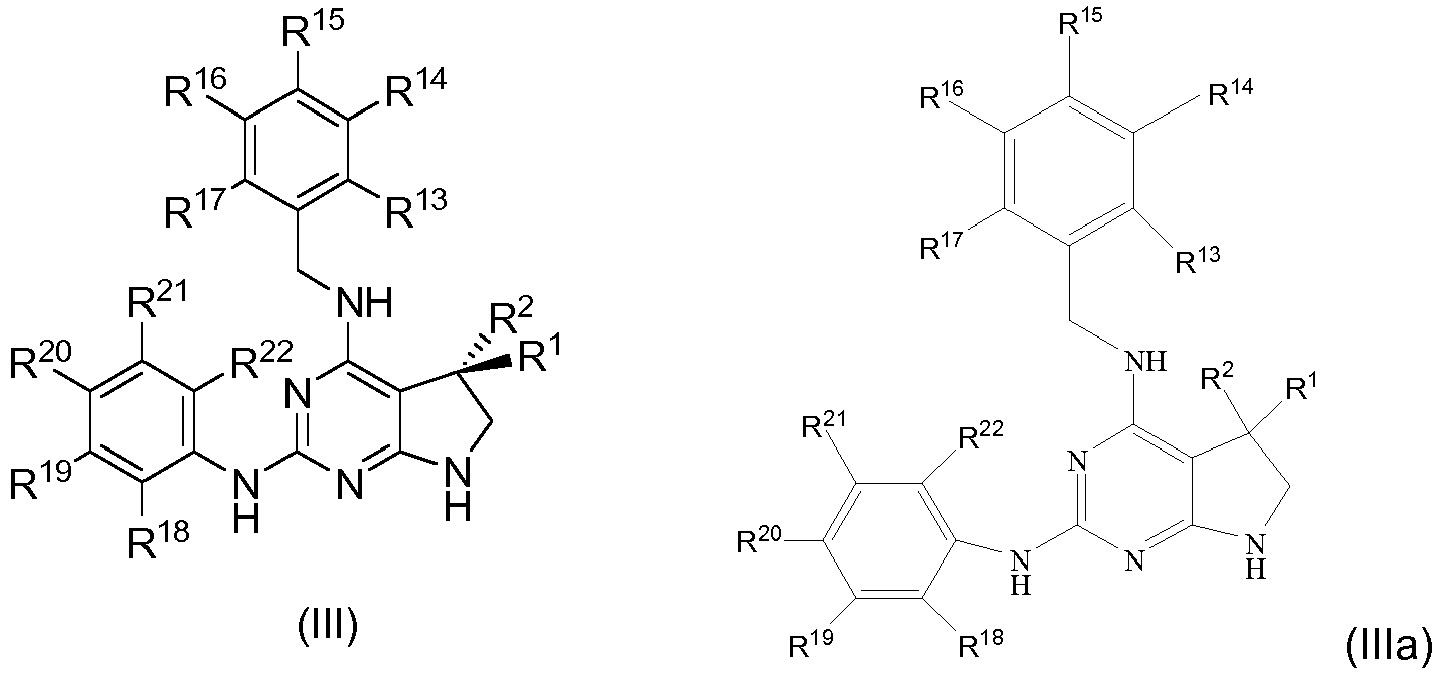
- R1 and R2 are independently selected from the group consisting of hydrogen, halogen, trifluromethyl, cyano, nitro, hydroxy, C1-C6 alkoxy, C1-C6 alkyl, C3-C6 cycloalkyl;, monoalkylamino, dialkylamino, cycloamino, heterocycloamino, arylamino, heteroarylamino, -NR23C(O)R24, -NR23SO2R25, -CONR23R26, -SO2NR23R26;
- R23 and R26 are independently selected from hydrogen, C1-C6 alkyl, and C3-C6 cycloalkyl; and
- R24 and R25 are independently selected from C1-C6 alkyl, C3-C6 cycloalkyl, aryl, substituted aryl, heteroaryl, and substituted heteroaryl; wherein the group pair of R13R14, R14R15, R15R16, R16R17, R18R19, R19R20, R20R 21 and R21R22 independently form an unsubstituted or substituted 5-8 membered cycle (including aryl or heteroaryl) or heterocycle together with the carbon atoms of phenyl group attached thereto.
- Whatever the formula is formula (III) or (IIIa), the compounds represented by these two formulas include all possible stereoisomers, regioisomers, diastereomers, enantiomers or epimers and mixtures thereof as described hereinafter in the disclosure.
- In another embodiment, the present disclosure provides a subclass of the compound of formula (I) respresented by formula (III) or (IIIa), or a pharmaceutically acceptable salt, solvate, poly-morph, tautomer or prodrug thereof, wherein:
- R1 and R2 are independently selected from the group consisting of hydrogen, halogen, cyano, nitro, hydroxy, optionally substituted C1-C6 alkyl, optionally substituted C3-C8 cycloalkyl, optionally substituted C2-C6 alkenyl, optionally substituted C2-C6 alkynyl, optionally substituted C1-C6 alkoxy; or R1 and R2, together with the carbon atom to which they link, form an optionally substituted C3-C8 cycloalkyl;
- R13, R14, R15, R16, R17, R18, R19, R20, R21 and R22 are independently selected from the group consisting of hydrogen, halogen, optionally substituted C1-C6 alkyl, optionally substituted C3-C8 cycloalkyl, optionally substituted C2-C6 alkenyl, optionally substituted C2-C6 alkynyl, optionally substituted C1-C6 alkoxy, optionally substituted C6-C10 aryl, optionally substituted 5-15 membered heterocyclyl with 1-4 heteroatoms selected from N, O or S, optionally substituted 5-10 membered heteroaryl with 1-4 heteroatoms selected from N, O or S, optionally substituted mono-C1-C6 alkylamino, optionally substituted di-C1-C6 alkylamino, optionally substituted mono-C1-C6 alkylaminoacyl, optionally substituted di-C1-C6 alkylaminoacyl, optionally substituted 5-12 membered heterocyclyl-acyl with 1-3 heteroatoms selected from N, O or S, optionally substituted C1-C6 alkylamido, aminosulfonyl, optionally substituted mono-C1-C6 alkylaminosulfonyl, optionally substituted di-C1-C6 alkylaminosulfonyl, aminosulfinyl, optionally substituted mono-C1-C6 alkylaminosulfinyl, optionally substituted di-C1-C6 alkylaminosulfinyl, and optionally substituted C1-C6 alkylsulfonamido.
- In another embodiment, the disclosure provides some preferable compounds of formulas (II), (IIa), (III) and (IIIa) or a pharmaceutically acceptable salt, solvate, poly-morph, tautomer or prodrug thereof, wherein R13, R14, R15, R16 and R17 are independently selected from the group consisting of hydrogen, -NR23C(O)R24, -NR23SO2R25, -CONR23R26, and -SO2NR23R26. The definitions of R23-R26 are the same as above.In another embodiment, the disclosure provides some preferable compounds of formula (II), (IIa), (III) and (IIIa) or a pharmaceutically acceptable salt, solvate, poly-morph, tautomer or prodrug thereof, wherein R18, R19, R20, R21 and R22 are independently selected from the group consisting of hydrogen, optionally substituted C1-C6 alkoxy, optionally substituted C1-C6 alkyl, optionally substituted C3-C6 cycloalkyl, optionally substituted 5-7 membered heterocycle with one or more N, O and S as the heteroatoms; or the group pair of R18R19, R19R20, R20R21 and R21R22 independently form an optionally substituted 5-15(or 5-10, 5-8) membered cycle (including aryl or heteroaryl) or heterocycle together with the carbon atoms of phenyl group attached thereto, in which the optionally substituted cycle or heterocycle is substituted with oxo, optionally substituted C1-C6 alkoxy, C1-C6 alkyl, C3-C6 cycloalkyl or 5-7 membered heterocycloC1-C6 alkyl.
- In another aspect, the disclosure provides compounds of formula (I), selected from the following compounds:


- In another aspect, the disclosure provides the compound of the disclosure, or a pharmaceutically acceptable salt, solvate, poly-morph, tautomer or prodrug thereof, for use as a medicament. Preferably, the medicament has an antiproliferative and/or proapoptotic activity.
- In another aspect, the disclosure provides a pharmaceutical composition comprising the compound of the present disclosure or a pharmaceutically acceptable salt, solvate, poly-morph, tautomer or prodrug thereof. In some embodiments, the pharmaceutical composition of the disclosure further comprises a pharmaceutically acceptable carrier, diluents, excipient and/or adjuvant, such as preservatives, agents for delaying absorption, fillers, binders, adsorbents, buffers, disintegrating agents, solubilizing agents, other carriers, and other inert ingredients. Methods of formulating the composition are well-known in the art.
- In another aspect, the disclosure provides a method for inhibiting FAK and/or Pyk2, comprising contacting the compound of the disclosure to FAK and/or Pyk2.
- In another aspect, the disclosure provides a method of the treatment or prophylaxis of a FAK and/or Pyk2 mediated disorder or disease, comprising administering to an individual in need thereof a therapeutically effective amount of the compound or composition of the disclosure. Preferably, the disorder or disease is a cancer, infection, inflammatory or autoimmune disease. More preferably, the disorder or disease is a cancer. In some embodiments of the present disclosure, the individual is a mammal, more preferably is a human.
- In another aspect, the disclosure provides use of a compound of the disclosure or a pharmaceutically acceptable salt, solvate, poly-morph, tautomer or prodrug thereof in the preparation of a pharmaceutical composition for inhibiting FAK and/or Pyk2. Preferably, the pharmaceutical composition is used for the treatment or prophylaxis of a FAK and/or Pyk2 mediated disorder or disease. More preferably, the disorder or disease is a proliferative disorder. In an embodiment of the disclosure, the proliferative disorder is a cancer. In another embodiment of the disclosure, the proliferative disorder is an inflammatory disease.
- In another aspect, the disclosure relates to pharmaceutical preparations comprising a compound of general formula (I) and at least one further cytostatic or cytotoxic active substance, different from formula (I), optionally in the form of tautomers, the racemates, the enantiomers, the diastereomers and the mixtures thereof, and optionally the pharmaceutically acceptable acid addition salts thereof.
- In other aspects, the present disclosure is directed to a pharmaceutical composition comprising a compound of the disclosure or a pharmaceutically acceptable salt, solvate, polymorph, tautomer or prodrug thereof. In some embodiments of the disclosure, the pharmaceutical composition is in a form suitable for oral administration. In further or additional embodiments of the disclosure, the pharmaceutical composition is in the form of a tablet, capsule, pill, powder, sustained release formulation, solution and suspension, for parenteral injection as a sterile solution, suspension or emulsion, for topical administration as an ointment or cream or for rectal administration as a suppository. In further or additional embodiments of the disclosure, the pharmaceutical composition is in unit dosage forms suitable for single administration of precise dosages. In further or additional embodiments of the disclosure the amount of compound of formula I is in the range of about 0.001 to about 1000 mg/kg body weight/day. In further or additional embodiments of the disclosure the amount of compound of formula I is in the range of about 0.5 to about 50 mg/kg body weight/day. In further or additional embodiments of the disclosure the amount of compound of formula I is about 0.001 to about 7 g/day. In further or additional embodiments of the disclosure the amount of compound of formula I is about 0.002 to about 6 g/day. In further or additional embodiments of the disclosure the amount of compound of formula I is about 0.005 to about 5 g/day. In further or additional embodiments of the disclosure the amount of compound of formula I is about 0.01 to about 5 g/day. In further or additional embodiments of the disclosure the amount of compound of formula I is about 0.02 to about 5 g/day. In further or additional embodiments of the disclosure the amount of compound of formula I is about 0.05 to about 2.5 g/day. In further or additional embodiments of the disclosure the amount of compound of formula I is about 0.1 to about 1 g/day. In further or additional embodiments of the disclosure, dosage levels below the lower limit of the aforesaid range may be more than adequate. In further or additional embodiments of the disclosure, dosage levels above the upper limit of the aforesaid range may be required. In further or additional embodiments of the disclosure the compound of formula I is administered in a single dose, once daily. In further or additional embodiments of the disclosure the compound of formula I is administered in multiple doses, more than once per day. In further or additional embodiments of the disclosure the compound of formula I is administered twice daily. In further or additional embodiments of the disclosure the compound of formula I is administered three times per day. In further or additional embodiments of the disclosure the compound of formula I is administered four times per day. In further or additional embodiments of the disclosure the compound of formula I is administered more than four times per day. In some embodiments of the disclosure, the pharmaceutical composition is for administration to a mammal. In further or additional embodiments of the disclosure, the mammal is human. In further or additional embodiments of the disclosure, the pharmaceutical composition further comprises a pharmaceutical carrier, excipient and/or adjuvant. In further or additional embodiments of the disclosure, the pharmaceutical composition further comprises at least one therapeutic agent. In further or additional embodiments of the disclosure, the therapeutic agent is selected from the group of cytotoxic agents, anti-angiogenesis agents and anti-neoplastic agents. In further or additional embodiments of the disclosure, the anti-neoplastic agent is selected from the group of consisting of alkylating agents, anti-metabolites, epidophyllotoxins; antineopiastic enzymes, topoisomerase inhibitors, procarbazines, mitoxantrones, platinum coordination complexes, biological response modifiers and growth inhibitors, hormonal/anti-hormonal therapeutic agents, and haematopoietic growth factors. In further or additional embodiments of the disclosure, the therapeutic agent is taxol, bortezomib or both. In further or additional embodiments of the disclosure, the pharmaceutical composition is administered in combination with an additional therapy. In further or additional embodiments of the disclosure, the additional therapy is radiation therapy, chemotherapy or a combination of both. In further or additional embodiments of the disclosure, the pharmaceutical composition comprises a pharmaceutically acceptable salt of a compound of formula I.
- In other aspects, the present disclosure is directed to a method for inhibiting FAK and/ or Pyk2. The method comprises contacting said FAK and/or Pyk2 with an amount of a composition comprising a compound of formula I or a pharmaceutically acceptable salt, solvate, polymorph, tautomer or prodrug thereof, sufficient to inhibit said kinase, wherein said kinase is inhibited. In some embodiments of the disclosure, the present disclosure is directed to a method for selectively inhibiting FAK and/or Pyk2.
- In other aspects, the present disclosure is directed to use of a compound of formula I or a pharmaceutically acceptable salt, solvate, polymorph, tautomer or prodrug thereof in the preparation of a pharmaceutical composition for inhibiting FAK and/or Pyk2.
- In further or additional embodiments of the disclosure, the kinase is at least about 1% inhibited. In further or additional embodiments of the disclosure the kinase is at least about 2% inhibited. In further or additional embodiments of the disclosure the kinase is at least about 3% inhibited. In further or additional embodiments of the disclosure the kinase is at least about 4% inhibited. In further or additional embodiments of the disclosure the kinase is at least about 5% inhibited. In further or additional embodiments of the disclosure the kinase is at least about 10% inhibited. In further or additional embodiments of the disclosure the kinase is at least about 20% inhibited. In further or additional embodiments of the disclosure the kinase is at least about 25% inhibited. In further or additional embodiments of the disclosure the kinase is at least about 30% inhibited. In further or additional embodiments of the disclosure the kinase is at least about 40% inhibited. In further or additional embodiments of the disclosure the kinase is at least about 50% inhibited. In further or additional embodiments of the disclosure the kinase is at least about 60% inhibited. In further or additional embodiments of the disclosure the kinase is at least about 70% inhibited. In further or additional embodiments of the disclosure the kinase is at least about 75% inhibited. In further or additional embodiments of the disclosure the kinase is at least about 80% inhibited. In further or additional embodiments of the disclosure the kinase is at least about 90% inhibited. In further or additional embodiments of the disclosure the kinase is essentially completely inhibited. In further or additional embodiments of the disclosure the contacting occurs within a cell. In further or additional embodiments of the disclosure the cell is a mammalian cell. In further or additional embodiments of the disclosure the mammalian cell is a human cell. In further or additional embodiments of the disclosure, FAK and/or Pyk2 is inhibited with a composition comprising a pharmaceutically acceptable salt of a compound of formula I.In other aspects, the present disclosure is directed to a method of treatment of a FAK and/or Pyk2 mediated disorder in an individual suffering from said disorder comprising administering to said individual an effective amount of a composition comprising a compound of formula I or a pharmaceutically acceptable salt, solvate, polymorph, tautomer or prodrug thereof. In other aspects, the present disclosure is directed to use of a compound of formula I or a pharmaceutically acceptable salt, solvate, polymorph, tautomer or prodrug thereof in the preparation of a pharmaceutical composition for treating a FAK and/or Pyk2 mediated disorder.
- In some embodiments of the disclosure, the composition comprising a compound of formula I is administered orally, intraduodenally, parenterally (including intravenous, subcutaneous, intramuscular, intravascular or by infusion), topically or rectally. In some embodiments of the disclosure, the pharmaceutical composition is in a form suitable for oral administration. In further or additional embodiments of the disclosure, the pharmaceutical composition is in the form of a tablet, capsule, pill, powder, sustained release formulations, solution and suspension, for parenteral injection as a sterile solution, suspension or emulsion, for topical administration as an ointment or cream or for rectal administration as a suppository. In further or additional embodiments of the disclosure, the pharmaceutical composition is in unit dosage forms suitable for single administration of precise dosages. In further or additional embodiments of the disclosure, the pharmaceutical composition further comprises a pharmaceutical carrier, excipient and/or adjuvant. In further or additional embodiments of the disclosure the amount of compound of formula I is in the range of about 0.001 to about 1000 mg/kg body weight/day. In further or additional embodiments of the disclosure the amount of compound of formula I is in the range of about 0.5 to about 50 mg/kg body weight/day. In further or additional embodiments of the disclosure the amount of compound of formula I is about 0.001 to about 7 g/day. In further or additional embodiments of the disclosure the amount of compound of formula I is about 0.01 to about 7 g/day. In further or additional embodiments of the disclosure the amount of compound of formula I is about 0.02 to about 5 g/day. In further or additional embodiments of the disclosure the amount of compound of formula I is about 0.05 to about 2.5 g/day. In further or additional embodiments of the disclosure the amount of compound of formula I is about 0.1 to about 1 g/day. In further or additional embodiments of the disclosure, dosage levels below the lower limit of the aforesaid range may be more than adequate. In further or additional embodiments of the disclosure, dosage levels above the upper limit of the aforesaid range may be required. In further or additional embodiments of the disclosure the compound of formula I is administered in a single dose, once daily. In further or additional embodiments of the disclosure the compound of formula I is administered in multiple doses, more than once per day. In further or additional embodiments of the disclosure the compound of formula I is administered twice daily. In further or additional embodiments of the disclosure the compound of formula I is administered three times per day. In further or additional embodiments of the disclosure the compound of formula I is administered four times per day. In further or additional embodiments of the disclosure the compound of formula I is administered more than four times per day. In some embodiments of the disclosure, the individual suffering from the FAK and/or Pyk2 mediated disorder is a mammal. In further or additional embodiments of the disclosure, the individual is a human. In some embodiments of the disclosure, the composition comprising a compound of formula I is administered in combination with an additional therapy. In further or additional embodiments of the disclosure, the additional therapy is radiation therapy, chemotherapy or a combination of both. In further or additional embodiments of the disclosure, the composition comprising a compound of formula I is administered in combination with at least one therapeutic agent. In further or additional embodiments of the disclosure, the therapeutic agent is selected from the group of cytotoxic agents, anti-angiogenesis agents and anti-neoplastic agents. In further or additional embodiments of the disclosure, the anti-neoplastic agent is selected from the group of consisting of alkylating agents, anti- metabolites, epidophyllotoxins; antineoplastic enzymes, topoisomerase inhibitors, procarbazines, mitoxantrones, platinum coordination complexes, biological response modifiers and growth inhibitors, hormonal/anti-hormonal therapeutic agents, and haematopoietic growth factors. In further or additional embodiments of the disclosure, the therapeutic agent is selected from taxol, bortezomib or both. In some embodiments of the disclosure, the FAK and/or Pyk2 mediated disorder is selected from the group consisting of inflammatory diseases, infections, autoimmune disorders, stroke, ischemia, cardiac disorder, neurological disorders, fibrogenic disorders, proliferative disorders, hyperproliferative disorders, non-cancer hyper- proliferative disorders, tumors, leukemias, neoplasms, cancers, carcinomas, metabolic diseases, malignant disease, vascular restenosis, psoriasis, atherosclerosis, rheumatoid arthritis, osteoarthritis, heart failure, chronic pain, neuropathic pain, dry eye, closed angle glaucoma and wide angle glaucoma. In further or additional embodiments of the disclosure, the FAK and/or Pyk2 mediated disorder is an inflammatory disease. In further or additional embodiments of the disclosure, the FAK and/or Pyk2 mediated disorder is a proliferative disease. In further or additional embodiments of the disclosure, the FAK and/or Pyk2 mediated disorder is selected from the group consisting of tumors, leukemias, neoplasms, cancers, carcinomas and malignant disease. In further or additional embodiments of the disclosure, the cancer is brain cancer, breast cancer, lung cancer, ovarian cancer, pancreatic cancer, prostate cancer, renal cancer, colorectal cancer or leukemia. In further or additional embodiments of the disclosure, the fibrogenetic disorder is scleroderma, polymyositis, systemic lupus, rheumatoid arthritis, liver cirrhosis, keloid formation, interstitial nephritis or pulmonary fibrosis. In further or additional embodiments of the disclosure, an effective amount of a composition comprising a pharmaceutically acceptable salt of a compound of formula I is administered.
- In other aspects, the present disclosure is directed to a method for degrading, inhibiting the growth of or killing a cancer cell comprising contacting said cell with an amount of a composition effective to degrade, inhibit the growth of or to kill said cell, the composition comprising a compound of formula I or a pharmaceutically acceptable salt, solvate, polymorph, tautomer or prodrug thereof.
- In other aspects, the present disclosure is directed to use of a compound of formula I or a pharmaceutically acceptable salt, solvate, polymorph, tautomer or prodrug thereof in the preparation of a pharmaceutical composition for degrading and/or inhibiting the growth of or killing a cancer cell.
- In some embodiments of the disclosure, the cancer cells comprise brain, breast, lung, ovarian, pancreatic, prostate, renal, or colorectal cancer cells. In further or additional embodiments of the disclosure, the composition is administered with at least one therapeutic agent. In further or additional embodiments of the disclosure, the therapeutic agent is taxol, bortezomib or both. In further or additional embodiments of the disclosure, the therapeutic agent is selected from the group consisting of cytotoxic agents, anti-angiogenesis agents and anti-neoplastic agents. In further or additional embodiments of the disclosure, the anti-neoplastic agents selected from the group of consisting of alkylating agents, anti-metabolites, epidophyllotoxins; antineoplastic enzymes, topoisomerase inhibitors, procarbazines, mitoxantrones, platinum coordination complexes, biological response modifiers and growth inhibitors, hormonal/anti-hormonal therapeutic agents, and haematopoietic growth factors. In some embodiments of the disclosure, the cancer cells are degraded. In further or additional embodiments of the disclosure, 1% of the cancer cells are degraded. In further or additional embodiments of the disclosure, 2% of the cancer cells are degraded. In further or additional embodiments of the disclosure, 3% of the cancer cells are degraded. In further or additional embodiments of the disclosure of the disclosure, 4% of the cancer cells are degraded. In further or additional embodiments of the disclosure, 5% of the cancer cells are degraded. In further or additional embodiments of the disclosure, 10% of the cancer cells are degraded. In further or additional embodiments of the disclosure, 20% of the cancer cells are degraded. In further or additional embodiments of the disclosure, 25% of the cancer cells are degraded. In further or additional embodiments of the disclosure, 30% of the cancer cells are degraded. In further or additional embodiments of the disclosure, 40% of the cancer cells are degraded. In further or additional embodiments of the disclosure, 50% of the cancer cells are degraded. In further or additional embodiments of the disclosure, 60% of the cancer cells are degraded. In further or additional embodiments of the disclosure, 70% of the cancer cells are degraded. In further or additional embodiments of the disclosure, 75% of the cancer cells are degraded. In further or additional embodiments of the disclosure, 80% of the cancer cells are degraded. In further or additional embodiments of the disclosure, 90% of the cancer cells are degraded. In further or additional embodiments of the disclosure, 100% of the cancer cells are degraded. In further or additional embodiments of the disclosure, essentially all of the cancer cells are degraded. In some embodiments of the disclosure, the cancer cells are killed. In further or additional embodiments of the disclosure, 1% of the cancer cells are killed. In further or additional embodiments of the disclosure, 2% of the cancer cells are killed. In further or additional embodiments of the disclosure, 3% of the cancer cells are killed. In further or additional embodiments of the disclosure, 4% of the cancer cells are killed. In further or additional embodiments of the disclosure, 5% of the cancer cells are killed. In further or additional embodiments of the disclosure, 10% of the cancer cells are killed. In further or additional embodiments of the disclosure, 20% of the cancer cells are killed. In further or additional embodiments of the disclosure, 25% of the cancer cells are killed. In further or additional embodiments of the disclosure, 30% of the cancer cells are killed. In further or additional embodiments of the disclosure, 40% of the cancer cells are killed. In further or additional embodiments of the disclosure, 50% of the cancer cells are killed. In further or additional embodiments of the disclosure, 60% of the cancer cells are killed. In further or additional embodiments of the disclosure, 70% of the cancer cells are killed. In further or additional embodiments of the disclosure, 75% of the cancer cells are killed. In further or additional embodiments of the disclosure, 80% of the cancer cells are killed. In further or additional embodiments of the disclosure, 90% of the cancer cells are killed. In further or additional embodiments of the disclosure, 100% of the cancer cells are killed. In further or additional embodiments of the disclosure, essentially all of the cancer cells are killed. In further or additional embodiments of the disclosure, the growth of the cancer cells is inhibited. In further or additional embodiments of the disclosure of the disclosure, the growth of the cancer cells is about 1% inhibited. In further or additional embodiments of the disclosure, the growth of the cancer cells is about 2% inhibited. In further or additional embodiments of the disclosure, the growth of the cancer cells is about 3% inhibited. In further or additional embodiments of the disclosure, the growth of the cancer cells is about 4% inhibited. In further or additional embodiments of the disclosure, the growth of the cancer cells is about 5% inhibited. In further or additional embodiments of the disclosure, the growth of the cancer cells is about 10% inhibited. In further or additional embodiments of the disclosure, the growth of the cancer cells is about 20% inhibited. In further or additional embodiments of the disclosure, the growth of the cancer cells is about 25% inhibited. In further or additional embodiments of the disclosure, the growth of the cancer cells is about 30% inhibited. In further or additional embodiments of the disclosure, the growth of the cancer cells is about 40% inhibited. In further or additional embodiments of the disclosure, the growth of the cancer cells is about 50% inhibited. In further or additional embodiments of the disclosure, the growth of the cancer cells is about 60% inhibited. In further or additional embodiments of the disclosure, the growth of the cancer cells is about 70% inhibited. In further or additional embodiments of the disclosure, the growth of the cancer cells is about 75% inhibited. In further or additional embodiments of the disclosure, the growth of the cancer cells is about 80% inhibited. In further or additional embodiments of the disclosure, the growth of the cancer cells is about 90% inhibited. In further or additional embodiments of the disclosure, the growth of the cancer cells is about 100% inhibited. In further or additional embodiments of the disclosure, a composition comprising a pharmaceutically acceptable salt of a compound of formula I is used.
- In other aspects, the present disclosure is directed to a method for the treatment or prophylaxis of a proliferative disease in an individual comprising administering to said individual an effective amount of a composition comprising a compound of formula I or a pharmaceutically acceptable salt, solvate, polymorph, tautomer or pro- drug thereof.
- In other aspects, the present disclosure is directed to use of a compound of formula I or a pharmaceutically acceptable salt, solvate, polymorph, tautomer or prodrug thereof in the preparation of a pharmaceutical composition for the treatment or prophylaxis of a proliferative disease.
- In some embodiments of the disclosure, the proliferative disease is cancer, psoriasis, restenosis, autoimmune disease, or atherosclerosis. In further or additional embodiments of the disclosure, the proliferative disease is a hyperproliferative disease. In further or additional embodiments of the disclosure, the proliferative disease is selected from the group consisting of tumors, leukemias, neoplasms, cancers, carcinomas and malignant disease. In further or additional embodiments of the disclosure, the cancer is brain cancer, breast cancer, lung cancer, ovarian cancer, pancreatic cancer, prostate cancer, renal cancer, colorectal cancer or leukemia. In further or additional embodiments of the disclosure, the fibrogenetic disorder is scleroderma, polymyositis, systemic lupus, rheumatoid arthritis, liver cirrhosis, keloid formation, interstitial nephritis or pulmonary fibrosis. In further or additional embodiments of the disclosure, the cancer is brain cancer, breast cancer, lung cancer, ovarian cancer, pancreatic cancer, prostate cancer, renal cancer, colorectal cancer or leukemia. In further or additional embodiments of the disclosure, the cancer is brain cancer or adrenocortical carcinoma. In further or additional embodiments of the disclosure, the cancer is breast cancer. In further or additional embodiments of the disclosure, the cancer is ovarian cancer. In further or additional embodiments of the disclosure, the cancer is pancreatic cancer. In further or additional embodiments of the disclosure, the cancer is prostate cancer. In further or additional embodiments of the disclosure, the cancer is renal cancer. In further or additional embodiments of the disclosure, the cancer is colorectal cancer. In further or additional embodiments of the disclosure, the cancer is myeloid leukemia. In further or additional embodiments of the disclosure, the cancer is glioblastoma. In further or additional embodiments of the disclosure, the cancer is follicular lymphoma. In further or additional embodiments of the disclosure, the cancer is pre-B acute leukemia. In further or additional embodiments of the disclosure, the cancer is chronic lymphocytic B-leukemia. In further or additional embodiments of the disclosure, the cancer is mesothelioma. In further or additional embodiments of the disclosure, the cancer is small cell line cancer. In some embodiments of the disclosure, the composition comprising a compound of formula I is administered in combination with an additional therapy. In further or additional embodiments of the disclosure, the additional therapy is radiation therapy, chemotherapy or a combination of both. In further or additional embodiments of the disclosure, the composition comprising a compound of formula I is administered in combination with at least one therapeutic agent. In further or additional embodiments of the disclosure, the therapeutic agent is selected from the group of cytotoxic agents, anti-angiogenesis agents and anti-neoplastic agents. In further or additional embodiments of the disclosure, the anti-neoplastic agent is selected from the group of consisting of alkylating agents, anti-metabolites, epidophyllotoxins; antineoplastic enzymes, topoisomerase inhibitors, procarbazines, mitoxantrones, platinum coordination complexes, biological response modifiers and growth inhibitors, hormonal/anti-hormonal therapeutic agents, and haematopoietic growth factors. In further or additional embodiments of the disclosure, the therapeutic agent is selected from taxol, bortezomib or both. In some embodiments of the disclosure, the composition is administered orally, intraduodenally, parenterally (including intravenous, subcutaneous, intramuscular, intravascular or by infusion), topically or rectally. In further or additional embodiments of the disclosure the amount of compound of formula I is in the range of about 0.001 to about 1000 mg/kg body weight/day. In further or additional embodiments of the disclosure the amount of compound of formula I is in the range of about 0.5 to about 50 mg/kg body weight /day. In further or additional embodiments of the disclosure the amount of compound of formula I is about 0.001 to about 7 g/day. In further or additional embodiments of the disclosure the amount of compound of formula I is about 0.01 to about 7 g/day. In further or additional embodiments of the disclosure the amount of compound of formula I is about 0.02 to about 5 g/day. In further or additional embodiments of the disclosure the amount of compound of formula I is about 0.05 to about 2.5 g/day. In further or additional embodiments of the disclosure the amount of compound of formula I is about 0.1 to about 1 g/day. In further or additional embodiments of the disclosure, dosage levels below the lower limit of the aforesaid range may be more than adequate. In further or additional embodiments of the disclosure, dosage levels above the upper limit of the aforesaid range may be required. In further or additional embodiments of the disclosure the compound of formula I is administered in a single dose, once daily. In further or additional embodiments of the disclosure the compound of formula I is administered in multiple doses, more than once per day. In further or additional embodiments of the disclosure the compound of formula I is administered twice daily. In further or additional embodiments of the disclosure the compound of formula I is administered three times per day. In further or additional embodiments of the disclosure the compound of formula I is administered four times per day. In further or additional embodiments of the disclosure the compound of formula I is administered more than four times per day. In some embodiments, of the disclosure the individual suffering from the proliferative disease is a mammal. In further or additional embodiments of the disclosure, the individual is a human. In further or additional embodiments of the disclosure, an effective amount of a composition comprising a pharmaceutically acceptable salt of a compound of formula I is administered.
- In other aspects, the present disclosure is directed to a method for the treatment or prophylaxis of an inflammatory disease in an individual comprising administering to said individual an effective amount of a composition comprising a compound of formula I or a pharmaceutically acceptable salt, solvate, polymorph, tautomer or prodrug thereof.
- In other aspects, the present disclosure is directed to use of a compound of formula I or a pharmaceutically acceptable salt, solvate, polymorph, tautomer or prodrug thereof in the preparation of a pharmaceutical composition for the treatment or prophylaxis of an inflammatory disease.
- In further or additional embodiments of the disclosure, the inflammatory disease is selected from chronic inflammatory diseases, rheumatoid arthritis, spondyloarthropathies, gouty arthritis, osteoarthritis, juvenile arthritis, acute rheumatic arthritis, enteropathic arthritis, neuropathic arthritis, psoriatic arthritis, pyogenic arthritis, atherosclerosis, systemic lupus erythematosus, inflammatory bowel disease, irritable bowel syndrome, ulcerative colitis, reflux esophagitis, Crohn's disease, gastritis, asthma, allergies, respiratory distress syndrome, pancreatitis, chronic obstructive pulmonary disease, pulmonary fibrosis, psoriasis, eczema or scleroderma. In some embodiments of the disclosure, the composition comprising a compound of formula I is administered in combination with an additional therapy. In further or additional embodiments of the disclosure, the composition comprising a compound of formula I is administered in combination with at least one therapeutic agent. In some embodiments of the disclosure, the composition is administered orally, intraduodenally, parenterally (including intravenous, subcutaneous, intramuscular, intravascular or by infusion), topically or rectally. In further or additional embodiments of the disclosure the amount of compound of formula I is in the range of about 0.001 to about 1000 mg/kg body weight/day. In further or additional embodiments of the disclosure the amount of compound of formula I is in the range of about 0.5 to about 50 mg/kg body weight /day. In further or additional embodiments of the disclosure the amount of compound of formula is about 0.001 to about 7 g/day. In further or additional embodiments of the disclosure the amount of compound of formula I is about 0.01 to about 7 g/day. In further or additional embodiments of the disclosure the amount of compound of formula I is about 0.02 to about 5 g/day. In further or additional embodiments of the disclosure the amount of compound of formula I is about 0.05 to about 2.5 g/day. In further or additional embodiments of the disclosure the amount of compound of formula I is about 0.1 to about 1 g/day. In further or additional embodiments of the disclosure, dosage levels below the lower limit of the aforesaid range may be more than adequate. In further or additional embodiments of the disclosure, dosage levels above the upper limit of the aforesaid range may be required. In further or additional embodiments of the disclosure the compound of formula I is administered in a single dose, once daily. In further or additional embodiments of the disclosure the compound of formula I is administered in multiple doses, more than once per day. In further or additional embodiments of the disclosure the compound of formula I is administered twice daily. In further or additional embodiments of the disclosure the compound of formula I is administered three times per day. In further or additional embodiments of the disclosure the compound of formula I is administered four times per day. In further or additional embodiments of the disclosure the compound of formula I is administered more than four times per day. In some embodiments of the disclosure, the individual suffering from the inflammatory disease is a mammal. In further or additional embodiments of the disclosure, the individual is a human. In further or additional embodiments of the disclosure, an effective amount of a composition comprising a pharmaceutically acceptable salt of a compound of formula I is administered.
- In other aspects, the present disclosure is directed to a method for the treatment or prophylaxis of cancer in an individual comprising administering to said individual an effective amount of a composition comprising a compound of formula I or a pharmaceutically acceptable salt, solvate, polymorph, tautomer or prodrug thereof.
- In other aspects, the present disclosure is directed to use of a compound of formula I or a pharmaceutically acceptable salt, solvate, polymorph, tautomer or prodrug thereof in the preparation of a pharmaceutical composition for the treatment or prophylaxis of a cancer.
- In further or additional embodiments of the disclosure, the cancer is brain cancer, breast cancer, lung cancer, ovarian cancer, pancreatic cancer, prostate cancer, renal cancer, colorectal cancer or leukemia. In further or additional embodiments of the disclosure, the fibrogenetic disorder is scleroderma, polymyositis, systemic lupus, rheumatoid arthritis, liver cirrhosis, keloid formation, interstitial nephritis or pulmonary fibrosis. In further or additional embodiments of the disclosure, the cancer is brain cancer, breast cancer, lung cancer, ovarian cancer, pancreatic cancer, prostate cancer, renal cancer, colorectal cancer or leukemia. In further or additional embodiments of the disclosure, the cancer is brain cancer or adrenocortical carcinoma. In further or additional embodiments of the disclosure, the cancer is breast cancer. In further or additional embodiments of the disclosure, the cancer is ovarian cancer. In further or additional embodiments of the disclosure, the cancer is pancreatic cancer. In further or additional embodiments of the disclosure, the cancer is prostate cancer. In further or additional embodiments, the cancer is renal cancer. In further or additional embodiments of the disclosure, the cancer is colorectal cancer. In further or additional embodiments of the disclosure, the cancer is myeloid leukemia. In further or additional embodiments of the disclosure, the cancer is glioblastoma. In further or additional embodiments of the disclosure, the cancer is follicular lymphoma. In further or additional embodiments of the disclosure, the cancer is pre-B acute leukemia. In further or additional embodiments of the disclosure, the cancer is chronic lymphocytic B-leukemia. In further or additional embodiments of the disclosure, the cancer is mesothelioma. In further or additional embodiments of the disclosure, the cancer is small cell line cancer. In some embodiments of the disclosure, the composition comprising a compound of formula I is administered in combination with an additional therapy. In further or additional embodiments of the disclosure, the additional therapy is radiation therapy, chemotherapy or a combination of both. In further or additional embodiments of the disclosure, the composition comprising a compound of formula I is administered in combination with at least one therapeutic agent. In further or additional embodiments of the disclosure, the therapeutic agent is selected from the group of cytotoxic agents, anti-angiogenesis agents and anti-neoplastic agents. In further or additional embodiments of the disclosure, the anti-neoplastic agent is selected from the group of consisting of alkylating agents, anti- metabolites, epidophyllotoxins; antineoplastic enzymes, topoisomerase inhibitors, procarbazines, mitoxantrones, platinum coordination complexes, biological response modifiers and growth inhibitors, hormonal/anti-hormonal therapeutic agents, and haematopoietic growth factors. In further or additional embodiments of the disclosure, the therapeutic agent is selected from taxol, bortezomib or both. In some embodiments of the disclosure, the composition is administered orally, intraduodenally, parenterally (including intravenous, subcutaneous, intramuscular, intravascular or by infusion), topically or rectally. In further or additional embodiments of the disclosure the amount of compound of formula is in the range of about 0.001 to about 1000 mg/kg body weight/day. In further or additional embodiments of the disclosure the amount of compound of formula I is in the range of about 0.5 to about 50 mg/kg body weight /day. In further or additional embodiments of the disclosure the amount of compound of formula I is about 0.001 to about 7 g/day. In further or additional embodiments of the disclosure the amount of compound of formula I is about 0.01 to about 7 g/day. In further or additional embodiments of the disclosure the amount of compound of formula I is about 0.02 to about 5 g/day. In further or additional embodiments of the disclosure the amount of compound of formula I is about 0.05 to about 2.5 g/day. In further or additional embodiments of the disclosure the amount of compound of formula I is about 0.1 to about 1 g/day. In further or additional embodiments of the disclosure, dosage levels below the lower limit of the aforesaid range may be more than adequate. In further or additional embodiments of the disclosure, dosage levels above the upper limit of the aforesaid range may be required. In further or additional embodiments of the disclosure the compound of formula is administered in a single dose, once daily. In further or additional embodiments of the disclosure the compound of formula I is administered in multiple doses, more than once per day. In further or additional embodiments of the disclosure the compound of formula I is administered twice daily. In further or additional embodiments of the disclosure the compound of formula I is administered three times per day. In further or additional embodiments of the disclosure the compound of formula I is administered four times per day. In further or additional embodiments of the disclosure the compound of formula I is administered more than four times per day. In some embodiments of the disclosure, the individual suffering from cancer is a mammal. In further or additional embodiments of the disclosure, the individual is a human. In further or additional embodiments of the disclosure, an effective amount of a composition comprising a pharmaceutically acceptable salt of a compound of formula I is administered.
- In other aspects, the present disclosure is directed to a method of reducing the size of a tumor, inhibiting tumor size increase, reducing tumor proliferation or preventing tumor proliferation in an individual, comprising administering to said individual an effective amount of a composition comprising a compound of formula I or a pharmaceutically acceptable salt, solvate, polymorph, tautomer or prodrug thereof.
- In other aspects, the present disclosure is directed to use of a compound of formula I or a pharmaceutically acceptable salt, solvate, polymorph, tautomer or prodrug thereof in the preparation of a pharmaceutical composition for reducing the size of a tumor, inhibiting tumor size increase, reducing tumor proliferation or preventing tumor proliferation.
- In some embodiments of the disclosure, the size of a tumor is reduced. In further or additional embodiments of the disclosure, the size of a tumor is reduced by at least 1%. In further or additional embodiments of the disclosure, the size of a tumor is reduced by at least 2%. In further or additional embodiments of the disclosure, the size of a tumor is reduced by at least 3%. In further or additional embodiments of the disclosure, the size of a tumor is reduced by at least 4%. In further or additional embodiments of the disclosure, the size of a tumor is reduced by at least 5%. In further or additional embodiments of the disclosure, the size of a tumor is reduced by at least 10%. In further or additional embodiments of the disclosure, the size of a tumor is reduced by at least 20%. In further or additional embodiments of the disclosure, the size of a tumor is reduced by at least 25%. In further or additional embodiments of the disclosure, the size of a tumor is reduced by at least 30%. In further or additional embodiments of the disclosure, the size of a tumor is reduced by at least 40%. In further or additional embodiments of the disclosure, the size of a tumor is reduced by at least 50%. In further or additional embodiments of the disclosure, the size of a tumor is reduced by at least 60%. In further or additional embodiments of the disclosure, the size of a tumor is reduced by at least 70%. In further or additional embodiments of the disclosure, the size of a tumor is reduced by at least 75%. In further or additional embodiments of the disclosure, the size of a tumor is reduced by at least 80%. In further or additional embodiments of the disclosure, the size of a tumor is reduced by at least 85%. In further or additional embodiments of the disclosure, the size of a tumor is reduced by at least 90%. In further or additional embodiments of the disclosure, the size of a tumor is reduced by at least 95%. In further or additional embodiments of the disclosure, the tumor is eradicated. In some embodiments of the disclosure, the size of a tumor does not increase. In some embodiments of the disclosure, tumor proliferation is reduced. In some embodiments of the disclosure, tumor proliferation is reduced by at least 1%. In some embodiments of the disclosure, tumor proliferation is reduced by at least 2%. In some embodiments of the disclosure, tumor proliferation is reduced by at least 3%. In some embodiments of the disclosure, tumor proliferation is reduced by at least 4%. In some embodiments of the disclosure, tumor proliferation is reduced by at least 5%. In some embodiments of the disclosure, tumor proliferation is reduced by at least 10%. In some embodiments of the disclosure, tumor proliferation is reduced by at least 20%. In some embodiments of the disclosure, tumor proliferation is reduced by at least 25%. In some embodiments of the disclosure, tumor proliferation is reduced by at least 30%. In some embodiments of the disclosure, tumor proliferation is reduced by at least 40%. In some embodiments of the disclosure, tumor proliferation is reduced by at least 50%. In some embodiments of the disclosure, tumor proliferation is reduced by at least 60%. In some embodiments of the disclosure, tumor proliferation is reduced by at least 70%. In some embodiments of the disclosure, tumor proliferation is reduced by at least 75%. In some embodiments of the disclosure, tumor proliferation is reduced by at least 80%. In some embodiments of the disclosure, tumor proliferation is reduced by at least 90%. In some embodiments of the disclosure, tumor proliferation is reduced by at least 95%. In some embodiments of the disclosure, tumor proliferation is prevented. In some embodiments of the disclosure, the composition comprising a compound of formula I is administered in combination with an additional therapy. In further or additional embodiments of the disclosure, the additional therapy is radiation therapy, chemotherapy or a combination of both. In further or additional embodiments of the disclosure, the composition comprising a compound of formula I is administered in combination with at least one therapeutic agent. In further or additional embodiments of the disclosure, the therapeutic agent is selected from the group of cytotoxic agents, anti-angiogenesis agents and anti-neoplastic agents. In further or additional embodiments of the disclosure, the anti-neoplastic agent is selected from the group of consisting of alkylating agents, anti-metabolites, epidophyllotoxins; antineoplastic enzymes, topoisomerase inhibitors, procarbazines, mitoxantrones, platinum coordination complexes, biological response modifiers and growth inhibitors, hormonal/anti-hormonal therapeutic agents, and haematopoietic growth factors. In further or additional embodiments of the disclosure, the therapeutic agent is selected from taxol, bortezomib or both. In some embodiments of the disclosure, the composition is administered orally, intraduodenally, parenterally (including intravenous, subcutaneous, intramuscular, intravascular or by infusion), topically or rectally. In further or additional embodiments of the disclosure the amount of compound of formula I is in the range of about 0.001 to about 1000 mg/kg body weight/day. In further or additional embodiments of the disclosure the amount of compound of formula I is in the range of about 0.5 to about 50 mg/kg body weight /day. In further or additional embodiments of the disclosure the amount of compound of formula I is about 0.001 to about 7 g/day. In further or additional embodiments of the disclosure the amount of compound of formula I is about 0.01 to about 7 g/day. In further or additional embodiments of the disclosure the amount of compound of formula I is about 0.02 to about 5 g/day. In further or additional embodiments of the disclosure the amount of compound of formula I is about 0.05 to about 2.5 g/day. In further or additional embodiments of the disclosure the amount of compound of formula I is about 0.1 to about 1 g/day. In further or additional embodiments of the disclosure, dosage levels below the lower limit of the aforesaid range may be more than adequate. In further or additional embodiments of the disclosure, dosage levels above the upper limit of the aforesaid range may be required. In further or additional embodiments of the disclosure the compound of formula I is administered in a single dose, once daily. In further or additional embodiments of the disclosure the compound of formula I is administered in multiple doses, more than once per day. In further or additional embodiments of the disclosure the compound of formula I is administered twice daily. In further or additional embodiments of the disclosure the compound of formula I is administered three times per day. In further or additional embodiments of the disclosure the compound of formula I is administered four times per day. In further or additional embodiments of the disclosure the compound of formula I is administered more than four times per day. In some embodiments of the disclosure, the individual suffering from cancer is a mammal. In further or additional embodiments of the disclosure, the individual is a human. In further or additional embodiments of the disclosure, an effective amount of a composition comprising a pharmaceutically acceptable salt of a compound of formula I is administered.
- In other aspects, the present disclosure is directed to a method for achieving an effect in a patient comprising the administration of an effective amount of a composition comprising a compound of formula I or a pharmaceutically acceptable salt, solvate, polymorph, tautomer or prodrug thereof, to a patient, wherein the effect is selected from the group consisting of inhibition of various cancers, immunological diseases, and inflammatory diseases. In some embodiments of the disclosure, the effect is inhibition of various cancers. In further or additional embodiments of the disclosure, the effect is inhibition of immunological diseases. In further or additional embodiments of the disclosure, the effect is inhibition inflammatory diseases.
- In other aspects, the present disclosure is directed to use of a compound of formula I or a pharmaceutically acceptable salt, solvate, polymorph, tautomer or prodrug thereof in the preparation of a pharmaceutical composition for the inhibiting various cancers, immunological diseases, and/or inflammatory diseases.
- In some embodiments of the disclosure, the composition comprising a compound of formula I is administered in combination with an additional therapy. In further or additional embodiments of the disclosure, the additional therapy is radiation therapy, chemotherapy or a combination of both. In further or additional embodiments of the disclosure, the composition comprising a compound of formula I is administered in combination with at least one therapeutic agent. In some embodiments of the disclosure, the composition is administered orally, intraduodenally, parenterally (including intravenous, subcutaneous, intramuscular, intravascular or by infusion), topically or rectally. In further or additional embodiments of the disclosure the amount of compound of formula I is in the range of about 0.001 to about 1000 mg/kg body weight/day. In further or additional embodiments of the disclosure the amount of compound of formula I is in the range of about 0.5 to about 50 mg/kg body weight /day. In further or additional embodiments of the disclosure the amount of compound of formula I is about 0.001 to about 7 g/day. In further or additional embodiments of the disclosure the amount of compound of formula I is about 0.01 to about 7 g/day. In further or additional embodiments of the disclosure the amount of compound of formula I is about 0.02 to about 5 g/day. In further or additional embodiments of the disclosure the amount of compound of formula I is about 0.05 to about 2.5 g/day. In further or additional embodiments of the disclosure the amount of compound of formula I is about 0.1 to about 1 g/day. In further or additional embodiments of the disclosure, dosage levels below the lower limit of the aforesaid range may be more than adequate. In further or additional embodiments of the disclosure, dosage levels above the upper limit of the aforesaid range may be required. In further or additional embodiments of the disclosure the compound of formula I is administered in a single dose, once daily. In further or additional embodiments of the disclosure the compound of formula I is administered in multiple doses, more than once per day. In further or additional embodiments of the disclosure the compound of formula I is administered twice daily. In further or additional embodiments of the disclosure the compound of formula I is administered three times per day. In further or additional embodiments of the disclosure the compound of formula I is administered four times per day. In further or additional embodiments of the disclosure the compound of formula I is administered more than four times per day. In some embodiments of the disclosure, the individual suffering from cancer is a mammal. In further or additional embodiments of the disclosure, the individual is a human. In further or additional embodiments of the disclosure, an effective amount of a composition comprising a pharmaceutically acceptable salt of a compound of formula I is administered.
- In other aspects, the present disclosure is directed to a process for preparing a compound of formula I or a pharmaceutically acceptable salt, solvate, polymorph, tautomer or prodrug thereof.
- The invention is as defined in the claims. Any embodiment not falling under the scope of the appended claims does not form part of the invention
- A better understanding of the features and advantages of the disclosure will be obtained by reference to the following detailed description that sets forth illustrative embodiments of the disclosure, in which the principles of the disclosure are utilized.
- Unless defined otherwise, all technical and scientific terms used herein have the same meaning as is commonly understood by one of skill in the art to which the claimed subject matter belongs. In the event that there is a plurality of definitions for terms herein, those in this section prevail. Where reference is made to a URL or other such identifier or address, it is understood that such identifiers can change and particular information on the internet can come and go, but equivalent information can be found by searching the internet or other appropriate reference source. Reference thereto evidences the availability and public dissemination of such information.
- It is to be understood that the foregoing general description and the following detailed description are exemplary and explanatory only and are not restrictive of any subject matter claimed. In this application, the use of the singular includes the plural unless specifically stated otherwise. It must be noted that, as used in the specification and the appended claims, the singular forms "a", "an" and "the" include plural referents unless the context clearly dictates otherwise. It should also be noted that use of "or" means "and/or" unless stated otherwise. Furthermore, use of the term "including" as well as other forms, such as "include", "includes", and "included" is not limiting. Likewise, use of the term "comprising" as well as other forms, such as "comprise", "comprises", and "comprised" is not limiting.
- Definition of standard chemistry terms may be found in reference works, including Carey and Sundberg "ADVANCED ORGANIC CHEMISTRY 4TH ED." Vols. A (2000) and B (2001), Plenum Press, New York. Unless otherwise indicated, conventional methods of mass spectroscopy, NMR, HPLC, IR and UV/Vis spectroscopy and pharmacology, within the skill of the art are employed. Unless specific definitions are provided, the nomenclature employed in connection with, and the laboratory procedures and techniques of, analytical chemistry, synthetic organic chemistry, and medicinal and pharmaceutical chemistry described herein are those known in the art. Standard techniques can be used for chemical syntheses, chemical analyses, pharmaceutical preparation, formulation, and delivery, and treatment of patients. Reactions and purification techniques can be performed e.g., using kits of manufacturer's specifications or as commonly accomplished in the art or as described herein. The foregoing techniques and procedures can be generally performed of conventional methods well known in the art and as described in various general and more specific references that are cited and discussed throughout the present specification. Throughout the specification, groups and substituents thereof can be chosen by one skilled in the field to provide stable moieties and compounds.
- Where substituent groups are specified by their conventional chemical formulas, written from left to right, they equally encompass the chemically identical substituents that would result from writing the structure from right to left. As a non-limiting example, CH2O is equivalent to OCH2.
- Unless otherwise noted, the use of general chemical terms, such as though not limited to "alkyl," "amine," "aryl," are equivalent to their optionally substituted forms. For example, "alkyl," as used herein, includes optionally substituted alkyl.
- The compounds presented herein may possess one or more stereocenters and each center may exist in the R or S configuration, or combinations thereof. Likewise, the compounds presented herein may possess one or more double bonds and each may exist in the E (trans) or Z (cis) configuration, or combinations thereof. Presentation of one particular stereoisomer, regioisomer, diastereomer, enantiomer or epimer should be understood to include all possible stereoisomers, regioisomers, diastereomers, enantiomers or epimers and mixtures thereof. Thus, the compounds presented herein include all separate configurational stereoisomeric, regioisomeric, diastereomeric, enantiomeric, and epimeric forms as well as the corresponding mixtures thereof. Techniques for inverting or leaving unchanged a particular stereocenter, and those for resolving mixtures of stereoisomers are well known in the art and it is well within the ability of one of skill in the art to choose an appropriate method for a particular situation. See, for example, Fumiss et al. (eds.), VOGEL'S ENCYCLOPEDIA OF PRACTICAL ORGANIC CHEMISTRY 5.sup.TH ED., Longman Scientific and Technical Ltd., Essex, 1991, 809-816; and Heller, Acc. Chem. Res. 1990, 23, 128.
- The terms "moiety", "chemical moiety", "group" and "chemical group", as used herein refer to a specific segment or functional group of a molecule. Chemical moieties are often recognized chemical entities embedded in or appended to a molecule.
- The term "bond" or "single bond" refers to a chemical bond between two atoms, or two moieties when the atoms joined by the bond are considered to be part of larger substructure.
- The term "optional" or "optionally" means that the subsequently described event or circumstance may or may not occur, and that the description includes instances where said event or circumstance occurs and instances in which it does not. For example, "optionally substituted alkyl" means either "alkyl" or "substituted alkyl" as defined below. Further, an optionally substituted group may be un-substituted (e.g.,CH2CH3), fully substituted (e.g.,CF2CF3),mono-substituted (e.g.,CH2CH2F) or substituted at a level anywhere in-between fully substituted and mono- substituted (e.g.,CH2CHF2, CF2CH3,CFHCHF2, etc). It will be understood by those skilled in the art with respect to any group containing one or more substituents that such groups are not intended to introduce any substitution or substitution patterns (e.g., substituted alkyl includes optionally substituted cycloalkyl groups, which in turn are defined as including optionally substituted alkyl groups, potentially ad infinitum) that are sterically impractical and/or synthetically non-feasible. Thus, any substituents described should generally be understood as having a maximum molecular weight of about 1,000 daltons, and more typically, up to about 500 daltons (except in those instances where macromolecular substituents are clearly intended, e.g., polypeptides, polysaccharides, polyethylene glycols, DNA, RNA and the like).
- As used herein, C1-Cn, includes C1-C2, C1-C3 ... C1-Cn. By way of example only, a group designated as "C1-C4" indicates that there are one to four carbon atoms in the moiety, i.e. groups containing 1 carbon atom, 2 carbon atoms, 3 carbon atoms or 4 carbon atoms, as well as the ranges C1-C2 and C1-C3. Thus, by way of example only, "C1-C4 alkyl" indicates that there are one to four carbon atoms in the alkyl group, i.e., the alkyl group is selected from among methyl, ethyl, propyl, iso-propyl, n-butyl, isobutyl, sec-butyl, and t-butyl. Whenever it appears herein, a numerical range such as "1 to 10" refers to each integer in the given range; e.g., "1 to 10 carbon atoms" means that the group may have 1 carbon atom, 2 carbon atoms, 3 carbon atoms, 4 carbon atoms, 5 carbon atoms, 6 carbon atoms, 7 carbon atoms, 8 carbon atoms, 9 carbon atoms, or 10 carbon atoms.
- The terms "heteroatom" or "hetero" as used herein, alone or in combination, refer to an atom other than carbon and hydrogen. Heteroatoms are independently selected from among oxygen, nitrogen, sulfur, phosphorous, silicon, selenium and tin but are not limited to these atoms. In embodiments of the disclosure in which two or more heteroatoms are present, the two or more heteroatoms can be the same as each another, or some or all of the two or more heteroatoms can each be different from the others.
- The term "alkyl" as used herein, alone or in combination, refers to an optionally substituted straight-chain, or optionally substituted branched-chain saturated hydrocarbon monoradical having from one to about ten carbon atoms, more preferably one to six carbon atoms. Examples include, but are not limited to methyl, ethyl, n-propyl, isopropyl, 2-methyl-1-propyl, 2-methyl-2-propyl, 2-methyl-1-butyl, 3-methyl-1-butyl, 2-methyl-3-butyl, 2,2-dimethyl-1-propyl, 2-methyl-1-pentyl, 3-methyl-1-pentyl, 4-methyl-1-pentyl, 2-methyl-2-pentyl, 3-methyl-2-pentyl, 4-methyl-2-pentyl, 2,2-dimethyl-1-butyl, 3,3-dimethyl-1-butyl, 2 -ethyl-1-butyl, n-butyl, isobutyl, sec-butyl, t-butyl, n-pentyl, isopentyl, neopentyl, tert-amyl and hexyl, and longer alkyl groups, such as heptyl, octyl and the like. Whenever it appears herein, a numerical range such as "C1-C6 alkyl" or "C1_6 alkyl", means that the alkyl group may consist of 1 carbon atom, 2 carbon atoms, 3 carbon atoms, 4 carbon atoms, 5 carbon atoms or 6 carbon atoms, although the present definition also covers the occurrence of the term "alkyl" where no numerical range is designated.
- The term "alkylene" as used herein, alone or in combination, refers to a diradical derived from the above-defined monoradical, alkyl. Examples include, but are not limited to methylene (-CH2), ethylene (-CH2CH2), propylene (-CH2CH2CH2), isopropylene (-CH(CH3)CH2) and the like.
- The term "alkenyl" as used herein, alone or in combination, refers to an optionally substituted straight- chain, or optionally substituted branched-chain hydrocarbon monoradical having one or more carbon-carbon double- bonds and having from two to about ten carbon atoms, more preferably two to about six carbon atoms. The group may be in either the cis or trans conformation about the double bond(s), and should be understood to include both isomers. Examples include, but are not limited to ethenyl (CH-CH2), 1-propenyl (CH2CH=CH2), isopropenyl [C(CH3)=CH2], butenyl, 1,3-butadienyl and the like. Whenever it appears herein, a numerical range such as "C2-C6 alkenyl" or "C2_6 alkenyl", means that the alkenyl group may consist of 2 carbon atoms, 3 carbon atoms, 4 carbon atoms, 5 carbon atoms or 6 carbon atoms, although the present definition also covers the occurrence of the term "alkenyl" where no numerical range is designated.
- The term "alkenylene" as used herein, alone or in combination, refers to a diradical derived from the above- defined monoradical alkenyl. Examples include, but are not limited to ethenylene (CH-CH), the propenylene isomers (e.g., CH2CH=CH and C(CH3)=CH) and the like.
- The term "alkynyl" as used herein, alone or in combination, refers to an optionally substituted straight- chain or optionally substituted branched-chain hydrocarbon monoradical having one or more carbon-carbon triple-bonds and having from two to about ten carbon atoms, more preferably from two to about six carbon atoms. Examples include, but are not limited to ethynyl, 2-propynyl, 2-butynyl, 1,3-butadiynyl and the like. Whenever it appears herein, a numerical range such as "C2-C6 alkynyl" or "C2-6 alkynyl", means that the alkynyl group may consist of 2 carbon atoms, 3 carbon atoms, 4 carbon atoms, 5 carbon atoms or 6 carbon atoms, although the present definition also covers the occurrence of the term "alkynyl" where no numerical range is designated.
- The terms "heteroalkyl", "heteroalkenyl" and "heteroalkynyl" as used herein, alone or in combination, refer to optionally substituted alkyl, alkenyl and alkynyl structures respectively, as described above, in which one or more of the skeletal chain carbon atoms (and any associated hydrogen atoms, as appropriate) are each independently replaced with a heteroatom (i.e. an atom other than carbon, such as though not limited to oxygen, nitrogen, sulfur, silicon, phosphorous, tin or combinations thereof.
- The terms "haloalkyl", "haloalkenyl" and "haloalkynyl" as used herein, alone or in combination, refer to optionally substituted alkyl, alkenyl and alkynyl groups respectively, as defined above, in which one or more hydrogen atoms is replaced by fluorine, chlorine, bromine or iodine atoms, or combinations thereof. In some embodiments of the disclosure two or more hydrogen atoms may be replaced with halogen atoms that are the same as each another (e.g. difluoromethyl); in other embodiments of the disclosure two or more hydrogen atoms may be replaced with halogen atoms that are not all the same as each other (e.g. 1-chloro-1-fluoro-1-iodoethyl). Non-limiting examples of haloalkyl groups are fluoromethyl and bromoethyl. A non-limiting example of a haloalkenyl group is bromoethenyl. A non-limiting example of a haloalkynyl group is chloroethynyl.
- The terms "cycle", "cyclic", "ring" and "membered ring" as used herein, alone or in combination, refer to any covalently closed structure, including alicyclic, heterocyclic, aromatic, heteroaromatic and polycyclic fused or non-fused ring systems as described herein. Rings can be optionally substituted. Rings can form part of a fused ring system. The term "membered" is meant to denote the number of skeletal atoms that constitute the ring. Thus, by way of example only, cyclohexane, pyridine, pyran and pyrimidine are six-membered rings and cyclopentane, pyrrole, tetrahydrofuran and thiophene are five-membered rings.
- The term "fused" as used herein, alone or in combination, refers to cyclic structures in which two or more rings share one or more bonds.
- The term "cycloalkyl" as used herein, alone or in combination, refers to an optionally substituted, saturated, hydrocarbon monoradical ring, containing from three to about fifteen ring carbon atoms or from three to about ten ring carbon atoms, though may include additional, non-ring carbon atoms as substituents (e.g. methylcyclopropyl).
- The term "aromatic" as used herein, refers to a planar, cyclic or polycyclic, ring moiety having a delocalized at-electron system containing 4n+2 n electrons, where n is an integer. Aromatic rings can be formed by five, six, seven, eight, nine, or more than nine atoms. Aromatics can be optionally substituted and can be monocyclic or fused- ring polycyclic. The term aromatic encompasses both all carbon containing rings (e.g., phenyl) and those rings containing one or more heteroatoms (e.g., pyridine).
- The term "aryl" as used herein, alone or in combination, refers to an optionally substituted aromatic hydrocarbon radical of six to about twenty ring carbon atoms, and includes fused and non-fused aryl rings. A fused aryl ring radical contains from two to four fused rings where the ring of attachment is an aryl ring, and the other individual rings may be alicyclic, heterocyclic, aromatic, heteroaromatic or any combination thereof. Further, the term aryl includes fused and non-fused rings containing from six to about twelve ring carbon atoms, as well as those containing from six to about ten ring carbon atoms. A non-limiting example of a single ring aryl group includes phenyl; a fused ring aryl group includes naphthyl, phenanthrenyl, anthracenyl, azulenyl; and a non-fused bi-aryl group includes biphenyl.
- The term "heteroaryl" as used herein, alone or in combination, refers to optionally substituted aromatic mono- radicals containing from about five to about twenty skeletal ring atoms, where one or more of the ring atoms is a heteroatom independently selected from among oxygen, nitrogen, sulfur, phosphorous, silicon, selenium and tin but not limited to these atoms and with the proviso that the ring of said group does not contain two adjacent 0 or S atoms. In embodiments of the disclosure in which two or more heteroatoms are present in the ring, the two or more heteroatoms can be the same as each another, or some or all of the two or more heteroatoms can each be different from the others. The term heteroaryl includes optionally substituted fused and non- fused heteroaryl radicals having at least one heteroatom. The term heteroaryl also includes fused and non-fused heteroaryls having from five to about twelve skeletal ring atoms, as well as those having from five to about ten skeletal ring atoms. Bonding to a heteroaryl group can be via a carbon atom or a heteroatom. Thus, as a non-limiting example, an imidiazole group may be attached to a parent molecule via any of its carbon atoms (imidazol-2-yl, imidazol-4-yl or imidazol-5-yl), or its nitrogen atoms (imidazol-1-yl or imidazol-3-yl). Likewise, a heteroaryl group may be further substituted via any or all of its carbon atoms, and/or any or all of its heteroatoms. A fused heteroaryl radical may contain from two to four fused rings where the ring of attachment is a heteroaromatic ring and the other individual rings may be alicyclic, heterocyclic, aromatic, heteroaromatic or any combination thereof. A non-limiting example of heteroaryl group includes pyridyl, 2,3-dihydrobenzo[b][1,4]dioxinyl, 2,3,4,5-tetrahydro-1H-benzo[b]azepinyl, benzimidazolyl, quinolinyl, acridinyl, bipyridinyl, furanyl, thienyl, oxazolyl, acridinyl, phenazinyl, benzimidazolyl, benzofuranyl, benzoxazolyl, benzothiazolyl, benzothiadiazolyl, benzothiophenyl, benzoxadiazolyl, benzotriazolyl, imidazolyl, indolyl, isoxazolyl, isoquinolinyl, indolizinyl, isothiazolyl, isoindolyloxadiazolyl, indazolyl, pyridyl, pyridazyl, pyrimidyl, pyrazinyl, pyrrolyl, pyrazolyl, purinyl, phthalazinyl, pteridinyl, quinolinyl, quinazolinyl, quinoxalinyl, triazolyl, tetrazolyl, thiazolyl, triazinyl, thiadiazolyl and the like, and their oxides, such as for example pyridyl-N-oxide and the like.
- The term "heterocyclyl", "heterocycle" or "heterocyclo" as used herein, alone or in combination, refers collectively to heteroalicyclyl and heteroaryl groups. Herein, whenever the number of carbon atoms in a heterocycle is indicated (e.g., C1-C6 heterocycle), at least one non-carbon atom (the heteroatom) must be present in the ring. Designations such as "C1-C6 heterocycle" refer only to the number of carbon atoms in the ring and do not refer to the total number of atoms in the ring. Designations such as "4-6 membered heterocycle" refer to the total number of atoms that are contained in the ring (i.e., a four, five, or six membered ring, in which at least one atom is a carbon atom, at least one atom is a heteroatom and the remaining two to four atoms are either carbon atoms or heteroatoms). For heterocycles having two or more heteroatoms, those two or more heteroatoms can be the same or different from one another. Heterocycles can be optionally substituted. Non-aromatic heterocyclic groups include groups having only three atoms in the ring, while aromatic heterocyclic groups must have at least five atoms in the ring. Bonding (i.e. attachment to a parent molecule or further substitution) to a heterocycle can be via a heteroatom or a carbon atom.
- A non-limiting example of "heterocyclyl", "heterocycle" or "heterocyclo" includes morpholine, azinyl, azetidinyl, oxetanyl, thietanyl, homopiperidinyl, piperidyl, oxepanyl, thiepanyl, oxazepinyl, diazepinyl, thiazepinyl, 1,2,3,6-tetrahydropyridinyl, 2-pyrrolinyl, 3-pyrrolinyl, pyrrolidinyl, indolinyl, 2H-pyranyl, piperazinyl, 2-oxopiperidiyl, 4H-pyranyl, dioxanyl, 1,3-dioxolanyl, pyrazolinyl, dithianyl, dithiolanyl, dihydropyranyl, dihydrothienyl, dihydrofuranyl, pyrazolidinyl, imidazolinyl, imidazolidinyl, (S,S-dioxothio)piperidinyl, 3-azabicyclo[3.1.0]hexyl, 3-azabicyclo [4. 1.0]heptyl, 3H-indolyl and quinolizinyl and the like. The terms also include all ring forms of the carbohydrates, including but not limited to the monosaccharides, the disaccharides and the oligosaccharides.
- The term "carbocyclyl" or "carbocycle"as used herein, alone or in combination, refers collectively to alicyclyl and aryl groups; i.e. all carbon, covalently closed ring structures, which may be saturated, partially unsaturated, fully unsaturated or aromatic. Carbocyclic rings can be formed by three, four, five, six, seven, eight, nine, or more than nine carbon atoms. Carbocycles can be optionally substituted. The term distinguishes carbocyclic from heterocyclic rings in which the ring backbone contains at least one atom which is different from carbon.
- The terms "halogen", "halo" or "halide" as used herein, alone or in combination refer to fluoro, chloro, bromo and iodo.
- The term "alkoxy" as used herein, alone or in combination, refers to an alkyl ether radical, O-alkyl, including the groups O-aliphatic and O-carbocyclyl, wherein the alkyl, aliphatic and carbocyclyl groups may be optionally substituted, and wherein the terms alkyl, aliphatic and carbocyclyl are as defined herein. Non-limiting examples of alkoxy radicals include methoxy, ethoxy, n-propoxy, isopropoxy, n-butoxy, iso-butoxy, sec-butoxy, tertbutoxy and the like.
- The term "sulfinyl" as used herein, alone or in combination, refers to the diradical -S(O).
- The term "sulfonyl" as used herein, alone or in combination, refers to the diradical -S(O)2.
- The terms "sulfonamide", "sulfonamido" and "sulfonamidyl" as used herein, alone or in combination, refer to the diradical groups -S(O)2-NH- and -NH-S(O)2
- In the present application, where any of the above groups is indicated as "optionally substituted", said group is optionally substituted with one or more groups selected from halogen, hydroxy, optionally substituted C1-C6 alkyl, optionally substituted C3-C8 cycloalkyl, optionally substituted C2-C6 alkenyl, optionally substituted C2-C6 alkynyl, optionally substituted C1-C6 alkoxy, optionally substituted C6-C10 aryl, optionally substituted 5-15 membered heterocyclyl with 1-4 heteroatoms selected from N, O or S, optionally substituted 5-10 membered heteroaryl with 1-4 heteroatoms selected from N, O or S, optionally substituted mono-C1-C6 alkylamino, optionally substituted di-C1-C6 alkylamino, optionally substituted mono-C1-C6 alkylaminoacyl, optionally substituted di-C1-C6 alkylaminoacyl, optionally substituted 5-12 membered heterocyclyl-acyl with 1-3 heteroatoms selected from N, O or S, optionally substituted C1-C6 alkylamido, aminosulfonyl, optionally substituted mono-C1-C6 alkylaminosulfonyl, optionally substituted di-C1-C6 alkylaminosulfonyl, aminosulfinyl, optionally substituted mono-C1-C6 alkylaminosulfinyl, optionally substituted di-C1-C6 alkylaminosulfinyl, and optionally substituted C1-C6 alkylsulfonamido. For the purpose of the present application, a group may be substituted in sequence for at most three times. The above listed groups are the same as the substituents for substituting the groups indicatd as "substituted" (for example "substituted alkyl") in the definitions of the groups in Formulas I, Ia, II, IIa, III, IIIa.
- The term "FAK/Pyk2 inhibitor" as used herein refers to a compound that exhibits an IC50, with respect to FAK and/or Pyk2 activity, of no more than about 100 M or not more than about 50 M, as measured in the FAK/Pyk2 activity assay described generally herein. "IC50" is that concentration of inhibitor which reduces the activity of an enzyme (e.g., FAK and/or Pyk2) to half-maximal level. Compounds described herein have been discovered to exhibit inhibition against FAK and/or Pyk2. Compounds of the disclosure preferably exhibit an IC50 with respect to FAK and/ or Pyk2 of no more than about 10 M, more preferably, no more than about 5 M, even more preferably not more than about 1 M, and most preferably, not more than about 200 nM, as measured in the FAK /Pyk2 activity assay described herein.
- The term "selective," "selectively," or "selectivity" as used herein refers to a compound of this disclosure having a lower IC50 value for a FAK and/or Pyk2 as compared to any other enzymes (e.g., at least 2, 5, 10 or more-fold lower).
- The term "subject", "patient" or "individual" as used herein in reference to individuals suffering from a disorder, a disorder, a condition, and the like, encompasses mammals and non-mammals. Examples of mammals include, but are not limited to, any member of the Mammalian class: humans, non-human primates such as chimpanzees, and other apes and monkey species; farm animals such as cattle, horses, sheep, goats, swine; domestic animals such as rabbits, dogs, and cats; laboratory animals including rodents, such as rats, mice and guinea pigs, and the like. Examples of non- mammals include, but are not limited to, birds, fish and the like. In one embodiment of the disclosure of the methods and compositions provided herein, the mammal is a human.
- The terms "treat," "treating" or "treatment," and other grammatical equivalents as used herein, include alleviating, abating or ameliorating a disease or condition symptoms, preventing additional symptoms, ameliorating or preventing the underlying metabolic causes of symptoms, inhibiting the disease or condition, e.g., arresting the development of the disease or condition, relieving the disease or condition, causing regression of the disease or condition, relieving a condition caused by the disease or condition, or stopping the symptoms of the disease or condition, and are intended to include prophylaxis. The terms further include achieving a therapeutic benefit and/or a prophylactic benefit. By therapeutic benefit is meant eradication or amelioration of the underlying disorder being treated. Also, a therapeutic benefit is achieved with the eradication or amelioration of one or more of the physiological symptoms associated with the underlying disorder such that an improvement is observed in the patient, notwithstanding that the patient may still be afflicted with the underlying disorder. For prophylactic benefit, the compositions may be administered to a patient at risk of developing a particular disease, or to a patient reporting one or more of the physiological symptoms of a disease, even though a diagnosis of this disease may not have been made.
- The terms "effective amount", "therapeutically effective amount" or "pharmaceutically effective amount" as used herein, refer to a sufficient amount of at least one agent or compound being administered which will relieve to some extent one or more of the symptoms of the disease or condition being treated. The result can be reduction and/or alleviation of the signs, symptoms, or causes of a disease, or any other desired alteration of a biological system. For example, an "effective amount" for therapeutic uses is the amount of the composition comprising a compound as disclosed herein required to provide a clinically significant decrease in a disease. An appropriate "effective" amount in any individual case may be determined using techniques, such as a dose escalation study.
- The terms "administer," "administering", "administration," and the like, as used herein, refer to the methods that may be used to enable delivery of compounds or compositions to the desired site of biological action. These methods include, but are not limited to oral routes, intraduodenal routes, parenteral injection (including intravenous, subcutaneous, intraperitoneal, intramuscular, and intravascular or infusion), topical and rectal administration. Those of skill in the art are familiar with administration techniques that can be employed with the compounds and methods described herein, e.g., as discussed in Goodman and Gilman, The Pharmacological Basis of Therapeutics, current ed.; Pergamon; and Remington's, Pharmaceutical Sciences (current edition), Mack Publishing Co., Easton, Pa. In preferred embodiments of the disclosure, the compounds and compositions described herein are administered orally.
- The term "acceptable" as used herein, with respect to a formulation, composition or ingredient, means having no persistent detrimental effect on the general health of the subject being treated.
- The term "pharmaceutically acceptable" as used herein, refers to a material, such as a carrier or diluent, which does not abrogate the biological activity or properties of the compounds described herein, and is relatively nontoxic, i.e., the material may be administered to an individual without causing undesirable biological effects or interacting in a deleterious manner with any of the components of the composition in which it is contained.
- The term "pharmaceutical composition," as used herein, refers to a biologically active compound, optionally mixed with at least one pharmaceutically acceptable chemical component, such as carrier and/or excipients, though not limited to stabilizers, diluents, dispersing agents, suspending agents, thickening agents, etc.
- The term "carrier" as used herein, may refer to relatively nontoxic chemical compounds or agents that facilitate the incorporation of a compound into cells or tissues.
- The term "agonist," as used herein, refers to a molecule such as a compound, a drug, an enzyme activator or a hormone modulator which enhances the activity of another molecule or the activity of a receptor site.
- The term "antagonist," as used herein, refers to a molecule such as a compound, a drug, an enzyme inhibitor, or a hormone modulator, which diminishes, or prevents the action of another molecule or the activity of a receptor site.
- The term "modulate," as used herein, means to interact with a target either directly or indirectly so as to alter the activity of the target, including, by way of example only, to enhance the activity of the target, to inhibit the activity of the target, to limit the activity of the target, or to extend the activity of the target.
- The term "modulator," as used herein, refers to a molecule that interacts with a target either directly or indirectly. The interactions include, but are not limited to, the interactions of an agonist and an antagonist.
- The term "pharmaceutically acceptable salt" as used herein, refers to salts that retain the biological effectiveness of the free acids and bases of the specified compound and that are not biologically or otherwise undesirable. Compounds described herein may possess acidic or basic groups and therefore may react with any of a number of inorganic or organic bases, and inorganic and organic acids, to form a pharmaceutically acceptable salt. These salts can be prepared in situ during the final isolation and purification of the compounds of the disclosure, or by separately reacting a purified compound in its free base form with a suitable organic or inorganic acid, and isolating the salt thus formed. Examples of pharmaceutically acceptable salts include those salts prepared by reaction of the compounds described herein with a mineral or organic acid or an inorganic base, such salts including, acetate, acrylate, adipate, alginate, aspartate, benzoate, benzenesulfonate, bisulfate, bisulfite, bromide, butyrate, butyn-1,4-dioate, camphorate, camphorsulfonate, caprylate, chlorobenzoate, chloride, citrate, cyclopentanepropionate, decanoate, digluconate, dihydrogenphosphate, dinitrobenzoate, dodecylsulfate, ethanesulfonate, formate, fumarate, glucoheptanoate, glycerophosphate, glycolate, hemisulfate, heptanoate, hexanoate, hexyne-1,6-dioate, hydroxybenzoate, y-hydroxybutyrate, hydrochloride, hydrobromide, hydroiodide, 2-hydroxyethanesulfonate, iodide, isobutyrate, lactate, maleate, malonate, methanesulfonate, mandelate. metaphosphate, methoxybenzoate, methylbenzoate, monohydrogenphosphate, 1-napthalenesulfonate, 2-napthalenesulfonate, nicotinate, nitrate, palmoate, pectinate, persulfate, 3-phenylpropionate, phosphate, picrate, pivalate, propionate, pyrosulfate, pyrophosphate, propiolate, phthalate, phenylacetate, phenylbutyrate, propanesulfonate, salicylate, succinate, sulfate, sulfite, suberate, sebacate, sulfonate, tartrate, thiocyanate, tosylate undeconate and xylenesulfonate. Other acids, such as oxalic, while not in themselves pharmaceutically acceptable, may be employed in the preparation of salts useful as intermediates in obtaining the compounds of the disclosure and their pharmaceutically acceptable acid addition salts (See examples at Berge et al., J. Pharm. Sci. 1977, 66, 1-19.). Further, those compounds described herein which may comprise a free acid group may react with a suitable base, such as the hydroxide, carbonate or bicarbonate of a pharmaceutically acceptable metal cation, with ammonia, or with a pharmaceutically acceptable organic primary, secondary or tertiary amine. Representative alkali or alkaline earth salts include the lithium, sodium, potassium, calcium, magnesium, and aluminum salts and the like. Illustrative examples of bases include sodium hydroxide, potassium hydroxide, choline hydroxide, sodium carbonate, IV' (C1_4 alkyl)4, and the like. Representative organic amines useful for the formation of base addition salts include ethylamine, diethylamine, ethylenediamine, ethanolamine, diethanolamine, piperazine and the like. It should be understood that the compounds described herein also include the quaternization of any basic nitrogen-containing groups they may contain. Water or oil-soluble or dispersible products may be obtained by such quaternization. See, for example, Berge et al., supra.
- The term "solvate" as used herein refers to a combination of a compound of this disclosure with a solvent molecule formed by solvation. In some situations, the solvate refers to a hydrate, i.e., the solvent molecule is a water molecule, the combination of a compound of this disclosure and water forms a hydrate.
- The term "polymorph" or "polymorphism" as used herein refers to a compound of this disclosure present in different crystal lattice forms.
- The term "tautomer" as used herein refers to an isomer readily interconverted from a compound of this disclosure by e.g., migration of a hydrogen atom or proton.
- The term "pharmaceutically acceptable derivative or prodrug" as used herein, refers to any pharmaceutically acceptable salt, ester, salt of an ester or other derivative of a compound of this disclosure, which, upon administration to a recipient, is capable of providing, either directly or indirectly, a compound of this disclosure or a pharmaceutically active metabolite or residue thereof. Particularly favored derivatives or prodrugs are those that increase the bioavailability of the compounds of this disclosure when such compounds are administered to a patient (e.g., by allowing orally administered compound to be more readily absorbed into blood) or which enhance delivery of the parent compound to a biological compartment (e.g., the brain or lymphatic system).
- Pharmaceutically acceptable prodrugs of the compounds described herein include, but are not limited to, esters, carbonates, thiocarbonates, N-acyl derivatives, N-acyloxyalkyl derivatives, quaternary derivatives of tertiary amines, N-Mannich bases, Schiff bases, amino acid conjugates, phosphate esters, metal salts and sulfonate esters. Various forms of prodrugs are well known in the art. See for example Design of Prodrugs, Bundgaard, A. Ed., Elseview, 1985 and Method in Enzymology, Widder, K. et al., Ed.; Academic, 1985, vol. 42, p. 309-396; Bundgaard, H. "Design and Application of Prodrugs" in A Textbook of Drug Design and Development, Krosgaard-Larsen and H. Bundgaard, Ed., 1991, Chapter 5, p. 113-191; and Bundgaard, H., Advanced Drug Delivery Review, 1992, 8, 1-38. The prodrugs described herein include, but are not limited to, the following groups and combinations of these groups; amine derived prodrugs: Hydroxy prodrugs include, but are not limited to acyloxyalkyl esters, alkoxycarbonyloxyalkyl esters, alkyl esters, aryl esters and disulfide containing esters.
- The terms "enhance" or "enhancing," as used herein, means to increase or prolong either in potency or duration of a desired effect. Thus, in regard to enhancing the effect of therapeutic agents, the term "enhancing" refers to the ability to increase or prolong, either in potency or duration, the effect of other therapeutic agents on a system.
- An "enhancing-effective amount," as used herein, refers to an amount adequate to enhance the effect of another therapeutic agent in a desired system.
- The terms "pharmaceutical combination", "administering an additional therapy", "administering an additional therapeutic agent" and the like, as used herein, refer to a pharmaceutical therapy resulting from mixing or combining more than one active ingredient and includes both fixed and non-fixed combinations of the active ingredients. The term "fixed combination" means that at least one of the compounds described herein, and at least one co-agent, are both administered to a patient simultaneously in the form of a single entity or dosage. The term "non-fixed combination" means that at least one of the compounds described herein, and at least one co-agent, are administered to a patient as separate entities either simultaneously, concurrently or sequentially with variable intervening time limits, wherein such administration provides effective levels of the two or more compounds in the body of the patient. These also apply to cocktail therapies, e.g. the administration of three or more active ingredients.
- The terms "co-administration", "administered in combination with" and their grammatical equivalents or the like, as used herein, are meant to encompass administration of the selected therapeutic agents to a single patient, and are intended to include treatment regimens in which the agents are administered by the same or different route of administration or at the same or different times. In some embodiments of the disclosure of the disclosure the compounds described herein will be co-administered with other agents. These terms encompass administration of two or more agents to an animal so that both agents and/or their metabolites are present in the animal at the same time. They include simultaneous administration in separate compositions, administration at different times in separate compositions, and/or administration in a composition in which both agents are present. Thus, in some embodiments of the disclosure, the compounds of the disclosure and the other agent (s) are administered in a single composition.
- The term "metabolite," as used herein, refers to a derivative of a compound which is formed when the compound is metabolized.
- The term "active metabolite," as used herein, refers to a biologically active derivative of a compound that is formed when the compound is metabolized.
- The term "metabolized," as used herein, refers to the sum of the processes (including, but not limited to, hydrolysis reactions and reactions catalyzed by enzymes) by which a particular substance is changed by an organism. Thus, enzymes may produce specific structural alterations to a compound. For example, cytochrome P450 catalyzes a variety of oxidative and reductive reactions while uridine diphosphate glucuronyltransferases catalyze the transfer of an activated glucuronic-acid molecule to aromatic alcohols, aliphatic alcohols, carboxylic acids, amines and free sulphydryl groups. Further information on metabolism may be obtained from The Pharmacological Basis of Therapeutics, 9th Edition, McGraw-Hill (1996).
- Methods for synthesizing the compounds described herein are provided. In some embodiments of the disclosure, the compounds described herein can be prepared by the methods described below. The procedures and examples below are intended to illustrate those methods.
- The compounds of formula I wherein one of R3 and R4 is hydrogen, one of R5 and R6 is hydrogen, and R" is hydrogen shown as the following formula is taken as an example to illustrate the preparation of the compounds of formula I.
-


-


- Step A: To a solution of anhydrous ethanol was added sodium (1.5 eq.) in pieces. After all the sodium dissolved, 1,1,2-tricarboxylates (i, 1.0 eq.) and urea (1.0 eq.) was added respectively. The reaction mixture was heated at reflux overnight and cooled to room temperature, evaporated to dryness. The residue was diluted with water and acidified by diluted hydrochloric acid (2 N). The mixture was evaporated and purified by silica gel chromatography to afford the product 2-(2,4,6-trihydroxypyrimidin-5-yl)acetates (ii).
- Step B: To a solution of 2-(2,4,6-trihydroxypyrimidin-5-yl)acetates (ii, 1.0 eq.) in phosphoryl trichloride was added N,N'-diisopropylethylamine (2.0 eq.) dropwise. After the addition was over, the reaction mixture was heated at 100 °C for 1-12 hours. Most of phosphoryl trichloride was removed under reduced pressure and the residue was basified by aqueous sodium bicarbonate. The aqueous phase was extracted with ethyl acetate, and the organic extracts were combined, washed by brine, dried over anhydrous sodium sulfate, evaporated and purified by silica gel chromatography to afford the product 2-(2,4,6-trichloropyrimidin-5-yl)acetates (iii).
- Step C: To a solution of 2-(2,4,6-trichloropyrimidin-5-yl)acetates (iii, 1.0 eq.) in anhydrous tetrahydrofuran at 0 °C was added diisobutylaluminium hydride (3.0-4.0 eq.) dropwise. The reaction mixture was continued stirring for another 2-12 hours and then quenched by diluted hydrochloric acid (1 N). The aqueous phase was extracted with ethyl acetate, and the organic phases were combined, washed by brine, dried over anhydrous sodium sulfate, and evaporated to afford the product 2-(2,4,6-trichloropyrimidin-5-yl)ethanols (iv), which was used for the next step without purification.
- Step D: To a solution of 2-(2,4,6-trichloropyrimidin-5-yl)ethanols (iv, 1.0 eq.) in dichloromethane was added methanesulfonyl chloride (2.0 eq.), triethyl amine (2.0 eq.) and catalytic amount of 4-dimethylaminopyridine respectively. The reaction mixture was stirred at room temperature for 1-12 hours, evaporated and purified by silica gel chromatography to afford the product 2-(2,4,6-trichloropyrimidin-5-yl)ethyl methanesulfonates (v).
- Step E: To a solution of 2-(2,4,6-trichloropyrimidin-5-yl)ethyl methanesulfonates (v, 1.0 eq.) in N-methyl-2-pyrrolidone was added (4-methoxyphenyl)methanamine (1.5 eq.) and triethyl amine (10.0 eq.). The reaction mixture was stirred at 130 °C for 1-3 hours. After cooling to room temperature, the mixture was poured into water. The aqueous phase was extracted with ethyl acetate, and the organic phases were combined, washed by brine, dried over anhydrous sodium sulfate, evaporated and purified by silica gel chromatography to afford the product 2,4-dichloro-7-(4-methoxybenzyl)-6,7-dihydro-5H-pyrrolo[2,3-d]pyrimidines (vi, Intermediates A1-A3).
-

-

- According to General Protocol I, 2,4-dichloro-7-(4-methoxybenzyl)-6,7-dihydro-5H-pyrrolo[2,3-d]pyrimidine was prepared from triethyl ethane-1,1,2-tricarboxylate (10 g, 41 mmol) and urea (2.44 g, 41 mmol), and isolated as a pale-yellow solid (4.6 g, yield 35 %).
-

- According to General Protocol I, ethyl 2-(2,4,6-trichloropyrimidin-5-yl)acetate was prepared from ethyl 2-(2,4,6-trihydroxypyrimidin-5-yl)acetate (2.5 g, 12 mmol), phosphoryl trichloride (20 mL) and N,N-diisopropylethylamine (4 mL), and isolated as a pale-yellow oil (860 mg, yield 27 %). 1H NMR (400 MHz, CDCl3) δ ppm 4.20-4.25 (q, 2H, J = 7.2 Hz), 3.94 (s, 2H), 1.27-1.30 (t, 3H, J = 7.2 Hz).
-

- According to General Protocol I, 2-(2,4,6-trichloropyrimidin-5-yl)ethanol was prepared from ethyl 2-(2,4,6-trichloropyrimidin-5-yl)acetate (860 mg, 3.2 mmol) and diisobutylaluminium hydride (1.0 M in hexane, 10 mL, 10 mmol), and isolated as a colorless oil (720 mg, yield 99 %).
-

- According to General Protocol I, 2-(2,4,6-trichloropyrimidin-5-yl)ethyl methanesulfonate was prepared from 2-(2,4,6-trichloropyrimidin-5-yl)ethanol (720 mg, 3.2 mmol), methanesulfonyl chloride (814 mg, 7.1 mmol) and treiethylamine (1 mL), and isolated as a pale-yellow oil (660 mg, yield 68 %). 1H NMR (400 MHz, CDCl3) δ ppm 4.39-4.44 (m, 2H), 3.29-3.36 (m, 2H), 3.08 (s, 3H).
- According to General Protocol I, 2,4-dichloro-7-(4-methoxybenzyl)-6,7-dihydro-5H-pyrrolo[2,3-d]pyrimidine was prepared from 2-(2,4,6-trichloropyrimidin-5-yl)ethyl methanesulfonate (480 mg, 1.57 mmol) and (4-methoxyphenyl)methanamine (325 mg, 2.37 mmol), and isolated as a yellow solid (660 mg, yield 68 %). 1H NMR (400 MHz, CDCl3) δ ppm 7.18-7.20 (dd, 2H, J = 2.0 Hz, 6.8 Hz), 6.86-6.88 (dd, 2H, J = 2.0 Hz, 6.4 Hz), 4.53 (s, 2H), 3.80 (s, 3H), 3.54-3.58 (t, 2H, J = 8.8 Hz), 2.95-3.00 (t, 2H, J = 8.8 Hz).
-

-

- To a solution of anhydrous ethanol (500 mL) was added sodium (9 g, 0.39 mol) in pieces. After all the sodium dissolved, diethyl malonate (50 g, 0.31 mol) was added dropwise at 0 °C, and the mixture was stirred at 0 °C for another 30 minutes, followed by the addition of (±)-ethyl 2-bromopropanoate (56.5 g, 0.31 mol) dropwise. The mixture was warmed to room temperature for 1 hour and then heated at reflux for 12 hours. After cooling to room temperature, most of solvents were removed, and the residue was diluted with ethyl acetate. The organic phase was washed by brine, dried over anhydrous sodium sulfate and evaporated to afford the product (±)-triethyl propane-1,1,2-tricarboxylate (67.8 g, yield 83.4 %), which was used for the next step without purification.
-

- According to General Protocol I, (±)-ethyl 2-(2,4,6-trihydroxypyrimidin-5-yl)propanoate was prepared from sodium (1.9 g, 83 mmol), (±)-triethyl propane-1,1,2-tricarboxylate (14.2 g, 55 mmol) and urea (3.3 g, 55 mmol) and isolated as a red-yellow oil (6 g, yield 48 %), which was used for the next step without purification.
-
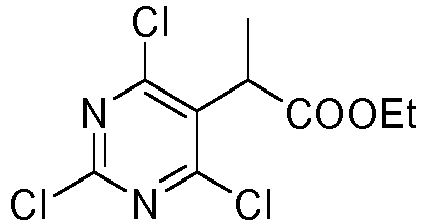
- According to General Protocol I, (±)-ethyl 2-(2,4,6-trichloropyrimidin-5-yl)propanoate was prepared from (±)-ethyl 2-(2,4,6-trihydroxypyrimidin-5-yl)propanoate (6 g, 12 mmol), phosphoryl trichloride (30 mL) and N,N'-diisopropylethylamine (7.5 mL) and isolated as a yellow oil (2.3 g, yield 31 %). 1H NMR (400 MHz, CDCl3) δ ppm 4.31-4.37 (m, 1H), 4.17-4.25 (m, 2H), 1.55-1.57 (m, 3H), 1.22-1.26 (m, 3H).
-

- According to General Protocol I, (±)-2-(2,4,6-trichloropyrimidin-5-yl)propan-1-ol was prepared from (±)-ethyl 2-(2,4,6-trichloropyrimidin-5-yl)propanoate (2.3 g, 8 mmol) and diisobutylaluminium hydride (1.0 M in hexane, 10 mL, 10 mmol) and isolated as a pale-yellow oil (260 mg, yield 13 %). 1H NMR (400 MHz, CDCl3) δ ppm 4.17-4.11 (m, 1H), 3.97-3.93 (m, 1H), 3.89-3.83 (m, 1H), 1.54 (s, 1H), 1.40-1.38 (d, 3H, J = 7.2 Hz).
-

- According to General Protocol I, (±)-2-(2,4,6-trichloropyrimidin-5-yl)propyl methanesulfonate was prepared from (±)-2-(2,4,6-trichloropyrimidin-5-yl)propan-1-ol (260 mg, 1.1 mmol), methanesulfonyl chloride (247 mg, 2.1 mmol) and triethyl amine (0.2 mL) and isolated as a pale-yellow oil (300 mg, yield 87 %). 1H NMR (400 MHz, CDCl3) δ ppm 4.73-4.68 (t, 1H, J = 9.2 Hz), 4.53-4.49 (dd, 1H, J = 6.8 Hz, 10.4 Hz), 4.13-4.06 (m, 1H), 3.00 (s, 3H), 1.48-1.46 (d, 3H, J = 7.2 Hz).
- According to General Protocol I, (±)-2,4-dichloro-7-(4-methoxybenzyl)-5-methyl-6,7-dihydro-5H-pyrrolo[2,3-d]pyrimidine was prepared from (±)-2-(2,4,6-trichloropyrimidin-5-yl)propyl methanesulfonate (300 mg, 0.94 mmol), (4-methoxyphenyl)methanamine (192 mg, 1.4 mmol) and triethyl amine (2 mL), and isolated as a yellow (190 mg, yield 63 %). 1H NMR (400 MHz, CDCl3) δ ppm 7.18-7.16 (d, 2H, J = 8.4 Hz), 6.88-6.86 (dd, 2H, J = 2.0 Hz, 6.4 Hz), 4.53 (s, 2H), 3.80 (s, 3H), 3.70-3.65 (t, 1H, J = 10.0 Hz), 3.35-3.34 (m, 1H), 3.11-3.07 (q, 1H, J = 4.8 Hz), 1.31-1.29 (m, 3H).
-

-

- To a solution of (L)-ethyl lactate (124 g, 1.05 mol) and triethyl amine (126 g, 1.25 mol) in toluene at 10-15 °C was added methanesulfonyl chloride (124 g, 1.08 mol) dropwise for about 2 hours. The mixture was allowed to warm to about 20 °C and the solid was filtered off. The solution was washed with water and dried, concentrated to afford the product (S)-ethyl 2-(methylsulfonyloxy)propanoate (199 g, yield 96.7 %).
-

- To a solution of (S)-ethyl 2-(methylsulfonyloxy)propanoate (28.4 g, 0.1 mol) in N,N'-dimethylformamide (400 mL) was added dibenzyl malonate (23.5 g, 0.12 mol) and cesium fluoride (15.2 g, 0.1 mol). The mixture was heated at 50 °C for 2 days. After cooled to room temperature, the mixture was poured into water and then extracted with ethyl acetate. The organic phases were combined, washed with brine, water and dried over anhydrous sodium sulfate, and then concentrated to afford the crude product (S)-1,1-dibenzyl 2-ethyl propane-1,1,2-tricarboxylate, which was purified by silica gel chromatography (23 g, yield 60 %).
-

- To the solution of (S)-1,1-dibenzyl 2-ethyl propane-1,1,2-tricarboxylate (23 g, 0.06 mol) in methanol (500 mL) was added palladium on carbon (10 %, 2 g), and then the mixture was stirred under an atmosphere of hydrogen at room temperature overnight. The catalyst was filtrated and the filtrate was concentrated under reduced pressure to afford the crude product (S)-2-(1-ethoxy-1-oxopropan-2-yl)malonic acid, which was purified by silica gel chromatography (10 g, yield 83 %).
-

- A suspension of (S)-2-(1-ethoxy-1-oxopropan-2-yl)malonic acid (5 g, 25 mmol) and urea (1.8 g, 29.4 mmol) in acetic anhydride (15 mL) was placed in a microwave reactor and allowed to react under microwave irradiation at 60 °C for 30 minutes. After cooled to room temperature, the mixture was quenched by sodium bicarbonate and extracted with ethyl acetate. The organic phases were combined, dried over anhydrous sodium sulfate, concentrated and purified by slica gel chromatography to afford the produt (S)-ethyl 2-(2,4,6-trioxohexahydropyrimidin-5-yl)propanoate (2.85 g, yield 50 %).
-

- According to General Protocol I, (S)-ethyl 2-(2,4,6-trichloropyrimidin-5-yl)propanoate was prepared from (S)-ethyl 2-(2,4,6-trioxohexahydropyrimidin-5-yl)propanoate (5.6 g, 25m mol), phosphoryl trichloride (20 mL) and N,N'-diisopropylethylamine (5 mL) and isolated as a yellow oil (2.8 g, yield 40 %). 1H NMR (400 MHz, CDCl3) δ ppm 4.30-4.36 (q, 1H, J = 7.2 Hz), 4.16-4.25 (m, 2H), 1.54-1.56 (d, 3H, J = 7.6 Hz), 1.22-1.25 (m, 3H).
-

- According to General Protocol I, (S)-2-(2,4,6-trichloropyrimidin-5-yl)propan-1-ol was prepared from (S)-ethyl 2-(2,4,6-trichloropyrimidin-5-yl)propanoate (1.0 g, 3.55 mmol) and diisobutylaluminium hydride (1.0 M in hexane, 10.6 mL, 10.6 mmol) and isolated as a pale-yellow oil (200 mg, yield 25 %). 1H NMR (400 MHz, CDCl3) δ ppm 4.13-4.17 (m, 1H), 3.83-3.96 (m, 2H), 1.79 (s, 1H), 1.38-1.40 (d, 3H, J = 7.2 Hz).
-

- According to General Protocol I, (S)-2-(2,4,6-trichloropyrimidin-5-yl)propyl methanesulfonate was prepared from (S)-2-(2,4,6-trichloropyrimidin-5-yl)propan-1-ol (200 mg, 0.83 mmol), methanesulfonyl chloride (191 mg, 1.66 mmol) and triethyl amine (166 mg, 1.66 mmol) and isolated as a pale-yellow oil (185 mg, yield 70 %).
- According to General Protocol I, (S)-2,4-dichloro-7-(4-methoxybenzyl)-5-methyl-6,7-dihydro-5H-pyrrolo[2,3-d]pyrimidine was prepared from (S)-2-(2,4,6-trichloropyrimidin-5-yl)propyl methanesulfonate (185 mg ,0.578 mmol), (4-methoxyphenyl)methanamine (120 mg, 0.867 mmol) and triethyl amine (117 mg, 1.156 mmol), and isolated as a yellow (120 mg, yield 64 %). 1H NMR (400 MHz, CDCl3) δ ppm 7.16-7.19 (d, 2H, J = 8.8 Hz), 6.86-6.88 (d, 2H, J = 8.4 Hz), 4.54 (s, 2H), 3.80 (s, 3H), 3.66-3.71 (t, 1H, J = 6.0 Hz), 3.33-3.36 (m, 1H), 3.08-3.12 (dd, 1H, J = 4.4 Hz, 10.0 Hz), 1.29-1.31 (d, 3H, J = 6.8 Hz).
-

- Intermediate A4 was synthesized according to the scheme as following:


-

- To a solution of ethyl 2-(2,4,6-trichloropyrimidin-5-yl)acetate (from Intermediate A1, 200 mg, 0.74 mmol) in N,N'-dimethylformamide (5 mL) was added (4-methoxyphenyl)methanamine (112 mg, 0.82 mmol) and N,N'-diisopropylethylamine (115 mg, 0.89 mmol). The resulting mixture was stirred at 60 °C for 1 hour, quenched by water and then extracted with ethyl acetate. The organic phases were combined, washed by diluted hydrochloric acid (1 N), water and brine, dried over anhydrous sodium sulfate, evaporated and purified by silica gel chromatography to afford the product ethyl 2-(2,4-dichloro-6-(4-methoxybenzylamino)pyrimidin-5-yl)acetate. 1H NMR (400 MHz, CDCl3) δ ppm 7.26-7.28 (m, 2H), 6.88-6.90 (dd, 2H, J = 2.0 Hz, 6.4 Hz), 6.15 (s, 1H), 4.60-4.62 (d, 2H, J = 5.2 Hz), 4.11-4.16 (q, 2H, J = 7.2 Hz), 3.81 (s, 3H), 3.60 (s, 2H), 1.21-1.26 (t, 3H, J = 6.4 Hz).
-

- Ethyl 2-(2,4-dichloro-6-(4-methoxybenzylamino)pyrimidin-5-yl)acetate (370 mg, 1.0 mol), iodomethane (284 mg, 2.0 mmol), potassium carbonate (690 mg, 5.0 mmol) and N,N'-dimethylformamide (10 mL) were added to a sealed tube and filled with nitrogen. The mixture was stirred for 1 hour at 80 °C. After cooling, the mixture was poured into water (100 mL) and extracted with ethyl acetate. The extracts were combined, washed with water and brine, dried over anhydrous sodium sulfate, filtrated and condensed. The residue was purified by silica gel column chromatography to afford the product 2,4-dichloro-7-(4-methoxybenzyl)-5,5-dimethyl-5H-pyrrolo[2,3-d]pyrimidin-6(7H)-one (270 mg, yield 77 %). 1H NMR (400 MHz, CDCl3) δ ppm 7.37-7.39 (d, 2H, J = 8.8 Hz), 6.84-6.86 (d, 2H, J = 8.8 Hz), 4.86 (s, 2H), 3.78 (s, 3H), 1.48 (s, 6H).
- To a solution of 2,4-dichloro-7-(4-methoxybenzyl)-5,5-dimethyl-5H-pyrrolo[2,3-d]pyrimidin-6(7H)-one (270 mg, 0.77 mol) in tetrahydrofuran (10 mL) was added diborane (1 M in tetrahydrofuran, 3.85 mL, 3.85 mmol) dropwise under nitrogen. The mixture was refluxed overnight. After cooling, methanol (2 mL) was added dropwise to decompose the excessive diborane. The solvent was removed and the residue was purified by silica gel column chromatography to afford the product 2,4-dichloro-7-(4-methoxybenzyl)-5,5-dimethyl-6,7-dihydro-5H-pyrrolo[2,3-d]pyrimidine (156 mg, yield 60 %). 1H NMR (400 MHz, CDCl3) δ ppm 7.16-7.18 (d, 2H, J = 8.4 Hz), 6.86-6.88 (d, 2H, J = 8.0 Hz), 4.56 (s, 2H), 3.81 (s, 3H), 3.23 (s, 2H), 1.37 (s, 6H).
-

- Intermediate A5 was synthesized according to the scheme as following:


-

- To a solution of (S)-2-aminopropanoic acid (60 g, 0.67 mol) in acetic acid (400 ml) was added NaNO2 (93 g, 1.34 mol) several portions at 0 °C. After addition, the mixture was stirred at room temperature for 4 hours. After removed the acetic acid, water added and then extracted with ether. The organic phase was collected, dried, concentrated to afford (R)-2-acetoxypropanoic acid (30 g, 35%). 1H NMR (400MHz, CDCl3) δ ppm, 11.70(s, 2H), 5.02-5.07 (q, 1H,), 2.07 (s, 3H),1.46-1.52 (d, 3H).
-

- To a solution of (R)-2-acetoxypropanoic acid (30g, 0.23 mol) in EtOH (500 ml) was added sulfuryl dichloride (54 g, 0.45mol) dropwise below -40 °C. The mixture was stirred for 48 hours at room temperature. The ethanol was removed under reduced pressure to afford sulfuryl dichloride, which was purified by silica gel chromatography (15 g, 58%). 1H NMR (400MHz, CDCl3) δ ppm, 4.22-4.27 (m, 3H), 2.87-2.87 (q, 1H), 1.41-1.43 (d, 3H, J = 7.6 Hz), 1.30-1.32 (m, 3H).
-

- (R)-ethyl 2-hydroxypropanoate (15 g, 0.127 mol) and TEA (15.4 g, 0.15 mol) were added to THF and then cooled to 10-15 °C. Then MsCI (15 g, 0.13 mol) was added to the solution dropwise with cooling while maintaining the temperature in the range of 10-15 °C at about 2 hours. The mixture was allowed to warm to about 20 °C and the solid was filtered off. The solution was washed with water and dried, concentrated to afford (R)-ethyl 2-(methylsulfonyloxy)propanoate (15 g, 60%). 1H NMR (400MHz, CDCl3) δ ppm, 5.11-5.14 (q, 1H,), 4.24-4.29 (m, 2H), 2.81-3.17 (q, 3H, J = 7.2 Hz), 1.61-1.43 (d, 3H, J = 7.6 Hz), 1.30-1.32 (m, 3H).
-

- To a solution of (R)-ethyl 2-(methylsulfonyloxy)propanoate (15 g, 0.076 mol) in DMF (300 ml) was added dibenzyl malonate (21.5 g, 0.076 mol) and CsF (11.5 g, 0.076 mol). The mixture was heated to 50 °C for 2 days. After cooled to room temperature, the mixture was poured into water and then extracted with EtOAc. The organic phase was washed with brine, water and dried. Concentrated to afford (R)-1,1-dibenzyl 2-ethyl propane-1,1,2-tricarboxylate, which was purified by silica gel chromatography (11 g, 40%).
-

- To the solution of (R)-1,1-dibenzyl 2-ethyl propane-1,1,2-tricarboxylate (11 g, 0.029 mol) in MeOH (500 ml) was added Pd/C (wet, 2 g), and then the mixture was stirred under hydrogen atmosphere at room temperature overnight. After filtered the Pd/C, the solvent was removed under reduced pressure to afford (R)-2-(1-ethoxy-1-oxopropan-2-yl)malonic acid, which was purified by silica gel chromatography (3.5 g, 60%).
-

- The (R)-2-(1-ethoxy-1-oxopropan-2-yl)malonic acid (3.5 g, 0.017 mol) and the urea (1.03 g, 0.017 mol) was dissolved into Ac2O (20 ml) and then added to the reaction vessel of the microwave reactor and were allowed to react under microwave irradiation at 60 °C for half an hour. After cooled to rt, added NaHCO3 aqueous and extracted with EtOAc. The organic phase was dried and concentrated to afford (R)-ethyl 2-(2,4,6-trioxohexahydropyrimidin-5-yl)propanoate , which was purified by slica gel chromatography (2.0 g, 52%).
-

- According to General Protocol I, (R)-ethyl 2-(2,4,6-trichloropyrimidin-5-yl)propanoate was prepared from (R)-ethyl 2-(2,4,6-trioxohexahydropyrimidin-5-yl)propanoate (2.0 g, 8.87 mmol), phosphoryl trichloride (20 mL) and N,N-diisopropylethylamine (5 mL) and isolated as a yellow oil (1.0 g, yield 40 %). 1H NMR (400MHz, CDCl3) δ ppm,4.30-4.36 (q, 1H, J = 7.2 Hz), 4.17-4.24 (m, 2H), 1.54-1.56 (d, 3H, J = 7.6 Hz), 1.22-1.25 (m, 3H).
-

- According to General Protocol I, (R)-2-(2,4,6-trichloropyrimidin-5-yl)propan-1-ol was prepared from (R)-ethyl 2-(2,4,6-trichloropyrimidin-5-yl)propanoate (1.0 g, 3.55 mmol) and diisobutylaluminium hydride (1.0 M in hexane, 10.6 mL, 10.6 mmol) and isolated as a pale yellow oil (70 mg, yield 10 %). 1H NMR (400 MHz, CDCl3) δ ppm 4.14 - 4.17 (m, 1H), 3.85 - 3.97 (m, 2H), 1.56 (s, 1H), 1.38 - 1.40 (d, 3H, J = 7.2 Hz).
-

- According to General Protocol I, (R) - 2 - (2,4,6 - trichloropyrimidin - 5 - yl)propyl methanesulfonate was prepared from (R) - 2 - (2,4,6 - trichloropyrimidin - 5 - yl)propan - 1 - ol (70 mg, 0.58 mmol), methanesulfonyl chloride (67 mg, 0.58 mmol) and triethyl amine (60 mg,1.66 mmol) and isolated as a pale yellow oil (60 mg, yield 65 %). 1H NMR (400 MHz, CDCl3) δ ppm 4.69 - 4.74 (t, 1H, J = 9.2 Hz), 4.49-4.54 (dd, 1H, J = 6.8 Hz, 10.4 Hz), 4.06-4.49 (m, 1H),3.92 (s, 1H), 1.46-1.48 (d, 3H, J = 7.2 Hz).
-

- (R) - 2,4 - dichloro - 7 - (4 - methoxybenzyl) - 5 - methyl - 6,7 - dihydro - 5H - pyrrolo[2,3 - d]pyrimidine was prepared from (R) - 2 - (2,4,6 - trichloropyrimidin - 5 - yl)propyl methanesulfonate (60 mg ,0.188 mmol), (4 - methoxyphenyl)methanamine (39 mg, 0.28 mmol) and triethyl amine (38 mg, 0.375 mmol), and isolated as a yellow (45 mg, yield 74 %). 1H NMR (400 MHz, CDCl3) δ ppm 7.16 - 7.19 (d, 2H, J = 8.8 Hz), 6.86 - 6.88 (d, 2H, J = 8.4 Hz), 4.54 (s, 2H), 3.80 (s, 3H), 3.66 - 3.71 (t, 1H, J = 6.0 Hz), 3.33 - 3.36 (m, 1H), 3.08 - 3.12 (dd, 1H, J = 4.4 Hz, 10.0 Hz), 1.29 - 1.31 (d, 3H, J = 6.8 Hz).
-

- Intermediate A6 was synthesized according to the scheme as following:


-

- To a solution of anhydrous ethanol (1000 mL) was added sodium (23.0 g, 1 mol) in pieces. After all the sodium dissolved, the reaction mixture was cooled to 0°C with an ice bath, diethyl malonate (160.2 g, 1 mol) was added dropwise, the reaction was allowed to warm to room temperature after stirred for 0.5 h, ethyl 2-chloroacetate (122.6 g, 1 mol) was added and stirred for another 1 h, then heated to reflux for 3 h and cooled to room temperature. Most of ethanol was removed under reduced pressure and the residue was poured into ice-water. The aqueous phase was extracted with ethyl acetate, and the organic extracts were combined, washed by brine, dried over anhydrous sodium sulfate, and evaporated to afford the product ethane-1,1,2-tricarboxylate as a pale-yellow oil (180.0 g, yield 73.1 %), which was used for the next step without purification.
-

- To a solution of anhydrous ethanol (1500 mL) was added sodium (25.2 g, 1.1 mol) in pieces. After all the sodium dissolved, triethyl ethane-1,1,2-tricarboxylate (180.0 g, 733 mmol) and urea (43.9 g, 733 mmol) was added respectively. The reaction mixture was heated at reflux overnight and cooled to room temperature, evaporated to dryness. The residue was diluted with water and acidified by diluted hydrochloric acid (2 N). The mixture was evaporated and purified by silica gel chromatography to afford the product ethyl 2-(2,4,6-trioxohexahydropyrimidin-5-yl)acetate as a pale-yellow solid (82.8 g, yield 35.0 %).
-

- To a solution of ethyl 2-(2,4,6-trioxohexahydropyrimidin-5-yl)acetate (50.0 g, 240.0 mmol) in phosphoryl trichloride (400.0 mL) was added N,N'-diisopropylethylamine (80.0 mL) dropwise. After the addition was over, the reaction mixture was heated at 100 °C for 2 hours. Most of phosphoryl trichloride was removed under reduced pressure and the residue was basified by aqueous sodium bicarbonate. The aqueous phase was extracted with ethyl acetate, and the organic extracts were combined, washed by brine, dried over anhydrous sodium sulfate, evaporated and purified by silica gel chromatography to afford the product ethyl 2-(2,4,6-trichloropyrimidin-5-yl)acetate as a pale-yellow solid (34.4 g, yield 54.6 %). 1H NMR (400 MHz, CDCl3) δ ppm 4.24 (q, J = 7.1 Hz, 2H), 3.95 (s, 2H), 1.29 (t, J = 7.1 Hz, 3H).
-

- To a solution of ethyl 2-(2,4,6-trichloropyrimidin-5-yl)acetate (43.3 g , 160.7 mmol) in N,N-dimethyllformamide (500 mL) was added 4-Methoxybenzylamine (24.2 g, 176.8 mmol) and N,N'-diisopropylethylamine (24.9 g, 192.9 mmol), the reaction mixture was heated to 60 °C for 1 h. Quenched with water, extracted with ethyl acetate, and the organic extracts were combined, washed with hydrochloride (1 N), brine, dried over anhydrous sodium sulfate, evaporated and purified by silica gel chromatography to afford the as a pale-yellow solid (27.1 g, yield 45.6 %). 1H NMR (400 MHz, CDCl3) δ ppm 7.29 (dd, J = 6.0, 3.9 Hz, 1H), 6.93 - 6.85 (m, 1H), 6.14 (s, 1H), 4.63 (d, J = 5.3 Hz, 2H), 4.15 (q, J = 7.1 Hz, 2H), 3.83 (s, 3H), 3.62 (s, 2H), 1.23 (t, J = 7.1 Hz, 2H).
-

- To a solution of ethyl 2-(2,4-dichloro-6-(4-methoxybenzylamino)pyrimidin-5-yl)acetate (27.1 g, 73.2 mmol) and powder potassium carbonate (101.1 g, 732.4 mmol) in N,N-dimethyllformamide (800 mL) was added 1,2-dibromoethane (27.5 g, 146.4 mmol) dropwise under nitrogen atmosphere at 40 °C. After the addition was over, the reaction mixture was heated to 80 °C for 1 h. Quenched with water, extracted with ethyl acetate, and the organic extracts were combined, washed with brine, dried over anhydrous sodium sulfate, evaporated and purified by silica gel chromatography to afford the product as a snow-white solid (21.2 g, yield 82.7 %). 1H NMR (400 MHz, CDCl3) δ ppm 7.53 - 7.38 (m, 2H), 6.86 (dd, J = 8.4, 1.3 Hz, 2H), 4.94 (d, J = 0.8 Hz, 2H), 3.79 (d, J = 1.6 Hz, 3H), 2.14 (qd, J = 4.3, 1.6 Hz, 2H), 1.79 (qd, J = 4.3, 1.6 Hz, 2H).
-

- To a solution of 2',4'-dichloro-7'-(4-methoxybenzyl)spiro[cyclopropane-1,5'-pyrrolo[2,3-d]pyrimidin]-6'(7'H)-one (14.0 g, 40.0 mmol) in tetrahydrofuran (200 mL) was added 94% Borane-methyl sulfide complex (8.2 mL, 80.0 mmol) dropwise under nitrogen atmosphere. After the addition was over, the reaction mixture was heated to 60 °C overnight. When the reaction was completed, methanol was added to the reaction solution at 0°C , concentrated in vacuum and the residue was purified by silica gel chromatography to afford the product as a white solid (8.4g, yield 62.4 %). 1H NMR (400 MHz, CDCl3) δ ppm 7.20 (d, J = 8.6 Hz, 2H), 6.91 - 6.86 (m, 2H), 4.59 (s, 2H), 3.81 (s, 3H), 3.48 (s, 2H), 1.71 (q, J = 4.9 Hz, 2H), 0.82 (q, J = 4.9 Hz, 2H).
-

-

- To a solution of 4-fluoro-2-methoxy-1-nitrobenzene (100 g, 0.584 mol) and morpholine (60 g, 0.689 mol) in dimethyl sulfoxide (60 mL) was added potassium carbonate (120 g, 0.870 mol). The mixture was stirred at 70 °C for 6 hours, and then poured into ice-water. The precipitate was collected by filtration and washed by water, dried to afford the product 4-(3-methoxy-4-nitrophenyl)morpholine (100 g, yield 72 %).
- To a suspension of 4-(3-methoxy-4-nitrophenyl)morpholine (100 g, 0.42 mol) in tetrahydrofuran (2 L) was added palladium on carbon (10 %, 10 g). The mixture was stirred under an atmosphere of hydrogen for 12 hours. The catalyst was removed by filtration and the filtrate was evaporated to afford the product 2-methoxy-4-morpholinoaniline (87 g, yield 100 %).
-

-

- 3-Chlorobenzaldehyde (15 g, 107 mmol) was added to concentrated sulfuric acid (150 mL) at -20 °C, followed by addition of potassium nitrate (11.9 g, 117 mmol) in portions, keeping the temperature bellow -10 °C. After addition, the mixture was stirred for 30 minutes and then poured into ice-water. The aqueous phase was extracted with ethyl acetate, and the organic phases were combined, washed by brine, dried over anhydrous sodium sulfate, evaporated and purified by silica gel chromatography to afford the product 5-chloro-2-nitrobenzaldehyde (12.0 g, yield 60.6 %).
-

- In a flask equipped with a Dean-Stark water separator, 5-chloro-2-nitrobenzaldehyde (12.0 g, 64.7 mmol), ethylene glycol (8.0 g, 129.3 mmol) and p-toluenesulfonic acid (0.2 g) were dissolved in toluene (150 mL). The mixture was stirred at reflux for 8 hours. Dichloromethane was added and the organic phase was washed with saturated sodium bicarbonate and brine, then dried over anhydrous sodium sulfate, evaporated and purified by silica gel chromatography to afford the product 2-(5-chloro-2-nitrophenyl)-1,3-dioxolane (13.4 g, yield 90.0 %).
-

- 2-(5-Chloro-2-nitrophenyl)-1,3-dioxolane (13.4 g, 58.4 mmol) was dissolved in morpholine (150 mL). The mixture was then heated to reflux for 16 hours. Cooling to room temperature, dichloromethane was added. The organic phase was washed with water, dried over anhydrous sodium sulfate, evaporated and purified by silica gel chromatography to afford the product 4-(3-(1,3-dioxolan-2-yl)-4-nitrophenyl)morpholine (15.9 g, yield 97.1 %).
-

- 4-(3-(1,3-Dioxolan-2-yl)-4-nitrophenyl)morpholine (15.9 g, 56.7 mmol) was dissolved in a mixture of acetone and water (100 mL / 100 mL). Then p-toluenesulfonic acid (2.0 g) was added and the mixture was heated to reflux for 4 hours. Ethyl acetate was added and the organic phase was washed with saturated sodium bicarbonate and brine, and then dried over anhydrous sodium sulfate, evaporated to afford the crude product 5-morpholino-2-nitrobenzaldehyde, which was used for the next step without purification.
-

- To a suspension of the crude 5-morpholino-2-nitrobenzaldehyde in a mixture of tetrahydrofuran and ethanol (100 mL / 100 mL) was slowly added sodium borohydride (4.0 g). The mixture was stirred at room temperature for 1 hour, and then was partitioned between ether and saturated ammonium chloride. The aqueous phase was extracted with ether, and the organic phases were combined, washed by brine, dried over anhydrous sodium sulfate, evaporated and purified by silica gel chromatography to afford the product (5-morpholino-2-nitrophenyl)methanol (8.5 g, yield 62.3 %, two steps).
-
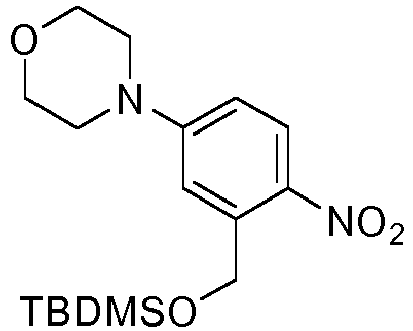
- To a solution of (5-morpholino-2-nitrophenyl)methanol (3.0 g, 12.6 mmol), triethylamine (2.54 g, 25.2 mmol) and 4-dimethylaminopyridine (0.2 g) in dichloromethane (100 mL) was added tert-butylchlorodimethylsilane (2.83g, 18.9 mmol). After the addition was over, the mixture was stirred at room temperature for 2 hours. The reaction mixture was diluted with ethyl acetate, and the organic phase was washed by saturated sodium bicarbonate, dried over anhydrous sodium sulfate, evaporated and purified by silica gel chromatography to afford the product 4-(3-((tert-butyldimethylsilyloxy)methyl)-4-nitrophenyl)morpholine (4.0 g, yield 90.9 %).
- A mixture of 4-(3-((tert-butyldimethylsilyloxy)methyl)-4-nitrophenyl)morpholine (4.0 g, 0.11 mol), Raney Ni (1.0 g) in methanol (250 mL) was stirred under an atmosphere of hydrogenated (1.0 atm) at room temperature for 1 hour. The catalyst was removed by filtration and the filtrate was evaporated to give the product 2-((tert-butyldimethylsilyloxy)methyl)-4-morpholinoaniline (3.48 g, yield 95.1 %). 1H NMR (400 MHz, CDCl3) δ ppm 6.72-6.76 (m, 2H), 6.62-6.64 (d, 1H, J = 8.0 Hz), 4.66 (s, 2H), 3.92 (s, 2H), 3.84-3.86 (t, 4H, J = 4.4 Hz), 3.00-3.03 (t, 4H, J = 4.8 Hz), 0.90-0.91 (m, 9H), 0.08-0.09 (m, 6H).
-

-

- To a solution of pyrocatechol (60 g, 0.54 mol) in ether (2000 mL) at 0 °C was added fuming nitric acid (24 mL) dropwise. After the addition was over, the reaction was allowed to stand at room temperature for 20 minutes, decanted into ice-water and the resulting solution was extracted with ether. The combined organic extracts were neutralized with aqueous sodium carbonate (10%), dried over anhydrous sodium sulfate, filtered and concentrated in vacuo. The residue obtained was purified by silica gel column chromatography (petroleum ether/ethyl acetate 5/1) to afford the product 3-nitrobenzene-1,2-diol (25 g, yield 30 %). 1H NMR (400 MHz, CDCl3) δ ppm 10.62 (s, 1H), 7.64-7.67 (dd, 1H, J = 1.6 Hz, 8.8 Hz), 7.23-7.26 (m, 1H), 6.89-6.93 (t, 1H, J = 8.4 Hz), 5.79 (br, 1H).
-

- To a solution of 3-nitrobenzene-1,2-diol (11 g , 0.071 mol) in N,N'-dimethylformamide (500 mL) was added potassium carbonate (29 g ,0.0.213 mol) followed by 1,2-dibromoethane (14.7 g, 0.078 mol). The mixture was heated at 110 °C for 2 hours. After cooled to room temperature, the mixture was poured into water and then extracted with ether. The organic phases were combined and dried over anhydrous sodium sulfate, filtrated and concentrated to give a crude product, which was purified by silica gel column chromatography (petroleum ether/ethyl acetate 20/1) to afford the product 5-nitro-2,3-dihydrobenzo[b][1,4]dioxine (8 g, yield 62 %). 1H NMR (400 MHz, CDCl3) δ ppm 7.48-7.50 (dd, 1H, J = 1.6 Hz, 8.4 Hz), 7.09-7.12 (dd, 1H, J = 1.6 Hz, 8.4 Hz), 6.88-6.92 (t, 1H, J = 8.4 Hz), 4.40-4.42 (m, 2H), 4.34-4.36 (m, 2H).
- A suspension of 5-nitro-2,3-dihydrobenzo[b][1,4]dioxine (8 g, 0.044 mol) and palladium on carbon (10 %, 2 g) in methanol (250 mL) was stirred vigorously under an atmosphere of hydrogen overnight at room temperature. The mixture was filtered through a pad of Celite and then concentrated to give the crude product, which was purified by silica gel column chromatography (petroleum ether/ethyl acetate 9/1) to afford the product 2,3-dihydrobenzo[b][1,4]dioxin-5-amine (6.5 g, yield 97 %). 1H NMR (400 MHz, CDCl3) δ ppm 6.61-6.65 (t, 1H, J = 8.0 Hz), 6.30-6.33 (dt, 2H, J = 1.2 Hz, 2.4 Hz), 4.22-4.27 (m, 4H), 3.75 (s, 2H).
-

-

- To a solution of 2,3-dihydrobenzo[b][1,4]dioxin-5-amine (Intermediate B3, 4.5 g, 30 mmol) in ethanol (50 mL) at room temperature was slowly added acetic anhydride (3.0 g, 30 mmol). After the addition was over, the mixture was stirred at room temperature for 5 minutes. The resulting suspension was concentrated to give the crude product, which was purified by silica gel column chromatography (petroleum ether/ethyl acetate 4/1) to afford the product N-(2,3-dihydrobenzo[b][1,4]dioxin-5-yl)acetamide (5.5 g, yield 95 %). 1H NMR (400 MHz, CDCl3) δ ppm 9.12 (s, 1H), 7.44-7.46 (d, 1H, J = 8.0 Hz), 6.71-6.75 (t, 1H, J = 8.0 Hz), 6.59-6.61 (d, 1H, J = 7.6 Hz), 4.23-4.30 (m, 4H), 2.06 (s, 3H).
-

- To a solution of N-(2,3-dihydrobenzo[b][1,4]dioxin-5-yl)acetamide (5.5 g, 28.5 mmol) in chloroform (20 mL) cooled at -20 °C was slowly added a solution of bromine (1.6 mL, 30 mmol) in chloroform (5 mL) so that the reaction temperature was maintained below -10 °C. The reaction was stirred at 0 °C for 10 minutes, and then quenched immediately with water. The mixture was extracted with dichloromethane; the combined extracts were washed with saturated sodium bicarbonate and brine, dried over anhydrous sodium sulfate, filtered and concentrated under reduced pressure. The residue was subjected to silica gel chromatography (dichloromethane) to afford the product N-(8-bromo-2,3-dihydrobenzo[b][1,4]dioxin-5-yl)acetamide (5 g, yield 64 %). 1H NMR (400 MHz, CDCl3) δ ppm 9.23 (s, 1H), 7.46-7.48 (d, 1H, J = 8.8 Hz), 7.04-7.06 (d, 1H, J = 9.2 Hz), 4.32-4.40 (m, 4H), 2.07 (s, 3H).
-

- To a solution of N-(8-bromo-2,3-dihydrobenzo[b][1,4]dioxin-5-yl)acetamide (5 g, 18.4 mmol) in toluene (50 mL) was added morpholine (1.9 g, 22 mmol), Pd2(dba)3 (1.68 g, 1.84 mmol), X-Phos (1.75 g, 3.68 mmol) and potassium tert-butoxide (4.1 g, 36.8 mmol) in a sealed tube. The mixture was heated at 130 °C for overnight. After cooled to room temperature, the mixture was filtered and the filtrate was evaporated to give a crude product, which was purified by silica gel column chromatography (petroleum ether/ethyl acetate 4/1) to afford the product N-(8-morpholino-2,3-dihydrobenzo[b][1,4]dioxin-5-yl)acetamide (2 g, yield 40 %).
- To a solution of N-(8-morpholino-2,3-dihydrobenzo[b][1,4]dioxin-5-yl)acetamide (2 g , 7.19 mmol) in methanol (100 mL) was added concentrated Hydrochloric acid (5 mL) and then the mixture was stirred at room temperature overnight. After the solvent was removed under reduce pressure, water was added and the pH was adjusted to 7-8 using aqueous sodium bicarbonate. The mixture was extracted with ethyl acetate and the combined organic phases were dried over anhydrous sodium sulfate, concentrated to give a crude product, which was purified by silica gel column chromatography (petroleum ether/ethyl acetate 2/1) to afford the product 8-morpholino-2,3-dihydrobenzo[b][1,4]dioxin-5-amine (1 g, yield 60 %). 1H NMR (400 MHz, CDCl3) δ ppm 6.38-6.41 (d, 1H, J = 8.4 Hz), 6.27-6.29 (d, 1H, J = 8.4 Hz), 4.28-4.32 (m, 4H), 3.85-3.88 (t, 4H, J = 4.8 Hz), 3.55 (s, 2H), 2.95-2.97 (t, 4H, J = 4.8 Hz).
-

-

- To a solution of 5-methoxy-3,4-dihydronaphthalen-1(2H)-one (8.3 g, 47.15 mmol) in polyphosphoric acid (100 mL) was added sodium azide (3.6 g, 55.4 mmol) in small portions at 0 °C within 30 minutes. Then the mixture was slowly warmed to room temperature and stirred for another 16 hours, and then poured into ice-water. The precipitate was collected and dried to afford the product 6-methoxy-4,5-dihydro-1H-benzo[b]azepin-2(3H)-one as a white solid (6.8 g, yield 75.5 %). 1H NMR (400 MHz, DMSO-d6) δ ppm 9.48 (s, 1H), 7.13-7.17 (t, 1H, J = 8.0 Hz), 6.77-6.79 (d, 1H, J = 7.6 Hz), 6.58-6.60 (d, 1H, J = 7.6 Hz), 3.78 (s, 3H), 2.68-2.72 (t, 2H, J= 6.8 Hz), 2.11-2.14 (t, 2H, J = 7.2 Hz), 1.99-2.05 (m, 2H).
-

- To a solution of 6-methoxy-4,5-dihydro-1H-benzo[b]azepin-2(3H)-one (6.8 g, 35.6 mmol) in acetonitrile (50 ml) at -10 °C was added trifluoromethanesulfonic anhydride (15.0 mL, 106.8 mmol) dropwise. After stirring for 20 minutes, potassium nitrate (3.94 g, 39.0 mmol) was added in portions, and the mixture was slowly warmed to room temperature and stirred for another 5 hours, poured into saturated sodium bicarbonate in ice water (100 mL) and adjusted the pH to 9. The aqueous phase was extracted with ethyl acetate and the organic extracts were combined, washed with water, dried over anhydrous sodium sulfate and concentrated in vacuum. The residue was purified by silica column chorography (petroleum ether/ethyl acetate 10/1 to 1/2) to afford the product 6-methoxy-7-nitro-4,5-dihydro-1H-benzo[b]azepin-2(3H)-one as a yellow solid (4.68 g, yield 55.7%). 1H NMR (400 MHz, DMSO-d6) δ ppm 10.01 (s, 1H), 7.80-7.83 (d, 1H, J = 8.8 Hz), 6.88-6.90 (d, 1H, J = 8.8 Hz), 3.85 (s, 3H), 2.73-2.77 (t, 2H, J = 7.2 Hz), 2.25-2.27 (t, 2H, J = 6.8 Hz), 2.15-2.20 (m, 2H).
-

- To a solution of 6-methoxy-7-nitro-4,5-dihydro-1H-benzo[b]azepin-2(3H)-one (4.5 g, 19.0 mmol) in dimethylformamide (30 mL) at 0 °C was added sodium hydride (60% on mineral oil, 1.15 g, 28.5 mmol) in small portions within 30 minutes. The mixture was stirred for 30 minutes at this temperature followed by adding ethyl iodide (1.84 mL, 22.9 mmol) dropwise. The mixture was warmed to room temperature and stirred for another 2 hours. Upon completion, the mixture was poured into ice-water and filtered to afford the product 1-ethyl-6-methoxy-7-nitro-4,5-dihydro-1H-benzo[b]azepin-2(3H)-one as a off-white solid (3.77 g, yield 78.5%). 1H NMR (400 MHz, CDCl3) δ ppm 7.81-7.84 (dd, 1H, J = 1.6 Hz, 8.8 Hz), 7.08-7.10 (dd, 1H, J = 1.2 Hz, 8.8 Hz), 3.76-3.94 (s+m, 5H), 2.89-2.96 (m, 2H), 2.22-2.32 (m, 4H), 1.16-1.26 (m, 3H).
- To a solution of 1-ethyl-6-methoxy-7-nitro-4,5-dihydro-1H-benzo[b]azepin-2(3H)-one (4.6 g, 18.0 mmol) in ethanol (45 mL) was added palladium on carbon (10 %, 0.45 g) and hydrazine (85 %, 8.78 mL, 0.18 mol). The mixture was heated to 90 °C for 6 hours. The mixture was cooled to R.T. and concentrated in vacuum. The residue was dissolved in acetone (40 mL) and was added concentrated HCI dropwise at 0°C. After removal of the solvent, the title 7-amino-1-ethyl-6-methoxy-4,5-dihydro-1H-benzo[b]azepin-2(3H)-one hydrochloride was obtained as a white solid (4.3 g, yield 87.7 %). 1H NMR (400 MHz, CDCl3) δ ppm 10.65 (br, 2H), 7.64-7.67 (d, 1H, J = 8.4 Hz), 7.07-7.09 (d, 1H, J = 8.4 Hz), 4.03 (s, 3H), 3.50-3.82 (m, 2H), 2.71-2.92 (m, 2H), 2.24-2.30 (m, 2H), 2.17-2.22 (m, 2H), 1.12-1.15 (t, 3H, J= 7.2 Hz).
-

-

- 2-methyl-4-nitrobenzoic acid methyl ester (696 mg, 3.57 mmol), azobisisbutyronitrile (58.6 mg, 0.357 mmol) and N-bromosuccinimide (785 mg, 4.46 mmol) were suspended in carbon tetrachloride (35 mL) in a sealed tube. The above mixture was flushed with nitrogen for 5 minutes and heated at 80 °C for 22 hours. After cooling, the solid was filtered off and the filtrate was concentrated to dryness to obtain the crude product methyl 2-(bromomethyl)-4-nitrobenzoate as a light-brown solid, which was used for the next step without purification.
-

- A suspension of methyl 2-(bromomethyl)-4-nitrobenzoate in ammonium solution (7 N in methanol, 5 mL) was stirred at room temperature for 2 hours and concentrated in vacuum to obtain a yellow solid. This crude solid was triturated with ethyl acetate (15 mL) and was then cooled at -20 °C. The mixture was filtered to obtain the product 5-nitroisoindolin-1-one as yellow solid. 1H NMR (400 MHz, DMSO-d6) δ ppm 9.04 (br s, 1H), 8.48 (d, 1H, J = 2.0 Hz), 8.25 (dd, 1H, J = 2.0 Hz, 8.4 Hz), 7.91 (d, 1H, J = 8.4 Hz), 4.51 (s, 2 H).
- To a solution of 5-nitroisoindolin-1-one (60 mg, 0.337 mmol) in methanol (20 mL) was added palladium on carbon (10 %, 50 mg). The mixture was stirred under an atmosphere of hydrogen for 1 hour. Filtration through Celite, followed by concentration led to 5-aminoisoindolin-1-one as a tan solid (38 mg, yield 76.2 %).
-

-

- To a solution of 2-hydroxybenzaldehyde (5.0 g, 41 mmol) in acetic acid (50 mL) at 0 °C was added nitric acid (65 %, 4 g) dropwise. The reaction mixture was slowly warmed to room temperature for 2 hours and then heated at 40 °C for another 5 hours. The resulting mixture was poured into ice (75 g) and water (500 g). The precipitates were filtrated and purified by silica gel chromatography to afford the product 2-hydroxy-3-nitrobenzaldehyde (1.8 g, yield 26 %). 1H NMR (400 MHz, CDCl3) δ ppm 11.44 (s, 1H), 10.42 (s, 1H), 8.34-8.37 (dd, 1H, J = 2.0 Hz, 8.4 Hz), 8.10-8.13 (dd, 1H, J = 2.0 Hz, 7.6 Hz), 7.12-7.16 (t, 1H, J = 8.0 Hz).
-
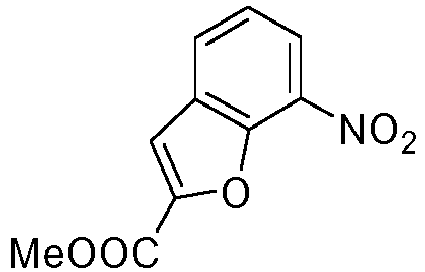
- A mixture of 2-hydroxy-3-nitrobenzaldehyde (4.3 g, 25.7 mmol), dimethyl 2-bromomalonate (5.95 g, 28.3 mmol), potassium carbonate (5.32 g, 38.6 mmol) and tetra-n-butylammonium bromide (0.8 g, 2.5 mmol) in toluene (100 mL) was heated at reflux with a Dean-Start trap for 5 hours. After cooling to room temperature, the mixture was evaporated and purified by silica gel chromatography (dichloromethane) to afford the product methyl 7-nitrobenzofuran-2-carboxylate (4.6 g, yield 81 %). 1H NMR (400 MHz, CDCl3) δ ppm 8.31-8.33 (dd, 1H, J = 1.2 Hz, 8.0 Hz), 8.02-8.04 (dd, 1H, J = 1.2 Hz, 8.0 Hz), 7.66 (s, 1H), 7.46-7.50 (t, 1H, J = 8.0 Hz), 4.03 (s, 3H).
-

- To a suspension of methyl 7-nitrobenzofuran-2-carboxylate (4.12 g, 18.6 mmol) in ethanol (100 mL) was added potassium hydroxide (2.08 g, 37.1 mmol). The mixture was heated at reflux for 1 hour, cooled to room temperature and evaporated. The residue was diluted with water, acidified by concentrated hydrochloric acid (12 N). The suspension was stirred for another 30 minutes, and then filtrated. The precipitate was collected, washed with water and dried to afford the product 7-nitrobenzofuran-2-carboxylic acid (3.54 g, yield 92 %). 1H NMR (400 MHz, CDCl3) δ ppm 8.28-8.30 (dd, 1H, J = 0.8 Hz, 8.0 Hz), 8.06-8.08 (dd, 1H, J = 0.8 Hz, 7.6 Hz), 7.641-7.642 (d, 1H, J = 0.4 Hz), 7.47-7.51 (m, 2H).
-

- A mixture of 7-nitrobenzofuran-2-carboxylic acid (3.54 g, 17.1 mmol) and copper(II) oxide (0.16 g, 2 mmol) in quinoline (30 mL) was heated at 170 °C for 1 hour. Cooling to room temperature, the mixture was diluted with water and extracted with ethyl acetate. The combined organic extracts were washed by brine, dried over anhydrous sodium sulfate, evaporated and purified by silica gel chromatography (petroleum ether/dichloromethane 2/3) to afford the product 7-nitrobenzofuran (2.56 g, yield 92 %). 1H NMR (400 MHz, DMSO-d6) δ ppm 8.27-8.28 (d, 1H, J = 2.0 Hz), 8.12-8.17 (m, 2H), 7.46-7.50 (t, 1H, J = 8.0 Hz), 7.215-7.220 (d, 1H, J = 2.0 Hz).
- To a solution of 7-nitrobenzofuran (2.56 g, 15.7 mmol) in methanol (100 mL) was added Raney Ni (ca. 200 mg) and hydrazine hydrate (2.5 g, 50 mmol) dropwise. The exothermic mixture was heated at 50 °C for 1 hour and then cooled to room temperature. The catalyst was removed by filtration and the filtrate was evaporated. The residue was diluted with ethyl acetate, and then a solution of hydrochloride in methanol (1 N) was added. The precipitate was collected and dried to afford the product benzofuran-7-amine hydrochloride (2.025 g, yield 76 %). 1H NMR (400 MHz, DMSO-d6) δ ppm 8.12-8.13 (d, 1H, J = 2.0 Hz), 7.57-7.59 (dd, 1H, J = 1.2 Hz, 8.0 Hz), 7.35-7.37 (m, 1H), 7.24-7.28 (t, 1H, J = 8.0 Hz), 7.047-7.053 (d, 1H, J = 2.4 Hz).
-
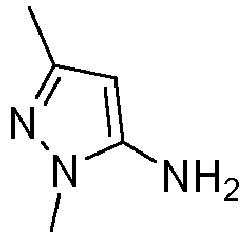
- To a solution of 3-aminocrotononitrile (16.5 g, 0.2 mol) in n-pentanol (40 mL) was added methylhydrazine (12.9 g, 0.28 mol). The solution was maintained at reflux for 3 hours. The n-pentanol and the excess methylhydrazine were subsequently distilled off under reduced pressure. The beige precipitate obtained was taken up in heptanes (150 mL), filtered on a sinter funnel and then dried under vacuum at a temperature of 40 °C to afford the product 1,3-dimethyl-1H-pyrazol-5-amine as a beige solid (13.5 g, yield 60.4 %).
-

-

- To a solution of nitric acid (20.0 mL) and acetic acid (40.0 mL) under 10 °C was added 3,4,5-trimethoxybenzoic acid (10.0 g, 47.0 mmol) in portions. The mixture was stirred at room temperature for 30 minutes. The reaction mixture was then poured into ice-water. The resulting precipitate was collected by filtration and washed with water, which was then recrystallized from ethanol to afford the product 1,2,3-trimethoxy-5-nitrobenzene (6.64 g, yield 66.1 %). 1H NMR (400 MHz, DMSO-d6) δ ppm 7.51 (s, 2H), 3.87 (s, 6H), 3.77 (s, 3H).
- To a solution of 1,2,3-trimethoxy-5-nitrobenzene (6.64 g, 31.2 mmol) in ethanol (250 mL) was added palladium on carbon (10 %, 300 mg) and hydrazine hydrate (85 %, 5.7 mL). After emission of gas has ceased, the reaction mixture was heated at refluxed for 1 hour, cooling to room temperature, filtered and evaporated to afford the product 3,4,5-trimethoxyaniline as a white solid (5.5 g, yield 96.4 %). 1H NMR (400 MHz, DMSO-d6) δ ppm 5.86 (s, 2H), 4.82 (br, 2H), 3.64 (s, 6H), 3.50 (s, 3H).
-

-

- To a solution of 4-nitroindole (5 g, 31 mmol) in anhydrous N,N'-dimethylformamide (200 mL) was added grounded potassium hydroxide (1.74 g, 31 mmol) in portions. Then a solution of 1,3-dibromopropane (18 g, 89 mmol) in N,N'-dimethylformamide was added dropwise. The mixture was stirred at room temperature for 12 hours, diluted with water and extracted with ethyl acetate. The organic phases were combined, washed by brine, dried over anhydrous sodium sulfate, filtrated and evaporated. The residue was purified by silica gel chromatography to afford the product 1-(3-bromopropyl)-4-nitro-1H-indole as brown-red oil (8.18 g, yield 94 %).
-
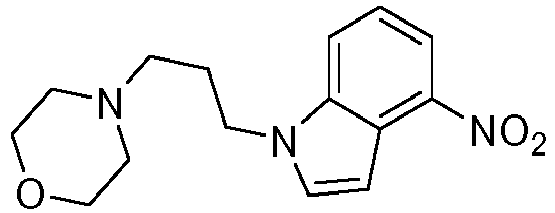
- To a solution of 1-(3-bromopropyl)-4-nitro-1H-indole (8.18 g, 28.9 mmol) in anhydrous N,N'-dimethylformamide (200 mL) was added grounded potassium carbonate (12 g, 87 mmol) in portions. Then a solution of morpholine (12.6 g, 144.8 mmol) in N,N'-dimethylformamide was added dropwise. The mixture was stirred at 80 °C for 12 hours, diluted with water and extracted with ethyl acetate. The organic phases were combined, washed by brine, dried over anhydrous sodium sulfate, filtrated and evaporated to afford the product 4-(3-(4-nitro-1H-indol-1-yl)propyl)morpholine, which was used for the next step without purification.
- To a solution of crude 4-(3-(4-nitro-1H-indol-1-yl)propyl)morpholine in methanol (100 mL) was added palladium on carbon (10 %). The mixture was stirred under an atmosphere of hydrogen for 12 hours. The catalyst was removed by filtration and the filtrate was evaporated. The residue was purified by silica gel chromatography to afford the product 1-(3-morpholinopropyl)-1H-indol-4-amine (5 g, yield 67 %, two steps) as a brown solid. 1H NMR (400 MHz, DMSO-d6) δ ppm 8.12, J = 2.4 Hz).
-

- Isatoic anhydride (10 g, 61.3 mmol) was suspended in tetrahydrofuran (200 ml) and treated dropwise with methylamine in methanol (40 %, 10 mL) with stirring. After stirring at room temperature for 16 hours, the solvent was distilled off under reduced pressure to afford the product 2-amino-N-methylbenzamide (9 g, yield 97.8 %). 1H NMR (400 MHz, CDCl3) δ ppm 7.14-7.32 (m, 2H), 6.60-6.72 (m, 2H), 6.05 (br s, 1H), 2.97 (d, 3H, J = 5.0 Hz).
-

-

- To a suspension of sodium hydride (60 %, 1.0 g, 25 mmol) in hexamethylphosphorous triamide (100 mL) was added a solution of 3-nitrobenzene-1,2-diol (from Intermediate B3, 1.55 g, 10 mmol) in hexamethylphosphorous triamide (20 mL) during 10 minutes. Then diiodomethane (0.94 mL, 11.6 mmol) was added and the solution was stirred for another 30 minutes, quenched by ice-water and extracted with ether. The combined organic extracts were dried over anhydrous sodium sulfate, concentrated to afford the product 4-nitrobenzo[d][1,3]dioxole (1.32 g, yield 79 %). 1H NMR (400 MHz, CDCl3) δ ppm 7.59-7.62 (dd, 1H, J = 1.2 Hz, 8.8 Hz), 7.06-7.09 (dd, 1H, J = 0.8 Hz, 8.0 Hz), 6.91-6.96 (dt, 1H, J = 0.8 Hz, 8.4 Hz), 6.219-6.221 (d, 2H, J = 0.8 Hz).
-

- To a solution of 4-nitrobenzo[d][1,3]dioxole (2.0 g, 12 mmol) in ethanol (80 mL) was added Raney Ni (ca. 0.5 g). The mixture was stirred under an atmosphere of hydrogen for 4 hours. The catalyst was removed by filtration and the filtrate was concentrated. The residue was purified by silica gel chromatography (dichloromethane) to afford the product benzo[d][1,3]dioxol-4-amine (1.04 g, yield 63 %). 1H NMR (400 MHz, CDCl3) δ ppm 6.64-6.68 (t, 1H, J = 8.0 Hz), 6.29-6.35 (dt, 2H, J = 0.8 Hz, 6.4 Hz), 5.90 (s, 2H), 3.52 (br, 2H).
-
- To a slurry of chloral hydrate (1.39 g, 8.4 mmol) and sodium sulfate (6.91 g, 48.7 mmol) in water (23.1 mL) was added benzo[d][1,3]dioxol-4-amine (1.0 g, 7.3 mmol), hydroxylamine sulfate (6.24 g, 38 mmol) and diluted hydrochloric acid (1.2 N, 7.7 mL). After stirring at 60 °C for 1.5 hours, the reaction mixture was kept at 25 °C overnight. The brown solid was collected by filtration and washed with water. After drying under vacuum, the solid was taken up in methane sulfonic acid and the solution was heated at 45 °C for 30 minutes. The mixture was cooled to 0 °C and then poured into ice (200 g). A dark red solid was precipitated and collected by filtration, dried to afford the product (635 mg, yield 53 %). 1H NMR (400 MHz, CDCl3) δ ppm 7.68 (br s, 1H), 7.35-7.37 (d, 1H, J = 8.0 Hz), 6.59-6.61 (d, 1H, J = 8.0 Hz), 6.13 (s, 2H).
-

- To a solution of sodium hydroxide (4.6 g, 115 mmol) in water (35 mL) was added the Intermediate from Step C (2.35 g, 14.4 mmol). A solution of hydrogen peroxide (30 %, 21 mL) was then added over 30 minutes. The reaction was neutralized to pH 7 by the addition of diluted hydrochloric acid (1N). The precipitate was collected and dried to afford the product 4-aminobenzo[d][1,3]dioxole-5-carboxylic acid (1.68 g, yield 64 %). 1H NMR (400 MHz, DMSO-d6) δ ppm 7.40-7.42 (d, 1H, J = 8.4 Hz), 6.25-6.27 (d, 1H, J = 8.4 Hz), 6.04 (s, 2H).
- To a solution of methylamine (0.43 g, 13.9 mmol, prepared from 33 % aqueous solution and sodium hydroxide) in acetonitrile (20 mL) was added 4-aminobenzo[d][1,3]dioxole-5-carboxylic acid (1.68 g, 9.3 mmol), N,N'-diisopropylethylamine (3.24 mL, 18.6 mmol) and O-(7-azabenzotriazol-1-yl)-N,N,N',N'-tetramethyluronium hexafluorophosphate (HATU, 4.28 g, 11.2 mmol). The mixture was stirred at room temperature for 12 hours, and then evaporated. The residue was diluted with dichloromethane, washed by water, dried over anhydrous sodium sulfate, concentrated and purified by silica gel chromatography to afford the product 4-amino-N-methylbenzo[d][1,3]dioxole-5-carboxamide (1.48 g, yield 82 %). 1H NMR (400 MHz, CDCl3) δ ppm 6.95-6.98 (d, 1H, J = 8.4 Hz), 6.24-6.26 (d, 1H, J = 8.0 Hz), 5.97 (s, 2H), 2.94-2.95 (m, 3H).
-

- To a solution of 2-aminobenzoic acid (5.0 g, 36.5 mol) in tetrahydrofuran (50 mL) was added N,N'-carbonyldiimidazole (6.5 g, 40.1 mol) at 25 °C, the resulting mixture was stirred for 1 hour at this temperature. Then pyrrolidine (3.5 g, 40.1 mmol) was added and the mixture was stirred overnight. The solvent was removed under the reduced pressure and the residue was washed with water and extracted with dichloromethane, the organic phase was dried over anhydrous sodium sulfate, concentrated to afford the product (2-aminophenyl)(pyrrolidin-1-yl)methanone (5.4 g, yield 66 %), which was used for the next step without further purification. 1H NMR (400 MHz, CDCl3) δ ppm 7.12-7.21 (m, 2H), 6.66-6.71 (m, 2H), 4.62 (br s, 2H), 3.63 (br s, 2H), 3.47 (br s, 2H), 1.87-1.94 (m, 4H).
-

-

- To a solution of 2-nitrobenzene-1-sulfonyl chloride (30 g, 0.14 mol) in dichloromethane (500 mL) was slowly added a solution of methylamine in water (30 %, 15.3 g) and triethylamine (38 mL, 0.27 mol) respectively. The mixture was stirred at room temperature for 1 hour and then evaporated. The residue was subjected to silica gel chromatography to afford the product N-methyl-2-nitrobenzenesulfonamide (26 g, yield 90 %).
- To a solution of N-methyl-2-nitrobenzenesulfonamide (26 g, 0.12 mol) in methanol (500 mL) was added palladium on carbon (10 %, 2 g). The mixture was stirred under an atmosphere of hydrogen at room temperature for 3 hours. The catalyst was filtrated and the filtrate was evaporated to afford the product 2-amino-N-methylbenzenesulfonamide (22 g, yield 98 %). 1H NMR (400 MHz, CDCl3) δ ppm 7.45-7.48 (dd, 1H, J = 1.6 Hz, 8.0 Hz), 7.24-7.31 (m, 2H), 6.81-6.83 (dd, 1H, J = 0.6 Hz, 8.0 Hz), 6.60-6.65 (m, 1H), 5.89 (s, 2H), 2.370-2.374 (d, 3H, J = 1.6 Hz).
-

-

- To a solution of propan-1-amine (2.36 g, 0.04 mol) in tetrahydrofuran (100 mL) at 0 °C was added triethylamine (4.05 g, 0.04 mol) and 2-nitrobenzene-1-sulfonyl chloride (8.88 g, 0.04 mol) in several portions over 10-15 minutes. The reaction mixture was stirred at room temperature for 4 hours, filtered and concentrated to afford the product 2-nitro-N-propylbenzenesulfonamide (9.18 g, yield 93.9 %). 1H NMR (400 MHz, CDCl3) δ ppm 8.11-8.16 (m, 1H), 7.84-7.89 (m, 1H), 7.74-7.79 (m, 2H), 5.26 (s, 1H), 3.05-3.10 (t, 2H, J = 6.4 Hz), 1.51-1.60 (m, 2H), 0.89-0.92 (t, 3H, J = 7.6 Hz).
- To a solution of 2-nitro-N-propylbenzenesulfonamide (8.64 g, 0.035 mol) in methanol (100 mL) was added palladium on carbon (10 %, 3.5 g). The mixture was stirred under an atmosphere of hydrogen for 12 hours. The catalyst was removed by filtration and the filtrate was evaporated. The solid residue was washed with ether to afford 2-amino-N-propylbenzenesulfonamide (7.45 g, yield 98.3 %), which was dissolved in ether, and bubbled in hydrochloride (gas) to afford the product 2-amino-N-propylbenzenesulfonamide hydrochloride (8.61 g, yield 98.4 %). 1H NMR (400 MHz, DMSO-d6) δ ppm 8.14 (br s, 3H), 7.50-7.62 (m, 2H), 7.26-7.30 (dt, 1H, J = 1.6 Hz, 7.6 Hz), 6.88-6.90 (d, 1H, J = 8.0 Hz), 6.67-6.71 (m, 1H), 2.61-2.65 (t, 2H, J = 7.2 Hz), 1.28-1.37 (sext, 2H, J = 7.2 Hz), 0.72-0.76 (t, 3H, J = 7.6 Hz).
-

-

- To a solution of 2-nitrobenzene-1-sulfonyl chloride (6.8 g, 30.8 mol) in dichloromethane (100 mL) at 0 °C was added triethylamine (14 g, 138.6 mol) and cyclobutanamine (2.2 g, 31 mmol) in several portions over 10-15 minutes. The reaction mixture was stirred at room temperature for 4 hours, concentrated and purified by silica gel chromatography to afford the product N-cyclobutyl-2-nitrobenzenesulfonamide (7 g, yield 88.9 %). 1H NMR (400 MHz, CDCl3) δ ppm 8.14-8.16 (m, 1H), 7.84-7.87 (m, 1H), 7.72-7.74 (m, 2H), 5.45-5.47 (d, 1H, J = 8.8 Hz), 3.93-3.99 (m, 1H), 2.11-2.18 (m, 2H), 1.84-1.90 (m, 2H), 1.59-1.69 (m, 2H).
- To a solution of N-cyclobutyl-2-nitrobenzenesulfonamide (7 g, 27.3 mmol) in methanol (100 mL) was added palladium on carbon (10 %). The mixture was stirred under an atmosphere of hydrogen for 12 hours. The catalyst was removed by filtration and the filtrate was evaporated to afford the product 2-amino-N-cyclobutylbenzenesulfonamide (6 g, yield 97.1 %). 1H NMR (400 MHz, CDCl3) δ ppm 7.68-7.71 (dd, 1H, J = 1.6 Hz, 8.0 Hz), 7.27-7.33 (m, 1H), 6.74-6.82 (m, 2H), 5.30 (s, 1H), 5.08 (s, 2H), 3.70-3.73 (m, 1H), 1.96-2.04 (m, 2H), 1.67-1.75 (m, 2H), 1.48-1.62 (m, 2H).
-

-

- To a solution of 2-nitrobenzene-1-sulfonyl chloride (22.1 g, 100 mol) in dichloromethane (500 mL) at 0 °C was added triethylamine (14 g, 138.6 mol) and cyclopentanamine (9 g, 105.9 mmol) in several portions over 10-15 minutes. The reaction mixture was stirred at room temperature for 4 hours, concentrated and purified by silica gel chromatography to afford the product N-cyclopentyl-2-nitrobenzenesulfonamide (23 g, yield 85.2 %). 1H NMR (400 MHz, CDCl3) δ ppm 8.16-8.18 (m, 1H), 7.84-7.87 (m, 1H), 7.40-7.78 (m, 2H), 5.25-5.27 (d, 1H, J = 7.6 Hz), 3.76-3.81 (m, 1H), 1.79-1.87 (m, 2H), 1.62-1.70 (m, 2H), 1.39-1.58 (m, 4H).
- To a solution of N-cyclopentyl-2-nitrobenzenesulfonamide (23 g, 85.2 mmol) in methanol (500 mL) was added palladium on carbon (10 %). The mixture was stirred under an atmosphere of hydrogen for 12 hours. The catalyst was removed by filtration and the filtrate was evaporated to afford the product 2-amino-N-cyclopentylbenzenesulfonamide (20 g, yield 97.8 %). 1H NMR (400 MHz, CDCl3) δ ppm 7.71-7.74 (dd, 1H, J = 1.2 Hz, 8.0 Hz), 7.30-7.34 (m, 1H), 6.75-6.82 (m, 2H), 4.86 (br s, 3H), 3.50-3.53 (m, 1H), 1.67-1.69 (m, 2H), 1.55-1.62 (m, 2H), 1.42-1.50 (m, 2H), 1.22-1.36 (m, 2H).
-

-

- To a solution of 2-nitrobenzene-1-sulfonyl chloride (22.1 g, 100 mol) in dichloromethane (500 mL) at 0 °C was added triethylamine (14 g, 138.6 mol) and cyclohexanamine (11.9 g, 120.2 mmol) in several portions over 10-15 minutes. The reaction mixture was stirred at room temperature for 4 hours, concentrated and purified by silica gel chromatography to afford the product N-cyclohexyl-2-nitrobenzenesulfonamide (25.7 g, yield 90.5 %). 1H NMR (400 MHz, CDCl3) δ ppm 8.16-8.19 (m, 1H), 7.85-7.87 (m, 1H), 7.72-7.78 (m, 2H), 5.24-5.26 (d, 1H, J = 7.6 Hz), 3.34-3.36 (m, 1H), 1.77-1.81 (m, 2H), 1.63-1.69 (m, 2H), 1.52-1.56 (m, 1H), 1.17-1.30 (m, 5H).
- To a solution of N-cyclohexyl-2-nitrobenzenesulfonamide (25.7 g, 90.5 mmol) in methanol (500 mL) was added palladium on carbon (10 %). The mixture was stirred under an atmosphere of hydrogen for 12 hours. The catalyst was removed by filtration and the filtrate was evaporated to afford the product 2-amino-N-cyclohexylbenzenesulfonamide (22 g, yield 95.7 %). 1H NMR (400 MHz, CDCl3) δ ppm 7.72-7.74 (dd, 1H, J = 1.2 Hz, 8.0 Hz), 7.27-7.33 (m, 1H), 6.75-6.82 (m, 2H), 4.84 (s, 3H), 3.05-3.07 (m, 1H), 1.59-1.70 (m, 4H), 1.46-1.50 (m, 1H), 1.08-1.22 (m, 5H).
-

- To a solution of benzene-1,2-diamine (100 g, 0.93 mol) in dichloromethane (1 L) at 0 °C was added acetic anhydride (87 mL, 0.92 mol). After stirring at 0 °C for 2 hours, the mixture was stand at 0 °C for 12 hours and the precipitate was collected by filtration, washed by dichloromethane and ether, dried in air to afford the product N-(2-aminophenyl)acetamide (25 g, yield 18 %). 1H NMR (400 MHz, CDCl3) δ ppm 7.14-7.26 (m, 2H), 7.04-7.08 (m, 1H), 6.78-6.81 (m, 2H), 3.86 (br s, 2H), 2.20 (s, 3H).
-

-

- To a suspension of cesium carbonate (20.2 g, 0.065 mol) in acetonitrile (500 mL) at room temperature was added N-methylmethanesulfonamide (5.33 g, 0.049 mol) and 1-fluoro-2-nitrobenzene (4.59 g, 0.033 mol) dropwise over 10-15 minutes. The reaction was stirred at room temperature for 12 hours. Upon completion, the mixture was filtered and then concentrated. The residue was purified by silica gel chromatography (dichloromethane) to afford the product N-methyl-N-(2-nitrophenyl) methanesulfonamide (4.2 g, yield 56.1 %). 1H NMR (400 MHz, DMSO-d6) δ ppm 7.92-7.94 (dd, 1H, J = 1.2 Hz, 8.0 Hz), 7.74-7.81 (m, 2H), 7.57-7.62 (m, 1H), 3.27 (s, 3H), 3.03 (s, 3H).
- To a solution of N-methyl-N-(2-nitrophenyl)methanesulfonamide (3.90 g, 0.017 mol) in a mixture of methanol and dichloromethane (100 mL) was added palladium on carbon (10 %, 1.5 g). The mixture was stirred under an atmosphere of hydrogen for 8 hours. The catalyst was removed by filtration and the filtrate was evaporated. The solid residue was washed with ether to afford the product N-(2-(aminomethyl)phenyl)-N-methylmethanesulfonamide (3.3 g, yield 97.4 %). 1H NMR (400 MHz, DMSO-d6) δ ppm 7.16-7.18 (dd, 1H, J = 1.2 Hz, 7.6 Hz), 6.99-7.04 (m, 1H), 6.72-6.75 (dd, 1H, J = 1.2 Hz, 8.0 Hz), 6.53-6.57 (m, 1H), 5.09 (br, 2H), 3.06 (s, 3H), 3.02 (s, 3H).
-

-

- To a solution of cesium carbonate (55.78 g, 171 mmol) in acetonitrile (500 mL) at room temperature was added N-methylmethane-sulfonamide (14.0 g, 0.128 mol). 2-Fluoro-benzonitrile (10.37 g, 86 mmol) was then added in portions over 10-15 minutes. The reaction mixture was stirred at room temperature for 12 hours. Upon completion, the mixture was filtered and then concentrated. The residue diluted with water and extracted by dichloromethane. The organic phases were combined, washed by brine, dried over anhydrous sodium sulfate and evaporated to afford the product N-(2-cyanophenyl)-N-methylmethane-sulfonamide (16.0 g, yield 88.9 %). 1H NMR (400 MHz, CDCl3) δ ppm 7.62-7.73 (m, 2H), 7.54-7.56 (m, 1H), 7.45-7.50 (m, 1H), 3.40 (s, 3H), 3.14 (s, 3H).
- To a solution of N-(2-cyanophenyl)-N-methylmethanesulfonamide (16.0 g, 76 mmol) in a solution of ammonia in ethanol (500 mL, 4 mol·L-1) was added palladium on carbon (10 %, 4 g). The mixture was stirred under an atmosphere of hydrogen for 24 hours. The catalyst was removed by filtration and the filtrate was evaporated. The residue was washed with ether to give N-(2-(aminomethyl)phenyl)-N-methylmethanesulfonamide (14.2 g, yield 87.1 %). 1H NMR (400 MHz, CDCl3) δ ppm 7.53-7.55 (m, 1H), 7.36-7.40 (m, 1H), 7.29-7.33 (m, 1H), 7.23-7.25 (m, 1H), 3.97-3.99 (br d, 2H, J = 8.0 Hz), 3.27 (s, 3H), 3.00 (s, 3H). N-(2-(aminomethyl)phenyl)-N-methylmethanesulfonamide was dissolved in ether and bubbled in hydrochloride (gas) to afford the product N-(2-(aminomethyl)phenyl)-N-methylmethanesulfonamide hydrochloride (15.0 g, yield 90.4 %). 1H NMR (400 MHz, CDCl3) δ ppm 7.54-7.55 (m, 1H), 7.35-7.40 (m, 1H), 7.28-7.33 (m, 1H), 7.24-7.26 (m, 1H), 3.99 (br s, 2H), 3.25 (s, 3H), 2.98 (s, 3H).
-


- Step A: To a solution of 2,4-dichloro-7-(4-methoxybenzyl)-6,7-dihydro-5H-pyrrolo[2,3-d]pyrimidines (vi, Intermediates A1-A4, 1.0 eq.) in anhydrous toluene was added R5R6NH (Intermediates B1-B10, 1.0-1.2 eq.), Pd2(dba)3 (5-20 mol%), (±)-BINAP / X-Phos (10-20 mol%) and cesium carbonate / sodium (potassium) tert-butoxide / potassium carbonate (1.5-4.0 eq.) respectively. The mixture was heated at 100-150 °C under microwave or in a sealed tube for several hours. Cooling to room temperature, the reaction mixture was evaporated and diluted with ethyl acetate, washed by brine, dried over anhydrous sodium sulfate, evaporated and subjected to silica gel chromatography to afford the product 4-chloro-7-(4-methoxybenzyl)-6,7-dihydro-5H-pyrrolo[2,3-d]pyrimidin-2-amines (vii).
- Step B: To a solution of 4-chloro-7-(4-methoxybenzyl)-6,7-dihydro-5H-pyrrolo[2,3-d]pyrimidin-2-amines (vii, 1.0 eq.) in anhydrous toluene was added R3R4NH (Intermediates C1-C11, 1.0-1.2 eq.), Pd2(dba)3 (5-20 mol%), (±)-BINAP / X-Phos (10-20 mol%) and cesium carbonate / sodium (potassium) tert-butoxide / / potassium carbonate (1.5-4.0 eq.) respectively. The mixture was heated at 100-150 °C under microwave or in a sealed tube for several hours. Cooling to room temperature, the reaction mixture was evaporated and diluted with ethyl acetate, washed by brine, dried over anhydrous sodium sulfate, evaporated and subjected to silica gel chromatography to afford the product 7-(4-methoxybenzyl)-6,7-dihydro-5H-pyrrolo[2,3-d]pyrimidine-2,4-diamine (viii).
- Step C: To a solution of 7-(4-methoxybenzyl)-6,7-dihydro-5H-pyrrolo[2,3-d]pyrimidine-2,4-diamine (viii) in anhydrous trifluoroacetic acid was added several drops of concentrated sulfuric acid. The mixture was stirred at room temperature for 2-12 hours, and then quenched by aqueous sodium bicarbonate. The aqueous phase was extracted with ethyl acetate and the organic phases were combined, washed by brine, dried over anhydrous sodium sulfate, evaporated and subjected to silica gel chromatography to afford the product 6,7-dihydro-5H-pyrrolo[2,3-d]pyrimidine-2,4-diamines (ix, Examples 1-37).
-

-
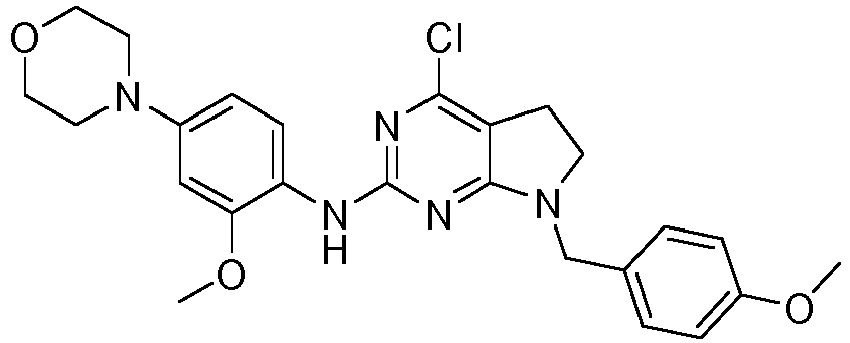
- According to General Protocol II, 4-chloro-N-(2-methoxy-4-morpholinophenyl)-7-(4-methoxybenzyl)-6,7-dihydro-5H-pyrrolo[2,3-d]pyrimidin-2-amine was prepared from 2,4-dichloro-7-(4-methoxybenzyl)-6,7-dihydro-5H-pyrrolo[2,3-d]pyrimidine (Intermediate A1, 200 mg, 0.65 mmol), 2-methoxy-4-morpholinoaniline (Intermediate B1, 160 mg, 0.77 mmol), Pd2(dba)3 (30 mg, 0.033 mmol), (±)-BINAP (40 mg, 0.064 mmol) and cesium carbonate (315 mg, 0.97 mmol), and isolated as a yellow solid (100 mg, yield 32 %). 1H NMR (400 MHz, CDCl3) δ ppm 8.37-8.39 (d, 1H, J = 9.6 Hz), 7.38 (s, 1H), 7.21-7.26 (m, 2H), 6.86-6.88 (dd, 2H, J = 2.0 Hz, 6.8 Hz), 6.50-6.52 (m, 2H), 4.54 (s, 2H), 3.85-3.87 (t+s, 7H), 3.80 (s, 3H), 3.45-3.49 (t, 2H, J = 8.4 Hz), 3.08-3.11 (t, 4H, J = 4.8 Hz), 2.90-2.94 (t, 2H, J = 8.4 Hz).
-

- According to General Protocol II, 2-(2-(2-methoxy-4-morpholinophenylamino)-7-(4-methoxybenzyl)-6,7-dihydro-5H-pyrrolo[2,3-d]pyrimidin-4-ylamino)-N-methylbenzamide was prepared from 4-chloro-N-(2-methoxy-4-morpholinophenyl)-7-(4-methoxybenzyl)-6,7-dihydro-5H-pyrrolo[2,3-d]pyrimidin-2-amine (100 mg, 0.21 mmol), 2-amino-N-methylbenzamide (Intermediate C1, 40 mg, 0.27 mmol), Pd2(dba)3 (10 mg, 0.011 mmol), (±)-BINAP (15 mg, 0.024 mmol) and cesium carbonate (105 mg, 0.322 mmol), and isolated as a yellow solid (60 mg, yield 48 %). 1H NMR (400 MHz, CDCl3) δ ppm 10.00 (s, 1H), 8.63-8.65 (d, 1H, J = 8.0 Hz), 8.39-8.41 (d, 1H, J = 8.8 Hz), 7.38-7.40 (m, 2H), 7.24-7.26 (m, 1H), 7.19 (s, 1H), 6.85-6.90 (m, 3H), 6.526-6.532 (d, 1H, J = 2.4 Hz), 6.47-6.49 (dd, 1H, J = 2.4 Hz, 8.8 Hz), 6.22 (s, 1H), 4.52 (s, 2H), 3.86-3.88 (t+s, 7H), 3.80 (s, 3H), 3.40-3.45 (t, 2H, J = 8.8 Hz), 3.09-3.11 (t, 4H, J = 4.8 Hz), 2.96-2.98 (d, 3H, J = 5.2 Hz), 2.89-2.93 (t, 2H, J = 8.8 Hz).
- According to General Protocol II, 2-(2-(2-methoxy-4-morpholinophenylamino)-6,7-dihydro-5H-pyrrolo[2,3-d]pyrimidin-4-ylamino) -N-methylbenzamide was prepared from 2-(2-(2-methoxy-4-morpholinophenylamino)-7-(4-methoxybenzyl)-6,7-dihydro-5H-pyrrolo[2,3-d]pyrimidin-4-ylamino)-N-methylbenzamide (20 mg, 0.034 mmol), trifluoroacetic acid (1 mL) and two drops of concentrated sulfuric acid, and isolated as a yellow solid (14 mg, yield 88 %). 1H NMR (400 MHz, DMSO-d6) δ ppm 10.64 (s, 1H), 8.61-8.63 (d, 1H, J = 4.8 Hz), 8.55-8.57 (d, 1H, J = 8.0 Hz), 7.83-7.85 (d, 1H, J = 8.8 Hz), 7.65-7.67 (dd, 1H, J = 1.2 Hz, 8.0 Hz), 7.31-7.35 (dt, 1H, J = 1.2 Hz, 8.4 Hz), 7.14 (s, 1H), 6.88-6.92 (dt, 1H, J = 0.8 Hz, 8.0 Hz), 6.605-6.611 (d, 1H, J = 2.4 Hz), 6.56 (s, 1H), 6.42-6.45 (dd, 1H, J = 2.4 Hz, 8.8 Hz), 3.80 (s, 3H), 3.72-3.74 (t, 4H, J = 4.8 Hz), 3.48-3.53 (t, 2H, J = 8.8 Hz), 3.05-3.07 (t, 4H, J = 4.8 Hz), 2.76-2.81 (s+t, 5H).
-

-

- According to General Protocol II, 4-(2-(2-methoxy-4-morpholinophenylamino)-7-(4-methoxybenzyl)-6,7-dihydro-5H-pyrrolo[2,3-d]pyrimidin-4-ylamino)-N-methylbenzo[d][1,3]dioxole-5-carboxamide was prepared from 4-chloro-N-(2-methoxy-4-morpholinophenyl)-7-(4-methoxybenzyl)-6,7-dihydro-5H-pyrrolo[2,3-d]pyrimidin-2-amine (80 mg, 0.166 mmol), 4-amino-N-methylbenzo[d][1,3]dioxole-5-carboxamide (Intermediate C2, 39 mg, 0.201 mmol), Pd2(dba)3 (30 mg, 0.033 mmol), X-Phos (16 mg, 0.034 mmol) and cesium carbonate (108 mg, 0.331 mmol) heated at 130 °C in a sealed tube for 12 hours, and isolated as a yellow solid (20 mg, yield 19 %). 1H NMR (400 MHz, CDCl3) δ ppm 8.27-8.29 (d, 1H, J = 8.8 Hz), 7.22-7.27 (m, 3H), 7.09-7.11 (d, 1H, J = 8.4 Hz), 6.84-6.87 (m, 2H), 6.65-6.67 (d, 1H, J = 8.4 Hz), 6.48 (s, 1H), 6.34-6.36 (m, 2H), 5.90 (s, 2H), 4.49 (s, 2H), 3.81-3.87 (m, 7H), 3.78-3.80 (m, 3H), 3.37-3.41 (t, 2H, J = 8.0 Hz), 3.07-3.08 (m, 4H), 2.888-2.891 (d, 3H, J = 1.2 Hz), 2.79-2.83 (t, 3H, J = 8.0 Hz).
- According to General Protocol II, 4-(2-(2-methoxy-4-morpholinophenylamino)-6,7-dihydro-5H-pyrrolo[2,3-d]pyrimidin-4-ylamino) -N-methylbenzo[d][1,3]dioxole-5-carboxamide was prepared from 4-(2-(2-methoxy-4-morpholinophenylamino)-7-(4-methoxybenzyl)-6,7-dihydro-5H-pyrrolo[2,3-d]pyrimidin-4-ylamino)-N-methylbenzo[d][1,3]dioxole-5-carboxamide (20 mg, 0.031 mmol), trifluoroacetic acid (5 mL) and four drops of concentrated sulfuric acid, and isolated as a white solid (6.3 mg, yield 39 %). 1H NMR (400 MHz, CDCl3) δ ppm 8.29 (s, 1H), 8.15-8.17 (d, 1H, J = 8.8 Hz), 7.12 (s, 1H), 7.07-7.09 (d, 1H, J = 8.0 Hz), 6.67-6.69 (d, 1H, J = 8.0 Hz), 6.46-6.47 (d, 1H, J = 2.4 Hz), 6.30-6.33 (dd, 1H, J = 1.6 Hz, 8.4 Hz), 6.21-6.22 (d, 1H, J = 4.4 Hz), 5.87 (s, 2H), 4.41 (s, 1H), 3.85-3.87 (t, 4H, J = 4.8 Hz), 3.82 (s, 3H), 3.61-3.65 (t, 2H, J = 8.4 Hz), 3.04-3.07 (t, 4H, J = 4.8 Hz), 2.90-2.97 (m, 5H).
-

-

- According to General Protocol II, (2-(2-(2-methoxy-4-morpholinophenylamino)-7-(4-methoxybenzyl)-6,7-dihydro-5H-pyrrolo[2,3-d]pyrimidin-4-ylamino)phenyl)(pyrrolidin-1-yl)methanone was prepared from 4-chloro-N-(2-methoxy-4-morpholinophenyl)-7-(4-methoxybenzyl)-6,7-dihydro-5H-pyrrolo[2,3-d]pyrimidin-2-amine (120 mg, 0.25 mmol), (2-aminophenyl)(pyrrolidin-1-yl)methanone hydrochloride (Intermediate C3, 68 mg, 0.30 mmol), Pd2(dba)3 (92 mg, 0.101 mmol), (±)-BINAP (62 mg, 0.10 mmol) and cesium carbonate (325 mg, 1.0 mmol) heated at 130 °C in a sealed tube for 12 hours, and isolated as a yellow solid (60 mg, yield 38 %). 1H NMR (400 MHz, CDCl3) δ ppm 8.61 (s, 1H), 8.45-8.47 (d, 1H, J = 8.4 Hz), 8.37-8.39 (d, 1H, J = 8.8 Hz), 7.32-7.38 (m, 2H), 7.23-7.24 (m, 2H), 6.92-6.95 (t, 1H, J = 7.2 Hz), 6.85-6.87 (d, 2H, J = 8.4 Hz), 6.525-6.531 (d, 1H, J = 2.4 Hz), 6.46-6.49 (dd, 1H, J = 2.4 Hz, 8.4 Hz), 4.52 (s, 2H), 3.86-3.88 (s+m, 7H), 3.80 (s, 3H), 3.61-3.64 (t, 2H, J = 7.2 Hz), 3.52-3.53 (m, 2H), 3.39-3.43 (t, 2H, J = 7.6 Hz), 3.09-3.11 (t, 4H, J = 4.8 Hz), 2.80-2.84 (t, 2H, J = 8.4 Hz), 1.94-1.96 (m, 2H), 1.85-1.86 (m, 2H).
- According to General Protocol II, (2-(2-(2-methoxy-4-morpholinophenylamino)-6,7-dihydro-5H-pyrrolo[2,3-d]pyrimidin-4-ylamino )phenyl)(pyrrolidin-1-yl)methanone was prepared from (2-(2-(2-methoxy-4-morpholinophenylamino)-7-(4-methoxybenzyl)-6,7-dihydro-5H-pyrrolo[2,3-d]pyrimidin-4-ylamino)phenyl)(pyrrolidin-1-yl)methanone (80 mg, 0.126 mmol), trifluoroacetic acid (6 mL) and five drops of concentrated sulfuric acid, and isolated as a white solid (56 mg, yield 86 %). 1H NMR (400 MHz, DMSO-d6) δ ppm 8.58 (s, 1H), 8.08-8.10 (d, 1H, J = 8.0 Hz), 7.89-7.91 (d, 1H, J = 8.8 Hz), 7.39-7.41 (d, 1H, J = 7.6 Hz), 7.30-7.32 (m, 1H), 7.06 (s, 1H), 6.96-6.99 (t, 1H, J = 7.6 Hz), 6.59-6.60 (d, 1H, J = 2.0 Hz), 6.55 (s, 1H), 6.37-6.40 (dd, 1H, J = 2.4 Hz, 8.8 Hz), 3.79 (s, 3H), 3.71-3.73 (t, 4H, J = 4.4 Hz), 3.44-3.49 (m, 6H), 3.02-3.05 (t, 4H, J = 4.4 Hz), 2.67-2.71 (t, 2H, J = 8.4 Hz), 1.74-1.83 (m, 4H).
-

-

- According to General Protocol II, 2-(2-(2-methoxy-4-morpholinophenylamino)-7-(4-methoxybenzyl)-6,7-dihydro-5H-pyrrolo[2,3-d]pyrimidin-4-ylamino)-N-methylbenzenesulfonamide was prepared from 4-chloro-N-(2-methoxy-4-morpholinophenyl)-7-(4-methoxybenzyl)-6,7-dihydro-5H-pyrrolo[2,3-d]pyrimidin-2-amine (100 mg, 0.208 mmol), 2-amino-N-methylbenzenesulfonamide (Intermediate C4, 46 mg, 0.25 mmol), Pd2(dba)3 (38 mg, 0.042 mmol), (±)-BINAP (26 mg, 0.042 mmol) and cesium carbonate (136 mg, 0.416 mmol) heated at 130 °C in a sealed tube for 24 hours, and isolated as a solid (94 mg, yield 72 %).
- According to General Protocol II, 2-(2-(2-methoxy-4-morpholinophenylamino)-6,7-dihydro-5H-pyrrolo[2,3-d]pyrimidin-4-ylamino) -N-methylbenzenesulfonamide was prepared from 2-(2-(2-methoxy-4-morpholinophenylamino)-7-(4-methoxybenzyl)-6,7-dihydro-5H-pyrrolo[2,3-d]pyrimidin-4-ylamino)-N-methylbenzenesulfonamide (94 mg, 0.149 mmol), trifluoroacetic acid (10 mL) and six drops of concentrated sulfuric acid, and isolated as a white solid (65 mg, yield 70 %). 1H NMR (400 MHz, DMSO-d6) δ ppm 8.49 (m, 1H), 8.32 (s, 1H), 7.75-7.78 (m, 2H), 7.69-7.71 (d, 1H, J = 8.0 Hz), 7.47-7.51 (t, 1H, J = 7.6 Hz), 7.27 (s, 1H), 7.07 (m, 1H), 6.75 (s, 1H), 6.63-6.64 (d, 1H, J = 2.8 Hz), 6.43-6.46 (dd, 1H, J = 2.4 Hz, 8.8 Hz), 3.81 (s, 3H), 3.74-3.76 (m, 4H), 3.51-3.55 (t, 2H, J = 8.4 Hz), 3.07-3.09 (t, 4H, J = 4.8 Hz), 2.77-2.81 (t, 2H, J = 8.0 Hz), 2.42-2.43 (d, 3H, J = 5.2 Hz).
-

-

- According to General Protocol II, 2-(2-(2-methoxy-4-morpholinophenylamino)-7-(4-methoxybenzyl)-6,7-dihydro-5H-pyrrolo[2,3-d]pyrimidin-4-ylamino)-N-propylbenzenesulfonamide was prepared from 4-chloro-N-(2-methoxy-4-morpholinophenyl)-7-(4-methoxybenzyl)-6,7-dihydro-5H-pyrrolo[2,3-d]pyrimidin-2-amine (100 mg, 0.207 mmol), 2-amino-N-propylbenzenesulfonamide hydrochloride (Intermediate C5, 62 mg, 0.247 mmol), Pd2(dba)3 (38 mg, 0.042 mmol), (±)-BINAP (26 mg, 0.042 mmol) and cesium carbonate (271 mg, 0.831 mmol) heated at 130 °C in a sealed tube for 12 hours, and isolated as a yellow solid (40 mg, yield 29 %). 1H NMR (400 MHz, CDCl3) δ ppm 8.31-8.35 (m, 2H), 7.92 (s, 1H), 7.84-7.86 (dd, 1H, J = 1.2 Hz, 8.0 Hz), 7.49-7.53 (m, 1H), 7.23-7.26 (m, 3H), 7.05-7.09 (m, 1H), 6.85-6.88 (m, 2H), 6.52-6.53 (d, 1H, J = 2.8 Hz), 6.40-6.43 (dd, 1H, J = 2.8 Hz, 8.8 Hz), 4.60-4.63 (t, 1H, J = 6.0 Hz), 4.52 (s, 2H), 3.86-3.89 (m, 7H), 3.80 (s, 3H), 3.41-3.45 (t, 2H, J = 8.4 Hz), 3.08-3.11 (m, 4H), 2.78-2.87 (m, 4H), 1.37-1.43 (m, 2H), 0.75-0.79 (t, 3H, J = 7.2 Hz).
- According to General Protocol II, 2-(2-(2-methoxy-4-morpholinophenylamino)-6,7-dihydro-5H-pyrrolo[2,3-d]pyrimidin-4-ylamino) -N-propylbenzenesulfonamide was prepared from 2-(2-(2-methoxy-4-morpholinophenylamino)-7-(4-methoxybenzyl)-6,7-dihydro-5H-pyrrolo[2,3-d]pyrimidin-4-ylamino)-N-propylbenzenesulfonamide (40 mg, 0.061 mmol), trifluoroacetic acid (4 mL) and three drops of concentrated sulfuric acid, and isolated as a white solid (16 mg, yield 48 %). 1H NMR (400 MHz, DMSO-d6) δ ppm 8.42-8.44 (d, 1H, J = 8.8 Hz), 8.28 (s, 1H), 7.84-7.85 (m, 1H), 7.77-7.79 (d, 1H, J = 8.8 Hz), 7.68-7.70 (d, 1H, J = 7.6 Hz), 7.43-7.45 (m, 1H), 7.22 (s, 1H), 7.02-7.06 (t, 1H, J = 7.6 Hz), 6.71 (s, 1H), 6.60-6.61 (d, 1H, J = 2.4 Hz), 6.40-6.42 (dd, 1H, J = 2.4 Hz, 8.8 Hz), 3.79 (s, 3H), 3.71-3.74 (m, 4H), 3.49-3.53 (m, 2H), 3.04-3.06 (m, 4H), 2.76-2.80 (t, 2H, J = 8.4 Hz), 2.68-2.73 (m, 2H), 1.30-1.35 (m, 2H), 0.70-0.73 (t, 3H, J = 7.6 Hz).
-

-

- According to General Protocol II, N-cyclobutyl-2-(2-(2-methoxy-4-morpholinophenylamino)-7-(4-methoxybenzyl)-6,7-dihydro-5H -pyrrolo[2,3-d]pyrimidin-4-ylamino)benzenesulfonamide was prepared from 4-chloro-N-(2-methoxy-4-morpholinophenyl)-7-(4-methoxybenzyl)-6,7-dihydro-5H-pyrrolo[2,3-d]pyrimidin-2-amine (100 mg, 0.208 mmol), 2-amino-N-cyclobutylbenzenesulfonamide (Intermediate C6, 56 mg, 0.248 mmol), Pd2(dba)3 (38 mg, 0.042 mmol), X-Phos (20 mg, 0.042 mmol) and cesium carbonate (136 mg, 0.416 mmol) heated at 130 °C in a sealed tube for 12 hours, and isolated as a white solid (100 mg, yield 71 %). 1H NMR (400 MHz, CDCl3) δ ppm 8.28-8.35 (dd, 2H, J = 8.8 Hz, 19.2 Hz), 7.83-7.89 (m, 2H), 7.48-7.52 (t, 1H, J = 8.0 Hz), 7.25-7.27 (m, 3H), 7.04-7.08 (t, 1H, J = 7.6 Hz), 6.86-6.88 (m, 2H), 6.53 (s, 1H), 6.38-6.40 (d, 1H, J = 8.8 Hz), 4.87-4.89 (d, 1H, J = 8.8 Hz), 4.54 (s, 2H), 3.86-3.89 (m, 7H), 3.80 (s, 3H), 3.71-3.73 (m, 1H), 3.43-3.47 (t, 2H, J = 8.4 Hz), 3.08-3.10 (m, 4H), 2.80-2.84 (t, 2H, J = 8.0 Hz), 1.95-2.02 (m, 2H), 1.69-1.76 (m, 2H), 1.45-1.52 (m, 2H).
- According to General Protocol II, N-cyclobutyl-2-(2-(2-methoxy-4-morpholinophenylamino)-6,7-dihydro-5H-pyrrolo[2,3-d]pyrimid in-4-ylamino)benzenesulfonamide was prepared from N-cyclobutyl-2-(2-(2-methoxy-4-morpholinophenylamino)-7-(4-methoxybenzyl)-6,7-dihydro-5H -pyrrolo[2,3-d]pyrimidin-4-ylamino)benzenesulfonamide (100 mg, 0.181 mmol), trifluoroacetic acid (6 mL) and five drops of concentrated sulfuric acid, and isolated as a white solid (39.8 mg, yield 49 %). 1H NMR (400 MHz, DMSO-d6) δ ppm 8.42-8.44 (d, 1H, J = 8.4 Hz), 8.30 (s, 1H), 8.18-8.20 (d, 1H, J = 8.8 Hz), 7.80-7.82 (d, 1H, J = 8.4 Hz), 7.70-7.72 (dd, 1H, J = 1.6 Hz, 8.0 Hz), 7.44-7.48 (m, 1H), 7.02-7.06 (m, 1H), 6.75 (s, 1H), 6.62-6.63 (d, 1H, J = 2.4 Hz), 6.40-6.43 (dd, 1H, J = 2.4 Hz, 9.2 Hz), 3.81 (s, 3H), 3.73-3.76 (t, 4H, J = 4.4 Hz), 3.52-3.61 (m, 3H), 3.06-3.08 (t, 4H, J = 4.8 Hz), 2.78-2.83 (t, 2H, J = 8.8 Hz), 1.87-1.90 (m, 2H), 1.73-1.87 (m, 2H), 1.45-1.49 (m, 2H).
-

-

- According to General Protocol II, N-cyclopentyl-2-(2-(2-methoxy-4-morpholinophenylamino)-7-(4-methoxybenzyl)-6,7-dihydro-5 H-pyrrolo[2,3-d]pyrimidin-4-ylamino)benzenesulfonamide was prepared from 4-chloro-N-(2-methoxy-4-morpholinophenyl)-7-(4-methoxybenzyl)-6,7-dihydro-5H-pyrrolo[2,3-d]pyrimidin-2-amine (80 mg, 0.166 mmol), 2-amino-N-cyclopentylbenzenesulfonamide (Intermediate C7, 48 mg, 0.20 mmol), Pd2(dba)3 (30 mg, 0.033 mmol), X-Phos (16 mg, 0.034 mmol) and cesium carbonate (108 mg, 0.331 mmol) heated at 130 °C in a sealed tube for 12 hours, and isolated as a white solid (90 mg, yield 79 %). 1H NMR (400 MHz, CDCl3) δ ppm 8.32-8.34 (d, 1H, J = 8.8 Hz), 8.23-8.25 (d, 1H, J = 8.4 Hz), 7.87-7.89 (dd, 1H, J = 1.2 Hz, 8.0 Hz), 7.82 (s, 1H), 7.49-7.53 (t, 1H, J = 8.0 Hz), 7.25-7.26 (m, 3H), 7.07-7.11 (t, 1H, J = 8.0 Hz), 6.86-6.88 (m, 2H), 6.52 (s, 1H), 6.38-6.40 (d, 1H, J = 8.8 Hz), 4.53-4.57 (m, 3H), 3.86-3.89 (m, 7H), 3.80 (s, 3H), 3.53-3.54 (m, 1H), 3.42-3.46 (t, 2H, J = 8.4 Hz), 3.08-3.10 (t, 4H, J = 3.6 Hz), 2.79-2.83 (t, 2H, J = 8.4 Hz), 1.65-1.71 (m, 2H), 1.49-1.50 (m, 2H), 1.36-1.40 (m, 2H), 1.24-1.31 (m, 2H).
- According to General Protocol II, N-cyclopentyl-2-(2-(2-methoxy-4-morpholinophenylamino)-6,7-dihydro-5H-pyrrolo[2,3-d]pyrimi din-4-ylamino)benzenesulfonamide was prepared from N-cyclopentyl-2-(2-(2-methoxy-4-morpholinophenylamino)-7-(4-methoxybenzyl)-6,7-dihydro-5 H-pyrrolo[2,3-d]pyrimidin-4-ylamino)benzenesulfonamide (100 mg, 0.146 mmol), trifluoroacetic acid (6 mL) and five drops of concentrated sulfuric acid, and isolated as a white solid (19.6 mg, yield 24 %). 1H NMR (400 MHz, DMSO-d6) δ ppm 8.39-8.41 (d, 1H, J = 8.4 Hz), 8.29 (s, 1H), 7.87-7.89 (d, 1H, J = 8.0 Hz), 7.80-7.82 (d, 1H, J = 8.8 Hz), 7.73-7.75 (dd, 1H, J = 1.6 Hz, 8.0 Hz), 7.46-7.47 (m, 1H), 7.24 (s, 1H), 7.03-7.07 (t, 1H, J = 7.6 Hz), 6.75 (s, 1H), 6.62-6.63 (d, 1H, J = 2.4 Hz), 6.40-6.43 (dd, 1H, J = 2.4 Hz, 8.8 Hz), 3.81 (s, 3H), 3.73-3.76 (t, 4H, J = 5.2 Hz), 3.51-3.55 (t, 2H, J = 8.4 Hz), 3.43-3.44 (m, 1H), 3.05-3.08 (t, 4H, J = 4.8 Hz), 2.77-2.81 (t, 2H, J = 8.4 Hz), 1.48-1.60 (m, 4H), 1.24-1.35 (m, 4H).
-

-

- According to General Protocol II, N-cyclohexyl-2-(2-(2-methoxy-4-morpholinophenylamino)-7-(4-methoxybenzyl)-6,7-dihydro-5 H-pyrrolo[2,3-d]pyrimidin-4-ylamino)benzenesulfonamide was prepared from 4-chloro-N-(2-methoxy-4-morpholinophenyl)-7-(4-methoxybenzyl)-6,7-dihydro-5H-pyrrolo[2,3-d]pyrimidin-2-amine (80 mg, 0.166 mmol), 2-amino-N-cyclohexylbenzenesulfonamide (Intermediate C8, 51 mg, 0.201 mmol), Pd2(dba)3 (30 mg, 0.033 mmol), X-Phos (16 mg, 0.034 mmol) and cesium carbonate (108 mg, 0.331 mmol) heated at 130 °C in a sealed tube for 12 hours, and isolated as a white solid (100 mg, yield 86 %). 1H NMR (400 MHz, CDCl3) δ ppm 8.31-8.33 (d, 1H, J = 8.0 Hz), 8.20-8.21 (m, 1H), 7.87-7.89 (dd, 1H, J = 1.6 Hz, 8.0 Hz), 7.81 (s, 1H), 7.48-7.52 (dt, 1H, J = 1.2 Hz, 8.8 Hz), 7.24-7.26 (m, 3H), 7.06-7.10 (m, 1H), 6.85-6.88 (dd, 1H, J = 2.0 Hz, 6.8 Hz), 6.516-6.523 (d, 1H, J = 2.8 Hz), 6.36-6.39 (dd, 1H, J = 2.8 Hz, 8.8 Hz), 4.58-4.60 (d, 1H, J = 7.6 Hz), 4.53 (s, 2H), 3.85-3.88 (m, 7H), 3.80 (s, 3H), 3.41-3.45 (t, 2H, J = 8.4 Hz), 3.07-3.10 (m, 5H), 2.79-2.83 (t, 2H, J = 8.4 Hz), 1.66-1.68 (m, 2H), 1.50-1.53 (m, 2H), 1.24-1.29 (m, 1H), 1.00-1.14 (m, 5H).
- According to General Protocol II, N-cyclohexyl-2-(2-(2-methoxy-4-morpholinophenylamino)-6,7-dihydro-5H-pyrrolo[2,3-d]pyrimi din-4-ylamino)benzenesulfonamide was prepared from N-cyclohexyl-2-(2-(2-methoxy-4-morpholinophenylamino)-7-(4-methoxybenzyl)-6,7-dihydro-5 H-pyrrolo[2,3-d]pyrimidin-4-ylamino)benzenesulfonamide (90 mg, 0.129 mmol), trifluoroacetic acid (5 mL) and four drops of concentrated sulfuric acid, and isolated as a white solid (20.1 mg, yield 27 %). 1H NMR (400 MHz, DMSO-d6) δ ppm 8.32-8.34 (d, 1H, J = 7.6 Hz), 8.23 (s, 1H), 7.82-7.88 (m, 2H), 7.75-7.77 (m, 1H), 7.46-7.48 (m, 1H), 7.22 (s, 1H), 7.05-7.09 (t, 1H, J = 7.6 Hz), 6.75 (s, 1H), 6.63 (s, 1H), 6.39-6.42 (d, 1H, J = 8.8 Hz), 3.81 (s, 3H), 3.75-3.76 (m, 4H), 3.51-3.55 (t, 2H, J = 8.4 Hz), 3.07-3.08 (m, 4H), 2.95-2.96 (m, 1H), 2.78-2.82 (t, 2H, J = 8.0 Hz), 1.52-1.54 (m, 4H), 1.40-1.42 (m, 1H), 0.99-1.08 (m, 4H), 0.84-0.86 (m, 1H).
-

-

- According to General Protocol II, N-(2-(2-(2-methoxy-4-morpholinophenylamino)-7-(4-methoxybenzyl)-6,7-dihydro-5H-pyrrolo[2 ,3-d]pyrimidin-4-ylamino)phenyl)acetamide was prepared from 4-chloro-N-(2-methoxy-4-morpholinophenyl)-7-(4-methoxybenzyl)-6,7-dihydro-5H-pyrrolo[2,3-d]pyrimidin-2-amine (120 mg, 0.25 mmol), N-(2-aminophenyl)acetamide (Intermediate C9, 41 mg, 0.27 mmol), Pd2(dba)3 (46 mg, 0.05 mmol), (±)-BINAP (31 mg, 0.05 mmol) and cesium carbonate (163 mg, 0.5 mmol) heated at 130 °C in a sealed tube for 24 hours, and isolated as a solid (108 mg, yield 51 %).
- According to General Protocol II, N-(2-(2-(2-methoxy-4-morpholinophenylamino)-6,7-dihydro-5H-pyrrolo[2,3-d]pyrimidin-4-ylami no)phenyl)acetamide was prepared from N-(2-(2-(2-methoxy-4-morpholinophenylamino)-7-(4-methoxybenzyl)-6,7-dihydro-5H-pyrrolo[2 ,3-d]pyrimidin-4-ylamino)phenyl)acetamide (60 mg, 0.1 mmol), trifluoroacetic acid (10 mL) and five drops of concentrated sulfuric acid, and isolated as a white solid (10 mg, yield 21 %). 1H NMR (400 MHz, DMSO-d6) δ ppm 9.75 (s, 1H), 7.72-7.76 (br, 1H), 7.42-7.54 (m, 3H), 7.20 (m, 3H), 6.63 (s, 1H), 6.38 (br s, 1H), 3.81 (s, 3H), 3.73-3.74 (m, 5H), 3.52 (s, 3H), 3.08 (m, 4H), 2.06 (s, 3H).
-

-

- According to General Protocol II, N-(2-(2-(2-methoxy-4-morpholinophenylamino)-7-(4-methoxybenzyl)-6,7-dihydro-5H-pyrrolo[2 ,3-d]pyrimidin-4-ylamino)phenyl)-N-methylmethanesulfonamide was prepared from 4-chloro-N-(2-methoxy-4-morpholinophenyl)-7-(4-methoxybenzyl)-6,7-dihydro-5H-pyrrolo[2,3-d]pyrimidin-2-amine (100 mg, 0.208 mmol), N-(2-aminophenyl)-N-methylmethanesulfonamide (Intermediate C10, 50 mg, 0.25 mmol), Pd2(dba)3 (38 mg, 0.042 mmol), (±)-BINAP (26 mg, 0.042 mmol) and cesium carbonate (271 mg, 0.831 mmol) heated at 130 °C in a sealed tube for 12 hours, and isolated as a white solid (70 mg, yield 52 %). 1H NMR (400 MHz, CDCl3) δ ppm 8.36-8.41 (dd, 2H, J= 8.4 Hz, 13.2 Hz), 7.31-7.33 (m, 2H), 7.27-7.28 (m, 3H), 7.15 (s, 1H), 6.99-7.02 (m, 1H), 6.86-6.88 (m, 2H), 6.53 (s, 1H), 6.45-6.47 (d, 1H, J = 8.8 Hz), 4.52 (s, 2H), 3.87-3.88 (m, 7H), 3.79 (s, 3H), 3.40-3.45 (t, 2H, J = 8.8 Hz), 3.26-3.27 (d, 3H, J = 1.6 Hz), 3.09-3.11 (m, 4H), 2.969-2.973 (d, 3H, J = 1.6 Hz), 2.82-2.86 (t, 2H, J = 8.0 Hz).
- According to General Protocol II, N-(2-(2-(2-methoxy-4-morpholinophenylamino)-6,7-dihydro-5H-pyrrolo[2,3-d]pyrimidin-4-ylami no)phenyl)-N-methylmethanesulfonamide was prepared from N-(2-(2-(2-methoxy-4-morpholinophenylamino)-7-(4-methoxybenzyl)-6,7-dihydro-5H-pyrrolo[2 ,3-d]pyrimidin-4-ylamino)phenyl)-N-methylmethanesulfonamide (70 mg, 0.108 mmol), trifluoroacetic acid (6 mL) and five drops of concentrated sulfuric acid, and isolated as a white solid (36.4 mg, yield 64 %). 1H NMR (400 MHz, DMSO-d6) δ ppm 8.13 (m, 1H), 7.79 (m, 1H), 7.51 (m, 1H), 7.04-7.29 (m, 4H), 6.61-6.63 (m, 2H), 6.22 (m, 1H), 3.81 (s, 3H), 3.73-3.76 (t, 4H, J = 4.8 Hz), 3.50-3.54 (t, 2H, J = 7.6 Hz), 3.17 (s, 3H), 3.07-3.08 (m, 7H), 2.71-2.72 (m, 3H).
-

-

- According to General Protocol II, N-(2-((2-(2-methoxy-4-morpholinophenylamino)-7-(4-methoxybenzyl)-6,7-dihydro-5H-pyrrolo[ 2,3-d]pyrimidin-4-ylamino)methyl)phenyl)-N-methylmethanesulfonamide was prepared from 4-chloro-N-(2-methoxy-4-morpholinophenyl)-7-(4-methoxybenzyl)-6,7-dihydro-5H-pyrrolo[2,3-d]pyrimidin-2-amine (120 mg, 0.25 mmol), N-(2-(aminomethyl)phenyl)-N-methylmethanesulfonamide hydrochloride (Intermediate C11, 62 mg, 0.25 mmol), Pd2(dba)3 (23 mg, 0.025 mmol), X-Phos (31 mg, 0.05 mmol) and cesium carbonate (325 mg, 1.0 mmol) heated at 130 °C in a sealed tube for 24 hours, and isolated as a solid (20 mg, yield 12 %).
- According to General Protocol II, N-(2-((2-(2-methoxy-4-morpholinophenylamino)-6,7-dihydro-5H-pyrrolo[2,3-d]pyrimidin-4-yla mino)methyl)phenyl)-N-methylmethanesulfonamide was prepared from N-(2-((2-(2-methoxy-4-morpholinophenylamino)-7-(4-methoxybenzyl)-6,7-dihydro-5H-pyrrolo[ 2,3-d]pyrimidin-4-ylamino)methyl)phenyl)-N-methylmethanesulfonamide (20 mg, 0.303 mmol), trifluoroacetic acid (4 mL) and one drops of concentrated sulfuric acid, and isolated as a white solid (0.63 mg, yield 4 %). 1H NMR (400 MHz, CD3OD) δ ppm 7.92-7.94 (d, 1H, J = 8.0 Hz), 7.78-7.81 (m, 1H), 7.58-7.62 (m, 1H), 7.46-7.53 (m, 2H), 7.33-7.35 (m, 2H), 6.58-6.60 (m, 1H), 6.35-6.37 (d, 1H, J = 8.8 Hz), 4.56 (s, 1H), 3.81-3.85 (m, 7 H), 3.56-3.63 (m, 3H), 3.18 (m, 2H), 3.04-3.05 (m, 7H), 2.80-2.84 (t, 2H, J = 8.4 Hz).
-

-

- According to General Protocol II, N 2-(2-methoxy-4-morpholinophenyl)-7-(4-methoxybenzyl)-N 4-(6-methylpyridin-2-yl)-6,7-dihydr o-5H-pyrrolo[2,3-d]pyrimidine-2,4-diamine was prepared from 4-chloro-N-(2-methoxy-4-morpholinophenyl)-7-(4-methoxybenzyl)-6,7-dihydro-5H-pyrrolo[2,3-d]pyrimidin-2-amine (100 mg, 0.208 mmol), 6-methylpyridin-2-amine (commercial available, 29mg, 0.266 mmol), Pd2(dba)3 (21 mg, 0.022 mmol), (±)-BINAP (28 mg, 0.044 mmol) and cesium carbonate (144 mg, 0.44 mmol) heated at 125 °C in a sealed tube under microwave for 4 hours, and isolated as a solid (40 mg, yield 33 %). 1H NMR (400 MHz, CDCl3) δ ppm 7.98-8.00 (d, 1H, J = 8.4 Hz), 7.84 (br, 1H), 7.47-7.51 (t, 1H, J = 8.0 Hz), 7.39-7.43 (t, 1H, J = 8.0 Hz), 7.20-7.22 (m, 3H), 6.86-6.88 (m, 2H), 6.65-6.67 (m, 1H), 6.59-6.61 (m, 1H), 6.46-6.52 (m, 3H), 5.89 (br s, 2H), 4.52 (s, 2H), 3.86-3.89 (m, 6H), 3.80 (s, 3H), 3.48-3.53 (m, 3H), 3.14-3.16 (m, 6H), 2.07-2.11 (m, 3H).
- According to General Protocol II, N 2-(2-methoxy-4-morpholinophenyl)-N 4-(6-methylpyridin-2-yl)-6,7-dihydro-5H-pyrrolo[2,3-d]py rimidine-2,4-diamine was prepared from N 2-(2-methoxy-4-morpholinophenyl)-7-(4-methoxybenzyl)-N 4-(6-methylpyridin-2-yl)-6,7-dihydr o-5H-pyrrolo[2,3-d]pyrimidine-2,4-diamine (40 mg, 72.3 mmmol), trifluoroacetic acid (5 mL) and two drops of concentrated sulfuric acid, and isolated as a white solid (3.6 mg, yield 11.5 %). 1H NMR (400 MHz, CDCl3) δ ppm 8.02-8.04 (d, 2H, J = 8.4 Hz), 7.50-7.51 (m, 1H), 7.19 (br s, 1H), 6.71-6.73 (d, 1H, J = 7.2 Hz), 6.48-6.51 (m, 2H), 3.84-3.88 (m, 7H), 3.64-3.68 (t, 2H, J = 8.0 Hz), 3.05-3.12 (m, 6H), 2.31 (br, 3H).
-

-

- According to General Protocol II, N 4-(3,4-difluorophenyl)-N 2-(2-methoxy-4-morpholinophenyl)-7-(4-methoxybenzyl)-6,7-dihydro-5H-pyrrolo[2,3-d]pyrimidine-2,4-diamine was prepared from 4-chloro-N-(2-methoxy-4-morpholinophenyl)-7-(4-methoxybenzyl)-6,7-dihydro-5H-pyrrolo[2,3-d]pyrimidin-2-amine (90 mg, 0.187 mmol), 3,4-difluoroaniline (commercial available, 29 mg, 0.225 mmol), Pd2(dba)3 (34 mg, 0.037 mmol), (±)-BINAP (23 mg, 0.037 mmol) and cesium carbonate (122 mg, 0.374 mmol) heated at 130 °C in a sealed tube for 12 hours, and isolated as a yellow solid (46 mg, yield 43 %). 1H NMR (400 MHz, CDCl3) δ ppm 8.29-8.31 (d, 1H, J = 8.8 Hz), 7.57-7.58 (m, 1H), 7.23-7.26 (m, 2H), 7.15 (s, 1H), 7.01-7.06 (m, 1H), 6.92-6.94 (m, 1H), 6.85-6.87 (m, 2H), 6.49-6.53 (dt, 2H, J = 2.4 Hz, 8.4 Hz), 5.82 (s, 1H), 4.52 (s, 2H), 3.86-3.89 (m, 7H), 3.80 (s, 3H), 3.37-3.42 (t, 2H, J = 8.8 Hz), 3.10-3.12 (t, 4H, J = 4.8 Hz), 2.66-2.71 (t, 2H, J = 8.4 Hz).
- According to General Protocol II, N 4-(3,4-difluorophenyl)-N 2-(2-methoxy-4-morpholinophenyl)-6,7-dihydro-5H-pyrrolo[2,3-d]pyri midine-2,4-diamine was prepared from N 4-(3,4-difluorophenyl)-N 2-(2-methoxy-4-morpholinophenyl)-7-(4-methoxybenzyl)-6,7-dihydro-5H-pyrrolo[2,3-d]pyrimidine-2,4-diamine (46 mg, 0.080 mmol), trifluoroacetic acid (5 mL) and three drops of concentrated sulfuric acid, and isolated as a white solid (2.9 mg, yield 8 %). 1H NMR (400 MHz, DMSO-d6) δ ppm 8.27 (s, 1H), 7.82-7.87 (m, 1H), 7.72-7.74 (d, 1H, J = 8.8 Hz), 7.19-7.25 (m, 2H), 7.12 (s, 1H), 6.596-6.603 (d, 1H, J = 2.8 Hz), 6.40-6.41 (d, 1H, J = 2.4 Hz), 6.38-6.41 (dd, 1H, J = 2.4 Hz, 8.8 Hz), 3.78 (s, 3H), 3.71-3.74 (m, 4H), 3.43-3.47 (m, 2H), 3.03-3.05 (t, 4H, J = 4.8 Hz), 2.79-2.83 (t, 2H, J = 8.4 Hz).
-

-

- According to General Protocol II, N-(2-((tert-butyldimethylsilyloxy)methyl)-4-morpholinophenyl)-4-chloro-7-(4-methoxybenzyl)-6, 7-dihydro-5H-pyrrolo[2,3-d]pyrimidin-2-amine was prepared from 2,4-dichloro-7-(4-methoxybenzyl)-6,7-dihydro-5H-pyrrolo[2,3-d]pyrimidine (Intermediate A1, 1 g, 3.2 mmol), 2-((tert-butyldimethylsilyloxy)methyl)-4-morpholinoaniline (Intermediate B2, 1.14 g, 3.5 mmol), Pd2(dba)3 (146 mg, 0.16 mmol), (±)-BINAP (200 mg, 0.32 mmol) and cesium carbonate (2.08 g, 6.2 mmol), and isolated as a solid (0.5 g, yield 26.3 %).
-

- According to General Protocol II, 2-(2-(2-((tert-butyldimethylsilyloxy)methyl)-4-morpholinophenylamino)-7-(4-methoxybenzyl)-6, 7-dihydro-5H-pyrrolo[2,3-d]pyrimidin-4-ylamino)-N-methylbenzamide was prepared from N-(2-((tert-butyldimethylsilyloxy)methyl)-4-morpholinophenyl)-4-chloro-7-(4-methoxybenzyl)-6, 7-dihydro-5H-pyrrolo[2,3-d]pyrimidin-2-amine (500 mg, 0.84 mmol), 2-amino-N-methylbenzamide (Intermediate C1, 151 mg, 1 mmol), Pd2(dba)3 (192 mg, 0.21 mmol), X-Phos (200 mg, 0.42 mmol) and cesium carbonate (546 mg, 1.7 mmol), and isolated as a solid (417 mg, yield 68.8 %). 1H NMR (400 MHz, DMSO-d6) δ ppm 10.79 (s, 1H), 8.57-8.61 (m, 2H), 8.02 (s, 1H), 7.63-7.71 (m, 2H), 7.21-7.23 (m, 3H), 6.96-6.97 (d, 1H, J = 2.8 Hz), 6.85-6.91 (m, 4H), 4.72 (s, 2H), 4.41 (s, 2H), 3.74-3.77 (s+m, 7H), 3.32-3.42 (m, 2H), 3.05-3.07 (t, 4H, J = 4.8 Hz), 2.75-2.79 (s+m, 5H), 0.89 (s, 9H), 0.06 (s, 6H).
- According to General Protocol II, 2-(2-(2-(hydroxymethyl)-4-morpholinophenylamino)-6,7-dihydro-5H-pyrrolo[2,3-d]pyrimidin-4-ylamino)-N-methylbenzamide was prepared from 2-(2-(2-((tert-butyldimethylsilyloxy)methyl)-4-morpholinophenylamino)-7-(4-methoxybenzyl)-6, 7-dihydro-5H-pyrrolo[2,3-d]pyrimidin-4-ylamino)-N-methylbenzamide (200 mg, 0.282 mmol), trifluoroacetic acid (2 mL) and four drops of concentrated sulfuric acid, and isolated as a solid (30 mg, yield 22.4 %). 1H NMR (400 MHz, DMSO-d6) δ ppm 10.69 (s, 1H), 8.56-8.58 (m, 2H), 7.94 (s, 1H), 7.61-7.63 (d, 1H, J = 6.0 Hz), 7.54-7.57 (d, 1H, J = 8.8 Hz), 7.20-7.22 (m, 1H), 6.92-6.93 (d, 1H, J = 2.8 Hz), 6.80-6.88 (m, 2H), 6.51 (s, 1H), 5.21-5.23 (t, 1H, J = 5.6 Hz), 4.45-4.46 (d, 2H, J = 5.2 Hz), 3.73-3.75 (t, 4H, J = 4.8 Hz), 3.45-3.51 (m, 2H), 3.03-3.06 (t, 4H, J = 4.8 Hz), 2.76-2.80 (m, 5H).
-

-

- According to General Protocol II, 4-chloro-N-(2,3-dihydrobenzo[b][1,4]dioxin-5-yl)-7-(4-methoxybenzyl)-6,7-dihydro-5-H-pyrrolo[ 2,3-d]pyrimidin-2-amine was prepared from 2,4-dichloro-7-(4-methoxybenzyl)-6,7-dihydro-5H-pyrrolo[2,3-d]pyrimidine (Intermediate A1, 310 mg, 1.0 mmol), 2,3-dihydrobenzo[b][1,4]dioxin-5-amine (Intermediate B3, 151 mg, 1.0 mmol), Pd2(dba)3 (183 mg, 0.2 mmol), (±)-BINAP (124 mg, 0.2 mmol) and sodium tert-butoxide (192 mg, 2.0 mmol) in a microwave tube at 100 °C for 10 minutes, and isolated as a yellow solid (100 mg, yield 24 %). 1H NMR (400 MHz, CDCl3) δ ppm 8.10-8.12 (dd, 1H, J = 1.2 Hz, 8.4 Hz), 7.22-7.24 (d, 2H, J = 8.8 Hz), 6.86-6.88 (dd, 2H, J = 2.0 Hz, 6.8 Hz), 6.78-6.83 (t, 1H, J = 8.4 Hz), 6.51-6.53 (dd, 1H, J = 1.2 Hz, 8.0 Hz), 6.31-6.33 (d, 1H, J = 8.0 Hz), 4.54 (s, 2H), 4.25-4.32 (m, 7H), 3.80 (s, 3H), 3.47-3.51 (t, 2H, J= 8.4 Hz), 2.91-2.96 (t, 2H, J = 8.4 Hz).
-

- According to General Protocol II, 2-(2-(2,3-dihydrobenzo[b][1,4]dioxin-5-ylamino)-7-(4-methoxybenzyl)-6,7-dihydro-5H-pyrrolo[2 ,3-d]pyrimidin-4-ylamino)-N-methylbenzamide was prepared from 4-chloro-N-(2,3-dihydrobenzo[b][1,4]dioxin-5-yl)-7-(4-methoxybenzyl)-6,7-dihydro-5H-pyrrolo[ 2,3-d]pyrimidin-2-amine (100 mg, 0.236 mmol), 2-amino-N-methylbenzamide (Intermediate C1, 42 mg, 0.280 mmol), Pd2(dba)3 (43 mg, 0.047 mmol), X-Phos (22 mg, 0.046 mmol) and cesium carbonate (154 mg, 0.472 mmol) heated at 130 °C for 12 hours, and isolated as a yellow solid (50 mg, yield 39 %). 1H NMR (400 MHz, CDCl3) δ ppm 10.03 (s, 1H), 8.62-8.64 (d, 1H, J = 8.4 Hz), 8.12-8.14 (dd, 1H, J = 0.8 Hz, 8.0 Hz), 7.39-7.42 (m, 2H), 7.22-7.26 (m, 2H), 6.85-6.91 (m, 3H), 6.74-6.79 (t, 1H, J = 8.4 Hz), 6.48-6.50 (dd, 1H, J = 1.6 Hz, 8.4 Hz), 6.21-6.22 (m, 1H), 4.52 (s, 2H), 4.33-4.35 (m, 2H), 4.26-4.28 (m, 2H), 3.78 (s, 3H), 3.42-3.46 (t, 2H, J = 8.4 Hz), 2.971-2.974 (d, 3H, J = 1.2 Hz), 2.90-2.94 (t, 2H, J = 8.4 Hz).
- According to General Protocol II, 2-(2-(2,3-dihydrobenzo[b][1,4]dioxin-5-ylamino)-6,7-dihydro-5H-pyrrolo[2,3-d]pyrimidin-4-ylam ino)-N-methylbenzamide was prepared from 2-(2-(2,3-dihydrobenzo[b][1,4]dioxin-5-ylamino)-7-(4-methoxybenzyl)-6,7-dihydro-5H-pyrrolo[2 ,3-d]pyrimidin-4-ylamino)-N-methylbenzamide (60 mg, 0.115 mmol), trifluoroacetic acid (6 mL) and four drops of concentrated sulfuric acid, and isolated as a solid (27 mg, yield 69 %). 1H NMR (400 MHz, DMSO-d6) δ ppm 9.18 (s, 1H), 8.67 (s, 1H), 7.68-7.70 (d, 1H, J = 7.6 Hz), 7.36-7.38 (m, 2H), 7.15-7.16 (m, 1H), 6.78-6.85 (m, 2H), 6.74-6.76 (m, 1H), 6.21-6.32 (m, 4H), 2.78-2.79 (d, 3H, J = 4.4 Hz), some signals (-CH2CH2-) was overlapped with solvent residual peak.
-

-
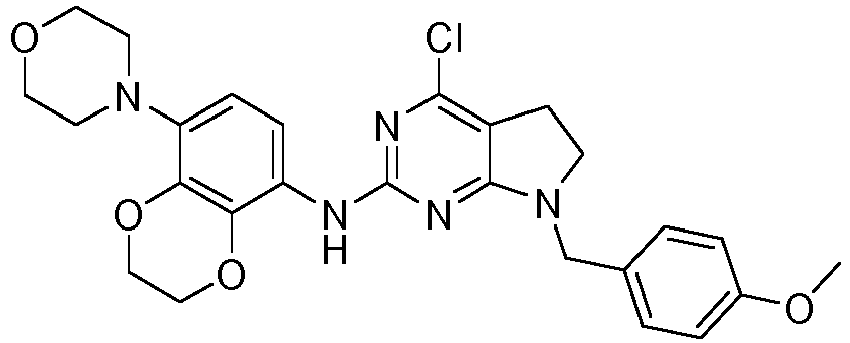
- According to General Protocol II, 4-chloro-7-(4-methoxybenzyl)-N-(8-morpholino-2,3-dihydrobenzo[b][1,4]dioxin-5-yl)-6,7-dihydr o-5H-pyrrolo[2,3-d]pyrimidin-2-amine was prepared from 2,4-dichloro-7-(4-methoxybenzyl)-6,7-dihydro-5H-pyrrolo[2,3-d]pyrimidine (Intermediate A1, 200 mg, 0.645 mmol), 8-morpholino-2,3-dihydrobenzo[b][1,4]dioxin-5-amine (Intermediate B4, 152 mg, 0.644 mmol), Pd2(dba)3 (118 mg, 0.129 mmol), (±)-BINAP (80 mg, 0.129 mmol) and sodium tert-butoxide (124 mg, 1.292 mmol) in a microwave tube at 100 °C for 10 minutes, and isolated as a yellow solid (200 mg, yield 61 %). 1H NMR (400 MHz, CDCl3) δ ppm 8.01-8.03 (d, 1H, J = 8.8 Hz), 7.21-7.24 (d, 2H, J = 8.4 Hz), 6.86-6.88 (d, 2H, J = 8.8 Hz), 6.51-6.54 (d, 1H, J = 8.8 Hz), 4.54 (s, 2H), 4.30-4.34 (m, 4H), 3.86-3.89 (m, 4H), 3.80 (s, 3H), 3.46-3.50 (m, 2H), 3.00-3.03 (m, 4H), 2.91-2.95 (m, 2H).
-

- According to General Protocol II, 2-(7-(4-methoxybenzyl)-2-(8-morpholino-2,3-dihydrobenzo[b][1,4]dioxin-5-ylamino)-6,7-dihydr o-5H-pyrrolo[2,3-d]pyrimidin-4-ylamino)-N-methylbenzamide was prepared from 4-chloro-7-(4-methoxybenzyl)-N-(8-morpholino-2,3-dihydrobenzo[b][1,4]dioxin-5-yl)-6,7-dihydr o-5H-pyrrolo[2,3-d]pyrimidin-2-amine (200 mg, 0.39 mmol), 2-amino-N-methylbenzamide (Intermediate C1, 71 mg, 0.47 mmol), Pd2(dba)3 (72 mg, 0.079 mmol), X-Phos (37 mg, 0.078mmol) and cesium carbonate (274 mg, 0.840 mmol) in a microwave tube at 130 °C for 2 hours, and isolated as a white solid (75 mg, yield 31 %). 1H NMR (400 MHz, CDCl3) δ ppm 10.03 (s, 1H), 8.62-8.64 (d, 1H, J = 8.4 Hz), 8.02-8.04 (d, 1H, J = 8.8 Hz), 7.38-7.42 (m, 2H), 7.23-7.25 (m, 2H), 7.09 (s, 1H), 6.85-6.92 (m, 3H), 6.47-6.50 (d, 1H, J = 8.8 Hz), 6.27-6.29 (d, 1H, J = 8.4 Hz), 4.52 (s, 2H), 4.27-4.34 (m, 4H), 3.85-3.90 (m, 4H), 3.80 (s, 3H), 3.41-3.45 (t, 2H, J = 8.4 Hz), 3.01-3.03 (m, 3H), 2.95-2.97 (m, 4H), 2.89-2.93 (t, 2H, J = 8.4 Hz).
- According to General Protocol II, N-methyl-2-(2-(8-morpholino-2,3-dihydrobenzo[b][1,4]dioxin-5-ylamino)-6,7-dihydro-5H-pyrrol o[2,3-d]pyrimidin-4-ylamino)benzamide was prepared from 2-(7-(4-methoxybenzyl)-2-(8-morpholino-2,3-dihydrobenzo[b][1,4]dioxin-5-ylamino)-6,7-dihydr o-5H-pyrrolo[2,3-d]pyrimidin-4-ylamino)-N-methylbenzamide (75 mg, 0.120 mmol), trifluoroacetic acid (6 mL) and five drops of concentrated sulfuric acid, and isolated as a solid (60 mg, yield 99 %). 1H NMR (400 MHz, DMSO-d6) δ ppm 11.98 (s, 1H), 10.68 (s, 1H), 8.63-8.64 (m, 2H), 7.66-7.67 (d, 1H, J = 7.6 Hz), 7.47-7.49 (d, 1H, J = 6.8 Hz), 7.33-7.37 (t, 1H, J = 8.0 Hz), 6.93-6.97 (t, 1H, J = 7.6 Hz), 6.72 (br s, 1H), 6.42-6.44 (d, 1H, J = 8.8 Hz), 4.25-4.28 (m, 4H), 3.71-3.73 (t, 4H, J = 4.4 Hz), 3.53-3.57 (t, 2H, J = 8.4 Hz), 2.92-2.94 (t, 4H, J = 4.4 Hz), 2.78-2.81 (m, 5H).
-

-

- According to General Protocol II, 7-(4-chloro-7-(4-methoxybenzyl)-6,7-dihydro-5H-pyrrolo[2,3-d]pyrimidin-2-ylamino)-1-ethyl-6-methoxy-4,5-dihydro-1H-benzo[b]azepin-2(3H)-one was prepared from 2,4-dichloro-7-(4-methoxybenzyl)-6,7-dihydro-5H-pyrrolo[2,3-d]pyrimidine (Intermediate A1, 310 mg, 1.0 mmol), 7-amino-1-ethyl-6-methoxy-4,5-dihydro-1H-benzo[b]azepin-2(3H)-one hydrochloride (Intermediate B5, 271 mg, 1.0 mmol), Pd2(dba)3 (183 mg, 0.2 mmol), (±)-BINAP (124 mg, 0.2 mmol) and cesium carbonate (1.304 g, 4.0 mmol) in a microwave tube at 130 °C for 2 hours, and isolated as a yellow solid (100 mg, yield 20 %). 1H NMR (400 MHz, CDCl3) δ ppm 8.45-8.48 (dd, 1H, J = 2.0 Hz, 9.2 Hz), 7.48 (s, 1H), 7.23-7.27 (m, 2H), 6.96-6.99 (d, 1H, J = 8.8 Hz), 6.88-6.90 (t, 2H, J = 2.4 Hz), 4.57 (s, 2H), 3.79-3.81 (m, 6H), 3.50-3.54 (t, 3H, J = 8.4 Hz), 2.94-2.98 (t, 2H, J = 8.4 Hz), 2.29 (s, 3H), 1.11-1.17 (m, 4H), some signals (-CH2CH2CH2-) were overlapped with residual impurity peak.
-

- According to General Protocol II, 2-(2-(1-ethyl-6-methoxy-2-oxo-2,3,4,5-tetrahydro-1H-benzo[b]azepin-7-ylamino)-7-(4-methoxy benzyl)-6,7-dihydro-5H-pyrrolo[2,3-d]pyrimidin-4-ylamino)-N-methylbenzamide was prepared from 7-(4-chloro-7-(4-methoxybenzyl)-6,7-dihydro-5H-pyrrolo[2,3-d]pyrimidin-2-ylamino)-1-ethyl-6-methoxy-4,5-dihydro-1H-benzo[b]azepin-2(3H)-one (100 mg, 0.197 mmol), 2-amino-N-methylbenzamide (Intermediate C1, 35 mg, 0.233 mmol), Pd2(dba)3 (36 mg, 0.039 mmol), (±)-BINAP (24 mg, 0.039 mmol) and cesium carbonate (128 mg, 0.393 mmol) heated at 130 °C for 12 hours, and isolated as a white solid (30 mg, yield 25 %). 1H NMR (400 MHz, CDCl3) δ ppm 10.09 (s, 1H), 8.58-8.61 (d, 1H, J = 8.4 Hz), 8.48-8.51 (d, 1H, J = 9.2 Hz), 7.52-7.53 (m, 1H), 7.41-7.42 (m, 2H), 7.27-7.30 (m, 1H), 7.24-7.26 (m, 1H), 6.86-6.96 (m, 3H), 4.54 (s, 2H), 3.80-3.82 (m, 6H), 3.45-3.49 (t, 2H, J = 8.4 Hz), 2.92-3.00 (m, 5H), 2.29-2.30 (m, 2H), 1.59-1.61 (m, 2H), 1.11-1.15 (t, 3H, J = 7.2 Hz), 0.94-0.98 (t, 2H, J = 7.6 Hz).
- According to General Protocol II, 2-(2-(1-ethyl-6-methoxy-2-oxo-2,3,4,5-tetrahydro-1H-benzo[b]azepin-7-ylamino)-6,7-dihydro-5 H-pyrrolo[2,3-d]pyrimidin-4-ylamino)-N-methylbenzamide was prepared from 2-(2-(1-ethyl-6-methoxy-2-oxo-2,3,4,5-tetrahydro-1H-benzo[b]azepin-7-ylamino)-7-(4-methoxy benzyl)-6,7-dihydro-5H-pyrrolo[2,3-d]pyrimidin-4-ylamino)-N-methylbenzamide (30 mg, 0.048 mmol), trifluoroacetic acid (6 mL) and three drops of concentrated sulfuric acid, and isolated as a solid (4.7 mg, yield 20 %). 1H NMR (400 MHz, CD3OD) δ ppm 8.37-8.39 (d, 1H, J = 8.4 Hz), 8.27-8.29 (m, 1H), 7.60-7.62 (d, 1H, J = 7.6 Hz), 7.37-7.39 (m, 1H), 6.97-6.99 (m, 2H), 3.77-3.78 (m, 3H), 3.64-3.68 (t, 2H, J = 8.0 Hz), 2.90-2.96 (m, 5H), 2.20-2.24 (m, 8H), 1.09-1.12 (m, 3H).
-

-
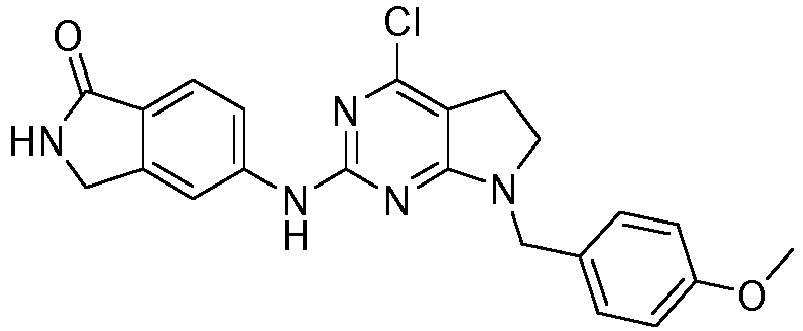
- According to General Protocol II, 5-(4-chloro-7-(4-methoxybenzyl)-6,7-dihydro-5H-pyrrolo[2,3-d]pyrimidin-2-ylamino)isoindolin-1-one was prepared from 2,4-dichloro-7-(4-methoxybenzyl)-6,7-dihydro-5H-pyrrolo[2,3-d]pyrimidine (Intermediate A1, 310 mg, 1.0 mmol), 5-aminoisoindolin-1-one (Intermediate B6, 148 mg, 1.0 mmol), Pd2(dba)3 (183 mg, 0.2 mmol), (±)-BINAP (124 mg, 0.2 mmol) and cesium carbonate (654 mg, 2.01 mmol) in a microwave vessel at 130 °C for 3 hours, and isolated as a yellow solid (80 mg, yield 19 %). 1H NMR (400 MHz, CDCl3) δ ppm 8.05 (s, 1H), 7.72-7.73 (m, 1H), 7.46-7.48 (d, 2H, J = 8.4 Hz), 7.22-7.24 (m, 2H), 6.87-6.89 (d, 2H, J = 6.8 Hz), 6.09 (s, 1H), 4.54 (s, 2H), 4.41 (s, 2H), 3.805-3.809 (d, 3H, J = 1.6 Hz), 3.54-3.55 (m, 2H), 2.96-2.97 (m, 2H).
-

- According to General Protocol II, 2-(7-(4-methoxybenzyl)-2-(1-oxoisoindolin-5-ylamino)-6,7-dihydro-5H-pyrrolo[2,3-d]pyrimidin-4-ylamino)-N-methylbenzamide was prepared from 5-(4-chloro-7-(4-methoxybenzyl)-6,7-dihydro-5H-pyrrolo[2,3-d]pyrimidin-2-ylamino)isoindolin-1-one (80 mg, 0.190 mmol), 2-amino-N-methylbenzamide (Intermediate C1, 34 mg, 0.227 mmol), Pd2(dba)3 (35 mg, 0.038 mmol), X-Phos (18 mg, 0.038 mmol) and cesium carbonate (124 mg, 0.380 mmol) heated in a sealed tube at 130 °C for 12 hours, and isolated as a yellow solid (10 mg, yield 10 %).
- According to General Protocol II, N-methyl-2-(2-(1-oxoisoindolin-5-ylamino)-6,7-dihydro-5H-pyrrolo[2,3-d]pyrimidin-4-ylamino)b enzamide was prepared from 2-(7-(4-methoxybenzyl)-2-(1-oxoisoindolin-5-ylamino)-6,7-dihydro-5H-pyrrolo[2,3-d]pyrimidin-4-ylamino)-N-methylbenzamide (10 mg, 0.019 mmol), trifluoroacetic acid (3 mL) and two drops of concentrated sulfuric acid, and isolated as a white solid (1.9 mg, yield 26 %). 1H NMR (400 MHz, CD3OD) δ ppm 8.45-8.47 (d, 1H, J = 8.8 Hz), 8.12 (s, 1H), 7.55-7.63 (m, 3H), 7.40-7.44 (t, 1H, J = 8.4 Hz), 7.00-7.04 (t, 1H, J = 8.0 Hz), 4.34 (s, 2H), 3.65-3.69 (t, 2H, J = 8.4 Hz), 2.94-2.98 (t, 2H, J = 8.0 Hz), 2.90 (s, 3H).
-

-

- According to General Protocol II, N-(benzofuran-7-yl)-4-chloro-7-(4-methoxybenzyl)-6,7-dihydro-5H-pyrrolo[2,3-d]pyrimidin-2-a mine was prepared from 2,4-dichloro-7-(4-methoxybenzyl)-6,7-dihydro-5H-pyrrolo[2,3-d]pyrimidine (Intermediate A1, 310 mg, 1.0 mmol), benzofuran-7-amine hydrochloride (Intermediate B7, 169.6 mg, 1.0 mmol), Pd2(dba)3 (183 mg, 0.2 mmol), (±)-BINAP (124 mg, 0.2 mmol) and cesium carbonate (1.304 g, 4.0 mmol), and isolated as a solid (200 mg, yield 49 %). 1H NMR (400 MHz, CDCl3) δ ppm 8.35-8.37 (dd, 1H, J = 2.8 Hz, 6.4 Hz), 7.596-7.601 (d, 1H, J = 2.0 Hz), 7.46 (s, 1H), 7.20-7.26 (m, 3H), 6.86-6.88 (dd, 2H, J = 2.0 Hz, 6.4 Hz), 6.768-6.774 (d, 1H, J = 2.4 Hz), 4.56 (s, 2H), 3.80 (s, 3H), 3.49-3.54 (t, 2H, J = 8.4 Hz), 2.94-2.98 (t, 2H, J = 8.4 Hz).
-

- According to General Protocol II, 2-(2-(benzofuran-7-ylamino)-7-(4-methoxybenzyl)-6,7-dihydro-5H-pyrrolo[2,3-d]pyrimidin-4-yl amino)-N-methylbenzamide was prepared from N-(benzofuran-7-yl)-4-chloro-7-(4-methoxybenzyl)-6,7-dihydro-5H-pyrrolo[2,3-d]pyrimidin-2-a mine (100 mg, 0.25 mmol), 2-amino-N-methylbenzamide (Intermediate C1, 44 mg, 0.293 mmol), Pd2(dba)3 (10 mg, 0.011 mmol), (±)-BINAP (15 mg, 0.049 mmol) and potassium-tert-butoxide (47 mg, 0.489 mmol) heated at 130 °C for 12 hours, and isolated as a solid (60 mg, yield 47 %).
- According to General Protocol II, 2-(2-(benzofuran-7-ylamino)-6,7-dihydro-5H-pyrrolo[2,3-d]pyrimidin-4-ylamino)-N-methylbenz amide was prepared from 2-(2-(benzofuran-7-ylamino)-7-(4-methoxybenzyl)-6,7-dihydro-5H-pyrrolo[2,3-d]pyrimidin-4-yl amino)-N-methylbenzamide (60 mg, 0.115 mmol), trifluoroacetic acid (8 mL) and four drops of concentrated sulfuric acid, and isolated as a solid (10 mg, yield 22 %). 1H NMR (400 MHz, DMSO-d6) δ ppm 10.73 (s, 1H), 8.58-8.59 (d, 1H, J = 4.4 Hz), 8.36-8.39 (m, 2H), 7.94-7.95 (d, 1H, J = 2.4 Hz), 7.61-7.63 (t, 2H, J = 7.6 Hz), 7.32-7.34 (d, 1H, J = 7.6 Hz), 7.10-7.18 (m, 2H), 6.956-9.962 (d, 1H, J = 2.4 Hz), 6.83-6.87 (t, 1H, J = 7.6 Hz), 6.65 (s, 1H), 3.52-3.57 (t, 2H, J = 8.8 Hz), 2.81-2.85 (t, 2H, J = 8.8 Hz), 2.77-2.78 (d, 3H, J = 4.4 Hz).
-

-

- According to General Protocol II, 4-chloro-N-(1,3-dimethyl-1H-pyrazol-5-yl)-7-(4-methoxybenzyl)-6,7-dihydro-5H-pyrrolo[2,3-d]p yrimidin-2-amine was prepared from 2,4-dichloro-7-(4-methoxybenzyl)-6,7-dihydro-5H-pyrrolo[2,3-d]pyrimidine (Intermediate A1, 130 mg, 0.421 mmol), 1,3-dimethyl-1H-pyrazol-5-amine (Intermediate B8, 56 mg, 0.505 mmol), Pd2(dba)3 (20 mg, 0.022 mmol), (±)-BINAP (26 mg, 0.042 mmol) and cesium carbonate (206 mg, 0.632 mmol) in a microwave at 130 °C for 2.5 hours, and isolated as a solid (20 mg, yield 9.8 %). 1H NMR (400 MHz, DMSO-d6) δ ppm 9.16 (s, 1H), 6.25-6.27 (d, 2H, J = 8.4 Hz), 6.95-6.98 (d, 2H, J = 8.8 Hz), 6.02 (s, 1H), 4.50 (s, 2H), 3.79 (s, 3H), 3.62 (s, 3H), 3.53-3.57 (t, 2H, J = 8.4 Hz), 2.92-2.96 (t, 2H, J = 8.4 Hz), 2.14 (s, 3H).
-

- According to General Protocol II, 2-(2-(1,3-dimethyl-1H-pyrazol-5-ylamino)-7-(4-methoxybenzyl)-6,7-dihydro-5H-pyrrolo[2,3-d]p yrimidin-4-ylamino)-N-methylbenzamide was prepared from 4-chloro-N-(1,3-dimethyl-1H-pyrazol-5-yl)-7-(4-methoxybenzyl)-6,7-dihydro-5H-pyrrolo[2,3-d]p yrimidin-2-amine (75 mg, 0.155 mmol), 2-amino-N-methylbenzamide (Intermediate C1, 28 mg, 0.185 mmol), Pd2(dba)3 (28 mg, 0.031 mmol), (±)-BINAP (19 mg, 0.031 mmol) and cesium carbonate (76 mg, 0.233 mmol) in a microwave tube heated at 130 °C, and isolated as a solid (50 mg, yield 65 %). 1H NMR (400 MHz, CDCl3) δ ppm 10.23 (s, 1H), 8.47-8.49 (d, 1H, J = 8.4 Hz), 7.36-7.38 (d, 1H, J = 8.0 Hz), 7.30-7.34 (t, 1H, J = 8.0 Hz), 7.19-7.21 (d, 2H, J = 8.4 Hz), 6.85-6.89 (m, 3H), 6.37 (s, 1H), 6.20-6.21 (d, 1H, J = 3.2 Hz), 6.08 (s, 1H), 4.46 (s, 2H), 3.801 (s, 3H), 3.799 (s, 3H), 3.43-3.47 (t, 2H, J = 8.4 Hz), 2.97-2.98 (d, 3H, J = 4.8 Hz), 2.89-2.93 (t, 2H, J = 8.4 Hz).
- According to General Protocol II, 2-(2-(1,3-dimethyl-1H-pyrazol-5-ylamino)-6,7-dihydro-5H-pyrrolo[2,3-d]pyrimidin-4-ylamino)-N -methylbenzamide was prepared from 2-(2-(1,3-dimethyl-1H-pyrazol-5-ylamino)-7-(4-methoxybenzyl)-6,7-dihydro-5H-pyrrolo[2,3-d]p yrimidin-4-ylamino)-N-methylbenzamide (50 mg, 0.1 mmol), trifluoroacetic acid (5 mL) and three drops of concentrated sulfuric acid, and isolated as a solid (3.8 mg, yield 10 %). 1H NMR (400 MHz, DMSO-d6) δ ppm 10.83 (s, 1H), 8.67-8.69 (d, 2H, J = 8.0 Hz), 8.54 (s, 1H), 7.71-7.73 (m, 1H), 7.31-7.32 (m, 1H), 6.95-6.97 (m, 1H), 6.72 (s, 1H), 5.98 (s, 1H), 3.57-3.60 (m, 5H), 2.84-2.89 (m, 5H), 2.05 (s, 3H).
-

-

- According to General Protocol II, 4-chloro-7-(4-methoxybenzyl)-N-(3,4,5-trimethoxyphenyl)-6,7-dihydro-5H-pyrrolo[2,3-d]pyrimi din-2-amine was prepared from 2,4-dichloro-7-(4-methoxybenzyl)-6,7-dihydro-5H-pyrrolo[2,3-d]pyrimidine (Intermediate A1, 200 mg, 0.645 mmol), 3,4,5-trimethoxyaniline (Intermediate B9, 118 mg, 0.645 mmol), Pd2(dba)3 (118 mg, 0.129 mmol), (±)-BINAP (80 mg, 0.129 mmol) and cesium carbonate (421 mg, 1.291 mmol) in a microwave tube at 130 °C for 2 hours, and isolated as a white solid (100 mg, yield 68 %). 1H NMR (400 MHz, CDCl3) δ ppm 7.19-7.21 (d, 2H, J = 8.4 Hz), 6.97 (s, 2H), 6.83-6.87 (m, 3H), 4.54 (s, 2H), 3.79-3.80 (s+s, 12H), 3.39-3.53 (t, 2H, J = 8.4 Hz), 2.93-2.97 (t, 2H, J = 8.4 Hz).
-

- According to General Protocol II, 2-(7-(4-methoxybenzyl)-2-(3,4,5-trimethoxyphenylamino)-6,7-dihydro-5H-pyrrolo[2,3-d]pyrimid in-4-ylamino)-N-methylbenzamide was prepared from 4-chloro-7-(4-methoxybenzyl)-N-(3,4,5-trimethoxyphenyl)-6,7-dihydro-5H-pyrrolo[2,3-d]pyrimi din-2-amine (100 mg, 0.219 mmol), 2-amino-N-methylbenzamide (Intermediate C1, 39 mg, 0.26 mmol), Pd2(dba)3 (40 mg, 0.044 mmol), (±)-BINAP (27 mg, 0.043 mmol) and cesium carbonate (143 mg, 0.439 mmol) heated at 130 °C for 12 hours, and isolated as a yellow solid (30 mg, yield 24 %). 1H NMR (400 MHz, CDCl3) δ ppm 10.11 (s, 1H), 8.63-8.65 (d, 1H, J = 8.4 Hz), 7.37-7.40 (m, 1H), 7.17-7.30 (m, 3H), 6.96 (s, 2H), 6.85-6.88 (m, 2H), 6.62-6.69 (m, 2H), 6.19 (s, 1H), 6.04 (s, 1H), 4.53 (s, 2H), 3.79-3.80 (m, 6H), 3.72 (s, 6H), 3.45-3.49 (t, 2H, J = 8.4 Hz), 2.92-2.98 (m, 5H).
- According to General Protocol II, N-methyl-2-(2-(3,4,5-trimethoxyphenylamino)-6,7-dihydro-5H-pyrrolo[2,3-d]pyrimidin-4-ylamin o)benzamide was prepared from 2-(7-(4-methoxybenzyl)-2-(3,4,5-trimethoxyphenylamino)-6,7-dihydro-5H-pyrrolo[2,3-d]pyrimid in-4-ylamino)-N-methylbenzamide (30 mg, 0.053 mmol), trifluoroacetic acid (6 mL) and three drops of concentrated sulfuric acid, and isolated as a solid (5.8 mg, yield 24 %). 1H NMR (400 MHz, DMSO-d6) δ ppm 10.60 (s, 1H), 8.60-8.69 (m, 3H), 7.64-7.66 (d, 1H, J = 8.0 Hz), 7.30-7.34 (t, 1H, J = 8.0 Hz), 7.08 (s, 2H), 6.89-6.93 (t, 1H, J = 7.6 Hz), 6.65 (s, 1H), 3.64 (s, 6H), 3.58 (s, 3H), 3.51-3.55 (t, 2H, J = 8.4 Hz), 2.77-2.84 (m, 5H).
-

-

- According to General Protocol II, 4-chloro-7-(4-methoxybenzyl)-N-(1-(3-morpholinopropyl)-1H-indol-4-yl)-6,7-dihydro-5H-pyrrol o[2,3-d]pyrimidin-2-amine was prepared from 2,4-dichloro-7-(4-methoxybenzyl)-6,7-dihydro-5H-pyrrolo[2,3-d]pyrimidine (Intermediate A1, 309 mg, 1.0 mmol), 1-(3-morpholinopropyl)-1H-indol-4-amine (Intermediate B10, 259 mg, 1.0 mmol), Pd2(dba)3 (183 mg, 0.2 mmol), (±)-BINAP (124 mg, 0.2 mmol) and cesium carbonate (652 mg, 2.0 mmol) heated in a microwave tube at 140 °C for 3 hours, and isolated as a solid (135 mg, yield 25.4 %).
-

- According to General Protocol II, 2-(7-(4-methoxybenzyl)-2-(1-(3-morpholinopropyl)-1H-indol-4-ylamino)-6,7-dihydro-5H-pyrrolo [2,3-d]pyrimidin-4-ylamino)-N-methylbenzamide was prepared from 4-chloro-7-(4-methoxybenzyl)-N-(1-(3-morpholinopropyl)-1H-indol-4-yl)-6,7-dihydro-5H-pyrrol o[2,3-d]pyrimidin-2-amine (135 mg, 0.254 mmol), 2-amino-N-methylbenzamide (Intermediate C1, 38 mg, 0.253 mmol), Pd2(dba)3 (46 mg, 0.050 mmol), X-Phos (24 mg, 0.050 mmol) and cesium carbonate (124 mg, 0.380 mmol) heated in a microwave tube at 140 °C for 3.5 hours, and isolated as a solid (100 mg, yield 61 %). 1H NMR (400 MHz, CDCl3) δ ppm 10.06 (s, 1H), 8.68-8.70 (d, 1H, J = 8.4 Hz), 8.09-8.10 (d, 1H, J = 6.8 Hz), 7.40-7.42 (m, 2H), 7.14-7.18 (m, 1H), 7.02-7.06 (m, 2H), 6.86-6.93 (m, 3H), 6.58 (s, 1H), 6.16 (s, 1H), 4.55 (s, 2H), 4.19-4.22 (m, 2H), 3.80 (s, 3H), 3.72-3.80 (m, 5H), 3.44-3.49 (m, 3H), 2.94-2.99 (m, 5H), 2.40-2.42 (m, 4H), 2.22-2.28 (m, 2H), 1.99-2.04 (m, 4H).
- According to General Protocol II, N-methyl-2-(2-(1-(3-morpholinopropyl)-1H-indol-4-ylamino)-6,7-dihydro-5H-pyrrolo[2,3-d]pyri midin-4-ylamino)benzamide was prepared from 2-(7-(4-methoxybenzyl)-2-(1-(3-morpholinopropyl)-1H-indol-4-ylamino)-6,7-dihydro-5H-pyrrolo [2,3-d]pyrimidin-4-ylamino)-N-methylbenzamide (100 mg, 0.155 mmol), trifluoroacetic acid (5 mL) and four drops of concentrated sulfuric acid, and isolated as a solid (10 mg, yield 12 %). 1H NMR (400 MHz, CDCl3) δ ppm 10.18 (s, 1H), 8.69-8.72 (d, 1H, J = 8.4 Hz), 7.95-7.97 (d, 1H, J = 7.6 Hz), 7.37-7.42 (m, 2H), 7.13-7.17 (m, 1H), 7.03-7.05 (m, 2H), 6.82-6.94 (m, 2H), 6.51-6.52 (d, 1H, J = 2.8 Hz), 6.19-6.20 (d, 1H, J = 4.8 Hz), 4.49 (s, 1H), 4.18-4.21 (t, 2H, J = 6.8 Hz), 3.65-3.74 (m, 7H), 2.99-3.07 (m, 5H), 2.39-2.40 (m, 4H), 2.17-2.19 (m, 2H), 1.95-1.99 (m, 3H).
-

-

- According to General Protocol II, (±)-4-chloro-N-(2-methoxy-4-morpholinophenyl)-7-(4-methoxybenzyl)-5-methyl-6,7-dihydro-5 H-pyrrolo[2,3-d]pyrimidin-2-amine was prepared from (±)-2,4-dichloro-7-(4-methoxybenzyl)-5-methyl-6,7-dihydro-5H-pyrrolo[2,3-d]pyrimidine (Intermediate A2, 190 mg, 0.586 mmol), 2-methoxy-4-morpholinoaniline (Intermediate B1, 146 mg, 0.702 mmol), Pd2(dba)3 (27 mg, 0.03 mmol), (±)-BINAP (36 mg, 0.058 mmol) and cesium carbonate (287 mg, 0.88 mmol), and isolated as a yellow solid (100 mg, yield 35 %). 1H NMR (400 MHz, CDCl3) δ ppm 8.37-8.39 (d, 1H, J = 9.2 Hz), 7.39 (s, 1H), 7.20-7.22 (dd, 2H, J = 2.0 Hz, 6.8 Hz), 6.86-6.88 (m, 2H), 6.49-6.52 (m, 2H), 4.54 (s, 2H), 3.85-3.87 (t+s, 7H), 3.80 (s, 3H), 3.57-3.62 (t, 1H, J = 9.6 Hz), 3.29-3.31 (m, 1H), 3.08-3.11 (m, 4H), 3.00-3.03 (dd, 1H, J = 4.0 Hz, 9.6 Hz), 1.24-1.28 (m, 3H).
-
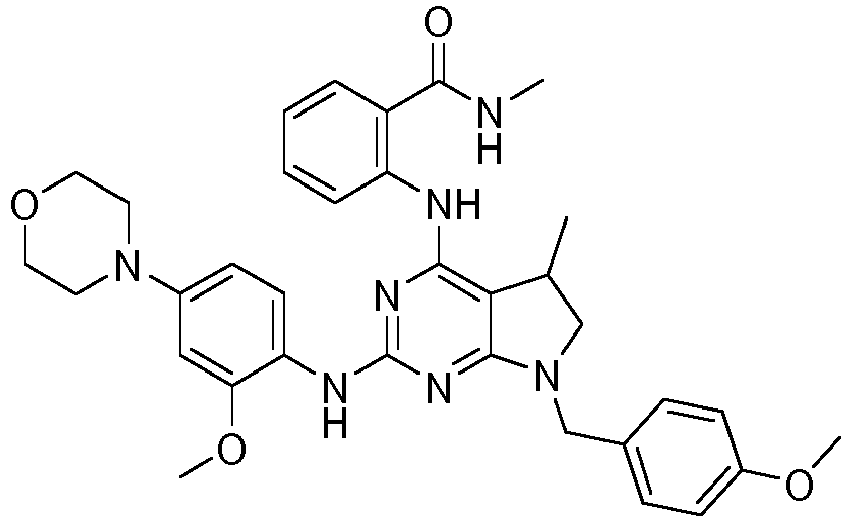
- According to General Protocol II, (±)-2-(2-(2-methoxy-4-morpholinophenylamino)-7-(4-methoxybenzyl)-5-methyl-6,7-dihydro-5H -pyrrolo[2,3-d]pyrimidin-4-ylamino)-N-methylbenzamide was prepared from (±)-4-chloro-N-(2-methoxy-4-morpholinophenyl)-7-(4-methoxybenzyl)-5-methyl-6,7-dihydro-5 H-pyrrolo[2,3-d]pyrimidin-2-amine (65 mg, 0.131 mmol), 2-amino-N-methylbenzamide (Intermediate C1, 24 mg, 0.16 mmol), Pd2(dba)3 (6 mg, 0.007 mmol), (±)-BINAP (9 mg, 0.014 mmol) and cesium carbonate (64 mg, 0.196 mmol), and isolated as a yellow solid (55 mg, yeld 45 %). 1H NMR (400 MHz, CDCl3) δ ppm 9.98 (s, 1H), 8.61-8.63 (d, 1H, J = 8.4 Hz), 8.38-8.40 (d, 1H, J = 8.8 Hz), 7.38-7.42 (m, 2H), 7.23-7.25 (m, 2H), 7.18 (s, 1H), 6.85-6.92 (m, 3H), 6.52 (s, 1H), 6.46-6.48 (d, 1H, J = 8.8 Hz), 6.15-6.16 (d, 1H, J = 4.8 Hz), 4.46-4.60 (dd, 2H, J = 14.8 Hz, 42.8 Hz), 3.86-3.88 (t+s, 7H), 3.798-3.802 (d, 3H, J = 1.6 Hz), 3.51-3.53 (m, 1H), 3.35-3.38 (m, 1H), 3.09-3.11 (t, 4H), 2.97-3.00 (s+m, 4H), 1.28-1.32 (m, 3H).
- According to General Protocol II, (±)-2-(2-(2-methoxy-4-morpholinophenylamino)-5-methyl-6,7-dihydro-5H-pyrrolo[2,3-d]pyrimid in-4-ylamino)-N-methylbenzamide was prepared from (±)-2-(2-(2-methoxy-4-morpholinophenylamino)-7-(4-methoxybenzyl)-5-methyl-6,7-dihydro-5H -pyrrolo[2,3-d]pyrimidin-4-ylamino)-N-methylbenzamide (55 mg, 0.09 mmol), trifluoroacetic acid (4 mL) and four drops of concentrated sulfuric acid, and isolated as a yellow solid (5 mg, yield 11 %). 1H NMR (400 MHz, DMSO-d6) δ ppm 10.62 (br s, 1H), 8.63-8.64 (d, 1H, J = 4.8 Hz), 8.40 (br s, 1H), 7.71-7.73 (d, 1H, J = 8.4 Hz), 7.62-7.65 (dd, 2H, J = 1.2 Hz, 8.0 Hz), 7.31-7.35 (t, 1H, J = 7.6 Hz), 6.94-6.97 (t, 1H, J = 7.6 Hz), 6.62-6.63 (d, 1H, J = 2.4 Hz), 6.43-6.45 (dd, 1H, J = 2.4 Hz, 8.8 Hz), 3.80 (s, 3H), 3.68-3.74 (m, 5H), 3.31 (m, 2H), 3.09-3.11 (m, 5H), 2.76-2.77 (d, 3H, J = 4.4 Hz), 1.20-1.21 (m, 3H).
- (±)-2-(2-(2-methoxy-4-morpholinophenylamino)-5-methyl-6,7-dihydro-5H-pyrrolo[2,3-d]pyrimid in-4-ylamino)-N-methylbenzamide was resolved on Chiralcel AD-H (4.6 × 150 mm, Chiral Technologies) eluted with 0.025 % diethylamine in ethanol / hexane (1 / 1). Two enantiomers were separated with retention time of 7.213 minutes and 10.835 minutes, respectively.
-

-

- According to General Protocol II, (±)-(2-(2-(2-methoxy-4-morpholinophenylamino)-7-(4-methoxybenzyl)-5-methyl-6,7-dihydro-5 H-pyrrolo[2,3-d]pyrimidin-4-ylamino)phenyl)(pyrrolidin-1-yl)methanone was prepared from (±)-4-chloro-N-(2-methoxy-4-morpholinophenyl)-7-(4-methoxybenzyl)-5-methyl-6,7-dihydro-5 H-pyrrolo[2,3-d]pyrimidin-2-amine (, 70 mg, 0.141 mmol), (2-aminophenyl)(pyrrolidin-1-yl)methanone hydrochloride (Intermediate C3, 39 mg, 0.172 mmol), Pd2(dba)3 (13 mg, 0.014 mmol), (±)-BINAP (18 mg, 0.029 mmol) and cesium carbonate (92 mg, 0.282 mmol) heated in a sealed tube at 130 °C for 12 hours, and isolated as a solid (90 mg, yeld 98 %). 1H NMR (400 MHz, CDCl3) δ ppm 8.63 (s, 1H), 8.40-8.44 (t, 2H, J = 8.8 Hz), 7.31-7.38 (m, 2H), 7.19-7.24 (m, 3H), 6.93-6.95 (dd, 1H, J = 0.8 Hz, 7.2 Hz), 6.86-6.92 (dd, 2H, J = 1.6 Hz, 20.4 Hz), 6.518-6.524 (d, 1H, J = 2.4 Hz), 6.45-6.47 (dd, 1H, J = 2.0 Hz, 8.8 Hz), 4.47-4.58 (dd, 2H, J = 14.8 Hz, 23.6 Hz), 3.86-3.88 (m, 7H), 3.80 (s, 3H), 3.62-3.63 (m, 2H), 3.50-3.54 (m, 3H), 3.27-3.28 (m, 1H), 3.09-3.11 (t, 4H, J = 4.8 Hz), 2.94-2.98 (dd, 1H, J = 4.4 Hz, 9.6 Hz), 1.84-1.95 (m, 4H), 1.24-1.27 (m, 3H).
- According to General Protocol II, (±)-(2-(2-(2-methoxy-4-morpholinophenylamino)-5-methyl-6,7-dihydro-5H-pyrrolo[2,3-d]pyrimi din-4-ylamino)phenyl)(pyrrolidin-1-yl)methanone was prepared from (±)-(2-(2-(2-methoxy-4-morpholinophenylamino)-7-(4-methoxybenzyl)-5-methyl-6,7-dihydro-5 H-pyrrolo[2,3-d]pyrimidin-4-ylamino)phenyl)(pyrrolidin-1-yl)methanone (90 mg, 0.138 mmol), trifluoroacetic acid (8 mL) and four drops of concentrated sulfuric acid, and isolated as a yellow solid (44.4 mg, yield 60 %). 1H NMR (400 MHz, DMSO-d6) δ ppm 8.67 (s, 1H), 8.21-8.23 (d, 1H, J = 8.8 Hz), 7.86-7.88 (d, 1H, J = 8.0 Hz), 7.42-7.44 (d, 1H, J = 7.6 Hz), 7.31-7.35 (t, 1H, J = 8.0 Hz), 7.13 (s, 1H), 6.97-7.01 (t, 1H, J = 7.6 Hz), 6.61-6.62 (m, 2H), 6.39-6.42 (dd, 1H, J = 2.0 Hz, 8.4 Hz), 3.81 (s, 3H), 3.73-3.76 (t, 4H, J = 4.4 Hz), 3.62-3.67 (t, 1H, J = 9.2 Hz), 3.35-3.52 (m, 5H), 3.01-3.05 (m, 5H), 1.75-1.87 (m, 4H), 1.16-1.18 (d, 3H, J = 6.4 Hz).
-

-
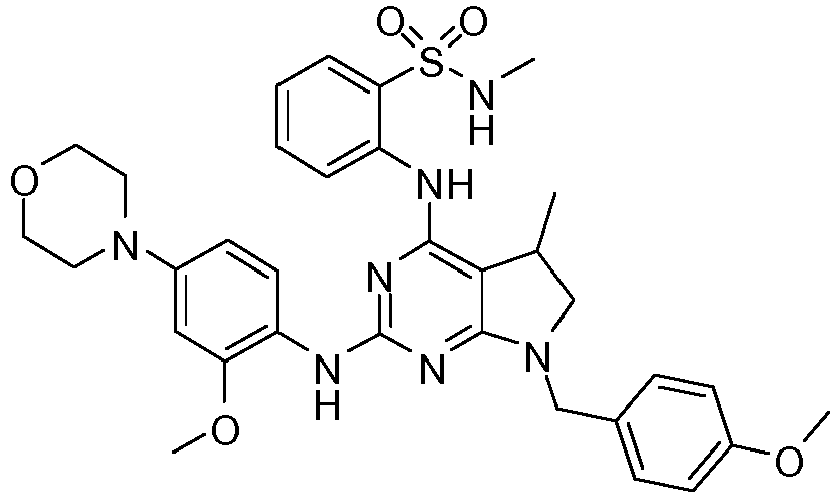
- According to General Protocol II, (±)-2-(2-(2-methoxy-4-morpholinophenylamino)-7-(4-methoxybenzyl)-5-methyl-6,7-dihydro-5H -pyrrolo[2,3-d]pyrimidin-4-ylamino)-N-methylbenzenesulfonamide was prepared from (±)-4-chloro-N-(2-methoxy-4-morpholinophenyl)-7-(4-methoxybenzyl)-5-methyl-6,7-dihydro-5 H-pyrrolo[2,3-d]pyrimidin-2-amine (80 mg, 0.161 mmol), 2-amino-N-methylbenzenesulfonamide (Intermediate C4, 36 mg, 0.194 mmol), Pd2(dba)3 (15 mg, 0.016 mmol), (±)-BINAP (20 mg, 0.032 mmol) and cesium carbonate (105 mg, 0.322 mmol) heated at 130 °C in a sealed tube for 12 hours, and isolated as a solid (95 mg, yeld 91 %). 1H NMR (400 MHz, CDCl3) δ ppm 8.32-8.38 (dd, 2H, J = 8.4 Hz, 15.2 Hz), 8.00 (s, 1H), 7.85-7.87 (dd, 1H, J = 1.6 Hz, 8.0 Hz), 7.50-7.54 (m, 1H), 7.22-7.27 (m, 3H), 7.07-7.10 (t, 1H, J = 8.0 Hz), 6.86-6.88 (m, 2H), 6.52-6.53 (d, 1H, J = 2.4 Hz), 6.40-6.43 (dd, 1H, J = 1.2 Hz, 8.8 Hz), 4.49-4.60 (m, 2H), 4.44-4.46 (m, 1H), 3.87-3.89 (m, 7H), 3.81 (s, 3H), 3.54-3.59 (m, 1H), 3.27-3.28 (m, 1H), 3.09-3.11 (t, 4H, J = 4.4 Hz), 2.99-3.02 (dd, 1H, J = 4.0 Hz, 9.6 Hz), 2.59-2.61 (d, 3H, J = 5.6 Hz), 1.22-1.28 (m, 3H).
- According to General Protocol II, (±)-2-(2-(2-methoxy-4-morpholinophenylamino)-5-methyl-6,7-dihydro-5H-pyrrolo[2,3-d]pyrimid in-4-ylamino)-N-methylbenzenesulfonamide was prepared from (±)-2-(2-(2-methoxy-4-morpholinophenylamino)-7-(4-methoxybenzyl)-5-methyl-6,7-dihydro-5H -pyrrolo[2,3-d]pyrimidin-4-ylamino)-N-methylbenzenesulfonamide (95 mg, 0.147 mmol), trifluoroacetic acid (8 mL) and four drops of concentrated sulfuric acid, and isolated as a solid (54 mg, yield 70 %). 1H NMR (400 MHz, DMSO-d6) δ ppm 8.48-8.50 (d, 1H, J = 8.0 Hz), 8.36 (s, 1H), 7.74-7.79 (m, 2H), 7.68-7.71 (dd, 1H, J = 1.6 Hz, 7.6 Hz), 7.46-7.48 (m, 1H), 7.26 (s, 1H), 7.05-7.09 (m, 1H), 6.74 (s, 1H), 6.62-6.63 (d, 1H, J = 2.8 Hz), 6.42-6.45 (dd, 1H, J = 2.4 Hz, 8.8 Hz), 3.81 (s, 3H), 3.74-3.76 (t, 4H, J = 4.8 Hz), 3.66-3.67 (t, 1H), 3.30-3.31 (m, 1H), 3.05-3.09 (m, 5H), 2.43-2.45 (d, 3H, J = 5.2 Hz), 1.16-1.18 (d, 3H, J = 7.2 Hz).
-

-

- According to General Protocol II, (±)-2-(2-(2-methoxy-4-morpholinophenylamino)-7-(4-methoxybenzyl)-5-methyl-6,7-dihydro-5H -pyrrolo[2,3-d]pyrimidin-4-ylamino)-N-propylbenzenesulfonamide was prepared from (±)-4-chloro-N-(2-methoxy-4-morpholinophenyl)-7-(4-methoxybenzyl)-5-methyl-6,7-dihydro-5 H-pyrrolo[2,3-d]pyrimidin-2-amine (70 mg, 0.141 mmol), 2-amino-N-propylbenzenesulfonamide hydrochloride (Intermediate C5, 43 mg, 0.171 mmol), Pd2(dba)3 (13 mg, 0.014 mmol), (±)-BINAP (18 mg, 0.029 mmol) and cesium carbonate (138 mg, 0.423 mmol) heated at 130 °C in a sealed tube for 12 hours, and isolated as a solid (60 mg, yield 63 %). 1H NMR (400 MHz, CDCl3) δ ppm 8.30-8.34 (dd, 2H, J = 4.8 Hz, 10.4 Hz), 7.96 (s, 1H), 7.85-7.88 (dd, 1H, J = 1.2 Hz, 8.0 Hz), 7.49-7.54 (t, 1H, J = 7.6 Hz), 7.23-7.25 (m, 2H), 7.07-7.11 (t, 1H, J = 7.6 Hz), 6.86-6.88 (d, 2H, J = 8.4 Hz), 6.518-6.524 (d, 1H, J = 2.4 Hz), 6.38-6.41 (dd, 1H, J = 2.4 Hz, 8.8 Hz), 4.45-4.60 (m, 3H), 3.86-3.89 (m, 7H), 3.81 (s, 3H), 3.54-3.59 (t, 1H, J = 9.2 Hz), 3.26-3.29 (m, 1H), 3.08-3.11 (t, 4H, J = 4.8 Hz), 2.99-3.02 (dd, 1H, J = 4.0 Hz, 9.6 Hz), 2.82-2.90 (m, 2H), 1.36-1.43 (m, 2H), 1.23-1.26 (m, 3H), 0.75-0.79 (t, 3H, J = 7.2 Hz).
- According to General Protocol II, (±)-2-(2-(2-methoxy-4-morpholinophenylamino)-5-methyl-6,7-dihydro-5H-pyrrolo[2,3-d]pyrimid in-4-ylamino)-N-propylbenzenesulfonamide was prepared from (±)-2-(2-(2-methoxy-4-morpholinophenylamino)-7-(4-methoxybenzyl)-5-methyl-6,7-dihydro-5H -pyrrolo[2,3-d]pyrimidin-4-ylamino)-N-propylbenzenesulfonamide (60 mg, 0.089 mmol), trifluoroacetic acid (5 mL) and four drops of concentrated sulfuric acid, and isolated as a solid (24.5 mg, yield 49.7 %). 1H NMR (400 MHz, DMSO-d6) δ ppm 8.42-8.44 (d, 1H, J = 8.4 Hz), 8.35 (s, 1H), 7.85-7.88 (t, 1H, J = 6.0 Hz), 7.76-7.78 (d, 1H, J = 8.8 Hz), 7.68-7.70 (dd, 1H, J = 1.2 Hz, 8.0 Hz), 7.42-7.46 (m, 1H), 7.24 (s, 1H), 7.02-7.05 (m, 1H), 6.73 (s, 1H), 6.60-6.61 (d, 1H, J = 2.4 Hz), 6.38-6.41 (dd, 1H, J = 2.4 Hz, 8.8 Hz), 3.79 (s, 3H), 3.71-3.74 (t, 4H, J = 4.8 Hz), 3.63-3.68 (t, 1H, J = 9.2 Hz), 3.25-3.27 (m, 1H), 3.04-3.06 (m, 5H), 2.68-2.76 (m, 2H), 1.32-1.37 (q, 2H, J = 7.2 Hz), 1.14-1.16 (d, 3H, J = 6.4 Hz), 0.71-0.74 (t, 3H, J = 7.6 Hz).
-

-

- According to General Protocol II, (±)-N-cyclobutyl-2-(2-(2-methoxy-4-morpholinophenylamino)-7-(4-methoxybenzyl)-5-methyl-6, 7-dihydro-5H-pyrrolo[2,3-d]pyrimidin-4-ylamino)benzenesulfonamide was prepared from (±)-4-chloro-N-(2-methoxy-4-morpholinophenyl)-7-(4-methoxybenzyl)-5-methyl-6,7-dihydro-5 H-pyrrolo[2,3-d]pyrimidin-2-amine (50 mg, 0.101 mmol), 2-amino-N-cyclobutylbenzenesulfonamide (Intermediate C6, 28mg, 0.124 mmol), Pd2(dba)3 (10 mg, 0.011 mmol), (±)-BINAP (13 mg, 0.021 mmol) and cesium carbonate (66 mg, 0.202 mmol) heated in a sealed tube at 130 °C for 12 hours, and isolated as a solid (55 mg, yield 79.4 %). 1H NMR (400 MHz, CDCl3) δ ppm 8.29-8.32 (d, 2H, J = 8.8 Hz), 7.90 (s, 1H), 7.84-7.86 (d, 1H, J = 6.4 Hz), 7.48-7.52 (t, 1H, J = 8.0 Hz), 7.24-7.26 (m, 2H), 7.05-7.09 (t, 1H, J = 7.6 Hz), 6.87-6.90 (m, 2H), 6.51-6.52 (d, 1H, J = 2.4 Hz), 6.33-6.36 (dd, 1H, J = 2.8 Hz, 8.8 Hz), 4.66-4.68 (d, 1H, J = 5.2 Hz), 4.49-4.60 (dd, 2H, J = 14.8 Hz, 29.6 Hz), 3.86-3.89 (m, 7H), 3.81 (s, 3H), 3.71-3.73 (m, 1H), 3.55-3.60 (t, 1H, J = 9.2 Hz), 3.27-3.30 (m, 1H), 3.07-3.10 (t, 4H, J = 4.4 Hz), 2.99-3.03 (dd, 1H, J = 4.0 Hz, 9.6 Hz), 1.96-2.05 (m, 2H), 1.66-1.75 (m, 2H), 1.30-1.52 (m, 2H), 1.25-1.27 (m, 3H).
- According to General Protocol II, (±)-N-cyclobutyl-2-(2-(2-methoxy-4-morpholinophenylamino)-5-methyl-6,7-dihydro-5H-pyrrolo[ 2,3-d]pyrimidin-4-ylamino)benzenesulfonamide was prepared from (±)-N-cyclobutyl-2-(2-(2-methoxy-4-morpholinophenylamino)-7-(4-methoxybenzyl)-5-methyl-6, 7-dihydro-5H-pyrrolo[2,3-d]pyrimidin-4-ylamino)benzenesulfonamide (55 mg, 0.08 mmol), trifluoroacetic acid (5 mL) and four drops of concentrated sulfuric acid, and isolated as a yellow solid (41.1 mg, yield 90.8 %). 1H NMR (400 MHz, DMSO-d6) δ ppm 8.51-8.53 (d, 1H, J = 8.4 Hz), 8.42 (s, 1H), 8.27-8.29 (d, 1H, J = 8.8 Hz), 7.84-7.86 (d, 1H, J = 8.8 Hz), 7.75-7.78 (dd, 1H, J = 1.6 Hz, 8.4 Hz), 7.49-7.52 (t, 1H, J = 7.2 Hz), 7.32 (s, 1H), 7.08-7.12 (m, 1H), 6.83 (s, 1H), 6.68-6.69 (d, 1H, J = 2.0 Hz), 6.45-6.48 (dd, 1H, J = 1.6 Hz, 8.8 Hz), 3.87 (s, 3H), 3.79-3.81 (t, 4H, J = 4.4 Hz), 3.65-3.77 (m, 2H), 3.33-3.35 (m, 1H), 3.12-3.15 (m, 5H), 2.02-2.06 (m, 1H), 1.87-1.92 (m, 2H), 1.77-1.81 (m, 1H), 1.48-1.55 (m, 2H), 1.23-1.25 (d, 3H, J = 6.4 Hz).
-

-

- According to General Protocol II, (±)-N-cyclopentyl-2-(2-(2-methoxy-4-morpholinophenylamino)-7-(4-methoxybenzyl)-5-methyl-6,7-dihydro-5H-pyrrolo[2,3-d]pyrimidin-4-ylamino)benzenesulfonamide was prepared from (±)-4-chloro-N-(2-methoxy-4-morpholinophenyl)-7-(4-methoxybenzyl)-5-methyl-6,7-dihydro-5 H-pyrrolo[2,3-d]pyrimidin-2-amine (50 mg, 0.101 mmol), 2-amino-N-cyclopentylbenzenesulfonamide (Intermediate C7, 29 mg, 0.121 mmol), Pd2(dba)3 (10 mg, 0.011 mmol), (±)-BINAP (13 mg, 0.021 mmol) and cesium carbonate (66 mg, 0.202 mmol) heated in a sealed tube at 130 °C for 12 hours, and isolated as a solid (55 mg, yeld 77.9 %). 1H NMR (400 MHz, CDCl3) δ ppm 8.27-8.30 (dd, 2H, J = 4.8 Hz, 7.6 Hz), 7.86-7.89 (m, 2H), 7.50-7.53 (t, 1H, J = 7.6 Hz), 7.23-7.25 (m, 2H), 7.07-7.11 (t, 1H, J = 7.6 Hz), 6.86-6.88 (dd, 2H, J = 2.0 Hz, 6.4 Hz), 6.51-6.52 (d, 1H, J = 2.4 Hz), 6.34-6.37 (dd, 1H, J = 2.8 Hz, 8.4 Hz), 4.49-4.59 (dd, 2H, J = 14.8 Hz, 26.8 Hz), 4.41-4.43 (d, 1H, J = 7.6 Hz), 3.86-3.89 (m, 7H), 3.81 (s, 3H), 3.52-3.59 (m, 2H), 3.28-3.30 (m, 1H), 3.07-3.10 (t, 4H, J = 4.8 Hz), 2.99-3.02 (dd, 1H, J = 4.4 Hz, 9.6 Hz), 1.66-1.71 (m, 2H), 1.47-1.50 (m, 2H), 1.22-1.39 (7H).
- According to General Protocol II, (±)-N-cyclopentyl-2-(2-(2-methoxy-4-morpholinophenylamino)-5-methyl-6,7-dihydro-5H-pyrrol o[2,3-d]pyrimidin-4-ylamino)benzenesulfonamide was prepared from (±)-N-cyclopentyl-2-(2-(2-methoxy-4-morpholinophenylamino)-7-(4-methoxybenzyl)-5-methyl-6,7-dihydro-5H-pyrrolo[2,3-d]pyrimidin-4-ylamino)benzenesulfonamide (55 mg, 0.079 mmol), trifluoroacetic acid (5 mL) and four drops of concentrated sulfuric acid, and isolated as a solid (47 mg, yield 100 %). 1H NMR (400 MHz, DMSO-d6) δ ppm 8.43-8.45 (d, 1H, J = 8.8 Hz), 8.38 (s, 1H), 7.89-7.91 (d, 1H, J = 7.6 Hz), 7.78-7.81 (d, 1H, J = 8.8 Hz), 7.72-7.75 (dd, 1H, J = 1.2 Hz, 8.0 Hz), 7.43-7.47 (m, 1H), 7.26 (s, 1H), 7.03-7.07 (t, 1H, J = 7.6 Hz), 6.76 (s, 1H), 6.62-6.63 (d, 1H, J = 2.4 Hz), 6.39-6.42 (dd, 1H, J = 2.4 Hz, 8.8 Hz), 3.81 (s, 3H), 3.73-3.76 (t, 4H, J = 4.8 Hz), 3.65-3.69 (t, 1H, J = 9.2 Hz), 3.43-3.45 (m, 1H), 3.26-3.30 (m, 1H), 3.06-3.08 (m, 5H), 1.64-1.66 (m, 1H), 1.51-1.56 (m, 4H), 1.16-1.39 (m, 3H), 0.83-0.85 (d, 3H, J = 8.0 Hz).
-

-

- According to General Protocol II, (±)-N-cyclohexyl-2-(2-(2-methoxy-4-morpholinophenylamino)-7-(4-methoxybenzyl)-5-methyl-6 ,7-dihydro-5H-pyrrolo[2,3-d]pyrimidin-4-ylamino)benzenesulfonamide was prepared from (±)-4-chloro-N-(2-methoxy-4-morpholinophenyl)-7-(4-methoxybenzyl)-5-methyl-6,7-dihydro-5 H-pyrrolo[2,3-d]pyrimidin-2-amine (50 mg, 0.101 mmol), 2-amino-N-cyclohexylbenzenesulfonamide (Intermediate C8, 31 mg, 0.121 mmol), Pd2(dba)3 (10 mg, 0.011 mmol), (±)-BINAP (13 mg, 0.021 mmol) and cesium carbonate (66 mg, 0.202 mmol) heated in a sealed tube at 130 °C for 12 hours, and isolated as a solid (55 mg, yeld 97.4 %). 1H NMR (400 MHz, CDCl3) δ ppm 8.25-8.29 (t, 2H, J = 7.6 Hz), 7.88-7.90 (dd, 1H, J = 1.6 Hz, 8.0 Hz), 7.85 (s, 1H), 7.49-7.53 (m, 1H), 7.23-7.27 (m, 3H), 7.08-7.12 (t, 1H, J = 7.6 Hz), 6.86-6.88 (m, 2H), 6.508-6.514 (d, 1H, J = 2.4 Hz), 6.32-6.35 (dd, 1H, J = 2.4 Hz, 8.8 Hz), 4.49-4.59 (dd, 2H, J = 14.8 Hz, 24.0 Hz), 4.37-4.39 (d, 1H, J = 7.6 Hz), 3.86-3.88 (m, 7H), 3.81 (s, 3H), 3.54-3.59 (t, 1H, J = 9.6 Hz), 3.28-3.31 (m, 1H), 3.07-3.09 (m, 5H), 2.99-3.02 (dd, 1H, J = 4.0 Hz, 9.2 Hz), 1.68-1.70 (m, 2H), 1.49-1.50 (m, 2H), 1.39-1.43 (m, 1H), 1.26-1.28 (m, 3H), 0.98-1.11 (m, 5H).
- According to General Protocol II, (±)-N-cyclohexyl-2-(2-(2-methoxy-4-morpholinophenylamino)-5-methyl-6,7-dihydro-5H-pyrrolo [2,3-d]pyrimidin-4-ylamino)benzenesulfonamide was prepared from (±)-N-cyclohexyl-2-(2-(2-methoxy-4-morpholinophenylamino)-7-(4-methoxybenzyl)-5-methyl-6 ,7-dihydro-5H-pyrrolo[2,3-d]pyrimidin-4-ylamino)benzenesulfonamide (70 mg, 0.098 mmol), trifluoroacetic acid (5 mL) and four drops of concentrated sulfuric acid, and isolated as a solid (38.3 mg, yield 65.4 %). 1H NMR (400 MHz, DMSO-d6) δ ppm 8.32-8.36 (m, 2H), 7.83-7.85 (d, 1H, J = 8.0 Hz), 7.78-7.80 (d, 1H, J = 8.8 Hz), 7.72-7.74 (m, 1H), 7.42-7.44 (m, 1H), 7.21 (s, 1H), 7.03-7.07 (t, 1H, J = 8.0 Hz), 6.73 (s, 1H), 6.597-6.603 (d, 1H, J = 2.4 Hz), 6.35-6.37 (dd, 1H, J = 2.0 Hz, 8.8 Hz), 3.79 (s, 3H), 3.71-3.73 (t, 4H, J = 4.8 Hz), 3.63-3.68 (t, 1H, J = 9.2 Hz), 3.05-3.07 (m, 5H), 3.03-3.04 (m, 1H), 1.21-1.61 (m, 4H), 0.94-1.18 (m, 7 H), 0.81-0.83 (m, 2H).
-

-

- According to General Protocol II, (±)-N-(2-(2-(2-methoxy-4-morpholinophenylamino)-7-(4-methoxybenzyl)-5-methyl-6,7-dihydro -5H-pyrrolo[2,3-d]pyrimidin-4-ylamino)phenyl)acetamide was prepared from (±)-4-chloro-N-(2-methoxy-4-morpholinophenyl)-7-(4-methoxybenzyl)-5-methyl-6,7-dihydro-5 H-pyrrolo[2,3-d]pyrimidin-2-amine (70 mg, 0.141 mmol), N-(2-aminophenyl)acetamide (Intermediate C9, 26 mg, 0.173 mmol), Pd2(dba)3 (15 mg, 0.016 mmol), (±)-BINAP (20 mg, 0.032 mmol) and cesium carbonate (105 mg, 0.322 mmol) heated in a sealed tube at 130 °C for 12 hours, and isolated as a yellow solid (80 mg, yeld 93 %). 1H NMR (400 MHz, CDCl3) δ ppm 8.75 (s, 1H), 8.11-8.13 (d, 1H, J = 8.4 Hz), 7.74-7.76 (d, 1H, J = 8.0 Hz), 7.31-7.33 (m, 1H), 7.13-7.26 (m, 5H), 6.86-6.88 (d, 2H, J = 8.4 Hz), 6.49-6.50 (d, 1H, J = 2.4 Hz), 6.37-6.39 (dd, 1H, J = 2.4 Hz, 8.8 Hz), 4.48-4.58 (dd, 2H, J = 15.2 Hz, 28.4 Hz), 3.86-3.89 (m, 7H), 3.80 (s, 3H), 3.51-3.55 (t, 1H, J = 9.2 Hz), 3.07-3.10 (m, 5H), 2.95-2.98 (dd, 1H, J = 4.0 Hz, 9.6 Hz), 2.02 (s, 3H), 0.86-0.89 (m, 3H).
- According to General Protocol II, (±)-N-(2-(2-(2-methoxy-4-morpholinophenylamino)-5-methyl-6,7-dihydro-5H-pyrrolo[2,3-d]pyri midin-4-ylamino)phenyl)acetamide was prepared from (±)-N-(2-(2-(2-methoxy-4-morpholinophenylamino)-7-(4-methoxybenzyl)-5-methyl-6,7-dihydro -5H-pyrrolo[2,3-d]pyrimidin-4-ylamino)phenyl)acetamide (80 mg, 0.131 mmol), trifluoroacetic acid (8 mL) and three drops of concentrated sulfuric acid, and isolated as a yellow solid (45 mg, yield 70 %). 1H NMR (400 MHz, DMSO-d6) δ ppm 10.00 (s, 1H), 7.97-7.99 (d, 1H, J = 8.8 Hz), 7.68-7.69 (d, 1H, J = 7.2 Hz), 7.59 (s, 1H), 7.36-7.38 (d, 1H, J = 8.0 Hz), 7.24-7.27 (t, 1H, J = 7.2 Hz), 7.08-7.15 (m, 2H), 6.65-6.66 (d, 2H, J = 2.4 Hz), 6.35-6.37 (d, 1H, J = 7.6 Hz), 3.86 (s, 3H), 3.78-3.81 (t, 4H, J = 4.4 Hz), 3.67-3.71 (t, 1H, J = 9.2 Hz), 3.23 (m, 1H), 3.08-3.10 (m, 5H), 2.12 (s, 3H), 1.12-1.14 (d, 3H, J = 6.4 Hz).
-

-

- According to General Protocol II, (±)-N-(2-(2-(2-methoxy-4-morpholinophenylamino)-7-(4-methoxybenzyl)-5-methyl-6,7-dihydro -5H-pyrrolo[2,3-d]pyrimidin-4-ylamino)phenyl)-N-methylmethanesulfonamide was prepared from (±)-4-chloro-N-(2-methoxy-4-morpholinophenyl)-7-(4-methoxybenzyl)-5-methyl-6,7-dihydro-5 H-pyrrolo[2,3-d]pyrimidin-2-amine (80 mg, 0.161 mmol), N-(2-aminophenyl)-N-methylmethanesulfonamide (Intermediate C10, 39 mg, 0.195 mmol), Pd2(dba)3 (15 mg, 0.016 mmol), (±)-BINAP (20 mg, 0.032 mmol) and cesium carbonate (105 mg, 0.322 mmol) heated at 130 °C in a sealed tube for 12 hours, and isolated as a solid (80 mg, yeld 75 %). 1H NMR (400 MHz, CDCl3) δ ppm 8.38-8.40 (d, 2H, J = 8.8 Hz), 7.32-7.36 (t, 1H, J = 8.4 Hz), 7.20-7.26 (m, 4H), 7.00-7.04 (m, 1H), 6.86-6.88 (d, 2H, J = 8.8 Hz), 6.518-6.524 (d, 1H, J = 2.4 Hz), 6.44-6.46 (dd, 1H, J = 2.8 Hz, 8.8 Hz), 4.46-4.60 (dd, 2H, J = 14.8 Hz, 41.6 Hz), 3.86-3.89 (m, 7H), 3.80 (s, 3H), 3.52-3.56 (t, 1H, J = 9.6 Hz), 3.27-3.28 (m, 1H), 3.27 (s, 3H), 3.09-3.11 (t, 4H, J = 4.4 Hz), 2.97-3.00 (m, 4H), 1.26-1.27 (m, 3H).
- According to General Protocol II, (±)-N-(2-(2-(2-methoxy-4-morpholinophenylamino)-5-methyl-6,7-dihydro-5H-pyrrolo[2,3-d]pyri midin-4-ylamino)phenyl)-N-methylmethanesulfonamide was prepared from (±)-N-(2-(2-(2-methoxy-4-morpholinophenylamino)-7-(4-methoxybenzyl)-5-methyl-6,7-dihydro -5H-pyrrolo[2,3-d]pyrimidin-4-ylamino)phenyl)-N-methylmethanesulfonamide (80 mg, 0.121 mmol), trifluoroacetic acid (8 mL) and three drops of concentrated sulfuric acid, and isolated as a solid (28.4 mg, yield 43 %). 1H NMR (400 MHz, DMSO-d6) δ ppm 8.26-8.28 (d, 1H, J = 8.0 Hz), 7.80-7.82 (d, 1H, J = 8.8 Hz), 7.51-7.53 (d, 1H, J = 8.4 Hz), 7.25-7.26 (m, 2H), 7.17 (s, 1H), 7.03-7.04 (m, 1H), 6.61-6.62 (m, 2H), 6.41-6.43 (d, 1H, J = 8.0 Hz), 3.81 (s, 3H), 3.74-3.75 (m, 4H), 3.66-3.67 (m, 1H), 3.16-3.17 (m, 1H), 3.10 (s, 3H), 3.03-3.07 (m, 8H), 1.20-1.23 (t, 3H, J = 6.4 Hz).
-

-

- According to General Protocol II, (±)-N-(2-((2-(2-methoxy-4-morpholinophenylamino)-7-(4-methoxybenzyl)-5-methyl-6,7-dihydr o-5H-pyrrolo[2,3-d]pyrimidin-4-ylamino)methyl)phenyl)-N-methylmethanesulfonamide was prepared from (±)-4-chloro-N-(2-methoxy-4-morpholinophenyl)-7-(4-methoxybenzyl)-5-methyl-6,7-dihydro-5 H-pyrrolo[2,3-d]pyrimidin-2-amine (60 mg, 0.121 mmol), N-(2-(aminomethyl)phenyl)-N-methylmethanesulfonamide hydrochloride (Intermediate C11, 37 mg, 0.147 mmol), Pd2(dba)3 (13 mg, 0.014 mmol), (±)-BINAP (15 mg, 0.024 mmol) and cesium carbonate (118 mg, 0.362 mmol) heated at 130 °C in a sealed tube for 24 hours, and isolated as a solid (50 mg, yield 60.8 %). 1H NMR (400 MHz, CDCl3) δ ppm 8.49-8.51 (m, 1H), 7.65-7.68 (t, 1H, J = 4.4 Hz), 7.32-7.34 (m, 2H), 7.18-7.24 (m, 3H), 6.84-6.86 (m, 2H), 6.516-6.522 (d, 1H, J = 1.6 Hz), 6.44-6.46 (d, 1H, J = 8.8 Hz), 5.19 (br, 1H), 4.87 (br s, 1H), 4.41-4.54 (dd, 2H, J = 14.4 Hz, 40.0 Hz), 3.85-3.88 (m, 7H), 3.80 (s, 3H), 3.40-3.41 (m, 1H), 3.30 (s, 2H), 3.06-3.09 (m, 4H), 3.00 (s, 3H), 2.86-2.89 (dd, 1H, J = 4.0 Hz, 8.8 Hz), 1.26-1.28 (m, 3H).
- According to General Protocol II, (±)-N-(2-((2-(2-methoxy-4-morpholinophenylamino)-5-methyl-6,7-dihydro-5H-pyrrolo[2,3-d]pyr imidin-4-ylamino)methyl)phenyl)-N-methylmethanesulfonamide was prepared from (±)-N-(2-((2-(2-methoxy-4-morpholinophenylamino)-7-(4-methoxybenzyl)-5-methyl-6,7-dihydr o-5H-pyrrolo[2,3-d]pyrimidin-4-ylamino)methyl)phenyl)-N-methylmethanesulfonamide (50 mg, 0.074 mmol), trifluoroacetic acid (4 mL) and one drops of concentrated sulfuric acid, and isolated as a solid (18.3 mg, yield 44.5 %). 1H NMR (400 MHz, DMSO-d6) δ ppm 7.83 (s, 1H), 7.48-7.50 (m, 1H), 7.29-7.36 (m, 3H), 6.89 (br, 1H), 6.54-6.58 (m, 2H), 6.22-6.23 (m, 2H), 4.44-4.78 (m, 2H), 3.77 (s, 3H), 3.69-3.71 (t, 4H, J = 4.8 Hz), 3.55-3.59 (t, 1H, J = 4.8 Hz), 3.20-3.23 (m, 4H), 3.09 (s, 3H), 2.96-2.98 (m, 5H), 1.12-1.14 (d, 3H, J = 6.0 Hz).
-

-

- According to General Protocol II, (±)-N2 -(2-methoxy-4-morpholinophenyl)-7-(4-methoxybenzyl)-5-methyl-N 4-(6-methylpyridin-2-yl)-6,7-dihydro-5H-pyrrolo[2,3-d]pyrimidine-2,4-diamine was prepared from (±)-4-chloro-N-(2-methoxy-4-morpholinophenyl)-7-(4-methoxybenzyl)-5-methyl-6,7-dihydro-5 H-pyrrolo[2,3-d]pyrimidin-2-amine (70 mg, 0.141 mmol), 6-methylpyridin-2-amine (commercial available, 19 mg, 0.176 mmol), Pd2(dba)3 (13 mg, 0.014 mmol), (±)-BINAP (18 mg, 0.029 mmol) and cesium carbonate (92 mg, 0.282 mmol) heated at 130 °C in a sealed tube for 12 hours, and isolated as a solid (70 mg, yield 87 %). 1H NMR (400 MHz, CDCl3) δ ppm 8.08-8.10 (d, 1H, J = 8.4 Hz), 7.48-7.52 (t, 1H, J = 8.0 Hz), 7.33-7.38 (m, 2H), 7.22-7.25 (m, 2H), 7.12 (s, 1H), 6.86-6.88 (d, 2H, J = 8.4 Hz), 6.70-6.72 (d, 1H, J = 7.2 Hz), 6.50-6.54 (m, 2H), 4.61 (s, 1H), 4.46-4.61 (dd, 2H, J = 14.8 Hz, 44.4 Hz), 3.87-3.88 (m, 7H), 3.80 (s, 3H), 3.54-3.59 (t, 1H, J = 9.2 Hz), 3.11-3.14 (t, 4H, J = 4.4 Hz), 2.99-3.02 (dd, 1H, J = 2.0 Hz, 9.2 Hz), 2.33 (m, 4H), 1.23-1.26 (m, 3H).
- According to General Protocol II, (±)-N 2-(2-methoxy-4-morpholinophenyl)-5-methyl-N 4-(6-methylpyridin-2-yl)-6,7-dihydro-5H-pyr rolo[2,3-d]pyrimidine-2,4-diamine was prepared from (±)-N 2-(2-methoxy-4-morpholinophenyl)-7-(4-methoxybenzyl)-5-methyl-N 4-(6-methylpyridin-2-yl)-6,7-dihydro-5H-pyrrolo[2,3-d]pyrimidine-2,4-diamine (70 mg, 0.123 mmol), trifluoroacetic acid (5 mL) and four drops of concentrated sulfuric acid, and isolated as a solid (43.2 mg, yield 78.5 %). 1H NMR (400 MHz, DMSO-d6) δ ppm 8.46 (s, 1H), 7.82-7.83 (m, 1H), 7.70-7.71 (m, 1H), 7.44-7.45 (m, 1H), 7.10-7.11 (m, 1H), 6.61-6.73 (m, 2H), 6.40-6.41 (m, 1H), 3.72-3.79 (m, 7H), 3.49-3.51 (m, 3H), 2.97-3.15 (m, 7H), 2.20 (m, 4H), 0.87-0.91 (m, 3H).
-

-

- According to General Protocol II, (±)-N 4-(3,4-difluorophenyl)-N 2-(2-methoxy-4-morpholinophenyl)-7-(4-methoxybenzyl)-5-methyl -6,7-dihydro-5H-pyrrolo[2,3-d]pyrimidine-2,4-diamine was prepared from (±)-4-chloro-N-(2-methoxy-4-morpholinophenyl)-7-(4-methoxybenzyl)-5-methyl-6,7-dihydro-5 H-pyrrolo[2,3-d]pyrimidin-2-amine (90 mg, 0.181 mmol), 3,4-difluoroaniline (commercial available, 28 mg, 0.217 mmol), Pd2(dba)3 (17 mg, 0.019 mmol), (±)-BINAP (23 mg, 0.037 mmol) and cesium carbonate (120 mg, 0.368 mmol) heated in a sealed tube at 130 °C for 12 hours, and isolated as a solid (70 mg, yeld 66 %). 1H NMR (400 MHz, CDCl3) δ ppm 8.27-8.29 (d, 1H, J = 8.4 Hz), 7.58-7.61 (m, 1H), 7.22-7.25 (m, 2H), 7.15 (s, 1H), 7.04-7.06 (m, 1H), 6.93-6.94 (m, 1H), 6.86-6.88 (dd, 2H, J = 2.0 Hz, 6.8 Hz), 6.48-6.53 (dt, 2H, J = 2.8 Hz, 8.8 Hz), 5.84 (s, 1H), 4.52-4.58 (dd, 2H, J = 14.4 Hz, 24.0 Hz), 3.86-3.89 (m, 7H), 3.80 (s, 3H), 3.50-3.55 (t, 1H, J = 9.2 Hz), 3.10-3.12 (m, 5H), 2.94-2.97 (dd, 1H, J = 4.0 Hz, 9.6 Hz), 1.13-1.15 (d, 3H, J = 6.8 Hz).
- According to General Protocol II, (±)-N 4-(3,4-difluorophenyl)-N 2-(2-methoxy-4-morpholinophenyl)-5-methyl-6,7-dihydro-5H-pyrr olo[2,3-d]pyrimidine-2,4-diamine was prepared from (±)-N 4-(3,4-difluorophenyl)-N 2-(2-methoxy-4-morpholinophenyl)-7-(4-methoxybenzyl)-5-methyl -6,7-dihydro-5H-pyrrolo[2,3-d]pyrimidine-2,4-diamine (70 mg, 0.119 mmol), trifluoroacetic acid (5 mL) and four drops of concentrated sulfuric acid, and isolated as a solid (51.7 mg, yield 93 %). 1H NMR (400 MHz, DMSO-d6) δ ppm 8.20 (s, 1H), 7.82-7.88 (m, 1H), 7.73-7.75 (d, 1H, J = 8.8 Hz), 7.21-7.24 (m, 2H), 7.16 (s, 1H), 6.615-6.622 (d, 1H, J = 2.8 Hz), 6.55 (s, 1H), 6.40-6.42 (dd, 1H, J = 2.0 Hz, 8.8 Hz), 3.80 (s, 3H), 3.73-3.76 (t, 4H, J = 4.4 Hz), 3.57-3.62 (t, 1H, J = 8.4 Hz), 3.02-3.07 (m, 5H), 1.10-1.12 (d, 3H, J = 6.8 Hz).
-

-

- According to General Protocol II, (S)-4-chloro-N-(2-methoxy-4-morpholinophenyl)-7-(4-methoxybenzyl)-5-methyl-6,7-dihydro-5 H-pyrrolo[2,3-d]pyrimidin-2-amine was prepared from (S)-2,4-dichloro-7-(4-methoxybenzyl)-5-methyl-6,7-dihydro-5H-pyrrolo[2,3-d]pyrimidine (Intermediate A3, 120 mg, 0.37mmol), 2-methoxy-4-morpholinoaniline (Intermediate B1, 85 mg, 0.41mmol), Pd2(dba)3 (34 mg, 0.04mmol), (±)-BINAP (46 mg,0.74 mmol) and cesium carbonate (181 mg, 0.56mmol), and isolated as a solid (88 mg, yield 48 %). 1H NMR (400 MHz, CDCl3) δ ppm 8.37-8.40 (d, 1H, J = 9.6 Hz), 7.40 (s, 1H), 7.20-7.25 (m, 2H), 6.83-6.88 (m, 2H), 6.49-6.52 (dd, 2H, J = 2.8 Hz, 6.0 Hz), 4.55 (s, 2H), 3.85-3.88 (s+m, 7H), 3.80 (s, 3H), 3.58-3.62 (t, 1H, J = 9.6 Hz), 3.28-3.30 (m, 1H), 3.08-3.11 (t, 4H, J = 4.8 Hz), 3.00-3.03 (dd, 1H, J = 4.0 Hz, 9.6 Hz), 1.24-1.27 (m, 3H).
-

- According to General Protocol II, (S)-2-(2-(2-methoxy-4-morpholinophenylamino)-7-(4-methoxybenzyl)-5-methyl-6,7-dihydro-5 H-pyrrolo[2,3-d]pyrimidin-4-ylamino)-N-methylbenzamide was prepared from (S)-4-chloro-N-(2-methoxy-4-morpholinophenyl)-7-(4-methoxybenzyl)-5-methyl-6,7-dihydro-5 H-pyrrolo[2,3-d]pyrimidin-2-amine (88 mg, 0.18 mmol), 2-amino-N-methylbenzamide (Intermediate C1, 27 mg, 0.18 mmol), Pd2(dba)3 (16 mg, 0.02 mmol), (±)-BINAP (22 mg,0.04 mmol) and cesium carbonate (87 mg, 0.27 mmol) heated at 130 °C for overnight, and isolated as a solid (50 mg, yield 46 %). 1H NMR (400 MHz, CDCl3) δ ppm 10.00 (s, 1H), 8.61-8.63 (d, 1H, J = 8.4 Hz), 8.39-7.42 (d, 1H, J = 8.8 Hz), 7.38-7.43 (m, 2H), 7.20-7.27 (m, 3H), 6.86-6.93 (m, 3H), 6.46-6.49 (m, 2H), 6.22 (s, 1H), 4.46-4.61 (dd, 2H, J = 10.8 Hz, 43.2 Hz), 3.87-3.88 (s+m, 7H), 3.81 (s, 3H), 3.51-3.54 (m, 1H), 3.36 (s, 1H), 3.10-3.12 (t, 4H, J = 3.2 Hz), 2.97-3.01 (m, 4H), 1.27-1.33 (m, 3H).
- According to General Protocol II, (S)-2-(2-(2-methoxy-4-morpholinophenylamino)-5-methyl-6,7-dihydro-5H-pyrrolo[2,3-d]pyrimi din-4-ylamino)-N-methylbenzamide was prepared from (S)-2-(2-(2-methoxy-4-morpholinophenylamino)-7-(4-methoxybenzyl)-5-methyl-6,7-dihydro-5 H-pyrrolo[2,3-d]pyrimidin-4-ylamino)-N-methylbenzamide (50 mg, 0.082 mmol), trifluoroacetic acid (10 mL) and four drops of concentrated sulfuric acid, and isolated as a solid (20 mg, yield 50 %). 1H NMR (400 MHz, DMSO-d6) δ ppm 10.08 (s, 1H), 8.60-8.63 (dd, 1H, J = 1.2 Hz, 8.4 Hz), 8.24-8.26 (d, 1H, J = 8.8 Hz), 7.38-7.42 (m, 2H), 7.10 (s, 1H), 6.91-6.95 (m, 1H), 6.51-6.52 (d, 1H, J = 2.4 Hz), 6.45-6.48 (dd, 1H, J = 3.2 Hz, 8.8 Hz), 6.18-6.19 (d, 1H, J = 4.4 Hz), 4.49 (s, 1H), 3.85-3.89 (s+m, 7H), 3.76-3.81 (t, 1H, J = 9.2 Hz), 3.47-3.49 (m, 1H), 3.20-3.23 (dd, 1H, J = 4.4 Hz, 8.8 Hz), 3.09-3.11 (t, 4H, J = 4.8 Hz), 2.98-2.99 (d, 3H, J = 4.8 Hz), 1.38-1.40 (d, 3H, J = 6.4 Hz). e.e. 92.70 %, determined by HPLC analysis (Chiralcel AD-H, 0.025 % diethylamino in ethanol / hexane (1 / 1) at x mL·min-1; λ = 220 nm; T = 30 °C, t R = 7.200 minutes for the (R)-enantiomer (minor) and 10.798 minutes for the (S)-enantiomer (major)).
-

-

- According to General Protocol II, (S)-N-cyclobutyl-2-(2-(2-methoxy-4-morpholinophenylamino)-7-(4-methoxybenzyl)-5-methyl-6 ,7-dihydro-5H-pyrrolo[2,3-d]pyrimidin-4-ylamino)benzenesulfonamide was prepared from (S)-4-chloro-N-(2-methoxy-4-morpholinophenyl)-7-(4-methoxybenzyl)-5-methyl-6,7-dihydro-5 H-pyrrolo[2,3-d]pyrimidin-2-amine (32 mg, 0.065 mmol), 2-amino-N-cyclobutylbenzenesulfonamide (Intermediate C6, 17 mg, 0.077 mmol), Pd2(dba)3 (12 mg, 0.013 mmol), X-Phos (6 mg, 0.013 mmol) and cesium carbonate (42 mg, 0.129 mmol) heated in a sealed tube at 130 °C for 12 hours, and isolated as a solid (20 mg, yeld 45 %). 1H NMR (400 MHz, CDCl3) δ ppm 8.30-8.32 (d, 2H, J = 8.4 Hz), 7.90 (s, 1H), 7.84-7.86 (m, 1H), 7.48-7.52 (t, 1H, J = 7.6 Hz), 7.24-7.26 (m, 2H), 7.05-7.09 (t, 1H, J = 7.6 Hz), 6.87-6.89 (d, 2H, J = 8.4 Hz), 6.51-6.52 (d, 1H, J = 2.4 Hz), 6.34-6.36 (dd, 1H, J = 2.4 Hz, 8.4 Hz), 4.66-4.68 (d, 1H, J = 9.2 Hz), 4.49-4.60 (dd, 2H, J = 14.8 Hz, 29.2 Hz), 3.86-3.89 (m, 7H), 3.81 (s, 3H), 3.71-3.74 (m, 1H), 3.55-3.60 (t, 1H, J = 9.6 Hz), 3.28-3.31 (m, 1H), 3.07-3.10 (t, 4H, J = 4.8 Hz), 3.00-3.03 (dd, 1H, J = 4.0 Hz, 9.2 Hz), 1.96-2.02 (m, 2H), 1.66-1.75 (m, 2H), 1.45-1.52 (m, 2H), 1.22-1.24 (m, 3H).
- According to General Protocol II, (S)-N-cyclobutyl-2-(2-(2-methoxy-4-morpholinophenylamino)-5-methyl-6,7-dihydro-5H-pyrrolo [2,3-d]pyrimidin-4-ylamino)benzenesulfonamide was prepared from (S)-N-cyclobutyl-2-(2-(2-methoxy-4-morpholinophenylamino)-7-(4-methoxybenzyl)-5-methyl-6 ,7-dihydro-5H-pyrrolo[2,3-d]pyrimidin-4-ylamino)benzenesulfonamide (20 mg, 0.029 mmol), trifluoroacetic acid (10mL) and three drops of concentrated sulfuric acid, and isolated as a solid (14 mg, yield 85 %). 1H NMR (400 MHz, CDCl3) δ ppm 8.29-8.31 (d, 1H, J = 8.4 Hz), 8.15-8.17 (d, 1H, J = 8.8 Hz), 8.02 (s, 1H), 7.86-7.88 (d, 1H, J = 8.0 Hz), 7.48-7.52 (t, 1H, J = 8.0 Hz), 7.18 (s, 1H), 7.08-7.12 (t, 1H, J = 7.6 Hz), 6.496-6.501 (d, 1H, J = 2.0 Hz), 6.32-6.35 (dd, 1H, J = 2.0 Hz, 8.8 Hz), 4.89-4.90 (d, 1H, J = 8.8 Hz), 4.69 (s, 1H), 3.70-3.88 (m, 8H), 3.38-3.43 (m, 1H), 3.21-3.24 (dd, 1H, J = 4.0 Hz, 8.8 Hz), 3.07-3.09 (t, 4H, J = 4.4 Hz), 1.97-2.01 (m, 2H), 1.64-1.75 (m, 2H), 1.42-1.51 (m, 2H), 1.26-1.33 (m, 3H).
-

-

- According to General Protocol II, 4-chloro-N-(2-methoxy-4-morpholinophenyl)-7-(4-methoxybenzyl)-5,5-dimethyl-6,7-dihydro-5 H-pyrrolo[2,3-d]pyrimidin-2-amine was prepared from 2,4-dichloro-7-(4-methoxybenzyl)-5,5-dimethyl-6,7-dihydro-5H-pyrrolo[2,3-d]pyrimidine (Intermediate A4, 156 mg, 0.46 mmol), 2-methoxy-4-morpholinoaniline (Intermediate B1, 115 mg, 0.55 mmol), Pd2(dba)3 (42 mg, 0.046 mmol), (±)-BINAP (57 mg, 0.092 mmol) and potassium carbonate (225 mg, 0.69 mmol) heated at 130 °C under microwave for 3 hours, and isolated as a white solid (86 mg, yield 37 %). 1H NMR (400 MHz, CDCl3) δ ppm 8.36-8.38 (d, 1H, J = 9.2 Hz), 7.39 (s, 1H), 7.20-7.22 (d, 2H, J = 8.4 Hz), 6.86-6.88 (d, 2H, J = 8.8 Hz), 6.50-6.51 (m, 2H), 4.57 (s, 2H), 3.85-3.87 (m, 7H), 3.80 (s, 3H), 3.16 (s, 2H), 3.08-3.11 (t, 4H, J = 4.8 Hz), 1.35 (s, 6H).
-

- According to General Protocol II, 2-(2-(2-methoxy-4-morpholinophenylamino)-7-(4-methoxybenzyl)-5,5-dimethyl-6,7-dihydro-5H -pyrrolo[2,3-d]pyrimidin-4-ylamino)-N-methylbenzamide was prepared from 4-chloro-N-(2-methoxy-4-morpholinophenyl)-7-(4-methoxybenzyl)-5,5-dimethyl-6,7-dihydro-5 H-pyrrolo[2,3-d]pyrimidin-2-amine (86 mg, 0.169 mol), 2-amino-N-methylbenzamide (Intermediate C1, 51 mg, 0.338 mmol), Pd2(dba)3 (16 mg, 0.017 mmol), (±)-BINAP (22 mg, 0.035 mmol) and potassium carbonate (110 mg, 0.338 mmol) heated at 150 °C under microwave for 3 hours, and isolated as a white solid (70 mg, yield 67 %). 1H NMR (400 MHz, CDCl3) δ ppm 9.76 (s, 1H), 8.52-8.54 (d, 1H, J = 8.0 Hz), 8.36-8.38 (d, 1H, J = 8.8 Hz), 7.37-7.41 (t, 2H, J = 7.6 Hz), 7.23-7.25 (m, 2H), 7.17 (s, 1H), 6.90-6.94 (t, 1H, J = 6.8 Hz), 6.86-6.90 (m, 2H), 6.51-6.52 (d, 1H, J = 2.8 Hz), 6.42-6.44 (dd, 1H, J = 2.0 Hz, 8.8 Hz), 6.19 (m, 1H), 4.54 (s, 2H), 3.86-3.88 (m, 7H), 3.80 (s, 3H), 3.08-3.10 (m, 6H), 2.97-2.98 (d, 3H, J = 4.8 Hz), 1.46 (s, 6H).
- According to General Protocol II, 2-(2-(2-methoxy-4-morpholinophenylamino)-5,5-dimethyl-6,7-dihydro-5H-pyrrolo[2,3-d]pyrimid in-4-ylamino)-N-methylbenzamide was prepared from 2-(2-(2-methoxy-4-morpholinophenylamino)-7-(4-methoxybenzyl)-5,5-dimethyl-6,7-dihydro-5H -pyrrolo[2,3-d]pyrimidin-4-ylamino)-N-methylbenzamide (70 mg, 0.112 mmol), trifluoroacetic acid (3 mL) and five drops of concentrated sulfuric acid, and isolated as a yellow solid (30 mg, yield 53.3 %). 1H NMR (400 MHz, CDCl3) δ ppm 9.84 (s, 1H), 8.52-8.54 (dd, 1H, J = 1.2 Hz, 8.8 Hz), 8.23-8.25 (d, 1H, J = 8.8 Hz), 7.37-7.41 (m, 2H), 7.09 (s, 1H), 6.96-7.00 (m, 1H), 6.50-6.51 (d, 1H, J = 2.8 Hz), 6.41-6.44 (dd, 1H, J = 2.8 Hz, 8.8 Hz), 6.11 (s, 1H), 4.43 (s, 1H), 3.85-3.89 (m, 7H), 3.336-3.339 (d, 3H, J = 1.2 Hz), 3.08-3.11 (t, 4H, J = 4.8 Hz), 2.99-3.00 (d, 3H, J = 4.8 Hz), 1.52 (s, 6H).
- Compounds in Example 38-163 were synthesized according to the synthetic method described in the disclosure.
-
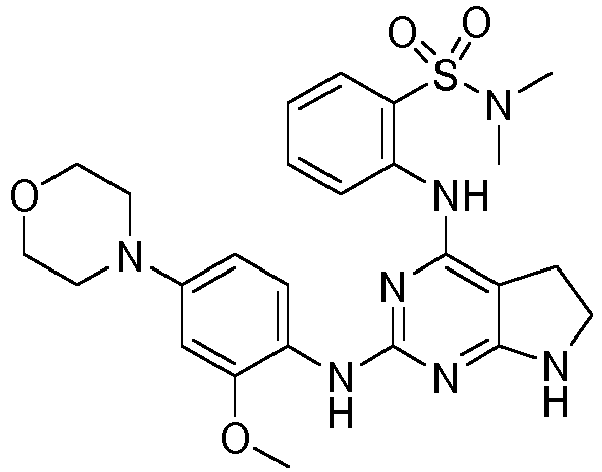
- 1H NMR (400 MHz, DMSO-d 6) δ ppm 8.53-8.55 (dd, 1H, J = 0.8 Hz, 8.0 Hz), 8.41 (s, 1H), 7.74-7.76 (d, 1H, J = 8.4Hz), 7.66-7.68 (m, 1H), 7.54-7.55 (m, 1H), 7.28 (s, 1H), 7.10-7.14 (t, 1H, J = 7.2 Hz), 6.79 (s, 1H), 6.625-6.631 (d, 1H, J = 2.4 Hz), 6.43-6.46 (dd, 1H, J = 6.4Hz, 8.8 Hz), 3.82 (s, 3H), 3.74-3.76 (m, 4H), 3.47-3.55 (m, 2H), 3.07-3.09 (m, 4H), 2.78-2.82 (t, 2H, J = 8.4 Hz), 2.64 (s, 6H).
- 1H NMR (400 MHz, DMSO-d 6) δ ppm 8.53-8.55 (dd, 1H, J = 0.8Hz, 8.0 Hz), 8.41 (s, 1H) , 7.74-7.76 (d, 1H, J = 8.4 Hz), 7.66-7.68 (m, 1H), 7.54-7.55 (m, 1H), 7.28 (s, 1H), 7.10-7.14 (t, 1H, J = 7.2Hz), 6.79 (s, 1H), 6.625-6.631 (d, 1H, J = 2.4 Hz), 6.43-6.46 (dd, 1H, J = 6.4 Hz, 8.8 Hz), 3.82 (s, 3H), 3.74-3.76 (m, 4H), 3.47-3.55 (m, 2H), 3.07-3.09 (m, 4H), 2.78-2.82 (t, 2H, J = 8.4Hz), 2.64 (s, 6H).
-

- 1H NMR (400 MHz, DMSO-d 6) δ ppm 8.41-8.43 (d, 1H, J = 8.0 Hz), 8.27 (s, 1H), 7.79-7.82 (m, 2H), 7.69-7.71 (d, 1H, J = 8.0 Hz), 7.45-7.46 (m, 1H), 7.21 (s, 1H), 7.04-7.06 (m, 1H), 6.72 (s, 1H), 6.61 (s, 1H), 6.40-6.42 (d, 1H, J = 8.8 Hz), 3.79 (s, 3H), 3.72-3.73 (m, 4H), 3.49-3.53 (t, 2H, J = 8.4Hz), 3.05-3.06 (m, 4H), 2.72-2.80 (m, 4H), 1.27-1.30 (m, 2H), 1.11-1.17 (m, 2H), 0.69-0.73 (t, 3H, J = 6.8 Hz).
-

- 1H NMR (400 MHz, DMSO-d6) δ ppm 8.38-8.40 (d, 1H, J = 8.4 Hz), 8.23 (s, 1H), 7.78-7.83 (m, 2H), 7.72-7.74 (d, 1H, J = 8.0 Hz), 7.43-7.47 (t, 1H, J = 7.6 Hz), 7.23 (s, 1H), 7.01-7.05 (t, 1H, J = 7.6Hz), 6.73 (s, 1H), 6.61 (s, 1H), 6.39-6.41 (d, 1H, J = 8.8 Hz), 3.788-3.791 (d, 3H, J = 1.2Hz), 3.72-3.73 (m, 4H), 3.49-3.53 (t, 2H, J = 8.4 Hz), 3.23-3.28 (m, 1H), 3.05-3.06 (m, 4H), 2.76-2.80 (t, 2H, J = 8.0 Hz), 0.91-0.93 (m, 6H).
-

- 1H NMR (400 MHz, DMSO-d6) δ ppm 8.51-8.53 (d, 1H, J = 8.4 Hz), 8.39 (s, 1H), 7.89-7.91 (d, 1H, J = 8.8Hz), 7.82-7.84 (dd, 1H, J = 1.2Hz, 8.0 Hz), 7.68 (s, 2H), 7.49-7.53 (m, 1H), 7.29 (s, 1H), 7.09-7.13 (m, 1H), 6.78 (s, 1H), 6.69-6.70 (d, 1H, J = 2.4 Hz), 6.48-6.51 (dd, 1H, J = 2.4 Hz, 8.8 Hz), 3.88 (s, 3H), 3.80-3.82 (t, 4H, J = 4.8 Hz), 3.57-3.61 (t, 2H, J = 8.4Hz), 3.13-3.15 (t, 4H, J = 4.8Hz), 2.83-2.88 (t, 2H, J = 8.4 Hz).
-

- 1H NMR (400 MHz, DMSO-d6) δ ppm 8.49-8.51 (d, 1H, J = 8.0 Hz), 8.19 (s, 1H), 8.14 (s, 1H), 7.79-7.81 (d, 1H, J = 8.8Hz), 7.73-7.76 (dd, 1H, J = 1.6 Hz, 8.0 Hz), 7.47-7.50 (t, 1H, J = 7.6Hz), 7.25 (s, 1H), 7.05-7.09 (t, 1H, J = 8.0Hz), 6.75 (s, 1H), 6.627-6.634 (d, 1H, J = 2.8Hz), 6.42-6.45 (dd, 1H, J = 2.4Hz, 8.8 Hz), 3.81 (s, 3H), 3.74-3.76 (t, 4H, J = 4.8 Hz), 3.50-3.55 (t, 2H, J = 8.4 Hz), 3.07-3.09 (t, 4H, J = 4.8Hz), 2.78-2.82 (t, 2H, J = 8.4Hz), 2.07-2.11 (m, 1H), 0.43-0.46 (m, 2H), 0.38-0.39 (m, 2H).
-

- 1H NMR (400 MHz, CDCl3) δ ppm 8.32 (s, 1H), 8.18 (d, J = 8.6 Hz, 1H), 8.05 (s, 1H), 7.88 (d, J = 7.8 Hz, 1H), 7.52 (t, J = 7.8 Hz, 1H), 7.21 - 7.05 (m, 2H), 6.51 (d, J = 2.5 Hz, 1H), 6.42 (d, J = 9.0 Hz, 1H), 4.63 (s, 1H), 4.56 (s, 1H), 3.92 - 3.82 (m, 7H), 3.67 (t, J = 8.2 Hz, 2H), 3.15 - 3.06 (m, 4H), 3.01 - 2.83 (m, 4H), 1.04 (t, J = 7.2 Hz, 3H).
-
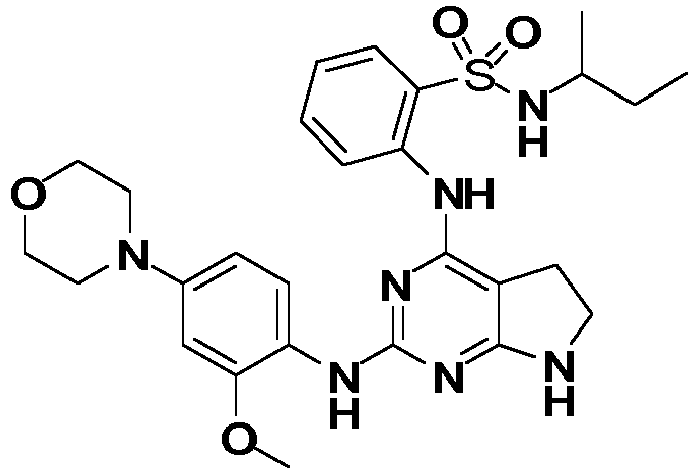
- 1H NMR (400 MHz, CDCl3) δ ppm 8.27 (d, J = 8.0 Hz, 1H), 8.20 (d, J = 8.2 Hz, 1H), 7.97 (s, 1H), 7.90 (d, J = 7.8 Hz, 1H), 7.51 (s, 1H), 7.17 (s, 1H), 7.11 (t, J = 7.9 Hz, 1H), 6.51 (s, 1H), 6.37 (d, J = 9.3 Hz, 1H), 4.52 (s, 1H), 4.38 (d, J = 7.9 Hz, 1H), 3.86 (s, 7H), 3.68 (t, J = 8.1 Hz, 2H), 3.18 (s, 1H), 3.09 (s, 4H), 2.94 (t, J = 8.5 Hz, 2H), 1.35-1.30 (m, 2H), 0.97 (d, J = 6.2 Hz, 3H), 0.71 (t, J = 7.0 Hz, 3H).
-

- 1H NMR (400 MHz, DMSO-d 6) δ ppm 8.48 (s, 1H), 7.86 (t, J = 6.4 Hz, 1H), 7.76 (d, J = 6.8 Hz, 1H), 7.48-7.60 (m, 2H), 7.14-7.47 (m, 2H), 6.64 (s, 1H), 6.49-6.51 (m, 1H), 3.79 (s, 3H), 3.72-3.74 (m, 4H), 3.51-3.61 (m, 2H), 3.24-3.31 (m, 2H), 3.05-3.14 (m, 2H), 2.53 (t, J = 6.4 Hz, 2H), 1.54-1.61 (m, 1H), 0.75 (d, J = 5.2 Hz, 6H).
-

- 1H NMR (400 MHz, DMSO-d 6) δ ppm 8.46 (d, J = 8.6 Hz, 1H), 8.36 (s, 1H), 7.84 (d, J = 7.8 Hz, 1H), 7.79 (d, J = 8.8 Hz, 1H), 7.74 (dd, J = 8.0, 1.5 Hz, 1H), 7.44 (t, J = 7.9 Hz, 1H), 7.25 (s, 1H), 7.04 (t, J = 7.2 Hz, 1H), 6.75 (s, 1H), 6.62 (d, J = 2.5 Hz, 1H), 6.40 (dd, J = 8.7, 2.5 Hz, 1H), 3.80 (s, 3H), 3.76 - 3.71 (m, 4H), 3.67 (t, J = 9.1 Hz, 1H), 3.31 - 3.25 (m, 2H), 3.11 - 3.01 (m, 4H), 1.17 (d, J = 6.7 Hz, 3H), 1.01 (d, J = 6.5 Hz, 3H), 0.90 (d, J = 6.5 Hz, 3H).
-

- 1H NMR (400 MHz, CDCl3) δ ppm 8.18 (dd, J = 13.6, 8.8 Hz, 2H), 7.93 (d, J = 7.9 Hz, 1H), 7.81 (s, 1H), 7.51 (t, J = 7.7 Hz, 1H), 7.14 (dd, J = 18.7, 11.1 Hz, 2H), 6.51 (s, 1H), 6.37 (d, J = 8.6 Hz, 1H), 4.56 (d, J = 13.0 Hz, 2H), 3.92 - 3.79 (m, 7H), 3.68 (t, J = 8.4 Hz, 2H), 3.10 (d, J = 4.8 Hz, 4H), 2.92 (t, J = 8.2 Hz, 2H), 1.16 (s, 9H).
-

- 1H NMR (400 MHz, DMSO-d 6) δ ppm 8.43 (d, J = 8.8 Hz, 1H), 8.25 (s, 1H), 7.85 (t, J = 5.8 Hz, 1H), 7.78 (d, J = 8.7 Hz, 1H), 7.69 (dd, J = 8.0, 1.3 Hz, 1H), 7.46 (t, J = 7.3 Hz, 1H), 7.23 (s, 1H), 7.05 (t, J = 7.6 Hz, 1H), 6.73 (s, 1H), 6.61 (d, J = 2.3 Hz, 1H), 6.41 (dd, J = 8.7, 2.3 Hz, 1H), 3.79 (s, 3H), 3.75 - 3.68 (m, 4H), 3.51 (t, J = 8.5 Hz, 2H), 3.18 (t, J = 6.1 Hz, 2H), 3.09-3.00 (m, 7H), 2.79 (dd, J = 13.2, 6.5 Hz, 4H), 1.59 - 1.46 (m, 2H).
-

- 1H NMR (400 MHz, DMSO-d 6) δ ppm 8.41 (d, J = 8.6 Hz, 1H), 8.24 (s, 1H), 7.79 (d, J = 8.7 Hz, 1H), 7.72 (d, J = 6.5 Hz, 1H), 7.47 (t, J = 7.2 Hz, 1H), 7.22 (s, 1H), 7.06 (t, J = 7.5 Hz, 1H), 6.73 (s, 1H), 6.61 (d, J = 2.4 Hz, 1H), 6.40 (dd, J = 8.8, 2.5 Hz, 1H), 3.79 (s, 3H), 3.76 - 3.66 (m, 4H), 3.51 (t, J = 8.1 Hz, 2H), 3.12 - 3.00 (m, 4H), 2.89 (s, 2H), 2.78 (t, J = 8.5 Hz, 2H), 2.14 (s, 6H).
-

- 1H NMR (400 MHz, DMSO-d 6) δ ppm 8.44 (d, J = 8.5 Hz, 1H), 8.26 (s, 1H), 8.08 (d, J = 5.9 Hz, 1H), 7.80 (d, J = 8.6 Hz, 1H), 7.71 (d, J = 7.6 Hz, 1H), 7.46 (s, 1H), 7.23 (s, 1H), 7.05 (d, J = 7.7 Hz, 1H), 6.72 (s, 1H), 6.62 (s, 1H), 6.42 (d, J = 8.4 Hz, 1H), 3.80 (s, 3H), 3.74 (m, 4H), 3.51 (t, J = 8.2 Hz, 2H), 3.25 (t, J = 5.6 Hz, 2H), 3.10 (s, 2H), 3.06 (s, 3H), 2.96 - 2.87 (m, 2H), 2.79 (t, J = 8.6 Hz, 2H).
-

- 1H NMR (400 MHz, CDCl3) δ ppm 8.14 (d, J = 8.7 Hz, 1H), 8.04 (d, J = 8.5 Hz, 1H), 7.80 (s, 1H), 7.73 (d, J = 7.7 Hz, 1H), 7.47 (t, J = 7.8 Hz, 1H), 7.23 (s, 1H), 7.11 - 6.99 (m, 5H), 6.51 (d, J = 2.2 Hz, 1H), 6.34 (d, J = 8.7 Hz, 1H), 4.57 (s, 1H), 3.91 - 3.83 (m, 7H), 3.61 (t, J = 8.3 Hz, 2H), 3.13 - 3.05 (m, 4H), 2.78 (t, J = 8.4 Hz, 2H).
-

- 1H NMR (400 MHz, DMSO-d 6) δ ppm 8.61 (s, 1H), 8.45 (d, J = 8.5 Hz, 1H), 8.23 (s, 1H), 7.83 (d, J = 8.0 Hz, 1H), 7.73 (dd, J = 8.0, 1.6 Hz, 1H), 7.49 (dd, J = 11.2, 8.1 Hz, 3H), 7.03 (t, J = 7.1 Hz, 1H), 6.79 (d, J = 9.1 Hz, 2H), 6.71 (s, 1H), 3.75 - 3.64 (m, 4H), 3.51 (t, J = 8.6 Hz, 2H), 3.29 - 3.20 (m, 1H), 3.02 - 2.91 (m, 4H), 2.78 (t, J = 8.6 Hz, 2H), 0.92 (d, J = 6.5 Hz, 6H).
-

- 1H NMR (400 MHz, DMSO-d 6) δ ppm 9.18 (s, 1H), 8.33 (d, J = 8.6 Hz, 1H), 8.23-8.10 (m, 2H), 7.85 (d, J = 7.7 Hz, 1H), 7.81 - 7.70 (m, 3H), 7.64 (d, J = 8.8 Hz, 2H), 7.55 (t, J = 7.7 Hz, 1H), 7.10 (t, J = 7.7 Hz, 1H), 6.89 (s, 1H), 3.55 (t, J = 8.4 Hz, 2H), 2.82 (t, J = 8.6 Hz, 2H), 2.74 (d, J = 4.5 Hz, 3H), 1.98 (d, J = 7.9 Hz, 1H), 0.92 (d, J = 6.5 Hz, 6H).
-
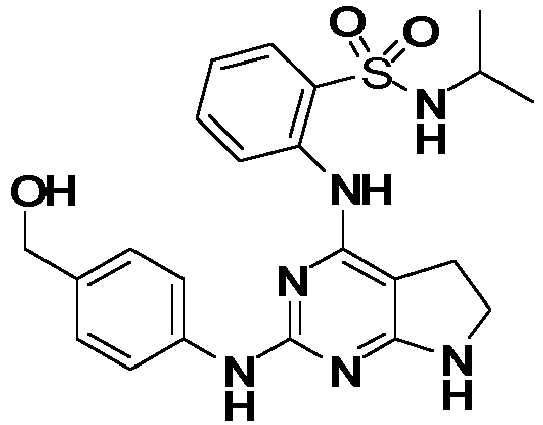
- 1H NMR (400 MHz, CDCl3) δ ppm 8.14 (d, J = 8.4 Hz, 1H), 7.88 (s, 1H), 7.81 (d, J = 7.8 Hz, 1H), 7.42 (t, J = 6.9 Hz, 3H), 7.12 (d, J = 8.4 Hz, 2H), 7.03 (t, J = 7.6 Hz, 1H), 6.77 (s, 1H), 4.52 (s, 2H), 4.40 (d, J = 8.0 Hz, 1H), 3.65(t, 2H),, 3.34 - 3.21 (m, 1H), 2.85 (t, J = 8.4 Hz, 2H), 0.91 (d, J = 6.5 Hz, 6H).
-

- 1H NMR (400 MHz, DMSO-d 6) δ ppm 8.46 (d, J = 8.3 Hz, 1H), 8.31 (s, 1H), 8.01 (s, 1H), 7.82 (d, J = 7.9 Hz, 1H), 7.48 - 7.28 (m, 2H), 6.98 (t, J = 7.6 Hz, 1H), 6.80 (dd, J = 14.0, 2.5 Hz, 1H), 6.72 - 6.61 (m, 2H), 3.83 - 3.66 (m, 4H), 3.50 (t, J = 8.6 Hz, 2H), 3.30 - 3.24 (m, 1H), 3.16 - 3.00 (m, 4H), 2.74 (dd, J = 31.1, 22.6 Hz, 2H), 0.87 (dd, J = 38.0, 6.7 Hz, 6H).
-

- 1H NMR(400 MHz, CDCl3) δ ppm 8.39 (d, 1H, J = 8.4 Hz), 8.25 (s, 1H), 7.85 (d, 1H, J = 8.4 Hz), 7.82 (d, 1H, J = 8.0 Hz), 7.71 (dd, 1H, J = 8.0 Hz, 1.2 Hz), 7.40 (t, 1H, J = 7.6 Hz), 7.33 (s, 1H), 7.01 (t, 1H, J = 7.6 Hz), 6.72 (s, 1H), 6.27 (d, 1H, J = 8.4 Hz), 3.80 (s, 1H), 3.69-3.71 (m, 4H), 3.50 (t, 2H, J = 8.4 Hz), 3.33-3.36 (m, 4H), 3.21-3.27 (m, 1H), 2.77 (t, 2H, J = 8.8 Hz), 0.94 (d, 1H, J = 6.8 Hz).
-

- 1H NMR(400 MHz, CDCl3) δ ppm 8.66 (s, 1H), 8.40 (d, 1H, J = 8.4 Hz), 8.36 (d, 1H, J = 2.4 Hz), 8.23 (s, 1H), 7.84-7.87 (m, 2H), 7.33 (dd, 1H, J = 8.0 Hz, 1.2 Hz), 7.46 (t, 1H, J = 7.2 Hz), 7.03 (t, 1H, J = 7.6 Hz), 6.78 (s, 1H), 6.74 (d, 1H, J = 9.2 Hz), 3.67-3.70 (m, 4H), 3.52 (t, 2H, J = 8.8 Hz), 3.26-3.31 (m, 5H), 2.78 (t, 2H, J = 8.4 Hz), 0.92 (d, 1H, J = 6.4 Hz).
-

- 1H NMR (400 MHz, CDCl3) δ ppm 8.99 (s, 1H), 8.11 (m, 2H), 8.03 - 7.74 (m, 3H), 7.50 (t, J = 7.0 Hz, 1H), 7.12 (d, J = 8.2 Hz, 2H), 6.54 (s, 1H), 4.49 (s, 1H), 4.07 - 3.78 (m, 4H), 3.72 (s, 2H), 3.42 (d, J = 5.6 Hz, 1H), 3.13 - 2.95 (m, 4H), 2.92 (s, 2H), 1.01 (d, J = 6.5 Hz, 6H).
-

- 1H NMR (400 MHz, CDCl3) δ ppm 8.21 (d, J = 9.3 Hz, 2H), 7.91 (d, J = 6.6 Hz, 2H), 7.52 (t, J = 7.3 Hz, 1H), 7.21 (s, 1H), 7.13 (d, J = 7.3 Hz, 1H), 6.50 (d, J = 2.5 Hz, 1H), 6.37 (d, J = 9.0 Hz, 1H), 4.57 (s, 1H), 4.40 (s, 1H), 4.08 (q, J = 7.0 Hz, 2H), 3.91 - 3.83 (m, 4H), 3.68 (t, J = 8.2 Hz, 2H), 3.41 (d, J = 7.1 Hz, 1H), 3.14 - 3.01 (m, 4H), 2.93 (s, 2H), 1.45 (t, J = 7.0 Hz, 3H), 1.01 (d, J = 6.5 Hz, 6H).
-

- 1H NMR (400 MHz, CDCl3) δ ppm 8.11 (d, J = 8.3 Hz, 1H), 7.95 (s, 1H), 7.88 (d, J = 9.0 Hz, 1H), 7.77 (dd, J = 8.0, 1.6 Hz, 1H), 7.30 (td, J = 8.4, 4.0 Hz, 1H), 7.08 - 6.92 (m, 2H), 6.89 (dd, J = 9.1, 2.9 Hz, 1H), 6.61 (s, 1H), 4.55 (s, 1H), 4.38 (d, J = 7.7 Hz, 1H), 3.98 - 3.71 (m, 4H), 3.57 (t, J = 8.5 Hz, 2H), 3.31 (dq, J = 13.2, 6.6 Hz, 1H), 3.13 - 2.86 (m, 4H), 2.82 (t, J = 8.5 Hz, 2H), 0.97 - 0.82 (m, 6H).
-

- 1H NMR (400 MHz, DMSO-d 6) δ ppm 9.35 (s, 1H), 8.29 (d, J = 8.2 Hz, 1H), 8.19 (s, 1H), 7.89 (d, J = 8.7 Hz, 2H), 7.84 (d, J = 8.1 Hz, 1H), 7.77 (dd, J = 8.0, 1.4 Hz, 1H), 7.56 (t, J = 7.8 Hz, 1H), 7.47 (d, J = 8.7 Hz, 2H), 7.10 (t, J = 7.6 Hz, 1H), 6.93 (s, 1H), 3.56 (t, J = 8.5 Hz, 2H), 3.28 - 3.14 (m, 1H), 2.83 (t, J = 8.5 Hz, 2H), 0.92 (d, J = 6.5 Hz, 6H).
-

- 1H NMR (400 MHz, CDCl3) δ ppm 8.11 (dd, J = 8.3, 0.8 Hz, 1H), 7.90 (s, 1H), 7.84 (dd, J = 8.0, 1.5 Hz, 1H), 7.54 - 7.41 (m, 3H), 7.26 - 7.21 (m, 2H), 7.06 (dd, J = 11.2, 4.0 Hz, 2H), 4.67 (d, J = 7.8 Hz, 1H), 4.59 (s, 1H), 3.59 (t, J = 8.5 Hz, 2H), 3.35 (dq, J = 13.2, 6.5 Hz, 1H), 2.99 (s, 6H), 2.86 (t, J = 8.5 Hz, 2H), 0.91 (dd, J = 18.9, 6.6 Hz, 6H).
-

- 1H NMR (400 MHz, DMSO-d 6) δ ppm 9.70 (s, 1H), 8.76 (s, 1H), 8.40 (d, J = 8.4 Hz, 1H), 8.20 (s, 1H), 7.82 (d, J = 7.8 Hz, 1H), 7.75 (dd, J = 8.0, 1.5 Hz, 1H), 7.55 (d, J = 9.0 Hz, 2H), 7.47 (t, J = 7.1 Hz, 1H), 7.35 (d, J = 9.0 Hz, 2H), 7.05 (t, J = 7.6 Hz, 1H), 6.75 (s, 1H), 3.52 (dd, J = 16.0, 7.5 Hz, 2H), 3.29 - 3.21 (m, 1H), 2.80 (t, J = 8.5 Hz, 2H), 1.97 (d, J = 3.2 Hz, 3H), 0.92 (d, J = 6.5 Hz, 6H).
-

- 1H NMR (400 MHz, DMSO-d 6) δ ppm 8.14 (d, J = 8.3 Hz, 1H), 8.00 (s, 1H), 7.94 (d, J = 7.9 Hz, 1H), 7.75 - 7.61 (m, 4H), 7.56 (t, J = 7.8 Hz, 1H), 7.18 (dd, J = 14.2, 6.3 Hz, 2H), 4.71 (s, 1H), 4.65 (d, J = 7.7 Hz, 1H), 4.37 (t, J = 17.6 Hz, 1H), 3.71 (t, J = 8.5 Hz, 2H), 3.45 (dd, J = 13.4, 6.7 Hz, 1H), 2.96 (t, J = 8.5 Hz, 2H), 2.62 (t, J = 16.5 Hz, 3H), 0.99 (dd, J = 24.1, 7.1 Hz, 6H).
-

- 1H NMR (400 MHz, DMSO-d 6) δ ppm 9.14 (s, 1H), 8.33 (d, J = 8.2 Hz, 1H), 8.20 (s, 1H), 7.83 (d, J = 8.0 Hz, 1H), 7.79 - 7.73 (m, 3H), 7.57 - 7.49 (m, 1H), 7.23 (d, J = 8.7 Hz, 2H), 7.09 (t, J = 7.6 Hz, 1H), 6.86 (s, 1H), 3.62 - 3.52 (m, 6H), 3.48 (s, 4H), 3.24 (dd, J = 13.8, 7.1 Hz, 1H), 2.82 (t, J = 8.6 Hz, 2H), 0.92 (d, J = 6.5 Hz, 6H).
-

- 1H NMR (400 MHz, CDCl3) δ ppm 8.27 (d, J = 8.4 Hz, 1H), 8.16 (s, 1H), 7.85 (d, J = 8.0 Hz, 1H), 7.66 (d, J = 8.4 Hz, 1H), 7.37 (t, J = 8.0 Hz, 1H), 7.04 (t, J = 7.6 Hz, 1H), 6.77 (s, 1H), 6.72 (d, J = 8.8 Hz, 1H), 6.38 (s, 1H), 4.58 (s, 1H), 4.44 (d, J = 6.8 Hz, 1H), 3.87 - 3.89 (m, 4H), 3.66 (t, J = 8.4 Hz , 2H), 3.44-3.38 (m, 1H), 3.11 - 3.13 (m, 4H), 2.90 (t, J = 8.4 Hz, 2H), 2.26 (s, 3H), 1.02 (d, J = 6.8 Hz, 6H).
-

- 1H NMR (400 MHz, DMSO-d 6) δ ppm 8.48 (d, J = 8.0 Hz, 1H), 8.27 (s, 1H), 7.83 (d, J = 8.0 Hz, 1H), 7.73 (dd, J = 8.0 Hz, 1.6Hz, 1H), 7.58 (d, J = 8.8 Hz, 1H), 7.41 (t, J = 8.4 Hz, 1H), 7.17 (s, 1H), 7.02 (t, J = 8.0 Hz, 1H), 6.66 (s, 1H), 6.20 (d, J = 2.4 Hz, 1H), 6.06 (dd, J = 8.8 Hz, 2.4 Hz, 1H), 3.78 (s, 3H), 3.51 (t, J = 8.8 Hz , 2H), 3.25 - 3.32 (m, 1H), 3.21 - 3.24 (m, 4H), 2.78 (t, J = 8.4 Hz, 2H), 1.94 - 1.97 (m, 4H), 0.94 (d, J = 6.4 Hz, 6H).
-

- 1H NMR (400 MHz, DMSO-d 6) δ ppm 8.41 (d, J = 8.4 Hz, 1H), 8.25 (s, 1H), 7.83 (d, J = 8.0 Hz, 1H), 7.77 (d, J = 8.8 Hz, 1H), 7.74 (dd, J = 8.8 Hz, 1.6 Hz, 1H), 7.46 (t, J = 8.8 Hz, 1H), 7.22 (s, 1H), 7.05 (t, J = 8.0 Hz, 1H), 6.73 (s, 1H), 6.59 (d, J = 2.4 Hz, 1H), 6.41 (dd, J = 8.8 Hz, 2.4 Hz, 1H), 3.80 (s, 3H), 3.53 (t, J = 8.4 Hz, 2H), 3.24 - 3.31 (m, 1H), 3.05 - 3.08 (m, 4H), 2.79 (t, J = 8.4 Hz, 2H), 1.61 - 1.67 (m, 4H), 1.51 - 1.54 (m, 2H), 0.94 (d, J = 6.4 Hz, 6H).
-

- 1H NMR (400 MHz, CDCl3) δ ppm 8.25 (d, J = 8.1 Hz, 1H), 7.98 (s, 1H), 7.90 (dd, J = 8.0, 1.5 Hz, 1H), 7.69 - 7.39 (m, 3H), 7.31 - 7.22 (m, 2H), 7.12 (t, J = 7.1 Hz, 1H), 6.77 (s, 1H), 4.86 (q, J = 6.4 Hz, 1H), 4.55 (s, 1H), 4.45 (d, J = 7.2 Hz, 1H), 3.69 (t, J = 8.5 Hz, 2H), 3.42 (dd, J = 14.0, 6.6 Hz, 1H), 2.94 (t, J = 8.5 Hz, 2H), 1.47 (t, J = 13.5 Hz, 3H), 1.01 (d, J = 6.5 Hz, 6H).
-

- 1H NMR (400 MHz, CDCl3) δ ppm 8.24 (d, J = 8.4 Hz, 1H), 8.18 (d, J = 8.9 Hz, 1H), 7.96-7.74 (m, 2H), 7.57 - 7.43 (m, 1H), 7.08 (dd, J = 29.7, 22.6 Hz, 2H), 6.52 (t, J = 10.3 Hz, 1H), 6.34 (dd, J = 8.9, 2.6 Hz, 1H), 4.55 (s, 1H), 4.47 (d, J = 7.7 Hz, 1H), 4.08 (t, J = 5.8 Hz, 2H), 3.94 - 3.79 (m, 3H), 3.79 - 3.70 (m, 4H), 3.67 (t, J = 8.5 Hz, 2H), 3.41 (dq, J = 13.2, 6.6 Hz, 1H), 2.93 (t, J = 8.4 Hz, 2H), 2.80 (t, J = 5.8 Hz, 2H), 2.66 - 2.49 (m, 4H), 0.99 (t, J = 11.8 Hz, 6H).
-

- 1H NMR (400 MHz, DMSO-d 6) δ ppm 9.11 (s, 1H), 8.33 (d, J = 8.4 Hz, 1H), 8.22 (s, 1H), 7.85 (d, J = 8.0 Hz, 1H), 7.76 - 7.79 (m, 3H), 7.54 (t, J = 8.8 Hz, 1H), 7.16 (d, J = 8.8 Hz, 2H), 7.09 (t, J = 8.0 Hz, 1H), 6.87 (s, 1H), 3.56 (t, J = 8.4 Hz, 2H), 3.28 - 3.31 (m, 1H), 2.83 (t, J = 8.4 Hz, 2H), 0.94 (d, J = 6.4 Hz, 6H).
-

- 1H NMR (400 MHz, DMSO-d 6) δ ppm 9.17 - 9.23 (brs, 2H), 8.86-8.89 (brs, 1H), 8.32 - 8.38 (brs, 1H), 8.28 (s, 1H), 7.86 (d, J = 7.6 Hz, 1H), 7.78 (d, J = 7.6 Hz, 1H), 7.73 (d, J = 8.8 Hz, 2H), 7.56 (t, J = 7.6 Hz, 1H), 7.43 (d, J = 8.8 Hz, 2H), 7.12 (t, J = 7.6 Hz, 1H), 4.36 - 4.40 (m, 1H), 3.57 (t, J = 8.4 Hz , 2H), 3.26 - 3.31 (m, 1H), 2.87 - 2.92 (m, 1H), 2.82 (t, J = 8.0 Hz, 2H), 1.55 (d, J = 6.8 Hz, 3H), 1.22 (d, J = 6.8 Hz, 6H), 0.94 (d, J = 6.4 Hz, 6H).
-

- 1H NMR (400 MHz, CDCl3) δ ppm 8.21 (d, J = 8.3 Hz, 1H), 8.01 (d, J = 7.8 Hz, 2H), 7.73 (s, 1H), 7.64 (t, J = 7.8 Hz, 1H), 7.30 - 7.14 (m, 3H), 6.91 (d, J = 8.7 Hz, 2H), 6.32 (s, 1H), 4.73 (s, 1H), 4.59 (d, J = 7.8 Hz, 1H), 3.77 (t, J = 8.5 Hz, 2H), 3.51 (dd, J = 13.0, 6.6 Hz, 1H), 3.06 (d, J = 1.4 Hz, 3H), 3.00 (d, J = 9.1 Hz, 2H), 1.09 (dd, J = 6.5, 1.3 Hz, 6H).
-

- 1H NMR (400 MHz, DMSO-d 6) δ ppm 8.99 (s, 1H), 8.47 (d, J = 8.4 Hz, 1H), 8.31 (s, 1H), 8.20 (q, J = 4.8 Hz, 1H), 7.99 (s, 1H), 7.83 - 7.88 (m, 2H), 7.75 (dd, J = 8.4 Hz, 1.6 Hz, 1H), 7.46 (t, J = 8.4 Hz, 1H), 7.23 - 7.29 (m, 2H), 7.06 (t, J = 8.4 Hz, 1H), 6.82 (s, 1H), 3.56 (t, J = 8.4 Hz, 2H), 3.25 - 3.31 (m, 1H), 2.83 (t, J = 8.0 Hz, 2H), 2.74 (d, J = 4.4 Hz, 3H), 0.94 (d, J = 6.4 Hz, 6H).
-

- 1H NMR (400 MHz, DMSO-d 6) δ ppm 9.80 (s, 1H), 8.90-9.00 (brs, 1H), 8.41 -8.50 (brs, 1H), 8.34 (s, 1H), 7.84 (d, J = 8.0 Hz, 1H), 7.76(d, J = 7.2 Hz, 1H), 7.66 (s, 1H), 7.46 - 7.49 (m, 2H), 7.00 - 7.19 (m, 3H), 6.84 - 6.89 (brs, 1H), 3.56 (t, J = 8.4 Hz, 2H), 3.24 - 3.33 (m, 1H), 2.70 - 2.89 (brs, 1H), 2.02 (s, 3H), 0.95 (d, J = 6.8 Hz, 6H).
-

- 1H NMR (400 MHz, DMSO-d 6) δ ppm 8.39 (d, J = 8.4 Hz, 1.6 Hz, 1H), 8.25 (s, 1H), 7.83 (d, J = 8.0 Hz, 1H), 7.81 (d, J = 8.8 Hz, 1H), 7.74 (dd, J = 8.8 Hz, 1H), 7.46 (t, J = 8.8 Hz, 1H), 7.24 (s, 1H), 7.05 (t, J = 8.0 Hz, 1H), 6.73 (s, 1H), 6.63 (d, J = 2.4 Hz, 1H), 6.45 (dd, J = 8.8 Hz, 2.4 Hz, 1H), 3.81 (s, 3H), 3.76 (d, J = 12.8 Hz, 2H), 3.53 (t, J = 8.8 Hz, 2H), 3.23-3.31 (m,1H), 3.05-3.19 (m, 1H), 2.79 (t, J = 8.8 Hz, 2H), 2.62-2.75 (m, 8H), 2.03 (d, J = 12.8 Hz, 2H), 1.64-1.72 (m, 2H), 0.94 (d, J = 6.8 Hz, 6H).
-

- 1H NMR (400 MHz, DMSO-d 6) δ ppm 8.30 (d, J = 8.8 Hz, 1H), 8.27 (d, J = 6.4 Hz, 1H), 8.21 (d, J = 6.8 Hz, 2H), 7.84 (d, J = 8.4 Hz, 1H), 7.75 (d, J = 8.0 Hz, 1H), 7.71 (s, 1H), 7.55 (t, J = 8.0 Hz, 1H), 7.44 (s, 1H), 7.24 (s, 1H), 7.04-7.09 (m, 3H), 6.90 (s, 1H), 3.93 (s,3H), 3.55 (t, J = 8.4 Hz, 2H), 3.21-3.31 (m, 1H), 2.81 (t, J = 8.8 Hz, 2H), 0.92 (d, J = 6.8 Hz, 6H).
-

- 1H NMR (400 MHz, CDCl3) δ ppm 8.15 (d, J = 8.5 Hz, 1H), 8.02 (s, 1H), 7.91 (d, J = 8.0 Hz, 1H), 7.62 - 7.50 (m, 3H), 7.42 (d, J = 8.6 Hz, 2H), 7.14 (t, J = 7.6 Hz, 1H), 4.79 (m, 2H), 3.67 (dd, J = 17.5, 8.4 Hz, 4H), 3.53 - 3.35 (m, 3H), 2.91 (t, J = 8.3 Hz, 2H), 2.01 - 1.79 (m, 4H), 1.00 (t, J = 8.1 Hz, 6H).
-

- 1H NMR (400 MHz, CDCl3) δ ppm 8.26 (d, J = 8.2 Hz, 1H), 8.15 (d, J = 8.8 Hz, 1H), 8.00 - 7.78 (m, 2H), 7.52 (t, J = 7.9 Hz, 1H), 7.12 (dd, J = 15.7, 7.6 Hz, 2H), 6.54 (d, J = 2.5 Hz, 1H), 6.41 (dd, J = 8.8, 2.5 Hz, 1H), 4.54 (s, 1H), 4.44 (d, J = 7.6 Hz, 1H), 3.84 (d, J = 6.7 Hz, 3H), 3.67 (t, J = 8.5 Hz, 2H), 3.63 - 3.48 (m, 4H), 3.40 (dq, J = 13.0, 6.6 Hz, 1H), 2.92 (t, J = 8.5 Hz, 2H), 2.67 (dd, J = 12.0, 9.7 Hz, 2H), 1.86 (d, J = 11.6 Hz, 2H), 1.56 - 1.38 (m, 2H), 1.02 (dd, J = 12.2, 6.6 Hz, 6H).
-

- 1H NMR (400 MHz, CDCl3) δ ppm 8.26 (s, 1H), 7.97-8.05 (m, 2H), 7.88 (d, J = 8.3 Hz, 1H), 7.50-7.55 (m, 2H), 7.26 (s, 5H), 7.09 (m, 2H), 6.14 (s, 1H), 6.05 (d, J = 8.8 Hz, 1H), 3.84 (s, 3H), 3.64 (t, J = 8.0 Hz, 2H), 3.56 - 3.19 (m, 5H), 2.87 (s, 2H), 2.27 - 2.10 (m, 2H), 2.07 - 1.94 (m, 4H), 1.00 (d, J = 6.5 Hz, 6H).
-

- 1H NMR (400 MHz, DMSO-d 6) δ ppm 8.34 (s, 1H), 7.79 (d, J = 7.6 Hz, 1H), 7.73-7.75 (m, 1H), 7.45-7.53 (m, 1H), 7.05-7.11 (m, 1H), 6.61 (s, 1H), 6.37-6.42 (m, 1H), 4.13-4.21 (m, 1H), 3.78 (s, 3H), 3.62-3.71 (m, 1H), 3.52 (t, J = 8.0 Hz, 2H), 3.34-3.45 (m, 2H), 2.63-2.85 (m, 4H), 1.88-1.94 (m, 1H), 1.68-1.74 (m, 1H), 1.38-1.58 (m, 2H), 0.92 (d, J = 6.4 Hz, 6H).
-

- 1H NMR (400 MHz, CDCl3) δ ppm 8.22 (d, J = 8.3 Hz, 1H), 8.01 (s, 1H), 7.90 (dd, J = 7.9, 1.4 Hz, 1H), 7.60 - 7.49 (m, 3H), 7.24 (s, 1H), 7.12 (t, J = 7.6 Hz, 1H), 6.85 (s, 1H), 4.59 (d, J = 7.1 Hz, 2H), 3.67 (t, J = 8.3 Hz, 2H), 3.52 - 3.30 (m, 1H), 2.91 (dd, J = 18.1, 9.7 Hz, 2H), 2.65 - 2.19 (m, 3H), 1.91 - 1.53 (m, 10H), 1.08 - 0.94 (m, 6H).
-

- 1H NMR (400 MHz, DMSO-d 6) δ ppm 8.29 (t, J = 8.0 Hz, 2H), 8.21 (s, 1H), 7.81 (d, J = 7.7 Hz, 1H), 7.76 (d, J = 7.9 Hz, 1H), 7.61 (d, J = 4.9 Hz, 1H), 7.55 (t, J = 7.8 Hz, 1H), 7.51 - 7.36 (m, 2H), 7.13 - 6.95 (m, 2H), 6.90 (s, 1H), 6.82 (dd, J = 8.5, 2.2 Hz, 1H), 6.45 (d, J = 8.8 Hz, 1H), 6.28 (t, J = 6.7 Hz, 1H), 3.85 (s, 3H), 3.55 (t, J = 8.8 Hz, 2H), 2.82 (t, J = 8.6 Hz, 2H), 0.90 (t, J = 19.2 Hz, 6H).
-

- 1H NMR (400 MHz, CDCl3) δ ppm 8.26 (d, J = 8.2 Hz, 1H), 8.17 (d, J = 8.8 Hz, 1H), 7.98 - 7.87 (m, 2H), 7.51 (dd, J = 12.0, 5.0 Hz, 1H), 7.12 (dd, J = 15.4, 7.5 Hz, 2H), 6.49 (d, J = 2.5 Hz, 1H), 6.36 (dd, J = 8.8, 2.5 Hz, 1H), 4.56 (d, J = 11.7 Hz, 2H), 3.90 - 3.78 (m, 5H), 3.65 (t, J = 8.4 Hz, 2H), 3.41 (td, J = 13.4, 6.7 Hz, 1H), 3.32 (d, J = 10.7 Hz, 2H), 2.91 (t, J = 8.4 Hz, 2H), 2.44 - 2.32 (m, 2H), 1.25(t, 1.8Hz,6H), 1.01 (d, J = 6.5 Hz, 6H).
-

- 1H NMR (400 MHz, DMSO-d 6) δ ppm 8.47 (d, J = 8.7 Hz, 1H), 8.27 (s, 1H), 7.82 (d, J = 7.8 Hz, 1H), 7.73 (dd, J = 8.0, 1.6 Hz, 1H), 7.51 (d, J = 8.5 Hz, 1H), 7.41 (t, J = 7.7 Hz, 1H), 7.14 (s, 1H), 7.02 (t, J = 7.6 Hz, 1H), 6.65 (s, 1H), 6.32 (d, J = 2.3 Hz, 1H), 6.12 (dd, J = 8.5, 2.3 Hz, 1H), 5.15 (m, 1H), 3.73 (s, 3H), 3.67 - 3.55 (m, 4H), 3.51 (t, J = 8.6 Hz, 2H), 3.39 - 3.25 (m, 1H), 3.13 (d, J = 6.3 Hz, 2H), 2.78 (t, J = 8.5 Hz, 2H), 2.43 (s, 4H), 0.95 (d, J = 6.5 Hz, 6H).
-

- 1H NMR (400 MHz, DMSO-d 6) δ ppm 8.42 (d, J = 8.3 Hz, 2H), 8.26 (s, 1H), 7.77 (t, J = 8.4 Hz, 3H), 7.47 (t, J = 7.9 Hz, 1H), 7.22 (s, 2H), 7.06 (t, J = 7.6 Hz, 1H), 6.74 (s, 2H), 6.61 (d, J = 2.5 Hz, 1H), 6.43 (d, J = 8.7 Hz, 1H), 4.67 (d, J = 4.2 Hz, 1H), 3.81 (s, 3H), 3.543.30 (m, 6H), 2.78 (m, 4H), 2.01 (d, J = 8.0 Hz, 1H), 1.83 (d, 2H), 1.51 (d, J = 9.9 Hz, 2H), 0.95 (d, J = 6.5 Hz, 6H).
-

- 1H NMR (400 MHz, CDCl3) δ ppm 8.25 (d, J = 8.7 Hz, 2H), 8.04 - 7.76 (m, 2H), 7.51 (s, 1H), 7.20 (s, 1H), 7.12 (t, 1H), 6.50 (s, 1H), 6.49 (s, 1H), 6.42 (d, J = 9.2 Hz, 1H), 4.55 (s, 1H), 4.39 (d, J = 7.6 Hz, 1H), 3.86 (s, 3H), 3.69 (t, J = 9.3 Hz, 7H), 3.69 (t, J = 9.3 Hz, 6H), 3.42 (dd, J = 14.0, 6.6 Hz, 1H), 3.18 - 3.04 (m, 4H), 2.94 (d, J = 8.3 Hz, 2H), 1.01 (d, J = 6.5 Hz, 6H).
-

- 1H NMR (400 MHz, CDCl3) δ ppm 8.59 (d, J = 9.2 Hz, 2H), 8.18 (d, J = 8.4 Hz, 1H), 7.97 - 7.91 (m, 2H), 7.66 - 7.49 (m, 4H), 7.18 (t, J = 7.6 Hz, 1H), 4.63 (s, 1H), 4.43 (d, J = 7.6 Hz, 1H), 3.99 (s, 3H), 3.73 (t, J = 8.5 Hz, 2H), 3.47 - 3.39 (m, 1H), 2.97 (dd, J = 20.2, 11.9 Hz, 2H), 1.01 (d, J = 6.5 Hz, 6H).
-

- 1H NMR (400 MHz, CDCl3) δ ppm 8.33 (s, 1H), 8.13 - 7.94 (m, 2H), 7.89 (d, J = 8.0 Hz, 1H), 7.50 (t, J = 7.9 Hz, 1H), 7.09 (t, J = 7.8 Hz, 1H), 7.00 (s, 1H), 6.13 (d, J = 2.2 Hz, 1H), 6.05 (d, J = 8.6 Hz, 1H), 4.51 (d, J = 30.1 Hz, 2H), 3.85 (s, 3H), 3.65 (t, J = 8.4 Hz, 2H), 3.55 - 3.37 (m, 4H), 3.21 (s, 1H), 2.37 (s, 6H), 2.13 (d, J = 67.2 Hz, 2H), 2.11 - 1.78 (m, 2H), 1.01 (s, 6H).
-

- 1H NMR (400 MHz, CDCl3) δ ppm 8.49 (d, J = 8.4 Hz, 1H), 8.21 (d, J = 8.3 Hz, 1H), 8.05 -7.77 (m, 2H), 7.73 - 7.48 (m, 1H), 7.43 (s, 1H), 7.15 (dd, J = 11.1, 4.1 Hz, 1H), 6.81 - 6.55 (m, 3H), 4.65 (s, 1H), 4.56 (d, J = 7.8 Hz, 1H), 3.90 (s, 3H), 3.73 (t, J = 8.4 Hz, 2H), 3.63 - 3.33 (m, 1H), 3.15 - 2.79 (m, 2H), 2.34 (s, 3H), 2.29 - 2.15 (m, 3H), 1.01 (dd, J = 17.8, 6.5 Hz, 6H).
-

- 1H NMR (400 MHz, CDCl3) δ ppm 12.30 (s, 1H), 9.47 (s, 1H), 7.91 (dd, J = 13.7, 8.2 Hz, 2H), 7.62 (s, 1H), 7.53 (t, J = 7.8 Hz, 1H), 7.15 (t, J = 7.7 Hz, 1H), 6.21 (s, 1H), 4.46 (d, J = 7.7 Hz, 1H), 3.80 (t, J = 8.2 Hz, 2H), 3.40 (dd, J = 12.8, 6.6 Hz, 1H), 2.96 (t, J = 8.2 Hz, 2H), 2.52 - 2.10 (m, 3H), 1.01 (dd, J = 6.5, 1.4 Hz, 6H).
-

- 1H NMR (400 MHz, CDCl3) δ ppm 8.22 (d, J = 8.4 Hz, 1H), 8.17 (d, J = 8.8 Hz, 1H), 7.85-7.92 (m, 2H), 7.52 (t, J = 7.6 Hz, 1H), 7.17 (s, 1H), 7.12 (t, J = 7.6 Hz, 1H), 6.51 (s, 1H), 6.38 (d, J = 8.8 Hz, 1H), 4.56 (s, 1H), 4.43-4.49 (brs, 1H), 3.85 (s, 3H), 3.62-3.70 (m, 4H), 3.39-3.44 (m, 1H), 3.28-3.21 (m, 7H), 2.72 (t, J = 8.4 Hz, 2H), 2.06-2.09 (m, 2H), 1.81-1.95 (m, 6H), 1.61-1.65 (m, 2H).
-

- 1H NMR (400 MHz, DMSO-d 6) δ ppm 8.38 (d, J = 8.4 Hz, 1H), 8.23 (s, 1H), 7.80 (dd, J = 8.3, 4.2 Hz, 2H), 7.73 (d, J = 8.0 Hz, 1H), 7.45 (t, J = 7.8 Hz, 1H), 7.20 (s, 1H), 7.03 (t, J = 7.6 Hz, 1H), 6.70 (s, 1H), 6.61 (d, J = 2.2 Hz, 1H), 6.50 - 6.37 (m, 1H), 3.79 (s, 3H), 3.65 (s, 2H), 3.51 (t, J = 8.4 Hz, 2H), 2.78 (t, J = 8.5 Hz, 2H), 2.64 (t, J = 11.5 Hz, 2H), 1.99 (d, J = 15.1 Hz, 2H), 1.82 (m, 4H), 1.66 (s, 2H), 0.93 (d, J = 6.5 Hz, 6H).
-

- 1H NMR (400 MHz, CDCl3) δ ppm 8.45 (d, J = 8.8 Hz, 1H), 8.22 (d, J = 8.0 Hz, 1H), 8.00 - 7.90 (m, 2H), 7.87 (d, J = 2.4 Hz, 1H), 7.71 (d, J = 1.5 Hz, 1H), 7.57 (t, J = 7.0 Hz, 1H), 7.40 (s, 1H), 7.30 (d, J = 2.3 Hz, 1H), 7.16 (t, J = 7.7 Hz, 1H), 7.01 (dd, J = 8.8, 2.4 Hz, 1H), 6.52 - 6.37 (m, 1H), 4.61 (s, 1H), 4.42 (d, J = 8.0 Hz, 1H), 3.95 (d, J = 18.6 Hz, 3H), 3.73 (t, J = 8.5 Hz, 2H), 3.43 (dd, J = 13.2, 7.0 Hz, 1H), 2.98 (t, J = 8.4 Hz, 2H), 1.00 (dd, J = 13.0, 7.0 Hz, 6H).
-

- 1H NMR (400 MHz, CDCl3) δ ppm 8.25 (s, 1H), 8.15 (d, J = 8.7 Hz, 1H), 7.93 (d, J = 6.8 Hz, 1H), 7.54 (t, J = 7.1 Hz, 1H), 7.21 (s, 1H), 7.14 (t, J = 7.7 Hz, 1H), 6.56 (t, J = 4.0 Hz, 1H), 6.46 - 6.32 (m, 1H), 4.65 (s, 1H), 4.52 (s, 1H), 3.98 (s, 1H), 3.87-3.72 (m, 7H), 3.71 - 3.49 (m, 4H), 3.43 (dd, J = 13.4, 6.6 Hz, 1H), 2.94 (m, 2H), 2.81 - 2.56 (m, 6H), 2.38 (s, 2H), 1.98 (d, J = 11.7 Hz, 2H), 1.72 (d, J = 11.8 Hz, 2H), 1.03 (d, J = 6.5 Hz, 6H).
-

- 1H NMR (400 MHz, DMSO-d 6) δ ppm 8.40 (d, J = 8.4 Hz, 1H), 8.24 (s, 1H), 7.83 (d, J = 8.0 Hz, 1H), 7.78 - 7.65 (m, 2H), 7.45 (t, J = 7.9 Hz, 1H), 7.21 (s, 1H), 7.04 (t, J = 7.6 Hz, 1H), 6.72 (s, 1H), 6.59 (d, J = 2.2 Hz, 1H), 6.46 - 6.31 (m, 1H), 3.79 (s, 3H), 3.65 (d, J = 12.1 Hz, 2H), 3.52 (t, J = 8.3 Hz, 2H), 3.28 - 3.16 (m, 3H), 2.78 (t, J = 8.5 Hz, 2H), 2.69 - 2.55 (m, 8H), 2.27 (m, 4H), 1.83 (s, 2H), 1.52 (d, J = 10.6 Hz, 2H), 0.93 (d, J = 6.5 Hz, 6H).
-

- 1H NMR (400 MHz, DMSO-d 6) δ ppm 8.82-9.03 (m, 2H), 7.79 (t, J = 7.6 Hz, 2H), 7.43-7.58 (m, 1H), 7.15-7.22 (m, 1H), 7.11-7.14 (m, 1H), 6.68 (s, 1H), 6.51-6.56 (m, 1H), 3.88-3.92 (m, 2H), 3.80 (s, 3H), 3.21-3.67 (m, 12H), 2.74 (t, J = 7.6 Hz, 2H), 2.57-2.65 (m, 2H), 1.61-1.71 (m, 2H), 0.93 (d, J = 6.4 Hz, 6H).
-

- 1H NMR (400 MHz, DMSO-d 6) δ ppm 8.41 (d, J = 8.2 Hz, 1H), 8.25 (s, 1H), 7.78 (m, 3H), 7.47 (t, J = 7.1 Hz, 1H), 7.23 (s, 1H), 7.05 (t, J = 7.6 Hz, 1H), 6.74 (s, 1H), 6.62 (d, J = 2.5 Hz, 1H), 6.44 (dd, J = 8.7, 2.5 Hz, 1H), 4.42 (d, J = 12.2 Hz, 1H), 3.82 (d, J = 9.3 Hz, 3H), 3.76 - 3.62 (m, 2H), 3.53 (t, J = 8.2 Hz, 2H), 3.29 - 3.19 (m, 1H), 3.18 (t, J = 5.6 Hz, 2H), 2.80 (t, J = 8.5 Hz, 2H), 2.69 (t, J = 11.2 Hz, 2H), 2.25 (t, J = 6.4 Hz, 2H), 1.90 - 1.77 (m, 2H), 1.68 (d, J = 4.7 Hz, 2H), 1.57 (d, J = 9.8 Hz,2H), 0.94 (d, J = 6.5 Hz, 6H).
-

- 1H NMR (400 MHz, CDCl3) δ ppm 8.26 (d, J = 8.0 Hz, 1H), 8.16 (d, J = 8.8 Hz, 1H), 7.93 (s, 1H), 7.90 (dd, J = 8.0 Hz, 1.2 Hz, 1H), 7.52 (t, J = 8.8 Hz, 1H), 7.16-7.25 (s, 1H), 7.12 (t, J = 7.6 Hz, 1H), 7.02 (t, J = 8.0 Hz, 1H), 6.57 (d, J = 2.4 Hz, 1H), 6.43 (dd, J = 8.8 Hz, 2.0 Hz, 1H), 4.54-4.61 (m, 2H), 4.43-4.50 (m, 1H), 3.86 (s, 3H), 3.65-3.69 (m, 4H), 3.39-3.44 (m, 1H), 2.92 (t, J = 8.8 Hz, 2H), 2.79-2.86 (m, 6H), 2.58-2.62 (m, 1H), 1.82-1.84 (m, 2H), 1.01 (d, J = 6.4 Hz, 6H).
-

- 1H NMR (400 MHz, DMSO-d 6) δ ppm 8.53 (s. 1H), 8.50 (d, J = 8.4 Hz, 1H), 7.75 (d, J = 8.8 Hz, 1H), 7.71 (dd, J = 8.0 Hz, 1.6 Hz, 1H), 7.58 (t, J = 8.4 Hz, 1H), 7.27 (s, 1H), 7.14 (t, J = 8.0 Hz, 1H), 6.76 (s, 1H), 6.62 (d, J = 2.4 Hz, 1H), 6.44 (dd, J = 8.8 Hz, 2.8 Hz, 1H), 3.80 (s, 3H), 3.74 - 3.76 (m, 4H), 3.51 (t, J = 8.4 Hz, 2H), 3.38 - 3.42 (m, 1H), 3.07 - 3.09 (m, 4H), 2.78 (t, J = 8.4 Hz, 2H), 1.17 (d, J = 6.8 Hz, 6H).
-

- 1H NMR (400 MHz, DMSO-d 6) δ ppm 8.46 (d, J = 8.3 Hz, 1H), 8.36 (s, 1H), 7.77 (ddd, J = 13.5, 9.5, 4.7 Hz, 3H), 7.44 (t, J = 7.9 Hz, 1H), 7.25 (s, 1H), 7.04 (t, J = 7.2 Hz, 1H), 6.75 (s, 1H), 6.62 (d, J = 2.5 Hz, 1H), 6.40 (dd, J = 8.7, 2.5 Hz, 1H), 3.80 (s, 3H), 3.77 - 3.71 (m, 4H), 3.67 (t, J = 9.1 Hz, 1H), 3.27 (d, J = 6.9 Hz, 1H), 3.11 - 3.03 (m, 5H), 1.17 (d, J = 6.7 Hz, 3H), 1.01 (d, J = 6.5 Hz, 3H), 0.90 (d, J = 6.5 Hz, 3H).
-

- 1H NMR (400 MHz, DMSO-d 6) δ ppm 10.08 (s, 1H), 8.60 - 8.63 (dd, 1H, J = 1.2 Hz, 8.4 Hz), 8.24 - 8.26 (d, 1H, J = 8.8 Hz), 7.39 - 7.42 (m, 2H), 7.10 (s, 1H), 6.91 - 6.95(m, 1H), 6.50 - 6.51 (d, 1H, J = 2.4 Hz), 6.45 - 6.48 (dd, 1H, J = 3.2 Hz, 8.8 Hz), 6.18 - 6.19 (d, 1H, J= 4.4 Hz), 4.13 (s, 1H), 3.85 - 3.89 (s+m, 7H), 3.76 - 3.81 (t, 1H, J = 9.2 Hz), 3.47 - 3.49 (m, 1H), 3.20 - 3.23 (dd, 1H, J = 4.4 Hz, 8.8 Hz), 3.00 - 3.10 (t, 4H, J = 4.8 Hz), 2.90 - 3.00 (d, 3H, J = 4.8 Hz),1.38 - 1.40 (d, 3H, J = 6.4 Hz).
-

- 1H NMR(400 MHz, CDCl3) δ ppm 8.32 (d, 1H, J = 8.4 Hz), 8.13 (d, 1H, J = 8.8 Hz), 8.32 (s, 1H), 7.88 (dd, 1H, J = 8.0 Hz, 1.6 Hz), 7.52 (t, 1H, J = 8.4 Hz), 7.17 (s, 1H), 7.11 (t, 1H, J = 7.2 Hz), 6.50 (d, 1H, J = 2.8 Hz), 6.33 (dd, 1H, J = 8.8 Hz, 2.4 Hz), 4.71 (s, 1H), 4.49 (q, 1H, J = 4.8 Hz), 3.85-3.88 (m, 7H), 3.35 (s, 2H), 3.07-3.10 (m, 4H), 2.59 (d, 3H, J = 5.2 Hz), 1.47 (s, 6H).
-

- 1H NMR(400 MHz, CDCl3) δ ppm 8.22 (d, 1H, J = 8.4 Hz), 8.13 (d, 1H, J = 8.8 Hz), 7.88 (dd, 1H, J = 8.8 Hz, 1.2 Hz), 7.87 (s, 1H), 7.50 (t, 1H, J = 7.2 Hz), 7.17 (s, 1H), 7.12 (t, 1H, J = 7.2 Hz), 6.49 (d, 1H, J = 2.4 Hz), 6.26 (dd, 1H, J = 8.8 Hz, 2.4 Hz), 4.63 (d, 1H, J = 9.6 Hz), 4.57 (s, 1H), 3.85-3.87 (m, 7H), 3.70-3.76 (m, 1H), 3.37 (s, 2H), 3.05-3.08 (m, 4H), 1.93-2.00 (m, 2H), 1.62-1.70 (m, 2H), 1.47 (s, 6H), 1.41-1.49 (m, 2H).
-

- 1H NMR(400 MHz, CDCl3) δ ppm 8.21 (d, 1H, J = 8.4 Hz), 8.13 (d, 1H, J = 8.8 Hz), 7.92 (dd, 1H, J = 8.0 Hz, 1.2 Hz), 7.83 (s, 1H), 7.51 (t, 1H, J = 7.2 Hz), 7.17 (s, 1H), 7.14 (t, 1H, J = 7.2 Hz), 6.49 (d, 1H, J = 2.0 Hz), 6.27 (dd, 1H, J = 8.8 Hz, 2.4 Hz), 4.58 (s, 1H), 4.29 (d, 1H, J = 4.0 Hz), 3.85-3.88 (m, 7H), 3.36-3.40 (m, 1H), 3.36 (s, 2H), 3.06-3.07 (m, 4H), 1.49 (s, 6H), 0.97 (d, 6H), J = 6.8 Hz).
-

- 1H NMR(400 MHz, CDCl3) δ ppm 8.26 (d, 1H, J = 8.4 Hz), 8.12 (d, 1H, J = 8.8 Hz), 7.93 (s, 1H), 7.89 (dd, 1H, J = 8.0 Hz, 1.6 Hz), 7.52 (t, 1H, J = 8.4 Hz), 7.17 (s, 1H), 7.14 (t, 1H, J = 8.0 Hz), 6.49 (d, 1H, J = 2.4 Hz), 6.31 (dd, 1H, J = 8.8 Hz, 2.8 Hz), 4.61 (s, 1H), 4.46 (t, 1H, J = 6.4 Hz), 3.85-3.88 (m, 7H), 3.36 (s, 1H), 3.07-3.09 (m, 4H), 2.86 (q, 2H, J = 6.4Hz), 1.47 (s, 6H), 1.28-1.39 (m, 2H), 0.72 (t, 3H, J = 7.6 Hz).
-

- 1H NMR(400 MHz, CDCl3) δ ppm 8.25 (d, 1H, J = 8.0 Hz), 8.11 (d, 1H, J = 8.8 Hz), 7.88-7.90 (m, 2H), 7.52 (t, 1H, J = 8.8 Hz), 7.16 (s, 1H), 7.14 (t, 1H, J = 8.4 Hz), 6.49 (d, 1H, J = 2.8 Hz), 6.29 (dd, 1H, J = 8.8 Hz, 2.4 Hz), 4.57 (s, 1H), 4.44 (t, 1H, J = 6.4 Hz), 3.85-3.88 (m, 7H), 3.36 (s, 2H), 3.07-3.09 (m, 4H), 2.70 (t, 2H, J = 6.8Hz), 1.55-1.63 (m, 1H), 1.48 (s, 6H), 0.72 (d, 6H, J = 6.8 Hz).
-

- 1H NMR (400 MHz, DMSO-d 6) δ ppm 8.35 (d, J = 8.0 Hz, 1H), 8.32 (s, 1H), 7.83 (d, J = 7.6 Hz, 1H), 7.78 (d, J = 8.8 Hz, 1H), 7.70 (dd, J = 8.0 Hz, 1.6 Hz, 1H), 7.41 (t, J = 8.4 Hz, 1H), 7.17 (s, 1H), 7.05 (t, J = 8.0 Hz, 1H), 6.76 (s, 1H), 6.59 (d, J = 2.8 Hz, 1H), 6.32 (dd, J = 8.8 Hz, 2.4 Hz, 1H), 3.79 (s, 3H), 3.71 - 3.73 (m, 4H), 3.43 - 3.47 (m, 1H), 3.19 (s, 2H), 3.02 - 3.05 (m, 4H), 1.55 - 1.69 (m, 2H), 1.41 - 1.53 (m, 2H), 1.30 - 1.35 (m, 10H).
-

- 1H NMR (400 MHz, DMSO-d 6) δ ppm 8.30 (s, 1H), 8.25 (d, J = 8.8 Hz, 1H), 7.79 (d, J = 8.8 Hz, 1H), 7.72 (d, J = 8.6 Hz, 1H), 7.42 (t, J = 8.0 Hz, 1H), 7.14 (s, 1H), 7.07 (t, J = 8.0 Hz, 1H), 6.76 (s, 1H), 6.59 (s, 1H), 6.28 (d, J = 8.8 Hz, 1H), 3.79 (s, 3H), 3.70 - 3.72 (m, 4H), 3.20 (s, 2H), 2.95 - 3.03 (m, 5H), 1.55 - 1.61 (m, 2H), 1.45 - 1.52 (m, 2H), 1.35 (s, 6H), 1.19 - 1.24 (m, 2H), 1.05 - 1.12 (m, 2H), 0.94 - 1.09 (m, 2H).
-

- 1H NMR (400 MHz, CDCl3) δ ppm 8.28 (d, J = 8.2 Hz, 1H), 8.13 (d, J = 8.8 Hz, 1H), 7.93 - 7.86 (m, 2H), 7.52 (s, 1H), 7.14 (d, J = 5.5 Hz, 2H), 6.49 (d, J = 2.5 Hz, 1H), 6.31 (dd, J = 8.8, 2.4 Hz, 1H), 4.53 (s, 1H), 4.36 (s, 1H), 3.86 (dd, J = 8.1, 3.2 Hz, 7H), 3.36 (s, 2H), 3.11 - 3.03 (m, 4H), 2.90 (dd, J = 13.6, 6.8 Hz, 2H), 1.47 (s, 6H), 1.31 (dd, J = 14.8, 7.3 Hz, 4H), 1.13 (dd, J = 15.0, 7.3 Hz, 2H), 0.72 (t, J = 7.3 Hz, 3H).
-

- 1H NMR(400 MHz, CDCl3) δ ppm 8.42 (s, 1H), 8.35 (d, 1H, J = 8.8 Hz), 8.20 (d, 1H, J = 8.8 Hz), 7.77 (dd, 1H, J = 8.0 Hz, 1.6 Hz), 7.50 (t, 1H, J = 8.4 Hz), 7.16 (s, 1H), 7.10 (t, 1H, J = 8.0 Hz), 6.50 (d, 1H, J = 2.4 Hz), 6.35 (dd, 1H, J = 8.8 Hz, 2.4 Hz), 4.54 (s, 1H), 3.86-3.88 (m, 7H), 3.35 (s, 2H), 3.08-3.10 (m, 4H), 2.72 (s, 6H), 1.48 (s, 2H).
-

- 1H NMR (400 MHz, CDCl3) δ ppm 8.21 (d, J = 8.3 Hz, 1H), 8.14 (d, J = 8.8 Hz, 1H), 7.92 (dd, J = 7.8, 1.6 Hz, 2H), 7.53 - 7.46 (m, 1H), 7.18 (s, 1H), 7.15 - 7.09 (m, 1H), 6.49 (d, J = 2.5 Hz, 1H), 6.26 (dd, J = 8.8, 2.5 Hz, 1H), 4.67 (s, 1H), 4.32 (d, J = 8.1 Hz, 1H), 3.91 - 3.81 (m, 7H), 3.35 (s, 2H), 3.17 (dt, J = 14.6, 6.6 Hz, 1H), 3.10 - 3.03 (m, 4H), 1.45 (d, J = 12.4 Hz, 6H), 1.38 - 1.19 (m, 2H), 0.96 (d, J = 6.6 Hz, 3H), 0.67 (t, J = 7.4 Hz, 3H).
-

- 1H NMR (400 MHz, CDCl3) δ ppm 8.29 (d, J = 7.9 Hz, 1H), 8.14 (d, J = 8.8 Hz, 1H), 7.95 (s, 1H), 7.89 (dd, J = 8.0, 1.5 Hz, 1H), 7.54 - 7.48 (m, 1H), 7.17 - 7.09 (m, 2H), 6.50 (d, J = 2.5 Hz, 1H), 6.32 (dd, J = 8.9, 2.6 Hz, 1H), 4.54 (s, 1H), 4.37 (t, J = 6.1 Hz, 1H), 3.89 - 3.83 (m, 7H), 3.36 (d, J = 0.9 Hz, 2H), 3.11 - 3.05 (m, 4H), 3.02 - 2.91 (m, 2H), 1.47 (s, 6H), 1.00 (t, J = 7.2 Hz, 3H).
-

- 1H NMR (400 MHz, CDCl3) δ ppm 8.32 (d, J = 8.3 Hz, 1H), 8.19 (d, J = 8.8 Hz, 1H), 7.96 (s, 1H), 7.90 (d, J = 8.0 Hz, 1H), 7.52 (t, J = 7.8 Hz, 1H), 7.21 - 7.08 (m, 2H), 6.51 (d, J = 2.5 Hz, 1H), 6.33 (dd, J = 8.8, 2.4 Hz, 1H), 5.50 (t, J = 5.6 Hz, 1H), 4.51 (s, 1H), 3.95 - 3.78 (m, 7H), 3.36 (s, 2H), 3.24 (t, J = 5.5 Hz, 2H), 3.13 - 3.06 (m, 4H), 3.04 - 2.97 (m, 5H), 1.48 (s, 6H).
-

- 1H NMR (400 MHz, CDCl3) δ ppm 8.29 (d, J = 8.0 Hz, 1H), 8.04 (s, 2H), 7.90 (d, J = 8.1 Hz, 1H), 7.51 (t, J = 7.2 Hz, 1H), 7.15 (t, J = 7.6 Hz, 1H), 6.49 (s, 1H), 6.32 (d, J = 6.4 Hz, 1H), 4.93 (s, 1H), 3.87 (d, J = 9.9 Hz, 7H), 3.41 (s, 2H), 3.26 (t, J = 5.1 Hz, 2H), 3.09 (dd, J = 12.5, 7.7 Hz, 9H), 1.48 (s, 6H).
-

- 1H NMR (400 MHz, CDCl3) δ ppm 8.11 (d, J = 8.8 Hz, 1H), 8.05 (d, J = 8.2 Hz, 1H), 7.73 (s, 1H), 7.63 (d, J = 8.0 Hz, 1H), 7.46 (t, J = 7.0 Hz, 1H), 7.23 (s, 1H), 7.02 (m, J = 7.3 Hz, 6H), 6.51 (d, J = 2.5 Hz, 1H), 6.43 (s, 1H), 6.20 (d, J = 8.8 Hz, 1H), 4.64 (s, 1H), 3.88 (d, J = 6.6 Hz, 7H), 3.38 (s, 2H), 3.11 - 3.04 (m, 4H), 1.49 (s, 6H).
-

- 1H NMR (400 MHz, CDCl3) δ ppm 8.44 (s, 1H), 8.19 (s, 1H), 7.96 (d, J = 7.6 Hz, 1H), 7.88 (t, J = 9.3 Hz, 2H), 7.50 (t, J = 7.7 Hz, 1H), 7.31 (d, J = 7.6 Hz, 1H), 6.88 (s, 1H), 6.56 (d, J = 8.3 Hz, 1H), 4.43 (s, 1H), 4.04 (s, 4H), 3.88 (d, J = 19.0 Hz, 3H), 3.60 (s, 2H), 3.37 (s, 4H), 1.52 (s, 6H), 1.16 (d, J = 17.1 Hz, 9H).
-

- 1H NMR (400 MHz, CDCl3) δ ppm 8.28 (d, J = 8.3 Hz, 1H), 8.13 (d, J = 8.8 Hz, 1H), 7.95 (d, J = 6.4 Hz, 1H), 7.89 (s, 1H), 7.57 (t, J = 7.1 Hz, 1H), 7.23 - 7.15 (m, 2H), 6.54 (d, J = 2.5 Hz, 1H), 6.32 (d, J = 9.0 Hz, 1H), 4.60 - 4.53 (m, 2H), 3.98 - 3.85 (m, 7H), 3.41 (s, 2H), 3.14 - 3.07 (m, 4H), 2.83 - 2.74 (m, 2H), 1.53 (s, 6H), 0.082 - 0.072 (m, 1H), 0.35 - 0.25 (m, 2H), -0.05--0.09 (m, 2H).
-

- 1H NMR (400 MHz, CDCl3) δ ppm 9.10 (s, 1H), 8.20 (s, 1H), 8.10 (d, J = 8.7 Hz, 1H), 7.95 (d, J = 8.0 Hz, 1H), 7.58 (d, J = 5.5 Hz, 1H), 7.32 (s, 1H), 7.04 (s, 1H), 6.92 (s, 1H), 4.17 - 4.07 (m, 4H), 3.87 (s, 3H), 3.61 (s, 3H), 3.57 - 3.49 (m, 6H), 3.11 (s, 2H), 1.53 (s, 6H).
-

- 1H NMR(400 MHz, CDCl3) δ ppm 8.17 (s, 1H), 8.03 (d, 1H, J = 8.8 Hz), 8.01 (s, 1H), 7.82 (dd, 1H, J = 8.0 Hz, 1.2 Hz), 7.53 (t, 1H, J = 8.4 Hz), 7.16 (t, 1H, J = 7.2 Hz), 6.48 (d, 1H, J = 2.4 Hz), 6.30 (dd, 1H, J = 8.8 Hz, 2.4 Hz), 4.99 (brs, 1H), 3.85-3.88 (m, 7H), 3.37 (s, 2H), 3.20-3.25 (m, 2H), 3.08-3.11 (m, 4H), 2.71-2.75 (m, 2H), 2.37 (s, 6H), 1.48 (s, 6H).
-

- 1H NMR (400 MHz, CDCl3) δ ppm 8.71 (s, 1H), 8.42 (d, J = 8.3 Hz, 1H), 8.28 (d, J = 8.8 Hz, 1H), 7.35 (dd, J = 12.2, 8.1 Hz, 2H), 7.13 (s, 1H), 6.97 (t, J = 7.5 Hz, 1H), 6.52 (s, 1H), 6.45 (d, J = 8.8 Hz, 1H), 4.45 (s, 1H), 3.95 - 3.78 (m, 7H), 3.64 (t, J = 6.7 Hz, 2H), 3.54 (t, J = 6.2 Hz, 2H), 3.33 (s, 2H), 3.11 (d, J = 4.5 Hz, 4H), 2.04 - 1.90 (m, 2H), 1.89 - 1.79 (m, 2H), 1.47 (s, 6H).
-

- 1H NMR (400 MHz, CDCl3) δ ppm 8.42 (d, J = 8.7 Hz, 1H), 8.16 (d, J = 8.5 Hz, 1H), 7.40 - 7.30 (m, 2H), 7.15 - 7.04 (m, 2H), 6.51 (s, 1H), 6.42 (d, J = 8.6 Hz, 1H), 5.35 (m, 2H), 3.88 (m, 4H), 3.85 (s, 3H), 3.35 (s, 2H), 3.27 (d, J = 2.4 Hz, 3H), 3.10 (m, 4H), 2.99 (s, 3H).
-

- 1H NMR (400 MHz, CDCl3) δ ppm 8.09 (t, J = 8.2 Hz, 2H), 7.48 (t, J = 7.9 Hz, 1H), 7.10 (s, 1H), 6.75 (d, J = 7.3 Hz, 1H), 6.52 (d, J = 2.5 Hz, 1H), 6.47 (dd, J = 8.7, 2.5 Hz, 1H), 4.82 (s, 1H), 3.94 - 3.80 (m, 7H), 3.35 (s, 2H), 3.15 - 3.09 (m, 4H), 2.44 (s, 3H), 1.49 (s, 6H).
-

- 1H NMR (400 MHz, CDCl3) δ ppm 8.52 (s, 1H), 7.87 (d, J = 8.8 Hz, 1H), 7.47 (t, J = 9.8 Hz, 2H), 7.24 - 7.08 (m, 3H), 6.53 - 6.40 (m, 2H), 6.28 (d, J = 8.7 Hz, 1H), 4.74 (s, 1H), 3.91 - 3.83 (m, 4H), 3.81 (s, 3H), 3.36 (s, 2H), 3.12 - 3.00 (m, 4H), 1.97 (s, 3H), 1.45 (s, 6H).
-

- 1H NMR (400 MHz, CDCl3) δ ppm 8.05 (d, J = 8.6 Hz, 1H), 7.73 (ddd, J = 12.8, 7.3, 2.7 Hz, 1H), 7.11 - 6.98 (m, 2H), 6.95 (d, J = 9.0 Hz, 1H), 6.52 - 6.41 (m, 2H), 5.94 (s, 1H), 4.59 (s, 1H), 3.91 - 3.81 (m, 7H), 3.34 (s, 2H), 3.15 - 3.06 (m, 4H), 1.42 (s, 6H).
-

- 1H NMR (400 MHz, CDCl3) δ ppm 8.79 (s, 1H), 8.09 (d, J = 8.8 Hz, 1H), 7.22 (s, 1H), 7.08 (d, J = 8.2 Hz, 1H), 6.70 (d, J = 8.1 Hz, 1H), 6.50 (d, J = 2.5 Hz, 1H), 6.32 (dd, J = 8.8, 2.5 Hz, 1H), 6.12 (d, J = 4.8 Hz, 1H), 5.84 (s, 2H), 4.80 - 4.60 (s, 1H), 3.94 - 3.88 (m, 4H), 3.86 (s, 3H), 3.38 (s, 2H), 3.14 - 3.06 (m, 4H), 2.96 (d, J = 4.9 Hz, 3H), 1.54 (s, 6H).
-

- 1H NMR (400 MHz, CDCl3) δ ppm 8.00 (d, J = 8.4 Hz, 1H), 6.48 (s, 1H), 6.43 (d, J = 8.4 Hz, 2H), 3.96 - 3.78 (m, 7H), 3.38 (s, 2H), 3.18 - 3.05 (m, 4H), 2.85 (s, 3H), 2.75 (m, 3H), 2.52 (m, 1H), 2.38 - 2.28 (t, 1H), 2.24 -2.18 (t, 2H), 2.08 - 1.96 (m, 4H), 1.60 (s, 6H), 1.40 - 1.30 (m, 4H).
-

- 1H NMR(400 MHz, CDCl3) δ ppm 9.87 (s, 1H), 8.50 (d, 1H, J = 8.0 Hz), 7.99 (dd, 1H, J = 8.4 Hz, 1.2 Hz), 7.39-7.43 (m, 2H), 7.12 (s, 1H), 6.95 (t, 1H, J = 8.4 Hz), 6.72 (t, 1H, J = 8.0 Hz), 6.48 (dd, 1H, J = 8.4 Hz, 1.6 Hz), 6.12-6.14 (brs, 1H), 4.48 (s, 1H), 4.25-4.31 (m, 4H), 3.34 (s, 2H), 2.99 (d, 3H, J = 5.2 Hz), 1.53 (s, 6H).
-

- 1H NMR (400 MHz, DMSO-d 6) δ ppm 10.97-10.64 (m, 1H), 8.79 (s, 1H), 8.44 (s, 1H), 7.69 (d, J = 7.7 Hz, 1H), 7.35 (s, 2H), 7.08 (s, 1H), 6.47 (d, J = 8.8 Hz, 1H), 4.31 (s, 4H), 3.80 - 3.73 (m, 4H), 3.40 (s, 4H), 2.99 (s, 4H), 2.82 (d, J = 4.5 Hz, 3H), 1.47 (s, 6H).
-

- 1H NMR(400 MHz, CDCl3) δ ppm 10.14 (s, 1H), 8.50 (d, J = 8.5 Hz, 1H), 7.43 (d, J = 6.5 Hz, 1H), 7.35 (d, J = 7.4 Hz, 1H), 6.96 (t, J = 7.5 Hz, 1H), 6.82 (s, 2H), 6.18 (s, 1H), 3.85 (s, 3H), 3.71 (s, 6H), 3.41 (s, 2H), 3.04 (d, J = 4.9 Hz, 3H), 1.55 (s, 6H).
-

- 1H NMR(400 MHz, CDCl3) δ ppm 9.91 (s, 1H), 8.50 (d, 1H, J = 8.8 Hz), 8.23 (d, 1H, J = 7.6 Hz), 7.59 (d, 1H, J = 2.0 Hz), 7.39-7.42 (m, 2H), 7.21 (s, 1H), 7.18 (dd, 1H, J = 8.0 Hz, 1.2 Hz), 7.12 (t, 1H, J = 8.0 Hz), 6.96 (t, 1H, J = 8.0 Hz), 6.76 (d, 1H, J = 2.0 Hz), 6.13-6.14 (brs, 1H), 4.54 (s, 1H), 3.37 (s, 1H), 2.99 (d, 3H, J = 5.2 Hz), 1.54 (s, 6H).
-
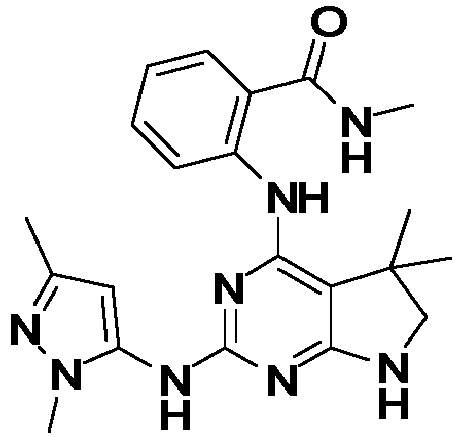
- 1H NMR(400 MHz, CDCl3) δ ppm 10.09 (s, 1H), 8.37 (d, 1H, J = 8.8 Hz), 7.36 (dd, 1H, J = 8.0 Hz, 1.6 Hz), 7.30 (t, 1H, J = 8.0 Hz), 6.91 (t, 1H, J = 7.2 Hz), 6.53 (brs, 1H), 6.11-6.14 (brs, 1H), 6.01 (s, 1H), 4.63 (s, 1H), 3.66 (s, 3H), 3.56 (s, 2H), 2.99 (d, 3H, J = 4.8 Hz), 2.25 (s, 3H), 1.52(s, 6H).
-

- 1H NMR (400 MHz, DMSO-d 6) δ ppm 10.35 (s, 1H), 8.64 (d, J = 4.6 Hz, 1H), 8.48 (d, J = 8.4 Hz, 1H), 8.07 (d, J = 8.8 Hz, 1H), 7.60 (d, J = 7.7 Hz, 1H), 7.46 (s, 1H), 7.33 (t, J = 7.9 Hz, 1H), 7.01 (d, J = 8.8 Hz, 1H), 6.94 (t, J = 7.5 Hz, 1H), 6.76 (s, 1H), 3.70 (s, 3H), 3.23 (s, 2H), 2.78 (d, J = 4.4 Hz, 3H), 2.12 (s, 3H), 1.98 (s, 1H), 1.44 (s, 6H), 0.99 (t, J = 7.1 Hz, 3H).
-

- 1H NMR (400 MHz, CDCl3) δ ppm 10.04 (s, 1H), 8.53 (d, J = 8.9 Hz, 1H), 7.88 (s, 1H), 7.43 - 7.30 (m, 2H), 7.09-7.12 (m, 3H), 6.97 (d, J = 7.4 Hz, 1H), 6.57 (s, 1H), 6.12 (s, 1H), 4.20 (t, J = 6.6 Hz, 2H), 3.73 (s, 4H), 3.40 (s, 2H), 2.99 (s, J = 4.6 Hz, 3H), 2.41 (m, 4H), 2.28 (s, 2H), 2.01 (m, J = 6.3 Hz, 2H), 1.55 (s, 6H).
-

- 1H NMR (400 MHz, CDCl3) δ ppm 8.11 (dd, J = 8.5, 5.3 Hz, 2H), 7.87 (dd, J = 8.0, 1.4 Hz, 1H), 7.52 (t, J = 7.8 Hz, 1H), 7.42 (s, 1H), 7.20 - 7.08 (m, 2H), 6.55 - 6.44 (m, 1H), 6.29 (dd, J = 8.8, 2.4 Hz, 1H), 4.76 (brs, 2H), 3.96 - 3.77 (m, 7H), 3.56 (s, 2H), 3.17 - 3.00 (m, 4H), 2.59 (d, J = 5.0 Hz, 3H), 1.52 (t, J = 6.1 Hz, 2H), 0.84 (t, J = 6.1 Hz, 2H).
-

- 1H NMR (400 MHz, CDCl3) δ ppm 8.03 (d, J = 8.9 Hz, 1H), 7.88 (dd, J = 19.7, 8.1 Hz, 2H), 7.43 (t, J = 7.8 Hz, 1H), 7.09 (dd, J = 15.0, 7.0 Hz, 3H), 6.41 (d, J = 2.4 Hz, 1H), 6.14 (dd, J = 8.9, 2.4 Hz, 1H), 4.60 (s, 1H), 4.34 (s, 1H), 3.87 - 3.71 (m, 7H), 3.52 (s, 2H), 3.13 - 2.86 (m, 5H), 1.60 - 1.30 (m, 3H), 1.04 (s, 9H), 0.79 (t, J = 6.1 Hz, 2H).
-

- 1H NMR (400 MHz, CDCl3) δ ppm 8.07 (t, J = 9.1 Hz, 2H), 7.86 (d, J = 8.2 Hz, 1H), 7.53 - 7.46 (m, 1H), 7.33 (s, 1H), 7.17 - 7.09 (m, 2H), 6.48 (d, J = 2.4 Hz, 1H), 6.25 (d, J = 11.5 Hz, 1H), 4.64 (s, 1H), 4.44 (s, 1H), 3.90 - 3.80 (m, 7H), 3.58 (s, 2H), 3.11 - 3.00 (m, 4H), 2.67 (t, J = 6.6 Hz, 2H), 1.52 (d, J = 6.2 Hz, 2H), 0.86 (d, J = 6.2 Hz, 2H), 0.71 (d, J = 6.7 Hz, 6H).
-

- 1H NMR (400 MHz, CDCl3) δ ppm 8.12 (d, J = 8.8 Hz, 1H), 8.04 (d, J = 8.3 Hz, 1H), 7.92 (d, J = 6.9 Hz, 1H), 7.52 (t, J = 7.9 Hz, 1H), 7.16 (dd, J = 16.4, 9.0 Hz, 2H), 6.50 (d, J = 2.3 Hz, 1H), 6.24 (d, J = 8.9 Hz, 1H), 4.68 (s, 1H), 4.33 (d, J = 7.9 Hz, 1H), 3.88 (d, J = 8.6 Hz, 7H), 3.60 (s, 2H), 3.37 (dd, J = 13.8, 6.7 Hz, 1H), 3.14 - 3.01 (m, 4H), 1.53 (t, J = 6.2 Hz, 2H), 0.93 (d, 6H), 0.84-0.87 (m, 2H).
-

- 1H NMR (400 MHz, CDCl3) δ ppm 8.09 (dd, J = 8.5, 4.1 Hz, 1H), 7.87 (d, J = 6.9 Hz, 1H), 7.50 (t, J = 7.4 Hz, 1H), 7.35 (s, 1H), 7.20 - 7.08 (m, 2H), 6.48 (d, J = 2.3 Hz, 1H), 6.26 (d, J = 8.8 Hz, 1H), 4.69 (s, 1H), 4.51 (t, J = 5.8 Hz, 1H), 3.94 - 3.76 (m, 7H), 3.57 (s, 2H), 3.18 - 2.98 (m, 4H), 2.98 - 2.87 (m, 2H), 1.51 (d, J = 6.0 Hz, 2H), 0.97 (t, J = 7.2 Hz, 3H), 0.90 - 0.77 (m, 2H).
-

- 1H NMR (400 MHz, CDCl3) δ ppm 8.05 (d, J = 9.1 Hz, 2H), 7.90 (d, J = 8.0 Hz, 1H), 7.53 (t, J = 7.7 Hz, 1H), 7.21 - 7.02 (m, 2H), 6.50 (d, J = 2.3 Hz, 1H), 6.24 (d, J = 8.9 Hz, 1H), 4.66 (s, 1H), 4.56 (s, 1H), 3.99 - 3.79 (m, 7H), 3.61 (s, 2H), 3.19 - 2.95 (m, 4H), 2.84 - 2.59 (m, 2H), 1.55 (dd, J = 12.9, 6.6 Hz, 2H), 0.88 (t, J = 6.1 Hz, 1H), 0.74 (m, 2H), 0.34 - 0.13 (m, 2H).
-

- 1H NMR (400 MHz, CDCl3) δ ppm 8.25 - 8.02 (m, 2H), 7.86 (dd, J = 8.0, 1.4 Hz, 1H), 7.56 - 7.46 (m, 1H), 7.41 (s, 1H), 7.16 (s, 1H), 7.10 (dd, J = 11.2, 4.0 Hz, 1H), 6.49 (d, J = 2.5 Hz, 1H), 6.29 (dd, J = 8.8, 2.5 Hz, 1H), 5.12 (s, 1H), 4.69 (s, 1H), 3.94 - 3.77 (m, 7H), 3.55 (s, 2H), 3.25 (t, J = 5.1 Hz, 2H), 3.16 - 3.01 (m, 9H), 1.51 (t, J = 6.1 Hz, 2H), 0.82 (t, J = 6.2 Hz, 2H).
-

- 1H NMR (400 MHz, CDCl3) δ ppm 8.08 (d, J = 8.2 Hz, 1H), 7.69 (d, J = 7.6 Hz, 1H), 7.26 (s, 9H), 6.77 (s, 1H), 6.70 (d, J = 8.3 Hz, 1H), 6.52 (m, 2H), 5.65 (brs, 1H), 4.79 (s, 2H), 4.58 (s, 1H), 4.25 (s, 2H), 3.87 (s, 7H), 3.52 (d, J = 18.3 Hz, 4H), 3.21 (s, 2H), 3.11 (s, 4H), 1.21 (s, 2H), 0.67 (s, 2H).
-

- 1H NMR (400 MHz, CDCl3) δ ppm 8.12 (t, J = 25.8 Hz, 1H), 7.89 (d, J = 8.3 Hz, 1H), 7.59 (t, J = 22.1 Hz, 1H), 7.44 (t, J = 7.8 Hz, 1H), 7.18 (m, 2H), 6.99 (t, J = 5.8 Hz, 6H), 6.50 (d, J = 2.4 Hz, 1H), 6.26 - 6.08 (m, 1H), 4.66 (s, 1H), 3.87 (d, J = 7.1 Hz, 7H), 3.58 (s, 2H), 3.24 - 2.96 (m, 4H), 1.51 (t, J = 6.2 Hz, 2H), 0.86 (t, J = 6.1 Hz, 2H).
-

- 1H NMR (400 MHz, CDCl3) δ ppm 8.10 (dd, J = 14.2, 8.6 Hz, 2H), 7.88 (d, J = 7.9 Hz, 1H), 7.52 (t, J = 7.2 Hz, 1H), 7.33 (s, 1H), 7.15 (dd, J = 15.0, 7.3 Hz, 2H), 6.50 (d, J = 2.4 Hz, 1H), 6.28 (dd, J = 8.9, 2.4 Hz, 1H), 5.74 - 5.39 (m, 1H), 4.99 (dd, J = 34.0, 13.6 Hz, 2H), 4.68 - 4.52 (m, 2H), 4.02 - 3.77 (m, 7H), 3.55 (dd, J = 16.6, 10.6 Hz, 4H), 3.25 - 2.93 (m, 4H), 1.52 (t, J = 6.1 Hz, 2H), 0.86 (t, J = 6.1 Hz, 2H).
-
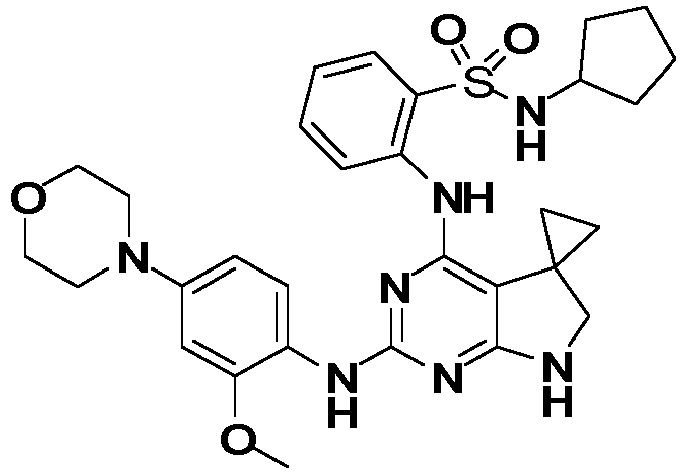
- 1H NMR (400 MHz, CDCl3) δ ppm 8.19 (d, J = 8.8 Hz, 1H), 8.10 (d, J = 8.2 Hz, 1H), 8.00 (d, J = 8.0 Hz, 1H), 7.61 (t, J = 7.3 Hz, 1H), 7.36 (d, J = 7.9 Hz, 8H), 7.16 (dd, J = 14.6, 6.8 Hz, 2H), 6.59 (d, J = 2.2 Hz, 1H), 6.32 (d, J = 8.8 Hz, 1H), 4.80 (s, 1H), 4.51 (d, J = 7.8 Hz, 1H), 3.97 (d, J = 8.6 Hz, 7H), 3.70 (s, 2H), 3.83 - 3.53 (m, 1H), 3.26 - 3.07 (m, 4H), 1.62 (m, 10H),), 0.87 (t, J = 6.2 Hz, 2H).
-

- 1H NMR (400 MHz, CDCl3) δ ppm 8.11 (s, 1H), 7.85 (s, 1H), 7.60 (d, J = 7.5 Hz, 1H), 7.16 (s, 1H), 6.77 (d, J = 7.5 Hz, 1H), 6.54 - 6.36 (m, 2H), 6.18 (s, 1H), 4.96-4.80(m, 2H), 3.87 (d, J = 10.6 Hz, 7H), 3.56 (d, J = 13.8 Hz, 2H), 3.05 (s, 4H), 2.48 (d, J = 22.6 Hz, 2H), 2.20 (d, J = 20.0 Hz, 2H), 1.29 (d, J = 26.4 Hz, 5H), 0.89 (s, 4H).
-

- 1H NMR (400 MHz, CDCl3) δ ppm 8.11 (d, J = 8.8 Hz, 1H), 8.02 (d, J = 8.3 Hz, 1H), 7.88 (dd, J = 8.0, 1.4 Hz, 1H), 7.47 (t, J = 7.8 Hz, 1H), 7.34 (s, 1H), 7.17 (s, 1H), 7.11 (t, J = 7.6 Hz, 1H), 6.47 (d, J = 2.5 Hz, 1H), 6.20 (dd, J = 8.9, 2.5 Hz, 1H), 4.64 (s, 1H), 4.31 (d, J = 8.2 Hz, 1H), 3.91 - 3.79 (m, 7H), 3.57 (s, 2H), 3.18 - 2.95 (m, 5H), 1.62 (s, 1H), 1.50 (t, J = 6.1 Hz, 2H), 0.93 (d, J = 6.6 Hz, 3H), 0.83 (d, J = 6.1 Hz, 2H), 0.65 (t, J = 7.4 Hz, 3H).
-

- 1H NMR (400 MHz, CDCl3) δ ppm 8.08 (t, J = 9.0 Hz, 2H), 7.87 (d, J = 7.9 Hz, 1H), 7.51 (t, J = 7.2 Hz, 1H), 7.33 (s, 1H), 7.20 - 7.10 (m, 2H), 6.48 (d, J = 2.4 Hz, 1H), 6.26 (d, J = 8.9 Hz, 1H), 4.64 (s, 1H), 4.44 (t, J = 6.0 Hz, 1H), 3.93 - 3.79 (m, 7H), 3.58 (s, 2H), 3.13 - 3.01 (m, 4H), 2.84 (dd, J = 13.6, 6.8 Hz, 2H), 1.52 (t, J = 6.1 Hz, 2H), 1.33 (dd, J = 14.5, 7.2 Hz, 3H), 0.86 (dd, J = 11.9, 6.0 Hz, 2H), 0.70 (t, J = 7.4 Hz, 3H).
-

- 1H NMR (400 MHz, CDCl3) δ ppm 8.09 (d, J = 8.8 Hz, 1H), 7.99 (d, J = 8.3 Hz, 1H), 7.91 (dd, J = 7.9, 1.4 Hz, 1H), 7.51 (t, J = 7.8 Hz, 1H), 7.17 (dd, J = 13.8, 5.8 Hz, 2H), 6.49 (d, J = 2.4 Hz, 1H), 6.21 (dd, J = 8.9, 2.4 Hz, 1H), 4.69 (s, 1H), 4.44 (d, J = 7.9 Hz, 1H), 3.94 - 3.77 (m, 7H), 3.60 (s, 2H), 3.13 - 2.98 (m, 5H), 1.64 (d, J = 8.6 Hz, 3H), 1.53 (t, J = 6.1 Hz, 2H), 1.45 (s, 2H), 1.36 - 1.22 (m, 7H), 1.12 - 0.94 (m, 5H), 0.88 (dd, J = 11.2, 5.1 Hz, 3H).
-

- 1H NMR (400 MHz, CDCl3) δ ppm 8.11 (d, J = 8.8 Hz, 1H), 8.03 (d, J = 8.3 Hz, 1H), 7.86 (d, J = 7.8 Hz, 1H), 7.49 (t, J = 7.7 Hz, 1H), 7.31 (s, 1H), 7.18 (s, 1H), 7.11 (t, J = 7.6 Hz, 1H), 6.48 (d, J = 2.2 Hz, 1H), 6.28 - 6.15 (m, 1H), 4.80 (d, J = 9.4 Hz, 1H), 4.74 (s, 1H), 3.93 - 3.78 (m, 7H), 3.78 - 3.64 (m, 1H), 3.58 (s, 2H), 3.10 - 2.96 (m, 4H), 2.12 - 1.86 (m, 4H), 1.74 - 1.59 (m, 3H), 1.51 (t, J = 6.1 Hz, 2H), 1.48 - 1.36 (m, 2H), 1.26 (t, J = 7.0 Hz, 6H), 0.92 - 0.78 (m, 3H).
-

- 1H NMR (400 MHz, CDCl3) δ ppm 8.16 (dd, J = 11.7, 8.8 Hz, 2H), 7.83 (s, 1H), 7.75 (d, J = 7.4 Hz, 1H), 7.51 (dd, J = 18.2, 9.9 Hz, 2H), 7.19 (s, 1H), 7.11 (t, J = 7.6 Hz, 1H), 6.51 (d, J = 2.3 Hz, 1H), 6.32 (d, J = 8.9 Hz, 1H), 4.67 (s, 1H), 3.87 (d, J = 8.9 Hz, 7H), 3.58 (s, 2H), 3.14 - 3.02 (m, 4H), 2.70 (s, 6H), 1.58 (t, J = 6.0 Hz, 2H), 0.84 (s, 2H).
-

- 1H NMR (400 MHz, CDCl3) δ ppm 9.39 (s, 1H), 8.34 (s, 1H), 8.25 (d, J = 8.8 Hz, 1H), 7.38 (d, J = 7.8 Hz, 2H), 7.12 (s, 1H), 6.94 (t, J = 7.5 Hz, 1H), 6.51 (d, J = 2.5 Hz, 1H), 6.40 (dd, J = 8.8, 2.5 Hz, 1H), 6.11 (s, 1H), 3.90 - 3.83 (m, 7H), 3.57 (s, 2H), 3.11 - 3.07 (m, 4H), 2.99 (d, J = 4.9 Hz, 3H), 1.75 (t, J = 6.0 Hz, 2H), 0.83 (t, J = 6.1 Hz, 2H).
-

- 1H NMR (400 MHz, CDCl3) δ ppm 8.07 (d, J = 8.8 Hz, 1H), 7.69 - 7.45 (m, 1H), 7.14 - 6.93 (m, 2H), 6.87 (s, 1H), 6.54 - 6.31 (m, 2H), 5.35 (s, 1H), 4.55 (s, 1H), 3.87 (dd, J = 10.3, 5.7 Hz, 7H), 3.56 (s, 2H), 3.21 - 2.91 (m, 4H), 1.31 (m,2H), 0.89 (m, 2H).
-

- 1H NMR (400 MHz, CDCl3) δ ppm 8.17 (d, J = 8.7 Hz, 1H), 7.98 (d, J = 8.3 Hz, 1H), 7.46 (dd, J = 21.9, 14.2 Hz, 1H), 7.02 (d, J = 20.3 Hz, 1H), 6.72 (d, J = 7.3 Hz, 1H), 6.58 - 6.35 (m, 2H), 6.17 (s, 1H), 4.60 (s, 1H), 3.87 (dd, J = 8.6, 3.6 Hz, 7H), 3.67 (s, 2H), 3.34 - 2.98 (m, 4H), 2.40 (s, 3H), 1.57 - 1.41 (m, 2H), 0.87 (t, J = 6.2 Hz, 2H).
-

- 1H NMR (400 MHz, CDCl3) δ ppm 8.41 (s, 1H), 7.86 (d, J = 8.8 Hz, 1H), 7.48 (s, 1H), 7.36 (d, J = 4.9 Hz, 1H), 7.23 - 7.14 (m, 2H), 7.05 (s, 1H), 6.44 (d, J = 15.2 Hz, 1H), 6.26 (d, J = 9.0 Hz, 1H), 5.84 (s, 1H), 4.60 (s, 1H), 3.90 - 3.83 (m, 4H), 3.81 (s, 3H), 3.57 (s, 2H), 3.13 - 3.01 (m, 4H), 1.98 (s, 3H), 1.42 (s, 2H), 0.87 (d, J = 7.0 Hz, 2H).
-

- 1H NMR (400 MHz, CDCl3) δ ppm 8.11 (d, J = 8.8 Hz, 1H), 8.03 (d, J = 8.3 Hz, 1H), 7.86 (d, J = 7.8 Hz, 1H), 7.49 (t, J = 7.7 Hz, 1H), 7.31 (s, 1H), 7.18 (s, 1H), 7.11 (t, J = 7.6 Hz, 1H), 6.70)s, 1H), 6.48 (d, J = 2.2 Hz, 1H), 6.28 - 6.15 (m, 1H), 4.74 (s, 1H), 3.93 - 3.78 (m, 7H), 3.58 (s, 2H), 3.25 (s, 2H), 3.10 - 2.96 (m, 4H), 1.74 - 1.59 (m, 3H), 1.51 (t, J = 6.1 Hz, 2H), 1.26 (t, J = 7.0 Hz, 2H), 0.92 - 0.78 (m, 2H).
-

- 1H NMR (400 MHz, CDCl3) δ ppm 8.05 (d, J = 8.4 Hz, 1H), 7.83 (dd, J = 8.0, 1.4 Hz, 1H), 7.54 - 7.36 (m, 2H), 7.04 (dd, J = 19.5, 12.2 Hz, 1H), 6.79 (s, 2H), 6.74 (s, 1H), 4.80 - 4.44 (m, 2H), 3.85 - 3.74 (s, 3H), 3.62 (m, 7H), 2.58 (d, J = 4.9 Hz, 3H), 1.54 - 1.41 (m, 2H), 0.84 (t, J = 6.1 Hz, 2H).
-

- 1H NMR (400 MHz, DMSO-d 6) δ ppm 10.66 (s, 1H), 8.62 (dd, J = 22.0, 17.5 Hz, 3H), 7.82 - 7.18 (m, 4H), 6.94 - 6.68 (m, 3H), 6.59 (s, 1H), 3.72 (s, 4H), 3.49 (dd, J = 23.3, 14.7 Hz, 2H), 3.00 (s, 4H), 2.82 - 2.56 (m, 5H).
-

- 1H NMR (400 MHz, DMSO-d 6) δ ppm 10.67 (d, J = 34.1 Hz, 1H), 8.63 (d, J = 4.5 Hz, 1H), 8.52 (d, J = 8.4 Hz, 1H), 8.22 (dd, J = 7.8, 1.6 Hz, 1H), 7.65 (d, J = 6.8 Hz, 1H), 7.35 (dd, J = 18.9, 11.7 Hz, 2H), 7.05 - 6.77 (m, 4H), 6.71 (s, 1H), 4.01 - 3.72 (m, 3H), 3.68 - 3.40 (m, 2H), 2.89 - 2.59 (m, 5H).
-

- 1H NMR (400 MHz, DMSO-d 6) δ ppm 11.54 - 10.76 (m, 1H), 8.69 (d, J = 8.2 Hz, 1H), 7.91 (d, J = 8.0 Hz, 1H), 7.80 (d, J = 8.7 Hz, 1H), 7.32 (d, J = 7.4 Hz, 1H), 7.19 (s, 1H), 6.85 (s, 2H), 6.61 (d, 2H), 6.46 (d, J = 8.8 Hz, 1H), 3.79 (s, 3H), 3.76 - 3.62 (m, 6H), 3.58 - 3.45 (m, 2H), 3.13 - 2.97 (m, 4H), 2.81 (t, 2H).
-

- 1H NMR (400 MHz, DMSO-d 6) δ ppm 10.31 (s, 1H), 9.93 (s, 1H), 8.70 (d, J = 8.6 Hz, 1H), 7.78 (d, J = 7.7 Hz, 1H), 7.68 (d, J = 8.7 Hz, 1H), 7.46 (d, J = 8.5 Hz, 1H), 7.32 (s, 1H), 7.05 (t, J = 7.1 Hz, 1H), 6.76 (s, 1H), 6.62 (d, J = 2.5 Hz, 1H), 6.46 (dd, J = 8.7, 2.5 Hz, 1H), 3.85 - 3.66 (m, 7H), 3.53 (dd, J = 18.5, 10.1 Hz, 2H), 3.15 - 3.02 (m, 4H), 2.86 (t, J = 8.4 Hz, 2H).
-

- 1H NMR (400 MHz, CDCl3) δ ppm 8.26 (d, J = 8.8 Hz, 1H), 7.94 (d, J = 8.2 Hz, 1H), 7.36 (d, J = 8.3 Hz, 2H), 7.31 - 7.25 (m, 1H), 7.21 (s, 1H), 7.10 (s, 1H), 6.54 (d, J = 2.6 Hz, 1H), 6.47 (d, J = 8.8 Hz, 1H), 4.79 (s, 2H), 4.55 (s, 1H), 3.90 (dd, J = 9.7, 4.8 Hz, 7H), 3.66 (t, J = 8.5 Hz, 2H), 3.19 - 3.06 (m, 1H), 2.83 (t, J = 8.4 Hz, 2H).
-

- 1H NMR (400 MHz, CDCl3) δ ppm 10.08 (s, 1H), 8.26 (dd, J = 8.0 Hz, 4.4 Hz, 1H), 8.22 (d, J = 8.8 Hz, 1H), 7.43 (t, J = 8.4 Hz, 1H), 8.26 (ddd, J = 14.4 Hz, 8.0 Hz, 1.6 Hz, 1H), 7.06 (s, 1H), 6.97 (t, J = 8.8 Hz, 1H), 6.54 (d, J = 2.8 Hz, 1H), 6.50 (dd, J = 8.8 Hz,2.4 Hz, 1H), 4.43 (s, 1H), 3.85 (s, 3H), 3.61-3.65 (m, 4H), 3.01 (t, J = 8.0 Hz, 2H), 2.64-2.71 (m, 6H), 2.41-2.58 (m, 4H), 2.34-2.40 (m, 1H),2.31 (s,3H), 1.94 (d, J = 13.2 Hz, 2H), 1.81 (d, J = 13.2 Hz, 6H), 1.70-1.74 (m, 2H).
- GST-tagged FAK was purchased from Invitrogen (PV3832). GST-tagged PYK2 was purchased from Invitrogen (PV4567). The activity of FAK/PYK2 was measured by monitoring the phosphorylation of a fluorophore labeled ULight-poly Glu, Ala, Tyr (1:1:1) peptide substrate from Perkin Elmer (TRF0101) in the presence of ATP. The phosphorylated tyrosine residue was recognized by a LANCE Europium chelate labeled anti-phosphotyrosine (PY20) antibody from Perkin Elmer (AD0066). This brought the fluorophore and europium chelate in close proximity (>10nm) that upon excitation at 320nm by an Envision (PerkinElmer), energy can be transferred from the donor Europium chelate to the acceptor fluorophore. This results in the emission of light at 665nm and can be captured by Envision. The strength of the signal was, therefore, directly proportional to the FAK/PYK2 activity.
- To measure inhibitory activity of FAK/PYK2 inhibitors, compounds were first prepare as a 1mM stock in 100% DMSO and 3-fold serial dilution was performed in a 96-well plate (Corning, 3897) to generate 12 different concentration of 100X stock. A 5µl of 100X stock of each concentration was added to wells containing 95µl of 1X reaction buffer (40mM Tris, pH7.5, 10mM MgCl2, 1mM DTT and 1mM CHAPS) to generate 5X stock. Then 2µl of 5X stock of each concentration was added to a 384 wells-OptiPlate (PerkinElmer, 6007299).
- For FAK, 4µl of 2.5nM FAK, 1ul of 8µg/µl BSA and 1.5µl of 666nM ULight-poly Glu, Ala, Tyr (1:1:1) peptide substrate, prepared in above reaction buffer, were added to each well. The reaction was initiated by adding 1.5µl of 33.3µM ATP. The reaction was allowed to proceed for 120 min before being quenched with 5µl of 40mM EDTA stop buffer prepared in 1X LANCE detection buffer (PerkinElmer, CR97-100).
- For PYK2, 5µl of 2nM PYK2 and 1.5µl of 666nM ULight-poly Glu, Ala, Tyr (1:1:1) peptide substrate, prepared in above reaction buffer, were added to each well. The reaction was initiated by adding 1.5µl of 46.6µM ATP. The reaction was allowed to proceed for 40 min before being quenched with 5µl of 40mM EDTA stop buffer prepared in 1X LANCE detection buffer (PerkinElmer, CR97-100).
- Upon quenching of the reaction, 5µl of 8nM anti-phosphotyrosine antibody was added to each well and incubated for 60 minutes. The plate was measured using an Envision (PerkinElmer) based on the theory mentioned above.
TABLE 1. Biological Activities of Selected Pyrrolo[2,3-d]pyrimidines of Formula (I) Ex # Structure Name MS [M+H]+ FAK IC50 (nM) PYK2 IC50 (nM) 1 
2-(2-(2-methoxy-4-morpholinophenylamino)-6,7-dihydro-5H-pyrrolo[2,3-d]pyrimidin-4-ylamino)-N-methylbenzamide 476 <100 <100 2 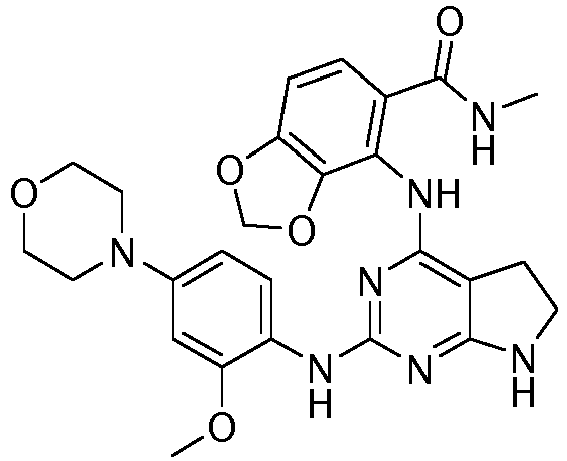
4-(2-(2-methoxy-4-morpholinophenylamino)-6,7-dihydro-5H-pyrrolo[2,3-d]pyrimidin-4-ylamino)-N-methylbenzo[d][1,3]dioxole-5-carboxamide 520 >1000 >1000 3 
(2-(2-(2-methoxy-4-morpholinophenylamino)-6,7-dihydro-5H-pyrrolo[2,3-d]pyrimidin-4-ylamino)phenyl)(pyrrolidin-1-yl)methanone 516 >1000 >1000 4 
2-(2-(2-methoxy-4-morpholinophenylamino)-6,7-dihydro-5H-pyrrolo[2,3-d]pyrimidin-4-ylamino)-N-methylbenzenesulfonamide 512 <20 <50 5 
2-(2-(2-methoxy-4-morpholinophenylamino)-6,7-dihydro-5H-pyrrolo[2,3-d]pyrimidin-4-ylamino)-N-propylbenzenesulfonamide 540 <20 <20 6 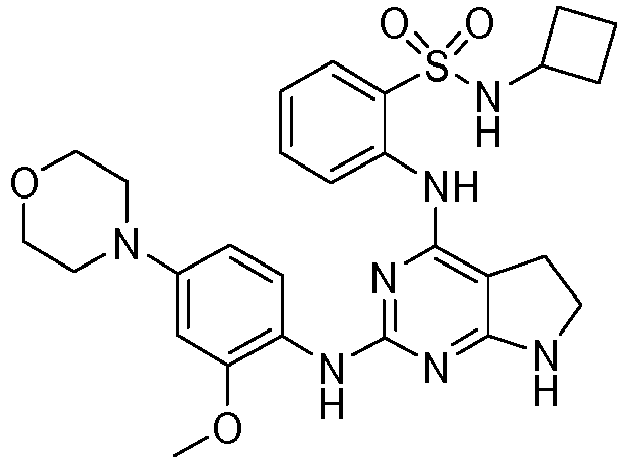
N-cyclobutyl-2-(2-(2-methoxy-4-morpholinophe nylamino)-6,7-dihydro-5H-pyrrolo[2,3-d]pyrimidin-4-ylamino)benzenesulfonamide 552 <20 <20 7 
N-cyclopentyl-2-(2-(2-methoxy-4-morpholinophenylamino)-6,7-dihydro-5H-pyrrolo[2,3-d]pyrimidin-4-ylamino)benzene sulfonamide 566 <50 <100 8 
N-cyclohexyl-2-(2-(2-methoxy-4-morpholinophenylamino)-6,7-dihydro-5H-pyrrolo[2,3-d]pyrimidin-4-ylamino)benzenesulfonamide 580 <200 <500 9 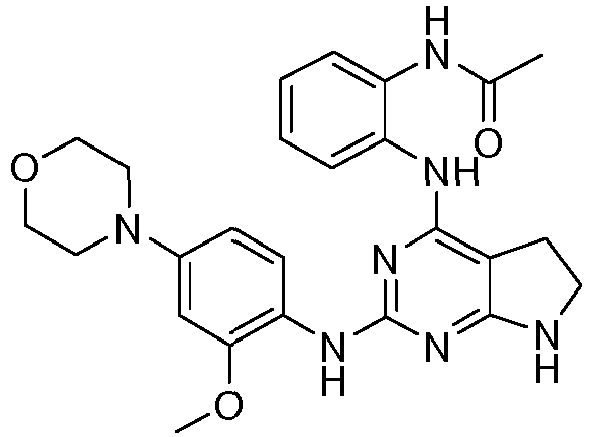
N-(2-(2-(2-methoxy-4-morpholinophenylamino)-6,7-dihydro-5H-pyrrolo[2,3-d]pyrimidin-4-ylamino)phenyl)acetamide 476 <1000 <1000 10 
N-(2-(2-(2-methoxy-4-morpholinophenylamino)-6,7-dihydro-5H-pyrrolo[2,3-d]pyrimidin-4-ylamino)phenyl)-N-methylmethanesulfonamide 526 <100 <50 11 
N-(2-((2-(2-methoxy-4-morpholinophenylamino)-6,7-dihydro-5H-pyrrolo[2,3-d]pyrimidin-4-ylamino)methyl)phenyl)-N-methylmethanesulfonamide 540 <100 >2000 12 
N 2-(2-methoxy-4-morpholinophenyl)-N 4-(6-methylpyridin-2-yl)-6,7-dihydro-5H-pyrrolo[2,3-d]pyrimidine-2,4-diamine 434 <100 <100 13 
N 4-(3,4-difluorophenyl)-N 2-(2-methoxy-4-morpholinophenyl)-6,7-dihydro-5H-pyrrolo[2,3-d]pyrimidine-2,4-diamine 454 >1000 <1000 14 
2-(2-(2-(hydroxymethyl)-4-morpholinophenylamino)-6,7-dihydro-5H-pyrrolo[2,3-d]pyrimidin-4-ylamino)-N-methylbenzamide 476 >1000 >1000 15 
2-(2-(2,3-dihydrobenzo[b][1,4]dioxin-5-ylamino)-6,7-dihydro-5H-pyrrolo[2,3-d]pyrimidin-4-ylamino)-N-methylbenzamide 419 <500 <500 16 
N-methyl-2-(2-(8-morpholino-2,3-dihydrobenzo[b][1,4]dioxin-5-ylamino)-6,7-dihydro-5H-pyrrolo[2,3-d]pyrimidin-4-ylamino)benzamide 504 <500 <200 17 
2-(2-(1-ethyl-6-methoxy-2-oxo-2,3,4,5-tetrahydro-1H-benzo[b]azepin-7-ylamino)-6,7-dihydro-5H-pyrrolo[2,3-d]pyrimidin-4-ylamino)-N-methylbenzamide 502 <1000 <200 19 
2-(2-(benzofuran-7-ylamino)-6,7-dihydro-5H-pyrrolo[2,3-d]pyrimidin-4-ylamino)-N-methylbenzamide 401 <200 <100 20 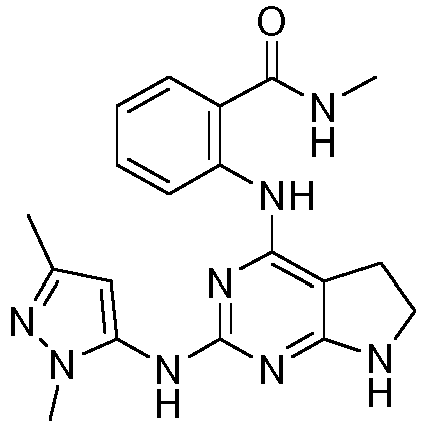
2-(2-(1,3-dimethyl-1H-pyrazol-5-ylamino)-6,7-dihydro-5H-pyrrolo[2,3-d]pyrimidin-4-ylamino)-N-methylbenzamide 379 <1000 <500 21 
N-methyl-2-(2-(3,4,5-trimethoxyphenylamino)-6,7-dihydro-5H-pyrrolo[2,3-d]pyrimidin-4-ylamino)benzamide 451 <1000 <300 22 
N-methyl-2-(2-(1-(3-morpholinopropyl)-1H-indol-4-ylamino)-6,7-dihydro-5H-pyrrolo[2,3-d]pyrimidin-4-ylamino)benzamide 527 <100 <200 23 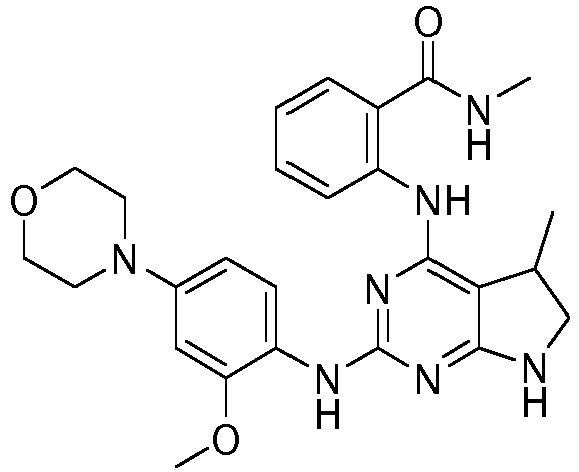
(±)-2-(2-(2-methoxy-4-morpholinophenylamino)-5-methyl-6,7-dihydro-5H-pyrrolo[2,3-d]pyrimi din-4-ylamino)-N-methylbenzamide 490 <50 <50 24 
(±)-(2-(2-(2-methoxy-4-morpholinophenylamino)-5-methyl-6,7-dihydro-5H-pyrrolo[2,3-d]pyrimidin-4-ylamino)phenyl)(pyrrolidin-1-yl)methanone 530 <200 <500 25 
(±)-2-(2-(2-methoxy-4-morpholinophenylamino)-5-methyl-6,7-dihydro-5H-pyrrolo[2,3-d]pyrimidin-4-ylamino)-N-methyIbenzenesulfonamide 526 <50 <20 26 
(±)-2-(2-(2-methoxy-4-morpholinophenylamino)-5-methyl-6,7-dihydro -5H-pyrrolo[2,3-d]pyrimi din-4-ylamino)-N-propylbenzenesulfonamide 554 <20 <20 27 
(±)-N-cyclobutyl-2-(2-(2 -methoxy-4-morpholino phenylamino)-5-methyl-6,7-dihydro-5H-pyrrolo[ 2,3-d]pyrimidin-4-ylamino)benzenesulfonamide 566 <20 <20 28 
(±)-N-cyclopentyl-2-(2-(2-methoxy-4-morpholinophenylamino)-5-methyl-6,7-dihydro-5H-pyrrolo[2,3-d]pyrimidin-4-ylamino)benzenesulfonamide 580 <300 <50 29 
(±)-N-cyclohexyl-2-(2-(2-methoxy-4-morpholinophenylamino)-5-methyl-6,7-dihydro-5H-pyrrolo[2,3-d]pyrimidin-4-ylamino)benzenesulfonamide 594 <50 <500 30 
(±)-N-(2-(2-(2-methoxy-4-morpholinophenylamino)-5-methyl-6,7-dihydro-5H-pyrrolo[2,3-d]pyrimidin-4-ylamino)phenyl)acetamide 490 <200 <200 31 
(±)-N-(2-(2-(2-methoxy-4-morpholinophenylamino)-5-methyl-6,7-dihydro-5H-pyrrolo[2,3-d]pyrimidin-4-ylamino)phenyl)-N-methylmethanesulfonamide 540 <30 <20 32 
N-(2-((2-(2-methoxy-4-morpholinophenylamino)-5-methyl-6,7-dihydro-5H-pyrrolo[2,3-d]pyrimidin-4-ylamino)methyl)phenyl)-N-methylmethanesulfonamide 554 <20 >1000 33 
(±)-N 2-(2-methoxy-4-morpholinophenyl)-5-methyl-N 4-(6-methylpyridin-2-yl)-6,7-dihydro-5H-pyrrolo[2,3-d]pyrimidine-2,4-diamine 448 <500 <1000 34 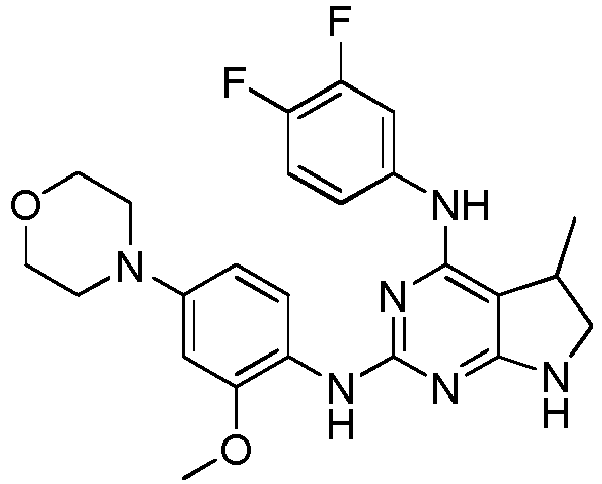
N 4-(3,4-difluorophenyl)-N2-(2-methoxy-4-morpholinophenyl)-5-methyl-6,7-dihydro-5H-pyrrolo[2,3-d]pyrimidine-2,4-diamine 469 >1000 <1000 35 
(S)-2-(2-(2-methoxy-4-morpholinophenylamino)-5-methyl-6,7-dihydro-5H-pyrrolo[2,3-d]pyrimidin-4-ylamino)-N-methylbenzamide 490 <20 <20 36 
(S)-N-cyclobutyl-2-(2-(2-methoxy-4-morpholinophenylamino)-5-methyl-6,7-dihydro-5H-pyrrolo[2,3-d]pyrimidin-4-ylamino)benzenesulfonamide 566 <20 <20 37 
2-(2-(2-methoxy-4-morpholinophenylamino)-5,5 -dimethyl-6,7-dihydro-5 H-pyrrolo[2,3-d]pyrimidin-4-ylamino)-N-methylbenzamide 504 <20 <20 38 
2-(2-(2-methoxy-4-morpholinophenylamino)-6,7-dihydro-5H-pyrrolo[2,3-d]pyrimidin-4-ylamino)-N,N-dimethylbenzenesulfonamide 526 <50 <200 39 
N-butyl-2-(2-(2-methoxy-4-morpholinophenylamino)-6,7-dihydro-5H-pyrrolo[2,3-d]pyrimidin-4-ylamino)benzenesulfonamide 554 <50 <100 40 
N-isopropyl-2-(2-(2-methoxy-4-morpholinophenylamino)-6,7-dihydro-5 H-pyrrolo[2,3-d]pyrimidin-4-ylamino)benzenesulfonamide 540 <20 <20 41 
2-(2-(2-methoxy-4-morpholinophenylamino)-6,7-dihydro-5H-pyrrolo[2,3-d]pyrimidin-4-ylamino)benzenesulfonamide 498 <50 <200 42 
N-cyclopropyl-2-(2-(2-methoxy-4-morpholinophenylamino)-6,7-dihydro-5H-pyrrolo[2,3-d]pyrimidin-4-ylamino)benzenesulfonamide 538 <20 <50 43 
N-ethyl-2-(2-(2-methoxy-4-morpholinophenylamino)-6,7-dihydro-5H-pyrrolo[2,3-d]pyrimidin-4-ylamino)benzenesulfonamide 526 <100 <20 44 
N-sec-butyl-2-(2-(2-methoxy-4-morpholinophenylamino)-6,7-dihydro-5H-pyrrolo[2,3-d]pyrimidin-4-ylamino)benzenesulfonamide 554 <20 <20 45 
N-isobutyl-2-(2-(2-methoxy-4-morpholinophenylamino)-6,7-dihydro-5H-pyrrolo[2,3-d]pyrimidin-4-ylamino)benzenesulfonamide 554 <100 <100 46 
N-isopropyl-2-(2-(2-methoxy-4-morpholinophenylamino)-6,7-dihydro-5 H-pyrrolo[2,3-d]pyrimidin-4-ylamino)benzenesulfonamide 554 <20 <20 47 
N-tert-butyl-2-(2-(2-methoxy-4-morpholinophenylamino)-6,7-dihydro-5H-pyrrolo[2,3-d]pyrimidin-4-ylamino)benzenesulfonamide 554 <200 <100 48 
2-(2-(2-methoxy-4-morpholinophenylamino)-6,7 -dihydro-5H-pyrrolo[2,3 -d]pyrimidin-4-ylamino)-N-(3-methoxypropyl)benzenesulfonamide 570 <100 <100 49 
N-(2-(dimethylamino)ethyl)-2-(2-(2-methoxy-4-morpholinophenylamino)-6,7-dihydro-5H-pyrrolo[2,3-d]pyrimidin-4-ylamino)benzenesulfonamide 569 <500 <500 50 
2-(2-(2-methoxy-4-morpholinophenylamino)-6,7-dihydro-5H-pyrrolo[2,3-d]pyrimidin-4-ylamino)-N-(2-methoxyethyl)benzenesulfonamide 556 <50 <50 51 
2-(2-(2-methoxy-4-morpholinophenylamino)-6,7-dihydro-5H-pyrrolo[2,3-d]pyrimidin-4-ylamino)-N-phenylbenzenesulfonamide 574 <200 <500 52 
N-isopropyl-2-(2-(4-morpholinophenylamino)-6,7-dihydro-5H-pyrrolo[2,3-d]pyrimidin-4-ylamino)benzenesulfonamide 510 <20 <20 53 
4-(4-(2-(N-isopropylsulfamoyl)phenylamino)-6, 7-dihydro-5H-pyrrolo[2,3-d]pyrimidin-2-ylamino)-N-methylbenzamide 482 <20 <20 54 
2-(2-(4-(hydroxymethyl)phenylamino)-6,7-dihydro-5H-pyrrolo[2,3-d]pyrimidin-4-ylamino)-N-isopropylbenzenesulfonamide 455 <20 <20 55 
2-(2-(2-fluoro-4-morpholinophenylamino)-6,7-dihydro-5H-pyrrolo[2,3-d]pyrimidin-4-ylamino)-N-isopropylbenzenesulfonamide 528 <20 <20 56 
N-isopropyl-2-(2-(2-methoxy-6-morpholinopyridin-3-ylamino)-6,7-dihydro-5H-pyrrolo[2,3-d]pyrimidin-4-ylamino)benzenesulfonamide 541 <20 <50 57 
N-isopropyl-2-(2-(6-morpholinopyridin-3-ylamino)-6,7-dihydro-5H-pyrrolo[2,3-d]pyrimidin-4-ylamino)benzenesulfonamide 511 <20 <20 58 
N-isopropyl-2-(2-(5-mor pholinopyridin-2-ylamino)-6,7-dihydro-5H-pyrrolo[2,3-d]pyrimidin-4-ylamino)benzenesulfonamide 511 <20 <50 59 
2-(2-(2-ethoxy-4-morpholinophenylamino)-6,7-dihydro-5H-pyrrolo[2,3-d]pyrimidin-4-ylamino)-N-isopropylbenzenesulfonamide 553 <50 <100 60 
N-isopropyl-2-(2-(4-morpholino-2-(trifluoromethyl)phenylamino)-6,7-dihydro-5H-pyrrolo[2,3-d]pyrimidin-4-ylamino)benzenesulfonamide 578 <500 >1000 61 
N-isopropyl-2-(2-(4-(trifluoromethyl)phenylamino)-6,7-dihydro-5H-pyrrolo[2,3-d]pyrimidin-4-ylamino)benzenesulfonamide 493 <1000 <500 62 
4-(4-(2-(N-isopropylsulfamoyl)phenylamino)-6, 7-dihydro-5H-pyrrolo[2,3-d]pyrimidin-2-ylamino)-N,N-dimethylbenzamide 496 <20 <20 63 
N-(4-(4-(2-(N-isopropylsulfamoyl)phenylamino)-6,7-dihydro-5H-pyrrolo[2,3-d]pyrimidin-2-ylamino)phenyl)acetamide 482 <20 <20 64 
N-isopropyl-2-(2-(4-(N-methylsulfamoyl)phenyl amino)-6,7-dihydro-5H-pyrrolo[2,3-d]pyrimidin-4-ylamino)benzenesulfonamide 518 <20 <20 65 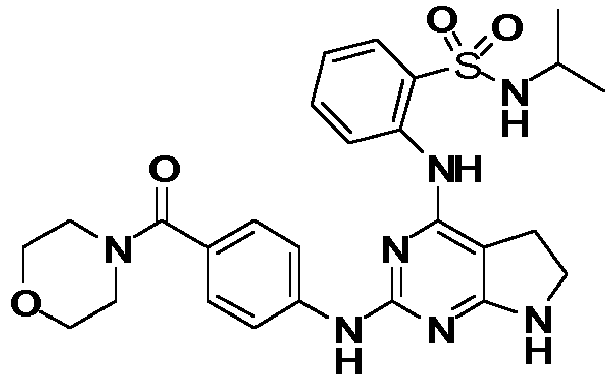
N-isopropyl-2-(2-(4-(morpholine-4-carbonyl)phe nylamino)-6,7-dihydro-5H-pyrrolo[2,3-d]pyrimidin-4-ylamino)benzenesulfonamide 538 <20 <20 66 
N-isopropyl-2-(2-(2-methyl-4-morpholinophenylamino)-6,7-dihydro-5H-pyrrolo[2,3-d]pyrimidin-4-ylamino)benzenesulfonamide 524 <20 <50 67 
N-isopropyl-2-(2-(2-methoxy-4-(pyrrolidin-1-yl)phenylamino)-6,7-dihydro-5H-pyrrolo[2,3-d]pyrimidin-4-ylamino)benzenesulfonamide 524 <50 <100 68 
N-isopropyl-2-(2-(2-methoxy-4-(piperidin-1-yl)phenylamino)-6,7-dihydro-5H-pyrrolo[2,3-d]pyrimidin-4-ylamino)benzenesulfonamide 538 <50 <200 69 
2-(2-(4-(1-hydroxyethyl)phenylamino)-6,7-dihydro-5H-pyrrolo[2,3-d]pyrimidin-4-ylamino)-N-isopropylbenzenesulfonamide 469 <20 <20 70 
N-isopropyl-2-(2-(2-methoxy-4-(2-morpholinoethoxy)phenylamino)-6,7-dihydro-5H-pyrrolo[2,3-d]pyrimidin-4-ylamino)benzenesulfonamide 584 <20 <20 71 
N-isopropyl-2-(2-(4-(trifluoromethoxy)phenylamino)-6,7-dihydro-5H-pyrrolo[2,3-d]pyrimidin-4-ylamino)benzenesulfonamide 509 <200 <100 72 
N-isopropyl-2-(2-(4-(1-(isopropylamino)ethyl)phenylamino)-6,7-dihydro-5H-pyrrolo[2,3-d]pyrimidin-4-ylamino)benzenesulfonamide 510 <20 <20 73 
N-isopropyl-2-(2-(3-(methylsulfonamido)phenylamino)-6,7-dihydro-5H-pyrrolo[2,3-d]pyrimidin-4-ylamino)benzenesulfonamide 518 <20 <20 74 
3-(4-(2-(N-isopropylsulfamoyl)phenylamino)-6,7-dihydro-5H-pyrrolo[2,3-d]pyrimidin-2-ylamino)-N-methylbenzamide 482 <20 <50 75 
N-(3-(4-(2-(N-isopropylsulfamoyl)phenylamino)-6,7-dihydro-5H-pyrrolo[2,3-d]pyrimidin-2-ylamino)phenyl)acetamide 482 <20 <20 76 
2-(2-(4-(4-(dimethylami no)piperidin-1-yl)-2-methoxyphenylamino)-6,7-dihydro-5H-pyrrolo[2,3-d]pyrimidin-4-ylamino)-N-isopropylbenzenesulf onamide 581 <20 <20 77 
2-(2-(4-(1 H-imidazol-1-yl)-2-methoxyphenylamino)-6,7-dihydro-5H-pyrrolo[2,3-d]pyrimidin-4-yl amino)-N-isopropylbenzenesulfonamide 521 <500 <500 78 
N-isopropyl-2-(2-(4-(pyrrolidine-1-carbonyl)phenylamino)-6,7-dihydro-5 H-pyrrolo[2,3-d]pyrimidin-4-ylamino)benzenesulfonamide 522 <20 <20 79 
2-(2-(4-(4-(hydroxymethyl)piperidin-1-yl)-2-methoxyphenylamino)-6,7-di hydro-5H-pyrrolo[2,3-d]pyrimidin-4-ylamino)-N-isopropylbenzenesulfonamide 568 <20 <20 80 
2-(2-(4-(3-hydroxypyrrol idin-1-yl)-2-methoxyphenylamino)-6,7-dihydro-5 H-pyrrolo[2,3-d]pyrimidin-4-ylamino)-N-isopropylbenzenesulfonamide 540 <20 <100 81 
2-(2-(4-(3-hydroxypiperidin-1-yl)-2-methoxyphenylamino)-6,7-dihydro-5 H-pyrrolo[2,3-d]pyrimidin-4-ylamino)-N-isopropylbenzenesulfonamide 554 <20 <50 82 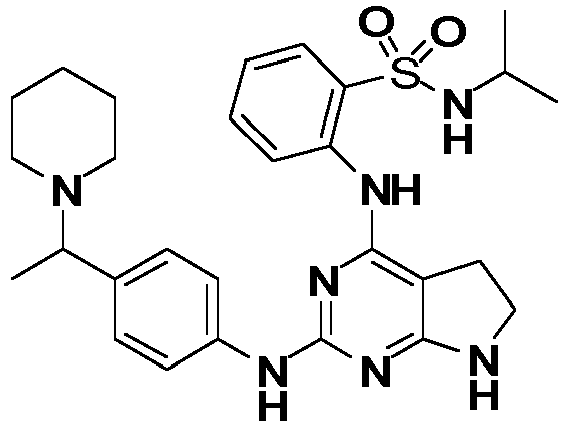
N-isopropyl-2-(2-(4-(1-(piperidin-1-yl)ethyl)phenylamino)-6,7-dihydro-5H-pyrrolo[2,3-d]pyrimidin-4-ylamino)benzenesulfonamide 566 <20 <20 83 
N-isopropyl-2-(2-(2-met hoxy-4-(2-oxopyridin-1( 2H)-yl)phenylamino)-6,7-dihydro-5H-pyrrolo[2, 3-d]pyrimidin-4-ylamino )benzenesulfonamide 548 <20 <20 84 
2-(2-(4-(3,5-dimethylmorpholino)-2-methoxyphenylamino)-6,7-dihydro-5H-pyrrolo[2,3-d]pyrimidin-4-ylamino)-N-isopropylbenzenesulfonamide 568 <50 <100 85 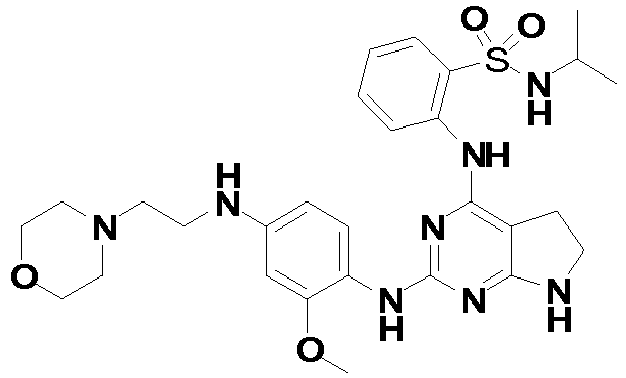
N-isopropyl-2-(2-(2-met hoxy-4-(2-morpholinoethylamino)phenylamino)-6,7-dihydro-5H-pyrrolo[2,3-d]pyrimidin-4-ylamino)benzenesulfonamide 583 <20 <20 86 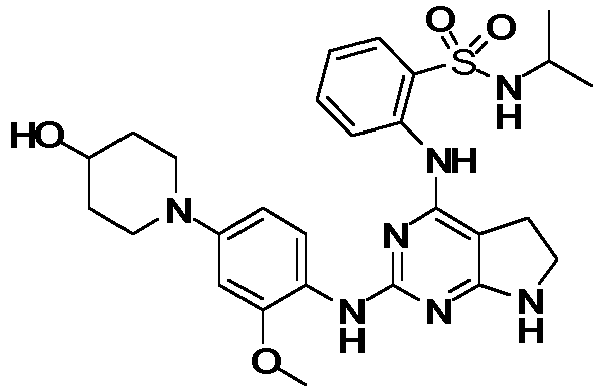
2-(2-(4-(4-hydroxypiperidin-1-yl)-2-methoxyphenylamino)-6,7-dihydro-5 H-pyrrolo[2,3-d]pyrimidin-4-ylamino)-N-isopropylbenzenesulfonamide 554 <20 <20 87 
2-(2-(4-(4-(S,S-dioxothio)piperidin-1-yl)-2-methoxyphenylamino)-6,7-dihydro-5H-pyrrolo[2,3-d] pyrimidin-4-ylamino)-N-isopropylbenzenesulfonamide 588 <20 <20 88 
N-isopropyl-2-(2-(2-methoxy-4-(2H-tetrazol-2-yl )phenylamino)-6,7-dihydro-5H-pyrrolo[2,3-d]pyrimidin-4-ylamino)benzenesulfonamide 523 <50 <200 89 
2-(2-(4-(3-(dimethylamino)pyrrolidin-1-yl)-2-methoxyphenylamino)-6,7-dihydro-5H-pyrrolo[2,3-d]pyrimidin-4-ylamino)-N-isopropylbenzenesulfonamide 567 <20 <20 90 
2-(2-(4-(2,4-dimethyl-1 H-imidazol-1-yl)-2-methoxyphenylamino)-6,7-dihydro-5H-pyrrolo[2,3-d]pyrimidin-4-ylamino)-N-isopropylbenzenesulfonamide 549 <20 <20 91 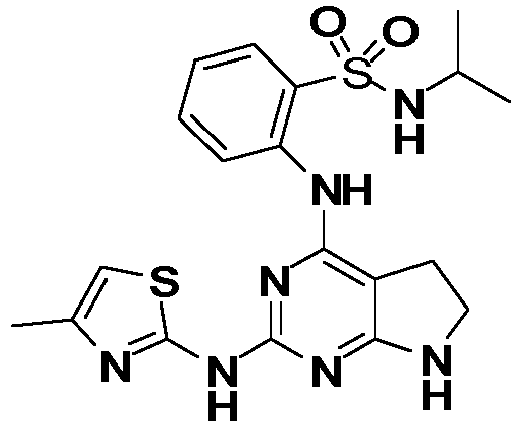
N-isopropyl-2-(2-(4-methylthiazol-2-ylamino)-6,7-dihydro-5H-pyrrolo[2,3-d]pyrimidin-4-ylamino)benzenesulfonamide 446 >1000 <1000 92 
2-(2-(4-(1,4'-bipiperidin-1'-yl)-2-methoxyphenylamino)-6,7-dihydro-5H-pyrrolo[2,3-d]pyrimidin-4-ylamino)-N-isopropylbenzenesulfonamide 621 <20 <20 93 
N-isopropyl-2-(2-(2-methoxy-4-(4-(pyrrolidin-1-yl)piperidin-1-yl)phenyl amino)-6,7-dihydro-5H-pyrrolo[2,3-d]pyrimidin-4-ylamino)benzenesulf onamide 607 <20 <20 94 
N-isopropyl-2-(2-(2-methoxy-4-(1H-pyrazol-1-yl )phenylamino)-6,7-dihy dro-5H-pyrrolo[2,3-d]pyrimidin-4-ylamino)benzenesulfonamide 521 <50 <200 95 
N-isopropyl-2-(2-(2-methoxy-4-(4-morpholinopi peridin-1-yl)phenylamin o)-6,7-dihydro-5H-pyrro lo[2,3-d]pyrimidin-4-yla mino)benzenesulfonam ide 621 <20 <20 96 
N-isopropyl-2-(2-(2-met hoxy-4-(4-(4-methylpip erazin-1-yl)piperidin-1-y l)phenylamino)-6,7-dihy dro-5H-pyrrolo[2,3-d]py rimidin-4-ylamino)benzenesulfonamide 636 <20 <20 97 
N-isopropyl-2-(2-(2-methoxy-4-(4-(piperazin-1-yl)piperidin-1-yl)phenylamino)-6,7-dihydro-5H-pyrrolo[2,3-d]pyrimidin-4-ylamino)benzenesulfonamide 622 <100 <500 98 
N-isopropyl-2-(2-(2-met hoxy-4-(2-oxopiperidin-1-yl)phenylamino)-6,7-dihydro-5H-pyrrolo[2,3-d]pyrimidin-4-ylamino)benzenesulfonamide 635 <20 <20 99 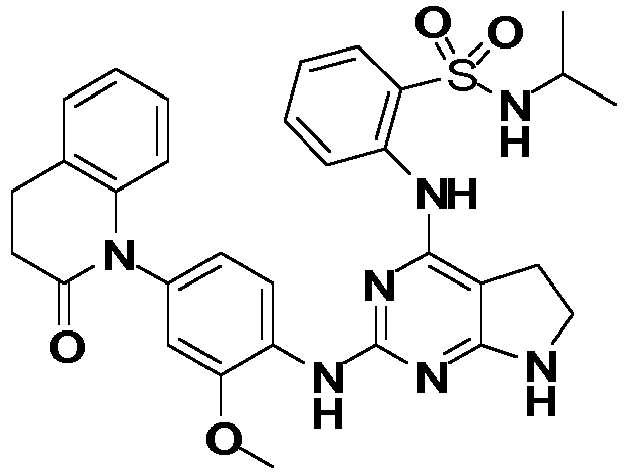
N-isopropyl-2-(2-(2-met hoxy-4-(2-oxo-3,4-dihydroquinolin-1(2H)-yl)ph enylamino)-6,7-dihydro-5H-pyrrolo[2,3-d]pyrimidin-4-ylamino)benzene sulfonamide 683 <500 <500 100 
N 4-(2-(isopropylsulfonyl)phenyl)-N 2-(2-methoxy-4-morpholinophenyl)-6 ,7-dihydro-5H-pyrrolo[2,3-d]pyrimidine-2,4-diamine 525 <20 <50 101 
N-isopropyl-2-(2-(2-met hoxy-4-morpholinophenylamino)-5-methyl-6,7-d ihydro-5H-pyrrolo[2,3-d]pyrimidin-4-ylamino)be nzenesulfonamide 554 <20 <20 102 
(R)-2-(2-(2-methoxy-4-morpholinophenylamin o)-5-methyl-6,7-dihydro-5H-pyrrolo[2,3-d]pyrimidin-4-ylamino)-N-methy lbenzamide 490 <20 <50 103 
2-(2-(2-methoxy-4-morpholinophenylamino)-5,5-dimethyl-6,7-dihydro-5H-pyrrolo[2,3-d]pyrimidin-4-ylamino)-N-methylbenzenesulfonamide 540 <20 <20 104 
N-cyclobutyl-2-(2-(2-methoxy-4-morpholinophenylamino)-5,5-dimethyl-6,7-dihydro-5H-pyrrolo[2,3-d]pyrimidin-4-ylamino)benzenesulfonamide 580 <20 <20 105 
N-isopropyl-2-(2-(2-methoxy-4-morpholinophenylamino)-5,5-dimethyl-6 ,7-dihydro-5H-pyrrolo[2,3-d]pyrimidin-4-ylamino)benzenesulfonamide 568 <20 <20 106 
2-(2-(2-methoxy-4-morpholinophenylamino)-5,5 -dimethyl-6,7-dihydro-5H-pyrrolo[2,3-d]pyrimidin-4-ylamino)-N-propylbenzenesulfonamide 568 <20 <20 107 
N-isobutyl-2-(2-(2-methoxy-4-morpholinopheny lamino)-5,5-dimethyl-6, 7-dihydro-5H-pyrrolo[2, 3-d]pyrimidin-4-ylamino )benzenesulfonamide 582 <20 <20 108 
N-cyclopentyl-2-(2-(2-m ethoxy-4-morpholinoph enylamino)-5,5-dimethyl-6,7-dihydro-5H-pyrrolo [2,3-d]pyrimidin-4-ylami no)benzenesulfonamid e 594 <200 <500 109 
N-cyclohexyl-2-(2-(2-methoxy-4-morpholinophenylamino)-5,5-dimethyl-6,7-dihydro-5H-pyrrolo[2,3-d]pyrimidin-4-ylamino)benzenesulfonamide 608 <200 <200 110 
N-butyl-2-(2-(2-methoxy-4-morpholinophenylamino)-5,5-dimethyl-6,7-dihydro-5H-pyrrolo[2,3-d]pyrimidin-4-ylamino)benzenesulfonamide 582 <20 <20 111 
2-(2-(2-methoxy-4-morpholinophenylamino)-5,5-dimethyl-6,7-dihydro-5 H-pyrrolo[2,3-d]pyrimidin-4-ylamino)-N,N-dimethylbenzenesulfonamide 554 <20 <20 112 
N-sec-butyl-2-(2-(2-methoxy-4-morpholinophenylamino)-5,5-dimethyl-6,7-dihydro-5H-pyrrolo[2,3-d]pyrimidin-4-ylamino)benzenesulfonamide 582 <20 <20 113 
N-ethyl-2-(2-(2-methoxy-4-morpholinophenylamino)-5,5-dimethyl-6,7-dihydro-5H-pyrrolo[2,3-d]pyrimidin-4-ylamino)benzenesulfonamide 554 <20 <20 114 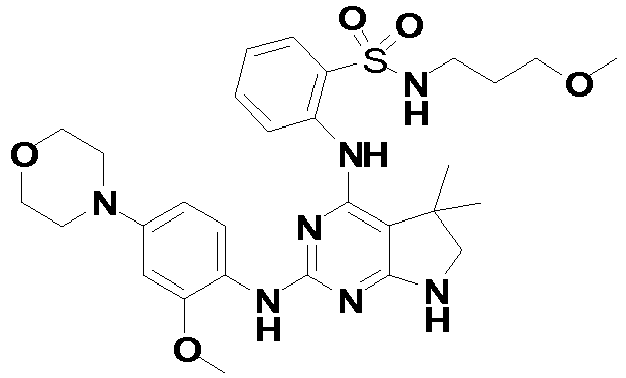
2-(2-(2-methoxy-4-morpholinophenylamino)-5,5-dimethyl-6,7-dihydro-5 H-pyrrolo[2,3-d]pyrimidin-4-ylamino)-N-(3-methoxypropyl)benzenesulfonamide 598 <20 <20 115 
2-(2-(2-methoxy-4-morpholinophenylamino)-5,5-dimethyl-6,7-dihydro-5 H-pyrrolo[2,3-d]pyrimidin-4-ylamino)-N-(2-methoxyethyl)benzenesulfonamide 584 <20 <20 116 
2-(2-(2-methoxy-4-morpholinophenylamino)-5,5-dimethyl-6,7-dihydro-5 H-pyrrolo[2,3-d]pyrimidin-4-ylamino)-N-phenylbenzenesulfonamide 602 <200 <500 117 
N-tert-butyl-2-(2-(2-methoxy-4-morpholinophenylamino)-5,5-dimethyl-6,7-dihydro-5H-pyrrolo[2,3-d]pyrimidin-4-ylamino)benzenesulfonamide 582 <20 <20 118 
N-(cyclopropylmethyl)-2 -(2-(2-methoxy-4-morpholinophenylamino)-5,5-dimethyl-6,7-dihydro-5 H-pyrrolo[2,3-d]pyrimidin-4-ylamino)benzenesulfonamide 580 <50 <50 119 
N-(2-hydroxyethyl)-2-(2 -(2-methoxy-4-morpholinophenylamino)-5,5-dimethyl-6,7-dihydro-5H-pyrrolo[2,3-d]pyrimidin-4-ylamino)benzenesulfonamide 570 <500 <200 120 
N-(2-(dimethylamino)ethyl)-2-(2-(2-methoxy-4-morpholinophenylamino)-5,5-dimethyl-6,7-dihydro-5H-pyrrolo[2,3-d]pyrimidin-4-ylamino)benzenesulfonamide 597 <20 <50 121 
(2-(2-(2-methoxy-4-morpholinophenylamino)-5, 5-dimethyl-6,7-dihydro-5H-pyrrolo[2,3-d]pyrimidin-4-ylamino)phenyl)(pyrrolidin-1-yl)methanone 544 <200 <200 122 
N-(2-(2-(2-methoxy-4-morpholinophenylamino)-5,5-dimethyl-6,7-dihydro-5H-pyrrolo[2,3-d]pyrimidin-4-ylamino)phenyl)-N-methylmethanesulfonamide 554 <50 <100 123 
N 2-(2-methoxy-4-morpholinophenyl)-5,5-dimethyl-N 4-(6-methylpyridin-2-yl)-6,7-dihydro-5H-pyrrolo[2,3-d]pyrimidine-2,4-diamine 462 <200 <500 124 
N-(2-(2-(2-methoxy-4-morpholinophenylamino)-5,5-dimethyl-6,7-dihydro-5H-pyrrolo[2,3-d]pyrimidin-4-ylamino)phenyl)acetamide 504 <200 <200 125 
N 4-(3,4-difluorophenyl)-N2-(2-methoxy-4-morp holinophenyl)-5,5-dimethyl-6,7-dihydro-5H-pyrrolo[2,3-d]pyrimidine-2,4-diamine 483 <1000 >1000 126 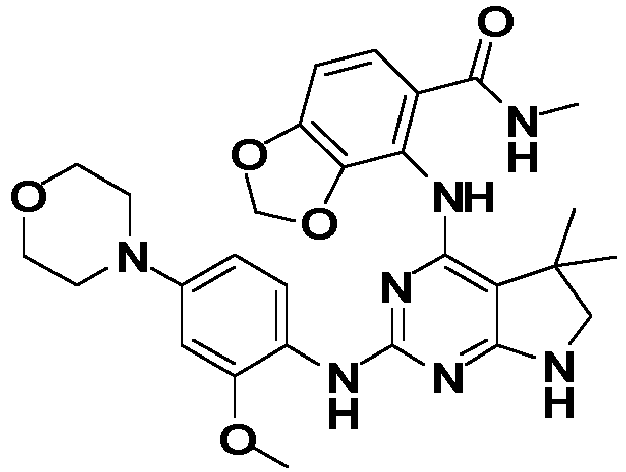
4-(2-(2-methoxy-4-morpholinophenylamino)-5,5 -dimethyl-6,7-dihydro-5H-pyrrolo[2,3-d]pyrimidin-4-ylamino)-N-methylbenzo[d][1,3]dioxole-5-carboxamide 548 <1000 >1000 127 
N-(2-(2-(2-methoxy-4-morpholinophenylamino)-5,5-dimethyl-6,7-dihydro-5H-pyrrolo[2,3-d]pyrimidin-4-ylamino)cyclohexyl)-N-methylmethanesulfonamide 560 <100 <100 128 
2-(2-(2,3-dihydrobenzo[b][1,4]dioxin-5-ylamino)-5,5-dimethyl-6,7-dihydro-5H-pyrrolo[2,3-d]pyrimidin-4-ylamino)-N-methylbenzamide 447 <20 <20 129 
2-(5,5-dimethyl-2-(8-morpholino-2,3-dihydrobenzo[b][1,4]dioxin-5-ylamino)-6,7-dihydro-5H-pyrrolo[2,3-d]pyrimidin-4-ylamino)-N-methylbenzamide 532 <50 <100 130 
2-(5,5-dimethyl-2-(3,4,5-trimethoxyphenylamino)-6,7-dihydro-5H-pyrrolo[2,3-d]pyrimidin-4-ylamino)-N-methylbenzamide 479 <200 <200 131 
2-(2-(benzofuran-7-ylamino)-5,5-dimethyl-6,7-dihydro-5H-pyrrolo[2,3-d]pyrimidin-4-ylamino)-N-methylbenzamide 429 <20 <20 132 
2-(2-(1,3-dimethyl-1H-pyrazol-5-ylamino)-5,5-dimethyl-6,7-dihydro-5H-pyrrolo[2,3-d]pyrimidin-4-ylamino)-N-methylbenzamide 407 <20 <50 133 
2-(2-(1-ethyl-6-methoxy -2-oxo-2,3,4,5-tetrahydro-1H-benzo[b]azepin-7-ylamino)-5,5-dimethyl-6,7-dihydro-5H-pyrrolo[2,3-d]pyrimidin-4-ylamino)-N-methylbenzamide 530 <20 <50 134 
2-(5,5-dimethyl-2-(1-(3-morpholinopropyl)-1H-indol-5-ylamino)-6,7-dihydro-5H-pyrrolo[2,3-d]pyrimidin-4-ylamino)-N-methylbenzamide 555 <200 <200 135 
2-(2'-(2-methoxy-4-morpholinophenylamino)-6',7'-dihydrospiro[cyclopropane-1,5'-pyrrolo[2,3-d] pyrimidine]-4'-ylamino)-N-methylbenzenesulfonamide 538 <50 <20 136 
N-tert-butyl-2-(2'-(2-met hoxy-4-morpholinophenylamino)-6',7'-dihydrospiro[cyclopropane-1,5'-pyrrolo[2,3-d]pyrimidine]-4'-ylamino)benzenesulf onamide 580 <20 <20 137 
N-isobutyl-2-(2'-(2-methoxy-4-morpholinophenylamino)-6',7'-dihydrospiro[cyclopropane-1,5'-pyrrolo[2,3-d]pyrimidine]-4' -ylamino)benzenesulfonamide 580 <20 <20 138 
N-isopropyl-2-(2'-(2-met hoxy-4-morpholinophenylamino)-6',7'-dihydrosp iro[cyclopropane-1,5'-pyrrolo[2,3-d]pyrimidine]-4'-ylamino)benzenesulf onamide 566 <20 <20 139 
N-ethyl-2-(2'-(2-methoxy-4-morpholinophenylamino)-6',7'-dihydrospiro[cyclopropane-1,5'-pyrrolo[2,3-d]pyrimidine]-4'-ylamino)benzenesulfonamide 552 <20 <20 140 
N-(cyclopropylmethyl)-2 -(2'-(2-methoxy-4-morpholinophenylamino)-6',7 '-dihydrospiro[cyclopropane-1,5'-pyrrolo[2,3-d]pyrimidine]-4'-ylamino)benzenesulfonamide 578 <20 <20 141 
2-(2'-(2-methoxy-4-morpholinophenylamino)-6',7'-dihydrospiro[cyclopropane-1,5'-pyrrolo[2,3-d]pyrimidine]-4'-ylamino)-N-(2-methoxyethyl)benzenesulfonamide 582 <20 <20 142 
N-(2-hydroxyethyl)-2-(2'-(2-methoxy-4-morpholinophenylamino)-6',7'-dihydrospiro[cyclopropane-1,5'-pyrrolo[2,3-d]pyrimidine]-4'-ylamino)benzenesulfonamide 568 >1000 >1000 143 
2-(2'-(2-methoxy-4-morpholinophenylamino)-6',7'-dihydrospiro[cyclopropane-1,5'-pyrrolo[2,3-d]pyrimidine]-4'-ylamino)-N-phenylbenzenesulfonamide 600 <100 <200 144 
N-allyl-2-(2'-(2-methoxy-4-morpholinophenylamino)-6',7'-dihydrospiro[cyclopropane-1,5'-pyrrolo[2,3-d]pyrimidine]-4'-yl amino)benzenesulfonamide 564 <20 <20 145 
N-cyclopentyl-2-(2'-(2-methoxy-4-morpholinophenylamino)-6',7'-dihydrospiro[cyclopropane-1,5'-pyrrolo[2,3-d]pyrimidine]-4'-ylamino)benzenesulfonamide 592 <100 <100 146 
N-cyclopropyl-2-(2'-(2-methoxy-4-morpholinophenylamino)-6',7'-dihydrospiro[cyclopropane-1,5'-pyrrolo[2,3-d]pyrimidine]-4'-ylamino)benzenesulfonamide 564 >1000 >1000 147 
N-sec-butyl-2-(2'-(2-met hoxy-4-morpholinophen ylamino)-6',7'-dihydrospiro[cyclopropane-1,5'-pyrrolo[2,3-d]pyrimidine]-4'-ylamino)benzenesulfonamide 580 <20 <20 148 
2-(2'-(2-methoxy-4-morpholinophenylamino)-6',7'-dihydrospiro[cyclopropane-1,5'-pyrrolo[2,3-d]pyrimidine]-4'-ylamino)-N-propylbenzenesulfon amide 566 <20 <20 149 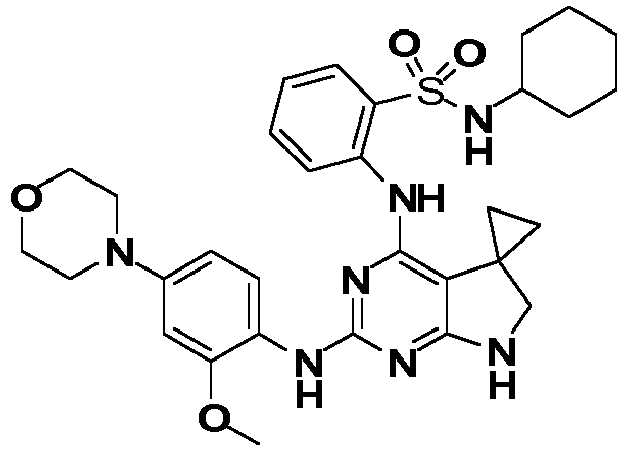
N-cyclohexyl-2-(2'-(2-m ethoxy-4-morpholinoph enylamino)-6',7'-dihydro spiro[cyclopropane-1,5' -pyrrolo[2,3-d]pyrimidin e]-4'-ylamino)benzenesulfonamide 606 <500 <500 150 
N-cyclobutyl-2-(2'-(2-m ethoxy-4-morpholinoph enylamino)-6',7'-dihydro spiro[cyclopropane-1,5' -pyrrolo[2,3-d]pyrimidin e]-4'-ylamino)benzenes ulfonamide 578 <20 <20 151 
2-(2'-(2-methoxy-4-mor pholinophenylamino)-6', 7'-dihydrospiro[cyclopro pane-1,5'-pyrrolo[2,3-d] pyrimidine]-4'-ylamino)-N,N-dimethylbenzenes ulfonamide 552 <20 <20 152 
2-(2'-(2-methoxy-4-mor pholinophenylamino)-6', 7'-dihydrospiro[cyclopro pane-1,5'-pyrrolo[2,3-d] pyrimidine]-4'-ylamino)-N-methylbenzamide 502 <50 <20 153 
N 4'-(3,4-difluorophenyl)-N 2 '-(2-methoxy-4-morp holinophenyl)-6',7'-dihy drospiro[cyclopropane-1,5'-pyrrolo[2,3-d]pyrimidine]-2',4'-diamine 481 <200 <500 154 
N 2 '-(2-meth oxy-4-morpholinophenyl)-N 4'-(6-methylpyridin-2-yl)-6',7'-dihydrospiro[cyclopropane-1,5'-pyrrolo[2,3-d]pyrimidine]-2',4'-diamine 460 <50 <100 155 
N-(2-(2'-(2-methoxy-4-morpholinophenylamino)-6',7'-dihydrospiro[cyclopropane-1,5'-pyrrolo[2,3-d]pyrimidine]-4'-ylamino)phenyl)acetamide 502 <50 <50 156 
N-(2-(2'-(2-methoxy-4-morpholinophenylamino)-6',7'-dihydrospiro[cyclopropane-1,5'-pyrrolo[2,3-d]pyrimidine]-4'-ylamino)phenyl)-N-methylmethanesulfonamide 552 <20 <20 157 
N-methyl-2-(2'-(3,4,5-trimethoxyphenylamino)-6',7'-dihydrospiro[cyclopropane-1,5'-pyrrolo[2,3-d]pyrimidine]-4'-ylamino)benzenesulfonamide 513 <20 <20 158 
N-methyl-2-(2-(4-morpholinophenylamino)-6,7-dihydro-5H-pyrrolo[2,3-d]pyrimidin-4-ylamino)benzamide 446 <100 <100 159 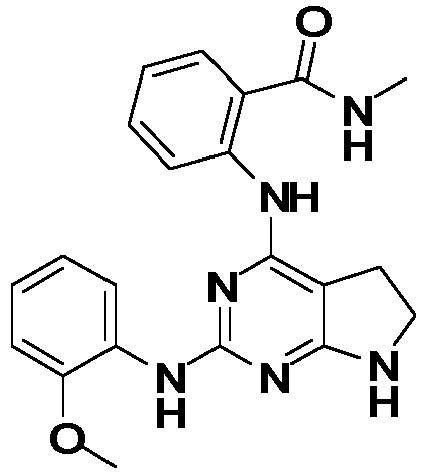
2-(2-(2-methoxyphenyl amino)-6,7-dihydro-5H-pyrrolo[2,3-d]pyrimidin-4-ylamino)-N-methylbenzamide 391 <200 <200 160 
2-(2-(2-methoxy-4-morp holinophenylamino)-6,7-dihydro-5H-pyrrolo[2,3 -d]pyrimidin-4-ylamino) benzoic acid 463 <500 <1000 161 
2-(2-(2-methoxy-4-morp holinophenylamino)-6,7 -dihydro-5H-pyrrolo[2,3 -d]pyrimidin-4-ylamino)benzaldehyde 447 <1000 <1000 162 
2-(2-(2-(2-methoxy-4-m orpholinophenylamino)-6,7-dihydro-5H-pyrrolo[2,3-d]pyrimidin-4-ylamino)phenyl)ethanol 449 <1000 <1000 163 
N 4-(2-(dimethylphospho ryl)phenyl)-N 2-(2-methoxy-4-(4-(piperazin-1-yl) piperidin-1-yl)phenyl)-6, 7-dihydro-5H-pyrrolo[2,3-d]pyrimidine-2,4-diamine 577 <100 <50
Claims (6)
- A compound selected from


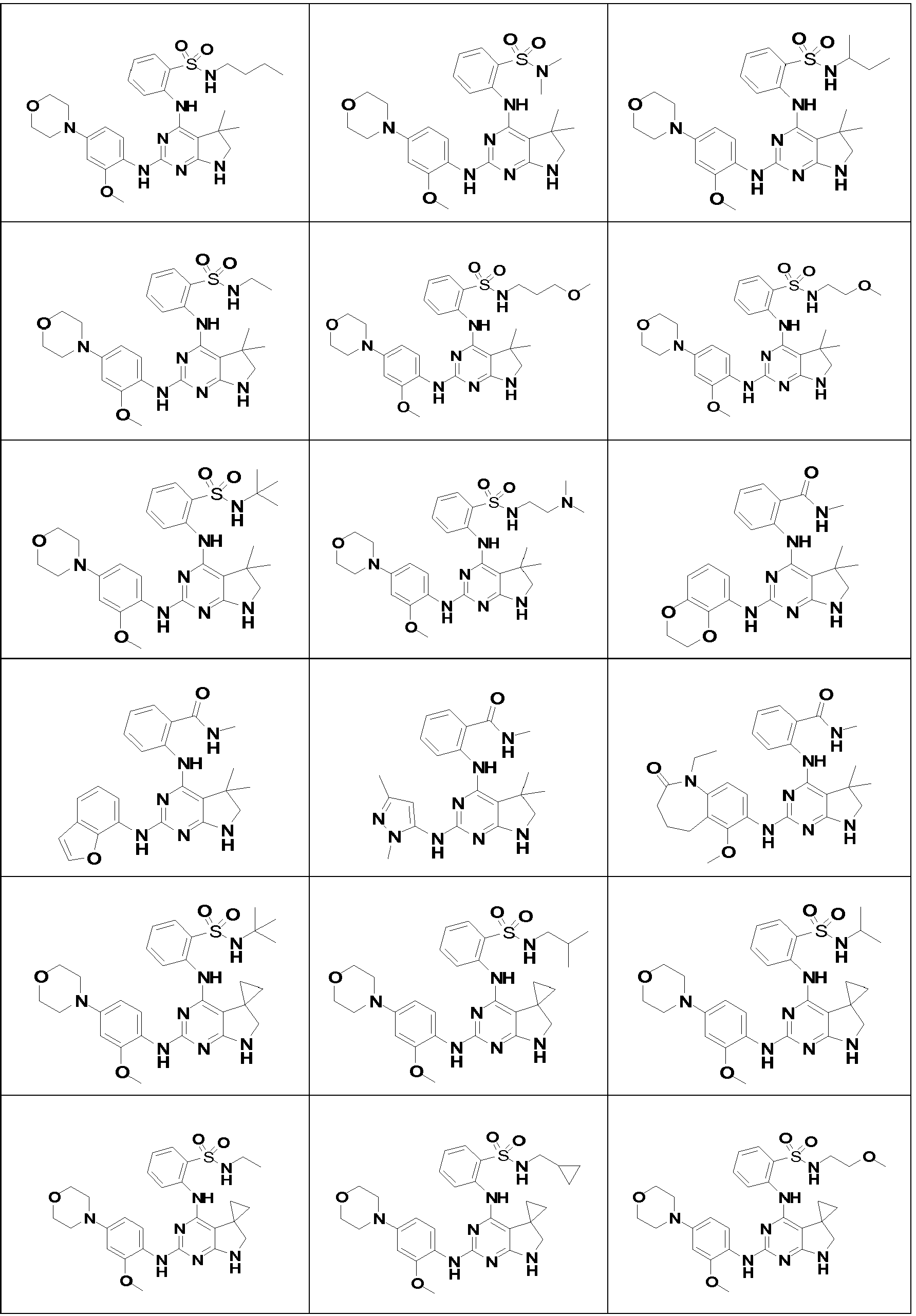 or a pharmaceutically acceptable salt, solvate, poly-morph or tautomer thereof.
- The compound of claim 1 or a pharmaceutically acceptable salt, solvate, poly-morph, tautomer thereof, for use as a medicament.
- The compound for the use of claim 2, or a pharmaceutically acceptable salt, solvate, poly-morph or tautomer thereof, wherein the medicament has an antiproliferative and/or proapoptotic activity.
- The compound for the use of claims 2-3, or a pharmaceutically acceptable salt, solvate, poly-morph or tautomer thereof, for use in the treatment of a proliferative disorder, an infectious or autoimmune disease.
- The compound for the use of claim 4, or a pharmaceutically acceptable salt, solvate, poly-morph or tautomer thereof, for use in the treatment of the proliferative disorder selected from the group consisting of a cancer and inflammatory disease.
- A pharmaceutical composition comprising a) the compound of claim 1 or a pharmaceutically acceptable salt, solvate, poly-morph or tautomer thereof, and b) a pharmaceutically acceptable carrier, diluents, excipient and/or adjusvant.
Applications Claiming Priority (3)
| Application Number | Priority Date | Filing Date | Title |
|---|---|---|---|
| CN201110002776.3A CN102093364B (en) | 2011-01-07 | 2011-01-07 | 2,4-diamido-6,7-dihydro-5H-pyrrolo [2,3] pyrimidine derivative as focal adhesion kinase/pyruvate kinase 2 (FAK/Pyk2) inhibitor |
| US201161457217P | 2011-02-02 | 2011-02-02 | |
| PCT/CN2012/070122 WO2012092880A1 (en) | 2011-01-07 | 2012-01-07 | 2,4-DIAMINO-6,7-DIHYDRO-5H-PYRROLO[2,3]PYRIMIDINE DERIVATIVES AS FAK/Pyk2 INHIBITORS |
Publications (3)
| Publication Number | Publication Date |
|---|---|
| EP2661437A1 EP2661437A1 (en) | 2013-11-13 |
| EP2661437A4 EP2661437A4 (en) | 2014-07-02 |
| EP2661437B1 true EP2661437B1 (en) | 2018-11-07 |
Family
ID=44126650
Family Applications (1)
| Application Number | Title | Priority Date | Filing Date |
|---|---|---|---|
| EP12732345.9A Not-in-force EP2661437B1 (en) | 2011-01-07 | 2012-01-07 | 2,4-DIAMINO-6,7-DIHYDRO-5H-PYRROLO[2,3]PYRIMIDINE DERIVATIVES AS FAK/Pyk2 INHIBITORS |
Country Status (8)
| Country | Link |
|---|---|
| US (1) | US9428508B2 (en) |
| EP (1) | EP2661437B1 (en) |
| JP (1) | JP5961628B2 (en) |
| KR (2) | KR101811938B1 (en) |
| CN (1) | CN102093364B (en) |
| AU (1) | AU2012204982B2 (en) |
| CA (1) | CA2823969C (en) |
| WO (1) | WO2012092880A1 (en) |
Families Citing this family (20)
| Publication number | Priority date | Publication date | Assignee | Title |
|---|---|---|---|---|
| CN102093364B (en) * | 2011-01-07 | 2015-01-28 | 北京赛林泰医药技术有限公司 | 2,4-diamido-6,7-dihydro-5H-pyrrolo [2,3] pyrimidine derivative as focal adhesion kinase/pyruvate kinase 2 (FAK/Pyk2) inhibitor |
| CN103476776B (en) * | 2011-01-07 | 2016-09-28 | 北京赛林泰医药技术有限公司 | 2,4-diaminourea-6,7-dihydro-5H-pyrrolo-[2,3] pyrimidine derivatives as FAK/Pyk2 inhibitor |
| CN108558842B (en) * | 2014-03-06 | 2021-06-04 | 山东轩竹医药科技有限公司 | Pyrimidine derivative anaplastic lymphoma kinase inhibitor |
| US10011592B2 (en) * | 2014-09-29 | 2018-07-03 | Xuanzhu Pharma Co., Ltd. | Polycyclic inhibitor of anaplastic lymphoma kinase |
| EP3481829B1 (en) * | 2016-07-08 | 2021-04-07 | H. Hoffnabb-La Roche Ag | Fused pyrimidine derivatives |
| EP3484884B1 (en) | 2016-07-14 | 2021-01-27 | Hoffmann-La Roche AG | Fused pyrimidine derivatives |
| CA3031592A1 (en) | 2016-08-31 | 2018-03-08 | Jiangsu Hengrui Medicine Co., Ltd. | Oxopicolinamide derivative, preparation method therefor and pharmaceutical use thereof |
| CN107936024B (en) * | 2016-10-12 | 2021-04-30 | 北京赛林泰医药技术有限公司 | Anaplastic lymphoma kinase inhibitor and preparation method and application thereof |
| CN108276410B (en) * | 2017-01-06 | 2021-12-10 | 首药控股(北京)股份有限公司 | Anaplastic lymphoma kinase inhibitor and preparation method and application thereof |
| CN108456210A (en) * | 2017-02-22 | 2018-08-28 | 北京赛林泰医药技术有限公司 | A kind of polymorph and preparation method thereof of alk tyrosine kinase inhibitor |
| MX391501B (en) | 2017-04-18 | 2025-03-21 | Fochon Pharmaceuticals Ltd | APOPTOSIS-INDUCING AGENTS |
| KR101992621B1 (en) | 2017-12-07 | 2019-09-27 | 주식회사 온코빅스 | Novel pyrimidine derivative showing growth inhibition of cancer cell and pharmaceutical composition comprising the same |
| CN110526915B (en) * | 2018-05-25 | 2022-02-01 | 首药控股(北京)股份有限公司 | Preparation method of anaplastic lymphoma kinase inhibitor |
| WO2020060268A1 (en) * | 2018-09-20 | 2020-03-26 | 한미약품 주식회사 | Novel sulfonamide derivative with fused pyrimidine skeleton, having epidermal growth factor receptor mutation inhibitory effect |
| KR102377007B1 (en) | 2018-09-20 | 2022-03-22 | 한미약품 주식회사 | Novel Fused Pyrimidine Scaffold Sulfonamide Derivative as mutant Epidermal Growth Factor Receptor Inhibitor |
| CN113087709A (en) * | 2020-01-09 | 2021-07-09 | 沈阳药科大学 | Pyrrolopyrimidine derivatives, and preparation method and application thereof |
| US20240067668A1 (en) * | 2020-12-29 | 2024-02-29 | Voronoi Inc. | Heteroaryl derivative compound and use thereof |
| JP2024516730A (en) * | 2021-05-04 | 2024-04-16 | エナラーレ セラピューティクス インコーポレイテッド | Large conductance potassium channel modulators, compositions thereof, methods of making same, and methods of use thereof |
| CN115368364B (en) * | 2021-05-19 | 2024-07-16 | 四川大学 | 7H-pyrrolo [2,3-d ] pyrimidine derivatives, preparation method and application thereof |
| WO2026086879A1 (en) * | 2024-10-25 | 2026-04-30 | 应世生物科技(南京)有限公司 | Fak inhibitor |
Family Cites Families (8)
| Publication number | Priority date | Publication date | Assignee | Title |
|---|---|---|---|---|
| JPH0782174A (en) | 1993-09-17 | 1995-03-28 | Takeda Chem Ind Ltd | Antitumor agent |
| GB0115393D0 (en) * | 2001-06-23 | 2001-08-15 | Aventis Pharma Ltd | Chemical compounds |
| WO2004043367A2 (en) * | 2002-11-06 | 2004-05-27 | Bristol-Myers Squibb Company | Fused heterocyclic compounds and use thereof |
| CA2553785C (en) * | 2004-02-14 | 2011-02-08 | Irm Llc | Compounds and compositions as protein kinase inhibitors |
| DE102006016426A1 (en) * | 2006-04-07 | 2007-10-11 | Merck Patent Gmbh | Novel cyclobutyl compounds as kinase inhibitors |
| JO3235B1 (en) * | 2006-05-26 | 2018-03-08 | Astex Therapeutics Ltd | Pyrroloperimidine compounds and their uses |
| JP2011518219A (en) | 2008-04-22 | 2011-06-23 | ポートラ ファーマシューティカルズ, インコーポレイテッド | Inhibitors of protein kinases |
| CN102093364B (en) * | 2011-01-07 | 2015-01-28 | 北京赛林泰医药技术有限公司 | 2,4-diamido-6,7-dihydro-5H-pyrrolo [2,3] pyrimidine derivative as focal adhesion kinase/pyruvate kinase 2 (FAK/Pyk2) inhibitor |
-
2011
- 2011-01-07 CN CN201110002776.3A patent/CN102093364B/en not_active Expired - Fee Related
-
2012
- 2012-01-07 WO PCT/CN2012/070122 patent/WO2012092880A1/en not_active Ceased
- 2012-01-07 US US13/978,475 patent/US9428508B2/en not_active Expired - Fee Related
- 2012-01-07 KR KR1020157037254A patent/KR101811938B1/en not_active Expired - Fee Related
- 2012-01-07 EP EP12732345.9A patent/EP2661437B1/en not_active Not-in-force
- 2012-01-07 JP JP2013547804A patent/JP5961628B2/en not_active Expired - Fee Related
- 2012-01-07 CA CA2823969A patent/CA2823969C/en not_active Expired - Fee Related
- 2012-01-07 KR KR1020137020933A patent/KR20130122778A/en not_active Ceased
- 2012-01-07 AU AU2012204982A patent/AU2012204982B2/en not_active Ceased
Non-Patent Citations (1)
| Title |
|---|
| None * |
Also Published As
| Publication number | Publication date |
|---|---|
| US20130281438A1 (en) | 2013-10-24 |
| AU2012204982A8 (en) | 2013-08-29 |
| EP2661437A4 (en) | 2014-07-02 |
| CN102093364A (en) | 2011-06-15 |
| AU2012204982A1 (en) | 2012-07-12 |
| AU2012204982B2 (en) | 2017-02-23 |
| CN102093364B (en) | 2015-01-28 |
| US9428508B2 (en) | 2016-08-30 |
| CA2823969A1 (en) | 2012-07-12 |
| KR20130122778A (en) | 2013-11-08 |
| KR101811938B1 (en) | 2017-12-22 |
| EP2661437A1 (en) | 2013-11-13 |
| KR20160007677A (en) | 2016-01-20 |
| JP5961628B2 (en) | 2016-08-02 |
| JP2014501766A (en) | 2014-01-23 |
| CA2823969C (en) | 2017-11-28 |
| WO2012092880A1 (en) | 2012-07-12 |
Similar Documents
| Publication | Publication Date | Title |
|---|---|---|
| US9428508B2 (en) | 2,4-diamino-6,7-dihydro-5H-pyrrolo[2,3]pyrimidine derivatives as FAK/Pyk2 inhibitors | |
| EP3442947B1 (en) | Amine-substituted aryl or heteroaryl compounds as ehmt1 and ehmt2 inhibitors | |
| EP3640241B1 (en) | Bromodomain inhibitors | |
| EP3464249B1 (en) | Substituted carbonucleoside derivatives useful as anticancer agents | |
| CN103476776B (en) | 2,4-diaminourea-6,7-dihydro-5H-pyrrolo-[2,3] pyrimidine derivatives as FAK/Pyk2 inhibitor | |
| EP3728207B1 (en) | Quinazolinones as parp14 inhibitors | |
| EP2780341B1 (en) | Kinase modulating compounds, compositions containing the same and use thereof | |
| AU2017364720A1 (en) | Novel oxoisoquinoline derivative | |
| EP4137484A1 (en) | Tricyclic compounds as egfr inhibitors | |
| EP2206714A1 (en) | Agent for prevention and/or treatment of skin diseases | |
| EP4692088A1 (en) | Compound acting as wrn helicase inhibitor | |
| KR20150138847A (en) | NOVEL N-(2,3-DIHYDRO-1H-PYRROLO[2,3-b]PYRIDIN-5-YL)-4-QUINAZOLINAMINE AND N-(2,3-DIHYDRO-1H-INDOL-5-YL)-4-QUINAZOLINAMINE DERIVATIVES AS PERK INHIBITORS | |
| CA3134405A1 (en) | Thienoheterocyclic derivative, preparation method therefor and medical use thereof | |
| TWI894448B (en) | Ctla-4 small molecule inhibitor and its application | |
| CN112250666B (en) | Substituted pyrimidines and their use | |
| HK40080347A (en) | Bromodomain inhibitors | |
| HK40109818A (en) | Erbb/btk inhibitors | |
| HK40004853A (en) | Amine-substituted aryl or heteroaryl compounds as ehmt1 and ehmt2 inhibitors | |
| HK40004853B (en) | Amine-substituted aryl or heteroaryl compounds as ehmt1 and ehmt2 inhibitors | |
| HK40039346A (en) | Erbb/btk inhibitors | |
| HK40039346B (en) | Erbb/btk inhibitors | |
| HK40017640A (en) | Bromodomain inhibitors | |
| HK40017640B (en) | Bromodomain inhibitors | |
| HK1226316A1 (en) | Bromodomain inhibitors | |
| HK1226316B (en) | Bromodomain inhibitors |
Legal Events
| Date | Code | Title | Description |
|---|---|---|---|
| PUAI | Public reference made under article 153(3) epc to a published international application that has entered the european phase |
Free format text: ORIGINAL CODE: 0009012 |
|
| 17P | Request for examination filed |
Effective date: 20130805 |
|
| AK | Designated contracting states |
Kind code of ref document: A1 Designated state(s): AL AT BE BG CH CY CZ DE DK EE ES FI FR GB GR HR HU IE IS IT LI LT LU LV MC MK MT NL NO PL PT RO RS SE SI SK SM TR |
|
| DAX | Request for extension of the european patent (deleted) | ||
| A4 | Supplementary search report drawn up and despatched |
Effective date: 20140603 |
|
| RIC1 | Information provided on ipc code assigned before grant |
Ipc: A61P 29/00 20060101ALI20140527BHEP Ipc: A61P 31/00 20060101ALI20140527BHEP Ipc: C07D 487/04 20060101AFI20140527BHEP Ipc: A61P 35/00 20060101ALI20140527BHEP Ipc: A61K 31/505 20060101ALI20140527BHEP Ipc: A61P 37/02 20060101ALI20140527BHEP |
|
| 17Q | First examination report despatched |
Effective date: 20150716 |
|
| STAA | Information on the status of an ep patent application or granted ep patent |
Free format text: STATUS: EXAMINATION IS IN PROGRESS |
|
| GRAP | Despatch of communication of intention to grant a patent |
Free format text: ORIGINAL CODE: EPIDOSNIGR1 |
|
| STAA | Information on the status of an ep patent application or granted ep patent |
Free format text: STATUS: GRANT OF PATENT IS INTENDED |
|
| INTG | Intention to grant announced |
Effective date: 20180511 |
|
| GRAS | Grant fee paid |
Free format text: ORIGINAL CODE: EPIDOSNIGR3 |
|
| GRAA | (expected) grant |
Free format text: ORIGINAL CODE: 0009210 |
|
| STAA | Information on the status of an ep patent application or granted ep patent |
Free format text: STATUS: THE PATENT HAS BEEN GRANTED |
|
| AK | Designated contracting states |
Kind code of ref document: B1 Designated state(s): AL AT BE BG CH CY CZ DE DK EE ES FI FR GB GR HR HU IE IS IT LI LT LU LV MC MK MT NL NO PL PT RO RS SE SI SK SM TR |
|
| REG | Reference to a national code |
Ref country code: GB Ref legal event code: FG4D |
|
| REG | Reference to a national code |
Ref country code: CH Ref legal event code: EP Ref country code: AT Ref legal event code: REF Ref document number: 1061923 Country of ref document: AT Kind code of ref document: T Effective date: 20181115 |
|
| REG | Reference to a national code |
Ref country code: IE Ref legal event code: FG4D |
|
| REG | Reference to a national code |
Ref country code: DE Ref legal event code: R096 Ref document number: 602012053160 Country of ref document: DE |
|
| REG | Reference to a national code |
Ref country code: NL Ref legal event code: MP Effective date: 20181107 |
|
| REG | Reference to a national code |
Ref country code: LT Ref legal event code: MG4D |
|
| REG | Reference to a national code |
Ref country code: AT Ref legal event code: MK05 Ref document number: 1061923 Country of ref document: AT Kind code of ref document: T Effective date: 20181107 |
|
| PG25 | Lapsed in a contracting state [announced via postgrant information from national office to epo] |
Ref country code: FI Free format text: LAPSE BECAUSE OF FAILURE TO SUBMIT A TRANSLATION OF THE DESCRIPTION OR TO PAY THE FEE WITHIN THE PRESCRIBED TIME-LIMIT Effective date: 20181107 Ref country code: AT Free format text: LAPSE BECAUSE OF FAILURE TO SUBMIT A TRANSLATION OF THE DESCRIPTION OR TO PAY THE FEE WITHIN THE PRESCRIBED TIME-LIMIT Effective date: 20181107 Ref country code: LV Free format text: LAPSE BECAUSE OF FAILURE TO SUBMIT A TRANSLATION OF THE DESCRIPTION OR TO PAY THE FEE WITHIN THE PRESCRIBED TIME-LIMIT Effective date: 20181107 Ref country code: HR Free format text: LAPSE BECAUSE OF FAILURE TO SUBMIT A TRANSLATION OF THE DESCRIPTION OR TO PAY THE FEE WITHIN THE PRESCRIBED TIME-LIMIT Effective date: 20181107 Ref country code: BG Free format text: LAPSE BECAUSE OF FAILURE TO SUBMIT A TRANSLATION OF THE DESCRIPTION OR TO PAY THE FEE WITHIN THE PRESCRIBED TIME-LIMIT Effective date: 20190207 Ref country code: NO Free format text: LAPSE BECAUSE OF FAILURE TO SUBMIT A TRANSLATION OF THE DESCRIPTION OR TO PAY THE FEE WITHIN THE PRESCRIBED TIME-LIMIT Effective date: 20190207 Ref country code: LT Free format text: LAPSE BECAUSE OF FAILURE TO SUBMIT A TRANSLATION OF THE DESCRIPTION OR TO PAY THE FEE WITHIN THE PRESCRIBED TIME-LIMIT Effective date: 20181107 Ref country code: ES Free format text: LAPSE BECAUSE OF FAILURE TO SUBMIT A TRANSLATION OF THE DESCRIPTION OR TO PAY THE FEE WITHIN THE PRESCRIBED TIME-LIMIT Effective date: 20181107 Ref country code: IS Free format text: LAPSE BECAUSE OF FAILURE TO SUBMIT A TRANSLATION OF THE DESCRIPTION OR TO PAY THE FEE WITHIN THE PRESCRIBED TIME-LIMIT Effective date: 20190307 |
|
| PG25 | Lapsed in a contracting state [announced via postgrant information from national office to epo] |
Ref country code: AL Free format text: LAPSE BECAUSE OF FAILURE TO SUBMIT A TRANSLATION OF THE DESCRIPTION OR TO PAY THE FEE WITHIN THE PRESCRIBED TIME-LIMIT Effective date: 20181107 Ref country code: PT Free format text: LAPSE BECAUSE OF FAILURE TO SUBMIT A TRANSLATION OF THE DESCRIPTION OR TO PAY THE FEE WITHIN THE PRESCRIBED TIME-LIMIT Effective date: 20190307 Ref country code: NL Free format text: LAPSE BECAUSE OF FAILURE TO SUBMIT A TRANSLATION OF THE DESCRIPTION OR TO PAY THE FEE WITHIN THE PRESCRIBED TIME-LIMIT Effective date: 20181107 Ref country code: GR Free format text: LAPSE BECAUSE OF FAILURE TO SUBMIT A TRANSLATION OF THE DESCRIPTION OR TO PAY THE FEE WITHIN THE PRESCRIBED TIME-LIMIT Effective date: 20190208 Ref country code: SE Free format text: LAPSE BECAUSE OF FAILURE TO SUBMIT A TRANSLATION OF THE DESCRIPTION OR TO PAY THE FEE WITHIN THE PRESCRIBED TIME-LIMIT Effective date: 20181107 Ref country code: RS Free format text: LAPSE BECAUSE OF FAILURE TO SUBMIT A TRANSLATION OF THE DESCRIPTION OR TO PAY THE FEE WITHIN THE PRESCRIBED TIME-LIMIT Effective date: 20181107 |
|
| PG25 | Lapsed in a contracting state [announced via postgrant information from national office to epo] |
Ref country code: CZ Free format text: LAPSE BECAUSE OF FAILURE TO SUBMIT A TRANSLATION OF THE DESCRIPTION OR TO PAY THE FEE WITHIN THE PRESCRIBED TIME-LIMIT Effective date: 20181107 Ref country code: IT Free format text: LAPSE BECAUSE OF FAILURE TO SUBMIT A TRANSLATION OF THE DESCRIPTION OR TO PAY THE FEE WITHIN THE PRESCRIBED TIME-LIMIT Effective date: 20181107 Ref country code: DK Free format text: LAPSE BECAUSE OF FAILURE TO SUBMIT A TRANSLATION OF THE DESCRIPTION OR TO PAY THE FEE WITHIN THE PRESCRIBED TIME-LIMIT Effective date: 20181107 Ref country code: PL Free format text: LAPSE BECAUSE OF FAILURE TO SUBMIT A TRANSLATION OF THE DESCRIPTION OR TO PAY THE FEE WITHIN THE PRESCRIBED TIME-LIMIT Effective date: 20181107 |
|
| REG | Reference to a national code |
Ref country code: DE Ref legal event code: R119 Ref document number: 602012053160 Country of ref document: DE |
|
| PG25 | Lapsed in a contracting state [announced via postgrant information from national office to epo] |
Ref country code: EE Free format text: LAPSE BECAUSE OF FAILURE TO SUBMIT A TRANSLATION OF THE DESCRIPTION OR TO PAY THE FEE WITHIN THE PRESCRIBED TIME-LIMIT Effective date: 20181107 Ref country code: SM Free format text: LAPSE BECAUSE OF FAILURE TO SUBMIT A TRANSLATION OF THE DESCRIPTION OR TO PAY THE FEE WITHIN THE PRESCRIBED TIME-LIMIT Effective date: 20181107 Ref country code: MC Free format text: LAPSE BECAUSE OF FAILURE TO SUBMIT A TRANSLATION OF THE DESCRIPTION OR TO PAY THE FEE WITHIN THE PRESCRIBED TIME-LIMIT Effective date: 20181107 Ref country code: SK Free format text: LAPSE BECAUSE OF FAILURE TO SUBMIT A TRANSLATION OF THE DESCRIPTION OR TO PAY THE FEE WITHIN THE PRESCRIBED TIME-LIMIT Effective date: 20181107 Ref country code: RO Free format text: LAPSE BECAUSE OF FAILURE TO SUBMIT A TRANSLATION OF THE DESCRIPTION OR TO PAY THE FEE WITHIN THE PRESCRIBED TIME-LIMIT Effective date: 20181107 |
|
| REG | Reference to a national code |
Ref country code: CH Ref legal event code: PL |
|
| PLBE | No opposition filed within time limit |
Free format text: ORIGINAL CODE: 0009261 |
|
| STAA | Information on the status of an ep patent application or granted ep patent |
Free format text: STATUS: NO OPPOSITION FILED WITHIN TIME LIMIT |
|
| PG25 | Lapsed in a contracting state [announced via postgrant information from national office to epo] |
Ref country code: LU Free format text: LAPSE BECAUSE OF NON-PAYMENT OF DUE FEES Effective date: 20190107 |
|
| 26N | No opposition filed |
Effective date: 20190808 |
|
| REG | Reference to a national code |
Ref country code: BE Ref legal event code: MM Effective date: 20190131 |
|
| GBPC | Gb: european patent ceased through non-payment of renewal fee |
Effective date: 20190207 |
|
| PG25 | Lapsed in a contracting state [announced via postgrant information from national office to epo] |
Ref country code: FR Free format text: LAPSE BECAUSE OF NON-PAYMENT OF DUE FEES Effective date: 20190107 Ref country code: DE Free format text: LAPSE BECAUSE OF NON-PAYMENT OF DUE FEES Effective date: 20190801 Ref country code: SI Free format text: LAPSE BECAUSE OF FAILURE TO SUBMIT A TRANSLATION OF THE DESCRIPTION OR TO PAY THE FEE WITHIN THE PRESCRIBED TIME-LIMIT Effective date: 20181107 |
|
| PG25 | Lapsed in a contracting state [announced via postgrant information from national office to epo] |
Ref country code: BE Free format text: LAPSE BECAUSE OF NON-PAYMENT OF DUE FEES Effective date: 20190131 |
|
| PG25 | Lapsed in a contracting state [announced via postgrant information from national office to epo] |
Ref country code: CH Free format text: LAPSE BECAUSE OF NON-PAYMENT OF DUE FEES Effective date: 20190131 Ref country code: LI Free format text: LAPSE BECAUSE OF NON-PAYMENT OF DUE FEES Effective date: 20190131 |
|
| PG25 | Lapsed in a contracting state [announced via postgrant information from national office to epo] |
Ref country code: IE Free format text: LAPSE BECAUSE OF NON-PAYMENT OF DUE FEES Effective date: 20190107 Ref country code: GB Free format text: LAPSE BECAUSE OF NON-PAYMENT OF DUE FEES Effective date: 20190207 |
|
| PG25 | Lapsed in a contracting state [announced via postgrant information from national office to epo] |
Ref country code: TR Free format text: LAPSE BECAUSE OF FAILURE TO SUBMIT A TRANSLATION OF THE DESCRIPTION OR TO PAY THE FEE WITHIN THE PRESCRIBED TIME-LIMIT Effective date: 20181107 |
|
| PG25 | Lapsed in a contracting state [announced via postgrant information from national office to epo] |
Ref country code: MT Free format text: LAPSE BECAUSE OF NON-PAYMENT OF DUE FEES Effective date: 20190107 |
|
| PG25 | Lapsed in a contracting state [announced via postgrant information from national office to epo] |
Ref country code: CY Free format text: LAPSE BECAUSE OF FAILURE TO SUBMIT A TRANSLATION OF THE DESCRIPTION OR TO PAY THE FEE WITHIN THE PRESCRIBED TIME-LIMIT Effective date: 20181107 |
|
| PG25 | Lapsed in a contracting state [announced via postgrant information from national office to epo] |
Ref country code: HU Free format text: LAPSE BECAUSE OF FAILURE TO SUBMIT A TRANSLATION OF THE DESCRIPTION OR TO PAY THE FEE WITHIN THE PRESCRIBED TIME-LIMIT; INVALID AB INITIO Effective date: 20120107 |
|
| PG25 | Lapsed in a contracting state [announced via postgrant information from national office to epo] |
Ref country code: MK Free format text: LAPSE BECAUSE OF FAILURE TO SUBMIT A TRANSLATION OF THE DESCRIPTION OR TO PAY THE FEE WITHIN THE PRESCRIBED TIME-LIMIT Effective date: 20181107 |