EP2655349B1 - Methods of making diastereomeric organic compounds - Google Patents
Methods of making diastereomeric organic compounds Download PDFInfo
- Publication number
- EP2655349B1 EP2655349B1 EP11810721.8A EP11810721A EP2655349B1 EP 2655349 B1 EP2655349 B1 EP 2655349B1 EP 11810721 A EP11810721 A EP 11810721A EP 2655349 B1 EP2655349 B1 EP 2655349B1
- Authority
- EP
- European Patent Office
- Prior art keywords
- alkyl
- compound
- formula
- cycloalkyl
- making
- Prior art date
- Legal status (The legal status is an assumption and is not a legal conclusion. Google has not performed a legal analysis and makes no representation as to the accuracy of the status listed.)
- Not-in-force
Links
- 238000000034 method Methods 0.000 title claims description 57
- 150000002894 organic compounds Chemical class 0.000 title 1
- 150000001875 compounds Chemical class 0.000 claims description 146
- 125000004169 (C1-C6) alkyl group Chemical group 0.000 claims description 133
- 238000004519 manufacturing process Methods 0.000 claims description 47
- 125000002496 methyl group Chemical group [H]C([H])([H])* 0.000 claims description 31
- -1 chloro, bromo, iodo, methoxy Chemical group 0.000 claims description 26
- 125000000623 heterocyclic group Chemical group 0.000 claims description 26
- 125000001246 bromo group Chemical group Br* 0.000 claims description 21
- 125000002837 carbocyclic group Chemical group 0.000 claims description 20
- 125000001997 phenyl group Chemical group [H]C1=C([H])C([H])=C(*)C([H])=C1[H] 0.000 claims description 20
- 125000004433 nitrogen atom Chemical group N* 0.000 claims description 16
- 125000005843 halogen group Chemical group 0.000 claims description 13
- 125000000113 cyclohexyl group Chemical group [H]C1([H])C([H])([H])C([H])([H])C([H])(*)C([H])([H])C1([H])[H] 0.000 claims description 12
- 229910052757 nitrogen Inorganic materials 0.000 claims description 12
- 125000001424 substituent group Chemical group 0.000 claims description 12
- 125000005279 aryl sulfonyloxy group Chemical group 0.000 claims description 10
- 125000005951 trifluoromethanesulfonyloxy group Chemical group 0.000 claims description 10
- 125000004432 carbon atom Chemical group C* 0.000 claims description 8
- 125000001559 cyclopropyl group Chemical group [H]C1([H])C([H])([H])C1([H])* 0.000 claims description 7
- 229910052736 halogen Inorganic materials 0.000 claims description 7
- 150000002367 halogens Chemical class 0.000 claims description 7
- 125000004633 N-oxo-pyridyl group Chemical group 0.000 claims description 6
- 125000003785 benzimidazolyl group Chemical group N1=C(NC2=C1C=CC=C2)* 0.000 claims description 6
- 125000004093 cyano group Chemical group *C#N 0.000 claims description 6
- 125000002757 morpholinyl group Chemical group 0.000 claims description 6
- 125000000449 nitro group Chemical group [O-][N+](*)=O 0.000 claims description 6
- 125000001715 oxadiazolyl group Chemical group 0.000 claims description 6
- 125000004043 oxo group Chemical group O=* 0.000 claims description 6
- 125000005479 oxodihydropyridyl group Chemical group 0.000 claims description 6
- 125000004193 piperazinyl group Chemical group 0.000 claims description 6
- 125000003386 piperidinyl group Chemical group 0.000 claims description 6
- 125000003373 pyrazinyl group Chemical group 0.000 claims description 6
- 125000003226 pyrazolyl group Chemical group 0.000 claims description 6
- 125000002098 pyridazinyl group Chemical group 0.000 claims description 6
- 125000004076 pyridyl group Chemical group 0.000 claims description 6
- 125000000714 pyrimidinyl group Chemical group 0.000 claims description 6
- 125000001113 thiadiazolyl group Chemical group 0.000 claims description 6
- 125000000335 thiazolyl group Chemical group 0.000 claims description 6
- 125000001544 thienyl group Chemical group 0.000 claims description 6
- 230000000063 preceeding effect Effects 0.000 claims 4
- XEKOWRVHYACXOJ-UHFFFAOYSA-N Ethyl acetate Chemical compound CCOC(C)=O XEKOWRVHYACXOJ-UHFFFAOYSA-N 0.000 description 27
- OKKJLVBELUTLKV-UHFFFAOYSA-N Methanol Chemical compound OC OKKJLVBELUTLKV-UHFFFAOYSA-N 0.000 description 25
- IMNFDUFMRHMDMM-UHFFFAOYSA-N N-Heptane Chemical compound CCCCCCC IMNFDUFMRHMDMM-UHFFFAOYSA-N 0.000 description 22
- WYURNTSHIVDZCO-UHFFFAOYSA-N Tetrahydrofuran Chemical compound C1CCOC1 WYURNTSHIVDZCO-UHFFFAOYSA-N 0.000 description 22
- 239000007787 solid Substances 0.000 description 22
- XLYOFNOQVPJJNP-UHFFFAOYSA-N water Substances O XLYOFNOQVPJJNP-UHFFFAOYSA-N 0.000 description 21
- 239000011541 reaction mixture Substances 0.000 description 20
- VLKZOEOYAKHREP-UHFFFAOYSA-N n-Hexane Chemical compound CCCCCC VLKZOEOYAKHREP-UHFFFAOYSA-N 0.000 description 19
- HEMHJVSKTPXQMS-UHFFFAOYSA-M Sodium hydroxide Chemical compound [OH-].[Na+] HEMHJVSKTPXQMS-UHFFFAOYSA-M 0.000 description 18
- YXFVVABEGXRONW-UHFFFAOYSA-N Toluene Chemical compound CC1=CC=CC=C1 YXFVVABEGXRONW-UHFFFAOYSA-N 0.000 description 18
- 238000002360 preparation method Methods 0.000 description 14
- 235000019439 ethyl acetate Nutrition 0.000 description 13
- 239000000203 mixture Substances 0.000 description 13
- KWYUFKZDYYNOTN-UHFFFAOYSA-M Potassium hydroxide Chemical compound [OH-].[K+] KWYUFKZDYYNOTN-UHFFFAOYSA-M 0.000 description 12
- SECXISVLQFMRJM-UHFFFAOYSA-N N-Methylpyrrolidone Chemical group CN1CCCC1=O SECXISVLQFMRJM-UHFFFAOYSA-N 0.000 description 11
- 238000003786 synthesis reaction Methods 0.000 description 10
- MLMPMGCDWIEGQS-KKSFZXQISA-N (4s)-6-[[(1s)-1-(4-bromophenyl)ethyl]amino]-2-methyl-4-phenylhexane-2,4-diol Chemical compound C1([C@@](O)(CC(C)(C)O)CCN[C@@H](C)C=2C=CC(Br)=CC=2)=CC=CC=C1 MLMPMGCDWIEGQS-KKSFZXQISA-N 0.000 description 9
- 230000015572 biosynthetic process Effects 0.000 description 9
- IAZDPXIOMUYVGZ-WFGJKAKNSA-N Dimethyl sulfoxide Chemical compound [2H]C([2H])([2H])S(=O)C([2H])([2H])[2H] IAZDPXIOMUYVGZ-WFGJKAKNSA-N 0.000 description 8
- DKGAVHZHDRPRBM-UHFFFAOYSA-N Tert-Butanol Chemical compound CC(C)(C)O DKGAVHZHDRPRBM-UHFFFAOYSA-N 0.000 description 8
- ZCSHNCUQKCANBX-UHFFFAOYSA-N lithium diisopropylamide Chemical compound [Li+].CC(C)[N-]C(C)C ZCSHNCUQKCANBX-UHFFFAOYSA-N 0.000 description 8
- 102100036506 11-beta-hydroxysteroid dehydrogenase 1 Human genes 0.000 description 7
- 101710186107 11-beta-hydroxysteroid dehydrogenase 1 Proteins 0.000 description 7
- PTKOSNAPUYFFKP-UHFFFAOYSA-N 2-prop-2-enyl-1,3,2-dioxaborinane Chemical compound C=CCB1OCCCO1 PTKOSNAPUYFFKP-UHFFFAOYSA-N 0.000 description 7
- XTHFKEDIFFGKHM-UHFFFAOYSA-N Dimethoxyethane Chemical compound COCCOC XTHFKEDIFFGKHM-UHFFFAOYSA-N 0.000 description 7
- ZMXDDKWLCZADIW-UHFFFAOYSA-N N,N-Dimethylformamide Chemical compound CN(C)C=O ZMXDDKWLCZADIW-UHFFFAOYSA-N 0.000 description 7
- 239000003054 catalyst Substances 0.000 description 7
- UAOMVDZJSHZZME-UHFFFAOYSA-N diisopropylamine Chemical compound CC(C)NC(C)C UAOMVDZJSHZZME-UHFFFAOYSA-N 0.000 description 7
- 238000001914 filtration Methods 0.000 description 7
- 239000003112 inhibitor Substances 0.000 description 7
- 239000000047 product Substances 0.000 description 7
- 230000002829 reductive effect Effects 0.000 description 7
- OSNJJVFRVACLBM-UHFFFAOYSA-N 3-methyl-1-phenyl-3-trimethylsilyloxybutan-1-one Chemical compound C[Si](C)(C)OC(C)(C)CC(=O)C1=CC=CC=C1 OSNJJVFRVACLBM-UHFFFAOYSA-N 0.000 description 6
- BZLVMXJERCGZMT-UHFFFAOYSA-N Methyl tert-butyl ether Chemical compound COC(C)(C)C BZLVMXJERCGZMT-UHFFFAOYSA-N 0.000 description 6
- VYPSYNLAJGMNEJ-UHFFFAOYSA-N Silicium dioxide Chemical compound O=[Si]=O VYPSYNLAJGMNEJ-UHFFFAOYSA-N 0.000 description 6
- 239000012074 organic phase Substances 0.000 description 6
- KUAVIVXUXYSBIT-KMRXNPHXSA-N phenyl n-[(1s)-1-(4-bromophenyl)ethyl]-n-[(3s)-3,5-dihydroxy-5-methyl-3-phenylhexyl]carbamate Chemical compound C1([C@@](O)(CC(C)(C)O)CCN([C@@H](C)C=2C=CC(Br)=CC=2)C(=O)OC=2C=CC=CC=2)=CC=CC=C1 KUAVIVXUXYSBIT-KMRXNPHXSA-N 0.000 description 6
- IHDYJSKSQGUJKA-INIZCTEOSA-N (3r)-3-hydroxy-5-methyl-3-phenyl-5-trimethylsilyloxyhexanal Chemical compound C[Si](C)(C)OC(C)(C)C[C@@](O)(CC=O)C1=CC=CC=C1 IHDYJSKSQGUJKA-INIZCTEOSA-N 0.000 description 5
- KXFUKCIICDTIQJ-BTYIYWSLSA-N (3r)-n-[(1s)-1-(4-bromophenyl)ethyl]-3,5-dihydroxy-5-methyl-3-phenylhexanamide Chemical compound C1([C@@](O)(CC(C)(C)O)CC(=O)N[C@@H](C)C=2C=CC(Br)=CC=2)=CC=CC=C1 KXFUKCIICDTIQJ-BTYIYWSLSA-N 0.000 description 5
- DNGAQKDEHIEQAQ-AOMKIAJQSA-N (6s)-3-[(1s)-1-(4-bromophenyl)ethyl]-6-(2-hydroxy-2-methylpropyl)-6-phenyl-1,3-oxazinan-2-one Chemical compound C1([C@@]2(CC(C)(C)O)CCN(C(O2)=O)[C@@H](C)C=2C=CC(Br)=CC=2)=CC=CC=C1 DNGAQKDEHIEQAQ-AOMKIAJQSA-N 0.000 description 5
- TXNPQZGSVXLGGP-MMTVBGGISA-N (6s)-6-(2-hydroxy-2-methylpropyl)-3-[(1s)-1-[4-(1-methyl-2-oxopyridin-4-yl)phenyl]ethyl]-6-phenyl-1,3-oxazinan-2-one Chemical compound C1([C@@]2(CC(C)(C)O)CCN(C(O2)=O)[C@@H](C)C=2C=CC(=CC=2)C2=CC(=O)N(C)C=C2)=CC=CC=C1 TXNPQZGSVXLGGP-MMTVBGGISA-N 0.000 description 5
- NPJWPMRCKKEERC-ZETCQYMHSA-N 2-bromo-n-[(1s)-1-(4-bromophenyl)ethyl]acetamide Chemical compound BrCC(=O)N[C@@H](C)C1=CC=C(Br)C=C1 NPJWPMRCKKEERC-ZETCQYMHSA-N 0.000 description 5
- 0 CCC[C@](CCN[C@](*)c1ccccc1)O Chemical compound CCC[C@](CCN[C@](*)c1ccccc1)O 0.000 description 5
- 239000003638 chemical reducing agent Substances 0.000 description 5
- IJOOHPMOJXWVHK-UHFFFAOYSA-N chlorotrimethylsilane Chemical compound C[Si](C)(C)Cl IJOOHPMOJXWVHK-UHFFFAOYSA-N 0.000 description 5
- MZRVEZGGRBJDDB-UHFFFAOYSA-N n-Butyllithium Substances [Li]CCCC MZRVEZGGRBJDDB-UHFFFAOYSA-N 0.000 description 5
- 239000011369 resultant mixture Substances 0.000 description 5
- 239000012279 sodium borohydride Substances 0.000 description 5
- 229910000033 sodium borohydride Inorganic materials 0.000 description 5
- MCFMMQZZXWMSJE-KRWDZBQOSA-N (4s)-6-methyl-4-phenyl-6-trimethylsilyloxyhept-1-en-4-ol Chemical compound C[Si](C)(C)OC(C)(C)C[C@@](O)(CC=C)C1=CC=CC=C1 MCFMMQZZXWMSJE-KRWDZBQOSA-N 0.000 description 4
- KWEKXPWNFQBJAY-UHFFFAOYSA-N (dimethyl-$l^{3}-silanyl)oxy-dimethylsilicon Chemical compound C[Si](C)O[Si](C)C KWEKXPWNFQBJAY-UHFFFAOYSA-N 0.000 description 4
- CSCPPACGZOOCGX-UHFFFAOYSA-N Acetone Chemical compound CC(C)=O CSCPPACGZOOCGX-UHFFFAOYSA-N 0.000 description 4
- IJGRMHOSHXDMSA-UHFFFAOYSA-N Atomic nitrogen Chemical compound N#N IJGRMHOSHXDMSA-UHFFFAOYSA-N 0.000 description 4
- XJUZRXYOEPSWMB-UHFFFAOYSA-N Chloromethyl methyl ether Chemical compound COCCl XJUZRXYOEPSWMB-UHFFFAOYSA-N 0.000 description 4
- QUSNBJAOOMFDIB-UHFFFAOYSA-N Ethylamine Chemical compound CCN QUSNBJAOOMFDIB-UHFFFAOYSA-N 0.000 description 4
- 238000006243 chemical reaction Methods 0.000 description 4
- 125000001309 chloro group Chemical group Cl* 0.000 description 4
- 239000000284 extract Substances 0.000 description 4
- 238000004895 liquid chromatography mass spectrometry Methods 0.000 description 4
- RLKHFSNWQCZBDC-UHFFFAOYSA-N n-(benzenesulfonyl)-n-fluorobenzenesulfonamide Chemical compound C=1C=CC=CC=1S(=O)(=O)N(F)S(=O)(=O)C1=CC=CC=C1 RLKHFSNWQCZBDC-UHFFFAOYSA-N 0.000 description 4
- 239000003921 oil Substances 0.000 description 4
- 239000012044 organic layer Substances 0.000 description 4
- BYBHAVKXBKZUIB-XDCSYDRFSA-N phenyl n-[(3s)-3,5-dihydroxy-5-methyl-3-phenylhexyl]-n-[(1s)-1-[4-(1-methyl-2-oxopyridin-4-yl)phenyl]ethyl]carbamate Chemical compound C1([C@@](O)(CC(C)(C)O)CCN([C@@H](C)C=2C=CC(=CC=2)C2=CC(=O)N(C)C=C2)C(=O)OC=2C=CC=CC=2)=CC=CC=C1 BYBHAVKXBKZUIB-XDCSYDRFSA-N 0.000 description 4
- 238000007363 ring formation reaction Methods 0.000 description 4
- 239000002002 slurry Substances 0.000 description 4
- 229940126558 11β-HSD1 inhibitor Drugs 0.000 description 3
- 238000005160 1H NMR spectroscopy Methods 0.000 description 3
- HBAQYPYDRFILMT-UHFFFAOYSA-N 8-[3-(1-cyclopropylpyrazol-4-yl)-1H-pyrazolo[4,3-d]pyrimidin-5-yl]-3-methyl-3,8-diazabicyclo[3.2.1]octan-2-one Chemical class C1(CC1)N1N=CC(=C1)C1=NNC2=C1N=C(N=C2)N1C2C(N(CC1CC2)C)=O HBAQYPYDRFILMT-UHFFFAOYSA-N 0.000 description 3
- IAZDPXIOMUYVGZ-UHFFFAOYSA-N Dimethylsulphoxide Chemical compound CS(C)=O IAZDPXIOMUYVGZ-UHFFFAOYSA-N 0.000 description 3
- RAXXELZNTBOGNW-UHFFFAOYSA-N imidazole Natural products C1=CNC=N1 RAXXELZNTBOGNW-UHFFFAOYSA-N 0.000 description 3
- 239000000543 intermediate Substances 0.000 description 3
- DLEDOFVPSDKWEF-UHFFFAOYSA-N lithium butane Chemical compound [Li+].CCC[CH2-] DLEDOFVPSDKWEF-UHFFFAOYSA-N 0.000 description 3
- AHWALFGBDFAJAI-UHFFFAOYSA-N phenyl carbonochloridate Chemical compound ClC(=O)OC1=CC=CC=C1 AHWALFGBDFAJAI-UHFFFAOYSA-N 0.000 description 3
- 239000000741 silica gel Substances 0.000 description 3
- 229910002027 silica gel Inorganic materials 0.000 description 3
- 229910052723 transition metal Inorganic materials 0.000 description 3
- 150000003624 transition metals Chemical class 0.000 description 3
- RIOQSEWOXXDEQQ-UHFFFAOYSA-N triphenylphosphine Chemical compound C1=CC=CC=C1P(C=1C=CC=CC=1)C1=CC=CC=C1 RIOQSEWOXXDEQQ-UHFFFAOYSA-N 0.000 description 3
- DNIAPMSPPWPWGF-VKHMYHEASA-N (+)-propylene glycol Chemical compound C[C@H](O)CO DNIAPMSPPWPWGF-VKHMYHEASA-N 0.000 description 2
- 125000005913 (C3-C6) cycloalkyl group Chemical group 0.000 description 2
- YPFDHNVEDLHUCE-UHFFFAOYSA-N 1,3-propanediol Substances OCCCO YPFDHNVEDLHUCE-UHFFFAOYSA-N 0.000 description 2
- 238000001644 13C nuclear magnetic resonance spectroscopy Methods 0.000 description 2
- YIAQRNNJNMLGTP-UHFFFAOYSA-N 2-(methoxymethoxy)-1-[2-(methoxymethoxy)naphthalen-1-yl]naphthalene Chemical group C1=CC=C2C(C3=C4C=CC=CC4=CC=C3OCOC)=C(OCOC)C=CC2=C1 YIAQRNNJNMLGTP-UHFFFAOYSA-N 0.000 description 2
- LSTRKXWIZZZYAS-UHFFFAOYSA-N 2-bromoacetyl bromide Chemical compound BrCC(Br)=O LSTRKXWIZZZYAS-UHFFFAOYSA-N 0.000 description 2
- HOLVFKNGVGMFJQ-JTQLQIEISA-N 4-[4-[(1s)-1-aminoethyl]phenyl]-1-methylpyridin-2-one Chemical compound C1=CC([C@@H](N)C)=CC=C1C1=CC(=O)N(C)C=C1 HOLVFKNGVGMFJQ-JTQLQIEISA-N 0.000 description 2
- KWOLFJPFCHCOCG-UHFFFAOYSA-N Acetophenone Chemical compound CC(=O)C1=CC=CC=C1 KWOLFJPFCHCOCG-UHFFFAOYSA-N 0.000 description 2
- YMWUJEATGCHHMB-UHFFFAOYSA-N Dichloromethane Chemical compound ClCCl YMWUJEATGCHHMB-UHFFFAOYSA-N 0.000 description 2
- YNQLUTRBYVCPMQ-UHFFFAOYSA-N Ethylbenzene Chemical compound CCC1=CC=CC=C1 YNQLUTRBYVCPMQ-UHFFFAOYSA-N 0.000 description 2
- 239000007818 Grignard reagent Substances 0.000 description 2
- 108010020056 Hydrogenase Proteins 0.000 description 2
- WMFOQBRAJBCJND-UHFFFAOYSA-M Lithium hydroxide Chemical compound [Li+].[OH-] WMFOQBRAJBCJND-UHFFFAOYSA-M 0.000 description 2
- 229910021586 Nickel(II) chloride Inorganic materials 0.000 description 2
- CBENFWSGALASAD-UHFFFAOYSA-N Ozone Chemical compound [O-][O+]=O CBENFWSGALASAD-UHFFFAOYSA-N 0.000 description 2
- OFBQJSOFQDEBGM-UHFFFAOYSA-N Pentane Chemical compound CCCCC OFBQJSOFQDEBGM-UHFFFAOYSA-N 0.000 description 2
- FAPWRFPIFSIZLT-UHFFFAOYSA-M Sodium chloride Chemical compound [Na+].[Cl-] FAPWRFPIFSIZLT-UHFFFAOYSA-M 0.000 description 2
- WQDUMFSSJAZKTM-UHFFFAOYSA-N Sodium methoxide Chemical compound [Na+].[O-]C WQDUMFSSJAZKTM-UHFFFAOYSA-N 0.000 description 2
- HUCVOHYBFXVBRW-UHFFFAOYSA-M caesium hydroxide Chemical compound [OH-].[Cs+] HUCVOHYBFXVBRW-UHFFFAOYSA-M 0.000 description 2
- 239000003153 chemical reaction reagent Substances 0.000 description 2
- 239000012230 colorless oil Substances 0.000 description 2
- 229940043279 diisopropylamine Drugs 0.000 description 2
- 239000000706 filtrate Substances 0.000 description 2
- 150000004795 grignard reagents Chemical class 0.000 description 2
- 239000010410 layer Substances 0.000 description 2
- 238000002844 melting Methods 0.000 description 2
- 230000008018 melting Effects 0.000 description 2
- 239000003960 organic solvent Substances 0.000 description 2
- 229920000166 polytrimethylene carbonate Polymers 0.000 description 2
- BWHMMNNQKKPAPP-UHFFFAOYSA-L potassium carbonate Chemical compound [K+].[K+].[O-]C([O-])=O BWHMMNNQKKPAPP-UHFFFAOYSA-L 0.000 description 2
- 239000002904 solvent Substances 0.000 description 2
- IPSRAFUHLHIWAR-UHFFFAOYSA-N zinc;ethane Chemical compound [Zn+2].[CH2-]C.[CH2-]C IPSRAFUHLHIWAR-UHFFFAOYSA-N 0.000 description 2
- YUHZIUAREWNXJT-UHFFFAOYSA-N (2-fluoropyridin-3-yl)boronic acid Chemical class OB(O)C1=CC=CN=C1F YUHZIUAREWNXJT-UHFFFAOYSA-N 0.000 description 1
- PPTXVXKCQZKFBN-UHFFFAOYSA-N (S)-(-)-1,1'-Bi-2-naphthol Chemical compound C1=CC=C2C(C3=C4C=CC=CC4=CC=C3O)=C(O)C=CC2=C1 PPTXVXKCQZKFBN-UHFFFAOYSA-N 0.000 description 1
- BHKKSKOHRFHHIN-MRVPVSSYSA-N 1-[[2-[(1R)-1-aminoethyl]-4-chlorophenyl]methyl]-2-sulfanylidene-5H-pyrrolo[3,2-d]pyrimidin-4-one Chemical compound N[C@H](C)C1=C(CN2C(NC(C3=C2C=CN3)=O)=S)C=CC(=C1)Cl BHKKSKOHRFHHIN-MRVPVSSYSA-N 0.000 description 1
- MSXVEPNJUHWQHW-UHFFFAOYSA-N 2-methylbutan-2-ol Chemical compound CCC(C)(C)O MSXVEPNJUHWQHW-UHFFFAOYSA-N 0.000 description 1
- 125000005916 2-methylpentyl group Chemical group 0.000 description 1
- 125000005917 3-methylpentyl group Chemical group 0.000 description 1
- 101150041968 CDC13 gene Proteins 0.000 description 1
- RTZKZFJDLAIYFH-UHFFFAOYSA-N Diethyl ether Chemical compound CCOCC RTZKZFJDLAIYFH-UHFFFAOYSA-N 0.000 description 1
- 208000002705 Glucose Intolerance Diseases 0.000 description 1
- 206010018429 Glucose tolerance impaired Diseases 0.000 description 1
- 208000001145 Metabolic Syndrome Diseases 0.000 description 1
- 238000005481 NMR spectroscopy Methods 0.000 description 1
- 208000008589 Obesity Diseases 0.000 description 1
- HEDRZPFGACZZDS-MICDWDOJSA-N Trichloro(2H)methane Chemical compound [2H]C(Cl)(Cl)Cl HEDRZPFGACZZDS-MICDWDOJSA-N 0.000 description 1
- 201000000690 abdominal obesity-metabolic syndrome Diseases 0.000 description 1
- WETWJCDKMRHUPV-UHFFFAOYSA-N acetyl chloride Chemical compound CC(Cl)=O WETWJCDKMRHUPV-UHFFFAOYSA-N 0.000 description 1
- 239000012346 acetyl chloride Substances 0.000 description 1
- 230000001476 alcoholic effect Effects 0.000 description 1
- 125000000217 alkyl group Chemical group 0.000 description 1
- 150000001412 amines Chemical class 0.000 description 1
- 239000008346 aqueous phase Substances 0.000 description 1
- 150000005347 biaryls Chemical group 0.000 description 1
- SIPUZPBQZHNSDW-UHFFFAOYSA-N bis(2-methylpropyl)aluminum Chemical compound CC(C)C[Al]CC(C)C SIPUZPBQZHNSDW-UHFFFAOYSA-N 0.000 description 1
- 230000005587 bubbling Effects 0.000 description 1
- UHOVQNZJYSORNB-UHFFFAOYSA-N c1ccccc1 Chemical compound c1ccccc1 UHOVQNZJYSORNB-UHFFFAOYSA-N 0.000 description 1
- 229910052799 carbon Inorganic materials 0.000 description 1
- NQZFAUXPNWSLBI-UHFFFAOYSA-N carbon monoxide;ruthenium Chemical compound [Ru].[Ru].[Ru].[O+]#[C-].[O+]#[C-].[O+]#[C-].[O+]#[C-].[O+]#[C-].[O+]#[C-].[O+]#[C-].[O+]#[C-].[O+]#[C-].[O+]#[C-].[O+]#[C-].[O+]#[C-] NQZFAUXPNWSLBI-UHFFFAOYSA-N 0.000 description 1
- 229920001429 chelating resin Polymers 0.000 description 1
- 238000004587 chromatography analysis Methods 0.000 description 1
- 229940126214 compound 3 Drugs 0.000 description 1
- 229940125898 compound 5 Drugs 0.000 description 1
- 238000001816 cooling Methods 0.000 description 1
- 125000001995 cyclobutyl group Chemical group [H]C1([H])C([H])([H])C([H])(*)C1([H])[H] 0.000 description 1
- 125000001511 cyclopentyl group Chemical group [H]C1([H])C([H])([H])C([H])([H])C([H])(*)C1([H])[H] 0.000 description 1
- 206010012601 diabetes mellitus Diseases 0.000 description 1
- XXECWTBMGGXMKP-UHFFFAOYSA-L dichloronickel;2-diphenylphosphanylethyl(diphenyl)phosphane Chemical compound Cl[Ni]Cl.C=1C=CC=CC=1P(C=1C=CC=CC=1)CCP(C=1C=CC=CC=1)C1=CC=CC=C1 XXECWTBMGGXMKP-UHFFFAOYSA-L 0.000 description 1
- HQWPLXHWEZZGKY-UHFFFAOYSA-N diethylzinc Chemical compound CC[Zn]CC HQWPLXHWEZZGKY-UHFFFAOYSA-N 0.000 description 1
- 208000037265 diseases, disorders, signs and symptoms Diseases 0.000 description 1
- 208000035475 disorder Diseases 0.000 description 1
- 230000000694 effects Effects 0.000 description 1
- 239000003480 eluent Substances 0.000 description 1
- 238000003821 enantio-separation Methods 0.000 description 1
- 125000001495 ethyl group Chemical group [H]C([H])([H])C([H])([H])* 0.000 description 1
- 125000001153 fluoro group Chemical group F* 0.000 description 1
- 238000004128 high performance liquid chromatography Methods 0.000 description 1
- 239000012535 impurity Substances 0.000 description 1
- 125000002346 iodo group Chemical group I* 0.000 description 1
- 125000000959 isobutyl group Chemical group [H]C([H])([H])C([H])(C([H])([H])[H])C([H])([H])* 0.000 description 1
- 125000001972 isopentyl group Chemical group [H]C([H])([H])C([H])(C([H])([H])[H])C([H])([H])C([H])([H])* 0.000 description 1
- JMMWKPVZQRWMSS-UHFFFAOYSA-N isopropanol acetate Natural products CC(C)OC(C)=O JMMWKPVZQRWMSS-UHFFFAOYSA-N 0.000 description 1
- 229940011051 isopropyl acetate Drugs 0.000 description 1
- 125000001449 isopropyl group Chemical group [H]C([H])([H])C([H])(*)C([H])([H])[H] 0.000 description 1
- GWYFCOCPABKNJV-UHFFFAOYSA-N isovaleric acid Chemical compound CC(C)CC(O)=O GWYFCOCPABKNJV-UHFFFAOYSA-N 0.000 description 1
- 238000011031 large-scale manufacturing process Methods 0.000 description 1
- 239000007788 liquid Substances 0.000 description 1
- YNESATAKKCNGOF-UHFFFAOYSA-N lithium bis(trimethylsilyl)amide Chemical compound [Li+].C[Si](C)(C)[N-][Si](C)(C)C YNESATAKKCNGOF-UHFFFAOYSA-N 0.000 description 1
- CYSFUFRXDOAOMP-UHFFFAOYSA-M magnesium;prop-1-ene;chloride Chemical compound [Mg+2].[Cl-].[CH2-]C=C CYSFUFRXDOAOMP-UHFFFAOYSA-M 0.000 description 1
- 125000004108 n-butyl group Chemical group [H]C([H])([H])C([H])([H])C([H])([H])C([H])([H])* 0.000 description 1
- 125000004123 n-propyl group Chemical group [H]C([H])([H])C([H])([H])C([H])([H])* 0.000 description 1
- 125000001971 neopentyl group Chemical group [H]C([*])([H])C(C([H])([H])[H])(C([H])([H])[H])C([H])([H])[H] 0.000 description 1
- 239000012299 nitrogen atmosphere Substances 0.000 description 1
- 238000000655 nuclear magnetic resonance spectrum Methods 0.000 description 1
- 235000020824 obesity Nutrition 0.000 description 1
- 238000005949 ozonolysis reaction Methods 0.000 description 1
- 229910000027 potassium carbonate Inorganic materials 0.000 description 1
- RPDAUEIUDPHABB-UHFFFAOYSA-N potassium ethoxide Chemical compound [K+].CC[O-] RPDAUEIUDPHABB-UHFFFAOYSA-N 0.000 description 1
- BDAWXSQJJCIFIK-UHFFFAOYSA-N potassium methoxide Chemical compound [K+].[O-]C BDAWXSQJJCIFIK-UHFFFAOYSA-N 0.000 description 1
- LPNYRYFBWFDTMA-UHFFFAOYSA-N potassium tert-butoxide Chemical compound [K+].CC(C)(C)[O-] LPNYRYFBWFDTMA-UHFFFAOYSA-N 0.000 description 1
- 238000000746 purification Methods 0.000 description 1
- 238000010791 quenching Methods 0.000 description 1
- 238000001953 recrystallisation Methods 0.000 description 1
- 238000006268 reductive amination reaction Methods 0.000 description 1
- 238000010992 reflux Methods 0.000 description 1
- 238000004007 reversed phase HPLC Methods 0.000 description 1
- 229920006395 saturated elastomer Polymers 0.000 description 1
- 125000002914 sec-butyl group Chemical group [H]C([H])([H])C([H])([H])C([H])(*)C([H])([H])[H] 0.000 description 1
- 239000011780 sodium chloride Substances 0.000 description 1
- QDRKDTQENPPHOJ-UHFFFAOYSA-N sodium ethoxide Chemical compound [Na+].CC[O-] QDRKDTQENPPHOJ-UHFFFAOYSA-N 0.000 description 1
- 239000000725 suspension Substances 0.000 description 1
- 208000024891 symptom Diseases 0.000 description 1
- 125000000999 tert-butyl group Chemical group [H]C([H])([H])C(*)(C([H])([H])[H])C([H])([H])[H] 0.000 description 1
- 150000003509 tertiary alcohols Chemical class 0.000 description 1
- YLQBMQCUIZJEEH-UHFFFAOYSA-N tetrahydrofuran Natural products C=1C=COC=1 YLQBMQCUIZJEEH-UHFFFAOYSA-N 0.000 description 1
- 239000005051 trimethylchlorosilane Substances 0.000 description 1
- 208000001072 type 2 diabetes mellitus Diseases 0.000 description 1
- 238000005292 vacuum distillation Methods 0.000 description 1
Classifications
-
- C—CHEMISTRY; METALLURGY
- C07—ORGANIC CHEMISTRY
- C07D—HETEROCYCLIC COMPOUNDS
- C07D413/00—Heterocyclic compounds containing two or more hetero rings, at least one ring having nitrogen and oxygen atoms as the only ring hetero atoms
- C07D413/02—Heterocyclic compounds containing two or more hetero rings, at least one ring having nitrogen and oxygen atoms as the only ring hetero atoms containing two hetero rings
- C07D413/10—Heterocyclic compounds containing two or more hetero rings, at least one ring having nitrogen and oxygen atoms as the only ring hetero atoms containing two hetero rings linked by a carbon chain containing aromatic rings
-
- A—HUMAN NECESSITIES
- A61—MEDICAL OR VETERINARY SCIENCE; HYGIENE
- A61P—SPECIFIC THERAPEUTIC ACTIVITY OF CHEMICAL COMPOUNDS OR MEDICINAL PREPARATIONS
- A61P3/00—Drugs for disorders of the metabolism
- A61P3/04—Anorexiants; Antiobesity agents
-
- A—HUMAN NECESSITIES
- A61—MEDICAL OR VETERINARY SCIENCE; HYGIENE
- A61P—SPECIFIC THERAPEUTIC ACTIVITY OF CHEMICAL COMPOUNDS OR MEDICINAL PREPARATIONS
- A61P3/00—Drugs for disorders of the metabolism
- A61P3/08—Drugs for disorders of the metabolism for glucose homeostasis
- A61P3/10—Drugs for disorders of the metabolism for glucose homeostasis for hyperglycaemia, e.g. antidiabetics
-
- A—HUMAN NECESSITIES
- A61—MEDICAL OR VETERINARY SCIENCE; HYGIENE
- A61P—SPECIFIC THERAPEUTIC ACTIVITY OF CHEMICAL COMPOUNDS OR MEDICINAL PREPARATIONS
- A61P43/00—Drugs for specific purposes, not provided for in groups A61P1/00-A61P41/00
-
- C—CHEMISTRY; METALLURGY
- C07—ORGANIC CHEMISTRY
- C07C—ACYCLIC OR CARBOCYCLIC COMPOUNDS
- C07C271/00—Derivatives of carbamic acids, i.e. compounds containing any of the groups, the nitrogen atom not being part of nitro or nitroso groups
- C07C271/06—Esters of carbamic acids
- C07C271/40—Esters of carbamic acids having oxygen atoms of carbamate groups bound to carbon atoms of six-membered aromatic rings
- C07C271/42—Esters of carbamic acids having oxygen atoms of carbamate groups bound to carbon atoms of six-membered aromatic rings with the nitrogen atoms of the carbamate groups bound to hydrogen atoms or to acyclic carbon atoms
- C07C271/48—Esters of carbamic acids having oxygen atoms of carbamate groups bound to carbon atoms of six-membered aromatic rings with the nitrogen atoms of the carbamate groups bound to hydrogen atoms or to acyclic carbon atoms to carbon atoms of hydrocarbon radicals substituted by singly-bound oxygen atoms
-
- C—CHEMISTRY; METALLURGY
- C07—ORGANIC CHEMISTRY
- C07D—HETEROCYCLIC COMPOUNDS
- C07D213/00—Heterocyclic compounds containing six-membered rings, not condensed with other rings, with one nitrogen atom as the only ring hetero atom and three or more double bonds between ring members or between ring members and non-ring members
- C07D213/02—Heterocyclic compounds containing six-membered rings, not condensed with other rings, with one nitrogen atom as the only ring hetero atom and three or more double bonds between ring members or between ring members and non-ring members having three double bonds between ring members or between ring members and non-ring members
- C07D213/04—Heterocyclic compounds containing six-membered rings, not condensed with other rings, with one nitrogen atom as the only ring hetero atom and three or more double bonds between ring members or between ring members and non-ring members having three double bonds between ring members or between ring members and non-ring members having no bond between the ring nitrogen atom and a non-ring member or having only hydrogen or carbon atoms directly attached to the ring nitrogen atom
- C07D213/60—Heterocyclic compounds containing six-membered rings, not condensed with other rings, with one nitrogen atom as the only ring hetero atom and three or more double bonds between ring members or between ring members and non-ring members having three double bonds between ring members or between ring members and non-ring members having no bond between the ring nitrogen atom and a non-ring member or having only hydrogen or carbon atoms directly attached to the ring nitrogen atom with hetero atoms or with carbon atoms having three bonds to hetero atoms with at the most one bond to halogen, e.g. ester or nitrile radicals, directly attached to ring carbon atoms
- C07D213/62—Oxygen or sulfur atoms
- C07D213/63—One oxygen atom
- C07D213/64—One oxygen atom attached in position 2 or 6
-
- C—CHEMISTRY; METALLURGY
- C07—ORGANIC CHEMISTRY
- C07D—HETEROCYCLIC COMPOUNDS
- C07D265/00—Heterocyclic compounds containing six-membered rings having one nitrogen atom and one oxygen atom as the only ring hetero atoms
- C07D265/04—1,3-Oxazines; Hydrogenated 1,3-oxazines
- C07D265/06—1,3-Oxazines; Hydrogenated 1,3-oxazines not condensed with other rings
- C07D265/08—1,3-Oxazines; Hydrogenated 1,3-oxazines not condensed with other rings having one double bond between ring members or between a ring member and a non-ring member
- C07D265/10—1,3-Oxazines; Hydrogenated 1,3-oxazines not condensed with other rings having one double bond between ring members or between a ring member and a non-ring member with oxygen atoms directly attached to ring carbon atoms
Definitions
- the invention relates to a method of making the compound of formula (I), wherein R 1 is bromo; and R 4 is -(C 1 -C 6 )alkyl.
- the invention relates to a method of making the compound of formula (I), wherein m and n are each 0.
- the invention relates to a method of making the compound of formula (I) according to any of the embodiments above, wherein R 4 is methyl.
- the invention relates to a method of making the compound of formula (I) according to the embodiment immediately above, wherein R 4 is methyl.
- the invention relates to a method of making the compound of formula (I) as described in the embodiment immediately above, wherein R 1 is oxodihydropyrid-4-yl and wherein said nitrogen atom of said oxodihydropyrid-4-yl is substituted by methyl or cyclohexyl; R 4 is methyl; and m and n are each 0.
- the invention relates to a method of making the compound of formula (I) according to any of the embodiments described above, wherein the base is selected from aqueous sodium hydroxide, aqueous potassium hydroxide and a mixture thereof.
- the invention relates to a method of making the compound of formula (I) according to any of the embodiments described above, further comprising an aprotic organic solvent that is miscible with water.
- the invention relates to a method of making the compound of formula (I) according to the embodiment described immediately above, wherein the aprotic organic solvent is N-methylpyrrolidone.
- the invention relates to a method of making the compound of formula (II), wherein R 1 is bromo; and R 4 is -(C 1 -C 6 )alkyl.
- the invention relates to a method of making the compound of formula (II), wherein m and n are each 0.
- the invention relates to a method of making the compound of formula (II), according to any of the embodiments above, wherein R 4 is methyl.
- the invention relates to a method of making the compound of formula (II), according to any of the embodiments above wherein R 5 is phenyl.
- the invention relates to a method of making the compound of formula (II) according to the broadest embodiment above, wherein R 1 is bromo; R 4 is -(C 1 -C 6 )alkyl; R 5 is phenyl; R 7 is chloro; and m and n are each 0.
- the invention relates to a method of making the compound of formula (II) according to the embodiment immediately above, wherein R 4 is methyl.
- the invention relates to a method of making the compound of formula (II) as described in the broadest embodiment above, wherein R 1 is oxodihydropyrid-4-yl; and wherein said nitrogen atom of said oxodihydropyrid-4-yl is substituted by methyl or cyclohexyl.
- the invention relates to a method of making the compound of formula (II) according to the two embodiments immediately above, wherein R 5 is phenyl and R 7 is chloro.
- the invention also relates to methods of making the compound of formula (IV):
- the method comprises allowing a compound of formula (III) to react with 1,1,3,3-tetramethyldisiloxane ([(CH 3 ) 2 SiH] 2 O) in the presence of a transition metal catalyst to provide the compound of formula (IV), wherein
- the invention relates to the first method of making the compound of formula (IV), wherein R 1 is bromo; and R 4 is -(C 1 -C 6 )alkyl.
- the invention relates to the first method of making the compound of formula (IV), wherein m and n are each 0.
- the invention relates to the first method of making the compound of formula (IV) according to the broadest embodiment above, wherein R 1 is bromo; R 4 is -(C 1 -C 6 )alkyl; and m and n are each 0.
- the invention relates to the first method of making the compound of formula (IV) according to the embodiment immediately above, wherein R 4 is methyl.
- the invention relates to the first method of making the compound of formula (IV) as described in the broadest embodiment above, wherein R 1 is oxodihydropyrid-4-yl; and wherein said nitrogen atom of said oxodihydropyrid-4-yl is substituted by methyl or cyclohexyl.
- the invention relates to the first method of making the compound of formula (II) according to any of the embodiments described above, wherein the transition metal catalyst is Ru 3 (CO) 10 .
- a method of making the compound of formula (IV) comprises allowing a compound formula (VIII): to react with the compound of formula (IX) in the presence of a reducing agent to provide the compound of formula (III), wherein
- the invention relates to the second process for making the compound of formula (IV) according to any of the embodiments above, wherein m and n are each 0.
- the invention relates to the second process for making the compound of formula (IV) according to the broadest embodiment above, wherein R 1 is bromo; R 4 is -(C 1 -C 6 )alkyl; and m and n are each 0.
- the invention relates to the second process for making the compound of formula (IV) according to the embodiment immediately above, wherein R 4 is methyl.
- the invention relates to the second method of making the compound of formula (IV) as described in the broadest embodiment above, wherein R 1 is oxodihydropyrid-4-yl; and wherein said nitrogen atom of said oxodihydropyrid-4-yl is substituted by methyl or cyclohexyl.
- the invention relates to the second method of making the compound of formula (IV) as described in the embodiment immediately above, wherein R 1 is oxodihydropyrid-4-yl and wherein said nitrogen atom of said oxodihydropyrid-4-yl is substituted by methyl or cyclohexyl; R 4 is methyl; and m and n are each 0.
- a method of making the compound of formula (III) comprises allowing a compound formula (VI): to react with a compound of formula (VII) in the presence of a catalyst to provide the compound of formula (III), wherein
- the invention relates to a method of making the compound of formula (III) according to the broadest embodiment above, wherein R 1 is bromo; and R 4 is -(C 1 -C 6 )alkyl;
- the invention relates to a method of making the compound of formula (III) according to any of the embodiments above, wherein R 4 is methyl.
- the invention relates to a method of making the compound of formula (III) according to any of the embodiments above, wherein the reducing agent is sodium borohydride.
- the invention relates to a method of making the compound of formula (III) according to any of the embodiments above, wherein the catalyst is NiCl 2 dppe/Et 2 Zn.
- the invention relates to a method for making the compound of formula (VIII), wherein m is O.
- the invention relates to a method for making the compound of formula (XII) according to any of the embodiments above, wherein m is 0.
- the invention relates to a method for making the compound of formula (XII) according to any of the embodiments above, wherein the (R)-3,3'-dihalo-1,1'-binaphthyl-2,2'-diol is selected from (R)-3,3'-difluoro-1,1'-binaphthyl-2,2'-diol, (R)-3,3'-dibromo-1,1'-binaphthyl-2,2'-diol and (R)-3,3'-dichloro-1,1'-binaphthyl-2,2'-diol.
- the invention relates to a method for making the compound of formula (XII) according to any of the embodiments above, wherein the (R)-3,3'-dihalo-1,1'-binaphthyl-2,2'-diol is (R)-3,3'-dibromo-1,1'-binaphthyl-2,2'-diol.
- the invention relates to a method for making the compound of formula (XII) according to any of the embodiments above, wherein the (R)-3,3'-dihalo-1,1'-binaphthyl-2,2'-diol is (R)-3,3'-difluoro-1,1'-binaphthyl-2,2'-diol.
- the invention relates to a compound of formula (II): wherein:
- the invention relates to a compound of formula (II), wherein R 1 is bromo; R 4 is -(C 1 -C 6 )alkyl; R 5 is phenyl; and m and n are each 0.
- the invention relates to a compound of formula (II) as described in any of the embodiments above, wherein R 1 is bromo; R 4 is methyl, R 5 is phenyl; and m and n are each 0.
- the invention relates to a compound of formula (III), wherein R 1 is bromo; R 4 is -(C 1 -C 6 )alkyl; and m and n are each 0.
- the invention relates to a compound of formula (III) as described in any of the embodiments above, wherein R 1 is bromo; R 4 is methyl; and m and n are each 0.
- the invention relates to (R)-2,2'-bis(methoxymethoxy)-1,1'-binaphthyl.
- (C 1 -C 6 )alkyl refers to branched and unbranched alkyl groups having from 1 to 6 carbon atoms.
- Examples of -(C 1 -C 6 )alkyls include methyl, ethyl, n-propyl, isopropyl, n-butyl, sec-butyl, isobutyl, tert-butyl, n-pentane, iso-pentyl, neopentyl, n-hexane, iso-hexanes (e.g., 2-methylpentyl, 3-methylpentyl, 2,3-dimethylbutyl, and 2,2-dimethylbutyl). It will be understood that any chemically feasible carbon atom of the (C 1 -C 6 )alkyl group can be the point of attachment to another group or moiety.
- (C 3 -C 6 )cycloalkyl refers to a nonaromatic 3- to 6-membered monocyclic carbocyclic radical.
- Examples of "(C 3 -C 6 )cycloalkyls include cyclopropyl, cyclobutyl, cyclohexyl, cyclopentyl and cyclohexyl.
- the compound of formula (II) can be prepared by allowing the compound of formula (III) to react with a reducing agent, e.g., 1,1,3,3-tetramethyldisiloxane, in the presence of a transition metal catalyst, e.g., Ru 3 (CO) 10 , to provide a compound of formula (IV).
- a transition metal catalyst e.g., Ru 3 (CO) 10
- the compound of formula (IV) is then allowed to react with the compound of formula (V) to provide the compound of formula (II).
- the compound of formula (IV) is not isolated prior to carrying out the reaction with the compound of formula (V).
- the compound of formula (III) can also be prepared using methods analogous to those described in, e.g., Devant, R. et al., Chemische Berichte 119: 2191-207 (1986 ).
- the compound of formula (VII) can also be made by known methods (see Odenkirk et al, Tetrahedron Lett. 1992, 33, 5729 ; Le Roux et al. Synlett 1998, 11, 1249 ; Chancharunee et al. Tetrahedron Lett. 2003, 44, 5683 ) or by the method depicted below in Scheme 2a using the procedure of Schneider et al, Chem. Eur. J. 2005, 11, 3010-3021 .
- the compound of formula (VII) is allowed to react with 2-(2-propen-1-yl)-1,3,2-dioxaborinane in the presence of a biaryl catalyst such as (R)-3,3'-dibromo-1,1'-binaphthyl-2,2'-diol ((R)-DBBINOL), (R)-3,3'-dichloro-1,1'-binaphthyl-2,2'-diol or (R)-3,3'-difluoro-1,1'-binaphthyl-2,2'-diol and 2 equivalents of tertiary alcohol such as t-BuOH and t-amyl alcohol to provide the compound of formula (XII).
- a biaryl catalyst such as (R)-3,3'-dibromo-1,1'-binaphthyl-2,2'-diol ((R)-DBBINOL), (R)
- the compound of formula (IX) used in Schemes 2 and 3 is enantiomerically pure, i.e., the enantiomer depicted in Schemes 2 and 3 is present in at least about 90%, more preferably 95%; most preferably at least about 99%, based on the total amount of both enantiomers of the compound of formula (IX).
- the other chiral center of the diastereomeric compounds is determined by the process conditions described above and in the Examples.
- products formed by this process substantially comprise only two diastereomers. This allows for easier purification of product and improved overall yield.
- Preparation 2 Using a procedure similar to that described in Preparation 1 above, the reaction mixture from Step 4 above is cooled to about 10°C and treated drop-wise with phenyl chloroformate (5.2 mL, 41.3 mmol). The reaction mixture is stirred at 20-25°C for 2-18 hours, extracted with EtOAc, and the organic extract washed with 3N aqueous HCl. The combined organic phases are distilled to remove EtOAc and DME. The resultant solution is treated with heptane (30 mL), cooled to about 5°C, seeded with 5 (obtained from Preparation 1 immediately above), and held at about 5°C for 3 hours.
- phenyl chloroformate 5.2 mL, 41.3 mmol
- a reactor is purged with N 2 and charged with 2M allylmagnesium chloride in THF (850 mL, 1.7 mol), anhydrous THF (755.7 g, 850 mL, 10.48 mol) and methyl-t-butyl ether (629.0 g, 850 mL, 7.1 mol), cooled to -65 °C, and treated with trimethylboronate (176.7 g, 1.7 mol) while maintaining a temperature of less than -60 °C.
- the resultant milky solution is maintained at -55 to -60 °C for 30 minutes and slowly warmed to 0 °C over 30 minutes.
- Ozone is bubbled through a solution of 8 (0.5 g) in 10 % MeOH/CH 2 Cl 2 (20 mL) at -70 to -78°C until a blue color persists.
- O 2 is then bubbled through the solution for 10 min followed by N 2 bubbling for 5 min.
- the solution is then treated with triphenylphosphine (Ph 3 P) and warmed to 22°C.
- the mixture is concentrated, purified on silica gel (Combiflash; eluent: 5 % EtOAc in hexane), and concentrated to provide 9 as clear colorless oil. Yield: 0.35 g, 1.18 mmol; 93%.
- Step 1 Synthesis of (R)-2,2'-bis(methoxymethoxy)-1,1'-binaphthyl ( 11 )
- Amberlyst® 15 (Aldrich) 15 (6 g) is added to a stirred solution of 12 (5.6g, 13.7 mmol) in 1:1 THF/MeOH (vol/vol) (60 mL). The resultant mixture is heated at reflux for 3 hours then allowed to cool to about 25°C. The mixture is then filtered through a Celite pad, and the filtrate is concentrated. The resultant residue is redissolved in a minimum volume of toluene, added to a silica gel column, eluted with hexane/EtOAc, and concentrated to provide 10 as a white solid. Yield: 4.3 g, 97%.
- NaBH 4 (0.226 g, 5.97 mmol) is added in portions to a mixture of 9 (1.17g, 3.98 mmol) and (S)-4-(4-(1-aminoethyl)phenyl)-1-methylpyridin-2(1H)-one ( 15 ) (1.00 g, 4.37 g) in MeOH (5 mL).
- the mixture is stirred at 25°C for 15 h, then treated with K 2 CO 3 (1.65 g, 11.93 mmol) followed by phenyl chloroformate (0.93, 5.97 mmol).
- the resultant suspension is then stirred at 25°C for 1 hour, treated with water (15 mL) over 30 min, and stirred at 25°C for 2 hours.
Landscapes
- Chemical & Material Sciences (AREA)
- Organic Chemistry (AREA)
- Health & Medical Sciences (AREA)
- Diabetes (AREA)
- Public Health (AREA)
- Life Sciences & Earth Sciences (AREA)
- Veterinary Medicine (AREA)
- General Health & Medical Sciences (AREA)
- Engineering & Computer Science (AREA)
- Chemical Kinetics & Catalysis (AREA)
- General Chemical & Material Sciences (AREA)
- Medicinal Chemistry (AREA)
- Nuclear Medicine, Radiotherapy & Molecular Imaging (AREA)
- Animal Behavior & Ethology (AREA)
- Pharmacology & Pharmacy (AREA)
- Bioinformatics & Cheminformatics (AREA)
- Obesity (AREA)
- Hematology (AREA)
- Endocrinology (AREA)
- Emergency Medicine (AREA)
- Child & Adolescent Psychology (AREA)
- Pharmaceuticals Containing Other Organic And Inorganic Compounds (AREA)
- Plural Heterocyclic Compounds (AREA)
- Low-Molecular Organic Synthesis Reactions Using Catalysts (AREA)
- Heterocyclic Carbon Compounds Containing A Hetero Ring Having Nitrogen And Oxygen As The Only Ring Hetero Atoms (AREA)
- Organic Low-Molecular-Weight Compounds And Preparation Thereof (AREA)
Description
- This application relates to methods of making diastereomers of 1, 3-disubstituted oxazinan-2-ones. The process of the invention provides the diastereomers in high yield and substantially free of the corresponding enantiomers. The compounds prepared by the process of the invention can be used to prepare pharmaceutically active compounds such as 11-β-hydroxysteroid hydrogenase type 1 (11-β-HSD1) inhibitors.
- 1, 3-disubstituted derivatives of oxazinan-2-ones are reportedly useful as inhibitors of 11-β-hydroxysteroid hydrogenase type 1 ("11-β-HSD1") and for treatment of disorders associated 11p-HSD1 activity including, for example, diabetes mellitus (e.g., type II diabetes), obesity, symptoms of metabolic syndrome, glucose intolerance, hyperglycemica (see, e.g.,
WO/2009/134400 ). - The oxazinan-2-one 11-β-HSD1 inhibitors can be prepared, for example, by methods described in
WO/2009/134400 andWO/2010/010150 . In one method, a compound of formula (A) is allowed to react with an appropriate Grignard reagent RMgBr to provide the oxazinan-2-one 11-β-HSD1 inhibitor of formula (B) as depicted below:
- However, the above method (and other known methods) present challenges for large-scale preparations. Additionally, compounds of formula (A) and formula (B) prepared by the known methods often contain a substantial amount of impurities (e.g., stereoisomers, structural isomers, and/or reagents). Thus, there is a need, for improved processes for making oxazinan-2-one 11-β-HSD1 inhibitors which are more amenable to large-scale production and provide a more pure form of the diastereomeric product
- In one embodiment, the invention relates to a method of making the compound of formula (I):


- m and n are each independently 0, 1 or 2;
- R1 is a leaving group selected from chloro, bromo, iodo, methoxy, arylsulfonyloxy and trifluoromethanesulfonyloxy; or
- R1 is a carbocyclic or heterocyclic ring selected from phenyl, thienyl, pyridyl, N-oxo-pyridyl, cyclopropyl, piperidinyl, piperazinyl, morpholinyl, thiazolyl, oxadiazolyl, thiadiazolyl, pyrazolyl, S,S-dioxothiazinyl, pyridazinyl, pyrimidinyl, pyrazinyl, benzimidazolyl, benztriazolyl, oxodihydropyridyl, oxodihydropyridazinyl, oxodihydropyrimidinyl and oxodihydropyrazinyl; wherein each of the foregoing R1 carbocyclic or heterocyclic rings may be optionally substituted by 1 to 4 groups; wherein substituents for ring carbon atoms of said carbocyclic or heterocyclic rings are independently selected from halogen, cyano, oxo, nitro, -(C1-C6)alkyl, -O(C1-C6)alkyl, and -(C3-C6)cycloalkyl; and wherein substituents for ring nitrogen atoms of said heterocyclic rings, when present, are selected from -(C1-C6)alkyl and -(C3- C6)cycloalkyl;
- each R2 and R3 is independently selected from -(C1-C6)alkyl, -O(C1-C6)alkyl, and -(C3-C6)cycloalkyl; wherein each of the -(C1-C6)alkyl, -O(C1-C6)alkyl, and -(C3-C6)cycloalkyl of said R2 and R3 is optionally independently substituted with one to three R6 groups;
- R4 is selected from -(C1-C6)alkyl and -(C3-C6)cycloalkyl; wherein the -(C1-C6)alkyl and -(C3-C6)cycloalkyl of said R4 is optionally substituted with one to three R6 groups;
- R5 is selected from -(C1-C6)alkyl, -(C3-C6)cycloalkyl, and phenyl; and
- each R6 is independently selected from halo, -(C1-C6)alkyl, -O(C1-C6)alkyl, and -(C3-C6)cycloalkyl.
- In another embodiment, the invention relates to a method of making the compound of formula (I), wherein R1 is bromo; and R4 is -(C1-C6)alkyl.
- In another embodiment, the invention relates to a method of making the compound of formula (I), wherein m and n are each 0.
- In another embodiment, the invention relates to a method of making the compound of formula (I) according to any of the embodiments above, wherein R4 is methyl.
- In another embodiment, the invention relates to a method of making the compound of formula (I) according to any of the embodiments above, wherein R5 is phenyl.
- In another embodiment, the invention relates to a method of making the compound of formula (I) according to the broadest embodiment above, wherein R1 is bromo; R4 is -(C1-C6)alkyl; R5 is phenyl; and m and n are each 0.
- In another embodiment, the invention relates to a method of making the compound of formula (I) according to the embodiment immediately above, wherein R4 is methyl.
- In another embodiment, the invention relates to a method of making the compound of formula (I) as described in the broadest embodiment above, wherein R1 is oxodihydropyrid-4-yl; and wherein said nitrogen atom of said oxodihydropyrid-4-yl is substituted by methyl or cyclohexyl.
- In another embodiment, the invention relates to a method of making the compound of formula (I) as described in the embodiment immediately above, wherein R1 is oxodihydropyrid-4-yl and wherein said nitrogen atom of said oxodihydropyrid-4-yl is substituted by methyl or cyclohexyl; R4 is methyl; and m and n are each 0.
- In another embodiment, the invention relates to a method of making the compound of formula (I) according to any of the embodiments described above, wherein the base is selected from aqueous sodium hydroxide, aqueous potassium hydroxide and a mixture thereof.
- In another embodiment, the invention relates to a method of making the compound of formula (I) according to any of the embodiments described above, further comprising an aprotic organic solvent that is miscible with water.
- In another embodiment, the invention relates to a method of making the compound of formula (I) according to the embodiment described immediately above, wherein the aprotic organic solvent is N-methylpyrrolidone.
- The invention also relates to methods of making the compound of formula (II):
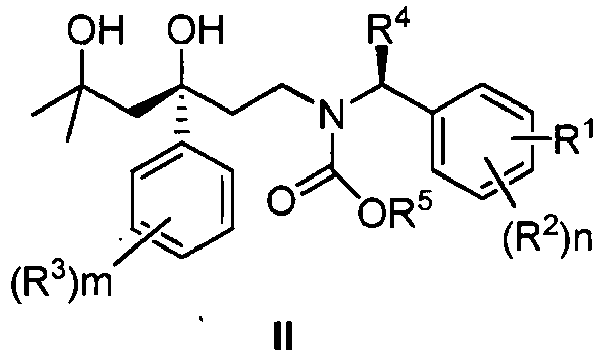

R5-O-C(O)-R7 V
to provide the compound of formula (II), wherein - m and n are each independently 0, 1 or 2;
- R1 is a leaving group selected from chloro, bromo, iodo, methoxy, arylsulfonyloxy and trifluoromethanesulfonyloxy; or
- R1 is a carbocyclic or heterocyclic ring selected from phenyl, thienyl, pyridyl, N-oxo-pyridyl, cyclopropyl, piperidinyl, piperazinyl, morpholinyl, thiazolyl, oxadiazolyl, thiadiazolyl, pyrazolyl, S,S-dioxothiazinyl, pyridazinyl, pyrimidinyl, pyrazinyl, benzimidazolyl, benztriazolyl, oxodihydropyridyl, oxodihydropyridazinyl, oxodihydropyrimidinyl and oxodihydropyrazinyl; wherein each of the foregoing R1 carbocyclic or heterocyclic rings may be optionally substituted by 1 to 4 groups; wherein substituents for ring carbon atoms of said carbocyclic or heterocyclic rings are independently selected from halogen, cyano, oxo, nitro, -(C1-C6)alkyl, -O(C1-C6)alkyl, and -(C3-C6)cycloalkyl; and wherein substituents for ring nitrogen atoms of said heterocyclic rings, when present, are selected from -(C1-C6)alkyl and -(C3- C6)cycloalkyl;
- each R2 and R3 is independently selected from -(C1-C6)alkyl, -O(C1-C6)alkyl, and -(C3-C6)cycloalkyl; wherein each of the -(C1-C6)alkyl, -O(C1-C6)alkyl, and -(C3-C6)cycloalkyl of said R2 and R3 is optionally independently substituted with one to three R6 groups;
- R4 is selected from -(C1-C6)alkyl and -(C3-C6)cycloalkyl; wherein the -(C1-C6)alkyl and -(C3-C6)cycloalkyl of said R4 is optionally substituted with one to three R6 groups;
- R5 is selected from -(C1-C6)alkyl, -(C3-C6)cycloalkyl, and phenyl;
- each R6 is independently selected from halo, -(C1-C6)alkyl, -O(C1-C6)alkyl, and -(C3-C6)cycloalkyl; and
- R7 is selected from chloro, iodo, and bromo.
- In another embodiment, the invention relates to a method of making the compound of formula (II), wherein R1 is bromo; and R4 is -(C1-C6)alkyl.
- In another embodiment, the invention relates to a method of making the compound of formula (II), wherein m and n are each 0.
- In another embodiment, the invention relates to a method of making the compound of formula (II), according to any of the embodiments above, wherein R4 is methyl.
- In another embodiment, the invention relates to a method of making the compound of formula (II), according to any of the embodiments above wherein R5 is phenyl.
- In another embodiment, the invention relates to a method of making the compound of formula (II) according to any of the embodiments, above wherein R7 is chloro.
- In another embodiment, the invention relates to a method of making the compound of formula (II) according to the broadest embodiment above, wherein R1 is bromo; R4 is -(C1-C6)alkyl; R5 is phenyl; R7 is chloro; and m and n are each 0.
- In another embodiment, the invention relates to a method of making the compound of formula (II) according to the embodiment immediately above, wherein R4 is methyl.
- In another embodiment, the invention relates to a method of making the compound of formula (II) as described in the broadest embodiment above, wherein R1 is oxodihydropyrid-4-yl; and wherein said nitrogen atom of said oxodihydropyrid-4-yl is substituted by methyl or cyclohexyl.
- In another embodiment, the invention relates to a method of making the compound of formula (II) as described in the embodiment immediately above, wherein R1 is oxodihydropyrid-4-yl and wherein said nitrogen atom of said oxodihydropyrid-4-yl is substituted by methyl or cyclohexyl; R4 is methyl; and m and n are each 0.
- In another embodiment, the invention relates to a method of making the compound of formula (II) according to the two embodiments immediately above, wherein R5 is phenyl and R7 is chloro.
- The invention also relates to methods of making the compound of formula (IV):


- m and n are each independently 0, 1 or 2;
- R1 is a leaving group selected from chloro, bromo, iodo, methoxy, arylsulfonyloxy and trifluoromethanesulfonyloxy; or
- R1 is a carbocyclic or heterocyclic ring selected from phenyl, thienyl, pyridyl, N-oxo-pyridyl, cyclopropyl, piperidinyl, piperazinyl, morpholinyl, thiazolyl, oxadiazolyl, thiadiazolyl, pyrazolyl, S,S-dioxothiazinyl, pyridazinyl, pyrimidinyl, pyrazinyl, benzimidazolyl, benztriazolyl, oxodihydropyridyl, oxodihydropyridazinyl, oxodihydropyrimidinyl and oxodihydropyrazinyl; wherein each of the foregoing R1 carbocyclic or heterocyclic rings may be optionally substituted by 1 to 4 groups; wherein substituents for ring carbon atoms of said carbocyclic or heterocyclic rings are independently selected from halogen, cyano, oxo, nitro, -(C1-C6)alkyl, -O(C1-C6)alkyl, and -(C3-C6)cycloalkyl; and wherein substituents for ring nitrogen atoms of said heterocyclic rings, when present, are selected from -(C1-C6)alkyl and -(C3- C6)cycloalkyl;
- each R2 and R3 is independently selected from -(C1-C6)alkyl, -O(C1-C6)alkyl, and -(C3-C6)cycloalkyl; wherein each of the -(C1-C6)alkyl, -O(C1-C6)alkyl, and -(C3-C6)cycloalkyl of said R2 and R3 is optionally independently substituted with one to three R6 groups;
- R4 is selected from -(C1-C6)alkyl and -(C3-C6)cycloalkyl; wherein the -(C1-C6)alkyl and -(C3-C6)cycloalkyl of said R4 is optionally substituted with one to three R6 groups; and
- each R6 is independently selected from halo, -(C1-C6)alkyl, -O(C1-C6)alkyl, and -(C3-C6)cycloalkyl.
- In another embodiment, the invention relates to the first method of making the compound of formula (IV), wherein R1 is bromo; and R4 is -(C1-C6)alkyl.
- In another embodiment, the invention relates to the first method of making the compound of formula (IV), wherein m and n are each 0.
- In another embodiment, the invention relates to the first method of making the compound of formula (IV) according to any of the embodiments above, wherein R4 is methyl.
- In another embodiment, the invention relates to the first method of making the compound of formula (IV) according to the broadest embodiment above, wherein R1 is bromo; R4 is -(C1-C6)alkyl; and m and n are each 0.
- In another embodiment, the invention relates to the first method of making the compound of formula (IV) according to the embodiment immediately above, wherein R4 is methyl.
- In another embodiment, the invention relates to the first method of making the compound of formula (IV) as described in the broadest embodiment above, wherein R1 is oxodihydropyrid-4-yl; and wherein said nitrogen atom of said oxodihydropyrid-4-yl is substituted by methyl or cyclohexyl.
- In another embodiment, the invention relates to the first method of making the compound of formula (IV) as described in the embodiment immediately above, wherein R1 is oxodihydropyrid-4-yl and wherein said nitrogen atom of said oxodihydropyrid-4-yl is substituted by methyl or cyclohexyl; R4 is methyl; and m and n are each 0.
- In another embodiment, the invention relates to the first method of making the compound of formula (II) according to any of the embodiments described above, wherein the transition metal catalyst is Ru3(CO)10.
- In another embodiment ("the second method for making the compound of formula (IV)"), a method of making the compound of formula (IV) comprises allowing a compound formula (VIII):


- m and n are each independently 0, 1 or 2;
- R1 is a leaving group selected from chloro, bromo, iodo, methoxy, arylsulfonyloxy and trifluoromethanesulfonyloxy; or
- R1 is a carbocyclic or heterocyclic ring selected from phenyl, thienyl, pyridyl, N-oxo-pyridyl, cyclopropyl, piperidinyl, piperazinyl, morpholinyl, thiazolyl, oxadiazolyl, thiadiazolyl, pyrazolyl, S,S-dioxothiazinyl, pyridazinyl, pyrimidinyl, pyrazinyl, benzimidazolyl, benztriazolyl, oxodihydropyridyl, oxodihydropyridazinyl, oxodihydropyrimidinyl and oxodihydropyrazinyl; wherein each of the foregoing R1 carbocyclic or heterocyclic rings may be optionally substituted by 1 to 4 groups; wherein substituents for ring carbon atoms of said carbocyclic or heterocyclic rings are independently selected from halogen, cyano, oxo, nitro, -(C1-C6)alkyl, -O(C1-C6)alkyl, and -(C3-C6)cycloalkyl; and wherein substituents for ring nitrogen atoms of said heterocyclic rings, when present, are selected from -(C1-C6)alkyl and -(C3- C6)cycloalkyl;
- each R2 and R3 is independently selected from -(C1-C6)alkyl, -O(C1-C6)alkyl, and -(C3-C6)cycloalkyl; wherein each of the -(C1-C6)alkyl, -O(C1-C6)alkyl, and -(C3-C6)cycloalkyl of said R2 and R3 is optionally independently substituted with one to three R6 groups;
- R4 is selected from -(C1-C6)alkyl and -(C3-C6)cycloalkyl; wherein the -(C1-C6)alkyl and -(C3-C6)cycloalkyl of said R4 is optionally substituted with one to three R6 groups; and
- each R6 is independently selected from halo, -(C1-C6)alkyl, -O(C1-C6)alkyl, and -(C3-C6)cycloalkyl.
- In another embodiment, the invention relates to the second process for making the compound of formula (IV), wherein R1 is bromo; and R4 is -(C1-C6)alkyl;
- In another embodiment, the invention relates to the second process for making the compound of formula (IV) according to any of the embodiments above, wherein m and n are each 0.
- In another embodiment, the invention relates to the second process for making the compound of formula (IV) according to any of the embodiments above, wherein R4 is methyl.
- In another embodiment, the invention relates to the second process for making the compound of formula (IV) according to the broadest embodiment above, wherein R1 is bromo; R4 is -(C1-C6)alkyl; and m and n are each 0.
- In another embodiment, the invention relates to the second process for making the compound of formula (IV) according to the embodiment immediately above, wherein R4 is methyl.
- In another embodiment, the invention relates to the second method of making the compound of formula (IV) as described in the broadest embodiment above, wherein R1 is oxodihydropyrid-4-yl; and wherein said nitrogen atom of said oxodihydropyrid-4-yl is substituted by methyl or cyclohexyl.
- In another embodiment, the invention relates to the second method of making the compound of formula (IV) as described in the embodiment immediately above, wherein R1 is oxodihydropyrid-4-yl and wherein said nitrogen atom of said oxodihydropyrid-4-yl is substituted by methyl or cyclohexyl; R4 is methyl; and m and n are each 0.
- In another embodiment, the invention relates to the second process for making the compound of formula (IV) according to any of the embodiments above, wherein the reducing agent is sodium borohydride.
- The invention still further relates to methods of making the compound of formula (III). In one embodiment, a method of making the compound of formula (III) comprises allowing a compound formula (VI):


- m and n are each independently 0, 1 or 2;
- R1 is a leaving group selected from chloro, bromo, iodo, methoxy, arylsulfonyloxy and trifluoromethanesulfonyloxy; or
- R1 is a carbocyclic or heterocyclic ring selected from phenyl, thienyl, pyridyl, N-oxo-pyridyl, cyclopropyl, piperidinyl, piperazinyl, morpholinyl, thiazolyl, oxadiazolyl, thiadiazolyl, pyrazolyl, S,S-dioxothiazinyl, pyridazinyl, pyrimidinyl, pyrazinyl, benzimidazolyl, benztriazolyl, oxodihydropyridyl, oxodihydropyridazinyl, oxodihydropyrimidinyl and oxodihydropyrazinyl; wherein each of the foregoing R1 carbocyclic or heterocyclic rings may be optionally substituted by 1 to 4 groups; wherein substituents for ring carbon atoms of said carbocyclic or heterocyclic rings are independently selected from halogen, cyano, oxo, nitro, -(C1-C6)alkyl, -O(C1-C6)alkyl, and -(C3-C6)cycloalkyl; and wherein substituents for ring nitrogen atoms of said heterocyclic rings, when present, are selected from -(C1-C6)alkyl and -(C3- C6)cycloalkyl;
- each R2 and R3 is independently selected from -(C1-C6)alkyl, -O(C1-C6)alkyl, and -(C3-C6)cycloalkyl; wherein each of the -(C1-C6)alkyl, -O(C1-C6)alkyl, and -(C3-C6)cycloalkyl of said R2 and R3 is optionally independently substituted with one to three R6 groups;
- R4 is selected from -(C1-C6)alkyl and -(C3-C6)cycloalkyl; wherein the -(C1-C6)alkyl and -(C3-C6)cycloalkyl of said R4 is optionally substituted with one to three R6 groups; and
- each R6 is independently selected from halo, -(C1-C6)alkyl, -O(C1-C6)alkyl, and -(C3-C6)cycloalkyl.
- In another embodiment, the invention relates to a method of making the compound of formula (III) according to the broadest embodiment above, wherein R1 is bromo; and R4 is -(C1-C6)alkyl;
- In another embodiment, the invention relates to a method of making the compound of formula (III) according to any of the embodiments above, wherein m and n are each 0.
- In another embodiment, the invention relates to a method of making the compound of formula (III) according to any of the embodiments above, wherein R4 is methyl.
- In another embodiment, the invention relates to a method of making the compound of formula (III) according to the broadest embodiment above, wherein R1 is bromo; R4 is -(C1-C6)alkyl; and m and n are each 0.
- In another embodiment, the invention relates to a method of making the compound of formula (III) according to the embodiment immediately above, wherein R4 is methyl.
- In another embodiment, the invention relates to a method of making the compound of formula (III) as described in the embodiment immediately above, wherein R1 is oxodihydropyrid-4-yl and wherein said nitrogen atom of said oxodihydropyrid-4-yl is substituted by methyl or cyclohexyl; R4 is methyl; and m and n are each 0.
- In another embodiment, the invention relates to a method of making the compound of formula (III) according to any of the embodiments above, wherein the reducing agent is sodium borohydride.
- In another embodiment, the invention relates to a method of making the compound of formula (III) according to any of the embodiments above, wherein the catalyst is NiCl2dppe/Et2Zn.
- In a further embodiment, the invention relates to a method of making the compound of formula (VIII)


- m is 0, 1 or 2;
- each R3 is independently selected from -(C1-C6)alkyl, -O(C1-C6)alkyl, and -(C3-C6)cycloalkyl; wherein each of the -(C1-C6)alkyl, -O(C1-C6)alkyl, and -(C3-C6)cycloalkyl of said R3 is optionally independently substituted with one to three R6 groups; and
- each R6 is independently selected from halo, -(C1-C6)alkyl, -O(C1-C6)alkyl, and -(C3-C6)cycloallcyl.
- In another embodiment, the invention relates to a method for making the compound of formula (VIII), wherein m is O.
- In still a further embodiment, the invention relates to a method of making the compound of formula (XII):

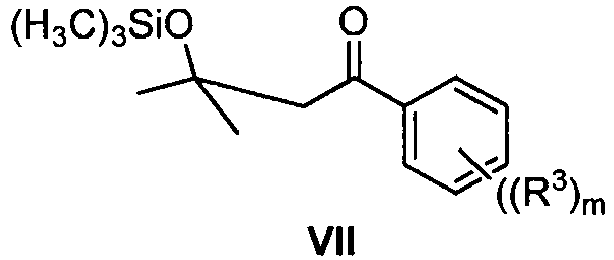
- m is 0, 1 or 2;
- each R3 is independently selected from -(C1-C6)alkyl, -O(C1-C6)alkyl, and -(C3-C6)cycloalkyl; wherein each of the -(C1-C6)alkyl, -O(C1-C6)alkyl, and -(C3-C6)cycloalkyl of said R3 is optionally independently substituted with one to three R6 groups; and
- each R6 is independently selected from halo, -(C1-C6)alkyl, -O(C1-C6)alkyl, and -(C3-C6)cycloalkyl.
- In another embodiment, the invention relates to a method for making the compound of formula (XII) according to any of the embodiments above, wherein m is 0.
- In another embodiment, the invention relates to a method for making the compound of formula (XII) according to any of the embodiments above, wherein the (R)-3,3'-dihalo-1,1'-binaphthyl-2,2'-diol is selected from (R)-3,3'-difluoro-1,1'-binaphthyl-2,2'-diol, (R)-3,3'-dibromo-1,1'-binaphthyl-2,2'-diol and (R)-3,3'-dichloro-1,1'-binaphthyl-2,2'-diol.
- In another embodiment, the invention relates to a method for making the compound of formula (XII) according to any of the embodiments above, wherein the (R)-3,3'-dihalo-1,1'-binaphthyl-2,2'-diol is (R)-3,3'-dibromo-1,1'-binaphthyl-2,2'-diol.
- In another embodiment, the invention relates to a method for making the compound of formula (XII) according to any of the embodiments above, wherein the (R)-3,3'-dihalo-1,1'-binaphthyl-2,2'-diol is (R)-3,3'-difluoro-1,1'-binaphthyl-2,2'-diol.
- In yet another embodiment, the invention relates to a compound of formula (II):

- m and n are each independently 0, 1 or 2;
- R1 is selected from chloro, bromo, iodo, methoxy, arylsulfonyloxy and trifluoromethanesulfonyloxy;
- each R2 and R3 is independently selected from -(C1-C6)alkyl, -O(C1-C6)alkyl, and -(C3-C6)cycloalkyl; wherein each of the -(C1-C6)alkyl, -O(C1-C6)alkyl, and -(C3-C6)cycloalkyl of said R2 and R3 is optionally independently substituted with one to three R6 groups;
- R4 is selected from -(C1-C6)alkyl and -(C3-C6)cycloalkyl; wherein the -(C1-C6)alkyl and -(C3-C6)cycloalkyl of said R4 is optionally substituted with one to three R6 groups;
- R5 is selected from -(C1-C6)alkyl, -(C3-C6)cycloalkyl, and phenyl;
- each R6 is independently selected from halo, -(C1-C6)alkyl, -O(C1-C6)alkyl, and -(C3-C6)cycloalkyl.
- In another embodiment, the invention relates to a compound of formula (II), wherein R1 is bromo; R4 is -(C1-C6)alkyl; R5 is phenyl; and m and n are each 0.
- In another embodiment, the invention relates to a compound of formula (II) as described in any of the embodiments above, wherein R1 is bromo; R4 is methyl, R5 is phenyl; and m and n are each 0.
- In yet another embodiment, the invention relates to a compound of formula (III):

- m and n are each independently 0, 1 or 2;
- R1 is selected from chloro, bromo, iodo, methoxy, arylsulfonyloxy and trifluoromethanesulfonyloxy;
- each R2 and R3 is independently selected from -(C1-C6)alkyl, -O(C1-C6)alkyl, and -(C3-C6)cycloalkyl; wherein each of the -(C1-C6)alkyl, -O(C1-C6)alkyl, and -(C3-C6)cycloalkyl of said R2 and R3 is optionally independently substituted with one to three R6 groups;
- R4 is selected from -(C1-C6)alkyl and -(C3-C6)cycloalkyl; wherein the -(C1-C6)alkyl and -(C3-C6)cycloalkyl of said R4 is optionally substituted with one to three R6 groups; and
- each R6 is independently selected from halo, -(C1-C6)alkyl, -O(C1-C6)alkyl, and -(C3-C6)cycloalkyl.
- In another embodiment, the invention relates to a compound of formula (III), wherein R1 is bromo; R4 is -(C1-C6)alkyl; and m and n are each 0.
- In another embodiment, the invention relates to a compound of formula (III) as described in any of the embodiments above, wherein R1 is bromo; R4 is methyl; and m and n are each 0.
- In another embodiment, the invention relates to a compound of formula (IV):

- m and n are each independently 0, 1 or 2;
- R1 is selected from chloro, bromo, iodo, methoxy, arylsulfonyloxy and trifluoromethanesulfonyloxy;
- each R2 and R3 is independently selected from -(C1-C6)alkyl, -O(C1-C6)alkyl, and -(C3-C6)cycloalkyl; wherein each of the -(C1-C6)alkyl, -O(C1-C6)alkyl, and -(C3-C6)cycloalkyl of said R2 and R3 is optionally independently substituted with one to three R6 groups;
- R4 is selected from -(C1-C6)alkyl and -(C3-C6)cycloalkyl; wherein the -(C1-C6)alkyl and -(C3-C6)cycloalkyl of said R4 is optionally substituted with one to three R6 groups; and
- each R6 is independently selected from halo, -(C1-C6)alkyl, -O(C1-C6)alkyl, and -(C3-C6)cycloalkyl.
- In another embodiment, the invention relates to a compound of formula (IV), wherein R1 is bromo; R4 is -(C1-C6)alkyl; and m and n are each 0.
- In another embodiment, the invention relates to a compound of formula (IV) as described in any of the embodiments above, wherein R1 is bromo; R4 is methyl; and m and n are each 0.
- In another embodiment, the invention relates to (R)-2,2'-bis(methoxymethoxy)-1,1'-binaphthyl.
- Further aspects of the invention are described below.
-
- (R)-DBBINOL= (R)-3,3'-dibromo-1,1'-binaphthyl-2,2'-diol
- n-BuLi = n-butyl lithium
- t-BuOH = t-butanol
- DIBAL-H = diisobutylaluminum hydride
- DME = 1,2-dimethoxyethane
- DMF = dimethylformamide
- EtOAc = ethyl acetate
- i-Pr2NH = diisopropylamine
- LDA = lithium diisopropylamide
- MeOH = methanol
- MOMCl = chloro(methoxy)methane
- MTBE = methyl tert-butyl ether
- NFSI = N-fluoro-N-(phenylsulfonyl)benzenesulfonamide
- NMP = N-methyl-2-pyrrolidone
- THF = tetrahydrofuran
- TMSCl = trimethylchlorosilane
- The term "(C1-C6)alkyl" refers to branched and unbranched alkyl groups having from 1 to 6 carbon atoms. Examples of -(C1-C6)alkyls include methyl, ethyl, n-propyl, isopropyl, n-butyl, sec-butyl, isobutyl, tert-butyl, n-pentane, iso-pentyl, neopentyl, n-hexane, iso-hexanes (e.g., 2-methylpentyl, 3-methylpentyl, 2,3-dimethylbutyl, and 2,2-dimethylbutyl). It will be understood that any chemically feasible carbon atom of the (C1-C6)alkyl group can be the point of attachment to another group or moiety.
- The term "(C3-C6)cycloalkyl" refers to a nonaromatic 3- to 6-membered monocyclic carbocyclic radical. Examples of "(C3-C6)cycloalkyls include cyclopropyl, cyclobutyl, cyclohexyl, cyclopentyl and cyclohexyl.
- The term "halo" or "halogen" refers to fluoro, chloro, bromo or iodo.
- As noted above, the subject invention relates to compounds of formulae (II), (III), and (IV). The subject invention also relates to methods of making the compounds of formulae (I), (II), (III), (IV), (VIII) and (XII). These compounds are useful as intermediates for making 1,3-disubstited oxazinan-2-one 11-β-HSD1 inhibitors. Thus, it is desirable to have improved methods for making these intermediates.
- Scheme 1 below depicts an exemplary method for making the compounds of formulae (I), (II), and (IV) according the processes of the invention.

- As depicted in Scheme 1, the compound of formula (I) can be prepared by allowing the compound of formula (II) to cyclize in the presence of base to provide the compound of formula (I). The cyclization can be carried out under aqueous or nonaqueous conditions. Nonlimiting examples of bases useful for carrying out the cyclization include aqueous bases comprising LiOH, NaOH, KOH, and CsOH. Nonlimiting examples of bases useful for carrying out the cyclization under non-aqueous conditions include KO-t-Bu, KO-t-pentyl, NaOMe, NaOEt, KOMe, KOEt, LiN(SiMe3)2, NaN(SiMe3)2, KN(SiMe3)2, and NaH. The cyclization may be carried out at a temperature of from about 2°C to about 100°C; typically about 25°C.
- As depicted in Scheme 1, the compound of formula (II) can be prepared by allowing the compound of formula (III) to react with a reducing agent, e.g., 1,1,3,3-tetramethyldisiloxane, in the presence of a transition metal catalyst, e.g., Ru3(CO)10, to provide a compound of formula (IV). The compound of formula (IV) is then allowed to react with the compound of formula (V) to provide the compound of formula (II). Typically, the compound of formula (IV) is not isolated prior to carrying out the reaction with the compound of formula (V). Alternatively, the compound of formula (II) can be prepared by methods described in
WO2010089303 which provide a mixture of diastereomers of the compound of formula (II). The compound of formula (II) can then be isolated from the mixture of diastereomers using known methods, e.g., recrystallization and/or chromatography (e.g., chiral chromatography). - The compounds of formula (I) where R1 is a carbocyclic or heterocyclic ring as defined above are useful as 11-β-HSD1 inhibitors. Alternatively, compounds of formula (I) where R1 is a leaving group as defined above are useful intermediates for making 11-β-HSD1 inhibitors. For example, the compound of formula (I) where R1 is a leaving group can be reacted with a Grignard reagent of formula RMgBr (where R is a carbocyclic or heterocyclic ring as defined for R1 above) to provide a 11-β-HSD1 inhibitor of formula (I) useful as an 11-β-HSD1 inhibitor (see, e.g.,
WO/2009/134400 andWO/2010/010150 ). - Schemes 2 and 3 below depict exemplary methods for making the compound of formula (III) according to the first process and second process of the invention.
- Scheme 2 below depicts an exemplary first process for making the compound of formula (III) according to the invention.

- As shown in Scheme 2, the compound of formula (IX) is allowed to react with bromoacetyl bromide in the presence of base to provide the compound of formula (VI). The compound of formula (VI) is then allowed to react with the compound of formula (VII) in the presence of a catalyst (e.g., NiCl2dppe/Et2Zn) at reduced temperature (e.g., about -4°C) to provide the compound of formula (III). Compounds of formula (IX) are commercially available or can be made by known methods. Preferably the compound of formula (IX) is enantiomerically pure, i.e., the enantiomer depicted in Scheme 2 is present in at least about 90%, more preferably 95%; most preferably at least about 99%, based on the total amount of both enantiomers of the compound of formula (IX).
- The compound of formula (III) can also be prepared using methods analogous to those described in, e.g., Devant, R. et al., Chemische Berichte 119: 2191-207 (1986). The compound of formula (VII) can also be made by known methods (see Odenkirk et al, Tetrahedron Lett. 1992, 33, 5729; Le Roux et al. Synlett 1998, 11, 1249; Chancharunee et al. Tetrahedron Lett. 2003, 44, 5683) or by the method depicted below in Scheme 2a using the procedure of Schneider et al, Chem. Eur. J. 2005, 11, 3010-3021.

- As depicted in Scheme 2a, a compound of formula (X) is allowed to react with acetone and n-BuLi in the presence of an amine (e.g., diisopropylamine) at reduced temperature. The compound of formula (XI) may also be prepared under milder conditions (e.g., 0°C) using the procedure of Mukaiyama et al, Organic Syntheses, 1987, 65, 6.
- Scheme 3 below depicts an exemplary method for making the compound of formula (III) according to the second process of the invention.

- As depicted in Scheme 3, the compound of formula (VII) is allowed to react with 2-(2-propen-1-yl)-1,3,2-dioxaborinane in the presence of a biaryl catalyst such as (R)-3,3'-dibromo-1,1'-binaphthyl-2,2'-diol ((R)-DBBINOL), (R)-3,3'-dichloro-1,1'-binaphthyl-2,2'-diol or (R)-3,3'-difluoro-1,1'-binaphthyl-2,2'-diol and 2 equivalents of tertiary alcohol such as t-BuOH and t-amyl alcohol to provide the compound of formula (XII). The compound of formula (XII) is then subject to ozonolysis to provide the compound of formula (VIII) which is further allowed to undergo reductive amination with the compound of formula (IX) in the presence of reducing agent (e.g., NaBH4) in alcoholic solvent to provide the compound of formula (III). 2-(2-propen-1-yl)-1,3,2-dioxaborinane can be prepared by the method described below in the Examples section or literature methods (see e.g., D. S. Barnett et al., Angewandte Chemie, International Edition, 48: 8679-8682 (2009) and H.C. Brown et al., Journal of Organic Chemistry, 55: 1868-74 (1990)).
- (R)-3,3'-dibromo-1,1'-binaphthyl-2,2'-diol ((R)-DBBINOL) and (R)-3,3'-dichloro-1,1'-binaphthyl-2,2'-diol can be prepared by known methods (see, e.g., Ooi et al., J. Am Chem. Soc. 125(17): 5139-5151 (2003) and Egami et al., J. Am Chem. Soc. 131(17): 6082-6083 ((2009)). (R)-3,3'-difluoro-1,1'-binaphthyl-2,2'-diol can be prepared by the method described below in the Examples section.
- Preferably the compound of formula (IX) used in Schemes 2 and 3 is enantiomerically pure, i.e., the enantiomer depicted in Schemes 2 and 3 is present in at least about 90%, more preferably 95%; most preferably at least about 99%, based on the total amount of both enantiomers of the compound of formula (IX). Applicants found that when using an enantiomerically pure form of (IX) as reagent, that chiral center of the diastereomeric products is fixed at the start of the reaction. The other chiral center of the diastereomeric compounds is determined by the process conditions described above and in the Examples. Thus, products formed by this process substantially comprise only two diastereomers. This allows for easier purification of product and improved overall yield.
- The purity of the compounds described in the Examples section is determined using high performance liquid chromatography (HPLC) and nuclear magnetic resonance (NMR) spectroscopy. Reverse phase HPLC is used to determine the amount of each diastereomer present and the ratio of these amounts is used to determine the chiral purity of the diastereomeric product.
- 1NMR spectra are recorded on a 400 MHz Bruker spectrometer using d-6 DMSO as the sample solvent.
-

-

- A solution of (S)-(4-bromophenyl)ethylamine (100.0 g, 0.50 mol; >99% chiral purity) and toluene (500 mL) is treated with a solution of NaOH (30.0 g, 0.75 mol) in water (500 mL). The resultant mixture is cooled to about 5°C and treated with bromoacetyl bromide (52.2 mL, 0.60 mol). The reaction mixture is allowed to warm to about 25°C over 1 hour. The solid is filtered and washed with water and heptane. The solid is then dried under vacuum at about 55°C for 18 hours to provide 1 as a white solid. Yield: 156.4 g, 95.6%.
-

- A flask is charged with THF (1 L), cooled to -50°C, and treated with lithium diisopropylamide (LDA) (1.05 L, 1.89 mol, 1.1 equiv, 1.8M in THF/heptane/ethylbenzene). The reactor contents are then treated with acetophenone (200 mL, 1.71 mol, 1.0 equiv) at a rate to maintain the batch at about -50°C. The reaction mixture is stirred at about -50°C for 30 minutes then treated with acetone (151 mL, 2.06 mol, 1.2 equiv) at a rate to maintain the mixture at about -50°C. The reaction mixture is stirred at about -50°C for 1 hour then treated with water (1 L) and heptane (500 mL). The reaction mixture is allowed to warm to 25°C, and the resultant organic phase is collected and washed with water (400 mL). The organic phase is concentrated to an oil and treated with a solution of imidazole (233.4 g, 3.43 mol, 2.0 equiv) and DMF (600 mL). The resultant solution is treated with chlorotrimethylsilane (217.6 mL, 1.71 mol, 1.0 equiv) at a rate to maintain the reaction mixture at no more than 35°C. The reaction mixture is stirred at 25°C for 1 hour, and diluted with heptane (600 mL) and water (1 L). The resultant organic phase is collected, washed with water (3 x 500 mL), and concentrated. The resultant oil is then vacuum distilled at 1-3 mm Hg (product distills at 83-88°C) to provide 2 as a yellow liquid. Yield: 160.3 g, 37%.
-

- A flask is charged with 1 (120.0 g, 0.366 mol), 2 (120.0 g, 0.479 mol) and NiCl2(dppe) (1.93 g, 3.66 mmol). The flask is purged with nitrogen and charged with DME (240 mL). The resultant slurry is cooled to about -20°C and treated with diethylzinc (30 wt.% solution in toluene, 477 mL, 1.097 mol) at a rate to keep the temperature of the reaction mixture between -15 to -5°C. The reaction mixture is then stirred at -5 to 0°C for 2 hours, treated with 6N aqueous HCl (600 mL), and stirred for 15 minutes. The reaction mixture is treated with isopropyl acetate (120 mL), stirred at 25°C for 30 minutes, cooled to 10°C, and held at 10°C for 30 minutes. The resultant solids are collected by filtration, and washed with water, toluene, and heptane. The solid is then dried at 70°C for 18 hours to provide 3 as a white solid. Yield: 98.3 g, 62:1-%; 97.1 wt.% purity. Diastereomeric ratio: 98.9:1.1. Melting point: 150-152°C. LC-MS: 419.8/421.8 (100%, 95%); calculated exact mass: 419.1.
-
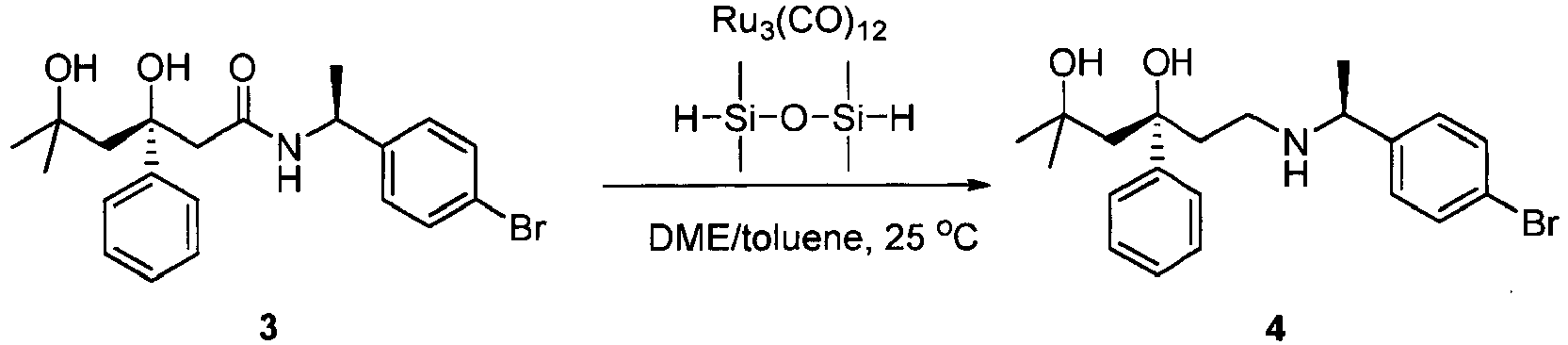
- A flask is charged with 3 (15.0 g, 96.5 wt.%, 34.4 mmol) and Ru3(CO)12 (220 mg, 0.344 mmol). The flask is purged with nitrogen and charged with toluene (45 mL) and DME (15 mL). The reaction mixture is then treated with 1,1,3,3-tetramethyldisiloxane (24.3 mL, 137.7 mmol). The reaction mixture is stirred at 25°C for 24-36 hours, treated with 1.5N aqueous HCl (30 mL), and stirred for 2 hours. The reaction mixture is then treated with 2N aqueous NaOH (30 mL) and stirred for 30 minutes to provide 4. LC-MS: 403.8/405.8 (85%, 100%); calculated exact mass: 405.1. The reaction mixture was used in Step 5 below without further treatment.
-

- Preparation 1: Compound 5 was first prepared by cooling a reaction mixture prepared according to Step 4 above to about 10°C and treating it drop-wise with phenyl chloroformate (1.25 molar equivalents based on the molar amount of compound 3 used in Step 4). The reaction mixture is stirred at 20-25°C for 2-18 hours, extracted with EtOAc, and the organic extract washed with 3N aqueous HCl. The combined organic phases are distilled to remove EtOAc and DME. The resultant solution is treated with heptane (30 mL), cooled to about 5°C, and held at about 5°C for 3 hours. The resultant solids are collected by filtration, washed with heptane, and dried under vacuum at 25°C for 18 hours to provide 5 as an off-white solid.
- Preparation 2: Using a procedure similar to that described in Preparation 1 above, the reaction mixture from Step 4 above is cooled to about 10°C and treated drop-wise with phenyl chloroformate (5.2 mL, 41.3 mmol). The reaction mixture is stirred at 20-25°C for 2-18 hours, extracted with EtOAc, and the organic extract washed with 3N aqueous HCl. The combined organic phases are distilled to remove EtOAc and DME. The resultant solution is treated with heptane (30 mL), cooled to about 5°C, seeded with 5 (obtained from Preparation 1 immediately above), and held at about 5°C for 3 hours. The resultant solids are collected by filtration, washed with heptane, and dried under vacuum at 25°C for 18 hours to provide 5 as an off-white solid. Yield: 14.61 g, 78.3%; 97.2 % purity by weight. Melting point: 129-131°C. LC-MS: 507.6/509.6 (95%, 100%); [M-H2O]+; calculated exact mass for M-H2O: 507.1.
-

- A flask is charged with phenyl (S)-1-(4-bromophenyl)ethyl((S)-3,5-dihydroxy-5-methyl-3-phenylhexyl)carbamate (25.0 g, 47.5 mmol) and NMP (125 mL). The resultant solution is treated with 50 wt.% aqueous KOH (12.5 mL), stirred at 25°C for 1 hour, and treated with water (250 mL). The resultant slurry is stirred at 25°C for 1 hour, and the solids collected by filtration. The solids are then washed with water and heptane, and dried under vacuum at 50°C for 18 hours to provide 6 as a white solid. Yield: 19.7 g, 95.1%; 99.1 %. purity by weight.
- Example 2 describes an alternative preparation of (S)-6-((S)-1-(4-bromophenyl)ethylamino)-2-methyl-4-phenylhexane-2,4-diol (4) described in Step 4 of Example 1 above.
-

- A reactor is purged with N2 and charged with 2M allylmagnesium chloride in THF (850 mL, 1.7 mol), anhydrous THF (755.7 g, 850 mL, 10.48 mol) and methyl-t-butyl ether (629.0 g, 850 mL, 7.1 mol), cooled to -65 °C, and treated with trimethylboronate (176.7 g, 1.7 mol) while maintaining a temperature of less than -60 °C. The resultant milky solution is maintained at -55 to -60 °C for 30 minutes and slowly warmed to 0 °C over 30 minutes. The mixture is then treated with acetyl chloride (120.1 g, 1.53 mol) while maintaining a temperature of less than 5 °C. The mixture is allowed to slowly warm to about 20 °C over 30 minutes and treated with 1,3-propanediol (116.4 g, 1.53 mol). The reaction mixture is maintained at about 20 °C for 6 hours, concentrated to about 1/3 of its original volume under reduced pressure at a temperature of less than about 29 °C, and treated with MTBE (580 mL) and heptane (720 ml). The resultant mixture is again reduced to about 1/3 of its original volume under reduced pressure, filtered through Celite, and the Celite plug rinsed with MTBE (3.5 L). The combined filtrates are then concentrated under reduced pressure at 29 °C to provide 7 as a colorless oil. Yield: 193 g; 75% based on 1,3-propanediol. The product was further purified by vacuum distillation prior to use in Step 2.
-

- A flask is charged with 2 (4.1 g; 16.5 mmol) (see Step 2 of Example 1 above), 17 mol% of (R)-DBBINOL (1.3 g; 2.9 mmol), and 2.4 eq. of t-BuOH (2.9 g; 39.1 mmol) under nitrogen atmosphere. The reaction mixture is then treated with 7 (3.7g; 29.4 mmol) from Step 1 above at 23°C and stirred for about 24 hours. The mixture is treated with water (50 mL), hexanes (50 mL), 3M HCl (1 mL), and stirred for 1 hour. The resultant organic layer is collected and washed with water (20 mL), 1M NaOH (2 x 10 mL), and water (2 x 10 mL). The organic layer is then concentrated to provide 8 as light yellow oil. Yield: 4.8 g, 16.99 mmol, 99% (>99% ee).
-

-

- A solution of 9 (20 mg; 0.068 mmol) in CH3OH (1.0 mL) at 23°C is treated with (S)-(4-bromophenyl)ethylamine (15 mg; 0.075 mmol; >99% chiral purity). The reaction mixture is then treated with solid NaBH4 (3.85 mg; 0.1 mmol), stirred overnight, and treated with 1M HCl (2 mL), and basified with 1 M NaOH (10 mL). The mixture is extracted with EtOAc (10 mL), and the organic extracts washed with saturated aqueous NaCl (10 mL). The washed extracts are then concentrated to provide 4 as an oil. Yield: 26 mg, 0.063 mmol, 95%.
-

-

- A solution of (R)-1,1'-binaphthyl-2,2'-diol (30 g, 0.10 mol) in THF (200 ml) is added to a stirred slurry of 60wt% NaH (10.48 g, 0.26 mol) in THF (100 mL) at 0-10°C. The mixture is stirred for 1 hour and treated with chloro(methoxy)methane (MOMCI) (20.25 g, 0.25 mol) while maintaining the temperature below 10°C. The resultant mixture is stirred for 1 hour at 0-5°C then treated with water (100 mL) to quench the reaction. The organic phase is collected and the aqueous phase extracted with EtOAc (2 x 250 mL). The combined organics layers are washed with water (200 mL) and concentrated. The resultant pale yellow solid is then slurried in 10:1 (vol/vol) hexane/EtOAc. The solids are collected by filtration and dried under reduced pressure top provide 11. Yield: 38.5g, 98%.
-

- A solution of n-BuLi (1.6M, 30.46 mL, 48.7 mL) in hexane is added to a stirred solution of 11 in Et2O (400 mL) at 23 °C. After 3 hour the resultant slurry is cooled to 0°C, treated with THF (40 mL), mixed for 0.5 hour, and treated with a solution of N-fluoro-N-(phenylsulfonyl)benzenesulfonamide (NFSI) (15.5 g, 49.2 mmol) in THF (40 mL). After 10 minutes the reaction is quenched with water, and the organic layer is collected. The aqueous layer is extracted with EtOAc (2 x 100 mL), and the combined organic layer is washed with water (100 mL) and concentrated. The resultant residue is redissolved in a minimum volume of toluene, added to a silica gel column, eluted with hexane/EtOAc, and concentrated to provide 10 as a white solid to provide 12. Yield: 6.3 g, 77%.
-

- Amberlyst® 15 (Aldrich) 15 (6 g) is added to a stirred solution of 12 (5.6g, 13.7 mmol) in 1:1 THF/MeOH (vol/vol) (60 mL). The resultant mixture is heated at reflux for 3 hours then allowed to cool to about 25°C. The mixture is then filtered through a Celite pad, and the filtrate is concentrated. The resultant residue is redissolved in a minimum volume of toluene, added to a silica gel column, eluted with hexane/EtOAc, and concentrated to provide 10 as a white solid. Yield: 4.3 g, 97%. 1H NMR (500 MHz, CDC13): δ 7.79 (d, 2H, J = 8.2 Hz), 7.65 (d, 2H, J = 11.2 Hz), 7.36 (t, 2H, J = 7.4 Hz), 7.22 (t, 2H, J = 7.9 Hz), 7.10 (d, 2H, J = 8.5 Hz), 5.96 (s, 2H). MS: 323(M+H).
-

-

- NaBH4 (0.226 g, 5.97 mmol) is added in portions to a mixture of 9 (1.17g, 3.98 mmol) and (S)-4-(4-(1-aminoethyl)phenyl)-1-methylpyridin-2(1H)-one (15) (1.00 g, 4.37 g) in MeOH (5 mL). The mixture is stirred at 25°C for 15 h, then treated with K2CO3 (1.65 g, 11.93 mmol) followed by phenyl chloroformate (0.93, 5.97 mmol). The resultant suspension is then stirred at 25°C for 1 hour, treated with water (15 mL) over 30 min, and stirred at 25°C for 2 hours. The solids are collected by filtration, rinsed with MeOH/water (1/3, 20 mL), and dried to provide 14 as off-white solid. Yield: 1.76 g, 79.8%. 1H NMR (DMSO-d6, 500 MHz): δ 7.77 (d, J = 7.2 Hz, 1H), 7.66 (m, 2H), 7.46-7.00 (m, 12H), 6.67 (d, J = 2.1 Hz, 1H), 6.56 (dd, J = 7.0, 2.1 Hz, 1H), 5.82 (s, 1H), 5.28 (br s, 1H), 5.11 (s, 1H), 3.45 (s, 3H), 3.35 (m, 1H), 2.59 (m, 1H), 2.14-1.81 (m, 4H), 1.55-1.29 (m, 3H), 1.01 (s, 3H), 0.61 (s, 3H); 13C NMR (DMSO-d6, 400 MHz): δ 161.97, 154.08, 151.20, 150.09, 147.53, 142.31, 139.85, 135.59, 129.18, 127.59, 127.40, 126.66, 125.87, 125.35, 125.07, 121.77, 114.79, 103.75, 75.53, 71.48, 53.82, 51.19, 44.90, 36.36, 32.80, 29.22, 21.58, 17.00; LC-MS (ES): m/z 555 (M+H), 479 (100).
-

- A solution of 25% KOH in MeOH (1.21 g, 5.41 mmol) is added to a solution of 14 (1.00 g, 1.80 mmol) in 1-methylpyrrolidin-2-one (NMP, 4 mL). The resultant mixture is stirred at about 25°C for 15 h, treated with water (15 mL), and stirred at 25°C for 0.5 h. The resultant solids are collected via filtration, rinsed with MeOH/water (1/3, 20 mL), and dried to provide 13 as white solid. Yield: 0.68 g, 81.4%. Purity: 99.6 area % at 220 nm. 1H NMR (DMSO-d6, 500 MHz): δ 7.74 (d, J = 7.1 Hz, 1H), 7.43 (d, J = 7.7 Hz, 2H), 7.34 (m, 5H), 6.95 (d, J = 7.7 Hz, 2H), 6.56 (s, 1H), 6.47 (d, J = 6.0 Hz, 1H), 5.43 (m, 1H), 4.26 (s, 1H), 3.43 (s, 3H, 3.33 (s, 2H), 3.02 (m, 1H), 2.43 (m, 1H), 2.14 (m, 1H), 2.02 (s, 2H), 1.46 (d, J = 6.8 Hz, 3H), 1.18 (s, 3H), 0.87 (s, 3H); 13C NMR (DMSO-d6, 400 MHz): δ 161.93, 152.44, 150.05, 143.37, 141.24, 139.85, 135.32, 128.33, 127.22, 127.10, 126.26, 124.90, 114.68, 103.70, 83.04, 69.30, 54.01, 52.62, 36.35, 36.22, 31.51, 30.81, 29.91, 15.46.
Claims (10)
- A method of making the compound of formula (I):

 m and n are each independently 0, 1 or 2;R1 is a leaving group selected from chloro, bromo, iodo, methoxy, arylsulfonyloxy and trifluoromethanesulfonyloxy; orR1 is a carbocyclic or heterocyclic ring selected from phenyl, thienyl, pyridyl, N-oxo-pyridyl, cyclopropyl, piperidinyl, piperazinyl, morpholinyl, thiazolyl, oxadiazolyl, thiadiazolyl, pyrazolyl, S,S-dioxothiazinyl, pyridazinyl, pyrimidinyl, pyrazinyl, benzimidazolyl, benztriazolyl, oxodihydropyridyl, oxodihydropyridazinyl, oxodihydropyrimidinyl and oxodihydropyrazinyl; wherein each of the foregoing R1 carbocyclic or heterocyclic rings may be optionally substituted by 1 to 4 groups; wherein substituents for ring carbon atoms of said carbocyclic or heterocyclic rings are independently selected from halogen, cyano, oxo, nitro, -(C1-C6)alkyl, -O(C1-C6)alkyl, and -(C3-C6)cycloalkyl; and wherein substituents for ring nitrogen atoms of said heterocyclic rings, when present, are selected from -(C1-C6)alkyl and -(C3-C6)cycloalkyl;each R2 and R3 is independently selected from -(C1-C6)alkyl, -O(C1-C6)alkyl, and -(C3-C6)cycloalkyl; wherein each of the -(C1-C6)alkyl, -O(C1-C6)alkyl, and -(C3-C6)cycloalkyl of said R2 and R3 is optionally independently substituted with one to three R6 groups;R4 is selected from -(C1-C6)alkyl and -(C3-C6)cycloalkyl; wherein the -(C1-C6)alkyl and -(C3-C6)cycloalkyl of said R4 is optionally substituted with one to three R6 groups;R5 is selected from -(C1-C6)alkyl, -(C3-C6)cycloalkyl, and phenyl; andeach R6 is independently selected from halo, -(C1-C6)alkyl, -O(C1-C6)alkyl, and -(C3-C6)cycloalkyl.
 - The method of claim 1, wherein R1 is bromo; and R4 is -(C1-C6)alkyl.
- The method of any of the preceeding claims, wherein m and n are each 0.
- The method of any of the preceeding claims, wherein R4 is methyl.
- The method of any of the preceeding claims, wherein R5 is phenyl.
- The method of any of the preceeding claims, wherein R1 is oxodihydropyrid-4-yl; and wherein said nitrogen atom of said oxodihydropyrid-4-yl is substituted by methyl or cyclohexyl.
- A compound of formula (II):
 m and n are each independently 0, 1 or 2;R1 is selected from chloro, bromo, iodo, methoxy, arylsulfonyloxy and trifluoromethanesulfonyloxy;each R2 and R3 is independently selected from -(C1-C6)alkyl, -O(C1-C6)alkyl, and -(C3-C6)cycloalkyl; wherein each of the -(C1-C6)alkyl, -O(C1-C6)alkyl, and -(C3-C6)cycloalkyl of said R2 and R3 is optionally independently substituted with one to three R6 groups;R4 is selected from -(C1-C6)alkyl and -(C3-C6)cycloalkyl; wherein the -(C1-C6)alkyl and -(C3-C6)cycloalkyl of said R4 is optionally substituted with one to three R6 groups;R5 is selected from -(C1-C6)alkyl, -(C3-C6)cycloalkyl, and phenyl; andeach R6 is independently selected from halo, -(C1-C6)alkyl, -O(C1-C6)alkyl, and -(C3-C6)cycloalkyl.
 - The compound of claim 7, wherein R1 is bromo; R4 is -(C1-C6)alkyl; R5 is phenyl; and m and n are each 0.
- The compound of claim 8, wherein R4 is methyl.
- A method of making the compound of formula (II) of claim 7, comprising allowing a compound of formula (IV),
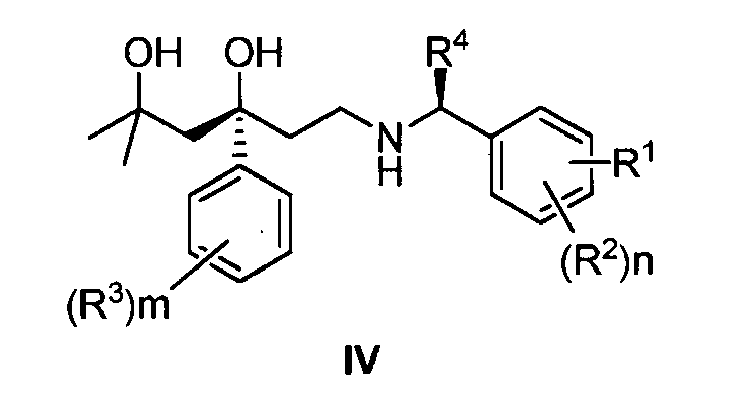
R5-O-C(O)-R7 V
to provide the compound of formula (II), whereinm, n and R1 to R5 are as defined in claim 7; andR7 is selected from chloro, iodo, and bromo.
Applications Claiming Priority (3)
| Application Number | Priority Date | Filing Date | Title |
|---|---|---|---|
| US201061424834P | 2010-12-20 | 2010-12-20 | |
| US201161528321P | 2011-08-29 | 2011-08-29 | |
| PCT/US2011/065013 WO2012087720A1 (en) | 2010-12-20 | 2011-12-15 | Methods of making diastereomeric organic compounds |
Publications (2)
| Publication Number | Publication Date |
|---|---|
| EP2655349A1 EP2655349A1 (en) | 2013-10-30 |
| EP2655349B1 true EP2655349B1 (en) | 2014-10-15 |
Family
ID=45498103
Family Applications (1)
| Application Number | Title | Priority Date | Filing Date |
|---|---|---|---|
| EP11810721.8A Not-in-force EP2655349B1 (en) | 2010-12-20 | 2011-12-15 | Methods of making diastereomeric organic compounds |
Country Status (4)
| Country | Link |
|---|---|
| US (1) | US8916701B2 (en) |
| EP (1) | EP2655349B1 (en) |
| JP (1) | JP2014508125A (en) |
| WO (1) | WO2012087720A1 (en) |
Family Cites Families (6)
| Publication number | Priority date | Publication date | Assignee | Title |
|---|---|---|---|---|
| WO2007011910A2 (en) * | 2005-07-19 | 2007-01-25 | Trustees Of Boston University | Chiral amine-catalyzed asymmetric addition of carbon-centered nucleophiles to imines |
| US8329897B2 (en) * | 2007-07-26 | 2012-12-11 | Vitae Pharmaceuticals, Inc. | Synthesis of inhibitors of 11β-hydroxysteroid dehydrogenase type 1 |
| CA2722427A1 (en) * | 2008-05-01 | 2009-11-05 | Vitae Pharmaceuticals, Inc. | Cyclic inhibitors of 11beta-hydroxysteroid dehydrogenase 1 |
| EP2291373B1 (en) * | 2008-05-01 | 2013-09-11 | Vitae Pharmaceuticals, Inc. | Cyclic inhibitors of 11beta-hydroxysteroid dehydrogenase 1 |
| WO2010010150A1 (en) | 2008-07-25 | 2010-01-28 | Boehringer Ingelheim International Gmbh | Synthesis of inhibitors of 11beta-hydroxysteroid dehydrogenase type 1 |
| WO2010089303A1 (en) * | 2009-02-04 | 2010-08-12 | Boehringer Ingelheim International Gmbh | CYCLIC INHIBITORS OF 11 β-HYDROXYSTEROID DEHYDROGENASE 1 |
-
2011
- 2011-12-15 US US13/921,145 patent/US8916701B2/en active Active
- 2011-12-15 WO PCT/US2011/065013 patent/WO2012087720A1/en not_active Ceased
- 2011-12-15 JP JP2013546218A patent/JP2014508125A/en active Pending
- 2011-12-15 EP EP11810721.8A patent/EP2655349B1/en not_active Not-in-force
Also Published As
| Publication number | Publication date |
|---|---|
| JP2014508125A (en) | 2014-04-03 |
| US8916701B2 (en) | 2014-12-23 |
| WO2012087720A1 (en) | 2012-06-28 |
| EP2655349A1 (en) | 2013-10-30 |
| US20140135493A1 (en) | 2014-05-15 |
Similar Documents
| Publication | Publication Date | Title |
|---|---|---|
| AU744313B2 (en) | 2-amino-6-(2-substituted-4-phenoxy)-substituted-pyridines | |
| JPWO2014021281A1 (en) | Partially saturated nitrogen-containing heterocyclic compounds | |
| JP2009544656A (en) | Preparation of levetiracetam | |
| JPH0262854A (en) | Production of substituted phenoxyethylamines | |
| TWI825323B (en) | Processes and intermediates for the preparation of 2-(2,6-dichlorophenyl)-1-[(1s,3r)-3-(hydroxymethyl)-5-(3-hydroxy-3-methylbutyl)-1-methyl-3,4-dihydroisoquinolin-2(1h)-yl]ethanone | |
| US8916701B2 (en) | Methods of making diastereomeric organic compounds | |
| WO2005115985A1 (en) | Aminopyridine derivatives as selective dopamine d3 agonists | |
| CA2200604C (en) | Novel production intermediate and process for producing pyridine derivative | |
| JP2015520750A (en) | Method for producing oxetane-3-ylmethanamine | |
| JP4956614B2 (en) | Novel process for producing 3-amino-5-fluoro-4-dialkoxypentanoic acid ester | |
| KR101686087B1 (en) | Process for Production of Optically Active Indoline Derivatives or Salts Thereof | |
| EP1442017A1 (en) | Preparation of benzosuberonylpiperidine compounds | |
| US5973161A (en) | Enantioselective synthesis of cyclopentenes | |
| WO2005068457A1 (en) | Cataltytic asymmetric hetero diels-alder reaction of a heteroaromatic c-nitroso dienophile: a novel method for synthesis of chiral non-racemic amino alcohols | |
| JP2006028154A (en) | Method for producing optically active compound | |
| JP5616977B2 (en) | Method for producing optically active alcohol compound | |
| KR101446708B1 (en) | Optically active ethylenediamine derivatives and prepartion method thereof | |
| Kawazoe et al. | Synthesis of Optically Active Thromboxane A2 and Leukotriene D4 Receptor Antagonists | |
| CA2307979C (en) | Novel production intermediate and process for producing pyridine derivative | |
| JPH11240869A (en) | Lactam carboxylic acid derivative, its production and production of piperidine derivative using the same | |
| AU2017258668A1 (en) | Process for the preparation of herbicidal pyridinylimidazolone compounds | |
| JP4267125B2 (en) | Method for producing pyridine alcohol derivative | |
| JP2023027698A (en) | OPTICALLY ACTIVE PYRROLIDINE DERIVATIVE OR ACIDIC SALT THEREOF, OPTICALLY ACTIVE α-CARBOLINE DERIVATIVE, AND METHOD FOR PRODUCING THEM | |
| Takahashi et al. | eeS OH-CH, Li LLS AAAAAA SAAAAAA SO, ee SS | |
| JP2016175859A (en) | Process for producing optically active uracil derivative and its intermediate |
Legal Events
| Date | Code | Title | Description |
|---|---|---|---|
| PUAI | Public reference made under article 153(3) epc to a published international application that has entered the european phase |
Free format text: ORIGINAL CODE: 0009012 |
|
| 17P | Request for examination filed |
Effective date: 20130722 |
|
| AK | Designated contracting states |
Kind code of ref document: A1 Designated state(s): AL AT BE BG CH CY CZ DE DK EE ES FI FR GB GR HR HU IE IS IT LI LT LU LV MC MK MT NL NO PL PT RO RS SE SI SK SM TR |
|
| DAX | Request for extension of the european patent (deleted) | ||
| GRAP | Despatch of communication of intention to grant a patent |
Free format text: ORIGINAL CODE: EPIDOSNIGR1 |
|
| INTG | Intention to grant announced |
Effective date: 20140514 |
|
| RIN1 | Information on inventor provided before grant (corrected) |
Inventor name: REEVES, JONATHAN TIMOTHY Inventor name: FANDRICK, DANIEL ROBERT Inventor name: SENANAYAKE, CHRIS HUGH Inventor name: ZHANG, YONGDA Inventor name: REEVES, DIANE CRIMHILDA Inventor name: LU, ZHI-HUI Inventor name: SONG, JINHUA J. |
|
| GRAS | Grant fee paid |
Free format text: ORIGINAL CODE: EPIDOSNIGR3 |
|
| GRAA | (expected) grant |
Free format text: ORIGINAL CODE: 0009210 |
|
| AK | Designated contracting states |
Kind code of ref document: B1 Designated state(s): AL AT BE BG CH CY CZ DE DK EE ES FI FR GB GR HR HU IE IS IT LI LT LU LV MC MK MT NL NO PL PT RO RS SE SI SK SM TR |
|
| REG | Reference to a national code |
Ref country code: CH Ref legal event code: EP Ref country code: GB Ref legal event code: FG4D |
|
| REG | Reference to a national code |
Ref country code: IE Ref legal event code: FG4D |
|
| REG | Reference to a national code |
Ref country code: AT Ref legal event code: REF Ref document number: 691602 Country of ref document: AT Kind code of ref document: T Effective date: 20141115 |
|
| REG | Reference to a national code |
Ref country code: DE Ref legal event code: R096 Ref document number: 602011010688 Country of ref document: DE Effective date: 20141127 |
|
| REG | Reference to a national code |
Ref country code: NL Ref legal event code: VDEP Effective date: 20141015 |
|
| REG | Reference to a national code |
Ref country code: AT Ref legal event code: MK05 Ref document number: 691602 Country of ref document: AT Kind code of ref document: T Effective date: 20141015 |
|
| REG | Reference to a national code |
Ref country code: LT Ref legal event code: MG4D |
|
| PG25 | Lapsed in a contracting state [announced via postgrant information from national office to epo] |
Ref country code: NL Free format text: LAPSE BECAUSE OF FAILURE TO SUBMIT A TRANSLATION OF THE DESCRIPTION OR TO PAY THE FEE WITHIN THE PRESCRIBED TIME-LIMIT Effective date: 20141015 |
|
| PG25 | Lapsed in a contracting state [announced via postgrant information from national office to epo] |
Ref country code: LT Free format text: LAPSE BECAUSE OF FAILURE TO SUBMIT A TRANSLATION OF THE DESCRIPTION OR TO PAY THE FEE WITHIN THE PRESCRIBED TIME-LIMIT Effective date: 20141015 Ref country code: ES Free format text: LAPSE BECAUSE OF FAILURE TO SUBMIT A TRANSLATION OF THE DESCRIPTION OR TO PAY THE FEE WITHIN THE PRESCRIBED TIME-LIMIT Effective date: 20141015 Ref country code: IS Free format text: LAPSE BECAUSE OF FAILURE TO SUBMIT A TRANSLATION OF THE DESCRIPTION OR TO PAY THE FEE WITHIN THE PRESCRIBED TIME-LIMIT Effective date: 20150215 Ref country code: PT Free format text: LAPSE BECAUSE OF FAILURE TO SUBMIT A TRANSLATION OF THE DESCRIPTION OR TO PAY THE FEE WITHIN THE PRESCRIBED TIME-LIMIT Effective date: 20150216 Ref country code: FI Free format text: LAPSE BECAUSE OF FAILURE TO SUBMIT A TRANSLATION OF THE DESCRIPTION OR TO PAY THE FEE WITHIN THE PRESCRIBED TIME-LIMIT Effective date: 20141015 Ref country code: NO Free format text: LAPSE BECAUSE OF FAILURE TO SUBMIT A TRANSLATION OF THE DESCRIPTION OR TO PAY THE FEE WITHIN THE PRESCRIBED TIME-LIMIT Effective date: 20150115 |
|
| PG25 | Lapsed in a contracting state [announced via postgrant information from national office to epo] |
Ref country code: LV Free format text: LAPSE BECAUSE OF FAILURE TO SUBMIT A TRANSLATION OF THE DESCRIPTION OR TO PAY THE FEE WITHIN THE PRESCRIBED TIME-LIMIT Effective date: 20141015 Ref country code: AT Free format text: LAPSE BECAUSE OF FAILURE TO SUBMIT A TRANSLATION OF THE DESCRIPTION OR TO PAY THE FEE WITHIN THE PRESCRIBED TIME-LIMIT Effective date: 20141015 Ref country code: PL Free format text: LAPSE BECAUSE OF FAILURE TO SUBMIT A TRANSLATION OF THE DESCRIPTION OR TO PAY THE FEE WITHIN THE PRESCRIBED TIME-LIMIT Effective date: 20141015 Ref country code: CY Free format text: LAPSE BECAUSE OF FAILURE TO SUBMIT A TRANSLATION OF THE DESCRIPTION OR TO PAY THE FEE WITHIN THE PRESCRIBED TIME-LIMIT Effective date: 20141015 Ref country code: SE Free format text: LAPSE BECAUSE OF FAILURE TO SUBMIT A TRANSLATION OF THE DESCRIPTION OR TO PAY THE FEE WITHIN THE PRESCRIBED TIME-LIMIT Effective date: 20141015 Ref country code: RS Free format text: LAPSE BECAUSE OF FAILURE TO SUBMIT A TRANSLATION OF THE DESCRIPTION OR TO PAY THE FEE WITHIN THE PRESCRIBED TIME-LIMIT Effective date: 20141015 Ref country code: GR Free format text: LAPSE BECAUSE OF FAILURE TO SUBMIT A TRANSLATION OF THE DESCRIPTION OR TO PAY THE FEE WITHIN THE PRESCRIBED TIME-LIMIT Effective date: 20150116 Ref country code: HR Free format text: LAPSE BECAUSE OF FAILURE TO SUBMIT A TRANSLATION OF THE DESCRIPTION OR TO PAY THE FEE WITHIN THE PRESCRIBED TIME-LIMIT Effective date: 20141015 |
|
| PG25 | Lapsed in a contracting state [announced via postgrant information from national office to epo] |
Ref country code: BE Free format text: LAPSE BECAUSE OF NON-PAYMENT OF DUE FEES Effective date: 20141231 |
|
| REG | Reference to a national code |
Ref country code: DE Ref legal event code: R097 Ref document number: 602011010688 Country of ref document: DE |
|
| PG25 | Lapsed in a contracting state [announced via postgrant information from national office to epo] |
Ref country code: CZ Free format text: LAPSE BECAUSE OF FAILURE TO SUBMIT A TRANSLATION OF THE DESCRIPTION OR TO PAY THE FEE WITHIN THE PRESCRIBED TIME-LIMIT Effective date: 20141015 Ref country code: SK Free format text: LAPSE BECAUSE OF FAILURE TO SUBMIT A TRANSLATION OF THE DESCRIPTION OR TO PAY THE FEE WITHIN THE PRESCRIBED TIME-LIMIT Effective date: 20141015 Ref country code: LU Free format text: LAPSE BECAUSE OF FAILURE TO SUBMIT A TRANSLATION OF THE DESCRIPTION OR TO PAY THE FEE WITHIN THE PRESCRIBED TIME-LIMIT Effective date: 20141215 Ref country code: EE Free format text: LAPSE BECAUSE OF FAILURE TO SUBMIT A TRANSLATION OF THE DESCRIPTION OR TO PAY THE FEE WITHIN THE PRESCRIBED TIME-LIMIT Effective date: 20141015 Ref country code: RO Free format text: LAPSE BECAUSE OF FAILURE TO SUBMIT A TRANSLATION OF THE DESCRIPTION OR TO PAY THE FEE WITHIN THE PRESCRIBED TIME-LIMIT Effective date: 20141015 Ref country code: DK Free format text: LAPSE BECAUSE OF FAILURE TO SUBMIT A TRANSLATION OF THE DESCRIPTION OR TO PAY THE FEE WITHIN THE PRESCRIBED TIME-LIMIT Effective date: 20141015 |
|
| REG | Reference to a national code |
Ref country code: CH Ref legal event code: PL |
|
| PLBE | No opposition filed within time limit |
Free format text: ORIGINAL CODE: 0009261 |
|
| STAA | Information on the status of an ep patent application or granted ep patent |
Free format text: STATUS: NO OPPOSITION FILED WITHIN TIME LIMIT |
|
| PG25 | Lapsed in a contracting state [announced via postgrant information from national office to epo] |
Ref country code: IT Free format text: LAPSE BECAUSE OF FAILURE TO SUBMIT A TRANSLATION OF THE DESCRIPTION OR TO PAY THE FEE WITHIN THE PRESCRIBED TIME-LIMIT Effective date: 20141015 |
|
| 26N | No opposition filed |
Effective date: 20150716 |
|
| REG | Reference to a national code |
Ref country code: IE Ref legal event code: MM4A |
|
| PG25 | Lapsed in a contracting state [announced via postgrant information from national office to epo] |
Ref country code: LI Free format text: LAPSE BECAUSE OF NON-PAYMENT OF DUE FEES Effective date: 20141231 Ref country code: IE Free format text: LAPSE BECAUSE OF NON-PAYMENT OF DUE FEES Effective date: 20141215 Ref country code: CH Free format text: LAPSE BECAUSE OF NON-PAYMENT OF DUE FEES Effective date: 20141231 |
|
| REG | Reference to a national code |
Ref country code: FR Ref legal event code: PLFP Year of fee payment: 5 |
|
| PGFP | Annual fee paid to national office [announced via postgrant information from national office to epo] |
Ref country code: GB Payment date: 20151221 Year of fee payment: 5 Ref country code: DE Payment date: 20151210 Year of fee payment: 5 |
|
| PG25 | Lapsed in a contracting state [announced via postgrant information from national office to epo] |
Ref country code: SI Free format text: LAPSE BECAUSE OF FAILURE TO SUBMIT A TRANSLATION OF THE DESCRIPTION OR TO PAY THE FEE WITHIN THE PRESCRIBED TIME-LIMIT Effective date: 20141015 |
|
| PGFP | Annual fee paid to national office [announced via postgrant information from national office to epo] |
Ref country code: FR Payment date: 20151221 Year of fee payment: 5 |
|
| PG25 | Lapsed in a contracting state [announced via postgrant information from national office to epo] |
Ref country code: SM Free format text: LAPSE BECAUSE OF FAILURE TO SUBMIT A TRANSLATION OF THE DESCRIPTION OR TO PAY THE FEE WITHIN THE PRESCRIBED TIME-LIMIT Effective date: 20141015 |
|
| PG25 | Lapsed in a contracting state [announced via postgrant information from national office to epo] |
Ref country code: MC Free format text: LAPSE BECAUSE OF FAILURE TO SUBMIT A TRANSLATION OF THE DESCRIPTION OR TO PAY THE FEE WITHIN THE PRESCRIBED TIME-LIMIT Effective date: 20141015 |
|
| PG25 | Lapsed in a contracting state [announced via postgrant information from national office to epo] |
Ref country code: BG Free format text: LAPSE BECAUSE OF FAILURE TO SUBMIT A TRANSLATION OF THE DESCRIPTION OR TO PAY THE FEE WITHIN THE PRESCRIBED TIME-LIMIT Effective date: 20141015 |
|
| PG25 | Lapsed in a contracting state [announced via postgrant information from national office to epo] |
Ref country code: TR Free format text: LAPSE BECAUSE OF FAILURE TO SUBMIT A TRANSLATION OF THE DESCRIPTION OR TO PAY THE FEE WITHIN THE PRESCRIBED TIME-LIMIT Effective date: 20141015 Ref country code: MT Free format text: LAPSE BECAUSE OF FAILURE TO SUBMIT A TRANSLATION OF THE DESCRIPTION OR TO PAY THE FEE WITHIN THE PRESCRIBED TIME-LIMIT Effective date: 20141015 Ref country code: HU Free format text: LAPSE BECAUSE OF FAILURE TO SUBMIT A TRANSLATION OF THE DESCRIPTION OR TO PAY THE FEE WITHIN THE PRESCRIBED TIME-LIMIT; INVALID AB INITIO Effective date: 20111215 |
|
| REG | Reference to a national code |
Ref country code: DE Ref legal event code: R119 Ref document number: 602011010688 Country of ref document: DE |
|
| GBPC | Gb: european patent ceased through non-payment of renewal fee |
Effective date: 20161215 |
|
| REG | Reference to a national code |
Ref country code: FR Ref legal event code: ST Effective date: 20170831 |
|
| PG25 | Lapsed in a contracting state [announced via postgrant information from national office to epo] |
Ref country code: FR Free format text: LAPSE BECAUSE OF NON-PAYMENT OF DUE FEES Effective date: 20170102 |
|
| PG25 | Lapsed in a contracting state [announced via postgrant information from national office to epo] |
Ref country code: GB Free format text: LAPSE BECAUSE OF NON-PAYMENT OF DUE FEES Effective date: 20161215 Ref country code: DE Free format text: LAPSE BECAUSE OF NON-PAYMENT OF DUE FEES Effective date: 20170701 |
|
| PG25 | Lapsed in a contracting state [announced via postgrant information from national office to epo] |
Ref country code: MK Free format text: LAPSE BECAUSE OF FAILURE TO SUBMIT A TRANSLATION OF THE DESCRIPTION OR TO PAY THE FEE WITHIN THE PRESCRIBED TIME-LIMIT Effective date: 20141015 |
|
| PG25 | Lapsed in a contracting state [announced via postgrant information from national office to epo] |
Ref country code: AL Free format text: LAPSE BECAUSE OF FAILURE TO SUBMIT A TRANSLATION OF THE DESCRIPTION OR TO PAY THE FEE WITHIN THE PRESCRIBED TIME-LIMIT Effective date: 20141015 |