EP2653957A2 - Operating movement detection device, operating movement detection method, and program therefor - Google Patents
Operating movement detection device, operating movement detection method, and program therefor Download PDFInfo
- Publication number
- EP2653957A2 EP2653957A2 EP13163962.7A EP13163962A EP2653957A2 EP 2653957 A2 EP2653957 A2 EP 2653957A2 EP 13163962 A EP13163962 A EP 13163962A EP 2653957 A2 EP2653957 A2 EP 2653957A2
- Authority
- EP
- European Patent Office
- Prior art keywords
- determination
- acceleration value
- determination period
- acceleration
- value
- Prior art date
- Legal status (The legal status is an assumption and is not a legal conclusion. Google has not performed a legal analysis and makes no representation as to the accuracy of the status listed.)
- Granted
Links
Images

Classifications
-
- G—PHYSICS
- G01—MEASURING; TESTING
- G01P—MEASURING LINEAR OR ANGULAR SPEED, ACCELERATION, DECELERATION, OR SHOCK; INDICATING PRESENCE, ABSENCE, OR DIRECTION, OF MOVEMENT
- G01P13/00—Indicating or recording presence, absence, or direction, of movement
-
- G—PHYSICS
- G01—MEASURING; TESTING
- G01P—MEASURING LINEAR OR ANGULAR SPEED, ACCELERATION, DECELERATION, OR SHOCK; INDICATING PRESENCE, ABSENCE, OR DIRECTION, OF MOVEMENT
- G01P15/00—Measuring acceleration; Measuring deceleration; Measuring shock, i.e. sudden change of acceleration
-
- G—PHYSICS
- G01—MEASURING; TESTING
- G01P—MEASURING LINEAR OR ANGULAR SPEED, ACCELERATION, DECELERATION, OR SHOCK; INDICATING PRESENCE, ABSENCE, OR DIRECTION, OF MOVEMENT
- G01P15/00—Measuring acceleration; Measuring deceleration; Measuring shock, i.e. sudden change of acceleration
- G01P15/18—Measuring acceleration; Measuring deceleration; Measuring shock, i.e. sudden change of acceleration in two or more dimensions
-
- G—PHYSICS
- G06—COMPUTING OR CALCULATING; COUNTING
- G06F—ELECTRIC DIGITAL DATA PROCESSING
- G06F3/00—Input arrangements for transferring data to be processed into a form capable of being handled by the computer; Output arrangements for transferring data from processing unit to output unit, e.g. interface arrangements
- G06F3/01—Input arrangements or combined input and output arrangements for interaction between user and computer
- G06F3/03—Arrangements for converting the position or the displacement of a member into a coded form
- G06F3/033—Pointing devices displaced or positioned by the user, e.g. mice, trackballs, pens or joysticks; Accessories therefor
- G06F3/0346—Pointing devices displaced or positioned by the user, e.g. mice, trackballs, pens or joysticks; Accessories therefor with detection of the device orientation or free movement in a three-dimensional [3D] space, e.g. 3D mice, 6-DOF [six degrees of freedom] pointers using gyroscopes, accelerometers or tilt-sensors
-
- G—PHYSICS
- G06—COMPUTING OR CALCULATING; COUNTING
- G06F—ELECTRIC DIGITAL DATA PROCESSING
- G06F3/00—Input arrangements for transferring data to be processed into a form capable of being handled by the computer; Output arrangements for transferring data from processing unit to output unit, e.g. interface arrangements
- G06F3/01—Input arrangements or combined input and output arrangements for interaction between user and computer
- G06F3/03—Arrangements for converting the position or the displacement of a member into a coded form
- G06F3/033—Pointing devices displaced or positioned by the user, e.g. mice, trackballs, pens or joysticks; Accessories therefor
- G06F3/038—Control and interface arrangements therefor, e.g. drivers or device-embedded control circuitry
Definitions
- the embodiments discussed herein are related to an operating movement detection device, an operating movement detection method, and a program.
- a portable electronic device such as a mobile terminal, that includes an interface that allows the electronic device to be operated by a user shaking the body of the electronic device, that is, by performing a shaking movement.
- Such an electronic device has a function that detects the shaking movement.
- the electronic device includes an acceleration sensor and the number of times an acceleration value sensed by the acceleration sensor in a determination period exceeds a certain threshold exceeds a certain number, it is determined that the shaking movement has been performed.
- the technique uses, as evaluation target values, values which are obtained by taking both an acceleration value with respect to a first axis along which the shaking movement is occurring and an acceleration value with respect to a second axis perpendicular to the first axis as variables so as not to incorrectly detect the case in which the electronic device is being shaken because a user is walking with the electronic device in his or her bag as a case in which the user is actively performing the shaking movement (see, for example, Japanese Laid-Open Patent Publication No. 2008-33526 ).
- acceleration value in the second axis direction which basically is not an evaluation target
- an evaluation target value may be more likely to cause incorrect detection when the acceleration value is high.
- This application is aimed at providing an operating movement detection device, an operating movement detection method, and a program that may reduce the possibility of incorrect detection of an operating movement.
- an operating movement detection device which detects a shaking movement performed on an electronic device in a first direction, includes an acquisition unit that acquires a first acceleration value in the first direction and a second acceleration value in a second direction different from the first direction, the first acceleration value and the second acceleration value being sensed by an acceleration sensor, a calculation unit that calculates a determination threshold based on the second acceleration value acquired in a first determination period, and a determination unit that determines whether or not the shaking movement has been performed based on the first acceleration value acquired in the first determination period and the calculated determination threshold.
- Embodiments of an operating movement detection device, an operating movement detection method, and a program according to this application are described in detail below with reference to the drawings.
- the operating movement detection device, the operating movement detection method, and the program that this application discloses are not limited to the embodiments.
- the same reference symbols are given to elements that have similar functions, and repeated explanation of the elements is omitted.
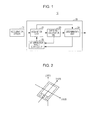
- FIG. 1 is a block diagram illustrating an example of a mobile terminal that includes an operating movement detection device according to Embodiment 1.
- FIG. 1 illustrates a mobile terminal 10 that includes an operating movement detection device 20.
- FIG. 2 illustrates the mobile terminal 10 and an example of setting of an X axis, a Y axis, and a Z axis.
- the mobile terminal 10 includes an acceleration sensor 11 and the operating movement detection device 20.
- the operating movement detection device 20 includes an acquisition unit 21, a determination period setting unit 22, a threshold calculation unit 23, and a determination unit 24.
- the acceleration sensor 11 includes a three-axis acceleration sensor, senses the acceleration in each direction of the X axis, the Y axis, and the Z axis, which cross one another at approximately right angles, and outputs a value of the sensed acceleration to the acquisition unit 21.
- the Y axis and the X axis are set to extend in the longitudinal direction and the lateral direction of the display face of the mobile terminal 10, respectively, and the Z axis is set to extend in a direction perpendicular to the display face.
- the mobile terminal 10 is operated by a shaking movement, which a user performs by shaking the mobile terminal 10 in the X axis direction.
- the acquisition unit 21 receives the acceleration value in the direction of each axis from the acceleration sensor 11 and stores the received acceleration values. After that, the acquisition unit 21 outputs the set of the acceleration values corresponding to the determination period, which is indicated by determination period information received from the determination period setting unit 22, to the threshold calculation unit 23 and the determination unit 24 for each axis. That is, the acquisition unit 21 outputs an "acceleration variation curve" of each axis, which is acquired in the determination period, to the threshold calculation unit 23 and the determination unit 24.
- the determination period setting unit 22 sets the determination period and outputs the determination period information that indicates the set determination period to the acquisition unit 21. Specifically, the determination period setting unit 22 receives information about a detection position, at which a determination threshold is exceeded in a first determination period, from the threshold calculation unit 23, and receives information indicating whether or not the shaking movement is detected in the first determination period from the determination unit 24. After that, the determination period setting unit 22 sets a second determination period so that the start position of the second determination period following the first determination period in which no shaking movement has been detected corresponds to the detection position at which the determination threshold is first exceeded in the first determination period.
- the threshold calculation unit 23 calculates the determination threshold for determination of the shaking movement.
- the vibration direction that causes incorrect detection may be the Z axis direction.
- the threshold calculation unit 23 detects an acceleration maximum value Zmax and an acceleration minimum value Zmin on the acceleration variation curve of the Z axis in the determination period, and calculates a "Z-axis amplitude value" Az, which is a difference between the detected maximum value Zmax and the detected minimum value Zmin.
- the threshold calculation unit 23 calculates the determination threshold by adjusting the threshold reference value Th basis using the value obtained by multiplying the Z-axis amplitude value Az by a certain coefficient ⁇ . Specifically, the determination threshold is calculated by adding the threshold reference value Th basis and the value obtained by multiplying the Z-axis amplitude value Az by the certain coefficient ⁇ .
- the threshold reference value Th basis is a constant, which is set in advance, and the coefficient ⁇ is a weighting coefficient determined in view of characteristics of the mobile terminal 10 and the acceleration sensor 11.
- the determination unit 24 determines whether or not the shaking movement has been performed.
- the shaking movement direction may be the X axis direction. That is, the axis direction used for the calculation of the determination threshold and the axis direction corresponding to the shaking movement direction are different from each other and are substantially at right angles to each other here.
- the determination unit 24 sets the determination threshold based on a "central acceleration" of the acceleration variation curve of the X axis in the determination period, detects a position at which the value of the acceleration variation curve exceeds the determination threshold, and counts the number of times the determination threshold is exceeded. After that, the determination unit 24 determines that the shaking movement has been performed when the number of times counted in the determination period is equal to or more than a certain number. When the number of times counted in the determination period is less than the certain number of times, the determination unit 24 determines that no shaking movement has been performed.
- the "central acceleration” may be an average value taken from a maximum value Xmax and a minimum value Xmin of the acceleration variation curve of the X axis in the determination period or may be an average value taken from all of the acceleration values of the acceleration variation curve of the X axis in the determination period. In either case, a reference acceleration is calculated by the determination unit 24. However, the amount of processing performed by the determination unit 24 may be reduced by using the average value taken from the maximum value and the minimum value as the "central acceleration" compared with the case of using the average value taken from all of the acceleration values.
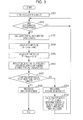
- FIG. 3 is a flowchart illustrating an example of the processing operations of the operating movement detection device 20 according to Embodiment 1.
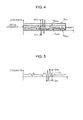
- FIG. 4 and FIG. 5 are diagrams that serve to explain the processing operations of the operating movement detection device 20 according to Embodiment 1.
- the acquisition unit 21 sequentially receives the acceleration values in the directions of the axes from the acceleration sensor 11 and stores the received values (step S101).
- the acquisition unit 21 determines whether or not the determination period indicated by the determination period information received from the determination period setting unit 22 has passed (step S102). The determination is repeated until the determination period has passed (step S102: No).
- step S102 When it is determined that the set determination period has passed (step S102: Yes), the acquisition unit 21 outputs the acceleration variation curve of the Z axis in the determination period to the threshold calculation unit 23, and outputs the acceleration variation curve of the X axis in the determination period to the determination unit 24.
- the determination unit 24 detects the maximum value Xmax and the minimum value Xmin of the acceleration variation curve of the X axis in the determination period and calculates the average value of the detected maximum value Xmax and the detected minimum value Xmin, that is, the central acceleration (step S103).
- the threshold calculation unit 23 detects the maximum value Zmax and the minimum value Zmin of the acceleration variation curve of the Z axis in the determination period and calculates the Z-axis amplitude value Az, which is a difference between the detected maximum value Zmax and the detected minimum value Zmin (step S104).
- the determination unit 24 sets the determination threshold, which is calculated in step S105, based on the central acceleration calculated in step S103, detects a position at which the value of the acceleration variation curve exceeds the determination threshold, and counts the number of times the determination threshold is exceeded (step S106).
- the position at which a value of the acceleration variation curve exceeds the determination threshold is a position at which the acceleration variation curve extends beyond the range between the upper threshold Th up and the lower threshold Th down .
- the determination unit 24 determines whether or not the number of times counted in the determination period is equal to or more than a certain number (step S107).
- step S107: Yes the determination unit 24 recognizes that the shaking movement has been performed (step S108). After that, the determination unit 24 outputs a signal indicating that the shaking movement is detected to a processing unit at another stage, which is not illustrated. Thus, the process corresponding to the operation that the shaking movement indicates is performed.
- step S107 When it is determined that the counted number of times is less than the certain number of times (step S107: No), the determination unit 24 recognizes that the shaking movement has not been performed (step S109). After that, the determination unit 24 outputs a signal indicating that no shaking movement has been detected to the determination period setting unit 22.
- the determination period setting unit 22 sets the second determination period so that the start position of the second determination period following the first determination period in which no shaking movement has been detected corresponds to the detected position at which the determination threshold is first exceeded in the first determination period (step S110).
- the determination period information indicating the second determination period is output to the acquisition unit 21. After that, the flow returns to step S102 and it is determined whether or not the second determination period has passed.
- the threshold calculation unit 23 in the operating movement detection device 20 calculates the determination threshold based on a group of the acceleration values in the Z axis direction in the first determination period. After that, based on the determination threshold calculated by the threshold calculation unit 23 and a group of the acceleration values in the X axis direction in the first determination period, the determination unit 24 determines whether or not the operating movement has been performed.
- the threshold to be used for determining the operating movement based on the acceleration value in the X axis direction may be calculated. That is, since the acceleration value in the Z axis direction that may cause the incorrect detection irrelevant to the operating movement is excluded from the evaluation targets and the operating movement is detected using the determination threshold set in view of the acceleration value in the Z axis direction, the possibility of incorrect detection may be reduced.
- the threshold calculation unit 23 calculates the determination threshold by adding the result of multiplying the difference between the maximum value and the minimum value included in the group of the acceleration values in the Z axis direction in the first determination period by the certain coefficient ⁇ to the threshold reference value Th basis .
- the determination threshold may be increased as the acceleration value in the Z axis direction increases, the possibility of incorrect detection may be reduced.
- the determination period setting unit 22 causes the start position of the second determination period following the first determination period to be at a position at which the acceleration value group in the X axis direction in the first determination period first exceeds the determination threshold. That is, the first determination period and the second determination period following the first determination period overlap each other.
- the shaking movement in the first determination period is not wasted but used in the second determination period.
- start timing of the first determination period is not mentioned in Embodiment 1, the start timing of the first determination period is not limited to a particular timing and may be, for example, a timing at which an application that uses the detection result of the shaking movement is started or a timing at which the mobile terminal 10 is started independent of a particular application.
- the mobile terminal 10 according to Embodiment 1 may be implemented with a hardware configuration described below.
- FIG. 6 is a diagram illustrating the hardware configuration of the mobile terminal 10.
- the hardware of the mobile terminal 10 may include the acceleration sensor 11, a central processing unit (CPU) 10a, memory 10b, a radio frequency (RF) circuit 10c with an antenna, a display 10d such as a liquid crystal display (LCD), and a key input device 10e.
- the memory 10b may be random access memory (RAM) such as synchronous dynamic RAM (SDRAM), read only memory (ROM), or flash memory.
- the acquisition unit 21, the determination period setting unit 22, the threshold calculation unit 23, and the determination unit 24 may be an integrated circuit such as the CPU 10a.
- each of the operations described in Embodiment 1 may be performed by causing a computer to execute a program prepared in advance. That is, the memory 10b may store programs corresponding to the operations to be performed by the acquisition unit 21, the determination period setting unit 22, the threshold calculation unit 23, and the determination unit 24, and the stored programs may function as a process by being read by the CPU 10a.
Landscapes
- Engineering & Computer Science (AREA)
- General Engineering & Computer Science (AREA)
- Theoretical Computer Science (AREA)
- Physics & Mathematics (AREA)
- General Physics & Mathematics (AREA)
- Human Computer Interaction (AREA)
- User Interface Of Digital Computer (AREA)
- Telephone Function (AREA)
- Position Input By Displaying (AREA)
Abstract
Description
- The embodiments discussed herein are related to an operating movement detection device, an operating movement detection method, and a program.
- In recent years, there has been a portable electronic device, such as a mobile terminal, that includes an interface that allows the electronic device to be operated by a user shaking the body of the electronic device, that is, by performing a shaking movement.
- Such an electronic device has a function that detects the shaking movement.
- For example, when the electronic device includes an acceleration sensor and the number of times an acceleration value sensed by the acceleration sensor in a determination period exceeds a certain threshold exceeds a certain number, it is determined that the shaking movement has been performed.
- For example, a technique is discussed. The technique uses, as evaluation target values, values which are obtained by taking both an acceleration value with respect to a first axis along which the shaking movement is occurring and an acceleration value with respect to a second axis perpendicular to the first axis as variables so as not to incorrectly detect the case in which the electronic device is being shaken because a user is walking with the electronic device in his or her bag as a case in which the user is actively performing the shaking movement (see, for example, Japanese Laid-Open Patent Publication No.
2008-33526 - However, including the acceleration value in the second axis direction, which basically is not an evaluation target, as an evaluation target value may be more likely to cause incorrect detection when the acceleration value is high.
- This application is aimed at providing an operating movement detection device, an operating movement detection method, and a program that may reduce the possibility of incorrect detection of an operating movement.
- According to an embodiment of a first aspect of the invention, an operating movement detection device, which detects a shaking movement performed on an electronic device in a first direction, includes an acquisition unit that acquires a first acceleration value in the first direction and a second acceleration value in a second direction different from the first direction, the first acceleration value and the second acceleration value being sensed by an acceleration sensor, a calculation unit that calculates a determination threshold based on the second acceleration value acquired in a first determination period, and a determination unit that determines whether or not the shaking movement has been performed based on the first acceleration value acquired in the first determination period and the calculated determination threshold.
-
-
FIG. 1 is a block diagram illustrating an example of a mobile terminal that includes an operating movement detection device according to Embodiment 1; -
FIG. 2 is a diagram illustrating the mobile terminal and an example of setting of an X axis, a Y axis, and a Z axis according to Embodiment 1; -
FIG. 3 is a flowchart illustrating an example of processing operations of the operating movement detection device according to Embodiment 1; -
FIG. 4 is a diagram that serves to explain the processing operations of the operating movement detection device according to Embodiment 1; -
FIG. 5 is a diagram that serves to explain the processing operations of the operating movement detection device according to Embodiment 1; and -
FIG. 6 is a diagram illustrating a hardware configuration of the mobile terminal. - Embodiments of an operating movement detection device, an operating movement detection method, and a program according to this application are described in detail below with reference to the drawings. The operating movement detection device, the operating movement detection method, and the program that this application discloses are not limited to the embodiments. In the embodiments, the same reference symbols are given to elements that have similar functions, and repeated explanation of the elements is omitted.
-
FIG. 1 is a block diagram illustrating an example of a mobile terminal that includes an operating movement detection device according to Embodiment 1.FIG. 1 illustrates amobile terminal 10 that includes an operatingmovement detection device 20.FIG. 2 illustrates themobile terminal 10 and an example of setting of an X axis, a Y axis, and a Z axis. - In
FIG. 1 , themobile terminal 10 includes anacceleration sensor 11 and the operatingmovement detection device 20. The operatingmovement detection device 20 includes anacquisition unit 21, a determinationperiod setting unit 22, athreshold calculation unit 23, and adetermination unit 24. - The
acceleration sensor 11 includes a three-axis acceleration sensor, senses the acceleration in each direction of the X axis, the Y axis, and the Z axis, which cross one another at approximately right angles, and outputs a value of the sensed acceleration to theacquisition unit 21. As illustrated inFIG. 2 , the Y axis and the X axis are set to extend in the longitudinal direction and the lateral direction of the display face of themobile terminal 10, respectively, and the Z axis is set to extend in a direction perpendicular to the display face. Themobile terminal 10 is operated by a shaking movement, which a user performs by shaking themobile terminal 10 in the X axis direction. - The
acquisition unit 21 receives the acceleration value in the direction of each axis from theacceleration sensor 11 and stores the received acceleration values. After that, theacquisition unit 21 outputs the set of the acceleration values corresponding to the determination period, which is indicated by determination period information received from the determinationperiod setting unit 22, to thethreshold calculation unit 23 and thedetermination unit 24 for each axis. That is, theacquisition unit 21 outputs an "acceleration variation curve" of each axis, which is acquired in the determination period, to thethreshold calculation unit 23 and thedetermination unit 24. - The determination
period setting unit 22 sets the determination period and outputs the determination period information that indicates the set determination period to theacquisition unit 21. Specifically, the determinationperiod setting unit 22 receives information about a detection position, at which a determination threshold is exceeded in a first determination period, from thethreshold calculation unit 23, and receives information indicating whether or not the shaking movement is detected in the first determination period from thedetermination unit 24. After that, the determinationperiod setting unit 22 sets a second determination period so that the start position of the second determination period following the first determination period in which no shaking movement has been detected corresponds to the detection position at which the determination threshold is first exceeded in the first determination period. - Based on a threshold reference value Thbasis, which is set in advance, and the acceleration variation curve of the axis corresponding to a vibration direction that causes incorrect detection, the
threshold calculation unit 23 calculates the determination threshold for determination of the shaking movement. For example, the vibration direction that causes incorrect detection may be the Z axis direction. Thethreshold calculation unit 23 detects an acceleration maximum value Zmax and an acceleration minimum value Zmin on the acceleration variation curve of the Z axis in the determination period, and calculates a "Z-axis amplitude value" Az, which is a difference between the detected maximum value Zmax and the detected minimum value Zmin. After that, thethreshold calculation unit 23 calculates the determination threshold by adjusting the threshold reference value Thbasis using the value obtained by multiplying the Z-axis amplitude value Az by a certain coefficient β. Specifically, the determination threshold is calculated by adding the threshold reference value Thbasis and the value obtained by multiplying the Z-axis amplitude value Az by the certain coefficient β. The threshold reference value Thbasis is a constant, which is set in advance, and the coefficient β is a weighting coefficient determined in view of characteristics of themobile terminal 10 and theacceleration sensor 11. - Based on the determination threshold calculated by the
threshold calculation unit 23 and the acceleration variation curve of the axis corresponding to the shaking movement direction, thedetermination unit 24 determines whether or not the shaking movement has been performed. For example, the shaking movement direction may be the X axis direction. That is, the axis direction used for the calculation of the determination threshold and the axis direction corresponding to the shaking movement direction are different from each other and are substantially at right angles to each other here. - Specifically, the
determination unit 24 sets the determination threshold based on a "central acceleration" of the acceleration variation curve of the X axis in the determination period, detects a position at which the value of the acceleration variation curve exceeds the determination threshold, and counts the number of times the determination threshold is exceeded. After that, thedetermination unit 24 determines that the shaking movement has been performed when the number of times counted in the determination period is equal to or more than a certain number. When the number of times counted in the determination period is less than the certain number of times, thedetermination unit 24 determines that no shaking movement has been performed. The "central acceleration" may be an average value taken from a maximum value Xmax and a minimum value Xmin of the acceleration variation curve of the X axis in the determination period or may be an average value taken from all of the acceleration values of the acceleration variation curve of the X axis in the determination period. In either case, a reference acceleration is calculated by thedetermination unit 24. However, the amount of processing performed by thedetermination unit 24 may be reduced by using the average value taken from the maximum value and the minimum value as the "central acceleration" compared with the case of using the average value taken from all of the acceleration values. - Operations of the operating
movement detection device 20 configured as above are described below.FIG. 3 is a flowchart illustrating an example of the processing operations of the operatingmovement detection device 20 according to Embodiment 1.FIG. 4 and FIG. 5 are diagrams that serve to explain the processing operations of the operatingmovement detection device 20 according to Embodiment 1. - The
acquisition unit 21 sequentially receives the acceleration values in the directions of the axes from theacceleration sensor 11 and stores the received values (step S101). - The
acquisition unit 21 determines whether or not the determination period indicated by the determination period information received from the determinationperiod setting unit 22 has passed (step S102). The determination is repeated until the determination period has passed (step S102: No). - When it is determined that the set determination period has passed (step S102: Yes), the
acquisition unit 21 outputs the acceleration variation curve of the Z axis in the determination period to thethreshold calculation unit 23, and outputs the acceleration variation curve of the X axis in the determination period to thedetermination unit 24. - As illustrated in
FIG. 4 , thedetermination unit 24 detects the maximum value Xmax and the minimum value Xmin of the acceleration variation curve of the X axis in the determination period and calculates the average value of the detected maximum value Xmax and the detected minimum value Xmin, that is, the central acceleration (step S103). - As illustrated in
FIG. 5 , thethreshold calculation unit 23 detects the maximum value Zmax and the minimum value Zmin of the acceleration variation curve of the Z axis in the determination period and calculates the Z-axis amplitude value Az, which is a difference between the detected maximum value Zmax and the detected minimum value Zmin (step S104). - The
threshold calculation unit 23 calculates the determination threshold by adding the threshold reference value Thbasis to the value obtained by multiplying the Z-axis amplitude value Az by the certain coefficient β (step S105). Specifically, an upper threshold Thup and a lower threshold Thdown are calculated using the following expressions:

- The
determination unit 24 sets the determination threshold, which is calculated in step S105, based on the central acceleration calculated in step S103, detects a position at which the value of the acceleration variation curve exceeds the determination threshold, and counts the number of times the determination threshold is exceeded (step S106). The position at which a value of the acceleration variation curve exceeds the determination threshold is a position at which the acceleration variation curve extends beyond the range between the upper threshold Thup and the lower threshold Thdown. - The
determination unit 24 determines whether or not the number of times counted in the determination period is equal to or more than a certain number (step S107). - When it is determined that the counted number is equal to or more than the certain number (step S107: Yes), the
determination unit 24 recognizes that the shaking movement has been performed (step S108). After that, thedetermination unit 24 outputs a signal indicating that the shaking movement is detected to a processing unit at another stage, which is not illustrated. Thus, the process corresponding to the operation that the shaking movement indicates is performed. - When it is determined that the counted number of times is less than the certain number of times (step S107: No), the
determination unit 24 recognizes that the shaking movement has not been performed (step S109). After that, thedetermination unit 24 outputs a signal indicating that no shaking movement has been detected to the determinationperiod setting unit 22. - The determination
period setting unit 22 sets the second determination period so that the start position of the second determination period following the first determination period in which no shaking movement has been detected corresponds to the detected position at which the determination threshold is first exceeded in the first determination period (step S110). The determination period information indicating the second determination period is output to theacquisition unit 21. After that, the flow returns to step S102 and it is determined whether or not the second determination period has passed. - As described above, according to the present embodiment, the
threshold calculation unit 23 in the operatingmovement detection device 20 calculates the determination threshold based on a group of the acceleration values in the Z axis direction in the first determination period. After that, based on the determination threshold calculated by thethreshold calculation unit 23 and a group of the acceleration values in the X axis direction in the first determination period, thedetermination unit 24 determines whether or not the operating movement has been performed. - Thus, in accordance with the acceleration value in the Z axis direction that may cause incorrect detection irrelevant to the operating movement, the threshold to be used for determining the operating movement based on the acceleration value in the X axis direction may be calculated. That is, since the acceleration value in the Z axis direction that may cause the incorrect detection irrelevant to the operating movement is excluded from the evaluation targets and the operating movement is detected using the determination threshold set in view of the acceleration value in the Z axis direction, the possibility of incorrect detection may be reduced.
- Specifically, the
threshold calculation unit 23 calculates the determination threshold by adding the result of multiplying the difference between the maximum value and the minimum value included in the group of the acceleration values in the Z axis direction in the first determination period by the certain coefficient β to the threshold reference value Thbasis. - Thus, since the determination threshold may be increased as the acceleration value in the Z axis direction increases, the possibility of incorrect detection may be reduced.
- The determination
period setting unit 22 causes the start position of the second determination period following the first determination period to be at a position at which the acceleration value group in the X axis direction in the first determination period first exceeds the determination threshold. That is, the first determination period and the second determination period following the first determination period overlap each other. - Thus, when the shaking movement is started at a midway position in the first determination period and the shaking movement fails to be detected in the first determination period, the shaking movement in the first determination period is not wasted but used in the second determination period.
- [1] Although the start timing of the first determination period is not mentioned in Embodiment 1, the start timing of the first determination period is not limited to a particular timing and may be, for example, a timing at which an application that uses the detection result of the shaking movement is started or a timing at which the
mobile terminal 10 is started independent of a particular application. - [2] The
mobile terminal 10 according to Embodiment 1 may be implemented with a hardware configuration described below. -
FIG. 6 is a diagram illustrating the hardware configuration of themobile terminal 10. As illustrated inFIG. 6 , the hardware of themobile terminal 10 may include theacceleration sensor 11, a central processing unit (CPU) 10a,memory 10b, a radio frequency (RF)circuit 10c with an antenna, adisplay 10d such as a liquid crystal display (LCD), and akey input device 10e. For example, thememory 10b may be random access memory (RAM) such as synchronous dynamic RAM (SDRAM), read only memory (ROM), or flash memory. Furthermore, for example, theacquisition unit 21, the determinationperiod setting unit 22, thethreshold calculation unit 23, and thedetermination unit 24 may be an integrated circuit such as theCPU 10a. - In addition, each of the operations described in Embodiment 1 may be performed by causing a computer to execute a program prepared in advance. That is, the
memory 10b may store programs corresponding to the operations to be performed by theacquisition unit 21, the determinationperiod setting unit 22, thethreshold calculation unit 23, and thedetermination unit 24, and the stored programs may function as a process by being read by theCPU 10a.
Claims (5)
- An operating movement detection device that detects a shaking movement performed on an electronic device in a first direction, the operating movement detection device comprising:an acquisition unit that acquires a first acceleration value in the first direction and a second acceleration value in a second direction different from the first direction, the first acceleration value and the second acceleration value being sensed by an acceleration sensor;a calculation unit that calculates a determination threshold based on the second acceleration value acquired in a first determination period; anda determination unit that determines whether or not the shaking movement has been performed based on the first acceleration value acquired in the first determination period and the calculated determination threshold.
- The operating movement detection device according to claim 1, further comprising:a determination period setting unit that when the determination unit determines that the shaking movement has not been performed, causes a start position of a second determination period to be at a position at which the first acceleration value acquired in the first determination period first exceeds the determination threshold, the second determination period being used to detect whether or not the shaking movement has been performed following the first determination period.
- The operating movement detection device according to claim 1 or 2, wherein:the calculation unit calculates the determination threshold by adding a result of multiplying a difference between a maximum value and a minimum value of the second acceleration value acquired in the first determination period by a certain coefficient to a reference value; andthe determination unit sets the calculated determination threshold based on an average value of a maximum value and a minimum value of the first acceleration value acquired in the first determination period.
- An operating movement detection method for detecting a shaking movement performed on an electronic device in a first direction, the method comprising:acquiring a first acceleration value in the first direction and a second acceleration value in a second direction different from the first direction, the first acceleration value and the second acceleration value being sensed by an acceleration sensor at a plurality of timings;calculating a determination threshold based on the second acceleration value acquired in a determination period; anddetermining whether or not the shaking movement has been performed based on the first acceleration value acquired in the determination period and the calculated determination threshold.
- A program that causes an operating movement detection device to execute an operating movement detection process for detecting a shaking movement performed on an electronic device in a first direction, the process comprising:acquiring a first acceleration value in the first direction and a second acceleration value in a second direction different from the first direction, the first acceleration value and the second acceleration value being sensed by an acceleration sensor at a plurality of timings;calculating a determination threshold based on the second acceleration value acquired in a determination period; anddetermining whether or not the shaking movement has been performed based on the first acceleration value acquired in the determination period and the calculated determination threshold.
Applications Claiming Priority (1)
| Application Number | Priority Date | Filing Date | Title |
|---|---|---|---|
| JP2012095901A JP5987443B2 (en) | 2012-04-19 | 2012-04-19 | Operation motion detection device, operation motion detection method, and program |
Publications (3)
| Publication Number | Publication Date |
|---|---|
| EP2653957A2 true EP2653957A2 (en) | 2013-10-23 |
| EP2653957A3 EP2653957A3 (en) | 2014-08-20 |
| EP2653957B1 EP2653957B1 (en) | 2018-11-07 |
Family
ID=48190095
Family Applications (1)
| Application Number | Title | Priority Date | Filing Date |
|---|---|---|---|
| EP13163962.7A Not-in-force EP2653957B1 (en) | 2012-04-19 | 2013-04-16 | Operating movement detection device, operating movement detection method, and program therefor |
Country Status (3)
| Country | Link |
|---|---|
| US (1) | US9304143B2 (en) |
| EP (1) | EP2653957B1 (en) |
| JP (1) | JP5987443B2 (en) |
Families Citing this family (17)
| Publication number | Priority date | Publication date | Assignee | Title |
|---|---|---|---|---|
| US9086281B1 (en) * | 2013-05-21 | 2015-07-21 | Amazon Technologies | Using accelerometer data to determine movement direction |
| US9342113B2 (en) * | 2013-07-18 | 2016-05-17 | Facebook, Inc. | Movement-triggered action for mobile device |
| CN103777846B (en) * | 2014-02-24 | 2017-03-01 | 联想(北京)有限公司 | Information processing method and electronic equipment |
| JP6310769B2 (en) * | 2014-05-15 | 2018-04-11 | 株式会社エクシング | Program, karaoke device and karaoke system |
| JP6333663B2 (en) * | 2014-08-08 | 2018-05-30 | シャープ株式会社 | Information processing apparatus, information processing apparatus control method, and program |
| CN115700434A (en) | 2014-09-02 | 2023-02-07 | 苹果公司 | A semantic framework for variable haptic output |
| DK179657B1 (en) * | 2016-06-12 | 2019-03-13 | Apple Inc. | Devices, methods and graphical user interfaces for providing haptic feedback |
| DK179823B1 (en) | 2016-06-12 | 2019-07-12 | Apple Inc. | Devices, methods, and graphical user interfaces for providing haptic feedback |
| DK179278B1 (en) | 2016-09-06 | 2018-03-26 | Apple Inc | Devices, methods and graphical user interfaces for haptic mixing |
| DK201670720A1 (en) | 2016-09-06 | 2018-03-26 | Apple Inc | Devices, Methods, and Graphical User Interfaces for Generating Tactile Outputs |
| DK201770372A1 (en) | 2017-05-16 | 2019-01-08 | Apple Inc. | Tactile feedback for locked device user interfaces |
| US10665207B2 (en) * | 2017-12-13 | 2020-05-26 | Kyocera Document Solutions Inc. | Back-and-forth displacement detecting device and information processing device |
| JP6969341B2 (en) * | 2017-12-13 | 2021-11-24 | 京セラドキュメントソリューションズ株式会社 | Reciprocating displacement detector and information processing device |
| EP3618015A1 (en) * | 2018-08-27 | 2020-03-04 | Continental Automotive GmbH | Electronic key and method for operating an electronic key |
| CN113535014B (en) * | 2020-04-13 | 2024-02-02 | 中移(上海)信息通信科技有限公司 | Screen capture methods, devices, settings and media |
| CN112731821B (en) * | 2020-12-18 | 2023-03-24 | 卧安科技(深圳)有限公司 | Equipment movement method and electronic equipment |
| US12299214B2 (en) * | 2023-08-09 | 2025-05-13 | Stmicroelectronics International N.V. | Low power lift-up gesture detection with shake rejection |
Citations (1)
| Publication number | Priority date | Publication date | Assignee | Title |
|---|---|---|---|---|
| JP2008033526A (en) | 2006-07-27 | 2008-02-14 | Sony Corp | Portable electronic device, operation control method, program, signal generation device, signal generation method |
Family Cites Families (11)
| Publication number | Priority date | Publication date | Assignee | Title |
|---|---|---|---|---|
| JP2000047813A (en) * | 1998-07-24 | 2000-02-18 | Casio Comput Co Ltd | Event signal generator and electronic equipment using the same |
| US7696092B2 (en) * | 2001-11-26 | 2010-04-13 | Globalfoundries Inc. | Method of using ternary copper alloy to obtain a low resistance and large grain size interconnect |
| JP2003345492A (en) * | 2002-05-27 | 2003-12-05 | Sony Corp | Portable electronic devices |
| TWI362605B (en) * | 2007-08-30 | 2012-04-21 | Ind Tech Res Inst | Method for adjusting sensing range and sensitivity and inertia interactive apparatus and system using thereof |
| KR20090034096A (en) * | 2007-10-02 | 2009-04-07 | 삼성전자주식회사 | Error correction device, method and three-dimensional pointing device using the same |
| JP2009245176A (en) * | 2008-03-31 | 2009-10-22 | Mitsubishi Electric Corp | Motion recognition device |
| JP5798713B2 (en) * | 2009-08-28 | 2015-10-21 | ラピスセミコンダクタ株式会社 | Electronic device, motion detection method and program |
| JP5547985B2 (en) * | 2010-02-22 | 2014-07-16 | ラピスセミコンダクタ株式会社 | Motion detection device, electronic device, motion detection method and program |
| JP2012027875A (en) * | 2010-07-28 | 2012-02-09 | Sony Corp | Electronic apparatus, processing method and program |
| JP2012038269A (en) * | 2010-08-11 | 2012-02-23 | Takahiro Saito | Portable information terminal device |
| JP5786503B2 (en) * | 2011-07-06 | 2015-09-30 | セイコーエプソン株式会社 | Status detection apparatus, electronic device, program, and status detection method |
-
2012
- 2012-04-19 JP JP2012095901A patent/JP5987443B2/en not_active Expired - Fee Related
-
2013
- 2013-04-11 US US13/861,296 patent/US9304143B2/en not_active Expired - Fee Related
- 2013-04-16 EP EP13163962.7A patent/EP2653957B1/en not_active Not-in-force
Patent Citations (1)
| Publication number | Priority date | Publication date | Assignee | Title |
|---|---|---|---|---|
| JP2008033526A (en) | 2006-07-27 | 2008-02-14 | Sony Corp | Portable electronic device, operation control method, program, signal generation device, signal generation method |
Also Published As
| Publication number | Publication date |
|---|---|
| JP2013222449A (en) | 2013-10-28 |
| US9304143B2 (en) | 2016-04-05 |
| EP2653957B1 (en) | 2018-11-07 |
| US20130282325A1 (en) | 2013-10-24 |
| JP5987443B2 (en) | 2016-09-07 |
| EP2653957A3 (en) | 2014-08-20 |
Similar Documents
| Publication | Publication Date | Title |
|---|---|---|
| EP2653957A2 (en) | Operating movement detection device, operating movement detection method, and program therefor | |
| US8849609B2 (en) | Number-of-step detection system, number-of-step detecting method, and activity meter | |
| EP1933228B1 (en) | Coordinate input apparatus | |
| EP2065680B1 (en) | Body Movement Detecting Apparatus | |
| US20110178759A1 (en) | Method of estimating stride length, method of calculating movement trajectory, and stride length estimating device | |
| EP3278195B1 (en) | An electronic mobile device | |
| US8606332B2 (en) | Gravity axis determination apparatus and mobile terminal apparatus using the same | |
| EP2720046B1 (en) | Drop determining apparatus and drop determining method | |
| EP3006913A1 (en) | Physical quantity sensor adjustment method, and physical quantity sensor | |
| US7805277B2 (en) | Step number measuring apparatus | |
| EP2910954B1 (en) | Method for counting steps and electronic apparatus using the same | |
| CN112486258A (en) | Wearable device, step counting method thereof and computer storage medium | |
| US20180267073A1 (en) | Device and method of characterizing motion | |
| JP2011149923A (en) | Method of estimating stride length, method of calculating movement trajectory, and stride length estimating device | |
| KR102006029B1 (en) | Method and Apparatus for calculation azimuth | |
| US10917851B2 (en) | Information processing device, electronic device, control method of information processing device and storage medium | |
| JP7215144B2 (en) | Measuring device, measuring method and measuring program | |
| EP2639686A2 (en) | Input control device, input control program, and input control method | |
| US12135400B2 (en) | Contact determination device and contact determination method | |
| CN113074724B (en) | Motion time calculation method, device, equipment and computer readable storage medium | |
| EP2866134A1 (en) | Portable electronic device and control method | |
| CN116211312B (en) | ECG signal monitoring method, device, equipment and storage medium | |
| EP3364345B1 (en) | Step-count measurement device and step count measurement program | |
| US20250155400A1 (en) | Electronic apparatus and method of controlling the same | |
| EP4403878B1 (en) | Measurement device, measurement method, and program |
Legal Events
| Date | Code | Title | Description |
|---|---|---|---|
| PUAI | Public reference made under article 153(3) epc to a published international application that has entered the european phase |
Free format text: ORIGINAL CODE: 0009012 |
|
| AK | Designated contracting states |
Kind code of ref document: A2 Designated state(s): AL AT BE BG CH CY CZ DE DK EE ES FI FR GB GR HR HU IE IS IT LI LT LU LV MC MK MT NL NO PL PT RO RS SE SI SK SM TR |
|
| AX | Request for extension of the european patent |
Extension state: BA ME |
|
| PUAL | Search report despatched |
Free format text: ORIGINAL CODE: 0009013 |
|
| AK | Designated contracting states |
Kind code of ref document: A3 Designated state(s): AL AT BE BG CH CY CZ DE DK EE ES FI FR GB GR HR HU IE IS IT LI LT LU LV MC MK MT NL NO PL PT RO RS SE SI SK SM TR |
|
| AX | Request for extension of the european patent |
Extension state: BA ME |
|
| RIC1 | Information provided on ipc code assigned before grant |
Ipc: G06F 3/0346 20130101ALI20140714BHEP Ipc: G06F 3/038 20130101AFI20140714BHEP |
|
| 17P | Request for examination filed |
Effective date: 20141015 |
|
| RBV | Designated contracting states (corrected) |
Designated state(s): AL AT BE BG CH CY CZ DE DK EE ES FI FR GB GR HR HU IE IS IT LI LT LU LV MC MK MT NL NO PL PT RO RS SE SI SK SM TR |
|
| STAA | Information on the status of an ep patent application or granted ep patent |
Free format text: STATUS: EXAMINATION IS IN PROGRESS |
|
| 17Q | First examination report despatched |
Effective date: 20161205 |
|
| GRAP | Despatch of communication of intention to grant a patent |
Free format text: ORIGINAL CODE: EPIDOSNIGR1 |
|
| STAA | Information on the status of an ep patent application or granted ep patent |
Free format text: STATUS: GRANT OF PATENT IS INTENDED |
|
| INTG | Intention to grant announced |
Effective date: 20180810 |
|
| GRAS | Grant fee paid |
Free format text: ORIGINAL CODE: EPIDOSNIGR3 |
|
| GRAA | (expected) grant |
Free format text: ORIGINAL CODE: 0009210 |
|
| STAA | Information on the status of an ep patent application or granted ep patent |
Free format text: STATUS: THE PATENT HAS BEEN GRANTED |
|
| AK | Designated contracting states |
Kind code of ref document: B1 Designated state(s): AL AT BE BG CH CY CZ DE DK EE ES FI FR GB GR HR HU IE IS IT LI LT LU LV MC MK MT NL NO PL PT RO RS SE SI SK SM TR |
|
| REG | Reference to a national code |
Ref country code: GB Ref legal event code: FG4D |
|
| REG | Reference to a national code |
Ref country code: CH Ref legal event code: EP Ref country code: AT Ref legal event code: REF Ref document number: 1062870 Country of ref document: AT Kind code of ref document: T Effective date: 20181115 |
|
| REG | Reference to a national code |
Ref country code: IE Ref legal event code: FG4D |
|
| REG | Reference to a national code |
Ref country code: DE Ref legal event code: R096 Ref document number: 602013046207 Country of ref document: DE |
|
| REG | Reference to a national code |
Ref country code: NL Ref legal event code: MP Effective date: 20181107 |
|
| REG | Reference to a national code |
Ref country code: LT Ref legal event code: MG4D |
|
| REG | Reference to a national code |
Ref country code: AT Ref legal event code: MK05 Ref document number: 1062870 Country of ref document: AT Kind code of ref document: T Effective date: 20181107 |
|
| PG25 | Lapsed in a contracting state [announced via postgrant information from national office to epo] |
Ref country code: ES Free format text: LAPSE BECAUSE OF FAILURE TO SUBMIT A TRANSLATION OF THE DESCRIPTION OR TO PAY THE FEE WITHIN THE PRESCRIBED TIME-LIMIT Effective date: 20181107 Ref country code: AT Free format text: LAPSE BECAUSE OF FAILURE TO SUBMIT A TRANSLATION OF THE DESCRIPTION OR TO PAY THE FEE WITHIN THE PRESCRIBED TIME-LIMIT Effective date: 20181107 Ref country code: IS Free format text: LAPSE BECAUSE OF FAILURE TO SUBMIT A TRANSLATION OF THE DESCRIPTION OR TO PAY THE FEE WITHIN THE PRESCRIBED TIME-LIMIT Effective date: 20190307 Ref country code: BG Free format text: LAPSE BECAUSE OF FAILURE TO SUBMIT A TRANSLATION OF THE DESCRIPTION OR TO PAY THE FEE WITHIN THE PRESCRIBED TIME-LIMIT Effective date: 20190207 Ref country code: NO Free format text: LAPSE BECAUSE OF FAILURE TO SUBMIT A TRANSLATION OF THE DESCRIPTION OR TO PAY THE FEE WITHIN THE PRESCRIBED TIME-LIMIT Effective date: 20190207 Ref country code: FI Free format text: LAPSE BECAUSE OF FAILURE TO SUBMIT A TRANSLATION OF THE DESCRIPTION OR TO PAY THE FEE WITHIN THE PRESCRIBED TIME-LIMIT Effective date: 20181107 Ref country code: LT Free format text: LAPSE BECAUSE OF FAILURE TO SUBMIT A TRANSLATION OF THE DESCRIPTION OR TO PAY THE FEE WITHIN THE PRESCRIBED TIME-LIMIT Effective date: 20181107 Ref country code: LV Free format text: LAPSE BECAUSE OF FAILURE TO SUBMIT A TRANSLATION OF THE DESCRIPTION OR TO PAY THE FEE WITHIN THE PRESCRIBED TIME-LIMIT Effective date: 20181107 Ref country code: HR Free format text: LAPSE BECAUSE OF FAILURE TO SUBMIT A TRANSLATION OF THE DESCRIPTION OR TO PAY THE FEE WITHIN THE PRESCRIBED TIME-LIMIT Effective date: 20181107 |
|
| PGFP | Annual fee paid to national office [announced via postgrant information from national office to epo] |
Ref country code: GB Payment date: 20190204 Year of fee payment: 7 |
|
| PG25 | Lapsed in a contracting state [announced via postgrant information from national office to epo] |
Ref country code: SE Free format text: LAPSE BECAUSE OF FAILURE TO SUBMIT A TRANSLATION OF THE DESCRIPTION OR TO PAY THE FEE WITHIN THE PRESCRIBED TIME-LIMIT Effective date: 20181107 Ref country code: NL Free format text: LAPSE BECAUSE OF FAILURE TO SUBMIT A TRANSLATION OF THE DESCRIPTION OR TO PAY THE FEE WITHIN THE PRESCRIBED TIME-LIMIT Effective date: 20181107 Ref country code: RS Free format text: LAPSE BECAUSE OF FAILURE TO SUBMIT A TRANSLATION OF THE DESCRIPTION OR TO PAY THE FEE WITHIN THE PRESCRIBED TIME-LIMIT Effective date: 20181107 Ref country code: AL Free format text: LAPSE BECAUSE OF FAILURE TO SUBMIT A TRANSLATION OF THE DESCRIPTION OR TO PAY THE FEE WITHIN THE PRESCRIBED TIME-LIMIT Effective date: 20181107 Ref country code: PT Free format text: LAPSE BECAUSE OF FAILURE TO SUBMIT A TRANSLATION OF THE DESCRIPTION OR TO PAY THE FEE WITHIN THE PRESCRIBED TIME-LIMIT Effective date: 20190307 Ref country code: GR Free format text: LAPSE BECAUSE OF FAILURE TO SUBMIT A TRANSLATION OF THE DESCRIPTION OR TO PAY THE FEE WITHIN THE PRESCRIBED TIME-LIMIT Effective date: 20190208 |
|
| PGFP | Annual fee paid to national office [announced via postgrant information from national office to epo] |
Ref country code: FR Payment date: 20190221 Year of fee payment: 7 |
|
| PG25 | Lapsed in a contracting state [announced via postgrant information from national office to epo] |
Ref country code: PL Free format text: LAPSE BECAUSE OF FAILURE TO SUBMIT A TRANSLATION OF THE DESCRIPTION OR TO PAY THE FEE WITHIN THE PRESCRIBED TIME-LIMIT Effective date: 20181107 Ref country code: CZ Free format text: LAPSE BECAUSE OF FAILURE TO SUBMIT A TRANSLATION OF THE DESCRIPTION OR TO PAY THE FEE WITHIN THE PRESCRIBED TIME-LIMIT Effective date: 20181107 Ref country code: DK Free format text: LAPSE BECAUSE OF FAILURE TO SUBMIT A TRANSLATION OF THE DESCRIPTION OR TO PAY THE FEE WITHIN THE PRESCRIBED TIME-LIMIT Effective date: 20181107 Ref country code: IT Free format text: LAPSE BECAUSE OF FAILURE TO SUBMIT A TRANSLATION OF THE DESCRIPTION OR TO PAY THE FEE WITHIN THE PRESCRIBED TIME-LIMIT Effective date: 20181107 |
|
| PGFP | Annual fee paid to national office [announced via postgrant information from national office to epo] |
Ref country code: DE Payment date: 20190205 Year of fee payment: 7 |
|
| REG | Reference to a national code |
Ref country code: DE Ref legal event code: R097 Ref document number: 602013046207 Country of ref document: DE |
|
| PG25 | Lapsed in a contracting state [announced via postgrant information from national office to epo] |
Ref country code: SM Free format text: LAPSE BECAUSE OF FAILURE TO SUBMIT A TRANSLATION OF THE DESCRIPTION OR TO PAY THE FEE WITHIN THE PRESCRIBED TIME-LIMIT Effective date: 20181107 Ref country code: EE Free format text: LAPSE BECAUSE OF FAILURE TO SUBMIT A TRANSLATION OF THE DESCRIPTION OR TO PAY THE FEE WITHIN THE PRESCRIBED TIME-LIMIT Effective date: 20181107 Ref country code: RO Free format text: LAPSE BECAUSE OF FAILURE TO SUBMIT A TRANSLATION OF THE DESCRIPTION OR TO PAY THE FEE WITHIN THE PRESCRIBED TIME-LIMIT Effective date: 20181107 Ref country code: SK Free format text: LAPSE BECAUSE OF FAILURE TO SUBMIT A TRANSLATION OF THE DESCRIPTION OR TO PAY THE FEE WITHIN THE PRESCRIBED TIME-LIMIT Effective date: 20181107 |
|
| PLBE | No opposition filed within time limit |
Free format text: ORIGINAL CODE: 0009261 |
|
| STAA | Information on the status of an ep patent application or granted ep patent |
Free format text: STATUS: NO OPPOSITION FILED WITHIN TIME LIMIT |
|
| 26N | No opposition filed |
Effective date: 20190808 |
|
| PG25 | Lapsed in a contracting state [announced via postgrant information from national office to epo] |
Ref country code: SI Free format text: LAPSE BECAUSE OF FAILURE TO SUBMIT A TRANSLATION OF THE DESCRIPTION OR TO PAY THE FEE WITHIN THE PRESCRIBED TIME-LIMIT Effective date: 20181107 |
|
| REG | Reference to a national code |
Ref country code: CH Ref legal event code: PL |
|
| REG | Reference to a national code |
Ref country code: BE Ref legal event code: MM Effective date: 20190430 |
|
| PG25 | Lapsed in a contracting state [announced via postgrant information from national office to epo] |
Ref country code: LU Free format text: LAPSE BECAUSE OF NON-PAYMENT OF DUE FEES Effective date: 20190416 Ref country code: MC Free format text: LAPSE BECAUSE OF FAILURE TO SUBMIT A TRANSLATION OF THE DESCRIPTION OR TO PAY THE FEE WITHIN THE PRESCRIBED TIME-LIMIT Effective date: 20181107 |
|
| PG25 | Lapsed in a contracting state [announced via postgrant information from national office to epo] |
Ref country code: LI Free format text: LAPSE BECAUSE OF NON-PAYMENT OF DUE FEES Effective date: 20190430 Ref country code: CH Free format text: LAPSE BECAUSE OF NON-PAYMENT OF DUE FEES Effective date: 20190430 |
|
| PG25 | Lapsed in a contracting state [announced via postgrant information from national office to epo] |
Ref country code: BE Free format text: LAPSE BECAUSE OF NON-PAYMENT OF DUE FEES Effective date: 20190430 |
|
| PG25 | Lapsed in a contracting state [announced via postgrant information from national office to epo] |
Ref country code: TR Free format text: LAPSE BECAUSE OF FAILURE TO SUBMIT A TRANSLATION OF THE DESCRIPTION OR TO PAY THE FEE WITHIN THE PRESCRIBED TIME-LIMIT Effective date: 20181107 |
|
| PG25 | Lapsed in a contracting state [announced via postgrant information from national office to epo] |
Ref country code: IE Free format text: LAPSE BECAUSE OF NON-PAYMENT OF DUE FEES Effective date: 20190416 |
|
| REG | Reference to a national code |
Ref country code: DE Ref legal event code: R119 Ref document number: 602013046207 Country of ref document: DE |
|
| PG25 | Lapsed in a contracting state [announced via postgrant information from national office to epo] |
Ref country code: FR Free format text: LAPSE BECAUSE OF NON-PAYMENT OF DUE FEES Effective date: 20200430 Ref country code: DE Free format text: LAPSE BECAUSE OF NON-PAYMENT OF DUE FEES Effective date: 20201103 |
|
| GBPC | Gb: european patent ceased through non-payment of renewal fee |
Effective date: 20200416 |
|
| PG25 | Lapsed in a contracting state [announced via postgrant information from national office to epo] |
Ref country code: GB Free format text: LAPSE BECAUSE OF NON-PAYMENT OF DUE FEES Effective date: 20200416 |
|
| PG25 | Lapsed in a contracting state [announced via postgrant information from national office to epo] |
Ref country code: CY Free format text: LAPSE BECAUSE OF FAILURE TO SUBMIT A TRANSLATION OF THE DESCRIPTION OR TO PAY THE FEE WITHIN THE PRESCRIBED TIME-LIMIT Effective date: 20181107 |
|
| PG25 | Lapsed in a contracting state [announced via postgrant information from national office to epo] |
Ref country code: HU Free format text: LAPSE BECAUSE OF FAILURE TO SUBMIT A TRANSLATION OF THE DESCRIPTION OR TO PAY THE FEE WITHIN THE PRESCRIBED TIME-LIMIT; INVALID AB INITIO Effective date: 20130416 Ref country code: MT Free format text: LAPSE BECAUSE OF FAILURE TO SUBMIT A TRANSLATION OF THE DESCRIPTION OR TO PAY THE FEE WITHIN THE PRESCRIBED TIME-LIMIT Effective date: 20181107 |
|
| PG25 | Lapsed in a contracting state [announced via postgrant information from national office to epo] |
Ref country code: MK Free format text: LAPSE BECAUSE OF FAILURE TO SUBMIT A TRANSLATION OF THE DESCRIPTION OR TO PAY THE FEE WITHIN THE PRESCRIBED TIME-LIMIT Effective date: 20181107 |