EP2650845A2 - Verfahren zur Analyse von Betriebseigenschaften eines Fahrzeugführers - Google Patents
Verfahren zur Analyse von Betriebseigenschaften eines Fahrzeugführers Download PDFInfo
- Publication number
- EP2650845A2 EP2650845A2 EP13020006.6A EP13020006A EP2650845A2 EP 2650845 A2 EP2650845 A2 EP 2650845A2 EP 13020006 A EP13020006 A EP 13020006A EP 2650845 A2 EP2650845 A2 EP 2650845A2
- Authority
- EP
- European Patent Office
- Prior art keywords
- vehicle
- data
- speed
- driver
- parameter
- Prior art date
- Legal status (The legal status is an assumption and is not a legal conclusion. Google has not performed a legal analysis and makes no representation as to the accuracy of the status listed.)
- Granted
Links
Images



Classifications
-
- G—PHYSICS
- G07—CHECKING-DEVICES
- G07C—TIME OR ATTENDANCE REGISTERS; REGISTERING OR INDICATING THE WORKING OF MACHINES; GENERATING RANDOM NUMBERS; VOTING OR LOTTERY APPARATUS; ARRANGEMENTS, SYSTEMS OR APPARATUS FOR CHECKING NOT PROVIDED FOR ELSEWHERE
- G07C5/00—Registering or indicating the working of vehicles
- G07C5/008—Registering or indicating the working of vehicles communicating information to a remotely located station
-
- G—PHYSICS
- G01—MEASURING; TESTING
- G01C—MEASURING DISTANCES, LEVELS OR BEARINGS; SURVEYING; NAVIGATION; GYROSCOPIC INSTRUMENTS; PHOTOGRAMMETRY OR VIDEOGRAMMETRY
- G01C21/00—Navigation; Navigational instruments not provided for in groups G01C1/00 - G01C19/00
- G01C21/26—Navigation; Navigational instruments not provided for in groups G01C1/00 - G01C19/00 specially adapted for navigation in a road network
- G01C21/28—Navigation; Navigational instruments not provided for in groups G01C1/00 - G01C19/00 specially adapted for navigation in a road network with correlation of data from several navigational instruments
-
- G—PHYSICS
- G06—COMPUTING OR CALCULATING; COUNTING
- G06F—ELECTRIC DIGITAL DATA PROCESSING
- G06F17/00—Digital computing or data processing equipment or methods, specially adapted for specific functions
-
- G—PHYSICS
- G06—COMPUTING OR CALCULATING; COUNTING
- G06Q—INFORMATION AND COMMUNICATION TECHNOLOGY [ICT] SPECIALLY ADAPTED FOR ADMINISTRATIVE, COMMERCIAL, FINANCIAL, MANAGERIAL OR SUPERVISORY PURPOSES; SYSTEMS OR METHODS SPECIALLY ADAPTED FOR ADMINISTRATIVE, COMMERCIAL, FINANCIAL, MANAGERIAL OR SUPERVISORY PURPOSES, NOT OTHERWISE PROVIDED FOR
- G06Q40/00—Finance; Insurance; Tax strategies; Processing of corporate or income taxes
- G06Q40/08—Insurance
-
- G—PHYSICS
- G07—CHECKING-DEVICES
- G07C—TIME OR ATTENDANCE REGISTERS; REGISTERING OR INDICATING THE WORKING OF MACHINES; GENERATING RANDOM NUMBERS; VOTING OR LOTTERY APPARATUS; ARRANGEMENTS, SYSTEMS OR APPARATUS FOR CHECKING NOT PROVIDED FOR ELSEWHERE
- G07C5/00—Registering or indicating the working of vehicles
- G07C5/08—Registering or indicating performance data other than driving, working, idle, or waiting time, with or without registering driving, working, idle or waiting time
- G07C5/0808—Diagnosing performance data
-
- G—PHYSICS
- G07—CHECKING-DEVICES
- G07C—TIME OR ATTENDANCE REGISTERS; REGISTERING OR INDICATING THE WORKING OF MACHINES; GENERATING RANDOM NUMBERS; VOTING OR LOTTERY APPARATUS; ARRANGEMENTS, SYSTEMS OR APPARATUS FOR CHECKING NOT PROVIDED FOR ELSEWHERE
- G07C5/00—Registering or indicating the working of vehicles
- G07C5/08—Registering or indicating performance data other than driving, working, idle, or waiting time, with or without registering driving, working, idle or waiting time
- G07C5/0841—Registering performance data
- G07C5/085—Registering performance data using electronic data carriers
-
- G—PHYSICS
- G07—CHECKING-DEVICES
- G07C—TIME OR ATTENDANCE REGISTERS; REGISTERING OR INDICATING THE WORKING OF MACHINES; GENERATING RANDOM NUMBERS; VOTING OR LOTTERY APPARATUS; ARRANGEMENTS, SYSTEMS OR APPARATUS FOR CHECKING NOT PROVIDED FOR ELSEWHERE
- G07C5/00—Registering or indicating the working of vehicles
- G07C5/08—Registering or indicating performance data other than driving, working, idle, or waiting time, with or without registering driving, working, idle or waiting time
- G07C5/0841—Registering performance data
- G07C5/085—Registering performance data using electronic data carriers
- G07C5/0858—Registering performance data using electronic data carriers wherein the data carrier is removable
Definitions
- the invention relates to a method for analyzing operation characteristics of a vehicle driver by means of an analyzing system.
- the analyzing system comprises an analyzing vehicle system and a stationary processing unit.
- Such a system is known, for example, from FR2936631 .
- PHYD Pay As You Drive
- PHYD Pay How You Drive
- This object is solved by a method for analyzing operation characteristics of a vehicle driver, wherein a driver operation characteristics parameter is determined by an analyzing vehicle system in the vehicle, the parameter is sent to a stationary processing unit, and the stationary processing unit determines a driver operation characteristics.
- Two distinct systems cooperate: The analyzing vehicle system in the vehicle determines the driver operation characteristics parameter, and the stationary processing unit remote from the vehicle, determines the driver operation characteristics from this parameter.
- the analyzing vehicle system can be kept simple or can leverage on manufacturer supplied programmable units in the vehicle that contain requisite functionality.
- Driver operation characteristics can be any information characterizing the driving of a vehicle driver.
- the driver operation characteristics parameter can be any parameter that describes operation characteristics of the vehicle driver, like location data indicating a route driven by the vehicle, vehicle speed, average speed, ratio of average speed against average speed limits, number and/or quantity of acceleration events within a predefined time span, or the like.
- the vehicle may be a car.
- the stationary processing unit can be a server.
- the analyzing vehicle system preferably only contains elements which are within the vehicle when the vehicle is travelling.
- the parameter or parameter data are sent from the analyzing vehicle system to the stationary processing unit. This can be done by packing parameter data in a data set, like a file, and sending the data set to the stationary processing unit.
- a data set can be a file, a data capsule, which can be a completed data package including all information to calculate operation characteristics of the driver, or the like.
- the analyzing vehicle system comprises at least a first device and a second device, communicating with one another.
- one of the devices is base device fixed to the vehicle - called fixed device for convenience - and the other device is a mobile device which is location independent from the vehicle, which means that it is selectively removable from the vehicle, like a portable device.
- the mobile device is preferably able to perform wireless remote information exchange, like a phone, especially any kind of a smart phone, a tablet computer, or the like. Both devices may be located independently in the vehicle and operate independently from one another.
- the two devices are the fixed device and the mobile device.
- the invention is not limited to this constellation, and the mobile device may be integrated in the fixed device creating a single device performing the method steps as described for the fixed device and the mobile device.
- the analyzing vehicle system is a part of an analyzing system which comprises the vehicle system and the stationary processing unit.
- vehicle system - collects parameter data, like motion and driving related data.
- Each of these two devices carries software, preferably with a unique identification code - a mobile ID for the mobile device and a base ID for the fixed device - that is attached to data sets that they collect and that are transmitted to the stationary processing unit.
- the mobile ID may be an app identification and/or a driver identification and the base ID may be a vehicle identification and/or insurance contract identification.
- the vehicle system can mirror the driving situation as the interaction of a specific car and a specific driver, with the mobile ID identifying the driver and the base ID identifying the vehicle.
- Several mobile devices may be assigned with the fixed device.
- the fixed device may comprise data which mobile ID is assigned to the base ID or fixed device respectively.
- Each device may generate data sets including driver operation characteristics parameter data to be sent to the remote stationary processing unit.
- Each data set preferably includes the mobile ID and/or the base ID.
- the mobile device may contain at least one processor, a memory, a means to communicate with the fixed device, a means to communicate with the stationary processing unit and an energy source, and preferably a location unit for generating location data of the mobile device, like a GPS unit.
- the mobile device can be equipped with a software application called analyzing app, or app, in this context that is made for generating and processing driver operation characteristics parameter data.
- the mobile device In order to facilitate the connection between the fixed device and the mobile device it is recommended that during vehicle operation the mobile device is placed in a holder or stand that is attached to the vehicle, preferably to the dashboard of the car. This will position the mobile device close to the fixed device, and, in case of multiple mobile devices in the vehicle, allows the fixed device to identify the driver's mobile device via the strongest signal. Otherwise the communicating antenna in the fixed device can be focused on the driver position to enhance that signal quality relative to other registered mobile devices in the vehicle.
- the analyzing app may be software that can be installed on the mobile device and performs the collection and processing of parameter data. Preferably, it runs under all common smart phone operating systems. However, it is not restricted to those operating systems and can also be modified to run on other kinds of operating systems.
- the app manages the capture of parameter data, processing or-pre-processing, the storage organization, data encryption (if required) and the transmission of the data to the stationary processing unit for further processing.
- the fixed device can be affixed to a surface of the vehicle, preferably the windshield. This can be done in a way that makes removal impossible without damaging the device.
- the fixed device may be prepared to perform one or any plurality of the following functions:
- the fixed device may contain an energy source, an accelerometer or other motion detection means, a processor with attached memory, a means to communicate with the mobile device, preferably a Bluetooth set, and an energy source.
- the fixed device is constructed and fixed to the vehicle in such a way that removing the fixed device from its supporting surface after installation will permanently disrupt the internal mechanics of the device. This is made to prevent unauthorized tampering such as removal and affixing to another vehicle.
- the stationary processing unit If the fixed device battery is removed surreptitiously, except momentarily, for example when replacement has been requested by the stationary processing unit, there will be time gaps in the battery confirmation data set containing successive battery confirmation data from multiple data polling. When the battery confirmation data set is transferred to the stationary processing unit, this gap is detected by the stationary processing unit and pinpoints misconduct.
- both, the mobile device and the fixed device are in operation, collecting and storing data and at intervals transmitting data between them.
- the operation of the system is non-discretionary.
- the fixed device records independent from driver intervention every driving event of the vehicle.
- the vehicle system operation starts and terminates without active interference from the driver.
- a start of the vehicle system may be triggered by vehicle motion and system termination by the prolonged lack of such motion.
- the data collected by the vehicle system are not accessible for the driver which precludes tampering and fraudulent manipulation. No event based selection is made from these data before upload.
- the communication session between the mobile device and the fixed device may be programmed to be intermittently terminated or put into sleep state and resumed during the driving of the vehicle.
- the collection of parameter data by at least the mobile device should continue after termination of communication. Resumption of the communication may be at random or predetermined intervals, preferably upon request by the fixed device. During such successive communication session it might be sufficient to exchange only ID information and battery information to check whether the app is still the same and the power level is fine.
- the devices operate in a handshake protocol with multiple successive handshake processes, like at predefined instants of time, the communication is terminated after a handshake process and during movement of the vehicle. After such termination and before a start of a new communication session, both devices may operate independently from one another, wherein at least one device works in an analyzing mode collecting parameter data. On the other hand, at least one device - preferably the mobile device - would stop working in the analyzing mode if a handshake process fails at a predefined instant of time. Further, if a handshake fails, the fixed device may monitor a parameter of a movement of the vehicle, especially the duration of the movement, and stores parameter data together with the information that the handshake failed.
- the fixed device records a registration, like a mobile ID, and preferably password information from the mobile device. This information may be verified by the fixed device and/or by the stationary processing unit upon an upload to the stationary processing unit. Alternatively or additionally the mobile device may record an ID of the fixed device. This information may be verified by the mobile device and/or by the stationary processing unit upon an upload to the stationary processing unit. If the verification by the fixed device or the mobile device fails, the period of travel of the vehicle is recorded by the fixed device. This data may be sent to the stationary processing unit later.
- the characteristics parameter may be determined, especially in the same way as with registration and/or correct password, and sent to the stationary processing unit together with information about the failed registration and/or wrong password.
- At least one of the devices checks a battery parameter, like energy level and/or absence of a battery signal, of the other device and stores battery parameter data. Those battery parameter data can be sent to the stationary processing unit later.
- the stationary processing unit can be a stationary processing unit of an insurance company connected to a storage medium containing records of multiple vehicle drivers associated with a given insured party and/or vehicle.
- This data transfer to the stationary processing unit can be made via the mobile device, especially the mobile device of a primary driver.
- Several options exist for transmission routine It may be triggered by the stationary processing unit contacting the mobile device. It may also be triggered by an internal routine of the analyzing app. In these cases the data transfer would not require any action from the operator.
- the stationary processing unit contacts the mobile device user, for example via SMS or email, and prompts him/her to upload the data.
- the upload itself can be made via the GSM network, or, less costly and more efficiently, via internet, either directly from the mobile device or via the mobile device user's PC connected directly or via Bluetooth or other wireless techniques.
- An index for a successful data transfer is stored in the mobile device memory. Upon the next contact with the fixed device the fixed device reads this information and deletes the related backup files from the fixed device memory. This procedure ensures that files do not escape the upload procedure and prevents "selective" data upload. All files generated from the point of the last successful data upload will be transmitted upon the next update event. It is impossible for the driver to "select" periods with good driving behavior for upload and "hide" instances of reckless driving.
- the stationary processing unit registers no data set transmissions over a certain number of upload sessions. This could happen if, for example, the vehicle has not been used for an extended period of time or, for multiple driver settings, has not been used by the primary driver. It could, however, also mean that the vehicle has been used without an operating analyzing app. In this case, the fixed device would carry a certain number of no app data sets, generated while driving without app connection, that were never uploaded to the stationary processing unit because they have never been transferred to the mobile device.
- the app of the primary driver can contain an override routine that allows the user to initialize a data transfer from the fixed device to the mobile device without actually operating the car.
- the primary driver will be prompted by email, mail, or SMS to use this method to update his vehicle information. All he has to do is enter the car, activate the update function and the data is transmitted from the fixed device to his mobile device.
- the file is not deleted, but remains in the fixed device memory in case the procedure has to be repeated.
- the stationary processing unit may serve as central processing unit of the system. Its task is to receive encrypted data from the mobile device for one or a plurality of the following procedures:
- a plurality of parameter data are processed to an integrated parameter value, e.g. a speed average, by the vehicle analyzing system.
- This integrated parameter value or a value derived from it may be sent to the stationary processing unit, preferably by the mobile device.
- the stationary processing unit may derive a metric from this value coming from the vehicle system.
- a metric is a value or data that is directly comparable with a value or data analogously derived from other drivers.
- a metric can be a speed metric, an acceleration metric or other metric.
- the stationary unit can compare the metric with metrics analogously derived for other drivers.
- the parameter is converted into a metric, preferably via an integrated parameter value, and the stationary processing unit derives a driving risk or any related values or factors from that metric.
- the metric can be a speed metric, an acceleration metric or other metrics.
- the parameter can be a plurality of speed data of the travelling speed of the vehicle.
- the parameter is a plurality of speed data of the travelling speed of the vehicle, wherein the vehicle system determines an average speed value of the vehicle over a driving distance and sends this value to the stationary processing unit.
- the stationary processing unit compares the speed value to an average speed limit of more than one different speed limits over that distance, the distance preferably corresponding to the locations at which speed values were taken.
- the driving distance can be a full journey of the vehicle, only over an area or only a travel segment.
- the speed data are averaged, like integrated, into an average value over a travel segment, this procedure is repeated for a plurality of travel segments and the speed average is calculated over those travel segments resulting in an average area speed.
- a determined average speed of the vehicle over a geographic area or a driving distance can be compared with a speed reference, especially a speed limit over that distance or area respectively.
- the speed limit over that distance or area can be an average speed limit of more than one different speed limits existing over that distance or area.
- Such difference between determined average speed and derived average statuary speed limit can be taken as speed metric for determining the driver operation characteristics.
- a weighted average can be determined, giving every single value a specific weight in the average.
- the weight can be the length of a speed limit area, a degree of traffic danger of an area, a degree of traffic density of an area, etc.
- acceleration is a valuable parameter for insurance purposes.
- acceleration of the vehicle may be determined as driving operation parameter, especially by two separate devices in the vehicle independently from one another.
- a rate of determining the parameter like speed, acceleration, average speed, average acceleration, speed metrics and/or acceleration metrics, is varied upon an input of a primary vehicle operator, like an input into the fixed device or the mobile device.
- the analyzing vehicle system contained the mobile device and the fixed device.
- the device described in the foregoing as fixed device is a mobile device as well, being associated with a specific vehicle but not unremovable fixed therein.
- the fixed device and the mobile device may be combined into a single device that performs the method steps of the analyzing vehicle system alone.
- This single device can be a fixed device, the fixation to the vehicle being as described for the fixed device in the foregoing.
- the single device can be a mobile device being location independent from the vehicle, as described for the mobile device in the foregoing. In both cases the single device may perform the steps which were described with the mobile device and the fixed device in a single unit, and the wording "mobile device" and "fixed device" may be replaced by "analyzing vehicle system".
- the invention is directed to an vehicle system for determining driver operation characteristics.
- vehicle system for determining driver operation characteristics.
- Preferably such system is prepared to perform one or more method steps as described above and/or in the following.
- the system comprises an vehicle system in a vehicle containing a base device fixed to the vehicle and a mobile device being location independent from the vehicle and a stationary processing unit.
- the fixed device comprises a safety element obviating an operation of the device upon disassembling the device from the vehicle.
- FIG 1 shows a schematic drawing of an analyzing system 2 comprising a vehicle analyzing system 4 and a remote and stationary processing unit 6 in a building 8.
- the vehicle analyzing system 4 contains a base device 14 fixed to a vehicle 12 and a mobile device 10, which is a portable computer, in this embodiment a smart phone.
- the mobile device 10 is held in a holder 15 of the fixed device 14 and kept in physical contact with the fixed device 14.
- the holder 15 can be constructed as stand alone device for holding the mobile device 10.
- a mobile device held in the holder 15 - either as part of the fixed device 14 or as stand alone device - performs the same acceleration as the vehicle 12 and may be used as accelerometer.
- the mobile device 10 contains at least a processor 16, a memory 18, a location unit 20, like a GPS unit, a communication means 22 to communicate with the fixed device, like a Bluetooth unit, a remote communication means 24 to communicate with the stationary processing unit 6, and an energy source, like a battery 26.
- the mobile device 10 is a smart phone. Although it is possible to run the system with other similar devices, a smart phone has the advantage that, in many cases, a driver will already own one and carry it with him while driving. Smart phones carry a processor and a substantial memory, enabling them to run complex and sophisticated software, they have a GPS component, and they offer a wide spectrum of communication options, such as telephone, like GSM, and internet connection and Bluetooth for short distance interaction with external system components.
- the fixed device 14 can be seen as a cradle for the mobile device 10. Since the stationary processing unit 6 actually serves as cradle as well, the fixed device 14 is like a virtual cradle in the vehicle system 4.
- the fixed device 14 contains an energy source, like a battery 28, an accelerometer or other motion detector 30, a processor 32 with attached memory 34, and a communication means 36 to communicate with the mobile device 10, like a Bluetooth unit.
- the fixed device 14 could also be configured to hold the mobile device 10 so both devices would be in immediate vicinity if not in surface contact with one another.
- Removing the fixed device 14 from its supporting surface after installation will permanently disrupt the internal mechanics of the device 14 to prevent unauthorized tampering. This is done by leading the processor energy supply line through an element which will break upon removal from the supporting surface. This element is glued on the supporting surface, has at least one predetermined breaking points, and tears upon removal.
- the fixed device 14 is a device that is affixed to the insured vehicle 12. It preferably interacts with the mobile device 10 in a way that detects when the vehicle 12 is used without system monitoring.
- the fixed device 14 is a relatively simple device that comprises a replaceable battery 28, accelerometer, or other motion detection means 30, and processor 32, memory 30 and Bluetooth 36 or other data transfer means. It is meant to be affixed to a vehicle surface and requires no professional installation.
- any unauthorized removal will cause a disablement.
- An example for such a configuration is shown in the schematic way in FIG 2 .
- other configurations are possible as long as they effectively counteract unauthorized removal of the device.
- the wire connection from battery 28 to processor 32 runs through plugs 37.
- At least one of the plugs 37 is connected to a plate 38 which is glued to the windshield of the car.
- a driver like an insurance customer, who wishes to operate his car in connection with the analyzing system, passes required registration information to a system operator, such as his insurance company.
- the registration information may contain an insurance policy number, information on vehicles he wants to register and a password which will allow him to access his profile and the feedback features. He can also identify other persons who will use the same car. In this case he will be registered as the primary driver, whereas the other drivers will be registered as secondary drivers.
- the driver operation characteristics parameter of the primary driver will be observed and stored in a primary driver profile.
- the primary driver gets the possibility to access in the stationary processing unit his profile and the feedback features which allow him to request feedback about his driver operation characteristics.
- the driver operation characteristics of the secondary drivers will be observed as well and stored in secondary drivers profiles respectively.
- the secondary drivers may or may not get access to their profile or any feedback features. Individual feedback and access are determined based on the insurer management of the system 2 and the desire to create remedial feedback to respective drivers in addition to the primary driver.
- Each driver can then download a personalized and registered copy of an analyzing app 40 to his mobile device.
- This app 40 is a software application that is made for generating and processing parameter data.
- the app 40 is stored or installed in said driver's mobile device 10 as specified and identified during that driver's registration.
- Each copy of the app 40 comes with a unique identification code (mobile ID) that refers to the customer files/profile on the stationary processing unit 6.
- mobile ID is encoded to distinguish between a mobile ID of the primary driver or of a secondary driver. Any driver sharing the vehicle with the primary driver has its own copy of the app 40 which he can download from the stationary processing unit which will also carry a unique mobile ID.
- the mobile device 10 or the primary app 40 of the primary driver will be used for data transmission to the stationary processing unit 6 only the mobile device 10 or the primary app 40 of the primary driver will be used. That means that only the mobile device 10 of the primary driver is used as the interface for data transmission to the stationary processing unit 6. If the fixed device is operated with an app 40 of a secondary driver, the data sets will be stored in the fixed device 14 and send to the stationary processing unit 6 only if the fixed device 14 is operated later with the app 40 of the primary driver.
- Each vehicle 12 registered in the stationary processing unit 6 as participating vehicle 12 is equipped with a fixed device 14 that also carries a unique ID, called base ID in this context.
- the base ID can be stored in the fixed device 14, preferably before mounting in the vehicle 12. This can either be achieved by allocating a base ID to a customer profile upon registration and then load it into the fixed device prior to installation, in which case the registration precedes the device installation, or by first installing the fixed device 14 in the vehicle 12, capturing the device base ID, for example by scanning a barcode or key said ID into the registration process, and then transmit this code to the stationary processing unit 6, where it will be allocated to the customer profile. In the last case, installation of the fixed device 14 precedes registration. It would also be possible that a base ID is generated upon registration, then sent to the mobile device 10, and from there it is transmitted to an already installed fixed device, e.g. by an activation key or similar method.
- each base ID one mobile ID of the primary driver is assigned. If secondary drivers are registered to that vehicle 12, the corresponding secondary mobile ID of each secondary driver is assigned to the fixed ID.
- the fixed device 14 starts a communication session with the mobile device 10. If the mobile device 10 or its app 40 respectively is present and active the base ID and the mobile ID will be checked whether both IDs are assigned to one another. If no app 40 is found by the fixed device 14 it will record that the vehicle 12 is operated without app 40 monitoring.
- the assignment check of the base ID to the mobile ID can be done in more than one version:
- each data transmission to the stationary processing unit 6 is characterized by a combination of two IDs, a mobile or driver ID and the base or vehicle ID.
- the authorized combinations of IDs are recorded in a participant file of the stationary processing unit 6 and, in case of multiple drivers, allow the driving characteristics to be related to a specific driver. Final validation that the mobile app and driver are authorized is done after upload to the stationary processing unit 6.
- the vehicle system 4 goes without the fixed device 14 the check of IDs within the vehicle system 4 may be omitted, and the mobile device 10 sends its mobile ID to the remote unit 6 for allocation to the driver's insurance files.
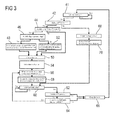
- FIG 3 shows a flow diagram of a preferred interaction between the fixed device 14 and the mobile device 10.
- the vehicle 12 is a car and is equipped with a fixed device 14 registered in the stationary processing unit 6, and that the driver carries a mobile device, like a smart phone, with a registered analyzing app.
- the motion detector 30 of the fixed device 14 senses that the car starts to move. For this the motion detector 30 operates in a stand by mode keeping an acceleration sensor at work either permanently or in regular time intervals. When in step 41 the motion detector 30 senses a movement of a car which is above a predefined motion or acceleration threshold, it triggers a change from the standby mode to an active mode of the fixed device 14.
- the detection of a vehicle movement prompts the fixed device 14 to search in step 42 for an active analyzing app 40 within the vicinity of its communication range, like with Bluetooth. If such app 40 is found the fixed device 14 matches in step 44 the mobile ID stored with the app 40, and validates it by matching its own ID with it. Alternatively the app 40 matches the base ID sent by the fixed device 14 to the app 40 with the authorized base ID stored in the app 40 and checks in this way the assignment of the base ID with the mobile ID. Further the app 40 or the fixed device 14 checks in step 46 whether the mobile ID is the primary ID or a secondary ID, i.e. the ID of a secondary driver.
- the fixed device 14 may only have the primary driver mobile ID stored. If a secondary driver is driving, then that driver's app 40 recognizes that it is in contact with a fixed device 14 to which the app 40 is authorized. The app 40 sends its mobile ID to the fixed device 14 and they begin a parameter data collecting session. The fixed device 14 notices, that the driver is a secondary driver and does not upload that session data set to the mobile device 10, but waits until it is connected to the primary mobile device 10 for the next time.
- the system 4 does not validate whether the app 40 and/or the fixed device 14 have been registered for this specific vehicle 12 or fixed device in the stationary processing unit 6. It may happen that changes in the insurance occurred, like deletion or addition of a secondary driver from/into the primary drivers profile, of other amendments. This verification is done later at the stationary processing unit 6 by matching the two IDs with the registration information, preferably the most current registration information.
- the fixed device 14 copies in step 48 all previous uncopied data sets stored in the fixed device 14 to the mobile device 10.
- the sessions data sets are uploaded to the stationary processing unit 6 that unit 6 checks if by means of the base ID and the mobile ID of each data set it the respective data collecting session was a truly authorized session.
- the fixed device 14 accesses in step 50 the memories 18, 34 of the mobile device 10 and of the fixed device 14 and generates in each of them a data set in a form of a data capsule, like a file, in which parameter data are written later.
- a data capsule is a corresponding receptacle for the data collected during an analyzing session.
- the data capsule contains a data set the terms data capsule and data set are seen as equivalent with regard to this invention.
- step 44 If in step 44 no mobile ID is found with the app 40, the process continues in step 50. If in step 46 the app 40 is not the app 40 of the primary driver, then all previously uncopied data sets/capsules from this mobile device 10 are copied in step 52 to the memory 34 of the fixed device 14.
- Each data capsule/set comprises a data capsule index number, the index number of corresponding data capsules are identical.
- the system 4 stores on each data capsule a data set. The following data are stored in the data capsule of the fixed device 14:
- the following data are stored in the data capsule of the mobile device 10:
- both devices 10, 14 collect parameter data. This is done independently by both devices 10, 14.
- the parameter data are written in the data set/capsule which is stored in the respective memory 18, 34.
- the system 2 attempts to re establish the communication connection between the devices 10, 14. Accordingly, the timer is consulted in step 60 to see whether the time interval is completed. If not, this request is continued in a loop until the time interval is completed. Then the communication connection is reopened triggered by the fixed device 14.
- the presence of the active app 40 is checked by the fixed device 14 in step 62. If the app 40 is active the properly indexed and open data capsule is verified in step 64. If yes again a loop is passed between steps 56 and 64. If no active app 40 is found in step 62 or the active app 40 does not contain the properly indexed and open data capsule, then the system proceeds to step 66, where the data capsule in the fixed device 14 is closed. Then the procedure goes back to step 41.
- the fixed device 14 When the fixed device 14 does not sense vehicle motion for an extended period of time, it goes back to standby mode and waits until the motion sensor 30 detects motion.
- the vehicle 12 may be parked, and the system 4 will wait in the standby mode for the next motion of the vehicle 12.
- the standby mode is the mode of the fixed device 14.
- the mobile device may operate a little while longer than the fixed device, since the mobile device does not react on the absence of motion of the vehicle but the on the absence of a handshake from the fixed device 14. Since the fixed device 14 is in standby the handshake will not be initiated by the fixed device. After the predefined timespan between handshakes the mobile device notices the absence of the handshake and closes its data collecting session.
- the app 40 may be shut of, deactivated or ended. The current data capsule will stay in the mobile device 10 as well as in the fixed device 14.
- the battery load of mobile device 10 Upon a new communication session between the fixed device 14 and the same mobile device 10 of the same driver - checked with the IDs - the contents of data capsule n of the fixed device 14, as the two IDs, the battery load of mobile device 10, time information about sessions, preferably acceleration data, etc, will be added to the data capsule n of the mobile device 10 which will then upload its data capsule n to the server 6 of the insurance company.
- the data capsule n of the fixed device 14 is sent to the mobile device 10 which then will upload both, its data capsule n and the data capsule n of the fixed device 14 to the stationary processing unit 6.
- n+1 is started in both devices 10, 14 and a new data collection session starts. It is to be noted that the new data capsule may have a higher number, as n+2, n+3, or even higher, depending on the secondary drivers having driven the vehicle 12 in between.
- step 42 the procedure continues further as before, checks the mobile ID and records the mobile battery charge in the reopened data capsule n of the fixed device 14. If, on the other hand, still no active app 40 is present (step 42) the fixed device 14 creates a new and special data capsule n+1 for parameter data collection without app 40 in step 68, that contains the following data:
- the system 4 opens a new session by generating a newly indexed data capsule in the fixed device 14 and the mobile device 10. Such situation can happen if the foregoing session was a session with the primary driver and the successive session is a session with a secondary driver.
- the old and "unfinished" data capsule n between fixed device 14 and primary app 40 remains in the fixed device14 and the primary mobile device 10 until they start a new communication session at later time.
- the data capsules can be stored non sequentially and the IDs need not be sequential and even the data capsules created simultaneously in the fixed and mobile device 14, 10 can be given different encoded ID numbers that only upon upload can be re-united as the same data capsule.
- step 58 a process loop is passed with the retrieval, whether the vehicle 12 is still moving. If the motion detector 30 signals a rest of the vehicle 12 over a predetermined time span the fixed device 14 jumps to step 66 and closes its data set. It may turn to standby mode and waits until a respective signal from the motion detector 30. This inactivity time span should be long enough that it is not affected by the stop-and-go- traffic found in traffic jams.
- the mobile device 10 Since the mobile device 10 is also programmed to expect the handshake connection of step 60 at certain intervals, a missing handshake will cause the app 40 to stop data recording and close down its data capsule. The app 40 may close and wait for a new activity trigger by the fixed device 14.
- the fixed device 14 attempts to establish a connection between the devices 10, 14.
- the fixed device 14 polls all analyzing apps within its Bluetooth reach for validation. If more than one app 40 can be found which are all valid for the base ID the system selects the mobile device 10 with the strongest signal, facilitated by placing the mobile device 10 as close as convenient to the fixed device 14 and preferably in the holder 15. Then it proceeds with step 44 as described before and generates in step 50 for the present combination of devices 10, 14 a new set of data capsules indexed n+1.
- the fixed device 14 can poll present data capsules from all such responding mobile devices 10 which indicate that they are authorized for this fixed device 14 or its base ID, respectively. Hence the fixed device 14 can acquire relevant data capsules even from authorized and not driver engaged mobile device/app 40.
- step 46 the fixed device 14 transfers all previous data capsules to the memory 18 of the mobile device 10, regardless whether they were compiled for this device 10 or not. All these files are transferred later from the mobile device 10 to the stationary processing unit 6. The fixed device 14 keeps a copy of the transferred files for backup. The system 4 then continues to operate as described for the initial session.
- the method as described with the data sets or data capsules may remain unchanged except that the data of the data set of the fixed device may be omitted or generated by the mobile device, like battery power or acceleration values.
- the unique aspects of the fixed device 14 revolve around how it is able to monitor, quantify and report attempts to use the insured vehicle 12 without system monitoring.
- the fixed device 14 linkage to mobile device 10 starts when the fixed device 14 detects via its motion detector/accelerometer 30 vehicle movement. This starts a process where the fixed device 14 attempts via Bluetooth 36 or any other appropriate means of data transmission to contact the mobile device 10 in the vehicle 12 and determine whether it contains a functioning insurer app 40 (step 42) and also determines if it is registered (step 44) and has the proper user password, which can be done within step 42.
- the level of password protection can include the fixed device 14 prompting the mobile device 10 to request direct entry by the driver on its key pad or it can be pre-stored in the application when it is initially download by the insurer, or by the system operator, to the participant.
- the fixed device 14 allows for adding insured parties, changing designated smart phone and changing password.
- the mobile device 10 is a smart phone in this embodiment.
- the fixed device 14 records the related registration and password information in the app 40. This information is only verified upon upload to the stationary processing unit 6 and in that stationary processing unit using records of all approved drivers, passwords etc associated with a given insured party or vehicle. The session proceeds only based on the presence of said datum in the app 40 but without validation. As will be discussed later in this section the Virtual Cradled downloads to the smart phone app 40 data capsules. This step can be restricted to only those registered app 40 and passwords that have previously interacted with the said fixed device 14 multiple times.
- the fixed device 14 records the smart phone battery level (could be done within step 42) and defines for the transit session now underway a data capsule with a sequence number (step 50).
- a data capsule is basically a file or a set of compiled data, such as, for example, the speed and/or acceleration, which can be used as speed and/or acceleration metric raw data.
- the initial Bluetooth session ends (step 58) but the fixed device 14 data capsule does remain active recording those acceleration or deceleration events that exceeded a predefined threshold, such as g-force or change in speed per second, and storing them with their respective time stamps.
- a predefined threshold such as g-force or change in speed per second
- the smart phone app 40 While in transit the fixed device 14 records in data capsule n the duration and smart phone battery level it has detected. In parallel the smart phone app 40 records and processes parameter data as will be described later, as fuzzy GPS, trend line coordinates, speed and acceleration metric raw data, etc.
- the fixed device 14 At given time intervals, like every quarter hour for example, if the fixed device 14 senses continued vehicle motion, it attempts to contact to the smart phone app 40 by Bluetooth or other communication means to confirm it is still in operation and once again monitors smart phone battery level. If the smart phone app 40 does not receive a fixed device 14 handshake at the appointed period of time it stops its data collection and closes the data capsule (step 66). If the fixed device 14 does not sense movement for a given period of time it also logs the end of transit and closes that data capsule. Hence at some point both the fixed device 14 and the app 40 have closed their respective data capsules n and stored them.
- the smart phone data capsule n may contain more data than the duration of transit logged by the fixed device 14 data capsule n such as might occur if the driver left the vehicle and got on a train with the app 40 still active. The app 40 will then only stop recording data when it fails to get its hourly handshake from the virtual cradle 14.
- the fixed device 14 When the fixed device 14 detects vehicle motion but does not detect an app 40 the fixed device 14 creates a special data capsule n * , like n+1, and records therein the time and duration of the event where the vehicle is in transit with no app 40 active.
- the fixed device 14 detects vehicle motion and connects with the smart phone and validates the appropriate app 40 is active, it defines a new joint data capsule n+2 and downloads to the smart phone the previous data capsule n containing the duration of transit n and also the data capsule n* that reports the transit and duration of transit n* without app 40 active.
- the stationary processing unit 6 When the stationary processing unit 6 now requests an upload, it receives all the data capsules with their respective parameter data and all the fixed device 14 data capsules with their recordings of transit time and related smart phone battery level. Some of the conditions then examined and detected are:
- the fixed device 14 has a battery replacement warning light, and for example, based on the number of data capsules transits that the stationary processing unit 6 monitors, an email can also be sent to the enrolled party advising them to change the fixed device 14 battery.
- the vehicle system comprises the fixed device, called virtual cradle, and the mobile device, like a smart phone with the respective app.
- the vehicle system 4 may contain a single device which performs some or all of the above described functions of the method as described above, or more than two devices interacting to perform the functions.
- the single device is fixed to the vehicle 12, especially as described with respect to the fixed device 14.
- a device performing the method steps of the mobile device 10 is then integrated in the single device.
- the system has totally different business models and ramifications based on whether the application is viewed as discretionary versus non-discretionary. Essentially it is a defining aspect of the invention that operation may not be at the discretion of the vehicle driver but may rather be defined and specified by the insurer. If it is wanted that the driver is able to turn of the monitoring at will, the app 40 may have a feature that deactivates monitoring or deactivates the app 40 as such completely. If only the monitoring function of the app 40 is deactivated, the ID match can still be performed, giving the information to the stationary processing unit 6 that an authorized driver drove the vehicle 12. Then the insurance payback can be adjusted by the duration of non-monitored driving. If the app 40 is deactivated completely the insurance payback can be adjusted differently for enrolled versus non-enrolled drivers, since in that case there is the possibility that a non-enrolled driver was driving the vehicle 12.
- system 4 can operate privacy compliant. It can be avoided to compile information that could be legally actionable in court for fining a driver. This can be done, for example, by eliminating at least two elements of the legally actionable three elements of information:
- the system requires no GIS information in its smart phone app 40 and hence has no per smart phone app 40 GIS license fee issues. Additionally the system provides feedback to insurer and insured with respect to speed, acceleration and privacy protected reconstructed approximation of route.
- the mobile system as a smart phone with an app, needs to coexist with other apps co-resident in smart phones and with the mobile phone's primary function which is telephony. These functions come together in memory allocation management and in particular battery drain management.
- the system is not in continuous smart phone positional polling or in continuous dialog with the Virtual Cradle.
- the system is a non-discretionary system, we only poll at random, discrete occasions GPS (with no concurrent GSM positioning assist). As has been detailed, this is part of a purposeful strategy to provide all the motoring information required while seamlessly assuring that locational anonymity is maintained.
- the communication between the mobile system and the fixed device 14 is purposely structured as triggered only upon start of movement of the vehicle and then with handshakes, preferably performed regularly, like every quarter hour.
- the analyzing system 2 is able to reconstruct a route of a given transit driven by the vehicle 12 in a manner that, while totally protecting privacy, it generates meaningful actuarial data. Furthermore the route reconstruction allows posing the other operation characteristics, as speed quality metric and acceleration quality metric - in a manner that provides the most actuarial inference as well as most meaningful and relevant remedial feedback.
- the route reconstruction by the analyzing system 2 proceeds in this embodiment by taking location data, as GPS coordinates, as the vehicle transits a journey route.
- location data are taken randomly, like at random intervals of time.
- GPS throughout this disclosure is used in a generic sense meaning GPS in special or any means of affixing position of the vehicle 12. It does not exclude other comparable systems such as Galileo or other non-RF or terra-firma based position systems based on RF or hybrid technology such as differential correction.
- the position coordinates can be taken by the mobile device 10, like a smart phone with GPS function. While the vehicle is in transit, the app 40 prompts the GPS unit in the Smart Phone to take positional readings at random intervals. Actually these could be identical to the coordinates captured for the purpose of speed recording.
- the mobile device position function is used in snap-shot mode and registers positional coordinates as depicted in FIG 4 .
- FIG 4 shows a schematic city map with a plurality of blocks and streets.
- the driving route of the vehicle 12 is shown in a continuous line.
- the location data are positional coordinates that are taken while the vehicle 12 travels the driving route.
- speed data are calculated, like the actual speed of the vehicle at certain moments or locations.
- the speed data may be derived from the location data as shown or from separate location data which is used only for speed calculation. In the embodiment shown in FIG 4 the speed data are derived from the location data resulting in a vehicle speed at every location point.
- the mobile device 10 then has the following data:
- time data as noted above can be quantized time windows of, for example, 5 minute increments that further ensure that all datum collected from it inception is not legally actionable.
- Camouflaging positional data While still in the memory of the vehicle system 4, each received GPS set of positional coordinates that will be used for travel segment construction is camouflaged by adding a random error to at least one of the x or y coordinates, preferably to both, the x-coordinates and y- coordinates. This can be done, for example, by inducing random fluctuations into the Circular Error Probability (CEP) with which GPS is normally resolved: i.e. +/-10 meters 50% of the time. The random fluctuation can be introduced to length of error and/or direction of error.
- CEP Circular Error Probability
- the CEP for the current route calculations location points can however be increased by adding a predefined length, like 200 m as shown with the slashed positional coordinates in FIG 4 , or with random circle diameter, preferably always larger than a predefined threshold.
- the random circle diameter can be adapted to the driving environment, resulting in a larger diameter in areas of low road density as in rural areas, and smaller diameter in areas of high street density, like in urban areas - thereby being attuned to maintaining route anonymity.
- this "fuzzy location" data has lost its CEP +/- 10m relevance, and hence gives the user greater anonymity than they normally get as part of mobile telephony, the location data have not lost their value for route reconstruction.
- Route reconstruction can be done by generating travel segments, like trend lines, of the route driven.
- the travel segments do not reflect roads driven but leave a probability of many alternative roads within the travel segment.
- Such travel segments are shown in FIG 5 . While the route driven is shown in a solid line, the travel segments are shown in broken lines.
- the randomized location data are depicted with crosses.
- the current trend line is calculated, preferably in the mobile device 10.
- the route driven changes direction the current trend line is terminated and a new trend line is calculated.
- the transition from one trend line to the next following trend line can be determined by a nominally monotonic decrease in b below a predefined threshold. For instance, if the least squares are increasing over two, three or more successive points this is considered as indicator to end the present trend line and start a new one.
- the actual movement of the vehicle is thus transformed via coordinate camouflaging and least squares fitting into a series of trend lines, each trend line being defined by a start coordinate point and a termination coordinate point.
- the start/termination coordinate point can be the cross point of two trend lines or one of the positional coordinates or coordinate points in other words.
- the respective coordinate point can be the point where the second, third or following successive decrease of b happened, this point belonging to both trend lines.
- trend line coordinates are stored by the app 40 in a file, each trend line carrying an index number for identification plus an encoded time marker.
- the time marker can be the times when the vehicle passed the start point and the termination point.
- the underpinning of route information is stored with some degree of temporal information - but not to such degree, that information is derivable about when and where the vehicle was at any point in the transit.
- the driver operation characteristics parameter may be speed and acceleration, etc. Better actuarial inference is achieved by speed metrics and/or acceleration metrics as advanced driver operation characteristics parameter.
- the speed metrics can be generated from the travel segments.
- the travel segments can be trend lines or areas of actuarial interest.
- driver operation characteristics do only reflect driver behavior to a low degree. Better description of driver operation characteristics may be obtained from special metrics that are derived from speed and/or other values. Further, metrics can be generated in a way that maintains privacy protection.
- speed metric may be based on the clear and permanent separation of individual speed value measurements from the location where those measurements have been captured.
- the storage of speed values and location is performed in a way that prevents re-association of any individual speed value with a specific coordinate point.
- a speed information is assigned to the travel segment. This can be done in the following way.
- the individual speed values from point within the travel segment are combined to travel segment speed information, like an average speed within the travel segment.
- speed can be determined as running average over the travel segment.
- the renewing of the running average can be stopped as soon as the travel segment is finished, like at the beginning of a new trend line.
- the vehicle system 4, especially the mobile device 10 contains the following data:
- randomly organized location data are transmitted to the stationary processing unit 6 for further processing.
- These data may be the randomly organized location data, as GPS point coordinates, used to compute the speed values, carrying no reference to the speed values themselves and no timestamp, preferably having no temporal relationship further than they were compiled during the time window associated with their timeline.
- the storage sequence of these data is - preferably continuously - reorganized in a random order.
- the point coordinates are processed via a data base, such as a GIS map, that assigns to each coordinate point on a road a speed reference.
- the speed reference can be the statutory speed limit. However, the speed reference can be other speed data, e.g. the average speed of a plurality of vehicles at that point during that time of the day. This speed reference may be lower at daytime than at night and even lower in rush hour than at other times of the day. To obtain the time of the day a daytime value may be assigned to any travel segment. However, such time value may be omitted.
- Other reference speed congestion and related inference information/parameters used in said metrics can also be taken from other sources other than a GIS map and may also be employed for this purpose, either instead or in addition to the statutory speed limit and other datum of actuarial interest and can be used to sub-set the processing of said metrics into units most germane to insurance inference.
- Such information from GIS and/or other sources can be processed in the same manner as described hereafter for the statutory speed limit.
- the speed reference is the statutory speed limit in the following.
- the stationary processing unit 6 may then extract from the data base the information on how fast the vehicle 12 was allowed to drive on the respective roads associated with these sets of GPS location coordinates. These speed limits are then combined into an average speed reference - like average statutory speed limit - for the entire journey, for an area of interest, or for a travel segment or for a plurality of travel segments within an area of interest.
- the resulting average speed reference is then compared to the average actual speed of the vehicle contained in the respective journey, area of interest, travel segment or plurality of travel segments respectively.
- the delta between the two average speed values is the called speed metric.
- a high-risk driver will tend to be frequently and consistently significantly in excess of the statutory speed limits to the degree that when averaged over many events these high risk driving patterns will be captured by a succession of high speed metric.
- the speed metric is a relative measure just like many other insurance and actuarial related parameters. To obtain a comparable value, it is suggested to compile the speed metric for good driving versus bad driving record vehicles/drivers and using them as to relatively rank other drivers as shown in FIG 6 .
- FIG 6 shows a diagram of an actuarial parameter AP over speed metric.
- the actuarial parameter AP is the daytime starting with midnight on the bottom and ending with midnight at the top of the diagram.
- the diagram shows five risk zones, zone 1 indicating low risk and zone 5 the highest risk.
- the stationary processing unit 6 calculates a driving risk for the route driven by the vehicle during this journey.
- the four lines separating the five risk zones result from this calculation, and they will be different for other routes driven.
- the four lines are identical, whereas in reality most probably they will differ from one another.
- the risk zone may not be distinct but merge continuously from one another, resulting in continuous risk values from 0 to 100, for instance.
- the average statutory speed limit ASSL for this journey was 42 mph.
- the average speed of the driver was 45 mph, so his speed metric was 3 mph.
- the driving risk depends not only on the speed driven, as indicated by the horizontal arrows in FIG 6 , but on the daytime of journey, as indicated by the vertical arrows in FIG 6 . If the speed metric was higher, the risk was higher, of course. However, at earlier daytime, like in morning rush hour where average speed on city streets are significantly lower, a speed metric of 3 mph would result in extreme risk zone 5, as shown with the lower hollow dot in FIG 6 . On the other hand, during night, the same speed metric is more or less acceptable and results in risk zone 2, as shown with the upper hollow dot in FIG 6 .
- the speed metric is calculated to a driving risk factor, like risk zones as in FIG 6 , by using actuarial parameter, like day time, as in FIG 6 .
- actuarial parameter may be current weather, or area in which the vehicle was driven, or other actuarial parameter AP.
- Very important is the area in which the vehicle 12 was driven, like urban or rural, or type of road, like city streets, urban roads or expressways.
- the speed metrics was calculated for the journey in total.
- the speed metrics can be calculated for every travel segment separately.
- the travel segment can be a trend line or an area. It, for instance, the vehicle 12 first travels on urban roads for 5 miles, then 15 miles on expressways and after that 2 miles on urban streets, this journey can be segmented in a first urban travel segment, a second expressway travel segment and a third urban segment.
- the travel segments are trend lines as explained above.
- the travel segments are geographic areas shaped from actuarial parameters. For every travel segment a driving risk or other parameter can be calculated which then are calculated to a total risk or parameter, like averaged, weighted, or the like.
- the route driven by the vehicle 12 is tracked in two ways. By travel segments for calculating the speed driven, and by exact location data for calculating the speed reference, like average statutory speed limit.
- the exact location data are sent to the stationary processing unit 6 to calculate the speed reference.
- these data are camouflaged, e.g. by randomizing their sequence in the file and by separating them from time and speed data.
- travel segments can be constructed in such a way that in themselves they do not contain any information about streets, areas or any other features that would allow someone to view them directly in relation to traffic conditions. This can be done by adding a random error to location data, as explained in the foregoing. No location data arrive at the stationary processing unit 6 that describe the driving route exactly.
- Travel segments are just patterns of coordinates within a geographic matrix. To put them into an actuarially meaningful context they have to be related to street map information. However, since, due to the masked coordinates the travel segments and even the trend lines do not follow the roads actually used, they can not be mapped directly to the road network. The fact that a trend line cuts or follows a road does not necessarily mean that this road was actually part of the route. Therefore, in a further embodiment, trend lines are not matched to roads but to so called areas or areas of interest.
- accelerating metric is another useful driver operation characteristics.
- basic procedure is similar to the one described speed metric.
- the acceleration/deceleration metric (for brevity in the following text the event acceleration and acceleration metric are used and infer also deceleration) differs from the speed metric in two aspects:
- Acceleration is hard to quantify as a risk factor in absolute terms. Rather it needs to be gauged relative to the likely prevailing speed and traffic conditions in given actuarial areas of interest.
- the risk factor significance of a given acceleration or deceleration is not an absolute but rather relates to where and when it takes place.
- the analyzing system preferably uses one accelerometer in the fixed device 14 and/or one accelerometer in the mobile device 10. Generally those acceleration events are stored which acceleration values exceed a predefined threshold.
- each acceleration event is provided with a time marker that shows in a quantized manner a time window relatable to the compilation of a respective trend line.
- these time markers are matched with the time markers in the travel segments file generated in the mobile device 10, allowing the association of acceleration events to travel segments.
- the time marker shows when the event has occurred.
- the acceleration data and the time marker are sent to the mobile device 10 which associates the event with the respective travel segment and erases the time marker from its memory 18.
- the acceleration event is then stored in the memory 18 together with indication in which travel segment the event occurred.
- the file finally transferred to the stationary processing unit 6 can contain for each travel segment an average acceleration value.
- both accelerometers record events that exceed simultaneously a threshold g-force on both devices. This avoids getting an undue number of false readings if the smart phone is dropped or picked up by a passenger.
- the smart phone can independently or in parallel record acceleration events that exceed a threshold, preferably as a running average.
- the respective acceleration values can be associated to each travel segment and stored in the active data capsule of the mobile device 10.
- the stationary processing unit 6 processes the acceleration metric from the acceleration values assigned to a travel segment.
- the acceleration metric can be a weighted average acceleration per travel segment.
- the travel segment data is also transmitted to the stationary processing unit 6 and processed to allocate each travel segment to an actuarial area. This information is combined with the average acceleration per travel segment to compute an average acceleration per area.
- acceleration events may be weighted according to one or more parameters, like acceleration value, number of events per segment and/or per time, time of event, location of event, density of traffic in which the event occurred, or other. The weighted value can then be used in the calculation of the average acceleration assigned to travel segments.
- Another weighting can be performed over a plurality of segments.
- Each segment is associated with a weighting value, dependent on one or more weighting parameters, like length of the segment, location or area of the segment, time of the day during which the segment was travelled, or other.
- weighting parameters like length of the segment, location or area of the segment, time of the day during which the segment was travelled, or other.
- the average acceleration is calculated from either many acceleration values of several segments or by relative weighting of several average acceleration values of several segments.
- the acceleration metrics is - like the speed metrics - used to determine the driver operation characteristics of a driver.
- the acceleration metric can be combined with actuarial parameter, analogous to the speed metric, as shown in FIG 6 , resulting in a driving risk factor or driving risk value.
- the actuarial parameter may be the same as used with speed metric. This may include a comparison of the acceleration metric of the vehicle driver with acceleration metrics of other drivers. If the driving risk of those other drivers is known the driving risk can be generated as a function of acceleration metrics of those drivers. This function can determine the driving risk of the vehicle driver.
- This "acceleration driving risk” can be related to the "speed driving risk" of the driver, the two risks being weighted and merged to a total driving risk, especially for feedback to the driver.
- the driver operation characteristics parameter used to generate the extreme metric is speed data.
- the vehicle system 4 preferably the mobile device 10 detects and stores speeding events, when the speed of the vehicle 12 is over a predefined threshold. To detect such speeding events the speed values as obtained for the speed metric may be used.
- the speed threshold lies preferably over the highest speed limit of the region travelled by the vehicle, like 90 mph.
- the number of occurrences of speeding events is counted per a predefined period of time or distance.
- the number is used as extreme metric and is compared to the respective number related to other drivers whose driving risk is known, and a speeding event driving risk is associated to the driver of the vehicle.
- This speeding event driving risk can be weighted and merged with speed driving risk and/or acceleration driving risk to a total driving risk, especially for feedback to the driver.
- the number of speeding events is weighted with the severity of the individual speeding events. Further weighting factors may be used, as time of the day and/or area of occurrence. In general above mentioned actuarial parameter may be used as weighting factors.
- the speeding events can be associated to travel segments - that can be done in the same manner as with acceleration events - and a travel segment speeding value can be derived. Such value can be further processed as an average speed per travel segment and/or average acceleration per travel segment, resulting in an extreme metric analogous to speed and/or acceleration metric.
- the frequency of sampling the vehicle speed as described above can be temporarily increased to better monitor the vehicle speed after the detected speeding event.
- the frequency can be random sampling as described above, a random factor being changed to increase random frequency of sampling.
- the frequency of sampling the vehicle speed can be increased upon observation of special events during the vehicle travel.
- Such observation can be a detection of a highway toll signal, like polling for an EZPass. Since such situations involve more dangerous situations than normal driving speeding events are more dangerous and can then be detected more reliable.
- the mobile device 10 cooperates with the fixed device 14.
- the fixed device may be omitted, and the method steps described with the fixed device 14 are then performed by the mobile device, or may be omitted.
- the wording "mobile device 10" and "fixed device 14" may be replaced by "analyzing vehicle system 4".
- the method Apart from the collection of data for the computation of insurance rates the method also aims at influencing the individual driver's behavior towards safer and less risky driving. Therefore the method does not stop at identifying hazardous speed and acceleration values but also provides a powerful feedback instrument that allows the driver to immediately assess his/her own performance.
- the feedback method is based on a collected body of driving speed/acceleration/other metric data for drivers with good or bad performance.
- the speed and acceleration values either per upload period or per area/time are statistically referenced to the number and/or severity of insurance events related to those values.
- the statistics gauges the risk for an insurance event for specific speed and acceleration values in certain locations/areas at certain times.
- the performance feedback Interface makes these references visible to the driver and shows his individual score within this risk matrix.
- the feedback information can be displayed in the shape of a two dimensional "risk space".
- FIG 7 shows such feedback diagram where risk R is depicted over speed metric SM.
- This diagram shows to the driver how fast he was driving and how risky this driving was.
- the acceleration metric can be added as third dimension in a three dimensional "risk space" created by acceleration, speed and their respective risk values.
- Each of these display modes can again be displayed for specific times of the day and specific actuarial areas.
- his driving behavior shows potential for improvement.
- the display could show him that his driving in the morning is quite safe and well within the green area of "good and approved driving” but that his speed and/or acceleration in the afternoon should be more controlled.
- this feedback system is quite expandable in the future with any complementary information that becomes available and may have relevance for the driving behavior such as traffic density and weather conditions.
- the insured party can request more frequent feedback from the stationary processing unit 6: "How am I doing?" to facilitate establishing the key "effort reward feedback cycle" central to driving behavior modification.
- the insured party which can be the driver of the vehicle or another person, like the vehicle holder or other authorized drivers, can request more frequent feedback from the system.
- the determination rate e.g. sampling rate
- a parameter - like speed, acceleration, average speed, average acceleration, speed metrics and/or acceleration metrics - may be varied upon an input of the driver.
- the frequency of feedback to the driver may be varied according in predefined manner or in a manner chosen by the driver.
- the feedback may be given by the mobile device 10, e.g. displayed in a smart phone.
- the feedback preferably includes one or both metrics, average speed and/or average acceleration, especially relative to other drivers or relative to a performance determined from data of other drivers.
- Retrieval Active analyzing app present? 44 Retrieval: Mobile ID encountered before? 46 Retrieval: Mobile device of the primary driver? 48 Copy data sets to the mobile device 50 Generate data sets 52 Copy data sets to the fixed device 54 Write data set 56 Write battery charge in data set 58 Terminate communication 60 Retrieval: Time for handshake? 62 Retrieval: App present? 64 Retrieval: Data capsule present? 66 Close communication 68 Create no-app data capsule 70 Record date, time, duration of movement AP actuarial parameter SM speed metric ASSL average statutory speed limit SR speed reference
Landscapes
- Engineering & Computer Science (AREA)
- Physics & Mathematics (AREA)
- General Physics & Mathematics (AREA)
- Business, Economics & Management (AREA)
- Remote Sensing (AREA)
- Radar, Positioning & Navigation (AREA)
- Theoretical Computer Science (AREA)
- Finance (AREA)
- Accounting & Taxation (AREA)
- Strategic Management (AREA)
- Technology Law (AREA)
- General Business, Economics & Management (AREA)
- Development Economics (AREA)
- Economics (AREA)
- Marketing (AREA)
- Mathematical Physics (AREA)
- General Engineering & Computer Science (AREA)
- Software Systems (AREA)
- Databases & Information Systems (AREA)
- Data Mining & Analysis (AREA)
- Automation & Control Theory (AREA)
- Traffic Control Systems (AREA)
- Financial Or Insurance-Related Operations Such As Payment And Settlement (AREA)
Applications Claiming Priority (1)
| Application Number | Priority Date | Filing Date | Title |
|---|---|---|---|
| US201261624016P | 2012-04-13 | 2012-04-13 |
Publications (3)
| Publication Number | Publication Date |
|---|---|
| EP2650845A2 true EP2650845A2 (de) | 2013-10-16 |
| EP2650845A3 EP2650845A3 (de) | 2015-03-25 |
| EP2650845B1 EP2650845B1 (de) | 2020-02-26 |
Family
ID=48463681
Family Applications (1)
| Application Number | Title | Priority Date | Filing Date |
|---|---|---|---|
| EP13020006.6A Active EP2650845B1 (de) | 2012-04-13 | 2013-04-15 | Verfahren zur Analyse von Betriebseigenschaften eines Fahrzeugführers |
Country Status (2)
| Country | Link |
|---|---|
| US (4) | US20130274955A1 (de) |
| EP (1) | EP2650845B1 (de) |
Cited By (2)
| Publication number | Priority date | Publication date | Assignee | Title |
|---|---|---|---|---|
| CN108877235A (zh) * | 2017-05-16 | 2018-11-23 | 北京嘀嘀无限科技发展有限公司 | 补偿方法、补偿装置和电子设备 |
| US11415659B2 (en) | 2018-12-07 | 2022-08-16 | Here Global B.V. | Privacy sensitive positioning |
Families Citing this family (192)
| Publication number | Priority date | Publication date | Assignee | Title |
|---|---|---|---|---|
| US10185455B2 (en) | 2012-10-04 | 2019-01-22 | Zonar Systems, Inc. | Mobile computing device for fleet telematics |
| US9563869B2 (en) | 2010-09-14 | 2017-02-07 | Zonar Systems, Inc. | Automatic incorporation of vehicle data into documents captured at a vehicle using a mobile computing device |
| US9384111B2 (en) | 2011-12-23 | 2016-07-05 | Zonar Systems, Inc. | Method and apparatus for GPS based slope determination, real-time vehicle mass determination, and vehicle efficiency analysis |
| US20130164715A1 (en) | 2011-12-24 | 2013-06-27 | Zonar Systems, Inc. | Using social networking to improve driver performance based on industry sharing of driver performance data |
| US10056008B1 (en) | 2006-06-20 | 2018-08-21 | Zonar Systems, Inc. | Using telematics data including position data and vehicle analytics to train drivers to improve efficiency of vehicle use |
| US9527515B2 (en) | 2011-12-23 | 2016-12-27 | Zonar Systems, Inc. | Vehicle performance based on analysis of drive data |
| US10431020B2 (en) | 2010-12-02 | 2019-10-01 | Zonar Systems, Inc. | Method and apparatus for implementing a vehicle inspection waiver program |
| US20140121857A1 (en) * | 2012-02-09 | 2014-05-01 | Infomobility.It S.P.A | System for characterizing the driving style of vehicle drivers |
| US20130261939A1 (en) | 2012-04-01 | 2013-10-03 | Zonar Systems, Inc. | Method and apparatus for matching vehicle ecu programming to current vehicle operating conditions |
| US8799032B2 (en) * | 2012-05-22 | 2014-08-05 | Hartford Fire Insurance Company | System and method to predict an insurance policy benefit associated with telematics data |
| US8977426B2 (en) | 2012-06-04 | 2015-03-10 | Geotab Inc. | VIN based accelerometer threshold |
| US9424696B2 (en) | 2012-10-04 | 2016-08-23 | Zonar Systems, Inc. | Virtual trainer for in vehicle driver coaching and to collect metrics to improve driver performance |
| US9361409B2 (en) * | 2013-01-10 | 2016-06-07 | International Business Machines Corporation | Automatic driver modeling for integration of human-controlled vehicles into an autonomous vehicle network |
| US9734537B2 (en) | 2013-03-10 | 2017-08-15 | State Farm Mutual Automobile Insurance Company | Vehicle image and sound data gathering for insurance rating purposes |
| CN104797494B (zh) * | 2013-08-02 | 2017-11-17 | 佳明瑞士有限责任公司 | 具有改进的轮廓线的海事导航装置 |
| US10423989B2 (en) | 2013-10-07 | 2019-09-24 | State Farm Mutual Automobile Insurance Company | Systems and methods to assess the condition of a vehicle |
| US11182859B2 (en) | 2013-12-04 | 2021-11-23 | State Farm Mutual Automobile Insurance Company | Assigning mobile device data to a vehicle |
| US20150158495A1 (en) * | 2013-12-05 | 2015-06-11 | Elwha Llc | Systems and methods for reporting characteristics of operator performance |
| US10023114B2 (en) | 2013-12-31 | 2018-07-17 | Hartford Fire Insurance Company | Electronics for remotely monitoring and controlling a vehicle |
| US10134091B2 (en) | 2013-12-31 | 2018-11-20 | Hartford Fire Insurance Company | System and method for determining driver signatures |
| WO2015160900A1 (en) * | 2014-04-15 | 2015-10-22 | Maris, Ltd | Assessing asynchronous authenticated data sources for use in driver risk management |
| FR3021147B1 (fr) * | 2014-05-16 | 2017-12-22 | Thales Sa | Dispositif de controle des donnees portees par un equipement embarque, systeme de collecte de taxe et procede associes |
| US11669090B2 (en) | 2014-05-20 | 2023-06-06 | State Farm Mutual Automobile Insurance Company | Autonomous vehicle operation feature monitoring and evaluation of effectiveness |
| US10599155B1 (en) | 2014-05-20 | 2020-03-24 | State Farm Mutual Automobile Insurance Company | Autonomous vehicle operation feature monitoring and evaluation of effectiveness |
| US10354330B1 (en) | 2014-05-20 | 2019-07-16 | State Farm Mutual Automobile Insurance Company | Autonomous feature use monitoring and insurance pricing |
| JP6447990B2 (ja) * | 2014-05-28 | 2019-01-09 | ソニーフィナンシャルホールディングス株式会社 | 情報処理装置、情報処理システム、情報処理方法、及びプログラム |
| US9904928B1 (en) | 2014-07-11 | 2018-02-27 | State Farm Mutual Automobile Insurance Company | Method and system for comparing automatically determined crash information to historical collision data to detect fraud |
| US9786154B1 (en) | 2014-07-21 | 2017-10-10 | State Farm Mutual Automobile Insurance Company | Methods of facilitating emergency assistance |
| US9317617B2 (en) * | 2014-09-12 | 2016-04-19 | E-Lead Electronic Co., Ltd. | Trip plan sharing and matching method |
| US10535103B1 (en) | 2014-09-22 | 2020-01-14 | State Farm Mutual Automobile Insurance Company | Systems and methods of utilizing unmanned vehicles to detect insurance claim buildup |
| US11170446B1 (en) | 2014-10-28 | 2021-11-09 | State Farm Mutual Automobile Insurance Company | Systems and methods for communicating with an electric vehicle |
| US10803526B1 (en) | 2014-10-30 | 2020-10-13 | State Farm Mutual Automobile Insurance Company | Systems and methods for processing trip-based insurance policies |
| US9969403B2 (en) * | 2014-10-31 | 2018-05-15 | Ford Global Technologies, Llc | Method and apparatus for predictive driving-mode learning and enablement |
| US10241509B1 (en) | 2014-11-13 | 2019-03-26 | State Farm Mutual Automobile Insurance Company | Autonomous vehicle control assessment and selection |
| US10354333B1 (en) | 2015-01-20 | 2019-07-16 | State Farm Mutual Automobile Insurance Company | Providing insurance discounts based upon usage of telematics data-based risk mitigation and prevention functionality |
| US10846799B2 (en) | 2015-01-28 | 2020-11-24 | Arity International Limited | Interactive dashboard display |
| US9390452B1 (en) | 2015-01-28 | 2016-07-12 | Allstate Insurance Company | Risk unit based policies |
| US9361599B1 (en) | 2015-01-28 | 2016-06-07 | Allstate Insurance Company | Risk unit based policies |
| US10817950B1 (en) | 2015-01-28 | 2020-10-27 | Arity International Limited | Usage-based policies |
| US10810504B1 (en) | 2015-03-11 | 2020-10-20 | State Farm Mutual Automobile Insurance Company | Route scoring for assessing or predicting driving performance |
| IN2015CH01603A (de) | 2015-03-28 | 2015-04-24 | Wipro Ltd | |
| ES2624498T3 (es) * | 2015-04-18 | 2017-07-14 | Urban Software Institute GmbH | Sistema y método para enrutamiento de mensaje |
| US10077056B1 (en) | 2015-04-24 | 2018-09-18 | State Farm Mutual Automobile Insurance Company | Managing self-driving behavior of autonomous or semi-autonomous vehicle based upon actual driving behavior of driver |
| US10832330B1 (en) | 2015-06-17 | 2020-11-10 | State Farm Mutual Automobile Insurance Company | Collection of crash data using autonomous or semi-autonomous drones |
| JP6994643B2 (ja) * | 2015-08-28 | 2022-01-14 | パナソニックIpマネジメント株式会社 | 情報端末の制御方法及び情報端末 |
| US11107365B1 (en) | 2015-08-28 | 2021-08-31 | State Farm Mutual Automobile Insurance Company | Vehicular driver evaluation |
| US10354334B1 (en) | 2015-09-04 | 2019-07-16 | State Farm Mutual Automobile Insurance Company | Systems and methods for weather-related vehicle damage prevention |
| US10565566B1 (en) | 2015-09-10 | 2020-02-18 | State Farm Mutual Automobile Insurance Company | Systems and methods for ordering a replacement component or repair service |
| US9395384B1 (en) * | 2015-10-07 | 2016-07-19 | State Farm Mutual Automobile Insurance Company | Systems and methods for estimating vehicle speed and hence driving behavior using accelerometer data during periods of intermittent GPS |
| US10733648B1 (en) | 2015-10-23 | 2020-08-04 | State Farm Mutual Automobile Insurance Company | Vehicle safety information system |
| US10308256B1 (en) | 2015-12-01 | 2019-06-04 | State Farm Mutual Automobile Insurance Company | Technology for notifying vehicle operators of incident-prone locations |
| US9965907B1 (en) * | 2015-12-10 | 2018-05-08 | Lytx, Inc. | Running characteristic for frequent data readings |
| US10503168B1 (en) | 2016-01-22 | 2019-12-10 | State Farm Mutual Automotive Insurance Company | Autonomous vehicle retrieval |
| US9749470B1 (en) | 2016-01-27 | 2017-08-29 | State Farm Mutual Automobile Insurance Company | Systems and methods for handling communications during user operation of a motor vehicle |
| US10949830B1 (en) | 2016-02-16 | 2021-03-16 | State Farm Mutual Automobile Insurance Company | Merchant terminal for receiving payment from a vehicle |
| US10949831B1 (en) | 2016-02-16 | 2021-03-16 | State Farm Mutual Automobile Insurance Company | Connected vehicle for providing navigation directions to merchant terminals that process vehicle payments |
| US10810572B1 (en) | 2016-02-16 | 2020-10-20 | State Farm Mutual Automobile Insurance Company | Connected car as a payment device |
| US11851041B1 (en) | 2016-04-11 | 2023-12-26 | State Farm Mutual Automobile Insurance Company | System for determining road slipperiness in bad weather conditions |
| US10832504B1 (en) | 2016-04-22 | 2020-11-10 | State Farm Mutual Automobile Insurance Company | System and method for generating data regarding a vehicle crash |
| US11861715B1 (en) | 2016-04-22 | 2024-01-02 | State Farm Mutual Automobile Insurance Company | System and method for indicating whether a vehicle crash has occurred |
| US10351133B1 (en) | 2016-04-27 | 2019-07-16 | State Farm Mutual Automobile Insurance Company | Systems and methods for reconstruction of a vehicular crash |
| US20210354691A1 (en) | 2016-04-27 | 2021-11-18 | State Farm Mutual Automobile Insurance Company | Systems and methods for reconstruction of a vehicular crash |
| US11068730B1 (en) | 2016-06-14 | 2021-07-20 | State Farm Mutual Automobile Insurance Company | Apparatuses, systems, and methods for determining vehicle operator distractions at particular geographic locations |
| US12014423B1 (en) | 2016-06-22 | 2024-06-18 | State Farm Mutual Automobile Insurance Company | Using vehicle data, geographic area type data, and vehicle collision data in determining an indication of whether a vehicle in a vehicle collision is a total loss |
| US20210291817A1 (en) | 2016-06-23 | 2021-09-23 | State Farm Mutual Automobile Insurance Company | Systems and methods for environmental analysis based upon vehicle sensor data |
| US10504189B1 (en) | 2016-06-23 | 2019-12-10 | State Farm Mutual Automobile Insurance Company | Systems and methods for analyzing property telematics data to update risk-based coverage of a property |
| US10832338B1 (en) | 2016-11-23 | 2020-11-10 | State Farm Mutual Automobile Insurance Company | Systems and methods for building, utilizing and/or maintaining an autonomous vehicle-related event distributed ledger or blockchain |
| US10776879B1 (en) | 2017-01-17 | 2020-09-15 | State Farm Mutual Automobile Insurance Company | Blockchain controlled multi-carrier auction system for usage-based auto insurance |
| US10558874B1 (en) | 2017-01-19 | 2020-02-11 | State Farm Mutual Automobile Insurance Company | Apparatuses, systems and methods for generation and transmission of vehicle operation mode data |
| US10906494B1 (en) | 2017-01-19 | 2021-02-02 | State Farm Mutual Automobile Insurance Company | Systems and methods for predicting occupant location based on vehicular collision |
| US10407079B1 (en) | 2017-01-19 | 2019-09-10 | State Farm Mutual Automobile Insurance Company | Apparatuses, systems and methods for determining distracted drivers associated with vehicle driving routes |
| US10549759B1 (en) | 2017-01-19 | 2020-02-04 | State Farm Mutual Automobile Insurance Company | Apparatuses, systems and methods for improving operation of autonomous vehicles |
| US10373387B1 (en) | 2017-04-07 | 2019-08-06 | State Farm Mutual Automobile Insurance Company | Systems and methods for enhancing and developing accident scene visualizations |
| US20210264362A1 (en) | 2017-05-02 | 2021-08-26 | State Farm Mutual Automobile Insurance Company | Distributed ledger system for claim payouts |
| US10493994B1 (en) | 2017-05-11 | 2019-12-03 | State Farm Mutual Automobile Insurance Company | Vehicle driver performance based on contextual changes and driver response |
| US11354616B1 (en) | 2017-05-11 | 2022-06-07 | State Farm Mutual Automobile Insurance Company | Vehicle driver safety performance based on relativity |
| US12013695B1 (en) | 2017-05-16 | 2024-06-18 | State Farm Mutual Automobile Insurance Company | Autonomous vehicle operation based on real-time analytics |
| US10732627B1 (en) | 2017-05-25 | 2020-08-04 | State Farm Mutual Automobile Insurance Company | Driver re-engagement system |
| US10262528B2 (en) | 2017-07-21 | 2019-04-16 | State Farm Mutual Automobile Insurance Company | Autonomous vehicle mode alert system for bystanders |
| US10565873B1 (en) | 2017-08-18 | 2020-02-18 | State Farm Mutual Automobile Insurance Company | Emergency vehicle detection and avoidance systems for autonomous vehicles |
| US10872381B1 (en) | 2017-09-06 | 2020-12-22 | State Farm Mutual Automobile Insurance Company | Evidence oracles |
| US11386498B1 (en) | 2017-09-06 | 2022-07-12 | State Farm Mutual Automobile Insurance Company | Using historical data for subrogation on a distributed ledger |
| US12198196B2 (en) | 2017-09-06 | 2025-01-14 | State Farm Mutual Automobile Insurance Company | Technology for analyzing previous vehicle usage to identify customer opportunities |
| US10755495B1 (en) | 2017-09-25 | 2020-08-25 | State Farm Mutual Automobile Insurance Company | Technology for detecting onboard sensor tampering |
| US10960895B1 (en) | 2017-09-27 | 2021-03-30 | State Farm Mutual Automobile Insurance Company | Automatically tracking driving activity |
| US12143459B2 (en) | 2017-10-03 | 2024-11-12 | State Farm Mutual Automobile Insurance Company | Predictive risk propensity model for improving high risk driving behaviors |
| US10713839B1 (en) | 2017-10-24 | 2020-07-14 | State Farm Mutual Automobile Insurance Company | Virtual vehicle generation by multi-spectrum scanning |
| US11587046B1 (en) | 2017-10-25 | 2023-02-21 | State Farm Mutual Automobile Insurance Company | Systems and methods for performing repairs to a vehicle |
| US10593202B1 (en) | 2017-11-13 | 2020-03-17 | State Farm Mutual Automobile Insurance Company | Technology for situational modification of autonomous vehicle operation |
| US10825340B1 (en) | 2017-11-17 | 2020-11-03 | State Farm Mutual Automotive Insurance Company | Autonomous vehicle maneuver system for emergency vehicles and non-standard traffic flow |
| US10699404B1 (en) | 2017-11-22 | 2020-06-30 | State Farm Mutual Automobile Insurance Company | Guided vehicle capture for virtual model generation |
| US10762785B1 (en) | 2018-01-09 | 2020-09-01 | State Farm Mutual Automobile Insurance Company | Vehicle collision alert system and method |
| US11349669B1 (en) | 2018-01-30 | 2022-05-31 | State Farm Mutual Automobile Insurance Company | Cryptographic hash chain for vehicle configuration verification |
| US11059494B1 (en) | 2018-02-15 | 2021-07-13 | State Farm Mutual Automobile Insurance Company | System and method for transferring preferences for autonomous driving |
| US10782698B1 (en) | 2018-02-20 | 2020-09-22 | State Farm Mutual Automobile Insurance Company | Data processing systems and methods for providing relocation alerts |
| US10776644B1 (en) | 2018-03-07 | 2020-09-15 | State Farm Mutual Automobile Insurance Company | Image analysis technologies for assessing safety of vehicle operation |
| US11237555B1 (en) | 2018-03-09 | 2022-02-01 | State Farm Mutual Automobile Insurance Company | Backup control systems and methods for autonomous vehicles |
| US10970923B1 (en) | 2018-03-13 | 2021-04-06 | State Farm Mutual Automobile Insurance Company | Method and system for virtual area visualization |
| EP3776493B1 (de) | 2018-03-28 | 2025-08-20 | Munic | Verfahren und system zur verbesserung der fahrerinformationen und der fahrzeugwartung |
| US10732001B1 (en) | 2018-04-06 | 2020-08-04 | State Farm Mutual Automobile Insurance Company | Methods and systems for response vehicle deployment |
| US11485254B2 (en) | 2018-04-09 | 2022-11-01 | State Farm Mutual Automobile Insurance Company | System and method for adjusting an interior configuration of a vehicle in response to a vehicular accident |
| US10935974B1 (en) | 2018-04-19 | 2021-03-02 | State Farm Mutual Automobile Insurance Company | Manual control re-engagement in an autonomous vehicle |
| US10618523B1 (en) | 2018-04-19 | 2020-04-14 | State Farm Mutual Automobile Insurance Company | Assessing driver ability to operate an autonomous vehicle |
| US12454277B1 (en) | 2018-04-19 | 2025-10-28 | State Farm Mutual Automobile Insurance Company | Determining risk for a user of an autonomous vehicle |
| US11254270B1 (en) | 2018-05-02 | 2022-02-22 | State Farm Mutual Automobile Insurance Company | Technologies for using image analysis to facilitate adjustments of vehicle components |
| US10832347B1 (en) | 2018-05-14 | 2020-11-10 | State Farm Mutual Automobile Insurance Company | Methods and systems for smart claim routing and smart claim assignment |
| US11120574B1 (en) | 2018-06-15 | 2021-09-14 | State Farm Mutual Automobile Insurance Company | Methods and systems for obtaining image data of a vehicle for automatic damage assessment |
| ES2736901A1 (es) | 2018-06-29 | 2020-01-08 | Geotab Inc | Caracterización de una colisión de vehículo |
| US12254510B2 (en) | 2018-07-03 | 2025-03-18 | State Farm Mutual Automobile Insurance Company | Systems and methods for reserving a replacement rental vehicle |
| US10858011B1 (en) | 2018-07-13 | 2020-12-08 | State Farm Mutual Automobile Insurance Company | Dynamic safe storage of vehicle content |
| US10953830B1 (en) | 2018-07-13 | 2021-03-23 | State Farm Mutual Automobile Insurance Company | Adjusting interior configuration of a vehicle based on vehicle contents |
| US10836401B1 (en) | 2018-07-13 | 2020-11-17 | State Farm Mutual Automobile Insurance Company | Dynamic limiting of vehicle operation based on interior configurations |
| US10911949B2 (en) * | 2018-07-23 | 2021-02-02 | Byton Limited | Systems and methods for a vehicle authenticating and enrolling a wireless device |
| US12026602B1 (en) | 2018-08-01 | 2024-07-02 | State Farm Mutual Automobile Insurance Company | Vehicle damage claims self-service |
| US12002068B2 (en) | 2018-09-28 | 2024-06-04 | Allstate Insurance Company | Data processing system with machine learning engine to provide output generation functions |
| US11204682B1 (en) | 2018-10-29 | 2021-12-21 | State Farm Mutual Automobile Insurance Company | Dynamic data-driven consolidation of user interface interactions requesting roadside assistance |
| US11410243B2 (en) * | 2019-01-08 | 2022-08-09 | Clover Health | Segmented actuarial modeling |
| US11176562B1 (en) | 2019-02-04 | 2021-11-16 | State Farm Mutual Automobile Insurance Company | System and methods for predicting rental vehicle use preferences |
| US10668930B1 (en) | 2019-02-04 | 2020-06-02 | State Farm Mutual Automobile Insurance Company | Determining acceptable driving behavior based on vehicle specific characteristics |
| US10703379B1 (en) | 2019-02-04 | 2020-07-07 | State Farm Mutual Automobile Insurance Company | System and methods for determining owner's preferences based on vehicle owner's telematics data |
| US11915306B1 (en) | 2019-02-04 | 2024-02-27 | State Farm Mutual Automobile Insurance Company | System and methods for determining rental eligibility based on contextual telematics data |
| US11255683B1 (en) | 2019-02-06 | 2022-02-22 | State Farm Mutual Automobile Insurance Company | First mile and last mile ride sharing method and system |
| US11466997B1 (en) | 2019-02-15 | 2022-10-11 | State Fram Mutual Automobile Insurance Company | Systems and methods for dynamically generating optimal routes for vehicle operation management |
| US11048261B1 (en) | 2019-04-05 | 2021-06-29 | State Farm Mutual Automobile Insurance Company | Systems and methods for evaluating autonomous vehicle software interactions for proposed trips |
| US11321972B1 (en) | 2019-04-05 | 2022-05-03 | State Farm Mutual Automobile Insurance Company | Systems and methods for detecting software interactions for autonomous vehicles within changing environmental conditions |
| US11372902B1 (en) | 2019-04-09 | 2022-06-28 | State Farm Mutual Automobile Insurance Company | Methods and apparatus to compress telematics data |
| US11519745B1 (en) | 2019-04-09 | 2022-12-06 | State Farm Mutual Automobile Insurance Company | Methods and apparatus to compress telematics data |
| US11922734B1 (en) | 2019-04-17 | 2024-03-05 | State Farm Mutual Automobile Insurance Company | Systems and methods for autonomous vehicle incident management and recertification |
| US11281920B1 (en) | 2019-05-23 | 2022-03-22 | State Farm Mutual Automobile Insurance Company | Apparatuses, systems and methods for generating a vehicle driver signature |
| US11308741B1 (en) | 2019-05-30 | 2022-04-19 | State Farm Mutual Automobile Insurance Company | Systems and methods for modeling and simulation in vehicle forensics |
| DE102019209226A1 (de) * | 2019-06-26 | 2020-12-31 | Volkswagen Aktiengesellschaft | Verfahren, Computerprogramm und Vorrichtung zur Verarbeitung von durch ein Kraftfahrzeug erfassten Daten |
| DE102019209485A1 (de) | 2019-06-28 | 2020-12-31 | Volkswagen Aktiengesellschaft | Verfahren, Computerprogramm und Vorrichtung zur Verarbeitung von durch ein Kraftfahrzeug erfassten Daten |
| DE102019209711A1 (de) | 2019-07-02 | 2021-01-07 | Volkswagen Aktiengesellschaft | Verfahren, Computerprogramm und Vorrichtung zur Verarbeitung von durch ein Kraftfahrzeug erfassten Daten, sowie zum Bereitstellen von Parametern für eine solche Verarbeitung |
| US11787422B2 (en) | 2019-07-16 | 2023-10-17 | State Farm Mutual Automobile Insurance Company | Systems and methods of determining effectiveness of vehicle safety features |
| US11661072B1 (en) | 2019-07-16 | 2023-05-30 | State Farm Mutual Automobile Insurance Company | Systems and methods of determining effectiveness of vehicle safety features |
| US12394253B2 (en) | 2019-07-16 | 2025-08-19 | State Farm Mutual Automobile Insurance Company | Distributed ledger for vehicle feature updates |
| US11544791B1 (en) | 2019-08-28 | 2023-01-03 | State Farm Mutual Automobile Insurance Company | Systems and methods for generating mobility insurance products using ride-sharing telematics data |
| US11587130B1 (en) | 2019-08-28 | 2023-02-21 | State Farm Mutual Automobile Insurance Company | Systems and methods for generating user offerings responsive to telematics data |
| US12125106B1 (en) | 2019-09-30 | 2024-10-22 | State Farm Mutual Automobile Insurance Company | Cloud-based vehicular telematics systems and methods for automatically generating rideshare-based risk profiles of rideshare drivers of a transport network company (TNC) platform |
| US11267482B2 (en) * | 2019-10-11 | 2022-03-08 | International Business Machines Corporation | Mitigating risk behaviors |
| US11900330B1 (en) | 2019-10-18 | 2024-02-13 | State Farm Mutual Automobile Insurance Company | Vehicle telematics systems and methods |
| US11850967B1 (en) | 2019-10-21 | 2023-12-26 | State Farm Mutual Automobile Insurance Company | Electric vehicle charging management system and method |
| US12145469B1 (en) | 2019-10-21 | 2024-11-19 | State Farm Mutual Automobile Insurance Company | Electric vehicle charging management system and method |
| US11516295B1 (en) | 2019-12-06 | 2022-11-29 | State Farm Mutual Automobile Insurance Company | Using contextual information for vehicle trip loss risk assessment scoring |
| US11508042B1 (en) | 2020-01-29 | 2022-11-22 | State Farm Mutual Automobile Insurance Company | Imputation of 3D data using generative adversarial networks |
| US11928738B1 (en) | 2020-02-07 | 2024-03-12 | State Farm Mutual Automobile Insurance Company | Systems and methods of gig-economy fleet mobilization |
| JP7065318B2 (ja) * | 2020-02-14 | 2022-05-12 | パナソニックIpマネジメント株式会社 | 保険切り替え装置の制御方法、および保険切り替えシステム |
| US12373892B1 (en) | 2020-03-04 | 2025-07-29 | State Farm Mutual Automobile Insurance Company | Systems and methods for generating on-demand products responsive to real-time geolocation and telematics |
| US12187289B1 (en) | 2020-04-07 | 2025-01-07 | State Farm Mutual Automobile Insurance Company | Systems and methods for generating refined risk models responsive to vehicle-based telematics data |
| US11790458B1 (en) | 2020-04-23 | 2023-10-17 | State Farm Mutual Automobile Insurance Company | Systems and methods for modeling telematics, positioning, and environmental data |
| US11699205B1 (en) | 2020-05-20 | 2023-07-11 | State Farm Mutual Automobile Insurance Company | Providing a GUI to enable analysis of time-synchronized data sets pertaining to a road segment |
| US11657458B2 (en) | 2020-06-10 | 2023-05-23 | Allstate Insurance Company | Data processing system for secure data sharing and customized output generation |
| US11798055B1 (en) | 2021-01-12 | 2023-10-24 | State Farm Mutual Automobile Insurance Company | Vehicle telematics systems and methods |
| US11941986B2 (en) | 2021-02-03 | 2024-03-26 | Geotab Inc. | Methods for characterizing a low-impact vehicle collision using high-rate acceleration data |
| US11884285B2 (en) | 2021-02-03 | 2024-01-30 | Geotab Inc. | Systems for characterizing a vehicle collision |
| US11862022B2 (en) | 2021-02-03 | 2024-01-02 | Geotab Inc. | Methods for characterizing a vehicle collision |
| US12051283B1 (en) | 2021-03-01 | 2024-07-30 | State Farm Mutual Automobile Insurance Company | Systems and methods of collapse of driving data to determine spatial averages of vehicle paths within an intersection |
| US12169985B1 (en) | 2021-03-01 | 2024-12-17 | State Farm Mutual Automobile Insurance Company | Systems and methods for determining direction of vehicle path through intersection |
| US11753040B1 (en) | 2021-03-10 | 2023-09-12 | State Farm Mutual Automobile Insurance Company | Autonomous vehicle delivery |
| US20220318920A1 (en) | 2021-04-05 | 2022-10-06 | State Farm Mutual Automobile Insurance Company | Systems and methods for modeling telematics data |
| US12106660B2 (en) | 2021-06-30 | 2024-10-01 | State Farm Mutual Automobile Insurance Company | High speed determination of intersection traversal without road data |
| WO2023014899A1 (en) | 2021-08-05 | 2023-02-09 | Vinli, Inc. | Normalizing and securely transmitting telematics data |
| US12190660B2 (en) | 2021-11-12 | 2025-01-07 | State Farm Mutual Automobile Insurance Company | Systems and methods of building a consistent vehicle data repository |
| US12125002B2 (en) | 2021-11-12 | 2024-10-22 | State Farm Mutual Automobile Insurance Company | Systems and methods of determining vehicle reparability |
| US12555418B2 (en) | 2021-12-03 | 2026-02-17 | State Farm Mutual Automobile Insurance Company | Systems and methods of determining effectiveness of vehicle safety features |
| US12524967B2 (en) | 2022-02-18 | 2026-01-13 | State Farm Mutual Automobile Insurance Company | Extended reality methods and systems for processing vehicle-related information |
| US12007240B1 (en) | 2022-03-03 | 2024-06-11 | State Farm Mutual Automobile Insurance Company | Blockchain rideshare data aggregator solution |
| US20230351340A1 (en) | 2022-04-20 | 2023-11-02 | State Farm Mutual Automobile Insurance Company | Systems and methods for generating a smart contract for a parametric event based upon vehicle data |
| US12548808B2 (en) | 2022-05-25 | 2026-02-10 | State Farm Mutual Automobile Insurance Company | Computer-implemented systems for battery monitoring, battery replacement, and fleet management |
| US12043085B2 (en) | 2022-06-08 | 2024-07-23 | State Farm Mutual Automobile Insurance Company | Emergency heating system for electric vehicle (EV) running out of power |
| US12583358B2 (en) | 2022-06-10 | 2026-03-24 | State Farm Mutual Automobile Insurance Company | Systems and methods for autonomous vehicle battery delivery and electric vehicle routing |
| US12430961B2 (en) | 2022-06-16 | 2025-09-30 | State Farm Mutual Automobile Insurance Company | Systems and methods for QR code battery health based tracking |
| US12427883B2 (en) | 2022-06-16 | 2025-09-30 | State Farm Mutual Automobile Insurance Company | Systems and methods for QR code battery health based tracking |
| US12377881B2 (en) | 2022-06-27 | 2025-08-05 | State Farm Mutual Automobile Insurance Company | Delivery hand off procedure when electric vehicle (EV) is about to lose power |
| US12444095B2 (en) | 2022-07-01 | 2025-10-14 | State Farm Mutual Automobile Insurance Company | VR environment for real-time road conditions |
| US12073010B2 (en) | 2022-07-01 | 2024-08-27 | State Farm Mutual Automobile Insurance Company | VR environment for accident reconstruction |
| US11790776B1 (en) | 2022-07-01 | 2023-10-17 | State Farm Mutual Automobile Insurance Company | Generating virtual reality (VR) alerts for challenging streets |
| US12157379B2 (en) | 2022-07-07 | 2024-12-03 | State Farm Mutual Automobile Insurance Company | Autonomous vehicle for temporarily powering electric vehicles (EVS) on the road |
| US12202507B2 (en) | 2022-08-12 | 2025-01-21 | State Farm Mutual Automobile Insurance Company | Systems and methods for enhanced outdoor displays via augmented reality |
| US12568344B2 (en) * | 2022-09-30 | 2026-03-03 | Cambridge Mobile Telematics Inc. | Identifying correlated mobile computing devices associated with a common vehicle or trip |
| US20240119535A1 (en) | 2022-10-05 | 2024-04-11 | State Farm Mutual Automobile Insurance Company | Systems and methods for generating, maintaining, and using portable telematics data on a blockchain |
| US12264929B2 (en) | 2022-10-27 | 2025-04-01 | State Farm Mutual Automobile Insurance Company | Systems and methods for identifying frequently traveled routes |
| US12154670B2 (en) | 2022-11-23 | 2024-11-26 | State Farm Mutual Automobile Insurance Company | Home condition alerts based on home sensor data |
| US20240273615A1 (en) | 2023-02-15 | 2024-08-15 | State Farm Mutual Automobile Insurance Company | Methods and systems for simulating a vehicle seat in a vehicle using virtual reality |
| US12614234B2 (en) | 2023-02-20 | 2026-04-28 | State Farm Mutual Automobile Insurance | Ground truth insurance database |
| US12332928B2 (en) | 2023-02-24 | 2025-06-17 | State Farm Mutual Automobile Insurance Company | Systems and methods for analysis of user telematics data using generative AI |
| US12400283B2 (en) | 2023-04-03 | 2025-08-26 | State Farm Mutual Automobile Insurance Company | Artificial intelligence for flood monitoring and insurance claim filing |
| US12423755B2 (en) | 2023-04-10 | 2025-09-23 | State Farm Mutual Automobile Insurance Company | Augmented reality system to provide recommendation to repair or replace an existing device to improve home score |
| US12179786B2 (en) | 2023-04-24 | 2024-12-31 | International Business Machines Corporation | Computer-based vehicle control and predicted vehicle operation |
| US12248993B2 (en) | 2023-06-06 | 2025-03-11 | State Farm Mutual Automobile Insurance Company | Chatbot for reviewing social media |
| US12280715B2 (en) | 2023-09-01 | 2025-04-22 | International Business Machines Corporation | Intelligent vehicle horn |
| US12397785B1 (en) | 2024-02-09 | 2025-08-26 | Geotab Inc. | Systems and methods for detecting vehicle collisions |
Citations (1)
| Publication number | Priority date | Publication date | Assignee | Title |
|---|---|---|---|---|
| FR2936631A1 (fr) | 2008-09-29 | 2010-04-02 | Act Concepts | Procede et dispositif d'authentification de donnees transmises relatives a l'usage d'un vehicule et/ou au comportement de son conducteur |
Family Cites Families (35)
| Publication number | Priority date | Publication date | Assignee | Title |
|---|---|---|---|---|
| US2797134A (en) | 1953-09-22 | 1957-06-25 | Gen Fire Appliance Co Ltd | Nozzle for producing spray and mist |
| DE4338556A1 (de) * | 1993-11-08 | 1995-05-11 | Mannesmann Ag | Einrichtung zur Aufzeichnung von Fahrtrouteninformationen |
| ES2108613B1 (es) | 1994-09-01 | 1998-08-01 | Perez Salvador Minguijon | Sistema para evaluar el riesgo en vehiculos automoviles. |
| US8090598B2 (en) | 1996-01-29 | 2012-01-03 | Progressive Casualty Insurance Company | Monitoring system for determining and communicating a cost of insurance |
| US5797134A (en) | 1996-01-29 | 1998-08-18 | Progressive Casualty Insurance Company | Motor vehicle monitoring system for determining a cost of insurance |
| US8140358B1 (en) | 1996-01-29 | 2012-03-20 | Progressive Casualty Insurance Company | Vehicle monitoring system |
| US6868386B1 (en) | 1996-01-29 | 2005-03-15 | Progressive Casualty Insurance Company | Monitoring system for determining and communicating a cost of insurance |
| US6851063B1 (en) | 2000-09-30 | 2005-02-01 | Keen Personal Technologies, Inc. | Digital video recorder employing a file system encrypted using a pseudo-random sequence generated from a unique ID |
| EP1251333A1 (de) * | 2001-04-20 | 2002-10-23 | CELTRAK RESEARCH LIMITED, IDA Industrial Estate | Verfahren und Vorrichtung zum Überwachen einer Fahrzeugbewegung |
| US9311676B2 (en) * | 2003-09-04 | 2016-04-12 | Hartford Fire Insurance Company | Systems and methods for analyzing sensor data |
| US7266435B2 (en) * | 2004-05-14 | 2007-09-04 | General Motors Corporation | Wireless operation of a vehicle telematics device |
| US20060053038A1 (en) * | 2004-09-08 | 2006-03-09 | Warren Gregory S | Calculation of driver score based on vehicle operation |
| US7606552B2 (en) * | 2005-11-10 | 2009-10-20 | Research In Motion Limited | System and method for activating an electronic device |
| GB0605069D0 (en) * | 2006-03-14 | 2006-04-26 | Airmax Group Plc | Method and system for driver style monitoring and analysing |
| US20090157566A1 (en) * | 2006-03-21 | 2009-06-18 | Bernard Grush | Method and process to ensure that a vehicular travel path recording that includes positional errors can be used to determine a reliable and repeatable road user charge |
| CN101449306B (zh) * | 2006-03-21 | 2011-11-02 | 天米公司 | 隐私的和可审计的车辆定位系统及用于该系统的机载设备 |
| US7659827B2 (en) * | 2006-05-08 | 2010-02-09 | Drivecam, Inc. | System and method for taking risk out of driving |
| EP1921580A1 (de) | 2006-11-07 | 2008-05-14 | András Kovács | Effiziente Implementierung von auf elektronischer Datenerfassung gestützten Kraftfahrzeugversicherungen |
| US8089339B2 (en) * | 2006-12-21 | 2012-01-03 | Cingular Wireless Ii, Llc | Wireless device as programmable vehicle key |
| WO2008151103A1 (en) * | 2007-05-31 | 2008-12-11 | Hti Ip, Llc | Methods, systems, and apparatuses for consumer telematics |
| GB0713336D0 (en) * | 2007-07-10 | 2007-08-22 | Hw Comm Ltd | Occupancy declaration/verification for passenger transport conveyances |
| JP5315353B2 (ja) * | 2007-10-26 | 2013-10-16 | トムトム インターナショナル ベスローテン フエンノートシャップ | 位置決定データを処理する方法、位置決定データを処理するように構成された機械、及び記憶媒体 |
| US20090222338A1 (en) * | 2008-03-03 | 2009-09-03 | Hamilton Ii Rick A | Monitoring and Rewards Methodologies for "Green" Use of Vehicles |
| JP5561847B2 (ja) * | 2008-06-19 | 2014-07-30 | ローム株式会社 | ドライブレコーダ |
| US8416067B2 (en) * | 2008-09-09 | 2013-04-09 | United Parcel Service Of America, Inc. | Systems and methods for utilizing telematics data to improve fleet management operations |
| JP2010130114A (ja) * | 2008-11-25 | 2010-06-10 | Fujitsu Ten Ltd | ドライブレコーダ |
| US8149390B2 (en) * | 2009-03-31 | 2012-04-03 | The United States Of America As Represented By The Secretary Of The Navy | User interface for laser targeting system |
| US11042816B2 (en) * | 2009-10-30 | 2021-06-22 | Getaround, Inc. | Vehicle access control services and platform |
| EP2330562B1 (de) * | 2009-12-02 | 2019-03-13 | Telit Automotive Solutions NV | Intelligentes Straßenbenutzungsgebührensystem |
| CA2799714C (en) * | 2010-05-17 | 2017-08-22 | The Travelers Indemnity Company | Monitoring customer-selected vehicle parameters |
| US8442558B2 (en) * | 2010-10-07 | 2013-05-14 | Guardity Technologies, Inc. | Detecting, identifying, reporting and discouraging unsafe device use within a vehicle or other transport |
| US9171409B2 (en) * | 2011-05-04 | 2015-10-27 | GM Global Technology Operations LLC | System and method for vehicle driving style determination |
| US20120303254A1 (en) * | 2011-05-27 | 2012-11-29 | Honda Motor Co., Ltd. | System and method for comparing vehicle economy based on driving levels |
| US20130006723A1 (en) * | 2011-06-29 | 2013-01-03 | Mcgowan Iii Thomas B | Tolled roadway and method for operating a roadway tolling system |
| US8510200B2 (en) * | 2011-12-02 | 2013-08-13 | Spireon, Inc. | Geospatial data based assessment of driver behavior |
-
2013
- 2013-04-12 US US13/861,989 patent/US20130274955A1/en not_active Abandoned
- 2013-04-15 EP EP13020006.6A patent/EP2650845B1/de active Active
-
2015
- 2015-02-24 US US14/630,257 patent/US9830748B2/en active Active
-
2017
- 2017-11-09 US US15/807,885 patent/US9990782B2/en active Active
-
2018
- 2018-05-15 US US15/980,307 patent/US10269190B2/en active Active
Patent Citations (1)
| Publication number | Priority date | Publication date | Assignee | Title |
|---|---|---|---|---|
| FR2936631A1 (fr) | 2008-09-29 | 2010-04-02 | Act Concepts | Procede et dispositif d'authentification de donnees transmises relatives a l'usage d'un vehicule et/ou au comportement de son conducteur |
Cited By (3)
| Publication number | Priority date | Publication date | Assignee | Title |
|---|---|---|---|---|
| CN108877235A (zh) * | 2017-05-16 | 2018-11-23 | 北京嘀嘀无限科技发展有限公司 | 补偿方法、补偿装置和电子设备 |
| CN108877235B (zh) * | 2017-05-16 | 2021-01-05 | 北京嘀嘀无限科技发展有限公司 | 补偿方法、补偿装置和电子设备 |
| US11415659B2 (en) | 2018-12-07 | 2022-08-16 | Here Global B.V. | Privacy sensitive positioning |
Also Published As
| Publication number | Publication date |
|---|---|
| US9830748B2 (en) | 2017-11-28 |
| US20180082496A1 (en) | 2018-03-22 |
| EP2650845B1 (de) | 2020-02-26 |
| US9990782B2 (en) | 2018-06-05 |
| US10269190B2 (en) | 2019-04-23 |
| US20180261021A1 (en) | 2018-09-13 |
| US20130274955A1 (en) | 2013-10-17 |
| US20150170438A1 (en) | 2015-06-18 |
| EP2650845A3 (de) | 2015-03-25 |
Similar Documents
| Publication | Publication Date | Title |
|---|---|---|
| US10269190B2 (en) | System for analyzing operation characteristics of a vehicle driver | |
| US11782455B1 (en) | Connected fleet management system with low earth orbit satellite communications | |
| US11587370B2 (en) | Distributed maintenance system and methods for connected fleet | |
| US12046087B2 (en) | Event based GPS tracking | |
| US9230437B2 (en) | Method and apparatus to encode fuel use data with GPS data and to analyze such data | |
| US9037852B2 (en) | System and method for independent control of for-hire vehicles | |
| CN103309315B (zh) | 物联网汽车智能控制仪表及物联网汽车智能管理系统 | |
| US9367967B2 (en) | Systems and methods for odometer monitoring | |
| WO1997013208A1 (en) | Electronic vehicle log | |
| US20140108058A1 (en) | Method and System to Determine Auto Insurance Risk | |
| US20140279707A1 (en) | System and method for vehicle data analysis | |
| US20130013347A1 (en) | Vehicle Monitoring System | |
| Iqbal et al. | Privacy implications of automated GPS tracking and profiling | |
| CA2685973A1 (en) | Recording and reporting of driving characteristics using wireless mobile device | |
| AU2023266378A1 (en) | System and method to reduce processing load on backend servers in a vehicle miles traveled system | |
| JP6422209B2 (ja) | 車両における走行距離の監視装置 | |
| JP4046013B2 (ja) | 車両用ドライブレコーダ,車両分析装置、および鍵管理方法 | |
| EP3459028A1 (de) | Verfahren und systeme zur fahrer- und oder reiseroutenidentifikation | |
| CN113469124B (zh) | 公路客运客流量采集与监管平台及其使用方法 | |
| US20050033492A1 (en) | System and method for safety and financial monitoring of motor vehicles | |
| CN118540676B (zh) | 车机信息上报方法、装置及车辆 | |
| CN120659015A (zh) | 基于共享设备的操作处理方法、装置和计算机设备 | |
| KR20230168723A (ko) | 대여차량 운전자 운행습관에 의한 사고예측 정보 관리 방법 및 그 시스템 | |
| GB2617461A (en) | Road user charging |
Legal Events
| Date | Code | Title | Description |
|---|---|---|---|
| PUAI | Public reference made under article 153(3) epc to a published international application that has entered the european phase |
Free format text: ORIGINAL CODE: 0009012 |
|
| AK | Designated contracting states |
Kind code of ref document: A2 Designated state(s): AL AT BE BG CH CY CZ DE DK EE ES FI FR GB GR HR HU IE IS IT LI LT LU LV MC MK MT NL NO PL PT RO RS SE SI SK SM TR |
|
| AX | Request for extension of the european patent |
Extension state: BA ME |
|
| PUAL | Search report despatched |
Free format text: ORIGINAL CODE: 0009013 |
|
| AK | Designated contracting states |
Kind code of ref document: A3 Designated state(s): AL AT BE BG CH CY CZ DE DK EE ES FI FR GB GR HR HU IE IS IT LI LT LU LV MC MK MT NL NO PL PT RO RS SE SI SK SM TR |
|
| AX | Request for extension of the european patent |
Extension state: BA ME |
|
| RIC1 | Information provided on ipc code assigned before grant |
Ipc: G07C 5/08 20060101ALI20150216BHEP Ipc: G07C 5/00 20060101AFI20150216BHEP |
|
| 17P | Request for examination filed |
Effective date: 20150921 |
|
| RBV | Designated contracting states (corrected) |
Designated state(s): AL AT BE BG CH CY CZ DE DK EE ES FI FR GB GR HR HU IE IS IT LI LT LU LV MC MK MT NL NO PL PT RO RS SE SI SK SM TR |
|
| GRAP | Despatch of communication of intention to grant a patent |
Free format text: ORIGINAL CODE: EPIDOSNIGR1 |
|
| STAA | Information on the status of an ep patent application or granted ep patent |
Free format text: STATUS: GRANT OF PATENT IS INTENDED |
|
| INTG | Intention to grant announced |
Effective date: 20190503 |
|
| GRAJ | Information related to disapproval of communication of intention to grant by the applicant or resumption of examination proceedings by the epo deleted |
Free format text: ORIGINAL CODE: EPIDOSDIGR1 |
|
| STAA | Information on the status of an ep patent application or granted ep patent |
Free format text: STATUS: REQUEST FOR EXAMINATION WAS MADE |
|
| GRAP | Despatch of communication of intention to grant a patent |
Free format text: ORIGINAL CODE: EPIDOSNIGR1 |
|
| STAA | Information on the status of an ep patent application or granted ep patent |
Free format text: STATUS: GRANT OF PATENT IS INTENDED |
|
| INTC | Intention to grant announced (deleted) | ||
| INTG | Intention to grant announced |
Effective date: 20190913 |
|
| GRAS | Grant fee paid |
Free format text: ORIGINAL CODE: EPIDOSNIGR3 |
|
| GRAA | (expected) grant |
Free format text: ORIGINAL CODE: 0009210 |
|
| STAA | Information on the status of an ep patent application or granted ep patent |
Free format text: STATUS: THE PATENT HAS BEEN GRANTED |
|
| AK | Designated contracting states |
Kind code of ref document: B1 Designated state(s): AL AT BE BG CH CY CZ DE DK EE ES FI FR GB GR HR HU IE IS IT LI LT LU LV MC MK MT NL NO PL PT RO RS SE SI SK SM TR |
|
| REG | Reference to a national code |
Ref country code: GB Ref legal event code: FG4D |
|
| REG | Reference to a national code |
Ref country code: CH Ref legal event code: EP |
|
| REG | Reference to a national code |
Ref country code: AT Ref legal event code: REF Ref document number: 1238555 Country of ref document: AT Kind code of ref document: T Effective date: 20200315 |
|
| REG | Reference to a national code |
Ref country code: IE Ref legal event code: FG4D |
|
| REG | Reference to a national code |
Ref country code: DE Ref legal event code: R096 Ref document number: 602013066155 Country of ref document: DE |
|
| PG25 | Lapsed in a contracting state [announced via postgrant information from national office to epo] |
Ref country code: FI Free format text: LAPSE BECAUSE OF FAILURE TO SUBMIT A TRANSLATION OF THE DESCRIPTION OR TO PAY THE FEE WITHIN THE PRESCRIBED TIME-LIMIT Effective date: 20200226 Ref country code: RS Free format text: LAPSE BECAUSE OF FAILURE TO SUBMIT A TRANSLATION OF THE DESCRIPTION OR TO PAY THE FEE WITHIN THE PRESCRIBED TIME-LIMIT Effective date: 20200226 Ref country code: NO Free format text: LAPSE BECAUSE OF FAILURE TO SUBMIT A TRANSLATION OF THE DESCRIPTION OR TO PAY THE FEE WITHIN THE PRESCRIBED TIME-LIMIT Effective date: 20200526 |
|
| REG | Reference to a national code |
Ref country code: NL Ref legal event code: MP Effective date: 20200226 |
|
| REG | Reference to a national code |
Ref country code: LT Ref legal event code: MG4D |
|
| PG25 | Lapsed in a contracting state [announced via postgrant information from national office to epo] |
Ref country code: BG Free format text: LAPSE BECAUSE OF FAILURE TO SUBMIT A TRANSLATION OF THE DESCRIPTION OR TO PAY THE FEE WITHIN THE PRESCRIBED TIME-LIMIT Effective date: 20200526 Ref country code: SE Free format text: LAPSE BECAUSE OF FAILURE TO SUBMIT A TRANSLATION OF THE DESCRIPTION OR TO PAY THE FEE WITHIN THE PRESCRIBED TIME-LIMIT Effective date: 20200226 Ref country code: LV Free format text: LAPSE BECAUSE OF FAILURE TO SUBMIT A TRANSLATION OF THE DESCRIPTION OR TO PAY THE FEE WITHIN THE PRESCRIBED TIME-LIMIT Effective date: 20200226 Ref country code: IS Free format text: LAPSE BECAUSE OF FAILURE TO SUBMIT A TRANSLATION OF THE DESCRIPTION OR TO PAY THE FEE WITHIN THE PRESCRIBED TIME-LIMIT Effective date: 20200626 Ref country code: HR Free format text: LAPSE BECAUSE OF FAILURE TO SUBMIT A TRANSLATION OF THE DESCRIPTION OR TO PAY THE FEE WITHIN THE PRESCRIBED TIME-LIMIT Effective date: 20200226 Ref country code: GR Free format text: LAPSE BECAUSE OF FAILURE TO SUBMIT A TRANSLATION OF THE DESCRIPTION OR TO PAY THE FEE WITHIN THE PRESCRIBED TIME-LIMIT Effective date: 20200527 |
|
| PG25 | Lapsed in a contracting state [announced via postgrant information from national office to epo] |
Ref country code: NL Free format text: LAPSE BECAUSE OF FAILURE TO SUBMIT A TRANSLATION OF THE DESCRIPTION OR TO PAY THE FEE WITHIN THE PRESCRIBED TIME-LIMIT Effective date: 20200226 |
|
| PG25 | Lapsed in a contracting state [announced via postgrant information from national office to epo] |
Ref country code: ES Free format text: LAPSE BECAUSE OF FAILURE TO SUBMIT A TRANSLATION OF THE DESCRIPTION OR TO PAY THE FEE WITHIN THE PRESCRIBED TIME-LIMIT Effective date: 20200226 Ref country code: EE Free format text: LAPSE BECAUSE OF FAILURE TO SUBMIT A TRANSLATION OF THE DESCRIPTION OR TO PAY THE FEE WITHIN THE PRESCRIBED TIME-LIMIT Effective date: 20200226 Ref country code: SM Free format text: LAPSE BECAUSE OF FAILURE TO SUBMIT A TRANSLATION OF THE DESCRIPTION OR TO PAY THE FEE WITHIN THE PRESCRIBED TIME-LIMIT Effective date: 20200226 Ref country code: DK Free format text: LAPSE BECAUSE OF FAILURE TO SUBMIT A TRANSLATION OF THE DESCRIPTION OR TO PAY THE FEE WITHIN THE PRESCRIBED TIME-LIMIT Effective date: 20200226 Ref country code: RO Free format text: LAPSE BECAUSE OF FAILURE TO SUBMIT A TRANSLATION OF THE DESCRIPTION OR TO PAY THE FEE WITHIN THE PRESCRIBED TIME-LIMIT Effective date: 20200226 Ref country code: SK Free format text: LAPSE BECAUSE OF FAILURE TO SUBMIT A TRANSLATION OF THE DESCRIPTION OR TO PAY THE FEE WITHIN THE PRESCRIBED TIME-LIMIT Effective date: 20200226 Ref country code: CZ Free format text: LAPSE BECAUSE OF FAILURE TO SUBMIT A TRANSLATION OF THE DESCRIPTION OR TO PAY THE FEE WITHIN THE PRESCRIBED TIME-LIMIT Effective date: 20200226 Ref country code: PT Free format text: LAPSE BECAUSE OF FAILURE TO SUBMIT A TRANSLATION OF THE DESCRIPTION OR TO PAY THE FEE WITHIN THE PRESCRIBED TIME-LIMIT Effective date: 20200719 Ref country code: LT Free format text: LAPSE BECAUSE OF FAILURE TO SUBMIT A TRANSLATION OF THE DESCRIPTION OR TO PAY THE FEE WITHIN THE PRESCRIBED TIME-LIMIT Effective date: 20200226 |
|
| REG | Reference to a national code |
Ref country code: AT Ref legal event code: MK05 Ref document number: 1238555 Country of ref document: AT Kind code of ref document: T Effective date: 20200226 |
|
| REG | Reference to a national code |
Ref country code: DE Ref legal event code: R097 Ref document number: 602013066155 Country of ref document: DE |
|
| PG25 | Lapsed in a contracting state [announced via postgrant information from national office to epo] |
Ref country code: MC Free format text: LAPSE BECAUSE OF FAILURE TO SUBMIT A TRANSLATION OF THE DESCRIPTION OR TO PAY THE FEE WITHIN THE PRESCRIBED TIME-LIMIT Effective date: 20200226 |
|
| REG | Reference to a national code |
Ref country code: CH Ref legal event code: PL |
|
| PLBE | No opposition filed within time limit |
Free format text: ORIGINAL CODE: 0009261 |
|
| STAA | Information on the status of an ep patent application or granted ep patent |
Free format text: STATUS: NO OPPOSITION FILED WITHIN TIME LIMIT |
|
| PG25 | Lapsed in a contracting state [announced via postgrant information from national office to epo] |
Ref country code: CH Free format text: LAPSE BECAUSE OF NON-PAYMENT OF DUE FEES Effective date: 20200430 Ref country code: LU Free format text: LAPSE BECAUSE OF NON-PAYMENT OF DUE FEES Effective date: 20200415 Ref country code: AT Free format text: LAPSE BECAUSE OF FAILURE TO SUBMIT A TRANSLATION OF THE DESCRIPTION OR TO PAY THE FEE WITHIN THE PRESCRIBED TIME-LIMIT Effective date: 20200226 Ref country code: IT Free format text: LAPSE BECAUSE OF FAILURE TO SUBMIT A TRANSLATION OF THE DESCRIPTION OR TO PAY THE FEE WITHIN THE PRESCRIBED TIME-LIMIT Effective date: 20200226 Ref country code: LI Free format text: LAPSE BECAUSE OF NON-PAYMENT OF DUE FEES Effective date: 20200430 |
|
| 26N | No opposition filed |
Effective date: 20201127 |
|
| REG | Reference to a national code |
Ref country code: BE Ref legal event code: MM Effective date: 20200430 |
|
| PG25 | Lapsed in a contracting state [announced via postgrant information from national office to epo] |
Ref country code: BE Free format text: LAPSE BECAUSE OF NON-PAYMENT OF DUE FEES Effective date: 20200430 Ref country code: PL Free format text: LAPSE BECAUSE OF FAILURE TO SUBMIT A TRANSLATION OF THE DESCRIPTION OR TO PAY THE FEE WITHIN THE PRESCRIBED TIME-LIMIT Effective date: 20200226 Ref country code: SI Free format text: LAPSE BECAUSE OF FAILURE TO SUBMIT A TRANSLATION OF THE DESCRIPTION OR TO PAY THE FEE WITHIN THE PRESCRIBED TIME-LIMIT Effective date: 20200226 |
|
| PG25 | Lapsed in a contracting state [announced via postgrant information from national office to epo] |
Ref country code: IE Free format text: LAPSE BECAUSE OF NON-PAYMENT OF DUE FEES Effective date: 20200415 |
|
| PG25 | Lapsed in a contracting state [announced via postgrant information from national office to epo] |
Ref country code: TR Free format text: LAPSE BECAUSE OF FAILURE TO SUBMIT A TRANSLATION OF THE DESCRIPTION OR TO PAY THE FEE WITHIN THE PRESCRIBED TIME-LIMIT Effective date: 20200226 Ref country code: MT Free format text: LAPSE BECAUSE OF FAILURE TO SUBMIT A TRANSLATION OF THE DESCRIPTION OR TO PAY THE FEE WITHIN THE PRESCRIBED TIME-LIMIT Effective date: 20200226 Ref country code: CY Free format text: LAPSE BECAUSE OF FAILURE TO SUBMIT A TRANSLATION OF THE DESCRIPTION OR TO PAY THE FEE WITHIN THE PRESCRIBED TIME-LIMIT Effective date: 20200226 |
|
| PG25 | Lapsed in a contracting state [announced via postgrant information from national office to epo] |
Ref country code: MK Free format text: LAPSE BECAUSE OF FAILURE TO SUBMIT A TRANSLATION OF THE DESCRIPTION OR TO PAY THE FEE WITHIN THE PRESCRIBED TIME-LIMIT Effective date: 20200226 Ref country code: AL Free format text: LAPSE BECAUSE OF FAILURE TO SUBMIT A TRANSLATION OF THE DESCRIPTION OR TO PAY THE FEE WITHIN THE PRESCRIBED TIME-LIMIT Effective date: 20200226 |
|
| PGFP | Annual fee paid to national office [announced via postgrant information from national office to epo] |
Ref country code: GB Payment date: 20220425 Year of fee payment: 10 Ref country code: FR Payment date: 20220420 Year of fee payment: 10 Ref country code: DE Payment date: 20220421 Year of fee payment: 10 |
|
| REG | Reference to a national code |
Ref country code: DE Ref legal event code: R119 Ref document number: 602013066155 Country of ref document: DE |
|
| GBPC | Gb: european patent ceased through non-payment of renewal fee |
Effective date: 20230415 |
|
| PG25 | Lapsed in a contracting state [announced via postgrant information from national office to epo] |
Ref country code: GB Free format text: LAPSE BECAUSE OF NON-PAYMENT OF DUE FEES Effective date: 20230415 |
|
| PG25 | Lapsed in a contracting state [announced via postgrant information from national office to epo] |
Ref country code: GB Free format text: LAPSE BECAUSE OF NON-PAYMENT OF DUE FEES Effective date: 20230415 Ref country code: FR Free format text: LAPSE BECAUSE OF NON-PAYMENT OF DUE FEES Effective date: 20230430 Ref country code: DE Free format text: LAPSE BECAUSE OF NON-PAYMENT OF DUE FEES Effective date: 20231103 |