EP2650186A2 - Drive system and control method of train - Google Patents
Drive system and control method of train Download PDFInfo
- Publication number
- EP2650186A2 EP2650186A2 EP13162795.2A EP13162795A EP2650186A2 EP 2650186 A2 EP2650186 A2 EP 2650186A2 EP 13162795 A EP13162795 A EP 13162795A EP 2650186 A2 EP2650186 A2 EP 2650186A2
- Authority
- EP
- European Patent Office
- Prior art keywords
- engines
- vehicles
- train
- engine
- output
- Prior art date
- Legal status (The legal status is an assumption and is not a legal conclusion. Google has not performed a legal analysis and makes no representation as to the accuracy of the status listed.)
- Granted
Links
- 238000000034 method Methods 0.000 title claims description 33
- 230000008859 change Effects 0.000 claims abstract description 3
- 230000003247 decreasing effect Effects 0.000 claims 5
- 238000005096 rolling process Methods 0.000 description 20
- 230000009467 reduction Effects 0.000 description 11
- 230000001133 acceleration Effects 0.000 description 8
- 238000010276 construction Methods 0.000 description 8
- 230000007423 decrease Effects 0.000 description 5
- 238000001514 detection method Methods 0.000 description 4
- 230000008901 benefit Effects 0.000 description 3
- 238000004891 communication Methods 0.000 description 3
- 230000009471 action Effects 0.000 description 2
- 239000000446 fuel Substances 0.000 description 2
- 230000003287 optical effect Effects 0.000 description 2
- 230000006866 deterioration Effects 0.000 description 1
- 230000005611 electricity Effects 0.000 description 1
- 238000009434 installation Methods 0.000 description 1
- 230000008569 process Effects 0.000 description 1
- 230000003068 static effect Effects 0.000 description 1
Images




Classifications
-
- B—PERFORMING OPERATIONS; TRANSPORTING
- B60—VEHICLES IN GENERAL
- B60L—PROPULSION OF ELECTRICALLY-PROPELLED VEHICLES; SUPPLYING ELECTRIC POWER FOR AUXILIARY EQUIPMENT OF ELECTRICALLY-PROPELLED VEHICLES; ELECTRODYNAMIC BRAKE SYSTEMS FOR VEHICLES IN GENERAL; MAGNETIC SUSPENSION OR LEVITATION FOR VEHICLES; MONITORING OPERATING VARIABLES OF ELECTRICALLY-PROPELLED VEHICLES; ELECTRIC SAFETY DEVICES FOR ELECTRICALLY-PROPELLED VEHICLES
- B60L15/00—Methods, circuits, or devices for controlling the traction-motor speed of electrically-propelled vehicles
- B60L15/32—Control or regulation of multiple-unit electrically-propelled vehicles
-
- B—PERFORMING OPERATIONS; TRANSPORTING
- B61—RAILWAYS
- B61C—LOCOMOTIVES; MOTOR RAILCARS
- B61C7/00—Other locomotives or motor railcars characterised by the type of motive power plant used; Locomotives or motor railcars with two or more different kinds or types of motive power
- B61C7/04—Locomotives or motor railcars with two or more different kinds or types of engines, e.g. steam and IC engines
-
- B—PERFORMING OPERATIONS; TRANSPORTING
- B60—VEHICLES IN GENERAL
- B60L—PROPULSION OF ELECTRICALLY-PROPELLED VEHICLES; SUPPLYING ELECTRIC POWER FOR AUXILIARY EQUIPMENT OF ELECTRICALLY-PROPELLED VEHICLES; ELECTRODYNAMIC BRAKE SYSTEMS FOR VEHICLES IN GENERAL; MAGNETIC SUSPENSION OR LEVITATION FOR VEHICLES; MONITORING OPERATING VARIABLES OF ELECTRICALLY-PROPELLED VEHICLES; ELECTRIC SAFETY DEVICES FOR ELECTRICALLY-PROPELLED VEHICLES
- B60L15/00—Methods, circuits, or devices for controlling the traction-motor speed of electrically-propelled vehicles
- B60L15/32—Control or regulation of multiple-unit electrically-propelled vehicles
- B60L15/38—Control or regulation of multiple-unit electrically-propelled vehicles with automatic control
-
- B—PERFORMING OPERATIONS; TRANSPORTING
- B60—VEHICLES IN GENERAL
- B60L—PROPULSION OF ELECTRICALLY-PROPELLED VEHICLES; SUPPLYING ELECTRIC POWER FOR AUXILIARY EQUIPMENT OF ELECTRICALLY-PROPELLED VEHICLES; ELECTRODYNAMIC BRAKE SYSTEMS FOR VEHICLES IN GENERAL; MAGNETIC SUSPENSION OR LEVITATION FOR VEHICLES; MONITORING OPERATING VARIABLES OF ELECTRICALLY-PROPELLED VEHICLES; ELECTRIC SAFETY DEVICES FOR ELECTRICALLY-PROPELLED VEHICLES
- B60L50/00—Electric propulsion with power supplied within the vehicle
- B60L50/10—Electric propulsion with power supplied within the vehicle using propulsion power supplied by engine-driven generators, e.g. generators driven by combustion engines
- B60L50/13—Electric propulsion with power supplied within the vehicle using propulsion power supplied by engine-driven generators, e.g. generators driven by combustion engines using AC generators and AC motors
-
- B—PERFORMING OPERATIONS; TRANSPORTING
- B60—VEHICLES IN GENERAL
- B60L—PROPULSION OF ELECTRICALLY-PROPELLED VEHICLES; SUPPLYING ELECTRIC POWER FOR AUXILIARY EQUIPMENT OF ELECTRICALLY-PROPELLED VEHICLES; ELECTRODYNAMIC BRAKE SYSTEMS FOR VEHICLES IN GENERAL; MAGNETIC SUSPENSION OR LEVITATION FOR VEHICLES; MONITORING OPERATING VARIABLES OF ELECTRICALLY-PROPELLED VEHICLES; ELECTRIC SAFETY DEVICES FOR ELECTRICALLY-PROPELLED VEHICLES
- B60L50/00—Electric propulsion with power supplied within the vehicle
- B60L50/50—Electric propulsion with power supplied within the vehicle using propulsion power supplied by batteries or fuel cells
- B60L50/51—Electric propulsion with power supplied within the vehicle using propulsion power supplied by batteries or fuel cells characterised by AC-motors
-
- B—PERFORMING OPERATIONS; TRANSPORTING
- B61—RAILWAYS
- B61C—LOCOMOTIVES; MOTOR RAILCARS
- B61C17/00—Arrangement or disposition of parts; Details or accessories not otherwise provided for; Use of control gear and control systems
- B61C17/12—Control gear; Arrangements for controlling locomotives from remote points in the train or when operating in multiple units
-
- B—PERFORMING OPERATIONS; TRANSPORTING
- B60—VEHICLES IN GENERAL
- B60L—PROPULSION OF ELECTRICALLY-PROPELLED VEHICLES; SUPPLYING ELECTRIC POWER FOR AUXILIARY EQUIPMENT OF ELECTRICALLY-PROPELLED VEHICLES; ELECTRODYNAMIC BRAKE SYSTEMS FOR VEHICLES IN GENERAL; MAGNETIC SUSPENSION OR LEVITATION FOR VEHICLES; MONITORING OPERATING VARIABLES OF ELECTRICALLY-PROPELLED VEHICLES; ELECTRIC SAFETY DEVICES FOR ELECTRICALLY-PROPELLED VEHICLES
- B60L2200/00—Type of vehicles
- B60L2200/26—Rail vehicles
-
- B—PERFORMING OPERATIONS; TRANSPORTING
- B60—VEHICLES IN GENERAL
- B60L—PROPULSION OF ELECTRICALLY-PROPELLED VEHICLES; SUPPLYING ELECTRIC POWER FOR AUXILIARY EQUIPMENT OF ELECTRICALLY-PROPELLED VEHICLES; ELECTRODYNAMIC BRAKE SYSTEMS FOR VEHICLES IN GENERAL; MAGNETIC SUSPENSION OR LEVITATION FOR VEHICLES; MONITORING OPERATING VARIABLES OF ELECTRICALLY-PROPELLED VEHICLES; ELECTRIC SAFETY DEVICES FOR ELECTRICALLY-PROPELLED VEHICLES
- B60L2240/00—Control parameters of input or output; Target parameters
- B60L2240/10—Vehicle control parameters
- B60L2240/12—Speed
-
- B—PERFORMING OPERATIONS; TRANSPORTING
- B60—VEHICLES IN GENERAL
- B60L—PROPULSION OF ELECTRICALLY-PROPELLED VEHICLES; SUPPLYING ELECTRIC POWER FOR AUXILIARY EQUIPMENT OF ELECTRICALLY-PROPELLED VEHICLES; ELECTRODYNAMIC BRAKE SYSTEMS FOR VEHICLES IN GENERAL; MAGNETIC SUSPENSION OR LEVITATION FOR VEHICLES; MONITORING OPERATING VARIABLES OF ELECTRICALLY-PROPELLED VEHICLES; ELECTRIC SAFETY DEVICES FOR ELECTRICALLY-PROPELLED VEHICLES
- B60L2240/00—Control parameters of input or output; Target parameters
- B60L2240/40—Drive Train control parameters
- B60L2240/44—Drive Train control parameters related to combustion engines
- B60L2240/441—Speed
-
- B—PERFORMING OPERATIONS; TRANSPORTING
- B60—VEHICLES IN GENERAL
- B60L—PROPULSION OF ELECTRICALLY-PROPELLED VEHICLES; SUPPLYING ELECTRIC POWER FOR AUXILIARY EQUIPMENT OF ELECTRICALLY-PROPELLED VEHICLES; ELECTRODYNAMIC BRAKE SYSTEMS FOR VEHICLES IN GENERAL; MAGNETIC SUSPENSION OR LEVITATION FOR VEHICLES; MONITORING OPERATING VARIABLES OF ELECTRICALLY-PROPELLED VEHICLES; ELECTRIC SAFETY DEVICES FOR ELECTRICALLY-PROPELLED VEHICLES
- B60L2240/00—Control parameters of input or output; Target parameters
- B60L2240/40—Drive Train control parameters
- B60L2240/44—Drive Train control parameters related to combustion engines
- B60L2240/443—Torque
-
- B—PERFORMING OPERATIONS; TRANSPORTING
- B60—VEHICLES IN GENERAL
- B60L—PROPULSION OF ELECTRICALLY-PROPELLED VEHICLES; SUPPLYING ELECTRIC POWER FOR AUXILIARY EQUIPMENT OF ELECTRICALLY-PROPELLED VEHICLES; ELECTRODYNAMIC BRAKE SYSTEMS FOR VEHICLES IN GENERAL; MAGNETIC SUSPENSION OR LEVITATION FOR VEHICLES; MONITORING OPERATING VARIABLES OF ELECTRICALLY-PROPELLED VEHICLES; ELECTRIC SAFETY DEVICES FOR ELECTRICALLY-PROPELLED VEHICLES
- B60L2240/00—Control parameters of input or output; Target parameters
- B60L2240/80—Time limits
-
- B—PERFORMING OPERATIONS; TRANSPORTING
- B60—VEHICLES IN GENERAL
- B60L—PROPULSION OF ELECTRICALLY-PROPELLED VEHICLES; SUPPLYING ELECTRIC POWER FOR AUXILIARY EQUIPMENT OF ELECTRICALLY-PROPELLED VEHICLES; ELECTRODYNAMIC BRAKE SYSTEMS FOR VEHICLES IN GENERAL; MAGNETIC SUSPENSION OR LEVITATION FOR VEHICLES; MONITORING OPERATING VARIABLES OF ELECTRICALLY-PROPELLED VEHICLES; ELECTRIC SAFETY DEVICES FOR ELECTRICALLY-PROPELLED VEHICLES
- B60L2260/00—Operating Modes
- B60L2260/20—Drive modes; Transition between modes
- B60L2260/26—Transition between different drive modes
-
- Y—GENERAL TAGGING OF NEW TECHNOLOGICAL DEVELOPMENTS; GENERAL TAGGING OF CROSS-SECTIONAL TECHNOLOGIES SPANNING OVER SEVERAL SECTIONS OF THE IPC; TECHNICAL SUBJECTS COVERED BY FORMER USPC CROSS-REFERENCE ART COLLECTIONS [XRACs] AND DIGESTS
- Y02—TECHNOLOGIES OR APPLICATIONS FOR MITIGATION OR ADAPTATION AGAINST CLIMATE CHANGE
- Y02T—CLIMATE CHANGE MITIGATION TECHNOLOGIES RELATED TO TRANSPORTATION
- Y02T10/00—Road transport of goods or passengers
- Y02T10/60—Other road transportation technologies with climate change mitigation effect
- Y02T10/64—Electric machine technologies in electromobility
-
- Y—GENERAL TAGGING OF NEW TECHNOLOGICAL DEVELOPMENTS; GENERAL TAGGING OF CROSS-SECTIONAL TECHNOLOGIES SPANNING OVER SEVERAL SECTIONS OF THE IPC; TECHNICAL SUBJECTS COVERED BY FORMER USPC CROSS-REFERENCE ART COLLECTIONS [XRACs] AND DIGESTS
- Y02—TECHNOLOGIES OR APPLICATIONS FOR MITIGATION OR ADAPTATION AGAINST CLIMATE CHANGE
- Y02T—CLIMATE CHANGE MITIGATION TECHNOLOGIES RELATED TO TRANSPORTATION
- Y02T10/00—Road transport of goods or passengers
- Y02T10/60—Other road transportation technologies with climate change mitigation effect
- Y02T10/70—Energy storage systems for electromobility, e.g. batteries
-
- Y—GENERAL TAGGING OF NEW TECHNOLOGICAL DEVELOPMENTS; GENERAL TAGGING OF CROSS-SECTIONAL TECHNOLOGIES SPANNING OVER SEVERAL SECTIONS OF THE IPC; TECHNICAL SUBJECTS COVERED BY FORMER USPC CROSS-REFERENCE ART COLLECTIONS [XRACs] AND DIGESTS
- Y02—TECHNOLOGIES OR APPLICATIONS FOR MITIGATION OR ADAPTATION AGAINST CLIMATE CHANGE
- Y02T—CLIMATE CHANGE MITIGATION TECHNOLOGIES RELATED TO TRANSPORTATION
- Y02T30/00—Transportation of goods or passengers via railways, e.g. energy recovery or reducing air resistance
Definitions
- the present invention relates to a method for controlling a train with at least two or more railway vehicles coupled together, the vehicles being equipped with engines such as diesel engines.
- Japanese Published Unexamined Patent Application No. 2008-54408 discloses a diesel hybrid railway vehicle equipped with an engine, such as a diesel engine, and with a storage battery, wherein: (1) when the vehicle is stopped at a station, the engine is stopped and the supply of power from the storage battery to auxiliary equipment, such as an air conditioner and lighting, is performed, on condition that the amount of charge of the storage battery is within a predetermined range; (2) when the vehicle departs from a station, the engine is started and the supply of power from the engine to an inverter and the auxiliary equipment is performed until vehicle speed has reached a given value (hereinafter, assuming a vehicle speed of A km/h) ; (3) Thereafter, when the vehicle is coasting, the engine is stopped and the supply of power from the storage battery to the auxiliary equipment, such as the air conditioner and lighting, is performed, on condition that the amount of charge of the storage battery is within a predetermined range; and (4) when the vehicle is braking, the supply of power from the storage battery to the auxiliary equipment is performed with the engine
- an object of the present invention is to reduce noise within a station platform by controlling engine noise generated when a train departs from or stops at a station.
- a drive system for a train with plural vehicles coupled together Each of the vehicles includes: an engine; a generator that is driven by the engine; a converter that converts alternating current from the generator into direct current; an inverter that converts direct current from the converter into variable voltage, variable frequency alternating current; an auxiliary power unit that is connected in parallel with an output of the converter to supply direct current to auxiliary equipment including an air conditioner; and at least one or more AC electric motors that are driven by the inverter.
- the drive system is configured to individually control start/stop, rotational speed, or output of the engines mounted on the plural vehicles and change in a specific order the start/stop, rotational speed, or output of the engines mounted on the plural vehicles.
- the drive system may further include an integrated control unit that exercises overall control over controllers of the engines so that the engines mounted on the vehicles can individually controlled.
- the integrated control unit determines the start/stop of the engines on the vehicles on the basis of vehicle running speed, vehicle running position, or vehicle running time to individually control the start/stop of the engines on the vehicles.
- the integrated control unit may be configured to calculate power (hereinafter referred to as required power) required for the train and, when the engines provide equal shares of the required power, individually control the rotational speed (output) of the engines so that the engine efficiency peaks.
- This embodiment is an embodiment of the present invention for reducing noise within station platforms in a train that includes plural vehicles equipped with engines and storage batteries.
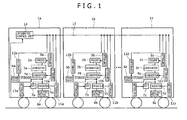
- FIG. 1 illustrates a first basic construction of rolling stock according to embodiments of the present invention.
- FIG. 1 there are shown only a leading vehicle 1a and two intermediate vehicles 1b and 1z out of the plural vehicles constituting the train.
- Embodiments of the present invention will be described using the three vehicles as an example, although any number of intermediate vehicles is possible if the number of intermediate vehicles is two or more.
- FIGS. 2 and 3 illustrate a rolling stock control method according to a first embodiment of the present invention.
- the rolling stock according to embodiments of the present invention is a train with plural railway vehicles coupled together.
- the vehicles 1a to 1z include: engines 2a to 2z; generators 3a to 3z that are driven by the engines 2a to 2z; converters 4a to 4z that convert alternating current from the generators 3a to 3z into direct current; inverters 5a to 5z that convert the direct current from the converters 4a to 4z into variable voltage, variable frequency alternating current; power storage devices 6a to 6z that are connected in parallel with outputs of the converters 4a to 4z to supply direct current to the inverters 5a to 5z; auxiliary power units (i.e., static inverters (SIVs)) 7a to 7z that are connected in parallel with outputs of the converters 4a to 4z to supply direct current to auxiliary equipment such as an air conditioner and lighting; and AC electric motors 8a to 8z that are driven by the inverters 5a to 5z, each of the vehicles 1a to 1z including at
- the engines 2a to 2z, the converters 4a to 4z, the inverters 5a to 5z, the power storage devices 6a to 6z, and the auxiliary power units (SIVs) 7a to 7z are controlled by engine controllers 9a to 9z, converter controllers 10a to 10z, inverter controllers 11a to 11z, power storage controllers 12a to 12z, and auxiliary power controllers 13a to 13z, respectively.
- the reference number represents equipment mounted on each of the vehicles 1a to 1z (number 1 denotes a vehicle; 2, an engine; 3, a generator, etc....), and the alpabetic letter suffix represents vehicle number (suffix "a” denotes Vehicle 1; b, Vehicle 2; c, Vehicle 3, etc.). That is, the combination of a number and an alphabetic letter specifies which vehicle the equipment is mounted on.
- reference sign 2a denotes "the engine mounted on Vehicle 1”
- reference sign 3c denotes "the generator mounted on Vehicle 3".
- the start/stop of the plural engines 2a to 2z mounted on the vehicles 1a to 1z are individually controlled on the basis of train running position information.
- an integrated control unit.14 that exercises overall control over the engine controllers 9a to 9z of the engines 2a to 2z is provided in the leading vehicle 1a where a driver's cab is located, and a communication line 15 is connected between the integrated control unit 14 and the engine controllers 9a to 9z so that the start/stop of the engines 2a to 2z can be individually controlled on the basis of engine control commands from the integrated control unit 14.
- the integrated control unit 14 is configured to, when obtaining train running position information, determine which vehicle (engine) has left a station platform by considering previously-obtained information on the length of the vehicles 1a to 1z (or information on the installation intervals between the engines 2a to 2z mounted on the vehicles 1a to 1z) and issue an engine control command for starting the engine mounted on a vehicle that has left the station platform.
- the integrated control unit 14 does not need to be mounted on the leading vehicle 1a where the driver's cab is located, and the integrated control unit 14 can be mounted on any of the vehicles 1a to 1z. Furthermore, the integrated control unit 14 obtains train running position information from outside and issues engine control commands (the start/stop of the engines 2a to 2z) on the basis of the obtained train running position information, thereby individually controlling the start/stop of the engines 2a to 2z of the vehicles 1a to 1z according to the running position.
- the integrated control unit 14 may issue engine control commands for the engines 2a to 2z on the basis of train running speed information or train running time information.
- the integrated control unit 14 may identify the vehicle that has left the station platform, on the basis of running speed information. Also, because train operations follow almost the same acceleration process every operation, the integrated control unit 14 may identify the vehicle that has left the station platform, on the basis of running time information showing the time that has elapsed since departure.
- FIG. 2 shows a method for individually controlling the engines when the train departs from the station.
- the leading vehicle 1a passes through an end (position A) of the station platform.
- time t 1 time t 1
- all the engines 2a to 2z are stopped, and the supply of power from the power storage devices 6a to 6z to the inverters 5a to 5z and the auxiliary power units 7a to 7z is performed.
- the integrated control unit 14 gives a start command to the engine 2a of the leading vehicle 1a to start the engine 2a.
- the integrated control unit 14 gives a start command to the engine 2b of the second vehicle 1b to start the engine 2b. Subsequently, in the same manner as above, the engines 2c to 2z mounted on the vehicles 1c to 1z are sequentially started each time the vehicles 1c to 1z in the train pass through the end (position A) of the station platform.
- a train is accelerated only by the power from storage batteries without starting engines at the time of departure from a station, and then when the speed reaches A km/h, it is determined that the train is a predetermined distance or more away from the station, and the engines are started.
- the power required to drive the train needs to be supplied only by the storage batteries until vehicles equipped with the engines have left the station platform completely, there have been problems in that large-capacity storage batteries are required and in that required drive power cannot be obtained, resulting in a reduction in train acceleration performance.
- the leading vehicle equipped with the engine can immediately leave the station platform if the train moves forward, however on the other hand, if the train moves rearward, it takes a long time before the vehicle equipped with the engine can leave the station platform, resulting in the above-described problems of the need for large-capacity storage batteries and a reduction in train acceleration performance.
- the engines are started sequentially from those mounted on the vehicles having left the station platform, thereby allowing quick starting of the plural engines while reducing noise within the station platform. Consequently, it is possible to address the above-described problems of the need for large-capacity storage batteries and a reduction in acceleration performance.
- FIG. 3 shows a method for individually controlling the engines when the train arrives at the station.
- the leading vehicle 1a passes through an end (position B) of the station platform.
- the integrated control unit 14 gives a stop command to the engine 2a mounted on the leading vehicle 1a to stop the engine 2a.
- the engine 2a stops, and therefore the supply of power from the power storage device 6a to the inverter 5a and the auxiliary power unit 7a is performed.
- the integrated control unit 14 gives a stop command to the engine 2b mounted on the second vehicle 1b to stop the engine 2b. Subsequently, in the same manner as above, the engines 2c to 2z mounted on the vehicles 1c to 1z are sequentially stopped each time the vehicles 1c to 1z in the train pass through the end (position B) of the station platform.
- examples of vehicle position detection methods include a method using position detectors such as transponders (radios), optical sensors, and infrared sensors.
- the position detectors are installed on the ground and vehicle to detect that a vehicle has passed through a predetermined position.
- the integrated control unit 14 receives, from the position detector installed on vehicle, a signal indicating that the vehicle has passed through the predetermined position, and, on the basis of the position information, individually controls the start/stop of the engines 2a to 2z mounted on the vehicles 1a to 1z.
- the position detector installed on vehicle may be mounted on each of the vehicles 1a to 1z.
- the arrangement may be such that the position detector is only mounted on the leading vehicle 1a and the passage of the second and subsequent vehicles 1b to 1z through the position is calculated on the basis of the passage of the first vehicle 1a, the lengths of the vehicles 1a to 1z as previously stored in the integrated control unit 14, etc.
- GPS Global Positioning System
- the integrated control unit 14 receives,from the GPS a signal indicating that a vehicle has passed through a predetermined position and calculates the passage of the vehicles 1a to 1z through the position on the basis of the lengths of the vehicles 1a to 1z as previously stored in the integrated control unit 14, and, on the basis of the position information, individually controls the start/stop of the engines 2a to 2z mounted on the vehicles 1a to 1z.
- control action at the time of departure from station as shown in FIG. 2 and the control action at the time of arrival at the station as shown in FIG. 3 are described, both control functions are not always necessary, and at least either one of the control functions is sufficient.
- control is performed so that the engines on the train are started or stopped sequentially from those mounted on the vehicles located toward the front in the travelling direction, such control is not always an essential feature.
- it is only necessary to preferentially start the engine that is not located at the station platform (that is, the engine mounted on a vehicle having left the station platform or on a vehicle before entering the station platform) and stop the engine mounted on the vehicle located at the station platform to the extent possible.
- the object of the present invention may be achieved by performing control so that plural engines mounted on plural vehicles are started or stopped in a specific order.
- the integrated control unit 14 issues engine control commands for individually controlling the start/stop of the engines 2a to 2z
- the integrated control unit 14 is not always an essential element of the present invention.
- the advantages of the present invention can be achieved by causing the engine controller mounted on each of the vehicles to obtain running position information, running speed information, or running time information of the train or the corresponding vehicle and control the start/stop or rotational speed of the engine.
- FIG. 1 shows the case where the auxiliary power unit (SIVs) is mounted on each of the vehicles
- the auxiliary power unit may be mounted on the passenger coach that is not equipped with the engine as shown in FIG. 8 . In this case, space for mounting the auxiliary power unit is easily obtained.
- the engines are started or stopped sequentially rom those toward the front in the travelling direction as described above, in the case where the passenger coaches are interposed between Vehicles 2 and 3 and Vehicles 6 and 7 as shown in FIG. 8 , it is not always necessary to start or stop the engines sequentially from the front, and the arrangement may be such that after the engines of Vehicles 2 and 3 are started together, the engines of Vehicles 6 and 7 are started together.
- the description is in terms of the diesel hybrid rolling stock including the power storage devices, in which the power to drive the vehicle and the power to the auxiliary equipment, such as an air conditioner and lighting, are supplied from the storage battery, in a nonoperating state of the engine, as for example when the train is stopped at the station.
- the rolling stock not equipped with the storage batteries for driving will be described because the obj ect of the present invention can be also achieved by an embodiment in which the storage battery is not used and a minimum required engine is always kept in operation for the supply of power to the auxiliary equipment or initial power running of the vehicle.
- At least one engine is kept in operation so as to produce the minimum electricity required to generate power to cause the vehicle to start to move.
- the power to the auxiliary equipment may be supplied by this engine, alternatively, it is possible to reduce the capacity of the engine operating while the train is stopped at the station and reduce noise within station platforms by refraining from the use of the auxiliary equipment when the vehicle starts to move or performing the supply of power from a 110-volt battery, serving as a control power supply, to a necessary portion of the auxiliary equipment.
- control operation is the same as the first embodiment, in which, when the train departs from or arrives at the station, the engine mounted on a vehicle that has left the station platform are preferentially started and the engines on the vehicle located at the station platform are stopped. Also, the construction of the rolling stock is similar to that shown in FIG. 1 except that it does not have the power storage devices and the power storage controllers.
- the present invention is also applicable to an embodiment in which, in a train with two vehicles equipped with engines, for example, the engines are mounted on the leading vehicle and the tail end vehicle.
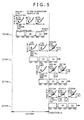
- FIGS. 5 and 6 show a rolling stock control method according to a third embodiment of the present invention.
- the third embodiment differs from the first embodiment in that while the engines 2a to 2z are individually controlled as to start/stop in the first embodiment, the engines 2a to 2z are individually controlled as to output (rotational speed) in the third embodiment.
- the engine controllers 9a to 9z mounted on the vehicles 1a to 1z are configured to individually control the output (rotational speed) of the engines 2a to 2z on the vehicles 1a to 1z on the basis of vehicle running position.
- the integrated control unit 14 that exercises control over the engine controllers 9a to 9z is provided in the leading vehicle 1a where the driver's cab is located, and the communication line 15 is connected between the integrated control unit 14 and the engine controllers 9a to 9z so that the output (rotational speed) of the engines 2a to 2z can be individually controlled on the basis of engine control commands from the integrated control unit 14. It should be noted that the integrated control unit 14 does not need to be mounted on the leading vehicle 1a where the driver's cab is located.
- the integrated control unit 14 obtains vehicle running position information from outside and issues engine control commands (the output (rotational speed) of the engines 2a to 2z) on the basis of the obtained vehicle running position information, thereby individually controlling the output (rotational speed) of the engines 2a to 2z of the vehicles 1a to 1z according to the running position.
- FIG. 5 shows a method for individually controlling the engines when the train departs from the station.
- the leading vehicle 1a passes through an end (position A) of the station platform.
- the output (rotational speed) of all the engines 2a to 2z is minimized from the viewpoint of reducing engine noise within the station platform, and the supply of power from the power storage devices 6a to 6z to the inverters 5a to 5z and the auxiliary power units 7a to 7z is performed.
- the integrated control unit 14 gives an output (rotational speed) increase command to the engine 2a of the leading vehicle 1a to increase the output (rotational speed) of the engine 2a. Furthermore, at time t 3 , when the second vehicle 1b passes through the end (position A) of the station platform, in order to place the operating point of the engine 2b of the second vehicle 1b on the ideal characteristics, the integrated control unit 14 gives an output (rotational speed) increase command to the engine 2b of the second vehicle 1b to increase the output (rotational speed) of the engine 2b.
- the output (rotational speed) of the engines 2c to 2z mounted on the vehicles 1c to 1z is sequentially increased each time the vehicles 1c to 1z in the train pass through the end (position A) of the station platform.
- FIG. 6 shows a method for individually controlling the engines when the train arrives at the station.
- the leading vehicle 1a passes through an end (position B) of the station platform.
- the integrated control unit 14 gives an output (rotational speed) reduction command to the engine 2a mounted on the leading vehicle 1a to reduce the output (rotational speed) of the engine 2a.
- the output of the engine 2a decreases, and therefore the supply of power from the power storage device 6a to the inverter 5a and the auxiliary power unit 7a is increased.
- the integrated control unit 14 gives an output (rotational speed) reduction command to the engine 2b mounted on the second vehicle 1b to reduce the output (rotational speed) of the engine 2b. Subsequently, in the same manner as above, the output (rotational speed) of the engines 2c to 2z mounted on the vehicles 1c to 1z is sequentially reduced each time the vehicles 1c to 1z in the train pass through the end (position B) of the station platform.
- the engines when the train departs from the station, the engines are increased in output (rotational speed) sequentially from those on the vehicles toward the front of the train, in the order in which the vehicles leave the station platform (pass through the position A). Furthermore, as shown in FIG. 6 , when the train arrives at the station, the engines are reduced in output (rotational speed) sequentially from those on the vehicles toward the front of the train, in the order in which the vehicles approach the station platform (pass through the position B).
- examples of vehicle position detection methods include a method using position detectors such as transponders (radios), optical sensors, and infrared sensors.
- the position detectors are installed on the ground and vehicle to detect that a vehicle has passed through a predetermined position.
- the integrated control unit 14 receives, from the position detector installed on vehicle, a signal indicating that the vehicle has passed through the predetermined position, and, on the basis of the position information, individually controls the start/stop of the engines 2a to 2z mounted on the vehicles 1a to 1z.
- the position detector installed on vehicle may be mounted on each of the vehicles 1a to 1z.
- the arrangement may be such that the position detector is only mounted on the leading vehicle 1a and the passage of the second and subsequent vehicles 1b to 1z through the position is calculated on the basis of the passage of the first vehicle 1a, the lengths of the vehicles 1a to 1z as previously stored in the integrated control unit 14, etc.
- GPS Global Positioning System
- the integrated control unit 14 receives from the GPS a signal indicating that a vehicle has passed through a predetermined position and calculates the passage of the vehicles 1a to 1z through the position on the basis of the lengths of the vehicles 1a to 1z as previously stored in the integrated control unit 14, and, on the basis of the position information, individually controls the start/stop of the engines 2a to 2z mounted on the vehicles 1a to 1z.
- the rolling stock according to this embodiment may include the diesel rolling stock having no power storage device.
- at least one engine is operating for the supply of power to the auxiliary power units even when the train is stopped at the station, which causes noise problems within the station platform.
- the station is provided with a power supply facility
- the train includes a pantograph or a current collector shoe for receiving power from the power supply facility, thereby, even if the train has no storage battery, ensuring the supply of power to the auxiliary power units while stopping the engine for noise reduction when the train is stopped at the station.
- the fourth embodiment have the same function as the first and second embodiments except that, when the train is stopped at the station, the pantograph or the current collector shoe receives power from the power supply facility of the station to supply the power to the auxiliary power units.
- FIG. 7 shows a rolling stock control method according to a fifth embodiment of the present invention.
- the fifth embodiment differs from the first and second embodiments in the following respect.
- the integrated control unit 14 individually controls the engines 2a to 2z (as to start/stop or increase/decrease in output (rotational speed)) on the basis of vehicle running position, vehicle running speed, or vehicle running time.
- the integrated control unit 14 individually controls the engines 2a to 2z (as to start/stop, increase/decrease in output (rotational speed)) depending on the power required for the train (hereinafter referred to as required train power).
- the individual output (rotational speed) control of the engines 2a to 2z mounted on the vehicles 1a to 1z can be performed depending on required train power.
- the integrated control unit 14 that exercises control over the engine controllers 9a to 9z of the engines 2a to 2z is provided in the leading vehicle 1a where the driver's cab is located, and the communication line 15 is connected between the integrated control unit 14 and the engine controllers 9a to 9z of the engines 2a to 2z so that the output (rotational speed) of the engines 2a to 2z can be individually controlled on the basis of engine control commands from the integrated control unit 14. It should be noted that the integrated control unit 14 does not need to be mounted on the leading vehicle 1a where the driver's cab is located.
- the integrated control unit 14 issues engine control commands (the output (rotational speed) of the engines 2a to 2z) depending on required train power, thereby individually controlling the output (rotational speed) of the engines 2a to 2z of the vehicles 1a to 1z depending on the required train power.
- the integrated control unit 14 normally calculates the required train power from vehicle speed.
- FIG. 7 shows a method for individually controlling the engines when the train accelerates.
- speed (v 1 ) is low and required drive power P 1 is also small, and therefore the required drive power P 1 is provided by a single engine.
- the integrated control unit 14 starts a second engine and adjusts the output (rotational speed) of the two engines so that the two engines provide equal shares of the required drive power P 2 .
- the two engines still provide equal shares of required drive power P 3 at speed v 3 .
- the integrated control unit 14 starts a third engine and adjusts the output (rotational speed) of the three engines so that the three engines provide equal shares of the required drive power P 4 .
- the integrated control unit 14 starts an (n+1) th engine and adjusts the output (rotational speed) of the n+1 number of engines (2a, 2b, 2c, ...2n+1 so that the n+1 number of engines (2a, 2b, 2c,...2n+1) provide equal shares of the required drive power P n .
- the required drive power is calculated from vehicle speed, and, on the basis of the required train power at that time, the engines 2a to 2z are individually controlled (as to start/stop, increase/decrease in output (rotational speed)).
- the required drive power can be calculated not only on the basis of vehicle running speed but vehicle running position or vehicle running time.
- the rolling stock according to this embodiment may include the diesel rolling stock having no power storage device.
- the output (rotational speed) of the engines 2a to 2z mounted on the vehicles 1a to 1z are individually controlled depending on required train power, thereby allowing the operating points of the engines 2a to 2z to hover near the rated output.
- the engine efficiency can be increased, and engine fuel consumption can be expected to be reduced.
- FIG. 7 there is shown the case where the engines are started sequentially from the leading vehicle, the order of starting of the engines is not limited thereto, and the engines may be started in any order. As shown in FIG. 7 , if the engines are started sequentially from the leading vehicle, in addition to the advantage of increased engine efficiency, the advantage of engine noise reduction within the station platform can be expected.
Landscapes
- Engineering & Computer Science (AREA)
- Transportation (AREA)
- Mechanical Engineering (AREA)
- Power Engineering (AREA)
- Life Sciences & Earth Sciences (AREA)
- Sustainable Development (AREA)
- Sustainable Energy (AREA)
- Automation & Control Theory (AREA)
- Electric Propulsion And Braking For Vehicles (AREA)
- Hybrid Electric Vehicles (AREA)
Abstract
Description
- The present invention relates to a method for controlling a train with at least two or more railway vehicles coupled together, the vehicles being equipped with engines such as diesel engines.
- Japanese Published Unexamined Patent Application No.
2008-54408 - Furthermore, in Japanese Published Unexamined Patent Application No.
2007-28874 - Unfortunately, in the above-described Japanese Published Unexamined Patent Application No.
2008-54408 - Furthermore, in the above-described Japanese Published Unexamined Patent Application No.
2007-28874 - Accordingly, an object of the present invention is to reduce noise within a station platform by controlling engine noise generated when a train departs from or stops at a station.
- According to an aspect of the present invention, there is provided a drive system for a train with plural vehicles coupled together. Each of the vehicles includes: an engine; a generator that is driven by the engine; a converter that converts alternating current from the generator into direct current; an inverter that converts direct current from the converter into variable voltage, variable frequency alternating current; an auxiliary power unit that is connected in parallel with an output of the converter to supply direct current to auxiliary equipment including an air conditioner; and at least one or more AC electric motors that are driven by the inverter. The drive system is configured to individually control start/stop, rotational speed, or output of the engines mounted on the plural vehicles and change in a specific order the start/stop, rotational speed, or output of the engines mounted on the plural vehicles.
- Furthermore, the drive system may further include an integrated control unit that exercises overall control over controllers of the engines so that the engines mounted on the vehicles can individually controlled. The integrated control unit determines the start/stop of the engines on the vehicles on the basis of vehicle running speed, vehicle running position, or vehicle running time to individually control the start/stop of the engines on the vehicles. Thus, when the train departs from a station, the engines on the vehicles are started sequentially from the one toward a front of the train, in the order in which the vehicles leave a station platform, while, when the train arrives at a station, the engines on the vehicles are stopped sequentially from the one toward a front of the train, in an order in which the vehicles approach a station platform.
- Moreover, the integrated control unit may be configured to calculate power (hereinafter referred to as required power) required for the train and, when the engines provide equal shares of the required power, individually control the rotational speed (output) of the engines so that the engine efficiency peaks.
-
-
FIG. 1 illustrates the basic construction of rolling stock according to embodiments of the present invention; -
FIG. 2 illustrates a method for individually controlling engines when a train departs from a station in accordance with a first embodiment of the present invention; -
FIG. 3 illustrates a method for individually controlling the engines when the train arrives at a station in accordance with the first embodiment of the present invention; -
FIG. 4 shows a relationship between engine output and engine rotational speed; -
FIG. 5 illustrates a method for individually controlling the engines when the train departs from a station in accordance with a third embodiment of the present invention; -
FIG. 6 illustrates a method for individually controlling the engines when the train arrives at a station in accordance with the third embodiment of the present invention; -
FIG. 7 illustrates a method for individually controlling the engines when the train accelerates in accordance with a fifth embodiment of the present invention; and -
FIG. 8 illustrates an alternative construction of the rolling stock according to embodiments of the present invention. - Hereinafter, embodiments of the present invention will be described with reference to the accompanying drawings.
- This embodiment is an embodiment of the present invention for reducing noise within station platforms in a train that includes plural vehicles equipped with engines and storage batteries.
-
FIG. 1 illustrates a first basic construction of rolling stock according to embodiments of the present invention. InFIG. 1 , there are shown only a leadingvehicle 1a and twointermediate vehicles - Furthermore,
FIGS. 2 and3 illustrate a rolling stock control method according to a first embodiment of the present invention. - As shown in
FIG. 1 , the rolling stock according to embodiments of the present invention is a train with plural railway vehicles coupled together. Thevehicles 1a to 1z include:engines 2a to 2z;generators 3a to 3z that are driven by theengines 2a to 2z;converters 4a to 4z that convert alternating current from thegenerators 3a to 3z into direct current;inverters 5a to 5z that convert the direct current from theconverters 4a to 4z into variable voltage, variable frequency alternating current; power storage devices 6a to 6z that are connected in parallel with outputs of theconverters 4a to 4z to supply direct current to theinverters 5a to 5z; auxiliary power units (i.e., static inverters (SIVs)) 7a to 7z that are connected in parallel with outputs of theconverters 4a to 4z to supply direct current to auxiliary equipment such as an air conditioner and lighting; and ACelectric motors 8a to 8z that are driven by theinverters 5a to 5z, each of thevehicles 1a to 1z including at least the one or more AC electric motors. Although in embodiments of the present invention, it is also intended that passenger coaches not equipped with engines, generators, inverters, and electric motors be interposed among thevehicles 1a to 1z shown inFIG. 1 , such passenger coaches are omitted for ease of explanation. - It should be noted that the
engines 2a to 2z, theconverters 4a to 4z, theinverters 5a to 5z, the power storage devices 6a to 6z, and the auxiliary power units (SIVs) 7a to 7z are controlled byengine controllers 9a to 9z,converter controllers 10a to 10z,inverter controllers 11a to 11z,power storage controllers 12a to 12z, andauxiliary power controllers 13a to 13z, respectively. Here, the reference number represents equipment mounted on each of thevehicles 1a to 1z (number 1 denotes a vehicle; 2, an engine; 3, a generator, etc....), and the alpabetic letter suffix represents vehicle number (suffix "a" denotesVehicle 1; b,Vehicle 2; c,Vehicle 3, etc....). That is, the combination of a number and an alphabetic letter specifies which vehicle the equipment is mounted on. For example,reference sign 2a denotes "the engine mounted onVehicle 1", and reference sign 3c denotes "the generator mounted onVehicle 3". - In this embodiment, the start/stop of the
plural engines 2a to 2z mounted on thevehicles 1a to 1z are individually controlled on the basis of train running position information. - More specifically, an integrated control unit.14 that exercises overall control over the
engine controllers 9a to 9z of theengines 2a to 2z is provided in the leadingvehicle 1a where a driver's cab is located, and acommunication line 15 is connected between the integratedcontrol unit 14 and theengine controllers 9a to 9z so that the start/stop of theengines 2a to 2z can be individually controlled on the basis of engine control commands from the integratedcontrol unit 14. Here, the integratedcontrol unit 14 is configured to, when obtaining train running position information, determine which vehicle (engine) has left a station platform by considering previously-obtained information on the length of thevehicles 1a to 1z (or information on the installation intervals between theengines 2a to 2z mounted on thevehicles 1a to 1z) and issue an engine control command for starting the engine mounted on a vehicle that has left the station platform. - It should be noted that the integrated
control unit 14 does not need to be mounted on the leadingvehicle 1a where the driver's cab is located, and the integratedcontrol unit 14 can be mounted on any of thevehicles 1a to 1z. Furthermore, the integratedcontrol unit 14 obtains train running position information from outside and issues engine control commands (the start/stop of theengines 2a to 2z) on the basis of the obtained train running position information, thereby individually controlling the start/stop of theengines 2a to 2z of thevehicles 1a to 1z according to the running position. - Here, while the above description is in terms of the case where the integrated
control unit 14 issues engine control commands for theengines 2a to 2z on thevehicles 1a to 1z on the basis of train running position information, the integratedcontrol unit 14 may issue engine control commands for theengines 2a to 2z on the basis of train running speed information or train running time information. At the time of departing from or stopping at the station, the train slows down with approach towards its stopping position in the station, while the train speeds up gradually with distance from its stopping position in the station. Therefore, the integratedcontrol unit 14 may identify the vehicle that has left the station platform, on the basis of running speed information. Also, because train operations follow almost the same acceleration process every operation, the integratedcontrol unit 14 may identify the vehicle that has left the station platform, on the basis of running time information showing the time that has elapsed since departure. -
FIG. 2 shows a method for individually controlling the engines when the train departs from the station. When the train departs from the station, firstly, the leadingvehicle 1a passes through an end (position A) of the station platform. Until the leadingvehicle 1a has passed through the end (position A) of the station platform (time t1), all theengines 2a to 2z are stopped, and the supply of power from the power storage devices 6a to 6z to theinverters 5a to 5z and the auxiliary power units 7a to 7z is performed. At time t2, when the leadingvehicle 1a passes through the end (position A) of the station platform, the integratedcontrol unit 14 gives a start command to theengine 2a of the leadingvehicle 1a to start theengine 2a. Furthermore, at time t3, when thesecond vehicle 1b passes through the end (position A) of the station platform, the integratedcontrol unit 14 gives a start command to theengine 2b of thesecond vehicle 1b to start theengine 2b. Subsequently, in the same manner as above, the engines 2c to 2z mounted on the vehicles 1c to 1z are sequentially started each time the vehicles 1c to 1z in the train pass through the end (position A) of the station platform. - Thus, as shown in
FIG. 2 , when the train departs from the station, the engines are started sequentially from those on the vehicles toward the front of the train, in the order in which the vehicles leave the station platform (pass through the position A). - The following is one possible method to reduce noise within station platforms: a train is accelerated only by the power from storage batteries without starting engines at the time of departure from a station, and then when the speed reaches A km/h, it is determined that the train is a predetermined distance or more away from the station, and the engines are started. In this method, however, because the power required to drive the train needs to be supplied only by the storage batteries until vehicles equipped with the engines have left the station platform completely, there have been problems in that large-capacity storage batteries are required and in that required drive power cannot be obtained, resulting in a reduction in train acceleration performance. For example, in the case where the engine is mounted only on a leading vehicle, the leading vehicle equipped with the engine can immediately leave the station platform if the train moves forward, however on the other hand, if the train moves rearward, it takes a long time before the vehicle equipped with the engine can leave the station platform, resulting in the above-described problems of the need for large-capacity storage batteries and a reduction in train acceleration performance.
- Also in a train which has plural vehicles equipped with engines as disclosed in Japanese Published Unexamined Patent Application No.
2007-28874 - On the other hand, according to the method shown in
FIG. 2 , the engines are started sequentially from those mounted on the vehicles having left the station platform, thereby allowing quick starting of the plural engines while reducing noise within the station platform. Consequently, it is possible to address the above-described problems of the need for large-capacity storage batteries and a reduction in acceleration performance. - Furthermore, in a train in which plural vehicles equipped with engines are coupled together, when the engines are all started, under conditions, such as low vehicle speed conditions, where the power required to drive the train (hereinafter referred to as required drive power) is low, the output load per engine becomes low, resulting in a problem of a reduction in engine efficiency. On the other hand, according to the method shown in
FIG. 2 , because the engines are sequentially started sequentially from those mounted on the vehicles having left the station platform, the number of operating engines is small and the vehicle speed increases under conditions where the vehicle speed is low and the power output required to drive the train is low, while the number of operating engines increases as the power output required to drive the train increases. Thus, the decrease in efficiency per engine can be avoided. - Next,
FIG. 3 shows a method for individually controlling the engines when the train arrives at the station. When the train arrives at the station, firstly, the leadingvehicle 1a passes through an end (position B) of the station platform. At time t6, when the leadingvehicle 1a passes through the end (position B) of the station platform, theintegrated control unit 14 gives a stop command to theengine 2a mounted on the leadingvehicle 1a to stop theengine 2a. At this time, in the leadingvehicle 1a, theengine 2a stops, and therefore the supply of power from the power storage device 6a to theinverter 5a and the auxiliary power unit 7a is performed. Furthermore, at time t7, when thesecond vehicle 1b passes through the end (position B) of the station platform, theintegrated control unit 14 gives a stop command to theengine 2b mounted on thesecond vehicle 1b to stop theengine 2b. Subsequently, in the same manner as above, the engines 2c to 2z mounted on the vehicles 1c to 1z are sequentially stopped each time the vehicles 1c to 1z in the train pass through the end (position B) of the station platform. - Thus, as shown in
FIG. 3 , when the train arrives at the station, the engines are stopped sequentially from those on the vehicles toward the front of the train, in the order in which the vehicles approach the station platform (pass through the position B). - Here, examples of vehicle position detection methods include a method using position detectors such as transponders (radios), optical sensors, and infrared sensors. The position detectors are installed on the ground and vehicle to detect that a vehicle has passed through a predetermined position. The
integrated control unit 14 receives, from the position detector installed on vehicle, a signal indicating that the vehicle has passed through the predetermined position, and, on the basis of the position information, individually controls the start/stop of theengines 2a to 2z mounted on thevehicles 1a to 1z. Here, the position detector installed on vehicle may be mounted on each of thevehicles 1a to 1z. Alternatively, the arrangement may be such that the position detector is only mounted on the leadingvehicle 1a and the passage of the second andsubsequent vehicles 1b to 1z through the position is calculated on the basis of the passage of thefirst vehicle 1a, the lengths of thevehicles 1a to 1z as previously stored in theintegrated control unit 14, etc. - As another position detection method, GPS (Global Positioning System) may be used. The
integrated control unit 14 receives,from the GPS a signal indicating that a vehicle has passed through a predetermined position and calculates the passage of thevehicles 1a to 1z through the position on the basis of the lengths of thevehicles 1a to 1z as previously stored in theintegrated control unit 14, and, on the basis of the position information, individually controls the start/stop of theengines 2a to 2z mounted on thevehicles 1a to 1z. - Although in this embodiment, the control action at the time of departure from station as shown in
FIG. 2 and the control action at the time of arrival at the station as shown inFIG. 3 are described, both control functions are not always necessary, and at least either one of the control functions is sufficient. - Although in this embodiment, the control is performed so that the engines on the train are started or stopped sequentially from those mounted on the vehicles located toward the front in the travelling direction, such control is not always an essential feature. In order to realize the reduction in engine noise within station platforms, which is an object of the present invention, it is only necessary to preferentially start the engine that is not located at the station platform (that is, the engine mounted on a vehicle having left the station platform or on a vehicle before entering the station platform) and stop the engine mounted on the vehicle located at the station platform to the extent possible. Therefore, it is not always necessary to control the engines so that they are started or stopped sequentially from the front in the travelling direction, and the control may be performed such that, when the train departs from the station, the engine mounted on a vehicle that has left the station platform is preferentially started, while, when the train enters the station, the engine mounted on a vehicle that has entered the station platform is preferentially stopped. Alternatively, the object of the present invention may be achieved by performing control so that plural engines mounted on plural vehicles are started or stopped in a specific order.
- It should be noted that although this embodiment shows the case where the
integrated control unit 14 issues engine control commands for individually controlling the start/stop of theengines 2a to 2z, theintegrated control unit 14 is not always an essential element of the present invention. Alternatively, the advantages of the present invention can be achieved by causing the engine controller mounted on each of the vehicles to obtain running position information, running speed information, or running time information of the train or the corresponding vehicle and control the start/stop or rotational speed of the engine. - It should be noted that although in this embodiment, the description has been made using as an example the train in which the three or more vehicles equipped with the engines are coupled together, as shown in
FIGS. 1 to 3 , the present invention is also applicable to an embodiment in which, in a train with two vehicles equipped with engines, for example, the engines are mounted on the leading vehicle and the tail end. - While the above description is made using the construction of
FIG. 1 as an example, this embodiment may include a construction such as shown inFIG. 8 . More specifically, althoughFIG. 1 shows the case where the auxiliary power unit (SIVs) is mounted on each of the vehicles, the auxiliary power unit may be mounted on the passenger coach that is not equipped with the engine as shown inFIG. 8 . In this case, space for mounting the auxiliary power unit is easily obtained. - Furthermore, although the engines are started or stopped sequentially rom those toward the front in the travelling direction as described above, in the case where the passenger coaches are interposed between
Vehicles Vehicles FIG. 8 , it is not always necessary to start or stop the engines sequentially from the front, and the arrangement may be such that after the engines ofVehicles Vehicles - In the first embodiment, the description is in terms of the diesel hybrid rolling stock including the power storage devices, in which the power to drive the vehicle and the power to the auxiliary equipment, such as an air conditioner and lighting, are supplied from the storage battery, in a nonoperating state of the engine, as for example when the train is stopped at the station. On the other hand, in a second embodiment, the rolling stock not equipped with the storage batteries for driving will be described because the obj ect of the present invention can be also achieved by an embodiment in which the storage battery is not used and a minimum required engine is always kept in operation for the supply of power to the auxiliary equipment or initial power running of the vehicle.
- It should be noted that, in this embodiment, the same construction and control as the first embodiment will not be described.
- In this embodiment, even while the train is stopped at the station, at least one engine is kept in operation so as to produce the minimum electricity required to generate power to cause the vehicle to start to move. Furthermore, although the power to the auxiliary equipment may be supplied by this engine, alternatively, it is possible to reduce the capacity of the engine operating while the train is stopped at the station and reduce noise within station platforms by refraining from the use of the auxiliary equipment when the vehicle starts to move or performing the supply of power from a 110-volt battery, serving as a control power supply, to a necessary portion of the auxiliary equipment.
- In this embodiment, the control operation is the same as the first embodiment, in which, when the train departs from or arrives at the station, the engine mounted on a vehicle that has left the station platform are preferentially started and the engines on the vehicle located at the station platform are stopped. Also, the construction of the rolling stock is similar to that shown in
FIG. 1 except that it does not have the power storage devices and the power storage controllers. - According to this embodiment, it is possible to reliably stop the
engines 2a to 2c within the station platform and reduce engine noise within the station platform. - It should be noted that although in this embodiment, the description has been made using as an example the train in which the three or more vehicles equipped with the engines are coupled together, as shown in
FIGS. 1 and2 , the present invention is also applicable to an embodiment in which, in a train with two vehicles equipped with engines, for example, the engines are mounted on the leading vehicle and the tail end vehicle. -
FIGS. 5 and6 show a rolling stock control method according to a third embodiment of the present invention. - The third embodiment differs from the first embodiment in that while the
engines 2a to 2z are individually controlled as to start/stop in the first embodiment, theengines 2a to 2z are individually controlled as to output (rotational speed) in the third embodiment. - It should be noted that, in this embodiment, the same construction and control as the first embodiment will not be described.
- In the diesel hybrid rolling stock shown in
FIG. 1 , theengine controllers 9a to 9z mounted on thevehicles 1a to 1z are configured to individually control the output (rotational speed) of theengines 2a to 2z on thevehicles 1a to 1z on the basis of vehicle running position. - More specifically, the
integrated control unit 14 that exercises control over theengine controllers 9a to 9z is provided in the leadingvehicle 1a where the driver's cab is located, and thecommunication line 15 is connected between theintegrated control unit 14 and theengine controllers 9a to 9z so that the output (rotational speed) of theengines 2a to 2z can be individually controlled on the basis of engine control commands from theintegrated control unit 14. It should be noted that theintegrated control unit 14 does not need to be mounted on the leadingvehicle 1a where the driver's cab is located. Furthermore, theintegrated control unit 14 obtains vehicle running position information from outside and issues engine control commands (the output (rotational speed) of theengines 2a to 2z) on the basis of the obtained vehicle running position information, thereby individually controlling the output (rotational speed) of theengines 2a to 2z of thevehicles 1a to 1z according to the running position. - Here, in the relationship between output and rotational speed of an engine, as shown in
FIG. 4 , there are ideal output (vertical axis) -rotational speed (horizontal axis) characteristics of the engine, which are determined from the viewpoints of fuel consumption reduction and emission control. Therefore, preferably, the operating point of the engine lies on the ideal characteristics as much as possible. -
FIG. 5 shows a method for individually controlling the engines when the train departs from the station. When the train departs from the station, firstly, the leadingvehicle 1a passes through an end (position A) of the station platform. Until the leadingvehicle 1a has passed through the end (position A) of the station platform (time t1), the output (rotational speed) of all theengines 2a to 2z is minimized from the viewpoint of reducing engine noise within the station platform, and the supply of power from the power storage devices 6a to 6z to theinverters 5a to 5z and the auxiliary power units 7a to 7z is performed. At time t2, when the leadingvehicle 1a passes through the end (position A) of the station platform, in order to place the operating point of theengine 2a of the leadingvehicle 1a on the ideal characteristics, theintegrated control unit 14 gives an output (rotational speed) increase command to theengine 2a of the leadingvehicle 1a to increase the output (rotational speed) of theengine 2a. Furthermore, at time t3, when thesecond vehicle 1b passes through the end (position A) of the station platform, in order to place the operating point of theengine 2b of thesecond vehicle 1b on the ideal characteristics, theintegrated control unit 14 gives an output (rotational speed) increase command to theengine 2b of thesecond vehicle 1b to increase the output (rotational speed) of theengine 2b. Subsequently, in the same manner as above, the output (rotational speed) of the engines 2c to 2z mounted on the vehicles 1c to 1z is sequentially increased each time the vehicles 1c to 1z in the train pass through the end (position A) of the station platform. -
FIG. 6 shows a method for individually controlling the engines when the train arrives at the station. When the train arrives at the station, firstly, the leadingvehicle 1a passes through an end (position B) of the station platform. At time t6, when the leadingvehicle 1a passes through the end (position B) of the station platform, theintegrated control unit 14 gives an output (rotational speed) reduction command to theengine 2a mounted on the leadingvehicle 1a to reduce the output (rotational speed) of theengine 2a. At this time, in the leadingvehicle 1a, the output of theengine 2a decreases, and therefore the supply of power from the power storage device 6a to theinverter 5a and the auxiliary power unit 7a is increased. Furthermore, at time t7, when thesecond vehicle 1b passes through the end (position B) of the station platform, theintegrated control unit 14 gives an output (rotational speed) reduction command to theengine 2b mounted on thesecond vehicle 1b to reduce the output (rotational speed) of theengine 2b. Subsequently, in the same manner as above, the output (rotational speed) of the engines 2c to 2z mounted on the vehicles 1c to 1z is sequentially reduced each time the vehicles 1c to 1z in the train pass through the end (position B) of the station platform. - Thus, as shown in
FIG. 5 , when the train departs from the station, the engines are increased in output (rotational speed) sequentially from those on the vehicles toward the front of the train, in the order in which the vehicles leave the station platform (pass through the position A). Furthermore, as shown inFIG. 6 , when the train arrives at the station, the engines are reduced in output (rotational speed) sequentially from those on the vehicles toward the front of the train, in the order in which the vehicles approach the station platform (pass through the position B). - Here, examples of vehicle position detection methods include a method using position detectors such as transponders (radios), optical sensors, and infrared sensors. The position detectors are installed on the ground and vehicle to detect that a vehicle has passed through a predetermined position. The
integrated control unit 14 receives, from the position detector installed on vehicle, a signal indicating that the vehicle has passed through the predetermined position, and, on the basis of the position information, individually controls the start/stop of theengines 2a to 2z mounted on thevehicles 1a to 1z. Here, the position detector installed on vehicle may be mounted on each of thevehicles 1a to 1z. Alternatively, the arrangement may be such that the position detector is only mounted on the leadingvehicle 1a and the passage of the second andsubsequent vehicles 1b to 1z through the position is calculated on the basis of the passage of thefirst vehicle 1a, the lengths of thevehicles 1a to 1z as previously stored in theintegrated control unit 14, etc. - As another position detection method, GPS (Global Positioning System) may be used. The
integrated control unit 14 receives from the GPS a signal indicating that a vehicle has passed through a predetermined position and calculates the passage of thevehicles 1a to 1z through the position on the basis of the lengths of thevehicles 1a to 1z as previously stored in theintegrated control unit 14, and, on the basis of the position information, individually controls the start/stop of theengines 2a to 2z mounted on thevehicles 1a to 1z. - It should be noted that, although in this embodiment, there is shown the case where the individual start/stop control of the
engines 2a to 2z mounted on thevehicles 1a to 1z is performed on the basis of vehicle running position, such control may be performed on the basis of vehicle running speed or vehicle running time, rather than vehicle running position. - It should be noted that, in this embodiment, an example of the diesel hybrid rolling stock having the power storage devices is shown, in which, when the engine output (rotational speed) is low, the power to drive the vehicle and the power to the auxiliary equipment, such as an air conditioner and lighting, are supplied from the storage battery. However, because the engine is low in output (rotational speed) yet operating, the power to drive the vehicle can be obtained without using the storage battery although its acceleration performance is low. Also, as for the supply of power to the auxiliary equipment, such as an air conditioner and lighting, the case where the storage battery is not provided can be addressed by refraining from the use of the auxiliary equipment or performing the supply of power from a 110-volt battery to only necessary auxiliary equipment. Therefore, the rolling stock according to this embodiment may include the diesel rolling stock having no power storage device.
- According to this embodiment, it is possible to reduce the output (rotational speed) of the
engines 2a to 2c within the station platform and reduce engine noise within the station platform. - In the first and third embodiments, the description has been made in terms of the train including the power storage devices, in which the supply of power from the power storage devices to the auxiliary power units is performed when the train is stopped at the station. However, problems exist with respect to the introduction cost of the power storage devices and complications in charge and discharge control of the power storage devices. Furthermore, in the second embodiment, at least one engine is operating for the supply of power to the auxiliary power units even when the train is stopped at the station, which causes noise problems within the station platform.
- In a fourth embodiment, the station is provided with a power supply facility, and the train includes a pantograph or a current collector shoe for receiving power from the power supply facility, thereby, even if the train has no storage battery, ensuring the supply of power to the auxiliary power units while stopping the engine for noise reduction when the train is stopped at the station.
- It should be noted that the fourth embodiment have the same function as the first and second embodiments except that, when the train is stopped at the station, the pantograph or the current collector shoe receives power from the power supply facility of the station to supply the power to the auxiliary power units.
- According to this embodiment, it is also possible to stop the engines or reduce the output (rotational speed) of the engines within station platforms and reduce engine noise within station platforms.
-
FIG. 7 shows a rolling stock control method according to a fifth embodiment of the present invention. The fifth embodiment differs from the first and second embodiments in the following respect. In the first and second embodiments, theintegrated control unit 14 individually controls theengines 2a to 2z (as to start/stop or increase/decrease in output (rotational speed)) on the basis of vehicle running position, vehicle running speed, or vehicle running time. In the fifth embodiment, on the other hand, theintegrated control unit 14 individually controls theengines 2a to 2z (as to start/stop, increase/decrease in output (rotational speed)) depending on the power required for the train (hereinafter referred to as required train power). - In the diesel hybrid rolling stock shown in
FIG. 1 , the individual output (rotational speed) control of theengines 2a to 2z mounted on thevehicles 1a to 1z can be performed depending on required train power. - More specifically, the
integrated control unit 14 that exercises control over theengine controllers 9a to 9z of theengines 2a to 2z is provided in the leadingvehicle 1a where the driver's cab is located, and thecommunication line 15 is connected between theintegrated control unit 14 and theengine controllers 9a to 9z of theengines 2a to 2z so that the output (rotational speed) of theengines 2a to 2z can be individually controlled on the basis of engine control commands from theintegrated control unit 14. It should be noted that theintegrated control unit 14 does not need to be mounted on the leadingvehicle 1a where the driver's cab is located. Furthermore, theintegrated control unit 14 issues engine control commands (the output (rotational speed) of theengines 2a to 2z) depending on required train power, thereby individually controlling the output (rotational speed) of theengines 2a to 2z of thevehicles 1a to 1z depending on the required train power. Here, because in rolling stock the required train power can be calculated from vehicle speed, theintegrated control unit 14 normally calculates the required train power from vehicle speed. -
FIG. 7 shows a method for individually controlling the engines when the train accelerates. When the train starts to accelerate, speed (v1) is low and required drive power P1 is also small, and therefore the required drive power P1 is provided by a single engine. When the speed increases and reaches speed v2, and required drive power P2 at that time exceeds maximum power Pmax that can be provided by the single engine, theintegrated control unit 14 starts a second engine and adjusts the output (rotational speed) of the two engines so that the two engines provide equal shares of the required drive power P2. When the speed increases further, the two engines still provide equal shares of required drive power P3 at speed v3. When the speed increases still further and reaches speed v4 and an equal share (P4/2) of required drive power P4 at that time to be provided by each of the two engines exceeds the maximum power Pmax that can be provided by each of the two engines, theintegrated control unit 14 starts a third engine and adjusts the output (rotational speed) of the three engines so that the three engines provide equal shares of the required drive power P4. - Subsequently, in the same manner as above, when the required drive power increases with increasing speed and an equal share (Pn/n) of required drive power Pn to be provided by each of n number of engines (2a, 2b...2n) exceeds the maximum power Pmax that can be provided by each of the engines (2a, 2b...2n), the
integrated control unit 14 starts an (n+1) th engine and adjusts the output (rotational speed) of the n+1 number of engines (2a, 2b, 2c, ...2n+1 so that the n+1 number of engines (2a, 2b, 2c,...2n+1) provide equal shares of the required drive power Pn. - In this embodiment, the required drive power is calculated from vehicle speed, and, on the basis of the required train power at that time, the
engines 2a to 2z are individually controlled (as to start/stop, increase/decrease in output (rotational speed)). However, because in rolling stock the torque remains constant, the acceleration also becomes constant, and, if time is identified, speed is readily determined. In the same manner, if position is identified, speed is readily determined. Therefore, the required drive power can be calculated not only on the basis of vehicle running speed but vehicle running position or vehicle running time. - It should be noted that, in this embodiment, an example of the diesel hybrid rolling stock having the power storage devices is shown, in which, when the engine output (rotational speed) is low, the power to drive the vehicle and the power to the auxiliary equipment, such as an air conditioner and lighting, are supplied from the storage battery. However, because the engine is low in output (rotational speed) yet operating, the power to drive the vehicle can be obtained without using the storage battery although its acceleration performance is low. Also, as for the supply of power to the auxiliary equipment, such as an air conditioner and lighting, the case where the storage battery is not provided can be addressed by refraining from the use of the auxiliary equipment or performing the supply of power from a 110-volt battery to only necessary auxiliary equipment. Therefore, the rolling stock according to this embodiment may include the diesel rolling stock having no power storage device.
- Here, it is known that the engine reaches its peak efficiency when it is operating at a high rotational speed near the rated output, as shown in
FIG. 4 . - According to the embodiments of the present invention, the output (rotational speed) of the
engines 2a to 2z mounted on thevehicles 1a to 1z are individually controlled depending on required train power, thereby allowing the operating points of theengines 2a to 2z to hover near the rated output. Thus, the engine efficiency can be increased, and engine fuel consumption can be expected to be reduced. - It should be noted that although in
FIG. 7 , there is shown the case where the engines are started sequentially from the leading vehicle, the order of starting of the engines is not limited thereto, and the engines may be started in any order. As shown inFIG. 7 , if the engines are started sequentially from the leading vehicle, in addition to the advantage of increased engine efficiency, the advantage of engine noise reduction within the station platform can be expected.
Claims (19)
- A drive system for a train with a plurality of vehicles coupled together, each of the vehicles comprising:an engine;a generator that is driven by the engine;a converter that converts alternating current from the generator into direct current;an inverter that converts direct current from the converter into variable voltage, variable frequency alternating current;an auxiliary power unit that is connected in parallel with an output of the converter to supply direct current to auxiliary equipment including an air conditioner; andat least one or more AC electric motors that are driven by the inverter,wherein the drive system is configured to:individually control start/stop, rotational speed, or output of the engines mounted on the plurality of vehicles; andchange in a specific order the start/stop, rotational speed, or output of the engines mounted on the plurality of vehicles.
- The drive system according to claim 1, wherein, when the train departs from a station, the engine mounted on a vehicle that has left a station platform is preferentially started or increased in rotational speed or output.
- The drive system according to claim 1 or 2, wherein, when the train enters a station, the engine mounted on a vehicle that has entered a station platform is preferentially stopped or reduced in rotational speed or output.
- The drive system according to Claim 1, wherein the engines mounted on the plurality of vehicles are changed in start/stop, rotational speed, or output in order from the one toward a front in a travelling direction of the train.
- The drive system according to claim 1, wherein, when the train departs from a station, the engines are started or increased in rotational speed or output in order from the engine mounted on a vehicle that has left a station platform.
- The drive system according to claim 1 or 5, wherein, when the train enters a station, the engines are stopped or reduced in rotational speed or output in order from the engine mounted on a vehicle that has entered a station platform.
- The drive system according to any one of claims 1 to 6, wherein the engines mounted on the plurality of vehicles are individually controlled as to the start/stop, rotational speed, or output, depending on running position information, running speed information, or running time information showing the time that has elapsed since departure of the train.
- The drive system according to any one of claims 1 to 6, wherein the engines mounted on the plurality of vehicles are individually controlled as to the start/stop, rotational speed, or output, depending on power required to drive the train.
- A train comprising the drive system according to any one of claims 1 to 8.
- A method for controlling a train with a plurality of railway vehicles coupled together, each of the vehicles comprising: an engine; a generator that is driven by the engine; a converter that converts alternating current from the generator into direct current; an inverter that converts direct current from the converter into variable voltage, variable frequency alternating current; an auxiliary power unit that is connected in parallel with an output of the converter to supply direct current to auxiliary equipment such as an air conditioner; and at least one or more AC electric motors that are driven by the inverter, the method comprising:increasing or decreasing in a specific order the rotational speed or output of the engines on the vehicles.
- The method according to claim 10, further comprising:individually controlling the engines on the vehicles so that the engines on the vehicles are started or stopped in a specific order on the basis of running position information, running speed information, or running time information showing the time that has elapsed since departure of the vehicles.
- The method according to claim 11, further comprising:individually controlling the engines on the vehicles so that the engines are started or stopped in order from the engine on a vehicle located toward a front of the train.
- The method according to claim 10, further comprising:individually controlling the engines on the vehicles so that the engines on the vehicles are increased or decreased in rotational speed or output in a specific order on the basis of running position of the vehicles.
- The method according to claim 13, further comprising:individually controlling the engines on the vehicles so that the engines are increased or decreased in rotational speed or output in order from the engine on a vehicle located toward a front of the train.
- The method according to claim 10, further comprising:individually controlling the engines on the vehicles so that the engines on the vehicles are started or stopped in a specific order, depending on power required to drive the train.
- The method according to claim 15, further comprising:individually controlling the engines on the vehicles so that the engines are started or stopped in order from the engine on a vehicle located toward a front of the train.
- The method according to claim 10, further comprising:individually controlling the engines on the vehicles so that the engines on the vehicles are increased or decreased in rotational speed or output in a specific order, depending on power required to drive the train.
- The method according to claim 17, further comprising:individually controlling the engines on the vehicles so that the engines are increased or decreased in rotational speed or output in order from the engine on a vehicle located toward a front of the train.
- The method according to any one of claims 15 to 18, further comprising:calculating the required drive power on the basis of vehicle running speed, vehicle running position, or vehicle running time.
Applications Claiming Priority (1)
| Application Number | Priority Date | Filing Date | Title |
|---|---|---|---|
| JP2012091500A JP5785897B2 (en) | 2012-04-13 | 2012-04-13 | Drive system and control method of trained vehicle |
Publications (3)
| Publication Number | Publication Date |
|---|---|
| EP2650186A2 true EP2650186A2 (en) | 2013-10-16 |
| EP2650186A3 EP2650186A3 (en) | 2017-08-30 |
| EP2650186B1 EP2650186B1 (en) | 2018-08-08 |
Family
ID=48139709
Family Applications (1)
| Application Number | Title | Priority Date | Filing Date |
|---|---|---|---|
| EP13162795.2A Not-in-force EP2650186B1 (en) | 2012-04-13 | 2013-04-08 | Drive system and control method of train |
Country Status (4)
| Country | Link |
|---|---|
| EP (1) | EP2650186B1 (en) |
| JP (1) | JP5785897B2 (en) |
| KR (1) | KR101403841B1 (en) |
| CN (1) | CN103373245B (en) |
Cited By (6)
| Publication number | Priority date | Publication date | Assignee | Title |
|---|---|---|---|---|
| GB2519660A (en) * | 2013-10-01 | 2015-04-29 | Hitachi Ltd | Railway vehicle drive system |
| US10005448B2 (en) | 2016-03-22 | 2018-06-26 | Ford Global Technologies, Llc | Load based engine start-stop control |
| EP3584107A1 (en) * | 2018-06-14 | 2019-12-25 | Bombardier Transportation GmbH | Combination of vehicles and method for supplying an on-board electricity network in such a combination |
| CN114248935A (en) * | 2021-11-15 | 2022-03-29 | 中国航发沈阳发动机研究所 | Altitude state starting adjustment method for aircraft engine |
| US11667310B2 (en) | 2019-12-10 | 2023-06-06 | Alstom Transport Technologies | Control device, control system, railway vehicle and associated control method |
| EP4339006A1 (en) * | 2022-09-19 | 2024-03-20 | ALSTOM Holdings | Railway vehicle and control method therefor |
Families Citing this family (6)
| Publication number | Priority date | Publication date | Assignee | Title |
|---|---|---|---|---|
| JP2019115216A (en) * | 2017-12-25 | 2019-07-11 | 東洋電機製造株式会社 | Driving system for railroad vehicle |
| CN109217133B (en) * | 2018-09-21 | 2024-06-07 | 株洲中车时代电气股份有限公司 | Switch box of magnetic suspension train |
| CN114000953B (en) * | 2021-11-25 | 2023-05-02 | 中车大连机车车辆有限公司 | Diesel engine rotating speed control method suitable for internal electric double-source motor train unit |
| JP7595819B2 (en) | 2022-11-02 | 2024-12-06 | 三菱電機株式会社 | Drive control device |
| US12286146B2 (en) | 2022-12-14 | 2025-04-29 | Progress Rail Locomotive Inc. | Synchronized control messages for starting and stopping independently controlled locomotives in a train |
| WO2025203262A1 (en) * | 2024-03-26 | 2025-10-02 | 三菱電機株式会社 | Drive control apparatus |
Family Cites Families (19)
| Publication number | Priority date | Publication date | Assignee | Title |
|---|---|---|---|---|
| JP2793316B2 (en) * | 1990-01-26 | 1998-09-03 | 株式会社東芝 | Floating railway engine generator control system |
| JPH08198102A (en) * | 1995-01-27 | 1996-08-06 | Hitachi Ltd | Diesel car control method |
| FR2788739B1 (en) * | 1999-01-27 | 2001-03-02 | Alstom | MODULAR RAILWAY AND RAILWAY CONVEYOR FORMED IN SUCH ROWS |
| JP3557952B2 (en) * | 1999-07-22 | 2004-08-25 | 株式会社日立製作所 | Train control system |
| US6612245B2 (en) * | 2001-03-27 | 2003-09-02 | General Electric Company | Locomotive energy tender |
| JP4063192B2 (en) * | 2003-10-23 | 2008-03-19 | 日産自動車株式会社 | Control device for motor-driven 4WD vehicle |
| JP2006101571A (en) | 2004-09-28 | 2006-04-13 | Nissan Motor Co Ltd | Vehicle drive system |
| JP4459838B2 (en) * | 2005-02-23 | 2010-04-28 | 北海道旅客鉄道株式会社 | Hybrid railway vehicle |
| JP4624202B2 (en) | 2005-07-21 | 2011-02-02 | 株式会社日立製作所 | vehicle |
| JP4929689B2 (en) * | 2005-11-18 | 2012-05-09 | 株式会社日立製作所 | Control method of hybrid vehicle and prime mover |
| JP5197939B2 (en) * | 2006-08-24 | 2013-05-15 | 株式会社日立製作所 | Railway vehicle drive system |
| US7431005B2 (en) * | 2006-08-31 | 2008-10-07 | National Railway Equipment Co. | Engine start/stop control for multiple engine ohv based on operating conditions |
| JP5373644B2 (en) * | 2010-01-05 | 2013-12-18 | 株式会社日立製作所 | Control method and control apparatus for knitted vehicle |
| JP5412336B2 (en) * | 2010-03-16 | 2014-02-12 | 北海道旅客鉄道株式会社 | Hybrid track vehicle and travel control method thereof |
| US8511449B2 (en) * | 2010-06-29 | 2013-08-20 | General Electric Company | Propulsion system for a powered rail vehicle and method of adapting the propulsion system between different configurations |
| JP5043162B2 (en) * | 2010-08-02 | 2012-10-10 | 株式会社日立製作所 | Drive system |
| JP5801999B2 (en) * | 2010-08-24 | 2015-10-28 | 株式会社日立製作所 | Train trains equipped with railway on-board electrical equipment |
| JP2014053976A (en) * | 2012-09-05 | 2014-03-20 | Kinki Sharyo Co Ltd | Organized train |
| JP5781050B2 (en) * | 2012-11-19 | 2015-09-16 | 近畿車輌株式会社 | Railway vehicle drive system |
-
2012
- 2012-04-13 JP JP2012091500A patent/JP5785897B2/en not_active Expired - Fee Related
-
2013
- 2013-04-08 EP EP13162795.2A patent/EP2650186B1/en not_active Not-in-force
- 2013-04-11 CN CN201310124311.4A patent/CN103373245B/en not_active Expired - Fee Related
- 2013-04-11 KR KR1020130039754A patent/KR101403841B1/en not_active Expired - Fee Related
Cited By (9)
| Publication number | Priority date | Publication date | Assignee | Title |
|---|---|---|---|---|
| GB2519660A (en) * | 2013-10-01 | 2015-04-29 | Hitachi Ltd | Railway vehicle drive system |
| GB2519660B (en) * | 2013-10-01 | 2016-01-13 | Hitachi Ltd | Railway vehicle drive system |
| US10005448B2 (en) | 2016-03-22 | 2018-06-26 | Ford Global Technologies, Llc | Load based engine start-stop control |
| EP3584107A1 (en) * | 2018-06-14 | 2019-12-25 | Bombardier Transportation GmbH | Combination of vehicles and method for supplying an on-board electricity network in such a combination |
| US11667310B2 (en) | 2019-12-10 | 2023-06-06 | Alstom Transport Technologies | Control device, control system, railway vehicle and associated control method |
| CN114248935A (en) * | 2021-11-15 | 2022-03-29 | 中国航发沈阳发动机研究所 | Altitude state starting adjustment method for aircraft engine |
| CN114248935B (en) * | 2021-11-15 | 2024-05-10 | 中国航发沈阳发动机研究所 | Altitude state starting adjustment method for aeroengine |
| EP4339006A1 (en) * | 2022-09-19 | 2024-03-20 | ALSTOM Holdings | Railway vehicle and control method therefor |
| FR3139767A1 (en) * | 2022-09-19 | 2024-03-22 | Alstom Holdings | Rail vehicle and associated control method |
Also Published As
| Publication number | Publication date |
|---|---|
| JP5785897B2 (en) | 2015-09-30 |
| KR101403841B1 (en) | 2014-06-03 |
| CN103373245A (en) | 2013-10-30 |
| CN103373245B (en) | 2015-10-21 |
| EP2650186A3 (en) | 2017-08-30 |
| KR20130116186A (en) | 2013-10-23 |
| JP2013223264A (en) | 2013-10-28 |
| EP2650186B1 (en) | 2018-08-08 |
Similar Documents
| Publication | Publication Date | Title |
|---|---|---|
| EP2650186B1 (en) | Drive system and control method of train | |
| CN101563253B (en) | Energy-regulating system for a vehicle | |
| KR101173722B1 (en) | Driver of rolling stock | |
| EP1897745B1 (en) | Vehicle driving system | |
| JP5174999B1 (en) | Train information management apparatus and device control method | |
| KR101372282B1 (en) | Low dc converter control system having output power adjuster for hybride vehicle and method of the same | |
| EP2886386B1 (en) | Train-information management device and device control method | |
| US20170174099A1 (en) | Electric vehicle control device | |
| EP2305509B1 (en) | Control system of electric vehicle | |
| US20160101698A1 (en) | Method for Controlling the Regenerative Braking Torque of an Electric Machine of a Vehicle in an Open-Loop or Closed-Loop Manner in Accordance with Need, Said Electric Machine Operating in Generator Mode | |
| EP1925494A2 (en) | Energy management for hybrid energy railway vehicle | |
| EP2476596A1 (en) | Energy efficient driving assistance | |
| JP6435789B2 (en) | Output control device for hybrid drive vehicle | |
| JP2015171318A (en) | System and method for controlling energy usage | |
| EP2805862A1 (en) | Traction system for railway vehicles and railway vehicles where the system is equipped | |
| KR20190072925A (en) | Method for controlling driving of hybrid vehicle using dynamic traffic information | |
| JP5226479B2 (en) | Railway vehicle | |
| US12420793B2 (en) | Method and control arrangement for controlling a speed of a vehicle in a downhill road section followed by an uphill road section | |
| JP2018186641A (en) | Train control system | |
| JP2016120740A (en) | Control unit of hybrid vehicle | |
| WO2014010466A1 (en) | Energy regeneration and drive assist device of railroad vehicle | |
| KR20250163020A (en) | Speed controller for connected system-based hydrogen hybrid powertrain system vehicle | |
| JP2015156760A (en) | Storage battery system and control device for railway vehicle | |
| KR20170033520A (en) | Catenary-less train system and method for operating thereof | |
| JP2017081355A (en) | Vehicle travel control device |
Legal Events
| Date | Code | Title | Description |
|---|---|---|---|
| PUAI | Public reference made under article 153(3) epc to a published international application that has entered the european phase |
Free format text: ORIGINAL CODE: 0009012 |
|
| 17P | Request for examination filed |
Effective date: 20130408 |
|
| AK | Designated contracting states |
Kind code of ref document: A2 Designated state(s): AL AT BE BG CH CY CZ DE DK EE ES FI FR GB GR HR HU IE IS IT LI LT LU LV MC MK MT NL NO PL PT RO RS SE SI SK SM TR |
|
| AX | Request for extension of the european patent |
Extension state: BA ME |
|
| PUAL | Search report despatched |
Free format text: ORIGINAL CODE: 0009013 |
|
| AK | Designated contracting states |
Kind code of ref document: A3 Designated state(s): AL AT BE BG CH CY CZ DE DK EE ES FI FR GB GR HR HU IE IS IT LI LT LU LV MC MK MT NL NO PL PT RO RS SE SI SK SM TR |
|
| AX | Request for extension of the european patent |
Extension state: BA ME |
|
| RIC1 | Information provided on ipc code assigned before grant |
Ipc: B60L 11/02 20060101ALI20170725BHEP Ipc: B60L 11/18 20060101ALI20170725BHEP Ipc: B61C 7/04 20060101AFI20170725BHEP |
|
| REG | Reference to a national code |
Ref country code: DE Ref legal event code: R079 Ref document number: 602013041474 Country of ref document: DE Free format text: PREVIOUS MAIN CLASS: B61C0007040000 Ipc: B60L0015380000 |
|
| GRAP | Despatch of communication of intention to grant a patent |
Free format text: ORIGINAL CODE: EPIDOSNIGR1 |
|
| STAA | Information on the status of an ep patent application or granted ep patent |
Free format text: STATUS: GRANT OF PATENT IS INTENDED |
|
| RIC1 | Information provided on ipc code assigned before grant |
Ipc: B60L 15/38 20060101AFI20180423BHEP Ipc: B60L 11/08 20060101ALI20180423BHEP Ipc: B61C 7/04 20060101ALI20180423BHEP Ipc: B60L 11/18 20060101ALI20180423BHEP |
|
| INTG | Intention to grant announced |
Effective date: 20180515 |
|
| GRAS | Grant fee paid |
Free format text: ORIGINAL CODE: EPIDOSNIGR3 |
|
| GRAA | (expected) grant |
Free format text: ORIGINAL CODE: 0009210 |
|
| STAA | Information on the status of an ep patent application or granted ep patent |
Free format text: STATUS: THE PATENT HAS BEEN GRANTED |
|
| AK | Designated contracting states |
Kind code of ref document: B1 Designated state(s): AL AT BE BG CH CY CZ DE DK EE ES FI FR GB GR HR HU IE IS IT LI LT LU LV MC MK MT NL NO PL PT RO RS SE SI SK SM TR |
|
| REG | Reference to a national code |
Ref country code: GB Ref legal event code: FG4D |
|
| REG | Reference to a national code |
Ref country code: CH Ref legal event code: EP Ref country code: AT Ref legal event code: REF Ref document number: 1026603 Country of ref document: AT Kind code of ref document: T Effective date: 20180815 |
|
| REG | Reference to a national code |
Ref country code: IE Ref legal event code: FG4D |
|
| REG | Reference to a national code |
Ref country code: DE Ref legal event code: R096 Ref document number: 602013041474 Country of ref document: DE |
|
| REG | Reference to a national code |
Ref country code: NL Ref legal event code: MP Effective date: 20180808 |
|
| REG | Reference to a national code |
Ref country code: LT Ref legal event code: MG4D |
|
| REG | Reference to a national code |
Ref country code: AT Ref legal event code: MK05 Ref document number: 1026603 Country of ref document: AT Kind code of ref document: T Effective date: 20180808 |
|
| PG25 | Lapsed in a contracting state [announced via postgrant information from national office to epo] |
Ref country code: AT Free format text: LAPSE BECAUSE OF FAILURE TO SUBMIT A TRANSLATION OF THE DESCRIPTION OR TO PAY THE FEE WITHIN THE PRESCRIBED TIME-LIMIT Effective date: 20180808 Ref country code: NL Free format text: LAPSE BECAUSE OF FAILURE TO SUBMIT A TRANSLATION OF THE DESCRIPTION OR TO PAY THE FEE WITHIN THE PRESCRIBED TIME-LIMIT Effective date: 20180808 Ref country code: BG Free format text: LAPSE BECAUSE OF FAILURE TO SUBMIT A TRANSLATION OF THE DESCRIPTION OR TO PAY THE FEE WITHIN THE PRESCRIBED TIME-LIMIT Effective date: 20181108 Ref country code: SE Free format text: LAPSE BECAUSE OF FAILURE TO SUBMIT A TRANSLATION OF THE DESCRIPTION OR TO PAY THE FEE WITHIN THE PRESCRIBED TIME-LIMIT Effective date: 20180808 Ref country code: GR Free format text: LAPSE BECAUSE OF FAILURE TO SUBMIT A TRANSLATION OF THE DESCRIPTION OR TO PAY THE FEE WITHIN THE PRESCRIBED TIME-LIMIT Effective date: 20181109 Ref country code: LT Free format text: LAPSE BECAUSE OF FAILURE TO SUBMIT A TRANSLATION OF THE DESCRIPTION OR TO PAY THE FEE WITHIN THE PRESCRIBED TIME-LIMIT Effective date: 20180808 Ref country code: RS Free format text: LAPSE BECAUSE OF FAILURE TO SUBMIT A TRANSLATION OF THE DESCRIPTION OR TO PAY THE FEE WITHIN THE PRESCRIBED TIME-LIMIT Effective date: 20180808 Ref country code: NO Free format text: LAPSE BECAUSE OF FAILURE TO SUBMIT A TRANSLATION OF THE DESCRIPTION OR TO PAY THE FEE WITHIN THE PRESCRIBED TIME-LIMIT Effective date: 20181108 Ref country code: IS Free format text: LAPSE BECAUSE OF FAILURE TO SUBMIT A TRANSLATION OF THE DESCRIPTION OR TO PAY THE FEE WITHIN THE PRESCRIBED TIME-LIMIT Effective date: 20181208 Ref country code: FI Free format text: LAPSE BECAUSE OF FAILURE TO SUBMIT A TRANSLATION OF THE DESCRIPTION OR TO PAY THE FEE WITHIN THE PRESCRIBED TIME-LIMIT Effective date: 20180808 Ref country code: PL Free format text: LAPSE BECAUSE OF FAILURE TO SUBMIT A TRANSLATION OF THE DESCRIPTION OR TO PAY THE FEE WITHIN THE PRESCRIBED TIME-LIMIT Effective date: 20180808 |
|
| PG25 | Lapsed in a contracting state [announced via postgrant information from national office to epo] |
Ref country code: LV Free format text: LAPSE BECAUSE OF FAILURE TO SUBMIT A TRANSLATION OF THE DESCRIPTION OR TO PAY THE FEE WITHIN THE PRESCRIBED TIME-LIMIT Effective date: 20180808 Ref country code: HR Free format text: LAPSE BECAUSE OF FAILURE TO SUBMIT A TRANSLATION OF THE DESCRIPTION OR TO PAY THE FEE WITHIN THE PRESCRIBED TIME-LIMIT Effective date: 20180808 Ref country code: AL Free format text: LAPSE BECAUSE OF FAILURE TO SUBMIT A TRANSLATION OF THE DESCRIPTION OR TO PAY THE FEE WITHIN THE PRESCRIBED TIME-LIMIT Effective date: 20180808 |
|
| PG25 | Lapsed in a contracting state [announced via postgrant information from national office to epo] |
Ref country code: RO Free format text: LAPSE BECAUSE OF FAILURE TO SUBMIT A TRANSLATION OF THE DESCRIPTION OR TO PAY THE FEE WITHIN THE PRESCRIBED TIME-LIMIT Effective date: 20180808 Ref country code: ES Free format text: LAPSE BECAUSE OF FAILURE TO SUBMIT A TRANSLATION OF THE DESCRIPTION OR TO PAY THE FEE WITHIN THE PRESCRIBED TIME-LIMIT Effective date: 20180808 Ref country code: EE Free format text: LAPSE BECAUSE OF FAILURE TO SUBMIT A TRANSLATION OF THE DESCRIPTION OR TO PAY THE FEE WITHIN THE PRESCRIBED TIME-LIMIT Effective date: 20180808 Ref country code: CZ Free format text: LAPSE BECAUSE OF FAILURE TO SUBMIT A TRANSLATION OF THE DESCRIPTION OR TO PAY THE FEE WITHIN THE PRESCRIBED TIME-LIMIT Effective date: 20180808 |
|
| REG | Reference to a national code |
Ref country code: DE Ref legal event code: R097 Ref document number: 602013041474 Country of ref document: DE |
|
| PG25 | Lapsed in a contracting state [announced via postgrant information from national office to epo] |
Ref country code: SM Free format text: LAPSE BECAUSE OF FAILURE TO SUBMIT A TRANSLATION OF THE DESCRIPTION OR TO PAY THE FEE WITHIN THE PRESCRIBED TIME-LIMIT Effective date: 20180808 Ref country code: DK Free format text: LAPSE BECAUSE OF FAILURE TO SUBMIT A TRANSLATION OF THE DESCRIPTION OR TO PAY THE FEE WITHIN THE PRESCRIBED TIME-LIMIT Effective date: 20180808 Ref country code: SK Free format text: LAPSE BECAUSE OF FAILURE TO SUBMIT A TRANSLATION OF THE DESCRIPTION OR TO PAY THE FEE WITHIN THE PRESCRIBED TIME-LIMIT Effective date: 20180808 |
|
| PLBE | No opposition filed within time limit |
Free format text: ORIGINAL CODE: 0009261 |
|
| STAA | Information on the status of an ep patent application or granted ep patent |
Free format text: STATUS: NO OPPOSITION FILED WITHIN TIME LIMIT |
|
| 26N | No opposition filed |
Effective date: 20190509 |
|
| PG25 | Lapsed in a contracting state [announced via postgrant information from national office to epo] |
Ref country code: SI Free format text: LAPSE BECAUSE OF FAILURE TO SUBMIT A TRANSLATION OF THE DESCRIPTION OR TO PAY THE FEE WITHIN THE PRESCRIBED TIME-LIMIT Effective date: 20180808 |
|
| REG | Reference to a national code |
Ref country code: CH Ref legal event code: PL |
|
| REG | Reference to a national code |
Ref country code: BE Ref legal event code: MM Effective date: 20190430 |
|
| PG25 | Lapsed in a contracting state [announced via postgrant information from national office to epo] |
Ref country code: MC Free format text: LAPSE BECAUSE OF FAILURE TO SUBMIT A TRANSLATION OF THE DESCRIPTION OR TO PAY THE FEE WITHIN THE PRESCRIBED TIME-LIMIT Effective date: 20180808 Ref country code: LU Free format text: LAPSE BECAUSE OF NON-PAYMENT OF DUE FEES Effective date: 20190408 |
|
| PG25 | Lapsed in a contracting state [announced via postgrant information from national office to epo] |
Ref country code: CH Free format text: LAPSE BECAUSE OF NON-PAYMENT OF DUE FEES Effective date: 20190430 Ref country code: LI Free format text: LAPSE BECAUSE OF NON-PAYMENT OF DUE FEES Effective date: 20190430 |
|
| PG25 | Lapsed in a contracting state [announced via postgrant information from national office to epo] |
Ref country code: BE Free format text: LAPSE BECAUSE OF NON-PAYMENT OF DUE FEES Effective date: 20190430 Ref country code: FR Free format text: LAPSE BECAUSE OF NON-PAYMENT OF DUE FEES Effective date: 20190430 |
|
| PG25 | Lapsed in a contracting state [announced via postgrant information from national office to epo] |
Ref country code: TR Free format text: LAPSE BECAUSE OF FAILURE TO SUBMIT A TRANSLATION OF THE DESCRIPTION OR TO PAY THE FEE WITHIN THE PRESCRIBED TIME-LIMIT Effective date: 20180808 |
|
| PG25 | Lapsed in a contracting state [announced via postgrant information from national office to epo] |
Ref country code: IE Free format text: LAPSE BECAUSE OF NON-PAYMENT OF DUE FEES Effective date: 20190408 |
|
| PG25 | Lapsed in a contracting state [announced via postgrant information from national office to epo] |
Ref country code: PT Free format text: LAPSE BECAUSE OF FAILURE TO SUBMIT A TRANSLATION OF THE DESCRIPTION OR TO PAY THE FEE WITHIN THE PRESCRIBED TIME-LIMIT Effective date: 20181208 |
|
| PGFP | Annual fee paid to national office [announced via postgrant information from national office to epo] |
Ref country code: IT Payment date: 20210310 Year of fee payment: 9 |
|
| PG25 | Lapsed in a contracting state [announced via postgrant information from national office to epo] |
Ref country code: CY Free format text: LAPSE BECAUSE OF FAILURE TO SUBMIT A TRANSLATION OF THE DESCRIPTION OR TO PAY THE FEE WITHIN THE PRESCRIBED TIME-LIMIT Effective date: 20180808 |
|
| PGFP | Annual fee paid to national office [announced via postgrant information from national office to epo] |
Ref country code: GB Payment date: 20210318 Year of fee payment: 9 |
|
| PG25 | Lapsed in a contracting state [announced via postgrant information from national office to epo] |
Ref country code: MT Free format text: LAPSE BECAUSE OF FAILURE TO SUBMIT A TRANSLATION OF THE DESCRIPTION OR TO PAY THE FEE WITHIN THE PRESCRIBED TIME-LIMIT Effective date: 20180808 Ref country code: HU Free format text: LAPSE BECAUSE OF FAILURE TO SUBMIT A TRANSLATION OF THE DESCRIPTION OR TO PAY THE FEE WITHIN THE PRESCRIBED TIME-LIMIT; INVALID AB INITIO Effective date: 20130408 |
|
| PGFP | Annual fee paid to national office [announced via postgrant information from national office to epo] |
Ref country code: DE Payment date: 20210316 Year of fee payment: 9 |
|
| PG25 | Lapsed in a contracting state [announced via postgrant information from national office to epo] |
Ref country code: MK Free format text: LAPSE BECAUSE OF FAILURE TO SUBMIT A TRANSLATION OF THE DESCRIPTION OR TO PAY THE FEE WITHIN THE PRESCRIBED TIME-LIMIT Effective date: 20180808 |
|
| REG | Reference to a national code |
Ref country code: DE Ref legal event code: R119 Ref document number: 602013041474 Country of ref document: DE |
|
| GBPC | Gb: european patent ceased through non-payment of renewal fee |
Effective date: 20220408 |
|
| PG25 | Lapsed in a contracting state [announced via postgrant information from national office to epo] |
Ref country code: GB Free format text: LAPSE BECAUSE OF NON-PAYMENT OF DUE FEES Effective date: 20220408 Ref country code: DE Free format text: LAPSE BECAUSE OF NON-PAYMENT OF DUE FEES Effective date: 20221103 |
|
| PG25 | Lapsed in a contracting state [announced via postgrant information from national office to epo] |
Ref country code: IT Free format text: LAPSE BECAUSE OF NON-PAYMENT OF DUE FEES Effective date: 20220408 |