EP2650150A1 - Bush- and bracket-integrated stabilizer bar - Google Patents
Bush- and bracket-integrated stabilizer bar Download PDFInfo
- Publication number
- EP2650150A1 EP2650150A1 EP11846567.3A EP11846567A EP2650150A1 EP 2650150 A1 EP2650150 A1 EP 2650150A1 EP 11846567 A EP11846567 A EP 11846567A EP 2650150 A1 EP2650150 A1 EP 2650150A1
- Authority
- EP
- European Patent Office
- Prior art keywords
- stabilizer bar
- rubber
- surface treatment
- bush
- amine
- Prior art date
- Legal status (The legal status is an assumption and is not a legal conclusion. Google has not performed a legal analysis and makes no representation as to the accuracy of the status listed.)
- Granted
Links
Images


Classifications
-
- B—PERFORMING OPERATIONS; TRANSPORTING
- B60—VEHICLES IN GENERAL
- B60G—VEHICLE SUSPENSION ARRANGEMENTS
- B60G21/00—Interconnection systems for two or more resiliently-suspended wheels, e.g. for stabilising a vehicle body with respect to acceleration, deceleration or centrifugal forces
- B60G21/02—Interconnection systems for two or more resiliently-suspended wheels, e.g. for stabilising a vehicle body with respect to acceleration, deceleration or centrifugal forces permanently interconnected
- B60G21/04—Interconnection systems for two or more resiliently-suspended wheels, e.g. for stabilising a vehicle body with respect to acceleration, deceleration or centrifugal forces permanently interconnected mechanically
- B60G21/05—Interconnection systems for two or more resiliently-suspended wheels, e.g. for stabilising a vehicle body with respect to acceleration, deceleration or centrifugal forces permanently interconnected mechanically between wheels on the same axle but on different sides of the vehicle, i.e. the left and right wheel suspensions being interconnected
- B60G21/055—Stabiliser bars
- B60G21/0551—Mounting means therefor
-
- B—PERFORMING OPERATIONS; TRANSPORTING
- B60—VEHICLES IN GENERAL
- B60G—VEHICLE SUSPENSION ARRANGEMENTS
- B60G21/00—Interconnection systems for two or more resiliently-suspended wheels, e.g. for stabilising a vehicle body with respect to acceleration, deceleration or centrifugal forces
- B60G21/02—Interconnection systems for two or more resiliently-suspended wheels, e.g. for stabilising a vehicle body with respect to acceleration, deceleration or centrifugal forces permanently interconnected
- B60G21/04—Interconnection systems for two or more resiliently-suspended wheels, e.g. for stabilising a vehicle body with respect to acceleration, deceleration or centrifugal forces permanently interconnected mechanically
- B60G21/05—Interconnection systems for two or more resiliently-suspended wheels, e.g. for stabilising a vehicle body with respect to acceleration, deceleration or centrifugal forces permanently interconnected mechanically between wheels on the same axle but on different sides of the vehicle, i.e. the left and right wheel suspensions being interconnected
- B60G21/055—Stabiliser bars
-
- C—CHEMISTRY; METALLURGY
- C08—ORGANIC MACROMOLECULAR COMPOUNDS; THEIR PREPARATION OR CHEMICAL WORKING-UP; COMPOSITIONS BASED THEREON
- C08G—MACROMOLECULAR COMPOUNDS OBTAINED OTHERWISE THAN BY REACTIONS ONLY INVOLVING UNSATURATED CARBON-TO-CARBON BONDS
- C08G59/00—Polycondensates containing more than one epoxy group per molecule; Macromolecules obtained by polymerising compounds containing more than one epoxy group per molecule using curing agents or catalysts which react with the epoxy groups
- C08G59/18—Macromolecules obtained by polymerising compounds containing more than one epoxy group per molecule using curing agents or catalysts which react with the epoxy groups ; e.g. general methods of curing
- C08G59/40—Macromolecules obtained by polymerising compounds containing more than one epoxy group per molecule using curing agents or catalysts which react with the epoxy groups ; e.g. general methods of curing characterised by the curing agents used
- C08G59/4007—Curing agents not provided for by the groups C08G59/42 - C08G59/66
- C08G59/4014—Nitrogen containing compounds
- C08G59/4035—Hydrazines; Hydrazides
-
- C—CHEMISTRY; METALLURGY
- C08—ORGANIC MACROMOLECULAR COMPOUNDS; THEIR PREPARATION OR CHEMICAL WORKING-UP; COMPOSITIONS BASED THEREON
- C08G—MACROMOLECULAR COMPOUNDS OBTAINED OTHERWISE THAN BY REACTIONS ONLY INVOLVING UNSATURATED CARBON-TO-CARBON BONDS
- C08G59/00—Polycondensates containing more than one epoxy group per molecule; Macromolecules obtained by polymerising compounds containing more than one epoxy group per molecule using curing agents or catalysts which react with the epoxy groups
- C08G59/18—Macromolecules obtained by polymerising compounds containing more than one epoxy group per molecule using curing agents or catalysts which react with the epoxy groups ; e.g. general methods of curing
- C08G59/40—Macromolecules obtained by polymerising compounds containing more than one epoxy group per molecule using curing agents or catalysts which react with the epoxy groups ; e.g. general methods of curing characterised by the curing agents used
- C08G59/42—Polycarboxylic acids; Anhydrides, halides or low molecular weight esters thereof
-
- C—CHEMISTRY; METALLURGY
- C08—ORGANIC MACROMOLECULAR COMPOUNDS; THEIR PREPARATION OR CHEMICAL WORKING-UP; COMPOSITIONS BASED THEREON
- C08G—MACROMOLECULAR COMPOUNDS OBTAINED OTHERWISE THAN BY REACTIONS ONLY INVOLVING UNSATURATED CARBON-TO-CARBON BONDS
- C08G59/00—Polycondensates containing more than one epoxy group per molecule; Macromolecules obtained by polymerising compounds containing more than one epoxy group per molecule using curing agents or catalysts which react with the epoxy groups
- C08G59/18—Macromolecules obtained by polymerising compounds containing more than one epoxy group per molecule using curing agents or catalysts which react with the epoxy groups ; e.g. general methods of curing
- C08G59/40—Macromolecules obtained by polymerising compounds containing more than one epoxy group per molecule using curing agents or catalysts which react with the epoxy groups ; e.g. general methods of curing characterised by the curing agents used
- C08G59/50—Amines
-
- C—CHEMISTRY; METALLURGY
- C09—DYES; PAINTS; POLISHES; NATURAL RESINS; ADHESIVES; COMPOSITIONS NOT OTHERWISE PROVIDED FOR; APPLICATIONS OF MATERIALS NOT OTHERWISE PROVIDED FOR
- C09D—COATING COMPOSITIONS, e.g. PAINTS, VARNISHES OR LACQUERS; FILLING PASTES; CHEMICAL PAINT OR INK REMOVERS; INKS; CORRECTING FLUIDS; WOODSTAINS; PASTES OR SOLIDS FOR COLOURING OR PRINTING; USE OF MATERIALS THEREFOR
- C09D163/00—Coating compositions based on epoxy resins; Coating compositions based on derivatives of epoxy resins
-
- C—CHEMISTRY; METALLURGY
- C09—DYES; PAINTS; POLISHES; NATURAL RESINS; ADHESIVES; COMPOSITIONS NOT OTHERWISE PROVIDED FOR; APPLICATIONS OF MATERIALS NOT OTHERWISE PROVIDED FOR
- C09D—COATING COMPOSITIONS, e.g. PAINTS, VARNISHES OR LACQUERS; FILLING PASTES; CHEMICAL PAINT OR INK REMOVERS; INKS; CORRECTING FLUIDS; WOODSTAINS; PASTES OR SOLIDS FOR COLOURING OR PRINTING; USE OF MATERIALS THEREFOR
- C09D5/00—Coating compositions, e.g. paints, varnishes or lacquers, characterised by their physical nature or the effects produced; Filling pastes
- C09D5/44—Coating compositions, e.g. paints, varnishes or lacquers, characterised by their physical nature or the effects produced; Filling pastes for electrophoretic applications
- C09D5/4419—Coating compositions, e.g. paints, varnishes or lacquers, characterised by their physical nature or the effects produced; Filling pastes for electrophoretic applications with polymers obtained otherwise than by polymerisation reactions only involving carbon-to-carbon unsaturated bonds
- C09D5/443—Polyepoxides
- C09D5/4434—Polyepoxides characterised by the nature of the epoxy binder
- C09D5/4438—Binder based on epoxy/amine adducts, i.e. reaction products of polyepoxides with compounds containing amino groups only
-
- C—CHEMISTRY; METALLURGY
- C09—DYES; PAINTS; POLISHES; NATURAL RESINS; ADHESIVES; COMPOSITIONS NOT OTHERWISE PROVIDED FOR; APPLICATIONS OF MATERIALS NOT OTHERWISE PROVIDED FOR
- C09J—ADHESIVES; NON-MECHANICAL ASPECTS OF ADHESIVE PROCESSES IN GENERAL; ADHESIVE PROCESSES NOT PROVIDED FOR ELSEWHERE; USE OF MATERIALS AS ADHESIVES
- C09J163/00—Adhesives based on epoxy resins; Adhesives based on derivatives of epoxy resins
-
- F—MECHANICAL ENGINEERING; LIGHTING; HEATING; WEAPONS; BLASTING
- F16—ENGINEERING ELEMENTS AND UNITS; GENERAL MEASURES FOR PRODUCING AND MAINTAINING EFFECTIVE FUNCTIONING OF MACHINES OR INSTALLATIONS; THERMAL INSULATION IN GENERAL
- F16F—SPRINGS; SHOCK-ABSORBERS; MEANS FOR DAMPING VIBRATION
- F16F1/00—Springs
- F16F1/02—Springs made of steel or other material having low internal friction; Wound, torsion, leaf, cup, ring or the like springs, the material of the spring not being relevant
- F16F1/024—Covers or coatings therefor
-
- F—MECHANICAL ENGINEERING; LIGHTING; HEATING; WEAPONS; BLASTING
- F16—ENGINEERING ELEMENTS AND UNITS; GENERAL MEASURES FOR PRODUCING AND MAINTAINING EFFECTIVE FUNCTIONING OF MACHINES OR INSTALLATIONS; THERMAL INSULATION IN GENERAL
- F16F—SPRINGS; SHOCK-ABSORBERS; MEANS FOR DAMPING VIBRATION
- F16F1/00—Springs
- F16F1/02—Springs made of steel or other material having low internal friction; Wound, torsion, leaf, cup, ring or the like springs, the material of the spring not being relevant
- F16F1/14—Torsion springs consisting of bars or tubes
- F16F1/16—Attachments or mountings
-
- F—MECHANICAL ENGINEERING; LIGHTING; HEATING; WEAPONS; BLASTING
- F16—ENGINEERING ELEMENTS AND UNITS; GENERAL MEASURES FOR PRODUCING AND MAINTAINING EFFECTIVE FUNCTIONING OF MACHINES OR INSTALLATIONS; THERMAL INSULATION IN GENERAL
- F16F—SPRINGS; SHOCK-ABSORBERS; MEANS FOR DAMPING VIBRATION
- F16F1/00—Springs
- F16F1/36—Springs made of rubber or other material having high internal friction, e.g. thermoplastic elastomers
- F16F1/38—Springs made of rubber or other material having high internal friction, e.g. thermoplastic elastomers with a sleeve of elastic material between a rigid outer sleeve and a rigid inner sleeve or pin, i.e. bushing-type
-
- F—MECHANICAL ENGINEERING; LIGHTING; HEATING; WEAPONS; BLASTING
- F16—ENGINEERING ELEMENTS AND UNITS; GENERAL MEASURES FOR PRODUCING AND MAINTAINING EFFECTIVE FUNCTIONING OF MACHINES OR INSTALLATIONS; THERMAL INSULATION IN GENERAL
- F16F—SPRINGS; SHOCK-ABSORBERS; MEANS FOR DAMPING VIBRATION
- F16F15/00—Suppression of vibrations in systems; Means or arrangements for avoiding or reducing out-of-balance forces, e.g. due to motion
- F16F15/02—Suppression of vibrations of non-rotating, e.g. reciprocating systems; Suppression of vibrations of rotating systems by use of members not moving with the rotating systems
- F16F15/04—Suppression of vibrations of non-rotating, e.g. reciprocating systems; Suppression of vibrations of rotating systems by use of members not moving with the rotating systems using elastic means
- F16F15/08—Suppression of vibrations of non-rotating, e.g. reciprocating systems; Suppression of vibrations of rotating systems by use of members not moving with the rotating systems using elastic means with rubber springs ; with springs made of rubber and metal
-
- B—PERFORMING OPERATIONS; TRANSPORTING
- B60—VEHICLES IN GENERAL
- B60G—VEHICLE SUSPENSION ARRANGEMENTS
- B60G2204/00—Indexing codes related to suspensions per se or to auxiliary parts
- B60G2204/10—Mounting of suspension elements
- B60G2204/12—Mounting of springs or dampers
- B60G2204/122—Mounting of torsion springs
- B60G2204/1222—Middle mounts of stabiliser on vehicle body or chassis
-
- B—PERFORMING OPERATIONS; TRANSPORTING
- B60—VEHICLES IN GENERAL
- B60G—VEHICLE SUSPENSION ARRANGEMENTS
- B60G2204/00—Indexing codes related to suspensions per se or to auxiliary parts
- B60G2204/40—Auxiliary suspension parts; Adjustment of suspensions
- B60G2204/41—Elastic mounts, e.g. bushings
-
- B—PERFORMING OPERATIONS; TRANSPORTING
- B60—VEHICLES IN GENERAL
- B60G—VEHICLE SUSPENSION ARRANGEMENTS
- B60G2204/00—Indexing codes related to suspensions per se or to auxiliary parts
- B60G2204/40—Auxiliary suspension parts; Adjustment of suspensions
- B60G2204/43—Fittings, brackets or knuckles
- B60G2204/4307—Bracket or knuckle for torsional springs
-
- B—PERFORMING OPERATIONS; TRANSPORTING
- B60—VEHICLES IN GENERAL
- B60G—VEHICLE SUSPENSION ARRANGEMENTS
- B60G2206/00—Indexing codes related to the manufacturing of suspensions: constructional features, the materials used, procedures or tools
- B60G2206/01—Constructional features of suspension elements, e.g. arms, dampers, springs
- B60G2206/40—Constructional features of dampers and/or springs
- B60G2206/42—Springs
- B60G2206/427—Stabiliser bars or tubes
-
- B—PERFORMING OPERATIONS; TRANSPORTING
- B60—VEHICLES IN GENERAL
- B60G—VEHICLE SUSPENSION ARRANGEMENTS
- B60G2206/00—Indexing codes related to the manufacturing of suspensions: constructional features, the materials used, procedures or tools
- B60G2206/01—Constructional features of suspension elements, e.g. arms, dampers, springs
- B60G2206/70—Materials used in suspensions
- B60G2206/73—Rubber; Elastomers
-
- B—PERFORMING OPERATIONS; TRANSPORTING
- B60—VEHICLES IN GENERAL
- B60G—VEHICLE SUSPENSION ARRANGEMENTS
- B60G2206/00—Indexing codes related to the manufacturing of suspensions: constructional features, the materials used, procedures or tools
- B60G2206/01—Constructional features of suspension elements, e.g. arms, dampers, springs
- B60G2206/80—Manufacturing procedures
- B60G2206/81—Shaping
- B60G2206/8106—Shaping by thermal treatment, e.g. curing hardening, vulcanisation
-
- B—PERFORMING OPERATIONS; TRANSPORTING
- B60—VEHICLES IN GENERAL
- B60G—VEHICLE SUSPENSION ARRANGEMENTS
- B60G2206/00—Indexing codes related to the manufacturing of suspensions: constructional features, the materials used, procedures or tools
- B60G2206/01—Constructional features of suspension elements, e.g. arms, dampers, springs
- B60G2206/80—Manufacturing procedures
- B60G2206/82—Joining
- B60G2206/821—Joining by gluing
-
- C—CHEMISTRY; METALLURGY
- C08—ORGANIC MACROMOLECULAR COMPOUNDS; THEIR PREPARATION OR CHEMICAL WORKING-UP; COMPOSITIONS BASED THEREON
- C08K—Use of inorganic or non-macromolecular organic substances as compounding ingredients
- C08K3/00—Use of inorganic substances as compounding ingredients
- C08K3/16—Halogen-containing compounds
Definitions
- the present invention relates to a bush- and bracket-integrated stabilizer bar in which a stabilizer bar, a portion of a suspension device for a vehicle such as an automobile, is integrated with a rubber bush and a bracket for mounting the stabilizer bar to the vehicle.
- a stabilizer bar is a member which mainly controls rolling, i.e., rolling movement around the longitudinal axis of a vehicle body.
- a rubber bush is attached between the stabilizer bar and the vehicle body, and it reduces the propagation of vibration entering the stabilizer bar depending on the conditions of road surface to the vehicle body, and at the same time it flexibly follows-up the movement of the stabilizer bar and supports the vehicle body.
- the mainstream of a conventional stabilizer bar with a rubber bush has been of a non-bonded type where the stabilizer bar and the rubber bush, and the rubber bush and the bracket are not bonded to each other. Consequently, when water intrudes into the non-bonded portion or when ambient temperature is extremely low, for example, at -30°C, the problem of generating a strange sound due to stick-slip arises.
- FIG. 6 shows generated torque (output) with respect to displacement of the stabilizer bar (input such as a kink in the stabilizer bar) when stick-slip occurs to a stabilizer bar with a rubber bush of a non-bonded type.
- a phase shift develops between the displacement of the stabilizer bar and the torque, so that handling performance is affected and steering stability is impaired.
- Patent Literatures 1 and 2 Vulcanization Bonding Method
- Patent Literature 1 discloses a technology of placing a stabilizer bar and brackets in a mold and performing bonding concurrently with vulcanization molding of rubber bushes.
- the stabilizer bar and the brackets made of metals are placed in the mold, strength and precision are required for the mold, besides durability of the mold degrades.
- the stabilizer bar usually has a length of about one meter, and thus equipment including the mold and others is made larger and raise the problem of carrying a large cost.
- paint is usually applied to the stabilizer bar and others after vulcanization bonding is performed, and thus coating defects are likely to develop, for example, between the rubber bush and the stabilizer bar, and incur loss of reliability.
- powder painting or cationic painting usually used in painting the stabilizer bar requires a drying or curing process involving high temperature and a long time period, and thus the problem of causing the possibility of heat deterioration of the vulcanization bonded rubber bush arises.
- Patent Literature 2 the problems of the upsizing of equipment and others are avoided by performing vulcanization bonding on the brackets when vulcanization molding of the rubber bushes are performed, followed by bonding the rubber bushes with brackets vulcanization bonded thereto to the coated stabilizer bar using a chlorinated rubber based adhesive.
- the present inventors performed a trial manufacture based on the disclosed information and confirmed that heat treatment was necessary to bond the rubber bushes and the stabilizer bar using a chlorinated rubber based adhesive, and that the strength of the rubber bushes degraded by 40 to 50% by heat deterioration. Further, this method requires two sets of a bracket with a rubber bush on the upper and lower sides of a stabilizer bar, and thus it is hard to say that is advantageous from a cost standpoint.
- Patent Literature 3 discloses a method of performing vulcanization molding on vulcanized rubber as a measure for suppressing the cost rise by the method described in (1). By using the vulcanized rubber, this method resolves the drawbacks such as increased cost through the upsizing of equipment described in (1).
- the present inventors performed a trial manufacture under the same conditions (heating under 10% compression, at 160°C, and for 60 minutes) based on details disclosed therein, and confirmed a significant degradation in strength of rubber bush due to heat deterioration and a problem was raised as to the long-term reliability of the rubber bush. Further, in Patent Literature 3, the bush and the bracket are not bonded or fixed together, and thus the problem of generating a strange sound in this portion or the problem of abrasion and breaking caused by intrusion of foreign substances cannot be resolved.
- Patent Literature 4 discloses a method of using a thermosetting adhesive. This method involves curing the adhesive by applying high temperature painting treatment (at 130 to 200°C for 20 minutes) in a painting step. However, this method also cannot prevent the heat deterioration caused by exposing the vulcanized rubber bush to a high temperature for a long time period. Further, this method also bonds the stabilizer bar and the bush alone and does not bond the bush and the bracket, and thus cannot prevent the strange sound from generating or abrasion and breaking caused by intrusion of foreign substances into this portion.
- Patent Literatures 5 and 6 disclose methods for bonding a rubber bush by painting a thermosetting adhesive on a stabilizer bar which has been subjected to electrostatic painting or powder painting.
- rubber breaking will not occur, since the adhesion force between the adhesive and the stabilizer bar or between the adhesive and the rubber bush is poor in these methods.
- the bush and the bracket are merely fixed by compression and are not bonded with each other, thus the problem of generating a strange sound in this portion or the problem of abrasion and breaking caused by intrusion of foreign substances still remains unresolved.
- Patent Literature 7 Post Bonding Method 3
- Patent Literature 7 discloses a method for bonding chlorination treated rubber bush to a coated stabilizer bar with a thermosetting adhesive. This method is considered to improve the adhesion force of the rubber bush by performing chlorination treatment. However, as a result of performing a trial manufacture based on the disclosed information, it is confirmed that the rubber surface is roughened by the chlorination treatment and the adhesion force improved to a certain degree by anchor effect, but that the adhesive strength of the vulcanization bonding produced by the adhesive alone is by far insufficient for the rubber breaking to occur. Further, also in this method, the bush and the bracket are merely fixed with a clamp, thus the problem of generating a strange sound in this portion or the problem of abrasion and breaking caused by intrusion of foreign substances cannot be dealt with.
- An object of the present invention is to provide a bush- and bracket-integrated stabilizer bar, at a low price, which resolves the problems of generating a strange sound due to stick-slip phenomenon, generating a strange sound due to intrusion of foreign substances into clearances and breaking caused by abrasion, and concurrently has excellent steering stability.
- a bush- and bracket-integrated stabilizer bar comprising a stabilizer bar, a rubber bush attached to an outer periphery of the stabilizer bar, and a bracket configured to mount the stabilizer bar to a bottom of a vehicle body with the rubber bush intervened
- the stabilizer bar comprises an amine-based curable epoxy paint or an amine-containing cationic paint and a surface treatment layer containing a halogen donor-based surface treatment agent on the paint
- the rubber bush comprises a surface treatment layer containing a halogen donor-based surface treatment agent on an inner surface thereof, and in that an adhesive layer containing an amine-based or an organic hydrazide-based curing agent and an epoxy resin is formed between the stabilizer bar and the rubber bush with each of the surface treatment layers thereof intervened.
- the bracket comprises an amine-based curable epoxy paint or an amine-containing cationic paint on an inner surface thereof and a surface treatment layer containing a halogen donor-based surface treatment agent on the paint, in that the rubber bush comprises a surface treatment layer containing a halogen donor-based surface treatment agent on an outer surface thereof, and in that an adhesive layer containing an amine-based or an organic hydrazide-based curing agent and an epoxy resin is formed between the bracket and the rubber bush with each of the surface treatment layers intervened.
- the stabilizer bar and the rubber bush are firmly bonded and fixed, it is possible to provide a bush- and bracket-integrated stabilizer bar, at a low price, which resolves the problems of generating a strange sound due to stick-slip phenomenon, generating a strange sound due to intrusion of foreign substances into clearances and breaking caused by abrasion, and concurrently has excellent steering stability.
- FIG. 1 shows a perspective view of a bush- and bracket-integrated stabilizer bar 1 according to an embodiment of the present invention.
- the bush- and bracket-integrated stabilizer bar 1 comprises a stabilizer bar 2, two rubber bushes 3 each attached to the outer periphery of the stabilizer bar 2, and brackets 4 arranged on the outer periphery of the rubber bushes 3 and configured to mount the stabilizer bar 2 to the bottom of a vehicle body with the rubber bushes 3 intervened.
- the stabilizer bar 2 comprises an amine-based curable epoxy paint or an amine-containing cationic paint (not shown in FIG. 1 ) on the surface thereof and a surface treatment layer (not shown in FIG. 1 ) containing a halogen donor-based surface treatment agent on the paint.
- the bracket 4 preferably comprises an amine-based curable epoxy paint or an amine-containing cationic paint (not shown in FIG. 1 ) on the surface thereof and a surface treatment layer (not shown in FIG. 1 ) containing a halogen donor-based surface treatment agent on the paint.
- the rubber bush 3 comprises a surface treatment layer containing a halogen donor-based surface treatment agent at least on the inner surface (on the side of the stabilizer bar 2).
- the rubber bush 3 also comprises a surface treatment layer containing a halogen donor-based surface treatment agent on the outer surface (on the side of the bracket 4).
- An adhesive layer (not shown in FIG. 1 ) containing an amine-based or an organic hydrazide-based curing agent and an epoxy resin is formed between the stabilizer bar 2 and the rubber bush 3 with each of the surface treatment layers intervened.
- an adhesive layer (not shown in FIG. 1 ) containing an amine-based or an organic hydrazide-based curing agent and an epoxy resin is also formed between the bracket 4 and the rubber bush 3 with each of the surface treatment layers intervened.
- the amine-based curable epoxy paint or amine-containing cationic electrodeposition paint which is generally used in painting automobiles, is used for painting the stabilizer bar and the brackets.
- the amine-based curable epoxy paint includes bisphenol A type epoxy resin, bisphenol F type epoxy resin and novolak type epoxy resin.
- the curing agent includes solid amine or organic acid hydrazide.
- the solid amine includes 1,12-dodecanamine, 4,4'-diaminodiphenylmethane, 2,4-tolylenediamine, and the organic acid hydrazide includes succinic acid hydrazide, adipic acid hydrazide, sebacic acid hydrazide and isophthalic acid hydrazide.
- the amine-containing cationic electrodeposition paint includes a reaction product of polyepoxy resin and a cationization agent, one obtained by protonating a polycondensation product of polycarboxylic acid and polyamine with an acid, and one obtained by protonating a polyadduct product between a polyisocyanate compound and polyol and mono or polyamine with an acid, for example.
- the cationization agent includes amine compounds of primary amine, secondary amine, tertiary amine and polyamine, for example.
- the surface treatment agent used for forming the surface treatment layer includes one obtained by dissolving a halogen-donor such as halogenated isocyanuric acid such as trichloroisocyanuric acid, dibromomethylhydantoin, and N-chloroparatoluenesulfonic acid amide in a solvent.
- a halogen-donor such as halogenated isocyanuric acid such as trichloroisocyanuric acid, dibromomethylhydantoin, and N-chloroparatoluenesulfonic acid amide
- trichloroisocyanuric acid is suitable, since it is easy to obtain and handle, and has a high improvement effect on the adhesive property.
- the solvent for trichloroisocyanuric acid ethyl acetate, methyl ethyl ketone, methyl acetate, and the like can be used.
- bisphenol F type epoxy resin and various curing agents for curing it as a two-component mixing type adhesive is used as the adhesive forming the adhesive layer.
- Strong adhesion force with the surface treatment layer can be obtained only when an amine-based curing agent or an organic hydrazide-based curing agent is used as the curing agent.
- the mixing ratio of the epoxy resin to each of the curing agents is optimum when the amount of reaction points of epoxy groups in the epoxy resin is equal to the amount of reaction points of the curing agent, but not limited thereto.
- an abrasive paper with a grain size of P150 according to JIS R6010 was used.
- a grain size in the range of P80 to P1200 can be used, and in particular, the range of P120 to P360 is preferable. Any means will do as long as the rubber surface can be physically roughened, and the means for performing the roughening treatment is not particularly limited to the abrasive paper.
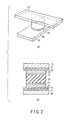
- FIG. 2 (a) is a perspective view of the test piece
- FIG. 2 (b) is a cross-sectional view of the test piece.
- the first steel member 10 was provided, and its surface was painted with amine-based curable epoxy paint 11.
- the second steel member 20 was provided, and its surface was painted with amine-containing cationic electrodeposition paint 21.
- a disk-shaped vulcanized natural rubber 30 having a diameter of 20 mm and a thickness of 5 mm was provided.
- the surface of the amine-based curable epoxy paint 11 on the first steel member 10, the surface of the amine-containing cationic electrodeposition paint 21 on the second steel member 20 and both the top and bottom surfaces of the natural rubber 30 were each treated with a 5% trichloroisocyanuric acid solution in ethyl acetate, thereby surface treatment layers 12, 22 and 31 were formed.
- the first steel member 10 and the natural rubber 30 were bonded with an epoxy adhesive with each of the surface treatment layers 12 and 31 intervened, thereby an adhesive layer 40 was formed.
- the second steel member 20 and the natural rubber 30 were bonded with an epoxy adhesive with each of the surface treatment layers 22 and 31 intervened, thereby an adhesive layer 40 was formed.
- test pieces not containing any of the constituent elements shown in FIG. 2 (b) was produced for evaluation.
- test pieces For each of the test pieces, a tensile test was performed in the perpendicular direction to the plane of the disk-shaped natural rubber until the test piece was broken, and the strength at breaking and the breaking portion were examined.
- samples were produced in which bush-shaped natural rubber was attached to a stabilizer bar and a bracket, and a torsion test was performed on each of the samples in the torsion direction of the stabilizer bar until the sample was broken, and the strength at breaking and a breaking portion were examined.
- bush-shaped samples were immersed in hot water at 80°C for 120 hours, and then were taken out in the atmosphere, and then a torsion test was performed on each of the samples until the sample was broken similar to the above tests. The strength at breaking and the breaking portion were also examined.
- the first steel member was provided and its surface was painted with amine-based curable epoxy paint.
- the second steel member was provided, and its surface was painted with amine-containing cationic electrodeposition paint. Further, a disk-shaped natural rubber with Shore hardness Hs of 60 was provided. Surfaces of these members were surface-treated with a 5% trichloroisocyanuric acid solution in ethyl acetate, thereby surface treatment layers were formed.
- thermosetting epoxy adhesive containing 100 parts of EPICLON EXA835 (a trade name of a product of DIC Corporation) which is a bisphenol F type epoxy resin and 20 parts of FUJICURER FXR1000 (a trade name of a product of Fujikaseikogyo Inc.) as a curing agent, thereby adhesive layers were formed.
- EPICLON EXA835 a trade name of a product of DIC Corporation
- FUJICURER FXR1000 a trade name of a product of Fujikaseikogyo Inc.
- the rubber As a result of performing a tensile test on the test piece, the rubber was broken. The strength was 68 MPa. As a result of a torsion test for a trial-manufactured bush- and bracket-integrated stabilizer bar, the rubber was internally broken. The strength was 152 N ⁇ m.
- Disk-shaped natural rubber with Shore hardness Hs of 85 was used.
- a test piece was produced with other conditions being the same as those in Example 1.
- Disk-shaped natural rubber with Shore hardness Hs of 55 was used.
- a test piece was produced with other conditions being the same as those in Example 1.
- a test piece was produced under the same conditions as those in Example 1 except that a curing agent of an epoxy adhesive was substituted with AMICURER PN23 (a product of Ajinomoto Corporation) which was an organic hydrazide-based curing agent.
- the mixing ratio was set to 100 parts of the epoxy resin and 30 parts of the curing agent.
- a test piece was produced under the same conditions as those in Example 1 except that an epoxy resin and a curing agent were substituted with Fosur 320/322 (a product of LORD Corporation) which was a commercially available epoxy-based adhesive.
- the curing agent was amine-based.
- the mixing ratio was set to 100 parts of the epoxy resin and 100 parts of the curing agent.
- Example 1 Prior to surface-treatment of the natural rubber, the surface of the adhesion portion was roughened with an abrasive paper with a grain size of P150 according to JIS R6010, and then surface-treatment was performed. A test piece was produced with other conditions being the same as those in Example 1.
- a test piece was produced without painting the first steel member and the second steel member (with an amine-based curable epoxy paint and an amine-containing cationic electrodeposition paint), and performing surface-treatment on the surfaces of the steel members with other conditions being the same as those in Example 1.
- test piece exhibited hardly any adhesion force, and the adhesive was detached from the surfaces of the steel members.
- the surface of the first steel member was painted with amine-based curable epoxy paint, but surface treatment was not performed thereto.
- the surface of the second steel member was painted with amine-containing cationic electrodeposition paint, but surface treatment was not performed thereto.
- a test piece was produced with other conditions being the same as those in Example 1.
- test piece exhibited hardly any adhesion force, and detachment occurred on the surfaces of the steel members, more specifically at the interface between the surfaces of the steel members and the adhesive.
- test piece exhibited hardly any adhesion force, and detachment occurred on the surfaces of the steel members, more specifically at the interface between the surfaces of the steel members and the adhesive.
- a test piece was produced under the same conditions as those in Example 1 except that a curing agent of an epoxy adhesive was substituted with EPICLON B570 (a product of Hitachi Chemical Co., Ltd.), an acid anhydride-based curing agent, and that dimethylbenzylamine was used as a curing accelerator.
- the mixing ratio was set to 100 parts of an epoxy resin, 80 parts of the curing agent, and 0.8 parts of the curing accelerator.
- the rubber was broken, and the strength was 24 MPa.
- the breaking cross-section the surface of the steel member and the surface of the rubber were observed discontinuously in patches, and intermittent detachment occurred both at the interface between the steel member and the adhesive and at the interface between the rubber and the adhesive layer.
- a test piece was produced under the same conditions as those in Example 1 except that a curing agent of an epoxy adhesive was substituted with EH317 (a product of ADEKA Corporation), a polymercaptan-based curing agent.
- the mixing ratio was set to 100 parts of an epoxy resin and 60 parts of the curing agent.
- a test piece was produced by performing vulcanization bonding on an unpainted steel member using unvulcanized natural rubber.
- Table 1 below provides a list of conditions and results for Examples 1 to 6 above
- Table 2 below provides a list of conditions and results for Comparative Examples 1 to 7 above.
- open circles appearing in the upper rows indicate what treatment was performed, the arrows indicate that it is of the same value as the one in the left column.
- marks appearing in the evaluation row have the following meanings: the open circle: Good, the open triangle: Acceptable, the cross: No good.
- breaking of a test piece at a breaking strength of around 60 MPa and at a torsion test strength of around 150 N ⁇ m means the breaking of rubber itself, and exhibits that the adhesion strength is higher than the strength of the rubber. From these results, in order to achieve sufficiently high adhesion strength, it is obvious that surface treatment of the steel member coated with amine-based curable epoxy paint or an amine-containing cationic electrodeposition paint be performed and bond the surface-treated natural rubber bush with an adhesive containing an amine-based curing agent or an organic hydrazide-based curing agent and an epoxy resin.
- a halogen-donor such as halogenated isocyanuric acid penetrates into a material having a double bond in the main chain such as natural rubber along with a solvent, and accesses the vicinity of the double bond in the main chain. Due to the action of water near the surface of the natural rubber, the halogenated isocyanuric acid is hydrolyzed to release halogen. The halogen attacks the nearby double bond in the main chain of the vulcanized rubber, which takes place addition reaction. During the course of the addition reaction, isolated isocyanuric acid is added along with chlorine to the main chain of the vulcanized rubber while keeping the ring structure.
- halogen donor such as halogenated isocyanuric acid as the surface treatment agent is hydrolyzed due to the action of water near the surface of amine-based curable epoxy paint or amine-containing cationic electrodeposition paint to release halogen.
- This halogen in particular chlorine, is considered to combine with hydrogen in R-NH 2 contained in the paint, or by other portions bonding therewith, and to undergo a reaction described below.
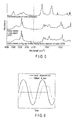
- FIG. 3 shows FT-IR charts before and after reaction between amine-based curable epoxy paint and trichloroisocyanuric acid.
- FIG. 4 shows FT-IR charts before and after reaction between amine-containing cationic paint and trichloroisocyanuric acid. It is understood from the charts that a peak appears in the vicinity of 1050 cm -1 after reaction.
- the halogen donor-based surface treatment agent does not react with materials that do not have an R-NH 2 structure such as bisphenol F type epoxy resin or bisphenol A type epoxy resin which is the primary ingredient of the adhesive.
- materials that do not have an R-NH 2 structure such as bisphenol F type epoxy resin or bisphenol A type epoxy resin which is the primary ingredient of the adhesive.
- an amine-based curing agent or an organic hydrazide-based curing agent is used as the curing agent of an adhesive, the following reaction between the curing agent and trichloroisocyanuric acid is considered to occur, since the curing agent has the R-NH 2 structure.
- FIG. 5 shows FT-IR charts before and after reaction between an amine-based curing agent and trichloroisocyanuric acid. It is also understood from the charts that a peak appears in the vicinity of 1050 cm -1 after reaction.
- an acid anhydride-based curing agent or a polymercaptan-based curing agent does not have an R-NH 2 structure, and thus does not react with trichloroisocyanuric acid.
- the paint and trichloroisocyanuric acid react with each other, and moreover, the curing agent in the adhesive and trichloroisocyanuric acid react with each other.
- the natural rubber and trichloroisocyanuric acid react with each other, and similarly, the curing agent in the adhesive and trichloroisocyanuric acid react with each other.
- the surface of the natural rubber can be roughened after vulcanization molding. Since the adhesive exerts an anchor effect on the fine irregularity of the surface created by roughening, adhesion force can be further enhanced. Therefore, even if the adhesive more or less deteriorates due to the water resistance test, it is capable of exhibiting sufficient adhesion force strong enough to completely make the rubber to be broken.
Landscapes
- Chemical & Material Sciences (AREA)
- Engineering & Computer Science (AREA)
- Organic Chemistry (AREA)
- General Engineering & Computer Science (AREA)
- Chemical Kinetics & Catalysis (AREA)
- Mechanical Engineering (AREA)
- Health & Medical Sciences (AREA)
- Life Sciences & Earth Sciences (AREA)
- Polymers & Plastics (AREA)
- Medicinal Chemistry (AREA)
- Materials Engineering (AREA)
- Wood Science & Technology (AREA)
- Molecular Biology (AREA)
- Aviation & Aerospace Engineering (AREA)
- Acoustics & Sound (AREA)
- Physics & Mathematics (AREA)
- Combustion & Propulsion (AREA)
- Vehicle Body Suspensions (AREA)
- Springs (AREA)
- Laminated Bodies (AREA)
- Vibration Prevention Devices (AREA)
- Adhesives Or Adhesive Processes (AREA)
- Paints Or Removers (AREA)
Abstract
Description
- The present invention relates to a bush- and bracket-integrated stabilizer bar in which a stabilizer bar, a portion of a suspension device for a vehicle such as an automobile, is integrated with a rubber bush and a bracket for mounting the stabilizer bar to the vehicle.
- A stabilizer bar is a member which mainly controls rolling, i.e., rolling movement around the longitudinal axis of a vehicle body. A rubber bush is attached between the stabilizer bar and the vehicle body, and it reduces the propagation of vibration entering the stabilizer bar depending on the conditions of road surface to the vehicle body, and at the same time it flexibly follows-up the movement of the stabilizer bar and supports the vehicle body.
- Force is exerted on the rubber bush attached to the stabilizer bar in the direction of rolling of the stabilizer bar depending on the vertical movement of the wheels or the vehicle body. Concurrently, force is exerted on the rubber bush in the vertical direction due to supporting the vehicle body and due to vibration.
- The mainstream of a conventional stabilizer bar with a rubber bush has been of a non-bonded type where the stabilizer bar and the rubber bush, and the rubber bush and the bracket are not bonded to each other. Consequently, when water intrudes into the non-bonded portion or when ambient temperature is extremely low, for example, at -30°C, the problem of generating a strange sound due to stick-slip arises.
-
FIG. 6 shows generated torque (output) with respect to displacement of the stabilizer bar (input such as a kink in the stabilizer bar) when stick-slip occurs to a stabilizer bar with a rubber bush of a non-bonded type. As shown inFIG. 6 , a phase shift develops between the displacement of the stabilizer bar and the torque, so that handling performance is affected and steering stability is impaired. - Further, since the stabilizer bar and the rubber bush, and the rubber bush and the bracket are not integrated by bonding, clearances develop between them when a large force is applied to the stabilizer bar. When hard foreign substances intruded into such clearances, there were cases where the stabilizer bar and the bracket were marred and a strange sound generated. Moreover, when hard foreign substances such as sand and stone were left in the clearances, there were cases where malfunctions such as abrasion and breaking occurred.
- In order to cope with such problems, various measures by bonding have been conventionally taken. However, they have problems of producing insufficient effects, carrying high costs and others.
-
Patent Literature 1 discloses a technology of placing a stabilizer bar and brackets in a mold and performing bonding concurrently with vulcanization molding of rubber bushes. However, since the stabilizer bar and the brackets made of metals are placed in the mold, strength and precision are required for the mold, besides durability of the mold degrades. Moreover, the stabilizer bar usually has a length of about one meter, and thus equipment including the mold and others is made larger and raise the problem of carrying a large cost. Further, paint is usually applied to the stabilizer bar and others after vulcanization bonding is performed, and thus coating defects are likely to develop, for example, between the rubber bush and the stabilizer bar, and incur loss of reliability. In addition, powder painting or cationic painting usually used in painting the stabilizer bar requires a drying or curing process involving high temperature and a long time period, and thus the problem of causing the possibility of heat deterioration of the vulcanization bonded rubber bush arises. - On the other hand, in
Patent Literature 2, the problems of the upsizing of equipment and others are avoided by performing vulcanization bonding on the brackets when vulcanization molding of the rubber bushes are performed, followed by bonding the rubber bushes with brackets vulcanization bonded thereto to the coated stabilizer bar using a chlorinated rubber based adhesive. However, the present inventors performed a trial manufacture based on the disclosed information and confirmed that heat treatment was necessary to bond the rubber bushes and the stabilizer bar using a chlorinated rubber based adhesive, and that the strength of the rubber bushes degraded by 40 to 50% by heat deterioration. Further, this method requires two sets of a bracket with a rubber bush on the upper and lower sides of a stabilizer bar, and thus it is hard to say that is advantageous from a cost standpoint. -
Patent Literature 3 discloses a method of performing vulcanization molding on vulcanized rubber as a measure for suppressing the cost rise by the method described in (1). By using the vulcanized rubber, this method resolves the drawbacks such as increased cost through the upsizing of equipment described in (1). However, the present inventors performed a trial manufacture under the same conditions (heating under 10% compression, at 160°C, and for 60 minutes) based on details disclosed therein, and confirmed a significant degradation in strength of rubber bush due to heat deterioration and a problem was raised as to the long-term reliability of the rubber bush. Further, inPatent Literature 3, the bush and the bracket are not bonded or fixed together, and thus the problem of generating a strange sound in this portion or the problem of abrasion and breaking caused by intrusion of foreign substances cannot be resolved. - Patent Literature 4 discloses a method of using a thermosetting adhesive. This method involves curing the adhesive by applying high temperature painting treatment (at 130 to 200°C for 20 minutes) in a painting step. However, this method also cannot prevent the heat deterioration caused by exposing the vulcanized rubber bush to a high temperature for a long time period. Further, this method also bonds the stabilizer bar and the bush alone and does not bond the bush and the bracket, and thus cannot prevent the strange sound from generating or abrasion and breaking caused by intrusion of foreign substances into this portion. Moreover, painting is performed after the rubber bush is bonded to the uncoated stabilizer bar, and thus painting defects such as leaving portions uncoated are likely to develop at the boundaries of the stabilizer bar and the rubber bush, and corrosion may develop from the painting defect portions, which may raise the problem of, for example, the stabilizer bar getting broken after use for a long time period.
- On the other hand, Patent Literatures 5 and 6 disclose methods for bonding a rubber bush by painting a thermosetting adhesive on a stabilizer bar which has been subjected to electrostatic painting or powder painting. However, as a result of performing a trial manufacture based on the details described in these documents, it is found that rubber breaking will not occur, since the adhesion force between the adhesive and the stabilizer bar or between the adhesive and the rubber bush is poor in these methods. Further, in these methods, the bush and the bracket are merely fixed by compression and are not bonded with each other, thus the problem of generating a strange sound in this portion or the problem of abrasion and breaking caused by intrusion of foreign substances still remains unresolved.
- Patent Literature 7 discloses a method for bonding chlorination treated rubber bush to a coated stabilizer bar with a thermosetting adhesive. This method is considered to improve the adhesion force of the rubber bush by performing chlorination treatment. However, as a result of performing a trial manufacture based on the disclosed information, it is confirmed that the rubber surface is roughened by the chlorination treatment and the adhesion force improved to a certain degree by anchor effect, but that the adhesive strength of the vulcanization bonding produced by the adhesive alone is by far insufficient for the rubber breaking to occur. Further, also in this method, the bush and the bracket are merely fixed with a clamp, thus the problem of generating a strange sound in this portion or the problem of abrasion and breaking caused by intrusion of foreign substances cannot be dealt with.
-
- Patent Literature 1: Examined Patent Publication No.
3716750 - Patent Literature 2: Unexamined Patent Publication No.
2006-123818 - Patent Literature 3: Unexamined Patent Publication No.
2005-319850 - Patent Literature 4: Unexamined Patent Publication No.
2001-270315 - Patent Literature 5: Unexamined Patent Publication No.
2006-008082 - Patent Literature 6: Unexamined Patent Publication No.
2006-027311 - Patent Literature 7: Unexamined Patent Publication No.
H11-108096 - An object of the present invention is to provide a bush- and bracket-integrated stabilizer bar, at a low price, which resolves the problems of generating a strange sound due to stick-slip phenomenon, generating a strange sound due to intrusion of foreign substances into clearances and breaking caused by abrasion, and concurrently has excellent steering stability.
- According to an embodiment of the present invention, there is provided a bush- and bracket-integrated stabilizer bar comprising a stabilizer bar, a rubber bush attached to an outer periphery of the stabilizer bar, and a bracket configured to mount the stabilizer bar to a bottom of a vehicle body with the rubber bush intervened, characterized in that the stabilizer bar comprises an amine-based curable epoxy paint or an amine-containing cationic paint and a surface treatment layer containing a halogen donor-based surface treatment agent on the paint, in that the rubber bush comprises a surface treatment layer containing a halogen donor-based surface treatment agent on an inner surface thereof, and in that an adhesive layer containing an amine-based or an organic hydrazide-based curing agent and an epoxy resin is formed between the stabilizer bar and the rubber bush with each of the surface treatment layers thereof intervened.
- In another embodiment of the present invention, it is further preferable that the bracket comprises an amine-based curable epoxy paint or an amine-containing cationic paint on an inner surface thereof and a surface treatment layer containing a halogen donor-based surface treatment agent on the paint, in that the rubber bush comprises a surface treatment layer containing a halogen donor-based surface treatment agent on an outer surface thereof, and in that an adhesive layer containing an amine-based or an organic hydrazide-based curing agent and an epoxy resin is formed between the bracket and the rubber bush with each of the surface treatment layers intervened.
- According to the embodiment of the present invention, because the stabilizer bar and the rubber bush are firmly bonded and fixed, it is possible to provide a bush- and bracket-integrated stabilizer bar, at a low price, which resolves the problems of generating a strange sound due to stick-slip phenomenon, generating a strange sound due to intrusion of foreign substances into clearances and breaking caused by abrasion, and concurrently has excellent steering stability.
-
-
FIG. 1 is a perspective view of the bush- and bracket-integrated stabilizer bar according to an embodiment of the present invention. -
FIG. 2 is a perspective view and a cross-sectional view of a test piece produced in the Examples. -
FIG. 3 shows FT-IR charts before and after a reaction between an amine-based curable epoxy paint and trichloroisocyanuric acid. -
FIG. 4 shows FT-IR charts before and after a reaction between an amine-containing cationic paint and trichloroisocyanuric acid. -
FIG. 5 shows FT-IR charts before and after a reaction between an amine-based curing agent and trichloroisocyanuric acid. -
FIG. 6 is a graph showing the relationship between displacement and torque of the stabilizer bar. - The bush- and bracket-integrated stabilizer bar according to embodiments of the present invention will be described in detail hereinafter.
-
FIG. 1 shows a perspective view of a bush- and bracket-integratedstabilizer bar 1 according to an embodiment of the present invention. The bush- and bracket-integratedstabilizer bar 1 comprises astabilizer bar 2, tworubber bushes 3 each attached to the outer periphery of thestabilizer bar 2, and brackets 4 arranged on the outer periphery of therubber bushes 3 and configured to mount thestabilizer bar 2 to the bottom of a vehicle body with therubber bushes 3 intervened. - The
stabilizer bar 2 comprises an amine-based curable epoxy paint or an amine-containing cationic paint (not shown inFIG. 1 ) on the surface thereof and a surface treatment layer (not shown inFIG. 1 ) containing a halogen donor-based surface treatment agent on the paint. Similarly, the bracket 4 preferably comprises an amine-based curable epoxy paint or an amine-containing cationic paint (not shown inFIG. 1 ) on the surface thereof and a surface treatment layer (not shown inFIG. 1 ) containing a halogen donor-based surface treatment agent on the paint. Therubber bush 3 comprises a surface treatment layer containing a halogen donor-based surface treatment agent at least on the inner surface (on the side of the stabilizer bar 2). Preferably, therubber bush 3 also comprises a surface treatment layer containing a halogen donor-based surface treatment agent on the outer surface (on the side of the bracket 4). - An adhesive layer (not shown in
FIG. 1 ) containing an amine-based or an organic hydrazide-based curing agent and an epoxy resin is formed between thestabilizer bar 2 and therubber bush 3 with each of the surface treatment layers intervened. Preferably, an adhesive layer (not shown inFIG. 1 ) containing an amine-based or an organic hydrazide-based curing agent and an epoxy resin is also formed between the bracket 4 and therubber bush 3 with each of the surface treatment layers intervened. - In the present invention, the amine-based curable epoxy paint or amine-containing cationic electrodeposition paint, which is generally used in painting automobiles, is used for painting the stabilizer bar and the brackets.
- The amine-based curable epoxy paint, as is described in Unexamined Patent Publication No.
H7-224234 - The amine-containing cationic electrodeposition paint, as is described in Unexamined Patent Publication No.
2002-121491 , includes a reaction product of polyepoxy resin and a cationization agent, one obtained by protonating a polycondensation product of polycarboxylic acid and polyamine with an acid, and one obtained by protonating a polyadduct product between a polyisocyanate compound and polyol and mono or polyamine with an acid, for example. The cationization agent includes amine compounds of primary amine, secondary amine, tertiary amine and polyamine, for example. - In the present invention, the surface treatment agent used for forming the surface treatment layer includes one obtained by dissolving a halogen-donor such as halogenated isocyanuric acid such as trichloroisocyanuric acid, dibromomethylhydantoin, and N-chloroparatoluenesulfonic acid amide in a solvent. In particular, trichloroisocyanuric acid is suitable, since it is easy to obtain and handle, and has a high improvement effect on the adhesive property. As the solvent for trichloroisocyanuric acid, ethyl acetate, methyl ethyl ketone, methyl acetate, and the like can be used. For example, in the Examples described hereinafter, a 5% trichloroisocyanuric acid solution in ethyl acetate is used as the surface treatment agent, but not limited thereto.
- In the present invention, bisphenol F type epoxy resin and various curing agents for curing it as a two-component mixing type adhesive, for example, is used as the adhesive forming the adhesive layer. Strong adhesion force with the surface treatment layer can be obtained only when an amine-based curing agent or an organic hydrazide-based curing agent is used as the curing agent. The mixing ratio of the epoxy resin to each of the curing agents is optimum when the amount of reaction points of epoxy groups in the epoxy resin is equal to the amount of reaction points of the curing agent, but not limited thereto.
- Further, in the present invention, when a roughening treatment of the rubber surface was performed, an abrasive paper with a grain size of P150 according to JIS R6010 was used. For performing the roughening treatment, a grain size in the range of P80 to P1200 can be used, and in particular, the range of P120 to P360 is preferable. Any means will do as long as the rubber surface can be physically roughened, and the means for performing the roughening treatment is not particularly limited to the abrasive paper.
- In the following Examples, a test piece shown in
FIG. 2 was produced for evaluation.FIG. 2 (a) is a perspective view of the test piece, andFIG. 2 (b) is a cross-sectional view of the test piece. - As a substitution for the stabilizer bar, the
first steel member 10 was provided, and its surface was painted with amine-based curable epoxy paint 11. As a substitution for the bracket, thesecond steel member 20 was provided, and its surface was painted with amine-containing cationic electrodeposition paint 21. As a substitution for the rubber bush, a disk-shaped vulcanizednatural rubber 30 having a diameter of 20 mm and a thickness of 5 mm was provided. The surface of the amine-based curable epoxy paint 11 on thefirst steel member 10, the surface of the amine-containing cationic electrodeposition paint 21 on thesecond steel member 20 and both the top and bottom surfaces of thenatural rubber 30 were each treated with a 5% trichloroisocyanuric acid solution in ethyl acetate, thereby surface treatment layers 12, 22 and 31 were formed. Thefirst steel member 10 and thenatural rubber 30 were bonded with an epoxy adhesive with each of the surface treatment layers 12 and 31 intervened, thereby anadhesive layer 40 was formed. Similarly, thesecond steel member 20 and thenatural rubber 30 were bonded with an epoxy adhesive with each of the surface treatment layers 22 and 31 intervened, thereby anadhesive layer 40 was formed. - Further, as comparative examples, test pieces not containing any of the constituent elements shown in
FIG. 2 (b) was produced for evaluation. - The constitution of each of the examples and comparative examples are shown in Tables 1 and 2 described hereinafter.
- For each of the test pieces, a tensile test was performed in the perpendicular direction to the plane of the disk-shaped natural rubber until the test piece was broken, and the strength at breaking and the breaking portion were examined.
- As to combination of materials for test pieces that exhibited good evaluation results, samples were produced in which bush-shaped natural rubber was attached to a stabilizer bar and a bracket, and a torsion test was performed on each of the samples in the torsion direction of the stabilizer bar until the sample was broken, and the strength at breaking and a breaking portion were examined.
- Further, as to combination of materials for test pieces that exhibited good evaluation results, in order to evaluate water resistant properties, bush-shaped samples were immersed in hot water at 80°C for 120 hours, and then were taken out in the atmosphere, and then a torsion test was performed on each of the samples until the sample was broken similar to the above tests. The strength at breaking and the breaking portion were also examined.
- Next, examples and comparative examples are specifically described.
- The first steel member was provided and its surface was painted with amine-based curable epoxy paint. The second steel member was provided, and its surface was painted with amine-containing cationic electrodeposition paint. Further, a disk-shaped natural rubber with Shore hardness Hs of 60 was provided. Surfaces of these members were surface-treated with a 5% trichloroisocyanuric acid solution in ethyl acetate, thereby surface treatment layers were formed. Then, these surface treatment layers were bonded with a thermosetting epoxy adhesive containing 100 parts of EPICLON EXA835 (a trade name of a product of DIC Corporation) which is a bisphenol F type epoxy resin and 20 parts of FUJICURER FXR1000 (a trade name of a product of Fujikaseikogyo Inc.) as a curing agent, thereby adhesive layers were formed. Thus, a test piece shown in
FIG. 2 was produced. - As a result of performing a tensile test on the test piece, the rubber was broken. The strength was 68 MPa. As a result of a torsion test for a trial-manufactured bush- and bracket-integrated stabilizer bar, the rubber was internally broken. The strength was 152 N·m.
- Further, as a result of performing a torsion test after immersion in hot water, the rubber was broken in most of the adhesion region, and a portion of the adhesive was broken. The breaking of the adhesive was caused by deterioration. The adhesion strength at that time was 129 N·m.
- Disk-shaped natural rubber with Shore hardness Hs of 85 was used. A test piece was produced with other conditions being the same as those in Example 1.
- As a result of performing a tensile test on the test piece, the rubber was broken, and the strength was 84 MPa. As a result of a torsion test for a trial-manufactured bush- and bracket-integrated stabilizer bar, the rubber was broken, and the strength was 172 N·m.
- Further, as a result of performing a torsion test after immersion in hot water, a portion of the rubber was internally broken, and in the remaining portion, the adhesive was broken in a range wider than the case of Example 1. The breaking of the adhesive was caused by deterioration, and the adhesion strength at that time was 136 N·m.
- Disk-shaped natural rubber with Shore hardness Hs of 55 was used. A test piece was produced with other conditions being the same as those in Example 1.
- As a result of performing a tensile test on the test piece, the rubber was broken, and the strength was 54 MPa. As a result of a torsion test for a trial-manufactured bush- and bracket-integrated stabilizer bar, the rubber was broken, and the strength was 172 N·m.
- Further, as a result of performing a torsion test after immersion in hot water, the rubber was broken in most of the adhesion region, and the adhesive was broken in a very limited region. The breaking of the adhesive was caused by deterioration, and the adhesion strength at that time was 119 N·m.
- A test piece was produced under the same conditions as those in Example 1 except that a curing agent of an epoxy adhesive was substituted with AMICURER PN23 (a product of Ajinomoto Corporation) which was an organic hydrazide-based curing agent. The mixing ratio was set to 100 parts of the epoxy resin and 30 parts of the curing agent.
- As a result of performing a tensile test on the test piece, a rubber was broken, and the strength was 62 MPa. As a result of a torsion test for a trial-manufactured bush- and bracket-integrated stabilizer bar, the rubber was broken, and the strength was 172 N·m.
- Further, as a result of performing a torsion test after immersion in hot water, the rubber was broken in most of the adhesion region, and a portion of the adhesive showed deterioration and was broken similar to the case of Example 1. The adhesion strength at that time was 127 N·m.
- A test piece was produced under the same conditions as those in Example 1 except that an epoxy resin and a curing agent were substituted with Fosur 320/322 (a product of LORD Corporation) which was a commercially available epoxy-based adhesive. The curing agent was amine-based. The mixing ratio was set to 100 parts of the epoxy resin and 100 parts of the curing agent.
- As a result of performing a tensile test on the test piece, a rubber was broken, and the strength was 69 MPa. As a result of a torsion test for a trial-manufactured bush- and bracket-integrated stabilizer bar, the rubber was broken, and the strength was 153 N·m.
- Further, as a result of performing a torsion test after immersion in hot water, the rubber was broken in most of the adhesion region, and a portion of the adhesive was broken due to deterioration similar to the case of Example 1. The adhesion strength at that time was 125 N·m.
- Prior to surface-treatment of the natural rubber, the surface of the adhesion portion was roughened with an abrasive paper with a grain size of P150 according to JIS R6010, and then surface-treatment was performed. A test piece was produced with other conditions being the same as those in Example 1.
- As a result of performing a tensile test on the test piece, a rubber was broken, and the strength was 69 MPa. As a result of a torsion test for a trial-manufactured bush- and bracket-integrated stabilizer bar, the rubber was broken, and the strength was 154 N·m.
- Further, as a result of performing a torsion test after immersion in hot water, degradation in the adhesion strength was not observed and the rubber was internally broken completely. The adhesion strength at that time was 152 N·m.
- A test piece was produced without painting the first steel member and the second steel member (with an amine-based curable epoxy paint and an amine-containing cationic electrodeposition paint), and performing surface-treatment on the surfaces of the steel members with other conditions being the same as those in Example 1.
- The test piece exhibited hardly any adhesion force, and the adhesive was detached from the surfaces of the steel members.
- The surface of the first steel member was painted with amine-based curable epoxy paint, but surface treatment was not performed thereto. The surface of the second steel member was painted with amine-containing cationic electrodeposition paint, but surface treatment was not performed thereto. A test piece was produced with other conditions being the same as those in Example 1.
- The test piece exhibited hardly any adhesion force, and detachment occurred on the surfaces of the steel members, more specifically at the interface between the surfaces of the steel members and the adhesive.
- Surface treatment was not performed on disk-shaped natural rubber. A test piece was produced with other conditions being the same as those in Example 1.
- The test piece exhibited hardly any adhesion force, and detachment occurred on the surfaces of the steel members, more specifically at the interface between the surfaces of the steel members and the adhesive.
- A test piece was produced under the same conditions as those in Example 1 except that a curing agent of an epoxy adhesive was substituted with EPICLON B570 (a product of Hitachi Chemical Co., Ltd.), an acid anhydride-based curing agent, and that dimethylbenzylamine was used as a curing accelerator. The mixing ratio was set to 100 parts of an epoxy resin, 80 parts of the curing agent, and 0.8 parts of the curing accelerator.
- As a result of performing a tensile test on the test piece, the rubber was broken, and the strength was 24 MPa. In the breaking cross-section, the surface of the steel member and the surface of the rubber were observed discontinuously in patches, and intermittent detachment occurred both at the interface between the steel member and the adhesive and at the interface between the rubber and the adhesive layer.
- A test piece was produced under the same conditions as those in Example 1 except that a curing agent of an epoxy adhesive was substituted with EH317 (a product of ADEKA Corporation), a polymercaptan-based curing agent. The mixing ratio was set to 100 parts of an epoxy resin and 60 parts of the curing agent.
- As a result of performing a tensile test on the test piece, detachment occurred both at the interface between the steel member and the adhesive layer and at the interface between the rubber and the adhesive, and the strength was 17 MPa.
- A test piece was produced by performing vulcanization bonding on an unpainted steel member using unvulcanized natural rubber.
- As a result of performing a tensile test on the test piece, a rubber was broken, and the strength was 65 MPa. As a result of a torsion test for a trial-manufactured bush- and bracket-integrated stabilizer bar, the rubber was internally broken, and the strength was 149 N·m.
- Further, as a result of performing a torsion test after immersion in hot water, the rubber was internally broken, and degradation in the adhesion strength was not observed. The adhesion strength at that time was 146 N·m.
- Incidentally, after performing the bonding step, epoxy powder painting was performed on a bush- and bracket-integrated stabilizer bar. As a result, small clearances developed between the rubber bush and the stabilizer bar and between the bracket and the rubber bush, unpainted portions were left behind, which clearly exhibited a high probability of causing durability deficiency.
- Table 1 below provides a list of conditions and results for Examples 1 to 6 above, and Table 2 below provides a list of conditions and results for Comparative Examples 1 to 7 above. In Tables 1 and 2, open circles appearing in the upper rows indicate what treatment was performed, the arrows indicate that it is of the same value as the one in the left column. In Tables 1 and 2, marks appearing in the evaluation row have the following meanings: the open circle: Good, the open triangle: Acceptable, the cross: No good.
Table 1 Examples 1 2 3 4 5 6 Embodiment Painting of steel member Amine-based curable epoxy paint amine-containing cationic electrodeposition paint ○ ○ ○ ○ ○ ○ Untreated (steel member as it is) Steel member surface treatment Trichloroisocyanuric acid treatment ○ ○ ○ ○ ○ ○ Rubber side surface treatment Trichloroisocyanuric acid treatment ○ ○ ○ ○ ○ ○ Rubber hardness 60 85 55 60 60 60 Surface roughness Mirror surface Mirror surface Mirror surface Mirror surface Mirror surface Roughened surface* Epoxy resin Bisphenol F type epoxy resin EPICLON EXA835 DIC Corporation 100 ← ← 100 100 Curing agent Amine-based FUKICURER FXR1000 Fujikaseikogyo Inc. 20 ← ← 20 Organic hydrazide-based AMICURER PN23 Ajinomoto Corporation 30 Acid anhydride-based EPICLON B570 Hitachi Chemical Co., Ltd. Polymercaptan-based EH317 ADEKA Corporation Examples 1 2 3 4 5 6 Curing accelerator Dimethylbenzylamine Wako Pure Chemical Industries Ltd. Commercial product Fosur320 Epoxy adhesive LORD Corporation 100 Fosur322 Epoxy curing agent LORD Corporation 100 Vulcanization bonding Evaluation on test piece Tensile test Breaking strength 68 84 54 62 69 69 Breaking portion Rubber broken Rubber broken Rubber broken Rubber broken Rubber broken Rubber broken Evaluation on bush-shaped sample Torsion test Breaking strength 152 172 146 155 153 154 Breaking portion Rubber broken Rubber broken Rubber broken Rubber broken Rubber broken Rubber broken Evaluation ○ ○ ○ ○ ○ ○ Evaluation on bush-shaped sample Torsion test after immersion in hot water Breaking strength 129 136 119 127 125 152 Breaking portion Rubber broken partially Portion of rubber broken partially Rubber broken substantially Rubber broken partially Rubber broken partially Rubber broken Total evaluation ○-Δ Δ ○ ○-Δ ○-Δ ○ *Roughened surface: The surface is roughened using an abrasive paper with a grain size of P150 according to JIS R6010. Table 2 Comparative Examples 1 2 3 4 5 6 Embodiment Painting of steel member Amine-based curable epoxy paint ○ ○ ○ ○ Amine-containing cationic electrodeposition paint Untreated (steel member as it is) ○ ○ Steel member surface treatment Trichloroisocyanuric acid treatment ○ ○ Rubber side surface treatment Trichloroisocyanuric acid treatment ○ ○ Rubber hardness 60 60 60 60 60 60 Surface roughness Mirror surface Mirror surface Mirror surface Mirror surface Mirror surface - Epoxy resin Bisphenol F type epoxy resin EPICLON EXA835 DIC Corporation 100 ← ← 100 100 Curing agent Amine-based FUKICURER FXR1000 Fujikaseikogyo Inc. 20 ← ← Organic hydrazide-based AMICURER PN23 Ajinomoto Corporation Acid anhydride-based EPICLON B570 Hitachi Chemical Co., Ltd. 80 Polymericaptan-based EH317 ADEKA Corporation 60 Curing accelerator Dimethylbenzylamine Wako Pure Chemical Industries Ltd. 0.8 Commercial product Four320 Epoxy adhesive LORD Corporation Fosur322 Epoxy curing agent LORD Corporation Vulcanization bonding ○ Evaluation on bush-shaped sample Tensile test Breaking strength <10 <10 <10 24 17 65 Breaking portion Interface detached Interface detached Interface detached Interface detached Interface detached Rubber broken Evaluation on bush-shaped sample Torsion test Breaking strength - - - - - 149 Breaking portion Interface detached Interface detached Interface detached Interface detached Interface detached Rubber broken Evaluation × × × × × ○ Bush shape Torsion test after immersion in hot water Breaking strength - - - - - 146 Breaking portion - - - - - Rubber broken Total evaluation × × × × × ○ - Incidentally, breaking of a test piece at a breaking strength of around 60 MPa and at a torsion test strength of around 150 N·m means the breaking of rubber itself, and exhibits that the adhesion strength is higher than the strength of the rubber. From these results, in order to achieve sufficiently high adhesion strength, it is obvious that surface treatment of the steel member coated with amine-based curable epoxy paint or an amine-containing cationic electrodeposition paint be performed and bond the surface-treated natural rubber bush with an adhesive containing an amine-based curing agent or an organic hydrazide-based curing agent and an epoxy resin.
- The reason why the combination stated above produces sufficient adhesion force is described below.
- A halogen-donor such as halogenated isocyanuric acid, as a surface treatment agent, penetrates into a material having a double bond in the main chain such as natural rubber along with a solvent, and accesses the vicinity of the double bond in the main chain. Due to the action of water near the surface of the natural rubber, the halogenated isocyanuric acid is hydrolyzed to release halogen. The halogen attacks the nearby double bond in the main chain of the vulcanized rubber, which takes place addition reaction. During the course of the addition reaction, isolated isocyanuric acid is added along with chlorine to the main chain of the vulcanized rubber while keeping the ring structure.

- When addition of isocyanuric acid and chlorine to the surface of the vulcanized rubber, or reaction of isocyanuric acid with the paint and the adhesive is caused, it is known that a difference appears in infrared absorption spectrum between before and after the addition or reaction (Unexamined Japanese Patent Publication No.
2006-519894 2009-131631 - Further, the halogen donor such as halogenated isocyanuric acid as the surface treatment agent is hydrolyzed due to the action of water near the surface of amine-based curable epoxy paint or amine-containing cationic electrodeposition paint to release halogen. This halogen, in particular chlorine, is considered to combine with hydrogen in R-NH2 contained in the paint, or by other portions bonding therewith, and to undergo a reaction described below.

- The outcome of the above mentioned reaction can be determined by an FT-IR measurement.
FIG. 3 shows FT-IR charts before and after reaction between amine-based curable epoxy paint and trichloroisocyanuric acid.FIG. 4 shows FT-IR charts before and after reaction between amine-containing cationic paint and trichloroisocyanuric acid. It is understood from the charts that a peak appears in the vicinity of 1050 cm-1 after reaction. - In order to react with a halogen donor-based surface treatment agent, it is preferable to have an R-NH2 structure like the amine-based curable epoxy paint or the amine-containing cationic electrodeposition paint. This is clear from the result of Comparative Example 6.
- The halogen donor-based surface treatment agent does not react with materials that do not have an R-NH2 structure such as bisphenol F type epoxy resin or bisphenol A type epoxy resin which is the primary ingredient of the adhesive. However, when an amine-based curing agent or an organic hydrazide-based curing agent is used as the curing agent of an adhesive, the following reaction between the curing agent and trichloroisocyanuric acid is considered to occur, since the curing agent has the R-NH2 structure.

- The outcome of the above mentioned reaction also can be determined by an FT-IR measurement.
FIG. 5 shows FT-IR charts before and after reaction between an amine-based curing agent and trichloroisocyanuric acid. It is also understood from the charts that a peak appears in the vicinity of 1050 cm-1 after reaction. - On the other hand, an acid anhydride-based curing agent or a polymercaptan-based curing agent does not have an R-NH2 structure, and thus does not react with trichloroisocyanuric acid.
- To summarize, on the steel member side, the paint and trichloroisocyanuric acid react with each other, and moreover, the curing agent in the adhesive and trichloroisocyanuric acid react with each other. On the rubber bush side, the natural rubber and trichloroisocyanuric acid react with each other, and similarly, the curing agent in the adhesive and trichloroisocyanuric acid react with each other. As such, since objects bonded together chemically react with each other, it is possible to achieve strong bonding comparable to that of vulcanization bonding.
- The surface of the natural rubber can be roughened after vulcanization molding. Since the adhesive exerts an anchor effect on the fine irregularity of the surface created by roughening, adhesion force can be further enhanced. Therefore, even if the adhesive more or less deteriorates due to the water resistance test, it is capable of exhibiting sufficient adhesion force strong enough to completely make the rubber to be broken.
- As mention above, according to embodiments of the present invention, by using a generally applied paint for automobiles of amine-based curable epoxy paint and amine-containing cationic electrodeposition paint and vulcanized natural rubber bush, and by applying surface treatment with a halogen donor such as trichloroisocyanuric acid, which is readily available at a low cost, it is possible to manufacture at a low cost a bush- and bracket-integrated stabilizer bar using an epoxy adhesive which is of low cost and has good adhesiveness, and which is capable of bonding with a curing treatment at low temperature in a short time period. In the present invention, since the members chemically react with each other to form strong bonding, it is possible to achieve strong bonding comparable to that of vulcanization bonding and to achieve manufacturing at a lower cost than the vulcanization bonding.
Claims (4)
- A bush- and bracket-integrated stabilizer bar comprising a stabilizer bar, a rubber bush attached to an outer periphery of the stabilizer bar, and a bracket configured to mount the stabilizer bar to a bottom of a vehicle body with the rubber bush intervened,
characterized in that the stabilizer bar comprises an amine-based curable epoxy paint or an amine-containing cationic paint and a surface treatment layer containing a halogen donor-based surface treatment agent on the paint, in that the rubber bush comprises a surface treatment layer containing a halogen donor-based surface treatment agent on an inner surface thereof, and in that an adhesive layer containing an amine-based or an organic hydrazide-based curing agent and an epoxy resin is formed between the stabilizer bar and the rubber bush with each of the surface treatment layers intervened. - The bush- and bracket-integrated stabilizer bar according to claim 1, characterized in that the bracket comprises an amine-based curable epoxy paint or an amine-containing cationic paint on an inner surface thereof and a surface treatment layer containing a halogen donor-based surface treatment agent on the paint, in that the rubber bush comprises a surface treatment layer containing a halogen donor-based surface treatment agent on an outer surface thereof,
and in that an adhesive layer containing an amine-based or an organic hydrazide-based curing agent and an epoxy resin is formed between the bracket and the rubber bush with each of the surface treatment layers intervened. - The bush- and bracket-integrated stabilizer bar according to claim 1 or 2, characterized in that the halogen donor-based surface treatment agent contains trichloroisocyanuric acid.
- The bush- and bracket-integrated stabilizer bar according to claim 1 or 2, characterized in that the surface of the rubber bush, on which the adhesive layer is formed, is roughened.
Applications Claiming Priority (2)
| Application Number | Priority Date | Filing Date | Title |
|---|---|---|---|
| JP2010272759A JP5478472B2 (en) | 2010-12-07 | 2010-12-07 | Bush and bracket integrated stabilizer bar |
| PCT/JP2011/078297 WO2012077710A1 (en) | 2010-12-07 | 2011-12-07 | Bush- and bracket-integrated stabilizer bar |
Publications (3)
| Publication Number | Publication Date |
|---|---|
| EP2650150A1 true EP2650150A1 (en) | 2013-10-16 |
| EP2650150A4 EP2650150A4 (en) | 2014-07-09 |
| EP2650150B1 EP2650150B1 (en) | 2015-09-02 |
Family
ID=46207197
Family Applications (1)
| Application Number | Title | Priority Date | Filing Date |
|---|---|---|---|
| EP11846567.3A Active EP2650150B1 (en) | 2010-12-07 | 2011-12-07 | Bush- and bracket-integrated stabilizer bar |
Country Status (8)
| Country | Link |
|---|---|
| US (1) | US8613460B2 (en) |
| EP (1) | EP2650150B1 (en) |
| JP (1) | JP5478472B2 (en) |
| KR (1) | KR101423015B1 (en) |
| CN (1) | CN103249580B (en) |
| ES (1) | ES2552464T3 (en) |
| MX (1) | MX345273B (en) |
| WO (1) | WO2012077710A1 (en) |
Cited By (1)
| Publication number | Priority date | Publication date | Assignee | Title |
|---|---|---|---|---|
| WO2018229135A1 (en) * | 2017-06-14 | 2018-12-20 | ThyssenKrupp Federn und Stabilisatoren GmbH | Stabilizer bar adhesive mount for a vehicle stabilizer bar, vehicle stabilizer bar having a stabilizer bar adhesive mount, and method for forming a stabilizer bar adhesive mount on a vehicle stabilizer bar |
Families Citing this family (15)
| Publication number | Priority date | Publication date | Assignee | Title |
|---|---|---|---|---|
| JP5638656B2 (en) * | 2013-04-19 | 2014-12-10 | 日本発條株式会社 | Stabilizer bush |
| JP6343153B2 (en) * | 2014-02-18 | 2018-06-13 | 日本発條株式会社 | Mounting structure between bar and semi-finished product of movement restriction member |
| CN106536969B (en) * | 2014-03-25 | 2019-03-01 | 株式会社万 | Winding collar, manufacturing device of winding collar, and manufacturing method of winding collar |
| JP5926763B2 (en) * | 2014-04-24 | 2016-05-25 | 日本発條株式会社 | Manufacturing method of stabilizer bar with rubber bush |
| JP6444082B2 (en) | 2014-07-23 | 2018-12-26 | 日本発條株式会社 | Stabilizer manufacturing apparatus and method |
| JP2016147580A (en) * | 2015-02-12 | 2016-08-18 | ヤマハ発動機株式会社 | vehicle |
| JP6347226B2 (en) | 2015-04-16 | 2018-06-27 | トヨタ自動車株式会社 | Stabilizer bar mounting device, stabilizer bar mounting bracket |
| JP6339544B2 (en) | 2015-09-17 | 2018-06-06 | 住友理工株式会社 | Stabilizer bar with bush |
| EP3275913B1 (en) * | 2016-07-28 | 2021-11-10 | 3M Innovative Properties Company | High performance epoxy adhesive compositions |
| WO2018025543A1 (en) * | 2016-08-03 | 2018-02-08 | 日本発條株式会社 | Vehicle spring production method and vehicle spring |
| CN109946087B (en) * | 2017-12-21 | 2021-04-20 | 汕尾比亚迪汽车有限公司 | Stabilizer bar bush assembly testing arrangement |
| CN108827653B (en) * | 2018-06-29 | 2023-07-18 | 上汽大众汽车有限公司 | Stabilizer bar assembly strength test device and test method |
| CN110203032B (en) * | 2019-05-31 | 2021-02-19 | 宁国市兴龙汽车配件有限公司 | Noise-reducing wear-resistant sleeve |
| CN110395083A (en) * | 2019-08-08 | 2019-11-01 | 浙江创城汽车零部件有限公司 | The environmental protection processing technology of stabiliser bar and abrasion-resistant rubber bushing vulcanization one |
| PL4039513T3 (en) | 2021-02-09 | 2025-04-14 | Courage Technologies S.L. | Unified cooling unit with modular structure |
Family Cites Families (19)
| Publication number | Priority date | Publication date | Assignee | Title |
|---|---|---|---|---|
| US5588209A (en) * | 1994-05-04 | 1996-12-31 | The Tempered Spring Company Limited | Method and apparatus to manufacture stabilizer bars |
| JPH09295372A (en) * | 1995-07-31 | 1997-11-18 | Bridgestone Corp | Manufacture of composite laminate |
| JPH10184788A (en) * | 1996-10-23 | 1998-07-14 | Yokohama Rubber Co Ltd:The | Pivotally mounting body for base isolation and manufacture thereof |
| JPH11108096A (en) * | 1997-10-07 | 1999-04-20 | Bridgestone Corp | Vibration control bush |
| JP2001270315A (en) | 2000-03-24 | 2001-10-02 | Tokai Rubber Ind Ltd | Stabilizer bar with rubber bush |
| JP2002069389A (en) * | 2000-08-31 | 2002-03-08 | Yokohama Rubber Co Ltd:The | Method for adhesion between vulcanized rubber and hard member |
| JP3716750B2 (en) | 2001-02-23 | 2005-11-16 | 東海ゴム工業株式会社 | Stabilizer bar with anti-vibration bush |
| US6893034B2 (en) * | 2002-10-15 | 2005-05-17 | Arvinmeritor Technology, Llc | Stabilizer bar with bushings that remain fixed to the bar |
| JP2005319850A (en) | 2004-05-06 | 2005-11-17 | Toyo Tire & Rubber Co Ltd | Stabilizer bar with rubber bush |
| JP2006008082A (en) * | 2004-06-29 | 2006-01-12 | Toyo Tire & Rubber Co Ltd | Manufacturing method of stabilizer bar with rubber bush |
| JP2006027311A (en) | 2004-07-12 | 2006-02-02 | Toyo Tire & Rubber Co Ltd | Stabilizer bar with rubber bush |
| JP4560376B2 (en) | 2004-10-29 | 2010-10-13 | 東海ゴム工業株式会社 | Stabilizer bush |
| JP2006170293A (en) * | 2004-12-14 | 2006-06-29 | Toyo Tire & Rubber Co Ltd | Vibration isolator and its mounting method |
| JP2006264435A (en) * | 2005-03-23 | 2006-10-05 | Tokai Rubber Ind Ltd | Method for manufacturing stabilizer bush |
| US20080106056A1 (en) * | 2006-11-07 | 2008-05-08 | Meritor Suspension Systems Company, U.S. | Heat shrunken low-friction stabilizer bar sleeve |
| JP2009196505A (en) * | 2008-02-21 | 2009-09-03 | Nhk Spring Co Ltd | Vehicle stabilizer |
| JP5398192B2 (en) * | 2008-07-29 | 2014-01-29 | 日本発條株式会社 | Stabilizer device and manufacturing method thereof |
| CN101767556B (en) * | 2008-12-26 | 2012-06-06 | 沈阳理工大学 | Composite automobile bumper |
| JP2010208528A (en) * | 2009-03-11 | 2010-09-24 | Nhk Spring Co Ltd | Stabilizer device and method of manufacturing the same |
-
2010
- 2010-12-07 JP JP2010272759A patent/JP5478472B2/en active Active
-
2011
- 2011-12-07 MX MX2013006380A patent/MX345273B/en active IP Right Grant
- 2011-12-07 WO PCT/JP2011/078297 patent/WO2012077710A1/en not_active Ceased
- 2011-12-07 KR KR1020137014496A patent/KR101423015B1/en active Active
- 2011-12-07 CN CN201180058789.0A patent/CN103249580B/en active Active
- 2011-12-07 EP EP11846567.3A patent/EP2650150B1/en active Active
- 2011-12-07 ES ES11846567.3T patent/ES2552464T3/en active Active
-
2013
- 2013-06-06 US US13/911,934 patent/US8613460B2/en active Active
Cited By (2)
| Publication number | Priority date | Publication date | Assignee | Title |
|---|---|---|---|---|
| WO2018229135A1 (en) * | 2017-06-14 | 2018-12-20 | ThyssenKrupp Federn und Stabilisatoren GmbH | Stabilizer bar adhesive mount for a vehicle stabilizer bar, vehicle stabilizer bar having a stabilizer bar adhesive mount, and method for forming a stabilizer bar adhesive mount on a vehicle stabilizer bar |
| US11214112B2 (en) | 2017-06-14 | 2022-01-04 | ThyssenKrupp Federn und Stabilisatoren GmbH | Stabilizer bar adhesive mount for a vehicle stabilizer bar, vehicle stabilizer bar having a stabilizer bar adhesive mount, and method for forming a stabilizer bar adhesive mount on a vehicle stabilizer bar |
Also Published As
| Publication number | Publication date |
|---|---|
| JP5478472B2 (en) | 2014-04-23 |
| MX2013006380A (en) | 2013-08-08 |
| ES2552464T3 (en) | 2015-11-30 |
| US20130270787A1 (en) | 2013-10-17 |
| EP2650150A4 (en) | 2014-07-09 |
| EP2650150B1 (en) | 2015-09-02 |
| KR101423015B1 (en) | 2014-07-23 |
| KR20130086626A (en) | 2013-08-02 |
| US8613460B2 (en) | 2013-12-24 |
| MX345273B (en) | 2017-01-24 |
| CN103249580B (en) | 2015-06-03 |
| WO2012077710A1 (en) | 2012-06-14 |
| CN103249580A (en) | 2013-08-14 |
| JP2012121414A (en) | 2012-06-28 |
Similar Documents
| Publication | Publication Date | Title |
|---|---|---|
| EP2650150B1 (en) | Bush- and bracket-integrated stabilizer bar | |
| JP5926763B2 (en) | Manufacturing method of stabilizer bar with rubber bush | |
| EP2617738A1 (en) | Method of bonding perfluoroelastomeric materials to a surface | |
| KR20090024193A (en) | Metal / Plastic Composite Structural Parts | |
| JP2008214751A (en) | Metal surface modification method and surface modification member | |
| CN109476201B (en) | Spring for vehicle and method for manufacturing the same | |
| CN101495547A (en) | Metal/plastic hybrid structural parts | |
| US10625554B2 (en) | Vehicle suspension member | |
| CN108473701B (en) | Surface treatment method for member and method for manufacturing laminated member | |
| JP6964808B2 (en) | Composite laminate, its manufacturing method, and metal resin joint | |
| US6428645B1 (en) | Vehicular mount assembly with bonded rubber | |
| JP6918894B2 (en) | Composite laminate and metal-polyamide resin joint | |
| JPS5854665B2 (en) | Method for manufacturing metal-rubber composite | |
| JP7818528B2 (en) | Surface treatment agent for vulcanized rubber, method for manufacturing bonded structure, bonded structure, and tire | |
| CN106459431B (en) | Sprayable carbon fiber-epoxy material and method | |
| JP7600769B2 (en) | Vehicle-mounted camera and its manufacturing method | |
| JP2010005838A (en) | Metal member for joining and its manufacturing method | |
| JP6919077B2 (en) | Surface-treated metal materials, composite laminates, metal-non-metal joints, and methods for manufacturing them. | |
| KR100359403B1 (en) | Epoxy composition containing a slip preventing solid | |
| JP3222957B2 (en) | Metal / rubber composite vibration insulator | |
| KR20250116845A (en) | An epoxy adhesive composition with easy detachment for recycle | |
| WO2021090568A1 (en) | Joined body and method for producing same | |
| JP2003148536A (en) | Anti-vibration rubber member for automobile and manufacturing method thereof | |
| JP2016193566A (en) | Rubber-metal laminate structure and manufacturing method therefor |
Legal Events
| Date | Code | Title | Description |
|---|---|---|---|
| PUAI | Public reference made under article 153(3) epc to a published international application that has entered the european phase |
Free format text: ORIGINAL CODE: 0009012 |
|
| 17P | Request for examination filed |
Effective date: 20130606 |
|
| AK | Designated contracting states |
Kind code of ref document: A1 Designated state(s): AL AT BE BG CH CY CZ DE DK EE ES FI FR GB GR HR HU IE IS IT LI LT LU LV MC MK MT NL NO PL PT RO RS SE SI SK SM TR |
|
| DAX | Request for extension of the european patent (deleted) | ||
| A4 | Supplementary search report drawn up and despatched |
Effective date: 20140606 |
|
| RIC1 | Information provided on ipc code assigned before grant |
Ipc: B60G 21/055 20060101AFI20140602BHEP Ipc: C09J 163/00 20060101ALI20140602BHEP Ipc: F16F 1/38 20060101ALI20140602BHEP Ipc: F16F 15/08 20060101ALI20140602BHEP |
|
| GRAP | Despatch of communication of intention to grant a patent |
Free format text: ORIGINAL CODE: EPIDOSNIGR1 |
|
| INTG | Intention to grant announced |
Effective date: 20150319 |
|
| GRAS | Grant fee paid |
Free format text: ORIGINAL CODE: EPIDOSNIGR3 |
|
| GRAA | (expected) grant |
Free format text: ORIGINAL CODE: 0009210 |
|
| AK | Designated contracting states |
Kind code of ref document: B1 Designated state(s): AL AT BE BG CH CY CZ DE DK EE ES FI FR GB GR HR HU IE IS IT LI LT LU LV MC MK MT NL NO PL PT RO RS SE SI SK SM TR |
|
| REG | Reference to a national code |
Ref country code: GB Ref legal event code: FG4D |
|
| REG | Reference to a national code |
Ref country code: AT Ref legal event code: REF Ref document number: 746322 Country of ref document: AT Kind code of ref document: T Effective date: 20150915 Ref country code: CH Ref legal event code: EP |
|
| REG | Reference to a national code |
Ref country code: IE Ref legal event code: FG4D |
|
| REG | Reference to a national code |
Ref country code: DE Ref legal event code: R096 Ref document number: 602011019477 Country of ref document: DE |
|
| REG | Reference to a national code |
Ref country code: ES Ref legal event code: FG2A Ref document number: 2552464 Country of ref document: ES Kind code of ref document: T3 Effective date: 20151130 |
|
| REG | Reference to a national code |
Ref country code: FR Ref legal event code: PLFP Year of fee payment: 5 |
|
| REG | Reference to a national code |
Ref country code: AT Ref legal event code: MK05 Ref document number: 746322 Country of ref document: AT Kind code of ref document: T Effective date: 20150902 |
|
| PG25 | Lapsed in a contracting state [announced via postgrant information from national office to epo] |
Ref country code: FI Free format text: LAPSE BECAUSE OF FAILURE TO SUBMIT A TRANSLATION OF THE DESCRIPTION OR TO PAY THE FEE WITHIN THE PRESCRIBED TIME-LIMIT Effective date: 20150902 Ref country code: LT Free format text: LAPSE BECAUSE OF FAILURE TO SUBMIT A TRANSLATION OF THE DESCRIPTION OR TO PAY THE FEE WITHIN THE PRESCRIBED TIME-LIMIT Effective date: 20150902 Ref country code: LV Free format text: LAPSE BECAUSE OF FAILURE TO SUBMIT A TRANSLATION OF THE DESCRIPTION OR TO PAY THE FEE WITHIN THE PRESCRIBED TIME-LIMIT Effective date: 20150902 Ref country code: NO Free format text: LAPSE BECAUSE OF FAILURE TO SUBMIT A TRANSLATION OF THE DESCRIPTION OR TO PAY THE FEE WITHIN THE PRESCRIBED TIME-LIMIT Effective date: 20151202 Ref country code: GR Free format text: LAPSE BECAUSE OF FAILURE TO SUBMIT A TRANSLATION OF THE DESCRIPTION OR TO PAY THE FEE WITHIN THE PRESCRIBED TIME-LIMIT Effective date: 20151203 |
|
| REG | Reference to a national code |
Ref country code: LT Ref legal event code: MG4D Ref country code: NL Ref legal event code: MP Effective date: 20150902 |
|
| PG25 | Lapsed in a contracting state [announced via postgrant information from national office to epo] |
Ref country code: PL Free format text: LAPSE BECAUSE OF FAILURE TO SUBMIT A TRANSLATION OF THE DESCRIPTION OR TO PAY THE FEE WITHIN THE PRESCRIBED TIME-LIMIT Effective date: 20150902 Ref country code: SE Free format text: LAPSE BECAUSE OF FAILURE TO SUBMIT A TRANSLATION OF THE DESCRIPTION OR TO PAY THE FEE WITHIN THE PRESCRIBED TIME-LIMIT Effective date: 20150902 Ref country code: AT Free format text: LAPSE BECAUSE OF FAILURE TO SUBMIT A TRANSLATION OF THE DESCRIPTION OR TO PAY THE FEE WITHIN THE PRESCRIBED TIME-LIMIT Effective date: 20150902 Ref country code: RS Free format text: LAPSE BECAUSE OF FAILURE TO SUBMIT A TRANSLATION OF THE DESCRIPTION OR TO PAY THE FEE WITHIN THE PRESCRIBED TIME-LIMIT Effective date: 20150902 |
|
| PG25 | Lapsed in a contracting state [announced via postgrant information from national office to epo] |
Ref country code: NL Free format text: LAPSE BECAUSE OF FAILURE TO SUBMIT A TRANSLATION OF THE DESCRIPTION OR TO PAY THE FEE WITHIN THE PRESCRIBED TIME-LIMIT Effective date: 20150902 Ref country code: IT Free format text: LAPSE BECAUSE OF FAILURE TO SUBMIT A TRANSLATION OF THE DESCRIPTION OR TO PAY THE FEE WITHIN THE PRESCRIBED TIME-LIMIT Effective date: 20150902 Ref country code: SK Free format text: LAPSE BECAUSE OF FAILURE TO SUBMIT A TRANSLATION OF THE DESCRIPTION OR TO PAY THE FEE WITHIN THE PRESCRIBED TIME-LIMIT Effective date: 20150902 Ref country code: IS Free format text: LAPSE BECAUSE OF FAILURE TO SUBMIT A TRANSLATION OF THE DESCRIPTION OR TO PAY THE FEE WITHIN THE PRESCRIBED TIME-LIMIT Effective date: 20160102 Ref country code: EE Free format text: LAPSE BECAUSE OF FAILURE TO SUBMIT A TRANSLATION OF THE DESCRIPTION OR TO PAY THE FEE WITHIN THE PRESCRIBED TIME-LIMIT Effective date: 20150902 Ref country code: CZ Free format text: LAPSE BECAUSE OF FAILURE TO SUBMIT A TRANSLATION OF THE DESCRIPTION OR TO PAY THE FEE WITHIN THE PRESCRIBED TIME-LIMIT Effective date: 20150902 |
|
| PG25 | Lapsed in a contracting state [announced via postgrant information from national office to epo] |
Ref country code: RO Free format text: LAPSE BECAUSE OF FAILURE TO SUBMIT A TRANSLATION OF THE DESCRIPTION OR TO PAY THE FEE WITHIN THE PRESCRIBED TIME-LIMIT Effective date: 20150902 Ref country code: PT Free format text: LAPSE BECAUSE OF FAILURE TO SUBMIT A TRANSLATION OF THE DESCRIPTION OR TO PAY THE FEE WITHIN THE PRESCRIBED TIME-LIMIT Effective date: 20160104 Ref country code: BE Free format text: LAPSE BECAUSE OF NON-PAYMENT OF DUE FEES Effective date: 20151231 |
|
| REG | Reference to a national code |
Ref country code: DE Ref legal event code: R097 Ref document number: 602011019477 Country of ref document: DE |
|
| PLBE | No opposition filed within time limit |
Free format text: ORIGINAL CODE: 0009261 |
|
| STAA | Information on the status of an ep patent application or granted ep patent |
Free format text: STATUS: NO OPPOSITION FILED WITHIN TIME LIMIT |
|
| PG25 | Lapsed in a contracting state [announced via postgrant information from national office to epo] |
Ref country code: MC Free format text: LAPSE BECAUSE OF FAILURE TO SUBMIT A TRANSLATION OF THE DESCRIPTION OR TO PAY THE FEE WITHIN THE PRESCRIBED TIME-LIMIT Effective date: 20150902 Ref country code: LU Free format text: LAPSE BECAUSE OF FAILURE TO SUBMIT A TRANSLATION OF THE DESCRIPTION OR TO PAY THE FEE WITHIN THE PRESCRIBED TIME-LIMIT Effective date: 20151207 |
|
| REG | Reference to a national code |
Ref country code: CH Ref legal event code: PL |
|
| 26N | No opposition filed |
Effective date: 20160603 |
|
| GBPC | Gb: european patent ceased through non-payment of renewal fee |
Effective date: 20151207 |
|
| PG25 | Lapsed in a contracting state [announced via postgrant information from national office to epo] |
Ref country code: SI Free format text: LAPSE BECAUSE OF FAILURE TO SUBMIT A TRANSLATION OF THE DESCRIPTION OR TO PAY THE FEE WITHIN THE PRESCRIBED TIME-LIMIT Effective date: 20150902 Ref country code: DK Free format text: LAPSE BECAUSE OF FAILURE TO SUBMIT A TRANSLATION OF THE DESCRIPTION OR TO PAY THE FEE WITHIN THE PRESCRIBED TIME-LIMIT Effective date: 20150902 |
|
| REG | Reference to a national code |
Ref country code: IE Ref legal event code: MM4A |
|
| PG25 | Lapsed in a contracting state [announced via postgrant information from national office to epo] |
Ref country code: LI Free format text: LAPSE BECAUSE OF NON-PAYMENT OF DUE FEES Effective date: 20151231 Ref country code: CH Free format text: LAPSE BECAUSE OF NON-PAYMENT OF DUE FEES Effective date: 20151231 Ref country code: IE Free format text: LAPSE BECAUSE OF NON-PAYMENT OF DUE FEES Effective date: 20151207 Ref country code: GB Free format text: LAPSE BECAUSE OF NON-PAYMENT OF DUE FEES Effective date: 20151207 |
|
| REG | Reference to a national code |
Ref country code: FR Ref legal event code: PLFP Year of fee payment: 6 |
|
| PG25 | Lapsed in a contracting state [announced via postgrant information from national office to epo] |
Ref country code: BE Free format text: LAPSE BECAUSE OF FAILURE TO SUBMIT A TRANSLATION OF THE DESCRIPTION OR TO PAY THE FEE WITHIN THE PRESCRIBED TIME-LIMIT Effective date: 20150902 |
|
| PG25 | Lapsed in a contracting state [announced via postgrant information from national office to epo] |
Ref country code: HU Free format text: LAPSE BECAUSE OF FAILURE TO SUBMIT A TRANSLATION OF THE DESCRIPTION OR TO PAY THE FEE WITHIN THE PRESCRIBED TIME-LIMIT; INVALID AB INITIO Effective date: 20111207 Ref country code: BG Free format text: LAPSE BECAUSE OF FAILURE TO SUBMIT A TRANSLATION OF THE DESCRIPTION OR TO PAY THE FEE WITHIN THE PRESCRIBED TIME-LIMIT Effective date: 20150902 Ref country code: SM Free format text: LAPSE BECAUSE OF FAILURE TO SUBMIT A TRANSLATION OF THE DESCRIPTION OR TO PAY THE FEE WITHIN THE PRESCRIBED TIME-LIMIT Effective date: 20150902 |
|
| PG25 | Lapsed in a contracting state [announced via postgrant information from national office to epo] |
Ref country code: CY Free format text: LAPSE BECAUSE OF FAILURE TO SUBMIT A TRANSLATION OF THE DESCRIPTION OR TO PAY THE FEE WITHIN THE PRESCRIBED TIME-LIMIT Effective date: 20150902 |
|
| PG25 | Lapsed in a contracting state [announced via postgrant information from national office to epo] |
Ref country code: HR Free format text: LAPSE BECAUSE OF FAILURE TO SUBMIT A TRANSLATION OF THE DESCRIPTION OR TO PAY THE FEE WITHIN THE PRESCRIBED TIME-LIMIT Effective date: 20150902 |
|
| PG25 | Lapsed in a contracting state [announced via postgrant information from national office to epo] |
Ref country code: MT Free format text: LAPSE BECAUSE OF FAILURE TO SUBMIT A TRANSLATION OF THE DESCRIPTION OR TO PAY THE FEE WITHIN THE PRESCRIBED TIME-LIMIT Effective date: 20150902 |
|
| REG | Reference to a national code |
Ref country code: FR Ref legal event code: PLFP Year of fee payment: 7 |
|
| PG25 | Lapsed in a contracting state [announced via postgrant information from national office to epo] |
Ref country code: MK Free format text: LAPSE BECAUSE OF FAILURE TO SUBMIT A TRANSLATION OF THE DESCRIPTION OR TO PAY THE FEE WITHIN THE PRESCRIBED TIME-LIMIT Effective date: 20150902 Ref country code: TR Free format text: LAPSE BECAUSE OF FAILURE TO SUBMIT A TRANSLATION OF THE DESCRIPTION OR TO PAY THE FEE WITHIN THE PRESCRIBED TIME-LIMIT Effective date: 20150902 |
|
| PG25 | Lapsed in a contracting state [announced via postgrant information from national office to epo] |
Ref country code: AL Free format text: LAPSE BECAUSE OF FAILURE TO SUBMIT A TRANSLATION OF THE DESCRIPTION OR TO PAY THE FEE WITHIN THE PRESCRIBED TIME-LIMIT Effective date: 20150902 |
|
| P01 | Opt-out of the competence of the unified patent court (upc) registered |
Effective date: 20230515 |
|
| PGFP | Annual fee paid to national office [announced via postgrant information from national office to epo] |
Ref country code: DE Payment date: 20251028 Year of fee payment: 15 |
|
| PGFP | Annual fee paid to national office [announced via postgrant information from national office to epo] |
Ref country code: FR Payment date: 20251110 Year of fee payment: 15 |
|
| PGFP | Annual fee paid to national office [announced via postgrant information from national office to epo] |
Ref country code: ES Payment date: 20260108 Year of fee payment: 15 |