EP2649052B1 - 2-aminobenzimidazole derivatives useful in the treatment of inflammation - Google Patents
2-aminobenzimidazole derivatives useful in the treatment of inflammation Download PDFInfo
- Publication number
- EP2649052B1 EP2649052B1 EP11796671.3A EP11796671A EP2649052B1 EP 2649052 B1 EP2649052 B1 EP 2649052B1 EP 11796671 A EP11796671 A EP 11796671A EP 2649052 B1 EP2649052 B1 EP 2649052B1
- Authority
- EP
- European Patent Office
- Prior art keywords
- alkyl
- groups
- optionally substituted
- chloro
- mmol
- Prior art date
- Legal status (The legal status is an assumption and is not a legal conclusion. Google has not performed a legal analysis and makes no representation as to the accuracy of the status listed.)
- Not-in-force
Links
- 0 *C(c1c(*)c(*)c(*)c(Nc2nc(c(*)c(*)c(*)c3*)c3[n]2*)c1*)(*#I)NN Chemical compound *C(c1c(*)c(*)c(*)c(Nc2nc(c(*)c(*)c(*)c3*)c3[n]2*)c1*)(*#I)NN 0.000 description 52
- UYPNQOIUUTZZJT-UHFFFAOYSA-N CC(C)(C)C(NCc(cc1Nc([nH]c2c3)nc2cc(Cl)c3N2CC3(CC3)CC2)ccc1Cl)=O Chemical compound CC(C)(C)C(NCc(cc1Nc([nH]c2c3)nc2cc(Cl)c3N2CC3(CC3)CC2)ccc1Cl)=O UYPNQOIUUTZZJT-UHFFFAOYSA-N 0.000 description 2
- YZKFCSOACWTUBF-UHFFFAOYSA-N CC(CC1)CCC1C(F)(F)F Chemical compound CC(CC1)CCC1C(F)(F)F YZKFCSOACWTUBF-UHFFFAOYSA-N 0.000 description 2
- QWHNJUXXYKPLQM-UHFFFAOYSA-N CC1(C)CCCC1 Chemical compound CC1(C)CCCC1 QWHNJUXXYKPLQM-UHFFFAOYSA-N 0.000 description 2
- CWHCTKAJYQOXMG-UHFFFAOYSA-N CC1(C)CCN(C)CC1 Chemical compound CC1(C)CCN(C)CC1 CWHCTKAJYQOXMG-UHFFFAOYSA-N 0.000 description 2
- LFHMKODCPPOLIB-UHFFFAOYSA-N CN(CC1)CCC1(F)F Chemical compound CN(CC1)CCC1(F)F LFHMKODCPPOLIB-UHFFFAOYSA-N 0.000 description 2
- WQDDXVGJRSTLED-UHFFFAOYSA-N CN(CC1)CCN1c1ccccc1 Chemical compound CN(CC1)CCN1c1ccccc1 WQDDXVGJRSTLED-UHFFFAOYSA-N 0.000 description 2
- OKOBDQQFXGPXKN-UHFFFAOYSA-N CN(CCC1)CC1C(F)(F)F Chemical compound CN(CCC1)CC1C(F)(F)F OKOBDQQFXGPXKN-UHFFFAOYSA-N 0.000 description 2
- AYORSNDAUVWHFG-UHFFFAOYSA-N Nc(c(N)c1)cc(N2CC3(CC3)CC2)c1Cl Chemical compound Nc(c(N)c1)cc(N2CC3(CC3)CC2)c1Cl AYORSNDAUVWHFG-UHFFFAOYSA-N 0.000 description 2
- HOXWESKAHYABGO-UHFFFAOYSA-N C(C1)C11CNCC1 Chemical compound C(C1)C11CNCC1 HOXWESKAHYABGO-UHFFFAOYSA-N 0.000 description 1
- VDFOZBKJGIZQHR-UHFFFAOYSA-N C=CC1(CCCC1)N Chemical compound C=CC1(CCCC1)N VDFOZBKJGIZQHR-UHFFFAOYSA-N 0.000 description 1
- GOEKONKDUWJURE-UHFFFAOYSA-N CC(C(NCc1cc(Nc([n](C)c2c3)nc2cc(Cl)c3N(CC2)CCC2C(F)(F)F)c(C(F)(F)F)cc1)=O)(F)F Chemical compound CC(C(NCc1cc(Nc([n](C)c2c3)nc2cc(Cl)c3N(CC2)CCC2C(F)(F)F)c(C(F)(F)F)cc1)=O)(F)F GOEKONKDUWJURE-UHFFFAOYSA-N 0.000 description 1
- JGAMMKMALSQRTD-UHFFFAOYSA-N CC(C)(C(NCc(ccc(Cl)c1Nc([n](C)c2c3)nc2cc(Cl)c3N(CCC2)CC2C(F)(F)F)c1Cl)=O)F Chemical compound CC(C)(C(NCc(ccc(Cl)c1Nc([n](C)c2c3)nc2cc(Cl)c3N(CCC2)CC2C(F)(F)F)c1Cl)=O)F JGAMMKMALSQRTD-UHFFFAOYSA-N 0.000 description 1
- SSRDBFIXRBRNAM-UHFFFAOYSA-N CC(C)(C)C(NCC(CC=C1Cl)C=C1NS)=O Chemical compound CC(C)(C)C(NCC(CC=C1Cl)C=C1NS)=O SSRDBFIXRBRNAM-UHFFFAOYSA-N 0.000 description 1
- SYKYLWLREXOYMH-UHFFFAOYSA-N CC(C)(C)C(NCc(cc1)cc(Nc2nc(cc(c(N3C(CN(C)C)CCC3)c3)Cl)c3[nH]2)c1Cl)=O Chemical compound CC(C)(C)C(NCc(cc1)cc(Nc2nc(cc(c(N3C(CN(C)C)CCC3)c3)Cl)c3[nH]2)c1Cl)=O SYKYLWLREXOYMH-UHFFFAOYSA-N 0.000 description 1
- QXPRFJYPXQLOOT-UHFFFAOYSA-N CC(C)(C)C(NCc(cc1)cc(Nc2nc3cc(N4CCCC4)ccc3[nH]2)c1Cl)=O Chemical compound CC(C)(C)C(NCc(cc1)cc(Nc2nc3cc(N4CCCC4)ccc3[nH]2)c1Cl)=O QXPRFJYPXQLOOT-UHFFFAOYSA-N 0.000 description 1
- DGDJUZQTEILDHG-UHFFFAOYSA-N CC(C)(C)C(NCc(cc1Nc([nH]c2c3)nc2cc(C#N)c3N(CCC2)CC2C(F)(F)F)ccc1OC(F)(F)F)O Chemical compound CC(C)(C)C(NCc(cc1Nc([nH]c2c3)nc2cc(C#N)c3N(CCC2)CC2C(F)(F)F)ccc1OC(F)(F)F)O DGDJUZQTEILDHG-UHFFFAOYSA-N 0.000 description 1
- NCCJJYZVQPWZQU-UHFFFAOYSA-N CC(C)(C)C(NCc(ccc(C)c1Nc2nc(cc(c(N(CC3)CCC3O)c3)Cl)c3[n]2CI)c1F)=O Chemical compound CC(C)(C)C(NCc(ccc(C)c1Nc2nc(cc(c(N(CC3)CCC3O)c3)Cl)c3[n]2CI)c1F)=O NCCJJYZVQPWZQU-UHFFFAOYSA-N 0.000 description 1
- YJBUNCXIWKPGNF-UHFFFAOYSA-N CC(C)(C)C(NCc(ccc(Cl)c1Nc2nc(cc(c(N(CC3)CCC3O)c3)Cl)c3[n]2C)c1F)=O Chemical compound CC(C)(C)C(NCc(ccc(Cl)c1Nc2nc(cc(c(N(CC3)CCC3O)c3)Cl)c3[n]2C)c1F)=O YJBUNCXIWKPGNF-UHFFFAOYSA-N 0.000 description 1
- RRGDYVKKNMJBOX-UHFFFAOYSA-N CC(C)(C)OC(NCc(cc1Nc([nH]c2c3)nc2cc(Cl)c3N2CC3(CC3)CC2)ccc1Cl)=O Chemical compound CC(C)(C)OC(NCc(cc1Nc([nH]c2c3)nc2cc(Cl)c3N2CC3(CC3)CC2)ccc1Cl)=O RRGDYVKKNMJBOX-UHFFFAOYSA-N 0.000 description 1
- NBSJCAVRXHCOAD-UHFFFAOYSA-N CC(CC1)CC1(F)F Chemical compound CC(CC1)CC1(F)F NBSJCAVRXHCOAD-UHFFFAOYSA-N 0.000 description 1
- DXDBWVLHVTXUHZ-UHFFFAOYSA-N CC(CC1)CC1C(F)(F)F Chemical compound CC(CC1)CC1C(F)(F)F DXDBWVLHVTXUHZ-UHFFFAOYSA-N 0.000 description 1
- FEUISMYEFPANSS-UHFFFAOYSA-N CC(CCCC1)C1N Chemical compound CC(CCCC1)C1N FEUISMYEFPANSS-UHFFFAOYSA-N 0.000 description 1
- JBRRTHIWXODSHI-UHFFFAOYSA-N CC(CCCC1)C1NC1CC(C)(C)CCC1 Chemical compound CC(CCCC1)C1NC1CC(C)(C)CCC1 JBRRTHIWXODSHI-UHFFFAOYSA-N 0.000 description 1
- LMWVZSBDFAMTMG-UHFFFAOYSA-N CC(N(CC1)CCN1I)=O Chemical compound CC(N(CC1)CCN1I)=O LMWVZSBDFAMTMG-UHFFFAOYSA-N 0.000 description 1
- YSDBJKNOEWSFGA-UHFFFAOYSA-N CC(N1CCN(C)CC1)=O Chemical compound CC(N1CCN(C)CC1)=O YSDBJKNOEWSFGA-UHFFFAOYSA-N 0.000 description 1
- QEGNUYASOUJEHD-UHFFFAOYSA-N CC1(C)CCCCC1 Chemical compound CC1(C)CCCCC1 QEGNUYASOUJEHD-UHFFFAOYSA-N 0.000 description 1
- SRYDWPYEBWVBSL-UHFFFAOYSA-N CC1(CCCC2)C2=C1 Chemical compound CC1(CCCC2)C2=C1 SRYDWPYEBWVBSL-UHFFFAOYSA-N 0.000 description 1
- MUYQCPKISBAUSC-UHFFFAOYSA-N CC1(CCCCC1)C(NCc(cc1)cc(Nc([nH]c2c3)nc2cc(Cl)c3N2CCOCC2)c1Cl)=O Chemical compound CC1(CCCCC1)C(NCc(cc1)cc(Nc([nH]c2c3)nc2cc(Cl)c3N2CCOCC2)c1Cl)=O MUYQCPKISBAUSC-UHFFFAOYSA-N 0.000 description 1
- FQQODVRCOYINQW-IBGZPJMESA-N CC1(CCCCC1)C(NCc(cc1)cc(Nc([nH]c2c3)nc2cc(Cl)c3N2[C@H](COC)CCC2)c1Cl)=O Chemical compound CC1(CCCCC1)C(NCc(cc1)cc(Nc([nH]c2c3)nc2cc(Cl)c3N2[C@H](COC)CCC2)c1Cl)=O FQQODVRCOYINQW-IBGZPJMESA-N 0.000 description 1
- OLDPHONOGAUTGQ-UHFFFAOYSA-N CC1(CCCCC1)C(NCc(cc1)cc(Nc2nc(ccc(N3CCOCC3)c3)c3[nH]2)c1Cl)=O Chemical compound CC1(CCCCC1)C(NCc(cc1)cc(Nc2nc(ccc(N3CCOCC3)c3)c3[nH]2)c1Cl)=O OLDPHONOGAUTGQ-UHFFFAOYSA-N 0.000 description 1
- VZZVMCAFVMBODL-UHFFFAOYSA-N CC12NCCC1N2 Chemical compound CC12NCCC1N2 VZZVMCAFVMBODL-UHFFFAOYSA-N 0.000 description 1
- FEYLYTBPPCYZLO-UHFFFAOYSA-N CC1C(C)CC=CC1 Chemical compound CC1C(C)CC=CC1 FEYLYTBPPCYZLO-UHFFFAOYSA-N 0.000 description 1
- KVZJLSYJROEPSQ-UHFFFAOYSA-N CC1C(C)CCCC1 Chemical compound CC1C(C)CCCC1 KVZJLSYJROEPSQ-UHFFFAOYSA-N 0.000 description 1
- RAHSRTHOQKAGDN-UHFFFAOYSA-N CCC(C)(CC)C(NCc(cc1Nc2nc3cc(N4CCCC4)ccc3[nH]2)ccc1Cl)=O Chemical compound CCC(C)(CC)C(NCc(cc1Nc2nc3cc(N4CCCC4)ccc3[nH]2)ccc1Cl)=O RAHSRTHOQKAGDN-UHFFFAOYSA-N 0.000 description 1
- INOCJDYBGANQJG-UHFFFAOYSA-N CCC(CCC(C)C)C(F)(F)F Chemical compound CCC(CCC(C)C)C(F)(F)F INOCJDYBGANQJG-UHFFFAOYSA-N 0.000 description 1
- CVWZKBIQMYRHBO-UHFFFAOYSA-N CCC(NCc(ccc(Cl)c1Nc2nc(cc(c(N(CCC3)CC3C(F)(F)F)c3)Cl)c3[n]2C)c1Cl)=O Chemical compound CCC(NCc(ccc(Cl)c1Nc2nc(cc(c(N(CCC3)CC3C(F)(F)F)c3)Cl)c3[n]2C)c1Cl)=O CVWZKBIQMYRHBO-UHFFFAOYSA-N 0.000 description 1
- ZSZDVYWGLLWSAZ-UHFFFAOYSA-N CCC(c1c2)C(Nc3cc(CNC(C4(CC4)C(F)(F)F)=O)ccc3Cl)=Nc1cc(Cl)c2N1CCOCC1 Chemical compound CCC(c1c2)C(Nc3cc(CNC(C4(CC4)C(F)(F)F)=O)ccc3Cl)=Nc1cc(Cl)c2N1CCOCC1 ZSZDVYWGLLWSAZ-UHFFFAOYSA-N 0.000 description 1
- ZMCKDNLJZOQZEE-ZXZZVCJLSA-N CCC/C(/N(CC1)CCC1C(F)(F)F)=C(/CC)\C=C1\N=C(Nc2cc(CNS(C(C)(C)C)=O)ccc2C(F)(F)F)N(C)C1 Chemical compound CCC/C(/N(CC1)CCC1C(F)(F)F)=C(/CC)\C=C1\N=C(Nc2cc(CNS(C(C)(C)C)=O)ccc2C(F)(F)F)N(C)C1 ZMCKDNLJZOQZEE-ZXZZVCJLSA-N 0.000 description 1
- JPAGYOZGZXCQCG-UHFFFAOYSA-N CCCCNNCCC Chemical compound CCCCNNCCC JPAGYOZGZXCQCG-UHFFFAOYSA-N 0.000 description 1
- BVLXOGDFAPJKPR-UHFFFAOYSA-N CN(C(C(CCC1)N1c1c(cc2[NH+2]O)Cl)=O)c1c2N Chemical compound CN(C(C(CCC1)N1c1c(cc2[NH+2]O)Cl)=O)c1c2N BVLXOGDFAPJKPR-UHFFFAOYSA-N 0.000 description 1
- MLLMAIJXIZOSFS-UHFFFAOYSA-N CN(C)C(C1NCCC1)=O Chemical compound CN(C)C(C1NCCC1)=O MLLMAIJXIZOSFS-UHFFFAOYSA-N 0.000 description 1
- HUSGIMGPSCQRKA-UHFFFAOYSA-N CN(CC1)CC1(F)F Chemical compound CN(CC1)CC1(F)F HUSGIMGPSCQRKA-UHFFFAOYSA-N 0.000 description 1
- VFYDKHKYYBVUSI-UHFFFAOYSA-N CN(CC1)CCN1c1ccc(C(F)(F)F)cc1 Chemical compound CN(CC1)CCN1c1ccc(C(F)(F)F)cc1 VFYDKHKYYBVUSI-UHFFFAOYSA-N 0.000 description 1
- MWOYJZFMMNSINN-UHFFFAOYSA-N CNc(c([N+](O)=O)c1)cc(Cl)c1Cl Chemical compound CNc(c([N+](O)=O)c1)cc(Cl)c1Cl MWOYJZFMMNSINN-UHFFFAOYSA-N 0.000 description 1
- JHOCBQHSDRHPQM-UHFFFAOYSA-N CNc(c([N+](O)=O)c1)cc(N2CCOCC2)c1Cl Chemical compound CNc(c([N+](O)=O)c1)cc(N2CCOCC2)c1Cl JHOCBQHSDRHPQM-UHFFFAOYSA-N 0.000 description 1
- UXVIFAZBIUQWKJ-QMMMGPOBSA-N C[C@@H](C1)OCCN1c(cc(c(N)c1)NC)c1Cl Chemical compound C[C@@H](C1)OCCN1c(cc(c(N)c1)NC)c1Cl UXVIFAZBIUQWKJ-QMMMGPOBSA-N 0.000 description 1
- POGWGNSBIUALMF-UHFFFAOYSA-N C[NH+](c(c(N)c1)cc(Cl)c1Cl)[O-] Chemical compound C[NH+](c(c(N)c1)cc(Cl)c1Cl)[O-] POGWGNSBIUALMF-UHFFFAOYSA-N 0.000 description 1
- MOUQLUZWVVZOAQ-UHFFFAOYSA-N C[n](c1c2)c(Nc(c(Cl)c(CNC(C(C3)CC3I)=O)cc3)c3Cl)nc1cc(Cl)c2N(CCC1)CC1C(F)(F)F Chemical compound C[n](c1c2)c(Nc(c(Cl)c(CNC(C(C3)CC3I)=O)cc3)c3Cl)nc1cc(Cl)c2N(CCC1)CC1C(F)(F)F MOUQLUZWVVZOAQ-UHFFFAOYSA-N 0.000 description 1
- JDSDQTKHAJNDHX-UHFFFAOYSA-N C[n](c1c2)c(Nc(c(Cl)c(CNC(CCC(F)(F)F)=O)cc3)c3Cl)nc1cc(Cl)c2N(CCC1)CC1C(F)(F)F Chemical compound C[n](c1c2)c(Nc(c(Cl)c(CNC(CCC(F)(F)F)=O)cc3)c3Cl)nc1cc(Cl)c2N(CCC1)CC1C(F)(F)F JDSDQTKHAJNDHX-UHFFFAOYSA-N 0.000 description 1
- UHSRSWGVIPBMHH-ZZAPORBBSA-N C[n](c1c2)c(Nc(c(Cl)c(CNC([C@@H](C3CC3)N)=O)cc3)c3Cl)nc1cc(Cl)c2N(CCC1)CC1C(F)(F)F Chemical compound C[n](c1c2)c(Nc(c(Cl)c(CNC([C@@H](C3CC3)N)=O)cc3)c3Cl)nc1cc(Cl)c2N(CCC1)CC1C(F)(F)F UHSRSWGVIPBMHH-ZZAPORBBSA-N 0.000 description 1
- VDYNZTSIQJRFOH-UHFFFAOYSA-N C[n](c1c2)c(Nc(c(Cl)c(CNC(c(ccnc3)c3F)=O)cc3)c3Cl)nc1cc(Cl)c2N(CCC1)CC1C(F)(F)F Chemical compound C[n](c1c2)c(Nc(c(Cl)c(CNC(c(ccnc3)c3F)=O)cc3)c3Cl)nc1cc(Cl)c2N(CCC1)CC1C(F)(F)F VDYNZTSIQJRFOH-UHFFFAOYSA-N 0.000 description 1
- TUBCGIJKKJHYKW-UHFFFAOYSA-N C[n](c1c2)c(Nc(c(Cl)c(CNC(c3ccncc3Cl)=O)cc3)c3Cl)nc1cc(Cl)c2N(CCC1)CC1C(F)(F)F Chemical compound C[n](c1c2)c(Nc(c(Cl)c(CNC(c3ccncc3Cl)=O)cc3)c3Cl)nc1cc(Cl)c2N(CCC1)CC1C(F)(F)F TUBCGIJKKJHYKW-UHFFFAOYSA-N 0.000 description 1
- BLALMONABQYXAC-UHFFFAOYSA-N C[n](c1c2)c(Nc(c(Cl)c(CNC(c3cncc(F)c3)=O)cc3)c3Cl)nc1cc(Cl)c2N(CCC1)CC1C(F)(F)F Chemical compound C[n](c1c2)c(Nc(c(Cl)c(CNC(c3cncc(F)c3)=O)cc3)c3Cl)nc1cc(Cl)c2N(CCC1)CC1C(F)(F)F BLALMONABQYXAC-UHFFFAOYSA-N 0.000 description 1
- PWDUBWBIRBVNID-UHFFFAOYSA-N C[n](c1c2)c(Nc3cc(CNC(C4(CC4)C(F)(F)F)=O)ccc3Cl)nc1cc(C#N)c2N(CC1)CCC1C(F)(F)F Chemical compound C[n](c1c2)c(Nc3cc(CNC(C4(CC4)C(F)(F)F)=O)ccc3Cl)nc1cc(C#N)c2N(CC1)CCC1C(F)(F)F PWDUBWBIRBVNID-UHFFFAOYSA-N 0.000 description 1
- HNOQPTIFCXAWRV-XPKAQORNSA-N C[n]1c(Nc(c(Cl)c(CNC([C@@H](C2)NCC2(F)F)=O)cc2)c2Cl)nc(cc2Cl)c1cc2N(CCC1)CC1C(F)(F)F Chemical compound C[n]1c(Nc(c(Cl)c(CNC([C@@H](C2)NCC2(F)F)=O)cc2)c2Cl)nc(cc2Cl)c1cc2N(CCC1)CC1C(F)(F)F HNOQPTIFCXAWRV-XPKAQORNSA-N 0.000 description 1
- DVZVFTQPLXKHME-ZDAZJVQBSA-N C[n]1c(Nc(c(Cl)c(CNC([C@H](C2)NC[C@@H]2F)=O)cc2)c2Cl)nc(cc2Cl)c1cc2N(CCC1)CC1C(F)(F)F Chemical compound C[n]1c(Nc(c(Cl)c(CNC([C@H](C2)NC[C@@H]2F)=O)cc2)c2Cl)nc(cc2Cl)c1cc2N(CCC1)CC1C(F)(F)F DVZVFTQPLXKHME-ZDAZJVQBSA-N 0.000 description 1
- HJWVFZVKKJLHCL-UHFFFAOYSA-N C[n]1c(Nc(c(Cl)c(CNC(c(cc2)ccc2F)=O)cc2)c2Cl)nc(cc2Cl)c1cc2N(CCC1)CC1C(F)(F)F Chemical compound C[n]1c(Nc(c(Cl)c(CNC(c(cc2)ccc2F)=O)cc2)c2Cl)nc(cc2Cl)c1cc2N(CCC1)CC1C(F)(F)F HJWVFZVKKJLHCL-UHFFFAOYSA-N 0.000 description 1
- YRHLJMDPMUMVLW-UHFFFAOYSA-N C[n]1c(Nc(cc(CNC(C(C(F)(F)F)(c2ccccc2)OC)=O)cc2)c2Cl)nc(cc2Cl)c1cc2N(CCC1)CC1C(F)(F)F Chemical compound C[n]1c(Nc(cc(CNC(C(C(F)(F)F)(c2ccccc2)OC)=O)cc2)c2Cl)nc(cc2Cl)c1cc2N(CCC1)CC1C(F)(F)F YRHLJMDPMUMVLW-UHFFFAOYSA-N 0.000 description 1
- DMEDNTFWIHCBRK-UHFFFAOYSA-N Cc(c(Cl)ccc1)c1Cl Chemical compound Cc(c(Cl)ccc1)c1Cl DMEDNTFWIHCBRK-UHFFFAOYSA-N 0.000 description 1
- JASNNLGFXAQWDO-UHFFFAOYSA-N Cc(cc1nc(Nc2cc(CN)ccc2C(F)(F)F)[n](C)c1c1)c1N(CC1)CCC1C(F)(F)F Chemical compound Cc(cc1nc(Nc2cc(CN)ccc2C(F)(F)F)[n](C)c1c1)c1N(CC1)CCC1C(F)(F)F JASNNLGFXAQWDO-UHFFFAOYSA-N 0.000 description 1
- VIXVOYPSZQAITM-UHFFFAOYSA-N Cc1c(C(NCc(cc2)cc(Nc3nc4cc(N5CCCC5)ccc4[nH]3)c2Cl)=O)nc(C)[s]1 Chemical compound Cc1c(C(NCc(cc2)cc(Nc3nc4cc(N5CCCC5)ccc4[nH]3)c2Cl)=O)nc(C)[s]1 VIXVOYPSZQAITM-UHFFFAOYSA-N 0.000 description 1
- YISYUYYETHYYMD-UHFFFAOYSA-N Cc1cc(F)cc(F)c1 Chemical compound Cc1cc(F)cc(F)c1 YISYUYYETHYYMD-UHFFFAOYSA-N 0.000 description 1
- VROGPJJMGZNWGT-UHFFFAOYSA-N FC(c(cc1)ccc1N(CC1)CCN1I)(F)F Chemical compound FC(c(cc1)ccc1N(CC1)CCN1I)(F)F VROGPJJMGZNWGT-UHFFFAOYSA-N 0.000 description 1
- QQSKKBLWBRCLNM-UHFFFAOYSA-N FC(c1cccc(F)c1I)(F)F Chemical compound FC(c1cccc(F)c1I)(F)F QQSKKBLWBRCLNM-UHFFFAOYSA-N 0.000 description 1
- CORVZFCZYQVZHJ-UHFFFAOYSA-N N#CC1(CC1)C(NCc(cc1)cc(Nc2nc3cc(N4CCCC4)ccc3[nH]2)c1Cl)=O Chemical compound N#CC1(CC1)C(NCc(cc1)cc(Nc2nc3cc(N4CCCC4)ccc3[nH]2)c1Cl)=O CORVZFCZYQVZHJ-UHFFFAOYSA-N 0.000 description 1
- WVFYSYYNVKQGCD-UHFFFAOYSA-N N#CC1CC(CCC(CNC2)C2C(F)(F)F)=CCC1 Chemical compound N#CC1CC(CCC(CNC2)C2C(F)(F)F)=CCC1 WVFYSYYNVKQGCD-UHFFFAOYSA-N 0.000 description 1
- GFYBXDLUQHNTOE-UHFFFAOYSA-N N#Cc1c2[nH]c(Nc(cc(CNC(C3(C(F)(F)F)C=C3)=O)cc3)c3Cl)nc2ccc1N(C1)C=CCC1C(F)(F)F Chemical compound N#Cc1c2[nH]c(Nc(cc(CNC(C3(C(F)(F)F)C=C3)=O)cc3)c3Cl)nc2ccc1N(C1)C=CCC1C(F)(F)F GFYBXDLUQHNTOE-UHFFFAOYSA-N 0.000 description 1
- APCSZMINSACNSQ-UHFFFAOYSA-N NC(C1)CC1F Chemical compound NC(C1)CC1F APCSZMINSACNSQ-UHFFFAOYSA-N 0.000 description 1
- YCBWLMWEQURJHX-UHFFFAOYSA-N NC(CC1)CCC1C(F)(F)F Chemical compound NC(CC1)CCC1C(F)(F)F YCBWLMWEQURJHX-UHFFFAOYSA-N 0.000 description 1
- UYHQDFQKVUGCAQ-UHFFFAOYSA-N NC1(CCC1)C(F)(F)F Chemical compound NC1(CCC1)C(F)(F)F UYHQDFQKVUGCAQ-UHFFFAOYSA-N 0.000 description 1
- VEDNBMITULAXMD-UHFFFAOYSA-N NN(CC1)CCC1c(cc1)ccc1F Chemical compound NN(CC1)CCC1c(cc1)ccc1F VEDNBMITULAXMD-UHFFFAOYSA-N 0.000 description 1
- XPLKXNSRQSQLIZ-UHFFFAOYSA-N Nc(c(N=O)c1)cc(Cl)c1Cl Chemical compound Nc(c(N=O)c1)cc(Cl)c1Cl XPLKXNSRQSQLIZ-UHFFFAOYSA-N 0.000 description 1
- KQOIBXZRCYFZSO-UHFFFAOYSA-N Nc1cc(F)cc(F)c1 Chemical compound Nc1cc(F)cc(F)c1 KQOIBXZRCYFZSO-UHFFFAOYSA-N 0.000 description 1
- CUYKNJBYIJFRCU-UHFFFAOYSA-N Nc1cccnc1 Chemical compound Nc1cccnc1 CUYKNJBYIJFRCU-UHFFFAOYSA-N 0.000 description 1
- XFTQRUTUGRCSGO-UHFFFAOYSA-N Nc1cnccn1 Chemical compound Nc1cnccn1 XFTQRUTUGRCSGO-UHFFFAOYSA-N 0.000 description 1
- VJJAJQIGJGNQRH-UHFFFAOYSA-N O=C(C(CC1)CCC1C(F)(F)F)NCC(C=C1Nc2nc3cc(N4CCCC4)ccc3[nH]2)=CCC1Cl Chemical compound O=C(C(CC1)CCC1C(F)(F)F)NCC(C=C1Nc2nc3cc(N4CCCC4)ccc3[nH]2)=CCC1Cl VJJAJQIGJGNQRH-UHFFFAOYSA-N 0.000 description 1
- LQKJBRQIGIDUIO-UHFFFAOYSA-N O=C(C1(CC1)C(F)(F)F)NCc(cc1)cc(Nc([nH]c2c3)nc2cc(Cl)c3N(CC2)CCC2C(F)(F)F)c1Cl Chemical compound O=C(C1(CC1)C(F)(F)F)NCc(cc1)cc(Nc([nH]c2c3)nc2cc(Cl)c3N(CC2)CCC2C(F)(F)F)c1Cl LQKJBRQIGIDUIO-UHFFFAOYSA-N 0.000 description 1
- PTOARQPVBRDZEY-UHFFFAOYSA-N O=C(c1cc(-c2ncccc2)ccc1)NCc(cc1)cc(Nc2nc3cc(N4CCCC4)ccc3[nH]2)c1Cl Chemical compound O=C(c1cc(-c2ncccc2)ccc1)NCc(cc1)cc(Nc2nc3cc(N4CCCC4)ccc3[nH]2)c1Cl PTOARQPVBRDZEY-UHFFFAOYSA-N 0.000 description 1
- AHRCKWTZDOPCOG-UHFFFAOYSA-N O=C(c1nccnc1)NCc(cc1)cc(Nc2nc3cc(N4CCCC4)ccc3[nH]2)c1Cl Chemical compound O=C(c1nccnc1)NCc(cc1)cc(Nc2nc3cc(N4CCCC4)ccc3[nH]2)c1Cl AHRCKWTZDOPCOG-UHFFFAOYSA-N 0.000 description 1
Classifications
-
- C—CHEMISTRY; METALLURGY
- C07—ORGANIC CHEMISTRY
- C07D—HETEROCYCLIC COMPOUNDS
- C07D403/00—Heterocyclic compounds containing two or more hetero rings, having nitrogen atoms as the only ring hetero atoms, not provided for by group C07D401/00
- C07D403/02—Heterocyclic compounds containing two or more hetero rings, having nitrogen atoms as the only ring hetero atoms, not provided for by group C07D401/00 containing two hetero rings
- C07D403/04—Heterocyclic compounds containing two or more hetero rings, having nitrogen atoms as the only ring hetero atoms, not provided for by group C07D401/00 containing two hetero rings directly linked by a ring-member-to-ring-member bond
-
- A—HUMAN NECESSITIES
- A61—MEDICAL OR VETERINARY SCIENCE; HYGIENE
- A61P—SPECIFIC THERAPEUTIC ACTIVITY OF CHEMICAL COMPOUNDS OR MEDICINAL PREPARATIONS
- A61P29/00—Non-central analgesic, antipyretic or antiinflammatory agents, e.g. antirheumatic agents; Non-steroidal antiinflammatory drugs [NSAID]
-
- A—HUMAN NECESSITIES
- A61—MEDICAL OR VETERINARY SCIENCE; HYGIENE
- A61P—SPECIFIC THERAPEUTIC ACTIVITY OF CHEMICAL COMPOUNDS OR MEDICINAL PREPARATIONS
- A61P43/00—Drugs for specific purposes, not provided for in groups A61P1/00-A61P41/00
-
- C—CHEMISTRY; METALLURGY
- C07—ORGANIC CHEMISTRY
- C07D—HETEROCYCLIC COMPOUNDS
- C07D235/00—Heterocyclic compounds containing 1,3-diazole or hydrogenated 1,3-diazole rings, condensed with other rings
- C07D235/02—Heterocyclic compounds containing 1,3-diazole or hydrogenated 1,3-diazole rings, condensed with other rings condensed with carbocyclic rings or ring systems
- C07D235/04—Benzimidazoles; Hydrogenated benzimidazoles
- C07D235/24—Benzimidazoles; Hydrogenated benzimidazoles with hetero atoms or with carbon atoms having three bonds to hetero atoms with at the most one bond to halogen, e.g. ester or nitrile radicals, directly attached in position 2
- C07D235/30—Nitrogen atoms not forming part of a nitro radical
-
- C—CHEMISTRY; METALLURGY
- C07—ORGANIC CHEMISTRY
- C07D—HETEROCYCLIC COMPOUNDS
- C07D401/00—Heterocyclic compounds containing two or more hetero rings, having nitrogen atoms as the only ring hetero atoms, at least one ring being a six-membered ring with only one nitrogen atom
- C07D401/02—Heterocyclic compounds containing two or more hetero rings, having nitrogen atoms as the only ring hetero atoms, at least one ring being a six-membered ring with only one nitrogen atom containing two hetero rings
- C07D401/04—Heterocyclic compounds containing two or more hetero rings, having nitrogen atoms as the only ring hetero atoms, at least one ring being a six-membered ring with only one nitrogen atom containing two hetero rings directly linked by a ring-member-to-ring-member bond
-
- C—CHEMISTRY; METALLURGY
- C07—ORGANIC CHEMISTRY
- C07D—HETEROCYCLIC COMPOUNDS
- C07D401/00—Heterocyclic compounds containing two or more hetero rings, having nitrogen atoms as the only ring hetero atoms, at least one ring being a six-membered ring with only one nitrogen atom
- C07D401/02—Heterocyclic compounds containing two or more hetero rings, having nitrogen atoms as the only ring hetero atoms, at least one ring being a six-membered ring with only one nitrogen atom containing two hetero rings
- C07D401/12—Heterocyclic compounds containing two or more hetero rings, having nitrogen atoms as the only ring hetero atoms, at least one ring being a six-membered ring with only one nitrogen atom containing two hetero rings linked by a chain containing hetero atoms as chain links
-
- C—CHEMISTRY; METALLURGY
- C07—ORGANIC CHEMISTRY
- C07D—HETEROCYCLIC COMPOUNDS
- C07D401/00—Heterocyclic compounds containing two or more hetero rings, having nitrogen atoms as the only ring hetero atoms, at least one ring being a six-membered ring with only one nitrogen atom
- C07D401/14—Heterocyclic compounds containing two or more hetero rings, having nitrogen atoms as the only ring hetero atoms, at least one ring being a six-membered ring with only one nitrogen atom containing three or more hetero rings
-
- C—CHEMISTRY; METALLURGY
- C07—ORGANIC CHEMISTRY
- C07D—HETEROCYCLIC COMPOUNDS
- C07D403/00—Heterocyclic compounds containing two or more hetero rings, having nitrogen atoms as the only ring hetero atoms, not provided for by group C07D401/00
- C07D403/02—Heterocyclic compounds containing two or more hetero rings, having nitrogen atoms as the only ring hetero atoms, not provided for by group C07D401/00 containing two hetero rings
- C07D403/12—Heterocyclic compounds containing two or more hetero rings, having nitrogen atoms as the only ring hetero atoms, not provided for by group C07D401/00 containing two hetero rings linked by a chain containing hetero atoms as chain links
-
- C—CHEMISTRY; METALLURGY
- C07—ORGANIC CHEMISTRY
- C07D—HETEROCYCLIC COMPOUNDS
- C07D405/00—Heterocyclic compounds containing both one or more hetero rings having oxygen atoms as the only ring hetero atoms, and one or more rings having nitrogen as the only ring hetero atom
- C07D405/02—Heterocyclic compounds containing both one or more hetero rings having oxygen atoms as the only ring hetero atoms, and one or more rings having nitrogen as the only ring hetero atom containing two hetero rings
- C07D405/12—Heterocyclic compounds containing both one or more hetero rings having oxygen atoms as the only ring hetero atoms, and one or more rings having nitrogen as the only ring hetero atom containing two hetero rings linked by a chain containing hetero atoms as chain links
-
- C—CHEMISTRY; METALLURGY
- C07—ORGANIC CHEMISTRY
- C07D—HETEROCYCLIC COMPOUNDS
- C07D409/00—Heterocyclic compounds containing two or more hetero rings, at least one ring having sulfur atoms as the only ring hetero atoms
- C07D409/14—Heterocyclic compounds containing two or more hetero rings, at least one ring having sulfur atoms as the only ring hetero atoms containing three or more hetero rings
-
- C—CHEMISTRY; METALLURGY
- C07—ORGANIC CHEMISTRY
- C07D—HETEROCYCLIC COMPOUNDS
- C07D413/00—Heterocyclic compounds containing two or more hetero rings, at least one ring having nitrogen and oxygen atoms as the only ring hetero atoms
- C07D413/02—Heterocyclic compounds containing two or more hetero rings, at least one ring having nitrogen and oxygen atoms as the only ring hetero atoms containing two hetero rings
- C07D413/12—Heterocyclic compounds containing two or more hetero rings, at least one ring having nitrogen and oxygen atoms as the only ring hetero atoms containing two hetero rings linked by a chain containing hetero atoms as chain links
-
- C—CHEMISTRY; METALLURGY
- C07—ORGANIC CHEMISTRY
- C07D—HETEROCYCLIC COMPOUNDS
- C07D417/00—Heterocyclic compounds containing two or more hetero rings, at least one ring having nitrogen and sulfur atoms as the only ring hetero atoms, not provided for by group C07D415/00
- C07D417/02—Heterocyclic compounds containing two or more hetero rings, at least one ring having nitrogen and sulfur atoms as the only ring hetero atoms, not provided for by group C07D415/00 containing two hetero rings
- C07D417/12—Heterocyclic compounds containing two or more hetero rings, at least one ring having nitrogen and sulfur atoms as the only ring hetero atoms, not provided for by group C07D415/00 containing two hetero rings linked by a chain containing hetero atoms as chain links
Definitions
- rheumatoid diseases e.g. rheumatoid arthritis, osteoarthritis, diseases of the visceral system e.g. inflammatory bowel syndrome, autoimmune diseases, e.g. lupus erythematodes, lung diseases like asthma and COPD.
- Current treatment with non-steroidal anti-inflammatory drugs (NSAIDs) and cyclooxygenase (COX)-2 inhibitors are efficacious, but show a prevalence for gastrointestinal and cardiovascular side effects. There is a high need for new treatment options showing equivalent efficacy with an improved side effect profile.
- COX cyclooxygenase
- COX-1 cyclooxygenase
- COX-2 cyclooxygenase
- COX-1 cyclooxygenase
- COX-2 cyclooxygenase
- COX-1 cyclooxygenase
- COX-2 cyclooxygenase
- COX-1 cyclooxygenase
- COX-2 cyclooxygenase
- COXs metabolise arachidonic acid to the unstable intermediate prostaglandin H 2 (PGH 2 ).
- PGH 2 is further metabolized to other prostaglandins including PGE 2 , PGF 2 ⁇ , PGD 2 , prostacyclin and thromboxane A 2 .
- Benzimidazole and imidazopyridine derivatives with mPGES-1 inhibitory activity are disclosed in WO 2010/034796 , WO 2010/034797 , WO 2010/034798 , WO 2010/034799 .
- WO2010/100249 describes a broad class of different 2-arylamino benzimidazoles in which the aryl group bears a particular side chain.
- A, M, W, R 1 , R 2 , R 3 , R 4 , R 6 , R 7 , R 8 , R 9 have the same meaning as defined in any of the preceding embodiments, and R a , R b independently represent hydrogen.
- A, M, R 1 , R 2 , R 3 , R 4 , R 6 , R 7 , R 8 , R 9 , R a , R b have the same meaning as defined in any of the preceding embodiments, and
- A, W, R 1 , R 2 , R 3 , R 4 , R 6 , R 7 , R 8 , R 9 , R a , R b have the same meaning as defined in any of the preceding embodiments, and
- A, M, W, R 1 , R 2 , R 3 , R 4 , R 6 , R 7 , R 9 , R a , R b have the same meaning as defined in any of the preceding embodiments, and
- M, W, R 1 , R 2 , R 3 , R 4 , R 6 , R 7 , R 8 , R 9 , R a , R b have the same meaning as defined in any of the preceding embodiments, and
- A, M , W, R 1 , R 2 , R 3 , R 4 , R 6 , R 7 , R 9 , R a , R b have the same meaning as defined in any of the preceding embodiments, and
- M, W, R 1 , R 2 , R 3 , R 4 , R 6 , R 7 , R 8 , R 9 , R a , R b have the same meaning as defined in any of the preceding embodiments, and
- A, W, R 1 , R 2 , R 3 , R 4 , R 6 , R 7 , R 8 , R 9 , R a , R b have the same meaning as defined in any of the preceding embodiments, and
- a further embodiment of the present invention comprises compounds of formula la in which
- pharmaceutically acceptable salts refer to derivatives of the disclosed compounds wherein the parent compound is modified by making acid or base salts thereof.
- examples of pharmaceutically acceptable salts include, but are not limited to, mineral or organic acid salts of basic residues such as amines; alkali or organic salts of acidic residues such as carboxylic acids; and the like.
- salts can be formed with cations from metals like aluminium, calcium, lithium, magnesium, potassium, sodium, zinc and the like. (also see Pharmaceutical salts, Berge, S.M. et al., J. Pharm. Sci., (1977), 66, 1-19 ).
- the pharmaceutically acceptable salts of the present invention can be synthesized from the parent compound which contains a basic or acidic moiety by conventional chemical methods. Generally, such salts can be prepared by reacting the free acid or base forms of these compounds with a sufficient amount of the appropriate base or acid in water or in an organic diluent like ether, ethyl acetate, ethanol, isopropanol, or acetonitrile, or a mixture thereof.
- Salts of other acids than those mentioned above which for example are useful for purifying or isolating the compounds of the present invention e.g. trifluoro acetate salts
- Salts of other acids than those mentioned above which for example are useful for purifying or isolating the compounds of the present invention also comprise a part of the invention.
- halogen generally denotes fluorine, chlorine, bromine and iodine.
- C 1-n -alkyl wherein n is an integer from 2 to n, either alone or in combination with another radical denotes an acyclic, saturated, branched or linear hydrocarbon radical with 1 to n C atoms.
- C 1-5 -alkyl embraces the radicals H 3 C-, H 3 C-CH 2 -, H 3 C-CH 2 -CH 2 -, H 3 C-CH(CH 3 )-, H 3 C-CH 2 -CH 2 -CH 2 -, H 3 C-CH 2 -CH(CH 3 )-, H 3 C-CH(CH 3 )-CH 2 -, H 3 C-C(CH 3 ) 2 -, H 3 C-CH 2 -CH 2 -CH 2 -CH 2 -, H 3 C-CH 2 -CH 2 -CH(CH 3 )-, H 3 C-CH 2 -CH(CH 3 )-CH 2 -, H 3 C-CH(CH 3 )-CH 2 -, H 3
- C 2-n -alkynyl wherein n is an integer from 3 to n, is used for a group as defined in the definition for "C 1-n -alkyl” with at least two carbon atoms, if at least two of those carbon atoms of said group are bonded to each other by a triple bond.
- cycloalkyl includes the following exemplary structures, which are not depicted as radicals as they may be attached through a covalent bond to any atom of the cycloalkyl ring fragment but not to an atom of the aryl or heteroaryl fragment:
- the heterocycloalkyl ring system may further be fused to a phenyl- or 5-6-membered heteroaryl ring such as a thienyl-, pyrrolyl-, thiazolyl-, oxazolyl-, isoxazolyl-, imidazolyl-, pyrazolyl-, triazolyl-, tetrazolyl-, pyridinyl-, pyrimidinyl- pyrazinyl- or pyridazinyl-ring.
- heterocycloalkyl is intended to include all the possible isomeric forms.
- heterocycloalkyl includes the following exemplary structures, which are not depicted as radicals as they may be attached through a covalent bond to any atom of the heterocycloalkyl or cycloalkyl ring fragment but not to an atom of the aryl or heteroaryl fragment:
- aryl as used herein, either alone or in combination with another radical, denotes a carbocyclic aromatic monocyclic group containing 6 carbon atoms which may further be fused to a second 5- or 6-membered aromatic, saturated or unsaturated carbocyclic group.
- aryl includes phenyl, indanyl, indenyl, naphthyl, anthracenyl, phenanthrenyl, tetrahydronaphthyl and dihydronaphthyl which may be attached through a covalent bond to any atom of the aromatic fragment.
- heteroaryl is intended to include all the possible isomeric forms.
- Step a The reaction between phenylenediamine X and the thioisocyanate XI (Step a) can be performed under standard conditions known to those skilled in the art - for example in analogy to the process described in WO2010/034796 and WO2010/100249 - in presence of a suitable solvent such as diethyl ether (Et 2 O), dimethylformamide (DMF), dichloromethane (DCM), acetonitrile (MeCN) and/or tetrahydrofuran (THF).
- a suitable solvent such as diethyl ether (Et 2 O), dimethylformamide (DMF), dichloromethane (DCM), acetonitrile (MeCN) and/or tetrahydrofuran (THF).
- the reaction is preferably performed in the presence of a suitable reagent which enhances the cyclisation step as for instance CH 3 -I or a carbodiimide based compound such as N,N'-dicyclohexylcarbodiimide (DCC), 1-ethyl-3-(3-dimethylaminopropyl) carbodiimide (EDCI, or its salt, e.g. hydrochloride) or N,N'-diisopropylcarbodiimide (DIC) or in presence of an amine base e.g. triethylamine (TEA) or diisopropyl ethyl amine (DIPEA).
- a suitable reagent which enhances the cyclisation step as for instance CH 3 -I or a carbodiimide based compound such as N,N'-dicyclohexylcarbodiimide (DCC), 1-ethyl-3-(3-dimethylaminopropyl) carbodi
- the reaction may proceed at any suitable temperature between 0°C to 200°C, preferably between room temperature and 100°C.
- Step a can be performed in a step-wise reaction including isolation of the thiourea intermediates XIIa and/or XIIb or in a one-pot procedure.
- the protecting group PG amino in XV is a literature known protecting group of an amino group well known to those skilled in the art as for example described in " Protective Groups in Organic Synthesis", 3rd edition, T.W. Greene & P.G.M. Wutz, Wiley-Interscience (1999 ), for example a tert-butoxycarbonyl-, benzyloxycarbonyl-, ethoxycarbonyl-, methoxycarbonyl-, allyloxycarbonyl- or trifluormethylcarbonyl group.
- Step a) can be performed as described in Scheme 1.
- the amide formation in step e) can be performed with the acids HO-W-M and an additional in-situ activating agent like 1-propylphosphonic acid cyclic anhydride (PPA), O-(benzo ⁇ triazol-1-yl)-N,N,N',N'-tetra-methyl-uronium tetrafluoroborate (TBTU), O-(benzo ⁇ triazol-1-yl)-N,N,N',N'-tetramethyl-uro-nium hexafluorophosphate (HBTU), O-(7-azabenzotriazol-1-yl)-N,N,N',N'-tetramethyl ⁇ uronium-hexafluorophosphate (HATU), DCC , EDCI, carbonyl ⁇ di ⁇ imidazole (CDI), carbonylditriazole (CDT), 1-chloro-2-methyl-propenyl-dimethylamine, oxalyl chloride or
- the coupling reaction is preferably performed in the presence of a base such as NaOH, KOH, NaHCO 3 , TEA, DIPEA, pyridine, N,N,-dimethylaminopyridine (DMAP) or other appropriate bases of the state of the art and for example described in Houben-Weyl, "Methods in Organic Synthesis” , Vol. E22a, p 425ff.
- the coupling reactions are performed in an appropriate solvent for example DCM, dioxane, THF, MeCN, DMF, dimethylacetamide (DMA), N-methylpyrrolidone (NMP) or in mixtures of the above mentioned solvents at any suitable temperature between 0°C to 100°C.
- the synthesis of the building blocks X can be performed in a procedure described in scheme C - wherein all variable groups in XIII and XIV are as defined in claim 1 and LG is a leaving group on the aromatic ring (for example a fluoro, chloro, bromo, iodo or trifluormethylsulfonyl group) - using standard reaction conditions known to those skilled in the art which are exemplified in the experimental part in detail.
- LG is a leaving group on the aromatic ring (for example a fluoro, chloro, bromo, iodo or trifluormethylsulfonyl group) - using standard reaction conditions known to those skilled in the art which are exemplified in the experimental part in detail.
- Step b can be performed by an aromatic substitution reaction of the building block XIII with the amine A-H or an appropriate salt thereof and using literature known reaction conditions.
- the reaction can be performed employing a building block XIII wherein LG is preferably a fluoro or chloro substituent in presence of a suitable base like K 2 CO 3 , Na 2 CO 3 , Cs 2 CO 3 , TEA, DIPEA in an appropriate solvent for example DMF, DMSO, DMA, NMP or mixtures of the above mentioned solvents at any suitable temperature between 0°C to 180°C.
- the reaction can also be performed in presence of a Pd-catalyst, in this case the preferred groups LG are bromo, iodo or trifluormethylsulfonyl.
- Pd(PPh 3 ) 4 can be used in presence of a suitable base for example K 2 CO 3 , Na 2 CO 3 , Cs 2 CO 3 , TEA, DIPEA in an appropriate solvent for example THF, MeCN, DMF or mixtures of the mentioned solvents preferably at a temperature between 0°C to 120°C.
- the nitro group in precursor XIV can be reduced to the amino group in step c) under literature known reduction conditions for example via hydrogenation (preferably at 1-5 bar) in presence of Pt/C, Pd/C or Raney-Nickel (Ra/Ni) in MeOH, EtOH or THF or mixtures thereof, optionally under acidic conditions in presence of HCl, or by using SnCl 2 /HCl, Na 2 S 2 O 4 , Zn/HCl, Fe/HCl, Fe-powder/aqueous NH 4 Cl solution or according to procedures described in the literature for example R. Larock, Comprehensive Organic Transformations, VCH Verlagstechnik, Weinheim (1989 ).
- Appropriate solvent for this step is for example DCM, THF, MeCN, DMF, DMA, NMP, EtOH, MeOH or mixtures of the above mentioned solvents at any suitable temperature between 0°C to 100°C.
- step g) can be performed in analogy to step c) or step e) to synthesize compound XVII or by using common reagents for amino group protection for example di-tert-butyl-dicarbonate, methyl-, ethyl-, benzyl or allyl-chloroformate under standard reaction conditions as described in " Protective Groups in Organic Synthesis", 3rd edition, T.W. Greene & P.G.M. Wutz, Wiley-Interscience (1999 ) to synthesize compounds XVIII.
- common reagents for amino group protection for example di-tert-butyl-dicarbonate, methyl-, ethyl-, benzyl or allyl-chloroformate under standard reaction conditions as described in " Protective Groups in Organic Synthesis", 3rd edition, T.W. Greene & P.G.M. Wutz, Wiley-Interscience (1999 ) to synthesize compounds XVIII.
- nitro group in precursor XVIIa or XVIIIa can be reduced to the amino group in step h) under literature known reduction conditions for example via hydrogenation (preferably at 1-5 bar) in presence of Pd/C, Pt/C or RaNi in MeOH, EtOH or THF optionally under acidic conditions in presence of HCl, or by using SnCl 2 /HCl, Na 2 S 2 O 4 , Zn/HCl, Fe/HCl, Fe-powder/aqueous NH 4 Cl solution or according to procedures described in the literature for example R. Larock, Comprehensive Organic Transformations, VCH Verlagstechnik, Weinheim (1989 ).
- Appropriate solvent for this step is for example DCM, THF, MeCN, DMF, DMA, NMP, EtOH, MeOH or mixtures of the above mentioned solvents at any suitable temperature between 0°C to 100°C.
- Step j) can be performed under the amide coupling conditions described for step e) and using NH 3 as coupling partner, for example 1-chloro-2-methyl-propenyl-dimethylamine in THF can be used as activating agent.
- Step k) can be performed using LiAlH 4 or BH 3 -containing reagents under literature known conditions as for example compiled in R.C.Larock, Comprehensive Organic Transformations, VCH, 1989, p.432-433 , preferably with LiAlH 4 in THF at 0-80°C.
- Step k) can be performed mixing XXIV with reagent XXV in concentrated H 2 SO 4 or F 3 C-SO 3 H at temperatures between 0-150°C, preferably between 20-80°C.
- Step o) can be performed applying literature known reduction conditions e.g. using ammonia or ammonium salts (e.g. ammonium acetate) and Borane reagents, for example NaBH 3 CN, BH 3 -THF-complex or BH 3 -SMe 2 -complex in water, MeOH, EtOH, THF or mixtures thereof, under buffered conditions preferably at a pH between 5-9 or employing hydrogenations using Pd/C or Ra-Ni as catalysts in MeOH, EtOH or THF optionally using HCl or HOAc as cocatalyst or according to procedures described in the literature for example in WO2010/100249 or R. Larock, Comprehensive Organic Transformations, VCH Verlagstechnik, Weinheim (1989 ).
- ammonia or ammonium salts e.g. ammonium acetate
- Borane reagents for example NaBH 3 CN, BH 3 -THF-complex or BH 3 -SMe 2 -
- Microsomes from Rosetta E.coli bacteria expressing recombinant human mPGES-1 can be derived as described below:
- HTRF time resolved fluorescent
- the extent of the specific HTRF is measured as a ratio of the emission intensity at 665 nm vs. that at 620 nm.
- a standard curve using synthetic PGE 2 is used to quantify the amount of PGE 2 in unknown samples. The degree of inhibition can be calculated as percent inhibition by dividing the amount of PGE 2 formed in unknown samples by the amount of PGE 2 formed in control samples.
- Assay B mPGES-1 enzyme assay (modified)
- Microsomes from Rosetta E.coli bacteria expressing recombinant human mPGES-1 can be derived as described below:
- the samples are diluted between 1:25 in PBS (Phosphate Buffered Saline). 10 ⁇ l of the diluted samples are transferred to 384-well low volume plate.
- a homogenous time resolved fluorescent (HTRF) detecting of PGE 2 has been performed using a commercially available kit from Cisbio according to the manufactures recommendation. This HTRF -based assay has been described in detail (see: Goedken et al., J Biomol Screen, 2008, 13(7), 619-625 ). Briefly, the diluted samples are mixed with 5 ⁇ l PGE 2 -d2 conjungate and 5 ⁇ l anti-PGE 2 cryptate conjungate. After an incubation period of the plates overnight, the fluorescence is measured by the use of an appropriate microplate reader.
- the present invention relates to compounds of formula I which are useful in the prevention and/or treatment of a disease and/or condition in which the inhibition of prostaglandin E synthases, in particular that of the microsomal prostaglandin E 2 synthase-1 (mPGES-1) is of therapeutic benefit, including but not limited to the treatment and/or prevention of inflammatory diseases and/or associated conditions.
- mPGES-1 microsomal prostaglandin E 2 synthase-1
- inflammation will be understood to include any inflammatory disease, disorder or condition per se, any condition that has an inflammatory component associated with it, and/or any condition characterised by inflammation as a symptom, including inter alia acute, chronic, ulcerative, specific, allergic and necrotic inflammation, and other forms of inflammation known to those skilled in the art.
- the term thus also includes, for the purposes of this invention, inflammatory pain, pain generally and/or fever.
- condition has an inflammatory component associated with it, or a condition characterised by inflammation as a symptom
- compounds of the invention may be useful in the treatment of the inflammatory symptoms and/or the inflammation associated with the condition.
- Compounds of the invention may also have effects that are not linked to inflammatory mechanisms, such as in the reduction of bone loss in a subject.
- Such conditions include osteoporosis, osteoarthritis, Paget's disease and/or periodontal diseases.
- a further aspect of the present invention is the compound of formula I for use in the treatment and/or prevention of inflammatory diseases and/or associated conditions.
- the present invention also relates to the compounds of formula I for use in the treatment and/or prevention of the following diseases and conditions:
- Preferred according to the present invention is the compound of formula I for use in the treatment and/or prevention of pain; in particular pain that is associated with any one of the diseases or conditions listed above.
- the dose range of the compounds of formula I applicable per day is usually from 0.01 to 5000 mg, preferably from 1 to 2000 mg, more preferably from 5 to 500 mg, most preferably 10 to 250 mg.
- Each dosage unit may conveniently contain from 2 to 500 mg, preferably 5 to 250 mg.
- the actual pharmaceutically effective amount or therapeutic dosage will of course depend on factors known by those skilled in the art such as age and weight of the patient, route of administration and severity of disease. In any case the combination will be administered at dosages and in a manner which allows a pharmaceutically effective amount to be delivered based upon patient's unique condition.
- Suitable preparations for administering the compounds of formula will be apparent to those with ordinary skill in the art and include for example tablets, pills, capsules, suppositories, lozenges, troches, solutions, syrups, elixirs, sachets, injectables, inhalatives and powders etc.
- the content of the pharmaceutically active compound(s) should be in the range from 1 to 99 wt.-%, preferably 10 to 90 wt.-%, more preferably 20 to 70 wt.-%, of the composition as a whole.
- Suitable tablets may be obtained, for example, by mixing one or more compounds according to formula I with known excipients, for example inert diluents, carriers, disintegrants, adjuvants, surfactants, binders and/or lubricants.
- the tablets may also consist of several layers.
- a further aspect of the invention is a pharmaceutical formulation including a compound of formula I in admixture with a pharmaceutically acceptable adjuvant, diluent or carrier.
- the compounds according to the present invention can be combined with other treatment options known to be used in the art in connection with a treatment of any of the indications the treatment of which is in the focus of the present invention.
- Combination therapy is also possible with new principles for the treatment of pain e.g. P2X3 antagonists, VR1 antagonists, NK1 and NK2 antagonists, NMDA antagonists, mGluR antagonists and the like.
- the combination of compounds is preferably a synergistic combination.
- Synergy as described for example by Chou and Talalay, Adv. Enzyme Regul. 22:27-55 (1984 ), occurs when the effect of the compounds when administered in combination is greater than the additive effect of the compounds when administered alone as a single agent. In general, a synergistic effect is most clearly demonstrated at suboptimal concentrations of the compounds. Synergy can be in terms of lower cytotoxicity, increased pharmacological effect, or some other beneficial effect of the combination compared with the individual components.
- the diode array detection took place in a wavelength range from 210-500 nm
- the diode array detection took place in a wavelength range from 190-400 nm
- Range of mass-spectrometric detection m/z 100 to m/z 1000
- the diode array detection took place in a wavelength range from 210-500 nm
- Range of mass-spectrometric detection m/z 120 to m/z 820
- Range of mass-spectrometric detection m/z 120 to m/z 820
- E1 water with 0.01% TFA
- E2 acetonitrile with 0.01% TFA
- the sub-title compound was prepared in analogy to example 3, step(d) from ⁇ 3-[6-(5-azaspiro[2.4]hept-5-yl)-5-chloro-1 H -benzimidazol-2-ylamino]-4-chloro-benzyl ⁇ -carbamic acid tert- butyl ester (50 mg, 0.1 mmol) and 6 M aq. HCl (0.40 mL) in THF (2 mL). Yield: 60 mg.
- the sub-title compound was prepared from 3-[6-(5-aza-spiro[2.4]hept-5-yl)-5-chloro-1 H- benzimidazol-2-ylamino]-4-chloro-benzylamine (60 mg, 0.1), pivaloyl chloride (20 ⁇ L, 0.1 mmol) and TEA (160 ⁇ L, 1.1 mmol) in THF (5 mL) in analogy to example 3, step (e). Yield: 40 mg.
- HPLC-method G: R t 1.36 min. MS m/z: 486 [M+H] + .
- N-(4-Chloro-3-isothiocyanatobenzyl)-2,2-dimethyl-propionamide (75 mg, 0.3 mmol), which was prepared as described in example 2 step(c), was added to 1-(4,5-diamino-2-chloro-phenyl)-pyrrolidine-2-carboxylic acid dimethylamide (75 mg, 0.3 mmol) in DMF (2 mL) and stirred at rt overnight. DIC (45 ⁇ L, 0.3 mmol) was added to the reaction mixture and stirring was continued for 5 h at 80°C. The mixture was concentrated and the crude was purified by chromatography to give the title compound. Yield: 60 mg (43%).
- the sub-title compound was prepared from 2-dimethylaminomethyl-pyrrolidine (270 mg, 2.1 mmol), 4,5-dichloro-2-nitroaniline (300 mg, 1.5 mmol) and potassium carbonate (300 mg, 2.2 mmol) in DMSO (3 mL) in analogy to the method described in example 3 step(a). Yield: 220 mg (51%).
- the sub-title compound was prepared from N-methylpiperazine (200 mg, 2.0 mmol), 4,5-dichloro-N-methyl-2-nitroaniline (442 mg, 2.0 mmol) and potassium carbonate (304 mg, 2.2 mmol) in DMF (10 mL) in accordance to example 9 step (d). Yield: 500 mg (88%).
- HPLC-method J: R t 1.37 min. MS m/z: 285 [M+H] + .
- the sub-title compound was prepared from 3-amino-4-chloro-2-fluoro-benzoic acid, (1-chloro-2-methyl-propenyl)-dimethyl-amine and conc. NH 3 in analogy to step 5c. Yield: 69%.
- R f 0.3 (silica gel, PE:EtOAc 4:6).
- HPLC-method B: R t 0.97 min.
- the title compound is prepared from N-(3-amino-4-chloro-2-fluoro-benzyl)- 2,2-dimethyl-propionamide, 1,1'-thiocarbonyldi-2-pyridone in analogy to step 5f.
- the compund was prepared from N -(2,4-dichloro-3-isothiocyanato-benzyl)-2,2-dimethyl-propionamide (87 mg, 0.28 mmol), 4-trifluoromethyl-2-amino-5-(4-trifluoromethyl-piperidin-1-yl)aniline (90 mg, 0.28 mmol), DIC (43 ⁇ L) in DMF (2 mL) in analogy to example 5, step (i). Yield: 24%.
- R f (TLC): 0.30 (silica gel, DCM:EtOH 95:5). MS m/z: 610 [M+H] + .HPLC-method G: R t 1.52 min.
- N -(4-Chloro-3-isothiocyanatobenzyl)-1-trifluoromethyl-cyclopropane carboxamide (161 mg, 0.48 mmol) was added to the THF solution from step (a) above and the mixture was concentrated.
- DMF (2 mL) was added to the residue, the mixture was stirred at rt for 1 h and DIC (67 mg, 0.53 mmol) was added. The mixture was stirred at rt overnight, another portion of DIC (17 mg, 0.13 mmol) was added and the mixture was stirred at rt overnight. The mixture was concentrated and the residue was purified by column chromatography to give the title compound. Yield: 91 mg (28%).
- HPLC-method O: R t 12.37 min. MS m/z: 685 [M+H] + .
- the sub-title compound was prepared in analogy to Example 76 using 5-chloro-2-methylamino-4-(4-trifluoromethyl-piperidin-1-yl)aniline (508 mg, 1.65 mmol), tert-butyl 4-chloro-3-isothiocyanatobenzylcarbamate (493 mg, 1.65 mmol), DIC (208 mg, 1.65 mmol) and DMF (8 mL). Yield: 701 mg (74%).
- the compound was prepared in analogy to the procedures in Example 94, step (c) and Example 94, step (b) using tert-butyl 5-aminomethyl-2-trifluoromethyl-phenylcarbamate (2.09 g; 7.20 mmol), 1-trifluoromethyl-cyclopropanecarboxylic acid (1.11 g; 7.20 mmol), HBTU (2.73 g; 7.20 mmol), TEA (2.19 g; 21.6 mmol), DMF (25 mL), TFA (10 mL) and DCM (50 mL). Yield: 1.8 g (77%).
- the sub-title compound was prepared in analogy to Example 76 using 5-chloro-2-methylamino-4-(4-trifluoromethyl-piperidin-1-yl)aniline (998 mg, 3.24 mmol), 3-isothiocyanato-4-(trifluoromethyl)benzonitrile (740 mg, 3.24 mmol), DIC (409 mg, 3.24 mmol) and DMF (7 mL). Yield: 1.21 g (74%).
- the sub-title compound was prepared in analogy to the procedure in Example 94, step (c) using 4-fluoro-3-nitro-benzylamine hydrochloride (3.0 g; 14.5 mmol), 1-(trifluoromethyl)-cyclopropanecarboxylic acid (2.5 g; 16.0 mmol), HBTU (6.07 g; 16.0 mmol), TEA (5.88 g; 58.1 mmol) and DMF (50 mL). Yield: 3.8 g (85%).
- the sub-title compound was prepared in analogy to the procedure in Example 93, step (c) using N -(4-fluoro-3-nitrobenzyl)-1-(trifluoromethyl)-cyclopropanecarboxamide (3.77 g; 12.3 mmol), Fe (3.45 g; 61.6 mmol), NH 4 Cl (aq, sat, 30 mL) and EtOH (30 mL). Yield: 3.2 g (76%).
- the sub-title compound was prepared in analogy to the procedure in Example 76 using 4-chloro-2-fluoro-5-isothiocyanatobenzonitrile (300 mg; 1.41 mmol), 5-chloro-2-methylamino-4-(4-trifluoromethyl-piperidin-1-yl)aniline (434 mg; 1.41 mmol), DIC (178 mg; 1.41 mmol) and DMF (12 mL). Yield: 264 mg (39%).
- the sub-title compound was prepared in analogy to Example 101, step (c) using 4-chloro-5-[5-chloro-1-methyl-6-(4-(trifluoromethyl)piperidin-1-yl)-1H-benzo[d]imidazol-2-ylamino]-2-fluorobenzonitrile (264 mg; 0.54 mmol), Ra-Ni (3 mg), H 2 (5 atm) and THF (30 mL).
- the sub-title compound was prepared in analogy to the procedure in Example 94, step (c) using 4-chloro-3-fluoro-5-nitro-benzylamine (761 mg; 3.72 mmol), 1-trifluoromethyl-cyclopropanecarboxylic acid (573 mg; 3.72 mmol), HBTU (1.41 g; 3.72 mmol), TEA (753 mg; 7.44 mmol) and DMF (10 mL). Yield: 980 mg (77%).
- the sub-title compound was prepared in analogy to Example 105, step (a) using N -(3-amino-4-chloro-5-fluorobenzyl)-1-trifluoromethyl-cyclopropanecarboxamide (800 mg, 2.57 mmol), di-(2-pyridyl)thionocarbonate (897 mg, 3.86 mmol) and THF (20 mL). Yield: 211 mg (23%).
- Nitronium tetrafluoroborate (3.97 g, 29.9 mmol) was added in portions over 5 min to N -(4-trifluoromethoxy-benzyl)-2,2-dimethyl-propionamide (4.1 g, 15 mmol) in MeNO 2 (35 mL) and the mixture was stirred at rt for 1 h. The mixture was treated with ice and Et 2 O was added. The organic layer was dried over Na 2 SO 4 , filtered and concentrated. The residue was treated with PE and the sub-title compound was filtered off. Yield: 3.40 g (71%).
Landscapes
- Chemical & Material Sciences (AREA)
- Organic Chemistry (AREA)
- Health & Medical Sciences (AREA)
- Chemical Kinetics & Catalysis (AREA)
- Life Sciences & Earth Sciences (AREA)
- General Chemical & Material Sciences (AREA)
- Medicinal Chemistry (AREA)
- Nuclear Medicine, Radiotherapy & Molecular Imaging (AREA)
- Veterinary Medicine (AREA)
- Pharmacology & Pharmacy (AREA)
- Public Health (AREA)
- Animal Behavior & Ethology (AREA)
- General Health & Medical Sciences (AREA)
- Engineering & Computer Science (AREA)
- Bioinformatics & Cheminformatics (AREA)
- Pain & Pain Management (AREA)
- Rheumatology (AREA)
- Pharmaceuticals Containing Other Organic And Inorganic Compounds (AREA)
- Plural Heterocyclic Compounds (AREA)
Description
- This invention relates to novel compounds, which are inhibitors of the microsomal prostaglandin E2 synthase-1 (mPGES-1), pharmaceutical compositions containing them, and said compounds for use as medicaments for the treatment and/or prevention of inflammatory diseases and associated conditions such as inflammatory/nociceptive pain.
- There are many acute and chronic diseases/disorders that are inflammatory in their nature including but not limited to rheumatoid diseases e.g. rheumatoid arthritis, osteoarthritis, diseases of the visceral system e.g. inflammatory bowel syndrome, autoimmune diseases, e.g. lupus erythematodes, lung diseases like asthma and COPD. Current treatment with non-steroidal anti-inflammatory drugs (NSAIDs) and cyclooxygenase (COX)-2 inhibitors are efficacious, but show a prevalence for gastrointestinal and cardiovascular side effects. There is a high need for new treatment options showing equivalent efficacy with an improved side effect profile.
- mPGES inhibitors may show such an improved side effect profile because they block the generation of PGE2 in a more specific manner as described below.
- NSAIDs and COX-2 inhibitors reduce inflammation and pain through inhibition of one or both isoformes of COX enzymes. The cyclooxygenase (COX) enzyme exists in two forms, one that is constitutively expressed in many cells and tissues (COX-1), and one that in most cells and tissues is induced by pro-inflammatory stimuli, such as cytokines, during an inflammatory response (COX-2). COXs metabolise arachidonic acid to the unstable intermediate prostaglandin H2 (PGH2). PGH2 is further metabolized to other prostaglandins including PGE2, PGF2α, PGD2, prostacyclin and thromboxane A2. These arachidonic acid metabolites are known to have pronounced physiological and pathophysiological activity including pro-inflammatory effects. PGE2 in particular is known to be a strong pro-inflammatory mediator, and is also known to induce fever, inflammation and pain. Consequently, numerous drugs were developed with a view to inhibiting the formation of PGE2, including "NSAIDs" (non-steroidal antiinflammatory drugs) and "coxibs" (selective COX-2 inhibitors). These drugs act predominantly by inhibition of COX-1 and/or COX-2, thereby reducing the formation of PGE2.
- However, the inhibition of COXs has the disadvantage that it results in the reduction of the formation of all metabolites downstream of PGH2, some of which are known to have beneficial properties. In view of this, drugs which act by inhibition of COXs are therefore known/suspected to cause adverse biological effects.
- For example, the non-selective inhibition of COXs by NSAIDs may give rise to gastrointestinal side-effects and affect platelet and renal function. Even the selective inhibition of COX-2 by coxibs, whilst reducing such gastrointestinal side-effects, is believed to give rise to cardiovascular problems.
- An alternative treatment of inflammatory diseases that does not give rise to the above-mentioned side effects would thus be of real benefit in the clinic. In particular, a drug that preferably inhibits the transformation of PGH2 to the pro-inflammatory mediator PGE2 selectively might be expected to reduce the inflammatory response in the absence of a corresponding reduction of the formation of other, beneficial arachidonic acid metabolites. Such inhibition would accordingly be expected to alleviate the undesirable side-effects mentioned above.
- PGH2 may be transformed to PGE2 by prostaglandin E synthases (PGES). Two microsomal prostaglandin E synthases (mPGES-1 and mPGES-2), and one cytosolic prostaglandin E synthase (cPGES) have been described. mPGES-1 is proposed to be closely linked to COX-2 and both enzyme's are upregulated during e.g. inflammation. Thus agents that are capable of inhibiting the action of mPGES-1 and thereby reducing the formation of PGE2 are likely to be of benefit for the treatment of inflammation and more general acute and chronic pain conditions
- Benzimidazole and imidazopyridine derivatives with mPGES-1 inhibitory activity are disclosed in
WO 2010/034796 ,WO 2010/034797 ,WO 2010/034798 ,WO 2010/034799 .WO2010/100249 describes a broad class of different 2-arylamino benzimidazoles in which the aryl group bears a particular side chain. - The present invention provides a compound of formula I,

- R1
- represents halo, -OH, -CN, C1-3 alkyl, C2-6 alkynyl, -OC1-3 alkyl which latter three groups are optionally substituted by one or more substituents selected from fluoro, -CN, =O, -OH, -OCH3, -OCF3;
- R2 , R3 and R4
- independently represent hydrogen, halo, -CN, C1-3 alkyl, -OC1-3 alkyl which latter two alkyl groups are optionally substituted by one or more substituents selected from fluoro, -CN, =O, -OH, -OCH3, -OCF3;
- Ra and Rb
- independently represent hydrogen, C1-3 alkyl which is optionally substituted by one or more fluorine atoms, or both together with the carbon atom which they are bound to, form a C3-7 cycloalkyl ring, or a 4-6 membered heterocycloalkyl ring which latter two groups are optionally substituted by one or more fluorine atoms;
- W
- represents -C(O)-, -S(O)-, -S(O)2-, -C(O)O-, -C(O)NRd- which groups are bound to the nitrogen of the -NH- moiety via carbon or sulfur atom;
- Rd
- represents hydrogen, C1-3 alkyl;
- M
- represents C1-8 alkyl, C2-8 alkynyl, C3-8 cycloalkyl-C0-4 alkyl-, 4-10 membered heterocycloalkyl-C0-4 alkyl- which latter four groups are optionally substituted by one or more groups selected from
fluoro, -OH, =O, -CN, -NH2, C1-3 alkyl, -NH(C1-3 alkyl), -N(C1-3 alkyl)2, azetidinyl, pyrrolidinyl, piperidinyl, -OC1-3 alkyl, [which latter seven alkyl groups can be substituted by one or more substituents selected from fluoro, -OH, -CN, - OC1-2 alkyl (which latter alkyl group is optionally substituted by one or more fluorine atoms)], aryl, heteroaryl [which latter two groups are optionally substituted by one or more substituents selected from halo, -OH, -CN, C1-3 alkyl, -OC1-3 alkyl (which latter two alkyl groups are optionally substituted by one or more fluorine atoms)], or aryl, heteroaryl which latter two groups are optionally substituted by one or more substituents selected from
halo, -OH, -CN, -NH2, aryl, heteroaryl [which latter two groups are optionally substituted by one or more substituents selected from halo, -OH, -CN, C1-3 alkyl, -OC1-3 alkyl (which latter two alkyl groups are optionally substituted by one or more fluorine atoms)],
C1-7 alkyl, C2-7 alkynyl, C3-7 cycloalkyl, 4-7 membered heterocycloalkyl, -NH2, -NH(C1-3 alkyl), -N(C1-3 alkyl)2, -OC1-3 alkyl, -O-C0-2alkyl-aryl, -SC1-3 alkyl, (which latter alkyl, alkynyl, heterocycloalkyl, aryl or cycloalkyl groups are optionally substituted by one or more substituents selected from fluoro, -CN, =O, -NH2, -NH(C1-3 alkyl), -N(C1-3 alkyl)2, -OH, -OC1-3alkyl)]; - R6
- represents hydrogen, C1-5 alkyl, C3-6 alkynyl, 4-7 membered heterocycloalkyl-C0-2 alkyl or C3-7cycloalkyl-C0-2 alkyl (which latter four groups are optionally substituted by one or more substituents selected from fluoro, -CN, =O, C1-3 alkyl, -OH, -NH2, -OC1-3 alkyl, -NH(C1-3 alkyl), -N(C1-3 alkyl)2);
- R7 , R8 and R9
- independently represent hydrogen, halo, -CN, C1-5 alkyl, C3-5 cycloalkyl-C0-2 alkyl-, C1-5 alkyl-O-, C3-5cycloalkyl-C0-2alkyl-O- (in which latter four groups the alkyl and cycloalkyl fragments are optionally substituted by one or more substituents selected from fluoro, -CN, -OH, -OC1-3 alkyl or by one or more C1-3 alkyl groups which are optionally substituted by one or more fluorine atoms);
- A
- represents -NHR10, -NR10R11, or a
4-10-membered heterocycloalkyl group which is bound to the benzimidazole through a nitrogen atom, and which is optionally substituted by one or more substituents R12; - R10 and R11
- independently represent C1-7 alkyl, C3-7 cycloalkyl-C0-4 alkyl- or C4-7 heterocycloalkyl-C0-4 alkyl- [which latter three groups are optionally substituted by one or more groups selected from fluoro, -OH, NH2, -CN, C1-3 alkyl, -NH(C1-3 alkyl), -N(C1-3 alkyl)2, -OC1-5 alkyl, -OC3-6 cycloalkyl, -OC4-6 heterocycloalkyl (which latter six groups are optionally substituted by one or more substituents selected from fluoro, -CF3, -CHF2, -CH2F, -CH3)],
or
aryl-C0-4 alkyl-, heteroaryl-C0-4 alkyl- [which latter two groups are optionally substituted by one or more substituents selected from halo, - OH, -CN, C1-3 alkyl, C3-5 cycloalkyl, C1-3 alkyl-O-, C3-5 cycloalkyl-O- (which latter four groups are optionally substituted by one or more fluorine atoms)]; - each R12
- independently represents halo, -OH, -NH2, =O, -CN, C1-4 alkyl, C3-5cycloalkyl-C0-2 alkyl-, C4-5 heterocycloalkyl-C0-2 alkyl-, C1-4 alkyl-O-, C1-3 alkyl-C(=O)-, -C(=O)-NH(C1-3 alkyl), -C(=O)-N(C1-3 alkyl)2 [which latter six groups are optionally substituted by one or more groups selected from fluoro, -OH, oxo, -NH2, -CN, C1-3 alkyl, -NH(C1-3 alkyl), -N(C1-3 alkyl)2, -OC1-3 alkyl, -OC3-5 cycloalkyl [which latter five groups are optionally substituted by one or more substituents selected from fluoro, -CF3, -CHF2, -CH2F],
or
aryl-C0-4 alkyl-" heteroaryl-C0-4 alkyl- [which latter two groups are optionally substituted by one or more substituents selected from halo, - OH, -CN, C1-3 alkyl, C3-5 cycloalkyl, C1-3 alkyl-O-, C3-5 cycloalkyl-O- (which latter four groups are optionally substituted by one or more fluorine atoms)]; - In a second embodiment, in the general formula I, A, M, W, R2 , R3 , R4 , R6 , R7 , R8 , R9 , Ra , Rb have the same meaning as defined in any of the preceding embodiments, and
- R1
- represents halo, C1-3 alkyl, -OC1-3 alkyl which latter two groups are optionally substituted by one or more fluorine atoms.
- In another embodiment, in the general formula I, A, M, W, R1, R3 , R4 , R6 , R7 , R8 , R9 , Ra , Rb have the same meaning as defined in any of the preceding embodiments, and
- R2
- represents hydrogen, halo, C1-3 alkyl optionally substituted by one or more fluorine atoms.
- In another embodiment, in the general formula I, A, M, W, R1, R2 , R6 , R7 , R8 , R9 , Ra , Rb have the same meaning as defined in any of the preceding embodiments, and
- R3 and R4
- independently represent hydrogen, halo.
- In another embodiment, in the general formula I, A, M, W, R1, R2 , R3 , R4 , R6, R7 , R8 , R9 have the same meaning as defined in any of the preceding embodiments, and Ra , Rb independently represent hydrogen.
- In another embodiment, in the general formula I, A, M, R1, R2 , R3 , R4 , R6 , R7 , R8 , R9 , Ra , Rb have the same meaning as defined in any of the preceding embodiments, and
- W
- represents -C(O)-, -S(O)2-, -C(O)O- which groups are bound to the nitrogen of the -NH- moiety via carbon or sulfur atom.
- In another embodiment, in the general formula I, A, W, R1, R2 , R3 , R4 , R6 , R7, R8 , R9 , Ra , Rb have the same meaning as defined in any of the preceding embodiments, and
- M
- represents C1-6 alkyl, C2-6 alkynyl, C3-8 cycloalkyl-C0-1 alkyl-, oxetanyl-, tetrahydrofuranyl-, azetidinyl-, pyrrolidinyl-, piperidinyl- or one of the following heterocyclic groups

phenyl, imidazolyl- [which latter two groups are optionally substituted by one or more substituents selected from halo, C1-2 alkyl, OC1-2alkyl (which latter two alkyl groups are optionally substituted by one or more fluorine atoms)],
or
phenyl, naphthyl, furanyl, thienyl, oxazolyl, isoxazolyl, thiazolyl, pyrrolyl, pyrazolyl, pyridinyl, pyrazinyl, quinolynyl which latter twelve groups are optionally substituted by one or more substituents selected from
halo, aryl, heteroaryl [which latter two groups are optionally substituted by one or more substituents selected from halo, -CH3, -CH2F, -CHF2, -CF3],
C1-2 alkyl, -OC1-2 alkyl [which latter two groups are optionally substituted by one or more fluorine atoms], C2-3 alkynyl, -O-C0-2alkyl-phenyl [in which latter group the phenyl is optionally substituted by one or more substituents selected from from halo, -CH3, -CH2F, -CHF2, -CF3]. - In another embodiment, in the general formula I, A, M, W, R1, R2 , R3 , R4 , R7 , R8 , R9 , Ra , Rb have the same meaning as defined in any of the preceding embodiments, and
- R6
- represents hydrogen, C1-5 alkyl or C3-7cycloalkyl-C0-2 alkyl [which latter two groups are optionally substituted by one or more substituents selected from fluoro, C1-3 alkyl, -OC1-3 alkyl, -NH(C1-3 alkyl), -N(C1-3 alkyl)2].
- In another embodiment, in the general formula I, A, M, W, R1, R2 , R3 , R4 , R6 , R8 , Ra , Rb have the same meaning as defined in any of the preceding embodiments, and
- R7 and R9
- independently represent hydrogen, halo, -CN, C1-3 alkyl optionally substituted by one or more fluorine atoms.
- In another embodiment, in the general formula I, A, M, W, R1, R2 , R3 , R4 , R6 , R7 , R9 , Ra , Rb have the same meaning as defined in any of the preceding embodiments, and
- R8
- represents hydrogen, halo, -CN, C1-5 alkyl, C3-5 cycloalkyl-C0-2 alkyl- (in which latter two groups the alkyl and cycloalkyl fragments are optionally substituted by one or more fluorine atoms, or by one or more C1-3 alkyl groups which are optionally substituted by one or more fluorine atoms).
- In another embodiment, in the general formula I, M, W, R1, R2 , R3 , R4 , R6 , R7 , R8 , R9 , Ra , Rb have the same meaning as defined in any of the preceding embodiments, and
- A
- represents -NHR10, -NR10R11, or
azetidinyl-, pyrrolidinyl-, piperidinyl-, morpholinyl-, piperazinyl- or
- R10 and R11
- independently represent C1-5 alkyl, C3-6 cycloalkyl-C0-1 alkyl- [which latter two groups are optionally substituted by one or more groups selected from fluoro, -OH, C1-3 alkyl],
or
aryl-C0-1 alkyl- optionally substituted by one or more substituents selected from halo, -OH, -CN, C1-3 alkyl, C1-3 alkyl-O- [which latter two groups are optionally substituted by one or more fluorine atoms]; - each R12
- independently represents halo, -OH, -CN, C1-4 alkyl, C1-2 alkyl-O-, C1-2 alkyl-C(=O)-, -C(=O)-NH(C1-2 alkyl), -C(=O)-N(C1-2 alkyl)2 [which latter five groups are optionally substituted by one or more groups selected from fluoro, -OH, C1-3 alkyl, -NH(C1-2 alkyl), -N(C1-2 alkyl)2, -OC1-2 alkyl (which latter four groups are optionally substituted by one or more substituents selected from fluoro, CF3, CHF2 or CH2F)],
or
phenyl optionally substituted by one or more substituents selected from halo or C1-3 alkyl which is optionally substituted by one or more fluorine atoms. - A further embodiment of the present invention comprises compounds of formula la

- R1
- represents halo, C1-3 alkyl, -OC1-3 alkyl which latter two groups are optionally substituted by one or more fluorine atoms;
- R2
- represents hydrogen, halo, C1-3 alkyl optionally substituted by one or more fluorine atoms;
- R3 and R4
- independently represent hydrogen, halo;
- W
- represents -C(O)-, -S(O)2-, -C(O)O- which groups are bound to the nitrogen of the -NH- moiety via carbon or sulfur atom;
- M
- represents C1-6 alkyl, C2-6 alkynyl, C3-8 cycloalkyl-C0-1 alkyl-, oxetanyl-, tetrahydrofuranyl-, azetidinyl-, pyrrolidinyl-, piperidinyl- or one of the following heterocyclic groups

fluoro, -OH, -CN, -NH2, C1-3 alkyl, -NH(C1-2 alkyl), -N(C1-2 alkyl)2, -OC1-2 alkyl, [which latter four alkyl groups are optionally substituted by one or more fluorine atoms], phenyl, imidazolyl- [which latter two groups are optionally substituted by one or more substituents selected from halo, C1-2 alkyl, OC1-2alkyl (which latter two alkyl groups are optionally substituted by one or more fluorine atoms)],
or
phenyl, naphthyl, furanyl, thienyl, oxazolyl, isoxazolyl, thiazolyl, pyrrolyl, pyrazolyl, pyridinyl, pyrazinyl, quinolynyl which latter twelve groups are optionally substituted by one or more substituents selected from
halo, aryl, heteroaryl [which latter two groups are optionally substituted by one or more substituents selected from halo, -CH3, -CH2F, -CHF2, -CF3],
C1-2 alkyl, -OC1-2 alkyl [which latter two groups are optionally substituted by one or more fluorine atoms], C2-3 alkynyl, -O-C0-2alkyl-phenyl [in which latter group the phenyl is optionally substituted by one or more substituents selected from from halo, -CH3, -CH2F, -CHF2, -CF3]; - R6
- represents hydrogen, C1-5 alkyl or C3-7cycloalkyl-C0-2 alkyl [which latter two groups are optionally substituted by one or more substituents selected from fluoro, C1-3 alkyl, -OC1-3 alkyl, -NH(C1-3 alkyl), -N(C1-3 alkyl)2];
- R8
- represents hydrogen, halo, -CN, C1-5 alkyl, C3-5 cycloalkyl-C0-2 alkyl- (in which latter two groups the alkyl and cycloalkyl fragments are optionally substituted by one or more fluorine atoms, or by one or more C1-3 alkyl groups which are optionally substituted by one or more fluorine atoms).
- R9
- represents hydrogen, halo, -CN, C1-3 alkyl optionally substituted by one or more substituents selected from fluorine atoms;
- A
- represents -NHR10, -NR10R11, or azetidinyl-, pyrrolidinyl-, piperidinyl-, morpholinyl-, piperazinyl- or

- R10 and R11
- independently represent C1-5 alkyl or C3-6 cycloalkyl-C0-1 alkyl- [which latter two groups are optionally substituted by one or more groups selected from: fluoro, -OH, C1-3 alkyl],
or
aryl-C0-1 alkyl- which can be substituted by one or more substituents selected from halo, -OH, -CN, C1-3 alkyl, C1-3 alkyl-O- [which latter two groups are optionally substituted by one or more fluorine atoms]; - each R12
- independently represents halo, -OH, -CN, C1-4 alkyl, C1-2 alkyl-O-, C1-2 alkyl-C(=O)-, -C(=O)-NH(C1-2 alkyl), -C(=O)-N(C1-2 alkyl)2 [which latter five groups are optionally substituted by one or more groups selected from fluoro, -OH, C1-3 alkyl, -NH(C1-2 alkyl), -N(C1-2 alkyl)2, -OC1-2 alkyl, (which latter four groups are optionally substituted by one or more substituents selected from fluoro, CF3, CHF2 or CH2F)],
or
phenyl optionally substituted by one or more substituents selected from halo or C1-3 alkyl which is optionally substituted by one or more fluorine atoms. - In another embodiment, in the general formula I or Ia, A, M, W, R1, R2 , R3 , R4 , R6 , R7 , R9 , Ra , Rb have the same meaning as defined in any of the preceding embodiments, and
- R8
- represents hydrogen, fluoro, chloro, CF3, -CN.
- In another embodiment, in the general formula I or Ia, M, W, R1, R2 , R3 , R4 , R6 , R7 , R8 , R9 , Ra , Rb have the same meaning as defined in any of the preceding embodiments, and
- A
- represents a group selected from





- In another embodiment, in the general formula I or Ia, A, W, R1, R2 , R3 , R4 , R6 , R7 , R8 , R9 , Ra , Rb have the same meaning as defined in any of the preceding embodiments, and
- M
- represents a group selected from





- A further embodiment of the present invention comprises compounds of formula la

- R1
- represents fluoro, chloro, CH3, CHF2, CH2F, CF3 or -OCF3;
- R2
- represents hydrogen, fluoro or chloro;
- R3 and R4
- independently represent hydrogen, fluoro;
- R6
- represents hydrogen, -CH3, -CH2CF3, cyclopropylmethyl-, -CH2CH2-O-CH3, -CH2CH2-N(CH3)2;
- R8
- represents hydrogen, fluoro, chloro, CF3, -CN;
- R9
- represents hydrogen, fluoro;
- A
- represents a group selected from


- W
- represents -C(O)-, -S(O)2- which groups are bound to the nitrogen of the -NH- moiety via carbon or sulfur atom;
- M
- represents a group selected from












- Terms not specifically defined herein should be given the meanings that would be given to them by one of skill in the art in light of the disclosure and the context. As used in the specification, however, unless specified to the contrary, the following terms have the meaning indicated and the following conventions are adhered to.
- In the groups, radicals, or moieties defined below, the number of carbon atoms is often specified preceding the group, for example, C1-6-alkyl means an alkyl group or radical having 1 to 6 carbon atoms. In general, for groups comprising two or more subgroups, the last named subgroup is the radical attachment point, for example, the substituent "aryl-C1-3-alkyl-" means an aryl group which is bound to a C1-3-alkyl-group, the latter of which is bound to the core or to the group to which the substituent is attached.
- In case a compound of the present invention is depicted in form of a chemical name and as a formula in case of any discrepancy the formula shall prevail.
- An asterisk is may be used in sub-formulas to indicate the bond which is connected to the core molecule as defined, for example a cyclopropylmethyl- group would be represented by the following drawing:

- Unless specifically indicated, throughout the specification and the appended claims, a given chemical formula or name shall encompass tautomers (e.g. 1H-benzimidazole may be considered to be identical to a corresponding compound containing a 3H-benzimidazole) and all stereo, optical and geometrical isomers (e.g. enantiomers, diastereomers, E/Z isomers etc.) and racemates thereof as well as mixtures in different proportions of the separate enantiomers, mixtures of diastereomers, or mixtures of any of the foregoing forms where such isomers and enantiomers exist, as well as salts, including pharmaceutically acceptable salts thereof and solvates thereof such as for instance hydrates including solvates of the free compounds or solvates of a salt of the compound.
- The phrase "pharmaceutically acceptable" is employed herein to refer to those compounds, materials, compositions, and/or dosage forms which are, within the scope of sound medical judgment, suitable for use in contact with the tissues of human beings and animals without excessive toxicity, irritation, allergic response, or other problem or complication, and commensurate with a reasonable benefit/risk ratio.
- As used herein, "pharmaceutically acceptable salts" refer to derivatives of the disclosed compounds wherein the parent compound is modified by making acid or base salts thereof. Examples of pharmaceutically acceptable salts include, but are not limited to, mineral or organic acid salts of basic residues such as amines; alkali or organic salts of acidic residues such as carboxylic acids; and the like. For example, such salts include salts from ammonia, L-arginine, betaine, benethamine, benzathine, calcium hydroxide, choline, deanol, diethanolamine (2,2'-iminobis(ethanol)), diethylamine, 2-(diethylamino)-ethanol, 2-aminoethanol, ethylenediamine, N-ethyl-glucamine, hydrabamine, 1 H-imidazole, lysine, magnesium hydroxide, 4-(2-hydroxyethyl)-morpholine, piperazine, potassium hydroxide, 1-(2-hydroxy-ethyl)-pyrrolidine, sodium hydroxide, triethanolamine (2,2',2"-nitrilotris(ethanol)), tromethamine, zinc hydroxide, acetic acid, 2.2-dichloro-acetic acid, adipic acid, alginic acid, ascorbic acid, L-aspartic acid, benzenesulfonic acid, benzoic acid, 2,5-dihydroxybenzoic acid, 4-acetamido-benzoic acid, (+)-camphoric acid, (+)-camphor-10-sulfonic acid, carbonic acid, cinnamic acid, citric acid, cyclamic acid, decanoic acid, dodecylsulfuric acid, ethane-1,2-disulfonic acid, ethanesulfonic acid, 2-hydroxy-ethanesulfonic acid, ethylenediamonotetraacetic acid, formic acid, fumaric acid, galacaric acid, gentisic acid, D-glucoheptonic acid, D-gluconic acid, D-glucuronic acid, glutamic acid, glutantic acid, glutaric acid, 2-oxo-glutaric acid, glycero-phosphoric acid, glycine, glycolic acid, hexanoic acid, hippuric acid, hydrobromic acid, hydrochloric acid isobutyric acid, DL-lactic acid, lactobionic acid, lauric acid, lysine, maleic acid, (-)-L-malic acid, malonic acid, DL-mandelic acid, methanesulfonic acid, galactaric acid, naphthalene-1,5-disulfonic acid, naphthalene-2-sulfonic acid, 1-hydroxy-2-naphthoic acid, nicotinic acid, nitric acid, octanoic acid, oleic acid, orotic acid, oxalic acid, palmitic acid, pamoic acid (embonic acid), phosphoric acid, propionic acid, (-)-L-pyroglutamic acid, salicylic acid, 4-amino-salicylic acid, sebacic acid, stearic acid, succinic acid, sulfuric acid, tannic acid, (+)-L-tartaric acid, thiocyanic acid, p-toluenesulfonic acid and undecylenic acid. Further pharmaceutically acceptable salts can be formed with cations from metals like aluminium, calcium, lithium, magnesium, potassium, sodium, zinc and the like. (also see Pharmaceutical salts, Berge, S.M. et al., J. Pharm. Sci., (1977), 66, 1-19).
- The pharmaceutically acceptable salts of the present invention can be synthesized from the parent compound which contains a basic or acidic moiety by conventional chemical methods. Generally, such salts can be prepared by reacting the free acid or base forms of these compounds with a sufficient amount of the appropriate base or acid in water or in an organic diluent like ether, ethyl acetate, ethanol, isopropanol, or acetonitrile, or a mixture thereof.
- Salts of other acids than those mentioned above which for example are useful for purifying or isolating the compounds of the present invention (e.g. trifluoro acetate salts) also comprise a part of the invention.
- The term halogen generally denotes fluorine, chlorine, bromine and iodine.
- The term "C1-n-alkyl", wherein n is an integer from 2 to n, either alone or in combination with another radical denotes an acyclic, saturated, branched or linear hydrocarbon radical with 1 to n C atoms. For example the term C1-5-alkyl embraces the radicals H3C-, H3C-CH2-, H3C-CH2-CH2-, H3C-CH(CH3)-, H3C-CH2-CH2-CH2-, H3C-CH2-CH(CH3)-, H3C-CH(CH3)-CH2-, H3C-C(CH3)2-, H3C-CH2-CH2-CH2-CH2-, H3C-CH2-CH2-CH(CH3)-, H3C-CH2-CH(CH3)-CH2-, H3C-CH(CH3)-CH2-CH2-, H3C-CH2-C(CH3)2-, H3C-C(CH3)2-CH2-, H3C-CH(CH3)-CH(CH3)- and H3C-CH2-CH(CH2CH3)-.
- The term "C2-n-alkynyl", wherein n is an integer from 3 to n, is used for a group as defined in the definition for "C1-n-alkyl" with at least two carbon atoms, if at least two of those carbon atoms of said group are bonded to each other by a triple bond.
- The term "C3-n-cycloalkyl", wherein n is an integer > 3, either alone or in combination with another radical denotes a mono-, bi-, tri- or tetracyclic, saturated, hydrocarbon radical with 3 to n C atoms. For example the term C3-7-cycloalkyl includes cyclopropyl, cyclobutyl, cyclopentyl, cyclohexyl and cycloheptyl.
- The term "cycloalkyl" encompasses fused, bridged and spirocyclic systems. The cycloalkyl radical may further be fused to a phenyl ring or to a 5-6-membered heteroaryl ring, e.g a thienyl-, pyrrolyl-, thiazolyl-, oxazolyl-, isoxazolyl-, imidazolyl-, pyrazolyl-, triazolyl-, tetrazolyl-, pyridinyl-, pyrimidinyl- pyrazinyl- or pyridazinyl-ring.
- Furthermore, the term "cycloalkyl" includes the following exemplary structures, which are not depicted as radicals as they may be attached through a covalent bond to any atom of the cycloalkyl ring fragment but not to an atom of the aryl or heteroaryl fragment:


- The term "4-n-membered heterocycloalkyl", wherein n is an integer >4, means a saturated or partially unsaturated mono- or polycyclic ring system containing one or more heteroatoms selected from N, O or S(O)r , wherein r = 0, 1 or 2, consisting of 4 to n ring atoms. The heterocycloalkyl ring system may further be fused to a phenyl- or 5-6-membered heteroaryl ring such as a thienyl-, pyrrolyl-, thiazolyl-, oxazolyl-, isoxazolyl-, imidazolyl-, pyrazolyl-, triazolyl-, tetrazolyl-, pyridinyl-, pyrimidinyl- pyrazinyl- or pyridazinyl-ring. The term "heterocycloalkyl" is intended to include all the possible isomeric forms.
- The term "heterocycloalkyl" includes the following exemplary structures, which are not depicted as radicals as they may be attached through a covalent bond to any atom of the heterocycloalkyl or cycloalkyl ring fragment but not to an atom of the aryl or heteroaryl fragment:


- The term "aryl" as used herein, either alone or in combination with another radical, denotes a carbocyclic aromatic monocyclic group containing 6 carbon atoms which may further be fused to a second 5- or 6-membered aromatic, saturated or unsaturated carbocyclic group. The term "aryl" includes phenyl, indanyl, indenyl, naphthyl, anthracenyl, phenanthrenyl, tetrahydronaphthyl and dihydronaphthyl which may be attached through a covalent bond to any atom of the aromatic fragment.
- The term "heteroaryl" means a mono- or polycyclic ring system containing one or more heteroatoms selected from N, O or S(O)r, wherein r = 0, 1 or 2, consisting of 5 to 14 ring atoms wherein at least one of the heteroatoms is part of the aromatic ring which may further be fused to a second 5- or 7-membered aromatic, saturated or unsaturated cycloalkyl or heterocycloalkyl group. The term "heteroaryl" is intended to include all the possible isomeric forms.
- The term "heteroaryl" includes the following exemplary structures, which are not depicted as radicals as they may be attached through a covalent bond to any atom of the mono or bicyclic heteroaryl ring but not to an atom of the cycloalkyl or heterocycloalkyl fragment:








- Compounds of the present invention can be prepared in accordance with techniques that are well known to those skilled in the art, for example as described hereinafter and in the experimental section or in analogy to methods described in
WO2010/034796 andWO2010/100249 . According to a further aspect of the invention there is provided a process for the preparation of a compound of formula I, which process can be performed for example according to the following schemes A-B.
- The reaction between phenylenediamine X and the thioisocyanate XI (Step a) can be performed under standard conditions known to those skilled in the art - for example in analogy to the process described in
WO2010/034796 andWO2010/100249 - in presence of a suitable solvent such as diethyl ether (Et2O), dimethylformamide (DMF), dichloromethane (DCM), acetonitrile (MeCN) and/or tetrahydrofuran (THF). The reaction is preferably performed in the presence of a suitable reagent which enhances the cyclisation step as for instance CH3-I or a carbodiimide based compound such as N,N'-dicyclohexylcarbodiimide (DCC), 1-ethyl-3-(3-dimethylaminopropyl) carbodiimide (EDCI, or its salt, e.g. hydrochloride) or N,N'-diisopropylcarbodiimide (DIC) or in presence of an amine base e.g. triethylamine (TEA) or diisopropyl ethyl amine (DIPEA). The reaction may proceed at any suitable temperature between 0°C to 200°C, preferably between room temperature and 100°C. Step a can be performed in a step-wise reaction including isolation of the thiourea intermediates XIIa and/or XIIb or in a one-pot procedure. - Alternatively, the compounds of formula I can be synthesized according to scheme B.

- The protecting group PGamino in XV is a literature known protecting group of an amino group well known to those skilled in the art as for example described in " Protective Groups in Organic Synthesis", 3rd edition, T.W. Greene & P.G.M. Wutz, Wiley-Interscience (1999), for example a tert-butoxycarbonyl-, benzyloxycarbonyl-, ethoxycarbonyl-, methoxycarbonyl-, allyloxycarbonyl- or trifluormethylcarbonyl group.
- Step a) can be performed as described in Scheme 1..
- Step d) PGamino in XVI can be removed in accordance with techniques that are well known to those skilled in the art and which are exemplified hereinafter. For example XVI can be deprotected using an appropriate agent (depending on the protecting group) such as for example trifluoro acetic acid, HCl or H2SO4 solutions, KOH; Ba(OH)2, Pd on carbon (Pd/C), trimethylsilyl iodide or other conditions as described in " Protective Groups in Organic Synthesis", 3rd edition, T.W. Greene & P.G.M. Wutz, Wiley-Interscience (1999). Appropriate co-solvent for this step is for example DCM, THF, MeCN, DMF, DMA, NMP or mixtures of the above mentioned solvents at any suitable temperature between 0°C to 100°C.
- The amide formation in step e) can be performed with the acids HO-W-M and an additional in-situ activating agent like 1-propylphosphonic acid cyclic anhydride (PPA), O-(benzo¬triazol-1-yl)-N,N,N',N'-tetra-methyl-uronium tetrafluoroborate (TBTU), O-(benzo¬triazol-1-yl)-N,N,N',N'-tetramethyl-uro-nium hexafluorophosphate (HBTU), O-(7-azabenzotriazol-1-yl)-N,N,N',N'-tetramethyl¬uronium-hexafluorophosphate (HATU), DCC , EDCI, carbonyl¬di¬imidazole (CDI), carbonylditriazole (CDT), 1-chloro-2-methyl-propenyl-dimethylamine, oxalyl chloride or other activating agents of the state of the art. Alternatively, the amide formation can be performed directly with the corresponding acid chloride CI-W-M under analogous conditions without an additional in situ activating agent.
- The coupling reaction is preferably performed in the presence of a base such as NaOH, KOH, NaHCO3, TEA, DIPEA, pyridine, N,N,-dimethylaminopyridine (DMAP) or other appropriate bases of the state of the art and for example described in Houben-Weyl, "Methods in Organic Synthesis", Vol. E22a, p 425ff. The coupling reactions are performed in an appropriate solvent for example DCM, dioxane, THF, MeCN, DMF, dimethylacetamide (DMA), N-methylpyrrolidone (NMP) or in mixtures of the above mentioned solvents at any suitable temperature between 0°C to 100°C.
- The synthesis of the building blocks X can be performed in a procedure described in scheme C - wherein all variable groups in XIII and XIV are as defined in claim 1 and LG is a leaving group on the aromatic ring (for example a fluoro, chloro, bromo, iodo or trifluormethylsulfonyl group) - using standard reaction conditions known to those skilled in the art which are exemplified in the experimental part in detail.

- Step b can be performed by an aromatic substitution reaction of the building block XIII with the amine A-H or an appropriate salt thereof and using literature known reaction conditions. For example the reaction can be performed employing a building block XIII wherein LG is preferably a fluoro or chloro substituent in presence of a suitable base like K2CO3, Na2CO3, Cs2CO3, TEA, DIPEA in an appropriate solvent for example DMF, DMSO, DMA, NMP or mixtures of the above mentioned solvents at any suitable temperature between 0°C to 180°C. Alternatively the reaction can also be performed in presence of a Pd-catalyst, in this case the preferred groups LG are bromo, iodo or trifluormethylsulfonyl. For example Pd(PPh3)4 can be used in presence of a suitable base for example K2CO3, Na2CO3, Cs2CO3, TEA, DIPEA in an appropriate solvent for example THF, MeCN, DMF or mixtures of the mentioned solvents preferably at a temperature between 0°C to 120°C.
- The nitro group in precursor XIV can be reduced to the amino group in step c) under literature known reduction conditions for example via hydrogenation (preferably at 1-5 bar) in presence of Pt/C, Pd/C or Raney-Nickel (Ra/Ni) in MeOH, EtOH or THF or mixtures thereof, optionally under acidic conditions in presence of HCl, or by using SnCl2/HCl, Na2S2O4, Zn/HCl, Fe/HCl, Fe-powder/aqueous NH4Cl solution or according to procedures described in the literature for example R. Larock, Comprehensive Organic Transformations, VCH Verlagsgemeinschaft, Weinheim (1989). Appropriate solvent for this step is for example DCM, THF, MeCN, DMF, DMA, NMP, EtOH, MeOH or mixtures of the above mentioned solvents at any suitable temperature between 0°C to 100°C.

- The synthesis of the building blocks XI and XV - wherein all variable groups are as defined in claim 1 and PGamino is a protecting group of the benzylic amino group - is employing standard reaction conditions according to scheme D known to those skilled in the art which are examplified in the experimental part in detail or in
WO2010/100249 .
- Step f) can be performed according to standard literature procedures for example with reagents such as 1,1'-thiocarbonyldi-2-pyridone, O,O'-di-2-pyridylthiocarbonate, 1,1'-thiocarbonyldiimidazole or with thiophosgene in a solvent as for example DCM, dioxane or DMF at temperatures between 0-150°C and optionally under addition of a base like DMAP or TEA.
- The building blocks XVII and XVIII can be prepared according to scheme E:

- The amide formation in step g) can be performed in analogy to step c) or step e) to synthesize compound XVII or by using common reagents for amino group protection for example di-tert-butyl-dicarbonate, methyl-, ethyl-, benzyl or allyl-chloroformate under standard reaction conditions as described in " Protective Groups in Organic Synthesis", 3rd edition, T.W. Greene & P.G.M. Wutz, Wiley-Interscience (1999) to synthesize compounds XVIII.
- The nitro group in precursor XVIIa or XVIIIa can be reduced to the amino group in step h) under literature known reduction conditions for example via hydrogenation (preferably at 1-5 bar) in presence of Pd/C, Pt/C or RaNi in MeOH, EtOH or THF optionally under acidic conditions in presence of HCl, or by using SnCl2/HCl, Na2S2O4, Zn/HCl, Fe/HCl, Fe-powder/aqueous NH4Cl solution or according to procedures described in the literature for example R. Larock, Comprehensive Organic Transformations, VCH Verlagsgemeinschaft, Weinheim (1989). Appropriate solvent for this step is for example DCM, THF, MeCN, DMF, DMA, NMP, EtOH, MeOH or mixtures of the above mentioned solvents at any suitable temperature between 0°C to 100°C.
- The building blocks XIX and XX can be prepared according to scheme F-H:

- Step i) can be performed via hydrogenation (1-5 bar) with a catalyst like Pd/C, PtO2 or RaNi in a suitable solvent like MeOH or EtOH optionally using HCl or NH3 as additive at temperatures between 0-60°C or via reduction with LiAlH4 or BH3-containing reagents in a suitable solvent like THF, MeOH or EtOH under literature-known conditions.
- Step j) can be performed under the amide coupling conditions described for step e) and using NH3 as coupling partner, for example 1-chloro-2-methyl-propenyl-dimethylamine in THF can be used as activating agent.
- Step k) can be performed using LiAlH4 or BH3-containing reagents under literature known conditions as for example compiled in R.C.Larock, Comprehensive Organic Transformations, VCH, 1989, p.432-433, preferably with LiAlH4 in THF at 0-80°C.
- Alternatively compounds XIX and XX can be prepared as described in
WO2010/100249 or according to scheme G
- Step k) can be performed mixing XXIV with reagent XXV in concentrated H2SO4 or F3C-SO3H at temperatures between 0-150°C, preferably between 20-80°C.
- Step I) can be performed using literature known deprotection procedures for the corresponding nitrogen protecting groups for example treatment of the phthalimide with hydrazine or cleavage of the amide bond using bases like NaOH in MeOH or EtOH at temperatures between 20-80°C or under acidic conditions using aqeous HCl solution or HCl in dioxane at temperatures between 20-80°C.
- Alternatively compounds XIX and XX can be prepared according to scheme H
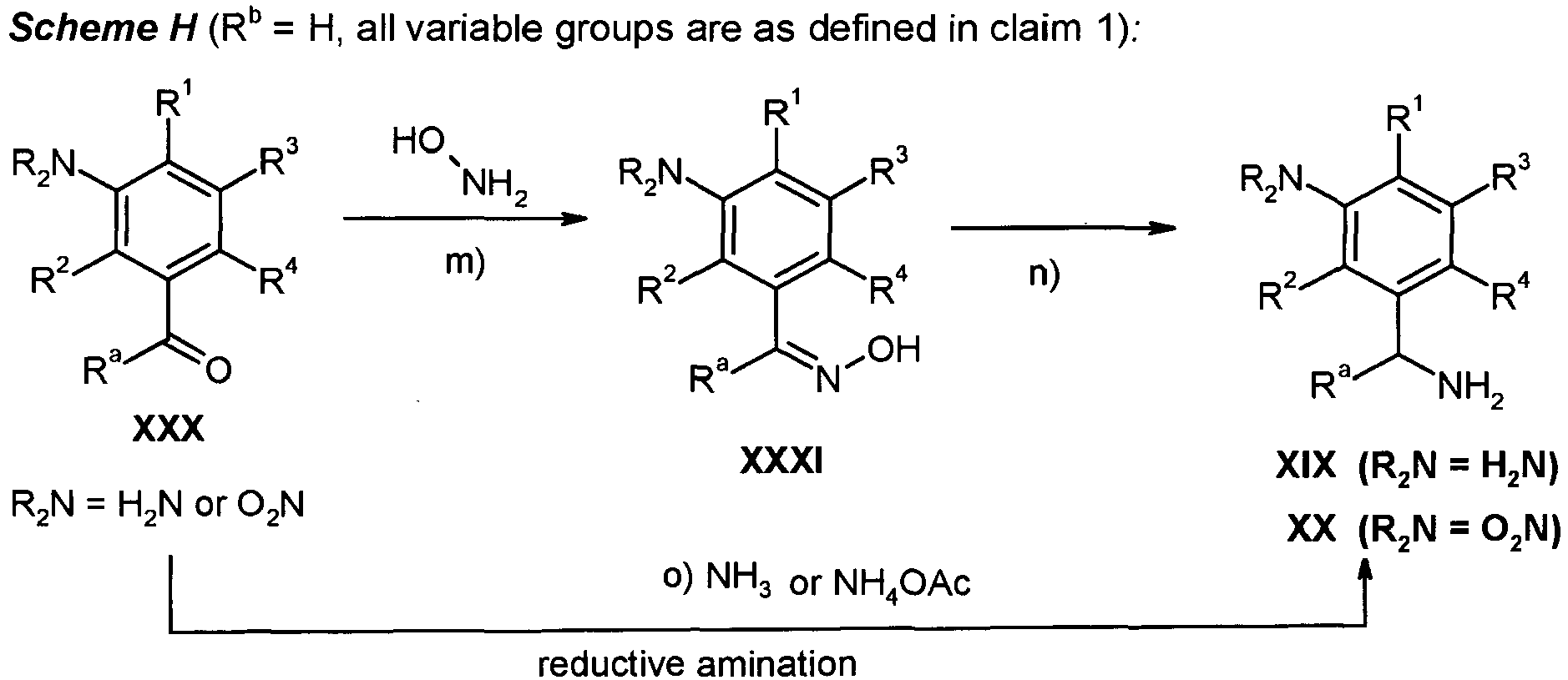
- Step m) can be performed mixing XXX with HO-NH2 in an appropriate solvent for example MeCN, DCM, THF, optionally using HCl as additive at temperatures between 0-60°C.
- Step n) can be performed applying literature known reduction conditions for example via hydrogenation preferably at 1-5 bar H2 pressure in presence of Pd/C or Ra-Ni in MeOH, EtOH or THF optionally using HCl or HOAc as catalyst, or by using SnCl2/HCl, Zn/HCl, Fe/HCl, Fe-powder/aqueous NH4Cl solution or according to procedures described in the literature for example R. Larock, Comprehensive Organic Transformations, VCH Verlagsgemeinschaft, Weinheim (1989).
- Step o) can be performed applying literature known reduction conditions e.g. using ammonia or ammonium salts (e.g. ammonium acetate) and Borane reagents, for example NaBH3CN, BH3-THF-complex or BH3-SMe2-complex in water, MeOH, EtOH, THF or mixtures thereof, under buffered conditions preferably at a pH between 5-9 or employing hydrogenations using Pd/C or Ra-Ni as catalysts in MeOH, EtOH or THF optionally using HCl or HOAc as cocatalyst or according to procedures described in the literature for example in
WO2010/100249 or R. Larock, Comprehensive Organic Transformations, VCH Verlagsgemeinschaft, Weinheim (1989). - The aim of this assay is to determine the affinity of a test compound for the mPGES-1 enzyme.
- Similar assays to measure inhibition of mPGES-1 have previously been described in the literature [1, 2].
-
- 1. Riendeau, D., R. Aspiotis, D. Ethier, Y. Gareau, E. Grimm, J. Guay, S. Guiral, H. Juteau, J. Mancini, N. Methot, J. Rubin, and R. Friesen, Inhibitors of the inducible microsomal prostaglandin E2 synthase (mPGES-1) derived from MK-886. Bioorg Med Chem Lett, 2005. 15(14): p. 3352-3355.
- 2. Cote, B., L. Boulet, C. Brideau, D. Claveau, D. Ethier, R. Frenette, M. Gagnon, A. Giroux, J. Guay, S. Guiral, J. Mancini, E. Martins, F. Masse, N. Methot, D. Riendeau, J. Rubin, D. Xu, H. Yu, Y. Ducharme, and R. Friesen, Substituted phenanthrene imidazoles as potent, selective, and orally active mPGES-1 inhibitors. Bioorg Med Chem Lett, 2007. 17(24): p. 6816-6820.
-
- Glutathione (Sigma, G-4251)
- Freeze culture in Rosetta E coli expression strain.
- LB growth media with Ampillicillin (Amp) final concentration in culture 50µg/mL
- Chloroamphenicol stock 34mg/mL (chloro) final concentration in culture 34µg/mL
- Sterile growth flasks for 500mL-1liter cultures
- 0.1 M KPi buffer pH 7.4
- 9.25% HCl
- PGH2 (0.25 mM)
- Fe (II) Cl2 tetra hydrate, 99% (Sigma, 220229)
- 384-well plate with compounds
- 96-well plate, polypropylene (Thermo fast 96 skirted VWR)
- 384-well plate polypropylene PCR plate (Greiner 785201)
- Greiner 384-well plate pp (In vitro cat. no. 781280)
- Adhesive sealing film for 96-well plates (Sigma-Aldrich)
- Aluminium foil (PCR foil, 310-0030-127-471 from Labora)
- PBS (GIBCO 14040)
- Prostaglandin E2 Assay (Cisbio,cat.no. 62P2APEC)
- Biomek FX robot (Beckman Coulter)
- Biomek NX robot (Beckman Coulter)
- Multidrop; micro or combi (ThermoLabsystems)
- Plate reader: Safire2 (Tecan)
- Microsomes from Rosetta E.coli bacteria expressing recombinant human mPGES-1 can be derived as described below:
- Inoculate 5mL LB with Amp and Chloro with bacteria from freeze culture. Incubate overnight at 37 °C with 200rpm. Thereafter, inoculate 500-800 mL LB containing Amp and Chloro with the 5 mL on culture and grow to OD640 of 0.6-0.8. Chill the culture to +4°C before induction. Induce the culture with IPTG at a final concentration of 400µM. Express the protein at room temp 18-23 °C with 200 rpm shaking overnight.
- The following steps can be performed on the following day:
- 1. Spin down the cells in 250mL centrifuge flasks for 15min at 7000rpm
- 2. Dissolve the pellet from 250mL culture in 12.5 mL homogenization buffer
- 3. Disintegrate the cells by sonication, 4X10 seconds at 35% amplitude
- 4. Add 2.5mL MgCl2 (100mM) and DNase 12.5µL (0.8mg/mL) and incubate on ice for 30 min
- 5. Spin down the bacteria debris and save the supernatant, 7000 rpm for 15 min
- 6. Isolate the protein containing membranes in the supernatant by ultracentrifugation 45000 x g for 1 hour.
- 7. Discard the supernatant and dissolve the pellet in 20mM KPi buffer and aliquot the enzyme and store aliquots at -80°C.
- Before each experiment is performed an aliquot of the enzyme is thawed and it can then be dissolved in 0.1 M KPi pH 7.4 buffer containing 2,5 mM GSH. 50 µL of this enzyme solution is subsequently dispensed in a 384-well plate at room temperature. 0.5 µL of the inhibitor dissolved in DMSO is thereafter added to each well and incubated for 25 minutes at room temperature. Subsequently, 2 µL of PGH2 dissolved in an appropriate solvent is added to each well and after one minute at room temperature, the acidified stop solution containing FeCl2 is added. 4 µL of the total volume is transferred to a separate plate and diluted 750-fold in two separate steps before quantification of PGE2.
- In order to quantitate the amount of PGE2 that has been formed, a homogenous time resolved fluorescent (HTRF) detection of PGE2 can be performed by the use of a commercially available kit from CisBio essentially according to the manufacturer's protocol. Briefly, 10 µL of the diluted sample is transferred to a white 384-well plate and the following steps can be performed in a sequential manner at room temperature or as indicated.
- 5 µL reconstitution buffer as supplied by the manufacturer is added to the negative control (NC) wells.
- The plate is covered with adhesive sealing film.
- The plate can now be centrifuged at 1200 rpm for 1 minute.
- The NC samples are covered with sealing film.
- 250µL d2 labeled PGE2 (d2-PGE2) can be diluted in 4750 µL reconstitution buffer as supplied by the manufacturer
- 250µL Eu3+-cryptate can be diluted in 4750µL reconstitution buffer as supplied by the manufacturer
- 5 µL d2-PGE2 can now be added to rows 1 to 24, by using a multidrop. The sealing film is thereafter removed from the NC wells.
- 5µL Eu3+-cryptate labeled anti-PGE2 can now be added to rows 1 to 24 by using a Multidrop.
- The plate can now be covered with sealing film.
- The plate can now be centrifuge at 1200 rpm for 1 minute and place at 4°C overnight.
- After the overnight incubation the fluorescence is measured by the use of an appropriate microplate reader. The fluorescence of Eu3+-cryptate and d2-PGE2 are measured using the following excitation and emission wavelength, europium cryptate: λmax ex = 307 nm, λmax em = 620 nm and d2: λmax ex = 620 nm, λmax em = 665 nm), respectively. The extent of the specific HTRF is measured as a ratio of the emission intensity at 665 nm vs. that at 620 nm. A standard curve using synthetic PGE2 is used to quantify the amount of PGE2 in unknown samples. The degree of inhibition can be calculated as percent inhibition by dividing the amount of PGE2 formed in unknown samples by the amount of PGE2 formed in control samples.
- Microsomes from Rosetta E.coli bacteria expressing recombinant human mPGES-1 can be derived as described below:
- Inoculate 5ml LB with Ampicilin (50 µg/ml) and Chloramphenicol (34 µg/ml) with bacteria from freeze culture. Incubate 8h at 37 °C with 200rpm. Thereafter, inoculate 500-1000 ml LB containing Ampicilin and Chloramphenicol with the 5 ml on culture and grow to OD640 of 0.8-1.0. Chill the culture to +4°C before induction. Induce the culture with IPTG at a final concentration of 400µM. Express the protein at room temp 18-23 °C with 200 rpm shaking overnight.
- The following steps can be performed on the following day:
- 1. Spin down the cells in 250ml centrifuge flasks for 15min at 7000rpm (Beckmann Coulte Avanti J-E centrifuge)
- 2. Dissolve the pellet from 250ml culture in 12.5 ml homogenization buffer
- 3. (15mM Tris-HCL pH8, 1mM EDTA pH8, 0.25mM Sucrose, 2.5mM GSH, 1Tablet Protease inhibitor per 50ml buffer)
- 4. Disintegrate the cells by sonication, 5X10 seconds at 48% amplitude of a 750W sonifier
- 5. Add 2.5ml MgCl2 (100mM) and DNase 12.5µl (0.8mg/ml) and incubate on ice for 30 min
- 6. Spin down the bacteria debris and save the supernatant, 7000 rpm for 15 min
- 7. Isolate the protein containing membranes in the supernatant by ultracentrifugation 120000 x g for 2hour at 4°C (Sorvall T880 rotor).
- 8. Discard the supernatant and dissolve the pellet in 20mM Potassium phosphate buffer pH7.4 (KH2PO4 and K2HPO4) buffer by sonication (5x10s, 30% of a 50W sonifier) and aliquot the enzyme and store aliquots at -80°C.
- Before each experiment is performed an aliquot of the enzyme is thawed and it can then be dissolved in 0.1 M Potassium phosphate buffer pH7.4 (KH2PO4 and K2HPO4) buffer containing 2,5 mM GSH.
- The aim of this assay is to determine the affinity of a test compound for the mPGES-1 enzyme.
- 47µl of recombinant human mPGES-1 (∼ 0.5 µg protein/well) containing microsomal suspension in a buffer containing GSH, (2.5 mmol/L L-Glutathione reduced, dissolved in 0.1mol/L Phosphat Buffer pH 7.4) is dispensed in a 384-well plate and thereafter 1 µl of the test compound(s) is/are added and incubated for 25 minutes at room temperature. The enzyme reaction is started by the addition of 2ul PGH2 (final conc. 2 µM) disolved in water-free Diglyme. After 60 seconds the reaction is terminated by addition of a stop solution containing FeCl2 (10µL 0.074mol/l FeCl2). The samples are diluted between 1:25 in PBS (Phosphate Buffered Saline). 10µl of the diluted samples are transferred to 384-well low volume plate. In order to quantify the amount of PGE2 that has been formed, a homogenous time resolved fluorescent (HTRF) detecting of PGE2 has been performed using a commercially available kit from Cisbio according to the manufactures recommendation. This HTRF -based assay has been described in detail (see: Goedken et al., J Biomol Screen, 2008, 13(7), 619-625). Briefly, the diluted samples are mixed with 5µl PGE2-d2 conjungate and 5µl anti-PGE2 cryptate conjungate. After an incubation period of the plates overnight, the fluorescence is measured by the use of an appropriate microplate reader.
- The fluorescence of Europium cryptate (maxex = 307 nm, maxem = 620 nm) and d2-PGE2 (maxex = 620 nm, maxem = 665 nm) are measured.
- The extent of the specific HTRF is measured as a ratio of the emission intensity at 665 nm vs. that at 620 nm at an excitation puls of 320 nm. The quantification plate contains also wells with different concentrations of PGE2 as calibration curve for the calculation of the PGE2 concentrations from the HTRF ratio values.
- From all mPGES enzyme assay the background is subtracted and the IC50 is calculated over a nonlinear regression with conventional software.
Table 1-A. mPGES-1 inhibitory effect (IC50 values in nM) of compounds of the invention in the biological assays A example IC50 [nM] example IC50 [nM] example IC50 [nM] example IC50 [nM] 1 2.5 11 140 28 24 72 11 2 19 13 2.6 29 105 73 61 3 715 14 4.8 30 300 74 144 4 24 15 3 34 100 75 8.7 5 3.8 16 15 54 6.6 76 3.1 6 215 17 24 65 15 77 10 7 74 18 79 66 10 78 1.7 8 106 19 52 68 4 79 2.4 9 143 20 >100 69 9 80 54 10 31 21 30 71 2.5 81 6.7 82 1.7 83 1.3 84 7.3 85 20 86 7.1 87 14 88 5.3 89 6.1 90 2.2 91 3.6 93 17 94 3.5 95 2.1 96 4.1 99 4.0 100 7.7 101 2.8 102 2.4 103 2.0 104 2.4 105 3.9 106 5.7 107 13 108 5.8 109 5.2 110 1.5 111 19 112 22 113 11 114 4.8 115 9.2 116 5.9 117 120 118 53 119 >100 120 266 121 60 122 7.9 123 29 124 2.6 125 32 126 6.7 127 26 128 172 129 634 130 15 132 124 133 25 Table 1-B. mPGES-1 inhibitory effect (IC50 values in nM) of compounds of the invention in the biological assays B example IC50 [nM] example IC50 [nM] example IC50 [nM] example IC50 [nM] 12 174 33 3 37 7.8 40 5.7 48 9 51 23 52 2.2 53 3.5 59 2 61 5 70 6.5 92 39 97 3.1 98 6.5 131 5 - The present invention relates to compounds of formula I which are useful in the prevention and/or treatment of a disease and/or condition in which the inhibition of prostaglandin E synthases, in particular that of the microsomal prostaglandin E2 synthase-1 (mPGES-1) is of therapeutic benefit, including but not limited to the treatment and/or prevention of inflammatory diseases and/or associated conditions.
- The term "inflammation" will be understood to include any inflammatory disease, disorder or condition per se, any condition that has an inflammatory component associated with it, and/or any condition characterised by inflammation as a symptom, including inter alia acute, chronic, ulcerative, specific, allergic and necrotic inflammation, and other forms of inflammation known to those skilled in the art. The term thus also includes, for the purposes of this invention, inflammatory pain, pain generally and/or fever.
- Where a condition has an inflammatory component associated with it, or a condition characterised by inflammation as a symptom, the skilled person will appreciate that compounds of the invention may be useful in the treatment of the inflammatory symptoms and/or the inflammation associated with the condition.
- Compounds of the invention may also have effects that are not linked to inflammatory mechanisms, such as in the reduction of bone loss in a subject. Such conditions include osteoporosis, osteoarthritis, Paget's disease and/or periodontal diseases.
- A further aspect of the present invention relates to a compound of formula I as a medicament. Another aspect of the present invention is the compounds of formula I for use in the treatment and/or prevention of a disease and/or condition in which the inhibition of the mPGES-1 is of therapeutic benefit.
- A further aspect of the present invention is the compound of formula I for use in the treatment and/or prevention of inflammatory diseases and/or associated conditions.
- The present invention also relates to the compounds of formula I for use in the treatment and/or prevention of the following diseases and conditions:
- 1. Rheumatic diseases or autoimmune diseases or muscoskeletal diseases: all forms of rheumatic diseases including e.g. soft tissue rheumatism, rheumatoid arthritis, polymyalgia rheumatica, reactive arthritis, tenosynovitis, gout or metabolic arthritis, bursitis, tendonitis, juvenile arthritis, spondyloarthropathies like e.g. spondylitis, ankylosing spondylitis, psoriatric arthropathy; sarcoidosis, fibromyalgia, myositis, polymyositis, osteoarthritis, traumatic arthritis, collagenoses of any origin e.g. systemic lupus erythematosus, scleroderma, dermatomyositis, Still's Disease, Sjögren syndrome, Felty syndrome; rheumatic fever and rheumatic heart disease, diseases of blood vessels like vasculitis, polyarthritis nodosa, Behcet's syndrome, giant cell arthritis, Wegener's granulomatosis, Henoch-Schönlein purpura; psoriatic arthritis, fungal arthritis, in particular including pain associated with any of the aforementioned conditions;
- 2. Headaches such as migraines with and without aura, tension-type headaches, cluster headaches and headaches with different origins;
- 3. Sympathetically maintained pain like complex regional pain syndrome Type I and II;
- 4. Neuropathic pain such as low back pain, hip pain, leg pain, non-herpetic neuralgia, post herpetic neuralgia, diabetic neuropathy, nerve injury-induced pain, acquired immune deficiency syndrome (AIDS) related neuropathic pain, head trauma, toxin and chemotherapy caused nerve injuries, phantom limb pain, multiple sclerosis, root avulsions, painful traumatic mononeuropathy, painful polyneuropathy, thalamic pain syndrome, post-stroke pain, central nervous system injury, post surgical pain, carpal tunnel syndrome, trigeminal neuralgia, post mastectomy syndrome, postthoracotomy syndrome, stump pain, repetitive motion pain, neuropathic pain associated hyperalgesia and allodynia, alcoholism and other drug-induced pain;
- 5. Cancer pain induced by or associated with tumors such as bone tumors, lymphatic leukemia; Hodgkin's disease, malignant lymphoma; lymphogranulomatoses; lymphosarcoma; solid malignant tumors; extensive metastases;
- 6. Visceral disorders such as chronic pelvic pain, pancreatitis, peptic ulcer, interstitial cystitis, cystitis, renal colic, angina, dysmenorrhoea, menstruation, gynaecological pain, irritable bowel disease (IBS), inflammatory bowel disease, Crohn's disease and ulcerative colitis, nephritis, prostatitis, vulvodynia, non-ulcer dyspepsia, non-cardiac chest pain, myocardial ischemia;
- 7. Inflammation associated diseases of ear, nose, mouth and throat like influenza and viral/bacterial infections such as the common cold, allergic rhinitis (seasonal and perennial), pharyngitis, tonsillitis, gingivitis, larhyngitis, sinusitis, and vasomotor rhinitis, fever, hay fever, thyroiditis, otitis, dental conditions like toothache, perioperative and post-operative conditions, trigeminal neuralgia, uveitis; iritis, allergic keratitis, conjunctivitis, blepharitis, neuritis nervi optici, choroiditis, glaucoma and sympathetic opthalmia, as well as pain thereof;
- 8. Neurological diseases such as cerebral oedema and angioedema, cerebral dementia like e.g. Parkinson's and Alzheimers disease, senile dementia; multiple sclerosis, epilepsy, drug resistant epilepsy, stroke, myasthenia gravis, brain and meningeal infections like encephalomyelitis, meningitis, including HIV as well as schizophrenia, delusional disorders, autism, affective disorders and tic disorders;
- 9. Work-related diseases like pneumoconiosis, including aluminosis, anthracosis, asbestosis, chalicosis, ptilosis, siderosis, silicosis, tabacosis and byssinosis;
- 10. Lung diseases such as asthma including allergic asthma (atopic or non-atopic) as well as exercise-induced bronchoconstriction, occupational asthma, viral- or bacterial exacerbation of asthma, other non-allergic asthmas and "wheezy-infant syndrome", Chronic obstructive pulmonary disease (COPD) including emphysema, adult respiratory distress syndrome, bronchitis, pneumonia, adult respiratory distress syndrome (ARDS), pigeon fancier's disease, farmers lung;
- 11. Skin diseases such as psoriasis and eczema, dermatitis, sunburn, burns as well as aprains and strains and tissue trauma;
- 12. Vascular and heart diseases which are inflammation- related like artheriosclerosis including cardiac transplant atherosclerosis, panarteritis nodosa, periarteritis nodosa, arteritis temporalis, Wegner granulomatosis, giant cell arthritis, reperfusion injury and erythema nodosum, thrombosis (e.g. deep vein thrombosis, renal, hepathic, portal vein thrombosis); coronary artery disease, aneurysm, vascular rejection, myocardial infarction, embolism, stroke, thrombosis including venous thrombosis, angina including unstable angina, coronary plaque inflammation, bacterial-induced inflammation including Chlamydia-induced inflammation, viral induced inflammation, and inflammation associated with surgical procedures such as vascular grafting including coronary artery bypass surgery, revascularization procedures including angioplasty, stent placement, endarterectomy, or other invasive procedures involving arteries, veins and capillaries, artery restenosis;
- 13. Diabetes-associated symptoms such as diabetic vasculopathy, diabetic neuropathy, diabetic retinopathy, post capillary resistance or diabetic symptoms associated with insulitis (e.g. hyperglycemia, diuresis, proteinuria and increased nitrite and kallikrein urinary excretion);
- 14. Benign and malignant tumors and neoplasia including cancer, such as colorectal cancer, brain cancer, bone cancer, epithelial cell-derived neoplasia (epithelial carcinoma) such as basal cell carcinoma, adenocarcinoma, gastrointestinal cancer such as lip cancer, mouth cancer, esophageal cancer, small bowel cancer, stomach cancer, colon cancer, liver cancer, bladder cancer, pancreas cancer, ovary cancer, cervical cancer, lung cancer, breast cancer, skin cancer such as squamous cell and basal cell cancers, prostate cancer, renal cell carcinoma, and other known cancers effecting epithelial cells throughout the body; neoplasias like gastrointestinal cancer, Barrett's esophagus, liver cancer, bladder cancer, pancreatic cancer, ovarian cancer, prostate cancer, cervical cancer, lung cancer, breast cancer and skin cancer; adenomatous polyps, including familial adenomatous polyposis (FAP) as well preventing polyps from forming in patients at risk of FAP.
- 15. Various other disease states and conditions like epilepsy, septic shock e.g. as antihypovolemic and/or antihypotensive agents, sepsis, osteoporosis, benign prostatic hyperplasia and hyperactive bladder, nephritis, pruritis, vitiligo, disturbances of visceral motility at respiratory, genitourinary, gastrointestinal or vascular regions, wounds, allergic skin reactions, mixed-vascular and non-vascular syndromes, septic shock associated with bacterial infections or with trauma, central nervous system injury, tissue damage and postoperative fever, syndromes associated with itching.
- Preferred according to the present invention is the compound of formula I for use in the treatment and/or prevention of pain; in particular pain that is associated with any one of the diseases or conditions listed above.
- The dose range of the compounds of formula I applicable per day is usually from 0.01 to 5000 mg, preferably from 1 to 2000 mg, more preferably from 5 to 500 mg, most preferably 10 to 250 mg. Each dosage unit may conveniently contain from 2 to 500 mg, preferably 5 to 250 mg.
- The actual pharmaceutically effective amount or therapeutic dosage will of course depend on factors known by those skilled in the art such as age and weight of the patient, route of administration and severity of disease. In any case the combination will be administered at dosages and in a manner which allows a pharmaceutically effective amount to be delivered based upon patient's unique condition.
- Suitable preparations for administering the compounds of formula will be apparent to those with ordinary skill in the art and include for example tablets, pills, capsules, suppositories, lozenges, troches, solutions, syrups, elixirs, sachets, injectables, inhalatives and powders etc. The content of the pharmaceutically active compound(s) should be in the range from 1 to 99 wt.-%, preferably 10 to 90 wt.-%, more preferably 20 to 70 wt.-%, of the composition as a whole.
- Suitable tablets may be obtained, for example, by mixing one or more compounds according to formula I with known excipients, for example inert diluents, carriers, disintegrants, adjuvants, surfactants, binders and/or lubricants. The tablets may also consist of several layers. A further aspect of the invention is a pharmaceutical formulation including a compound of formula I in admixture with a pharmaceutically acceptable adjuvant, diluent or carrier.
- The compounds according to the present invention can be combined with other treatment options known to be used in the art in connection with a treatment of any of the indications the treatment of which is in the focus of the present invention.
- Among such treatment options that are considered suitable for combination with the treatment according to the present inventions are:
- non-steroidal antiinflammatory drugs (NSAIDs) including COX-2 inhibitors;
- opiate receptor agonists;
- Cannabionoid agonists or inhibitors of the endocannabinoid pathway
- Sodium channel blockers;
- N-type calcium channel blockers;
- serotonergic and noradrenergic modulators;
- corticosteroids;
- histamine H1 receptor antagonists;
- histamine H2 receptor antagonists;
- proton pump inhibitors;
- leukotriene antagonists and 5-lipoxygenase inhibitors;
- local anesthetics;
- VR1 agonists and antagonists;
- Nicotinic acetylcholine receptor agonists;
- P2X3 receptor antagonists;
- NGF agonists and antagonists or anti-NGF antibodies;
- NK1 and NK2 antagonists;
- Bradykinin B1 antagonists
- CCR2 antagonists
- iNOS or nNOS or eNOS inhibitors
- NMDA antagonist;
- potassium channel modulators;
- GABA modulators;
- serotonergic and noradrenergic modulators;
- anti-migraine drugs;
- neuropathic pain drugs such as pregabaline or duloxetine.
- Said list is not considered to have a limiting character.
-
- Non-steroidal antiinflammatory drugs (NSAIDs) including COX-2 inhibitors: propionic acid derivatives (alminoprofen, benoxaprofen, bucloxic acid, carprofen, fenhufen, fenoprofen, flubiprofen, ibuprofen, indoprofen, ketoprofen, miroprofen, naproxen, oxaprozin, pirprofen, pranoprofen, suprofen, tiaprofenic acid, and tioxaprofen), acetic acid derivatives (indomethacin, acemetacin, alclofenac, clidanac, diclofenac, fenclofenac, fenclozic acid, fentiazac, furofenac, ibufenac, isoxepac, oxpinac, sulindac, tiopinac, tolmetin, zidometacin, and zomepirac), fenamic acid derivatives (meclofenamic acid, mefenamic acid, and tolfenamic acid), biphenyl-carboxylic acid derivatives, oxicams (isoxicam, meloxicam, piroxicam, sudoxicam and tenoxican), salicylates (acetyl salicylic acid, sulfasalazine) and the pyrazolones (apazone, bezpiperylon, feprazone, mofebutazone, oxyphenbutazone, phenylbutazone), and the coxibs (celecoxib, valecoxib, rofecoxib and etoricoxib) and the like;
- Antiviral drugs like acyclovir, tenovir, pleconaril, peramivir, pocosanol and the like.
- Antibiotic drugs like gentamicin, streptomycin, geldanamycin, doripenem, cephalexin, cefaclor, ceftazichine, cefepime, erythromycin, vancomycin, aztreonam, amoxicillin, bacitracin, enoxacin, mafenide, doxycycline, chloramphenicol and the like;
- Opiate receptor agonists: morphine, propoxyphene (Darvon), tramadol, buprenorphin and the like;
- Glucocorticosteroids such as bethamethasone, budesonide, dexamethasone, hydrocortisone, methylprednisolone, prednisolone, prednisone, triamcinolone and deflazacort; immunosuppressive, immunomodulatory, or cytsostatic drugs inlcuding but not limited to hydroxychlorquine, D-penicillamine, sulfasalizine, auranofin, gold mercaptopurine, tacrolimus, sirolimus, mycophenolate mofetil, cyclosporine, leflunomide, methotrexate, azathioprine, cyclophosphamide and glatiramer acetate and novantrone, fingolimod (FTY720), minocycline and thalidomide and the like;
- anti-TNF antibodies or TNF-receptor antagonists such as but not limited to Etanercept, Infliximab, Adalimumab (D2E7), CDP 571, and Ro 45-2081 (Lenercept), or biologic agents directed against targets such as but not limited to CD-4, CTLA-4, LFA-1, IL-6, ICAM-1, C5 and Natalizumab and the like;
- IL-1 receptor antagonists such as but not limited to Kineret;
- Sodium channel blockers: carbamazepine, mexiletine, lamotrigine, tectin, lacosamide and the like.
- N-type calcium channel blockers: Ziconotide and the like.
- Serotonergic and noradrenergic modulators: paroxetine, duloxetine, clonidine, amitriptyline, citalopram;
- Histamine H1 receptor antagonists: bromophtniramint, chlorpheniramine, dexchlorpheniramine, triprolidine, clemastine, diphenhydramine, diphenylpyraline, tripelennamine, hydroxyzine, methdiJazine, promethazine, trimeprazine, azatadine, cyproheptadine, antazoline, pheniramine pyrilamine, astemizole, terfenadine, loratadine, cetirizine, deslo- ratadine, fexofenadine and levocetirizine and the like;
- Histamine H2 receptor antagonists: cimetidine, famotidine and ranitidine and the like;
- Proton pump inhibitors: omeprazole, pantoprazole and esomeprazole and the like;
- Leukotriene antagonists and 5-lipoxygenase inhibitors: zafirlukast, mon- telukast, pranlukast and zileuton and the like;
- Local anesthetics such as ambroxol, lidocaine and the like;
- Potassium channel modulators:like retigabine;
- GABA modulators: lacosamide, pregabalin, gabapentin and the like;
- Anti-migraine drugs: sumatriptan, zolmitriptan, naratriptan, eletriptan, telcegepant and the like;
- NGF antibodies such as RI-724 and the like.
- Combination therapy is also possible with new principles for the treatment of pain e.g. P2X3 antagonists, VR1 antagonists, NK1 and NK2 antagonists, NMDA antagonists, mGluR antagonists and the like.
- The combination of compounds is preferably a synergistic combination. Synergy, as described for example by Chou and Talalay, Adv. Enzyme Regul. 22:27-55 (1984), occurs when the effect of the compounds when administered in combination is greater than the additive effect of the compounds when administered alone as a single agent. In general, a synergistic effect is most clearly demonstrated at suboptimal concentrations of the compounds. Synergy can be in terms of lower cytotoxicity, increased pharmacological effect, or some other beneficial effect of the combination compared with the individual components.
- Unless otherwise stated, one or more tautomeric forms of compounds of the examples described hereinafter may be prepared in situ and/or isolated. All tautomeric forms of compounds of the examples described hereinafter should be considered to be disclosed.
- The invention is illustrated by way of the following examples, in which the following abbreviations may be employed:
-
- AcOH
- acetic acid
- ALOX B
- aluminium oxide
- aq
- aqueous
- Boc
- tert.-butoxycarbonyl
- CE
- chromatography equipment
- CH
- cyclohexane
- conc
- concentrated
- DCM
- dichloromethane
- DIC
- N,N'-diisopropylcarbodiimide
- DIPEA
- N-ethyldiisopropylamine
- DMAP
- N,N-dimethylaminopyridine
- DMSO
- dimethylsulphoxide
- DMF
- N,N-dimethylformamide
- EDC
- 1-(3-dimethylaminopropyl)-3-ethylcarbodiimide hydrochloride
- eq.
- equivalent
- EtOAc
- ethyl acetate
- Et2O
- diethyl ether
- EtOH
- ethanol
- FA
- formic acid
- HBTU
- O-(benzotriazol-1-yl)-N,N,N',N'-tetramethyluronium hexafluorophospate
- HPLC
- high performance liquid chromatography
- i-PrOH
- isopropanol
- MeCN
- acetonitrile
- MeOH
- methanol
- MS
- mass spectrometry
- MTBE
- methyl-tert-butyl ether
- NMP
- N-Methylpyrrolidinon
- NMR
- nuclear magnetic resonance
- PE
- petrol ether
- PPA
- 1-propylphosphonic-acid cyclic anhydride
- Pd/C
- 10 % Palladium on carbon
- Pt/C
- Platinum on carbon
- Ra-Ni
- Raney-Nickel
- RP
- reversed phase
- rt
- room temperature
- Rf
- retention factor
- Rt
- retention time
- sat
- saturated
- TBTU
- O-(benzotriazol-1-yl)-N,N,N',N'-tetramethyluronium tetrafluoroborate
- TCDI
- thiocarbonyl diimidazole
- TEA
- triethylamine
- THF
- tetrahydrofuran
- TFA
- trifluoroacetic acid
- TLC
- thin layer chromatography
- The HPLC/MS data, where specified, were obtained under the following conditions:
- Agilent 1100 with quaternary pump, Gilson G215 Autosampler, HP diode array detector. The diode array detection took place in a wavelength range from 210-550 nm
- Range of mass-spectrometric detection: m/z 120 to m/z 1000
- Waters ZQ2000 MS, Alliance 2695, PDA 2996, 210-500 nm, waters 2700 AS.
- Range of mass-spectrometric detection: m/z 120 to m/z 820
- Waters ZQ2000 MS, Agilent HP 100, binary pump, waters 2700 AS.
- The diode array detection took place in a wavelength range from 210-500 nm
- Range of mass-spectrometric detection: m/z 120 to m/z 820
- Agilent 1200 with binary pump, Agilent MS 6140, HiPALS1367C
- The diode array detection took place in a wavelength range from 190-400 nm
- Range of mass-spectrometric detection: m/z 100 to m/z 1000
- Waters ZQ2000 MS, Agilent HP 100, binary pump, Gilson 215 AS.
- The diode array detection took place in a wavelength range from 210-500 nm
- Range of mass-spectrometric detection: m/z 120 to m/z 820
- Waters SQD MS, Acquity UPLC.
- The diode array detection took place in a wavelength range from 210-500 nm
- Range of mass-spectrometric detection: m/z 120 to m/z 820
- Waters Alliance 2695 Separations Module.
- Waters 2487 Dual λ Absorbance Detector (detection at 254 nm and 280 nm).
- Waters 3100 Mass Detector. Range of mass-spectrometric detection: m/z 150 to m/z 1200.
- Waters Acquity UPLC system, Waters Acquity TUV Detector (detection at 210 nm), Waters Acquity Binary Solvent Manager and Micromas Quattro micro API Mass Spectrometer.
- The following methods were used:
- CE 4 was used.
- Mobile phase: E1: water with 0.15% formic acid; E2: acetonitrile
-
time in min %E1 %E2 flow rate in mL/min 0.0 95 5 1.6 2.25 10 90 1.6 2.50 10 90 1.6 2.75 90 10 1.6 - Chromatography column: (column temperature: constant at 25°C): XBridge C18, 2.5. µm, 3.0×30 mm
- CE 4 was used.
- Mobile phase and eluent gradient: As described in method A.
- Chromatography column: (column temperature: constant at 25°C): Sunfire C18, 2.5. µm, 3.0x30 mm
- CE 2 was used.
- Mobile phase: E1: water with 0.1 % TFA; E2: acetonitrile with 0.08% TFA
-
time in min %E1 %E2 flow rate in mL/min 0.0 95 5 1.5 2.00 0 100 1.5 3.00 0 100 1.5 3.40 95 5 1.5 - Chromatography column: (column temperature: constant at 40°C): Waters sunfire C18, 3.5 µm, 4.6x50 mm
- CE 3 was used.
- Mobile phase: E1: water with 0.032% NH3; E2: MeOH
-
time in min %E1 %E2 flow rate in mL/min 0.0 95 5 1.5 2.00 0 100 1.5 - Chromatography column: (column temperature: constant at 40°C): Waters XBridge C18, 3.5 µm, 4.6x50 mm
- CE 4 was used.
- Mobile phase: E1: water with 0.15% formic acid; E2: acetonitrile
-
time in min %E1 %E2 flow rate in mL/min 0.00 95 5 1.6 2.00 50 50 1.6 2.25 10 90 1.6 2.50 10 90 1.6 2.75 95 5 1.6 - Chromatography column: (column temperature: constant at 25°C): Sunfire C18, 2.5. µm, 3.0x30 mm
- CE 4 was used.
- Mobile phase: E1: water with 0.15% formic acid; E2: acetonitrile
-
time in min %E1 %E2 flow rate in mL/min 0.00 95 5 1.6 1.00 10 90 1.6 2.50 10 90 1.6 2.75 95 5 1.6 - Chromatography column: (column temperature: constant at 25°C): Sunfire C18, 2.5. µm, 3.0x30 mm
- CE 4 was used.
- Mobile phase and eluent gradient: as described in Method E.
- Chromatography column: (column temperature: constant at 25°C): Zorbax Stable Bond C18, 1.8 µm, 3.0x30 mm
- CE 4 was used.
- Mobile phase and eluent gradient: As described in Method A.
- Chromatography column: (column temperature: constant at 25°C): Zorbax Stable Bond C18, 1.8 µm, 3.0x30 mm
- CE 4 was used.
- Mobile phase: E1: water with 0.15% formic acid; E2: acetonitrile
-
time in min %E1 %E2 flow rate in mL/min 0.0 95 5 1.6 2.00 10 90 1.6 5.00 10 90 1.6 5.50 90 10 1.6 - Chromatography column: (column temperature: constant at 25°C): Zorbax Stable Bond C18, 3.5 µm, 4.6x75 mm
- CE 3 was used.
- Mobile phase: E1: water with 0.1% TFA; E2: acetonitrile with 0.08% TFA
-
time in min %E1 %E2 flow rate in mL/min 0.0 95 5 1.5 2.00 0 100 1.5 2.50 0 100 1.5 2.60 95 5 1.5 - Chromatography column: (column temperature: constant at 40°C): Waters sunfire C18, 3.5 µm, 4.6x50 mm
- CE 3 was used.
- Mobile phase: E1: water with 0.15% HCOOH, E2: MeOH
- Eluent gradient and column as in method D:
- CE 5 was used.
- Mobile phase: E1: water with 0.1% TFA; E2: acetonitrile with 0.1% TFA
-
time in min %E1 %E2 flow rate in mL/min 0.0 95 5 1.5 2.00 0 100 1.5 2.49 0 100 1.5 2.50 95 5 1.5 - Chromatography column: (column temperature: constant at 40°C): Waters sunfire C18, 3.5 µm, 4.6x50 mm
- CE 5 was used.
- Mobile phase: E1: water with 0.032% NH3; E2: acetonitrile
-
time in min %E1 %E2 flow rate in mL/min 0.0 95 5 1.3 2.00 0 100 1.3 2.50 0 100 1.3 2.60 95 5 1.3 - Chromatography column: (column temperature: constant at 60°C): Waters XBridge C18, 1.7 µm, 2.1x50 mm
- CE 7 was used.
- Mobile phase: E1: water with 0.01% TFA; E2: acetonitrile with 0.01% TFA
-
time in min %E1 %E2 flow rate in mL/min 0.00 90 10 0.2 15.00 5 95 0.2 25.00 5 95 0.2 25.10 90 10 0.2 - Chromatography column: (column temperature: constant at 30°C): Atlantis dC18, 5 µm, 2.1x50 mm
- CE 7 was used.
- E1: water with 0.01% TFA; E2: acetonitrile with 0.01% TFA
-
time in min %E1 %E2 flow rate in mL/min 0.00 90 10 0.2 15.00 5 95 0.2 20.00 5 95 0.2 20.10 90 10 0.2 25.00 90 10 0.2 - Chromatography column: (column temperature: constant at 30°C): XBridge C18, 3.5 µm, 2.1x50 mm
- CE 8 was used.
- Mobile phase: E1: water with 0.1 % HCOOH; E2: acetonitrile with 0.1 % HCOOH
-
time in min %E1 %E2 flow rate in mL/min 0.00 95 5 0.2 10.00 2 98 0.2 15.00 2 98 0.2 15.50 95 5 0.2 20.00 95 5 0.2 - Chromatography column: (column temperature: constant at 30°C): Acquity UPLC BEH C18, 1.7 µm, 2.1x50 mm
- CE 5 was used.
- Mobile phase: E1: water with 0.1 % TFA; E2: MeOH
-
time in min %E1 %E2 flow rate in mL/min 0.0 80 20 2.0 1.70 0 100 2.0 2.50 0 100 2.0 2.60 80 20 2.0 - Chromatography column: (column temperature: constant at 60°C): Waters sunfire C18, 3.5 µm, 4.6x50 mm
- In the mass spectra in general only the m/z-peak of the main isotope is cited. For all compounds where mass spectra data is given, the isotope patterns are in analogy to the natural occurance of the elements which are present in the given compound.
-
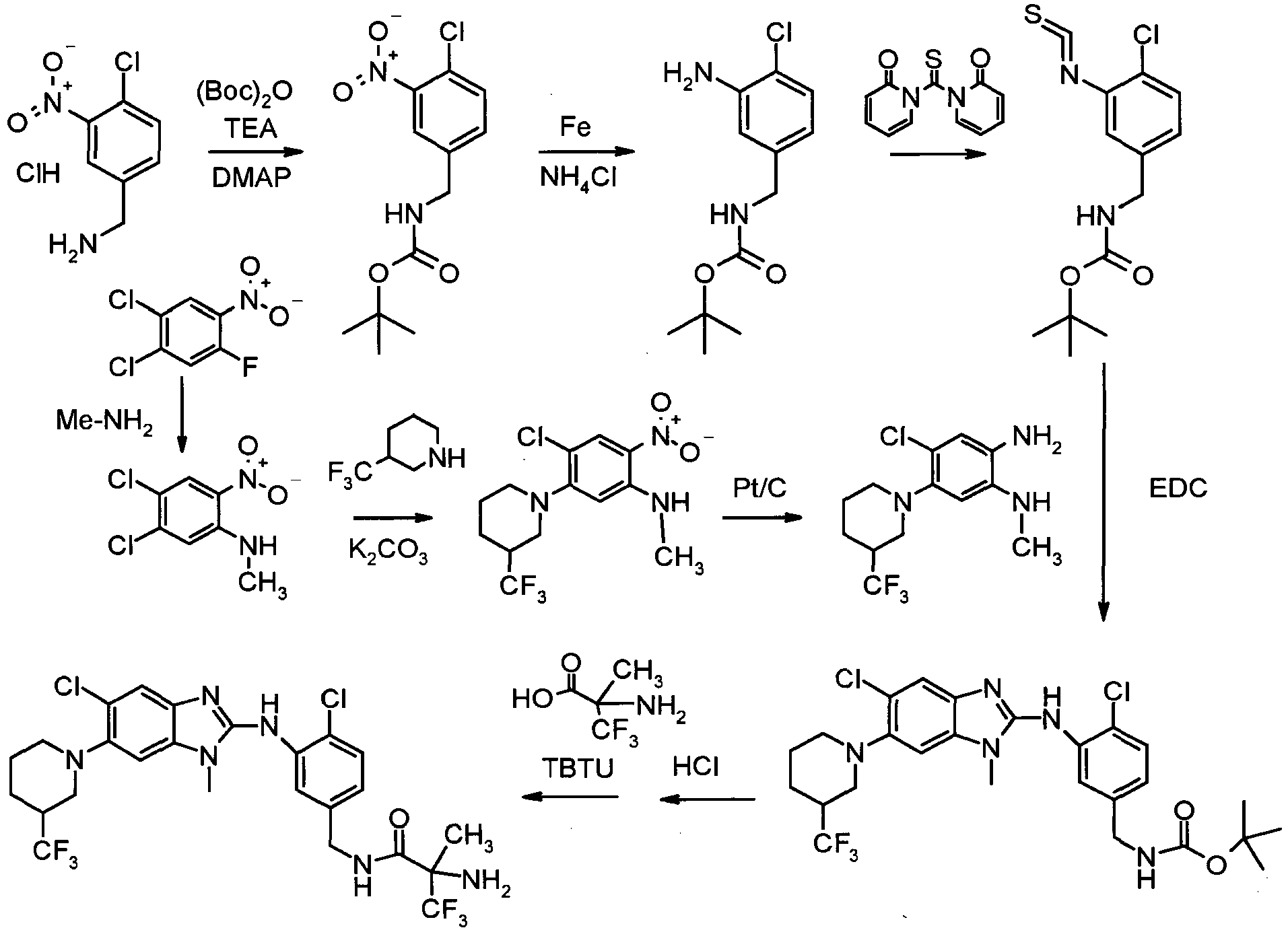
- TEA (3.12 mL, 22.4 mmol) followed by DMAP (0.14 g, 1.1 mmol) were added to (4-chloro-3-nitrophenyl)methanamine hydrochloride (5.00 g, 22.4 mmol) in DCM (30 mL). The mixture was cooled to 0°C and BOC-anhydride (5.87 g, 26.9 mmol) in DCM (15 mL) was added. After stirring at 0°C for 30 min and further 18 h at rt the reaction mixture was poured into ammonia (10%). The mixture was extracted with DCM. The combined extracts were washed with brine, dried over Na2SO4 and concentrated to give the sub-title compound.
Yield: 5.66 g (88%). Rf(TLC): 0.75 (silica gel, DCM:EtOH 98:2) - Sat. aq. NH4Cl (50 mL) followed by iron powder (5.51 g, 98.7 mmol) were added at rt to a mixture of tert-butyl 4-chloro-3-nitrobenzylcarbamate (5.66 g, 19.7 mmol) and EtOH (50 mL). After stirring for 4 h at 80°C, 4 h at 90°C and at rt overnight the reaction mixture was filtered through celite and washed with EtOAc. The aq. layer was extracted with EtOAc. The combined extracts were washed with brine, dried over Na2SO4 and concentrated to give the sub-title compound.
Yield: 5.02 g (99%). Rf(TLC): 0.33 (silica gel, DCM:EtOH 98:2). MS m/z: 257 [M+H]+. - Tert-butyl 3-amino-4-chlorobenzylcarbamate (2.57 g, 10.0 mmol) was added to a mixture of 1,1'-thiocarbonyldi-2-pyridone (2.55 g, 11.0 mmol) and DCM (90 mL) and it was stirred at rt for 4 h. The mixture was diluted with DCM and filtered over silica gel. The organic layer was concentrated to give the sub-title compound.
Yield: 2.73 g (91%). Rf(TLC): 0.88 (silica gel, PE:EtOAc 1:1). MS m/z: 297 [M-H]-. - 1,2-Dichloro-4-fluoro-5-nitrobenzene (5.00 g, 23.8 mmol) in DMF (5.0 mL) was added to methylamine (10% in toluene, 80.0 g, 258 mmol) and stirred at rt overnight. The reaction mixture was filtered through a pad of ALOX B, washed with DMF/MeOH and concentrated to give the sub-title compound.
Yield: 5.22 g (99%). HPLC-method C: Rt= 2.70 min. MS m/z: 221 [M]+. - 3-(Trifluoromethyl)piperidine (0.69 g, 4.5 mmol) followed by potassium carbonate (1.25 g, 9.1 mmol) were added to 4,5-dichloro-N-methyl-2-nitroaniline (1.00 g, 4.5 mmol) in DMF (15 mL). The reaction mixture was stirred 5 h at 80°C and overnight at 70°C. After addition of further 1.5 eq of potassium carbonate the mixture was stirred 2 h at rt and 2 days at 100°C. The reaction mixture was filtered through a pad of ALOX B and concentrated. The crude was purified by chromatography to give the sub-title compound.
Yield: 1.01 g (66%). Rf(TLC): 0.36 (silica gel, CH:EtOAc 5:1). HPLC-method C: Rt= 2.94 min. MS m/z: 336 [M-H]-. - A mixture of 4-chloro-N-methyl-2-nitro-5-(3-(trifluoromethyl)piperidin-1-yl)aniline (250 mg, 0.7 mmol), THF (6 mL), MeOH (6 mL) and Pt/C (50 mg) was stirred for 4 h at 35°C under a hydrogen atmosphere (3.2 bar). The catalyst was removed by filtration and the mixture was concentrated to give the sub-title compound.
Yield: 205 mg (90%). HPLC-method C: Rt= 2.05 min. MS m/z: 308 [M+H]+. - Tert-butyl 4-chloro-3-isothiocyanatobenzylcarbamate (938 mg, 3.1 mmol) was added to 5-chloro-2-methylamino-4-(3-(trifluoromethyl)piperidin-1-yl)aniline (920 mg, 3.0 mmol) in MeCN (20 mL). The mixture was stirred for 4 h at rt, then EDC (582 µL, 3.3 mmol) was added and it was stirred overnight. The reaction mixture was purified by chromatography to give the subtitle compound.
Yield: 700 mg (41%). HPLC-method C: Rt= 2.34 min. MS m/z: 572 [M]+. - 4 M HCl in dioxane (20 mL) was added to tert-butyl N-{4-chloro-3-[5-chloro-1-methyl-6-(3-(trifluoromethyl)piperidin-1-yl)-1H-benzo[d]imidazol-2-ylamino]benzyl}-carbamate (700 mg, 1.2 mmol) in dioxane (20 mL). The reaction mixture was stirred at rt for 2 h then diluted with water and aq. K2CO3-solution and stirred for 1 h at rt. The mixture was concentrated, filtered and the filtercake was washed with water and dried to give the sub-title compound.
Yield: 570 mg (99%). HPLC-method C: Rt= 1.83 min. MS m/z: 472 [M+H]+. - TBTU (106 mg, 0.3 mmol) followed by TEA (126 µL, 0.9 mmol) were added to 2-amino-3,3,3-trifluoro-2-methylpropanoic acid (57 mg, 0.4 mmol) in DMF (2 mL). After 5 min at rt a mixture of 4-chloro-3-[5-chloro-1-methyl-6-(3-(trifluoromethyl)piperidin-1-yl)-1H-benzo[d]imidazol-2-ylamino]benzylamine (142 mg, 0.3 mmol) and DMF (2 mL) was added to the reaction mixture and stirred at rt overnight. The reaction mixture was purified by chromatography to give the title compound.
Yield: 104 mg (57%). HPLC-method D: Rt= 2.77 min. MS m/z: 611 [M+H]+. -

- TEA (8.00 mL, 57.5 mmol) followed by pivaloyl chloride (2.80 mL, 22.8 mmol) in THF (25 mL) were added to 4-chloro-3-nitrobenzylamine hydrochloride (5.00 g, 22.4 mmol) in THF (100 mL). The reaction mixture was diluted with THF and stirred at rt for 1.5 h. The mixture was filtered and washed. The filtrate was concentrated to give the sub-title compound.
Yield: 5.92 g (98%). HPLC-method A: Rt= 1.911 min. MS m/z: 271 [M+H]+. - A mixture of N-(4-chloro-3-nitrobenzyl)-2,2-dimethyl-propionamide (5.92 g, 21.9 mmol), THF (150 mL) and Ra-Ni (1.50 g) was stirred for 2 days at RT under a hydrogen atmosphere (3.0 bar). The catalyst was removed by filtration and the mixture was concentrated. The crude was purified by chromatography to give the sub-title compound.
Yield: 4.31 g (82%). Rf(TLC): 0.68 (silica gel, DCM:EtOH 9:1). MS m/z: 241 [M+H]+. - 1,1'-Thiocarbonyldi-2-pyridone (2.12 g, 9.1 mmol) was added to a mixture of N-(3-amino-4-chlorobenzyl)-2,2-dimethyl-propionamide (2.00 g, 8.3 mmol) and DCM (60 mL) and stirred at rt for 1.5 h. The mixture was filtered over silica gel. The organic layer was concentrated to give the sub-title compound.
Yield: 1.48 g (63%). Rf(TLC): 0.73 (silica gel, DCM:EtOH 9:1). - 3,3-Difluoropyrrolidine hydrochloride (3.12 g, 21.7 mmol) followed by potassium carbonate (4.00 g, 29.0 mmol) were added to 4,5-dichloro-2-nitroaniline (3.00 g, 14.5 mmol) in DMF (60 mL). The reaction mixture was stirred at 130°C over the weekend. After cooling the reaction mixture was poured into ice-water and extracted with EtOAc. The combined organic layers were washed with water, dried, concentrated and the crude was purified by chromatography to give the sub-title compound.
Yield: 1.73 g (31%). Rf(TLC): 0.33 (silica gel, PE:EtOAc 7:3). MS m/z: 278 [M+H]+. - A mixture of 4-chloro-5-(3,3-difluoropyrrolidin-1-yl)-2-nitroaniline (300 mg, 1.1 mmol), THF (10 mL) and Pd/C (20 mg) was stirred for 1.5 days at RT under a hydrogen atmosphere (3.0 bar). The catalyst was removed by filtration. To the filtrate was added 4 M HCl in dioxane (10 mL).The mixture was concentrated and used in the next step without further purification.
Yield: 340 mg (98%). MS m/z: 248 [M+H]+. HPLC-method A: Rt= 1.40 min - 4-Chloro-5-(3,3-difluoropyrrolidin-1-yl)benzene-1,2-diamine dihydrochloride (340 mg, 1.1 mmol) was added to N-(4-chloro-3-isothiocyanatobenzyl)-2,2-dimethyl-propionamide (300 mg, 1.1 mmol) in MeCN (10 mL) and stirred at rt overnight. After additon of DIPEA (0.41 µL, 2.3 mmol) the reaction mixture was stirred at rt for 4.5 h. The mixture was concentrated. The crude was purified by chromatography to give the sub-title compound.
Yield: 140 mg (25%). Rf(TLC): 0.47 (silica gel, DCM:EtOH 9:1). - DIC (50 µL, 0.3 mmol) was added to a mixture of N-{4-chloro-3-[2-amino-5-chloro-4-(3,3-difluoropyrrolidin-1-yl)phenyl]thioureido]-benzyl}-2,2-dimethyl-propionamide (140 mg, 0.3 mmol) and MeCN (4 mL). After 1.5 h at 60°C the reaction mixture was allowed to cool and was concentrated. The crude was purified by chromatography to give the title compound.
Yield: 22 mg (17%). Rf(TLC): 0.33 (silica gel, DCM:EtOH 9:1). MS m/z: 496 [M+H]+. -

- Potassium carbonate (500 mg, 3.6 mmol) was added to a mixture of 3-dimethylaminomethyl-pyrrolidine (450 mg, 3.5 mmol) and 4,5-dichloro-2-nitroaniline (500 mg, 2.4 mmol) in DMSO (5 mL). The reaction mixture was stirred at 120°C overnight, diluted with EtOAc and washed with water and brine. The organic layer was dried over Na2SO4 and concentrated.
Yield: 630 mg (87%). Rf(TLC): 0.15 (silica gel, DCM:EtOH 95:5). HPLC-method B: Rt= 1.28 min. MS m/z: 299 [M+H]+. - A mixture of 4-chloro-5-(3-dimethylaminomethyl-pyrrolidin-1-yl)-2-nitroaniline (630 mg, 2.1 mmol), EtOAc (20 mL) and Ra-Ni (150 mg) was stirred for 2 days at rt under a hydrogen atmosphere (3.0 bar). The catalyst was removed by filtration and the filtrate was concentrated. The crude was purified by chromatography to give the sub-title compound. Yield: 480 mg (85%). Rf(TLC): 0.50 (silica gel, DCM:EtOH:NH4OH 80:20:2). HPLC-method E:
Rt= 0.11 min. MS m/z: 269 [M+H]+. - (4-Chloro-3-isothiocyanato-benzyl)-carbamic acid tert-butyl ester (111 mg, 0.4 mmol) was added to 4-chloro-5-(3-dimethylaminomethyl-pyrrolidin-1-yl)-benzene-1,2-diamine (100 mg, 0.4 mmol) in DMF (3 mL). The mixture was stirred at rt overnight, DIC (62.4 µL, 0.4 mmol) was added and stirring was continued at 80°C for 3 h. The mixture was concentrated and the crude was purified by chromatography to give the sub-title compound.
Yield: 150 mg (76%). Rf(TLC): 0.30 (silica gel, DCM:EtOH:NH4OH 90:10:1). HPLC-method F: Rt= 1.01 min. MS m/z: 533 [M+H]+. - 6 M aq. HCl-solution (1.0 ml) was added to N-{4-chloro-3-[5-chloro-6-(3-dimethylaminomethyl-pyrrolidin-1-yl)-1H-benzimidazol-2-ylamino]-benzyl}-carbamic acid tert-butyl ester (130 mg, 0.2 mmol) in THF (2 mL) and stirred at 50°C for 1 h. The reaction mixture was concentrated to give the sub-title compound.
Yield: 160 mg. Rf(TLC): 0.35 (silica gel, DCM:EtOH:NH4OH 80:20:2). HPLC-method E: Rt= 0.20 min. MS m/z: 433 [M+H]+. - Pivaloyl chloride (10 µL, 0.1 mmol) was added to a mixture of 4-chloro-3-[5-chloro-6-(3-dimethylaminomethyl-pyrrolidin-1-yl)-1H-benzimidazol-2-ylamino]-benzylamine (60 mg) and TEA (150 µL, 1.1 mmol) in THF (5 mL) and stirred at rt overnight. The reaction mixture was diluted with EtOAc and washed with sat.aq. NaHCO3. The organic layer was dried over Na2SO4 and concentrated. The crude was purified by chromatography to give the title compound.
Yield: 30 mg (56%). Rf(TLC): 0.85 (silica gel, DCM:EtOH:NH4OH 80:20:2). HPLC-method E: Rt= 0.45 min. MS m/z: 517 [M+H]+. -

- The sub-title compound was prepared from 4,5-dichloro-2-nitroaniline (470 mg, 2.3 mmol), 5-aza-spiro[2.4]heptane (320 mg, 3.3 mmol) and potassium carbonate (470 mg, 3.4 mmol) in DMSO (5 mL) in analogy to example 3, step (a).
Yield: 550 mg (91%). Rf(TLC): 0.85 (silica gel, DCM:EtOH 99:1). HPLC-method F: Rt= 1.01 min. MS m/z: 533 [2M+H]+. - A mixture of 5-(5-aza-spiro[2.4]hept-5-yl)-4-chloro-2-nitro-phenylamine (550 mg, 2.1 mmol), EtOAc (20 mL) and Ra-Ni (150 mg) was stirred for 21 h at RT under a hydrogen atmosphere (3 bar). After addition of further catalyst the hydrogenation was continued at rt for 7 h. The catalyst was removed by filtration. The filtrate was acidified with 1.25 M HCl in EtOH (6 mL) and concentrated to give the sub-title compound.
Yield: 620 mg. Rf(TLC): 0.05 (silica gel, DCM:EtOH 99:1). HPLC-method F: Rt= 0.77 min. MS m/z:238[M+H]+. - TEA (130 µL, 0.9 mmol) followed by 4-(5-aza-spiro[2.4]hept-5-yl)-5-chloro-benzene-1,2-diamine (80 mg) were added to (4-chloro-3-isothiocyanato-benzyl)-carbamic acid tert-butyl ester (example 1, step(c), 69 mg, 0.2 mmol) in DMF (3 mL). The reaction mixture was stirred at rt overnight, then concentrated and purified by chromatography to give the sub-title compound.
Yield: 60 mg (52%). Rf(TLC): 0.40 (silica gel, DCM:EtOH 95:5). HPLC-method F: Rt= 1.25 min. MS m/z: 502 [M+H]+. - The sub-title compound was prepared in analogy to example 3, step(d) from {3-[6-(5-azaspiro[2.4]hept-5-yl)-5-chloro-1H-benzimidazol-2-ylamino]-4-chloro-benzyl}-carbamic acid tert-butyl ester (50 mg, 0.1 mmol) and 6 M aq. HCl (0.40 mL) in THF (2 mL).
Yield: 60 mg. Rf(TLC): 0.25 (silica gel, DCM:EtOH:NH4OH 90:10:1). - The sub-title compound was prepared from 3-[6-(5-aza-spiro[2.4]hept-5-yl)-5-chloro-1H-benzimidazol-2-ylamino]-4-chloro-benzylamine (60 mg, 0.1), pivaloyl chloride (20 µL, 0.1 mmol) and TEA (160 µL, 1.1 mmol) in THF (5 mL) in analogy to example 3, step (e).
Yield: 40 mg. Rf(TLC): 0.80 (silica gel, DCM:EtOH:NH4OH 90:10:1). HPLC-method G: Rt= 1.36 min. MS m/z: 486 [M+H]+. -

- Water (110 mL) was added to N-(2,6-dichloro-3-methyl-phenyl)-acetamide (13 g, 59 mmol) in pyridine (30 mL). The mixture was heated to 70°C and KMnO4 (47 g, 298 mmol) was cautiously added portionwise. After 6 h at reflux the reaction mixture was filtered through a pad of celite and washed with hot water. The filtrate was cooled to rt, concentrated and slowly acidified with 6 M aq. HCl solution. The mixture was cooled in an ice bath, filtered and the filtercake was washed with cold water and dried to give the sub-title compound.
Yield: 11.6 g (78%). Rf = 0.1 (silica gel, DCM:EtOH 9:1). MS m/z: 248 [M+H]+. - 3-Acetylamino-2,4-dichloro-benzoic acid (21.0 g, 84.6 mmol) was stirred in 6 M aq. HCl-solution (120 mL) and acetic acid (250 mL) at reflux for 24 h. The reaction mixture was cooled, concentrated, diluted with water and concentrated again. The residue was diluted with water, stirred under cooling and filtered. The filtercake was washed and dried to give the sub-title compound.
Yield: 16.8 g (96%). MS m/z: 204 [M-H]-. HPLC-method C: Rt= 1.46 min. - (1-Chloro-2-methyl-propenyl)-dimethyl-amine (16.1 mL, 116 mmol) was added to 3-amino-2,4-dichloro-benzoic acid (20.0 g, 97.1 mmol) in THF (320 mL). After 4 h at rt the mixture was added dropwise to conc. NH3 (320 mL) and stirred at rt overnight. The reaction mixture was concentrated, cooled and filtered. The filtercake was dried to give the sub-title compound.
Yield: 17.4 g (87%). MS m/z: 205 [M+H]+. HPLC-method C: Rt= 1.19 min. - 3-Amino-2,4-dichloro-benzamide (2.00 g, 9.8 mmol) in THF (45 mL) was added dropwise to LiAlH4 (1 M in THF, 24.4 mL) in THF (45 mL). The reaction mixture was stirred for 1 h at rt and 10 h at reflux. Excess LiAlH4 was carefully destroyed under cooling as described by L.F.Fieser & M. Fieser Vol 1, p 584 Wiley 1967. After 30 min the mixture was filtered and the filtrate was concentrated to give the sub-title compound.
Yield: 1.85 g (99%). Rf = 0.12 (silica gel, DCM:EtOH 95:5). MS m/z: 191 [M+H]+. - 3-Amino-2,4-dichloro-benzylamine (2.28 g, 11.9 mmol) was added to a mixture of 2,2-dimethyl-propionic acid chloride (1.47 mL, 11.9 mmol) and TEA (4.14 mL, 29.8 mmol) in THF (90 mL) and it was stirred for 3 h. The reaction mixture was concentrated, diluted with EtOAc, washed with 5% aq. NaHCO3 solution and water, dried with Na2SO4 filtered and concentrated to give the sub-title compound.
Yield: 3.1 g (94%). Rf= 0.61 (silica gel, DCM:EtOH 95:5). - 1,1'-Thiocarbonyldi-2-pyridone (4.87 g, 21 mmol) was added to a mixture of N-(3-amino-2,4-dichloro-benzyl)- 2,2-dimethyl-propionamide (5.50 g, 20 mmol) and dioxane (200 mL) and stirred at rt for 2 h and at reflux for 8 h. The mixture was concentrated, diluted with DCM and filtered over silica gel. The filtrate was concentrated to give the sub-title compound.
Yield: 6.00 g (95%). HPLC-method B: Rt= 1.58 min. MS m/z: 318 [M+H]+. - The sub-title compund was prepared from 4,5-dichloro-2-nitro-N-methyl-aniline (820 mg, 3.7 mmol), 4-trifluoromethyl-piperidine (680 mg, 4.5 mmol) and potassium carbonate (770 mg, 5.6 mmol) in DMSO (10 mL) in analogy to example 3, step (a).
Yield: 1.07 g (85%). Rf(TLC): 0.15 (silica gel, PE:EtOAc 9:1). MS m/z: 338 [M+H]+. HPLC-method G: Rt= 1.70 min - A mixture of 4-chloro-N-methyl-2-nitro-5-(4-trifluoromethyl-piperidin-1-yl)aniline (1.07 g, 3.2 mmol), THF (20 mL), MeOH (30 mL) and Pt/C (100 mg) was stirred for 6 h at rt under a hydrogen atmosphere (3 bar). The catalyst was removed by filtration and the mixture was concentrated to give the sub-title compound.
Yield: 1.00 g. Rf(TLC): 0.25 (silica gel, DCM). HPLC-method G: Rt= 1.30 min. MS m/z: 308 [M+H]+. - N-(2,4-Dichloro-3-isothiocyanato-benzyl)-2,2-dimethyl-propionamide (120 mg, 0.4 mmol) was added to (4-chloro-2-methylamino-5-(4-trifluoromethyl-piperidin-1-yl)aniline (110 mg, 0.4 mmol) in DMF (2 mL). After 3 h at rt DIC (74 µL, 0.5 mmol) was added to the reaction mixture and it was stirred at 80°C for 5.5 h. Additional DIC (40 µL, 0.3 mmol) was added and stirring was continued at 100°C overnight. The reaction mixture was concentrated and the crude was purified by chromatography to give the title compound.
Yield: 140 mg (65%). Rf(TLC): 0.35 (silica gel, DCM:EtOH 95:5). MS m/z: 590 [M+H]+. HPLC-method G: Rt= 1.44 min. -

- Potassium carbonate (1.00 g, 7.3 mmol) was added to a mixture of pyrrolidine-2-carboxylic acid dimethylamide (1.00 g, 7.0 mmol) and 4,5-dichloro-2-nitroaniline (1.00 g, 4.8 mmol) in DMSO (6 mL). The reaction mixture was stirred at 120°C for 2.5 h, diluted with EtOAc and washed with water and sat.aq. NaCl. The organic layer was dried over Na2SO4, concentrated and the crude was purified by chromatography to give the sub-title compound.
Yield: 1.18 g (78%). Rf(TLC): 0.15 (silica gel, DCM:EtOH 98:2). MS m/z: 313 [M+H]+. - Tin dichloride dihydrate (710 mg, 3.1 mmol) was added to 4-chloro-5-(2-dimethylcarbamoyl-pyrrolidin-1-yl)-2-nitroaniline (200 mg, 0.6 mmol) in EtOAc (5 mL). The reaction mixture was stirred at reflux for 3 h, cooled and poured into sat.aq. NaHCO3-solution.The mixture was filtered through a pad of celite. The organic layer was dried over Na2SO4 and concentrated to give the sub-title compound.
Yield: 75 mg (42%). Rf(TLC): 0.40 (silica gel, DCM:EtOH:NH4OH 90:10:1). MS m/z: 283 [M+H]+. HPLC-method F: Rt= 0.84 min. - N-(4-Chloro-3-isothiocyanatobenzyl)-2,2-dimethyl-propionamide (75 mg, 0.3 mmol), which was prepared as described in example 2 step(c), was added to 1-(4,5-diamino-2-chloro-phenyl)-pyrrolidine-2-carboxylic acid dimethylamide (75 mg, 0.3 mmol) in DMF (2 mL) and stirred at rt overnight. DIC (45 µL, 0.3 mmol) was added to the reaction mixture and stirring was continued for 5 h at 80°C. The mixture was concentrated and the crude was purified by chromatography to give the title compound.
Yield: 60 mg (43%). Rf(TLC): 0.20 (silica gel, DCM:EtOH 95:5). MS m/z: 531 [M+H]+. HPLC-method F: Rt= 1.09 min. -
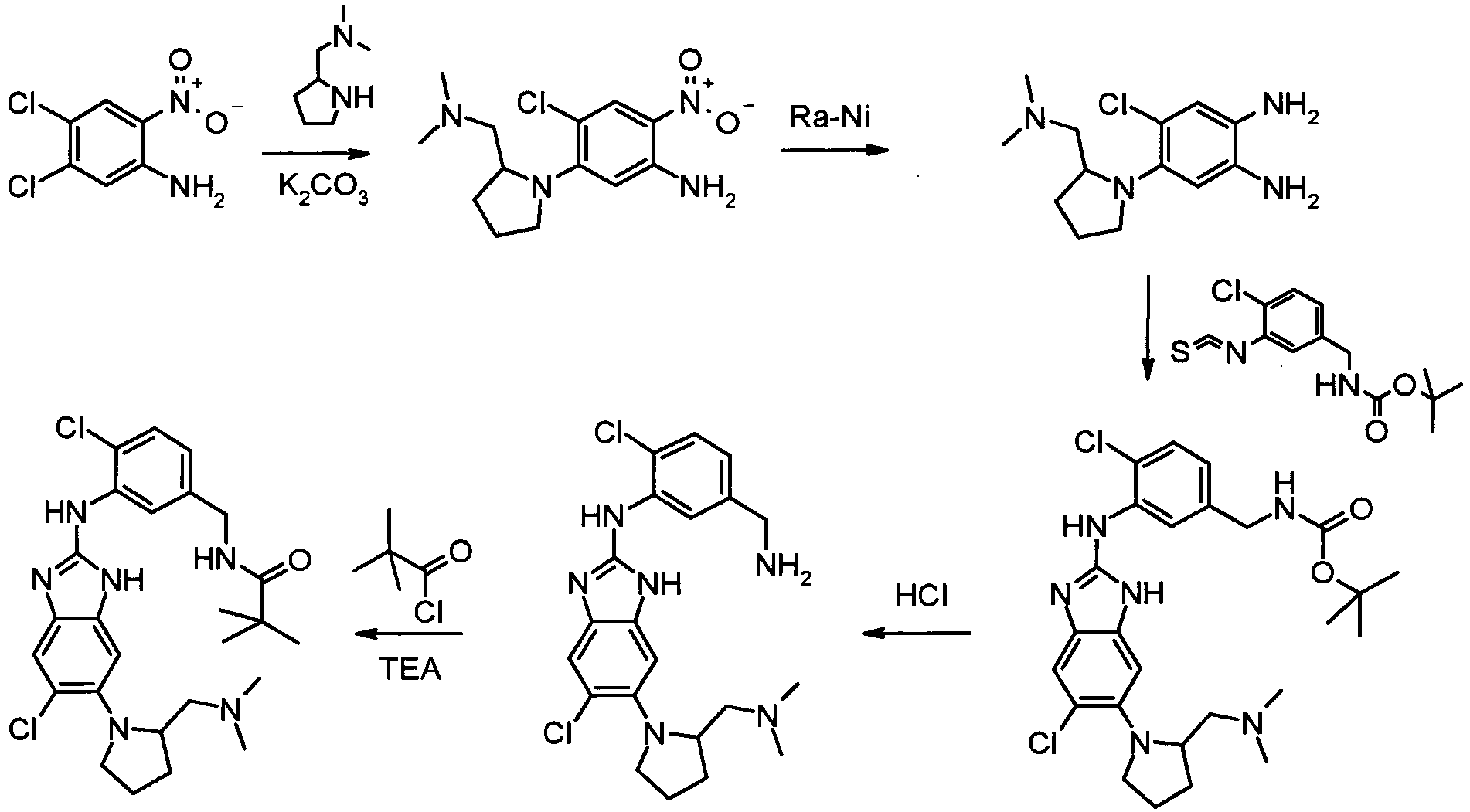
- The sub-title compound was prepared from 2-dimethylaminomethyl-pyrrolidine (270 mg, 2.1 mmol), 4,5-dichloro-2-nitroaniline (300 mg, 1.5 mmol) and potassium carbonate (300 mg, 2.2 mmol) in DMSO (3 mL) in analogy to the method described in example 3 step(a).
Yield: 220 mg (51%). Rf(TLC): 0.05 (silica gel, DCM:EtOH 99:1) - A mixture of 4-chloro-5-(2-dimethylaminomethyl-pyrrolidin-1-yl)-2-nitroaniline (150 mg, 0.5 mmol), EtOAc (10 mL) and Ra-Ni (50 mg) was stirred for 19 h at rt under a hydrogen atmosphere (3.0 bar). Further catalyst was added and the hydrogenation was continued for 6 h at 40°C. The catalyst was removed by filtration, the filtrate was acidified with 1.25 M HCl in EtOH and concentrated to give the sub-title compound.
Yield: 180 mg. Rf(TLC): 0.15 (silica gel, DCM:EtOH:NH4OH 90:10:1). MS m/z: 269 [M+H]+. - (4-Chloro-3-isothiocyanato-benzyl)-carbamic acid tert-butyl ester (68 mg, 0.2 mmol) followed by TEA (160 µL, 1.2 mmol) were added to 4-chloro-5-(2-dimethylaminomethyl-pyrrolidin-1-yl)-benzene-1,2-diamine (95 mg) in DMF (3 mL). The mixture was stirred at rt for 4 h and then purified by chromatography to give the sub-title compound.
Yield: 20 mg (16%). Rf(TLC): 0.30 (silica gel, DCM:EtOH:NH4OH 90:10:1). HPLC-method F: Rt= 1.01 min. MS m/z: 533 [M+H]+. - The sub-title compound was prepared from {4-chloro-3-[5-chloro-6-(2-dimethylaminomethyl-pyrrolidin-1-yl)-1H-benzimidazol-2-ylamino]-benzyl}-carbamic acid tert-butyl ester (20 mg, 0.04 mmol) and 6 M aq. HCl-solution (1.0 ml) in THF (2 mL) in analogy to example 3 step(d).
Yield: 30 mgRf(TLC): 0.40 (silica gel, DCM:EtOH:NH4OH 80:20:2). - The title compound was prepared analogously to example 3 step(e) from 4-chloro-3-[5-chloro-6-(2-dimethylaminomethyl-pyrrolidin-1-yl)-1H-benzimidazol-2-ylamino]-benzylamine (30 mg), pivaloyl chloride (10 µL, 0.06 mmol) and TEA (70 µL, 0.54 mmol) in THF (2 mL).
Yield: 20 mg (75%). Rf(TLC): 0.90 (silica gel, DCM:EtOH:NH4OH 80:20:2). HPLC-method E: Rt= 1.42 min. MS m/z: 517 [M+H]+. -

- Potassium carbonate (2.93 g, 21.3 mmol) was added to a mixture of pyrrolidine-3-carbonitrile hydrochloride (1.41 g, 10.6 mmol) and 4,5-dichloro-2-nitroaniline (2.00 g, 9.7 mmol) in DMF (8 mL). The reaction mixture was stirred at 120°C overnight, diluted with EtOAc and washed with water and brine. The organic layer was dried over Na2SO4, concentrated and the crude was purified by chromatography to give the sub-title compound.
Yield: 1.18 g (78%). Rf(TLC): 0.25 (silica gel, DCM). MS m/z: 267 [M+H]+. HPLC-method G: Rt= 1.33 min. - Tin dichloride dihydrate (410 mg, 1.8 mmol) was added to 1-(5-amino-2-chloro-4-nitro-phenyl)-pyrrolidine-3-carbonitrile (100 mg, 0.4 mmol) in EtOAc (5 mL). The reaction mixture was stirred at reflux for 1.5 h, cooled, diluted with EtOAc and water and basified with conc. ammonia. The mixture was filtered through a pad of celite. The organic layer was dried over Na2SO4 and concentrated to give the sub-title compound.
Yield: 75 mg (42%). Rf(TLC): 0.40 (silica gel, DCM:EtOH:NH4OH 90:10:1). MS m/z: 283 [M+H]+. HPLC-method F: Rt= 0.84 min. - The title compound was prepared from N-(4-chloro-3-isothiocyanatobenzyl)-2,2-dimethyl-propionamide (66 mg, 0.2 mmol), 1-(4,5-diamino-2-chloro-phenyl)-pyrrolidine-3-carbonitrile (55 mg, 0.2 mmol) in DMF (2 mL) and DIC (39 µL, 0.2 mmol) in analogy to example 6 step(c).
Yield: 50 mg (44%). Rf(TLC): 0.35 (silica gel, DCM:EtOH 95:5). MS m/z: 485 [M+H]+. HPLC-method G: Rt= 1.22 min. -
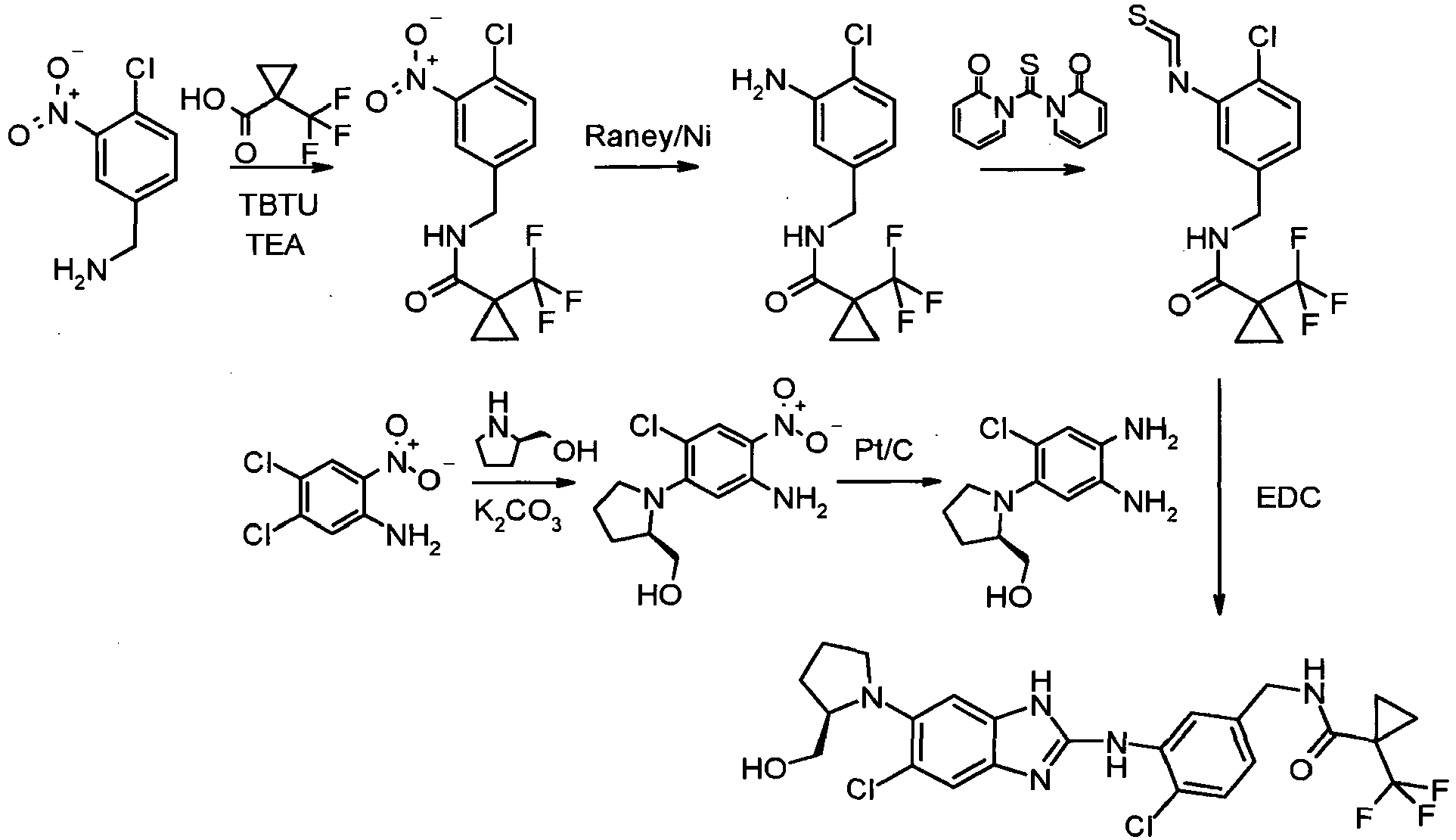
- TBTU (0.44 g, 1.4 mmol) and TEA (0.43 mL, 3.1 mmol) were added to 1-trifluoromethyl-cyclopropanecarboxylic acid (0.19 g, 1.2 mmol) in THF (5mL). After 10 min at rt 4-chloro-3-nitro-benzylamine (0.23 g, 1.2 mmol) was added to the reaction mixture and stirring was continued overnight. The mixture was concentrated, diluted with EtOAc and washed with sat.aq. NaHCO3-solution, water and brine. The organic layer was dried over Na2SO4 and concentrated to give the subtitle compound.
Yield: 340 mg (86%). MS m/z: 321 [M+H]+. HPLC-method I: Rt= 2.76 min. - A mixture of N-(4-chloro-3-nitro-benzyl)-1-trifluoromethyl-cyclopropanecarboxamide (340 mg, 1.1 mmol), EtOAc (10 mL) and Ra-Ni (30 mg) was stirred at rt under a hydrogen atmosphere (3 bar). The catalyst was removed by filtration and the filtrate was concentrated to give the sub-title compound.
Yield: 250 mg (81%). Rf(TLC): 0.50 (silica gel, DCM:EtOH 95:5). HPLC-method G: Rt= 1.30 min. MS m/z: 293 [M+H]+. - A mixture of N-(4-chloro-3-amino-benzyl)-1-trifluoromethyl-cyclopropanecarboxamide (100 mg, 0.3 mmol), N,N-diisopropylcarbodiimide (87 mg, 0.4 mmol) and DCM (5 mL) was strirred at rt overnight. The reaction mixture was filtered through a pad of silica gel and the filtrate was concentrated to give the sub-title compound.
Yield: 95 mg (83%). Rf(TLC): 0.75 (silica gel, CH:EtOAc 1:1). MS m/z: 335 [M+H]+. - (R)-2-Hydroxymethyl-pyrrolidine (202 mg, 2.0 mmol) followed by potassium carbonate (304 mg, 2.2 mmol) were added to a mixture of 4,5-dichloro-2-nitro-phenylamine (414 mg, 2.0 mmol) in DMF (10 mL) and stirred at rt overnight. The reaction mixture was diluted with water, acidified with TFA:H2O 1:1 and filtered. The filtercake was washed with DMF:H2O 1:1 and dried to give the sub-title compound.
Yield: 220 mg (41%). HPLC-method J: Rt= 1.91 min. MS m/z: 272 [M+H]+. - The sub-title compound was prepared from (R)-1-(5-amino-2-chloro-4-nitro-phenyl)-2-hydroxymethyl-pyrrolidine (220 mg, 0.8 mmol) and Pt/C (50 mg) in MeOH (6 mL) and THF (6 mL) in analogy to example 1 step(f).
Yield: 186 mg (95%). HPLC-method C: Rt= 1.22 min. MS m/z: 242 [M+H]+. - The title compound was prepared from N-(4-chloro-3-isothiocyanato-benzyl)-1-trifluoromethyl-cyclopropanecarboxamide (85 mg, 0.3 mmol), (R)-1-(4,5-diamino-2-chloro-phenyl)-2-hydroxymethyl-pyrrolidine (62 mg, 0.3 mmol) and EDC (45 µL, 0.3 mmol) in MeCN (5 mL) in analogy with the method described in example 1 step(g).
Yield: 3 mg (2%). HPLC-method J: Rt= 1.56 min. MS m/z: 542 [M+H]+. -

- Morpholine (174 mg, 2.0 mmol) followed by potassium carbonate (304 mg, 2.2 mmol) were added to a mixture of 4,5-dichloro-N-methyl-2-nitroaniline (442 mg, 2.0 mmol) in DMF (10 mL) and stirred at rt overnight. The reaction mixture was acidified with TFA:H2O 1:1 and purified by chromatography to give the sub-title compound.
Yield: 260 mg (48%). HPLC-method J: Rt= 2.18 min. MS m/z: 272 [M+H]+. - The sub-title compound was prepared from (4-chloro-5-morpholin-4-yl-2-nitro-N-methyl-aniline (260 mg, 1.0 mmol), THF (6 mL), MeOH (6 mL) and Pt/C (50 mg) in analogy to example 1 step(f).
Yield: 219 mg (95%). HPLC-method C: Rt= 1.57 min. MS m/z: 242 [M+H]+. - The title compound was prepared from N-(4-chloro-3-isothiocyanato-benzyl)-1-trifluoromethyl-cyclopropanecarboxamide (111 mg, 0.3 mmol), 5-chloro-2-methylamino-4-morpholin-4-yl-aniline (80 mg, 0.3 mmol) and EDC (59 µL, 0.3 mmol) in MeCN (5 mL) in analogy with method described in example 1 step(g).
Yield: 53 mg (30%). HPLC-method J: Rt= 1.68 min. MS m/z: 542 [M+H]+. -

- The sub-title compound was prepared from N-methylpiperazine (200 mg, 2.0 mmol), 4,5-dichloro-N-methyl-2-nitroaniline (442 mg, 2.0 mmol) and potassium carbonate (304 mg, 2.2 mmol) in DMF (10 mL) in accordance to example 9 step (d).
Yield: 500 mg (88%). HPLC-method J: Rt= 1.37 min. MS m/z: 285 [M+H]+. - The sub-title compound was prepared from 4-chloro-5-(4-methyl-piperazin-1-yl)-2-nitro-N-methyl-aniline (500 mg, 1.8 mmol), THF (6 mL), MeOH (6 mL) and Pt/C (50 mg) in analogy to example 1 step(f).
Yield: 403 mg (90%). HPLC-method C: Rt= 1.22 min. MS m/z: 255 [M+H]+. - The title compound was prepared from N-(4-chloro-3-isothiocyanato-benzyl)-1-trifluoromethyl-cyclopropanecarboxamide (176 mg, 0.5 mmol), 5-chloro-2-methylamino-4-(4-methyl-piperazin-1-yl)-aniline (134 mg, 0.5 mmol) and EDC (93 µL, 0.5 mmol) in MeCN (5 mL) in analogy to example 1 step(g).
Yield: 84 mg. HPLC-method J: Rt= 1.40 min. MS m/z: 555 [M+H]+. -

- Under argon sodium tert-butoxide (366 mg, 3.8 mmol) followed by palladium(II) acetate (22 mg, 0.1 mmol) and tri-tert-butylphosphine 10% in toluene (450 µL, 0.2 mmol) were added to a mixture of 4-bromo-2-nitro-N-methyl-aniline (440 mg, 1.9 mmol) and 4-(trifluoromethyl)piperidine (660 mg, 2.9 mmol) in toluene (7 mL). The reaction mixture was stirred at 100°C overnight then allowed to cool and was concentrated. The crude was purified by chromatography to give the sub-title compound.
Yield: 220 mg (38%). Rf(TLC): 0.56 (silica gel, DCM:EtOH 98:2). MS m/z: 304 [M+H]+. - A mixture of N-methyl-2-nitro-4-(4-trifluoromethyl-piperidin-1-yl)-aniline (220 mg, 0.7 mmol), MeOH (7 mL) and Pd/C (30 mg) was stirred for 18 h at rt under a hydrogen atmosphere (3.0 bar). The catalyst was removed by filtration, the filtrate was concentrated and directly used in the next step.
- A mixture of 2-methylamino-5-(4-trifluoromethyl-piperidin-1-yl)aniline (90 mg, 0.3 mmol) and N-(4-chloro-3-isothiocyanatobenzyl)-2,2-dimethyl-propionamide (93 mg, 0.3 mmol) in THF (10 mL) was stirred at rt for 4 h. The reaction mixture was concentrated and directly used in the next step. Yield: 180 mg (98%). HPLC-method A : Rt= 2.23 min. MS m/z: 556 [M+H]+.
- DIC (130 µL, 0.8 mmol) was added to N-(4-chloro-3-{3-[2-methylamino-5-(4-trifluoromethyl-piperidin-1-yl)-phenyl]-thioureido}-benzyl)-2,2-dimethyl-propionamide (180 mg, 0.3 mmol) in MeCN. The reaction mixture was heated at 60°C - 80°C for one week (additional DIC (2.5 ml) was added). The mixture was cooled to rt and concentrated. The residue was treated with MeCN, filtered and washed. The filtercake was diluted with dioxane and HCOOH and lyophilized to give the title compound.
Yield: 33 mg (20%). Rf(TLC): 0.65 (silica gel, DCM:EtOH 9:1). MS m/z: 522 [M+H]+. -

- Boc2O (1.48 g, 6.68 mmol) in 3.3 mL DCM was added at 0°C to a mixture of 3-amino-2,4-dichloro-benzylamine (1.16 g, 6.07 mmol), 6.7 mL DCM and 12.1 mL 1 N NaOH-solution. The mixture was stirred vigourously for 2d and diluted with 5% aq NH3-solution. The organic phase was separated and the aq. phase was washed 2 x with DCM. The combined organic phase was washed with brine, dried with Na2SO4, filtered and concentrated to give the subtitle compound.
Yield: 1.71 g (97%). Rf = 0.65 (silica gel, DCM:EtOH 95:5). MS m/z: 291 [M+H]+. - 1,1'-Thiocarbonyldi-2-pyridone (0.42 g, 1.8 mmol) was added to a mixture of (3-amino-2,4-dichloro-benzyl)-carbamic acid tert-butyl ester (0.50 g, 1.7 mmol) and dioxane (25 mL) and stirred at rt for 2 h and at reflux for 2 d. The mixture was concentrated, diluted with DCM and filtered over silica gel. The filtrate was concentrated to give the sub-title compound.
Yield: 0.49 g (86%). Rf = 0.83 (silica gel, DCM:EtOH 95:5). - The title compound was prepared from (2,4-dichloro-3-isothiocyanato-benzyl)-carbamic acid tert-butyl ester (5.47g, 16.4 mmol), 5-chloro-2-methylamino-4-(3-(trifluoromethyl)piperidin-1-yl)aniline (5.05g, 16.4 mmol) and DIC 4.48 ml, 29 mmol) in MeCN in analogy to example 6 step(c).
HPLC-method A: Rt= 2.37 min. MS m/z: 606 [M+H]+. - 4 M HCl in dioxane (38 mL) was added to N-{2,4-dichloro-3-[5-chloro-l-methyl-6-(3-(trifluoromethyl)piperidin-1-yl)-1H-benzimidazol-2-ylamino]benzyl}-carbamic acid tert-butyl ester (5.4 g, 8.9 mmol) in dioxane (300 mL) and stirred at rt overnight. The reaction mixture was concentrated and the resulting residue was diluted with aq. NaHCO3-solution.The aq. phase was extracted with EtOAc, the organic phase was dried with Na2SO4 and concentrated.
Yield: 3.65 g (81%). HPLC-method A: Rt= 1.33 min. MS m/z: 506 [M+H]+. - The title compound was prepared from TBTU (35 mg, 0.11 mmol), TEA (50 µL, 0.36 mmol), 1-trifluormethyl-cyclobutanecarboxylic acid (57 mg, 0.4 mmol) and 2,4-dichloro-3-[5-chloro-1-methyl-6-(3-(trifluoromethyl)piperidin-1-yl)-1 H-benzimidazol-2-ylamino]benzylamine (45.3 mg, 0,1 mmol) in DMF (3 mL) analogy to example 1 step(i).
Yield: 36 mg (55%). HPLC-method Q: Rt= 1.73 min. MS m/z: 656 [M+H]+. -

- A TEA solution (0.35 M in DMF, 0.1 mL) was added to a 4-Chloro-3-[5-(pyrrolidin-1-yl)-1H-benzimidazol-2-ylamino]-benzylamine solution (0.12 M in MeCN, 0.1 mL, prepared in analogy to example 4d) followed by a cyclopropylsulfonyl chloride solution (0.12 M in MeCN, 0.1 mL). The mixture was stirred overnight and filtered through basic alumina. The solids were washed with DMF/MeOH 9:1 and the combinded filtrates were concentrated to give the title compound.
MS m/z: 446 [M+H]+. HPLC-method L: Rt= 1.46 min. -

- Acetylchloride (2.56 mL, 36.0 mmol) was added to a mixture of 6-chloro-2-fluoro-3-methylaniline (5.00 g, 31.3 mmol) and toluene (200 mL), additional toluene (50 mL) was added and the mixture was heated to reflux for 3 h. The reaction mixture was cooled with an ice bath and the formed precipitate was filtered off, washed with cold toluene and dried.
Yield: 4.75 g (75%). HPLC-method B: Rt= 1.12 min. MS m/z: 202 [M+H]+. - The sub-title compound was prepared from N-(6-chloro-2-fluoro-3-methyl-phenyl)-acetamide and KMnO4 in pyridine in analogy to step 5a.
Yield: 49%. Rf = 0.2 (silica gel, DCM/EtOH 4:1). HPLC Rt = 0.93 min (method B). MS m/z: 232 [M+H]+. - The sub-title compound was prepared from 3-acetylamino-4-chloro-2-fluoro-benzoic acid and 6 M HCl-solution in analogy to step 5b.
Yield: 96%. HPLC Rt = 1.10 min (method B). MS m/z: 190 [M+H]+. - The sub-title compound was prepared from 3-amino-4-chloro-2-fluoro-benzoic acid, (1-chloro-2-methyl-propenyl)-dimethyl-amine and conc. NH3 in analogy to step 5c.
Yield: 69%. Rf= 0.3 (silica gel, PE:EtOAc 4:6). HPLC-method B: Rt= 0.97 min. MS m/z: 189 [M+H]+. - The crude sub-title compound was prepared from 3-amino-4-chloro-2-fluoro-benzamide and LiAlH4 in analogy to step 5d.
HPLC-method B: Rt= 0.37 min. MS m/z: 175 [M+H]+. - The sub-title compound is prepared from crude 3-amino-4-chloro-2-fluoro-benzylamine, 2,2-dimethyl-propionic acid chloride and TEA in analogy to example 5e.
Yield: 36% (side product in 29%: N-(3-Amino-4-chloro-benzyl)-2,2-dimethyl-propionamide). Rf = 0.6 (silica gel, PE:EtOAc 6:4). HPLC-method B: Rt= 1.27 min. MS m/z: 259 [M+H]+. - The title compound is prepared from N-(3-amino-4-chloro-2-fluoro-benzyl)- 2,2-dimethyl-propionamide, 1,1'-thiocarbonyldi-2-pyridone in analogy to step 5f.
- The title compound is prepared from N-(4-chloro-2-fluoro-3-isothiocyanato-benzyl)- 2,2-dimethyl-propionamide and 5-chloro-2-methylamino-4-(4-fluoropiperidin-1-yl)-aniline and DIC in analogy to example 5i.
Yield: 49%. Rf= 0.5 (silica gel, PE:EtOAc 1:1). HPLC-method G: Rt= 1.40 min. MS m/z: 524 [M+H]+. -

- The sub-title compund was prepared from 4,5-dichloro-2-nitro-aniline (500 mg, 2.4 mmol), 4-trifluoromethyl-piperidine hydrochloride (550 mg, 2.9 mmol) and K2CO3 (830 mg, 6.0 mmol) in DMSO (10 mL) in analogy to example 3, step (a).
MS m/z: 324 [M+H]+. HPLC-method G: Rt= 1.59 min - A mixture of 4-chloro-2-nitro-5-(4-trifluoromethyl-piperidin-1-yl)aniline (0.63 g, 1.9 mmol), THF (10 mL), MeOH (20 mL) and 50% -Pt-on-carbon (60 mg) was stirred for 22 h at rt under a hydrogen atmosphere (3 bar). The catalyst was removed by filtration and the mixture was concentrated to give the sub-title compound.
HPLC-method G: Rt= 1.22 min. MS m/z: 294 [M+H]+. - The title compund was prepared from N-(2,4-dichloro-3-isothiocyanato-benzyl)-2,2-dimethyl-propionamide (108 mg, 0.34 mmol), 4-chloro-2-amino-5-(4-trifluoromethyl-piperidin-1-yl)aniline (100 mg, 0.34 mmol), DIC (56 µL) in DMF (2 mL) in analogy to example 5, step (i). Rf(TLC): 0.35 (silica gel, DCM:EtOH 95:5). MS m/z: 576 [M+H]+.HPLC-method G: Rt= 1.48 min.
-

- The sub-title compund was prepared from 4-trifluoromethyl-5-chloro-2-nitro-aniline (100 mg, 0.42 mmol), 4-trifluoromethyl-piperidine hydrochloride (394 mg, 2.1 mmol) and K2CO3 (600 mg, 4.4 mmol) in NMP (2 mL) in analogy to example 3, step (a).
MS m/z: 356 [M+H]+. Rf(TLC): 0.8 (silica gel, DCM). HPLC-method G: Rt= 1.62 min - A mixture of 4-trifluoromethyl-2-nitro-5-(4-trifluoromethyl-piperidin-1-yl)aniline (0.14 g, 0.39 mmol), THF (10 mL) and Pd/C (15 mg) was stirred for 2 d at rt under a hydrogen atmosphere (3 bar). The catalyst was filtered off and the mixture was concentrated.
MS m/z: 328 [M+H]+. Rf(TLC): 0.2 (silica gel, DCM). HPLC-method G: Rt= 1.42 min. - The compund was prepared from N-(2,4-dichloro-3-isothiocyanato-benzyl)-2,2-dimethyl-propionamide (87 mg, 0.28 mmol), 4-trifluoromethyl-2-amino-5-(4-trifluoromethyl-piperidin-1-yl)aniline (90 mg, 0.28 mmol), DIC (43 µL) in DMF (2 mL) in analogy to example 5, step (i).
Yield: 24%. Rf(TLC): 0.30 (silica gel, DCM:EtOH 95:5). MS m/z: 610 [M+H]+.HPLC-method G: Rt= 1.52 min. -

- A mixture of 3-Nitro-2,4-difluoro-benzonitrile (0.50 g, 2.7 mmol), MeOH (25 ml), 37% HCl (1.5 ml) and Pd/C (200 mg) was stirred for 13 h at rt under a hydrogen atmosphere (3 bar). The catalyst was removed by filtration and the filtrate was concentrated.
Yield: 0.58 g. MS m/z: 159 [M+H]+. - TEA (1.92 mL, 13.8 mmol) was added to a mixture of 3-amino-2,4-difluoro-benzylamine (0.58 g, 2.5 mmol) in THF (40 ml) followed by pivaloyl chloride (0.31 mL, 2.5 mmol) and it was stirred overnight. The mixture was diluted with EtOAc, washed successively with satd. NaHCO3 and brine. The organic phase was dried with Na2SO4, filtered and concentrated.
Yield: 0.57 g. HPLC-method G: Rt= 1.20 min. MS m/z: 243 [M+H]+. - 1,1'-Thiocarbonyldi-2-pyridone (546 mg, 2.35 mmol) was added to a mixture of N-(3-amino-2,4-difluoro-benzyl)-2,2-dimethyl-propionamide (570 mg, 2.35 mmol) and dioxane (20 mL) and stirred at reflux overnight. The mixture was concentrated, diluted with DCM and filtered over silica gel. The filtrate was concentrated to give the sub-title compound.
Yield: 440 mg Rf(TLC): 0.8 (silica gel, DCM:EtOH 95:5). - The compound was prepared in analogy to example 5 (i) from N-(2,4-difluoro-3-isothiocyanato-benzyl)-2,2-dimethyl-propionamide (68 mg, 0.24 mmol), 5-chloro-2-methylamino-4-(4-trifluoromethyl-piperidin-1-yl)aniline (100 mg, 0.24 mmol), DIC (40 µL, 0.25 mmol) in DMF.
Yield: 50 mg (37%). Rf(TLC): 0.4 (silica gel, DCM:EtOH 95:5). MS m/z: 558 [M+H]+. HPLC-method G: Rt= 1.47 min. -

- A mixture of N-(4-chloro-3-isothiocyanatobenzyl)-1-(trifluoromethyl)cyclopropane carboxamide (0.15 g; 0.45 mmol) and 5-chloro-2-methylamino-4-(4-trifluoromethyl-piperidin-1-yl)aniline (0.14 g; 0.45 mmol) in DMF (3 mL) was stirred overnight at rt. EDC (0.086 g; 0.45 mmol) was added and the mixture was heated to 90 °C for 1 h. The mixture was poured in water, extracted with DCM and the combined organic layer was washed with brine, dried over Na2SO4, filtered, concentrated and purified by column chromatography.
Yield: 0.079 g (29%). HPLC-method N: Rt= 13.92 min. MS m/z: 608 [M+H]+. -

- A mixture of N-(4-chloro-3-isothiocyanatobenzyl)-1-(trifluoromethyl)cyclopropane carboxamide (200 mg; 0.60 mmol) and 5-chloro-2-methylamino-4-(4-phenyl-piperidin-1-yl)aniline (190 mg; 0.60 mmol) in DMF (4 mL) was stirred overnight at rt. DIC (76 mg; 0.60 mmol) was added and the mixture was heated at 90 °C for 1.5 h. The mixture was poured in water, extracted with EtOAc and the combined organic layer was dried over Na2SO4, filtered and concentrated and the residue was purified by column chromatography.
Yield: 69 mg (19%). HPLC-method O: Rt= 11.40 min. MS m/z: 616 [M+H]+. -
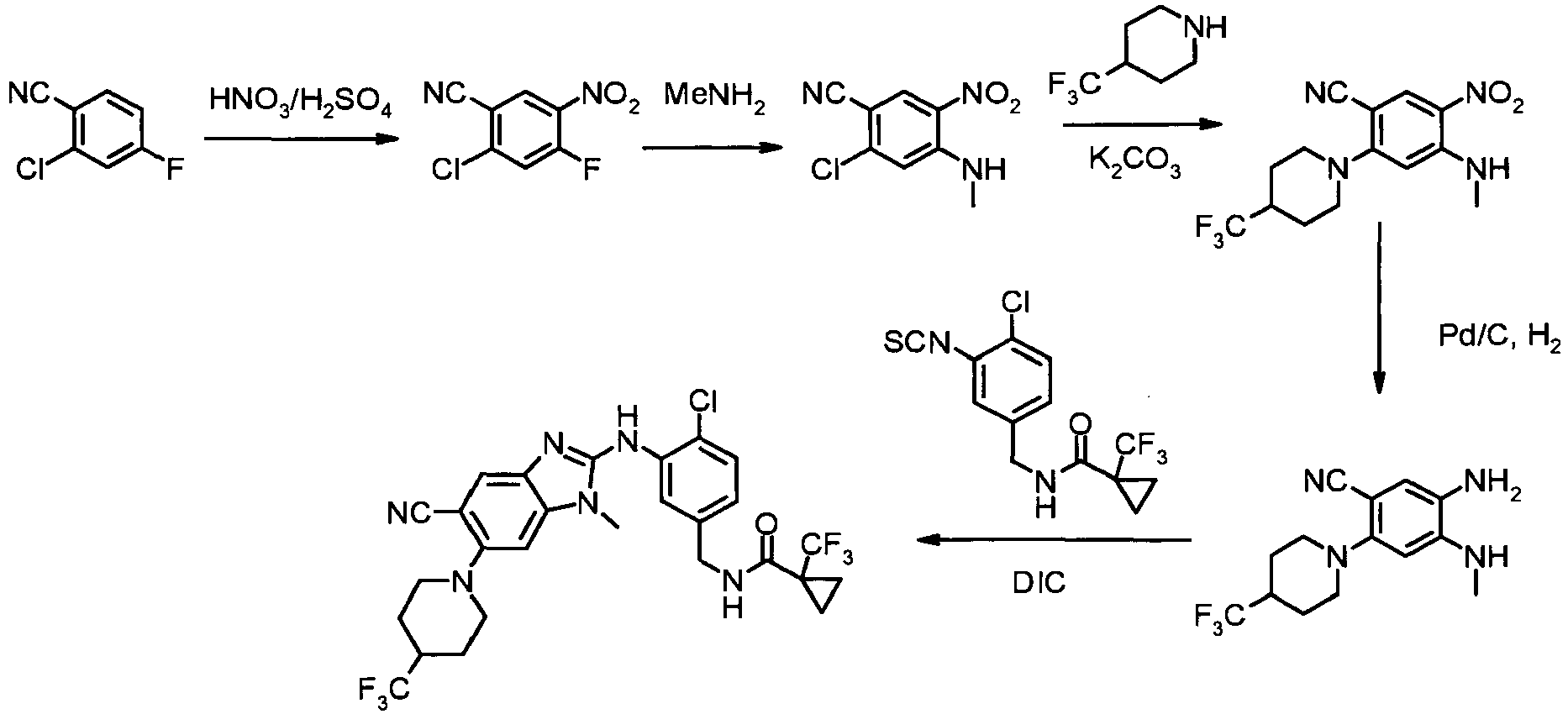
- Fuming HNO3 (2.9 mL, 64 mmol) was added dropwise to a solution of 2-chloro-4-fluorobenzonitrile (5.0 g, 32 mmol) in conc. H2SO4 (5 mL) at 0 °C. The mixture was stirred at 0 °C for 15 min and at rt for 30 min whereafter it was poured into ice. The precipitate was filtered off, washed with water and dried under vacuum.
Yield: 6.08 g (95%). - A solution of MeNH2 in THF (14.9 mL, 2 M, 29.8 mmol) was added dropwise to a solution of 2-chloro-4-fluoro-5-nitrobenzonitrile (3.0 g, 15 mmol) in THF (100 mL) at -20 °C. The mixture was stirred at -20 °C for 1 h and thereafter concentrated, washed with brine and extracted with EtOAc. The organic layer was dried over Na2SO4, filtered and concentrated. The resulting residue was washed with PE to give the sub-title compound.
Yield: 3.07 g (97%). - A mixture of 2-chloro-4-(methylamino)-5-nitrobenzonitrile (3.07 g, 14.5 mmol), 4-trifluoromethylpiperidine (3.33 g, 21.7 mmol), K2CO3 (5.01 g, 36.2 mmol) and DMF (16 mL) was heated at 60 °C for 6 h under Ar atmosphere. The mixture was poured into aqueous NH4OH and extracted with EtOAc. The organic layer was dried over Na2SO4, filtered and concentrated. Crystallization from EtOAc/PE gave the sub-title compound.
Yield: 3.65 g (77%). - H2 (1 atm) was passed through a mixture of 4-(methylamino)-5-nitro-2-(4-trifluoromethyl-piperidin-1-yl)benzonitrile (204 mg, 0.62 mmol), Pd/C (66 mg, 0.062 mmol), EtOAc (10 mL) and EtOH (10 mL) at rt for 1 h. The mixture was filtered through celite and concentrated. Crystallization from Et2O/PE gave the sub-title compound.
Yield: 182 mg (98%). - The title compound was prepared in analogy to Example 76 using 5-amino-4-(methylamino)-2-(4-trifluoromethyl-piperidin-1-yl)benzonitrile (179 mg, 0.60 mmol), N-(4-chloro-3-isothiocyanatobenzyl)-1-(trifluoromethyl)cyclopropane carboxamide (200 mg; 0.60 mmol), DIC (76 mg, 0.60 mmol) and DMF (4 mL).
Yield: 142 mg (40%). HPLC-method O: Rt= 11.23 min. MS m/z: 599 [M+H]+. -

- A mixture of 4-chloro-N-methyl-2-nitro-5-(4-(4-trifluoromethylphenyl)-piperazin-1-yl)aniline (200 mg, 0.48 mmol), Ra-Ni (20 mg; 0.34 mmol) and THF (8 mL) was shaken under H2 atmosphere (1 atm) at rt for 4 h. The mixture was filtered through celite and the resulting solution was used immediately used in the next step.
- N-(4-Chloro-3-isothiocyanatobenzyl)-1-trifluoromethyl-cyclopropane carboxamide (161 mg, 0.48 mmol) was added to the THF solution from step (a) above and the mixture was concentrated. DMF (2 mL) was added to the residue, the mixture was stirred at rt for 1 h and DIC (67 mg, 0.53 mmol) was added. The mixture was stirred at rt overnight, another portion of DIC (17 mg, 0.13 mmol) was added and the mixture was stirred at rt overnight. The mixture was concentrated and the residue was purified by column chromatography to give the title compound.
Yield: 91 mg (28%). HPLC-method O: Rt= 12.37 min. MS m/z: 685 [M+H]+. -

- A solution of MeNH2 in THF (50.7 mL, 2 M, 101 mmol) was added dropwise to a solution of 1,2,3,4-tetrafluoro-5-nitrobenzene (9.88 g, 50.7 mmol) in THF (200 mL) at -20 °C. The mixture was stirred at -20 °C for 1.5 h, concentrated, washed with brine and extracted with EtOAc. The organic layer was dried over Na2SO4, filtered and concentrated. Crystallization from EtOAc/PE gave the sub-title compound. Yield: 8.5 g (81%).
- A mixture of 2,3,4-trifluoro-N-methyl-6-nitroaniline (1.5 g, 7.3 mmol), 4-trifluoromethylpiperidine hydrochloride (2.76 g, 14.6 mmol), K2CO3 (2.01 g, 14.6 mmol) and DMF (10 mL) was stirred at rt overnight under Ar atmosphere. The mixture was poured into aqueous ammonia and extracted with EtOAc. The organic layer was dried over Na2SO4, filtered and concentrated. Crystallization from EtOAc/PE gave the sub-title compound.
Yield: 2.3 g (93%). - A mixture of 2,4-difluoro-N-methyl-6-nitro-3-(4-trifluoromethyl-piperidin-1-yl)aniline (210 mg, 0.62 mmol), Ra-Ni (4 mg, 0.062 mmol) and THF (30 mL) was shaken under H2 atmosphere (1 atm) at rt for 1 h. The mixture was filtered through celite and the celite pad was further washed with THF. The resulting solution was concentrated to give the sub-title compound.
Yield: 190 mg (99%). - The title compound was prepared in analogy to Example 76 using 3,5-difluoro-2-methylamino-4-(4-trifluoromethyl-piperidin-1-yl)aniline (186 mg, 0.60 mmol), N-(4-chloro-3-isothiocyanatobenzyl)-1-(trifluoromethyl)cyclopropane carboxamide (200 mg; 0.60 mmol), DIC (76 mg, 0.60 mmol) and DMF (3 mL).
Yield: 119 mg (33%). HPLC-method O: Rt= 12.25 min. MS m/z: 610 [M+H]+. -

- A solution of MeNH2 in THF (5.7 mL, 2 M, 11 mmol) was added dropwise to a solution of 1,2,4-trifluoro-5-nitrobenzene (1.0 g, 5.7 mmol) in THF (10 mL) at -20 °C. The mixture was stirred at -20 °C for 1 h, concentrated, washed with brine and extracted with EtOAc. The organic layer was dried over Na2SO4, filtered and concentrated. Crystallization from EtOAc/PE gave the sub-title compound. Yield: 1.0 g (81%).
- A mixture of 4,5-difluoro-N-methyl-2-nitroaniline (1.0 g, 5.3 mmol), 4-trifluoromethylpiperidine hydrochloride (2.02 g, 10.6 mmol), K2CO3 (1.47 g, 10.6 mmol) and DMF (7 mL) was stirred at 40 °C overnight under Ar atmosphere. The mixture was poured into aqueous ammonia and extracted with EtOAc. The organic layer was dried over Na2SO4, filtered and concentrated. The residue was washed with Et2O/PE to give the sub-title compound.
Yield: 1.6 g (95%). - A mixture of 4-fluoro-N-methyl-2-nitro-5-(4-trifluoromethyl-piperidin-1-yl)aniline (200 mg, 0.62 mmol), Ra-Ni (4 mg, 0.062 mmol) and THF (30 mL) was shaken under H2 atmosphere (1 atm) at rt for 1 h. The mixture was filtered through celite and the celite pad was further washed with THF. Concentration and crystallization from Et2O/PE gave the sub-title compound.
Yield: 176 mg (97%). - The title compound was prepared in analogy to Example 76 using 5-fluoro-2-methylamino-4-(4-trifluoromethyl-piperidin-1-yl)aniline (175 mg, 0.60 mmol), N-(4-chloro-3-isothiocyanatobenzyl)-1-(trifluoromethyl)cyclopropane carboxamide (200 mg; 0.60 mmol), DIC (76 mg, 0.60 mmol) and DMF (3 mL).
Yield: 155 mg (44%). HPLC-method O: Rt= 10.62 min. MS m/z: 592 [M+H]+. -
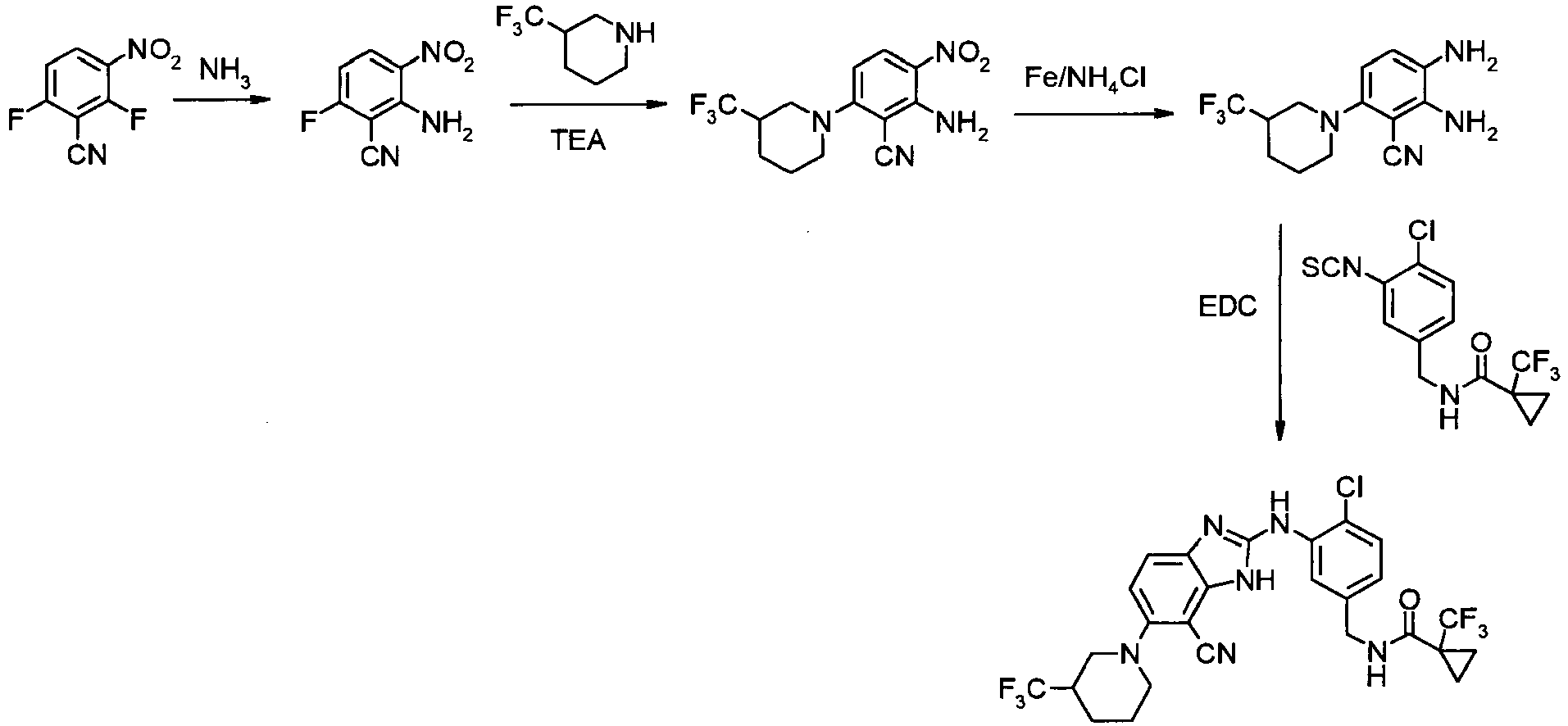
- A solution of NH3 in EtOH (19 mL, 8.6 M, 160 mmol) was added dropwise to a solution of 2,6-difluoro-3-nitrobenzonitrile (10 g, 54 mmol) in THF (50 mL) at 0 °C under Ar and the resulting mixture was stirred at 0 °C for 1 h. The mixture was concentrated and the residue washed with brine and extracted with EtOAc. The organic layer was dried over Na2SO4, filtered and concentrated.
Yield: 9.59 g (98%). - A mixture of 2-amino-6-fluoro-3-nitrobenzonitrile (3.1 g, 17 mmol), 3-trifluoromethylpiperidine (2.5 g, 19 mmol), TEA (3.4 g, 34 mmol) and THF (110 mL) was stirred under Ar at rt for 3 h. The mixture was concentrated and poured into H2O and thereafter extracted with EtOAc. The organic layer was dried over Na2SO4, filtered and concentrated. Crystallization from EtOAc gave the sub-title compound.
Yield: 2.9 g (54%). - A mixture of 2-amino-3-nitro-6-(3-trifluoromethyl-piperidin-1-yl)benzonitrile (200 mg, 0.64 mmol), Fe (178 mg, 3.18 mmol), aqueous NH4Cl (5 mL) and EtOH (5 mL) was heated under Ar at 90 °C for 2 h. The mixture was thereafter basicified to pH ∼9-10 and filtered through celite and the celite pad was washed with EtOH and EtOAc. The organic layer was concentrated and the residue was extracted with EtOAc. The organic layer was dried over Na2SO4, filtered and concentrrated. The residue was washed with Et2O to give the sub-title compound.
Yield: 153 mg (84%). - The title compound was prepared in analogy to Example 71 using 2,3-diamino-6-(3-trifluoromethyl-piperidin-1-yl)benzonitrile (115 mg, 0.40 mmol), N-(4-chloro-3-isothiocyanatobenzyl)-1-(trifluoromethyl)cyclopropane carboxamide (135 mg; 0.40 mmol), EDC (77 mg, 0.40 mmol) and DMF (3 mL).
Yield: 69 mg (29%). HPLC-method N: Rt= 15.50 min. MS m/z: 585 [M+H]+. -

- The sub-title compound was prepared in analogy to Example 76 using 5-chloro-2-methylamino-4-(4-trifluoromethyl-piperidin-1-yl)aniline (508 mg, 1.65 mmol), tert-butyl 4-chloro-3-isothiocyanatobenzylcarbamate (493 mg, 1.65 mmol), DIC (208 mg, 1.65 mmol) and DMF (8 mL).
Yield: 701 mg (74%). - A mixture of tert-butyl N-{4-chloro-3-[5-chloro-1-methyl-6-(4-trifluoromethyl-piperidin-1-yl)-1H-benzo[d]imidazol-2-ylamino]benzyl}-carbamate (790 mg, 1.38 mmol), TFA (1.54 mL, 20.7 mmol) and DCM (30 mL) was stirred at rt overnight. The mixture was cooled to 0 °C, basicified to pH ∼10 and extracted with DCM. The organic layer was dried over Na2SO4, filtered and concentrated and the residue was washed with Et2O/PE.
- A mixture of 2,2-difluoropropanoic acid (37 mg; 0.34 mmol), HBTU (129 mg; 0.34 mmol) and TEA (69 mg; 0.68 mmol) in DMF (1.5 mL) was stirred for 30 min at rt and added to a solution of 4-chloro-3-[5-chloro-1-methyl-6-(4-trifluoromethyl-piperidin-1-yl)-1H-benzo[d]imidazol-2-ylamino]benzylamine (161 mg; 0.34 mmol) in DMF (1.5 mL). The resulting mixture was stirred overnight at rt, poured into brine and extracted with EtOAc. The organic layer was dried over Na2SO4, filtered and concentrated and the residue was purified by column chromatography.
Yield: 87 mg (45%). HPLC-method O: Rt= 10.60 min. MS m/z: 564 [M+H]+. -

- A solution of 2-methylpropane-2-sulfinic acid chloride (83 mg, 0.59 mmol) in DCM (2 mL) was added dropwise to a solution of 4-chloro-3-[5-chloro-1-methyl-6-(4-trifluoromethyl-piperidin-1-yl)-1H-benzo[d]imidazol-2-ylamino]benzylamine (265 mg, 0.56 mmol), TEA (113 mg, 1.12 mmol) and DCM (3 mL) at 0 °C under Ar. The mixture was stirred at rt overnight, poured into H2O and extracted with DCM. The organic layer was washed with brine, dried over Na2SO4, filtered and concentrated. Crystallization from DCM/PE gave the sub-title compound.
Yield: 298 mg (92%). - A mixture of N-(4-chloro-3-(5-chloro-1-methyl-6-(4-trifluoromethyl-piperidin-1-yl)-1H-benzo[d]imidazol-2-ylamino)benzyl)-2-methylpropane-2-sulfinamide (298 mg, 0.52 mmol), m-chloroperoxybenzoic acid (127 mg, 0.74 mmol) and DCM (20 mL) was stirred at rt overnight. The mixture was basicified to pH ∼8-9 and extracted with EtOAc. The organic layer was dried over Na2SO4, filtered and concentrated. Crystallization from DCM/Et2O gave the title compound.
Yield: 39 mg (13%). HPLC-method O: Rt= 10.84 min. MS m/z: 592 [M+H]+. -

- A closed pressure tube charged with 3-fluoro-4-trifluoromethyl-benzonitrile (10.0 g; 52.9 mmol) and liquid NH3 (60 mL) was heated for 6 days at 90 °C. The tube was cooled to -60 °C and opened. The mixture was allowed to stir for 1 h at rt, washed with brine, extracted with EtOAc, dried over Na2SO4, filtered and concentrated..
Yield: 10.2 g (quantitative; slightly contaminated). - A mixture of 3-amino-4-trifluoromethyl-benzonitrile (10.0 g; 53.7 mmol), DCM (100 mL) and TEA (8.2 mL; 59 mmol) was treated dropwise with a solution of Boc2O (12.9 g; 59.1 mmol) in DCM (50 mL) at 0 °C and stirred overnight. Another portion of Boc2O in DCM and DMAP (656 mg; 5.37 mmol) was added and the mixture was stirred for another 12 h at rt. The mixture was washed with water and brine, dried over Na2SO4, filtered, concentrated and purified by column chromatography.
Yield: 8.50 g (55%). - A mixture of tert-butyl 5-cyano-2-trifluoromethyl-phenylcarbamate (8.5 g; 29.7 mmol), Ra-Ni (174 mg; 2.97 mmol) and THF (60 mL) was stirred under H2-atmosphere (5 atm) overnight at rt. The mixture was filtered through celite and the celite pad was washed with THF and EtOAc. Concentration gave the sub-title compound which was used in the next step without further purification. Yield: 8 g (93%).
- The compound was prepared in analogy to the procedures in Example 94, step (c) and Example 94, step (b) using tert-butyl 5-aminomethyl-2-trifluoromethyl-phenylcarbamate (2.09 g; 7.20 mmol), 1-trifluoromethyl-cyclopropanecarboxylic acid (1.11 g; 7.20 mmol), HBTU (2.73 g; 7.20 mmol), TEA (2.19 g; 21.6 mmol), DMF (25 mL), TFA (10 mL) and DCM (50 mL). Yield: 1.8 g (77%).
- A mixture of N-(3-amino-4-trifluoromethyl-benzyl)-1-trifluoromethyl-cyclopropanecarboxamide (1.60 g; 4.90 mmol), di-(2-pyridyl)thionocarbonate (1.71 g; 7.36 mmol) and THF (40 mL) was stirred in a pressure tube for 2 days at 60 °C. The mixture was concentrated and the residue was purified by column chromatography. Yield: 1.29 g (72%).
- The title compound was prepared in analogy to Example 76 using 5-chloro-2-methylamino-4-(4-trifluoromethyl-piperidin-1-yl)aniline (185 mg, 0.60 mmol), N-(4-trifluoromethyl-3-isothiocyanatobenzyl)-1-(trifluoromethyl)cyclopropane carboxamide (221 mg, 0.60 mmol), DIC (76 mg, 0.60 mmol) and DMF (4 mL).
Yield: 185 mg (48%). HPLC-method O: Rt= 11.17 min. MS m/z: 642 [M+H]+. -

- A mixture of 3-amino-4-trifluoromethyl-benzonitrile (1.0 g, 5.4 mmol), di-(2-pyridyl)thionocarbonate (1.87 g, 8.06 mmol) and THF (50 mL) was stirred at rt overnight. The mixture was concentrated and the residue was purified by column chromatography.
Yield: 760 mg (62%). - The sub-title compound was prepared in analogy to Example 76 using 5-chloro-2-methylamino-4-(4-trifluoromethyl-piperidin-1-yl)aniline (998 mg, 3.24 mmol), 3-isothiocyanato-4-(trifluoromethyl)benzonitrile (740 mg, 3.24 mmol), DIC (409 mg, 3.24 mmol) and DMF (7 mL).
Yield: 1.21 g (74%). - A mixture of 3-(5-chloro-1-methyl-6-(4-trifluoromethyl-piperidin-1-yl)-1H-benzo[d]imidazol-2-ylamino)-4-trifluoromethyl-benzonitrile (1.20 g; 2.39 mmol), Ra-Ni (14 mg; 0.24 mmol) and THF (50 mL) was shaken under H2-atmosphere (5 atm) overnight at rt. The mixture was filtered through celite and the celite pad was washed with THF and EtOAc. Concentration and crystallization from Et2O/PE gave the sub-title compound.
Yield: 1.2 g (99%). - The title compound was prepared in analogy to the procedure in Example 94, step (c) using 4-trifluoromethyl-3-[5-chloro-1-methyl-6-(4-trifluoromethyl-piperidin-1-yl)-1H-benzimidazol-2-ylamino]-benzylamine (110 mg; 0.22 mmol), 3,3,3-trifluoro-2-methylpropanoic acid (31 mg; 0.22 mmol), HBTU (83 mg; 0.22 mmol), TEA (45 mg; 0.44 mmol), DMF (2 mL).
Yield: 39 mg (28%). HPLC-method O: Rt= 11.80 min. MS m/z: 630 [M+H]+. -

- The title compound was prepared in analogy to the procedure in Example 99, step (a) using 2-methylpropane-2-sulfinic chloride (117 mg, 0.83 mmol), 4-trifluoromethyl-3-[5-chloro-1-methyl-6-(4-trifluoromethyl-piperidin-1-yl)-1H-benzimidazol-2-ylamino]-benzylamine (400 mg, 0.79 mmol), TEA (160 mg, 1.58 mmol) and DCM (5 mL).
Yield: 210 mg (44%). HPLC-method O: Rt= 11.25 min. MS m/z: 610 [M+H]+. -

- A mixture of N-(4-trifluoromethyl-3-(5-chloro-1-methyl-6-(4-trifluoromethyl-piperidin-1-yl)-1H-benzo[d]imidazol-2-ylamino)benzyl)-2-methylpropane-2-sulfinamide (140 mg, 0.23 mmol), m-chloroperoxybenzoic acid (198 mg, 1.15 mmol) and CHCl3 (7 mL) was stirred at rt for 15 min. The mixture was poured into brine and extracted with DCM. The organic layer was dried over Na2SO4, filtered and concentrated. The residue was mixed with PBr3 (144 mg, 0.50 mmol) and DCM (5 ml) and the mixture was stirred at rt overnight. The mixture was poured into H2O and extracted with DCM. The organic layer was washed with brine, dried over Na2SO4, filtered and concentrated. Purification by column chromatography gave the title compound. Yield: 33 mg (16%). HPLC-method O: Rt= 11.44 min. MS m/z: 626 [M+H]+.
-

- BH3/THF (120 mL; 120 mmol) was added to a solution of 4-fluoro-3-nitro-benzonitrile (10 g; 60 mmol) in THF (50 mL) over 30 min at 0 °C and the resulting mixture was stirred at 0 °C for 1 h and at rt for 3 h. The mixture was acidified to pH ∼1 and stirred for 1 h at rt, basicified to pH ∼7-8 and extracted with EtOAc. The organic layer was dried over Na2SO4, filtered and concentrated. The residue was dissolved in Et2O and treated with a solution of HCl in 1,4-dioxane to give the sub-title compound.
Yield: 8.7 g (70%). - The sub-title compound was prepared in analogy to the procedure in Example 94, step (c) using 4-fluoro-3-nitro-benzylamine hydrochloride (3.0 g; 14.5 mmol), 1-(trifluoromethyl)-cyclopropanecarboxylic acid (2.5 g; 16.0 mmol), HBTU (6.07 g; 16.0 mmol), TEA (5.88 g; 58.1 mmol) and DMF (50 mL).
Yield: 3.8 g (85%). - The sub-title compound was prepared in analogy to the procedure in Example 93, step (c) using N-(4-fluoro-3-nitrobenzyl)-1-(trifluoromethyl)-cyclopropanecarboxamide (3.77 g; 12.3 mmol), Fe (3.45 g; 61.6 mmol), NH4Cl (aq, sat, 30 mL) and EtOH (30 mL).
Yield: 3.2 g (76%). - A mixture of N-(3-amino-4-fluorobenzyl)-1-(trifluoromethyl)cyclopropanecarboxamide (3.17 g; 11.5 mmol) and TCDI (3.07 g; 17.2 mmol) in DCM (50 mL) was heated overnight at 50 °C. The mixture was concentrated and the residue was purified by column chromatography.
Yield: 3 g (82%). - The title compound was prepared in analogy to the procedure in Example 76 using N-(4-fluoro-3-isothiocyanatobenzyl)-1-(trifluoromethyl)cyclopropane carboxamide (191 mg; 0.60 mmol), 5-chloro-2-methylamino-4-(4-trifluoromethyl-piperidin-1-yl)aniline (185 mg; 0.60 mmol), DIC (76 mg; 0.60 mmol) and DMF (3 mL).
Yield: 111 mg (31%). HPLC-method O: Rt= 11.07 min. MS m/z: 592 [M+H]+. -

- A mixture of 4-chloro-2-fluorobenzonitrile (4.62 g; 29.7 mmol) in conc. H2SO4 (42 mL) was treated dropwise with conc. HNO3 (3.9 mL) at 1-2 °C. After stirring at 1-2 °C for 2 h the mixture was poured into ice and filtered.
Yield: 5.18 g (87%). - H2 was passed through a mixture of 4-chloro-2-fluoro-5-nitrobenzonitrile (1.0 g; 5.0 mmol) and Ra-Ni (29 mg, 0.50 mmol) in THF (50 mL) for 6 h. The mixture was filtered through celite. CSCl2 (2.29 g; 19.9 mmol) and K2CO3 (3.45 g; 25.0 mmol) was added and it was stirred overnight at rt. The residue was concentrated and purified by column chromatography.
Yield: 840 mg (79%). - The sub-title compound was prepared in analogy to the procedure in Example 76 using 4-chloro-2-fluoro-5-isothiocyanatobenzonitrile (300 mg; 1.41 mmol), 5-chloro-2-methylamino-4-(4-trifluoromethyl-piperidin-1-yl)aniline (434 mg; 1.41 mmol), DIC (178 mg; 1.41 mmol) and DMF (12 mL).
Yield: 264 mg (39%). - The sub-title compound was prepared in analogy to Example 101, step (c) using 4-chloro-5-[5-chloro-1-methyl-6-(4-(trifluoromethyl)piperidin-1-yl)-1H-benzo[d]imidazol-2-ylamino]-2-fluorobenzonitrile (264 mg; 0.54 mmol), Ra-Ni (3 mg), H2 (5 atm) and THF (30 mL).
- The title compound was prepared in analogy to the procedure in Example 94, step (c) using 4-chloro-2-fluoro-5-[5-chloro-1-methyl-6-(4-trifluoromethyl-piperidin-1-yl)-1H-benzimidazol-2-ylamino]-benzylamine (270 mg; 0.55 mmol), 1-trifluoromethyl-cyclopropanecarboxylic acid (85 mg; 0.55 mmol), HBTU (209 mg; 0.55 mmol), TEA (111 mg; 1.10 mmol) and DMF (5 mL).
Yield: 79 mg (23%). HPLC-method O: Rt= 11.47 min. MS m/z: 626 [M+H]+. -

- Fuming HNO3 (1.8 mL; 44 mmol) was added dropwise to a solution of 3-fluoro-4-hydroxybenzonitrile (4.0 g; 29 mmol) in conc. H2SO4 (10 mL) at -10 °C. The mixture was stirred at -10 °C for 1 h and thereafter slowly poured into ice. The precipitate was filtered off and the filtrate was extracted with EtOAc. The organic layer was dried over Na2SO4, filtered and concentrated. The residue was combined with the precipitate and crystallized from EtOAc/PE to give the sub-title compound.
Yield: 3.9 g (73%). - Oxalyl chloride (5.44 g; 42.8 mmol) was added dropwise to a solution of 3-fluoro-4-hydroxy-5-nitrobenzonitrile (3.9 g; 21 mmol) in DMF (40 mL) at -25 °C. The mixture was stirred at -25 °C for 15 min and thereafter at 80 °C for 2.5 h. The mixture was slowly poured into ice, the precipitate was filtered off and the filtrate was extracted with EtOAc. The organic layer was dried over Na2SO4, filtered and concentrated. The residue was combined with the precipitate and filtered through a plug of silica gel to give the sub-title compound.
Yield: 2.44 g (56%). - A solution of BH3/THF (7.5 mL; 7.5 mmol) was added dropwise to a solution of 4-chloro-3-fluoro-5-nitrobenzonitrile (750 mg; 3.74 mmol) in THF (5 mL) at 0 °C. The mixture was stirred at 0 °C for 3 h, it was acidified to pH ∼1 and stirred at rt for 1 h and then basicified to pH ∼8 and extracted with EtOAc. The organic layer was dried over Na2SO4, filtered and concentrated. The residue was dissolved in Et2O and precipitated with PE to give the sub-title compound.
Yield: 761 mg (99%). - The sub-title compound was prepared in analogy to the procedure in Example 94, step (c) using 4-chloro-3-fluoro-5-nitro-benzylamine (761 mg; 3.72 mmol), 1-trifluoromethyl-cyclopropanecarboxylic acid (573 mg; 3.72 mmol), HBTU (1.41 g; 3.72 mmol), TEA (753 mg; 7.44 mmol) and DMF (10 mL).
Yield: 980 mg (77%). - H2 was passed through a shaken mixture of N-(4-chloro-3-fluoro-5-nitrobenzyl)-1-trifluoromethyl-cyclopropanecarboxamide (980 mg, 2.88 mmol), Ra-Ni (17 mg, 0.29 mmol) and THF (50 mL) at rt for 1.5 h. The mixture was filtered through celite and concentrated.
Yield: 800 mg (89%). - The sub-title compound was prepared in analogy to Example 105, step (a) using N-(3-amino-4-chloro-5-fluorobenzyl)-1-trifluoromethyl-cyclopropanecarboxamide (800 mg, 2.57 mmol), di-(2-pyridyl)thionocarbonate (897 mg, 3.86 mmol) and THF (20 mL).
Yield: 211 mg (23%). - The title compound was prepared in analogy to the procedure in Example 76 using N-(4-chloro-5-fluoro-3-isothiocyanatobenzyl)-1-trifluoromethyl-cyclopropane carboxamide (211 mg; 0.60 mmol), 5-chloro-2-methylamino-4-(4-trifluoromethyl-piperidin-1-yl)aniline (184 mg; 0.60 mmol), DIC (78 mg; 0.60 mmol) and DMF (4 mL).
Yield: 75 mg (20%). HPLC-method O: Rt= 11.80 min. MS m/z: 626 [M+H]+. -

- A solution of pivaloyl chloride (2.1 mL, 17 mmol) in MeCN (10 mL) was added dropwise over 10 min to a solution of 4-trifluoromethoxy-benzylamine (2.6 mL, 17 mmol) and TEA (4.0 mL, 29 mmol) in MeCN (20 mL) at 0 °C. The mixture was stirred for 30 min, filtered and concentrated. The residue was treated with water and filtration gave the sub-title compound.
Yield: 4.12 g (88%). - Nitronium tetrafluoroborate (3.97 g, 29.9 mmol) was added in portions over 5 min to N-(4-trifluoromethoxy-benzyl)-2,2-dimethyl-propionamide (4.1 g, 15 mmol) in MeNO2 (35 mL) and the mixture was stirred at rt for 1 h. The mixture was treated with ice and Et2O was added. The organic layer was dried over Na2SO4, filtered and concentrated. The residue was treated with PE and the sub-title compound was filtered off.
Yield: 3.40 g (71%). - A mixture of N-(3-nitro-4-trifluoromethoxy-benzyl)-2,2-dimethyl-propionamide (3.4 g, 11 mmol), Fe (3.7 g, 66 mmol), saturated aqueous NH4Cl-solution (35 mL) and EtOH (170 mL) was refluxed for 30 min. The mixture was concentrated, treated with water and the pH was adjusted to ∼8. The mixture was extracted with EtOAc and the organic layer was dried over Na2SO4, filtered and concentrated. The residue was treated with PE and the sub-title compound was filtered off. Yield: 2.7 g (88%).
- A mixture of N-(3-amino-4-trifluoromethoxy-benzyl)-2,2-dimethyl-propionamide (200 mg, 0.69 mmol), TCDI (133 mg, 0.746 mmol) and MeCN (3 mL) was refluxed for 1 h. Concentration and purification by column chromatography gave the sub-title compound.
Yield: 135 mg (59%). - A mixture of N-(3-isothiocyanato-4-trifluoromethoxy-benzyl)-2,2-dimethyl-propionamide (135 mg, 0.406 mmol), 4,5-diamino-2-(3-trifluoromethyl-piperidin-1-yl)benzonitrile (115 mg, 0.406 mmol) and DMF (2 mL) was stirred at rt for 4 h. EDC (101 mg, 0.527 mmol) was added and mixture was stirred at rt overnight. The mixture was treated with water and extracted with Et2O. Concentration and purification by column chromatography gave an oil. The oil was treated with CHCl3 and the precipitate was collected by filtration.
Yield: 52 mg (22%). HPLC-method N: Rt= 14.60 min. MS m/z: 583 [M+H]+. -

- A mixture of (S)-4-chloro-5-(2-(methoxymethyl)pyrrolidin-1-yl)-2-nitroaniline (200 mg; 0.70 mmol), NaHCO3 (588 mg; 7.00 mmol), CH2Cl2 (7 mL) and SCCl2 (402 mg; 3.50 mmol) was stirred at rt overnight and concentrated and the residue was purified by column chromatography. Yield: 170 mg (74%).
- A mixture of N-(3-amino-4-chlorobenzyl)-1-(trifluoromethyl)cyclopropanecarboxamide (150 mg; 0.51 mmol), (S)-5-chloro-2-isothiocyanato-4-(2-(methoxymethyl)pyrrolidin-1-yl)-nitrobenzene (169 mg; 0.51 mmol) and DMF (3 mL) was stirred at rt overnight. The mixture was poured into brine and extracted with CH2Cl2. The organic layer was dried over Na2SO4, filtered and concentrated. The residue was washed with Et2O to give the sub-title compound. Yield: 145 mg (46%).
- A mixture of (S)-N-(4-chloro-3-(3-(4-chloro-5-(2-(methoxymethyl)pyrrolidin-1-yl)-2-nitrophenyl)thioureido)benzyl)-1-(trifluoromethyl)cyclopropanecarboxamide (145 mg; 0.23 mmol), Fe (65 mg; 1.2 mmol), saturated aqueous NH4Cl-solution (3 mL) and EtOH (3 mL) was stirred at 90 °C for 2 h. The mixture was basicified to pH∼9-10 and filtered through celite. The celite pad was washed with EtOH and EtOAc. The mixture was concentrated and the residue was extracted with EtOAc. The organic layer was dried over Na2SO4, filtered and concentrated. The residue was washed with Et2O to give the sub-title compound.
Yield: 110 mg (81%). - A mixture of (S)-N-(3-(3-(2-amino-4-chloro-5-(2-(methoxymethyl)pyrrolidin-1-yl)phenyl)thioureido)-4-chlorobenzyl)-1-(trifluoromethyl)cyclopropanecarboxamide (110 mg; 0.19 mmol), EDC (36 mg; 0.19 mmol) and DMF (4 mL) was stirred at 90 °C overnight. The mixture was poured into brine and extracted with CH2Cl2. The organic layer wase dried over Na2SO4, filtered and concentrated and the residue was purified by column chromatography. Yield: 29 mg (27%). HPLC-method N: Rt= 12.10 min. MS m/z: 556 [M+H]+.
- The following examples were prepared in analogy to the indicated methods described above using the appropriate building blocks.
Ex. Structure Formula/ Mw. MS* m/z [M+H]+ Rf (TLC) or Rt [min] (HPLC-method) Prepared in analogy to example 13 
C25H25Cl2F6N5O 596 Rt = 2.31 (method C) 12 596.39 14 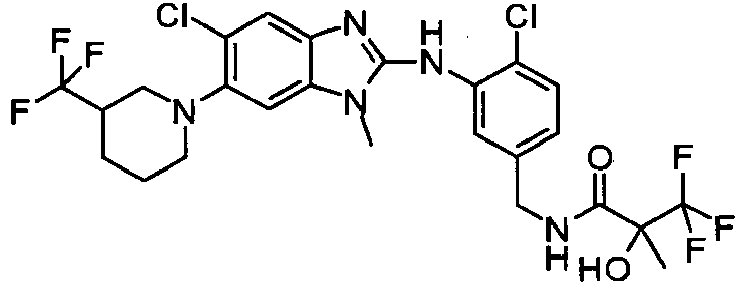
C25H25Cl2F6N5O2 612 Rt: 2.56 (method K) 12 612.39 15 
C24H24Cl2F5N5O 564 Rt: 2.78 (method D) 12 564.38 16 
C25H32ClN5O 454 Rt: 1.66 (method L) 1(i) 454.02 17 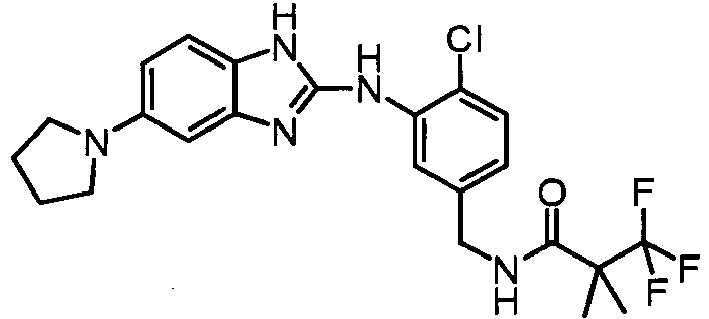
C23H25ClF3N5O 480 Rt: 1.62 (method L) 1(i) 479.93 18 
C25H32ClN5O 454 Rt: 1.69 (method L) 1(i) 454.02 19 
C26H32ClN5O 466 Rt: 1.67 (method L) 1(i) 466.03 20 
C23H28ClN5O 426 Rt: 1.51 (method L) 1(i) 425.96 21 
C32H30ClN5O2 552 Rt: 1.78 (method L) 1(i) 552.08 22 
C28H25ClN6O 497 Rt: 1.66 (method L) 1(i) 497.00 24 
C27H27Cl3F3N5O 600 Rt: 1.68 (method Q) 23 600.9 25 
C26H22Cl4F3N5OS 650 Rt: 1.77 (method Q) 23 651.37 26 
C23H23ClN6O 435 Rt: 1.46 (method L) 1(i) 434.93 27 
C26H29ClF3N5O 520 Rt: 1.68 (method L) 1(i) 520.00 28 
C25H30ClN5O 452 Rt: 1.62 (method L) 1(i) 452.00 29 
C22H22ClN5O3S 472 Rt: 1.54 (method L) 30 471.97 31 
C23H28ClN5O2 442 Rt: 1.40 (method L) 1(i) 441.96 32 
C24H25ClN6OS 481 Rt: 1.47 (method L) 1(i) 481.02 34 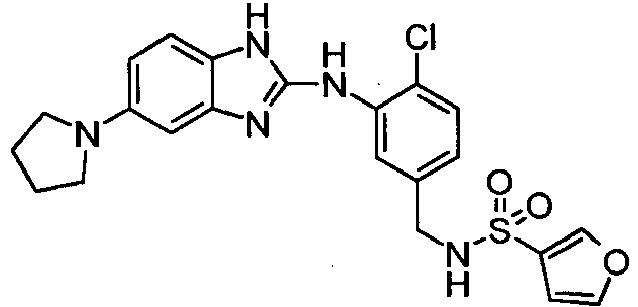
C22H22ClN5O3S 472 Rt: 1.53 (method L) 30 471.97 35 
C26H30ClN5O 464 Rt: 1.64 (method L) 1 (i) 464.01 36 
C26H33ClN6O 480 Rt: 1.33 (method L) 1(i) 481.04 37 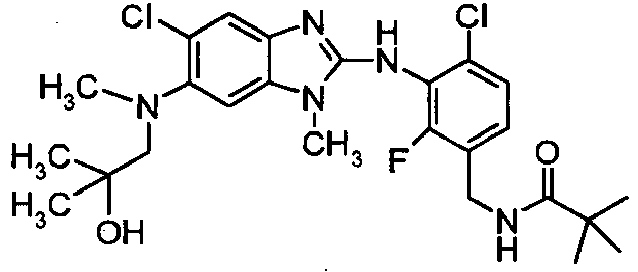
C25H32Cl2FN5O2 524 Rf: 0.3 (silica; DCM:EtOH 95:5) 33 524.46 38 
C25H25ClN6O 460 Rt: 1.31 (method L) 1(i) 460.97 39 
C23H23ClN6O2 451 Rt: 1.48 (method L) 1(i) 450.93 41 
C27H28ClN5O 474 Rt: 1.62 (method L) 1(i) 474.01 42 
C25H30Cl2FN5O2 522 Rt: 1.20 (method G) 33 522.442 43 
C30H27ClN6O 523 Rt: 1.40 (method L) 1(i) 523.04 44 
C23H22ClN7O 448 Rt: 1.40 (method L) 1(i) 447.93 45 
C24H25ClN6O 449 Rt: 1.54 (method L) 1(i) 448.96 46 
C23H24ClN7O 448 Rt: 0.32 (method L) 1(i) 449.94 47 
C23H23ClN6O2 451 Rt: 0.60 (method L) 1(i) 450.93 48 
C24H27Cl2F2N5O 510 Rt: 1.41 (method G) 33 510.408 49 
C29H26ClN5O 496 Rt: 1.74 (method L) 1(i) 496.01 50 
C27H24ClN5O 470 Rt: 0.68 (method L) 1(i) 469.97 51 
C26H29Cl3F3N5O2 606 Rt: 2.37 (method A) 1 606.894 52 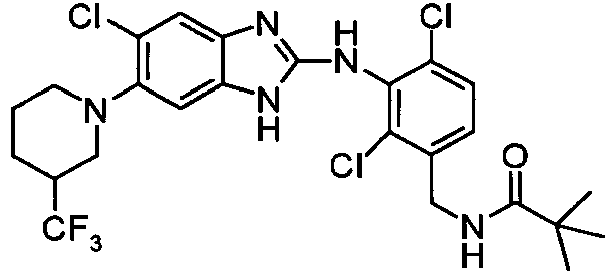
C25H27Cl3F3N5O 576 5 576.87 53 
C26H29Cl3F3N5O 590 Rt: 1.51 (method G) 5 590.90 54 
C27H23Cl4F3N6O 645 Rt: 1.52 (method M) 1(i) 646.33 55 
C24H23Cl2F6N5O2 598 Rt: 1.43 (method M) 1(i) 598.37 56 
C26H25Cl3F5N5O 624 Rt: 1.97 (method Q) 1(i) 624.87 57 
C26H27Cl2F6N5O2 626 Rt: 1.93 (method L) 1(i) 626.43 58 
C32H34Cl2F3N5O 632 Rt: 2.03 (method L) 1(i) 632.56 59 
C25H27Cl3F3N5O 576 Rt: 1.50 (method G) 5 576.87 60 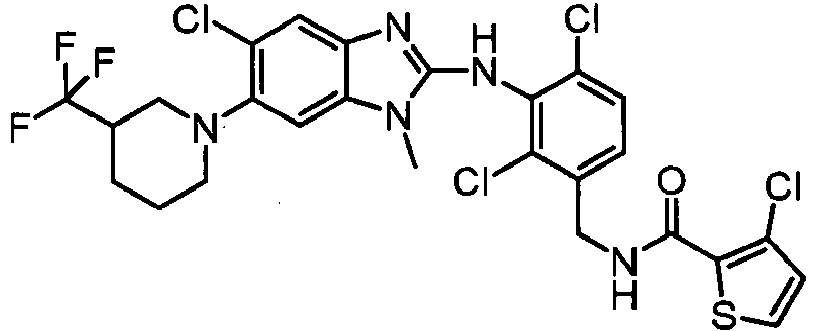
C26H22Cl4F3N5OS 650 Rt: 1.69 (method Q) 23 651.37 62 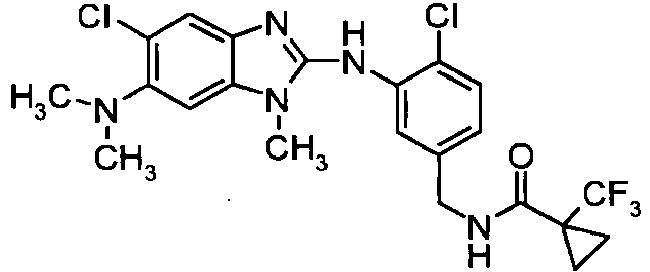
C22H22Cl2F3N5O 500 Rt: 1.54 (method J) 71 500.34 63 
C31H30Cl2F3N5O 616 Rt: 2.00 (method L) 1(i) 616.51 64 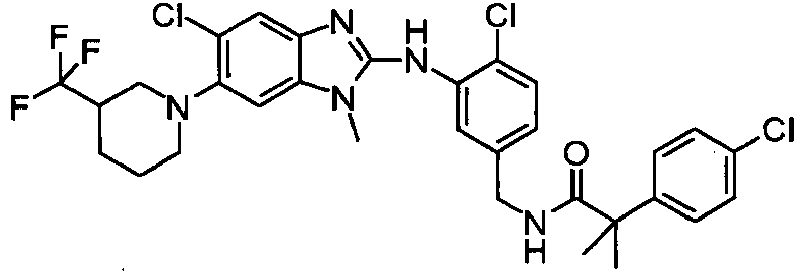
C31H31Cl3F3N5O 652 Rt: 2.05 (method L) 1(i) 652.97 65 
C24H24Cl2F6N6O 597 Rt: 1.69 (method L) 1(i) 597.39 66 
C26H28Cl2F3N5O2 570 Rt: 1.81 (method L) 1(i) 570.44 67 
C31H29Cl2F6N5O2 688 Rt: 2.04 (method L) 1(i) 688.50 68 
C28H24Cl4F3N5O 644 Rt: 1.96 (method L) 1(i) 645.34 69 
C29H24Cl2F7N5O 662 Rt: 1.96 (method L) 1(i) 662.44 72 
C25H23Cl2F6N5O 594 Rt: 13.74 (method N) 71 594.38 73 
C26H27Cl2F3N6O2 583 Rt: 11.03 (method N) 71 583.43 74 
C25H25Cl2F3N6O2 569 Rt: 10.87 (method N) 71 569.41 75 
C25H23Cl2F6N5O 594 Rt: 13.70 (method N) 71 594.38 77 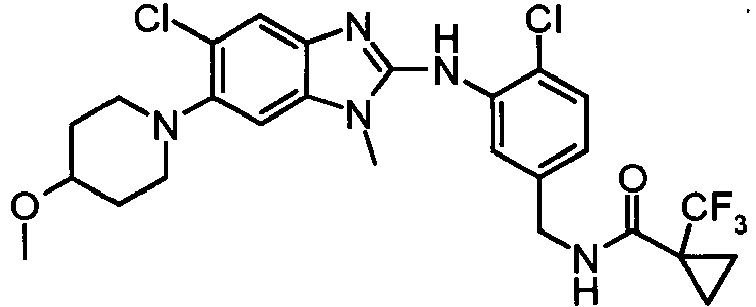
C26H28Cl2F3N5O2 570 Rt: 9.55 (method O) 76 570.43 78 
C27H30Cl2F3N5O 568 Rt: 11.39 (method O) 76 568.46 79 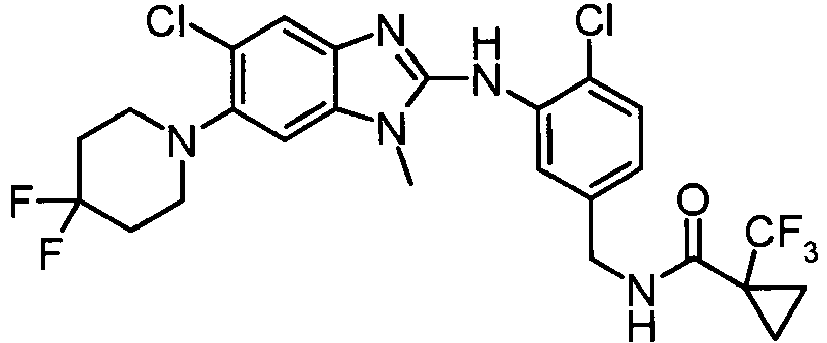
C25H24Cl2F5N5O 576 Rt: 10.59 (method O) 76 576.39 80 
C29H32Cl2F6N6O 665 Rt: 10.67 (method O) 76 665.50 81 
C28H29Cl2F6N5O2 652 Rt: 12.90 (method O) 76 652.46 85 
C27H29ClF5N5O 570 Rt: 12.64 (method O) 84 570.00 87 
C27H30ClF4N5O 552 Rt: 10.65 (method O) 86 552.01 88 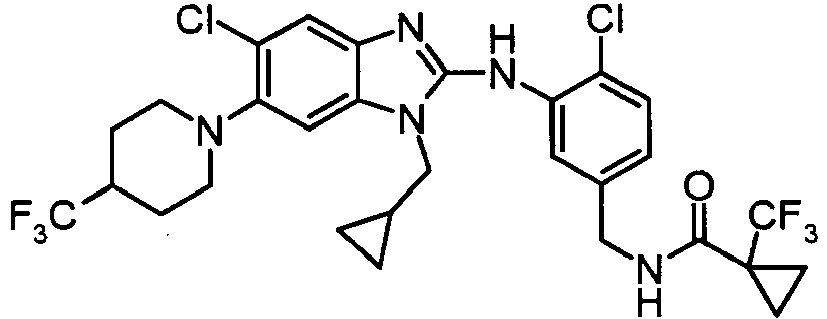
C29H29Cl2F6N5O 648 Rt: 11.70 (method O) 76 648.47 89 
C27H24Cl2F9N5O 676 Rt: 13.07 (method O) 76 676.40 90 
C30H29Cl2F3N6O 617 Rt: 11.23 (method O) 76 617.49 91 
C31H29Cl2F4N5O 634 Rt: 11.88 (method O) 76 634.49 92 
C26H26Cl2F6N6O 623 Rt: 10.85 (method O) 76 623.42 95 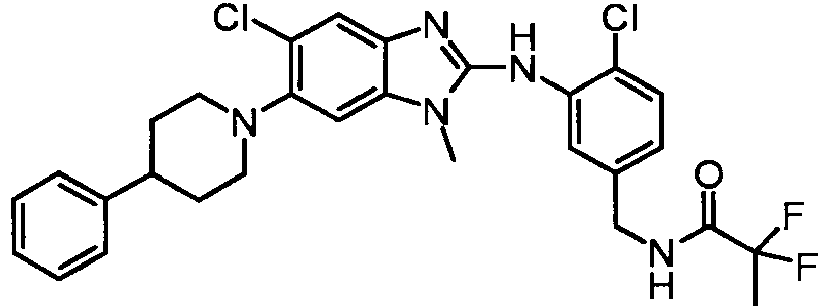
C29H29Cl2F2N5O 572 Rt: 11.20 (method O) 94 572.48 96 
C29H27Cl2F5N6O 641 Rt: 12.00 (method O) 94 641.46 97 
C31H32Cl2F3N5O 618 Rt: 12.02 (method O) 94 618.52 98 
C31H30Cl2F6N6O 687 Rt: 12.19 (method O) 94 687.51 100 
C30H33Cl2F3N6O2 S 669 Rt: 12.12 (method O) 99 669.59 102 
C26H26ClF6N5O 574 Rt: 10.53 (method O) 101 573.96 103 
C29H24Cl2F7N5O 662 Rt: 11.10 (method O) 101 662.43 104 
C27H30ClF6N5O 590 Rt: 11.03 (method O) 101 590.00 106 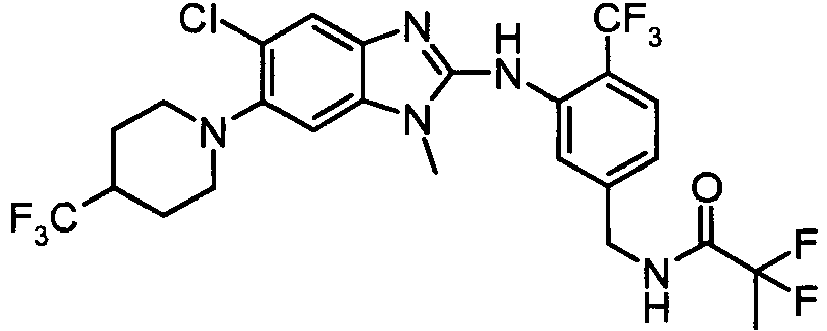
C25H24ClF8N5O 598 Rt: 11.23 (method O) 105 597.93 107 
C26H26ClF6N5O2 590 Rt: 10.50 (method O) 105 589.96 108 
C26H26ClF9N6O 645 Rt: 11.27 (method O) 105 644.96 112 
C25H24ClF6N5O 560 Rt: 10.48 (method O) 111 559.93 113 
C27H25F7N6O 583 Rt: 10.82 (method O) 111 582.52 115 
C27H29Cl2F4N5O 586 Rt: 11.60 (method O) 114 586.45 118 
C26H32ClN5O 466 Rt: 6.10 (method P) 71 466.02 119 
C26H32ClN5O2 482 Rt: 4.79 (method P) 71 482.02 120 
C27H34Cl2N6O 529 Rt: 3.82 (method P) 71 529.50 121 
C26H31Cl2N5O2 516 Rt: 11.62 (method N) 71 516.46 122 
C28H35Cl2N5O2 544 Rt: 12.50 (method N) 71 544.52 123 
C27H34ClN5O 480 Rt: 12.25 (method N) 71 480.04 124 
C26H25Cl2F6N5O 608 Rt: 14.02 (method N) 71 608.41 125 
C27H31Cl2F3N6O 583 Rt: 9.35 (method N) 71 583.48 126 
C26H28Cl2F3N5O2 570 Rt: 12.52 (method N) 71 570.43 127 
C24H22ClF3N6O 503 Rt: 11.84 (method N) 71 502.92 128 
C23H22Cl2F3N5O2 528 Rt: 11.28 (method N) 71 528.35 129 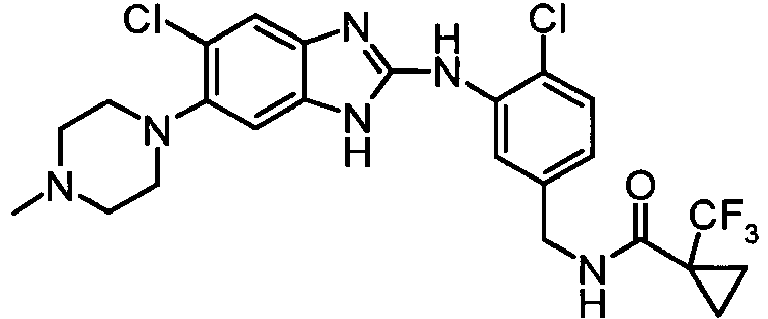
C24H25Cl2F3N6O 541 Rt: 8.90 (method N) 71 541.40 130 
C26H23ClF6N6O 585 Rt: 13.92 (method N) 82 584.94 131 
C26H27Cl2F3N6O 567 Rt: 1.39 (method G) 82 567.433 132 
C24H25ClF3N5O 492 Rt: 12.00 (method N) 9(f) 491.94 134 
C24H25Cl3F3N5O 562 Rt: 1.62 (method Q) 23 562.85 135 
C25H27Cl3F3N5O 576 Rt: 1.66 (method Q) 23 576.88 136 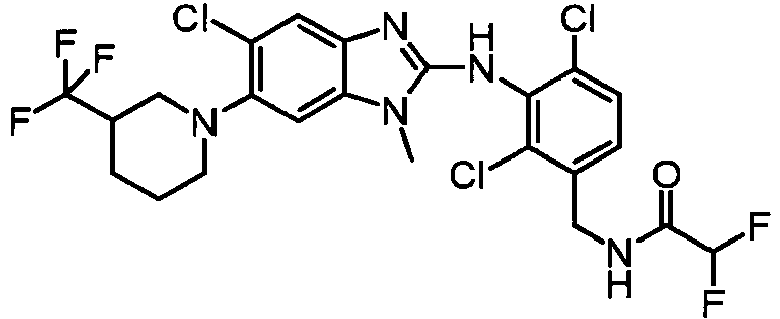
C23H21Cl3F5N5O 584 Rt: 1.61 (method Q) 23 584.8 137 
C24H24Cl3F4N5O 580 Rt: 1.62 (method Q)) 23 580.84 138 
C25H26Cl3F4N5O 594 Rt: 1.65 (method Q) 23 594.87 139 
C25H24Cl3F6N5O 630 Rt: 1.69 (method Q) 23 630.85 140 
C26H26Cl3F6N5O 644 Rt: 1.72 (method Q) 23 644.87 141 
C24H23Cl3F5N5O 598 Rt: 1.64 (method Q) 23 598.83 142 
C24H22Cl3F6N5O 616 Rt: 1.65 (method Q) 23 616.82 143 
C25H24Cl3F6N5O 630 Rt: 1.68 (method Q) 23 630.85 144 
C27H31Cl3F3N5O 604 Rt: 1.73 (method Q) 23 604.93 145 
C26H26Cl3F3N6O 601 Rt: 1.63 (method Q) 23 601.89 146 
C24H26Cl3F3N6O 577 Rt: 1.40 (method Q) 23 577.86 147 
C25H25Cl3F6N6O 645 Rt: 1.57 (method Q) 23 645.86 148 
C24H25Cl3F4N6O 595 Rt: 1.41 (method Q) 23 595.85 149 
C26H28Cl3F3N6O 603 Rt: 1.42 (method Q) 23 603.9 150 
C26H28Cl3F3N6O 603 Rt: 1.42 (method Q) 23 603.9 151 
C25H24Cl3F6N5O2 646 Rt: 1.66 (method Q) 23 646.84 152 
C24H22Cl3F6N5O2 632 Rt: 1.63 (method Q) 23 632.82 153 
C26H26Cl3F6N5O2 660 Rt: 1.67 (method Q) 23 660.87 154 
C26H26Cl3F6N5O2 660 Rt: 1.68 (method Q) 23 660.87 155 
C25H25Cl3F3N5O 574 Rt: 1.64 (method Q) 23 574.86 156 
C26H27Cl3F3N5O 588 Rt: 1.68 (method Q) 23 588.89 157 
C26H24Cl3F6N5O 642 Rt: 1.70 (method Q) 23 642.86 158 
C25H25Cl3F3N5O2 590 Rt: 1.61 (method Q) 23 590.86 159 
C25H26Cl3F3N6O 589 Rt: 1.40 (method Q) 23 589.87 160 
C26H26Cl3F4N5O 606 Rt: 1.66 (method Q) 23 606.88 161 
C27H28Cl3F4N6O 615 Rt: 1.41 (method Q) 23 615.91 162 
C27H28Cl3F3N6O 615 Rt: 1.41 (method Q) 23 615.91 163 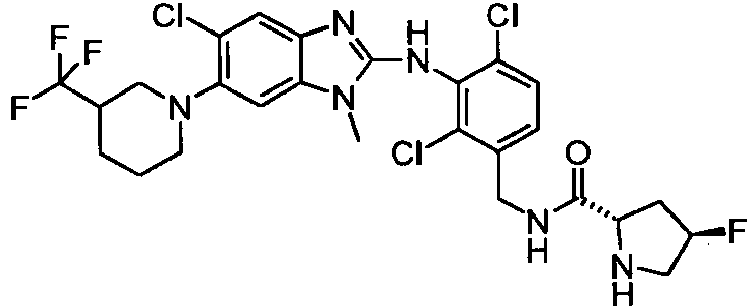
C26H27Cl3F4N6O 621 Rt: 1.40 (method Q) 23 621.89 164 
C26H26Cl3F5N6O 639 Rt: 1.46 (method Q) 23 639.88 165 
C25H26Cl3F3N6O 589 Rt: 1.40 (method Q) 23 589.87 166 
C25H26Cl3F3N6O 589 Rt: 1.40 (method Q) 23 589.87 167 
C28H24Cl3F4N5O 628 Rt: 1.67 (method Q) 23 628.88 168 
C28H23Cl4F4N5O 662 Rt: 1.67 (method Q) 23 663.33 169 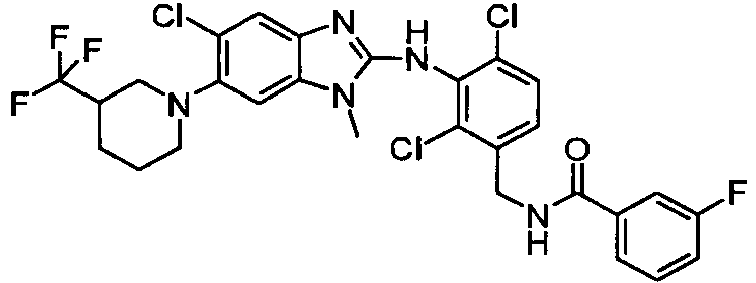
C28H24Cl3F4N5O 628 Rt: 1.71 (method Q) 23 628.88 170 
C28H23Cl3F5N5O 646 Rt: 1.74 (method Q) 23 646.87 171 
C28H24Cl3F4N5O 628 Rt: 1.71 (method Q) 23 628.88 172 
C27H24Cl3F3N6O 611 Rt: 1.60 (method Q) 23 611.88 173 
C27H23Cl4F3N6O 645 Rt: 1.63 (method Q) 23 646.33 174 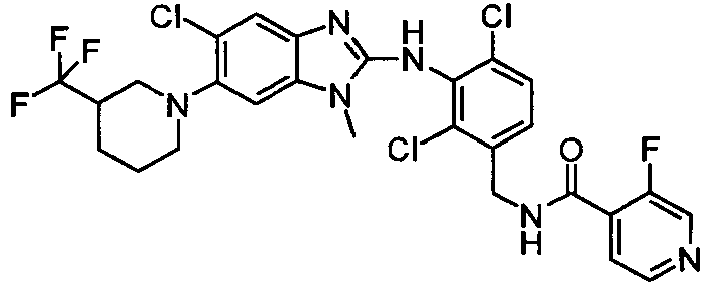
C27H23Cl3F4N6O 629 Rt: 1.62 (method Q) 23 629.87 175 
C28H26Cl3F3N6O 625 Rt: 1.67 (method Q) 23 625.91 176 
C27H24Cl3F3N6O 611 Rt: 1.65 (method Q) 23 611.88 177 
C27H23Cl3F4N6O 629 Rt: 1.66 (method Q) 23 629.87 178 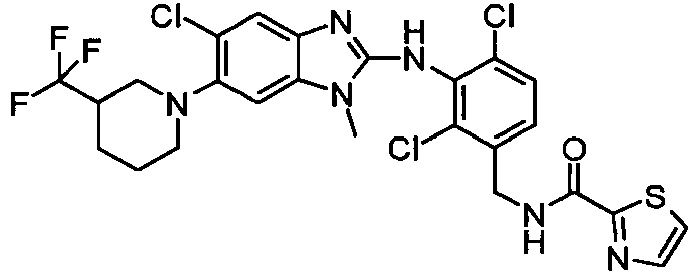
C25H22Cl3F3N6OS 617 Rt: 1.64 (method Q) 23 617.91 179 
C26H23Cl4F3N6O 633 Rt: 1.69 (method Q) 23 634.31 180 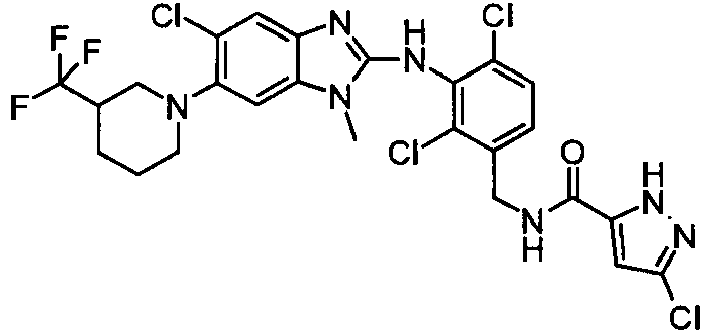
C25H22Cl4F3N7O 634 Rt: 1.66 (method Q) 23 635.3
Claims (15)
- A compound of formula I
 R1 represents halo, -OH, -CN, C1-3 alkyl, C2-6 alkynyl, -OC1-3 alkyl which latter three groups are optionally substituted by one or more substituents selected from fluoro, -CN, =O, -OH, -OCH3, -OCF3;R2, R3 and R4 independently represent hydrogen, halo, -CN, C1-3 alkyl, -OC1-3 alkyl which latter two alkyl groups are optionally substituted by one or more substituents selected from fluoro, -CN, =O, -OH, -OCH3, -OCF3;Ra and Rb independently represent hydrogen, C1-3 alkyl which is optionally substituted by one or more fluorine atoms, or both together with the carbon atom which they are bound to, form a C3-7 cycloalkyl ring, or a 4-6 membered heterocycloalkyl ring which latter two groups are optionally substituted by one or more fluorine atoms;W represents -C(O)-, -S(O)-, -S(O)2-, -C(O)O-, -C(O)NRd- which groups are bound to the nitrogen of the -NH- moiety via carbon or sulfur atom;Rd represents hydrogen, C1-3 alkyl;M represents C1-8 alkyl, C2-8 alkynyl, C3-8 cycloalkyl-C0-4 alkyl-, 4-10 membered heterocycloalkyl-C0-4 alkyl- which latter four groups are optionally substituted by one or more groups selected from fluoro, -OH, =O, -CN, -NH2, C1-3 alkyl, -NH(C1-3 alkyl), -N(C1-3 alkyl)2, azetidinyl, pyrrolidinyl, piperidinyl, -OC1-3 alkyl, [which latter seven alkyl groups can be substituted by one or more substituents selected from fluoro, -OH, -CN, - OC1-2 alkyl (which latter alkyl group is optionally substituted by one or more fluorine atoms)], aryl, heteroaryl [which latter two groups are optionally substituted by one or more substituents selected from halo, -OH, -CN, C1-3 alkyl, -OC1-3 alkyl (which latter two alkyl groups are optionally substituted by one or more fluorine atoms)],
or
aryl, heteroaryl which latter two groups are optionally substituted by one or more substituents selected from halo, -OH, -CN, -NH2, aryl, heteroaryl [which latter two groups are optionally substituted by one or more substituents selected from halo, -OH, -CN, C1-3 alkyl, -OC1-3 alkyl (which latter two alkyl groups are optionally substituted by one or more fluorine atoms)], C1-7 alkyl, C2-7 alkynyl, C3-7 cycloalkyl, 4-7 membered heterocycloalkyl, -NH2, -NH(C1-3 alkyl), -N(C1-3 alkyl)2, -OC1-3 alkyl, -O-C0-2alkyl-aryl, -SC1-3 alkyl, (which latter alkyl, alkynyl, heterocycloalkyl, aryl or cycloalkyl groups are optionally substituted by one or more substituents selected from fluoro, -CN, =O, -NH2, -NH(C1-3 alkyl), -N(C1-3 alkyl)2, -OH, -OC1-3alkyl)];R6 represents hydrogen, C1-5 alkyl, C3-6 alkynyl, 4-7 membered heterocycloalkyl-C0-2 alkyl or C3-7cycloalkyl-C0-2 alkyl (which latter four groups are optionally substituted by one or more substituents selected from fluoro, -CN, =O, C1-3 alkyl, -OH, -NH2, -OC1-3 alkyl, -NH(C1-3 alkyl), -N(C1-3 alkyl)2);R 7, R 8 and R9 independently represent hydrogen, halo, -CN, C1-5 alkyl, C3-5 cycloalkyl-C0-2 alkyl-, C1-5 alkyl-O-, C3-5 cycloalkyl-C0-2 alkyl-O- (in which latter four groups the alkyl and cycloalkyl fragments are optionally substituted by one or more substituents selected from fluoro, -CN, -OH, -OC1-3 alkyl or by one or more C1-3 alkyl groups which are optionally substituted by one or more fluorine atoms);A represents -NHR10, -NR10R11, or a 4-10-membered heterocycloalkyl group which is bound to the benzimidazole through a nitrogen atom, and which is optionally substituted by one or more substituents R12;R 10 and R11 independently represent C1-7 alkyl, C3-7 cycloalkyl-C0-4 alkyl- or C4-7 heterocycloalkyl-C0-4 alkyl- [which latter three groups are optionally substituted by one or more groups selected from fluoro, -OH, NH2, -CN, C1-3 alkyl, -NH(C1-3 alkyl), -N(C1-3 alkyl)2, -OC1-5 alkyl, -OC3-6 cycloalkyl, -OC4-6 heterocycloalkyl (which latter six groups are optionally substituted by one or more substituents selected from fluoro, -CF3, -CHF2, -CH2F, -CH3)],
or
aryl-C0-4 alkyl-, heteroaryl-C0-4 alkyl- [which latter two groups are optionally substituted by one or more substituents selected from halo, - OH, -CN, C1-3 alkyl, C3-5 cycloalkyl, C1-3 alkyl-O-, C3-5 cycloalkyl-O- (which latter four groups are optionally substituted by one or more fluorine atoms)];each R12 independently represents halo, -OH, -NH2, =O, -CN, C1-4 alkyl, C3-5 cycloalkyl-C0-2 alkyl-, C4-5 heterocycloalkyl-C0-2 alkyl-, C1-4 alkyl-O-, C1-3 alkyl-C(=O)-, -C(=O)-NH(C1-3 alkyl), -C(=O)-N(C1-3 alkyl)2 [which latter six groups are optionally substituted by one or more groups selected from fluoro, -OH, oxo, -NH2, -CN, C1-3 alkyl, -NH(C1-3 alkyl), -N(C1-3 alkyl)2, -OC1-3 alkyl, -OC3-5 cycloalkyl [which latter five groups are optionally substituted by one or more substituents selected from fluoro, -CF3, -CHF2, -CH2F],or a salt thereof, particularly a physiologically acceptable salt thereof.
or
aryl-C0-4 alkyl-" heteroaryl-C0-4 alkyl- [which latter two groups are optionally substituted by one or more substituents selected from halo, - OH, -CN, C1-3 alkyl, C3-5 cycloalkyl, C1-3 alkyl-O-, C3-5 cycloalkyl-O- (which latter four groups are optionally substituted by one or more fluorine atoms)]; - A compound according to claim 1, whereinR 1 represents halo, C1-3 alkyl, -OC1-3 alkyl which latter two groups are optionally substituted by one or more fluorine atoms.
- A compound according to claim 1 or 2, whereinR3 and R4 independently represent hydrogen, halo.
- A compound according to any one of the preceding claims, whereinM represents C1-6 alkyl, C2-6 alkynyl, C3-8 cycloalkyl-C0-1 alkyl-, oxetanyl-, tetrahydrofuranyl-, azetidinyl-, pyrrolidinyl-, piperidinyl- or one of the following heterocyclic groups

fluoro, -OH, -CN, -NH2, C1-3 alkyl, -NH(C1-2 alkyl), -N(C1-2 alkyl)2, -OC1-2 alkyl [which latter four alkyl groups are optionally substituted by one or more substituents selected from fluoro],
phenyl, imidazolyl- [which latter two groups are optionally substituted by one or more substituents selected from halo, C1-2 alkyl, OC1-2alkyl (which latter two alkyl groups are optionally substituted by one or more fluorine atoms)],
or phenyl, naphthyl, furanyl, thienyl, oxazolyl, isoxazolyl, thiazolyl, pyrrolyl, pyrazolyl, pyridinyl, pyrazinyl, quinolynyl which latter twelve groups are optionally substituted by one or more substituents selected from
halo, aryl, heteroaryl [which latter two groups are optionally substituted by one or more substituents selected from halo, -CH3, -CH2F, -CHF2, -CF3],
C1-2alkyl, -OC1-2 alkyl [which latter two groups are optionally substituted by one or more fluorine atoms],
C2-3 alkynyl, -O-C0-2alkyl-phenyl [in which latter group the phenyl is optionally substituted by one or more substituents selected from from halo, -CH3, -CH2F, -CHF2, -CF3]. - A compound according to any one of the preceding claims, whereinR 7 and R9 independently represent hydrogen, halo, -CN, C1-3 alkyl optionally substituted by one or more fluorine atoms.
- A compound according to any one of the preceding claims, whereinA represents -NHR10, -NR10R11, or
azetidinyl-, pyrrolidinyl-, piperidinyl-, morpholinyl-, piperazinyl- or R 10 and R11 independently represent C1-5 alkyl, C3-6 cycloalkyl-C0-1 alkyl- [which latter two groups are optionally substituted by one or more groups selected from fluoro, -OH, C1-3 alkyl],
or
aryl-C0-1 alkyl- optionally substituted by one or more substituents selected from halo, -OH, -CN, C1-3 alkyl, C1-3 alkyl-O- [which latter two groups are optionally substituted by one or more fluorine atoms];each R12 independently represents halo, -OH, -CN, C1-4 alkyl, C1-2 alkyl-O-, C1-2 alkyl-C(=O)-, -C(=O)-NH(C1-2 alkyl), -C(=O)-N(C1-2 alkyl)2 [which latter five groups are optionally substituted by one or more groups selected from fluoro, -OH, C1-3 alkyl, -NH(C1-2 alkyl), -N(C1-2 alkyl)2, -OC1-2 alkyl (which latter four groups are optionally substituted by one or more substituents selected from fluoro, CF3, CHF2 or CH2F)],
or
phenyl optionally substituted by one or more substituents selected from halo or C1-3 alkyl which is optionally substituted by one or more fluorine atoms. - A compound according to any one of the preceding claims, namely a compound of formula Ia
 R 1 represents halo, C1-3 alkyl, -OC1-3 alkyl which latter two groups are optionally substituted by one or more fluorine atoms;R 2 represents hydrogen, halo, C1-3 alkyl optionally substituted by one or more fluorine atoms;R3 and R4 independently represent hydrogen, halo;W represents -C(O)-, -S(O)2-, -C(O)O- which groups are bound to the nitrogen of the -NH- moiety via carbon or sulfur atom;M represents C1-6 alkyl, C2-6 alkynyl, C3-8 cycloalkyl-C0-1 alkyl-, oxetanyl-, tetrahydrofuranyl-, azetidinyl-, pyrrolidinyl-, piperidinyl- or one of the following heterocyclic groups
fluoro, -OH, -CN, -NH2, C1-3 alkyl, -NH(C1-2 alkyl), -N(C1-2 alkyl)2, -OC1-2 alkyl, [which latter four alkyl groups are optionally substituted by one or more fluorine atoms], phenyl, imidazolyl- [which latter two groups are optionally substituted by one or more substituents selected from halo, C1-2 alkyl, OC1-2alkyl (which latter two alkyl groups are optionally substituted by one or more fluorine atoms)],
or
phenyl, naphthyl, furanyl, thienyl, oxazolyl, isoxazolyl, thiazolyl, pyrrolyl, pyrazolyl, pyridinyl, pyrazinyl, quinolynyl which latter twelve groups are optionally substituted by one or more substituents selected from
halo, aryl, heteroaryl [which latter two groups are optionally substituted by one or more substituents selected from halo, -CH3, -CH2F, -CHF2, -CF3],
C1-2alkyl, -OC1-2 alkyl [which latter two groups are optionally substituted by one or more fluorine atoms],
C2-3 alkynyl, -O-C0-2alkyl-phenyl [in which latter group the phenyl is optionally substituted by one or more substituents selected from from halo, -CH3, -CH2F, -CHF2, -CF3];R 6 represents hydrogen, C1-5 alkyl or C3-7cycloalkyl-C0-2 alkyl [which latter two groups are optionally substituted by one or more substituents selected from fluoro, C1-3 alkyl, -OC1-3 alkyl, -NH(C1-3 alkyl), -N(C1-3 alkyl)2];R8 represents hydrogen, halo, -CN, C1-5 alkyl, C3-5 cycloalkyl-C0-2 alkyl- (in which latter two groups the alkyl and cycloalkyl fragments are optionally substituted by one or more fluorine atoms, or by one or more C1-3 alkyl groups which are optionally substituted by one or more fluorine atoms)R9 represents hydrogen, halo, -CN, C1-3 alkyl optionally substituted by one or more substituents selected from fluorine atoms;A represents -NHR10, -NR10R11, or azetidinyl-, pyrrolidinyl-, piperidinyl-, morpholinyl-, piperazinyl- or R 10 and R11 independently represent C1-5 alkyl or C3-6 cycloalkyl-C0-1 alkyl- [which latter two groups are optionally substituted by one or more groups selected from: fluoro, -OH, C1-3 alkyl],
or
aryl-C0-1 alkyl- which can be substituted by one or more substituents selected from halo, -OH, -CN, C1-3 alkyl, C1-3 alkyl-O- [which latter two groups are optionally substituted by one or more fluorine atoms];each R12 independently represents halo, -OH, -CN, C1-4 alkyl, C1-2 alkyl-O-, C1-2 alkyl-C(=O)-, -C(=O)-NH(C1-2 alkyl), -C(=O)-N(C1-2 alkyl)2 [which latter five groups are optionally substituted by one or more groups selected from fluoro, -OH, C1-3 alkyl, -NH(C1-2 alkyl), -N(C1-2 alkyl)2, -OC1-2 alkyl, (which latter four groups are optionally substituted by one or more substituents selected from fluoro, CF3, CHF2 or CH2F)],
or
phenyl optionally substituted by one or more substituents selected from halo or C1-3 alkyl which is optionally substituted by one or more fluorine atoms. - A compound according to any one of the preceding claims, whereinR8 represents hydrogen, fluoro, chloro, CF3, -CN.
- A compound according to any one of the preceding claims, whereinA represents a group selected from


- A compound according to any one of the preceding claims, whereinM represents a group selected from


- A compound according to any one of the preceding claims, namely a compound of formula la
 R 1 represents fluoro, chloro, CH3, CHF2, CH2F, CF3 or -OCF3;R 2 represents hydrogen, fluoro or chloro;R3 and R4 independently represent hydrogen, fluoro;R6 represents hydrogen, -CH3, -CH2CF3, cyclopropylmethyl-, -CH2CH2-O-CH3, -CH2CH2-N(CH3)2;R8 represents hydrogen, fluoro, chloro, CF3, -CN;R9 represents hydrogen, fluoro;A represents a group selected from


 W represents -C(O)-, -S(O)2- which groups are bound to the nitrogen of the -NH- moiety via carbon or sulfur atom;M represents a group selected from




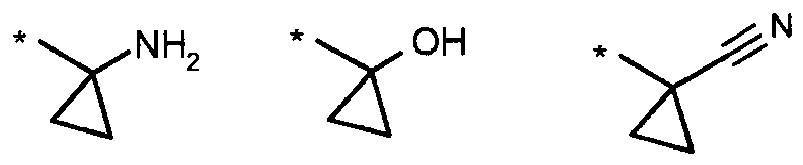


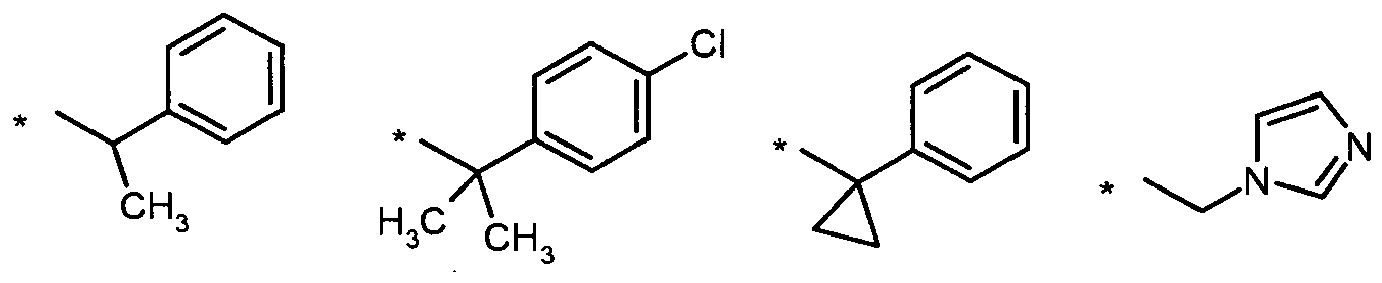


- A compound according to any one of the preceding claims selected from the group consisting of
Structure Structure 1 
2 
3 
4 
5 
6 
7 
8 
9 
10 
11 
12 
13 
14 
15 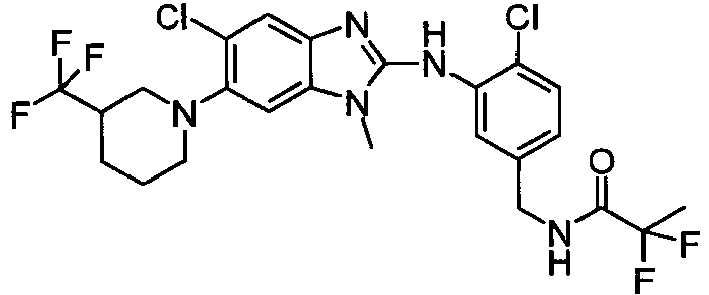
16 
17 
18 
19 
20 
21 
22 
23 
24 
25 
26 
27 
28 
29 
30 
31 
32 
33 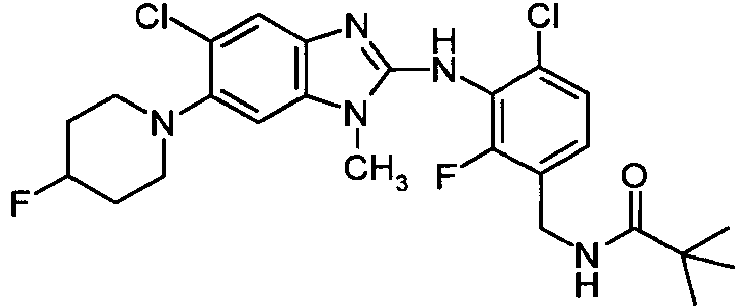
34 
35 
36 
37 
38 
39 
40 
41 
42 
43 
44 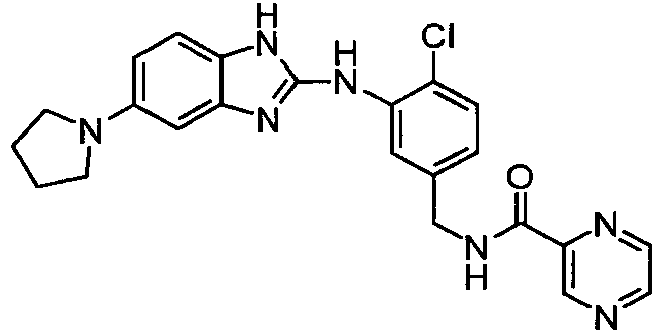
45 
46 
47 
48 
49 
50 
51 
52 
53 
54 
55 
56 
57 
58 
59 
60 
61 
62 
63 
64 
65 
66 
67 
68 
69 
70 
71 
72 
73 
74 
75 
76 
77 
78 
79 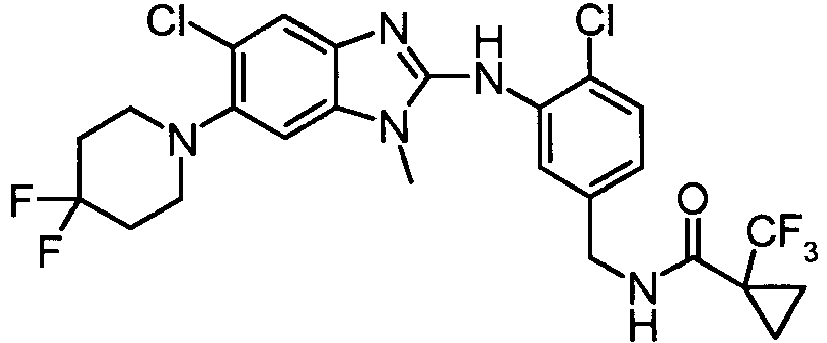
80 
81 
82 
83 
84 
85 
86 
87 
88 
89 
90 
91 
92 
93 
94 
95 
96 
97 
98 
99 
100 
101 
102 
103 
104 
105 
106 
107 
108 
109 
110 
111 
112 
113 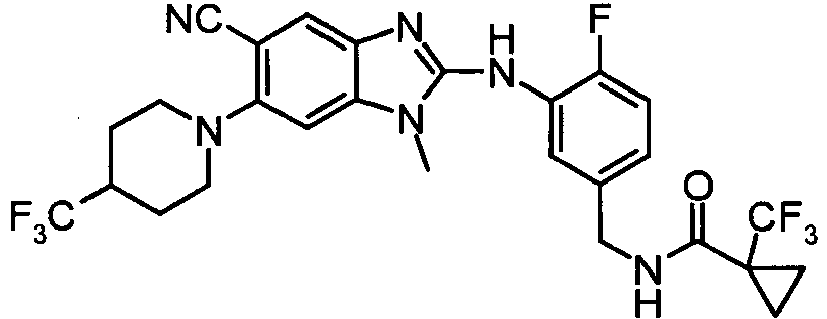
114 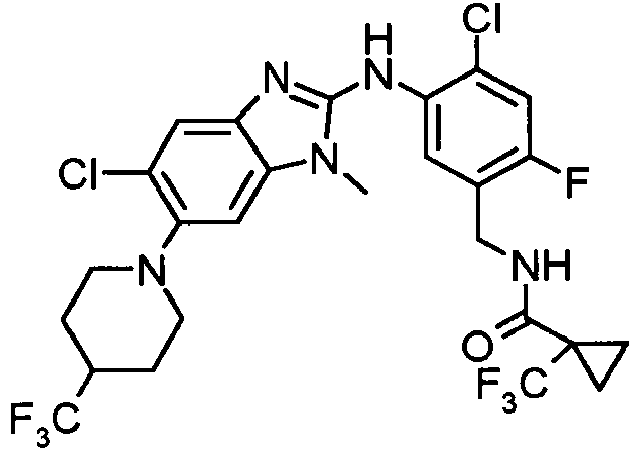
115 
116 
117 
118 
119 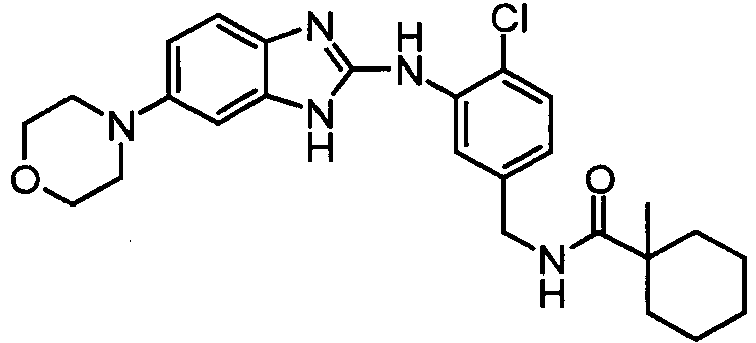
120 
121 
122 
123 
124 
125 
126 
127 
128 
129 
130 
131 
132 
133 
134 
135 
136 
137 
138 
139 
140 
141 
142 
143 
144 
145 
146 
147 
148 
149 
150 
151 
152 
153 
154 
155 
156 
157 
158 
159 
160 
161 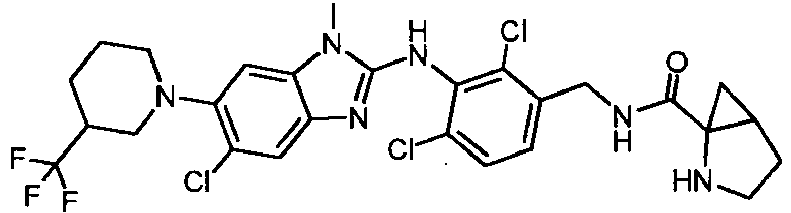
162 
163 
164 
165 
166 
167 
168 
169 
170 
171 
172 
173 
174 
175 
176 
177 
178 
179 
180 
- A compound according to any of the preceding claims for use as a medicament.
- A pharmaceutical composition comprising at least one compound according to any of claims 1 to 12 or a pharmaceutically acceptable salt thereof in admixture with a pharmaceutically acceptable adjuvant, diluent and/or carrier.
- A compound according to any one of claims 1 to 12 or a pharmaceutically acceptable salt thereof for use in the treatment and/or prevention of inflammatory diseases and/or associated conditions, in particular pain.
Priority Applications (1)
| Application Number | Priority Date | Filing Date | Title |
|---|---|---|---|
| EP11796671.3A EP2649052B1 (en) | 2010-12-10 | 2011-12-09 | 2-aminobenzimidazole derivatives useful in the treatment of inflammation |
Applications Claiming Priority (3)
| Application Number | Priority Date | Filing Date | Title |
|---|---|---|---|
| EP10194456 | 2010-12-10 | ||
| PCT/EP2011/072256 WO2012076672A1 (en) | 2010-12-10 | 2011-12-09 | 2 -aminobenz imidazole derivatives useful in the treatment of inflammation |
| EP11796671.3A EP2649052B1 (en) | 2010-12-10 | 2011-12-09 | 2-aminobenzimidazole derivatives useful in the treatment of inflammation |
Publications (2)
| Publication Number | Publication Date |
|---|---|
| EP2649052A1 EP2649052A1 (en) | 2013-10-16 |
| EP2649052B1 true EP2649052B1 (en) | 2014-10-22 |
Family
ID=43568037
Family Applications (1)
| Application Number | Title | Priority Date | Filing Date |
|---|---|---|---|
| EP11796671.3A Not-in-force EP2649052B1 (en) | 2010-12-10 | 2011-12-09 | 2-aminobenzimidazole derivatives useful in the treatment of inflammation |
Country Status (4)
| Country | Link |
|---|---|
| US (1) | US8466186B2 (en) |
| EP (1) | EP2649052B1 (en) |
| JP (1) | JP5808423B2 (en) |
| WO (1) | WO2012076672A1 (en) |
Families Citing this family (52)
| Publication number | Priority date | Publication date | Assignee | Title |
|---|---|---|---|---|
| UY32138A (en) | 2008-09-25 | 2010-04-30 | Boehringer Ingelheim Int | SUBSTITUTED AMIDES 2- (2,6-DICLORO-PHENYLAMINE) -6-FLUORO-1-METHYL-1H-BENCIMIDAZOL-5-CARBOXYL AND ITS PHARMACEUTICALLY ACCEPTABLE SALTS |
| UY32470A (en) | 2009-03-05 | 2010-10-29 | Boehringer Ingelheim Int | DERIVATIVES OF 2- {2-CHLORINE-5 - [(REPLACED) METHYL] PHENYLAMINE} -1-METHYL] PHENYLAMINE} -1-METHYLBENCIMIDAZOL-5-CARBOXAMIDES-N- (SUBSTITUTED) AND ITS PHYSIOLOGICALLY ACCEPTABLE SALTS, COMPOSITIONS AND APPLIANCE |
| US8759537B2 (en) | 2010-08-20 | 2014-06-24 | Boehringer Ingelheim International Gmbh | 3H-imidazo [4, 5-C] pyridine-6-carboxamides as anti-inflammatory agents |
| US8586604B2 (en) | 2010-08-20 | 2013-11-19 | Boehringer Ingelheim International Gmbh | Inhibitors of the microsomal prostaglandin E2 synthase-1 |
| US8486968B2 (en) | 2010-12-10 | 2013-07-16 | Boehringer Ingelheim International Gmbh | Compounds |
| UY33779A (en) | 2010-12-10 | 2012-07-31 | Boehringer Ingelheim Int | ? 2- (Phenylamino) -1H-benzimidazol-5-carboxamides novel? |
| US8466186B2 (en) | 2010-12-10 | 2013-06-18 | Boehringer Ingelheim International Gmbh | Compounds |
| KR102494596B1 (en) * | 2014-07-31 | 2023-01-31 | 재단법인 한국파스퇴르연구소 | 2-amino-benzimidazole derivatives and their use as 5-lipoxygenase and/or prostaglandin e synthase inhibitors |
| HUE047988T2 (en) * | 2015-06-09 | 2020-05-28 | Abbvie Inc | Nuclear receptor modulators (ROR) for the treatment of inflammatory and autoimmune diseases |
| WO2016198908A1 (en) * | 2015-06-09 | 2016-12-15 | Abbvie Inc. | Ror nuclear receptor modulators |
| CA3079483A1 (en) | 2017-11-22 | 2019-05-31 | Khondrion Ip B.V. | Compounds as mpges-1 inhibitors |
| WO2019158731A1 (en) * | 2018-02-16 | 2019-08-22 | Ucb Biopharma Sprl | Pharmaceutical 6,5 heterobicyclic ring derivatives |
| AU2020301161B2 (en) | 2019-06-25 | 2023-10-26 | Gilead Sciences, Inc. | FLT3L-Fc fusion proteins and methods of use |
| KR102902719B1 (en) | 2019-10-18 | 2025-12-24 | 포티 세븐, 엘엘씨 | Combination therapy for treating myelodysplastic syndromes and acute myeloid leukemia |
| CA3153636A1 (en) | 2019-10-31 | 2021-05-06 | Forty Seven, Inc. | Anti-cd47 and anti-cd20 based treatment of blood cancer |
| TWI778443B (en) | 2019-11-12 | 2022-09-21 | 美商基利科學股份有限公司 | Mcl1 inhibitors |
| EP4445902A3 (en) | 2019-12-24 | 2024-12-18 | Carna Biosciences, Inc. | Diacylglycerol kinase modulating compounds |
| CN117964757A (en) | 2020-02-14 | 2024-05-03 | 吉利德科学公司 | Antibodies and fusion proteins binding to CCR8 and uses thereof |
| US12110294B2 (en) | 2020-05-01 | 2024-10-08 | Gilead Sciences, Inc. | CD73 compounds |
| TW202302145A (en) | 2021-04-14 | 2023-01-16 | 美商基利科學股份有限公司 | Co-inhibition of cd47/sirpα binding and nedd8-activating enzyme e1 regulatory subunit for the treatment of cancer |
| TW202313094A (en) | 2021-05-18 | 2023-04-01 | 美商基利科學股份有限公司 | Methods of using flt3l-fc fusion proteins |
| US11932634B2 (en) | 2021-06-23 | 2024-03-19 | Gilead Sciences, Inc. | Diacylglycerol kinase modulating compounds |
| WO2022271659A1 (en) | 2021-06-23 | 2022-12-29 | Gilead Sciences, Inc. | Diacylglyercol kinase modulating compounds |
| WO2022271650A1 (en) | 2021-06-23 | 2022-12-29 | Gilead Sciences, Inc. | Diacylglyercol kinase modulating compounds |
| EP4359415A1 (en) | 2021-06-23 | 2024-05-01 | Gilead Sciences, Inc. | Diacylglyercol kinase modulating compounds |
| AU2022375782B2 (en) | 2021-10-28 | 2026-02-26 | Gilead Sciences, Inc. | Pyridizin-3(2h)-one derivatives |
| AU2022376954B2 (en) | 2021-10-29 | 2026-04-23 | Gilead Sciences, Inc. | Cd73 compounds |
| AU2022419982B2 (en) | 2021-12-22 | 2026-04-16 | Gilead Sciences, Inc. | Ikaros zinc finger family degraders and uses thereof |
| CA3237577A1 (en) | 2021-12-22 | 2023-06-29 | Gilead Sciences, Inc. | Ikaros zinc finger family degraders and uses thereof |
| TW202340168A (en) | 2022-01-28 | 2023-10-16 | 美商基利科學股份有限公司 | Parp7 inhibitors |
| EP4493554A1 (en) | 2022-03-17 | 2025-01-22 | Gilead Sciences, Inc. | Ikaros zinc finger family degraders and uses thereof |
| WO2023183817A1 (en) | 2022-03-24 | 2023-09-28 | Gilead Sciences, Inc. | Combination therapy for treating trop-2 expressing cancers |
| TW202345806A (en) | 2022-03-31 | 2023-12-01 | 美商艾伯維有限公司 | Thiazolo[5,4-b]pyridine malt-1 inhibitors |
| TWI876305B (en) | 2022-04-05 | 2025-03-11 | 美商基利科學股份有限公司 | Combination therapy for treating colorectal cancer |
| CR20240451A (en) | 2022-04-21 | 2024-12-04 | Gilead Sciences Inc | Kras g12d modulating compounds |
| PE20250758A1 (en) | 2022-07-01 | 2025-03-13 | Gilead Sciences Inc | CD73 COMPOUNDS |
| KR102913600B1 (en) * | 2022-08-01 | 2026-01-16 | 경희대학교 산학협력단 | Pharmaceutical composition containing a benzimidazole derivative or a pharmaceutically acceptable salt thereof, and method for preparing the same |
| WO2024029819A1 (en) * | 2022-08-01 | 2024-02-08 | 경희대학교 산학협력단 | Pharmaceutical composition containing benzimidazole derivative or pharmaceutically acceptable salt thereof, and method for preparing same |
| WO2024064668A1 (en) | 2022-09-21 | 2024-03-28 | Gilead Sciences, Inc. | FOCAL IONIZING RADIATION AND CD47/SIRPα DISRUPTION ANTICANCER COMBINATION THERAPY |
| CN120225509A (en) | 2022-12-22 | 2025-06-27 | 吉利德科学公司 | PRMT5 inhibitors and uses thereof |
| AU2024252725A1 (en) | 2023-04-11 | 2025-11-06 | Gilead Sciences, Inc. | Kras modulating compounds |
| PE20260121A1 (en) | 2023-04-21 | 2026-01-16 | Gilead Sciences Inc | PRMT5 INHIBITORS AND THEIR USES |
| AU2024306338A1 (en) | 2023-06-30 | 2026-01-08 | Gilead Sciences, Inc. | Kras modulating compounds |
| WO2025024811A1 (en) | 2023-07-26 | 2025-01-30 | Gilead Sciences, Inc. | Parp7 inhibitors |
| KR20260046403A (en) | 2023-07-26 | 2026-04-07 | 길리애드 사이언시즈, 인코포레이티드 | PARP7 inhibitor |
| AU2024337913A1 (en) | 2023-09-08 | 2026-03-26 | Gilead Sciences, Inc. | Pyrimidine-containing polycyclic derivatives as kras g12d modulating compounds |
| US20250101042A1 (en) | 2023-09-08 | 2025-03-27 | Gilead Sciences, Inc. | Kras g12d modulating compounds |
| US20250154172A1 (en) | 2023-11-03 | 2025-05-15 | Gilead Sciences, Inc. | Prmt5 inhibitors and uses thereof |
| WO2025137640A1 (en) | 2023-12-22 | 2025-06-26 | Gilead Sciences, Inc. | Azaspiro wrn inhibitors |
| WO2025245003A1 (en) | 2024-05-21 | 2025-11-27 | Gilead Sciences, Inc. | Prmt5 inhibitors and uses thereof |
| WO2026039365A1 (en) | 2024-08-12 | 2026-02-19 | Gilead Sciences, Inc. | Kras modulating compounds |
| WO2026089992A1 (en) | 2024-10-21 | 2026-04-30 | Gilead Sciences, Inc. | Prmt5 inhibitors and uses thereof |
Family Cites Families (39)
| Publication number | Priority date | Publication date | Assignee | Title |
|---|---|---|---|---|
| DE3006671A1 (en) | 1980-02-22 | 1981-08-27 | Dr. Karl Thomae Gmbh, 7950 Biberach | NEW BENZOXAZOLES, THEIR PRODUCTION AND THEIR USE AS MEDICINAL PRODUCTS |
| FI91859C (en) | 1987-06-17 | 1994-08-25 | Eisai Co Ltd | Analogue method for the preparation of an active benzothiazole derivative as an antiallergic agent |
| JPH06759B2 (en) | 1989-09-22 | 1994-01-05 | ファイザー製薬株式会社 | Novel benzimidazole compound |
| SK2612001A3 (en) | 1998-08-26 | 2001-11-06 | Aventis Pharma Ltd | Aza-bicycles which modulate the inhibition of cell adhesion |
| WO2000049005A1 (en) | 1999-02-16 | 2000-08-24 | Aventis Pharma Limited | Bicyclic compounds and their use as integrin receptor ligands |
| EE200100528A (en) | 1999-04-12 | 2003-02-17 | Aventis Pharma Limited | Substituted bicyclic heteroaryl compound, pharmaceutical composition containing it and their therapeutic use |
| ATE421958T1 (en) | 1999-05-05 | 2009-02-15 | Aventis Pharma Ltd | SUBSTITUTED BIZYCLIC COMPOUNDS |
| US6340681B1 (en) | 1999-07-16 | 2002-01-22 | Pfizer Inc | 2-benzimidazolylamine compounds as ORL-1-receptor agonists |
| ATE277044T1 (en) | 1999-10-06 | 2004-10-15 | Boehringer Ingelheim Pharma | HETEROCYCLIC COMPOUNDS USABLE AS TYROSINE KINASE INHIBITORS |
| FR2833948B1 (en) | 2001-12-21 | 2004-02-06 | Sod Conseils Rech Applic | NOVEL BENZIMIDAZOLE DERIVATIVES AND THEIR USE AS MEDICAMENTS |
| US7338959B2 (en) | 2002-03-01 | 2008-03-04 | Smithkline Beecham Corporation | Diamino-pyrimidines and their use as angiogenesis inhibitors |
| ATE447404T1 (en) | 2002-03-29 | 2009-11-15 | Novartis Vaccines & Diagnostic | SUBSTITUTED BENZAZOLES AND THEIR USE AS RAF-KINASE INHIBITORS |
| US7037902B2 (en) | 2002-07-03 | 2006-05-02 | Receptron, Inc. | Affinity small molecules for the EPO receptor |
| CA2502356A1 (en) | 2002-10-15 | 2004-04-29 | Synta Pharmaceuticals Corp. | Aromatic bicyclic heterocyles to modulate 1l - 12 production |
| AU2004212490B2 (en) | 2003-02-10 | 2008-05-15 | Amgen Inc. | Vanilloid receptor ligands and their use in treatments |
| FR2851563B1 (en) | 2003-02-26 | 2005-04-22 | Sod Conseils Rech Applic | NOVEL BENZIMIDAZOLE AND IMIDAZO-PYRIDINE DERIVATIVES AND THEIR USE AS A MEDICINAL PRODUCT |
| US7531553B2 (en) | 2003-03-21 | 2009-05-12 | Amgen Inc. | Heterocyclic compounds and methods of use |
| FR2852957B1 (en) | 2003-03-31 | 2005-06-10 | Sod Conseils Rech Applic | NOVEL IMIDAZO-PYRIDINE DERIVATIVES AND THEIR USE AS A MEDICINAL PRODUCT |
| US7329682B2 (en) | 2003-04-03 | 2008-02-12 | Ewha University-Industry Collaboration Foundation | Method for inhibiting 5-lipoxygenase using a benzoxazole derivative |
| CA2543707A1 (en) | 2003-10-31 | 2005-05-19 | Takeda Pharmaceutical Company Limited | Nitrogen-containing fused heterocyclic compounds |
| US7470712B2 (en) | 2004-01-21 | 2008-12-30 | Bristol-Myers Squibb Company | Amino-benzazoles as P2Y1 receptor inhibitors |
| GB0401334D0 (en) | 2004-01-21 | 2004-02-25 | Novartis Ag | Organic compounds |
| US20080188473A1 (en) | 2004-06-18 | 2008-08-07 | Kristofer Olofsson | Indoles Useful in the Treatment of Inflammation |
| US7723340B2 (en) | 2005-01-13 | 2010-05-25 | Signal Pharmaceuticals, Llc | Haloaryl substituted aminopurines, compositions thereof, and methods of treatment therewith |
| US7521446B2 (en) | 2005-01-13 | 2009-04-21 | Signal Pharmaceuticals, Llc | Haloaryl substituted aminopurines, compositions thereof, and methods of treatment therewith |
| ATE501119T1 (en) | 2005-01-19 | 2011-03-15 | Biolipox Ab | ANTI-INFLAMMATORY INDOLE DERIVATIVES |
| JP2008531537A (en) | 2005-02-25 | 2008-08-14 | クドス ファーマシューティカルズ リミテッド | Compound |
| AU2007215247B2 (en) | 2006-02-10 | 2012-12-13 | Transtech Pharma, Llc | Benzazole derivatives, compositions, and methods of use as Aurora kinase inhibitors |
| WO2008009924A2 (en) | 2006-07-18 | 2008-01-24 | Biolipox Ab | Indoles useful in the treatment of inflammation |
| WO2008035956A1 (en) | 2006-09-22 | 2008-03-27 | Ewha University - Industry Collaboration Foundation | New benzoxazole derivative, process for the preparation thereof and pharmaceutical composition comprising the same |
| JP2010513253A (en) | 2006-12-14 | 2010-04-30 | ベーリンガー インゲルハイム インテルナショナール ゲーエムベーハー | Benzoxazoles useful for the treatment of inflammation |
| WO2008129276A1 (en) | 2007-04-19 | 2008-10-30 | Boehringer Ingelheim International Gmbh | Disulfonamides useful in the treatment of inflammation |
| UY32138A (en) | 2008-09-25 | 2010-04-30 | Boehringer Ingelheim Int | SUBSTITUTED AMIDES 2- (2,6-DICLORO-PHENYLAMINE) -6-FLUORO-1-METHYL-1H-BENCIMIDAZOL-5-CARBOXYL AND ITS PHARMACEUTICALLY ACCEPTABLE SALTS |
| UY32470A (en) * | 2009-03-05 | 2010-10-29 | Boehringer Ingelheim Int | DERIVATIVES OF 2- {2-CHLORINE-5 - [(REPLACED) METHYL] PHENYLAMINE} -1-METHYL] PHENYLAMINE} -1-METHYLBENCIMIDAZOL-5-CARBOXAMIDES-N- (SUBSTITUTED) AND ITS PHYSIOLOGICALLY ACCEPTABLE SALTS, COMPOSITIONS AND APPLIANCE |
| US8586604B2 (en) | 2010-08-20 | 2013-11-19 | Boehringer Ingelheim International Gmbh | Inhibitors of the microsomal prostaglandin E2 synthase-1 |
| US8759537B2 (en) | 2010-08-20 | 2014-06-24 | Boehringer Ingelheim International Gmbh | 3H-imidazo [4, 5-C] pyridine-6-carboxamides as anti-inflammatory agents |
| US8466186B2 (en) | 2010-12-10 | 2013-06-18 | Boehringer Ingelheim International Gmbh | Compounds |
| US8486968B2 (en) | 2010-12-10 | 2013-07-16 | Boehringer Ingelheim International Gmbh | Compounds |
| UY33779A (en) | 2010-12-10 | 2012-07-31 | Boehringer Ingelheim Int | ? 2- (Phenylamino) -1H-benzimidazol-5-carboxamides novel? |
-
2011
- 2011-12-08 US US13/314,565 patent/US8466186B2/en not_active Expired - Fee Related
- 2011-12-09 JP JP2013542550A patent/JP5808423B2/en not_active Expired - Fee Related
- 2011-12-09 WO PCT/EP2011/072256 patent/WO2012076672A1/en not_active Ceased
- 2011-12-09 EP EP11796671.3A patent/EP2649052B1/en not_active Not-in-force
Also Published As
| Publication number | Publication date |
|---|---|
| EP2649052A1 (en) | 2013-10-16 |
| JP2013544867A (en) | 2013-12-19 |
| US8466186B2 (en) | 2013-06-18 |
| US20120309738A1 (en) | 2012-12-06 |
| WO2012076672A1 (en) | 2012-06-14 |
| JP5808423B2 (en) | 2015-11-10 |
Similar Documents
| Publication | Publication Date | Title |
|---|---|---|
| US8466186B2 (en) | Compounds | |
| US8586604B2 (en) | Inhibitors of the microsomal prostaglandin E2 synthase-1 | |
| EP2606036B1 (en) | 2-anilinobenzimidazole-6-carboxamides as anti-inflammatory agents | |
| US8674113B2 (en) | Compounds | |
| AU2010220263B2 (en) | 3H-imidazo [4, 5 -C] pyridine- 6 -carboxamides as anti- inflammatory agents | |
| US8486968B2 (en) | Compounds | |
| AU2010260397A1 (en) | Compounds which selectively modulate the CB2 receptor | |
| TW201307298A (en) | Novel compounds |
Legal Events
| Date | Code | Title | Description |
|---|---|---|---|
| PUAI | Public reference made under article 153(3) epc to a published international application that has entered the european phase |
Free format text: ORIGINAL CODE: 0009012 |
|
| 17P | Request for examination filed |
Effective date: 20130710 |
|
| AK | Designated contracting states |
Kind code of ref document: A1 Designated state(s): AL AT BE BG CH CY CZ DE DK EE ES FI FR GB GR HR HU IE IS IT LI LT LU LV MC MK MT NL NO PL PT RO RS SE SI SK SM TR |
|
| DAX | Request for extension of the european patent (deleted) | ||
| GRAP | Despatch of communication of intention to grant a patent |
Free format text: ORIGINAL CODE: EPIDOSNIGR1 |
|
| INTG | Intention to grant announced |
Effective date: 20140516 |
|
| GRAS | Grant fee paid |
Free format text: ORIGINAL CODE: EPIDOSNIGR3 |
|
| GRAA | (expected) grant |
Free format text: ORIGINAL CODE: 0009210 |
|
| AK | Designated contracting states |
Kind code of ref document: B1 Designated state(s): AL AT BE BG CH CY CZ DE DK EE ES FI FR GB GR HR HU IE IS IT LI LT LU LV MC MK MT NL NO PL PT RO RS SE SI SK SM TR |
|
| REG | Reference to a national code |
Ref country code: GB Ref legal event code: FG4D |
|
| REG | Reference to a national code |
Ref country code: CH Ref legal event code: EP |
|
| REG | Reference to a national code |
Ref country code: AT Ref legal event code: REF Ref document number: 692564 Country of ref document: AT Kind code of ref document: T Effective date: 20141115 |
|
| REG | Reference to a national code |
Ref country code: IE Ref legal event code: FG4D |
|
| REG | Reference to a national code |
Ref country code: DE Ref legal event code: R096 Ref document number: 602011010838 Country of ref document: DE Effective date: 20141204 |
|
| REG | Reference to a national code |
Ref country code: FR Ref legal event code: PLFP Year of fee payment: 4 |
|
| RAP2 | Party data changed (patent owner data changed or rights of a patent transferred) |
Owner name: OREXO AB |
|
| REG | Reference to a national code |
Ref country code: NL Ref legal event code: VDEP Effective date: 20141022 |
|
| REG | Reference to a national code |
Ref country code: AT Ref legal event code: MK05 Ref document number: 692564 Country of ref document: AT Kind code of ref document: T Effective date: 20141022 |
|
| REG | Reference to a national code |
Ref country code: LT Ref legal event code: MG4D |
|
| PG25 | Lapsed in a contracting state [announced via postgrant information from national office to epo] |
Ref country code: IS Free format text: LAPSE BECAUSE OF FAILURE TO SUBMIT A TRANSLATION OF THE DESCRIPTION OR TO PAY THE FEE WITHIN THE PRESCRIBED TIME-LIMIT Effective date: 20150222 Ref country code: FI Free format text: LAPSE BECAUSE OF FAILURE TO SUBMIT A TRANSLATION OF THE DESCRIPTION OR TO PAY THE FEE WITHIN THE PRESCRIBED TIME-LIMIT Effective date: 20141022 Ref country code: NO Free format text: LAPSE BECAUSE OF FAILURE TO SUBMIT A TRANSLATION OF THE DESCRIPTION OR TO PAY THE FEE WITHIN THE PRESCRIBED TIME-LIMIT Effective date: 20150122 Ref country code: PT Free format text: LAPSE BECAUSE OF FAILURE TO SUBMIT A TRANSLATION OF THE DESCRIPTION OR TO PAY THE FEE WITHIN THE PRESCRIBED TIME-LIMIT Effective date: 20150223 Ref country code: ES Free format text: LAPSE BECAUSE OF FAILURE TO SUBMIT A TRANSLATION OF THE DESCRIPTION OR TO PAY THE FEE WITHIN THE PRESCRIBED TIME-LIMIT Effective date: 20141022 Ref country code: LT Free format text: LAPSE BECAUSE OF FAILURE TO SUBMIT A TRANSLATION OF THE DESCRIPTION OR TO PAY THE FEE WITHIN THE PRESCRIBED TIME-LIMIT Effective date: 20141022 Ref country code: NL Free format text: LAPSE BECAUSE OF FAILURE TO SUBMIT A TRANSLATION OF THE DESCRIPTION OR TO PAY THE FEE WITHIN THE PRESCRIBED TIME-LIMIT Effective date: 20141022 |
|
| PGFP | Annual fee paid to national office [announced via postgrant information from national office to epo] |
Ref country code: DE Payment date: 20150126 Year of fee payment: 4 |
|
| PG25 | Lapsed in a contracting state [announced via postgrant information from national office to epo] |
Ref country code: PL Free format text: LAPSE BECAUSE OF FAILURE TO SUBMIT A TRANSLATION OF THE DESCRIPTION OR TO PAY THE FEE WITHIN THE PRESCRIBED TIME-LIMIT Effective date: 20141022 Ref country code: LV Free format text: LAPSE BECAUSE OF FAILURE TO SUBMIT A TRANSLATION OF THE DESCRIPTION OR TO PAY THE FEE WITHIN THE PRESCRIBED TIME-LIMIT Effective date: 20141022 Ref country code: HR Free format text: LAPSE BECAUSE OF FAILURE TO SUBMIT A TRANSLATION OF THE DESCRIPTION OR TO PAY THE FEE WITHIN THE PRESCRIBED TIME-LIMIT Effective date: 20141022 Ref country code: RS Free format text: LAPSE BECAUSE OF FAILURE TO SUBMIT A TRANSLATION OF THE DESCRIPTION OR TO PAY THE FEE WITHIN THE PRESCRIBED TIME-LIMIT Effective date: 20141022 Ref country code: AT Free format text: LAPSE BECAUSE OF FAILURE TO SUBMIT A TRANSLATION OF THE DESCRIPTION OR TO PAY THE FEE WITHIN THE PRESCRIBED TIME-LIMIT Effective date: 20141022 Ref country code: SE Free format text: LAPSE BECAUSE OF FAILURE TO SUBMIT A TRANSLATION OF THE DESCRIPTION OR TO PAY THE FEE WITHIN THE PRESCRIBED TIME-LIMIT Effective date: 20141022 Ref country code: CY Free format text: LAPSE BECAUSE OF FAILURE TO SUBMIT A TRANSLATION OF THE DESCRIPTION OR TO PAY THE FEE WITHIN THE PRESCRIBED TIME-LIMIT Effective date: 20141022 Ref country code: GR Free format text: LAPSE BECAUSE OF FAILURE TO SUBMIT A TRANSLATION OF THE DESCRIPTION OR TO PAY THE FEE WITHIN THE PRESCRIBED TIME-LIMIT Effective date: 20150123 |
|
| PGFP | Annual fee paid to national office [announced via postgrant information from national office to epo] |
Ref country code: FR Payment date: 20150121 Year of fee payment: 4 |
|
| PG25 | Lapsed in a contracting state [announced via postgrant information from national office to epo] |
Ref country code: BE Free format text: LAPSE BECAUSE OF NON-PAYMENT OF DUE FEES Effective date: 20141231 |
|
| REG | Reference to a national code |
Ref country code: DE Ref legal event code: R097 Ref document number: 602011010838 Country of ref document: DE |
|
| PG25 | Lapsed in a contracting state [announced via postgrant information from national office to epo] |
Ref country code: EE Free format text: LAPSE BECAUSE OF FAILURE TO SUBMIT A TRANSLATION OF THE DESCRIPTION OR TO PAY THE FEE WITHIN THE PRESCRIBED TIME-LIMIT Effective date: 20141022 Ref country code: DK Free format text: LAPSE BECAUSE OF FAILURE TO SUBMIT A TRANSLATION OF THE DESCRIPTION OR TO PAY THE FEE WITHIN THE PRESCRIBED TIME-LIMIT Effective date: 20141022 Ref country code: RO Free format text: LAPSE BECAUSE OF FAILURE TO SUBMIT A TRANSLATION OF THE DESCRIPTION OR TO PAY THE FEE WITHIN THE PRESCRIBED TIME-LIMIT Effective date: 20141022 Ref country code: LU Free format text: LAPSE BECAUSE OF FAILURE TO SUBMIT A TRANSLATION OF THE DESCRIPTION OR TO PAY THE FEE WITHIN THE PRESCRIBED TIME-LIMIT Effective date: 20141209 Ref country code: SK Free format text: LAPSE BECAUSE OF FAILURE TO SUBMIT A TRANSLATION OF THE DESCRIPTION OR TO PAY THE FEE WITHIN THE PRESCRIBED TIME-LIMIT Effective date: 20141022 Ref country code: CZ Free format text: LAPSE BECAUSE OF FAILURE TO SUBMIT A TRANSLATION OF THE DESCRIPTION OR TO PAY THE FEE WITHIN THE PRESCRIBED TIME-LIMIT Effective date: 20141022 |
|
| REG | Reference to a national code |
Ref country code: CH Ref legal event code: PL |
|
| PLBE | No opposition filed within time limit |
Free format text: ORIGINAL CODE: 0009261 |
|
| STAA | Information on the status of an ep patent application or granted ep patent |
Free format text: STATUS: NO OPPOSITION FILED WITHIN TIME LIMIT |
|
| PG25 | Lapsed in a contracting state [announced via postgrant information from national office to epo] |
Ref country code: IT Free format text: LAPSE BECAUSE OF FAILURE TO SUBMIT A TRANSLATION OF THE DESCRIPTION OR TO PAY THE FEE WITHIN THE PRESCRIBED TIME-LIMIT Effective date: 20141022 |
|
| 26N | No opposition filed |
Effective date: 20150723 |
|
| PG25 | Lapsed in a contracting state [announced via postgrant information from national office to epo] |
Ref country code: CH Free format text: LAPSE BECAUSE OF NON-PAYMENT OF DUE FEES Effective date: 20141231 Ref country code: LI Free format text: LAPSE BECAUSE OF NON-PAYMENT OF DUE FEES Effective date: 20141231 Ref country code: IE Free format text: LAPSE BECAUSE OF NON-PAYMENT OF DUE FEES Effective date: 20141209 |
|
| PG25 | Lapsed in a contracting state [announced via postgrant information from national office to epo] |
Ref country code: SI Free format text: LAPSE BECAUSE OF FAILURE TO SUBMIT A TRANSLATION OF THE DESCRIPTION OR TO PAY THE FEE WITHIN THE PRESCRIBED TIME-LIMIT Effective date: 20141022 |
|
| PG25 | Lapsed in a contracting state [announced via postgrant information from national office to epo] |
Ref country code: SM Free format text: LAPSE BECAUSE OF FAILURE TO SUBMIT A TRANSLATION OF THE DESCRIPTION OR TO PAY THE FEE WITHIN THE PRESCRIBED TIME-LIMIT Effective date: 20141022 |
|
| PG25 | Lapsed in a contracting state [announced via postgrant information from national office to epo] |
Ref country code: MC Free format text: LAPSE BECAUSE OF FAILURE TO SUBMIT A TRANSLATION OF THE DESCRIPTION OR TO PAY THE FEE WITHIN THE PRESCRIBED TIME-LIMIT Effective date: 20141022 |
|
| PG25 | Lapsed in a contracting state [announced via postgrant information from national office to epo] |
Ref country code: BG Free format text: LAPSE BECAUSE OF FAILURE TO SUBMIT A TRANSLATION OF THE DESCRIPTION OR TO PAY THE FEE WITHIN THE PRESCRIBED TIME-LIMIT Effective date: 20141022 |
|
| REG | Reference to a national code |
Ref country code: DE Ref legal event code: R119 Ref document number: 602011010838 Country of ref document: DE |
|
| PG25 | Lapsed in a contracting state [announced via postgrant information from national office to epo] |
Ref country code: MT Free format text: LAPSE BECAUSE OF FAILURE TO SUBMIT A TRANSLATION OF THE DESCRIPTION OR TO PAY THE FEE WITHIN THE PRESCRIBED TIME-LIMIT Effective date: 20141022 Ref country code: TR Free format text: LAPSE BECAUSE OF FAILURE TO SUBMIT A TRANSLATION OF THE DESCRIPTION OR TO PAY THE FEE WITHIN THE PRESCRIBED TIME-LIMIT Effective date: 20141022 Ref country code: HU Free format text: LAPSE BECAUSE OF FAILURE TO SUBMIT A TRANSLATION OF THE DESCRIPTION OR TO PAY THE FEE WITHIN THE PRESCRIBED TIME-LIMIT; INVALID AB INITIO Effective date: 20111209 |
|
| GBPC | Gb: european patent ceased through non-payment of renewal fee |
Effective date: 20151209 |
|
| REG | Reference to a national code |
Ref country code: FR Ref legal event code: ST Effective date: 20160831 |
|
| PG25 | Lapsed in a contracting state [announced via postgrant information from national office to epo] |
Ref country code: GB Free format text: LAPSE BECAUSE OF NON-PAYMENT OF DUE FEES Effective date: 20151209 Ref country code: DE Free format text: LAPSE BECAUSE OF NON-PAYMENT OF DUE FEES Effective date: 20160701 |
|
| PG25 | Lapsed in a contracting state [announced via postgrant information from national office to epo] |
Ref country code: FR Free format text: LAPSE BECAUSE OF NON-PAYMENT OF DUE FEES Effective date: 20151231 |
|
| PG25 | Lapsed in a contracting state [announced via postgrant information from national office to epo] |
Ref country code: MK Free format text: LAPSE BECAUSE OF FAILURE TO SUBMIT A TRANSLATION OF THE DESCRIPTION OR TO PAY THE FEE WITHIN THE PRESCRIBED TIME-LIMIT Effective date: 20141022 |
|
| PG25 | Lapsed in a contracting state [announced via postgrant information from national office to epo] |
Ref country code: AL Free format text: LAPSE BECAUSE OF FAILURE TO SUBMIT A TRANSLATION OF THE DESCRIPTION OR TO PAY THE FEE WITHIN THE PRESCRIBED TIME-LIMIT Effective date: 20141022 |