EP2647673A1 - Curable composition for coating containing fluorine-containing hyperbranched polymer - Google Patents
Curable composition for coating containing fluorine-containing hyperbranched polymer Download PDFInfo
- Publication number
- EP2647673A1 EP2647673A1 EP11844234.2A EP11844234A EP2647673A1 EP 2647673 A1 EP2647673 A1 EP 2647673A1 EP 11844234 A EP11844234 A EP 11844234A EP 2647673 A1 EP2647673 A1 EP 2647673A1
- Authority
- EP
- European Patent Office
- Prior art keywords
- curable composition
- monomer
- meth
- mass
- acrylate
- Prior art date
- Legal status (The legal status is an assumption and is not a legal conclusion. Google has not performed a legal analysis and makes no representation as to the accuracy of the status listed.)
- Withdrawn
Links
- 239000011248 coating agent Substances 0.000 title claims abstract description 190
- 238000000576 coating method Methods 0.000 title claims abstract description 181
- 239000000203 mixture Substances 0.000 title claims abstract description 120
- 229910052731 fluorine Inorganic materials 0.000 title claims abstract description 47
- YCKRFDGAMUMZLT-UHFFFAOYSA-N Fluorine atom Chemical compound [F] YCKRFDGAMUMZLT-UHFFFAOYSA-N 0.000 title claims abstract description 44
- 239000011737 fluorine Substances 0.000 title claims abstract description 44
- 229920000587 hyperbranched polymer Polymers 0.000 title 1
- 229920000642 polymer Polymers 0.000 claims abstract description 123
- 239000000178 monomer Substances 0.000 claims abstract description 108
- 150000001875 compounds Chemical class 0.000 claims abstract description 87
- 239000002904 solvent Substances 0.000 claims abstract description 52
- 239000003607 modifier Substances 0.000 claims abstract description 49
- 239000003505 polymerization initiator Substances 0.000 claims abstract description 46
- 239000011247 coating layer Substances 0.000 claims abstract description 26
- 229920001296 polysiloxane Polymers 0.000 claims abstract description 24
- 239000010702 perfluoropolyether Substances 0.000 claims abstract description 22
- 238000006116 polymerization reaction Methods 0.000 claims abstract description 17
- 125000003709 fluoroalkyl group Chemical group 0.000 claims abstract description 9
- NIXOWILDQLNWCW-UHFFFAOYSA-M Acrylate Chemical compound [O-]C(=O)C=C NIXOWILDQLNWCW-UHFFFAOYSA-M 0.000 claims description 105
- -1 divinyl compound Chemical class 0.000 claims description 56
- VYPSYNLAJGMNEJ-UHFFFAOYSA-N Silicium dioxide Chemical compound O=[Si]=O VYPSYNLAJGMNEJ-UHFFFAOYSA-N 0.000 claims description 35
- LYCAIKOWRPUZTN-UHFFFAOYSA-N Ethylene glycol Chemical compound OCCO LYCAIKOWRPUZTN-UHFFFAOYSA-N 0.000 claims description 33
- 239000010419 fine particle Substances 0.000 claims description 17
- 239000000377 silicon dioxide Substances 0.000 claims description 17
- 239000000758 substrate Substances 0.000 claims description 16
- 125000000391 vinyl group Chemical group [H]C([*])=C([H])[H] 0.000 claims description 15
- NIXOWILDQLNWCW-UHFFFAOYSA-N acrylic acid group Chemical group C(C=C)(=O)O NIXOWILDQLNWCW-UHFFFAOYSA-N 0.000 claims description 13
- 238000001035 drying Methods 0.000 claims description 8
- JOYRKODLDBILNP-UHFFFAOYSA-N Ethyl urethane Chemical compound CCOC(N)=O JOYRKODLDBILNP-UHFFFAOYSA-N 0.000 claims description 7
- 230000001678 irradiating effect Effects 0.000 claims description 7
- 239000002245 particle Substances 0.000 claims description 6
- 125000003647 acryloyl group Chemical group O=C([*])C([H])=C([H])[H] 0.000 claims description 5
- 125000001153 fluoro group Chemical group F* 0.000 claims description 5
- 125000002887 hydroxy group Chemical group [H]O* 0.000 claims description 5
- KAKZBPTYRLMSJV-UHFFFAOYSA-N vinyl-ethylene Natural products C=CC=C KAKZBPTYRLMSJV-UHFFFAOYSA-N 0.000 claims description 5
- 125000004435 hydrogen atom Chemical group [H]* 0.000 claims description 4
- ZQMHJBXHRFJKOT-UHFFFAOYSA-N methyl 2-[(1-methoxy-2-methyl-1-oxopropan-2-yl)diazenyl]-2-methylpropanoate Chemical compound COC(=O)C(C)(C)N=NC(C)(C)C(=O)OC ZQMHJBXHRFJKOT-UHFFFAOYSA-N 0.000 claims description 4
- 125000002496 methyl group Chemical group [H]C([H])([H])* 0.000 claims description 3
- 229910052799 carbon Inorganic materials 0.000 claims description 2
- 125000004432 carbon atom Chemical group C* 0.000 claims description 2
- 230000003666 anti-fingerprint Effects 0.000 abstract description 12
- 239000012299 nitrogen atmosphere Substances 0.000 abstract description 12
- 239000012298 atmosphere Substances 0.000 abstract description 10
- 239000010408 film Substances 0.000 description 113
- 230000000052 comparative effect Effects 0.000 description 44
- YXFVVABEGXRONW-UHFFFAOYSA-N Toluene Chemical compound CC1=CC=CC=C1 YXFVVABEGXRONW-UHFFFAOYSA-N 0.000 description 39
- IJGRMHOSHXDMSA-UHFFFAOYSA-N Atomic nitrogen Chemical compound N#N IJGRMHOSHXDMSA-UHFFFAOYSA-N 0.000 description 32
- 238000006243 chemical reaction Methods 0.000 description 19
- XLYOFNOQVPJJNP-UHFFFAOYSA-N water Substances O XLYOFNOQVPJJNP-UHFFFAOYSA-N 0.000 description 19
- 230000015572 biosynthetic process Effects 0.000 description 18
- 239000007788 liquid Substances 0.000 description 18
- NTIZESTWPVYFNL-UHFFFAOYSA-N Methyl isobutyl ketone Chemical compound CC(C)CC(C)=O NTIZESTWPVYFNL-UHFFFAOYSA-N 0.000 description 17
- 238000000034 method Methods 0.000 description 17
- 238000003786 synthesis reaction Methods 0.000 description 17
- WYURNTSHIVDZCO-UHFFFAOYSA-N Tetrahydrofuran Chemical compound C1CCOC1 WYURNTSHIVDZCO-UHFFFAOYSA-N 0.000 description 16
- 229910052757 nitrogen Inorganic materials 0.000 description 16
- 230000003373 anti-fouling effect Effects 0.000 description 15
- UHESRSKEBRADOO-UHFFFAOYSA-N ethyl carbamate;prop-2-enoic acid Chemical compound OC(=O)C=C.CCOC(N)=O UHESRSKEBRADOO-UHFFFAOYSA-N 0.000 description 15
- 239000000654 additive Substances 0.000 description 14
- 238000011156 evaluation Methods 0.000 description 14
- VLKZOEOYAKHREP-UHFFFAOYSA-N n-Hexane Chemical compound CCCCCC VLKZOEOYAKHREP-UHFFFAOYSA-N 0.000 description 14
- 239000000047 product Substances 0.000 description 14
- 239000000126 substance Substances 0.000 description 14
- WRIDQFICGBMAFQ-UHFFFAOYSA-N (E)-8-Octadecenoic acid Natural products CCCCCCCCCC=CCCCCCCC(O)=O WRIDQFICGBMAFQ-UHFFFAOYSA-N 0.000 description 13
- ZWEHNKRNPOVVGH-UHFFFAOYSA-N 2-Butanone Chemical compound CCC(C)=O ZWEHNKRNPOVVGH-UHFFFAOYSA-N 0.000 description 13
- LQJBNNIYVWPHFW-UHFFFAOYSA-N 20:1omega9c fatty acid Natural products CCCCCCCCCCC=CCCCCCCCC(O)=O LQJBNNIYVWPHFW-UHFFFAOYSA-N 0.000 description 13
- QSBYPNXLFMSGKH-UHFFFAOYSA-N 9-Heptadecensaeure Natural products CCCCCCCC=CCCCCCCCC(O)=O QSBYPNXLFMSGKH-UHFFFAOYSA-N 0.000 description 13
- CSCPPACGZOOCGX-UHFFFAOYSA-N Acetone Chemical compound CC(C)=O CSCPPACGZOOCGX-UHFFFAOYSA-N 0.000 description 13
- 239000005642 Oleic acid Substances 0.000 description 13
- ZQPPMHVWECSIRJ-UHFFFAOYSA-N Oleic acid Natural products CCCCCCCCC=CCCCCCCCC(O)=O ZQPPMHVWECSIRJ-UHFFFAOYSA-N 0.000 description 13
- QXJSBBXBKPUZAA-UHFFFAOYSA-N isooleic acid Natural products CCCCCCCC=CCCCCCCCCC(O)=O QXJSBBXBKPUZAA-UHFFFAOYSA-N 0.000 description 13
- ZQPPMHVWECSIRJ-KTKRTIGZSA-N oleic acid Chemical compound CCCCCCCC\C=C/CCCCCCCC(O)=O ZQPPMHVWECSIRJ-KTKRTIGZSA-N 0.000 description 13
- 239000000243 solution Substances 0.000 description 13
- XEKOWRVHYACXOJ-UHFFFAOYSA-N Ethyl acetate Chemical compound CCOC(C)=O XEKOWRVHYACXOJ-UHFFFAOYSA-N 0.000 description 12
- ZMXDDKWLCZADIW-UHFFFAOYSA-N N,N-Dimethylformamide Chemical compound CN(C)C=O ZMXDDKWLCZADIW-UHFFFAOYSA-N 0.000 description 12
- 238000005259 measurement Methods 0.000 description 12
- 150000003254 radicals Chemical class 0.000 description 12
- LFQSCWFLJHTTHZ-UHFFFAOYSA-N Ethanol Chemical compound CCO LFQSCWFLJHTTHZ-UHFFFAOYSA-N 0.000 description 11
- 239000003960 organic solvent Substances 0.000 description 11
- 238000002360 preparation method Methods 0.000 description 11
- 230000000996 additive effect Effects 0.000 description 10
- OKKJLVBELUTLKV-UHFFFAOYSA-N Methanol Chemical compound OC OKKJLVBELUTLKV-UHFFFAOYSA-N 0.000 description 9
- HDKLIZDXVUCLHQ-UHFFFAOYSA-N non-3-en-2-one Chemical compound CCCCCC=CC(C)=O HDKLIZDXVUCLHQ-UHFFFAOYSA-N 0.000 description 9
- 238000003756 stirring Methods 0.000 description 9
- STVZJERGLQHEKB-UHFFFAOYSA-N ethylene glycol dimethacrylate Chemical compound CC(=C)C(=O)OCCOC(=O)C(C)=C STVZJERGLQHEKB-UHFFFAOYSA-N 0.000 description 8
- 239000000835 fiber Substances 0.000 description 8
- DCAYPVUWAIABOU-UHFFFAOYSA-N hexadecane Chemical compound CCCCCCCCCCCCCCCC DCAYPVUWAIABOU-UHFFFAOYSA-N 0.000 description 8
- 239000004745 nonwoven fabric Substances 0.000 description 8
- 238000004528 spin coating Methods 0.000 description 8
- KFZMGEQAYNKOFK-UHFFFAOYSA-N Isopropanol Chemical compound CC(C)O KFZMGEQAYNKOFK-UHFFFAOYSA-N 0.000 description 7
- SECXISVLQFMRJM-UHFFFAOYSA-N N-Methylpyrrolidone Chemical compound CN1CCCC1=O SECXISVLQFMRJM-UHFFFAOYSA-N 0.000 description 7
- 238000001460 carbon-13 nuclear magnetic resonance spectrum Methods 0.000 description 7
- UHOVQNZJYSORNB-UHFFFAOYSA-N Benzene Chemical compound C1=CC=CC=C1 UHOVQNZJYSORNB-UHFFFAOYSA-N 0.000 description 6
- LRHPLDYGYMQRHN-UHFFFAOYSA-N N-Butanol Chemical compound CCCCO LRHPLDYGYMQRHN-UHFFFAOYSA-N 0.000 description 6
- DNIAPMSPPWPWGF-UHFFFAOYSA-N Propylene glycol Chemical compound CC(O)CO DNIAPMSPPWPWGF-UHFFFAOYSA-N 0.000 description 6
- 238000005227 gel permeation chromatography Methods 0.000 description 6
- 229930195733 hydrocarbon Natural products 0.000 description 6
- YNXCGLKMOXLBOD-UHFFFAOYSA-N oxolan-2-ylmethyl prop-2-enoate Chemical compound C=CC(=O)OCC1CCCO1 YNXCGLKMOXLBOD-UHFFFAOYSA-N 0.000 description 6
- 238000000425 proton nuclear magnetic resonance spectrum Methods 0.000 description 6
- 229920002554 vinyl polymer Polymers 0.000 description 6
- 230000000007 visual effect Effects 0.000 description 6
- RTZKZFJDLAIYFH-UHFFFAOYSA-N Diethyl ether Chemical compound CCOCC RTZKZFJDLAIYFH-UHFFFAOYSA-N 0.000 description 5
- UIHCLUNTQKBZGK-UHFFFAOYSA-N Methyl isobutyl ketone Natural products CCC(C)C(C)=O UIHCLUNTQKBZGK-UHFFFAOYSA-N 0.000 description 5
- 239000004793 Polystyrene Substances 0.000 description 5
- 230000000694 effects Effects 0.000 description 5
- 239000011521 glass Substances 0.000 description 5
- 230000004048 modification Effects 0.000 description 5
- 238000012986 modification Methods 0.000 description 5
- 229920002223 polystyrene Polymers 0.000 description 5
- YLQBMQCUIZJEEH-UHFFFAOYSA-N tetrahydrofuran Natural products C=1C=COC=1 YLQBMQCUIZJEEH-UHFFFAOYSA-N 0.000 description 5
- MYRTYDVEIRVNKP-UHFFFAOYSA-N 1,2-Divinylbenzene Chemical compound C=CC1=CC=CC=C1C=C MYRTYDVEIRVNKP-UHFFFAOYSA-N 0.000 description 4
- RFFLAFLAYFXFSW-UHFFFAOYSA-N 1,2-dichlorobenzene Chemical compound ClC1=CC=CC=C1Cl RFFLAFLAYFXFSW-UHFFFAOYSA-N 0.000 description 4
- RYHBNJHYFVUHQT-UHFFFAOYSA-N 1,4-Dioxane Chemical compound C1COCCO1 RYHBNJHYFVUHQT-UHFFFAOYSA-N 0.000 description 4
- PCKZAVNWRLEHIP-UHFFFAOYSA-N 2-hydroxy-1-[4-[[4-(2-hydroxy-2-methylpropanoyl)phenyl]methyl]phenyl]-2-methylpropan-1-one Chemical compound C1=CC(C(=O)C(C)(O)C)=CC=C1CC1=CC=C(C(=O)C(C)(C)O)C=C1 PCKZAVNWRLEHIP-UHFFFAOYSA-N 0.000 description 4
- XLLIQLLCWZCATF-UHFFFAOYSA-N 2-methoxyethyl acetate Chemical compound COCCOC(C)=O XLLIQLLCWZCATF-UHFFFAOYSA-N 0.000 description 4
- LWRBVKNFOYUCNP-UHFFFAOYSA-N 2-methyl-1-(4-methylsulfanylphenyl)-2-morpholin-4-ylpropan-1-one Chemical compound C1=CC(SC)=CC=C1C(=O)C(C)(C)N1CCOCC1 LWRBVKNFOYUCNP-UHFFFAOYSA-N 0.000 description 4
- 125000003903 2-propenyl group Chemical group [H]C([*])([H])C([H])=C([H])[H] 0.000 description 4
- YEJRWHAVMIAJKC-UHFFFAOYSA-N 4-Butyrolactone Chemical compound O=C1CCCO1 YEJRWHAVMIAJKC-UHFFFAOYSA-N 0.000 description 4
- DKPFZGUDAPQIHT-UHFFFAOYSA-N Butyl acetate Natural products CCCCOC(C)=O DKPFZGUDAPQIHT-UHFFFAOYSA-N 0.000 description 4
- FXHOOIRPVKKKFG-UHFFFAOYSA-N N,N-Dimethylacetamide Chemical compound CN(C)C(C)=O FXHOOIRPVKKKFG-UHFFFAOYSA-N 0.000 description 4
- CTQNGGLPUBDAKN-UHFFFAOYSA-N O-Xylene Chemical compound CC1=CC=CC=C1C CTQNGGLPUBDAKN-UHFFFAOYSA-N 0.000 description 4
- DKGAVHZHDRPRBM-UHFFFAOYSA-N Tert-Butanol Chemical compound CC(C)(C)O DKGAVHZHDRPRBM-UHFFFAOYSA-N 0.000 description 4
- QYKIQEUNHZKYBP-UHFFFAOYSA-N Vinyl ether Chemical class C=COC=C QYKIQEUNHZKYBP-UHFFFAOYSA-N 0.000 description 4
- 150000001252 acrylic acid derivatives Chemical class 0.000 description 4
- JHIVVAPYMSGYDF-UHFFFAOYSA-N cyclohexanone Chemical compound O=C1CCCCC1 JHIVVAPYMSGYDF-UHFFFAOYSA-N 0.000 description 4
- 239000002612 dispersion medium Substances 0.000 description 4
- 238000009826 distribution Methods 0.000 description 4
- 229940052303 ethers for general anesthesia Drugs 0.000 description 4
- LZCLXQDLBQLTDK-UHFFFAOYSA-N ethyl 2-hydroxypropanoate Chemical compound CCOC(=O)C(C)O LZCLXQDLBQLTDK-UHFFFAOYSA-N 0.000 description 4
- FUZZWVXGSFPDMH-UHFFFAOYSA-M hexanoate Chemical compound CCCCCC([O-])=O FUZZWVXGSFPDMH-UHFFFAOYSA-M 0.000 description 4
- ZXEKIIBDNHEJCQ-UHFFFAOYSA-N isobutanol Chemical compound CC(C)CO ZXEKIIBDNHEJCQ-UHFFFAOYSA-N 0.000 description 4
- UCUUFSAXZMGPGH-UHFFFAOYSA-N penta-1,4-dien-3-one Chemical class C=CC(=O)C=C UCUUFSAXZMGPGH-UHFFFAOYSA-N 0.000 description 4
- WXZMFSXDPGVJKK-UHFFFAOYSA-N pentaerythritol Chemical compound OCC(CO)(CO)CO WXZMFSXDPGVJKK-UHFFFAOYSA-N 0.000 description 4
- 239000000843 powder Substances 0.000 description 4
- 238000007639 printing Methods 0.000 description 4
- BDERNNFJNOPAEC-UHFFFAOYSA-N propan-1-ol Chemical compound CCCO BDERNNFJNOPAEC-UHFFFAOYSA-N 0.000 description 4
- 239000002002 slurry Substances 0.000 description 4
- 239000007787 solid Substances 0.000 description 4
- 239000008096 xylene Substances 0.000 description 4
- LPYQDDHAJRABQA-DYESRHJHSA-N (3r)-3-[(13r)-13-hydroxy-10-oxotetradecyl]-5,7-dimethoxy-3h-2-benzofuran-1-one Chemical compound COC1=CC(OC)=CC2=C1C(=O)O[C@@H]2CCCCCCCCCC(=O)CC[C@@H](C)O LPYQDDHAJRABQA-DYESRHJHSA-N 0.000 description 3
- 239000012956 1-hydroxycyclohexylphenyl-ketone Substances 0.000 description 3
- ARXJGSRGQADJSQ-UHFFFAOYSA-N 1-methoxypropan-2-ol Chemical compound COCC(C)O ARXJGSRGQADJSQ-UHFFFAOYSA-N 0.000 description 3
- 239000004593 Epoxy Substances 0.000 description 3
- PEDCQBHIVMGVHV-UHFFFAOYSA-N Glycerine Chemical compound OCC(O)CO PEDCQBHIVMGVHV-UHFFFAOYSA-N 0.000 description 3
- RRHGJUQNOFWUDK-UHFFFAOYSA-N Isoprene Chemical compound CC(=C)C=C RRHGJUQNOFWUDK-UHFFFAOYSA-N 0.000 description 3
- IMNFDUFMRHMDMM-UHFFFAOYSA-N N-Heptane Chemical compound CCCCCCC IMNFDUFMRHMDMM-UHFFFAOYSA-N 0.000 description 3
- XUIMIQQOPSSXEZ-UHFFFAOYSA-N Silicon Chemical compound [Si] XUIMIQQOPSSXEZ-UHFFFAOYSA-N 0.000 description 3
- 125000001931 aliphatic group Chemical group 0.000 description 3
- 150000001408 amides Chemical class 0.000 description 3
- 150000004945 aromatic hydrocarbons Chemical class 0.000 description 3
- MQDJYUACMFCOFT-UHFFFAOYSA-N bis[2-(1-hydroxycyclohexyl)phenyl]methanone Chemical compound C=1C=CC=C(C(=O)C=2C(=CC=CC=2)C2(O)CCCCC2)C=1C1(O)CCCCC1 MQDJYUACMFCOFT-UHFFFAOYSA-N 0.000 description 3
- LWMFAFLIWMPZSX-UHFFFAOYSA-N bis[2-(4,5-dihydro-1h-imidazol-2-yl)propan-2-yl]diazene Chemical compound N=1CCNC=1C(C)(C)N=NC(C)(C)C1=NCCN1 LWMFAFLIWMPZSX-UHFFFAOYSA-N 0.000 description 3
- 239000012295 chemical reaction liquid Substances 0.000 description 3
- 238000010894 electron beam technology Methods 0.000 description 3
- 150000002148 esters Chemical class 0.000 description 3
- 150000002222 fluorine compounds Chemical class 0.000 description 3
- 238000010528 free radical solution polymerization reaction Methods 0.000 description 3
- WGCNASOHLSPBMP-UHFFFAOYSA-N hydroxyacetaldehyde Natural products OCC=O WGCNASOHLSPBMP-UHFFFAOYSA-N 0.000 description 3
- 239000003999 initiator Substances 0.000 description 3
- 150000002576 ketones Chemical class 0.000 description 3
- 239000011159 matrix material Substances 0.000 description 3
- LLHKCFNBLRBOGN-UHFFFAOYSA-N propylene glycol methyl ether acetate Chemical compound COCC(C)OC(C)=O LLHKCFNBLRBOGN-UHFFFAOYSA-N 0.000 description 3
- 230000002940 repellent Effects 0.000 description 3
- 239000005871 repellent Substances 0.000 description 3
- 229920005989 resin Polymers 0.000 description 3
- 239000011347 resin Substances 0.000 description 3
- RMAQACBXLXPBSY-UHFFFAOYSA-N silicic acid Chemical compound O[Si](O)(O)O RMAQACBXLXPBSY-UHFFFAOYSA-N 0.000 description 3
- 229910052710 silicon Inorganic materials 0.000 description 3
- 239000010703 silicon Substances 0.000 description 3
- CXWXQJXEFPUFDZ-UHFFFAOYSA-N tetralin Chemical compound C1=CC=C2CCCCC2=C1 CXWXQJXEFPUFDZ-UHFFFAOYSA-N 0.000 description 3
- 229920001567 vinyl ester resin Polymers 0.000 description 3
- BPXVHIRIPLPOPT-UHFFFAOYSA-N 1,3,5-tris(2-hydroxyethyl)-1,3,5-triazinane-2,4,6-trione Chemical compound OCCN1C(=O)N(CCO)C(=O)N(CCO)C1=O BPXVHIRIPLPOPT-UHFFFAOYSA-N 0.000 description 2
- KGRVJHAUYBGFFP-UHFFFAOYSA-N 2,2'-Methylenebis(4-methyl-6-tert-butylphenol) Chemical compound CC(C)(C)C1=CC(C)=CC(CC=2C(=C(C=C(C)C=2)C(C)(C)C)O)=C1O KGRVJHAUYBGFFP-UHFFFAOYSA-N 0.000 description 2
- SDJHPPZKZZWAKF-UHFFFAOYSA-N 2,3-dimethylbuta-1,3-diene Chemical compound CC(=C)C(C)=C SDJHPPZKZZWAKF-UHFFFAOYSA-N 0.000 description 2
- AVTLBBWTUPQRAY-UHFFFAOYSA-N 2-(2-cyanobutan-2-yldiazenyl)-2-methylbutanenitrile Chemical compound CCC(C)(C#N)N=NC(C)(CC)C#N AVTLBBWTUPQRAY-UHFFFAOYSA-N 0.000 description 2
- OZAIFHULBGXAKX-UHFFFAOYSA-N 2-(2-cyanopropan-2-yldiazenyl)-2-methylpropanenitrile Chemical compound N#CC(C)(C)N=NC(C)(C)C#N OZAIFHULBGXAKX-UHFFFAOYSA-N 0.000 description 2
- XNWFRZJHXBZDAG-UHFFFAOYSA-N 2-METHOXYETHANOL Chemical compound COCCO XNWFRZJHXBZDAG-UHFFFAOYSA-N 0.000 description 2
- WMYINDVYGQKYMI-UHFFFAOYSA-N 2-[2,2-bis(hydroxymethyl)butoxymethyl]-2-ethylpropane-1,3-diol Chemical compound CCC(CO)(CO)COCC(CC)(CO)CO WMYINDVYGQKYMI-UHFFFAOYSA-N 0.000 description 2
- TXBCBTDQIULDIA-UHFFFAOYSA-N 2-[[3-hydroxy-2,2-bis(hydroxymethyl)propoxy]methyl]-2-(hydroxymethyl)propane-1,3-diol Chemical compound OCC(CO)(CO)COCC(CO)(CO)CO TXBCBTDQIULDIA-UHFFFAOYSA-N 0.000 description 2
- ZNQVEEAIQZEUHB-UHFFFAOYSA-N 2-ethoxyethanol Chemical compound CCOCCO ZNQVEEAIQZEUHB-UHFFFAOYSA-N 0.000 description 2
- SVONRAPFKPVNKG-UHFFFAOYSA-N 2-ethoxyethyl acetate Chemical compound CCOCCOC(C)=O SVONRAPFKPVNKG-UHFFFAOYSA-N 0.000 description 2
- JJLUWYULIBMDGF-UHFFFAOYSA-N 3,3,4,4,5,5,6,6,7,7,8,8,9,9,10,10-hexadecafluorododeca-1,11-diene Chemical compound C=CC(F)(F)C(F)(F)C(F)(F)C(F)(F)C(F)(F)C(F)(F)C(F)(F)C(F)(F)C=C JJLUWYULIBMDGF-UHFFFAOYSA-N 0.000 description 2
- PDFSXHZXNZCKNF-UHFFFAOYSA-N 3,3,4,4,5,5,6,6,7,7,8,8-dodecafluorodeca-1,9-diene Chemical compound C=CC(F)(F)C(F)(F)C(F)(F)C(F)(F)C(F)(F)C(F)(F)C=C PDFSXHZXNZCKNF-UHFFFAOYSA-N 0.000 description 2
- XRSMAKAYKVRPSA-UHFFFAOYSA-N 3,3,4,4,5,5,6,6-octafluoroocta-1,7-diene Chemical compound C=CC(F)(F)C(F)(F)C(F)(F)C(F)(F)C=C XRSMAKAYKVRPSA-UHFFFAOYSA-N 0.000 description 2
- VFXXTYGQYWRHJP-UHFFFAOYSA-N 4,4'-azobis(4-cyanopentanoic acid) Chemical compound OC(=O)CCC(C)(C#N)N=NC(C)(CCC(O)=O)C#N VFXXTYGQYWRHJP-UHFFFAOYSA-N 0.000 description 2
- HRPVXLWXLXDGHG-UHFFFAOYSA-N Acrylamide Chemical compound NC(=O)C=C HRPVXLWXLXDGHG-UHFFFAOYSA-N 0.000 description 2
- HEDRZPFGACZZDS-UHFFFAOYSA-N Chloroform Chemical compound ClC(Cl)Cl HEDRZPFGACZZDS-UHFFFAOYSA-N 0.000 description 2
- 239000004641 Diallyl-phthalate Substances 0.000 description 2
- YMWUJEATGCHHMB-UHFFFAOYSA-N Dichloromethane Chemical compound ClCCl YMWUJEATGCHHMB-UHFFFAOYSA-N 0.000 description 2
- IAZDPXIOMUYVGZ-UHFFFAOYSA-N Dimethylsulphoxide Chemical compound CS(C)=O IAZDPXIOMUYVGZ-UHFFFAOYSA-N 0.000 description 2
- YNQLUTRBYVCPMQ-UHFFFAOYSA-N Ethylbenzene Chemical compound CCC1=CC=CC=C1 YNQLUTRBYVCPMQ-UHFFFAOYSA-N 0.000 description 2
- CERQOIWHTDAKMF-UHFFFAOYSA-N Methacrylic acid Chemical compound CC(=C)C(O)=O CERQOIWHTDAKMF-UHFFFAOYSA-N 0.000 description 2
- 239000002202 Polyethylene glycol Substances 0.000 description 2
- CDBYLPFSWZWCQE-UHFFFAOYSA-L Sodium Carbonate Chemical compound [Na+].[Na+].[O-]C([O-])=O CDBYLPFSWZWCQE-UHFFFAOYSA-L 0.000 description 2
- UIIMBOGNXHQVGW-UHFFFAOYSA-M Sodium bicarbonate Chemical compound [Na+].OC([O-])=O UIIMBOGNXHQVGW-UHFFFAOYSA-M 0.000 description 2
- UCKMPCXJQFINFW-UHFFFAOYSA-N Sulphide Chemical compound [S-2] UCKMPCXJQFINFW-UHFFFAOYSA-N 0.000 description 2
- HEDRZPFGACZZDS-MICDWDOJSA-N Trichloro(2H)methane Chemical compound [2H]C(Cl)(Cl)Cl HEDRZPFGACZZDS-MICDWDOJSA-N 0.000 description 2
- ZJCCRDAZUWHFQH-UHFFFAOYSA-N Trimethylolpropane Chemical compound CCC(CO)(CO)CO ZJCCRDAZUWHFQH-UHFFFAOYSA-N 0.000 description 2
- 239000007983 Tris buffer Substances 0.000 description 2
- RABVYVVNRHVXPJ-UHFFFAOYSA-N [3-(hydroxymethyl)-1-adamantyl]methanol Chemical compound C1C(C2)CC3CC1(CO)CC2(CO)C3 RABVYVVNRHVXPJ-UHFFFAOYSA-N 0.000 description 2
- 150000001298 alcohols Chemical class 0.000 description 2
- 230000003667 anti-reflective effect Effects 0.000 description 2
- 239000012965 benzophenone Substances 0.000 description 2
- QUDWYFHPNIMBFC-UHFFFAOYSA-N bis(prop-2-enyl) benzene-1,2-dicarboxylate Chemical compound C=CCOC(=O)C1=CC=CC=C1C(=O)OCC=C QUDWYFHPNIMBFC-UHFFFAOYSA-N 0.000 description 2
- IISBACLAFKSPIT-UHFFFAOYSA-N bisphenol A Chemical compound C=1C=C(O)C=CC=1C(C)(C)C1=CC=C(O)C=C1 IISBACLAFKSPIT-UHFFFAOYSA-N 0.000 description 2
- PXKLMJQFEQBVLD-UHFFFAOYSA-N bisphenol F Chemical compound C1=CC(O)=CC=C1CC1=CC=C(O)C=C1 PXKLMJQFEQBVLD-UHFFFAOYSA-N 0.000 description 2
- GZUXJHMPEANEGY-UHFFFAOYSA-N bromomethane Chemical compound BrC GZUXJHMPEANEGY-UHFFFAOYSA-N 0.000 description 2
- 239000003795 chemical substances by application Substances 0.000 description 2
- MGNZXYYWBUKAII-UHFFFAOYSA-N cyclohexa-1,3-diene Chemical compound C1CC=CC=C1 MGNZXYYWBUKAII-UHFFFAOYSA-N 0.000 description 2
- ZSWFCLXCOIISFI-UHFFFAOYSA-N cyclopentadiene Chemical compound C1C=CC=C1 ZSWFCLXCOIISFI-UHFFFAOYSA-N 0.000 description 2
- BGTOWKSIORTVQH-UHFFFAOYSA-N cyclopentanone Chemical compound O=C1CCCC1 BGTOWKSIORTVQH-UHFFFAOYSA-N 0.000 description 2
- 238000010908 decantation Methods 0.000 description 2
- NZZFYRREKKOMAT-UHFFFAOYSA-N diiodomethane Chemical compound ICI NZZFYRREKKOMAT-UHFFFAOYSA-N 0.000 description 2
- 239000003085 diluting agent Substances 0.000 description 2
- 238000010790 dilution Methods 0.000 description 2
- 239000012895 dilution Substances 0.000 description 2
- 238000002296 dynamic light scattering Methods 0.000 description 2
- 239000004210 ether based solvent Substances 0.000 description 2
- 239000012634 fragment Substances 0.000 description 2
- 230000009477 glass transition Effects 0.000 description 2
- 125000003827 glycol group Chemical group 0.000 description 2
- 229910052736 halogen Inorganic materials 0.000 description 2
- 150000002367 halogens Chemical class 0.000 description 2
- HJOVHMDZYOCNQW-UHFFFAOYSA-N isophorone Chemical compound CC1=CC(=O)CC(C)(C)C1 HJOVHMDZYOCNQW-UHFFFAOYSA-N 0.000 description 2
- 239000004973 liquid crystal related substance Substances 0.000 description 2
- 229920002521 macromolecule Polymers 0.000 description 2
- 239000000463 material Substances 0.000 description 2
- QSHDDOUJBYECFT-UHFFFAOYSA-N mercury Chemical compound [Hg] QSHDDOUJBYECFT-UHFFFAOYSA-N 0.000 description 2
- SFLRURCEBYIKSS-UHFFFAOYSA-N n-butyl-2-[[1-(butylamino)-2-methyl-1-oxopropan-2-yl]diazenyl]-2-methylpropanamide Chemical compound CCCCNC(=O)C(C)(C)N=NC(C)(C)C(=O)NCCCC SFLRURCEBYIKSS-UHFFFAOYSA-N 0.000 description 2
- SLCVBVWXLSEKPL-UHFFFAOYSA-N neopentyl glycol Chemical compound OCC(C)(C)CO SLCVBVWXLSEKPL-UHFFFAOYSA-N 0.000 description 2
- 239000003921 oil Substances 0.000 description 2
- 239000000123 paper Substances 0.000 description 2
- 230000000704 physical effect Effects 0.000 description 2
- 229920001515 polyalkylene glycol Polymers 0.000 description 2
- 239000004417 polycarbonate Substances 0.000 description 2
- 229920000515 polycarbonate Polymers 0.000 description 2
- 229920000728 polyester Polymers 0.000 description 2
- 229920001223 polyethylene glycol Polymers 0.000 description 2
- 229920001451 polypropylene glycol Polymers 0.000 description 2
- 239000002244 precipitate Substances 0.000 description 2
- 238000012673 precipitation polymerization Methods 0.000 description 2
- 238000004445 quantitative analysis Methods 0.000 description 2
- 230000035484 reaction time Effects 0.000 description 2
- 150000003377 silicon compounds Chemical class 0.000 description 2
- VZGDMQKNWNREIO-UHFFFAOYSA-N tetrachloromethane Chemical compound ClC(Cl)(Cl)Cl VZGDMQKNWNREIO-UHFFFAOYSA-N 0.000 description 2
- 238000012546 transfer Methods 0.000 description 2
- ZFZDWMXUMXACHS-IACGZSPGSA-N tricyclo[5.2.1.02,6]decane-4,8-dimethanol Chemical compound C([C@H]1C2)C(CO)[C@H]2C2C1CC(CO)C2 ZFZDWMXUMXACHS-IACGZSPGSA-N 0.000 description 2
- ZIBGPFATKBEMQZ-UHFFFAOYSA-N triethylene glycol Chemical compound OCCOCCOCCO ZIBGPFATKBEMQZ-UHFFFAOYSA-N 0.000 description 2
- 238000009281 ultraviolet germicidal irradiation Methods 0.000 description 2
- 239000002966 varnish Substances 0.000 description 2
- 238000004260 weight control Methods 0.000 description 2
- 230000004580 weight loss Effects 0.000 description 2
- QNODIIQQMGDSEF-UHFFFAOYSA-N (1-hydroxycyclohexyl)-phenylmethanone Chemical compound C=1C=CC=CC=1C(=O)C1(O)CCCCC1 QNODIIQQMGDSEF-UHFFFAOYSA-N 0.000 description 1
- RRKODOZNUZCUBN-CCAGOZQPSA-N (1z,3z)-cycloocta-1,3-diene Chemical compound C1CC\C=C/C=C\C1 RRKODOZNUZCUBN-CCAGOZQPSA-N 0.000 description 1
- ZODNDDPVCIAZIQ-UHFFFAOYSA-N (2-hydroxy-3-prop-2-enoyloxypropyl) 2-methylprop-2-enoate Chemical compound CC(=C)C(=O)OCC(O)COC(=O)C=C ZODNDDPVCIAZIQ-UHFFFAOYSA-N 0.000 description 1
- PMJHHCWVYXUKFD-SNAWJCMRSA-N (E)-1,3-pentadiene Chemical compound C\C=C\C=C PMJHHCWVYXUKFD-SNAWJCMRSA-N 0.000 description 1
- MJYFYGVCLHNRKB-UHFFFAOYSA-N 1,1,2-trifluoroethyl 2-methylprop-2-enoate Chemical compound CC(=C)C(=O)OC(F)(F)CF MJYFYGVCLHNRKB-UHFFFAOYSA-N 0.000 description 1
- WVAFEFUPWRPQSY-UHFFFAOYSA-N 1,2,3-tris(ethenyl)benzene Chemical compound C=CC1=CC=CC(C=C)=C1C=C WVAFEFUPWRPQSY-UHFFFAOYSA-N 0.000 description 1
- CYIGRWUIQAVBFG-UHFFFAOYSA-N 1,2-bis(2-ethenoxyethoxy)ethane Chemical compound C=COCCOCCOCCOC=C CYIGRWUIQAVBFG-UHFFFAOYSA-N 0.000 description 1
- ROLAGNYPWIVYTG-UHFFFAOYSA-N 1,2-bis(4-methoxyphenyl)ethanamine;hydrochloride Chemical compound Cl.C1=CC(OC)=CC=C1CC(N)C1=CC=C(OC)C=C1 ROLAGNYPWIVYTG-UHFFFAOYSA-N 0.000 description 1
- ZJQIXGGEADDPQB-UHFFFAOYSA-N 1,2-bis(ethenyl)-3,4-dimethylbenzene Chemical group CC1=CC=C(C=C)C(C=C)=C1C ZJQIXGGEADDPQB-UHFFFAOYSA-N 0.000 description 1
- DFEVZXQWFHVLGO-UHFFFAOYSA-N 1,2-bis(ethenyl)-9h-carbazole Chemical compound C1=CC=C2NC3=C(C=C)C(C=C)=CC=C3C2=C1 DFEVZXQWFHVLGO-UHFFFAOYSA-N 0.000 description 1
- POIHBQZRXFDOPO-UHFFFAOYSA-N 1,2-bis(ethenyl)-9h-fluorene Chemical compound C1=CC=C2C3=CC=C(C=C)C(C=C)=C3CC2=C1 POIHBQZRXFDOPO-UHFFFAOYSA-N 0.000 description 1
- QLLUAUADIMPKIH-UHFFFAOYSA-N 1,2-bis(ethenyl)naphthalene Chemical compound C1=CC=CC2=C(C=C)C(C=C)=CC=C21 QLLUAUADIMPKIH-UHFFFAOYSA-N 0.000 description 1
- QTYUSOHYEPOHLV-FNORWQNLSA-N 1,3-Octadiene Chemical compound CCCC\C=C\C=C QTYUSOHYEPOHLV-FNORWQNLSA-N 0.000 description 1
- UCBVELLBUAKUNE-UHFFFAOYSA-N 1,3-bis(prop-2-enyl)-1,3,5-triazinane-2,4,6-trione Chemical compound C=CCN1C(=O)NC(=O)N(CC=C)C1=O UCBVELLBUAKUNE-UHFFFAOYSA-N 0.000 description 1
- HNSDLXPSAYFUHK-UHFFFAOYSA-N 1,4-bis(2-ethylhexyl) sulfosuccinate Chemical compound CCCCC(CC)COC(=O)CC(S(O)(=O)=O)C(=O)OCC(CC)CCCC HNSDLXPSAYFUHK-UHFFFAOYSA-N 0.000 description 1
- ALVZNPYWJMLXKV-UHFFFAOYSA-N 1,9-Nonanediol Chemical compound OCCCCCCCCCO ALVZNPYWJMLXKV-UHFFFAOYSA-N 0.000 description 1
- MLKIVXXYTZKNMI-UHFFFAOYSA-N 1-(4-dodecylphenyl)-2-hydroxy-2-methylpropan-1-one Chemical compound CCCCCCCCCCCCC1=CC=C(C(=O)C(C)(C)O)C=C1 MLKIVXXYTZKNMI-UHFFFAOYSA-N 0.000 description 1
- XQUPVDVFXZDTLT-UHFFFAOYSA-N 1-[4-[[4-(2,5-dioxopyrrol-1-yl)phenyl]methyl]phenyl]pyrrole-2,5-dione Chemical compound O=C1C=CC(=O)N1C(C=C1)=CC=C1CC1=CC=C(N2C(C=CC2=O)=O)C=C1 XQUPVDVFXZDTLT-UHFFFAOYSA-N 0.000 description 1
- SAMJGBVVQUEMGC-UHFFFAOYSA-N 1-ethenoxy-2-(2-ethenoxyethoxy)ethane Chemical compound C=COCCOCCOC=C SAMJGBVVQUEMGC-UHFFFAOYSA-N 0.000 description 1
- IYSVFZBXZVPIFA-UHFFFAOYSA-N 1-ethenyl-4-(4-ethenylphenyl)benzene Chemical group C1=CC(C=C)=CC=C1C1=CC=C(C=C)C=C1 IYSVFZBXZVPIFA-UHFFFAOYSA-N 0.000 description 1
- CSCSROFYRUZJJH-UHFFFAOYSA-N 1-methoxyethane-1,2-diol Chemical compound COC(O)CO CSCSROFYRUZJJH-UHFFFAOYSA-N 0.000 description 1
- OEYNWAWWSZUGDU-UHFFFAOYSA-N 1-methoxypropane-1,2-diol Chemical compound COC(O)C(C)O OEYNWAWWSZUGDU-UHFFFAOYSA-N 0.000 description 1
- DMFAHCVITRDZQB-UHFFFAOYSA-N 1-propoxypropan-2-yl acetate Chemical compound CCCOCC(C)OC(C)=O DMFAHCVITRDZQB-UHFFFAOYSA-N 0.000 description 1
- HGYHGASWPAKAPQ-UHFFFAOYSA-N 1-undec-10-enoxyethane-1,2-diol Chemical compound C(CCCCCCCCC=C)OC(CO)O HGYHGASWPAKAPQ-UHFFFAOYSA-N 0.000 description 1
- 238000001644 13C nuclear magnetic resonance spectroscopy Methods 0.000 description 1
- 238000005160 1H NMR spectroscopy Methods 0.000 description 1
- 125000004206 2,2,2-trifluoroethyl group Chemical group [H]C([H])(*)C(F)(F)F 0.000 description 1
- IJQXJNFUDNCYAX-UHFFFAOYSA-N 2,2-bis(hydroxymethyl)propane-1,3-diol;ethane-1,2-diol Chemical compound OCCO.OCC(CO)(CO)CO IJQXJNFUDNCYAX-UHFFFAOYSA-N 0.000 description 1
- KWVGIHKZDCUPEU-UHFFFAOYSA-N 2,2-dimethoxy-2-phenylacetophenone Chemical compound C=1C=CC=CC=1C(OC)(OC)C(=O)C1=CC=CC=C1 KWVGIHKZDCUPEU-UHFFFAOYSA-N 0.000 description 1
- FCMUPMSEVHVOSE-UHFFFAOYSA-N 2,3-bis(ethenyl)pyridine Chemical compound C=CC1=CC=CN=C1C=C FCMUPMSEVHVOSE-UHFFFAOYSA-N 0.000 description 1
- URQQDYIVGXOEDA-UHFFFAOYSA-N 2-(2-ethenoxyethoxy)ethyl prop-2-enoate Chemical compound C=COCCOCCOC(=O)C=C URQQDYIVGXOEDA-UHFFFAOYSA-N 0.000 description 1
- SMZOUWXMTYCWNB-UHFFFAOYSA-N 2-(2-methoxy-5-methylphenyl)ethanamine Chemical compound COC1=CC=C(C)C=C1CCN SMZOUWXMTYCWNB-UHFFFAOYSA-N 0.000 description 1
- SBASXUCJHJRPEV-UHFFFAOYSA-N 2-(2-methoxyethoxy)ethanol Chemical compound COCCOCCO SBASXUCJHJRPEV-UHFFFAOYSA-N 0.000 description 1
- PUBNJSZGANKUGX-UHFFFAOYSA-N 2-(dimethylamino)-2-[(4-methylphenyl)methyl]-1-(4-morpholin-4-ylphenyl)butan-1-one Chemical compound C=1C=C(N2CCOCC2)C=CC=1C(=O)C(CC)(N(C)C)CC1=CC=C(C)C=C1 PUBNJSZGANKUGX-UHFFFAOYSA-N 0.000 description 1
- GJKGAPPUXSSCFI-UHFFFAOYSA-N 2-Hydroxy-4'-(2-hydroxyethoxy)-2-methylpropiophenone Chemical compound CC(C)(O)C(=O)C1=CC=C(OCCO)C=C1 GJKGAPPUXSSCFI-UHFFFAOYSA-N 0.000 description 1
- MJGLWGBXQWRFCX-UHFFFAOYSA-N 2-[(1-imino-2-methyl-1-pyrrolidin-1-ylpropan-2-yl)diazenyl]-2-methyl-1-pyrrolidin-1-ylpropan-1-imine;dihydrochloride Chemical compound Cl.Cl.C1CCCN1C(=N)C(C)(C)N=NC(C)(C)C(=N)N1CCCC1 MJGLWGBXQWRFCX-UHFFFAOYSA-N 0.000 description 1
- WYGWHHGCAGTUCH-UHFFFAOYSA-N 2-[(2-cyano-4-methylpentan-2-yl)diazenyl]-2,4-dimethylpentanenitrile Chemical compound CC(C)CC(C)(C#N)N=NC(C)(C#N)CC(C)C WYGWHHGCAGTUCH-UHFFFAOYSA-N 0.000 description 1
- GFKOWYOUZOVVTP-UHFFFAOYSA-N 2-[2-[(4-carboxy-2-cyano-7,7,7-trifluoroheptan-2-yl)diazenyl]-2-cyanopropyl]-5,5,5-trifluoropentanoic acid Chemical compound FC(F)(F)CCC(C(O)=O)CC(C)(C#N)N=NC(C)(CC(CCC(F)(F)F)C(O)=O)C#N GFKOWYOUZOVVTP-UHFFFAOYSA-N 0.000 description 1
- QUPSHWOTFDBQPR-UHFFFAOYSA-N 2-[2-[(4-carboxy-2-cyano-7,7,8,8,9,9,10,10,10-nonafluorodecan-2-yl)diazenyl]-2-cyanopropyl]-5,5,6,6,7,7,8,8,8-nonafluorooctanoic acid Chemical compound FC(F)(F)C(F)(F)C(F)(F)C(F)(F)CCC(C(O)=O)CC(C)(C#N)N=NC(C)(CC(CCC(F)(F)C(F)(F)C(F)(F)C(F)(F)F)C(O)=O)C#N QUPSHWOTFDBQPR-UHFFFAOYSA-N 0.000 description 1
- OCEQIBZEKFFFOA-UHFFFAOYSA-N 2-[2-[(4-carboxy-2-cyano-7,7,8,8,9,9,10,10,11,11,12,12,12-tridecafluorododecan-2-yl)diazenyl]-2-cyanopropyl]-5,5,6,6,7,7,8,8,9,9,10,10,10-tridecafluorodecanoic acid Chemical compound FC(F)(F)C(F)(F)C(F)(F)C(F)(F)C(F)(F)C(F)(F)CCC(C(O)=O)CC(C)(C#N)N=NC(C)(CC(CCC(F)(F)C(F)(F)C(F)(F)C(F)(F)C(F)(F)C(F)(F)F)C(O)=O)C#N OCEQIBZEKFFFOA-UHFFFAOYSA-N 0.000 description 1
- FLKBKUFGKQPPRY-UHFFFAOYSA-N 2-[2-[2-[2-[1-(2-hydroxyethyl)-4,5-dihydroimidazol-2-yl]propan-2-yldiazenyl]propan-2-yl]-4,5-dihydroimidazol-1-yl]ethanol;dihydrochloride Chemical compound Cl.Cl.N=1CCN(CCO)C=1C(C)(C)N=NC(C)(C)C1=NCCN1CCO FLKBKUFGKQPPRY-UHFFFAOYSA-N 0.000 description 1
- UHFFVFAKEGKNAQ-UHFFFAOYSA-N 2-benzyl-2-(dimethylamino)-1-(4-morpholin-4-ylphenyl)butan-1-one Chemical compound C=1C=C(N2CCOCC2)C=CC=1C(=O)C(CC)(N(C)C)CC1=CC=CC=C1 UHFFVFAKEGKNAQ-UHFFFAOYSA-N 0.000 description 1
- POAOYUHQDCAZBD-UHFFFAOYSA-N 2-butoxyethanol Chemical compound CCCCOCCO POAOYUHQDCAZBD-UHFFFAOYSA-N 0.000 description 1
- CKSAKVMRQYOFBC-UHFFFAOYSA-N 2-cyanopropan-2-yliminourea Chemical compound N#CC(C)(C)N=NC(N)=O CKSAKVMRQYOFBC-UHFFFAOYSA-N 0.000 description 1
- LBOWDTAJSXKQTL-UHFFFAOYSA-N 2-ethyl-2-(hydroxymethyl)propane-1,3-diol;propane-1,2-diol Chemical compound CC(O)CO.CCC(CO)(CO)CO LBOWDTAJSXKQTL-UHFFFAOYSA-N 0.000 description 1
- YIWUKEYIRIRTPP-UHFFFAOYSA-N 2-ethylhexan-1-ol Chemical compound CCCCC(CC)CO YIWUKEYIRIRTPP-UHFFFAOYSA-N 0.000 description 1
- QPXVRLXJHPTCPW-UHFFFAOYSA-N 2-hydroxy-2-methyl-1-(4-propan-2-ylphenyl)propan-1-one Chemical compound CC(C)C1=CC=C(C(=O)C(C)(C)O)C=C1 QPXVRLXJHPTCPW-UHFFFAOYSA-N 0.000 description 1
- XMLYCEVDHLAQEL-UHFFFAOYSA-N 2-hydroxy-2-methyl-1-phenylpropan-1-one Chemical compound CC(C)(O)C(=O)C1=CC=CC=C1 XMLYCEVDHLAQEL-UHFFFAOYSA-N 0.000 description 1
- 125000004200 2-methoxyethyl group Chemical group [H]C([H])([H])OC([H])([H])C([H])([H])* 0.000 description 1
- LYPGJGCIPQYQBW-UHFFFAOYSA-N 2-methyl-2-[[2-methyl-1-oxo-1-(prop-2-enylamino)propan-2-yl]diazenyl]-n-prop-2-enylpropanamide Chemical compound C=CCNC(=O)C(C)(C)N=NC(C)(C)C(=O)NCC=C LYPGJGCIPQYQBW-UHFFFAOYSA-N 0.000 description 1
- SDQROPCSKIYYAV-UHFFFAOYSA-N 2-methyloctane-1,8-diol Chemical compound OCC(C)CCCCCCO SDQROPCSKIYYAV-UHFFFAOYSA-N 0.000 description 1
- YEYKMVJDLWJFOA-UHFFFAOYSA-N 2-propoxyethanol Chemical compound CCCOCCO YEYKMVJDLWJFOA-UHFFFAOYSA-N 0.000 description 1
- VPKQPPJQTZJZDB-UHFFFAOYSA-N 3,3,4,4,5,5,6,6,7,7,8,8,8-tridecafluorooctyl prop-2-enoate Chemical compound FC(F)(F)C(F)(F)C(F)(F)C(F)(F)C(F)(F)C(F)(F)CCOC(=O)C=C VPKQPPJQTZJZDB-UHFFFAOYSA-N 0.000 description 1
- BXAAQNFGSQKPDZ-UHFFFAOYSA-N 3-[1,2,2-tris(prop-2-enoxy)ethoxy]prop-1-ene Chemical compound C=CCOC(OCC=C)C(OCC=C)OCC=C BXAAQNFGSQKPDZ-UHFFFAOYSA-N 0.000 description 1
- BSXGCUHREZFSRY-UHFFFAOYSA-N 3-[[1-amino-2-[[1-amino-1-(2-carboxyethylimino)-2-methylpropan-2-yl]diazenyl]-2-methylpropylidene]amino]propanoic acid;tetrahydrate Chemical compound O.O.O.O.OC(=O)CCNC(=N)C(C)(C)N=NC(C)(C)C(=N)NCCC(O)=O BSXGCUHREZFSRY-UHFFFAOYSA-N 0.000 description 1
- PAKGDPSCXSUALC-UHFFFAOYSA-N 3-methylbuta-1,2-diene Chemical compound CC(C)=C=C PAKGDPSCXSUALC-UHFFFAOYSA-N 0.000 description 1
- ATVJXMYDOSMEPO-UHFFFAOYSA-N 3-prop-2-enoxyprop-1-ene Chemical compound C=CCOCC=C ATVJXMYDOSMEPO-UHFFFAOYSA-N 0.000 description 1
- JEALRYGRTHFMOF-UHFFFAOYSA-N 3-tris(trimethoxysilyloxy)silylpropyl 2-methylprop-2-enoate Chemical compound CO[Si](OC)(OC)O[Si](O[Si](OC)(OC)OC)(O[Si](OC)(OC)OC)CCCOC(=O)C(C)=C JEALRYGRTHFMOF-UHFFFAOYSA-N 0.000 description 1
- BESKSSIEODQWBP-UHFFFAOYSA-N 3-tris(trimethylsilyloxy)silylpropyl 2-methylprop-2-enoate Chemical compound CC(=C)C(=O)OCCC[Si](O[Si](C)(C)C)(O[Si](C)(C)C)O[Si](C)(C)C BESKSSIEODQWBP-UHFFFAOYSA-N 0.000 description 1
- VSZARHUCMHICLD-UHFFFAOYSA-N 4,6-bis(prop-2-enoxy)-1h-1,3,5-triazin-2-one Chemical compound C=CCOC=1N=C(OCC=C)NC(=O)N=1 VSZARHUCMHICLD-UHFFFAOYSA-N 0.000 description 1
- DBCAQXHNJOFNGC-UHFFFAOYSA-N 4-bromo-1,1,1-trifluorobutane Chemical compound FC(F)(F)CCCBr DBCAQXHNJOFNGC-UHFFFAOYSA-N 0.000 description 1
- RTANHMOFHGSZQO-UHFFFAOYSA-N 4-methoxy-2,4-dimethylpentanenitrile Chemical compound COC(C)(C)CC(C)C#N RTANHMOFHGSZQO-UHFFFAOYSA-N 0.000 description 1
- 229920002799 BoPET Polymers 0.000 description 1
- MRABAEUHTLLEML-UHFFFAOYSA-N Butyl lactate Chemical compound CCCCOC(=O)C(C)O MRABAEUHTLLEML-UHFFFAOYSA-N 0.000 description 1
- 239000004215 Carbon black (E152) Substances 0.000 description 1
- 229920002284 Cellulose triacetate Polymers 0.000 description 1
- XDTMQSROBMDMFD-UHFFFAOYSA-N Cyclohexane Chemical compound C1CCCCC1 XDTMQSROBMDMFD-UHFFFAOYSA-N 0.000 description 1
- 102100021202 Desmocollin-1 Human genes 0.000 description 1
- XXRCUYVCPSWGCC-UHFFFAOYSA-N Ethyl pyruvate Chemical compound CCOC(=O)C(C)=O XXRCUYVCPSWGCC-UHFFFAOYSA-N 0.000 description 1
- 101000968043 Homo sapiens Desmocollin-1 Proteins 0.000 description 1
- 101000880960 Homo sapiens Desmocollin-3 Proteins 0.000 description 1
- 229920000877 Melamine resin Polymers 0.000 description 1
- 229910003849 O-Si Inorganic materials 0.000 description 1
- 229910003872 O—Si Inorganic materials 0.000 description 1
- 229910019142 PO4 Inorganic materials 0.000 description 1
- 239000004721 Polyphenylene oxide Substances 0.000 description 1
- 229920000297 Rayon Polymers 0.000 description 1
- 102220557642 Sperm acrosome-associated protein 5_D10N_mutation Human genes 0.000 description 1
- 229910000831 Steel Inorganic materials 0.000 description 1
- NNLVGZFZQQXQNW-ADJNRHBOSA-N [(2r,3r,4s,5r,6s)-4,5-diacetyloxy-3-[(2s,3r,4s,5r,6r)-3,4,5-triacetyloxy-6-(acetyloxymethyl)oxan-2-yl]oxy-6-[(2r,3r,4s,5r,6s)-4,5,6-triacetyloxy-2-(acetyloxymethyl)oxan-3-yl]oxyoxan-2-yl]methyl acetate Chemical compound O([C@@H]1O[C@@H]([C@H]([C@H](OC(C)=O)[C@H]1OC(C)=O)O[C@H]1[C@@H]([C@@H](OC(C)=O)[C@H](OC(C)=O)[C@@H](COC(C)=O)O1)OC(C)=O)COC(=O)C)[C@@H]1[C@@H](COC(C)=O)O[C@@H](OC(C)=O)[C@H](OC(C)=O)[C@H]1OC(C)=O NNLVGZFZQQXQNW-ADJNRHBOSA-N 0.000 description 1
- ALBJGICXDBJZGK-UHFFFAOYSA-N [1-[(1-acetyloxy-1-phenylethyl)diazenyl]-1-phenylethyl] acetate Chemical compound C=1C=CC=CC=1C(C)(OC(=O)C)N=NC(C)(OC(C)=O)C1=CC=CC=C1 ALBJGICXDBJZGK-UHFFFAOYSA-N 0.000 description 1
- SEEVRZDUPHZSOX-UHFFFAOYSA-N [1-[9-ethyl-6-(2-methylbenzoyl)carbazol-3-yl]ethylideneamino] acetate Chemical compound C=1C=C2N(CC)C3=CC=C(C(C)=NOC(C)=O)C=C3C2=CC=1C(=O)C1=CC=CC=C1C SEEVRZDUPHZSOX-UHFFFAOYSA-N 0.000 description 1
- LXEKPEMOWBOYRF-UHFFFAOYSA-N [2-[(1-azaniumyl-1-imino-2-methylpropan-2-yl)diazenyl]-2-methylpropanimidoyl]azanium;dichloride Chemical compound Cl.Cl.NC(=N)C(C)(C)N=NC(C)(C)C(N)=N LXEKPEMOWBOYRF-UHFFFAOYSA-N 0.000 description 1
- LOCXTTRLSIDGPS-UHFFFAOYSA-N [[1-oxo-1-(4-phenylsulfanylphenyl)octan-2-ylidene]amino] benzoate Chemical compound C=1C=C(SC=2C=CC=CC=2)C=CC=1C(=O)C(CCCCCC)=NOC(=O)C1=CC=CC=C1 LOCXTTRLSIDGPS-UHFFFAOYSA-N 0.000 description 1
- WYUIWUCVZCRTRH-UHFFFAOYSA-N [[[ethenyl(dimethyl)silyl]amino]-dimethylsilyl]ethene Chemical compound C=C[Si](C)(C)N[Si](C)(C)C=C WYUIWUCVZCRTRH-UHFFFAOYSA-N 0.000 description 1
- GOJJVSHXJLGSEG-UHFFFAOYSA-N [ethenyl-[[ethenyl(diphenyl)silyl]amino]-phenylsilyl]benzene Chemical compound C=1C=CC=CC=1[Si](C=1C=CC=CC=1)(C=C)N[Si](C=C)(C=1C=CC=CC=1)C1=CC=CC=C1 GOJJVSHXJLGSEG-UHFFFAOYSA-N 0.000 description 1
- GUCYFKSBFREPBC-UHFFFAOYSA-N [phenyl-(2,4,6-trimethylbenzoyl)phosphoryl]-(2,4,6-trimethylphenyl)methanone Chemical compound CC1=CC(C)=CC(C)=C1C(=O)P(=O)(C=1C=CC=CC=1)C(=O)C1=C(C)C=C(C)C=C1C GUCYFKSBFREPBC-UHFFFAOYSA-N 0.000 description 1
- KYIKRXIYLAGAKQ-UHFFFAOYSA-N abcn Chemical compound C1CCCCC1(C#N)N=NC1(C#N)CCCCC1 KYIKRXIYLAGAKQ-UHFFFAOYSA-N 0.000 description 1
- 238000005299 abrasion Methods 0.000 description 1
- 239000006096 absorbing agent Substances 0.000 description 1
- IPTNXMGXEGQYSY-UHFFFAOYSA-N acetic acid;1-methoxybutan-1-ol Chemical compound CC(O)=O.CCCC(O)OC IPTNXMGXEGQYSY-UHFFFAOYSA-N 0.000 description 1
- XECAHXYUAAWDEL-UHFFFAOYSA-N acrylonitrile butadiene styrene Chemical compound C=CC=C.C=CC#N.C=CC1=CC=CC=C1 XECAHXYUAAWDEL-UHFFFAOYSA-N 0.000 description 1
- 229920000122 acrylonitrile butadiene styrene Polymers 0.000 description 1
- MOLCWHCSXCKHAP-UHFFFAOYSA-N adamantane-1,3-diol Chemical compound C1C(C2)CC3CC1(O)CC2(O)C3 MOLCWHCSXCKHAP-UHFFFAOYSA-N 0.000 description 1
- 230000001070 adhesive effect Effects 0.000 description 1
- 239000005456 alcohol based solvent Substances 0.000 description 1
- 150000004056 anthraquinones Chemical class 0.000 description 1
- 239000003963 antioxidant agent Substances 0.000 description 1
- 239000002216 antistatic agent Substances 0.000 description 1
- 239000007864 aqueous solution Substances 0.000 description 1
- 125000003118 aryl group Chemical group 0.000 description 1
- 238000007611 bar coating method Methods 0.000 description 1
- RWCCWEUUXYIKHB-UHFFFAOYSA-N benzophenone Chemical compound C=1C=CC=CC=1C(=O)C1=CC=CC=C1 RWCCWEUUXYIKHB-UHFFFAOYSA-N 0.000 description 1
- 150000008366 benzophenones Chemical class 0.000 description 1
- 125000001797 benzyl group Chemical group [H]C1=C([H])C([H])=C(C([H])=C1[H])C([H])([H])* 0.000 description 1
- WPKWPKDNOPEODE-UHFFFAOYSA-N bis(2,4,4-trimethylpentan-2-yl)diazene Chemical compound CC(C)(C)CC(C)(C)N=NC(C)(C)CC(C)(C)C WPKWPKDNOPEODE-UHFFFAOYSA-N 0.000 description 1
- ORZGJQJXBLFGRP-WAYWQWQTSA-N bis(ethenyl) (z)-but-2-enedioate Chemical compound C=COC(=O)\C=C/C(=O)OC=C ORZGJQJXBLFGRP-WAYWQWQTSA-N 0.000 description 1
- PVESJTCZIRKKLC-UHFFFAOYSA-N bis(ethenyl) 2-methylidenebutanedioate Chemical compound C=COC(=O)CC(=C)C(=O)OC=C PVESJTCZIRKKLC-UHFFFAOYSA-N 0.000 description 1
- PIPBVABVQJZSAB-UHFFFAOYSA-N bis(ethenyl) benzene-1,2-dicarboxylate Chemical compound C=COC(=O)C1=CC=CC=C1C(=O)OC=C PIPBVABVQJZSAB-UHFFFAOYSA-N 0.000 description 1
- FWICIOVOJVNAIJ-UHFFFAOYSA-N bis(ethenyl) benzene-1,3-dicarboxylate Chemical compound C=COC(=O)C1=CC=CC(C(=O)OC=C)=C1 FWICIOVOJVNAIJ-UHFFFAOYSA-N 0.000 description 1
- JZQAAQZDDMEFGZ-UHFFFAOYSA-N bis(ethenyl) hexanedioate Chemical compound C=COC(=O)CCCCC(=O)OC=C JZQAAQZDDMEFGZ-UHFFFAOYSA-N 0.000 description 1
- CSXPRVTYIFRYPR-UHFFFAOYSA-N bis(ethenyl)-diethoxysilane Chemical compound CCO[Si](C=C)(C=C)OCC CSXPRVTYIFRYPR-UHFFFAOYSA-N 0.000 description 1
- QRHCILLLMDEFSD-UHFFFAOYSA-N bis(ethenyl)-dimethylsilane Chemical compound C=C[Si](C)(C)C=C QRHCILLLMDEFSD-UHFFFAOYSA-N 0.000 description 1
- JRMHUZLFQVKRNB-UHFFFAOYSA-N bis(ethenyl)-diphenylsilane Chemical compound C=1C=CC=CC=1[Si](C=C)(C=C)C1=CC=CC=C1 JRMHUZLFQVKRNB-UHFFFAOYSA-N 0.000 description 1
- ZPOLOEWJWXZUSP-WAYWQWQTSA-N bis(prop-2-enyl) (z)-but-2-enedioate Chemical compound C=CCOC(=O)\C=C/C(=O)OCC=C ZPOLOEWJWXZUSP-WAYWQWQTSA-N 0.000 description 1
- FPODCVUTIPDRTE-UHFFFAOYSA-N bis(prop-2-enyl) hexanedioate Chemical compound C=CCOC(=O)CCCCC(=O)OCC=C FPODCVUTIPDRTE-UHFFFAOYSA-N 0.000 description 1
- 238000009835 boiling Methods 0.000 description 1
- 238000012662 bulk polymerization Methods 0.000 description 1
- 239000001191 butyl (2R)-2-hydroxypropanoate Substances 0.000 description 1
- 229940043232 butyl acetate Drugs 0.000 description 1
- NEHMKBQYUWJMIP-NJFSPNSNSA-N chloro(114C)methane Chemical compound [14CH3]Cl NEHMKBQYUWJMIP-NJFSPNSNSA-N 0.000 description 1
- 239000008119 colloidal silica Substances 0.000 description 1
- 239000012043 crude product Substances 0.000 description 1
- 125000004122 cyclic group Chemical group 0.000 description 1
- NZNMSOFKMUBTKW-UHFFFAOYSA-N cyclohexanecarboxylic acid Chemical compound OC(=O)C1CCCCC1 NZNMSOFKMUBTKW-UHFFFAOYSA-N 0.000 description 1
- 125000000113 cyclohexyl group Chemical group [H]C1([H])C([H])([H])C([H])([H])C([H])(*)C([H])([H])C1([H])[H] 0.000 description 1
- MPHSOKLLUAJEGV-UHFFFAOYSA-N decane methanol Chemical compound CO.CCCCCCCCCC MPHSOKLLUAJEGV-UHFFFAOYSA-N 0.000 description 1
- FOTKYAAJKYLFFN-UHFFFAOYSA-N decane-1,10-diol Chemical compound OCCCCCCCCCCO FOTKYAAJKYLFFN-UHFFFAOYSA-N 0.000 description 1
- 125000002704 decyl group Chemical group [H]C([H])([H])C([H])([H])C([H])([H])C([H])([H])C([H])([H])C([H])([H])C([H])([H])C([H])([H])C([H])([H])C([H])([H])* 0.000 description 1
- 230000032798 delamination Effects 0.000 description 1
- 230000006866 deterioration Effects 0.000 description 1
- 239000010432 diamond Substances 0.000 description 1
- 238000007607 die coating method Methods 0.000 description 1
- XXJWXESWEXIICW-UHFFFAOYSA-N diethylene glycol monoethyl ether Chemical compound CCOCCOCCO XXJWXESWEXIICW-UHFFFAOYSA-N 0.000 description 1
- 229940075557 diethylene glycol monoethyl ether Drugs 0.000 description 1
- 125000000118 dimethyl group Chemical group [H]C([H])([H])* 0.000 description 1
- 238000003618 dip coating Methods 0.000 description 1
- VFHVQBAGLAREND-UHFFFAOYSA-N diphenylphosphoryl-(2,4,6-trimethylphenyl)methanone Chemical compound CC1=CC(C)=CC(C)=C1C(=O)P(=O)(C=1C=CC=CC=1)C1=CC=CC=C1 VFHVQBAGLAREND-UHFFFAOYSA-N 0.000 description 1
- 239000006185 dispersion Substances 0.000 description 1
- 238000012674 dispersion polymerization Methods 0.000 description 1
- 150000002019 disulfides Chemical class 0.000 description 1
- 239000000975 dye Substances 0.000 description 1
- 238000000572 ellipsometry Methods 0.000 description 1
- ZSBOTBREDQGUMM-UHFFFAOYSA-N ethane-1,2-diol;2-ethyl-2-(hydroxymethyl)propane-1,3-diol Chemical compound OCCO.CCC(CO)(CO)CO ZSBOTBREDQGUMM-UHFFFAOYSA-N 0.000 description 1
- 150000002170 ethers Chemical class 0.000 description 1
- CKSRFHWWBKRUKA-UHFFFAOYSA-N ethyl 2-ethoxyacetate Chemical compound CCOCC(=O)OCC CKSRFHWWBKRUKA-UHFFFAOYSA-N 0.000 description 1
- GFUIDHWFLMPAGY-UHFFFAOYSA-N ethyl 2-hydroxy-2-methylpropanoate Chemical compound CCOC(=O)C(C)(C)O GFUIDHWFLMPAGY-UHFFFAOYSA-N 0.000 description 1
- ZANNOFHADGWOLI-UHFFFAOYSA-N ethyl 2-hydroxyacetate Chemical compound CCOC(=O)CO ZANNOFHADGWOLI-UHFFFAOYSA-N 0.000 description 1
- BHXIWUJLHYHGSJ-UHFFFAOYSA-N ethyl 3-ethoxypropanoate Chemical compound CCOCCC(=O)OCC BHXIWUJLHYHGSJ-UHFFFAOYSA-N 0.000 description 1
- IJUHLFUALMUWOM-UHFFFAOYSA-N ethyl 3-methoxypropanoate Chemical compound CCOC(=O)CCOC IJUHLFUALMUWOM-UHFFFAOYSA-N 0.000 description 1
- 229940093499 ethyl acetate Drugs 0.000 description 1
- 229940116333 ethyl lactate Drugs 0.000 description 1
- JBTWLSYIZRCDFO-UHFFFAOYSA-N ethyl methyl carbonate Chemical compound CCOC(=O)OC JBTWLSYIZRCDFO-UHFFFAOYSA-N 0.000 description 1
- 229940117360 ethyl pyruvate Drugs 0.000 description 1
- 239000007888 film coating Substances 0.000 description 1
- 238000009501 film coating Methods 0.000 description 1
- RMBPEFMHABBEKP-UHFFFAOYSA-N fluorene Chemical compound C1=CC=C2C3=C[CH]C=CC3=CC2=C1 RMBPEFMHABBEKP-UHFFFAOYSA-N 0.000 description 1
- MDQRDWAGHRLBPA-UHFFFAOYSA-N fluoroamine Chemical class FN MDQRDWAGHRLBPA-UHFFFAOYSA-N 0.000 description 1
- 238000009472 formulation Methods 0.000 description 1
- 235000011187 glycerol Nutrition 0.000 description 1
- PBZROIMXDZTJDF-UHFFFAOYSA-N hepta-1,6-dien-4-one Chemical compound C=CCC(=O)CC=C PBZROIMXDZTJDF-UHFFFAOYSA-N 0.000 description 1
- 150000002391 heterocyclic compounds Chemical class 0.000 description 1
- AHAREKHAZNPPMI-UHFFFAOYSA-N hexa-1,3-diene Chemical compound CCC=CC=C AHAREKHAZNPPMI-UHFFFAOYSA-N 0.000 description 1
- ACCCMOQWYVYDOT-UHFFFAOYSA-N hexane-1,1-diol Chemical compound CCCCCC(O)O ACCCMOQWYVYDOT-UHFFFAOYSA-N 0.000 description 1
- XXMIOPMDWAUFGU-UHFFFAOYSA-N hexane-1,6-diol Chemical compound OCCCCCCO XXMIOPMDWAUFGU-UHFFFAOYSA-N 0.000 description 1
- 230000001771 impaired effect Effects 0.000 description 1
- 230000006872 improvement Effects 0.000 description 1
- 239000011261 inert gas Substances 0.000 description 1
- 239000003112 inhibitor Substances 0.000 description 1
- 239000011256 inorganic filler Substances 0.000 description 1
- 229910003475 inorganic filler Inorganic materials 0.000 description 1
- 229910052500 inorganic mineral Inorganic materials 0.000 description 1
- 239000001023 inorganic pigment Substances 0.000 description 1
- 238000011835 investigation Methods 0.000 description 1
- INQOMBQAUSQDDS-UHFFFAOYSA-N iodomethane Chemical compound IC INQOMBQAUSQDDS-UHFFFAOYSA-N 0.000 description 1
- 238000004255 ion exchange chromatography Methods 0.000 description 1
- 239000005453 ketone based solvent Substances 0.000 description 1
- 239000010410 layer Substances 0.000 description 1
- 238000004519 manufacturing process Methods 0.000 description 1
- 238000000691 measurement method Methods 0.000 description 1
- 239000002609 medium Substances 0.000 description 1
- JDSHMPZPIAZGSV-UHFFFAOYSA-N melamine Chemical compound NC1=NC(N)=NC(N)=N1 JDSHMPZPIAZGSV-UHFFFAOYSA-N 0.000 description 1
- 229910052753 mercury Inorganic materials 0.000 description 1
- 229910052751 metal Inorganic materials 0.000 description 1
- 239000002184 metal Substances 0.000 description 1
- 229910001507 metal halide Inorganic materials 0.000 description 1
- 150000005309 metal halides Chemical class 0.000 description 1
- 150000002739 metals Chemical class 0.000 description 1
- YSGBMDFJWFIEDF-UHFFFAOYSA-N methyl 2-hydroxy-3-methylbutanoate Chemical compound COC(=O)C(O)C(C)C YSGBMDFJWFIEDF-UHFFFAOYSA-N 0.000 description 1
- HSDFKDZBJMDHFF-UHFFFAOYSA-N methyl 3-ethoxypropanoate Chemical compound CCOCCC(=O)OC HSDFKDZBJMDHFF-UHFFFAOYSA-N 0.000 description 1
- BDJSOPWXYLFTNW-UHFFFAOYSA-N methyl 3-methoxypropanoate Chemical compound COCCC(=O)OC BDJSOPWXYLFTNW-UHFFFAOYSA-N 0.000 description 1
- 229940102396 methyl bromide Drugs 0.000 description 1
- CWKLZLBVOJRSOM-UHFFFAOYSA-N methyl pyruvate Chemical compound COC(=O)C(C)=O CWKLZLBVOJRSOM-UHFFFAOYSA-N 0.000 description 1
- 239000011707 mineral Substances 0.000 description 1
- 239000011259 mixed solution Substances 0.000 description 1
- WVFLGSMUPMVNTQ-UHFFFAOYSA-N n-(2-hydroxyethyl)-2-[[1-(2-hydroxyethylamino)-2-methyl-1-oxopropan-2-yl]diazenyl]-2-methylpropanamide Chemical compound OCCNC(=O)C(C)(C)N=NC(C)(C)C(=O)NCCO WVFLGSMUPMVNTQ-UHFFFAOYSA-N 0.000 description 1
- BUGISVZCMXHOHO-UHFFFAOYSA-N n-[1,3-dihydroxy-2-(hydroxymethyl)propan-2-yl]-2-[[1-[[1,3-dihydroxy-2-(hydroxymethyl)propan-2-yl]amino]-2-methyl-1-oxopropan-2-yl]diazenyl]-2-methylpropanamide Chemical compound OCC(CO)(CO)NC(=O)C(C)(C)N=NC(C)(C)C(=O)NC(CO)(CO)CO BUGISVZCMXHOHO-UHFFFAOYSA-N 0.000 description 1
- WMRNGPYHLQSTDL-UHFFFAOYSA-N n-cyclohexyl-2-[[1-(cyclohexylamino)-2-methyl-1-oxopropan-2-yl]diazenyl]-2-methylpropanamide Chemical compound C1CCCCC1NC(=O)C(C)(C)N=NC(C)(C)C(=O)NC1CCCCC1 WMRNGPYHLQSTDL-UHFFFAOYSA-N 0.000 description 1
- DYUWTXWIYMHBQS-UHFFFAOYSA-N n-prop-2-enylprop-2-en-1-amine Chemical compound C=CCNCC=C DYUWTXWIYMHBQS-UHFFFAOYSA-N 0.000 description 1
- WSGCRAOTEDLMFQ-UHFFFAOYSA-N nonan-5-one Chemical compound CCCCC(=O)CCCC WSGCRAOTEDLMFQ-UHFFFAOYSA-N 0.000 description 1
- JFNLZVQOOSMTJK-KNVOCYPGSA-N norbornene Chemical compound C1[C@@H]2CC[C@H]1C=C2 JFNLZVQOOSMTJK-KNVOCYPGSA-N 0.000 description 1
- NIHNNTQXNPWCJQ-UHFFFAOYSA-N o-biphenylenemethane Natural products C1=CC=C2CC3=CC=CC=C3C2=C1 NIHNNTQXNPWCJQ-UHFFFAOYSA-N 0.000 description 1
- 150000002894 organic compounds Chemical class 0.000 description 1
- 125000000962 organic group Chemical group 0.000 description 1
- DSQPRECRRGZSCV-UHFFFAOYSA-N penta-1,4-dien-3-yl(phenyl)silane Chemical compound C=CC([SiH2]c1ccccc1)C=C DSQPRECRRGZSCV-UHFFFAOYSA-N 0.000 description 1
- DBSDMAPJGHBWAL-UHFFFAOYSA-N penta-1,4-dien-3-ylbenzene Chemical compound C=CC(C=C)C1=CC=CC=C1 DBSDMAPJGHBWAL-UHFFFAOYSA-N 0.000 description 1
- 150000002978 peroxides Chemical class 0.000 description 1
- 125000001997 phenyl group Chemical group [H]C1=C([H])C([H])=C(*)C([H])=C1[H] 0.000 description 1
- WVDDGKGOMKODPV-ZQBYOMGUSA-N phenyl(114C)methanol Chemical compound O[14CH2]C1=CC=CC=C1 WVDDGKGOMKODPV-ZQBYOMGUSA-N 0.000 description 1
- NBIIXXVUZAFLBC-UHFFFAOYSA-K phosphate Chemical compound [O-]P([O-])([O-])=O NBIIXXVUZAFLBC-UHFFFAOYSA-K 0.000 description 1
- 239000010452 phosphate Substances 0.000 description 1
- 239000003504 photosensitizing agent Substances 0.000 description 1
- 229920003023 plastic Polymers 0.000 description 1
- 239000004033 plastic Substances 0.000 description 1
- 239000002985 plastic film Substances 0.000 description 1
- 229920006255 plastic film Polymers 0.000 description 1
- 239000004014 plasticizer Substances 0.000 description 1
- 229920003192 poly(bis maleimide) Polymers 0.000 description 1
- 229920002589 poly(vinylethylene) polymer Polymers 0.000 description 1
- 229920000570 polyether Polymers 0.000 description 1
- 230000000379 polymerizing effect Effects 0.000 description 1
- 229920000193 polymethacrylate Polymers 0.000 description 1
- 229920000098 polyolefin Polymers 0.000 description 1
- 239000011148 porous material Substances 0.000 description 1
- MILWSGRFEGYSGM-UHFFFAOYSA-N propane-1,2-diol;propane-1,2,3-triol Chemical compound CC(O)CO.OCC(O)CO MILWSGRFEGYSGM-UHFFFAOYSA-N 0.000 description 1
- QLNJFJADRCOGBJ-UHFFFAOYSA-N propionamide Chemical compound CCC(N)=O QLNJFJADRCOGBJ-UHFFFAOYSA-N 0.000 description 1
- 229940080818 propionamide Drugs 0.000 description 1
- 230000005855 radiation Effects 0.000 description 1
- 239000011541 reaction mixture Substances 0.000 description 1
- 230000009257 reactivity Effects 0.000 description 1
- 230000009467 reduction Effects 0.000 description 1
- 230000003578 releasing effect Effects 0.000 description 1
- 238000001226 reprecipitation Methods 0.000 description 1
- 102220262397 rs772216758 Human genes 0.000 description 1
- 238000007650 screen-printing Methods 0.000 description 1
- 239000010454 slate Substances 0.000 description 1
- 229910000030 sodium bicarbonate Inorganic materials 0.000 description 1
- 229910000029 sodium carbonate Inorganic materials 0.000 description 1
- 239000011877 solvent mixture Substances 0.000 description 1
- 235000015096 spirit Nutrition 0.000 description 1
- 238000005507 spraying Methods 0.000 description 1
- 239000003381 stabilizer Substances 0.000 description 1
- 239000010959 steel Substances 0.000 description 1
- 238000003860 storage Methods 0.000 description 1
- 150000003462 sulfoxides Chemical class 0.000 description 1
- 239000004094 surface-active agent Substances 0.000 description 1
- MUTNCGKQJGXKEM-UHFFFAOYSA-N tamibarotene Chemical compound C=1C=C2C(C)(C)CCC(C)(C)C2=CC=1NC(=O)C1=CC=C(C(O)=O)C=C1 MUTNCGKQJGXKEM-UHFFFAOYSA-N 0.000 description 1
- CZDYPVPMEAXLPK-UHFFFAOYSA-N tetramethylsilane Chemical compound C[Si](C)(C)C CZDYPVPMEAXLPK-UHFFFAOYSA-N 0.000 description 1
- 239000010409 thin film Substances 0.000 description 1
- KUAZQDVKQLNFPE-UHFFFAOYSA-N thiram Chemical class CN(C)C(=S)SSC(=S)N(C)C KUAZQDVKQLNFPE-UHFFFAOYSA-N 0.000 description 1
- 239000010936 titanium Substances 0.000 description 1
- 229910052719 titanium Inorganic materials 0.000 description 1
- 238000004627 transmission electron microscopy Methods 0.000 description 1
- 238000002834 transmittance Methods 0.000 description 1
- 125000002023 trifluoromethyl group Chemical group FC(F)(F)* 0.000 description 1
- 229920006305 unsaturated polyester Polymers 0.000 description 1
- 229960000834 vinyl ether Drugs 0.000 description 1
- 238000005406 washing Methods 0.000 description 1
- 239000002023 wood Substances 0.000 description 1
- 210000002268 wool Anatomy 0.000 description 1
- 229910052724 xenon Inorganic materials 0.000 description 1
- FHNFHKCVQCLJFQ-UHFFFAOYSA-N xenon atom Chemical compound [Xe] FHNFHKCVQCLJFQ-UHFFFAOYSA-N 0.000 description 1
- PAPBSGBWRJIAAV-UHFFFAOYSA-N ε-Caprolactone Chemical class O=C1CCCCCO1 PAPBSGBWRJIAAV-UHFFFAOYSA-N 0.000 description 1
Images


Classifications
-
- C—CHEMISTRY; METALLURGY
- C09—DYES; PAINTS; POLISHES; NATURAL RESINS; ADHESIVES; COMPOSITIONS NOT OTHERWISE PROVIDED FOR; APPLICATIONS OF MATERIALS NOT OTHERWISE PROVIDED FOR
- C09D—COATING COMPOSITIONS, e.g. PAINTS, VARNISHES OR LACQUERS; FILLING PASTES; CHEMICAL PAINT OR INK REMOVERS; INKS; CORRECTING FLUIDS; WOODSTAINS; PASTES OR SOLIDS FOR COLOURING OR PRINTING; USE OF MATERIALS THEREFOR
- C09D4/00—Coating compositions, e.g. paints, varnishes or lacquers, based on organic non-macromolecular compounds having at least one polymerisable carbon-to-carbon unsaturated bond ; Coating compositions, based on monomers of macromolecular compounds of groups C09D183/00 - C09D183/16
- C09D4/06—Organic non-macromolecular compounds having at least one polymerisable carbon-to-carbon unsaturated bond in combination with a macromolecular compound other than an unsaturated polymer of groups C09D159/00 - C09D187/00
-
- C—CHEMISTRY; METALLURGY
- C09—DYES; PAINTS; POLISHES; NATURAL RESINS; ADHESIVES; COMPOSITIONS NOT OTHERWISE PROVIDED FOR; APPLICATIONS OF MATERIALS NOT OTHERWISE PROVIDED FOR
- C09D—COATING COMPOSITIONS, e.g. PAINTS, VARNISHES OR LACQUERS; FILLING PASTES; CHEMICAL PAINT OR INK REMOVERS; INKS; CORRECTING FLUIDS; WOODSTAINS; PASTES OR SOLIDS FOR COLOURING OR PRINTING; USE OF MATERIALS THEREFOR
- C09D133/00—Coating compositions based on homopolymers or copolymers of compounds having one or more unsaturated aliphatic radicals, each having only one carbon-to-carbon double bond, and at least one being terminated by only one carboxyl radical, or of salts, anhydrides, esters, amides, imides, or nitriles thereof; Coating compositions based on derivatives of such polymers
- C09D133/04—Homopolymers or copolymers of esters
- C09D133/14—Homopolymers or copolymers of esters of esters containing halogen, nitrogen, sulfur or oxygen atoms in addition to the carboxy oxygen
-
- B—PERFORMING OPERATIONS; TRANSPORTING
- B32—LAYERED PRODUCTS
- B32B—LAYERED PRODUCTS, i.e. PRODUCTS BUILT-UP OF STRATA OF FLAT OR NON-FLAT, e.g. CELLULAR OR HONEYCOMB, FORM
- B32B27/00—Layered products comprising a layer of synthetic resin
-
- C—CHEMISTRY; METALLURGY
- C09—DYES; PAINTS; POLISHES; NATURAL RESINS; ADHESIVES; COMPOSITIONS NOT OTHERWISE PROVIDED FOR; APPLICATIONS OF MATERIALS NOT OTHERWISE PROVIDED FOR
- C09D—COATING COMPOSITIONS, e.g. PAINTS, VARNISHES OR LACQUERS; FILLING PASTES; CHEMICAL PAINT OR INK REMOVERS; INKS; CORRECTING FLUIDS; WOODSTAINS; PASTES OR SOLIDS FOR COLOURING OR PRINTING; USE OF MATERIALS THEREFOR
- C09D133/00—Coating compositions based on homopolymers or copolymers of compounds having one or more unsaturated aliphatic radicals, each having only one carbon-to-carbon double bond, and at least one being terminated by only one carboxyl radical, or of salts, anhydrides, esters, amides, imides, or nitriles thereof; Coating compositions based on derivatives of such polymers
- C09D133/04—Homopolymers or copolymers of esters
- C09D133/14—Homopolymers or copolymers of esters of esters containing halogen, nitrogen, sulfur or oxygen atoms in addition to the carboxy oxygen
- C09D133/16—Homopolymers or copolymers of esters containing halogen atoms
-
- C—CHEMISTRY; METALLURGY
- C09—DYES; PAINTS; POLISHES; NATURAL RESINS; ADHESIVES; COMPOSITIONS NOT OTHERWISE PROVIDED FOR; APPLICATIONS OF MATERIALS NOT OTHERWISE PROVIDED FOR
- C09D—COATING COMPOSITIONS, e.g. PAINTS, VARNISHES OR LACQUERS; FILLING PASTES; CHEMICAL PAINT OR INK REMOVERS; INKS; CORRECTING FLUIDS; WOODSTAINS; PASTES OR SOLIDS FOR COLOURING OR PRINTING; USE OF MATERIALS THEREFOR
- C09D171/00—Coating compositions based on polyethers obtained by reactions forming an ether link in the main chain; Coating compositions based on derivatives of such polymers
-
- C—CHEMISTRY; METALLURGY
- C09—DYES; PAINTS; POLISHES; NATURAL RESINS; ADHESIVES; COMPOSITIONS NOT OTHERWISE PROVIDED FOR; APPLICATIONS OF MATERIALS NOT OTHERWISE PROVIDED FOR
- C09D—COATING COMPOSITIONS, e.g. PAINTS, VARNISHES OR LACQUERS; FILLING PASTES; CHEMICAL PAINT OR INK REMOVERS; INKS; CORRECTING FLUIDS; WOODSTAINS; PASTES OR SOLIDS FOR COLOURING OR PRINTING; USE OF MATERIALS THEREFOR
- C09D183/00—Coating compositions based on macromolecular compounds obtained by reactions forming in the main chain of the macromolecule a linkage containing silicon, with or without sulfur, nitrogen, oxygen, or carbon only; Coating compositions based on derivatives of such polymers
- C09D183/04—Polysiloxanes
-
- C—CHEMISTRY; METALLURGY
- C08—ORGANIC MACROMOLECULAR COMPOUNDS; THEIR PREPARATION OR CHEMICAL WORKING-UP; COMPOSITIONS BASED THEREON
- C08G—MACROMOLECULAR COMPOUNDS OBTAINED OTHERWISE THAN BY REACTIONS ONLY INVOLVING UNSATURATED CARBON-TO-CARBON BONDS
- C08G77/00—Macromolecular compounds obtained by reactions forming a linkage containing silicon with or without sulfur, nitrogen, oxygen or carbon in the main chain of the macromolecule
- C08G77/04—Polysiloxanes
- C08G77/20—Polysiloxanes containing silicon bound to unsaturated aliphatic groups
-
- C—CHEMISTRY; METALLURGY
- C08—ORGANIC MACROMOLECULAR COMPOUNDS; THEIR PREPARATION OR CHEMICAL WORKING-UP; COMPOSITIONS BASED THEREON
- C08G—MACROMOLECULAR COMPOUNDS OBTAINED OTHERWISE THAN BY REACTIONS ONLY INVOLVING UNSATURATED CARBON-TO-CARBON BONDS
- C08G77/00—Macromolecular compounds obtained by reactions forming a linkage containing silicon with or without sulfur, nitrogen, oxygen or carbon in the main chain of the macromolecule
- C08G77/04—Polysiloxanes
- C08G77/22—Polysiloxanes containing silicon bound to organic groups containing atoms other than carbon, hydrogen and oxygen
- C08G77/24—Polysiloxanes containing silicon bound to organic groups containing atoms other than carbon, hydrogen and oxygen halogen-containing groups
-
- Y—GENERAL TAGGING OF NEW TECHNOLOGICAL DEVELOPMENTS; GENERAL TAGGING OF CROSS-SECTIONAL TECHNOLOGIES SPANNING OVER SEVERAL SECTIONS OF THE IPC; TECHNICAL SUBJECTS COVERED BY FORMER USPC CROSS-REFERENCE ART COLLECTIONS [XRACs] AND DIGESTS
- Y10—TECHNICAL SUBJECTS COVERED BY FORMER USPC
- Y10T—TECHNICAL SUBJECTS COVERED BY FORMER US CLASSIFICATION
- Y10T428/00—Stock material or miscellaneous articles
- Y10T428/26—Web or sheet containing structurally defined element or component, the element or component having a specified physical dimension
- Y10T428/263—Coating layer not in excess of 5 mils thick or equivalent
- Y10T428/264—Up to 3 mils
- Y10T428/265—1 mil or less
Definitions
- the present invention relates to a curable composition for coating containing a fluorine-containing highly branched polymer and a hard coating film obtained from the curable composition.
- a coating agent for a hard coating layer or a coating agent for an antireflective layer that includes a silicone compound, and a fluorine-containing oligomer or polymer is disclosed as a coating agent for forming a hard coating layer (Patent Document 1). It is disclosed that a hard coating layer obtained from a coating agent for a hard coating layer including a perfluoropolyether and a fluorine-containing block polymer has wiping resistance with acetone (Patent Document 2).
- a method including adding a branched polymer to a matrix polymer made of a linear polymer and segregating the branched polymer on the surface of the matrix polymer is known as one of the methods for surface modification of polymers (Patent Document 3).
- the hard coating film having acetone wiping resistance is obtained.
- the hard coating film is formed by curing with electron beam irradiation under nitrogen atmosphere.
- the acetone wiping resistance durability
- the acetone wiping resistance cannot be obtained in curing conditions of ultraviolet ray irradiation under nitrogen atmosphere or air atmosphere that are generally used.
- conventional hard coating films do not satisfy organic solvent resistance of surface characteristics such as the anti-fingerprint property, and further improvement has been desired.
- a composition for forming a hard coating layer that has excellent surface characteristics such as the anti-fingerprint property and excellent solvent wiping resistance, that is, durability in antifouling properties and that can be cured by ultraviolet ray irradiation under nitrogen atmosphere or air atmosphere that is generally used has been desired.
- a hard coating layer having antifouling properties such as the anti-fingerprint property and durability in the solvent wiping resistance
- a curable composition containing a highly branched polymer in which fluoroalkyl groups are introduced at the terminals, a fluorine-based or silicone-based surface modifier, a polyfunctional monomer, and a polymerization initiator, and, in addition, that the hard coating layer can exert these characteristics in conventionally used curing conditions with ultraviolet irradiation, and thus, the inventors of the present invention have accomplished the present invention.
- the present invention relates to a curable composition for coating including: (a) a fluorine-containing highly branched polymer obtained by polymerization of a monomer A having two or more radical polymerizable double bonds in its molecule and a monomer B having a fluoroalkyl group and at least one radical polymerizable double bond in its molecule, in the presence of a polymerization initiator C at an amount of 5% by mole to 200% by mole per the number of moles of the monomer A; (b) at least one surface modifier selected from the group consisting of a perfluoropolyether compound and a silicone compound; (c) an active energy ray-curable polyfunctional monomer; and (d) a polymerization initiator that generates radicals by irradiation with an active energy ray.
- the present invention relates to the curable composition for coating according to the first aspect, in which 0.001% by mass to 20% by mass of (a) the fluorine-containing highly branched polymer per mass of (c) the polyfunctional monomer.
- the present invention relates to the curable composition for coating according to the second aspect, in which the monomer A is a compound having any one of or both of a vinyl group or a (meth)acrylic group.
- the present invention relates to the curable composition for coating according to the third aspect, in which the monomer A is a divinyl compound or a di(meth)acrylate compound.
- the present invention relates to the curable composition for coating according to the fourth aspect, in which the monomer A is ethylene glycol di(meth)acrylate,
- the present invention relates to the curable composition for coating according to the second aspect, in which (a) the fluorine-containing highly branched polymer is a highly branched polymer obtained by using 5% by mole to 300% by mole of the monomer B per the monomer A.
- the present invention relates to the curable composition for coating according to the sixth aspect, in which the monomer B is a compound having any one of or both of a vinyl group or a (meth)acrylic group.
- the present invention relates to the curable composition for coating according to the seventh aspect, in which the monomer B is a compound of Formula [1]. (where R 1 is a hydrogen atom or a methyl group; and R 2 is a fluoroalkyl group having a carbon atom number of 2 to 12 and optionally substituted with a hydroxy group).
- the present invention relates to the curable composition for coating according to the eighth aspect, in which the monomer B is a compound of Formula [2].
- R 1 has the same definition as in Formula [1];
- X is a hydrogen atom or a fluorine atom;
- m is 1 or 2; and
- n is an integer of 0 to 5).
- the present invention relates to the curable composition for coating according to the second aspect, in which the polymerization initiator C is an azo-based polymerization initiator.
- the present invention relates to the curable composition for coating according to the tenth aspect, in which the polymerization initiator C is dimethyl 2,2'-azobisisobutyrate,
- the present invention relates to the curable composition for coating according to any one of the first aspect to the eleventh aspect, in which the curable composition includes 0.001% by mass to 20% by mass of (b) the surface modifier per mass of (c) the polyfunctional monomer.
- the present invention relates to the curable composition for coating according to the twelfth aspect, in which (b) the surface modifier is a compound having a (meth)acryloyl group.
- the present invention relates to the curable composition for coating according to the twelfth aspect or the thirteenth aspect, in which (b) the surface modifier is a perfluoropolyether compound.
- the present invention relates to the curable composition for coating according to any one of the first aspect to the eleventh aspect, in which (c) the polyfunctional monomer is at least one selected from the group consisting of a polyfunctional (meth)acrylate compound and a polyfunctional urethane (meth)acrylate compound.
- the present invention relates to the curable composition for coating according to any one of the first aspect to the eleventh aspect, in which the curable composition includes 1% by mass to 20% by mass of (d) the polymerization initiator per mass of (c) the polyfunctional monomer.
- the present invention relates to the curable composition for coating according to the sixteenth aspect, in which (d) the polymerization initiator is an alkylphenone compound.
- the present invention relates to the curable composition for coating according to any one of the first aspect to the eleventh aspect, further including (e) silica fine particles.
- the present invention relates to the curable composition for coating according to the eighteenth aspect, in which the curable composition includes 5% by mass to 80% by mass of (e) the silica fine particles per mass of (c) the polyfunctional monomer.
- the present invention relates to the curable composition for coating according to the nineteenth aspect, in which (e) the silica fine particles have an average particle diameter of 1 nm to 100 nm.
- the present invention relates to the curable composition for coating according to any one of the first aspect to the twentieth aspect, further including a solvent.
- the present invention relates to a cured film made from the curable composition for coating as described in any one of the first aspect to the twenty-first aspect.
- the present invention relates to a hard coating film including a hard coating layer on at least one surface of a film substrate, the hard coating layer being formed by forming a coating film by applying the curable composition for coating as described in the twenty-first aspect on the film substrate; drying the coating film to remove the solvent; and irradiating the coating film with ultraviolet rays to cure the coating film.
- the present invention relates to the hard coating film according to the twenty-third aspect, in which the hard coating layer has a film thickness of 1 ⁇ m to 30 ⁇ m,
- the curable composition for coating of the present invention includes a specific fluorine-containing highly branched polymer as one component.
- the highly branched polymer purposefully introduces a branched structure, and thus, the highly branched polymer has less entanglement of molecules compared with a linear macromolecule, exhibits particle-like behavior, and has high solubility in organic solvents and high dispersibility in resins. For this reason, when a hard coating layer is formed using the curable composition for coating of the present invention, the particulate highly branched polymer easily moves to an interface (the surface of the hard coating layer) and is easy to provide activity including antifouling properties such as the anti-fingerprint property to the resin surface.
- the curable composition for coating of the present invention includes at least one surface modifier selected from the group consisting of a perfluoropolyether compound and a silicone compound. This provides a felt pen ink wiping off property and durability in antifouling properties such as the anti-fingerprint property, as seen in solvent wiping resistance described above, to the cured film obtained from the composition.
- the curable composition for coating of the present invention does not need specific curing conditions such as electron beam irradiation under nitrogen atmosphere by selecting, as the polymerization initiator, a polymerization initiator that generates radicals by irradiation with active energy rays, in particular, a specific polymerization initiator. Even in usual curing conditions, that is, in ultraviolet ray irradiation under nitrogen atmosphere or air atmosphere, the curable composition can form the cured film having surface activities described above.
- the curable composition for coating of the present invention is constituted by including (a) a fluorine-containing highly branched polymer, (b) at least one surface modifier selected from the group consisting of a perfluoropolyether compound and a silicone compound; (c) an active energy ray-curable polyfunctional monomer; and (d) a polymerization initiator that generates radicals by irradiation with an active energy ray.
- the fluorine-containing highly branched polymer (a) is a polymer obtained by polymerization of a monomer A having two or more radical polymerizable double bonds in its molecule and a monomer B having a fluoroalkyl group and at least one radical polymerizable double bond in its molecule, in the presence of a polymerization initiator C at an amount of 5% by mole to 200% by mole per the number of moles of the monomer A.
- the fluorine-containing highly branched polymer (a) is what is called an initiator fragment incorporated fluorine-containing highly branched polymer and contains fragments of the polymerization initiator C used in the polymerization at terminals thereof.
- the monomer A having two or more radical polymerizable double bonds in the molecule preferably has any one of or both of vinyl groups or (meth)acrylic groups and is particularly preferably a divinyl compound or a di(meth)acrylate compound.
- the (meth)acrylate compound means both an acrylate compound and a methacrylate compound.
- (meth)acrylic acid means acrylic acid and methacrylic acid.
- Examples of the monomer A as described above include organic compounds indicated in the following (A1) to (A7).
- preferable compounds are the aromatic vinyl hydrocarbons of (A1-3) group, the vinyl esters, allyl esters, vinyl ethers, allyl ethers, and vinyl ketones of (A2) group, the (meth)acrylic esters of (A3) group, the vinyl compounds having polyalkylene glycol chains of (A4) group, and the nitrogen-containing vinyl compounds of (A5) group.
- Particularly preferable compounds are divinylbenzene belonging to (A1-3) group, diallyl phthalate belonging to (A2) group, ethylene glycol di(meth)acrylate, 1,3-adamantanedimethanol di(meth)acrylate, tricyclo[5.2.1.0 2,6 ]decanedimethanol di(meth)acrylate, and the aliphatic urethane di(meth)acrylate that are belonging to (A3) group, and methylenebis(meth)acrylamide belonging to (A5) group.
- ethylene glycol di(meth)acrylate is particularly preferable.
- the monomer B having a fluoroalkyl group and at least one radical polymerizable double bond in the molecule preferably has any one of or both of a vinyl group or a (meth)acrylic group.
- the compound of Formula [1] is preferable, and the compound of Formula [2] is more preferable.
- Examples of this monomer B include 2,2,2-trifluoroethyl (meth)acrylate, 2,2,3,3,3-pentafluoropropyl (meth)acrylate, 2-(perfluorobutyl)ethyl (meth)acrylate, 2-(perfluorohexyl)ethyl (meth)acrylate, 2-(perfluorooctyl)ethyl (meth)acrylate, 2-(perfluorodecyl)ethyl (meth)acrylate, 2-(perfluoro-3-methylbutyl)ethyl (meth)acrylate, 2-(perfluoro-5-methylhexyl)ethyl (meth)acrylate, 2-(perfluoro-7-methyloctyl)ethyl (meth)acrylate, 1H,1H,3H-tetrafluoropropyl (meth)acrylate, 1H,1H,5H-octafluoropentyl
- the monomer B is preferably used in an amount of 5% by mole to 300% by mole, particularly an amount of 10% by mole to 150% by mole, and more preferably an amount of 20% by mole to 100% by mole per the number of moles used of the monomer A from the viewpoint of reactivity and surface modification effect.
- Such other monomers preferably have any one of or both of a vinyl group or a (meth)acrylic group.
- the perfluoropolyether compounds being the surface modifier (b) for example, 2-(2-vinyloxyethoxy)ethyl (meth)acrylate, 2-methoxyethyl (meth)acrylate, 3-methoxypropyl (meth)acrylate, methoxyethylene glycol mono(meth)acrylate, methoxypolyethylene glycol mono(meth)acrylate, methoxypropylene glycol mono(meth)acrylate, and methoxypolypropylene glycol mono(meth)acrylate are preferable.
- silicone compound being the surface modifier (b) for example, 3-tris(triethoxysiloxy)silylpropyl (meth)acrylate, 3-trimethoxysilylpropyl (meth)acrylate, and 3-triethoxysilylpropyl (meth)acrylate are preferable.
- 2-(2-vinyloxyethoxy)ethyl (meth)acrylate and 3-tris(triethoxysiloxy)silylpropyl (meth)acrylate is particularly preferable.
- the other monomer is preferably used in an amount of 5% by mole to 300% by mole, particularly an amount of 10% by mole to 150% by mole, and more preferably an amount of 20% by mole to 100% by mole per the number of moles used of the monomer A.
- an azo-based polymerization initiator is preferably used as the polymerization initiator C in the present invention.
- the azo-based polymerization initiator may include the following compounds indicated by (1) to (6).
- azo-based polymerization initiator from the viewpoint of dispersibility of the obtained highly branched polymer to the component (b) and/or the component (c) and surface modification, 2,2'-azobis(2-methylbutyronitrile) or 2,2'-dimethyl azobisisobutyrate is preferable, and 2,2'-dimethyl azobisisobutyrate is particularly preferable.
- the polymerization initiator C is used in an amount of 5% by mole to 200% by mole, preferably an amount of 20% by mole to 200% by mole, and more preferably an amount of 20% by mole to 100% by mole per the number of moles of the monomer A.
- the fluorine-containing highly branched polymer (a) is obtained by polymerizing the monomer A and the monomer B in the presence of a predetermined amount of the polymerization initiator C per amount of the monomer A.
- the polymerization method include publicly known methods such as solution polymerization, dispersion polymerization, precipitation polymerization, and bulk polymerization. Among them, the solution polymerization or the precipitation polymerization is preferable. Particularly, in terms of the molecular weight control, the reaction is preferably carried out by the solution polymerization in an organic solvent.
- organic solvent used in the reaction examples include: aromatic hydrocarbon solvents such as benzene, toluene, xylene, ethylbenzene, and tetralin; aliphatic or alicyclic hydrocarbon solvents such as n-hexane, n-heptane, mineral spirits, and cyclohexane; halogen-based solvents such as methyl chloride, methyl bromide, methyl iodide, methylene dichloride, chloroform, carbon tetrachloride, trichloroethylene, perchloroethylene, and ortho-dichlorobenzene; ester or ester ether solvents such as ethyl acetate, butyl acetate, methoxybutyl acetate, methylcellosolve acetate, ethylcellosolve acetate, and propylene glycol monomethyl ether acetate; ether solvents such as diethyl ether, te
- the aromatic hydrocarbon solvent, the halogen-based solvent, the ester solvent, the ether solvent, the ketone solvent, the alcohol solvent, the amide solvent, and the like are preferable, and benzene, toluene, xylene, ortho-dichlorobenzene, ethyl acetate, butyl acetate, propylene glycol monomethyl ether acetate, propylene glycol monomethyl ether, tetrahydrofuran, 1,4-dioxane, methyl ethyl ketone, methyl isobutyl ketone, methanol, ethanol, n-propanol, isopropanol, n-butanol, isobutanol, tert-butanol, N,N-dimethylformamide, N,N-dimethylacetamide, N-methyl-2-pyrrolidone, and the like are particularly preferable.
- a mass of the organic solvent is usually 5 parts by mass to 120 parts by mass, and preferably, 10 parts by mass to 110 parts by mass per 1 part by mass of the monomer A.
- the polymerization reaction is carried out under normal pressure, under pressurized pressure in a closed system, or under reduced pressure, and in terms of easiness of apparatus and operations, the polymerization reaction is preferably carried out under normal pressure.
- the polymerization reaction is preferably carried out in inert gas atmosphere such as N 2 .
- a temperature for the polymerization reaction may be any temperature as long as the temperature is lower than or equal to a boiling point of the reaction mixture.
- the temperature is preferably 50°C or higher and 200°C or lower, further preferably 80°C or higher and 150°C or lower, and more preferably 80°C or higher and 130°C or lower.
- a reaction time varies depending on the reaction temperature, the types and ratios of the monomer A, the monomer B, and the polymerization initiator C, and the polymerization solvent, and thus, cannot be generally defined.
- the reaction time is preferably 30 minutes or more and 720 minutes or less, and more preferably 40 minutes or more and 540 minutes or less.
- the obtained fluorine-containing highly branched polymer is recovered by an adequate method, and if needed, the highly branched polymer is subjected to post-treatment such as washing.
- the method for recovering the polymer from the reaction solution include a method of reprecipitation.
- a weight average molecular weight (Mw) of the fluorine-containing highly branched polymer (a) measured by gel permeation chromatography in terms of polystyrene is 1,000 to 400,000, and preferably 2,000 to 200,000.
- the at least one surface modifier (b) selected from the group consisting of a perfluoropolyether compound and a silicone compound is preferably a perfluoropolyether compound or a silicone compound modified with organic group(s) at one terminal or both terminals of the compound, and more preferably a perfluoropolyether compound or a silicone compound having (meth)acryloyl group(s).
- the perfluoropolyether compound having (meth)acryloyl group(s) is preferable.
- a compound including repeating units of -(O-CF 2 CF 2 )- or -(O-CF 2 CF(CF 3 ))- is preferable as the perfluoropolyether compound.
- Examples of the compound including these repeating units include both terminal alcohol-modified compounds: FOMBLIN (registered trademark) ZDOL 2000, FOMBLIN (registered trademark) ZDOL 2500, FOMBLIN (registered trademark) ZDOL 4000, FOMBLIN (registered trademark) ZDOL FOMBLIN (registered trademark) TX, FOMBLIN (registered trademark) ZTETRAOL 2000G, FOMBLIN (registered trademark) T, FLUOROLINK (registered trademark) D10H, and FLUOROLINK (registered trademark) E10H (every compound is manufactured by Solvay Solexis Corporation); both terminal piperonyl-modified compounds: FOMBLIN (registered trademark) AM2001 and FOMBLIN (registered trademark) AM3001 (every compound is manufactured by Solvay Solexis Corporation); a both terminal carboxylic acid-modified compound: FLUOROLINK (registered trademark) C10 (every compound is manufactured by Solvay Solexis Corporation); a both terminal
- the both terminal (meth)acrylic-modified compounds are preferable, and FLUOROLINK (registered trademark) MD500, FLUOROLINK (registered trademark) MD700, FLUOROLINK (registered trademark) 5101 X, and FLUOROLINK (registered trademark) AD1700 are particularly preferable.
- a compound including the repeating unit of -(O-Si(CH 3 ) 2 -Si(CH 3 ) 2 )- is preferable as the silicone compound.
- the compound including these repeating units include the following compounds:
- the both terminal (meth)acrylic-modified compounds are preferable, and BYK-UV 3500 is particularly preferable.
- the surface modifier (b) is used in an amount of 0.001% by mass to 20% by mass, preferably an amount of 0.005% by mass to 10% by mass, and particularly preferably an amount of 0.01 % by mass to 5% by mass per mass of the polyfunctional monomer (c) described below.
- Examples of the active energy ray-curable polyfunctional monomer (c) include polyfunctional monomers containing two or more (meth) acryloyl groups such as an urethane acrylic-based monomer, an epoxy acrylic-based monomer, and various (meth)acrylate-based monomers.
- the polyfunctional monomer (c) is at least one monomer selected from the group consisting of a polyfunctional (meth)acrylate compound and a polyfunctional urethane (meth)acrylate compound.
- this active energy ray-curable polyfunctional monomer examples include hexanediol di(meth)acrylate, neopentyl glycol di(meth)acrylate, triethylene glycol di(meth)acrylate, polyethylene glycol di(meth)acrylate, poly(propylene glycol) di(meth)acrylate, pentaerythritol di(meth)acrylate monostearate, bisphenol A ethylene glycol adduct (meth)acrylate, bisphenol F ethylene glycol adduct (meth)acrylate, tricyclo[5.2.1.0 2,6 ]decanemethanol di(meth)acrylate, tris(hydroxyethyl)isocyanurate di(meth)acrylate, trimethylolpropane tri(meth)acrylate, trimethylolpropane ethylene glycol adduct tri(meth)acrylate, trimethylolpropane propylene glycol adduct tri(meth)acrylate, pent
- a formulation amount of the fluorine-containing highly branched polymer (a) to the active energy ray-curable polyfunctional monomer (c) are as follows.
- the fluorine-containing highly branched polymer (a) is used in an amount of 0.001 % by mass to 20% by mass, preferably, 0.005% by mass to 15% by mass, particularly preferably, 0.01% by mass to 10% by mass per mass of the polyfunctional monomer (C).
- the polymerization initiator that generates radicals by irradiation with the active energy rays (d) for example, alkylphenones, benzophenones, ketals, anthraquinones, thioxanthones, azo compounds, peroxides, 2,3-dialkyldione compounds, disulfide compounds, thiuram compounds, and fluoroamine compounds are used.
- alkylphenones particularly, ⁇ -hydroxy alkylphenones are preferably used.
- 1-hydroxycyclohexyl phenyl ketone 2-hydroxy-1- ⁇ 4-[4-(2-hydroxy-2-methylpropionyl)benzyl]phenyl ⁇ -2-methylpropan-1-one, 2-methyl-1-[4-(methylthio)phenyl]-2-morpholinopropan-1-one, benzyl dimethyl ketone, 1-(4-dodecylphenyl)-2-hydroxy-2-methylpropan-1-one, 2-hydroxy-2-methyl-1-phenylpropan-1-one, 1-(4-isopropylphenyl)-2-hydroxy-2-methylpropan-1-one, 2,2-dimethoxy-1,2-diphenylethan-1-one, 1-[4-(2-hydroxyethoxy)phenyl]-2-hydroxy-2-methyl-1-propan-1-one, 2-benzyl-2-dimethylamino-1-(4-morpholinophenyl)-1-butanone, 2-dimethylamino-2-[(4-methylphenyl
- 1-hydroxycyclohexyl phenyl ketone, 2-hydroxy-1- ⁇ 4-[4-(2-hydroxy-2-methylpropionyl)benzyl]phenyl ⁇ -2-methylpropane-1-on e, and 2-methyl-1-[4-(methylthio)phenyl]-2-morpholinopropan-1-one are preferable because these polymerization initiators initiate and promote the polymerization reaction by irradiation with ionization radiation even in small quantities.
- These polymerization initiators can be used singly or in combination. These polymerization initiators are commercially available.
- the polymerization initiator (d) is used in an amount of 0.01% by mass to 20% by mass, preferably, an amount of 0.1% by mass to 20% by mass, and particularly preferably, an amount of 1% by mass to 20% by mass per mass of the polyfunctional monomer (c).
- the curable composition for coating of the present invention may further include the silica fine particles (e).
- the average particle diameter of the silica fine particles used herein is preferably 1 nm to 100 nm. Silica fine particles having an average particle diameter exceeding 100 nm may cause reduction in transparency of the cured film formed from the prepared curable composition.
- the average particle diameter described herein is an average particle diameter obtained by the measurement by dynamic light scattering (DLS) and a direct observation method using transmission electron microscopy (TEM).
- Colloidal solution silica fine particles are preferable as the silica fine particles.
- the colloidal solution may be a colloidal solution prepared by dispersing silica fine particles in a dispersion medium, or may be commercially available colloidal silica.
- the surface shape of or other functions of the cured film to be formed can be provided by containing the silica fine particles in the curable composition.
- Examples of the dispersion medium of the silica fine particles include water and an organic solvent. Particularly, in the present invention, an organosilica sol dispersed in the organic solvent is preferably used.
- organic solvent used in the dispersion medium examples include alcohols such as methanol, isopropyl alcohol, ethylene glycol, butanol, and ethylene glycol mono propyl ether; ketones such as methyl ethyl ketone and methyl isobutyl ketone; aromatic hydrocarbons such as toluene and xylene; amides such as dimethylformamide, dimethylacetamide, and N-methylpyrrolidone; esters such as ethyl acetate, butyl acetate, and ⁇ -butyrolactone; and ethers such as tetrahydrofuran and 1,4-dioxane. Among them, the alcohols and the ketones are preferable. These organic solvents may be used as a dispersion medium singly or in combination of two or more solvents.
- an amount of the silica fine particles (e) in the curable composition for coating of the present invention is 5% by mass to 80% by mass, preferably, 5% by mass to 70% by mass, and particularly preferably, 5% by mass to 60% by mass per mass of the polyfunctional monomer (c).
- the curable composition for coating of the present invention may also be in the form of varnish by further including a solvent.
- the solvent used in this case may be a solvent that dissolves the components (a) to (d).
- active energy ray-curable monomers that are different from the polyfunctional monomer (c) may be added as a diluent.
- These diluent monomers are not particularly limited as long as the monomers are compatible with the components (a) to (d).
- (meth) acrylates such as methyl (meth)acrylate, tetrahydrofurfuryl (meth)acrylate, cyclohexyl (meth)acrylate, cyclohexyloxymethyl (meth)acrylate, tricyclo[5.2.1.0 2.6 ]decanyl (meth)acrylate (also called dicyclopentanyl (meth)acrylate), tricyclo[5.2.1.0 2,6 ]deca-3-enyl (meth)acrylate (also called dicyclopentenyl (meth)acrylate), 2-(tricyclo[5.2.1.0 2,6 ]deca-3-enyloxy)ethyl (meth)acrylate (also called dicyclopentenyloxyethyl (meth)acrylate), (2-ethyl-2-methyl-1,3-dioxolan-4-yl)methyl (meth)acrylate, (2-isobutyl-2-methyl-1,3-dioxolan-4-yl)methyl (
- a solid content in the curable composition for coating of the present invention is, for example, 0.5% by mass to 80% by mass, 1% by mass to 70% by mass, or 1% by mass to 60% by mass.
- the solid content means components obtained by removing the solvent component from the whole components of the curable composition for coating.
- additives that are generally added can be adequately formulated, if needed, as long as the additives do not impair the effects of the present invention.
- additives include photosensitizers, polymerization inhibitors, polymerization initiators, leveling agents, surfactants, adhesion imparting agents, plasticizers, ultraviolet absorbers, antioxidants, storage stabilizers, antistatic agents, inorganic fillers, pigments, and dyes.
- the curable composition for coating of the present invention can form molded products such as a cured film and a stacked product by applying the composition onto a substrate and carrying out photopolymerization (curing).
- the cured film thus obtained is also an object of the present invention.
- the substrate may include plastics (for example, polycarbonate, polymethacrylate, polystyrene, polyester, polyolefin, epoxy, melamine, triacetylcellulose, ABS, AS, and a norbornene-based resin), metals, wood, paper, glass, and slate.
- plastics for example, polycarbonate, polymethacrylate, polystyrene, polyester, polyolefin, epoxy, melamine, triacetylcellulose, ABS, AS, and a norbornene-based resin
- metals wood, paper, glass, and slate.
- Shapes of these substrates may be a plate-like shape, a film-like shape, or three-dimensional molded part.
- Coating methods for the curable composition for coating of the present invention can be adequately selected from a cast coating method, a spin coating method, a blade coating method, a dip coating method, a roll coating method, a bar coating method, a die coating method, an inkjet method, a printing method (such as anastatic printing, intaglio printing, planographic printing, and screen printing) and a spray coating method.
- the spin coating method is desirably used because the method has advantages such that a solution having high volatility can be used because the solution can be applied in a short period of time, and highly uniform coating can be carried out.
- a composition in the form of the varnish described above can be suitably used.
- the curable composition for coating is preferably applied for coating after the curable composition for coating is previously filtered using a filter having a pore size of about 0.2 ⁇ m.
- the coating film is subsequently pre-dried using a hot plate or an oven, and then, the coating film is light cured by irradiation with active rays such as ultraviolet rays.
- active rays include ultraviolet rays, electron beams, and X rays.
- a light source used for the ultraviolet irradiation for example, sun rays, a chemical lamp, a low-pressure mercury lamp, a high-pressure mercury-vapor lamp, a metal halide lamp, and a xenon lamp can be used.
- the polymerization can be completed by carrying out post-baking, specifically, applying heat with a hot plate, an oven, or the like.
- the thickness of the film formed by coating is usually 0.01 ⁇ m to 50 ⁇ m, and preferably, 0.05 ⁇ m to 20 ⁇ m.
- a hard coating film having a hard coating layer on at least one surface of a film substrate, in which the hard coating layer is formed by forming a coating film by applying the curable composition for coating of the present invention on a film substrate; drying the coating film to remove a solvent; and irradiating the coating film with ultraviolet rays to cure the coating film, is also an object of the present invention.
- a substrate, a coating method, and ultraviolet irradiation used herein are the same as the substrate, the film coating method, and the ultraviolet irradiation described in ⁇ Cured product>.
- the film thickness of the hard coating layer is preferably 1 ⁇ m to 30 ⁇ m.
- the hard coating film obtained from the curable composition for coating of the present invention has not only the antifouling properties such as the anti-fingerprint property and the felt pen ink wiping off property but also durability for the antifouling properties seen in the solvent wiping resistance.
- the hard coating film of the present invention is useful for a hard coating layer material for the surfaces of various displays such as liquid crystal displays (LCDs), plasma display panels (PDPs), and touch panels.
- LCDs liquid crystal displays
- PDPs plasma display panels
- the anti-fingerprint property means a performance that includes a property that fingerprints are intrinsically difficult to attach, and in addition, that fingerprints are difficult to be found after the fingerprints are attached, and the attached fingerprints are easily removed by wiping.
- the felt pen ink wiping resistance means that when a surface is fouled with felt pen ink, the felt pen ink is easily removed by wiping.
- equipment and conditions used for preparing samples and analyzing physical properties are as follows.
- FIGS. 1 and 2 1 H NMR and 13 C NMR spectra of the obtained target product are shown in FIGS. 1 and 2 .
- a weight average molecular weight Mw of the target product measured by GPC in terms of polystyrene was 8,400, and the degree of distribution: Mw (weight average molecular weight)/Mn (number average molecular weight) was 2.5.
- the mixture was added dropwise over 20 minutes using a dropping pump from the 100mL reaction flask in which EGDMA, C6FA, SXMA, and MAIB were charged. After completion of the dropwise addition, the mixture was aged for 1 hour.
- FIGS. 3 and 4 1 H NMR and 13 C NMR spectra of the obtained target product are shown in FIGS. 3 and 4 .
- a weight average molecular weight Mw of the target product measured by GPC in terms of polystyrene was 13,000, and the degree of distribution Mw/Mn was 2.1.
- the mixture was added dropwise over 30 minutes using a dropping pump from the 100mL reaction flask in which EB4858, C6FA, and MAIB were charged. After completion of the dropwise addition, the mixture was aged for 1 hour.
- FIGS. 5 and 6 1 H NMR and 13 C NMR spectra of the obtained target product are shown in FIGS. 5 and 6 .
- a weight average molecular weight Mw of the target product measured by GPC in terms of polystyrene was 3,900, and the degree of distribution Mw/Mn was 1.8.
- the highly branched polymer solution was applied onto a silicon wafer by spin coating (slope for 5 seconds, and subsequently, rotation at 1,500 rpm for 30 seconds, and further slope for 5 seconds), and the solvent was evaporated by treating the coated film with heat at 100°C for 30 minutes to form a film.
- a refractive index at a wavelength of 633 nm and the contact angles of water, diiodomethane, and oleic acid of the obtained thin film were evaluated.
- the surface energy was also calculated from the result of the contact angles.
- the glass transition temperature (Tg) and the temperature at 5% weight loss (Td 5% ) of each highly branched polymer powder were measured. The obtained result is listed in Table 2.
- urethane acrylate [UX-5000, manufactured by Nippon Kayaku Co., Ltd.], 2.0 g of 30% by mass silica sol dispersion in MIBK [MIBK-SD, manufactured by Nissan Chemical Industries, Ltd.], 15 mg of the highly branched polymer 1 obtained in Synthesis Example 1 as a fluorine-containing highly branched polymer (0.5 parts per total mass of the urethane acrylate and the solid content of the silica sol as 100 parts ), 15 mg of PFPE-1 as a surface modifier (0.5 parts in the same manner), 150 mg of Irg. 184 as a polymerization initiator (5 parts in the same manner), and 1.6 g of MIBK were mixed and the mixture was dissolved with stirring to prepare a homogeneous curable composition (refer to Table 3).
- the curable composition was applied on a glass substrate having a size of 5 cm ⁇ 5 cm by spin coating (slope for 5 seconds, and subsequently, rotation at 1,500 rpm for 30 seconds, and further slope for 5 seconds) to obtain a coating film.
- a hard coating film having a film thickness of about 5 ⁇ m to 10 ⁇ m was prepared by irradiating and exposing the coating film with UV light having an exposure amount of 500 mJ/cm 2 under nitrogen atmosphere.
- the contact angle of oleic acid and the HAZE value of the obtained hard coating film were measured to evaluate an antifouling property and transparency, respectively.
- An ethanol-impregnated nonwoven fabric wiper [BEMCOT (trademark) M-1, manufactured by Asahi Kasei Fibers Corporation] was reciprocated on the surface of the obtained hard coating film each 3 times, 50 times, and 100 times for wiping. After the ethanol was volatilized with an air gun, a contact angle with oleic acid was measured again. After a steel wool [#1000, manufactured by Nippon Steel Wool Co, Ltd.] applied with a load of 1 kg was reciprocated on the surface of the obtained hard coating film 5 times for rubbing, a HAZE value was measured again.
- a line was written on the surface of the hard coating film with a felt pen [Magic ink (black) extra-fine, manufactured by Teranishi Chemical Industry Co., Ltd.], and after 30 seconds, the surface was wiped with a nonwoven fabric wiper [BEMCOT (trademark) M-1, manufactured by Asahi Kasei Fibers Corporation].
- BEMCOT trademark
- M-1 manufactured by Asahi Kasei Fibers Corporation
- Example 4 Similar operations to Example 1 were carried out for each Example except that the type and the amount of the fluorine-containing highly branched polymer, the type and the amount of the surface modifier, the type and the amount of the polymerization initiator, and curing (exposure) atmosphere listed in Table 3 were changed, and the obtained hard coating films were evaluated in a similar manner. The result is listed in Table 4 together with the other results.
- Example 4 Similar operations to Example 1 were carried out for each Example except that the type and the amount of the added polymer, the type and the amount of the surface modifier, and curing (exposure) atmosphere listed in Table 3 were changed, and the obtained hard coating films were evaluated in a similar manner. The result is listed in Table 4 together with the other results.
- the curable composition was applied on a glass substrate having a size of 5 cm ⁇ 5 cm by spin coating (slope for 5 seconds, and subsequently, rotation at 500 rpm for 30 seconds, and further slope for 5 seconds) to obtain a coating film. After the solvent of the obtained coating film was removed by drying for 1 minute using a hot plate at 80°C, a hard coating film having a film thickness of about 5 ⁇ m to 10 ⁇ m was prepared by irradiating and exposing the coating film with UV light having an exposure amount of 960 mJ/cm 2 .
- the contact angles of oleic acid and water and the HAZE value of the obtained hard coating film were measured to evaluate an antifouling property and transparency, respectively.
- a line was written on the surface of the hard coating film with a felt pen [Magic ink (black) extra-fine, manufactured by Teranishi Chemical Industry Co., Ltd.], and after 30 seconds, the surface was wiped with a nonwoven fabric wiper [BEMCOT (trademark) M-1, manufactured by Asahi Kasei Fibers Corporation].
- BEMCOT trademark
- the wiping off property of the line written with the felt pen was visually evaluated. The result is listed in Table 5 together with the other results.
- the criteria of visual valuation of the felt pen ink wiping off property were the same as the previous description.
- Example 5 Similar operations to Example 5 were carried out for each Example except that the type and the amount of the fluorine-containing highly branched polymer and the type and the amount of the surface modifier listed in Table 5 were changed, and the obtained hard coating films were evaluated in a similar manner. The result is listed in Table 5 together with the other results.
- Example 5 Similar operations to Example 5 were carried out for each Example except that the type and the amount of the fluorine-containing highly branched polymer and the type and the amount of the surface modifier listed in Table 5 were changed, and the obtained hard coating films were evaluated in a similar manner. The result is listed in Table 5 together with the other results.
- Example 5 Polyfunctional monomer Highly branched polymer Surface modifier Contact angle [degree] Felt pen ink wiping off property HAZE value Type Amount* [Part] Type Amount* [Part] H 2 O Oleic acid
- Example 5 A-DPH Highly branched polymer 1 1.0 Silicone-1 0.1 103.3 59.2 ⁇ 0.31
- Example 6 A-DPH Highly branched polymer 1 1.0 Silicone-1 0.3 100.0 52.0 ⁇ 0.34
- Example 7 A-DPH Highly branched polymer 1 1.0 Silicone-1 0.5 98.6 50.5 ⁇ 0.44
- Example 8 A-DPH Highly branched polymer 1 1.0 Silicone-1 0.7 95.6 50.3 ⁇ 0.56
- Example 9 A-DPH Highly branched polymer 1 1.0 Silicone-1 1.0 99.6 50.4 ⁇ 0.82
- Example 10 A-DPH Highly branched polymer 2 1.0 Silicone-1 0.1 107.1 61.4 ⁇ 0.78
- Example 11 A-DPH Highly branched polymer 2
- the curable composition was applied on a glass substrate having a size of 5 cm ⁇ 5 cm by spin coating (slope for 5 seconds, and subsequently, rotation at 500 rpm for 30 seconds, and further slope for 5 seconds) to obtain a coating film. After the solvent of the obtained coating film was removed by drying for 1 minute using a hot plate at 80°C, a hard coating film having a film thickness of about 5 ⁇ m to 10 ⁇ m was prepared by irradiating and exposing the coating film with UV light having an exposure amount of 960 mJ/cm 2 .
- the contact angles of oleic acid and water and the HAZE value of the obtained hard coating film were measured to evaluate an antifouling property and transparency, respectively.
- a line was written on the surface of the hard coating film with a felt pen [Magic ink (black) extra-fine, manufactured by Teranishi Chemical Industry Co., Ltd.], and after 30 seconds, the surface was wiped with a nonwoven fabric wiper [BEMCOT (trademark) M-1, manufactured by Asahi Kasei Fibers Corporation].
- BEMCOT trademark
- the wiping off property of the line written with the felt pen was visually evaluated. The result is listed in Table 6 together with the other results.
- the criteria of visual valuation of the felt pen ink wiping off property were the same as the previous description.
- Example 12 Similar operations to Example 12 were carried out for each Example except that the type and the amount of the polyfunctional monomer and fluorine-containing highly branched polymer and the type and the amount of surface modifier listed in Table 6 were changed, and the obtained hard coating films were evaluated in a similar manner. The result is listed in Table 6 together with the other results.
- Example 12 Similar operations to Example 12 were carried out for each Comparative Example except that the type and the amount of the polyfunctional monomer and fluorine-containing highly branched polymer and the type and the amount of the surface modifier listed in Table 6 were changed, and the obtained hard coating films were evaluated in a similar manner. The result is listed in Table 6 together with the other results.
- a transfer silicon stamp of an artificial fingerprint kit [AFP-KIT-01, manufactured by TDK Corporation] was pressed for 1 second with a load of 1 kg. Thereafter, transfer of the artificial fingerprint was carried out onto the surface of the hard coating film prepared according to Example 19 for 1 second with a load of 1 kg to attach the artificial fingerprint.
- the artificial fingerprints were attached to three parts in total by a similar procedure, and a HAZE value was measured at each part. Each part where the artificial fingerprint was attached was wiped using a nonwoven fabric wiper [BEMCOT (trademark) M-1, manufactured by Asahi Kasei Fibers Corporation] with a load of 1 kg. HAZE values after the wiper was reciprocated 3 times and 10 times for wiping were measured. The result is listed in Table 7 together with the other results.
- fluorine-based general-purpose hard coating agent [DEFENSA FH-800ME, manufactured by DIC Corporation] and 100 parts by mass of MIBK were mixed to prepare a homogeneous curable composition.
- the curable composition was applied on a glass substrate having a size of 5 cmx5 cm by spin coating (slope for 5 seconds, and subsequently, rotation at 500 rpm for 30 seconds, and further slope for 5 seconds) to obtain a coating film.
- a hard coating film having a film thickness of about 5 ⁇ m to 10 ⁇ m was prepared by irradiating and exposing the coating film with UV light having an exposure amount of 960 mJ/cm 2 .
- the contact angles of oleic acid and water and the HAZE value of the obtained hard coating film were measured to evaluate an antifouling property and transparency, respectively.
- a line was written on the surface of the hard coating film with a felt pen [Magic ink (black) extra-fine, manufactured by Teranishi Chemical Industry Co., Ltd.], and after 30 seconds, the surface was wiped with a nonwoven fabric wiper [BEMCOT (trademark) M-1, manufactured by Asahi Kasei Fibers Corporation].
- BEMCOT trademark
- the wiping off property of the line written with the felt pen was visually evaluated.
- the criteria of visual valuation of the felt pen ink wiping off property were the same as the previous description.
- a hard coating film was prepared and evaluated in a similar manner to Comparative Example 18 except that the DEFENSA FH-800ME/MIBK mixed solution was replaced by an undiluted solution of a general-purpose anti-fingerprint hard coating agent [LIODURAS EFC-211, manufactured by Toyo Ink MFG. Co., Ltd.]. The result is listed in Table 7 together with the other results.
- the curable composition was applied on a polycarbonate substrate having a size of 5 cmx5 cm by spin coating (slope for 5 seconds, and subsequently, rotation at 2,000 rpm for 30 seconds, and further slope for 5 seconds) to obtain a coating film.
- the obtained coating film was irradiated and exposed with UV light having an exposure amount of 1,200 mJ/cm 2 under nitrogen atmosphere to prepare a hard coating film.
- the contact angles of water and hexadecane of the obtained hard coating film were measured to evaluate an antifouling property.
- a line was written on the surface of the hard coating film with a felt pen [Magic ink (black) extra-fine, manufactured by Teranishi Chemical Industry Co., Ltd.], and after 30 seconds, the surface was wiped with a nonwoven fabric wiper [BEMCOT (trademark) M-1, manufactured by Asahi Kasei Fibers Corporation].
- BEMCOT trademark
- the wiping off property of the line written with the felt pen was visually evaluated. The result is listed in Table 8 together with the other results.
- the criteria of visual valuation of the felt pen ink wiping off property were the same as the previous description.
- Example 21 Similar operations to Example 21 were carried out for each Example except that the amount of the fluorine-containing highly branched polymer and the type and the amount of the surface modifier listed in Table 8 were changed, and the obtained hard coating films were evaluated in a similar manner. The result is listed in Table 8 together with the other results.
- Example 21 Similar operations to Example 21 were carried out except that the used amount of the highly branched polymer 3 was changed to 1.0 part by mass and the surface modifier was not added, and the obtained hard coating film was evaluated in a similar manner. The result is listed in Table 8 together with the other results.
- Example 21 Similar operations to Example 21 were carried out except that the additive liquid was replaced by 2.5 parts by mass of a general-purpose perfluoropolyether-based surface modifier RS75 (1.0 part by mass as an effective component because the concentration of the effective component in the modifier is 40% by mass), and the obtained hard coating film was evaluated in a similar manner. The result is listed in Table 8 together with the other results.
- a general-purpose perfluoropolyether-based surface modifier RS75 1.0 part by mass as an effective component because the concentration of the effective component in the modifier is 40% by mass
- Example 21 Similar operations to Example 21 were carried out except that the additive liquid was replaced by 5.0 parts by mass of a general-purpose perfluoropolyether-based surface modifier DAC-HP (1.0 part by mass as an effective component because the concentration of the effective component in the modifier is 20% by mass), and the obtained hard coating film was evaluated in a similar manner. The result is listed in Table 8 together with the other results.
- DAC-HP general-purpose perfluoropolyether-based surface modifier
- Example 21 Similar operations to Example 21 were carried out except that the additive liquid was not added at all, and the obtained hard coating film was evaluated in a similar manner. The result is listed in Table 8 together with the other results.
- the hard coating films obtained from the curable compositions for coating of the present invention provide the results that the hard coating films have both high contact angle of hexadecane and good felt pen ink wiping off property.
- the hard coating film in Comparative Example 20 that contains no surface modifier has high contact angle, but does not obtain good felt pen ink wiping off property.
- the hard coating films in Comparative Examples 21 and 22 that employ the general-purpose surface modifier have good felt pen ink wiping off property, but the contact angle of water and the contact angle of hexadecane are almost as the same as the hard coating film containing no additive liquid (Comparative Example 23). This means that water/oil repellent properties are not so enhanced.
- the curable composition was applied onto a PET film having A4 size (210 mm ⁇ 297 mm) using a wire bar coater (Bar Coater #9) to obtain a coating film.
- the obtained coating film was irradiated and exposed with UV light having an exposure amount of 1,200 mJ/cm 2 under nitrogen atmosphere to prepare a hard coating film.
- the contact angles of oleic acid and water of the obtained hard coating film were measured, and an antifouling property was evaluated.
- a line was written on the surface of the hard coating film with a felt pen [Magic ink (black) extra-fine, manufactured by Teranishi Chemical Industry Co., Ltd.], and after 30 seconds, the surface was wiped with a nonwoven fabric wiper [BEMCOT (trademark) M-1, manufactured by Asahi Kasei Fibers Corporation].
- BEMCOT trademark
- the wiping off property of the line written with the felt pen was visually evaluated. The result is listed in Table 9 together with the other results.
- the criteria of visual valuation of the felt pen ink wiping off property were the same as the previous description.
- Example 25 Similar operations to Example 25 were carried out for each Example except that the amount of the surface modifier listed in Table 9 was changed and the obtained hard coating films were evaluated in a similar manner. The result is listed in Table 9 together with the other results.
- Example 25 Similar operations to Example 25 were carried out except that the additive liquid was not added at all, and the obtained hard coating film was evaluated in a similar manner. The result is listed in Table 9 together with the other results.
- the results that the hard coating film has excellent antifouling properties of both anti-fingerprint property and felt pen ink wiping off property and has the liquid repellent property excellent in solvent wiping resistance under common film formation conditions such as UV irradiation in air atmosphere or nitrogen atmosphere were obtained.
Landscapes
- Chemical & Material Sciences (AREA)
- Life Sciences & Earth Sciences (AREA)
- Engineering & Computer Science (AREA)
- Materials Engineering (AREA)
- Wood Science & Technology (AREA)
- Organic Chemistry (AREA)
- Chemical Kinetics & Catalysis (AREA)
- Paints Or Removers (AREA)
- Addition Polymer Or Copolymer, Post-Treatments, Or Chemical Modifications (AREA)
- Laminated Bodies (AREA)
Abstract
Description
- The present invention relates to a curable composition for coating containing a fluorine-containing highly branched polymer and a hard coating film obtained from the curable composition.
- In recent years, polymer (macromolecule) materials have been used more and more in various fields. Accompanying with this, not only properties of a polymer as a matrix but also characteristics of the surface and interface of the polymer become important, depending on each field. For example, by using a fluorine compound having low surface energy as a surface modifier, characteristics relevant to surface/interface control such as a water/oil repellent property, an antifouling property, a non-adhesive property, a delamination property, a mold releasing property, a sliding property, abrasion resistance, an antireflective property, and chemical resistance are expected to be enhanced and are developed variously.
- On the surfaces of various displays such as liquid crystal displays (LCDs), plasma display panels (PDPs), and touch panels, various plastic films having a hard coating layer for preventing scratches are used. Fingerprint marks and dirt are, however, easy to be attached to the hard coating layer, and the attached fingerprint marks and dirt are difficult to be removed. For this reason, the visibility of the images of the display is drastically impaired and the display is defiled. Particularly, a user directly touches the surface of a touch panel, and thus, a touch panel to which fingerprint marks are difficult to be attached and, if attached, from which the fingerprint marks are easily removed has been eagerly desired.
- In order to form such a hard coating layer, specifically, a coating agent for a hard coating layer or a coating agent for an antireflective layer that includes a silicone compound, and a fluorine-containing oligomer or polymer is disclosed as a coating agent for forming a hard coating layer (Patent Document 1). It is disclosed that a hard coating layer obtained from a coating agent for a hard coating layer including a perfluoropolyether and a fluorine-containing block polymer has wiping resistance with acetone (Patent Document 2).
- A method including adding a branched polymer to a matrix polymer made of a linear polymer and segregating the branched polymer on the surface of the matrix polymer is known as one of the methods for surface modification of polymers (Patent Document 3).
-
- Patent Document 1: Japanese Patent Application Publication No.
2007-264277 JP 2007-264277 A - Patent Document 2: Japanese Patent Application Publication No.
2005-179613 JP 2005-179613 A - Patent Document 3: WC? 2007/049608 Pamphlet
- As described above, various methods for modifying the surface of a hard coating layer by adding a silicon compound (a silicone-based surface conditioner) or a fluorine compound (a fluorine-based surface conditioner) to a coating agent for forming a hard coating layer are developed. In various displays and electronic device housings having a hard coating layer including a silicon compound and a fluorine compound, deterioration of surface characteristics such as an anti-fingerprint property has become an issue that is caused by wiping off the dirt attached to the surfaces of the displays and electronic device housings using a piece of tissue paper or a piece of wet tissue impregnated with an organic solvent as represented by ethanol by users who use the displays and electronic device housings,
- In the method of
Patent Document 2 described above, for example, the hard coating film having acetone wiping resistance is obtained. As conditions for curing the coating agent, however, the hard coating film is formed by curing with electron beam irradiation under nitrogen atmosphere. There has been an issue that the acetone wiping resistance (durability) cannot be obtained in curing conditions of ultraviolet ray irradiation under nitrogen atmosphere or air atmosphere that are generally used. - As described above, conventional hard coating films do not satisfy organic solvent resistance of surface characteristics such as the anti-fingerprint property, and further improvement has been desired.
- In other words, a composition for forming a hard coating layer that has excellent surface characteristics such as the anti-fingerprint property and excellent solvent wiping resistance, that is, durability in antifouling properties and that can be cured by ultraviolet ray irradiation under nitrogen atmosphere or air atmosphere that is generally used has been desired.
- As a result of an intensive investigation for solving the problems, the inventors of the present invention have found out that a hard coating layer having antifouling properties such as the anti-fingerprint property and durability in the solvent wiping resistance can be formed from a curable composition containing a highly branched polymer in which fluoroalkyl groups are introduced at the terminals, a fluorine-based or silicone-based surface modifier, a polyfunctional monomer, and a polymerization initiator, and, in addition, that the hard coating layer can exert these characteristics in conventionally used curing conditions with ultraviolet irradiation, and thus, the inventors of the present invention have accomplished the present invention.
- Specifically, as a first aspect, the present invention relates to a curable composition for coating including: (a) a fluorine-containing highly branched polymer obtained by polymerization of a monomer A having two or more radical polymerizable double bonds in its molecule and a monomer B having a fluoroalkyl group and at least one radical polymerizable double bond in its molecule, in the presence of a polymerization initiator C at an amount of 5% by mole to 200% by mole per the number of moles of the monomer A; (b) at least one surface modifier selected from the group consisting of a perfluoropolyether compound and a silicone compound; (c) an active energy ray-curable polyfunctional monomer; and (d) a polymerization initiator that generates radicals by irradiation with an active energy ray.
- As a second aspect, the present invention relates to the curable composition for coating according to the first aspect, in which 0.001% by mass to 20% by mass of (a) the fluorine-containing highly branched polymer per mass of (c) the polyfunctional monomer.
- As a third aspect, the present invention relates to the curable composition for coating according to the second aspect, in which the monomer A is a compound having any one of or both of a vinyl group or a (meth)acrylic group.
- As a fourth aspect, the present invention relates to the curable composition for coating according to the third aspect, in which the monomer A is a divinyl compound or a di(meth)acrylate compound.
- As a fifth aspect, the present invention relates to the curable composition for coating according to the fourth aspect, in which the monomer A is ethylene glycol di(meth)acrylate,
- As a sixth aspect, the present invention relates to the curable composition for coating according to the second aspect, in which (a) the fluorine-containing highly branched polymer is a highly branched polymer obtained by using 5% by mole to 300% by mole of the monomer B per the monomer A.
- As a seventh aspect, the present invention relates to the curable composition for coating according to the sixth aspect, in which the monomer B is a compound having any one of or both of a vinyl group or a (meth)acrylic group.
- As an eighth aspect, the present invention relates to the curable composition for coating according to the seventh aspect, in which the monomer B is a compound of Formula [1].

- As a ninth aspect, the present invention relates to the curable composition for coating according to the eighth aspect, in which the monomer B is a compound of Formula [2].

- As a tenth aspect, the present invention relates to the curable composition for coating according to the second aspect, in which the polymerization initiator C is an azo-based polymerization initiator.
- As an eleventh aspect, the present invention relates to the curable composition for coating according to the tenth aspect, in which the polymerization initiator C is
dimethyl 2,2'-azobisisobutyrate, - As a twelfth aspect, the present invention relates to the curable composition for coating according to any one of the first aspect to the eleventh aspect, in which the curable composition includes 0.001% by mass to 20% by mass of (b) the surface modifier per mass of (c) the polyfunctional monomer.
- As a thirteenth aspect, the present invention relates to the curable composition for coating according to the twelfth aspect, in which (b) the surface modifier is a compound having a (meth)acryloyl group.
- As a fourteenth aspect, the present invention relates to the curable composition for coating according to the twelfth aspect or the thirteenth aspect, in which (b) the surface modifier is a perfluoropolyether compound.
- As a fifteenth aspect, the present invention relates to the curable composition for coating according to any one of the first aspect to the eleventh aspect, in which (c) the polyfunctional monomer is at least one selected from the group consisting of a polyfunctional (meth)acrylate compound and a polyfunctional urethane (meth)acrylate compound.
- As a sixteenth aspect, the present invention relates to the curable composition for coating according to any one of the first aspect to the eleventh aspect, in which the curable composition includes 1% by mass to 20% by mass of (d) the polymerization initiator per mass of (c) the polyfunctional monomer.
- As a seventeenth aspect, the present invention relates to the curable composition for coating according to the sixteenth aspect, in which (d) the polymerization initiator is an alkylphenone compound.
- As an eighteenth aspect, the present invention relates to the curable composition for coating according to any one of the first aspect to the eleventh aspect, further including (e) silica fine particles.
- As a nineteenth aspect, the present invention relates to the curable composition for coating according to the eighteenth aspect, in which the curable composition includes 5% by mass to 80% by mass of (e) the silica fine particles per mass of (c) the polyfunctional monomer.
- As a twentieth aspect, the present invention relates to the curable composition for coating according to the nineteenth aspect, in which (e) the silica fine particles have an average particle diameter of 1 nm to 100 nm.
- As a twenty-first aspect, the present invention relates to the curable composition for coating according to any one of the first aspect to the twentieth aspect, further including a solvent.
- As a twenty-second aspect, the present invention relates to a cured film made from the curable composition for coating as described in any one of the first aspect to the twenty-first aspect.
- As a twenty-third aspect, the present invention relates to a hard coating film including a hard coating layer on at least one surface of a film substrate, the hard coating layer being formed by forming a coating film by applying the curable composition for coating as described in the twenty-first aspect on the film substrate; drying the coating film to remove the solvent; and irradiating the coating film with ultraviolet rays to cure the coating film.
- As a twenty-fourth aspect, the present invention relates to the hard coating film according to the twenty-third aspect, in which the hard coating layer has a film thickness of 1 µm to 30 µm,
- The curable composition for coating of the present invention includes a specific fluorine-containing highly branched polymer as one component. The highly branched polymer purposefully introduces a branched structure, and thus, the highly branched polymer has less entanglement of molecules compared with a linear macromolecule, exhibits particle-like behavior, and has high solubility in organic solvents and high dispersibility in resins. For this reason, when a hard coating layer is formed using the curable composition for coating of the present invention, the particulate highly branched polymer easily moves to an interface (the surface of the hard coating layer) and is easy to provide activity including antifouling properties such as the anti-fingerprint property to the resin surface.
- The curable composition for coating of the present invention includes at least one surface modifier selected from the group consisting of a perfluoropolyether compound and a silicone compound. This provides a felt pen ink wiping off property and durability in antifouling properties such as the anti-fingerprint property, as seen in solvent wiping resistance described above, to the cured film obtained from the composition.
- The curable composition for coating of the present invention does not need specific curing conditions such as electron beam irradiation under nitrogen atmosphere by selecting, as the polymerization initiator, a polymerization initiator that generates radicals by irradiation with active energy rays, in particular, a specific polymerization initiator. Even in usual curing conditions, that is, in ultraviolet ray irradiation under nitrogen atmosphere or air atmosphere, the curable composition can form the cured film having surface activities described above.
-
- [
FIG. 1] FIG. 1 is a chart illustrating 1H NMR spectrum of a highlybranched polymer 1 produced in Synthesis Example 1. - [
FIG. 2]FIG. 2 is a chart illustrating 13C NMR spectrum of the highlybranched polymer 1 produced in Synthesis Example 1. - [
FIG. 3]FIG. 3 is a chart illustrating 1H NMR spectrum of a highlybranched polymer 2 produced in Synthesis Example 2. - [
FIG. 4]FIG. 4 is a chart illustrating 13C NMR spectrum of the highlybranched polymer 2 produced in Synthesis Example 2. - [
FIG. 5]FIG. 5 is a chart illustrating 1H NMR spectrum of a highlybranched polymer 3 produced in Synthesis Example 3. - [
FIG. 6]FIG. 6 is a chart illustrating 13C NMR spectrum of the highlybranched polymer 3 produced in Synthesis Example 3. - The curable composition for coating of the present invention is constituted by including (a) a fluorine-containing highly branched polymer, (b) at least one surface modifier selected from the group consisting of a perfluoropolyether compound and a silicone compound; (c) an active energy ray-curable polyfunctional monomer; and (d) a polymerization initiator that generates radicals by irradiation with an active energy ray.
- Hereinafter, each of the components (a) to (d) will be described.
- The fluorine-containing highly branched polymer (a) is a polymer obtained by polymerization of a monomer A having two or more radical polymerizable double bonds in its molecule and a monomer B having a fluoroalkyl group and at least one radical polymerizable double bond in its molecule, in the presence of a polymerization initiator C at an amount of 5% by mole to 200% by mole per the number of moles of the monomer A. The fluorine-containing highly branched polymer (a) is what is called an initiator fragment incorporated fluorine-containing highly branched polymer and contains fragments of the polymerization initiator C used in the polymerization at terminals thereof.
- In the present invention, the monomer A having two or more radical polymerizable double bonds in the molecule preferably has any one of or both of vinyl groups or (meth)acrylic groups and is particularly preferably a divinyl compound or a di(meth)acrylate compound. In the present invention, the (meth)acrylate compound means both an acrylate compound and a methacrylate compound. For example, (meth)acrylic acid means acrylic acid and methacrylic acid.
- Examples of the monomer A as described above include organic compounds indicated in the following (A1) to (A7).
- (A1) Vinyl hydrocarbons:
- (A1-1) Aliphatic vinyl hydrocarbons; isoprene, butadiene, 3-methyl-1,2-butadiene, 2,3-dimethyl-1,3-butadiene, 1,2-polybutadiene, pentadiene, hexadiene, octadiene, and the like
- (A1-2)Alicyclic vinyl hydrocarbons; cyclopentadiene, cyclohexadiene, cyclooctadiene, norbomadiene, and the like
- (A1-3) Aromatic vinyl hydrocarbons; divinylbenzene, divinyltoluene, divinylxylene, trivinylbenzene, divinylbiphenyl, divinylnaphthalene, divinylfluorene, divinylcarbazole, divinylpyridine, and the like
- (A2) Vinyl esters, allyl esters, vinyl ethers, allyl ethers, and vinyl ketones:
- (A2-1) Vinyl esters; divinyl adipate, divinyl maleate, divinyl phthalate, divinyl isophthalate, divinyl itaconate, vinyl (meth)acrylate, and the like
- (A2-2) Allyl esters; diallyl maleate, diallyl phthalate, diallyl isophthalate, diallyl adipate, allyl (meth)acrylate, and the like
- (A2-3) Vinyl ethers; divinyl ether, diethylene glycol divinyl ether, triethylene glycol divinyl ether, and the like
- (A2-4) Allyl ethers; diallylether, diallyloxyethane, triallyloxyethane, tetraallyloxyethane, tetraallyloxypropane, tetraallyloxybutane, tetramethallyloxyethane, and the like
- (A2-5) Vinyl ketones; divinylketone, diallylketone, and the like
- (A3) (Meth)acrylic esters:
- ethylene glycol di(meth)acrylate, triethylene glycol di(meth)acrylate, propylene glycol di(meth)acrylate, neopentyl glycol di(meth)acrylate, trimethylolpropane tri(meth)acrylate,
- ditrimethylolpropane tetra(meth)acrylate, glycerol tri(meth)acrylate, pentaerythritol tetra(meth)acrylate, an alkoxy titanium tri(meth)acrylate, 1,6-hexanediol di(meth)acrylate, 2-methyl-1,8-octanediol di(meth)acrylate, 1,9-nonanediol di(meth)acrylate, 1,10-decanediol di(meth)acrylate, tricyclo[5.2.1.02,6]decanedimethanol di(meth)acrylate,
- dioxane glycol di(meth)acrylate, 2-hydroxy-1-acryloyloxy-3-methacryloyloxypropane, 2-hydroxy-1,3-di(meth)acryloyloxypropane,
- 9,9-bis[4-(2-(meth)acryloyloxyethoxy)phenyl]fluorene, undecylenoxyethylene glycol di(meth)acrylate, bis[4-(meth)acryloylthiophenyl] sulfide,
- bis[2-(meth)acryloylthioethyl]sulfide, 1,3-adamantanediol di(meth)acrylate, 1,3-adamantanedimethanol di(meth)acrylate, an aromatic urethane di(meth)acrylate, an aliphatic urethane di(meth)acrylate, and the like
- (A4) Vinyl compounds having polyalkylene glycol chains:
- polyethylene glycol (molecular weight 300) di(meth)acrylate, polypropylene glycol (molecular weight 500) di(meth)acrylate, and the like
- (A5) Nitrogen-containing vinyl compounds:
- diallylamine, diallylisocyanurate, diallylcyanurate, methylenebis(meth)acrylamide, bismaleimide, and the like
- (A6) Silicon-containing vinyl compounds:
- dimethyldivinylsilane, divinylmethylphenylsilane, diphenyldivinylsilane, 1,3-divinyl-1,1,3,3-tetramethyldisilazane, 1,3-divinyl-1,1,3,3-tetraphenyldisilazane, diethoxydivinylsilane, and the like
- (A7) Fluorine-containing vinyl compounds:
- 1,4-divinylperfluorobutane, 1,4-divinyloctafluorobutane, 1,6-divinylperfluorohexane, 1,6-divinyldodecafluorohexane, 1,8-divinylperfluorooctane,
1,8-divinylhexadecafluorooctane, and the like.
- 1,4-divinylperfluorobutane, 1,4-divinyloctafluorobutane, 1,6-divinylperfluorohexane, 1,6-divinyldodecafluorohexane, 1,8-divinylperfluorooctane,
- Among these compounds, preferable compounds are the aromatic vinyl hydrocarbons of (A1-3) group, the vinyl esters, allyl esters, vinyl ethers, allyl ethers, and vinyl ketones of (A2) group, the (meth)acrylic esters of (A3) group, the vinyl compounds having polyalkylene glycol chains of (A4) group, and the nitrogen-containing vinyl compounds of (A5) group. Particularly preferable compounds are divinylbenzene belonging to (A1-3) group, diallyl phthalate belonging to (A2) group, ethylene glycol di(meth)acrylate, 1,3-adamantanedimethanol di(meth)acrylate, tricyclo[5.2.1.02,6]decanedimethanol di(meth)acrylate, and the aliphatic urethane di(meth)acrylate that are belonging to (A3) group, and methylenebis(meth)acrylamide belonging to (A5) group. Among them, ethylene glycol di(meth)acrylate is particularly preferable.
- In the present invention, the monomer B having a fluoroalkyl group and at least one radical polymerizable double bond in the molecule preferably has any one of or both of a vinyl group or a (meth)acrylic group. Particularly, the compound of Formula [1] is preferable, and the compound of Formula [2] is more preferable.
- Examples of this monomer B include 2,2,2-trifluoroethyl (meth)acrylate, 2,2,3,3,3-pentafluoropropyl (meth)acrylate, 2-(perfluorobutyl)ethyl (meth)acrylate, 2-(perfluorohexyl)ethyl (meth)acrylate, 2-(perfluorooctyl)ethyl (meth)acrylate, 2-(perfluorodecyl)ethyl (meth)acrylate, 2-(perfluoro-3-methylbutyl)ethyl (meth)acrylate, 2-(perfluoro-5-methylhexyl)ethyl (meth)acrylate, 2-(perfluoro-7-methyloctyl)ethyl (meth)acrylate, 1H,1H,3H-tetrafluoropropyl (meth)acrylate, 1H,1H,5H-octafluoropentyl (meth)acrylate, 1H,1H,7H-dodecafluoroheptyl (meth)acrylate, 1H,1H,9H-hexadecafluorononyl (meth)acrylate, 1H-1-(trifluoromethyl)trifluoroethyl (meth)acrylate, 1H, 1H,3 H-hexafluorobutyl (meth)acrylate, 3-perfluorobutyl-2-hydroxypropyl (meth)acrylate, 3-perfluorohexyl-2-hydroxypropyl (meth)acrylate, 3-perfluorooctyl-2-hydroxypropyl (meth)acrylate, 3-(perfluoro-3-methylbutyl)-2-hydroxypropyl (meth)acrylate, 3-(perfluoro-5-methylhexyl)-2-hydroxypropyl (meth)acrylate, and 3-(perfluoro-7-methyloctyl)-2-hydroxypropyl (meth)acrylate.
- In the present invention, the monomer B is preferably used in an amount of 5% by mole to 300% by mole, particularly an amount of 10% by mole to 150% by mole, and more preferably an amount of 20% by mole to 100% by mole per the number of moles used of the monomer A from the viewpoint of reactivity and surface modification effect.
- In the present invention, in addition to the monomer A and the monomer B, other monomers having at least one radical polymerizable double bond in its molecule may be included.
- Such other monomers preferably have any one of or both of a vinyl group or a (meth)acrylic group. In addition to this, from the viewpoint of dispersibility to the perfluoropolyether compounds being the surface modifier (b), for example, 2-(2-vinyloxyethoxy)ethyl (meth)acrylate, 2-methoxyethyl (meth)acrylate, 3-methoxypropyl (meth)acrylate, methoxyethylene glycol mono(meth)acrylate, methoxypolyethylene glycol mono(meth)acrylate, methoxypropylene glycol mono(meth)acrylate, and methoxypolypropylene glycol mono(meth)acrylate are preferable.
- From the viewpoint of dispersibility to the silicone compound being the surface modifier (b), for example, 3-tris(triethoxysiloxy)silylpropyl (meth)acrylate, 3-trimethoxysilylpropyl (meth)acrylate, and 3-triethoxysilylpropyl (meth)acrylate are preferable.
- Among them, 2-(2-vinyloxyethoxy)ethyl (meth)acrylate and 3-tris(triethoxysiloxy)silylpropyl (meth)acrylate is particularly preferable.
- In the present invention, the other monomer is preferably used in an amount of 5% by mole to 300% by mole, particularly an amount of 10% by mole to 150% by mole, and more preferably an amount of 20% by mole to 100% by mole per the number of moles used of the monomer A.
- As the polymerization initiator C in the present invention, an azo-based polymerization initiator is preferably used. Examples of the azo-based polymerization initiator may include the following compounds indicated by (1) to (6).
- (1) Azonitrile compounds:
- 2,2'-azobisisobutyronitrile, 2,2'-azobis(2-methylbutyronitrile),
- 2,2'-azobis(2,4-dimethylvaleronitrile), 1,1'-azobis(1-cyclohexanecarbonitrile),
- 2,2-azobis(4-methoxy-2,4-dimethylvaleronitrile), 2-(carbamoylazo)isobutyronitrile, and the like.
- (2) Azoamide compounds:
- 2,2'-azobis{2-methyl-N-[1,1-bis(hydroxymethyl)-2-hydroxyethyl]propionamide},
- 2,2' -azobis{2-methyl-N-[2-(1-hydroxybutyl)]propionamide},
- 2,2'-azobis[2-methyl-N-(2-hydroxyethyl)propionamide], 2,2'-azobis[N-(2-propenyl)-2-methylpropionamide], 2,2'-azobis(N-butyl-2-methylpropionamide),
- 2,2'-azobis(N-cyclohexyl-2-methylpropionamide), and the like
- (3) Cyclic azoamidine compounds:
- 2,2'-azobis[2-(2-imidazolin-2-yl)propane] dihydrochloride,
- 2,2'-azobis[2-(2-imidazolin-2-yl)propane]disulfate dihydrate,
- 2,2'-azobis[2-[1-(2-hydroxyethyl)-2-imidazolin-2-yl]propane] dihydrochloride,
- 2,2'-azobis[2-(2-imidazolin-2-yl)propane],
- 2,2'-azobis(1-imino-1-pyrrolidino-2-methylpropane) dihydrochloride, and the like
- (4) Azoamidine compounds:
- 2,2'-azobis(2-methylpropionamidine) dihydrochloride,
- 2,2'-azobis[N-(2-carboxyethyl)-2-methylpropionamidine] tetrahydrate, and the like
- (5) Others:
-
dimethyl 2,2'-azobisisobutyrate, 4,4'-azobis(4-cyanovaleric acid), 2,2'-azobis(2,4,4-trimethylpentane), 1,1'-azobis(1-acetoxy-1-phenylethane),dimethyl 1,1'-azabis(1-cyclohexanecarboxylate), 4,4'-azobis(4-cyanopentanoic acid), and the like
-
- (6) Fluoroalkyl group-containing azo-based polymerization initiator:
- 4,4'-azobis(2-(perfluoromethyl)ethyl 4-cyanopentanoate),
- 4,4'-azobis(2-(perfluorobutyl)ethyl 4-cyanopentanoate),
- 4,4'-azobis(2-(perfluorohexyl)ethyl 4-cyanopentanoate), and the like
- Among these azo-based polymerization initiator, from the viewpoint of dispersibility of the obtained highly branched polymer to the component (b) and/or the component (c) and surface modification, 2,2'-azobis(2-methylbutyronitrile) or 2,2'-dimethyl azobisisobutyrate is preferable, and 2,2'-dimethyl azobisisobutyrate is particularly preferable.
- The polymerization initiator C is used in an amount of 5% by mole to 200% by mole, preferably an amount of 20% by mole to 200% by mole, and more preferably an amount of 20% by mole to 100% by mole per the number of moles of the monomer A.
- The fluorine-containing highly branched polymer (a) is obtained by polymerizing the monomer A and the monomer B in the presence of a predetermined amount of the polymerization initiator C per amount of the monomer A. Examples of the polymerization method include publicly known methods such as solution polymerization, dispersion polymerization, precipitation polymerization, and bulk polymerization. Among them, the solution polymerization or the precipitation polymerization is preferable. Particularly, in terms of the molecular weight control, the reaction is preferably carried out by the solution polymerization in an organic solvent.
- Examples of the organic solvent used in the reaction include: aromatic hydrocarbon solvents such as benzene, toluene, xylene, ethylbenzene, and tetralin; aliphatic or alicyclic hydrocarbon solvents such as n-hexane, n-heptane, mineral spirits, and cyclohexane; halogen-based solvents such as methyl chloride, methyl bromide, methyl iodide, methylene dichloride, chloroform, carbon tetrachloride, trichloroethylene, perchloroethylene, and ortho-dichlorobenzene; ester or ester ether solvents such as ethyl acetate, butyl acetate, methoxybutyl acetate, methylcellosolve acetate, ethylcellosolve acetate, and propylene glycol monomethyl ether acetate; ether solvents such as diethyl ether, tetrahydrofuran, 1,4-dioxane, methylcellosolve, ethylcellosolve, butylcellosolve, and propylene glycol monomethyl ether; ketone solvents such as acetone, methyl ethyl ketone, methyl isobutyl ketone, di-n-butyl ketone, and cyclohexanone; alcohol solvents such as methanol, ethanol, n-propanol, isopropanol, n-butanol, isobutanol, tert-butanol, 2-ethylhexyl alcohol, benzyl alcohol, and ethylene glycol; amide solvents such as N,N-dimethylformamide and N,N-dimethylacetamide; sulfoxide solvents such as dimethylsulfoxide; heterocyclic compound solvents such as N-methyl-2-pyrrolidone; and a solvent mixture of two or more of these solvents.
- Among them, the aromatic hydrocarbon solvent, the halogen-based solvent, the ester solvent, the ether solvent, the ketone solvent, the alcohol solvent, the amide solvent, and the like are preferable, and benzene, toluene, xylene, ortho-dichlorobenzene, ethyl acetate, butyl acetate, propylene glycol monomethyl ether acetate, propylene glycol monomethyl ether, tetrahydrofuran, 1,4-dioxane, methyl ethyl ketone, methyl isobutyl ketone, methanol, ethanol, n-propanol, isopropanol, n-butanol, isobutanol, tert-butanol, N,N-dimethylformamide, N,N-dimethylacetamide, N-methyl-2-pyrrolidone, and the like are particularly preferable.
- When the polymerization reaction of the present invention is carried out in the presence of the organic solvent, a mass of the organic solvent is usually 5 parts by mass to 120 parts by mass, and preferably, 10 parts by mass to 110 parts by mass per 1 part by mass of the monomer A.
- The polymerization reaction is carried out under normal pressure, under pressurized pressure in a closed system, or under reduced pressure, and in terms of easiness of apparatus and operations, the polymerization reaction is preferably carried out under normal pressure. The polymerization reaction is preferably carried out in inert gas atmosphere such as N2.
- A temperature for the polymerization reaction may be any temperature as long as the temperature is lower than or equal to a boiling point of the reaction mixture. In terms of polymerization efficiency and molecular weight control, the temperature is preferably 50°C or higher and 200°C or lower, further preferably 80°C or higher and 150°C or lower, and more preferably 80°C or higher and 130°C or lower.
- A reaction time varies depending on the reaction temperature, the types and ratios of the monomer A, the monomer B, and the polymerization initiator C, and the polymerization solvent, and thus, cannot be generally defined. The reaction time, however, is preferably 30 minutes or more and 720 minutes or less, and more preferably 40 minutes or more and 540 minutes or less.
- After the completion of the polymerization reaction, the obtained fluorine-containing highly branched polymer is recovered by an adequate method, and if needed, the highly branched polymer is subjected to post-treatment such as washing. Examples of the method for recovering the polymer from the reaction solution include a method of reprecipitation.
- A weight average molecular weight (Mw) of the fluorine-containing highly branched polymer (a) measured by gel permeation chromatography in terms of polystyrene is 1,000 to 400,000, and preferably 2,000 to 200,000.
- From the viewpoint of dispersibility to the active energy ray-curable polyfunctional monomer (c), the at least one surface modifier (b) selected from the group consisting of a perfluoropolyether compound and a silicone compound is preferably a perfluoropolyether compound or a silicone compound modified with organic group(s) at one terminal or both terminals of the compound, and more preferably a perfluoropolyether compound or a silicone compound having (meth)acryloyl group(s). Particularly, the perfluoropolyether compound having (meth)acryloyl group(s) is preferable.
- As specific examples of the surface modifier (b) used in the present invention, a compound including repeating units of -(O-CF2CF2)- or -(O-CF2CF(CF3))- is preferable as the perfluoropolyether compound. Examples of the compound including these repeating units include both terminal alcohol-modified compounds: FOMBLIN (registered trademark) ZDOL 2000, FOMBLIN (registered trademark) ZDOL 2500, FOMBLIN (registered trademark) ZDOL 4000, FOMBLIN (registered trademark) ZDOL FOMBLIN (registered trademark) TX, FOMBLIN (registered trademark) ZTETRAOL 2000G, FOMBLIN (registered trademark) T, FLUOROLINK (registered trademark) D10H, and FLUOROLINK (registered trademark) E10H (every compound is manufactured by Solvay Solexis Corporation); both terminal piperonyl-modified compounds: FOMBLIN (registered trademark) AM2001 and FOMBLIN (registered trademark) AM3001 (every compound is manufactured by Solvay Solexis Corporation); a both terminal carboxylic acid-modified compound: FLUOROLINK (registered trademark) C10 (every compound is manufactured by Solvay Solexis Corporation); a both terminal ester-modified compound: FLUOROLINK (registered trademark) L10H (every compound is manufactured by Solvay Solexis Corporation); both terminal (meth)acrylic-modified compounds: FLUOROLINK (registered trademark) MD500, FLUOROLINK (registered trademark) MD700, FLUOROLINK (registered trademark) 5101X, and FLUOROLINK (registered trademark) AD1700 (every compound is manufactured by Solvay Solexis Corporation), and CN4000 (manufactured by Sartomer Company, Inc.).
- Among them, the both terminal (meth)acrylic-modified compounds are preferable, and FLUOROLINK (registered trademark) MD500, FLUOROLINK (registered trademark) MD700, FLUOROLINK (registered trademark) 5101 X, and FLUOROLINK (registered trademark) AD1700 are particularly preferable.
- As specific examples of the surface modifier (b), a compound including the repeating unit of -(O-Si(CH3)2-Si(CH3)2)- is preferable as the silicone compound. Examples of the compound including these repeating units include the following compounds:
- both terminal polyether modified compounds: BYK-300, 301, 302, 306, 307, 310, 320, 325, 330, 331, 333, 337, 341, 344, 378, and UV3510; both terminal polyester-modified compounds: BYK-310, 315, and 313; a both terminal polyester-modified hydroxy group-containing compound: BYK-370; a both terminal polyether-ester-modified hydroxy group-containing compound: BYK-375; a both terminal polyether-modified hydroxy group-containing compound: BYK-377; and both terminal (meth)acrylic-modified compounds: BYK-UV3500 and 3570 (these compounds are manufactured by BYK Japan KK);
- both terminal alcohol-modified compounds: Shin-Etsu Silicone (registered trademark) X-22-160AS, KF-6001, KF-6002, KF-6003; both terminal (meth)acrylic-modified compounds: Shin-Etsu Silicone (registered trademark) X-22-164, X22-164AS, X-22-164A, X-22-164B, X-22-164C, X-22-164D, and X-22-164E; both terminal ether-modified compounds: Shin-Etsu Silicone (registered trademark) X-22-4952, X-22-4272, and X-22-6266; a both terminal carboxy-modified compound: Shin-Etsu Silicone (registered trademark) X-22-162C; single terminal alcohol-modified compounds: Shin-Etsu Silicone (registered trademark) X-22-170BX, X-22-170DX, X-22-176DX, and X-22-176F; single terminal (meth)acrylic-modified compounds: Shin-Etsu Silicone (registered trademark) X-22-174DX, X-22-2426, and X-22-2475; and a single terminal carboxy-modified compound: Shin-Etsu Silicone (registered trademark) X-22-3710 (these compounds are manufactured by Shin-Etsu Chemical Co., Ltd.);
- both terminal alcohol-modified compounds: Silaplane (registered trademark) FM-4411, FM-4421, and FM-4425; both terminal (meth)acrylic-modified compounds: Silaplane (registered trademark) FM-7711, FM-7721, and FM-7725; single terminal alcohol-modified compounds: Silaplane (registered trademark) FM-0411, FM-0421, FM-0425, FM-DA11, FM-DA21, and FA-DA26; and single terminal (meth)acrylic-modifed compounds: Silaplane (registered trademark) FM-0711, FM-0721, FM-0725, TM-0701, and TM-0701T (these compounds are manufactured by Chisso Corporation).
- Among them, the both terminal (meth)acrylic-modified compounds are preferable, and BYK-UV 3500 is particularly preferable.
- In the curable composition for coating of the present invention, the surface modifier (b) is used in an amount of 0.001% by mass to 20% by mass, preferably an amount of 0.005% by mass to 10% by mass, and particularly preferably an amount of 0.01 % by mass to 5% by mass per mass of the polyfunctional monomer (c) described below.
- Examples of the active energy ray-curable polyfunctional monomer (c) include polyfunctional monomers containing two or more (meth) acryloyl groups such as an urethane acrylic-based monomer, an epoxy acrylic-based monomer, and various (meth)acrylate-based monomers.
- Preferably, the polyfunctional monomer (c) is at least one monomer selected from the group consisting of a polyfunctional (meth)acrylate compound and a polyfunctional urethane (meth)acrylate compound.
- Examples of this active energy ray-curable polyfunctional monomer include hexanediol di(meth)acrylate, neopentyl glycol di(meth)acrylate, triethylene glycol di(meth)acrylate, polyethylene glycol di(meth)acrylate, poly(propylene glycol) di(meth)acrylate, pentaerythritol di(meth)acrylate monostearate, bisphenol A ethylene glycol adduct (meth)acrylate, bisphenol F ethylene glycol adduct (meth)acrylate, tricyclo[5.2.1.02,6]decanemethanol di(meth)acrylate, tris(hydroxyethyl)isocyanurate di(meth)acrylate, trimethylolpropane tri(meth)acrylate, trimethylolpropane ethylene glycol adduct tri(meth)acrylate, trimethylolpropane propylene glycol adduct tri(meth)acrylate, pentaerythritol tri(meth)acrylate, tris((meth)acryloyloxyethyl) phosphate, tris(hydroxyethyl)isocyanurate tri(meth)acrylate, modified ε-caprolactone tri(meth)acrylate, trimethylolpropane ethoxy tri(meth)acrylate, glycerin propylene glycol adduct tris(meth)acrylate, pentaerythritol tetra(meth)acrylate, pentaerythritol ethylene glycol adduct tetra(meth)acrylate, ditrimethylolpropane tetra(meth)acrylate, dipentaerythritol hexa(meth)acrylate, dipentaerythritol monohydroxy penta(meth)acrylate, urethane (meth)acrylates, epoxy (meth)acrylates, polyester (meth)acrylates, and unsaturated polyesters.
- In the curable composition for coating of the present invention, a formulation amount of the fluorine-containing highly branched polymer (a) to the active energy ray-curable polyfunctional monomer (c) are as follows. The fluorine-containing highly branched polymer (a) is used in an amount of 0.001 % by mass to 20% by mass, preferably, 0.005% by mass to 15% by mass, particularly preferably, 0.01% by mass to 10% by mass per mass of the polyfunctional monomer (C).
- As the polymerization initiator that generates radicals by irradiation with the active energy rays (d), for example, alkylphenones, benzophenones, ketals, anthraquinones, thioxanthones, azo compounds, peroxides, 2,3-dialkyldione compounds, disulfide compounds, thiuram compounds, and fluoroamine compounds are used. Among them, the alkylphenones, particularly, α-hydroxy alkylphenones are preferably used. More specifically, 1-hydroxycyclohexyl phenyl ketone,
2-hydroxy-1-{4-[4-(2-hydroxy-2-methylpropionyl)benzyl]phenyl}-2-methylpropan-1-one, 2-methyl-1-[4-(methylthio)phenyl]-2-morpholinopropan-1-one, benzyl dimethyl ketone, 1-(4-dodecylphenyl)-2-hydroxy-2-methylpropan-1-one,
2-hydroxy-2-methyl-1-phenylpropan-1-one,
1-(4-isopropylphenyl)-2-hydroxy-2-methylpropan-1-one,
2,2-dimethoxy-1,2-diphenylethan-1-one,
1-[4-(2-hydroxyethoxy)phenyl]-2-hydroxy-2-methyl-1-propan-1-one,
2-benzyl-2-dimethylamino-1-(4-morpholinophenyl)-1-butanone,
2-dimethylamino-2-[(4-methylphenyl)methyl]-1-[4-(4-morpholinyl)phenyl]-1-butanone, 2,4,6-trimethylbenzoyldiphenylphosphineoxide,
bis(2,4,6-trimethylbenzoyl)phenylphosphineoxide,
2-benzoyloxyimino-1-[4-(phenylthio)phenyl]octan-1-one,
1-{1-[9-ethyl-6-(2-methylbenzoyl)-9H-carbazol-3-yl]ethylideneaminooxy}ethanone, and benzophenone can be exemplified. Among them, 1-hydroxycyclohexyl phenyl ketone, 2-hydroxy-1-{4-[4-(2-hydroxy-2-methylpropionyl)benzyl]phenyl}-2-methylpropane-1-on e, and 2-methyl-1-[4-(methylthio)phenyl]-2-morpholinopropan-1-one are preferable because these polymerization initiators initiate and promote the polymerization reaction by irradiation with ionization radiation even in small quantities. These polymerization initiators can be used singly or in combination. These polymerization initiators are commercially available. - In the curable composition for coating of the present invention, the polymerization initiator (d) is used in an amount of 0.01% by mass to 20% by mass, preferably, an amount of 0.1% by mass to 20% by mass, and particularly preferably, an amount of 1% by mass to 20% by mass per mass of the polyfunctional monomer (c).
- The curable composition for coating of the present invention may further include the silica fine particles (e).
- The average particle diameter of the silica fine particles used herein is preferably 1 nm to 100 nm. Silica fine particles having an average particle diameter exceeding 100 nm may cause reduction in transparency of the cured film formed from the prepared curable composition. The average particle diameter described herein is an average particle diameter obtained by the measurement by dynamic light scattering (DLS) and a direct observation method using transmission electron microscopy (TEM).
- Colloidal solution silica fine particles are preferable as the silica fine particles. The colloidal solution may be a colloidal solution prepared by dispersing silica fine particles in a dispersion medium, or may be commercially available colloidal silica. In the present invention, the surface shape of or other functions of the cured film to be formed can be provided by containing the silica fine particles in the curable composition.
- Examples of the dispersion medium of the silica fine particles include water and an organic solvent. Particularly, in the present invention, an organosilica sol dispersed in the organic solvent is preferably used.
- Examples of the organic solvent used in the dispersion medium include alcohols such as methanol, isopropyl alcohol, ethylene glycol, butanol, and ethylene glycol mono propyl ether; ketones such as methyl ethyl ketone and methyl isobutyl ketone; aromatic hydrocarbons such as toluene and xylene; amides such as dimethylformamide, dimethylacetamide, and N-methylpyrrolidone; esters such as ethyl acetate, butyl acetate, and γ-butyrolactone; and ethers such as tetrahydrofuran and 1,4-dioxane. Among them, the alcohols and the ketones are preferable. These organic solvents may be used as a dispersion medium singly or in combination of two or more solvents.
- When the silica fine particles are contained, an amount of the silica fine particles (e) in the curable composition for coating of the present invention is 5% by mass to 80% by mass, preferably, 5% by mass to 70% by mass, and particularly preferably, 5% by mass to 60% by mass per mass of the polyfunctional monomer (c).
- The curable composition for coating of the present invention may also be in the form of varnish by further including a solvent. The solvent used in this case may be a solvent that dissolves the components (a) to (d). For example, ethylene glycol monomethyl ether, ethylene glycol monoethyl ether, methyl cellosolve acetate, ethyl cellosolve acetate, diethylene glycol monomethyl ether, diethylene glycol monoethyl ether, propylene glycol, propylene glycol monomethyl ether, propylene glycol monomethyl ether acetate, propylene glycol propyl ether acetate, toluene, xylene, methyl ethyl ketone, methyl isobutyl ketone, cyclopentanone, cyclohexanone, ethyl 2-hydroxypropionate, ethyl 2-hydroxy-2-methylpropionate, ethyl ethoxyacetate, ethyl hydroxyacetate, methyl 2-hydroxy-3-methylbutanoate, methyl 3-methoxypropionate, ethyl 3-methoxypropionate, ethyl 3-ethoxypropionate, methyl 3-ethoxypropionate, methyl pyruvate, ethyl pyruvate, ethyl acetate, butyl acetate, ethyl lactate, butyl lactate, N, N-dimethylformamide, N, N-dimethylacetamide, N-methyl-2-pyrrolidone, and, γ-butyrolactone can be used. These solvents can be used singly or in combination of two or more solvents.
- Depending on the situation using the curable composition for coating, when the curable composition for coating containing no solvent is desired, active energy ray-curable monomers that are different from the polyfunctional monomer (c) may be added as a diluent. These diluent monomers are not particularly limited as long as the monomers are compatible with the components (a) to (d). For example, (meth) acrylates such as methyl (meth)acrylate, tetrahydrofurfuryl (meth)acrylate, cyclohexyl (meth)acrylate, cyclohexyloxymethyl (meth)acrylate, tricyclo[5.2.1.02.6]decanyl (meth)acrylate (also called dicyclopentanyl (meth)acrylate), tricyclo[5.2.1.02,6]deca-3-enyl (meth)acrylate (also called dicyclopentenyl (meth)acrylate), 2-(tricyclo[5.2.1.02,6]deca-3-enyloxy)ethyl (meth)acrylate (also called dicyclopentenyloxyethyl (meth)acrylate), (2-ethyl-2-methyl-1,3-dioxolan-4-yl)methyl (meth)acrylate, (2-isobutyl-2-methyl-1,3-dioxolan-4-yl)methyl (meth)acrylate, 1,4-dioxaspiro[4.5]decan-2-ylmethyl (meth)acrylate, and benzyl (meth)acrylate can be used.
- A solid content in the curable composition for coating of the present invention is, for example, 0.5% by mass to 80% by mass, 1% by mass to 70% by mass, or 1% by mass to 60% by mass. The solid content means components obtained by removing the solvent component from the whole components of the curable composition for coating.
- In the curable composition for coating of the present invention, additives that are generally added can be adequately formulated, if needed, as long as the additives do not impair the effects of the present invention. Examples of these additives include photosensitizers, polymerization inhibitors, polymerization initiators, leveling agents, surfactants, adhesion imparting agents, plasticizers, ultraviolet absorbers, antioxidants, storage stabilizers, antistatic agents, inorganic fillers, pigments, and dyes.
- The curable composition for coating of the present invention can form molded products such as a cured film and a stacked product by applying the composition onto a substrate and carrying out photopolymerization (curing). The cured film thus obtained is also an object of the present invention.
- Examples of the substrate may include plastics (for example, polycarbonate, polymethacrylate, polystyrene, polyester, polyolefin, epoxy, melamine, triacetylcellulose, ABS, AS, and a norbornene-based resin), metals, wood, paper, glass, and slate. Shapes of these substrates may be a plate-like shape, a film-like shape, or three-dimensional molded part.
- Coating methods for the curable composition for coating of the present invention can be adequately selected from a cast coating method, a spin coating method, a blade coating method, a dip coating method, a roll coating method, a bar coating method, a die coating method, an inkjet method, a printing method (such as anastatic printing, intaglio printing, planographic printing, and screen printing) and a spray coating method. Among them, the spin coating method is desirably used because the method has advantages such that a solution having high volatility can be used because the solution can be applied in a short period of time, and highly uniform coating can be carried out. As the curable composition for coating used herein, a composition in the form of the varnish described above can be suitably used. The curable composition for coating is preferably applied for coating after the curable composition for coating is previously filtered using a filter having a pore size of about 0.2 µm.
- After the coating, preferably, the coating film is subsequently pre-dried using a hot plate or an oven, and then, the coating film is light cured by irradiation with active rays such as ultraviolet rays. Examples of the active rays include ultraviolet rays, electron beams, and X rays. As a light source used for the ultraviolet irradiation, for example, sun rays, a chemical lamp, a low-pressure mercury lamp, a high-pressure mercury-vapor lamp, a metal halide lamp, and a xenon lamp can be used.
- Subsequently, the polymerization can be completed by carrying out post-baking, specifically, applying heat with a hot plate, an oven, or the like.
- After drying and curing, the thickness of the film formed by coating is usually 0.01 µm to 50µm, and preferably, 0.05 µm to 20 µm.
- A hard coating film having a hard coating layer on at least one surface of a film substrate, in which the hard coating layer is formed by forming a coating film by applying the curable composition for coating of the present invention on a film substrate; drying the coating film to remove a solvent; and irradiating the coating film with ultraviolet rays to cure the coating film, is also an object of the present invention.
- A substrate, a coating method, and ultraviolet irradiation used herein are the same as the substrate, the film coating method, and the ultraviolet irradiation described in <Cured product>.
- In the hard coating film, the film thickness of the hard coating layer is preferably 1 µm to 30 µm.
- The hard coating film obtained from the curable composition for coating of the present invention has not only the antifouling properties such as the anti-fingerprint property and the felt pen ink wiping off property but also durability for the antifouling properties seen in the solvent wiping resistance.
- Because of this, the hard coating film of the present invention is useful for a hard coating layer material for the surfaces of various displays such as liquid crystal displays (LCDs), plasma display panels (PDPs), and touch panels.
- In the present invention, the anti-fingerprint property means a performance that includes a property that fingerprints are intrinsically difficult to attach, and in addition, that fingerprints are difficult to be found after the fingerprints are attached, and the attached fingerprints are easily removed by wiping.
- The felt pen ink wiping resistance means that when a surface is fouled with felt pen ink, the felt pen ink is easily removed by wiping.
- Hereinafter, the present invention will be described in more detail with reference to Examples. The present invention, however, is not limited to the following Examples.
- In Examples, equipment and conditions used for preparing samples and analyzing physical properties are as follows.
-
- (1) Gel permeation chromatography (GPC)
- Equipment: HLC-8220GPC, manufactured by Tosoh Corporation
- Column: Shodex KF-804L and KF-805L
- Column temperature: 40°C
- Solvent: Tetrahydrofuran
- Detector: RI
- (2) 1H NMR spectrometer and 13C NMR spectrometer
- Equipment: JNM-ECA700, manufactured by JEOL Ltd.
- Solvent: CDCl3
- Internal standard: Tetramethylsilane
- (3) Ion chromatography (fluorine quantitative analysis)
- Equipment: ICS-1500, manufactured by Nippon Dionex K.K.
- Solvent: (2.7 mmol Na2CO3+0.3 mmol NaHCO3) /L aqueous solution
- Detector: electric conductivity
- (4) Spin coater
- Equipment: MS-A100, manufactured by Mikasa Co., Ltd.
- (5) Ellipsometry (refractive index and film thickness measurement)
- Equipment: EC-400, manufactured by J.A. Woollam Co., Inc.
- (6) Contact angle measurement
- Equipment: VCA Optima, manufactured by AST Products, Inc.
- Measurement temperature: 20°C
- Measurement method: a contact angle after 10 seconds from dropping a measurement medium to the surface to be measured was measured 5 times, and a contact angle value was determined as an average value of three measured values excluding the maximum and minimum values.
- (7) Glass transition temperature (Tg) measurement
[Highly branchedpolymers 1 and 2]- Equipment: Diamond DSC, manufactured by PerkinElmer Inc.
- Measurement condition: under nitrogen atmosphere
- Temperature rise rate: 5°C/min (25°C to 160°C)
- Equipment: TGA/DSC1, manufactured by Mettler-Toledo, International Inc.
- Measurement condition: under nitrogen atmosphere
- Temperature rise rate: 10°C/min (30°C to 300°C)
- (8) Measurement of temperature at 5% weight loss (Td5%)
- Equipment: TG8120, manufactured by Rigaku Corporation
- Measurement condition: under air atmosphere
- Temperature rise rate: 10°C/min (25°C to 500°C)
- (9) UV irradiation equipment
- Equipment: H02-L41, manufactured by Eye Graphics Co., Ltd.
- Intensity: 16 mW/cm2 (365 nm)
- (10) Hazemeter (total light transmittance and turbidity measurement)
- Equipment: NDH5000, Nippon Denshoku Industries Co., Ltd.
- (11) Wire bar coater
- Equipment: PM-9050MC, manufactured by SMT Co., LTD.
-
- EGDMA: Ethylene glycol dimethacrylate [1G, manufactured by Shin-Nakamura Chemical Co., Ltd.]
- EB4858: Isophorone-based di(urethane acrylate) [EBECRYL4858, manufactured by DAICEL-CYTEC Company Ltd.]
- C6FA: 2-(perfluorohexyl)ethyl acrylate [R-1620, manufactured by Daikin Chemicals Sales Co., Ltd.]
- VEEA: 2-(2-vinyloxyethoxy)ethyl acrylate [VEEA, manufactured by Nippon Shokubai Co., Ltd.]
- SXMA: 3-tris(trimethoxysiloxy)silylpropyl methacrylate [Shin-Etsu Silicone (registered trademark) X-22-2404, manufactured by Shin-Etsu Chemical Co., Ltd.]
- MAIB: 2,2'-azobis(methyl isobutyrate) [MAIB, manufactured by Otsuka Chemical Co., Ltd.]
- Irg. 127:
2-hydroxy-1-{4-[4-(2-hydroxy-2-methylpropionyl)benzyl]phenyl}-2-methyl-propan-1-on e [Irgacure 127, manufactured by BASF Japan Ltd.] - Irg. 184: 1-hydroxycyclohexyl phenyl ketone [Irgacure 184, manufactured by BASF Japan Ltd.]
- Irg. 907: 2-methyl-1-(4-methylthiophenyl)-2-morpholinopropan-1-one [Irgacure 907, manufactured by BASF Japan Ltd.]
- Silicone 1: Silicone-based surface conditioner [BYK-UV3500, manufactured by BYK Japan KK]
- PFPE-1: Perfluoropolyether [AD-1700, manufactured Solvay Solexis Corporation]
- PFPE-2: Perfluoropolyether [MD-700, manufactured by Solvay Solexis Corporation]
- PFPE-3: Perfluoropolyether [5101X, manufactured by Solvay Solexis Corporation]
- F-552: Fluorine group-containing and lipophilic group-containing linear oligomer [MEGAFAC F-552, manufactured by DIC Corporation]
- A-DPH: 5- or 6-functional acrylate [A-DPH, manufactured by Shin-Nakamura Chemical Co., Ltd.]
- UA-306H: 6-functional urethane acrylate [UA-306H, manufactured by Kyoeisha Chemical Co., Ltd.]
- UA-306I: 6-functional urethane acrylate [UA-306I, manufactured by Kyoeisha Chemical Co., Ltd.]
- UV7620: Polyfunctional urethane acrylate [Shikoh (registered trademark) UV-7620EA, manufactured by Nippon Synthetic Chemical Industry Co., Ltd.]
- UV7600: Polyfunctional urethane acrylate [Shikoh (registered trademark) UV-7600B, manufactured by Nippon Synthetic Chemical Industry Co., Ltd.]
- BS575: Polyfunctional urethane acrylate [
BEAMSET 575, manufactured by Arakawa Chemical Industries, Ltd.] - THF-A: Tetrahydrofurfuryl acrylate [THF-A, manufactured by Kyoeisha Chemical Co., Ltd.]
- SK1110: Non-solvent type acrylic UV curable hard coating agent [SK1110, manufactured by Sony Chemical & Information Device Corporation]
- UR6530: Non-solvent type acrylic UV curable hard coating agent [UR6530, manufactured by Mitsubishi Rayon Co., Ltd.]
- RS75: Perfluoropolyether-based surface modifier [MEGAFAC RS-75 (40% by mass MEK /MIBK solution), manufactured by DIC Corporation]
- DAC-HP: Perfluoropolyether-based surface modifier [Optool (trademark) DAC-HP (20% by mass fluorine-based solvent solution), manufactured by Daikin Industries Ltd.]
- MIBK: Isobutyl methyl ketone
- THF: Tetrahydrofuran
- To a 200mL reaction flask, 59 g of toluene was charged and nitrogen was introduced for 5 minutes with stirring. The internal liquid was heated (to a temperature of approximately 110°C) until the internal liquid was refluxed.
- To another 100mL reaction flask, 4.0 g of EGDMA (20 mmol), 5.2 g of C6FA (13 mmol), 1.9 g of VEEA (10 mmol), 2.8 g of MAIB (12 mmol), and 59 g of toluene were charged, and the inside of the reaction flask was purged with flowing nitrogen by introducing nitrogen for 5 minutes with stirring. Subsequently, the mixture was cooled to 0°C in an ice bath.
- Into the refluxed toluene in the 200mL reaction flask described above, the mixture was added dropwise over 30 minutes using a dropping pump from the 100mL reaction flask in which EGDMA, C6FA, VEEA, and MAIB were charged. After completion of the dropwise addition, the mixture was aged for 1 hour.
- Subsequently, after 28 g of toluene was distilled away from this reaction liquid using a rotary evaporator, the residue was added to 277 g of hexane to precipitate a polymer in a slurry state. The slurry was filtered under reduced pressure and the filtered residue was dried in vacuo to obtain 6.6 g of the target product (highly branched polymer 1) as a white powder (yield 65%).
- 1H NMR and 13C NMR spectra of the obtained target product are shown in
FIGS. 1 and 2 . A weight average molecular weight Mw of the target product measured by GPC in terms of polystyrene was 8,400, and the degree of distribution: Mw (weight average molecular weight)/Mn (number average molecular weight) was 2.5. - To a 200mL reaction flask, 32g of toluene was charged and nitrogen was introduced for 5 minutes with stirring. The internal liquid was heated (to a temperature of approximately 110°C) until the internal liquid was refluxed.
- To another 100mL reaction flask, 4.0 g of EGDMA (20 mmol), 4.3 g of C6FA (10 mmol), 4.3 g of SXMA (10 mmol), 2.3 g of MAIB (10 mmol), and 32 g of toluene were charged, and the inside of the reaction flask was purged with flowing nitrogen by introducing nitrogen for 5 minutes with stirring. Subsequently, the mixture was cooled to 0°C in an ice bath.
- Into the refluxed toluene in the 200mL reaction flask described above, the mixture was added dropwise over 20 minutes using a dropping pump from the 100mL reaction flask in which EGDMA, C6FA, SXMA, and MAIB were charged. After completion of the dropwise addition, the mixture was aged for 1 hour.
- Subsequently, after 57 g of toluene was distilled away from this reaction liquid using a rotary evaporator, the residue was added to 284 g of hexane to precipitate a polymer in a slurry state. The slurry was filtered under reduced pressure and the filtered residue was dried in vacuo to obtain 7.6 g of the target product (highly branched polymer 2) as a white powder (yield 53%).
- 1H NMR and 13C NMR spectra of the obtained target product are shown in
FIGS. 3 and4 . A weight average molecular weight Mw of the target product measured by GPC in terms of polystyrene was 13,000, and the degree of distribution Mw/Mn was 2.1. - To a 300mL reaction flask, 54g of MIBK was charged and nitrogen was introduced for 5 minutes with stirring. The internal liquid was heated (to a temperature of approximately 116°C) until the internal liquid was refluxed.
- To another 100mL reaction flask, 9.0 g of EB4858 (20 mmol), 5.9 g of C6FA (14 mmol), 2.3 g of MAIB (10 mmol), and 54 g of MIBK were charged, and the inside of the reaction flask was purged with flowing nitrogen by introducing nitrogen for 5 minutes with stirring. Subsequently, the mixture was cooled to 0°C in an ice bath.
- Into the refluxed MIBK in the 300mL reaction flask described above, the mixture was added dropwise over 30 minutes using a dropping pump from the 100mL reaction flask in which EB4858, C6FA, and MAIB were charged. After completion of the dropwise addition, the mixture was aged for 1 hour.
- Subsequently, after 35 g of MIBK was distilled away from this reaction liquid using a rotary evaporator, the residue was added to 450g of ice-cooled hexane to precipitate a polymer. The precipitate was isolated by decantation. The obtained crude product was dissolved in 18 g of THF and was again added to 450 g of ice-cooled hexane to precipitate the polymer. The precipitate was isolated by decantation. The obtained polymer was dissolved in 18 g of THF again, the solvent of the solution was removed under reduced pressure, and the residue was dried in vacuo to obtain 12.0 g of the target product (highly branched polymer 3) as a white powder (yield 71%).
- 1H NMR and 13C NMR spectra of the obtained target product are shown in
FIGS. 5 and6 . A weight average molecular weight Mw of the target product measured by GPC in terms of polystyrene was 3,900, and the degree of distribution Mw/Mn was 1.8. - The types and the charged amounts [% by mole] of each monomer and initiator (the monomer B, the other monomers, and the polymerization initiator C) per monomer A, weight average molecular weights Mw, degrees of distribution Mn/Mn, introduced amounts of fluorine-based monomer (the monomer B) calculated from 13C NMR spectrum [% by mole], and fluorine atom contents calculated from fluorine quantitative analysis [% by mass], of the highly branched
polymers 1 to 3 obtained in Synthesis examples 1 to 3 are listed in Table 1. -
[Table 1] Highly branched polymer Monomer A Monomer B Other monomer Initiator C Mw Mw/Mn Introduced amount of monomer B [% by mole] F atom content [% by weight] Type Charged amount [% by mole] Type Charged amount [% by mole] Type Charged amount [% by mole] 1 EGDMA C6FA 63 VEEA 50 MAIB 60 8.400 2.5 21 21 2 EGDMA C6FA 50 SXMA 50 MAIB 50 13.000 2.1 23 18 3 EB4858 C6FA 70 None - MAIB 50 3.900 1.8 33 17 - The highly
branched polymers 1 to 3 obtained in Synthesis examples 1 to 3, each 0.25 g, were each dissolved in 4.75 g of toluene, and each of the resultant solutions was filtered using a filter to prepare each highly branched polymer solution. The highly branched polymer solution was applied onto a silicon wafer by spin coating (slope for 5 seconds, and subsequently, rotation at 1,500 rpm for 30 seconds, and further slope for 5 seconds), and the solvent was evaporated by treating the coated film with heat at 100°C for 30 minutes to form a film. - A refractive index at a wavelength of 633 nm and the contact angles of water, diiodomethane, and oleic acid of the obtained thin film were evaluated. The surface energy was also calculated from the result of the contact angles. The glass transition temperature (Tg) and the temperature at 5% weight loss (Td5%) of each highly branched polymer powder were measured. The obtained result is listed in Table 2.
-
[Table 2] Polymer Tg [°C] Td5% [°C] Film thickness [nm] Refractive index (633 nm) Contact angle [degree] Surface energy [mJ/m2] H2O CH2I2 Oleic acid Highly branched polymer 164.6 261.2 185.2 1.459 104.2 70.9 73.2 22.4 Highly branched polymer 260.0 253.6 182.4 1.458 106.8 68.3 63.9 24.0 Highly branched polymer 349.2 273.9 108.1 1.473 102.0 71.3 72.6 22.2 - 2.4 g of urethane acrylate [UX-5000, manufactured by Nippon Kayaku Co., Ltd.], 2.0 g of 30% by mass silica sol dispersion in MIBK [MIBK-SD, manufactured by Nissan Chemical Industries, Ltd.], 15 mg of the highly
branched polymer 1 obtained in Synthesis Example 1 as a fluorine-containing highly branched polymer (0.5 parts per total mass of the urethane acrylate and the solid content of the silica sol as 100 parts ), 15 mg of PFPE-1 as a surface modifier (0.5 parts in the same manner), 150 mg of Irg. 184 as a polymerization initiator (5 parts in the same manner), and 1.6 g of MIBK were mixed and the mixture was dissolved with stirring to prepare a homogeneous curable composition (refer to Table 3). - The curable composition was applied on a glass substrate having a size of 5 cm×5 cm by spin coating (slope for 5 seconds, and subsequently, rotation at 1,500 rpm for 30 seconds, and further slope for 5 seconds) to obtain a coating film. After the solvent of the obtained coating film was removed by drying for 3 minutes using a hot plate at 80°C, a hard coating film having a film thickness of about 5 µm to 10 µm was prepared by irradiating and exposing the coating film with UV light having an exposure amount of 500 mJ/cm2 under nitrogen atmosphere.
- The contact angle of oleic acid and the HAZE value of the obtained hard coating film were measured to evaluate an antifouling property and transparency, respectively. An ethanol-impregnated nonwoven fabric wiper [BEMCOT (trademark) M-1, manufactured by Asahi Kasei Fibers Corporation] was reciprocated on the surface of the obtained hard coating film each 3 times, 50 times, and 100 times for wiping. After the ethanol was volatilized with an air gun, a contact angle with oleic acid was measured again. After a steel wool [#1000, manufactured by Nippon Steel Wool Co, Ltd.] applied with a load of 1 kg was reciprocated on the surface of the obtained
hard coating film 5 times for rubbing, a HAZE value was measured again. A line was written on the surface of the hard coating film with a felt pen [Magic ink (black) extra-fine, manufactured by Teranishi Chemical Industry Co., Ltd.], and after 30 seconds, the surface was wiped with a nonwoven fabric wiper [BEMCOT (trademark) M-1, manufactured by Asahi Kasei Fibers Corporation]. The wiping off property of the line written with the felt pen was visually evaluated. The result is listed in Table 4 together with the other results. -
- ○: Written line is completely erased.
- Δ: Written line is almost erased.
- x: Written line is not erased at all.
- Similar operations to Example 1 were carried out for each Example except that the type and the amount of the fluorine-containing highly branched polymer, the type and the amount of the surface modifier, the type and the amount of the polymerization initiator, and curing (exposure) atmosphere listed in Table 3 were changed, and the obtained hard coating films were evaluated in a similar manner. The result is listed in Table 4 together with the other results.
- Similar operations to Example 1 were carried out for each Example except that the type and the amount of the added polymer, the type and the amount of the surface modifier, and curing (exposure) atmosphere listed in Table 3 were changed, and the obtained hard coating films were evaluated in a similar manner. The result is listed in Table 4 together with the other results.
-
[Table 3] Highly branched polymer Surface modifier 1 Surface modifier 2 Polymerization initiator 1 polymerization initiator 2 Curing (exposure) atmosphere Type Amount* [Part] Type Amount* [Part] Type Amount* [Part] Type Amount* [Part] Type Amount* [Part] Example 1 Highly branched polymer 1 0.5 PFPE-1 0.5 None - Irg 184 5 None - Under nitrogen Example 2 Highly branched polymer 1 0.4 PFFE-1 0.5 PFPE-2 0.1 Irg 184 3 None - Under air Example 3 Highly branched polymer 1 0.4 PFPE-1 0.5 PFPE-2 0.1 Irg 184 3 Irg 127 6 Under air Example 4 Highly branched polymer 2 1.0 Silicone-1 0.4 None - Irg 184 3 Irg 127 6 Under nitrogen Comparative Example 1 None - None - None - Irg. 184 5 None - Under nitrogen Comparative Example 2 Highly branched polymer 1 1.0 None - None - Irg 184 5 None - Under nitrogen Comparative Example 3 Highly branched polymer 2 1.0 None - None - Irg 184 3 Irg. 127 6 Under nitrogen Comparative Example 4 None - Silicone-1 0.4 None - Irg. 184 3 Irg 127 6 Under nitrogen Comparative Example 5 F-552 0.5 PFPE-1 0.5 None - Irg. 184 5 None - Under nitrogen *: An added amount when the total amount of the urethane acrylate and a solid content of the silica sol is determined as 100 parts -
[Table 4] Oleic acid contact angle [degree] Felt pen ink wiping off property HAZE value Before wiping After 3 times wiping After 50 times wiping After 100 times wiping Before rubbing After rubbing Example 1 75.1 69.9 71.0 69.8 ○ 0.24 0.21 Example 2 73.6 65.6 53.4 50.7 ○ 0.24 2.19 Example 3 75.8 73.2 71.9 70.8 ○ 0.43 2.21 Example 4 65.4 60.4 50.5 49.8 Δ 0.49 0.80 Comparative Example 1 12.8 12.3 12.0 12.1 x 0.20 0.58 Comparative Example 2 73.5 51.0 38.7 37.3 x 0.31 0.36 Comparative Example 3 65.1 50.0 42.0 40.3 x 0.15 0.58 Comparative Example 4 41.5 35.6 29.9 28.0 ○ 0.27 0.27 Comparative Example 5 42.3 26.3 23.6 23.0 ○ 0.73 1.05 - 100 parts by mass of multifunctional acrylate [A-DPH, manufactured by Shin-Nakamura Chemical Co., Ltd.], 1 part by mass of the highly
branched polymer 1 obtained in Synthesis Example 1 as a fluorine-containing highly branched polymer, 0.1 parts by mass of silicone-1 as a surface modifier, 1 part by mass of Irg. 907, and 100 parts by mass of MIBK were mixed and the mixture was dissolved with stirring to prepare a homogeneous curable composition. - The curable composition was applied on a glass substrate having a size of 5 cm×5 cm by spin coating (slope for 5 seconds, and subsequently, rotation at 500 rpm for 30 seconds, and further slope for 5 seconds) to obtain a coating film. After the solvent of the obtained coating film was removed by drying for 1 minute using a hot plate at 80°C, a hard coating film having a film thickness of about 5 µm to 10 µm was prepared by irradiating and exposing the coating film with UV light having an exposure amount of 960 mJ/cm2.
- The contact angles of oleic acid and water and the HAZE value of the obtained hard coating film were measured to evaluate an antifouling property and transparency, respectively. A line was written on the surface of the hard coating film with a felt pen [Magic ink (black) extra-fine, manufactured by Teranishi Chemical Industry Co., Ltd.], and after 30 seconds, the surface was wiped with a nonwoven fabric wiper [BEMCOT (trademark) M-1, manufactured by Asahi Kasei Fibers Corporation]. The wiping off property of the line written with the felt pen was visually evaluated. The result is listed in Table 5 together with the other results. The criteria of visual valuation of the felt pen ink wiping off property were the same as the previous description.
- Similar operations to Example 5 were carried out for each Example except that the type and the amount of the fluorine-containing highly branched polymer and the type and the amount of the surface modifier listed in Table 5 were changed, and the obtained hard coating films were evaluated in a similar manner. The result is listed in Table 5 together with the other results.
- Similar operations to Example 5 were carried out for each Example except that the type and the amount of the fluorine-containing highly branched polymer and the type and the amount of the surface modifier listed in Table 5 were changed, and the obtained hard coating films were evaluated in a similar manner. The result is listed in Table 5 together with the other results.
-
[Table 5] Polyfunctional monomer Highly branched polymer Surface modifier Contact angle [degree] Felt pen ink wiping off property HAZE value Type Amount* [Part] Type Amount* [Part] H2O Oleic acid Example 5 A-DPH Highly branched polymer 11.0 Silicone-1 0.1 103.3 59.2 ○ 0.31 Example 6 A-DPH Highly branched polymer 11.0 Silicone-1 0.3 100.0 52.0 ○ 0.34 Example 7 A-DPH Highly branched polymer 11.0 Silicone-1 0.5 98.6 50.5 ○ 0.44 Example 8 A-DPH Highly branched polymer 11.0 Silicone-1 0.7 95.6 50.3 ○ 0.56 Example 9 A-DPH Highly branched polymer 11.0 Silicone-1 1.0 99.6 50.4 ○ 0.82 Example 10 A-DPH Highly branched polymer 21.0 Silicone-1 0.1 107.1 61.4 ○ 0.78 Example 11 A-DPH Highly branched polymer 21.0 Silicone-1 0.3 105.7 54.9 ○ 0.46 Comparative Example 6 A-DPH Highly branched polymer 11.0 None - 106.1 70.9 X 0.24 Comparative Example 7 A-DPH Highly branched polymer 21.0 None - 107.8 62.0 X 0.91 Comparative Example 8 A-DPH None - None - 62.0 15.7 X 0.46 * An added amount when the amount of the polyfunctional monomer is determined as 100 parts - 100 parts by mass of polyfunctional monomer UA-306H, 1 part by mass of the highly
branched polymer 1 obtained in Synthesis Example 1 as a fluorine-containing highly branched polymer, 0.1 parts by mass of silicone-1 as a surface modifier, 1 part by mass of Irg. 907, and 100 parts by mass of MIBK were mixed and the mixture was dissolved with stirring to prepare a homogeneous curable composition. - The curable composition was applied on a glass substrate having a size of 5 cm×5 cm by spin coating (slope for 5 seconds, and subsequently, rotation at 500 rpm for 30 seconds, and further slope for 5 seconds) to obtain a coating film. After the solvent of the obtained coating film was removed by drying for 1 minute using a hot plate at 80°C, a hard coating film having a film thickness of about 5 µm to 10 µm was prepared by irradiating and exposing the coating film with UV light having an exposure amount of 960 mJ/cm2.
- The contact angles of oleic acid and water and the HAZE value of the obtained hard coating film were measured to evaluate an antifouling property and transparency, respectively. A line was written on the surface of the hard coating film with a felt pen [Magic ink (black) extra-fine, manufactured by Teranishi Chemical Industry Co., Ltd.], and after 30 seconds, the surface was wiped with a nonwoven fabric wiper [BEMCOT (trademark) M-1, manufactured by Asahi Kasei Fibers Corporation]. The wiping off property of the line written with the felt pen was visually evaluated. The result is listed in Table 6 together with the other results. The criteria of visual valuation of the felt pen ink wiping off property were the same as the previous description.
- Similar operations to Example 12 were carried out for each Example except that the type and the amount of the polyfunctional monomer and fluorine-containing highly branched polymer and the type and the amount of surface modifier listed in Table 6 were changed, and the obtained hard coating films were evaluated in a similar manner. The result is listed in Table 6 together with the other results.
- Similar operations to Example 12 were carried out for each Comparative Example except that the type and the amount of the polyfunctional monomer and fluorine-containing highly branched polymer and the type and the amount of the surface modifier listed in Table 6 were changed, and the obtained hard coating films were evaluated in a similar manner. The result is listed in Table 6 together with the other results.
-
[Table 6] Polyfunctional monomer Highly branched Surface modifier polymer Contact angle [degree] Felt pen ink wiping off property HAZE value Type Amount* [Part] Type Amount* [Part] H2O Oleic acid Example 12 UA-306H Highly branched polymer I 1.0 Silicone-1 0.1 103.1 57.4 ○ 0.43 Example 13 UA-306H Highly branched polymer 1 1.0 Silicone-1 0.3 100.5 50.9 ○ 0.62 Example 14 UA-306H Highly branched polymer 2 1.0 Silicone-1 0.1 106.3 60.8 ○ 1.05 Example 15 UA-306H Highly branched polymer 2 1.0 Silicone-1 0.3 104.0 53.9 ○ 1.22 Example 16 UA-306I Highly branched polymer 2 1.0 Silicone-1 0.1 102.8 62.3 ○ 0.74 Example 17 UV7620 Highly branched polymer 2 1.0 Silicone-1 0.1 103.2 62.6 ○ 0.42 Example 18 UV7600 Highly branched polymer 2 1.0 Silicone-1 0.1 103.2 63.8 ○ 0.80 Example 19 BS575 Highly branched polymer 2 1.0 Silicone-1 0.1 103.7 64.7 ○ 0.75 Comparative Example 9 UA-306H Highly branched polymer 1 1.0 None - 102.7 65.0 X 0.44 Comparative Example 10 UA-306H Highly branched polymer 2 1.0 None - 107.4 62.7 X 0.75 Comparative Example 11 UA-306H None - None - 63.3 13.2 X 0.26 Comparative Example 12 UA-306I Highly branched polymer 2 1.0 None - 103.7 64.0 X 0.46 Comparative Example 13 UA-306I None - None - 64.5 11.7 X 0.22 Comparative Example 14 UV7620 Highly branched polymer 2 1.0 None - 103.5 63.7 X 0.26 Comparative Example 15 UV7620 None - None - 70.4 11.2 X 0.20 Comparative Example 16 UV7600 None - None - 67.5 12.7 X 0.33 Comparative Example 17 BS575 None -- None - 67.4 13.3 X 0.23 - To an artificial fingerprint plate on which an artificial fingerprint liquid was attached, a transfer silicon stamp of an artificial fingerprint kit [AFP-KIT-01, manufactured by TDK Corporation] was pressed for 1 second with a load of 1 kg. Thereafter, transfer of the artificial fingerprint was carried out onto the surface of the hard coating film prepared according to Example 19 for 1 second with a load of 1 kg to attach the artificial fingerprint. The artificial fingerprints were attached to three parts in total by a similar procedure, and a HAZE value was measured at each part. Each part where the artificial fingerprint was attached was wiped using a nonwoven fabric wiper [BEMCOT (trademark) M-1, manufactured by Asahi Kasei Fibers Corporation] with a load of 1 kg. HAZE values after the wiper was reciprocated 3 times and 10 times for wiping were measured. The result is listed in Table 7 together with the other results.
- 100 parts by mass of fluorine-based general-purpose hard coating agent [DEFENSA FH-800ME, manufactured by DIC Corporation] and 100 parts by mass of MIBK were mixed to prepare a homogeneous curable composition.
- The curable composition was applied on a glass substrate having a size of 5 cmx5 cm by spin coating (slope for 5 seconds, and subsequently, rotation at 500 rpm for 30 seconds, and further slope for 5 seconds) to obtain a coating film. After the solvent of the obtained coating film was removed by drying for 1 minute using a hot plate at 80°C, a hard coating film having a film thickness of about 5 µm to 10 µm was prepared by irradiating and exposing the coating film with UV light having an exposure amount of 960 mJ/cm2.
- The contact angles of oleic acid and water and the HAZE value of the obtained hard coating film were measured to evaluate an antifouling property and transparency, respectively. A line was written on the surface of the hard coating film with a felt pen [Magic ink (black) extra-fine, manufactured by Teranishi Chemical Industry Co., Ltd.], and after 30 seconds, the surface was wiped with a nonwoven fabric wiper [BEMCOT (trademark) M-1, manufactured by Asahi Kasei Fibers Corporation]. The wiping off property of the line written with the felt pen was visually evaluated. The criteria of visual valuation of the felt pen ink wiping off property were the same as the previous description.
- The artificial fingerprint attachment property and the wiping off property of the artificial fingerprint were evaluated in a similar manner to Example 20. The result is listed in Table 7 together with the other results.
- A hard coating film was prepared and evaluated in a similar manner to Comparative Example 18 except that the DEFENSA FH-800ME/MIBK mixed solution was replaced by an undiluted solution of a general-purpose anti-fingerprint hard coating agent [LIODURAS EFC-211, manufactured by Toyo Ink MFG. Co., Ltd.]. The result is listed in Table 7 together with the other results.
-
[Table 7] Contact angle [degree] Felt pen ink wiping off property HAZE value (average of 3 measurement points) H2O Oleic acid Before artificial fingerprint attachment After artificial fingerprint attachment After 3 times reciprocating wiping After 10 times reciprocating wiping Example 20 103.7* 64.7* ○* 0.75* 3.05 0.71 0.60 Comparative Example 18 102.4 56.3 ○ 0.28 6.83 3.65 1.23 Comparative Example 19 80.0 14.7 X 0.38 8.50 5.88 2.44 * The marked data are listed again - 0.3 parts by mass of the highly
branched polymer 3 obtained in Example 3 as a fluorine-containing highly branched polymer and 0.7 parts by mass of PFPE-1 as a surface modifier were dissolved in 4 parts by mass of THF-A as a dilution monomer to prepare an additive liquid having a concentration of the effective components (the fluorine-containing highly branched polymer and the surface modifier) of 20% by mass. - 5 parts by mass of the additive liquid was mixed with 100 parts by mass of a general-purpose non-solvent hard coating agent SK1110 in which the polyfunctional monomer and the polymerization initiator were formulated, and the mixture was stirred to form a homogeneous non-solvent curable composition.
- The curable composition was applied on a polycarbonate substrate having a size of 5 cmx5 cm by spin coating (slope for 5 seconds, and subsequently, rotation at 2,000 rpm for 30 seconds, and further slope for 5 seconds) to obtain a coating film. The obtained coating film was irradiated and exposed with UV light having an exposure amount of 1,200 mJ/cm2 under nitrogen atmosphere to prepare a hard coating film.
- The contact angles of water and hexadecane of the obtained hard coating film were measured to evaluate an antifouling property. A line was written on the surface of the hard coating film with a felt pen [Magic ink (black) extra-fine, manufactured by Teranishi Chemical Industry Co., Ltd.], and after 30 seconds, the surface was wiped with a nonwoven fabric wiper [BEMCOT (trademark) M-1, manufactured by Asahi Kasei Fibers Corporation]. The wiping off property of the line written with the felt pen was visually evaluated. The result is listed in Table 8 together with the other results. The criteria of visual valuation of the felt pen ink wiping off property were the same as the previous description.
- Similar operations to Example 21 were carried out for each Example except that the amount of the fluorine-containing highly branched polymer and the type and the amount of the surface modifier listed in Table 8 were changed, and the obtained hard coating films were evaluated in a similar manner. The result is listed in Table 8 together with the other results.
- Similar operations to Example 21 were carried out except that the used amount of the highly
branched polymer 3 was changed to 1.0 part by mass and the surface modifier was not added, and the obtained hard coating film was evaluated in a similar manner. The result is listed in Table 8 together with the other results. - Similar operations to Example 21 were carried out except that the additive liquid was replaced by 2.5 parts by mass of a general-purpose perfluoropolyether-based surface modifier RS75 (1.0 part by mass as an effective component because the concentration of the effective component in the modifier is 40% by mass), and the obtained hard coating film was evaluated in a similar manner. The result is listed in Table 8 together with the other results.
- Similar operations to Example 21 were carried out except that the additive liquid was replaced by 5.0 parts by mass of a general-purpose perfluoropolyether-based surface modifier DAC-HP (1.0 part by mass as an effective component because the concentration of the effective component in the modifier is 20% by mass), and the obtained hard coating film was evaluated in a similar manner. The result is listed in Table 8 together with the other results.
- Similar operations to Example 21 were carried out except that the additive liquid was not added at all, and the obtained hard coating film was evaluated in a similar manner. The result is listed in Table 8 together with the other results.
-
[Table 8] SK1110 [part by mass] Additive liquid [parts by mass] Contact angle [degree] Felt pen ink wiping off property Highly branched polymer 3PFPE-1 PFPE-3 THF-A H2O Hexadecane Example 21 100 0.3 0.7 - 4 97.8 66.0 Δ Example 22 100 0.3 0.6 0.1 4 108.3 68.0 ○ Example 23 100 0.3 0.5 0.2 4 108.1 68.3 ○ Example 24 100 0.5 0.4 0.1 4 107.0 66.9 Δ Comparative Example 20 100 1.0 - - 4 106.9 73.0 × Comparative Example 21 100 2.5 parts by mass of RS75 (1.0 part by mass as effective component) 99.6 48.6 ○ Comparative Example 22 100 5.0 parts by mass of DAC-HP (1.0 part by mass as effective component) 95.0 37.1 ○ Comparative Example 23 100 None 95.0 36.0 Δ - As shown in Table 8, the hard coating films obtained from the curable compositions for coating of the present invention (Examples 21 to 24) provide the results that the hard coating films have both high contact angle of hexadecane and good felt pen ink wiping off property.
- Conversely, the hard coating film in Comparative Example 20 that contains no surface modifier has high contact angle, but does not obtain good felt pen ink wiping off property. The hard coating films in Comparative Examples 21 and 22 that employ the general-purpose surface modifier have good felt pen ink wiping off property, but the contact angle of water and the contact angle of hexadecane are almost as the same as the hard coating film containing no additive liquid (Comparative Example 23). This means that water/oil repellent properties are not so enhanced.
- 0.3 parts by mass of the highly
branched polymer 3 obtained in Example 3 as a fluorine-containing highly branched polymer, 0.6 parts by mass of PFPE-1 and 0.1 parts by mass of PFPE-3 as a surface modifier were dissolved in 4 parts by mass of THF-A as a dilution monomer to prepare an additive liquid having a concentration of the effective components (the fluorine-containing highly branched polymer and the surface modifier) of 20% by mass. - 5 parts by mass of the additive liquid was mixed with 100 parts by mass of a general-purpose non-solvent hard coating agent UR6530 in which the polyfunctional monomer and the polymerization initiator were formulated, and the mixture was stirred to form a homogeneous non-solvent curable composition.
- The curable composition was applied onto a PET film having A4 size (210 mm×297 mm) using a wire bar coater (Bar Coater #9) to obtain a coating film. The obtained coating film was irradiated and exposed with UV light having an exposure amount of 1,200 mJ/cm2 under nitrogen atmosphere to prepare a hard coating film.
- The contact angles of oleic acid and water of the obtained hard coating film were measured, and an antifouling property was evaluated. A line was written on the surface of the hard coating film with a felt pen [Magic ink (black) extra-fine, manufactured by Teranishi Chemical Industry Co., Ltd.], and after 30 seconds, the surface was wiped with a nonwoven fabric wiper [BEMCOT (trademark) M-1, manufactured by Asahi Kasei Fibers Corporation]. The wiping off property of the line written with the felt pen was visually evaluated. The result is listed in Table 9 together with the other results. The criteria of visual valuation of the felt pen ink wiping off property were the same as the previous description.
- Similar operations to Example 25 were carried out for each Example except that the amount of the surface modifier listed in Table 9 was changed and the obtained hard coating films were evaluated in a similar manner. The result is listed in Table 9 together with the other results.
- Similar operations to Example 25 were carried out except that the additive liquid was not added at all, and the obtained hard coating film was evaluated in a similar manner. The result is listed in Table 9 together with the other results.
-
[Table 9] UR6530 [part by mass] Surface modifier [part by mass] Contact angle [degree] Felt pen ink wiping off property Highly branched polymer 3PFPE-1 PFPE-3 THF-A H2O Oleic acid Example 25 100 0.3 0.6 0.1 4 115.0 75.0 ○ Example 26 100 0.3 0.5 0.2 4 109.8 73.1 ○ Example 27 100 0.2 0.5 0.3 4 115.6 72.8 ○ Comparative Example 24 100 None 100.9 55.6 x - As shown in the results of Examples described above, in the hard coating film obtained from the curable composition for coating of the present invention, the results that the hard coating film has excellent antifouling properties of both anti-fingerprint property and felt pen ink wiping off property and has the liquid repellent property excellent in solvent wiping resistance under common film formation conditions such as UV irradiation in air atmosphere or nitrogen atmosphere were obtained.
Claims (24)
- A curable composition for coating comprising:(a) a fluorine-containing highly branched polymer obtained by polymerization of a monomer A having two or more radical polymerizable double bonds in a molecule of the monomer A and a monomer B having a fluoroalkyl group and at least one radical polymerizable double bond in a molecule of the monomer B, in the presence of a polymerization initiator C at an amount of 5% by mole to 200% by mole per the number of moles of the monomer A;(b) at least one surface modifier selected from the group consisting of a perfluoropolyether compound and a silicone compound;(c) an active energy ray-curable polyfunctional monomer; and(d) a polymerization initiator that generates radicals by irradiation with an active energy ray.
- The curable composition for coating according claim 1, wherein
0.001% by mass to 20% by mass of (a) the fluorine-containing highly branched polymer per mass of (c) the polyfunctional monomer. - The curable composition for coating according to claim 2, wherein
the monomer A is a compound having any one of or both of a vinyl group or a (meth)acrylic group. - The curable composition for coating according to claim 3, wherein
the monomer A is a divinyl compound or a di(meth)acrylate compound. - The curable composition for coating according to claim 4, wherein
the monomer A is ethylene glycol di(meth)acrylate. - The curable composition for coating according to claim 2, wherein(a) the fluorine-containing highly branched polymer is a highly branched polymer obtained by using 5% by mole to 300% by mole of the monomer B per the monomer A.
- The curable composition for coating according to claim 6, wherein
the monomer B is a compound having any one of or both of a vinyl group or a (meth)acrylic group. - The curable composition for coating according to claim 7, wherein
the monomer B is a compound of Formula [1].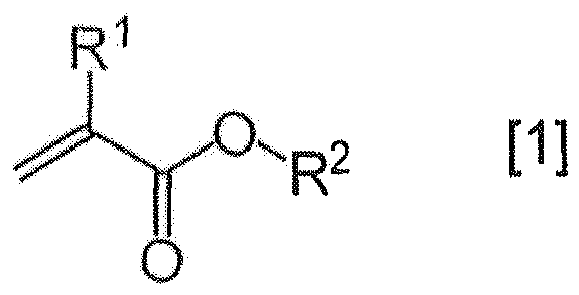
- The curable composition for coating according to claim 8, wherein
the monomer B is a compound of Formula [2].
- The curable composition for coating according to claim 2, wherein
the polymerization initiator C is an azo-based polymerization initiator. - The curable composition for coating according to claim 10, wherein
the polymerization initiator C is dimethyl 2,2'-azobisisobutyrate. - The curable composition for coating according to any one of claims 1 to 11, wherein
the curable composition includes 0.001% by mass to 20% by mass of (b) the surface modifier per mass of (c) the polyfunctional monomer. - The curable composition for coating according to claim 12, wherein
(b) the surface modifier is a compound having a (meth)acryloyl group. - The curable composition for coating according to claim 12 or 13, wherein
(b) the surface modifier is a perfluoropolyether compound. - The curable composition for coating according to any one of claims 1 to 11, wherein
(c) the polyfunctional monomer is at least one selected from the group consisting of a polyfunctional (meth)acrylate compound and a polyfunctional urethane (meth)acrylate compound. - The curable composition for coating according to any one of claims 1 to 11, wherein
the curable composition includes 1% by mass to 20% by mass of (d) the polymerization initiator per mass of (c) the polyfunctional monomer. - The curable composition for coating according to claim 16, wherein
(d) the polymerization initiator is an alkylphenone compound. - The curable composition for coating according to any one of claims 1 to 11, further comprising
(e) silica fine particles. - The curable composition for coating according to claim 18, wherein
the curable composition includes 5% by mass to 80% by mass of (e) the silica fine particles per mass of (c) the polyfunctional monomer. - The curable composition for coating according to claim 19, wherein
(e) the silica fine particles have an average particle diameter of 1 nm to 100 nm. - The curable composition for coating according to any one of claims 1 to 20, further comprising
a solvent. - A cured film made from the curable composition for coating as claimed in any one of claims 1 to 21.
- A hard coating film comprising a hard coating layer on at least one surface of a film substrate, the hard coating layer being formed by forming a coating film by applying the curable composition for coating as claimed in claim 21 on the film substrate; drying the coating film to remove the solvent; and irradiating the coating film with ultraviolet rays to cure the coating film.
- The hard coating film according to claim 23, wherein
the hard coating layer has a film thickness of 1 µm to 30 µm.
Applications Claiming Priority (3)
| Application Number | Priority Date | Filing Date | Title |
|---|---|---|---|
| JP2010268875 | 2010-12-01 | ||
| JP2011091392 | 2011-04-15 | ||
| PCT/JP2011/077850 WO2012074071A1 (en) | 2010-12-01 | 2011-12-01 | Curable composition for coating containing fluorine-containing hyperbranched polymer |
Publications (2)
| Publication Number | Publication Date |
|---|---|
| EP2647673A1 true EP2647673A1 (en) | 2013-10-09 |
| EP2647673A4 EP2647673A4 (en) | 2016-02-10 |
Family
ID=46171996
Family Applications (1)
| Application Number | Title | Priority Date | Filing Date |
|---|---|---|---|
| EP11844234.2A Withdrawn EP2647673A4 (en) | 2010-12-01 | 2011-12-01 | Curable composition for coating containing fluorine-containing hyperbranched polymer |
Country Status (7)
| Country | Link |
|---|---|
| US (1) | US10301502B2 (en) |
| EP (1) | EP2647673A4 (en) |
| JP (1) | JP5880871B2 (en) |
| KR (1) | KR101828809B1 (en) |
| CN (1) | CN103237848B (en) |
| TW (2) | TWI513778B (en) |
| WO (1) | WO2012074071A1 (en) |
Families Citing this family (22)
| Publication number | Priority date | Publication date | Assignee | Title |
|---|---|---|---|---|
| WO2013077451A1 (en) * | 2011-11-25 | 2013-05-30 | 日産化学工業株式会社 | Reactive fluorinated hyperbranched polymer and curable composition containing same |
| JP6385274B2 (en) | 2012-07-27 | 2018-09-05 | 日産化学株式会社 | Silicon-containing hyperbranched polymer and curable composition containing the same |
| JP5997998B2 (en) * | 2012-09-28 | 2016-09-28 | 株式会社ネオス | Reactive fluorine-containing oligomer |
| JP6057121B2 (en) * | 2012-11-02 | 2017-01-11 | Dic株式会社 | Active energy ray curable composition, cured product thereof and article having cured coating film thereof |
| US9562170B2 (en) | 2012-11-05 | 2017-02-07 | Nissan Chemical Industries, Ltd. | Curable composition including fluorine-containing highly branched polymer and siloxane oligomer |
| ITMI20121900A1 (en) * | 2012-11-07 | 2014-05-08 | Printgraph Waterless S P A | PRINTING MACHINE |
| JP5979026B2 (en) * | 2013-01-30 | 2016-08-24 | 凸版印刷株式会社 | Transfer film for simultaneous decoration |
| WO2014208323A1 (en) * | 2013-06-28 | 2014-12-31 | 横浜ゴム株式会社 | Resin compositions for forming hard coating layer |
| KR20160118340A (en) | 2014-02-07 | 2016-10-11 | 올싸거널 인코포레이티드 | Cross-linkable fluorinated photopolymer |
| KR102345843B1 (en) * | 2015-04-07 | 2021-12-31 | 닛산 가가쿠 가부시키가이샤 | Curable composition for anti-glare coating |
| CN104789094B (en) * | 2015-04-28 | 2017-01-18 | 中科院广州化学有限公司南雄材料生产基地 | A kind of carboxyl-terminated fluorine-containing prepolymer modified epoxy coating and its preparation method and application |
| CN107848255A (en) * | 2015-07-17 | 2018-03-27 | 日产自动车株式会社 | Anti-pollution structure body and its manufacture method |
| KR102621643B1 (en) * | 2016-04-28 | 2024-01-05 | 동우 화인켐 주식회사 | Hard coating composition and hard coating film formed therefrom |
| CN109689353B (en) | 2016-09-13 | 2021-02-02 | 日产自动车株式会社 | Antifouling structure |
| WO2018056370A1 (en) * | 2016-09-21 | 2018-03-29 | 日産化学工業株式会社 | Scratch-resistant hard coating material |
| CN106675359B (en) * | 2016-12-15 | 2018-12-07 | 顺德职业技术学院 | Ultraviolet light heats double curing type anti-fingerprint paints and its in the apparent application of electronic product |
| KR20190127658A (en) | 2017-03-07 | 2019-11-13 | 에이지씨 가부시키가이샤 | Water- and oil-repellent article, method for manufacturing the same, and water- and oil-repellent composition |
| JPWO2019235108A1 (en) * | 2018-06-06 | 2021-04-22 | 富士フイルム株式会社 | Modifiers, compositions, hard coat films, articles with hard coat films, and image display devices |
| US20220064427A1 (en) * | 2020-08-28 | 2022-03-03 | Lawrence Livermore National Security, Llc | Actinic and thermal cure fluoropolymers with controlled porosity |
| CN115181271B (en) * | 2022-08-17 | 2024-02-09 | 浙江工业职业技术学院 | Fluorine-containing vinyl polysiloxane and printing raw paste and preparation method thereof |
| WO2025253960A1 (en) * | 2024-06-07 | 2025-12-11 | 日産化学株式会社 | Curable composition for forming hard coat layer |
| CN120867099A (en) * | 2025-09-24 | 2025-10-31 | 杭州百腾环境科技有限公司 | Alkali-resistant hydrophobic oleophobic finishing agent for hollow fiber membrane and application thereof |
Family Cites Families (22)
| Publication number | Priority date | Publication date | Assignee | Title |
|---|---|---|---|---|
| DE3826947A1 (en) * | 1988-08-09 | 1990-02-22 | Merck Patent Gmbh | THIOXANTHON DERIVATIVES, THEIR USE AS PHOTOINITIATORS, PHOTOPOLYMERIZABLE BINDING SYSTEMS AND METHOD FOR THE PRODUCTION OF A RADIATION-COATED COATING |
| WO1996003609A1 (en) * | 1994-07-22 | 1996-02-08 | Optical Polymer Research, Inc. | Curable, inter-polymer optical fiber cladding compositions |
| US6521290B1 (en) * | 1998-05-18 | 2003-02-18 | Shin-Etsu Chemical Co., Ltd. | Silica particles surface-treated with silane, process for producing the same and uses thereof |
| JP4009700B2 (en) * | 2003-10-20 | 2007-11-21 | 株式会社テクノネットワーク四国 | Method for producing radical polymer |
| JP4784723B2 (en) | 2003-12-24 | 2011-10-05 | Tdk株式会社 | Hard coating agent composition and optical information medium using the same |
| US7196136B2 (en) * | 2004-04-29 | 2007-03-27 | Hewlett-Packard Development Company, L.P. | UV curable coating composition |
| PL1700871T3 (en) * | 2005-03-10 | 2007-12-31 | Nanogate Advanced Mat Gmbh | Moulding composition for preparation of precision optics |
| JP5367268B2 (en) | 2005-10-25 | 2013-12-11 | 日産化学工業株式会社 | Polymer structure with modified surface and / or interface, and method for producing the same |
| JP2007264277A (en) | 2006-03-28 | 2007-10-11 | Dainippon Printing Co Ltd | Optical laminate comprising a low refractive index layer |
| US7615283B2 (en) * | 2006-06-13 | 2009-11-10 | 3M Innovative Properties Company | Fluoro(meth)acrylate polymer composition suitable for low index layer of antireflective film |
| US20090181242A1 (en) * | 2008-01-11 | 2009-07-16 | Enniss James P | Exterior window film |
| KR101553079B1 (en) * | 2008-04-28 | 2015-09-14 | 미쓰비시 가가꾸 가부시키가이샤 | Active energy ray-curable resin composition cured film laminate optical recording medium and method for producing cured film |
| US20090301027A1 (en) * | 2008-06-06 | 2009-12-10 | David Pelletier | Compositions and methods for sealing natural stone tiles and natural stone articles |
| JP5473270B2 (en) * | 2008-07-17 | 2014-04-16 | 国立大学法人徳島大学 | Photopatterning composition using hyperbranched polymer |
| JP5441428B2 (en) | 2009-02-17 | 2014-03-12 | 国立大学法人九州大学 | Interfacial adhesion control using hyperbranched polymer |
| WO2010126140A1 (en) * | 2009-05-01 | 2010-11-04 | 日産化学工業株式会社 | Method for producing highly branched polymer |
| JP5542371B2 (en) | 2009-05-29 | 2014-07-09 | 国立大学法人九州大学 | Interfacial adhesion control using fluorine-containing hyperbranched polymer |
| CN105384871B (en) * | 2009-05-29 | 2018-03-09 | 日产化学工业株式会社 | Fluorine-containing hyper branched polymer and the resin combination comprising the polymer |
| WO2011102383A1 (en) | 2010-02-16 | 2011-08-25 | 国立大学法人 福井大学 | Fine fibers with modified surface |
| JP6040774B2 (en) * | 2010-12-01 | 2016-12-07 | 日産化学工業株式会社 | Fluorine-containing highly branched polymer and photosensitive composition containing the same |
| WO2012074064A1 (en) * | 2010-12-01 | 2012-06-07 | 日産化学工業株式会社 | Fluorine-containing hyperbranched polymer, and photo-cationically polymerizable composition containing same |
| CN104768978B (en) * | 2012-10-31 | 2017-10-27 | Dic株式会社 | Shaping light polymer resin composition and multi-layer molded articles |
-
2011
- 2011-12-01 CN CN201180058144.7A patent/CN103237848B/en active Active
- 2011-12-01 JP JP2012546946A patent/JP5880871B2/en active Active
- 2011-12-01 EP EP11844234.2A patent/EP2647673A4/en not_active Withdrawn
- 2011-12-01 US US13/990,216 patent/US10301502B2/en active Active
- 2011-12-01 TW TW100144585A patent/TWI513778B/en active
- 2011-12-01 WO PCT/JP2011/077850 patent/WO2012074071A1/en not_active Ceased
- 2011-12-01 KR KR1020137015525A patent/KR101828809B1/en active Active
- 2011-12-01 TW TW104133215A patent/TWI541301B/en active
Also Published As
| Publication number | Publication date |
|---|---|
| US20130302598A1 (en) | 2013-11-14 |
| KR101828809B1 (en) | 2018-02-13 |
| TWI541301B (en) | 2016-07-11 |
| KR20130132477A (en) | 2013-12-04 |
| WO2012074071A1 (en) | 2012-06-07 |
| EP2647673A4 (en) | 2016-02-10 |
| JP5880871B2 (en) | 2016-03-09 |
| CN103237848A (en) | 2013-08-07 |
| TW201602269A (en) | 2016-01-16 |
| JPWO2012074071A1 (en) | 2014-05-19 |
| US10301502B2 (en) | 2019-05-28 |
| TWI513778B (en) | 2015-12-21 |
| CN103237848B (en) | 2015-09-02 |
| TW201233743A (en) | 2012-08-16 |
Similar Documents
| Publication | Publication Date | Title |
|---|---|---|
| US10301502B2 (en) | Curable composition for coating containing fluorine-containing highly branched polymer | |
| JP6795793B2 (en) | Silicon-containing highly branched polymer | |
| JP2014159573A (en) | Coating composition and coating film excellent in abrasion resistance and fingerprint trace removability | |
| WO2014069634A1 (en) | Curable composition containing fluorine-containing hyperbranched polymer and siloxane oligomer | |
| JP5880870B2 (en) | Polymerizable fluorine-containing hyperbranched polymer and curable composition containing the same | |
| WO2012128214A1 (en) | Lipophilic, highly branched polymer, and photopolymerizable composition containing the same | |
| JP2009287017A (en) | Active energy ray-curable resin composition, cured product and article | |
| WO2014054698A1 (en) | Curable composition including silicon-containing highly-branched polymer | |
| JP5142075B2 (en) | Active energy ray curable resin, active energy ray curable resin composition, and article having a hard coat layer obtained using the same | |
| JP6020836B2 (en) | Reactive fluorine-containing hyperbranched polymer and curable composition containing the same | |
| JP6288509B2 (en) | Antifouling coating agent and article |
Legal Events
| Date | Code | Title | Description |
|---|---|---|---|
| PUAI | Public reference made under article 153(3) epc to a published international application that has entered the european phase |
Free format text: ORIGINAL CODE: 0009012 |
|
| 17P | Request for examination filed |
Effective date: 20130701 |
|
| AK | Designated contracting states |
Kind code of ref document: A1 Designated state(s): AL AT BE BG CH CY CZ DE DK EE ES FI FR GB GR HR HU IE IS IT LI LT LU LV MC MK MT NL NO PL PT RO RS SE SI SK SM TR |
|
| DAX | Request for extension of the european patent (deleted) | ||
| RA4 | Supplementary search report drawn up and despatched (corrected) |
Effective date: 20160112 |
|
| RIC1 | Information provided on ipc code assigned before grant |
Ipc: B32B 27/00 20060101ALI20160105BHEP Ipc: C09D 133/16 20060101ALI20160105BHEP Ipc: C09D 183/04 20060101ALI20160105BHEP Ipc: C09D 171/00 20060101ALI20160105BHEP Ipc: C09D 4/06 20060101AFI20160105BHEP |
|
| GRAP | Despatch of communication of intention to grant a patent |
Free format text: ORIGINAL CODE: EPIDOSNIGR1 |
|
| INTG | Intention to grant announced |
Effective date: 20171020 |
|
| STAA | Information on the status of an ep patent application or granted ep patent |
Free format text: STATUS: THE APPLICATION IS DEEMED TO BE WITHDRAWN |
|
| 18D | Application deemed to be withdrawn |
Effective date: 20180301 |