EP2646496B1 - Verfahren zur herstellung eines films mit der integration von antimikrobiellen mitteln natürlichen ursprungs in einer polymerischen struktur zur entwicklung von verpackungen zur erhöhung der haltbarkeit von gekühltem fleisch, vorzugsweise gekühltem frischem lachs - Google Patents
Verfahren zur herstellung eines films mit der integration von antimikrobiellen mitteln natürlichen ursprungs in einer polymerischen struktur zur entwicklung von verpackungen zur erhöhung der haltbarkeit von gekühltem fleisch, vorzugsweise gekühltem frischem lachs Download PDFInfo
- Publication number
- EP2646496B1 EP2646496B1 EP11805937.7A EP11805937A EP2646496B1 EP 2646496 B1 EP2646496 B1 EP 2646496B1 EP 11805937 A EP11805937 A EP 11805937A EP 2646496 B1 EP2646496 B1 EP 2646496B1
- Authority
- EP
- European Patent Office
- Prior art keywords
- thymol
- carvacrol
- obtaining
- film
- ppm
- Prior art date
- Legal status (The legal status is an assumption and is not a legal conclusion. Google has not performed a legal analysis and makes no representation as to the accuracy of the status listed.)
- Not-in-force
Links
- 238000000034 method Methods 0.000 title claims description 32
- 239000004599 antimicrobial Substances 0.000 title claims description 27
- 230000008569 process Effects 0.000 title claims description 20
- 241000972773 Aulopiformes Species 0.000 title claims description 7
- 238000010348 incorporation Methods 0.000 title claims description 7
- 235000019515 salmon Nutrition 0.000 title claims description 7
- 235000013372 meat Nutrition 0.000 title claims description 6
- MGSRCZKZVOBKFT-UHFFFAOYSA-N thymol Chemical compound CC(C)C1=CC=C(C)C=C1O MGSRCZKZVOBKFT-UHFFFAOYSA-N 0.000 claims description 138
- RECUKUPTGUEGMW-UHFFFAOYSA-N carvacrol Chemical compound CC(C)C1=CC=C(C)C(O)=C1 RECUKUPTGUEGMW-UHFFFAOYSA-N 0.000 claims description 73
- HHTWOMMSBMNRKP-UHFFFAOYSA-N carvacrol Natural products CC(=C)C1=CC=C(C)C(O)=C1 HHTWOMMSBMNRKP-UHFFFAOYSA-N 0.000 claims description 73
- 235000007746 carvacrol Nutrition 0.000 claims description 73
- WYXXLXHHWYNKJF-UHFFFAOYSA-N isocarvacrol Natural products CC(C)C1=CC=C(O)C(C)=C1 WYXXLXHHWYNKJF-UHFFFAOYSA-N 0.000 claims description 73
- 239000005844 Thymol Substances 0.000 claims description 69
- 229960000790 thymol Drugs 0.000 claims description 69
- 239000003094 microcapsule Substances 0.000 claims description 30
- 229920000084 Gum arabic Polymers 0.000 claims description 12
- 235000010489 acacia gum Nutrition 0.000 claims description 12
- 239000000205 acacia gum Substances 0.000 claims description 12
- XLYOFNOQVPJJNP-UHFFFAOYSA-N water Chemical compound O XLYOFNOQVPJJNP-UHFFFAOYSA-N 0.000 claims description 11
- 239000012153 distilled water Substances 0.000 claims description 8
- 239000004264 Petrolatum Substances 0.000 claims description 7
- 239000000203 mixture Substances 0.000 claims description 7
- 229940066842 petrolatum Drugs 0.000 claims description 7
- 235000019271 petrolatum Nutrition 0.000 claims description 7
- 238000013019 agitation Methods 0.000 claims description 6
- 239000008346 aqueous phase Substances 0.000 claims description 6
- 239000000839 emulsion Substances 0.000 claims description 6
- 229920001213 Polysorbate 20 Polymers 0.000 claims description 5
- 239000012071 phase Substances 0.000 claims description 5
- 229920000642 polymer Polymers 0.000 claims description 5
- 235000010486 polyoxyethylene sorbitan monolaurate Nutrition 0.000 claims description 5
- 239000000256 polyoxyethylene sorbitan monolaurate Substances 0.000 claims description 5
- 238000003851 corona treatment Methods 0.000 claims description 2
- 241000978776 Senegalia senegal Species 0.000 claims 3
- 238000000265 homogenisation Methods 0.000 claims 1
- 230000000845 anti-microbial effect Effects 0.000 description 24
- 235000013305 food Nutrition 0.000 description 11
- 239000003921 oil Substances 0.000 description 11
- 239000000243 solution Substances 0.000 description 11
- 244000215068 Acacia senegal Species 0.000 description 9
- 239000000463 material Substances 0.000 description 7
- 244000005700 microbiome Species 0.000 description 7
- WCGCDDRTGKUVKC-UHFFFAOYSA-N 2-methyl-5-propan-2-ylphenol;5-methyl-2-propan-2-ylphenol Chemical compound CC(C)C1=CC=C(C)C(O)=C1.CC(C)C1=CC=C(C)C=C1O WCGCDDRTGKUVKC-UHFFFAOYSA-N 0.000 description 6
- 239000002609 medium Substances 0.000 description 6
- VLKZOEOYAKHREP-UHFFFAOYSA-N n-Hexane Chemical compound CCCCCC VLKZOEOYAKHREP-UHFFFAOYSA-N 0.000 description 6
- 239000012785 packaging film Substances 0.000 description 6
- 229920006280 packaging film Polymers 0.000 description 6
- 239000004033 plastic Substances 0.000 description 6
- 229920003023 plastic Polymers 0.000 description 6
- 239000000126 substance Substances 0.000 description 6
- 239000000341 volatile oil Substances 0.000 description 6
- 238000004806 packaging method and process Methods 0.000 description 5
- 235000021485 packed food Nutrition 0.000 description 5
- IOAISUCAQCEHTA-UHFFFAOYSA-N 5-methyl-2-propan-2-ylphenol Chemical compound CC(C)C1=CC=C(C)C=C1O.CC(C)C1=CC=C(C)C=C1O IOAISUCAQCEHTA-UHFFFAOYSA-N 0.000 description 4
- 238000009456 active packaging Methods 0.000 description 4
- 239000013543 active substance Substances 0.000 description 4
- 238000013270 controlled release Methods 0.000 description 4
- 238000002474 experimental method Methods 0.000 description 4
- 238000004519 manufacturing process Methods 0.000 description 4
- OKKJLVBELUTLKV-UHFFFAOYSA-N Methanol Chemical compound OC OKKJLVBELUTLKV-UHFFFAOYSA-N 0.000 description 3
- 238000004458 analytical method Methods 0.000 description 3
- 239000012736 aqueous medium Substances 0.000 description 3
- 239000011230 binding agent Substances 0.000 description 3
- 239000003795 chemical substances by application Substances 0.000 description 3
- 239000007789 gas Substances 0.000 description 3
- 238000002347 injection Methods 0.000 description 3
- 239000007924 injection Substances 0.000 description 3
- 239000007788 liquid Substances 0.000 description 3
- 239000002985 plastic film Substances 0.000 description 3
- 229920006255 plastic film Polymers 0.000 description 3
- YMBFCQPIMVLNIU-SOUVJXGZSA-N (-)-exo-alpha-bergamotene Chemical compound C1[C@@H]2[C@@](CCC=C(C)C)(C)[C@H]1CC=C2C YMBFCQPIMVLNIU-SOUVJXGZSA-N 0.000 description 2
- KAKZBPTYRLMSJV-UHFFFAOYSA-N Butadiene Chemical group C=CC=C KAKZBPTYRLMSJV-UHFFFAOYSA-N 0.000 description 2
- ZFMSMUAANRJZFM-UHFFFAOYSA-N Estragole Chemical compound COC1=CC=C(CC=C)C=C1 ZFMSMUAANRJZFM-UHFFFAOYSA-N 0.000 description 2
- GLZPCOQZEFWAFX-UHFFFAOYSA-N Geraniol Chemical compound CC(C)=CCCC(C)=CCO GLZPCOQZEFWAFX-UHFFFAOYSA-N 0.000 description 2
- ZYEMGPIYFIJGTP-UHFFFAOYSA-N O-methyleugenol Chemical compound COC1=CC=C(CC=C)C=C1OC ZYEMGPIYFIJGTP-UHFFFAOYSA-N 0.000 description 2
- VYPSYNLAJGMNEJ-UHFFFAOYSA-N Silicium dioxide Chemical compound O=[Si]=O VYPSYNLAJGMNEJ-UHFFFAOYSA-N 0.000 description 2
- 230000000843 anti-fungal effect Effects 0.000 description 2
- 229940121375 antifungal agent Drugs 0.000 description 2
- 239000007864 aqueous solution Substances 0.000 description 2
- 230000015572 biosynthetic process Effects 0.000 description 2
- 238000004587 chromatography analysis Methods 0.000 description 2
- 239000011248 coating agent Substances 0.000 description 2
- 238000000576 coating method Methods 0.000 description 2
- 150000001875 compounds Chemical class 0.000 description 2
- 230000006835 compression Effects 0.000 description 2
- 238000007906 compression Methods 0.000 description 2
- 229920001577 copolymer Polymers 0.000 description 2
- 238000011161 development Methods 0.000 description 2
- 239000002612 dispersion medium Substances 0.000 description 2
- 238000004945 emulsification Methods 0.000 description 2
- 239000008393 encapsulating agent Substances 0.000 description 2
- 238000005538 encapsulation Methods 0.000 description 2
- 235000013355 food flavoring agent Nutrition 0.000 description 2
- 239000005350 fused silica glass Substances 0.000 description 2
- 230000009036 growth inhibition Effects 0.000 description 2
- 125000001475 halogen functional group Chemical group 0.000 description 2
- 238000010438 heat treatment Methods 0.000 description 2
- 239000002346 layers by function Substances 0.000 description 2
- CDOSHBSSFJOMGT-UHFFFAOYSA-N linalool Chemical compound CC(C)=CCCC(C)(O)C=C CDOSHBSSFJOMGT-UHFFFAOYSA-N 0.000 description 2
- 229920001684 low density polyethylene Polymers 0.000 description 2
- 239000004702 low-density polyethylene Substances 0.000 description 2
- 230000007246 mechanism Effects 0.000 description 2
- 239000008188 pellet Substances 0.000 description 2
- 238000011002 quantification Methods 0.000 description 2
- 239000000758 substrate Substances 0.000 description 2
- 239000006228 supernatant Substances 0.000 description 2
- 239000010678 thyme oil Substances 0.000 description 2
- 239000001490 (3R)-3,7-dimethylocta-1,6-dien-3-ol Substances 0.000 description 1
- CDOSHBSSFJOMGT-JTQLQIEISA-N (R)-linalool Natural products CC(C)=CCC[C@@](C)(O)C=C CDOSHBSSFJOMGT-JTQLQIEISA-N 0.000 description 1
- WEEGYLXZBRQIMU-UHFFFAOYSA-N 1,8-cineole Natural products C1CC2CCC1(C)OC2(C)C WEEGYLXZBRQIMU-UHFFFAOYSA-N 0.000 description 1
- XVRFLAKLFMLOPO-UHFFFAOYSA-N 3-hydroxy-5-methyl-1h-pyrimidine-2,4-dione Chemical compound CC1=CNC(=O)N(O)C1=O XVRFLAKLFMLOPO-UHFFFAOYSA-N 0.000 description 1
- WTEVQBCEXWBHNA-UHFFFAOYSA-N Citral Natural products CC(C)=CCCC(C)=CC=O WTEVQBCEXWBHNA-UHFFFAOYSA-N 0.000 description 1
- 235000005979 Citrus limon Nutrition 0.000 description 1
- 244000131522 Citrus pyriformis Species 0.000 description 1
- 240000002943 Elettaria cardamomum Species 0.000 description 1
- 241000196324 Embryophyta Species 0.000 description 1
- 241000588724 Escherichia coli Species 0.000 description 1
- WEEGYLXZBRQIMU-WAAGHKOSSA-N Eucalyptol Chemical compound C1C[C@H]2CC[C@]1(C)OC2(C)C WEEGYLXZBRQIMU-WAAGHKOSSA-N 0.000 description 1
- PSMFFFUWSMZAPB-UHFFFAOYSA-N Eukalyptol Natural products C1CC2CCC1(C)COCC2(C)C PSMFFFUWSMZAPB-UHFFFAOYSA-N 0.000 description 1
- 239000005792 Geraniol Substances 0.000 description 1
- GLZPCOQZEFWAFX-YFHOEESVSA-N Geraniol Natural products CC(C)=CCC\C(C)=C/CO GLZPCOQZEFWAFX-YFHOEESVSA-N 0.000 description 1
- 235000013628 Lantana involucrata Nutrition 0.000 description 1
- 241000186805 Listeria innocua Species 0.000 description 1
- 229920000881 Modified starch Polymers 0.000 description 1
- 239000004368 Modified starch Substances 0.000 description 1
- 235000006677 Monarda citriodora ssp. austromontana Nutrition 0.000 description 1
- 102000016943 Muramidase Human genes 0.000 description 1
- 108010014251 Muramidase Proteins 0.000 description 1
- 108010062010 N-Acetylmuramoyl-L-alanine Amidase Proteins 0.000 description 1
- 239000004677 Nylon Substances 0.000 description 1
- 240000001359 Origanum dictamnus Species 0.000 description 1
- 235000015987 Origanum dictamnus Nutrition 0.000 description 1
- 240000007673 Origanum vulgare Species 0.000 description 1
- 239000002202 Polyethylene glycol Substances 0.000 description 1
- 241000191967 Staphylococcus aureus Species 0.000 description 1
- 239000011149 active material Substances 0.000 description 1
- 239000000654 additive Substances 0.000 description 1
- JGINTSAQGRHGMG-SOUVJXGZSA-N alpha-trans-bergamotenol Natural products C1[C@@H]2[C@@](CCC=C(CO)C)(C)[C@H]1CC=C2C JGINTSAQGRHGMG-SOUVJXGZSA-N 0.000 description 1
- 238000009452 anti-microbial packaging Methods 0.000 description 1
- 230000004888 barrier function Effects 0.000 description 1
- 230000008901 benefit Effects 0.000 description 1
- 230000033228 biological regulation Effects 0.000 description 1
- 235000005300 cardamomo Nutrition 0.000 description 1
- 239000012159 carrier gas Substances 0.000 description 1
- 238000005119 centrifugation Methods 0.000 description 1
- RFFOTVCVTJUTAD-UHFFFAOYSA-N cineole Natural products C1CC2(C)CCC1(C(C)C)O2 RFFOTVCVTJUTAD-UHFFFAOYSA-N 0.000 description 1
- 229940043350 citral Drugs 0.000 description 1
- 238000005354 coacervation Methods 0.000 description 1
- 238000001816 cooling Methods 0.000 description 1
- 238000010586 diagram Methods 0.000 description 1
- 230000001804 emulsifying effect Effects 0.000 description 1
- 238000005516 engineering process Methods 0.000 description 1
- 125000001495 ethyl group Chemical group [H]C([H])([H])C([H])([H])* 0.000 description 1
- 238000011156 evaluation Methods 0.000 description 1
- 239000000284 extract Substances 0.000 description 1
- 239000000796 flavoring agent Substances 0.000 description 1
- 235000019634 flavors Nutrition 0.000 description 1
- 125000000524 functional group Chemical group 0.000 description 1
- WTEVQBCEXWBHNA-JXMROGBWSA-N geranial Chemical compound CC(C)=CCC\C(C)=C\C=O WTEVQBCEXWBHNA-JXMROGBWSA-N 0.000 description 1
- 229940113087 geraniol Drugs 0.000 description 1
- 230000036541 health Effects 0.000 description 1
- 239000001307 helium Substances 0.000 description 1
- 229910052734 helium Inorganic materials 0.000 description 1
- SWQJXJOGLNCZEY-UHFFFAOYSA-N helium atom Chemical compound [He] SWQJXJOGLNCZEY-UHFFFAOYSA-N 0.000 description 1
- 229920001477 hydrophilic polymer Polymers 0.000 description 1
- 238000000338 in vitro Methods 0.000 description 1
- 230000003993 interaction Effects 0.000 description 1
- 230000002452 interceptive effect Effects 0.000 description 1
- 239000010410 layer Substances 0.000 description 1
- 229930007744 linalool Natural products 0.000 description 1
- 239000002502 liposome Substances 0.000 description 1
- 239000004325 lysozyme Substances 0.000 description 1
- 229960000274 lysozyme Drugs 0.000 description 1
- 235000010335 lysozyme Nutrition 0.000 description 1
- 230000014759 maintenance of location Effects 0.000 description 1
- 239000011159 matrix material Substances 0.000 description 1
- 238000002844 melting Methods 0.000 description 1
- 230000008018 melting Effects 0.000 description 1
- 239000012528 membrane Substances 0.000 description 1
- 230000002503 metabolic effect Effects 0.000 description 1
- -1 methylcinamate Chemical compound 0.000 description 1
- 229940116837 methyleugenol Drugs 0.000 description 1
- PRHTXAOWJQTLBO-UHFFFAOYSA-N methyleugenol Natural products COC1=CC=C(C(C)=C)C=C1OC PRHTXAOWJQTLBO-UHFFFAOYSA-N 0.000 description 1
- 230000005012 migration Effects 0.000 description 1
- 238000013508 migration Methods 0.000 description 1
- 238000002156 mixing Methods 0.000 description 1
- 235000019426 modified starch Nutrition 0.000 description 1
- 239000002365 multiple layer Substances 0.000 description 1
- 229920001778 nylon Polymers 0.000 description 1
- 239000008601 oleoresin Substances 0.000 description 1
- 239000002245 particle Substances 0.000 description 1
- 244000052769 pathogen Species 0.000 description 1
- 230000001717 pathogenic effect Effects 0.000 description 1
- WTJKGGKOPKCXLL-RRHRGVEJSA-N phosphatidylcholine Chemical compound CCCCCCCCCCCCCCCC(=O)OC[C@H](COP([O-])(=O)OCC[N+](C)(C)C)OC(=O)CCCCCCCC=CCCCCCCCC WTJKGGKOPKCXLL-RRHRGVEJSA-N 0.000 description 1
- 229920000747 poly(lactic acid) Polymers 0.000 description 1
- 229920001223 polyethylene glycol Polymers 0.000 description 1
- 229920001282 polysaccharide Polymers 0.000 description 1
- 238000002360 preparation method Methods 0.000 description 1
- 239000000047 product Substances 0.000 description 1
- 230000001105 regulatory effect Effects 0.000 description 1
- 238000000926 separation method Methods 0.000 description 1
- 239000002356 single layer Substances 0.000 description 1
- 239000007787 solid Substances 0.000 description 1
- 238000003860 storage Methods 0.000 description 1
- 239000000725 suspension Substances 0.000 description 1
- 229920001169 thermoplastic Polymers 0.000 description 1
- 239000012815 thermoplastic material Substances 0.000 description 1
- YMBFCQPIMVLNIU-UHFFFAOYSA-N trans-alpha-bergamotene Natural products C1C2C(CCC=C(C)C)(C)C1CC=C2C YMBFCQPIMVLNIU-UHFFFAOYSA-N 0.000 description 1
Images





Classifications
-
- C—CHEMISTRY; METALLURGY
- C08—ORGANIC MACROMOLECULAR COMPOUNDS; THEIR PREPARATION OR CHEMICAL WORKING-UP; COMPOSITIONS BASED THEREON
- C08K—Use of inorganic or non-macromolecular organic substances as compounding ingredients
- C08K5/00—Use of organic ingredients
- C08K5/0008—Organic ingredients according to more than one of the "one dot" groups of C08K5/01 - C08K5/59
- C08K5/0058—Biocides
-
- A—HUMAN NECESSITIES
- A01—AGRICULTURE; FORESTRY; ANIMAL HUSBANDRY; HUNTING; TRAPPING; FISHING
- A01N—PRESERVATION OF BODIES OF HUMANS OR ANIMALS OR PLANTS OR PARTS THEREOF; BIOCIDES, e.g. AS DISINFECTANTS, AS PESTICIDES OR AS HERBICIDES; PEST REPELLANTS OR ATTRACTANTS; PLANT GROWTH REGULATORS
- A01N25/00—Biocides, pest repellants or attractants, or plant growth regulators, characterised by their forms, or by their non-active ingredients or by their methods of application, e.g. seed treatment or sequential application; Substances for reducing the noxious effect of the active ingredients to organisms other than pests
- A01N25/26—Biocides, pest repellants or attractants, or plant growth regulators, characterised by their forms, or by their non-active ingredients or by their methods of application, e.g. seed treatment or sequential application; Substances for reducing the noxious effect of the active ingredients to organisms other than pests in coated particulate form
- A01N25/28—Microcapsules or nanocapsules
-
- A—HUMAN NECESSITIES
- A01—AGRICULTURE; FORESTRY; ANIMAL HUSBANDRY; HUNTING; TRAPPING; FISHING
- A01N—PRESERVATION OF BODIES OF HUMANS OR ANIMALS OR PLANTS OR PARTS THEREOF; BIOCIDES, e.g. AS DISINFECTANTS, AS PESTICIDES OR AS HERBICIDES; PEST REPELLANTS OR ATTRACTANTS; PLANT GROWTH REGULATORS
- A01N25/00—Biocides, pest repellants or attractants, or plant growth regulators, characterised by their forms, or by their non-active ingredients or by their methods of application, e.g. seed treatment or sequential application; Substances for reducing the noxious effect of the active ingredients to organisms other than pests
- A01N25/34—Shaped forms, e.g. sheets, not provided for in any other sub-group of this main group
-
- A—HUMAN NECESSITIES
- A01—AGRICULTURE; FORESTRY; ANIMAL HUSBANDRY; HUNTING; TRAPPING; FISHING
- A01N—PRESERVATION OF BODIES OF HUMANS OR ANIMALS OR PLANTS OR PARTS THEREOF; BIOCIDES, e.g. AS DISINFECTANTS, AS PESTICIDES OR AS HERBICIDES; PEST REPELLANTS OR ATTRACTANTS; PLANT GROWTH REGULATORS
- A01N31/00—Biocides, pest repellants or attractants, or plant growth regulators containing organic oxygen or sulfur compounds
- A01N31/08—Oxygen or sulfur directly attached to an aromatic ring system
-
- A—HUMAN NECESSITIES
- A23—FOODS OR FOODSTUFFS; TREATMENT THEREOF, NOT COVERED BY OTHER CLASSES
- A23B—PRESERVATION OF FOODS, FOODSTUFFS OR NON-ALCOHOLIC BEVERAGES; CHEMICAL RIPENING OF FRUIT OR VEGETABLES
- A23B4/00—Preservation of meat, sausages, fish or fish products
- A23B4/10—Coating with a protective layer; Compositions or apparatus therefor
-
- A—HUMAN NECESSITIES
- A23—FOODS OR FOODSTUFFS; TREATMENT THEREOF, NOT COVERED BY OTHER CLASSES
- A23B—PRESERVATION OF FOODS, FOODSTUFFS OR NON-ALCOHOLIC BEVERAGES; CHEMICAL RIPENING OF FRUIT OR VEGETABLES
- A23B4/00—Preservation of meat, sausages, fish or fish products
- A23B4/14—Preserving with chemicals not covered by groups A23B4/02 or A23B4/12
-
- A—HUMAN NECESSITIES
- A23—FOODS OR FOODSTUFFS; TREATMENT THEREOF, NOT COVERED BY OTHER CLASSES
- A23B—PRESERVATION OF FOODS, FOODSTUFFS OR NON-ALCOHOLIC BEVERAGES; CHEMICAL RIPENING OF FRUIT OR VEGETABLES
- A23B4/00—Preservation of meat, sausages, fish or fish products
- A23B4/14—Preserving with chemicals not covered by groups A23B4/02 or A23B4/12
- A23B4/18—Preserving with chemicals not covered by groups A23B4/02 or A23B4/12 in the form of liquids or solids
- A23B4/20—Organic compounds; Microorganisms; Enzymes
-
- B—PERFORMING OPERATIONS; TRANSPORTING
- B01—PHYSICAL OR CHEMICAL PROCESSES OR APPARATUS IN GENERAL
- B01J—CHEMICAL OR PHYSICAL PROCESSES, e.g. CATALYSIS OR COLLOID CHEMISTRY; THEIR RELEVANT APPARATUS
- B01J13/00—Colloid chemistry, e.g. the production of colloidal materials or their solutions, not otherwise provided for; Making microcapsules or microballoons
- B01J13/02—Making microcapsules or microballoons
-
- B—PERFORMING OPERATIONS; TRANSPORTING
- B65—CONVEYING; PACKING; STORING; HANDLING THIN OR FILAMENTARY MATERIAL
- B65D—CONTAINERS FOR STORAGE OR TRANSPORT OF ARTICLES OR MATERIALS, e.g. BAGS, BARRELS, BOTTLES, BOXES, CANS, CARTONS, CRATES, DRUMS, JARS, TANKS, HOPPERS, FORWARDING CONTAINERS; ACCESSORIES, CLOSURES, OR FITTINGS THEREFOR; PACKAGING ELEMENTS; PACKAGES
- B65D65/00—Wrappers or flexible covers; Packaging materials of special type or form
- B65D65/38—Packaging materials of special type or form
- B65D65/42—Applications of coated or impregnated materials
-
- C—CHEMISTRY; METALLURGY
- C08—ORGANIC MACROMOLECULAR COMPOUNDS; THEIR PREPARATION OR CHEMICAL WORKING-UP; COMPOSITIONS BASED THEREON
- C08J—WORKING-UP; GENERAL PROCESSES OF COMPOUNDING; AFTER-TREATMENT NOT COVERED BY SUBCLASSES C08B, C08C, C08F, C08G or C08H
- C08J3/00—Processes of treating or compounding macromolecular substances
- C08J3/20—Compounding polymers with additives, e.g. colouring
-
- C—CHEMISTRY; METALLURGY
- C08—ORGANIC MACROMOLECULAR COMPOUNDS; THEIR PREPARATION OR CHEMICAL WORKING-UP; COMPOSITIONS BASED THEREON
- C08J—WORKING-UP; GENERAL PROCESSES OF COMPOUNDING; AFTER-TREATMENT NOT COVERED BY SUBCLASSES C08B, C08C, C08F, C08G or C08H
- C08J3/00—Processes of treating or compounding macromolecular substances
- C08J3/20—Compounding polymers with additives, e.g. colouring
- C08J3/22—Compounding polymers with additives, e.g. colouring using masterbatch techniques
- C08J3/223—Packed additives
-
- C—CHEMISTRY; METALLURGY
- C08—ORGANIC MACROMOLECULAR COMPOUNDS; THEIR PREPARATION OR CHEMICAL WORKING-UP; COMPOSITIONS BASED THEREON
- C08J—WORKING-UP; GENERAL PROCESSES OF COMPOUNDING; AFTER-TREATMENT NOT COVERED BY SUBCLASSES C08B, C08C, C08F, C08G or C08H
- C08J5/00—Manufacture of articles or shaped materials containing macromolecular substances
- C08J5/18—Manufacture of films or sheets
-
- C—CHEMISTRY; METALLURGY
- C09—DYES; PAINTS; POLISHES; NATURAL RESINS; ADHESIVES; COMPOSITIONS NOT OTHERWISE PROVIDED FOR; APPLICATIONS OF MATERIALS NOT OTHERWISE PROVIDED FOR
- C09D—COATING COMPOSITIONS, e.g. PAINTS, VARNISHES OR LACQUERS; FILLING PASTES; CHEMICAL PAINT OR INK REMOVERS; INKS; CORRECTING FLUIDS; WOODSTAINS; PASTES OR SOLIDS FOR COLOURING OR PRINTING; USE OF MATERIALS THEREFOR
- C09D105/00—Coating compositions based on polysaccharides or on their derivatives, not provided for in groups C09D101/00 or C09D103/00
-
- C—CHEMISTRY; METALLURGY
- C08—ORGANIC MACROMOLECULAR COMPOUNDS; THEIR PREPARATION OR CHEMICAL WORKING-UP; COMPOSITIONS BASED THEREON
- C08J—WORKING-UP; GENERAL PROCESSES OF COMPOUNDING; AFTER-TREATMENT NOT COVERED BY SUBCLASSES C08B, C08C, C08F, C08G or C08H
- C08J2305/00—Characterised by the use of polysaccharides or of their derivatives not provided for in groups C08J2301/00 or C08J2303/00
- C08J2305/12—Agar-agar; Derivatives thereof
-
- C—CHEMISTRY; METALLURGY
- C08—ORGANIC MACROMOLECULAR COMPOUNDS; THEIR PREPARATION OR CHEMICAL WORKING-UP; COMPOSITIONS BASED THEREON
- C08K—Use of inorganic or non-macromolecular organic substances as compounding ingredients
- C08K9/00—Use of pretreated ingredients
- C08K9/10—Encapsulated ingredients
Definitions
- the present invention refers to processes for obtaining a film comprising the incorporation of naturally-sourced antimicrobial agents into a polymeric structure in order to develop packages for increasing the shelf life of refrigerated meat, preferentially refrigerated fresh salmon.
- the active agent is microencapsulated-incorporated on the surface of a plastic film so that a differentiated kinetics is obtained in function of the type of coating used for obtaining the microcapsule.
- the active packaging technology in which the most attention focus is placed is undoubtedly the antimicrobial active packaging.
- the growth of microorganisms is the main cause for the spoilage of fresh foods.
- the growth of spoiling microorganisms reduces food's life, while the growth of pathogen microorganisms puts health at risk.
- Using antimicrobial packaging promotes the release of substances that would inhibit the microorganisms' growth in the surface of foods.
- the antimicrobial action in active packaging can be based on the emission of volatile substances to the package's head space, or on the migration of the material's active component to the packaged food's surface.
- the oil can be selected from linalool and/or methylchavicol, but also from one or more of citral, geraniol, methylcinamate, methyleugenol, 1,8-cineol, trans- ⁇ -bergamotene, carvacrol, and thymol mixed with one or more polymers selected from copolymers of vinyl-ethylene alcohol, polyacrilates, including the methaacrilate copolymers, ethyl acrilate, lonomers, nylon, and other hydrophilic polymers, or polymers having functional groups capable of partially anchor the additives and the coated binder mixture which is located in the film's contact face of food packaging or incorporated into a food packaging film.
- a binding agent as polyethylene glycol is added to the mixture to enhance the volatile oil retention in the polymer during the process. This material has no regulatory limitations, and at the referred concentrations, does not generate undesirable flavors in the packaged food.
- WO 2010/006710 discloses a packaging film for producing a package that uses a single-layer or multiple-layer substrate, and an antimicrobial and/or antifungal functional layer applied to the substrate, and the formation of an outermost layer of the packaging film of at least two segments.
- the functional layer comprises particles as antimicrobial agents and/or antifungal active substances.
- thermoplastic material especially low-density polyethylene, incorporating substances with antimicrobial activity.
- the production process for the film comprises the following steps: a) mixing at a temperature lower than or equal to 160 °C a thermoplastic polymer having a melting point lower than or equal to 160 °C, and at least one substance with antimicrobial activity selected from the group consisting of lysozyme, thymol, and lemon extract; b) subjecting the obtained mixture in this step a) to a compression at the same temperature as indicated above; c) cooling under compression to a temperature lower than or equal to 40 °C, obtaining strips, which are divided into short pieces (pellets); d) feeding these short pieces (pellets) into a extruder provided with a die and with heating means to bring the temperature thereinside to a value lower than or equal to 160 °C; and e) ex
- Non patent document by M. Martins entitled “Microencapsulation of thyme oil by coacervation", Journal of Microencapsulation, published on the 1st December 2009 , describes the encapsulation of essential oils from oregano in phosphatidyl choline-based liposomes.
- Non patent document by C.C. Liolios entitled “Liposomal incorporation of carvacrol and thymol isolated from the essential oil of Origanum dictamnus L. and in vitro antimicrobial activity", Food Chemistry, published on the 1st January 2009 , describes the encapsulation of thyme oil with polylactide in the presence of Tween 20.
- Non patent document by S. Krishnan entitled “The use of gum arabic and modified starch in the microencapsulation of a food flavoring agent", Carbohydrate Polymers, published on the 14th December 2005 , describes the use of gum arabic in the microencapsulation of food flavoring agent (cardamon oleoresin).
- the main spoiling mechanism for salmon marketed as fresh and refrigerated is the growth of microorganisms at surface level, this being the main cause for its short life.
- the present invention refers to a process for obtaining a film comprising the incorporation of naturally-sourced antimicrobial agents into a polymeric structure to develop packages that increase the shelf life of refrigerated meat, preferentially refrigerated fresh salmon.
- the purpose of this invention is providing a plastic packaging film with antimicrobial capability using volatile essential oils (thymol), which are incorporated into the plastic die itself as a coating over the plastic material through a microencapsulation system that allows for delivering the active compound with different kinetics in function of the encapsulating agent being used.
- thymol volatile essential oils
- the present invention refers to processes for obtaining a film comprising the incorporation of naturally-sourced antimicrobial agents into a polymeric structure in order to develop packages for increasing the shelf life of refrigerated meat, preferentially refrigerated fresh salmon.
- the active agent extracted from plant essential oils, is incorporated in the form of microcapsules into the plastic package's inner surface in direct contact with the meat's surface.
- Different encapsulating agents are used which allow for a release with different kinetics, and different rates of release.
- the microcapsule production is accomplished by an emulsification technique from an oil-in-water type of emulsion.
- an aqueous phase was made up by dissolving 15 g gum arabic (Quimatic) and 2 g Tween 20 in 100 ml distilled water. Gum arabic is slowly added to the distilled water, with continuous agitation for 5 minutes by means of a magnetic agitator at room temperature. This solution pH is adjusted to a value of 6 by adding 10 ml Na OH.
- the oily phase is made up by a solution of the naturally-sourced antimicrobial agent with different concentrations (ppm) of thymol-carvacrol. These concentrations of thymol-carvacrol in ppm are: 10,000-10,000, 20,000-20,000, 50,000-50,000, 100,000-100,000, respectively, dissolved in 4.3 g soy oil or petrolatum. This mixture is subjected to mild manual agitation for two minutes at room temperature.
- the emulsion is prepared using a homogenizer, dispenser device that allows for emulsifying, homogenizing, and producing suspensions in liquid media generating a mechanic movement by means of rotors that provide an adjustable range of speed.
- a homogenizer, dispenser device that allows for emulsifying, homogenizing, and producing suspensions in liquid media generating a mechanic movement by means of rotors that provide an adjustable range of speed.
- the aqueous phase was incorporated onto the oily phase.
- the homogenizer operation is performed at an increasing speed of 0 up to 10,000 rpm, accelerating from 1,100 rpm every 20 seconds for 3 minutes at room temperature. In this way, the microencapsulation of the optimal synergist combination of thymol and carvacrol with an encapsulating material of gum arabic is obtained.
- Figure 1 shows a schematic of the methodology used for producing the microcapsules by a separation emulsion technique.
- the determination of the analytes is conducted by a gas chromatographer equipped with a column injection system, pressure control, and flame ionizer detector (FID).
- the analyses were conducted in a capillary column of fused silica.
- the injection of samples was conducted by the device autosampler.
- the injector temperature and that of the detector remained at 250 °C and 300 °C, respectively.
- the temperature program was: 100 °C as initial temperature, then the temperature was increased to a rate of 8 °C/min up to 180 °, and then 20 °C/min up to 250, where it remained for 5 minutes.
- the carrier gas was helium, which circulated with a constant flow of 2 ml/min.
- the antimicrobial concentration encapsulated was of 200,000 ppm, consisting of 50% thymol (100,000 ppm) and 50% carvacrol (100,000 ppm).
- the loss of antimicrobial agents left unmicroencapsulated was determined, consisting of a concentration of 2,281.97 ppm thymol, which represents a 1.14%, and 9,102.88 ppm carvacrol (4.6%), which indicates that the actual percentages of microencapsulation were 98.86% for thymol and 95.4% for carvacrol.
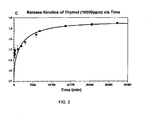
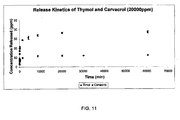
- Thymol Thymol Concentration in ppm SD: Standard Deviation Time (min) [ppm] Thymol Thymol SD Time (min) [ppm] Thymol Thymol SD 0 6.38 0.06 1,440 19.95 1.56 10 6.73 0.28 2,880 21.39 2.21 20 13.71 1.05 4,320 23.42 0.33 50 15.32 0.94 8,640 27.22 1.59 60 16.32 4.55 10,080 28.99 0.60 240 17.86 4.26 20,160 31.55 3.29 300 17.16 3.39 30,240 32.34 0.21 420 19.33 3.54 40,320 32.98 1.20
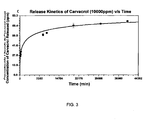
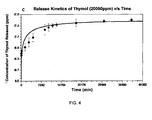
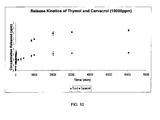
- microcapsule kinetics containing a concentration of thymol of 50,000 ppm ( Figure 6 ), and 50,000 ppm of carvacrol ( Figure 7 ) was analyzed.
- microcapsule production was accomplished by an emulsification technique from an oil-in-water type of emulsion.
- an aqueous phase was made by dissolving 15 g gum arabic and 2 g Tween 20 in 100 ml distilled water. Gum arabic was added slowly to the distilled water, with continuous agitation for 5 minutes by means of a magnetic agitator at room temperature. This solution pH was adjusted to a value of 6 by adding 10 ml Na OH.
- the oily phase was made up by a solution of 1,000 and 3,000 ppm natural antimicrobial agent (thymol or carvacrol) dissolved in 4.3 g soy oil or petrolatum. This mixture was subjected to mild manual agitation for two minutes at room temperature.
- natural antimicrobial agent thymol or carvacrol
- a chromatographer equipped with a FID-type detector (flame ionization), and a capillary column of fused silica (30 m x 0.32 mm ID, 0.25 ⁇ m thickness) was used.
- the sample injection was conducted by the chromatographer autosampler, and the column temperature was programmed the following way: It was started at 100 °C, then it had a heating rate of 20 °C per minute to go up to 180 °C, increasing again to 5 °C per minute to finally going up to a temperature of 250 °C.
- microencapsulated antimicrobial agent in time for the different experiences was determined by the rate of release in a metabolic medium.
- the last step of this procedure comprises the incorporation of the microcapsules into polymers, which need to be previously treated in order to reduce their surface tension (corona treatment), which assumes the superficial ionization of the plastic matrix, the microcapsules settling over the film, and letting them dry on a stove at controlled temperature.
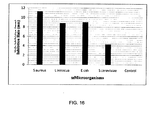
- the antimicrobial effect of an active package with concentrations of 50,000 ppm thymol and 50,000 ppm carvacrol in the microcapsules was determined.
- the growth inhibition halo for different microorganisms around the film was determined, which was 11.26 mm for Staphylococcus aureus, 8.76 mm for Listeria innocua, 9.00 mm for Escherichia coli, and 4.26 mm for Saccharomices cerevisiae.
Landscapes
- Chemical & Material Sciences (AREA)
- Life Sciences & Earth Sciences (AREA)
- Engineering & Computer Science (AREA)
- Health & Medical Sciences (AREA)
- Chemical Kinetics & Catalysis (AREA)
- Polymers & Plastics (AREA)
- Organic Chemistry (AREA)
- Wood Science & Technology (AREA)
- Zoology (AREA)
- General Health & Medical Sciences (AREA)
- Medicinal Chemistry (AREA)
- Agronomy & Crop Science (AREA)
- Environmental Sciences (AREA)
- Food Science & Technology (AREA)
- Dentistry (AREA)
- Plant Pathology (AREA)
- Pest Control & Pesticides (AREA)
- Toxicology (AREA)
- Materials Engineering (AREA)
- Manufacturing & Machinery (AREA)
- General Chemical & Material Sciences (AREA)
- Dispersion Chemistry (AREA)
- Mechanical Engineering (AREA)
- Biodiversity & Conservation Biology (AREA)
- Microbiology (AREA)
- Agricultural Chemicals And Associated Chemicals (AREA)
- Packging For Living Organisms, Food Or Medicinal Products That Are Sensitive To Environmental Conditiond (AREA)
- Compositions Of Macromolecular Compounds (AREA)
- Food Preservation Except Freezing, Refrigeration, And Drying (AREA)
Claims (13)
- Verfahren zum Erhalten einer Folie umfassend die Einarbeitung von antimikrobiellen Mitteln natürlichen Ursprungs in eine polymere Struktur, um Verpackungen zur Erhöhung der Haltbarkeit von gekühltem Fleisch, vorzugsweise gekühltem frischem Lachs, zu entwickeln, wobei das Verfahren die folgenden Schritte umfasst:a) das Erhalten von Mikrokapseln von einem antimikrobiellen Mittel natürlichen Ursprungs in einem umhüllenden Medium, umfassend die Schritte:a1) das Herstellen einer wässrigen Phase durch Auflösen von Gummi arabicum und Tween 20 in destilliertem Wasser;a2) das Herstellen einer öligen Phase durch eine Lösung des antimikrobiellen Mittels natürlichen Ursprungs mit einer Mischung von Thymol und Carvacrol;a3) das Herstellen einer Emulsion durch Einarbeiten der wässrigen Phase in die ölige Phase;b) das Einarbeiten der Mikrokapseln in Polymere, das Behandeln dieser vorher, um ihre Oberflächenspannung zu verringern, durch Coronabehandlung, das Absetzen der Mikrokapseln auf der Folie, und das Trocknenlassen dieser an einem Ofen bei kontrollierter Temperatur.
- Verfahren zum Erhalten einer Folie nach Anspruch 1, wobei die wässrige Phase von Schritt a1) durch Auflösen von 15 g Gummi arabicum mit 2 g Tween 20 in 100 ml destilliertem Wasser erhalten wird.
- Verfahren zum Erhalten einer Folie nach Anspruch 2, wobei das Gummi arabicum langsam zu dem destilliertem Wasser zugegeben wird, mit kontinuierlichem Rühren während 5 Minuten mittels eines Magnetrührers bei Raumtemperatur.
- Verfahren zum Erhalten einer Folie nach Anspruch 3, wobei es das Einstellen des pH-Werts der Lösung auf einen Wert von 6 durch Zugeben von 10 ml NaOH umfasst.
- Verfahren zum Erhalten einer Folie nach Anspruch 1, wobei in dem Schritt a2) die Konzentration von Thymol und Carvacrol in ppm 1000 Thymol und 3000 Carvacrol beträgt.
- Verfahren zum Erhalten einer Folie nach Anspruch 1, wobei in dem Schritt a2) die Konzentration von Thymol und Carvacrol in ppm 10000 Thymol und 10000 Carvacrol beträgt.
- Verfahren zum Erhalten einer Folie nach Anspruch 1, wobei in dem Schritt a2) die Konzentration von Thymol und Carvacrol in ppm 20000 Thymol und 20000 Carvacrol beträgt.
- Verfahren zum Erhalten einer Folie nach Anspruch 1, wobei in dem Schritt a2) die Konzentration von Thymol und Carvacrol in ppm 50000 Thymol und 50000 Carvacrol beträgt.
- Verfahren zum Erhalten einer Folie nach Anspruch 1, wobei in dem Schritt a2) die Konzentration von Thymol und Carvacrol in ppm 100000 Thymol und 100000 Carvacrol beträgt.
- Verfahren zum Erhalten einer Folie nach einem der Ansprüche 5 bis 9, wobei in dem Schritt a2) Thymol und Carvacrol in 4,3 g Sojaöl gelöst werden.
- Verfahren zum Erhalten einer Folie nach einem der Ansprüche 5 bis 9, wobei in dem Schritt a2) Thymol und Carvacrol in 4,3 g Vaseline gelöst werden.
- Verfahren zum Erhalten einer Folie nach Anspruch 10 oder 11, wobei in dem Schritt a2) die Mischung zwei Minuten lang einem sanften manuellen Rühren bei Raumtemperatur unterworfen wird.
- Verfahren zum Erhalten einer Folie nach Anspruch 12, wobei in dem Schritt a3) die Homogenisierung mit einer zunehmenden Geschwindigkeit von 0 bis 10000 U/min, wobei alle 20 Sekunden um 1100 U/min beschleunigt wird, 3 Minuten lang bei Raumtemperatur durchgeführt wird.
Applications Claiming Priority (2)
| Application Number | Priority Date | Filing Date | Title |
|---|---|---|---|
| CL2010001342A CL2010001342A1 (es) | 2010-12-03 | 2010-12-03 | Proceso de obtencion de un film que comprende la incorporacion de agentes antimicrobianos de origen natural en una estructura polimerica, para el desarrollo de envases destinados a incrementar la vida util de carne refrigerada, preferentemente de salmon fresco refrigerado. |
| PCT/IB2011/002930 WO2012073107A1 (en) | 2010-12-03 | 2011-12-02 | A process for obtaining a film comprised of the incorporation of naturally-sourced antimicrobial agents in a polymeric structure to develop packages for increasing the shelf life of refrigerated meat, preferentially refrigerated fresh salmon |
Publications (2)
| Publication Number | Publication Date |
|---|---|
| EP2646496A1 EP2646496A1 (de) | 2013-10-09 |
| EP2646496B1 true EP2646496B1 (de) | 2015-02-11 |
Family
ID=50825711
Family Applications (1)
| Application Number | Title | Priority Date | Filing Date |
|---|---|---|---|
| EP11805937.7A Not-in-force EP2646496B1 (de) | 2010-12-03 | 2011-12-02 | Verfahren zur herstellung eines films mit der integration von antimikrobiellen mitteln natürlichen ursprungs in einer polymerischen struktur zur entwicklung von verpackungen zur erhöhung der haltbarkeit von gekühltem fleisch, vorzugsweise gekühltem frischem lachs |
Country Status (6)
| Country | Link |
|---|---|
| US (1) | US20140154426A1 (de) |
| EP (1) | EP2646496B1 (de) |
| BR (1) | BR112013013594A8 (de) |
| CL (1) | CL2010001342A1 (de) |
| ES (1) | ES2532727T3 (de) |
| WO (1) | WO2012073107A1 (de) |
Cited By (1)
| Publication number | Priority date | Publication date | Assignee | Title |
|---|---|---|---|---|
| WO2022101613A1 (en) * | 2020-11-10 | 2022-05-19 | UPL Corporation Limited | Biodegradable fungicide composition |
Families Citing this family (5)
| Publication number | Priority date | Publication date | Assignee | Title |
|---|---|---|---|---|
| CN103478232B (zh) * | 2013-09-23 | 2015-12-02 | 浙江省农业科学院 | 一种香芹酚缓释保鲜剂及其制备方法 |
| CL2015003698A1 (es) * | 2015-12-22 | 2016-06-17 | Univ Santiago Chile | Película degradable para empaque de frutas y hortalizas que comprende una matriz polimérica en base a poliolefina, la que incorpora un agente activo antimicrobiano (biocida o fungicida) de aceite esencial o dicho aceite esencial, y además incorpora agentes degradantes, y procedimiento de microencapsulación de dicho agente activo antimicrobiano de aceite esencial, y método de preparación de la película. |
| US12030283B2 (en) | 2019-01-23 | 2024-07-09 | Inteplast Group Corporation | Food packaging film with antioxidant for freshness protection |
| CL2020002046A1 (es) * | 2020-08-06 | 2020-09-25 | Univ Santiago Chile | Recubrimiento polimérico comprendiendo carvacrol como agente activo antimicrobiano volátil natural portado en un vehículo polimérico disuelto en solvente orgánico volátil y película flexible polimérica que comprende interiormente dicho recubrimiento, útil para prolongar la vida útil de productos cárnicos |
| CN113441095B (zh) * | 2021-04-30 | 2022-06-21 | 江西农业大学 | 一种二氧化硅-精油微胶囊的制备方法 |
Family Cites Families (10)
| Publication number | Priority date | Publication date | Assignee | Title |
|---|---|---|---|---|
| US3565559A (en) * | 1968-03-11 | 1971-02-23 | Sumitomo Chemical Co | Process for making microcapsules |
| IE36796B1 (en) * | 1970-10-02 | 1977-03-02 | Fuji Photo Film Co Ltd | Capsule-coated sheets |
| EP1773130A4 (de) | 2004-06-29 | 2008-09-03 | Univ Victoria | Antimikrobielles verpackungsmaterial |
| US8753676B2 (en) * | 2006-02-15 | 2014-06-17 | Botanocap Ltd. | Applications of microencapsulated essential oils |
| FR2900940B1 (fr) * | 2006-05-12 | 2008-07-18 | Univ Montpellier Ii | "materiaux a base d'un support fibreux, tisse ou non tisse enduit d'une matrice, contenant au moins un agent antimicrobien et procede de fabrication" |
| GB2449876B (en) * | 2007-06-06 | 2009-05-06 | Post Harvest Solutions Ltd | Active packaging materials incorporating micro-porous solids and essential oils |
| EP2145758B2 (de) | 2008-07-14 | 2017-06-07 | 3A Technology & Management AG | Verpackung sowie Packgut-Verpackungseinheit |
| IT1391784B1 (it) | 2008-11-20 | 2012-01-27 | Consiglio Naz Delle Ricerche 16 67 | Metodo per la produzione di un film di materia termoplastica contenente una sostanza ad attività antimicrobica e utilizzo di tale film nella produzione di confezioni per alimenti |
| US9149045B2 (en) * | 2010-12-07 | 2015-10-06 | Kimberly-Clark Worldwide, Inc. | Wipe coated with a botanical emulsion having antimicrobial properties |
| SG11201507867RA (en) * | 2013-03-15 | 2015-10-29 | Purdue Research Foundation | Antimicrobial compositions and methods of use |
-
2010
- 2010-12-03 CL CL2010001342A patent/CL2010001342A1/es unknown
-
2011
- 2011-12-02 BR BR112013013594A patent/BR112013013594A8/pt not_active Application Discontinuation
- 2011-12-02 EP EP11805937.7A patent/EP2646496B1/de not_active Not-in-force
- 2011-12-02 ES ES11805937.7T patent/ES2532727T3/es active Active
- 2011-12-02 WO PCT/IB2011/002930 patent/WO2012073107A1/en not_active Ceased
-
2013
- 2013-06-03 US US13/908,570 patent/US20140154426A1/en not_active Abandoned
Cited By (1)
| Publication number | Priority date | Publication date | Assignee | Title |
|---|---|---|---|---|
| WO2022101613A1 (en) * | 2020-11-10 | 2022-05-19 | UPL Corporation Limited | Biodegradable fungicide composition |
Also Published As
| Publication number | Publication date |
|---|---|
| BR112013013594A8 (pt) | 2019-06-04 |
| WO2012073107A1 (en) | 2012-06-07 |
| CL2010001342A1 (es) | 2014-08-01 |
| US20140154426A1 (en) | 2014-06-05 |
| BR112013013594A2 (pt) | 2016-09-13 |
| ES2532727T3 (es) | 2015-03-31 |
| EP2646496A1 (de) | 2013-10-09 |
Similar Documents
| Publication | Publication Date | Title |
|---|---|---|
| US20140154426A1 (en) | Process for Obtaining a Film Comprised of the Incorporation of Naturally-Sourced Antimicrobial Agents in a Polymeric Structure to Develop Packages for Increasing the Shelf Life of Refrigerated Meat, Preferentially Refrigerated Fresh Salmon | |
| Hasan et al. | Nanoemulsion as advanced edible coatings to preserve the quality of fresh-cut fruits and vegetables: A review | |
| Mastromatteo et al. | Advances in controlled release devices for food packaging applications | |
| Chacha et al. | Essential oil‐based active polymer‐based packaging system: A review of its effect on the antimicrobial, antioxidant, and sensory properties of beef and chicken meat | |
| Paris et al. | Modelling release mechanisms of cinnamon (Cinnamomum zeylanicum) essential oil encapsulated in alginate beads during vapor-phase application | |
| Li et al. | Active packaging film containing oregano essential oil microcapsules and their application for strawberry preservation | |
| EP2685835A1 (de) | Verfahren zur herstellung einer folie mittels integration von natürlichen antimikrobika in einer polymerstruktur | |
| Petchwattana et al. | Controlled release antimicrobial sachet prepared from poly (butylene succinate)/geraniol and ethylene vinyl alcohol coated paper for bread shelf-life extension application | |
| CA2233741C (en) | Glass stabilized material and method of preparing same | |
| Zhang et al. | Nanoscale Pickering emulsion food preservative films/coatings: Compositions, preparations, influencing factors, and applications | |
| Polat et al. | Effects of nanoparticle ratio on structural, migration properties of polypropylene films and preservation quality of lemon juice | |
| US20160330952A1 (en) | Encapsulation and controlled release of volatile organic compounds | |
| DE69909902T2 (de) | Sauerstoffabsorbierende Zusammensetzung, Sauerstoffabsorbierendes Harz und Konservierungsverfahren | |
| WO2006000032A1 (en) | Antimicrobial packaging material | |
| Janjarasskul et al. | Whey protein film with oxygen scavenging function by incorporation of ascorbic acid | |
| Desobry et al. | Encapsulation of flavors, nutraceuticals, and antibacterials | |
| Botrel et al. | Microencapsulation of essential oils using spray drying technology | |
| Phala et al. | Development of EVA and LLDPE polymer-based carvone and spearmint essential oil release systems for citrus postharvest diseases applications | |
| WO2024076874A1 (en) | Systems and methods for carrier systems for controlled release delivery in perishable goods | |
| Ulloa et al. | Modeling the release of antimicrobial agents (thymol and carvacrol) from two different encapsulation materials | |
| Chuesiang et al. | Effect of nanoemulsion to minimise undesirable odour and colour of cinnamon bark oil and to improve sensory properties of refrigerated Asian seabass fillets | |
| Kim et al. | Study of light-induced volatile compounds in goat's milk cheese | |
| Sangatash et al. | Development of antioxidant active films containing sodium ascorbate (SA) and ethylene vinyl alcohol (EVOH) to extend the shelf life of peanut | |
| Sarkhel et al. | Antimicrobial active packaging with biopolymers and natural extracts: sustainable solutions and technological challenges | |
| Masoomian et al. | Application of nano-encapsulated antimicrobial compounds combined with MAP for bio-preservation of ground meat |
Legal Events
| Date | Code | Title | Description |
|---|---|---|---|
| PUAI | Public reference made under article 153(3) epc to a published international application that has entered the european phase |
Free format text: ORIGINAL CODE: 0009012 |
|
| 17P | Request for examination filed |
Effective date: 20130701 |
|
| AK | Designated contracting states |
Kind code of ref document: A1 Designated state(s): AL AT BE BG CH CY CZ DE DK EE ES FI FR GB GR HR HU IE IS IT LI LT LU LV MC MK MT NL NO PL PT RO RS SE SI SK SM TR |
|
| DAX | Request for extension of the european patent (deleted) | ||
| GRAP | Despatch of communication of intention to grant a patent |
Free format text: ORIGINAL CODE: EPIDOSNIGR1 |
|
| INTG | Intention to grant announced |
Effective date: 20140722 |
|
| GRAS | Grant fee paid |
Free format text: ORIGINAL CODE: EPIDOSNIGR3 |
|
| GRAA | (expected) grant |
Free format text: ORIGINAL CODE: 0009210 |
|
| AK | Designated contracting states |
Kind code of ref document: B1 Designated state(s): AL AT BE BG CH CY CZ DE DK EE ES FI FR GB GR HR HU IE IS IT LI LT LU LV MC MK MT NL NO PL PT RO RS SE SI SK SM TR |
|
| REG | Reference to a national code |
Ref country code: GB Ref legal event code: FG4D |
|
| REG | Reference to a national code |
Ref country code: CH Ref legal event code: EP |
|
| REG | Reference to a national code |
Ref country code: IE Ref legal event code: FG4D |
|
| REG | Reference to a national code |
Ref country code: AT Ref legal event code: REF Ref document number: 709905 Country of ref document: AT Kind code of ref document: T Effective date: 20150315 |
|
| REG | Reference to a national code |
Ref country code: DE Ref legal event code: R096 Ref document number: 602011013694 Country of ref document: DE Effective date: 20150326 |
|
| REG | Reference to a national code |
Ref country code: ES Ref legal event code: FG2A Ref document number: 2532727 Country of ref document: ES Kind code of ref document: T3 Effective date: 20150331 |
|
| REG | Reference to a national code |
Ref country code: NL Ref legal event code: VDEP Effective date: 20150211 |
|
| REG | Reference to a national code |
Ref country code: AT Ref legal event code: MK05 Ref document number: 709905 Country of ref document: AT Kind code of ref document: T Effective date: 20150211 |
|
| REG | Reference to a national code |
Ref country code: LT Ref legal event code: MG4D |
|
| PG25 | Lapsed in a contracting state [announced via postgrant information from national office to epo] |
Ref country code: LT Free format text: LAPSE BECAUSE OF FAILURE TO SUBMIT A TRANSLATION OF THE DESCRIPTION OR TO PAY THE FEE WITHIN THE PRESCRIBED TIME-LIMIT Effective date: 20150211 Ref country code: NO Free format text: LAPSE BECAUSE OF FAILURE TO SUBMIT A TRANSLATION OF THE DESCRIPTION OR TO PAY THE FEE WITHIN THE PRESCRIBED TIME-LIMIT Effective date: 20150511 Ref country code: FI Free format text: LAPSE BECAUSE OF FAILURE TO SUBMIT A TRANSLATION OF THE DESCRIPTION OR TO PAY THE FEE WITHIN THE PRESCRIBED TIME-LIMIT Effective date: 20150211 Ref country code: HR Free format text: LAPSE BECAUSE OF FAILURE TO SUBMIT A TRANSLATION OF THE DESCRIPTION OR TO PAY THE FEE WITHIN THE PRESCRIBED TIME-LIMIT Effective date: 20150211 Ref country code: SE Free format text: LAPSE BECAUSE OF FAILURE TO SUBMIT A TRANSLATION OF THE DESCRIPTION OR TO PAY THE FEE WITHIN THE PRESCRIBED TIME-LIMIT Effective date: 20150211 |
|
| PG25 | Lapsed in a contracting state [announced via postgrant information from national office to epo] |
Ref country code: IS Free format text: LAPSE BECAUSE OF FAILURE TO SUBMIT A TRANSLATION OF THE DESCRIPTION OR TO PAY THE FEE WITHIN THE PRESCRIBED TIME-LIMIT Effective date: 20150611 Ref country code: NL Free format text: LAPSE BECAUSE OF FAILURE TO SUBMIT A TRANSLATION OF THE DESCRIPTION OR TO PAY THE FEE WITHIN THE PRESCRIBED TIME-LIMIT Effective date: 20150211 Ref country code: LV Free format text: LAPSE BECAUSE OF FAILURE TO SUBMIT A TRANSLATION OF THE DESCRIPTION OR TO PAY THE FEE WITHIN THE PRESCRIBED TIME-LIMIT Effective date: 20150211 Ref country code: AT Free format text: LAPSE BECAUSE OF FAILURE TO SUBMIT A TRANSLATION OF THE DESCRIPTION OR TO PAY THE FEE WITHIN THE PRESCRIBED TIME-LIMIT Effective date: 20150211 Ref country code: GR Free format text: LAPSE BECAUSE OF FAILURE TO SUBMIT A TRANSLATION OF THE DESCRIPTION OR TO PAY THE FEE WITHIN THE PRESCRIBED TIME-LIMIT Effective date: 20150512 Ref country code: RS Free format text: LAPSE BECAUSE OF FAILURE TO SUBMIT A TRANSLATION OF THE DESCRIPTION OR TO PAY THE FEE WITHIN THE PRESCRIBED TIME-LIMIT Effective date: 20150211 |
|
| PG25 | Lapsed in a contracting state [announced via postgrant information from national office to epo] |
Ref country code: SK Free format text: LAPSE BECAUSE OF FAILURE TO SUBMIT A TRANSLATION OF THE DESCRIPTION OR TO PAY THE FEE WITHIN THE PRESCRIBED TIME-LIMIT Effective date: 20150211 Ref country code: EE Free format text: LAPSE BECAUSE OF FAILURE TO SUBMIT A TRANSLATION OF THE DESCRIPTION OR TO PAY THE FEE WITHIN THE PRESCRIBED TIME-LIMIT Effective date: 20150211 Ref country code: DK Free format text: LAPSE BECAUSE OF FAILURE TO SUBMIT A TRANSLATION OF THE DESCRIPTION OR TO PAY THE FEE WITHIN THE PRESCRIBED TIME-LIMIT Effective date: 20150211 Ref country code: RO Free format text: LAPSE BECAUSE OF FAILURE TO SUBMIT A TRANSLATION OF THE DESCRIPTION OR TO PAY THE FEE WITHIN THE PRESCRIBED TIME-LIMIT Effective date: 20150211 Ref country code: CZ Free format text: LAPSE BECAUSE OF FAILURE TO SUBMIT A TRANSLATION OF THE DESCRIPTION OR TO PAY THE FEE WITHIN THE PRESCRIBED TIME-LIMIT Effective date: 20150211 |
|
| REG | Reference to a national code |
Ref country code: DE Ref legal event code: R097 Ref document number: 602011013694 Country of ref document: DE |
|
| PG25 | Lapsed in a contracting state [announced via postgrant information from national office to epo] |
Ref country code: PL Free format text: LAPSE BECAUSE OF FAILURE TO SUBMIT A TRANSLATION OF THE DESCRIPTION OR TO PAY THE FEE WITHIN THE PRESCRIBED TIME-LIMIT Effective date: 20150211 |
|
| PLBE | No opposition filed within time limit |
Free format text: ORIGINAL CODE: 0009261 |
|
| STAA | Information on the status of an ep patent application or granted ep patent |
Free format text: STATUS: NO OPPOSITION FILED WITHIN TIME LIMIT |
|
| PG25 | Lapsed in a contracting state [announced via postgrant information from national office to epo] |
Ref country code: IT Free format text: LAPSE BECAUSE OF FAILURE TO SUBMIT A TRANSLATION OF THE DESCRIPTION OR TO PAY THE FEE WITHIN THE PRESCRIBED TIME-LIMIT Effective date: 20150211 |
|
| 26N | No opposition filed |
Effective date: 20151112 |
|
| PG25 | Lapsed in a contracting state [announced via postgrant information from national office to epo] |
Ref country code: SI Free format text: LAPSE BECAUSE OF FAILURE TO SUBMIT A TRANSLATION OF THE DESCRIPTION OR TO PAY THE FEE WITHIN THE PRESCRIBED TIME-LIMIT Effective date: 20150211 |
|
| PG25 | Lapsed in a contracting state [announced via postgrant information from national office to epo] |
Ref country code: BE Free format text: LAPSE BECAUSE OF FAILURE TO SUBMIT A TRANSLATION OF THE DESCRIPTION OR TO PAY THE FEE WITHIN THE PRESCRIBED TIME-LIMIT Effective date: 20150211 |
|
| REG | Reference to a national code |
Ref country code: DE Ref legal event code: R119 Ref document number: 602011013694 Country of ref document: DE |
|
| PG25 | Lapsed in a contracting state [announced via postgrant information from national office to epo] |
Ref country code: MC Free format text: LAPSE BECAUSE OF FAILURE TO SUBMIT A TRANSLATION OF THE DESCRIPTION OR TO PAY THE FEE WITHIN THE PRESCRIBED TIME-LIMIT Effective date: 20150211 Ref country code: LU Free format text: LAPSE BECAUSE OF FAILURE TO SUBMIT A TRANSLATION OF THE DESCRIPTION OR TO PAY THE FEE WITHIN THE PRESCRIBED TIME-LIMIT Effective date: 20151202 |
|
| REG | Reference to a national code |
Ref country code: CH Ref legal event code: PL |
|
| REG | Reference to a national code |
Ref country code: IE Ref legal event code: MM4A |
|
| REG | Reference to a national code |
Ref country code: FR Ref legal event code: ST Effective date: 20160831 |
|
| PG25 | Lapsed in a contracting state [announced via postgrant information from national office to epo] |
Ref country code: CH Free format text: LAPSE BECAUSE OF NON-PAYMENT OF DUE FEES Effective date: 20151231 Ref country code: LI Free format text: LAPSE BECAUSE OF NON-PAYMENT OF DUE FEES Effective date: 20151231 Ref country code: DE Free format text: LAPSE BECAUSE OF NON-PAYMENT OF DUE FEES Effective date: 20160701 Ref country code: IE Free format text: LAPSE BECAUSE OF NON-PAYMENT OF DUE FEES Effective date: 20151202 |
|
| PG25 | Lapsed in a contracting state [announced via postgrant information from national office to epo] |
Ref country code: FR Free format text: LAPSE BECAUSE OF NON-PAYMENT OF DUE FEES Effective date: 20151231 |
|
| PG25 | Lapsed in a contracting state [announced via postgrant information from national office to epo] |
Ref country code: HU Free format text: LAPSE BECAUSE OF FAILURE TO SUBMIT A TRANSLATION OF THE DESCRIPTION OR TO PAY THE FEE WITHIN THE PRESCRIBED TIME-LIMIT; INVALID AB INITIO Effective date: 20111202 Ref country code: BG Free format text: LAPSE BECAUSE OF FAILURE TO SUBMIT A TRANSLATION OF THE DESCRIPTION OR TO PAY THE FEE WITHIN THE PRESCRIBED TIME-LIMIT Effective date: 20150211 Ref country code: SM Free format text: LAPSE BECAUSE OF FAILURE TO SUBMIT A TRANSLATION OF THE DESCRIPTION OR TO PAY THE FEE WITHIN THE PRESCRIBED TIME-LIMIT Effective date: 20150211 |
|
| PG25 | Lapsed in a contracting state [announced via postgrant information from national office to epo] |
Ref country code: CY Free format text: LAPSE BECAUSE OF FAILURE TO SUBMIT A TRANSLATION OF THE DESCRIPTION OR TO PAY THE FEE WITHIN THE PRESCRIBED TIME-LIMIT Effective date: 20150211 |
|
| PG25 | Lapsed in a contracting state [announced via postgrant information from national office to epo] |
Ref country code: MT Free format text: LAPSE BECAUSE OF FAILURE TO SUBMIT A TRANSLATION OF THE DESCRIPTION OR TO PAY THE FEE WITHIN THE PRESCRIBED TIME-LIMIT Effective date: 20150211 |
|
| PG25 | Lapsed in a contracting state [announced via postgrant information from national office to epo] |
Ref country code: MK Free format text: LAPSE BECAUSE OF FAILURE TO SUBMIT A TRANSLATION OF THE DESCRIPTION OR TO PAY THE FEE WITHIN THE PRESCRIBED TIME-LIMIT Effective date: 20150211 Ref country code: TR Free format text: LAPSE BECAUSE OF FAILURE TO SUBMIT A TRANSLATION OF THE DESCRIPTION OR TO PAY THE FEE WITHIN THE PRESCRIBED TIME-LIMIT Effective date: 20150211 Ref country code: PT Free format text: LAPSE BECAUSE OF FAILURE TO SUBMIT A TRANSLATION OF THE DESCRIPTION OR TO PAY THE FEE WITHIN THE PRESCRIBED TIME-LIMIT Effective date: 20150211 |
|
| PG25 | Lapsed in a contracting state [announced via postgrant information from national office to epo] |
Ref country code: AL Free format text: LAPSE BECAUSE OF FAILURE TO SUBMIT A TRANSLATION OF THE DESCRIPTION OR TO PAY THE FEE WITHIN THE PRESCRIBED TIME-LIMIT Effective date: 20150211 |
|
| PGFP | Annual fee paid to national office [announced via postgrant information from national office to epo] |
Ref country code: GB Payment date: 20191220 Year of fee payment: 9 Ref country code: ES Payment date: 20200114 Year of fee payment: 9 |
|
| GBPC | Gb: european patent ceased through non-payment of renewal fee |
Effective date: 20201202 |
|
| PG25 | Lapsed in a contracting state [announced via postgrant information from national office to epo] |
Ref country code: GB Free format text: LAPSE BECAUSE OF NON-PAYMENT OF DUE FEES Effective date: 20201202 |
|
| REG | Reference to a national code |
Ref country code: ES Ref legal event code: FD2A Effective date: 20220209 |
|
| PG25 | Lapsed in a contracting state [announced via postgrant information from national office to epo] |
Ref country code: ES Free format text: LAPSE BECAUSE OF NON-PAYMENT OF DUE FEES Effective date: 20201203 |