EP2645912B2 - Simple user-interface for a beverage machine - Google Patents
Simple user-interface for a beverage machine Download PDFInfo
- Publication number
- EP2645912B2 EP2645912B2 EP11791532.2A EP11791532A EP2645912B2 EP 2645912 B2 EP2645912 B2 EP 2645912B2 EP 11791532 A EP11791532 A EP 11791532A EP 2645912 B2 EP2645912 B2 EP 2645912B2
- Authority
- EP
- European Patent Office
- Prior art keywords
- user
- machine
- ingredient
- control unit
- sensing arrangement
- Prior art date
- Legal status (The legal status is an assumption and is not a legal conclusion. Google has not performed a legal analysis and makes no representation as to the accuracy of the status listed.)
- Active
Links
Images


Classifications
-
- A—HUMAN NECESSITIES
- A47—FURNITURE; DOMESTIC ARTICLES OR APPLIANCES; COFFEE MILLS; SPICE MILLS; SUCTION CLEANERS IN GENERAL
- A47J—KITCHEN EQUIPMENT; COFFEE MILLS; SPICE MILLS; APPARATUS FOR MAKING BEVERAGES
- A47J31/00—Apparatus for making beverages
- A47J31/44—Parts or details or accessories of beverage-making apparatus
-
- A—HUMAN NECESSITIES
- A47—FURNITURE; DOMESTIC ARTICLES OR APPLIANCES; COFFEE MILLS; SPICE MILLS; SUCTION CLEANERS IN GENERAL
- A47J—KITCHEN EQUIPMENT; COFFEE MILLS; SPICE MILLS; APPARATUS FOR MAKING BEVERAGES
- A47J31/00—Apparatus for making beverages
- A47J31/24—Coffee-making apparatus in which hot water is passed through the filter under pressure, i.e. in which the coffee grounds are extracted under pressure
- A47J31/34—Coffee-making apparatus in which hot water is passed through the filter under pressure, i.e. in which the coffee grounds are extracted under pressure with hot water under liquid pressure
- A47J31/36—Coffee-making apparatus in which hot water is passed through the filter under pressure, i.e. in which the coffee grounds are extracted under pressure with hot water under liquid pressure with mechanical pressure-producing means
- A47J31/3604—Coffee-making apparatus in which hot water is passed through the filter under pressure, i.e. in which the coffee grounds are extracted under pressure with hot water under liquid pressure with mechanical pressure-producing means with a mechanism arranged to move the brewing chamber between loading, infusing and ejecting stations
- A47J31/3623—Cartridges being employed
- A47J31/3633—Means to perform transfer from a loading position to an infusing position
-
- A—HUMAN NECESSITIES
- A47—FURNITURE; DOMESTIC ARTICLES OR APPLIANCES; COFFEE MILLS; SPICE MILLS; SUCTION CLEANERS IN GENERAL
- A47J—KITCHEN EQUIPMENT; COFFEE MILLS; SPICE MILLS; APPARATUS FOR MAKING BEVERAGES
- A47J31/00—Apparatus for making beverages
- A47J31/44—Parts or details or accessories of beverage-making apparatus
- A47J31/4403—Constructional details
- A47J31/4407—Lids, covers or knobs
Definitions
- the field of the invention pertains to beverage preparation machines, in particular using capsules of an ingredient of the beverage to be prepared, such as a beverage preparation machines having a user-interface for allowing a user to control the machine and/or receive information regarding a state and/or a carried out process of the machine.
- a "beverage” is meant to include any human-consumable liquid substance, such as tea, coffee, hot or cold chocolate, milk, soup, baby food, etc.
- a "capsule” is meant to include any pre-portioned beverage ingredient, such as a flavouring ingredient, within an enclosing packaging of any material, in particular an airtight packaging, e.g. plastic, aluminium, recyclable and/or biodegradable packagings, and of any shape and structure, including soft pods or rigid cartridges containing the ingredient.
- Certain beverage preparation machines use capsules containing ingredients to be extracted or to be dissolved; for other machines, the ingredients are stored and dosed automatically in the machine or else are added at the time of preparation of the drink.
- Most coffee machines possess filling means that include a pump for liquid, usually water, which pumps the liquid from a source of water that is cold or indeed heated through heating means, such as a heating resistor, a thermoblock or the like.
- a pump for liquid usually water
- Such machine typically have a brewing unit for holding and extraction the beverage ingredient.
- the brewing unit has a closure mechanism that may be driven by a handle that is operable by a user.
- Various configurations for manipulating the machine have been disclosed in the art.
- EP 1 208 782 , EP 1 829 469 , US 2008/0006159 , US 7,165,488 and WO 2007/111884 disclose such beverage machines.
- a user-interface with a power switch for shutting on and off the machine, a first button for requesting the dispensing of ristretto-size or espresso-size coffee and a second button for requesting the dispensing or regular-size or lungo-size coffee.
- the beverage volumes associated with each of the two buttons may usually be re-programmed by a user to fit his or her individual preferences.
- Various LEDs are usually provided to indicate a states of the machine, e.g. a start-up state, a standby state, a beverage dispensing state, a readiness state, etc...
- a preferred object of the present invention is to provide a simple, reliable and/or inexpensive user-interface arrangement for a user-control of functions of a beverage preparation machine.
- the invention relates to a machine for preparing a beverage.
- the machine is a coffee, tea, chocolate, cacao, milk or soup preparation machine.
- the machine is arranged for preparing within a beverage processing module a beverage by passing hot or cold water or another liquid through a capsule containing an ingredient, such as a flavouring ingredient, of the beverage to be prepared, such as ground coffee or tea or chocolate or cacao or milk powder.
- Such beverage preparation typically includes the mixing of a plurality of beverage ingredients, e.g. water and milk powder, and/or the infusion of a beverage ingredient, such as an infusion of ground coffee or tea with water.
- a predetermined amount of beverage is formed and dispensed on user-request, which corresponds to a serving.
- the volume of such a serving may be in the range of 25 to 200 ml, e.g. the volume for filling a cup or mug, depending on the type of beverage.
- Formed and dispensed beverages may be selected from ristrettos, espressos, lungos, cappuccinos, café latte, americano coffees, teas, etc...
- a coffee machine may be configured for dispensing espressos, e.g. an adjustable volume of 20 to 60 ml per serving, and/or for dispensing lungos, e.g. a volume in the range of 70 to 150 ml per serving.
- the beverage preparation machine includes:
- the ingredient is optionally inserted into the processing module and/or evacuated therefrom within an ingredient capsule, e.g. an aluminium or plastic or paper enclosure containing the ingredient.
- an ingredient capsule e.g. an aluminium or plastic or paper enclosure containing the ingredient.
- the sensing arrangement and the control unit are so arranged that each of said different user-requestable control programs is executed on a user-actuation of the sensing arrangement only.
- buttons or other simple interface device e.g. a user-sensing arrangement having a single actuation state detection i.e. actuation detected or not detected. All operations that can be requested by a user may be controlled by the same interface device.
- all user-requests may be acquired by the control unit via the same user-actuation irrespectively of the length and repetition of actuation.
- the control unit may be configured to differentiate between the number of user-actuations and/or the duration of user-actuation of the same interface device sensing the same user-actuation.
- the logic of the control unit is configured to discriminate between user-requests accordingly.
- the requests may be differentiated as to the number and/or length of actuation of the sensing arrangement
- the manner of actuating the sensing arrangement e.g. the actual contacting a certain location of the arrangement or the actual pushing a certain element of the arrangement, is generally always the same irrespective of the kind of user-request. For instance, only one press-button is provided which the user may actuate by depressing completely, irrespective of the length of the depression and/or number of depression.
- the identification of the relevant user-request linked to a particular actuation of the sensing arrangement among all possible user-requests selectable by a generally identical actuation of the sensing arrangement is carried out based on the particular state of the machine at the time of the user-actuation.
- Two user-actuations of the sensing arrangement are considered to be "generally identical" when the same information is derived by the control unit from the sensing arrangement. With the exception of discrimination between repeated actuations and/or duration-based actuations, the identification of a particular user-request is achieved via the user-logic in the control unit of the machine.
- the user-interface, in particular the user-input interface, of the beverage machine of the invention is simplified so that various different user-requests are communicated to the beverage machine via the same sensing arrangement by the same user-actuation. It follows that a multitude of selectors and/or touch screens with sensing matrix for discriminating between different spatial locations of user-actuation of the interface is no more necessary.
- the control unit is programmed to derive a specific user-request in particular based on the state of the machine at the time of the user-actuation.
- the sensing arrangement can be a single user-selector selected from touch, push, turn, and toggle user-selectors such as a touch pad, a touch-plate, a push button, a turn button or a toggle lever, in particular an automatic return toggle lever.
- a simple and/or low cost user-input device can be used for requesting all user-requestable processes of the machine.
- the control unit may contain a user-requestable powering program for starting up the machine on user-actuation of the sensing arrangement in a shut-off state, optionally such machine comprising a thermal conditioner, such as a heater, that is powered to reach an operative temperature during start up.
- a thermal conditioner such as a heater
- the sensing arrangement may also be used as a power switch of the machine.
- the ingredient processing module may include a motorized ingredient handling unit that has a holding configuration for preparing a beverage therefrom and a loading configuration for loading said ingredient into the handling unit.
- the control unit can be arranged to bring the handling unit automatically into the holding configuration at shut-off and into the loading configuration upon start-up.
- An intermediate configuration may be provided during a transition between different machine states, e.g. between an operative state and a shut-off state or for an indication of a machine disorder or to indicate that the machine is busy.
- the control unit may be arranged to bring the handling unit automatically into the loading configuration at an end of a beverage preparation.
- the handling unit comprises a first part and a second part movable relative to the first part from a position for housing therein an ingredient to a transfer position for loading this ingredient into the handling unit and/or for evacuation thereof from the handling unit.
- the first and second parts are associated with: a passage for inserting this ingredient into the handling unit and/or evacuating such ingredient therefrom; and optionally a gate driven by the movable second part and associated with the passage and movable between a position opening the passage and a position closing the passage.
- Such gate may be used to prevent projections of hot liquid and/or vapour out of the capsule passage and/or to indicate to a user when the handling unit is in state for receiving the ingredient and when it is not, respectively.
- the control unit may comprise an auto-shut off module for shutting off such machine automatically, in particular a module including a timer and/or a beverage preparation counter, such as a user-programmable auto-shut off module. Hence, no user-interface may be needed for shutting off the machine.
- Timer-based auto-shut off devices are well known in the art.
- a serving-based auto-shut off device is disclosed in EP 2 252 182 .
- the control unit contains a user-requestable beverage preparation program.
- Such program typically includes the control of various machine components for circulating and conditioning a liquid via the processing module to turn prepare a desired beverage.
- the control unit can be arranged to register a beverage user-request via the sensing arrangement after powering or start-up of such machine.
- the machine may include an ingredient sensor in or adjacent to the ingredient processing module, the ingredient sensor being connected to the control unit, the control unit being arranged to register a beverage user-request via the sensing arrangement when a beverage ingredient is sensed.
- the control unit can contain a user-requestable beverage stop program, the control unit being arranged to register a beverage stop request via the sensing arrangement during execution of a beverage preparation program.
- start and stop of the beverage preparation for dispensing a serving are manual.
- the machine may be configured to prepare beverages for dispensing beverage servings of a single volume only.
- the control unit contains a first and a second user-requestable beverage preparation program, the first program being requestable by a single user-actuation of the sensing arrangement, the second user-requestable beverage preparation program being requestable by a repeated-user actuation of the sensing arrangement, such as a double user-actuation of the sensing arrangement.
- control unit may be configured to register successive user-actuations within a limited time frame, e.g. one or two seconds, for discriminating between different programs selectable at the same point in time.
- control unit may be configured so that only no more than one user-requestable program is requestable at any point in time so that no options are available to a user at any point in time, even though several user-requestable different programs are available to a user over time linked to the different states of the machine.
- the latter configuration reduces the flexibility of the machine but simplifies the control of the machine by a user who is not confronted to different operating options.
- the control unit may contain a beverage preparation program that has a parameter which is user-programmable upon executing a user-programming program executed on a predetermined sequence of user-actuations of the sensing arrangement. For instance, a long actuation of the sensing arrangement or a plurality of actuation thereof in a limited time frame or window, e.g. 1 to 2 seconds, will initiate the user-programming program, e.g. for allowing a user to set the volume of a beverage serving, or to set the number of servings or duration of non-use of the machine before automatic shut down.
- the machine may include a machine interface for connection to an external device, e.g. for uploading a user-program from a portable device such as a USB-key or from a computer interfaced with the machine.
- an external device e.g. for uploading a user-program from a portable device such as a USB-key or from a computer interfaced with the machine.
- the interface of an external device may be used for complex programming of the machine. This can be justified as such programming will usually be seldom and would not justify a dedicated sophisticated user-interface integrated in the beverage machine that would unnecessarily increase the cost of the machine.
- the beverage machine may also incorporate a sensor in or adjacent to the ingredient processing module.
- the control unit can contains a user-requestable service program, such as a cleaning and/or rinsing program, the control unit being arranged to register a service user-request via the sensing arrangement when no beverage ingredient is sensed or when a service accessory is sensed via the sensor.
- the control unit contains a user-requestable service stop program and is arranged to register a service stop request via the sensing arrangement during execution of the service program.
- the machine comprises only one user-indicator, such as a visual and/or sound indicator, for indicating a machine state, such as a LED or a sound generator, optionally the user-indicator being arranged for indicating a plurality of different machine states, in particular by corresponding indication sequences.
- a user-indicator such as a visual and/or sound indicator
- the user-indicator being arranged for indicating a plurality of different machine states, in particular by corresponding indication sequences.
- continuous lightening/sound may be used to indicate a specific state
- intermittent indication or different kind of different indications e.g. blinking
- one or more machine parts involved in the internal operations of the machine may be visible from outside of the machine so that the user may derive an operational status by observing such parts.
- the machine part is a movable part of the handling unit that telescopes in and out according to its loading configuration and beverage processing configuration.
- Such a telescoping part is for example disclosed in WO 2009/043630 .
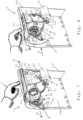
- FIGs 1 to 8a illustrate an exemplary embodiment of a beverage preparation machine 1 in accordance with the invention.
- Figs 1 to 6 illustrate the operation by a user 3 of machine 1 from start up ( Fig. 1 ) over insertion of ingredient capsule 2 ( Figs 2 and 3 ) beverage formation ( Fig. 4 ) to evacuation of used ingredient capsule 2 ( Figs 5 and 6 ).
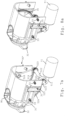
- Figures 7 to 8a show in greater details the motorization of machine 1.
- Machine 1 has an ingredient processing module 10 with an ingredient handling unit 20,30 that comprises a first part 20 and a second part 30.
- First and second parts 20,30 are relatively movable from a position for holding ( Figs 4 , 8 and 8a ) and processing therein an ingredient 2 for forming a beverage to a transfer position for loading ( Figs 2, 3 , 7 , 7a ) such ingredient 2 into handling unit 20,30 and/or for evacuation ( Figs 5, 6 , 7 , 7a ) thereof from unit 20,30.
- Such ingredient is typically a flavouring ingredient pre-portioned in a capsule 2.
- first part 20 of handling unit 20,30 can be more or less fixed in a structure 100, e.g. frame or housing, of machine 1 and second part 30 of handling unit 20,30 may be driven to and away from first part 20 between the transfer and the holding positions.
- second part 30 can be movable and has an opening 30', as indicated in Fig. 7a , that may slide back and forth over first part 20.
- Lateral support elements 33 ( Fig. 7a ) are provided for guiding second part 30 in slots 101 ( Figs 4 and 8 ) of structure 100.
- First part 20 defines a chamber 21 and second part 30 has a member 31, e.g. generally shaped as a plate.
- Chamber 21 and member 31 are spaced apart in Figs 2, 3 , 5, 6 , 7 and 7a for receiving (loading) and/or evacuating an ingredient 2 therebetween. Chamber 21 and member 31 are brought together in Figs 4 , 8 and 8a for delimiting an inner ingredient processing cavity for holding and housing the ingredient, such as tea or coffee or chocolate or powder milk. As mentioned above, the ingredient may be inserted pre-portioned within a capsule 2 into this cavity.
- first and second parts 20,30 in their processing position can be arranged for mixing liquid, such as an incoming flow of hot water, with a flavouring ingredient, e.g. coffee or tea, to form a flavoured beverage.
- a flavouring ingredient e.g. coffee or tea
- the flavouring ingredient may in particular be supplied as a solid, e.g. ground coffee, tea leaves, powder milk, etc...
- first and second parts 20,30 of handling unit 20,30 form a brewing unit, e.g. of a tea or coffee machine.
- the flavouring ingredient may be supplied within capsule 2 into the brewing unit.
- the interaction between the brewing unit and the flavouring ingredient, when provided within a capsule, may be of the type disclosed in EP 1 859 714 or in EP 2 205 133 .
- Parts 20,30 in their holding position may be arranged for holding a pre-portioned flavouring ingredient supplied within capsule 2 while liquid is circulated therethrough to form a beverage.
- a flavouring capsule 2 may have a cup-shaped body 2' with a rim 2" for fixing a lid 2'" thereon, as illustrated in Fig 5 .
- Body 2' has a cavity configured for containing a pre-portioned amount of flavouring ingredient, e.g. from 3 to 12 g ground coffee.
- first and second parts 20,30 may include a capsule opener such as blades and/or a tearing tool, e.g. a plate with a tearing profile, for instance as known form Nespresso TM machines.
- a capsule opener such as blades and/or a tearing tool, e.g. a plate with a tearing profile, for instance as known form Nespresso TM machines.
- processing module 10 includes an upstream fluid arrangement, e.g. incorporating a liquid driver, such as a pump 5, and a thermal conditioner, such as a heater 4 and/or cooler, connected via tube 6 to the liquid driver for circulating thermally conditioned liquid, such as water, from a source, e.g. a liquid reservoir typically adjacent housing 100, into the ingredient processing cavity.
- a liquid driver such as a pump 5
- a thermal conditioner such as a heater 4 and/or cooler
- processing module 10 comprises a downstream fluid arrangement with an outlet member 40 ( Fig. 4 ) for dispensing to an area for dispensing beverage to a user, e.g. an area for placing a user-cup or a user-mug, the beverage formed in the cavity containing the ingredient mixed with the circulating liquid.
- the dispensing area may be delimited at the bottom by a support surface for holding a user cup or mug.
- support surfaces are well known in the art, e.g. as disclosed in EP 1 867 260 and WO 2009/074557 .
- Outlet member 40 is in fluid communication with the ingredient processing cavity, downstream thereof, via liquid guide member 32.
- Guide member 32 can be fixed to movable part 30.
- Machine 1 may have a collector receptacle (not shown) for collecting used ingredients, such as tea leaves or ground coffee, e.g. within used capsules, and waste liquid.
- the collector receptacle e.g. waste collector
- the collector receptacle may be located in a lower part 102 ( Fig. 5 ) of structure 100 of machine 1 and have an upper compartment for solids and a lower compartment for liquids.
- Collector receptacle may be insertable, e.g. slidable, into a cavity formed in the machine and removable therefrom for servicing, e.g. emptying the solids and/or liquids contained therein.
- the storage capacity of the collector receptacle for accumulating used ingredient may be aligned to the storage capacity of reservoir for the supply of liquid such as water, e.g. as taught in PCT/EP10/056194 .
- processing module 10 can include a drop evacuation member 41 for collecting residual drops in the downstream fluid arrangement when machine 1 is not expected to dispense a beverage; typically when processing module 10 is in the transfer position as illustrated in Fig. 4 .
- Evacuation member 41 is configured to be in fluid configuration with liquid guide member 32 and arranged to evacuated liquid therefrom into a service unit located inside machine 1 generally underneath processing module 10.
- the service unit is of the type of the above discussed collector receptacle.
- the collector receptacle can be positioned underneath parts 20,30 to collect upon beverage preparation the used flavouring ingredient, e.g. ground coffee or tea, evacuated to the receptacle via an ingredient evacuation passage 96 ( Fig. 7 ), e.g. by gravity.
- the receptacle typically has an anti-clogging arrangement, as for example taught in WO 2009/074559 and in WO 2009/135869 , which are hereby incorporated by way of reference.
- Ingredient processing module 10 can be configured to circulate automatically the liquid into the cavity containing the ingredient, optionally within a capsule, when first and second parts 20,30 reach the processing position for housing the ingredient.
- An automatic ingredient recognition system may be used to parameterize the processing of the ingredient automatically such as a temperature of the beverage and volume of the beverage (for a serving).
- Beverage machine 1 typically includes one or more of the following components:
- Heater 4 may be a thermoblock or an on demand heater (ODH), for instance an ODH type disclosed in EP 1 253 844 , EP 1 380 243 and EP 1 809 151 .
- ODH on demand heater
- Examples of suitable brewing units and capsule management are for example disclosed in WO 2005/004683 , WO2007/135136 and WO 2009/043630 , which are hereby incorporated by way of reference.
- Suitable fluid circuits of beverage preparation modules are for instance disclosed in WO 2009/074550 and WO 2009/130099 , which are hereby incorporated by way of reference.
- machine 1 includes a motor means 50 for relatively moving first and second parts 20,30 from the processing position for housing ingredient 2 ( Figs 4 , 8 and 8a ) to the transfer position ( Figs 2, 3 , 5, 6 , 7 and 7a ) and/or vice versa.
- Motor means 50 comprises an electric motor 51 and a mechanical converter 52 for converting movements from motor 51 into relative movements between first and second parts 20,30.
- Figs 7a and 8a illustrate motor 51 and converter 52 driving downstream part 30 from the transfer position ( Fig. 7a ) to the processing position ( Fig. 8a ).
- mechanical converter 52 may include a gear, e.g. toothed gear, and/or cam arrangement.
- converter 52 includes a toothed wheel 521 that engages with a worm gear 511 formed on the rotating drive axis of motor 51. Toothed wheel 521 is fixed via rod 522 to a pair of transmission toothed wheels 523.
- Latter wheels 523 engage with corresponding toothed wheels 524, e.g. wheel sectors, that bear each a cam-follower 525 for cooperation with a cam 35 of movable second part 30 of processing module 10.
- Wheels 524 are pivotally mounted via a pivoting axis 526 on a frame or housing or another part of machine 1, such as onto part 20 of processing module 10.
- rod 522 may be pivotally mounted on a frame or housing 100 or another part of machine 1, e.g. part 20.
- machine 1 has a control unit 60 (illustrated in Fig. 4 ) for controlling motor means 50 to relatively move first and second parts 20,30.
- control unit 60 e.g. a printed circuit board (PCB) with a controller or processor and memory device etc..., is electrically connected to a triac or another electrically controlled switch 61 for controlling the electric powering of motor 51 via an appropriate electric connection 62.
- PCB printed circuit board
- Machine 1 also includes a user-interface 70,70' connected to control unit 60, e.g. via an appropriate electric connection 63.
- User-interface 70,70' is arranged for sensing a user-request.
- this user-interface is a touch-sensitive interface, e.g. a push button 70 or a capacitive button 70'.
- the interface may also be a photosensitive user-selector.
- first and second parts 20,30 are relatively movable by motor means 50 in a linear direction, namely in a straight direction.
- the first and second parts can be relatively movable by the motor means in an arched direction, or in an arched and linear direction, e.g. sequentially arched and then linear and/or vice versa.
- machine 1 has a stationary structure 100, such as a housing and/or a frame, the second part 30 being movable by motor means 50 relative to the first part and relative to the stationary structure.
- the first part may include a fixed structure 25, in particular including a hydraulic cylinder, and a secondary structure 26, such as a hydraulic piston member including an ingredient or capsule cage.
- Secondary structure 26 may be slightly movable relative to fixed structure 25, for example to adjust the closing distance between first and second relatively movable parts 20,30, e.g. to ensure proper handling of ingredient/capsule 2 inserted therebetween. Examples of such hydraulic positioning are for instance disclosed in EP 2 142 054 .
- the exemplary embodiment of machine 1 according to the invention will now be discussed in greater details in relation to ingredient passage 95,96 and ingredient gate 90.
- the ingredient passage has an insertion portion 95 for inserting ingredient 2 into the processing module 10 and an evacuation portion 96 for evacuating ingredient 2 therefrom ( Fig. 7 ).
- the ingredient gate is directly or indirectly driven by motor means 50 between a position ( Figs 2, 3 , 5, 6 , 7 and 7a ) opening and a position ( Figs 1 , 4 , 8 and 8a ) closing passage 95,96.
- a displacement of the movable second part 30 in one direction 35,36 may be coordinated with a displacement of the gate in a diverging direction, in particular in a generally opposite direction 35',36', as illustrated in Figs 7 and 8 .
- the displacement directions may be generally similar.
- machine 1 may include an outermost housing 100.
- Ingredient passage 95,96 can extend from outermost housing 100 to ingredient processing module 10, the gate 90 being movable along a portion of housing 100 generally parallel thereto, as illustrated in Figs 1 to 4 and 5 .
- Passage 95,96 is generally upright so that ingredient 2 is movable in the passage under the effect of gravity. Passage 95,96 extends inbetween parts 20,30 in the open position, as illustrated in Figs 3 and 4 . As mentioned above, the passage comprises an insertion portion 95 guiding ingredient 2 from housing 100 into processing module 10 and an evacuation portion 96 guiding ingredient 2 from processing module to a used ingredient collector located in an area 102 underneath module 10.
- Gate 90 e.g. a generally plate-like member, can be drivable in a generally horizontal direction, movable part 30 being optionally movable in a horizontal direction.
- the gate can be made pivotable optionally in combination with a linearly movable second part, or vice versa. In the latter case, a linear movement is converted into a rotational movement, or vice versa, by the intermediate mechanical conversion mechanism, e.g. by means of a wheel and a cooperating rack only.
- Gate 90 can be configured to support in the closed position ( Figs 1 , 4 and 8 ) ingredient 2, especially contained within a capsule, and to free ingredient 2 into or out of the passage 95,96 when gate 90 is moved into the open position ( Figs 3 , 6 and 7 ).
- Machine 1 will now be described in greater details in relation with its user-control arrangement.
- machine 1 has a sensing arrangement 70,70'.
- This arrangement is configured for sensing a user-request by a user-actuation of the sensing arrangement.
- Control unit 60 contains different control programs for controlling the ingredient processing module executable on corresponding user-requests, namely when the machine's user-interface is correspondingly actuated.
- sensing arrangement 70,70' and control unit 60 are so arranged that each of said different user-requestable control programs is executed on a user-actuation of the sensing arrangement 70,70' only.
- user-interface 70,70' is configured to sense only one form of actuation for identifying a user-request pertaining to any of the user-requestable programs. This simplifies greatly the user-operation, construction and costs of user-interface.
- sensing arrangement 70,70' is normally a single user-selector, e.g. a push-button 70 as illustrated in Figs 1 to 6 or a capacitive button 70' as illustrated in Figs. 7 and 8 .
- control unit 60 may contain a user-requestable powering program for starting up the machine on user-actuation of the sensing arrangement 70 in a shut-off state.
- sensing arrangement 70 may serve as a power switch when machine 1 is in a switched off state.
- powering program When powering program is executed, machine 1 is brought into a start-up mode during which heater 4, an in-line thermal accumulation heater such as a thermoblock, is driven to its operative temperature.
- This start-up process may typically last from 10 to 90 seconds depending on the heater and the start-up algorithm.
- parts 20,30 may be in the holding configuration ( Fig. 1 ) or in the transfer configuration ( Fig. 2 ) or may be in an intermediate configuration, e.g. half open, indicating the transition between the inactive state and the operative state of machine 1.
- ingredient processing module 10 may be motorized to drive parts 20,30 of the handling unit apart and together as required.
- Control unit 60 may be arranged to bring handling unit 20,30 automatically into the holding configuration at shut-off ( Fig. 1 ) and into the loading configuration upon start-up ( Fig. 2 ).
- Control unit 60 may be arranged to bring handling unit 20,30 automatically into the loading configuration at an end of a beverage preparation ( Fig. 5 ).
- control unit 60 comprises an auto-shut off module for shutting off machine 1 automatically.
- This module may including a timer and/or a beverage preparation counter, such as a factory preset and/or user-programmable auto-shut off module.
- the auto-shut off module is arranged to switch off machine 1 automatically after a period of time of non-use in the range of 1 to 30 min, such as 5 to 20 min or about 10 to 15 min.
- Control unit 60 contains a user-requestable beverage preparation program. Such a program normally includes a set of instructions for controlling heater 4 and pump 5 in a manner appropriate for preparing the requested beverage.
- pump 5 may be controlled to circulate 25 to 40 ml water at 10 to 20 bar through brewing unit 20,30 and heater 4 may be configured to heat the circulated water to a temperature of 88 to 94°C.
- Control unit 60 may be arranged to register a beverage user-request via sensing arrangement 70,70' after powering or start-up of such machine, as indicated in Fig. 3 .
- Machine 1 may include an ingredient sensor, e.g. an optic, electric, magnetic and/or mechanic capsule detector as known in the art, in or adjacent to the ingredient processing module 10.
- This ingredient sensor can be connected to control unit 60, the control unit 60 being arranged to register a beverage user-request via the sensing arrangement 70,70' when a beverage ingredient is sensed, as illustrated in Fig. 3 .
- Control unit 60 may contain a user-requestable beverage stop program, the control unit 60 being arranged to register a beverage stop request via the sensing arrangement 70,70' during execution of a beverage preparation program. Hence, when a user is satisfied with the dispensed volume of beverage, beverage preparation may be ended by user-actuation of sensing arrangement 70,70'.
- the control unit 60 contains a first and a second user-requestable beverage preparation program, the first program being requestable by a single user-actuation of the sensing arrangement 70,70', the second user-requestable beverage preparation program being requestable by a repeated-user actuation of the sensing arrangement, such a double user-actuation of the sensing arrangement, typically within a short time frame, e.g. 1 to 2 seconds.
- Control unit 60 may contain a beverage preparation program that has a parameter which is user-programmable upon executing a user-programming program executed on a predetermined sequence of user-actuations of the sensing arrangement 70,70'.
- Control unit 60 may include a sensor in or adjacent to the ingredient processing module.
- Control unit 60 can contain a user-requestable service program, such as a cleaning and/or rinsing program, the control unit being arranged to register a service user-request via sensing arrangement 70,70' when no beverage ingredient is sensed or when a service accessory, such as a cleaning capsule 2, is sensed via the sensor.
- Control unit 60 may contain a user-requestable service stop program and be arranged to register a service stop request via the sensing arrangement 70,70' during execution of the service program.
- Machine 1 may comprise only one user-indicator 90, such as a visual and/or sound indicator, for indicating a machine state, such as a LED or a sound generator, optionally the user-indicator being arranged for indicating a plurality of different machine state, in particular by corresponding indication sequences.
- gate 90 may serve as a user indicator for indicating a state of shut-off of machine 1 ( Fig. 1 ) an intermediate state of start-up, a state of readiness for an ingredient loading ( Fig. 2 ), a state of beverage processing in combination with beverage dispensing via outlet 40 ( Fig. 4 ), and a state of returned readiness for an ingredient loading ( Fig. 6 ).
- Indicator 90 may indicate a transitional state, as mentioned above, and/or a state of malfunctioning or disorder such as overheating and/or liquid shortage and/or problem at closure of ingredient handling arrangement 20,30 e.g. because an inappropriate object is introduced, such as a human hand 3 or a wrong ingredient.
- the user-indicator may have only one function, i.e. present an information to a user, e.g. in the form of a LED.
- the user-indicator may have one or more further functions in addition to presenting information to the user, e.g. close or open a capsule insertion passage.
Landscapes
- Engineering & Computer Science (AREA)
- Food Science & Technology (AREA)
- Mechanical Engineering (AREA)
- Apparatus For Making Beverages (AREA)
- Devices For Dispensing Beverages (AREA)
Description
- The field of the invention pertains to beverage preparation machines, in particular using capsules of an ingredient of the beverage to be prepared, such as a beverage preparation machines having a user-interface for allowing a user to control the machine and/or receive information regarding a state and/or a carried out process of the machine.
- For the purpose of the present description, a "beverage" is meant to include any human-consumable liquid substance, such as tea, coffee, hot or cold chocolate, milk, soup, baby food, etc... A "capsule" is meant to include any pre-portioned beverage ingredient, such as a flavouring ingredient, within an enclosing packaging of any material, in particular an airtight packaging, e.g. plastic, aluminium, recyclable and/or biodegradable packagings, and of any shape and structure, including soft pods or rigid cartridges containing the ingredient.
- Certain beverage preparation machines use capsules containing ingredients to be extracted or to be dissolved; for other machines, the ingredients are stored and dosed automatically in the machine or else are added at the time of preparation of the drink.
- Most coffee machines possess filling means that include a pump for liquid, usually water, which pumps the liquid from a source of water that is cold or indeed heated through heating means, such as a heating resistor, a thermoblock or the like. Such machine typically have a brewing unit for holding and extraction the beverage ingredient. To introduce the ingredient into the brewing unit and then remove the ingredient upon use, the brewing unit has a closure mechanism that may be driven by a handle that is operable by a user. Various configurations for manipulating the machine have been disclosed in the art.
EP 1 208 782EP 1 829 469US 2008/0006159 ,US 7,165,488 andWO 2007/111884 disclose such beverage machines. - More recently, efforts have been specifically devoted to the ease of operation of a beverage preparation machine for a user and ergonomic configuration of such machines, as illustrated in
EP 1 878 368EP 1 864 598WO 2009/074553 andWO 2010/015427 . - For allowing the user to control machine operation various systems have been disclosed in the art, for instance as mentioned in the following references:
AT 410 377 CH 682 798 DE 44 29 353 ,DE 202 00 419 ,DE 20 2006 019 039 ,DE 2007 008 590 ,EP 1 448 084EP 1 676 509 ,EP 08155851.2 FR 2 624 844GB 2 397 510US 4,377,049 ,US 4,458,735 ,US 4,554,419 ,US 4,767,632 ,US 4, 954, 697 ,US 5,312,020 ,US 5,335,705 ,US 5,372,061 ,US 5,375,508 ,US 5,731,981 ,US 5,645,230 ,US 5,836,236 ,US 5,959,869 ,US 6,182,555 ,US 6,354,341 ,US 6,759,072 ,US 2007/0157820 ,WO 97/25634 WO99/50172 WO 2004/030435 ,WO 2004/030438 ,WO 2006/063645 ,WO 2006/090183 ,WO 2007/003062 ,WO 2007/003990 ,WO 2008/104751 ,WO 2008/138710 ,WO 2008/138820 ,WO 2009/135821 ,WO 2010/003932 andWO 2010/037806 andPCT/EP10/061801 - In the field of coffee machines, in particular coffee machines using ground coffee capsules, it is well known to provide a user-interface with a power switch for shutting on and off the machine, a first button for requesting the dispensing of ristretto-size or espresso-size coffee and a second button for requesting the dispensing or regular-size or lungo-size coffee. The beverage volumes associated with each of the two buttons may usually be re-programmed by a user to fit his or her individual preferences. Various LEDs are usually provided to indicate a states of the machine, e.g. a start-up state, a standby state, a beverage dispensing state, a readiness state, etc...
- A preferred object of the present invention is to provide a simple, reliable and/or inexpensive user-interface arrangement for a user-control of functions of a beverage preparation machine.
- The invention relates to a machine for preparing a beverage. For instance, the machine is a coffee, tea, chocolate, cacao, milk or soup preparation machine. In particular, the machine is arranged for preparing within a beverage processing module a beverage by passing hot or cold water or another liquid through a capsule containing an ingredient, such as a flavouring ingredient, of the beverage to be prepared, such as ground coffee or tea or chocolate or cacao or milk powder.
- Such beverage preparation typically includes the mixing of a plurality of beverage ingredients, e.g. water and milk powder, and/or the infusion of a beverage ingredient, such as an infusion of ground coffee or tea with water. For instance, a predetermined amount of beverage is formed and dispensed on user-request, which corresponds to a serving. The volume of such a serving may be in the range of 25 to 200 ml, e.g. the volume for filling a cup or mug, depending on the type of beverage. Formed and dispensed beverages may be selected from ristrettos, espressos, lungos, cappuccinos, café latte, americano coffees, teas, etc... In particular, a coffee machine may be configured for dispensing espressos, e.g. an adjustable volume of 20 to 60 ml per serving, and/or for dispensing lungos, e.g. a volume in the range of 70 to 150 ml per serving.
- In particular, the beverage preparation machine includes:
- an ingredient processing module for processing at least one ingredient, in particular an ingredient supplied within a capsule into the module;
- a sensing arrangement for sensing a user-request by a user-actuation of the sensing arrangement; and
- a control unit containing different control programs for controlling the ingredient processing module executable on corresponding user-requests.
- As discussed above, the ingredient is optionally inserted into the processing module and/or evacuated therefrom within an ingredient capsule, e.g. an aluminium or plastic or paper enclosure containing the ingredient.
- In accordance with the invention, the sensing arrangement and the control unit are so arranged that each of said different user-requestable control programs is executed on a user-actuation of the sensing arrangement only.
- With an appropriate user-logic, different operations can be carried out by using only one button or other simple interface device, e.g. a user-sensing arrangement having a single actuation state detection i.e. actuation detected or not detected. All operations that can be requested by a user may be controlled by the same interface device. In the most simple configuration, all user-requests may be acquired by the control unit via the same user-actuation irrespectively of the length and repetition of actuation. In an optional configuration, the control unit may be configured to differentiate between the number of user-actuations and/or the duration of user-actuation of the same interface device sensing the same user-actuation. The logic of the control unit is configured to discriminate between user-requests accordingly. Whereas, in this latter embodiment, the requests may be differentiated as to the number and/or length of actuation of the sensing arrangement, the manner of actuating the sensing arrangement, e.g. the actual contacting a certain location of the arrangement or the actual pushing a certain element of the arrangement, is generally always the same irrespective of the kind of user-request. For instance, only one press-button is provided which the user may actuate by depressing completely, irrespective of the length of the depression and/or number of depression.
- The identification of the relevant user-request linked to a particular actuation of the sensing arrangement among all possible user-requests selectable by a generally identical actuation of the sensing arrangement is carried out based on the particular state of the machine at the time of the user-actuation.
- Two user-actuations of the sensing arrangement are considered to be "generally identical" when the same information is derived by the control unit from the sensing arrangement. With the exception of discrimination between repeated actuations and/or duration-based actuations, the identification of a particular user-request is achieved via the user-logic in the control unit of the machine.
- Hence, the user-interface, in particular the user-input interface, of the beverage machine of the invention is simplified so that various different user-requests are communicated to the beverage machine via the same sensing arrangement by the same user-actuation. It follows that a multitude of selectors and/or touch screens with sensing matrix for discriminating between different spatial locations of user-actuation of the interface is no more necessary. Depending on the timing of the user-actuation of the single sensing arrangement, the control unit is programmed to derive a specific user-request in particular based on the state of the machine at the time of the user-actuation.
- It follows that fewer or less complex interface devices are needed to control the full range of the machine's user-functionalities. Thus, fewer interface components are needed which reduces the machine's production costs and fewer components are exposed to failure during the machine's lifetime which reduces the maintenance costs. Moreover, by having to manage only one sensing arrangement, e.g. button, the operation of the machine is made easier for the user.
- The sensing arrangement can be a single user-selector selected from touch, push, turn, and toggle user-selectors such as a touch pad, a touch-plate, a push button, a turn button or a toggle lever, in particular an automatic return toggle lever.
- Hence, a simple and/or low cost user-input device can be used for requesting all user-requestable processes of the machine.
- The control unit may contain a user-requestable powering program for starting up the machine on user-actuation of the sensing arrangement in a shut-off state, optionally such machine comprising a thermal conditioner, such as a heater, that is powered to reach an operative temperature during start up. Hence, the sensing arrangement may also be used as a power switch of the machine.
- Alternatively, it is possible that a mere plugging of the power cord to the mains initiates the powering program of the machine.
- The ingredient processing module may include a motorized ingredient handling unit that has a holding configuration for preparing a beverage therefrom and a loading configuration for loading said ingredient into the handling unit. The control unit can be arranged to bring the handling unit automatically into the holding configuration at shut-off and into the loading configuration upon start-up. An intermediate configuration may be provided during a transition between different machine states, e.g. between an operative state and a shut-off state or for an indication of a machine disorder or to indicate that the machine is busy. The control unit may be arranged to bring the handling unit automatically into the loading configuration at an end of a beverage preparation.
- For example, the handling unit comprises a first part and a second part movable relative to the first part from a position for housing therein an ingredient to a transfer position for loading this ingredient into the handling unit and/or for evacuation thereof from the handling unit. For instance, the first and second parts are associated with: a passage for inserting this ingredient into the handling unit and/or evacuating such ingredient therefrom; and optionally a gate driven by the movable second part and associated with the passage and movable between a position opening the passage and a position closing the passage. Such gate may be used to prevent projections of hot liquid and/or vapour out of the capsule passage and/or to indicate to a user when the handling unit is in state for receiving the ingredient and when it is not, respectively.
- The control unit may comprise an auto-shut off module for shutting off such machine automatically, in particular a module including a timer and/or a beverage preparation counter, such as a user-programmable auto-shut off module. Hence, no user-interface may be needed for shutting off the machine. Timer-based auto-shut off devices are well known in the art. A serving-based auto-shut off device is disclosed in
EP 2 252 182 - The control unit contains a user-requestable beverage preparation program. Such program typically includes the control of various machine components for circulating and conditioning a liquid via the processing module to turn prepare a desired beverage.
- The control unit can be arranged to register a beverage user-request via the sensing arrangement after powering or start-up of such machine. The machine may include an ingredient sensor in or adjacent to the ingredient processing module, the ingredient sensor being connected to the control unit, the control unit being arranged to register a beverage user-request via the sensing arrangement when a beverage ingredient is sensed.
- The control unit can contain a user-requestable beverage stop program, the control unit being arranged to register a beverage stop request via the sensing arrangement during execution of a beverage preparation program. In this case, start and stop of the beverage preparation for dispensing a serving are manual. Alternatively, the machine may be configured to prepare beverages for dispensing beverage servings of a single volume only.
- The control unit contains a first and a second user-requestable beverage preparation program, the first program being requestable by a single user-actuation of the sensing arrangement, the second user-requestable beverage preparation program being requestable by a repeated-user actuation of the sensing arrangement, such as a double user-actuation of the sensing arrangement.
- As mentioned above, the control unit may be configured to register successive user-actuations within a limited time frame, e.g. one or two seconds, for discriminating between different programs selectable at the same point in time. Alternatively, the control unit may be configured so that only no more than one user-requestable program is requestable at any point in time so that no options are available to a user at any point in time, even though several user-requestable different programs are available to a user over time linked to the different states of the machine. The latter configuration reduces the flexibility of the machine but simplifies the control of the machine by a user who is not confronted to different operating options.
- The control unit may contain a beverage preparation program that has a parameter which is user-programmable upon executing a user-programming program executed on a predetermined sequence of user-actuations of the sensing arrangement. For instance, a long actuation of the sensing arrangement or a plurality of actuation thereof in a limited time frame or window, e.g. 1 to 2 seconds, will initiate the user-programming program, e.g. for allowing a user to set the volume of a beverage serving, or to set the number of servings or duration of non-use of the machine before automatic shut down.
- Alternatively, for user-programming of the control unit, the machine may include a machine interface for connection to an external device, e.g. for uploading a user-program from a portable device such as a USB-key or from a computer interfaced with the machine. Hence, the interface of an external device may be used for complex programming of the machine. This can be justified as such programming will usually be seldom and would not justify a dedicated sophisticated user-interface integrated in the beverage machine that would unnecessarily increase the cost of the machine.
- The beverage machine may also incorporate a sensor in or adjacent to the ingredient processing module. The control unit can contains a user-requestable service program, such as a cleaning and/or rinsing program, the control unit being arranged to register a service user-request via the sensing arrangement when no beverage ingredient is sensed or when a service accessory is sensed via the sensor. Optionally, the control unit contains a user-requestable service stop program and is arranged to register a service stop request via the sensing arrangement during execution of the service program.
- Advantageously, to reduce the cost of the machine, the machine comprises only one user-indicator, such as a visual and/or sound indicator, for indicating a machine state, such as a LED or a sound generator, optionally the user-indicator being arranged for indicating a plurality of different machine states, in particular by corresponding indication sequences. For instance, continuous lightening/sound may be used to indicate a specific state, intermittent indication or different kind of different indications, e.g. blinking, may be used to indicate other machine states.
- Alternatively or cumulatively, one or more machine parts involved in the internal operations of the machine may be visible from outside of the machine so that the user may derive an operational status by observing such parts. In this case, no additional interface part is required to indicate to a user such operation of the machine. For instance, the machine part is a movable part of the handling unit that telescopes in and out according to its loading configuration and beverage processing configuration. Such a telescoping part is for example disclosed in
WO 2009/043630 . - The invention will now be described with reference to the schematic drawings, wherein:
-
Figures 1 to 6 show part of a machine with a sensing arrangement and a control unit according to invention in different states in an sequence of use; -
Figures 7 and 8 are further views of a similar beverage machine showing in particular part of the ingredient processing module, a motor, a control unit and different user-interface; and -
Figures 7a and 8a illustrate the motorization of a movable part of the processing module shown inFigures 7a and 8a . -
Figures 1 to 8a illustrate an exemplary embodiment of abeverage preparation machine 1 in accordance with the invention. In particular,Figs 1 to 6 illustrate the operation by auser 3 ofmachine 1 from start up (Fig. 1 ) over insertion of ingredient capsule 2 (Figs 2 and 3 ) beverage formation (Fig. 4 ) to evacuation of used ingredient capsule 2 (Figs 5 and 6 ).Figures 7 to 8a show in greater details the motorization ofmachine 1. -
Machine 1 has aningredient processing module 10 with aningredient handling unit first part 20 and asecond part 30. First andsecond parts Figs 4 ,8 and8a ) and processing therein aningredient 2 for forming a beverage to a transfer position for loading (Figs 2, 3 ,7 ,7a )such ingredient 2 intohandling unit Figs 5, 6 ,7 ,7a ) thereof fromunit capsule 2. - For example,
first part 20 ofhandling unit structure 100, e.g. frame or housing, ofmachine 1 andsecond part 30 ofhandling unit first part 20 between the transfer and the holding positions. In particular,second part 30 can be movable and has an opening 30', as indicated inFig. 7a , that may slide back and forth overfirst part 20. Lateral support elements 33 (Fig. 7a ) are provided for guidingsecond part 30 in slots 101 (Figs 4 and8 ) ofstructure 100.First part 20 defines achamber 21 andsecond part 30 has amember 31, e.g. generally shaped as a plate.Chamber 21 andmember 31 are spaced apart inFigs 2, 3 ,5, 6 ,7 and7a for receiving (loading) and/or evacuating aningredient 2 therebetween.Chamber 21 andmember 31 are brought together inFigs 4 ,8 and8a for delimiting an inner ingredient processing cavity for holding and housing the ingredient, such as tea or coffee or chocolate or powder milk. As mentioned above, the ingredient may be inserted pre-portioned within acapsule 2 into this cavity. - Typically, first and
second parts - In a particular embodiment, first and
second parts handling unit capsule 2 into the brewing unit. The interaction between the brewing unit and the flavouring ingredient, when provided within a capsule, may be of the type disclosed inEP 1 859 714EP 2 205 133 -
Parts capsule 2 while liquid is circulated therethrough to form a beverage. Such aflavouring capsule 2 may have a cup-shaped body 2' with arim 2" for fixing a lid 2'" thereon, as illustrated inFig 5 . Body 2' has a cavity configured for containing a pre-portioned amount of flavouring ingredient, e.g. from 3 to 12 g ground coffee. - When closed
capsules 2 of flavouring ingredients are used, first andsecond parts - In particular, as schematically indicated in
Fig. 1 ,processing module 10 includes an upstream fluid arrangement, e.g. incorporating a liquid driver, such as apump 5, and a thermal conditioner, such as a heater 4 and/or cooler, connected viatube 6 to the liquid driver for circulating thermally conditioned liquid, such as water, from a source, e.g. a liquid reservoir typicallyadjacent housing 100, into the ingredient processing cavity. Examples of upstream fluid arrangements are disclosed in greater details inWO 2009/074550 and inWO 2009/130099 . - Moreover,
processing module 10 comprises a downstream fluid arrangement with an outlet member 40 (Fig. 4 ) for dispensing to an area for dispensing beverage to a user, e.g. an area for placing a user-cup or a user-mug, the beverage formed in the cavity containing the ingredient mixed with the circulating liquid. The dispensing area may be delimited at the bottom by a support surface for holding a user cup or mug. Such support surfaces are well known in the art, e.g. as disclosed inEP 1 867 260WO 2009/074557 . -
Outlet member 40 is in fluid communication with the ingredient processing cavity, downstream thereof, vialiquid guide member 32.Guide member 32 can be fixed tomovable part 30. -
Machine 1 may have a collector receptacle (not shown) for collecting used ingredients, such as tea leaves or ground coffee, e.g. within used capsules, and waste liquid. The collector receptacle, e.g. waste collector, may be located in a lower part 102 (Fig. 5 ) ofstructure 100 ofmachine 1 and have an upper compartment for solids and a lower compartment for liquids. Collector receptacle may be insertable, e.g. slidable, into a cavity formed in the machine and removable therefrom for servicing, e.g. emptying the solids and/or liquids contained therein. For example, the storage capacity of the collector receptacle for accumulating used ingredient may be aligned to the storage capacity of reservoir for the supply of liquid such as water, e.g. as taught inPCT/EP10/056194 - Furthermore,
processing module 10 can include adrop evacuation member 41 for collecting residual drops in the downstream fluid arrangement whenmachine 1 is not expected to dispense a beverage; typically when processingmodule 10 is in the transfer position as illustrated inFig. 4 .Evacuation member 41 is configured to be in fluid configuration withliquid guide member 32 and arranged to evacuated liquid therefrom into a service unit located insidemachine 1 generally underneathprocessing module 10. For example, the service unit is of the type of the above discussed collector receptacle. - The collector receptacle can be positioned underneath
parts Fig. 7 ), e.g. by gravity. The receptacle typically has an anti-clogging arrangement, as for example taught inWO 2009/074559 and inWO 2009/135869 , which are hereby incorporated by way of reference. -
Ingredient processing module 10 can be configured to circulate automatically the liquid into the cavity containing the ingredient, optionally within a capsule, when first andsecond parts -
Beverage machine 1 typically includes one or more of the following components: - a)
Processing module 10, e.g. a fluid circuit including aningredient handling unit capsule 2, and for guiding via an inlet an incoming flow of liquid for flavouring thereof, such as water, through this ingredient to a beverage outlet; - b) an in-line heater 4 for heating this flow of liquid to be supplied to
ingredient 2; - c) a
pump 5 for pumping liquid through the in-line heater; - d) one or more
fluid connecting members 6 for guiding liquid from a source of liquid, such as tank of liquid; - e) an
electric control unit 60, in particular comprising a printed circuit board (PCB), for receiving instructions from a user via an input user-interface (70,70') and for controlling in-line heater 4 and thepump 5; and/or - f) one or more sensors for sensing at least one characteristic selected from characteristics of
processing module 10, in-line heater 4, pump 5, the liquid tank, an ingredient collector, a flow of the liquid (e.g. by a flowmeter), a pressure of the liquid and a temperature of the liquid, and for communicating such characteristic(s) to controlunit 60. - Heater 4 may be a thermoblock or an on demand heater (ODH), for instance an ODH type disclosed in
EP 1 253 844EP 1 380 243EP 1 809 151WO 2005/004683 ,WO2007/135136 andWO 2009/043630 , which are hereby incorporated by way of reference. Suitable fluid circuits of beverage preparation modules are for instance disclosed inWO 2009/074550 andWO 2009/130099 , which are hereby incorporated by way of reference. - Furthermore, in this particular embodiment of the invention,
machine 1 includes a motor means 50 for relatively moving first andsecond parts Figs 4 ,8 and8a ) to the transfer position (Figs 2, 3 ,5, 6 ,7 and7a ) and/or vice versa. Motor means 50 comprises anelectric motor 51 and amechanical converter 52 for converting movements frommotor 51 into relative movements between first andsecond parts -
Figs 7a and 8a illustratemotor 51 andconverter 52 drivingdownstream part 30 from the transfer position (Fig. 7a ) to the processing position (Fig. 8a ). - In particular,
mechanical converter 52 may include a gear, e.g. toothed gear, and/or cam arrangement. For instance,converter 52 includes a toothed wheel 521 that engages with aworm gear 511 formed on the rotating drive axis ofmotor 51. Toothed wheel 521 is fixed viarod 522 to a pair of transmissiontoothed wheels 523.Latter wheels 523 engage with correspondingtoothed wheels 524, e.g. wheel sectors, that bear each a cam-follower 525 for cooperation with acam 35 of movablesecond part 30 ofprocessing module 10.Wheels 524 are pivotally mounted via a pivotingaxis 526 on a frame or housing or another part ofmachine 1, such as ontopart 20 ofprocessing module 10. Likewise,rod 522 may be pivotally mounted on a frame orhousing 100 or another part ofmachine 1,e.g. part 20. - Furthermore,
machine 1 has a control unit 60 (illustrated inFig. 4 ) for controlling motor means 50 to relatively move first andsecond parts control unit 60, e.g. a printed circuit board (PCB) with a controller or processor and memory device etc..., is electrically connected to a triac or another electrically controlledswitch 61 for controlling the electric powering ofmotor 51 via an appropriateelectric connection 62. -
Machine 1 also includes a user-interface 70,70' connected to controlunit 60, e.g. via an appropriateelectric connection 63. User-interface 70,70' is arranged for sensing a user-request. For instance, this user-interface is a touch-sensitive interface, e.g. apush button 70 or a capacitive button 70'. The interface may also be a photosensitive user-selector. - In the particular examples illustrated in the appended Figures, first and
second parts - Typically,
machine 1 has astationary structure 100, such as a housing and/or a frame, thesecond part 30 being movable by motor means 50 relative to the first part and relative to the stationary structure. The first part may include a fixedstructure 25, in particular including a hydraulic cylinder, and a secondary structure 26, such as a hydraulic piston member including an ingredient or capsule cage. Secondary structure 26 may be slightly movable relative to fixedstructure 25, for example to adjust the closing distance between first and second relativelymovable parts capsule 2 inserted therebetween. Examples of such hydraulic positioning are for instance disclosed inEP 2 142 054 - The exemplary embodiment of
machine 1 according to the invention will now be discussed in greater details in relation toingredient passage ingredient gate 90. The ingredient passage has aninsertion portion 95 for insertingingredient 2 into theprocessing module 10 and anevacuation portion 96 for evacuatingingredient 2 therefrom (Fig. 7 ). Typically, the ingredient gate is directly or indirectly driven by motor means 50 between a position (Figs 2, 3 ,5, 6 ,7 and7a ) opening and a position (Figs 1 ,4 ,8 and8a ) closingpassage - A displacement of the movable
second part 30 in onedirection Figs 7 and 8 . In another embodiment (not shown), the displacement directions may be generally similar. - Hence,
machine 1 may include anoutermost housing 100.Ingredient passage outermost housing 100 toingredient processing module 10, thegate 90 being movable along a portion ofhousing 100 generally parallel thereto, as illustrated inFigs 1 to 4 and5 . -
Passage ingredient 2 is movable in the passage under the effect of gravity.Passage inbetween parts Figs 3 and4 . As mentioned above, the passage comprises aninsertion portion 95 guidingingredient 2 fromhousing 100 intoprocessing module 10 and anevacuation portion 96 guidingingredient 2 from processing module to a used ingredient collector located in anarea 102 underneathmodule 10. -
Gate 90, e.g. a generally plate-like member, can be drivable in a generally horizontal direction,movable part 30 being optionally movable in a horizontal direction. Alternatively, the gate can be made pivotable optionally in combination with a linearly movable second part, or vice versa. In the latter case, a linear movement is converted into a rotational movement, or vice versa, by the intermediate mechanical conversion mechanism, e.g. by means of a wheel and a cooperating rack only. -
Gate 90 can be configured to support in the closed position (Figs 1 ,4 and8 )ingredient 2, especially contained within a capsule, and tofree ingredient 2 into or out of thepassage gate 90 is moved into the open position (Figs 3 ,6 and7 ). -
Machine 1 will now be described in greater details in relation with its user-control arrangement. - As mentioned above,
machine 1 has asensing arrangement 70,70'. This arrangement is configured for sensing a user-request by a user-actuation of the sensing arrangement.Control unit 60 contains different control programs for controlling the ingredient processing module executable on corresponding user-requests, namely when the machine's user-interface is correspondingly actuated. - In accordance with the invention, sensing
arrangement 70,70' andcontrol unit 60 are so arranged that each of said different user-requestable control programs is executed on a user-actuation of thesensing arrangement 70,70' only. Hence, user-interface 70,70' is configured to sense only one form of actuation for identifying a user-request pertaining to any of the user-requestable programs. This simplifies greatly the user-operation, construction and costs of user-interface. - Hence, sensing
arrangement 70,70' is normally a single user-selector, e.g. a push-button 70 as illustrated inFigs 1 to 6 or a capacitive button 70' as illustrated inFigs. 7 and 8 . - As illustrated in the first stage (
Fig. 1 ) of the sequence shown inFigs. 1 to 6 ,control unit 60 may contain a user-requestable powering program for starting up the machine on user-actuation of thesensing arrangement 70 in a shut-off state. Hence, sensingarrangement 70 may serve as a power switch whenmachine 1 is in a switched off state. When powering program is executed,machine 1 is brought into a start-up mode during which heater 4, an in-line thermal accumulation heater such as a thermoblock, is driven to its operative temperature. This start-up process may typically last from 10 to 90 seconds depending on the heater and the start-up algorithm. During the start-up procedure,parts Fig. 1 ) or in the transfer configuration (Fig. 2 ) or may be in an intermediate configuration, e.g. half open, indicating the transition between the inactive state and the operative state ofmachine 1. - As mentioned above,
ingredient processing module 10 may be motorized to driveparts Control unit 60 may be arranged to bringhandling unit Fig. 1 ) and into the loading configuration upon start-up (Fig. 2 ).Control unit 60 may be arranged to bringhandling unit Fig. 5 ). - In an embodiment,
control unit 60 comprises an auto-shut off module for shutting offmachine 1 automatically. This module may including a timer and/or a beverage preparation counter, such as a factory preset and/or user-programmable auto-shut off module. Typically, the auto-shut off module is arranged to switch offmachine 1 automatically after a period of time of non-use in the range of 1 to 30 min, such as 5 to 20 min or about 10 to 15 min. -
Control unit 60 contains a user-requestable beverage preparation program. Such a program normally includes a set of instructions for controlling heater 4 and pump 5 in a manner appropriate for preparing the requested beverage. E.g. For preparing an espresso coffee, pump 5 may be controlled to circulate 25 to 40 ml water at 10 to 20 bar throughbrewing unit -
Control unit 60 may be arranged to register a beverage user-request viasensing arrangement 70,70' after powering or start-up of such machine, as indicated inFig. 3 . -
Machine 1 may include an ingredient sensor, e.g. an optic, electric, magnetic and/or mechanic capsule detector as known in the art, in or adjacent to theingredient processing module 10. This ingredient sensor can be connected to controlunit 60, thecontrol unit 60 being arranged to register a beverage user-request via thesensing arrangement 70,70' when a beverage ingredient is sensed, as illustrated inFig. 3 . -
Control unit 60 may contain a user-requestable beverage stop program, thecontrol unit 60 being arranged to register a beverage stop request via thesensing arrangement 70,70' during execution of a beverage preparation program. Hence, when a user is satisfied with the dispensed volume of beverage, beverage preparation may be ended by user-actuation ofsensing arrangement 70,70'. - The
control unit 60 contains a first and a second user-requestable beverage preparation program, the first program being requestable by a single user-actuation of thesensing arrangement 70,70', the second user-requestable beverage preparation program being requestable by a repeated-user actuation of the sensing arrangement, such a double user-actuation of the sensing arrangement, typically within a short time frame, e.g. 1 to 2 seconds. -
Control unit 60 may contain a beverage preparation program that has a parameter which is user-programmable upon executing a user-programming program executed on a predetermined sequence of user-actuations of thesensing arrangement 70,70'. -
Machine 1 may include a sensor in or adjacent to the ingredient processing module.Control unit 60 can contain a user-requestable service program, such as a cleaning and/or rinsing program, the control unit being arranged to register a service user-request viasensing arrangement 70,70' when no beverage ingredient is sensed or when a service accessory, such as acleaning capsule 2, is sensed via the sensor.Control unit 60 may contain a user-requestable service stop program and be arranged to register a service stop request via thesensing arrangement 70,70' during execution of the service program. -
Machine 1 may comprise only one user-indicator 90, such as a visual and/or sound indicator, for indicating a machine state, such as a LED or a sound generator, optionally the user-indicator being arranged for indicating a plurality of different machine state, in particular by corresponding indication sequences. Inparticular gate 90 may serve as a user indicator for indicating a state of shut-off of machine 1 (Fig. 1 ) an intermediate state of start-up, a state of readiness for an ingredient loading (Fig. 2 ), a state of beverage processing in combination with beverage dispensing via outlet 40 (Fig. 4 ), and a state of returned readiness for an ingredient loading (Fig. 6 ). - Other machine states may be indicated via the single user-indicator, e.g. a
semi-open gate 90.Indicator 90 may indicate a transitional state, as mentioned above, and/or a state of malfunctioning or disorder such as overheating and/or liquid shortage and/or problem at closure ofingredient handling arrangement human hand 3 or a wrong ingredient. - The user-indicator may have only one function, i.e. present an information to a user, e.g. in the form of a LED. Alternatively, the user-indicator may have one or more further functions in addition to presenting information to the user, e.g. close or open a capsule insertion passage.
Claims (13)
- A machine (1) for preparing a beverage comprising:- an ingredient processing module (10) for processing at least one ingredient, in particular an ingredient supplied within a capsule (2) into the module;- a sensing arrangement (70,70') for sensing a user-request by a user-actuation of the sensing arrangement; and- a control unit (60) containing different control programs for controlling the ingredient processing module executable on corresponding user-requests,characterised in that the sensing arrangement (70,70') has a single actuation state detection, i.e. actuation detected or not detected, and in that the sensing arrangement (70,70') and the control unit (60) are so arranged that each of said different user-requestable control programs is executed on a user-actuation of the sensing arrangement (70,70') only and the identification of the relevant user-requestable control program linked to said user-actuation of the sensing arrangement (70,70') among said different user-requestable control programs is carried out based on a state of the machine at the time of said user-actuation of the sensing arrangement (70,70'),wherein the control unit (60) contains a user-requestable beverage preparation program,wherein the control unit (60) contains a first and a second user-requestable beverage preparation program, the first program being requestable by a single user-actuation of the sensing arrangement (70, 70'), the second user-requestable beverage preparation program being requestable by a repeated user-actuation of the sensing arrangement, such as a double user-actuation of the sensing arrangement.
- The machine of claim 1, wherein the sensing arrangement is a single user-selector (70,70') selected from touch, push, turn, and toggle user-selectors such as a touch pad, a push button (70), a touch-plate (70'), a turn button or a toggle lever, in particular an automatic return toggle lever.
- The machine of any preceding claim, wherein the control unit (60) contains a user-requestable powering program for starting up the machine on user-actuation of the sensing arrangement (70,70') in a shut-off state, optionally such machine (1) comprising a thermal conditioner, such as a heater (4), that is powered to reach an operative temperature during start up.
- The machine of any preceding claim, wherein the ingredient processing module (10) comprises a motorized ingredient handling unit (20,30) that has a holding configuration for preparing a beverage from said ingredient (2) and a loading configuration for loading said ingredient into the handling unit.
- The machine of claim 4, wherein the control unit (60) is arranged to bring the handling unit (20,30) automatically into the holding configuration at shut-off and into the loading configuration upon start-up.
- The machine of claim 4 or 5, wherein the control unit (60) is arranged to bring the handling unit (20,30) automatically into the loading configuration at an end of a beverage preparation.
- The machine of any preceding claim, wherein the control unit (60) comprises an auto-shut off module for shutting off such machine automatically, in particular a module including a timer and/or a beverage preparation counter, such as a factory-preset and/or user-programmable auto-shut off module.
- The machine of claim 1, wherein the control unit (60) is arranged to register a beverage user-request via the sensing arrangement (70,70') after powering or start-up of such machine (1).
- The machine of claim 1 or 8, which comprises an ingredient sensor in or adjacent to the ingredient processing module (10), the ingredient sensor being connected to the control unit (60), the control unit (60) being arranged to register a beverage user-request via the sensing arrangement (70,70') when a beverage ingredient is sensed.
- The machine of any one of claims 1 or 8 to 9, wherein the control unit (60) contains a user-requestable beverage stop program, the control unit (60) being arranged to register a beverage stop request via the sensing arrangement (70,70') during execution of a beverage preparation program.
- The machine of any one of claims 1 or 8 to 10, wherein the control unit (60) contains a beverage preparation program that has a parameter which is user-programmable upon executing a user-programming program executed on a predetermined sequence of user-actuations of the sensing arrangement (70,70').
- The machine of any preceding claim, which comprises a sensor in or adjacent to the ingredient processing module, wherein the control unit (60) contains a user-requestable service program, such as a cleaning and/or rinsing program, the control unit being arranged to register a service user-request via the sensing arrangement (70,70') when no beverage ingredient is sensed or when a service accessory is sensed via the sensor, optionally the control unit containing a user-requestable service stop program and being arranged to register a service stop request via the sensing arrangement (70,70') during execution of the service program.
- The machine of any preceding claim, which comprises only one user-indicator, such as a visual and/or sound indicator, for indicating a machine state, such as a LED or a sound generator, optionally the user-indicator being arranged for indicating different machine states, in particular by corresponding indication sequences.
Priority Applications (1)
| Application Number | Priority Date | Filing Date | Title |
|---|---|---|---|
| EP11791532.2A EP2645912B2 (en) | 2010-12-01 | 2011-12-01 | Simple user-interface for a beverage machine |
Applications Claiming Priority (3)
| Application Number | Priority Date | Filing Date | Title |
|---|---|---|---|
| EP10193235 | 2010-12-01 | ||
| PCT/EP2011/071562 WO2012072767A1 (en) | 2010-12-01 | 2011-12-01 | Simple user-interface for a beverage machine |
| EP11791532.2A EP2645912B2 (en) | 2010-12-01 | 2011-12-01 | Simple user-interface for a beverage machine |
Publications (3)
| Publication Number | Publication Date |
|---|---|
| EP2645912A1 EP2645912A1 (en) | 2013-10-09 |
| EP2645912B1 EP2645912B1 (en) | 2017-06-14 |
| EP2645912B2 true EP2645912B2 (en) | 2025-05-07 |
Family
ID=43618207
Family Applications (1)
| Application Number | Title | Priority Date | Filing Date |
|---|---|---|---|
| EP11791532.2A Active EP2645912B2 (en) | 2010-12-01 | 2011-12-01 | Simple user-interface for a beverage machine |
Country Status (10)
| Country | Link |
|---|---|
| US (1) | US20130247771A1 (en) |
| EP (1) | EP2645912B2 (en) |
| JP (1) | JP2013544601A (en) |
| CN (1) | CN103327859A (en) |
| AU (1) | AU2011334912A1 (en) |
| BR (1) | BR112013013533A2 (en) |
| CA (1) | CA2819281A1 (en) |
| RU (1) | RU2013129935A (en) |
| WO (1) | WO2012072767A1 (en) |
| ZA (1) | ZA201304863B (en) |
Families Citing this family (28)
| Publication number | Priority date | Publication date | Assignee | Title |
|---|---|---|---|---|
| CN104066363B (en) | 2011-11-23 | 2018-07-27 | 星巴克公司贸易用名星巴克咖啡公司 | Apparatus, system and method for brewing beverages |
| US9320382B2 (en) * | 2013-07-15 | 2016-04-26 | La Vit Technology Llc | Capsule based system for preparing and dispensing a beverage |
| USD738667S1 (en) | 2013-11-20 | 2015-09-15 | Starbucks Corporation | Beverage brewing apparatus |
| WO2015077237A2 (en) | 2013-11-20 | 2015-05-28 | Starbucks Corporation D/B/A Starbucks Coffee Company | Cooking system power management |
| BR112016015564B1 (en) | 2014-01-03 | 2021-09-14 | Koninklijke Douwe Egberts B.V. | METHOD FOR PUTTING TO USE A REPLACEABLE REFILL ON A BEVERAGE DISPENSING MACHINE, BEVERAGE DISPENSING SYSTEM, AND, COMPUTER-READY STORAGE MEDIA |
| DE102014104210A1 (en) * | 2014-03-26 | 2015-10-01 | Qbo Coffee Gmbh | CLEANING CAPSULE FOR EXTRACTION UNIT |
| JP2017530741A (en) * | 2014-08-21 | 2017-10-19 | ネステク ソシエテ アノニム | Interoperable capsule delivery unit and beverage preparation machine |
| CN106998941B (en) | 2014-11-27 | 2020-12-01 | 雀巢产品有限公司 | Liquid dispensing machine with manual drop stop |
| EP3223668B1 (en) | 2014-11-27 | 2018-11-21 | Nestec S.A. | Liquid dispensing machine with compact drop stop |
| ES2579978B2 (en) * | 2015-02-16 | 2017-04-07 | Smart Spirits, S.L. | Alcoholic beverage infuser |
| RU2721090C2 (en) | 2015-09-04 | 2020-05-15 | Сосьете Де Продюи Нестле С.А. | Beverage preparation device with an ergonomic outlet channel |
| EP3344098B1 (en) * | 2015-09-04 | 2019-06-05 | Nestec S.A. | Beverage machine with an ergonomic user-interface |
| PT3364832T (en) * | 2015-10-23 | 2021-06-24 | Nestle Sa | User interface of beverage preparation machine |
| EP3175746A1 (en) * | 2015-12-01 | 2017-06-07 | Qbo Coffee GmbH | Machine for making beverages |
| CN109640755A (en) * | 2016-09-09 | 2019-04-16 | 雀巢产品技术援助有限公司 | Beverage machine with ergonomic handling |
| PT3525636T (en) | 2016-10-11 | 2020-11-23 | Nestle Sa | Liquid dispensing machine with drop stop |
| JP7109430B2 (en) | 2016-10-11 | 2022-07-29 | ソシエテ・デ・プロデュイ・ネスレ・エス・アー | Liquid dosing machine with speed regulator |
| CA3041722A1 (en) | 2016-11-09 | 2018-05-17 | Pepsico, Inc. | Carbonated beverage makers, methods, and systems |
| WO2018219985A1 (en) * | 2017-06-01 | 2018-12-06 | Nestec Sa | Beverage machine with a storable dispensing head |
| JP7308200B2 (en) | 2017-12-20 | 2023-07-13 | ソシエテ・デ・プロデュイ・ネスレ・エス・アー | Convenient anti-drip beverage preparation machine |
| WO2019121593A1 (en) | 2017-12-20 | 2019-06-27 | Societe Des Produits Nestle S.A. | Beverage preparation machine with foam refinement |
| US11564527B2 (en) | 2017-12-20 | 2023-01-31 | Societe Des Produits Nestle S.A. | Beverage preparation machine with drop evacuation |
| WO2019158542A1 (en) | 2018-02-14 | 2019-08-22 | Societe Des Produits Nestle S.A. | Used capsule receptacle for beverage machines |
| WO2024251710A1 (en) | 2023-06-05 | 2024-12-12 | Societe Des Produits Nestle S.A. | Beverage preparation machine with reliable dispensing |
| EP4719142A1 (en) | 2023-06-05 | 2026-04-08 | Société des Produits Nestlé S.A. | Machine for dispensing beverages with foam |
| WO2025120135A1 (en) | 2023-12-07 | 2025-06-12 | Societe Des Produits Nestle S.A. | Reliable capsule removal system |
| WO2025120122A1 (en) | 2023-12-07 | 2025-06-12 | Societe Des Produits Nestle S.A. | Reliable capsule beverage dispensing system |
| WO2025120121A1 (en) | 2023-12-07 | 2025-06-12 | Societe Des Produits Nestle S.A. | Used capsule receptacle for beverage machines |
Citations (6)
| Publication number | Priority date | Publication date | Assignee | Title |
|---|---|---|---|---|
| DE20100700U1 (en) † | 2001-01-16 | 2001-03-22 | Eugster/Frismag Ag, Romanshorn | Coffee drink maker, especially espresso machine |
| EP1554958A2 (en) † | 2004-01-14 | 2005-07-20 | René Schifferle | Coffee machine for brewing ground coffee packed in a cartridge |
| EP1833750B1 (en) † | 2004-12-14 | 2008-09-10 | Nestec S.A. | Device and method for controlling the filling of a cup in a drinks vending machine such as a coffee machine |
| EP2196117A1 (en) † | 2008-12-10 | 2010-06-16 | Tchibo GmbH | Brewing machine |
| EP2194824A1 (en) † | 2007-08-29 | 2010-06-16 | Nestec S.A. | Dispensing device for preparing and dispensing food and/or nutritional composition |
| EP2252182A1 (en) † | 2008-01-24 | 2010-11-24 | Nestec S.A. | Energy saving manager for beverage preparation devices |
Family Cites Families (68)
| Publication number | Priority date | Publication date | Assignee | Title |
|---|---|---|---|---|
| DE2626175C3 (en) | 1976-06-11 | 1979-04-05 | Bayer Ag, 5090 Leverkusen | Process for the production of oligourethanes and their use for the production of polyurethane plastics |
| US4377049A (en) | 1980-05-22 | 1983-03-22 | Pepsico Inc. | Capacitive switching panel |
| US4458735A (en) | 1982-09-30 | 1984-07-10 | Medetec Industries, Inc. | Dispensing arrangement for a beverage such as a milkshake |
| US4554419A (en) | 1983-12-02 | 1985-11-19 | The Coca-Cola Company | Touch selection panel for a vending machine |
| JPS6282496A (en) | 1985-10-05 | 1987-04-15 | サンデン株式会社 | Self-service store apparatus |
| DE3615158C2 (en) | 1986-05-05 | 1990-11-15 | Cafina Ag | Method for preparing a plurality of coffee portions |
| FR2624844B1 (en) | 1987-12-18 | 1990-07-20 | Andries Eric | APPARATUS FOR MAKING BEVERAGES MADE OF MIXTURES OF INGREDIENTS, ESPECIALLY COCKTAILS |
| JP2960590B2 (en) | 1991-09-27 | 1999-10-06 | 東芝機械株式会社 | Automatic dispensing device for sparkling beverages |
| DE4137324C1 (en) | 1991-11-13 | 1993-02-04 | Cis Elektrogeraete Ag, Hinwil, Ch | |
| CH682798A5 (en) | 1991-11-15 | 1993-11-30 | Salvis Ag | Coffee machine with grinder, brewer and dispenser in one unit - has all three modules in one structure, behind front and each is accessible from top or front, brewing module has two brewing stations |
| US5731981A (en) | 1992-06-08 | 1998-03-24 | Azbar, Inc. | Beverage dispensing system for bar |
| US5372061A (en) | 1993-04-14 | 1994-12-13 | Avanti Espresso U.S.A., Inc. | Espresso/cappuccino apparatus and method |
| US5375508A (en) | 1993-12-29 | 1994-12-27 | Bunn-O-Matic Corporation | Digital brewer control |
| US5744793A (en) | 1994-02-28 | 1998-04-28 | Electro-Pro, Inc. | Triangulation position-detection and integrated dispensing valve |
| DE4429353A1 (en) | 1994-08-19 | 1996-02-22 | Joachim Koeninger | Universal automatic drinks dispenser |
| IT1280833B1 (en) | 1995-03-31 | 1998-02-11 | Enrico Marogna | DEVICE FOR CONTROL OF COFFEE GRINDING, GRINDER DOSING MACHINE EQUIPPED WITH THIS DEVICE AND PROCEDURE FOR THE |
| US5959869A (en) | 1996-12-03 | 1999-09-28 | The Coca-Cola Company | Vending machine controller and system |
| US5836236A (en) | 1997-03-03 | 1998-11-17 | Rolfes; Patrick J. | Coffee brewer and hot water dispenser |
| CH693016A5 (en) * | 1998-02-25 | 2003-01-31 | Jura Elektroapparate Ag | Coffee machine- or household equipment controller includes rotary selection switch, optical or acoustic display and start switch |
| US6082419A (en) | 1998-04-01 | 2000-07-04 | Electro-Pro, Inc. | Control method and apparatus to detect the presence of a first object and monitor a relative position of the first or subsequent objects such as container identification and product fill control |
| US6182555B1 (en) | 1999-04-07 | 2001-02-06 | Red River Tea Company | Apparatus and methods for brewing and dispensing beverages |
| US6759072B1 (en) | 1999-08-14 | 2004-07-06 | The Procter + Gamble Co. | Methods and systems for utilizing delayed dilution, mixing and filtration for providing customized beverages on demand |
| US6354341B1 (en) | 1999-11-10 | 2002-03-12 | Shurflo Pump Manufacturing Co., Inc. | Rapid comestible fluid dispensing apparatus and method |
| US6459854B1 (en) | 2000-01-24 | 2002-10-01 | Nestec S.A. | Process and module for heating liquid |
| ATE274321T1 (en) | 2000-11-28 | 2004-09-15 | Nestle Sa | PERCOLATION DEVICE |
| DE10154046A1 (en) | 2001-11-02 | 2003-05-22 | Miele & Cie | household appliance |
| DE20200419U1 (en) | 2002-01-12 | 2002-05-29 | Wik Far East Ltd., North Point | Electrical household or personal care device that is stationary during operation |
| DE60227248D1 (en) | 2002-07-12 | 2008-08-07 | Nestec Sa | Device for heating a liquid |
| WO2004030435A2 (en) | 2002-10-02 | 2004-04-15 | Automated Beverage Technologies Ltd | Dispenser |
| CA2737138C (en) | 2002-10-04 | 2012-07-17 | Lancer Partnership, Ltd. | Multiple brand ice beverage dispenser |
| GB2397510A (en) | 2003-01-24 | 2004-07-28 | Kraft Foods R & D Inc | Cartridge and machine for the preparation of beverages |
| EP1495702A1 (en) | 2003-07-10 | 2005-01-12 | Nestec S.A. | Device for the extraction of a cartridge |
| CA2544686C (en) | 2003-11-07 | 2013-05-14 | Bunn-O-Matic Corporation | Adjustable volume brewer |
| US7165488B2 (en) | 2003-12-12 | 2007-01-23 | Keurig, Incorporated | Brew chamber for a single serve beverage brewer |
| EP1634520A1 (en) | 2004-09-13 | 2006-03-15 | Nestec S.A. | Device and method for heating a liquid |
| EP1676509A1 (en) | 2004-12-30 | 2006-07-05 | Rhea Vendors S.p.A. | Process and apparatus for controlling the preparation of brewed beverages |
| EP1855571A2 (en) | 2005-02-28 | 2007-11-21 | Coffee Nation Ltd. | Apparatus for preparing beverages |
| WO2007027206A2 (en) * | 2005-04-11 | 2007-03-08 | Coffee Equipment Company | Machine for brewing a beverage such as coffee and related method |
| CH697974B1 (en) * | 2005-07-01 | 2009-04-15 | Saeco Ipr Ltd | Operating device for hot beverage vending machines. |
| EP1899927A1 (en) | 2005-07-01 | 2008-03-19 | Saeco IPR Limited | Operator's device for automatic hot beverage dispensers |
| DE202006019039U1 (en) | 2005-12-19 | 2007-03-08 | Mayer, Martin | Soda Fountain |
| JP5058559B2 (en) * | 2006-01-24 | 2012-10-24 | サンデン株式会社 | Beverage extractor |
| DE202006002678U1 (en) | 2006-02-17 | 2006-04-20 | Eugster/Frismag Ag | Coffee machine for preparing a coffee beverage by means of packaged, pre-portioned Kaffeepouches |
| FR2898028B1 (en) | 2006-03-01 | 2008-05-16 | Seb Sa | INFUSING MACHINE COMPRISING A DEVICE FOR EJECTING THE INFUSED PRODUCT |
| US7513192B2 (en) | 2006-03-23 | 2009-04-07 | Keurig, Incorporated | Beverage forming device with opening/closing mechanism for a beverage cartridge receiver |
| EP1859714B2 (en) | 2006-05-24 | 2015-05-27 | Nestec S.A. | Brewing device and brewing capsule system with a capsule holder for facilitating insertion and removal of capsules |
| ATE442798T1 (en) | 2006-05-24 | 2009-10-15 | Nestec Sa | BREWING DEVICE FOR CAPSULES WITH CLOSING MECHANISM WITH VARIABLE GEAR RATIO |
| ES2359577T3 (en) | 2006-06-09 | 2011-05-24 | Nestec S.A. | MODULAR DEVICE FOR THE PRODUCTION OF DRINKS WITH RECEPTION STATION. |
| DE602006014521D1 (en) | 2006-06-16 | 2010-07-08 | Nestec Sa | Vending machine with support system and drip catcher for containers of different sizes |
| DE602006007698D1 (en) | 2006-07-11 | 2009-08-20 | Nestec Sa | Machine for preparing drinks with functional device and foot construction |
| ITMI20061376A1 (en) * | 2006-07-14 | 2008-01-15 | De Longhi Spa | APPARATUS FOR THE PRODUCTION OF A COFFEE BEVERAGE AND PROCEDURE FOR LOADING THE CONTAINER OF THAT EQUIPMENT |
| GB2447024A (en) | 2007-02-27 | 2008-09-03 | Kraft Foods R & D Inc | A dispensing machine for hot or cold drinks |
| ATE536777T1 (en) | 2007-05-16 | 2011-12-15 | Nestec Sa | BEVERAGE PRODUCTION MODULE AND METHOD FOR OPERATING A BEVERAGE PRODUCTION MODULE |
| AU2008250314C1 (en) | 2007-05-16 | 2013-11-14 | Nestec S.A. | Control device having a peristaltic valve for a drink preparing machine |
| DE202007008590U1 (en) | 2007-06-15 | 2007-09-13 | Eugster/Frismag Ag | The beverage brewer |
| MX2010003570A (en) | 2007-10-04 | 2010-04-30 | Nestec Sa | Beverage brewing unit. |
| EP2070454B1 (en) | 2007-12-12 | 2015-07-15 | Nestec S.A. | Beverage production machines comprising a plurality of core units |
| WO2009074559A1 (en) | 2007-12-12 | 2009-06-18 | Nestec S.A. | Used capsule or pod receptacle for liquid food or beverage machines |
| US9572450B2 (en) | 2008-03-20 | 2017-02-21 | Nestec S.A. | Beverage production device for producing a beverage from a single-use capsule |
| JP2011518015A (en) | 2008-04-22 | 2011-06-23 | ネステク ソシエテ アノニム | Module assembly for beverage production equipment |
| ES2430589T3 (en) | 2008-05-07 | 2013-11-21 | Nestec S.A. | Capsule collector used for beverage preparation device |
| RU2463245C2 (en) | 2008-05-08 | 2012-10-10 | Нестек С.А. | Facility for setting level of cup filling used with device for drinks pouring |
| RU2544762C2 (en) | 2008-07-09 | 2015-03-20 | Нестек С.А. | Ergonomic screen interface for beverage preparation machine |
| WO2010015427A1 (en) | 2008-08-08 | 2010-02-11 | Nestec S.A. | Beverage machine with carrying handle and configurable appearance & side functions |
| PT2362743E (en) * | 2008-10-03 | 2012-12-12 | Nestec Sa | User-friendly interface for a beverage machine |
| IT1392574B1 (en) * | 2008-12-30 | 2012-03-09 | Lavazza Luigi Spa | PODS MACHINE FOR COFFEE PREPARATION AND OTHER HOT DRINKS AND METHOD FOR THE PREPARATION OF PODS MACHINES |
| US8511220B2 (en) * | 2009-03-12 | 2013-08-20 | Wal-Mart Stores, Inc. | Cleaning cycle indicator and cleaning process for beverage maker |
| DE102009059176A1 (en) * | 2009-12-17 | 2010-07-15 | SEVERIN ELEKTROGERÄTE GmbH | Control device for electric beverage making system or similar household appliances, comprises multiple switching elements, where variety of operating functions are activated by triggering corresponding switching elements |
-
2011
- 2011-12-01 CN CN2011800659672A patent/CN103327859A/en active Pending
- 2011-12-01 JP JP2013541362A patent/JP2013544601A/en not_active Withdrawn
- 2011-12-01 AU AU2011334912A patent/AU2011334912A1/en not_active Abandoned
- 2011-12-01 EP EP11791532.2A patent/EP2645912B2/en active Active
- 2011-12-01 WO PCT/EP2011/071562 patent/WO2012072767A1/en not_active Ceased
- 2011-12-01 RU RU2013129935/12A patent/RU2013129935A/en unknown
- 2011-12-01 BR BR112013013533A patent/BR112013013533A2/en not_active IP Right Cessation
- 2011-12-01 US US13/991,351 patent/US20130247771A1/en not_active Abandoned
- 2011-12-01 CA CA2819281A patent/CA2819281A1/en not_active Abandoned
-
2013
- 2013-06-28 ZA ZA2013/04863A patent/ZA201304863B/en unknown
Patent Citations (7)
| Publication number | Priority date | Publication date | Assignee | Title |
|---|---|---|---|---|
| DE20100700U1 (en) † | 2001-01-16 | 2001-03-22 | Eugster/Frismag Ag, Romanshorn | Coffee drink maker, especially espresso machine |
| US20020096054A1 (en) † | 2001-01-16 | 2002-07-25 | Markus Schob | Automatic coffee beverage machine, in particular automatic espresso machine |
| EP1554958A2 (en) † | 2004-01-14 | 2005-07-20 | René Schifferle | Coffee machine for brewing ground coffee packed in a cartridge |
| EP1833750B1 (en) † | 2004-12-14 | 2008-09-10 | Nestec S.A. | Device and method for controlling the filling of a cup in a drinks vending machine such as a coffee machine |
| EP2194824A1 (en) † | 2007-08-29 | 2010-06-16 | Nestec S.A. | Dispensing device for preparing and dispensing food and/or nutritional composition |
| EP2252182A1 (en) † | 2008-01-24 | 2010-11-24 | Nestec S.A. | Energy saving manager for beverage preparation devices |
| EP2196117A1 (en) † | 2008-12-10 | 2010-06-16 | Tchibo GmbH | Brewing machine |
Non-Patent Citations (7)
| Title |
|---|
| ANONYM: "Royal Office Type SUP 015V", SAECO, 1 March 2001 (2001-03-01), pages 1 - 29, XP055477468 † |
| ANONYMOUS: "HD7850", PHILIPS, pages 1 - 28 † |
| ANONYMOUS: "Magic Superautomatica de luxe Type SUP 012", SAECO®, pages 1 - 123 † |
| Archivierter Test als PDF † |
| Screenshot des archivierten, ausführlichen Tests † |
| USER MANUAL AND DEVICE LAVAZZA BLUE LB2210 † |
| YOUTUBE VIDEO, Retrieved from the Internet <URL:https://www.youtube.com/watch?v=JO9S1 rBDCxO> † |
Also Published As
| Publication number | Publication date |
|---|---|
| WO2012072767A1 (en) | 2012-06-07 |
| ZA201304863B (en) | 2014-12-23 |
| RU2013129935A (en) | 2015-01-10 |
| AU2011334912A1 (en) | 2013-06-13 |
| CN103327859A (en) | 2013-09-25 |
| EP2645912B1 (en) | 2017-06-14 |
| EP2645912A1 (en) | 2013-10-09 |
| JP2013544601A (en) | 2013-12-19 |
| US20130247771A1 (en) | 2013-09-26 |
| BR112013013533A2 (en) | 2016-10-18 |
| CA2819281A1 (en) | 2012-06-07 |
Similar Documents
| Publication | Publication Date | Title |
|---|---|---|
| EP2645912B1 (en) | Simple user-interface for a beverage machine | |
| EP2645913B1 (en) | Ergonomic user-interface for motorised ingredient chamber | |
| EP2645908B1 (en) | Beverage machine having a capsule passage with a gate | |
| CN104105432B (en) | Cover for ingredient inlet with wet handling | |
| CN103402405B (en) | Beverage machine with lid for ingredient inlet | |
| EP2688449B1 (en) | Beverage machine with a cover for an ingredient inlet | |
| EP2571409B1 (en) | Ergonomic dispenser interface | |
| US20130247772A1 (en) | Beverage machine with reliable user-indicator | |
| WO2018046400A1 (en) | Beverage machine with ergonomic handling | |
| EP3344098A1 (en) | Beverage machine with an ergonomic user-interface |
Legal Events
| Date | Code | Title | Description |
|---|---|---|---|
| PUAI | Public reference made under article 153(3) epc to a published international application that has entered the european phase |
Free format text: ORIGINAL CODE: 0009012 |
|
| 17P | Request for examination filed |
Effective date: 20130701 |
|
| AK | Designated contracting states |
Kind code of ref document: A1 Designated state(s): AL AT BE BG CH CY CZ DE DK EE ES FI FR GB GR HR HU IE IS IT LI LT LU LV MC MK MT NL NO PL PT RO RS SE SI SK SM TR |
|
| DAX | Request for extension of the european patent (deleted) | ||
| 17Q | First examination report despatched |
Effective date: 20140908 |
|
| GRAP | Despatch of communication of intention to grant a patent |
Free format text: ORIGINAL CODE: EPIDOSNIGR1 |
|
| STAA | Information on the status of an ep patent application or granted ep patent |
Free format text: STATUS: GRANT OF PATENT IS INTENDED |
|
| INTG | Intention to grant announced |
Effective date: 20170125 |
|
| GRAS | Grant fee paid |
Free format text: ORIGINAL CODE: EPIDOSNIGR3 |
|
| GRAA | (expected) grant |
Free format text: ORIGINAL CODE: 0009210 |
|
| STAA | Information on the status of an ep patent application or granted ep patent |
Free format text: STATUS: THE PATENT HAS BEEN GRANTED |
|
| AK | Designated contracting states |
Kind code of ref document: B1 Designated state(s): AL AT BE BG CH CY CZ DE DK EE ES FI FR GB GR HR HU IE IS IT LI LT LU LV MC MK MT NL NO PL PT RO RS SE SI SK SM TR |
|
| REG | Reference to a national code |
Ref country code: GB Ref legal event code: FG4D |
|
| REG | Reference to a national code |
Ref country code: CH Ref legal event code: EP Ref country code: AT Ref legal event code: REF Ref document number: 900191 Country of ref document: AT Kind code of ref document: T Effective date: 20170615 |
|
| REG | Reference to a national code |
Ref country code: IE Ref legal event code: FG4D |
|
| REG | Reference to a national code |
Ref country code: DE Ref legal event code: R096 Ref document number: 602011038754 Country of ref document: DE |
|
| REG | Reference to a national code |
Ref country code: NL Ref legal event code: FP |
|
| REG | Reference to a national code |
Ref country code: FR Ref legal event code: PLFP Year of fee payment: 7 |
|
| REG | Reference to a national code |
Ref country code: LT Ref legal event code: MG4D |
|
| PG25 | Lapsed in a contracting state [announced via postgrant information from national office to epo] |
Ref country code: HR Free format text: LAPSE BECAUSE OF FAILURE TO SUBMIT A TRANSLATION OF THE DESCRIPTION OR TO PAY THE FEE WITHIN THE PRESCRIBED TIME-LIMIT Effective date: 20170614 Ref country code: NO Free format text: LAPSE BECAUSE OF FAILURE TO SUBMIT A TRANSLATION OF THE DESCRIPTION OR TO PAY THE FEE WITHIN THE PRESCRIBED TIME-LIMIT Effective date: 20170914 Ref country code: LT Free format text: LAPSE BECAUSE OF FAILURE TO SUBMIT A TRANSLATION OF THE DESCRIPTION OR TO PAY THE FEE WITHIN THE PRESCRIBED TIME-LIMIT Effective date: 20170614 Ref country code: GR Free format text: LAPSE BECAUSE OF FAILURE TO SUBMIT A TRANSLATION OF THE DESCRIPTION OR TO PAY THE FEE WITHIN THE PRESCRIBED TIME-LIMIT Effective date: 20170915 Ref country code: FI Free format text: LAPSE BECAUSE OF FAILURE TO SUBMIT A TRANSLATION OF THE DESCRIPTION OR TO PAY THE FEE WITHIN THE PRESCRIBED TIME-LIMIT Effective date: 20170614 |
|
| REG | Reference to a national code |
Ref country code: AT Ref legal event code: MK05 Ref document number: 900191 Country of ref document: AT Kind code of ref document: T Effective date: 20170614 |
|
| PG25 | Lapsed in a contracting state [announced via postgrant information from national office to epo] |
Ref country code: LV Free format text: LAPSE BECAUSE OF FAILURE TO SUBMIT A TRANSLATION OF THE DESCRIPTION OR TO PAY THE FEE WITHIN THE PRESCRIBED TIME-LIMIT Effective date: 20170614 Ref country code: SE Free format text: LAPSE BECAUSE OF FAILURE TO SUBMIT A TRANSLATION OF THE DESCRIPTION OR TO PAY THE FEE WITHIN THE PRESCRIBED TIME-LIMIT Effective date: 20170614 Ref country code: RS Free format text: LAPSE BECAUSE OF FAILURE TO SUBMIT A TRANSLATION OF THE DESCRIPTION OR TO PAY THE FEE WITHIN THE PRESCRIBED TIME-LIMIT Effective date: 20170614 Ref country code: BG Free format text: LAPSE BECAUSE OF FAILURE TO SUBMIT A TRANSLATION OF THE DESCRIPTION OR TO PAY THE FEE WITHIN THE PRESCRIBED TIME-LIMIT Effective date: 20170914 |
|
| REG | Reference to a national code |
Ref country code: DE Ref legal event code: R026 Ref document number: 602011038754 Country of ref document: DE |
|
| PG25 | Lapsed in a contracting state [announced via postgrant information from national office to epo] |
Ref country code: EE Free format text: LAPSE BECAUSE OF FAILURE TO SUBMIT A TRANSLATION OF THE DESCRIPTION OR TO PAY THE FEE WITHIN THE PRESCRIBED TIME-LIMIT Effective date: 20170614 Ref country code: AT Free format text: LAPSE BECAUSE OF FAILURE TO SUBMIT A TRANSLATION OF THE DESCRIPTION OR TO PAY THE FEE WITHIN THE PRESCRIBED TIME-LIMIT Effective date: 20170614 Ref country code: CZ Free format text: LAPSE BECAUSE OF FAILURE TO SUBMIT A TRANSLATION OF THE DESCRIPTION OR TO PAY THE FEE WITHIN THE PRESCRIBED TIME-LIMIT Effective date: 20170614 Ref country code: RO Free format text: LAPSE BECAUSE OF FAILURE TO SUBMIT A TRANSLATION OF THE DESCRIPTION OR TO PAY THE FEE WITHIN THE PRESCRIBED TIME-LIMIT Effective date: 20170614 Ref country code: SK Free format text: LAPSE BECAUSE OF FAILURE TO SUBMIT A TRANSLATION OF THE DESCRIPTION OR TO PAY THE FEE WITHIN THE PRESCRIBED TIME-LIMIT Effective date: 20170614 |
|
| PLBI | Opposition filed |
Free format text: ORIGINAL CODE: 0009260 |
|
| PG25 | Lapsed in a contracting state [announced via postgrant information from national office to epo] |
Ref country code: ES Free format text: LAPSE BECAUSE OF FAILURE TO SUBMIT A TRANSLATION OF THE DESCRIPTION OR TO PAY THE FEE WITHIN THE PRESCRIBED TIME-LIMIT Effective date: 20170614 Ref country code: IS Free format text: LAPSE BECAUSE OF FAILURE TO SUBMIT A TRANSLATION OF THE DESCRIPTION OR TO PAY THE FEE WITHIN THE PRESCRIBED TIME-LIMIT Effective date: 20171014 Ref country code: SM Free format text: LAPSE BECAUSE OF FAILURE TO SUBMIT A TRANSLATION OF THE DESCRIPTION OR TO PAY THE FEE WITHIN THE PRESCRIBED TIME-LIMIT Effective date: 20170614 Ref country code: PL Free format text: LAPSE BECAUSE OF FAILURE TO SUBMIT A TRANSLATION OF THE DESCRIPTION OR TO PAY THE FEE WITHIN THE PRESCRIBED TIME-LIMIT Effective date: 20170614 |
|
| 26 | Opposition filed |
Opponent name: BSH HAUSGERAETE GMBH Effective date: 20180126 |
|
| PLBI | Opposition filed |
Free format text: ORIGINAL CODE: 0009260 |
|
| PLAX | Notice of opposition and request to file observation + time limit sent |
Free format text: ORIGINAL CODE: EPIDOSNOBS2 |
|
| 26 | Opposition filed |
Opponent name: OSLO PATENTKONTOR AS Effective date: 20180314 |
|
| PG25 | Lapsed in a contracting state [announced via postgrant information from national office to epo] |
Ref country code: DK Free format text: LAPSE BECAUSE OF FAILURE TO SUBMIT A TRANSLATION OF THE DESCRIPTION OR TO PAY THE FEE WITHIN THE PRESCRIBED TIME-LIMIT Effective date: 20170614 |
|
| PLBB | Reply of patent proprietor to notice(s) of opposition received |
Free format text: ORIGINAL CODE: EPIDOSNOBS3 |
|
| GBPC | Gb: european patent ceased through non-payment of renewal fee |
Effective date: 20171201 |
|
| PG25 | Lapsed in a contracting state [announced via postgrant information from national office to epo] |
Ref country code: SI Free format text: LAPSE BECAUSE OF FAILURE TO SUBMIT A TRANSLATION OF THE DESCRIPTION OR TO PAY THE FEE WITHIN THE PRESCRIBED TIME-LIMIT Effective date: 20170614 |
|
| REG | Reference to a national code |
Ref country code: IE Ref legal event code: MM4A |
|
| PG25 | Lapsed in a contracting state [announced via postgrant information from national office to epo] |
Ref country code: MT Free format text: LAPSE BECAUSE OF NON-PAYMENT OF DUE FEES Effective date: 20171201 Ref country code: LU Free format text: LAPSE BECAUSE OF NON-PAYMENT OF DUE FEES Effective date: 20171201 |
|
| REG | Reference to a national code |
Ref country code: FR Ref legal event code: PLFP Year of fee payment: 8 |
|
| REG | Reference to a national code |
Ref country code: BE Ref legal event code: MM Effective date: 20171231 |
|
| PG25 | Lapsed in a contracting state [announced via postgrant information from national office to epo] |
Ref country code: IE Free format text: LAPSE BECAUSE OF NON-PAYMENT OF DUE FEES Effective date: 20171201 |
|
| PG25 | Lapsed in a contracting state [announced via postgrant information from national office to epo] |
Ref country code: BE Free format text: LAPSE BECAUSE OF NON-PAYMENT OF DUE FEES Effective date: 20171231 Ref country code: GB Free format text: LAPSE BECAUSE OF NON-PAYMENT OF DUE FEES Effective date: 20171201 |
|
| PG25 | Lapsed in a contracting state [announced via postgrant information from national office to epo] |
Ref country code: HU Free format text: LAPSE BECAUSE OF FAILURE TO SUBMIT A TRANSLATION OF THE DESCRIPTION OR TO PAY THE FEE WITHIN THE PRESCRIBED TIME-LIMIT; INVALID AB INITIO Effective date: 20111201 Ref country code: MC Free format text: LAPSE BECAUSE OF FAILURE TO SUBMIT A TRANSLATION OF THE DESCRIPTION OR TO PAY THE FEE WITHIN THE PRESCRIBED TIME-LIMIT Effective date: 20170614 |
|
| REG | Reference to a national code |
Ref country code: NL Ref legal event code: PD Owner name: SOCIETE DES PRODUITS NESTLE S.A.; CH Free format text: DETAILS ASSIGNMENT: CHANGE OF OWNER(S), MERGE Effective date: 20190620 |
|
| RAP2 | Party data changed (patent owner data changed or rights of a patent transferred) |
Owner name: SOCIETE DES PRODUITS NESTLE S.A. |
|
| REG | Reference to a national code |
Ref country code: CH Ref legal event code: PCOW |
|
| PG25 | Lapsed in a contracting state [announced via postgrant information from national office to epo] |
Ref country code: CY Free format text: LAPSE BECAUSE OF NON-PAYMENT OF DUE FEES Effective date: 20170614 |
|
| PG25 | Lapsed in a contracting state [announced via postgrant information from national office to epo] |
Ref country code: MK Free format text: LAPSE BECAUSE OF FAILURE TO SUBMIT A TRANSLATION OF THE DESCRIPTION OR TO PAY THE FEE WITHIN THE PRESCRIBED TIME-LIMIT Effective date: 20170614 |
|
| REG | Reference to a national code |
Ref country code: DE Ref legal event code: R082 Ref document number: 602011038754 Country of ref document: DE Representative=s name: MITSCHERLICH, PATENT- UND RECHTSANWAELTE PARTM, DE Ref country code: DE Ref legal event code: R081 Ref document number: 602011038754 Country of ref document: DE Owner name: SOCIETE DES PRODUITS NESTLE S.A., CH Free format text: FORMER OWNER: NESTEC S.A., VEVEY, CH |
|
| PG25 | Lapsed in a contracting state [announced via postgrant information from national office to epo] |
Ref country code: TR Free format text: LAPSE BECAUSE OF FAILURE TO SUBMIT A TRANSLATION OF THE DESCRIPTION OR TO PAY THE FEE WITHIN THE PRESCRIBED TIME-LIMIT Effective date: 20170614 |
|
| APBM | Appeal reference recorded |
Free format text: ORIGINAL CODE: EPIDOSNREFNO |
|
| APBP | Date of receipt of notice of appeal recorded |
Free format text: ORIGINAL CODE: EPIDOSNNOA2O |
|
| APAH | Appeal reference modified |
Free format text: ORIGINAL CODE: EPIDOSCREFNO |
|
| APBM | Appeal reference recorded |
Free format text: ORIGINAL CODE: EPIDOSNREFNO |
|
| APBP | Date of receipt of notice of appeal recorded |
Free format text: ORIGINAL CODE: EPIDOSNNOA2O |
|
| PLAB | Opposition data, opponent's data or that of the opponent's representative modified |
Free format text: ORIGINAL CODE: 0009299OPPO |
|
| APBM | Appeal reference recorded |
Free format text: ORIGINAL CODE: EPIDOSNREFNO |
|
| APBP | Date of receipt of notice of appeal recorded |
Free format text: ORIGINAL CODE: EPIDOSNNOA2O |
|
| PG25 | Lapsed in a contracting state [announced via postgrant information from national office to epo] |
Ref country code: PT Free format text: LAPSE BECAUSE OF FAILURE TO SUBMIT A TRANSLATION OF THE DESCRIPTION OR TO PAY THE FEE WITHIN THE PRESCRIBED TIME-LIMIT Effective date: 20170614 |
|
| R26 | Opposition filed (corrected) |
Opponent name: OSLO PATENTKONTOR AS Effective date: 20200423 |
|
| APBQ | Date of receipt of statement of grounds of appeal recorded |
Free format text: ORIGINAL CODE: EPIDOSNNOA3O |
|
| APBQ | Date of receipt of statement of grounds of appeal recorded |
Free format text: ORIGINAL CODE: EPIDOSNNOA3O |
|
| APBQ | Date of receipt of statement of grounds of appeal recorded |
Free format text: ORIGINAL CODE: EPIDOSNNOA3O |
|
| APAL | Date of receipt of statement of grounds of an appeal modified |
Free format text: ORIGINAL CODE: EPIDOSCNOA3O |
|
| PG25 | Lapsed in a contracting state [announced via postgrant information from national office to epo] |
Ref country code: AL Free format text: LAPSE BECAUSE OF FAILURE TO SUBMIT A TRANSLATION OF THE DESCRIPTION OR TO PAY THE FEE WITHIN THE PRESCRIBED TIME-LIMIT Effective date: 20170614 |
|
| PLAB | Opposition data, opponent's data or that of the opponent's representative modified |
Free format text: ORIGINAL CODE: 0009299OPPO |
|
| R26 | Opposition filed (corrected) |
Opponent name: OSLO PATENTKONTOR AS Effective date: 20200423 |
|
| PLAB | Opposition data, opponent's data or that of the opponent's representative modified |
Free format text: ORIGINAL CODE: 0009299OPPO |
|
| R26 | Opposition filed (corrected) |
Opponent name: OSLO PATENTKONTOR AS Effective date: 20200423 |
|
| APBU | Appeal procedure closed |
Free format text: ORIGINAL CODE: EPIDOSNNOA9O |
|
| PLAY | Examination report in opposition despatched + time limit |
Free format text: ORIGINAL CODE: EPIDOSNORE2 |
|
| PLBC | Reply to examination report in opposition received |
Free format text: ORIGINAL CODE: EPIDOSNORE3 |
|
| P01 | Opt-out of the competence of the unified patent court (upc) registered |
Effective date: 20230527 |
|
| REG | Reference to a national code |
Ref country code: CH Ref legal event code: PK Free format text: BERICHTIGUNGEN |
|
| RIN2 | Information on inventor provided after grant (corrected) |
Inventor name: MAISCH, RAINER |
|
| PUAH | Patent maintained in amended form |
Free format text: ORIGINAL CODE: 0009272 |
|
| STAA | Information on the status of an ep patent application or granted ep patent |
Free format text: STATUS: PATENT MAINTAINED AS AMENDED |
|
| 27A | Patent maintained in amended form |
Effective date: 20250507 |
|
| AK | Designated contracting states |
Kind code of ref document: B2 Designated state(s): AL AT BE BG CH CY CZ DE DK EE ES FI FR GB GR HR HU IE IS IT LI LT LU LV MC MK MT NL NO PL PT RO RS SE SI SK SM TR |
|
| REG | Reference to a national code |
Ref country code: DE Ref legal event code: R102 Ref document number: 602011038754 Country of ref document: DE |
|
| REG | Reference to a national code |
Ref country code: NL Ref legal event code: FP |
|
| PGFP | Annual fee paid to national office [announced via postgrant information from national office to epo] |
Ref country code: NL Payment date: 20251112 Year of fee payment: 15 |
|
| REG | Reference to a national code |
Ref country code: CH Ref legal event code: U11 Free format text: ST27 STATUS EVENT CODE: U-0-0-U10-U11 (AS PROVIDED BY THE NATIONAL OFFICE) Effective date: 20260101 |
|
| PGFP | Annual fee paid to national office [announced via postgrant information from national office to epo] |
Ref country code: DE Payment date: 20251104 Year of fee payment: 15 |
|
| PGFP | Annual fee paid to national office [announced via postgrant information from national office to epo] |
Ref country code: IT Payment date: 20251121 Year of fee payment: 15 |
|
| PGFP | Annual fee paid to national office [announced via postgrant information from national office to epo] |
Ref country code: FR Payment date: 20251110 Year of fee payment: 15 |
|
| PGFP | Annual fee paid to national office [announced via postgrant information from national office to epo] |
Ref country code: CH Payment date: 20260101 Year of fee payment: 15 |