EP2644667A1 - Antifouling paint composition and antifouling paint - Google Patents
Antifouling paint composition and antifouling paint Download PDFInfo
- Publication number
- EP2644667A1 EP2644667A1 EP11843964.5A EP11843964A EP2644667A1 EP 2644667 A1 EP2644667 A1 EP 2644667A1 EP 11843964 A EP11843964 A EP 11843964A EP 2644667 A1 EP2644667 A1 EP 2644667A1
- Authority
- EP
- European Patent Office
- Prior art keywords
- meth
- acrylate
- ethylenically unsaturated
- antifouling paint
- mass
- Prior art date
- Legal status (The legal status is an assumption and is not a legal conclusion. Google has not performed a legal analysis and makes no representation as to the accuracy of the status listed.)
- Granted
Links
Classifications
-
- C—CHEMISTRY; METALLURGY
- C09—DYES; PAINTS; POLISHES; NATURAL RESINS; ADHESIVES; COMPOSITIONS NOT OTHERWISE PROVIDED FOR; APPLICATIONS OF MATERIALS NOT OTHERWISE PROVIDED FOR
- C09D—COATING COMPOSITIONS, e.g. PAINTS, VARNISHES OR LACQUERS; FILLING PASTES; CHEMICAL PAINT OR INK REMOVERS; INKS; CORRECTING FLUIDS; WOODSTAINS; PASTES OR SOLIDS FOR COLOURING OR PRINTING; USE OF MATERIALS THEREFOR
- C09D5/00—Coating compositions, e.g. paints, varnishes or lacquers, characterised by their physical nature or the effects produced; Filling pastes
- C09D5/16—Antifouling paints; Underwater paints
-
- C—CHEMISTRY; METALLURGY
- C09—DYES; PAINTS; POLISHES; NATURAL RESINS; ADHESIVES; COMPOSITIONS NOT OTHERWISE PROVIDED FOR; APPLICATIONS OF MATERIALS NOT OTHERWISE PROVIDED FOR
- C09D—COATING COMPOSITIONS, e.g. PAINTS, VARNISHES OR LACQUERS; FILLING PASTES; CHEMICAL PAINT OR INK REMOVERS; INKS; CORRECTING FLUIDS; WOODSTAINS; PASTES OR SOLIDS FOR COLOURING OR PRINTING; USE OF MATERIALS THEREFOR
- C09D5/00—Coating compositions, e.g. paints, varnishes or lacquers, characterised by their physical nature or the effects produced; Filling pastes
- C09D5/16—Antifouling paints; Underwater paints
- C09D5/1606—Antifouling paints; Underwater paints characterised by the anti-fouling agent
- C09D5/1637—Macromolecular compounds
-
- C—CHEMISTRY; METALLURGY
- C08—ORGANIC MACROMOLECULAR COMPOUNDS; THEIR PREPARATION OR CHEMICAL WORKING-UP; COMPOSITIONS BASED THEREON
- C08F—MACROMOLECULAR COMPOUNDS OBTAINED BY REACTIONS ONLY INVOLVING CARBON-TO-CARBON UNSATURATED BONDS
- C08F220/00—Copolymers of compounds having one or more unsaturated aliphatic radicals, each having only one carbon-to-carbon double bond, and only one being terminated by only one carboxyl radical or a salt, anhydride ester, amide, imide or nitrile thereof
- C08F220/02—Monocarboxylic acids having less than ten carbon atoms; Derivatives thereof
- C08F220/04—Acids; Metal salts or ammonium salts thereof
- C08F220/06—Acrylic acid; Methacrylic acid; Metal salts or ammonium salts thereof
-
- C—CHEMISTRY; METALLURGY
- C09—DYES; PAINTS; POLISHES; NATURAL RESINS; ADHESIVES; COMPOSITIONS NOT OTHERWISE PROVIDED FOR; APPLICATIONS OF MATERIALS NOT OTHERWISE PROVIDED FOR
- C09D—COATING COMPOSITIONS, e.g. PAINTS, VARNISHES OR LACQUERS; FILLING PASTES; CHEMICAL PAINT OR INK REMOVERS; INKS; CORRECTING FLUIDS; WOODSTAINS; PASTES OR SOLIDS FOR COLOURING OR PRINTING; USE OF MATERIALS THEREFOR
- C09D133/00—Coating compositions based on homopolymers or copolymers of compounds having one or more unsaturated aliphatic radicals, each having only one carbon-to-carbon double bond, and at least one being terminated by only one carboxyl radical, or of salts, anhydrides, esters, amides, imides, or nitriles thereof; Coating compositions based on derivatives of such polymers
-
- C—CHEMISTRY; METALLURGY
- C09—DYES; PAINTS; POLISHES; NATURAL RESINS; ADHESIVES; COMPOSITIONS NOT OTHERWISE PROVIDED FOR; APPLICATIONS OF MATERIALS NOT OTHERWISE PROVIDED FOR
- C09D—COATING COMPOSITIONS, e.g. PAINTS, VARNISHES OR LACQUERS; FILLING PASTES; CHEMICAL PAINT OR INK REMOVERS; INKS; CORRECTING FLUIDS; WOODSTAINS; PASTES OR SOLIDS FOR COLOURING OR PRINTING; USE OF MATERIALS THEREFOR
- C09D4/00—Coating compositions, e.g. paints, varnishes or lacquers, based on organic non-macromolecular compounds having at least one polymerisable carbon-to-carbon unsaturated bond ; Coating compositions, based on monomers of macromolecular compounds of groups C09D183/00 - C09D183/16
-
- C—CHEMISTRY; METALLURGY
- C09—DYES; PAINTS; POLISHES; NATURAL RESINS; ADHESIVES; COMPOSITIONS NOT OTHERWISE PROVIDED FOR; APPLICATIONS OF MATERIALS NOT OTHERWISE PROVIDED FOR
- C09D—COATING COMPOSITIONS, e.g. PAINTS, VARNISHES OR LACQUERS; FILLING PASTES; CHEMICAL PAINT OR INK REMOVERS; INKS; CORRECTING FLUIDS; WOODSTAINS; PASTES OR SOLIDS FOR COLOURING OR PRINTING; USE OF MATERIALS THEREFOR
- C09D5/00—Coating compositions, e.g. paints, varnishes or lacquers, characterised by their physical nature or the effects produced; Filling pastes
- C09D5/16—Antifouling paints; Underwater paints
- C09D5/1606—Antifouling paints; Underwater paints characterised by the anti-fouling agent
- C09D5/1612—Non-macromolecular compounds
Definitions
- the present invention relates to an antifouling paint composition and antifouling paint.
- Antifouling paints have been developed to prevent such attachment of marine organisms.
- the following types are known among antifouling paints: collapsible antifouling paints, where the resin of coating surfaces collapses unevenly in seawater for elution of antifouling agents; and self-polishing antifouling paints, where the resin of coating surfaces gradually decomposes uniformly through hydrolysis for elution of antifouling agents.
- high-solid antifouling paints have been studied recently as a way of reducing the amount of volatile organic compounds (VOC).
- patent publication 1 describes a high-solid self-polishing antifouling paint that includes metal-containing acrylic resin.
- Patent publication 2 describes an antifouling paint that includes vinyl resin particles with a metal ester bond, and also a method for producing a high-solid paint by adding resin particles without resulting in a higher paint viscosity.
- the objective of the present invention is to provide an antifouling paint composition suitable for producing a high-solid antifouling paint that exhibits excellent storage stability of the paint and a shorter drying time for a coating film because of capillary action among polymer particles.
- a first aspect of the present invention relates to an antifouling paint composition that includes metal-containing polymer particles, an organic solvent and acrylic polymer (P) that is soluble in the organic solvent.
- a second aspect of the present invention relates to metal-containing polymer particles formed by polymerizing ethylenically unsaturated monomer mixture (M) that includes the following: 8 to 65% by mass of divalent or higher-valent metal-containing ethylenically unsaturated monomer (a1); 0.5 to 8% by mass of carboxyl group-containing ethylenically unsaturated polymer (a2); and 27 to 91.5% by mass of other ethylenically unsaturated polymer (a3).
- M ethylenically unsaturated monomer mixture
- An antifouling paint composition suitable for producing a high-solid antifouling paint is obtained according to an embodiment of the present invention.
- Such an antifouling paint has excellent storage stability, and the drying time for a coating film is shorter due to capillary action among polymer particles.
- An antifouling paint composition includes metal-containing polymer particles (hereinafter referred to as polymer particles (A)), an organic solvent, and acrylic polymer (P) that is soluble in the organic solvent. Because of polymer particles (A), during the drying process for paint that contains the antifouling paint resin composition, the solvent in the paint volatilizes easily through capillary action among the polymer particles. Thus, the drying time of the paint improves. Accordingly, after a vessel is painted, problems such as swelling of coating surfaces during the removal of blocks are prevented. Furthermore, because of polymer particles (A), the amount of solid content in the paint increases without resulting in a higher viscosity of the paint, and a high-solid antifouling paint is obtained.
- Polymer particles (A) are present as the particles in an antifouling paint composition, and are preferred to have a divalent or higher-valent metal ester structure. With a divalent or higher-valent metal ester structure, hydrolysis properties are enhanced, and thus antifouling performance is well achieved.
- Examples of polymer particles (A) having a divalent or higher-valent metal ester structure are magnesium salts, calcium salts, zinc salts, copper salts, aluminum salts, titanate or the like of acid group-containing acrylic copolymers, for example. Especially, zinc salts of acid group-containing acrylic copolymers are preferred from the viewpoint of transparency characteristics.
- polymer particles (A) are preferred to be metal-containing polymer particles that include the following: 8 to 65% by mass of divalent or higher-valent metal-containing ethylenically unsaturated monomer (a1); 0.5 to 8% by mass of carboxyl group-containing ethylenically unsaturated polymer (a2); and 27 to 91.5% by mass of other ethylenically unsaturated polymer (a3).
- Such particles are formed by polymerizing ethylenically unsaturated monomer mixture (M) (hereinafter referred to as monomer mixture (M)), which includes 8 to 65% by mass of divalent or higher-valent metal-containing ethylenically unsaturated monomer (a1); 0.5 to 8% by mass of carboxyl group-containing ethylenically unsaturated polymer (a2); and 27 to 91.5% by mass of other ethylenically unsaturated polymer (a3).
- M ethylenically unsaturated monomer mixture
- monomer mixture (M) which includes 8 to 65% by mass of divalent or higher-valent metal-containing ethylenically unsaturated monomer (a1); 0.5 to 8% by mass of carboxyl group-containing ethylenically unsaturated polymer (a2); and 27 to 91.5% by mass of other ethylenically unsaturated polymer (a3).
- the percentage of divalent or higher-valent metal containing ethylenically unsaturated monomer (a1) in monomer mixture (M) is preferred to be 8 to 65% by mass.
- the percentage is 8% or greater by mass, hydrolysis progresses well and excellent antifouling performance is achieved.
- obtained polymer particles (A) have lower solubility in solvents, thus leading to a reduced viscosity of resin ingredients. Accordingly, the amount of a diluent necessary for an antifouling paint is reduced so that the amount of VOC in the paint decreases.
- the percentage is 65% or lower by mass, the water resistance of a coating film is excellent. The percentage is more preferred to be 15% or greater by mass so that the solid content of the paint increases without resulting in a higher paint viscosity, and to be 55% or less by mass from the viewpoint of the water resistance of the coating film.
- Divalent or higher-valent metal-containing ethylenically unsaturated monomer (a1) is obtained as follows, for example: method (I) for reacting an inorganic metal compound and a carboxyl group-containing ethylenically unsaturated monomer; and method (II) for reacting an inorganic metal compound, a carboxyl group-containing ethylenically unsaturated monomer, and an organic acid with no polymerizable functional group in the molecule.
- Well-known methods are used for such reactions in a temperature range at which unsaturated monomers will not polymerize, for example, 100°C or lower.
- a list of inorganic metal compounds is as follows, for example: metal oxides such as magnesium oxide, aluminum oxide, calcium oxide, titanium oxide, copper oxide and zinc oxide; metal hydroxides such as magnesium hydroxide, aluminum hydroxide, calcium hydroxide, titanium hydroxide, copper hydroxide and zinc hydroxide; and metal salts such as magnesium salt, aluminum salt, calcium salt, titanium salt, copper salt and zinc salt.
- metal oxides such as magnesium oxide, aluminum oxide, calcium oxide, titanium oxide, copper oxide and zinc oxide
- metal hydroxides such as magnesium hydroxide, aluminum hydroxide, calcium hydroxide, titanium hydroxide, copper hydroxide and zinc hydroxide
- metal salts such as magnesium salt, aluminum salt, calcium salt, titanium salt, copper salt and zinc salt.
- carboxyl group-containing ethylenically unsaturated monomers to be reacted with inorganic metal compounds they are not limited specifically, and any ethylenically unsaturated monomer is used as long as it includes at least one carboxyl group or carboxylic acid anhydride group in the molecule.
- carboxyl group-containing ethylenically unsaturated monomers such as (meth)acrylic acid, fumaric acid, maleic acid, itaconic acid and sorbic acid
- carboxylic acid anhydride group-containing ethylenically unsaturated monomers such as itaconic anhydride, and maleic anhydride
- dicarboxylic monoesters such as monoalkyl itaconate, and monoalkyl maleate.
- (meth)acrylic acids are preferred, since copolymerization with other monomers progresses well.
- organic acids with no polymerizable functional group in the molecule the following are listed: acetic acid, monochloroacetic acid, monofluoroacetic acid, propionic acid, octylic acid, 2-ethylhexyl acid, versatic acid, isostearic acid, caproic acid, caprylic acid and the like.
- acetic acid monochloroacetic acid, monofluoroacetic acid, propionic acid, octylic acid, 2-ethylhexyl acid, versatic acid, isostearic acid, caproic acid, caprylic acid and the like.
- octylic acid is preferable from the viewpoint of the storage stability of monomer (a1).
- divalent or higher-valent metal-containing ethylenically unsaturated monomer (a1) to be produced by the above method (I) the following are listed, for example: (meth)acrylate divalent metal salts such as magnesium (meth)acrylate, calcium (meth)acrylate, zinc (meth)acrylate, and copper (meth)acrylate; (meth)acrylate trivalent metal salts such as aluminum (meth)acrylate; and (meth)acrylate tetravalent metal salts such as titanate (meth)acrylate.
- zinc (meth)acrylate is preferred from the viewpoint of transparency characteristics of polymer (A).
- divalent or higher-valent metal-containing ethylenically unsaturated monomer (a1) obtained by the above method (II) the following are listed, for example: divalent metal salts such as magnesium propionate (meth)acrylate, calcium propionate (meth)acrylate, zinc propionate (meth)acrylate, copper propionate (meth)acrylate, magnesium octylate (meth)acrylate, calcium octylate (meth)acrylate, zinc octylate (meth)acrylate, copper octylate (meth)acrylate magnesium versatate (meth)acrylate, calcium versatate (meth)acrylate, zinc versatate (meth)acrylate, copper versatate (meth)acrylate, magnesium isostearate (meth)acrylate, calcium isostearate (meth)acrylate, zinc isostearate (meth)acrylate, and copper isostearate (meth)acrylate; trivalent metal salts such as aluminum dipropionate (
- the content of carboxyl group-containing ethylenically unsaturated monomer (a2) in monomer mixture (M) is preferred to be 0.5 to 8% by mass.
- the percentage is 0.5% by mass or greater, the storage stability of the paint is excellent.
- the percentage is 8% by mass or less, the storage stability of the paint as well as its water resistance is excellent.
- the percentage is more preferred to be 2 to 4% by mass from the viewpoint of the storage stability of the paint.
- carboxyl group-containing ethylenically unsaturated monomer (a2) is not limited specifically, and the same carboxyl group-containing ethylenically unsaturated monomers are used as those listed for producing metal-containing ethylenically unsaturated monomer (a1).
- ethylenically unsaturated monomer (a3) in addition to above-described monomers (a1) and (a2), is preferred to be included in monomer mixture (M) at 27 to 91.5% by mass.
- monomer (a3) is included at 27% by mass or greater, the adhesion and hydrolysis properties of a coating film are enhanced, thus improving antifouling effects.
- the monomer is contained at 91.5% by mass or less, since the solubility of obtained polymer particles (A) in organic solvents decreases, the solid content of paint increases without resulting in a higher viscosity of the paint. Accordingly, a high-solid antifouling paint is obtained. It is more preferable when the percentage is in a range of 41 to 83% by mass.
- ethylenically unsaturated monomer (a3) it is not limited specifically, as long as it is neither monomer (a1) nor monomer (a2), and is a monomer having an unsaturated double bond.
- (meth)acrylic acid ester monomers such as methyl (meth)acrylate, ethyl (meth)acrylate, 2-methoxyethyl (meth)acrylate, n-butyl (meth)acrylate, i-butyl (meth)acrylate, t-butyl (meth)acrylate, 2-ethylhexyl (meth)acrylate, lauryl (meth)acrylate, stearyl (meth)acrylate, benzyl (meth)acrylate, phenyl (meth)acrylate, isobornyl (meth)acrylate, cyclohexyl (meth)acrylate, and glycidyl (meth)acrylate; hydroxyl group-containing (meth)acrylic acid ester monomers such as 2-hydroxyethyl (meth)acrylate, 2-hydroxypropyl (meth)acrylate, 2-hydroxy butyl (meth)acrylate, and 4-hydroxy butyl (meth)acryl
- a monomer having appropriate hydrophilic and hardness properties For example, methyl (meth)acrylate is preferred. In addition, a combination of two or more of those monomers may be used.
- Polymer particles (A) are produced through polymerization in a solvent that does not dissolve polymer particles (A), using a well-known method such as suspension polymerization, emulsion polymerization, precipitation polymerization, or nonaqueous dispersion polymerization.
- a well-known method such as suspension polymerization, emulsion polymerization, precipitation polymerization, or nonaqueous dispersion polymerization.
- monomer mixture (M) a dispersant, a polymerization initiator and a chain-transfer agent are added to an aqueous medium for suspension. Then, the suspension is heated for polymerization, and the suspension after polymerization is filtered, cleansed, dehydrated and dried. Accordingly, a granular polymer is produced.
- the particle diameter of polymer particles (A) is preferred to be 1 to 20 ⁇ m, more preferably 1 to 10 ⁇ m. It is especially preferred to be 1 to 5 ⁇ m.
- a copolymer of alkali metal salt of sulfoalkyl (meth)acrylate and (meth)acrylic acid ester, alkali metal salt of polystyrene sulfonate, a copolymer of alkali metal salt of styrene sulfonic acid and (meth)acrylic acid ester, or the like may be used.
- it is preferred to select a copolymer of alkali metal salt of (meth)acrylate, alkali metal salt of sulfoalkyl (meth)acrylate and (meth)acrylic acid ester because of its excellent dispersion stability.
- the amount of a dispersant is not limited specifically, and 0.005 to 5 parts by mass based on 100 parts by mass of the monomer mixture is preferred.
- inorganic electrolytes may also be used for enhancing dispersion stability during suspension polymerization.
- Inorganic electrolytes are not limited to any specific type; for example, sodium carbonate, potassium carbonate, sodium hydrogen carbonate, sodium sulphate, manganese sulphate and so forth, or a combination thereof, may be used.
- the polymerization initiator to be used in suspension polymerization is not limited specifically, and the following are listed, for example: azo compounds such as 2,2'-azobis isobutyronitrile, 2,2'-azobis (2-methylbutyronitrile), 2,2'-azobis (2,4-dimethyl valeronitrile), dimethyl 2,2'-azobis isobutyrate, and 2,2'-azobis (2-methylpropionamidine) dihydrochloride; organic peroxides such as cumyl peroxy neodecanoate, 1,1,3,3-tetramethyl-butyl peroxy-2-ethylhexanoate, t-hexyl peroxy-2-ethylhexanoate, t-butyl peroxy-2-ethylhexanoate, diisopropylbenzene hydroperoxide, and cumene hydroperoxide; and inorganic peroxides such as hydrogen peroxide, potassium persulfate, sodium persul
- a combination of two or more may be used.
- the amount of a polymerization initiator is not limited specifically, but it is preferred to use 0.05 to 10 parts by mass based on 100 parts by mass of the monomer mixture.
- Acrylic polymer (P) to be used for the present embodiment is a polymer which is soluble in the organic solvent contained in an antifouling paint composition, and is formed by polymerizing a monomer mixture that includes a (meth)acrylic monomer.
- the percentage of the (meth)acrylic monomer in the monomer mixture is preferred to be 50% by mass or greater.
- (meth)acrylic monomers are used here. Considering self-polishing properties and stable solubility after coating, it is preferred to select a monomer having appropriate hydrophilic and hardness properties. Methyl (meth)acrylate or ethyl (meth)acrylate is preferred to be used. A preferred percentage in a (meth)acrylic monomer mixture is 1 to 50% by mass of methyl methacrylate, 40 to 80% by mass of ethyl methacryalte, or 1 to 20% by mass of 2-methoxyethyl acrylate.
- acrylic polymer (P) is preferred to have a divalent metal ester structure.
- antifouling agents elute when acrylic polymer (P) is gradually dissolved in seawater through hydrolysis. Accordingly, long-term antifouling effects are achieved.
- a method for introducing a divalent metal ester structure into acrylic polymer (P) it is an option to polymerize an ethylenically unsaturated monomer mixture having a divalent metal-containing ethylenically unsaturated monomer. Namely, as a specific method, polymerization is conducted using a (meth)acrylic monomer having a divalent metal ester structure. Alternatively, a (meth)acrylic monomer mixture containing (meth)acrylic acid may be polymerized, and then esterified with a divalent metal oxide or salt.
- (meth)acrylic monomers having a divalent metal ester structure the following are listed, for example: (meth)acrylate divalent metal salts such as magnesium (meth)acrylate, calcium (meth)acrylate, zinc (meth)acrylate, and copper (meth)acrylate; and organic acid-containing divalent metal salts such as magnesium propionate (meth)acrylate, calcium propionate (meth)acrylate, zinc propionate (meth)acrylate, copper propionate (meth)acrylate, agnesium octylate (meth)acrylate, calcium octylate (meth)acrylate, zinc octylate (meth)acrylate, copper octylate (meth)acrylate, magnesium versatate (meth)acyrlate, calcium versatate (meth)acrylate, zinc versatate (meth)acrylate, copper versatate (meth)acrylate magnesium isostearate (meth)acrylate, calcium isostearate (meth)acrylate,
- the mean weight-average molecular weight (Mw) of acrylic polymer (P) is preferred to be 2000 to 20000, more preferably 2500 to 10000.
- Mw mean weight-average molecular weight
- a mean molecular weight is 2000 or greater, the water resistance of a coating film tends to be enhanced.
- a mean molecular weight is 10000 or smaller, the viscosity of a paint made from acrylic polymer (P) is suppressed from rising, making it easier to form a high-solid antifouling paint.
- Acrylic polymer (P) is produced by a well-known solution polymerization method.
- the antifouling paint resin composition according to the present embodiment is obtained by mixing polymer particles (A) and acrylic polymer (P) using a well-known method.
- the antifouling paint resin composition includes the organic solvent used for solution polymerization of acrylic polymer (P). The organic solvent dissolves acrylic polymer (P).
- organic solvents such as toluene, xylene, ethylbenzene, cyclopentane, octane, heptane, cyclohexane and white spirit; ethers such as dioxane, tetrahydrofuran, ethylene glycol monomethyl ether, ethylene glycol monoethyl ether, ethylene glycol monobutyl ether, ethylene glycol dibutyl ether, diethylene glycol monomethyl ether, and diethylene glycol monoethyl ether; esters such as butyl acetate, propyl acetate, benzyl acetate, ethylene glycol monomethyl ether acetate, and ethylene glycol monoethyl ether acetate; ketones such as ethyl isobutyl ketone, and methyl isobutyl ketone; and alcohols such as n-butanol, propyl
- the ratio of polymer particles (A) is preferred to be high, considering the drying time and water resistance of a coating film, and to be low, considering the water resistance and adhesion of the coating film.
- the mass ratio of polymer particles (A) and acrylic polymer (P) is preferred to be 3/97 to 90/10, more preferably 10/90 to 70/30. These are the mass ratios of solid contents of polymers that exclude solvent ingredients.
- the mass ratio of acrylic polymer (P) and an organic solvent is determined based on the solid content when solution polymerization is conducted, and it is generally 30/70 to 80/20, preferably 40/60 to 70/30.
- antifouling paint that contains the antifouling paint resin composition of the present embodiment has polymer particles (A)
- the solvent in the paint volatilizes easily when the paint is drying due to capillary action among the polymer particles.
- the drying time of the paint improves.
- polymer particles (A) because of polymer particles (A), the solid content of the paint increases without resulting in a higher viscosity of the paint. Accordingly, a high-solid antifouling paint is obtained.
- the antifouling paint of the present embodiment it is an option to add a silicone compound such as dimethylpolysiloxane or silicone oil, a fluoro-containing compound such as fluorocarbon, other additives such as antifouling agents, pigment and plasticizers, along with solvents and the like, so that coating surfaces are lubricated and bio-organisms are prevented from attaching to the surfaces.
- a silicone compound such as dimethylpolysiloxane or silicone oil
- a fluoro-containing compound such as fluorocarbon
- other additives such as antifouling agents, pigment and plasticizers, along with solvents and the like
- solvents the same organic solvents contained in the antifouling paint resin composition may be used.
- Those ingredients are mixed using a well-known method by a well-known mixer such as a ball mill, pebble mill, roller mill or sand grinding mill.
- Antifouling paints were kept at a temperature of 25°C for three days, a month and three months, and were visually observed respectively to determine whether the viscosity of paints had changed and whether agglomeration had occurred. The results were evaluated using the following criteria.
- Test plates were formed using a rigid polyvinyl-chloride plate with a size of 50 mm ⁇ 50 mm ⁇ 2mm (thickness), and prepared paints were applied by an applicator to have a dry film thickness of 120 ⁇ m. Then, after the test plates were left at room temperature (approximately 20°C) and dried for a week, the thickness of the dry coating film was measured using a laser displacement sensor. Then, the test plates were attached to a rotary drum set in seawater, and the drum was rotated at a circumferential speed of 7.7 m/s (15 knots). Then, the thickness of the consumed coating was measured three months and six months respectively after antifouling paints were applied. The average monthly thickness of consumed coating is preferred to be at least 3.0 ⁇ m or greater.
- Test plates were prepared using a substrate made of a sandblasted steel plate with rust-preventing paint applied in advance, and prepared antifouling paints were applied to a dry film thickness of 120 ⁇ m.
- the test plates were immersed for a month in artificial seawater, dried for a week at a temperature of 20°C, and the coating surfaces were observed. The results are evaluated using the following criteria.
- Test plates prepared the same as in the above water resistance test were dried at a temperature of 20°C for a day, and a 50 mm ⁇ 50 mm polyethylene sheet was placed on coated surfaces. Then, a 30 mmx30 mm model block was placed on the plates, which were pressurized by adding 40 kg for 20 minutes. The coating surfaces were observed after the model block was removed. The results were evaluated using the following criteria. If the antifouling paint has not dried well, the coating may deform notably when the model block is removed, and such situations are not preferred.
- Test plates prepared the same as in the above water resistance test were immersed in artificial seawater for a month and dried at a temperature of 20°C for a week, then underwent cross-cut testing.
- Cross-cut testing was carried out as follows: Test plates were cut at an interval of 2 mm to a depth that reaches the substrate, and 25 cross-cut patterns of 2 mm 2 were formed; Sellotape (registered trademark) was placed on the cross-cut plates and immediately peeled. The peeled surfaces of the cross-cut plates were observed and evaluated using the following criteria.
- GPC Gel Permeation Chromatography
- HPC-8220 made by Tosoh Corporation
- TSK gel ⁇ -M 7.8 mm ⁇ 30 cm made by Tosoh Corporation
- TSK guard column ⁇ 6.0 mmx4 cm made by Tosoh Corporation
- Calibration curves were prepared using F288/F128/F80/F40/F20/F2/A1000 (standard polystyrene made by Tosoh Corporation) and styrene monomers.
- N,N-dimethylformamide (DMF) solution in which 0.4% by mass of a polymer is dissolved is prepared.
- Molecular weights were measured using 100 ⁇ L of the DMF solution at 40°C.
- Mean weight-average molecular weights (Mw) were calculated in terms of standard polystyrene.
- ethylenically unsaturated monomer (a3) 20 parts of polyethylene glycol allyl ether (brand name: "Uniox PKA 5001” made by NOF Corporation, hereinafter abbreviated as “Uniox PKA 5001 "), 132.8 parts of methyl methacrylate (hereinafter abbreviated as "MMA”) and 81 parts of zinc oxide. Then, the temperature was raised to 75°C while the contents were stirred.
- polyethylene glycol allyl ether brand name: "Uniox PKA 5001” made by NOF Corporation, hereinafter abbreviated as "Uniox PKA 5001 "
- MMA methyl methacrylate
- mixture (X1) which includes divalent metal-containing ethylenically unsaturated monomer (a1), namely, zinc (meth)acrylate produced by reacting zinc oxide and (meth)acrylic acid, and ethylenically unsaturated monomer (a3), namely, Uniox PKA 5100 and MMA.
- Mixtures (X2) to (X4) were prepared using the same method as above, but containing their respective amounts of divalent or higher-valent metal-containing ethylenically unsaturated monomer (a1) and ethylenically unsaturated monomer (a3) as shown in Table 1.
- Table 1 amount (part by mass) ethylenically unsaturated monomer (a3) carboxyl-containing ethylenically unsaturated monomer inorganic metal compound organic acid others PKA5001 MMA MAA AA ZnO Al(OH) 3 Ti(OH) 4 octylic acid water X1 20.0 132.8 86.0 72.0 81.0 - - - 10.0 X2 20.0 115.9 79.6 66.6 81.0 - - 21.6 - X3 20.0 108.7 120.4 100.8 - 78.0 - 28.8 - X4 20.0 112.0 163.4 136.8 - - 120.0 28.8 -
- PGM propyleneglycol monomethyl ether
- a polymerization apparatus equipped with a cooler, thermometer, dripping funnel and mixer, the following were added and stirred: 900 parts of deionized water, 60 parts of sodium 2-sulfoethyl methacrylate, 10 parts of potassium methacrylate, and 12 parts of methyl methacrylate. Then, the inside atmosphere of the polymerization apparatus was displaced with nitrogen, and the temperature was raised to 50°C. Next, 0.08 parts of 2,2'-azobis(2-methylpropionamidine) hydrochloride was added as a polymerization initiator, and the temperature was further raised to 60°C.
- dispersant 1 was obtained as a transparent polymer solution with a solid content of 10%.
- Polymer particles (A2) to (A14) were produced using the same method as producing polymer particles (A1), and by the amount shown in tables 2 and 3.
- the obtained acrylic polymers (P1) to (P2) and polymer particles (A1) to (A14) were combined according to the amounts in tables 4 and 5 using a high-speed disperser to prepare paints.
- the following additives were added to each paint along with PGM and xylene so that the viscosity of each paint would be 80 to 90 KU when measured using a Stormer viscometer (25°C). 73 parts of cuprous oxide, 23 parts of triphenylboron, 13 parts of copper pyrithione, 7 parts of colloidal silica, 7 parts of titanium oxide, and 10 parts of copper phthalocyanine.
- PKA 5001 polyethylene glycol allyl ether (brand name: Uniox PKA 5001, made by NOF Corporation)
- MMA methyl methacrylate
- MAA methacrylic acid
- AA acrylic acid
- EA ethyl acrylate
- PGM propylene glycol monomethyl ether
- VOC volatile organic compound
- comparative example 1 which does not contain polymer particles (A) showed low results in both water resistance and drying time tests.
- examples 1 to 19 show excellent results in either water resistance testing or drying time testing or in both of them.
- the antifouling paint resin composition according to an embodiment of the present invention has excellent dispersion properties of polymer particles in paint, storage stability of the paint is excellent and it is suitable for producing a high-solid antifouling paint with a shorter drying time because of capillary action among the polymer particles. Moreover, since self-polishing characteristics, water resistance, drying time and adhesion of a coating film of the antifouling paint in seawater are excellent, it is very useful when applied toward industrial purposes.
Landscapes
- Chemical & Material Sciences (AREA)
- Organic Chemistry (AREA)
- Life Sciences & Earth Sciences (AREA)
- Engineering & Computer Science (AREA)
- Materials Engineering (AREA)
- Wood Science & Technology (AREA)
- Health & Medical Sciences (AREA)
- Chemical Kinetics & Catalysis (AREA)
- Medicinal Chemistry (AREA)
- Polymers & Plastics (AREA)
- Paints Or Removers (AREA)
- Addition Polymer Or Copolymer, Post-Treatments, Or Chemical Modifications (AREA)
- Application Of Or Painting With Fluid Materials (AREA)
Abstract
Description
- The present invention relates to an antifouling paint composition and antifouling paint.
- Marine organisms such as barnacles, teredos and algae attached to vessels and offshore structures cause a reduction in the speed of a vessel, corrosion of materials and the like. Antifouling paints have been developed to prevent such attachment of marine organisms. The following types are known among antifouling paints: collapsible antifouling paints, where the resin of coating surfaces collapses unevenly in seawater for elution of antifouling agents; and self-polishing antifouling paints, where the resin of coating surfaces gradually decomposes uniformly through hydrolysis for elution of antifouling agents. In addition, from environmental viewpoints, high-solid antifouling paints have been studied recently as a way of reducing the amount of volatile organic compounds (VOC).
- For example, patent publication 1 describes a high-solid self-polishing antifouling paint that includes metal-containing acrylic resin. Patent publication 2 describes an antifouling paint that includes vinyl resin particles with a metal ester bond, and also a method for producing a high-solid paint by adding resin particles without resulting in a higher paint viscosity.
-
- [Patent Publication 1] Japanese Laid-Open Patent Publication
2002-241676 - [Patent Publication 2] Japanese Laid-Open Patent Publication
S63-56510 - However, according to the method described in patent publication 1, the solvent in a coating film is hard to volatilize, resulting in a longer drying time for the film. Also, using the method described in patent publication 2, since the vinyl resin particle composition is not optimized, agglomeration or precipitation of vinyl resin particles may occur in the paint, causing insufficient storage stability of the paint.
- The present invention was carried out to solve the problems described above. Namely, the objective of the present invention is to provide an antifouling paint composition suitable for producing a high-solid antifouling paint that exhibits excellent storage stability of the paint and a shorter drying time for a coating film because of capillary action among polymer particles.
- A first aspect of the present invention relates to an antifouling paint composition that includes metal-containing polymer particles, an organic solvent and acrylic polymer (P) that is soluble in the organic solvent.
- A second aspect of the present invention relates to metal-containing polymer particles formed by polymerizing ethylenically unsaturated monomer mixture (M) that includes the following: 8 to 65% by mass of divalent or higher-valent metal-containing ethylenically unsaturated monomer (a1); 0.5 to 8% by mass of carboxyl group-containing ethylenically unsaturated polymer (a2); and 27 to 91.5% by mass of other ethylenically unsaturated polymer (a3).
- An antifouling paint composition suitable for producing a high-solid antifouling paint is obtained according to an embodiment of the present invention. Such an antifouling paint has excellent storage stability, and the drying time for a coating film is shorter due to capillary action among polymer particles.
- An antifouling paint composition according to an embodiment of the present invention includes metal-containing polymer particles (hereinafter referred to as polymer particles (A)), an organic solvent, and acrylic polymer (P) that is soluble in the organic solvent. Because of polymer particles (A), during the drying process for paint that contains the antifouling paint resin composition, the solvent in the paint volatilizes easily through capillary action among the polymer particles. Thus, the drying time of the paint improves. Accordingly, after a vessel is painted, problems such as swelling of coating surfaces during the removal of blocks are prevented. Furthermore, because of polymer particles (A), the amount of solid content in the paint increases without resulting in a higher viscosity of the paint, and a high-solid antifouling paint is obtained.
- Polymer particles (A) are present as the particles in an antifouling paint composition, and are preferred to have a divalent or higher-valent metal ester structure. With a divalent or higher-valent metal ester structure, hydrolysis properties are enhanced, and thus antifouling performance is well achieved. Examples of polymer particles (A) having a divalent or higher-valent metal ester structure are magnesium salts, calcium salts, zinc salts, copper salts, aluminum salts, titanate or the like of acid group-containing acrylic copolymers, for example. Especially, zinc salts of acid group-containing acrylic copolymers are preferred from the viewpoint of transparency characteristics.
- In addition, polymer particles (A) are preferred to be metal-containing polymer particles that include the following: 8 to 65% by mass of divalent or higher-valent metal-containing ethylenically unsaturated monomer (a1); 0.5 to 8% by mass of carboxyl group-containing ethylenically unsaturated polymer (a2); and 27 to 91.5% by mass of other ethylenically unsaturated polymer (a3). Such particles are formed by polymerizing ethylenically unsaturated monomer mixture (M) (hereinafter referred to as monomer mixture (M)), which includes 8 to 65% by mass of divalent or higher-valent metal-containing ethylenically unsaturated monomer (a1); 0.5 to 8% by mass of carboxyl group-containing ethylenically unsaturated polymer (a2); and 27 to 91.5% by mass of other ethylenically unsaturated polymer (a3).
- Because of divalent or higher-valent metal-containing ethylenically unsaturated monomer (a1) in monomer mixture (M), obtained polymer particles (A) undergo hydrolysis in seawater, resulting in excellent self-polishing characteristics of a coating film formed using a paint containing the antifouling paint resin composition.
- The percentage of divalent or higher-valent metal containing ethylenically unsaturated monomer (a1) in monomer mixture (M) is preferred to be 8 to 65% by mass. When the percentage is 8% or greater by mass, hydrolysis progresses well and excellent antifouling performance is achieved. Moreover, obtained polymer particles (A) have lower solubility in solvents, thus leading to a reduced viscosity of resin ingredients. Accordingly, the amount of a diluent necessary for an antifouling paint is reduced so that the amount of VOC in the paint decreases. Also, when the percentage is 65% or lower by mass, the water resistance of a coating film is excellent. The percentage is more preferred to be 15% or greater by mass so that the solid content of the paint increases without resulting in a higher paint viscosity, and to be 55% or less by mass from the viewpoint of the water resistance of the coating film.
- Divalent or higher-valent metal-containing ethylenically unsaturated monomer (a1) is obtained as follows, for example: method (I) for reacting an inorganic metal compound and a carboxyl group-containing ethylenically unsaturated monomer; and method (II) for reacting an inorganic metal compound, a carboxyl group-containing ethylenically unsaturated monomer, and an organic acid with no polymerizable functional group in the molecule. Well-known methods are used for such reactions in a temperature range at which unsaturated monomers will not polymerize, for example, 100°C or lower.
- A list of inorganic metal compounds is as follows, for example: metal oxides such as magnesium oxide, aluminum oxide, calcium oxide, titanium oxide, copper oxide and zinc oxide; metal hydroxides such as magnesium hydroxide, aluminum hydroxide, calcium hydroxide, titanium hydroxide, copper hydroxide and zinc hydroxide; and metal salts such as magnesium salt, aluminum salt, calcium salt, titanium salt, copper salt and zinc salt. Considering the storage stability of monomer (a1) and the transparency characteristics of copolymer particles (A) to be obtained, zinc compounds and magnesium compounds are preferred, and zinc oxides are especially preferred.
- As for carboxyl group-containing ethylenically unsaturated monomers to be reacted with inorganic metal compounds, they are not limited specifically, and any ethylenically unsaturated monomer is used as long as it includes at least one carboxyl group or carboxylic acid anhydride group in the molecule. For example, the following are listed: carboxyl group-containing ethylenically unsaturated monomers such as (meth)acrylic acid, fumaric acid, maleic acid, itaconic acid and sorbic acid; carboxylic acid anhydride group-containing ethylenically unsaturated monomers such as itaconic anhydride, and maleic anhydride; and dicarboxylic monoesters such as monoalkyl itaconate, and monoalkyl maleate. Among those, (meth)acrylic acids are preferred, since copolymerization with other monomers progresses well.
- In addition, as for organic acids with no polymerizable functional group in the molecule, the following are listed: acetic acid, monochloroacetic acid, monofluoroacetic acid, propionic acid, octylic acid, 2-ethylhexyl acid, versatic acid, isostearic acid, caproic acid, caprylic acid and the like. One or more of the above are appropriately selected. Especially, octylic acid is preferable from the viewpoint of the storage stability of monomer (a1).
- As for divalent or higher-valent metal-containing ethylenically unsaturated monomer (a1) to be produced by the above method (I), the following are listed, for example: (meth)acrylate divalent metal salts such as magnesium (meth)acrylate, calcium (meth)acrylate, zinc (meth)acrylate, and copper (meth)acrylate; (meth)acrylate trivalent metal salts such as aluminum (meth)acrylate; and (meth)acrylate tetravalent metal salts such as titanate (meth)acrylate. Among them, zinc (meth)acrylate is preferred from the viewpoint of transparency characteristics of polymer (A).
- As for divalent or higher-valent metal-containing ethylenically unsaturated monomer (a1) obtained by the above method (II), the following are listed, for example: divalent metal salts such as magnesium propionate (meth)acrylate, calcium propionate (meth)acrylate, zinc propionate (meth)acrylate, copper propionate (meth)acrylate, magnesium octylate (meth)acrylate, calcium octylate (meth)acrylate, zinc octylate (meth)acrylate, copper octylate (meth)acrylate magnesium versatate (meth)acrylate, calcium versatate (meth)acrylate, zinc versatate (meth)acrylate, copper versatate (meth)acrylate, magnesium isostearate (meth)acrylate, calcium isostearate (meth)acrylate, zinc isostearate (meth)acrylate, and copper isostearate (meth)acrylate; trivalent metal salts such as aluminum dipropionate (meth)acrylate, aluminum propionate di(meth)acrylate, aluminum dioctylate (meth)acrylate, aluminum octylate di(meth)acrylate, aluminum diversatate (meth)acrylate, aluminum versatate di(meth)acrylate, aluminum diisostearate (meth)acrylate, and aluminum isostearate di(meth)acrylate; and tetravalent metal salts such as titanium tripropionate (meth)acrylate, titanium dipropionate (meth)acrylate, titanium propionate tri(meth)acrylate, titanium trioctylate (meth)acrylate, titanium dioctylate di(meth)acrylate, titanium octylate tri(meth)acrylate, titanium triversatate (meth)acrylate, titanium diversatate di(meth)acrylate, titanium versatate tri(meth)acrylate, titanium triisostearate (meth)acrylate, titanium diisostearate di(meth)acrylate, and titanium isostearate tri(meth)acrylate.
- Furthermore, in the present embodiment, it is an option to use two or more types of divalent or higher-valent metal-containing ethylenically unsaturated monomers (a1) obtained by the above methods. It is also an option to produce monomer (a1) in reactions under conditions that include ethylenically unsaturated monomer (a3). Moreover, when inorganic metal compounds and carboxyl group-containing compounds react, such reactions are preferred to take place in the presence of water so that the fluidity of reaction solutions is maintained. The percentage of water is preferred to be 0.01 to 30% by mass of the reactant.
- When carboxyl group-containing ethylenically unsaturated monomer (a2) is included in monomer mixture (M), the dispersion of polymer particles (A) in a paint are enhanced, improving the storage stability of the paint.
- The content of carboxyl group-containing ethylenically unsaturated monomer (a2) in monomer mixture (M) is preferred to be 0.5 to 8% by mass. When the percentage is 0.5% by mass or greater, the storage stability of the paint is excellent. In addition, when the percentage is 8% by mass or less, the storage stability of the paint as well as its water resistance is excellent. The percentage is more preferred to be 2 to 4% by mass from the viewpoint of the storage stability of the paint.
- As long as an ethylenically unsaturated monomer contains at least one carboxyl group or carboxylic acid anhydride group in the molecule, carboxyl group-containing ethylenically unsaturated monomer (a2) is not limited specifically, and the same carboxyl group-containing ethylenically unsaturated monomers are used as those listed for producing metal-containing ethylenically unsaturated monomer (a1).
- In the present embodiment, other ethylenically unsaturated monomer (a3), in addition to above-described monomers (a1) and (a2), is preferred to be included in monomer mixture (M) at 27 to 91.5% by mass. When monomer (a3) is included at 27% by mass or greater, the adhesion and hydrolysis properties of a coating film are enhanced, thus improving antifouling effects. In addition, when the monomer is contained at 91.5% by mass or less, since the solubility of obtained polymer particles (A) in organic solvents decreases, the solid content of paint increases without resulting in a higher viscosity of the paint. Accordingly, a high-solid antifouling paint is obtained. It is more preferable when the percentage is in a range of 41 to 83% by mass.
- When reactions to obtain divalent or higher-valent metal-containing ethylenically unsaturated monomer (a1) have taken place under conditions that includes other ethylenically unsaturated monomer (a3), and the mixture of monomer (a1) and monomer (a3) obtained through such reactions is used to prepare monomer mixture (M), the amount of that monomer (a3) is included in the above-described percentage of monomer (a3).
- As for other ethylenically unsaturated monomer (a3), it is not limited specifically, as long as it is neither monomer (a1) nor monomer (a2), and is a monomer having an unsaturated double bond.
- Specifically, (meth)acrylic acid ester monomers such as methyl (meth)acrylate, ethyl (meth)acrylate, 2-methoxyethyl (meth)acrylate, n-butyl (meth)acrylate, i-butyl (meth)acrylate, t-butyl (meth)acrylate, 2-ethylhexyl (meth)acrylate, lauryl (meth)acrylate, stearyl (meth)acrylate, benzyl (meth)acrylate, phenyl (meth)acrylate, isobornyl (meth)acrylate, cyclohexyl (meth)acrylate, and glycidyl (meth)acrylate; hydroxyl group-containing (meth)acrylic acid ester monomers such as 2-hydroxyethyl (meth)acrylate, 2-hydroxypropyl (meth)acrylate, 2-hydroxy butyl (meth)acrylate, and 4-hydroxy butyl (meth)acrylate; adducts of hydroxyl group-containing (meth)acrylic acid ester monomers such as 2-hydroxyethyl (meth)acrylate and 2-hydroxypropyl (meth)acrylate with ethylene oxide, propylene oxide, γ-butyrolactone, ε-caprolactone, or the like; dimeric or trimeric hydroxyl group-containing (meth)acrylic acid ester monomers such as 2-hydroxyethyl (meth)acrylate, and 2-hydroxypropyl (meth)acrylate; (meth)acrylic acid ester monomers containing multiple hydroxyl groups such as glycerol (meth)acrylate; primary and secondary amino group-containing (meth)acrylic acid ester monomers such as butylaminoethyl (meth)acrylate, and (meth)acrylamide; amino group-containing (meth)acrylic acid ester monomers such as dimethyl aminoethyl (meth)acrylate, and diethyl aminoethyl (meth)acrylate; (meth)acrylamide monomers such as (meth)acrylamide, and N-butyl (meth)acrylamide; vinyl monomers such as styrene, α-methyl styrene, vinyl toluene, (meth)acrylonitrile, vinyl chloride, and vinyl acetate; allyl group-containing monomers such as allyl glycol, polyethylene glycol allyl ether, methoxy polyethylene glycol allyl ether, butoxypolyethylene glycol allyl ether, polypropylene glycol allyl ether, methoxy polypropylene glycol allyl ether, and butoxypolypropylene glycol allyl ether; and polyfunctional (meth)acrylate ester monomers such as ethylene glycol di(meth)acrylate, diethylene glycol di(meth)acrylate, triethylene glycol di(meth)acrylate, and allyl (meth)acrylate. From the viewpoint of self-polishing characteristics and stable solubility after coating, it is preferred to select a monomer having appropriate hydrophilic and hardness properties. For example, methyl (meth)acrylate is preferred. In addition, a combination of two or more of those monomers may be used.
- Polymer particles (A) are produced through polymerization in a solvent that does not dissolve polymer particles (A), using a well-known method such as suspension polymerization, emulsion polymerization, precipitation polymerization, or nonaqueous dispersion polymerization. For example, when suspension polymerization is used, monomer mixture (M), a dispersant, a polymerization initiator and a chain-transfer agent are added to an aqueous medium for suspension. Then, the suspension is heated for polymerization, and the suspension after polymerization is filtered, cleansed, dehydrated and dried. Accordingly, a granular polymer is produced.
- The particle diameter of polymer particles (A) is preferred to be 1 to 20 µm, more preferably 1 to 10 µm. It is especially preferred to be 1 to 5 µm.
- As for a dispersant for suspension copolymerization, a copolymer of alkali metal salt of sulfoalkyl (meth)acrylate and (meth)acrylic acid ester, alkali metal salt of polystyrene sulfonate, a copolymer of alkali metal salt of styrene sulfonic acid and (meth)acrylic acid ester, or the like may be used. Especially, it is preferred to select a copolymer of alkali metal salt of (meth)acrylate, alkali metal salt of sulfoalkyl (meth)acrylate and (meth)acrylic acid ester because of its excellent dispersion stability. The amount of a dispersant is not limited specifically, and 0.005 to 5 parts by mass based on 100 parts by mass of the monomer mixture is preferred.
- When a suspension polymerization method is employed, inorganic electrolytes may also be used for enhancing dispersion stability during suspension polymerization. Inorganic electrolytes are not limited to any specific type; for example, sodium carbonate, potassium carbonate, sodium hydrogen carbonate, sodium sulphate, manganese sulphate and so forth, or a combination thereof, may be used.
- The polymerization initiator to be used in suspension polymerization is not limited specifically, and the following are listed, for example: azo compounds such as 2,2'-azobis isobutyronitrile, 2,2'-azobis (2-methylbutyronitrile), 2,2'-azobis (2,4-dimethyl valeronitrile), dimethyl 2,2'-azobis isobutyrate, and 2,2'-azobis (2-methylpropionamidine) dihydrochloride; organic peroxides such as cumyl peroxy neodecanoate, 1,1,3,3-tetramethyl-butyl peroxy-2-ethylhexanoate, t-hexyl peroxy-2-ethylhexanoate, t-butyl peroxy-2-ethylhexanoate, diisopropylbenzene hydroperoxide, and cumene hydroperoxide; and inorganic peroxides such as hydrogen peroxide, potassium persulfate, sodium persulfate, and ammonium persulfate. Among them, the following are especially preferred, since they tend to have enhanced polymerization stability: 1,1,3,3-tetramethyl butyl peroxy-2-ethylhexanoate, t-hexyl peroxy-2-ethylhexanoate, and t-butyl peroxy-2-ethylhexanoate. A combination of two or more may be used. The amount of a polymerization initiator is not limited specifically, but it is preferred to use 0.05 to 10 parts by mass based on 100 parts by mass of the monomer mixture.
- Acrylic polymer (P) to be used for the present embodiment is a polymer which is soluble in the organic solvent contained in an antifouling paint composition, and is formed by polymerizing a monomer mixture that includes a (meth)acrylic monomer. The percentage of the (meth)acrylic monomer in the monomer mixture is preferred to be 50% by mass or greater.
- Well-known (meth)acrylic monomers are used here. Considering self-polishing properties and stable solubility after coating, it is preferred to select a monomer having appropriate hydrophilic and hardness properties. Methyl (meth)acrylate or ethyl (meth)acrylate is preferred to be used. A preferred percentage in a (meth)acrylic monomer mixture is 1 to 50% by mass of methyl methacrylate, 40 to 80% by mass of ethyl methacryalte, or 1 to 20% by mass of 2-methoxyethyl acrylate.
- Moreover, acrylic polymer (P) is preferred to have a divalent metal ester structure. By using acrylic polymer (P) with a divalent metal ester structure, antifouling agents elute when acrylic polymer (P) is gradually dissolved in seawater through hydrolysis. Accordingly, long-term antifouling effects are achieved.
- As a method for introducing a divalent metal ester structure into acrylic polymer (P), it is an option to polymerize an ethylenically unsaturated monomer mixture having a divalent metal-containing ethylenically unsaturated monomer. Namely, as a specific method, polymerization is conducted using a (meth)acrylic monomer having a divalent metal ester structure. Alternatively, a (meth)acrylic monomer mixture containing (meth)acrylic acid may be polymerized, and then esterified with a divalent metal oxide or salt.
- As for (meth)acrylic monomers having a divalent metal ester structure, the following are listed, for example: (meth)acrylate divalent metal salts such as magnesium (meth)acrylate, calcium (meth)acrylate, zinc (meth)acrylate, and copper (meth)acrylate; and organic acid-containing divalent metal salts such as magnesium propionate (meth)acrylate, calcium propionate (meth)acrylate, zinc propionate (meth)acrylate, copper propionate (meth)acrylate, agnesium octylate (meth)acrylate, calcium octylate (meth)acrylate, zinc octylate (meth)acrylate, copper octylate (meth)acrylate, magnesium versatate (meth)acyrlate, calcium versatate (meth)acrylate, zinc versatate (meth)acrylate, copper versatate (meth)acrylate magnesium isostearate (meth)acrylate, calcium isostearate (meth)acrylate, zinc isostearate (meth)acrylate, and copper isostearate (meth)acrylate. The percentage of a (meth)acrylic monomer having a divalent metal ester structure is preferred to be 1 to 60% by mass based on the entire monomer mixture used when polymerizing acrylic polymer (P).
- The mean weight-average molecular weight (Mw) of acrylic polymer (P) is preferred to be 2000 to 20000, more preferably 2500 to 10000. When a mean molecular weight is 2000 or greater, the water resistance of a coating film tends to be enhanced. On the other hand, when a mean molecular weight is 10000 or smaller, the viscosity of a paint made from acrylic polymer (P) is suppressed from rising, making it easier to form a high-solid antifouling paint.
- Acrylic polymer (P) is produced by a well-known solution polymerization method.
- The antifouling paint resin composition according to the present embodiment is obtained by mixing polymer particles (A) and acrylic polymer (P) using a well-known method. The antifouling paint resin composition includes the organic solvent used for solution polymerization of acrylic polymer (P). The organic solvent dissolves acrylic polymer (P).
- As for specific examples of organic solvents, the following are listed: hydrocarbons such as toluene, xylene, ethylbenzene, cyclopentane, octane, heptane, cyclohexane and white spirit; ethers such as dioxane, tetrahydrofuran, ethylene glycol monomethyl ether, ethylene glycol monoethyl ether, ethylene glycol monobutyl ether, ethylene glycol dibutyl ether, diethylene glycol monomethyl ether, and diethylene glycol monoethyl ether; esters such as butyl acetate, propyl acetate, benzyl acetate, ethylene glycol monomethyl ether acetate, and ethylene glycol monoethyl ether acetate; ketones such as ethyl isobutyl ketone, and methyl isobutyl ketone; and alcohols such as n-butanol, propyl alcohol.
- The ratio of polymer particles (A) is preferred to be high, considering the drying time and water resistance of a coating film, and to be low, considering the water resistance and adhesion of the coating film. The mass ratio of polymer particles (A) and acrylic polymer (P) is preferred to be 3/97 to 90/10, more preferably 10/90 to 70/30. These are the mass ratios of solid contents of polymers that exclude solvent ingredients.
- The mass ratio of acrylic polymer (P) and an organic solvent is determined based on the solid content when solution polymerization is conducted, and it is generally 30/70 to 80/20, preferably 40/60 to 70/30.
- Since antifouling paint that contains the antifouling paint resin composition of the present embodiment has polymer particles (A), the solvent in the paint volatilizes easily when the paint is drying due to capillary action among the polymer particles. Thus, the drying time of the paint improves. Moreover, because of polymer particles (A), the solid content of the paint increases without resulting in a higher viscosity of the paint. Accordingly, a high-solid antifouling paint is obtained.
- For the antifouling paint of the present embodiment, it is an option to add a silicone compound such as dimethylpolysiloxane or silicone oil, a fluoro-containing compound such as fluorocarbon, other additives such as antifouling agents, pigment and plasticizers, along with solvents and the like, so that coating surfaces are lubricated and bio-organisms are prevented from attaching to the surfaces. As for such solvents, the same organic solvents contained in the antifouling paint resin composition may be used. Those ingredients are mixed using a well-known method by a well-known mixer such as a ball mill, pebble mill, roller mill or sand grinding mill.
- Examples of the present embodiment are shown in the following. The evaluation was conducted by the methods shown below. In the examples, "parts" means "parts by mass" and "%" means "% by mass."
- Antifouling paints were kept at a temperature of 25°C for three days, a month and three months, and were visually observed respectively to determine whether the viscosity of paints had changed and whether agglomeration had occurred. The results were evaluated using the following criteria.
- ○: neither increased viscosity of paint nor agglomeration observed after a predetermined time
- Δ: minor agglomeration observed, but dispersed after the paint is stirred
- ×: gelatinization or agglomeration of paint observed, and not dispersed after the paint is stirred
- Test plates were formed using a rigid polyvinyl-chloride plate with a size of 50 mm×50 mm×2mm (thickness), and prepared paints were applied by an applicator to have a dry film thickness of 120 µm. Then, after the test plates were left at room temperature (approximately 20°C) and dried for a week, the thickness of the dry coating film was measured using a laser displacement sensor. Then, the test plates were attached to a rotary drum set in seawater, and the drum was rotated at a circumferential speed of 7.7 m/s (15 knots). Then, the thickness of the consumed coating was measured three months and six months respectively after antifouling paints were applied. The average monthly thickness of consumed coating is preferred to be at least 3.0 µm or greater.
- Test plates were prepared using a substrate made of a sandblasted steel plate with rust-preventing paint applied in advance, and prepared antifouling paints were applied to a dry film thickness of 120 µm. The test plates were immersed for a month in artificial seawater, dried for a week at a temperature of 20°C, and the coating surfaces were observed. The results are evaluated using the following criteria.
- ○: no cracking or peeling observed
- Δ: some cracking and peeling observed
- ×: cracking and peeling observed on entire surface
- Test plates prepared the same as in the above water resistance test were dried at a temperature of 20°C for a day, and a 50 mm×50 mm polyethylene sheet was placed on coated surfaces. Then, a 30 mmx30 mm model block was placed on the plates, which were pressurized by adding 40 kg for 20 minutes. The coating surfaces were observed after the model block was removed. The results were evaluated using the following criteria. If the antifouling paint has not dried well, the coating may deform notably when the model block is removed, and such situations are not preferred.
- ○: trace of model block observed
- Δ: vicinity of model block deformed; swelling observed on coating film
- ×: vicinity of model block notably deformed; substantial swelling observed on coating film
- Test plates prepared the same as in the above water resistance test were immersed in artificial seawater for a month and dried at a temperature of 20°C for a week, then underwent cross-cut testing. Cross-cut testing was carried out as follows: Test plates were cut at an interval of 2 mm to a depth that reaches the substrate, and 25 cross-cut patterns of 2 mm2 were formed; Sellotape (registered trademark) was placed on the cross-cut plates and immediately peeled. The peeled surfaces of the cross-cut plates were observed and evaluated using the following criteria.
- ○: no peeling observed on cross-cut surfaces or corners of cross-cut patterns
- Δ: peeling observed in 1 to 12 cross-cut patterns
- ×: peeling observed in 13 to 25 cross-cut patterns
- Gel Permeation Chromatography (GPC) (HLC-8220 made by Tosoh Corporation) was used for measurement. As for columns, TSK gel α-M (7.8 mm×30 cm made by Tosoh Corporation) and TSK guard column α (6.0 mmx4 cm made by Tosoh Corporation) were used. Calibration curves were prepared using F288/F128/F80/F40/F20/F2/A1000 (standard polystyrene made by Tosoh Corporation) and styrene monomers. N,N-dimethylformamide (DMF) solution in which 0.4% by mass of a polymer is dissolved is prepared. Molecular weights were measured using 100 µL of the DMF solution at 40°C. Mean weight-average molecular weights (Mw) were calculated in terms of standard polystyrene.
- In a four-necked flask equipped with a cooler, thermometer, dripping funnel and mixer, the following were added as ethylenically unsaturated monomer (a3): 20 parts of polyethylene glycol allyl ether (brand name: "Uniox PKA 5001" made by NOF Corporation, hereinafter abbreviated as "Uniox PKA 5001 "), 132.8 parts of methyl methacrylate (hereinafter abbreviated as "MMA") and 81 parts of zinc oxide. Then, the temperature was raised to 75°C while the contents were stirred. Next, a mixture containing 86 parts of methacrylic acid, 72 parts of acrylic acid and 10 parts of water was dripped out in 3 hours through the dripping funnel at a constant speed. Then, the mixture was stirred for 2 hours and cooled to room temperature. Accordingly, mixture (X1) is obtained, which includes divalent metal-containing ethylenically unsaturated monomer (a1), namely, zinc (meth)acrylate produced by reacting zinc oxide and (meth)acrylic acid, and ethylenically unsaturated monomer (a3), namely, Uniox PKA 5100 and MMA.
- Mixtures (X2) to (X4) were prepared using the same method as above, but containing their respective amounts of divalent or higher-valent metal-containing ethylenically unsaturated monomer (a1) and ethylenically unsaturated monomer (a3) as shown in Table 1.
- [TABLE 1]
Table 1 amount (part by mass) ethylenically unsaturated monomer (a3) carboxyl-containing ethylenically unsaturated monomer inorganic metal compound organic acid others PKA5001 MMA MAA AA ZnO Al(OH)3 Ti(OH)4 octylic acid water X1 20.0 132.8 86.0 72.0 81.0 - - - 10.0 X2 20.0 115.9 79.6 66.6 81.0 - - 21.6 - X3 20.0 108.7 120.4 100.8 - 78.0 - 28.8 - X4 20.0 112.0 163.4 136.8 - - 120.0 28.8 - - In a four-necked flask equipped with a cooler, thermometer, dripping funnel and mixer, the following were added: 10 parts of propyleneglycol monomethyl ether (hereinafter abbreviated as "PGM"), 47.1 parts of xylene, and 4 parts of ethyl acrylate. Then, the temperature was raised to 100°C while the contents were being stirred. Next, a mixture containing the following was dripped out in 6 hours through the dripping funnel at a constant speed: 62.6 parts of ethyl acrylate, 3 parts of 2-methoxyethyl acrylate, 32.7 parts of above-described mixture (X1) (18 parts of metal-containing ethylenically unsaturated monomer (a1), 1.6 parts of Uniox PKA 5001, 10.8 parts of MMA, and 2.3 parts of water), 12.4 parts of PGM, 1 part of a chain transfer agent (brand name: Nofmer MSD, made by NOF Corporation), 2.5 parts of AIBN (2,2'-azobis (isobutyronitrile), and 10 parts of AMBN (2,2'-azobis (2-methylbutyronitrile)).
- After the above dripping was completed, a mixture of 0.5 parts of t-butylperoctoate and 5 parts of xylene was dripped out in 30 minutes. The mixture was further stirred for one and a half hours, and 5 parts of xylene was added. Accordingly, a transparent pale yellow solution of acrylic polymer (P1) having no insoluble substance was obtained at a solid content of 56.0% and a Gardner viscosity of Z1. The mean weight-average molecular weight (Mw) of the acrylic polymer (P1) was 3200.
- In a four-necked flask equipped with a cooler, thermometer, dripping funnel and mixer, 10 parts of PGM and 47.1 parts of xylene were added, and the temperature was raised to 100°C while the contents were being stirred. Next, a transparent mixture containing the following was dripped out in 6 hours through the dripping funnel at a constant speed: 24.8 parts of methyl methacrylate, 70.3 parts of ethyl acrylate, 3.2 parts of 2-ethoxyethyl acrylate, 14.7 parts of PGM, 2.5 parts of AIBN, and 4 parts of AMBN.
- After the above dripping was completed, a mixture of 0.5 parts of t-butylperoctoate and 5 parts of xylene was dripped out in 30 minutes. The mixture was further stirred for one and a half hours, and 5 parts of xylene was added. Accordingly, a transparent pale yellow solution of non-metal-containing acrylic polymer (P2) having no insoluble substance was obtained at a solid content of 55.4% and a Gardner viscosity of N. The mean weight-average molecular weight (Mw) of the acrylic polymer (P2) was 7000.
- In a polymerization apparatus equipped with a cooler, thermometer, dripping funnel and mixer, the following were added and stirred: 900 parts of deionized water, 60 parts of sodium 2-sulfoethyl methacrylate, 10 parts of potassium methacrylate, and 12 parts of methyl methacrylate. Then, the inside atmosphere of the polymerization apparatus was displaced with nitrogen, and the temperature was raised to 50°C. Next, 0.08 parts of 2,2'-azobis(2-methylpropionamidine) hydrochloride was added as a polymerization initiator, and the temperature was further raised to 60°C. Simultaneously with the adding of the polymerization initiator, 18 parts of methyl methacrylate was dripped out in 75 minutes and stirred at 60°C for 6 hours. Then, the temperature was lowered to room temperature. Accordingly, dispersant 1 was obtained as a transparent polymer solution with a solid content of 10%.
- In a polymerization apparatus equipped with a cooler, thermometer, dripping funnel and mixer, the following were added and stirred to form a homogenous solution: 170 parts of deionized water, 0.2 parts of sodium sulfate, and 0.8 parts of dispersant 1 (solid content of 10%). Next, the following were added and stirred: 16.7 parts of mixture (X2) (10 parts of metal-containing ethylenically unsaturated monomer (a1), 0.8 parts of Uniox PKA 5001, 5 parts of methyl methacrylate, and 0.8 parts of water), 3 parts of methacrylic acid, 62 parts of methyl methacrylate, 4.2 part of Uniox PKA 5001, 15 parts of ethyl acrylate, and 1.5 parts of 1,1,3,3-tetramethylbutyl peroxy-2-ethylhexanoate. After the inside atmosphere of the polymerization apparatus was displaced with nitrogen, the temperature was raised to 80°C for reactions to take place for one hour.
- Next, the temperature was raised to 90°C and reactions continued for one hour. Then, the temperature was lowered to 40°C and a water suspension containing the polymer was obtained. The water suspension was filtered through 45-µm openings of a nylon filter cloth, and the filtered suspension was cleansed with deionized water, dehydrated and dried at 40°C for 16 hours. Accordingly, polymer particles (A1) with a perfect-sphere shape were obtained. The amount of each material, the amount of metal contained in polymer particles (A1) and its solubility in organic solvents are shown in table 2.
- Polymer particles (A2) to (A14) were produced using the same method as producing polymer particles (A1), and by the amount shown in tables 2 and 3.
- [TABLE 2]

- [TABLE 3]
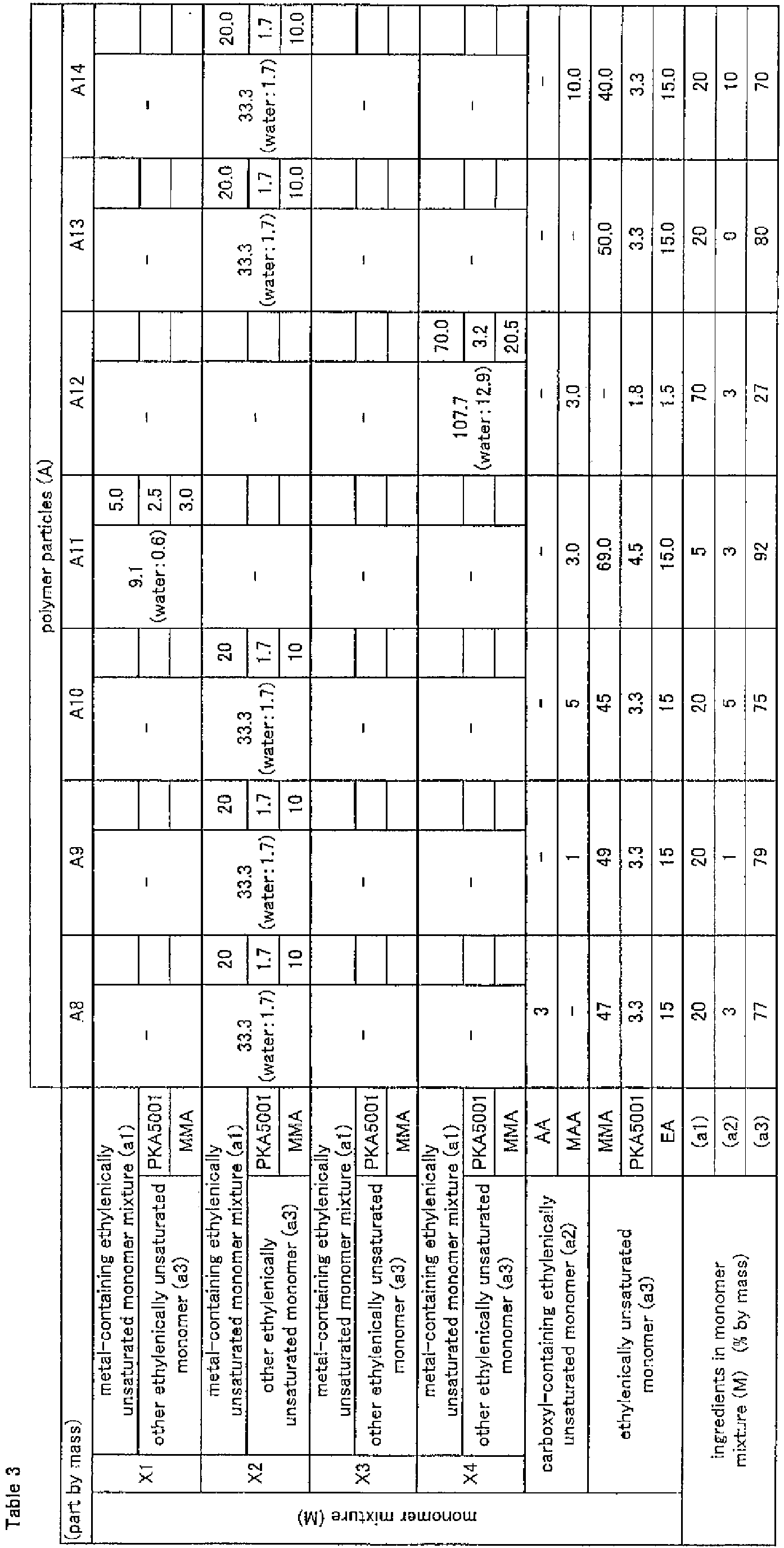
- The obtained acrylic polymers (P1) to (P2) and polymer particles (A1) to (A14) were combined according to the amounts in tables 4 and 5 using a high-speed disperser to prepare paints. The following additives were added to each paint along with PGM and xylene so that the viscosity of each paint would be 80 to 90 KU when measured using a Stormer viscometer (25°C). 73 parts of cuprous oxide, 23 parts of triphenylboron, 13 parts of copper pyrithione, 7 parts of colloidal silica, 7 parts of titanium oxide, and 10 parts of copper phthalocyanine.
- The amounts of VOC calculated based on the amount of solvent and specific gravity of each of the prepared paints are shown in tables 4 and 5. Also shown are results of testing on paint storage stability, coating consumption, water resistance, drying time, and cross-cut peeling.
- [TABLE 4]
Table 4 (part by mass) example 1 2 3 4 5 6 7 8 9 10 11 acrylic polymer (P) top: solid content (bottom: total amount) P1 - 50 (90.9) 50 (90.9) 50 (90.9) 50 (90.9) 50 (90.9) 50 (90.9) 50 (90.9) 50 (90.9) 50 (90.9) 50 (90.9) P2 50 (90.9) - - - - - - - - - - polymer fine particles (A) type A1 A1 A2 A3 A4 A5 A6 A7 A8 A9 A10 amount 50 50 50 50 50 50 50 50 50 50 50 ingredients in monomer mixture (M) (% by mass) (a1) 10 10 20 40 60 20 40 60 20 20 20 (a2) 3 3 3 3 3 3 3 1 3 1 5 (a3) 89 89 77 57 37 77 77 37 77 79 75 P/A 50/50 50/50 50/50 50/50 50/50 50/50 50/50 50/50 50/50 50/50 50/50 viscosity adjustment solvent PGM 20 20 20 20 20 20 20 20 20 20 20 Xylene 30 50 35 35 30 35 40 35 35 35 35 paint properties total amount of solvent 90.9 110.9 95.9 85.9 85.9 95.9 100.9 95.9 95.9 95.9 95.9 specific gravity 1.2 1.2 1.2 1.2 1.2 1.2 1.2 1.2 1.2 1.2 1.2 VOC 337 387 350 323 323 350 363 350 350 350 276 viscosity (KU) 85 90 84 86 85 81 87 84 90 82 88 storage stability test after 3 days ○ ○ ○ ○ ○ ○ ○ ○ ○ ○ ○ after 1 month ○ ○ ○ ○ ○ ○ ○ ○ ○ ○ Δ after 3 months ○ ○ ○ ○ ○ ○ ○ ○ ○ Δ Δ coating consumption test thickness of consumed coating (µm) after 3 months 9 14 17 20 22 18 12 20 18 17 19 after 6 months 22 31 39 43 48 41 29 45 41 37 40 average monthly thickness of consumed coating 3.7 5.2 6.5 7.2 8.0 6.8 4.8 7.5 6.8 6.2 6.7 water resistance test Δ ○ ○ ○ Δ ○ ○ Δ ○ ○ ○ coating dryness test (pressure test by model block) ○ ○ ○ ○ ○ ○ ○ ○ ○ ○ ○ cross-cut test (adhesion) Δ ○ ○ ○ ○ ○ ○ ○ ○ ○ ○ - [Table 5]
Table 5 (part by mass) example comparative 12 13 14 15 16 17 18 19 1 acrylic polymer (P) top: solid content (bottom: total P1 95 (172.7) 90 (163.6) 30 (54.5) 20 (36.4) 50 (90.9) 50 (90.9) 50 (90.9) 50 (90.9) 100 (181.8) P2 - - - - - - - - - polymer fine particles (A) type A3 A3 A3 A3 A11 A12 A13 A14 - amount 5 10 70 80 50 50 50 50 - ingredients in monomer mixture (M) (% by mass) (a1) 40 40 40 40 5 70 20 20 - (a2) 3 3 3 3 3 1 0 10 - (a3) 57 57 57 57 92 29 80 70 - P/A 95/5 90/10 30/70 20/80 50/50 50/50 50/50 50/50 100/0 viscosity adjustment solvent PGM 20 20 20 20 20 20 20 20 20 Xylene 15 15 35 45 80 35 35 60 15 paint properties total amount of solvent 112.7 108.6 79.5 81.4 140.9 90.9 95.9 120.9 116.8 specific gravity 1.2 1.2 1.2 1.2 1.2 1.2 1.2 1.2 1.2 VOC 391 382 305 311 452 350 350 410 401 viscosity (KU) 90 87 85 80 90 80 80 90 88 storage stability test after 3 days ○ ○ ○ ○ ○ ○ ○ Δ ○ after 1 month ○ ○ ○ ○ ○ ○ Δ × ○ after 3 months ○ ○ ○ ○ ○ ○ × × ○ coating consumption test thickness of consumed coating (µm) after 3 months 18 18 21 22 8 20 17 21 18 after 6 months 34 35 42 46 15 45 35 43 34 average monthly thickness of consumed 5.6 5.8 7.0 7.7 2.5 7.5 5.8 7.2 5.7 water resistance test Δ ○ ○ Δ ○ × Δ ○ × coating dryness test (pressure test by model block) Δ ○ ○ ○ ○ ○ ○ ○ × cross-cut test (adhesion) ○ ○ ○ Δ ○ Δ × Δ Δ - Abbreviations in tables are the following compounds respectively: PKA 5001: polyethylene glycol allyl ether (brand name: Uniox PKA 5001, made by NOF Corporation)
MMA: methyl methacrylate
MAA: methacrylic acid
AA: acrylic acid
EA: ethyl acrylate
PGM: propylene glycol monomethyl ether
VOC: volatile organic compound - As shown in tables 4 and 5, comparative example 1 which does not contain polymer particles (A) showed low results in both water resistance and drying time tests. By contrast, examples 1 to 19 show excellent results in either water resistance testing or drying time testing or in both of them.
- Since the antifouling paint resin composition according to an embodiment of the present invention has excellent dispersion properties of polymer particles in paint, storage stability of the paint is excellent and it is suitable for producing a high-solid antifouling paint with a shorter drying time because of capillary action among the polymer particles. Moreover, since self-polishing characteristics, water resistance, drying time and adhesion of a coating film of the antifouling paint in seawater are excellent, it is very useful when applied toward industrial purposes.
Claims (8)
- An antifouling paint composition, comprising:metal-containing polymer particles;an organic solvent; andan acrylic polymer (P) that is soluble in the organic solvent.
- The antifouling paint composition according to Claim 1, wherein the metal-containing polymer particles comprise a divalent or higher-valent metal ester structure.
- The antifouling paint composition according to Claim 1, wherein the metal-containing polymer particles are such polymer particles that are produced by polymerizing ethylenically unsaturated monomer mixture (M) containing 8 to 65% by mass of divalent or higher-valent metal-containing ethylenically unsaturated monomer (a1), 0.5 to 8% by mass of carboxyl group-containing ethylenically unsaturated monomer (a2) and 27 to 91.5% by mass of other ethylenically unsaturated monomer (a3).
- The antifouling paint composition according to Claim 1, wherein the mass ratio of the metal-containing polymer particles and acrylic polymer (P) is in a range of 10/90 to 70/30.
- The antifouling paint composition according to Claim 1, wherein acrylic polymer (P) comprises a divalent metal ester structure.
- The antifouling paint composition according to Claim 5, wherein acrylic polymer (P) is obtained by polymerizing an ethylenically unsaturated monomer mixture that contains a divalent metal-containing ethylenically unsaturated monomer.
- Metal-containing polymer particles obtained by polymerizing ethylenically unsaturated monomer mixture (M) comprising 8 to 65% by mass of divalent or higher-valent metal-containing ethylenically unsaturated monomer (a1), 0.5 to 8% by mass of carboxyl group-containing ethylenically unsaturated monomer (a2) and 27 to 91.5% by mass of other ethylenically unsaturated monomer (a3).
- An antifouling paint containing the antifouling paint composition according to Claim 1.
Applications Claiming Priority (2)
| Application Number | Priority Date | Filing Date | Title |
|---|---|---|---|
| JP2010262941 | 2010-11-25 | ||
| PCT/JP2011/076857 WO2012070552A1 (en) | 2010-11-25 | 2011-11-22 | Antifouling paint composition and antifouling paint |
Publications (3)
| Publication Number | Publication Date |
|---|---|
| EP2644667A1 true EP2644667A1 (en) | 2013-10-02 |
| EP2644667A4 EP2644667A4 (en) | 2015-01-21 |
| EP2644667B1 EP2644667B1 (en) | 2018-10-31 |
Family
ID=46145894
Family Applications (1)
| Application Number | Title | Priority Date | Filing Date |
|---|---|---|---|
| EP11843964.5A Active EP2644667B1 (en) | 2010-11-25 | 2011-11-22 | Antifouling paint composition and antifouling paint |
Country Status (6)
| Country | Link |
|---|---|
| US (1) | US9139741B2 (en) |
| EP (1) | EP2644667B1 (en) |
| JP (2) | JPWO2012070552A1 (en) |
| KR (1) | KR102086542B1 (en) |
| CN (1) | CN103221496B (en) |
| WO (1) | WO2012070552A1 (en) |
Cited By (1)
| Publication number | Priority date | Publication date | Assignee | Title |
|---|---|---|---|---|
| EP3483215A4 (en) * | 2016-07-05 | 2019-06-19 | Mitsubishi Chemical Corporation | POLYMER-CONTAINING COMPOSITION AND ANTITATE COATING COMPOSITION |
Families Citing this family (7)
| Publication number | Priority date | Publication date | Assignee | Title |
|---|---|---|---|---|
| CN104284949B (en) * | 2012-06-04 | 2016-10-12 | 三菱丽阳株式会社 | Antifouling paint resin combination, antifouling paint and antifouling coat |
| BR112015026458B1 (en) * | 2013-04-24 | 2022-02-01 | Nitto Kasei Co., Ltd | Copolymer for an antifouling coating composition, antifouling coating composition, method for producing a copolymer and coated object |
| KR101958719B1 (en) * | 2014-12-31 | 2019-03-15 | 엘지엠엠에이 주식회사 | The light diffusion resin composition comprising a cross-linked polymer particles produced by using a polymerization dispersing agent and light diffusing molded article comprising the same |
| JP6511944B2 (en) * | 2015-05-08 | 2019-05-15 | 三菱ケミカル株式会社 | Resin composition for antifouling paint and antifouling coating film |
| JP6801253B2 (en) * | 2015-06-26 | 2020-12-16 | 三菱ケミカル株式会社 | Antifouling paint composition |
| SG10201911771XA (en) * | 2015-09-25 | 2020-02-27 | Mitsubishi Chem Corp | (meth)acrylic copolymer, polymer solution, polymer-containing composition, anti-fouling coating composition, and method for producing (meth)acrylic copolymer |
| CN114231114B (en) * | 2021-11-25 | 2023-08-29 | 山东省海洋化工科学研究院 | Preparation method of allicin grafted amphiphilic photocatalytic antifouling paint special for aquaculture net cage |
Family Cites Families (26)
| Publication number | Priority date | Publication date | Assignee | Title |
|---|---|---|---|---|
| US3705137A (en) * | 1969-12-04 | 1972-12-05 | Mitsui Mining & Smelting Co | Precipitation copolymerization of metal salts of unsaturated carboxylic acids |
| JPS58174453A (en) * | 1982-04-07 | 1983-10-13 | Chugoku Toryo Kk | Ship-bottom antifouling paint for reducing frictional resistance |
| JPS58183762A (en) * | 1982-04-20 | 1983-10-27 | Chugoku Toryo Kk | Ship bottom antifouling paint |
| JPH0625317B2 (en) * | 1986-08-26 | 1994-04-06 | 日本ペイント株式会社 | Spherical collapsible vinyl resin particles for antifouling paint |
| JPS6372768A (en) * | 1986-09-16 | 1988-04-02 | Nippon Paint Co Ltd | Antifouling paint |
| JP3508935B2 (en) * | 1991-05-30 | 2004-03-22 | 東レ・ダウコーニング・シリコーン株式会社 | Paint composition |
| JPH069919A (en) * | 1992-06-23 | 1994-01-18 | Tokyo Keikaku:Kk | Coating composition containing mildew-resistant crosslinked urethane particle |
| JP2614825B2 (en) | 1994-06-07 | 1997-05-28 | 北海道 | Snow and ice protection paint composition |
| JP3342815B2 (en) * | 1996-12-03 | 2002-11-11 | 三菱レイヨン株式会社 | Antifouling paint composition |
| JPH10310710A (en) * | 1997-05-09 | 1998-11-24 | Toagosei Co Ltd | Water-disintegrable resin composition and its production |
| JP4343289B2 (en) * | 1998-10-06 | 2009-10-14 | 関西ペイント株式会社 | Water-based antifouling paint |
| JP5031133B2 (en) * | 1998-12-17 | 2012-09-19 | 中国塗料株式会社 | Antifouling paint composition, antifouling coating film, ship or underwater structure coated with the antifouling coating film, and antifouling method for ship outer plate or underwater structure |
| JP2000319590A (en) * | 1999-05-14 | 2000-11-21 | Kansai Paint Co Ltd | Resin composition for paint |
| JP4709370B2 (en) * | 2000-03-28 | 2011-06-22 | 日本ペイント株式会社 | Antifouling paint |
| JP4812947B2 (en) | 2001-02-21 | 2011-11-09 | 日本ペイント株式会社 | High solid antifouling paint |
| EP1496088B1 (en) | 2000-03-28 | 2011-11-02 | Nippon Paint Co., Ltd. | Antifouling coating |
| JP3483524B2 (en) * | 2000-06-28 | 2004-01-06 | 三菱レイヨン株式会社 | Metal-containing resin composition and antifouling paint composition |
| JP4758564B2 (en) * | 2001-05-22 | 2011-08-31 | 三菱レイヨン株式会社 | paint |
| JP5162066B2 (en) * | 2001-08-07 | 2013-03-13 | 三菱レイヨン株式会社 | Method for producing aqueous antifouling paint composition |
| EP1749868B1 (en) * | 2004-05-26 | 2016-11-02 | Nippon Paint Holdings Co., Ltd. | Coating composition, coating film, and method of reducing underwater friction |
| US7435771B2 (en) * | 2005-11-23 | 2008-10-14 | Arch Chemicals, Inc. | Stable antifouling paint composition containing metal salt of pyrithione and cuprous oxide |
| JP5144389B2 (en) * | 2008-06-20 | 2013-02-13 | 三菱レイヨン株式会社 | Resin composition for water-based antifouling paint |
| JP5247331B2 (en) * | 2008-09-25 | 2013-07-24 | 三菱レイヨン株式会社 | Acrylic syrup and antifouling paint for antifouling paint |
| TWI440673B (en) * | 2008-09-30 | 2014-06-11 | Nippon Paint Co Ltd | Coating composition and method for producing the same, coating film and water structure |
| EP2520620B1 (en) * | 2009-12-28 | 2015-09-16 | Mitsubishi Rayon Co., Ltd. | Method for producing resin dispersion for antifouling coating |
| JP6141056B2 (en) * | 2013-03-12 | 2017-06-07 | キヤノン株式会社 | Optical scanning apparatus and image forming apparatus |
-
2011
- 2011-11-22 JP JP2011550766A patent/JPWO2012070552A1/en active Pending
- 2011-11-22 CN CN201180056603.8A patent/CN103221496B/en active Active
- 2011-11-22 US US13/989,675 patent/US9139741B2/en active Active
- 2011-11-22 EP EP11843964.5A patent/EP2644667B1/en active Active
- 2011-11-22 KR KR1020137014347A patent/KR102086542B1/en active Active
- 2011-11-22 WO PCT/JP2011/076857 patent/WO2012070552A1/en not_active Ceased
-
2016
- 2016-05-31 JP JP2016108906A patent/JP6168195B2/en active Active
Non-Patent Citations (2)
| Title |
|---|
| No further relevant documents disclosed * |
| See also references of WO2012070552A1 * |
Cited By (4)
| Publication number | Priority date | Publication date | Assignee | Title |
|---|---|---|---|---|
| EP3483215A4 (en) * | 2016-07-05 | 2019-06-19 | Mitsubishi Chemical Corporation | POLYMER-CONTAINING COMPOSITION AND ANTITATE COATING COMPOSITION |
| US10954394B2 (en) | 2016-07-05 | 2021-03-23 | Mitsubishi Chemical Corporation | Polymer-containing composition and antifouling coating composition |
| EP3901213A3 (en) * | 2016-07-05 | 2022-01-12 | Mitsubishi Chemical Corporation | Polymer-containing composition and antifouling coating composition |
| US11732144B2 (en) | 2016-07-05 | 2023-08-22 | Mitsubishi Chemical Corporation | Polymer-containing composition and antifouling coating composition |
Also Published As
| Publication number | Publication date |
|---|---|
| KR20140057472A (en) | 2014-05-13 |
| JPWO2012070552A1 (en) | 2014-05-19 |
| WO2012070552A1 (en) | 2012-05-31 |
| KR102086542B1 (en) | 2020-03-09 |
| US20130245179A1 (en) | 2013-09-19 |
| EP2644667B1 (en) | 2018-10-31 |
| CN103221496A (en) | 2013-07-24 |
| EP2644667A4 (en) | 2015-01-21 |
| JP2016172875A (en) | 2016-09-29 |
| JP6168195B2 (en) | 2017-07-26 |
| US9139741B2 (en) | 2015-09-22 |
| CN103221496B (en) | 2017-02-15 |
Similar Documents
| Publication | Publication Date | Title |
|---|---|---|
| EP2644667B1 (en) | Antifouling paint composition and antifouling paint | |
| CA2193375C (en) | Hydrolyzable metal-containing resin and antifouling paint composition | |
| KR101309310B1 (en) | Antifouling coating composition, antifouling coating film formed using the composition, coated object having the coating film on the surface, and method of antifouling treatment by formation of the coating film | |
| CN104053690B (en) | The manufacture method of vinyl based polymer and the water-based antifouling paint resin combination that comprises vinyl based polymer | |
| TW534912B (en) | Metal-containing monomer dissolved mixture, metal-containing resin and antifouling paint composition | |
| KR101040453B1 (en) | High solid antifouling coating composition, antifouling coating film, base material with coating film, antifouling base material, method of forming coating film on substrate surface, antifouling method of base material and high solid multi-component antifouling coating composition set | |
| CN102686680B (en) | The manufacture method of antifouling paint resin dispersion | |
| CN111868185A (en) | Antifouling coating composition | |
| JP2000063708A (en) | Antifouling coating composition | |
| JP3483524B2 (en) | Metal-containing resin composition and antifouling paint composition | |
| EP0849289B1 (en) | Hydrolyzable resin containing aldehyde bonded thereto and self-polishing antifouling paint | |
| CZ260397A3 (en) | Novel preparations of (meth)acrylic resin for coating compositions used for painting objects submerged in sea water and corresponding coating compositions per se | |
| JP2016210881A (en) | Resin composition for antifouling paint and antifouling coating film | |
| CN117255833A (en) | Antifouling coating composition | |
| EP1088837A1 (en) | Process for producing metal-containing resin and composition thereof | |
| WO2022224785A1 (en) | Anti-fouling coating material composition | |
| CN120500514A (en) | Antifouling coating composition | |
| WO2022191100A1 (en) | Antifouling coating composition | |
| JP2002143667A (en) | Dispersant used in water system and water-based dispersion containing the same | |
| CN121866311A (en) | Antifouling coating composition | |
| WO2022186027A1 (en) | Antifouling coating material composition | |
| JP2002173647A (en) | Antifouling coating composition | |
| JPH01152170A (en) | Antifouling coating composition | |
| HK1125125A (en) | High solid antifouling coating composition, antifouling coating film, base with coating film, antifouling base, method for forming coating film on base surface, method for preventing fouling of base, and high solid multi-component antifouling coating composition set |
Legal Events
| Date | Code | Title | Description |
|---|---|---|---|
| PUAI | Public reference made under article 153(3) epc to a published international application that has entered the european phase |
Free format text: ORIGINAL CODE: 0009012 |
|
| 17P | Request for examination filed |
Effective date: 20130624 |
|
| AK | Designated contracting states |
Kind code of ref document: A1 Designated state(s): AL AT BE BG CH CY CZ DE DK EE ES FI FR GB GR HR HU IE IS IT LI LT LU LV MC MK MT NL NO PL PT RO RS SE SI SK SM TR |
|
| DAX | Request for extension of the european patent (deleted) | ||
| A4 | Supplementary search report drawn up and despatched |
Effective date: 20141219 |
|
| RIC1 | Information provided on ipc code assigned before grant |
Ipc: C09D 133/00 20060101AFI20141215BHEP Ipc: C09D 7/12 20060101ALI20141215BHEP Ipc: C09D 5/16 20060101ALI20141215BHEP Ipc: C08F 220/06 20060101ALI20141215BHEP |
|
| RAP1 | Party data changed (applicant data changed or rights of an application transferred) |
Owner name: MITSUBISHI CHEMICAL CORPORATION |
|
| 17Q | First examination report despatched |
Effective date: 20180207 |
|
| REG | Reference to a national code |
Ref country code: DE Ref legal event code: R079 Ref document number: 602011053507 Country of ref document: DE Free format text: PREVIOUS MAIN CLASS: C09D0133000000 Ipc: C09D0005000000 |
|
| GRAP | Despatch of communication of intention to grant a patent |
Free format text: ORIGINAL CODE: EPIDOSNIGR1 |
|
| RIC1 | Information provided on ipc code assigned before grant |
Ipc: C09D 5/00 20060101AFI20180531BHEP |
|
| INTG | Intention to grant announced |
Effective date: 20180627 |
|
| GRAS | Grant fee paid |
Free format text: ORIGINAL CODE: EPIDOSNIGR3 |
|
| GRAA | (expected) grant |
Free format text: ORIGINAL CODE: 0009210 |
|
| AK | Designated contracting states |
Kind code of ref document: B1 Designated state(s): AL AT BE BG CH CY CZ DE DK EE ES FI FR GB GR HR HU IE IS IT LI LT LU LV MC MK MT NL NO PL PT RO RS SE SI SK SM TR |
|
| REG | Reference to a national code |
Ref country code: CH Ref legal event code: EP Ref country code: GB Ref legal event code: FG4D |
|
| RIN1 | Information on inventor provided before grant (corrected) |
Inventor name: IWAMOTO, AKIO Inventor name: KAWAI, ERI |
|
| REG | Reference to a national code |
Ref country code: AT Ref legal event code: REF Ref document number: 1059330 Country of ref document: AT Kind code of ref document: T Effective date: 20181115 |
|
| REG | Reference to a national code |
Ref country code: DE Ref legal event code: R096 Ref document number: 602011053507 Country of ref document: DE |
|
| REG | Reference to a national code |
Ref country code: IE Ref legal event code: FG4D |
|
| REG | Reference to a national code |
Ref country code: NL Ref legal event code: FP |
|
| REG | Reference to a national code |
Ref country code: LT Ref legal event code: MG4D |
|
| REG | Reference to a national code |
Ref country code: AT Ref legal event code: MK05 Ref document number: 1059330 Country of ref document: AT Kind code of ref document: T Effective date: 20181031 |
|
| PG25 | Lapsed in a contracting state [announced via postgrant information from national office to epo] |
Ref country code: BG Free format text: LAPSE BECAUSE OF FAILURE TO SUBMIT A TRANSLATION OF THE DESCRIPTION OR TO PAY THE FEE WITHIN THE PRESCRIBED TIME-LIMIT Effective date: 20190131 Ref country code: NO Free format text: LAPSE BECAUSE OF FAILURE TO SUBMIT A TRANSLATION OF THE DESCRIPTION OR TO PAY THE FEE WITHIN THE PRESCRIBED TIME-LIMIT Effective date: 20190131 Ref country code: FI Free format text: LAPSE BECAUSE OF FAILURE TO SUBMIT A TRANSLATION OF THE DESCRIPTION OR TO PAY THE FEE WITHIN THE PRESCRIBED TIME-LIMIT Effective date: 20181031 Ref country code: LT Free format text: LAPSE BECAUSE OF FAILURE TO SUBMIT A TRANSLATION OF THE DESCRIPTION OR TO PAY THE FEE WITHIN THE PRESCRIBED TIME-LIMIT Effective date: 20181031 Ref country code: AT Free format text: LAPSE BECAUSE OF FAILURE TO SUBMIT A TRANSLATION OF THE DESCRIPTION OR TO PAY THE FEE WITHIN THE PRESCRIBED TIME-LIMIT Effective date: 20181031 Ref country code: IS Free format text: LAPSE BECAUSE OF FAILURE TO SUBMIT A TRANSLATION OF THE DESCRIPTION OR TO PAY THE FEE WITHIN THE PRESCRIBED TIME-LIMIT Effective date: 20190228 Ref country code: ES Free format text: LAPSE BECAUSE OF FAILURE TO SUBMIT A TRANSLATION OF THE DESCRIPTION OR TO PAY THE FEE WITHIN THE PRESCRIBED TIME-LIMIT Effective date: 20181031 Ref country code: LV Free format text: LAPSE BECAUSE OF FAILURE TO SUBMIT A TRANSLATION OF THE DESCRIPTION OR TO PAY THE FEE WITHIN THE PRESCRIBED TIME-LIMIT Effective date: 20181031 Ref country code: PL Free format text: LAPSE BECAUSE OF FAILURE TO SUBMIT A TRANSLATION OF THE DESCRIPTION OR TO PAY THE FEE WITHIN THE PRESCRIBED TIME-LIMIT Effective date: 20181031 Ref country code: HR Free format text: LAPSE BECAUSE OF FAILURE TO SUBMIT A TRANSLATION OF THE DESCRIPTION OR TO PAY THE FEE WITHIN THE PRESCRIBED TIME-LIMIT Effective date: 20181031 |
|
| PG25 | Lapsed in a contracting state [announced via postgrant information from national office to epo] |
Ref country code: SE Free format text: LAPSE BECAUSE OF FAILURE TO SUBMIT A TRANSLATION OF THE DESCRIPTION OR TO PAY THE FEE WITHIN THE PRESCRIBED TIME-LIMIT Effective date: 20181031 Ref country code: RS Free format text: LAPSE BECAUSE OF FAILURE TO SUBMIT A TRANSLATION OF THE DESCRIPTION OR TO PAY THE FEE WITHIN THE PRESCRIBED TIME-LIMIT Effective date: 20181031 Ref country code: GR Free format text: LAPSE BECAUSE OF FAILURE TO SUBMIT A TRANSLATION OF THE DESCRIPTION OR TO PAY THE FEE WITHIN THE PRESCRIBED TIME-LIMIT Effective date: 20190201 Ref country code: AL Free format text: LAPSE BECAUSE OF FAILURE TO SUBMIT A TRANSLATION OF THE DESCRIPTION OR TO PAY THE FEE WITHIN THE PRESCRIBED TIME-LIMIT Effective date: 20181031 Ref country code: PT Free format text: LAPSE BECAUSE OF FAILURE TO SUBMIT A TRANSLATION OF THE DESCRIPTION OR TO PAY THE FEE WITHIN THE PRESCRIBED TIME-LIMIT Effective date: 20190301 |
|
| REG | Reference to a national code |
Ref country code: DE Ref legal event code: R119 Ref document number: 602011053507 Country of ref document: DE |
|
| REG | Reference to a national code |
Ref country code: CH Ref legal event code: PL |
|
| PG25 | Lapsed in a contracting state [announced via postgrant information from national office to epo] |
Ref country code: LU Free format text: LAPSE BECAUSE OF NON-PAYMENT OF DUE FEES Effective date: 20181122 Ref country code: CZ Free format text: LAPSE BECAUSE OF FAILURE TO SUBMIT A TRANSLATION OF THE DESCRIPTION OR TO PAY THE FEE WITHIN THE PRESCRIBED TIME-LIMIT Effective date: 20181031 Ref country code: DK Free format text: LAPSE BECAUSE OF FAILURE TO SUBMIT A TRANSLATION OF THE DESCRIPTION OR TO PAY THE FEE WITHIN THE PRESCRIBED TIME-LIMIT Effective date: 20181031 Ref country code: IT Free format text: LAPSE BECAUSE OF FAILURE TO SUBMIT A TRANSLATION OF THE DESCRIPTION OR TO PAY THE FEE WITHIN THE PRESCRIBED TIME-LIMIT Effective date: 20181031 |
|
| REG | Reference to a national code |
Ref country code: BE Ref legal event code: MM Effective date: 20181130 |
|
| REG | Reference to a national code |
Ref country code: IE Ref legal event code: MM4A |
|
| PG25 | Lapsed in a contracting state [announced via postgrant information from national office to epo] |
Ref country code: CH Free format text: LAPSE BECAUSE OF NON-PAYMENT OF DUE FEES Effective date: 20181130 Ref country code: MC Free format text: LAPSE BECAUSE OF FAILURE TO SUBMIT A TRANSLATION OF THE DESCRIPTION OR TO PAY THE FEE WITHIN THE PRESCRIBED TIME-LIMIT Effective date: 20181031 Ref country code: SM Free format text: LAPSE BECAUSE OF FAILURE TO SUBMIT A TRANSLATION OF THE DESCRIPTION OR TO PAY THE FEE WITHIN THE PRESCRIBED TIME-LIMIT Effective date: 20181031 Ref country code: EE Free format text: LAPSE BECAUSE OF FAILURE TO SUBMIT A TRANSLATION OF THE DESCRIPTION OR TO PAY THE FEE WITHIN THE PRESCRIBED TIME-LIMIT Effective date: 20181031 Ref country code: SK Free format text: LAPSE BECAUSE OF FAILURE TO SUBMIT A TRANSLATION OF THE DESCRIPTION OR TO PAY THE FEE WITHIN THE PRESCRIBED TIME-LIMIT Effective date: 20181031 Ref country code: RO Free format text: LAPSE BECAUSE OF FAILURE TO SUBMIT A TRANSLATION OF THE DESCRIPTION OR TO PAY THE FEE WITHIN THE PRESCRIBED TIME-LIMIT Effective date: 20181031 Ref country code: LI Free format text: LAPSE BECAUSE OF NON-PAYMENT OF DUE FEES Effective date: 20181130 |
|
| PLBE | No opposition filed within time limit |
Free format text: ORIGINAL CODE: 0009261 |
|
| STAA | Information on the status of an ep patent application or granted ep patent |
Free format text: STATUS: NO OPPOSITION FILED WITHIN TIME LIMIT |
|
| GBPC | Gb: european patent ceased through non-payment of renewal fee |
Effective date: 20190131 |
|
| 26N | No opposition filed |
Effective date: 20190801 |
|
| PG25 | Lapsed in a contracting state [announced via postgrant information from national office to epo] |
Ref country code: FR Free format text: LAPSE BECAUSE OF NON-PAYMENT OF DUE FEES Effective date: 20181231 Ref country code: DE Free format text: LAPSE BECAUSE OF NON-PAYMENT OF DUE FEES Effective date: 20190601 Ref country code: IE Free format text: LAPSE BECAUSE OF NON-PAYMENT OF DUE FEES Effective date: 20181122 Ref country code: SI Free format text: LAPSE BECAUSE OF FAILURE TO SUBMIT A TRANSLATION OF THE DESCRIPTION OR TO PAY THE FEE WITHIN THE PRESCRIBED TIME-LIMIT Effective date: 20181031 |
|
| PG25 | Lapsed in a contracting state [announced via postgrant information from national office to epo] |
Ref country code: BE Free format text: LAPSE BECAUSE OF NON-PAYMENT OF DUE FEES Effective date: 20181130 |
|
| PG25 | Lapsed in a contracting state [announced via postgrant information from national office to epo] |
Ref country code: GB Free format text: LAPSE BECAUSE OF NON-PAYMENT OF DUE FEES Effective date: 20190131 |
|
| PG25 | Lapsed in a contracting state [announced via postgrant information from national office to epo] |
Ref country code: MT Free format text: LAPSE BECAUSE OF NON-PAYMENT OF DUE FEES Effective date: 20181122 |
|
| PG25 | Lapsed in a contracting state [announced via postgrant information from national office to epo] |
Ref country code: TR Free format text: LAPSE BECAUSE OF FAILURE TO SUBMIT A TRANSLATION OF THE DESCRIPTION OR TO PAY THE FEE WITHIN THE PRESCRIBED TIME-LIMIT Effective date: 20181031 |
|
| PG25 | Lapsed in a contracting state [announced via postgrant information from national office to epo] |
Ref country code: HU Free format text: LAPSE BECAUSE OF FAILURE TO SUBMIT A TRANSLATION OF THE DESCRIPTION OR TO PAY THE FEE WITHIN THE PRESCRIBED TIME-LIMIT; INVALID AB INITIO Effective date: 20111122 Ref country code: MK Free format text: LAPSE BECAUSE OF NON-PAYMENT OF DUE FEES Effective date: 20181031 Ref country code: CY Free format text: LAPSE BECAUSE OF FAILURE TO SUBMIT A TRANSLATION OF THE DESCRIPTION OR TO PAY THE FEE WITHIN THE PRESCRIBED TIME-LIMIT Effective date: 20181031 |
|
| P01 | Opt-out of the competence of the unified patent court (upc) registered |
Effective date: 20230522 |
|
| PGFP | Annual fee paid to national office [announced via postgrant information from national office to epo] |
Ref country code: NL Payment date: 20251022 Year of fee payment: 15 |