EP2644605A1 - Method for producing optically active fluorine-containing oxeten - Google Patents
Method for producing optically active fluorine-containing oxeten Download PDFInfo
- Publication number
- EP2644605A1 EP2644605A1 EP11843767.2A EP11843767A EP2644605A1 EP 2644605 A1 EP2644605 A1 EP 2644605A1 EP 11843767 A EP11843767 A EP 11843767A EP 2644605 A1 EP2644605 A1 EP 2644605A1
- Authority
- EP
- European Patent Office
- Prior art keywords
- group
- optically active
- substituted
- nucleobase
- oxeten
- Prior art date
- Legal status (The legal status is an assumption and is not a legal conclusion. Google has not performed a legal analysis and makes no representation as to the accuracy of the status listed.)
- Granted
Links
- 229910052731 fluorine Inorganic materials 0.000 title claims abstract description 59
- YCKRFDGAMUMZLT-UHFFFAOYSA-N Fluorine atom Chemical compound [F] YCKRFDGAMUMZLT-UHFFFAOYSA-N 0.000 title claims abstract description 58
- 239000011737 fluorine Substances 0.000 title claims abstract description 58
- 238000004519 manufacturing process Methods 0.000 title claims abstract description 19
- 239000003446 ligand Substances 0.000 claims abstract description 24
- 229910052723 transition metal Inorganic materials 0.000 claims abstract description 17
- 150000001345 alkine derivatives Chemical class 0.000 claims abstract description 16
- 150000003624 transition metals Chemical class 0.000 claims abstract description 8
- 125000004122 cyclic group Chemical group 0.000 claims description 43
- 125000003118 aryl group Chemical group 0.000 claims description 39
- 125000000217 alkyl group Chemical group 0.000 claims description 28
- 125000004453 alkoxycarbonyl group Chemical group 0.000 claims description 27
- 229910052799 carbon Inorganic materials 0.000 claims description 17
- 125000005843 halogen group Chemical group 0.000 claims description 16
- OKTJSMMVPCPJKN-UHFFFAOYSA-N Carbon Chemical compound [C] OKTJSMMVPCPJKN-UHFFFAOYSA-N 0.000 claims description 15
- -1 cationic transition metal Chemical class 0.000 claims description 14
- 125000001424 substituent group Chemical group 0.000 claims description 12
- 125000000547 substituted alkyl group Chemical group 0.000 claims description 12
- KDLHZDBZIXYQEI-UHFFFAOYSA-N Palladium Chemical compound [Pd] KDLHZDBZIXYQEI-UHFFFAOYSA-N 0.000 claims description 8
- 125000002496 methyl group Chemical group [H]C([H])([H])* 0.000 claims description 8
- 125000001495 ethyl group Chemical group [H]C([H])([H])C([H])([H])* 0.000 claims description 7
- 125000005010 perfluoroalkyl group Chemical group 0.000 claims description 7
- 238000000034 method Methods 0.000 claims description 6
- 125000002091 cationic group Chemical group 0.000 claims description 4
- 229910052763 palladium Inorganic materials 0.000 claims description 4
- 239000000543 intermediate Substances 0.000 abstract description 10
- 239000003905 agrochemical Substances 0.000 abstract description 7
- 239000003814 drug Substances 0.000 abstract description 7
- 239000011982 enantioselective catalyst Substances 0.000 abstract description 6
- 230000003287 optical effect Effects 0.000 abstract description 5
- 238000006243 chemical reaction Methods 0.000 description 11
- 125000003277 amino group Chemical group 0.000 description 8
- 125000004435 hydrogen atom Chemical group [H]* 0.000 description 8
- 125000002887 hydroxy group Chemical group [H]O* 0.000 description 8
- VLKZOEOYAKHREP-UHFFFAOYSA-N n-Hexane Chemical compound CCCCCC VLKZOEOYAKHREP-UHFFFAOYSA-N 0.000 description 8
- 125000006239 protecting group Chemical group 0.000 description 8
- RTZKZFJDLAIYFH-UHFFFAOYSA-N Diethyl ether Chemical compound CCOCC RTZKZFJDLAIYFH-UHFFFAOYSA-N 0.000 description 7
- YMWUJEATGCHHMB-UHFFFAOYSA-N Dichloromethane Chemical compound ClCCl YMWUJEATGCHHMB-UHFFFAOYSA-N 0.000 description 6
- XEKOWRVHYACXOJ-UHFFFAOYSA-N Ethyl acetate Chemical compound CCOC(C)=O XEKOWRVHYACXOJ-UHFFFAOYSA-N 0.000 description 6
- HEDRZPFGACZZDS-MICDWDOJSA-N Trichloro(2H)methane Chemical compound [2H]C(Cl)(Cl)Cl HEDRZPFGACZZDS-MICDWDOJSA-N 0.000 description 6
- 150000001875 compounds Chemical class 0.000 description 6
- 125000003396 thiol group Chemical group [H]S* 0.000 description 6
- 125000003172 aldehyde group Chemical group 0.000 description 5
- MUALRAIOVNYAIW-UHFFFAOYSA-N binap Chemical class C1=CC=CC=C1P(C=1C(=C2C=CC=CC2=CC=1)C=1C2=CC=CC=C2C=CC=1P(C=1C=CC=CC=1)C=1C=CC=CC=1)C1=CC=CC=C1 MUALRAIOVNYAIW-UHFFFAOYSA-N 0.000 description 5
- 125000003178 carboxy group Chemical group [H]OC(*)=O 0.000 description 5
- 239000007810 chemical reaction solvent Substances 0.000 description 5
- 239000007788 liquid Substances 0.000 description 5
- IJGRMHOSHXDMSA-UHFFFAOYSA-N Atomic nitrogen Chemical compound N#N IJGRMHOSHXDMSA-UHFFFAOYSA-N 0.000 description 4
- 125000002252 acyl group Chemical group 0.000 description 4
- 125000003342 alkenyl group Chemical group 0.000 description 4
- 150000001721 carbon Chemical group 0.000 description 4
- 229910052757 nitrogen Inorganic materials 0.000 description 4
- 239000000047 product Substances 0.000 description 4
- 238000003786 synthesis reaction Methods 0.000 description 4
- ZCYVEMRRCGMTRW-UHFFFAOYSA-N 7553-56-2 Chemical group [I] ZCYVEMRRCGMTRW-UHFFFAOYSA-N 0.000 description 3
- WEVYAHXRMPXWCK-UHFFFAOYSA-N Acetonitrile Chemical compound CC#N WEVYAHXRMPXWCK-UHFFFAOYSA-N 0.000 description 3
- UHOVQNZJYSORNB-UHFFFAOYSA-N Benzene Chemical compound C1=CC=CC=C1 UHOVQNZJYSORNB-UHFFFAOYSA-N 0.000 description 3
- WKBOTKDWSSQWDR-UHFFFAOYSA-N Bromine atom Chemical group [Br] WKBOTKDWSSQWDR-UHFFFAOYSA-N 0.000 description 3
- KFZMGEQAYNKOFK-UHFFFAOYSA-N Isopropanol Chemical compound CC(C)O KFZMGEQAYNKOFK-UHFFFAOYSA-N 0.000 description 3
- IMNFDUFMRHMDMM-UHFFFAOYSA-N N-Heptane Chemical compound CCCCCCC IMNFDUFMRHMDMM-UHFFFAOYSA-N 0.000 description 3
- YXFVVABEGXRONW-UHFFFAOYSA-N Toluene Chemical compound CC1=CC=CC=C1 YXFVVABEGXRONW-UHFFFAOYSA-N 0.000 description 3
- 125000003545 alkoxy group Chemical group 0.000 description 3
- 125000000304 alkynyl group Chemical group 0.000 description 3
- 150000004945 aromatic hydrocarbons Chemical class 0.000 description 3
- IVRMZWNICZWHMI-UHFFFAOYSA-N azide group Chemical group [N-]=[N+]=[N-] IVRMZWNICZWHMI-UHFFFAOYSA-N 0.000 description 3
- 229910052801 chlorine Inorganic materials 0.000 description 3
- 239000012043 crude product Substances 0.000 description 3
- 125000004093 cyano group Chemical group *C#N 0.000 description 3
- 150000008282 halocarbons Chemical class 0.000 description 3
- 229910052740 iodine Inorganic materials 0.000 description 3
- 238000004811 liquid chromatography Methods 0.000 description 3
- 125000004108 n-butyl group Chemical group [H]C([H])([H])C([H])([H])C([H])([H])C([H])([H])* 0.000 description 3
- 125000000449 nitro group Chemical group [O-][N+](*)=O 0.000 description 3
- 125000004430 oxygen atom Chemical group O* 0.000 description 3
- 125000002023 trifluoromethyl group Chemical group FC(F)(F)* 0.000 description 3
- 125000004400 (C1-C12) alkyl group Chemical group 0.000 description 2
- 238000001644 13C nuclear magnetic resonance spectroscopy Methods 0.000 description 2
- 238000004293 19F NMR spectroscopy Methods 0.000 description 2
- 238000005160 1H NMR spectroscopy Methods 0.000 description 2
- 0 CCC(C*C1CCCCC1)[C@](C)CC Chemical compound CCC(C*C1CCCCC1)[C@](C)CC 0.000 description 2
- HEDRZPFGACZZDS-UHFFFAOYSA-N Chloroform Chemical compound ClC(Cl)Cl HEDRZPFGACZZDS-UHFFFAOYSA-N 0.000 description 2
- 238000005481 NMR spectroscopy Methods 0.000 description 2
- OFBQJSOFQDEBGM-UHFFFAOYSA-N Pentane Chemical compound CCCCC OFBQJSOFQDEBGM-UHFFFAOYSA-N 0.000 description 2
- VYPSYNLAJGMNEJ-UHFFFAOYSA-N Silicium dioxide Chemical compound O=[Si]=O VYPSYNLAJGMNEJ-UHFFFAOYSA-N 0.000 description 2
- 125000002777 acetyl group Chemical group [H]C([H])([H])C(*)=O 0.000 description 2
- 125000001931 aliphatic group Chemical group 0.000 description 2
- 125000004457 alkyl amino carbonyl group Chemical group 0.000 description 2
- 125000003282 alkyl amino group Chemical group 0.000 description 2
- 125000004414 alkyl thio group Chemical group 0.000 description 2
- 125000003710 aryl alkyl group Chemical group 0.000 description 2
- 125000003236 benzoyl group Chemical group [H]C1=C([H])C([H])=C(C([H])=C1[H])C(*)=O 0.000 description 2
- 125000001797 benzyl group Chemical group [H]C1=C([H])C([H])=C(C([H])=C1[H])C([H])([H])* 0.000 description 2
- 125000003917 carbamoyl group Chemical group [H]N([H])C(*)=O 0.000 description 2
- 125000004432 carbon atom Chemical group C* 0.000 description 2
- 125000001309 chloro group Chemical group Cl* 0.000 description 2
- 238000004440 column chromatography Methods 0.000 description 2
- 230000000694 effects Effects 0.000 description 2
- 150000002148 esters Chemical group 0.000 description 2
- 150000002170 ethers Chemical class 0.000 description 2
- KUFWTXSQQKDMAI-UHFFFAOYSA-N ethynylsilicon Chemical group [Si]C#C KUFWTXSQQKDMAI-UHFFFAOYSA-N 0.000 description 2
- 125000000524 functional group Chemical group 0.000 description 2
- 125000002541 furyl group Chemical group 0.000 description 2
- 125000004438 haloalkoxy group Chemical group 0.000 description 2
- 125000001188 haloalkyl group Chemical group 0.000 description 2
- 125000000623 heterocyclic group Chemical group 0.000 description 2
- 125000001624 naphthyl group Chemical group 0.000 description 2
- 125000004433 nitrogen atom Chemical group N* 0.000 description 2
- AHHWIHXENZJRFG-UHFFFAOYSA-N oxetane Chemical compound C1COC1 AHHWIHXENZJRFG-UHFFFAOYSA-N 0.000 description 2
- 125000001997 phenyl group Chemical group [H]C1=C([H])C([H])=C(*)C([H])=C1[H] 0.000 description 2
- 125000000168 pyrrolyl group Chemical group 0.000 description 2
- 230000035484 reaction time Effects 0.000 description 2
- 239000000741 silica gel Substances 0.000 description 2
- 229910002027 silica gel Inorganic materials 0.000 description 2
- 239000000758 substrate Substances 0.000 description 2
- 229910052717 sulfur Inorganic materials 0.000 description 2
- 125000004434 sulfur atom Chemical group 0.000 description 2
- 125000001544 thienyl group Chemical group 0.000 description 2
- 238000011282 treatment Methods 0.000 description 2
- WSLDOOZREJYCGB-UHFFFAOYSA-N 1,2-Dichloroethane Chemical compound ClCCCl WSLDOOZREJYCGB-UHFFFAOYSA-N 0.000 description 1
- 238000007106 1,2-cycloaddition reaction Methods 0.000 description 1
- RYHBNJHYFVUHQT-UHFFFAOYSA-N 1,4-Dioxane Chemical compound C1COCCO1 RYHBNJHYFVUHQT-UHFFFAOYSA-N 0.000 description 1
- 125000001637 1-naphthyl group Chemical group [H]C1=C([H])C([H])=C2C(*)=C([H])C([H])=C([H])C2=C1[H] 0.000 description 1
- 125000003903 2-propenyl group Chemical group [H]C([*])([H])C([H])=C([H])[H] 0.000 description 1
- 125000001494 2-propynyl group Chemical group [H]C#CC([H])([H])* 0.000 description 1
- 125000000175 2-thienyl group Chemical group S1C([*])=C([H])C([H])=C1[H] 0.000 description 1
- HBAQYPYDRFILMT-UHFFFAOYSA-N 8-[3-(1-cyclopropylpyrazol-4-yl)-1H-pyrazolo[4,3-d]pyrimidin-5-yl]-3-methyl-3,8-diazabicyclo[3.2.1]octan-2-one Chemical class C1(CC1)N1N=CC(=C1)C1=NNC2=C1N=C(N=C2)N1C2C(N(CC1CC2)C)=O HBAQYPYDRFILMT-UHFFFAOYSA-N 0.000 description 1
- LRFVTYWOQMYALW-UHFFFAOYSA-N 9H-xanthine Chemical group O=C1NC(=O)NC2=C1NC=N2 LRFVTYWOQMYALW-UHFFFAOYSA-N 0.000 description 1
- 238000006596 Alder-ene reaction Methods 0.000 description 1
- 229910017048 AsF6 Inorganic materials 0.000 description 1
- ZAMOUSCENKQFHK-UHFFFAOYSA-N Chlorine atom Chemical compound [Cl] ZAMOUSCENKQFHK-UHFFFAOYSA-N 0.000 description 1
- XDTMQSROBMDMFD-UHFFFAOYSA-N Cyclohexane Chemical compound C1CCCCC1 XDTMQSROBMDMFD-UHFFFAOYSA-N 0.000 description 1
- 101000652482 Homo sapiens TBC1 domain family member 8 Proteins 0.000 description 1
- BZLVMXJERCGZMT-UHFFFAOYSA-N Methyl tert-butyl ether Chemical compound COC(C)(C)C BZLVMXJERCGZMT-UHFFFAOYSA-N 0.000 description 1
- CTQNGGLPUBDAKN-UHFFFAOYSA-N O-Xylene Chemical compound CC1=CC=CC=C1C CTQNGGLPUBDAKN-UHFFFAOYSA-N 0.000 description 1
- 102100030302 TBC1 domain family member 8 Human genes 0.000 description 1
- ISAKRJDGNUQOIC-UHFFFAOYSA-N Uracil Chemical group O=C1C=CNC(=O)N1 ISAKRJDGNUQOIC-UHFFFAOYSA-N 0.000 description 1
- 101100020289 Xenopus laevis koza gene Proteins 0.000 description 1
- VDHAUMFISVWIRX-UHFFFAOYSA-L [1-(2-diphenylphosphanylnaphthalen-1-yl)naphthalen-2-yl]-diphenylphosphane;palladium(2+);dichloride Chemical compound Cl[Pd]Cl.C1=CC=CC=C1P(C=1C(=C2C=CC=CC2=CC=1)C=1C2=CC=CC=C2C=CC=1P(C=1C=CC=CC=1)C=1C=CC=CC=1)C1=CC=CC=C1 VDHAUMFISVWIRX-UHFFFAOYSA-L 0.000 description 1
- JZOSBBLJKXSBBN-UHFFFAOYSA-N [3-(4-diphenylphosphanyl-2,6-dimethoxypyridin-3-yl)-2,6-dimethoxypyridin-4-yl]-diphenylphosphane Chemical class COC=1N=C(OC)C=C(P(C=2C=CC=CC=2)C=2C=CC=CC=2)C=1C=1C(OC)=NC(OC)=CC=1P(C=1C=CC=CC=1)C1=CC=CC=C1 JZOSBBLJKXSBBN-UHFFFAOYSA-N 0.000 description 1
- RZZDRSHFIVOQAF-UHFFFAOYSA-N [4-(5-diphenylphosphanyl-1,3-benzodioxol-4-yl)-1,3-benzodioxol-5-yl]-diphenylphosphane Chemical class C=12OCOC2=CC=C(P(C=2C=CC=CC=2)C=2C=CC=CC=2)C=1C1=C2OCOC2=CC=C1P(C=1C=CC=CC=1)C1=CC=CC=C1 RZZDRSHFIVOQAF-UHFFFAOYSA-N 0.000 description 1
- 238000005903 acid hydrolysis reaction Methods 0.000 description 1
- GFFGJBXGBJISGV-UHFFFAOYSA-N adenyl group Chemical group N1=CN=C2N=CNC2=C1N GFFGJBXGBJISGV-UHFFFAOYSA-N 0.000 description 1
- 150000001338 aliphatic hydrocarbons Chemical class 0.000 description 1
- 125000002009 alkene group Chemical group 0.000 description 1
- 150000001413 amino acids Chemical group 0.000 description 1
- 238000004458 analytical method Methods 0.000 description 1
- 125000005428 anthryl group Chemical group [H]C1=C([H])C([H])=C2C([H])=C3C(*)=C([H])C([H])=C([H])C3=C([H])C2=C1[H] 0.000 description 1
- 239000012300 argon atmosphere Substances 0.000 description 1
- 125000006615 aromatic heterocyclic group Chemical group 0.000 description 1
- 125000002029 aromatic hydrocarbon group Chemical group 0.000 description 1
- 238000011914 asymmetric synthesis Methods 0.000 description 1
- 125000004618 benzofuryl group Chemical group O1C(=CC2=C1C=CC=C2)* 0.000 description 1
- 125000004196 benzothienyl group Chemical group S1C(=CC2=C1C=CC=C2)* 0.000 description 1
- 230000015572 biosynthetic process Effects 0.000 description 1
- GDTBXPJZTBHREO-UHFFFAOYSA-N bromine Substances BrBr GDTBXPJZTBHREO-UHFFFAOYSA-N 0.000 description 1
- 229910052794 bromium Inorganic materials 0.000 description 1
- 125000006015 bromomethoxy group Chemical group 0.000 description 1
- 125000005997 bromomethyl group Chemical group 0.000 description 1
- 239000006227 byproduct Substances 0.000 description 1
- 230000003197 catalytic effect Effects 0.000 description 1
- 239000007806 chemical reaction intermediate Substances 0.000 description 1
- 239000000460 chlorine Substances 0.000 description 1
- 229910001914 chlorine tetroxide Inorganic materials 0.000 description 1
- 125000004651 chloromethoxy group Chemical group ClCO* 0.000 description 1
- 125000004218 chloromethyl group Chemical group [H]C([H])(Cl)* 0.000 description 1
- 238000007796 conventional method Methods 0.000 description 1
- 229910052802 copper Inorganic materials 0.000 description 1
- OPTASPLRGRRNAP-UHFFFAOYSA-N cytosine Chemical group NC=1C=CNC(=O)N=1 OPTASPLRGRRNAP-UHFFFAOYSA-N 0.000 description 1
- 125000001664 diethylamino group Chemical group [H]C([H])([H])C([H])([H])N(*)C([H])([H])C([H])([H])[H] 0.000 description 1
- 125000002147 dimethylamino group Chemical group [H]C([H])([H])N(*)C([H])([H])[H] 0.000 description 1
- 125000004914 dipropylamino group Chemical group C(CC)N(CCC)* 0.000 description 1
- 238000004821 distillation Methods 0.000 description 1
- 125000001301 ethoxy group Chemical group [H]C([H])([H])C([H])([H])O* 0.000 description 1
- 125000003754 ethoxycarbonyl group Chemical group C(=O)(OCC)* 0.000 description 1
- 125000004705 ethylthio group Chemical group C(C)S* 0.000 description 1
- WMYNMYVRWWCRPS-UHFFFAOYSA-N ethynoxyethane Chemical group CCOC#C WMYNMYVRWWCRPS-UHFFFAOYSA-N 0.000 description 1
- 125000001153 fluoro group Chemical group F* 0.000 description 1
- 125000004785 fluoromethoxy group Chemical group [H]C([H])(F)O* 0.000 description 1
- 125000004216 fluoromethyl group Chemical group [H]C([H])(F)* 0.000 description 1
- 238000004817 gas chromatography Methods 0.000 description 1
- UYTPUPDQBNUYGX-UHFFFAOYSA-N guanine Chemical group O=C1NC(N)=NC2=C1N=CN2 UYTPUPDQBNUYGX-UHFFFAOYSA-N 0.000 description 1
- 238000010438 heat treatment Methods 0.000 description 1
- 125000005842 heteroatom Chemical group 0.000 description 1
- 238000005984 hydrogenation reaction Methods 0.000 description 1
- 238000007327 hydrogenolysis reaction Methods 0.000 description 1
- 230000007062 hydrolysis Effects 0.000 description 1
- 238000006460 hydrolysis reaction Methods 0.000 description 1
- FDGQSTZJBFJUBT-UHFFFAOYSA-N hypoxanthine Chemical group O=C1NC=NC2=C1NC=N2 FDGQSTZJBFJUBT-UHFFFAOYSA-N 0.000 description 1
- 125000001041 indolyl group Chemical group 0.000 description 1
- 239000011630 iodine Substances 0.000 description 1
- 238000006317 isomerization reaction Methods 0.000 description 1
- 230000014759 maintenance of location Effects 0.000 description 1
- 238000005259 measurement Methods 0.000 description 1
- AUHZEENZYGFFBQ-UHFFFAOYSA-N mesitylene Substances CC1=CC(C)=CC(C)=C1 AUHZEENZYGFFBQ-UHFFFAOYSA-N 0.000 description 1
- 125000001827 mesitylenyl group Chemical group [H]C1=C(C(*)=C(C([H])=C1C([H])([H])[H])C([H])([H])[H])C([H])([H])[H] 0.000 description 1
- 125000000956 methoxy group Chemical group [H]C([H])([H])O* 0.000 description 1
- 125000001160 methoxycarbonyl group Chemical group [H]C([H])([H])OC(*)=O 0.000 description 1
- 125000004184 methoxymethyl group Chemical group [H]C([H])([H])OC([H])([H])* 0.000 description 1
- XGLLQDIWQRQROJ-UHFFFAOYSA-N methyl 3,3,3-trifluoro-2-oxopropanoate Chemical compound COC(=O)C(=O)C(F)(F)F XGLLQDIWQRQROJ-UHFFFAOYSA-N 0.000 description 1
- 125000002816 methylsulfanyl group Chemical group [H]C([H])([H])S[*] 0.000 description 1
- 238000012986 modification Methods 0.000 description 1
- 230000004048 modification Effects 0.000 description 1
- 125000002757 morpholinyl group Chemical group 0.000 description 1
- 229910052759 nickel Inorganic materials 0.000 description 1
- 108020004707 nucleic acids Proteins 0.000 description 1
- 150000007523 nucleic acids Chemical class 0.000 description 1
- 102000039446 nucleic acids Human genes 0.000 description 1
- 239000012038 nucleophile Substances 0.000 description 1
- 239000003960 organic solvent Substances 0.000 description 1
- VLTRZXGMWDSKGL-UHFFFAOYSA-M perchlorate Chemical compound [O-]Cl(=O)(=O)=O VLTRZXGMWDSKGL-UHFFFAOYSA-M 0.000 description 1
- GYZZZILPVUYAFJ-UHFFFAOYSA-N phanephos Chemical class C1CC(C(=C2)P(C=3C=CC=CC=3)C=3C=CC=CC=3)=CC=C2CCC2=CC=C1C=C2P(C=1C=CC=CC=1)C1=CC=CC=C1 GYZZZILPVUYAFJ-UHFFFAOYSA-N 0.000 description 1
- 125000000951 phenoxy group Chemical group [H]C1=C([H])C([H])=C(O*)C([H])=C1[H] 0.000 description 1
- 125000000587 piperidin-1-yl group Chemical group [H]C1([H])N(*)C([H])([H])C([H])([H])C([H])([H])C1([H])[H] 0.000 description 1
- 125000005936 piperidyl group Chemical group 0.000 description 1
- 229910052697 platinum Inorganic materials 0.000 description 1
- 108090000765 processed proteins & peptides Chemical group 0.000 description 1
- 125000002572 propoxy group Chemical group [*]OC([H])([H])C(C([H])([H])[H])([H])[H] 0.000 description 1
- 125000001436 propyl group Chemical group [H]C([*])([H])C([H])([H])C([H])([H])[H] 0.000 description 1
- 125000004742 propyloxycarbonyl group Chemical group 0.000 description 1
- 125000004076 pyridyl group Chemical group 0.000 description 1
- 125000005493 quinolyl group Chemical group 0.000 description 1
- 238000001953 recrystallisation Methods 0.000 description 1
- 238000007086 side reaction Methods 0.000 description 1
- 229910001544 silver hexafluoroantimonate(V) Inorganic materials 0.000 description 1
- 238000007614 solvation Methods 0.000 description 1
- 238000003756 stirring Methods 0.000 description 1
- 239000000126 substance Substances 0.000 description 1
- 125000005297 thienyloxy group Chemical group S1C(=CC=C1)O* 0.000 description 1
- 238000004809 thin layer chromatography Methods 0.000 description 1
- RWQNBRDOKXIBIV-UHFFFAOYSA-N thymine Chemical group CC1=CNC(=O)NC1=O RWQNBRDOKXIBIV-UHFFFAOYSA-N 0.000 description 1
- 125000002221 trityl group Chemical group [H]C1=C([H])C([H])=C([H])C([H])=C1C([*])(C1=C(C(=C(C(=C1[H])[H])[H])[H])[H])C1=C([H])C([H])=C([H])C([H])=C1[H] 0.000 description 1
- XLYOFNOQVPJJNP-UHFFFAOYSA-N water Substances O XLYOFNOQVPJJNP-UHFFFAOYSA-N 0.000 description 1
- 239000008096 xylene Substances 0.000 description 1
Classifications
-
- C—CHEMISTRY; METALLURGY
- C07—ORGANIC CHEMISTRY
- C07D—HETEROCYCLIC COMPOUNDS
- C07D305/00—Heterocyclic compounds containing four-membered rings having one oxygen atom as the only ring hetero atoms
- C07D305/02—Heterocyclic compounds containing four-membered rings having one oxygen atom as the only ring hetero atoms not condensed with other rings
- C07D305/10—Heterocyclic compounds containing four-membered rings having one oxygen atom as the only ring hetero atoms not condensed with other rings having one or more double bonds between ring members or between ring members and non-ring members
-
- C—CHEMISTRY; METALLURGY
- C07—ORGANIC CHEMISTRY
- C07D—HETEROCYCLIC COMPOUNDS
- C07D407/00—Heterocyclic compounds containing two or more hetero rings, at least one ring having oxygen atoms as the only ring hetero atoms, not provided for by group C07D405/00
- C07D407/02—Heterocyclic compounds containing two or more hetero rings, at least one ring having oxygen atoms as the only ring hetero atoms, not provided for by group C07D405/00 containing two hetero rings
- C07D407/04—Heterocyclic compounds containing two or more hetero rings, at least one ring having oxygen atoms as the only ring hetero atoms, not provided for by group C07D405/00 containing two hetero rings directly linked by a ring-member-to-ring-member bond
-
- C—CHEMISTRY; METALLURGY
- C07—ORGANIC CHEMISTRY
- C07D—HETEROCYCLIC COMPOUNDS
- C07D409/00—Heterocyclic compounds containing two or more hetero rings, at least one ring having sulfur atoms as the only ring hetero atoms
- C07D409/02—Heterocyclic compounds containing two or more hetero rings, at least one ring having sulfur atoms as the only ring hetero atoms containing two hetero rings
- C07D409/04—Heterocyclic compounds containing two or more hetero rings, at least one ring having sulfur atoms as the only ring hetero atoms containing two hetero rings directly linked by a ring-member-to-ring-member bond
Definitions
- the present invention relates to a method for producing an optically active fluorine-containing oxeten and the like.
- An optically active fluorine-containing oxeten is a compound that can be an important intermediate for pharmaceuticals and agrochemicals.
- Non-Patent Publication 1 As a conventional technique, there has been reported a [2+2] cycloaddition reaction between methyl trifluoropyruvate and ethoxyacetylene (Non-Patent Publication 1).
- Non-Patent Publication 1 Tetrahedron (England), 2003, Vol. 59, No. 9, p. 1389-1394
- An optically active fluorine-containing oxeten is a novel compound and there has been known no production method relating to the oxeten.
- Non-Patent Publication 1 a fluorine-containing oxeten is only supposed to be present as a reaction intermediate, and actually, the oxeten is not able to be isolated because of its unstability. Moreover, Non-Patent Publication 1 does not assume the production of an optically active compound.
- the present invention is an invention achieved in view of the above circumstances to provide the following method for producing an optically active fluorine-containing oxeten, and more specifically to provide [Invention 1] to [Invention 5].
- Rf represents a perfluoroalkyl group
- R 1 represents an alkyl group
- R 2 and R 3 mutually independently represent a halogen atom, an alkyl group, a substituted alkyl group, an aromatic cyclic group, a substituted aromatic cyclic group, a nucleobase, a substituted nucleobase, an alkoxycarbonyl group or a substituted alkoxycarbonyl group
- "*" represents an asymmetric carbon.
- R 4 represents a methyl group or an ethyl group
- R 5 represents an aromatic cyclic group, a substituted aromatic cyclic group, a nucleobase or a substituted nucleobase
- R 6 represents a halogen atom, an alkyl group, a substituted alkyl group, an aromatic cyclic group, a substituted aromatic cyclic group, a nucleobase, a substituted nucleobase, an alkoxycarbonyl group or a substituted alkoxycarbonyl group
- "*" represents an asymmetric carbon.
- an optically active fluorine-containing oxeten can be obtained with high regioselectivity and high stereoselectivity (high optical purity) with high yield even in cases where the amount of an asymmetric catalyst is relatively low.
- optically active fluorine-containing oxeten can also be converted into various useful intermediates.
- the present invention can provide a practical method for producing an optically active fluorine-containing oxeten which can be an important intermediate for pharmaceuticals and agrochemicals.
- Rf of a fluorine-containing ⁇ -ketoester represented by general formula [1] means a perfluoroalkyl group. It is possible to cite C 1 -C 12 perfluoroalkyl groups, in which those having a carbon number of three or more can take a straight-chain, branched or cyclic structure.
- R 1 of a fluorine-containing ⁇ -ketoester represented by general formula [1] means an alkyl group. It is possible to cite C 1 -C 12 alkyl groups, in which those having a carbon number of three or more can take a straight-chain, branched or cyclic structure.
- fluorine-containing ⁇ -ketoesters those available on a large scale and having a trifluoromethyl group as a perfluoroalkyl group (Rf) and having a methyl group or an ethyl group as an alkyl group (R 1 ) of the ester moiety are preferable (and more specifically, fluorine-containing ⁇ -ketoesters represented by general formula [4] are preferable) for producing an optically active fluorine-containing oxeten.
- the amount of the fluorine-containing ⁇ -ketoester to be used is required only to be 0.2 mol or more, preferably 0.3 to 7 mol, and particularly preferably 0.4 to 5 mol relative to 1 mol of an internal alkyne represented by general formula [2].
- R 2 and R 3 in the internal alkyne represented by general formula [2] mutually independently represent a halogen atom, an alkyl group, a substituted alkyl group, an aromatic cyclic group, a substituted aromatic cyclic group, a nucleobase, a substituted nucleobase, an alkoxycarbonyl group or a substituted alkoxycarbonyl group.
- halogen atom it is possible to cite a fluorine atom, a chlorine atom, a bromine atom and an iodine atom.
- alkyl group it is possible to cite C 1 -C 12 alkyl groups, in which those having a carbon number of three or more can take a straight-chain, branched or cyclic structure.
- aromatic cyclic group it is possible to cite: C 1 -C 18 aromatic hydrocarbon groups such as a phenyl group, a naphthyl group, an anthryl group and the like; and aromatic heterocyclic groups having a hetero atom such as a nitrogen atom, an oxygen atom, a sulfur atom and the like, e.g., a pyrrolyl group (a group protected with nitrogen), a pyridyl group, a furyl group, a thienyl group, an indolyl group (a group protected with nitrogen), a quinolyl group, a benzofuryl group, a benzothienyl group and the like.
- a pyrrolyl group a group protected with nitrogen
- pyridyl group a furyl group
- a thienyl group an indolyl group (a group protected with nitrogen)
- quinolyl group a benzofuryl group
- benzothienyl group and the
- nucleobase As a nucleobase, it is possible to cite an adenine residue, a guanine residue, a hypoxanthine residue, a xanthine residue, a uracil residue, a thymine residue, a cytosine residue and the like.
- the nucleobase can be protected with a protective group generally used in the field of synthesis of compounds relating to nucleic acid.
- a protective group for a hydroxyl group can be exemplified by: an acyl group such as an acetyl group, a benzoyl group and the like; an alkyl group such as a methoxymethyl group, an allyl group and the like; an aralkyl group such as a benzyl group, a triphenylmethyl group and the like; and so on.
- a protective group for an amino group can be exemplified by: an acyl group such as an acetyl group, a benzoyl group and the like; an aralkyl group such as a benzyl group; and so on. Furthermore, these protective groups may be substituted with a halogen atom, a lower alkyl group, a lower alkoxyl group or the like.
- an amino group and/or a hydroxyl group in the nucleobase with a hydrogen atom, a cyano group, an amino group, an azide group, a nitro group, a hydroxyl group, a halogen atom, a thiol group or the like.
- An alkyl moiety (R) of an alkoxycarbonyl group (CO 2 R) can be exemplified by the alkyl group same as the above.
- a substituted alkyl group, a substituted aromatic cyclic group, a substituted nucleobase and a substituted alkoxycarbonyl group are obtained by substituting an arbitrary number and an arbitrary combination of hydrogen atoms on any of a carbon atom, a nitrogen atom, an oxygen atom and/or a sulfur atom of an alkyl group, an aromatic cyclic group, a nucleobase and an alkoxylcarbonyl group with the following substituent.
- a halogen atom including fluorine, chlorine, bromine and iodine; an azide group; a nitro group; a lower alkyl group such as a methyl group, an ethyl group, a propyl group and the like; a lower haloalkyl group such as a fluoromethyl group, a chloromethyl group, a bromomethyl group and the like; a lower alkoxyl group such as a methoxy group, an ethoxy group, a propoxy group and the like; a lower haloalkoxy group such as a fluoromethoxy group, a chloromethoxy group, a bromomethoxy group and the like; a lower alkylamino group such as a dimethylamino group, a diethylamino group, a dipropylamino group and the like; a lower alkylthio group such as methylthio
- the unsaturated group may be substituted with a halogen atom, an azide group, a nitro group, a lower alkyl group, a lower haloalkyl group, a lower alkoxy group, a lower haloalkoxy group, a lower alkylamino group, a lower alkylthio group, a cyano group, a lower alkoxycarbonyl group, an aminocarbonyl group, a lower alkylaminocarbonyl group, a hydroxyl group, a protected hydroxyl group, an amino group, a protected amino group, a thiol group, a protected thiol group, an aldehyde group, a protected aldehyde group, a carboxyl group, a protected carboxyl group or the like.
- “Lower” means a straight or branched chain or cyclic chain (with a carbon number of not smaller than 3) having a carbon number of from 1 to 6.
- “unsaturated group” is the double bond (i.e., the case of alkenyl group), it may take either E configuration or Z configuration or both.
- a protective group for a hydroxyl group, an amino group, a thiol group, an aldehyde group or a carboxyl group it is possible to use protective groups and the like described in Protective Groups in Organic Synthesis, Third Edition, 1999, John Wiley & Sons, Inc. , in which two or more functional groups may simultaneously be protected with one protective group.
- a transition metal complex that has an optically active ligand it is possible to cite: "a divalent cationic transition metal complex that has an optically active ligand” represented by general formula [7]; a BINOL-Ti complex represented by general formula [8]; and the like.
- X-*-X represents an optically active SEGPHOS derivative (Formula (A)), an optically active BINAP derivative (Formula (B)), an optically active BIPHEP derivative (Formula (C)), an optically active P-Phos derivative (Formula (D)), an optically active PhanePhos derivative (Formula (E)), an optically active 1,4-Et 2 -cyclo-C 6 H 8 -NUPHOS (Formula (F)), an optically active BOX derivative (Formula (G)) or the like.
- Y represents Ni, Pd, Pt or Cu.
- Z represents SbF 6 , ClO 4 , BF 4 , OTf (Tf; CF 3 SO 2 ), AsF 6 , PF 6 or B(3,5-(CF 3 ) 2 C 6 H 3 ) 4 .]
- R represents a hydrogen atom, a chlorine atom, a bromine atom, an iodine atom or a trifluoromethyl group
- Me represents a methyl group.
- a divalent cationic transition metal complex that has an optically active ligand is preferable and "a divalent cationic palladium complex that has an optically active ligand” is particularly preferable in order to stereoselectively develop a desired reaction.
- this specification cites representative examples of the optically active ligand, it is possible to suitably use, for example, those described in CATALYTIC ASYMMETRIC SYNTHESIS, Second Edition, 2000, Wiley-VCH, Inc.
- Z is preferably SbF 6 , BF 4 , OTf or B(3,5-(CF 3 ) 2 C 6 H 3 ) 4 , and particularly preferably SbF 6 , OTf or B(3,5-(CF 3 ) 2 C 6 H 3 ) 4 .
- a cationic binuclear transition metal complex that has an optically active ligand represented by general formula [9] may sometimes be used as well as "a divalent cationic transition metal complex that has an optically active ligand” represented by general formula [7]. [In the formula [9], "X-*-X”, “Y” and “Z” represent the same as in the general formula [7].]
- stereochemical structure of an optically active ligand [( R ), ( S ), ( R , R ), ( S , S ) etc.] may suitably be selected according to the stereochemical structure of the target optically active fluorine-containing oxeten.
- optical purity of an optically active ligand may suitably be predetermined according to the optical purity of the target optically active fluorine-containing oxeten, and it is usually required to be not smaller than 95% e.e. (enantiomeric excess), more preferably not smaller than 97% e.e., and particularly preferably not smaller than 99% e.e..
- BINAP derivatives are preferable, because either of its enantiomers are the most economically available and they exhibit a highly great activity when they are derivatized to an asymmetric catalyst.
- BINAP and Tol-BINAP are preferable and BINAP is particularly preferable.
- the amount of "a transition metal complex that has an optically active ligand" to be used is required only to be not larger than 0.4 mol, more preferably 0.3 to 0.00001 mol, much more preferably 0.2 to 0.0001 mol relative to 1 mol of an internal alkyne represented by general formula [2].
- reaction solvent examples include: aliphatic hydrocarbons such as n- pentane, n -hexane, cyclohexane, n -heptane, etc.; aromatic hydrocarbons such as benzene, toluene, xylene, mesitylene, etc; halogenated hydrocarbons such as methylene chloride, chloroform, 1,2-dichloroethane, etc; and ethers such as diethyl ether, tert -butyl methyl ether, 1,4-dioxane, etc.
- aliphatic hydrocarbons such as n- pentane, n -hexane, cyclohexane, n -heptane, etc.
- aromatic hydrocarbons such as benzene, toluene, xylene, mesitylene, etc
- halogenated hydrocarbons such as methylene chloride, chloroform, 1,2-dichloroe
- aromatic hydrocarbons, halogenated hydrocarbons and ethers are preferable and aromatic hydrocarbons and halogenated hydrocarbons are particularly preferable.
- These reaction solvents may be used singly or in combination.
- the production method of the present invention may be carried out in the absence of the reaction solvent.
- the amount of the reaction solvent to be used is required only to be not lower than 0.05 L, preferably 0.1 to 30 L, much more preferably 0.15 to 20 L.
- the reaction temperature is required only to be within a range of from -100 to +150°C, preferably -90 to +125°C, much more preferably -80 to +100°C.
- the reaction time is required only to be within a range of 48 hours. Since the reaction time differs according to a substrate, an asymmetric catalyst and reaction conditions, it is preferable to monitor the progress of the reaction by using analysis means such as gas chromatography, thin-layer chromatography, liquid chromatography, nuclear magnetic resonance (NMR) and the like thereby defining a point at which a substrate almost disappears as a termination.
- analysis means such as gas chromatography, thin-layer chromatography, liquid chromatography, nuclear magnetic resonance (NMR) and the like thereby defining a point at which a substrate almost disappears as a termination.
- an operation common in organic synthesis is conducted on a reaction-terminated liquid as a post-treatment, it becomes possible to obtain the target, i.e., an optically active fluorine-containing oxeten represented by general formula [3]. More specifically, by removing an asymmetric catalyst contained in the reaction-terminated liquid by a short column and then concentrating a filtered rinsed liquid, it is possible to obtain a crude product through a relatively convenient operation.
- the crude product may be purified with high purity as necessary, by an operation such as activated carbon treatment, distillation, recrystallization, column chromatography and the like.
- optically active fluorine-containing oxeten to be obtained by the present invention is a novel compound which may serve as an important intermediate for pharmaceuticals and agrochemicals.
- optically active fluorine-containing oxetens represented by general formula [3] preferable ones are optically active fluorine-containing oxetens in which: a perfluoroalkyl group is a trifluoromethyl group; an alkyl group of the ester moiety is a methyl group or an ethyl group; one substituent disposed on the side of an internal alkene moiety (the side of a carbon atom to which an oxygen atom is bonded) is an aromatic cyclic group, a substituted aromatic cyclic group, a nucleobase or a substituted nucleobase; and the other substituent (disposed on the side of a carbon atom to which a carbon atom is bonded) is a halogen atom, an alkyl group, a substituted alkyl group, an aromatic
- an optically active fluorine-containing oxeten represented by general formula [6] can be obtained through a reaction between a fluorine-containing ⁇ -ketoester represented by general formula [4] and an internal alkyne represented by general formula [5].
- an optically active fluorine-containing oxeten can be committed to a conversion reaction common in organic synthesis.
- the yield was 99 %.
- the optical purity was confirmed by chiral liquid chromatography to be 98% e.e. ( R configuration).
- Example 1 was referred to in order to implement Examples 2 to 8.
- the results of Examples 1 to 8 are summarized in Table 1.
- An optically active fluorine-containing oxeten produced according to the present invention can be utilized as an important intermediate for pharmaceuticals and agrochemicals.
Landscapes
- Chemical & Material Sciences (AREA)
- Organic Chemistry (AREA)
- Organic Low-Molecular-Weight Compounds And Preparation Thereof (AREA)
- Epoxy Compounds (AREA)
- Plural Heterocyclic Compounds (AREA)
- Low-Molecular Organic Synthesis Reactions Using Catalysts (AREA)
Abstract
Description
- The present invention relates to a method for producing an optically active fluorine-containing oxeten and the like.
- An optically active fluorine-containing oxeten, the target of the present invention, is a compound that can be an important intermediate for pharmaceuticals and agrochemicals.
- As a conventional technique, there has been reported a [2+2] cycloaddition reaction between methyl trifluoropyruvate and ethoxyacetylene (Non-Patent Publication 1).
- Additionally, there is also known a method of causing hydrolysis after reacting a fluorine-containing α-ketoester with silylacetylene in the presence of "a transition metal complex that has an optically active ligand" thereby producing a product that can become an optically active fluorine-containing alkynyl (Patent Publication 1).
- Furthermore, there is also known a method of causing a fluorine-containing α-ketoester and an acyl alkenyl ether to react with each other in the presence of "a transition metal complex that has an optically active ligand" thereby producing an optically active fluorine-containing oxetane (Patent Publication 2).
-
- Patent Publication 1: Japanese Patent Application Publication No.
2010-195736 - Patent Publication 2: Japanese Patent Application Publication No.
2010-222345 - Non-Patent Publication 1: Tetrahedron (England), 2003, Vol. 59, No. 9, p. 1389-1394
- An optically active fluorine-containing oxeten, the target of the present invention, is a novel compound and there has been known no production method relating to the oxeten.
- In Non-Patent Publication 1, a fluorine-containing oxeten is only supposed to be present as a reaction intermediate, and actually, the oxeten is not able to be isolated because of its unstability. Moreover, Non-Patent Publication 1 does not assume the production of an optically active compound.
- In Patent Publications 1 and 2, silylacetylene and acyl alkenyl ether are used as a nucleophile; however, in the present invention an internal alkyne different from these is used.
- Also concerning products to be obtained, these are different evidently in structure (a product that can become an optically active fluorine-containing alkynyl, an optically active fluorine-containing oxetane vs. an optically active fluorine-containing oxeten).
- Additionally, it is known that a carbonyl-ene reaction is caused in an alkyne having a hydrogen atom at a propargyl moiety. An internal alkyne used in the present invention also contains such an alkyne and therefore bears a concern about 2,3-allenol formed as a by-product.
- Under the circumstances, it has been desired to develop a practical production method by which an optically active fluorine-containing oxeten which can become an important intermediate for pharmaceuticals and agrochemicals is able to be stably isolated.
- The present invention is an invention achieved in view of the above circumstances to provide the following method for producing an optically active fluorine-containing oxeten, and more specifically to provide [Invention 1] to [Invention 5].
- A method for producing an optically active fluorine-containing oxeten represented by general formula [3], comprising the steps of:
- causing a fluorine-containing α-ketoester represented by general formula [1] and an internal alkyne represented by general formula [2] to react with each other in the presence of a transition metal complex that has an optically active ligand.

- [In the formula [1], Rf represents a perfluoroalkyl group and R1 represents an alkyl group.]

- [In the formula [2], R2 and R3 mutually independently represent a halogen atom, an alkyl group, a substituted alkyl group, an aromatic cyclic group, a substituted aromatic cyclic group, a nucleobase, a substituted nucleobase, an alkoxycarbonyl group or a substituted alkoxycarbonyl group.]

- [In the formula [3], Rf, R1, R2 and R3 represent the same substituents as the above and "*" represents an asymmetric carbon.]
- A method for producing an optically active fluorine-containing oxeten represented by general formula [6], comprising the steps of:
- causing a fluorine-containing α-ketoester represented by general formula [4] and an internal alkyne represented by general formula [5] to react with each other in the presence of a divalent cationic transition metal complex that has an optically active ligand.

- [In the formula [4], R4 represents a methyl group or an ethyl group.]

- [In the formula [5], R5 represents an aromatic cyclic group, a substituted aromatic cyclic group, a nucleobase or a substituted nucleobase, and R6 represents a halogen atom, an alkyl group, a substituted alkyl group, an aromatic cyclic group, a substituted aromatic cyclic group, a nucleobase, a substituted nucleobase, an alkoxycarbonyl group or a substituted alkoxycarbonyl group.]

- [In the formula [6], R4, R5 and R6 represent the same substituents as the above and "*" represents an asymmetric carbon.]
- A method as discussed in Invention 1 or 2, characterized in that the divalent cationic transition metal complex that has an optically active ligand is a divalent cationic palladium complex that has an optically active ligand.
- An optically active fluorine-containing oxeten represented by general formula [3].

- An optically active fluorine-containing oxeten represented by general formula [6].

- According to the present invention, it becomes possible to provide a method for producing an oxeten, the method being able to stably isolate an optically active fluorine-containing oxeten that behaves as a novel compound.
- By adopting the production method of the present invention, an optically active fluorine-containing oxeten can be obtained with high regioselectivity and high stereoselectivity (high optical purity) with high yield even in cases where the amount of an asymmetric catalyst is relatively low.
- In addition, the thus-obtained optically active fluorine-containing oxeten can also be converted into various useful intermediates.
- Thus, the present invention can provide a practical method for producing an optically active fluorine-containing oxeten which can be an important intermediate for pharmaceuticals and agrochemicals.
- Hereinafter, a method for producing an optically active fluorine-containing oxeten according to the present invention and the like will be described in detail. The scope of the present invention may never be limited by the description, and modifications into the other than the following examples may suitably occur within a range not to affect the scope of the present invention. Incidentally, general formulas [1] to [6] discussed below are the same as discussed above.
- "Rf" of a fluorine-containing α-ketoester represented by general formula [1] means a perfluoroalkyl group. It is possible to cite C1-C12 perfluoroalkyl groups, in which those having a carbon number of three or more can take a straight-chain, branched or cyclic structure.
- R1 of a fluorine-containing α-ketoester represented by general formula [1] means an alkyl group. It is possible to cite C1-C12 alkyl groups, in which those having a carbon number of three or more can take a straight-chain, branched or cyclic structure.
- Of fluorine-containing α-ketoesters, those available on a large scale and having a trifluoromethyl group as a perfluoroalkyl group (Rf) and having a methyl group or an ethyl group as an alkyl group (R1) of the ester moiety are preferable (and more specifically, fluorine-containing α-ketoesters represented by general formula [4] are preferable) for producing an optically active fluorine-containing oxeten.
- The amount of the fluorine-containing α-ketoester to be used is required only to be 0.2 mol or more, preferably 0.3 to 7 mol, and particularly preferably 0.4 to 5 mol relative to 1 mol of an internal alkyne represented by general formula [2].
- R2 and R3 in the internal alkyne represented by general formula [2] mutually independently represent a halogen atom, an alkyl group, a substituted alkyl group, an aromatic cyclic group, a substituted aromatic cyclic group, a nucleobase, a substituted nucleobase, an alkoxycarbonyl group or a substituted alkoxycarbonyl group.
- As a halogen atom, it is possible to cite a fluorine atom, a chlorine atom, a bromine atom and an iodine atom.
- As an alkyl group, it is possible to cite C1-C12 alkyl groups, in which those having a carbon number of three or more can take a straight-chain, branched or cyclic structure.
- As an aromatic cyclic group, it is possible to cite: C1-C18 aromatic hydrocarbon groups such as a phenyl group, a naphthyl group, an anthryl group and the like; and aromatic heterocyclic groups having a hetero atom such as a nitrogen atom, an oxygen atom, a sulfur atom and the like, e.g., a pyrrolyl group (a group protected with nitrogen), a pyridyl group, a furyl group, a thienyl group, an indolyl group (a group protected with nitrogen), a quinolyl group, a benzofuryl group, a benzothienyl group and the like.
- As a nucleobase, it is possible to cite an adenine residue, a guanine residue, a hypoxanthine residue, a xanthine residue, a uracil residue, a thymine residue, a cytosine residue and the like.
- The nucleobase can be protected with a protective group generally used in the field of synthesis of compounds relating to nucleic acid. [For example, a protective group for a hydroxyl group (serving as a functional group after isomerization) can be exemplified by: an acyl group such as an acetyl group, a benzoyl group and the like; an alkyl group such as a methoxymethyl group, an allyl group and the like; an aralkyl group such as a benzyl group, a triphenylmethyl group and the like; and so on. Additionally, a protective group for an amino group can be exemplified by: an acyl group such as an acetyl group, a benzoyl group and the like; an aralkyl group such as a benzyl group; and so on. Furthermore, these protective groups may be substituted with a halogen atom, a lower alkyl group, a lower alkoxyl group or the like.]
- Moreover, it is also possible to substitute an amino group and/or a hydroxyl group in the nucleobase with a hydrogen atom, a cyano group, an amino group, an azide group, a nitro group, a hydroxyl group, a halogen atom, a thiol group or the like.
- An alkyl moiety (R) of an alkoxycarbonyl group (CO2R) can be exemplified by the alkyl group same as the above.
- A substituted alkyl group, a substituted aromatic cyclic group, a substituted nucleobase and a substituted alkoxycarbonyl group are obtained by substituting an arbitrary number and an arbitrary combination of hydrogen atoms on any of a carbon atom, a nitrogen atom, an oxygen atom and/or a sulfur atom of an alkyl group, an aromatic cyclic group, a nucleobase and an alkoxylcarbonyl group with the following substituent.
- As the above-mentioned substituent, it is possible to cite: a halogen atom including fluorine, chlorine, bromine and iodine; an azide group; a nitro group; a lower alkyl group such as a methyl group, an ethyl group, a propyl group and the like; a lower haloalkyl group such as a fluoromethyl group, a chloromethyl group, a bromomethyl group and the like; a lower alkoxyl group such as a methoxy group, an ethoxy group, a propoxy group and the like; a lower haloalkoxy group such as a fluoromethoxy group, a chloromethoxy group, a bromomethoxy group and the like; a lower alkylamino group such as a dimethylamino group, a diethylamino group, a dipropylamino group and the like; a lower alkylthio group such as methylthio group, an ethylthio group, a propylthio group and the like; a cyano group; a lower alkoxycarbonyl group such as a methoxycarbonyl group, an ethoxycarbonyl group, a propoxycarbonyl group and the like; a lower alkylaminocarbonyl group such as an aminocarbonyl group, a dimethylaminocarbonyl group, a diethylaminocarbonyl group, a dipropylaminocarbonyl group and the like; an unsaturated group such as a lower alkenyl group (where one hydrogen atom is removed from each of adjacent two carbon atoms of a lower alkyl group (a total number of the hydrogen atoms is two) thereby forming a double bond), a lower alkynyl group (where two hydrogen atoms are removed from each of adjacent two carbon atoms of a lower alkyl group (a total number of the hydrogen atoms is four) thereby forming a triple bond) and the like; an aromatic cyclic group such as a phenyl group, a naphthyl group, a pyrrolyl group, a furyl group, a thienyl group and the like; an aromatic cyclic oxy group such as a phenoxy group, a naphtoxy group, a pyrrolyloxy group, a furyloxy group, a thienyloxy group and the like; an aliphatic heterocyclic group such as a piperidyl group, a piperidino group, a morpholinyl group and the like; a hydroxyl group and a protected hydroxyl group; an amino group (including amino acid and peptide residue) and a protected amino group; a thiol group and a protected thiol group; an aldehyde group and a protected aldehyde group; a carboxyl group and a protected carboxyl group; and the like.
- Of these substituents, "the unsaturated group", "the aromatic cyclic group", "the aromatic cyclic oxy group" and "the aliphatic heterocyclic group" may be substituted with a halogen atom, an azide group, a nitro group, a lower alkyl group, a lower haloalkyl group, a lower alkoxy group, a lower haloalkoxy group, a lower alkylamino group, a lower alkylthio group, a cyano group, a lower alkoxycarbonyl group, an aminocarbonyl group, a lower alkylaminocarbonyl group, a hydroxyl group, a protected hydroxyl group, an amino group, a protected amino group, a thiol group, a protected thiol group, an aldehyde group, a protected aldehyde group, a carboxyl group, a protected carboxyl group or the like.
- Of these, some substituents relate to a side reaction; however, it is possible to conduct a desired reaction in a good state by adopting suitable reaction conditions.
- Incidentally, in this specification, each of the following terms is used as having the following meaning. "Lower" means a straight or branched chain or cyclic chain (with a carbon number of not smaller than 3) having a carbon number of from 1 to 6. In the case that "unsaturated group" is the double bond (i.e., the case of alkenyl group), it may take either E configuration or Z configuration or both.
- As "a protective group for a hydroxyl group, an amino group, a thiol group, an aldehyde group or a carboxyl group", it is possible to use protective groups and the like described in Protective Groups in Organic Synthesis, Third Edition, 1999, John Wiley & Sons, Inc., in which two or more functional groups may simultaneously be protected with one protective group.
- Of internal alkynes, those in which one substituent (R2) is an aromatic cyclic group, a substituted aromatic cyclic group, a nucleobase or a substituted nucleobase and the other substituent (R3) is a halogen atom, an alkyl group, a substituted alkyl group, an aromatic cyclic group, a substituted aromatic cyclic group, a nucleobase, a substituted nucleobase, an alkoxycarbonyl group or a substituted alkoxycarbonyl group (more specifically, internal alkynes represented by general formula [5]) are preferable in order to regioselectively develop a desired reaction, and additionally, suitable for production of an optically active fluorine-containing oxeten.
- As "a transition metal complex that has an optically active ligand", it is possible to cite: "a divalent cationic transition metal complex that has an optically active ligand" represented by general formula [7]; a BINOL-Ti complex represented by general formula [8]; and the like.


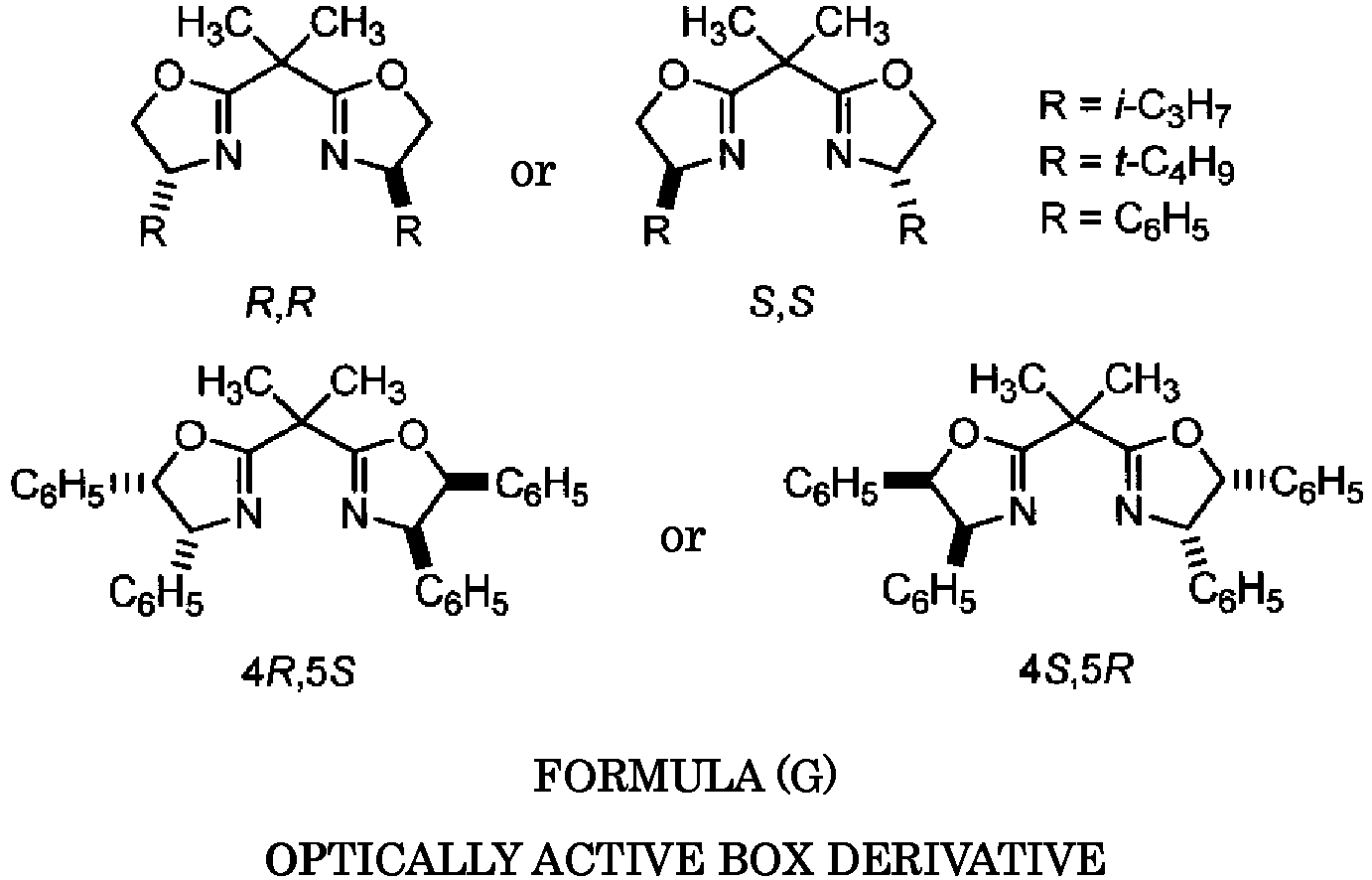

- Of these, "a divalent cationic transition metal complex that has an optically active ligand" is preferable and "a divalent cationic palladium complex that has an optically active ligand" is particularly preferable in order to stereoselectively develop a desired reaction. Though this specification cites representative examples of the optically active ligand, it is possible to suitably use, for example, those described in CATALYTIC ASYMMETRIC SYNTHESIS, Second Edition, 2000, Wiley-VCH, Inc. Moreover, "Z" is preferably SbF6, BF4, OTf or B(3,5-(CF3)2C6H3)4, and particularly preferably SbF6, OTf or B(3,5-(CF3)2C6H3)4.
- These complexes can be prepared by publicly known methods, for example:
- Tetrahedron Letters (England), 2004, Vol. 45, p. 183-185;
- Tetrahedron: Asymmetry (England), 2004, Vol. 15, p. 3885-3889;
- Angew. Chem. Int. Ed. (Germany), 2005, Vol. 44, p. 7257-7260;
- J. Org. Chem. (U.S.), 2006, Vol. 71, p. 9751-9764;
- J. Am. Chem. Soc. (U.S.), 1999, Vol. 121, p. 686-699; and
- Nature (England), 1997, Vol. 385, p. 613-615.
- Not only an isolated complex, but also a complex previously prepared in a reaction system so as not to be isolated can be used, as a matter of course. It is also possible to use one where water or an organic solvent such as acetonitrile and the like is coordinately bonded to these complexes (i.e., solvation).
- Furthermore, "a cationic binuclear transition metal complex that has an optically active ligand" represented by general formula [9] may sometimes be used as well as "a divalent cationic transition metal complex that has an optically active ligand" represented by general formula [7].

- The stereochemical structure of an optically active ligand [(R), (S), (R,R), (S,S) etc.] may suitably be selected according to the stereochemical structure of the target optically active fluorine-containing oxeten.
- The optical purity of an optically active ligand may suitably be predetermined according to the optical purity of the target optically active fluorine-containing oxeten, and it is usually required to be not smaller than 95% e.e. (enantiomeric excess), more preferably not smaller than 97% e.e., and particularly preferably not smaller than 99% e.e..
- Of these optically active ligands, BINAP derivatives are preferable, because either of its enantiomers are the most economically available and they exhibit a highly great activity when they are derivatized to an asymmetric catalyst. BINAP and Tol-BINAP are preferable and BINAP is particularly preferable.
- The amount of "a transition metal complex that has an optically active ligand" to be used is required only to be not larger than 0.4 mol, more preferably 0.3 to 0.00001 mol, much more preferably 0.2 to 0.0001 mol relative to 1 mol of an internal alkyne represented by general formula [2].
- Examples of a reaction solvent are: aliphatic hydrocarbons such as n-pentane, n-hexane, cyclohexane, n-heptane, etc.; aromatic hydrocarbons such as benzene, toluene, xylene, mesitylene, etc; halogenated hydrocarbons such as methylene chloride, chloroform, 1,2-dichloroethane, etc; and ethers such as diethyl ether, tert-butyl methyl ether, 1,4-dioxane, etc.
- Among these, aromatic hydrocarbons, halogenated hydrocarbons and ethers are preferable and aromatic hydrocarbons and halogenated hydrocarbons are particularly preferable. These reaction solvents may be used singly or in combination.
- Additionally, the production method of the present invention may be carried out in the absence of the reaction solvent. In the case of using the reaction solvent, the amount of the reaction solvent to be used is required only to be not lower than 0.05 L, preferably 0.1 to 30 L, much more preferably 0.15 to 20 L.
- The reaction temperature is required only to be within a range of from -100 to +150°C, preferably -90 to +125°C, much more preferably -80 to +100°C.
- The reaction time is required only to be within a range of 48 hours. Since the reaction time differs according to a substrate, an asymmetric catalyst and reaction conditions, it is preferable to monitor the progress of the reaction by using analysis means such as gas chromatography, thin-layer chromatography, liquid chromatography, nuclear magnetic resonance (NMR) and the like thereby defining a point at which a substrate almost disappears as a termination.
- When an operation common in organic synthesis is conducted on a reaction-terminated liquid as a post-treatment, it becomes possible to obtain the target, i.e., an optically active fluorine-containing oxeten represented by general formula [3]. More specifically, by removing an asymmetric catalyst contained in the reaction-terminated liquid by a short column and then concentrating a filtered rinsed liquid, it is possible to obtain a crude product through a relatively convenient operation. The crude product may be purified with high purity as necessary, by an operation such as activated carbon treatment, distillation, recrystallization, column chromatography and the like.
- The optically active fluorine-containing oxeten to be obtained by the present invention is a novel compound which may serve as an important intermediate for pharmaceuticals and agrochemicals. Among optically active fluorine-containing oxetens represented by general formula [3], preferable ones are optically active fluorine-containing oxetens in which: a perfluoroalkyl group is a trifluoromethyl group; an alkyl group of the ester moiety is a methyl group or an ethyl group; one substituent disposed on the side of an internal alkene moiety (the side of a carbon atom to which an oxygen atom is bonded) is an aromatic cyclic group, a substituted aromatic cyclic group, a nucleobase or a substituted nucleobase; and the other substituent (disposed on the side of a carbon atom to which a carbon atom is bonded) is a halogen atom, an alkyl group, a substituted alkyl group, an aromatic cyclic group, a substituted aromatic cyclic group, a nucleobase, a substituted nucleobase, an alkoxycarbonyl group or a substituted alkoxycarbonyl group (and more specifically, the preferable ones are optically active fluorine-containing oxetens represented by general formula [6]). These can be produced on a large scale and become a particularly important intermediate for pharmaceuticals and agrochemicals. Incidentally, an optically active fluorine-containing oxeten represented by general formula [6] can be obtained through a reaction between a fluorine-containing α-ketoester represented by general formula [4] and an internal alkyne represented by general formula [5].
- Referring to the 5th edition of Jikken Kagaku Koza, The Chemical Society of Japan (Maruzen) etc., an optically active fluorine-containing oxeten can be committed to a conversion reaction common in organic synthesis.
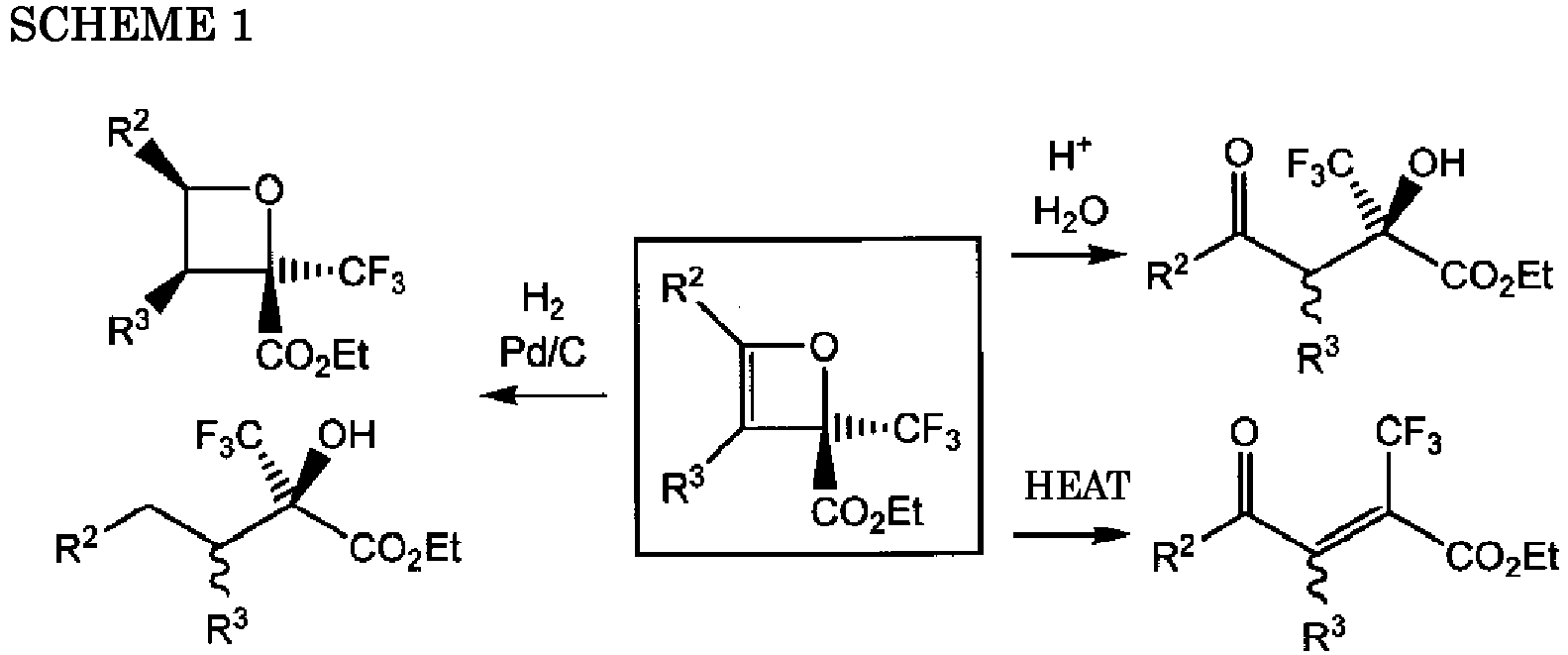
- In fact, by performing hydrogenation, hydrogenolysis, acid hydrolysis or heating, an optically active fluorine-containing oxeten obtained through Examples as discussed below was converted into various useful intermediates with good yield (see Scheme 1).
- Hereinafter the embodiments of the present invention will specifically be explained with reference to examples; however, the present invention is not limited by these examples.
- Under argon atmosphere, 8.0 mg (0.010 mmol) of (S)-BINAP-PdCl2 represented by the following formula:

- To this asymmetric catalyst solution, 680 mg (4.0 mmol) of a fluorine-containing α-ketoester represented by the following formula:


- A reaction-terminated liquid was directly supplied to a short column (silica gel/ethyl acetate : n-hexane = 1 : 3) to remove "a divalent cationic transition metal complex that has an optically active ligand" and then a filtered rinsed liquid was concentrated under a reduced pressure. A residue (a crude product) was purified by column chromatography (silica gel/ethyl acetate : n-hexane = 1 : 20) thereby obtaining 709 mg of an optically active fluorine-containing oxeten (a pure product) represented by the following formula.

- Measurement conditions in chiral liquid chromatography are shown below.
-
Column; CHIRALPAK AD-3 Mobile Phase; 2-propanol : n-hexane = 1 : 99 Flow Velocity; 0.5 mL/min Temperature; 15°C Detector; UV 254 nm Retention Time; Miner isomer (S configuration) 16.2 min Major isomer (R configuration) 17.7 min - 1H, 13C and 19F-NMR are shown as follows.
- 1H-NMR(300MHz,CDCl3)δ
0.93(t,J=7.5Hz,3H),1.34(t,J=7.2Hz,3H),1.33-1.60(m,4H),2.43(t,J=8.1Hz,2H),3. 81(s,3H),4.35(q,J=7.2Hz,2H),6.92(d,J=9.0Hz,2H),7.46(t,J=9.0Hz,2H). 13C-NMR(75MHz,CDCl3)δ
13.7,13.9,22.5,24.1,30.2,55.3,62.6,86.2(q,JC-F=33.2Hz),113.5,114.1,121.3,122.2( q,JC-F=280.4Hz),127.8,160.9,162.7,164.0.
19F-NMR(282MHz,CDCl3)δ -75.9. - Example 1 was referred to in order to implement Examples 2 to 8. The results of Examples 1 to 8 are summarized in Table 1.
TABLE 1 
EXAMPLE R2 R3 YIELD (%) ee (%) 1 4-Me0-Ph n-Bu 99 98 2 4-Me0-Ph Ph 97 97 3 4-Me0-Ph I 93 96 4 4-Me0-Ph C02Et 92 97 5 Ph I 63 90 6 1-naphthyl n-Bu 95 92 7 2-Me-furyl I 93 97 8 2-thienyl n-Bu 96 99 - An optically active fluorine-containing oxeten produced according to the present invention can be utilized as an important intermediate for pharmaceuticals and agrochemicals.
Claims (5)
- A method for producing an optically active fluorine-containing oxeten represented by general formula [3], comprising the steps of:causing a fluorine-containing α-ketoester represented by general formula [1] and an internal alkyne represented by general formula [2] to react with each other in the presence of a transition metal complex that has an optically active ligand.
 [In the formula [1], Rf represents a perfluoroalkyl group and R1 represents an alkyl group.]
 [In the formula [2], R2 and R3 mutually independently represent a halogen atom, an alkyl group, a substituted alkyl group, an aromatic cyclic group, a substituted aromatic cyclic group, a nucleobase, a substituted nucleobase, an alkoxycarbonyl group or a substituted alkoxycarbonyl group.]
 [In the formula [3], Rf, R1, R2 and R3 represent the same substituents as the above and "*" represents an asymmetric carbon.]
 - A method for producing an optically active fluorine-containing oxeten represented by general formula [6], comprising the steps of:causing a fluorine-containing α-ketoester represented by general formula [4] and an internal alkyne represented by general formula [5] to react with each other in the presence of a divalent cationic transition metal complex that has an optically active ligand.
 [In the formula [4], R4 represents a methyl group or an ethyl group.]
 [In the formula [5], R5 represents an aromatic cyclic group, a substituted aromatic cyclic group, a nucleobase or a substituted nucleobase, and R6 represents a halogen atom, an alkyl group, a substituted alkyl group, an aromatic cyclic group, a substituted aromatic cyclic group, a nucleobase, a substituted nucleobase, an alkoxycarbonyl group or a substituted alkoxycarbonyl group.]
 [In the formula [6], R4, R5 and R6 represent the same substituents as the above and "*" represents an asymmetric carbon.]
 - A method as claimed in claim 1 or 2, characterized in that the divalent cationic transition metal complex that has an optically active ligand is a divalent cationic palladium complex that has an optically active ligand.
- An optically active fluorine-containing oxeten represented by general formula [3].

- An optically active fluorine-containing oxeten represented by general formula [6].

Applications Claiming Priority (2)
| Application Number | Priority Date | Filing Date | Title |
|---|---|---|---|
| JP2010263128A JP5669534B2 (en) | 2010-11-26 | 2010-11-26 | Process for producing optically active fluorine-containing oxetene |
| PCT/JP2011/076359 WO2012070437A1 (en) | 2010-11-26 | 2011-11-16 | Method for producing optically active fluorine-containing oxeten |
Publications (3)
| Publication Number | Publication Date |
|---|---|
| EP2644605A1 true EP2644605A1 (en) | 2013-10-02 |
| EP2644605A4 EP2644605A4 (en) | 2014-05-07 |
| EP2644605B1 EP2644605B1 (en) | 2016-04-06 |
Family
ID=46145783
Family Applications (1)
| Application Number | Title | Priority Date | Filing Date |
|---|---|---|---|
| EP11843767.2A Not-in-force EP2644605B1 (en) | 2010-11-26 | 2011-11-16 | Method for producing optically active fluorine-containing oxeten |
Country Status (5)
| Country | Link |
|---|---|
| US (1) | US8859789B2 (en) |
| EP (1) | EP2644605B1 (en) |
| JP (1) | JP5669534B2 (en) |
| CN (1) | CN103228637B (en) |
| WO (1) | WO2012070437A1 (en) |
Family Cites Families (2)
| Publication number | Priority date | Publication date | Assignee | Title |
|---|---|---|---|---|
| JP5303311B2 (en) * | 2009-02-26 | 2013-10-02 | 国立大学法人東京工業大学 | Process for producing optically active fluorinated alkynylated product |
| JP5507285B2 (en) * | 2009-02-26 | 2014-05-28 | 国立大学法人東京工業大学 | Process for producing optically active fluorinated oxetane |
-
2010
- 2010-11-26 JP JP2010263128A patent/JP5669534B2/en not_active Expired - Fee Related
-
2011
- 2011-11-16 CN CN201180056741.6A patent/CN103228637B/en not_active Expired - Fee Related
- 2011-11-16 EP EP11843767.2A patent/EP2644605B1/en not_active Not-in-force
- 2011-11-16 WO PCT/JP2011/076359 patent/WO2012070437A1/en not_active Ceased
- 2011-11-16 US US13/989,662 patent/US8859789B2/en not_active Expired - Fee Related
Non-Patent Citations (2)
| Title |
|---|
| No further relevant documents disclosed * |
| See also references of WO2012070437A1 * |
Also Published As
| Publication number | Publication date |
|---|---|
| JP5669534B2 (en) | 2015-02-12 |
| CN103228637A (en) | 2013-07-31 |
| US8859789B2 (en) | 2014-10-14 |
| CN103228637B (en) | 2015-07-29 |
| EP2644605B1 (en) | 2016-04-06 |
| US20130310580A1 (en) | 2013-11-21 |
| WO2012070437A1 (en) | 2012-05-31 |
| EP2644605A4 (en) | 2014-05-07 |
| JP2012111721A (en) | 2012-06-14 |
Similar Documents
| Publication | Publication Date | Title |
|---|---|---|
| JP5451209B2 (en) | Practical methods for reducing esters and lactones | |
| EP1842841B1 (en) | Process for production of fluoro derivative | |
| EP2650276B1 (en) | Method for producing beta-fluoroalcohol | |
| EP2020402A1 (en) | Dehydroxylated fluorinating agent | |
| CN102046573B (en) | Process for producing halogenated α-fluoroethers | |
| EP2357168B1 (en) | Method for producing fluorosulfuric acid ester | |
| He et al. | Asymmetric tandem Michael addition/oxidation of pyrazolones with p-benzoquinone catalyzed by cinchona alkaloids | |
| KR101944575B1 (en) | Optical resolution method for bicyclic compound using asymmetric catalyst | |
| JP5924479B2 (en) | Method for producing β-dihydrofuran-derived compound, β-dihydrofuran-derived compound or β-tetrahydrofuran-derived compound, and method for producing β-glycoside compound | |
| EP2644605B1 (en) | Method for producing optically active fluorine-containing oxeten | |
| WO2020064818A1 (en) | Process for the preparation of sphingosine-1-phosphate receptor agonist | |
| WO2010073974A1 (en) | Practical method for reducing amides and lactams | |
| Fan et al. | Acid-labile δ-ketal-β-hydroxy esters by asymmetric hydrogenation of corresponding δ-ketal-β-keto esters in the presence of CaCO 3 | |
| EP2402328B1 (en) | Method for producing optically active fluorinated oxetane | |
| JP5303311B2 (en) | Process for producing optically active fluorinated alkynylated product | |
| JP2010195737A (en) | Method for producing optically active convolutamydine derivative | |
| RU2634000C1 (en) | Method of producing 4-(3,5-diphenylfuran-2-yl)butanone-2 derivatives | |
| JP4627625B2 (en) | Method for producing N-acetylcytidines | |
| JP2010208975A (en) | Method for producing optically active convolutamydine derivative by asymmetric carbonyl-ene reaction |
Legal Events
| Date | Code | Title | Description |
|---|---|---|---|
| PUAI | Public reference made under article 153(3) epc to a published international application that has entered the european phase |
Free format text: ORIGINAL CODE: 0009012 |
|
| 17P | Request for examination filed |
Effective date: 20130624 |
|
| AK | Designated contracting states |
Kind code of ref document: A1 Designated state(s): AL AT BE BG CH CY CZ DE DK EE ES FI FR GB GR HR HU IE IS IT LI LT LU LV MC MK MT NL NO PL PT RO RS SE SI SK SM TR |
|
| DAX | Request for extension of the european patent (deleted) | ||
| A4 | Supplementary search report drawn up and despatched |
Effective date: 20140404 |
|
| RIC1 | Information provided on ipc code assigned before grant |
Ipc: C07D 407/04 20060101ALI20140331BHEP Ipc: C07D 305/10 20060101AFI20140331BHEP Ipc: C07D 409/04 20060101ALI20140331BHEP Ipc: C07B 61/00 20060101ALI20140331BHEP |
|
| GRAP | Despatch of communication of intention to grant a patent |
Free format text: ORIGINAL CODE: EPIDOSNIGR1 |
|
| GRAJ | Information related to disapproval of communication of intention to grant by the applicant or resumption of examination proceedings by the epo deleted |
Free format text: ORIGINAL CODE: EPIDOSDIGR1 |
|
| GRAP | Despatch of communication of intention to grant a patent |
Free format text: ORIGINAL CODE: EPIDOSNIGR1 |
|
| GRAJ | Information related to disapproval of communication of intention to grant by the applicant or resumption of examination proceedings by the epo deleted |
Free format text: ORIGINAL CODE: EPIDOSDIGR1 |
|
| INTG | Intention to grant announced |
Effective date: 20150723 |
|
| INTG | Intention to grant announced |
Effective date: 20150804 |
|
| INTC | Intention to grant announced (deleted) | ||
| GRAP | Despatch of communication of intention to grant a patent |
Free format text: ORIGINAL CODE: EPIDOSNIGR1 |
|
| INTG | Intention to grant announced |
Effective date: 20150924 |
|
| INTG | Intention to grant announced |
Effective date: 20150929 |
|
| GRAS | Grant fee paid |
Free format text: ORIGINAL CODE: EPIDOSNIGR3 |
|
| GRAA | (expected) grant |
Free format text: ORIGINAL CODE: 0009210 |
|
| AK | Designated contracting states |
Kind code of ref document: B1 Designated state(s): AL AT BE BG CH CY CZ DE DK EE ES FI FR GB GR HR HU IE IS IT LI LT LU LV MC MK MT NL NO PL PT RO RS SE SI SK SM TR |
|
| REG | Reference to a national code |
Ref country code: GB Ref legal event code: FG4D |
|
| REG | Reference to a national code |
Ref country code: AT Ref legal event code: REF Ref document number: 787669 Country of ref document: AT Kind code of ref document: T Effective date: 20160415 Ref country code: CH Ref legal event code: EP |
|
| REG | Reference to a national code |
Ref country code: IE Ref legal event code: FG4D |
|
| REG | Reference to a national code |
Ref country code: DE Ref legal event code: R096 Ref document number: 602011025129 Country of ref document: DE |
|
| REG | Reference to a national code |
Ref country code: LT Ref legal event code: MG4D Ref country code: NL Ref legal event code: MP Effective date: 20160406 |
|
| REG | Reference to a national code |
Ref country code: AT Ref legal event code: MK05 Ref document number: 787669 Country of ref document: AT Kind code of ref document: T Effective date: 20160406 |
|
| PG25 | Lapsed in a contracting state [announced via postgrant information from national office to epo] |
Ref country code: NL Free format text: LAPSE BECAUSE OF FAILURE TO SUBMIT A TRANSLATION OF THE DESCRIPTION OR TO PAY THE FEE WITHIN THE PRESCRIBED TIME-LIMIT Effective date: 20160406 |
|
| PG25 | Lapsed in a contracting state [announced via postgrant information from national office to epo] |
Ref country code: PL Free format text: LAPSE BECAUSE OF FAILURE TO SUBMIT A TRANSLATION OF THE DESCRIPTION OR TO PAY THE FEE WITHIN THE PRESCRIBED TIME-LIMIT Effective date: 20160406 Ref country code: IS Free format text: LAPSE BECAUSE OF FAILURE TO SUBMIT A TRANSLATION OF THE DESCRIPTION OR TO PAY THE FEE WITHIN THE PRESCRIBED TIME-LIMIT Effective date: 20160806 Ref country code: LT Free format text: LAPSE BECAUSE OF FAILURE TO SUBMIT A TRANSLATION OF THE DESCRIPTION OR TO PAY THE FEE WITHIN THE PRESCRIBED TIME-LIMIT Effective date: 20160406 Ref country code: FI Free format text: LAPSE BECAUSE OF FAILURE TO SUBMIT A TRANSLATION OF THE DESCRIPTION OR TO PAY THE FEE WITHIN THE PRESCRIBED TIME-LIMIT Effective date: 20160406 Ref country code: NO Free format text: LAPSE BECAUSE OF FAILURE TO SUBMIT A TRANSLATION OF THE DESCRIPTION OR TO PAY THE FEE WITHIN THE PRESCRIBED TIME-LIMIT Effective date: 20160706 |
|
| REG | Reference to a national code |
Ref country code: FR Ref legal event code: PLFP Year of fee payment: 6 |
|
| PG25 | Lapsed in a contracting state [announced via postgrant information from national office to epo] |
Ref country code: SE Free format text: LAPSE BECAUSE OF FAILURE TO SUBMIT A TRANSLATION OF THE DESCRIPTION OR TO PAY THE FEE WITHIN THE PRESCRIBED TIME-LIMIT Effective date: 20160406 Ref country code: LV Free format text: LAPSE BECAUSE OF FAILURE TO SUBMIT A TRANSLATION OF THE DESCRIPTION OR TO PAY THE FEE WITHIN THE PRESCRIBED TIME-LIMIT Effective date: 20160406 Ref country code: ES Free format text: LAPSE BECAUSE OF FAILURE TO SUBMIT A TRANSLATION OF THE DESCRIPTION OR TO PAY THE FEE WITHIN THE PRESCRIBED TIME-LIMIT Effective date: 20160406 Ref country code: PT Free format text: LAPSE BECAUSE OF FAILURE TO SUBMIT A TRANSLATION OF THE DESCRIPTION OR TO PAY THE FEE WITHIN THE PRESCRIBED TIME-LIMIT Effective date: 20160808 Ref country code: GR Free format text: LAPSE BECAUSE OF FAILURE TO SUBMIT A TRANSLATION OF THE DESCRIPTION OR TO PAY THE FEE WITHIN THE PRESCRIBED TIME-LIMIT Effective date: 20160707 Ref country code: RS Free format text: LAPSE BECAUSE OF FAILURE TO SUBMIT A TRANSLATION OF THE DESCRIPTION OR TO PAY THE FEE WITHIN THE PRESCRIBED TIME-LIMIT Effective date: 20160406 Ref country code: AT Free format text: LAPSE BECAUSE OF FAILURE TO SUBMIT A TRANSLATION OF THE DESCRIPTION OR TO PAY THE FEE WITHIN THE PRESCRIBED TIME-LIMIT Effective date: 20160406 Ref country code: HR Free format text: LAPSE BECAUSE OF FAILURE TO SUBMIT A TRANSLATION OF THE DESCRIPTION OR TO PAY THE FEE WITHIN THE PRESCRIBED TIME-LIMIT Effective date: 20160406 |
|
| PG25 | Lapsed in a contracting state [announced via postgrant information from national office to epo] |
Ref country code: IT Free format text: LAPSE BECAUSE OF FAILURE TO SUBMIT A TRANSLATION OF THE DESCRIPTION OR TO PAY THE FEE WITHIN THE PRESCRIBED TIME-LIMIT Effective date: 20160406 Ref country code: BE Free format text: LAPSE BECAUSE OF FAILURE TO SUBMIT A TRANSLATION OF THE DESCRIPTION OR TO PAY THE FEE WITHIN THE PRESCRIBED TIME-LIMIT Effective date: 20160406 |
|
| REG | Reference to a national code |
Ref country code: DE Ref legal event code: R097 Ref document number: 602011025129 Country of ref document: DE |
|
| PG25 | Lapsed in a contracting state [announced via postgrant information from national office to epo] |
Ref country code: CZ Free format text: LAPSE BECAUSE OF FAILURE TO SUBMIT A TRANSLATION OF THE DESCRIPTION OR TO PAY THE FEE WITHIN THE PRESCRIBED TIME-LIMIT Effective date: 20160406 Ref country code: RO Free format text: LAPSE BECAUSE OF FAILURE TO SUBMIT A TRANSLATION OF THE DESCRIPTION OR TO PAY THE FEE WITHIN THE PRESCRIBED TIME-LIMIT Effective date: 20160406 Ref country code: SK Free format text: LAPSE BECAUSE OF FAILURE TO SUBMIT A TRANSLATION OF THE DESCRIPTION OR TO PAY THE FEE WITHIN THE PRESCRIBED TIME-LIMIT Effective date: 20160406 Ref country code: EE Free format text: LAPSE BECAUSE OF FAILURE TO SUBMIT A TRANSLATION OF THE DESCRIPTION OR TO PAY THE FEE WITHIN THE PRESCRIBED TIME-LIMIT Effective date: 20160406 Ref country code: DK Free format text: LAPSE BECAUSE OF FAILURE TO SUBMIT A TRANSLATION OF THE DESCRIPTION OR TO PAY THE FEE WITHIN THE PRESCRIBED TIME-LIMIT Effective date: 20160406 |
|
| PLBE | No opposition filed within time limit |
Free format text: ORIGINAL CODE: 0009261 |
|
| STAA | Information on the status of an ep patent application or granted ep patent |
Free format text: STATUS: NO OPPOSITION FILED WITHIN TIME LIMIT |
|
| PG25 | Lapsed in a contracting state [announced via postgrant information from national office to epo] |
Ref country code: SM Free format text: LAPSE BECAUSE OF FAILURE TO SUBMIT A TRANSLATION OF THE DESCRIPTION OR TO PAY THE FEE WITHIN THE PRESCRIBED TIME-LIMIT Effective date: 20160406 |
|
| 26N | No opposition filed |
Effective date: 20170110 |
|
| PG25 | Lapsed in a contracting state [announced via postgrant information from national office to epo] |
Ref country code: SI Free format text: LAPSE BECAUSE OF FAILURE TO SUBMIT A TRANSLATION OF THE DESCRIPTION OR TO PAY THE FEE WITHIN THE PRESCRIBED TIME-LIMIT Effective date: 20160406 |
|
| REG | Reference to a national code |
Ref country code: CH Ref legal event code: PL |
|
| PG25 | Lapsed in a contracting state [announced via postgrant information from national office to epo] |
Ref country code: LI Free format text: LAPSE BECAUSE OF NON-PAYMENT OF DUE FEES Effective date: 20161130 Ref country code: CH Free format text: LAPSE BECAUSE OF NON-PAYMENT OF DUE FEES Effective date: 20161130 |
|
| REG | Reference to a national code |
Ref country code: IE Ref legal event code: MM4A |
|
| PG25 | Lapsed in a contracting state [announced via postgrant information from national office to epo] |
Ref country code: LU Free format text: LAPSE BECAUSE OF NON-PAYMENT OF DUE FEES Effective date: 20161130 |
|
| REG | Reference to a national code |
Ref country code: FR Ref legal event code: PLFP Year of fee payment: 7 |
|
| PG25 | Lapsed in a contracting state [announced via postgrant information from national office to epo] |
Ref country code: IE Free format text: LAPSE BECAUSE OF NON-PAYMENT OF DUE FEES Effective date: 20161116 |
|
| PGFP | Annual fee paid to national office [announced via postgrant information from national office to epo] |
Ref country code: FR Payment date: 20171012 Year of fee payment: 7 |
|
| PGFP | Annual fee paid to national office [announced via postgrant information from national office to epo] |
Ref country code: GB Payment date: 20171115 Year of fee payment: 7 |
|
| PG25 | Lapsed in a contracting state [announced via postgrant information from national office to epo] |
Ref country code: HU Free format text: LAPSE BECAUSE OF FAILURE TO SUBMIT A TRANSLATION OF THE DESCRIPTION OR TO PAY THE FEE WITHIN THE PRESCRIBED TIME-LIMIT; INVALID AB INITIO Effective date: 20111116 Ref country code: CY Free format text: LAPSE BECAUSE OF FAILURE TO SUBMIT A TRANSLATION OF THE DESCRIPTION OR TO PAY THE FEE WITHIN THE PRESCRIBED TIME-LIMIT Effective date: 20160406 |
|
| PG25 | Lapsed in a contracting state [announced via postgrant information from national office to epo] |
Ref country code: MK Free format text: LAPSE BECAUSE OF FAILURE TO SUBMIT A TRANSLATION OF THE DESCRIPTION OR TO PAY THE FEE WITHIN THE PRESCRIBED TIME-LIMIT Effective date: 20160406 Ref country code: MC Free format text: LAPSE BECAUSE OF FAILURE TO SUBMIT A TRANSLATION OF THE DESCRIPTION OR TO PAY THE FEE WITHIN THE PRESCRIBED TIME-LIMIT Effective date: 20160406 |
|
| PG25 | Lapsed in a contracting state [announced via postgrant information from national office to epo] |
Ref country code: BG Free format text: LAPSE BECAUSE OF FAILURE TO SUBMIT A TRANSLATION OF THE DESCRIPTION OR TO PAY THE FEE WITHIN THE PRESCRIBED TIME-LIMIT Effective date: 20160406 |
|
| PG25 | Lapsed in a contracting state [announced via postgrant information from national office to epo] |
Ref country code: MT Free format text: LAPSE BECAUSE OF NON-PAYMENT OF DUE FEES Effective date: 20161116 |
|
| PG25 | Lapsed in a contracting state [announced via postgrant information from national office to epo] |
Ref country code: AL Free format text: LAPSE BECAUSE OF FAILURE TO SUBMIT A TRANSLATION OF THE DESCRIPTION OR TO PAY THE FEE WITHIN THE PRESCRIBED TIME-LIMIT Effective date: 20160406 Ref country code: TR Free format text: LAPSE BECAUSE OF FAILURE TO SUBMIT A TRANSLATION OF THE DESCRIPTION OR TO PAY THE FEE WITHIN THE PRESCRIBED TIME-LIMIT Effective date: 20160406 |
|
| GBPC | Gb: european patent ceased through non-payment of renewal fee |
Effective date: 20181116 |
|
| PG25 | Lapsed in a contracting state [announced via postgrant information from national office to epo] |
Ref country code: FR Free format text: LAPSE BECAUSE OF NON-PAYMENT OF DUE FEES Effective date: 20181130 |
|
| PG25 | Lapsed in a contracting state [announced via postgrant information from national office to epo] |
Ref country code: GB Free format text: LAPSE BECAUSE OF NON-PAYMENT OF DUE FEES Effective date: 20181116 |
|
| PGFP | Annual fee paid to national office [announced via postgrant information from national office to epo] |
Ref country code: DE Payment date: 20191105 Year of fee payment: 9 |
|
| REG | Reference to a national code |
Ref country code: DE Ref legal event code: R119 Ref document number: 602011025129 Country of ref document: DE |
|
| PG25 | Lapsed in a contracting state [announced via postgrant information from national office to epo] |
Ref country code: DE Free format text: LAPSE BECAUSE OF NON-PAYMENT OF DUE FEES Effective date: 20210601 |