EP2641895A1 - Precursor of polymerizable compound - Google Patents
Precursor of polymerizable compound Download PDFInfo
- Publication number
- EP2641895A1 EP2641895A1 EP13156109.4A EP13156109A EP2641895A1 EP 2641895 A1 EP2641895 A1 EP 2641895A1 EP 13156109 A EP13156109 A EP 13156109A EP 2641895 A1 EP2641895 A1 EP 2641895A1
- Authority
- EP
- European Patent Office
- Prior art keywords
- group
- formula
- compound
- ring
- compound represented
- Prior art date
- Legal status (The legal status is an assumption and is not a legal conclusion. Google has not performed a legal analysis and makes no representation as to the accuracy of the status listed.)
- Granted
Links
- RELPCYDLHYBTKF-UHFFFAOYSA-N CC(COCCCNC(CCCl)=O)(COCCCNC(CCCl)=O)NC(CCCl)=O Chemical compound CC(COCCCNC(CCCl)=O)(COCCCNC(CCCl)=O)NC(CCCl)=O RELPCYDLHYBTKF-UHFFFAOYSA-N 0.000 description 1
- BMBCRSTZYYMVBI-UHFFFAOYSA-N O=C(CCCl)NCCCOCC(COCCCNC(CCCl)=O)NC(CCCl)=O Chemical compound O=C(CCCl)NCCCOCC(COCCCNC(CCCl)=O)NC(CCCl)=O BMBCRSTZYYMVBI-UHFFFAOYSA-N 0.000 description 1
Images

Classifications
-
- C—CHEMISTRY; METALLURGY
- C07—ORGANIC CHEMISTRY
- C07C—ACYCLIC OR CARBOCYCLIC COMPOUNDS
- C07C233/00—Carboxylic acid amides
- C07C233/01—Carboxylic acid amides having carbon atoms of carboxamide groups bound to hydrogen atoms or to acyclic carbon atoms
- C07C233/16—Carboxylic acid amides having carbon atoms of carboxamide groups bound to hydrogen atoms or to acyclic carbon atoms having the nitrogen atom of at least one of the carboxamide groups bound to a carbon atom of a hydrocarbon radical substituted by singly-bound oxygen atoms
- C07C233/17—Carboxylic acid amides having carbon atoms of carboxamide groups bound to hydrogen atoms or to acyclic carbon atoms having the nitrogen atom of at least one of the carboxamide groups bound to a carbon atom of a hydrocarbon radical substituted by singly-bound oxygen atoms with the substituted hydrocarbon radical bound to the nitrogen atom of the carboxamide group by an acyclic carbon atom
- C07C233/18—Carboxylic acid amides having carbon atoms of carboxamide groups bound to hydrogen atoms or to acyclic carbon atoms having the nitrogen atom of at least one of the carboxamide groups bound to a carbon atom of a hydrocarbon radical substituted by singly-bound oxygen atoms with the substituted hydrocarbon radical bound to the nitrogen atom of the carboxamide group by an acyclic carbon atom having the carbon atom of the carboxamide group bound to a hydrogen atom or to a carbon atom of an acyclic saturated carbon skeleton
-
- C—CHEMISTRY; METALLURGY
- C07—ORGANIC CHEMISTRY
- C07C—ACYCLIC OR CARBOCYCLIC COMPOUNDS
- C07C231/00—Preparation of carboxylic acid amides
- C07C231/12—Preparation of carboxylic acid amides by reactions not involving the formation of carboxamide groups
Definitions
- the present invention relates to a compound which is a precursor of a polymerizable compound.
- (Meth)acrylamides are polymerizable compounds showing high reactivity. These compounds are widely utilized as a raw material or a crosslinking agent of various kinds of synthetic resins in an industrial application such as a coating material, paint, printing ink, an adhesive, and a resist material.
- an ink composition containing the (meth)acrylamides as a radical polymerizable compound is described in JP-A-2005-307198 ("JP-A" means unexamined published Japanese patent application).
- the (meth)acrylamides are generally obtained by reacting an amine compound with a (meth)acrylate.
- the method results in low yield because an alkylamine compound further reacts with a (meth)acrylic group of an amidated compound thus obtained, or this is further amidated.
- R represents a hydrogen atom or an alkyl group having 1 to 4 carbon atom(s);
- Ra represents a hydrogen atom, an alkyl group, an aryl group, or a heterocyclic group;
- X represents a halogen atom, or an alkyl- or aryl-sulfonyloxy group;
- L represents a divalent linking group;
- Z represents a (n + 1)-valent organic group; and n represents an integer of 1 to 6, a plurality of Rs and Ras and Xs may be the same or different from each other, respectively, and when n represents 2 to 6, a plurality of Ls may be the same or different from each other.
- the present inventors have found that a compound having a specific partial structure can be used as a synthetic precursor of a polymerizable compound such as a (meth)acrylamide compound, and that a higher yield can be achieved according to a synthetic method through the precursor, as compared with the conventional method.
- the present invention has been completed based on the finding.
- (meth)acrylamide(s) means acrylamide(s) and/or methacrylamide(s). Further, in the present invention, "to” denotes a range including numerical values described before and after it as a minimum value and a maximum value.
- the present invention has been made based on a finding that a compound including at least the following partial structure (I) or (II) can be used as an intermediate or precursor for synthesizing a polymerizable compound such as a (meth)acrylamide compound.
- R represents a hydrogen atom or an alkyl group having 1 to 4 carbon atom(s);
- X represents a halogen atom, or an alkyl- or aryl-sulfonyloxy group; and * represents a linking site in a precursor compound.
- the compound of the present invention is represented by the following formula (I), and can be used as the precursor (synthetic intermediate) for synthesizing the polymerizable compound such as the (meth)acrylamide compound.
- R represents a hydrogen atom or an alkyl group having 1 to 4 carbon atom(s); Ra represents a hydrogen atom, an alkyl group, an aryl group, or a heterocyclic group; X represents a halogen atom, or an alkyl- or aryl-sulfonyloxy group; L represents a divalent linking group; Z represents a (n + 1)-valent organic group; and n represents an integer of 1 to 6, a plurality of Rs and Ras and Xs may be the same or different from each other, respectively, and when n represents 2 to 6, a plurality of Ls may be the same or different from each other.
- R is preferably a hydrogen atom or a methyl group, and more preferably a hydrogen atom.
- Ra is preferably a hydrogen atom or an alkyl group, more preferably a hydrogen atom or an unsubstituted alkyl group, and furthermore preferably a hydrogen atom.
- the alkyl group represented by Ra is preferably a straight or branched chain alkyl group having 1 to 8 carbon atom(s), for example, methyl, ethyl, isopropyl, tert-buthyl, and 2-ethylhexyl.
- the aryl group represented by Ra is preferably an aryl group having 6 to 14 carbon atoms, for example, a phenyl group and a naphthyl group.
- the heterocyclic group represented by Ra includes an aromatic heterocyclic group or a non-aromatic heterocyclic group, and also includes a single ring or a condensed ring.
- the heterocyclic group preferably includes a hetero atom selected from an oxygen atom, a sulfur atom and a nitrogen atom as an annular atom, and the heterocyclic group is preferably a 5-membered or a 6-membered ring.
- heterocycle of the heterocyclic group include a pyrrole ring, a imidazole ring, a pyrazole ring, a pyridine ring, a triazine ring, an indole ring, a thiophene ring, a furan ring, a piperazine ring, a piperidine ring, and a morpholine ring.
- X is preferably a halogen atom (for example, an iodine atom, a bromine atom, or a chlorine atom), an alkylsulfonyloxy group (preferably, an alkylsulfonyloxy group having 1 to 8 carbon atom(s), for example, methanesulfonyloxy, ethanesulfonyloxy, or octanesulfonyloxy), or an arylsulfonyloxy group (preferably, an arylsulfonyloxy group having 6 to 12 carbon atoms, for example, benzenesulfonyloxy or toluenesulfonyloxy).
- X is preferably a halogen atom, more preferably an iodine atom, a bromine atom, or a chlorine atom, and particularly preferably a chlorine atom.
- L represents a linking group, but includes no single bond. That is, L represents a divalent linking group.
- L is a linking group which at least contains a group selected from -O-, an alkylene group, and a group obtained by combining these groups, as a partial structure. Further preferably, L consists of a group selected from -O-, an alkylene group, and a group obtained by combining these groups.
- the substituent is preferably an alkyl group, an aryl group, or a hydroxyl group.
- alkylene group examples include methylene, ethylene, propylene, butylene, pentylene, hexylene, heptylene, octylene, and nonylene.
- arylene group examples include phenylene and naphthylene.
- a heterocycle in the above-described divalent heterocyclic group includes an aromatic heterocycle or a non-aromatic heterocycle, and also includes a single ring or a condensed ring.
- the heterocycle preferably includes a hetero atom selected from an oxygen atom, a sulfur atom and a nitrogen atom as an annular atom, and the heterocycle is preferably a 5-membered or 6-membered ring.
- Such a heterocycle include a pyridine ring, a pyrazine ring, a pyrimidine ring, a pyridazine ring, a triazine ring, a quinoline ring, an isoquinoline ring, a quinazoline ring, a cinnoline ring, a phthalazine ring, a quinoxaline ring, a pyrrole ring, an indole ring, a furan ring, a benzofuran ring, a thiophene ring, a benzothiophene ring, a pyrazole ring, an imidazole ring, a benzimidazole ring, a triazole ring, an oxazole ring, a benzoxazole ring, a thiazole ring, a benzothiazole ring, an isothiazole ring, a benziso
- the heterocycle is shown in the form of a heterocycle in which two bonding positions are omitted, but the two bonding positions are not limited.
- the pyridine ring may be bonded on two positions of any of 2-position to 6-position, to be pyridine-2,4-diyl or pyridine-2,6-diyl. Replacement on 3-position or 4-position is allowed.
- a divalent aromatic heterocyclic group is preferable.
- a heterocycle of the divalent aromatic heterocyclic group is preferably a pyridine ring, a pyrazine ring, a pyrimidine ring, a pyridazine ring, a triazine ring, a pyrazole ring, an imidazole ring, a benzimidazole ring, a triazole ring, a thiazole ring, a benzothiazole ring, an isothiazole ring, a benzisothiazole ring, or a thiadiazole ring.
- These heterocycles may have a substituent. Specific examples of the substituent include an alkyl group, an aryl group, and an alkoxy group.
- Z represents a (n + 1)-valent organic group, and n represents 1 to 6.
- n is preferably 2 to 6, more preferably 3 to 6, and particularly preferably 3.
- Z is preferably a (n + 1)-valent aliphatic group, and more preferably a (n + 1)-valent alkyl group.
- Z preferably having 1 to 10 carbon atom(s), more preferably 1 to 8, further preferably 1 to 4, and particularly preferably 1.
- Z is represented in the form of >C ⁇ .
- the compound represented by formula (I) is preferably a compound represented by the following formula (II).
- R, Ra, X and L have the same meanings as those of the above formula (I).
- an alkyl group having 1 to 10 carbon atom(s) is preferable, and the alkyl group may have a substituent.
- substituents include an alkyl group, an alkenyl group, an aryl group, a heterocyclic group, a halogen atom, a hydroxyl group, an alkoxy group, an aryloxy groups, an alkylthio group, an arylthio group, an amino group, an alkylamino group, an arylamino group, a heterocyclic amino group, an acyl group, an alkyloxycarbonyl or aryloxycarbonyl group, an acyloxy group, an acylamino group, an alkylsulfonyl or arylsulfonyl group, an alkylsulfonamide or arylsulfonamide group, a carbamoyl group, a sulfamoyl group, and a
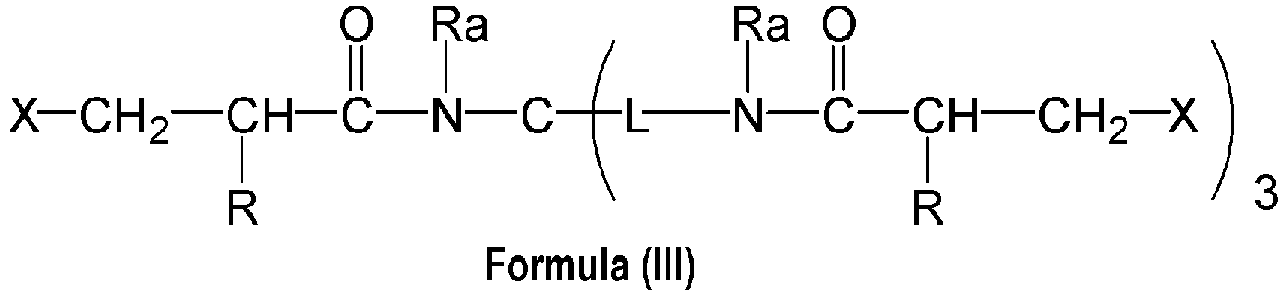
- the formula (II) is represented by the following formula (III).
- R, Ra, X and L have the same meanings as those of the formula (I), and the preferable range thereof are also the same as those of the formula (I).
- the compound represented by any one of the formulae (I) to (III) is particularly preferably a compound represented the following formula (1).
- R 1 represents a hydrogen atom or a methyl group
- X 1 represents a halogen atom
- L 1 represents a divalent linking group
- L 2 represents a straight or branched alkylene group having 2 to 4 carbon atoms, and L 2 is linked to adjacent groups through at least two carbon atoms
- k represents 2 or 3
- m represents an integer of 0 to 6
- R 1 s, L 1 s, L 2 s, X 1 s, ks and ms may be the same or different from each other, respectively.
- the divalent linking group of L 1 is preferably the divalent linking group as described in L.
- L 1 is preferably the alkylene group having 1 to 6 carbon atom(s), more preferably 1 to 3 carbons atom(s), and particularly preferably 1 carbon atom.
- L 1 is preferably the arylene group having 6 to 14 carbon atoms, more preferably 6 to 10 carbons atoms, and particularly preferably 6 carbon atoms.
- the arylene group may have a substituent. Specific examples of the substituent include an alkyl group and an alkoxy group.
- the preferable divalent heterocyclic group of L 1 is the same as those of L.
- L 1 is preferably an alkylene group.
- k represents 2 or 3.
- a plurality of ks may be the same or different from each other, and they are preferably the same.
- C k H 2k may be a straight chain structure or a branched chain structure.
- m represents an integer of 0 to 6.
- m is preferably an integer of 0 to 5, and more preferably 0 to 3.
- a plurality of ms may be the same or different from each other, and they are preferably the same.
- the compound represented by formulae (1) is particularly preferably a compound represented the following formula (2).
- R 1 and X 1 have the same meanings as those of R 1 and X 1 in formula (1), and the preferable range of R 1 and X 1 are also the same as those of R 1 and X 1 in formula (1).
- a plurality of R 1 s and X 1 s may be the same or different from each other, and they are preferably the same.
- a compound including the above-described partial structure (I) or (II) can be synthesized, for example, by using an amine compound exemplified below as a raw material and applying the following synthetic methods 1 to 3.
- Ph represents a phenyl group and Me represents a methyl group, respectively.
- amine compounds can be used, for example, an amine compound as described in databases, such as Chemical Abstracts and CAS, an amine compound as described in books, such as Aldrich Structure Index, 1996-1997 ed ., an amine compound available from a reagent manufacturer brochure.
- an amine compound that is not described in the above-described databases, books, or the like can be synthesized according to a generally known reaction (for example, a substitution reaction of amine; a reduction reaction of nitro, azide, or nitrile; a hydrolysis reaction of amide, imine, or isocyanate) by using a compound that can be a synthetic precursor of the amine compound.
- Specific examples of the method for synthesizing the compound represented by the formula (I) include the following general synthetic methods using an amine compound as a starting material.
- Examples of an amine compound used in the above-described synthetic method include the following compounds.
- amine compound may be used from a commercial product, or may be synthesized according to the generally known reaction (for example, the substitution reaction of amine; the reduction reaction of nitro, azide, or nitrile; the hydrolysis reaction of amide, imine, or isocyanate) by using the compound that can be the synthetic precursor of the amine compound.
- the generally known reaction for example, the substitution reaction of amine; the reduction reaction of nitro, azide, or nitrile; the hydrolysis reaction of amide, imine, or isocyanate
- amino alcohols having an amino group and a hydroxyl group can be converted into -OCH 2 (CR 1 ) CH 2 NH 2 (herein, R 1 represents a hydrogen atom or a methyl group.) by converting -OH as a hydroxyl group into -OCH 2 (CR 1 ) CN with (meth)acrylonitrile, and then reducing the nitrile group.
- R 1 represents a hydrogen atom or a methyl group.
- HN(Ra)-Z-[L-N(Ra)] n can be easily synthesized (herein, Ra, L, Z, and n have the same meanings as those of formula (I).).
- the compound represented by formula (I) according to the present invention can be used as a precursor for synthesizing a (meth)acrylamide compound represented by formula (A).
- R represents a hydrogen atom or an alkyl group having 1 to 4 carbon atom(s); Ra represents a hydrogen atom, an alkyl group, an aryl group, or a heterocyclic group; L represents a divalent linking group; Z represents a (n + 1)-valent organic group; and n represents an integer of 1 to 6, a plurality of Rs and Ras may be the same or different from each other, respectively, and when n represents 2 to 6, a plurality of Ls may be the same or different from each other.
- the (meth)acrylamide compound can be obtained by allowing a base (an organic base and/or an inorganic base) to act on the precursor compound of the present invention, and forming a carbon-to-carbon double bond at a terminal according to an elimination reaction between X 1 of the precursor and a hydrogen atom bound to the carbon atom to which R 1 is bonded.
- a base an organic base and/or an inorganic base
- tris(hydroxymethyl)aminomethane is used as a starting material (A) to allow a hydroxyl group of tris(hydroxymethyl)aminomethane to react with acrylonitrile or methacrylonitrile, and thus a (meth)acrylonitrile adduct is obtained as an intermediate (B).
- the intermediate (B) obtained is allowed to react with hydrogen in the presence of a catalyst, and thus an amine form as an intermediate (C) is obtained according to a hydrogenation reaction.
- the intermediate (C) obtained is further allowed to react with 3-chloropropionic acid chloride or 3-chloro-2-methylpropionic acid chloride to perform amidation, and thus a compound represented by formula (2) as a precursor compound of the present invention can be obtained.
- a compound represented by formula (2) as a precursor compound of the present invention can be obtained.
- di 3-chloropropionic anhydride or di 3-chloro-2-methylpropionic acid anhydride may be used in place of the above acid chloride.
- the process from (A) to (B) is preferably performed at 0 to 60°C for 30 minutes to 8 hours
- the process from (B) to (C) is preferably performed at 20 to 45°C for 2 hours to 16 hours
- the process from (C) to the compound represented by formula (2) is preferably performed at 0 to 30°C for 30 minutes to 6 hours
- a process for synthesizing the (meth)acrylamide compound 1 from the compound represented by formula (2) is preferably performed at 0°C to 60°C for 1 hour to 12 hours.
- the precursor compound of the present invention and the (meth)acrylamide compound as the final compound can be isolated and collected from a reaction production mixture according to an ordinary method.
- the compounds can be isolated, for example, by extraction with an organic solvent, crystallization using a poor solvent, column chromatography using silica gel.
- the precursor compound of the present invention can be easily converted into the polymerizable compound such as the (meth)acrylamide compound.
- the (meth)acrylamide compound as the final product can be obtained with a high yield.
- the synthetic reaction through the precursor compound of the present invention as the intermediate can produce the (meth)acrylamide compound with a high yield, as compared with a general synthetic method in which the (meth)acrylamide compound is synthesized by allowing (meth)acrylic acid chloride or (meth)acrylic anhydride to react with an amine compound under basic conditions.
- the polymerizable compound such as the (meth)acrylamide compound as obtained by the precursor compound of the present invention polymerizes by light or heat to show hardening properties. Therefore, the polymerizable compound can be used in various applications as a radical polymerizable compound.
- the compound represented by the formula (A) as obtained by the compound represented by formula (I) of the present invention is useful as a crosslinking agent or a curing agent for a photosensitive resin composition or inkjet ink.
- the polymerizable compound is used in Examples as described in JP-A-2011-214001 , JP-A-2011-248354 , or JP-A-2012-32556 , an effect as described in these documents is exhibited.
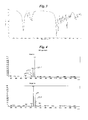
- the white solid obtained was identified by means of 1 H-NMR, 13 C-NMR, IR, and MS under the following measuring conditions. Identified data are shown in Figs. 1 to 4 .
- the white solid was confirmed to have a structure of the exemplified compound (1).
- An acrylamide compound (A1) was obtained by allowing a base to act on the exemplified compound (1) obtained in Example 1 according to the method as described in Russian Journal of General Chemistry, 2005, Vol. 75, No. 6, pp. 915-922 , and U. S. Patent No. 4,914,225 , or according to a method equivalent thereto.
- the hardening properties (thermosetting properties) of the acrylamide compound (A1) obtained were evaluated according to the following procedures.
- a sample solution containing the acrylamide compound (A1), a radical polymerization initiator, and an organic solvent was prepared and applied onto a copper plate, and then this was heated, and progress of radical polymerization and a sense of touch before and after heating were evaluated.
- the progress of radical polymerization was confirmed by a thermal decrease of a peak at 806 cm -1 arising from an acrylic group by using FT-IR (VARIAN 3100 FT-IR (trade name), made by Varian, Inc.). The details are shown below.
- a sample liquid 1A for evaluation was prepared by dissolving 250 mg of acrylamide compound (A1) and 25 mg of azobisisobutyronitril (AIBN) as the radical polymerization initiator in 1 mL of methanol. Then, 10 ⁇ L of this sample liquid 1A for evaluation was measured, and applied onto the copper plate.
- AIBN azobisisobutyronitril
- the copper plate onto which the sample liquid was applied was measured by means of FT-IR, and the peak at 806 cm -1 arising from the acrylic group was confirmed. Then, the copper plate was heated in an oven at 100°C for 1 hour under a nitrogen atmosphere. When the copper plate after heating was again measured by means of FT-IR, the peak at 806 cm -1 arising from the acrylic group decreased. From this result, the progress of radical polymerization of acrylamide compound (A1) was confirmed.
Landscapes
- Chemical & Material Sciences (AREA)
- Organic Chemistry (AREA)
- Chemical Kinetics & Catalysis (AREA)
- Organic Low-Molecular-Weight Compounds And Preparation Thereof (AREA)
- Addition Polymer Or Copolymer, Post-Treatments, Or Chemical Modifications (AREA)
- Plural Heterocyclic Compounds (AREA)
Abstract
Description
- The present invention relates to a compound which is a precursor of a polymerizable compound.
- (Meth)acrylamides are polymerizable compounds showing high reactivity. These compounds are widely utilized as a raw material or a crosslinking agent of various kinds of synthetic resins in an industrial application such as a coating material, paint, printing ink, an adhesive, and a resist material. For example, an ink composition containing the (meth)acrylamides as a radical polymerizable compound is described in
JP-A-2005-307198 - The (meth)acrylamides are generally obtained by reacting an amine compound with a (meth)acrylate. However, the method results in low yield because an alkylamine compound further reacts with a (meth)acrylic group of an amidated compound thus obtained, or this is further amidated.
- Further, methods for producing (meth)acrylamides by reacting an alkylamine with an alkyl acid alkyl to convert them into an aminoamide (amide adduct), and thermally decomposing the resultant or adjusting a concentration of a monoalkylamine are known (for example,
JP-A-4-208258 U.S. Patent No. 2,683,741 ). However, these methods still have a problem of suppressing by-products when a plurality of (meth)acrylamide groups are included in one molecule. - Under the circumstances, a novel precursor (synthetic intermediate) for efficiently producing a compound that has a plurality of (meth)acrylamide groups and that is useful for the raw material or the crosslinking agent for various kinds of synthetic resins, particularly the ink composition, has been desired.
- The present invention resides in a compound represented by formula (I):

- Other and further features and advantages of the invention will appear more fully from the following description, appropriately referring to the accompanying drawings.
-
-
Fig. 1 is a 1H-NMR spectrum chart of the exemplified compound (1) synthesized in Example 1 as described later. -
Fig. 2 is a 13C-NMR spectrum chart of the exemplified compound (1) synthesized in Example 1. -
Fig. 3 is an IR spectrum chart of the exemplified compound (1) synthesized in Example 1. -
Fig. 4 is a MS spectrum chart of the exemplified compound (1) synthesized in Example 1. - The present inventors have found that a compound having a specific partial structure can be used as a synthetic precursor of a polymerizable compound such as a (meth)acrylamide compound, and that a higher yield can be achieved according to a synthetic method through the precursor, as compared with the conventional method.
- The present invention has been completed based on the finding.
- According to the present invention, there is provided the following means:
- <1> A compound represented by formula (I):

- <2> The compound according to the item <1 >, wherein n is 3 to 6.
- <3> The compound according to the item <1> or <2>, wherein L at least contains a group selected from -O-, an alkylene group, and a group obtained by combining these groups.
- <4> The compound according to any one of the items <1> to <3>, wherein the compound represented by formula (I) is a compound represented by formula (II):

- <5> The compound according to any one of the items <1> to <4>, wherein the compound represented by formula (I) is a compound represented by formula (III):

- <6> The compound according to any one of the items <1> to <5>, wherein the compound represented by formula (I) is a compound represented by formula (1):

- <7> The compound according to any one of the items <1> to <6>, wherein the compound is a synthetic intermediate of a (meth)acrylamide compound represented by formula (A):

- In the present invention, the term "(meth)acrylamide(s)" means acrylamide(s) and/or methacrylamide(s). Further, in the present invention, "to" denotes a range including numerical values described before and after it as a minimum value and a maximum value.
- The present invention has been made based on a finding that a compound including at least the following partial structure (I) or (II) can be used as an intermediate or precursor for synthesizing a polymerizable compound such as a (meth)acrylamide compound.

- In the partial structure (I) and (II), R represents a hydrogen atom or an alkyl group having 1 to 4 carbon atom(s); X represents a halogen atom, or an alkyl- or aryl-sulfonyloxy group; and * represents a linking site in a precursor compound.
- The compound of the present invention is represented by the following formula (I), and can be used as the precursor (synthetic intermediate) for synthesizing the polymerizable compound such as the (meth)acrylamide compound.

- In formula (I), R represents a hydrogen atom or an alkyl group having 1 to 4 carbon atom(s); Ra represents a hydrogen atom, an alkyl group, an aryl group, or a heterocyclic group; X represents a halogen atom, or an alkyl- or aryl-sulfonyloxy group; L represents a divalent linking group; Z represents a (n + 1)-valent organic group; and n represents an integer of 1 to 6, a plurality of Rs and Ras and Xs may be the same or different from each other, respectively, and when n represents 2 to 6, a plurality of Ls may be the same or different from each other.
- R is preferably a hydrogen atom or a methyl group, and more preferably a hydrogen atom.
- Ra is preferably a hydrogen atom or an alkyl group, more preferably a hydrogen atom or an unsubstituted alkyl group, and furthermore preferably a hydrogen atom.
- The alkyl group represented by Ra is preferably a straight or branched chain alkyl group having 1 to 8 carbon atom(s), for example, methyl, ethyl, isopropyl, tert-buthyl, and 2-ethylhexyl.
- The aryl group represented by Ra is preferably an aryl group having 6 to 14 carbon atoms, for example, a phenyl group and a naphthyl group.
- The heterocyclic group represented by Ra includes an aromatic heterocyclic group or a non-aromatic heterocyclic group, and also includes a single ring or a condensed ring. The heterocyclic group preferably includes a hetero atom selected from an oxygen atom, a sulfur atom and a nitrogen atom as an annular atom, and the heterocyclic group is preferably a 5-membered or a 6-membered ring. The specific example of heterocycle of the heterocyclic group include a pyrrole ring, a imidazole ring, a pyrazole ring, a pyridine ring, a triazine ring, an indole ring, a thiophene ring, a furan ring, a piperazine ring, a piperidine ring, and a morpholine ring.
- X is preferably a halogen atom (for example, an iodine atom, a bromine atom, or a chlorine atom), an alkylsulfonyloxy group (preferably, an alkylsulfonyloxy group having 1 to 8 carbon atom(s), for example, methanesulfonyloxy, ethanesulfonyloxy, or octanesulfonyloxy), or an arylsulfonyloxy group (preferably, an arylsulfonyloxy group having 6 to 12 carbon atoms, for example, benzenesulfonyloxy or toluenesulfonyloxy). X is preferably a halogen atom, more preferably an iodine atom, a bromine atom, or a chlorine atom, and particularly preferably a chlorine atom.
- L represents a linking group, but includes no single bond. That is, L represents a divalent linking group.
- L is preferably an alkylene group, an ethynylene group, an arylene group, a divalent heterocyclic group, -O-, -S-, -N(Ra)-, -C(=O)-, -SO-, or -SO2-, or a group obtained by combining these (for example, -alkylene-O-, -O-C(=O)-, -C(=O)-O-, - C(=O)-N(Ra)-, -N(Ra)-C(=O)-, -SO2-N(Ra)-, or -N(Ra)-SO2-). More preferably, L is a linking group which at least contains a group selected from -O-, an alkylene group, and a group obtained by combining these groups, as a partial structure. Further preferably, L consists of a group selected from -O-, an alkylene group, and a group obtained by combining these groups.
- These groups may have a substituent. The substituent is preferably an alkyl group, an aryl group, or a hydroxyl group.
- Specific examples of the above-described alkylene group include methylene, ethylene, propylene, butylene, pentylene, hexylene, heptylene, octylene, and nonylene.
- Specific examples of the above-described arylene group include phenylene and naphthylene.
- A heterocycle in the above-described divalent heterocyclic group includes an aromatic heterocycle or a non-aromatic heterocycle, and also includes a single ring or a condensed ring. The heterocycle preferably includes a hetero atom selected from an oxygen atom, a sulfur atom and a nitrogen atom as an annular atom, and the heterocycle is preferably a 5-membered or 6-membered ring. Specific examples of such a heterocycle include a pyridine ring, a pyrazine ring, a pyrimidine ring, a pyridazine ring, a triazine ring, a quinoline ring, an isoquinoline ring, a quinazoline ring, a cinnoline ring, a phthalazine ring, a quinoxaline ring, a pyrrole ring, an indole ring, a furan ring, a benzofuran ring, a thiophene ring, a benzothiophene ring, a pyrazole ring, an imidazole ring, a benzimidazole ring, a triazole ring, an oxazole ring, a benzoxazole ring, a thiazole ring, a benzothiazole ring, an isothiazole ring, a benzisothiazole ring, a thiadiazole ring, an isoxazol ring, a benzisoxazole ring, a pyrrolidine ring, a piperidine ring, a piperazine ring, an imidazolidine ring, and a thiazoline ring. In addition, according to the above-described specific examples, the heterocycle is shown in the form of a heterocycle in which two bonding positions are omitted, but the two bonding positions are not limited. For example, the pyridine ring may be bonded on two positions of any of 2-position to 6-position, to be pyridine-2,4-diyl or pyridine-2,6-diyl. Replacement on 3-position or 4-position is allowed.
- Among the divalent heterocyclic groups, a divalent aromatic heterocyclic group is preferable. A heterocycle of the divalent aromatic heterocyclic group is preferably a pyridine ring, a pyrazine ring, a pyrimidine ring, a pyridazine ring, a triazine ring, a pyrazole ring, an imidazole ring, a benzimidazole ring, a triazole ring, a thiazole ring, a benzothiazole ring, an isothiazole ring, a benzisothiazole ring, or a thiadiazole ring. These heterocycles may have a substituent. Specific examples of the substituent include an alkyl group, an aryl group, and an alkoxy group.
- Z represents a (n + 1)-valent organic group, and n represents 1 to 6.
- n is preferably 2 to 6, more preferably 3 to 6, and particularly preferably 3.
- Z is preferably a (n + 1)-valent aliphatic group, and more preferably a (n + 1)-valent alkyl group. Z preferably having 1 to 10 carbon atom(s), more preferably 1 to 8, further preferably 1 to 4, and particularly preferably 1. When Z has one carbon atom, Z is represented in the form of >C<.
- The compound represented by formula (I) is preferably a compound represented by the following formula (II).

- In formula (II), Rb represents a hydrogen atom, an alkyl group, or -L-N(Ra)-C(=O)-CH(R)-CH2-X. R, Ra, X and L have the same meanings as those of the above formula (I).
- As an alkyl group in Rb, an alkyl group having 1 to 10 carbon atom(s) is preferable, and the alkyl group may have a substituent. Specific examples of such a substituent include an alkyl group, an alkenyl group, an aryl group, a heterocyclic group, a halogen atom, a hydroxyl group, an alkoxy group, an aryloxy groups, an alkylthio group, an arylthio group, an amino group, an alkylamino group, an arylamino group, a heterocyclic amino group, an acyl group, an alkyloxycarbonyl or aryloxycarbonyl group, an acyloxy group, an acylamino group, an alkylsulfonyl or arylsulfonyl group, an alkylsulfonamide or arylsulfonamide group, a carbamoyl group, a sulfamoyl group, and a cyano group.
- Rb is preferably -L-N(Ra)-C(=O)-CH(R)-CH2-X. In this case, the formula (II) is represented by the following formula (III).
- In the present invention, the compound represented by any one of the formulae (I) to (III) is particularly preferably a compound represented the following formula (1).

- In formula (1), R1 represents a hydrogen atom or a methyl group; X1 represents a halogen atom; L1 represents a divalent linking group; L2 represents a straight or branched alkylene group having 2 to 4 carbon atoms, and L2 is linked to adjacent groups through at least two carbon atoms; k represents 2 or 3; m represents an integer of 0 to 6; and a plurality of R1s, L1s, L2s, X1s, ks and ms may be the same or different from each other, respectively.
- The divalent linking group of L1 is preferably the divalent linking group as described in L.
- Among the alkylene group exemplified in L, L1 is preferably the alkylene group having 1 to 6 carbon atom(s), more preferably 1 to 3 carbons atom(s), and particularly preferably 1 carbon atom.
- Among the arylene group exemplified in L, L1 is preferably the arylene group having 6 to 14 carbon atoms, more preferably 6 to 10 carbons atoms, and particularly preferably 6 carbon atoms. The arylene group may have a substituent. Specific examples of the substituent include an alkyl group and an alkoxy group.
- Among the divalent heterocyclic group exemplified in L, the preferable divalent heterocyclic group of L1 is the same as those of L.
- Among the above groups, L1 is preferably an alkylene group.
- In formula (1), k represents 2 or 3. A plurality of ks may be the same or different from each other, and they are preferably the same. CkH2k may be a straight chain structure or a branched chain structure.
- In formula (1), m represents an integer of 0 to 6. m is preferably an integer of 0 to 5, and more preferably 0 to 3.
- A plurality of ms may be the same or different from each other, and they are preferably the same.
- The compound represented by formulae (1) is particularly preferably a compound represented the following formula (2).

- In formula (2), R1 and X1 have the same meanings as those of R1 and X1 in formula (1), and the preferable range of R1 and X1 are also the same as those of R1 and X1 in formula (1). A plurality of R1s and X1s may be the same or different from each other, and they are preferably the same.
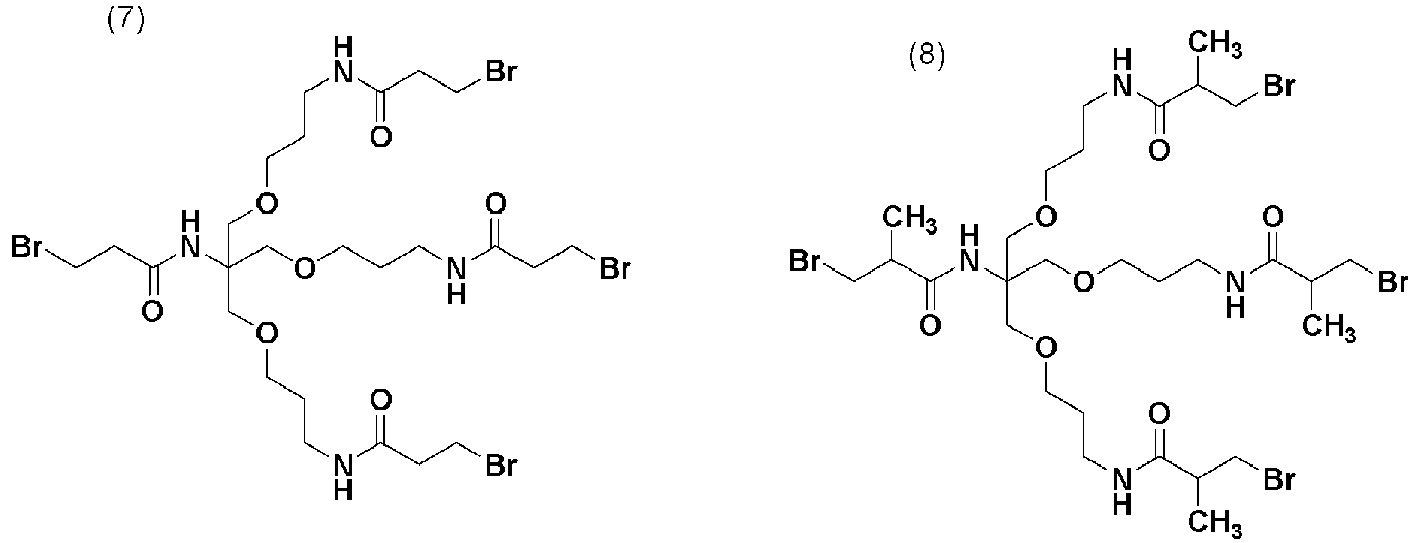
- Hereinafter, specific example of the compound represented by formula (I) in the present invention, but the present invention is not limited thereto.




- A compound including the above-described partial structure (I) or (II) can be synthesized, for example, by using an amine compound exemplified below as a raw material and applying the following
synthetic methods 1 to 3. - A method in which an amine compound is allowed to react with an acid halide compound in the presence of a base.
- A method in which an amine compound is allowed to react with a carboxylic acid compound and a condensing agent in the presence of a base.
- A method for synthesizing the precursor compound according to an ester-amide exchange reaction by heating an amine compound and an ester compound.


- In the amine compound exemplified above, Ph represents a phenyl group and Me represents a methyl group, respectively.
- Further, other amine compounds can be used, for example, an amine compound as described in databases, such as Chemical Abstracts and CAS, an amine compound as described in books, such as Aldrich Structure Index, 1996-1997 ed., an amine compound available from a reagent manufacturer brochure. Moreover, even an amine compound that is not described in the above-described databases, books, or the like can be synthesized according to a generally known reaction (for example, a substitution reaction of amine; a reduction reaction of nitro, azide, or nitrile; a hydrolysis reaction of amide, imine, or isocyanate) by using a compound that can be a synthetic precursor of the amine compound.
- Specific examples of the method for synthesizing the compound represented by the formula (I) include the following general synthetic methods using an amine compound as a starting material.
- A method in which an amine compound is allowed to react with an acid halide compound in the presence of a base.
- A method in which an amine compound is allowed to react with a carboxylic acid compound and a condensing agent in the presence of a base.
- A method for synthesizing the precursor compound according to an ester-amide exchange reaction by heating an amine compound and an ester compound.
- These reactions can be performed according to a method described in Shin Jikken Kagaku Koza (New Experimental Chemistry Course) 14, Synthesis and Reaction of Organic Compounds (V), 11.6: Protection of Amino Groups, pp. 2555 to 2569.
- Examples of an amine compound used in the above-described synthetic method include the following compounds.


- These amine compound may be used from a commercial product, or may be synthesized according to the generally known reaction (for example, the substitution reaction of amine; the reduction reaction of nitro, azide, or nitrile; the hydrolysis reaction of amide, imine, or isocyanate) by using the compound that can be the synthetic precursor of the amine compound.
- In particular, amino alcohols having an amino group and a hydroxyl group can be converted into -OCH2(CR1) CH2NH2 (herein, R1 represents a hydrogen atom or a methyl group.) by converting -OH as a hydroxyl group into -OCH2(CR1) CN with (meth)acrylonitrile, and then reducing the nitrile group. In a similar way, HN(Ra)-Z-[L-N(Ra)]n can be easily synthesized (herein, Ra, L, Z, and n have the same meanings as those of formula (I).).
- Representative examples are shown hereinafter.
- The compound represented by formula (I) according to the present invention can be used as a precursor for synthesizing a (meth)acrylamide compound represented by formula (A).

- In formula (A), R represents a hydrogen atom or an alkyl group having 1 to 4 carbon atom(s); Ra represents a hydrogen atom, an alkyl group, an aryl group, or a heterocyclic group; L represents a divalent linking group; Z represents a (n + 1)-valent organic group; and n represents an integer of 1 to 6, a plurality of Rs and Ras may be the same or different from each other, respectively, and when n represents 2 to 6, a plurality of Ls may be the same or different from each other.
- In synthesis of the (meth)acrylamide compound using the precursor compound of the present invention, for example, the (meth)acrylamide compound can be obtained by allowing a base (an organic base and/or an inorganic base) to act on the precursor compound of the present invention, and forming a carbon-to-carbon double bond at a terminal according to an elimination reaction between X1 of the precursor and a hydrogen atom bound to the carbon atom to which R1 is bonded.
- In the following synthetic scheme, a specific example of a method is shown for synthesizing a precursor compound of the present invention [a compound represented by formula (2) in the following scheme] from an amine compound, and further synthesizing a (meth)
acrylamide compound 1 from the precursor. In addition, R1 and X1 in the following synthetic scheme have the same meanings as those of R1 and X1 in formula (2) as described above.
- According to the above synthetic scheme, first, tris(hydroxymethyl)aminomethane is used as a starting material (A) to allow a hydroxyl group of tris(hydroxymethyl)aminomethane to react with acrylonitrile or methacrylonitrile, and thus a (meth)acrylonitrile adduct is obtained as an intermediate (B). Next, the intermediate (B) obtained is allowed to react with hydrogen in the presence of a catalyst, and thus an amine form as an intermediate (C) is obtained according to a hydrogenation reaction. The intermediate (C) obtained is further allowed to react with 3-chloropropionic acid chloride or 3-chloro-2-methylpropionic acid chloride to perform amidation, and thus a compound represented by formula (2) as a precursor compound of the present invention can be obtained. As an amidating agent, di 3-chloropropionic anhydride or di 3-chloro-2-methylpropionic acid anhydride may be used in place of the above acid chloride. When both 3-chloropropionic acid chloride and 3-chloro-2-methylpropionic acid chloride are used in the above amidation process, a compound represented by formula (2) having both a 3-chloropropionic acid amide group and a 3-chloro-2-methylpropionic acid amide group in the same molecule can be obtained as a final product. Finally, the (meth)
acrylamide compound 1 can be derived from the compound represented by formula (2) by allowing a base to act on the compound. - In the above synthetic scheme, the process from (A) to (B) is preferably performed at 0 to 60°C for 30 minutes to 8 hours, the process from (B) to (C) is preferably performed at 20 to 45°C for 2 hours to 16 hours, the process from (C) to the compound represented by formula (2) is preferably performed at 0 to 30°C for 30 minutes to 6 hours, and a process for synthesizing the (meth)
acrylamide compound 1 from the compound represented by formula (2) is preferably performed at 0°C to 60°C for 1 hour to 12 hours. - The precursor compound of the present invention and the (meth)acrylamide compound as the final compound can be isolated and collected from a reaction production mixture according to an ordinary method. The compounds can be isolated, for example, by extraction with an organic solvent, crystallization using a poor solvent, column chromatography using silica gel.
- The precursor compound of the present invention can be easily converted into the polymerizable compound such as the (meth)acrylamide compound. According to a synthetic reaction of the (meth)acrylamide compound through the precursor compound of the present invention as the synthetic intermediate as shown in the above-described synthetic scheme, the (meth)acrylamide compound as the final product can be obtained with a high yield. The synthetic reaction through the precursor compound of the present invention as the intermediate can produce the (meth)acrylamide compound with a high yield, as compared with a general synthetic method in which the (meth)acrylamide compound is synthesized by allowing (meth)acrylic acid chloride or (meth)acrylic anhydride to react with an amine compound under basic conditions.
- The polymerizable compound such as the (meth)acrylamide compound as obtained by the precursor compound of the present invention polymerizes by light or heat to show hardening properties. Therefore, the polymerizable compound can be used in various applications as a radical polymerizable compound.
- In particular, the compound represented by the formula (A) as obtained by the compound represented by formula (I) of the present invention is useful as a crosslinking agent or a curing agent for a photosensitive resin composition or inkjet ink. For example, when the polymerizable compound is used in Examples as described in
JP-A-2011-214001 JP-A-2011-248354 JP-A-2012-32556 - According to the present invention, it is possible to provide a compound useful as a precursor for synthesizing a polymerizable compound such as a (meth)acrylamide compound.
- The present invention will be described in more detail based on the following examples, but the invention is not intended to be limited thereto. In the following Examples, the terms "part" and "%" with respect to the composition are values by mass, unless they are indicated differently in particular.
- A compound in which R1 is H, and X1 is C1 (chlorine atom) in the formula (2) was synthesized as follows. Hereinafter, the compound is referred to as an exemplified compound (1).

- To a 1 L volume three-necked flask equipped with a stirrer bar, 121 g (1 equivalent) of tris(hydroxymethyl)aminomethane (A) (made by Tokyo Chemical Industry Co., Ltd.), 84 mL of 50% potassium hydroxide aqueous solution, and 423 mL of toluene were added and the resultant mixture was stirred. An inside of a reaction system was kept at 20 to 25°C in a water bath, and 397.5 g (7.5 equivalents) of acrylonitrile was added dropwise over 2 hours. After the dropwise addition, the resultant mixture was stirred for 1.5 hours, and then 540 mL of toluene was added to the mixture, the reaction mixture was transferred to a separating funnel, and an aqueous layer was removed. The remaining organic layer was dried over magnesium sulfate, and then subjected to Celite filtration, a solvent was distilled off under reduced pressure, and thus an intermediate (B) was obtained. The obtained material was analyzed by 1H NMR and MS, and the analytical results showed a satisfactory agreement with those of a known material. Therefore, the material was used for the next reduction reaction without further purification.
- In a 1 L volume autoclave, 24 g of intermediate (B), 48 g of Co catalyst (Raney Cobalt 2700, made by W. R. Grace & Co.), and 600 mL of solution (25% aqueous ammonia : methanol =1 : 1) were put, the resultant mixture was suspended, and a reaction vessel was sealed. Hydrogen at 10 MPa was introduced into the reaction vessel, and a reaction was allowed at a reaction temperature of 25°C for 16 hours.
- Disappearance of the raw materials was confirmed by means of 1H NMR, the reaction mixture was subjected to Celite filtration, and the Celite filter was washed with methanol several times. A solvent was distilled off from the filtrate under reduced pressure, and thus an intermediate (C) was obtained. The material obtained was used for the next reaction without further purification.
- To a 2 L volume three-necked flask equipped with a stirrer, 29.2 g of intermediate (C), 48.48 g (4.8 equivalents) of triethylamine, and 1 L of acetonitrile were added, and 55.87 g (4.4 equivalents) of 3-chloropropionic acid chloride was added dropwise over 2 hours in an ice bath, and then the resultant mixture was stirred at room temperature for 1 hour. Disappearance of the raw materials was confirmed by means of 1H-NMR, a solvent was distilled off from the reaction mixture under reduced pressure, and the resultant product was subjected to Celite filtration, and the solvent was again distilled off under reduced pressure. Finally, the resultant product was purified by means of column chromatography (ethyl acetate : methanol = 4 : 1), and thus a white solid at normal temperature was obtained (yield: 36%).
- The white solid obtained was identified by means of 1H-NMR, 13C-NMR, IR, and MS under the following measuring conditions. Identified data are shown in
Figs. 1 to 4 . - 1H-NMR
Solvent: deuterochloroform, Internal standard: TMS - 13C-NMR
Solvent: deuterochloroform, Internal standard: TMS - IR
A spectrum was measured according to a potassium bromide (KBr) tablet method, and converted into absorbance. - MS
Solvent: MeOH/H2O = 9/1, 10 mM CH3COONH4 - As a result of the above identification, the white solid was confirmed to have a structure of the exemplified compound (1).
- An acrylamide compound (A1) was obtained by allowing a base to act on the exemplified compound (1) obtained in Example 1 according to the method as described in Russian Journal of General Chemistry, 2005, Vol. 75, No. 6, pp. 915-922, and
U. S. Patent No. 4,914,225 , or according to a method equivalent thereto.
- The hardening properties (thermosetting properties) of the acrylamide compound (A1) obtained were evaluated according to the following procedures.
- A sample solution containing the acrylamide compound (A1), a radical polymerization initiator, and an organic solvent was prepared and applied onto a copper plate, and then this was heated, and progress of radical polymerization and a sense of touch before and after heating were evaluated. In addition, the progress of radical polymerization was confirmed by a thermal decrease of a peak at 806 cm-1 arising from an acrylic group by using FT-IR (VARIAN 3100 FT-IR (trade name), made by Varian, Inc.). The details are shown below.
- A sample liquid 1A for evaluation was prepared by dissolving 250 mg of acrylamide compound (A1) and 25 mg of azobisisobutyronitril (AIBN) as the radical polymerization initiator in 1 mL of methanol. Then, 10 µL of this sample liquid 1A for evaluation was measured, and applied onto the copper plate.
- The copper plate onto which the sample liquid was applied was measured by means of FT-IR, and the peak at 806 cm-1 arising from the acrylic group was confirmed. Then, the copper plate was heated in an oven at 100°C for 1 hour under a nitrogen atmosphere. When the copper plate after heating was again measured by means of FT-IR, the peak at 806 cm-1 arising from the acrylic group decreased. From this result, the progress of radical polymerization of acrylamide compound (A1) was confirmed.
- Furthermore, when the sense of touch before and after heating was evaluated, no stickiness was felt on the sample plate after heating when the sample plate was touched, and no change was felt when the sample plate was rubbed with a ball of a finger, as compared with the sense before rubbing. These results show a fact that the sample liquid applied onto the copper plate was hardened by heating.
- Having described our invention as related to the present embodiments, it is our intention that the invention not be limited by any of the details of the description, unless otherwise specified, but rather be construed broadly within its spirit and scope as set out in the accompanying claims.
- This application claims priority on Patent Application No.
2012-065144
Claims (7)
- A compound represented by formula (I):

- The compound according to Claim 1, wherein n is 3 to 6.
- The compound according to Claim 1 or 2, wherein L at least contains a group selected from -O-, an alkylene group, and a group obtained by combining these groups.
- The compound according to any one of Claims 1 to 3, wherein the compound represented by formula (I) is a compound represented by formula (II):

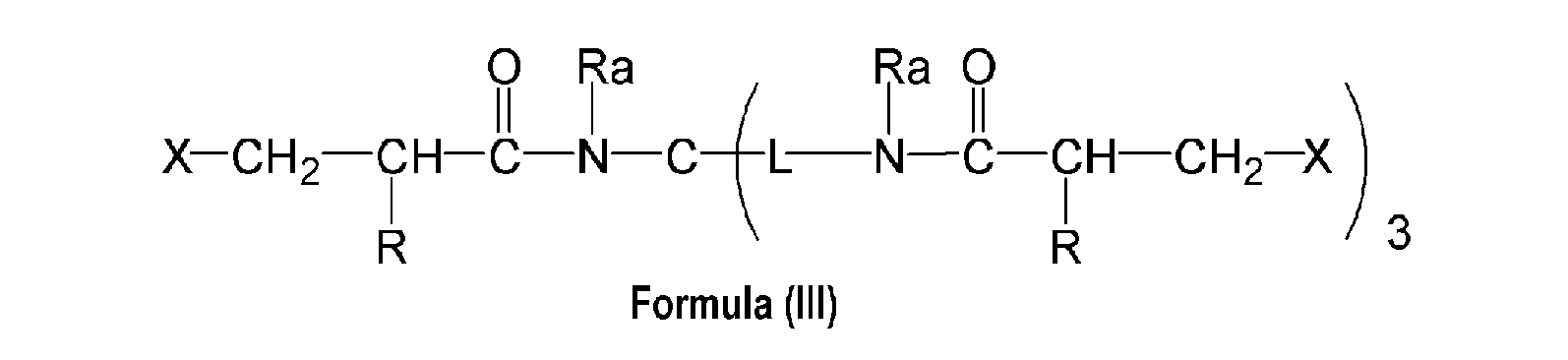
- The compound according to any one of Claims 1 to 4, wherein the compound represented by formula (I) is a compound represented by formula (III):
- The compound according to any one of Claims 1 to 5, wherein the compound represented by formula (I) is a compound represented by formula (1):

- The compound according to any one of Claims 1 to 6, wherein the compound is a synthetic intermediate of a (meth)acrylamide compound represented by formula (A):

Applications Claiming Priority (1)
| Application Number | Priority Date | Filing Date | Title |
|---|---|---|---|
| JP2012065144A JP5591855B2 (en) | 2012-03-22 | 2012-03-22 | Polymerizable compound precursor |
Publications (2)
| Publication Number | Publication Date |
|---|---|
| EP2641895A1 true EP2641895A1 (en) | 2013-09-25 |
| EP2641895B1 EP2641895B1 (en) | 2018-02-14 |
Family
ID=47748502
Family Applications (1)
| Application Number | Title | Priority Date | Filing Date |
|---|---|---|---|
| EP13156109.4A Not-in-force EP2641895B1 (en) | 2012-03-22 | 2013-02-21 | Precursor of polymerizable compound |
Country Status (5)
| Country | Link |
|---|---|
| US (1) | US8901351B2 (en) |
| EP (1) | EP2641895B1 (en) |
| JP (1) | JP5591855B2 (en) |
| CN (1) | CN103319363B (en) |
| IN (1) | IN2013CH00854A (en) |
Cited By (1)
| Publication number | Priority date | Publication date | Assignee | Title |
|---|---|---|---|---|
| EP2730625A4 (en) * | 2011-07-08 | 2015-02-25 | Fujifilm Corp | INK COMPOSITION AND IMAGE FORMATION METHOD |
Families Citing this family (1)
| Publication number | Priority date | Publication date | Assignee | Title |
|---|---|---|---|---|
| CN104326927B (en) * | 2014-10-28 | 2016-06-15 | 齐鲁天和惠世制药有限公司 | A kind of preparation method of 1-[2-amino-1-(4-methoxyphenyl) ethyl] Hexalin sulfate |
Citations (11)
| Publication number | Priority date | Publication date | Assignee | Title |
|---|---|---|---|---|
| DE743466C (en) * | 1939-05-11 | 1952-11-04 | I G Farbenindustrie A G Frankf | Process for the production of diacrylic acid diamides and their polymerization products |
| US2683741A (en) | 1947-06-17 | 1954-07-13 | Allied Chem & Dye Corp | Production of nu-alkylacrylamides |
| US3641116A (en) * | 1967-09-27 | 1972-02-08 | Ciba Ltd | Hardeners for water-soluble polymers |
| US4914225A (en) | 1986-04-25 | 1990-04-03 | Nippon Paint Co., Ltd. | Acrylamide derivatives and their polymers |
| JPH04208258A (en) | 1990-11-30 | 1992-07-29 | Kohjin Co Ltd | Production of n,n-dialkyl(meth)acrylamide |
| JP2005307198A (en) | 2004-03-26 | 2005-11-04 | Canon Inc | Active energy ray-curable water-based ink, ink jet recording method, ink cartridge, recording unit and ink jet recording apparatus using the same |
| WO2006055437A2 (en) * | 2004-11-16 | 2006-05-26 | Genencor International, Inc. | Synthesis and use of glycodendrimer reagents |
| JP2011214001A (en) | 2010-03-19 | 2011-10-27 | Fujifilm Corp | Inkjet ink, surface metal film material and method for manufacturing the same, metal pattern material and method for manufacturing the same |
| JP2011248354A (en) | 2010-04-28 | 2011-12-08 | Fujifilm Corp | Photosensitive composition, forming method of photosensitive film, photosensitive laminate and permanent pattern, and printed board |
| JP2012032556A (en) | 2010-07-29 | 2012-02-16 | Fujifilm Corp | Polymerizable composition |
| WO2012133182A1 (en) * | 2011-03-30 | 2012-10-04 | 富士フイルム株式会社 | Polyether compound, curing agent using polyether compound, and method for producing polyether compound |
Family Cites Families (9)
| Publication number | Priority date | Publication date | Assignee | Title |
|---|---|---|---|---|
| JPS6345246A (en) * | 1986-04-25 | 1988-02-26 | Nippon Paint Co Ltd | N-(substituted oxalyl)alkylacrylamide and production thereof |
| US6399578B1 (en) * | 1998-12-09 | 2002-06-04 | La Jolla Pharmaceutical Company | Conjugates comprising galactose α1,3 galactosyl epitopes and methods of using same |
| WO2005092993A1 (en) * | 2004-03-26 | 2005-10-06 | Canon Kabushiki Kaisha | Active energy radiation hardenable water base ink and utilizing the same, method of inkjet recording, ink cartridge, recording unit and inkjet recording apparatus |
| JP4611834B2 (en) * | 2005-07-28 | 2011-01-12 | 信越ポリマー株式会社 | Conductive polymer paint, conductive coating |
| JP2010079085A (en) * | 2008-09-26 | 2010-04-08 | Fujifilm Corp | Lithographic printing plate precursor, and method of manufacturing the same |
| JP2010274476A (en) * | 2009-05-27 | 2010-12-09 | Canon Inc | Inkjet recording method |
| JP5611858B2 (en) * | 2010-02-25 | 2014-10-22 | 富士フイルム株式会社 | Ink composition and image forming method |
| JP5486536B2 (en) * | 2011-03-30 | 2014-05-07 | 富士フイルム株式会社 | Polymerizable compound |
| JP5764416B2 (en) * | 2011-07-08 | 2015-08-19 | 富士フイルム株式会社 | Ink composition and image forming method |
-
2012
- 2012-03-22 JP JP2012065144A patent/JP5591855B2/en not_active Expired - Fee Related
-
2013
- 2013-02-21 EP EP13156109.4A patent/EP2641895B1/en not_active Not-in-force
- 2013-02-22 US US13/774,936 patent/US8901351B2/en active Active
- 2013-02-27 IN IN854CH2013 patent/IN2013CH00854A/en unknown
- 2013-02-28 CN CN201310063850.1A patent/CN103319363B/en not_active Expired - Fee Related
Patent Citations (11)
| Publication number | Priority date | Publication date | Assignee | Title |
|---|---|---|---|---|
| DE743466C (en) * | 1939-05-11 | 1952-11-04 | I G Farbenindustrie A G Frankf | Process for the production of diacrylic acid diamides and their polymerization products |
| US2683741A (en) | 1947-06-17 | 1954-07-13 | Allied Chem & Dye Corp | Production of nu-alkylacrylamides |
| US3641116A (en) * | 1967-09-27 | 1972-02-08 | Ciba Ltd | Hardeners for water-soluble polymers |
| US4914225A (en) | 1986-04-25 | 1990-04-03 | Nippon Paint Co., Ltd. | Acrylamide derivatives and their polymers |
| JPH04208258A (en) | 1990-11-30 | 1992-07-29 | Kohjin Co Ltd | Production of n,n-dialkyl(meth)acrylamide |
| JP2005307198A (en) | 2004-03-26 | 2005-11-04 | Canon Inc | Active energy ray-curable water-based ink, ink jet recording method, ink cartridge, recording unit and ink jet recording apparatus using the same |
| WO2006055437A2 (en) * | 2004-11-16 | 2006-05-26 | Genencor International, Inc. | Synthesis and use of glycodendrimer reagents |
| JP2011214001A (en) | 2010-03-19 | 2011-10-27 | Fujifilm Corp | Inkjet ink, surface metal film material and method for manufacturing the same, metal pattern material and method for manufacturing the same |
| JP2011248354A (en) | 2010-04-28 | 2011-12-08 | Fujifilm Corp | Photosensitive composition, forming method of photosensitive film, photosensitive laminate and permanent pattern, and printed board |
| JP2012032556A (en) | 2010-07-29 | 2012-02-16 | Fujifilm Corp | Polymerizable composition |
| WO2012133182A1 (en) * | 2011-03-30 | 2012-10-04 | 富士フイルム株式会社 | Polyether compound, curing agent using polyether compound, and method for producing polyether compound |
Non-Patent Citations (7)
| Title |
|---|
| "Shin Jikken Kagaku Koza", SYNTHESIS AND REACTION OF ORGANIC COMPOUNDS (V), 11.6: PROTECTION OF AMINO GROUPS, vol. 14, pages 2555 - 2569 |
| A. SENNING, ET AL.: "Neue Bis-sulfonsäureester mit zytostatischer Wirkung", ARZNEIMITTEL FORSCHUNG. DRUG RESEARCH, ECV EDITIO CANTOR VERLAG, AULENDORF, DE, vol. 26, no. 10, 1976, pages 1800 - 1809, XP008163830, ISSN: 0004-4172 * |
| B.J. LUDWIG, ET AL.: "Carbamate derivatives related to meprobamate", JOURNAL OF MEDICINAL CHEMISTRY, vol. 12, no. 3, 1 May 1969 (1969-05-01), American Chemical Society, Washington, DC, US, pages 462 - 472, XP055072842, ISSN: 0022-2623, DOI: 10.1021/jm00303a029 * |
| E. TERRENO, ET AL.: "Highly shifted LIPOCEST agents based on the encapsulation of neutral polynuclear paramagnetic shift reagents", CHEMICAL COMMUNICATIONS, vol. 8, no. 5, 26 November 2007 (2007-11-26), Royal Society of Chemistry, Cambridge, GB, pages 600 - 602, XP002476682, ISSN: 0022-4936, DOI: 10.1039/b715383j * |
| RUSSIAN JOURNAL OF GENERAL CHEMISTRY, vol. 75, no. 6, 2005, pages 915 - 922 |
| T.A. ANDREYANOVA, ET AL.: "Synthesis and antitumor activity of diazepine derivatives and their structural analogues", PHARMACEUTICAL CHEMISTRY JOURNAL, vol. 32, no. 7, July 1998 (1998-07-01), Springer, US, pages 352 - 355, XP055073025, ISSN: 0091-150X, DOI: 10.1007/BF02645990 * |
| W.D. ROLL: "Synthesis of N,N'-haloacyl analogues of p,p'-oxydianiline as potential antineoplastic agents", JOURNAL OF PHARMACEUTICAL SCIENCES, vol. 55, no. 10, October 1966 (1966-10-01), Wiley InterScience, New York, NY, US, pages 1151 - 1152, XP055073017, ISSN: 0022-3549, DOI: 10.1002/jps.2600551040 * |
Cited By (1)
| Publication number | Priority date | Publication date | Assignee | Title |
|---|---|---|---|---|
| EP2730625A4 (en) * | 2011-07-08 | 2015-02-25 | Fujifilm Corp | INK COMPOSITION AND IMAGE FORMATION METHOD |
Also Published As
| Publication number | Publication date |
|---|---|
| US8901351B2 (en) | 2014-12-02 |
| JP2013194021A (en) | 2013-09-30 |
| CN103319363B (en) | 2016-04-27 |
| US20130296606A1 (en) | 2013-11-07 |
| JP5591855B2 (en) | 2014-09-17 |
| EP2641895B1 (en) | 2018-02-14 |
| IN2013CH00854A (en) | 2015-07-31 |
| CN103319363A (en) | 2013-09-25 |
Similar Documents
| Publication | Publication Date | Title |
|---|---|---|
| AU2010299483B2 (en) | Process for the preparation of sorafenib tosylate | |
| Tong et al. | A simple approach to benzothiazoles from 2-chloronitrobenzene, elemental sulfur, and aliphatic amine under solvent-free and catalyst-free conditions | |
| US3988341A (en) | Esterification process | |
| EP2641895B1 (en) | Precursor of polymerizable compound | |
| AU2013215796B2 (en) | Method for preparing compound by novel Michael addition reaction using water or various acids as additive | |
| Szatmari et al. | Microwave-assisted one-pot synthesis of (aminoalkyl) naphthols and (aminoalkyl) quinolinols by using ammonium carbamate or ammonium hydrogen carbonate as solid ammonia source | |
| CN102675241B (en) | A kind of synthetic method of multi-substituted benzothiazole derivatives | |
| CN109265409B (en) | Synthesis method of 2-substituted benzoxazole, 2-substituted benzothiazole and derivatives thereof | |
| RS65238B1 (en) | Process and intermediate for the preparation of oxetan-2-ylmethanamine | |
| Xi et al. | Regio-controlled synthesis of N-substituted imidazoles | |
| CN105170180A (en) | Application of 4,5-methylene-L-proline as catalyst in direct asymmetric Aldol reaction | |
| Mazurkiewicz et al. | Synthesis and decarboxylation of N-acyl-α-triphenylphosphonio-α-amino acids: a new synthesis of α-(N-acylamino) alkyltriphenylphosphonium salts | |
| US6313294B1 (en) | Process for preparing amides | |
| JP2013194022A (en) | (mrth)acrylamide compound precursor | |
| KR101339757B1 (en) | Process for the preparation of 2-aminoazoles using metal catalyst, oxidant and acid | |
| Rao et al. | A novel approach for the conversion of primary amides into tetrazoles by using tributyltin chloride and sodium azide in the presence of DMF | |
| JP2003206282A (en) | Method for producing oxazolidin-2-one derivative | |
| KR102548050B1 (en) | Novel multi-fused heterocyclic compound and preparation method thereof | |
| US8124790B2 (en) | Preparation process useful in synthesis of atorvastatin | |
| HK1209751A1 (en) | Process for the synthesis of substituted gamma lactams | |
| JP4305747B2 (en) | 2-Phenyl-4- (dichlorophenyl) imidazole compound | |
| Paulvannan et al. | Asymmetric Synthesis of Mercaptoalcohols-Matrix Metalloproteinase Inhibitors | |
| KR101962516B1 (en) | Sitagliptin intermediate, method of synthesizing the sitagliptin intermediate, and method of synthesizing sitagliptin using the sitagliptin intermediate | |
| Mal’kina et al. | Chemo-and regioselective modification of D, L-phenylalanine with α-cyanoacetylenic alcohols in water | |
| JP5148188B2 (en) | Barbituric acid compounds |
Legal Events
| Date | Code | Title | Description |
|---|---|---|---|
| PUAI | Public reference made under article 153(3) epc to a published international application that has entered the european phase |
Free format text: ORIGINAL CODE: 0009012 |
|
| AK | Designated contracting states |
Kind code of ref document: A1 Designated state(s): AL AT BE BG CH CY CZ DE DK EE ES FI FR GB GR HR HU IE IS IT LI LT LU LV MC MK MT NL NO PL PT RO RS SE SI SK SM TR |
|
| AX | Request for extension of the european patent |
Extension state: BA ME |
|
| 17P | Request for examination filed |
Effective date: 20140324 |
|
| RBV | Designated contracting states (corrected) |
Designated state(s): AL AT BE BG CH CY CZ DE DK EE ES FI FR GB GR HR HU IE IS IT LI LT LU LV MC MK MT NL NO PL PT RO RS SE SI SK SM TR |
|
| 17Q | First examination report despatched |
Effective date: 20160203 |
|
| STAA | Information on the status of an ep patent application or granted ep patent |
Free format text: STATUS: EXAMINATION IS IN PROGRESS |
|
| GRAP | Despatch of communication of intention to grant a patent |
Free format text: ORIGINAL CODE: EPIDOSNIGR1 |
|
| STAA | Information on the status of an ep patent application or granted ep patent |
Free format text: STATUS: GRANT OF PATENT IS INTENDED |
|
| INTG | Intention to grant announced |
Effective date: 20170922 |
|
| GRAS | Grant fee paid |
Free format text: ORIGINAL CODE: EPIDOSNIGR3 |
|
| GRAA | (expected) grant |
Free format text: ORIGINAL CODE: 0009210 |
|
| STAA | Information on the status of an ep patent application or granted ep patent |
Free format text: STATUS: THE PATENT HAS BEEN GRANTED |
|
| AK | Designated contracting states |
Kind code of ref document: B1 Designated state(s): AL AT BE BG CH CY CZ DE DK EE ES FI FR GB GR HR HU IE IS IT LI LT LU LV MC MK MT NL NO PL PT RO RS SE SI SK SM TR |
|
| REG | Reference to a national code |
Ref country code: GB Ref legal event code: FG4D |
|
| REG | Reference to a national code |
Ref country code: CH Ref legal event code: EP |
|
| REG | Reference to a national code |
Ref country code: IE Ref legal event code: FG4D |
|
| REG | Reference to a national code |
Ref country code: DE Ref legal event code: R096 Ref document number: 602013033020 Country of ref document: DE Ref country code: AT Ref legal event code: REF Ref document number: 969748 Country of ref document: AT Kind code of ref document: T Effective date: 20180315 |
|
| REG | Reference to a national code |
Ref country code: NL Ref legal event code: MP Effective date: 20180214 |
|
| REG | Reference to a national code |
Ref country code: AT Ref legal event code: MK05 Ref document number: 969748 Country of ref document: AT Kind code of ref document: T Effective date: 20180214 |
|
| PG25 | Lapsed in a contracting state [announced via postgrant information from national office to epo] |
Ref country code: FI Free format text: LAPSE BECAUSE OF FAILURE TO SUBMIT A TRANSLATION OF THE DESCRIPTION OR TO PAY THE FEE WITHIN THE PRESCRIBED TIME-LIMIT Effective date: 20180214 Ref country code: NO Free format text: LAPSE BECAUSE OF FAILURE TO SUBMIT A TRANSLATION OF THE DESCRIPTION OR TO PAY THE FEE WITHIN THE PRESCRIBED TIME-LIMIT Effective date: 20180514 Ref country code: LT Free format text: LAPSE BECAUSE OF FAILURE TO SUBMIT A TRANSLATION OF THE DESCRIPTION OR TO PAY THE FEE WITHIN THE PRESCRIBED TIME-LIMIT Effective date: 20180214 Ref country code: CY Free format text: LAPSE BECAUSE OF FAILURE TO SUBMIT A TRANSLATION OF THE DESCRIPTION OR TO PAY THE FEE WITHIN THE PRESCRIBED TIME-LIMIT Effective date: 20180214 Ref country code: HR Free format text: LAPSE BECAUSE OF FAILURE TO SUBMIT A TRANSLATION OF THE DESCRIPTION OR TO PAY THE FEE WITHIN THE PRESCRIBED TIME-LIMIT Effective date: 20180214 Ref country code: ES Free format text: LAPSE BECAUSE OF FAILURE TO SUBMIT A TRANSLATION OF THE DESCRIPTION OR TO PAY THE FEE WITHIN THE PRESCRIBED TIME-LIMIT Effective date: 20180214 Ref country code: NL Free format text: LAPSE BECAUSE OF FAILURE TO SUBMIT A TRANSLATION OF THE DESCRIPTION OR TO PAY THE FEE WITHIN THE PRESCRIBED TIME-LIMIT Effective date: 20180214 |
|
| PG25 | Lapsed in a contracting state [announced via postgrant information from national office to epo] |
Ref country code: BG Free format text: LAPSE BECAUSE OF FAILURE TO SUBMIT A TRANSLATION OF THE DESCRIPTION OR TO PAY THE FEE WITHIN THE PRESCRIBED TIME-LIMIT Effective date: 20180514 Ref country code: GR Free format text: LAPSE BECAUSE OF FAILURE TO SUBMIT A TRANSLATION OF THE DESCRIPTION OR TO PAY THE FEE WITHIN THE PRESCRIBED TIME-LIMIT Effective date: 20180515 Ref country code: SE Free format text: LAPSE BECAUSE OF FAILURE TO SUBMIT A TRANSLATION OF THE DESCRIPTION OR TO PAY THE FEE WITHIN THE PRESCRIBED TIME-LIMIT Effective date: 20180214 Ref country code: LV Free format text: LAPSE BECAUSE OF FAILURE TO SUBMIT A TRANSLATION OF THE DESCRIPTION OR TO PAY THE FEE WITHIN THE PRESCRIBED TIME-LIMIT Effective date: 20180214 Ref country code: RS Free format text: LAPSE BECAUSE OF FAILURE TO SUBMIT A TRANSLATION OF THE DESCRIPTION OR TO PAY THE FEE WITHIN THE PRESCRIBED TIME-LIMIT Effective date: 20180214 Ref country code: AT Free format text: LAPSE BECAUSE OF FAILURE TO SUBMIT A TRANSLATION OF THE DESCRIPTION OR TO PAY THE FEE WITHIN THE PRESCRIBED TIME-LIMIT Effective date: 20180214 |
|
| REG | Reference to a national code |
Ref country code: CH Ref legal event code: PL |
|
| PG25 | Lapsed in a contracting state [announced via postgrant information from national office to epo] |
Ref country code: RO Free format text: LAPSE BECAUSE OF FAILURE TO SUBMIT A TRANSLATION OF THE DESCRIPTION OR TO PAY THE FEE WITHIN THE PRESCRIBED TIME-LIMIT Effective date: 20180214 Ref country code: EE Free format text: LAPSE BECAUSE OF FAILURE TO SUBMIT A TRANSLATION OF THE DESCRIPTION OR TO PAY THE FEE WITHIN THE PRESCRIBED TIME-LIMIT Effective date: 20180214 Ref country code: IT Free format text: LAPSE BECAUSE OF FAILURE TO SUBMIT A TRANSLATION OF THE DESCRIPTION OR TO PAY THE FEE WITHIN THE PRESCRIBED TIME-LIMIT Effective date: 20180214 Ref country code: AL Free format text: LAPSE BECAUSE OF FAILURE TO SUBMIT A TRANSLATION OF THE DESCRIPTION OR TO PAY THE FEE WITHIN THE PRESCRIBED TIME-LIMIT Effective date: 20180214 Ref country code: PL Free format text: LAPSE BECAUSE OF FAILURE TO SUBMIT A TRANSLATION OF THE DESCRIPTION OR TO PAY THE FEE WITHIN THE PRESCRIBED TIME-LIMIT Effective date: 20180214 |
|
| REG | Reference to a national code |
Ref country code: DE Ref legal event code: R097 Ref document number: 602013033020 Country of ref document: DE |
|
| REG | Reference to a national code |
Ref country code: IE Ref legal event code: MM4A |
|
| REG | Reference to a national code |
Ref country code: BE Ref legal event code: MM Effective date: 20180228 |
|
| PG25 | Lapsed in a contracting state [announced via postgrant information from national office to epo] |
Ref country code: LI Free format text: LAPSE BECAUSE OF NON-PAYMENT OF DUE FEES Effective date: 20180228 Ref country code: MC Free format text: LAPSE BECAUSE OF FAILURE TO SUBMIT A TRANSLATION OF THE DESCRIPTION OR TO PAY THE FEE WITHIN THE PRESCRIBED TIME-LIMIT Effective date: 20180214 Ref country code: LU Free format text: LAPSE BECAUSE OF NON-PAYMENT OF DUE FEES Effective date: 20180221 Ref country code: SK Free format text: LAPSE BECAUSE OF FAILURE TO SUBMIT A TRANSLATION OF THE DESCRIPTION OR TO PAY THE FEE WITHIN THE PRESCRIBED TIME-LIMIT Effective date: 20180214 Ref country code: CZ Free format text: LAPSE BECAUSE OF FAILURE TO SUBMIT A TRANSLATION OF THE DESCRIPTION OR TO PAY THE FEE WITHIN THE PRESCRIBED TIME-LIMIT Effective date: 20180214 Ref country code: CH Free format text: LAPSE BECAUSE OF NON-PAYMENT OF DUE FEES Effective date: 20180228 Ref country code: DK Free format text: LAPSE BECAUSE OF FAILURE TO SUBMIT A TRANSLATION OF THE DESCRIPTION OR TO PAY THE FEE WITHIN THE PRESCRIBED TIME-LIMIT Effective date: 20180214 Ref country code: SM Free format text: LAPSE BECAUSE OF FAILURE TO SUBMIT A TRANSLATION OF THE DESCRIPTION OR TO PAY THE FEE WITHIN THE PRESCRIBED TIME-LIMIT Effective date: 20180214 |
|
| PLBE | No opposition filed within time limit |
Free format text: ORIGINAL CODE: 0009261 |
|
| STAA | Information on the status of an ep patent application or granted ep patent |
Free format text: STATUS: NO OPPOSITION FILED WITHIN TIME LIMIT |
|
| 26N | No opposition filed |
Effective date: 20181115 |
|
| PG25 | Lapsed in a contracting state [announced via postgrant information from national office to epo] |
Ref country code: IE Free format text: LAPSE BECAUSE OF NON-PAYMENT OF DUE FEES Effective date: 20180221 |
|
| PG25 | Lapsed in a contracting state [announced via postgrant information from national office to epo] |
Ref country code: BE Free format text: LAPSE BECAUSE OF NON-PAYMENT OF DUE FEES Effective date: 20180228 Ref country code: SI Free format text: LAPSE BECAUSE OF FAILURE TO SUBMIT A TRANSLATION OF THE DESCRIPTION OR TO PAY THE FEE WITHIN THE PRESCRIBED TIME-LIMIT Effective date: 20180214 |
|
| PG25 | Lapsed in a contracting state [announced via postgrant information from national office to epo] |
Ref country code: FR Free format text: LAPSE BECAUSE OF NON-PAYMENT OF DUE FEES Effective date: 20180414 |
|
| PGFP | Annual fee paid to national office [announced via postgrant information from national office to epo] |
Ref country code: FR Payment date: 20181121 Year of fee payment: 10 |
|
| PG25 | Lapsed in a contracting state [announced via postgrant information from national office to epo] |
Ref country code: MT Free format text: LAPSE BECAUSE OF NON-PAYMENT OF DUE FEES Effective date: 20180221 |
|
| PG25 | Lapsed in a contracting state [announced via postgrant information from national office to epo] |
Ref country code: TR Free format text: LAPSE BECAUSE OF FAILURE TO SUBMIT A TRANSLATION OF THE DESCRIPTION OR TO PAY THE FEE WITHIN THE PRESCRIBED TIME-LIMIT Effective date: 20180214 |
|
| PG25 | Lapsed in a contracting state [announced via postgrant information from national office to epo] |
Ref country code: PT Free format text: LAPSE BECAUSE OF FAILURE TO SUBMIT A TRANSLATION OF THE DESCRIPTION OR TO PAY THE FEE WITHIN THE PRESCRIBED TIME-LIMIT Effective date: 20180214 Ref country code: HU Free format text: LAPSE BECAUSE OF FAILURE TO SUBMIT A TRANSLATION OF THE DESCRIPTION OR TO PAY THE FEE WITHIN THE PRESCRIBED TIME-LIMIT; INVALID AB INITIO Effective date: 20130221 |
|
| PG25 | Lapsed in a contracting state [announced via postgrant information from national office to epo] |
Ref country code: MK Free format text: LAPSE BECAUSE OF NON-PAYMENT OF DUE FEES Effective date: 20180214 |
|
| PG25 | Lapsed in a contracting state [announced via postgrant information from national office to epo] |
Ref country code: IS Free format text: LAPSE BECAUSE OF FAILURE TO SUBMIT A TRANSLATION OF THE DESCRIPTION OR TO PAY THE FEE WITHIN THE PRESCRIBED TIME-LIMIT Effective date: 20180614 |
|
| GBPC | Gb: european patent ceased through non-payment of renewal fee |
Effective date: 20200221 |
|
| PG25 | Lapsed in a contracting state [announced via postgrant information from national office to epo] |
Ref country code: GB Free format text: LAPSE BECAUSE OF NON-PAYMENT OF DUE FEES Effective date: 20200221 |
|
| PGFP | Annual fee paid to national office [announced via postgrant information from national office to epo] |
Ref country code: DE Payment date: 20211230 Year of fee payment: 10 |
|
| REG | Reference to a national code |
Ref country code: DE Ref legal event code: R119 Ref document number: 602013033020 Country of ref document: DE |
|
| PG25 | Lapsed in a contracting state [announced via postgrant information from national office to epo] |
Ref country code: DE Free format text: LAPSE BECAUSE OF NON-PAYMENT OF DUE FEES Effective date: 20230901 |