EP2639350A1 - Method for reducing negative effects of natural pitch contaminants in both pulping and papermaking operations - Google Patents
Method for reducing negative effects of natural pitch contaminants in both pulping and papermaking operations Download PDFInfo
- Publication number
- EP2639350A1 EP2639350A1 EP12001801.5A EP12001801A EP2639350A1 EP 2639350 A1 EP2639350 A1 EP 2639350A1 EP 12001801 A EP12001801 A EP 12001801A EP 2639350 A1 EP2639350 A1 EP 2639350A1
- Authority
- EP
- European Patent Office
- Prior art keywords
- component
- glycol dimethacrylate
- polymer dispersion
- dimethacrylate
- styrene
- Prior art date
- Legal status (The legal status is an assumption and is not a legal conclusion. Google has not performed a legal analysis and makes no representation as to the accuracy of the status listed.)
- Granted
Links
Classifications
-
- D—TEXTILES; PAPER
- D21—PAPER-MAKING; PRODUCTION OF CELLULOSE
- D21H—PULP COMPOSITIONS; PREPARATION THEREOF NOT COVERED BY SUBCLASSES D21C OR D21D; IMPREGNATING OR COATING OF PAPER; TREATMENT OF FINISHED PAPER NOT COVERED BY CLASS B31 OR SUBCLASS D21G; PAPER NOT OTHERWISE PROVIDED FOR
- D21H17/00—Non-fibrous material added to the pulp, characterised by its constitution; Paper-impregnating material characterised by its constitution
- D21H17/20—Macromolecular organic compounds
- D21H17/33—Synthetic macromolecular compounds
- D21H17/34—Synthetic macromolecular compounds obtained by reactions only involving carbon-to-carbon unsaturated bonds
- D21H17/37—Polymers of unsaturated acids or derivatives thereof, e.g. polyacrylates
-
- D—TEXTILES; PAPER
- D21—PAPER-MAKING; PRODUCTION OF CELLULOSE
- D21C—PRODUCTION OF CELLULOSE BY REMOVING NON-CELLULOSE SUBSTANCES FROM CELLULOSE-CONTAINING MATERIALS; REGENERATION OF PULPING LIQUORS; APPARATUS THEREFOR
- D21C9/00—After-treatment of cellulose pulp, e.g. of wood pulp, or cotton linters ; Treatment of dilute or dewatered pulp or process improvement taking place after obtaining the raw cellulosic material and not provided for elsewhere
- D21C9/08—Removal of fats, resins, pitch or waxes; Chemical or physical purification, i.e. refining, of crude cellulose by removing non-cellulosic contaminants, optionally combined with bleaching
-
- D—TEXTILES; PAPER
- D21—PAPER-MAKING; PRODUCTION OF CELLULOSE
- D21H—PULP COMPOSITIONS; PREPARATION THEREOF NOT COVERED BY SUBCLASSES D21C OR D21D; IMPREGNATING OR COATING OF PAPER; TREATMENT OF FINISHED PAPER NOT COVERED BY CLASS B31 OR SUBCLASS D21G; PAPER NOT OTHERWISE PROVIDED FOR
- D21H21/00—Non-fibrous material added to the pulp, characterised by its function, form or properties; Paper-impregnating or coating material, characterised by its function, form or properties
- D21H21/02—Agents for preventing deposition on the paper mill equipment, e.g. pitch or slime control
-
- D—TEXTILES; PAPER
- D21—PAPER-MAKING; PRODUCTION OF CELLULOSE
- D21H—PULP COMPOSITIONS; PREPARATION THEREOF NOT COVERED BY SUBCLASSES D21C OR D21D; IMPREGNATING OR COATING OF PAPER; TREATMENT OF FINISHED PAPER NOT COVERED BY CLASS B31 OR SUBCLASS D21G; PAPER NOT OTHERWISE PROVIDED FOR
- D21H17/00—Non-fibrous material added to the pulp, characterised by its constitution; Paper-impregnating material characterised by its constitution
- D21H17/20—Macromolecular organic compounds
- D21H17/33—Synthetic macromolecular compounds
- D21H17/34—Synthetic macromolecular compounds obtained by reactions only involving carbon-to-carbon unsaturated bonds
- D21H17/36—Polyalkenyalcohols; Polyalkenylethers; Polyalkenylesters
Definitions
- the invention relates to resin and pitch control agents, which are aqueous, non-film forming, polymer dispersions and to a process for preventing the deposition of pitch particles in cellulosic pulp suspensions, by use of such polymer dispersions.
- Cellulosic pulps contain a considerable proportion of organosoluble matter which is generally referred to as resin or pitch.
- the resins are extracted from the wood during the pulping process and constitute a significant nuisance in cellulosic suspensions because the resin particles are sticky, tend to agglomerate and form adherent deposits on the pulping and papermaking machinery.
- the removal of water during papermaking is normally carried out using a type of fabric mesh, commonly referred to as machine wires or felts.
- Resin or pitch deposits clog and block the small openings in the fabrics inhibiting drainage and causing sheet defects, such as holes in the finished paper. Deposits which accumulate on the internal surfaces of pulp and backwater chests can suddenly be released and displayed as resin lumps in the paper sheet. Larger lumps can break the paper sheet in the machine, leading to loss of production.
- resins and pitch do not cause any problems in papermaking, if they do not agglomerate.
- various methods are known for chemically modifying the pitch particles that have remained in the stock stream and the adsorption thereof on support materials, such as machine wires.
- dispersion may take place, with the aim of changing the charge on the pitch by means of anionic and nonionic dispersants.
- This forms colloidal, anionically charged or nonionic particles which counteract agglomeration and deposition.
- the wetting properties of the dispersant are very important in this case, since the pitch is hydrophobic.
- the tack of the pitch can be reduced in the following ways:
- fixatives include polyethyleneimine (PEI), polydiallyldimethylammonium chloride (polyDADMAC), polyvinylamine (PVAm), polyaluminum chloride (PAC), polyacrylamide (PAAM), polyamine, etc.
- PEI polyethyleneimine
- polyDADMAC polydiallyldimethylammonium chloride
- PVAm polyvinylamine
- PAC polyaluminum chloride
- PAAM polyacrylamide
- polyamine etc.
- the sphere of action of fixatives extends from about 1 nm to 50 micrometers in terms of the particle size of the pitch, depending on the nature and modification of the chemicals used.
- Adsorbents used are, in particular, various types of talc with specific surface modifications and particle-size distribution, which on account of their hydrophobic and organophilic surface are capable of attaching to adhesive constituents and entraining them with the paper. Particles of adhesive encapsulated in this way have less of a tendency to deposit on hot machinery parts.
- Protein solutions are also employed as agents for masking sticky impurities.
- the pitch agglomerates tend to deposit on machinery parts, wires, cloths, drying cylinders, and this consequently leads to marks, holes, and instances of web sticking, and consequently to breakages in the wet section and drying section in the course of winding and rewinding or in the course of printing.
- talc has been known in the prior art to prevent and control pitch deposits.
- Using talc to control pitch deposits has certain disadvantages. For instance, the system is highly sensitive to shear. Talc, moreover, has poor retention properties and frequently causes clogging of the felts. Talc may adversely affect resin sizing, and stabilizes foam.
- the two inorganic products, talc and bentonite, require laborious dispersion.
- the invention provides an aqueous polymer dispersion and the use thereof in a method for reducing sticky contaminants in the processing of wood pulp and in the papermaking procedure, which involves adding an aqueous polymer dispersion comprising a component A and a component B for passivating and detackifying the pitch particles, component A being a homopolymer and/or copolymer of acrylic acid and/or its alkyl esters, more particularly its methyl, ethyl, butyl, isobutyl, propyl, octyl, decyl, 2-ethylhexyl esters; or methacrylic acid and/or its alkyl esters, more particularly its methyl, ethyl, butyl, isobutyl, propyl, octyl, decyl, 2-ethylhexyl esters; styrene and/or methylstyrene; vinyl acetate; itaconic acid; glycidy
- Component A is a hydrophobic homopolymer and/or copolymer of the above-stated monomers having a very high glass transition temperature or softening temperature (Tg), preferably methyl methacrylate or styrene.
- Tg glass transition temperature or softening temperature
- the glass transition temperature of A is preferably above 70°C, more particularly above 90°C, very preferably above 100°C.
- Component B is a styrene copolymer with (meth)acrylic acid, maleimide and/or maleic anhydride.
- Component B is preferably a copolymer of styrene and acrylic acid.
- Component B preferably has a molecular weight of between 3000 g/mol and 15 000 g/mol, more particularly 3000 and 7000 g/mol.
- the aqueous polymer dispersion may be applied in combination with calcium and or magnesium salts, often naturally occurring in the processing water. Hardness salts insolubilise component B, leading to the de-stabilisation of the tiny emulsion particles.
- the agglomerated emulsion particles are now more hydrophobic and associate readily and preferentially with any pitch particles in the pulp.
- the harder emulsion particles reduce the tackiness of the pitch and increase the softening temperature.
- Hard agglomerates show much less tendency to deposit on machinery.
- aqueous polymer dispersion may therefore be optionally applied in combination with component C, a cationic fixative, which promotes coagulation of the emulsion particles in the cellulosic fibre slurry.
- component C is preferably selected from the following group: polyethyleneimine (PEI), polydiallyldimethylammonium chloride (polyDADMAC), polyvinylamine (PVAm), polyaluminum chloride (PAC), zirconium salts, polyacrylamide (PAAM), polyamine and polyamideamine.
- a further component D optionally in the form of a surfactant.
- the polymer dispersion comprises water (component E).
- the aqueous dispersion comprises 2 % to 50 %, preferably 5 % to 30 % of component A, 1 % to 30 %, preferably 3 % to 10 % of component B, 0 % to 0.3 %, preferably 0 % to 0.2 % of component D, and 96 % to 17.7 %, preferably 90 % to 45 % of water (component E).
- the aqueous dispersion constitutes a self-coagulating nanodispersion.
- the polymer dispersion of the invention attaches to the hydrophobic sticky particles, incorporating them into the precipitating polymer dispersion and thus detackifying them.
- a 2 I reactor with stirrer and reflux condenser was charged with 739.5 g of deionized water and 419.3 g of 25 % strength solution of styrene-acrylic acid copolymer, this initial charge then being heated to 85 °C with stirring under a nitrogen atmosphere.
- feed stream I and feed stream II were metered continuously into the polymerization batch via two separate feeds, beginning simultaneously, over a period of 3 h 30, with stirring and retention of the reaction temperature.
- the pumps were flushed with 318.2 g of deionized water. After the end of both feed streams, the system was left to after react at the reaction temperature for a further 25 minutes. After that, the reaction mixture was cooled to room temperature and filtered on a filter having a mesh size of 160 ⁇ m.
- a 2 I reactor with stirrer and reflux condenser was charged with 739.5 g of deionized water and 419.3 g of 25 % strength solution of styrene-acrylic acid copolymer, this initial charge then being heated to 85 °C with stirring under a nitrogen atmosphere.
- feed stream I and feed stream II were metered continuously into the polymerization batch via two separate feeds, beginning simultaneously, over a period of 3 h 30, with stirring and retention of the reaction temperature.
- the pumps were flushed with 318.2 g of deionized water. After the end of both feed streams, the system was left to after react at the reaction temperature for a further 25 minutes. After that, the reaction mixture was cooled to room temperature and filtered on a filter having a mesh size of 160 ⁇ m.
- a 2 I reactor with stirrer and reflux condenser was charged with 740 g of deionized water and 419 g of 25 % strength solution of styrene-acrylic acid copolymer, this initial charge then being heated to 85 °C with stirring under a nitrogen atmosphere.
- feed stream I and feed stream II were metered continuously into the polymerization batch via two separate feeds, beginning simultaneously, over a period of 3 h 30, with stirring and retention of the reaction temperature.
- the pumps were flushed with 318 g of deionized water. After the end of both feed streams, the system was left to after react at the reaction temperature for a further 25 minutes. After that, the reaction mixture was cooled to room temperature and filtered on a filter having a mesh size of 160 ⁇ m.
- a 2 I reactor with stirrer and reflux condenser was charged with 739.5 g of deionized water and 419.3 g of 25 % strength solution of styrene-acrylic acid copolymer, this initial charge then being heated to 85 °C with stirring under a nitrogen atmosphere.
- feed stream I and feed stream II were metered continuously into the polymerization batch via two separate feeds, beginning simultaneously, over a period of 3 h 30, with stirring and retention of the reaction temperature.
- the pumps were flushed with 318.2 g of deionized water. After the end of both feed streams, the system was left to after react at the reaction temperature for a further 25 minutes. After that, the reaction mixture was cooled to room temperature and filtered on a filter having a mesh size of 160 ⁇ m.
- a 2 I reactor with stirrer and reflux condenser was charged with 1111 g of deionized water, 310 g of 25 % strength solution of styrene-acrylic acid copolymer, and 3 grams of lauryl sulfate, this initial charge then being heated to 85 °C with stirring under a nitrogen atmosphere.
- feed stream I and feed stream II were metered continuously into the polymerization batch via two separate feeds, beginning simultaneously, over a period of 3 h 30, with stirring and retention of the reaction temperature.
- the pumps were flushed with 80 g of deionized water. After the end of both feed streams, the system was left to after react at the reaction temperature for a further 25 minutes. After that, the reaction mixture was cooled to room temperature and filtered on a filter having a mesh size of 160 ⁇ m.
- a 2 I reactor with stirrer and reflux condenser was charged with 739.5 g of deionized water and 420 g of 25 % strength solution of styrene-acrylic acid copolymer, this initial charge then being heated to 85 °C with stirring under a nitrogen atmosphere.
- feed stream I and feed stream II were metered continuously into the polymerization batch via two separate feeds, beginning simultaneously, over a period of 3 h 30, with stirring and retention of the reaction temperature.
- the pumps were flushed with 318.2 g of deionized water. After the end of both feed streams, the system was left to after react at the reaction temperature for a further 25 minutes. After that, the reaction mixture was cooled to room temperature and filtered on a filter having a mesh size of 160 ⁇ m.
- a 2 I reactor with stirrer and reflux condenser was charged with 400 g of deionized water and 750 g of 14 % strength solution of styrene-maleic anhydride copolymer, this initial charge then being heated to 85 °C with stirring under a nitrogen atmosphere.
- feed stream I and feed stream II were metered continuously into the polymerization batch via two separate feeds, beginning simultaneously, over a period of 3 h 30, with stirring and retention of the reaction temperature.
- the pumps were flushed with 318.2 g of deionized water. After that, the reaction mixture was cooled to room temperature and filtered on a filter having a mesh size of 160 ⁇ m.
- a 2 I reactor with stirrer and reflux condenser was charged with 21.1 g of deionized water and 750 g of 25 % strength solution of styrene-acrylic acid copolymer, this initial charge then being heated to 85 °C with stirring under a nitrogen atmosphere.
- feed stream I and feed stream II were metered continuously into the polymerization batch via two separate feeds, beginning simultaneously, over a period of 3 h 30, with stirring and retention of the reaction temperature.
- the pumps were flushed with 80 g of deionized water. After the end of both feed streams, the mixture was left to after react at the reaction temperature for a further 25 minutes. After that, the reaction mixture was cooled to room temperature and filtered on a filter having a mesh size of 160 ⁇ m.
- Example 9 styrene-acrylic acid copolymer with Tg of about 30 °C
- feed stream I and feed stream II were metered continuously into the polymerization batch via two separate feeds, beginning simultaneously, over a period of 4 h, with stirring and retention of the reaction temperature.
- the pumps were flushed with 235 g of deionized water. After the end of both feed streams, the system was left to after react at the reaction temperature for a further 25 minutes. After that, the reaction mixture was cooled to room temperature and filtered on a filter having a mesh size of 160 ⁇ m.
Landscapes
- Chemical & Material Sciences (AREA)
- Chemical Kinetics & Catalysis (AREA)
- Life Sciences & Earth Sciences (AREA)
- Engineering & Computer Science (AREA)
- Wood Science & Technology (AREA)
- Paper (AREA)
- Addition Polymer Or Copolymer, Post-Treatments, Or Chemical Modifications (AREA)
Abstract
Description
- The invention relates to resin and pitch control agents, which are aqueous, non-film forming, polymer dispersions and to a process for preventing the deposition of pitch particles in cellulosic pulp suspensions, by use of such polymer dispersions.
- Cellulosic pulps contain a considerable proportion of organosoluble matter which is generally referred to as resin or pitch. The resins are extracted from the wood during the pulping process and constitute a significant nuisance in cellulosic suspensions because the resin particles are sticky, tend to agglomerate and form adherent deposits on the pulping and papermaking machinery. The removal of water during papermaking is normally carried out using a type of fabric mesh, commonly referred to as machine wires or felts. Resin or pitch deposits clog and block the small openings in the fabrics inhibiting drainage and causing sheet defects, such as holes in the finished paper. Deposits which accumulate on the internal surfaces of pulp and backwater chests can suddenly be released and displayed as resin lumps in the paper sheet. Larger lumps can break the paper sheet in the machine, leading to loss of production.
- For years there have already been products supplied as passivating agents for treating pulp contaminants such as resin or pitch. These dissolved products are intended to make the surface of the tacky impurities more hydrophilic and hence keep them more wettable, thereby reducing the affinity for hydrophobic surfaces. Hydrophobic surfaces are present on, for example, wires, felts and rollers; hydrophobizing is boosted further by coating, with sizing agent or defoamer, for example, thereby further promoting the attachment of pitch.
- In certain cases, resins and pitch do not cause any problems in papermaking, if they do not agglomerate. To prevent agglomeration, various methods are known for chemically modifying the pitch particles that have remained in the stock stream and the adsorption thereof on support materials, such as machine wires.
- In the context of these problems, the procedures below have been adopted in practice, but lead only to partial success.
- On the one hand, dispersion may take place, with the aim of changing the charge on the pitch by means of anionic and nonionic dispersants. This forms colloidal, anionically charged or nonionic particles which counteract agglomeration and deposition. The wetting properties of the dispersant are very important in this case, since the pitch is hydrophobic.
- Alternatively, according to the literature, the tack of the pitch can be reduced in the following ways:
- Fixing of the strongly anionic contaminants by means of strongly cationic fixatives (formation of what are called polyelectrolyte complexes; the reaction product then adsorbs on the anionic fiber).
- Absorption on pigments of high specific surface area (e.g., talc, modified clay, mica, smectite, bentonite), often with subsequent flocculation by means of polymers in order to bind separable macroflocs.
- Enveloping (masking) with nonionic hydrophilic polymers (polyvinyl alcohol) or zirconium compounds, more particularly zirconium acetate and ammonium zirconium carbonate.
- Known strongly cationic fixatives include polyethyleneimine (PEI), polydiallyldimethylammonium chloride (polyDADMAC), polyvinylamine (PVAm), polyaluminum chloride (PAC), polyacrylamide (PAAM), polyamine, etc. The sphere of action of fixatives extends from about 1 nm to 50 micrometers in terms of the particle size of the pitch, depending on the nature and modification of the chemicals used.
- Materials with a low surface energy (wires, felts, roller surfaces) exhibit a more hydrophobic behaviour and therefore possess a high affinity for hydrophobic compounds, such as resins and pitch, thereby resulting in contamination of the wires and hence to defects and/or reduction in the dewatering performance of felts.
- Adsorbents used are, in particular, various types of talc with specific surface modifications and particle-size distribution, which on account of their hydrophobic and organophilic surface are capable of attaching to adhesive constituents and entraining them with the paper. Particles of adhesive encapsulated in this way have less of a tendency to deposit on hot machinery parts.
- Protein solutions are also employed as agents for masking sticky impurities.
- The pitch agglomerates tend to deposit on machinery parts, wires, cloths, drying cylinders, and this consequently leads to marks, holes, and instances of web sticking, and consequently to breakages in the wet section and drying section in the course of winding and rewinding or in the course of printing.
- 2009DE002 by Clariant discloses a method for reducing negative effects of adhesive synthetic contaminants in systems of substances comprising waste paper. In waste paper the main problem are the pitch agglomerates (stickies) which lead to a deposit on the machinery parts.
- In contrary in the process for producing cellulosic pulp suspensions the negative effects are caused by natural pitch contaminants in both pulping and papermaking operations. These contaminants tend to deposit during the production on the cellulosic material and lead to ugly black spots.
- In order to prevent resin deposits talc has been known in the prior art to prevent and control pitch deposits. Using talc to control pitch deposits, however, has certain disadvantages. For instance, the system is highly sensitive to shear. Talc, moreover, has poor retention properties and frequently causes clogging of the felts. Talc may adversely affect resin sizing, and stabilizes foam. The two inorganic products, talc and bentonite, require laborious dispersion.
- There continues to be a need for improvement in reducing the tackiness of natural pitch and resin particles.
- Surprisingly, the tackiness of pitch can be reduced considerably through the use of specific polymer dispersions.
- The invention provides an aqueous polymer dispersion and the use thereof in a method for reducing sticky contaminants in the processing of wood pulp and in the papermaking procedure, which involves adding an aqueous polymer dispersion comprising a component A and a component B for passivating and detackifying the pitch particles, component A being a homopolymer and/or copolymer of acrylic acid and/or its alkyl esters, more particularly its methyl, ethyl, butyl, isobutyl, propyl, octyl, decyl, 2-ethylhexyl esters;
or methacrylic acid and/or its alkyl esters, more particularly its methyl, ethyl, butyl, isobutyl, propyl, octyl, decyl, 2-ethylhexyl esters;
styrene and/or methylstyrene;
vinyl acetate;
itaconic acid;
glycidyl methacrylate;
2-hydroxyalkyl (meth)acrylate;
methacrylamide;
N-hydroxyethyl (meth)acrylamide
dimethacrylate monomers, such as, for example, 1,4-butylene glycol dimethacrylate, 1,3-butylene glycol dimethacrylate, ethylene glycol dimethacrylate, diethylene glycol dimethacrylate, propylene glycol dimethacrylate, dipropylene glycol dimethacrylate, 4-methyl-1,4-pentanediol dimethacrylate;
divinylbenzene and/or trivinylbenzene
and component B being an aqueous solution of a styrene copolymer with acrylic acid, maleimide and/or maleic anhydride. - Component A is a hydrophobic homopolymer and/or copolymer of the above-stated monomers having a very high glass transition temperature or softening temperature (Tg), preferably methyl methacrylate or styrene. The glass transition temperature of A is preferably above 70°C, more particularly above 90°C, very preferably above 100°C.
- Component B is a styrene copolymer with (meth)acrylic acid, maleimide and/or maleic anhydride. Component B is preferably a copolymer of styrene and acrylic acid. Component B preferably has a molecular weight of between 3000 g/mol and 15 000 g/mol, more particularly 3000 and 7000 g/mol.
- Particularly preferred is an aqueous dispersion with particle sizes of less than 150 nm, preferably less than 120 nm.
- The aqueous polymer dispersion may be applied in combination with calcium and or magnesium salts, often naturally occurring in the processing water. Hardness salts insolubilise component B, leading to the de-stabilisation of the tiny emulsion particles. The agglomerated emulsion particles are now more hydrophobic and associate readily and preferentially with any pitch particles in the pulp. The harder emulsion particles reduce the tackiness of the pitch and increase the softening temperature. Hard agglomerates show much less tendency to deposit on machinery.
- Where water hardness levels are very low, there may not be sufficient electrolyte to initiate de-stabilisation of the emulsion particles. The aqueous polymer dispersion may therefore be optionally applied in combination with component C, a cationic fixative, which promotes coagulation of the emulsion particles in the cellulosic fibre slurry. Component C is preferably selected from the following group: polyethyleneimine (PEI), polydiallyldimethylammonium chloride (polyDADMAC), polyvinylamine (PVAm), polyaluminum chloride (PAC), zirconium salts, polyacrylamide (PAAM), polyamine and polyamideamine.
- In order to boost the efficiency of the polymer dispersion of the invention and its stability, it is further possible to add a further component D optionally in the form of a surfactant.
- Further to components A, B, and/or D, the polymer dispersion comprises water (component E).
- In one preferred embodiment the aqueous dispersion comprises
2 % to 50 %, preferably 5 % to 30 % of component A,
1 % to 30 %, preferably 3 % to 10 % of component B,
0 % to 0.3 %, preferably 0 % to 0.2 % of component D, and
96 % to 17.7 %, preferably 90 % to 45 % of water (component E). - All percentages here relate to % by weight.
- In the presence of Ca2+, the aqueous dispersion constitutes a self-coagulating nanodispersion. The polymer dispersion of the invention attaches to the hydrophobic sticky particles, incorporating them into the precipitating polymer dispersion and thus detackifying them.
- A 2 I reactor with stirrer and reflux condenser was charged with 739.5 g of deionized water and 419.3 g of 25 % strength solution of styrene-acrylic acid copolymer, this initial charge then being heated to 85 °C with stirring under a nitrogen atmosphere.
- Feed stream I:
- 384.8 g of methyl methacrylate
- Feed stream II:
- 1.9 g of ammonium peroxodisulfate
- 136.3 g of deionized water
- When an internal temperature of 85 °C had been reached, feed stream I and feed stream II were metered continuously into the polymerization batch via two separate feeds, beginning simultaneously, over a period of 3 h 30, with stirring and retention of the reaction temperature. The pumps were flushed with 318.2 g of deionized water. After the end of both feed streams, the system was left to after react at the reaction temperature for a further 25 minutes. After that, the reaction mixture was cooled to room temperature and filtered on a filter having a mesh size of 160 µm.
- The characterization of the copolymer obtained, in terms of solids content (SC) and average particle size (D), is given below:


- A 2 I reactor with stirrer and reflux condenser was charged with 739.5 g of deionized water and 419.3 g of 25 % strength solution of styrene-acrylic acid copolymer, this initial charge then being heated to 85 °C with stirring under a nitrogen atmosphere.
- Feed stream I:
- 370.9 g of methyl methacrylate
- 19.5 g of glycidyl methacrylate
- Feed stream II:
- 1.9 g of ammonium peroxodisulfate
- 136.3 g of deionized water
- When an internal temperature of 85 °C had been reached, feed stream I and feed stream II were metered continuously into the polymerization batch via two separate feeds, beginning simultaneously, over a period of 3 h 30, with stirring and retention of the reaction temperature. The pumps were flushed with 318.2 g of deionized water. After the end of both feed streams, the system was left to after react at the reaction temperature for a further 25 minutes. After that, the reaction mixture was cooled to room temperature and filtered on a filter having a mesh size of 160 µm.
- The characterization of the copolymer obtained, in terms of solids content (SC) and average particle size (D), is given below:


- A 2 I reactor with stirrer and reflux condenser was charged with 740 g of deionized water and 419 g of 25 % strength solution of styrene-acrylic acid copolymer, this initial charge then being heated to 85 °C with stirring under a nitrogen atmosphere.
- Feed stream I:
- 370 g of methyl methacrylate
- 19 g of ethylene glycol dimethacrylate
- Feed stream II:
- 2 g of ammonium peroxodisulfate
- 136 g of deionized water
- When an internal temperature of 85 °C had been reached, feed stream I and feed stream II were metered continuously into the polymerization batch via two separate feeds, beginning simultaneously, over a period of 3 h 30, with stirring and retention of the reaction temperature. The pumps were flushed with 318 g of deionized water. After the end of both feed streams, the system was left to after react at the reaction temperature for a further 25 minutes. After that, the reaction mixture was cooled to room temperature and filtered on a filter having a mesh size of 160 µm.
- The characterization of the copolymer obtained, in terms of solids content (SC) and average particle size (D), is given below:


- A 2 I reactor with stirrer and reflux condenser was charged with 739.5 g of deionized water and 419.3 g of 25 % strength solution of styrene-acrylic acid copolymer, this initial charge then being heated to 85 °C with stirring under a nitrogen atmosphere.
- Feed stream I:
- 384.8 g of styrene
- Feed stream II:
- 1.9 g of ammonium peroxodisulfate
- 136.3 g of deionized water
- When an internal temperature of 85 °C had been reached, feed stream I and feed stream II were metered continuously into the polymerization batch via two separate feeds, beginning simultaneously, over a period of 3 h 30, with stirring and retention of the reaction temperature. The pumps were flushed with 318.2 g of deionized water. After the end of both feed streams, the system was left to after react at the reaction temperature for a further 25 minutes. After that, the reaction mixture was cooled to room temperature and filtered on a filter having a mesh size of 160 µm.
- The characterization of the copolymer obtained, in terms of solids content (SC) and average particle size (D), is given below:


- A 2 I reactor with stirrer and reflux condenser was charged with 1111 g of deionized water, 310 g of 25 % strength solution of styrene-acrylic acid copolymer, and 3 grams of lauryl sulfate, this initial charge then being heated to 85 °C with stirring under a nitrogen atmosphere.
- Feed stream I:
- 387 g of methyl methacrylate
- Feed stream II:
- 2 g of ammonium peroxodisulfate
- 88 g of deionized water
- When an internal temperature of 85 °C had been reached, feed stream I and feed stream II were metered continuously into the polymerization batch via two separate feeds, beginning simultaneously, over a period of 3 h 30, with stirring and retention of the reaction temperature. The pumps were flushed with 80 g of deionized water. After the end of both feed streams, the system was left to after react at the reaction temperature for a further 25 minutes. After that, the reaction mixture was cooled to room temperature and filtered on a filter having a mesh size of 160 µm.
- The characterization of the copolymer obtained, in terms of solids content (SC) and average particle size (D), is given below:


- A 2 I reactor with stirrer and reflux condenser was charged with 739.5 g of deionized water and 420 g of 25 % strength solution of styrene-acrylic acid copolymer, this initial charge then being heated to 85 °C with stirring under a nitrogen atmosphere.
- Feed stream I:
- 193 g of styrene
- 193 g of methyl methacrylate
- Feed stream II:
- 2 g of ammonium peroxodisulfate
- 136 g of deionized water
- When an internal temperature of 85 °C had been reached, feed stream I and feed stream II were metered continuously into the polymerization batch via two separate feeds, beginning simultaneously, over a period of 3 h 30, with stirring and retention of the reaction temperature. The pumps were flushed with 318.2 g of deionized water. After the end of both feed streams, the system was left to after react at the reaction temperature for a further 25 minutes. After that, the reaction mixture was cooled to room temperature and filtered on a filter having a mesh size of 160 µm.
- The characterization of the copolymer obtained, in terms of solids content (SC) and average particle size (D), is given below:

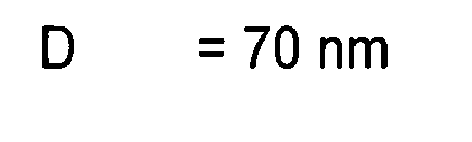
- A 2 I reactor with stirrer and reflux condenser was charged with 400 g of deionized water and 750 g of 14 % strength solution of styrene-maleic anhydride copolymer, this initial charge then being heated to 85 °C with stirring under a nitrogen atmosphere.
- Feed stream I:
- 390 g of methyl methacrylate
- Feed stream II:
- 2 g of ammonium peroxodisulfate
- 130 g of deionized water
- When an internal temperature of 85 °C had been reached, feed stream I and feed stream II were metered continuously into the polymerization batch via two separate feeds, beginning simultaneously, over a period of 3 h 30, with stirring and retention of the reaction temperature. The pumps were flushed with 318.2 g of deionized water. After that, the reaction mixture was cooled to room temperature and filtered on a filter having a mesh size of 160 µm.
- The characterization of the copolymer obtained, in terms of solids content (SC) and average particle size (D), is given below:


- A 2 I reactor with stirrer and reflux condenser was charged with 21.1 g of deionized water and 750 g of 25 % strength solution of styrene-acrylic acid copolymer, this initial charge then being heated to 85 °C with stirring under a nitrogen atmosphere.
- Feed stream I:
- 390 g of methyl methacrylate
- Feed stream II:
- 2 g of ammonium peroxodisulfate
- 130 g of deionized water
- When an internal temperature of 85 °C had been reached, feed stream I and feed stream II were metered continuously into the polymerization batch via two separate feeds, beginning simultaneously, over a period of 3 h 30, with stirring and retention of the reaction temperature. The pumps were flushed with 80 g of deionized water. After the end of both feed streams, the mixture was left to after react at the reaction temperature for a further 25 minutes. After that, the reaction mixture was cooled to room temperature and filtered on a filter having a mesh size of 160 µm.
- The characterization of the copolymer obtained, in terms of solids content (SC) and average particle size (D), is given below:


- A 2 I reactor with stirrer and reflux condenser was charged with 433 g of deionized water, and 3 grams of lauryl sulfate (30 % strength solution), this initial charge then being heated to 80 °C with stirring under a nitrogen atmosphere.
- Feed stream I:
- 5 g of ammonium peroxodisulfate
- 62 g of deionized water
- Feed stream II:
- 400 g of styrene,
- 260 g of butyl acrylate,
- 10 g of methacrylic acid,
- 11 g of surfactant solution (lauryl sulfate, 30 %),
- 384 g of deionized water
- When an internal temperature of 80 °C had been reached, feed stream I and feed stream II were metered continuously into the polymerization batch via two separate feeds, beginning simultaneously, over a period of 4 h, with stirring and retention of the reaction temperature. The pumps were flushed with 235 g of deionized water. After the end of both feed streams, the system was left to after react at the reaction temperature for a further 25 minutes. After that, the reaction mixture was cooled to room temperature and filtered on a filter having a mesh size of 160 µm.
- The characterization of the copolymer obtained, in terms of solids content (SC) and average particle size (D), is given below:


Claims (14)
- A method for inhibiting pitch deposition on pulping and papermaking equipment or machinery comprising adding to a pulp slurry containing pitch an effective amount of polymer dispersion comprising a component A and a component B, wherein component A being a homopolymer and/or copolymer of acrylic acid and/or its alkyl esters, or methacrylic acid and/or its alkyl esters, styrene and/or methylstyrene, vinyl acetate, itaconic acid, glycidyl methacrylate, 2-hydroxyalkyl (meth)acrylate, methacrylamide, N-hydroxyethyl(meth)acrylamide, dimethacrylate monomers, 1,3-butylene glycol dimethacrylate, ethylene glycol dimethacrylate, diethylene glycol dimethacrylate, propylene glycol dimethacrylate, dipropylene glycol dimethacrylate, 4-methyl-1,4-pentanediol dimethacrylate, divinylbenzene and/or trivinylbenzene, and component B being an aqueous solution of a styrene copolymer with acrylic acid, maleimide and/or maleic anhydride.
- The method as claimed in claim 1, wherein component A possesses a glass transition temperature > 90 °C.
- The method as claimed in at least one of the preceding claims, wherein component B possesses a molecular weight in the range from 3000 to 15 000 g/mol, preferably 3000 to 7000 g/mol.
- The method as claimed in at least one of the preceding claims, wherein the aqueous polymer dispersion is applied in combination with calcium and or magnesium salts, often naturally occurring in the processing water, or component C, a cationic fixative, any of which promote the coagulation of the aqueous emulsion particles.
- The method as claimed in claim 4, wherein component C is selected from the following group: polyethyleneimine (PEI), polydiallyldimethylammonium chloride (polyDADMAC), polyvinylamine (PVAm), polyaluminum chloride (PAC), zirconium salts, polyacrylamide (PAAM), polyamine and polyamideamine.
- The method as claimed in at least one of the preceding claims, wherein the aqueous polymer dispersion further comprises a component D in the form of a surfactant.
- The method as claimed in any of the preceding claims, wherein the water fraction of the aqueous polymer dispersion is 93 % to 17.7 %, preferably 80 % to 45 % by weight.
- An aqueous polymer dispersion for coagulating and detackifying pitch in the processing of wood pulp or during the papermaking procedure, comprising a component A selected from a homopolymer and/or copolymer of the following group: acrylic acid and/or its alkyl esters, or methacrylic acid and/or its alkyl esters, styrene and/or methylstyrene, vinyl acetate, itaconic acid, glycidyl methacrylate, 2-hydroxyalkyl (meth)acrylate, methacrylamide, N-hydroxyethyl(meth)acrylamide, dimethacrylate monomers, 1,3-butylene glycol dimethacrylate, ethylene glycol dimethacrylate, diethylene glycol dimethacrylate, propylene glycol dimethacrylate, dipropylene glycol dimethacrylate, 4-methyl-1,4-pentanediol dimethacrylate, divinylbenzene and/or trivinylbenzene, and component B, which is an aqueous solution of a styrene copolymer with acrylic acid, maleimide and/or maleic anhydride.
- The aqueous polymer dispersion as claimed in claim 8, wherein the dispersion is applied in combination with calcium and or magnesium salts, often naturally occurring in the processing water, or component C, a cationic fixative, selected from the following group: polyethyleneimine (PEI), polydiallyldimethylammonium chloride (polyDADMAC), polyvinylamine (PVAm), polyaluminum chloride (PAC), zirconium salts, polyacrylamide (PAAM), polyamine and polyamideamine.
- The aqueous polymer dispersion as claimed in claim 8 and/or 9, wherein the dispersion comprises a further component D in the form of a surfactant.
- The aqueous polymer dispersion as claimed in at least one of claims 8 to 10, which comprises
2 % to 50 %, preferably 5 % to 30 % of component A,
1 % to 30 %, preferably 3 % to 10 % of component B,
100 to 400 ppm calcium and/or magnesium carbonate (water hardness) 0 % to 2 % of component C,
0 % to 0.3 %, preferably 0 % to 0.2 % of component D, and
96 % to 17.7 %, preferably 90 % to 45 % of water (component E). - The use of an aqueous polymer dispersion comprising a component A and a component B, component A being a homopolymer and/or copolymer of methyl methacrylate, acrylate and/or styrene and component B being an aqueous solution of styrene copolymer with acrylic acid, maleimide and/or maleic anhydride, for coagulating and detackifying pitch particles in the processing of pulp and paper.
- The use as claimed in claim 12, the polymer dispersion is further combined with calcium and/or magnesium salts or the natural water hardness in the pulp and/or papermaking process water or component C, a cationic fixative.
- The use as claimed in claim 12, whereby the amount of aqueous dispersion applied to the cellulosic pulp slurry is preferably 0.05 to 0.5 %, more preferably 0.1 to 0.2 %, based on the dry weight of the cellulose.
Priority Applications (8)
| Application Number | Priority Date | Filing Date | Title |
|---|---|---|---|
| PL12001801T PL2639350T3 (en) | 2012-03-16 | 2012-03-16 | Method for reducing negative effects of natural pitch contaminants in both pulping and papermaking operations |
| PT120018015T PT2639350T (en) | 2012-03-16 | 2012-03-16 | Method for reducing negative effects of natural pitch contaminants in both pulping and papermaking operations |
| ES12001801.5T ES2625776T3 (en) | 2012-03-16 | 2012-03-16 | Procedure for reducing the negative effects of pollutants from natural resin lumps in pulp and papermaking operations |
| EP12001801.5A EP2639350B1 (en) | 2012-03-16 | 2012-03-16 | Method for reducing negative effects of natural pitch contaminants in both pulping and papermaking operations |
| CA2864955A CA2864955C (en) | 2012-03-16 | 2013-03-09 | Method for reducing negative effects of natural pitch contaminants in both pulping and papermaking operations |
| BR112014022440-4A BR112014022440B1 (en) | 2012-03-16 | 2013-03-09 | METHOD FOR THE INHIBITION OF NATURAL PICKS DEPOSITS IN PULP FORMING EQUIPMENT OR MACHINERY AND USE OF A WATER POLYMER DISPERSION |
| US14/384,747 US20150027652A1 (en) | 2012-03-16 | 2013-03-09 | Method for Reducing Negative Effects of Natural Pitch Contaminants in Both Pulping and Papermaking Operations |
| PCT/EP2013/000703 WO2013135362A1 (en) | 2012-03-16 | 2013-03-09 | Method for reducing negative effects of natural pitch contaminants in both pulping and papermaking operations |
Applications Claiming Priority (1)
| Application Number | Priority Date | Filing Date | Title |
|---|---|---|---|
| EP12001801.5A EP2639350B1 (en) | 2012-03-16 | 2012-03-16 | Method for reducing negative effects of natural pitch contaminants in both pulping and papermaking operations |
Publications (2)
| Publication Number | Publication Date |
|---|---|
| EP2639350A1 true EP2639350A1 (en) | 2013-09-18 |
| EP2639350B1 EP2639350B1 (en) | 2017-02-22 |
Family
ID=47844256
Family Applications (1)
| Application Number | Title | Priority Date | Filing Date |
|---|---|---|---|
| EP12001801.5A Active EP2639350B1 (en) | 2012-03-16 | 2012-03-16 | Method for reducing negative effects of natural pitch contaminants in both pulping and papermaking operations |
Country Status (8)
| Country | Link |
|---|---|
| US (1) | US20150027652A1 (en) |
| EP (1) | EP2639350B1 (en) |
| BR (1) | BR112014022440B1 (en) |
| CA (1) | CA2864955C (en) |
| ES (1) | ES2625776T3 (en) |
| PL (1) | PL2639350T3 (en) |
| PT (1) | PT2639350T (en) |
| WO (1) | WO2013135362A1 (en) |
Cited By (2)
| Publication number | Priority date | Publication date | Assignee | Title |
|---|---|---|---|---|
| WO2018141740A1 (en) | 2017-01-31 | 2018-08-09 | Archroma Ip Gmbh | Copolymer, aqueous solution comprising the copolymer and method for reducing negative effects of natural pitch and adhesive contaminants in both pulping and papermaking operations |
| US10829895B2 (en) * | 2016-01-14 | 2020-11-10 | Archroma Ip Gmbh | Use of an acrylate copolymer as retention aid in a method of making a substrate comprising cellulosic fibres |
Families Citing this family (2)
| Publication number | Priority date | Publication date | Assignee | Title |
|---|---|---|---|---|
| CN109679603B (en) * | 2018-11-30 | 2021-12-03 | 中国海洋石油集团有限公司 | Composite ionic polymer gel and preparation method thereof |
| CN113444373B (en) * | 2021-06-03 | 2023-01-24 | 李威风 | Composition for modifying asphalt, modified asphalt, method for producing same, and asphalt mixture |
Citations (7)
| Publication number | Priority date | Publication date | Assignee | Title |
|---|---|---|---|---|
| WO1998005819A1 (en) * | 1996-08-05 | 1998-02-12 | Ashland Inc. | Pitch control composition |
| US6150452A (en) * | 1997-06-06 | 2000-11-21 | Betzdearborn Inc. | Methods and compositions for treating stickies |
| WO2001025535A1 (en) * | 1999-10-05 | 2001-04-12 | Hercules Incorporated | Method for paper machine cleanliness |
| US20040226676A1 (en) * | 2003-05-13 | 2004-11-18 | Zhiqiang Song | Use of water-soluble crosslinked cationic polymers for controlling deposition of pitch and stickies in papermaking |
| US20060048908A1 (en) * | 2004-09-08 | 2006-03-09 | Enzymatic Deinking Technologies, Llc | System for control of stickies in recovered and virgin paper processing |
| WO2011015297A1 (en) * | 2009-08-03 | 2011-02-10 | Clariant International Ltd | Method for reducing negative effects of adhesive contaminants in systems of substances comprising waste paper |
| US20110094695A1 (en) * | 2009-10-27 | 2011-04-28 | Enzymatic Deinking Technologies, L.L.C. | Method of controlling organic contaminants in pulp and paper making processes |
-
2012
- 2012-03-16 PL PL12001801T patent/PL2639350T3/en unknown
- 2012-03-16 ES ES12001801.5T patent/ES2625776T3/en active Active
- 2012-03-16 PT PT120018015T patent/PT2639350T/en unknown
- 2012-03-16 EP EP12001801.5A patent/EP2639350B1/en active Active
-
2013
- 2013-03-09 CA CA2864955A patent/CA2864955C/en active Active
- 2013-03-09 WO PCT/EP2013/000703 patent/WO2013135362A1/en not_active Ceased
- 2013-03-09 US US14/384,747 patent/US20150027652A1/en not_active Abandoned
- 2013-03-09 BR BR112014022440-4A patent/BR112014022440B1/en active IP Right Grant
Patent Citations (7)
| Publication number | Priority date | Publication date | Assignee | Title |
|---|---|---|---|---|
| WO1998005819A1 (en) * | 1996-08-05 | 1998-02-12 | Ashland Inc. | Pitch control composition |
| US6150452A (en) * | 1997-06-06 | 2000-11-21 | Betzdearborn Inc. | Methods and compositions for treating stickies |
| WO2001025535A1 (en) * | 1999-10-05 | 2001-04-12 | Hercules Incorporated | Method for paper machine cleanliness |
| US20040226676A1 (en) * | 2003-05-13 | 2004-11-18 | Zhiqiang Song | Use of water-soluble crosslinked cationic polymers for controlling deposition of pitch and stickies in papermaking |
| US20060048908A1 (en) * | 2004-09-08 | 2006-03-09 | Enzymatic Deinking Technologies, Llc | System for control of stickies in recovered and virgin paper processing |
| WO2011015297A1 (en) * | 2009-08-03 | 2011-02-10 | Clariant International Ltd | Method for reducing negative effects of adhesive contaminants in systems of substances comprising waste paper |
| US20110094695A1 (en) * | 2009-10-27 | 2011-04-28 | Enzymatic Deinking Technologies, L.L.C. | Method of controlling organic contaminants in pulp and paper making processes |
Cited By (4)
| Publication number | Priority date | Publication date | Assignee | Title |
|---|---|---|---|---|
| US10829895B2 (en) * | 2016-01-14 | 2020-11-10 | Archroma Ip Gmbh | Use of an acrylate copolymer as retention aid in a method of making a substrate comprising cellulosic fibres |
| WO2018141740A1 (en) | 2017-01-31 | 2018-08-09 | Archroma Ip Gmbh | Copolymer, aqueous solution comprising the copolymer and method for reducing negative effects of natural pitch and adhesive contaminants in both pulping and papermaking operations |
| EP3865523A1 (en) | 2017-01-31 | 2021-08-18 | Archroma IP GmbH | Copolymer, aqueous solution comprising the copolymer and method for reducing negative effects of natural pitch and adhesive contaminants in both pulping and papermaking operations |
| US11274397B2 (en) | 2017-01-31 | 2022-03-15 | Archroma Ip Gmbh | Copolymer, aqueous solution comprising the copolymer and method for reducing negative effects of natural pitch and adhesive contaminants in both pulping and papermaking operations |
Also Published As
| Publication number | Publication date |
|---|---|
| WO2013135362A1 (en) | 2013-09-19 |
| EP2639350B1 (en) | 2017-02-22 |
| PL2639350T3 (en) | 2017-10-31 |
| BR112014022440B1 (en) | 2021-04-27 |
| CA2864955A1 (en) | 2013-09-19 |
| ES2625776T3 (en) | 2017-07-20 |
| CA2864955C (en) | 2019-12-24 |
| US20150027652A1 (en) | 2015-01-29 |
| PT2639350T (en) | 2017-05-26 |
Similar Documents
| Publication | Publication Date | Title |
|---|---|---|
| US9057155B2 (en) | Method for reducing negative effects of adhesive contaminants in systems of substances comprising waste paper | |
| KR102864342B1 (en) | Method for producing paper or board, and paper or board obtained by the method, and use of cationic emulsion polymer in the production of paper or board | |
| US6033524A (en) | Selective retention of filling components and improved control of sheet properties by enhancing additive pretreatment | |
| EP2639350B1 (en) | Method for reducing negative effects of natural pitch contaminants in both pulping and papermaking operations | |
| WO1998046828A1 (en) | Method for producing paper, pulpboard and cardboard | |
| KR20250130618A (en) | Water-soluble amphoteric emulsion terpolymer, method for preparing the same, and method for using the same as a maintenance and dehydration aid | |
| EP3332063B1 (en) | Method for producing paper | |
| RU2309210C2 (en) | Method for processing of white resin sediments | |
| KR20190110093A (en) | Copolymers, aqueous solutions comprising such copolymers, and methods for reducing the negative effects of natural pitch and adhesive contaminants in both pulping and papermaking operations | |
| KR100580306B1 (en) | Pretreatment with enhancer to selectively hold filler components and improve paper property control | |
| JP2004244766A (en) | Papermaking raw material composition with improved retention | |
| WO1996016224A1 (en) | Processes for reducing contamination of cellulosic liquors | |
| KR101541385B1 (en) | Method for producing paper or the like | |
| CN107190562B (en) | Method for producing paper | |
| TW568975B (en) | Method for increasing retention and drainage of filling components in a paper making furnish in paper making process | |
| NZ505246A (en) | Method of increasing retention and drainage of filling components in paper making furnish by enhancing additive pretreatment |
Legal Events
| Date | Code | Title | Description |
|---|---|---|---|
| PUAI | Public reference made under article 153(3) epc to a published international application that has entered the european phase |
Free format text: ORIGINAL CODE: 0009012 |
|
| AK | Designated contracting states |
Kind code of ref document: A1 Designated state(s): AL AT BE BG CH CY CZ DE DK EE ES FI FR GB GR HR HU IE IS IT LI LT LU LV MC MK MT NL NO PL PT RO RS SE SI SK SM TR |
|
| AX | Request for extension of the european patent |
Extension state: BA ME |
|
| 17P | Request for examination filed |
Effective date: 20140318 |
|
| RBV | Designated contracting states (corrected) |
Designated state(s): AL AT BE BG CH CY CZ DE DK EE ES FI FR GB GR HR HU IE IS IT LI LT LU LV MC MK MT NL NO PL PT RO RS SE SI SK SM TR |
|
| 17Q | First examination report despatched |
Effective date: 20140513 |
|
| RAP1 | Party data changed (applicant data changed or rights of an application transferred) |
Owner name: ARCHROMA IP GMBH |
|
| REG | Reference to a national code |
Ref country code: DE Ref legal event code: R079 Ref document number: 602012028850 Country of ref document: DE Free format text: PREVIOUS MAIN CLASS: D21C0009080000 Ipc: D21H0021020000 |
|
| RIC1 | Information provided on ipc code assigned before grant |
Ipc: D21H 17/35 20060101ALN20160630BHEP Ipc: D21H 17/37 20060101ALN20160630BHEP Ipc: D21H 21/02 20060101AFI20160630BHEP Ipc: D21H 17/36 20060101ALN20160630BHEP Ipc: D21C 9/08 20060101ALI20160630BHEP |
|
| RIC1 | Information provided on ipc code assigned before grant |
Ipc: D21H 21/02 20060101AFI20160708BHEP Ipc: D21H 17/36 20060101ALN20160708BHEP Ipc: D21H 17/35 20060101ALN20160708BHEP Ipc: D21C 9/08 20060101ALI20160708BHEP Ipc: D21H 17/37 20060101ALN20160708BHEP |
|
| RIC1 | Information provided on ipc code assigned before grant |
Ipc: D21C 9/08 20060101ALI20160729BHEP Ipc: D21H 17/36 20060101ALN20160729BHEP Ipc: D21H 21/02 20060101AFI20160729BHEP Ipc: D21H 17/35 20060101ALN20160729BHEP Ipc: D21H 17/37 20060101ALN20160729BHEP |
|
| GRAP | Despatch of communication of intention to grant a patent |
Free format text: ORIGINAL CODE: EPIDOSNIGR1 |
|
| INTG | Intention to grant announced |
Effective date: 20160913 |
|
| STAA | Information on the status of an ep patent application or granted ep patent |
Free format text: STATUS: GRANT OF PATENT IS INTENDED |
|
| GRAS | Grant fee paid |
Free format text: ORIGINAL CODE: EPIDOSNIGR3 |
|
| GRAA | (expected) grant |
Free format text: ORIGINAL CODE: 0009210 |
|
| STAA | Information on the status of an ep patent application or granted ep patent |
Free format text: STATUS: THE PATENT HAS BEEN GRANTED |
|
| AK | Designated contracting states |
Kind code of ref document: B1 Designated state(s): AL AT BE BG CH CY CZ DE DK EE ES FI FR GB GR HR HU IE IS IT LI LT LU LV MC MK MT NL NO PL PT RO RS SE SI SK SM TR |
|
| REG | Reference to a national code |
Ref country code: GB Ref legal event code: FG4D |
|
| REG | Reference to a national code |
Ref country code: CH Ref legal event code: EP |
|
| REG | Reference to a national code |
Ref country code: AT Ref legal event code: REF Ref document number: 869389 Country of ref document: AT Kind code of ref document: T Effective date: 20170315 |
|
| REG | Reference to a national code |
Ref country code: IE Ref legal event code: FG4D |
|
| REG | Reference to a national code |
Ref country code: DE Ref legal event code: R096 Ref document number: 602012028850 Country of ref document: DE |
|
| REG | Reference to a national code |
Ref country code: FR Ref legal event code: PLFP Year of fee payment: 6 |
|
| REG | Reference to a national code |
Ref country code: PT Ref legal event code: SC4A Ref document number: 2639350 Country of ref document: PT Date of ref document: 20170526 Kind code of ref document: T Free format text: AVAILABILITY OF NATIONAL TRANSLATION Effective date: 20170517 |
|
| REG | Reference to a national code |
Ref country code: SE Ref legal event code: TRGR |
|
| REG | Reference to a national code |
Ref country code: LT Ref legal event code: MG4D |
|
| REG | Reference to a national code |
Ref country code: NL Ref legal event code: MP Effective date: 20170222 |
|
| REG | Reference to a national code |
Ref country code: ES Ref legal event code: FG2A Ref document number: 2625776 Country of ref document: ES Kind code of ref document: T3 Effective date: 20170720 |
|
| PG25 | Lapsed in a contracting state [announced via postgrant information from national office to epo] |
Ref country code: LT Free format text: LAPSE BECAUSE OF FAILURE TO SUBMIT A TRANSLATION OF THE DESCRIPTION OR TO PAY THE FEE WITHIN THE PRESCRIBED TIME-LIMIT Effective date: 20170222 Ref country code: NO Free format text: LAPSE BECAUSE OF FAILURE TO SUBMIT A TRANSLATION OF THE DESCRIPTION OR TO PAY THE FEE WITHIN THE PRESCRIBED TIME-LIMIT Effective date: 20170522 Ref country code: GR Free format text: LAPSE BECAUSE OF FAILURE TO SUBMIT A TRANSLATION OF THE DESCRIPTION OR TO PAY THE FEE WITHIN THE PRESCRIBED TIME-LIMIT Effective date: 20170523 Ref country code: HR Free format text: LAPSE BECAUSE OF FAILURE TO SUBMIT A TRANSLATION OF THE DESCRIPTION OR TO PAY THE FEE WITHIN THE PRESCRIBED TIME-LIMIT Effective date: 20170222 |
|
| PGFP | Annual fee paid to national office [announced via postgrant information from national office to epo] |
Ref country code: CH Payment date: 20170428 Year of fee payment: 6 |
|
| PG25 | Lapsed in a contracting state [announced via postgrant information from national office to epo] |
Ref country code: RS Free format text: LAPSE BECAUSE OF FAILURE TO SUBMIT A TRANSLATION OF THE DESCRIPTION OR TO PAY THE FEE WITHIN THE PRESCRIBED TIME-LIMIT Effective date: 20170222 Ref country code: NL Free format text: LAPSE BECAUSE OF FAILURE TO SUBMIT A TRANSLATION OF THE DESCRIPTION OR TO PAY THE FEE WITHIN THE PRESCRIBED TIME-LIMIT Effective date: 20170222 Ref country code: LV Free format text: LAPSE BECAUSE OF FAILURE TO SUBMIT A TRANSLATION OF THE DESCRIPTION OR TO PAY THE FEE WITHIN THE PRESCRIBED TIME-LIMIT Effective date: 20170222 Ref country code: BG Free format text: LAPSE BECAUSE OF FAILURE TO SUBMIT A TRANSLATION OF THE DESCRIPTION OR TO PAY THE FEE WITHIN THE PRESCRIBED TIME-LIMIT Effective date: 20170522 |
|
| PG25 | Lapsed in a contracting state [announced via postgrant information from national office to epo] |
Ref country code: CZ Free format text: LAPSE BECAUSE OF FAILURE TO SUBMIT A TRANSLATION OF THE DESCRIPTION OR TO PAY THE FEE WITHIN THE PRESCRIBED TIME-LIMIT Effective date: 20170222 Ref country code: EE Free format text: LAPSE BECAUSE OF FAILURE TO SUBMIT A TRANSLATION OF THE DESCRIPTION OR TO PAY THE FEE WITHIN THE PRESCRIBED TIME-LIMIT Effective date: 20170222 Ref country code: RO Free format text: LAPSE BECAUSE OF FAILURE TO SUBMIT A TRANSLATION OF THE DESCRIPTION OR TO PAY THE FEE WITHIN THE PRESCRIBED TIME-LIMIT Effective date: 20170222 Ref country code: SK Free format text: LAPSE BECAUSE OF FAILURE TO SUBMIT A TRANSLATION OF THE DESCRIPTION OR TO PAY THE FEE WITHIN THE PRESCRIBED TIME-LIMIT Effective date: 20170222 |
|
| REG | Reference to a national code |
Ref country code: DE Ref legal event code: R097 Ref document number: 602012028850 Country of ref document: DE |
|
| PG25 | Lapsed in a contracting state [announced via postgrant information from national office to epo] |
Ref country code: SM Free format text: LAPSE BECAUSE OF FAILURE TO SUBMIT A TRANSLATION OF THE DESCRIPTION OR TO PAY THE FEE WITHIN THE PRESCRIBED TIME-LIMIT Effective date: 20170222 Ref country code: DK Free format text: LAPSE BECAUSE OF FAILURE TO SUBMIT A TRANSLATION OF THE DESCRIPTION OR TO PAY THE FEE WITHIN THE PRESCRIBED TIME-LIMIT Effective date: 20170222 Ref country code: MC Free format text: LAPSE BECAUSE OF FAILURE TO SUBMIT A TRANSLATION OF THE DESCRIPTION OR TO PAY THE FEE WITHIN THE PRESCRIBED TIME-LIMIT Effective date: 20170222 |
|
| REG | Reference to a national code |
Ref country code: IE Ref legal event code: MM4A |
|
| PLBE | No opposition filed within time limit |
Free format text: ORIGINAL CODE: 0009261 |
|
| STAA | Information on the status of an ep patent application or granted ep patent |
Free format text: STATUS: NO OPPOSITION FILED WITHIN TIME LIMIT |
|
| 26N | No opposition filed |
Effective date: 20171123 |
|
| PG25 | Lapsed in a contracting state [announced via postgrant information from national office to epo] |
Ref country code: LU Free format text: LAPSE BECAUSE OF NON-PAYMENT OF DUE FEES Effective date: 20170316 |
|
| PG25 | Lapsed in a contracting state [announced via postgrant information from national office to epo] |
Ref country code: IE Free format text: LAPSE BECAUSE OF NON-PAYMENT OF DUE FEES Effective date: 20170316 Ref country code: SI Free format text: LAPSE BECAUSE OF FAILURE TO SUBMIT A TRANSLATION OF THE DESCRIPTION OR TO PAY THE FEE WITHIN THE PRESCRIBED TIME-LIMIT Effective date: 20170222 |
|
| REG | Reference to a national code |
Ref country code: BE Ref legal event code: MM Effective date: 20170331 |
|
| REG | Reference to a national code |
Ref country code: FR Ref legal event code: PLFP Year of fee payment: 7 |
|
| PG25 | Lapsed in a contracting state [announced via postgrant information from national office to epo] |
Ref country code: BE Free format text: LAPSE BECAUSE OF NON-PAYMENT OF DUE FEES Effective date: 20170331 |
|
| PG25 | Lapsed in a contracting state [announced via postgrant information from national office to epo] |
Ref country code: MT Free format text: LAPSE BECAUSE OF NON-PAYMENT OF DUE FEES Effective date: 20170316 |
|
| REG | Reference to a national code |
Ref country code: CH Ref legal event code: PL |
|
| PG25 | Lapsed in a contracting state [announced via postgrant information from national office to epo] |
Ref country code: LI Free format text: LAPSE BECAUSE OF NON-PAYMENT OF DUE FEES Effective date: 20180331 Ref country code: CH Free format text: LAPSE BECAUSE OF NON-PAYMENT OF DUE FEES Effective date: 20180331 |
|
| REG | Reference to a national code |
Ref country code: AT Ref legal event code: UEP Ref document number: 869389 Country of ref document: AT Kind code of ref document: T Effective date: 20170222 |
|
| PG25 | Lapsed in a contracting state [announced via postgrant information from national office to epo] |
Ref country code: HU Free format text: LAPSE BECAUSE OF FAILURE TO SUBMIT A TRANSLATION OF THE DESCRIPTION OR TO PAY THE FEE WITHIN THE PRESCRIBED TIME-LIMIT; INVALID AB INITIO Effective date: 20120316 |
|
| PG25 | Lapsed in a contracting state [announced via postgrant information from national office to epo] |
Ref country code: CY Free format text: LAPSE BECAUSE OF NON-PAYMENT OF DUE FEES Effective date: 20170222 |
|
| PG25 | Lapsed in a contracting state [announced via postgrant information from national office to epo] |
Ref country code: MK Free format text: LAPSE BECAUSE OF FAILURE TO SUBMIT A TRANSLATION OF THE DESCRIPTION OR TO PAY THE FEE WITHIN THE PRESCRIBED TIME-LIMIT Effective date: 20170222 |
|
| PG25 | Lapsed in a contracting state [announced via postgrant information from national office to epo] |
Ref country code: TR Free format text: LAPSE BECAUSE OF FAILURE TO SUBMIT A TRANSLATION OF THE DESCRIPTION OR TO PAY THE FEE WITHIN THE PRESCRIBED TIME-LIMIT Effective date: 20170222 |
|
| PG25 | Lapsed in a contracting state [announced via postgrant information from national office to epo] |
Ref country code: AL Free format text: LAPSE BECAUSE OF FAILURE TO SUBMIT A TRANSLATION OF THE DESCRIPTION OR TO PAY THE FEE WITHIN THE PRESCRIBED TIME-LIMIT Effective date: 20170222 Ref country code: IS Free format text: LAPSE BECAUSE OF FAILURE TO SUBMIT A TRANSLATION OF THE DESCRIPTION OR TO PAY THE FEE WITHIN THE PRESCRIBED TIME-LIMIT Effective date: 20170622 |
|
| PGFP | Annual fee paid to national office [announced via postgrant information from national office to epo] |
Ref country code: ES Payment date: 20250423 Year of fee payment: 14 |
|
| PGFP | Annual fee paid to national office [announced via postgrant information from national office to epo] |
Ref country code: SE Payment date: 20260323 Year of fee payment: 15 |
|
| PGFP | Annual fee paid to national office [announced via postgrant information from national office to epo] |
Ref country code: GB Payment date: 20260319 Year of fee payment: 15 |
|
| PGFP | Annual fee paid to national office [announced via postgrant information from national office to epo] |
Ref country code: DE Payment date: 20260320 Year of fee payment: 15 |
|
| PGFP | Annual fee paid to national office [announced via postgrant information from national office to epo] |
Ref country code: AT Payment date: 20260318 Year of fee payment: 15 |
|
| PGFP | Annual fee paid to national office [announced via postgrant information from national office to epo] |
Ref country code: FI Payment date: 20260323 Year of fee payment: 15 Ref country code: IT Payment date: 20260320 Year of fee payment: 15 |
|
| PGFP | Annual fee paid to national office [announced via postgrant information from national office to epo] |
Ref country code: FR Payment date: 20260323 Year of fee payment: 15 |
|
| PGFP | Annual fee paid to national office [announced via postgrant information from national office to epo] |
Ref country code: PT Payment date: 20260224 Year of fee payment: 15 |
|
| PGFP | Annual fee paid to national office [announced via postgrant information from national office to epo] |
Ref country code: PL Payment date: 20260223 Year of fee payment: 15 |