EP2639085A1 - Verfahren zum Verankern eines Containers für temperatursensible Elektronik im Laufstreifen eines Fahrzeugreifens - Google Patents
Verfahren zum Verankern eines Containers für temperatursensible Elektronik im Laufstreifen eines Fahrzeugreifens Download PDFInfo
- Publication number
- EP2639085A1 EP2639085A1 EP13154878.6A EP13154878A EP2639085A1 EP 2639085 A1 EP2639085 A1 EP 2639085A1 EP 13154878 A EP13154878 A EP 13154878A EP 2639085 A1 EP2639085 A1 EP 2639085A1
- Authority
- EP
- European Patent Office
- Prior art keywords
- container
- tread
- adhesive system
- lid
- adhesive
- Prior art date
- Legal status (The legal status is an assumption and is not a legal conclusion. Google has not performed a legal analysis and makes no representation as to the accuracy of the status listed.)
- Granted
Links
- 238000000034 method Methods 0.000 title claims abstract description 24
- 238000004873 anchoring Methods 0.000 title claims description 4
- 239000000853 adhesive Substances 0.000 claims abstract description 28
- 230000001070 adhesive effect Effects 0.000 claims abstract description 28
- 239000000463 material Substances 0.000 claims abstract description 9
- 230000000295 complement effect Effects 0.000 claims abstract description 4
- 238000010438 heat treatment Methods 0.000 claims description 5
- 239000011248 coating agent Substances 0.000 claims description 4
- 238000000576 coating method Methods 0.000 claims description 4
- 238000003825 pressing Methods 0.000 claims description 3
- 238000001035 drying Methods 0.000 claims description 2
- 230000006698 induction Effects 0.000 claims description 2
- XLYOFNOQVPJJNP-UHFFFAOYSA-N water Substances O XLYOFNOQVPJJNP-UHFFFAOYSA-N 0.000 claims 1
- 238000001514 detection method Methods 0.000 abstract description 5
- 238000010030 laminating Methods 0.000 abstract 1
- 230000005540 biological transmission Effects 0.000 description 3
- 238000003860 storage Methods 0.000 description 3
- 230000003213 activating effect Effects 0.000 description 2
- 238000007598 dipping method Methods 0.000 description 2
- 230000010354 integration Effects 0.000 description 2
- 230000000694 effects Effects 0.000 description 1
- 239000013536 elastomeric material Substances 0.000 description 1
- 238000005516 engineering process Methods 0.000 description 1
- 238000009776 industrial production Methods 0.000 description 1
- 239000004615 ingredient Substances 0.000 description 1
- 238000003780 insertion Methods 0.000 description 1
- 230000037431 insertion Effects 0.000 description 1
- 239000007788 liquid Substances 0.000 description 1
- 238000005259 measurement Methods 0.000 description 1
- 239000002184 metal Substances 0.000 description 1
- 239000004033 plastic Substances 0.000 description 1
- 238000005096 rolling process Methods 0.000 description 1
- 239000002356 single layer Substances 0.000 description 1
- 238000005507 spraying Methods 0.000 description 1
- 239000000126 substance Substances 0.000 description 1
- 238000004073 vulcanization Methods 0.000 description 1
Images
Classifications
-
- B—PERFORMING OPERATIONS; TRANSPORTING
- B29—WORKING OF PLASTICS; WORKING OF SUBSTANCES IN A PLASTIC STATE IN GENERAL
- B29D—PRODUCING PARTICULAR ARTICLES FROM PLASTICS OR FROM SUBSTANCES IN A PLASTIC STATE
- B29D30/00—Producing pneumatic or solid tyres or parts thereof
- B29D30/0061—Accessories, details or auxiliary operations not otherwise provided for
-
- B—PERFORMING OPERATIONS; TRANSPORTING
- B60—VEHICLES IN GENERAL
- B60C—VEHICLE TYRES; TYRE INFLATION; TYRE CHANGING; CONNECTING VALVES TO INFLATABLE ELASTIC BODIES IN GENERAL; DEVICES OR ARRANGEMENTS RELATED TO TYRES
- B60C23/00—Devices for measuring, signalling, controlling, or distributing tyre pressure or temperature, specially adapted for mounting on vehicles; Arrangement of tyre inflating devices on vehicles, e.g. of pumps or of tanks; Tyre cooling arrangements
- B60C23/02—Signalling devices actuated by tyre pressure
- B60C23/04—Signalling devices actuated by tyre pressure mounted on the wheel or tyre
- B60C23/0491—Constructional details of means for attaching the control device
- B60C23/0493—Constructional details of means for attaching the control device for attachment on the tyre
-
- B—PERFORMING OPERATIONS; TRANSPORTING
- B29—WORKING OF PLASTICS; WORKING OF SUBSTANCES IN A PLASTIC STATE IN GENERAL
- B29D—PRODUCING PARTICULAR ARTICLES FROM PLASTICS OR FROM SUBSTANCES IN A PLASTIC STATE
- B29D30/00—Producing pneumatic or solid tyres or parts thereof
- B29D30/0061—Accessories, details or auxiliary operations not otherwise provided for
- B29D2030/0083—Attaching monitoring devices to tyres before or after vulcanization by inserting them inside tyre cavities
-
- B—PERFORMING OPERATIONS; TRANSPORTING
- B60—VEHICLES IN GENERAL
- B60C—VEHICLE TYRES; TYRE INFLATION; TYRE CHANGING; CONNECTING VALVES TO INFLATABLE ELASTIC BODIES IN GENERAL; DEVICES OR ARRANGEMENTS RELATED TO TYRES
- B60C11/00—Tyre tread bands; Tread patterns; Anti-skid inserts
- B60C11/14—Anti-skid inserts, e.g. vulcanised into the tread band
- B60C11/16—Anti-skid inserts, e.g. vulcanised into the tread band of plug form, e.g. made from metal, textile
Definitions
- the invention relates to a method for anchoring a container in a tread of a vehicle tire.
- the invention further relates to the container and a vehicle tire provided with this container.
- Tire tires with components for a tire condition quantity detection, which are incorporated in the tread of this pneumatic vehicle tire are, for example, from DE 10 2004 044 954 A1 known.
- the components for the state quantity detection and their storage and / or transmission are housed in a container which is arranged in the middle of a profile element of the tread and is completely enclosed by rubber material of the tread.
- the problem is the durable introduction of this container in the tread to safely position the container in the tread during operation of the vehicle tire. It is necessary that temperature-sensitive components for the tire condition size detection and / or components for the transmission and / or storage of these data are not damaged by excessive temperatures during this insertion and integration of the container in the tread.
- temperatures of 170 ° to 220 ° C are reached. These temperatures damage temperature-sensitive electronics.
- the invention is therefore an object of the invention to provide a method which allows a largely load-resistant integration of a container in the tread, so that the risk of container loss under high Loads is minimized.
- it should enable the invention to accommodate temperature-sensitive components for tire condition size detection, transmission and / or storage in the container.
- the container is a closable container with a lid
- the container includes temperature-sensitive electronics for detecting tire condition sizes and by coating the container with an adhesive system prior to introduction into the tread of the already vulkaninstrumenten tire and pressing the Adding rubber material in an existing, approximately complementary recess to the container and then by heat the adhesive system of the arranged in the recesses container, preferably up to 120 ° C activated so that an adhesive connection of the container with the rubber material of the tread is made.
- a closable container is used, which is fitted with the electronics inserted into an existing recess of the already heat-pressed tire.
- its adhesive system is activated at low temperatures.
- the temperature necessary for activating the adhesive system is preferably at a maximum of 120 ° C. and is harmless for the temperature-sensitive electronics.
- the container is chemically and physically integrated into the tread and is able to withstand even high external loads.
- the invention also enables subsequent and optional loading of the tire with a container.
- the container has a lid and is thus resealable to remove or replace the electronics or parts of these from the container.
- the container is coated in a dipping process with the adhesive system.
- the adhesive system it is possible to proceed in such a way that the container is immersed in a primer, subsequently dried, then dipped into the adhesive system and finally dried.
- the liquid (s) intended for coating can also be applied by means of a spraying process.
- a drying process involves heat, for example, warm air.
- the adhesive system on the container is activated by contact heating.
- the heat is transferred from the outside to the tire. This is possible, for example, by rolling the tire on a suitably heated surface.
- Another advantageous way to activate the container's adhesive system is by induction heating the container. This method is suitable for Caontainer with a metallic body.
- the invention further relates to the container container and lid for use in an aforementioned method, wherein the lid closes the container form-fitting or frictionally preferably resealable. It is important that the seal achieved is moisture-proof, so that the electronics are protected from moisture.
- the container consists for example of metal or plastic or hard elastomeric material.
- the lid is a rubber lid, wherein the lid is designed such that it is used as a container lid in the tread, the tread radially outwardly completely and closes flush with the surface of the tread.
- the connection to the tread rubber is good and easy to reach.
- a rubber drop is to be arranged on the outer surface of a lid, which is designed such that it is inserted into the tread, the tread radially outwardly completely and flush with the surface of the tread.
- the rubber drop can optionally be permanently bonded in a further step by means of cold vulcanization technology.
- the invention further relates to a pneumatic vehicle tire with a container which is anchored in the tread according to the aforementioned method according to the invention and / or designed according to an aforementioned embodiment.
- the invention further relates to the use of a spike body as a container. This makes it possible to determine spikerelevante measurement data.
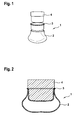
- the Fig. 1 shows a three-dimensional view of a container 1 according to the invention, whose components are not yet assembled.
- the ingredients are the container 2, which is to be sealed moisture-tight with a lid 3 and a rubber drop 4, which is to be inserted on the outside of the lid 3.
- the container 1 serves to receive temperature-sensitive electronics and to be anchored in a tread 5 of an already vulcanized vehicle tire. With the electronics, tire condition variables can be captured and transmitted and / or stored.
- tire condition variables can be captured and transmitted and / or stored.
- the adhesive system of the container 2 arranged in the recesses is activated by heat up to a maximum of 120 ° C., so that an adhesive connection of the container 2 with the rubber material of the tread 5
- the Fig. 2 shows a longitudinal section through the container 1 used in the tread 5 of Fig. 1 ,
- the rubber drop 4 closes the recess in the tread 5 such that it is flush with the surface 6 of the tread 5 and that it is moisture-tight.
Landscapes
- Engineering & Computer Science (AREA)
- Mechanical Engineering (AREA)
- Tires In General (AREA)
- Tyre Moulding (AREA)
Abstract
Description
- Die Erfindung betrifft ein Verfahren zum Verankern eines Containers in einem Laufstreifen eines Fahrzeugreifens. Die Erfindung betrifft ferner den Container und einen mit diesem Container versehenen Fahrzeugreifen.
- Fahrzeugreifen mit Komponenten für eine Reifenzustandsgrößenerfassung, welche in den Laufstreifen dieses Fahrzeugluftreifens eingebracht sind, sind beispielsweise aus der
DE 10 2004 044 954 A1 bekannt. Die Komponenten für die Zustandsgrößenerfassung und deren Speicherung und/ oder Übertragung sind in einem Container untergebracht, welcher inmitten eines Profilelementes des Laufstreifens angeordnet und vollständig von Gummimaterial des Laufstreifens umschlossen ist. - Problematisch ist das haltbare Einbringen dieses Containers in den Laufstreifen, um den Container auch im Betrieb des Fahrzeugreifens sicher im Laufstreifen zu positionieren. Dabei ist es erforderlich, dass temperatursensible Komponenten für die Reifenzustandsgrößenerfassung und/ oder Komponenten für die Übermittlung und/ oder Speicherung dieser Daten nicht durch zu hohe Temperaturen während dieses Einbringens und Einbindens des Containers in den Laufstreifen beschädigt werden. Beim Vulkanisieren eines Reifenrohlings zu einem betriebsbereiten Reifen werden Temperaturen von 170° bis 220°C erreicht. Diese Temperaturen schädigen temperatursensible Elektronik.
- Der Erfindung liegt somit die Aufgabe zugrunde, ein Verfahren zur Verfügung zu stellen, welches eine weitgehend belastungsresistente Einbindung eines Containers in den Laufstreifen ermöglicht, so dass die Gefahr eines Containerverlustes unter hohen Belastungen minimiert ist. Darüber hinaus soll es die Erfindung ermöglichen, temperatursensible Komponenten für die Reifenzustandsgrößenerfassung, -übertragung und/oder -speicherung im Container unterbringen zu können.
- Gelöst wird die gestellte Aufgabe, indem der Container ein mit einem Deckel verschließbarer Behälter ist, wobei der Container temperatursensible Elektronik zur Erfassung von Reifenzustandsgrößen beinhaltet und indem man den Behälter vor dem Einbringen in den Laufstreifen des bereits vulkanisierten Reifens mit einem Haftsystem beschichtet und unter Pressung des Gummimaterials in eine vorhandene, dem Behälter in etwa komplementäre Aussparung einbringt und indem man anschließend das Haftsystem des in der Aussparungen angeordneten Behälters durch Wärme, vorzugsweise bis maximal 120°C aktiviert, so dass eine Haftverbindung des Behälters mit dem Gummimaterial des Laufstreifens hergestellt wird.
- Beim erfindungsgemäßen Verfahren wird ein verschließbarer Container verwendet, der mit der Elektronik bestückt in eine bereits vorhandene Aussparung des bereits heizgepressten Reifens eingesetzt wird. In einem weiteren Schritt wird dessen Haftsystem unter geringen Temperaturen aktiviert. Die zur Aktivierung des Haftsystems notwendige Temperatur liegt vorzugsweise bei maximal 120°C und ist für die temperatursensible Elektronik unschädlich. Der Container wird chemisch und physikalisch in den Laufstreifen eingebunden und ist in der Lage, auch hohen äußeren Belastungen standzuhalten. Die Erfindung ermöglicht außerdem eine nachträgliche und optionale Bestückung des Reifens mit einem Container. Der Container weist einen Deckel auf und ist damit wiederverschließbar, um die Elektronik oder Teile dieser aus dem Container entnehmen oder austauschen zu können.
- In einer bevorzugten Ausführungsform der Erfindung wird der Container in einem Tauchverfahren mit dem Haftsystem beschichtet. Dabei kann derart vorgegangen werden, dass der Container in einen Primer getaucht, anschließend zwischengetrocknet, dann in das Haftsystem getaucht und schließlich getrocknet wird. Alternativ kann auch ein einschichtig aufzubringendes Haftsystem verwendet werden, in diesem Fall ist nur ein Tauchbad erforderlich. Im Rahmen eines Tauchverfahrens ist es ferner möglich, den Container komplett zu beschichten oder lediglich Teilbereiche des Containers zu beschichten.
- Die zur Beschichtung vorgesehene(n) Flüssigkeit(en) kann bzw. können auch mittels eines Sprühverfahrens aufgebracht werden. Auch in diesem Fall schließt ein Trocknungsvorgang unter Zufuhr von Wärme, beispielsweise warmer Luft, an.
- Um die chemische Haftung des in den Laufstreifen eingebrachten und mit dem Haftsystem beschichteten Containers durch Ausheizen bzw. Aktivieren des Haftsystems zu bewirken, sind verschiedene vorteilhafte und in der industriellen Fertigung von Reifen rationell einsetzbare Verfahren möglich.
- Bei einem dieser Verfahren wird das Haftsystem auf dem Container durch Kontaktheizen aktiviert. Die Wärme wird von außen auf den Reifen übertragen. Möglich ist dies beispielsweise durch ein Abrollen des Reifens auf einem entsprechend erhitzten Untergrund.
- Eine weitere, vorteilhafte Möglichkeit, das Haftsystem des Containers zu aktivieren, ist durch Induktionsheizen des Containers. Dieses Verfahren eignet sich für Caontainer mit einem metallischen Körper.
- Die Erfindung betrifft ferner den Container aus Behälter und Deckel zur Verwendung in einem vorgenannten Verfahren, wobei der Deckel den Behälter formschlüssig oder reibschlüssig vorzugsweise wiederverschließbar verschließt. Dabei ist es wichtig, dass der erreichte Verschluss feuchtigkeitsdicht ist, so dass die Elektronik vor Feuchtigkeit geschützt ist.
- Der Container besteht beispielsweise aus Metall oder Kunststoff oder hartem Elastomermaterial.
- Vorteilhafterweise ist der Deckel ein Gummideckel, wobei der Deckel derart gestaltet ist, dass dieser als Behälterdeckel in den Laufstreifen eingesetzt, den Laufstreifen nach radial außen vollständig und mit der Oberfläche des Laufstreifens fluchtend verschließt. Die Anbindung an das Laufstreifengummi ist gut und einfach zu erreichen.
- Alternativ zum Gummideckel ist an der äußeren Oberfläche eines Deckels ein Gummipropfen anzuordnen, der derart gestaltet ist, dass dieser in den Laufstreifen eingesetzt, den Laufstreifen nach radial außen vollständig und mit der Oberfläche des Laufstreifens fluchtend verschließt. Der Gummipropfen ist optional in einem weiteren Schritt mittels Kaltvulkanisationstechnik dauerhaft anzubinden.
- Die Erfindung betrifft ferner einen Fahrzeugluftreifen mit einem Container, welcher gemäß dem vorgenannten erfindungsgemäßen Verfahren im Laufstreifen verankert ist und/oder gemäß einer vorgenannten Ausführung ausgestaltet ist.
- Die Erfindung betrifft ferner die Verwendung eines Spikekörpers als Container. Hierdurch ist es ermöglicht, spikerelevante Messdaten zu ermitteln.
- Weitere Merkmale, Vorteile und Einzelheiten der Erfindung werden anhand der schematischen Zeichnungen, die ein Ausführungsbeispiel darstellen, näher beschrieben. Dabei zeigen die
- Fig. 1
- eine dreidimensionale Ansicht eines erfindungsgemäßen Containers, dessen Bestandteile noch nicht zusammengesetzt sind;
- Fig. 2
- einen Längsschnitt durch einen in den Laufstreifen eingesetzten Container der
Fig. 1 . - Die
Fig. 1 zeigt eine dreidimensionale Ansicht eines erfindungsgemäßen Containers 1, dessen Bestandteile noch nicht zusammengesetzt sind. Die Bestandteile sind der Behälter 2, welcher mit einem Deckel 3 feuchtigkeitsdicht zu verschließen ist und ein Gummipropfen 4, welcher auf der Außenseite des Deckels 3 einzustecken ist. Der Container 1 dient dazu, temperatursensible Elektronik aufzunehmen und in einem Laufstreifen 5 eines bereits vulkanisierten Fahrzeugreifens verankert zu werden. Mit der Elektronik können Reifenzustandsgrößen erfasst und übertragen und/oder gespeichert werden. Zum Verankern des Containers 1 in einem Laufstreifen 5 eines Fahrzeugreifens geht man folgendermaßen vor: man beschichtet das Behältnis 2 vor dem Einbringen in den bereits vulkanisierten Laufstreifen 5 mit einem Haftsystem und bringt den Behälter 2 unter Pressung des Gummimaterials in eine bereits vorhandene, dem Behälter 2 etwa komplementäre Aussparungen ein. Anschließend aktiviert man das Haftsystem des in der Aussparungen angeordneten Behälters 2 durch Wärme bis maximal 120°C, so dass eine Haftverbindung des Behälters 2 mit dem Gummimaterial des Laufstreifens 5 hergestellt wird. - Die
Fig. 2 zeigt einen Längsschnitt durch den in den Laufstreifen 5 eingesetzten Container 1 derFig. 1 . Der Gummipropfen 4 verschließt die Aussparung im Laufstreifen 5 derart, dass dieser mit der Oberfläche 6 der Lauffläche 5 fluchtet und dass diese feuchtigkeitsdicht ist. -
- 1
- Container
- 2
- Behälter
- 3
- Deckel
- 4
- Gummipropfen
- 5
- Laufstreifen
- 6
- Laufstreifenoberfläche
Claims (13)
- Verfahren zum Verankern eines Containers (1) in einem Laufstreifen (5) eines Fahrzeugluftreifens, wobei der Container (1) ein mit einem Deckel (3) verschließbarer Behälter (2) ist und wobei der Container (1) temperatursensible Elektronik zur Erfassung von Reifenzustandsgrößen beinhaltet,
indem man den Behälter (2) vor dem Einbringen in den Laufstreifen (5) mit einem Haftsystem beschichtet und unter Pressung des Gummimaterials in vorhandene, dem Behälter (2) in etwa komplementäre bereits vorhandene Aussparungen einbringt und indem man anschließend das Haftsystem des in der Aussparungen angeordneten Behälters (2) durch Wärme aktiviert, so dass eine Haftverbindung des Behälters (2) mit dem Gummimaterial des Laufstreifens (5) hergestellt wird. - Verfahren nach Anspruch 1, dadurch gekennzeichnet, dass man das Haftsystem mit Wärme bis maximal 120°C aktiviert.
- Verfahren nach Anspruch 1 oder 2, dadurch gekennzeichnet, dass man das Haftsystem durch Eintauchen des Behälters (2) aufbringt und man den Behälter (2) anschließend trocknet.
- Verfahren nach Anspruch 1 oder 2, dadurch gekennzeichnet, dass man den Behälter (2) mit dem Haftsystem besprüht und anschließend trocknet.
- Verfahren nach einem der Ansprüche 1 bis 4, dadurch gekennzeichnet, dass man das auf den Behälter (2) aufgebrachte Haftsystem durch Kontaktheizen aktiviert.
- Verfahren nach Anspruch 5, dadurch gekennzeichnet, dass man den Reifen auf einem erhitzten Untergrund abrollt.
- Verfahren nach einem der Ansprüche 1 bis 5, dadurch gekennzeichnet, dass man das auf den Behälter (2) aufgebrachte Haftsystem durch Heißluft, Heißdampf oder Heißwasser aktiviert.
- Verfahren nach einem der Ansprüche 1 bis 5, dadurch gekennzeichnet, dass man das auf den Behälter (2) aufgebrachte Haftsystem durch ein Induktionsheizen aktiviert.
- Container zur Verwendung in einem Verfahren nach einem oder mehreren der Ansprüche 1 bis 8, dadurch gekennzeichnet, dass der Deckel (3) des Behälters (2) formschlüssig oder reibschlüssig vorzugsweise wiederverschließbar verschließt.
- Container nach Anspruch 9, dadurch gekennzeichnet, dass der Deckel (3) ein Gummideckel ist, der derart gestaltet ist, dass dieser in den Laufstreifen (5) eingesetzt, den Laufstreifen (5) nach radial außen vollständig und mit der Oberfläche (6) des Laufstreifens fluchtend verschließt.
- Container nach Anspruch 9, dadurch gekennzeichnet, dass an der äußeren Oberfläche des Deckels (3) ein Gummipropfen (4) anzuordnen ist, der derart gestaltet ist, dass dieser in den Laufstreifen (5) eingesetzt, den Laufstreifen (5) nach radial außen vollständig und mit der Oberfläche (6) des Laufstreifens fluchtend verschließt.
- Fahrzeugluftreifen mit einem Container (1), welcher gemäß dem Verfahren nach einem oder mehreren der Ansprüche 1 bis 8 verankert ist und/oder gemäß einem der Ansprüche 9 bis 11 ausgestaltet ist.
- Verwendung eines Spikekörpers als Container (1) gemäß einem oder mehreren der Ansprüche 1 bis 12.
Applications Claiming Priority (1)
| Application Number | Priority Date | Filing Date | Title |
|---|---|---|---|
| DE201210102232 DE102012102232A1 (de) | 2012-03-16 | 2012-03-16 | Verfahren zum Verankern eines Containers für temperatursensible Elektronik im Laufstreifen eines Fahrzeugreifens |
Publications (2)
| Publication Number | Publication Date |
|---|---|
| EP2639085A1 true EP2639085A1 (de) | 2013-09-18 |
| EP2639085B1 EP2639085B1 (de) | 2015-09-02 |
Family
ID=47739102
Family Applications (1)
| Application Number | Title | Priority Date | Filing Date |
|---|---|---|---|
| EP13154878.6A Not-in-force EP2639085B1 (de) | 2012-03-16 | 2013-02-12 | Verfahren zum Verankern eines Containers für temperatursensible Elektronik im Laufstreifen eines Fahrzeugreifens |
Country Status (2)
| Country | Link |
|---|---|
| EP (1) | EP2639085B1 (de) |
| DE (1) | DE102012102232A1 (de) |
Cited By (2)
| Publication number | Priority date | Publication date | Assignee | Title |
|---|---|---|---|---|
| WO2016012121A1 (de) * | 2014-07-21 | 2016-01-28 | Benchmark Drives GmbH & Co. KG | Reifen |
| CN114269569A (zh) * | 2019-08-23 | 2022-04-01 | 通伊欧轮胎株式会社 | 轮胎以及轮胎的制造方法 |
Families Citing this family (1)
| Publication number | Priority date | Publication date | Assignee | Title |
|---|---|---|---|---|
| DE102017213825A1 (de) | 2017-08-08 | 2019-02-14 | Continental Reifen Deutschland Gmbh | Sensorvorrichtung |
Citations (4)
| Publication number | Priority date | Publication date | Assignee | Title |
|---|---|---|---|---|
| DE10206882A1 (de) * | 2002-02-19 | 2003-08-28 | Continental Ag | Luftreifen mit Sensor |
| US20040134578A1 (en) * | 2002-12-23 | 2004-07-15 | Kleckner James P. | Tire with tire tag |
| DE102004044954A1 (de) | 2003-09-16 | 2005-04-28 | Toyota Motor Co Ltd | Reifenzustandsgrößenerfassungsvorrichtung und Verfahren |
| US20080303674A1 (en) * | 2004-03-31 | 2008-12-11 | Bridgestone Corporation | Holder with Wireless Ic Tag and Tire with Wireless Ic Tag |
-
2012
- 2012-03-16 DE DE201210102232 patent/DE102012102232A1/de not_active Withdrawn
-
2013
- 2013-02-12 EP EP13154878.6A patent/EP2639085B1/de not_active Not-in-force
Patent Citations (4)
| Publication number | Priority date | Publication date | Assignee | Title |
|---|---|---|---|---|
| DE10206882A1 (de) * | 2002-02-19 | 2003-08-28 | Continental Ag | Luftreifen mit Sensor |
| US20040134578A1 (en) * | 2002-12-23 | 2004-07-15 | Kleckner James P. | Tire with tire tag |
| DE102004044954A1 (de) | 2003-09-16 | 2005-04-28 | Toyota Motor Co Ltd | Reifenzustandsgrößenerfassungsvorrichtung und Verfahren |
| US20080303674A1 (en) * | 2004-03-31 | 2008-12-11 | Bridgestone Corporation | Holder with Wireless Ic Tag and Tire with Wireless Ic Tag |
Cited By (5)
| Publication number | Priority date | Publication date | Assignee | Title |
|---|---|---|---|---|
| WO2016012121A1 (de) * | 2014-07-21 | 2016-01-28 | Benchmark Drives GmbH & Co. KG | Reifen |
| CN106660410A (zh) * | 2014-07-21 | 2017-05-10 | 邦仕马克驱动器有限及两合公司 | 轮胎 |
| US10137742B2 (en) | 2014-07-21 | 2018-11-27 | Continental Bicycle Systems Gmbh & Co. Kg | Tire having a device for generating rotation-dependent signals |
| CN106660410B (zh) * | 2014-07-21 | 2020-04-17 | 邦仕马克驱动器有限及两合公司 | 轮胎 |
| CN114269569A (zh) * | 2019-08-23 | 2022-04-01 | 通伊欧轮胎株式会社 | 轮胎以及轮胎的制造方法 |
Also Published As
| Publication number | Publication date |
|---|---|
| EP2639085B1 (de) | 2015-09-02 |
| DE102012102232A1 (de) | 2013-09-19 |
Similar Documents
| Publication | Publication Date | Title |
|---|---|---|
| DE10255138A1 (de) | Haltevorrichtung zur Befestigung eines elektronischen Bauteils | |
| EP2639085B1 (de) | Verfahren zum Verankern eines Containers für temperatursensible Elektronik im Laufstreifen eines Fahrzeugreifens | |
| DE102014206463A1 (de) | Sensorgehäuse zur Montage in einem Fahrzeugrad | |
| DE102019219204A1 (de) | Verfahren zum Befestigen eines Aufnahmekörpers an einem Reifen | |
| EP0056424A1 (de) | Verfahren und Vorrichtung zur Bestimmung des Siedepunktes von Bremsflüssigkeit | |
| DE102009050268A1 (de) | Befestigungssystem zur Anbringung von Halterungen an Elastomeren Bauteilen | |
| AU2016374641B2 (en) | Coated condom | |
| EP2255959B1 (de) | Verfahren zum Verankern von Spikes im Laufstreifen eines Fahrzeugluftreifens | |
| JP7642237B2 (ja) | スウェージングされた締結具 | |
| DE202012104362U1 (de) | Vorrichtung zur Applikation einer Magnetdichtung sowie angepasste Magnetdichtung dafür | |
| WO2017092892A1 (de) | Fahrzeugluftreifen | |
| US20150224535A1 (en) | Bore Masking System | |
| EP1963109B1 (de) | Radnabenanordnung | |
| AT519363B1 (de) | Verfahren zum Setzen eines Füllstriches auf einem Gefäß | |
| DE102017100350B4 (de) | Stabilisator für Kraftfahrzeuge | |
| DE102014213060A1 (de) | Verfahren zur Montage von Reifenmodulen auf der Reifeninnenseite von Fahrzeugreifen | |
| EP2705946B1 (de) | Verfahren zum dauerhaften Einbinden eines in eine Aussparung eines Laufstreifens eines Fahrzeugluftreifens eingesetzten Profileinsatzes | |
| DE102014215658A1 (de) | Enteisung eines Fahrzeugs | |
| DE102017005723A1 (de) | Verfahren zur Bestimmung einer Strömungsgeschwindigkeit eines Fluides relativ zu einer Karosserie eines Kraftfahrzeugs | |
| DE102016111305B4 (de) | Verfahren und Vorrichtung zum Aufschweißen einer Schicht aus einem Kunststoffmaterial auf ein Kunststoffrohr | |
| WO2015193438A1 (de) | Verfahren zum verbinden einer stabilisatorstange eines kraftfahrzeugs mit elastomerformteilen | |
| DE102011016477B4 (de) | Vorrichtung und Verfahren zur teilweisen Lack-Freihaltung von Flächen auf Werkstücken, einschließlich zur Temperatur- und Durchschlagsspannungsmessung mittels Maskierungswerkzeug | |
| DE102016004638A1 (de) | Kraftfahrzeug, Korrosionsschutzvorrichtung für ein Kraftfahrzeug und Verfahren zum Bereitstellen eines Korrossionsschutzes | |
| WO2013179152A1 (de) | Fahrzeugreifen mit einer temperaturüberwachung sowie temperaturüberwachung für fahrzeugreifen | |
| EP3638568A1 (de) | Behälteranordnung für ein fahrzeug |
Legal Events
| Date | Code | Title | Description |
|---|---|---|---|
| PUAI | Public reference made under article 153(3) epc to a published international application that has entered the european phase |
Free format text: ORIGINAL CODE: 0009012 |
|
| AK | Designated contracting states |
Kind code of ref document: A1 Designated state(s): AL AT BE BG CH CY CZ DE DK EE ES FI FR GB GR HR HU IE IS IT LI LT LU LV MC MK MT NL NO PL PT RO RS SE SI SK SM TR |
|
| AX | Request for extension of the european patent |
Extension state: BA ME |
|
| 17P | Request for examination filed |
Effective date: 20140318 |
|
| RBV | Designated contracting states (corrected) |
Designated state(s): AL AT BE BG CH CY CZ DE DK EE ES FI FR GB GR HR HU IE IS IT LI LT LU LV MC MK MT NL NO PL PT RO RS SE SI SK SM TR |
|
| RIC1 | Information provided on ipc code assigned before grant |
Ipc: B29D 30/00 20060101ALI20140922BHEP Ipc: B60C 23/04 20060101AFI20140922BHEP Ipc: B60C 11/16 20060101ALI20140922BHEP |
|
| 17Q | First examination report despatched |
Effective date: 20141112 |
|
| GRAP | Despatch of communication of intention to grant a patent |
Free format text: ORIGINAL CODE: EPIDOSNIGR1 |
|
| INTG | Intention to grant announced |
Effective date: 20150511 |
|
| GRAS | Grant fee paid |
Free format text: ORIGINAL CODE: EPIDOSNIGR3 |
|
| GRAA | (expected) grant |
Free format text: ORIGINAL CODE: 0009210 |
|
| AK | Designated contracting states |
Kind code of ref document: B1 Designated state(s): AL AT BE BG CH CY CZ DE DK EE ES FI FR GB GR HR HU IE IS IT LI LT LU LV MC MK MT NL NO PL PT RO RS SE SI SK SM TR |
|
| REG | Reference to a national code |
Ref country code: GB Ref legal event code: FG4D Free format text: NOT ENGLISH |
|
| REG | Reference to a national code |
Ref country code: AT Ref legal event code: REF Ref document number: 746318 Country of ref document: AT Kind code of ref document: T Effective date: 20150915 Ref country code: CH Ref legal event code: EP |
|
| REG | Reference to a national code |
Ref country code: IE Ref legal event code: FG4D Free format text: LANGUAGE OF EP DOCUMENT: GERMAN |
|
| REG | Reference to a national code |
Ref country code: DE Ref legal event code: R096 Ref document number: 502013001074 Country of ref document: DE |
|
| PG25 | Lapsed in a contracting state [announced via postgrant information from national office to epo] |
Ref country code: GR Free format text: LAPSE BECAUSE OF FAILURE TO SUBMIT A TRANSLATION OF THE DESCRIPTION OR TO PAY THE FEE WITHIN THE PRESCRIBED TIME-LIMIT Effective date: 20151203 Ref country code: NO Free format text: LAPSE BECAUSE OF FAILURE TO SUBMIT A TRANSLATION OF THE DESCRIPTION OR TO PAY THE FEE WITHIN THE PRESCRIBED TIME-LIMIT Effective date: 20151202 Ref country code: LT Free format text: LAPSE BECAUSE OF FAILURE TO SUBMIT A TRANSLATION OF THE DESCRIPTION OR TO PAY THE FEE WITHIN THE PRESCRIBED TIME-LIMIT Effective date: 20150902 Ref country code: LV Free format text: LAPSE BECAUSE OF FAILURE TO SUBMIT A TRANSLATION OF THE DESCRIPTION OR TO PAY THE FEE WITHIN THE PRESCRIBED TIME-LIMIT Effective date: 20150902 Ref country code: FI Free format text: LAPSE BECAUSE OF FAILURE TO SUBMIT A TRANSLATION OF THE DESCRIPTION OR TO PAY THE FEE WITHIN THE PRESCRIBED TIME-LIMIT Effective date: 20150902 |
|
| REG | Reference to a national code |
Ref country code: LT Ref legal event code: MG4D Ref country code: NL Ref legal event code: MP Effective date: 20150902 |
|
| REG | Reference to a national code |
Ref country code: FR Ref legal event code: PLFP Year of fee payment: 4 |
|
| PG25 | Lapsed in a contracting state [announced via postgrant information from national office to epo] |
Ref country code: SE Free format text: LAPSE BECAUSE OF FAILURE TO SUBMIT A TRANSLATION OF THE DESCRIPTION OR TO PAY THE FEE WITHIN THE PRESCRIBED TIME-LIMIT Effective date: 20150902 Ref country code: ES Free format text: LAPSE BECAUSE OF FAILURE TO SUBMIT A TRANSLATION OF THE DESCRIPTION OR TO PAY THE FEE WITHIN THE PRESCRIBED TIME-LIMIT Effective date: 20150902 Ref country code: RS Free format text: LAPSE BECAUSE OF FAILURE TO SUBMIT A TRANSLATION OF THE DESCRIPTION OR TO PAY THE FEE WITHIN THE PRESCRIBED TIME-LIMIT Effective date: 20150902 Ref country code: PL Free format text: LAPSE BECAUSE OF FAILURE TO SUBMIT A TRANSLATION OF THE DESCRIPTION OR TO PAY THE FEE WITHIN THE PRESCRIBED TIME-LIMIT Effective date: 20150902 |
|
| PG25 | Lapsed in a contracting state [announced via postgrant information from national office to epo] |
Ref country code: EE Free format text: LAPSE BECAUSE OF FAILURE TO SUBMIT A TRANSLATION OF THE DESCRIPTION OR TO PAY THE FEE WITHIN THE PRESCRIBED TIME-LIMIT Effective date: 20150902 Ref country code: NL Free format text: LAPSE BECAUSE OF FAILURE TO SUBMIT A TRANSLATION OF THE DESCRIPTION OR TO PAY THE FEE WITHIN THE PRESCRIBED TIME-LIMIT Effective date: 20150902 Ref country code: IS Free format text: LAPSE BECAUSE OF FAILURE TO SUBMIT A TRANSLATION OF THE DESCRIPTION OR TO PAY THE FEE WITHIN THE PRESCRIBED TIME-LIMIT Effective date: 20160102 Ref country code: CZ Free format text: LAPSE BECAUSE OF FAILURE TO SUBMIT A TRANSLATION OF THE DESCRIPTION OR TO PAY THE FEE WITHIN THE PRESCRIBED TIME-LIMIT Effective date: 20150902 Ref country code: SK Free format text: LAPSE BECAUSE OF FAILURE TO SUBMIT A TRANSLATION OF THE DESCRIPTION OR TO PAY THE FEE WITHIN THE PRESCRIBED TIME-LIMIT Effective date: 20150902 |
|
| PG25 | Lapsed in a contracting state [announced via postgrant information from national office to epo] |
Ref country code: PT Free format text: LAPSE BECAUSE OF FAILURE TO SUBMIT A TRANSLATION OF THE DESCRIPTION OR TO PAY THE FEE WITHIN THE PRESCRIBED TIME-LIMIT Effective date: 20160104 Ref country code: RO Free format text: LAPSE BECAUSE OF FAILURE TO SUBMIT A TRANSLATION OF THE DESCRIPTION OR TO PAY THE FEE WITHIN THE PRESCRIBED TIME-LIMIT Effective date: 20150902 Ref country code: BE Free format text: LAPSE BECAUSE OF NON-PAYMENT OF DUE FEES Effective date: 20160229 |
|
| REG | Reference to a national code |
Ref country code: DE Ref legal event code: R097 Ref document number: 502013001074 Country of ref document: DE |
|
| PLBE | No opposition filed within time limit |
Free format text: ORIGINAL CODE: 0009261 |
|
| STAA | Information on the status of an ep patent application or granted ep patent |
Free format text: STATUS: NO OPPOSITION FILED WITHIN TIME LIMIT |
|
| 26N | No opposition filed |
Effective date: 20160603 |
|
| PG25 | Lapsed in a contracting state [announced via postgrant information from national office to epo] |
Ref country code: SI Free format text: LAPSE BECAUSE OF FAILURE TO SUBMIT A TRANSLATION OF THE DESCRIPTION OR TO PAY THE FEE WITHIN THE PRESCRIBED TIME-LIMIT Effective date: 20150902 Ref country code: DK Free format text: LAPSE BECAUSE OF FAILURE TO SUBMIT A TRANSLATION OF THE DESCRIPTION OR TO PAY THE FEE WITHIN THE PRESCRIBED TIME-LIMIT Effective date: 20150902 |
|
| PG25 | Lapsed in a contracting state [announced via postgrant information from national office to epo] |
Ref country code: LU Free format text: LAPSE BECAUSE OF FAILURE TO SUBMIT A TRANSLATION OF THE DESCRIPTION OR TO PAY THE FEE WITHIN THE PRESCRIBED TIME-LIMIT Effective date: 20160212 Ref country code: MC Free format text: LAPSE BECAUSE OF FAILURE TO SUBMIT A TRANSLATION OF THE DESCRIPTION OR TO PAY THE FEE WITHIN THE PRESCRIBED TIME-LIMIT Effective date: 20150902 |
|
| REG | Reference to a national code |
Ref country code: CH Ref legal event code: PL |
|
| PG25 | Lapsed in a contracting state [announced via postgrant information from national office to epo] |
Ref country code: CH Free format text: LAPSE BECAUSE OF NON-PAYMENT OF DUE FEES Effective date: 20160229 Ref country code: LI Free format text: LAPSE BECAUSE OF NON-PAYMENT OF DUE FEES Effective date: 20160229 |
|
| REG | Reference to a national code |
Ref country code: IE Ref legal event code: MM4A |
|
| PG25 | Lapsed in a contracting state [announced via postgrant information from national office to epo] |
Ref country code: IE Free format text: LAPSE BECAUSE OF NON-PAYMENT OF DUE FEES Effective date: 20160212 |
|
| REG | Reference to a national code |
Ref country code: FR Ref legal event code: PLFP Year of fee payment: 5 |
|
| PG25 | Lapsed in a contracting state [announced via postgrant information from national office to epo] |
Ref country code: MT Free format text: LAPSE BECAUSE OF FAILURE TO SUBMIT A TRANSLATION OF THE DESCRIPTION OR TO PAY THE FEE WITHIN THE PRESCRIBED TIME-LIMIT Effective date: 20150902 |
|
| GBPC | Gb: european patent ceased through non-payment of renewal fee |
Effective date: 20170212 |
|
| REG | Reference to a national code |
Ref country code: FR Ref legal event code: PLFP Year of fee payment: 6 |
|
| PG25 | Lapsed in a contracting state [announced via postgrant information from national office to epo] |
Ref country code: GB Free format text: LAPSE BECAUSE OF NON-PAYMENT OF DUE FEES Effective date: 20170212 |
|
| PG25 | Lapsed in a contracting state [announced via postgrant information from national office to epo] |
Ref country code: SM Free format text: LAPSE BECAUSE OF FAILURE TO SUBMIT A TRANSLATION OF THE DESCRIPTION OR TO PAY THE FEE WITHIN THE PRESCRIBED TIME-LIMIT Effective date: 20150902 Ref country code: CY Free format text: LAPSE BECAUSE OF FAILURE TO SUBMIT A TRANSLATION OF THE DESCRIPTION OR TO PAY THE FEE WITHIN THE PRESCRIBED TIME-LIMIT Effective date: 20150902 Ref country code: HU Free format text: LAPSE BECAUSE OF FAILURE TO SUBMIT A TRANSLATION OF THE DESCRIPTION OR TO PAY THE FEE WITHIN THE PRESCRIBED TIME-LIMIT; INVALID AB INITIO Effective date: 20130212 |
|
| PG25 | Lapsed in a contracting state [announced via postgrant information from national office to epo] |
Ref country code: HR Free format text: LAPSE BECAUSE OF FAILURE TO SUBMIT A TRANSLATION OF THE DESCRIPTION OR TO PAY THE FEE WITHIN THE PRESCRIBED TIME-LIMIT Effective date: 20150902 Ref country code: MK Free format text: LAPSE BECAUSE OF FAILURE TO SUBMIT A TRANSLATION OF THE DESCRIPTION OR TO PAY THE FEE WITHIN THE PRESCRIBED TIME-LIMIT Effective date: 20150902 Ref country code: TR Free format text: LAPSE BECAUSE OF FAILURE TO SUBMIT A TRANSLATION OF THE DESCRIPTION OR TO PAY THE FEE WITHIN THE PRESCRIBED TIME-LIMIT Effective date: 20150902 |
|
| PG25 | Lapsed in a contracting state [announced via postgrant information from national office to epo] |
Ref country code: BG Free format text: LAPSE BECAUSE OF FAILURE TO SUBMIT A TRANSLATION OF THE DESCRIPTION OR TO PAY THE FEE WITHIN THE PRESCRIBED TIME-LIMIT Effective date: 20150902 |
|
| PG25 | Lapsed in a contracting state [announced via postgrant information from national office to epo] |
Ref country code: AL Free format text: LAPSE BECAUSE OF FAILURE TO SUBMIT A TRANSLATION OF THE DESCRIPTION OR TO PAY THE FEE WITHIN THE PRESCRIBED TIME-LIMIT Effective date: 20150902 |
|
| REG | Reference to a national code |
Ref country code: AT Ref legal event code: MM01 Ref document number: 746318 Country of ref document: AT Kind code of ref document: T Effective date: 20180212 |
|
| PG25 | Lapsed in a contracting state [announced via postgrant information from national office to epo] |
Ref country code: AT Free format text: LAPSE BECAUSE OF NON-PAYMENT OF DUE FEES Effective date: 20180212 |
|
| PGFP | Annual fee paid to national office [announced via postgrant information from national office to epo] |
Ref country code: FR Payment date: 20230221 Year of fee payment: 11 |
|
| PGFP | Annual fee paid to national office [announced via postgrant information from national office to epo] |
Ref country code: IT Payment date: 20230223 Year of fee payment: 11 Ref country code: DE Payment date: 20230228 Year of fee payment: 11 |
|
| REG | Reference to a national code |
Ref country code: DE Ref legal event code: R119 Ref document number: 502013001074 Country of ref document: DE |
|
| PG25 | Lapsed in a contracting state [announced via postgrant information from national office to epo] |
Ref country code: DE Free format text: LAPSE BECAUSE OF NON-PAYMENT OF DUE FEES Effective date: 20240903 |
|
| PG25 | Lapsed in a contracting state [announced via postgrant information from national office to epo] |
Ref country code: FR Free format text: LAPSE BECAUSE OF NON-PAYMENT OF DUE FEES Effective date: 20240229 |
|
| PG25 | Lapsed in a contracting state [announced via postgrant information from national office to epo] |
Ref country code: FR Free format text: LAPSE BECAUSE OF NON-PAYMENT OF DUE FEES Effective date: 20240229 Ref country code: DE Free format text: LAPSE BECAUSE OF NON-PAYMENT OF DUE FEES Effective date: 20240903 |
|
| PG25 | Lapsed in a contracting state [announced via postgrant information from national office to epo] |
Ref country code: IT Free format text: LAPSE BECAUSE OF NON-PAYMENT OF DUE FEES Effective date: 20240212 |