EP2638004B1 - Novel compounds, method for preparation thereof and use thereof for preparing polymers useful for increasing heat resistance of polymeric compositions - Google Patents
Novel compounds, method for preparation thereof and use thereof for preparing polymers useful for increasing heat resistance of polymeric compositions Download PDFInfo
- Publication number
- EP2638004B1 EP2638004B1 EP11779673.0A EP11779673A EP2638004B1 EP 2638004 B1 EP2638004 B1 EP 2638004B1 EP 11779673 A EP11779673 A EP 11779673A EP 2638004 B1 EP2638004 B1 EP 2638004B1
- Authority
- EP
- European Patent Office
- Prior art keywords
- compound
- formula
- polymer
- pea
- heat resistance
- Prior art date
- Legal status (The legal status is an assumption and is not a legal conclusion. Google has not performed a legal analysis and makes no representation as to the accuracy of the status listed.)
- Active
Links
- 0 CC(*)(*)N(C1C(*)C(*)(*)N(*)C(C)(*)C1)C(***(*)=O)=O Chemical compound CC(*)(*)N(C1C(*)C(*)(*)N(*)C(C)(*)C1)C(***(*)=O)=O 0.000 description 1
Classifications
-
- C—CHEMISTRY; METALLURGY
- C07—ORGANIC CHEMISTRY
- C07C—ACYCLIC OR CARBOCYCLIC COMPOUNDS
- C07C235/00—Carboxylic acid amides, the carbon skeleton of the acid part being further substituted by oxygen atoms
- C07C235/70—Carboxylic acid amides, the carbon skeleton of the acid part being further substituted by oxygen atoms having carbon atoms of carboxamide groups and doubly-bound oxygen atoms bound to the same carbon skeleton
- C07C235/72—Carboxylic acid amides, the carbon skeleton of the acid part being further substituted by oxygen atoms having carbon atoms of carboxamide groups and doubly-bound oxygen atoms bound to the same carbon skeleton with the carbon atoms of the carboxamide groups bound to acyclic carbon atoms
- C07C235/74—Carboxylic acid amides, the carbon skeleton of the acid part being further substituted by oxygen atoms having carbon atoms of carboxamide groups and doubly-bound oxygen atoms bound to the same carbon skeleton with the carbon atoms of the carboxamide groups bound to acyclic carbon atoms of a saturated carbon skeleton
-
- C—CHEMISTRY; METALLURGY
- C07—ORGANIC CHEMISTRY
- C07C—ACYCLIC OR CARBOCYCLIC COMPOUNDS
- C07C231/00—Preparation of carboxylic acid amides
- C07C231/12—Preparation of carboxylic acid amides by reactions not involving the formation of carboxamide groups
-
- C—CHEMISTRY; METALLURGY
- C07—ORGANIC CHEMISTRY
- C07C—ACYCLIC OR CARBOCYCLIC COMPOUNDS
- C07C233/00—Carboxylic acid amides
- C07C233/01—Carboxylic acid amides having carbon atoms of carboxamide groups bound to hydrogen atoms or to acyclic carbon atoms
- C07C233/34—Carboxylic acid amides having carbon atoms of carboxamide groups bound to hydrogen atoms or to acyclic carbon atoms having the nitrogen atom of at least one of the carboxamide groups bound to a carbon atom of a hydrocarbon radical substituted by amino groups
- C07C233/35—Carboxylic acid amides having carbon atoms of carboxamide groups bound to hydrogen atoms or to acyclic carbon atoms having the nitrogen atom of at least one of the carboxamide groups bound to a carbon atom of a hydrocarbon radical substituted by amino groups with the substituted hydrocarbon radical bound to the nitrogen atom of the carboxamide group by an acyclic carbon atom
- C07C233/36—Carboxylic acid amides having carbon atoms of carboxamide groups bound to hydrogen atoms or to acyclic carbon atoms having the nitrogen atom of at least one of the carboxamide groups bound to a carbon atom of a hydrocarbon radical substituted by amino groups with the substituted hydrocarbon radical bound to the nitrogen atom of the carboxamide group by an acyclic carbon atom having the carbon atom of the carboxamide group bound to a hydrogen atom or to a carbon atom of an acyclic saturated carbon skeleton
-
- C—CHEMISTRY; METALLURGY
- C08—ORGANIC MACROMOLECULAR COMPOUNDS; THEIR PREPARATION OR CHEMICAL WORKING-UP; COMPOSITIONS BASED THEREON
- C08G—MACROMOLECULAR COMPOUNDS OBTAINED OTHERWISE THAN BY REACTIONS ONLY INVOLVING UNSATURATED CARBON-TO-CARBON BONDS
- C08G63/00—Macromolecular compounds obtained by reactions forming a carboxylic ester link in the main chain of the macromolecule
- C08G63/68—Polyesters containing atoms other than carbon, hydrogen and oxygen
- C08G63/685—Polyesters containing atoms other than carbon, hydrogen and oxygen containing nitrogen
- C08G63/6854—Polyesters containing atoms other than carbon, hydrogen and oxygen containing nitrogen derived from polycarboxylic acids and polyhydroxy compounds
- C08G63/6856—Dicarboxylic acids and dihydroxy compounds
-
- C—CHEMISTRY; METALLURGY
- C08—ORGANIC MACROMOLECULAR COMPOUNDS; THEIR PREPARATION OR CHEMICAL WORKING-UP; COMPOSITIONS BASED THEREON
- C08G—MACROMOLECULAR COMPOUNDS OBTAINED OTHERWISE THAN BY REACTIONS ONLY INVOLVING UNSATURATED CARBON-TO-CARBON BONDS
- C08G69/00—Macromolecular compounds obtained by reactions forming a carboxylic amide link in the main chain of the macromolecule
- C08G69/44—Polyester-amides
-
- C—CHEMISTRY; METALLURGY
- C08—ORGANIC MACROMOLECULAR COMPOUNDS; THEIR PREPARATION OR CHEMICAL WORKING-UP; COMPOSITIONS BASED THEREON
- C08L—COMPOSITIONS OF MACROMOLECULAR COMPOUNDS
- C08L67/00—Compositions of polyesters obtained by reactions forming a carboxylic ester link in the main chain; Compositions of derivatives of such polymers
- C08L67/02—Polyesters derived from dicarboxylic acids and dihydroxy compounds
-
- C—CHEMISTRY; METALLURGY
- C08—ORGANIC MACROMOLECULAR COMPOUNDS; THEIR PREPARATION OR CHEMICAL WORKING-UP; COMPOSITIONS BASED THEREON
- C08L—COMPOSITIONS OF MACROMOLECULAR COMPOUNDS
- C08L77/00—Compositions of polyamides obtained by reactions forming a carboxylic amide link in the main chain; Compositions of derivatives of such polymers
- C08L77/12—Polyester-amides
Definitions
- the present invention relates to the preparation of polymeric compositions useful for preparing plastic articles, notably vehicle parts, such as automobile parts.
- polymeric compositions do not have sufficient heat resistance in order to allow their use as plastic articles, notably as vehicle parts.
- polymeric compositions used as materials in the automotive field notably inside cars behind the glazed surfaces, should be able to withstand temperatures above 120°C.
- Poly(esteramide) polymers advantageously have interesting thermal, mechanical and biodegradability properties and are therefore materials suitable for preparing plastic articles which may withstand temperatures above 120°C. Methods for preparing these poly(esteramide) polymers by polymerization have been described in the literature.
- the application CN 1 403 872 describes a film substrate containing hydrophilic antistatic base layer.
- polyesteramides by polymerisation of monomers, in particular chosen from dialcohols, carboxylic acids, and 1/1 mixtures of carboxylic acids and of diamines. Polyesteramides obtained from adipic acid are described.
- the goal of the present invention is to provide a method for preparing a polymer:
- the invention provides a compound of formula (I) which may be used as a starting product for preparing a poly(esteramide) polymer useful as an additive or as a polymeric matrix as defined above.
- the compound of formula (I), and the poly(esteramide) polymer obtained from said compound may notably be prepared from glutaric or succinic acid or from their derivatives, unlike the known poly(esteramide) polymers.
- the invention relates to a compound of the following formula (I): wherein n and p independently represent an integer from 2 to 12 and m independently represents an integer from 1 to 12. Preferably n and p independently represent an integer from 2 to 6 and/or m represents an integer from 1 to 4.
- each subunit has the same number of carbon atoms with the advantages described hereafter.
- m, n and p are even integers.
- the polymers (PEA) prepared from such compounds actually give the possibility of improving the heat resistance of polymeric compositions more efficiently.
- n and p represent 4 and m represents 2.
- the compound of formula (I) is formed with three different subunits but having the same number of carbon atoms, said subunits stemming from succinic acid, 1,4-butanediol and 1,4-butanediamine units.
- n and p represent 5 and m represents 3.
- the compound of formula (I) is formed with three different subunits but with the same number of carbon atoms, said subunits being derived from glutaric acid, 1,5-pentanediol and 1,5-pentanediamine units.
- the invention relates to a method for preparing a compound of formula (I) as defined above, comprising a step consisting of coupling a compound having the following formula (II): wherein m and p are as defined above, with a dialcohol of the following formula (III): HO-(CH 2 ) n -OH (III), wherein n is as defined above.
- the method for preparing a compound of formula (I) comprises the steps:
- Step a) comprises the bringing of the compound of formula (II) into contact with an excess of dialcohol of formula (III). Typically, more than 5, or even more than 10 equivalents typically of the order of 14 equivalents of dialcohol of formula (III) relatively to the compound of formula (II), are used.
- Step a) generally comprises the bringing of the compound formula (II) into contact with an excess of dialcohol of formula (III) in the presence of a catalyst, which promotes esterification occurring during step b).
- This catalyst may be an acid, a base or a metal and is typically an acid catalyst, for example paratoluenesulfonic acid.
- step a) The contacting of step a) is generally achieved in the absence of solvent.
- Step b) a temperature above 50°C is sufficient for the esterification reactions leading to the compound of formula (I) to occur, and the temperature is less than 200°C, preferably less than 150°C in order to avoid degradation of the compound of formula (II).
- Step b) is generally carried out at atmospheric pressure.
- Step b) is generally followed by a step for recovering the compound of formula (I).
- the purification methods for the compound are the purification methods usually applied by one skilled in the art (distillation, chromatography, re-precipitation).
- dialcohols of formula (III) are advantageously commercial dialcohols, for example available at Sigma Aldrich ® , Alfa Aesar ® , VWR ® , Brenntag ® .
- the compound of formula (II) may be synthesized according to methods known to one skilled in the art, for example by following the procedure described for the embodiment wherein m represents 2 and p represents 4 in US 2004/171518 (Example 3), by adapting this procedure starting from a diacid of the following formula (IV'): or from the corresponding cyclic anhydride wherein m is as defined above, and from a diamine of the following formula (V): H 2 N-(CH 2 ) p -NH 2 (V), wherein p is as defined above.
- the diacids of formula (IV') and their cyclic anhydride and the diamines of formula (V) are advantageously commercial compounds, for example available at Sigma Aldrich ® , Alfa Aesar ® , VWR ® , UNIPEX ® , DSM ® .
- dialcohols of formula (III) and the compound of formula (II) may stem from renewable resources, as described in US 2009/0171037 . Further, methods are presently developed and will shortly allow preparation of diamines of formula (V) from renewable resources. Thus, the compound of formula (II) would be advantageously synthesized from starting products stemming from renewable resources.
- the compound of formula (I) according to the invention may be used as a precursor of a polymer, a so-called (PEA) polymer hereafter, useful as an additive for improving the heat resistance of a polymeric composition or as polymeric matrix of a polymeric composition presenting a good heat resistance.
- PEA so-called
- the invention relates to a method for preparing a (PEA) polymer from the compound of formula (I). More specifically, the invention relates to a method for preparing a (PEA) polymer comprising a step consisting of heating to a temperature greater than or equal to the melting temperature of the compound of formula (I) and under reduced pressure, a compound of formula (I) in the presence of a catalyst for polymerizing the compound of formula (I).
- the catalyst is preferably a metal catalyst, notably a metal salt or a derivative of a transition metal, the metal notably being titanium, zinc, aluminum, tin, germanium, hafnium, zirconium or antimony.
- Titanium complexes preferably titanium alkoxides, such as Ti(OEt) 4 , Ti(OPr) 4 or Ti(OBu) 4 , are particularly suitable catalysts.
- the polymerization is preferably carried out under reduced pressure, typically less than or equal to 0.8 bars, or even less than or equal to 0.1 bars, and by varying the temperature, more specifically by increasing it from an initial temperature above the melting temperature of the compound or formula (I): the polymerization is generally started at a temperature comprised between the melting temperature of the compound of formula (I) and 130°C, preferentially between 105 and 130°C, in particular at a temperature of the order of 120°C, and for a duration from 2 to 10 hours, typically of the order of 6 hours, and the temperature is then increased between 135 and 160°C, in particular to a temperature of the order of 150°C for a duration from 2 to 10 hours, typically of the order of 6 hours, and finally the temperature is increased between 165 and 175°C, in particular to a temperature of the order of 170°C for a duration from 1 to 5 hours, typically of the order of 2 hours.
- the additives usually used for polymerization reactions may be added during the process.
- chain extenders such as isocyanates, carbodiimides, epoxides, dianhydrides.
- the (PEA) polymer self-polymerizes.
- the catalyst in the presence of the catalyst and under the aforementioned temperature and pressure conditions, reactions of transesterifications or hydrolysis of at least one of the ester functions of the compound of formula (I) occur, generating a terminal carboxylic acid function which then forms an ester function with the terminal alcohol functions of the compound of formula (I) thereby causing polymerization of the compound of formula (I) in order to form the (PEA) polymer.
- the obtained (PEA) polymer is an alternating copolymer: it comprises an alternation between amide functions and ester functions.
- the obtained polymer typically has the following formula (VI): wherein R represents H or a -(CH 2 ) n -OH group and R' represents H or a -(CO)-(CH 2 ) m -COOH group, n, m and p are as defined above and q is an integer depending on the degree of polymerization.
- the obtained (PEA) polymer is generally semi-crystalline.
- the compound of formula (I) is brought into contact under the aforementioned temperature and pressure conditions with a compound of the following formula (IV): wherein m is as defined above and R" represents H or an alkyl with 1 to 5 carbon atoms, preferably a methyl or ethyl.
- the compound of formula (I) and the compound of formula (IV) are typically used in equimolar amounts.
- the obtained (PEA) polymer is an alternating copolymer: it comprises an alternation between amide functions and ester functions.
- the obtained polymer typically as the following formula (VII): wherein R 1 represents R" or a -(CH 2 ) n -OH group and R' represents H or a -(CO)-(CH 2 ) m -COOR” group, n, m and p are as defined above and q is an integer depending on the degree of polymerization.
- the obtained (PEA) polymer is generally semi-crystalline.
- the compound of formula (I) is brought into contact under the aforementioned temperature and pressure conditions both with a compound of formula (IV) as defined above and with a compound of the following formula (III): HO-(CH 2 ) n -OH (III), wherein n is as defined above.
- the polymer obtained in this embodiment is typically a random polymer.
- the (PEA) polymer obtainable according to the method described above is also described.
- the (PEA) polymer obtainable by the method typically has a weight average molecular weight comprised between 1,000 and 100,000 g/mol, preferably greater than 10,000 g/mol. Such polymers (PEA) actually allow more efficient improvement of the heat resistance of polymeric compositions.
- the (PEA) may be used as a polymeric matrix of a polymeric composition having a good heat resistance, typically which withstands temperatures above 120°C.
- the (PEA) polymer is also used for as an additive in a polymeric composition for improving the heat resistance thereof.
- the (PEA) polymer is useful for improving the heat resistance of a composition comprising a polymer (P), in particular of a composition comprising a polymer (P) and natural fibers.
- the (PEA) may be used as a compatibilizing agent between semi-polar and polar polymeric matrices, typically between polyesters and polyamides, starch..., with polar fillers (cloisite, montmorillonite%) and polar reinforcements (hemp, flax, sisal, wood flour).
- composition comprising:
- the (PEA) polymer is an additive of a composition.
- the composition is without any polymer (P)
- the (PEA) polymer is the polymeric matrix of the composition.
- the obtained composition has good heat resistance, i.e. typically it withstands temperatures above 120°C.
- the polymer (P) is a polyamide, polyester, polyamide/polyester copolymer or a mixture thereof (polyamide-polyester blend).
- the polyester is typically an aliphatic polyester, notably poly(butylene succinate) (PBS).
- PBS poly(butylene succinate)
- the (PEA) polymer actually has a structure close to these polymers and is therefore easily dispersible in the latter, and thus a homogeneous composition may advantageously be obtained.
- each subunit of the compound of formula (I), and therefore of the (PEA) polymer has the same number of carbon atoms, and incorporation of the (PEA) polymer into the crystalline lattice of the polymer (P) is promoted.
- the composition optionally comprises natural fibers.
- the natural fibers are preferably:
- the preferred fibers are hemp, flax, sisal, preferably hemp.
- the composition typically comprises from 10 to 40%, notably from 20 to 35%, preferably from 25 to 30% by weight of fibers.
- composition may further comprise additives usually used in polymer compositions, such as:
- This composition may be used for preparing plastic articles, notably vehicle parts and typically for automobile parts where thermal and mechanical constraints are important and of particular interest.
- plastic articles notably vehicle parts, such as automobile parts, comprising the composition as described above.
- the plastic article may be, as an example, an interior trim of an automobile such as instrument panel.
- the plastic article may, as known by a man skilled in the art, be used without covering or with a covering layer.
- plastic articles are notably obtainable with usual methods for transforming plastic materials, typically by injection, back injection, thermocompression, thermoforming, preferably by injection.
- the excessively used 1,4-butanediol may be recovered by washing the medium with acetonitrile in which it is soluble, filtration of the insoluble compound of formula (I'). The 1,4-butanediol may thus be recycled.
- the yield in an isolated compound of formula (I') is greater than 30%.
- the compound of the following formula (I') is obtained as a solid: Its melting temperature is 105°C and its degradation temperature (mass loss) by thermogravimetric analysis (ATG) is 200°C, which is advantageously much greater than the temperatures usually used during the synthesis of polymers, in particular of polyesters, by extrusion.
- HRMS MALDI-TOF: m/z: 455.2363.
- the obtained (PEA) polymer is an alternating copolymer with a weight average molecular weight Mw (as measured by MALDI-TOF) of 1,340g/mol: it comprises an alternation between amide functions and ester functions.
- a poly(butylene succinate) has a melting point of 106°C. An increase in the melting point by at least 35°C is therefore observed.
- the formed (PEA) polymer is a derivative of poly(butylene succinate) into which amide functions have been introduced.
- introducing (PEA) into a polymeric composition comprising poly(butylene succinate) it is possible to improve the heat resistance of said composition.
- a (PEA) polymer is produced with an Mw (by MALDI TOF) of 1,665g/mol having a melting point ranging from 115°C to 140°C depending on the crystallization conditions (as measured by differential scanning calorimetry (DSC)).
- the obtained (PEA) polymer is an alternating co-polymer: it comprises an alternation between the amide functions and the ester functions.
Landscapes
- Chemical & Material Sciences (AREA)
- Organic Chemistry (AREA)
- Chemical Kinetics & Catalysis (AREA)
- Health & Medical Sciences (AREA)
- Medicinal Chemistry (AREA)
- Polymers & Plastics (AREA)
- Polyamides (AREA)
- Organic Low-Molecular-Weight Compounds And Preparation Thereof (AREA)
- Compositions Of Macromolecular Compounds (AREA)
- Addition Polymer Or Copolymer, Post-Treatments, Or Chemical Modifications (AREA)
- Macromonomer-Based Addition Polymer (AREA)
Description
- The present invention relates to the preparation of polymeric compositions useful for preparing plastic articles, notably vehicle parts, such as automobile parts.
- Certain polymeric compositions do not have sufficient heat resistance in order to allow their use as plastic articles, notably as vehicle parts. In particular, polymeric compositions used as materials in the automotive field, notably inside cars behind the glazed surfaces, should be able to withstand temperatures above 120°C.
- Various methods have been described for improving heat resistance of polymers, notably incorporation of rigid functions into the polymer, for example aromatic rings. However, a large molar proportion of aromatic rings (of more than 25% molar) has to be incorporated into the polymer in order to observe an improvement in the heat resistance of the polymer, which is costly and which changes the behavior of the polymer: the crystallization kinetics become much lower. The polymer is amorphous in the injection process and its heat resistance is too low for making plastic articles, notably vehicle parts. Further because of the presence of these aromatic rings, the modified polymers cannot stem from renewable resources.
- Poly(esteramide) polymers advantageously have interesting thermal, mechanical and biodegradability properties and are therefore materials suitable for preparing plastic articles which may withstand temperatures above 120°C. Methods for preparing these poly(esteramide) polymers by polymerization have been described in the literature.
- The application
CN 1 403 872 describes a film substrate containing hydrophilic antistatic base layer. The described antistatic agents have the following formulae:
H(OCH2CH2)9OOCCH=CHCONHC2H4NHCOCH=CHCOO (CH2CH2)9H
H(OCH2CH2)13.5OOCC6H4CONHCH2CH2NHCOC6H4COO (CH2CH2)13.5H
H(OCH2CH2)23OOCCONHCH2CH2CH2NHCOCOO(CH2CH2)23H
H(OCH2CH2)9OOCC2H4CONH(CH2)4NHCOC2H4COO (CH2CH2)9H
H(OCH2CH2)45OOC(CH2)3CONHC2H4NHCO(CH2)3COO (CH2CH2)45H
- The
application GB 2 074 564 

- Alena Braunova et al. (Collect. Czech. Chem. Commun., 69, 2004, 1643) describe the synthesis and the degradation of poly(ethylene glycol) diblock and multiblock polymers. The following compounds are described:

- The application
US 2004/0171518 describes the compound of formula:
- The
application US 5,644,020 describes the preparation of high molecular weight polyesteramides by polymerisation of monomers, in particular chosen from dialcohols, carboxylic acids, and 1/1 mixtures of carboxylic acids and of diamines. Polyesteramides obtained from adipic acid are described. - Pivsa-Art et al. (Journal of applied polymer science, 85, 2002, 774-784) describe the results of a study on the biodegradability of copolyesteramides. The copolyesteramides were obtained by 1) polycondensation of one or more equivalent of diacid chloride for one equivalent of diol, whereby a mixture of polyester and of diacid chloride was obtained, then 2) addition of a diamine, according to the following scheme:
(m + n)ClCO-(CH2) a -COCl + mHO-(CH2) b -OH → Cl-[-CO(CH2) a × COO(CHO2) b O-] m -CO(CH2) a CO-Cl (Step 1)
Cl-[-CO(CH2) a COO(CH2) b O-] m -CO(CH2) a × CO-Cl + nH2N-(CH2) c -NH2 → [-CO(CH2) a COO(CH2) b O-] m [-CO(CH2) a × CONH(CH2) c NH-] n (Step 2)
a = 2, 3, 4; b = 2, 3, 4, 6; c = 2, 3, 4, 6 Adipic acid based copolyesteramides and a poly(glutaric acid / 1,3-propanediol /1,3-propanediamine) copolyesteramide were synthesized. - However, it was observed that these methods only operate with certain monomers used as a starting product and not with other ones. In particular, attempts for obtaining poly(esteramide) polymers from glutaric and succinic acid (or from their derivatives, notably the corresponding anhydrides) have failed, since these polymers form highly stable cyclic imides preventing polymerization. For example, the method applied by Thomas Fey et al. (Polym. Int. 52, 1625-1632, 2003) does not operate with N-(hydroxyalkyl)imides obtained from succinic anhydride, as starting monomers. Also, Pieter J. Dijkstra (Macromol. Symp. 152, 127-137, 2000) reports an unsuccessful polymerization attempt from dimethyl 6,11-diaza-5,12-dioxo-1,16-hexadecanedioate, obtained from glutaric anhydride. Indeed, 6,11-diaza-5,12-dioxo-1,16-hexadecanedioate cyclizes and the product prevents polymerization and the formation of a poly(esteramide) polymer.
- However, as glutaric and succinic acid monomers are inexpensive, polymers prepared from the latter would be of interest.
- The goal of the present invention is to provide a method for preparing a polymer:
- useful as an additive for improving heat resistance of a polymeric composition, and in particular of a polymeric composition comprising natural fibers, and/or
- useful as a polymeric matrix of a polymeric composition having a good heat resistance. The increase in the heat resistance is associated with an increase in the melting point of the polymeric composition, measurable by methods known to one skilled in the art.
- For this purpose, the invention provides a compound of formula (I) which may be used as a starting product for preparing a poly(esteramide) polymer useful as an additive or as a polymeric matrix as defined above. Advantageously, the compound of formula (I), and the poly(esteramide) polymer obtained from said compound, may notably be prepared from glutaric or succinic acid or from their derivatives, unlike the known poly(esteramide) polymers.
- Thus, according to a first object, the invention relates to a compound of the following formula (I):

- Generally, in the above formula (I), p and n are identical and independently represent an integer from 3 to 12 and m represents (n -2). Thus, if the compound of formula (I) is broken down into subunits as explained on the following diagram, each subunit has the same number of carbon atoms with the advantages described hereafter.

- In an embodiment, in the above formula (I), m, n and p are even integers. The polymers (PEA) prepared from such compounds actually give the possibility of improving the heat resistance of polymeric compositions more efficiently.
- In an embodiment, in the above formula (I) m represents 2 or 3. Preferably, n and p represent 4 and m represents 2. Thus, the compound of formula (I) is formed with three different subunits but having the same number of carbon atoms, said subunits stemming from succinic acid, 1,4-butanediol and 1,4-butanediamine units. According to another alternative, n and p represent 5 and m represents 3. Thus, the compound of formula (I) is formed with three different subunits but with the same number of carbon atoms, said subunits being derived from glutaric acid, 1,5-pentanediol and 1,5-pentanediamine units.
- According to a second object, the invention relates to a method for preparing a compound of formula (I) as defined above, comprising a step consisting of coupling a compound having the following formula (II):

HO-(CH2)n-OH (III),
wherein n is as defined above. - Typically, the method for preparing a compound of formula (I) comprises the steps:
- a) bringing into contact a compound having the following formula (II):

with an excess of a dialcohol of the following formula (III):
HO-(CH2)n-OH (III),
wherein n is as defined above,
in order to obtain a reaction mixture, - b) heating the reaction mixture to a temperature from 50 to 200°C, the steps a) and b) being successive or simultaneous.
- Step a) comprises the bringing of the compound of formula (II) into contact with an excess of dialcohol of formula (III). Typically, more than 5, or even more than 10 equivalents typically of the order of 14 equivalents of dialcohol of formula (III) relatively to the compound of formula (II), are used.
- Step a) generally comprises the bringing of the compound formula (II) into contact with an excess of dialcohol of formula (III) in the presence of a catalyst, which promotes esterification occurring during step b). This catalyst may be an acid, a base or a metal and is typically an acid catalyst, for example paratoluenesulfonic acid.
- The contacting of step a) is generally achieved in the absence of solvent.
- During step b), a temperature above 50°C is sufficient for the esterification reactions leading to the compound of formula (I) to occur, and the temperature is less than 200°C, preferably less than 150°C in order to avoid degradation of the compound of formula (II). Step b) is generally carried out at atmospheric pressure.
- Step b) is generally followed by a step for recovering the compound of formula (I). The purification methods for the compound are the purification methods usually applied by one skilled in the art (distillation, chromatography, re-precipitation...).
- The dialcohols of formula (III) are advantageously commercial dialcohols, for example available at Sigma Aldrich®, Alfa Aesar®, VWR®, Brenntag®.
- The compound of formula (II) may be synthesized according to methods known to one skilled in the art, for example by following the procedure described for the embodiment wherein m represents 2 and p represents 4 in
US 2004/171518 (Example 3), by adapting this procedure starting from a diacid of the following formula (IV'):
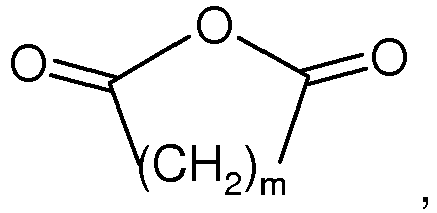
and from a diamine of the following formula (V):
H2N-(CH2)p-NH2 (V),
wherein p is as defined above. - The diacids of formula (IV') and their cyclic anhydride and the diamines of formula (V) are advantageously commercial compounds, for example available at Sigma Aldrich®, Alfa Aesar®, VWR®, UNIPEX®, DSM®.
- Advantageously, the dialcohols of formula (III) and the compound of formula (II) may stem from renewable resources, as described in
US 2009/0171037 . Further, methods are presently developed and will shortly allow preparation of diamines of formula (V) from renewable resources. Thus, the compound of formula (II) would be advantageously synthesized from starting products stemming from renewable resources. - The compound of formula (I) according to the invention may be used as a precursor of a polymer, a so-called (PEA) polymer hereafter, useful as an additive for improving the heat resistance of a polymeric composition or as polymeric matrix of a polymeric composition presenting a good heat resistance.
- According to a third object, the invention relates to a method for preparing a (PEA) polymer from the compound of formula (I). More specifically, the invention relates to a method for preparing a (PEA) polymer comprising a step consisting of heating to a temperature greater than or equal to the melting temperature of the compound of formula (I) and under reduced pressure, a compound of formula (I) in the presence of a catalyst for polymerizing the compound of formula (I).
- In the sense of the present application, the polymer obtained by this method is designated by "(PEA) polymer".
- The catalyst is preferably a metal catalyst, notably a metal salt or a derivative of a transition metal, the metal notably being titanium, zinc, aluminum, tin, germanium, hafnium, zirconium or antimony. Titanium complexes, preferably titanium alkoxides, such as Ti(OEt)4, Ti(OPr)4 or Ti(OBu)4, are particularly suitable catalysts.
- The polymerization is preferably carried out under reduced pressure, typically less than or equal to 0.8 bars, or even less than or equal to 0.1 bars, and by varying the temperature, more specifically by increasing it from an initial temperature above the melting temperature of the compound or formula (I): the polymerization is generally started at a temperature comprised between the melting temperature of the compound of formula (I) and 130°C, preferentially between 105 and 130°C, in particular at a temperature of the order of 120°C, and for a duration from 2 to 10 hours, typically of the order of 6 hours, and the temperature is then increased between 135 and 160°C, in particular to a temperature of the order of 150°C for a duration from 2 to 10 hours, typically of the order of 6 hours, and finally the temperature is increased between 165 and 175°C, in particular to a temperature of the order of 170°C for a duration from 1 to 5 hours, typically of the order of 2 hours.
- The additives usually used for polymerization reactions may be added during the process. For example, it is possible to add chain extenders such as isocyanates, carbodiimides, epoxides, dianhydrides...
- In a first embodiment, the (PEA) polymer self-polymerizes. Without wishing to be bound by a specific theory, it seems that in the presence of the catalyst and under the aforementioned temperature and pressure conditions, reactions of transesterifications or hydrolysis of at least one of the ester functions of the compound of formula (I) occur, generating a terminal carboxylic acid function which then forms an ester function with the terminal alcohol functions of the compound of formula (I) thereby causing polymerization of the compound of formula (I) in order to form the (PEA) polymer.
- Generally, in this embodiment, the obtained (PEA) polymer is an alternating copolymer: it comprises an alternation between amide functions and ester functions. The obtained polymer typically has the following formula (VI):

- The obtained (PEA) polymer is generally semi-crystalline.
- In a second embodiment, the compound of formula (I) is brought into contact under the aforementioned temperature and pressure conditions with a compound of the following formula (IV):

- The compound of formula (I) and the compound of formula (IV) are typically used in equimolar amounts.
- In this embodiment, without wishing to be bound by a specific theory, it seems that during the polymerization, the terminal alcohol functions of the compound of formula (I) reacts with the carboxylic acid functions of the compound of formula (IV) and/or with the carboxylic acid functions generated by hydrolysis of the ester function of the compound of formula (I), as explained above.
- Generally, in this embodiment, the obtained (PEA) polymer is an alternating copolymer: it comprises an alternation between amide functions and ester functions.
- The obtained polymer typically as the following formula (VII):

- The obtained (PEA) polymer is generally semi-crystalline.
- In a third embodiment, the compound of formula (I) is brought into contact under the aforementioned temperature and pressure conditions both with a compound of formula (IV) as defined above and with a compound of the following formula (III):
HO-(CH2)n-OH (III),
wherein n is as defined above. - In this embodiment, without wishing to be bound by a specific theory, it seems that during the polymerization, the terminal alcohol functions of the compound of formula (I) and those of the compound of formula (III) react with the carboxylic acid functions of the compound of formula (IV) and/or with the carboxylic acid functions generated by cleavage of the ester function of the compound of formula (I), as explained above.
- The polymer obtained in this embodiment is typically a random polymer.
- The (PEA) polymer obtainable according to the method described above is also described.
- The polymers (PEA) obtainable by the method described above with a compound of formula (I) wherein:
- m, n and p are even integers, or
- m represents 2 or 3, and preferably :
- n and p represent 4 and m represents 2, or
- n and p represent 5 and m represent 3,
- The (PEA) polymer obtainable by the method typically has a weight average molecular weight comprised between 1,000 and 100,000 g/mol, preferably greater than 10,000 g/mol. Such polymers (PEA) actually allow more efficient improvement of the heat resistance of polymeric compositions.
- The (PEA) may be used as a polymeric matrix of a polymeric composition having a good heat resistance, typically which withstands temperatures above 120°C.
- The (PEA) polymer is also used for as an additive in a polymeric composition for improving the heat resistance thereof. The (PEA) polymer is useful for improving the heat resistance of a composition comprising a polymer (P), in particular of a composition comprising a polymer (P) and natural fibers. Further, the (PEA) may be used as a compatibilizing agent between semi-polar and polar polymeric matrices, typically between polyesters and polyamides, starch..., with polar fillers (cloisite, montmorillonite...) and polar reinforcements (hemp, flax, sisal, wood flour...).
- Hereafter is described a composition comprising:
- a (PEA) polymer as defined above,
- optionally at least one other polymer (P), and
- optionally natural fibers.
- When the composition comprises a polymer (P), the (PEA) polymer is an additive of a composition. When the composition is without any polymer (P), the (PEA) polymer is the polymeric matrix of the composition. In both embodiments, the obtained composition has good heat resistance, i.e. typically it withstands temperatures above 120°C.
- Preferably, the polymer (P) is a polyamide, polyester, polyamide/polyester copolymer or a mixture thereof (polyamide-polyester blend). The polyester is typically an aliphatic polyester, notably poly(butylene succinate) (PBS). The (PEA) polymer actually has a structure close to these polymers and is therefore easily dispersible in the latter, and thus a homogeneous composition may advantageously be obtained.
- In the embodiment described above wherein p and n are identical and m represents (n -2), each subunit of the compound of formula (I), and therefore of the (PEA) polymer has the same number of carbon atoms, and incorporation of the (PEA) polymer into the crystalline lattice of the polymer (P) is promoted.
- The composition optionally comprises natural fibers. The natural fibers are preferably:
- fibers of plant origin, notably selected from the group formed by cotton, flax, hemp, Manila hemp or abaca, banana tree, coconut, jute, ramie, raffia, sisal, broom, bamboo, miscanthus, kenaf, coprah, agave, sorghum, switch-grass and wood, and/or
- fibers of animal origin, notably selected from the group formed by wool, alpaca fleece, mohair, cashmere, angora and silk.
- With these fibers it is notably possible to improve the thermomechanical performances, notably the stiffness and sometimes to lighten the obtained composition. The preferred fibers are hemp, flax, sisal, preferably hemp.
- The composition typically comprises from 10 to 40%, notably from 20 to 35%, preferably from 25 to 30% by weight of fibers.
- The composition may further comprise additives usually used in polymer compositions, such as:
- an impact resistance additive (for example acrylic copolymers, elastomers), and/or
- an anti-hydrolysis additive (for example carbodiimides, epoxides), and/or
- a fluidifying agent (for example oligomers, lubricants, plasticizers) and/or
- an antifungal agent, and/or
- anti-oxidants (phosphoric, phenolic...), and/or
- fillers (talcum, calcium carbonate...), and/or
- nanofillers (montmorillonite, cloisite...), and/or
- an anti-UV agent (phenolic hindered amines ...), and/or
- a coloring agent or a pigment, and/or
- a flame-retardant, and/or
- a compatibilizing agent (maleic anhydride, silanes...).
- This composition may be used for preparing plastic articles, notably vehicle parts and typically for automobile parts where thermal and mechanical constraints are important and of particular interest. Thus, hereafter are described plastic articles, notably vehicle parts, such as automobile parts, comprising the composition as described above. The plastic article may be, as an example, an interior trim of an automobile such as instrument panel. The plastic article may, as known by a man skilled in the art, be used without covering or with a covering layer.
- The plastic articles are notably obtainable with usual methods for transforming plastic materials, typically by injection, back injection, thermocompression, thermoforming, preferably by injection.
- The invention will be better understood considering the examples hereafter.
- The compound of the following formula (II') :

US 2004/0171518 . - 10 g (0.035 mol) of the compound of formula (II') and 45 g of 1,4-butanediol (0.5 mol) (corresponding to a compound of formula (III) wherein n represents 4) (a 1,4-butanediol / formula (II') compound ratio of about 95/5) were mixed, and then 0.0035 mol (10% molar of paratoluene-sulfonic acid relatively to the molarity of the compound of formula (II')) were added with stirring, and the obtained mixture was heated in an oil bath at 100°C for 4 hours with an open neck.
- The excessively used 1,4-butanediol may be recovered by washing the medium with acetonitrile in which it is soluble, filtration of the insoluble compound of formula (I'). The 1,4-butanediol may thus be recycled.
- The yield in an isolated compound of formula (I') is greater than 30%.
- The compound of the following formula (I') is obtained as a solid:

- The polymerization of the compound of formula (I') was conducted in the presence of a catalyst Ti(OBu)4 at 0.2 %mol relatively to the total molarity in a toluene solvent under reduced pressure (pressure below 0.1 bars):
- at a temperature of 120°C for 6 hours, and then
- at a temperature of 150°C for 6 hours, and then
- at a temperature of 170°C for 2 hours.
- The obtained (PEA) polymer is an alternating copolymer with a weight average molecular weight Mw (as measured by MALDI-TOF) of 1,340g/mol: it comprises an alternation between amide functions and ester functions.
- The obtained (PEA) polymer has a melting point ranging from 141°C to 172°C depending on the crystallization conditions (measured by differential scanning calorimetry on an apparatus of the DSC 2920 Modulated DSC TA instrument type, with temperatures cooled at a rate of 20°C/min (Tm=141°C) down to 150°C annealings for 1h (Tm=170°C)).
- A poly(butylene succinate) has a melting point of 106°C. An increase in the melting point by at least 35°C is therefore observed.
- The formed (PEA) polymer is a derivative of poly(butylene succinate) into which amide functions have been introduced. By introducing (PEA) into a polymeric composition comprising poly(butylene succinate), it is possible to improve the heat resistance of said composition.
- Polymerization of the compound of formula (I') whilst conducted in the presence of succinic acid (an equimolar mixture of the compound of formula (I') and of succinic acid) and of 0.2%mols of catalyst Ti(OBu)4 under reduced pressure :
- at a temperature of 120°C for 6 hours, at a pressure below 0.8 bars, and then
- at a temperature of 150°C for 6 hours, at a pressure below 0.1 bars and then
- at a temperature of 170°C for 2 hours, at a pressure below 0.1 bars.
- A (PEA) polymer is produced with an Mw (by MALDI TOF) of 1,665g/mol having a melting point ranging from 115°C to 140°C depending on the crystallization conditions (as measured by differential scanning calorimetry (DSC)). The obtained (PEA) polymer is an alternating co-polymer: it comprises an alternation between the amide functions and the ester functions.
- Tests were conducted with:
- 1 mole of compound of formula (I') + 3 moles succinic acid (SA) + 2 moles of 1,4-butanediol, or
- 1 mole of compound of formula (I') + 7 moles of succinic acid (SA) + 6 moles of 1,4-butanediol.
- Under these conditions, a non-crystalline and random (PEA) polymer was obtained.
Claims (9)
- A compound of the following formula (I):

- The compound according to claim 1, wherein p and n are identical and independently represent an integer from 3 to 12 and m represents (n -2).
- The compound according to claim 1 or 2, wherein n, m and p are even integers.
- The compound according to claims 1 or 2, wherein m represents 2 or 3.
- The compound according to claim 4, wherein n and p represent 4 and m represents 2 or n and p represent 5 and m represents 3.
- A method for preparing a compound according to any of claims 1 to 5, comprising a step consisting of coupling a compound having the following formula (II):

with a dialcohol of the following formula (III):
HO-(CH2)n-OH (III),
wherein n is as defined in claim 1. - A method for preparing a (PEA) polymer comprising a step consisting of heating to a temperature greater than or equal to the melting temperature of the compound of formula (I) and under reduced pressure, a compound of formula (I) according to any of claims 1 to 5, in the presence of a catalyst, in order to polymerize said compound of formula (I).
- The method for preparing a (PEA) polymer according to claim 7, wherein the compound of formula (I) is brought into contact with a compound of the following formula (IV):

and optionally with a compound of the following formula (III):
HO-(CH2)n-OH (III),
wherein n is as defined in claim 1. - The method for preparing a (PEA) polymer according to claims 7 or 8, wherein the compound of formula (I) is the compound according to claim 4 or 5.
Applications Claiming Priority (2)
| Application Number | Priority Date | Filing Date | Title |
|---|---|---|---|
| FR1059256A FR2967156B1 (en) | 2010-11-09 | 2010-11-09 | NOVEL COMPOUNDS, PROCESS FOR THEIR PREPARATION AND THE USE THEREOF FOR THE PREPARATION OF USEFUL POLYMERS FOR INCREASING THE THERMAL CONTAINMENT OF POLYMERIC COMPOSITIONS |
| PCT/EP2011/069733 WO2012062799A1 (en) | 2010-11-09 | 2011-11-09 | Novel compounds, method for preparation thereof and use thereof for preparing polymers useful for increasing heat resistance of polymeric compositions |
Publications (2)
| Publication Number | Publication Date |
|---|---|
| EP2638004A1 EP2638004A1 (en) | 2013-09-18 |
| EP2638004B1 true EP2638004B1 (en) | 2017-08-02 |
Family
ID=43970865
Family Applications (1)
| Application Number | Title | Priority Date | Filing Date |
|---|---|---|---|
| EP11779673.0A Active EP2638004B1 (en) | 2010-11-09 | 2011-11-09 | Novel compounds, method for preparation thereof and use thereof for preparing polymers useful for increasing heat resistance of polymeric compositions |
Country Status (7)
| Country | Link |
|---|---|
| US (1) | US9475758B2 (en) |
| EP (1) | EP2638004B1 (en) |
| JP (1) | JP6025738B2 (en) |
| CN (1) | CN103608330B (en) |
| BR (1) | BR112013011516B1 (en) |
| FR (1) | FR2967156B1 (en) |
| WO (1) | WO2012062799A1 (en) |
Citations (1)
| Publication number | Priority date | Publication date | Assignee | Title |
|---|---|---|---|---|
| EP0191386A2 (en) * | 1985-02-13 | 1986-08-20 | Bayer Ag | Polyhydroxy compounds cntaining urea and ester or amide groups, process for their preparation and their use |
Family Cites Families (9)
| Publication number | Priority date | Publication date | Assignee | Title |
|---|---|---|---|---|
| US4348524A (en) * | 1980-03-28 | 1982-09-07 | Ciba-Geigy Corporation | Amide derivatives of polyalkylpiperidines |
| JPS6049029A (en) * | 1983-08-26 | 1985-03-18 | Toray Ind Inc | Manufacture of hydrophilic polyamide elastomer |
| JPS6063225A (en) * | 1983-09-19 | 1985-04-11 | Toray Ind Inc | Manufacture of hydrophilic polyetheresteramide |
| JPS63277238A (en) * | 1987-05-08 | 1988-11-15 | Asahi Chem Ind Co Ltd | Production of polyether ester amide elastomer |
| DE4327024A1 (en) * | 1993-08-12 | 1995-02-16 | Bayer Ag | Thermoplastically processable and biodegradable aliphatic polyesteramides |
| NL1003459C2 (en) * | 1996-06-28 | 1998-01-07 | Univ Twente | Copoly (ester amides) and copoly (ester urethanes). |
| CN1403872A (en) * | 2001-08-23 | 2003-03-19 | 中国乐凯胶片集团公司 | Dacron film substrate containing new-type antistatic agent |
| US20040171518A1 (en) * | 2003-02-27 | 2004-09-02 | Medtronic Minimed, Inc. | Compounds for protein stabilization and methods for their use |
| JP4380704B2 (en) | 2005-04-22 | 2009-12-09 | 三菱化学株式会社 | Biomass resource-derived polyester and method for producing the same |
-
2010
- 2010-11-09 FR FR1059256A patent/FR2967156B1/en active Active
-
2011
- 2011-11-09 BR BR112013011516-5A patent/BR112013011516B1/en active IP Right Grant
- 2011-11-09 EP EP11779673.0A patent/EP2638004B1/en active Active
- 2011-11-09 WO PCT/EP2011/069733 patent/WO2012062799A1/en not_active Ceased
- 2011-11-09 US US13/884,540 patent/US9475758B2/en active Active
- 2011-11-09 JP JP2013538178A patent/JP6025738B2/en active Active
- 2011-11-09 CN CN201180061253.4A patent/CN103608330B/en active Active
Patent Citations (1)
| Publication number | Priority date | Publication date | Assignee | Title |
|---|---|---|---|---|
| EP0191386A2 (en) * | 1985-02-13 | 1986-08-20 | Bayer Ag | Polyhydroxy compounds cntaining urea and ester or amide groups, process for their preparation and their use |
Also Published As
| Publication number | Publication date |
|---|---|
| EP2638004A1 (en) | 2013-09-18 |
| WO2012062799A1 (en) | 2012-05-18 |
| FR2967156B1 (en) | 2012-11-16 |
| BR112013011516A2 (en) | 2020-09-01 |
| CN103608330A (en) | 2014-02-26 |
| BR112013011516A8 (en) | 2021-02-09 |
| US9475758B2 (en) | 2016-10-25 |
| JP2014501800A (en) | 2014-01-23 |
| JP6025738B2 (en) | 2016-11-16 |
| FR2967156A1 (en) | 2012-05-11 |
| BR112013011516B1 (en) | 2021-04-06 |
| CN103608330B (en) | 2015-10-14 |
| US20140005351A1 (en) | 2014-01-02 |
Similar Documents
| Publication | Publication Date | Title |
|---|---|---|
| US6344535B1 (en) | Polyether ester amides | |
| JP5620061B2 (en) | Process for producing polylactic acid block copolymer | |
| CN103703054B (en) | Novel polymeric amide, Its Preparation Method And Use | |
| JP6231549B2 (en) | Polymer, process for synthesizing it and composition comprising it | |
| JPS606746A (en) | Forming composition | |
| JPS63159432A (en) | Elastomer | |
| JP2008291244A (en) | Method for producing polyester resin containing furan structure | |
| JP2016520706A (en) | Biodegradable polyester resin and article containing the same | |
| US9475758B2 (en) | Compounds, method for preparation thereof and use thereof for preparing polymers useful for increasing heat resistance of polymeric compositions | |
| JP2020520405A (en) | Polyester copolymer | |
| TW202544117A (en) | Aliphatic polyesters, resin compositions, molded articles, and methods for manufacturing aliphatic polyesters, as well as block copolymers, resin compositions, and molded articles. | |
| CN113817150A (en) | Copolyester containing aromatic secondary amine structure and its preparation method and application | |
| JP5207343B2 (en) | Biodegradable polyesteramide and method for producing the same | |
| US7342086B2 (en) | Aliphatic polyester polyether copolymer, process for producing the same and aliphatic polyester composition using the copolymer | |
| JP7568298B2 (en) | Compositions and methods of making sheets, films, fibers, and molded parts | |
| JP4152767B2 (en) | Polyester block copolymer and method for producing the same | |
| JP3601530B2 (en) | Method for producing aliphatic polyester copolymer | |
| Zhao | Development and investigation of bio-based environmentally friendly fire retardant PLA composites | |
| JP7772474B2 (en) | Polylactide resin composition and method for producing same | |
| JP4047160B2 (en) | Film made of aliphatic polyester copolymer | |
| CN105518051A (en) | Method for preparing biodegradable polyester resin | |
| JP4696306B2 (en) | Biodegradable polyester and method for producing the same | |
| JPH0420526A (en) | Production of aromatic polyester-amide | |
| JP4196759B2 (en) | Aromatic amide-polylactone block copolymer and process for producing the same | |
| JP2024525102A (en) | Polylactide resin composition having excellent crystallinity and method for producing same |
Legal Events
| Date | Code | Title | Description |
|---|---|---|---|
| PUAI | Public reference made under article 153(3) epc to a published international application that has entered the european phase |
Free format text: ORIGINAL CODE: 0009012 |
|
| 17P | Request for examination filed |
Effective date: 20130502 |
|
| AK | Designated contracting states |
Kind code of ref document: A1 Designated state(s): AL AT BE BG CH CY CZ DE DK EE ES FI FR GB GR HR HU IE IS IT LI LT LU LV MC MK MT NL NO PL PT RO RS SE SI SK SM TR |
|
| RAP1 | Party data changed (applicant data changed or rights of an application transferred) |
Owner name: INSTITUT NATIONAL DE LA RECHERCHE AGRONOMIQUE (INR Owner name: FAURECIA INTERIEUR INDUSTRIE |
|
| DAX | Request for extension of the european patent (deleted) | ||
| 17Q | First examination report despatched |
Effective date: 20140423 |
|
| GRAP | Despatch of communication of intention to grant a patent |
Free format text: ORIGINAL CODE: EPIDOSNIGR1 |
|
| INTG | Intention to grant announced |
Effective date: 20170221 |
|
| GRAS | Grant fee paid |
Free format text: ORIGINAL CODE: EPIDOSNIGR3 |
|
| GRAA | (expected) grant |
Free format text: ORIGINAL CODE: 0009210 |
|
| AK | Designated contracting states |
Kind code of ref document: B1 Designated state(s): AL AT BE BG CH CY CZ DE DK EE ES FI FR GB GR HR HU IE IS IT LI LT LU LV MC MK MT NL NO PL PT RO RS SE SI SK SM TR |
|
| REG | Reference to a national code |
Ref country code: CH Ref legal event code: EP Ref country code: AT Ref legal event code: REF Ref document number: 914277 Country of ref document: AT Kind code of ref document: T Effective date: 20170815 |
|
| REG | Reference to a national code |
Ref country code: IE Ref legal event code: FG4D |
|
| REG | Reference to a national code |
Ref country code: DE Ref legal event code: R096 Ref document number: 602011040202 Country of ref document: DE |
|
| REG | Reference to a national code |
Ref country code: DE Ref legal event code: R082 Ref document number: 602011040202 Country of ref document: DE Representative=s name: LAVOIX MUNICH, DE |
|
| RAP2 | Party data changed (patent owner data changed or rights of a patent transferred) |
Owner name: FAURECIA INTERIEUR INDUSTRIE |
|
| REG | Reference to a national code |
Ref country code: FR Ref legal event code: PLFP Year of fee payment: 7 |
|
| REG | Reference to a national code |
Ref country code: NL Ref legal event code: MP Effective date: 20170802 |
|
| REG | Reference to a national code |
Ref country code: AT Ref legal event code: MK05 Ref document number: 914277 Country of ref document: AT Kind code of ref document: T Effective date: 20170802 |
|
| REG | Reference to a national code |
Ref country code: LT Ref legal event code: MG4D |
|
| PG25 | Lapsed in a contracting state [announced via postgrant information from national office to epo] |
Ref country code: AT Free format text: LAPSE BECAUSE OF FAILURE TO SUBMIT A TRANSLATION OF THE DESCRIPTION OR TO PAY THE FEE WITHIN THE PRESCRIBED TIME-LIMIT Effective date: 20170802 Ref country code: LT Free format text: LAPSE BECAUSE OF FAILURE TO SUBMIT A TRANSLATION OF THE DESCRIPTION OR TO PAY THE FEE WITHIN THE PRESCRIBED TIME-LIMIT Effective date: 20170802 Ref country code: SE Free format text: LAPSE BECAUSE OF FAILURE TO SUBMIT A TRANSLATION OF THE DESCRIPTION OR TO PAY THE FEE WITHIN THE PRESCRIBED TIME-LIMIT Effective date: 20170802 Ref country code: NO Free format text: LAPSE BECAUSE OF FAILURE TO SUBMIT A TRANSLATION OF THE DESCRIPTION OR TO PAY THE FEE WITHIN THE PRESCRIBED TIME-LIMIT Effective date: 20171102 Ref country code: HR Free format text: LAPSE BECAUSE OF FAILURE TO SUBMIT A TRANSLATION OF THE DESCRIPTION OR TO PAY THE FEE WITHIN THE PRESCRIBED TIME-LIMIT Effective date: 20170802 Ref country code: NL Free format text: LAPSE BECAUSE OF FAILURE TO SUBMIT A TRANSLATION OF THE DESCRIPTION OR TO PAY THE FEE WITHIN THE PRESCRIBED TIME-LIMIT Effective date: 20170802 Ref country code: FI Free format text: LAPSE BECAUSE OF FAILURE TO SUBMIT A TRANSLATION OF THE DESCRIPTION OR TO PAY THE FEE WITHIN THE PRESCRIBED TIME-LIMIT Effective date: 20170802 |
|
| PG25 | Lapsed in a contracting state [announced via postgrant information from national office to epo] |
Ref country code: RS Free format text: LAPSE BECAUSE OF FAILURE TO SUBMIT A TRANSLATION OF THE DESCRIPTION OR TO PAY THE FEE WITHIN THE PRESCRIBED TIME-LIMIT Effective date: 20170802 Ref country code: LV Free format text: LAPSE BECAUSE OF FAILURE TO SUBMIT A TRANSLATION OF THE DESCRIPTION OR TO PAY THE FEE WITHIN THE PRESCRIBED TIME-LIMIT Effective date: 20170802 Ref country code: ES Free format text: LAPSE BECAUSE OF FAILURE TO SUBMIT A TRANSLATION OF THE DESCRIPTION OR TO PAY THE FEE WITHIN THE PRESCRIBED TIME-LIMIT Effective date: 20170802 Ref country code: IS Free format text: LAPSE BECAUSE OF FAILURE TO SUBMIT A TRANSLATION OF THE DESCRIPTION OR TO PAY THE FEE WITHIN THE PRESCRIBED TIME-LIMIT Effective date: 20171202 Ref country code: BG Free format text: LAPSE BECAUSE OF FAILURE TO SUBMIT A TRANSLATION OF THE DESCRIPTION OR TO PAY THE FEE WITHIN THE PRESCRIBED TIME-LIMIT Effective date: 20171102 Ref country code: PL Free format text: LAPSE BECAUSE OF FAILURE TO SUBMIT A TRANSLATION OF THE DESCRIPTION OR TO PAY THE FEE WITHIN THE PRESCRIBED TIME-LIMIT Effective date: 20170802 Ref country code: GR Free format text: LAPSE BECAUSE OF FAILURE TO SUBMIT A TRANSLATION OF THE DESCRIPTION OR TO PAY THE FEE WITHIN THE PRESCRIBED TIME-LIMIT Effective date: 20171103 |
|
| PG25 | Lapsed in a contracting state [announced via postgrant information from national office to epo] |
Ref country code: DK Free format text: LAPSE BECAUSE OF FAILURE TO SUBMIT A TRANSLATION OF THE DESCRIPTION OR TO PAY THE FEE WITHIN THE PRESCRIBED TIME-LIMIT Effective date: 20170802 Ref country code: RO Free format text: LAPSE BECAUSE OF FAILURE TO SUBMIT A TRANSLATION OF THE DESCRIPTION OR TO PAY THE FEE WITHIN THE PRESCRIBED TIME-LIMIT Effective date: 20170802 Ref country code: CZ Free format text: LAPSE BECAUSE OF FAILURE TO SUBMIT A TRANSLATION OF THE DESCRIPTION OR TO PAY THE FEE WITHIN THE PRESCRIBED TIME-LIMIT Effective date: 20170802 |
|
| REG | Reference to a national code |
Ref country code: DE Ref legal event code: R097 Ref document number: 602011040202 Country of ref document: DE |
|
| PG25 | Lapsed in a contracting state [announced via postgrant information from national office to epo] |
Ref country code: IT Free format text: LAPSE BECAUSE OF FAILURE TO SUBMIT A TRANSLATION OF THE DESCRIPTION OR TO PAY THE FEE WITHIN THE PRESCRIBED TIME-LIMIT Effective date: 20170802 Ref country code: SM Free format text: LAPSE BECAUSE OF FAILURE TO SUBMIT A TRANSLATION OF THE DESCRIPTION OR TO PAY THE FEE WITHIN THE PRESCRIBED TIME-LIMIT Effective date: 20170802 Ref country code: EE Free format text: LAPSE BECAUSE OF FAILURE TO SUBMIT A TRANSLATION OF THE DESCRIPTION OR TO PAY THE FEE WITHIN THE PRESCRIBED TIME-LIMIT Effective date: 20170802 Ref country code: SK Free format text: LAPSE BECAUSE OF FAILURE TO SUBMIT A TRANSLATION OF THE DESCRIPTION OR TO PAY THE FEE WITHIN THE PRESCRIBED TIME-LIMIT Effective date: 20170802 |
|
| PLBE | No opposition filed within time limit |
Free format text: ORIGINAL CODE: 0009261 |
|
| STAA | Information on the status of an ep patent application or granted ep patent |
Free format text: STATUS: NO OPPOSITION FILED WITHIN TIME LIMIT |
|
| PG25 | Lapsed in a contracting state [announced via postgrant information from national office to epo] |
Ref country code: MC Free format text: LAPSE BECAUSE OF FAILURE TO SUBMIT A TRANSLATION OF THE DESCRIPTION OR TO PAY THE FEE WITHIN THE PRESCRIBED TIME-LIMIT Effective date: 20170802 |
|
| 26N | No opposition filed |
Effective date: 20180503 |
|
| REG | Reference to a national code |
Ref country code: FR Ref legal event code: TQ Owner name: FAURECIA INTERIEUR INDUSTRIE, FR Effective date: 20180613 Ref country code: FR Ref legal event code: TQ Owner name: AGRO INDUSTRIE RECHERCHES ET DEVELOPPEMENTS, FR Effective date: 20180613 |
|
| GBPC | Gb: european patent ceased through non-payment of renewal fee |
Effective date: 20171109 |
|
| PG25 | Lapsed in a contracting state [announced via postgrant information from national office to epo] |
Ref country code: LI Free format text: LAPSE BECAUSE OF NON-PAYMENT OF DUE FEES Effective date: 20171130 Ref country code: CH Free format text: LAPSE BECAUSE OF NON-PAYMENT OF DUE FEES Effective date: 20171130 |
|
| PG25 | Lapsed in a contracting state [announced via postgrant information from national office to epo] |
Ref country code: SI Free format text: LAPSE BECAUSE OF FAILURE TO SUBMIT A TRANSLATION OF THE DESCRIPTION OR TO PAY THE FEE WITHIN THE PRESCRIBED TIME-LIMIT Effective date: 20170802 Ref country code: LU Free format text: LAPSE BECAUSE OF NON-PAYMENT OF DUE FEES Effective date: 20171109 |
|
| REG | Reference to a national code |
Ref country code: BE Ref legal event code: MM Effective date: 20171130 |
|
| REG | Reference to a national code |
Ref country code: IE Ref legal event code: MM4A |
|
| PG25 | Lapsed in a contracting state [announced via postgrant information from national office to epo] |
Ref country code: MT Free format text: LAPSE BECAUSE OF NON-PAYMENT OF DUE FEES Effective date: 20171109 |
|
| REG | Reference to a national code |
Ref country code: FR Ref legal event code: PLFP Year of fee payment: 8 |
|
| PG25 | Lapsed in a contracting state [announced via postgrant information from national office to epo] |
Ref country code: IE Free format text: LAPSE BECAUSE OF NON-PAYMENT OF DUE FEES Effective date: 20171109 |
|
| PG25 | Lapsed in a contracting state [announced via postgrant information from national office to epo] |
Ref country code: GB Free format text: LAPSE BECAUSE OF NON-PAYMENT OF DUE FEES Effective date: 20171109 Ref country code: BE Free format text: LAPSE BECAUSE OF NON-PAYMENT OF DUE FEES Effective date: 20171130 |
|
| PG25 | Lapsed in a contracting state [announced via postgrant information from national office to epo] |
Ref country code: HU Free format text: LAPSE BECAUSE OF FAILURE TO SUBMIT A TRANSLATION OF THE DESCRIPTION OR TO PAY THE FEE WITHIN THE PRESCRIBED TIME-LIMIT; INVALID AB INITIO Effective date: 20111109 |
|
| PG25 | Lapsed in a contracting state [announced via postgrant information from national office to epo] |
Ref country code: CY Free format text: LAPSE BECAUSE OF NON-PAYMENT OF DUE FEES Effective date: 20170802 |
|
| PG25 | Lapsed in a contracting state [announced via postgrant information from national office to epo] |
Ref country code: MK Free format text: LAPSE BECAUSE OF FAILURE TO SUBMIT A TRANSLATION OF THE DESCRIPTION OR TO PAY THE FEE WITHIN THE PRESCRIBED TIME-LIMIT Effective date: 20170802 |
|
| PG25 | Lapsed in a contracting state [announced via postgrant information from national office to epo] |
Ref country code: TR Free format text: LAPSE BECAUSE OF FAILURE TO SUBMIT A TRANSLATION OF THE DESCRIPTION OR TO PAY THE FEE WITHIN THE PRESCRIBED TIME-LIMIT Effective date: 20170802 |
|
| PG25 | Lapsed in a contracting state [announced via postgrant information from national office to epo] |
Ref country code: PT Free format text: LAPSE BECAUSE OF FAILURE TO SUBMIT A TRANSLATION OF THE DESCRIPTION OR TO PAY THE FEE WITHIN THE PRESCRIBED TIME-LIMIT Effective date: 20170802 |
|
| PG25 | Lapsed in a contracting state [announced via postgrant information from national office to epo] |
Ref country code: AL Free format text: LAPSE BECAUSE OF FAILURE TO SUBMIT A TRANSLATION OF THE DESCRIPTION OR TO PAY THE FEE WITHIN THE PRESCRIBED TIME-LIMIT Effective date: 20170802 |
|
| PGFP | Annual fee paid to national office [announced via postgrant information from national office to epo] |
Ref country code: DE Payment date: 20251022 Year of fee payment: 15 |
|
| PGFP | Annual fee paid to national office [announced via postgrant information from national office to epo] |
Ref country code: FR Payment date: 20251022 Year of fee payment: 15 |