EP2634837A1 - Separator including coating layer of organic and inorganic mixture containing polyimide, and battery including the same - Google Patents
Separator including coating layer of organic and inorganic mixture containing polyimide, and battery including the same Download PDFInfo
- Publication number
- EP2634837A1 EP2634837A1 EP13157215.8A EP13157215A EP2634837A1 EP 2634837 A1 EP2634837 A1 EP 2634837A1 EP 13157215 A EP13157215 A EP 13157215A EP 2634837 A1 EP2634837 A1 EP 2634837A1
- Authority
- EP
- European Patent Office
- Prior art keywords
- separator
- organic binder
- coating layer
- separator according
- polyimide
- Prior art date
- Legal status (The legal status is an assumption and is not a legal conclusion. Google has not performed a legal analysis and makes no representation as to the accuracy of the status listed.)
- Withdrawn
Links
- 239000004642 Polyimide Substances 0.000 title claims abstract description 49
- 229920001721 polyimide Polymers 0.000 title claims abstract description 49
- 239000011247 coating layer Substances 0.000 title claims abstract description 47
- 239000000203 mixture Substances 0.000 title description 11
- 239000011248 coating agent Substances 0.000 claims abstract description 48
- 239000002904 solvent Substances 0.000 claims abstract description 41
- 239000011230 binding agent Substances 0.000 claims abstract description 39
- 229920000098 polyolefin Polymers 0.000 claims abstract description 9
- 239000003792 electrolyte Substances 0.000 claims description 27
- -1 polyethylene Polymers 0.000 claims description 19
- 239000010954 inorganic particle Substances 0.000 claims description 14
- 229920005569 poly(vinylidene fluoride-co-hexafluoropropylene) Polymers 0.000 claims description 14
- 239000004698 Polyethylene Substances 0.000 claims description 12
- 229920000573 polyethylene Polymers 0.000 claims description 12
- 239000004743 Polypropylene Substances 0.000 claims description 10
- 229920001155 polypropylene Polymers 0.000 claims description 10
- 229910052744 lithium Inorganic materials 0.000 claims description 8
- WHXSMMKQMYFTQS-UHFFFAOYSA-N Lithium Chemical group [Li] WHXSMMKQMYFTQS-UHFFFAOYSA-N 0.000 claims description 6
- 238000003618 dip coating Methods 0.000 claims description 6
- 239000002245 particle Substances 0.000 claims description 6
- 239000002356 single layer Substances 0.000 claims description 6
- PNEYBMLMFCGWSK-UHFFFAOYSA-N aluminium oxide Inorganic materials [O-2].[O-2].[O-2].[Al+3].[Al+3] PNEYBMLMFCGWSK-UHFFFAOYSA-N 0.000 claims description 5
- 229910052593 corundum Inorganic materials 0.000 claims description 5
- 239000010410 layer Substances 0.000 claims description 5
- 125000002023 trifluoromethyl group Chemical group FC(F)(F)* 0.000 claims description 5
- 229910001845 yogo sapphire Inorganic materials 0.000 claims description 5
- VYPSYNLAJGMNEJ-UHFFFAOYSA-N Silicium dioxide Chemical compound O=[Si]=O VYPSYNLAJGMNEJ-UHFFFAOYSA-N 0.000 claims description 4
- GWEVSGVZZGPLCZ-UHFFFAOYSA-N Titan oxide Chemical compound O=[Ti]=O GWEVSGVZZGPLCZ-UHFFFAOYSA-N 0.000 claims description 4
- XOLBLPGZBRYERU-UHFFFAOYSA-N tin dioxide Chemical compound O=[Sn]=O XOLBLPGZBRYERU-UHFFFAOYSA-N 0.000 claims description 4
- 229910011255 B2O3 Inorganic materials 0.000 claims description 2
- 229910052681 coesite Inorganic materials 0.000 claims description 2
- 229910052906 cristobalite Inorganic materials 0.000 claims description 2
- QZQVBEXLDFYHSR-UHFFFAOYSA-N gallium(III) oxide Inorganic materials O=[Ga]O[Ga]=O QZQVBEXLDFYHSR-UHFFFAOYSA-N 0.000 claims description 2
- 239000000377 silicon dioxide Substances 0.000 claims description 2
- 229910052682 stishovite Inorganic materials 0.000 claims description 2
- 229910052905 tridymite Inorganic materials 0.000 claims description 2
- 238000009835 boiling Methods 0.000 abstract description 14
- 230000001747 exhibiting effect Effects 0.000 abstract 1
- CSCPPACGZOOCGX-UHFFFAOYSA-N Acetone Chemical compound CC(C)=O CSCPPACGZOOCGX-UHFFFAOYSA-N 0.000 description 28
- 229920000642 polymer Polymers 0.000 description 21
- 239000002585 base Substances 0.000 description 20
- 239000000243 solution Substances 0.000 description 18
- 238000000576 coating method Methods 0.000 description 13
- 230000000052 comparative effect Effects 0.000 description 11
- 239000002270 dispersing agent Substances 0.000 description 9
- 238000002360 preparation method Methods 0.000 description 9
- 229910052751 metal Inorganic materials 0.000 description 8
- 239000002184 metal Substances 0.000 description 8
- 229920001577 copolymer Polymers 0.000 description 6
- 230000006866 deterioration Effects 0.000 description 6
- 239000006185 dispersion Substances 0.000 description 6
- 238000011068 loading method Methods 0.000 description 6
- 150000002739 metals Chemical class 0.000 description 6
- 239000000126 substance Substances 0.000 description 6
- 238000001035 drying Methods 0.000 description 5
- 239000011888 foil Substances 0.000 description 5
- 238000005259 measurement Methods 0.000 description 5
- OKTJSMMVPCPJKN-UHFFFAOYSA-N Carbon Chemical compound [C] OKTJSMMVPCPJKN-UHFFFAOYSA-N 0.000 description 4
- SECXISVLQFMRJM-UHFFFAOYSA-N N-Methylpyrrolidone Chemical compound CN1CCCC1=O SECXISVLQFMRJM-UHFFFAOYSA-N 0.000 description 4
- PXHVJJICTQNCMI-UHFFFAOYSA-N Nickel Chemical compound [Ni] PXHVJJICTQNCMI-UHFFFAOYSA-N 0.000 description 4
- 150000001875 compounds Chemical class 0.000 description 4
- 229910001416 lithium ion Inorganic materials 0.000 description 4
- 238000003756 stirring Methods 0.000 description 4
- WEVYAHXRMPXWCK-UHFFFAOYSA-N Acetonitrile Chemical compound CC#N WEVYAHXRMPXWCK-UHFFFAOYSA-N 0.000 description 3
- LFQSCWFLJHTTHZ-UHFFFAOYSA-N Ethanol Chemical compound CCO LFQSCWFLJHTTHZ-UHFFFAOYSA-N 0.000 description 3
- KFZMGEQAYNKOFK-UHFFFAOYSA-N Isopropanol Chemical compound CC(C)O KFZMGEQAYNKOFK-UHFFFAOYSA-N 0.000 description 3
- OKKJLVBELUTLKV-UHFFFAOYSA-N Methanol Chemical compound OC OKKJLVBELUTLKV-UHFFFAOYSA-N 0.000 description 3
- 239000002202 Polyethylene glycol Substances 0.000 description 3
- 239000011324 bead Substances 0.000 description 3
- 238000000034 method Methods 0.000 description 3
- 239000007773 negative electrode material Substances 0.000 description 3
- 239000003960 organic solvent Substances 0.000 description 3
- 229920002239 polyacrylonitrile Polymers 0.000 description 3
- 229920001223 polyethylene glycol Polymers 0.000 description 3
- 239000007774 positive electrode material Substances 0.000 description 3
- 230000001629 suppression Effects 0.000 description 3
- DHKHKXVYLBGOIT-UHFFFAOYSA-N 1,1-Diethoxyethane Chemical compound CCOC(C)OCC DHKHKXVYLBGOIT-UHFFFAOYSA-N 0.000 description 2
- YEJRWHAVMIAJKC-UHFFFAOYSA-N 4-Butyrolactone Chemical compound O=C1CCCO1 YEJRWHAVMIAJKC-UHFFFAOYSA-N 0.000 description 2
- 229910017048 AsF6 Inorganic materials 0.000 description 2
- OIFBSDVPJOWBCH-UHFFFAOYSA-N Diethyl carbonate Chemical compound CCOC(=O)OCC OIFBSDVPJOWBCH-UHFFFAOYSA-N 0.000 description 2
- IAZDPXIOMUYVGZ-UHFFFAOYSA-N Dimethylsulphoxide Chemical compound CS(C)=O IAZDPXIOMUYVGZ-UHFFFAOYSA-N 0.000 description 2
- KMTRUDSVKNLOMY-UHFFFAOYSA-N Ethylene carbonate Chemical compound O=C1OCCO1 KMTRUDSVKNLOMY-UHFFFAOYSA-N 0.000 description 2
- HBBGRARXTFLTSG-UHFFFAOYSA-N Lithium ion Chemical compound [Li+] HBBGRARXTFLTSG-UHFFFAOYSA-N 0.000 description 2
- 239000002033 PVDF binder Substances 0.000 description 2
- 239000004697 Polyetherimide Substances 0.000 description 2
- 239000004793 Polystyrene Substances 0.000 description 2
- WYURNTSHIVDZCO-UHFFFAOYSA-N Tetrahydrofuran Chemical compound C1CCOC1 WYURNTSHIVDZCO-UHFFFAOYSA-N 0.000 description 2
- 229910052783 alkali metal Inorganic materials 0.000 description 2
- 150000001450 anions Chemical class 0.000 description 2
- 150000001768 cations Chemical class 0.000 description 2
- 229910001914 chlorine tetroxide Inorganic materials 0.000 description 2
- VUPKGFBOKBGHFZ-UHFFFAOYSA-N dipropyl carbonate Chemical compound CCCOC(=O)OCCC VUPKGFBOKBGHFZ-UHFFFAOYSA-N 0.000 description 2
- 238000010494 dissociation reaction Methods 0.000 description 2
- 230000005593 dissociations Effects 0.000 description 2
- 238000004090 dissolution Methods 0.000 description 2
- JBTWLSYIZRCDFO-UHFFFAOYSA-N ethyl methyl carbonate Chemical compound CCOC(=O)OC JBTWLSYIZRCDFO-UHFFFAOYSA-N 0.000 description 2
- 238000004817 gas chromatography Methods 0.000 description 2
- HCDGVLDPFQMKDK-UHFFFAOYSA-N hexafluoropropylene Chemical group FC(F)=C(F)C(F)(F)F HCDGVLDPFQMKDK-UHFFFAOYSA-N 0.000 description 2
- 238000005470 impregnation Methods 0.000 description 2
- 239000000463 material Substances 0.000 description 2
- 238000003801 milling Methods 0.000 description 2
- 238000002156 mixing Methods 0.000 description 2
- 229910052759 nickel Inorganic materials 0.000 description 2
- 238000013021 overheating Methods 0.000 description 2
- VLTRZXGMWDSKGL-UHFFFAOYSA-M perchlorate Chemical compound [O-]Cl(=O)(=O)=O VLTRZXGMWDSKGL-UHFFFAOYSA-M 0.000 description 2
- 229920003229 poly(methyl methacrylate) Polymers 0.000 description 2
- 229920001601 polyetherimide Polymers 0.000 description 2
- 239000004926 polymethyl methacrylate Substances 0.000 description 2
- 229920002223 polystyrene Polymers 0.000 description 2
- 229920002981 polyvinylidene fluoride Polymers 0.000 description 2
- RUOJZAUFBMNUDX-UHFFFAOYSA-N propylene carbonate Chemical compound CC1COC(=O)O1 RUOJZAUFBMNUDX-UHFFFAOYSA-N 0.000 description 2
- 150000003839 salts Chemical class 0.000 description 2
- RYGMFSIKBFXOCR-UHFFFAOYSA-N Copper Chemical compound [Cu] RYGMFSIKBFXOCR-UHFFFAOYSA-N 0.000 description 1
- 229910000881 Cu alloy Inorganic materials 0.000 description 1
- XTHFKEDIFFGKHM-UHFFFAOYSA-N Dimethoxyethane Chemical compound COCCOC XTHFKEDIFFGKHM-UHFFFAOYSA-N 0.000 description 1
- 229910000733 Li alloy Inorganic materials 0.000 description 1
- 229920003171 Poly (ethylene oxide) Polymers 0.000 description 1
- 229920001328 Polyvinylidene chloride Polymers 0.000 description 1
- IDSMHEZTLOUMLM-UHFFFAOYSA-N [Li].[O].[Co] Chemical class [Li].[O].[Co] IDSMHEZTLOUMLM-UHFFFAOYSA-N 0.000 description 1
- 239000000654 additive Substances 0.000 description 1
- 150000001298 alcohols Chemical class 0.000 description 1
- 230000004075 alteration Effects 0.000 description 1
- 229910052782 aluminium Inorganic materials 0.000 description 1
- XAGFODPZIPBFFR-UHFFFAOYSA-N aluminium Chemical compound [Al] XAGFODPZIPBFFR-UHFFFAOYSA-N 0.000 description 1
- 230000003466 anti-cipated effect Effects 0.000 description 1
- 238000000429 assembly Methods 0.000 description 1
- 230000000712 assembly Effects 0.000 description 1
- 229910052799 carbon Inorganic materials 0.000 description 1
- 239000002131 composite material Substances 0.000 description 1
- 239000011889 copper foil Substances 0.000 description 1
- 238000000151 deposition Methods 0.000 description 1
- 150000001983 dialkylethers Chemical class 0.000 description 1
- 238000007607 die coating method Methods 0.000 description 1
- IEJIGPNLZYLLBP-UHFFFAOYSA-N dimethyl carbonate Chemical compound COC(=O)OC IEJIGPNLZYLLBP-UHFFFAOYSA-N 0.000 description 1
- 230000005611 electricity Effects 0.000 description 1
- 239000007772 electrode material Substances 0.000 description 1
- 238000010294 electrolyte impregnation Methods 0.000 description 1
- 238000011049 filling Methods 0.000 description 1
- 150000002334 glycols Chemical class 0.000 description 1
- PCHJSUWPFVWCPO-UHFFFAOYSA-N gold Chemical compound [Au] PCHJSUWPFVWCPO-UHFFFAOYSA-N 0.000 description 1
- 239000010931 gold Substances 0.000 description 1
- 229910052737 gold Inorganic materials 0.000 description 1
- 229910002804 graphite Inorganic materials 0.000 description 1
- 239000010439 graphite Substances 0.000 description 1
- 230000017525 heat dissipation Effects 0.000 description 1
- 229920001519 homopolymer Polymers 0.000 description 1
- 238000002347 injection Methods 0.000 description 1
- 239000007924 injection Substances 0.000 description 1
- 150000002576 ketones Chemical class 0.000 description 1
- 239000001989 lithium alloy Substances 0.000 description 1
- 229910000625 lithium cobalt oxide Inorganic materials 0.000 description 1
- CASZBAVUIZZLOB-UHFFFAOYSA-N lithium iron(2+) oxygen(2-) Chemical class [O-2].[Fe+2].[Li+] CASZBAVUIZZLOB-UHFFFAOYSA-N 0.000 description 1
- 229910002102 lithium manganese oxide Inorganic materials 0.000 description 1
- QEXMICRJPVUPSN-UHFFFAOYSA-N lithium manganese(2+) oxygen(2-) Chemical class [O-2].[Mn+2].[Li+] QEXMICRJPVUPSN-UHFFFAOYSA-N 0.000 description 1
- URIIGZKXFBNRAU-UHFFFAOYSA-N lithium;oxonickel Chemical class [Li].[Ni]=O URIIGZKXFBNRAU-UHFFFAOYSA-N 0.000 description 1
- 238000004519 manufacturing process Methods 0.000 description 1
- 238000012986 modification Methods 0.000 description 1
- 230000004048 modification Effects 0.000 description 1
- 229920005548 perfluoropolymer Polymers 0.000 description 1
- 239000002006 petroleum coke Substances 0.000 description 1
- 239000002952 polymeric resin Substances 0.000 description 1
- 229920001451 polypropylene glycol Polymers 0.000 description 1
- 229920002689 polyvinyl acetate Polymers 0.000 description 1
- 239000011118 polyvinyl acetate Substances 0.000 description 1
- 229920000915 polyvinyl chloride Polymers 0.000 description 1
- 239000004800 polyvinyl chloride Substances 0.000 description 1
- 239000005033 polyvinylidene chloride Substances 0.000 description 1
- 239000011148 porous material Substances 0.000 description 1
- 238000001179 sorption measurement Methods 0.000 description 1
- 230000001502 supplementing effect Effects 0.000 description 1
- 229920003002 synthetic resin Polymers 0.000 description 1
- YLQBMQCUIZJEEH-UHFFFAOYSA-N tetrahydrofuran Natural products C=1C=COC=1 YLQBMQCUIZJEEH-UHFFFAOYSA-N 0.000 description 1
- 238000009736 wetting Methods 0.000 description 1
Classifications
-
- H—ELECTRICITY
- H01—ELECTRIC ELEMENTS
- H01M—PROCESSES OR MEANS, e.g. BATTERIES, FOR THE DIRECT CONVERSION OF CHEMICAL ENERGY INTO ELECTRICAL ENERGY
- H01M50/00—Constructional details or processes of manufacture of the non-active parts of electrochemical cells other than fuel cells, e.g. hybrid cells
- H01M50/40—Separators; Membranes; Diaphragms; Spacing elements inside cells
- H01M50/409—Separators, membranes or diaphragms characterised by the material
- H01M50/446—Composite material consisting of a mixture of organic and inorganic materials
-
- C—CHEMISTRY; METALLURGY
- C08—ORGANIC MACROMOLECULAR COMPOUNDS; THEIR PREPARATION OR CHEMICAL WORKING-UP; COMPOSITIONS BASED THEREON
- C08J—WORKING-UP; GENERAL PROCESSES OF COMPOUNDING; AFTER-TREATMENT NOT COVERED BY SUBCLASSES C08B, C08C, C08F, C08G or C08H
- C08J7/00—Chemical treatment or coating of shaped articles made of macromolecular substances
- C08J7/04—Coating
-
- H—ELECTRICITY
- H01—ELECTRIC ELEMENTS
- H01M—PROCESSES OR MEANS, e.g. BATTERIES, FOR THE DIRECT CONVERSION OF CHEMICAL ENERGY INTO ELECTRICAL ENERGY
- H01M10/00—Secondary cells; Manufacture thereof
- H01M10/05—Accumulators with non-aqueous electrolyte
- H01M10/052—Li-accumulators
-
- H—ELECTRICITY
- H01—ELECTRIC ELEMENTS
- H01M—PROCESSES OR MEANS, e.g. BATTERIES, FOR THE DIRECT CONVERSION OF CHEMICAL ENERGY INTO ELECTRICAL ENERGY
- H01M10/00—Secondary cells; Manufacture thereof
- H01M10/05—Accumulators with non-aqueous electrolyte
- H01M10/058—Construction or manufacture
-
- H—ELECTRICITY
- H01—ELECTRIC ELEMENTS
- H01M—PROCESSES OR MEANS, e.g. BATTERIES, FOR THE DIRECT CONVERSION OF CHEMICAL ENERGY INTO ELECTRICAL ENERGY
- H01M50/00—Constructional details or processes of manufacture of the non-active parts of electrochemical cells other than fuel cells, e.g. hybrid cells
- H01M50/40—Separators; Membranes; Diaphragms; Spacing elements inside cells
- H01M50/403—Manufacturing processes of separators, membranes or diaphragms
-
- H—ELECTRICITY
- H01—ELECTRIC ELEMENTS
- H01M—PROCESSES OR MEANS, e.g. BATTERIES, FOR THE DIRECT CONVERSION OF CHEMICAL ENERGY INTO ELECTRICAL ENERGY
- H01M50/00—Constructional details or processes of manufacture of the non-active parts of electrochemical cells other than fuel cells, e.g. hybrid cells
- H01M50/40—Separators; Membranes; Diaphragms; Spacing elements inside cells
- H01M50/409—Separators, membranes or diaphragms characterised by the material
- H01M50/411—Organic material
- H01M50/414—Synthetic resins, e.g. thermoplastics or thermosetting resins
-
- H—ELECTRICITY
- H01—ELECTRIC ELEMENTS
- H01M—PROCESSES OR MEANS, e.g. BATTERIES, FOR THE DIRECT CONVERSION OF CHEMICAL ENERGY INTO ELECTRICAL ENERGY
- H01M50/00—Constructional details or processes of manufacture of the non-active parts of electrochemical cells other than fuel cells, e.g. hybrid cells
- H01M50/40—Separators; Membranes; Diaphragms; Spacing elements inside cells
- H01M50/409—Separators, membranes or diaphragms characterised by the material
- H01M50/411—Organic material
- H01M50/414—Synthetic resins, e.g. thermoplastics or thermosetting resins
- H01M50/417—Polyolefins
-
- H—ELECTRICITY
- H01—ELECTRIC ELEMENTS
- H01M—PROCESSES OR MEANS, e.g. BATTERIES, FOR THE DIRECT CONVERSION OF CHEMICAL ENERGY INTO ELECTRICAL ENERGY
- H01M50/00—Constructional details or processes of manufacture of the non-active parts of electrochemical cells other than fuel cells, e.g. hybrid cells
- H01M50/40—Separators; Membranes; Diaphragms; Spacing elements inside cells
- H01M50/409—Separators, membranes or diaphragms characterised by the material
- H01M50/411—Organic material
- H01M50/414—Synthetic resins, e.g. thermoplastics or thermosetting resins
- H01M50/426—Fluorocarbon polymers
-
- H—ELECTRICITY
- H01—ELECTRIC ELEMENTS
- H01M—PROCESSES OR MEANS, e.g. BATTERIES, FOR THE DIRECT CONVERSION OF CHEMICAL ENERGY INTO ELECTRICAL ENERGY
- H01M50/00—Constructional details or processes of manufacture of the non-active parts of electrochemical cells other than fuel cells, e.g. hybrid cells
- H01M50/40—Separators; Membranes; Diaphragms; Spacing elements inside cells
- H01M50/409—Separators, membranes or diaphragms characterised by the material
- H01M50/449—Separators, membranes or diaphragms characterised by the material having a layered structure
- H01M50/451—Separators, membranes or diaphragms characterised by the material having a layered structure comprising layers of only organic material and layers containing inorganic material
-
- H—ELECTRICITY
- H01—ELECTRIC ELEMENTS
- H01M—PROCESSES OR MEANS, e.g. BATTERIES, FOR THE DIRECT CONVERSION OF CHEMICAL ENERGY INTO ELECTRICAL ENERGY
- H01M50/00—Constructional details or processes of manufacture of the non-active parts of electrochemical cells other than fuel cells, e.g. hybrid cells
- H01M50/40—Separators; Membranes; Diaphragms; Spacing elements inside cells
- H01M50/409—Separators, membranes or diaphragms characterised by the material
- H01M50/449—Separators, membranes or diaphragms characterised by the material having a layered structure
- H01M50/457—Separators, membranes or diaphragms characterised by the material having a layered structure comprising three or more layers
-
- H—ELECTRICITY
- H01—ELECTRIC ELEMENTS
- H01M—PROCESSES OR MEANS, e.g. BATTERIES, FOR THE DIRECT CONVERSION OF CHEMICAL ENERGY INTO ELECTRICAL ENERGY
- H01M50/00—Constructional details or processes of manufacture of the non-active parts of electrochemical cells other than fuel cells, e.g. hybrid cells
- H01M50/40—Separators; Membranes; Diaphragms; Spacing elements inside cells
- H01M50/489—Separators, membranes, diaphragms or spacing elements inside the cells, characterised by their physical properties, e.g. swelling degree, hydrophilicity or shut down properties
-
- Y—GENERAL TAGGING OF NEW TECHNOLOGICAL DEVELOPMENTS; GENERAL TAGGING OF CROSS-SECTIONAL TECHNOLOGIES SPANNING OVER SEVERAL SECTIONS OF THE IPC; TECHNICAL SUBJECTS COVERED BY FORMER USPC CROSS-REFERENCE ART COLLECTIONS [XRACs] AND DIGESTS
- Y02—TECHNOLOGIES OR APPLICATIONS FOR MITIGATION OR ADAPTATION AGAINST CLIMATE CHANGE
- Y02E—REDUCTION OF GREENHOUSE GAS [GHG] EMISSIONS, RELATED TO ENERGY GENERATION, TRANSMISSION OR DISTRIBUTION
- Y02E60/00—Enabling technologies; Technologies with a potential or indirect contribution to GHG emissions mitigation
- Y02E60/10—Energy storage using batteries
Definitions
- the present invention relates to a separator including a coating layer of an organic and inorganic mixture containing an organic binder and polyimide, and a battery including the same.
- a separator for an electrochemical battery refers to a middle layer disposed inside a battery to isolate a positive electrode and a negative electrode from each other while maintaining ionic conductivity to permit charge and discharge of the battery.
- electrochemical batteries have been developed to have a lighter and thinner structure to improve portability of electronic devices such as mobile devices and notebook computers while ensuring high output and high capacity for use in electric cars and the like. Consequently, it is necessary for a separator for batteries to have a slim thickness and a light weight while ensuring shape stability based on high heat resistance in order to produce high capacity batteries.
- Korean Patent No. 0775310 discloses a separator which includes a coating layer of an organic/inorganic mixture formed on one or both sides of a base film by coating inorganic particles and an organic binder polymer thereon.
- an organic binder having excellent heat resistance is used as an organic binder component of a coating agent for a separator, it can be anticipated that the coating layer can exhibit further improved thermal stability. In this case, however, the organic binder having high heat resistance is unlikely to be dissolved in a low boiling point solvent generally used for forming the coating layer and is not used in practice due to low compatibility with other components of the coating agent.
- the present inventor developed a separator which includes a coating layer formed on a base film by coating the base film with a coating agent containing polyimide and an organic binder, and exhibits excellent heat resistance.
- the present invention provides a separator which includes a coating layer formed on one or both sides of a base film using a coating agent containing polyimide, an organic binder, and a solvent, wherein the remaining amount of the solvent is 100 ppm or less.
- the present invention provides a separator which has a solvent remaining amount of 100 ppm or less, as measured by coating one side of a base film with a coating agent containing polyimide and an organic binder, followed by drying the coating agent.
- the present invention provides an electrochemical battery, which includes the separator, a positive electrode, a negative electrode, and an electrolyte.
- the electrochemical battery may be a lithium rechargeable battery.
- the separator is coated with the coating agent containing polyimide and an organic binder, which improves heat resistance of the separator to achieve suppression of thermal shrinkage of the separator.
- a highly heat resistant polyimide capable of being easily dissolved in a low boiling point solvent and compatible with an organic binder of a coating agent is used as an organic binder component of the coating agent to be coated on a polyolefin base film, thereby improving heat resistance of the base film that is vulnerable to heat.
- the separator of the present invention can prevent short circuit of electrodes by preventing thermal shrinkage of the battery upon overheating of the battery, thereby improving stability and lifespan of the battery.
- One aspect of the present invention provides a separator which includes a coating layer formed on one or both sides of a base film using a coating agent containing polyimide, an organic binder, and a solvent, wherein the remaining amount of the solvent is 100 ppm or less.
- the polyimide may be a soluble polyimide.
- the soluble polyimide refers to a polyimide which can be more easily dissolved in a low boiling point solvent having a lower boiling point than a general insoluble polyimide, and is not limited to a particular soluble polyimide.
- the term 'low boiling point solvent' refers to a solvent having a boiling point of less than 150°C
- the term 'high boiling point solvent' refers to a solvent having a boiling point of 150°C or more.
- the coating layer When the solvent remains in excess in the dried coating layer of the separator, the coating layer exhibits low adhesion.
- a low boiling point solvent is used as a solvent for the coating agent in a typical coating process (particularly, dip coating).
- a typical insoluble polyimide has a problem in that it is not dissolved in such a low boiling point solvent. Moreover, the typical polyimide has not been used as a component for the coating layer in the field of the separator due to incompatibility with expandable organic binder components, which are advantageously used together in terms of impregnation for an electrolyte of the coating layer.
- the soluble polyimide is used as a component for the coating layer to be formed on the separator, thereby overcoming problems in the art.
- any typical polyimide soluble in a low boiling point solvent can be used without limitation.
- the soluble polyimide may include fluoro-polyimide, polyether imide, and the like.
- the fluoro-polyimide may be a tri-fluoromethyl group containing polyimide. Since the tri-fluoromethyl group has a bulky structure to enlarge a free volume, the tri-fluoromethyl group containing polyimide can be more easily dissolved in the low boiling point solvent.
- the tri-fluoromethyl group containing polyimide may include compounds represented by Formula 1 or 2.
- the polyether imide may include compounds represented by Formula 3.
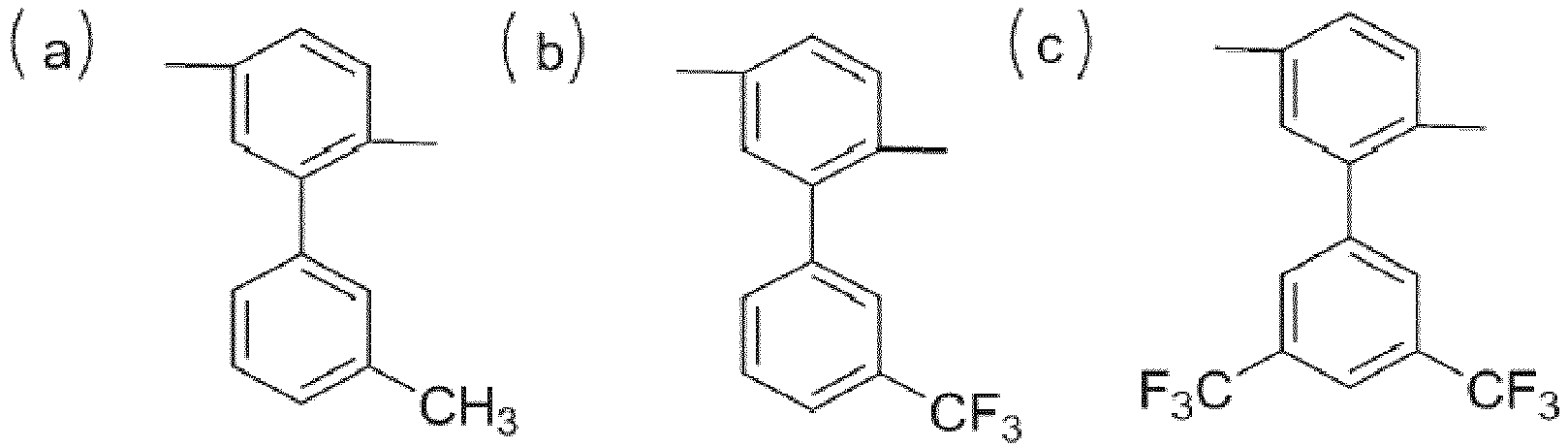
- Ar may include compounds represented by Formulae (a), (b), and (c), and Ar' may include compounds represented by Formulae (x), (y) and (z).
- the organic binder may be an expandable organic binder.
- the expandable organic binder refers to an organic binder component that is used as a component of the coating layer to enlarge an electrolyte supplementing capability of the separator and exhibits expandable properties with respect to the electrolyte.
- any kind of expandable organic binder having electrochemical stability and affinity with battery electrolytes may be used without limitation as the expandable organic binder according to the present invention.
- the expandable organic binder may include polyvinylidene fluoride-hexafluoropropylene copolymers, perfluoropolymer, polyvinyl chloride or polyvinylidene chloride and copolymers thereof, polyethylene glycol derivatives including polyethylene glycol dialkylether and polyethylene glycol dialkylester, poly oxides including poly(oxymethylene-oligo-oxyethylene), polyethylene oxides and polypropylene oxides, polyacrylonitrile copolymers including polyvinylacetate, poly(vinylpyrrolidone-vinylacetate), polystyrene and polystyrene acrylonitrile copolymers, polyacrylonitrile, polyacrylonitrile methylmethacrylate copolymers, polymethylmethacrylate or polymethylmethacrylate copolymers, and the like. These may be used alone or in combination thereof.
- the expandable organic binder may be a polyvinylidene fluoride-hexafluoropropylene copolymer.
- the polyvinylidene fluoride-hexafluoropropylene copolymer may have a weight average molecular weight of 600,000 g/mol or more to 800,000 g/mol or less, more preferably 600,000 g/mol or more to 750,000 g/mol or less.
- the separator allows excellent electrolyte impregnation, so that a battery including the separator can achieve efficient output of electricity.
- polyvinylidene fluoride-hexafluoropropylene copolymer used in the present invention, although the content of each of polyvinylidene fluoride and hexafluoropropylene is not particularly limited, hexafluoropropylene may be present in an amount of 0.1 or more to 40 % or less by weight based on the total weight of the copolymer.
- the coating layer may further include the inorganic particles.
- the inorganic particles may be selected from the group consisting of Al 2 O 3 , SiO 2 , B 2 O 3 , Ga 2 O 3 , TiO 2 and SnO 2 , without being limited thereto. These may be used alone or in combination thereof.
- the inorganic particles are Al 2 O 3 particles.
- the inorganic particles preferably have an average particle size from 1 nm or more to 2,000 nm or less, more preferably from 100 nm or more to 1,000 nm or less.
- the inorganic particles can prevent deterioration in coating processibility and dispersion within the coating agent, deterioration in mechanical properties, and increase in electric resistance by allowing suitable thickness adjustment of the coating layer through increase in density of the coating layer.
- pores of a suitable size can be created in the coating layer, thereby lowering the likelihood of internal short circuit upon charge and discharge of the battery.
- the coating agent of the organic and inorganic mixture contains the polyimide and the organic binder as organic binder polymer resins, and the inorganic particles.
- the coating agent may further contain suitable solvents and other additives.
- the coating layer may contain: 5 or more to 10 or less parts by weight of the polyimide; 5 or more to 20 or less parts by weight of the organic binder; and 70 or more to 90 or less parts by weight of the inorganic particles, based on 100 parts by weight of the coating layer.
- the polyimide can provide improved heat resistance and adhesion
- the inorganic particles can provide improved heat dissipation
- the organic binder can permit sufficient impregnation of the electrolyte, whereby the coating layer can be formed in a relatively flat shape by preventing deterioration in coating processibility and dispersion of the coating agent.
- the polyimide, the organic binder, and the inorganic particles may be dissolved in suitable solvents, respectively, and mixed with each other.
- the polyimide and the organic binder for example, a polyvinylidene fluoride-hexafluoropropylene copolymer
- the polyimide and the organic binder may be prepared as polymer solutions, which are obtained by dissolving the polyimide and the polyvinylidene fluoride-hexafluoropropylene copolymer in acetone.
- the inorganic particles may be prepared as an inorganic dispersant, which is obtained by dissolving the inorganic particles in acetone.
- the polymer solutions and the inorganic dispersant may be mixed in a suitable solvent to prepare a coating agent.
- solvents used in the present invention may include ketones such as acetone, or alcohols such as methanol, ethanol, isopropyl alcohol, and the like, without being limited thereto. These solvents provide an advantage of allowing easy removal upon drying after coating.
- the coating agent may be prepared in the form of a mixture obtained by sufficiently stirring the polymer solutions, the inorganic dispersant and the solvent using a ball mill, a bead mill or a screw mixer.
- the separator of the present invention may be prepared by coating the coating agent on one or both sides of a base film, followed by drying the coating agent.
- any typical coating method known in the art may be used without limitation in order to coat the base film with the coating agent.
- dip coating, die coating, roll coating, or comma coating may be used. These coating processes may be used alone or in combination thereof.
- the coating layer of the separator is formed by dip coating.
- the coating layer of the organic and inorganic mixture preferably has a thickness of 0.01 ⁇ m or more to 20 ⁇ m or less, more preferably 1 ⁇ m or more to 15 ⁇ m or less. Within this thickness range, the coating layer can be formed to a suitable thickness to have excellent thermal stability and adhesion, and can prevent the separator from being excessively thickened, thereby preventing increase in internal resistance of the battery.
- a term of "loading amount of coating agent (or coating layer)" means a weight per unit area of the coating layer.
- the base film may be a polyolefin base film.
- the polyolefin base film may be selected from the group consisting of a polyethylene monolayer film, a polypropylene monolayer film, a polyethylene/polypropylene bilayer film, a polypropylene/polyethylene/polypropylene triple-layer film, and a polyethylene/polypropylene/polyethylene triple-layer film.
- the polyolefin base film preferably has a thickness of 1 ⁇ m or more to 40 ⁇ m or less, more preferably 1 ⁇ m or more to 25 ⁇ m or less.
- the separator can be formed to a suitable thickness, thereby preventing short circuit of the positive electrode and the negative electrode while improving stability of the battery. If the thickness of the separator exceeds this range, there is a problem of increase in internal resistance of the battery.
- the separator comprising the coating layer of the organic and inorganic mixture may have a thermal shrinkage of 30% or less in a machine direction (MD) or in a transverse direction (TD), as measured after leaving the separator at 150°C for 1 hour. Within this range, the separator can effectively prevent short circuit of the electrodes, thereby improving stability of the battery.
- MD machine direction
- TD transverse direction
- any typical method known in the art may be used without limitation to measure the thermal shrinkage of the separator.
- the thermal shrinkage of the separator can be measured as follows: a prepared separator is cut into a size of about 5 cm (width) ⁇ about 5 cm (length) and left in a chamber at 150°C for 1 hour, followed by measuring degrees of shrinkage in MD and TD directions to calculate thermal shrinkage.
- the separator may have an electrolyte wettability of 80 seconds or less.
- the electrolyte wettability refers to a period of time from a time point of leaving a separator having a predetermined size (for example, a circular separator specimen having an outer diameter of 18 mm) on a surface of an electrolyte in a beaker to a time point when the separator is completely wet by the electrolyte.
- a predetermined size for example, a circular separator specimen having an outer diameter of 18 mm
- any typical electrolyte for electrochemical batteries known in the art may be used without limitation.
- the electrolyte may be obtained through dissolution or dissociation of a salt having, for example, a structure of A + B - in an organic solvent.
- a + component that is, cation
- alkali metal cations such as Li + , Na + or K + , and combinations thereof, without being limited thereto.
- the B - component may include PF 6 - , BF 4 - , Cl - , Br - , I - , ClO 4 - , AsF 6 - , CH 3 CO 2 - , CF 3 SO 3 - , N(CF 3 SO 2 ) 2 - , C(CF 2 SO 2 ) 3 - , and combinations thereof, without being limited thereto.
- the separator may have a remaining solvent amount of 100 ppm or less.
- the remaining solvent amount of 100 ppm or less technically does not means a numerical value of 0 or less and is a positive value that exceeds 0 and is less than or equal to 100 ppm.
- the remaining amount of the solvent may exceed 10 ppm and may be less than or equal to 100 ppm.
- the remaining solvent amount may be measured by depositing the coating agent of the organic and inorganic mixture containing the polyimide and the organic binder on one side of the base film, followed by drying at temperatures of 90°C to 120°C for 5 seconds to 2 minutes, more preferably at 100°C for 10 seconds.
- the remaining solvent amount in the separator is 100 ppm or less, it is possible to prevent various problems caused by excess of the solvent remaining in the separator, that is, insufficient demonstration of adhesion by the organic binder component, insufficient suppression of thermal shrinkage of the base film due to deterioration in adhesion of the coating layer, short circuit between electrodes upon overheating of the battery due to deterioration in performance of the battery upon charge and discharge of the battery, and the like.
- the present invention provides a separator having a solvent remaining amount of 100 ppm or less, as measured by coating one side of a base film with a coating agent containing polyimide and an organic binder, and drying the coating agent at 100°C for 10 seconds.
- the present invention provides an electrochemical battery, which includes the polyolefin porous separator including the coating layer of the organic and inorganic mixture, a positive electrode, and a negative electrode, and which is filled with an electrolyte.
- electrochemical battery Any type of electrochemical battery known in the art may be used without limitation.
- Examples of the electrochemical battery of the present invention may include lithium rechargeable batteries, such as lithium metal rechargeable batteries, lithium ion rechargeable batteries, lithium polymer rechargeable batteries, lithium ion polymer rechargeable batteries, and the like.
- lithium rechargeable batteries such as lithium metal rechargeable batteries, lithium ion rechargeable batteries, lithium polymer rechargeable batteries, lithium ion polymer rechargeable batteries, and the like.
- the electrochemical battery according to the present invention may be manufactured by placing the polyolefin separator including the coating layer of the organic and inorganic mixture according to the present invention between a positive electrode and a negative electrode, and filling a space therebetween with an electrolyte.
- the electrodes of the electrochemical battery according to the present invention may be prepared in the form of assemblies of electrode active materials and current collectors, which are combined by a typical method used in the art.
- any positive electrode active material known in the art may be used without limitation.
- Examples of the positive electrode active material may include lithium manganese oxides, lithium cobalt oxides, lithium nickel oxides, lithium iron oxides, and lithium composite oxides thereof, without being limited thereto.
- negative electrode active material of the battery according to the present invention any negative electrode active material known in the art may be used without limitation.
- Examples of the negative electrode active material may include lithium metal, lithium alloys, lithium adsorption materials such as carbon, petroleum coke, activated carbon, graphite and other carbonous materials, and the like.
- any typical current collector known in the art may be used without limitation.
- Examples of a positive electrode current collector may include aluminum foils, nickel foils, and combinations thereof, without being limited thereto.
- Examples of a negative electrode current collector may include copper foils, gold foils, nickel foils, copper alloy foils, and combinations thereof, without being limited thereto.
- any typical electrolyte for electrochemical batteries known in the art may be used without limitation.
- the electrolyte may be obtained through dissolution or dissociation of a salt having, for example, a structure of A + B - in an organic solvent.
- Examples of the A + component that is, cation, may include alkali metal cations such as Li + , Na + or K + , and combinations thereof, without being limited thereto.
- Examples of the B - component may include PF 6 - , BF 4 - , Cl - , Br - , I - , ClO 4 - , AsF 6 - , CH 3 CO 2 - , CF 3 SO 3 - , N(CF 3 SO 2 ) 2 - , C(CF 2 SO 2 ) 3 - , and combinations thereof, without being limited thereto.
- organic solvent examples include propylene carbonate (PC), ethylene carbonate (EC), diethylcarbonate (DEC), dimethylcarbonate (DMC), dipropylcarbonate (DPC), dimethylsulfoxide, acetonitrile, dimethoxyethane, diethoxyethane, tetrahydrofuran, N-methyl-2-pyrrolidone (NMP), ethylmethylcarbonate (EMC), ⁇ -butyrolactone, and the like. These may be used alone or in combination thereof.
- PC propylene carbonate
- EC ethylene carbonate
- DEC diethylcarbonate
- DMC dimethylcarbonate
- DPC dipropylcarbonate
- dimethylsulfoxide acetonitrile, dimethoxyethane, diethoxyethane, tetrahydrofuran, N-methyl-2-pyrrolidone (NMP), ethylmethylcarbonate (EMC), ⁇ -butyrolactone, and the
- the prepared first polymer solution, second polymer solution and inorganic dispersant were mixed in a ratio of first polymer solution : second polymer solution : inorganic dispersant : solvent (acetone) of 1.8:0.2:3:6, and stirred at 25°C for 2 hours using a power mixer to prepare a coating agent.
- the prepared coating agent was deposited on both sides of a 9 ⁇ m thick polyethylene monolayer base film by dip coating and dried at a temperature of 100°C for 10 seconds to prepare a separator.
- a separator was prepared in the same manner as in Example 1 except that the coating agent was prepared by mixing the first polymer solution, the second polymer solution, the inorganic dispersion and solvent (acetone) in a ratio of 1.4:0.4:3:6 in (1) of Example 1.
- a separator was prepared in the same manner as in Example 1 except that the coating agent was prepared by mixing the first polymer solution, the second polymer solution, the inorganic dispersion and solvent (acetone) in a ratio of 1:1:3:6 in (1) Example 1.
- separator including coating layer containing insoluble polyimide
- the prepared first polymer solution and inorganic dispersant were mixed in a ratio of first polymer solution : inorganic dispersant : solvent (acetone) of 2:3:6, and stirred at 25°C for 2 hours using a power mixer to prepare a coating agent.
- the prepared coating agent was deposited on both sides of a 9 ⁇ m thick polyethylene monolayer base film by dip coating and dried to prepare a separator.
- a separator was prepared in the same manner as in Example 1 except that a polyvinylidene fluoride homopolymer (5130, Solvay) was added in an amount of 10 wt% to DMF (Daejung Chemicals & Metals) to prepare a first polymer solution in (1) of Example 1 in (1) of Example 1.
- a polyvinylidene fluoride homopolymer (5130, Solvay) was added in an amount of 10 wt% to DMF (Daejung Chemicals & Metals) to prepare a first polymer solution in (1) of Example 1 in (1) of Example 1.
- the thickness and loading amount of each of the coating layers prepared in Examples 1 to 3 and Comparative Examples 2 and 3 were measured as follows.
- each coating layer was measured using an SEM cross section image and a microcaliper.
- each of the coating layers was cut into 10 cm (MD) ⁇ 20 cm (TD) pieces to prepare specimens, each weight of which was measured using an electronic scale, followed by calculating the loading amount of the coating agent.
- Each of the separators prepared in Examples 1 to 3 and Comparative Examples 2 and 3 was cut into 5 cm (MD) x 5 cm (TD) pieces to prepare a total of 5 specimens.
- Each of the specimens was left in a chamber at 150°C for 1 hour, followed by measuring degrees of shrinkage of each specimen in MD and TD directions to calculate thermal shrinkage.
- Each of the separators prepared in Examples 1 to 3 and Comparative Examples 2 and 3 was cut into circular pieces each having an outer diameter of 18 ⁇ to prepare a total of 5 specimens. Then, each specimen was placed on the surface of the electrolyte in a beaker until the specimen was completely wet by the electrolyte. Here, a period of time from a time point of placing the specimen on the surface of the electrolyte to a time point when the specimen was completely wet by the electrolyte was measured.
- the separators of Examples 1 to 3 each including the coating layer containing the soluble polyimide had lower thermal shrinkage than the separators of Comparative Example 2 including the coating layer free from the soluble polyimide. Thus, it can be confirmed that the separators of Examples 1 to 3 have improved thermal stability.
- Comparative Example 3 wherein the PVdF-HFP copolymer was not used under the same conditions as in Example 1, it was determined that the separator had significantly deterioration in electrolyte wettability and could not be used for a battery.
- the remaining amount of acetone in each of the separators prepared in Examples 1 to 3 was less than about 50 ppm.
Landscapes
- Chemical & Material Sciences (AREA)
- Chemical Kinetics & Catalysis (AREA)
- General Chemical & Material Sciences (AREA)
- Electrochemistry (AREA)
- Engineering & Computer Science (AREA)
- Inorganic Chemistry (AREA)
- Manufacturing & Machinery (AREA)
- Materials Engineering (AREA)
- Composite Materials (AREA)
- Health & Medical Sciences (AREA)
- Medicinal Chemistry (AREA)
- Polymers & Plastics (AREA)
- Organic Chemistry (AREA)
- Cell Separators (AREA)
- Secondary Cells (AREA)
Abstract
Description
- The present invention relates to a separator including a coating layer of an organic and inorganic mixture containing an organic binder and polyimide, and a battery including the same.
- A separator for an electrochemical battery refers to a middle layer disposed inside a battery to isolate a positive electrode and a negative electrode from each other while maintaining ionic conductivity to permit charge and discharge of the battery.
- Recently, electrochemical batteries have been developed to have a lighter and thinner structure to improve portability of electronic devices such as mobile devices and notebook computers while ensuring high output and high capacity for use in electric cars and the like. Consequently, it is necessary for a separator for batteries to have a slim thickness and a light weight while ensuring shape stability based on high heat resistance in order to produce high capacity batteries.
- For example, Korean Patent No.
0775310 - When an organic binder having excellent heat resistance is used as an organic binder component of a coating agent for a separator, it can be anticipated that the coating layer can exhibit further improved thermal stability. In this case, however, the organic binder having high heat resistance is unlikely to be dissolved in a low boiling point solvent generally used for forming the coating layer and is not used in practice due to low compatibility with other components of the coating agent.
- Since heat resistance of the separator is an important factor relating to stability and lifespan of a battery, there is a need for a separator including a coating layer which has excellent thermal stability through use of a heat resistant organic binder.
- In order to solve such problems of the related art, the present inventor developed a separator which includes a coating layer formed on a base film by coating the base film with a coating agent containing polyimide and an organic binder, and exhibits excellent heat resistance.
- It is an aspect of the present invention to provide a separator which employs polyimide capable of being easily dissolved in a low boiling point solvent and compatible with other components of an organic binder of a coating agent and has excellent heat resistance to achieve suppression of thermal shrinkage.
- In accordance with one aspect, the present invention provides a separator which includes a coating layer formed on one or both sides of a base film using a coating agent containing polyimide, an organic binder, and a solvent, wherein the remaining amount of the solvent is 100 ppm or less.
- In accordance with another aspect, the present invention provides a separator which has a solvent remaining amount of 100 ppm or less, as measured by coating one side of a base film with a coating agent containing polyimide and an organic binder, followed by drying the coating agent.
- In accordance with a further aspect, the present invention provides an electrochemical battery, which includes the separator, a positive electrode, a negative electrode, and an electrolyte.
- The electrochemical battery may be a lithium rechargeable battery.
- According to the present invention, the separator is coated with the coating agent containing polyimide and an organic binder, which improves heat resistance of the separator to achieve suppression of thermal shrinkage of the separator.
- Specifically, in the present invention, a highly heat resistant polyimide capable of being easily dissolved in a low boiling point solvent and compatible with an organic binder of a coating agent is used as an organic binder component of the coating agent to be coated on a polyolefin base film, thereby improving heat resistance of the base film that is vulnerable to heat.
- Further, when applied to a battery, the separator of the present invention can prevent short circuit of electrodes by preventing thermal shrinkage of the battery upon overheating of the battery, thereby improving stability and lifespan of the battery.
- Hereinafter, embodiments of the present invention will be described in more detail. Descriptions of details apparent to those skilled in the art will be omitted herein.
- One aspect of the present invention provides a separator which includes a coating layer formed on one or both sides of a base film using a coating agent containing polyimide, an organic binder, and a solvent, wherein the remaining amount of the solvent is 100 ppm or less.
- The polyimide may be a soluble polyimide.
- Herein, the soluble polyimide refers to a polyimide which can be more easily dissolved in a low boiling point solvent having a lower boiling point than a general insoluble polyimide, and is not limited to a particular soluble polyimide. As used herein, the term 'low boiling point solvent' refers to a solvent having a boiling point of less than 150°C, and the term 'high boiling point solvent' refers to a solvent having a boiling point of 150°C or more.
- When the solvent remains in excess in the dried coating layer of the separator, the coating layer exhibits low adhesion. Thus, a low boiling point solvent is used as a solvent for the coating agent in a typical coating process (particularly, dip coating).
- However, a typical insoluble polyimide has a problem in that it is not dissolved in such a low boiling point solvent. Moreover, the typical polyimide has not been used as a component for the coating layer in the field of the separator due to incompatibility with expandable organic binder components, which are advantageously used together in terms of impregnation for an electrolyte of the coating layer.
- In the present invention, the soluble polyimide is used as a component for the coating layer to be formed on the separator, thereby overcoming problems in the art.
- As the soluble polyimide applicable to the present invention, any typical polyimide soluble in a low boiling point solvent can be used without limitation. Examples of the soluble polyimide may include fluoro-polyimide, polyether imide, and the like. Particularly, the fluoro-polyimide may be a tri-fluoromethyl group containing polyimide. Since the tri-fluoromethyl group has a bulky structure to enlarge a free volume, the tri-fluoromethyl group containing polyimide can be more easily dissolved in the low boiling point solvent.
- In some embodiments, the tri-fluoromethyl group containing polyimide may include compounds represented by Formula 1 or 2.


- In some embodiments, the polyether imide may include compounds represented by Formula 3.

- In Formula 3, Ar may include compounds represented by Formulae (a), (b), and (c), and Ar' may include compounds represented by Formulae (x), (y) and (z).


- According to the present invention, the organic binder may be an expandable organic binder.
- Herein, the expandable organic binder refers to an organic binder component that is used as a component of the coating layer to enlarge an electrolyte supplementing capability of the separator and exhibits expandable properties with respect to the electrolyte.
- As typically used in the art, any kind of expandable organic binder having electrochemical stability and affinity with battery electrolytes may be used without limitation as the expandable organic binder according to the present invention.
- Examples of the expandable organic binder may include polyvinylidene fluoride-hexafluoropropylene copolymers, perfluoropolymer, polyvinyl chloride or polyvinylidene chloride and copolymers thereof, polyethylene glycol derivatives including polyethylene glycol dialkylether and polyethylene glycol dialkylester, poly oxides including poly(oxymethylene-oligo-oxyethylene), polyethylene oxides and polypropylene oxides, polyacrylonitrile copolymers including polyvinylacetate, poly(vinylpyrrolidone-vinylacetate), polystyrene and polystyrene acrylonitrile copolymers, polyacrylonitrile, polyacrylonitrile methylmethacrylate copolymers, polymethylmethacrylate or polymethylmethacrylate copolymers, and the like. These may be used alone or in combination thereof.
- According to the present invention, the expandable organic binder may be a polyvinylidene fluoride-hexafluoropropylene copolymer.
- According to the present invention, the polyvinylidene fluoride-hexafluoropropylene copolymer may have a weight average molecular weight of 600,000 g/mol or more to 800,000 g/mol or less, more preferably 600,000 g/mol or more to 750,000 g/mol or less.
- Within this molecular weight range of the polyvinylidene fluoride-hexafluoropropylene copolymer, the separator allows excellent electrolyte impregnation, so that a battery including the separator can achieve efficient output of electricity.
- In the polyvinylidene fluoride-hexafluoropropylene copolymer used in the present invention, although the content of each of polyvinylidene fluoride and hexafluoropropylene is not particularly limited, hexafluoropropylene may be present in an amount of 0.1 or more to 40 % or less by weight based on the total weight of the copolymer.
- The coating layer may further include the inorganic particles.
- According to the present invention, the inorganic particles may be selected from the group consisting of Al2O3, SiO2, B2O3, Ga2O3, TiO2 and SnO2, without being limited thereto. These may be used alone or in combination thereof.
- Preferably, the inorganic particles are Al2O3 particles.
- Although not particularly limited to a certain average particle size, the inorganic particles preferably have an average particle size from 1 nm or more to 2,000 nm or less, more preferably from 100 nm or more to 1,000 nm or less. Within this size range, the inorganic particles can prevent deterioration in coating processibility and dispersion within the coating agent, deterioration in mechanical properties, and increase in electric resistance by allowing suitable thickness adjustment of the coating layer through increase in density of the coating layer. Further, pores of a suitable size can be created in the coating layer, thereby lowering the likelihood of internal short circuit upon charge and discharge of the battery.
- According to the present invention, the coating agent of the organic and inorganic mixture contains the polyimide and the organic binder as organic binder polymer resins, and the inorganic particles. The coating agent may further contain suitable solvents and other additives.
- Although not particularly limited to a certain ratio in the coating layer of the organic and inorganic mixture, the coating layer may contain: 5 or more to 10 or less parts by weight of the polyimide; 5 or more to 20 or less parts by weight of the organic binder; and 70 or more to 90 or less parts by weight of the inorganic particles, based on 100 parts by weight of the coating layer.
- Within these ranges, the polyimide can provide improved heat resistance and adhesion, the inorganic particles can provide improved heat dissipation, and the organic binder can permit sufficient impregnation of the electrolyte, whereby the coating layer can be formed in a relatively flat shape by preventing deterioration in coating processibility and dispersion of the coating agent.
- In preparation of the coating agent used in the present invention, the polyimide, the organic binder, and the inorganic particles may be dissolved in suitable solvents, respectively, and mixed with each other.
- For example, the polyimide and the organic binder, for example, a polyvinylidene fluoride-hexafluoropropylene copolymer, may be prepared as polymer solutions, which are obtained by dissolving the polyimide and the polyvinylidene fluoride-hexafluoropropylene copolymer in acetone. Further, the inorganic particles may be prepared as an inorganic dispersant, which is obtained by dissolving the inorganic particles in acetone.
- The polymer solutions and the inorganic dispersant may be mixed in a suitable solvent to prepare a coating agent.
- Examples of solvents used in the present invention may include ketones such as acetone, or alcohols such as methanol, ethanol, isopropyl alcohol, and the like, without being limited thereto. These solvents provide an advantage of allowing easy removal upon drying after coating.
- According to the present invention, the coating agent may be prepared in the form of a mixture obtained by sufficiently stirring the polymer solutions, the inorganic dispersant and the solvent using a ball mill, a bead mill or a screw mixer.
- The separator of the present invention may be prepared by coating the coating agent on one or both sides of a base film, followed by drying the coating agent.
- Any typical coating method known in the art may be used without limitation in order to coat the base film with the coating agent. For example, dip coating, die coating, roll coating, or comma coating may be used. These coating processes may be used alone or in combination thereof.
- Preferably, the coating layer of the separator is formed by dip coating.
- According to the present invention, the coating layer of the organic and inorganic mixture preferably has a thickness of 0.01 µm or more to 20 µm or less, more preferably 1 µm or more to 15 µm or less. Within this thickness range, the coating layer can be formed to a suitable thickness to have excellent thermal stability and adhesion, and can prevent the separator from being excessively thickened, thereby preventing increase in internal resistance of the battery.
- A term of "loading amount of coating agent (or coating layer)" means a weight per unit area of the coating layer.
- According to the present invention, the base film may be a polyolefin base film.
- The polyolefin base film may be selected from the group consisting of a polyethylene monolayer film, a polypropylene monolayer film, a polyethylene/polypropylene bilayer film, a polypropylene/polyethylene/polypropylene triple-layer film, and a polyethylene/polypropylene/polyethylene triple-layer film.
- The polyolefin base film preferably has a thickness of 1 µm or more to 40 µm or less, more preferably 1 µm or more to 25 µm or less. Within this thickness range of the base film, the separator can be formed to a suitable thickness, thereby preventing short circuit of the positive electrode and the negative electrode while improving stability of the battery. If the thickness of the separator exceeds this range, there is a problem of increase in internal resistance of the battery.
- The separator comprising the coating layer of the organic and inorganic mixture may have a thermal shrinkage of 30% or less in a machine direction (MD) or in a transverse direction (TD), as measured after leaving the separator at 150°C for 1 hour. Within this range, the separator can effectively prevent short circuit of the electrodes, thereby improving stability of the battery.
- Here, any typical method known in the art may be used without limitation to measure the thermal shrinkage of the separator.
- For example, the thermal shrinkage of the separator can be measured as follows: a prepared separator is cut into a size of about 5 cm (width) × about 5 cm (length) and left in a chamber at 150°C for 1 hour, followed by measuring degrees of shrinkage in MD and TD directions to calculate thermal shrinkage.
- In some embodiments of the present invention, the separator may have an electrolyte wettability of 80 seconds or less.
- Herein, the electrolyte wettability refers to a period of time from a time point of leaving a separator having a predetermined size (for example, a circular separator specimen having an outer diameter of 18 mm) on a surface of an electrolyte in a beaker to a time point when the separator is completely wet by the electrolyte.
- As the electrolyte of the battery according to the present invention, any typical electrolyte for electrochemical batteries known in the art may be used without limitation. The electrolyte may be obtained through dissolution or dissociation of a salt having, for example, a structure of A+ B- in an organic solvent. Examples of the A+ component, that is, cation, may include alkali metal cations such as Li+, Na+ or K+, and combinations thereof, without being limited thereto. Examples of the B- component, that is, anion, may include PF6 -, BF4 -, Cl-, Br-, I-, ClO4 -, AsF6 -, CH3CO2 -, CF3SO3 -, N(CF3SO2)2 -, C(CF2SO2)3 -, and combinations thereof, without being limited thereto. In some embodiments of the present invention, the separator may have a remaining solvent amount of 100 ppm or less. Herein, the remaining solvent amount of 100 ppm or less technically does not means a numerical value of 0 or less and is a positive value that exceeds 0 and is less than or equal to 100 ppm. Particularly, the remaining amount of the solvent may exceed 10 ppm and may be less than or equal to 100 ppm.
- The remaining solvent amount may be measured by depositing the coating agent of the organic and inorganic mixture containing the polyimide and the organic binder on one side of the base film, followed by drying at temperatures of 90°C to 120°C for 5 seconds to 2 minutes, more preferably at 100°C for 10 seconds.
- When the remaining solvent amount in the separator is 100 ppm or less, it is possible to prevent various problems caused by excess of the solvent remaining in the separator, that is, insufficient demonstration of adhesion by the organic binder component, insufficient suppression of thermal shrinkage of the base film due to deterioration in adhesion of the coating layer, short circuit between electrodes upon overheating of the battery due to deterioration in performance of the battery upon charge and discharge of the battery, and the like.
- In accordance with another aspect, the present invention provides a separator having a solvent remaining amount of 100 ppm or less, as measured by coating one side of a base film with a coating agent containing polyimide and an organic binder, and drying the coating agent at 100°C for 10 seconds.
- In accordance with a further aspect, the present invention provides an electrochemical battery, which includes the polyolefin porous separator including the coating layer of the organic and inorganic mixture, a positive electrode, and a negative electrode, and which is filled with an electrolyte.
- Any type of electrochemical battery known in the art may be used without limitation.
- Examples of the electrochemical battery of the present invention may include lithium rechargeable batteries, such as lithium metal rechargeable batteries, lithium ion rechargeable batteries, lithium polymer rechargeable batteries, lithium ion polymer rechargeable batteries, and the like.
- Any typical method known in the art can be used without limitation in manufacture of the electrochemical battery according to the present invention.
- For example, the electrochemical battery according to the present invention may be manufactured by placing the polyolefin separator including the coating layer of the organic and inorganic mixture according to the present invention between a positive electrode and a negative electrode, and filling a space therebetween with an electrolyte.
- The electrodes of the electrochemical battery according to the present invention may be prepared in the form of assemblies of electrode active materials and current collectors, which are combined by a typical method used in the art.
- As the positive active material of the battery according to the present invention, any positive electrode active material known in the art may be used without limitation.
- Examples of the positive electrode active material may include lithium manganese oxides, lithium cobalt oxides, lithium nickel oxides, lithium iron oxides, and lithium composite oxides thereof, without being limited thereto.
- Further, as the negative electrode active material of the battery according to the present invention, any negative electrode active material known in the art may be used without limitation.
- Examples of the negative electrode active material may include lithium metal, lithium alloys, lithium adsorption materials such as carbon, petroleum coke, activated carbon, graphite and other carbonous materials, and the like.
- As the current collector of the battery according to the present invention, any typical current collector known in the art may be used without limitation.
- Examples of a positive electrode current collector may include aluminum foils, nickel foils, and combinations thereof, without being limited thereto.
- Examples of a negative electrode current collector may include copper foils, gold foils, nickel foils, copper alloy foils, and combinations thereof, without being limited thereto.
- As the electrolyte of the battery according to the present invention, any typical electrolyte for electrochemical batteries known in the art may be used without limitation.
- The electrolyte may be obtained through dissolution or dissociation of a salt having, for example, a structure of A+B- in an organic solvent.
- Examples of the A+ component, that is, cation, may include alkali metal cations such as Li+, Na+ or K+, and combinations thereof, without being limited thereto.
- Examples of the B- component, that is, anion, may include PF6 -, BF4 -, Cl-, Br-, I-, ClO4 -, AsF6 -, CH3CO2 -, CF3SO3 -, N(CF3SO2)2 -, C(CF2SO2)3 -, and combinations thereof, without being limited thereto.
- Examples of the organic solvent may include propylene carbonate (PC), ethylene carbonate (EC), diethylcarbonate (DEC), dimethylcarbonate (DMC), dipropylcarbonate (DPC), dimethylsulfoxide, acetonitrile, dimethoxyethane, diethoxyethane, tetrahydrofuran, N-methyl-2-pyrrolidone (NMP), ethylmethylcarbonate (EMC), γ-butyrolactone, and the like. These may be used alone or in combination thereof.
- Next, the present invention will be described in more detail with reference to some examples. However, it should be understood that the following examples are provided for illustration only and are not to be construed in any way as limiting the present invention.
-
- 1) A polyvinylidene fluoride-hexafluoropropylene ('PVdF-HFP') copolymer (21216, Solvay) having a weight average molecular weight of 700,000 g/mol was added in an amount of 10 wt% to acetone (Daejung Chemicals & Metals), followed by stirring at 25°C for 4 hours using a stirrer to prepare a first polymer solution.
- 2) A polyimide (Cheil Industries) having a weight average molecular weight of 50,000 g/mol was added in an amount of 10 wt% to acetone (Daejung Chemicals & Metals), followed by stirring at 25°C for 4 hours using a stirrer to prepare a second polymer solution.
- 3) Al2O3 particles (LS235, Nippon Light Metal Company) were added in an amount of 25 wt% to acetone (Daejung Chemicals & Metals), followed by milling for dispersion at 25°C for 3 hours using a bead mill to prepare an inorganic dispersant.
- The prepared first polymer solution, second polymer solution and inorganic dispersant were mixed in a ratio of first polymer solution : second polymer solution : inorganic dispersant : solvent (acetone) of 1.8:0.2:3:6, and stirred at 25°C for 2 hours using a power mixer to prepare a coating agent.
- The prepared coating agent was deposited on both sides of a 9 µm thick polyethylene monolayer base film by dip coating and dried at a temperature of 100°C for 10 seconds to prepare a separator.
- A separator was prepared in the same manner as in Example 1 except that the coating agent was prepared by mixing the first polymer solution, the second polymer solution, the inorganic dispersion and solvent (acetone) in a ratio of 1.4:0.4:3:6 in (1) of Example 1.
- A separator was prepared in the same manner as in Example 1 except that the coating agent was prepared by mixing the first polymer solution, the second polymer solution, the inorganic dispersion and solvent (acetone) in a ratio of 1:1:3:6 in (1) Example 1.
- Although an insoluble polyimide was used instead of the soluble polyimide for preparing the second polymer solution in (1) of Example 1, the insoluble polyimide was not dissolved in acetone. As a result, the coating agent could not be prepared.
-
- 1) A polyvinylidene fluoride-hexafluoropropylene ('PVdF-HFP') copolymer (21216, Solvay) having a weight average molecular weight of 700,000 g/mol was added in an amount of 10 wt% to acetone (Daejung Chemicals & Metals), followed by stirring at 25°C for 4 hours using a stirrer to prepare a first polymer solution.
- 2) Al2O3 particles (LS235, Nippon Light Metal Company) were added in an amount of 25 wt% to acetone (Daejung Chemicals & Metals), followed by milling for dispersion at 25°C for 3 hours using a bead mill to prepare an inorganic dispersant.
- The prepared first polymer solution and inorganic dispersant were mixed in a ratio of first polymer solution : inorganic dispersant : solvent (acetone) of 2:3:6, and stirred at 25°C for 2 hours using a power mixer to prepare a coating agent.
- The prepared coating agent was deposited on both sides of a 9 µm thick polyethylene monolayer base film by dip coating and dried to prepare a separator.
- A separator was prepared in the same manner as in Example 1 except that a polyvinylidene fluoride homopolymer (5130, Solvay) was added in an amount of 10 wt% to DMF (Daejung Chemicals & Metals) to prepare a first polymer solution in (1) of Example 1 in (1) of Example 1.
- The thickness and loading amount of each of the coating layers prepared in Examples 1 to 3 and Comparative Examples 2 and 3 were measured as follows.
- First, the thickness of each coating layer was measured using an SEM cross section image and a microcaliper.
- Then, each of the coating layers was cut into 10 cm (MD) × 20 cm (TD) pieces to prepare specimens, each weight of which was measured using an electronic scale, followed by calculating the loading amount of the coating agent.
- The calculation results of the thicknesses and the loading amounts are listed in Table 1.
- Each of the separators prepared in Examples 1 to 3 and Comparative Examples 2 and 3 was cut into 5 cm (MD) x 5 cm (TD) pieces to prepare a total of 5 specimens. Each of the specimens was left in a chamber at 150°C for 1 hour, followed by measuring degrees of shrinkage of each specimen in MD and TD directions to calculate thermal shrinkage.
- Measurement results of the thermal shrinkage are listed in Table 1.
- Each of the separators prepared in Examples 1 to 3 and Comparative Examples 2 and 3 was cut into circular pieces each having an outer diameter of 18 Φ to prepare a total of 5 specimens. Then, each specimen was placed on the surface of the electrolyte in a beaker until the specimen was completely wet by the electrolyte. Here, a period of time from a time point of placing the specimen on the surface of the electrolyte to a time point when the specimen was completely wet by the electrolyte was measured.
- Periods of time taken for wetting the specimens by the electrolyte are listed in Table 1.
Table 1 Thickness of coating layer (µm) Loading amount (g/m2) Thermal shrinkage of separator (%) Electrolyte Wettability (sec) TD MD Example 1 4.5 7.9 9.5 15.0 63 Example 2 4.4 8.1 8.5 12.5 51 Example 3 4.6 8.2 7.0 9.5 32 Comparative Example 2 4.3 8.1 21.5 25.0 85 Comparative Example 3 4.6 8.3 5.0 7.0 187 - As shown in Table 1, the separators of Examples 1 to 3 each including the coating layer containing the soluble polyimide had lower thermal shrinkage than the separators of Comparative Example 2 including the coating layer free from the soluble polyimide. Thus, it can be confirmed that the separators of Examples 1 to 3 have improved thermal stability.
- Further, in Comparative Example 3 wherein the PVdF-HFP copolymer was not used under the same conditions as in Example 1, it was determined that the separator had significantly deterioration in electrolyte wettability and could not be used for a battery.
- Each of the separators prepared in Examples 1 to 3 was analyzed through gas-chromatography (HP-6890) under conditions as listed in Table 2 to measure the amount of the solvent remaining in the separator.
Table 2 Parameter Condition Column Front: HP-INNOWax (length 30 M, ID 0.53 mm, Film thickness 1.00 µm) Back: HP-1 (length 30 M, ID 0.53 mm, Film thickness 0.88 µm) Temperature and time 40°C (4 min) → 20°C/min → 250°C (4min) Flow rate 10 mL/min Injector S/SL Injector Split ratio 5 : 1 Detector FID Injection volume 1 µℓ Injector temperature 200°C - According to results of the gas-chromatography, the remaining amount of acetone in each of the separators prepared in Examples 1 to 3 was less than about 50 ppm.
- Although some embodiments have been disclosed herein, it should be understood that these embodiments are provided by way of illustration only, and that various modifications, changes, and alterations can be made without departing from the spirit and scope of the invention. Therefore, the scope of the invention should be limited only by the accompanying claims and equivalents thereof.
Claims (14)
- A separator comprising a coating layer formed on one or both sides of a base film using a coating agent containing polyimide, an organic binder, and a solvent,
wherein a remaining amount of the solvent is 100 ppm or less in the separator. - The separator according to claim 1, wherein the base film is a polyolefin film.
- The separator according to claim 1 or 2, wherein the polyolefin base film is one selected from the group consisting of a polyethylene monolayer film, a polypropylene monolayer film, a polyethylene/polypropylene bilayer film, a polypropylene/polyethylene/polypropylene triple-layer film, and a polyethylene/polypropylene/polyethylene triple-layer film.
- The separator according to any of the claims 1 to 3, wherein the polyimide comprises a soluble polyimide.
- The separator according to any of the claims 1 to 4, wherein the polyimide contains a tri-fluoromethyl group.
- The separator according to any of the claims 1 to 5, wherein the organic binder comprises an expandable organic binder.
- The separator according to any of the claims 1 to 6, wherein the expandable organic binder comprises a polyvinylidene fluoride-hexafluoropropylene copolymer.
- The separator according to any of the claims 1 to 7, wherein the coating layer further comprises inorganic particles.
- The separator according to any of the claims 1 to 7, wherein the inorganic particles comprise at least one selected from the group consisting of Al2O3, SiO2, B2O3, Ga2O3, TiO2 and SnO2 particles.
- The separator according to any of the claims 1 to 9, wherein the coating layer is formed by dip coating.
- The separator according to to any of the claims 1 to 10, wherein the separator has a thermal shrinkage of 30% or less in a machine direction (MD) or in a transverse direction (TD), as measured after leaving the separator at 150°C for 1 hour.
- The separator according to any of the claims 1 to 11, wherein the separator has a wettability of 80 seconds or less.
- An electrochemical battery comprising a positive electrode, a negative electrode, an electrolyte, and the separator according to any of the claims 1 to 12.
- The electrochemical battery according to claim 13, wherein the electrochemical battery is a lithium rechargeable battery.
Applications Claiming Priority (1)
| Application Number | Priority Date | Filing Date | Title |
|---|---|---|---|
| KR1020120021142A KR20130099546A (en) | 2012-02-29 | 2012-02-29 | Separator comprising organic and inorganic mixture coating layer containing soluble polyimide and battery using the separator |
Publications (1)
| Publication Number | Publication Date |
|---|---|
| EP2634837A1 true EP2634837A1 (en) | 2013-09-04 |
Family
ID=47757462
Family Applications (1)
| Application Number | Title | Priority Date | Filing Date |
|---|---|---|---|
| EP13157215.8A Withdrawn EP2634837A1 (en) | 2012-02-29 | 2013-02-28 | Separator including coating layer of organic and inorganic mixture containing polyimide, and battery including the same |
Country Status (4)
| Country | Link |
|---|---|
| US (1) | US20130224554A1 (en) |
| EP (1) | EP2634837A1 (en) |
| KR (1) | KR20130099546A (en) |
| CN (1) | CN103296238B (en) |
Families Citing this family (12)
| Publication number | Priority date | Publication date | Assignee | Title |
|---|---|---|---|---|
| US9991493B2 (en) * | 2013-10-15 | 2018-06-05 | Eaglepicher Technologies, Llc | High energy density non-aqueous electrochemical cell with extended operating temperature window |
| CN103618059B (en) * | 2013-12-10 | 2017-01-04 | 深圳市星源材质科技股份有限公司 | A kind of macromolecule inorganic coating lithium ion battery separator and preparation method thereof |
| CN103915595A (en) * | 2014-04-23 | 2014-07-09 | 深圳市星源材质科技股份有限公司 | Aqueous polymer diaphragm and preparation method thereof |
| KR101709696B1 (en) * | 2015-02-25 | 2017-02-23 | 삼성에스디아이 주식회사 | Separator for rechargeable lithium battery and rechargeable lithium battery including the same |
| CN107958977B (en) * | 2017-11-06 | 2020-06-12 | 上海恩捷新材料科技股份有限公司 | Battery diaphragm, lithium ion battery and preparation method thereof |
| KR102883065B1 (en) * | 2019-01-04 | 2025-11-07 | 셀가드 엘엘씨 | Polyimide coated separator for lithium batteries or capacitors |
| KR102841650B1 (en) * | 2019-02-22 | 2025-08-01 | 주식회사 엘지에너지솔루션 | Separator for lithium secondadry battery and manufacturing method thereof |
| CN110600662A (en) * | 2019-09-19 | 2019-12-20 | 湘潭大学 | Polyvinylidene fluoride-hexafluoropropylene/titanium dioxide composite membrane and preparation method and application thereof |
| CN110591471B (en) * | 2019-09-27 | 2021-06-08 | 新恒东薄膜材料(常州)有限公司 | Pre-coating liquid for enhancing surface adhesion of transparent PI (polyimide) substrate and application method thereof |
| KR20230089757A (en) * | 2021-12-14 | 2023-06-21 | 에스케이온 주식회사 | Separator for secondary battery, preparing method thereof, and secondary battery comprising the same |
| KR102889049B1 (en) * | 2022-05-19 | 2025-11-19 | 주식회사 엘지화학 | Manufacturing method of electrode for lithium recharegable battery, electrode for lithium recharegable battery, and lithium recharegable battery using the same |
| CN116544605B (en) * | 2023-05-08 | 2026-02-03 | 天目湖先进储能技术研究院有限公司 | Battery diaphragm and preparation method thereof |
Citations (4)
| Publication number | Priority date | Publication date | Assignee | Title |
|---|---|---|---|---|
| US20050208383A1 (en) * | 2004-03-19 | 2005-09-22 | Hiroki Totsuka | Electronic component separator and method for producing the same |
| KR100775310B1 (en) | 2004-12-22 | 2007-11-08 | 주식회사 엘지화학 | Organic/inorganic composite microporous membrane and electrochemical device prepared thereby |
| US20080261106A1 (en) * | 2007-04-20 | 2008-10-23 | Szu-Nan Yang | Electricity element, separator and manufacturing method thereof |
| US20100129720A1 (en) * | 2006-10-30 | 2010-05-27 | Kentaro Sako | Polyolefin microporous membrane |
Family Cites Families (11)
| Publication number | Priority date | Publication date | Assignee | Title |
|---|---|---|---|---|
| US5091087A (en) * | 1990-06-25 | 1992-02-25 | Hoechst Celanese Corp. | Fabrication of microporous PBI membranes with narrow pore size distribution |
| US7087343B2 (en) * | 2003-07-15 | 2006-08-08 | Celgard, Inc. | High melt integrity battery separator for lithium ion batteries |
| JP4662533B2 (en) * | 2003-08-26 | 2011-03-30 | 日東電工株式会社 | Reactive polymer-supported porous film for battery separator and battery manufacturing method using the same |
| KR100686816B1 (en) * | 2005-07-22 | 2007-02-26 | 삼성에스디아이 주식회사 | Lithium secondary battery |
| KR100918751B1 (en) * | 2006-07-26 | 2009-09-24 | 주식회사 엘지화학 | Electrode with improved interfacial adhesion with separator and electrochemical device comprising same |
| CN101170177A (en) * | 2006-10-25 | 2008-04-30 | 奇鋐科技股份有限公司 | Fuel battery device with preserved signal pin |
| JP5286844B2 (en) * | 2007-03-23 | 2013-09-11 | 住友化学株式会社 | Separator |
| CN101656306B (en) * | 2008-08-22 | 2012-07-04 | 比亚迪股份有限公司 | Composite membrane and preparation method thereof and battery comprising composite membrane |
| KR101716900B1 (en) * | 2009-12-04 | 2017-03-15 | 소니 주식회사 | Separator and battery |
| KR101187767B1 (en) * | 2010-03-17 | 2012-10-05 | 주식회사 엘지화학 | A separator and electrochemical device containing the same |
| KR101243931B1 (en) * | 2010-06-14 | 2013-03-14 | 한양대학교 산학협력단 | Separator for lithium secondary battery and method of manufacturing the same |
-
2012
- 2012-02-29 KR KR1020120021142A patent/KR20130099546A/en not_active Ceased
-
2013
- 2013-02-27 US US13/778,354 patent/US20130224554A1/en not_active Abandoned
- 2013-02-28 CN CN201310064598.6A patent/CN103296238B/en active Active
- 2013-02-28 EP EP13157215.8A patent/EP2634837A1/en not_active Withdrawn
Patent Citations (4)
| Publication number | Priority date | Publication date | Assignee | Title |
|---|---|---|---|---|
| US20050208383A1 (en) * | 2004-03-19 | 2005-09-22 | Hiroki Totsuka | Electronic component separator and method for producing the same |
| KR100775310B1 (en) | 2004-12-22 | 2007-11-08 | 주식회사 엘지화학 | Organic/inorganic composite microporous membrane and electrochemical device prepared thereby |
| US20100129720A1 (en) * | 2006-10-30 | 2010-05-27 | Kentaro Sako | Polyolefin microporous membrane |
| US20080261106A1 (en) * | 2007-04-20 | 2008-10-23 | Szu-Nan Yang | Electricity element, separator and manufacturing method thereof |
Also Published As
| Publication number | Publication date |
|---|---|
| CN103296238A (en) | 2013-09-11 |
| US20130224554A1 (en) | 2013-08-29 |
| CN103296238B (en) | 2017-03-01 |
| KR20130099546A (en) | 2013-09-06 |
Similar Documents
| Publication | Publication Date | Title |
|---|---|---|
| EP2634837A1 (en) | Separator including coating layer of organic and inorganic mixture containing polyimide, and battery including the same | |
| EP2634841B1 (en) | Separator including coating layer of inorganic and organic mixture, and battery including the same | |
| EP2634836B1 (en) | Separator including coating layer of inorganic and organic mixture, and battery including the same | |
| EP2634840B1 (en) | Separator including density-controlled coating layer and battery including the same | |
| EP2122714B1 (en) | Organic/inorganic composite separator having porous active coating layer and electrochemical device containing the same | |
| EP4138198A1 (en) | Separator for secondary battery comprising adhesive layer, and method for manufacturing separator | |
| EP2634842B1 (en) | Separator including coating layer of organic and inorganic mixture, and battery including the same | |
| EP2077594A1 (en) | Composite separator films for lithium-ion batteries | |
| KR102592147B1 (en) | Composite separator, preparing method thereof, and lithium secondary battery including the same | |
| JP6953629B2 (en) | Separator for electrochemical device, its manufacturing method, and electrochemical device including it | |
| KR102803836B1 (en) | Manufactururing method for separator and separator therefrom | |
| JP5157107B2 (en) | Non-aqueous electrolyte battery | |
| WO2014079861A1 (en) | Separator coated with polymer and conductive salt and electrochemical device using the same | |
| TWI847293B (en) | Solid electrolyte | |
| KR20220029513A (en) | A separator for an electrochemical device and an electrochemical device comprising the same | |
| KR20180025298A (en) | Separator for nonaqueous electrolyte secondary battery | |
| KR102311809B1 (en) | Separator and electrochemical device comprising the same | |
| KR20140076784A (en) | Coating agent composition, separator formed by using the coating agent composition, and battery using the separator | |
| KR101677794B1 (en) | Organic/inorganic composite separator for secondary battery, method of manufacturing the same, and secondary battery using the same | |
| JP7493616B2 (en) | Separator for lithium secondary battery and lithium secondary battery including same | |
| KR102913209B1 (en) | Method for manufacturing separator, separator manufactured by the method and method for manufacturing electrochemical device including the separator | |
| EP4738451A1 (en) | Anode for lithium secondary battery, manufacturing method therefor and lithium secondary battery comprising same | |
| EP4503307A1 (en) | Separator for nonaqueous secondary battery, and nonaqueous secondary battery | |
| CN114729143A (en) | Gelled polymer film for LI-ion batteries | |
| KR20190045869A (en) | Nonaqueous electrolyte secondary battery porous layer |
Legal Events
| Date | Code | Title | Description |
|---|---|---|---|
| PUAI | Public reference made under article 153(3) epc to a published international application that has entered the european phase |
Free format text: ORIGINAL CODE: 0009012 |
|
| AK | Designated contracting states |
Kind code of ref document: A1 Designated state(s): AL AT BE BG CH CY CZ DE DK EE ES FI FR GB GR HR HU IE IS IT LI LT LU LV MC MK MT NL NO PL PT RO RS SE SI SK SM TR |
|
| AX | Request for extension of the european patent |
Extension state: BA ME |
|
| 17P | Request for examination filed |
Effective date: 20140304 |
|
| RBV | Designated contracting states (corrected) |
Designated state(s): AL AT BE BG CH CY CZ DE DK EE ES FI FR GB GR HR HU IE IS IT LI LT LU LV MC MK MT NL NO PL PT RO RS SE SI SK SM TR |
|
| GRAP | Despatch of communication of intention to grant a patent |
Free format text: ORIGINAL CODE: EPIDOSNIGR1 |
|
| INTG | Intention to grant announced |
Effective date: 20160406 |
|
| STAA | Information on the status of an ep patent application or granted ep patent |
Free format text: STATUS: THE APPLICATION IS DEEMED TO BE WITHDRAWN |
|
| 18D | Application deemed to be withdrawn |
Effective date: 20160817 |