EP2632012B1 - Verfahren zum Synchronisieren einer Einspeisespannung mit einer Netzspannung - Google Patents
Verfahren zum Synchronisieren einer Einspeisespannung mit einer Netzspannung Download PDFInfo
- Publication number
- EP2632012B1 EP2632012B1 EP12156495.9A EP12156495A EP2632012B1 EP 2632012 B1 EP2632012 B1 EP 2632012B1 EP 12156495 A EP12156495 A EP 12156495A EP 2632012 B1 EP2632012 B1 EP 2632012B1
- Authority
- EP
- European Patent Office
- Prior art keywords
- network
- voltage
- power
- inverter
- feed
- Prior art date
- Legal status (The legal status is an assumption and is not a legal conclusion. Google has not performed a legal analysis and makes no representation as to the accuracy of the status listed.)
- Active
Links
Images



Classifications
-
- H—ELECTRICITY
- H02—GENERATION; CONVERSION OR DISTRIBUTION OF ELECTRIC POWER
- H02J—ELECTRIC POWER NETWORKS; CIRCUIT ARRANGEMENTS OR SYSTEMS FOR SUPPLYING OR DISTRIBUTING ELECTRIC POWER; SYSTEMS FOR STORING ELECTRIC ENERGY
- H02J3/00—Circuit arrangements for AC mains or AC distribution networks
- H02J3/38—Arrangements for feeding a single network from two or more generators or sources in parallel; Arrangements for feeding already energised networks from additional generators or sources in parallel
- H02J3/40—Synchronisation of generators for connection to a network or to another generator
- H02J3/42—Synchronisation of generators for connection to a network or to another generator with automatic parallel connection when synchronisation is achieved
-
- H—ELECTRICITY
- H02—GENERATION; CONVERSION OR DISTRIBUTION OF ELECTRIC POWER
- H02J—ELECTRIC POWER NETWORKS; CIRCUIT ARRANGEMENTS OR SYSTEMS FOR SUPPLYING OR DISTRIBUTING ELECTRIC POWER; SYSTEMS FOR STORING ELECTRIC ENERGY
- H02J3/00—Circuit arrangements for AC mains or AC distribution networks
-
- H—ELECTRICITY
- H02—GENERATION; CONVERSION OR DISTRIBUTION OF ELECTRIC POWER
- H02J—ELECTRIC POWER NETWORKS; CIRCUIT ARRANGEMENTS OR SYSTEMS FOR SUPPLYING OR DISTRIBUTING ELECTRIC POWER; SYSTEMS FOR STORING ELECTRIC ENERGY
- H02J4/00—Circuit arrangements for mains or distribution networks not specified as AC or DC; Circuit arrangements for mains or distribution networks combining AC and DC sections or sub-networks
-
- G—PHYSICS
- G16—INFORMATION AND COMMUNICATION TECHNOLOGY [ICT] SPECIALLY ADAPTED FOR SPECIFIC APPLICATION FIELDS
- G16Z—INFORMATION AND COMMUNICATION TECHNOLOGY [ICT] SPECIALLY ADAPTED FOR SPECIFIC APPLICATION FIELDS, NOT OTHERWISE PROVIDED FOR
- G16Z99/00—Subject matter not provided for in other main groups of this subclass
-
- H—ELECTRICITY
- H02—GENERATION; CONVERSION OR DISTRIBUTION OF ELECTRIC POWER
- H02J—ELECTRIC POWER NETWORKS; CIRCUIT ARRANGEMENTS OR SYSTEMS FOR SUPPLYING OR DISTRIBUTING ELECTRIC POWER; SYSTEMS FOR STORING ELECTRIC ENERGY
- H02J2101/00—Supply or distribution of decentralised, dispersed or local electric power generation
- H02J2101/10—Dispersed power generation using fossil fuels, e.g. diesel generators
-
- H—ELECTRICITY
- H02—GENERATION; CONVERSION OR DISTRIBUTION OF ELECTRIC POWER
- H02J—ELECTRIC POWER NETWORKS; CIRCUIT ARRANGEMENTS OR SYSTEMS FOR SUPPLYING OR DISTRIBUTING ELECTRIC POWER; SYSTEMS FOR STORING ELECTRIC ENERGY
- H02J2101/00—Supply or distribution of decentralised, dispersed or local electric power generation
- H02J2101/20—Dispersed power generation using renewable energy sources
- H02J2101/22—Solar energy
- H02J2101/24—Photovoltaics
-
- H—ELECTRICITY
- H02—GENERATION; CONVERSION OR DISTRIBUTION OF ELECTRIC POWER
- H02J—ELECTRIC POWER NETWORKS; CIRCUIT ARRANGEMENTS OR SYSTEMS FOR SUPPLYING OR DISTRIBUTING ELECTRIC POWER; SYSTEMS FOR STORING ELECTRIC ENERGY
- H02J2101/00—Supply or distribution of decentralised, dispersed or local electric power generation
- H02J2101/20—Dispersed power generation using renewable energy sources
- H02J2101/28—Wind energy
-
- H—ELECTRICITY
- H02—GENERATION; CONVERSION OR DISTRIBUTION OF ELECTRIC POWER
- H02J—ELECTRIC POWER NETWORKS; CIRCUIT ARRANGEMENTS OR SYSTEMS FOR SUPPLYING OR DISTRIBUTING ELECTRIC POWER; SYSTEMS FOR STORING ELECTRIC ENERGY
- H02J3/00—Circuit arrangements for AC mains or AC distribution networks
- H02J3/38—Arrangements for feeding a single network from two or more generators or sources in parallel; Arrangements for feeding already energised networks from additional generators or sources in parallel
- H02J3/381—Dispersed generators
-
- Y—GENERAL TAGGING OF NEW TECHNOLOGICAL DEVELOPMENTS; GENERAL TAGGING OF CROSS-SECTIONAL TECHNOLOGIES SPANNING OVER SEVERAL SECTIONS OF THE IPC; TECHNICAL SUBJECTS COVERED BY FORMER USPC CROSS-REFERENCE ART COLLECTIONS [XRACs] AND DIGESTS
- Y02—TECHNOLOGIES OR APPLICATIONS FOR MITIGATION OR ADAPTATION AGAINST CLIMATE CHANGE
- Y02E—REDUCTION OF GREENHOUSE GAS [GHG] EMISSIONS, RELATED TO ENERGY GENERATION, TRANSMISSION OR DISTRIBUTION
- Y02E10/00—Energy generation through renewable energy sources
- Y02E10/50—Photovoltaic [PV] energy
- Y02E10/56—Power conversion systems, e.g. maximum power point trackers
-
- Y—GENERAL TAGGING OF NEW TECHNOLOGICAL DEVELOPMENTS; GENERAL TAGGING OF CROSS-SECTIONAL TECHNOLOGIES SPANNING OVER SEVERAL SECTIONS OF THE IPC; TECHNICAL SUBJECTS COVERED BY FORMER USPC CROSS-REFERENCE ART COLLECTIONS [XRACs] AND DIGESTS
- Y02—TECHNOLOGIES OR APPLICATIONS FOR MITIGATION OR ADAPTATION AGAINST CLIMATE CHANGE
- Y02E—REDUCTION OF GREENHOUSE GAS [GHG] EMISSIONS, RELATED TO ENERGY GENERATION, TRANSMISSION OR DISTRIBUTION
- Y02E10/00—Energy generation through renewable energy sources
- Y02E10/70—Wind energy
- Y02E10/76—Power conversion electric or electronic aspects
Definitions
- the invention relates to a method for obtaining a mains voltage in an electrical energy supply network, to a control device for carrying out the method, to a network generator for obtaining a mains voltage in an electrical energy supply network and to an electrical energy supply network with the network former.
- Electrical power supply networks with network images for obtaining a mains voltage in the electrical energy supply network are known, for example, from US Pat DE 102 10 099 A1 known.
- Each voltage is characterized by a shape that may include, for example, the RMS value, frequency, and phase.
- the invention is based on the consideration that blackstarts or blackstarts called restarting in electrical energy supply networks in decentralized electrical energy supply networks, called island networks, present a special challenge.
- a black start is understood below to mean the ability of the stand-alone network to build up and maintain a common mains voltage from a disconnected state. For this purpose, during the black start, all network creators connected to the stand-alone grid must find a common operating point for establishing a stable grid voltage.
- the invention is based on the consideration that a distinction is made between network creators and network supporters in an electrical energy supply network.
- Mains sup- plies supply as a first approximation, an available power to the electrical power supply network regardless of the state of the network and thus act as a power source.
- network designers participate in the regulation of the mains voltage and thus act as a voltage source.
- the currently delivered power is dependent on the electrical power retrieved from the electrical power supply network at this time.
- at least one network former must be present.
- a stable operation of several network formers in an electrical energy supply network is preferably carried out with the aid of a so-called static characteristic which compares an electrical power called up by the electrical energy supply network with the mains voltage.
- Each network generator in the stand-alone grid determines its current voltage to be fed using these static characteristics.
- a working point between several network formers which is coordinated in the electrical energy supply network is achieved when all network formers deliver an identical voltage to be fed in.
- the invention is based on the consideration that it would be best to first let a single network generator specify the mains voltage, and then switch the remaining network formers to the electrical energy supply network.
- island grids are characterized by a low hierarchy.
- the network formers can only be interconnected with the consumer loads here.
- here could still specify a single Netzschner first, the mains voltage, by the connected consumers, the existing during the black start load load for this individual Netzschner be too large to generate the mains voltage.
- This can only be solved by doing the black start together with at least two coordinated network builders. This coordination could be asynchronous, with each of the network builders to be coordinated calculate the voltage to be fed into the grid by means of its own power currently fed into the electrical energy supply network via the static characteristic curve.
- the invention is based on the finding that a common line voltage can not be set on the asynchronous path if one of the coordinated network elements can not follow the other network elements quickly enough on its static characteristic curve. This should be explained by way of example to network builders who have a current limit that they can not exceed. Since Netzschner work as already mentioned as power sources, they would be able to deliver infinitely high currents, which is not the case in practice. At points on the static characteristic curve with very low voltages, the network formers have to compensate for high power flows into the electrical energy supply network by means of correspondingly high currents.
- the invention therefore provides a method for synchronizing a supply voltage with a mains voltage of an electrical power supply network wherein a property of the supply voltage can be determined based on a static characteristic, the static characteristic is the feed voltage characteristic of a feed-in, wherein the feed-in by the electric power grid in the applied Supply voltage is added, and wherein the property of the supply voltage to a certain value is adjusted when a limit for the feed-in power is reached.
- the properties of the supply voltage or the mains voltage are, for example, the frequency mentioned at the outset, the phase position and / or the effective value of the corresponding voltage.
- the limit for the feed-in power is reached when a maximum power that can be delivered to the power grid is reached and / or the feed-in power is negative. This development is based on the consideration that in power electronic components such as inverters and frequency converters due their semiconductor devices have fixed current limits that can not be exceeded.
- the specific value is less than or equal to the corresponding property of the mains voltage.
- the actual value of the corresponding characteristic of the mains voltage can be used as the basis for the specific value.
- the particular voltage could be re-selected in any way that the network generator can move freely on the static characteristic again.
- communication means or other internal storage requirements on Netzschner a guideline available by means of which the network builder can reorient his point on the static characteristic in order to move freely again.
- the static characteristic on a base point which is moved to adjust the property of the supply voltage to the specific value. Due to the displacement of the base point, the feed-in power to be delivered by the network generator carrying out the specified method is reduced in the case of the current characteristics of the feed-in power. As a result of this reduction, the mesh former is pulled out of its performance limit and can thus move freely on its static characteristic curve again.
- an applied primary energy is reduced to move the base point, from which the feed-in power is converted. Due to the reduced primary energy supply, the feed-in power is also automatically reduced, so that no further reprogramming effort is necessary on the static characteristic curve itself.
- the base point of the static characteristic curve can be returned to its original value if the supply voltage is less than the limit for the feed-in power.
- the network former after its liberation from the power limit again contribute to the voltage maintenance of the predetermined by a parent unit mains voltage in their frequency and in their rms value.
- the static characteristic is linear and has a slope which is changed to adapt the property of the supply voltage to the determined value.
- the feed power of the network generator can also be reduced in the current characteristics of its supply voltage, so that the network images is pulled out of its power limit.
- the slope of the static characteristic curve is reset to its original value if the supply voltage is less than the limit for the feed-in power.
- the feed voltage is applied to the electrical power grid after receiving a predetermined turn-on signal.
- the switch-on signal triggers the black start, after which the corresponding network generator must move to a point on its static characteristics with the nominal properties for the mains voltage.
- these nominal properties do not need to be explicitly communicated to the network former, but, as a result of the static characteristic curve of the electrical energy supply network, it automatically moves from the point of view of its feed point into an equilibrium point in which the nominal properties for the network voltage are given. If the network former remains on its static characteristic due to a certain power limit, it can be moved again using the specified method so that it can be used Can reach equilibrium safely. Due to the switch-on signal, all network creators involved in the maintenance of the mains voltage can be started synchronously in black.
- the switch-on signal is an increase in a property of the mains voltage.
- the specified method comprises the step of detecting a switch-on signal before adapting the feed-in voltage to the feed-in power currently delivered to the energy supply network.
- the switch-on signal enables all network creators participating in the black start to be started synchronously and synchronized with one another via the electrical power supply network without having to introduce an extra infrastructure for their communication with one another. It is sufficient if a master is connected to one of the network creators, who gives the start signal to this network creator. The network originator started by the master can generate an initial voltage rise which all other network generators can measure in order to enter the black start of the electrical power supply network.
- the property of the supply voltage is subsequently regulated on receipt of the predetermined signal based on a desired course.
- the network builders involved in the maintenance of the mains voltage can be introduced at a predeterminable speed to the aforementioned equilibrium point on their characteristic curve, which reduces the likelihood that network formers will ever remain standing on their static characteristic curves.
- the sequence-controlled property of the feed voltage is the effective value of the feed voltage.
- the correspondingly regulated voltage increase is then the already mentioned voltage ramp, which, for example, due to a slow parallel displacement the reactive power characteristic of the corresponding network generator at black start arises.
- the controlled increase in the effective value of the voltage can influence the changes in the individual supply voltage in the electrical energy supply network, which could lead to corresponding disturbances in the electrical energy supply network due to induction currents.
- the desired course is ramp-shaped.
- a time length of the ramp shape is shorter than a transmission duration of the switch-on signal. This means that the individual network devices not connected to the master should detect the voltage increase before the network device connected to the master changes to a stationary state.
- the specified method comprises the step of increasing the feed-in power to the electrical power grid based on a desired form for the grid voltage.
- the desired form for the mains voltage can for example be specified by a master who communicates with only a single network generator in the electrical energy supply network.
- all other network formers can adjust their output voltage to the desired shape of the mains voltage, without further communication means than the actual electrical power transmission network for synchronization of the individual network formers with each other are necessary.
- the static characteristic comprises a reactive power statics characteristic curve which compares the reactive power of the feed-in power to the effective value of the feed-in voltage.
- reactive power is a form of power that periodically paces back and forth between an electric power generator and an electrical consumer, For example, it is needed to operate asynchronous motors.
- the supply of reactive power to the electrical energy supply network, the receipt of the amplitude and thus the rms value of the mains voltage can be influenced, since the supplied reactive power generates induced currents in the network, which affect the mains voltage.
- the specified method comprises the step of shifting the reactive power statics curve to increase the feed-in power to the electrical energy supply network.
- shifting the reactive power statics characteristic and the associated influence on the supply voltage a voltage ramp can be generated.
- the shape of the voltage ramp can be adapted over time to a predefined form.
- the static characteristic curve comprises an active power static characteristic curve which compares the active power of the feed-in power with the frequency of the feed-in voltage and which is kept constant during the increase in the feed-in power to the electrical power supply system.
- the active power depends on the product of angular velocity and torque. This generator behavior can be imposed on each network former, such as an inverter with a connected solar cell by suitable control circuits, so that the grid frequency of the power grid can be kept constant by the control of the power supply network supplied active power.
- the invention also provides a control device for carrying out the specified method.
- the specified control device has a memory and a processor.
- the method is stored in the form of a computer program in the memory and the processor provides for executing the method when the computer program is loaded from memory into the processor.
- the invention also provides a network generator for a power electrical network, comprising an electric power generator for outputting a feed voltage into an electrical power grid having a grid voltage and a specified controller.
- the specified network generator comprises an energy store for receiving an electrical energy from the energy supply network.
- the energy storage of the network generator in the electrical power network or electrical power grid can also act as a consumer and absorb electrical energy, if necessary.
- the energy generator is an inverter which is designed to convert electrical energy from a DC voltage source into the supply voltage.
- the invention also provides an electrical power supply network comprising a network generator for outputting electrical supply voltages to form a mains voltage and electrical loads for receiving the mains voltage. At least one network former, such as the previously mentioned network former, is formed.
- all network formers are designed as the specified network builder.
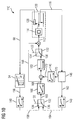
- FIG. 1 shows a schematic diagram of an electrical energy supply network.
- the electrical power supply network 2 is formed in the present embodiment as a stand-alone network 2, which is indeed connected to a centralized network 4, in normal operation However, it can be operated completely independently of this.
- the island grid 2 can be supplied with electrical energy from various electrical power sources.
- the electrical power sources include a solar cell 6, a wind turbine 8, a water wheel 10 and a diesel generator 12.
- the electrical energy from the electrical power sources may be in the direction 14 of one or more in FIG. 2 15 consumers are shown. If the electric power supply through the electrical power sources is greater than the consumers 15 can record, so an excess of electrical energy can be cached in energy storage.
- the energy stores comprise a rechargeable battery 16, a flywheel 18 and a double-layer capacitor 20.
- a fuel cell 22 is arranged as the electric power source. If the electrical power demand of the consumers 15 temporarily exceeds the electrical energy output by the electrical power sources, the electrical energy surplus stored in the energy stores can be retrieved again.
- the network formers 6, 8, 10, 12 regulate the grid voltage of the island grid 2 based on in 3 and 4 shown statics. These contrast the shape of the mains voltage of the retrieved from the island grid 2 electrical power. While the static characteristics are intrinsically predetermined in the diesel generator 12, to the solar cell 6, the wind turbine 8 and the water wheel 10 depending on the mains condition dependent regulated power converters 24 are imposed, which force these electrical power sources corresponding static characteristics, what in the context of FIG. 2 discussed in more detail becomes. If a flow of water can be regulated by the water wheel 10, for example with throttle valves and by-passes, as in FIG. 1 indicated by dashed lines, optionally be dispensed with an extra self-commutated converter 24.
- the network supports 16, 18, 20, 22 feed in a first approximation regardless of the state of the island grid 2 their currently available power in the island grid 2 a.
- the network supports 16, 18, 20, 22 in the present embodiment, depending on the available feed power dependent regulated converter 26 downstream.
- the accumulator 16 and the double-layer capacitor 20 may each be followed by a DC-DC converter 28 to compensate for voltage fluctuations of these two energy storage depending on their state of charge.
- the island grid 2 can be connected via a transformer 30 with other isolated networks 2, not shown.
- the island grid 2 is simplified below and explained with reference to a two-phase electrical power supply. All statements below can be extended to any number of phases in a manner known to those skilled in the art.
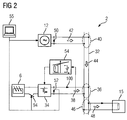
- the self-commutated power converter 24 of the solar cell 6 is an inverter 34. Since each self-commutated, an alternating voltage output power converter 24 usually includes an inverter, the following statements about the inverter 34 can be applied to all in the island network 2 of FIG. 1 shown self-guided Power converter 24 are transmitted. While the inverter 34 and the diesel generator 12 each feed an electrical inverter power 38 at an inverter connection point 36 and an electrical generator power 42 at a generator connection point 40 and thus maintain an electrical grid power 44, the consumer 15 takes the line network 32 at a consumer connection point 46 an electrical consumer power 48.
- the inverter power 38 and the generator power 42 must be synchronized with each other to avoid that the inverter 34 and the generator 12 with each other to exchange electrical power and how electrical consumers to each other.
- the dependence of the generator voltage 50 can be used by the generator power 42.
- the frequency of the generator voltage 50 decreases with increasing active component in the generator power 42, or the effective value of the generator voltage 50 decreases with increasing reactive component in the generator power 42.
- This dependence is modeled in the already mentioned static characteristics. If a plurality of electrical energy generators are interconnected with one or more consumers depending on the output power output, then a stable operating point with a stable output voltage arises, in which each individual electrical energy generator delivers electrical power and only the one or more electrical consumers deliver electrical power take up.
- the inverter voltage 52 is basically not dependent on the inverter power 38, it must be made artificially dependent on the inverter power 14 as already indicated. This is done by defining inverter static characteristics for the inverter and the inverter voltage 52, as in FIG. 2 indicated, is made dependent on correspondingly inverted inverter static characteristics 54 of the inverter power 38. In this way, the inverter 34 behaves like the generator 12 and can be synchronized with this via the static characteristics in the electrical power grid. As the actual network generator, this does not affect the solar cell 6 but the inverter 34 connected to it, which is why essentially only the inverter 34 is to be considered.
- the diesel generator 12 and / or the inverter 34 with its inverted static characteristics 54 can be controlled by a master computer 55, which will be discussed in more detail later.
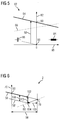
- FIG. 3 11 shows an active power diagram 56 with an inverter active power statistical characteristic 58 and a line network active power static characteristic curve 60 as seen by the inverter 34.
- FIG. 4 a reactive power diagram 62 with an inverter reactive power statistic 64 and a line network reactive power static characteristic 66 seen from the inverter 34 from.
- An active power diagram compares the active power 68 delivered or picked up by the two-pole to the frequency 70 of its delivered or received voltage. If the active power 68 is positive, the two-pole acts like a generator 72. If the active power 68 is negative, the two-pole acts like a consumer 74.
- the inverter active power statics characteristic 58 is predetermined as already mentioned.
- the line network active power statics curve 60 represents the behavior of the line network 4 from the perspective of the inverter 34 and is not one of them shown Dieselgenerator Wirk orientalsstatikkennline, the impedance of the load 15 and the impedance of the power system 32 dependent.
- the inverter 34 and the line network 32 seen from the inverter 34 are connected between the inverter power 38 and the power absorbed by the power network 32 electrical power at the inverter connection point 36 of the inverter operating point 76, in which the inverter Wirkschaftsstatikkennline 58 and the line network active power statics curve 60 intersect.
- the inverter operating point 76 the grid frequency 78 of the common mains voltage is given.
- the reactive power diagram 62 for any two-pole compares the reactive power 80 delivered or received by the two-pole with the rms value 82 of its delivered or received voltage. If the reactive power 80 is positive, the two-pole acts like an inductance 84. If the reactive power 80 is negative, the two-pole acts like a capacitance 86.
- the inverter reactive power statistic 64 is also given.
- the line system reactive power statistical curve 66 again represents the behavior of the line network 32 from the perspective of the inverter 34 and is dependent on a diesel generator reactive power static curve, not shown, the impedance of the load 15 and the impedance of the line network 32.
- the network effective value 88 of the common grid voltage can be read from the intersection between the inverter reactive-power statistical characteristic 64 and the line-system reactive-power statistical characteristic 66.
- the diesel generator 12 is supplied with chemical energy in the form of diesel and the inverter 34 with electrical energy from the solar cell 6.
- This external power supply 92 raises the open circuit voltage 90 and thus the static characteristic (in FIG. 5 the reactive power static characteristic 64) of the inverter 34 and the diesel generator 12 and thus enables the delivery of electrical power 38, 42 to the consumer 15. If the electrical load 15 is connected to the electrical energy supply network 2, so arises between the diesel generator 12, the inverter 34th and the electrical load 15, the above-mentioned operating point 76 a.
- the master computer 55 can start the combustion process in the diesel generator 12 and turn it on.
- the start of the diesel generator 12 causes a voltage ramp in the electrical power grid 2, which can be used to start the electrical power output of the inverter 34.
- the inverter 34 with the solar cell 6 is connected via a switch 94, which is controllable via the inverter voltage 52 at the inverter connection point 36. As soon as the inverter voltage 52 exceeds a specific threshold value, the switch is closed and the electrical energy supply of the inverter 34 is started from the solar cell 6.
- diesel generator 12 and the switch 94 may both be controlled by the master computer, as in FIG FIG. 2 indicated by a dashed line.
- the communication between the master computer 55 and the diesel generator 12 and / or the switch 94 may be via separate lines, as in FIG FIG. 2 shown.
- the master computer 55 can also transmit its signals via the electrical energy supply network 2 and superimpose the electrical line network power 44.
- the inverter 34 is at the point of open circuit voltage 90th
- the inverter 34 After triggering the start of the electrical power supply by the master computer 55, when the inverter 34 and diesel generator 12 both feed electrical power 38, 42 into the electrical power grid 2, the line grid Wirkschaftsstatikkennline 60 from the perspective of the inverter 34 depends on the generator 8, and both curves intersect at the inverter operating point 76. In order to move to the inverter operating point 76, the inverter 34 must provide additional active power 98. However, since the mains voltage at the inverter 34 is very small at the beginning of the electrical power supply, the additional active power 98 can essentially only exceed that in FIG FIG. 2 shown inverter current 100, which is also limited by the current limit of the inverter 34. As a result, the inverter 34 remains on its inverter active power characteristic 58 before the inverter operating point 76 at a limit operating point 102 stand.
- the diesel generator 12 may move freely to the inverter operating point 76 on its generator active power statistical characteristic curve, if appropriate, until it is switched off. Since the inverter 34 can not follow the generator 8, the generator moves back on its generator Wirkstatstatikkennline seen from the inverter operating point 76 back to provide a missing from the inverter 34 active power difference 103. From the point of view of the inverter 34, the line network 4 assumes a compensation operating point 104 on the line network active power statistical characteristic line 60. As a result, the inverter 34 outputs an inverter voltage 52, the one having a frequency difference 105 different frequency 70 to the mains voltage.
- the invention proposes to change the inverter voltage 52 in the case of the synchronization problem so that the inverter 34 can move freely again on its static characteristics 58, 64.
- the electrical power supply to the inverter 34 could be reduced from the solar cell 6. This has the effect that the static characteristics 58, 64 of the inverter 34 are shifted negatively by a defined amount 106. If the static characteristics 58, 64 of the inverter 34 are displaced, for example, so long that they run through the current compensation operating point 104 of the pipeline network, the inverter 34 can again move freely on its static characteristics 58, 64.
- the static characteristics 58, 64 of the inverter 34, and thus the power supply from the solar cell 6 could be slowly raised again to set the actually set by the master 55 mains voltage.
- the change in the static characteristic 58, 64 can be achieved in the simplest case, that the inverter 34 for the time of lowering the static characteristic 58, 64 of the mains voltage and thus the current compensation working point 104 of the power network 32 follows.
- the slope of the static characteristics 58, 64 of the inverter 34 could be changed briefly.
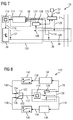
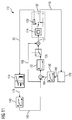
- FIG. 7 shows a section 108 from the electrical power grid 2 of FIG. 2 with a device 110 for controlling the inverter 34.
- the inverter 34 is hereinafter a self-commutated inverter.
- the device 110 may output a control signal 112 to a drive processor 114 of the inverter 34 based on the inverter power 38 fed into the line network 2, which in turn may output clock signals 116 based on the control signal 112 to switches (not shown) of the inverter 34 with which the inverter 34 the inverter voltage 52 is generated.
- the device 110 switches the operation of the inverter 34 between a control mode of operation and an error mode of operation. As long as there are no synchronization problems, the inverter 34 can contribute in regular operation mode to keep the mains voltage 118 in the line network 2 constant. In case of synchronization problems, the inverter 34 should follow the mains voltage 118.
- an error detection device 120 of the device 110 may monitor the inverter connection point 36 for synchronization problems and output a corresponding state signal 122 to the device.
- the fault detection device 120 can check whether an inverter current 100 has reached its maximum current I tot .
- the error detection device 120 can check whether there is currently a short circuit in the line network 4. This can be done, for example, by monitoring the level of the mains voltage 118 and comparing it with a threshold value. In the event of a short circuit, the mains voltage 118 falls below the threshold value.
- the error detection device 120 can check whether the inverter 34 is currently connected to the line network 2 as the only electrical power generation unit.
- the fault detection device 120 can receive, for example from the master 55, a parameterization signal 124 which indicates how many electrical power generation units are connected to the line network 2.
- the fault detection device 120 can feed a fault 126 in the control network 4 in the control mode, and thus direct the inverter 34 specifically from the inverter operating point 76. If the network power 20 changes significantly according to the introduced disturbance 126, it can be assumed that this response is caused by another generating unit with a static characteristic behavior.
- the time response must be adapted to the dominant time constant of the generator 12 in order to cause a frequency-voltage response in this case.
- the inverter power 38 is sensed via a power meter 128 based on the grid voltage 118 and the inverter current 100.
- the device 124 will be described in more detail below with reference to four exemplary embodiments.
- the drive processor 114, the inverter 34 and the power meter 128 are combined to form a controlled system 130, which is controlled by the device 110 via the actuating signal 112.
- FIG. 8 the first embodiment of the device 110 is shown.
- a switch 132 which can be controlled by the status signal 122 specifies in which of the two operating modes the inverter 34 of the controlled system 130 is to be controlled. For this purpose, the switch 132 is in a position for the control mode 134 and a position for the error operating mode 136 can be transferred.
- control mode 134 the inverter 34 will operate as in FIG FIG. 2 is controlled via the inverted inverter static characteristic curve 54 with a drive signal in such a way that the inverter 34 adapts to a predetermined static behavior and thus actively contributes to the maintenance of a constant mains voltage 118. Since the inverter 34 in this case has to deliver a specific inverter power 38 into the line network 2, the drive signal in the control mode 134 is to be referred to as a power control signal 138. Via a low-pass filter 140 with PT1 behavior, it is possible to attenuate fluctuations, which originate for example from noise, from the power control signal 138. The low-pass filtered power control signal 142 is finally output as the control signal 112 to the drive processor 114 in the regular operation mode 134 to set the inverter voltage 52.
- the controlled system 130 is controlled with a drive signal in such a way that the inverter voltage 52 follows the grid voltage 118.
- the drive signal should therefore in the error operating mode as a follow-up control signal 144th be designated.
- the sequencing control signal 144 may be derived from the grid voltage 118 via a phase locked loop 146, called PLL 146, in a manner known to those skilled in the art to stabilize the sequencing control signal 144. Variations in the sequence control signal 144 can be damped again via another low-pass filter 140, wherein the low-pass filtered sequence control signal 148 is output as the control signal 126 to the control processor 128.
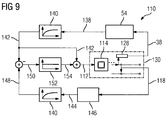
- FIG. 9 the second embodiment of the device 110 is shown.
- the low pass filtered power control signal 142 may be subtracted from the low pass filtered sequencer signal 148.
- the resulting control difference 150 may be supplied to a controller 152.
- a resulting control signal 154 may be obtained using the in FIG. 8 shown switch 132 in error mode 136 in a manner not shown directly as a control signal 112 to the drive processor 114 output.
- the low-pass filtered follow-up control signal 148 and thus the line voltage 118 represents a command variable for the inverter voltage 52.
- the low-pass filtered power control signal 142 is output as a control signal 112.
- the low-pass filtered power control signal 142 may also be switched to the control signal 154.
- the inverter voltage 52 to be set is directly apparent.
- a weighting factor for the control difference 150 can be preset via the controller 152, which specifies the speed of the adaptation of the inverter voltage 52 to the mains voltage 118.
- the control difference 150 is completely suppressed, so that only the low-pass filtered power control signal 142 is output as a control signal 112.
- the gain factor of exactly 0 therefore replaces the switch 132 in the position for the control mode 134.
- the low-pass filtered sequencing control signal 148 is output because the low-pass filtered power control signal 142 cancels by the negative lock in front of the regulator 152 and the positive lock after the regulator 152 at that gain.
- the gain factor of exactly 1 therefore replaces the switch 132 in the fault mode 136 position.
- the controller 152 can be used to switch continuously and without jumps from the normal operating mode 134 into the error operating mode 136 and vice versa.
- the use of the switch 132 can optionally be completely dispensed with in the third exemplary embodiment. If the switch is nevertheless used after the controller 152, the controller 152 can also be parameterized invariably and the speed of the adaptation of the inverter voltage 52 to the mains voltage 118 can be permanently preset.
- the third exemplary embodiment for calculating the actuating signal 126 which is used to set the frequency of the inverter voltage based on the inverted inverter active power static characteristic curve 38, is shown.
- the power meter 144 detects the active power 68 of the inverter power 38 based on the grid voltage 118, the inverter current 100, and the phase shift between both quantities. Via the inverted inverter active power statics curve 54 the drive frequency is determined, which must set the inverter 34 to fulfill its predetermined active power statics to actively contribute to the frequency maintenance in the grid voltage 118.
- This drive frequency is analogous to below FIG. 8 Power frequency 156 denotes.
- the analog to FIG. 8 low-pass filtered power frequency 158 over one to FIG. 8 analog switch 132 in the control mode 134 are output as the adjustment frequency 160 for the inverter voltage 52. From the PLL 146, the current network frequency 162 can be seen.
- the analog to FIG. 8 Low pass filtered network frequency 165 may be output in error mode 136 as the drive frequency 160 for the inverter voltage 52.
- the control frequency 160 can be converted into an inverter voltage phase 168 for the inverter voltage 52.
- a mains voltage phase 170 can be derived in the following and low-pass filtered.
- the low-pass filtered mains voltage phase 172 and the inverter voltage phase 168 may then be further processed into the control signal 112 as well as the low-pass filtered power voltage 142 and the low-pass filtered follower voltage 148 in FIG FIG. 9 ,
- the switch 132 is shown after the controller 152, which allows the controller 152 to be invariably preset.
- FIG. 11 4 the fourth exemplary embodiment for calculating the actuating signal 112, which is used to set the effective value of the inverter voltage 52 based on an inverted inverter reactive power statistical characteristic 174, is shown.
- the power meter 128 detects the reactive power 80 output by the inverter 34.
- the required inverter effective power value 176 for the inverter voltage 174 becomes the inverted inverter reactive power static characteristic 174 52 is output so that the inverter 34 follows its predetermined reactive power statics.
- Inverter RMS value 176 is finally low pass filtered.
- the mains voltage effective value 180 can be determined, which is also low-pass filtered.
- the low-pass filtered inverter rms value 182 and the low-pass filtered net voltage rms value 184 are then further processed into the control signal 112 as well as the low-pass filtered power voltage 142 and the low-pass filtered follower voltage 148 in FIG FIG. 9 ,
- the switch 132 is shown after the controller 152, which allows the controller 152 to be invariably preset.
- FIG. 12 By way of example, a method 186 for switching between the normal operation mode 134 and the error operation mode 136 is illustrated.
- the method begins in step 188 with determining the RMS value 176, the frequency 156 and the phase 168 for the inverter voltage 52 from the inverted static characteristics 52, 174.
- steps 190, 192 and 194 the above-mentioned conditions for generating the state signal 122 are successively checked.
- step 190 While it is checked in step 190 whether there is a short circuit, it is checked in step 192 whether the inverter 34 is not yet working on its inverter current limit I ges and in step 194, if no other power generator connected to the line network 2.
- the inverter voltage 52 is in step 198 in the control mode 134 based on the RMS value 176, the frequency 156 and the Phase 158 generated from step 188. Otherwise, the method 186 enters the error mode 136 at step 196 and generates the inverter voltage 54 based on the rms value 176, frequency 156, and phase 158 of the line voltage 118.
- step 196 it may be checked when one of the conditions from steps 190-194 is again met to move the method 186 to step 198. In this way, the inverter voltage 52 is corrected in the error operating mode 136, so that the inverter 34 can actively contribute to the maintenance of the grid voltage 118 in a timely manner.
- the method 186 may be automatically transferred to step 198 after a certain time.
Landscapes
- Engineering & Computer Science (AREA)
- Power Engineering (AREA)
- Supply And Distribution Of Alternating Current (AREA)
Priority Applications (5)
| Application Number | Priority Date | Filing Date | Title |
|---|---|---|---|
| EP12156495.9A EP2632012B1 (de) | 2012-02-22 | 2012-02-22 | Verfahren zum Synchronisieren einer Einspeisespannung mit einer Netzspannung |
| DK12156495.9T DK2632012T3 (da) | 2012-02-22 | 2012-02-22 | Fremgangsmåde til synkronisering af en fødespænding med en netspænding |
| PCT/EP2013/051918 WO2013124133A1 (de) | 2012-02-22 | 2013-01-31 | Verfahren zum synchronisieren einer einspeisespannung mit einer netzspannung |
| CN201380010230.XA CN104137377B (zh) | 2012-02-22 | 2013-01-31 | 用于将馈送电压与电网电压同步的方法 |
| US14/380,318 US9812872B2 (en) | 2012-02-22 | 2013-01-31 | Method for synchronizing a feed voltage with a network voltage |
Applications Claiming Priority (1)
| Application Number | Priority Date | Filing Date | Title |
|---|---|---|---|
| EP12156495.9A EP2632012B1 (de) | 2012-02-22 | 2012-02-22 | Verfahren zum Synchronisieren einer Einspeisespannung mit einer Netzspannung |
Publications (2)
| Publication Number | Publication Date |
|---|---|
| EP2632012A1 EP2632012A1 (de) | 2013-08-28 |
| EP2632012B1 true EP2632012B1 (de) | 2016-02-17 |
Family
ID=47683716
Family Applications (1)
| Application Number | Title | Priority Date | Filing Date |
|---|---|---|---|
| EP12156495.9A Active EP2632012B1 (de) | 2012-02-22 | 2012-02-22 | Verfahren zum Synchronisieren einer Einspeisespannung mit einer Netzspannung |
Country Status (5)
| Country | Link |
|---|---|
| US (1) | US9812872B2 (da) |
| EP (1) | EP2632012B1 (da) |
| CN (1) | CN104137377B (da) |
| DK (1) | DK2632012T3 (da) |
| WO (1) | WO2013124133A1 (da) |
Cited By (1)
| Publication number | Priority date | Publication date | Assignee | Title |
|---|---|---|---|---|
| DE102021203615A1 (de) | 2021-04-13 | 2022-10-13 | Fronius International Gmbh | Bidirektionaler Wechselrichter |
Families Citing this family (13)
| Publication number | Priority date | Publication date | Assignee | Title |
|---|---|---|---|---|
| DE102013102603B4 (de) | 2013-03-14 | 2017-02-09 | Sma Solar Technology Ag | Verfahren für einen Schwarzstart eines Kraftwerks mit mehreren einem Wechselstromnetz zuschaltbaren Wechselrichtern |
| EP3011668B1 (de) * | 2013-08-19 | 2017-04-12 | Siemens Aktiengesellschaft | Regelverfahren für selbstgeführten stromrichter zur reglung des leistungsaustauschs |
| CN103647304B (zh) * | 2013-12-27 | 2016-04-20 | 国家电网公司 | 一种有外部支援的电网黑启动子系统并列方法 |
| US9537315B2 (en) * | 2014-02-04 | 2017-01-03 | Canrig Drilling Technology Ltd. | Generator load control |
| US20150229131A1 (en) * | 2014-02-13 | 2015-08-13 | Nextronex, Inc. | Grid tie solar inverter system with storage |
| DE102014214151A1 (de) | 2014-07-21 | 2016-01-21 | Siemens Aktiengesellschaft | Mehrgenerator-Kraftwerksanordnung, Energieversorgungsnetz mit einer Mehrgenerator-Kraftwerksanordnung und Verfahren zur Verteilung der Blindleistungserzeugung in einer Mehrgenerator-Kraftwerksanordnung |
| EP3216099B1 (en) * | 2014-11-03 | 2018-12-12 | Vestas Wind Systems A/S | Method of controlling active power generation of a wind power plant and wind power plant |
| DE102016105662A1 (de) | 2016-03-29 | 2017-10-05 | Wobben Properties Gmbh | Verfahren zum Einspeisen elektrischer Leistung in ein elektrisches Versorgungsnetz mit einem Windpark sowie Windpark |
| DE102017106338A1 (de) * | 2017-03-23 | 2018-09-27 | Wobben Properties Gmbh | Verfahren zum Starten eines Energieerzeugungsnetzes |
| GB2564645B (en) * | 2017-07-17 | 2019-09-25 | Protean Electric Ltd | A control system for a vehicle |
| AU2018366935B2 (en) | 2017-11-16 | 2024-03-21 | Sma Solar Technology Ag | Feeding electric power from a photovoltaic system into an AC system having a low short-circuit capacity |
| US20210401491A1 (en) * | 2020-06-29 | 2021-12-30 | Biosense Webster (Israel) Ltd. | Estimating progress of irreversible electroporation ablation based on amplitude of measured bipolar signals |
| CN112311011B (zh) * | 2020-11-19 | 2025-05-16 | 西安热工研究院有限公司 | 一种具有小型水电的火电厂黑启动系统及方法 |
Family Cites Families (14)
| Publication number | Priority date | Publication date | Assignee | Title |
|---|---|---|---|---|
| DE3108915A1 (de) * | 1981-03-09 | 1982-09-16 | Siemens AG, 1000 Berlin und 8000 München | Verfahren und einrichtung zur regelung eines turbosatzes |
| IN164018B (da) * | 1985-08-16 | 1988-12-31 | Siemens Ag | |
| DE10210099A1 (de) | 2002-03-08 | 2003-10-02 | Aloys Wobben | Inselnetz und Verfahren zum Betrieb eines Inselnetzes |
| US7519454B2 (en) * | 2005-12-12 | 2009-04-14 | Virginia Tech Intellectual Properties, Inc. | Location determination of power system disturbances based on frequency responses of the system |
| DE102006028103A1 (de) | 2006-06-19 | 2007-12-20 | Siemens Ag | Netzseitiger Stromrichter mit unterbrechungsfreier Umschaltung zwischen getaktetem spannungsgeregelten Betrieb und grundfrequentem ungeregelten Betrieb, sowie Verfahren zum unterbrechungsfreien Umschalten eines solchen Stromrichters |
| DE102006059199B3 (de) * | 2006-12-13 | 2008-04-17 | Howaldtswerke-Deutsche Werft Gmbh | Unterseeboot |
| US8494795B2 (en) * | 2008-05-05 | 2013-07-23 | Schweitzer Engineering Laboratories Inc | Apparatus and method for estimating synchronized phasors at predetermined times referenced to a common time standard in an electrical system |
| DK2144360T3 (da) | 2008-07-08 | 2018-11-26 | Siemens Ag | Fremgangsmåde til drift af en omformer og tilsvarende indretning |
| EP2144361B1 (de) | 2008-07-09 | 2017-03-29 | Siemens Aktiengesellschaft | Verfahren und Vorrichtung zur Einstellung einer Rückspeiseleistung eines grundfrequent getakteten Stromrichters |
| US8373309B2 (en) * | 2009-08-19 | 2013-02-12 | Schweitzer Engineering Laboratories Inc | Systems and methods for asynchronous sampling data conversion |
| CN101719679B (zh) * | 2009-12-21 | 2013-04-24 | 中国电力科学研究院 | 一种分布式电源与电网的同步方法 |
| DE102010001333A1 (de) * | 2010-01-28 | 2011-08-18 | Airbus Operations GmbH, 21129 | Verfahren und Vorrichtung zum Bereitstellen einer Bordnetz-Wechselspannung bei einem Flugzeug |
| US9142968B2 (en) * | 2010-05-07 | 2015-09-22 | Advanced Energy Industries, Inc. | Systems and methods for islanding detection |
| US9509141B2 (en) * | 2011-04-15 | 2016-11-29 | Siemens Aktiengesellschaft | Black start of wind turbine devices |
-
2012
- 2012-02-22 EP EP12156495.9A patent/EP2632012B1/de active Active
- 2012-02-22 DK DK12156495.9T patent/DK2632012T3/da active
-
2013
- 2013-01-31 US US14/380,318 patent/US9812872B2/en active Active
- 2013-01-31 CN CN201380010230.XA patent/CN104137377B/zh not_active Expired - Fee Related
- 2013-01-31 WO PCT/EP2013/051918 patent/WO2013124133A1/de not_active Ceased
Cited By (1)
| Publication number | Priority date | Publication date | Assignee | Title |
|---|---|---|---|---|
| DE102021203615A1 (de) | 2021-04-13 | 2022-10-13 | Fronius International Gmbh | Bidirektionaler Wechselrichter |
Also Published As
| Publication number | Publication date |
|---|---|
| DK2632012T3 (da) | 2016-04-25 |
| WO2013124133A1 (de) | 2013-08-29 |
| CN104137377A (zh) | 2014-11-05 |
| US9812872B2 (en) | 2017-11-07 |
| US20150035366A1 (en) | 2015-02-05 |
| EP2632012A1 (de) | 2013-08-28 |
| CN104137377B (zh) | 2016-11-16 |
Similar Documents
| Publication | Publication Date | Title |
|---|---|---|
| EP2632012A1 (de) | Verfahren zum Synchronisieren einer Einspeisespannung mit einer Netzspannung | |
| EP2898582B1 (de) | Verfahren für einen schwarzstart eines kraftwerks mit mehreren einem wechselstromnetz zuschaltbaren wechselrichtern | |
| DE102017114306B4 (de) | Verfahren zum betrieb eines inselnetzes und inselnetz | |
| DE102019116254B4 (de) | Verfahren zum Betrieb einer Energieerzeugungsanlage | |
| EP3031112B1 (de) | System und verfahren zur regelung der frequenz- und/oder spannungshaltung aus dem verteilnetz | |
| DE102009017939A1 (de) | Windpark mit mehreren Windenergieanlagen sowie Verfahren zur Regelung der Einspeisung von einem Windpark | |
| WO2022013458A1 (de) | Verfahren zum betrieb einer energieversorgungsanlage und energieversorgungsanlage | |
| DE102017112654A1 (de) | Spannungssteuersystem, Brennstoffzellensystem und Steuerverfahren für ein Spannungssteuersystem | |
| EP2951903A1 (de) | Verfahren und wechselrichter zur leistungsverteilung über mehrere, gemeinsam an einen gleichspannungseingang eines dc/ac-wandlers angeschlossene gleichstromquellen | |
| WO2012037989A2 (de) | Verfahren zur rechnergestützten regelung der elektrischen energieverteilung in einem dezentralen energienetz | |
| DE112014000638T5 (de) | Solarzellen-Regelvorrichtung | |
| DE102016124602A1 (de) | Netzersatzanlage, Umrichter für eine Netzersatzanlage sowie Verfahren zum Betreiben einer Netzersatzanlage | |
| EP3092697A1 (de) | Verfahren und regeleinrichtung zum regeln einer betriebsfrequenz einer energiequelle in einem wechselspannungsnetz | |
| EP2533413B1 (de) | Synchronisierung eines Wechselrichters mit einem elektrischen Leitungsnetz | |
| DE102013106151B4 (de) | Kaskadierung und Energiespeicher | |
| EP3311481B1 (de) | Verfahren zur regelung eines selbstgeführten umrichters, selbstgeführter umrichter sowie anordnung zur übertragung elektrischer leistung | |
| DE102013218892A1 (de) | Verfahren zur rechnergestützten Steuerung einer oder mehrerer regenerativer Energieerzeugungsanlagen in einem elektrischen Stromnetz | |
| EP3759783A1 (de) | Vorrichtung zur verbindung eines teilnetzes mit einem wechselspannungsnetz und verfahren zur regelung einer elektrischen leistung | |
| EP4142093A2 (de) | Verfahren zum betreiben eines energiesystems | |
| DE102014101406A1 (de) | Steuereinrichtung und Verfahren zum Betreiben einer Photovoltaikanlage | |
| DE102012211271A1 (de) | Verfahren und Vorrichtung zur dezentralen Regelung einer Spannung in einem Verteilnetz | |
| DE102019131475B4 (de) | Verfahren zur Leistungsregelung eines Offshore-Windenergiesystems mittels eines Zweipunktreglers mit Hysteresefunktion | |
| DE102011014468B4 (de) | Phasenselektives VAr - Management | |
| DE102024210506A1 (de) | Verfahren zu einem Betrieb eines Energieversorgungssystems, Energieversorgungssystem und Lastenanbindungsmodul | |
| WO2023213354A1 (de) | Blindleistungsregelungsverfahren zur dezentralen spannungshaltung eines verteilungsnetzes sowie wechselrichter und betriebsverfahren |
Legal Events
| Date | Code | Title | Description |
|---|---|---|---|
| PUAI | Public reference made under article 153(3) epc to a published international application that has entered the european phase |
Free format text: ORIGINAL CODE: 0009012 |
|
| AK | Designated contracting states |
Kind code of ref document: A1 Designated state(s): AL AT BE BG CH CY CZ DE DK EE ES FI FR GB GR HR HU IE IS IT LI LT LU LV MC MK MT NL NO PL PT RO RS SE SI SK SM TR |
|
| AX | Request for extension of the european patent |
Extension state: BA ME |
|
| 17P | Request for examination filed |
Effective date: 20131106 |
|
| RBV | Designated contracting states (corrected) |
Designated state(s): AL AT BE BG CH CY CZ DE DK EE ES FI FR GB GR HR HU IE IS IT LI LT LU LV MC MK MT NL NO PL PT RO RS SE SI SK SM TR |
|
| 17Q | First examination report despatched |
Effective date: 20131202 |
|
| GRAP | Despatch of communication of intention to grant a patent |
Free format text: ORIGINAL CODE: EPIDOSNIGR1 |
|
| INTG | Intention to grant announced |
Effective date: 20150907 |
|
| GRAS | Grant fee paid |
Free format text: ORIGINAL CODE: EPIDOSNIGR3 |
|
| GRAA | (expected) grant |
Free format text: ORIGINAL CODE: 0009210 |
|
| REG | Reference to a national code |
Ref country code: FR Ref legal event code: PLFP Year of fee payment: 5 |
|
| AK | Designated contracting states |
Kind code of ref document: B1 Designated state(s): AL AT BE BG CH CY CZ DE DK EE ES FI FR GB GR HR HU IE IS IT LI LT LU LV MC MK MT NL NO PL PT RO RS SE SI SK SM TR |
|
| REG | Reference to a national code |
Ref country code: GB Ref legal event code: FG4D Free format text: NOT ENGLISH |
|
| REG | Reference to a national code |
Ref country code: CH Ref legal event code: EP Ref country code: CH Ref legal event code: NV Representative=s name: SIEMENS SCHWEIZ AG, CH |
|
| REG | Reference to a national code |
Ref country code: IE Ref legal event code: FG4D Free format text: LANGUAGE OF EP DOCUMENT: GERMAN |
|
| REG | Reference to a national code |
Ref country code: AT Ref legal event code: REF Ref document number: 776036 Country of ref document: AT Kind code of ref document: T Effective date: 20160315 |
|
| REG | Reference to a national code |
Ref country code: DE Ref legal event code: R096 Ref document number: 502012006010 Country of ref document: DE |
|
| REG | Reference to a national code |
Ref country code: DK Ref legal event code: T3 Effective date: 20160421 |
|
| REG | Reference to a national code |
Ref country code: NL Ref legal event code: MP Effective date: 20160217 |
|
| REG | Reference to a national code |
Ref country code: LT Ref legal event code: MG4D |
|
| PG25 | Lapsed in a contracting state [announced via postgrant information from national office to epo] |
Ref country code: GR Free format text: LAPSE BECAUSE OF FAILURE TO SUBMIT A TRANSLATION OF THE DESCRIPTION OR TO PAY THE FEE WITHIN THE PRESCRIBED TIME-LIMIT Effective date: 20160518 Ref country code: ES Free format text: LAPSE BECAUSE OF FAILURE TO SUBMIT A TRANSLATION OF THE DESCRIPTION OR TO PAY THE FEE WITHIN THE PRESCRIBED TIME-LIMIT Effective date: 20160217 Ref country code: HR Free format text: LAPSE BECAUSE OF FAILURE TO SUBMIT A TRANSLATION OF THE DESCRIPTION OR TO PAY THE FEE WITHIN THE PRESCRIBED TIME-LIMIT Effective date: 20160217 Ref country code: NO Free format text: LAPSE BECAUSE OF FAILURE TO SUBMIT A TRANSLATION OF THE DESCRIPTION OR TO PAY THE FEE WITHIN THE PRESCRIBED TIME-LIMIT Effective date: 20160517 |
|
| PG25 | Lapsed in a contracting state [announced via postgrant information from national office to epo] |
Ref country code: RS Free format text: LAPSE BECAUSE OF FAILURE TO SUBMIT A TRANSLATION OF THE DESCRIPTION OR TO PAY THE FEE WITHIN THE PRESCRIBED TIME-LIMIT Effective date: 20160217 Ref country code: BE Free format text: LAPSE BECAUSE OF NON-PAYMENT OF DUE FEES Effective date: 20160229 Ref country code: NL Free format text: LAPSE BECAUSE OF FAILURE TO SUBMIT A TRANSLATION OF THE DESCRIPTION OR TO PAY THE FEE WITHIN THE PRESCRIBED TIME-LIMIT Effective date: 20160217 Ref country code: LV Free format text: LAPSE BECAUSE OF FAILURE TO SUBMIT A TRANSLATION OF THE DESCRIPTION OR TO PAY THE FEE WITHIN THE PRESCRIBED TIME-LIMIT Effective date: 20160217 Ref country code: PT Free format text: LAPSE BECAUSE OF FAILURE TO SUBMIT A TRANSLATION OF THE DESCRIPTION OR TO PAY THE FEE WITHIN THE PRESCRIBED TIME-LIMIT Effective date: 20160617 Ref country code: SE Free format text: LAPSE BECAUSE OF FAILURE TO SUBMIT A TRANSLATION OF THE DESCRIPTION OR TO PAY THE FEE WITHIN THE PRESCRIBED TIME-LIMIT Effective date: 20160217 Ref country code: PL Free format text: LAPSE BECAUSE OF FAILURE TO SUBMIT A TRANSLATION OF THE DESCRIPTION OR TO PAY THE FEE WITHIN THE PRESCRIBED TIME-LIMIT Effective date: 20160217 Ref country code: LT Free format text: LAPSE BECAUSE OF FAILURE TO SUBMIT A TRANSLATION OF THE DESCRIPTION OR TO PAY THE FEE WITHIN THE PRESCRIBED TIME-LIMIT Effective date: 20160217 |
|
| PG25 | Lapsed in a contracting state [announced via postgrant information from national office to epo] |
Ref country code: EE Free format text: LAPSE BECAUSE OF FAILURE TO SUBMIT A TRANSLATION OF THE DESCRIPTION OR TO PAY THE FEE WITHIN THE PRESCRIBED TIME-LIMIT Effective date: 20160217 |
|
| REG | Reference to a national code |
Ref country code: DE Ref legal event code: R097 Ref document number: 502012006010 Country of ref document: DE |
|
| PG25 | Lapsed in a contracting state [announced via postgrant information from national office to epo] |
Ref country code: SM Free format text: LAPSE BECAUSE OF FAILURE TO SUBMIT A TRANSLATION OF THE DESCRIPTION OR TO PAY THE FEE WITHIN THE PRESCRIBED TIME-LIMIT Effective date: 20160217 Ref country code: CZ Free format text: LAPSE BECAUSE OF FAILURE TO SUBMIT A TRANSLATION OF THE DESCRIPTION OR TO PAY THE FEE WITHIN THE PRESCRIBED TIME-LIMIT Effective date: 20160217 Ref country code: RO Free format text: LAPSE BECAUSE OF FAILURE TO SUBMIT A TRANSLATION OF THE DESCRIPTION OR TO PAY THE FEE WITHIN THE PRESCRIBED TIME-LIMIT Effective date: 20160217 Ref country code: SK Free format text: LAPSE BECAUSE OF FAILURE TO SUBMIT A TRANSLATION OF THE DESCRIPTION OR TO PAY THE FEE WITHIN THE PRESCRIBED TIME-LIMIT Effective date: 20160217 |
|
| REG | Reference to a national code |
Ref country code: IE Ref legal event code: MM4A |
|
| PLBE | No opposition filed within time limit |
Free format text: ORIGINAL CODE: 0009261 |
|
| STAA | Information on the status of an ep patent application or granted ep patent |
Free format text: STATUS: NO OPPOSITION FILED WITHIN TIME LIMIT |
|
| 26N | No opposition filed |
Effective date: 20161118 |
|
| PG25 | Lapsed in a contracting state [announced via postgrant information from national office to epo] |
Ref country code: IE Free format text: LAPSE BECAUSE OF NON-PAYMENT OF DUE FEES Effective date: 20160222 |
|
| REG | Reference to a national code |
Ref country code: FR Ref legal event code: PLFP Year of fee payment: 6 |
|
| PG25 | Lapsed in a contracting state [announced via postgrant information from national office to epo] |
Ref country code: BG Free format text: LAPSE BECAUSE OF FAILURE TO SUBMIT A TRANSLATION OF THE DESCRIPTION OR TO PAY THE FEE WITHIN THE PRESCRIBED TIME-LIMIT Effective date: 20160517 Ref country code: SI Free format text: LAPSE BECAUSE OF FAILURE TO SUBMIT A TRANSLATION OF THE DESCRIPTION OR TO PAY THE FEE WITHIN THE PRESCRIBED TIME-LIMIT Effective date: 20160217 |
|
| PG25 | Lapsed in a contracting state [announced via postgrant information from national office to epo] |
Ref country code: MT Free format text: LAPSE BECAUSE OF FAILURE TO SUBMIT A TRANSLATION OF THE DESCRIPTION OR TO PAY THE FEE WITHIN THE PRESCRIBED TIME-LIMIT Effective date: 20160217 |
|
| REG | Reference to a national code |
Ref country code: CH Ref legal event code: PCOW Free format text: NEW ADDRESS: WERNER-VON-SIEMENS-STRASSE 1, 80333 MUENCHEN (DE) |
|
| REG | Reference to a national code |
Ref country code: FR Ref legal event code: PLFP Year of fee payment: 7 |
|
| PG25 | Lapsed in a contracting state [announced via postgrant information from national office to epo] |
Ref country code: CY Free format text: LAPSE BECAUSE OF FAILURE TO SUBMIT A TRANSLATION OF THE DESCRIPTION OR TO PAY THE FEE WITHIN THE PRESCRIBED TIME-LIMIT Effective date: 20160217 Ref country code: HU Free format text: LAPSE BECAUSE OF FAILURE TO SUBMIT A TRANSLATION OF THE DESCRIPTION OR TO PAY THE FEE WITHIN THE PRESCRIBED TIME-LIMIT; INVALID AB INITIO Effective date: 20120222 |
|
| PG25 | Lapsed in a contracting state [announced via postgrant information from national office to epo] |
Ref country code: LU Free format text: LAPSE BECAUSE OF NON-PAYMENT OF DUE FEES Effective date: 20160222 Ref country code: MK Free format text: LAPSE BECAUSE OF FAILURE TO SUBMIT A TRANSLATION OF THE DESCRIPTION OR TO PAY THE FEE WITHIN THE PRESCRIBED TIME-LIMIT Effective date: 20160217 Ref country code: TR Free format text: LAPSE BECAUSE OF FAILURE TO SUBMIT A TRANSLATION OF THE DESCRIPTION OR TO PAY THE FEE WITHIN THE PRESCRIBED TIME-LIMIT Effective date: 20160217 Ref country code: IS Free format text: LAPSE BECAUSE OF FAILURE TO SUBMIT A TRANSLATION OF THE DESCRIPTION OR TO PAY THE FEE WITHIN THE PRESCRIBED TIME-LIMIT Effective date: 20160217 Ref country code: MC Free format text: LAPSE BECAUSE OF FAILURE TO SUBMIT A TRANSLATION OF THE DESCRIPTION OR TO PAY THE FEE WITHIN THE PRESCRIBED TIME-LIMIT Effective date: 20160217 |
|
| PG25 | Lapsed in a contracting state [announced via postgrant information from national office to epo] |
Ref country code: AL Free format text: LAPSE BECAUSE OF FAILURE TO SUBMIT A TRANSLATION OF THE DESCRIPTION OR TO PAY THE FEE WITHIN THE PRESCRIBED TIME-LIMIT Effective date: 20160217 |
|
| PGFP | Annual fee paid to national office [announced via postgrant information from national office to epo] |
Ref country code: GB Payment date: 20190123 Year of fee payment: 13 |
|
| REG | Reference to a national code |
Ref country code: FI Ref legal event code: MAE |
|
| REG | Reference to a national code |
Ref country code: DK Ref legal event code: EBP Effective date: 20200229 |
|
| GBPC | Gb: european patent ceased through non-payment of renewal fee |
Effective date: 20200222 |
|
| PG25 | Lapsed in a contracting state [announced via postgrant information from national office to epo] |
Ref country code: FI Free format text: LAPSE BECAUSE OF NON-PAYMENT OF DUE FEES Effective date: 20200222 |
|
| PG25 | Lapsed in a contracting state [announced via postgrant information from national office to epo] |
Ref country code: DK Free format text: LAPSE BECAUSE OF NON-PAYMENT OF DUE FEES Effective date: 20200229 Ref country code: GB Free format text: LAPSE BECAUSE OF NON-PAYMENT OF DUE FEES Effective date: 20200222 |
|
| PGFP | Annual fee paid to national office [announced via postgrant information from national office to epo] |
Ref country code: FR Payment date: 20210215 Year of fee payment: 10 |
|
| PGFP | Annual fee paid to national office [announced via postgrant information from national office to epo] |
Ref country code: AT Payment date: 20210107 Year of fee payment: 10 |
|
| PGFP | Annual fee paid to national office [announced via postgrant information from national office to epo] |
Ref country code: CH Payment date: 20210504 Year of fee payment: 10 |
|
| REG | Reference to a national code |
Ref country code: CH Ref legal event code: PL |
|
| REG | Reference to a national code |
Ref country code: AT Ref legal event code: MM01 Ref document number: 776036 Country of ref document: AT Kind code of ref document: T Effective date: 20220222 |
|
| PG25 | Lapsed in a contracting state [announced via postgrant information from national office to epo] |
Ref country code: AT Free format text: LAPSE BECAUSE OF NON-PAYMENT OF DUE FEES Effective date: 20220222 |
|
| PG25 | Lapsed in a contracting state [announced via postgrant information from national office to epo] |
Ref country code: FR Free format text: LAPSE BECAUSE OF NON-PAYMENT OF DUE FEES Effective date: 20220228 |
|
| PG25 | Lapsed in a contracting state [announced via postgrant information from national office to epo] |
Ref country code: LI Free format text: LAPSE BECAUSE OF NON-PAYMENT OF DUE FEES Effective date: 20220228 Ref country code: CH Free format text: LAPSE BECAUSE OF NON-PAYMENT OF DUE FEES Effective date: 20220228 |
|
| PGFP | Annual fee paid to national office [announced via postgrant information from national office to epo] |
Ref country code: IT Payment date: 20260225 Year of fee payment: 15 |
|
| PGFP | Annual fee paid to national office [announced via postgrant information from national office to epo] |
Ref country code: DE Payment date: 20260420 Year of fee payment: 15 |