EP2631832A2 - System und Verfahren zur Verarbeitung einer Referenzsequenz zur Analyse einer Genomsequenz - Google Patents
System und Verfahren zur Verarbeitung einer Referenzsequenz zur Analyse einer Genomsequenz Download PDFInfo
- Publication number
- EP2631832A2 EP2631832A2 EP12187722.9A EP12187722A EP2631832A2 EP 2631832 A2 EP2631832 A2 EP 2631832A2 EP 12187722 A EP12187722 A EP 12187722A EP 2631832 A2 EP2631832 A2 EP 2631832A2
- Authority
- EP
- European Patent Office
- Prior art keywords
- seed
- reference sequence
- base
- unidentified
- extracted
- Prior art date
- Legal status (The legal status is an assumption and is not a legal conclusion. Google has not performed a legal analysis and makes no representation as to the accuracy of the status listed.)
- Withdrawn
Links
Images



Classifications
-
- G—PHYSICS
- G16—INFORMATION AND COMMUNICATION TECHNOLOGY [ICT] SPECIALLY ADAPTED FOR SPECIFIC APPLICATION FIELDS
- G16B—BIOINFORMATICS, i.e. INFORMATION AND COMMUNICATION TECHNOLOGY [ICT] SPECIALLY ADAPTED FOR GENETIC OR PROTEIN-RELATED DATA PROCESSING IN COMPUTATIONAL MOLECULAR BIOLOGY
- G16B50/00—ICT programming tools or database systems specially adapted for bioinformatics
-
- C—CHEMISTRY; METALLURGY
- C12—BIOCHEMISTRY; BEER; SPIRITS; WINE; VINEGAR; MICROBIOLOGY; ENZYMOLOGY; MUTATION OR GENETIC ENGINEERING
- C12Q—MEASURING OR TESTING PROCESSES INVOLVING ENZYMES, NUCLEIC ACIDS OR MICROORGANISMS; COMPOSITIONS OR TEST PAPERS THEREFOR; PROCESSES OF PREPARING SUCH COMPOSITIONS; CONDITION-RESPONSIVE CONTROL IN MICROBIOLOGICAL OR ENZYMOLOGICAL PROCESSES
- C12Q1/00—Measuring or testing processes involving enzymes, nucleic acids or microorganisms; Compositions therefor; Processes of preparing such compositions
- C12Q1/68—Measuring or testing processes involving enzymes, nucleic acids or microorganisms; Compositions therefor; Processes of preparing such compositions involving nucleic acids
- C12Q1/6869—Methods for sequencing
-
- G—PHYSICS
- G16—INFORMATION AND COMMUNICATION TECHNOLOGY [ICT] SPECIALLY ADAPTED FOR SPECIFIC APPLICATION FIELDS
- G16B—BIOINFORMATICS, i.e. INFORMATION AND COMMUNICATION TECHNOLOGY [ICT] SPECIALLY ADAPTED FOR GENETIC OR PROTEIN-RELATED DATA PROCESSING IN COMPUTATIONAL MOLECULAR BIOLOGY
- G16B30/00—ICT specially adapted for sequence analysis involving nucleotides or amino acids
-
- G—PHYSICS
- G16—INFORMATION AND COMMUNICATION TECHNOLOGY [ICT] SPECIALLY ADAPTED FOR SPECIFIC APPLICATION FIELDS
- G16B—BIOINFORMATICS, i.e. INFORMATION AND COMMUNICATION TECHNOLOGY [ICT] SPECIALLY ADAPTED FOR GENETIC OR PROTEIN-RELATED DATA PROCESSING IN COMPUTATIONAL MOLECULAR BIOLOGY
- G16B30/00—ICT specially adapted for sequence analysis involving nucleotides or amino acids
- G16B30/10—Sequence alignment; Homology search
-
- G—PHYSICS
- G16—INFORMATION AND COMMUNICATION TECHNOLOGY [ICT] SPECIALLY ADAPTED FOR SPECIFIC APPLICATION FIELDS
- G16B—BIOINFORMATICS, i.e. INFORMATION AND COMMUNICATION TECHNOLOGY [ICT] SPECIALLY ADAPTED FOR GENETIC OR PROTEIN-RELATED DATA PROCESSING IN COMPUTATIONAL MOLECULAR BIOLOGY
- G16B30/00—ICT specially adapted for sequence analysis involving nucleotides or amino acids
- G16B30/20—Sequence assembly
Definitions
- NGS next generation sequencing
- reads very short fragment sequences
- a reference sequence is often used.
- a reference sequence may contain one or more bases that are of uncertain identity. For example, it is uncertain whether these bases are A, C, G or T.
- Such unidentified bases are generally denoted as a separate letter, such as "N.”
- conventional systems for analyzing a base sequence are known that consider the unidentified base as being selected from A, C, G and T, or which predict the identity of the unidentified base using, for example, probabilistic methodology.
- the speed at which a base sequence can be analyzed is considerably reduced, and/or the degree of accuracy in the analysis of a base sequence is reduced, due to the additional processing required for the unidentified base(s).
- One or more exemplary embodiments provide technology for treating an uncertain base in a reference sequence capable of being treated at a high speed without lowering accuracy in analysis of a base sequence.
- a system for processing a reference sequence including: a seed extractor configured to extract a seed from a reference sequence; a determiner configured to determine whether an unidentified base is present or absent in the seed extracted by the seed extractor; and an index generator configured to add the seed to an index when unidentified bases are absent from the seed.
- a method of processing a reference sequence including: extracting a seed from a reference sequence; determining whether an unidentified base is present or absent in the extracted seed; and adding the seed to an index when unidentified bases are absent from the seed.
- an apparatus including: at least one processor, a memory, and at least one program.
- the at least one program may be stored in the memory and executed by the at least one processor, and the at least one program may include commands for extracting a seed from a reference sequence, determining whether an unidentified base is present or absent in the extracted seed, and adding the seed to an index when unidentified bases are absent from the seed.
- FIG. 1 is a diagram illustrating an example of extraction of a seed from a reference sequence
- FIG. 2 is a flowchart illustrating an example of genome sequencing
- FIG. 3 is a diagram illustrating an example of mapping reads onto a reference sequence during genome sequencing
- FIG. 4 is a block diagram of an exemplary system for processing a reference sequence
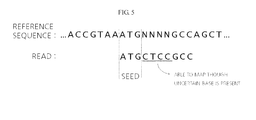
- FIG. 5 is a diagram illustrating an exemplary process for determining the identity of an unidentified base, through comparison of a reference sequence with a read.
- FIG. 6 is a flowchart illustrating an exemplary method for processing a reference sequence.
- exemplary embodiments will be described in detail. However, one or more exemplary embodiments are not limited to exemplary embodiments disclosed below, but can be implemented in various forms. The following exemplary embodiments are described in order to enable those of ordinary skill in the art to embody and practice exemplary embodiments.
- first, second, etc. may be used to describe various elements, these elements are not limited in their order of appearance or operation by these terms. These terms are only used as expedients to connote the existence of different elements. For example, a first element could be termed a second element, and, similarly, a second element could be termed a first element.
- the term "and/or" includes any and all combinations of one or more of the associated listed items.
- an element When an element is “connected” or “coupled” to another element, it may be directly connected or coupled to the other element, or one or more intervening elements may be present. In contrast, when an element is referred to as being “directly connected” or “directly coupled” to another element, there are no intervening elements present.
- read is a fragment of a reference sequence that is sequenced and outputted from a genome sequencer.
- the length of a particular read may vary, and in some embodiments, may be about 35 to 500 base pairs (bp) in length. As those skilled in the art would appreciate, the length of read varies depending on the type of genome sequencing technology employed. DNA bases are generally denoted using the letters A, C, G and T.
- reference sequence refers to a base sequence used to assemble a complete base sequence from the reads.
- a complete base sequence may be assembled by mapping a large number of reads outputted from a genome sequencer onto a reference sequence.
- Reference sequences and reads constitute sequences of bases, with bases in DNA being commonly designated as A, C, G or T, depending on the chemical structure of the base. However, for various reasons (e.g., a sequencing error, a sampling error, etc.), a reference sequence may contain one or more bases that are of uncertain identity. Such bases are generally denoted as a separate letter, such as "N.”
- seed is a unit sequence used for mapping reads onto a reference sequence.
- all the reads should be sequentially compared with the reference sequence, beginning with the first part thereof, in order to estimate the positions in the reference sequence from which each read is produced.
- one disadvantage of this approach is that it requires excessive time and computing power to map a read.
- a hash table is constructed by hashing a predetermined length of the reference sequence, beginning with the first part thereof, and advancing one base at a time, and then the read is mapped to a position on the reference sequence.
- the fragment of the reference sequence for hashing becomes a seed.
- a fragment of the read may be a seed.
- the seed length may be smaller than the length of the read(s), and the seed length may also be adjusted depending on the length of the reference sequence, and/or the capacity of the constructed hash table.
- FIG. 1 illustrates an example of extraction of a seed from a reference sequence.
- the seed is extracted by extracting the base sequence of the reference sequence one base at a time in a length of 10 bp from the first part thereof.
- the extracted seeds have the same length (10 bp in the example shown in FIG. 1 ), but the sequences of the seeds are different from one another depending on the positions of the bases extracted from the reference sequence.
- the first extracted seed contains the 1 st to 10th bases of the reference sequence, which is G T G G C A A T T A
- the third extracted seed has the 3rd to 12th bases of the reference sequence, which is G G C A A T T A A A.
- FIG. 2 is a flowchart illustrating an exemplary method for genome sequencing (S200). It allows the assembly of a complete genome sequence by mapping a large quantity of short reads outputted from a genome sequencer onto a reference sequence.
- a seed is extracted from a reference sequence (S202).
- a plurality of seeds are extracted by sequentially extracting sequences of bases of a predetermined length from the reference sequence, beginning with the first part thereof, and advancing one base at a time.
- the seeds extracted in S202 are hashed using a hash function, and thereby a hash table is produced (S204).
- the hash table may be keyed with a value generated from the seed.
- the value indicates the location in the reference sequence to which the seed corresponds.
- a plurality of reads are extracted from a gene by the genome sequencer (S206), and the extracted reads are mapped onto the reference sequence using the hash table (S208).
- FIG. 3 is a diagram illustrating an example of the mapping of reads onto a reference sequence, in the manner described above.
- the N bp (N is a seed length) of the read extracted in S206 is read out as a seed, and one or more mapping candidate positions of the seed in the reference sequence are obtained by searching the hash table.
- the first part of the read is used as a seed, but in practice, the seed may be any part of the read. However, because the accuracy of the first part of the read is generally high, in some embodiments, the first part of the read is used as a seed.
- at least one mapping candidate position is generally obtained (In Table 3, two mapping candidates L1 and L2 are obtained). The number of mapping candidate positions vary depending on seed length.
- the remaining part of the read is compared with the reference sequence at each of the mapping candidate positions, to determine an exact mapping position of the read.
- the read does not correspond to the reference sequence, but the read corresponds to the reference sequence at L2.
- the read is mapped to the L2 position.
- FIG. 4 is a block diagram of an exemplary system for processing a reference sequence 400.
- the system for processing a reference sequence 400 may be configured as a separate system, or alternatively, may be included as one element in the system for analyzing a reference sequence.
- an exemplary system for processing a reference sequence 400 includes a seed extractor 402, a determiner 404, and an index generator 406.
- the seed extractor 402 extracts a seed from a reference sequence. As described above, the seed extractor 402 extracts a plurality of seeds by sequentially extracting sequences of bases of a predetermined length from the reference sequence, beginning with the first part thereof, and advancing one base at a time.
- the reference sequence is as follows:
- seeds generated from the reference sequence are as follows:
- the determiner 404 determines whether a base that is not identified in a read is identified or not in the seed extracted by the seed extractor 402.
- a reference sequence may contain one or more bases that are of uncertain identity, and such base(s) are generally denoted as a separate letter, such as "N.” Accordingly, the determiner 404 may determine that a base that is not identified in the read is also not identified in the seed, i.e., that the unidentified base is also present in the seed, when a base other than A, C, G or T is present in the seed.
- the determiner 404 may determine whether an unidentified base denoted as "N" is present or absent in the seed. When the unidentified base is present in the seed, it may be determined that an unidentified base present in the read is also not identified in the seed. In addition, when the unidentified base is denoted by a letter other than N, the determiner 404 recognizes such other letter, and determines whether the unidentified base in the read is identified or not in the seed.
- the 11th to 14th bases in the reference sequence are denoted as unidentified (uncertain) bases ("N;" indicated by an underline below), and the 5th to 14th seeds among the seeds extracted from the reference sequence include the unidentified ("N") bases. Accordingly, the determiner 404 determines that an unidentified base in a read is also not identified in the 5th to 14th seeds among the extracted 15 seeds, i.e., the unidentified bases are also present in the 5th to 14th seeds.
- the index generator 406 only adds a seed which is determined not to have an unidentified base(s); seeds determined to have an unidentified base(s) are excluded by the determiner 404. Specifically, the index generator 406 hashes a corresponding seed using a hash function when the seed is determined not to have an unidentified base, and generates a hash table using the hashed seed as a key. In the above-mentioned example, the index generator 406 performs indexing only to seeds listed below, excluding the 5th to 14th seeds among the 15 extracted seeds.
- the hash table is generated by extracting seeds from a reference sequence, and excluding those seeds that contain an unidentified base(s). In this way, the analysis speed is dramatically improved without decreasing accuracy, as compared to conventional methods for analyzing base sequences.
- unidentified bases are concentrated in a single location, and make up only about 5% of all the retrieved sequencing data. Accordingly, the exclusion of seeds containing unidentified bases does not decrease significantly the total accuracy of the genome sequencing.
- N unidentified base
- Table 1 Seed Length (k) Total Number of Seeds Including N 10 222,409,329 11 222,409,622 12 222,409,915 13 222,410,208 14 222,410,501 15 222,410,794 16 222,411,087 17 222,411,380
- N unidentified bases
- the read corresponds to the ATG part of the reference sequence.
- the N N N N part of the reference sequence does not correspond to the read, but corresponds to the following G C C part. Therefore, it can be predicted that the uncertain bases are C T C C through comparison with the read. That is, without considering the unidentified ("N") part of the reference sequence, mapping is also possible in an uncertain region through comparison with other parts.
- a sequencer extracts reads from one gene through approximately 30 or more repeated operations. Accordingly, when the above-mentioned exemplary method is repeatedly performed using the extracted reads, accurate mapping is also possible with respect to an uncertain part of the reference sequence, and with a very high degree of accuracy.
- the number of records in the hash table when N is considered as a different letter, such as A, C, G or T, in the reference sequence is as follows:
- the number of records in the hash table when N is not considered in the reference sequence is as follows:
- the capacity of the hash table is determined as follows:
- the hash table capacity decreases to approximately 1/45.
- FIG. 6 is a flowchart illustrating an exemplary method of processing a reference sequence (S600).
- a seed is extracted from a reference sequence (S602), and it is determined whether an unidentified base in a read is also unidentified in the extracted seed (S604), i.e., whether the unidentified base is also present in the seed.
- S604 when a base denoted by a letter other than A, C, G or T is present in the seed (e.g., when a base represented by N is present), it can be determined that the unidentified base in the read is also unidentified in the seed.
- the seed is excluded from generation of an index. That is, a seed including an unidentified base is not used in subsequent mapping.
- the seed is added to a hash table (S606).
- the processes in S602 to S606 are repeated until analysis of a base sequence is sequentially performed from the first part of the reference sequence to the last part thereof, and a seed index for analyzing a base sequence is generated through the above-mentioned process.
- a computer-readable recording medium which includes a program for performing methods described herein on a computer.
- the computer-readable recording medium may include a program command, a local data file, and a local data structure, used alone or in combination.
- the medium may be specially designed or configured for the present invention, or known to those of ordinary skill in the field of computer software.
- Examples of the computer-readable recoding medium include magnetic media such as a hard disk, a floppy disk and a magnetic tape, optical recording media such as a CD-ROM and a DVD, a magnetic-optical medium such as a floppy disk, and hardware devices specially configured to store and execute program commands such as a ROM, a RAM and a flash memory.
- the program commands may include a high-level language code capable of being executed by a computer using an interpreter, as well as machine code, which is, for example, made by a compiler.
- an algorithm for processing an unidentified base may be omitted from analysis of a reference sequence, whilst still maintaining accuracy, the process of analyzing a base sequence can be simplified, and the analysis time can be drastically reduced.
- the capacity of a hash table is drastically reduced, and thus it is possible to analyze a base sequence with a smaller memory.
Landscapes
- Life Sciences & Earth Sciences (AREA)
- Physics & Mathematics (AREA)
- Health & Medical Sciences (AREA)
- Engineering & Computer Science (AREA)
- Biotechnology (AREA)
- Chemical & Material Sciences (AREA)
- Biophysics (AREA)
- Bioinformatics & Cheminformatics (AREA)
- General Health & Medical Sciences (AREA)
- Theoretical Computer Science (AREA)
- Bioinformatics & Computational Biology (AREA)
- Medical Informatics (AREA)
- Spectroscopy & Molecular Physics (AREA)
- Proteomics, Peptides & Aminoacids (AREA)
- Evolutionary Biology (AREA)
- Analytical Chemistry (AREA)
- Organic Chemistry (AREA)
- Databases & Information Systems (AREA)
- Bioethics (AREA)
- Zoology (AREA)
- Wood Science & Technology (AREA)
- Molecular Biology (AREA)
- Microbiology (AREA)
- Immunology (AREA)
- Biochemistry (AREA)
- General Engineering & Computer Science (AREA)
- Genetics & Genomics (AREA)
- Measuring Or Testing Involving Enzymes Or Micro-Organisms (AREA)
- Apparatus Associated With Microorganisms And Enzymes (AREA)
- Investigating Or Analysing Biological Materials (AREA)
Applications Claiming Priority (1)
| Application Number | Priority Date | Filing Date | Title |
|---|---|---|---|
| KR1020120019090A KR101372947B1 (ko) | 2012-02-24 | 2012-02-24 | 염기 서열 분석을 위한 참조 서열 처리 시스템 및 방법 |
Publications (2)
| Publication Number | Publication Date |
|---|---|
| EP2631832A2 true EP2631832A2 (de) | 2013-08-28 |
| EP2631832A3 EP2631832A3 (de) | 2014-05-21 |
Family
ID=47559050
Family Applications (1)
| Application Number | Title | Priority Date | Filing Date |
|---|---|---|---|
| EP12187722.9A Withdrawn EP2631832A3 (de) | 2012-02-24 | 2012-10-09 | System und Verfahren zur Verarbeitung einer Referenzsequenz zur Analyse einer Genomsequenz |
Country Status (5)
| Country | Link |
|---|---|
| US (1) | US9323889B2 (de) |
| EP (1) | EP2631832A3 (de) |
| JP (1) | JP2013172709A (de) |
| KR (1) | KR101372947B1 (de) |
| CN (1) | CN103294932A (de) |
Cited By (1)
| Publication number | Priority date | Publication date | Assignee | Title |
|---|---|---|---|---|
| CN115831233A (zh) * | 2023-02-07 | 2023-03-21 | 杭州联川基因诊断技术有限公司 | 一种基于mTag的靶向测序数据预处理的方法、设备和介质 |
Families Citing this family (5)
| Publication number | Priority date | Publication date | Assignee | Title |
|---|---|---|---|---|
| KR101394339B1 (ko) | 2012-03-06 | 2014-05-13 | 삼성에스디에스 주식회사 | 시드의 길이를 고려한 염기 서열 처리 시스템 및 방법 |
| KR101538852B1 (ko) * | 2013-10-31 | 2015-07-22 | 삼성에스디에스 주식회사 | 정확도를 고려한 염기 서열 정렬 장치 및 방법 |
| US11482304B2 (en) | 2017-08-02 | 2022-10-25 | Genemind Biosciences Company Limited | Alignment methods, devices and systems |
| KR102377810B1 (ko) * | 2020-03-11 | 2022-03-23 | 한국전자통신연구원 | 유전체 서열 정렬 방법 및 그 장치 |
| JP2023541090A (ja) * | 2020-09-15 | 2023-09-28 | イルミナ インコーポレイテッド | ソフトウェアで加速されたゲノムリードマッピング |
Family Cites Families (4)
| Publication number | Priority date | Publication date | Assignee | Title |
|---|---|---|---|---|
| AU6387000A (en) * | 1999-07-29 | 2001-02-19 | Genzyme Corporation | Serial analysis of genetic alterations |
| US20030165495A1 (en) * | 2003-04-01 | 2003-09-04 | Carulli John P. | Nucleic acids and polypeptides |
| US20060091023A1 (en) * | 2004-10-28 | 2006-05-04 | Ahsan Bukhari | Assessing micro-via formation PCB substrate manufacturing process |
| CN102329895A (zh) * | 2011-10-14 | 2012-01-25 | 武汉百泰基因工程有限公司 | 乙型肝炎前c区和bcp区基因突变检测试剂盒、检测方法、引物及其探针 |
-
2012
- 2012-02-24 KR KR1020120019090A patent/KR101372947B1/ko not_active Expired - Fee Related
- 2012-10-09 EP EP12187722.9A patent/EP2631832A3/de not_active Withdrawn
- 2012-10-12 JP JP2012227089A patent/JP2013172709A/ja active Pending
- 2012-12-13 US US13/713,927 patent/US9323889B2/en not_active Expired - Fee Related
-
2013
- 2013-01-10 CN CN2013100090732A patent/CN103294932A/zh active Pending
Non-Patent Citations (2)
| Title |
|---|
| ANONYMOUS: "Genomic Dna Hash Tables And Ambiguous Bases", BIOSTARS- BIOINFORMATICS EXPLAINED, 31 December 2010 (2010-12-31), XP055228286, Retrieved from the Internet <URL:https://www.biostars.org/p/3623/> [retrieved on 20151113] * |
| NING Z: "SSAHA: a fast search method for large DNA databases", GENOME RESEARCH, COLD SPRING HARBOR LABORATORY PRESS, vol. 11, no. 10, 1 October 2001 (2001-10-01), pages 1725 - 1729, XP002983796, ISSN: 1088-9051, DOI: 10.1101/GR.194201 * |
Cited By (1)
| Publication number | Priority date | Publication date | Assignee | Title |
|---|---|---|---|---|
| CN115831233A (zh) * | 2023-02-07 | 2023-03-21 | 杭州联川基因诊断技术有限公司 | 一种基于mTag的靶向测序数据预处理的方法、设备和介质 |
Also Published As
| Publication number | Publication date |
|---|---|
| CN103294932A (zh) | 2013-09-11 |
| KR101372947B1 (ko) | 2014-03-13 |
| KR20130097440A (ko) | 2013-09-03 |
| US9323889B2 (en) | 2016-04-26 |
| US20130226467A1 (en) | 2013-08-29 |
| EP2631832A3 (de) | 2014-05-21 |
| JP2013172709A (ja) | 2013-09-05 |
Similar Documents
| Publication | Publication Date | Title |
|---|---|---|
| Larson et al. | A clinician’s guide to bioinformatics for next-generation sequencing | |
| US20200243164A1 (en) | Systems and methods for patient-specific identification of neoantigens by de novo peptide sequencing for personalized immunotherapy | |
| EP2631832A2 (de) | System und Verfahren zur Verarbeitung einer Referenzsequenz zur Analyse einer Genomsequenz | |
| KR102858552B1 (ko) | 표적화 핵산 서열 분석 데이터를 정렬하는 방법 | |
| Gao et al. | Comparison of various algorithms for recognizing short coding sequences of human genes | |
| US20120259556A1 (en) | System and methods for indel identification using short read sequencing | |
| CN104699998A (zh) | 用于对基因组进行压缩和解压缩的方法和装置 | |
| KR101481457B1 (ko) | 리드 전체를 고려한 염기 서열 정렬 시스템 및 방법 | |
| US20190362807A1 (en) | Genomic variant ranking system for clinical trial matching | |
| WO2014041380A1 (en) | Method and computer program product for detecting mutation in a nucleotide sequence | |
| WO2010056131A1 (en) | A method and system for analysing data sequences | |
| US9348968B2 (en) | System and method for processing genome sequence in consideration of seed length | |
| KR20070083641A (ko) | 전사 맵핑을 위한 유전자 식별 기호 분석방법 | |
| Wang et al. | Recognizing shorter coding regions of human genes based on the statistics of stop codons | |
| AlEisa et al. | K‐Mer Spectrum‐Based Error Correction Algorithm for Next‐Generation Sequencing Data | |
| US10443090B2 (en) | Method and apparatus for detecting translocation | |
| KR101584857B1 (ko) | 염기 서열 정렬 시스템 및 방법 | |
| CN116888673A (zh) | 用于处理序列数据的方法、系统和装置 | |
| US20150120208A1 (en) | System and method for aligning genome sequence in consideration of accuracy | |
| US20190102515A1 (en) | Method and device for decoding data segments derived from oligonucleotides and related sequencer | |
| Smitha et al. | Computational transcription factor binding prediction using random forests | |
| US20140121988A1 (en) | System and method for aligning genome sequence considering repeats | |
| WO2025221998A1 (en) | Systems and methods for variant calling | |
| JP2017068521A (ja) | 新規転写産物抽出装置、及び新規転写産物抽出プログラム | |
| Moore et al. | Finding a longest open reading frame of an alternatively spliced gene |
Legal Events
| Date | Code | Title | Description |
|---|---|---|---|
| PUAI | Public reference made under article 153(3) epc to a published international application that has entered the european phase |
Free format text: ORIGINAL CODE: 0009012 |
|
| 17P | Request for examination filed |
Effective date: 20121009 |
|
| AK | Designated contracting states |
Kind code of ref document: A2 Designated state(s): AL AT BE BG CH CY CZ DE DK EE ES FI FR GB GR HR HU IE IS IT LI LT LU LV MC MK MT NL NO PL PT RO RS SE SI SK SM TR |
|
| AX | Request for extension of the european patent |
Extension state: BA ME |
|
| PUAL | Search report despatched |
Free format text: ORIGINAL CODE: 0009013 |
|
| AK | Designated contracting states |
Kind code of ref document: A3 Designated state(s): AL AT BE BG CH CY CZ DE DK EE ES FI FR GB GR HR HU IE IS IT LI LT LU LV MC MK MT NL NO PL PT RO RS SE SI SK SM TR |
|
| AX | Request for extension of the european patent |
Extension state: BA ME |
|
| RIC1 | Information provided on ipc code assigned before grant |
Ipc: G06F 19/28 20110101ALN20140411BHEP Ipc: G06F 19/22 20110101AFI20140411BHEP |
|
| 17Q | First examination report despatched |
Effective date: 20151125 |
|
| STAA | Information on the status of an ep patent application or granted ep patent |
Free format text: STATUS: EXAMINATION IS IN PROGRESS |
|
| STAA | Information on the status of an ep patent application or granted ep patent |
Free format text: STATUS: THE APPLICATION IS DEEMED TO BE WITHDRAWN |
|
| 18D | Application deemed to be withdrawn |
Effective date: 20190501 |