EP2629174A2 - Verfahren zur Verringerung des Stromverbrauchs innerhalb einer tragbaren Kommunikationsvorrichtung - Google Patents
Verfahren zur Verringerung des Stromverbrauchs innerhalb einer tragbaren Kommunikationsvorrichtung Download PDFInfo
- Publication number
- EP2629174A2 EP2629174A2 EP13155043.6A EP13155043A EP2629174A2 EP 2629174 A2 EP2629174 A2 EP 2629174A2 EP 13155043 A EP13155043 A EP 13155043A EP 2629174 A2 EP2629174 A2 EP 2629174A2
- Authority
- EP
- European Patent Office
- Prior art keywords
- spatial
- location
- sensing modules
- control module
- modules
- Prior art date
- Legal status (The legal status is an assumption and is not a legal conclusion. Google has not performed a legal analysis and makes no representation as to the accuracy of the status listed.)
- Withdrawn
Links
Images


Classifications
-
- H—ELECTRICITY
- H04—ELECTRIC COMMUNICATION TECHNIQUE
- H04W—WIRELESS COMMUNICATION NETWORKS
- H04W52/00—Power management, e.g. Transmission Power Control [TPC] or power classes
- H04W52/02—Power saving arrangements
- H04W52/0209—Power saving arrangements in terminal devices
- H04W52/0251—Power saving arrangements in terminal devices using monitoring of local events, e.g. events related to user activity
- H04W52/0254—Power saving arrangements in terminal devices using monitoring of local events, e.g. events related to user activity detecting a user operation or a tactile contact or a motion of the device
-
- G—PHYSICS
- G01—MEASURING; TESTING
- G01S—RADIO DIRECTION-FINDING; RADIO NAVIGATION; DETERMINING DISTANCE OR VELOCITY BY USE OF RADIO WAVES; LOCATING OR PRESENCE-DETECTING BY USE OF THE REFLECTION OR RERADIATION OF RADIO WAVES; ANALOGOUS ARRANGEMENTS USING OTHER WAVES
- G01S19/00—Satellite radio beacon positioning systems; Determining position, velocity or attitude using signals transmitted by such systems
- G01S19/01—Satellite radio beacon positioning systems transmitting time-stamped messages, e.g. GPS [Global Positioning System], GLONASS [Global Orbiting Navigation Satellite System] or GALILEO
- G01S19/13—Receivers
- G01S19/34—Power consumption
-
- G—PHYSICS
- G01—MEASURING; TESTING
- G01S—RADIO DIRECTION-FINDING; RADIO NAVIGATION; DETERMINING DISTANCE OR VELOCITY BY USE OF RADIO WAVES; LOCATING OR PRESENCE-DETECTING BY USE OF THE REFLECTION OR RERADIATION OF RADIO WAVES; ANALOGOUS ARRANGEMENTS USING OTHER WAVES
- G01S5/00—Position-fixing by co-ordinating two or more direction or position line determinations; Position-fixing by co-ordinating two or more distance determinations
- G01S5/01—Determining conditions which influence positioning, e.g. radio environment, state of motion or energy consumption
- G01S5/014—Identifying transitions between environments
-
- G—PHYSICS
- G06—COMPUTING OR CALCULATING; COUNTING
- G06F—ELECTRIC DIGITAL DATA PROCESSING
- G06F1/00—Details not covered by groups G06F3/00 - G06F13/00 and G06F21/00
- G06F1/26—Power supply means, e.g. regulation thereof
- G06F1/32—Means for saving power
- G06F1/3203—Power management, i.e. event-based initiation of a power-saving mode
- G06F1/3206—Monitoring of events, devices or parameters that trigger a change in power modality
- G06F1/3231—Monitoring the presence, absence or movement of users
-
- G—PHYSICS
- G06—COMPUTING OR CALCULATING; COUNTING
- G06F—ELECTRIC DIGITAL DATA PROCESSING
- G06F1/00—Details not covered by groups G06F3/00 - G06F13/00 and G06F21/00
- G06F1/26—Power supply means, e.g. regulation thereof
- G06F1/32—Means for saving power
- G06F1/3203—Power management, i.e. event-based initiation of a power-saving mode
- G06F1/3234—Power saving characterised by the action undertaken
- G06F1/325—Power saving in peripheral device
-
- H—ELECTRICITY
- H04—ELECTRIC COMMUNICATION TECHNIQUE
- H04W—WIRELESS COMMUNICATION NETWORKS
- H04W52/00—Power management, e.g. Transmission Power Control [TPC] or power classes
- H04W52/02—Power saving arrangements
- H04W52/0209—Power saving arrangements in terminal devices
- H04W52/0261—Power saving arrangements in terminal devices managing power supply demand, e.g. depending on battery level
- H04W52/0274—Power saving arrangements in terminal devices managing power supply demand, e.g. depending on battery level by switching on or off the equipment or parts thereof
-
- Y—GENERAL TAGGING OF NEW TECHNOLOGICAL DEVELOPMENTS; GENERAL TAGGING OF CROSS-SECTIONAL TECHNOLOGIES SPANNING OVER SEVERAL SECTIONS OF THE IPC; TECHNICAL SUBJECTS COVERED BY FORMER USPC CROSS-REFERENCE ART COLLECTIONS [XRACs] AND DIGESTS
- Y02—TECHNOLOGIES OR APPLICATIONS FOR MITIGATION OR ADAPTATION AGAINST CLIMATE CHANGE
- Y02D—CLIMATE CHANGE MITIGATION TECHNOLOGIES IN INFORMATION AND COMMUNICATION TECHNOLOGIES [ICT], I.E. INFORMATION AND COMMUNICATION TECHNOLOGIES AIMING AT THE REDUCTION OF THEIR OWN ENERGY USE
- Y02D10/00—Energy efficient computing, e.g. low power processors, power management or thermal management
-
- Y—GENERAL TAGGING OF NEW TECHNOLOGICAL DEVELOPMENTS; GENERAL TAGGING OF CROSS-SECTIONAL TECHNOLOGIES SPANNING OVER SEVERAL SECTIONS OF THE IPC; TECHNICAL SUBJECTS COVERED BY FORMER USPC CROSS-REFERENCE ART COLLECTIONS [XRACs] AND DIGESTS
- Y02—TECHNOLOGIES OR APPLICATIONS FOR MITIGATION OR ADAPTATION AGAINST CLIMATE CHANGE
- Y02D—CLIMATE CHANGE MITIGATION TECHNOLOGIES IN INFORMATION AND COMMUNICATION TECHNOLOGIES [ICT], I.E. INFORMATION AND COMMUNICATION TECHNOLOGIES AIMING AT THE REDUCTION OF THEIR OWN ENERGY USE
- Y02D30/00—Reducing energy consumption in communication networks
- Y02D30/70—Reducing energy consumption in communication networks in wireless communication networks
Definitions
- the present disclosure generally relates to portable communication devices, and more specifically, to methods of conserving power within portable communication devices. Further, aspects of the disclosure are also directed to software products recorded on machine-readable data storage media, and such software products are executable upon computing hardware of portable communication devices, to implement the methods of the disclosure.
- Portable communication devices within the scope of the disclosure, are construed as devices which are portable, and which are capable of supporting wireless communication.
- portable communication devices include, although are not limited to, mobile telephones, cellular phones, wireless-enabled tablet computers, iPhones TM , iPods TM , personal laptop computers, personal digital assistants ("PDA's") and other such similar devices [Superscript 'TM' stands for registered trademarks].
- portable communication devices including cellular phones
- modules for determining an exact position and location of the devices For example, many mobile devices have or utilize global positioning systems (GPS) to determine their exact location.
- GPS systems have a GPS receiver, which is synchronized with geostationary satellites, and the GPS receiver continuously receives signals from the satellites, to determine the exact location of the devices, and more specifically, their exact latitudinal and longitudinal positions.
- Certain cell based location determination systems are available in the art, which use the cellular identifier (ID) of the portable devices, to identify their location.
- ID cellular identifier
- Techniques are also available to determine positions of portable communication devices by analyzing signals received by the devices from certain near-field wireless sources.
- many smart phones, including the 'Juice Defender' for Android TM platforms are equipped with functionality to selectively switch off or switch on, certain modules in the phones.
- the smartphone is not in a dedicated cellular cell of a wireless communication infrastructure, i.e., it is unable to find a typically used base station, the Wireless local area network (WLAN) of the phone can be set to switch-off in such circumstances.
- WLAN Wireless local area network
- the present disclosure provides a method and a system for substantially reducing the consumption of power within portable communication devices, while identifying the location of such devices through different location identifying modules installed within the devices.
- the present disclosure provides a method for reducing the consumption of power within a portable communication device.
- the device includes multiple spatial sensing modules for determining the location of the device.
- the method includes, using at least one or more of the spatial sensing modules, to identify whether device is in a spatially stationary state for a certain period, to sense any motion of the device, and to continuously monitor the surroundings of the device for identifying any sudden change in the surroundings.
- One or more or the spatial sensing modules of the device are selectively switched on or switched off, to reduce the consumption of power, based on identifying that the device has been at a spatially constant location for some period, or based on identifying any sudden motion of the device, or based on any sudden changes monitored in the surroundings of the device.
- the present disclosure provides a portable communication device equipped with a battery, and the device is adapted to save the energy stored within its battery.
- the device includes multiple spatial sensing modules to sense motion, to sense a spatially stationary state of the device for a certain period, and to continuously monitor the device's surroundings. Further, the device is provided with a control module operatively coupled to the spatial sensing modules. The control module selectively switches on or switches off, one or more of the spatial sensing modules to reduce power consumption, when the device is identified to be spatially static for a certain period, or is suddenly identified to move, or when a sudden change in the surroundings of the device is observed.
- the spatial sensing modules include a global positioning system and a module, which when operable, determines the position of the device using a cellular wireless communication infrastructure through which the device communicates, and through a suitable near-field communication infrastructure proximal to the device.
- the global positioning system determines the position of the device through communication between a GPS receiver, which the device is equipped with, and a set of GPS satellites.
- the spatial sensing modules include multiple inertial motion sensors to continuously detect any sudden change in orientation of the device, or a sudden movement of the device, or to sense that the device is in a spatially constant location for some period.
- the control module turns off the GPS system of the device, to save power consumption. Further, if the device is identified to move from the indoor location, to an outdoor location, the control module switches on the GPS system back again.
- the method of the present disclosure substantially alleviates the aforementioned problems of higher power consumption within portable consumption devices, while determining the location of such devices.
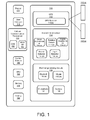
- Fig.1 illustrates different spatial sensing modules of a portable communication device, in accordance with the present disclosure.
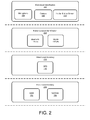
- Fig. 2 depicts the different spatial sensing modules, rearranged at different hierarchical levels, the hierarchical levels corresponding to the different levels of accuracy desired while determining the location of the device, in accordance with the present disclosure.
- Fig. 3 illustrates the communication between the device of Fig. 1 , with different Bluetooth and WLAN stations coupled to the spatial sensing modules of the device, for determining the location of the device, when it is at an indoor location.
- Fig. 4 illustrates an embodiment, wherein the device of Fig. 1 , in accordance with the present disclosure, is identified to be lying at a spatially constant location, within an indoor confinement.
- Fig. 5 illustrates the different steps involved in the method of reducing the power consumption within the portable communication device of Fig. 1 , in accordance with the present disclosure.
- Portable communication devices including mobile devices, cellular phones, iPads, iPhones, personal laptop computers, personal digital assistants (PDA), are predominantly used in the art, for communication and other purposes, and such devices are often equipped with the feature of supporting wireless communication, including the Wireless Local Area Networks (WLAN), through suitable applications/modules installed within the devices. Further, most of these devices are provided with many accurate position determination systems, for precisely identifying the exact location of the devices.
- An example of such position determination system is the Global positioning system (GPS), which is currently available in most advanced cellular phones, including smart phones and iPhones, for navigation and position determination.
- GPS Global positioning system
- GPS Global positioning system
- the devices are equipped with a GPS receiver, and the receiver is in continuous communication with the GPS satellites revolving around the earth.
- the system is capable of precisely determining the location of the device, in terms of its longitude, latitude, altitude above the sea level etc.
- the GPS receiver continuously receives signals from at least three GPS satellites, and calculates the times taken to receive the messages from the at least three satellites, and uses these times to determine the distance of the receiver to the at least three satellites. Further, different algorithms and trilateration techniques are then used, to determine the position of the device.
- some portable communication devices are provided with other spatial location modules for determining their location on the Earth's surface.
- One such spatial location module uses cell-based location technique, identifies the cellular cell ID of the device, and uses triangulation technique to identify location. Further, there are other indoor location systems that these devices are equipped with, Bluetooth or the Wi Fi networks etc.
- the present disclosure provides a more effective and efficient way of reducing the power consumption within a portable communication device, by identifying that the device is in a spatially stationary state for some period, i.e. at a spatially constant location for some period, or is suddenly moved from that location.
- the portable communication device is provided with multiple spatial sensing modules for sensing motion or a spatially stationary state of the device. Some of these spatial sensing modules continuously monitor the surroundings of the device. One or more of these spatial sensing modules is switched on or switched off, in a hierarchical manner, based on certain conditions, as disclosed in details hereinafter.
- Fig. 1 is an illustration of different components of a portable communication device 100 (referred to as 'device 100' hereinafter, for simplicity and economy of expression), in accordance with the present disclosure, the device 100 being adapted to save energy stored within its battery.
- the device 100 can be any appropriate device known in the art, and capable of supporting wireless communication. This may include, though not be limited to, a mobile phone, a smart phone such as an iPhone, Android phone, iPad from Apple, Inc., a laptop, a Symbian phone etc.
- the device 100 is optionally equipped with 2G or 3G technology, or WCDMA, TDMA, GSM, LTE etc., for supporting wireless communication. As shown in Fig.
- the device 100 has a display 101, configured to render text, videos or images/pictures, to the user. Furthermore, the device 100 includes multiple spatial sensing modules 110, for detecting the position of the device, and accurately determining its spatial location.
- the spatial sensing modules 110 include a GPS 112, for determining the exact location of the device on the Earth's surface, in terms of its latitude, longitude and its altitude above the sea level.
- the GPS 112 includes a GPS receiver 112 (a), which is coupled to at least three GPS satellites 112 (b), and it continuously obtains signals from the GPS satellites 112 (b), to determine the location of the device 100.
- the spatial sensing modules 110 include an inertial motion sensor 114 for determining the orientation, for sensing movement, and for sensing the acceleration of the device 100.
- the inertial motion sensor 114 (hereinafter 'sensor 114') includes a linear accelerometer 114 (a) for determining linear acceleration of the device 100.
- the sensor 114 includes a rotation sensor 114 (b), for determining the orientation of the device 100, and for sensing any sudden change in the orientation. For example, if the device 100 has been kept stationary on a table, for a substantially long period, and suddenly the user picks it up in his hands, or slightly rotates it from its current position, the rotation sensor 114 (b) is able to detect the change in the orientation of the device 100.
- An angular accelerometer 114 (c) measures angular acceleration of the device 100 if it is suddenly rotated. Furthermore, the sensor 114 includes a sound detector 114 (d) for detecting any sudden sounds produced proximal to the device 100, or the sound generated when the device 100 is suddenly moved or put over a supporting surface. For example, if the user suddenly puts the device 100 on a table, the sound detector 114 (d) is capable of identifying the corresponding sound.
- a light detector 114 (e) monitors the ambience of the device 100 and identifies changes in illumination of the device 100's surroundings. For example, if the device 100 is suddenly moved from an outdoor location on a sunny afternoon, to a dark room, the light detector 114 (e) identifies such a change.
- the spatial sensing modules 110 also include a short range sensing module 116 for short range communication and indoor/proximity location.
- the short range sensing module 116 includes a Bluetooth module 116 (a), and Wireless Local Area Network (WLAN) module 116 (b) for communication.
- WLAN Wireless Local Area Network
- Other typical applications known in the art, for short range communication and data exchange with other devices, can also be incorporated within the short range sensing module 116, thus not limiting the scope of the disclosure.
- a microphone 120 is provided for receiving sounds on the device 100.
- a camera 130 is configured to capture images and videos, when turned on.
- a user interface 140 obtains appropriate inputs from the user, for enabling operations on the device 100.
- the user interface 140 can be any suitable means known in the art, and is normally provided in portable communication devices, for obtaining user inputs, including a touch screen with suitable keys incorporated, or a keypad.
- the device 100 includes a cellular communication transceiver 150, such as GSM 152 or WCDMA 154 for enabling communication according to cellular communication standards, for example 3GPP.
- a central processing unit 160 executes software applications typically stored in the memory 170 of the device 100.
- a battery 180 stores energy within it, to provide power for the operations of the device 100.
- the battery 180 can be any suitable means known in the art, and usable in communication devices.
- the battery 180 can be a Lithium ion battery cell (LiOn), a rechargeable Zinc-air battery, a rechargeable Aluminium-Carbon battery or a battery driven by power related electronics.
- other chargeable battery like the Nickel-Metal hydride (NiMH), or a Nickel-Cadmium battery, can also be used.
- the battery 180 has a connection point to an external charger.
- the device 100 is provided with a housing and suitable audio output, and input/output interfaces, and Universal Serial Bus (USB) ports.
- USB Universal Serial Bus
- a control module 190 is coupled to the different spatial sensing modules 110, and it is configured to selectively switch on or switch off one or more of the spatial sensing modules 110, based on a set of conditions that will described hereinafter, in details.
- a control module 190 can consist of electrical components configured to provide control signals to other modules.
- a control module 190 is preferably implemented as an application stored in memory 170 and executed in CPU 160. In an embodiment controlling of other modules is done/managed by the CPU 160. In some embodiments one or more modules can be physically implemented in a singe integrated circuit (IC) and/or be integrated to CPU architecture.
- the mutually different spatial sensing modules 110 can be used to determine the location of the device 100, based on the different levels of accuracy desired.
- Fig. 2 shows a rearrangement of the different spatial modules at different hierarchical levels, and illustrates their usage, based on different levels of accuracy desired, while determining the location of the device 100.
- the different spatial sensing modules disposed are utilized for obtaining accuracy pertaining to that level.
- the level 210 corresponds to a block level accuracy, when accuracy to within 1km to 10 km of radius range from the device 100 is desired.
- This level of accuracy is achieved by analyzing signals between the cellular transceiver 150 and the cellular base station with which the cellular transceiver 150 communicates.
- the cellular ID of the device 100 can be mapped to a geographical location, either locally, or the location can be converted into a real location by sending the cellular ID to a server providing geo-location services.
- GSM 152 and the WCDMA 154 are shown in Fig. 2 , the method can optionally also use any other appropriate technology in conjunction with GSM/WCDMA (e.g., LTE, CDMA 2000, TD-SCDMA etc).
- the level 220 corresponds to a case when a street level accuracy is desired. Typically, this is an accuracy within a range of 10 meters to 50 meters.
- the appropriate spatial sensing module 110 is the GPS 112 (shown in Fig. 1 ). The GPS module 112 can accurately determine the spatial location of the device 100 within this range.
- the level 230 corresponds to the indoor location identification. This pertains to the case when the device 100 is identified to be at an indoor location, for example, within a house or within an office premises.
- the short range spatial sensing modules 116 as shown in Fig. 1 can be used, including, for example, the Bluetooth 116 (a) or the WLAN 116 (b), for communication and data exchange. Usage of these short range sensing modules 116, at the level 230, typically requires communication and connection of the device 100 with suitable Bluetooth and WLAN stations. These will be shown in further detail in Fig. 3 .
- the device 100 is equipped with appropriate dedicated software applications for using the short range sensing modules 116 at the level 230.
- the WLAN 116 (b) can also be used at times, in outdoor locations, thus not limiting the scope of the disclosure.
- the level 240 corresponds to the micro-level identification.
- the inertial motion sensors 114, the camera 130, the microphone 120, etc. can be used.
- the micro-level identification at the level 240 refers to sensing certain situations, for example, whether the device 100 is moving, or is at a spatially constant location for a certain temporal period, is lying on a table for a substantially long time, or for sensing a sudden movement of the device 100 from a location, where it has been detected to be lying for some temporal period.
- the camera 130 is adapted to continuously capture the images of the surroundings of the device 100, and store them in a database.
- the camera 130 can identify whether or not the device 100 has been moved from one location to the other, based on any changes in the captured images of the device's surroundings. For example, if the device 100, lying initially on a desk or a table, is moved to some other location, there may be a sudden change in the appearance of roof and the ceilings, and this may be easily identified by the camera 130, for example as a change in color or intensity of light, or both.
- the sound detector 114 (d) continuously detects any sounds generated proximal to the device 100. For example, if the user suddenly places the device 100 on a table, the sound detector 114 (d) detects the corresponding sound and provides signals to the control module 190 (shown in Fig. 1 ).
- the light detector 114 (e) can detect the sudden change in the surroundings and provide corresponding signals to the control module 190.
- the linear and angular accelerometers 114 (a) and 114 (c), respectively, and the rotation sensor 114 (b) can collaborate, or work independently to detect any change in the orientation of the device 100, or to sense any sudden motion of the device 100, and provide the corresponding signals control module 180.
- Fig. 3 illustrates the case when the device 100 is identified to be at an indoor location, and the method of identifying the location of the device 100 using one or more of the short range spatial sensing modules 116, for example, the Bluetooth 116 (a) or the WLAN 116 (b) of Fig. 1 .
- the device 100 is depicted lying within the confinements of an indoor environment 300.
- the device 100 is operatively connected to, and communicates with one or more Bluetooth stations 302 (a), 302 (b), 302 (c) etc., and simultaneously with multiple WLAN stations 304 (a), 304 (b) and 304 (c), as shown.
- the device 100 is connected to a server 306 through the Internet 308.
- radio signals emitted by the device 100 are used to identify the indoor location.
- the device 100 is equipped with suitable applications installed within it, and it requires connection with at least three base stations, to analyze and identify the indoor confinement 300.
- a suitable technique known in the art for example, triangulation, is used to determine the indoor location of the device 100.
- the location is then transmitted to the server 306 via the Internet 308.
- triangulation technique includes calculating the time of flight (TOF) of the radio signals, measuring the strength of the signals and calculating the parameter 'received signal strength indicator' (RSSI), etc. for the signals transmitted to the Bluetooth or WLAN stations.
- TOF time of flight
- RSSI parameter 'received signal strength indicator'
- Fig. 4 an embodiment of the disclosure is shown, wherein the device 100 is lying over a desk 402, within an indoor location.
- the micro-level identification modules shown in Fig. 2 , are used to sense sudden motion and to monitor the surrounding of the device 100 continuously.
- selected spatial sensing modules 110 including the camera 130, the microphone 120 and the inertial motion sensors 114 are used continuously to detect any changes in the surroundings of the device 100, and to sense any sudden motion of the device 100.
- the corresponding signals are conveyed to the control module 190.
- the control module 190 switches off one or more of the short range spatial sensing modules, including the Bluetooth 116 (a) or the WLAN 116 (b), to save power. Furthermore, the control module 190 also switches off the device's GPS receiver 112 (a), in such a situation. Preferably, the control module 190 generally always switches off the device's GPS 112, if the device 100 is identified to be at an indoor location, or at a spatially constant location, for some period, for example several minutes, or several hours.
- the control module 190 switches back on, the GPS 112 and the GPS receiver 112 (a) of the device 100, if this movement is sensed. Furthermore, the Bluetooth 116 (a) and the WLAN 116 (b) are switched on again, when the device 100 is identified to move to an outdoor area.
- Fig. 5 illustrates the different steps involved, in the exemplary method 500, for reducing power consumption within the device 100, in accordance with the present disclosure.
- the method 500 continuously identifies the location of the device 100 through the GPS 112.
- the GPS receiver 112 (a) shown in Fig. 1
- the method 500 continuously monitors surroundings of the device 100, and identifies any changes in the GPS coordinates of the device 100.
- the method 500 also senses an existence of a stationary state or a sudden movement of the device 100, at this step 504. Effectively, any sudden change in the position of the device 100 can be observed by change in its GPS coordinates, as there is always a slight drift in the position of the device 100, as shown by the GPS 112, when the device 100 moves. Furthermore, the inertial motion sensors 114, including the linear accelerometers and the angular accelerometers 114 (a) and 114 (c), respectively, are used at the step 504, to sense that the device 100 is stationary (i.e., at a spatially constant location), or for sensing the motion of the device 100, or a sudden change in its position. At a step 506, the method 500 identifies whether or not the device 100 is moving.
- the GPS 112 of the device 100 is kept switched on at a step 508. If the device 100 is not moving, then at a step 510, the method 500 identifies whether or not the device 100 has been at a spatially constant location for some temporal period. If the device 100 is not moving, i.e., at the spatially constant location for the temporal period, then at a step 512, the GPS 112 is switched off to save power consumption within the device 100. Proceeding further, at a step 514, the method 500 continuously monitors the state of rest of the device 100, and identifies whether or not the device 100 has started moving again, from the spatially constant location identified at step 510.
- the method 500 further checks at a step 518, whether or not the device 100 is at an indoor location.
- the inertial motion sensors 114 are used, to continuously monitor the surroundings of the device 100, and to sense motion of the device 100. The different inertial motion sensors 114, continuously interact with the control module 190 at this step 518.
- the shorter range spatial sensing modules including the Bluetooth 116 (a) and the WLAN 116 (a), are switched off to save power. Furthermore, the GPS 112 of the device 100 is still kept switched off to save power consumption within the device 100.
- the method 500 proceeding further from the step 520, continuously monitors the surroundings of the device 100, and checks whether or not the device 100 is still continuing to be at the indoor location identified at the step 518. This is again achieved by using the inertial motion sensors 114, including the linear accelerometers 114 (a), the angular accelerometers 114 (c), and the rotation sensors 114 (b), which are capable of sensing sudden motion of the device 100.
- the shorter range spatial sensing modules and the GPS 112 are kept switched off. Otherwise, if any motion of the device 100 is detected, and it is identified to move from the indoor location identified at the step 518, to an outdoor area, the previously turned off GPS 112 and the shorter range spatial sensing modules, are switched on again.
- the method in accordance with the present disclosure is implementable on, and is compatible with, any portable communication device that supports wireless communication, and is in operable connection with near-field wireless communication networks, or Bluetooth stations, WLAN stations etc.
- the disclosure is not limited merely to mobile devices, but works equally with other portable communication devices, examples of which were set forth before, including iPads, personal laptop computers etc.
Landscapes
- Engineering & Computer Science (AREA)
- Theoretical Computer Science (AREA)
- Physics & Mathematics (AREA)
- General Physics & Mathematics (AREA)
- Radar, Positioning & Navigation (AREA)
- Remote Sensing (AREA)
- Computer Networks & Wireless Communication (AREA)
- General Engineering & Computer Science (AREA)
- Signal Processing (AREA)
- Telephone Function (AREA)
- Mobile Radio Communication Systems (AREA)
Applications Claiming Priority (1)
| Application Number | Priority Date | Filing Date | Title |
|---|---|---|---|
| US13/372,784 US8521148B1 (en) | 2012-02-14 | 2012-02-14 | Method of reducing power consumption within a portable communication device |
Publications (2)
| Publication Number | Publication Date |
|---|---|
| EP2629174A2 true EP2629174A2 (de) | 2013-08-21 |
| EP2629174A3 EP2629174A3 (de) | 2016-03-09 |
Family
ID=47843047
Family Applications (1)
| Application Number | Title | Priority Date | Filing Date |
|---|---|---|---|
| EP13155043.6A Withdrawn EP2629174A3 (de) | 2012-02-14 | 2013-02-13 | Verfahren zur Verringerung des Stromverbrauchs innerhalb einer tragbaren Kommunikationsvorrichtung |
Country Status (2)
| Country | Link |
|---|---|
| US (2) | US8521148B1 (de) |
| EP (1) | EP2629174A3 (de) |
Cited By (1)
| Publication number | Priority date | Publication date | Assignee | Title |
|---|---|---|---|---|
| CN108845337A (zh) * | 2018-04-13 | 2018-11-20 | 南京粒聚智能科技有限公司 | 一种超低功耗的终端设备供电方法 |
Families Citing this family (14)
| Publication number | Priority date | Publication date | Assignee | Title |
|---|---|---|---|---|
| KR102058947B1 (ko) * | 2012-05-24 | 2019-12-24 | 엘지전자 주식회사 | 이동 단말기 및 그의 gps엔진 제어방법 |
| TWI486805B (zh) * | 2012-10-09 | 2015-06-01 | Quanta Comp Inc | 健康照護產品與其電源管理方法 |
| JP2014185859A (ja) * | 2013-03-21 | 2014-10-02 | Fujitsu Ltd | 携帯情報端末の制御方法、制御プログラム、携帯情報端末 |
| EP3008946B1 (de) | 2013-06-11 | 2018-08-08 | Seven Networks, LLC | Offload von anwendungsverkehr auf einen gemeinsamen kommunikationskanal zur signaloptimierung in einem drahtlosen netzwerk für verkehr unter verwendung von proprietären und nicht-proprietären protokollen |
| US9706513B2 (en) * | 2014-02-20 | 2017-07-11 | Verizon Patent And Licensing Inc. | Power conservation on user devices having location identification hardware |
| JP6537344B2 (ja) * | 2015-05-13 | 2019-07-03 | 株式会社Nttドコモ | 測位システム及び測位方法 |
| EP3291617B1 (de) * | 2015-05-26 | 2019-08-14 | Huawei Technologies Co., Ltd. | Steuerungsverfahren, -vorrichtung und -system für mobiles endgerät |
| US10054688B2 (en) * | 2015-11-03 | 2018-08-21 | Samsung Electronics Co., Ltd | Method and apparatus for saving power during synthetic positioning in GNSS receivers |
| US10568034B2 (en) * | 2016-01-23 | 2020-02-18 | Blustream Corporation | Intelligent power management for monitoring a movable object |
| KR102564468B1 (ko) * | 2016-02-11 | 2023-08-08 | 삼성전자주식회사 | 경로 정보를 제공하기 위한 전자 장치 및 방법 |
| US9906914B2 (en) * | 2016-05-11 | 2018-02-27 | Mapsted Corp. | Scalable indoor navigation and positioning systems and methods |
| JP2018105669A (ja) * | 2016-12-26 | 2018-07-05 | アイシン・エィ・ダブリュ株式会社 | 消費電力制御システム、ナビゲーションシステム、消費電力制御プログラムおよび制御プログラム |
| US10178624B2 (en) * | 2017-03-17 | 2019-01-08 | Aireon Llc | Provisioning satellite coverage |
| CN117330804A (zh) * | 2023-10-27 | 2024-01-02 | 江苏苏源杰瑞科技有限公司 | 一种具有防盗功能的自动灭火电表 |
Family Cites Families (6)
| Publication number | Priority date | Publication date | Assignee | Title |
|---|---|---|---|---|
| AU2003258898A1 (en) * | 2002-08-09 | 2004-02-25 | Surveylab Group Limited | Mobile instrument, viewing device, and methods of processing and storing information |
| US8320932B2 (en) * | 2006-04-11 | 2012-11-27 | Motorola Solutions, Inc. | Method and system of utilizing a context vector and method and system of utilizing a context vector and database for location applications |
| GB2451616B (en) * | 2007-05-08 | 2012-07-04 | Samsung Electronics Co Ltd | Location-dependent control in a cellular phone |
| AU2008280823A1 (en) * | 2007-07-24 | 2009-01-29 | Rethink Technology Pty Ltd | Improvements relating to communication devices |
| US8310394B2 (en) * | 2010-03-08 | 2012-11-13 | Deutsche Telekom Ag | Apparatus, method, manufacture, and system for sensing substitution for location-based applications |
| US9072052B2 (en) * | 2010-08-09 | 2015-06-30 | Blackberry Limited | Communication system providing context-based mobile wireless communications device power consumption management and related methods |
-
2012
- 2012-02-14 US US13/372,784 patent/US8521148B1/en not_active Expired - Fee Related
-
2013
- 2013-02-13 EP EP13155043.6A patent/EP2629174A3/de not_active Withdrawn
- 2013-08-26 US US14/010,325 patent/US20140031092A1/en not_active Abandoned
Non-Patent Citations (1)
| Title |
|---|
| None |
Cited By (1)
| Publication number | Priority date | Publication date | Assignee | Title |
|---|---|---|---|---|
| CN108845337A (zh) * | 2018-04-13 | 2018-11-20 | 南京粒聚智能科技有限公司 | 一种超低功耗的终端设备供电方法 |
Also Published As
| Publication number | Publication date |
|---|---|
| US20130210408A1 (en) | 2013-08-15 |
| EP2629174A3 (de) | 2016-03-09 |
| US20140031092A1 (en) | 2014-01-30 |
| US8521148B1 (en) | 2013-08-27 |
Similar Documents
| Publication | Publication Date | Title |
|---|---|---|
| US8521148B1 (en) | Method of reducing power consumption within a portable communication device | |
| CN107192980B (zh) | 用于移动设备定位的自适应被动扫描和/或主动探测技术 | |
| Oshin et al. | Improving the energy-efficiency of GPS based location sensing smartphone applications | |
| KR101421164B1 (ko) | 이동 단말기 및 그의 무선기기 표시방법 | |
| EP2659467B1 (de) | Leistungssteuerung einer drahtlosen verfolgungsvorrichtung mit eingeschränkter stromquelle | |
| US9185525B2 (en) | Automatic activation of speed measurement in mobile device based on available motion indicia | |
| US10172089B2 (en) | Low power location tracking device | |
| US9313788B2 (en) | Mobile device for wireless data communication and a method for communicating data by wireless data communication in a data communication network | |
| CA2692960C (en) | Automatic activation of speed measurement in mobile device based on available motion | |
| CN117202085A (zh) | 感知终端的选择方法、装置及通信设备 | |
| KR20130124530A (ko) | 네비게이션을 위한 카메라 인에이블 헤드셋 | |
| US20170006424A1 (en) | Wireless underground location tracking | |
| US10274574B2 (en) | System and method of transmitting location data based on wireless communication activity | |
| JP2007020074A (ja) | 移動無線局及びその通信パラメータ制御方法 | |
| KR20150069172A (ko) | 전자 장치의 위치 정보 공유 방법 및 장치 | |
| CN107534932A (zh) | 一种功能状态控制的方法及相关设备 | |
| KR20120124111A (ko) | 이동 단말기 및 이동 단말기의 제어 방법 | |
| CN106161800A (zh) | 一种来电提醒方法、装置和移动通讯终端 | |
| Dhanalakshmi et al. | Enhancing indoor navigation: bluetooth Beacon-Based localization systems | |
| CN109813300B (zh) | 一种定位方法及终端设备 | |
| CN110418049B (zh) | 位置信息处理方法和装置、移动终端、存储介质 | |
| WO2018098717A1 (zh) | 一种调整定位周期的方法及装置 | |
| CN107835304B (zh) | 控制移动终端的方法、装置、移动终端及存储介质 | |
| CN109936817A (zh) | 一种定位方法及终端设备 | |
| CN113965880A (zh) | 一种无线耳机查找方法、装置及电子设备 |
Legal Events
| Date | Code | Title | Description |
|---|---|---|---|
| PUAI | Public reference made under article 153(3) epc to a published international application that has entered the european phase |
Free format text: ORIGINAL CODE: 0009012 |
|
| AK | Designated contracting states |
Kind code of ref document: A2 Designated state(s): AL AT BE BG CH CY CZ DE DK EE ES FI FR GB GR HR HU IE IS IT LI LT LU LV MC MK MT NL NO PL PT RO RS SE SI SK SM TR |
|
| AX | Request for extension of the european patent |
Extension state: BA ME |
|
| PUAL | Search report despatched |
Free format text: ORIGINAL CODE: 0009013 |
|
| AK | Designated contracting states |
Kind code of ref document: A3 Designated state(s): AL AT BE BG CH CY CZ DE DK EE ES FI FR GB GR HR HU IE IS IT LI LT LU LV MC MK MT NL NO PL PT RO RS SE SI SK SM TR |
|
| AX | Request for extension of the european patent |
Extension state: BA ME |
|
| RIC1 | Information provided on ipc code assigned before grant |
Ipc: H04W 52/02 20090101AFI20160204BHEP Ipc: G01S 19/34 20100101ALI20160204BHEP Ipc: G06F 1/32 20060101ALI20160204BHEP |
|
| STAA | Information on the status of an ep patent application or granted ep patent |
Free format text: STATUS: THE APPLICATION IS DEEMED TO BE WITHDRAWN |
|
| 18D | Application deemed to be withdrawn |
Effective date: 20160910 |