EP2628738A1 - Heterocyclic substituted pyridine derivatives and antifungal agent containing same - Google Patents
Heterocyclic substituted pyridine derivatives and antifungal agent containing same Download PDFInfo
- Publication number
- EP2628738A1 EP2628738A1 EP12193373.3A EP12193373A EP2628738A1 EP 2628738 A1 EP2628738 A1 EP 2628738A1 EP 12193373 A EP12193373 A EP 12193373A EP 2628738 A1 EP2628738 A1 EP 2628738A1
- Authority
- EP
- European Patent Office
- Prior art keywords
- compound
- reaction
- group
- examples
- pyridin
- Prior art date
- Legal status (The legal status is an assumption and is not a legal conclusion. Google has not performed a legal analysis and makes no representation as to the accuracy of the status listed.)
- Granted
Links
- 0 *CC(CC*=C)c1c(*)nc(*)cc1 Chemical compound *CC(CC*=C)c1c(*)nc(*)cc1 0.000 description 5
- YNQLUTRBYVCPMQ-UHFFFAOYSA-N CCc1ccccc1 Chemical compound CCc1ccccc1 YNQLUTRBYVCPMQ-UHFFFAOYSA-N 0.000 description 1
- YSJSPABVMCUEMY-UHFFFAOYSA-N Nc(cc1)nc(N)c1-c1cc(Cc(cn2)ccc2OCC2=CC=CCC2)n[o]1 Chemical compound Nc(cc1)nc(N)c1-c1cc(Cc(cn2)ccc2OCC2=CC=CCC2)n[o]1 YSJSPABVMCUEMY-UHFFFAOYSA-N 0.000 description 1
Classifications
-
- A—HUMAN NECESSITIES
- A01—AGRICULTURE; FORESTRY; ANIMAL HUSBANDRY; HUNTING; TRAPPING; FISHING
- A01N—PRESERVATION OF BODIES OF HUMANS OR ANIMALS OR PLANTS OR PARTS THEREOF; BIOCIDES, e.g. AS DISINFECTANTS, AS PESTICIDES OR AS HERBICIDES; PEST REPELLANTS OR ATTRACTANTS; PLANT GROWTH REGULATORS
- A01N43/00—Biocides, pest repellants or attractants, or plant growth regulators containing heterocyclic compounds
- A01N43/48—Biocides, pest repellants or attractants, or plant growth regulators containing heterocyclic compounds having rings with two nitrogen atoms as the only ring hetero atoms
- A01N43/56—1,2-Diazoles; Hydrogenated 1,2-diazoles
-
- A—HUMAN NECESSITIES
- A01—AGRICULTURE; FORESTRY; ANIMAL HUSBANDRY; HUNTING; TRAPPING; FISHING
- A01N—PRESERVATION OF BODIES OF HUMANS OR ANIMALS OR PLANTS OR PARTS THEREOF; BIOCIDES, e.g. AS DISINFECTANTS, AS PESTICIDES OR AS HERBICIDES; PEST REPELLANTS OR ATTRACTANTS; PLANT GROWTH REGULATORS
- A01N43/00—Biocides, pest repellants or attractants, or plant growth regulators containing heterocyclic compounds
- A01N43/72—Biocides, pest repellants or attractants, or plant growth regulators containing heterocyclic compounds having rings with nitrogen atoms and oxygen or sulfur atoms as ring hetero atoms
- A01N43/80—Biocides, pest repellants or attractants, or plant growth regulators containing heterocyclic compounds having rings with nitrogen atoms and oxygen or sulfur atoms as ring hetero atoms five-membered rings with one nitrogen atom and either one oxygen atom or one sulfur atom in positions 1,2
-
- A—HUMAN NECESSITIES
- A61—MEDICAL OR VETERINARY SCIENCE; HYGIENE
- A61P—SPECIFIC THERAPEUTIC ACTIVITY OF CHEMICAL COMPOUNDS OR MEDICINAL PREPARATIONS
- A61P31/00—Antiinfectives, i.e. antibiotics, antiseptics, chemotherapeutics
-
- A—HUMAN NECESSITIES
- A61—MEDICAL OR VETERINARY SCIENCE; HYGIENE
- A61P—SPECIFIC THERAPEUTIC ACTIVITY OF CHEMICAL COMPOUNDS OR MEDICINAL PREPARATIONS
- A61P31/00—Antiinfectives, i.e. antibiotics, antiseptics, chemotherapeutics
- A61P31/10—Antimycotics
-
- C—CHEMISTRY; METALLURGY
- C07—ORGANIC CHEMISTRY
- C07D—HETEROCYCLIC COMPOUNDS
- C07D401/00—Heterocyclic compounds containing two or more hetero rings, having nitrogen atoms as the only ring hetero atoms, at least one ring being a six-membered ring with only one nitrogen atom
- C07D401/02—Heterocyclic compounds containing two or more hetero rings, having nitrogen atoms as the only ring hetero atoms, at least one ring being a six-membered ring with only one nitrogen atom containing two hetero rings
- C07D401/04—Heterocyclic compounds containing two or more hetero rings, having nitrogen atoms as the only ring hetero atoms, at least one ring being a six-membered ring with only one nitrogen atom containing two hetero rings directly linked by a ring-member-to-ring-member bond
-
- C—CHEMISTRY; METALLURGY
- C07—ORGANIC CHEMISTRY
- C07D—HETEROCYCLIC COMPOUNDS
- C07D401/00—Heterocyclic compounds containing two or more hetero rings, having nitrogen atoms as the only ring hetero atoms, at least one ring being a six-membered ring with only one nitrogen atom
- C07D401/14—Heterocyclic compounds containing two or more hetero rings, having nitrogen atoms as the only ring hetero atoms, at least one ring being a six-membered ring with only one nitrogen atom containing three or more hetero rings
-
- C—CHEMISTRY; METALLURGY
- C07—ORGANIC CHEMISTRY
- C07D—HETEROCYCLIC COMPOUNDS
- C07D413/00—Heterocyclic compounds containing two or more hetero rings, at least one ring having nitrogen and oxygen atoms as the only ring hetero atoms
- C07D413/02—Heterocyclic compounds containing two or more hetero rings, at least one ring having nitrogen and oxygen atoms as the only ring hetero atoms containing two hetero rings
- C07D413/04—Heterocyclic compounds containing two or more hetero rings, at least one ring having nitrogen and oxygen atoms as the only ring hetero atoms containing two hetero rings directly linked by a ring-member-to-ring-member bond
-
- C—CHEMISTRY; METALLURGY
- C07—ORGANIC CHEMISTRY
- C07D—HETEROCYCLIC COMPOUNDS
- C07D413/00—Heterocyclic compounds containing two or more hetero rings, at least one ring having nitrogen and oxygen atoms as the only ring hetero atoms
- C07D413/14—Heterocyclic compounds containing two or more hetero rings, at least one ring having nitrogen and oxygen atoms as the only ring hetero atoms containing three or more hetero rings
-
- C—CHEMISTRY; METALLURGY
- C07—ORGANIC CHEMISTRY
- C07D—HETEROCYCLIC COMPOUNDS
- C07D417/00—Heterocyclic compounds containing two or more hetero rings, at least one ring having nitrogen and sulfur atoms as the only ring hetero atoms, not provided for by group C07D415/00
- C07D417/14—Heterocyclic compounds containing two or more hetero rings, at least one ring having nitrogen and sulfur atoms as the only ring hetero atoms, not provided for by group C07D415/00 containing three or more hetero rings
Definitions
- the present invention relates to heterocyclic substituted pyridine derivatives and to antifungal agents comprising the same.
- amphotericine B which is based on a polyene skeleton, fluconazole, itraconazole and voriconazole which are based on an azole skeleton, or the like
- amphotericine B which is based on a polyene skeleton
- fluconazole fluconazole
- itraconazole and voriconazole which are based on an azole skeleton, or the like
- Patent Documents 1 and 2 describe pyridine derivatives which demonstrates effects against the onset, progress, and persistence of infections by inhibiting the expression of cell wall proteins, inhibiting the cell wall assembly and also adhesion onto cells, and preventing pathogens from showing pathogenicity, with the process which transports GPI (Glycosylphosphatidylinositol)-anchored proteins to the cell wall being inhibited.
- GPI Glycosylphosphatidylinositol
- this group differs structural from the compounds according to the present invention in that the common structure has a single ring bound via an amidemethylene linker at the pyridine ring 3-position.
- Patent Documents 3 to 5 also provide examples of related art with structures similar to the compounds according to the present invention.
- Patent Documents 3 and 4 describe pyridine derivatives substituted by a pyrazole ring, which are used as glycine transporter inhibitors or 5-HT receptor ligands, while Patent Document 5 describes 5-member heterocyclic substituted pyridine derivatives which are used as an AGE disruptor and inhibitor.
- Patent Documents 3 to 5 do not disclose the compounds according to the present invention, and the antifungal effects of the compounds disclosed in Patent Documents 3 to 5 against Candida, Aspergillus, Cryptococcus and the like which are common fungi in human fungal disease are not disclosed.
- the present inventors have succeeded in synthesizing novel pyridine derivatives (hereinafter, the compounds of the present invention) represented by the following formula (I); and having a chemical structure in which a pyridine ring and a 5- or 6-member heteroaryl ring or benzene ring are joined with a 5-member heteroaryl methyl group as a linker, and have perfected the present invention upon discovering that these compounds have excellent antifungal action.
- novel pyridine derivatives hereinafter, the compounds of the present invention represented by the following formula (I); and having a chemical structure in which a pyridine ring and a 5- or 6-member heteroaryl ring or benzene ring are joined with a 5-member heteroaryl methyl group as a linker, and have perfected the present invention upon discovering that these compounds have excellent antifungal action.
- the present invention provides:
- the compound (I) of the present invention or a salt thereof 1) acts against the onset, development and persistence of infections by inhibiting fungal GPI biosynthesis, thereby inhibiting expression of cell wall proteins and blocking cell wall assembly while preventing the fungus from attaching to cells so that the pathogen cannot become pathogenic, and 2) is superior in terms of physical properties, safety and metabolic stability, and is extremely useful as a preventive or therapeutic agent for fungal infections.
- a structural formula of a compound sometimes represents a certain isomer for convenience of description.
- compounds according to the present invention may include all possible isomers, such as structural possible geometric isomers, optical isomers generated due to the presence of asymmetric carbons, stereoisomers, tautomers, and mixtures of isomers, and are not limited to formulae being used for the convenience of description, and may be either one of two isomers or a mixture of both isomers.
- the compounds according to the present invention may be either optically active compounds having an asymmetric carbon atom in their molecules or their racemates, and are not restricted to either of them but include both.
- the compounds according to the present invention may exhibit crystalline polymorphism, but likewise are not restricted to any one of these, but may be in any one of these crystal forms or exist as a mixture of two or more crystal forms.
- the compounds according to the present invention also include both anhydrous and solvates such as hydrated forms.
- C 1-6 alkyl group used in the present specification refers to a straight-chain or branched-chain alkyl group with 1 to 6 carbon atoms which is a monovending group induced by removal of any one hydrogen atom from an aliphatic hydrocarbon with 1 to 6 carbon atoms.
- C 1-6 alkyl group includes a methyl group, an ethyl group, a n -propyl group, an isopropyl group, a n- butyl group, an isobutyl group, a sec -butyl group, a tert -butyl group, a n -pentyl group, an isopentyl group, a sec -pentyl group, a neopentyl group, a 1-methylbutyl group, a 2-methylbutyl group, a 1,1-dimethylpropyl group, a 1,2-dimethylpropyl group, a n- hexyl group, an isohexyl group, a 1-methylpentyl group, a 2-methylpentyl group, a 3-methylpentyl group, a 1,1-dimethylbutyl group, a 1,2-dimethylbutyl group, a 2,2-di
- C 2-6 alkenyl group used in the present specification refers to a straight-chain or branched-chain alkenyl group with 2 to 6 carbon atoms which may contain 1 or 2 double bonds.
- examples of “C 2-6 alkenyl group” include an ethenyl group, a 1-propenyl group, a 2-propenyl group, a 1-butenyl group, a 2-butenyl group, a 3-butenyl group, a 2-methyl-1-propenyl group, a pentenyl group, a 3-methyl-2-butenyl group, a hexenyl group, a hexanedienyl group or the like, preferably an ethenyl group, a 1-propenyl group, a 2-propenyl group, a 1-butenyl group, a 2-butenyl group, a 3-butenyl group, a 2-methyl-1-propenyl group, a 3-methyl-2-
- C 2-6 alkynyl group used in the present specification refers to a straight-chain or branched-chain alkynyl chain with 2 to 6 carbon atoms which may contain 1 or 2 triple bonds.
- examples of "C 2-6 alkynyl group” include an ethynyl group, a 1-propynyl group, a 2-propynyl group, a 1-butynyl group, a 2-butynyl group, a 3-butynyl group, a pentynyl group, a hexynyl group, a hexanediynyl group or the like, preferably an ethynyl group, a 1-propynyl group, a 2-propynyl group, a 1-butynyl group, a 2-butynyl group, a 3-butynyl group or the like.
- C 3-8 cycloalkyl group used in the present specification refers to a cyclic aliphatic hydrocarbon group with 3 to 8 carbon atoms.
- examples of “C 3-8 cycloalkyl group” include a cyclopropyl group, a cyclobutyl group, a cyclopentyl group, a cyclohexyl group, a cycloheptyl group, a cyclooctyl group or the like, preferably a cyclopropyl group, a cyclobutyl group, a cyclopentyl group, a cyclohexyl group or the like.
- C 1-6 alkoxy group used in the present specification refers to a group in which an oxygen atom is bonded to terminus of the "C 1-6 alkyl group” defined above.
- examples of "C 1-6 alkoxy group” include a methoxy group, an ethoxy group, a n -propoxy group, an isopropoxy group, a n -butoxy group, an isobutoxy group, a sec -butoxy group, a tert -butoxy group, a n -pentyloxy group, an isopentyloxy group, a sec -pentyioxy group, a neopentyloxy group, a 1-methylbutoxy group, a 2-methylbutoxy group, a 1,1-dimethylprapoxy group, a 1,2-dimethyfpropoxy group, a n-hexyloxy group, an isohexyloxy group, a 1-methylpentyloxy group, a 2-
- hydroxyl C 1-6 alkyl group used in the present specification refers to a group in which any of the hydrogen atoms in a "C 1-6 alkyl group” as defined above has been replaced by a hydroxyl group.
- examples of "hydroxyl C 1-6 alkyl group” include a hydroxymethyl group, a 1-hydroxyethyl group, a 2-hydroxyethyl group, a 1-hydroxy- n -propyl group, a 2-hydroxy- n -propyl group, a 3-hydroxy-n-propyl group, a 1-hydroxy-isopropyl group, a 2-hydroxy-isopropyl group, a 3-hydroxy-isopropyl group, a 1-hydroxy- tert -butyl group or the like, preferably a hydroxymethyl group, a 1-hydroxyethyl group, a 2-hydroxyethyl group or the like.
- C 1-6 alkoxycarbonyl group used in the present specification refers to a group in which a carbonyl group is bonded to terminus of the "C 1-6 alkoxy group” defined above.
- examples of “C 1-6 alkoxycarbonyl group” include a methoxycarbonyl group, an ethoxycarbonyl group, a n -propoxycarbonyl group, an isopropoxycarbonyl group or the like.
- C 1-6 alkoxycarbonyl C 1-6 alkyl group used in the present specification refers to a group in which the "C 1-6 alkyl group” defined above is bonded to terminus of the "C 1-6 alkoxycarbonyl group” defined above.
- examples of the "C 1-6 alkoxycarbonyl C 1-6 alkyl group” include a methoxycarbonyl methyl group, a methoxycarbonyl ethyl group, an ethoxycarbonyl methyl group, an ethoxycarbonyl ethyl group or the like.
- C 6-10 aryl group used in the present specification refers to an aromatic hydrocarbon cyclic group with 6 to 10 carbon atoms.
- examples of “C 6-10 aryl group” include a phenyl group, a 1-naphthyl group, a 2-naphthyl group, an indenyl group, an azulenyl group, a heptalenyl group or the like, preferably a phenyl group, a 1-naphthyl group, 2-naphthyl group or the like.
- C 1-6 alkoxy C 1-6 alkyl group used in the present specification refers to a group in which any of the hydrogen atoms in a "C 1-6 alkyl group” as defined above has been replaced by a "C 1-6 alkoxy group” as defined above.
- examples of "C 1-6 alkoxy C 1-6 alkyl group” include a methoxymethyl group, an ethoxymethyl group, a n -propoxymethyl group, a methoxyethyl group, an ethoxyethyl group or the like.
- halogen atom used in the present specification refers a fluorine atom, a chlorine atom, a bromine atom or an iodine atom.
- hetero atom used in the present specification refers to a nitrogen atom, a sulfur atom or an oxygen atom.
- 5- or 6-member heteroaryl ring used in the present specification refers to an aromatic ring in which the number of atoms making up the ring is 5 or 6, and 1 or more hetero atoms are included in the atoms making up the ring.
- examples of "5- or 6-member heteroaryl ring” include a furan ring, a thiophene ring, a pyrrole ring, a pyridine ring, a pyrazine ring, a pyridazine ring, a pyrimidine ring, a triazole ring (a 1,2,3-triazole ring, a 1,2,4-triazole ring, etc.), a tetrazole ring (a 1 H -tetrazale ring, a 2 H -tetrazole ring, etc.), a thiazole ring, a pyrazole ring, an oxazole ring, an isoxazole ring, an isothiazole ring, an oxadiazole ring, a thiadiazole ring or the like.
- 5- or 6-member heteroaryl group used in the present specification refers to a monovalent group induced by removing 1 hydrogen atom from any position in an aromatic ring in which the number of atoms making up the ring is 5 or 6 and 1 or more hetero atoms are included in the atoms making up the ring.
- examples of "5- or 6-member heteroaryl group” include a furyl group (a 2-furyl group or a 3-furyl group, etc.), a thienyl group (a 2-thienyl group or a 3-thienyl group, etc.), a pyrrolyl group (a 1-pyrrolyl group, a 2-pyrrolyl group or a 3-pyrrolylgroup, etc.), a pyridyl group (a 2-pyridyl group, a 3-pyridyl group, a 4-pyridyl group, etc.), a pyrazinyl group, a pyridazinyl group (a 3-pyridazinyl group or a 4-pyridazinyl group, etc.), a pyrimidinyl group (a 2-pyrimidinyl group, a 4-pyrimidinyl group or a 5-pyrimidinyl group, etc.), a triazolyl froup (a 1,2,3-
- 5- or 6-member non-aromatic heterocyclic group used in the present specification refers to a monovalent group induced by removing 1 hydrogen atom from any position in a non-aromatic ring in which the number of atoms making up the ring is 5 or 6 and 1 or more hetero atoms are included in the atoms making up the ring.
- examples of "5- or 6-member non-aromatic heterocyclic group” include a pyrrolidinyl group, a piperadinyl group, a piperidinyl group, a morpholinyl group, a tetrahydrofuryl group, a tetrahydropyranyl group or the like.
- di C 1-6 alkylamino group used in the present specification refers to a group in which 2 hydrogen atoms of the amino group are replaved with the "C 1-6 alkyl groups” defined above being the same as or different from each other.
- examples of the term "di C 1-6 alkylamino group” include a N, N-dimethylamino group, a N, N-diethylamino group, a N, N-di- n -propylamino group, a N, N-di-isopropylamino group, a N, N-di- n -butylamino group, a N, N-isobutylamino group, a N, N-di-sec-butylamino group, a N,N-di- tert- butylamina group, a N-ethyl-N-methylamino group, a N- n -propylamino-N-methylamino group, a N-isopropyl-N-methylamino group, a N- n -butyl-N-methylamino group, a N-isobutyl-N-methylamino group,
- R 1 preferably represents a hydrogen atom, a halogen atom, an amino group, a C 1-6 alkyl group, a C 1-6 alkoxy group, a C 1-6 alkylamino group, a hydroxyl C 1-6 alkylamino group, or a C 1-6 alkoxy C 1-6 alkyl group, and more preferably a hydrogen atom, an amino group or a C 1-6 alkoxy C 1-6 alkyl group, with a methoxymethyl group being preferred as the C 1-6 alkoxy C 1-6 alkyl group.
- R 2 represents a hydrogen atom, an amino group or di C 1-6 alkylamino group, with a hydrogen atom or an amino group being preferred.
- One of X and Y is a nitrogen atom while the other is a nitrogen atom or an oxygen atom.
- the partial structure which contains X and Y and which is represented by formula (II) below: has a structure such as those shown below, preferably with the left side bound to the 3-position of a pyridine ring via a single bond, and the right side bound to an A ring via a methylene group:
- the partial structure which contains X and Y has a structure such as that shown by formulae (III) or (IV) below, preferably with the left end bound to the 3-position of a pyridine ring via a single bond and the right end linked to an A ring via a ethylene group: while if X and Y are both nitrogen atoms, the partial structure which contains X and Y, and which is represented by the following formula (II): has a structure such as that shown by formula (V) or (VI) below, preferably with the left end bound to the 3-position of a pyridine ring via a single bond and the right end bound to an A ring via a methylene group:
- a ring A represents a 5- or 6-member heteroaryl ring or a benzene ring which may have a halogen atom or 1 or 2 C 1-6 alkyl groups, and preferably represents a pyridine ring, a benzene ring, a furan ring, a thiophene ring or a pyrrole ring, or more preferably a pyridine ring, a benzene ring or a thiophene ring, still more preferably a pyridine ring or a benzene ring.
- Z preferably represents a single bond, a methylene group, an ethylene group, an oxygen atom, a sulfur atom, -CH 2 O-, -OCH 2 -, -NH-, -NHCH 2 -, -CH 2 NH-, -CH 2 -S-, or -SCH 2 -.
- a methylene group an oxygen atom, -CH 2 O- or -OCH 2 - is preferred, and an oxygen atom, -CH 2 O- or -OCH 2 - is especially preferred.
- R 3 represents a hydrogen atom, halogen atom, a C 1-6 alkyl group, a C 3-8 cycloalkyl group, a C 6-10 aryl group or a 5- or 6-member ring heteroaryl group which may have 1 or 2 substituents each selected from substituent group ⁇ :
- R 3 examples include a n -butyl group, a cyclopropyl group, a phenyl group, a fluorophenyl group, a furyl group, a chlorofuryl group, a methylfuryl group, a thienyl group, a bromothienyl group, a methylthienyl group, a pyridyl group and a methylpyridyl group, more preferably a n -butyl group, a cyclopropyl group, a phenyl group, a fluorophenyl group, a pyridyl group or a methylpyridyl group.
- R 3 may constitute the substituent of ring A in any combination.
- R 3 -Z- as the substituent of ring A constituted in this way include a phenoxy group, a benzyloxy group, a 2-fluoro-benzyloxy group, a 3-fluoro-benzyloxy group, a 4-fluoro-benzyloxy group, a pyridin-2-yloxymethyl group, a 6-methyl-pyridin-2-yloxymethyl group, a pyridin-2-yimethoxy, a 6-methyl-pyridin-2-ylmethoxy group, a 4-methyl-pyridin-2-ylmethoxy group, a butoxymethyl group and a cyclopropylmethoxy group and the like.
- compositions of the present invention include the following compounds:
- salt used in the present specification include a salt with an inorganic acid, a salt with an organic acid, a salt with an acidic amino acid or the like. Among these salts, it is preferable that a salt used herein be a pharmaceutically acceptable.
- Preferable examples of the salt with the inorganic acid include salts with hydrochloric acid, hydrobromic acid, sulfuric acid, nitric acid, phosphoric acid or the like.
- Preferable examples of the salt with the organic acid include salts with acetic acid, succinic acid, fumaric acid, maleic acid, tartaric acid, citric acid, lactic acid, stearic acid, benzoic acid, methanesulfonic acid, ethanesulfonic acid, p- toluenesulfonic acid or the like.
- Preferable examples of the salt with the acidic amino acid include salts with aspartic acid, glutamic acid or the like.
- Preferable examples of the salt with the basic amino acid include salts with arginine, lysine, ornithine or the like.
- antifungal agent used in the present specification refers to a preventive agent or a therapeutic agent for fungal infection.
- the compounds according to the present invention can be formulated into tablets, powders, fine granules, granules, coated tablets, capsulates, syrups, troches, inhalants, suppositories, injections, ointments, eye ointments, tapes, eye drops, nose drops, ear drops, cataplasms, lotions or the like, by the conventional methods.
- Such formulation can be achieved by using typical diluents, binders, lubricants, colorants, flavorants, and, as necessary, stabilizers, emulsifiers, absorbefacients, surfactants, pH modulators, preservatives, antioxidants or the like, and materials commonly used as ingredients of pharmaceutical preparations according to the conventional methods.
- an oral preparation can be produced by combining a compound of the present invention or a pharmaceutically acceptable salt thereof with a diluent, and if required, a binder, a disintegrating agent, a lubricant, a colorant, a flavorant or the like, and formulating the mixture into powders, fine granules, granules, tablets, coated tablets, capsules or the like according to the conventional methods.
- the materials include animal and vegetable oils such as soy bean oil, beef tallow, and synthetic glyceride; hydrocarbons such as liquid paraffin, squalane, and solid paraffin; ester oils such as octyldodecyl myristate and iso-propyl myristate; higher alcohols such as cetostearyl alcohol and behenyl alcohol; silicone resins; silicone oils; surfactants such as polyoxyethylene fatty acids ester, sorbitan fatty acid ester, polyoxyethylene sorbitan fatty acid ester, polyoxyethylene hydrogenated castor oil, and polyoxyethylene polyoxypropylene block co-polymer; water-soluble polymers such as hydroxyethyl cellulose, polyacrylic acid, carboxyvinyl polymer, polyethylene glycol, polyvinylpyrrolidone, and methytl cellulose; lower alcohols such as ethanol and isopropanol; polyhydric alcohols such as glycerol, propylene glycol,
- Examples of the diluents include lactose, corn starch, white sugar, glucose, mannitol, sorbitol, crystalline cellulose, silicon dioxide or the like.
- Examples of the binders include polyvinyl alcohol, polyvinyl ether, methylcellulose, ethylcellulose, gum Arabic, tragacanth, gelatin, shellac, hydroxypropyl methylcellulose, hydroxypropyl cellulose, polyvinylpyrrolidone, polypropylene glycol-polyoxyethylene block co-polymer, and meglumine or the like.
- disintegrating agents include starch, agar, gelatin powder, crystalline cellulose, calcium carbonate, sodium hydrogencarbonate, calcium citrate, dextrin, pectin, calcium carboxymethyl cellulose or the like.
- lubricants include magnesium stearate, talc, polyethylene glycol, silica, hydrogenated vegetable oil or the like.
- colorants include those pharmaceutically acceptable.
- flavorants include cocoa powder, peppermint camphor, aromatic powder peppermint oil, Borneo camphor, cinnamon powder or the like. Tablets and granules may be coated with sugar, or if required, other appropriate coatings can be made.
- Solutions such as syrups or injectable preparations, to be administered can be formulated by combining a compound according to the present invention or a pharmaceutically acceptable salt thereof with a pH modulator, a solubilizing agent, an isotonizing agent or the like, and if required, with an auxiliary solubilizing agent, a stabilizer or the like, according to the conventional methods.
- Methods for manufacturing external preparations are not limited and such preparations can be manufactured by the conventional methods. Specifically, various materials typically used for manufacturing pharmaceuticals, quasi drugs, cosmetics or the like can be used as base materials for the external formulation.
- base materials to be used include animal and vegetable oils, minerals oils, ester oils, wax, higher alcohols, fatty acids, silicone oil, surfactants, phospholipids, alcohols, polyhydric alcohols, water-soluble polymers, clay minerals, pure water or the like.
- external preparations of the present invention can contain, as required, pH modulators, antioxidants, chelating agents, antibacterial/antifungal agents, colorants, odoriferous substances or the like. But this does not limit the type of base materials that are to be used in the external preparations of the present invention.
- the preparation may contain differentiation inducers, blood flow improving agents, antimicrobial agents, antiphologistics, cell activators, vitamins, amino acids, humectants, keratolytic agents or the like.
- the amount of the base materials listed above is adjusted within a concentration range used for producing typical external preparations.
- the forms of the compounds are not limited in particular, and the compound can be given orally or parenterally by the conventional method.
- the compound can be administered as a dosage form such as tablets, powders, granules, capsules, syrups, troches, inhalants, suppositories, injections, ointments, eye ointments, tapes, eye drops, nasal drops, ear drops, cataplasms and lotions.
- Dose of a medicament according to the present invention can be selected appropriately according to symptom severity, age, sex, body weight, forms of administration, type of salts, specific type of disease or the like.
- An oral preparation according to the present invention can be generally administered once or several time at a dose of from 1 to 10000 mg/adult/day, preferably from 10 to 2000 mg/adult/day.
- An injection according to the present invention can be generally administered at a dose of from 0.1 to 10000 mg/adult/day, preferably from 1 to 2000 mg/adult/day.
- the method for manufacturing the compounds represented by formula (I) according to the present invention (hereinafter referred to as compounds (I)) is discussed here.
- the compounds according to the present invention can be synthesized by ordinary organic synthesis methods, but for example, among the compounds (I), the compounds represented by formula (1 a), formula (2a), formula (3a), formula (4a), formula (5a), formula (6a-1), formula (6a-3), formula (7), formula (8a), formula (9a) and formula (10a) (hereinafter referred to as compound (1a), compound (2a), compound (3a), compound (4a), compound (5a), compound (6a-1), compound (6a-3), compound (7a), compound (8a), compound (9a) and compound (10a), respectively) can be synthesized by the methods given [Manufacturing Method 1] to [Manufacturing Method 10] below and the like.
- Compound (1 b) which is a commercially available product can be used as is or compound (1b) can also be manufactured from a commercially available product by the well known methods.
- compound (1 b) can be manufactured by the methods described in the Manufacturing Examples in the Examples or according to [Manufacturing Method 1-2-1] or the like.
- Compound (1c) can be manufactured by the well known methods from a commercial available product. Compound (1c) can also be manufactured by the methods described in the Manufacturing Examples in the Examples or according to [Manufacturing Method 1-3-1] and the like.
- This step is a step wherein compound (1 a) is obtained by reacting compound (1b) and compound (1c) in the presence of a base.
- a base There are no particular limitations on the solvent used in this reaction as long as it dissolves the starting materials to a certain extent without impeding the reaction.
- solvents used in this reaction include ether solvents such as tetrahydrofuran and diethyl ether; aromatic hydrocarbon solvents such as benzene and toluene; amide solvents such as N,N-dimethylformamide and N-methylpyrrolidinone; alcohol solvents such as methanol and ethanol; and water, methylene chloride, chloroform, ethyl acetate, dimethyl sulfoxide, mixed solvents of the foregoing and the like.
- base used in this reaction include triethylamine, N,N-diisopropylethylamine, sodium hydrogencarbonate, potassium carbonate and the like.
- Compound (1c) can be used in the amount of 1 to 3 equivalents, preferably 1 to 2 equivalents, based on compound (1b).
- the base can be used in the amount of 1 to 3 equivalents based on compound (1c).
- the reaction temperature is from room temperature to reflux temperature, and the reaction time is from 10 minutes to 24 hours.
- R 1 and R 2 are defined as above, Hal represents a halogen atom, and R 5 and R 6 represent each independently C 1-6 alkyl groups.
- Compound (1 b-1) which is a commercially available product can be used as is, or compound (1 b-1) can also be manufactured from commercially available products by the well known methods.
- This step is a step wherein compound (1b-2) is obtained by reacting compound (1 b-1) with an ethynyl silane derivative.
- Compound (1 b-2) can be obtained by reacting compound (1 b-1) with an ethynyl silane derivative in the presence of a palladium catalyst, a base and a copper catalyst.
- a phosphine ligand may also be added to obtain good results.
- the solvent used in this reaction there are no particular limitations on the solvent used in this reaction as long as it can dissolve the starting materials to a certain extent without impeding the reaction.
- solvents used in this reaction include ether solvents such as tetrahydrofuran and 1,4-dioxane; amide solvents such as N,N-dimethylformamide and N-methylpyrrolidinone; and acetonitrile, dimethyl sulfoxide, mixed solvents of the foregoing and the like.
- ether solvents such as tetrahydrofuran and 1,4-dioxane
- amide solvents such as N,N-dimethylformamide and N-methylpyrrolidinone
- acetonitrile, dimethyl sulfoxide mixed solvents of the foregoing and the like.
- ethynyl silane derivative include trimethylsilylacetylene, triethylsilylacetylene, triisopropylsilylacetylene, t- butyldimethylsilylacetylene and the like.
- Examples of the palladium catalysts include palladium (II) acetate, tetrakis(triphenylphosphine)palladium (0), dichlorobis(triphenylphosphine)palladium (II), dichlorobis(tri-o-tolylphosphine)palladium (II), bis(tri- t- butylphosphine)palladium (0), or tris(dibenzylideneacetone)dipalladium (0) and the like.
- Examples of the base include triethylamine, N,N-diisopropylethylamine, pyridine and the like.
- Examples of the phosphine ligand include triphenylphosphine, tri- o -tolylphosphine, tri- t- butylphosphine and the like.
- a copper catalyst can be added in this reaction.
- Examples of the copper catalyst include copper, copper (I) iodide, copper (I) bromide, copper (I) chloride and the like.
- the ethynyl silane derivative is used in the amount of 1 to 5 equivalents based on compound (1b-1).
- the palladium catalyst is used in the amount of 0.01 to 0.3 equivalents based on compound (1b-1).
- the base is used in the amount of 2 to 5 equivalents based on compound (1b-1).
- the phosphine ligand is used in the amount of 0.01 to 1.2 equivalents based on compound (1b-1).
- the copper catalyst is used in the amount of 0.001 to 0.3 equivalents based on compound (1 b-1).
- the reaction temperature is from room temperature to reflux temperature, and the reaction time is from 30 minutes to 24 hours.
- This step is a step wherein compound (1b) is obtained by reacting compound (1 b-2) with a base.
- solvents there are no particular limitations on the solvent used in this reaction as long as it dissolves the starting materials to a certain extent without impeding the reaction.
- the solvents in this step include ether solvents such as tetrahydrofuran and diethyl ether; alcohol solvents such as methanol and ethanol; amide solvents such as N,N-dimethylformamide and N-methylpyrrolidinone; and acetonitrile, dimethyl sulfoxide, water, mixed solvents of the foregoing and the like.
- Examples of the base include potassium carbonate, sodium hydroxide, tetrabutylammonium fluoride, potassium fluoride, cesium fluoride and the like.
- the base is used in the amount of 0.05 to 10 equivalents based on compound (1b-2).
- the reaction temperature is from 0°C to reflux temperature, and the reaction time is from 5 minutes to 24 hours.
- R 1 and R 2 are defined as above, and R 7 represents a C 1-6 alkyl group.
- Compound (1b-3) which is a commercially available product can be used as is, or compound (1 b-3) can also be manufactured from commercially available products by the well known methods.
- This step is a step wherein compound (1b-4) is obtained by esterifying compound (1b-3) in the presence of an acid.
- the solvent used in this reaction is preferably an alcohol solvent such as methanol, ethanol and the like.
- the acids include sulfuric acid, hydrochloric acid, hydrobromic acid and the like.
- the acid can be used in the amount from a catalytic amount to a solvent amount based on compound (1b-3).
- the reaction temperature is from room temperature to reflux temperature, and the reaction time is from 1 hour to 72 hours.
- Compound (1b-4) can also be obtained from compound (1b-4) by the methods described as Alternative Methods (1), (2) and (3) below.
- Compound (1b-4) can be converted into a methyl ester derivative using diazomethane or trimethylsilyl diazomethane.
- the solvent used in this reaction include ether solvents such as tetrahydrofuran and diethyl ether; aromatic hydrocarbon solvents such as benzene and toluene; alcohol solvents such as methanol and ethanol; and methylene chloride, hexane, mixed solvents of the foregoing and the like.
- the diazomethane or trimethylsilyl diazomethane is used in the amount of 1 to 2 equivalents based on compound (1 b-3).
- the reaction temperature is from 0°C to room temperature, and the reaction time is from 10 minutes to 24 hours.
- Compound (1b-3) can be converted into compound (1b-4) using an alkylating agent in the presence of a base.
- a solvent used in this reaction there are no particular limitations on the solvent used in this reaction as long as it dissolves the starting materials to a certain extent without impeding the reaction.
- the solvents used in this reaction include ether solvents such as tetrahydrofuran and diethyl ether; aromatic hydrocarbon solvents such as benzene and toluene; amide solvents such as N,N-dimethylformamide and N-methylpyrrolidinone; alcohol solvents such as methanol and ethanol; and water, acetone, acetonitrile, dimethyl sulfoxide, mixed solvents of the foregoing and the like.
- a phase-transfer catalyst such as tetrabutylammonium bromide can also be added to this reaction.
- the base used in this reaction include potassium hydroxide, sodium hydroxide, lithium hydroxide, potassium carbonate, cesium carbonate, cesium fluoride and the like.
- the alkylating agents include iodomethane, iodoethane, dimethylsulfate and the like.
- the base is used in the amount of 1 to 1.5 equivalents based on compound (1b-3).
- the alkylating agent is used in the amount of 1 to 2 equivalents based on compound (1b-3).
- the reaction temperature is from 0°C to reflux temperature, and the reaction time is from 1 hour to 72 hours.
- Compound (1 b-3) can be converted into an acid chloride using a halogenating agent, and then converted into compound (1b-4) by addition of alcohol.
- a halogenating agent there are no particular limitations on the solvent used in this reaction as long as it dissolves the starting materials to a certain extent without impeding the reaction.
- the solvents used in this reaction include aromatic hydrocarbon solvents such as benzene and toluene; amide solvents such as N,N-dimethylformamide and N-methylpyrrolidinone; and acetonitrile, methylene chloride, 1,2-dichioroethane, mixed solvents of the foregoing and the like.
- the halogenating agent can also be used as the solvent.
- a catalytic amount of pyridine or a phase-transfer catalyst such as benzyltriethylammonium chloride can also be added to this reaction.
- the halogenating agents include thionyl chloride, phosphorus pentachloride and the like.
- the alcohols include methanol, ethanol and the like.
- the halogenating agent is used in the amount of 1 to 20 equivalents based on compound (1 b-3).
- the alcohol is used in the amount of 1 to 20 equivalents based on compound (1b-3).
- the reaction temperature during conversion to an acid chloride is from 0°C to reflux temperature, with a reaction time being from 10 minutes to 48 hours.
- the reaction temperature for reacting the alcohol is from 0°C to reflux temperature, with a reaction time being from 10 minutes to 48 hours.
- the alcohol can be used as the solvent in this reaction.
- compound (1 b-4) can be obtained by adding the halogenating agent to a mixture of the solvent and compound (1 b-3).
- the reaction temperature is from 0°C to room temperature, and the reaction time is from 10 minutes to 24 hours.
- This step is a step wherein compound (1b-5) is obtained by reduction of compound (1 b-4).
- the solvent used in this reaction there are no particular limitations on the solvent used in this reaction as long as it dissolves the starting materials to a certain extent without impeding the reaction, but tetrahydrofuran is preferred.
- the reducing agent in this reaction include lithium aluminum hydride, lithium aluminum hydride-aluminum chloride (aluminum chloride in the amount of 1 to 1.5 equivalents based on lithium aluminum hydride), lithium borohydride and the like.
- the reducing agent is used in the amount of 0.5 to 4 equivalents based on compound (1 b-4).
- the reaction temperature is from 0°C to reflux temperature, and the reaction time is from 10 minutes to 48 hours.
- This step is a step wherein compound (1 b-6) is obtained by oxidation of compound (1 b-5).
- solvents used in this reaction include ether solvents such as tetrahydrofuran and diethyl ether; aromatic hydrocarbon solvents such as benzene and toluene; alcohol solvents such as methanol and ethanol; and methylene chloride, acetone, hexane, mixed solvents of the foregoing and the like.
- oxidizing agent used in this reaction examples include manganese dioxide, pyridinium chlorochromate, pyridinium dichromate, dimethyl sulfoxide - activator, tetrapropylammonium perruthenate, dichlorotris(triphenylphosphine)ruthenium (II), 1,1,1-tris(acetyloxy)-1,1-dihydro-1,2-benziodoxol-3-(1H)-on (Dess-Martin Periodinane) and the like.
- the oxidizing agent is used in the amount of from the catalytic amount to 20 equivalents based on compound (1b-5).
- examples of the activator include acid anhydrides such as acetic anhydride and trifluoroacetic anhydride; acid chlorides such as oxalyl chloride and thionyl chloride; and chlorine, N-chlorosuccinimide and the like.
- the dimethyl sulfoxide is used in the amount of 1 to 20 equivalents based on the activator.
- an oxidizing agent such as N-methylmorpholine-N-oxide or bis(trimethylsilyl)peroxide can be used at the same time.
- the reaction temperature is from -78°C to reflux temperature, and the reaction time is from 10 minutes to 72 hours.
- This step is a step wherein compound (1b) is obtained from compound (1b-6) in the presence of a base using a diazo compound.
- diazo compound used in this reaction include trimethylsilyl diazomethane, (1-diazo-2-oxopropyl)-phosphoric acid dimethyl ester, diazomethyl phosphoric acid dimethyl ester and the like.
- solvent used in this reaction there are no particular limitations on the solvent used in this reaction as long as it dissolves the starting materials to a certain extent without impeding the reaction.
- solvents used in this reaction include ether solvents such as tetrahydrofuran and diethyl ether; aromatic hydrocarbon solvents such as benzene and toluene; alcohol solvents such as methanol and ethanol; and methylene chloride, hexane, mixed solvents of the foregoing and the like.
- ether solvents such as tetrahydrofuran and diethyl ether
- aromatic hydrocarbon solvents such as benzene and toluene
- alcohol solvents such as methanol and ethanol
- methylene chloride hexane, mixed solvents of the foregoing and the like.
- potassium carbonate, potassium t- butoxide and the like can be used as the base.
- the diazo compound is used in the amount of 1 to 1.5 equivalents based on compound (1b-6).
- the base is used in the amount of 1 to 2 equivalents based on compound (1b-6).
- the reaction temperature is from -78°C to room temperature, and the reaction time is from 10 minutes to 24 hours.
- Dihaloalkene synthesis There are no particular limitations on the solvent used in this reaction as long as it dissolves the starting materials to a certain extent without impeding the reaction.
- the solvent used in this synthesis include ether solvents such as tetrahydrofuran and diethyl ether; aromatic hydrocarbon solvents such as benzene and toluene; and hexane, mixed solvents of the foregoing and the like.
- the reagent for converting compound (1b-6) into dihaloalkene include (dichloromethyl)-phosphoric acid dimethyl ester, dibromomethyl triphenyl phosphonium bromide ( Tetrahedron Letters, Vol. 40, No.49, 8575-8578 ) and the like.
- Examples of the base in this reaction include lithium diisopropylamide, potassium t- butoxide and the like.
- the reagent for converting into dihaloalkene is used in the amount of 1 to 1.5 equivalents based on compound (1b-6).
- the base is used in the amount of 1 to 2 equivalents based on compound (1 b-6).
- the reaction temperature is from -78°C to room temperature, and the reaction time is from 10 minutes to 24 hours.
- dihaloalkene As another synthetic method of dihaloalkene, following alternative method using carbon tetrabromide can be applied.
- Compound (1 b-6) is converted into dihaloalkene by reacting carbon tetrabromide and triphenylphosphine. Zinc can also be added in this reaction.
- the solvent used in this reaction There are no particular limitations on the solvent used in this reaction as long as it dissolves the starting materials to a certain extent without impeding the reaction.
- the solvent used in this synthesis include tetrahydrofuran and methylene chloride.
- the carbon tetrabromide is used in the amount of 1 to 2 equivalents based on compound (1 b-6).
- the triphenylphosphine is used in the amount of 2 to 4 equivalents based on compound (1 b-6).
- the zinc is used in the amount of 1 equivalent based on the carbon tetrabromide.
- the reaction temperature is from 0°C to room temperature, and the reaction time is from 10 minutes to 12 hours.
- R 2 and Hal are defined as above, and R 8 represents a C 1-6 alkyl.
- Compound (1 b-7) which is a commercially available product can be used as is, or compound (1 b-7) can also be manufactured by from a commercially available product with the well known methods, for example, WO 2005/033079 A1 , pp 85-86, etc.
- This step is a step wherein compound (1 b-8) is obtained by reacting compound (1b-7) with an alcohol in the presence of a base.
- This step is carried out according to the procedures of [Step 1-39] given below or the method disclosed in Journal of Medicinal Chemistry, Vol 46, No. 5, pp 702-705 or the like. There are no particular limitations on the solvent used in this reaction as long as it dissolves the starting materials to a certain extent without impeding the reaction.
- solvents in this step include ether solvents such as tetrahydrofuran and diethyl ether; aromatic hydrocarbon solvents such as benzene and toluene; amide solvents such as N,N-dimethylformamide and N-methylpyrrolidinone; alcohol solvents such as methanol and ethanol; and dimethyl sulfoxide, mixed solvents of the foregoing and the like.
- the base in this step include sodium hydride, potassium t- butoxide, potassium hexamethyldisilazide and the like.
- a copper catalyst can be added in this reaction. Examples of the copper catalyst include copper, copper (I) iodide, copper (I) bromide, copper (I) chloride and the like.
- the base can be used in the amount of 1 to 20 equivalents based on compound (1b-7).
- the alcohol can be used in the amount of 1 to 20 equivalents based on compound (1b-7).
- the copper catalyst can be used in the amount of 0.01 to 0.3 equivalents based on compound (1b-7).
- the reaction temperature is from 0°C to reflux temperature, and the reaction time is from 30 minutes to 48 hours.
- R 2 , R 7 and Hal are defined as above and R 9 represents a C 1-6 alkyl group.
- Compound (1 b-9) which is a commercially available product can be used as is, or compound (1 b-9) can also be manufactured from commercially available products by the well known methods.
- Compound (1b-9-1) which is a commercially available product can be used as is, or compound (1b-9-1) can also be manufactured from commercially available products by the well known methods (for example, WO 2005/033079 A1 , pp 85-86, etc.).
- This step is a step wherein compound (1b-10) is obtained by reacting compound (1 b-9) with compound (1b-9-1) in the presence of a palladium catalyst.
- a phosphine ligand may also be added to obtain good results.
- the solvent used in this reaction include ether solvents such as 1,4-dioxane and tetrahydrofuran; aromatic hydrocarbon solvents such as toluene and xylene; amide solvents such as N,N-dimethylformamide and N-methylpyrrolidinone; and dimethyl sulfoxide, mixed solvents of the foregoing and the like.
- the palladium catalyst examples include palladium (II) acetate, tris(dibenzylideneacetone)dipalladium (0), dichlorobis(triphenylphosphine)palladium (II), dichlorobis(tri- o- tolylphosphine)palladium (II), bis(tri- t- butylphosphine)palladium (0), tetrakis(triphenylphosphine)palladium (0), 1,1'-bis(diphenylphosphinoferrocene)dichloropalladium (II) and the like.
- Examples of the phosphine ligand include triphenylphosphine, tri-o-tolylphosphine, tri- t- butylphosphine, diphenylphosphinoferrocene and the like.
- Compound (1b-9-1) is used in the amount of 1 to 3 equivalents based on compound (1b-9).
- the palladium catalyst is used in the amount of 0.01 to 0.3 equivalents based on compound (1 b-9).
- the phosphine ligand is used in the amount of 0.01 to 1.2 equivalents based on compound (1 b-9).
- the reaction temperature is from room temperature to reflux temperature, and the reaction time is from 10 minutes to 24 hours.
- R 10 and R 11 each independently represents C 1-6 alkyl groups.
- This step is a step wherein compound (1b-11) is obtained by alkylating compound (1 b-9) through a reaction with compound (1 b-9-2) in the presence of a palladium catalyst.
- Compound (1b-11) can be manufactured according to the method similar to those of [Step 1-8].
- Compound (1b-3) which is a commercially available product can be used as is or may be obtained from commercially available products by the known methods.
- This step is a step wherein compound (1 b-5) is obtained by reducing compound (1 b-3).
- Compound (1 b-5) can be manufactured according to methods similar to those of [Step 1-4].
- R 1 , R 2 and Hal is defined as above; R 12 represents a hydrogen atom, a hydroxy group, or OR 7 (R 7 is defined as above).
- Compound (1b-12) which is a commercially available product can used as is or may be obtained from commercially available products by the known methods.
- This step is a step wherein compound (1b-13) is obtained by substituting a halogen atom for a hydrogen atom on the pyridine ring of compound (1b-12).
- This step can be carried out according to, for instance, European Journal of Medicinal Chemistry, Vol.12, No.6, 531-536 , or, Journal of Organic Chemistry, Vol.49, No.26, 5237-5243 , or the like.
- the solvent used in this reaction there are no particular limitations on the solvent used in this reaction as long as it dissolves the starting materials to a certain extent without impeding the reaction.
- the solvent examples include halogen solvents such as chloroform and dichloromethane; ether solvents such as tetrahydrofuran and diethyl ether; amide solvents such as N,N-dimethylformamide and N-methylpyrrolidinone; acid solvents such as acetic acid and hydrochloric acid aqueous solution; dimethyl sulfoxide; acetonitrile; mixed solvents of the foregoing, or the like.
- halogenation reagent include N-chlorosuccinimide, N-bromosuccinimide, chlorine and bromine. The halogenation reagent is used in the amount of 1.0 to 1.5 equivalents based on compound (1b-12).
- the reaction temperature is from room temperature to 50°C, and the reaction time is from 5 minutes to 24 hours.
- Compound (1 b-14) can be manufactured according to the methods described in [Manufacturing Method 1-2-4] given above.
- This step is a step wherein compound (1 b-15) is obtained by reducing compound (1 b-14).
- Compound (1b-15) can be manufactured according to the methods similar to those of [Step 1-4].
- This step is a step wherein compound (1 b-16) is obtained by oxidizing compound (1b-15).
- Compound (1 b-16) can be manufactured according to the methods similar to those of [Step 1-5].
- This step is a step wherein compound (1 b-17) is obtained by reacting compound (1 b-16) with boron tribromide.
- the solvent include halogenated hydrocarbon solvents such as methylene chloride; aromatic hydrocarbon solvents such as benzene and toluene; mixed solvents of the foregoing, or the like.
- Boron tribromide can be used in the amount of 1 to 5 equivalents based on compound (1b-16), preferably 3 equivalents.
- the reaction temperature is from -20°C to room temperature, and preferably 0°C.
- the reaction time is 10 minutes to 24 hours.
- R 13 and R 13' represent C 1-6 alkyl groups or crosslinked -(CH 2 ) n -, n is 2 or 3, and R 14 represents a hydrogen atom, a sodium atom, a potassium atom and a lithium atom.
- each compound in the above reaction scheme which is commercially available products can be used as is, or each compound can also be manufactured from commercially available products by the well known methods.
- each compound can be manufactured by the methods described in the manufacturing examples in the examples and by the methods described in [Manufacturing Method 1-3-1] to [Manufacturing Method 1-3-23].
- This step is a step wherein compound (1c-6) is obtained by reacting a formylation reagent with an organometallic compound obtained by substituting a metal atom for the halogen atom in compound (1c-1).
- a formylation reagent with an organometallic compound obtained by substituting a metal atom for the halogen atom in compound (1c-1).
- the solvent used in this reaction include ether solvents such as tetrahydrofuran and diethyl ether.
- organometallic compound examples include organolithium compounds obtained using a base such as n -butyl lithium, s- butyl lithium, t- butyl lithium and lithium diisopropylamide, or Grignard reagents obtained using a base such as metal magnesium, ethyl magnesium bromide and isopropyl magnesium chloride.
- a catalytic amount of iodine, dibromoethane and the like can be added when preparing the Grignard reagents using metal magnesium.
- the temperature for preparing the organolithium compound is from -78°C to room temperature, preferably from -78°C to -40°C, the base is used in the amount of 1 to 1.5 equivalents based on compound (1c-1), and the reaction time is from 30 minutes to 24 hours.
- the temperature for preparing the Grignard reagents using metal magnesium is from room temperature to reflux temperature of the solvent, the metal magnesium is used in the amount of 1 to 2 equivalents based on compound (1c-1), and the reaction time is from 30 minutes to 24 hours.
- the temperature for preparing the Grignard reagents using ethyl magnesium bromide or isopropyl magnesium chloride is from -60°C to reflux temperature
- the ethyl magnesium bromide or isopropyl magnesium bromide is used in the amount of 1 to 1.6 equivalents based on compound (1c-1), and the reaction time is from 5 minutes to 12 hours.
- the formylation agents include dimethylformamide, N-formylpiperldine, N-formylmorpholine, N-methylformanilide and the like.
- the formylation reagent can be used in the amount of 1 to 20 equivalents, preferably 1 to 2 equivalents, based on the organometallic compound.
- the temperature for reacting the organometallic compound and formylation reagent is from -78°C to room temperature in the case of the organolithium compounds, with a reaction time being from 5 minutes to 6 hours, while in the case of the Grignard reagents the reaction temperature is from -78°C to reflux temperature of the solvent, with a reaction time being from 5 minutes to 24 hours.
- This step is a step wherein compound (1c-6) is obtained by reacting an acid to the acetal of compound (1c-2), so as to deprotect the acetal.
- the solvent used in this reaction include ether solvents such as tetrahydrofuran and diethyl ether; aromatic hydrocarbon solvents such as benzene and toluene; amide solvents such as N,N-dimethylformamide and N-methylpyrrolidinone; alcohol solvents such as methanol and ethanol; dimethyl sulfoxide and water, mixed solvents of the foregoing and the like.
- Examples of the acid in this reaction include inorganic acids such as hydrochloric acid, sulfuric acid, and hydrobromic acid; organic acids such as citric acid, trifluoroacetic acid, p- toluenesulfonic acid and the like.
- the acid can be used in the amount of from a catalytic amount to an excess amount based on compound (1c-2).
- the reaction temperature is from 0°C to the reflux temperature of the solvent, and the reaction time is from 5 minutes to 24 hours.
- This step is a step wherein compound (1c-6) is obtained by oxidation of compound (1 c-3).
- Compound (1c-6) can be manufactured according to the methods similar to those of [Step 1-5].
- This step is a step wherein compound (1c-6) is obtained by reduction of compound (1 c-4).
- Compound (1c-6) can be obtained by means of the reduction reaction using a reducing agent such as diisobutylaluminum hydride, sodium triethoxyaluminum hydride, lithium triethoxyaluminum hydride and the like.
- a reducing agent such as diisobutylaluminum hydride, sodium triethoxyaluminum hydride, lithium triethoxyaluminum hydride and the like.
- hydrocarbons such as toluene and ethers such as tetrahydrofuran can be used.
- the reducing agent is used in the amount of 1 to 2 equivalents based on compound (1c-4).
- the reaction temperature is from -78°C to room temperature, and the reaction time is from 10 minutes to 24 hours.
- This step is a step wherein compound (1 c-5) is obtained by reduction of compound (1c-4).
- Compound (1c-5) can be obtained either by the reduction reaction using a reducing agent such as lithium aluminum hydride or diisobutylaluminum hydride, or by catalytic hydrogenation using a Raney nickel, palladium-carbon or other catalyst in a hydrogen atmosphere.
- ethers such as tetrahydrofuran and diethyl ether, or hydrocarbons such as toluene can be used preferably, while in the case of catalytic hydrogenation, alcohols such as methanol, ethanol, propanol and the like can be used preferably.
- the reducing agent is used in the amount of 1 to 10 equivalents based on compound (1c-4).
- reaction temperature there are no particular limitations on the reaction temperature, but in the case of the reducing reaction using a reducing agent, the reaction tempearute is from -78°C to a reflux temperature of the solvent used, while in the case of the catalytic hydrogenation, the reaction temperature is from room temperature to a reflux temperature of the solvent used.
- the reaction time is from 10 minutes to 24 hours.
- the atmospheric pressure in the case of catalytic hydrogenation is from 1 to 4 atms. An amount of catalyst from a catalytic amount to excess may be used in catalytic hydrogenation.
- This step is a step wherein compound (1 c-3) is obtained by converting the amino groups of compound (1 c-5) into acetoxy groups by reacting with sodium nitrite and acetic acid, followed by hydrolysis using a base.
- Acetoxylation reaction Preferable example of the solvent used in this reaction includes a mixed solvent of acetic acid and water. More preferably, the ratio of acetic acid to water is from 1:5 to 5:1. Sodium nitrite is used in the amount of 1 to 20 equivalents based on compound (1 c-5). The reaction temperature is from 0°C to room temperature, and the reaction time is from 1 hour to 12 hours.
- Hydrolysis reaction There are no particular limitations on the solvent used in this reaction as long as it dissolves the starting materials to a certain extent without impeding the reaction.
- the solvent in this reaction include alcohol solvents such as methanol and ethanol; ether solvents such as tetrahydrofuran; amide solvents such as N,N-dimethylformamide and N-methylpyrrolidinone; and water, dimethyl sulfoxide, mixed solvents of the foregoing and the like.
- the base include sodium hydroxide, potassium hydroxide, potassium carbonate and the like.
- the reaction temperature is from 0°C to 60°C, preferably from 20°C to 40°C, and the reaction time is from 30 minutes to 12 hours.
- This step is a step wherein compound (1c-3) is obtained by heating compound (1 c-5) in the presence of a strong base.
- a strong base Preferable example of the solvent in this step includes diethylene glycol, and preferable example of the base includes potassium hydroxide.
- the potassium hydroxide is used in the amount of 5 to 30 equivalents based on compound (1c-5), the reaction temperature is from 150°C to 230°C, and the reaction time is from 1 hour to 12 hours. Note that during the reaction, an inactive gas is preferably substituted inside the reaction container.
- This step is a step wherein compound (1 c-7) is obtained by reacting compound (1 c-6) with nitromethane in the presence of a base.
- a base There are no particular limitations on the solvent used in this reaction as long as it dissolves the starting materials to a certain extent without impeding the reaction.
- the solvents used in this reaction include alcohol solvents such as methanol and ethanol; ether solvents such as tetrahydrofuran and diethyl ether; and the like.
- the base in this reaction include sodium methoxide, sodium ethoxide, n -butyl lithium, lithium diisopropylamide, sodium hydroxide, potassium hydroxide, potassium carbonate, potassium t- butoxide or the like.
- the nitromethane can be used in the amount of 1 to 20 equivalents based on compound (1c-6).
- the base is used in the amount of 1 to 2 equivalents based on compound (1 c-6).
- the reaction temperature is from -78°C to reflux temperature, and the reaction time is from 5 minutes to 48 hours.
- This step is a step wherein compound (1 c-8) is obtained by esterifying the hydroxyl groups of compound (1c-7) in the presence of a base, followed by elimination in situ.
- a base a base
- solvents used in this reaction include ether solvents such as tetrahydrofuran and diethyl ether; amide solvents such as N,N-dimethylformamide and N-methylpyrrolidinone; and methylene chloride, dimethyl sulfoxide, mixed solvents of the foregoing and the like.
- Examples of the base in this reaction include triethylamine, N,N-diisopropylethylamine and the like.
- Examples of the esterification agents include acetic anhydride, methanesulfonyl chloride, p- toluenesulfonyl chloride and the like.
- the base is used in the amount of 1.0 to 4.0 equivalents based on compound (1c-7).
- the esterification agent is used in the amount of 1.0 to 2.0 equivalents based on compound (1c-7).
- the reaction temperature is from room temperature to reflux temperature, and the reaction time is from 30 minutes to 24 hours.
- Compound (1c-8) can also be obtained from compound (1c-7) by the method described below as Alternative Method (1).
- Compound (1 c-8) can be obtained by dehydrating compound (1 c-7) in an acetic acid solvent in the presence of an acetic acid salt.
- Acetic acid is used as the solvent in this reaction, but a mixed solvent of acetic acid and methanol, tetrahydrofuran and the like can also be used.
- Examples of acetic acid salt include ammonium acetate, ethylene diamine diacetic acid salt and the like.
- the acetic acid salt is used in the amount of 1 to 20 equivalents based on compound (1c-7).
- the reaction temperature is from room temperature to reflux temperature, and the reaction time is from 30 minutes to 72 hours.
- This step is a step wherein compound (1 c-8) is obtained by reacting compound (1c-6) with nitromethane in the presence of a base, and then dehydrating by addition of an acid to the reaction system.
- a base a base
- dehydrating by addition of an acid to the reaction system.
- the solvent used in this reaction include water; alcohol solvents such as methanol and ethanol; ether solvents such as tetrahydrofuran and diethyl ether; mixed solvents of the foregoing and the like.
- Examples of the base used in this reaction include sodium methoxide, sodium ethoxide, n -butyl lithium, lithium diisopropylamide, sodium hydroxide, potassium hydroxide, potassium carbonate, potassium t- butoxide and the like.
- Examples of the acid used in this reaction include hydrochloric acid, sulfuric acid, acetic acid and the like.
- the nitromethane is used in the amount of 1 to 20 equivalents based on compound (1 c-6).
- the base is used in the amount of 1 to 2 equivalents based on compound (1c-6).
- the acid can be added in an excess amount.
- the reaction temperature for the reaction with nitromethane is from -78°C to reflux temperature, with a reaction time being from 5 minutes to 48 hours.
- the reaction temperature for the dehydration reaction is from room temperature to reflux temperature, with a reaction time being from 5 minutes to 48 hours.
- Compound (1c-8) can also be obtained from compound (1c-6) by the method given below as Alternative Method (1).
- Compound (1c-8) can be obtained by reacting compound (1 c-6) with nitromethane in the presence of an acetic acid salt.
- Acetic acid is used as the solvent in this reaction, but a mixed solvent of acetic acid and methanol, tetrahydrofuran and the like can also be used.
- Examples of the acetic acid salt used in this reaction include ammonium acetate, ethylenediamine diacetic acid salt and the like.
- Nitromethane is used in the amount of 1 to 10 equivalents based on compound (1 c-6).
- the acetic acid salt is used in the amount of 1 to 20 equivalents based on compound (1 c-6).
- the reaction temperature is from room temperature to reflux temperature, and the reaction time is from 30 minutes to 72 hours.
- This step is a step wherein compound (1 c-9) is obtained by reduction of compound (1c-8).
- an acid such as acetic acid or hydrochloric acid can be added.
- the solvent used in this reaction include alcohol solvents such as methanol and ethanol; ether solvents such as tetrahydrofuran; and dimethyl sulfoxide and the like.
- the reducing agent used in this reaction include sodium borohydride, lithium borohydride and the like.
- the reducing agent is used in the amount of 0.5 to 3 equivalents based on compound (1 c-8).
- the reaction temperature is from -20°C to 80°C, and the reaction time is from 10 minutes to 12 hours.
- the acid can be added in the amount of 1 equivalent to the solvent amount based on the reducing agent.
- This step is a step wherein compound (1 c) is obtained by anionization of the nitroethyl moiety in compound (1 c-9) using a base, followed by adding titanium (IV) chloride.
- Anionization reaction of compound (1c-9) There are no particular limitations on the solvent used in this reaction as long as it dissolves the starting materials to a certain extent without impeding the reaction.
- the solvents used in this reaction include alcohol solvents such as methanol and ethanol; ether solvents such as tetrahydrofuran; and the like.
- the base used in this reaction include lithium methoxide, sodium methoxide, potassium t- butoxide, n -butyl lithium and the like. The base is used in the amount of 1 to 2 equivalents based on compound (1 c-9).
- the reaction temperature is from -78°C to room temperature, and the reaction time is from 5 minutes to 1 hour.
- Reaction with titanium (IV) chloride There are no particular limitations on the solvents used in this reaction as long as it dissolves the starting materials to a certain extent without impeding the reaction. Examples of the solvents used in this reaction include ether solvents such as tetrahydrofuran; and methylene chloride, 1,2-dichloroethane, mixed solvents of the foregoing and the like.
- the titanium (IV) chloride is used in the amount of 1 to 3 equivalents based on compound (1c-9).
- the reaction temperature is from -10°C to room temperature, and the reaction time is from 10 minutes to 12 hours.
- This step is a step wherein compound (1c) is obtained by reacting compound (1c-8) with titanium (IV) chloride in the presence of triethylsilane.
- solvents used in this reaction include ether solvents such as tetrahydrofuran; and methylene chloride, 1,2-dichloroethane, mixed solvents of the foregoing and the like.
- the triethylsilane is used in the amount of 1 to 3 equivalents based on compound (1c-8).
- the titanium (IV) chloride is used in the amount of 1 to 3 equivalents based on compound (1 c-8).
- the reaction temperature is from -20°C to room temperature, and the reaction time is from 10 minutes to 12 hours.
- R 3 is defined as above; in the formula, R 15 represents a C 1-6 alkyl group which may be substituted with a halogen or the like; L represents a leaving group such as a halogen atom, a p- toluenesulfonyl group and a trifluoromethanesulfonyl group.
- Compound (1c-10), compound (1c-10-1) and compound (1c-10-2) which are commercially available products can be used as is or they can also be manufactured from commercially available products by the known methods.
- This step is a step wherein compound (1c-11) is obtained by reacting compound (1c-10) with an organophosphorous compound, an azo reagent and compound (1c-10-1).
- solvents used in this reaction include ether solvents such as tetrahydrofuran and diethyl ether; aromatic hydrocarbon solvents such as benzene and toluene; amide solvents such as N,N-dimethylformamide and N-methylpyrrolidinone; ethyl acetate; acetonitrile; methylene chloride; mixed solvents of the foregoing and the like.
- organophosphorous compound examples include triphenyl phosphine, tri- n -butyl phosphine and the like.
- azo compound examples include ester derivatives such as diethyl azodicarboxylate and diisopropyl azodicarboxylate, and amide derivatives such as 1,1'-(azodicarbonyl)dipiperidine, Compound (1c-10-1) is used in the amount of 1 to 1.5 equivalents based on compound (1c-10).
- the organophosphorous compound is used in the amount of 1 to 3 equivalents based on compound (1c-10).
- the azo reagent is used in the amount of 1 to 3 equivalents based on compound (1c-10).
- the reaction temperature is from 0°C to reflux temperature, and the reaction time is from 5 minutes to 24 hours.
- This step is a step wherein compound (1c-11) is obtained by reacting compound (1 c-1 0) with compound (1c-10-2), in the presence of a base.
- a base There are no particular limitations on the solvent used in this reaction as long as it dissolves the starting materials to a certain extent without impeding the reaction.
- solvents used in this reaction include ether solvents such as tetrahydrofuran, diethyl ether or the like; aromatic hydrocarbon solvents such as benzene, toluene or the like; amide solvents such as N,N-dimethylformamide, N-methylpyrrolidinone or the like; alcohol solvents such as methanol, ethanol or the like; dimethyl sulfoxide; mixed solvents of the foregoing and the like.
- Examples of the base include sodium hydride, potassium t- butoxide, sodium ethoxide, sodium methoxide, N,N-diisopropylethylamine, triethylamine, potassium hydroxide, sodium hydroxide, potassium carbonate, sodium carbonate and the like.
- the base is used in the amount of 1 to 5 equivalents based on compound (1c-10-2).
- Compound (1c-10-2) is used in the amount of 1 to 20 equivalents based on compound (1c-10).
- the reaction temperature is from 0°C to reflux temperature, and the reaction time is from 5 minutes to 6 hours.
- This step is a step wherein compound (1c-12) is obtained by reacting compound (1c-11) with peroxide.
- peroxide examples include m -chloroperbenzoic acid, hydrogen peroxide, dimethyldioxirane, benzoyl peroxide, peracetic acid or the like.
- solvent used in this reaction there are no particular limitations on the solvent used in this reaction as long as it dissolves the starting materials to a certain extent without impeding the reaction.
- the solvent examples include halogen solvents such as chloroform and methylene chloride; alcohol solvents such as methanol and ethanol; amide solvents such as N,N-dimethylformamide and N-methylpyrrolidinone; aromatic hydrocarbon solvents such as benzene and toluene, diethyl ether; acetone; acetonitrile; acetic acid; water or the like.
- Peroxide is used in the amount of 1 to 5 equivalents based on compound (1c-11).
- the reaction temperature is from -40°C to reflux temperature, and the reaction time is from 1 minute to 48 hours.
- This step is a step wherein compound (1c-13) is obtained by reacting compound (1c-12) with an acid anhydride.
- the acid anhydride used in this reaction include acetic anhydride, trifluoroacetic acid anhydride, or the like.
- the solvent used in this reaction include halogen solvents such as chloroform and methylene chloride; aromatic hydrocarbon solvents such as benzene and toluene; acetic acid, trifluoroacetic acid or the like.
- Acid anhydride can also be used as the solvent. Acid anhydride is used in the amount of 1 equivalent to excess based on compound (1c-12).
- the reaction temperature is from 0°C to reflux temperature, and the reaction time is from 10 minutes to 24 hours.
- This step is a step wherein compound (1c-14) is obtained by hydrolyzing compound (1c-13).
- Compound (1c-14) can be obtained by hydrolyzing compound (1c-13), for instance, in the presence of an acid such as sulfuric acid, or, for instance, in the presence of an alkali such as sodium hydroxide, potassium hydroxide, sodium methoxide, potassium carbonate or sodium carbonate.
- an acid such as sulfuric acid
- an alkali such as sodium hydroxide, potassium hydroxide, sodium methoxide, potassium carbonate or sodium carbonate.
- the solvent examples include ether solvents such as 1,4-dioxane and tetrahydrofuran; alcohol solvents such as methanol and ethanol; halogen solvents such as methylene chloride and chloroform; aromatic hydrocarbon solvents such as benzene and toluene; amide solvents such as N,N-dimethylformamide and N-methylpyrrolidinone; dimethyl sulfoxide, acetonitrile, water, mixed solvents of the foregoing or the like.
- the acid or the base is used in the amount of 1 equivalent to excess based on compound (1c-13).
- the reaction temperature is from 0°C to reflux temperature, and the reaction time is from 10 minutes to 24 hours.
- This step is a step wherein compound (1c-15) is obtained by converting the hydroxyl group of compound (1c-14) to a leaving group.
- compound (1c-15) can be obtained by reacting compound (1c-14) with sulfonyl chloride under basic conditions. There are no particular limitations on the solvent used in this reaction as long as it dissolves the starting materials to a certain extent without impeding the reaction.
- the solvent examples include ether solvents such as 1,4-dioxane and tetrahydrofuran; aromatic hydrocarbon solvents such as benzene and toluene; amide solvents such as N,N-dimethylformamide and N-methylpyrrolidinone; and dimethyl sulfoxide, methylene chloride, mixed solvents of the foregoing and the like.
- the base examples include triethylamine, N,N-diisopropylethylamine and the like.
- the sulfonyl chloride include methanesulfonyl chloride, p- toluenesulfonyl chloride and the like.
- the base is used in the amount of 1 to 3 equivalents based on compound (1c-14).
- the sulfonyl chloride is used in the amount of 1 to 2 equivalents based on compound (1c-14).
- the reaction temperature is from 0°C to room temperature, and the reaction time is from 10 minutes to 24 hours.
- compound (1 c-15) can be obtained by halogenating compound (1 c-14) with tetrachloromethane or tetrabromomethane in the presence of triphenylphosphine.
- the solvent used in this reaction include ether solvents such as tetrahydrofuran; amide solvents such as N,N-dimethylformamide and N-methylpyrrolidinone; and methylene chloride, mixed solvents of the foregoing and the like.
- the tetrachloromethane or tetrabromomethane can also be used as the solvent.
- the triphenylphosphine is used in the amount of 1 to 2 equivalents based on compound (1c-14).
- the tetrachloromethane or tetrabromomethane is used in the amount of 1 equivalent to the solvent amount based on compound (1c-14).
- the reaction temperature is from 0°C to reflux temperature, and the reaction time is from 10 minutes to 12 hours.
- Compound (1c-15) can also be obtained from compound (1c-14) according to the methods described below as Alternative Methods (1), (2) and (3).
- Alternative Method (1) Compound (1c-14) can be converted into compound (1 c-15) under acidic conditions.
- the solvent include ether solvents such as diethyl ether; water, ethyl acetate, mixed solvents of the foregoing and the like.
- a phase-transfer agent such as tetrabutylammonium bromide can be used in the amount of 0.01 to 2 equivalents based on compound (1c-14).
- Examples of the acid include hydrochloric acid, hydrobromic acid and the like. Sulfuric acid can also be added to obtain good results.
- the reaction temperature is from 0°C to room temperature, and the reaction time is from 10 minutes to 12 hours.
- Alternative Method (2): Compound (1c-15) can be obtained by reacting compound (1c-14) with thionyl chloride.
- the solvent include aromatic hydrocarbon solvents such as benzene and toluene; and acetonitrile, chloroform, methylene chloride and the like, and the thionyl chloride can also be used as the solvent.
- Pyridine can also be added to the reaction in a catalytic amount to improve the yield.
- the thionyl chloride is used in the amount of 1 equivalent to the solvent amount based on compound (1c-14).
- the reaction temperature is from 0°C to reflux temperature, and the reaction time is from 10 minutes to 12 hours.
- Alternative Method (3): Compound (1c-15) can be obtained by reacting compound (1c-14) with phosphorus halide.
- the solvent include ether solvents such as diethyl ether; N,N-dimethylformamide, acetonitrile, chloroform and the like.
- Examples of the phosphorus halide include phosphorus oxychloride, phosphorus trichloride, phosphorus tribromide and the like.
- the phosphorus halide is used in the amount of 0.33 to 3 equivalents based on compound (1c-14).
- the reaction temperature is from 0°C to reflux temperature, and the reaction time is from 10 minutes to 12 hours.
- This step is a step wherein compound (1c-16) is obtained by converting the leaving group of compound (1c-15) to a cyano group.
- an inorganic salt such as sodium iodide or the like may also be added in the amount of 1 to 2 equivalents based on compound (1c-15).
- the cyanization agent used in this reaction include sodium cyanide, potassium cyanide, lithium cyanide or the like.
- solvent used in this reaction there are no particular limitations on the solvent used in this reaction as long as it dissolves the starting materials to a certain extent without impeding the reaction.
- the solvent examples include alcohol solvents such as methanol and ethanol; ether solvents such as 1,4-dioxane and tetrahydrofuran; amide solvents such as N,N-dimethylformamide and N-methylpyrrolidinone; dimethyl sulfoxide; acetonitrile; acetone; water; mixed solvents of the foregoing or the like.
- the cyanidation agent is used in the amount of 1 to 5 equivalents based on compound (1c-15).
- the reaction temperature is from room temperature to reflux temperature, and the reaction time is from 30 minutes to 48 hours.
- This step is a step wherein compound (1c-17) is obtained by reacting compound (1c-16) with hydroxylammonium chloride.
- Examples of the base used in this reaction include pyridine, sodium acetate, potassium acetate, sodium bicarbonate, sodium carbonate, sodium hydroxide, potassium hydroxide or the like.
- There are no particular limitations on the solvent used in this reaction as long as it dissolves the starting materials to a certain extent without impeding the reaction.
- the solvent examples include halogenated hydrocarbons such as dichloromethane and chloroform; sulfoxides such as dimethyl sulfoxide; ethers such as tetrahydrofuran and 1,4-dioxane; alcohols such as methanol and ethanol; amides such as N-methylpyrrolidinone, N,N-dimethylformamide and N,N-dimethylacetamide; pyridine; water, mixed solvents of the foregoing, or the like. Hydroxylammonium chloride is used in the amount of 1 to 5 equivalents based on compound (1c-16). The base is used in the amount of 1 equivalent to excess based on compound (1c-16). The reaction temperature is from 0°C to reflux temperature, and the reaction time is from 10 minutes to 48 hours.
- halogenated hydrocarbons such as dichloromethane and chloroform
- sulfoxides such as dimethyl sulfoxide
- ethers such as tetrahydrofuran and 1,4-
- This step is a step wherein compound (1c-18) is obtained by reacting compound (1c-17) with sodium nitrite and a chlorine source.
- the chlorine source used in this reaction include hydrochloric acid, copper chloride or the like.
- the solvent used in this reaction include ether solvents such as 1,4-dioxane and tetrahydrofuran; amide solvents such as N,N-dimethylformamide and N-methylpyrrolidinone; dimethyl sulfoxide; acetonitrile; acetone; hydrochloric acid aqueous solution; water; mixed solvents of the foregoing, or the like.
- Sodium nitrite can be used in the amount of 1 to 10 equivalents based on compound (1c-17).
- the chlorine source can be used in the amount of 1 equivalent to excess based on compound (1c-17).
- the reaction temperature is from -40°C to reflux temperature, and the reaction time is from 1 minute to 24 hours.
- Compound (1c-19), compound (1 c-20), compound (1c-19-1) and compound (1c-20-1) which are commercially available products can be used as is, or they can be obtained from commercially available products by the well known methods.
- This step is a step wherein compound (1c-21) is obtained by reacting compound (1c-19) with compound (1c-19-1) in the presence of a base.
- Compound (1c-21) can be manufactured according to the methods similar to those of [Step 1-28].
- This step is a step wherein compound (1 c-21) is obtained by reacting compound (1c-20) with an organophosphorous compound, an azo reagent and compound (1 c-19-1).
- Compound (1 c-21) can be manufactured according to the methods similar to those of [Step 1-27].
- This step is a step wherein compound (1c-21) is obtained by reacting compound (1 c-20) with compound (1c-20-1) in the presence of a base.
- a catalytic amount of sodium iodide, potassium iodide or tetrabutylammonium iodide can be added to obtain good results, and a copper catalyst can also be added in order to obtain good results.
- the solvent used in this reaction there are no particular limitations on the solvent used in this reaction as long as it dissolves the starting materials to a certain extent without impeding the reaction.
- solvents used in this reaction include ether solvents such as tetrahydrofuran and diethyl ether; aromatic hydrocarbon solvents such as benzene and toluene; amide solvents such as N,N-dimethylformamide and N-methylpyrrolidinone; alcohol solvents such as methanol and ethanol; and dimethyl sulfoxide, mixed solvents of the foregoing and the like.
- the base include sodium hydride, potassium t- butoxide, sodium ethoxide, sodium methoxide, N,N-diisopropylethylamine, triethylamine, potassium hydroxide, sodium hydroxide, potassium carbonate, sodium carbonate and the like.
- Examples of the copper catalysts include copper, copper (I) iodide, copper (I) bromide, copper (I) chloride and the like.
- Compound (1c-20-1) is used in the amount of 1 to 5 equivalents based on compound (1c-20).
- the base is used in the amount of 1 to 5 equivalents based on compound (1c-20).
- the copper catalyst can be used in the amount of 0.01 to 0.3 equivalents based on compound (1b-20).
- the reaction temperature is from 0°C to reflux temperature, and the reaction time is from 5 minutes to 48 hours.
- Compound (1 c-22) and Compound (1c-10-1) may be commercially available products or can also be manufactured from the commercially available products by the well known methods.
- This step is a step wherein compound (1c-23) is obtained by reacting compound (1 c-22) with compound (1c-10-1) in the presence of a base.
- a copper catalyst can also be added in this reaction.
- the solvent used in this reaction include ether solvents such as tetrahydrofuran and diethyl ether; aromatic hydrocarbon solvents such as benzene and toluene; amide solvents such as N,N-dimethylformamide and N-methylpyrrolidinone; alcohol solvents such as methanol and ethanol; and dimethyl sulfoxide, mixed solvents of the foregoing and the like.
- Examples of the base include sodium hydride, potassium t- butoxide, sodium ethoxide, sodium methoxide, potassium hydroxide, sodium hydroxide and the like.
- Examples of the copper catalyst include copper, copper (I) iodide, copper (I) bromide, copper (I) chloride and the like.
- the base is used in the amount of 1 to 5 equivalents based on compound (1c-10-1).
- Compound (1c-10-1) is used in the amount of 1.0 to 3.0 equivalents based on compound (1c-22).
- the copper catalyst can be used in the amount of 0.01 to 1 equivalents based on compound (1c-10-1).
- the reaction temperature is from room temperature to reflux temperature, and the reaction time is from 10 minutes to 48 hours.
- Hal, L, R 3 , R 13 and R 13' is defined as above; in addition, R 16 and R 17 represent a halogen group, a C 1-6 alkyl group and a C 1-6 alkoxy group; Hal 1 represents a chlorine atom and a bromine atom; M 1 represents a magnesium atom and a zinc atom.
- Compound (1c-24), compound (1c-25), compound (1c-19-1), compound (1c-20-1), compound (1c-24-1) and compound (1c-26-1) which are commercially available products can be used as is, or they can be manufactured from commercially available products by the known methods.
- a formylating reagent There are no particular limitations on the solvent used in this step as long as it dissolves the starting materials to a certain extent without impeding the reaction, but diethyl ether is desirable.
- Exmaples of the organometallic compounds include organolithium compounds obtained by applying a base such as n -butyl lithium, s- butyl lithium, t- butyl lithium or the like.
- the temperature at which the organolithium compound is to be prepared is from -100°C to room temperature, and preferably from -78°C to -40°C.
- the base can be used in the amount of 1 to 1.2 equivalents based on compound (1c-24), and the reaction time is from 10 minutes to 24 hours.
- the formylating reagent include N,N-dimethylformamide, N-formylpiperidine, N-formylmorpholine, N-methylformanilide or the like.
- the formylating reagent can be used in the amount of 1 to 20 equivalents based on compound (1c-24), and preferably 1 to 2 equivalents.
- the temperature for reacting the organometallic compound and the formylating reagent is from -78°C to room temperature, and the reaction time is from 5 minutes to 24 hours.
- This step is a step wherein compound (1c-26) is obtained by protecting the formyl group of compound (1c-25) with an acetal, in the presence of an alcohol and an acid catalyst.
- alcohol used in this reaction include methanol, ethanol, ethylene glycol, propylene glycol or the like.
- acid caltalyst include hydrochloric acid, sulfuric acid, p- toluenesulfonic acid, acetic acid, ammonium chloride or the like.
- solvent used in this step there are no particular limitations on the solvent used in this step as long as it dissolves the starting materials to a certain extent without impeding the reaction.
- the solvent examples include alcohol solvents such as methanol, ethanol and ethylene glycol; aromatic hydrocarbon solvents such as benzene and toluene; halogenated hydrocarbon solvents such as dichloromethane and chloroform, or the like.
- the alcohol is used in the amount of 1 equivalent to the solvent amount based on compound (1c-25).
- the acid catalyst is used in the amount of 0.05 equivalents to excess based on compound (1c-25).
- the reaction temperature is from room temperature to reflux temperature, and the reaction time is from 10 minutes to 24 hours.
- This step is a step wherein compound (1 c-27) is obtained by converting compound (1c-26) into an organometallic compound by substituting a metal atom for a halogen atom of compound (1c-26), and then applying a formylation reagent.
- Compound (1 c-27) can be manufactured according to the methods similar to those of [Step 1-15].
- This step is a step wherein compound (1 c-28) is obtained by reducing compound (1c-27).
- the reducing agent used in this reaction include sodium borohydride, lithium borohydride, lithium aluminumhydride, or the like.
- the solvent used in this reaction include alcohol solvents such as methanol and ethanol; ether solvents such as diethyl ether and tetrahydrofuran; aromatic hydrocarbon solvents such as benzene and toluene; halogenated hydrocarbon solvents such as dichloromethane and chloroform; water, mixed solvents of the foregoing, or the like.
- alcohol solvents are desirable when using a reducing agent such as sodium borohydride; ether solvents are desirable when using a reducing agent such as lithium aluminumhydride.
- the reducing agent is used in the amount of 0.25 to 4 equivalents based on compound (1c-27).
- the reaction temperature is from 0°C to reflux temperature, and the reaction time is from 5 minutes to 24 hours.
- This step is a step wherein compound (1c-29) is obtained by reacting compound (1c-28) and compound (1c-20-1), in the presence of a base.
- Compound (1c-29) can be obtained according to the methods similar to those of [Step 1-38].
- This step is a step wherein compound (1c-30) is obtained by reacting compound (1c-24) and compound (1c-24-1), in the presence of a base.
- Compound (1c-30) can be manufactured according to the methods similar to those of [Step 1-39].
- This step is a step wherein compound (1c-31) is obtained by reacting compound (1c-24) and compound (1c-19-1), in the presence of a base.
- Compound (1c-31) can be manufactured according to the methods similar to those of [Step 1-39].
- This step is a step wherein compound (1c-32) is obtained by converting compound (1c-31) into an organometallic compound by substituting a metal atom for a halogen atom of compound (1c-31), and then reacting with a formylating agent.
- Compound (1 c-32) can be manufactured according to the methods similar to those of [Step 1-15].
- This step is a step wherein compound (1c-32) is obtained by reacting compound (1c-25) and compound (1c-19-1), in the presence of a base.
- Compound (1c-32) can be manufactured according to the methods similar to those of [Step 1-39].
- This step is a step wherein compound (1c-33) is obtained by reacting compound (1 c-26) and compound (1c-26-1), in the presence of a nickel catalyst.
- a nickel catalyst there are no particular limitations on the solvent used in this reaction as long as it dissolves the starting materials to a certain extent without impeding the reaction.
- the solvent include ether solvents such as tetrahydrofuran, dioxane and diethyl ether.
- nickel catalyst examples include 1,3-bis(diphenylphosphino)propane nickel (II) chloride, bis(triphenylphosphine) nickel (II) chloride, 1,2-bis(diphenyiphosphino)ethane nickel (II) chloride, 1,1'-bis(diphenylphosphino ⁇ ferrocene nickel (II) chloride or the like.
- Compound (1c-26-1) is used in the amount of 1 to 2 equivalents based on compound (1c-26), and the nickel catalyst is used in the amount of 0.02 to 0.2 equivalents based on compound (1c-26).
- the reaction temperature is from -10°C to 80°C, and the reaction time is from 30 minutes to 12 hours.
- compound (1c-26-1) when M 1 is a zinc atom, compound (1c-26-1) can be prepared in situ and used in the reaction, as describe below.
- the reaction in [Step 1-49] can be carried out by synthesizing compound (1c-26-1) in situ using benzyl halide and activated zinc. in this case, the activated zinc is used in the amount of 1 to 1.3 equivalents based on benzyl halide.
- the reaction temperature for obtaining compound (1c-26-1) is from -10°C to room temperature, preferably from -5°C to 10°C, and the reaction time is from 1 hour to 10 hours.
- R 18 , R 19 , R 20 and R 21 represent a halogen, a C 1-6 alkyl group and a C 1-6 alkoxy group.
- Compound (1c-34), compound (1c-34-1), compound (1c-34-2), compound (1 c-34-3) and compound (1c-34-4) which are commercially available products can be used as is, or they can also be manufactured from commercially available products by the known methods.
- This step is a step wherein compound (1 c-35) is obtained by converting compound (1c-34) into an organometallic compound by substituting a metal atom for a halogen atom of compound (1c-34), and then reacting with compound (1c-34-1).
- the solvent include ether solvents such as tetrahydrofuran and diethyl ether.
- the organometallic compound include organolithium compounds obtained by applying a base such as n -butyl lithium, s-butyl lithium, t- butyl lithium, lithium diisopropyl amide, or the like.
- the temperature at which the organolithium compound is to be prepared is from -78°C to room temperature, preferably from -78°C to -40°C.
- the base is used in the amount of 1 to 1.5 equivalents based on compound (1 c-34).
- the reaction time is from 30 minutes to 24 hours.
- Compound (1c-34-1) is used in the amount of 1 to 2 equivalents based on compound (1c-34).
- the temperature for reacting the organometallic compound and compound (1c-34-1) is from -78°C to room temperature, and the reaction time is from 5 minutes to 12 hours.
- This step is a step wherein compound (1c-35) is obtained by reacting compound (1c-34) and compound (1c-34-2), in the presence of a base.
- a base there are no particular limitations on the solvent used in this reaction as long as it dissolves the starting materials to a certain extent without impeding the reaction.
- the solvent include ether solvents such as tetrahydrofuran and diethyl ether; aromatic hydrocarbon solvents such as benzene and toluene; amide solvents such as N,N-dimethylformamide and N-methylpyrrolidinone; alcohol solvents such as methanol and ethanol; dimethyl sulfoxide, mixed solvents of the forgoing, or the like.
- Examples of the base include sodium hydride, potassium t-butoxide, sodium ethoxide, sodium methoxide, potassium hydroxide, sodium hydroxide or the like.
- the base is used in the amount of 1 to 5 equivalents based on compound (1 c-34).
- Compound (1 c-34-2) is used in the amount of 1 to 2 equivalents based on compound (1c-34).
- the reaction temperature is from room temperature to reflux temperature, and the reaction time is from 5 minutes to 24 hours.
- This step is a step wherein compound (1 c-36) is obtained by converting compound (1 c-34) into an organometallic compound by substituting a metal atom for a halogen atom of compound (1c-34), and then reacting compound (1c-34-3).
- Compound (1 c-36) can be manufactured according to the methods similar to those of [Step 1-50].
- This step is a step wherein compound (1 c-36) is obtained by reacting compound (1 c-34) and compound (1 c-34-4) in the presence of a base.
- Compound (1c-36) can be manufactured according to the methods similar to those of [Step 1-51].
- R 22 and R 23 represent a halogen atom, a C 1-6 alkyl group and a C 1-6 alkoxy group.
- Compound (1 c-37) and compound (1 c-37-1) which are commercially available products can be used as is, or they can be manufactured from commercially available products by the known methods.
- This step is a step wherein compound (1c-38) is obtained by converting compound (1c-37) into an organometallic compound by substituting a metal atom for the hydrogen atom at position 5 of compound (1c-37), and then reacting with compound (1 c-37-1).
- the solvent include ether solvents such as tetrahydrofuran and diethyl ether.
- the organometallic compound include organolithium compounds obtained by applying a base such as n- butyl lithium, s -butyl lithium, t -butyl lithium, lithium diisopropyl amide or the like.
- the temperature at which the organolithium compound is to be preparted is from -78°C to room temperature, preferably from -78°C to -40°C.
- the base is used in the amount of 1 to 1.5 equivalents based on compound (1c-37).
- the reaction time is from 30 minutes to 24 hours.
- Compound (1c-37-1) is used in the amount of 1 to 2 equivalents based on compound (1 c-37).
- the temperature for reacting the organometallic compound and compound (1 c-37-1) is from -78°C to room temperature.
- the reaction time is from 5 minutes to 12 hours.
- Compound (1 c-39) and Compound (1c-20-1) may be commercially available products or can also be manufactured from the commercially available products by the well known methods.
- This step is a step wherein compound (1c-40) is obtained by reacting compound (1c-39) with compound (1c-20-1).
- Compound (1c-20-1) is used in the amount of 0.2 to 1.0 equivalents based on compound (1c-39).
- Compound (1c-40) can be manufactured according to the methods similar to those of [Step 1-38].
- Compound (1c-41) and compound (1c-41-1) may be commercially available products or can also be manufactured from the commercially available products by the well known methods.
- This step is a step wherein the halogen atom in compound (1c-41) is replaced with a metal atom to obtain an organometallic compound, which is then reacted with compound (1c-41-1) to obtain compound (1c-42).
- the solvent used in this reaction include ether solvents such as tetrahydrofuran and diethyl ether; aromatic hydrocarbon solvents such as benzene and toluene; mixed solvents of the foregoing and the like.
- Examples of the reagent for converting compound (1 c-41) into an organometallic compound include n-butyl lithium, s-butyl lithium, ethyl magnesium bromide, ethyl magnesium chloride, isopropyl magnesium chloride, magnesium, zinc and the like.
- the reagent for converting compound (1c-41) into an organometallic compound is used in the amount of 1 to 3 equivalents based on compound (1c-41).
- Compound (1c-41-1) is used in the amount of 1 to 2 equivalents based on compound (1c-41).
- the reaction temperature in the reaction for converting compound (1c-41) into an organometallic compound is from -78°C to reflux temperature, with a reaction time being from 10 minutes to 12 hours.
- the reaction temperature in the reaction of adding compound (1c-41-1) is from -78°C to room temperature, with a reaction time being from 10 minutes to 6 hours.
- This step is a step wherein compound (1 c-43) is obtained by deprotecting the acetal of compound (1c-42).
- Compound (1c-43) is manufactured according to the methods similar to those of [Step 1-16].
- This step is a step wherein compound (1c-43) is obtained by reacting compound (1c-41) with compound (1c-41-1).
- compound (1c-42) is obtained according to the methods similar to those of [Step 1-56], after which an acid is added in the reaction system or at the work-up stage to obtain compound (1c-43).
- the acids used in this reaction include inorganic acids such as hydrochloric acid, sulfuric acid and hydrobromic acid; organic acids such as citric acid, trifluoroacetic acid and p -toluenesulfonic acid; acidic silica gels and the like.
- the acid can be used in the amounts of from the catalytic amount to the solvent amount based on Compound (1c-41).
- the reaction temperature is from 0°C to the reflux temperature of the solvent, and the reaction time is from 5 minutes to 24 hours.
- This step is a step wherein compound (1 c-44) is obtained by reducing compound (1c-43).
- solvents used in this reaction include ether solvents such as tetrahydrofuran and diethyl ether; aromatic hydrocarbon solvents such as benzene and toluene; and the like.
- the reducing agent include lithium aluminum hydride-aluminum chloride and the like. The lithium aluminum hydride is used in the amount of 2 to 6 equivalents based on compound (1c-43). The aluminum chloride is used in the amount of 2 to 9 equivalents based on compound (1c-43).
- the reaction temperature is from 0°C to reflux temperature, and the reaction time is from 10 minutes to 48 hours.
- R 24 represents a hydrogen atom, a halogen, a C 1-6 alkyl group and a C 1-6 alkoxy group, or the like.
- Compound (1c-45) and compound (1c-45-1) which are commercially available products can be used as is or they can also be manufactured from commercially available products by the known methods.
- This step is a step wherein compound (1c-46) is obtained by reacting compound (1c-45) and compound (1c-45-1).
- Compound (1c-46) can be obtained by reacting compound (1c-45) and compound (1c-45-1), for instance, in a solvent such as tetrahydrofuran, N,N-dimethylformamide or dimethyl sulfoxide, for instance, in the presence of a base such as potassium t-butoxide.
- Compound (1c-45-1) is used in the amount of 1 to 1.5 equivalents based on compound (1c-45).
- the base is used in the amount of 1 to 1.5 equivalents based on compound (1c-45).
- the reaction temperature is from room temperature to reflux temperature.
- the reaction time is from 30 minutes to 24 hours.
- This step is a step wherein compound (1 c-47) is obtained by reducing the compound (1 c-46).
- Compound (1 c-47) can be manufactured according to the methods similar to those of [Step 1-4].
- R 3 , R 7 and Hal are defined as above; in addition, R 25 represents a C 1-6 alkyl group.
- Compound (1 c-48) and compound (1c-41-1) which are commercially available products can be used as is, or they can be manufactured from commercially products by the known methods.
- This step is a step wherein compound (1 c-49) is obtained by substituting a phosphorus atom for a halogen atom of compound (1c-48).
- This reaction is carried out by mixing compound (1c-48) and trialkylphosphite in a solvent or in the absence of solvent, and heating.
- the solvent include aromatic hydrocarbon solvents such as toluene and xylene or mixed solvents of the foregoing.
- the trialkylphosphite is added in the amount of 1 to 1.2 equivalents based on compound (1 c-48).
- the reaction temperature is from 100°C to 150 °C, and the reaction time is from 30 minutes to 2 hours.
- This step is a step wherein compound (1 c-50) is obtained by adding a base to compound (1 c-49) and then reacting with compound (1c-41-1).
- the solvent include ether solvents such as tetrahydrofuran and 1,4-dioxane; amide solvents such as N,N -dimethylformamide and N -methylpyrrolidinone; or mixed solvents of the foregoing.
- the base include metal hydrides such as sodium hydride and potassium hydride; metal alcoholates such as sodium methoxide and potassium t-butoxide.
- Compound (1c-41-1) is added in the amounts of 1 to 2 equivalents based on compound (1 c-49).
- the reaction temperature is from room temperature to 80°C, and the reaction time is from 30 minutes to 12 hours.
- This step is a step wherein a double bond of compound (1c-50) is hydrogenated, leading to compound (1c-51).
- This step is a reaction whereby hydrogen addition is carried with compound (1c-50) in a solvent, under a hydrogen atmosphere, and using a metal catalyst.
- the solvent include ether solvents such as tetrahydrofuran and 1,4-dioxane; alcohol solvents such as methanol and ethanol; ester solvents such as ethyl acetate or mixed solvents of the foregoing.
- Exmaples of the metal catalyst include palladium (II) oxide, palladium hydroxide, platinum (IV) oxide, Raney nickel or the like.
- the metal catalyst is used in a catalytic amount to excess based on compound (1 c-50).
- the reaction temperature is from room temperature to 80°C, the reaction time is from 5 minutes to 24 hours.
- the reaction pressure is from 1 atmosphere to 4 atmospheres.
- This step is a step wherein alcohol product (1c-52) is obtained by reducing the ester group of compound (1c-51).
- the solvent include ether solvents such as ether and tetrahydrofuran; aromatic hydrocarbon solvents such as toluene and xylene; or mixed solvents of the foregoing.
- the reducing agent include sodium borohydride, lithium aluminum hydride, diisobutylaluminum hydride, or the like.
- the reducing agent is added in the amount of 0.5 to 2 equivalents of compound (1 c-51).
- the reaction temperature is from -20°C to reflux temperature of the solvent, and the reaction time is from 10 minutes to 24 hours.
- R 26 and R 27 represent a halogen atom, a C 1-6 alkyl group and a C 1-6 alkoxy group.
- Compound (1c-53) and compound (1c-53-1) which are commercially available products can be used as is, or they may be manufactured from commercially available products by the known methods.
- This step is a step wherein compound (1 c-54) is obtained by reacting compound (1c-53) and compound (1c-53-1).
- the solvent used in this reaction as long as it dissolves the starting materials to a certain extent without impeding the reaction.
- the solvent include alcohol solvents such as ethanol and methanol, or the like.
- Compound (1c-53-1) is used in the amount of 1 to 2 equivalents based on compound (1c-53).
- the reaction temperature is the reflux temperature, and the reaction time is from 30 minutes to 12 hours.
- This step is a step wherein compound (1c-55) is obtained by reducing compound (1c-54).
- Compound (1 c-55) can be manufactured according to the methods similar to those of [Step 1-4].
- Compound (1 c-56), compound (1 c-58), compound (1 c-60), compound (1 c-62), compound (1 c-64), compound (1c-19-1), compound (1c-41-1) and compound (1 c-56-1) which are commercially available products can be used as is, or they can also be manufactured from the commercially available products by the well known methods.
- This step is a step wherein compound (1c-57) is obtained by reacting compound (1 c-56) with compound (1 c-19-1) in the presence of a base.
- a base there are no particular limitations on the solvent used in this reaction as long as it dissolves the starting materials to a certain extent without impeding the reaction.
- the solvent used in this reaction include ether solvents such as tetrahydrofuran; amide solvents such as N,N-dimethylformamide and N-methylpyrrolidinone; alcohol solvents such as methanol and ethanol; and dimethyl sulfoxide, mixed solvents of the foregoing and the like.
- Examples of the base include sodium hydride, potassium t- butoxide, sodium ethoxide, sodium methoxide, N,N-diisopropylethylamine, triethylamine, potassium hydroxide, sodium hydroxide, potassium carbonate, sodium carbonate and the like.
- the base is used in the amount of 1 to 5 equivalents based on compound (1c-19-1).
- Compound (1c-19-1) is used in the amount of 1 equivalent to the solvent amount based on compound (1c-56).
- the reaction temperature is from room temperature to reflux temperature, and the reaction time is from 30 minutes to 48 hours.
- This step is a step wherein compound (1 c-59) is obtained by reacting compound (1 c-58) with compound (1c-19-1).
- Compound (1 c-59) can be manufactured according to the methods similar to those of [Step 1-37].
- This step is a step wherein compound (1c-59) is obtained by reacting compound (1c-60) with compound (1c-19-1).
- Compound (1c-59) can be obtained according to the methods similar to those of [Step 1-36].
- This step is a step wherein compound (1c-61) is obtained by reacting compound (1 c-56) with compound (1c-56-1) in the presence of a palladium catalyst.
- a phosphine ligand can also be added to the reaction system to obtain good results.
- the solvent used in this reaction there are no particular limitations on the solvent used in this reaction as long as it dissolves the starting materials to a certain extent without impeding the reaction.
- solvent in this reaction examples include ether solvents such as 1,4-dioxane and tetrahydrofuran; alcohol solvents such as methanol and ethanol; aromatic hydrocarbons solvent such as toluene and xylene; amide solvents such as N,N-dimethylformamide and N-methylpyrrolidinone; and dimethyl sulfoxide, mixed solvents of the foregoing and the like.
- ether solvents such as 1,4-dioxane and tetrahydrofuran
- alcohol solvents such as methanol and ethanol
- aromatic hydrocarbons solvent such as toluene and xylene
- amide solvents such as N,N-dimethylformamide and N-methylpyrrolidinone
- dimethyl sulfoxide mixed solvents of the foregoing and the like.
- palladium catalyst examples include palladium (II) acetate, tris(dibenzylidenacetone)dipalladium (0), dichlorobis(triphenylphosphine)palladium (II), dichlorobis(tri-o-tolylphosphine)palladium (II), bis(tri-t-butylphosphine)palladium (0), tetrakis(triphenylphosphine)palladium (0), palladium (0) pentadienone and the like.
- Examples of the phosphine ligand include triphenylphosphine, tri-o-tolylphosphine, tri-t-butylphosphine, diphenylphosphinoferrocene, 2-dicyclohexylphosphinobiphenyl, 2--di-t-butylphosphinobiphenyl, 2,2'-bis(diphenylphosphino)-1,1'-binaphthyl (BINAP) and the like.
- Examples of the base include sodium t-butoxide, cesium carbonate, potassium carbonate, potassium phosphate and the like.
- Compound (1c-56-1) is used in the amount of 1 equivalent to excess based on compound (1 c-56).
- the palladium catalyst is used in the amount of 0.01 to 0.3 equivalents based on compound (1 c-56).
- the phosphine ligand is used in the amount of 0.01 to 1.2 equivalents based on compound (1 c-56).
- the base is used in the amount of 1 to 4 equivalents based on compound (1c-56).
- the reaction temperature is from room temperature to reflux temperature, and the reaction time is from 30 minutes to 72 hours.
- This step is a step wherein compound (1 c-63) is obtained by a reductive amination in which compound (1 c-62) is reacted with compound (1 c-56-1).
- Acetic acid can also be added to promote the reaction.
- the solvent used in this reaction include ether solvents such as 1,4-dioxane and tetrahydrofuran; alcohol solvents such as methanol and ethanol; and methylene chloride, mixed solvents of the foregoing an the like.
- Examples of the reducing agent include lithium aluminum hydride, sodium borohydride, sodium cyanoborohydride, sodium triacetoxyborohydride, 2-picoline-borane and the like.
- Compound (1c-56-1) is used in the amount of 1 to 2 equivalents based on compound (1 c-62).
- the reducing agent is used in the amount of 0.5 to 2 equivalents based on compound (1c-62).
- the reaction temperature is from room temperature to reflux temperature, and the reaction time is from 10 minutes to 24 hours.
- This step is a step wherein compound (1c-65) is obtained by a reductive amination in which compound (1 c-64) is reacted with compound (1c-41-1).
- Compound (1 c-65) can be manufactured according to the methods similar to those of [Step 1-72].
- Compound (1c-56) and compound (1c-41-1) which are commercially available products can be used as is, or compound (1c-56) and compound (1c-41-1) can also be manufactured from commercially available products by the well known methods.
- This step is a step wherein compound (1 c-66) is obtained by reacting compound (1c-56) with compound (1c-41-1).
- Compound (1c-66) can be manufactured according to the methods similar to those of [Step 1-56].
- This step is a step wherein compound (1 c-67) is obtained by reducing compound (1c-66) with iodotrimethylsilane.
- the solvent include ether solvents such as tetrahydrofuran; and acetonitrile, methylene chloride and the like, preferably methylene chloride and acetonitrile.
- the iodotrimethylsilane is used in the amount of 2 to 10 equivalents based on compound (1c-66), the reaction temperature is from 0°C to 60°C, and the reaction time is from 5 minutes to 6 hours.
- the iodotrimethylsilane used in the reaction may be a commercially available product, or may be prepared at the time of use by reacting sodium iodide and chlorotrimethylsilane in acetonitrile at room temperature.
- Compound (1c-68) and compound (1 c-41-1) which are commercially available products can be used as is, or they can also be manufactured from the commercially available products by the well known methods.
- This step is a step wherein one of the bromide atoms in compound (1c-68) is anionized using an organometallic reagent, which is reacted with compound (1 c-41-1), then the other bromide atom in compound (1c-68) is anionized by adding the further organometallic reagent in the same container, which is then reacted with a cyanization reagent to obtain compound (1 c-69).
- organometallic reagent which is reacted with compound (1 c-41-1
- the other bromide atom in compound (1c-68) is anionized by adding the further organometallic reagent in the same container, which is then reacted with a cyanization reagent to obtain compound (1 c-69).
- a cyanization reagent there are no particular limitations on the solvent used in this reaction as long as it dissolves the starting materials to a certain extent without impeding the reaction.
- the solvent examples include ether solvents such as tetrahydrofuran and diethyl ether; aromatic hydrocarbon solvents such as benzene and toluene; mixed solvents of the foregoing and the like.
- the organometallic reagent examples include n -butyl lithium, s -butyl lithium and the like.
- Preferable examples of the cyanization reagent include p -toluenesulfonyl cyanide.
- the organometallic reagent is used in the total amount of 2 to 3 equivalents based on compound (1c-68).
- Compound (1c-41-1) is used in the amount of 1 to 1.5 equivalents based on compound (1 c-68).
- the cyanization reagent is used in the amount of 1 to 1.5 equivalents based on compound (1c-68).
- the reaction temperature is from -78°C to room temperature, and the reaction time is from 10 minutes to 24 hours.
- This step is a step wherein compound (1c-70) is obtained by reducing compound (1c-69).
- Compound (1c-70) can be manufactured according to the methods similar to those of [Step 1-75].
- Compound (1c-66) can be manufactured from a commercially available product by the well known methods, or compound (1c-66) can be manufactured according to the methods similar to those of [Step 1-74].
- This step is a step wherein compound (1c-71) is obtained by reducing compound (1c-66).
- the solvent include ether solvents such as tetrahydrofuran and diethyl ether; aromatic hydrocarbon solvents such as benzene and toluene and the like.
- the reducing agent include lithium aluminum hydride-aluminum chloride. The lithium aluminum hydride is used in the amount of 3 to 8 equivalents based on compound (1c-66). The aluminum chloride is used in the amount of 3 to 10 equivalents based on compound (1c-66).
- the reaction temperature is from 0°C to reflux temperature, and the reaction time is from 10 minutes to 48 hours.
- Compound (1c-69) can be manufactured from commercially available products by the well known methods, or compound (1c-69) can be manufactured according to the methods similar to those of [Step 1-76].
- This step is a step wherein compound (1c-72) is obtained by reducing compound (1c-69).
- Compound (1c-72) can be manufactured according to the methods similar to those of [Step 1-78].
- Compound (1 c-42) can be manufactured from commercially available products by the well known methods, or compound (1c-42) can be manufactured according to the methods similar to those of [Step 1-56].
- This step is a step wherein compound (1 c-73) is obtained by simultaneous reduction and acetal deprotection of compound (1c-42) using iodotrimethylsilane.
- the solvent include ether solvents such as tetrahydrofuran; acetonitrile, methylene chloride and the like, and preferably methylene chloride or acetonitrile.
- the iodotrimethylsilane is used in the amount of 2 to 10 equivalents based on compound (1c-42).
- the reaction temperature is from 0°C to 60°C, and the reaction time is from 5 minutes to 6 hours.
- the iodotrimethylsilane used in the reaction may be a commercial product, or may be prepared at the time of use by reacting sodium iodide and chlorotrimethylsilane in acetonitrile at room temperature.
- R 28 represent a halogen or a C 1-6 alkyl group.
- Compound (1 c-74) and compound (1c-74-1) which are commercially available products can be used as is, or they may be manufactured from commercially available products by the known methods.
- This step is a step wherein compound (1 c-75) is obtained by reacting compound (1 c-74) and compound (1c-74-1), in the presence of a base.
- a base there are no particular limitations on the solvent used in this reaction as long as it dissolves the starting materials to a certain extent without impeding the reaction.
- the solvent include ether solvents such as tetrahydrofuran and 1,4-dioxane; aromatic hydrocarbon solvents such as benzene and toluene; amide solvents such as N,N-dimethylformamide and N-methylpyrrolidinone, dimethyl sulfoxide, mixed solvents of the foregoing, or the like.
- Examples of the base include sodium hydride, potassium t-butoxide, sodium hydroxide, potassium hydroxide, sodium bicarbonate, potassium carbonate or the like.
- Compound (1 c-74) is used in the amount of 0.5 to 2 equivalents based on compound (1c-74-1).
- the base is used in the amount of 0.5 to 5 equivalents based on compound (1c-74-1).
- the reaction temperature is from 100°C to 170°C, and the reaction time is from 30 minutes to 12 hours.
- R 29 and R 30 represent a halogen, a C 1-6 alkyl group and a C 1-6 alkoxy group.
- Compound (1c-76), compound (1 c-79) and compound (1c-76-1) which are commercially available products can be used as is, or they may be manufactured from commercially available products by the known methods.
- This step is a step wherein compound (1 c-77) is obtained by reacting compound (1 c-76) and compound (1c-76-1), in the presence of a bas.
- a bas there are no particular limitations on the solvent used in this reaction as long as it dissolves the starting materials to a certain extent without impeding the reaction.
- the solvent include ether solvents such as tetrahydrofuran and 1,4-dioxane; aromatic hydrocarbon solvents such as benzene and toluene; amide solvents such as N,N-dimethylformamide and N-methylpyrrolidinone; dimethyl sulfoxide, mixed solvents of the foregoing, or the like.
- Examples of the base include sodium hydride, potassium t-butoxide, sodium hydroxide, potassium hydroxide, sodium bicarbonate, potassium carbonate, or the like.
- Compound (1c-76-1) is used in the amount of 1 to 2 equivalents based on compound (1 c-76).
- the base is used in the amount of 2 to 3 equivalents based on compound (1c-76).
- the reaction temperature is from room temperature to 80°C, and the reaction time is from 30 minutes to 72 hours.
- This step is a step wherein compound (1 c-78) is obtained by reducing the cyano group of compound (1 c-77).
- Compound (1c-78) can be manufactured according to the methods similar to those of [Step 1-18].
- This step is a step wherein compound (1c-78) is obtained by reacting compound (1c-79) and compound (1c-76-1), in the presence of a base.
- Compound (1c-78) can be obtained according to the methods similar to those of [Step 1-82].
- R 31 and R 32 represent a halogen, a C 1-6 alkyl group and a C 1-6 alkoxy group.
- Compound (1c-80) and compound (1c-80-1) which are commercially available products can be used as is, or they may be manufactured from commercially available products by the known methods.
- This step is a step wherein compound (1c-81) is obtained by reacting compound (1c-80) and compound (1c-80-1).
- the solvent include acetic acid, or the like.
- Compound (1c-80-1) is used in the amount of 1 equivalent based on compound (1c-80).
- the reaction temperature is from 50°C to 110°C, and the reaction time is from 5 minutes to 1 hours.
- Compound (1 c-82) and compound (1c-56-1) which are commercially available products can be used as is, or they may be manufactured from commercially available products by the known methods.
- This step is a step wherein compound (1 c-83) is obtained by carrying out a reductive amination of compound (1 c-82) and compound (1 c-56-1).
- Compound (1 c-83) can be manufactured according to the methods similar to those of [Step 1-72].
- This step is a step wherein compound (1 c-84) is obtained by deprotecting of acetal in compound (1c-83) by adding an acid.
- Compound (1c-84) can be manufactured according to the methods similar to those of [Step 1-16].
- R 33 represents a C 1 - 6 alkyl group, a C 3 - 8 cycloalkyl group, a C 6-10 aryl group, or a 5- or 6-membered ring heteroaryl group, which may have 1 or 2 substituents selected from the substituent group ⁇ 1 , respectively;
- M + represents a potassium cation and a sodium cation.
- a cyano group a C 1- 6 alkyl group, a C 1- 6 alkoxy group, a C 1-6 alkoxycarbonyl group and a C 3-8 cycloalkyl group
- Compound (1c-85), compound (1c-85-1), compound (1c-85-2) and compound (1c-85-3) which are commercially available products can be used as is, or they may also be manufactured from commercially available products by the known methods.
- This step is a step wherein compound (1c-86) is obtained by reacting compound (1c-85) and compound (1c-85-1) or compound (1c-85-2), in the presence of a palladium catalyst and a base.
- An inorganic salt such as lithium chloride; an ammonium salt such as tetrabutylammonium chloride; or a phosphine ligand can also be added to obtain good results.
- This reaction can be carried out under an inert gas atmosphere, such as nitrogen gas and argon gas.
- an inert gas atmosphere such as nitrogen gas and argon gas.
- the solvent examples include ether solvents such as 1,4-dioxane and tetrahydrofuran; aromatic hydrocarbon solvents such as toluene and xylene; amide solvents such as N,N-dimethylformamide and N-methylpyrrolidinone; dimethyl sulfoxide, water, mixed solvents of the foregoing, and the like.
- the palladium catalyst examples include palladium (II) acetate, tetrakis(triphenylphosphine)paliadium (0), dichlorobis(triphenylphosphine)palladium (II),tris (dibenzylidene acetone)dipalladium (0), palladium carbon, bis(tri-t-butyl phosphine)palladium (0),1,1'-bis(diphenyl phosphinoferrocene)dichloro palladium (II), or the like.
- palladium (II) acetate tetrakis(triphenylphosphine)paliadium (0), dichlorobis(triphenylphosphine)palladium (II),tris (dibenzylidene acetone)dipalladium (0), palladium carbon, bis(tri-t-butyl phosphine)palladium (0),1,1'-bis(dipheny
- phosphine ligand examples include triphenylphosphine, tri-o-tolylphosphine, tri- t -butylphosphine, tricyclohexyl phosphine, diphenylphosphinoferrocene, 2-dicyclohexylphosphino-2',6'-dimethoxybiphenyl, 2-dicyclohexylphosphino-2',4',6'-triisopropylbiphenyl, 2-di-t-butylphosphino-2',4',6'-triisopropylbiphenyl, 2-di-t-butylphosphinobiphenyl, 2-dicyclohexylphosphinobiphenyl, 2-dicyclohexylphosphinobiphenyl, 2-dicyclohexylphosphino-2'-(N,N-dimethylamino)biphenyl, 2-di-t-
- Examples of the base include potassium carbonate, sodium carbonate, cesium carbonate, potassium fluoride, cesium fluoride, potassium phosphate, sodium hydroxide, barium hydroxide, potassium hydroxide, or the like.
- Compound (1c-85-1) or compound (1 c-85-2) is used in the amount of 1 to 3 equivalents based on compound (1c-85).
- the palladium catalyst is used in the amount of 0.01 to 0.25 equivalents based on compound (1 c-85).
- the phosphine ligand is used in the amount of 0.01 to 1 equivalent based on compound (1 c-85).
- Inorganic salts such as lithium chloride, or ammonium salts such as tetrabutylammonium chloride, are used in the amount of 0.5 to 2 equivalents.
- the reaction temperature is from room temperature to reflux temperature, and the reaction time is from 10 minutes to 72 hours.
- This step is a step wherein compound (1 c-86) is obtained by reacting compound (1 c-85) with compound (1c-85-3), under a palladium catalyst.
- An inorganic salt such as lithium chloride, an ammonium salt such as tetrabutylammonium chloride, a phosphine ligand, or a copper reagent can also be added to obtain good results.
- This reaction can be carried out under an inert gas atmosphere, such as nitrogen gas and argon gas.
- an inert gas atmosphere such as nitrogen gas and argon gas.
- the solvent examples include ether solvents such as 1,4-dioxane and tetrahydrofuran; aromatic hydrocarbon solvents such as toluene and xylene; amide solvents such as N,N-dimethyl formamide and N-methyl pyrrolidinone; dimethyl sulfoxide, mixed solvents of the foregoing, or the like.
- the palladium catalyst examples include palladium (II) acetate, tris (dibenzylideneacetone)dipalladium (0), dichlorobis(triphenylphosphine)palladium (II), dichlorobis(tri-o-tolylphosphine) palladium (II), bis(tri- t -butylphosphine)palladium (0), tetrakis(triphenylphosphine) palladium (0),1,1'-bis(diphenylphosphinoferrocene)dichloro palladium (II), or the like.
- Examples of the phosphine ligand include triphenylphosphine, tri-o-tolylphosphine, tri-t-butylphosphine, diphenylphosphinoferrocene, or the like.
- Examples of the copper reagent include copper (I) iodide, copper (I) bromide, copper (I) chloride, or the like.
- Compound (1 c-85-3) is used in the amount of 1 to 3 equivalents based on compound (1 c-85).
- the palladium catalyst is used in the amount of 0.01 to 0.25 equivalents based on compound (1 c-85).
- the phosphine ligand is used in the amount of 0.01 to 1 equivalent based on compound (1c-85).
- the copper reagent is used in the amount of 0.1 to 3 equivalents based on compound (1c-85).
- Inorganic salt such as lithium chloride, or ammonium salt such as tetrabutylammonium chloride, are used in the amount of 0.5 to 2 equivalents.
- the reaction temperature is from room temperature to reflux temperature, and the reaction time is from 10 minutes to 72 hours.
- Hal and Hal' each independently represents a halogen atom
- R 3 4 represents a C 1- 6 alkyl group, a C 1-6 alkoxyC 1-6 alkyl group, a C 3-8 cycloalkyl C 1-6 alkyl group or a C 3-8 cycloalkyl group
- M + represents a potassium cation and a sodium cation.
- Compound (1 c-87), compound (1c-88-1), compound (1 c-90) and compound (1 c-91) which are commercially available products can be used as is, or they may be manufactured from commercially available products by the known methods.
- Compound (1c-91) which a commercially available product can be used as is, or may be manufactured from commercially available products by the known methods for instance, W02005/033079 A1 , pages 82-84, and the like).
- This step is a step wherein compound (1 c-88) is manufactured by reacting an organometallic reagent and compound (1 c-87) to generate an anionized compound, which is reacted with boric acid ester, then neutralizing the reaction mixture by the addition of an acid, and finally by reacting with a diol such as pinacol.
- This reaction can also be carried out by adding an organometallic reagent to a mixture of compound (1c-87) and boric acid ester, in which the generation of anion from compound (1c-87) and reacting with boric acid ester are occurred simultaneously.
- This reaction can also be carried out under an inert gas stream or atmosphere, such as nitrogen or argon.
- Examples of compound (1c-87) include chloroiodomethane, dibromo methane, bromoiodomethane, or the like, and preferably, chloroiodomethane and dibromo methane.
- chloroiodomethane dibromo methane, bromoiodomethane, or the like, and preferably, chloroiodomethane and dibromo methane.
- solvent used in this reaction there are no particular limitations on the solvent used in this reaction as long as it dissolves the starting materials to a certain extent without impeding the reaction.
- the solvent examples include ether solvents such as tetrahydrofuran, 1,2-dimethoxyethane, methyl-t-butyl ether, cyclopentyl methyl ether, diethyl ether, diisopropyl ether, dibutyl ether and dicyclopentyl ether; aromatic hydrocarbon solvents such as benzene and toluene; aliphatic hydrocarbon solvents such as heptane and hexane, mixed solvents of the foregoing, or the like, and preferably tetrahydrofuran.
- the boric acid ester include trimethyl borate, triisopropyl borate or the like, and preferably triisopropyl borate.
- organometallic reagent examples include n -butyl lithium, s-butyl lithium and the like, and preferably n -butyl lithium.
- acid examples include methanesulfonic acid, p- toluenesulfonic acid, hydrochloric acid-ethyl acetate solution, hydrochloric acid-methanol solution, or the like, and preferably methanesulfonic acid and hydrochloric acid-ethyl acetate solution.
- Boric acid ester can be used in the amount of 0.8 to 1.2 equivalents based on compound (1c-87), and preferably 0.9 to 1 equivalents.
- the organometallic reagent can be used in the amount of 0.8 to 1.2 equivalents based on compound (1 c-87), and preferably 0.8 to 1 equivalents.
- a mixture of the anionized compound prepared at -78°C from compound (1c-87) and boric acid ester is stirred for 1 to 3 hours at the temperature mentioned below. This mixture is neutralized at the temperature mentioned below, then pinacol is added and stirred for 10 to 60 minutes at the temperature mentioned below.
- the mixture of anionized compound and boric acid ester is stirred at 0°C to room temperature, and more preferably at room temperature.
- the temperature during the neutralization reaction and the addition of the diol is from -20°C to room temperature, and more preferably 0°C.
- the temperature after the addition of the diol is from 0°C to room temperature, and more preferably from room temperature
- This step is a step wherein anionized compound, generated by reacting compound (1c-88-1) with a base, is reacted with compound (1 c-88), followed by reacting with a hydrogen fluoride salt (potassium hydrogen fluoride or sodium hydrogen fluoride) to obtain compound (1 c-89).
- a hydrogen fluoride salt potassium hydrogen fluoride or sodium hydrogen fluoride
- This step can also be carried out by adding a catalytic amount of iodine compound such as potassium iodide and tetrabutylammonium iodide.
- This reaction can also be carried out under an inert gas stream or atmosphere, such as nitrogen or argon.
- an inert gas stream or atmosphere such as nitrogen or argon.
- the solvent examples include ether solvents such as tetrahydrofuran, 1,2-dimethoxyethane, methyl-t-butyl ether, cyclopentyl methyl ether, diethyl ether, diisopropyl ether, dibutyl ether and dicyclopentyl ether; aromatic hydrocarbon solvents such as benzene and toluene; amide solvents such as N,N-dimethylformamide and N-methylpyrrolidinone; dimethyl sulfoxide, mixed solvents of the foregoing, or the like, and preferably tetrahydrofuran or N,N-dimethylformamide.
- ether solvents such as tetrahydrofuran, 1,2-dimethoxyethane, methyl-t-butyl ether, cyclopentyl methyl ether, diethyl ether, diisopropyl ether, dibutyl ether and dicyclopentyl ether
- Examples of the base include sodium hydride, potassium bis(trimethylsilyl)amide, potassium hydride, and preferably sodium hydride and potassium bis(trimethylsilyl)amide.
- Compound (1c-88-1) can be used in the amount of 1 to 5 equivalents based on compound (1c-88), and preferably 2 to 3 equivalents.
- the above-mentioned base can be used in the amount of 1 to 5 equivalents based on compound (1c-88), and preferably 2 to 3 equivalents.
- the above-mentioned hydrogen fluoride salt can be used in the amount of 2 to 8 equivalents based on compound (1 c-88), and preferably 3 to 5 equivalents.
- the reaction time for aniozation reaction of compound (1c-88-1) is, preferably from 30 to 60 minutes for stirring for at the temperature mentioned below, and after adding compound (1c-88) to the mixture, the reaction time is from 1 to 12 hours for stirring at the temperature mentioned below. After adding hydrogen fluoride salt to the reaction mixture, the reaction time is from 10 to 120 minutes for stirring at the temperature mentioned below.
- the temperature during addition of the base is from 0°C to room temperature, more preferably 0°C.
- the temperature after addition of the base is from 0°C to 70°C, more preferably from room temperature to 50°C.
- the temperature during addition of compound (1c-88) is from 0°C to room temperature, and more preferably 0°C.
- the temperature after addition of compound (1c-88) is from room temperature to 100°C, more preferably from room temperature to 70°C.
- the temperature during addition of the reagent is from 0°C to room temperature, and more preferably 0°C.
- the temperature after addition of the reagent is from 0°C to room temperature, and more preferably room temperature.
- This step is a step wherein anionized compound generated by reacting an organometallic reagent and compound (1c-90) is reacted with boric acid ester, followed by reacting with a hydrogen fluoride salt (potassium hydrogen fluoride or sodium hydrogen fluoride, or the like) to obtain compound (1 c-89).
- a hydrogen fluoride salt potassium hydrogen fluoride or sodium hydrogen fluoride, or the like
- the reaction can be carried out in a solvent or using a large amount of compound (1c-90) as the solvent.
- this step can be carried out in the presence of a base.
- This step can be carried out according to the general methods, for instance, 5tn Edition of Jikkenkagakukoza 18 (pages 20 to 23 ), Tetrahedron Letters, Vol.24, No.31, pp.
- This reaction can also be carried out under an inert gas stream or atmosphere, such as nitrogen or argon.
- an inert gas stream or atmosphere such as nitrogen or argon.
- the solvent include aliphatic hydrocarbon solvents such as heptane and hexane, or the like.
- compound (1c-90) is used in large amount as a solvent.
- the organometallic reagent include 1 -butyl lithium, sec-butyl lithium, or the like, preferably sec -butyl lithium.
- Examples of the base include potassium t -butoxide, potassium sec -butoxide, potassium methoxide, or the like, preferably potassium t -butoxide.
- An organometallic reagent is added to a mixture of compound (1c-90) and solvent at -75 to -60°C (preferably -75 to -70°C), then the mixture is stirred for 5 to 30 minutes (preferably 5 to 10 minutes) at -20 to 0°C (preferably -10 to -5°C). Then, boric acid ester is added to the mixture at -75 to -70°C, the mixture is then stirred for 10 to 60 minutes (preferably 10 to 30 minutes) at 10°C to room temperature (preferably room temperature).
- Hydrogen fluoride salt is added to the mixture at 0 to 5°C, water is then added at the same temperature, the reaction mixture is warmed to room temperature, to obtain compound (1c-89).
- compound (1c-90) is used in solvent amount based on the organometallic reagent.
- the base can be used in the amount of preferably 0.6 to 1 equivalents based on the organometallic reagent.
- the boric acid ester can be used in the amount of 1 to 2 equivalents based on the organometallic reagent, and preferably 1 to 1.8 equivalents.
- the above-mentioned hydrogen fluoride salt can be used in the amount of 3 to 10 equivalents based on the above-mentioned boric acid ester compound, and preferably 3 to 5 equivalents.
- This step is a step wherein anionized compound, generated by reacting a organometallic reagent with compound (1 c-91), reacted with a boric acid ester (triisopropyl borate, trimethyl borate, 2-isopropoxy-4,4,5,5-tetramethyl-1,3,2-dioxaborolane, or the like), followed by reacting with a hydrogen fluoride salt (potassium hydrogen fluoride or sodium hydrogen fluoride, or the like) to obtain compound (1c-89).
- a hydrogen fluoride salt potassium hydrogen fluoride or sodium hydrogen fluoride, or the like
- the solvent examples include ether solvents such as tetrahydrofuran, 1,2-dimethoxyethane, methyl t-butyl ether, cyclopentyl methyl ether, diethyl ether, diisopropyl ether, dibutyl ether and dicyclopentyl ether; aromatic hydrocarbon solvents such as benzene and toluene; aliphatic hydrocarbon solvents such as heptane and hexane, mixed solvents of the foregoing, and the like, and preferably tetrahydrofuran.
- ether solvents such as tetrahydrofuran, 1,2-dimethoxyethane, methyl t-butyl ether, cyclopentyl methyl ether, diethyl ether, diisopropyl ether, dibutyl ether and dicyclopentyl ether
- aromatic hydrocarbon solvents such as benzene and toluene
- organometallic reagent examples include n -butyl lithium, sec -butyl lithium, methyl lithium or the like, preferably n -butyl lithium.
- Compound (1c-89) can be obtained by the two methods described below. If it is difficult to carry out the reaction (i), such as the anion generated by reacting organometallic reagent and compound (1c-91) is unstable, reaction (ii) is preferred.
- the organometallic reagent can be used in the amount of 0.8 to 1.2 equivalents based on compound (1c-91), and preferably 1 equivalent.
- the boric acid ester can be used in the amount of 1 to 2 equivalents based on compound (1 c-91), and preferably 1 to 1.2 equivalents.
- the hydrogen fluoride salt can be used in the amount of 3 to 10 equivalents based on compound (1 c-91), and preferably 3 to 5 equivalents.
- Compound (2b) can be manufactured from commercially available products by the well known methods, or can also be manufactured according to the methods described in the Manufacturing Examples in the Examples, [Manufacturing Method 2-2-1] given below or the like.
- Compound (2c) which is a commercially available product can be used as is, or compound (2c) can also be manufactured from commercially available products by the well known methods.
- Compound (2c) can further be manufactured according to the methods described in the Manufacturing Examples in the Examples, [Manufacturing Method 2-3] given below or the like.
- This step is a step wherein compound (2a) is manufactured by reacting compound (2b) and compound (2c) in the presence of a base.
- a base there are no particular limitations on the solvent used in this reaction as long as it dissolves the starting materials to a certain extent without impeding the reaction.
- the solvent include ether solvents such as tetrahydrofuran and diethyl ether; aromatic hydrocarbon solvents such as benzene and toluene; amide solvents such as N, N-dimethylformamide and N-methylpyrrolidinone; alcohol solvents such as methanol and ethanol; and dimethyl sulfoxide, mixed solvents of the foregoing and like.
- Examples of the base include sodium hydride, potassium t -butoxide, sodium ethoxide, triethylamine, sodium hydroxide, potassium hydroxide and the like.
- Compound (2c) is used in the amount of 1 to 5 equivalents based on compound (2b).
- the base is used in the amount of 1 to 5 equivalents based on compound (2b).
- the reaction temperature is from 0°C to reflux temperature, and the reaction time is from 10 minutes to 24 hours.
- Compound (1 b-1) which is a commercially available product can be used as is, or compound (1 b-1) can also be manufactured from commercially available products by the well known methods.
- Compound (2d) can be manufactured from commercially available products by the well known methods, or can be manufactured according to the methods described in the Manufacturing Examples in the Examples, [Manufacturing Method 2-4] given below or the like.
- This step is a step wherein compound (2a-1) is obtained by reacting compound (1 b-1) with compound (2d) in the presence of a palladium catalyst.
- Inorganic salts such as lithium chloride, ammonium salts such as tetrabutylammonium chloride, phosphine ligands, or copper reagents can be added to obtain good results.
- the solvent used in this reaction there are no particular limitations on the solvent used in this reaction as long as it dissolves the starting materials to a certain extent without impeding the reaction.
- the solvent examples include ether solvents such as 1,4-dioxane and tetrahydrofuran; aromatic hydrocarbon solvents such as toluene and xylene, amide solvents such as N,N-dimethylformamide and N-methylpyrrolidinone; dimethyl sulfoxide, mixed solvents of the foregoing and the like.
- ether solvents such as 1,4-dioxane and tetrahydrofuran
- aromatic hydrocarbon solvents such as toluene and xylene
- amide solvents such as N,N-dimethylformamide and N-methylpyrrolidinone
- dimethyl sulfoxide mixed solvents of the foregoing and the like.
- Examples of the palladium catalyst include palladium (II) acetate, tris(dibenzylidenacetone)dipalladium (0), dichlorobis(triphenylphosphine)palladium (II), dichlorobis(tri- o- tolylphosphine)palladium (II), bis(tri- t -butylphosphine)palladium (0), tetrakis(triphenylphosphine)palladium (0) and the like.
- Examples of the phosphine ligand include triphenylphosphine, tri- o -tolylphosphine, tri- t -butylphosphine and the like.
- Examples of the copper reagent include copper (I) iodide, copper (I) bromide, copper (I) chloride and the like.
- Compound (2d) is used in the amount of 1 to 3 equivalents based on compound (1b-1).
- the palladium catalyst is used in the amount of 0.01 to 0.3 equivalents based on compound (1b-1).
- the phosphine ligand is used in the amount of 0.01 to 1.2 equivalents based on compound (1 b-1).
- the copper reagent is used in the amount of 0.1 to 3 equivalents based on compound (1b-1).
- the inorganic salts such as lithium chloride or ammonium salts such as tetrabutylammonium chloride are used in the amount of 1 to 3 equivalents based on compound (1 b-1).
- the reaction temperature is from room temperature to reflux temperature, and the reaction time is from 10 minutes to 48 hours.
- Compound (2b-1) can be manufactured from commercially available products by the known methods, and can also be manufactured according to the methods described in the Manufacturing Example in Examples or [Manufacturing Method 2-2-1], and the like.
- Compound (2c-1) which is a commercially available product can be used as is, or may also be manufactured from commercially available products by the known methods.
- Compounds (1c-85-1), (1c-85-2) and (1 c-85-3) which are commercially available products can be used as is, or may also be manufactured from commercially available products by the known methods.
- This step is a step wherein compound (2a-2) is obtained by reacting compound (2b-1) and compound (2c-1), in the presence of a base.
- Compound (2a-2) can be manufactured according to the methods similar to those of [Step 2].
- This step is a step wherein compound (2a-3) is obtained by reacting compound (1c-85-1) or compound (1 c-85-2) and compound (2a-2), in the presence of a palladium catalyst and a base.
- Compound (2a-3) can be manufactured according to the methods similar to those of [Step 1-88].
- This step is a step wherein compound (2a-3) is obtained by reacting compound (1c-85-3) and compound (2a-2), in the presence of a palladium catalyst.
- Compound (2a-3) can be manufactured according to the methods similar to those of [Step 1-89].
- a commercially available product can be used as is for compound (2b-2).
- Compound (1 b-1) which is a commercially available product can be used as is or compound (1 b-1) can also be manufactured from commercially available products by the well known methods.
- This step is a step wherein compound (2b-3) is obtained by reacting compound (2b-2) with chlorotriphenylmethane in the presence of a base.
- a base There are no particular limitations on the solvent used in this reaction as long as it dissolves the starting materials to a certain extent without impeding the reaction.
- the solvent include ether solvents such as tetrahydrofuran and diethyl ether; amide solvents such as N,N-dimethylformamide and N-methylpyrrolidinone; and dimethyl sulfoxide, mixed solvents of the foregoing and the like.
- the base include triethylamine, sodium hydride, potassium t -butoxide, potassium carbonate, sodium hydroxide and the like.
- the base is used in the amount of 1 to 4 equivalents based on compound (2b-2).
- the chlorotriphenylmethane is used in the amount of 1 to 4 equivalents based on compound (2b-2).
- the reaction temperature is from room temperature to reflux temperature, and the reaction time is from 1 hour to 24 hours.
- This step is a step wherein compound (2b-4) is obtained by reacting compound (2b-3) with a boronic acid derivative in the presence of a palladium catalyst and a base.
- a phosphine ligand may also be added to obtain good results.
- the solvent include ether solvents such as 1,4-dioxane and tetrahydrofuran; aromatic hydrocarbon solvents such as benzene and toluene; amide solvents such as N,N-dimethylformamide and N-methylpyrrolidinone; and dimethyl sulfoxide, mixed solvents of the foregoing and the like.
- the palladium catalyst examples include palladium (II) acetate, tris(dibenzylidenacetone)dipalladium (0), dichlorobis(triphenylphosphine)palladium (II), bis(tri- t -butylphosphine)palladium (0), tetrakis(triphenylphosphine)palladium (0), 1,1'-bis(diphenylphosphinoferrocene)dichloropalladium (II) and the like, preferably 1,1'-bis(diphenylphosphinoferrocene)dichloropalladium (II).
- Examples of the base include potassium acetate, triethylamine, N,N-diisopropylethylamine, potassium phenoxide, potassium carbonate and the like, preferably potassium acetate.
- Examples of the boronic acid derivative include bis(pinacolate)diboron, 4,4,5,5,-tetramethyl-[1,3,2]-dioxaborolane and the like.
- Examples of the phosphine ligand include triphenylphosphine, tri- t -butylphosphine, tricyciohexylphosphine, diphenylphosphinoferrocene, 2-dicyclohexylphosphinobiphenyl and the like.
- the palladium catalyst is used in the amount of 0.01 to 0.3 equivalents based on compound (2b-3).
- the base is used in the amount of 1 to 10 equivalents based on compound (2b-3).
- the boronic acid derivative is used in the amount of 1 to 3.0 equivalents based on compound (2b-3).
- the phosphine ligand is used in the amount of 0.01 to 1.2 equivalents based on compound (2b-3).
- the reaction temperature is from room temperature to reflux temperature, and the reaction time is from 10 minutes to 24 hours.
- Compound (2b-4) can also be obtained from compound (2b-3) according to the method given below as Alternative Method (1).
- Compound (2b-4) can be obtained by first anionizing the bromine atom of compound (2b-3) using an organometallic reagent, and then reacting with a boronic acid ester.
- an organometallic reagent there are no particular limitations on the solvent used in this reaction as long as it dissolves the starting materials to a certain extent without impeding the reaction.
- the solvent include ether solvents such as tetrahydrofuran and diethyl ether; aromatic hydrocarbon solvents such as benzene and toluene; and hexane, mixed solvents of the foregoing and the like.
- the organometallic reagent include n -butyl lithium, s -butyl lithium, t -butyl lithium and the like.
- boronic acid ester examples include 2-methoxy-4,4,5,5-tetramethyl-[1,3,2]-dioxaborolane, trimethyl borate, triisopropyl borate and the like.
- (1-Tripheny Imethyl)-pyrazol-4-yl boronic acid which is produced in the case of using trimethyl borate or triisopropyl borate as the boronic acid ester, can be converted into a boronic acid pinacol ester in accordance with the literature ( Journal of Heterocyclic Chemistry, Vol. 41, No. 6, 931 to 939 , so as to obtain compound (2b-4).
- the organometallic reagent is used in the amount of 1 to 1.5 equivalents based on compound (2b-3).
- the boronic acid ester is used in the amount of 1 to 1.5 equivalents based on compound (2b-3).
- the reaction temperature for the anionization reaction is from -90°C to -60°C, and the reaction time is from 10 minutes to 24 hours.
- the temperature for the reaction with the boronic acid ester is from -78°C to 0°C, with a reaction time being from 10 minutes to 12 hours.
- (1-triphenylmethyl)-pyrazol-4-yl boronic acid which is produced in the case of using trimethyl borate or triisopropyl borate as the boronic acid ester in this reaction, can be used in place of compound (2b-4) as the substrate in [Step 2-7].
- This step is a step wherein compound (2b-5) is obtained by reacting compound (2b-4) with compound (1 b-1) in the presence of a palladium catalyst and a base.
- a phosphine ligand can be added to obtain good results.
- a quaternary ammonium salt such as tetrabutylammonium bromide, tetrabutylammonium chloride and the like can also be added in the amount of 0.1 to 2 equivalents based on compound (2b-4).
- There are no particular limitations on the solvent used in this reaction as long as it dissolves the starting materials to a certain extent without impeding the reaction.
- the solvent examples include ether solvents such as 1,4-dioxane and tetrahydrofuran; aromatic hydrocarbon solvents such as benzene and toluene; amide solvents such as N,N-dimethylformamide and N-methylpyrrolidinone; alcohol solvents such as methanol and ethanol; and dimethyl sulfoxide, water, mixed solvents of the foregoing and the like.
- ether solvents such as 1,4-dioxane and tetrahydrofuran
- aromatic hydrocarbon solvents such as benzene and toluene
- amide solvents such as N,N-dimethylformamide and N-methylpyrrolidinone
- alcohol solvents such as methanol and ethanol
- dimethyl sulfoxide water, mixed solvents of the foregoing and the like.
- Examples of the palladium catalyst include palladium (II) acetate, tris(dibenzylidenacetane)dipalladium (0), dichlorobis(triphenylphosphine)palladium (II), bis(tri- t -butylphosphine)palladium (0), tetrakis(triphenylphosphine)palladium (0), 1,1'-bis(diphenylphosphinoferrocene)dichloropalladium (II) and the like.
- Examples of the base include sodium carbonate, potassium carbonate, cesium carbonate, cesium fluoride, potassium phosphate, sodium hydroxide, potassium hydroxide and the like.
- Examples of the phosphine ligand include triphenylphosphine, tri- t -butylphosphine, tricyclohexylphosphine, diphenylphosphinoferrocene, 2-dicyclohexylphosphinobiphenyl and the like.
- the palladium catalyst is used in the amount of 0.01 to 0.3 equivalents based on compound (2b-4).
- the base is used in the amount of 1.5 to 10 equivalents based on compound (2b-4).
- Compound (1 b-1) is used in the amount of 1.0 to 3.0 equivalents based on compound (2b-4).
- the phosphine ligand is used in the amount of 0.01 to 1.2 equivalents based on compound (2b-4).
- the reaction temperature is from room temperature to reflux temperature, and the reaction time is from 10 minutes to 24 hours.
- This step is a step wherein compound (2b-1) is obtained by deprotecting the triphenylmethyl group of compound (2b-5) under acidic conditions.
- the solvent include ether solvents such as 1,4-dioxane and tetrahydrofuran; aromatic hydrocarbon solvents such as benzene and toluene, alcohol solvents such as methanol and ethanol; methylene chloride, water, mixed solvents of the foregoing and the like.
- the acid include hydrochloric acid, sulfuric acid, hydrobromic acid, trifluoroacetic acid, formic acid and the like. The acid is used in the amounts of from 2 equivalents to the solvent amount based on compound (2b-5).
- the reaction temperature is from 0°C to reflux temperature, and the reaction time is from 10 minutes to 24 hours.
- Compound (2b-6) which is a commercially available product can be used as is, or may be manufactured from commercially available products by the known methods.
- Compound (2b-4) can be manufactured according to the methods described in [Manufacturing Method 2-2-1].
- This step is a step wherein compound (2b-7) is obtained by substituting a halogen atom for a hydrogen atom on the pyridine ring of compound (2b-6).
- Compound (2b-7) can be manufactured according to the methods similar to those of [Step 1-11].
- This step is a step wherein compound (2b-8) is obtained by reacting compound (2b-7) with compound (2b-4), in the presence of a palladium catalyst and a base.
- Compound (2b-8) can be manufactured according to the methods similar to those of [Step 2-7]. With the proviso that compound (2b-4) is used in the amount of 1 to 1.2 equivalents based on compound (2b-7).
- This step is a step wherein compound (2b-9) is obtained by deprotecting the triphenyl methyl group of compound (2b-8) under acidic conditions.
- Compound (2b-9) can be manufactured according to the methods similar to those of [Step 2-8].
- Compound (1 c-3) which is a commercially available product can be used as is, or compound (1 c-3) can also be manufactured from commercially available products by the well known methods.
- Compound (1 c-3) can further be manufactured according to the methods described in the Manufacturing Examples in the Examples, [Manufacturing Method 1-3-1] given above or the like.
- This step is a step wherein compound (2c) is obtained by converting the hydroxyl group of compound (1c-3) into a leaving group.
- Compound (2c) can be manufactured according to the methods similar to those of [Step 1-32].
- Compound (2c) which is a commercially available product can be used as is, or compound (2c) can also be manufactured from commercially available products by the well known methods.
- Compound (2c) can further be manufactured according to the methods described in the Manufacturing Examples in the Examples, [Manufacturing Method 2-3] given above or the like.
- a commercial product may be used as is for compound (2b-2).
- This step is a step wherein compound (2d-1) is obtained by reacting compound (2c) with compound (2b-2).
- Compound (2d-1) can be manufactured according to the methods similar to those of [Step 2].
- This step is a step wherein compound (2d) is obtained by reacting compound (2d-1) with hexa(n-butyl)ditin in the presence of a palladium catalyst.
- a phosphine ligand can be added into this reaction in order to obtain good results.
- the solvent used in this reaction there are no particular limitations on the solvent used in this reaction as long as it dissolves the starting materials to a certain extent without impeding the reaction.
- the solvent examples include ether solvents such as 1,4-dioxane and tetrahydrofuran; aromatic hydrocarbon solvents such as toluene and xylene; amide solvents such as N,N-dimethylformamide and N-methylpyrrolidinone, dimethyl sulfoxide, mixed solvents of the foregoing and the like.
- Examples of the palladium catalyst include palladium (II) acetate, tris(dibenzylidenacetone)dipaliadium (0), dichlorobis(triphenylphosphine)palladium (II), dichlorobis(tri-o-tolylphosphine)palladium (II), tetrakis(triphenylphosphine)palladium (0) and the like.
- Examples of the phosphine ligand include triphenylphosphine, tri-o-tolylphosphine and the like.
- the hexa( n -butyl)ditin is used in the amount of 1 to 10 equivalents, preferably 3 to 5 equivalents, based on compound (2d-1).
- the palladium catalyst is used in the amount of 0.01 to 0.3 equivalents based on compound (2d-1).
- the phosphine ligand is used in the amount of 0.01 to 1.2 equivalents based on compound (2d-1).
- the reaction temperature is from room temperature to reflux temperature, and the reaction time is from 10 minutes to 48 hours.
- Compound (2d) can also be obtained from compound (2d-1) according to the method given below as Alternative Method (1).
- Compound (2d) can be obtained by first anionizing the bromine atom of compound (2d-1) using an organometallic reagent, and then reacting with tri( n -butyl)tin chloride.
- the solvent include ether solvents such as tetrahydrofuran and diethyl ether; aromatic hydrocarbon solvents such as benzene and toluene; hexane, mixed solvents of the foregoing and the like.
- organometallic reagent examples include n -butyl lithium, s -butyl lithium, t -butyl lithium and the like.
- the organometallic reagent is used in the amount of 1 to 1.5 equivalents based on compound (2d-1).
- the tri( n -butyl)tin chloride is used in the amount of 1 to 1.5 equivalents based on compound (2d-1).
- the reaction temperature for the anionization reaction is from -90°C to -60°C, with a reaction time being from 10 minutes to 24 hours.
- the temperature for the reaction with the tri(n-butyl)tin chloride is from -78°C to 0°C, with a reaction time being from 10 minutes to 12 hours.
- Compound (3b) can be manufactured from commercially available products by the well known methods, or compound (3b) can also be manufactured according to the methods given in the Manufacturing Examples in the Examples, [Manufacturing Method 3-2] given below or the like.
- Compound (3c) can be manufactured from a commercially available product by the well known methods, or compound (3c) can also be manufactured according to the methods given in the Manufacturing Examples in the Examples, [Manufacturing Method 3-3] given below or the like.
- This step is a step wherein compound (3a) is obtained by reacting compound (3b) with compound (3c).
- Compound (3a) can be manufactured according to the methods similar to those of [Step 1-8].
- R 1 and R 2 are defined as above, and R 2a represents a hydrogen atom and - NHR 2b R 2b represents a protective group such as t-butoxycarbonyl, t-butycarbonyl and the like.
- Compound (3b-1) which is a commercially available product can be used as is, or compound (3b-1) can also be manufactured from commercially available products by the well known methods.
- a commercial product can be used as is for compound (2b-1).
- This step is a step wherein compound (3b-2) is obtained by reacting compound (3b-1) with compound (2b-1) in the presence of a base and a copper catalyst.
- a copper ligand can also be added to improve the yield.
- the solvent include ether solvents such as 1,4-dioxane and tetrahydrofuran; aromatic hydrocarbon solvents such as benzene, toluene and xylene; amide solvents such as N,N-dimethylformamide and N-methylpyrrolidinone; and dimethyl sulfoxide, mixed solvents of the foregoing and the like.
- Examples of the base used in this reaction include potassium carbonate, cesium carbonate, potassium phosphate, potassium t- butoxide, sodium t -butoxide and the like.
- Examples of the copper catalyst include copper (I) iodide, copper (I) bromide, copper (I) chloride and the like.
- Examples of the copper ligand include 1,2-cyclohexanediamine, N,N-dimethyl-cyclohexane-1,2-diamine, 1,10-phenanthrofine and the like.
- Compound (2b-1) is used in the amounts of from 1 to 5 equivalents based on compound (3b-1).
- the base is used in the amount of 1 to 5 equivalents based on compound (3b-1).
- the copper catalyst is used in the amount of 0.01 to 0.3 equivalents based on compound (3b-1).
- the copper ligand is used in the amount of 1 to 3 equivalents based on the copper catalyst.
- the reaction temperature is from 50°C to reflux temperature, and the reaction time is from 30 minutes to 48 hours.
- This step is a step wherein compound (3b) is obtained by reacting acid with compound (3b-2), so as to deprotect an amine moiety.
- the solvent include alcohol solvents such as methanol and ethanol; and water, mixed solvents of the foregoing and the like.
- the acid include inorganic acids such as hydrochloric acid, sulfuric acid, and hydrobromic acid; organic acids such as trifluoroacetic acid, p -toluenesulfonic acid; and the like.
- the acid is used in the amounts of from 2 equivalents to the solvent amount based on compound (3b-2).
- the reaction temperature is from room temperature to reflux temperature, and the reaction time is from 30 minutes to 72 hours.
- Compound (2c) can be manufactured from commercially available products by the well known methods, or compound (2c) can also be manufactured according to the methods described in the Manufacturing Examples in the Examples, [Manufacturing Method 2-3] given above or the like.
- This step is a step wherein compound (3c) is obtained by reacting compound (2c) with tributyltin-anions.
- the solvent used in this reaction as long as it dissolves the starting materials to a certain extent without impeding the reaction.
- the solvent include ether solvents such as tetrahydrofuran and diethyl ester; aromatic hydrocarbon solvents such as benzene, toluene and xylene; mixed solvents of the foregoing and the like.
- the tributyltin-anions used in the reaction can be synthesized by reacting an organometallic reagent with tributyltin hydride.
- organometallic reagent examples include lithium diisopropylamide, isopropyl magnesium chloride, methyl magnesium iodide and the like.
- the tributyltin hydride is used in the amount of 1 to 2 equivalents based on compound (2c).
- the organometallic reagent is used in the amount of 1 to 1.5 equivalents based on tributyltin hydride.
- the reaction temperature is from -78°C to room temperature, and the reaction time is from 10 minutes to 12 hours.
- Compound (4a-1) can be manufactured from commercially available products by the well known method, or compound (4a-1) can be manufactured according to the methods described in the Manufacturing Examples in the Examples, [Manufacturing Method 4-2] given below or the like.
- This step is a step wherein compound (4a) is obtained by substituting a hydrogen atom for a chlorine atom of compound (4a-1).
- Compound (4a) can be obtained by reacting compound (4a-1) in the presence of a palladium catalyst, a base and a hydrogen source.
- a phosphine ligand can also be added to obtain good results.
- the solvent used in this reaction there are no particular limitations on the solvent used in this reaction as long as it dissolves the starting materials to a certain extent without impeding the reaction.
- the solvent examples include ether solvents such as 1,4-dioxane and tetrahydrofuran; aromatic hydrocarbon solvents such as toluene and xylene; amide solvents such as N,N-dimethylformamide and N-methylpyrrolidinone; and dimethyl sulfoxide, mixed solvents of the foregoing and the like.
- Examples of the palladium catalyst include bis(tri-t-butylphosphine)palfadium (0), palladium (II) acetate, tetrakis(triphenylphosphine)palladium (0), dichlorobis(triphenylphosphine)palladium (II), tris(dibenzylidenacetone)dipalladium (0) and the like.
- Examples of the base include triethylamine, N,N-diisopropylethylamine and the like.
- Examples of the hydrogen source include formic acid, potassium formate, sodium formate, lithium formate, ammonium formate and the like.
- Examples of the phosphine ligand include triphenylphosphine, tri-o-tolylphosphine, tri-t-butylphosphine and the like.
- the palladium catalyst is used in the amount of 0.01 to 0.3 equivalents based on compound (4a-1).
- the base is used in the amount of 2 to 5 equivalents based on compound (4a-1).
- the hydrogen source is used in the amount of 1 to 5 equivalents based on compound (4a-1).
- the phosphine ligand is used in the amount of 0.01 to 1.2 equivalents based on compound (4a-1).
- the reaction temperature is from room temperature to reflux temperature, and the reaction time is from 30 minutes to 24 hours.
- Compound (4b-1) which is a commercially available product can be used as is.
- Compound (4c) can be manufactured from commerciall available products by the well known methods, or compound (4c) can also be manufactured according to the methods described in the Manufacturing Examples in the Examples, [Manufacturing Method 4-3] given below or the like.
- This step is a step wherein compound (4b-2) is obtained by reacting compound (4b-1) with hydroxylamine or hydroxylamine hydrochloride in the presence of a base.
- a base There are no particular limitations on the solvent used in this reaction as long as it dissolves the starting materials to a certain extent without impeding the reaction.
- the solvent include alcohol solvents such as methanol and ethanol; and methylene chloride, water and the like.
- the base can also be used as the solvent. Examples of the base include pyridine, sodium hydroxide, potassium hydroxide, sodium acetate, sodium carbonate, sodium hydrogen carbonate and the like.
- Hydroxylamine or hydroxylamine hydrochloride is used in the amounts of from 1 to 10 equivalents based on compound (4b-1).
- the base is used in the amount of 1 equivalent to the solvent amount based on compound (4b-1).
- the reaction temperature is from 0°C to reflux temperature, and the reaction time is from 10 minutes to 24 hours.
- This step is a step wherein compound (4b-3) is obtained by reacting compound (4b-2) with a chlorinating agent.
- a chlorinating agent there are no particular limitations on the solvent used in this reaction as long as it dissolves the starting materials to a certain extent without impeding the reaction.
- the solvent include ether solvents such as 1,4-dioxane and tetrahydrofuran; alcohol solvents such as methanol and ethanol, amide solvents such as N,N-dimethylformamide and N-methylpyrrolidinone; and dimethyl sulfoxide, methylene chlorine, water, mixed solvents of the foregoing and the like.
- the chlorinating agent include N-chlorosuccinimide, sodium hypochlorite, chlorine and the like.
- the chlorinating agent is used in the amount of 2 to 5 equivalents based on compound (4b-2).
- the reaction temperature is from 0°C to room temperature, and the reaction time is from 10 minutes to 24 hours.
- This step is a step wherein compound (4a-1) is obtained by reacting compound (4b-3) with compound (4c).
- Compound (4a-1) can be manufactured according to the methods similar to those of [Step 1].
- Compound (2c) can be manufactured from commercially available products by the well known methods, or compound (2c) can also be manufactured according to the methods described in the Manufacturing Examples in the Examples, [Manufacturing Method 2-3] given below or the like.
- This step is a step wherein compound (4c-1) is obtained by reacting compound (2c) with an ethynylsilane derivative.
- Compound (4c-1) can be obtained by reacting compound (2c) with an ethynyl Grignard reagent obtained by reacting an ethynyl silane derivative with a Grignard reagent.
- a copper reagent such as copper (I) bromide, copper (I) iodide and the like can also be added to obtain good results.
- Examples of the ethynylsilane derivative include trimethylsilyl acetylene, triethylsilyl acetylene, triisopropylsilyl acetylene, t-butyldimethylsilyl acetylene and the like.
- An alkyl magnesium halide such as ethyl magnesium bromide and isopropyl magnesium chloride can be used as the Grignard reagent.
- the ethynyisilane derivative can be used in the amount of 1 to 3 equivalents based on compound (2c).
- the Grignard reagent can be used in the amount of 1 to 3 equivalents based on compound (2c).
- the copper reagent can be used in the amount of 0.1 to 3 equivalents based on compound (2c).
- the reaction temperature is from room temperature to reflux temperature, and the reaction time is from 1 hour to 72 hours.
- This step is a step wherein compound (4c) is obtained by deprotecting the trimethylsilyl group of compound (4c-1).
- Compound (4c) can be manufactured according to the methods similar to those of [Step 1-2].
- Compound (5a-1) can be manufactured according to the method described in the Manufacturing Examples in the Examples, [Manufacturing Method 5-2] given below or the like.
- Compound (1 c-10-1) and compound (1 c-1 0-2) which are commercially available products can be used as is, or they can also be manufactured from commercially available products by the well known methods.
- This step is a step wherein compound (5a) is obtained by adding 1 equivalent of base to compound (5a-1) to obtain phenoxide ions, followed by reacting with compound (1c-10-2).
- Phenoxide ion production Phenoxide ions can be obtained by adding 1 equivalent of a base to compound (5a-1) in a solvent such as tetrahydrofuran or methanol.
- a base include potassium hydroxide, sodium hydroxide, potassium carbonate, sodium carbonate, potassium t-butoxide and the like, preferably sodium hydroxide.
- the solvent is preferably concentrated for use in the following reaction. The reaction temperature is room temperature, and the reaction time is from 5 minutes to 1 hour.
- Reaction of phenoxide ions with compound (1c-10-2) The phenoxide ions and compound (1c-10-2) are reacted in a solvent to obtain compound (5a).
- solvent there are no particular limitations on the solvent used in this reaction as long as it dissolves the starting materials to a certain extent without impeding the reaction.
- Example of the solvent include amide solvents such as N,N-dimethylformamide, N-methylpyrrolidinone and hexamethylphosphoramide; and dimethyl sulfoxide, mixed solvents of the foregoing and the like.
- Compound (1c-10-2) is used in the amount of 1 to 3 equivalents based on compound (5a-1).
- the reaction temperature is from room temperature to reflux temperature, and the reaction time is from 10 minutes to 48 hours.
- Compound (5a) can also be obtained from compound (5a-1) according to the method described below as Alternative Method (1).
- Compound (5a) can be obtained by reacting compound (5a-1) with compound (1c-10-2) in the presence of a base.
- a base there are no particular limitations on the solvent used in this reaction as long as it dissolves the starting materials to a certain extent without impeding the reaction.
- the solvent include ether solvents such as tetrahydrofuran and diethyl ether, aromatic hydrocarbon solvents such as benzene and toluene, amide solvents such as N,N-dimethylformamide and N-methylpyrrolidinone; and dimethyl sulfoxide, mixed solvents of the foregoing and the like.
- Examples of the base include sodium hydride, potassium carbonate, sodium carbonate, cesium carbonate, potassium hydroxide, sodium hydroxide and the like.
- a catalytic amount of sodium iodide or potassium iodide or tetrabutylammonium iodide can also be added to obtain good results.
- the base is added in the amount of 1 to 1.5 equivalents based on compound (5a-1).
- the reaction temperature is from room temperature to reflux temperature, and the reaction time is from 10 minutes to 48 hours.
- This step is a step wherein compound (5a) is obtained by reacting compound (5a-1) with compound (1c-10-1).
- Compound (5a) can be manufactured according to the methods similar to those of [Step 1-37].
- Compound (5a-2) can be manufactured according to the methods described in the Manufacturing Examples in the Examples, [Manufacturing Method 1], [Manufacturing Method 2], [Manufacturing Method 3] and [Manufacturing Method 4] which are given above or the like.
- This step is a step wherein compound (5a-1) is obtained by reacting acid with compound (5b-2).
- An additive such as thioanisole may be added in the reaction system to obtain better results.
- the solvent include ether solvents such as diethyl ether and tetrahydrofuran; and methylene chloride, trifluoroacetic acid and the like.
- the acid include organic acids such as trifluoroacetic acid and methanesulfonic acid; inorganic acids such as sulfuric acid; Lewis acids such as boron trifluoride diethyl etherate; and the like.
- the additives include thioanisole, ethanethiol, dl-methionine and the like.
- the acid is used in the amount of 1 equivalent to the solvent amount based on compound (5a-2).
- the additive is used in the amount of 1 to 5 equivalents based on compound (5a-2).
- the reaction temperature is from 0°C to reflux temperature, and the reaction time is from 10 minutes to 72 hours.
- Compound (5a-1) can also be obtained from compound (5a-2) according to the method described below as Alternative Method (1).
- Compound (5a-1) can be obtained by reacting compound (5a-2) with boron tribromide or boron trichloride.
- boron tribromide or boron trichloride is used in the amount of 1 to 5 equivalents based on compound (5a-2).
- the reaction temperature is from -78°C to room temperature, and the reaction time is from 30 minutes to 24 hours.
- R 39 represents a hydrogen atom or a C 1 - 6 alkyl group.
- Compound (6a-2) can be manufactured according to the methods described in [Manufacturing Method 1].
- This step is a step wherein compound (6a-1) is obtained by substituting a halogen atom for a hydrogen atom on the pyridine ring of compound (6a-2).
- Compound (6a-1) can be manufactured according to the methods similar to those of [Step 1-11].
- R 40 represents a hydrogen atom or a C 1-6 alkyl group.
- Compound (6a-4) can be manufactured according to the methods described in [Manufacturing Method 1].
- This step is a step wherein compound (6a-3) is obtained by substituting a halogen atom for a hydrogen atom on the pyridine ring of compound (6a-4).
- Compound (6a-3) can be manufactured according to the methods similar to those of [Step 1-11].
- Compound (7a-1) which is a commercially available can be used as is.
- Compound (1c-1) can be manufactured from commercially available products by the known methods, and can be manufactured according to the methods described in Manufacturing Example of Example or [Manufacturing Method 1-3-1], and the like.
- This step is a step wherein compound (7a-2) is obtained by substituting a halogen atom for a hydrogen atom on the pyridine ring of compound (7a-1).
- Compound (7a-2) can be manufactured according to the methods similar to those of [Step 1-11].
- This step is a step wherein compound (7a-3) is obtained by reacting compound (7a-2) and an ethinylsilane derivative.
- Compound (7a-3) can be manufactured according to the methods similar to those of [Step 1-1].
- This step is a step wherein compound (7a-4) is obtained by reacting compound (7a-3) with a base.
- Compound (7a-4) can be manufactured according to the methods similar to those of [Step 1-2].
- This step is a step wherein compound (7a) is obtained by reacting compound (7a-4) and compound (1c-1), in the presence of a base.
- Compound (7a) can be manufactured according to the methods similar to those of [Step 1].
- R 35 represents a hydrogen atom, a C 1-5 alkyl group, a hydroxy C 1 5 alkyl group, a C 1 - 6 alkoxy carbonyl group or a C 1 - 6 alkoxy C 1 5 alkyl group.
- Compound (8a-1-1) which is a commercially available product can be used as is, or may also be manufactured from commercially available products by the known methods.
- Compound (8a-1) can be manufactured according to the methods described in [Manufacturing Method 1], or the like.
- This step is a step wherein compound (8a) is obtained by reacting compound (8a-1) and compound (8a-1-1) in the presence of a reducing agent.
- This step can be carried out by adding an acid such as acetic acid or hydrochloric acid in catalytic amount to solvent amount.
- an acid such as acetic acid or hydrochloric acid in catalytic amount.
- the solvent examples include ether solvents such as tetrahydrofuran and diethyl ether; aromatic hydrocarbon solvents such as benzene and toluene; amide solvents such as N,N-dimethylformamide and N-methylpyrrolidinone; alcohol solvents such as methanol and ethanol; halogenated hydrocarbon solvents such as methylene chloride and chloroform, 1,2-dichloroethane; water, acetic acid, mixed solvents of the foregoing, or the like, preferably a mix ed solvent of N,N-dimethylformamide and acetic acid.
- ether solvents such as tetrahydrofuran and diethyl ether
- aromatic hydrocarbon solvents such as benzene and toluene
- amide solvents such as N,N-dimethylformamide and N-methylpyrrolidinone
- alcohol solvents such as methanol and ethanol
- halogenated hydrocarbon solvents such as methylene chloride
- Examples of the reducing agent used in this reaction include ⁇ -picoline borane, pyridine-borane, sodium cyanoborohydride, sodium triacetoxyborohydride and the like, preferably ⁇ -picoline borane.
- Compound (8a-1-1) can be used in the amount of 1 to 5 equivalents based on compound (8a-1), preferably 1 to 1.5 equivalents.
- the reducing agent can be used in the amount of 0.5 to 5 equivalents based on compound (8a-1), preferably 1 to 1.5 equivalents.
- the reaction temperature is from 0°C to reflux temperature, and the reaction time is from 10 minutes to 48 hours.
- R 36 represents a C 1-6 alkyl group or a C 1-6 alkoxyalkyl group.
- Compound (8a-1-2), compound (8a-1-8) and compound (8a-1-4) which are commercially available products can beused as is, or they may also be manufactured from commercially available products by the known methods.
- Compound (8a-1) can be manufactured according to the methods described in [Manufacturing Method 1], or the like.
- This step is a step wherein compound (9a) is obtained by reacting compound (8a-1-2) or compound (8a-1-3) with compound (8a-1), in the presence of a base.
- a base there are no particular limitations on the solvent used in this reaction as long as it dissolves the starting materials to a certain extent without impeding the reaction.
- the solvent include ether solvents such as tetrahydrofuran and diethyl ether; aromatic hydrocarbon solvents such as benzene and toluene; amide solvents such as N,N-dimethylformamide and N-methylpyrrolidinone; halogenated hydrocarbon solvents such as methylene chloride and chloroform, mixed solvents of the foregoing, or the like.
- Examples of the base include triethylamine, pyridine, potassium carbonate, or the like. A catalytic amount of 4-dimethylaminopyridine can also be added in order to accelerate the reaction.
- Compound (8a-1-2) or compound (8a-1-3) can be used in the amount of 1 to 5 equivalents based on compound (8a-1), preferably 1 to 1.5 equivalents.
- the base can be used in the amount of 0.5 equivalents to solvent amount based on compound (8a-1), preferably 1 to 1.5 equivalents.
- the reaction temperature is from 0°C to reflux temperature, and the reaction time is from 10 minutes to 48 hours.
- This step is a step wherein compound (9a) is obtained by reacting compound (8a-1) and compound (8a-1-4), in the presence of a condensing reagent.
- a condensing reagent There are no particular limitations on the solvent used in this reaction as long as it dissolves the starting materials to a certain extent without impeding the reaction.
- the solvent examples include halogenated hydrocarbon solvents such as methylene chloride and chloroform; ether solvents such as tetrahydrofuran and 1,4-dioxane; amide solvents such as N,N-dimethylformamide and N-methylpyrrolidinone; sulfoxide solvents such as dimethyl sulfoxide; ester solvents such as ethyl acetate, mixed solvents of the foregoing, or the like.
- halogenated hydrocarbon solvents such as methylene chloride and chloroform
- ether solvents such as tetrahydrofuran and 1,4-dioxane
- amide solvents such as N,N-dimethylformamide and N-methylpyrrolidinone
- sulfoxide solvents such as dimethyl sulfoxide
- ester solvents such as ethyl acetate, mixed solvents of the foregoing, or the like.
- condensing reagent examples include Bop (1 H-1,2,3-benzotriazole-1-yloxy(tri(dimethylamino))phosphonium hexafluorophosphate), WSC (1-ethyl-3-(3-dimethylaminopropyl)carbodiimide hydrochloride), DCC (N, N-dicyclohexylcarbodiimide), or the like.
- a catalytic amount of 4-dimethylaminopyridine can also be added to accelerate the reaction.
- this step can also be carried out by adding a base such as triethylamine in the amount of 1 to 5 equivalents.
- Compound (8a-1-4) can be used in the amount of 1 to 3 equivalents based on compound (8a-1), preferably 1 to 1.5 equivalents.
- the condensing reagent can be used in the amount of 1 to 3 equivalents based on compound (8a-1), preferably 1 to 1.5 equivalents.
- the reaction temperature is from 0°C to reflux temperature, and the reaction time is from 10 minutes to 48 hours.
- R 37 represents a hydrogen atom, a halogen atom, R 12- (CO)-NH-(R 12 is a C 1-6 alkyl group or a C 1 - 6 alkoxy C 1-6 alkyl group), a C 1-6 alkyl group, a hydroxy C 1-6 alkyl group, a cyano C 1- 6 alkyl group, a C 1-6 alkoxy group or a C 1-6 6 alkoxy C 1-6 alkyl group; R 38 represents a hydrogen atom and a C 1-5 alkyl group.
- Compound (10a-1-1) which is be a commercially available product can be used as is, or may also be manufactured from the commercially available products by the known methods.
- Compound (10a-1) can be manufactured according to the methods described in [Manufacturing Method 1], or the like.
- This step is a step wherein compound (10a) is obtained by reacting compound (10a-1) and compound (10a-1-1) in the presence of a reducing agent.
- Compound (10a) can be manufactured according to the methods similar to those of [Step 8].
- the compounds according to the present invention can be manufactured, for example, according to the methods described in the following manufacturing examples and examples. These are only examples, however, and the compounds according to the present invention are in no way limited to the following specific examples.
- the starting material 4-benzyloxy-phenyl-acetohydroximoyl chloride, was synthesized as follows.
- the starting material 3-ethynyl-pyridin-2-ylamine, was synthesized as follows.
- the starting material (4-(pyridin-2-yloxymethyl)-phenyl)-acetohydroximoyl chloride, was synthesized as follows.
- Lithium wire (323 mg, 46.6 mmol) was added to and dissolved in methanol (75 mL).
- 2-(4-(2-nitro-ethyl)-benzyloxy)-pyridine (6.0 g, 23.3 mmol) described in Manufacturing Example 2-1-4.
- the reaction solution was concentrated under a reduced pressure.
- Toluene was added to the residue, and the solvent was concentrated under a reduced pressure.
- a solution of the resulting residue in methylene chloride (90 mL) and tetrahydrofuran (45 mL) was cooled to - 78°C, and titanium (IV) chloride (8.15 mL, 74.4 mmol) was added while stirring.
- the reaction mixture was stirred for 10 minutes at 0°C and 30 minutes at room temperature.
- the reaction solution was poured into an ice water and extracted with ethyl acetate.
- the organic layer was dried over anhydrous magnesium sulfate, and the magnesium sulfate was removed by filtration.
- the filtrate was passed through a glass filter covered with neutral silica gel, washed with ethyl acetate.
- the resulting eluate was concentrated under a reduced pressure. A small amount of ethyl acetate was added to the residue, and the precipitated solids were filtered out to obtain the title compound (1.86 g, 28.8%).
- reaction mixture was purified as is by reverse-phase high performance liquid chromatography (using an acetonitrile-water mobile phase containing 0.1% trifluoroacetic acid) to obtain the title compound (3.6 mg, 39%) as a ditrifuoracetic acid salt.
- the starting material 3-ethynyl-pyridin-2,6-diamine, was synthesized as follows.
- the reaction solution was partitioned into water and ethyl acetate.
- the ethyl acetate layer was washed with water 4 times and dried over sodium sulfate, and the solvent was evaporated under a reduced pressure.
- the solids obtained by concentrating the eluate under a reduced pressure were washed with heptane containing a small amount of ethyl acetate to obtain the title compound (10.5 g, 60.0%).
- the compounds (I) of the present invention or salts thereof exhibits excellent inhibition activity on the GPI-anchored protein transport procees based on the inhibition of fungal GPI biosynthesis, anti- Candida activity and anti -Aspergillus activity, and are also superior in terms of its physical properties, safety and metabolic stability, making it extremely useful as a preventive or therapeutic agent for fungal infections.
- the antifungal activity of the compounds (I) of the present invention was measured by measuring 1; anti- Candida and anti -Aspergillus activity and 2; activity in the experimental systemic candidal infection model in mice.
- a fungal suspension from a standing culture for 48 hours at 30°C in a Sabouraud dextrose liquid culture medium (SDB) was diluted with RPMI1640 medium to adjust a fungal suspension of 1.2 x 10 3 cells / mL.
- SDB Sabouraud dextrose liquid culture medium
- RPMI1640 medium was diluted with RPMI1640 medium to adjust to a fungal suspension of 4.5 x 10 3 cells / mL.
- sample dilution solutions 8 samples / plate (A to H) of sample dilution solutions were prepared. On the 2 nd to 12 th rows were dispensed 10 ⁇ L of dimethyl sulfoxide solution. Weighted sample was dissolved in dimethyl sulfoxide to prepare a 2.5 mg / mL solution, 20 ⁇ L of this solution was added to the first row of the prepared plate, and 12 steps of two-foled step dilutions (10 ⁇ L of solution + 10 ⁇ L of dimethyl sulfoxide solution) were performed on the plate. This sample dilution solution was dispensed in the amount of 1 ⁇ L to a flat-bottomed 96 well plate for MIG measurement to prepare a sample dilution plate.
- the fungal suspension prepared in (1) was used in the amount of 99 ⁇ L / well to inoculate the flat-bottomed 96 well plate containing 1 ⁇ L / well of the test compound dilution prepared in (2), and a standing culture was carried out aerobically for 42-48 hours at 35°C.
- the minimum concentration that clearly inhibited fungal growth as compared to the control by visual inspection was determined as the minimum inhibitory concentration (MIC).
- a standing culture of C. albicans E81022 strain was carried out for 48 hours at 30°C in sabouraud dextrose agar medium (SDA), the recovered fungal cells were suspended in sterilized physiological saline. By counting the fungal number on cytometry plate, the suspension was diluted to 2 x 10 7 cells / mL with sterilized physiological saline to serve fungal inoculum.
- SDA sabouraud dextrose agar medium
- the fungal inoculum was used in the amounts of 0.2 mL to inoculate 4.5 to 5.5 week-old female ICR mice in the tail vein (4x10 6 cells/mouse).
- agent solution dissolved or suspended in sterilized physiological saline containing 6.5% dimethyl sulfoxide and 3.5% Tween 80
- the agent concentration was 2.5 mg/kg or 10 mg/kg, and the number of animals in one group was 5 animals.
- the protective effect was determined by observing life/death until 14 days after infection and calculating the mean survival days.
- mice administered with the compounds of the present invention survived for a long time as compared to the untreated group, and the compounds according to the present invention have been also found to demonstrate anti- Candida activity in vivo.
- TABLE 7 Example Nos. Mean Survival Days Non-Administered Group (control) 2.5mg/kg 10mg/kg 2 4.0 13.2 14.0 9 3.4 12.8 14.0 14 4.0 13.4 14.0 25 2.6 12.2 - 32 6.0 10.2 12.2
- the compound (I) of the present invention or a salt thereof 1) acts against the onset, development and persistence of infections by inhibiting fungal GPI biosynthesis, thereby inhibiting expression of cell wall proteins and blocking cell wall assembly while preventing the fungus from attaching to cells so that the pathogen cannot become pathogenic, and 2) is superior in terms of physical properties, safety and metabolic stability, and is extremely useful as a preventive or therapeutic agent for fungal infections.
Landscapes
- Organic Chemistry (AREA)
- Chemical & Material Sciences (AREA)
- Life Sciences & Earth Sciences (AREA)
- Health & Medical Sciences (AREA)
- General Health & Medical Sciences (AREA)
- Engineering & Computer Science (AREA)
- Zoology (AREA)
- Environmental Sciences (AREA)
- Wood Science & Technology (AREA)
- Dentistry (AREA)
- Plant Pathology (AREA)
- Pest Control & Pesticides (AREA)
- Agronomy & Crop Science (AREA)
- Pharmacology & Pharmacy (AREA)
- Public Health (AREA)
- Oncology (AREA)
- Animal Behavior & Ethology (AREA)
- Chemical Kinetics & Catalysis (AREA)
- Communicable Diseases (AREA)
- Medicinal Chemistry (AREA)
- General Chemical & Material Sciences (AREA)
- Veterinary Medicine (AREA)
- Nuclear Medicine, Radiotherapy & Molecular Imaging (AREA)
- Pharmaceuticals Containing Other Organic And Inorganic Compounds (AREA)
- Plural Heterocyclic Compounds (AREA)
- Nitrogen Condensed Heterocyclic Rings (AREA)
- Agricultural Chemicals And Associated Chemicals (AREA)
Abstract
3-(3-(4-(pyridin-2-yloxymethyl)-benzyl)-isoxazol-5-yl)-pyridin-2-ylamine;
3-(3-(4-(Pyridin-2-ylmethoxy)-benzyl)-isoxazol-5-yl)-pyridin-2-ylamine;
3-(3-(4-pyridin-2-yloxymethyl)-benzyl)-isoxazol-5-yl)-pyridine-2,6-diamine;
3-(3-(6-benzyloxy-pyridin-3-ylmethyl)-isoxazol-5-yl)-pyridin-2,6-diamine; and
3-(1-(4-(pyridin-2-yloxymethyl)-benzyl)-1H-pyrazol-4-yl)-pyridin-2-ylamine.
Description
- The present invention relates to heterocyclic substituted pyridine derivatives and to antifungal agents comprising the same.
- in recent years, managements of opportunistic infections have become more and more significant more than ever because of an increase in the number of elderly people and immunocompromised patients as a result of advanced chemotherapies or the like. As demonstrated by the fact that opportunistic infections are occur ring one after another by different virulent pathogen, it is shown that the problem of infectious disease will not ends as long as there are underlying diseases that diminish the immune functions of patients. Consequently, new strategies for infectious diseases control, including the problem of drug-resistant pathogen, will be one of the important issues in the soon-to-come aged society.
- In the field of antifungal agents, heretofore, for instance, amphotericine B which is based on a polyene skeleton, fluconazole, itraconazole and voriconazole which are based on an azole skeleton, or the like, have been developed for the treatment of deep seated mycoses. Most of pre-existing drugs already avallable commercially have similar mechanism of action, and currently, the appearance of azole-reslstant fungi or the like has been problems.
- In recent years, as a 1,3-β-glucan synthetase inhibitor with a novel mechanism naturally occurring compound-derived cyclic hexapeptides caspofungin and micafungin or the like, have been developed; however, from the fact that these agents only exist in injectable form, they are not yet sufficient practically as antifungal agents.
- Since there have been the situations that the pre-existing antifungal agents are insufficient for treatment of the deep seated mycoses, there is a demand and need for development of agents which are based on a novel mechanism and are of high safety.
- As the related art relevant to antifungal agents based on such a novel mechanism, Patent Documents 1 and 2 describe pyridine derivatives which demonstrates effects against the onset, progress, and persistence of infections by inhibiting the expression of cell wall proteins, inhibiting the cell wall assembly and also adhesion onto cells, and preventing pathogens from showing pathogenicity, with the process which transports GPI (Glycosylphosphatidylinositol)-anchored proteins to the cell wall being inhibited.
- However, groups of the compounds disclosed in Patent Document 1 have 2-benzyl pyridine moieties as the common structure, clearly differing structurally from compounds according to the present invention. In addition, the groups of the compounds disclosed in Patent Document 1 bear the problem that, although these compounds demonstrate activities in vitro, they are easily metabolized inside the body. The group of compounds disclosed in Patent Document 2 exhibits excellent antifungal activity, but the group of representative compounds has the structure represented by the following formula-.

- A1 = optionally substituted 3-pyridyl or quinolyl, etc.
- X1 = -C(=O)-NH, -NH-C(=O)-, etc.
- E = furyl, thienyl, pyrrolyl, phenyl, pyridyl, tetrazolyl, thiazolyl, or pyrazolyl
- Looking only at those having pyridine ring skeletons, this group differs structural from the compounds according to the present invention in that the common structure has a single ring bound via an amidemethylene linker at the pyridine ring 3-position.
- Patent Documents 3 to 5 also provide examples of related art with structures similar to the compounds according to the present invention. Patent Documents 3 and 4 describe pyridine derivatives substituted by a pyrazole ring, which are used as glycine transporter inhibitors or 5-HT receptor ligands, while Patent Document 5 describes 5-member heterocyclic substituted pyridine derivatives which are used as an AGE disruptor and inhibitor.
- However, Patent Documents 3 to 5 do not disclose the compounds according to the present invention, and the antifungal effects of the compounds disclosed in Patent Documents 3 to 5 against Candida, Aspergillus, Cryptococcus and the like which are common fungi in human fungal disease are not disclosed.
- [Patent Document 1] International Publication
WO 02/04626 - [Patent Document 2] International Publication
WO 05/033079 - [Patent Document 3] International Publication
WO 03/031435 - [Patent Document 4] International Publication
WO 04/089931 - [Patent Document 5] International Publication
WO 02/085897 - It is an object of the present invention to provide an antifungal agent which has excellent antifungal action not found in the antifungal agents in the prior art, and which is also excellent in terms of property, safety and metabolic stability.
- As a result of exhaustive research conducted in view of the above circumstances, the present inventors have succeeded in synthesizing novel pyridine derivatives (hereinafter, the compounds of the present invention) represented by the following formula (I);
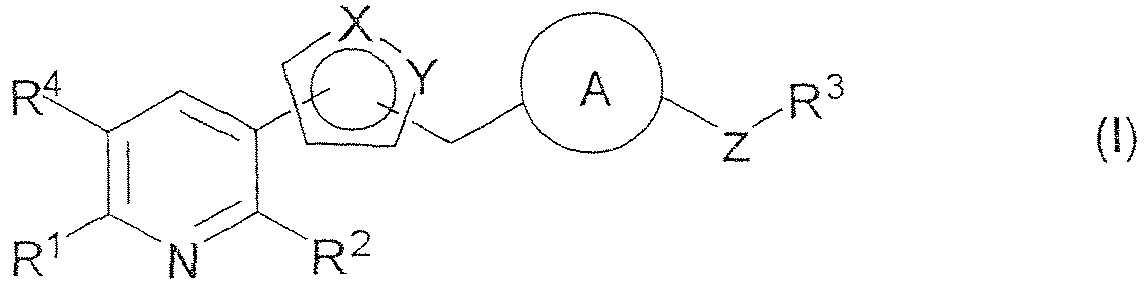
- That is, the present invention provides:
- [1] a compound represented by the following formula (I), or a salt thereof:

R2 represents a hydrogen atom, a C1-6 alkyl group, an amino group or a di C1-6 alkylamino group;
one of X and Y is a nitrogen atom while the other is a nitrogen atom or an oxygen atom;
ring A represents a 5- or 6-member heteroaryl ring or a benzene ring which may have 1 or 2 halogen atoms, or 1 or 2 C1-6 alkyl groups;
Z represents a single bond, a methylene group, an ethylene group, an oxygen atom, a sulfur atom, -CH2O-, -OCH2-, -NH-, -CH2NH-, -NHCH2-, -CH2S-, or -SCH2-1
R3 represents a hydrogen atom, a halogen atom, a C1-6 alkyl group, a C3-8 cycloalkyl group, a C6-10 aryl group, a 5- or 6-member heteroaryl group, or 5- or 6-member non-aromatic heterocyclic group which may have 1 or 2 substituents selected from substituent group α : and
[substituent group α]
substituent group α represents the group consisting of a halogen atom, a cyano group, a C1-6alkyl group, a C1-6 alkoxy group, a C1-6 alkoxycarbonyl group, a C3-8 cycloalkyl group, a C2-6 alkenyl group and a C2-6 alkynyl group
R4 represents a hydrogen atom or a halogen atom;
excluding compounds where all of R1, R2, and R4 represent the hydrogen atom at the same time when Z represents the signle bond or R3 represents the hydrogen atom; - [2] a compound represented by the following formula (I'), or a salt thereof:

R2 represents a hydrogen atom or an amino group;
one of X and Y is a nitrogen atom while the other is a nitrogen atom or an oxygen atom;
ring A represents a 5- or 6-member heteroaryl ring or a benzene ring;
Z represents a methylene group, an oxygen atom, -CH2O-, -OCH2-, -NH-, - NHCH2- or -CH2NH-;
and R3 represents a C1-6 alkyl group, a C3-8 cycloalkyl group, a C6-10 aryl group or a 5- or 6-member heteroaryl group which may have 1 or 2 substituents selected from substituent group a:
[substituent group α]
substituent group α represents the group consisting of a halogen atom, a C1-6 alkyl group, a C1-6 alkoxy group, a C3-8 cycloalkyl group, a C2-6 alkenyl group and a C2-6 alkynyl group; - [3] the compound according to item [1] or [2], or the salt thereof, wherein a partial structure represented by formula (II):


- [4] the compound according to item [1] or [2], or the salt thereof, wherein one of X and Y is a nitrogen atom and the other is an oxygen atom;
- [5] the compound according to item [4] or the salt thereof, wherein a partial structure represented by the formula (II):


- [6] the compound according to item [1] or [2], or the salt thereof, wherein : and Y are both nitrogen atoms;
- [7] the compound according to item [6] or the salt thereof, wherein a partial structure represented by the formula (II):


- [8] the compound according to any one of items [1] to [7] or the salt thereof, wherein R2 represents an amino group;
- [9] the compound according to item [8] or the salt thereof, wherein R1 represents a hydrogen atom, an amino group or a C1-6 alkoxy C1-6 alkyl group;
- [10] the compound according to any one of items [1] to [7] or the salt thereof, wherein R1 represents an amino group and R2 represents a hydrogen atom;
- [11] the compound according to any one of items [1] to [10] or the salt thereof, wherein the ring A represents a pyridine ring, a benzene ring, a furan ring, a thiophene ring or a pyrrole ring;
- [12] the compound according to item [11] or a salt thereof, wherein ring A represents a pyridine ring or a benzene ring;
- [13] the compound according to any one of items [1] to [12] or the salt thereof, wherein Z represents an oxygen atom, -CH2O- or -OCH2-;
- [14] a pharmaceutical composition comprising the compound according to any one of items [1] to [13] or the salt thereof.
- [15] a medicament comprising the compound according to any one of items [1] to[13] or the salt thereof;
- [16] an antifungal agent comprising the compound according to any one of items [1] to [13] or the salt thereof, as an active ingredient;
- [17] a method for preventing and/or treating a fungal infection comprising administering a pharmacologically effective dose of the compound according to any one of items [1] to [13] or the salt thereof;
- [18] a use of the compound according to any one of items [1] to [13] or the salt thereof for manufacturing an antifungal agent.
- The compound (I) of the present invention or a salt thereof 1) acts against the onset, development and persistence of infections by inhibiting fungal GPI biosynthesis, thereby inhibiting expression of cell wall proteins and blocking cell wall assembly while preventing the fungus from attaching to cells so that the pathogen cannot become pathogenic, and 2) is superior in terms of physical properties, safety and metabolic stability, and is extremely useful as a preventive or therapeutic agent for fungal infections.
- The present invention is explained below in more detail by reference to the symbols and the terms used herein being defined and the following examples.
- Herein, a structural formula of a compound sometimes represents a certain isomer for convenience of description. However, compounds according to the present invention may include all possible isomers, such as structural possible geometric isomers, optical isomers generated due to the presence of asymmetric carbons, stereoisomers, tautomers, and mixtures of isomers, and are not limited to formulae being used for the convenience of description, and may be either one of two isomers or a mixture of both isomers. Thus, the compounds according to the present invention may be either optically active compounds having an asymmetric carbon atom in their molecules or their racemates, and are not restricted to either of them but include both. Furthermore, the compounds according to the present invention may exhibit crystalline polymorphism, but likewise are not restricted to any one of these, but may be in any one of these crystal forms or exist as a mixture of two or more crystal forms. The compounds according to the present invention also include both anhydrous and solvates such as hydrated forms.
- The term "C1-6 alkyl group" used in the present specification refers to a straight-chain or branched-chain alkyl group with 1 to 6 carbon atoms which is a monovaient group induced by removal of any one hydrogen atom from an aliphatic hydrocarbon with 1 to 6 carbon atoms. Specifically, examples of "C1-6 alkyl group" includes a methyl group, an ethyl group, a n-propyl group, an isopropyl group, a n-butyl group, an isobutyl group, a sec-butyl group, a tert-butyl group, a n-pentyl group, an isopentyl group, a sec-pentyl group, a neopentyl group, a 1-methylbutyl group, a 2-methylbutyl group, a 1,1-dimethylpropyl group, a 1,2-dimethylpropyl group, a n-hexyl group, an isohexyl group, a 1-methylpentyl group, a 2-methylpentyl group, a 3-methylpentyl group, a 1,1-dimethylbutyl group, a 1,2-dimethylbutyl group, a 2,2-dimethylbutyl group, a 1,3-dimethylbutyl group, a 2,3-dimethylbutyl group, a 3,3-dimethylbutyl group, a 1-ethylbutyl group, a 2-ethylbutyl group, a 1,1,2,-trimethylpropyl group, a 1,2,2-trimethylpropyl group, a 1-ethyl-1-methylpropyl group, a 1-ethyl-2-methylpropyl group or the like, preferably a methyl group, an ethyl group, a n-propyl group, an isopropyl group, a n-butyl group, an isobutyl group, a sec-butyl group or a tert-butyl group or the like.
- The term "C2-6 alkenyl group" used in the present specification refers to a straight-chain or branched-chain alkenyl group with 2 to 6 carbon atoms which may contain 1 or 2 double bonds. Specifically, examples of "C2-6alkenyl group" include an ethenyl group, a 1-propenyl group, a 2-propenyl group, a 1-butenyl group, a 2-butenyl group, a 3-butenyl group, a 2-methyl-1-propenyl group, a pentenyl group, a 3-methyl-2-butenyl group, a hexenyl group, a hexanedienyl group or the like, preferably an ethenyl group, a 1-propenyl group, a 2-propenyl group, a 1-butenyl group, a 2-butenyl group, a 3-butenyl group, a 2-methyl-1-propenyl group, a 3-methyl-2-butenyl group or the like,
- The term "C2-6 alkynyl group" used in the present specification refers to a straight-chain or branched-chain alkynyl chain with 2 to 6 carbon atoms which may contain 1 or 2 triple bonds. Specifically, examples of "C2-6 alkynyl group" include an ethynyl group, a 1-propynyl group, a 2-propynyl group, a 1-butynyl group, a 2-butynyl group, a 3-butynyl group, a pentynyl group, a hexynyl group, a hexanediynyl group or the like, preferably an ethynyl group, a 1-propynyl group, a 2-propynyl group, a 1-butynyl group, a 2-butynyl group, a 3-butynyl group or the like.
- The term "C3-8 cycloalkyl group" used in the present specification refers to a cyclic aliphatic hydrocarbon group with 3 to 8 carbon atoms. Specifically, examples of "C3-8 cycloalkyl group" include a cyclopropyl group, a cyclobutyl group, a cyclopentyl group, a cyclohexyl group, a cycloheptyl group, a cyclooctyl group or the like, preferably a cyclopropyl group, a cyclobutyl group, a cyclopentyl group, a cyclohexyl group or the like.
- The term "C1-6 alkoxy group" used in the present specification refers to a group in which an oxygen atom is bonded to terminus of the "C1-6 alkyl group" defined above. Specifically, examples of "C1-6 alkoxy group" include a methoxy group, an ethoxy group, a n-propoxy group, an isopropoxy group, a n-butoxy group, an isobutoxy group, a sec-butoxy group, a tert-butoxy group, a n-pentyloxy group, an isopentyloxy group, a sec-pentyioxy group, a neopentyloxy group, a 1-methylbutoxy group, a 2-methylbutoxy group, a 1,1-dimethylprapoxy group, a 1,2-dimethyfpropoxy group, a n-hexyloxy group, an isohexyloxy group, a 1-methylpentyloxy group, a 2-methylpentyloxy group, a 3-methylpentyloxy group, a 1,1-dimethylbutoxy group, a 1,2-dimethylbutoxy group, a 2,2-dimethylbutoxy group, a 1,3-dimethyibutoxy group, a 2,3-dimethylbutoxy group, a 3,3-dimethylbutoxy group, a 1-ethylbutoxy group, a 2-ethylbutoxy group, a 1,1,2-trimethylpropoxy group, a 1,2,2-trimethylpropoxy group, a 1-ethyl-1-methylpropxy group, a 1-ethyl-2-methylpropoxy group or the like, preferably a methoxy group, an ethoxy group , a n-propoxy group, an isopropoxy group, a n-butoxy group, an isobutoxy group, a sec-butoxy group, a tert-butoxy group or the like.
- The term "hydroxyl C1-6 alkyl group" used in the present specification refers to a group in which any of the hydrogen atoms in a "C1-6 alkyl group" as defined above has been replaced by a hydroxyl group. Specifically, examples of "hydroxyl C1-6 alkyl group" include a hydroxymethyl group, a 1-hydroxyethyl group, a 2-hydroxyethyl group, a 1-hydroxy-n-propyl group, a 2-hydroxy-n-propyl group, a 3-hydroxy-n-propyl group, a 1-hydroxy-isopropyl group, a 2-hydroxy-isopropyl group, a 3-hydroxy-isopropyl group, a 1-hydroxy-tert-butyl group or the like, preferably a hydroxymethyl group, a 1-hydroxyethyl group, a 2-hydroxyethyl group or the like.
- The term "C1-6 alkoxycarbonyl group" used in the present specification refers to a group in which a carbonyl group is bonded to terminus of the "C1-6 alkoxy group" defined above. Specifically, examples of "C1-6 alkoxycarbonyl group" include a methoxycarbonyl group, an ethoxycarbonyl group, a n-propoxycarbonyl group, an isopropoxycarbonyl group or the like.
- The term "C1-6 alkoxycarbonyl C1-6 alkyl group" used in the present specification refers to a group in which the "C1-6 alkyl group" defined above is bonded to terminus of the "C1-6 alkoxycarbonyl group" defined above. Specifically, examples of the "C1-6 alkoxycarbonyl C1-6 alkyl group" include a methoxycarbonyl methyl group, a methoxycarbonyl ethyl group, an ethoxycarbonyl methyl group, an ethoxycarbonyl ethyl group or the like.
- The term "C6-10 aryl group" used in the present specification refers to an aromatic hydrocarbon cyclic group with 6 to 10 carbon atoms. Specifically, examples of "C6-10 aryl group" include a phenyl group, a 1-naphthyl group, a 2-naphthyl group, an indenyl group, an azulenyl group, a heptalenyl group or the like, preferably a phenyl group, a 1-naphthyl group, 2-naphthyl group or the like.
- The term "C1-6 alkoxy C1-6 alkyl group" used in the present specification refers to a group in which any of the hydrogen atoms in a "C1-6 alkyl group" as defined above has been replaced by a "C1-6 alkoxy group" as defined above. Specifically, examples of "C1-6 alkoxy C1-6 alkyl group" include a methoxymethyl group, an ethoxymethyl group, a n-propoxymethyl group, a methoxyethyl group, an ethoxyethyl group or the like.
- The term "halogen atom" used in the present specification refers a fluorine atom, a chlorine atom, a bromine atom or an iodine atom.
- The term "hetero atom" used in the present specification refers to a nitrogen atom, a sulfur atom or an oxygen atom.
- The term "5- or 6-member heteroaryl ring" used in the present specification refers to an aromatic ring in which the number of atoms making up the ring is 5 or 6, and 1 or more hetero atoms are included in the atoms making up the ring. Specifically, examples of "5- or 6-member heteroaryl ring" include a furan ring, a thiophene ring, a pyrrole ring, a pyridine ring, a pyrazine ring, a pyridazine ring, a pyrimidine ring, a triazole ring (a 1,2,3-triazole ring, a 1,2,4-triazole ring, etc.), a tetrazole ring (a 1H-tetrazale ring, a 2H-tetrazole ring, etc.), a thiazole ring, a pyrazole ring, an oxazole ring, an isoxazole ring, an isothiazole ring, an oxadiazole ring, a thiadiazole ring or the like.
- The term "5- or 6-member heteroaryl group" used in the present specification refers to a monovalent group induced by removing 1 hydrogen atom from any position in an aromatic ring in which the number of atoms making up the ring is 5 or 6 and 1 or more hetero atoms are included in the atoms making up the ring. Specifically, examples of "5- or 6-member heteroaryl group" include a furyl group (a 2-furyl group or a 3-furyl group, etc.), a thienyl group (a 2-thienyl group or a 3-thienyl group, etc.), a pyrrolyl group (a 1-pyrrolyl group, a 2-pyrrolyl group or a 3-pyrrolylgroup, etc.), a pyridyl group (a 2-pyridyl group, a 3-pyridyl group, a 4-pyridyl group, etc.), a pyrazinyl group, a pyridazinyl group (a 3-pyridazinyl group or a 4-pyridazinyl group, etc.), a pyrimidinyl group (a 2-pyrimidinyl group, a 4-pyrimidinyl group or a 5-pyrimidinyl group, etc.), a triazolyl froup (a 1,2,3-triazolyl group or a 1,2,4-triazolyl group, etc.), a tetrazolyl group (a 1H-tetrazolyl group or a 2H-tetrazolyl group, etc.), a thiazolyl group (a 2-thiazolyl group, a 4-thiazolyl group or a 5-thiazolyl group, etc.), a pyrazolyl group (a 3-pyrazolyl group or a 4-pyrazoiyl group, etc.), an oxazolyl group (a 2-oxazolyl group, a 4-oxazolyl group or a 5-oxazolyl group, etc.), an isoxazolyl group (a 3-isoxazolyl group, a 4-isoxazolyl group or a 5-isoxazolyl group, etc.), an isothiazolyl group (a 3-isothiazolyl group, a 4-isothiazolyl group or a 5-isothiazolyl group, etc.), an oxadiazolyl group ,a thiadiazolyl group or the like.
- The term "5- or 6-member non-aromatic heterocyclic group" used in the present specification refers to a monovalent group induced by removing 1 hydrogen atom from any position in a non-aromatic ring in which the number of atoms making up the ring is 5 or 6 and 1 or more hetero atoms are included in the atoms making up the ring. Specifically, examples of "5- or 6-member non-aromatic heterocyclic group" include a pyrrolidinyl group, a piperadinyl group, a piperidinyl group, a morpholinyl group, a tetrahydrofuryl group, a tetrahydropyranyl group or the like.
- The term "di C1-6 alkylamino group" used in the present specification refers to a group in which 2 hydrogen atoms of the amino group are replaved with the "C1-6 alkyl groups" defined above being the same as or different from each other. Specifically, examples of the term "di C1-6 alkylamino group" include a N, N-dimethylamino group, a N, N-diethylamino group, a N, N-di-n-propylamino group, a N, N-di-isopropylamino group, a N, N-di-n-butylamino group, a N, N-isobutylamino group, a N, N-di-sec-butylamino group, a N,N-di-tert-butylamina group, a N-ethyl-N-methylamino group, a N-n-propylamino-N-methylamino group, a N-isopropyl-N-methylamino group, a N-n-butyl-N-methylamino group, a N-isobutyl-N-methylamino group, a N-sec-butyl-N-methylamino group, a N-tert-butyl-N-methlamina group or the like, preferably a N,N-dimethylamino group, a N,N-diethylamino group, N-ethyl-N-methylamino group or the like.
- The term "may have 1 or 2 substituents" used in the specification means that there may be 1 or 2 substituents in any combination in sites capable of substituting.
- R1 preferably represents a hydrogen atom, a halogen atom, an amino group, a C1-6 alkyl group, a C1-6 alkoxy group, a C1-6 alkylamino group, a hydroxyl C1-6 alkylamino group, or a C1-6 alkoxy C1-6 alkyl group, and more preferably a hydrogen atom, an amino group or a C1-6 alkoxy C1-6 alkyl group, with a methoxymethyl group being preferred as the C1-6 alkoxy C1-6alkyl group.
- R2 represents a hydrogen atom, an amino group or di C1-6 alkylamino group, with a hydrogen atom or an amino group being preferred.
- One of X and Y is a nitrogen atom while the other is a nitrogen atom or an oxygen atom.
- The partial structure which contains X and Y and which is represented by formula (II) below:
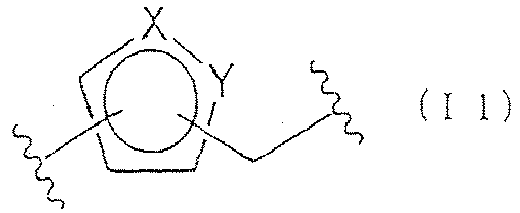


- In the case of the partial structure of formula (III), for example, the structure of the compound of the present invention is shown by the following formula:

- It is preferable that one of X and Y be a nitrogen atom and the other be an oxygen atom, or that both X and Y be nitrogen atoms, and when one of X and Y is a nitrogen atom and the other is an oxygen atom, the partial structure which contains X and Y, and which is represented by the following formula (II):


- A ring A represents a 5- or 6-member heteroaryl ring or a benzene ring which may have a halogen atom or 1 or 2 C1-6 alkyl groups, and preferably represents a pyridine ring, a benzene ring, a furan ring, a thiophene ring or a pyrrole ring, or more preferably a pyridine ring, a benzene ring or a thiophene ring, still more preferably a pyridine ring or a benzene ring.
- Z preferably represents a single bond, a methylene group, an ethylene group, an oxygen atom, a sulfur atom, -CH2O-, -OCH2-, -NH-, -NHCH2-, -CH2NH-, -CH2-S-, or -SCH2-. Of these a methylene group, an oxygen atom, -CH2O- or -OCH2- is preferred, and an oxygen atom, -CH2O- or -OCH2- is especially preferred.
- R3 represents a hydrogen atom, halogen atom, a C1-6 alkyl group, a C3-8 cycloalkyl group, a C6-10 aryl group or a 5- or 6-member ring heteroaryl group which may have 1 or 2 substituents each selected from substituent group α:
- [substituent group α]
- a halogen atom, a cyano group, a C1-6 alkyl group, a C1-6 alkoxy group, C1-6 alkoxycarbonyl group, a C3-8 cycloalkyl group, a C2-6 alkenyl group and a C2-6 alkynyl group.
- Examples of preferable groups as R3 include a n-butyl group, a cyclopropyl group, a phenyl group, a fluorophenyl group, a furyl group, a chlorofuryl group, a methylfuryl group, a thienyl group, a bromothienyl group, a methylthienyl group, a pyridyl group and a methylpyridyl group, more preferably a n-butyl group, a cyclopropyl group, a phenyl group, a fluorophenyl group, a pyridyl group or a methylpyridyl group.
- Z and R3 may constitute the substituent of ring A in any combination. Preferable examples of R3-Z- as the substituent of ring A constituted in this way include a phenoxy group, a benzyloxy group, a 2-fluoro-benzyloxy group, a 3-fluoro-benzyloxy group, a 4-fluoro-benzyloxy group, a pyridin-2-yloxymethyl group, a 6-methyl-pyridin-2-yloxymethyl group, a pyridin-2-yimethoxy, a 6-methyl-pyridin-2-ylmethoxy group, a 4-methyl-pyridin-2-ylmethoxy group, a butoxymethyl group and a cyclopropylmethoxy group and the like.
- Preferable examples of the compounds of the present invention include the following compounds:
- 3-(3-(4-benzyloxy-benzyl)-isoxazol-5-yl)-pyridin-2-ylamine;
- 3-(3-(4-(pyridin-2-yloxymethyl)-benzyl)-isoxazol-5-yl)-pyridin-2-ylamine;
- 3-(3-(4-(pyridin-2-ylmethoxy)-benzyl)-isoxazol-5-yl)-pyridin-2-ylamine;
- 3-(3-(4-(4-methyl-pyridin-2-ylmethoxy)-benzyl)-isoxazol-5-yl)-pyridin-2-ylamine;
- 3-(3-(6-benzyloxy-pyridin-3-ylmethyl)-isoxazol-5-yl)-pyridin-2-ylamine;
- 3-(3-(4-benzyloxy-benzyl)-isoxazol-5-yl)-pyridin-2,6-diamine;
- 3-(3-(4-pyridin-2-yloxymethyl)-benzyl)-isoxazol-5-yl)-pyridine-2,6-diamine,
- 3-(3-(4-(6-methyl-pyridin-2-yloxymethyl)-benzyl)-isoxazol-5-yl)-pyridin-2,6-diamine;
- 3-(3-(4-butoxymethyl-benzyl)-isoxazol-5-yl)-pyridin-2,6-diamine;
- 3-(3-(4-phenoxy-benzyl)-isoxazol-5-yl)-pyridin-2,6-diamine-,
- 3-(3-(4-(4-methyl-pyridin-2-ylmethoxy)-benzyl)-isoxazol-5-yl)-pyridin-2,6-diamine;
- 3-(3-(6-benzyloxy-pyridin-3-ylmethyl)-isoxazol-5-yl)-pyridin-2,6-diamine,
- 5-methoxymethyl-3-(3-(4-pyridin-2-yloxymethyl)-benzyl)-isoxazol-5-yl)-pyridin-2-ylamine;
- 3-(5-(4-benzyloxy-benzyl)-isoxazol-3-yl)-pyridin-2-ylamine;
- 3-(5-(4-(pyridin-2-yloxymethyl)-benzyl)-isoxazol-3-yl)-pyridin-2-ylamine;
- 3-(1-(4-benzyloxy-benzyl)-1H-pyrazol-4-yl)-pyridin-2-ylamine;
- 3-(1-(4-(pyridin-2-yloxymethyl)-benzyl)-1H-pyrazol-4-yl)-pyridin-2-ylamine;
- 3-(1-(4-butoxymethyl-benzyl)-1H-pyrazol-4-yl)-pyridin-2-ylamine;
- 3-(1-(4-benzyloxy-benzyl)-1H-pyrazol-4-yl)-pyridin-2,6-diamine;
- 3-(1-(4-(pyridin-2-yloxymethyl)-benzyl)-1H-pyrazol-4-yl)-pyridin-2,6-diamine;
- 3-(1-(4-butoxymethyl-benzyl)-1H-pyrazol-4-yl)-pyridin-2,6-diamine;
- 3-(3-(6-phenoxy-pyridin-3-ylmethyl)-isoxazol-5-yl)-pyridin-2,6-diamine;
- 3-(3-(4-(5-fluoro-pyridin-2-ylmethoxy}-benzyl}-isoxazol-5-yl)-pyridin-2-ylamine;
- 3-(3-(4-(4-methyl-pyridin-2-yloxymethyl)-benzyl)-isoxazol-5-yl)-pyridin-2-ylamine;
- 3-(3-(4-(6-fluoro-pyridin-2-ylmethoxy)-benzyl)-isoxazol-5-yl)-pyridin-2-ylamine;
- 3-(3-(4-(4-chloro-pyridin-2-ylmethoxy)-benzyl)-isoxazol-5-yl}-pyridin-2-ylamine;
- 3-(3-(4-(6-chloro-pyridin-2-ylmethoxy)-benzyl)-isoxazol-5-yl)-pyridin-2-ylamine;
- 3-(3-(6-phenoxymethyl-pyridin-3-ylmethyl)-isoxazol-5-yl)-pyridin-2-ylamine;
- 3-(3-(4-(6-fluoro-pyridin-2-yloxymethyl)-benzyl)-isoxazol-5-yl)-pyridin-2-ylamine;
- 3-(3-(6-(4-fluoro-benzyloxy)-pyridin-3-ylmethyl)-isoxazol-5-yl)-pyridin-2-ylamine;
- 3-(3-(4-(5-chloro-furan-2-ylrnethyl)-benzyl)-isoxazol-5-yl)-pyridin-2-ylamine;
- 3-(3-(4-phenylaminomethyl-benzyl)-isoxazol-5-yl)-pyridin-2-ylamine;
- 3-(3-(4-(4-methyl-pyridin-2-yloxymethyl)-benzyl)-isoxazol-5-yl)-pyridin-2,6-diamine;
- 3-(3-(4-(6-fluoro-pyridin-2-ylmethoxy)-benzyl)-isoxazol-5-yi)-pyridin-2,6-diamine;
- 3-(3-(4-(5-methyl-furan-2-ylmethyl)-benzyl)-isoxazol-5-yl)-pyridin-2,6-diamine;
- 3-(3-(4-(4-chloro-pyridin-2-ylmethoxy)-benzyl)-isoxazol-5-yl)-pyridin-2,6-diamine;
- 3-(3-(4-(6-chloro-pyridin-2-ylmethoxy)-benzyl)-isoxazol-5-yl)-pyridin-2,6-diamine;
- 3-(3-(6-phenoxymethyl-pyridin-3-ylmethyl)-isoxazol-5-yl)-pyridin-2,6-diamine;
- 3-(3-(4-(5-fluoro-pyridin-2-ylmethoxy)-benzyl)-isoxazol-5-yl)-pyridin-2,6-diamine;
- 3-(3-(4-(6-fluoro-pyridin-2-yloxymethyl)-benzyl)-isoxazol-5-yl)-pyridin-2,6-diamine;
- 3-(3-(1-benzyl-1H-pyrrol-3-ylmethyl)-isoxazol-5-yl)- pyridin-2,6-diamine;
- 3-(3-(6-(4-fluoro-benzyloxy)-pyridin-3-ylmethyl)-isoxazol-5-yl)-pyridin-2,6-diamine;
- 3-(3-(4-(5-chloro-furan-2-ylmethyl)-benzyl)-isoxazol-5-yl)-pyridin-2,6-diamine;
- 3-(3-(6-(3-fluoro-phenoxy)pyridin-3-ylmethyl)-isoxazol-5-yl)-pyridin-2,6-diamine;
- 3-(3-(4-phenylaminomethyl-benzyl)-isoxazol-5-yl)-pyridin-2,6-diamine;
- 3-(3-(6-(4-fluoro-phenoxy)-pyridin-3-ylmethyl)-isoxazol-5-yl)-pyridin-2,6-diamine;
- 3-(3-(4-(thiazol-2-ylmethoxy)-benzyl)-isoxazol-5-yl)-pyridin-2,6-diamine,
- 3-(3-(5-(4-fluoro-phenoxy-thiophen-2-ylmethyl)-isoxazol-5-yl)-pyridin-2,6-diamine;
- 6-methoxymethyl-3-(3-(4-(pyridin-2-ylmethoxy)-benzyl)-isoxazol-5-yl)-pyridin-2-ylamine;
- 6-methyl-3-(3-(4-pyridin-2-yloxymethyl)-benzyl)-isoxazol-5-yl)-pyridin-2-ylamine;
- 5-(3-(4-pyridin-2-yloxymethyl)-benzyl)-isoxazol-5-yl)-pyridin-2-ylamine;
- 3-(1-(4-(pyridin-2-ylmethoxy)-benzyl)-1H-pyrazol-4-yl)-pyridin-2-ylamine; and
- 3-(3-(4-(pyridin-2-yloxymethyl)-benzyl)-isoxazol-5-yl)-pyridine.
- Examples of the term "salt" used in the present specification include a salt with an inorganic acid, a salt with an organic acid, a salt with an acidic amino acid or the like. Among these salts, it is preferable that a salt used herein be a pharmaceutically acceptable.
- Preferable examples of the salt with the inorganic acid include salts with hydrochloric acid, hydrobromic acid, sulfuric acid, nitric acid, phosphoric acid or the like. Preferable examples of the salt with the organic acid include salts with acetic acid, succinic acid, fumaric acid, maleic acid, tartaric acid, citric acid, lactic acid, stearic acid, benzoic acid, methanesulfonic acid, ethanesulfonic acid, p-toluenesulfonic acid or the like.
- Preferable examples of the salt with the acidic amino acid include salts with aspartic acid, glutamic acid or the like. Preferable examples of the salt with the basic amino acid include salts with arginine, lysine, ornithine or the like.
- The term "antifungal agent" used in the present specification refers to a preventive agent or a therapeutic agent for fungal infection.
- The compounds according to the present invention, or salts or hydrates thereof, can be formulated into tablets, powders, fine granules, granules, coated tablets, capsulates, syrups, troches, inhalants, suppositories, injections, ointments, eye ointments, tapes, eye drops, nose drops, ear drops, cataplasms, lotions or the like, by the conventional methods.
- Such formulation can be achieved by using typical diluents, binders, lubricants, colorants, flavorants, and, as necessary, stabilizers, emulsifiers, absorbefacients, surfactants, pH modulators, preservatives, antioxidants or the like, and materials commonly used as ingredients of pharmaceutical preparations according to the conventional methods. For example, an oral preparation can be produced by combining a compound of the present invention or a pharmaceutically acceptable salt thereof with a diluent, and if required, a binder, a disintegrating agent, a lubricant, a colorant, a flavorant or the like, and formulating the mixture into powders, fine granules, granules, tablets, coated tablets, capsules or the like according to the conventional methods.
- Examples of the materials include animal and vegetable oils such as soy bean oil, beef tallow, and synthetic glyceride; hydrocarbons such as liquid paraffin, squalane, and solid paraffin; ester oils such as octyldodecyl myristate and iso-propyl myristate; higher alcohols such as cetostearyl alcohol and behenyl alcohol; silicone resins; silicone oils; surfactants such as polyoxyethylene fatty acids ester, sorbitan fatty acid ester, polyoxyethylene sorbitan fatty acid ester, polyoxyethylene hydrogenated castor oil, and polyoxyethylene polyoxypropylene block co-polymer; water-soluble polymers such as hydroxyethyl cellulose, polyacrylic acid, carboxyvinyl polymer, polyethylene glycol, polyvinylpyrrolidone, and methytl cellulose; lower alcohols such as ethanol and isopropanol; polyhydric alcohols such as glycerol, propylene glycol, dipropylene glycol, and sorbitol; sugars such as glucose and sucrose; inorganic powder such as anhydrous silicic acid, magnesium aluminum silicate, and aluminum silicate; and pure water. Examples of the diluents include lactose, corn starch, white sugar, glucose, mannitol, sorbitol, crystalline cellulose, silicon dioxide or the like. Examples of the binders include polyvinyl alcohol, polyvinyl ether, methylcellulose, ethylcellulose, gum Arabic, tragacanth, gelatin, shellac, hydroxypropyl methylcellulose, hydroxypropyl cellulose, polyvinylpyrrolidone, polypropylene glycol-polyoxyethylene block co-polymer, and meglumine or the like. Examples of disintegrating agents include starch, agar, gelatin powder, crystalline cellulose, calcium carbonate, sodium hydrogencarbonate, calcium citrate, dextrin, pectin, calcium carboxymethyl cellulose or the like. Examples of lubricants include magnesium stearate, talc, polyethylene glycol, silica, hydrogenated vegetable oil or the like. Examples of colorants include those pharmaceutically acceptable. Examples of flavorants include cocoa powder, peppermint camphor, aromatic powder peppermint oil, Borneo camphor, cinnamon powder or the like. Tablets and granules may be coated with sugar, or if required, other appropriate coatings can be made. Solutions, such as syrups or injectable preparations, to be administered can be formulated by combining a compound according to the present invention or a pharmaceutically acceptable salt thereof with a pH modulator, a solubilizing agent, an isotonizing agent or the like, and if required, with an auxiliary solubilizing agent, a stabilizer or the like, according to the conventional methods. Methods for manufacturing external preparations are not limited and such preparations can be manufactured by the conventional methods. Specifically, various materials typically used for manufacturing pharmaceuticals, quasi drugs, cosmetics or the like can be used as base materials for the external formulation. More specifically, examples of base materials to be used include animal and vegetable oils, minerals oils, ester oils, wax, higher alcohols, fatty acids, silicone oil, surfactants, phospholipids, alcohols, polyhydric alcohols, water-soluble polymers, clay minerals, pure water or the like. Furthermore, external preparations of the present invention can contain, as required, pH modulators, antioxidants, chelating agents, antibacterial/antifungal agents, colorants, odoriferous substances or the like. But this does not limit the type of base materials that are to be used in the external preparations of the present invention. If required, the preparation may contain differentiation inducers, blood flow improving agents, antimicrobial agents, antiphologistics, cell activators, vitamins, amino acids, humectants, keratolytic agents or the like. The amount of the base materials listed above is adjusted within a concentration range used for producing typical external preparations.
- When administering the compound of the present invention or a salt thereof, the forms of the compounds are not limited in particular, and the compound can be given orally or parenterally by the conventional method. For instance, the compound can be administered as a dosage form such as tablets, powders, granules, capsules, syrups, troches, inhalants, suppositories, injections, ointments, eye ointments, tapes, eye drops, nasal drops, ear drops, cataplasms and lotions.
- Dose of a medicament according to the present invention can be selected appropriately according to symptom severity, age, sex, body weight, forms of administration, type of salts, specific type of disease or the like.
- The does varies remarkably depending on the patient's disease, symptom severity, age and sex, drug susceptibility or the like, An oral preparation according to the present invention can be generally administered once or several time at a dose of from 1 to 10000 mg/adult/day, preferably from 10 to 2000 mg/adult/day. An injection according to the present invention can be generally administered at a dose of from 0.1 to 10000 mg/adult/day, preferably from 1 to 2000 mg/adult/day.
- The method for manufacturing the compounds represented by formula (I) according to the present invention (hereinafter referred to as compounds (I)) is discussed here. The compounds according to the present invention can be synthesized by ordinary organic synthesis methods, but for example, among the compounds (I), the compounds represented by formula (1 a), formula (2a), formula (3a), formula (4a), formula (5a), formula (6a-1), formula (6a-3), formula (7), formula (8a), formula (9a) and formula (10a) (hereinafter referred to as compound (1a), compound (2a), compound (3a), compound (4a), compound (5a), compound (6a-1), compound (6a-3), compound (7a), compound (8a), compound (9a) and compound (10a), respectively) can be synthesized by the methods given [Manufacturing Method 1] to [Manufacturing Method 10] below and the like.
-

-

- Compound (1 b) which is a commercially available product can be used as is or compound (1b) can also be manufactured from a commercially available product by the well known methods. In addition, compound (1 b) can be manufactured by the methods described in the Manufacturing Examples in the Examples or according to [Manufacturing Method 1-2-1] or the like.
- Compound (1c) can be manufactured by the well known methods from a commercial available product. Compound (1c) can also be manufactured by the methods described in the Manufacturing Examples in the Examples or according to [Manufacturing Method 1-3-1] and the like.
- This step is a step wherein compound (1 a) is obtained by reacting compound (1b) and compound (1c) in the presence of a base. There are no particular limitations on the solvent used in this reaction as long as it dissolves the starting materials to a certain extent without impeding the reaction. Examples of the solvents used in this reaction include ether solvents such as tetrahydrofuran and diethyl ether; aromatic hydrocarbon solvents such as benzene and toluene; amide solvents such as N,N-dimethylformamide and N-methylpyrrolidinone; alcohol solvents such as methanol and ethanol; and water, methylene chloride, chloroform, ethyl acetate, dimethyl sulfoxide, mixed solvents of the foregoing and the like. Examples of the base used in this reaction include triethylamine, N,N-diisopropylethylamine, sodium hydrogencarbonate, potassium carbonate and the like. Compound (1c) can be used in the amount of 1 to 3 equivalents, preferably 1 to 2 equivalents, based on compound (1b). The base can be used in the amount of 1 to 3 equivalents based on compound (1c). The reaction temperature is from room temperature to reflux temperature, and the reaction time is from 10 minutes to 24 hours.
-

- Compound (1 b-1) which is a commercially available product can be used as is, or compound (1 b-1) can also be manufactured from commercially available products by the well known methods.
- This step is a step wherein compound (1b-2) is obtained by reacting compound (1 b-1) with an ethynyl silane derivative. Compound (1 b-2) can be obtained by reacting compound (1 b-1) with an ethynyl silane derivative in the presence of a palladium catalyst, a base and a copper catalyst. A phosphine ligand may also be added to obtain good results. There are no particular limitations on the solvent used in this reaction as long as it can dissolve the starting materials to a certain extent without impeding the reaction. Examples of the solvents used in this reaction include ether solvents such as tetrahydrofuran and 1,4-dioxane; amide solvents such as N,N-dimethylformamide and N-methylpyrrolidinone; and acetonitrile, dimethyl sulfoxide, mixed solvents of the foregoing and the like. Examples of the ethynyl silane derivative include trimethylsilylacetylene, triethylsilylacetylene, triisopropylsilylacetylene, t-butyldimethylsilylacetylene and the like. Examples of the palladium catalysts include palladium (II) acetate, tetrakis(triphenylphosphine)palladium (0), dichlorobis(triphenylphosphine)palladium (II), dichlorobis(tri-o-tolylphosphine)palladium (II), bis(tri-t-butylphosphine)palladium (0), or tris(dibenzylideneacetone)dipalladium (0) and the like. Examples of the base include triethylamine, N,N-diisopropylethylamine, pyridine and the like. Examples of the phosphine ligand include triphenylphosphine, tri-o-tolylphosphine, tri-t-butylphosphine and the like. A copper catalyst can be added in this reaction. Examples of the copper catalyst include copper, copper (I) iodide, copper (I) bromide, copper (I) chloride and the like. The ethynyl silane derivative is used in the amount of 1 to 5 equivalents based on compound (1b-1). The palladium catalyst is used in the amount of 0.01 to 0.3 equivalents based on compound (1b-1). The base is used in the amount of 2 to 5 equivalents based on compound (1b-1). The phosphine ligand is used in the amount of 0.01 to 1.2 equivalents based on compound (1b-1). The copper catalyst is used in the amount of 0.001 to 0.3 equivalents based on compound (1 b-1). The reaction temperature is from room temperature to reflux temperature, and the reaction time is from 30 minutes to 24 hours.
- This step is a step wherein compound (1b) is obtained by reacting compound (1 b-2) with a base. There are no particular limitations on the solvent used in this reaction as long as it dissolves the starting materials to a certain extent without impeding the reaction. Examples of the solvents in this step include ether solvents such as tetrahydrofuran and diethyl ether; alcohol solvents such as methanol and ethanol; amide solvents such as N,N-dimethylformamide and N-methylpyrrolidinone; and acetonitrile, dimethyl sulfoxide, water, mixed solvents of the foregoing and the like. Examples of the base include potassium carbonate, sodium hydroxide, tetrabutylammonium fluoride, potassium fluoride, cesium fluoride and the like. The base is used in the amount of 0.05 to 10 equivalents based on compound (1b-2). The reaction temperature is from 0°C to reflux temperature, and the reaction time is from 5 minutes to 24 hours.
-

- Compound (1b-3) which is a commercially available product can be used as is, or compound (1 b-3) can also be manufactured from commercially available products by the well known methods.
- This step is a step wherein compound (1b-4) is obtained by esterifying compound (1b-3) in the presence of an acid. The solvent used in this reaction is preferably an alcohol solvent such as methanol, ethanol and the like. Examples of the acids include sulfuric acid, hydrochloric acid, hydrobromic acid and the like. The acid can be used in the amount from a catalytic amount to a solvent amount based on compound (1b-3). The reaction temperature is from room temperature to reflux temperature, and the reaction time is from 1 hour to 72 hours.
- Compound (1b-4) can also be obtained from compound (1b-4) by the methods described as Alternative Methods (1), (2) and (3) below.
- Alternative Method (1): Compound (1b-4) can be converted into a methyl ester derivative using diazomethane or trimethylsilyl diazomethane. There are no particular limitations on the solvent used in this reaction as long as it dissolves the starting materials to a certain extent without impeding the reaction. Examples of the solvent used in this reaction include ether solvents such as tetrahydrofuran and diethyl ether; aromatic hydrocarbon solvents such as benzene and toluene; alcohol solvents such as methanol and ethanol; and methylene chloride, hexane, mixed solvents of the foregoing and the like. The diazomethane or trimethylsilyl diazomethane is used in the amount of 1 to 2 equivalents based on compound (1 b-3). The reaction temperature is from 0°C to room temperature, and the reaction time is from 10 minutes to 24 hours.
- Alternative Method (2): Compound (1b-3) can be converted into compound (1b-4) using an alkylating agent in the presence of a base. There are no particular limitations on the solvent used in this reaction as long as it dissolves the starting materials to a certain extent without impeding the reaction. Examples of the solvents used in this reaction include ether solvents such as tetrahydrofuran and diethyl ether; aromatic hydrocarbon solvents such as benzene and toluene; amide solvents such as N,N-dimethylformamide and N-methylpyrrolidinone; alcohol solvents such as methanol and ethanol; and water, acetone, acetonitrile, dimethyl sulfoxide, mixed solvents of the foregoing and the like. A phase-transfer catalyst such as tetrabutylammonium bromide can also be added to this reaction. Examples of the base used in this reaction include potassium hydroxide, sodium hydroxide, lithium hydroxide, potassium carbonate, cesium carbonate, cesium fluoride and the like. Examples of the alkylating agents include iodomethane, iodoethane, dimethylsulfate and the like. The base is used in the amount of 1 to 1.5 equivalents based on compound (1b-3). The alkylating agent is used in the amount of 1 to 2 equivalents based on compound (1b-3). The reaction temperature is from 0°C to reflux temperature, and the reaction time is from 1 hour to 72 hours.
- Alternative Method (3): Compound (1 b-3) can be converted into an acid chloride using a halogenating agent, and then converted into compound (1b-4) by addition of alcohol. There are no particular limitations on the solvent used in this reaction as long as it dissolves the starting materials to a certain extent without impeding the reaction. Examples of the solvents used in this reaction include aromatic hydrocarbon solvents such as benzene and toluene; amide solvents such as N,N-dimethylformamide and N-methylpyrrolidinone; and acetonitrile, methylene chloride, 1,2-dichioroethane, mixed solvents of the foregoing and the like. The halogenating agent can also be used as the solvent. A catalytic amount of pyridine or a phase-transfer catalyst such as benzyltriethylammonium chloride can also be added to this reaction. Examples of the halogenating agents include thionyl chloride, phosphorus pentachloride and the like. Examples of the alcohols include methanol, ethanol and the like. The halogenating agent is used in the amount of 1 to 20 equivalents based on compound (1 b-3). The alcohol is used in the amount of 1 to 20 equivalents based on compound (1b-3). The reaction temperature during conversion to an acid chloride is from 0°C to reflux temperature, with a reaction time being from 10 minutes to 48 hours. The reaction temperature for reacting the alcohol is from 0°C to reflux temperature, with a reaction time being from 10 minutes to 48 hours. The alcohol can be used as the solvent in this reaction. In this case, compound (1 b-4) can be obtained by adding the halogenating agent to a mixture of the solvent and compound (1 b-3). The reaction temperature is from 0°C to room temperature, and the reaction time is from 10 minutes to 24 hours.
- This step is a step wherein compound (1b-5) is obtained by reduction of compound (1 b-4). There are no particular limitations on the solvent used in this reaction as long as it dissolves the starting materials to a certain extent without impeding the reaction, but tetrahydrofuran is preferred. Examples of the reducing agent in this reaction include lithium aluminum hydride, lithium aluminum hydride-aluminum chloride (aluminum chloride in the amount of 1 to 1.5 equivalents based on lithium aluminum hydride), lithium borohydride and the like. The reducing agent is used in the amount of 0.5 to 4 equivalents based on compound (1 b-4). The reaction temperature is from 0°C to reflux temperature, and the reaction time is from 10 minutes to 48 hours.
- This step is a step wherein compound (1 b-6) is obtained by oxidation of compound (1 b-5). There are no particular limitations on the solvent used in this reaction as long as it dissolves the starting materials to a certain extent without impeding the reaction. Examples of the solvents used in this reaction include ether solvents such as tetrahydrofuran and diethyl ether; aromatic hydrocarbon solvents such as benzene and toluene; alcohol solvents such as methanol and ethanol; and methylene chloride, acetone, hexane, mixed solvents of the foregoing and the like. Examples of oxidizing agent used in this reaction include manganese dioxide, pyridinium chlorochromate, pyridinium dichromate, dimethyl sulfoxide - activator, tetrapropylammonium perruthenate, dichlorotris(triphenylphosphine)ruthenium (II), 1,1,1-tris(acetyloxy)-1,1-dihydro-1,2-benziodoxol-3-(1H)-on (Dess-Martin Periodinane) and the like. The oxidizing agent is used in the amount of from the catalytic amount to 20 equivalents based on compound (1b-5). When oxidizing with dimethyl sulfoxide-activator, examples of the activator include acid anhydrides such as acetic anhydride and trifluoroacetic anhydride; acid chlorides such as oxalyl chloride and thionyl chloride; and chlorine, N-chlorosuccinimide and the like. The dimethyl sulfoxide is used in the amount of 1 to 20 equivalents based on the activator. When using tetrapropyl ammonium perruthenate or dichlorotris(triphenylphosphine)ruthenium (II) in a catalytic amount, an oxidizing agent such as N-methylmorpholine-N-oxide or bis(trimethylsilyl)peroxide can be used at the same time. The reaction temperature is from -78°C to reflux temperature, and the reaction time is from 10 minutes to 72 hours.
- This step is a step wherein compound (1b) is obtained from compound (1b-6) in the presence of a base using a diazo compound. Examples of the diazo compound used in this reaction include trimethylsilyl diazomethane, (1-diazo-2-oxopropyl)-phosphoric acid dimethyl ester, diazomethyl phosphoric acid dimethyl ester and the like. There are no particular limitations on the solvent used in this reaction as long as it dissolves the starting materials to a certain extent without impeding the reaction. Examples of the solvents used in this reaction include ether solvents such as tetrahydrofuran and diethyl ether; aromatic hydrocarbon solvents such as benzene and toluene; alcohol solvents such as methanol and ethanol; and methylene chloride, hexane, mixed solvents of the foregoing and the like. When using trimethylsilyl diazomethane as the diazo compound, n-butyl lithium and lithium diisopropylamide can be used as the base. When using a phosphoric acid ester derivative such as (1-diazo-2-oxopropyl)-phosphoric acid dimethyl ester and diazomethyl phosphoric acid dimethyl ester as the diazo compound, potassium carbonate, potassium t-butoxide and the like can be used as the base. The diazo compound is used in the amount of 1 to 1.5 equivalents based on compound (1b-6). The base is used in the amount of 1 to 2 equivalents based on compound (1b-6). The reaction temperature is from -78°C to room temperature, and the reaction time is from 10 minutes to 24 hours.
- Compound (1 b) can also be obtained from compound (1 b-6) by the methods given below as Alternative Methods (1).
- Alternative Method (1): Compound (1 b-6) can be converted into a dihaloalkene in the presence of a base, and then reacted with a base to obtain compound (1b).
- Dihaloalkene synthesis: There are no particular limitations on the solvent used in this reaction as long as it dissolves the starting materials to a certain extent without impeding the reaction. Examples of the solvent used in this synthesis include ether solvents such as tetrahydrofuran and diethyl ether; aromatic hydrocarbon solvents such as benzene and toluene; and hexane, mixed solvents of the foregoing and the like. Examples of the reagent for converting compound (1b-6) into dihaloalkene include (dichloromethyl)-phosphoric acid dimethyl ester, dibromomethyl triphenyl phosphonium bromide ( Tetrahedron Letters, Vol. 40, No.49, 8575-8578) and the like. Examples of the base in this reaction include lithium diisopropylamide, potassium t-butoxide and the like. The reagent for converting into dihaloalkene is used in the amount of 1 to 1.5 equivalents based on compound (1b-6). The base is used in the amount of 1 to 2 equivalents based on compound (1 b-6). The reaction temperature is from -78°C to room temperature, and the reaction time is from 10 minutes to 24 hours.
- As another synthetic method of dihaloalkene, following alternative method using carbon tetrabromide can be applied. Compound (1 b-6) is converted into dihaloalkene by reacting carbon tetrabromide and triphenylphosphine. Zinc can also be added in this reaction. There are no particular limitations on the solvent used in this reaction as long as it dissolves the starting materials to a certain extent without impeding the reaction. Preferable examples of the solvent used in this synthesis include tetrahydrofuran and methylene chloride. The carbon tetrabromide is used in the amount of 1 to 2 equivalents based on compound (1 b-6). The triphenylphosphine is used in the amount of 2 to 4 equivalents based on compound (1 b-6). The zinc is used in the amount of 1 equivalent based on the carbon tetrabromide. The reaction temperature is from 0°C to room temperature, and the reaction time is from 10 minutes to 12 hours.
- Synthesis of compound (1 b) from dihaloalkene: There are no particular limitations on the solvent used in this reaction as long as it dissolves the starting materials to a certain extent without impeding the reaction. Examples of the solvent used in this synthesis include ether solvents such as tetrahydrofuran and diethyl ether; aromatic hydrocarbon solvents such as benzene and toluene; and hexane, mixed solvents of the foregoing and the like. Examples of the base used in this reaction include n-butyl lithium, t-butyl lithium, potassium t-butoxide and the like. The base is used in the amount of 2 to 3 equivalents based on the dihaloalkene. The reaction temperature is from -78°C to room temperature, and the reaction time is from 10 minutes to 24 hours.
-
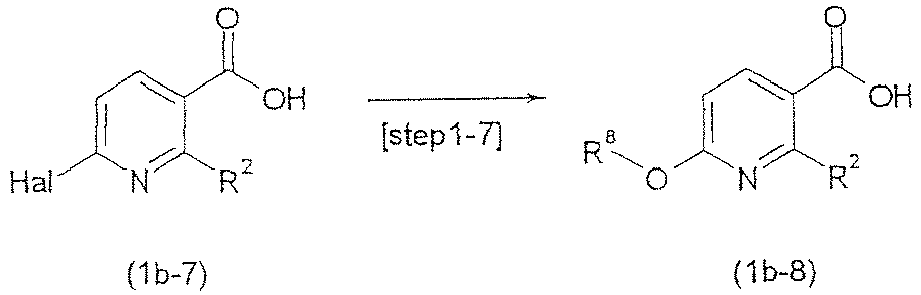
- Compound (1 b-7) which is a commercially available product can be used as is, or compound (1 b-7) can also be manufactured by from a commercially available product with the well known methods, for example,
WO 2005/033079 A1 , pp 85-86, etc. - This step is a step wherein compound (1 b-8) is obtained by reacting compound (1b-7) with an alcohol in the presence of a base. This step is carried out according to the procedures of [Step 1-39] given below or the method disclosed in Journal of Medicinal Chemistry, Vol 46, No. 5, pp 702-705 or the like. There are no particular limitations on the solvent used in this reaction as long as it dissolves the starting materials to a certain extent without impeding the reaction. Examples of the solvents in this step include ether solvents such as tetrahydrofuran and diethyl ether; aromatic hydrocarbon solvents such as benzene and toluene; amide solvents such as N,N-dimethylformamide and N-methylpyrrolidinone; alcohol solvents such as methanol and ethanol; and dimethyl sulfoxide, mixed solvents of the foregoing and the like. Examples of the base in this step include sodium hydride, potassium t-butoxide, potassium hexamethyldisilazide and the like. A copper catalyst can be added in this reaction. Examples of the copper catalyst include copper, copper (I) iodide, copper (I) bromide, copper (I) chloride and the like. The base can be used in the amount of 1 to 20 equivalents based on compound (1b-7). The alcohol can be used in the amount of 1 to 20 equivalents based on compound (1b-7). The copper catalyst can be used in the amount of 0.01 to 0.3 equivalents based on compound (1b-7). The reaction temperature is from 0°C to reflux temperature, and the reaction time is from 30 minutes to 48 hours.
-

- Compound (1 b-9) which is a commercially available product can be used as is, or compound (1 b-9) can also be manufactured from commercially available products by the well known methods. Compound (1b-9-1) which is a commercially available product can be used as is, or compound (1b-9-1) can also be manufactured from commercially available products by the well known methods (for example,
WO 2005/033079 A1 , pp 85-86, etc.). - This step is a step wherein compound (1b-10) is obtained by reacting compound (1 b-9) with compound (1b-9-1) in the presence of a palladium catalyst. A phosphine ligand may also be added to obtain good results. There are no particular limitations on the solvent used in this reaction as long as it dissolves the starting materials to a certain extent without impeding the reaction. Examples of the solvents in this step include ether solvents such as 1,4-dioxane and tetrahydrofuran; aromatic hydrocarbon solvents such as toluene and xylene; amide solvents such as N,N-dimethylformamide and N-methylpyrrolidinone; and dimethyl sulfoxide, mixed solvents of the foregoing and the like. Examples of the palladium catalyst include palladium (II) acetate, tris(dibenzylideneacetone)dipalladium (0), dichlorobis(triphenylphosphine)palladium (II), dichlorobis(tri-o-tolylphosphine)palladium (II), bis(tri-t-butylphosphine)palladium (0), tetrakis(triphenylphosphine)palladium (0), 1,1'-bis(diphenylphosphinoferrocene)dichloropalladium (II) and the like. Examples of the phosphine ligand include triphenylphosphine, tri-o-tolylphosphine, tri-t-butylphosphine, diphenylphosphinoferrocene and the like. Compound (1b-9-1) is used in the amount of 1 to 3 equivalents based on compound (1b-9). The palladium catalyst is used in the amount of 0.01 to 0.3 equivalents based on compound (1 b-9). The phosphine ligand is used in the amount of 0.01 to 1.2 equivalents based on compound (1 b-9). The reaction temperature is from room temperature to reflux temperature, and the reaction time is from 10 minutes to 24 hours.
-
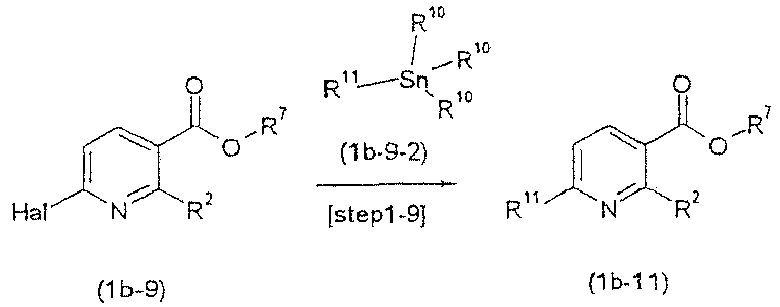
- Compound (1 b-9) and compound (1 b-9-2) which are commercially available products can be used as is or may be obtained from commercially available products by the known methods
- This step is a step wherein compound (1b-11) is obtained by alkylating compound (1 b-9) through a reaction with compound (1 b-9-2) in the presence of a palladium catalyst. Compound (1b-11) can be manufactured according to the method similar to those of [Step 1-8].
-

- Compound (1b-3) which is a commercially available product can be used as is or may be obtained from commercially available products by the known methods.
- This step is a step wherein compound (1 b-5) is obtained by reducing compound (1 b-3). Compound (1 b-5) can be manufactured according to methods similar to those of [Step 1-4].
-

- Compound (1b-12) which is a commercially available product can used as is or may be obtained from commercially available products by the known methods.
- This step is a step wherein compound (1b-13) is obtained by substituting a halogen atom for a hydrogen atom on the pyridine ring of compound (1b-12). This step can be carried out according to, for instance, European Journal of Medicinal Chemistry, Vol.12, No.6, 531-536, or, Journal of Organic Chemistry, Vol.49, No.26, 5237-5243, or the like. There are no particular limitations on the solvent used in this reaction as long as it dissolves the starting materials to a certain extent without impeding the reaction. Examples of the solvent include halogen solvents such as chloroform and dichloromethane; ether solvents such as tetrahydrofuran and diethyl ether; amide solvents such as N,N-dimethylformamide and N-methylpyrrolidinone; acid solvents such as acetic acid and hydrochloric acid aqueous solution; dimethyl sulfoxide; acetonitrile; mixed solvents of the foregoing, or the like. Examples of halogenation reagent include N-chlorosuccinimide, N-bromosuccinimide, chlorine and bromine. The halogenation reagent is used in the amount of 1.0 to 1.5 equivalents based on compound (1b-12). The reaction temperature is from room temperature to 50°C, and the reaction time is from 5 minutes to 24 hours.
-

- Compound (1 b-14) can be manufactured according to the methods described in [Manufacturing Method 1-2-4] given above.
- This step is a step wherein compound (1 b-15) is obtained by reducing compound (1 b-14). Compound (1b-15) can be manufactured according to the methods similar to those of [Step 1-4].
- This step is a step wherein compound (1 b-16) is obtained by oxidizing compound (1b-15). Compound (1 b-16) can be manufactured according to the methods similar to those of [Step 1-5].
- This step is a step wherein compound (1 b-17) is obtained by reacting compound (1 b-16) with boron tribromide. There are no particular limitations on the solvent used in this reaction as long as it dissolves the starting materials to a certain extent without impeding the reaction. Examples of the solvent include halogenated hydrocarbon solvents such as methylene chloride; aromatic hydrocarbon solvents such as benzene and toluene; mixed solvents of the foregoing, or the like. Boron tribromide can be used in the amount of 1 to 5 equivalents based on compound (1b-16), preferably 3 equivalents. The reaction temperature is from -20°C to room temperature, and preferably 0°C. The reaction time is 10 minutes to 24 hours.
-

- Each compound in the above reaction scheme which is commercially available products can be used as is, or each compound can also be manufactured from commercially available products by the well known methods. In addition, each compound can be manufactured by the methods described in the manufacturing examples in the examples and by the methods described in [Manufacturing Method 1-3-1] to [Manufacturing Method 1-3-23].
- This step is a step wherein compound (1c-6) is obtained by reacting a formylation reagent with an organometallic compound obtained by substituting a metal atom for the halogen atom in compound (1c-1). There are no particular limitations on the solvent used in this reaction as long as it dissolves the starting materials to a certain extent without impeding the reaction. Preferable examples of the solvents used in this reaction include ether solvents such as tetrahydrofuran and diethyl ether. Examples of the organometallic compound include organolithium compounds obtained using a base such as n-butyl lithium, s-butyl lithium, t-butyl lithium and lithium diisopropylamide, or Grignard reagents obtained using a base such as metal magnesium, ethyl magnesium bromide and isopropyl magnesium chloride. A catalytic amount of iodine, dibromoethane and the like can be added when preparing the Grignard reagents using metal magnesium. The temperature for preparing the organolithium compound is from -78°C to room temperature, preferably from -78°C to -40°C, the base is used in the amount of 1 to 1.5 equivalents based on compound (1c-1), and the reaction time is from 30 minutes to 24 hours. The temperature for preparing the Grignard reagents using metal magnesium is from room temperature to reflux temperature of the solvent, the metal magnesium is used in the amount of 1 to 2 equivalents based on compound (1c-1), and the reaction time is from 30 minutes to 24 hours. The temperature for preparing the Grignard reagents using ethyl magnesium bromide or isopropyl magnesium chloride is from -60°C to reflux temperature, the ethyl magnesium bromide or isopropyl magnesium bromide is used in the amount of 1 to 1.6 equivalents based on compound (1c-1), and the reaction time is from 5 minutes to 12 hours. Examples of the formylation agents include dimethylformamide, N-formylpiperldine, N-formylmorpholine, N-methylformanilide and the like. The formylation reagent can be used in the amount of 1 to 20 equivalents, preferably 1 to 2 equivalents, based on the organometallic compound. The temperature for reacting the organometallic compound and formylation reagent is from -78°C to room temperature in the case of the organolithium compounds, with a reaction time being from 5 minutes to 6 hours, while in the case of the Grignard reagents the reaction temperature is from -78°C to reflux temperature of the solvent, with a reaction time being from 5 minutes to 24 hours.
- This step is a step wherein compound (1c-6) is obtained by reacting an acid to the acetal of compound (1c-2), so as to deprotect the acetal. There are no particular limitations on the solvent used in this reaction as long as it dissolves the starting materials to a certain extent without impeding the reaction. Examples of the solvent used in this reaction include ether solvents such as tetrahydrofuran and diethyl ether; aromatic hydrocarbon solvents such as benzene and toluene; amide solvents such as N,N-dimethylformamide and N-methylpyrrolidinone; alcohol solvents such as methanol and ethanol; dimethyl sulfoxide and water, mixed solvents of the foregoing and the like. Examples of the acid in this reaction include inorganic acids such as hydrochloric acid, sulfuric acid, and hydrobromic acid; organic acids such as citric acid, trifluoroacetic acid, p-toluenesulfonic acid and the like. The acid can be used in the amount of from a catalytic amount to an excess amount based on compound (1c-2). The reaction temperature is from 0°C to the reflux temperature of the solvent, and the reaction time is from 5 minutes to 24 hours.
- This step is a step wherein compound (1c-6) is obtained by oxidation of compound (1 c-3). Compound (1c-6) can be manufactured according to the methods similar to those of [Step 1-5].
- This step is a step wherein compound (1c-6) is obtained by reduction of compound (1 c-4). Compound (1c-6) can be obtained by means of the reduction reaction using a reducing agent such as diisobutylaluminum hydride, sodium triethoxyaluminum hydride, lithium triethoxyaluminum hydride and the like. There are no particular limitations on the solvent used, but in the case of a reducing reaction using a reducing agent, hydrocarbons such as toluene and ethers such as tetrahydrofuran can be used. The reducing agent is used in the amount of 1 to 2 equivalents based on compound (1c-4). The reaction temperature is from -78°C to room temperature, and the reaction time is from 10 minutes to 24 hours.
- This step is a step wherein compound (1 c-5) is obtained by reduction of compound (1c-4). Compound (1c-5) can be obtained either by the reduction reaction using a reducing agent such as lithium aluminum hydride or diisobutylaluminum hydride, or by catalytic hydrogenation using a Raney nickel, palladium-carbon or other catalyst in a hydrogen atmosphere. There are no particular limitations on the solvent used, but in the case of a reducing reaction using a reducing agent, ethers such as tetrahydrofuran and diethyl ether, or hydrocarbons such as toluene can be used preferably, while in the case of catalytic hydrogenation, alcohols such as methanol, ethanol, propanol and the like can be used preferably. The reducing agent is used in the amount of 1 to 10 equivalents based on compound (1c-4). There are no particular limitations on the reaction temperature, but in the case of the reducing reaction using a reducing agent, the reaction tempearute is from -78°C to a reflux temperature of the solvent used, while in the case of the catalytic hydrogenation, the reaction temperature is from room temperature to a reflux temperature of the solvent used. The reaction time is from 10 minutes to 24 hours. The atmospheric pressure in the case of catalytic hydrogenation is from 1 to 4 atms. An amount of catalyst from a catalytic amount to excess may be used in catalytic hydrogenation.
- This step is a step wherein compound (1 c-3) is obtained by converting the amino groups of compound (1 c-5) into acetoxy groups by reacting with sodium nitrite and acetic acid, followed by hydrolysis using a base.
- Acetoxylation reaction: Preferable example of the solvent used in this reaction includes a mixed solvent of acetic acid and water. More preferably, the ratio of acetic acid to water is from 1:5 to 5:1. Sodium nitrite is used in the amount of 1 to 20 equivalents based on compound (1 c-5). The reaction temperature is from 0°C to room temperature, and the reaction time is from 1 hour to 12 hours.
- Hydrolysis reaction: There are no particular limitations on the solvent used in this reaction as long as it dissolves the starting materials to a certain extent without impeding the reaction. Examples of the solvent in this reaction include alcohol solvents such as methanol and ethanol; ether solvents such as tetrahydrofuran; amide solvents such as N,N-dimethylformamide and N-methylpyrrolidinone; and water, dimethyl sulfoxide, mixed solvents of the foregoing and the like. Examples of the base include sodium hydroxide, potassium hydroxide, potassium carbonate and the like. The reaction temperature is from 0°C to 60°C, preferably from 20°C to 40°C, and the reaction time is from 30 minutes to 12 hours.
- Compound (1c-3) can also be obtained from compound (1 c-5) by the method described as Alternative Method (1) below.
- Alternative Method (1): This step is a step wherein compound (1c-3) is obtained by heating compound (1 c-5) in the presence of a strong base. Preferable example of the solvent in this step includes diethylene glycol, and preferable example of the base includes potassium hydroxide. The potassium hydroxide is used in the amount of 5 to 30 equivalents based on compound (1c-5), the reaction temperature is from 150°C to 230°C, and the reaction time is from 1 hour to 12 hours. Note that during the reaction, an inactive gas is preferably substituted inside the reaction container.
- This step is a step wherein compound (1 c-7) is obtained by reacting compound (1 c-6) with nitromethane in the presence of a base. There are no particular limitations on the solvent used in this reaction as long as it dissolves the starting materials to a certain extent without impeding the reaction. Examples of the solvents used in this reaction include alcohol solvents such as methanol and ethanol; ether solvents such as tetrahydrofuran and diethyl ether; and the like. Examples of the base in this reaction include sodium methoxide, sodium ethoxide, n-butyl lithium, lithium diisopropylamide, sodium hydroxide, potassium hydroxide, potassium carbonate, potassium t-butoxide or the like. The nitromethane can be used in the amount of 1 to 20 equivalents based on compound (1c-6). The base is used in the amount of 1 to 2 equivalents based on compound (1 c-6). The reaction temperature is from -78°C to reflux temperature, and the reaction time is from 5 minutes to 48 hours.
- This step is a step wherein compound (1 c-8) is obtained by esterifying the hydroxyl groups of compound (1c-7) in the presence of a base, followed by elimination in situ. There are no particular limitations on the solvent used in this reaction as long as it dissolves the starting materials to a certain extent without impeding the reaction. Examples of the solvents used in this reaction include ether solvents such as tetrahydrofuran and diethyl ether; amide solvents such as N,N-dimethylformamide and N-methylpyrrolidinone; and methylene chloride, dimethyl sulfoxide, mixed solvents of the foregoing and the like. Examples of the base in this reaction include triethylamine, N,N-diisopropylethylamine and the like. Examples of the esterification agents include acetic anhydride, methanesulfonyl chloride, p-toluenesulfonyl chloride and the like. The base is used in the amount of 1.0 to 4.0 equivalents based on compound (1c-7). The esterification agent is used in the amount of 1.0 to 2.0 equivalents based on compound (1c-7). The reaction temperature is from room temperature to reflux temperature, and the reaction time is from 30 minutes to 24 hours.
- Compound (1c-8) can also be obtained from compound (1c-7) by the method described below as Alternative Method (1).
- Alternative Method (1): Compound (1 c-8) can be obtained by dehydrating compound (1 c-7) in an acetic acid solvent in the presence of an acetic acid salt. Acetic acid is used as the solvent in this reaction, but a mixed solvent of acetic acid and methanol, tetrahydrofuran and the like can also be used. Examples of acetic acid salt include ammonium acetate, ethylene diamine diacetic acid salt and the like. The acetic acid salt is used in the amount of 1 to 20 equivalents based on compound (1c-7). The reaction temperature is from room temperature to reflux temperature, and the reaction time is from 30 minutes to 72 hours.
- This step is a step wherein compound (1 c-8) is obtained by reacting compound (1c-6) with nitromethane in the presence of a base, and then dehydrating by addition of an acid to the reaction system. There are no particular limitations on the solvent used in this reaction as long as it dissolves the starting materials to a certain extent without impeding the reaction. Examples of the solvent used in this reaction include water; alcohol solvents such as methanol and ethanol; ether solvents such as tetrahydrofuran and diethyl ether; mixed solvents of the foregoing and the like. Examples of the base used in this reaction include sodium methoxide, sodium ethoxide, n-butyl lithium, lithium diisopropylamide, sodium hydroxide, potassium hydroxide, potassium carbonate, potassium t-butoxide and the like. Examples of the acid used in this reaction include hydrochloric acid, sulfuric acid, acetic acid and the like. The nitromethane is used in the amount of 1 to 20 equivalents based on compound (1 c-6). The base is used in the amount of 1 to 2 equivalents based on compound (1c-6). The acid can be added in an excess amount. The reaction temperature for the reaction with nitromethane is from -78°C to reflux temperature, with a reaction time being from 5 minutes to 48 hours. The reaction temperature for the dehydration reaction is from room temperature to reflux temperature, with a reaction time being from 5 minutes to 48 hours.
- Compound (1c-8) can also be obtained from compound (1c-6) by the method given below as Alternative Method (1).
- Alternative Method (1): Compound (1c-8) can be obtained by reacting compound (1 c-6) with nitromethane in the presence of an acetic acid salt. Acetic acid is used as the solvent in this reaction, but a mixed solvent of acetic acid and methanol, tetrahydrofuran and the like can also be used. Examples of the acetic acid salt used in this reaction include ammonium acetate, ethylenediamine diacetic acid salt and the like. Nitromethane is used in the amount of 1 to 10 equivalents based on compound (1 c-6). The acetic acid salt is used in the amount of 1 to 20 equivalents based on compound (1 c-6). The reaction temperature is from room temperature to reflux temperature, and the reaction time is from 30 minutes to 72 hours.
- This step is a step wherein compound (1 c-9) is obtained by reduction of compound (1c-8). In order to obtain good results, an acid such as acetic acid or hydrochloric acid can be added. There are no particular limitations on the solvent used in this reaction as long as it dissolves the starting materials to a certain extent without impeding the reaction. Examples of the solvents used in this reaction include alcohol solvents such as methanol and ethanol; ether solvents such as tetrahydrofuran; and dimethyl sulfoxide and the like. Examples of the reducing agent used in this reaction include sodium borohydride, lithium borohydride and the like. The reducing agent is used in the amount of 0.5 to 3 equivalents based on compound (1 c-8). The reaction temperature is from -20°C to 80°C, and the reaction time is from 10 minutes to 12 hours. In the case of adding the acid, the acid can be added in the amount of 1 equivalent to the solvent amount based on the reducing agent.
- This step is a step wherein compound (1 c) is obtained by anionization of the nitroethyl moiety in compound (1 c-9) using a base, followed by adding titanium (IV) chloride.
- Anionization reaction of compound (1c-9): There are no particular limitations on the solvent used in this reaction as long as it dissolves the starting materials to a certain extent without impeding the reaction. Examples of the solvents used in this reaction include alcohol solvents such as methanol and ethanol; ether solvents such as tetrahydrofuran; and the like. Examples of the base used in this reaction include lithium methoxide, sodium methoxide, potassium t-butoxide, n-butyl lithium and the like. The base is used in the amount of 1 to 2 equivalents based on compound (1 c-9). The reaction temperature is from -78°C to room temperature, and the reaction time is from 5 minutes to 1 hour.
- Reaction with titanium (IV) chloride: There are no particular limitations on the solvents used in this reaction as long as it dissolves the starting materials to a certain extent without impeding the reaction. Examples of the solvents used in this reaction include ether solvents such as tetrahydrofuran; and methylene chloride, 1,2-dichloroethane, mixed solvents of the foregoing and the like. The titanium (IV) chloride is used in the amount of 1 to 3 equivalents based on compound (1c-9). The reaction temperature is from -10°C to room temperature, and the reaction time is from 10 minutes to 12 hours.
- This step is a step wherein compound (1c) is obtained by reacting compound (1c-8) with titanium (IV) chloride in the presence of triethylsilane. There are no particular limitations on the solvent used in this reaction as long as it dissolves the starting materials to a certain extent without impeding the reaction. Examples of the solvents used in this reaction include ether solvents such as tetrahydrofuran; and methylene chloride, 1,2-dichloroethane, mixed solvents of the foregoing and the like. The triethylsilane is used in the amount of 1 to 3 equivalents based on compound (1c-8). The titanium (IV) chloride is used in the amount of 1 to 3 equivalents based on compound (1 c-8). The reaction temperature is from -20°C to room temperature, and the reaction time is from 10 minutes to 12 hours.
-

- Compound (1c-10), compound (1c-10-1) and compound (1c-10-2) which are commercially available products can be used as is or they can also be manufactured from commercially available products by the known methods.
- This step is a step wherein compound (1c-11) is obtained by reacting compound (1c-10) with an organophosphorous compound, an azo reagent and compound (1c-10-1). There are no particular limitations on the solvent used in this reaction as long as it dissolves the starting materials to a certain extent without impeding the reaction. Examples of the solvents used in this reaction include ether solvents such as tetrahydrofuran and diethyl ether; aromatic hydrocarbon solvents such as benzene and toluene; amide solvents such as N,N-dimethylformamide and N-methylpyrrolidinone; ethyl acetate; acetonitrile; methylene chloride; mixed solvents of the foregoing and the like. Examples of the organophosphorous compound include triphenyl phosphine, tri-n-butyl phosphine and the like. Examples of the azo compound include ester derivatives such as diethyl azodicarboxylate and diisopropyl azodicarboxylate, and amide derivatives such as 1,1'-(azodicarbonyl)dipiperidine, Compound (1c-10-1) is used in the amount of 1 to 1.5 equivalents based on compound (1c-10). The organophosphorous compound is used in the amount of 1 to 3 equivalents based on compound (1c-10). The azo reagent is used in the amount of 1 to 3 equivalents based on compound (1c-10). The reaction temperature is from 0°C to reflux temperature, and the reaction time is from 5 minutes to 24 hours.
- This step is a step wherein compound (1c-11) is obtained by reacting compound (1 c-1 0) with compound (1c-10-2), in the presence of a base. There are no particular limitations on the solvent used in this reaction as long as it dissolves the starting materials to a certain extent without impeding the reaction. Examples of the solvents used in this reaction include ether solvents such as tetrahydrofuran, diethyl ether or the like; aromatic hydrocarbon solvents such as benzene, toluene or the like; amide solvents such as N,N-dimethylformamide, N-methylpyrrolidinone or the like; alcohol solvents such as methanol, ethanol or the like; dimethyl sulfoxide; mixed solvents of the foregoing and the like. Examples of the base include sodium hydride, potassium t-butoxide, sodium ethoxide, sodium methoxide, N,N-diisopropylethylamine, triethylamine, potassium hydroxide, sodium hydroxide, potassium carbonate, sodium carbonate and the like. The base is used in the amount of 1 to 5 equivalents based on compound (1c-10-2). Compound (1c-10-2) is used in the amount of 1 to 20 equivalents based on compound (1c-10). The reaction temperature is from 0°C to reflux temperature, and the reaction time is from 5 minutes to 6 hours.
- This step is a step wherein compound (1c-12) is obtained by reacting compound (1c-11) with peroxide. Examples of the peroxide used in this reaction include m-chloroperbenzoic acid, hydrogen peroxide, dimethyldioxirane, benzoyl peroxide, peracetic acid or the like. There are no particular limitations on the solvent used in this reaction as long as it dissolves the starting materials to a certain extent without impeding the reaction. Examples of the solvent include halogen solvents such as chloroform and methylene chloride; alcohol solvents such as methanol and ethanol; amide solvents such as N,N-dimethylformamide and N-methylpyrrolidinone; aromatic hydrocarbon solvents such as benzene and toluene, diethyl ether; acetone; acetonitrile; acetic acid; water or the like. Peroxide is used in the amount of 1 to 5 equivalents based on compound (1c-11). The reaction temperature is from -40°C to reflux temperature, and the reaction time is from 1 minute to 48 hours.
- This step is a step wherein compound (1c-13) is obtained by reacting compound (1c-12) with an acid anhydride. Examples of the acid anhydride used in this reaction include acetic anhydride, trifluoroacetic acid anhydride, or the like. There are no particular limitations on the solvent used in this reaction as long as it dissolves the starting materials to a certain extent without impeding the reaction. Examples of the sovent include halogen solvents such as chloroform and methylene chloride; aromatic hydrocarbon solvents such as benzene and toluene; acetic acid, trifluoroacetic acid or the like. Acid anhydride can also be used as the solvent. Acid anhydride is used in the amount of 1 equivalent to excess based on compound (1c-12). The reaction temperature is from 0°C to reflux temperature, and the reaction time is from 10 minutes to 24 hours.
- This step is a step wherein compound (1c-14) is obtained by hydrolyzing compound (1c-13). Compound (1c-14) can be obtained by hydrolyzing compound (1c-13), for instance, in the presence of an acid such as sulfuric acid, or, for instance, in the presence of an alkali such as sodium hydroxide, potassium hydroxide, sodium methoxide, potassium carbonate or sodium carbonate. There are no particular limitations on the solvent used in this reaction as long as it dissolves the starting materials to a certain extent without impeding the reaction. Examples of the solvent include ether solvents such as 1,4-dioxane and tetrahydrofuran; alcohol solvents such as methanol and ethanol; halogen solvents such as methylene chloride and chloroform; aromatic hydrocarbon solvents such as benzene and toluene; amide solvents such as N,N-dimethylformamide and N-methylpyrrolidinone; dimethyl sulfoxide, acetonitrile, water, mixed solvents of the foregoing or the like. The acid or the base is used in the amount of 1 equivalent to excess based on compound (1c-13). The reaction temperature is from 0°C to reflux temperature, and the reaction time is from 10 minutes to 24 hours.
- This step is a step wherein compound (1c-15) is obtained by converting the hydroxyl group of compound (1c-14) to a leaving group.
- When L is a methanesulfonyloxy group, p-toluenesulfonyloxy group or other sulfuric acid ester; compound (1c-15) can be obtained by reacting compound (1c-14) with sulfonyl chloride under basic conditions. There are no particular limitations on the solvent used in this reaction as long as it dissolves the starting materials to a certain extent without impeding the reaction. Examples of the solvent include ether solvents such as 1,4-dioxane and tetrahydrofuran; aromatic hydrocarbon solvents such as benzene and toluene; amide solvents such as N,N-dimethylformamide and N-methylpyrrolidinone; and dimethyl sulfoxide, methylene chloride, mixed solvents of the foregoing and the like. Examples of the base include triethylamine, N,N-diisopropylethylamine and the like. Examples of the sulfonyl chloride include methanesulfonyl chloride, p-toluenesulfonyl chloride and the like. The base is used in the amount of 1 to 3 equivalents based on compound (1c-14). The sulfonyl chloride is used in the amount of 1 to 2 equivalents based on compound (1c-14). The reaction temperature is from 0°C to room temperature, and the reaction time is from 10 minutes to 24 hours.
- When L is a chlorine atom or a bromine atom; compound (1 c-15) can be obtained by halogenating compound (1 c-14) with tetrachloromethane or tetrabromomethane in the presence of triphenylphosphine. There are no particular limitations on the solvent used in this reaction as long as it dissolves the starting materials to a certain extent without impeding the reaction. Examples of the solvent include ether solvents such as tetrahydrofuran; amide solvents such as N,N-dimethylformamide and N-methylpyrrolidinone; and methylene chloride, mixed solvents of the foregoing and the like. The tetrachloromethane or tetrabromomethane can also be used as the solvent. The triphenylphosphine is used in the amount of 1 to 2 equivalents based on compound (1c-14). The tetrachloromethane or tetrabromomethane is used in the amount of 1 equivalent to the solvent amount based on compound (1c-14). The reaction temperature is from 0°C to reflux temperature, and the reaction time is from 10 minutes to 12 hours.
- Compound (1c-15) can also be obtained from compound (1c-14) according to the methods described below as Alternative Methods (1), (2) and (3). Alternative Method (1): Compound (1c-14) can be converted into compound (1 c-15) under acidic conditions. There are no particular limitations on the solvent used in this reaction as long as it dissolves the starting materials to a certain extent without impeding the reaction. Examples of the solvent include ether solvents such as diethyl ether; water, ethyl acetate, mixed solvents of the foregoing and the like. In this reaction, a phase-transfer agent such as tetrabutylammonium bromide can be used in the amount of 0.01 to 2 equivalents based on compound (1c-14). Examples of the acid include hydrochloric acid, hydrobromic acid and the like. Sulfuric acid can also be added to obtain good results. The reaction temperature is from 0°C to room temperature, and the reaction time is from 10 minutes to 12 hours. Alternative Method (2): Compound (1c-15) can be obtained by reacting compound (1c-14) with thionyl chloride. There are no particular limitations on the solvent used in this reaction as long as it dissolves the starting materials to a certain extent without impeding the reaction. Examples of the solvent include aromatic hydrocarbon solvents such as benzene and toluene; and acetonitrile, chloroform, methylene chloride and the like, and the thionyl chloride can also be used as the solvent. Pyridine can also be added to the reaction in a catalytic amount to improve the yield. The thionyl chloride is used in the amount of 1 equivalent to the solvent amount based on compound (1c-14). The reaction temperature is from 0°C to reflux temperature, and the reaction time is from 10 minutes to 12 hours. Alternative Method (3): Compound (1c-15) can be obtained by reacting compound (1c-14) with phosphorus halide. There are no particular limitations on the solvent used in this reaction as long as it dissolves the starting materials to a certain extent without impeding the reaction. Examples of the solvent include ether solvents such as diethyl ether; N,N-dimethylformamide, acetonitrile, chloroform and the like. Examples of the phosphorus halide include phosphorus oxychloride, phosphorus trichloride, phosphorus tribromide and the like. The phosphorus halide is used in the amount of 0.33 to 3 equivalents based on compound (1c-14). The reaction temperature is from 0°C to reflux temperature, and the reaction time is from 10 minutes to 12 hours.
- This step is a step wherein compound (1c-16) is obtained by converting the leaving group of compound (1c-15) to a cyano group. To obtain good results, an inorganic salt such as sodium iodide or the like may also be added in the amount of 1 to 2 equivalents based on compound (1c-15). Examples of the cyanization agent used in this reaction include sodium cyanide, potassium cyanide, lithium cyanide or the like. There are no particular limitations on the solvent used in this reaction as long as it dissolves the starting materials to a certain extent without impeding the reaction. Examples of the solvent include alcohol solvents such as methanol and ethanol; ether solvents such as 1,4-dioxane and tetrahydrofuran; amide solvents such as N,N-dimethylformamide and N-methylpyrrolidinone; dimethyl sulfoxide; acetonitrile; acetone; water; mixed solvents of the foregoing or the like. The cyanidation agent is used in the amount of 1 to 5 equivalents based on compound (1c-15). The reaction temperature is from room temperature to reflux temperature, and the reaction time is from 30 minutes to 48 hours.
- This step is a step wherein compound (1c-17) is obtained by reacting compound (1c-16) with hydroxylammonium chloride. Examples of the base used in this reaction include pyridine, sodium acetate, potassium acetate, sodium bicarbonate, sodium carbonate, sodium hydroxide, potassium hydroxide or the like. There are no particular limitations on the solvent used in this reaction as long as it dissolves the starting materials to a certain extent without impeding the reaction. Examples of the solvent include halogenated hydrocarbons such as dichloromethane and chloroform; sulfoxides such as dimethyl sulfoxide; ethers such as tetrahydrofuran and 1,4-dioxane; alcohols such as methanol and ethanol; amides such as N-methylpyrrolidinone, N,N-dimethylformamide and N,N-dimethylacetamide; pyridine; water, mixed solvents of the foregoing, or the like. Hydroxylammonium chloride is used in the amount of 1 to 5 equivalents based on compound (1c-16). The base is used in the amount of 1 equivalent to excess based on compound (1c-16). The reaction temperature is from 0°C to reflux temperature, and the reaction time is from 10 minutes to 48 hours.
- This step is a step wherein compound (1c-18) is obtained by reacting compound (1c-17) with sodium nitrite and a chlorine source. Examples of the chlorine source used in this reaction include hydrochloric acid, copper chloride or the like. There are no particular limitations on the solvent used in this reaction as long as it dissolves the starting materials to a certain extent without impeding the reaction. Examples of the solvent include ether solvents such as 1,4-dioxane and tetrahydrofuran; amide solvents such as N,N-dimethylformamide and N-methylpyrrolidinone; dimethyl sulfoxide; acetonitrile; acetone; hydrochloric acid aqueous solution; water; mixed solvents of the foregoing, or the like. Sodium nitrite can be used in the amount of 1 to 10 equivalents based on compound (1c-17). The chlorine source can be used in the amount of 1 equivalent to excess based on compound (1c-17). The reaction temperature is from -40°C to reflux temperature, and the reaction time is from 1 minute to 24 hours.
-

- Compound (1c-19), compound (1 c-20), compound (1c-19-1) and compound (1c-20-1) which are commercially available products can be used as is, or they can be obtained from commercially available products by the well known methods.
- This step is a step wherein compound (1c-21) is obtained by reacting compound (1c-19) with compound (1c-19-1) in the presence of a base. Compound (1c-21) can be manufactured according to the methods similar to those of [Step 1-28].
- This step is a step wherein compound (1 c-21) is obtained by reacting compound (1c-20) with an organophosphorous compound, an azo reagent and compound (1 c-19-1). Compound (1 c-21) can be manufactured according to the methods similar to those of [Step 1-27].
- This step is a step wherein compound (1c-21) is obtained by reacting compound (1 c-20) with compound (1c-20-1) in the presence of a base. A catalytic amount of sodium iodide, potassium iodide or tetrabutylammonium iodide can be added to obtain good results, and a copper catalyst can also be added in order to obtain good results. There are no particular limitations on the solvent used in this reaction as long as it dissolves the starting materials to a certain extent without impeding the reaction. Examples of the solvents used in this reaction include ether solvents such as tetrahydrofuran and diethyl ether; aromatic hydrocarbon solvents such as benzene and toluene; amide solvents such as N,N-dimethylformamide and N-methylpyrrolidinone; alcohol solvents such as methanol and ethanol; and dimethyl sulfoxide, mixed solvents of the foregoing and the like. Examples of the base include sodium hydride, potassium t-butoxide, sodium ethoxide, sodium methoxide, N,N-diisopropylethylamine, triethylamine, potassium hydroxide, sodium hydroxide, potassium carbonate, sodium carbonate and the like. Examples of the copper catalysts include copper, copper (I) iodide, copper (I) bromide, copper (I) chloride and the like. Compound (1c-20-1) is used in the amount of 1 to 5 equivalents based on compound (1c-20). The base is used in the amount of 1 to 5 equivalents based on compound (1c-20). The copper catalyst can be used in the amount of 0.01 to 0.3 equivalents based on compound (1b-20). The reaction temperature is from 0°C to reflux temperature, and the reaction time is from 5 minutes to 48 hours.
-

- Compound (1 c-22) and Compound (1c-10-1) may be commercially available products or can also be manufactured from the commercially available products by the well known methods.
- This step is a step wherein compound (1c-23) is obtained by reacting compound (1 c-22) with compound (1c-10-1) in the presence of a base. A copper catalyst can also be added in this reaction. There are no particular limitations on the solvent used in this reaction as long as it dissolves the starting materials to a certain extent without impeding the reaction. Examples of the solvents used in this reaction include ether solvents such as tetrahydrofuran and diethyl ether; aromatic hydrocarbon solvents such as benzene and toluene; amide solvents such as N,N-dimethylformamide and N-methylpyrrolidinone; alcohol solvents such as methanol and ethanol; and dimethyl sulfoxide, mixed solvents of the foregoing and the like. Examples of the base include sodium hydride, potassium t-butoxide, sodium ethoxide, sodium methoxide, potassium hydroxide, sodium hydroxide and the like. Examples of the copper catalyst include copper, copper (I) iodide, copper (I) bromide, copper (I) chloride and the like. The base is used in the amount of 1 to 5 equivalents based on compound (1c-10-1). Compound (1c-10-1) is used in the amount of 1.0 to 3.0 equivalents based on compound (1c-22). The copper catalyst can be used in the amount of 0.01 to 1 equivalents based on compound (1c-10-1). The reaction temperature is from room temperature to reflux temperature, and the reaction time is from 10 minutes to 48 hours.
-

- Compound (1c-24), compound (1c-25), compound (1c-19-1), compound (1c-20-1), compound (1c-24-1) and compound (1c-26-1) which are commercially available products can be used as is, or they can be manufactured from commercially available products by the known methods.
- This is a step wherein compound (1c-25) is obtained by converting compound (1 c-24) into an organometallic compound by substituting a metal atom for a halogen atom of compound (1 c-24), and then applying a formylating reagent. There are no particular limitations on the solvent used in this step as long as it dissolves the starting materials to a certain extent without impeding the reaction, but diethyl ether is desirable. Exmaples of the organometallic compounds include organolithium compounds obtained by applying a base such as n-butyl lithium, s-butyl lithium, t-butyl lithium or the like. The temperature at which the organolithium compound is to be prepared is from -100°C to room temperature, and preferably from -78°C to -40°C. The base can be used in the amount of 1 to 1.2 equivalents based on compound (1c-24), and the reaction time is from 10 minutes to 24 hours. Examples of the formylating reagent include N,N-dimethylformamide, N-formylpiperidine, N-formylmorpholine, N-methylformanilide or the like. The formylating reagent can be used in the amount of 1 to 20 equivalents based on compound (1c-24), and preferably 1 to 2 equivalents. The temperature for reacting the organometallic compound and the formylating reagent is from -78°C to room temperature, and the reaction time is from 5 minutes to 24 hours.
- This step is a step wherein compound (1c-26) is obtained by protecting the formyl group of compound (1c-25) with an acetal, in the presence of an alcohol and an acid catalyst. Preferable exmaples of alcohol used in this reaction include methanol, ethanol, ethylene glycol, propylene glycol or the like. Examples of the acid caltalyst include hydrochloric acid, sulfuric acid, p-toluenesulfonic acid, acetic acid, ammonium chloride or the like. There are no particular limitations on the solvent used in this step as long as it dissolves the starting materials to a certain extent without impeding the reaction. Examples of the solvent include alcohol solvents such as methanol, ethanol and ethylene glycol; aromatic hydrocarbon solvents such as benzene and toluene; halogenated hydrocarbon solvents such as dichloromethane and chloroform, or the like. The alcohol is used in the amount of 1 equivalent to the solvent amount based on compound (1c-25). The acid catalyst is used in the amount of 0.05 equivalents to excess based on compound (1c-25). The reaction temperature is from room temperature to reflux temperature, and the reaction time is from 10 minutes to 24 hours.
- This step is a step wherein compound (1 c-27) is obtained by converting compound (1c-26) into an organometallic compound by substituting a metal atom for a halogen atom of compound (1c-26), and then applying a formylation reagent. Compound (1 c-27) can be manufactured according to the methods similar to those of [Step 1-15].
- This step is a step wherein compound (1 c-28) is obtained by reducing compound (1c-27). Examples of the reducing agent used in this reaction include sodium borohydride, lithium borohydride, lithium aluminumhydride, or the like. There are no particular limitations on the solvent used in this reaction as long as it dissolves the starting materials to a certain extent without impeding the reaction. Examples of the solvent include alcohol solvents such as methanol and ethanol; ether solvents such as diethyl ether and tetrahydrofuran; aromatic hydrocarbon solvents such as benzene and toluene; halogenated hydrocarbon solvents such as dichloromethane and chloroform; water, mixed solvents of the foregoing, or the like. Preferably alcohol solvents are desirable when using a reducing agent such as sodium borohydride; ether solvents are desirable when using a reducing agent such as lithium aluminumhydride. The reducing agent is used in the amount of 0.25 to 4 equivalents based on compound (1c-27). The reaction temperature is from 0°C to reflux temperature, and the reaction time is from 5 minutes to 24 hours.
- This step is a step wherein compound (1c-29) is obtained by reacting compound (1c-28) and compound (1c-20-1), in the presence of a base. Compound (1c-29) can be obtained according to the methods similar to those of [Step 1-38].
- This step is a step wherein compound (1c-30) is obtained by reacting compound (1c-24) and compound (1c-24-1), in the presence of a base. Compound (1c-30) can be manufactured according to the methods similar to those of [Step 1-39].
- This step is a step wherein compound (1c-31) is obtained by reacting compound (1c-24) and compound (1c-19-1), in the presence of a base. Compound (1c-31) can be manufactured according to the methods similar to those of [Step 1-39].
- This step is a step wherein compound (1c-32) is obtained by converting compound (1c-31) into an organometallic compound by substituting a metal atom for a halogen atom of compound (1c-31), and then reacting with a formylating agent. Compound (1 c-32) can be manufactured according to the methods similar to those of [Step 1-15].
- This step is a step wherein compound (1c-32) is obtained by reacting compound (1c-25) and compound (1c-19-1), in the presence of a base. Compound (1c-32) can be manufactured according to the methods similar to those of [Step 1-39].
- This step is a step wherein compound (1c-33) is obtained by reacting compound (1 c-26) and compound (1c-26-1), in the presence of a nickel catalyst. There are no particular limitations on the solvent used in this reaction as long as it dissolves the starting materials to a certain extent without impeding the reaction. Preferable examples of the solvent include ether solvents such as tetrahydrofuran, dioxane and diethyl ether. Examples of the nickel catalyst include 1,3-bis(diphenylphosphino)propane nickel (II) chloride, bis(triphenylphosphine) nickel (II) chloride, 1,2-bis(diphenyiphosphino)ethane nickel (II) chloride, 1,1'-bis(diphenylphosphino}ferrocene nickel (II) chloride or the like. Compound (1c-26-1) is used in the amount of 1 to 2 equivalents based on compound (1c-26), and the nickel catalyst is used in the amount of 0.02 to 0.2 equivalents based on compound (1c-26). The reaction temperature is from -10°C to 80°C, and the reaction time is from 30 minutes to 12 hours.
- In addition, when M1 is a zinc atom, compound (1c-26-1) can be prepared in situ and used in the reaction, as describe below. The reaction in [Step 1-49] can be carried out by synthesizing compound (1c-26-1) in situ using benzyl halide and activated zinc. in this case, the activated zinc is used in the amount of 1 to 1.3 equivalents based on benzyl halide. The reaction temperature for obtaining compound (1c-26-1) is from -10°C to room temperature, preferably from -5°C to 10°C, and the reaction time is from 1 hour to 10 hours.
-

- Compound (1c-34), compound (1c-34-1), compound (1c-34-2), compound (1 c-34-3) and compound (1c-34-4) which are commercially available products can be used as is, or they can also be manufactured from commercially available products by the known methods.
- This step is a step wherein compound (1 c-35) is obtained by converting compound (1c-34) into an organometallic compound by substituting a metal atom for a halogen atom of compound (1c-34), and then reacting with compound (1c-34-1). There are no particular limitations on the solvent used in this reaction as long as it dissolves the starting materials to a certain extent without impeding the reaction. Preferable examples of the solvent include ether solvents such as tetrahydrofuran and diethyl ether. Examples of the organometallic compound include organolithium compounds obtained by applying a base such as n-butyl lithium, s-butyl lithium, t-butyl lithium, lithium diisopropyl amide, or the like. The temperature at which the organolithium compound is to be prepared is from -78°C to room temperature, preferably from -78°C to -40°C. The base is used in the amount of 1 to 1.5 equivalents based on compound (1 c-34). The reaction time is from 30 minutes to 24 hours. Compound (1c-34-1) is used in the amount of 1 to 2 equivalents based on compound (1c-34). The temperature for reacting the organometallic compound and compound (1c-34-1) is from -78°C to room temperature, and the reaction time is from 5 minutes to 12 hours.
- This step is a step wherein compound (1c-35) is obtained by reacting compound (1c-34) and compound (1c-34-2), in the presence of a base. There are no particular limitations on the solvent used in this reaction as long as it dissolves the starting materials to a certain extent without impeding the reaction. Examples of the solvent include ether solvents such as tetrahydrofuran and diethyl ether; aromatic hydrocarbon solvents such as benzene and toluene; amide solvents such as N,N-dimethylformamide and N-methylpyrrolidinone; alcohol solvents such as methanol and ethanol; dimethyl sulfoxide, mixed solvents of the forgoing, or the like. Examples of the base include sodium hydride, potassium t-butoxide, sodium ethoxide, sodium methoxide, potassium hydroxide, sodium hydroxide or the like. The base is used in the amount of 1 to 5 equivalents based on compound (1 c-34). Compound (1 c-34-2) is used in the amount of 1 to 2 equivalents based on compound (1c-34). The reaction temperature is from room temperature to reflux temperature, and the reaction time is from 5 minutes to 24 hours.
- This step is a step wherein compound (1 c-36) is obtained by converting compound (1 c-34) into an organometallic compound by substituting a metal atom for a halogen atom of compound (1c-34), and then reacting compound (1c-34-3). Compound (1 c-36) can be manufactured according to the methods similar to those of [Step 1-50].
- This step is a step wherein compound (1 c-36) is obtained by reacting compound (1 c-34) and compound (1 c-34-4) in the presence of a base. Compound (1c-36) can be manufactured according to the methods similar to those of [Step 1-51].
-

- Compound (1 c-37) and compound (1 c-37-1) which are commercially available products can be used as is, or they can be manufactured from commercially available products by the known methods.
- This step is a step wherein compound (1c-38) is obtained by converting compound (1c-37) into an organometallic compound by substituting a metal atom for the hydrogen atom at position 5 of compound (1c-37), and then reacting with compound (1 c-37-1). There are no particular limitations on the solvent used in this reaction as long as it dissolves the starting materials to a certain extent without impeding the reaction. Preferable examples of the solvent include ether solvents such as tetrahydrofuran and diethyl ether. Examples of the organometallic compound include organolithium compounds obtained by applying a base such as n-butyl lithium, s-butyl lithium, t-butyl lithium, lithium diisopropyl amide or the like. The temperature at which the organolithium compound is to be preparted is from -78°C to room temperature, preferably from -78°C to -40°C. The base is used in the amount of 1 to 1.5 equivalents based on compound (1c-37). The reaction time is from 30 minutes to 24 hours. Compound (1c-37-1) is used in the amount of 1 to 2 equivalents based on compound (1 c-37). The temperature for reacting the organometallic compound and compound (1 c-37-1) is from -78°C to room temperature. The reaction time is from 5 minutes to 12 hours.
-

- Compound (1 c-39) and Compound (1c-20-1) may be commercially available products or can also be manufactured from the commercially available products by the well known methods.
- This step is a step wherein compound (1c-40) is obtained by reacting compound (1c-39) with compound (1c-20-1). Compound (1c-20-1) is used in the amount of 0.2 to 1.0 equivalents based on compound (1c-39). Compound (1c-40) can be manufactured according to the methods similar to those of [Step 1-38].
-

- Compound (1c-41) and compound (1c-41-1) may be commercially available products or can also be manufactured from the commercially available products by the well known methods.
- This step is a step wherein the halogen atom in compound (1c-41) is replaced with a metal atom to obtain an organometallic compound, which is then reacted with compound (1c-41-1) to obtain compound (1c-42). There are no particular limitations on the solvent used in this reaction as long as it dissolves the starting materials to a certain extent without impeding the reaction. Examples of the solvents used in this reaction include ether solvents such as tetrahydrofuran and diethyl ether; aromatic hydrocarbon solvents such as benzene and toluene; mixed solvents of the foregoing and the like. Examples of the reagent for converting compound (1 c-41) into an organometallic compound include n-butyl lithium, s-butyl lithium, ethyl magnesium bromide, ethyl magnesium chloride, isopropyl magnesium chloride, magnesium, zinc and the like. The reagent for converting compound (1c-41) into an organometallic compound is used in the amount of 1 to 3 equivalents based on compound (1c-41). Compound (1c-41-1) is used in the amount of 1 to 2 equivalents based on compound (1c-41). The reaction temperature in the reaction for converting compound (1c-41) into an organometallic compound is from -78°C to reflux temperature, with a reaction time being from 10 minutes to 12 hours. The reaction temperature in the reaction of adding compound (1c-41-1) is from -78°C to room temperature, with a reaction time being from 10 minutes to 6 hours.
- This step is a step wherein compound (1 c-43) is obtained by deprotecting the acetal of compound (1c-42). Compound (1c-43) is manufactured according to the methods similar to those of [Step 1-16].
- This step is a step wherein compound (1c-43) is obtained by reacting compound (1c-41) with compound (1c-41-1). In this step, compound (1c-42) is obtained according to the methods similar to those of [Step 1-56], after which an acid is added in the reaction system or at the work-up stage to obtain compound (1c-43). Examples of the acids used in this reaction include inorganic acids such as hydrochloric acid, sulfuric acid and hydrobromic acid; organic acids such as citric acid, trifluoroacetic acid and p-toluenesulfonic acid; acidic silica gels and the like. The acid can be used in the amounts of from the catalytic amount to the solvent amount based on Compound (1c-41). The reaction temperature is from 0°C to the reflux temperature of the solvent, and the reaction time is from 5 minutes to 24 hours.
- This step is a step wherein compound (1 c-44) is obtained by reducing compound (1c-43). There are no particular limitations on the solvent used in this reaction as long as it dissolves the starting materials to a certain extent without impeding the reaction. Examples of the solvents used in this reaction include ether solvents such as tetrahydrofuran and diethyl ether; aromatic hydrocarbon solvents such as benzene and toluene; and the like. Examples of the reducing agent include lithium aluminum hydride-aluminum chloride and the like. The lithium aluminum hydride is used in the amount of 2 to 6 equivalents based on compound (1c-43). The aluminum chloride is used in the amount of 2 to 9 equivalents based on compound (1c-43). The reaction temperature is from 0°C to reflux temperature, and the reaction time is from 10 minutes to 48 hours.
-

- Compound (1c-45) and compound (1c-45-1) which are commercially available products can be used as is or they can also be manufactured from commercially available products by the known methods.
- This step is a step wherein compound (1c-46) is obtained by reacting compound (1c-45) and compound (1c-45-1). Compound (1c-46) can be obtained by reacting compound (1c-45) and compound (1c-45-1), for instance, in a solvent such as tetrahydrofuran, N,N-dimethylformamide or dimethyl sulfoxide, for instance, in the presence of a base such as potassium t-butoxide. Compound (1c-45-1) is used in the amount of 1 to 1.5 equivalents based on compound (1c-45). The base is used in the amount of 1 to 1.5 equivalents based on compound (1c-45). The reaction temperature is from room temperature to reflux temperature. The reaction time is from 30 minutes to 24 hours.
- This step is a step wherein compound (1 c-47) is obtained by reducing the compound (1 c-46). Compound (1 c-47) can be manufactured according to the methods similar to those of [Step 1-4].
-

- Compound (1 c-48) and compound (1c-41-1) which are commercially available products can be used as is, or they can be manufactured from commercially products by the known methods.
- This step is a step wherein compound (1 c-49) is obtained by substituting a phosphorus atom for a halogen atom of compound (1c-48). This reaction is carried out by mixing compound (1c-48) and trialkylphosphite in a solvent or in the absence of solvent, and heating. There are no particular limitations on the solvent used in this reaction as long as it dissolves the starting materials to a certain extent without impeding the reaction. Examples of the solvent include aromatic hydrocarbon solvents such as toluene and xylene or mixed solvents of the foregoing. The trialkylphosphite is added in the amount of 1 to 1.2 equivalents based on compound (1 c-48). The reaction temperature is from 100°C to 150 °C, and the reaction time is from 30 minutes to 2 hours.
- This step is a step wherein compound (1 c-50) is obtained by adding a base to compound (1 c-49) and then reacting with compound (1c-41-1). There are no particular limitations on the solvent used in this reaction as long as it dissolves the starting materials to a certain extent without impeding the reaction. Examples of the solvent include ether solvents such as tetrahydrofuran and 1,4-dioxane; amide solvents such as N,N-dimethylformamide and N-methylpyrrolidinone; or mixed solvents of the foregoing. Examples of the base include metal hydrides such as sodium hydride and potassium hydride; metal alcoholates such as sodium methoxide and potassium t-butoxide. Compound (1c-41-1) is added in the amounts of 1 to 2 equivalents based on compound (1 c-49). The reaction temperature is from room temperature to 80°C, and the reaction time is from 30 minutes to 12 hours.
- This step is a step wherein a double bond of compound (1c-50) is hydrogenated, leading to compound (1c-51). This step is a reaction whereby hydrogen addition is carried with compound (1c-50) in a solvent, under a hydrogen atmosphere, and using a metal catalyst. There are no particular limitations on the solvent used in this reaction as long as it dissolves the starting materials to a certain extent without impeding the reaction. Examples of the solvent include ether solvents such as tetrahydrofuran and 1,4-dioxane; alcohol solvents such as methanol and ethanol; ester solvents such as ethyl acetate or mixed solvents of the foregoing. Exmaples of the metal catalyst include palladium (II) oxide, palladium hydroxide, platinum (IV) oxide, Raney nickel or the like. The metal catalyst is used in a catalytic amount to excess based on compound (1 c-50). The reaction temperature is from room temperature to 80°C, the reaction time is from 5 minutes to 24 hours. The reaction pressure is from 1 atmosphere to 4 atmospheres.
- This step is a step wherein alcohol product (1c-52) is obtained by reducing the ester group of compound (1c-51). There are no particular limitations on the solvent used in this reaction as long as it dissolves the starting materials to a certain extent without impeding the reaction. Examples of the solvent include ether solvents such as ether and tetrahydrofuran; aromatic hydrocarbon solvents such as toluene and xylene; or mixed solvents of the foregoing. Examples of the reducing agent include sodium borohydride, lithium aluminum hydride, diisobutylaluminum hydride, or the like. The reducing agent is added in the amount of 0.5 to 2 equivalents of compound (1 c-51). The reaction temperature is from -20°C to reflux temperature of the solvent, and the reaction time is from 10 minutes to 24 hours.
-

- Compound (1c-53) and compound (1c-53-1) which are commercially available products can be used as is, or they may be manufactured from commercially available products by the known methods.
- This step is a step wherein compound (1 c-54) is obtained by reacting compound (1c-53) and compound (1c-53-1). There are no particular limitations on the solvent used in this reaction as long as it dissolves the starting materials to a certain extent without impeding the reaction. Examples of the solvent include alcohol solvents such as ethanol and methanol, or the like. Compound (1c-53-1) is used in the amount of 1 to 2 equivalents based on compound (1c-53). The reaction temperature is the reflux temperature, and the reaction time is from 30 minutes to 12 hours.
- This step is a step wherein compound (1c-55) is obtained by reducing compound (1c-54). Compound (1 c-55) can be manufactured according to the methods similar to those of [Step 1-4].
-


- Compound (1 c-56), compound (1 c-58), compound (1 c-60), compound (1 c-62), compound (1 c-64), compound (1c-19-1), compound (1c-41-1) and compound (1 c-56-1) which are commercially available products can be used as is, or they can also be manufactured from the commercially available products by the well known methods.
- This step is a step wherein compound (1c-57) is obtained by reacting compound (1 c-56) with compound (1 c-19-1) in the presence of a base. There are no particular limitations on the solvent used in this reaction as long as it dissolves the starting materials to a certain extent without impeding the reaction. Examples of the solvent used in this reaction include ether solvents such as tetrahydrofuran; amide solvents such as N,N-dimethylformamide and N-methylpyrrolidinone; alcohol solvents such as methanol and ethanol; and dimethyl sulfoxide, mixed solvents of the foregoing and the like. Examples of the base include sodium hydride, potassium t-butoxide, sodium ethoxide, sodium methoxide, N,N-diisopropylethylamine, triethylamine, potassium hydroxide, sodium hydroxide, potassium carbonate, sodium carbonate and the like. The base is used in the amount of 1 to 5 equivalents based on compound (1c-19-1). Compound (1c-19-1) is used in the amount of 1 equivalent to the solvent amount based on compound (1c-56). The reaction temperature is from room temperature to reflux temperature, and the reaction time is from 30 minutes to 48 hours.
- This step is a step wherein compound (1 c-59) is obtained by reacting compound (1 c-58) with compound (1c-19-1). Compound (1 c-59) can be manufactured according to the methods similar to those of [Step 1-37].
- This step is a step wherein compound (1c-59) is obtained by reacting compound (1c-60) with compound (1c-19-1). Compound (1c-59) can be obtained according to the methods similar to those of [Step 1-36].
- This step is a step wherein compound (1c-61) is obtained by reacting compound (1 c-56) with compound (1c-56-1) in the presence of a palladium catalyst. A phosphine ligand can also be added to the reaction system to obtain good results. There are no particular limitations on the solvent used in this reaction as long as it dissolves the starting materials to a certain extent without impeding the reaction. Examples of the solvent in this reaction include ether solvents such as 1,4-dioxane and tetrahydrofuran; alcohol solvents such as methanol and ethanol; aromatic hydrocarbons solvent such as toluene and xylene; amide solvents such as N,N-dimethylformamide and N-methylpyrrolidinone; and dimethyl sulfoxide, mixed solvents of the foregoing and the like. Examples of palladium catalyst include palladium (II) acetate, tris(dibenzylidenacetone)dipalladium (0), dichlorobis(triphenylphosphine)palladium (II), dichlorobis(tri-o-tolylphosphine)palladium (II), bis(tri-t-butylphosphine)palladium (0), tetrakis(triphenylphosphine)palladium (0), palladium (0) pentadienone and the like. Examples of the phosphine ligand include triphenylphosphine, tri-o-tolylphosphine, tri-t-butylphosphine, diphenylphosphinoferrocene, 2-dicyclohexylphosphinobiphenyl, 2--di-t-butylphosphinobiphenyl, 2,2'-bis(diphenylphosphino)-1,1'-binaphthyl (BINAP) and the like. Examples of the base include sodium t-butoxide, cesium carbonate, potassium carbonate, potassium phosphate and the like. Compound (1c-56-1) is used in the amount of 1 equivalent to excess based on compound (1 c-56). The palladium catalyst is used in the amount of 0.01 to 0.3 equivalents based on compound (1 c-56). The phosphine ligand is used in the amount of 0.01 to 1.2 equivalents based on compound (1 c-56). The base is used in the amount of 1 to 4 equivalents based on compound (1c-56). The reaction temperature is from room temperature to reflux temperature, and the reaction time is from 30 minutes to 72 hours.
- This step is a step wherein compound (1 c-63) is obtained by a reductive amination in which compound (1 c-62) is reacted with compound (1 c-56-1). Acetic acid can also be added to promote the reaction. There are no particular limitations on the solvent used in this reaction as long as it dissolves the starting materials to a certain extent without impeding the reaction. Examples of the solvent in this reaction include ether solvents such as 1,4-dioxane and tetrahydrofuran; alcohol solvents such as methanol and ethanol; and methylene chloride, mixed solvents of the foregoing an the like. Examples of the reducing agent include lithium aluminum hydride, sodium borohydride, sodium cyanoborohydride, sodium triacetoxyborohydride, 2-picoline-borane and the like. Compound (1c-56-1) is used in the amount of 1 to 2 equivalents based on compound (1 c-62). The reducing agent is used in the amount of 0.5 to 2 equivalents based on compound (1c-62). The reaction temperature is from room temperature to reflux temperature, and the reaction time is from 10 minutes to 24 hours.
- This step is a step wherein compound (1c-65) is obtained by a reductive amination in which compound (1 c-64) is reacted with compound (1c-41-1). Compound (1 c-65) can be manufactured according to the methods similar to those of [Step 1-72].
-

- Compound (1c-56) and compound (1c-41-1) which are commercially available products can be used as is, or compound (1c-56) and compound (1c-41-1) can also be manufactured from commercially available products by the well known methods.
- This step is a step wherein compound (1 c-66) is obtained by reacting compound (1c-56) with compound (1c-41-1). Compound (1c-66) can be manufactured according to the methods similar to those of [Step 1-56].
- This step is a step wherein compound (1 c-67) is obtained by reducing compound (1c-66) with iodotrimethylsilane. There are no particular limitations on the solvent used in this reaction as long as it dissolves the starting materials to a certain extent without impeding the reaction. Examples of the solvent include ether solvents such as tetrahydrofuran; and acetonitrile, methylene chloride and the like, preferably methylene chloride and acetonitrile. The iodotrimethylsilane is used in the amount of 2 to 10 equivalents based on compound (1c-66), the reaction temperature is from 0°C to 60°C, and the reaction time is from 5 minutes to 6 hours. The iodotrimethylsilane used in the reaction may be a commercially available product, or may be prepared at the time of use by reacting sodium iodide and chlorotrimethylsilane in acetonitrile at room temperature.
-

- Compound (1c-68) and compound (1 c-41-1) which are commercially available products can be used as is, or they can also be manufactured from the commercially available products by the well known methods.
- This step is a step wherein one of the bromide atoms in compound (1c-68) is anionized using an organometallic reagent, which is reacted with compound (1 c-41-1), then the other bromide atom in compound (1c-68) is anionized by adding the further organometallic reagent in the same container, which is then reacted with a cyanization reagent to obtain compound (1 c-69). There are no particular limitations on the solvent used in this reaction as long as it dissolves the starting materials to a certain extent without impeding the reaction. Examples of the solvent include ether solvents such as tetrahydrofuran and diethyl ether; aromatic hydrocarbon solvents such as benzene and toluene; mixed solvents of the foregoing and the like. Examples of the organometallic reagent include n-butyl lithium, s-butyl lithium and the like. Preferable examples of the cyanization reagent include p-toluenesulfonyl cyanide. The organometallic reagent is used in the total amount of 2 to 3 equivalents based on compound (1c-68). Compound (1c-41-1) is used in the amount of 1 to 1.5 equivalents based on compound (1 c-68). The cyanization reagent is used in the amount of 1 to 1.5 equivalents based on compound (1c-68). The reaction temperature is from -78°C to room temperature, and the reaction time is from 10 minutes to 24 hours.
- This step is a step wherein compound (1c-70) is obtained by reducing compound (1c-69). Compound (1c-70) can be manufactured according to the methods similar to those of [Step 1-75].
-

- Compound (1c-66) can be manufactured from a commercially available product by the well known methods, or compound (1c-66) can be manufactured according to the methods similar to those of [Step 1-74].
- This step is a step wherein compound (1c-71) is obtained by reducing compound (1c-66). There are no particular limitations on the solvent used in this reaction as long as it dissolves the starting materials to a certain extent without impeding the reaction. Examples of the solvent include ether solvents such as tetrahydrofuran and diethyl ether; aromatic hydrocarbon solvents such as benzene and toluene and the like. Examples of the reducing agent include lithium aluminum hydride-aluminum chloride. The lithium aluminum hydride is used in the amount of 3 to 8 equivalents based on compound (1c-66). The aluminum chloride is used in the amount of 3 to 10 equivalents based on compound (1c-66). The reaction temperature is from 0°C to reflux temperature, and the reaction time is from 10 minutes to 48 hours.
-

- Compound (1c-69) can be manufactured from commercially available products by the well known methods, or compound (1c-69) can be manufactured according to the methods similar to those of [Step 1-76].
- This step is a step wherein compound (1c-72) is obtained by reducing compound (1c-69). Compound (1c-72) can be manufactured according to the methods similar to those of [Step 1-78].
-

- Compound (1 c-42) can be manufactured from commercially available products by the well known methods, or compound (1c-42) can be manufactured according to the methods similar to those of [Step 1-56].
- This step is a step wherein compound (1 c-73) is obtained by simultaneous reduction and acetal deprotection of compound (1c-42) using iodotrimethylsilane. There are no particular limitations on the solvent used in this reaction as long as it dissolves the starting materials to a certain extent without impeding the reaction. Examples of the solvent include ether solvents such as tetrahydrofuran; acetonitrile, methylene chloride and the like, and preferably methylene chloride or acetonitrile. The iodotrimethylsilane is used in the amount of 2 to 10 equivalents based on compound (1c-42). The reaction temperature is from 0°C to 60°C, and the reaction time is from 5 minutes to 6 hours. The iodotrimethylsilane used in the reaction may be a commercial product, or may be prepared at the time of use by reacting sodium iodide and chlorotrimethylsilane in acetonitrile at room temperature.
-

- Compound (1 c-74) and compound (1c-74-1) which are commercially available products can be used as is, or they may be manufactured from commercially available products by the known methods.
- This step is a step wherein compound (1 c-75) is obtained by reacting compound (1 c-74) and compound (1c-74-1), in the presence of a base. There are no particular limitations on the solvent used in this reaction as long as it dissolves the starting materials to a certain extent without impeding the reaction. Examples of the solvent include ether solvents such as tetrahydrofuran and 1,4-dioxane; aromatic hydrocarbon solvents such as benzene and toluene; amide solvents such as N,N-dimethylformamide and N-methylpyrrolidinone, dimethyl sulfoxide, mixed solvents of the foregoing, or the like. Examples of the base include sodium hydride, potassium t-butoxide, sodium hydroxide, potassium hydroxide, sodium bicarbonate, potassium carbonate or the like. Compound (1 c-74) is used in the amount of 0.5 to 2 equivalents based on compound (1c-74-1). The base is used in the amount of 0.5 to 5 equivalents based on compound (1c-74-1). The reaction temperature is from 100°C to 170°C, and the reaction time is from 30 minutes to 12 hours.
-

- Compound (1c-76), compound (1 c-79) and compound (1c-76-1) which are commercially available products can be used as is, or they may be manufactured from commercially available products by the known methods.
- This step is a step wherein compound (1 c-77) is obtained by reacting compound (1 c-76) and compound (1c-76-1), in the presence of a bas. There are no particular limitations on the solvent used in this reaction as long as it dissolves the starting materials to a certain extent without impeding the reaction. Examples of the solvent include ether solvents such as tetrahydrofuran and 1,4-dioxane; aromatic hydrocarbon solvents such as benzene and toluene; amide solvents such as N,N-dimethylformamide and N-methylpyrrolidinone; dimethyl sulfoxide, mixed solvents of the foregoing, or the like. Examples of the base include sodium hydride, potassium t-butoxide, sodium hydroxide, potassium hydroxide, sodium bicarbonate, potassium carbonate, or the like. Compound (1c-76-1) is used in the amount of 1 to 2 equivalents based on compound (1 c-76). The base is used in the amount of 2 to 3 equivalents based on compound (1c-76). The reaction temperature is from room temperature to 80°C, and the reaction time is from 30 minutes to 72 hours.
- This step is a step wherein compound (1 c-78) is obtained by reducing the cyano group of compound (1 c-77). Compound (1c-78) can be manufactured according to the methods similar to those of [Step 1-18].
- This step is a step wherein compound (1c-78) is obtained by reacting compound (1c-79) and compound (1c-76-1), in the presence of a base. Compound (1c-78) can be obtained according to the methods similar to those of [Step 1-82].
-

- Compound (1c-80) and compound (1c-80-1) which are commercially available products can be used as is, or they may be manufactured from commercially available products by the known methods.
- This step is a step wherein compound (1c-81) is obtained by reacting compound (1c-80) and compound (1c-80-1). Examples of the solvent include acetic acid, or the like. Compound (1c-80-1) is used in the amount of 1 equivalent based on compound (1c-80). The reaction temperature is from 50°C to 110°C, and the reaction time is from 5 minutes to 1 hours.
-

- Compound (1 c-82) and compound (1c-56-1) which are commercially available products can be used as is, or they may be manufactured from commercially available products by the known methods.
- This step is a step wherein compound (1 c-83) is obtained by carrying out a reductive amination of compound (1 c-82) and compound (1 c-56-1). Compound (1 c-83) can be manufactured according to the methods similar to those of [Step 1-72].
- This step is a step wherein compound (1 c-84) is obtained by deprotecting of acetal in compound (1c-83) by adding an acid. Compound (1c-84) can be manufactured according to the methods similar to those of [Step 1-16].
-

- Compound (1c-85), compound (1c-85-1), compound (1c-85-2) and compound (1c-85-3) which are commercially available products can be used as is, or they may also be manufactured from commercially available products by the known methods.
- This step is a step wherein compound (1c-86) is obtained by reacting compound (1c-85) and compound (1c-85-1) or compound (1c-85-2), in the presence of a palladium catalyst and a base. An inorganic salt such as lithium chloride; an ammonium salt such as tetrabutylammonium chloride; or a phosphine ligand can also be added to obtain good results. This reaction can be carried out under an inert gas atmosphere, such as nitrogen gas and argon gas. There are no particular limitations on the solvent used in this reaction as long as it dissolves the starting materials to a certain extent without impeding the reaction. Examples of the solvent include ether solvents such as 1,4-dioxane and tetrahydrofuran; aromatic hydrocarbon solvents such as toluene and xylene; amide solvents such as N,N-dimethylformamide and N-methylpyrrolidinone; dimethyl sulfoxide, water, mixed solvents of the foregoing, and the like. Examples of the palladium catalyst include palladium (II) acetate, tetrakis(triphenylphosphine)paliadium (0), dichlorobis(triphenylphosphine)palladium (II),tris (dibenzylidene acetone)dipalladium (0), palladium carbon, bis(tri-t-butyl phosphine)palladium (0),1,1'-bis(diphenyl phosphinoferrocene)dichloro palladium (II), or the like. Examples of the phosphine ligand include triphenylphosphine, tri-o-tolylphosphine, tri-t-butylphosphine, tricyclohexyl phosphine, diphenylphosphinoferrocene, 2-dicyclohexylphosphino-2',6'-dimethoxybiphenyl, 2-dicyclohexylphosphino-2',4',6'-triisopropylbiphenyl, 2-di-t-butylphosphino-2',4',6'-triisopropylbiphenyl, 2-di-t-butylphosphinobiphenyl, 2-dicyclohexylphosphinobiphenyl, 2-dicyclohexylphosphino-2'-(N,N-dimethylamino)biphenyl, 2-di-t-butylphosphino-2'-(N,N-dimethylamino)biphenyl, 2,2'-bis(diphenylphosphino)-1,1'-binaphthyl, 1,2-bis(diphenylphosphino)ethane, 1,3-bis(diphenylphosphino)propane, 1,4-bis(diphenylphosphino)butane, or the like. Examples of the base include potassium carbonate, sodium carbonate, cesium carbonate, potassium fluoride, cesium fluoride, potassium phosphate, sodium hydroxide, barium hydroxide, potassium hydroxide, or the like. Compound (1c-85-1) or compound (1 c-85-2) is used in the amount of 1 to 3 equivalents based on compound (1c-85). The palladium catalyst is used in the amount of 0.01 to 0.25 equivalents based on compound (1 c-85). The phosphine ligand is used in the amount of 0.01 to 1 equivalent based on compound (1 c-85). Inorganic salts such as lithium chloride, or ammonium salts such as tetrabutylammonium chloride, are used in the amount of 0.5 to 2 equivalents. The reaction temperature is from room temperature to reflux temperature, and the reaction time is from 10 minutes to 72 hours.
- This step is a step wherein compound (1 c-86) is obtained by reacting compound (1 c-85) with compound (1c-85-3), under a palladium catalyst. An inorganic salt such as lithium chloride, an ammonium salt such as tetrabutylammonium chloride, a phosphine ligand, or a copper reagent can also be added to obtain good results. This reaction can be carried out under an inert gas atmosphere, such as nitrogen gas and argon gas. There are no particular limitations on the solvent used in this reaction as long as it dissolves the starting materials to a certain extent without impeding the reaction. Examples of the solvent include ether solvents such as 1,4-dioxane and tetrahydrofuran; aromatic hydrocarbon solvents such as toluene and xylene; amide solvents such as N,N-dimethyl formamide and N-methyl pyrrolidinone; dimethyl sulfoxide, mixed solvents of the foregoing, or the like. Examples of the palladium catalyst include palladium (II) acetate, tris (dibenzylideneacetone)dipalladium (0), dichlorobis(triphenylphosphine)palladium (II), dichlorobis(tri-o-tolylphosphine) palladium (II), bis(tri-t-butylphosphine)palladium (0), tetrakis(triphenylphosphine) palladium (0),1,1'-bis(diphenylphosphinoferrocene)dichloro palladium (II), or the like. Examples of the phosphine ligand include triphenylphosphine, tri-o-tolylphosphine, tri-t-butylphosphine, diphenylphosphinoferrocene, or the like. Examples of the copper reagent include copper (I) iodide, copper (I) bromide, copper (I) chloride, or the like. Compound (1 c-85-3) is used in the amount of 1 to 3 equivalents based on compound (1 c-85). The palladium catalyst is used in the amount of 0.01 to 0.25 equivalents based on compound (1 c-85). The phosphine ligand is used in the amount of 0.01 to 1 equivalent based on compound (1c-85). The copper reagent is used in the amount of 0.1 to 3 equivalents based on compound (1c-85). Inorganic salt such as lithium chloride, or ammonium salt such as tetrabutylammonium chloride, are used in the amount of 0.5 to 2 equivalents. The reaction temperature is from room temperature to reflux temperature, and the reaction time is from 10 minutes to 72 hours.
-

- Compound (1 c-87), compound (1c-88-1), compound (1 c-90) and compound (1 c-91) which are commercially available products can be used as is, or they may be manufactured from commercially available products by the known methods. Compound (1c-91) which a commercially available product can be used as is, or may be manufactured from commercially available products by the known methods (for instance,
W02005/033079 A1 , pages 82-84, and the like). - This step is a step wherein compound (1 c-88) is manufactured by reacting an organometallic reagent and compound (1 c-87) to generate an anionized compound, which is reacted with boric acid ester, then neutralizing the reaction mixture by the addition of an acid, and finally by reacting with a diol such as pinacol. This reaction can also be carried out by adding an organometallic reagent to a mixture of compound (1c-87) and boric acid ester, in which the generation of anion from compound (1c-87) and reacting with boric acid ester are occurred simultaneously. This reaction can also be carried out under an inert gas stream or atmosphere, such as nitrogen or argon. Examples of compound (1c-87) include chloroiodomethane, dibromo methane, bromoiodomethane, or the like, and preferably, chloroiodomethane and dibromo methane. There are no particular limitations on the solvent used in this reaction as long as it dissolves the starting materials to a certain extent without impeding the reaction. Examples of the solvent include ether solvents such as tetrahydrofuran, 1,2-dimethoxyethane, methyl-t-butyl ether, cyclopentyl methyl ether, diethyl ether, diisopropyl ether, dibutyl ether and dicyclopentyl ether; aromatic hydrocarbon solvents such as benzene and toluene; aliphatic hydrocarbon solvents such as heptane and hexane, mixed solvents of the foregoing, or the like, and preferably tetrahydrofuran. Examples of the boric acid ester include trimethyl borate, triisopropyl borate or the like, and preferably triisopropyl borate. Examples of the organometallic reagent include n-butyl lithium, s-butyl lithium and the like, and preferably n-butyl lithium. Examples of the acid include methanesulfonic acid, p-toluenesulfonic acid, hydrochloric acid-ethyl acetate solution, hydrochloric acid-methanol solution, or the like, and preferably methanesulfonic acid and hydrochloric acid-ethyl acetate solution. Boric acid ester can be used in the amount of 0.8 to 1.2 equivalents based on compound (1c-87), and preferably 0.9 to 1 equivalents. The organometallic reagent can be used in the amount of 0.8 to 1.2 equivalents based on compound (1 c-87), and preferably 0.8 to 1 equivalents. A mixture of the anionized compound prepared at -78°C from compound (1c-87) and boric acid ester is stirred for 1 to 3 hours at the temperature mentioned below. This mixture is neutralized at the temperature mentioned below, then pinacol is added and stirred for 10 to 60 minutes at the temperature mentioned below.
- The mixture of anionized compound and boric acid ester is stirred at 0°C to room temperature, and more preferably at room temperature.
- The temperature during the neutralization reaction and the addition of the diol is from -20°C to room temperature, and more preferably 0°C. The temperature after the addition of the diol is from 0°C to room temperature, and more preferably from room temperature
- This step is a step wherein anionized compound, generated by reacting compound (1c-88-1) with a base, is reacted with compound (1 c-88), followed by reacting with a hydrogen fluoride salt (potassium hydrogen fluoride or sodium hydrogen fluoride) to obtain compound (1 c-89). This step can also be carried out by adding a catalytic amount of iodine compound such as potassium iodide and tetrabutylammonium iodide. This reaction can also be carried out under an inert gas stream or atmosphere, such as nitrogen or argon. There are no particular limitations on the solvent used in this reaction as long as it dissolves the starting materials to a certain extent without impeding the reaction. Examples of the solvent include ether solvents such as tetrahydrofuran, 1,2-dimethoxyethane, methyl-t-butyl ether, cyclopentyl methyl ether, diethyl ether, diisopropyl ether, dibutyl ether and dicyclopentyl ether; aromatic hydrocarbon solvents such as benzene and toluene; amide solvents such as N,N-dimethylformamide and N-methylpyrrolidinone; dimethyl sulfoxide, mixed solvents of the foregoing, or the like, and preferably tetrahydrofuran or N,N-dimethylformamide. Examples of the base include sodium hydride, potassium bis(trimethylsilyl)amide, potassium hydride, and preferably sodium hydride and potassium bis(trimethylsilyl)amide. Compound (1c-88-1) can be used in the amount of 1 to 5 equivalents based on compound (1c-88), and preferably 2 to 3 equivalents. The above-mentioned base can be used in the amount of 1 to 5 equivalents based on compound (1c-88), and preferably 2 to 3 equivalents. The above-mentioned hydrogen fluoride salt can be used in the amount of 2 to 8 equivalents based on compound (1 c-88), and preferably 3 to 5 equivalents.
- The reaction time for aniozation reaction of compound (1c-88-1) is, preferably from 30 to 60 minutes for stirring for at the temperature mentioned below, and after adding compound (1c-88) to the mixture, the reaction time is from 1 to 12 hours for stirring at the temperature mentioned below. After adding hydrogen fluoride salt to the reaction mixture, the reaction time is from 10 to 120 minutes for stirring at the temperature mentioned below.
- The temperature during addition of the base is from 0°C to room temperature, more preferably 0°C. The temperature after addition of the base is from 0°C to 70°C, more preferably from room temperature to 50°C.
- The temperature during addition of compound (1c-88) is from 0°C to room temperature, and more preferably 0°C. The temperature after addition of compound (1c-88) is from room temperature to 100°C, more preferably from room temperature to 70°C.
- The temperature during addition of the reagent is from 0°C to room temperature, and more preferably 0°C. The temperature after addition of the reagent is from 0°C to room temperature, and more preferably room temperature.
- This step is a step wherein anionized compound generated by reacting an organometallic reagent and compound (1c-90) is reacted with boric acid ester, followed by reacting with a hydrogen fluoride salt (potassium hydrogen fluoride or sodium hydrogen fluoride, or the like) to obtain compound (1 c-89). In this step, the reaction can be carried out in a solvent or using a large amount of compound (1c-90) as the solvent. In addition, this step can be carried out in the presence of a base. This step can be carried out according to the general methods, for instance, 5tn Edition of Jikkenkagakukoza 18 (pages 20 to 23), Tetrahedron Letters, Vol.24, No.31, pp. 3165-3168, and the like. This reaction can also be carried out under an inert gas stream or atmosphere, such as nitrogen or argon. There are no particular limitations on the solvent used in this reaction as long as it dissolves the starting materials to a certain extent without impeding the reaction. Examples of the solvent include aliphatic hydrocarbon solvents such as heptane and hexane, or the like. Preferably, compound (1c-90) is used in large amount as a solvent. Examples of the organometallic reagent include 1-butyl lithium, sec-butyl lithium, or the like, preferably sec-butyl lithium. Examples of the base include potassium t-butoxide, potassium sec-butoxide, potassium methoxide, or the like, preferably potassium t-butoxide. An organometallic reagent is added to a mixture of compound (1c-90) and solvent at -75 to -60°C (preferably -75 to -70°C), then the mixture is stirred for 5 to 30 minutes (preferably 5 to 10 minutes) at -20 to 0°C (preferably -10 to -5°C). Then, boric acid ester is added to the mixture at -75 to -70°C, the mixture is then stirred for 10 to 60 minutes (preferably 10 to 30 minutes) at 10°C to room temperature (preferably room temperature). Hydrogen fluoride salt is added to the mixture at 0 to 5°C, water is then added at the same temperature, the reaction mixture is warmed to room temperature, to obtain compound (1c-89). Preferably, compound (1c-90) is used in solvent amount based on the organometallic reagent. The base can be used in the amount of preferably 0.6 to 1 equivalents based on the organometallic reagent. The boric acid ester can be used in the amount of 1 to 2 equivalents based on the organometallic reagent, and preferably 1 to 1.8 equivalents. The above-mentioned hydrogen fluoride salt can be used in the amount of 3 to 10 equivalents based on the above-mentioned boric acid ester compound, and preferably 3 to 5 equivalents.
- This step is a step wherein anionized compound, generated by reacting a organometallic reagent with compound (1 c-91), reacted with a boric acid ester (triisopropyl borate, trimethyl borate, 2-isopropoxy-4,4,5,5-tetramethyl-1,3,2-dioxaborolane, or the like), followed by reacting with a hydrogen fluoride salt (potassium hydrogen fluoride or sodium hydrogen fluoride, or the like) to obtain compound (1c-89). This reaction can also be carried out under an inert gas stream or atmosphere, such as nitrogen or argon. There are no particular limitations on the solvent used in this reaction as long as it dissolves the starting materials to a certain extent without impeding the reaction. Examples of the solvent include ether solvents such as tetrahydrofuran, 1,2-dimethoxyethane, methyl t-butyl ether, cyclopentyl methyl ether, diethyl ether, diisopropyl ether, dibutyl ether and dicyclopentyl ether; aromatic hydrocarbon solvents such as benzene and toluene; aliphatic hydrocarbon solvents such as heptane and hexane, mixed solvents of the foregoing, and the like, and preferably tetrahydrofuran. Examples of the above-mentioned organometallic reagent include n-butyl lithium, sec-butyl lithium, methyl lithium or the like, preferably n-butyl lithium. Compound (1c-89) can be obtained by the two methods described below. If it is difficult to carry out the reaction (i), such as the anion generated by reacting organometallic reagent and compound (1c-91) is unstable, reaction (ii) is preferred.
- (i) In a solvent, an organometallic reagent and compound (1 c-91) are stirred for 30 to 120 minutes (preferably 30 to 60 minutes) at -75 to -60°C (preferably -75 to - 70°C). Then, boric acid ester is added to the mixture at -75 to -70°C, whereafter the mixture is stirred for 10 to 120 minutes (preferably 20 to 80 minutes) at 0°C to room temperature (preferably 0 to 5°C). A hydrogen fluoride salt is added to the mixture at 0 to 5°C, water is then added at the same temperature, and the reaction mixture is warmed to room temperature, to obtain compound (1c-89).
- (ii) In a solvent, an organometallic reagent is added to a mixture of a boric acid ester and compound (1c-89) at -75 to -60°C (preferably -75 to -70°C), and stirred for 10 to 120 minutes (preferably 20 to 60 minutes) at-75 to 5°C (preferably 0 to 5°C). Hydrogen fluoride salt is added to the mixture at 0 to 5°C, whereafter water is added at the same temperature, and the reaction mixture is warmed to room temperature, to obtain compound (1c-89).
- The organometallic reagent can be used in the amount of 0.8 to 1.2 equivalents based on compound (1c-91), and preferably 1 equivalent. The boric acid ester can be used in the amount of 1 to 2 equivalents based on compound (1 c-91), and preferably 1 to 1.2 equivalents. The hydrogen fluoride salt can be used in the amount of 3 to 10 equivalents based on compound (1 c-91), and preferably 3 to 5 equivalents.
-

-

- Compound (2b) can be manufactured from commercially available products by the well known methods, or can also be manufactured according to the methods described in the Manufacturing Examples in the Examples, [Manufacturing Method 2-2-1] given below or the like.
- Compound (2c) which is a commercially available product can be used as is, or compound (2c) can also be manufactured from commercially available products by the well known methods. Compound (2c) can further be manufactured according to the methods described in the Manufacturing Examples in the Examples, [Manufacturing Method 2-3] given below or the like.
- This step is a step wherein compound (2a) is manufactured by reacting compound (2b) and compound (2c) in the presence of a base. There are no particular limitations on the solvent used in this reaction as long as it dissolves the starting materials to a certain extent without impeding the reaction. Examples of the solvent include ether solvents such as tetrahydrofuran and diethyl ether; aromatic hydrocarbon solvents such as benzene and toluene; amide solvents such as N, N-dimethylformamide and N-methylpyrrolidinone; alcohol solvents such as methanol and ethanol; and dimethyl sulfoxide, mixed solvents of the foregoing and like. Examples of the base include sodium hydride, potassium t-butoxide, sodium ethoxide, triethylamine, sodium hydroxide, potassium hydroxide and the like. Compound (2c) is used in the amount of 1 to 5 equivalents based on compound (2b). The base is used in the amount of 1 to 5 equivalents based on compound (2b). The reaction temperature is from 0°C to reflux temperature, and the reaction time is from 10 minutes to 24 hours.
-

- Compound (1 b-1) which is a commercially available product can be used as is, or compound (1 b-1) can also be manufactured from commercially available products by the well known methods. Compound (2d) can be manufactured from commercially available products by the well known methods, or can be manufactured according to the methods described in the Manufacturing Examples in the Examples, [Manufacturing Method 2-4] given below or the like.
- This step is a step wherein compound (2a-1) is obtained by reacting compound (1 b-1) with compound (2d) in the presence of a palladium catalyst. Inorganic salts such as lithium chloride, ammonium salts such as tetrabutylammonium chloride, phosphine ligands, or copper reagents can be added to obtain good results. There are no particular limitations on the solvent used in this reaction as long as it dissolves the starting materials to a certain extent without impeding the reaction. Examples of the solvent include ether solvents such as 1,4-dioxane and tetrahydrofuran; aromatic hydrocarbon solvents such as toluene and xylene, amide solvents such as N,N-dimethylformamide and N-methylpyrrolidinone; dimethyl sulfoxide, mixed solvents of the foregoing and the like. Examples of the palladium catalyst include palladium (II) acetate, tris(dibenzylidenacetone)dipalladium (0), dichlorobis(triphenylphosphine)palladium (II), dichlorobis(tri-o-tolylphosphine)palladium (II), bis(tri-t-butylphosphine)palladium (0), tetrakis(triphenylphosphine)palladium (0) and the like. Examples of the phosphine ligand include triphenylphosphine, tri-o-tolylphosphine, tri-t-butylphosphine and the like. Examples of the copper reagent include copper (I) iodide, copper (I) bromide, copper (I) chloride and the like. Compound (2d) is used in the amount of 1 to 3 equivalents based on compound (1b-1). The palladium catalyst is used in the amount of 0.01 to 0.3 equivalents based on compound (1b-1). The phosphine ligand is used in the amount of 0.01 to 1.2 equivalents based on compound (1 b-1). The copper reagent is used in the amount of 0.1 to 3 equivalents based on compound (1b-1). The inorganic salts such as lithium chloride or ammonium salts such as tetrabutylammonium chloride are used in the amount of 1 to 3 equivalents based on compound (1 b-1). The reaction temperature is from room temperature to reflux temperature, and the reaction time is from 10 minutes to 48 hours.
-

- Compound (2b-1) can be manufactured from commercially available products by the known methods, and can also be manufactured according to the methods described in the Manufacturing Example in Examples or [Manufacturing Method 2-2-1], and the like. Compound (2c-1) which is a commercially available product can be used as is, or may also be manufactured from commercially available products by the known methods. Compounds (1c-85-1), (1c-85-2) and (1 c-85-3) which are commercially available products can be used as is, or may also be manufactured from commercially available products by the known methods.
- This step is a step wherein compound (2a-2) is obtained by reacting compound (2b-1) and compound (2c-1), in the presence of a base. Compound (2a-2) can be manufactured according to the methods similar to those of [Step 2].
- This step is a step wherein compound (2a-3) is obtained by reacting compound (1c-85-1) or compound (1 c-85-2) and compound (2a-2), in the presence of a palladium catalyst and a base. Compound (2a-3) can be manufactured according to the methods similar to those of [Step 1-88].
- This step is a step wherein compound (2a-3) is obtained by reacting compound (1c-85-3) and compound (2a-2), in the presence of a palladium catalyst. Compound (2a-3) can be manufactured according to the methods similar to those of [Step 1-89].
-

- A commercially available product can be used as is for compound (2b-2). Compound (1 b-1) which is a commercially available product can be used as is or compound (1 b-1) can also be manufactured from commercially available products by the well known methods.
- This step is a step wherein compound (2b-3) is obtained by reacting compound (2b-2) with chlorotriphenylmethane in the presence of a base. There are no particular limitations on the solvent used in this reaction as long as it dissolves the starting materials to a certain extent without impeding the reaction. Examples of the solvent include ether solvents such as tetrahydrofuran and diethyl ether; amide solvents such as N,N-dimethylformamide and N-methylpyrrolidinone; and dimethyl sulfoxide, mixed solvents of the foregoing and the like. Examples of the base include triethylamine, sodium hydride, potassium t-butoxide, potassium carbonate, sodium hydroxide and the like. The base is used in the amount of 1 to 4 equivalents based on compound (2b-2). The chlorotriphenylmethane is used in the amount of 1 to 4 equivalents based on compound (2b-2). The reaction temperature is from room temperature to reflux temperature, and the reaction time is from 1 hour to 24 hours.
- This step is a step wherein compound (2b-4) is obtained by reacting compound (2b-3) with a boronic acid derivative in the presence of a palladium catalyst and a base. A phosphine ligand may also be added to obtain good results. There are no particular limitations on the solvent used in this reaction as long as it dissolves the starting materials to a certain extent without impeding the reaction. Examples of the solvent include ether solvents such as 1,4-dioxane and tetrahydrofuran; aromatic hydrocarbon solvents such as benzene and toluene; amide solvents such as N,N-dimethylformamide and N-methylpyrrolidinone; and dimethyl sulfoxide, mixed solvents of the foregoing and the like. Examples of the palladium catalyst include palladium (II) acetate, tris(dibenzylidenacetone)dipalladium (0), dichlorobis(triphenylphosphine)palladium (II), bis(tri-t-butylphosphine)palladium (0), tetrakis(triphenylphosphine)palladium (0), 1,1'-bis(diphenylphosphinoferrocene)dichloropalladium (II) and the like, preferably 1,1'-bis(diphenylphosphinoferrocene)dichloropalladium (II). Examples of the base include potassium acetate, triethylamine, N,N-diisopropylethylamine, potassium phenoxide, potassium carbonate and the like, preferably potassium acetate. Examples of the boronic acid derivative include bis(pinacolate)diboron, 4,4,5,5,-tetramethyl-[1,3,2]-dioxaborolane and the like. Examples of the phosphine ligand include triphenylphosphine, tri-t-butylphosphine, tricyciohexylphosphine, diphenylphosphinoferrocene, 2-dicyclohexylphosphinobiphenyl and the like. The palladium catalyst is used in the amount of 0.01 to 0.3 equivalents based on compound (2b-3). The base is used in the amount of 1 to 10 equivalents based on compound (2b-3). The boronic acid derivative is used in the amount of 1 to 3.0 equivalents based on compound (2b-3). The phosphine ligand is used in the amount of 0.01 to 1.2 equivalents based on compound (2b-3). The reaction temperature is from room temperature to reflux temperature, and the reaction time is from 10 minutes to 24 hours.
- Compound (2b-4) can also be obtained from compound (2b-3) according to the method given below as Alternative Method (1).
- Alternative Method (1): Compound (2b-4) can be obtained by first anionizing the bromine atom of compound (2b-3) using an organometallic reagent, and then reacting with a boronic acid ester. There are no particular limitations on the solvent used in this reaction as long as it dissolves the starting materials to a certain extent without impeding the reaction. Examples of the solvent include ether solvents such as tetrahydrofuran and diethyl ether; aromatic hydrocarbon solvents such as benzene and toluene; and hexane, mixed solvents of the foregoing and the like. Examples of the organometallic reagent include n-butyl lithium, s-butyl lithium, t-butyl lithium and the like. Examples of the boronic acid ester include 2-methoxy-4,4,5,5-tetramethyl-[1,3,2]-dioxaborolane, trimethyl borate, triisopropyl borate and the like. (1-Tripheny Imethyl)-pyrazol-4-yl boronic acid, which is produced in the case of using trimethyl borate or triisopropyl borate as the boronic acid ester, can be converted into a boronic acid pinacol ester in accordance with the literature (Journal of Heterocyclic Chemistry, Vol. 41, No. 6, 931 to 939, so as to obtain compound (2b-4). The organometallic reagent is used in the amount of 1 to 1.5 equivalents based on compound (2b-3). The boronic acid ester is used in the amount of 1 to 1.5 equivalents based on compound (2b-3). The reaction temperature for the anionization reaction is from -90°C to -60°C, and the reaction time is from 10 minutes to 24 hours. The temperature for the reaction with the boronic acid ester is from -78°C to 0°C, with a reaction time being from 10 minutes to 12 hours.
- Note that (1-triphenylmethyl)-pyrazol-4-yl boronic acid, which is produced in the case of using trimethyl borate or triisopropyl borate as the boronic acid ester in this reaction, can be used in place of compound (2b-4) as the substrate in [Step 2-7].
- This step is a step wherein compound (2b-5) is obtained by reacting compound (2b-4) with compound (1 b-1) in the presence of a palladium catalyst and a base. A phosphine ligand can be added to obtain good results. A quaternary ammonium salt such as tetrabutylammonium bromide, tetrabutylammonium chloride and the like can also be added in the amount of 0.1 to 2 equivalents based on compound (2b-4). There are no particular limitations on the solvent used in this reaction as long as it dissolves the starting materials to a certain extent without impeding the reaction. Examples of the solvent include ether solvents such as 1,4-dioxane and tetrahydrofuran; aromatic hydrocarbon solvents such as benzene and toluene; amide solvents such as N,N-dimethylformamide and N-methylpyrrolidinone; alcohol solvents such as methanol and ethanol; and dimethyl sulfoxide, water, mixed solvents of the foregoing and the like. Examples of the palladium catalyst include palladium (II) acetate, tris(dibenzylidenacetane)dipalladium (0), dichlorobis(triphenylphosphine)palladium (II), bis(tri-t-butylphosphine)palladium (0), tetrakis(triphenylphosphine)palladium (0), 1,1'-bis(diphenylphosphinoferrocene)dichloropalladium (II) and the like. Examples of the base include sodium carbonate, potassium carbonate, cesium carbonate, cesium fluoride, potassium phosphate, sodium hydroxide, potassium hydroxide and the like. Examples of the phosphine ligand include triphenylphosphine, tri-t-butylphosphine, tricyclohexylphosphine, diphenylphosphinoferrocene, 2-dicyclohexylphosphinobiphenyl and the like. The palladium catalyst is used in the amount of 0.01 to 0.3 equivalents based on compound (2b-4). The base is used in the amount of 1.5 to 10 equivalents based on compound (2b-4). Compound (1 b-1) is used in the amount of 1.0 to 3.0 equivalents based on compound (2b-4). The phosphine ligand is used in the amount of 0.01 to 1.2 equivalents based on compound (2b-4). The reaction temperature is from room temperature to reflux temperature, and the reaction time is from 10 minutes to 24 hours.
- This step is a step wherein compound (2b-1) is obtained by deprotecting the triphenylmethyl group of compound (2b-5) under acidic conditions. There are no particular limitations on the solvent used in this reaction as long as it dissolves the starting materials to a certain extent without impeding the reaction. Example of the solvent include ether solvents such as 1,4-dioxane and tetrahydrofuran; aromatic hydrocarbon solvents such as benzene and toluene, alcohol solvents such as methanol and ethanol; methylene chloride, water, mixed solvents of the foregoing and the like. Examples of the acid include hydrochloric acid, sulfuric acid, hydrobromic acid, trifluoroacetic acid, formic acid and the like. The acid is used in the amounts of from 2 equivalents to the solvent amount based on compound (2b-5). The reaction temperature is from 0°C to reflux temperature, and the reaction time is from 10 minutes to 24 hours.
-

- Compound (2b-6) which is a commercially available product can be used as is, or may be manufactured from commercially available products by the known methods. Compound (2b-4) can be manufactured according to the methods described in [Manufacturing Method 2-2-1].
- This step is a step wherein compound (2b-7) is obtained by substituting a halogen atom for a hydrogen atom on the pyridine ring of compound (2b-6). Compound (2b-7) can be manufactured according to the methods similar to those of [Step 1-11].
- This step is a step wherein compound (2b-8) is obtained by reacting compound (2b-7) with compound (2b-4), in the presence of a palladium catalyst and a base. Compound (2b-8) can be manufactured according to the methods similar to those of [Step 2-7]. With the proviso that compound (2b-4) is used in the amount of 1 to 1.2 equivalents based on compound (2b-7).
- This step is a step wherein compound (2b-9) is obtained by deprotecting the triphenyl methyl group of compound (2b-8) under acidic conditions. Compound (2b-9) can be manufactured according to the methods similar to those of [Step 2-8].
-

- Compound (1 c-3) which is a commercially available product can be used as is, or compound (1 c-3) can also be manufactured from commercially available products by the well known methods. Compound (1 c-3) can further be manufactured according to the methods described in the Manufacturing Examples in the Examples, [Manufacturing Method 1-3-1] given above or the like.
- This step is a step wherein compound (2c) is obtained by converting the hydroxyl group of compound (1c-3) into a leaving group. Compound (2c) can be manufactured according to the methods similar to those of [Step 1-32].
-

- Compound (2c) which is a commercially available product can be used as is, or compound (2c) can also be manufactured from commercially available products by the well known methods. Compound (2c) can further be manufactured according to the methods described in the Manufacturing Examples in the Examples, [Manufacturing Method 2-3] given above or the like. A commercial product may be used as is for compound (2b-2).
- This step is a step wherein compound (2d-1) is obtained by reacting compound (2c) with compound (2b-2). Compound (2d-1) can be manufactured according to the methods similar to those of [Step 2].
- This step is a step wherein compound (2d) is obtained by reacting compound (2d-1) with hexa(n-butyl)ditin in the presence of a palladium catalyst. A phosphine ligand can be added into this reaction in order to obtain good results. There are no particular limitations on the solvent used in this reaction as long as it dissolves the starting materials to a certain extent without impeding the reaction. Examples of the solvent include ether solvents such as 1,4-dioxane and tetrahydrofuran; aromatic hydrocarbon solvents such as toluene and xylene; amide solvents such as N,N-dimethylformamide and N-methylpyrrolidinone, dimethyl sulfoxide, mixed solvents of the foregoing and the like. Examples of the palladium catalyst include palladium (II) acetate, tris(dibenzylidenacetone)dipaliadium (0), dichlorobis(triphenylphosphine)palladium (II), dichlorobis(tri-o-tolylphosphine)palladium (II), tetrakis(triphenylphosphine)palladium (0) and the like. Examples of the phosphine ligand include triphenylphosphine, tri-o-tolylphosphine and the like. The hexa(n-butyl)ditin is used in the amount of 1 to 10 equivalents, preferably 3 to 5 equivalents, based on compound (2d-1). The palladium catalyst is used in the amount of 0.01 to 0.3 equivalents based on compound (2d-1). The phosphine ligand is used in the amount of 0.01 to 1.2 equivalents based on compound (2d-1). The reaction temperature is from room temperature to reflux temperature, and the reaction time is from 10 minutes to 48 hours.
- Compound (2d) can also be obtained from compound (2d-1) according to the method given below as Alternative Method (1).
- Alternative Method (1): Compound (2d) can be obtained by first anionizing the bromine atom of compound (2d-1) using an organometallic reagent, and then reacting with tri(n-butyl)tin chloride. There are no particular limitations on the solvent used in this reaction as long as it dissolves the starting materials to a certain extent without impeding the reaction. Examples of the solvent include ether solvents such as tetrahydrofuran and diethyl ether; aromatic hydrocarbon solvents such as benzene and toluene; hexane, mixed solvents of the foregoing and the like. Examples of the organometallic reagent include n-butyl lithium, s-butyl lithium, t-butyl lithium and the like. The organometallic reagent is used in the amount of 1 to 1.5 equivalents based on compound (2d-1). The tri(n-butyl)tin chloride is used in the amount of 1 to 1.5 equivalents based on compound (2d-1). The reaction temperature for the anionization reaction is from -90°C to -60°C, with a reaction time being from 10 minutes to 24 hours. The temperature for the reaction with the tri(n-butyl)tin chloride is from -78°C to 0°C, with a reaction time being from 10 minutes to 12 hours.
-

-

- Compound (3b) can be manufactured from commercially available products by the well known methods, or compound (3b) can also be manufactured according to the methods given in the Manufacturing Examples in the Examples, [Manufacturing Method 3-2] given below or the like.
- Compound (3c) can be manufactured from a commercially available product by the well known methods, or compound (3c) can also be manufactured according to the methods given in the Manufacturing Examples in the Examples, [Manufacturing Method 3-3] given below or the like.
- This step is a step wherein compound (3a) is obtained by reacting compound (3b) with compound (3c). Compound (3a) can be manufactured according to the methods similar to those of [Step 1-8].
-

- Compound (3b-1) which is a commercially available product can be used as is, or compound (3b-1) can also be manufactured from commercially available products by the well known methods. A commercial product can be used as is for compound (2b-1).
- This step is a step wherein compound (3b-2) is obtained by reacting compound (3b-1) with compound (2b-1) in the presence of a base and a copper catalyst. A copper ligand can also be added to improve the yield. There are no particular limitations on the solvent used in this reaction as long as it dissolves the starting materials to a certain extent without impeding the reaction. Examples of the solvent include ether solvents such as 1,4-dioxane and tetrahydrofuran; aromatic hydrocarbon solvents such as benzene, toluene and xylene; amide solvents such as N,N-dimethylformamide and N-methylpyrrolidinone; and dimethyl sulfoxide, mixed solvents of the foregoing and the like. Examples of the base used in this reaction include potassium carbonate, cesium carbonate, potassium phosphate, potassium t-butoxide, sodium t-butoxide and the like. Examples of the copper catalyst include copper (I) iodide, copper (I) bromide, copper (I) chloride and the like. Examples of the copper ligand include 1,2-cyclohexanediamine, N,N-dimethyl-cyclohexane-1,2-diamine, 1,10-phenanthrofine and the like. Compound (2b-1) is used in the amounts of from 1 to 5 equivalents based on compound (3b-1). The base is used in the amount of 1 to 5 equivalents based on compound (3b-1). The copper catalyst is used in the amount of 0.01 to 0.3 equivalents based on compound (3b-1). The copper ligand is used in the amount of 1 to 3 equivalents based on the copper catalyst. The reaction temperature is from 50°C to reflux temperature, and the reaction time is from 30 minutes to 48 hours.
- This step is a step wherein compound (3b) is obtained by reacting acid with compound (3b-2), so as to deprotect an amine moiety. There are no particular limitations on the solvent used in this reaction as long as it dissolves the starting materials to a certain extent without impeding the reaction. Examples of the solvent include alcohol solvents such as methanol and ethanol; and water, mixed solvents of the foregoing and the like. Examples of the acid include inorganic acids such as hydrochloric acid, sulfuric acid, and hydrobromic acid; organic acids such as trifluoroacetic acid, p-toluenesulfonic acid; and the like. The acid is used in the amounts of from 2 equivalents to the solvent amount based on compound (3b-2). The reaction temperature is from room temperature to reflux temperature, and the reaction time is from 30 minutes to 72 hours.
-
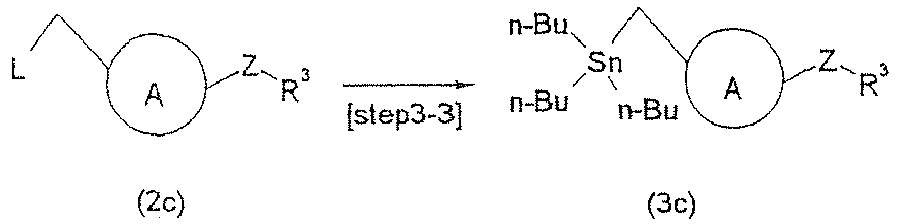
- Compound (2c) can be manufactured from commercially available products by the well known methods, or compound (2c) can also be manufactured according to the methods described in the Manufacturing Examples in the Examples, [Manufacturing Method 2-3] given above or the like.
- This step is a step wherein compound (3c) is obtained by reacting compound (2c) with tributyltin-anions. There are no particular limitations on the solvent used in this reaction as long as it dissolves the starting materials to a certain extent without impeding the reaction. Examples of the solvent include ether solvents such as tetrahydrofuran and diethyl ester; aromatic hydrocarbon solvents such as benzene, toluene and xylene; mixed solvents of the foregoing and the like. The tributyltin-anions used in the reaction can be synthesized by reacting an organometallic reagent with tributyltin hydride. Examples of the organometallic reagent include lithium diisopropylamide, isopropyl magnesium chloride, methyl magnesium iodide and the like. The tributyltin hydride is used in the amount of 1 to 2 equivalents based on compound (2c). The organometallic reagent is used in the amount of 1 to 1.5 equivalents based on tributyltin hydride. The reaction temperature is from -78°C to room temperature, and the reaction time is from 10 minutes to 12 hours.
-

-

- Compound (4a-1) can be manufactured from commercially available products by the well known method, or compound (4a-1) can be manufactured according to the methods described in the Manufacturing Examples in the Examples, [Manufacturing Method 4-2] given below or the like.
- This step is a step wherein compound (4a) is obtained by substituting a hydrogen atom for a chlorine atom of compound (4a-1). Compound (4a) can be obtained by reacting compound (4a-1) in the presence of a palladium catalyst, a base and a hydrogen source. A phosphine ligand can also be added to obtain good results. There are no particular limitations on the solvent used in this reaction as long as it dissolves the starting materials to a certain extent without impeding the reaction. Examples of the solvent include ether solvents such as 1,4-dioxane and tetrahydrofuran; aromatic hydrocarbon solvents such as toluene and xylene; amide solvents such as N,N-dimethylformamide and N-methylpyrrolidinone; and dimethyl sulfoxide, mixed solvents of the foregoing and the like. Examples of the palladium catalyst include bis(tri-t-butylphosphine)palfadium (0), palladium (II) acetate, tetrakis(triphenylphosphine)palladium (0), dichlorobis(triphenylphosphine)palladium (II), tris(dibenzylidenacetone)dipalladium (0) and the like. Examples of the base include triethylamine, N,N-diisopropylethylamine and the like. Examples of the hydrogen source include formic acid, potassium formate, sodium formate, lithium formate, ammonium formate and the like. Examples of the phosphine ligand include triphenylphosphine, tri-o-tolylphosphine, tri-t-butylphosphine and the like. The palladium catalyst is used in the amount of 0.01 to 0.3 equivalents based on compound (4a-1). The base is used in the amount of 2 to 5 equivalents based on compound (4a-1). The hydrogen source is used in the amount of 1 to 5 equivalents based on compound (4a-1). The phosphine ligand is used in the amount of 0.01 to 1.2 equivalents based on compound (4a-1). The reaction temperature is from room temperature to reflux temperature, and the reaction time is from 30 minutes to 24 hours.
-

- Compound (4b-1) which is a commercially available product can be used as is. Compound (4c) can be manufactured from commerciall available products by the well known methods, or compound (4c) can also be manufactured according to the methods described in the Manufacturing Examples in the Examples, [Manufacturing Method 4-3] given below or the like.
- This step is a step wherein compound (4b-2) is obtained by reacting compound (4b-1) with hydroxylamine or hydroxylamine hydrochloride in the presence of a base. There are no particular limitations on the solvent used in this reaction as long as it dissolves the starting materials to a certain extent without impeding the reaction. Examples of the solvent include alcohol solvents such as methanol and ethanol; and methylene chloride, water and the like. The base can also be used as the solvent. Examples of the base include pyridine, sodium hydroxide, potassium hydroxide, sodium acetate, sodium carbonate, sodium hydrogen carbonate and the like. Hydroxylamine or hydroxylamine hydrochloride is used in the amounts of from 1 to 10 equivalents based on compound (4b-1). The base is used in the amount of 1 equivalent to the solvent amount based on compound (4b-1). The reaction temperature is from 0°C to reflux temperature, and the reaction time is from 10 minutes to 24 hours.
- This step is a step wherein compound (4b-3) is obtained by reacting compound (4b-2) with a chlorinating agent. There are no particular limitations on the solvent used in this reaction as long as it dissolves the starting materials to a certain extent without impeding the reaction. Examples of the solvent include ether solvents such as 1,4-dioxane and tetrahydrofuran; alcohol solvents such as methanol and ethanol, amide solvents such as N,N-dimethylformamide and N-methylpyrrolidinone; and dimethyl sulfoxide, methylene chlorine, water, mixed solvents of the foregoing and the like. Examples of the chlorinating agent include N-chlorosuccinimide, sodium hypochlorite, chlorine and the like. The chlorinating agent is used in the amount of 2 to 5 equivalents based on compound (4b-2). The reaction temperature is from 0°C to room temperature, and the reaction time is from 10 minutes to 24 hours.
- This step is a step wherein compound (4a-1) is obtained by reacting compound (4b-3) with compound (4c). Compound (4a-1) can be manufactured according to the methods similar to those of [Step 1].
-

- Compound (2c) can be manufactured from commercially available products by the well known methods, or compound (2c) can also be manufactured according to the methods described in the Manufacturing Examples in the Examples, [Manufacturing Method 2-3] given below or the like.
- This step is a step wherein compound (4c-1) is obtained by reacting compound (2c) with an ethynylsilane derivative. Compound (4c-1) can be obtained by reacting compound (2c) with an ethynyl Grignard reagent obtained by reacting an ethynyl silane derivative with a Grignard reagent. A copper reagent such as copper (I) bromide, copper (I) iodide and the like can also be added to obtain good results. Examples of the ethynylsilane derivative include trimethylsilyl acetylene, triethylsilyl acetylene, triisopropylsilyl acetylene, t-butyldimethylsilyl acetylene and the like. An alkyl magnesium halide such as ethyl magnesium bromide and isopropyl magnesium chloride can be used as the Grignard reagent. The ethynyisilane derivative can be used in the amount of 1 to 3 equivalents based on compound (2c). The Grignard reagent can be used in the amount of 1 to 3 equivalents based on compound (2c). The copper reagent can be used in the amount of 0.1 to 3 equivalents based on compound (2c). The reaction temperature is from room temperature to reflux temperature, and the reaction time is from 1 hour to 72 hours.
- This step is a step wherein compound (4c) is obtained by deprotecting the trimethylsilyl group of compound (4c-1). Compound (4c) can be manufactured according to the methods similar to those of [Step 1-2].
-

-

- Compound (5a-1) can be manufactured according to the method described in the Manufacturing Examples in the Examples, [Manufacturing Method 5-2] given below or the like. Compound (1 c-10-1) and compound (1 c-1 0-2) which are commercially available products can be used as is, or they can also be manufactured from commercially available products by the well known methods.
- This step is a step wherein compound (5a) is obtained by adding 1 equivalent of base to compound (5a-1) to obtain phenoxide ions, followed by reacting with compound (1c-10-2).
- Phenoxide ion production: Phenoxide ions can be obtained by adding 1 equivalent of a base to compound (5a-1) in a solvent such as tetrahydrofuran or methanol. Examples of the base include potassium hydroxide, sodium hydroxide, potassium carbonate, sodium carbonate, potassium t-butoxide and the like, preferably sodium hydroxide. The solvent is preferably concentrated for use in the following reaction. The reaction temperature is room temperature, and the reaction time is from 5 minutes to 1 hour.
- Reaction of phenoxide ions with compound (1c-10-2): The phenoxide ions and compound (1c-10-2) are reacted in a solvent to obtain compound (5a). There are no particular limitations on the solvent used in this reaction as long as it dissolves the starting materials to a certain extent without impeding the reaction. Example of the solvent include amide solvents such as N,N-dimethylformamide, N-methylpyrrolidinone and hexamethylphosphoramide; and dimethyl sulfoxide, mixed solvents of the foregoing and the like. Compound (1c-10-2) is used in the amount of 1 to 3 equivalents based on compound (5a-1). The reaction temperature is from room temperature to reflux temperature, and the reaction time is from 10 minutes to 48 hours.
- Compound (5a) can also be obtained from compound (5a-1) according to the method described below as Alternative Method (1).
- Alternative Method (1): Compound (5a) can be obtained by reacting compound (5a-1) with compound (1c-10-2) in the presence of a base. There are no particular limitations on the solvent used in this reaction as long as it dissolves the starting materials to a certain extent without impeding the reaction. Examples of the solvent include ether solvents such as tetrahydrofuran and diethyl ether, aromatic hydrocarbon solvents such as benzene and toluene, amide solvents such as N,N-dimethylformamide and N-methylpyrrolidinone; and dimethyl sulfoxide, mixed solvents of the foregoing and the like. Examples of the base include sodium hydride, potassium carbonate, sodium carbonate, cesium carbonate, potassium hydroxide, sodium hydroxide and the like. A catalytic amount of sodium iodide or potassium iodide or tetrabutylammonium iodide can also be added to obtain good results. The base is added in the amount of 1 to 1.5 equivalents based on compound (5a-1). The reaction temperature is from room temperature to reflux temperature, and the reaction time is from 10 minutes to 48 hours.
- This step is a step wherein compound (5a) is obtained by reacting compound (5a-1) with compound (1c-10-1). Compound (5a) can be manufactured according to the methods similar to those of [Step 1-37].
-

- Compound (5a-2) can be manufactured according to the methods described in the Manufacturing Examples in the Examples, [Manufacturing Method 1], [Manufacturing Method 2], [Manufacturing Method 3] and [Manufacturing Method 4] which are given above or the like.
- This step is a step wherein compound (5a-1) is obtained by reacting acid with compound (5b-2). An additive such as thioanisole may be added in the reaction system to obtain better results. There are no particular limitations on the solvent used in this reaction as long as it dissolves the starting materials to a certain extent without impeding the reaction. Examples of the solvent include ether solvents such as diethyl ether and tetrahydrofuran; and methylene chloride, trifluoroacetic acid and the like. Examples of the acid include organic acids such as trifluoroacetic acid and methanesulfonic acid; inorganic acids such as sulfuric acid; Lewis acids such as boron trifluoride diethyl etherate; and the like. Examples of the additives include thioanisole, ethanethiol, dl-methionine and the like. The acid is used in the amount of 1 equivalent to the solvent amount based on compound (5a-2). The additive is used in the amount of 1 to 5 equivalents based on compound (5a-2). The reaction temperature is from 0°C to reflux temperature, and the reaction time is from 10 minutes to 72 hours.
- Compound (5a-1) can also be obtained from compound (5a-2) according to the method described below as Alternative Method (1).
- Alternative Method (1): Compound (5a-1) can be obtained by reacting compound (5a-2) with boron tribromide or boron trichloride. There are no particular limitations on the solvent used in this reaction as long as it dissolves the starting materials to a certain extent without impeding the reaction, but methylene chloride is preferably used. The boron tribromide or boron trichloride is used in the amount of 1 to 5 equivalents based on compound (5a-2). The reaction temperature is from -78°C to room temperature, and the reaction time is from 30 minutes to 24 hours.
-

- Compound (6a-2) can be manufactured according to the methods described in [Manufacturing Method 1].
- This step is a step wherein compound (6a-1) is obtained by substituting a halogen atom for a hydrogen atom on the pyridine ring of compound (6a-2). Compound (6a-1) can be manufactured according to the methods similar to those of [Step 1-11].
-

- Compound (6a-4) can be manufactured according to the methods described in [Manufacturing Method 1].
- This step is a step wherein compound (6a-3) is obtained by substituting a halogen atom for a hydrogen atom on the pyridine ring of compound (6a-4). Compound (6a-3) can be manufactured according to the methods similar to those of [Step 1-11].
-

- Compound (7a-1) which is a commercially available can be used as is. Compound (1c-1) can be manufactured from commercially available products by the known methods, and can be manufactured according to the methods described in Manufacturing Example of Example or [Manufacturing Method 1-3-1], and the like.
- This step is a step wherein compound (7a-2) is obtained by substituting a halogen atom for a hydrogen atom on the pyridine ring of compound (7a-1). Compound (7a-2) can be manufactured according to the methods similar to those of [Step 1-11].
- This step is a step wherein compound (7a-3) is obtained by reacting compound (7a-2) and an ethinylsilane derivative. Compound (7a-3) can be manufactured according to the methods similar to those of [Step 1-1].
- This step is a step wherein compound (7a-4) is obtained by reacting compound (7a-3) with a base. Compound (7a-4) can be manufactured according to the methods similar to those of [Step 1-2].
- This step is a step wherein compound (7a) is obtained by reacting compound (7a-4) and compound (1c-1), in the presence of a base. Compound (7a) can be manufactured according to the methods similar to those of [Step 1].
-

- Compound (8a-1-1) which is a commercially available product can be used as is, or may also be manufactured from commercially available products by the known methods. Compound (8a-1) can be manufactured according to the methods described in [Manufacturing Method 1], or the like.
- This step is a step wherein compound (8a) is obtained by reacting compound (8a-1) and compound (8a-1-1) in the presence of a reducing agent. This step can be carried out by adding an acid such as acetic acid or hydrochloric acid in catalytic amount to solvent amount. There are no particular limitations on the solvent used in this reaction as long as it dissolves the starting materials to a certain extent without impeding the reaction. Examples of the solvent include ether solvents such as tetrahydrofuran and diethyl ether; aromatic hydrocarbon solvents such as benzene and toluene; amide solvents such as N,N-dimethylformamide and N-methylpyrrolidinone; alcohol solvents such as methanol and ethanol; halogenated hydrocarbon solvents such as methylene chloride and chloroform, 1,2-dichloroethane; water, acetic acid, mixed solvents of the foregoing, or the like, preferably a mix ed solvent of N,N-dimethylformamide and acetic acid. Examples of the reducing agent used in this reaction include α-picoline borane, pyridine-borane, sodium cyanoborohydride, sodium triacetoxyborohydride and the like, preferably α-picoline borane. Compound (8a-1-1) can be used in the amount of 1 to 5 equivalents based on compound (8a-1), preferably 1 to 1.5 equivalents. The reducing agent can be used in the amount of 0.5 to 5 equivalents based on compound (8a-1), preferably 1 to 1.5 equivalents. The reaction temperature is from 0°C to reflux temperature, and the reaction time is from 10 minutes to 48 hours.
-

- Compound (8a-1-2), compound (8a-1-8) and compound (8a-1-4) which are commercially available products can beused as is, or they may also be manufactured from commercially available products by the known methods. Compound (8a-1) can be manufactured according to the methods described in [Manufacturing Method 1], or the like.
- This step is a step wherein compound (9a) is obtained by reacting compound (8a-1-2) or compound (8a-1-3) with compound (8a-1), in the presence of a base. There are no particular limitations on the solvent used in this reaction as long as it dissolves the starting materials to a certain extent without impeding the reaction. Examples of the solvent include ether solvents such as tetrahydrofuran and diethyl ether; aromatic hydrocarbon solvents such as benzene and toluene; amide solvents such as N,N-dimethylformamide and N-methylpyrrolidinone; halogenated hydrocarbon solvents such as methylene chloride and chloroform, mixed solvents of the foregoing, or the like. Examples of the base include triethylamine, pyridine, potassium carbonate, or the like. A catalytic amount of 4-dimethylaminopyridine can also be added in order to accelerate the reaction. Compound (8a-1-2) or compound (8a-1-3) can be used in the amount of 1 to 5 equivalents based on compound (8a-1), preferably 1 to 1.5 equivalents. The base can be used in the amount of 0.5 equivalents to solvent amount based on compound (8a-1), preferably 1 to 1.5 equivalents. The reaction temperature is from 0°C to reflux temperature, and the reaction time is from 10 minutes to 48 hours.
- This step is a step wherein compound (9a) is obtained by reacting compound (8a-1) and compound (8a-1-4), in the presence of a condensing reagent. There are no particular limitations on the solvent used in this reaction as long as it dissolves the starting materials to a certain extent without impeding the reaction. Examples of the solvent include halogenated hydrocarbon solvents such as methylene chloride and chloroform; ether solvents such as tetrahydrofuran and 1,4-dioxane; amide solvents such as N,N-dimethylformamide and N-methylpyrrolidinone; sulfoxide solvents such as dimethyl sulfoxide; ester solvents such as ethyl acetate, mixed solvents of the foregoing, or the like. Examples of the condensing reagent include Bop (1 H-1,2,3-benzotriazole-1-yloxy(tri(dimethylamino))phosphonium hexafluorophosphate), WSC (1-ethyl-3-(3-dimethylaminopropyl)carbodiimide hydrochloride), DCC (N, N-dicyclohexylcarbodiimide), or the like. A catalytic amount of 4-dimethylaminopyridine can also be added to accelerate the reaction. In addition, this step can also be carried out by adding a base such as triethylamine in the amount of 1 to 5 equivalents. Compound (8a-1-4) can be used in the amount of 1 to 3 equivalents based on compound (8a-1), preferably 1 to 1.5 equivalents. The condensing reagent can be used in the amount of 1 to 3 equivalents based on compound (8a-1), preferably 1 to 1.5 equivalents. The reaction temperature is from 0°C to reflux temperature, and the reaction time is from 10 minutes to 48 hours.
-

- Compound (10a-1-1) which is be a commercially available product can be used as is, or may also be manufactured from the commercially available products by the known methods. Compound (10a-1) can be manufactured according to the methods described in [Manufacturing Method 1], or the like.
- This step is a step wherein compound (10a) is obtained by reacting compound (10a-1) and compound (10a-1-1) in the presence of a reducing agent. Compound (10a) can be manufactured according to the methods similar to those of [Step 8].
- The compounds according to the present invention can be manufactured, for example, according to the methods described in the following manufacturing examples and examples. These are only examples, however, and the compounds according to the present invention are in no way limited to the following specific examples.
-

- To a mixture of 4-benzyloxy-phenyl-acetohydroximoyl chloride (1.2 g, 4.4 mmol) described in Manufacturing Example 1-1-3 and tetrahydrofuran (34 mL) were added 3-Ethynyl-pyridin-2-ylamine (260 mg, 2.2 mmol) described in Manufacturing Example 1-2-3 and triethylamine (3.0 mL, 22 mmol) at 0°C, which was stirred for 1 hour at room temperature. To the reaction mixture was added water at room temperature, which was then extracted with ethyl acetate-tetrahydrofuran (2:1). The organic layer was washed with saturated aqueous sodium chloride, and the solvent was evaporated under a reduced pressure. The residue was purified by NH silica gel column chromatography (ethyl acetate : heptane = 1 : 3) to obtain the title compound (240 mg, 15%).
1H-NMR Spectrum (CDCl3) δ (ppm): 4.00 (2H, s), 5.05 (2H, s), 5.41 (2H, s), 6.24 (1H, s), 6.71 (1 H, dd, J = 4.9, 7.6 Hz), 6.93-6.97 (2H, m), 7.18-7.22 (2H, m), 7.31-7.44 (5H, m), 7.70 (1H, dd, J = 1.7, 7.6 Hz), 8.13 (1 H, dd, J = 1.8, 4.9 Hz). - The starting material, 4-benzyloxy-phenyl-acetohydroximoyl chloride, was synthesized as follows.
-

- To a mixture of 4-benzyloxybenzaldehyde (1.0 g, 4.7 mmol) and sodium methoxide (28% methanol solution, 150 µL, 0.74 mmol) and methanol (10 mL) were added nitromethane (330 µL, 6.1 mmol) and sodium methoxide (28% methanol solution, 1.0 mL, 4.9 mmol) at 0°C, which was stirred for 10 minutes at room temperature. The reaction mixture was cooled to 0°C, and 5 N aqueous hydrochloric acid solution (20 mL) was added thereto at the same temperature. The reaction mixture was then stirred for 15 minutes at room temperature. The precipitated solids were filtered to obtain the title compound (1.2 g, 100%).
1H-NMR Spectrum (DMSO-d6) δ (ppm): 5.20 (2H, s), 7.10-7.14 (2H, m), 7.32-7.48 (5H, m), 7.82-7.85 (2H, m), 8.12 (2H, dd, J = 13.5, 18.2 Hz). -

- To a mixture of 1-benzyloxy-4-((E)-2-nitro-vinyl)-benzene (1.0 g, 3.9 mmol) described in Manufacturing Example 1-1-1, acetic acid (1 mL) and dimethyl sulfoxide (17 mL) was added sodium borohydride (250 mg, 6.3 mmol) at room temperature while cooling appropriately, and the reaction mixture was stirred for 40 minutes at room temperature. Water was added to the reaction mixture. The reaction mixture was partitioned into ethyl acetate and water. The organic layer was washed with water and saturated aqueous sodium chloride, and dried over anhydrous magnesium sulfate, and the solvent was evaporated under a reduced pressure. The residue was purified by NH silica gel column chromatography (ethyl acetate : heptane = 1:3) to obtain the title compound (710 mg, 70%).
1H-NMR Spectrum (CDCl3) δ (ppm): 3.26 (2H, t, J = 7.2 Hz), 4.56 (2H, t, J = 7.2 Hz), 5.04 (2H, s), 6.92 (2H, d, J = 8.4 Hz), 7.11 (2H, d, J = 8.8 Hz), 7.30-7.42 (5H, m). -

- To a mixture of 1-benzyloxy-4-(2-nitro-ethyl)-benzene (340 mg, 1.3 mmol) described in Manufacturing Example 1-1-2 and methanol (5 mL) was added lithium methoxide (100 mg, 2.6 mmol) at room temperature, which was stirred for 15 minutes at room temperature. The reaction mixture was concentrated under a reduced pressure. Methylene chloride (4 mL) and tetrahydrofuran (2 mL) were added to the residue. Titanium (IV) chloride was added at -78°C to the reaction mixture, which was then stirred for 50 minutes at 0°C. The reaction mixture was cooled to -78°C, and after adding water (5 mL), the reaction mixture was gradually warmed to room temperature. The reaction mixture was partitioned into ethyl acetate and water. The organic layer was washed with saturated aqueous sodium chloride, and the solvent was evaporated under a reduced pressure. The residue was purified by neutral silica gel column chromatography (ethyl acetate : heptane = 1 : 3) to obtain the title compound (310 mg, 84%).
1H-NMR Spectrum (CDCl3) δ (ppm): 3.83 (2H, s), 5.07 (2H, s), 6.94-6.98 (2H, m), 7.17-7.21 (2H, m), 7.32-7.44 (5H, m). - The starting material, 3-ethynyl-pyridin-2-ylamine, was synthesized as follows.
-

- A mixture of N-(3-Iodopyridin-2-yl)-2,2-dimethyl-propionamide (66.2 g, 218 mmol) described in Manufacturing Example 39-1-2, 5 N aqueous sodium hydroxide solution (200 mL) and methanol (200 mL) was stirred under reflux for 1 hour and 20 minutes. The reaction solution was allowed to room temperature and partitioned into water and ethyl acetate. The aqueous layer was extracted with ethyl acetate three times. The organic layers were combined, washed with saturated aqueous sodium chloride, and dried over anhydrous sodium sulfate. The sodium sulfate was removed by filtration, and the solvent was concentrated under a reduced pressure to obtain the title compound (41.2 g, 85.9%).
1H-NMR Spectrum (DMSO-d6) δ (ppm): 6.00 (2H, brs), 6.32 (1 H, dd, J = 4.8 Hz, 7.2 Hz), 7.87 (1 H, d, J = 7.2 Hz), 7.92 (1 H, d, J = 4.8 Hz). -
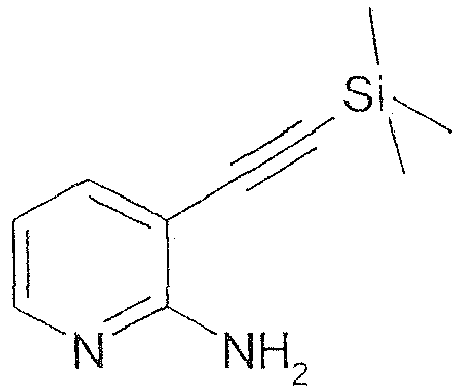
- To a mixture of 3-iodopyridin-2-ylamine (40.2 g, 183 mmol) described in Manufacturing Example 1-2-1, trimethylsilylacetylene (51.7 mL, 366 mmol), copper (I) iodide (3.49 g, 18.3 mmol), N,N-diisopropylethylamine (63.7mL, 366mmol) and N-methylpyrrolidinone (200 mL) was added tetrakis(triphenylphosphine)paliadium (0) (10.6 g, 9.15 mmol) under nitrogen atmosphere, which was stirred for 3 hours and 10 minutes at room temperature. Water was added to the reaction solution, which was then extracted with ethyl acetate 4 times. The solvent was concentrated under a reduced pressure. The residue was purified by NH silica gel chromatography (heptane : ethyl acetate = 4 : 1). The resulting solution was concentrated under a reduced pressure, and the residue was purified by silica gel chromatography (heptane : ethyl acetate =2:1 then 1 : 1) to obtain the title compound (28.1 g, 80.7%).
1H-NMR Spectrum (DMSO-d6) δ(ppm): 0.25 (9H, s), 6.09 (2H, brs), 6.51-6.57 (1H, m), 7.50-7.55 (1H, m), 7.95-7.99 (1H, m). -

- To a solution of 3-trimethylsilanylethynyl-pyridin-2-ylamine (28.1 g, 148 mmoL) described in Manufacturing Example 1-2-2 in tetrahydrofuran (300 mL) was added tetrabutylammonium fluoride (1 M tetrahydrofuran solution, 20 mL, 20 mmol), which was stirred for 15 minutes at room temperature. Water was added to the reaction solution, which was then extracted with ethyl acetate 4 times. The organic layer was dried over anhydrous sodium sulfate, and the solvent was evaporated under a reduced pressure. The residue was purified by silica gel chromatography (heptane : ethyl acetate =1:1 then 1 : 2) to obtain the title compound (16.4 g, 93.7%). 1H-NMR Spectrum (DMSO-d6) δ (ppm): 4.43 (1 H, s), 6.14 (2H, brs), 6.53 (1 H, dd, J = 4.8 Hz, 7.2 Hz), 7.53 (1 H, d, J = 7.2 Hz), 7.96 (1 H, d, J = 4.8 Hz).
-

- To a solution of (4-(pyridin-2-yloxymethyl)-phenyl)-acotohydroximoyl chloride (510 mg, 1.84 mmol) described in Manufacturing Example 2-1-5 and 3-ethynyl-pyridin-2-ylamine (150 mg, 1.27 mmol) described in Manufacturing Example 1-2-3 in tetrahydrofuran (5 mL) was added triethylamine (708 µL, 5.08 mmol) at room temperature, which was stirred for 95 minutes at room temperature. Water was added at room temperature to the reaction solution, which was then extracted with ethyl acetate. The organic layer was washed with saturated aqueous sodium chloride, and dried over anhydrous magnesium sulfate, and the solvent was evaporated under a reduced pressure. The residue was purified by NH silica gel column chromatography (heptane : ethyl acetate = 2 : 1) to obtain the title compound (120 mg, 26%).
1H-NMR Spectrum (CDCl3) δ (ppm): 4.08 (2H, s), 5.37 (2H, s), 6.33 (1 H, s), 6.45 (2H, brs), 6.79-6.82 (2H, m), 6.88-6.91 (1H, m), 7.30 (2H, d, J = 8.1 Hz), 7.45 (2H, d, J = 8.1 Hz), 7.57-7.61 (1H, m), 7.85 (1H, d, J = 7.3 Hz), 8.03 (1 H, d, J = 5.5 Hz), 8.17 (1H, m). - The starting material; (4-(pyridin-2-yloxymethyl)-phenyl)-acetohydroximoyl chloride, was synthesized as follows.
-

- To a mixture of 1,4-benzenedimethanol (5.5 g, 40 mmol), 2-fluoropyridine (1.3 g, 13 mmol) and N,N-dimethylformamide (15 mL) was added sodium hydride (1.4 g, 40 mmol, 66% in oil) at 0°C, which was stirred for 20 minutes at room temperature and for 1 hour at 70°C. Water was added to the reaction mixture, which was then extracted with ethyl acetate. The organic layer was washed with saturated aqueous sodium chloride, and the solvent was evaporated under a reduced pressure. The residue was purified by NH silica gel column chromatography (ethyl acetate : heptane =1 : 1) to obtain the title compound (1.9 g, 66%).
1H-NMR Spectrum (CDCl3) δ (ppm): 4.71 (2H, s), 5.38 (2H, s), 6.81 (1 H, td, J = 0.9, 8.4 Hz), 6.89 (1 H, ddd, J = 0.9, 5.1, 7.1 Hz), 7.37-7.47 (4H, m), 7.59 (1 H, ddd, J = 2.0,7.1, 8.3 Hz), 8.17 (1 H, ddd, J = 0.7, 2.0, 5.1 Hz). -

- To a mixture of (4-(pyridin-2-yloxymethyl)-phenyl)methanol (1.9 g, 8.6 mmol) described in Manufacturing Example 2-1-1 and methylene chloride (30 mL) was added manganese dioxide (15 g, 17 mmol) at room temperature, which was stirred overnight at that temperature. The reaction mixture was filtered through a Celite pad, and the solvent was evaporated under a reduced pressure. The residue was purified by silica gel column chromatography (ethyl acetate : heptane =1:4) to obtain the title compound (770 mg, 42%).
1H-NMR Spectrum (CDCl3) δ (ppm): 5.48 (2H, s), 6.85 (1 H, d, J = 8.2 Hz), 6.90-6.93 (1 H, m), 7.60-7.64 (3H, m), 7.89 (2H, d, J = 8.1 Hz), 8.16 (1 H, dd, J = 1.3, 4.9 Hz), 10.0 (1 H, s). -

- A mixture of 4-(pyridin-2-yloxymethyl)-benzaldehyde (23.4 g, 110 mmol) described in Manufacturing Example 2-1-2, nitromethane (33.6 g, 550 mmol), ammonium acetate (17.0 g, 220 mmol) and acetic acid (200 mL) was stirred for 1 hour and 45 minutes at 100°C. The reaction solution was stirred on an ice bath while adding a small amount of water, and the precipitated solids were filtered to obtain the title compound (21.0 g, 74.5%).
1H-NMR Spectrum (DMSO-d6) δ (ppm): 5.41 (2H, s), 6.91 (1 H, dd, J = 0.8, 8.4 Hz), 6.99-7.10 (1 H, m), 7.53 (2H, d, J = 8.0 Hz), 7.72-7.79 (1 H, m), 7.86 (2H, d, J = 8.0 Hz), 8.13 (1 H, d, J = 10 Hz), 8.15-8.20 (1 H, m), 8.23 (1 H, d, J = 10 Hz). -

- To a solution of 2-(4-((E)-2-nitro-vinyl)-benzyloxy)-pyridine (21.0 g, 81.9 mmol) described in Manufacturing Example 2-1-3, acetic acid (21 mL) in dimethyl sulfoxide (200 mL) was added sodium borohydride (4.96 g, 131 mmol) at room temperature while cooling appropriately. After addition of sodium borohydride, the cooling bath was removed, followed by stirring for 15 minutes at room temperature. The reaction solution was partitioned into water and ethyl acetate. The ethyl acetate layer was washed with water twice and with saturated aqueous sodium chloride once, and dried over anhydrous magnesium sulfate, and the solvent was evaporated under a reduced pressure. The residue was purified by NH silica gel column chromatography (ethyl acetate : heptane = 1 : 3) to obtain the title compound (16.3 g, 77.1 %). 1H-NMR Spectrum (DMSO-d6) δ (ppm): 3.23 (2H, t, J = 6.8 Hz), 4.85 (2H, t, J = 6.8 Hz), 5.32(2H, s), 6.82-6.88 (1H, m), 6.96-7.01 (1 H, m), 7.28 (2H, d, J = 8.0 Hz), 7.38 (2H, d, J = 8.0 Hz), 7.69-7.74 (1H, m), 8.15-8.19 (1H, m).
-

- Lithium wire (323 mg, 46.6 mmol) was added to and dissolved in methanol (75 mL). To the mixture solution was added 2-(4-(2-nitro-ethyl)-benzyloxy)-pyridine (6.0 g, 23.3 mmol) described in Manufacturing Example 2-1-4. The reaction solution was concentrated under a reduced pressure. Toluene was added to the residue, and the solvent was concentrated under a reduced pressure. A solution of the resulting residue in methylene chloride (90 mL) and tetrahydrofuran (45 mL) was cooled to - 78°C, and titanium (IV) chloride (8.15 mL, 74.4 mmol) was added while stirring. Immediately after addition of the titanium (IV) chloride, the reaction mixture was stirred for 10 minutes at 0°C and 30 minutes at room temperature. The reaction solution was poured into an ice water and extracted with ethyl acetate. The organic layer was dried over anhydrous magnesium sulfate, and the magnesium sulfate was removed by filtration. The filtrate was passed through a glass filter covered with neutral silica gel, washed with ethyl acetate. The resulting eluate was concentrated under a reduced pressure. A small amount of ethyl acetate was added to the residue, and the precipitated solids were filtered out to obtain the title compound (1.86 g, 28.8%).
1H-NMR Spectrum (DMSO-d6) δ (ppm): 3.82 (2H, s), 5.33 (2H, s), 6.84-6.89 (1 H, m), 6.97-7.01 (1H, m), 7.25 (2H, d, J = 8.4 Hz), 7.41 (2H, d, J = 8.4 Hz), 7.70-7.76 (1H, m), 8.15-8.18 (1 H, m), 11.7 (1 H, s). - The starting material, 4-(5-(2-amino-pyridin-3-yl)isoxazol-3-ylmethyl)-phenol was synthesized as follows.
-

- To a mixture of 3-(3-(4-benzyloxy-benzyl)-isoxazol-5-yl)-pyridin-2-ylamine (32 mg, 0.090 mmol) described in Example 1 and trifluoroacetic acid (1 mL) was added thioanisole (45 mg, 0.36 mmol) at room temperature, which was stirred for 2 hours at the same temperature. To a mixture of saturated aqueous sodium hydrogencarbonate solution and ethyl acetate was added the reaction mixture. The organic layer was separated and washed with saturated aqueous sodium chloride, and the solvent was evaporated under a reduced pressure. The residue was purified by silica gel column chromatography (ethyl acetate : heptane = 4 : 1) to obtain the title compound (24 mg, 100%).
1H-NMR Spectrum (DMSO-d6) δ(ppm): 3.90 (2H, s), 6.25 (2H, brs), 6.68-6.72 (3H, m), 6.76 (1 H, s), 7.11 (2H, d, J = 8.6 Hz), 7.87 (1 H, dd, J = 1.5, 7.7 Hz), 8.10 (1 H, brs), 9.29 (1 H, s). -

- To a mixture of 4-(5-(2-amino-pyridin-3-yl)isoxazol-3-ylmethyl)-phenol (4.2 mg, 0.015 mmol) described in Manufacturing Example 5-1-1 and methanol (0.4 mL) was added 1 N aqueous sodium hydroxide solution (16 µL, 0.016 mmol), which was then concentrated under a reduced pressure. To a mixture of the residue and N,N-dimethylformamide (0.5 mL) was added 2-picolyl chloride (3.1 mg, 0.019 mmol), which was stirred for 2 hours at room temperature. The reaction mixture was purified as is by reverse-phase high performance liquid chromatography (using an acetonitrile-water mobile phase containing 0.1% trifluoroacetic acid) to obtain the title compound (3.6 mg, 39%) as a ditrifuoracetic acid salt.
MS m/e (ESI) 359.16 (MH+) - The starting material, (2-benzyloxy-pyridin-5-yl)-acetohydroximoyl chloride, was synthesized as follows.
-

- To a solution of phenyl-methanol (20.5 g, 190 mmol) in N,N-dimethylformamide (200 mL) was added sodium hydride (7.6 g, 190 mmol) under nitrogen atmosphere on an ice bath (0°C), which was stirred for 30 minutes at room temperature. 2,5-Dibromopyridine was then added thereto on the ice bath (0°C), and stirred for 60 minutes at room temperature. The reaction mixture was partitioned into water and ethyl acetate on the ice bath (0°C). The organic layer was washed with water and saturated aqueous sodium chloride, and dried over anhydrous magnesium sulfate, and the solvent was evaporated under a reduced pressure. The residue was purified by silica gel column chromatography (ethyl acetate : heptane = 1 : 20 then 1 : 10) to obtain the title compound (15.1 g, 90%).
1H-NMR Spectrum (CDCl3) δ (ppm): 5.34 (2H, s), 6.71-6.73 (1H, m), 7.32-7.45 (5H, m), 7.64-7.67 (1 H, m), 8.20-8.21 (1 H, m). -

- To a solution of 2-benzyloxy-5-bromopyridine (15.1 g, 57.0 mmol) described in Manufacturing Example 12-1-1 in anhydrous tetrahydrofuran (250 mL) were added dropwise n-butyl lithium (2.67 M n-hexane solution, 25.6 mL, 68.4 mmol) under nitrogen atmosphere on a dry ice-ethanol bath (-78°C), which was stirred for 30 minutes at -78°C. N,N-Dimethylformamide (6.60 mL, 85.5 mmol) was then added thereto at -78°C, and stirred for 30 minutes. Water and ethyl acetate were added to the reaction mixture, and the organic layer was separated after stirring for 10 minutes at room temperature. The organic layer was washed with water and saturated aqueous sodium chloride, and dried over anhydrous magnesium sulfate, and the solvent was evaporated under a reduced pressure. The residue was purified by NH silica gel column chromatography (ethyl acetate : heptane =1:7 then 1 : 5) to obtain the title compound (4.87 g, 40%).
1H-NMR Spectrum (CDCl3) δ (ppm): 5.49 (2H, s), 6.89-6.92 (1H, m), 7.34-7.48 (5H, m), 8.07-8.10 (1H, m), 8.64-8.65 (1H, m), 9.97 (1H, s). -

- To a solution of 6-benzyloxy-pyridin-3-carbaldehyde (4.87 g, 22.8 mmol) described in Manufacturing Example 12-1-2 in acetic acid (30 mL) were added nitromethane (6.96 g, 114 mmol) and ammonium acetate (3.51 g, 45.6 mmol) under nitrogen atmosphere at room temperature, which was stirred for 2.5 hours at 110°C. The reaction mixture was partitioned into water and ethyl acetate. The organic layer was washed with water and saturated aqueous sodium chloride, and dried over anhydrous magnesium sulfate, and the solvent was evaporated under a reduced pressure to obtain the title compound (5.60 g, 96%) as a crude product.
1H-NMR Spectrum (DMSO-d6) δ (ppm): 5.43 (2H, s), 7.01 (1 H, d, J = 8.8 Hz), 7.34-7.47 (5H, m), 8.16 (1 H, d, J = 13.6 Hz), 8.24 (1 H, d, J = 13.6 Hz), 8.27 (1 H, dd, J = 2.4, 8.8 Hz), 8.64 (1 H, d, J = 2.4 Hz). -

- To a solution of 2-benzyloxy-5-((E)-2-nitro-vinyl)-pyridine (5.80 g, 22.8 mmol) described in Manufacturing Example 12-1-3 and acetic acid (5.80 mL) in dimethyl sulfoxide (70 mL) was added sodium borohydride (1.44 g, 36.2 mmol) under nitrogen atmosphere at room temperature while cooling appropriately, which was stirred for 10 minutes at room temperature. The reaction mixture was partitioned into water and ethyl acetate. The organic layer was washed with water and saturated aqueous sodium chloride, and dried over anhydrous magnesium sulfate, and the solvent was evaporated under a reduced pressure. The residue was purified by NH silica gel column chromatography (ethyl acetate : heptane = 1 : 4) to obtain the title compound (2.50 g, 43%).
1H-NMR Spectrum (DMSO-d6) δ (ppm): 3.17 (2H, t, J = 6.8 Hz), 4.84 (2H, d, J = 6.8 Hz), 5.31 (2H, s), 6.84 (1 H, d, J = 8.4 Hz), 7.31-7.42 (5H, m), 7.68 (1 H, dd, J = 2.4, 8.4 Hz), 8.06 (1 H, d, J = 2.4 Hz). -

- To a solution of 2-benzyloxy-5-(2-nitro-ethyl)pyridine (3.97 g, 15.4 mmol) described in Manufacturing Example 12-1-4 in methanol (25 mL) was added lithium methoxide (1.17 g, 30.8 mmol) under nitrogen atmosphere at room temperature, which was stirred at room temperature for 30 minutes. The reaction mixture was concentrated under a reduced pressure. Anhydrous methylene chloride (30 mL) and anhydrous tetrahydrofuran (20 mL) were added to the residue. Titanium (IV) chloride (5.42 mL, 49.3 mmol) was added dropwise into the reaction mixture on a dry ice-ethanol bath (-78°C), and stirred for 45 minutes at 0°C. Water, ethyl acetate and tetrahydrofuran were added to the reaction mixture on an ice bath (0°C), and the organic layer was separated. The organic layer was washed with water and saturated aqueous sodium chloride, and dried over anhydrous magnesium sulfate, and the solvent was evaporated under a reduced pressure to obtain the title compound (3.4 g, 80%) as a crude product.
1H-NMR Spectrum (DMSO-d6) δ (ppm): 3.79 (2H, s), 5.34 (2H, s), 6.87 (1H, d, J = 8.4 Hz), 7.30-7.62 (5H, m), 7.61 (1 H, dd, J = 2.4, 8.4 Hz), 7.08 (1H, d, J = 2.4 Hz), 11.8(1H,s). - The starting material, 3-ethynyl-pyridin-2,6-diamine, was synthesized as follows.
-

- 2,6-Diaminopyridine (100 g, 916 mmol) was dissolved in dimethyl sulfoxide (400 mL), and N-iodosuccinimide (100 g, 445 mmol) was added in one portion while stirring at room temperature. The reaction solution was stirring for 10 minutes at room temperature. Water (3.5 L) was added to the reaction solution, and the precipitated solids were filtered out. The resulting aqueous layer was extracted with ethyl acetate (1.3 L) 3 times. The ethyl acetate layers were combined and the solvent was evaporated under a reduced pressure. The residue was purified by silica gel chromatography (heptane : ethyl acetate = 2 : 3) to obtain the title compound (23.8 g, 22.8%).
1H-NMR Spectrum (DMSO-d6) δ (ppm): 5.41 (2H, brs), 5.57 (1H, d, J = 8.0 Hz), 5.64 (2H, brs), 7.37 (1H, d, J = 8.0 Hz). -

- To a mixture of 3-iodo-pyridin-2,6-diamine (20.0 g, 85.2 mmol) described in Manufacturing Example 13-1-1, trimethylsilyl acetylene (24.2 mL, 170 mmol), copper (I) iodide (3.25 g, 17.0 mmol) N,N-diisopropylethylamine (19.1g, 148 mmol) and N-methylpyrrolidinone (286 mL) was added tetrakis(triphenylphosphine)palladium (0) (9.81 g, 8.52 mmol) under argon atmosphere, which was stirred for 30 minutes at room temperature. The reaction solution was partitioned into water and ethyl acetate. The ethyl acetate layer was washed with water 4 times and dried over sodium sulfate, and the solvent was evaporated under a reduced pressure. The residue was purified by NH silica gel chromatography (heptane : ethyl acetate =4:1 1 then 1 : 1). The solids obtained by concentrating the eluate under a reduced pressure were washed with heptane containing a small amount of ethyl acetate to obtain the title compound (10.5 g, 60.0%).
1H-NMR Spectrum (DMSO-d6) δ (ppm): 0.20 (9H, s), 5.53 (2H, brs), 5.66 (1 H, d, J = 8.0 Hz), 5.95 (2H, brs), 7.11 (1 H, d, J = 8.0 Hz). -

- To a solution of 3-trimethylsilanylethynyl-pyridin-2,6-diamine (7.0 g, 34.1 mmoL) described in Manufacturing Example 13-1-2 in tetrahydrofuran (100 mL) was added tetrabutylammonium fluoride (1M tetrahydrofuran solution, 17 mL, 17 mmol) on an ice bath, which was stirred for 10 minutes at room temperature. Water was added to the reaction solution, which was then extracted with ethyl acetate 3 times. The extract was dried over sodium sulfate, and the solvent was evaporated under a reduced pressure. The residue was purified by silica gel chromatography (ethyl acetate) to obtain the title compound (3.35 g, 73.8%).
1H-NMR Spectrum (DMSO-d6) δ (ppm): 4.08 (1 H, s), 5.57 (2H, brs), 5.68 (1 H, d, J = 8.0 Hz), 5.89 (2H, brs), 7.14 (1 H, d, J = 8.0 Hz). -

- To a solution of 3-ethynyl-pyridin-2,6-diamine (120 mg, 0.90 mmol) described in Manufacturing Example 13-1-3 and 4-(pyridine-2-yloxymethyl)-phenyl-acetohydroximoyl chloride (390 mg, 1.41 mmol) described in Manufacturing Example 2-1-5 in tetrahydrofuran (5.0 mL) was added triethylamine (502 µL, 3.6 mmol) at 0°C. The reaction mixture was stirred for 1 hour and 30 minutes at room temperature. The mixture was partitioned into ethyl acetate and water. The organic layer was separated, washed with water and saturated aqueous sodium chloride, and dried over anhydrous magnesium sulfate, and the solvent was evaporated under a reduced pressure. The residue was purified by silica gel column chromatography (heptane : ethyl acetate = 1 : 1, then ethyl acetate) to obtain the title compound (290 mg, 86.2%).
1H-NMR Spectrum (DMSO-d6) δ (ppm): 3.95 (2H, s), 5.31 (2H, s), 5.79 (2H, brs), 5.82 (1H, d, J = 8.4 Hz), 6.11 (2H, brs), 6.37 (1 H, s), 6.84-6.86 (1H, m), 6.97-7.00 (1 H, m), 7.31 (2H, d, J = 8.2 Hz), 7.39 (2H, d, J = 8.2 Hz), 7.51 (1 H, d, J = 8.4 Hz), 7.69-7.73 (1 H, m), 8.16-8.18 (1H, m). -

- To a solution of 3-ethynyl-pyridin-2,6-diamine (230 mg, 1.73 mmol) described in Manufacturing Example 13-1-3 in anhydrous tetrahydrofuran (20 mL) was added (2-benzyloxy-pyridin-5-yl)-acetohydroximoyl chloride (1.00 g, 3.61 mmol) described in Manufacturing Example 12-1-5 under nitrogen atmosphere at room temperature. Triethylamine (965 µL, 6.92 mmol) was added dropwise to the mixture and stirred for 1.5 hours at room temperature. The reaction mixture was partitioned into water and ethyl acetate at room temperature. The organic layer was washed with water and saturated aqueous sodium chloride, and dried over anhydrous magnesium sulfate, and the solvent was evaporated under a reduced pressure. The residue was purified by NH silica gel column chromatography (ethyl acetate : heptane = 2 : 1) to obtain the title compound (470 mg, 73%).
1H-NMR Spectrum (DMSO-d6) δ (ppm): 3.92 (2H, s), 5.33 (2H, s), 5.81 (2H, brs), 5.83 (1 H, d, J = 8.4 Hz), 6.11 (2H, brs), 6.40 (1 H, s), 6.85 (1 H, d, J = 8.8 Hz), 7.31-7.39 (3H, m), 7.42-7.44 (2H, m), 7.52 (1 H, d, J = 8.4 Hz), 7.66 (1H, dd, J = 2.4, 8.4 Hz), 8.14 (1 H, d, J = 2.4 Hz). - The starting material, 5-chloro-3-(5-(4-(pyridin-2-yloxymethyl)-benzyl)-isoxazol-3-yl)-pyridin-2-ylamine, was synthesized as follows.
-

- A mixture of (4-(pyridin-2-yloxymethyl)-phenyl)methanol (540 mg, 2.51 mmol) described in Manufacturing Example 2-1-1, triphenylphosphine (856 mg, 3.27 mmol) and carbon tetrachloride (10.8 g, 10.2 mmol) was stirred under reflux for 2 hours and 10 minutes. The reaction solution was cooled to room temperature, and concentrated under a reduced pressure. The residue was purified by silica gel column chromatography (heptane : acetic acid = 8 : 1) to obtain the title compound (300 mg, 51.1 %).
1H-NMR Spectrum (DMSO-d6) δ (ppm): 4.76 (2H, s), 5.35 (2H, s), 6.86-6.90 (1H, m), 6.97-7.20 (1H,m), 7.44 (4H, s), 7.70-7.76 (1H, m), 8.15-8.18 (1 H m). -

- To a solution of 3-(1H-pyrazol-4-yl)-pyridin-2-ylamine (150 mg, 0.94 mmol) described in Manufacturing Example 32-1-4 in N,N-dimethylformamide (10 mL) was added sodium hydride (48.7 mg, 1.22 mmol, 60% in oil) on an ice bath (0°C) under nitrogen atmosphere. Following 40 minutes of stirring at room temperature, 2-(4-chloromethyl-benzyloxy)-pyridine (228 mg, 0.98 mmol) described in Manufacturing Example 30-1-1 was added and stirred for 30 minutes at room temperature. The reaction mixture was partitioned into water and ethyl acetate at room temperature. The organic layer was washed with water and saturated aqueous sodium chloride, and dried over anhydrous magnesium sulfate, and the solvent was evaporated under a reduced pressure. The residue was purified by NH silica gel column chromatography (ethyl acetate : heptane =2:1, then ethyl acetate) to obtain the title compound (307 mg, 92%).
1H-NMR Spectrum (DMSO-d6) δ (ppm): 5.33 (2H, s), 5.35 (2H, s), 5.60 (2H, brs), 6.61 (1H, dd, J = 4.8, 7.4 Hz), 6.84-6.87 (1 H, m), 6.96-7.00 (1 H, m), 7.30-7.43 (1 H, m), 7.31 (2H, d, J = 8.4 Hz), 7.42 (1 H, t, J = 8.4 Hz), 7.48 (1 H, dd, J = 2.0, 7.2 Hz), 7.69-7.73 (1 H, m), 7.76 (1 H, d, J = 1.2 Hz), 7.87 (1 H, dd, J = 2.0, 5.0 Hz), 8.15-8.17 (1 H, m), 8.18 (1 H, d, J = 0.8 Hz). - The starting material, 3-(1H-pyrazol-4-yl)-pyridin-2-ylamine, was synthesized as follows.
-

- To a solution of 4-bromopyrazole (10.0 g, 68.0 mmol) in N,N-dimethylformamide (100 mL) was added dropwise triethylamine (23.7 mL, 170 mmol) under nitrogen atmosphere at room temperature. Trityl chloride (37.9 g, 136 mmol) was added to the reaction solution on an ice bath (0°C), and stirred for 3 hours at 70°C. Water (400 mL) was added to the reaction solution to precipitate the solids. The precipitated solids were filtered and dried under a reduced pressure. The solids were then azeotropically dried with toluene to obtain the title compound (22.9 g, 87%).
1H-NMR Spectrum (DMSO-d6) δ (ppm): 7.04-7.07 (6H, m), 7.35-7.38 (9H, m), 7.52 (1H, d, J = 0.4 Hz), 7.76 (1H, d, J = 0.8 Hz). -

- A mixture of 4-bromo-4-trityl-1H-pyrazole (4.8 g, 12.3 mmol) described in Manufacturing Example 32-1-1, bis(pinacolate)diboran (5.0 g, 19.7 mmol), potassium acetate (3.62 g, 36.9 mmoL), 1,1' bis(diphenylphosphino)ferrocene dichloropalladium (II) (450 mg, 0.62 mmol) and dimethyl sulfoxide (50 mL) was stirred under argon atmosphere for 17 hours and 10 minutes at 80°C. The reaction solution was allowed to room temperature, and partitioned into water and ethyl acetate. The organic layer was concentrated under a reduced pressure. The residue was purified by silica gel chromatography (heptane : ethyl acetate =4:1). Heptane was added to the solids obtained by concentrating the eluate under a reduced pressure, which were then irradiated by ultrasonic wave and filtered to obtain the title compound (1.51 g, 28.0%).
1H-NMR Spectrum (CDCl3) δ (ppm): 1.30 (12H, s), 7.10-7.16 (6H, m), 7.26-7.31 (9H, m), 7.75 (1 H, s), 7.94 (1 H, s). -

- 4-(4,4,5,5-Tetramethyl-(1,3,2)dioxaborolan-2-yl)-1-trityl-1H-pyrazole (3.2 g, 7.33 mmol) described in Manufacturing Example 32-1-2, 3-bromo-pyridine-2-ylamine (1.14 g, 6.60 mmol), tetrakis (triphenylphosphine)palladium (0) (424 mg, 0.37 mmol), toluene (40 mL), 2 M aqueous sodium carbonate solution (10 mL) and ethanol (20 mL) were stirred for 1 hour at 95°C. The reaction solution was allowed to room temperature, and partitioned into water and ethyl acetate. The ethyl acetate layer was washed with water once, and the solvent was evaporated under a reduced pressure. The residue was purified by silica gel chromatography (heptane : ethyl acetate = 1:2) to obtain the title compound (2.3 g, 78.0%).
1H-NMR Spectrum (DMSO-d6) δ (ppm): 5.52 (2H, brs), 6.57 (1 H, dd, J = 7.2, 4.8 Hz), 7.10-7.16 (6H, m), 7.28-7.38 (9H, m), 7.42 (1H, d, J = 7.2 Hz), 7.66 (1H, s), 7.84 (1 H, d, J =4.8 Hz), 7.92 (1 H, s). -

- 3-(1-Trityl-1H-pyrazol-4-yl)-pyridin-2-ylamine (2.3 g, 5.71 mmol) described in Manufacturing Example 32-1-3, 2 N hydrochloric acid (15 mL), methanol (15 mL) and tetrahydrofuran (10 mL) were stirred for 30 minutes at 70°C. The reaction solution was allowed to room temperature, and partitioned into water and ethyl acetate. Saturated sodium bicarbonate solution was added to the separated aqueous layer, which was then extracted with ethyl acetate 6 times. The ethyl acetate layers were combined and the solvent was evaporated under a reduced pressure. The residue was purified by silica gel chromatography (ethyl acetate, then ethyl acetate : methanol = 10 : 1) to obtain the title compound (625 mg, 68.3%).
1H-NMR Spectrum (DMSO-d6) δ (ppm): 5.59 (2H, brs), 6.62 (1 H, dd, J = 4.8, 7.6 Hz), 7.49 (1 H, d, J = 7.2 Hz), 7.88 (1 H, d, J = 4.8 Hz), 7.72-8.15 (2H, brs), 12.9 (1 H, brs). - The starting material, 3-(4-bromo-pyrazol-1-yl)-pyridin-2-ylamine, was synthesized as follows.
-

- To a solution of 2-aminopyridine (50.0 g, 531 mmol) in methylene chloride (500 mL) were added triethylamine (81.4 mL, 584 mmol) and pivaloyl chloride (71.9 mL, 584 mmol) at 0°C, which was stirred for 4 hours and 30 minutes at room temperature. The reaction solution was partitioned into water and methylene chloride. The organic layer was washed with water and saturated aqueous sodium chloride, and dried over anhydrous magnesium sulfate, and the solvent was evaporated under a reduced pressure. To a solution of the resulting residue in methanol (300 mL) was added potassium carbonate (73.4 g, 531 mmol) at 0°C, which was stirred for 90 minutes at room temperature. The reaction solution was partitioned into water and ethyl acetate at room temperature. The organic layer was washed with saturated aqueous sodium chloride and dried over anhydrous magnesium sulfate, and the solvent was evaporated under a reduced pressure. Heptane (300 mL) was added to the residue, and the precipitated solids were filtered to obtain the title compound (80.2 g, 85%). The filtrate was then concentrated under a reduced pressure, and the residue was purified by silica gel column chromatography (heptane:ethyl acetate = 2:1) to obtain the title compound (12.2 g, 13%).
1H-NMR Spectrum (DMSO-d6) δ (ppm): 1.22 (9H, s), 7.06-7.09 (1 H, m), 7.72-7.77 (1 H, m), 8.01-8.03 (1 H, m), 8.29-8.31 (1 H, m), 9.71 (1 H, s). -

- To a mixture of 2,2-dimethyl-N-pyridin-2-yl-propionamide (3.0 g, 17 mmol) described in Manufacturing Example 39-1-1, N,N,N',N'-tetramethylethylenediamine (6.3 mL, 42 mmol) and tetrahydrofuran (60 mL) was added dropwise n-butyl lithium (1.6 M n-hexane solution, 30 mL, 47 mmol) at -78°C, which was stirred overnight at 0°C. Iodine (6.8 g, 27 mmol) was added to the reaction mixture at -78°C, and stirred for 1.5 hours at 0°C. Water and saturated aqueous sodium thiosulfate solution were added to the reaction mixture, which was then extracted with ethyl acetate. The organic layer was washed with saturated aqueous sodium chloride, and the solvent was evaporated under a reduced pressure. The residue was purified by silica gel column chromatography (ethyl acetate : heptane = 2 : 1) to obtain the title compound (2.9 g, 57%).
1H-NMR Spectrum (CDCl3) δ (ppm): 1.38 (9H, s), 6.85 (1 H, dd, J = 4.8, 7.9 Hz), 7.94 (1 H, brs), 8.11 (1 H, dd, J = 1.7, 7.9 Hz), 8.46 (1 H, dd, J = 1.7, 4.6 Hz). - The compounds (I) of the present invention or salts thereof exhibits excellent inhibition activity on the GPI-anchored protein transport procees based on the inhibition of fungal GPI biosynthesis, anti-Candida activity and anti-Aspergillus activity, and are also superior in terms of its physical properties, safety and metabolic stability, making it extremely useful as a preventive or therapeutic agent for fungal infections.
- In order to demonstrate the usefulness of the compounds (I) of the present invention, the antifungal activity of the compounds (I) of the present invention was measured by measuring 1; anti-Candida and anti-Aspergillus activity and 2; activity in the experimental systemic candidal infection model in mice.
- For the C. albicans CAF2-1 strain, a fungal suspension from a standing culture for 48 hours at 30°C in a Sabouraud dextrose liquid culture medium (SDB) was diluted with RPMI1640 medium to adjust a fungal suspension of 1.2 x 10³ cells / mL. For the A. fumigatus Tsukuba strain, -80°C stored strain was diluted with RPMI1640 medium to adjust to a fungal suspension of 4.5 x 10³ cells / mL.
- Using a U-bottomed 96 well plate, 8 samples / plate (A to H) of sample dilution solutions were prepared. On the 2nd to 12th rows were dispensed 10 µL of dimethyl sulfoxide solution. Weighted sample was dissolved in dimethyl sulfoxide to prepare a 2.5 mg / mL solution, 20 µL of this solution was added to the first row of the prepared plate, and 12 steps of two-foled step dilutions (10 µL of solution + 10 µL of dimethyl sulfoxide solution) were performed on the plate. This sample dilution solution was dispensed in the amount of 1 µL to a flat-bottomed 96 well plate for MIG measurement to prepare a sample dilution plate.
- The fungal suspension prepared in (1) was used in the amount of 99 µL / well to inoculate the flat-bottomed 96 well plate containing 1 µL / well of the test compound dilution prepared in (2), and a standing culture was carried out aerobically for 42-48 hours at 35°C.
- The minimum concentration that clearly inhibited fungal growth as compared to the control by visual inspection was determined as the minimum inhibitory concentration (MIC).
- The following representative compounds prepared in the examples were measured for anti-Candida activity and anti-Aspergillus activity by the measurement method described in 1. As a result, as shown in Table 1, it was found that the compounds according to the present invention clearly had anti-Candida and anti-Aspergillus activity.
TABLE 1 Ex. No. Anti-Candida Activity (µg/mL) Anti-Aspergillus Activity (µg/mL) 2 0.05 0.20 9 0.20 0.39 14 0.39 0.39 25 0.20 0.20 32 0.20 0.78 - A standing culture of C. albicans E81022 strain was carried out for 48 hours at 30°C in sabouraud dextrose agar medium (SDA), the recovered fungal cells were suspended in sterilized physiological saline. By counting the fungal number on cytometry plate, the suspension was diluted to 2 x 10⁷ cells / mL with sterilized physiological saline to serve fungal inoculum.
- The fungal inoculum was used in the amounts of 0.2 mL to inoculate 4.5 to 5.5 week-old female ICR mice in the tail vein (4x10⁶ cells/mouse).
- From 0.5 to 1 hour after fungal inoculation, 0.2 mL of agent solution (dissolved or suspended in sterilized physiological saline containing 6.5% dimethyl sulfoxide and 3.5% Tween 80) was administered into the stomach using a peroral probe, 3 times every 4 hours. The agent concentration was 2.5 mg/kg or 10 mg/kg, and the number of animals in one group was 5 animals.
- The protective effect was determined by observing life/death until 14 days after infection and calculating the mean survival days.
- As a result, as shown in Table 7, mice administered with the compounds of the present invention survived for a long time as compared to the untreated group, and the compounds according to the present invention have been also found to demonstrate anti-Candida activity in vivo.
TABLE 7 Example Nos. Mean Survival Days Non-Administered Group (control) 2.5mg/kg 10mg/kg 2 4.0 13.2 14.0 9 3.4 12.8 14.0 14 4.0 13.4 14.0 25 2.6 12.2 - 32 6.0 10.2 12.2 - According to the present invention, the compound (I) of the present invention or a salt thereof 1) acts against the onset, development and persistence of infections by inhibiting fungal GPI biosynthesis, thereby inhibiting expression of cell wall proteins and blocking cell wall assembly while preventing the fungus from attaching to cells so that the pathogen cannot become pathogenic, and 2) is superior in terms of physical properties, safety and metabolic stability, and is extremely useful as a preventive or therapeutic agent for fungal infections.
Claims (11)
- A compound or a pharmaceutically acceptable salt thereof, the compound being selected from the group consisting of
3-(3-(4-(pyridin-2-yloxymethyl)-benzyl)-isoxazol-5-yl)-pyridin-2-ylamine;
3-(3-(4-(pyridin-2-ylmethoxy)-benzyl)-isoxazol-5-yl)-pyridin-2-ylamine;
3-(3-(4-(pyridin-2-yloxymethyl)-benzyl)-isoxazol-5-yl)-pyridine-2,6-diamine;
3-(3-(6-benzyloxy-pyridin-3-ylmethyl)-isoxazol-5-yl)-pyridin-2,6-diamine; and
3-(1-(4-(pyridin-2-yloxymethyl)-benzyl)-1H-pyrazol-4-yl)-pyridin-2-ylamine. - The compound according to claim 1, which is 3-(3-(4-(pyridin-2-yloxymethyl)-benzyl)-isoxazol-5-yl)-pyridin-2-ylamine represented by:

- The compound according to claim 1, which is 3-(3-(4-(pyridin-2-ylmethoxy)-benzyl)-isoxazol-5-yl)-pyridin-2-ylamine represented by:

- The compound according to claim 1, which is 3-(3-(4-(pyridin-2-yloxymethyl)-benzyl)-isoxazol-5-yl)-pyridine-2,6-diamine represented by:

- The compound according to claim 1, which is 3-(3-(6-benzyloxy-pyridin-3-ylmethyl)-isoxazol-5-yl)-pyridin-2,6-diamine represented by:

- The compound according to claim 1, which is 3-(1-(4-(pyridin-2-yloxymethyl)-benzyl)-1H-pyrazol-4-yl)-pyridin-2-ylamine represented by:

- A pharmaceutical composition comprising the compound according to any one of Claims 1 to 6 or a pharmaceutically acceptable salt thereof.
- A medicament comprising the compound according to any one of Claims 1 to 6 or a pharmaceutically acceptable salt thereof.
- An antifungal agent comprising the compound according to any one of Claims 1 to 6 a pharmaceutically acceptable salt thereof.
- The compound according to any one of Claims 1 to 6 or a pharmaceutically acceptable salt thereof for use in preventing and/or treating a fungal infection.
- Use of the compound according to any one of Claims 1 to 6 or a pharmaceutically acceptable salt thereof for the manufacturing an antifungal agent.
Applications Claiming Priority (5)
| Application Number | Priority Date | Filing Date | Title |
|---|---|---|---|
| US73126705P | 2005-10-31 | 2005-10-31 | |
| JP2005317680 | 2005-10-31 | ||
| US75339105P | 2005-12-27 | 2005-12-27 | |
| JP2005374395 | 2005-12-27 | ||
| EP06812187.0A EP1944303B1 (en) | 2005-10-31 | 2006-10-30 | Pyridine derivative substituted by heterocycle and fungicide containing the same |
Related Parent Applications (2)
| Application Number | Title | Priority Date | Filing Date |
|---|---|---|---|
| EP06812187.0A Division EP1944303B1 (en) | 2005-10-31 | 2006-10-30 | Pyridine derivative substituted by heterocycle and fungicide containing the same |
| EP06812187.0 Division | 2006-10-30 |
Publications (2)
| Publication Number | Publication Date |
|---|---|
| EP2628738A1 true EP2628738A1 (en) | 2013-08-21 |
| EP2628738B1 EP2628738B1 (en) | 2014-09-03 |
Family
ID=44351887
Family Applications (1)
| Application Number | Title | Priority Date | Filing Date |
|---|---|---|---|
| EP12193373.3A Active EP2628738B1 (en) | 2005-10-31 | 2006-10-30 | Heterocyclic substituted pyridine derivatives and antifungal agent containing same |
Country Status (8)
| Country | Link |
|---|---|
| US (4) | US7691882B2 (en) |
| EP (1) | EP2628738B1 (en) |
| JP (1) | JP5107721B2 (en) |
| BR (1) | BRPI0617880B8 (en) |
| ES (1) | ES2517521T3 (en) |
| MY (1) | MY145746A (en) |
| SA (1) | SA06270396B1 (en) |
| TW (1) | TWI385169B (en) |
Cited By (2)
| Publication number | Priority date | Publication date | Assignee | Title |
|---|---|---|---|---|
| WO2019113542A1 (en) | 2017-12-07 | 2019-06-13 | Amplyx Pharmaceuticals, Inc. | Heterocycle substituted pyridine derivative antifungal agents |
| US11771688B2 (en) | 2018-06-25 | 2023-10-03 | Amplyx Pharmaceuticals, Inc. | Pyridine derivatives substituted by heterocyclic ring and amino group |
Families Citing this family (22)
| Publication number | Priority date | Publication date | Assignee | Title |
|---|---|---|---|---|
| EP1669348A4 (en) * | 2003-09-30 | 2009-03-11 | Eisai R&D Man Co Ltd | Novel antifungal agent comprising heterocyclic compound |
| US20050241110A1 (en) * | 2004-04-09 | 2005-11-03 | Bruce Baker | Ergonomic handles, especially for garden tools |
| US20090227799A1 (en) * | 2004-08-09 | 2009-09-10 | Kazutaka Nakamoto | Novel Antimalarial Agent Containing Heterocyclic Compound |
| WO2006106711A1 (en) | 2005-03-30 | 2006-10-12 | Eisai R & D Management Co., Ltd. | Antifungal agent containing pyridine derivative |
| TWI385169B (en) * | 2005-10-31 | 2013-02-11 | Eisai R&D Man Co Ltd | Heterocyclic substituted pyridine derivatives and antifungal agent containing same |
| WO2008035726A1 (en) * | 2006-09-21 | 2008-03-27 | Eisai R & D Management Co., Ltd. | Pyridine derivative substituted by heteroaryl ring, and antifungal agent comprising the same |
| TW200841879A (en) * | 2007-04-27 | 2008-11-01 | Eisai R&D Man Co Ltd | Pyridine derivatives substituted by heterocyclic ring and phosphonoamino group, and anti-fungal agent containing same |
| CA2685194A1 (en) * | 2007-04-27 | 2008-11-13 | Eisai R&D Management Co., Ltd. | Heterocycle-substituted pyridine derivatives salt or crystal thereof |
| KR20100007956A (en) * | 2007-05-03 | 2010-01-22 | 화이자 리미티드 | 2-pyridine carboxamide derivatives as sodium channel modulators |
| EP2226320A4 (en) | 2007-12-26 | 2012-07-11 | Eisai R&D Man Co Ltd | Process for production of heterocycle-substituted pyridine derivative |
| US8513287B2 (en) | 2007-12-27 | 2013-08-20 | Eisai R&D Management Co., Ltd. | Heterocyclic ring and phosphonoxymethyl group substituted pyridine derivatives and antifungal agent containing same |
| US8188119B2 (en) | 2008-10-24 | 2012-05-29 | Eisai R&D Management Co., Ltd | Pyridine derivatives substituted with heterocyclic ring and γ-glutamylamino group, and antifungal agents containing same |
| JP2012176900A (en) * | 2009-06-24 | 2012-09-13 | Eisai R & D Management Co Ltd | Pyridin derivative containing ((phosphonooxy)methyl) pyridinium ring and anti-fungal agent containing these derivative |
| EP2306199A1 (en) * | 2009-09-29 | 2011-04-06 | Academisch Ziekenhuis Leiden Acting Under The Name Leiden University Medical Center | Reductive amination and analysis of carbohydrates using 2-picoline borane as reducing agent |
| US20130288956A1 (en) * | 2010-11-05 | 2013-10-31 | Eisai R&D Management Co., Ltd. | Combined pharmaceutical composition as antifungal agent |
| KR101727390B1 (en) | 2015-07-28 | 2017-04-26 | 엘에스산전 주식회사 | Power metering system and method, and system for load power monitoring |
| KR101717854B1 (en) * | 2015-09-03 | 2017-03-17 | 엘에스산전 주식회사 | Power monitoring system and mhthod for monitoring power thereof |
| JP6469238B2 (en) | 2015-09-18 | 2019-02-13 | 科研製薬株式会社 | Biaryl derivative and medicament containing the same |
| WO2019196915A1 (en) * | 2018-04-13 | 2019-10-17 | 江苏恒瑞医药股份有限公司 | Method for preparing pyrroloaminopyridazinone compound and intermediates thereof |
| EP3886854A4 (en) | 2018-11-30 | 2022-07-06 | Nuvation Bio Inc. | PYRROLE AND PYRAZOLE COMPOUNDS AND METHODS OF USE THEREOF |
| WO2020247804A1 (en) * | 2019-06-07 | 2020-12-10 | Amplyx Pharmaceuticals, Inc. | Heterocycle substituted pyridine derivative antifungal agents |
| MX2022016179A (en) * | 2020-06-17 | 2023-04-20 | Amplyx Pharmaceuticals Inc | Compounds and methods for treating fungal infections. |
Citations (8)
| Publication number | Priority date | Publication date | Assignee | Title |
|---|---|---|---|---|
| US4576956A (en) * | 1982-10-05 | 1986-03-18 | Shionogi & Co., Ltd. | Iodo propargylaminoisoxazoles as fungicides |
| WO2002004626A1 (en) | 2000-07-07 | 2002-01-17 | Eisai Co., Ltd. | Fungal cell wall synthesis gene |
| WO2002085897A1 (en) | 2001-04-05 | 2002-10-31 | Alangudi Sankaranarayanan | Heterocyclic compounds for aging-related and diabetic vascular complications |
| WO2003031435A1 (en) | 2001-10-06 | 2003-04-17 | Merck Patent Gmbh | Pyrazole derivatives as glycine transporter inhibitors |
| US20030114491A1 (en) * | 2001-10-27 | 2003-06-19 | Youseung Kim | Pyrrolidinone derivatives, their preparation and pharmaceutical composition comprising the same |
| WO2004033432A1 (en) * | 2002-10-09 | 2004-04-22 | Ssp Co., Ltd. | Novel pyrazole compounds having antifungal activity |
| WO2004089931A1 (en) | 2003-04-05 | 2004-10-21 | Merck Patent Gmbh | Substituted pyrazoles |
| WO2005033079A1 (en) | 2003-09-30 | 2005-04-14 | Eisai Co., Ltd. | Novel antifungal agent comprising heterocyclic compound |
Family Cites Families (149)
| Publication number | Priority date | Publication date | Assignee | Title |
|---|---|---|---|---|
| GB919073A (en) | 1960-09-15 | 1963-02-20 | Farmaceutici Italia | Benzylamine derivatives |
| JPS542325A (en) | 1977-06-07 | 1979-01-09 | Sankyo Co Ltd | Agricultural and horticultural pesticide |
| US4306633A (en) | 1980-01-22 | 1981-12-22 | H. J. Langen & Sons Limited | Bag transfer means |
| US4551532A (en) | 1980-05-08 | 1985-11-05 | Takeda Chemical Industries, Ltd. | Ethylene glycol derivatives having anti-protozoan, anti-fungal and anti-tumor activity |
| JPS57179192A (en) | 1981-04-27 | 1982-11-04 | Takeda Chem Ind Ltd | Ethylene glycol derivative |
| JPS5984824A (en) | 1982-11-08 | 1984-05-16 | Takeda Chem Ind Ltd | Antitumor agent |
| GB8311003D0 (en) | 1983-04-22 | 1983-05-25 | Shell Int Research | Aniline compounds |
| DE3316187A1 (en) | 1983-05-04 | 1984-11-08 | Cassella Ag, 6000 Frankfurt | 2-(Aminomethyl)pyrrole derivatives, process for their preparation, and their use |
| DE3461711D1 (en) * | 1983-05-04 | 1987-01-29 | Cassella Farbwerke Mainkur Ag | 2-(aminoalkyl)-pyrrole derivatives, process for their manufacture and their use |
| WO1986003203A1 (en) | 1984-11-22 | 1986-06-05 | Yoshitomi Pharmaceutical Industries, Ltd. | Thienylthiazole derivatives |
| JP2556849B2 (en) | 1986-02-13 | 1996-11-27 | 三共株式会社 | Glycerin derivative |
| US5070082A (en) * | 1986-10-23 | 1991-12-03 | American Cyanamid Company | Solubilized pro-drugs |
| US4851423A (en) | 1986-12-10 | 1989-07-25 | Schering Corporation | Pharmaceutically active compounds |
| JPH0823294B2 (en) | 1987-06-22 | 1996-03-06 | マツダ株式会社 | Engine intake system |
| JPS643162A (en) | 1987-06-26 | 1989-01-06 | Tokuyama Soda Co Ltd | Sulfonamide compound |
| GT198900008A (en) | 1988-01-29 | 1990-07-17 | DERIVATIVES OF QUINOLINE, QUINAZOLINE AND CINOLINE. | |
| JPH01261381A (en) | 1988-04-12 | 1989-10-18 | Nippon Soda Co Ltd | Oxa(thia)diazole derivative, its production and miticide |
| US5034393A (en) | 1989-07-27 | 1991-07-23 | Dowelanco | Fungicidal use of pyridopyrimidine, pteridine, pyrimidopyrimidine, pyrimidopyridazine, and pyrimido-1,2,4-triazine derivatives |
| JPH03161470A (en) | 1989-11-17 | 1991-07-11 | Nisshin Flour Milling Co Ltd | Indole derivative |
| US5371086A (en) * | 1991-03-15 | 1994-12-06 | The Green Cross Corporation | Aminopyridine compounds |
| JPH05294935A (en) | 1991-03-15 | 1993-11-09 | Green Cross Corp:The | Aminopyridine compound |
| US5208247A (en) * | 1991-08-01 | 1993-05-04 | American Cyanamid Company | Pyridinium compounds which are useful as antagonists of platelet activating factor |
| EP0533130A1 (en) | 1991-09-19 | 1993-03-24 | Hoechst Aktiengesellschaft | 2-Hydroxymethylpyridines, the corresponding pyridine-N-oxides and derivatives thereof, process for their preparation and their use |
| WO1993007138A1 (en) * | 1991-10-08 | 1993-04-15 | Nippon Soda Co., Ltd. | Pyrazole derivative and agrohorticultural bactericide containing same |
| AU2931692A (en) * | 1991-10-23 | 1993-05-21 | Baylor College Of Medicine | Fingerprinting bacterial strains using repetitive dna sequence amplification |
| US5250564A (en) | 1991-12-12 | 1993-10-05 | Trustees Of The University Of Pennsylvania | Aromatic peptidomimetics |
| SE9103776D0 (en) | 1991-12-19 | 1991-12-19 | Astra Ab | NEW COMPOUNDS |
| JPH0725853A (en) | 1993-07-14 | 1995-01-27 | Ishihara Sangyo Kaisha Ltd | Amido compound or its salt, its production and controller for harmful animal containing the same |
| JP2759257B2 (en) | 1993-09-28 | 1998-05-28 | 大塚製薬株式会社 | Diabetes treatment |
| AU674613B2 (en) | 1993-09-28 | 1997-01-02 | Otsuka Pharmaceutical Co., Ltd. | Quinoxaline derivative as antidiabetic agent |
| JPH09507245A (en) | 1994-01-07 | 1997-07-22 | ダウエランコ | N- (4-pyrimidinyl) amide pest control agent |
| JP3452213B2 (en) | 1994-07-05 | 2003-09-29 | エーザイ株式会社 | Antifungal agent and method for producing the same |
| IL112778A0 (en) * | 1994-03-04 | 1995-05-26 | Merck & Co Inc | Substituted heterocycles, their preparation and pharmaceutical compositions containing them |
| GB9510757D0 (en) | 1994-09-19 | 1995-07-19 | Wellcome Found | Therapeuticaly active compounds |
| DE4434637A1 (en) * | 1994-09-28 | 1996-04-04 | Hoechst Schering Agrevo Gmbh | Substituted pyridines, processes for their preparation and their use as pesticides and fungicides |
| JPH08175993A (en) | 1994-12-21 | 1996-07-09 | Green Cross Corp:The | Antioxidant |
| ES2169773T3 (en) * | 1995-04-11 | 2002-07-16 | Mitsui Chemicals Inc | DERIVATIVES OF REPLACED THIOPHEN AND AGRICULTURAL AND HORTICOL FUNGICIDES CONTAINING THESE DERIVATIVES AS ACTIVE INGREDIENT. |
| US5710171A (en) * | 1995-05-24 | 1998-01-20 | Merck & Co., Inc. | Bisphenyl inhibitors of farnesyl-protein transferase |
| US6080767A (en) * | 1996-01-02 | 2000-06-27 | Aventis Pharmaceuticals Products Inc. | Substituted n-[(aminoiminomethyl or aminomethyl)phenyl]propyl amides |
| AU703203B2 (en) | 1996-01-30 | 1999-03-18 | Merck & Co., Inc. | Inhibitors of farnesyl-protein transferase |
| EP0880501A1 (en) | 1996-02-02 | 1998-12-02 | Zeneca Limited | Heterocyclic compounds useful as pharmaceutical agents |
| US5945431A (en) * | 1996-03-15 | 1999-08-31 | Biochem Therapeutics Incorporated | Cytomegalovirus inhibiting compounds |
| GB9605437D0 (en) | 1996-03-15 | 1996-05-15 | Iaf Biochem Int | Cytomegalovirus inhibiting compounds |
| CZ88499A3 (en) | 1996-09-12 | 1999-10-13 | Merck And Co., Inc. | Combination of antifungal agents |
| US6174905B1 (en) | 1996-09-30 | 2001-01-16 | Mitsui Chemicals, Inc. | Cell differentiation inducer |
| ES2202663T3 (en) | 1996-12-11 | 2004-04-01 | ABBOTT GMBH & CO. KG | CETOBENZAMIDS AS CALPAINE INHIBITORS. |
| SK132899A3 (en) * | 1997-04-04 | 2000-09-12 | Pfizer Prod Inc | NICOTINAMIDE DERIVATIVES AND PHARMACEUTICAL COMPOSITIONì (54) COMPRISING THEM |
| US20020111495A1 (en) * | 1997-04-04 | 2002-08-15 | Pfizer Inc. | Nicotinamide acids, amides, and their mimetics active as inhibitors of PDE4 isozymes |
| AU7371998A (en) | 1997-05-07 | 1998-11-27 | University Of Pittsburgh | Inhibitors of protein isoprenyl transferases |
| ES2179490T3 (en) | 1997-05-08 | 2003-01-16 | Merck Sharp & Dohme | DERIVATIVES OF 1,2,4-TRIAZOLO (3,4-A) FTALAZINA SUBSTITUTED AS LIGANDOS DE GABA ALFA 5. |
| DE19727117A1 (en) | 1997-06-26 | 1999-01-07 | Boehringer Ingelheim Pharma | Phenylalkyl derivatives, pharmaceutical compositions containing them and processes for their preparation |
| DE19732033A1 (en) | 1997-07-25 | 1999-01-28 | Bayer Ag | Triazolinethione-phosphoric acid derivatives |
| AU9002598A (en) | 1997-09-16 | 1999-04-05 | Takeda Chemical Industries Ltd. | Nitrogenous fused-ring compounds, process for the preparation of the same, and drugs |
| JPH11152275A (en) | 1997-09-16 | 1999-06-08 | Takeda Chem Ind Ltd | Nitrogen-containing condensed ring compound, its production and agent |
| TW390963B (en) | 1997-09-26 | 2000-05-21 | Shinetsu Handotai Kk | Method and apparatus for detecting heavy metals in silicon wafer bulk withhigh sensitivity |
| EP0913826A1 (en) * | 1997-10-31 | 1999-05-06 | Hewlett-Packard Company | Scratch protection in tape data storage system |
| US6022884A (en) | 1997-11-07 | 2000-02-08 | Amgen Inc. | Substituted pyridine compounds and methods of use |
| AU740745B2 (en) | 1997-12-11 | 2001-11-15 | Biochem Pharma Inc. | Antiviral compounds |
| US5985856A (en) | 1997-12-31 | 1999-11-16 | University Of Kansas | Water soluble prodrugs of secondary and tertiary amine containing drugs and methods of making thereof |
| HUP0101275A3 (en) | 1998-03-26 | 2002-12-28 | Japan Tobacco Inc | Amide derivatives and pharmaceutical compositions containing them as nociceptin antagonists |
| AU762726B2 (en) | 1998-03-31 | 2003-07-03 | Acadia Pharmaceuticals, Inc. | Compounds with activity on muscarinic receptors |
| PE20000942A1 (en) | 1998-07-31 | 2000-09-28 | Lilly Co Eli | DERIVATIVES OF AMIDE, CARBAMATE AND UREA |
| CN1142912C (en) | 1998-08-04 | 2004-03-24 | 阿斯特拉曾尼卡有限公司 | Amide derivatives useful as inhibitors of cytokine production |
| JP2000178243A (en) | 1998-12-14 | 2000-06-27 | Teijin Ltd | Biphenylamidine derivative |
| US6235728B1 (en) * | 1999-02-19 | 2001-05-22 | Bristol-Myers Squibb Company | Water-soluble prodrugs of azole compounds |
| US6340690B1 (en) * | 1999-02-22 | 2002-01-22 | Bio-Chem Pharma Inc. | Antiviral methods using [1,8]naphthyridine derivatives |
| WO2000051998A1 (en) | 1999-03-02 | 2000-09-08 | Boehringer Ingelheim Pharmaceuticals, Inc. | Compounds useful as reversible inhibitors of cathepsin s |
| NZ513639A (en) | 1999-04-15 | 2004-02-27 | Bristol Myers Squibb Co | Cyclic protein tyrosine kinase inhibitors |
| US6319944B1 (en) | 1999-05-10 | 2001-11-20 | Merck & Co., Inc. | Aryl amidines, compositions containing such compounds and methods of use |
| CN1361768A (en) | 1999-06-02 | 2002-07-31 | Nps药物有限公司 | Metabolic glutamate receptor antagonists and their use in the treatment of central nervous system disorders |
| GB9919588D0 (en) * | 1999-08-18 | 1999-10-20 | Hoechst Schering Agrevo Gmbh | Fungicidal compounds |
| ATE364592T1 (en) | 1999-09-24 | 2007-07-15 | Genentech Inc | TYROSINE DERIVATIVES |
| TWI262185B (en) | 1999-10-01 | 2006-09-21 | Eisai Co Ltd | Carboxylic acid derivatives having anti-hyperglycemia and anti-hyperlipemia action, and pharmaceutical composition containing the derivatives |
| GB9923710D0 (en) | 1999-10-08 | 1999-12-08 | Proteus Molecular Design | Chemical compounds |
| EP1225894B1 (en) | 1999-10-08 | 2006-07-05 | Affinium Pharmaceuticals, Inc. | Fab i inhibitors |
| AU1607501A (en) | 1999-11-15 | 2001-05-30 | Drug Innovation & Design, Inc. | Selective cellular targeting: multifunctional delivery vehicles |
| WO2001051456A2 (en) | 2000-01-13 | 2001-07-19 | Tularik Inc. | Antibacterial agents |
| HN2001000008A (en) | 2000-01-21 | 2003-12-11 | Inc Agouron Pharmaceuticals | AMIDA COMPOSITE AND PHARMACEUTICAL COMPOSITIONS TO INHIBIT PROTEINKINASES, AND THE INSTRUCTIONS FOR USE |
| KR100350983B1 (en) * | 2000-02-03 | 2002-08-28 | 삼성전자 주식회사 | Laser diode driver, initializing method of optical recording/reproducing apparatus therefor, and driving method of laser diode driver |
| DE10005719A1 (en) | 2000-02-09 | 2001-08-16 | Schaeffler Waelzlager Ohg | Linear roller bearings |
| NZ521870A (en) | 2000-03-31 | 2004-08-27 | Euro Celtique S | Aminopyridines and their use as anticonvulsants and sodium channel blockers |
| US6414013B1 (en) * | 2000-06-19 | 2002-07-02 | Pharmacia & Upjohn S.P.A. | Thiophene compounds, process for preparing the same, and pharmaceutical compositions containing the same background of the invention |
| AU2001273040A1 (en) | 2000-06-27 | 2002-01-08 | Du Pont Pharmaceuticals Company | Factor xa inhibitors |
| US20040038239A1 (en) * | 2000-07-07 | 2004-02-26 | Kappei Tsukahara | Fungal cell wall synthesis gene |
| EP1301508A1 (en) | 2000-07-17 | 2003-04-16 | Smithkline Beecham Plc | Novel processes for the preparation of 4-phenylpiperidine derivatives |
| DE10039477A1 (en) * | 2000-08-08 | 2002-02-21 | Aventis Cropscience Gmbh | Heterocyclyl alkyl azole derivatives and their use as pesticides |
| MXPA03002325A (en) | 2000-09-15 | 2003-06-24 | Anormed Inc | Chemokine receptor binding heterocyclic compounds. |
| RU2003110962A (en) | 2000-09-18 | 2004-10-20 | Е.И.Дюпон де Немур энд Компани (US) | Pyridinyl amides and imides for use as fungicides |
| US6658444B1 (en) * | 2000-11-09 | 2003-12-02 | Sun Microsystems, Inc. | Method and apparatus for performing a mask-driven interval division operation |
| EP1217000A1 (en) | 2000-12-23 | 2002-06-26 | Aventis Pharma Deutschland GmbH | Inhibitors of factor Xa and factor VIIa |
| ATE293109T1 (en) | 2001-01-31 | 2005-04-15 | Pfizer Prod Inc | NICOTINIC ACID AMIDE DERIVATIVES AND THEIR MIMETICS AS INHIBITORS OF PDE4 ISOZYMS |
| OA12542A (en) | 2001-01-31 | 2006-06-05 | Pfizer Prod Inc | Thiazolyl-, oxazolyl-, pyrrolyl-, and imidazolyl-acid amide derivatives useful as inhibitors of PDE4isozymes. |
| JP2004520386A (en) | 2001-01-31 | 2004-07-08 | ファイザー・プロダクツ・インク | Nicotinamide biaryl derivatives useful as inhibitors of PDE4 isozymes |
| KR20030070150A (en) | 2001-01-31 | 2003-08-27 | 화이자 프로덕츠 인크. | Ether Derivatives Useful as Inhibitors of PDE4 Isozymes |
| JP2002275159A (en) | 2001-03-16 | 2002-09-25 | Japan Tobacco Inc | Hcp inhibitor and compound having hcp inhibiting activity |
| GB0109122D0 (en) | 2001-04-11 | 2001-05-30 | Smithkline Beecham Spa | Novel compounds |
| EP1253131A1 (en) | 2001-04-24 | 2002-10-30 | Aventis Animal Nutrition S.A. | Process for the preparation of an xanthophyll |
| EP1275301A1 (en) | 2001-07-10 | 2003-01-15 | Bayer CropScience S.A. | Trisubstituted heterocyclic compounds and their use as fungicides |
| EP1275653A1 (en) | 2001-07-10 | 2003-01-15 | Bayer CropScience S.A. | Oxazolopyridines and their use as fungicides |
| JP2005509594A (en) | 2001-07-13 | 2005-04-14 | バーチャル ドラッグ ディヴェロップメント、インコーポレイティッド | NAD synthetase inhibitors and uses thereof |
| US20040198773A1 (en) | 2001-09-26 | 2004-10-07 | Barry Hart | Substituted 3-pyridyl oxazoles as c17,20 lyase inhibitors |
| WO2003027094A2 (en) | 2001-09-26 | 2003-04-03 | Bayer Pharmaceuticals Corporation | Substituted 3-pyridyl indoles and indazoles as c17,20 lyase inhibitors |
| EP1440072A4 (en) | 2001-10-30 | 2005-02-02 | Conforma Therapeutic Corp | Purine analogs having hsp90-inhibiting activity |
| EP1451156A4 (en) | 2001-11-27 | 2005-05-25 | Merck & Co Inc | 4-AMINOQUINOLINE COMPOUNDS |
| US6596718B1 (en) * | 2001-11-27 | 2003-07-22 | Hoffmann-La Roche Inc. | 7-Morpholin-4yl-benzothiazole amide derivatives |
| DE10201764A1 (en) | 2002-01-18 | 2003-07-31 | Bayer Cropscience Ag | Substituted 4-aminopyridine derivatives |
| GB0203193D0 (en) | 2002-02-11 | 2002-03-27 | Pfizer Ltd | Nicotinamide derivatives useful as pde4 inhibitors |
| US20030191158A1 (en) | 2002-02-11 | 2003-10-09 | Magee Thomas V. | Nicotinamide derivatives and a tiotropium salt in combination for the treatment of diseases |
| PL372756A1 (en) | 2002-02-11 | 2005-08-08 | Pfizer Inc. | Nicotinamide derivatives useful as pde4 inhibitors |
| BRPI0307351B8 (en) | 2002-02-12 | 2021-05-25 | Smithkline Beecham Corp | compound, pharmaceutical composition, use of a compound, and, process for preparing a compound |
| KR100974394B1 (en) | 2002-03-08 | 2010-08-05 | 바스프 에스이 | Fungicide mixtures based on prothioconazole and containing pesticides |
| WO2003080047A1 (en) | 2002-03-20 | 2003-10-02 | Bristol-Myers Squibb Company | Phosphate prodrugs of fluorooxindoles |
| JP4895476B2 (en) | 2002-04-26 | 2012-03-14 | イーライ リリー アンド カンパニー | Tachykinin receptor antagonist |
| DK1501809T3 (en) | 2002-04-26 | 2008-05-13 | Lilly Co Eli | Trizole derivatives as tachykinin receptor antagonists |
| EP1369420A1 (en) | 2002-06-06 | 2003-12-10 | Aventis Pharma Deutschland GmbH | Inhibitors of the GPib - vWF interaction |
| AU2003244181A1 (en) | 2002-06-25 | 2004-01-06 | Yamanouchi Pharmaceutical Co., Ltd. | Phenoxypyridine derivative or salt thereof |
| TW200424183A (en) | 2002-08-09 | 2004-11-16 | Nps Pharma Inc | New compounds |
| PA8578101A1 (en) | 2002-08-13 | 2004-05-07 | Warner Lambert Co | HETEROBIARILO DERIVATIVES AS METALOPROTEINASE IN MATRIX INHIBITORS |
| GB0222495D0 (en) | 2002-09-27 | 2002-11-06 | Glaxo Group Ltd | Compounds |
| EP1565749B9 (en) | 2002-11-22 | 2012-04-25 | Eisai R&D Management Co., Ltd. | Methods of screening for compounds that inhibit the biosynthesis of gpi in malaria parasites |
| WO2004052280A2 (en) | 2002-12-10 | 2004-06-24 | Imclone Systems Incorporated | Anti-angiogenic compounds and their use in cancer treatment |
| JP4896518B2 (en) * | 2002-12-13 | 2012-03-14 | ワイエム・バイオサイエンシズ・オーストラリア・ピーティーワイ・リミテッド | Nicotinamide kinase inhibitor |
| TW200500360A (en) | 2003-03-01 | 2005-01-01 | Astrazeneca Ab | Hydroxymethyl compounds |
| JP4156460B2 (en) | 2003-07-09 | 2008-09-24 | Tdk株式会社 | Work pickup method and apparatus, and mounting machine |
| DE602004017494D1 (en) * | 2003-07-25 | 2008-12-11 | Novartis Ag | INHIBITORS OF P-38 KINASE |
| JP4765627B2 (en) * | 2003-09-22 | 2011-09-07 | Msd株式会社 | Novel piperidine derivatives |
| JO2525B1 (en) | 2004-04-08 | 2010-03-17 | شركة جانسين فارماسوتيكا ان. في | Substiuted 4-alkyl-and 4-alkanoyl piperidine derivatives and there use as neurokinin antagonist |
| EP1767526B1 (en) | 2004-06-30 | 2012-10-24 | Toyama Chemical Co., Ltd. | Arylamidine derivative, salt thereof and antifungal containing these |
| US20090227799A1 (en) | 2004-08-09 | 2009-09-10 | Kazutaka Nakamoto | Novel Antimalarial Agent Containing Heterocyclic Compound |
| WO2006016548A1 (en) | 2004-08-09 | 2006-02-16 | Eisai R & D Management Co., Ltd. | Novel antimalaria agent containing heterocyclic compound |
| WO2006106711A1 (en) | 2005-03-30 | 2006-10-12 | Eisai R & D Management Co., Ltd. | Antifungal agent containing pyridine derivative |
| WO2007052615A1 (en) | 2005-10-31 | 2007-05-10 | Eisai R & D Management Co., Ltd. | Pyridine derivative substituted by heterocycle and fungicide containing the same |
| TWI385169B (en) | 2005-10-31 | 2013-02-11 | Eisai R&D Man Co Ltd | Heterocyclic substituted pyridine derivatives and antifungal agent containing same |
| US20070099877A1 (en) | 2005-11-02 | 2007-05-03 | Cytovia, Inc. | N-aryl-thienopyrimidin-4-amines and analogs as activators of caspases and inducers of apoptosis and the use thereof |
| US20070150904A1 (en) * | 2005-11-15 | 2007-06-28 | International Business Machines Corporation | Multi-threaded polling in a processing environment |
| EP2001298A2 (en) | 2006-03-27 | 2008-12-17 | Basf Se | Substituted 5-hetaryl-4-aminopyrimidines |
| WO2008035726A1 (en) | 2006-09-21 | 2008-03-27 | Eisai R & D Management Co., Ltd. | Pyridine derivative substituted by heteroaryl ring, and antifungal agent comprising the same |
| MX2009003533A (en) | 2006-10-06 | 2009-07-17 | Toyama Chemical Co Ltd | Pharmaceutical composition comprising phenylamidine derivative and method of using the pharmaceutical composition in combination with antifungal agent. |
| JP2010511717A (en) | 2006-12-05 | 2010-04-15 | ニューロジェシックス, インコーポレイテッド | Prodrugs and how to create and use them |
| US8316849B2 (en) * | 2007-04-26 | 2012-11-27 | Buxco Electronics, Inc. | Integrated ventilator with calibration |
| TW200841879A (en) * | 2007-04-27 | 2008-11-01 | Eisai R&D Man Co Ltd | Pyridine derivatives substituted by heterocyclic ring and phosphonoamino group, and anti-fungal agent containing same |
| CA2685194A1 (en) | 2007-04-27 | 2008-11-13 | Eisai R&D Management Co., Ltd. | Heterocycle-substituted pyridine derivatives salt or crystal thereof |
| US20090084621A1 (en) | 2007-09-27 | 2009-04-02 | Giovannini Mario R | Rack-mounted service center having separately removable housing |
| EP2226320A4 (en) | 2007-12-26 | 2012-07-11 | Eisai R&D Man Co Ltd | Process for production of heterocycle-substituted pyridine derivative |
| US8513287B2 (en) | 2007-12-27 | 2013-08-20 | Eisai R&D Management Co., Ltd. | Heterocyclic ring and phosphonoxymethyl group substituted pyridine derivatives and antifungal agent containing same |
| JP5657524B2 (en) | 2008-04-24 | 2015-01-21 | エフツージー リミテッド | Pyrrole antifungal agent |
| GB0809773D0 (en) | 2008-05-29 | 2008-07-09 | F2G Ltd | Antifungal combination therapy |
| US8188119B2 (en) | 2008-10-24 | 2012-05-29 | Eisai R&D Management Co., Ltd | Pyridine derivatives substituted with heterocyclic ring and γ-glutamylamino group, and antifungal agents containing same |
| JP2012176900A (en) | 2009-06-24 | 2012-09-13 | Eisai R & D Management Co Ltd | Pyridin derivative containing ((phosphonooxy)methyl) pyridinium ring and anti-fungal agent containing these derivative |
-
2006
- 2006-10-27 TW TW095139861A patent/TWI385169B/en not_active IP Right Cessation
- 2006-10-30 SA SA06270396A patent/SA06270396B1/en unknown
- 2006-10-30 US US11/589,128 patent/US7691882B2/en active Active
- 2006-10-30 MY MYPI20081356A patent/MY145746A/en unknown
- 2006-10-30 JP JP2007542735A patent/JP5107721B2/en active Active
- 2006-10-30 ES ES12193373.3T patent/ES2517521T3/en active Active
- 2006-10-30 BR BRPI0617880A patent/BRPI0617880B8/en active IP Right Grant
- 2006-10-30 EP EP12193373.3A patent/EP2628738B1/en active Active
-
2010
- 2010-02-12 US US12/704,637 patent/US8158657B2/en active Active
- 2010-02-12 US US12/704,643 patent/US8153662B2/en active Active
-
2011
- 2011-09-23 US US13/242,702 patent/US8841327B2/en active Active
Patent Citations (9)
| Publication number | Priority date | Publication date | Assignee | Title |
|---|---|---|---|---|
| US4576956A (en) * | 1982-10-05 | 1986-03-18 | Shionogi & Co., Ltd. | Iodo propargylaminoisoxazoles as fungicides |
| WO2002004626A1 (en) | 2000-07-07 | 2002-01-17 | Eisai Co., Ltd. | Fungal cell wall synthesis gene |
| WO2002085897A1 (en) | 2001-04-05 | 2002-10-31 | Alangudi Sankaranarayanan | Heterocyclic compounds for aging-related and diabetic vascular complications |
| US20030045554A1 (en) * | 2001-04-05 | 2003-03-06 | Torrent Pharmaceuticals Ltd. | Novel compounds for the management of aging-related and diabetic vascular complications, process for their preparation, therapeutic and cosmetic uses thereof |
| WO2003031435A1 (en) | 2001-10-06 | 2003-04-17 | Merck Patent Gmbh | Pyrazole derivatives as glycine transporter inhibitors |
| US20030114491A1 (en) * | 2001-10-27 | 2003-06-19 | Youseung Kim | Pyrrolidinone derivatives, their preparation and pharmaceutical composition comprising the same |
| WO2004033432A1 (en) * | 2002-10-09 | 2004-04-22 | Ssp Co., Ltd. | Novel pyrazole compounds having antifungal activity |
| WO2004089931A1 (en) | 2003-04-05 | 2004-10-21 | Merck Patent Gmbh | Substituted pyrazoles |
| WO2005033079A1 (en) | 2003-09-30 | 2005-04-14 | Eisai Co., Ltd. | Novel antifungal agent comprising heterocyclic compound |
Non-Patent Citations (7)
| Title |
|---|
| "Jikkenkagakukoza", vol. 18, pages: 20 - 23 |
| EUROPEAN JOURNAL OF MEDICINAL CHEMISTRY, vol. 12, no. 6, pages 531 - 536 |
| JOURNAL OF HETEROCYCLIC CHEMISTRY, vol. 41, no. 6, pages 931 - 939 |
| JOURNAL OF MEDICINAL CHEMISTRY, vol. 46, no. 5, pages 702 - 705 |
| JOURNAL OF ORGANIC CHEMISTRY, vol. 49, no. 26, pages 5237 - 5243 |
| TETRAHEDRON LETTERS, vol. 24, no. 31, pages 3165 - 3168 |
| TETRAHEDRON LETTERS, vol. 40, no. 49, pages 8575 - 8578 |
Cited By (7)
| Publication number | Priority date | Publication date | Assignee | Title |
|---|---|---|---|---|
| WO2019113542A1 (en) | 2017-12-07 | 2019-06-13 | Amplyx Pharmaceuticals, Inc. | Heterocycle substituted pyridine derivative antifungal agents |
| CN111698989A (en) * | 2017-12-07 | 2020-09-22 | 安普利克斯制药公司 | Heterocyclic substituted pyridine derivative antifungal agent |
| EP3720438A4 (en) * | 2017-12-07 | 2021-06-16 | Amplyx Pharmaceuticals, Inc. | ANTIFUNGAL AGENTS DERIVED FROM PYRIDINE SUBSTITUTED BY A HETEROCYCLE |
| AU2018379077B2 (en) * | 2017-12-07 | 2023-04-27 | Basilea Pharmaceutica International Ag, Allschwil | Heterocycle substituted pyridine derivative antifungal agents |
| IL275121B1 (en) * | 2017-12-07 | 2025-07-01 | Amplyx Pharmaceuticals Inc | Heterocycle substituted pyridine derivative antifungal agents |
| IL275121B2 (en) * | 2017-12-07 | 2025-11-01 | Amplyx Pharmaceuticals Inc | Antifungal agents History of pyridine derivatives transformed into heterocycles |
| US11771688B2 (en) | 2018-06-25 | 2023-10-03 | Amplyx Pharmaceuticals, Inc. | Pyridine derivatives substituted by heterocyclic ring and amino group |
Also Published As
| Publication number | Publication date |
|---|---|
| US20120029023A1 (en) | 2012-02-02 |
| JPWO2007052615A1 (en) | 2009-04-30 |
| BRPI0617880A2 (en) | 2011-08-09 |
| BRPI0617880B8 (en) | 2021-05-25 |
| SA06270396B1 (en) | 2010-10-23 |
| TW200804362A (en) | 2008-01-16 |
| MY145746A (en) | 2012-03-30 |
| US20100160379A1 (en) | 2010-06-24 |
| US20100168173A1 (en) | 2010-07-01 |
| TWI385169B (en) | 2013-02-11 |
| US8153662B2 (en) | 2012-04-10 |
| ES2517521T3 (en) | 2014-11-03 |
| US20070105904A1 (en) | 2007-05-10 |
| BRPI0617880B1 (en) | 2021-01-19 |
| US8158657B2 (en) | 2012-04-17 |
| US7691882B2 (en) | 2010-04-06 |
| EP2628738B1 (en) | 2014-09-03 |
| US8841327B2 (en) | 2014-09-23 |
| JP5107721B2 (en) | 2012-12-26 |
Similar Documents
| Publication | Publication Date | Title |
|---|---|---|
| US8158657B2 (en) | Heterocycles substituted pyridine derivatives and antifungal agent containing thereof | |
| US8507530B2 (en) | Pyridine derivatives substituted by heterocyclic ring and phosphonoamino group, and anti-fungal agent containing same | |
| EP2065377B1 (en) | Pyridine derivative substituted by heteroaryl ring, and antifungal agent comprising the same | |
| IL190609A (en) | Heterocyclic substituted pyridine derivatives, pharmaceutical compositions comprising them and use thereof in the preparation of antifungal agents | |
| US8513287B2 (en) | Heterocyclic ring and phosphonoxymethyl group substituted pyridine derivatives and antifungal agent containing same | |
| CN101300250A (en) | Heterocyclic substituted pyridine derivative and antifungal agent containing the same | |
| RU2380365C1 (en) | Heterocyclic substituted pyrimidine derivatives and antifungal agent containing said derivatives | |
| JP5284788B2 (en) | Heteroaryl ring-substituted pyridine derivatives and antifungal agents containing them | |
| HK1138597A (en) | Pyridine derivative substituted with heterocycle and phosphonoamino and antifungal agent containing the same |
Legal Events
| Date | Code | Title | Description |
|---|---|---|---|
| PUAI | Public reference made under article 153(3) epc to a published international application that has entered the european phase |
Free format text: ORIGINAL CODE: 0009012 |
|
| 17P | Request for examination filed |
Effective date: 20130502 |
|
| AC | Divisional application: reference to earlier application |
Ref document number: 1944303 Country of ref document: EP Kind code of ref document: P |
|
| AK | Designated contracting states |
Kind code of ref document: A1 Designated state(s): AT BE BG CH CY CZ DE DK EE ES FI FR GB GR HU IE IS IT LI LT LU LV MC NL PL PT RO SE SI SK TR |
|
| AX | Request for extension of the european patent |
Extension state: AL BA HR MK RS |
|
| RBV | Designated contracting states (corrected) |
Designated state(s): AT BE BG CY CZ DK EE ES FI GR HU IE IS IT LT LU LV MC NL PL PT RO SE SI SK TR |
|
| REG | Reference to a national code |
Ref country code: DE Ref legal event code: R108 |
|
| GRAP | Despatch of communication of intention to grant a patent |
Free format text: ORIGINAL CODE: EPIDOSNIGR1 |
|
| REG | Reference to a national code |
Ref country code: DE Ref legal event code: R108 Effective date: 20140326 |
|
| INTG | Intention to grant announced |
Effective date: 20140422 |
|
| GRAS | Grant fee paid |
Free format text: ORIGINAL CODE: EPIDOSNIGR3 |
|
| GRAA | (expected) grant |
Free format text: ORIGINAL CODE: 0009210 |
|
| AC | Divisional application: reference to earlier application |
Ref document number: 1944303 Country of ref document: EP Kind code of ref document: P |
|
| AK | Designated contracting states |
Kind code of ref document: B1 Designated state(s): AT BE BG CY CZ DK EE ES FI GR HU IE IS IT LT LU LV MC NL PL PT RO SE SI SK TR |
|
| AX | Request for extension of the european patent |
Extension state: AL BA HR MK RS |
|
| REG | Reference to a national code |
Ref country code: AT Ref legal event code: REF Ref document number: 685529 Country of ref document: AT Kind code of ref document: T Effective date: 20140915 |
|
| REG | Reference to a national code |
Ref country code: IE Ref legal event code: FG4D |
|
| REG | Reference to a national code |
Ref country code: ES Ref legal event code: FG2A Ref document number: 2517521 Country of ref document: ES Kind code of ref document: T3 Effective date: 20141103 |
|
| REG | Reference to a national code |
Ref country code: SE Ref legal event code: TRGR |
|
| REG | Reference to a national code |
Ref country code: NL Ref legal event code: T3 |
|
| REG | Reference to a national code |
Ref country code: AT Ref legal event code: MK05 Ref document number: 685529 Country of ref document: AT Kind code of ref document: T Effective date: 20140903 |
|
| PG25 | Lapsed in a contracting state [announced via postgrant information from national office to epo] |
Ref country code: GR Free format text: LAPSE BECAUSE OF FAILURE TO SUBMIT A TRANSLATION OF THE DESCRIPTION OR TO PAY THE FEE WITHIN THE PRESCRIBED TIME-LIMIT Effective date: 20141204 Ref country code: LT Free format text: LAPSE BECAUSE OF FAILURE TO SUBMIT A TRANSLATION OF THE DESCRIPTION OR TO PAY THE FEE WITHIN THE PRESCRIBED TIME-LIMIT Effective date: 20140903 Ref country code: FI Free format text: LAPSE BECAUSE OF FAILURE TO SUBMIT A TRANSLATION OF THE DESCRIPTION OR TO PAY THE FEE WITHIN THE PRESCRIBED TIME-LIMIT Effective date: 20140903 |
|
| REG | Reference to a national code |
Ref country code: LT Ref legal event code: MG4D |
|
| PG25 | Lapsed in a contracting state [announced via postgrant information from national office to epo] |
Ref country code: CY Free format text: LAPSE BECAUSE OF FAILURE TO SUBMIT A TRANSLATION OF THE DESCRIPTION OR TO PAY THE FEE WITHIN THE PRESCRIBED TIME-LIMIT Effective date: 20140903 Ref country code: LV Free format text: LAPSE BECAUSE OF FAILURE TO SUBMIT A TRANSLATION OF THE DESCRIPTION OR TO PAY THE FEE WITHIN THE PRESCRIBED TIME-LIMIT Effective date: 20140903 Ref country code: AT Free format text: LAPSE BECAUSE OF FAILURE TO SUBMIT A TRANSLATION OF THE DESCRIPTION OR TO PAY THE FEE WITHIN THE PRESCRIBED TIME-LIMIT Effective date: 20140903 |
|
| PG25 | Lapsed in a contracting state [announced via postgrant information from national office to epo] |
Ref country code: EE Free format text: LAPSE BECAUSE OF FAILURE TO SUBMIT A TRANSLATION OF THE DESCRIPTION OR TO PAY THE FEE WITHIN THE PRESCRIBED TIME-LIMIT Effective date: 20140903 Ref country code: CZ Free format text: LAPSE BECAUSE OF FAILURE TO SUBMIT A TRANSLATION OF THE DESCRIPTION OR TO PAY THE FEE WITHIN THE PRESCRIBED TIME-LIMIT Effective date: 20140903 Ref country code: IS Free format text: LAPSE BECAUSE OF FAILURE TO SUBMIT A TRANSLATION OF THE DESCRIPTION OR TO PAY THE FEE WITHIN THE PRESCRIBED TIME-LIMIT Effective date: 20150103 Ref country code: RO Free format text: LAPSE BECAUSE OF FAILURE TO SUBMIT A TRANSLATION OF THE DESCRIPTION OR TO PAY THE FEE WITHIN THE PRESCRIBED TIME-LIMIT Effective date: 20140903 Ref country code: SK Free format text: LAPSE BECAUSE OF FAILURE TO SUBMIT A TRANSLATION OF THE DESCRIPTION OR TO PAY THE FEE WITHIN THE PRESCRIBED TIME-LIMIT Effective date: 20140903 Ref country code: PT Free format text: LAPSE BECAUSE OF FAILURE TO SUBMIT A TRANSLATION OF THE DESCRIPTION OR TO PAY THE FEE WITHIN THE PRESCRIBED TIME-LIMIT Effective date: 20150105 |
|
| PG25 | Lapsed in a contracting state [announced via postgrant information from national office to epo] |
Ref country code: PL Free format text: LAPSE BECAUSE OF FAILURE TO SUBMIT A TRANSLATION OF THE DESCRIPTION OR TO PAY THE FEE WITHIN THE PRESCRIBED TIME-LIMIT Effective date: 20140903 |
|
| PG25 | Lapsed in a contracting state [announced via postgrant information from national office to epo] |
Ref country code: MC Free format text: LAPSE BECAUSE OF FAILURE TO SUBMIT A TRANSLATION OF THE DESCRIPTION OR TO PAY THE FEE WITHIN THE PRESCRIBED TIME-LIMIT Effective date: 20140903 Ref country code: BE Free format text: LAPSE BECAUSE OF NON-PAYMENT OF DUE FEES Effective date: 20141031 |
|
| PLBE | No opposition filed within time limit |
Free format text: ORIGINAL CODE: 0009261 |
|
| STAA | Information on the status of an ep patent application or granted ep patent |
Free format text: STATUS: NO OPPOSITION FILED WITHIN TIME LIMIT |
|
| REG | Reference to a national code |
Ref country code: IE Ref legal event code: MM4A |
|
| PG25 | Lapsed in a contracting state [announced via postgrant information from national office to epo] |
Ref country code: DK Free format text: LAPSE BECAUSE OF FAILURE TO SUBMIT A TRANSLATION OF THE DESCRIPTION OR TO PAY THE FEE WITHIN THE PRESCRIBED TIME-LIMIT Effective date: 20140903 |
|
| 26N | No opposition filed |
Effective date: 20150604 |
|
| PG25 | Lapsed in a contracting state [announced via postgrant information from national office to epo] |
Ref country code: IE Free format text: LAPSE BECAUSE OF NON-PAYMENT OF DUE FEES Effective date: 20141030 |
|
| PG25 | Lapsed in a contracting state [announced via postgrant information from national office to epo] |
Ref country code: SI Free format text: LAPSE BECAUSE OF FAILURE TO SUBMIT A TRANSLATION OF THE DESCRIPTION OR TO PAY THE FEE WITHIN THE PRESCRIBED TIME-LIMIT Effective date: 20140903 |
|
| PG25 | Lapsed in a contracting state [announced via postgrant information from national office to epo] |
Ref country code: BG Free format text: LAPSE BECAUSE OF FAILURE TO SUBMIT A TRANSLATION OF THE DESCRIPTION OR TO PAY THE FEE WITHIN THE PRESCRIBED TIME-LIMIT Effective date: 20140903 |
|
| PG25 | Lapsed in a contracting state [announced via postgrant information from national office to epo] |
Ref country code: LU Free format text: LAPSE BECAUSE OF NON-PAYMENT OF DUE FEES Effective date: 20141030 Ref country code: TR Free format text: LAPSE BECAUSE OF FAILURE TO SUBMIT A TRANSLATION OF THE DESCRIPTION OR TO PAY THE FEE WITHIN THE PRESCRIBED TIME-LIMIT Effective date: 20140903 Ref country code: HU Free format text: LAPSE BECAUSE OF FAILURE TO SUBMIT A TRANSLATION OF THE DESCRIPTION OR TO PAY THE FEE WITHIN THE PRESCRIBED TIME-LIMIT; INVALID AB INITIO Effective date: 20061030 Ref country code: BE Free format text: LAPSE BECAUSE OF FAILURE TO SUBMIT A TRANSLATION OF THE DESCRIPTION OR TO PAY THE FEE WITHIN THE PRESCRIBED TIME-LIMIT Effective date: 20140903 |
|
| P01 | Opt-out of the competence of the unified patent court (upc) registered |
Effective date: 20230510 |
|
| PGFP | Annual fee paid to national office [announced via postgrant information from national office to epo] |
Ref country code: NL Payment date: 20251021 Year of fee payment: 20 |
|
| PGFP | Annual fee paid to national office [announced via postgrant information from national office to epo] |
Ref country code: IT Payment date: 20251024 Year of fee payment: 20 |
|
| PGFP | Annual fee paid to national office [announced via postgrant information from national office to epo] |
Ref country code: SE Payment date: 20251021 Year of fee payment: 20 |
|
| PGFP | Annual fee paid to national office [announced via postgrant information from national office to epo] |
Ref country code: ES Payment date: 20251210 Year of fee payment: 20 |