EP2626349A1 - Amine compound and use for same - Google Patents
Amine compound and use for same Download PDFInfo
- Publication number
- EP2626349A1 EP2626349A1 EP11830585.3A EP11830585A EP2626349A1 EP 2626349 A1 EP2626349 A1 EP 2626349A1 EP 11830585 A EP11830585 A EP 11830585A EP 2626349 A1 EP2626349 A1 EP 2626349A1
- Authority
- EP
- European Patent Office
- Prior art keywords
- amine compound
- methyl
- amino
- ylmethyl
- imidazol
- Prior art date
- Legal status (The legal status is an assumption and is not a legal conclusion. Google has not performed a legal analysis and makes no representation as to the accuracy of the status listed.)
- Withdrawn
Links
- -1 Amine compound Chemical class 0.000 title claims abstract description 69
- 125000000217 alkyl group Chemical group 0.000 claims abstract description 6
- 125000004432 carbon atom Chemical group C* 0.000 claims abstract description 6
- 150000003839 salts Chemical class 0.000 claims description 23
- 239000000651 prodrug Substances 0.000 claims description 15
- 229940002612 prodrug Drugs 0.000 claims description 15
- 102100031650 C-X-C chemokine receptor type 4 Human genes 0.000 claims description 12
- 101000922348 Homo sapiens C-X-C chemokine receptor type 4 Proteins 0.000 claims description 12
- 239000004480 active ingredient Substances 0.000 claims description 12
- 230000008485 antagonism Effects 0.000 claims description 11
- BXLBFQIPYSWAKK-UHFFFAOYSA-N 2-(dimethylamino)ethyl 3-[4-(dipropylamino)butyl-[[4-[[1h-imidazol-2-ylmethyl-[(1-methylimidazol-2-yl)methyl]amino]methyl]phenyl]methyl]amino]propanoate Chemical compound C1=CC(CN(CCC(=O)OCCN(C)C)CCCCN(CCC)CCC)=CC=C1CN(CC=1N(C=CN=1)C)CC1=NC=CN1 BXLBFQIPYSWAKK-UHFFFAOYSA-N 0.000 claims description 7
- KRKNYBCHXYNGOX-UHFFFAOYSA-K Citrate Chemical group [O-]C(=O)CC(O)(CC([O-])=O)C([O-])=O KRKNYBCHXYNGOX-UHFFFAOYSA-K 0.000 claims description 7
- 239000003795 chemical substances by application Substances 0.000 claims description 7
- 125000002496 methyl group Chemical group [H]C([H])([H])* 0.000 claims description 7
- 239000002576 chemokine receptor CXCR4 antagonist Substances 0.000 claims description 5
- 229940121384 cxc chemokine receptor type 4 (cxcr4) antagonist Drugs 0.000 claims description 5
- 125000001495 ethyl group Chemical group [H]C([H])([H])C([H])([H])* 0.000 claims description 4
- 206010061289 metastatic neoplasm Diseases 0.000 claims description 4
- 239000008194 pharmaceutical composition Substances 0.000 claims description 4
- 208000025747 Rheumatic disease Diseases 0.000 claims description 3
- 230000003356 anti-rheumatic effect Effects 0.000 claims description 3
- 239000003435 antirheumatic agent Substances 0.000 claims description 3
- 230000002001 anti-metastasis Effects 0.000 claims description 2
- 239000003443 antiviral agent Substances 0.000 claims description 2
- 150000002148 esters Chemical class 0.000 abstract description 11
- 210000002966 serum Anatomy 0.000 abstract description 10
- FCISHAUCAFRFDC-UHFFFAOYSA-N 3-[4-(dipropylamino)butyl-[[4-[[1h-imidazol-2-ylmethyl-[(1-methylimidazol-2-yl)methyl]amino]methyl]phenyl]methyl]amino]propanoic acid Chemical compound C1=CC(CN(CCC(O)=O)CCCCN(CCC)CCC)=CC=C1CN(CC=1N(C=CN=1)C)CC1=NC=CN1 FCISHAUCAFRFDC-UHFFFAOYSA-N 0.000 abstract description 9
- 150000001875 compounds Chemical class 0.000 description 54
- 239000000203 mixture Substances 0.000 description 29
- YXFVVABEGXRONW-UHFFFAOYSA-N Toluene Chemical compound CC1=CC=CC=C1 YXFVVABEGXRONW-UHFFFAOYSA-N 0.000 description 24
- 229940126062 Compound A Drugs 0.000 description 15
- LFQSCWFLJHTTHZ-UHFFFAOYSA-N Ethanol Chemical compound CCO LFQSCWFLJHTTHZ-UHFFFAOYSA-N 0.000 description 15
- 238000004519 manufacturing process Methods 0.000 description 15
- NLDMNSXOCDLTTB-UHFFFAOYSA-N Heterophylliin A Natural products O1C2COC(=O)C3=CC(O)=C(O)C(O)=C3C3=C(O)C(O)=C(O)C=C3C(=O)OC2C(OC(=O)C=2C=C(O)C(O)=C(O)C=2)C(O)C1OC(=O)C1=CC(O)=C(O)C(O)=C1 NLDMNSXOCDLTTB-UHFFFAOYSA-N 0.000 description 14
- 229940125904 compound 1 Drugs 0.000 description 14
- 239000000243 solution Substances 0.000 description 13
- CSCPPACGZOOCGX-UHFFFAOYSA-N Acetone Chemical compound CC(C)=O CSCPPACGZOOCGX-UHFFFAOYSA-N 0.000 description 12
- 230000000694 effects Effects 0.000 description 12
- 238000006243 chemical reaction Methods 0.000 description 11
- 239000002904 solvent Substances 0.000 description 11
- WEVYAHXRMPXWCK-UHFFFAOYSA-N Acetonitrile Chemical compound CC#N WEVYAHXRMPXWCK-UHFFFAOYSA-N 0.000 description 9
- XEKOWRVHYACXOJ-UHFFFAOYSA-N Ethyl acetate Chemical compound CCOC(C)=O XEKOWRVHYACXOJ-UHFFFAOYSA-N 0.000 description 9
- VEXZGXHMUGYJMC-UHFFFAOYSA-N Hydrochloric acid Chemical compound Cl VEXZGXHMUGYJMC-UHFFFAOYSA-N 0.000 description 9
- OKKJLVBELUTLKV-UHFFFAOYSA-N Methanol Chemical compound OC OKKJLVBELUTLKV-UHFFFAOYSA-N 0.000 description 9
- HEMHJVSKTPXQMS-UHFFFAOYSA-M Sodium hydroxide Chemical compound [OH-].[Na+] HEMHJVSKTPXQMS-UHFFFAOYSA-M 0.000 description 9
- 239000000825 pharmaceutical preparation Substances 0.000 description 9
- XLYOFNOQVPJJNP-UHFFFAOYSA-N water Substances O XLYOFNOQVPJJNP-UHFFFAOYSA-N 0.000 description 9
- HEDRZPFGACZZDS-UHFFFAOYSA-N Chloroform Chemical compound ClC(Cl)Cl HEDRZPFGACZZDS-UHFFFAOYSA-N 0.000 description 8
- FAPWRFPIFSIZLT-UHFFFAOYSA-M Sodium chloride Chemical class [Na+].[Cl-] FAPWRFPIFSIZLT-UHFFFAOYSA-M 0.000 description 8
- 230000015572 biosynthetic process Effects 0.000 description 8
- 239000012044 organic layer Substances 0.000 description 8
- 238000003786 synthesis reaction Methods 0.000 description 8
- PMZURENOXWZQFD-UHFFFAOYSA-L Sodium Sulfate Chemical compound [Na+].[Na+].[O-]S([O-])(=O)=O PMZURENOXWZQFD-UHFFFAOYSA-L 0.000 description 7
- 230000036436 anti-hiv Effects 0.000 description 7
- 238000010521 absorption reaction Methods 0.000 description 6
- 239000007864 aqueous solution Substances 0.000 description 6
- 201000010099 disease Diseases 0.000 description 6
- 208000037265 diseases, disorders, signs and symptoms Diseases 0.000 description 6
- BWHMMNNQKKPAPP-UHFFFAOYSA-L potassium carbonate Chemical compound [K+].[K+].[O-]C([O-])=O BWHMMNNQKKPAPP-UHFFFAOYSA-L 0.000 description 6
- 239000000047 product Substances 0.000 description 6
- XKRFYHLGVUSROY-UHFFFAOYSA-N Argon Chemical group [Ar] XKRFYHLGVUSROY-UHFFFAOYSA-N 0.000 description 4
- 241000713772 Human immunodeficiency virus 1 Species 0.000 description 4
- HEDRZPFGACZZDS-MICDWDOJSA-N Trichloro(2H)methane Chemical compound [2H]C(Cl)(Cl)Cl HEDRZPFGACZZDS-MICDWDOJSA-N 0.000 description 4
- 125000003178 carboxy group Chemical group [H]OC(*)=O 0.000 description 4
- KRKNYBCHXYNGOX-UHFFFAOYSA-N citric acid Chemical compound OC(=O)CC(O)(C(O)=O)CC(O)=O KRKNYBCHXYNGOX-UHFFFAOYSA-N 0.000 description 4
- 239000012153 distilled water Substances 0.000 description 4
- 239000007788 liquid Substances 0.000 description 4
- 230000000144 pharmacologic effect Effects 0.000 description 4
- PYOKUURKVVELLB-UHFFFAOYSA-N trimethyl orthoformate Chemical compound COC(OC)OC PYOKUURKVVELLB-UHFFFAOYSA-N 0.000 description 4
- 238000005160 1H NMR spectroscopy Methods 0.000 description 3
- 0 C*CCCC*(CC(C)*(**C*(*)(*)*C)=O)CC1C=CC(CCC(CC2=*C=C*2C)*CC(C)=C[C@](*)C=CC)=CC1 Chemical compound C*CCCC*(CC(C)*(**C*(*)(*)*C)=O)CC1C=CC(CCC(CC2=*C=C*2C)*CC(C)=C[C@](*)C=CC)=CC1 0.000 description 3
- IAZDPXIOMUYVGZ-UHFFFAOYSA-N Dimethylsulphoxide Chemical compound CS(C)=O IAZDPXIOMUYVGZ-UHFFFAOYSA-N 0.000 description 3
- LYCAIKOWRPUZTN-UHFFFAOYSA-N Ethylene glycol Chemical compound OCCO LYCAIKOWRPUZTN-UHFFFAOYSA-N 0.000 description 3
- 239000013543 active substance Substances 0.000 description 3
- 239000003814 drug Substances 0.000 description 3
- 208000015181 infectious disease Diseases 0.000 description 3
- 239000010410 layer Substances 0.000 description 3
- 210000004185 liver Anatomy 0.000 description 3
- 229910000027 potassium carbonate Inorganic materials 0.000 description 3
- 239000007787 solid Substances 0.000 description 3
- 239000000126 substance Substances 0.000 description 3
- VZCYOOQTPOCHFL-UHFFFAOYSA-N trans-butenedioic acid Natural products OC(=O)C=CC(O)=O VZCYOOQTPOCHFL-UHFFFAOYSA-N 0.000 description 3
- VZSRBBMJRBPUNF-UHFFFAOYSA-N 2-(2,3-dihydro-1H-inden-2-ylamino)-N-[3-oxo-3-(2,4,6,7-tetrahydrotriazolo[4,5-c]pyridin-5-yl)propyl]pyrimidine-5-carboxamide Chemical compound C1C(CC2=CC=CC=C12)NC1=NC=C(C=N1)C(=O)NCCC(N1CC2=C(CC1)NN=N2)=O VZSRBBMJRBPUNF-UHFFFAOYSA-N 0.000 description 2
- CURLTUGMZLYLDI-UHFFFAOYSA-N Carbon dioxide Chemical compound O=C=O CURLTUGMZLYLDI-UHFFFAOYSA-N 0.000 description 2
- IAZDPXIOMUYVGZ-WFGJKAKNSA-N Dimethyl sulfoxide Chemical compound [2H]C([2H])([2H])S(=O)C([2H])([2H])[2H] IAZDPXIOMUYVGZ-WFGJKAKNSA-N 0.000 description 2
- 108090000371 Esterases Proteins 0.000 description 2
- FEWJPZIEWOKRBE-JCYAYHJZSA-L L-tartrate(2-) Chemical compound [O-]C(=O)[C@H](O)[C@@H](O)C([O-])=O FEWJPZIEWOKRBE-JCYAYHJZSA-L 0.000 description 2
- MKYBYDHXWVHEJW-UHFFFAOYSA-N N-[1-oxo-1-(2,4,6,7-tetrahydrotriazolo[4,5-c]pyridin-5-yl)propan-2-yl]-2-[[3-(trifluoromethoxy)phenyl]methylamino]pyrimidine-5-carboxamide Chemical compound O=C(C(C)NC(=O)C=1C=NC(=NC=1)NCC1=CC(=CC=C1)OC(F)(F)F)N1CC2=C(CC1)NN=N2 MKYBYDHXWVHEJW-UHFFFAOYSA-N 0.000 description 2
- NIPNSKYNPDTRPC-UHFFFAOYSA-N N-[2-oxo-2-(2,4,6,7-tetrahydrotriazolo[4,5-c]pyridin-5-yl)ethyl]-2-[[3-(trifluoromethoxy)phenyl]methylamino]pyrimidine-5-carboxamide Chemical compound O=C(CNC(=O)C=1C=NC(=NC=1)NCC1=CC(=CC=C1)OC(F)(F)F)N1CC2=C(CC1)NN=N2 NIPNSKYNPDTRPC-UHFFFAOYSA-N 0.000 description 2
- AFCARXCZXQIEQB-UHFFFAOYSA-N N-[3-oxo-3-(2,4,6,7-tetrahydrotriazolo[4,5-c]pyridin-5-yl)propyl]-2-[[3-(trifluoromethoxy)phenyl]methylamino]pyrimidine-5-carboxamide Chemical compound O=C(CCNC(=O)C=1C=NC(=NC=1)NCC1=CC(=CC=C1)OC(F)(F)F)N1CC2=C(CC1)NN=N2 AFCARXCZXQIEQB-UHFFFAOYSA-N 0.000 description 2
- UEEJHVSXFDXPFK-UHFFFAOYSA-N N-dimethylaminoethanol Chemical compound CN(C)CCO UEEJHVSXFDXPFK-UHFFFAOYSA-N 0.000 description 2
- NBIIXXVUZAFLBC-UHFFFAOYSA-N Phosphoric acid Chemical compound OP(O)(O)=O NBIIXXVUZAFLBC-UHFFFAOYSA-N 0.000 description 2
- KKEYFWRCBNTPAC-UHFFFAOYSA-N Terephthalic acid Chemical compound OC(=O)C1=CC=C(C(O)=O)C=C1 KKEYFWRCBNTPAC-UHFFFAOYSA-N 0.000 description 2
- 229910052786 argon Inorganic materials 0.000 description 2
- 239000012298 atmosphere Substances 0.000 description 2
- HUMNYLRZRPPJDN-UHFFFAOYSA-N benzaldehyde Chemical compound O=CC1=CC=CC=C1 HUMNYLRZRPPJDN-UHFFFAOYSA-N 0.000 description 2
- 238000007385 chemical modification Methods 0.000 description 2
- 238000001816 cooling Methods 0.000 description 2
- 125000005265 dialkylamine group Chemical group 0.000 description 2
- 239000002552 dosage form Substances 0.000 description 2
- 229940079593 drug Drugs 0.000 description 2
- 230000032050 esterification Effects 0.000 description 2
- 238000005886 esterification reaction Methods 0.000 description 2
- 125000004494 ethyl ester group Chemical group 0.000 description 2
- 125000000524 functional group Chemical group 0.000 description 2
- 230000007062 hydrolysis Effects 0.000 description 2
- 238000006460 hydrolysis reaction Methods 0.000 description 2
- 238000001727 in vivo Methods 0.000 description 2
- 238000004895 liquid chromatography mass spectrometry Methods 0.000 description 2
- HQKMJHAJHXVSDF-UHFFFAOYSA-L magnesium stearate Chemical compound [Mg+2].CCCCCCCCCCCCCCCCCC([O-])=O.CCCCCCCCCCCCCCCCCC([O-])=O HQKMJHAJHXVSDF-UHFFFAOYSA-L 0.000 description 2
- VZCYOOQTPOCHFL-UPHRSURJSA-N maleic acid Chemical compound OC(=O)\C=C/C(O)=O VZCYOOQTPOCHFL-UPHRSURJSA-N 0.000 description 2
- BDAGIHXWWSANSR-UHFFFAOYSA-N methanoic acid Natural products OC=O BDAGIHXWWSANSR-UHFFFAOYSA-N 0.000 description 2
- 238000000034 method Methods 0.000 description 2
- 239000002504 physiological saline solution Substances 0.000 description 2
- 238000010898 silica gel chromatography Methods 0.000 description 2
- 239000012279 sodium borohydride Substances 0.000 description 2
- 229910000033 sodium borohydride Inorganic materials 0.000 description 2
- 229940095064 tartrate Drugs 0.000 description 2
- URAYPUMNDPQOKB-UHFFFAOYSA-N triacetin Chemical compound CC(=O)OCC(OC(C)=O)COC(C)=O URAYPUMNDPQOKB-UHFFFAOYSA-N 0.000 description 2
- RYHBNJHYFVUHQT-UHFFFAOYSA-N 1,4-Dioxane Chemical compound C1COCCO1 RYHBNJHYFVUHQT-UHFFFAOYSA-N 0.000 description 1
- UEBFLTZXUXZPJO-UHFFFAOYSA-N 1-methylimidazole-2-carbaldehyde Chemical compound CN1C=CN=C1C=O UEBFLTZXUXZPJO-UHFFFAOYSA-N 0.000 description 1
- XYHKNCXZYYTLRG-UHFFFAOYSA-N 1h-imidazole-2-carbaldehyde Chemical compound O=CC1=NC=CN1 XYHKNCXZYYTLRG-UHFFFAOYSA-N 0.000 description 1
- QLLRVESSVWKUMK-UHFFFAOYSA-N 2-(diethylamino)butyl 3-[4-(dipropylamino)butyl-[[4-[[1-(1h-imidazol-2-yl)ethyl-(1h-imidazol-2-ylmethyl)amino]methyl]phenyl]methyl]amino]propanoate Chemical compound C1=CC(CN(CCC(=O)OCC(CC)N(CC)CC)CCCCN(CCC)CCC)=CC=C1CN(C(C)C=1NC=CN=1)CC1=NC=CN1 QLLRVESSVWKUMK-UHFFFAOYSA-N 0.000 description 1
- TVMFCUGSXTVCKE-UHFFFAOYSA-N 2-(diethylamino)ethyl 3-[4-(dipropylamino)butyl-[[4-[[1-(1h-imidazol-2-yl)ethyl-(1h-imidazol-2-ylmethyl)amino]methyl]phenyl]methyl]amino]propanoate Chemical compound C1=CC(CN(CCC(=O)OCCN(CC)CC)CCCCN(CCC)CCC)=CC=C1CN(C(C)C=1NC=CN=1)CC1=NC=CN1 TVMFCUGSXTVCKE-UHFFFAOYSA-N 0.000 description 1
- ASKURPUNTSNXKU-UHFFFAOYSA-N 2-(diethylamino)propyl 3-[4-(dipropylamino)butyl-[[4-[[1h-imidazol-2-ylmethyl-[(1-methylimidazol-2-yl)methyl]amino]methyl]phenyl]methyl]amino]propanoate Chemical compound C1=CC(CN(CCC(=O)OCC(C)N(CC)CC)CCCCN(CCC)CCC)=CC=C1CN(CC=1N(C=CN=1)C)CC1=NC=CN1 ASKURPUNTSNXKU-UHFFFAOYSA-N 0.000 description 1
- XQBVHRZJZDPSDV-UHFFFAOYSA-N 2-(dimethylamino)butyl 3-[4-(dipropylamino)butyl-[[4-[[1h-imidazol-2-ylmethyl-[(1-methylimidazol-2-yl)methyl]amino]methyl]phenyl]methyl]amino]propanoate Chemical compound C1=CC(CN(CCC(=O)OCC(CC)N(C)C)CCCCN(CCC)CCC)=CC=C1CN(CC=1N(C=CN=1)C)CC1=NC=CN1 XQBVHRZJZDPSDV-UHFFFAOYSA-N 0.000 description 1
- GBTOFIAPFHLOED-UHFFFAOYSA-N 2-(dimethylamino)propyl 3-[4-(dipropylamino)butyl-[[4-[[1-(1h-imidazol-2-yl)ethyl-(1h-imidazol-2-ylmethyl)amino]methyl]phenyl]methyl]amino]propanoate Chemical compound C1=CC(CN(CCC(=O)OCC(C)N(C)C)CCCCN(CCC)CCC)=CC=C1CN(C(C)C=1NC=CN=1)CC1=NC=CN1 GBTOFIAPFHLOED-UHFFFAOYSA-N 0.000 description 1
- DXIVXNRAMRUKSN-UHFFFAOYSA-N 2-(dipropylamino)butyl 3-[4-(dipropylamino)butyl-[[4-[[1h-imidazol-2-ylmethyl-[(1-methylimidazol-2-yl)methyl]amino]methyl]phenyl]methyl]amino]propanoate Chemical compound C1=CC(CN(CCC(=O)OCC(CC)N(CCC)CCC)CCCCN(CCC)CCC)=CC=C1CN(CC=1N(C=CN=1)C)CC1=NC=CN1 DXIVXNRAMRUKSN-UHFFFAOYSA-N 0.000 description 1
- JPFOTKQDHBGVQO-UHFFFAOYSA-N 2-(dipropylamino)ethyl 3-[4-(dipropylamino)butyl-[[4-[[1h-imidazol-2-ylmethyl-[(1-methylimidazol-2-yl)methyl]amino]methyl]phenyl]methyl]amino]propanoate Chemical compound C1=CC(CN(CCC(=O)OCCN(CCC)CCC)CCCCN(CCC)CCC)=CC=C1CN(CC=1N(C=CN=1)C)CC1=NC=CN1 JPFOTKQDHBGVQO-UHFFFAOYSA-N 0.000 description 1
- QUOFNEWXEIGHHG-UHFFFAOYSA-N 2-(dipropylamino)propyl 3-[4-(dipropylamino)butyl-[[4-[[1h-imidazol-2-ylmethyl-[(1-methylimidazol-2-yl)methyl]amino]methyl]phenyl]methyl]amino]propanoate Chemical compound C1=CC(CN(CCC(=O)OCC(C)N(CCC)CCC)CCCCN(CCC)CCC)=CC=C1CN(CC=1N(C=CN=1)C)CC1=NC=CN1 QUOFNEWXEIGHHG-UHFFFAOYSA-N 0.000 description 1
- JNXXPBBDFFUUKF-UHFFFAOYSA-N 2-[4-(dipropylamino)butyl-[[4-[[1h-imidazol-2-ylmethyl-[(1-methylimidazol-2-yl)methyl]amino]methyl]phenyl]methyl]amino]acetic acid Chemical compound C1=CC(CN(CC(O)=O)CCCCN(CCC)CCC)=CC=C1CN(CC=1N(C=CN=1)C)CC1=NC=CN1 JNXXPBBDFFUUKF-UHFFFAOYSA-N 0.000 description 1
- 125000003006 2-dimethylaminoethyl group Chemical group [H]C([H])([H])N(C([H])([H])[H])C([H])([H])C([H])([H])* 0.000 description 1
- LBLYYCQCTBFVLH-UHFFFAOYSA-M 2-methylbenzenesulfonate Chemical compound CC1=CC=CC=C1S([O-])(=O)=O LBLYYCQCTBFVLH-UHFFFAOYSA-M 0.000 description 1
- OSWFIVFLDKOXQC-UHFFFAOYSA-N 4-(3-methoxyphenyl)aniline Chemical compound COC1=CC=CC(C=2C=CC(N)=CC=2)=C1 OSWFIVFLDKOXQC-UHFFFAOYSA-N 0.000 description 1
- QTBSBXVTEAMEQO-UHFFFAOYSA-M Acetate Chemical compound CC([O-])=O QTBSBXVTEAMEQO-UHFFFAOYSA-M 0.000 description 1
- FERIUCNNQQJTOY-UHFFFAOYSA-M Butyrate Chemical compound CCCC([O-])=O FERIUCNNQQJTOY-UHFFFAOYSA-M 0.000 description 1
- FERIUCNNQQJTOY-UHFFFAOYSA-N Butyric acid Natural products CCCC(O)=O FERIUCNNQQJTOY-UHFFFAOYSA-N 0.000 description 1
- 235000005956 Cosmos caudatus Nutrition 0.000 description 1
- JIGUQPWFLRLWPJ-UHFFFAOYSA-N Ethyl acrylate Chemical compound CCOC(=O)C=C JIGUQPWFLRLWPJ-UHFFFAOYSA-N 0.000 description 1
- 239000004606 Fillers/Extenders Substances 0.000 description 1
- VZCYOOQTPOCHFL-OWOJBTEDSA-N Fumaric acid Chemical compound OC(=O)\C=C\C(O)=O VZCYOOQTPOCHFL-OWOJBTEDSA-N 0.000 description 1
- IAJILQKETJEXLJ-UHFFFAOYSA-N Galacturonsaeure Natural products O=CC(O)C(O)C(O)C(O)C(O)=O IAJILQKETJEXLJ-UHFFFAOYSA-N 0.000 description 1
- 108010010803 Gelatin Proteins 0.000 description 1
- 208000031886 HIV Infections Diseases 0.000 description 1
- 208000037357 HIV infectious disease Diseases 0.000 description 1
- 241000725303 Human immunodeficiency virus Species 0.000 description 1
- 229920002153 Hydroxypropyl cellulose Polymers 0.000 description 1
- JVTAAEKCZFNVCJ-UHFFFAOYSA-M Lactate Chemical compound CC(O)C([O-])=O JVTAAEKCZFNVCJ-UHFFFAOYSA-M 0.000 description 1
- GUBGYTABKSRVRQ-QKKXKWKRSA-N Lactose Natural products OC[C@H]1O[C@@H](O[C@H]2[C@H](O)[C@@H](O)C(O)O[C@@H]2CO)[C@H](O)[C@@H](O)[C@H]1O GUBGYTABKSRVRQ-QKKXKWKRSA-N 0.000 description 1
- 239000004166 Lanolin Substances 0.000 description 1
- OFOBLEOULBTSOW-UHFFFAOYSA-L Malonate Chemical compound [O-]C(=O)CC([O-])=O OFOBLEOULBTSOW-UHFFFAOYSA-L 0.000 description 1
- AFVFQIVMOAPDHO-UHFFFAOYSA-N Methanesulfonic acid Chemical compound CS(O)(=O)=O AFVFQIVMOAPDHO-UHFFFAOYSA-N 0.000 description 1
- RDYRPERBNWBVTF-UHFFFAOYSA-N N-[[4-(aminomethyl)phenyl]methyl]-N',N'-dipropylbutane-1,4-diamine trihydrochloride Chemical compound Cl.Cl.Cl.CCCN(CCC)CCCCNCC1=CC=C(CN)C=C1 RDYRPERBNWBVTF-UHFFFAOYSA-N 0.000 description 1
- 229910002651 NO3 Inorganic materials 0.000 description 1
- NHNBFGGVMKEFGY-UHFFFAOYSA-N Nitrate Chemical compound [O-][N+]([O-])=O NHNBFGGVMKEFGY-UHFFFAOYSA-N 0.000 description 1
- MUBZPKHOEPUJKR-UHFFFAOYSA-N Oxalic acid Chemical compound OC(=O)C(O)=O MUBZPKHOEPUJKR-UHFFFAOYSA-N 0.000 description 1
- XBDQKXXYIPTUBI-UHFFFAOYSA-M Propionate Chemical compound CCC([O-])=O XBDQKXXYIPTUBI-UHFFFAOYSA-M 0.000 description 1
- UIIMBOGNXHQVGW-UHFFFAOYSA-M Sodium bicarbonate Chemical class [Na+].OC([O-])=O UIIMBOGNXHQVGW-UHFFFAOYSA-M 0.000 description 1
- 229920002472 Starch Polymers 0.000 description 1
- QAOWNCQODCNURD-UHFFFAOYSA-L Sulfate Chemical compound [O-]S([O-])(=O)=O QAOWNCQODCNURD-UHFFFAOYSA-L 0.000 description 1
- DTQVDTLACAAQTR-UHFFFAOYSA-M Trifluoroacetate Chemical compound [O-]C(=O)C(F)(F)F DTQVDTLACAAQTR-UHFFFAOYSA-M 0.000 description 1
- 239000000654 additive Substances 0.000 description 1
- 239000000443 aerosol Substances 0.000 description 1
- 150000001298 alcohols Chemical class 0.000 description 1
- IAJILQKETJEXLJ-QTBDOELSSA-N aldehydo-D-glucuronic acid Chemical compound O=C[C@H](O)[C@@H](O)[C@H](O)[C@H](O)C(O)=O IAJILQKETJEXLJ-QTBDOELSSA-N 0.000 description 1
- 125000004453 alkoxycarbonyl group Chemical group 0.000 description 1
- 229910000147 aluminium phosphate Inorganic materials 0.000 description 1
- 230000000840 anti-viral effect Effects 0.000 description 1
- 239000012300 argon atmosphere Substances 0.000 description 1
- 210000004369 blood Anatomy 0.000 description 1
- 239000008280 blood Substances 0.000 description 1
- 239000000872 buffer Substances 0.000 description 1
- 239000002775 capsule Substances 0.000 description 1
- 235000014633 carbohydrates Nutrition 0.000 description 1
- 150000001720 carbohydrates Chemical class 0.000 description 1
- 239000001569 carbon dioxide Substances 0.000 description 1
- 229910002092 carbon dioxide Inorganic materials 0.000 description 1
- 230000005779 cell damage Effects 0.000 description 1
- 239000001913 cellulose Substances 0.000 description 1
- 229920002678 cellulose Polymers 0.000 description 1
- 239000003153 chemical reaction reagent Substances 0.000 description 1
- 239000003086 colorant Substances 0.000 description 1
- 238000012258 culturing Methods 0.000 description 1
- 229960002887 deanol Drugs 0.000 description 1
- 238000010908 decantation Methods 0.000 description 1
- 238000000354 decomposition reaction Methods 0.000 description 1
- 238000007865 diluting Methods 0.000 description 1
- 239000003085 diluting agent Substances 0.000 description 1
- 239000003995 emulsifying agent Substances 0.000 description 1
- 239000000839 emulsion Substances 0.000 description 1
- NSJMSNMBIARPIQ-UHFFFAOYSA-N ethyl 3-[4-(dipropylamino)butyl-[[4-[(1h-imidazol-2-ylmethylamino)methyl]phenyl]methyl]amino]propanoate Chemical compound C1=CC(CN(CCC(=O)OCC)CCCCN(CCC)CCC)=CC=C1CNCC1=NC=CN1 NSJMSNMBIARPIQ-UHFFFAOYSA-N 0.000 description 1
- ODCVKVWYZDDQBS-UHFFFAOYSA-N ethyl 3-[4-(dipropylamino)butyl-[[4-[[1h-imidazol-2-ylmethyl-[(1-methylimidazol-2-yl)methyl]amino]methyl]phenyl]methyl]amino]propanoate Chemical compound C1=CC(CN(CCC(=O)OCC)CCCCN(CCC)CCC)=CC=C1CN(CC=1N(C=CN=1)C)CC1=NC=CN1 ODCVKVWYZDDQBS-UHFFFAOYSA-N 0.000 description 1
- CINDZCBULQPTPE-UHFFFAOYSA-N ethyl 3-[[4-(aminomethyl)phenyl]methyl-[4-(dipropylamino)butyl]amino]propanoate Chemical compound CCCN(CCC)CCCCN(CCC(=O)OCC)CC1=CC=C(CN)C=C1 CINDZCBULQPTPE-UHFFFAOYSA-N 0.000 description 1
- DBPGGQNOFYXDMQ-UHFFFAOYSA-N ethyl 3-[[4-[(benzylideneamino)methyl]phenyl]methyl-[4-(dipropylamino)butyl]amino]propanoate Chemical compound C1=CC(CN(CCC(=O)OCC)CCCCN(CCC)CCC)=CC=C1CN=CC1=CC=CC=C1 DBPGGQNOFYXDMQ-UHFFFAOYSA-N 0.000 description 1
- 239000003889 eye drop Substances 0.000 description 1
- 229940012356 eye drops Drugs 0.000 description 1
- 239000000796 flavoring agent Substances 0.000 description 1
- 235000013355 food flavoring agent Nutrition 0.000 description 1
- 235000003599 food sweetener Nutrition 0.000 description 1
- 235000019253 formic acid Nutrition 0.000 description 1
- 210000001035 gastrointestinal tract Anatomy 0.000 description 1
- 239000008273 gelatin Substances 0.000 description 1
- 229920000159 gelatin Polymers 0.000 description 1
- 235000019322 gelatine Nutrition 0.000 description 1
- 235000011852 gelatine desserts Nutrition 0.000 description 1
- 229940097043 glucuronic acid Drugs 0.000 description 1
- 235000013773 glyceryl triacetate Nutrition 0.000 description 1
- 239000008187 granular material Substances 0.000 description 1
- 125000000623 heterocyclic group Chemical group 0.000 description 1
- 208000033519 human immunodeficiency virus infectious disease Diseases 0.000 description 1
- IXCSERBJSXMMFS-UHFFFAOYSA-N hydrogen chloride Substances Cl.Cl IXCSERBJSXMMFS-UHFFFAOYSA-N 0.000 description 1
- 229910000041 hydrogen chloride Inorganic materials 0.000 description 1
- 125000002887 hydroxy group Chemical group [H]O* 0.000 description 1
- WGCNASOHLSPBMP-UHFFFAOYSA-N hydroxyacetaldehyde Natural products OCC=O WGCNASOHLSPBMP-UHFFFAOYSA-N 0.000 description 1
- 239000001863 hydroxypropyl cellulose Substances 0.000 description 1
- 235000010977 hydroxypropyl cellulose Nutrition 0.000 description 1
- 239000007924 injection Substances 0.000 description 1
- 238000002347 injection Methods 0.000 description 1
- 239000008101 lactose Substances 0.000 description 1
- 235000019388 lanolin Nutrition 0.000 description 1
- 229940039717 lanolin Drugs 0.000 description 1
- 231100000053 low toxicity Toxicity 0.000 description 1
- 239000007937 lozenge Substances 0.000 description 1
- 229960003511 macrogol Drugs 0.000 description 1
- 235000019359 magnesium stearate Nutrition 0.000 description 1
- 230000004060 metabolic process Effects 0.000 description 1
- 230000004048 modification Effects 0.000 description 1
- 238000012986 modification Methods 0.000 description 1
- QCVOEDBQKMRSSH-UHFFFAOYSA-N n-[[4-[(benzylideneamino)methyl]phenyl]methyl]-n',n'-dipropylbutane-1,4-diamine Chemical compound C1=CC(CNCCCCN(CCC)CCC)=CC=C1CN=CC1=CC=CC=C1 QCVOEDBQKMRSSH-UHFFFAOYSA-N 0.000 description 1
- 229910052757 nitrogen Inorganic materials 0.000 description 1
- 125000004433 nitrogen atom Chemical group N* 0.000 description 1
- 229940126701 oral medication Drugs 0.000 description 1
- QNGNSVIICDLXHT-UHFFFAOYSA-N para-ethylbenzaldehyde Natural products CCC1=CC=C(C=O)C=C1 QNGNSVIICDLXHT-UHFFFAOYSA-N 0.000 description 1
- PNJWIWWMYCMZRO-UHFFFAOYSA-N pent‐4‐en‐2‐one Natural products CC(=O)CC=C PNJWIWWMYCMZRO-UHFFFAOYSA-N 0.000 description 1
- 235000019271 petrolatum Nutrition 0.000 description 1
- WVDDGKGOMKODPV-ZQBYOMGUSA-N phenyl(114C)methanol Chemical compound O[14CH2]C1=CC=CC=C1 WVDDGKGOMKODPV-ZQBYOMGUSA-N 0.000 description 1
- 239000006187 pill Substances 0.000 description 1
- 229940114930 potassium stearate Drugs 0.000 description 1
- ANBFRLKBEIFNQU-UHFFFAOYSA-M potassium;octadecanoate Chemical compound [K+].CCCCCCCCCCCCCCCCCC([O-])=O ANBFRLKBEIFNQU-UHFFFAOYSA-M 0.000 description 1
- 239000000843 powder Substances 0.000 description 1
- 239000002243 precursor Substances 0.000 description 1
- 239000003755 preservative agent Substances 0.000 description 1
- 230000002335 preservative effect Effects 0.000 description 1
- 230000003449 preventive effect Effects 0.000 description 1
- 238000010791 quenching Methods 0.000 description 1
- 239000011780 sodium chloride Substances 0.000 description 1
- 239000012321 sodium triacetoxyborohydride Substances 0.000 description 1
- 239000012453 solvate Substances 0.000 description 1
- 239000003381 stabilizer Substances 0.000 description 1
- 239000008107 starch Substances 0.000 description 1
- 235000019698 starch Nutrition 0.000 description 1
- 238000003756 stirring Methods 0.000 description 1
- 125000001424 substituent group Chemical group 0.000 description 1
- KDYFGRWQOYBRFD-UHFFFAOYSA-L succinate(2-) Chemical compound [O-]C(=O)CCC([O-])=O KDYFGRWQOYBRFD-UHFFFAOYSA-L 0.000 description 1
- 239000006228 supernatant Substances 0.000 description 1
- 239000000829 suppository Substances 0.000 description 1
- 239000000725 suspension Substances 0.000 description 1
- 239000003765 sweetening agent Substances 0.000 description 1
- 239000006188 syrup Substances 0.000 description 1
- 235000020357 syrup Nutrition 0.000 description 1
- 239000003826 tablet Substances 0.000 description 1
- 239000000454 talc Substances 0.000 description 1
- 229910052623 talc Inorganic materials 0.000 description 1
- 235000012222 talc Nutrition 0.000 description 1
- 125000003831 tetrazolyl group Chemical group 0.000 description 1
- 230000001225 therapeutic effect Effects 0.000 description 1
- 230000001988 toxicity Effects 0.000 description 1
- 231100000419 toxicity Toxicity 0.000 description 1
- 229960002622 triacetin Drugs 0.000 description 1
- AHZJKOKFZJYCLG-UHFFFAOYSA-K trifluoromethanesulfonate;ytterbium(3+) Chemical compound [Yb+3].[O-]S(=O)(=O)C(F)(F)F.[O-]S(=O)(=O)C(F)(F)F.[O-]S(=O)(=O)C(F)(F)F AHZJKOKFZJYCLG-UHFFFAOYSA-K 0.000 description 1
- 235000015112 vegetable and seed oil Nutrition 0.000 description 1
- 239000008158 vegetable oil Substances 0.000 description 1
- 230000009385 viral infection Effects 0.000 description 1
Classifications
-
- C—CHEMISTRY; METALLURGY
- C07—ORGANIC CHEMISTRY
- C07D—HETEROCYCLIC COMPOUNDS
- C07D233/00—Heterocyclic compounds containing 1,3-diazole or hydrogenated 1,3-diazole rings, not condensed with other rings
- C07D233/54—Heterocyclic compounds containing 1,3-diazole or hydrogenated 1,3-diazole rings, not condensed with other rings having two double bonds between ring members or between ring members and non-ring members
- C07D233/64—Heterocyclic compounds containing 1,3-diazole or hydrogenated 1,3-diazole rings, not condensed with other rings having two double bonds between ring members or between ring members and non-ring members with substituted hydrocarbon radicals attached to ring carbon atoms, e.g. histidine
-
- A—HUMAN NECESSITIES
- A61—MEDICAL OR VETERINARY SCIENCE; HYGIENE
- A61P—SPECIFIC THERAPEUTIC ACTIVITY OF CHEMICAL COMPOUNDS OR MEDICINAL PREPARATIONS
- A61P29/00—Non-central analgesic, antipyretic or antiinflammatory agents, e.g. antirheumatic agents; Non-steroidal antiinflammatory drugs [NSAID]
-
- A—HUMAN NECESSITIES
- A61—MEDICAL OR VETERINARY SCIENCE; HYGIENE
- A61P—SPECIFIC THERAPEUTIC ACTIVITY OF CHEMICAL COMPOUNDS OR MEDICINAL PREPARATIONS
- A61P31/00—Antiinfectives, i.e. antibiotics, antiseptics, chemotherapeutics
- A61P31/12—Antivirals
-
- A—HUMAN NECESSITIES
- A61—MEDICAL OR VETERINARY SCIENCE; HYGIENE
- A61P—SPECIFIC THERAPEUTIC ACTIVITY OF CHEMICAL COMPOUNDS OR MEDICINAL PREPARATIONS
- A61P31/00—Antiinfectives, i.e. antibiotics, antiseptics, chemotherapeutics
- A61P31/12—Antivirals
- A61P31/14—Antivirals for RNA viruses
- A61P31/18—Antivirals for RNA viruses for HIV
-
- A—HUMAN NECESSITIES
- A61—MEDICAL OR VETERINARY SCIENCE; HYGIENE
- A61P—SPECIFIC THERAPEUTIC ACTIVITY OF CHEMICAL COMPOUNDS OR MEDICINAL PREPARATIONS
- A61P35/00—Antineoplastic agents
- A61P35/04—Antineoplastic agents specific for metastasis
-
- A—HUMAN NECESSITIES
- A61—MEDICAL OR VETERINARY SCIENCE; HYGIENE
- A61P—SPECIFIC THERAPEUTIC ACTIVITY OF CHEMICAL COMPOUNDS OR MEDICINAL PREPARATIONS
- A61P43/00—Drugs for specific purposes, not provided for in groups A61P1/00-A61P41/00
Definitions
- the present invention relates to an amine compound that has antiviral activity based on antagonism against a chemokine receptor CXCR4.
- HIV-1 infects cells one after another via CXCR4 as a coreceptor. Therefore, a compound that functions as an appropriate CXCR4 antagonist can prevent infection of HIV-1, and may be used as an anti-HIV-1 agent that has a novel action mechanism.
- the compound represented by the formula (1) is effective against HIV-1, and is expected to be used as a drug that exhibits low toxicity and has few side effects.
- compound A 3-[(4-dipropylaminobutyl)(4- ⁇ [(1H-imidazol-2-ylmethyl)(1-methyl-1H-imidazol-2-ylmethyl)amino]methyl ⁇ benzyl)amino]propionic acid (hereinafter may be referred to as "compound A") represented by the formula (1) exhibits excellent CXCR4 antagonism, but exhibits poor oral absorption properties. Therefore, it is preferable to chemically modify part of the compound A to improve oral absorption properties in order to utilize the compound A as an oral drug.
- Patent Document 2 discloses an ethyl ester of the compound A.
- the inventors of the present invention found that the ethyl ester of the compound A is hydrolyzed to only a small extent in serum.
- the ester of the compound A may be accumulated in the body of the subject, for example, and may have unexpected side effects or toxicity.
- a main object of the present invention is to provide an ester of 3-[(4-dipropylaminobutyl)(4- ⁇ [(1H-imidazol-2-ylmethyl)(1-methyl-1H-imidazol-2-ylmethyl)amino]methyl ⁇ benzyl)amino]propionic acid, which is easily hydrolyzed in serum.
- the inventors of the present invention conducted extensive studies in order to achieve the above object. As a result, the inventors found that an ester of the above compound produced using an alcohol that includes a dialkylamine is easily hydrolyzed in serum, and this finding has led to the completion of the invention. The inventors also found that an ester of the above compound produced using an alcohol that includes a dialkylamine exhibits anti-HIV activity equivalent to that of the hydrolyzed compound (compound A).
- the present invention was achieved based on the above novel findings, and includes the following aspects.
- An amine compound according to the present invention is represented by the following general formula (2).
- n is an integer from 1 to 4, and R 1 and R 2 represent an alkyl group having 1 to 3 carbon atoms.
- n in the general formula (2) is 2 or 3.
- n in the general formula (2) is 2, and R 1 and R 2 in the general formula (2) represent a methyl group or an ethyl group.
- the amine compound according to the present invention is preferably 2-dimethylaminoethyl 3-[(4-dipropylaminobutyl)(4- ⁇ [(1H-imidazol-2-ylmethyl)(1-methyl-1H-imidazol-2-ylmethyl)amino]methyl ⁇ benzyl)amino]propionate.
- a pharmaceutical composition comprising as an active ingredient the amine compound according to the present invention, and a pharmaceutical composition comprising as a prodrug the amine compound according to the present invention are also included within the scope of the present invention.
- a CXCR4 antagonist, an antiviral drug, an anti-rheumatic disease agent, and an anti-metastatic disease agent comprising as an active ingredient the amine compound according to the present invention as an active ingredient are also included within the scope of the present invention.
- a pharmacologically acceptable salt of the amine compound represented by the general formula (2) is also included within the scope of the present invention.
- the pharmacologically acceptable salt of the amine compound according to the present invention is preferably a salt of citric acid.
- the amine compound according to the present invention is easily hydrolyzed. Specifically, the amine compound according to the present invention is easily converted into 3-[(4-dipropylaminobutyl)(4- ⁇ [(1H-imidazol-2-ylmethyl)(1-methyl-1H-imidazol-2-ylmethyl)amino]methyl ⁇ benzyl)amino]propionic acid through decomposition of the ester due to metabolism by the body of the subject.
- the amine compound according to the present invention thus exhibits excellent oral absorption properties, and is highly safe.
- the amine compound according to the present invention has anti-HIV activity based on CXCR4 antagonism that is equivalent to that of the hydrolyzed compound.
- the amine compound according to the present invention thus exhibits an excellent therapeutic or preventive effect against various diseases (e.g., virus infection (e.g., HIV), rheumatism, and metastatic disease) based on the CXCR4 antagonism in addition to the above effects.
- diseases e.g., virus infection (e.g., HIV), rheumatism, and metastatic disease
- the inventors conducted extensive studies in order to develop a novel compound that functions as an excellent CXCR4 antagonist. As a result, the inventors found a group of amine compounds, and sufficiently confirmed that these amine compounds have pharmacological activity (see Patent Documents 1 and 2, for example). Some of these amine compounds that do not exhibit excellent oral absorption properties are converted into a prodrug through esterification of the carboxyl group in order to improve oral absorption properties.
- prodrug used herein is described below. Even a compound that exhibits high pharmacological activity may be decomposed in the digestive tract or the liver after administration, so that the amount of the active ingredient may decrease significantly. The prodrug was conceived in order to solve such a problem. Specifically, the term “prodrug” used herein refers to a compound that is chemically modified so that the compound is converted into a compound that exhibits pharmacological activity in vivo or after the compound has reached the target site, and the resulting compound exhibits its pharmacological effect (is activated). In other words, the term “prodrug” used herein refers to a precursor substance that is chemically or biochemically metabolized to function as an effective drug after administration.
- the amine compound according to the present invention is represented by the following general formula (2).
- n is an integer from 1 to 4, and R 1 and R 2 represent an alkyl group having 1 to 3 carbon atoms.
- the amine compound is converted into a prodrug through chemical modification using various substituents. It is preferable to convert the amine compound into a prodrug through esterification of the carboxyl group in order to increase lipophilicity and improve oral absorption properties.
- the amine compound in which the carboxyl group is esterified is easily hydrolyzed due to the effects of an esterase present in the liver or the like, so that a pharmacologically active compound is obtained.
- the amine compound according to the present invention is administered orally, and absorbed through the bowel wall.
- the amine compound is hydrolyzed and metabolically activated in the bowel wall or plasma due to an esterase from the liver or the like.
- the amine compound according to the present invention is a dialkylamine ester. More specifically, it is preferable that the amine compound according to the present invention is an ester obtained by bonding the carboxyl group of 3-[(4-dipropylaminobutyl)(4- ⁇ [(1H-imidazol-2-ylmethyl)(1-methyl-1H-imidazol-2-ylmethyl)amino]methyl ⁇ benzyl)amino]propionic acid (see the following formula (3)) and the hydroxyl group of an alcohol represented by the following general formula (4) via an ester linkage.
- n is an integer from 1 to 4, and R 1 and R 2 represent an alkyl group having 1 to 3 carbon atoms.
- n in the general formula (4) is preferably 2 or 3, and more preferably 2.
- R 1 in the general formula (4) preferably represents a methyl group or an ethyl group, and more preferably represents a methyl group.
- R 2 in the general formula (4) preferably represents a methyl group or an ethyl group, and more preferably represents a methyl group.
- R 1 and R 2 may be either identical or different. It is most preferable that both R 1 and R 2 represent a methyl group.
- the alkyl group having 1 to 3 carbon atoms may be either linear or branched.
- the amine compound according to the present invention is an ester of 3-[(4-dipropylaminobutyl)(4- ⁇ [(1H-imidazol-2-ylmethyl)(1-methyl-1H-imidazol-2-ylmethyl)amino]methyl ⁇ benzyl)amino]propionic acid and 2-dimethylaminoethanol.
- Table 1 shows examples of the structural formula of the amine compound according to the present invention.
- the compounds are hereinafter specified using the compound number shown in Table 1.
- Table 1 shows the compounds A and B so that the features of the present invention can be more readily understood.
- the names of the compounds 1 to 9 and the compounds A and B are shown below.
- the amine compound according to the present invention may be in the form of a salt.
- the amine compound according to the present invention may be in the form of an arbitrary salt as long as the salt is a pharmacologically acceptable salt.
- the pharmacologically acceptable salt examples include a trifluoroacetate, a hydrochloride, an acetate, a sulfate, a nitrate, a lactate, a maleate, a methanesulfonate, a toluenesulfonate, a tartrate, a citrate, an oxalate, a malonate, a succinate, a fumarate, a propionate, a butyrate, a salt of glucuronic acid, terephthalic acid, phosphoric acid, and the like. It is preferable that the pharmacologically acceptable salt is a hydrochloride, a maleate, a tartrate, or a citrate. Among them, a citrate is more preferable.
- the amine compound according to the present invention may form a hydrate or a solvate.
- the amine compound according to the present invention has anti-HIV activity based on CXCR4 antagonism.
- the amine compound according to the present invention is a prodrug of the compound A, which serves as a pharmacologically active substance, and is a compound that has anti-HIV activity based on the CXCR4 antagonism.
- the amine compound according to the present invention is also effective against other diseases that can be treated based on the CXCR4 antagonism.
- diseases include rheumatism, metastatic diseases, and the like.
- the amine compound according to the present invention may be used as an active ingredient for a pharmaceutical preparation that is used to treat or prevent various diseases based on CXCR4 antagonism.
- the amine compound according to the present invention that is included in the pharmaceutical preparation may be further made chemical modification in part.
- the pharmaceutical preparation may include a prodrug of the amine compound according to the present invention, serving as a pharmacologically active substance.
- the prodrug may have such a structure: at least one functional group that is metabolized and eliminated in vivo is bonded to an arbitrary nitrogen atom that forms an arbitrary heterocyclic ring or chain of the amine compound represented by the general formula (2).
- the functional group include an alkoxycarbonyl group, a dialkylaminosulfone group, and the like.
- the amine compound included as an active ingredient in the pharmaceutical preparation may be in the form of an above-mentioned pharmacologically acceptable salt.
- the pharmaceutical preparation may include a pharmacologically acceptable carrier, a vehicle, a diluent, an extender, a disintegrator, a stabilizer, a preservative, a buffer, an emulsifier, a flavoring agent, a coloring agent, a sweetener, a viscous agent, a flavoring substance, a solubilizer, and the like in addition to the amine compound according to the present invention.
- additives include water, vegetable oils, alcohols such as ethanol and benzyl alcohol, glycol, glycerol triacetate, gelatin, carbohydrates such as lactose and starch, magnesium stearate, potassium stearate, talc, lanolin, petroleum jelly, macrogol, crystalline cellulose, hydroxypropyl cellulose, and the like.
- the dosage form of the pharmaceutical preparation is not particularly limited.
- examples of the dosage form include a tablet, a powder, granules, a capsule, a pill, a suppository, an injection, eye drops, a liquid medicine, a lozenge, an aerosol, a suspension, an emulsion, medicated syrup, and the like.
- the dosage of the pharmaceutical preparation differs depending on the type and the stage of disease, the compound to be administered, the route of administration, and the age, sex, and weight of the patient.
- the dosage preferably lies in the range of 0.1 to 5000 mg per adult, and more preferably in the range of 1 to 3000 mg per adult.
- the prodrug of the amine compound according to the present invention serving as a pharmacologically active substance, the dosage preferably lies in the range of 1 to 5000 mg per adult.
- Example 1 3-[(4-dipropylaminobutyl)(4- ⁇ [(1H-imidazol-2-ylmethyl)(1-methyl-1H-imidazol-2-ylmethyl)amino]methyl ⁇ benzyl)amino]propionate (compound No. 1 shown in Table 1 (hereinafter may be referred to as "compound 1")) is described below as Example 1.
- the compound 1 can be produced by utilizing a known organic chemical reaction.
- a commercially available product e.g., a product manufactured by Tokyo Chemical Industry Co., Ltd. (Tokyo) or Kanto Kagaku Co., Ltd. (Tokyo)
- a commercially available product e.g., a product manufactured by Tokyo Chemical Industry Co., Ltd. (Tokyo) or Kanto Kagaku Co., Ltd. (Tokyo)
- the resulting organic layer was combined with the organic layer that was previously obtained, and the mixture was washed with distilled water and a saturated sodium chloride solution. The mixture was dried over anhydrous sodium sulfate, concentrated, azeotropically distilled with toluene, and dried under reduced pressure to obtain 13.13 g of the target compound as a light orange oily product (99.5%).
- Example 2 the amine compound according to the present invention was subjected to an anti-HIV activity test and a hydrolysis test.
- Test Example 1 the amine compound according to the present invention was subjected to the anti-HIV activity test.
- the compounds 1, A, and B shown in Table 1 were used.
- HIV-1 IIIB infected MT-4 cells (3.0 ⁇ 10 4 cells/well, MOI (multiplicity of infection): 0.01) were added to a 96-well microtiter plate together with the test compound (compound 1, A, or B) at a different concentration immediately after infection. After culturing the cells at 37°C for 5 days using a carbon dioxide incubator, the number of viable cells was measured by the MTT (tetrazolium) method ( Pawels et al., J. Virol. Method, 20, 309-321, 1988 ). The results are shown in Table 2.
- Test Example 2 the compound 1 was subjected to the hydrolysis test.
- the compound 1 that is an ester is hydrolyzed to the compound A.
- a human serum pool (Cosmo Bio Co., Ltd.) or a pooled serum obtained by centrifuging (3500 rpm ⁇ 10 min) whole blood collected from a Crj:CD (SD) IGS male rat (Charles River Laboratories Japan, Inc.) was dispensed to a tube.
- a physiological saline solution (Hikari Pharmaceutical Co., Ltd.) was dispensed to the tube, and the mixture was preincubated for 3 minutes.
- 3 ⁇ l of a solution (concentration: 500 ⁇ mol/l) that was prepared by diluting a 25 mmol/l DMSO solution of the compound 1 with a physiological saline solution was added, and the components were mixed.
- the mixture was reacted for 30 minutes using a thermomixer. 600 ⁇ l of a 0.1% formic acid/methanol solution was added, and the components were mixed. The mixture was then centrifuged (15000 rpm ⁇ 5 min), and the supernatant liquid was subjected to liquid chromatography-mass spectrometry (LCMS). It was confirmed that the compound 1 had been converted into the compound A.
- the conversion rate (%) into the compound A is shown in Table 3.
- EC50 is the concentration (50% effective concentration) at which cellular damage due to HIV infection is inhibited by 50%.
- Test Example 2 It was confirmed by Test Example 2 that the compound 1 was converted into the compound A at a conversion rate of about 100% when using both human serum and rat serum. It was thus confirmed the compound 1 is easily hydrolyzed in human serum, and is highly safe when administered to a human subject.
- the amine compound according to the present invention may suitably be used as an active ingredient of a pharmaceutical preparation that is used to treat or prevent various diseases based on CXCR4 antagonism.
Landscapes
- Health & Medical Sciences (AREA)
- Organic Chemistry (AREA)
- Chemical & Material Sciences (AREA)
- Life Sciences & Earth Sciences (AREA)
- General Health & Medical Sciences (AREA)
- Public Health (AREA)
- Medicinal Chemistry (AREA)
- Nuclear Medicine, Radiotherapy & Molecular Imaging (AREA)
- Chemical Kinetics & Catalysis (AREA)
- Pharmacology & Pharmacy (AREA)
- Veterinary Medicine (AREA)
- Animal Behavior & Ethology (AREA)
- General Chemical & Material Sciences (AREA)
- Oncology (AREA)
- Virology (AREA)
- Communicable Diseases (AREA)
- Engineering & Computer Science (AREA)
- Bioinformatics & Cheminformatics (AREA)
- AIDS & HIV (AREA)
- Tropical Medicine & Parasitology (AREA)
- Molecular Biology (AREA)
- Pain & Pain Management (AREA)
- Rheumatology (AREA)
- Pharmaceuticals Containing Other Organic And Inorganic Compounds (AREA)
Abstract
Description
- The present invention relates to an amine compound that has antiviral activity based on antagonism against a chemokine receptor CXCR4.
- It is known that HIV-1 infects cells one after another via CXCR4 as a coreceptor. Therefore, a compound that functions as an appropriate CXCR4 antagonist can prevent infection of HIV-1, and may be used as an anti-HIV-1 agent that has a novel action mechanism.
- The applicant of the present application found 2-([4-(dipropylamino)butyl]{[4-({[(1H-imidazol-2-yl)methyl][(1-methyl-1H-imidazol-2-yl)methyl]amino}methyl)phenyl]methyl}amino)acetic acid tri-(2R,3R)-tartrate (see the following formula (1)) as a novel CXCR4 antagonist (see Patent Documents 1 and 2).
-

- The compound represented by the formula (1) is effective against HIV-1, and is expected to be used as a drug that exhibits low toxicity and has few side effects.
-
- [Patent Document 1]
WO2004/024697 - [Patent Document 2]
WO2005/085209 - However, some of the compounds disclosed in Patent Documents 1 and 2 have the following problems. For example, 3-[(4-dipropylaminobutyl)(4-{[(1H-imidazol-2-ylmethyl)(1-methyl-1H-imidazol-2-ylmethyl)amino]methyl}benzyl)amino]propionic acid (hereinafter may be referred to as "compound A") represented by the formula (1) exhibits excellent CXCR4 antagonism, but exhibits poor oral absorption properties. Therefore, it is preferable to chemically modify part of the compound A to improve oral absorption properties in order to utilize the compound A as an oral drug.
- Patent Document 2 discloses an ethyl ester of the compound A. However, the inventors of the present invention found that the ethyl ester of the compound A is hydrolyzed to only a small extent in serum. When an ester of the compound A is not hydrolyzed in serum, the ester of the compound A may be accumulated in the body of the subject, for example, and may have unexpected side effects or toxicity.
- The present invention was conceived in view of the above problems. A main object of the present invention is to provide an ester of 3-[(4-dipropylaminobutyl)(4- {[(1H-imidazol-2-ylmethyl)(1-methyl-1H-imidazol-2-ylmethyl)amino]methyl}benzyl)amino]propionic acid, which is easily hydrolyzed in serum.
- The inventors of the present invention conducted extensive studies in order to achieve the above object. As a result, the inventors found that an ester of the above compound produced using an alcohol that includes a dialkylamine is easily hydrolyzed in serum, and this finding has led to the completion of the invention. The inventors also found that an ester of the above compound produced using an alcohol that includes a dialkylamine exhibits anti-HIV activity equivalent to that of the hydrolyzed compound (compound A). The present invention was achieved based on the above novel findings, and includes the following aspects.
- An amine compound according to the present invention is represented by the following general formula (2).
-

- In the amine compound according to the present invention, it is preferable that n in the general formula (2) is 2 or 3.
- In the amine compound according to the present invention, it is preferable that n in the general formula (2) is 2, and R1 and R2 in the general formula (2) represent a methyl group or an ethyl group.
- The amine compound according to the present invention is preferably 2-dimethylaminoethyl 3-[(4-dipropylaminobutyl)(4-{[(1H-imidazol-2-ylmethyl)(1-methyl-1H-imidazol-2-ylmethyl)amino]methyl}benzyl)amino]propionate.
- A pharmaceutical composition comprising as an active ingredient the amine compound according to the present invention, and a pharmaceutical composition comprising as a prodrug the amine compound according to the present invention are also included within the scope of the present invention.
- A CXCR4 antagonist, an antiviral drug, an anti-rheumatic disease agent, and an anti-metastatic disease agent comprising as an active ingredient the amine compound according to the present invention as an active ingredient are also included within the scope of the present invention.
- A pharmacologically acceptable salt of the amine compound represented by the general formula (2) is also included within the scope of the present invention. The pharmacologically acceptable salt of the amine compound according to the present invention is preferably a salt of citric acid.
- The amine compound according to the present invention is easily hydrolyzed. Specifically, the amine compound according to the present invention is easily converted into 3-[(4-dipropylaminobutyl)(4-{[(1H-imidazol-2-ylmethyl)(1-methyl-1H-imidazol-2-ylmethyl)amino]methyl}benzyl)amino]propionic acid through decomposition of the ester due to metabolism by the body of the subject. The amine compound according to the present invention thus exhibits excellent oral absorption properties, and is highly safe.
- The amine compound according to the present invention has anti-HIV activity based on CXCR4 antagonism that is equivalent to that of the hydrolyzed compound. The amine compound according to the present invention thus exhibits an excellent therapeutic or preventive effect against various diseases (e.g., virus infection (e.g., HIV), rheumatism, and metastatic disease) based on the CXCR4 antagonism in addition to the above effects.
- An amine compound according to one embodiment of the present invention is described below. The meaning of the term "prodrug" used herein and the significance of the present invention are briefly described below before describing the details of the amine compound.
- The inventors conducted extensive studies in order to develop a novel compound that functions as an excellent CXCR4 antagonist. As a result, the inventors found a group of amine compounds, and sufficiently confirmed that these amine compounds have pharmacological activity (see Patent Documents 1 and 2, for example). Some of these amine compounds that do not exhibit excellent oral absorption properties are converted into a prodrug through esterification of the carboxyl group in order to improve oral absorption properties.
- The term "prodrug" used herein is described below. Even a compound that exhibits high pharmacological activity may be decomposed in the digestive tract or the liver after administration, so that the amount of the active ingredient may decrease significantly. The prodrug was conceived in order to solve such a problem. Specifically, the term "prodrug" used herein refers to a compound that is chemically modified so that the compound is converted into a compound that exhibits pharmacological activity in vivo or after the compound has reached the target site, and the resulting compound exhibits its pharmacological effect (is activated). In other words, the term "prodrug" used herein refers to a precursor substance that is chemically or biochemically metabolized to function as an effective drug after administration.
- The amine compound according to the present invention is represented by the following general formula (2).
-

- The amine compound is converted into a prodrug through chemical modification using various substituents. It is preferable to convert the amine compound into a prodrug through esterification of the carboxyl group in order to increase lipophilicity and improve oral absorption properties. The amine compound in which the carboxyl group is esterified is easily hydrolyzed due to the effects of an esterase present in the liver or the like, so that a pharmacologically active compound is obtained.
- The amine compound according to the present invention is administered orally, and absorbed through the bowel wall. The amine compound is hydrolyzed and metabolically activated in the bowel wall or plasma due to an esterase from the liver or the like.
- It is preferable that the amine compound according to the present invention is a dialkylamine ester. More specifically, it is preferable that the amine compound according to the present invention is an ester obtained by bonding the carboxyl group of 3-[(4-dipropylaminobutyl)(4-{[(1H-imidazol-2-ylmethyl)(1-methyl-1H-imidazol-2-ylmethyl)amino]methyl}benzyl)amino]propionic acid (see the following formula (3)) and the hydroxyl group of an alcohol represented by the following general formula (4) via an ester linkage.
-

-

- wherein n is an integer from 1 to 4, and R1 and R2 represent an alkyl group having 1 to 3 carbon atoms. n in the general formula (4) is preferably 2 or 3, and more preferably 2. R1 in the general formula (4) preferably represents a methyl group or an ethyl group, and more preferably represents a methyl group. R2 in the general formula (4) preferably represents a methyl group or an ethyl group, and more preferably represents a methyl group. R1 and R2 may be either identical or different. It is most preferable that both R1 and R2 represent a methyl group. The alkyl group having 1 to 3 carbon atoms may be either linear or branched.
- Specifically, it is most preferable that the amine compound according to the present invention is an ester of 3-[(4-dipropylaminobutyl)(4-{[(1H-imidazol-2-ylmethyl)(1-methyl-1H-imidazol-2-ylmethyl)amino]methyl}benzyl)amino]propionic acid and 2-dimethylaminoethanol.
- The details of the amine compound according to the present invention are described below.
- Table 1 shows examples of the structural formula of the amine compound according to the present invention. The compounds are hereinafter specified using the compound number shown in Table 1. For example, a compound No. n (n=1 to 9) is indicated as a compound n (n=1 to 9). Though the compounds A and B shown in Table 1 do not fall under the amine compound according to the present invention, Table 1 shows the compounds A and B so that the features of the present invention can be more readily understood. The names of the compounds 1 to 9 and the compounds A and B are shown below.
- 2-dimethylaminoethyl 3-[(4-dipropylaminobutyl)(4-{[(1H-imidazol-2-ylmethyl)(1-methyl-1H-imidazol-2-ylmethyl)amino]methyl}benzyl)amino]propionate
- 2-diethylaminoethyl 3-[{4-dipropylaminobutyl)(4-{[(1H-imidazol-2-ylmethyl)(-methyl-1H-imidazol-2-ylmethyl)amino]methyl}benzyl)amino]propionate
- 2-dipropylaminoethyl 3-[(4-dipropylaminobutyl)(4-{[(1H-imidazol-2-ylmethyl)(1-methyl-1H-imidazol-2-ylmethyl)amino]methyl}benzyl)amino]propionate
- 2-dimethylaminopropyl 3-[(4-dipropylaminobutyl)(4-{[(1H-imidazol-2-ylmethyl)(-methyl-1H-imidazol-2-ylmethyl)amino]methyl}benzyl)amino]propionate
- 2-diethylaminopropyl 3-[(4-dipropylaminobutyl)(4-{[(1H-imidazol-2-ylmethyl)(1-methyl-1H-imidazol-2-ylmethyl)amino]methyl}benzyl)amino]propionate
- 2-dipropylaminopropyl 3-[(4-dipropylaminobutyl)(4-{[(1H-imidazol-2-ylmethyl)(1-methyl-1H-imidazol-2-ylmethyl)amino]methyl}benzyl)amino]propionate
- 2-dimethylaminobutyl 3-[(4-dipropylaminobutyl)(4-{[(1H-imidazol-2-ylmethyl)(1-methyl-1H-imidazol-2-ylmethyl)amino]methyl}benzyl)amino]propionate
- 2-diethylaminobutyl 3-[(4-dipropylaminobutyl)(4-{[(1H-imidazol-2-ylmethyl)(-methyl-1H-imidazol-2-ylmethyl)amino]methyl}benzyl)amino]propionate
- 2-dipropylaminobutyl 3-[(4-dipropylaminobutyl)(4-{[(1H-imidazol-2-ylmethyl)(1-methyl-1H-imidazol-2-ylmethyl)amino]methyl}benzyl)amino]propionate
- 3-[(4-dipropylaminobutyl)(4-{[(1H-imidazol-2-ylmethyl)(1-methyl-1H-imidazol-2-ylmethyl)amino]methyl}benzyl)amino]propionic acid
- ethyl 3-[(4-dipropylaminobutyl)(4-{[(1H-imidazol-2-ylmethyl)(1-methyl-1H-imidazol-2-ylmethyl)amino]methyl}benzyl)amino]propionate
-
[TABLE 1] No. Structural formula No. Structural formula 1 
7 
2 
8 
3 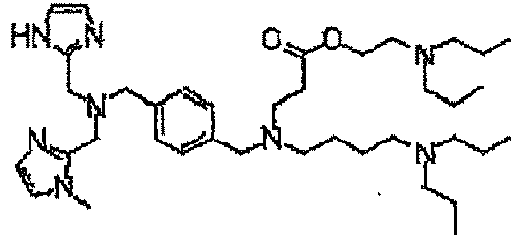
9 
4 
A 
5 
B 
6 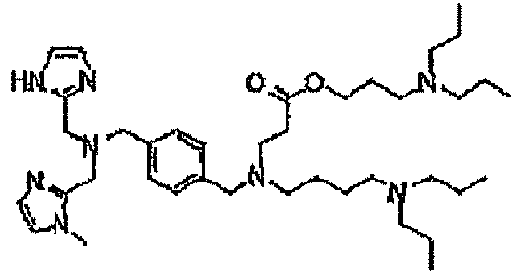
- The amine compound according to the present invention may be in the form of a salt. The amine compound according to the present invention may be in the form of an arbitrary salt as long as the salt is a pharmacologically acceptable salt.
- Examples of the pharmacologically acceptable salt include a trifluoroacetate, a hydrochloride, an acetate, a sulfate, a nitrate, a lactate, a maleate, a methanesulfonate, a toluenesulfonate, a tartrate, a citrate, an oxalate, a malonate, a succinate, a fumarate, a propionate, a butyrate, a salt of glucuronic acid, terephthalic acid, phosphoric acid, and the like. It is preferable that the pharmacologically acceptable salt is a hydrochloride, a maleate, a tartrate, or a citrate. Among them, a citrate is more preferable. The amine compound according to the present invention may form a hydrate or a solvate.
- The amine compound according to the present invention has anti-HIV activity based on CXCR4 antagonism. Specifically, the amine compound according to the present invention is a prodrug of the compound A, which serves as a pharmacologically active substance, and is a compound that has anti-HIV activity based on the CXCR4 antagonism.
- The amine compound according to the present invention is also effective against other diseases that can be treated based on the CXCR4 antagonism. Examples of such diseases include rheumatism, metastatic diseases, and the like.
- The amine compound according to the present invention may be used as an active ingredient for a pharmaceutical preparation that is used to treat or prevent various diseases based on CXCR4 antagonism. The amine compound according to the present invention that is included in the pharmaceutical preparation may be further made chemical modification in part. Specifically, the pharmaceutical preparation may include a prodrug of the amine compound according to the present invention, serving as a pharmacologically active substance.
- The prodrug, for example, may have such a structure: at least one functional group that is metabolized and eliminated in vivo is bonded to an arbitrary nitrogen atom that forms an arbitrary heterocyclic ring or chain of the amine compound represented by the general formula (2). Examples of the functional group include an alkoxycarbonyl group, a dialkylaminosulfone group, and the like.
- The amine compound included as an active ingredient in the pharmaceutical preparation may be in the form of an above-mentioned pharmacologically acceptable salt.
- The pharmaceutical preparation may include a pharmacologically acceptable carrier, a vehicle, a diluent, an extender, a disintegrator, a stabilizer, a preservative, a buffer, an emulsifier, a flavoring agent, a coloring agent, a sweetener, a viscous agent, a flavoring substance, a solubilizer, and the like in addition to the amine compound according to the present invention. Specific examples of such additives include water, vegetable oils, alcohols such as ethanol and benzyl alcohol, glycol, glycerol triacetate, gelatin, carbohydrates such as lactose and starch, magnesium stearate, potassium stearate, talc, lanolin, petroleum jelly, macrogol, crystalline cellulose, hydroxypropyl cellulose, and the like.
- The dosage form of the pharmaceutical preparation is not particularly limited. Examples of the dosage form include a tablet, a powder, granules, a capsule, a pill, a suppository, an injection, eye drops, a liquid medicine, a lozenge, an aerosol, a suspension, an emulsion, medicated syrup, and the like.
- The dosage of the pharmaceutical preparation differs depending on the type and the stage of disease, the compound to be administered, the route of administration, and the age, sex, and weight of the patient. In the general case of oral administration, the dosage preferably lies in the range of 0.1 to 5000 mg per adult, and more preferably in the range of 1 to 3000 mg per adult. In the case of the prodrug of the amine compound according to the present invention, serving as a pharmacologically active substance, the dosage preferably lies in the range of 1 to 5000 mg per adult.
- The present invention is not limited to the above embodiments. Various modifications may be made to the above embodiments within the scope of the invention recited in the claims. A configuration achieved by appropriately combining the technical means disclosed in connection with the embodiments is also intended to be included within the technical scope of the present invention.
- The present invention is further described below by way of examples. Note that the present invention is not limited to the following examples.
- 3-[(4-dipropylaminobutyl)(4-{[(1H-imidazol-2-ylmethyl)(1-methyl-1H-imidazol-2-ylmethyl)amino]methyl}benzyl)amino]propionate (compound No. 1 shown in Table 1 (hereinafter may be referred to as "compound 1")) is described below as Example 1. The compound 1 can be produced by utilizing a known organic chemical reaction. In the examples, a commercially available product (e.g., a product manufactured by Tokyo Chemical Industry Co., Ltd. (Tokyo) or Kanto Kagaku Co., Ltd. (Tokyo)) that is readily available for skilled persons was used as a reagent unless otherwise specified.
- 11.7 g (29.2 mmol) of N-(4-aminomethylbenzyl)-N',N'-dipropylbutane-1,4-diamine trihydrochloride was dissolved in distilled water, washed with toluene, adjusted to a pH of 11 using a sodium hydroxide aqueous solution, and extracted with toluene. The organic layer was dried over anhydrous sodium sulfate, concentrated, and dried under reduced pressure to obtain 8.07 g (27.7 mmol) of a free compound. The compound was dissolved in 81 ml of methanol, and the atmosphere inside the system was replaced with argon. 2.88 ml (1.02 eq) of benzaldehyde was added, followed by the addition of 5.63 ml (2.0 eq) of trimethyl orthoformate, and the mixture was stirred for 25 hours in an argon atmosphere. After completion of the reaction, the solvent was concentrated, and the residue was dried under reduced pressure to obtain 10.45 g of the target compound as a light yellow oily product (99.4%).
MS (Fab., Pos.): m/z=480 [M+H]+
1H-NMR (500 MHz, CDCl3): δ=0.85 (6H, t, J=7.3 Hz), 1.23 (3H, t, J=7.1 Hz), 1.34-1.51 (8H, m), 2.30-2.36 (6H, m), 2.36-2.43 (2H, m), 2.45 (2H, t, J=7.3 Hz), 2.79 (2H, t, J=7.3 Hz), 3.55 (2H, s), 4.10 (2H, q, J=7.1 Hz), 4.81 (2H, s), 7.16-7.32 (4H, m), 7.41-7.43 (3H, m), 7.77-7.80 (2H, m), 8.40 (1H, s). - 10.45 g (27.5 mmol) of the compound synthesized in Production Example 1-1 was dissolved in 200 ml of acetonitrile, and the atmosphere inside the system was replaced with argon. 859 mg (5 mol%) of ytterbium trifluoromethanesulfonate and 6.02 ml (2.0 eq) of ethyl acrylate were added, and the mixture was stirred at room temperature for 92 hours. After completion of the reaction, the solvent was concentrated and 200 ml of toluene was added to the residue. The mixture was washed with a potassium carbonate aqueous solution (pH: 10). The aqueous layer was extracted again with 100 ml of toluene. The resulting organic layer was combined with the organic layer that was previously obtained, and the mixture was washed with distilled water and a saturated sodium chloride solution. The mixture was dried over anhydrous sodium sulfate, concentrated, azeotropically distilled with toluene, and dried under reduced pressure to obtain 13.13 g of the target compound as a light orange oily product (99.5%).
- 13.13 g (27.4 mmol) of the compound synthesized in Production Example 1-2 was dissolved in 39 ml of ethanol. 328 ml (12 eq) of a 1 mol/l hydrochloric acid aqueous solution was added dropwise over 30 minutes under cooling with ice, and the mixture was stirred at room temperature for 5 hours. After completion of the reaction, the solvent was concentrated, and the residue was washed with toluene and ethyl acetate. The pH of the mixture was adjusted to 9 using potassium carbonate, chloroform was added to the aqueous layer, and the resulting organic layer was washed with a saturated sodium chloride solution. The mixture was dried over anhydrous sodium sulfate, the solvent was evaporated, and the residue was dried under reduced pressure to obtain 9.84 g of the target compound as a colorless oily product (91.8%).
- 9.14 g (23.3 mmol) of the compound synthesized in Production Example 1-3 was dissolved in 90 ml of ethanol. 2.35 g (1.05 eq) of 2-imidazolecarboaldehyde and 7.10 ml of trimethyl orthoformate were added, and the mixture was stirred at room temperature for 19 hours. The reaction system was then cooled in an ice bath. 1.32 g (1.5 eq) of sodium borohydride was added, and the mixture was stirred at room temperature for 2 hours.
- After completion of the reaction, 20 ml of concentrated hydrochloric acid and 130 ml of distilled water were added to the mixture under cooling with ice, and the mixture was stirred to quench sodium borohydride. The mixture was neutralized by adding 34 g of potassium carbonate (pH: 10 to 11), and toluene was added to the mixture. The resulting organic layer was washed with distilled water and a saturated sodium chloride solution, and dried over anhydrous sodium sulfate. The solvent was then evaporated, and the residue was dried under reduced pressure, and dissolved in 200 ml of ethanol. 3.03 g (1.2 eq) of 1-methyl-2-imidazolecarboaldehyde and 11.65 g (2.4 eq) of sodium triacetoxyborohydride were added, and the mixture was stirred at room temperature for 3 days.
- After completion of the reaction, the solvent was concentrated so that the amount was approximately halved, and the residue was slowly added to 300 ml of a saturated sodium hydrogen carbonate aqueous solution. Toluene was added, the resulting organic layer was washed with a saturated sodium chloride solution, dried over anhydrous sodium sulfate, and the solvent was evaporated. The residue was purified by silica gel column chromatography (Chromatorex NH: 250 g, chloroform/acetonitrile=2/1) to obtain 10.05 g of the target compound as a colorless oily product (77.6%).
- 4.71 g (8.32 mmol) of the compound synthesized in Production Example 1-4 was dissolved in 47 ml of methanol, 16.6 ml (2 eq) of a 1 mol/l sodium hydroxide aqueous solution was added, and the mixture was stirred at room temperature for 4 hours. After completion of the reaction, the solution was concentrated, and 16.6 ml of 1 mol/l hydrochloric acid was added to the mixture. Sodium chloride was added so that saturation occurred, and then chloroform was added to the mixture. The resulting organic layer was washed with a saturated sodium chloride solution and dried over anhydrous sodium sulfate, and the solvent was evaporated. The residue was dried under vacuum to obtain 3.44 g of the target compound as a colorless viscous liquid (76.9%).
- 0.250 ml (2-fold amount) of dimethylaminoethanol was added to 114.4 mg (0.213 mmol) of the compound synthesized in Production Example 1-5, and the mixture was mixed thoroughly. 1.1 ml of a 4 mol/l hydrogen chloride/dioxane solution was added carefully, and the mixture was stirred at room temperature for 20 hours. After completion of the reaction, the solvent was concentrated, and water was added to the mixture. The mixture was washed with ethyl acetate, and the pH of the mixture was adjusted to 9 using a sodium hydroxide aqueous solution. Ethyl acetate was added to the aqueous layer, and the resulting organic layer was washed with a saturated sodium chloride solution and dried over anhydrous sodium sulfate. The solvent was evaporated, and the residue was purified by silica gel column chromatography (Chromatorex NH, chloroform/acetonitrile=1/1) to obtain 81.2 mg of the target compound as a colorless viscous liquid (62.6%).
MS (Fab., Pos.): m/z=609 [M+H]+
1H-NMR (500 MHz, CDCl3): δ=0.85 (6H, t, J=7.3 Hz), 1.35-1.48 (8H, m), 2.26 (6H, s), 2.26-2.39 (6H, m), 2.42 (2H, t, J=7.6 Hz),, 2.47-2.54 (4H, m), 2.79 (2H, t, J=7.6 Hz), 3.46 (2H, s), 3.55 (5H, s), 3.62 (2H, s), 3.67 (2H, s), 4.14 (2H, t, J=5.6 Hz), 6.87 (1H, d, J=1.2 Hz), 6.99 (1H, d, J=1.2 Hz), 7.08 (1H, brs), 7.12 (1H, brs), 7.26 (2H, d, J=8.1Hz), 7.32 (2H, d, J=8.1 Hz), 12.35 (1H, brs). - 0.5 ml of acetone was added to 88.2 mg (0.420 mmol) of citric acid hydrate, and 0.5 ml of an acetone solution of 101.2 mg (0.166 mmol) of the compound synthesized in Production Example 1-6 was added dropwise to the mixture with stirring. 1.5 ml of acetone was added, and the mixture was stirred at room temperature for 40 minutes. The mixture was then subjected to decantation, and the resulting solid was washed three times with 4 ml of acetone. The solid was dried under reduced pressure to obtain a citrate of the compound 1 as a white solid (181.3 mg (100%)).
1H-NMR (500 MHz, DMSO-d6): δ=0.88 (6H, t, J=7.3 Hz), 1.40-1.47 (2H, m), 1.35-1.48 (8H, m), 2.35-2.42 (2H, m), 2.38 (6H, s), 2.54 (5H, d, J=15.2 Hz), 2.62 (5H, d, J=15.2 Hz), 2.67-2.70 (2H, m), 2.76-2.78 (2H, m), 2.88-2.91 (6H, m), 3.51-3.55 (9H, m), 3.59 (2H, s), 4.15 (2H, t, J=5.6 Hz).6.84 (1H, d, J=1.2 Hz), 7.03 (2H, s), 7.11 (1H, d, J=1.2 Hz), 7.23 (2H, d, J=8.1 Hz), 7.32 (2H, d, J=8.1 Hz). - In Example 2, the amine compound according to the present invention was subjected to an anti-HIV activity test and a hydrolysis test.
- In Test Example 1, the amine compound according to the present invention was subjected to the anti-HIV activity test. The compounds 1, A, and B shown in Table 1 were used.
- HIV-1 IIIB infected MT-4 cells (3.0×10⁴ cells/well, MOI (multiplicity of infection): 0.01) were added to a 96-well microtiter plate together with the test compound (compound 1, A, or B) at a different concentration immediately after infection. After culturing the cells at 37°C for 5 days using a carbon dioxide incubator, the number of viable cells was measured by the MTT (tetrazolium) method (Pawels et al., J. Virol. Method, 20, 309-321, 1988). The results are shown in Table 2.
-
[TABLE 2] Compound No. EC50 (µM) 1 0.003 A 0.003 B 0.003 - In Test Example 2, the compound 1 was subjected to the hydrolysis test. The compound 1 that is an ester is hydrolyzed to the compound A.
- 147 µl of a human serum pool (Cosmo Bio Co., Ltd.) or a pooled serum obtained by centrifuging (3500 rpm×10 min) whole blood collected from a Crj:CD (SD) IGS male rat (Charles River Laboratories Japan, Inc.) was dispensed to a tube. 147 µl of a physiological saline solution (Hikari Pharmaceutical Co., Ltd.) was dispensed to the tube, and the mixture was preincubated for 3 minutes. 3 µl of a solution (concentration: 500 µmol/l) that was prepared by diluting a 25 mmol/l DMSO solution of the compound 1 with a physiological saline solution was added, and the components were mixed. The mixture was reacted for 30 minutes using a thermomixer. 600 µl of a 0.1% formic acid/methanol solution was added, and the components were mixed. The mixture was then centrifuged (15000 rpm×5 min), and the supernatant liquid was subjected to liquid chromatography-mass spectrometry (LCMS). It was confirmed that the compound 1 had been converted into the compound A. The conversion rate (%) into the compound A is shown in Table 3.
-

- It was confirmed by Test Example 1 that the compound 1 had an EC50 of 0.003 µM, and exhibited anti-HIV activity equivalent to that of the compounds A and B. EC50 is the concentration (50% effective concentration) at which cellular damage due to HIV infection is inhibited by 50%.
- It was confirmed by Test Example 2 that the compound 1 was converted into the compound A at a conversion rate of about 100% when using both human serum and rat serum. It was thus confirmed the compound 1 is easily hydrolyzed in human serum, and is highly safe when administered to a human subject.
- The amine compound according to the present invention may suitably be used as an active ingredient of a pharmaceutical preparation that is used to treat or prevent various diseases based on CXCR4 antagonism.
Claims (11)
- An amine compound represented by a general formula (1) or a pharmacologically acceptable salt thereof,wherein n is an integer from 1 to 4, and R1 and R2 represent an alkyl group having 1 to 3 carbon atoms.

- An amine compound or a pharmacologically acceptable salt thereof according to claim 1, wherein n in the general formula (1) is 2 or 3.
- An amine compound or a pharmacologically acceptable salt thereof according to claim 2, wherein n in the general formula (1) is 2, and R1 and R2 in the general formula (1) represent a methyl group or an ethyl group.
- An amine compound or a pharmacologically acceptable salt thereof according to any one of claims 1 to 3, wherein the amine compound represented by the general formula (1) is 2-dimethylaminoethyl 3-[(4-dipropylaminobutyl)(4-{[(1H-imidazol-2-ylmethyl)(1-methyl-1H-imidazol-2-ylmethyl)amino]methyl}benzyl)amino]propionate.
- An amine compound or a pharmacologically acceptable salt thereof according to claim 4, wherein the pharmacologically acceptable salt is a citrate of 2-dimethylaminoethyl 3-[(4-dipropylaminobutyl)(4-{[(1H-imidazol-2-ylmethyl)(1-methyl-1H-imidazol-2-ylmethyl)amino]methyl}benzyl)amino]propionate.
- A pharmaceutical composition comprising as an active ingredient the amine compound or the pharmacologically acceptable salt thereof according to any one of claims 1 to 5.
- A pharmaceutical composition according to claim 6, comprising as a prodrug the amine compound or the pharmacologically acceptable salt thereof according to any one of claims 1 to 5.
- A CXCR4 antagonist comprising as an active ingredient the amine compound or the pharmacologically acceptable salt thereof according to any one of claims 1 to 5.
- An antiviral drug comprising as an active ingredient the amine compound or the pharmacologically acceptable salt thereof according to any one of claims 1 to 5.
- An anti-rheumatic disease agent based on CXCR4 antagonism, the anti-rheumatic disease agent comprising as an active ingredient the amine compound or the pharmacologically acceptable salt thereof according to any one of claims 1 to 5.
- An anti-metastatic disease agent based on CXCR4 antagonism, comprising as an active ingredient the amine compound or the pharmacologically acceptable salt thereof according to any one of claims 1 to 5.
Applications Claiming Priority (2)
| Application Number | Priority Date | Filing Date | Title |
|---|---|---|---|
| JP2010226370 | 2010-10-06 | ||
| PCT/JP2011/072563 WO2012046653A1 (en) | 2010-10-06 | 2011-09-30 | Amine compound and use for same |
Publications (2)
| Publication Number | Publication Date |
|---|---|
| EP2626349A1 true EP2626349A1 (en) | 2013-08-14 |
| EP2626349A4 EP2626349A4 (en) | 2014-03-12 |
Family
ID=45927649
Family Applications (1)
| Application Number | Title | Priority Date | Filing Date |
|---|---|---|---|
| EP11830585.3A Withdrawn EP2626349A4 (en) | 2010-10-06 | 2011-09-30 | Amine compound and use for same |
Country Status (4)
| Country | Link |
|---|---|
| US (1) | US8722719B2 (en) |
| EP (1) | EP2626349A4 (en) |
| JP (1) | JPWO2012046653A1 (en) |
| WO (1) | WO2012046653A1 (en) |
Family Cites Families (4)
| Publication number | Priority date | Publication date | Assignee | Title |
|---|---|---|---|---|
| KR100863667B1 (en) | 2002-09-11 | 2008-10-15 | 가부시끼가이샤 구레하 | Amine Compound and Use Thereof |
| KR101149124B1 (en) | 2004-03-10 | 2012-05-25 | 가부시끼가이샤 구레하 | Amine basic compound and use thereof |
| DOP2006000016A (en) * | 2005-01-26 | 2006-07-31 | Aventis Pharma Inc | 2-PHENYL-INDOLES AS ANTAGONISTS OF THE PROSTAGLANDIN RECEPTOR D2. |
| WO2010028458A1 (en) * | 2008-09-12 | 2010-03-18 | Parnell Laboratories (Aust) Pty Ltd | Prodrugs of isoxazolyl penicillins and uses thereof |
-
2011
- 2011-09-30 EP EP11830585.3A patent/EP2626349A4/en not_active Withdrawn
- 2011-09-30 US US13/878,131 patent/US8722719B2/en not_active Expired - Fee Related
- 2011-09-30 JP JP2012537676A patent/JPWO2012046653A1/en active Pending
- 2011-09-30 WO PCT/JP2011/072563 patent/WO2012046653A1/en not_active Ceased
Non-Patent Citations (2)
| Title |
|---|
| No further relevant documents disclosed * |
| See also references of WO2012046653A1 * |
Also Published As
| Publication number | Publication date |
|---|---|
| WO2012046653A1 (en) | 2012-04-12 |
| EP2626349A4 (en) | 2014-03-12 |
| US8722719B2 (en) | 2014-05-13 |
| US20130245280A1 (en) | 2013-09-19 |
| JPWO2012046653A1 (en) | 2014-02-24 |
Similar Documents
| Publication | Publication Date | Title |
|---|---|---|
| RU2213743C2 (en) | Derivative of thienylazolylalkoxyethaneamine, method for its preparing (variants), pharmaceutical composition, intermediate compound and method for its preparing (variants) | |
| JP2017128605A (en) | Solid forms of antiviral compound | |
| CN114375193B (en) | Thyroid hormone receptor beta agonist compounds | |
| US12391661B2 (en) | Cystine diamide analogs for the prevention of cystine stone formation in cystinuria | |
| JPH0136819B2 (en) | ||
| TW470742B (en) | Benzimidazole derivatives, preparation and pharmaceutical compositions thereof | |
| HUP0000312A2 (en) | Guanidyl heterocyclic compounds that can be used as alpha-2-adrenoreceptor agonists and pharmaceutical preparations containing these compounds | |
| KR20170023184A (en) | Substituted 2-thioxo-imidazolidin-4-ones and spiro analogues thereof, active anti-cancer ingredient, pharmaceutical composition, medicinal preparation, method for treating prostate cancer | |
| US8329710B2 (en) | Metformin folate and preparation of the same | |
| JP2023529011A (en) | Indene compounds, pharmaceutical compositions thereof, and their therapeutic applications | |
| CA3075813A1 (en) | Small molecule inhibition of transcription factor sall4 and uses thereof | |
| EP2062885A1 (en) | Acid addition salts of imatinib and formulations comprising the same | |
| EP4606798A1 (en) | Benzoisothiazole compound, and pharmaceutical composition and use thereof | |
| HUP0002966A2 (en) | [(2-imidazolidinylidene)-amino]-benzoxazole derivatives that can be used as alpha-2-adrenoreceptor agonists and pharmaceutical preparations containing them | |
| WO1998011083A1 (en) | 4-substituted-2,7-dideoxy-7-fluoro-2,3-didehydrosialic acids | |
| CN112047993A (en) | Alpha-glucosidase inhibitor and application thereof | |
| CN114181161B (en) | (2- ((substituted oxy) phenyl) amino) pyrimidin-4-yl) aminobenzoyl derivative and preparation method and application thereof | |
| IE45556B1 (en) | 2-n-(cycloalkylmethyl)-n-(phenyl)-amino)-2-imidazoline derivatives,methods for their preparation and compositions containing them | |
| EP1902054B1 (en) | Derivatives of pyrido[2,3-d]pyrimidine, the preparation thereof and the therapeutic application of the same | |
| US20220009951A1 (en) | Torsemide phosphate prodrug, preparation method and composition thereof | |
| US8722719B2 (en) | Amine compound and use for same | |
| JPS6334865B2 (en) | ||
| KR20040074134A (en) | 2'-Halo-3', 5'-dialkoxyphen-1'-yl-imino-2-imidazolidine derivatives and the use thereof for the treatment of urinary incontinence | |
| JPH11505240A (en) | Drugs for weight loss | |
| EP4631949A1 (en) | Compound, nanoparticles, medicine and method for producing nanoparticles |
Legal Events
| Date | Code | Title | Description |
|---|---|---|---|
| PUAI | Public reference made under article 153(3) epc to a published international application that has entered the european phase |
Free format text: ORIGINAL CODE: 0009012 |
|
| 17P | Request for examination filed |
Effective date: 20130327 |
|
| AK | Designated contracting states |
Kind code of ref document: A1 Designated state(s): AL AT BE BG CH CY CZ DE DK EE ES FI FR GB GR HR HU IE IS IT LI LT LU LV MC MK MT NL NO PL PT RO RS SE SI SK SM TR |
|
| DAX | Request for extension of the european patent (deleted) | ||
| A4 | Supplementary search report drawn up and despatched |
Effective date: 20140206 |
|
| RIC1 | Information provided on ipc code assigned before grant |
Ipc: A61P 31/18 20060101ALI20140131BHEP Ipc: A61P 43/00 20060101ALI20140131BHEP Ipc: C07D 233/64 20060101AFI20140131BHEP Ipc: A61K 31/4164 20060101ALI20140131BHEP |
|
| GRAP | Despatch of communication of intention to grant a patent |
Free format text: ORIGINAL CODE: EPIDOSNIGR1 |
|
| INTG | Intention to grant announced |
Effective date: 20150209 |
|
| STAA | Information on the status of an ep patent application or granted ep patent |
Free format text: STATUS: THE APPLICATION IS DEEMED TO BE WITHDRAWN |
|
| 18D | Application deemed to be withdrawn |
Effective date: 20150620 |