EP2624696B1 - Benzimidazole derivatives as pi3 kinase inhibitors - Google Patents
Benzimidazole derivatives as pi3 kinase inhibitors Download PDFInfo
- Publication number
- EP2624696B1 EP2624696B1 EP11831214.9A EP11831214A EP2624696B1 EP 2624696 B1 EP2624696 B1 EP 2624696B1 EP 11831214 A EP11831214 A EP 11831214A EP 2624696 B1 EP2624696 B1 EP 2624696B1
- Authority
- EP
- European Patent Office
- Prior art keywords
- cancer
- leukemia
- cell
- compound
- methyl
- Prior art date
- Legal status (The legal status is an assumption and is not a legal conclusion. Google has not performed a legal analysis and makes no representation as to the accuracy of the status listed.)
- Active
Links
- VLGGDEVMCXSOHS-UHFFFAOYSA-N Cc([nH]c1cc(N2CCOCC2)c2)nc1c2C(OC)=O Chemical compound Cc([nH]c1cc(N2CCOCC2)c2)nc1c2C(OC)=O VLGGDEVMCXSOHS-UHFFFAOYSA-N 0.000 description 1
- XTKLTGBKIDQGQL-UHFFFAOYSA-N Cc1nc(c(C(O)=O)cc(N2CCOCC2)c2)c2[n]1Cc1c(C)c(C(F)(F)F)ccc1 Chemical compound Cc1nc(c(C(O)=O)cc(N2CCOCC2)c2)c2[n]1Cc1c(C)c(C(F)(F)F)ccc1 XTKLTGBKIDQGQL-UHFFFAOYSA-N 0.000 description 1
Classifications
-
- A—HUMAN NECESSITIES
- A61—MEDICAL OR VETERINARY SCIENCE; HYGIENE
- A61K—PREPARATIONS FOR MEDICAL, DENTAL OR TOILETRY PURPOSES
- A61K31/00—Medicinal preparations containing organic active ingredients
- A61K31/33—Heterocyclic compounds
- A61K31/395—Heterocyclic compounds having nitrogen as a ring hetero atom, e.g. guanethidine or rifamycins
- A61K31/535—Heterocyclic compounds having nitrogen as a ring hetero atom, e.g. guanethidine or rifamycins having six-membered rings with at least one nitrogen and one oxygen as the ring hetero atoms, e.g. 1,2-oxazines
- A61K31/5375—1,4-Oxazines, e.g. morpholine
- A61K31/5377—1,4-Oxazines, e.g. morpholine not condensed and containing further heterocyclic rings, e.g. timolol
-
- A—HUMAN NECESSITIES
- A61—MEDICAL OR VETERINARY SCIENCE; HYGIENE
- A61K—PREPARATIONS FOR MEDICAL, DENTAL OR TOILETRY PURPOSES
- A61K31/00—Medicinal preparations containing organic active ingredients
- A61K31/33—Heterocyclic compounds
- A61K31/335—Heterocyclic compounds having oxygen as the only ring hetero atom, e.g. fungichromin
- A61K31/337—Heterocyclic compounds having oxygen as the only ring hetero atom, e.g. fungichromin having four-membered rings, e.g. taxol
-
- A—HUMAN NECESSITIES
- A61—MEDICAL OR VETERINARY SCIENCE; HYGIENE
- A61P—SPECIFIC THERAPEUTIC ACTIVITY OF CHEMICAL COMPOUNDS OR MEDICINAL PREPARATIONS
- A61P29/00—Non-central analgesic, antipyretic or antiinflammatory agents, e.g. antirheumatic agents; Non-steroidal antiinflammatory drugs [NSAID]
-
- A—HUMAN NECESSITIES
- A61—MEDICAL OR VETERINARY SCIENCE; HYGIENE
- A61P—SPECIFIC THERAPEUTIC ACTIVITY OF CHEMICAL COMPOUNDS OR MEDICINAL PREPARATIONS
- A61P35/00—Antineoplastic agents
-
- A—HUMAN NECESSITIES
- A61—MEDICAL OR VETERINARY SCIENCE; HYGIENE
- A61P—SPECIFIC THERAPEUTIC ACTIVITY OF CHEMICAL COMPOUNDS OR MEDICINAL PREPARATIONS
- A61P35/00—Antineoplastic agents
- A61P35/02—Antineoplastic agents specific for leukemia
-
- A—HUMAN NECESSITIES
- A61—MEDICAL OR VETERINARY SCIENCE; HYGIENE
- A61P—SPECIFIC THERAPEUTIC ACTIVITY OF CHEMICAL COMPOUNDS OR MEDICINAL PREPARATIONS
- A61P37/00—Drugs for immunological or allergic disorders
-
- C—CHEMISTRY; METALLURGY
- C07—ORGANIC CHEMISTRY
- C07D—HETEROCYCLIC COMPOUNDS
- C07D235/00—Heterocyclic compounds containing 1,3-diazole or hydrogenated 1,3-diazole rings, condensed with other rings
- C07D235/02—Heterocyclic compounds containing 1,3-diazole or hydrogenated 1,3-diazole rings, condensed with other rings condensed with carbocyclic rings or ring systems
- C07D235/04—Benzimidazoles; Hydrogenated benzimidazoles
- C07D235/06—Benzimidazoles; Hydrogenated benzimidazoles with only hydrogen atoms, hydrocarbon or substituted hydrocarbon radicals, directly attached in position 2
- C07D235/08—Radicals containing only hydrogen and carbon atoms
-
- C—CHEMISTRY; METALLURGY
- C07—ORGANIC CHEMISTRY
- C07D—HETEROCYCLIC COMPOUNDS
- C07D235/00—Heterocyclic compounds containing 1,3-diazole or hydrogenated 1,3-diazole rings, condensed with other rings
- C07D235/02—Heterocyclic compounds containing 1,3-diazole or hydrogenated 1,3-diazole rings, condensed with other rings condensed with carbocyclic rings or ring systems
- C07D235/04—Benzimidazoles; Hydrogenated benzimidazoles
- C07D235/06—Benzimidazoles; Hydrogenated benzimidazoles with only hydrogen atoms, hydrocarbon or substituted hydrocarbon radicals, directly attached in position 2
- C07D235/10—Radicals substituted by halogen atoms or nitro radicals
-
- C—CHEMISTRY; METALLURGY
- C07—ORGANIC CHEMISTRY
- C07D—HETEROCYCLIC COMPOUNDS
- C07D235/00—Heterocyclic compounds containing 1,3-diazole or hydrogenated 1,3-diazole rings, condensed with other rings
- C07D235/02—Heterocyclic compounds containing 1,3-diazole or hydrogenated 1,3-diazole rings, condensed with other rings condensed with carbocyclic rings or ring systems
- C07D235/04—Benzimidazoles; Hydrogenated benzimidazoles
- C07D235/24—Benzimidazoles; Hydrogenated benzimidazoles with hetero atoms or with carbon atoms having three bonds to hetero atoms with at the most one bond to halogen, e.g. ester or nitrile radicals, directly attached in position 2
-
- C—CHEMISTRY; METALLURGY
- C07—ORGANIC CHEMISTRY
- C07D—HETEROCYCLIC COMPOUNDS
- C07D401/00—Heterocyclic compounds containing two or more hetero rings, having nitrogen atoms as the only ring hetero atoms, at least one ring being a six-membered ring with only one nitrogen atom
- C07D401/02—Heterocyclic compounds containing two or more hetero rings, having nitrogen atoms as the only ring hetero atoms, at least one ring being a six-membered ring with only one nitrogen atom containing two hetero rings
- C07D401/10—Heterocyclic compounds containing two or more hetero rings, having nitrogen atoms as the only ring hetero atoms, at least one ring being a six-membered ring with only one nitrogen atom containing two hetero rings linked by a carbon chain containing aromatic rings
-
- C—CHEMISTRY; METALLURGY
- C07—ORGANIC CHEMISTRY
- C07D—HETEROCYCLIC COMPOUNDS
- C07D403/00—Heterocyclic compounds containing two or more hetero rings, having nitrogen atoms as the only ring hetero atoms, not provided for by group C07D401/00
- C07D403/02—Heterocyclic compounds containing two or more hetero rings, having nitrogen atoms as the only ring hetero atoms, not provided for by group C07D401/00 containing two hetero rings
- C07D403/04—Heterocyclic compounds containing two or more hetero rings, having nitrogen atoms as the only ring hetero atoms, not provided for by group C07D401/00 containing two hetero rings directly linked by a ring-member-to-ring-member bond
-
- C—CHEMISTRY; METALLURGY
- C07—ORGANIC CHEMISTRY
- C07D—HETEROCYCLIC COMPOUNDS
- C07D403/00—Heterocyclic compounds containing two or more hetero rings, having nitrogen atoms as the only ring hetero atoms, not provided for by group C07D401/00
- C07D403/02—Heterocyclic compounds containing two or more hetero rings, having nitrogen atoms as the only ring hetero atoms, not provided for by group C07D401/00 containing two hetero rings
- C07D403/10—Heterocyclic compounds containing two or more hetero rings, having nitrogen atoms as the only ring hetero atoms, not provided for by group C07D401/00 containing two hetero rings linked by a carbon chain containing aromatic rings
-
- C—CHEMISTRY; METALLURGY
- C07—ORGANIC CHEMISTRY
- C07D—HETEROCYCLIC COMPOUNDS
- C07D405/00—Heterocyclic compounds containing both one or more hetero rings having oxygen atoms as the only ring hetero atoms, and one or more rings having nitrogen as the only ring hetero atom
- C07D405/02—Heterocyclic compounds containing both one or more hetero rings having oxygen atoms as the only ring hetero atoms, and one or more rings having nitrogen as the only ring hetero atom containing two hetero rings
- C07D405/04—Heterocyclic compounds containing both one or more hetero rings having oxygen atoms as the only ring hetero atoms, and one or more rings having nitrogen as the only ring hetero atom containing two hetero rings directly linked by a ring-member-to-ring-member bond
-
- C—CHEMISTRY; METALLURGY
- C07—ORGANIC CHEMISTRY
- C07D—HETEROCYCLIC COMPOUNDS
- C07D405/00—Heterocyclic compounds containing both one or more hetero rings having oxygen atoms as the only ring hetero atoms, and one or more rings having nitrogen as the only ring hetero atom
- C07D405/02—Heterocyclic compounds containing both one or more hetero rings having oxygen atoms as the only ring hetero atoms, and one or more rings having nitrogen as the only ring hetero atom containing two hetero rings
- C07D405/10—Heterocyclic compounds containing both one or more hetero rings having oxygen atoms as the only ring hetero atoms, and one or more rings having nitrogen as the only ring hetero atom containing two hetero rings linked by a carbon chain containing aromatic rings
-
- C—CHEMISTRY; METALLURGY
- C07—ORGANIC CHEMISTRY
- C07D—HETEROCYCLIC COMPOUNDS
- C07D409/00—Heterocyclic compounds containing two or more hetero rings, at least one ring having sulfur atoms as the only ring hetero atoms
- C07D409/02—Heterocyclic compounds containing two or more hetero rings, at least one ring having sulfur atoms as the only ring hetero atoms containing two hetero rings
- C07D409/10—Heterocyclic compounds containing two or more hetero rings, at least one ring having sulfur atoms as the only ring hetero atoms containing two hetero rings linked by a carbon chain containing aromatic rings
-
- C—CHEMISTRY; METALLURGY
- C07—ORGANIC CHEMISTRY
- C07D—HETEROCYCLIC COMPOUNDS
- C07D413/00—Heterocyclic compounds containing two or more hetero rings, at least one ring having nitrogen and oxygen atoms as the only ring hetero atoms
- C07D413/02—Heterocyclic compounds containing two or more hetero rings, at least one ring having nitrogen and oxygen atoms as the only ring hetero atoms containing two hetero rings
- C07D413/04—Heterocyclic compounds containing two or more hetero rings, at least one ring having nitrogen and oxygen atoms as the only ring hetero atoms containing two hetero rings directly linked by a ring-member-to-ring-member bond
-
- C—CHEMISTRY; METALLURGY
- C07—ORGANIC CHEMISTRY
- C07D—HETEROCYCLIC COMPOUNDS
- C07D413/00—Heterocyclic compounds containing two or more hetero rings, at least one ring having nitrogen and oxygen atoms as the only ring hetero atoms
- C07D413/02—Heterocyclic compounds containing two or more hetero rings, at least one ring having nitrogen and oxygen atoms as the only ring hetero atoms containing two hetero rings
- C07D413/10—Heterocyclic compounds containing two or more hetero rings, at least one ring having nitrogen and oxygen atoms as the only ring hetero atoms containing two hetero rings linked by a carbon chain containing aromatic rings
-
- C—CHEMISTRY; METALLURGY
- C07—ORGANIC CHEMISTRY
- C07D—HETEROCYCLIC COMPOUNDS
- C07D417/00—Heterocyclic compounds containing two or more hetero rings, at least one ring having nitrogen and sulfur atoms as the only ring hetero atoms, not provided for by group C07D415/00
- C07D417/02—Heterocyclic compounds containing two or more hetero rings, at least one ring having nitrogen and sulfur atoms as the only ring hetero atoms, not provided for by group C07D415/00 containing two hetero rings
- C07D417/04—Heterocyclic compounds containing two or more hetero rings, at least one ring having nitrogen and sulfur atoms as the only ring hetero atoms, not provided for by group C07D415/00 containing two hetero rings directly linked by a ring-member-to-ring-member bond
-
- C—CHEMISTRY; METALLURGY
- C07—ORGANIC CHEMISTRY
- C07D—HETEROCYCLIC COMPOUNDS
- C07D417/00—Heterocyclic compounds containing two or more hetero rings, at least one ring having nitrogen and sulfur atoms as the only ring hetero atoms, not provided for by group C07D415/00
- C07D417/02—Heterocyclic compounds containing two or more hetero rings, at least one ring having nitrogen and sulfur atoms as the only ring hetero atoms, not provided for by group C07D415/00 containing two hetero rings
- C07D417/10—Heterocyclic compounds containing two or more hetero rings, at least one ring having nitrogen and sulfur atoms as the only ring hetero atoms, not provided for by group C07D415/00 containing two hetero rings linked by a carbon chain containing aromatic rings
Definitions
- This invention relates to the use of a benzimidazole derivative for the modulation, notably the inhibition of the activity or function of the phosphoinositide 3' OH kinase family (hereinafter PI3 kinases), suitably, PI3K ⁇ , PI3K ⁇ , PI3K ⁇ , and/or PI3K ⁇ .
- PI3 kinases phosphoinositide 3' OH kinase family
- the present invention relates to the use of a benzimidazole in the treatment of one or more disease states selected from: autoimmune disorders, inflammatory diseases, cardiovascular diseases, neurodegenerative diseases, allergy, asthma, pancreatitis, multiorgan failure, kidney diseases, platelet aggregation, cancer, sperm motility, transplantation rejection, graft rejection and lung injuries. More suitably, the present invention relates to a PI3K ⁇ selective benzimidazole compound for treating cancer.
- PI3K phosphoinositide 3-kinase pathway
- PIP3 is a critical second messenger which recruits proteins that contain pleckstrin homology domains to the cell membrane where they are activated. The most studied of these proteins is AKT which promotes cell survival, growth, and proliferation.
- the PI3K family consists of 15 proteins that share sequence homology, particularly within their kinase domains, but have distinct substrate specificities and modes of regulation ( Vivanco I and Sawyers CL. The phosphatidylinositol 3-kinase-AKT pathway in human cancer. Nature Reviews Cancer, 2002;2:489-501 ).
- Class I PI3Ks are heterodimers consisting of a p110 catalytic subunit complexed to one of several regulatory subunits collectively referred to as p85 and have been the most extensively studied in the context of tumorgenesis.
- the class 1A PI3K catalytic subunits comprise the p110 ⁇ , p110 ⁇ , and p110 ⁇ isoforms, which associate with one of five different regulatory subunits encoded by three separate genes.
- a single class 1B PI3K catalytic isoform p110 ⁇ interacts with one of two associated regulatory subunits (Crabbe T, Welham MJ, Ward SG, The PI3k inhibitor arsenal: choose your weapon Trends in Biochem Sci, 2007;32:450-456 ).
- Class 1 PI3Ks are primarily responsible for phosphorylating the critical PIP2 signaling molecule.
- PI3K pathway The link between the PI3K pathway and cancer was confirmed by a study which identified somatic mutations in the PIK3CA gene encoding the p110 ⁇ protein. Subsequently, mutations in PIK3CA have been identified in numerous cancers including colorectal, breast, glioblastomas ovarian and lung. In contrast to PIK3CA, no somatic mutations in the ⁇ isoform have been identified.
- p110 ⁇ was reported to be essential to the transformed phenotype in a PTEN-null prostate cancer model ( Jia S, Liu Z, Zhang S, Liu P, Zhang L, et al., Essential roles of PI(3)K-p110b in cell growth, metabolism and tumorgenesis. Nature 2008;10:1038 ).
- fibrogenesis including systemic sclerosis (SSc), arthritis, nephropahty, liver cirrhosis, and some cancers, are related to PTEN deficiency and corresponding PI3K-Akt overexpression ( Parapuram, S.K., et al., Loss of PTEN expression by dermal fibroblasts cuases skin fibrosis. J. of Investigative Dermatology, advance online publication 9 June 2011; doi: 10.1038/jid.2011.156 ). Taken together, these findings indicate PI3K p110 ⁇ as a promising target for cancer and other syndromes related to PTEN loss ( Hollander, M.
- US20070066606A1 discloses benzyl-benzimidazolyl derivatives which are stated to be inhibitors of tyrosine kinases, useful for the treatment of tumours.
- US7223757B2 discloses benzimidazole compounds which are stated to be inhibitors of tyrosine kinases, useful as anti-cancer agents.
- the present invention relates to the compound, 2-methyl-1- ⁇ [2-methyl-3-(trifluoromethyl)phenyl]methyl ⁇ -6-(4-morpholinyl)-1H-benzimidazole-4-carboxylic acid represented by the formula: or a pharmaceutically acceptable salt thereof.
- a compound of formula (Ia) or a pharmaceutically acceptable salt thereof for use in the treatment of a susceptible neoplasm in a mammal in need thereof.
- a compound of formula (Ia) or a pharmaceutically acceptable salt thereof in the preparation of a medicament for use in the treatment of a susceptible neoplasm in a mammal in need thereof.
- a pharmaceutical composition comprising a compound of formula (Ia) or a pharmaceutically acceptable salt thereof for use in the treatment of a susceptible neoplasm in a mammal in need thereof.
- the invention relates to the compound, 2-methyl-1- ⁇ [2-methyl-3-(trifluoromethyl)phenyl]methyl ⁇ -6-(4-morpholinyl)-1H-benzimidazole-4-carboxylic acid represented by the formula or a pharmaceutically acceptable salt thereof.
- aryl aromatic, hydrocarbon, ring system.
- the ring system may be monocyclic or fused polycyclic (e.g. bicyclic, tricyclic, etc.).
- the monocyclic aryl ring is C5-C10, or C5-C7, or C5-C6, where these carbon numbers refer to the number of carbon atoms that form the ring system.
- a C6 ring system i.e. a phenyl ring is a suitable aryl group.
- the polycyclic ring is a bicyclic aryl group, where suitable bicyclic aryl groups are C8-C12, or C9-C10.
- a naphthyl ring, which has 10 carbon atoms, is a suitable polycyclic aryl group.
- heteroaryl an aromatic ring system containing carbon(s) and at least one heteroatom.
- Heteroaryl may be monocyclic or polycyclic.
- a monocyclic heteroaryl group may have 1 to 4 heteroatoms in the ring, while a polycyclic heteroaryl may contain 1 to 10 hetero atoms.
- a polycyclic heteroaryl ring may contain fused, spiro or bridged ring junctions, for example, bicyclic heteroaryl is a polycyclic heteroaryl.
- Bicyclic heteroaryl rings may contain from 8 to 12 member atoms.
- Monocyclic heteroaryl rings may contain from 5 to 8 member atoms (carbons and heteroatoms).
- heteroaryl groups include: benzofuran, benzothiene, benzothiophene, furan, imidazole, indole, isothiazole, oxazole, pyrazine, pyrazole, pyridazine, pyridine, pyrimidine, pyrrole, quinoline, isoquinoline, quinazoline, quinoxaline, thiazole, and thiophene.
- heteroaryls may be substituted with one to three alkyl groups.
- alkoxy as used herein is meant -O(alkyl) including -OCH 3 ,-OCH 2 CH 3 and -OC(CH 3 ) 3 where alkyl is as described herein.
- heteroatom oxygen, nitrogen or sulfur.
- halogen as used herein is meant a substituent selected from bromide, iodide, chloride and fluoride.
- alkyl and derivatives thereof and in all carbon chains as used herein, including alkyl chains defined by the term “-(CH 2 ) n “, “-(CH 2 ) m “ and the like, is meant a linear or branched, saturated or unsaturated hydrocarbon chain, and unless otherwise defined, the carbon chain will contain from 1 to 12 carbon atoms.
- co-administering and derivatives thereof as used herein is meant either simultaneous administration or any manner of separate sequential administration of a PI3 kinase inhibiting compound, as described herein, and a further active ingredient or ingredients.
- further active ingredient or ingredients includes any compound or therapeutic agent known to or that demonstrates advantageous properties when administered to a patient in need of treatment.
- the compounds are administered in a close time proximity to each other.
- the compounds are administered in the same dosage form, e.g. one compound may be administered topically and another compound may be administered orally.
- compound as used herein includes all isomers of the compound. Examples of such isomers include: enantiomers, tautomers, rotamers.
- Certain compounds described herein may contain one or more chiral atoms, or may otherwise be capable of existing as two enantiomers, or two or more diastereoisomers. Accordingly, the compounds of of Formula (I) disclosed include mixtures of enantiomers/diastereoisomers as well as purified enantiomers/diastereoisomers or enantiomerically/diastereoisomerically enriched mixtures. Also disclosed are the individual isomers of the compounds represented by Formula (I) above as well as any wholly or partially equilibrated mixtures thereof. Also disclosed are the individual isomers of the compounds represented by Formula (I) above as mixtures with isomers thereof in which one or more chiral centers are inverted. The present invention also includes isotopomers of the compounds of Formula (Ia). Examples of such isotopomers include but not limited to compounds with one of more deuterium atoms.
- a compound of Formula (Ia) is included in the pharmaceutical compositions of the invention.
- pharmaceutically acceptable esters can be employed, for example methyl, ethyl, pivaloyloxymethyl, and the like for -COOH, and acetate maleate and the like for -OH, and those esters known in the art for modifying solubility or hydrolysis characteristics, for use as sustained release or prodrug formulations.
- the compounds of formula (I) may be utilized as a pharmaceutically acceptable salt version thereof.
- the pharmaceutically acceptable salts of the compounds of formula (I) include conventional salts formed from pharmaceutically acceptable (i.e., non-toxic) inorganic or organic acids or bases as well as quaternary ammonium salts.
- Representative salts include the following: acetate, benzenesulfonate, benzoate, bicarbonate, bisulfate, bitartrate, borate, bromide, calcium edetate, camsylate, carbonate, chloride, clavulanate, citrate, dihydrochloride, edetate, edisylate, estolate, esylate, ethanol amine, fumarate, gluceptate, gluconate, glutamate, glycollylarsanilate, hexylresorcinate, hydrabamine, hydrobromide, hydrochloride, hydroxynaphthoate, iodide, isethionate, lactate, lactobionate, laurate, malate, maleate, mandelate, mesylate (methanesulfonate), methylbromide, methylnitrate, methylsulfate, monopotassium maleate, mucate, napsylate, nitrate
- the compound of formula (I) is in the form of the free base.
- the compound of formula (I) is in the form of the tris salt, i.e. tris(hydroxymethyl)aminomethane.
- the compound of formula (I) is in the form of the sulfate salt.
- the compound of formula (I) is in the form of the hydrochloride salt.
- the compound of formula (I) is in the form of the sodium salt.
- Certain salt versions of the compounds may be solvates, particularly hydrates.
- the compound of formula (I) or a pharmaceutically acceptable salt thereof is in the form of a mono-, di-, tri- or hemihydrate.
- compounds of Formula (I) are inhibitors of the Phosphatoinositides 3-kinases (PI3Ks).
- PI3Ks Phosphatoinositides 3-kinases
- PI3K phosphatoinositides 3-kinase
- the compound of the present invention is therefore useful in the treatment of autoimmune disorders, inflammatory diseases, cardiovascular diseases, neurodegenerative diseases, allergy, asthma, pancreatitis, multiorgan failure, kidney diseases, platelet aggregation, cancer, sperm motility, transplantation rejection, graft rejection and lung injuries.
- Compounds according to Formula (I) are suitable for the modulation, notably the inhibition of the activity of phosphatoinositides 3-kinases (PI3K) and, more particularly, selective inhibitors of the beta isoform of phosphatoinositides 3-kinase (PI3K ⁇ ). Therefore the compound of the present invention is also useful for the treatment of disorders which are mediated by PI3Ks. Said treatment involves the modulation - notably the inhibition or the down regulation - of the phosphatoinositides 3-kinases.
- the pharmaceutically active compound of the present invention is active as a PI3 kinase inhibitor, particularly inhibiting PI3K ⁇ , either selectively or in conjunction with one or more of PI3K ⁇ , PI3K ⁇ , and/or PI3K ⁇ , it exhibits therapeutic utility in treatment of susceptible neoplasms, particularly those neoplasms that exhibit a PTEN deficiency.
- PTEN deficient or “PTEN deficiency” shall describe tumors with deficiencies of the tumor suppressor function of PTEN (Phosphatase and Tensin Homolog). Such deficiency includes mutation in the PTEN gene, reduction or absence of PTEN proteins when compared to PTEN wild-type, or mutation or absence of other genes that cause suppression of PTEN function.
- treatment refers to alleviating the specified condition, eliminating or reducing the symptoms of the condition, slowing or eliminating the progression, invasion, or metastatic spread of the condition and preventing or delaying the reoccurrence of the condition in a previously afflicted subject.
- the present invention further provides use of the compound of the invention for the preparation of a medicament for the treatment of several conditions in a mammal (e.g., human) in need thereof.
- “Susceptible neoplasm” as used herein refers to neoplasms which are susceptible to treatment by a kinase inhibitor and particularly neoplasms that are susceptible to treatment by a PI3K ⁇ inhibitor.
- Neoplasms which have been associated with inappropriate activity of the PTEN phosphatase and particularly neoplasms which exhibit mutation of PTEN, or mutation of an upstream activator of PI3K ⁇ kinase or overexpression of an upstream activator of PI3K ⁇ kinase, and are therefore susceptible to treatment with an PI3K ⁇ inhibitor are known in the art, and include both primary and metastatic tumors and cancers. According to one embodiment, description of the treatment of a susceptible neoplasm may be used interchangeably with description of the treatment of a cancer.
- susceptible neoplasms includes, but are not limited to PTEN-defiecient neoplasms listed as follows:
- the term "susceptible neoplasm” includes and is limited to hormone refractory prostate cancer, non-small-cell lung cancer, endometrial cancer, gastric cancer, melanoma, head and neck cancer, breast cancer, including trip-negative breast cancer, and glioma.
- PTEN deficiency has been correlated to such cancers as demonstrated in a number of published resources, e.g. Am J Clin Pathol. 2009 Feb;131(2):257-63 (glioblastoma), J Clin Neurosci. 2010 Dec;17(12):1543-7 (glioblastoma), Nat Genet. 2009 May;41(5):619-24 (prostate cancer), Br J Cancer.
- a method of treating a susceptible neoplasm in a mammal in need thereof comprising administering to the mammal a therapeutically effective amount of a compound of formula (I) or a pharmaceutically acceptable salt thereof.
- Fibrosis includes, alternatively or collectively, systemic sclerosis (SSc), arthritis, nephropahty, and liver cirrhosis.
- SSc systemic sclerosis
- Disclosed herein is a method of treating hormone refractory prostate cancer in a mammal in need thereof, comprising administering to the mammal a therapeutically effective amount of a compound of formula (I) or a pharmaceutically acceptable salt thereof.
- Disclosed herein is a method of treating non-small-cell lung cancer in a mammal in need thereof, comprising administering to the mammal a therapeutically effective amount of a compound of formula (I) or a pharmaceutically acceptable salt thereof.
- a method of treating endometrial cancer in a mammal in need thereof comprising administering to the mammal a therapeutically effective amount of a compound of formula (I) or a pharmaceutically acceptable salt thereof.
- Disclosed herein is a method of treating gastric cancer in a mammal in need thereof, comprising administering to the mammal a therapeutically effective amount of a compound of formula (I) or a pharmaceutically acceptable salt thereof.
- a method of treating melanoma in a mammal in need thereof comprising administering to the mammal a therapeutically effective amount of a compound of formula (I) or a pharmaceutically acceptable salt thereof.
- Disclosed herein is a method of treating head and neck cancer in a mammal in need thereof, comprising administering to the mammal a therapeutically effective amount of a compound of formula (I) or a pharmaceutically acceptable salt thereof.
- a method of treating trip-negative breast cancer in a mammal in need thereof comprising administering to the mammal a therapeutically effective amount of a compound of formula (I) or a pharmaceutically acceptable salt thereof.
- Disclosed herein is a method of treating glioma in a mammal in need thereof, comprising administering to the mammal a therapeutically effective amount of a compound of formula (I) or a pharmaceutically acceptable salt thereof.
- a compound of formula (Ia) or a pharmaceutically acceptable salt thereof for use in the treatment of a susceptible neoplasm in a mammal in need thereof.
- a compound of formula (Ia) or a pharmaceutically acceptable salt thereof in the preparation of a medicament for use in the treatment of a susceptible neoplasm in a mammal in need thereof.
- a pharmaceutical composition comprising a compound of formula (Ia) or a pharmaceutically acceptable salt thereof for use in the treatment of a susceptible neoplasm in a mammal in need thereof.
- a compound of Formula (I) When a compound of Formula (I) is administered for the treatment of cancer, the term “co-administering" and derivatives thereof as used herein is meant either simultaneous administration or any manner of separate sequential administration of a PI3 kinase inhibiting compound, as described herein, and a further active ingredient or ingredients, known to be useful in the treatment of cancer, including chemotherapy and radiation treatment.
- the term further active ingredient or ingredients, as used herein includes any compound or therapeutic agent known to or that demonstrates advantageous properties when administered to a patient in need of treatment for cancer.
- the compounds are administered in a close time proximity to each other.
- the compounds are administered in the same dosage form, e.g. one compound may be administered topically and another compound may be administered orally.
- any anti-neoplastic agent that has activity versus a susceptible tumor being treated may be co-administered in the treatment of cancer in the present invention.
- examples of such agents can be found in Cancer Principles and Practice f Oncology by V.T. Devita and S. Hellman (editors), 6th edition (February 15, 2001), Lippincott Williams & Wilkins Publishers .
- a person of ordinary skill in the art would be able to discern which combinations of agents would be useful based on the particular characteristics of the drugs and the cancer involved.
- Typical anti-neoplastic agents useful in the present invention include, but are not limited to, anti-microtubule agents such as diterpenoids and vinca alkaloids; platinum coordination complexes; alkylating agents such as nitrogen mustards, oxazaphosphorines, alkylsulfonates, nitrosoureas, and triazenes; antibiotic agents such as anthracyclins, actinomycins and bleomycins; topoisomerase II inhibitors such as epipodophyllotoxins; antimetabolites such as purine and pyrimidine analogues and anti-folate compounds; topoisomerase I inhibitors such as camptothecins; hormones and hormonal analogues; signal transduction pathway inhibitors; non-receptor tyrosine kinase angiogenesis inhibitors; immunotherapeutic agents; proapoptotic agents; and cell cycle signaling inhibitors.
- anti-microtubule agents such as diterpenoids and vinca alkaloids
- Examples of a further active ingredient or ingredients for use in combination or co-administered with the present PI3 kinase inhibiting compound are chemotherapeutic agents.
- Anti-microtubule or anti-mitotic agents are phase specific agents active against the microtubules of tumor cells during M or the mitosis phase of the cell cycle.
- anti-microtubule agents include, but are not limited to, diterpenoids and vinca alkaloids.
- Diterpenoids which are derived from natural sources, are phase specific anti - cancer agents that operate at the G 2 /M phases of the cell cycle. It is believed that the diterpenoids stabilize the ⁇ -tubulin subunit of the microtubules, by binding with this protein. Disassembly of the protein appears then to be inhibited with mitosis being arrested and cell death following. Examples of diterpenoids include, but are not limited to, paclitaxel and its analog docetaxel.
- Paclitaxel 5 ⁇ ,20-epoxy-1,2 ⁇ ,4,7 ⁇ ,10 ⁇ ,13 ⁇ -hexa-hydroxytax-11-en-9-one 4,10-diacetate 2-benzoate 13-ester with (2R,3S)-N-benzoyl-3-phenylisoserine; is a natural diterpene product isolated from the Pacific yew tree Taxus brevifolia and is commercially available as an injectable solution TAXOL®. It is a member of the taxane family of terpenes. It was first isolated in 1971 by Wani et al. J. Am. Chem, Soc., 93:2325. 1971 ), who characterized its structure by chemical and X-ray crystallographic methods.
- Paclitaxel has been approved for clinical use in the treatment of refractory ovarian cancer in the United States ( Markman et al., Yale Journal of Biology and Medicine, 64:583, 1991 ; McGuire et al., Ann. Intem, Med., 111:273,1989 ) and for the treatment of breast cancer ( Holmes et al., J. Nat. Cancer Inst., 83:1797,1991 .) It is a potential candidate for treatment of neoplasms in the skin ( Einzig et. al., Proc. Am. Soc. Clin. Oncol., 20:46 ) and head and neck carcinomas ( Forastire et. al., Sem. Oncol., 20:56, 1990 ).
- the compound also shows potential for the treatment of polycystic kidney disease ( Woo et. al., Nature, 368:750. 1994 ), lung cancer and malaria.
- Treatment of patients with paclitaxel results in bone marrow suppression (multiple cell lineages, Ignoff, R.J. et. al, Cancer Chemotherapy Pocket Guide, 1998 ) related to the duration of dosing above a threshold concentration (50nM) ( Kearns, C.M. et. al., Seminars in Oncology, 3(6) p.16-23, 1995 ).
- Docetaxel (2R,3S)-N-carboxy-3-phenylisoserine,N- tert -butyl ester, 13-ester with 5 ⁇ -20-epoxy-1,2 ⁇ ,4,7 ⁇ ,10 ⁇ ,13 ⁇ -hexahydroxytax-11-en-9-one 4-acetate 2-benzoate, trihydrate; is commercially available as an injectable solution as TAXOTERE®.
- Docetaxel is indicated for the treatment of breast cancer.
- Docetaxel is a semisynthetic derivative of paclitaxel q.v., prepared using a natural precursor, 10-deacetyl-baccatin III, extracted from the needle of the European Yew tree. The dose limiting toxicity of docetaxel is neutropenia.
- Vinca alkaloids are phase specific anti-neoplastic agents derived from the periwinkle plant. Vinca alkaloids act at the M phase (mitosis) of the cell cycle by binding specifically to tubulin. Consequently, the bound tubulin molecule is unable to polymerize into microtubules. Mitosis is believed to be arrested in metaphase with cell death following. Examples of vinca alkaloids include, but are not limited to, vinblastine, vincristine, and vinorelbine.
- Vinblastine vincaleukoblastine sulfate
- VELBAN® an injectable solution.
- Myelosuppression is the dose limiting side effect of vinblastine.
- Vincristine vincaleukoblastine, 22-oxo-, sulfate
- ONCOVIN® an injectable solution.
- Vincristine is indicated for the treatment of acute leukemias and has also found use in treatment regimens for Hodgkin's and non-Hodgkin's malignant lymphomas.
- Alopecia and neurologic effects are the most common side effect of vincristine and to a lesser extent myelosupression and gastrointestinal mucositis effects occur.
- Vinorelbine 3',4'-didehydro -4'-deoxy-C'-norvincaleukoblastine [R-(R*,R*)-2,3-dihydroxybutanedioate (1:2)(salt)], commercially available as an injectable solution of vinorelbine tartrate (NAVELBINE®), is a semisynthetic vinca alkaloid.
- Vinorelbine is indicated as a single agent or in combination with other chemotherapeutic agents, such as cisplatin, in the treatment of various solid tumors, particularly non-small cell lung, advanced breast, and hormone refractory prostate cancers. Myelosuppression is the most common dose limiting side effect of vinorelbine.
- Platinum coordination complexes are non-phase specific anti-cancer agents, which are interactive with DNA.
- the platinum complexes enter tumor cells, undergo aquation and form intra- and interstrand crosslinks with DNA causing adverse biological effects to the tumor.
- Examples of platinum coordination complexes include, but are not limited to, cisplatin and carboplatin.
- Cisplatin cis-diamminedichloroplatinum
- PLATINOL® an injectable solution.
- Cisplatin is primarily indicated in the treatment of metastatic testicular and ovarian cancer and advanced bladder cancer.
- the primary dose limiting side effects of cisplatin are nephrotoxicity, which may be controlled by hydration and diuresis, and ototoxicity.
- Carboplatin platinum, diammine [1,1-cyclobutane-dicarboxylate(2-)-O,O'], is commercially available as PARAPLATIN® as an injectable solution.
- Carboplatin is primarily indicated in the first and second line treatment of advanced ovarian carcinoma. Bone marrow suppression is the dose limiting toxicity of carboplatin.
- Alkylating agents are non-phase anti-cancer specific agents and strong electrophiles. Typically, alkylating agents form covalent linkages, by alkylation, to DNA through nucleophilic moieties of the DNA molecule such as phosphate, amino, sulfhydryl, hydroxy, carboxyl, and imidazole groups. Such alkylation disrupts nucleic acid function leading to cell death.
- alkylating agents include, but are not limited to, nitrogen mustards such as cyclophosphamide, melphalan, and chlorambucil; alkyl sulfonates such as busulfan; nitrosoureas such as carmustine; and triazenes such as dacarbazine.
- Cyclophosphamide 2-[bis(2-chloroethyl)amino]tetrahydro-2H-1,3,2-oxazaphosphorine 2-oxide monohydrate, is commercially available as an injectable solution or tablets as CYTOXAN®. Cyclophosphamide is indicated as a single agent or in combination with other chemotherapeutic agents, in the treatment of malignant lymphomas, multiple myeloma, and leukemias. Alopecia, nausea, vomiting and leukopenia are the most common dose limiting side effects of cyclophosphamide.
- Melphalan 4-[bis(2-chloroethyl)amino]-L-phenylalanine, is commercially available as an injectable solution or tablets as ALKERAN®. Melphalan is indicated for the palliative treatment of multiple myeloma and non-resectable epithelial carcinoma of the ovary. Bone marrow suppression is the most common dose limiting side effect of melphalan.
- Chlorambucil 4-[bis(2-chloroethyl)amino]benzenebutanoic acid, is commercially available as LEUKERAN® tablets. Chlorambucil is indicated for the palliative treatment of chronic lymphatic leukemia, and malignant lymphomas such as lymphosarcoma, giant follicular lymphoma, and Hodgkin's disease. Bone marrow suppression is the most common dose limiting side effect of chlorambucil.
- Busulfan 1,4-butanediol dimethanesulfonate, is commercially available as MYLERAN® TABLETS. Busulfan is indicated for the palliative treatment of chronic myelogenous leukemia. Bone marrow suppression is the most common dose limiting side effects of busulfan.
- Carmustine 1,3-[bis(2-chloroethyl)-1-nitrosourea, is commercially available as single vials of lyophilized material as BiCNU®.
- Carmustine is indicated for the palliative treatment as a single agent or in combination with other agents for brain tumors, multiple myeloma, Hodgkin's disease, and non-Hodgkin's lymphomas. Delayed myelosuppression is the most common dose limiting side effects of carmustine.
- dacarbazine 5-(3,3-dimethyl-1-triazeno)-imidazole-4-carboxamide, is commercially available as single vials of material as DTIC-Dome®.
- dacarbazine is indicated for the treatment of metastatic malignant melanoma and in combination with other agents for the second line treatment of Hodgkin's Disease. Nausea, vomiting, and anorexia are the most common dose limiting side effects of dacarbazine.
- Antibiotic anti-neoplastics are non-phase specific agents, which bind or intercalate with DNA. Typically, such action results in stable DNA complexes or strand breakage, which disrupts ordinary function of the nucleic acids leading to cell death.
- antibiotic anti-neoplastic agents include, but are not limited to, actinomycins such as dactinomycin, anthrocyclins such as daunorubicin and doxorubicin; and bleomycins.
- Dactinomycin also know as Actinomycin D, is commercially available in injectable form as COSMEGEN®. Dactinomycin is indicated for the treatment of Wilm's tumor and rhabdomyosarcoma. Nausea, vomiting, and anorexia are the most common dose limiting side effects of dactinomycin.
- Daunorubicin (8S-cis-)-8-acetyl-10-[(3-amino-2,3,6-trideoxy- ⁇ -L-lyxo-hexopyranosyl)oxy]-7,8,9,10-tetrahydro-6,8,11-trihydroxy-1-methoxy-5,12 naphthacenedione hydrochloride, is commercially available as a liposomal injectable form as DAUNOXOME® or as an injectable as CERUBIDINE®. Daunorubicin is indicated for remission induction in the treatment of acute nonlymphocytic leukemia and advanced HIV associated Kaposi's sarcoma. Myelosuppression is the most common dose limiting side effect of daunorubicin.
- Doxorubicin (8S, 10S)-10-[(3-amino-2,3,6-trideoxy- ⁇ -L-lyxo-hexopyranosyl)oxy]-8-glycoloyl, 7,8,9,10-tetrahydro-6,8,11-trihydroxy-1-methoxy-5,12 naphthacenedione hydrochloride, is commercially available as an injectable form as RUBEX® or ADRIAMYCIN RDF®.
- Doxorubicin is primarily indicated for the treatment of acute lymphoblastic leukemia and acute myeloblastic leukemia, but is also a useful component in the treatment of some solid tumors and lymphomas. Myelosuppression is the most common dose limiting side effect of doxorubicin.
- Bleomycin a mixture of cytotoxic glycopeptide antibiotics isolated from a strain of Streptomyces verticillus, is commercially available as BLENOXANE®. Bleomycin is indicated as a palliative treatment, as a single agent or in combination with other agents, of squamous cell carcinoma, lymphomas, and testicular carcinomas. Pulmonary and cutaneous toxicities are the most common dose limiting side effects of bleomycin.
- Topoisomerase II inhibitors include, but are not limited to, epipodophyllotoxins.
- Epipodophyllotoxins are phase specific anti-neoplastic agents derived from the mandrake plant. Epipodophyllotoxins typically affect cells in the S and G 2 phases of the cell cycle by forming a ternary complex with topoisomerase II and DNA causing DNA strand breaks. The strand breaks accumulate and cell death follows. Examples of epipodophyllotoxins include, but are not limited to, etoposide and teniposide.
- Etoposide 4'-demethyl-epipodophyllotoxin 9[4,6-0-(R)-ethylidene- ⁇ -D-glucopyranoside]
- VePESID® an injectable solution or capsules
- VP-16 an injectable solution or capsules
- Etoposide is indicated as a single agent or in combination with other chemotherapy agents in the treatment of testicular and non-small cell lung cancers. Myelosuppression is the most common side effect of etoposide. The incidence of leucopenia tends to be more severe than thrombocytopenia.
- Teniposide 4'-demethyl-epipodophyllotoxin 9[4,6-0-(R)-thenylidene- ⁇ -D-glucopyranoside], is commercially available as an injectable solution as VUMON® and is commonly known as VM-26.
- Teniposide is indicated as a single agent or in combination with other chemotherapy agents in the treatment of acute leukemia in children. Myelosuppression is the most common dose limiting side effect of teniposide. Teniposide can induce both leucopenia and thrombocytopenia.
- Antimetabolite neoplastic agents are phase specific anti-neoplastic agents that act at S phase (DNA synthesis) of the cell cycle by inhibiting DNA synthesis or by inhibiting purine or pyrimidine base synthesis and thereby limiting DNA synthesis. Consequently, S phase does not proceed and cell death follows.
- Examples of antimetabolite anti-neoplastic agents include, but are not limited to, fluorouracil, methotrexate, cytarabine, mecaptopurine, thioguanine, and gemcitabine.
- 5-Fluorouracil 5-fluoro-2,4- (1H,3H) pyrimidinedione
- fluorouracil is commercially available as fluorouracil.
- Administration of 5-fluorouracil leads to inhibition of thymidylate synthesis and is also incorporated into both RNA and DNA. The result typically is cell death.
- 5-Fluorouracil is indicated as a single agent or in combination with other chemotherapy agents in the treatment of carcinomas of the breast, colon, rectum, stomach and pancreas. Myelosuppression and mucositis are dose limiting side effects of 5-fluorouracil.
- Other fluoropyrimidine analogs include 5-fluoro deoxyuridine (floxuridine) and 5-fluorodeoxyuridine monophosphate.
- Cytarabine 4-amino-1- ⁇ -D-arabinofuranosyl-2(1H)-pyrimidinone, is commercially available as CYTOSAR-U® and is commonly known as Ara-C. It is believed that cytarabine exhibits cell phase specificity at S-phase by inhibiting DNA chain elongation by terminal incorporation of cytarabine into the growing DNA chain. Cytarabine is indicated as a single agent or in combination with other chemotherapy agents in the treatment of acute leukemia. Other cytidine analogs include 5-azacytidine and 2',2'-difluorodeoxycytidine (gemcitabine). Cytarabine induces leucopenia, thrombocytopenia, and mucositis.
- Mercaptopurine 1,7-dihydro-6H-purine-6-thione monohydrate, is commercially available as PURINETHOL®.
- Mercaptopurine exhibits cell phase specificity at S-phase by inhibiting DNA synthesis by an as of yet unspecified mechanism.
- Mercaptopurine is indicated as a single agent or in combination with other chemotherapy agents in the treatment of acute leukemia. Myelosuppression and gastrointestinal mucositis are expected side effects of mercaptopurine at high doses.
- a useful mercaptopurine analog is azathioprine.
- Thioguanine 2-amino-1,7-dihydro-6H-purine-6-thione, is commercially available as TABLOID®.
- Thioguanine exhibits cell phase specificity at S-phase by inhibiting DNA synthesis by an as of yet unspecified mechanism.
- Thioguanine is indicated as a single agent or in combination with other chemotherapy agents in the treatment of acute leukemia.
- Myelosuppression including leucopenia, thrombocytopenia, and anemia, is the most common dose limiting side effect of thioguanine administration. However, gastrointestinal side effects occur and can be dose limiting.
- Other purine analogs include pentostatin, erythrohydroxynonyladenine, fludarabine phosphate, and cladribine.
- Gemcitabine 2'-deoxy-2',2'-difluorocytidine monohydrochloride ( ⁇ -isomer), is commercially available as GEMZAR®.
- Gemcitabine exhibits cell phase specificity at S-phase and by blocking progression of cells through the G1/S boundary.
- Gemcitabine is indicated in combination with cisplatin in the treatment of locally advanced non-small cell lung cancer and alone in the treatment of locally advanced pancreatic cancer.
- Myelosuppression including leucopenia, thrombocytopenia, and anemia, is the most common dose limiting side effect of gemcitabine administration.
- Methotrexate N-[4[[(2,4-diamino-6-pteridinyl) methyl]methylamino] benzoyl]-L-glutamic acid, is commercially available as methotrexate sodium. Methotrexate exhibits cell phase effects specifically at S-phase by inhibiting DNA synthesis, repair and/or replication through the inhibition of dyhydrofolic acid reductase which is required for synthesis of purine nucleotides and thymidylate.
- Methotrexate is indicated as a single agent or in combination with other chemotherapy agents in the treatment of choriocarcinoma, meningeal leukemia, non-Hodgkin's lymphoma, and carcinomas of the breast, head, neck, ovary and bladder.
- Myelosuppression (leucopenia, thrombocytopenia, and anemia) and mucositis are expected side effect of methotrexate administration.
- Camptothecins including, camptothecin and camptothecin derivatives are available or under development as Topoisomerase I inhibitors. Camptothecins cytotoxic activity is believed to be related to its Topoisomerase I inhibitory activity. Examples of camptothecins include, but are not limited to irinotecan, topotecan, and the various optical forms of 7-(4-methylpiperazino-methylene)-10,11-ethylenedioxy-20-camptothecin described below.
- Irinotecan HCl (4S)-4,11-diethyl-4-hydroxy-9-[(4-piperidinopiperidino) carbonyloxy]-1H-pyrano[3',4',6,7]indolizino[1,2-b]quinoline-3,14(4H,12H)-dione hydrochloride, is commercially available as the injectable solution CAMPTOSAR®.
- Irinotecan is a derivative of camptothecin which binds, along with its active metabolite SN-38, to the topoisomerase I - DNA complex. It is believed that cytotoxicity occurs as a result of irreparable double strand breaks caused by interaction of the topoisomerase I : DNA : irintecan or SN-38 ternary complex with replication enzymes. Irinotecan is indicated for treatment of metastatic cancer of the colon or rectum. The dose limiting side effects of irinotecan HCl are myelosuppression, including neutropenia, and GI effects, including diarrhea.
- Topotecan HCl (S)-10-[(dimethylamino)methyl]-4-ethyl-4,9-dihydroxy-1H-pyrano[3',4',6,7]indolizino[1,2-b]quinoline-3,14-(4H,12H)-dione monohydrochloride, is commercially available as the injectable solution HYCAMTIN®.
- Topotecan is a derivative of camptothecin which binds to the topoisomerase I - DNA complex and prevents religation of singles strand breaks caused by Topoisomerase I in response to torsional strain of the DNA molecule.
- Topotecan is indicated for second line treatment of metastatic carcinoma of the ovary and small cell lung cancer.
- the dose limiting side effect of topotecan HCl is myelosuppression, primarily neutropenia.
- camptothecin derivative of formula A following, currently under development, including the racemic mixture (R,S) form as well as the R and S enantiomers: known by the chemical name "7-(4-methylpiperazino-methylene)-10,11-ethylenedioxy-20(R,S)-camptothecin (racemic mixture) or "7-(4-methylpiperazino-methylene)-10,11-ethylenedioxy-20(R)-camptothecin (R enantiomer) or "7-(4-methylpiperazino-methylene)-10,11-ethylenedioxy-20(S)-camptothecin (S enantiomer).
- Hormones and hormonal analogues are useful compounds for treating cancers in which there is a relationship between the hormone(s) and growth and/or lack of growth of the cancer.
- hormones and hormonal analogues useful in cancer treatment include, but are not limited to, adrenocorticosteroids such as prednisone and prednisolone which are useful in the treatment of malignant lymphoma and acute leukemia in children ; aminoglutethimide and other aromatase inhibitors such as anastrozole, letrazole, vorazole, and exemestane useful in the treatment of adrenocortical carcinoma and hormone dependent breast carcinoma containing estrogen receptors; progestrins such as megestrol acetate useful in the treatment of hormone dependent breast cancer and endometrial carcinoma; estrogens, androgens, and anti-androgens such as flutamide, nilutamide, bicalutamide, cyproterone acetate and 5 ⁇ -reductases
- Patent Nos. 5,681,835 , 5,877,219 , and 6,207,716 useful in the treatment of hormone dependent breast carcinoma and other susceptible cancers; and gonadotropin-releasing hormone (GnRH) and analogues thereof which stimulate the release of leutinizing hormone (LH) and/or follicle stimulating hormone (FSH) for the treatment of prostatic carcinoma, for instance, LHRH agonists and antagagonists such as goserelin acetate and luprolide.
- GnRH gonadotropin-releasing hormone
- LH leutinizing hormone
- FSH follicle stimulating hormone
- Signal transduction pathway inhibitors are those inhibitors, which block or inhibit a chemical process which evokes an intracellular change. As used herein this change is cell proliferation or differentiation.
- Signal tranduction inhibitors useful in the present invention include inhibitors of receptor tyrosine kinases, non-receptor tyrosine kinases, SH2/SH3domain blockers, serine/threonine kinases, phosphotidyl inositol-3 kinases, myoinositol signaling, and Ras oncogenes.
- protein tyrosine kinases catalyse the phosphorylation of specific tyrosyl residues in various proteins involved in the regulation of cell growth.
- protein tyrosine kinases can be broadly classified as receptor or non-receptor kinases.
- Receptor tyrosine kinases are transmembrane proteins having an extracellular ligand binding domain, a transmembrane domain, and a tyrosine kinase domain. Receptor tyrosine kinases are involved in the regulation of cell growth and are generally termed growth factor receptors. Inappropriate or uncontrolled activation of many of these kinases, i.e. aberrant kinase growth factor receptor activity, for example by overexpression or mutation, has been shown to result in uncontrolled cell growth. Accordingly, the aberrant activity of such kinases has been linked to malignant tissue growth. Consequently, inhibitors of such kinases could provide cancer treatment methods.
- Growth factor receptors include, for example, epidermal growth factor receptor (EGFr), platelet derived growth factor receptor (PDGFr), erbB2, erbB4, vascular endothelial growth factor receptor (VEGFr), tyrosine kinase with immunoglobulin-like and epidermal growth factor homology domains (TIE-2), insulin growth factor -I (IGFI) receptor, macrophage colony stimulating factor (cfms), BTK, ckit, cmet, fibroblast growth factor (FGF) receptors, Trk receptors (TrkA, TrkB, and TrkC), ephrin (eph) receptors, and the RET protooncogene.
- EGFr epidermal growth factor receptor
- PDGFr platelet derived growth factor receptor
- erbB2 erbB4
- VEGFr vascular endothelial growth factor receptor
- TIE-2 vascular endothelial growth factor receptor
- TIE-2 t
- inhibitors of growth receptors include ligand antagonists, antibodies, tyrosine kinase inhibitors and anti-sense oligonucleotides.
- Growth factor receptors and agents that inhibit growth factor receptor function are described, for instance, in Kath, John C., Exp. Opin. Ther. Patents (2000) 10(6):803-818 ; Shawver et al DDT Vol 2, No. 2 February 1997 ; and Lofts, F. J. et al, "Growth factor receptors as targets", New Molecular Targets for Cancer Chemotherapy, ed. Workman, Paul and Kerr, David, CRC press 1994, Lond on.
- Non-receptor tyrosine kinases which are not growth factor receptor kinases are termed non-receptor tyrosine kinases.
- Non-receptor tyrosine kinases useful in the present invention include cSrc, Lck, Fyn, Yes, Jak, cAbl, FAK (Focal adhesion kinase), Brutons tyrosine kinase, and Bcr-Abl.
- Such non-receptor kinases and agents which inhibit non-receptor tyrosine kinase function are described in Sinh, S.
- SH2/SH3 domain blockers are agents that disrupt SH2 or SH3 domain binding in a variety of enzymes or adaptor proteins including, PI3-K p85 subunit, Src family kinases, adaptor molecules (Shc, Crk, Nck, Grb2) and Ras-GAP.
- SH2/SH3 domains as targets for anti-cancer drugs are discussed in Smithgall, T.E. (1995), Journal of Pharmacological and Toxicological Methods. 34(3) 125-32 .
- Inhibitors of Serine/Threonine Kinases including MAP kinase cascade blockers which include blockers of Raf kinases (rafk), Mitogen or Extracellular Regulated Kinase (MEKs), and Extracellular Regulated Kinases (ERKs); and Protein kinase C family member blockers including blockers of PKCs (alpha, beta, gamma, epsilon, mu, lambda, iota, zeta).
- IkB kinase family IKKa, IKKb
- PKB family kinases AKT kinase family members
- TGF beta receptor kinases TGF beta receptor kinases.
- Serine/Threonine kinases and inhibitors thereof are described in Yamamoto, T., Taya, S., Kaibuchi, K., (1999), Journal of Biochemistry. 126 (5) 799-803 ; Brodt, P, Samani, A., and Navab, R. (2000), Biochemical Pharmacology, 60. 1101-1107 ; Massague, J., Weis-Garcia, F. (1996) Cancer Surveys. 27:41-64 ; Philip, P.A., and Harris, A.L. (1995), Cancer Treatment and Research. 78: 3-27 , Lackey, K. et al Bioorganic and Medicinal Chemistry Letters, (10), 2000, 223-226 ; U.S. Patent No. 6,268,391 ; and Martinez-Iacaci, L., et al, Int. J. Cancer (2000), 88(1), 44-52 .
- Inhibitors of Phosphotidyl inositol-3 Kinase family members including blockers of PI3-kinase, ATM, DNA-PK, and Ku are also useful in the present invention.
- Such kinases are discussed in Abraham, R.T. (1996), Current Opinion in Immunology. 8 (3) 412-8 ; Canman, C.E., Lim, D.S. (1998), Oncogene 17 (25) 3301-3308 ; Jackson, S.P. (1997), International Journal of Biochemistry and Cell Biology. 29 (7):935-8 ; and Zhong, H. et al, Cancer res, (2000) 60(6), 1541-1545 .
- Myo-inositol signaling inhibitors such as phospholipase C blockers and Myoinositol analogues.
- signal inhibitors are described in Powis, G., and Kozikowski A., (1994) New Molecular Targets for Cancer Chemotherapy ed., Paul Workman and David Kerr, CRC press 1994, Lond on.
- Ras Oncogene Another group of signal transduction pathway inhibitors are inhibitors of Ras Oncogene.
- Such inhibitors include inhibitors of farnesyltransferase, geranyl-geranyl transferase, and CAAX proteases as well as anti-sense oligonucleotides, ribozymes and immunotherapy.
- Such inhibitors have been shown to block ras activation in cells containing wild type mutant ras , thereby acting as antiproliferation agents.
- Ras oncogene inhibition is discussed in Scharovsky, O.G., Rozados, V.R., Gervasoni, S.I. Matar, P. (2000), Journal of Biomedical Science. 7(4) 292-8 ; Ashby, M.N. (1998), Current Opinion in Lipidology. 9 (2) 99 - 102 ; and BioChem. Biophys. Acta, (19899) 1423(3):19-30 .
- antibody antagonists to receptor kinase ligand binding may also serve as signal transduction inhibitors.
- This group of signal transduction pathway inhibitors includes the use of humanized antibodies to the extracellular ligand binding domain of receptor tyrosine kinases.
- Imclone C225 EGFR specific antibody see Green, M.C. et al, Monoclonal Antibody Therapy for Solid Tumors, Cancer Treat.
- Herceptin ® erbB2 antibody see Tyrosine Kinase Signalling in Breast cancer:erbB Family Receptor Tyrosine Kinases, Breast cancer Res., 2000, 2(3), 176-183
- 2CB VEGFR2 specific antibody see Brekken, R.A. et al, Selective Inhibition of VEGFR2 Activity by a monoclonal Anti-VEGF antibody blocks tumor growth in mice, Cancer Res. (2000) 60, 5117-5124 ).
- Non-receptor kinase angiogenesis inhibitors may also find use in the present invention.
- Inhibitors of angiogenesis related VEGFR and TIE2 are discussed above in regard to signal transduction inhibitors (both receptors are receptor tyrosine kinases).
- non-receptor tyrosine kinase inhibitors may be used in combination with the inhibitor of the present invention.
- anti-VEGF antibodies which do not recognize VEGFR (the receptor tyrosine kinase), but bind to the ligand; small molecule inhibitors of integrin (alpha v beta 3 ) that will inhibit angiogenesis; endostatin and angiostatin (non-RTK) may also prove useful in combination with the disclosed family inhibitors.
- Agents used in immunotherapeutic regimens may also be useful in combination with the compounds of formula (I).
- immunologic strategies to generate an immune response against erbB2 or EGFR. These strategies are generally in the realm of tumor vaccinations.
- the efficacy of immunologic approaches may be greatly enhanced through combined inhibition of erbB2/EGFR signaling pathways using a small molecule inhibitor. Discussion of the immunologic/tumor vaccine approach against erbB2/EGFR are found in Reilly RT et al. (2000), Cancer Res. 60: 3569-3576 ; and Chen Y, Hu D, Eling DJ, Robbins J, and Kipps TJ. (1998), Cancer Res. 58: 1965-1971 .
- Agents used in proapoptotic regimens may also be used in the combination of the present invention.
- Members of the Bcl-2 family of proteins block apoptosis. Upregulation of bcl-2 has therefore been linked to chemoresistance.
- EGF epidermal growth factor
- Cell cycle signalling inhibitors inhibit molecules involved in the control of the cell cycle.
- a family of protein kinases called cyclin dependent kinases (CDKs) and their interaction with a family of proteins termed cyclins controls progression through the eukaryotic cell cycle. The coordinate activation and inactivation of different cyclin/CDK complexes is necessary for normal progression through the cell cycle.
- CDKs cyclin dependent kinases
- Several inhibitors of cell cycle signalling are under development. For instance, examples of cyclin dependent kinases, including CDK2, CDK4, and CDK6 and inhibitors for the same are described in, for instance, Rosania et al, Exp. Opin. Ther. Patents (2000) 10(2):215-230 .
- the cancer treatment method of the claimed invention includes the co-administration a compound of formula (Ia) and/or a pharmaceutically acceptable salt, hydrate, solvate or pro-drug thereof and at least one anti-neoplastic agent, such as one selected from the group consisting of anti-microtubule agents, platinum coordination complexes, alkylating agents, antibiotic agents, topoisomerase II inhibitors, antimetabolites, topoisomerase I inhibitors, hormones and hormonal analogues, signal transduction pathway inhibitors, non-receptor tyrosine kinase angiogenesis inhibitors, immunotherapeutic agents, proapoptotic agents, and cell cycle signaling inhibitors.
- anti-neoplastic agent such as one selected from the group consisting of anti-microtubule agents, platinum coordination complexes, alkylating agents, antibiotic agents, topoisomerase II inhibitors, antimetabolites, topoisomerase I inhibitors, hormones and hormonal analogues, signal transduction pathway inhibitors, non-receptor
- the pharmaceutically active compound of the present invention is incorporated into convenient dosage forms such as capsules, tablets, or injectable preparations.
- Solid or liquid pharmaceutical carriers are employed.
- Solid carriers include, starch, lactose, calcium sulfate dihydrate, terra alba, sucrose, talc, gelatin, agar, pectin, acacia, magnesium stearate, and stearic acid.
- Liquid carriers include syrup, peanut oil, olive oil, saline, and water.
- the carrier or diluent may include any prolonged release material, such as glyceryl monostearate or glyceryl distearate, alone or with a wax.
- the amount of solid carrier varies widely but, preferably, will be from about 25 mg to about 1 g per dosage unit.
- the preparation will be in the form of a syrup, elixir, emulsion, soft gelatin capsule, sterile injectable liquid such as an ampoule, or an aqueous or nonaqueous liquid suspension.
- the pharmaceutical preparations are made following conventional techniques of a pharmaceutical chemist involving mixing, granulating, and compressing, when necessary, for tablet forms, or mixing, filling and dissolving the ingredients, as appropriate, to give the desired oral or parenteral products.
- Doses of the presently invented pharmaceutically active compound in a pharmaceutical dosage unit as described above will be an efficacious, nontoxic quantity preferably selected from the range of 0.001 - 100 mg/kg of active compound, preferably 0.001 - 50 mg/kg.
- the selected dose is administered preferably from 1-6 times daily, orally or parenterally.
- Preferred forms of parenteral administration include topically, rectally, transdermally, by injection and continuously by infusion.
- Oral dosage units for human administration preferably contain from 0.05 to 3500 mg of active compound.
- the oral dosage for human administration contains 100 to 1000 mg per day.
- Oral administration which uses lower dosages is preferred. Parenteral administration, at high dosages, however, also can be used when safe and convenient for the patient.
- Optimal dosages to be administered may be readily determined by those skilled in the art, and will vary with the particular PI3 kinase inhibitor in use, the strength of the preparation, the mode of administration, and the advancement of the disease condition. Additional factors depending on the particular patient being treated will result in a need to adjust dosages, including patient age, weight, diet, and time of administration.
- Exemplary dosages include oral formulations equivalent to 10 mg, 25 mg, and 100 mg of the compound of formula (I), to be administered alone, in multiples, or in combination.
- Another exemplary dosage includes oral formulations of the tris(hydroxymethyl)aminomethane salt of 2-methyl-1- ⁇ [2-methyl-3-(trifluoromethyl)phenyl]methyl ⁇ -6-(4-morpholinyl)-1H-benzimidazole-4-carboxylic acid equivalent to 10 mg, 25 mg, or 100 mg of the free base of 2-methyl-1- ⁇ [2-methyl-3-(trifluoromethyl)phenyl]methyl ⁇ -6-(4-morpholinyl)-1H-benzimidazole-4-carboxylic acid.
- the method of this invention of inducing PI3 kinase inhibitory activity in mammals, including humans, comprises administering to a subject in need of such activity an effective PI3 kinase modulating/inhibiting amount of a pharmaceutically active compound of the present invention.
- the invention also provides for the use of a compound of Formula (Ia) in the manufacture of a medicament for use in therapy.
- the invention also provides for the use of a compound of Formula (Ia) in the manufacture of a medicament for use in treating autoimmune disorders, inflammatory diseases, cardiovascular diseases, neurodegenerative diseases, allergy, asthma, pancreatitis, multiorgan failure, kidney diseases, platelet aggregation, cancer, sperm motility, transplantation rejection, graft rejection and lung injuries.
- the invention also provides for a pharmaceutical composition for use as a PI3 inhibitor which comprises a compound of Formula (Ia) and a pharmaceutically acceptable carrier.
- the invention also provides for a pharmaceutical composition for use in the treatment of autoimmune disorders, inflammatory diseases, cardiovascular diseases, neurodegenerative diseases, allergy, asthma, pancreatitis, multiorgan failure, kidney diseases, platelet aggregation, cancer, sperm motility, transplantation rejection, graft rejection and lung injuries, which comprises a compound of Formula (Ia) and a pharmaceutically acceptable carrier.
- the pharmaceutically active compounds of the present invention can be co-administered with further active ingredients, including compounds known to have utility when used in combination with a PI3 kinase inhibitor.
- 2,6-Dinitroaniline 1 can be brominated with bromine in acetic acid to provide 4-bromo-2,6-dinitroaniline 2 that can be reduced to the di-amino nitro benzene 3 with (NH 4 + ) 2 S.
- Alkylation to afford substituted benzimidazole 5 can be accomplished with a suitably substituted alkyl halide with a base, such as K 2 CO 3 , in a polar aprotic solvent, such as DMF.
- 2,6-Dinitroaniline 1 can be brominated with bromine in acetic acid to provide 4-bromo-2,6-dinitroaniline 2 that can be reduced to the di-amino nitro benzene 3 with (NH 4 + ) 2 S.
- Subsequent reaction of 3 with a carboxylic acid in the presence of strong acid at elevated temperatures affords nitrobenzimidazole 4.
- Alkylation to afford substituted benzimidazole 5 can be accomplished with a suitably substituted alkyl halide with a base, such as K 2 CO 3 , in a polar aprotic solvent, such as DMF.
- 2-Amino-3-nitrophenol 1 can be methylated with MeI and K 2 CO 3 in DMF to afford methoxy nitro aniline 2 .
- Bromination, with bromine in acetic acid, followed by acetylation with acetic anhydride in acetic acid and sulfuric acid, can provide intermediate 4.
- Palladium-catalyzed displacement of the aromatic bromide with morpholine can then afford intermediate 5.
- Iron-induced nitro reduction followed by ring closure can then provide benzimidazole 6 that can be alkylated with a suitably substituted alkyl bromide using a base, such as K 2 CO 3 , in a polar aprotic solvent such as DMF, to afford final products 7.
- Aminobenzimidazole 1 can be converted to bromobenzimidazole 2 using sodium nitrite with NaBr in aqueous HBr. Palladium catalyzed coupling with an aryl boronic acid in the presence of a suitable phosphine with an inorganic base in a polar non-protic solvent can then provide final substituted benzimidazoles 3. Het includes 2-, 3- furanyls, and 1,3-thiozols.
- Palladium catalyzed carbonylaton of bromo-benzimidazole 1 can be accomplished by bubbling carbon-monoxide gas in methanol with triethylamine to provide methyl ester 2. Ester hydrolysis can then be accomplished with lithium hydroxide in THF/water to provide final product benzimidazole acid 3.
- Palladium catalyzed cyanation of bromo-benzimidazole 1 can be accomplished with zinc cyanide in DMF to provide benzimidazole nitrile 2.
- the nitrile can be converted to the primary carboxamide with KOH and peroxide in THF to provide amide 3.
- Treatment of the carboxamide 3 with DMF-DMA can provide intermediate 4 that can then be cyclized to triazole analogs 5 with hydrazine in acetic acid.
- Amination of 5-chloro-2-nitrobenzoic acid with O-methyl hydroxyl amine and t-butoxide in the presence of copper acetate can provide 3-amino-5-chloro-2-nitrobenzoic acid 2.
- Esterification can be accomplished with methanol and sulfuric acid to provide methyl ester 3 that can be reacted with morpholine in DMF with K 2 CO 3 to provide phenyl morpholine analog 4.
- Nitro reduction can be accomplished using a variety of metal reductions to provide diamine 5.
- Seed crystal preparation - Batch 1 To the 2-methyl-1- ⁇ [2-methyl-3-(trifluoromethyl)phenyl]methyl ⁇ -6-(4-morpholinyl)-1H-benzimidazole-4-carboxylic acid (52.9 mg, 0.122 mmol), methanol (2.0 mL) was added. To the slurry, tromethamine (2-amino-2-(hydroxymethyl)-1,3-propanediol) (3.0 M solution in water, 1.0 equivalent) was added. The slurry was heated to 60C and kept stirring at 60C for 3 hours. The slurry was then cooled slowly (0.1C/min) to 20C. Once the temperature of the slurry reached 20C, the slurry was kept stirring at 20C for 8 hours. The crystalline solids were isolated by vacuum filtration. The yield of the desired salt was 57.2 mg (85% yield).
- Seed crystal preparation - Batch 2 To the 2-methyl-1- ⁇ [2-methyl-3-(trifluoromethyl)phenyl]methyl ⁇ -6-(4-morpholinyl)-1H-benzimidazole-4-carboxylic acid (353.0 mg), methanol (14.0 mL) was added. The slurry was heated to 60C and tromethamine (3.0 M solution in water, 1.0 equivalent) was added in four aliquots over 15 minutes followed by the addition of crystalline seeds of crystalline tromethamine salt from batch 1. The slurry was stirred at 60C for 3 hours, cooled (1C/min) to 20C, and stirred at 20C for 8 hours. The solids were isolated by vacuum filtration, dried at 60C under vacuum for 5 hours. The yield of the tromethamine salt was 401.5 mg ( ⁇ 88.9% yield).
- This slurry was stirred (flask rotated on buchii rotovap) at 60 °C for 3 hours, then cooled ( ⁇ 1 °C/min) to 20 °C (room temperature), then finally magnetically stirred at 20 °C (room temperature) for 8 hours.
- the compound of the present invention was tested according to the following assays and found to be an inhibitor of PI3 kinases, particularly PI3K ⁇ .
- the activities (IC 50 ) of exemplified compounds were under 10 nM.
- the IC 50 value can be converted and presented as pIC 50 value.
- the PI3-Kinase profiling assays were developed to measure the compound-dependent inhibition of the alpha, beta, delta, and gamma isoforms of PI3Kin an in vitro catalytic assay.
- This assay was developed and optimized from a kit produced by Upstate (Millipore catalog # 33-017). Briefly, this procedure utilizes a pre-formed HTRF (Homogeneous Time-Resolved Fluorescence energy transfer) complex between four binding partners: 1) biotinylated PIP3, 2) GST tagged pleckstrin homology (PH) domain, 3) Europium labeled anti-GST monoclonal antibody, and 4) Streptavidin-Allophycocyanin (APC).
- HTRF Homogeneous Time-Resolved Fluorescence energy transfer
- the native PIP3 produced by PI 3-Kinase activity displaces biotin-PIP3 from the PH domain, resulting in the dissociation of the HTRF complex and a decrease in the fluorescence signal.
- the format of this assay is the same for all 4 isoforms of PI3K; the differences lie in the concentration of enzyme used to achieve the most robust signal.
- the alpha and delta assays are run at 400pM enzyme; the beta assay is at 200pM enzyme and the gamma assay is run at InM enzyme.
- the alpha, beta and delta assays are run with 150mM NaCl while the gamma assay is run in the absence of NaCl.
- the ATP concentration is 100uM in the alpha, beta, and delta assays and 15uM ATP in the gamma assay. All reactions are run at 10uM PIP2
- PIP3 was added at 40 ⁇ M in 1X Reaction buffer (1 ⁇ L of 200 ⁇ M PIP3) to alternating rows of column 18 (wells 18 B, D, F, H, J, L, N, P).
- the no-enzyme control reactions were run in wells 18 A, C, E, G, I, K, M, O (0.1 ⁇ L of 100% DMSO).
- the PI3-Kinase profiling assay was optimized using the HTRF kit provided by Upstate (Millipore).
- the assay kit contained seven reagents: 1) 4X Reaction Buffer; 2) native PIP2 (substrate); 3) Stop A (EDTA); 4) Stop B (Biotin-PIP3); 5) Detection Mix A (Streptavidin-APC); 6) Detection Mix B (Eu-labeled Anti-GST plus GST-tagged PH-domain); 7) Detection Mix C (KF).
- PI3Kinase prepared by GSK BR&AD
- dithiothreitol Sigma, D-5545
- Adenosine-5'-triphosphate ATP, Teknova cat. # A0220
- native PIP3 (1,2-dioctanoyl-sn-glycero-3-[phosphoinositil-3,4,5-triphosphate] tetraammonium salt
- DMSO Stemolar lipids
- PI3Kinase Reaction Buffer was prepared by diluting the stock 1:4 with de-ionized water. Freshly prepared DTT was added at a final concentration of 5 mM on the day of use. Enzyme addition and compound pre-incubation were initiated by the addition of 2.5 ⁇ L of PI3K (at twice its final concentration) in 1X reaction buffer to all wells using a Multidrop Combi. Plates were incubated at room temperature for 15 minutes. Reactions were initiated by addition of 2.5 ⁇ L of 2X substrate solution (PIP2 and ATP in 1X reaction buffer) using a Multidrop Combi. Plates were incubated at room temperature for one hour.
- Reactions were quenched by the addition of 2.5 ⁇ L of stop solution (Stop A and Stop B pre-mixed at a ratio of 5:1, respectively) to all wells using the Multidrop Combi.
- the quenched reactions were then processed to detect product formation by adding 2.5 ⁇ L of Detection Solution to all wells using the Mulitdrop Combi (Detection mix C, Detection mix A, and Detection mix B combined together in an 18:1:1 ratio, i.e.: for a 6000 ⁇ L total volume, mix 5400 ⁇ L Detection mix C, 300 ⁇ L Detection mix A, and 300 ⁇ L Detection mix B. Note: this solution should be prepared 2 hours prior to use). Following a one hour incubation in the dark, the HTRF signal was measured on the Envision plate reader set for 330nm excitation and dual emission detection at 620nm (Eu) and 665nm (APC).
- the loss of the HTRF signal is due to the displacement of biotinylated-PIP3 from the PH domain by the PI3K-dependent conversion of PIP2 to PIP3.
- This loss of signal is nonlinear with respect to both increasing product and time. This non-linear detection will impact accuracy of IC 50 calculations; therefore, there is a need for a correction factor to obtain more accurate IC 50 values.
- This correction is derived from the assay standards in the wells of column 6 and 18 of the assay plate.
- %inhibition min + (max-min)/(1 + ([inhibitor]/IC 50 ) ⁇ n) where min is the %inhibition with no inhibitor (typically 0%), max is the signal in the (-) Enzyme control, and n is the Hill slope (typically 1).
- pIC 50 -log(IC 50 )
- Table 1 The compound listed in Table 1 was tested generally according to the assays described herein. Table 1 lists the pIC50 values for either an experimental run or an average of two or more experimental runs with the examples shown. Table 1 Example # MW PI3KB PIC50 MEAN 1 433.43 8.2
- PTEN wild-type or PTEN deficient tumor cell lines were cultured generally according to instructions supplied by cell culture supplier American Type Culture Collection, Manassas, VA, with 10% fetal bovine serum at 5% CO 2 and 37°C. Cells were seeded into either a T-75 or a T-175 flask 3-4 days prior to 96-well assay plating such that the flasks were approximately 70-80% confluent of the time of harvest. Cells were harvested using 0.25% trypsin-EDTA (Invitrogen #25200056). Trypan Blue exclusion staining was used to determine cell number.
- Viable cells were plated in clear, flat bottom 96-well plates (BD #353075) under anchorage independent conditions at 2,000-10,000 cells per well depending on the cell line.
- a 5% agar stock solution in water was made and autoclaved to melt and sterilize.
- a 0.6% agar/media + 10% fetal bovine serum (FBS) solution was made to generate a bottom agar layer in the plates to prevent cell attachment. Seventy five microliters per well of the 0.6% agar-media solution was added to the plates.
- FBS fetal bovine serum
- the EC 50 is the midpoint of active compound effect window (between Ymax plateau and Ymin plateau of compound) and represents the concentration of the compound of example 1 where 50% of its maximal effect is observed. Values from wells containing 0.3% Brij 35 (under anchorage independent conditions) were subtracted from all samples for background correction.
- Table 2 Anchorage Independent Soft Agar Tumor Growth Assay Cell Line Origin Type PTEN Mutation / Copy Number Status PTEN Western Analysis Compound EC 50 (nM) ⁇ StDev Ymin ⁇ StDev BT549 breast carcinoma p.V275fs*1 No protein 7 ⁇ 2 52 ⁇ 7 WM-115 skin melanoma p.165fs* No protein 8 ⁇ 3 54 ⁇ 14 C32 skin melanoma p.55fs* No protein 8 ⁇ 2 20 ⁇ 14 SW1783 CNS glioblastoma p.R233* No protein 10 ⁇ 3 69 ⁇ 4 UM-UC-3 bladder transitional Loss No protein 10 ⁇ 8 83 ⁇ 29 SW1088 CNS glioblastoma Loss No protein 12 ⁇ 6 36 ⁇ 8 H4 CNS glioblastoma Loss No protein
- the activity of the compound of example 1 was evaluated in vivo against PC-3 (prostate carcinoma cell line encoding a deficient PTEN protein) xenograft mouse model.
- the PC-3 tumor bearing mice were generated by injecting 2.5 x 10 6 PC-3 cells suspended 1:1 in Matrigel subcutaneously in the flank of female nude mice (Charles River - Wilmington; strain Crl: CD-1-Foxn1).
- One set of mice, each approximately 19 weeks of age, were implanted with the cells for the 100, 30, and 10 mg/kg doses and another set of mice, each approximately 11 weeks of age, were implanted with the cells for the 10, 3, and 1 mg/kg doses.
- Tumor growth was measured twice weekly in two dimensions with vernier callipers; the longest dimension was defined as the length (1), and the width (w) was measured perpendicular to the length.
- Means of the tumor volumes were used to compare treatment groups. Stable disease for this study is defined as a tumor volume which during the course of compound treatment does not substantially increase or decrease but stays similar to the volume prior to drug treatment compared to vehicle treated in which the tumor volume continues to increase during the course of the study.
- Tumor growth delay is defined as tumor volume that is reduced during the course of the compound treatment relative to vehicle treated tumor volume.
- the activity of the compound of example 1 was evaluated in vivo against PC-3 (prostate carcinoma cell line encoding a deficient PTEN protein) xenograft mouse model.
- PC-3 prostate carcinoma cell line encoding a deficient PTEN protein
- Female nude mice (Charles River Laboratories, Wilmington, DE; strain CD-1-Foxn1, ⁇ 6 weeks of age) were injected subcutaneously with 2 million PC-3 (human prostate carcinoma) cells mixed 1:1 with Matrigel in the flank. Tumors were allowed to grow for approximately 5 weeks.
- Tumor lysates were serially diluted in 96-well polypropylene plates on wet ice. Lysates (150 ⁇ L) were loaded in row 1; rows 2-12 were loaded with 75 ⁇ L of complete Meso Scale Discovery (MSD) lysis buffer (supplied in MSD kit; # K15100D-3). Samples were serially diluted 2-fold across the plate by sequential transfer of 75 ⁇ L through well 11; row 12 contained lysis buffer only.
- MSD Meso Scale Discovery
- MSD Multi-Spot assay plates (whole cell lysate kit: Phospho(ser473),Total AKT Assay, catalog # K15100D-3) were blocked with 150 ⁇ L of 3% Blocker A overnight at 4°C with shaking before being washed 4X with 200 ⁇ L MSD Tris wash buffer. Fifty microliters of the serially diluted lysates were pipetted onto the blocked MSD plates, covered, and incubated overnight at 4°C with shaking. Plates were washed with Tris buffer as before. Detection antibody was added (25 ⁇ L/well) at a final concentration of 10 nM in 1 mL Blocker A and 2 mLTris wash buffer and incubated for 1 hour at room temperature with shaking.
- P/T AKT was calculated as shown: (phospho AKT(Ser473) signal)/[(phospho AKT(Ser473) signal) + (total AKT signal)]. Values from three points in each row of diluted samples identified as being in the linear range of detection were averaged to represent each tumor sample's P/T AKT value. Averages and standard deviations of the P/T AKT value for each group of 3 mice were determined. Percent inhibition was calculated for each group as follows: 100-[(sample P/T AKT value)/(vehicle P/T AKT value)]*100.
- the the compound of example 1 exhibited dose dependent inhibition of the pharmacodynamic marker pAKT (pAKT/tAKT).
- the compounds of the present invention can also be tested to determine their inhibitory activity at PI3K ⁇ , PI3K ⁇ PI3K ⁇ and PI3K ⁇ according to international patent publication No. WO2009/039140 .
- the pharmaceutically active compounds within the scope of this invention are useful as PI3 Kinase inhibitors in mammals, particularly humans, in need thereof.
- the compounds of Formula (I) also provide for a method of treating the above indicated disease states because of their ability to act as PI3 inhibitors.
- the drug may be administered to a patient in need thereof by any conventional route of administration, including, but not limited to, intravenous, intramuscular, oral, subcutaneous, intradermal, and parenteral.
Landscapes
- Chemical & Material Sciences (AREA)
- Organic Chemistry (AREA)
- Health & Medical Sciences (AREA)
- Life Sciences & Earth Sciences (AREA)
- Veterinary Medicine (AREA)
- Public Health (AREA)
- General Health & Medical Sciences (AREA)
- Medicinal Chemistry (AREA)
- Animal Behavior & Ethology (AREA)
- Pharmacology & Pharmacy (AREA)
- Epidemiology (AREA)
- General Chemical & Material Sciences (AREA)
- Nuclear Medicine, Radiotherapy & Molecular Imaging (AREA)
- Chemical Kinetics & Catalysis (AREA)
- Immunology (AREA)
- Bioinformatics & Cheminformatics (AREA)
- Hematology (AREA)
- Oncology (AREA)
- Pain & Pain Management (AREA)
- Rheumatology (AREA)
- Engineering & Computer Science (AREA)
- Pharmaceuticals Containing Other Organic And Inorganic Compounds (AREA)
- Plural Heterocyclic Compounds (AREA)
- Medicines That Contain Protein Lipid Enzymes And Other Medicines (AREA)
Description
- This invention relates to the use of a benzimidazole derivative for the modulation, notably the inhibition of the activity or function of the phosphoinositide 3' OH kinase family (hereinafter PI3 kinases), suitably, PI3Kα, PI3Kδ, PI3Kβ, and/or PI3Kγ. Suitably, the present invention relates to the use of a benzimidazole in the treatment of one or more disease states selected from: autoimmune disorders, inflammatory diseases, cardiovascular diseases, neurodegenerative diseases, allergy, asthma, pancreatitis, multiorgan failure, kidney diseases, platelet aggregation, cancer, sperm motility, transplantation rejection, graft rejection and lung injuries. More suitably, the present invention relates to a PI3Kβ selective benzimidazole compound for treating cancer.
- The phosphoinositide 3-kinase (PI3K) pathway is among the most commonly activated in human cancer and the importance in carcinogenesis is well established (Samuels Y and Ericson K. Oncogenic PI3K and its role in cancer. Current Opinion in Oncology, 2006;18:77-82). Initiation of signaling begins with the phosphorylation of phosphatidylinositol-4, 5-bisphosphate (PIP2) to produce phosphatidylinositol-3, 4, 5-P3 (PIP3). PIP3 is a critical second messenger which recruits proteins that contain pleckstrin homology domains to the cell membrane where they are activated. The most studied of these proteins is AKT which promotes cell survival, growth, and proliferation.
- The PI3K family consists of 15 proteins that share sequence homology, particularly within their kinase domains, but have distinct substrate specificities and modes of regulation (Vivanco I and Sawyers CL. The phosphatidylinositol 3-kinase-AKT pathway in human cancer. Nature Reviews Cancer, 2002;2:489-501). Class I PI3Ks are heterodimers consisting of a p110 catalytic subunit complexed to one of several regulatory subunits collectively referred to as p85 and have been the most extensively studied in the context of tumorgenesis. The class 1A PI3K catalytic subunits comprise the p110α, p110β, and p110δ isoforms, which associate with one of five different regulatory subunits encoded by three separate genes. A single class 1B PI3K catalytic isoform p110γ interacts with one of two associated regulatory subunits (Crabbe T, Welham MJ, Ward SG, The PI3k inhibitor arsenal: choose your weapon Trends in Biochem Sci, 2007;32:450-456). Class 1 PI3Ks are primarily responsible for phosphorylating the critical PIP2 signaling molecule.
- The link between the PI3K pathway and cancer was confirmed by a study which identified somatic mutations in the PIK3CA gene encoding the p110α protein. Subsequently, mutations in PIK3CA have been identified in numerous cancers including colorectal, breast, glioblastomas ovarian and lung. In contrast to PIK3CA, no somatic mutations in the β isoform have been identified. However, in overexpression studies, the PI3Kβ isoform has been implicated as necessary for transformation induced by the loss or inactivation of the PTEN tumor suppressor both in vitro and in vivo (Torbett NE, Luna A, Knight ZA, et al., A chemical screen in diverse breast cancer cell lines reveals genetic enhancers and suppressors of sensitivity to PI3K isotype-selective inhibition. Biochem J 2008;415:97-110; Zhao JJ, Liu Z, Wang L, Shin E, Loda MF, Roberts TM, The oncogenic properties of mutant p110a and p110b phosphatidylinositol 3-kinases in human mammary epithelial cells. Proc Natl Acad Sci USA 2005;102:18443-8). Consistent with this finding, overexpression of the PIK3CB gene has been identified in some bladder, colon, glioblastomas and leukemias and siRNA mediated knockdown of p110β in glioblastoma cell lines results in suppression of tumor growth in vitro and in vivo (Pu P, Kang C, Zhang Z, et al., Downregulation of PIK3CB by siRNA suppresses malignant glioma cell growth in vitro and in vivo. Technolo Cancer Res Treat 2006;5:271-280). More recent data using shRNA demonstrated that downregulation of p110β and not p110α resulted in PI3K pathway inactivation and subsequent inactivation of tumor cell growth in PTEN deficient cancers cells both in vitro and in vivo (Wee S, Wiederschain, Maira S-M, Loo A, Miller C, et al., PTEN-deficient cancers depend on PIK3CB. Proc Natl Acad Sci 2008;105:13057-13062). Consistent with a role of PIK3CB signaling in PTEN null tumors, p110β was reported to be essential to the transformed phenotype in a PTEN-null prostate cancer model (Jia S, Liu Z, Zhang S, Liu P, Zhang L, et al., Essential roles of PI(3)K-p110b in cell growth, metabolism and tumorgenesis. Nature 2008;10:1038).
- Further, it has been reported that fibrogenesis, including systemic sclerosis (SSc), arthritis, nephropahty, liver cirrhosis, and some cancers, are related to PTEN deficiency and corresponding PI3K-Akt overexpression (Parapuram, S.K., et al., Loss of PTEN expression by dermal fibroblasts cuases skin fibrosis. J. of Investigative Dermatology, advance online publication 9 June 2011; doi: 10.1038/jid.2011.156). Taken together, these findings indicate PI3K p110β as a promising target for cancer and other syndromes related to PTEN loss (Hollander, M. Christine; Blumenthal, Gideon M.; Dennis, Phillip P.; PTEN loss in the continuum of common cancers, rare syndromes and mouse models. Nature Reviews/Cancer 2011; 11: 289-301). It is therefore desirable to create a potent, selective inhibitor of PI3K-β.
-
US20070066606A1 discloses benzyl-benzimidazolyl derivatives which are stated to be inhibitors of tyrosine kinases, useful for the treatment of tumours. -
US7223757B2 discloses benzimidazole compounds which are stated to be inhibitors of tyrosine kinases, useful as anti-cancer agents. - Disclosed are novel compounds of formula (I):

- R1 is selected from H, C1-6alkyl, alkoxy, hydroxy, halogen, -CN, -NH2, -NHC(O)Ra, -NHSO2Ra, -CO2H, -CO2Ra, -CONHRb, -CONH2, -CH2OH, and heteroaryl wherein the heteroaryl may be substituted by one or two C1-3alkyl groups;
- R2 is selected from H, -NHRa, alkoxy, halogen, -CF3, -CHF2, and C1-6alkyl;
- R3 is selected from aryl and heteroaryl, wherein said aryl or heteroaryl may be substituted by one to three Rc;
- R4 is selected from H or Ra;
- each R5 is independently selected from C1-6alkyl;
- each Ra is independently selected from C1-3alkyl;
- Rb is selected from C1-3alkyl, and SO2Me;
- each Rc is independently selected from C1-3alkyl, halogen, -CF3, and hydroxy; and n is 0-2,
- The present invention relates to the compound, 2-methyl-1-{[2-methyl-3-(trifluoromethyl)phenyl]methyl}-6-(4-morpholinyl)-1H-benzimidazole-4-carboxylic acid represented by the formula:

- In another aspect of the present invention, there is provided a compound of formula (Ia) or a pharmaceutically acceptable salt thereof for use in therapy.
- In another aspect, there is provided a compound of formula (Ia) or a pharmaceutically acceptable salt thereof for use in the treatment of a susceptible neoplasm in a mammal in need thereof.
- In a another aspect of the present invention, there is provided the use of a compound of formula (Ia) or a pharmaceutically acceptable salt thereof, in the preparation of a medicament for use in the treatment of a susceptible neoplasm in a mammal in need thereof.
- In another aspect of the present invention, there is provided a pharmaceutical composition comprising a compound of formula (Ia) or a pharmaceutically acceptable salt thereof for use in the treatment of a susceptible neoplasm in a mammal in need thereof.
- Disclosed are compounds of Formula (I).
The invention relates to the compound, 2-methyl-1-{[2-methyl-3-(trifluoromethyl)phenyl]methyl}-6-(4-morpholinyl)-1H-benzimidazole-4-carboxylic acid represented by the formula
- By the term "aryl" as used herein, unless otherwise defined, is meant aromatic, hydrocarbon, ring system. The ring system may be monocyclic or fused polycyclic (e.g. bicyclic, tricyclic, etc.). In various embodiments, the monocyclic aryl ring is C5-C10, or C5-C7, or C5-C6, where these carbon numbers refer to the number of carbon atoms that form the ring system. A C6 ring system, i.e. a phenyl ring is a suitable aryl group. In various embodiments, the polycyclic ring is a bicyclic aryl group, where suitable bicyclic aryl groups are C8-C12, or C9-C10. A naphthyl ring, which has 10 carbon atoms, is a suitable polycyclic aryl group.
- By the term "heteroaryl" as used herein, unless otherwise defined, is meant an aromatic ring system containing carbon(s) and at least one heteroatom. Heteroaryl may be monocyclic or polycyclic. A monocyclic heteroaryl group may have 1 to 4 heteroatoms in the ring, while a polycyclic heteroaryl may contain 1 to 10 hetero atoms. A polycyclic heteroaryl ring may contain fused, spiro or bridged ring junctions, for example, bicyclic heteroaryl is a polycyclic heteroaryl. Bicyclic heteroaryl rings may contain from 8 to 12 member atoms. Monocyclic heteroaryl rings may contain from 5 to 8 member atoms (carbons and heteroatoms). Exemplary heteroaryl groups include: benzofuran, benzothiene, benzothiophene, furan, imidazole, indole, isothiazole, oxazole, pyrazine, pyrazole, pyridazine, pyridine, pyrimidine, pyrrole, quinoline, isoquinoline, quinazoline, quinoxaline, thiazole, and thiophene. According to an alternative embodiment, heteroaryls may be substituted with one to three alkyl groups.
- By the term "alkoxy" as used herein is meant -O(alkyl) including -OCH3,-OCH2CH3 and -OC(CH3)3 where alkyl is as described herein.
- By the term "heteroatom" as used herein is meant oxygen, nitrogen or sulfur.
- By the term "halogen" as used herein is meant a substituent selected from bromide, iodide, chloride and fluoride.
- By the term "alkyl" and derivatives thereof and in all carbon chains as used herein, including alkyl chains defined by the term "-(CH2)n", "-(CH2)m" and the like, is meant a linear or branched, saturated or unsaturated hydrocarbon chain, and unless otherwise defined, the carbon chain will contain from 1 to 12 carbon atoms.
- By the term "co-administering" and derivatives thereof as used herein is meant either simultaneous administration or any manner of separate sequential administration of a PI3 kinase inhibiting compound, as described herein, and a further active ingredient or ingredients. The term further active ingredient or ingredients, as used herein, includes any compound or therapeutic agent known to or that demonstrates advantageous properties when administered to a patient in need of treatment. Suitably, if the administration is not simultaneous, the compounds are administered in a close time proximity to each other. Furthermore, it does not matter if the compounds are administered in the same dosage form, e.g. one compound may be administered topically and another compound may be administered orally.
- The term "compound" as used herein includes all isomers of the compound. Examples of such isomers include: enantiomers, tautomers, rotamers.
- Certain compounds described herein may contain one or more chiral atoms, or may otherwise be capable of existing as two enantiomers, or two or more diastereoisomers. Accordingly, the compounds of of Formula (I) disclosed include mixtures of enantiomers/diastereoisomers as well as purified enantiomers/diastereoisomers or enantiomerically/diastereoisomerically enriched mixtures. Also disclosed are the individual isomers of the compounds represented by Formula (I) above as well as any wholly or partially equilibrated mixtures thereof. Also disclosed are the individual isomers of the compounds represented by Formula (I) above as mixtures with isomers thereof in which one or more chiral centers are inverted. The present invention also includes isotopomers of the compounds of Formula (Ia). Examples of such isotopomers include but not limited to compounds with one of more deuterium atoms.
- A compound of Formula (Ia) is included in the pharmaceutical compositions of the invention. Where a -COOH or -OH group is present, pharmaceutically acceptable esters can be employed, for example methyl, ethyl, pivaloyloxymethyl, and the like for -COOH, and acetate maleate and the like for -OH, and those esters known in the art for modifying solubility or hydrolysis characteristics, for use as sustained release or prodrug formulations.
- It will be appreciated by those skilled in the art that the compounds of formula (I) may be utilized as a pharmaceutically acceptable salt version thereof. The pharmaceutically acceptable salts of the compounds of formula (I) include conventional salts formed from pharmaceutically acceptable (i.e., non-toxic) inorganic or organic acids or bases as well as quaternary ammonium salts. Representative salts include the following: acetate, benzenesulfonate, benzoate, bicarbonate, bisulfate, bitartrate, borate, bromide, calcium edetate, camsylate, carbonate, chloride, clavulanate, citrate, dihydrochloride, edetate, edisylate, estolate, esylate, ethanol amine, fumarate, gluceptate, gluconate, glutamate, glycollylarsanilate, hexylresorcinate, hydrabamine, hydrobromide, hydrochloride, hydroxynaphthoate, iodide, isethionate, lactate, lactobionate, laurate, malate, maleate, mandelate, mesylate (methanesulfonate), methylbromide, methylnitrate, methylsulfate, monopotassium maleate, mucate, napsylate, nitrate, N-methylglucamine, oxalate, pamoate (embonate), palmitate, pantothenate, phosphate/diphosphate, polygalacturonate, potassium, salicylate, sodium, stearate, subacetate, succinate, tannate, tartrate, teoclate, tosylate (methylbenzenesulfonate), triethiodide, trimethylammonium and valerate. Other salts, such as oxalic and trifluoroacetic, which are not themselves pharmaceutically acceptable, may be useful in the preparation of salts useful as intermediates in obtaining compounds of this invention. In one embodiment, the compound of formula (I) is in the form of the free base. In one embodiment, the compound of formula (I) is in the form of the tris salt, i.e. tris(hydroxymethyl)aminomethane. In one embodiment, the compound of formula (I) is in the form of the sulfate salt. In one embodiment, the compound of formula (I) is in the form of the hydrochloride salt. In one embodiment, the compound of formula (I) is in the form of the sodium salt. Certain salt versions of the compounds may be solvates, particularly hydrates. In one embodiment, the compound of formula (I) or a pharmaceutically acceptable salt thereof is in the form of a mono-, di-, tri- or hemihydrate.
- It has now been found that compounds of Formula (I) are inhibitors of the Phosphatoinositides 3-kinases (PI3Ks). When the phosphatoinositides 3-kinase (PI3K) enzyme is inhibited by a compound of Formula (I), PI3K is unable to exert its enzymatic, biological and/or pharmacological effects. The compound of the present invention is therefore useful in the treatment of autoimmune disorders, inflammatory diseases, cardiovascular diseases, neurodegenerative diseases, allergy, asthma, pancreatitis, multiorgan failure, kidney diseases, platelet aggregation, cancer, sperm motility, transplantation rejection, graft rejection and lung injuries.
- Compounds according to Formula (I) are suitable for the modulation, notably the inhibition of the activity of phosphatoinositides 3-kinases (PI3K) and, more particularly, selective inhibitors of the beta isoform of phosphatoinositides 3-kinase (PI3Kβ). Therefore the compound of the present invention is also useful for the treatment of disorders which are mediated by PI3Ks. Said treatment involves the modulation - notably the inhibition or the down regulation - of the phosphatoinositides 3-kinases.
- Because the pharmaceutically active compound of the present invention is active as a PI3 kinase inhibitor, particularly inhibiting PI3Kβ, either selectively or in conjunction with one or more of PI3Kδ, PI3Kα, and/or PI3Kγ, it exhibits therapeutic utility in treatment of susceptible neoplasms, particularly those neoplasms that exhibit a PTEN deficiency.
- As used herein, the phrase "PTEN deficient" or "PTEN deficiency" shall describe tumors with deficiencies of the tumor suppressor function of PTEN (Phosphatase and Tensin Homolog). Such deficiency includes mutation in the PTEN gene, reduction or absence of PTEN proteins when compared to PTEN wild-type, or mutation or absence of other genes that cause suppression of PTEN function.
- As used herein, the term "treatment" or "treating" in the context of therapeutic methods, refers to alleviating the specified condition, eliminating or reducing the symptoms of the condition, slowing or eliminating the progression, invasion, or metastatic spread of the condition and preventing or delaying the reoccurrence of the condition in a previously afflicted subject. The present invention further provides use of the compound of the invention for the preparation of a medicament for the treatment of several conditions in a mammal (e.g., human) in need thereof.
- "Susceptible neoplasm" as used herein refers to neoplasms which are susceptible to treatment by a kinase inhibitor and particularly neoplasms that are susceptible to treatment by a PI3Kβ inhibitor. Neoplasms which have been associated with inappropriate activity of the PTEN phosphatase and particularly neoplasms which exhibit mutation of PTEN, or mutation of an upstream activator of PI3Kβ kinase or overexpression of an upstream activator of PI3Kβ kinase, and are therefore susceptible to treatment with an PI3Kβ inhibitor are known in the art, and include both primary and metastatic tumors and cancers. According to one embodiment, description of the treatment of a susceptible neoplasm may be used interchangeably with description of the treatment of a cancer.
- According to one embodiment, "susceptible neoplasms" includes, but are not limited to PTEN-defiecient neoplasms listed as follows:
- brain (gliomas),
- glioblastomas,
- leukemias,
- Bannayan-Zonana syndrome,
- Cowden disease,
- Lhermitte-Duclos disease,
- breast cancer,
- inflammatory breast cancer,
- colorectal cancer
- Wilm's tumor,
- Ewing's sarcoma,
- Rhabdomyosarcoma,
- ependymoma,
- medulloblastoma,
- colon cancer,
- head and neck cancer,
- kidney cancer,
- lung cancer,
- liver cancer,
- melanoma,
- squamous cell carcinoma,
- ovarian cancer,
- pancreatic cancer,
- prostate cancer,
- sarcoma cancer,
- osteosarcoma,
- giant cell tumor of bone,
- thyroid cancer,
- lymphoblastic T cell leukemia,
- chronic myelogenous leukemia,
- chronic lymphocytic leukemia,
- hairy-cell leukemia,
- acute lymphoblastic leukemia,
- acute myelogenous leukemia,
- chronic neutrophilic leukemia,
- acute lymphoblastic T cell leukemia,
- Plasmacytoma,
- Immunoblastic large cell leukemia,
- Mantle cell leukemia,
- Multiple myeloma,
- Megakaryoblastic leukemia,
- Acute megakaryocytic leukemia,
- promyelocytic leukemia,
- Erythroleukemia,
- malignant lymphoma,
- hodgkins lymphoma,
- non-hodgkins lymphoma,
- lymphoblastic T cell lymphoma,
- Burkitt's lymphoma,
- follicular lymphoma,
- neuroblastoma,
- bladder cancer,
- urothelial cancer,
- vulval cancer,
- cervical cancer,
- endometrial cancer,
- renal cancer,
- mesothelioma,
- esophageal cancer,
- salivary gland cancer,
- hepatocellular cancer,
- gastric cancer,
- nasopharangeal cancer,
- buccal cancer,
- cancer of the mouth,
- GIST (gastrointestinal stromal tumor),
- and testicular cancer.
- According to an alternative embodiment, the term "susceptible neoplasm" includes and is limited to hormone refractory prostate cancer, non-small-cell lung cancer, endometrial cancer, gastric cancer, melanoma, head and neck cancer, breast cancer, including trip-negative breast cancer, and glioma. PTEN deficiency has been correlated to such cancers as demonstrated in a number of published resources, e.g. Am J Clin Pathol. 2009 Feb;131(2):257-63 (glioblastoma), J Clin Neurosci. 2010 Dec;17(12):1543-7 (glioblastoma), Nat Genet. 2009 May;41(5):619-24 (prostate cancer), Br J Cancer. 2008 Oct 21;99(8):1296-301 (prostate cancer), Int J Cancer. 2007 Mar 15;120(6):1284-92 (prostate cancer), J Invest Dermatol. 2006 Jan; 126(1):154-60 (melanoma), J Clin Oncol. 2006 Jan 10;24(2):288-95 (melanoma), Am J Clin Pathol. 2005 Oct;124(4):528-36 (melanoma), Int J Oncol. 2009 Apr;34(4):983-93 (breast cancer), Epigenetics. 2011 May 1;6(5):638-49 (breast cancer), Gynecol Oncol. 2009 Feb;112(2):307-13 (ovarian cancer), Mod Pathol. 2010 Oct;23(10):1316-24 (ovarian cancer), J Pathol. 2010 Feb;220(3):392-400 (ovarian cancer), Lung. 2009 Mar-Apr;187(2):104-9 (lung cancer), Anticancer Res. 2007 Jan-Feb;27(1B):575-81 (lung cancer), Am J Surg. 2008 Jun;195(6):719-25 (colon cancer), J Clin Oncol. 2009 Dec 10;27(35):5924-30 (colon cancer), Gynecol Oncol. 2004 Jun;93(3):621-7 (cervical cancer), and J Oral Pathol Med. 2002 Aug;31(7):379-84 (head and neck cancer).
- Disclosed herein is, a method of treating a susceptible neoplasm in a mammal in need thereof, comprising administering to the mammal a therapeutically effective amount of a compound of formula (I) or a pharmaceutically acceptable salt thereof.
- Disclosed herein is a method of treating fibrosis in a mammal in need thereof, comprising administering to the mammal a therapeutically effective amount of a compound of formula (I) or a pharmaceutically acceptable salt thereof. Fibrosis includes, alternatively or collectively, systemic sclerosis (SSc), arthritis, nephropahty, and liver cirrhosis.
- Disclosed herein is a method of treating hormone refractory prostate cancer in a mammal in need thereof, comprising administering to the mammal a therapeutically effective amount of a compound of formula (I) or a pharmaceutically acceptable salt thereof.
- Disclosed herein is a method of treating non-small-cell lung cancer in a mammal in need thereof, comprising administering to the mammal a therapeutically effective amount of a compound of formula (I) or a pharmaceutically acceptable salt thereof. Disclosed herein is a method of treating endometrial cancer in a mammal in need thereof, comprising administering to the mammal a therapeutically effective amount of a compound of formula (I) or a pharmaceutically acceptable salt thereof.
- Disclosed herein is a method of treating gastric cancer in a mammal in need thereof, comprising administering to the mammal a therapeutically effective amount of a compound of formula (I) or a pharmaceutically acceptable salt thereof. Disclosed herein is a method of treating melanoma in a mammal in need thereof, comprising administering to the mammal a therapeutically effective amount of a compound of formula (I) or a pharmaceutically acceptable salt thereof.
- Disclosed herein is a method of treating head and neck cancer in a mammal in need thereof, comprising administering to the mammal a therapeutically effective amount of a compound of formula (I) or a pharmaceutically acceptable salt thereof. Disclosed herein is a method of treating trip-negative breast cancer in a mammal in need thereof, comprising administering to the mammal a therapeutically effective amount of a compound of formula (I) or a pharmaceutically acceptable salt thereof.
- Disclosed herein is a method of treating glioma in a mammal in need thereof, comprising administering to the mammal a therapeutically effective amount of a compound of formula (I) or a pharmaceutically acceptable salt thereof.
- In another aspect of the present invention, there is provided a compound of formula (Ia), or a pharmaceutically acceptable salt thereof for use in therapy.
- In another aspect, there is provided a compound of formula (Ia) or a pharmaceutically acceptable salt thereof for use in the treatment of a susceptible neoplasm in a mammal in need thereof.
- In a another aspect of the present invention, there is provided the use of a compound of formula (Ia) or a pharmaceutically acceptable salt thereof, in the preparation of a medicament for use in the treatment of a susceptible neoplasm in a mammal in need thereof.
- In another aspect of the present invention, there is provided a pharmaceutical composition comprising a compound of formula (Ia) or a pharmaceutically acceptable salt thereof for use in the treatment of a susceptible neoplasm in a mammal in need thereof.
- When a compound of Formula (I) is administered for the treatment of cancer, the term "co-administering" and derivatives thereof as used herein is meant either simultaneous administration or any manner of separate sequential administration of a PI3 kinase inhibiting compound, as described herein, and a further active ingredient or ingredients, known to be useful in the treatment of cancer, including chemotherapy and radiation treatment. The term further active ingredient or ingredients, as used herein, includes any compound or therapeutic agent known to or that demonstrates advantageous properties when administered to a patient in need of treatment for cancer. Preferably, if the administration is not simultaneous, the compounds are administered in a close time proximity to each other. Furthermore, it does not matter if the compounds are administered in the same dosage form, e.g. one compound may be administered topically and another compound may be administered orally.
- Typically, any anti-neoplastic agent that has activity versus a susceptible tumor being treated may be co-administered in the treatment of cancer in the present invention. Examples of such agents can be found in Cancer Principles and Practice f Oncology by V.T. Devita and S. Hellman (editors), 6th edition (February 15, 2001), Lippincott Williams & Wilkins Publishers. A person of ordinary skill in the art would be able to discern which combinations of agents would be useful based on the particular characteristics of the drugs and the cancer involved. Typical anti-neoplastic agents useful in the present invention include, but are not limited to, anti-microtubule agents such as diterpenoids and vinca alkaloids; platinum coordination complexes; alkylating agents such as nitrogen mustards, oxazaphosphorines, alkylsulfonates, nitrosoureas, and triazenes; antibiotic agents such as anthracyclins, actinomycins and bleomycins; topoisomerase II inhibitors such as epipodophyllotoxins; antimetabolites such as purine and pyrimidine analogues and anti-folate compounds; topoisomerase I inhibitors such as camptothecins; hormones and hormonal analogues; signal transduction pathway inhibitors; non-receptor tyrosine kinase angiogenesis inhibitors; immunotherapeutic agents; proapoptotic agents; and cell cycle signaling inhibitors.
- Examples of a further active ingredient or ingredients for use in combination or co-administered with the present PI3 kinase inhibiting compound are chemotherapeutic agents.
- Anti-microtubule or anti-mitotic agents are phase specific agents active against the microtubules of tumor cells during M or the mitosis phase of the cell cycle. Examples of anti-microtubule agents include, but are not limited to, diterpenoids and vinca alkaloids.
- Diterpenoids, which are derived from natural sources, are phase specific anti - cancer agents that operate at the G2/M phases of the cell cycle. It is believed that the diterpenoids stabilize the β-tubulin subunit of the microtubules, by binding with this protein. Disassembly of the protein appears then to be inhibited with mitosis being arrested and cell death following. Examples of diterpenoids include, but are not limited to, paclitaxel and its analog docetaxel.
- Paclitaxel, 5β,20-epoxy-1,2α,4,7β,10β,13α-hexa-hydroxytax-11-en-9-one 4,10-diacetate 2-benzoate 13-ester with (2R,3S)-N-benzoyl-3-phenylisoserine; is a natural diterpene product isolated from the Pacific yew tree Taxus brevifolia and is commercially available as an injectable solution TAXOL®. It is a member of the taxane family of terpenes. It was first isolated in 1971 by Wani et al. J. Am. Chem, Soc., 93:2325. 1971), who characterized its structure by chemical and X-ray crystallographic methods. One mechanism for its activity relates to paclitaxel's capacity to bind tubulin, thereby inhibiting cancer cell growth. Schiff et al., Proc. Natl. Acad, Sci. USA, 77:1561-1565 (1980); Schiff et al., Nature, 277:665-667 (1979); Kumar, J. Biol, Chem, 256: 10435-10441 (1981). For a review of synthesis and anticancer activity of some paclitaxel derivatives see: D. G. I. Kingston et al., Studies in Organic Chemistry vol. 26, entitled "New trends in Natural Products Chemistry 1986", Attaur-Rahman, P.W. Le Quesne, Eds. (Elsevier, Amsterdam, 1986) pp 219-235.
- Paclitaxel has been approved for clinical use in the treatment of refractory ovarian cancer in the United States (Markman et al., Yale Journal of Biology and Medicine, 64:583, 1991; McGuire et al., Ann. Intem, Med., 111:273,1989) and for the treatment of breast cancer (Holmes et al., J. Nat. Cancer Inst., 83:1797,1991.) It is a potential candidate for treatment of neoplasms in the skin (Einzig et. al., Proc. Am. Soc. Clin. Oncol., 20:46) and head and neck carcinomas (Forastire et. al., Sem. Oncol., 20:56, 1990). The compound also shows potential for the treatment of polycystic kidney disease (Woo et. al., Nature, 368:750. 1994), lung cancer and malaria. Treatment of patients with paclitaxel results in bone marrow suppression (multiple cell lineages, Ignoff, R.J. et. al, Cancer Chemotherapy Pocket Guide, 1998) related to the duration of dosing above a threshold concentration (50nM) (Kearns, C.M. et. al., Seminars in Oncology, 3(6) p.16-23, 1995).
- Docetaxel, (2R,3S)-N-carboxy-3-phenylisoserine,N-tert-butyl ester, 13-ester with 5β-20-epoxy-1,2α,4,7β,10β,13α-hexahydroxytax-11-en-9-one 4-acetate 2-benzoate, trihydrate; is commercially available as an injectable solution as TAXOTERE®. Docetaxel is indicated for the treatment of breast cancer. Docetaxel is a semisynthetic derivative of paclitaxel q.v., prepared using a natural precursor, 10-deacetyl-baccatin III, extracted from the needle of the European Yew tree. The dose limiting toxicity of docetaxel is neutropenia.
- Vinca alkaloids are phase specific anti-neoplastic agents derived from the periwinkle plant. Vinca alkaloids act at the M phase (mitosis) of the cell cycle by binding specifically to tubulin. Consequently, the bound tubulin molecule is unable to polymerize into microtubules. Mitosis is believed to be arrested in metaphase with cell death following. Examples of vinca alkaloids include, but are not limited to, vinblastine, vincristine, and vinorelbine.
- Vinblastine, vincaleukoblastine sulfate, is commercially available as VELBAN® as an injectable solution. Although, it has possible indication as a second line therapy of various solid tumors, it is primarily indicated in the treatment of testicular cancer and various lymphomas including Hodgkin's Disease; and lymphocytic and histiocytic lymphomas. Myelosuppression is the dose limiting side effect of vinblastine.
- Vincristine, vincaleukoblastine, 22-oxo-, sulfate, is commercially available as ONCOVIN® as an injectable solution. Vincristine is indicated for the treatment of acute leukemias and has also found use in treatment regimens for Hodgkin's and non-Hodgkin's malignant lymphomas. Alopecia and neurologic effects are the most common side effect of vincristine and to a lesser extent myelosupression and gastrointestinal mucositis effects occur.
- Vinorelbine, 3',4'-didehydro -4'-deoxy-C'-norvincaleukoblastine [R-(R*,R*)-2,3-dihydroxybutanedioate (1:2)(salt)], commercially available as an injectable solution of vinorelbine tartrate (NAVELBINE®), is a semisynthetic vinca alkaloid. Vinorelbine is indicated as a single agent or in combination with other chemotherapeutic agents, such as cisplatin, in the treatment of various solid tumors, particularly non-small cell lung, advanced breast, and hormone refractory prostate cancers. Myelosuppression is the most common dose limiting side effect of vinorelbine.
- Platinum coordination complexes are non-phase specific anti-cancer agents, which are interactive with DNA. The platinum complexes enter tumor cells, undergo aquation and form intra- and interstrand crosslinks with DNA causing adverse biological effects to the tumor. Examples of platinum coordination complexes include, but are not limited to, cisplatin and carboplatin.
- Cisplatin, cis-diamminedichloroplatinum, is commercially available as PLATINOL® as an injectable solution. Cisplatin is primarily indicated in the treatment of metastatic testicular and ovarian cancer and advanced bladder cancer. The primary dose limiting side effects of cisplatin are nephrotoxicity, which may be controlled by hydration and diuresis, and ototoxicity.
- Carboplatin, platinum, diammine [1,1-cyclobutane-dicarboxylate(2-)-O,O'], is commercially available as PARAPLATIN® as an injectable solution. Carboplatin is primarily indicated in the first and second line treatment of advanced ovarian carcinoma. Bone marrow suppression is the dose limiting toxicity of carboplatin.
- Alkylating agents are non-phase anti-cancer specific agents and strong electrophiles. Typically, alkylating agents form covalent linkages, by alkylation, to DNA through nucleophilic moieties of the DNA molecule such as phosphate, amino, sulfhydryl, hydroxy, carboxyl, and imidazole groups. Such alkylation disrupts nucleic acid function leading to cell death. Examples of alkylating agents include, but are not limited to, nitrogen mustards such as cyclophosphamide, melphalan, and chlorambucil; alkyl sulfonates such as busulfan; nitrosoureas such as carmustine; and triazenes such as dacarbazine.
- Cyclophosphamide, 2-[bis(2-chloroethyl)amino]tetrahydro-2H-1,3,2-oxazaphosphorine 2-oxide monohydrate, is commercially available as an injectable solution or tablets as CYTOXAN®. Cyclophosphamide is indicated as a single agent or in combination with other chemotherapeutic agents, in the treatment of malignant lymphomas, multiple myeloma, and leukemias. Alopecia, nausea, vomiting and leukopenia are the most common dose limiting side effects of cyclophosphamide.
- Melphalan, 4-[bis(2-chloroethyl)amino]-L-phenylalanine, is commercially available as an injectable solution or tablets as ALKERAN®. Melphalan is indicated for the palliative treatment of multiple myeloma and non-resectable epithelial carcinoma of the ovary. Bone marrow suppression is the most common dose limiting side effect of melphalan.
- Chlorambucil, 4-[bis(2-chloroethyl)amino]benzenebutanoic acid, is commercially available as LEUKERAN® tablets. Chlorambucil is indicated for the palliative treatment of chronic lymphatic leukemia, and malignant lymphomas such as lymphosarcoma, giant follicular lymphoma, and Hodgkin's disease. Bone marrow suppression is the most common dose limiting side effect of chlorambucil.
- Busulfan, 1,4-butanediol dimethanesulfonate, is commercially available as MYLERAN® TABLETS. Busulfan is indicated for the palliative treatment of chronic myelogenous leukemia. Bone marrow suppression is the most common dose limiting side effects of busulfan.
- Carmustine, 1,3-[bis(2-chloroethyl)-1-nitrosourea, is commercially available as single vials of lyophilized material as BiCNU®. Carmustine is indicated for the palliative treatment as a single agent or in combination with other agents for brain tumors, multiple myeloma, Hodgkin's disease, and non-Hodgkin's lymphomas. Delayed myelosuppression is the most common dose limiting side effects of carmustine.
- Dacarbazine, 5-(3,3-dimethyl-1-triazeno)-imidazole-4-carboxamide, is commercially available as single vials of material as DTIC-Dome®. Dacarbazine is indicated for the treatment of metastatic malignant melanoma and in combination with other agents for the second line treatment of Hodgkin's Disease. Nausea, vomiting, and anorexia are the most common dose limiting side effects of dacarbazine.
- Antibiotic anti-neoplastics are non-phase specific agents, which bind or intercalate with DNA. Typically, such action results in stable DNA complexes or strand breakage, which disrupts ordinary function of the nucleic acids leading to cell death. Examples of antibiotic anti-neoplastic agents include, but are not limited to, actinomycins such as dactinomycin, anthrocyclins such as daunorubicin and doxorubicin; and bleomycins.
- Dactinomycin, also know as Actinomycin D, is commercially available in injectable form as COSMEGEN®. Dactinomycin is indicated for the treatment of Wilm's tumor and rhabdomyosarcoma. Nausea, vomiting, and anorexia are the most common dose limiting side effects of dactinomycin.
- Daunorubicin, (8S-cis-)-8-acetyl-10-[(3-amino-2,3,6-trideoxy-α-L-lyxo-hexopyranosyl)oxy]-7,8,9,10-tetrahydro-6,8,11-trihydroxy-1-methoxy-5,12 naphthacenedione hydrochloride, is commercially available as a liposomal injectable form as DAUNOXOME® or as an injectable as CERUBIDINE®. Daunorubicin is indicated for remission induction in the treatment of acute nonlymphocytic leukemia and advanced HIV associated Kaposi's sarcoma. Myelosuppression is the most common dose limiting side effect of daunorubicin.
- Doxorubicin, (8S, 10S)-10-[(3-amino-2,3,6-trideoxy-α-L-lyxo-hexopyranosyl)oxy]-8-glycoloyl, 7,8,9,10-tetrahydro-6,8,11-trihydroxy-1-methoxy-5,12 naphthacenedione hydrochloride, is commercially available as an injectable form as RUBEX® or ADRIAMYCIN RDF®. Doxorubicin is primarily indicated for the treatment of acute lymphoblastic leukemia and acute myeloblastic leukemia, but is also a useful component in the treatment of some solid tumors and lymphomas. Myelosuppression is the most common dose limiting side effect of doxorubicin.
- Bleomycin, a mixture of cytotoxic glycopeptide antibiotics isolated from a strain of Streptomyces verticillus, is commercially available as BLENOXANE®. Bleomycin is indicated as a palliative treatment, as a single agent or in combination with other agents, of squamous cell carcinoma, lymphomas, and testicular carcinomas. Pulmonary and cutaneous toxicities are the most common dose limiting side effects of bleomycin.
- Topoisomerase II inhibitors include, but are not limited to, epipodophyllotoxins.
- Epipodophyllotoxins are phase specific anti-neoplastic agents derived from the mandrake plant. Epipodophyllotoxins typically affect cells in the S and G2 phases of the cell cycle by forming a ternary complex with topoisomerase II and DNA causing DNA strand breaks. The strand breaks accumulate and cell death follows. Examples of epipodophyllotoxins include, but are not limited to, etoposide and teniposide.
- Etoposide, 4'-demethyl-epipodophyllotoxin 9[4,6-0-(R)-ethylidene-β-D-glucopyranoside], is commercially available as an injectable solution or capsules as VePESID® and is commonly known as VP-16. Etoposide is indicated as a single agent or in combination with other chemotherapy agents in the treatment of testicular and non-small cell lung cancers. Myelosuppression is the most common side effect of etoposide. The incidence of leucopenia tends to be more severe than thrombocytopenia.
- Teniposide, 4'-demethyl-epipodophyllotoxin 9[4,6-0-(R)-thenylidene-β-D-glucopyranoside], is commercially available as an injectable solution as VUMON® and is commonly known as VM-26. Teniposide is indicated as a single agent or in combination with other chemotherapy agents in the treatment of acute leukemia in children. Myelosuppression is the most common dose limiting side effect of teniposide. Teniposide can induce both leucopenia and thrombocytopenia.
- Antimetabolite neoplastic agents are phase specific anti-neoplastic agents that act at S phase (DNA synthesis) of the cell cycle by inhibiting DNA synthesis or by inhibiting purine or pyrimidine base synthesis and thereby limiting DNA synthesis. Consequently, S phase does not proceed and cell death follows. Examples of antimetabolite anti-neoplastic agents include, but are not limited to, fluorouracil, methotrexate, cytarabine, mecaptopurine, thioguanine, and gemcitabine.
- 5-Fluorouracil, 5-fluoro-2,4- (1H,3H) pyrimidinedione, is commercially available as fluorouracil. Administration of 5-fluorouracil leads to inhibition of thymidylate synthesis and is also incorporated into both RNA and DNA. The result typically is cell death. 5-Fluorouracil is indicated as a single agent or in combination with other chemotherapy agents in the treatment of carcinomas of the breast, colon, rectum, stomach and pancreas. Myelosuppression and mucositis are dose limiting side effects of 5-fluorouracil. Other fluoropyrimidine analogs include 5-fluoro deoxyuridine (floxuridine) and 5-fluorodeoxyuridine monophosphate.
- Cytarabine, 4-amino-1-β-D-arabinofuranosyl-2(1H)-pyrimidinone, is commercially available as CYTOSAR-U® and is commonly known as Ara-C. It is believed that cytarabine exhibits cell phase specificity at S-phase by inhibiting DNA chain elongation by terminal incorporation of cytarabine into the growing DNA chain. Cytarabine is indicated as a single agent or in combination with other chemotherapy agents in the treatment of acute leukemia. Other cytidine analogs include 5-azacytidine and 2',2'-difluorodeoxycytidine (gemcitabine). Cytarabine induces leucopenia, thrombocytopenia, and mucositis.
- Mercaptopurine, 1,7-dihydro-6H-purine-6-thione monohydrate, is commercially available as PURINETHOL®. Mercaptopurine exhibits cell phase specificity at S-phase by inhibiting DNA synthesis by an as of yet unspecified mechanism. Mercaptopurine is indicated as a single agent or in combination with other chemotherapy agents in the treatment of acute leukemia. Myelosuppression and gastrointestinal mucositis are expected side effects of mercaptopurine at high doses. A useful mercaptopurine analog is azathioprine.
- Thioguanine, 2-amino-1,7-dihydro-6H-purine-6-thione, is commercially available as TABLOID®. Thioguanine exhibits cell phase specificity at S-phase by inhibiting DNA synthesis by an as of yet unspecified mechanism. Thioguanine is indicated as a single agent or in combination with other chemotherapy agents in the treatment of acute leukemia. Myelosuppression, including leucopenia, thrombocytopenia, and anemia, is the most common dose limiting side effect of thioguanine administration. However, gastrointestinal side effects occur and can be dose limiting. Other purine analogs include pentostatin, erythrohydroxynonyladenine, fludarabine phosphate, and cladribine.
- Gemcitabine, 2'-deoxy-2',2'-difluorocytidine monohydrochloride (β-isomer), is commercially available as GEMZAR®. Gemcitabine exhibits cell phase specificity at S-phase and by blocking progression of cells through the G1/S boundary. Gemcitabine is indicated in combination with cisplatin in the treatment of locally advanced non-small cell lung cancer and alone in the treatment of locally advanced pancreatic cancer. Myelosuppression, including leucopenia, thrombocytopenia, and anemia, is the most common dose limiting side effect of gemcitabine administration.
- Methotrexate, N-[4[[(2,4-diamino-6-pteridinyl) methyl]methylamino] benzoyl]-L-glutamic acid, is commercially available as methotrexate sodium. Methotrexate exhibits cell phase effects specifically at S-phase by inhibiting DNA synthesis, repair and/or replication through the inhibition of dyhydrofolic acid reductase which is required for synthesis of purine nucleotides and thymidylate. Methotrexate is indicated as a single agent or in combination with other chemotherapy agents in the treatment of choriocarcinoma, meningeal leukemia, non-Hodgkin's lymphoma, and carcinomas of the breast, head, neck, ovary and bladder. Myelosuppression (leucopenia, thrombocytopenia, and anemia) and mucositis are expected side effect of methotrexate administration.
- Camptothecins, including, camptothecin and camptothecin derivatives are available or under development as Topoisomerase I inhibitors. Camptothecins cytotoxic activity is believed to be related to its Topoisomerase I inhibitory activity. Examples of camptothecins include, but are not limited to irinotecan, topotecan, and the various optical forms of 7-(4-methylpiperazino-methylene)-10,11-ethylenedioxy-20-camptothecin described below.
- Irinotecan HCl, (4S)-4,11-diethyl-4-hydroxy-9-[(4-piperidinopiperidino) carbonyloxy]-1H-pyrano[3',4',6,7]indolizino[1,2-b]quinoline-3,14(4H,12H)-dione hydrochloride, is commercially available as the injectable solution CAMPTOSAR®.
- Irinotecan is a derivative of camptothecin which binds, along with its active metabolite SN-38, to the topoisomerase I - DNA complex. It is believed that cytotoxicity occurs as a result of irreparable double strand breaks caused by interaction of the topoisomerase I : DNA : irintecan or SN-38 ternary complex with replication enzymes. Irinotecan is indicated for treatment of metastatic cancer of the colon or rectum. The dose limiting side effects of irinotecan HCl are myelosuppression, including neutropenia, and GI effects, including diarrhea.
- Topotecan HCl, (S)-10-[(dimethylamino)methyl]-4-ethyl-4,9-dihydroxy-1H-pyrano[3',4',6,7]indolizino[1,2-b]quinoline-3,14-(4H,12H)-dione monohydrochloride, is commercially available as the injectable solution HYCAMTIN®. Topotecan is a derivative of camptothecin which binds to the topoisomerase I - DNA complex and prevents religation of singles strand breaks caused by Topoisomerase I in response to torsional strain of the DNA molecule. Topotecan is indicated for second line treatment of metastatic carcinoma of the ovary and small cell lung cancer. The dose limiting side effect of topotecan HCl is myelosuppression, primarily neutropenia.
- Also of interest, is the camptothecin derivative of formula A following, currently under development, including the racemic mixture (R,S) form as well as the R and S enantiomers:

U.S. Patent Nos. 6,063,923 ;5,342,947 ;5,559,235 ;5,491,237 and pendingU.S. patent Application No. 08/977,217 filed November 24, 1997 - Hormones and hormonal analogues are useful compounds for treating cancers in which there is a relationship between the hormone(s) and growth and/or lack of growth of the cancer. Examples of hormones and hormonal analogues useful in cancer treatment include, but are not limited to, adrenocorticosteroids such as prednisone and prednisolone which are useful in the treatment of malignant lymphoma and acute leukemia in children ; aminoglutethimide and other aromatase inhibitors such as anastrozole, letrazole, vorazole, and exemestane useful in the treatment of adrenocortical carcinoma and hormone dependent breast carcinoma containing estrogen receptors; progestrins such as megestrol acetate useful in the treatment of hormone dependent breast cancer and endometrial carcinoma; estrogens, androgens, and anti-androgens such as flutamide, nilutamide, bicalutamide, cyproterone acetate and 5α-reductases such as finasteride and dutasteride, useful in the treatment of prostatic carcinoma and benign prostatic hypertrophy; antiestrogens such as tamoxifen, toremifene, raloxifene, droloxifene, iodoxyfene, as well as selective estrogen receptor modulators (SERMS) such those described in
U.S. Patent Nos. 5,681,835 ,5,877,219 , and6,207,716 , useful in the treatment of hormone dependent breast carcinoma and other susceptible cancers; and gonadotropin-releasing hormone (GnRH) and analogues thereof which stimulate the release of leutinizing hormone (LH) and/or follicle stimulating hormone (FSH) for the treatment of prostatic carcinoma, for instance, LHRH agonists and antagagonists such as goserelin acetate and luprolide. - Signal transduction pathway inhibitors are those inhibitors, which block or inhibit a chemical process which evokes an intracellular change. As used herein this change is cell proliferation or differentiation. Signal tranduction inhibitors useful in the present invention include inhibitors of receptor tyrosine kinases, non-receptor tyrosine kinases, SH2/SH3domain blockers, serine/threonine kinases, phosphotidyl inositol-3 kinases, myoinositol signaling, and Ras oncogenes.
- Several protein tyrosine kinases catalyse the phosphorylation of specific tyrosyl residues in various proteins involved in the regulation of cell growth. Such protein tyrosine kinases can be broadly classified as receptor or non-receptor kinases.
- Receptor tyrosine kinases are transmembrane proteins having an extracellular ligand binding domain, a transmembrane domain, and a tyrosine kinase domain. Receptor tyrosine kinases are involved in the regulation of cell growth and are generally termed growth factor receptors. Inappropriate or uncontrolled activation of many of these kinases, i.e. aberrant kinase growth factor receptor activity, for example by overexpression or mutation, has been shown to result in uncontrolled cell growth. Accordingly, the aberrant activity of such kinases has been linked to malignant tissue growth. Consequently, inhibitors of such kinases could provide cancer treatment methods. Growth factor receptors include, for example, epidermal growth factor receptor (EGFr), platelet derived growth factor receptor (PDGFr), erbB2, erbB4, vascular endothelial growth factor receptor (VEGFr), tyrosine kinase with immunoglobulin-like and epidermal growth factor homology domains (TIE-2), insulin growth factor -I (IGFI) receptor, macrophage colony stimulating factor (cfms), BTK, ckit, cmet, fibroblast growth factor (FGF) receptors, Trk receptors (TrkA, TrkB, and TrkC), ephrin (eph) receptors, and the RET protooncogene. Several inhibitors of growth receptors are under development and include ligand antagonists, antibodies, tyrosine kinase inhibitors and anti-sense oligonucleotides. Growth factor receptors and agents that inhibit growth factor receptor function are described, for instance, in Kath, John C., Exp. Opin. Ther. Patents (2000) 10(6):803-818; Shawver et al DDT Vol 2, No. 2 February 1997; and Lofts, F. J. et al, "Growth factor receptors as targets", New Molecular Targets for Cancer Chemotherapy, ed. Workman, Paul and Kerr, David, CRC press 1994, London.
- Tyrosine kinases, which are not growth factor receptor kinases are termed non-receptor tyrosine kinases. Non-receptor tyrosine kinases useful in the present invention, which are targets or potential targets of anti-cancer drugs, include cSrc, Lck, Fyn, Yes, Jak, cAbl, FAK (Focal adhesion kinase), Brutons tyrosine kinase, and Bcr-Abl. Such non-receptor kinases and agents which inhibit non-receptor tyrosine kinase function are described in Sinh, S. and Corey, S.J., (1999) Journal of Hematotherapy and Stem Cell Research 8 (5): 465 - 80; and Bolen, J.B., Brugge, J.S., (1997) Annual review of Immunology. 15: 371-404.
- SH2/SH3 domain blockers are agents that disrupt SH2 or SH3 domain binding in a variety of enzymes or adaptor proteins including, PI3-K p85 subunit, Src family kinases, adaptor molecules (Shc, Crk, Nck, Grb2) and Ras-GAP. SH2/SH3 domains as targets for anti-cancer drugs are discussed in Smithgall, T.E. (1995), Journal of Pharmacological and Toxicological Methods. 34(3) 125-32.
- Inhibitors of Serine/Threonine Kinases including MAP kinase cascade blockers which include blockers of Raf kinases (rafk), Mitogen or Extracellular Regulated Kinase (MEKs), and Extracellular Regulated Kinases (ERKs); and Protein kinase C family member blockers including blockers of PKCs (alpha, beta, gamma, epsilon, mu, lambda, iota, zeta). IkB kinase family (IKKa, IKKb), PKB family kinases, AKT kinase family members, and TGF beta receptor kinases. Such Serine/Threonine kinases and inhibitors thereof are described in Yamamoto, T., Taya, S., Kaibuchi, K., (1999), Journal of Biochemistry. 126 (5) 799-803; Brodt, P, Samani, A., and Navab, R. (2000), Biochemical Pharmacology, 60. 1101-1107; Massague, J., Weis-Garcia, F. (1996) Cancer Surveys. 27:41-64; Philip, P.A., and Harris, A.L. (1995), Cancer Treatment and Research. 78: 3-27, Lackey, K. et al Bioorganic and Medicinal Chemistry Letters, (10), 2000, 223-226;
U.S. Patent No. 6,268,391 ; and Martinez-Iacaci, L., et al, Int. J. Cancer (2000), 88(1), 44-52. - Inhibitors of Phosphotidyl inositol-3 Kinase family members including blockers of PI3-kinase, ATM, DNA-PK, and Ku are also useful in the present invention. Such kinases are discussed in Abraham, R.T. (1996), Current Opinion in Immunology. 8 (3) 412-8; Canman, C.E., Lim, D.S. (1998), Oncogene 17 (25) 3301-3308; Jackson, S.P. (1997), International Journal of Biochemistry and Cell Biology. 29 (7):935-8; and Zhong, H. et al, Cancer res, (2000) 60(6), 1541-1545.
- Also useful in the present invention are Myo-inositol signaling inhibitors such as phospholipase C blockers and Myoinositol analogues. Such signal inhibitors are described in Powis, G., and Kozikowski A., (1994) New Molecular Targets for Cancer Chemotherapy ed., Paul Workman and David Kerr, CRC press 1994, London.
- Another group of signal transduction pathway inhibitors are inhibitors of Ras Oncogene. Such inhibitors include inhibitors of farnesyltransferase, geranyl-geranyl transferase, and CAAX proteases as well as anti-sense oligonucleotides, ribozymes and immunotherapy. Such inhibitors have been shown to block ras activation in cells containing wild type mutant ras , thereby acting as antiproliferation agents. Ras oncogene inhibition is discussed in Scharovsky, O.G., Rozados, V.R., Gervasoni, S.I. Matar, P. (2000), Journal of Biomedical Science. 7(4) 292-8; Ashby, M.N. (1998), Current Opinion in Lipidology. 9 (2) 99 - 102; and BioChem. Biophys. Acta, (19899) 1423(3):19-30.
- As mentioned above, antibody antagonists to receptor kinase ligand binding may also serve as signal transduction inhibitors. This group of signal transduction pathway inhibitors includes the use of humanized antibodies to the extracellular ligand binding domain of receptor tyrosine kinases. For example Imclone C225 EGFR specific antibody (see Green, M.C. et al, Monoclonal Antibody Therapy for Solid Tumors, Cancer Treat. Rev., (2000), 26(4), 269-286); Herceptin ® erbB2 antibody (see Tyrosine Kinase Signalling in Breast cancer:erbB Family Receptor Tyrosine Kinases, Breast cancer Res., 2000, 2(3), 176-183); and 2CB VEGFR2 specific antibody (see Brekken, R.A. et al, Selective Inhibition of VEGFR2 Activity by a monoclonal Anti-VEGF antibody blocks tumor growth in mice, Cancer Res. (2000) 60, 5117-5124).
- Non-receptor kinase angiogenesis inhibitors may also find use in the present invention. Inhibitors of angiogenesis related VEGFR and TIE2 are discussed above in regard to signal transduction inhibitors (both receptors are receptor tyrosine kinases). Accordingly, non-receptor tyrosine kinase inhibitors may be used in combination with the inhibitor of the present invention. For example, anti-VEGF antibodies, which do not recognize VEGFR (the receptor tyrosine kinase), but bind to the ligand; small molecule inhibitors of integrin (alphav beta3) that will inhibit angiogenesis; endostatin and angiostatin (non-RTK) may also prove useful in combination with the disclosed family inhibitors. (See Bruns CJ et al (2000), Cancer Res., 60: 2926-2935; Schreiber AB, Winkler ME, and Derynck R. (1986), Science, 232: 1250-1253; Yen L et al. (2000), Oncogene 19: 3460-3469).
- Agents used in immunotherapeutic regimens may also be useful in combination with the compounds of formula (I). There are a number of immunologic strategies to generate an immune response against erbB2 or EGFR. These strategies are generally in the realm of tumor vaccinations. The efficacy of immunologic approaches may be greatly enhanced through combined inhibition of erbB2/EGFR signaling pathways using a small molecule inhibitor. Discussion of the immunologic/tumor vaccine approach against erbB2/EGFR are found in Reilly RT et al. (2000), Cancer Res. 60: 3569-3576; and Chen Y, Hu D, Eling DJ, Robbins J, and Kipps TJ. (1998), Cancer Res. 58: 1965-1971.
- Agents used in proapoptotic regimens (e.g., bcl-2 antisense oligonucleotides) may also be used in the combination of the present invention. Members of the Bcl-2 family of proteins block apoptosis. Upregulation of bcl-2 has therefore been linked to chemoresistance. Studies have shown that the epidermal growth factor (EGF) stimulates anti-apoptotic members of the bcl-2 family (i.e., mcl-1). Therefore, strategies designed to downregulate the expression of bcl-2 in tumors have demonstrated clinical benefit and are now in Phase II/III trials, namely Genta's G3139 bcl-2 antisense oligonucleotide. Such proapoptotic strategies using the antisense oligonucleotide strategy for bcl-2 are discussed in Water JS et al. (2000), J. Clin. Oncol. 18: 1812-1823; and Kitada S et al. (1994), Antisense Res. Dev. 4: 71-79.
- Cell cycle signalling inhibitors inhibit molecules involved in the control of the cell cycle. A family of protein kinases called cyclin dependent kinases (CDKs) and their interaction with a family of proteins termed cyclins controls progression through the eukaryotic cell cycle. The coordinate activation and inactivation of different cyclin/CDK complexes is necessary for normal progression through the cell cycle. Several inhibitors of cell cycle signalling are under development. For instance, examples of cyclin dependent kinases, including CDK2, CDK4, and CDK6 and inhibitors for the same are described in, for instance, Rosania et al, Exp. Opin. Ther. Patents (2000) 10(2):215-230.
- In one embodiment, the cancer treatment method of the claimed invention includes the co-administration a compound of formula (Ia) and/or a pharmaceutically acceptable salt, hydrate, solvate or pro-drug thereof and at least one anti-neoplastic agent, such as one selected from the group consisting of anti-microtubule agents, platinum coordination complexes, alkylating agents, antibiotic agents, topoisomerase II inhibitors, antimetabolites, topoisomerase I inhibitors, hormones and hormonal analogues, signal transduction pathway inhibitors, non-receptor tyrosine kinase angiogenesis inhibitors, immunotherapeutic agents, proapoptotic agents, and cell cycle signaling inhibitors.
- The pharmaceutically active compound of the present invention is incorporated into convenient dosage forms such as capsules, tablets, or injectable preparations. Solid or liquid pharmaceutical carriers are employed. Solid carriers include, starch, lactose, calcium sulfate dihydrate, terra alba, sucrose, talc, gelatin, agar, pectin, acacia, magnesium stearate, and stearic acid. Liquid carriers include syrup, peanut oil, olive oil, saline, and water. Similarly, the carrier or diluent may include any prolonged release material, such as glyceryl monostearate or glyceryl distearate, alone or with a wax. The amount of solid carrier varies widely but, preferably, will be from about 25 mg to about 1 g per dosage unit. When a liquid carrier is used, the preparation will be in the form of a syrup, elixir, emulsion, soft gelatin capsule, sterile injectable liquid such as an ampoule, or an aqueous or nonaqueous liquid suspension.
- The pharmaceutical preparations are made following conventional techniques of a pharmaceutical chemist involving mixing, granulating, and compressing, when necessary, for tablet forms, or mixing, filling and dissolving the ingredients, as appropriate, to give the desired oral or parenteral products.
- Doses of the presently invented pharmaceutically active compound in a pharmaceutical dosage unit as described above will be an efficacious, nontoxic quantity preferably selected from the range of 0.001 - 100 mg/kg of active compound, preferably 0.001 - 50 mg/kg. When treating a human patient in need of a PI3K inhibitor, the selected dose is administered preferably from 1-6 times daily, orally or parenterally. Preferred forms of parenteral administration include topically, rectally, transdermally, by injection and continuously by infusion. Oral dosage units for human administration preferably contain from 0.05 to 3500 mg of active compound. According to one embodiment, the oral dosage for human administration contains 100 to 1000 mg per day. Oral administration, which uses lower dosages is preferred. Parenteral administration, at high dosages, however, also can be used when safe and convenient for the patient.
- Optimal dosages to be administered may be readily determined by those skilled in the art, and will vary with the particular PI3 kinase inhibitor in use, the strength of the preparation, the mode of administration, and the advancement of the disease condition. Additional factors depending on the particular patient being treated will result in a need to adjust dosages, including patient age, weight, diet, and time of administration. Exemplary dosages include oral formulations equivalent to 10 mg, 25 mg, and 100 mg of the compound of formula (I), to be administered alone, in multiples, or in combination. Another exemplary dosage includes oral formulations of the tris(hydroxymethyl)aminomethane salt of 2-methyl-1-{[2-methyl-3-(trifluoromethyl)phenyl]methyl}-6-(4-morpholinyl)-1H-benzimidazole-4-carboxylic acid equivalent to 10 mg, 25 mg, or 100 mg of the free base of 2-methyl-1-{[2-methyl-3-(trifluoromethyl)phenyl]methyl}-6-(4-morpholinyl)-1H-benzimidazole-4-carboxylic acid.
- The method of this invention of inducing PI3 kinase inhibitory activity in mammals, including humans, comprises administering to a subject in need of such activity an effective PI3 kinase modulating/inhibiting amount of a pharmaceutically active compound of the present invention.
- The invention also provides for the use of a compound of Formula (Ia) in the manufacture of a medicament for use in therapy.
- The invention also provides for the use of a compound of Formula (Ia) in the manufacture of a medicament for use in treating autoimmune disorders, inflammatory diseases, cardiovascular diseases, neurodegenerative diseases, allergy, asthma, pancreatitis, multiorgan failure, kidney diseases, platelet aggregation, cancer, sperm motility, transplantation rejection, graft rejection and lung injuries.
- The invention also provides for a pharmaceutical composition for use as a PI3 inhibitor which comprises a compound of Formula (Ia) and a pharmaceutically acceptable carrier.
- The invention also provides for a pharmaceutical composition for use in the treatment of autoimmune disorders, inflammatory diseases, cardiovascular diseases, neurodegenerative diseases, allergy, asthma, pancreatitis, multiorgan failure, kidney diseases, platelet aggregation, cancer, sperm motility, transplantation rejection, graft rejection and lung injuries, which comprises a compound of Formula (Ia) and a pharmaceutically acceptable carrier.
- In addition, the pharmaceutically active compounds of the present invention can be co-administered with further active ingredients, including compounds known to have utility when used in combination with a PI3 kinase inhibitor.
- Without further elaboration, it is believed that one skilled in the art can, using the preceding description, utilize the present invention to its fullest extent. The following examples are, therefore, to be construed as merely illustrative and not a limitation of the scope of the present invention in any way.
- Compounds of Formula (I) may be prepared using the general schemes I - VII, as described below.
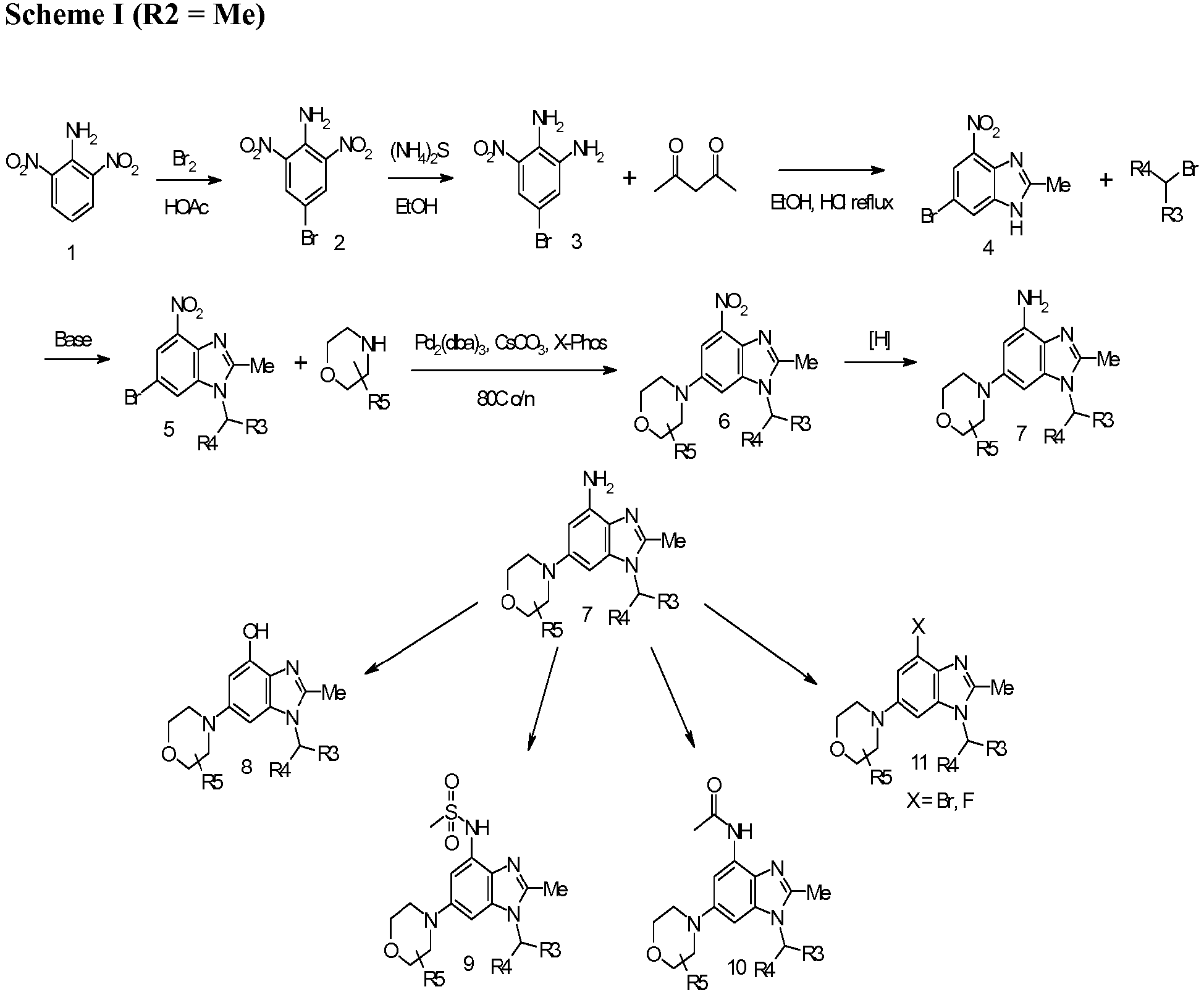
- 2,6-Dinitroaniline 1 can be brominated with bromine in acetic acid to provide 4-bromo-2,6-dinitroaniline 2 that can be reduced to the di-amino nitro benzene 3 with (NH4 +)2S. Subsequent reaction of 3 with 2,4-pentanedione in the presence of strong acid at reflux temperatures, in an alcoholic solvent, affords nitrobenzimidazole 4. Alkylation to afford substituted benzimidazole 5 can be accomplished with a suitably substituted alkyl halide with a base, such as K2CO3, in a polar aprotic solvent, such as DMF. Palladium-catalyzed displacement of the aromatic bromine with morpholine can then afford substituted nitrobenzimidazole 6 which can then be reduced to the amino benzimidazole 7. Amino benzimidazole 7 can then be converted into hydroxyl analog 8, sulfonamide 9, amide 10, and halo analog 11, using standard organic manipulations.

- 2,6-Dinitroaniline 1 can be brominated with bromine in acetic acid to provide 4-bromo-2,6-dinitroaniline 2 that can be reduced to the di-amino nitro benzene 3 with (NH4 +)2S. Subsequent reaction of 3 with a carboxylic acid in the presence of strong acid at elevated temperatures affords nitrobenzimidazole 4. Alkylation to afford substituted benzimidazole 5 can be accomplished with a suitably substituted alkyl halide with a base, such as K2CO3, in a polar aprotic solvent, such as DMF. Palladium-catalyzed displacement of the aromatic bromine with morpholine can then afford substituted nitrobenzimidazole 6 which can then be reduced to the amino benzimidazole 7. Amino benzimidazole 7 can then be converted into hydroxyl analog 8, sulfonamide 9, amide 10, and halo analog 11, using standard organic manipulations.

- 2-Amino-3-nitrophenol 1 can be methylated with MeI and K2CO3 in DMF to afford methoxy nitro aniline 2. Bromination, with bromine in acetic acid, followed by acetylation with acetic anhydride in acetic acid and sulfuric acid, can provide intermediate 4. Palladium-catalyzed displacement of the aromatic bromide with morpholine can then afford intermediate 5. Iron-induced nitro reduction followed by ring closure can then provide benzimidazole 6 that can be alkylated with a suitably substituted alkyl bromide using a base, such as K2CO3, in a polar aprotic solvent such as DMF, to afford final products 7.

- Aminobenzimidazole 1 can be converted to bromobenzimidazole 2 using sodium nitrite with NaBr in aqueous HBr. Palladium catalyzed coupling with an aryl boronic acid in the presence of a suitable phosphine with an inorganic base in a polar non-protic solvent can then provide final substituted benzimidazoles 3. Het includes 2-, 3- furanyls, and 1,3-thiozols.

- Palladium catalyzed carbonylaton of bromo-benzimidazole 1 can be accomplished by bubbling carbon-monoxide gas in methanol with triethylamine to provide methyl ester 2. Ester hydrolysis can then be accomplished with lithium hydroxide in THF/water to provide final product benzimidazole acid 3.

- Palladium catalyzed cyanation of bromo-benzimidazole 1 can be accomplished with zinc cyanide in DMF to provide benzimidazole nitrile 2. The nitrile can be converted to the primary carboxamide with KOH and peroxide in THF to provide amide 3. Treatment of the carboxamide 3 with DMF-DMA can provide intermediate 4 that can then be cyclized to triazole analogs 5 with hydrazine in acetic acid.

- Amination of 5-chloro-2-nitrobenzoic acid with O-methyl hydroxyl amine and t-butoxide in the presence of copper acetate can provide 3-amino-5-chloro-2-nitrobenzoic acid 2. Esterification can be accomplished with methanol and sulfuric acid to provide methyl ester 3 that can be reacted with morpholine in DMF with K2CO3 to provide phenyl morpholine analog 4. Nitro reduction can be accomplished using a variety of metal reductions to provide diamine 5. Condensation of 5 with a variety of carboxylic acids can provide benzimidazole methylester 6 that can be further converted to final products 7 (R1 = CO2Me, CO2H, CONH2, CN, triazole, tetrazole) after alkylation with an alkyl halide, followed by standard organic manipulations as previously described.
-

-

- Under nitrogen, to a solution of t-BuOK (156.8 g) and Cu(OAc)2 (3.6 g) in DMF (1.2 L) was added a solution of 5-chloro-2-nitrobenzoic acid (40.0 g) and MeONH2HCl (33.2 g) in DMF (300 mL) at 0° C. After 3h the reaction was quenched by addition of H2O (2.5 L) and acidified with 10% HCl solution to pH= 1.The mixture was extracted with EA (2 L × 2) and the combined organic layers were then washed with brine, dried over anhydrous Na2SO4, filtered and concentrated in-vacuo to afford the crude product as a yellow solid (43.2g, yield 100%). 1H NMR (300 MHz, CDCl3): δ ppm 6.88 (s, 1H, J= 2.4Hz), 6.91 (d, 1H, J= 2.4Hz), 8.08 (br s, 2H); LC-MS: m/e = 217 [M+1]+.
-

- A mixture of 3-amino-5-chloro-2-nitrobenzoic acid (43.2 g) and HATU (2-(1H-7-Azabenzotriazol-1-yl)--1,1,3,3-tetramethyl uronium hexafluorophosphate Methanaminium, commercially available) (76 g) in MeOH (81 mL), Et3N (83 mL) and THF (300 mL) was stirred at room temperature for 3h. When TLC showed no starting material, the solvent was removed in-vacuo and the residue was then diluted with EtOAc (2 L). It was then washed with brine (1 L×3) and dried over anhydrous Na2SO4, filtered and concentrated in-vacuo. The residue was then purified by silica gel chromatography eluted with EtOAc : petroleum ether = 1 : 8 to afford the desired product as a yellow solid (29.5 g, yield 64%). 1H NMR (300 MHz, CDCl3): δ ppm 3.90 (s, 3H, s), 5.85 (br s, 2H), 6.80 (d, 1H, J = 2.4 Hz), 6.90 (d, 1H, J = 2.4 Hz); LC-MS: m/e = 231 [M+1]+.
-

- A mixture of combined batches of methyl 3-amino-5-chloro-2-nitrobenzoate (39 g), morpholine (29.5 g) and K2CO3 (47 g) was stirred in DMF (200ml) at 110 °C for 5 h. The mixture was cooled to room temperature and poured into water (1 L). It was extracted with EtOAc (500 mL × 3). The combined organic layers were washed with brine, dried over anhydrous Na2SO4, filtered and concentrated in-vacuo to afford the desired product as a yellow solid (22 g, yield 46%). 1H NMR (300 MHz, CDCl3): δ ppm 3.31 (t, 4H, J= 4.8 Hz), 3.82 (t, 4H, J= 4.8 Hz), 3.89 (s, 3H), 6.03 (d, 1H, J= 2.4 Hz), 6.34 (d, 1H, J= 2.4 Hz); LC-MS: m/e = 282 [M+1]+.
-

- To a solution of methyl 3-amino-5-(4-morpholinyl)-2-nitrobenzoate (22 g) stirring at reflux in HOAc (400 mL) was added iron powder in portions (13 g). After the addition, the mixture was stirred at reflux for 5 h. It was cooled to room temperature and the solvent was removed in-vacuo. The residue was neutralized with aqueous Na2CO3 solution (1 L). It was extracted with EtOAc (500 mL ×3). The combined organic layers were then concentrated in-vacuo and the residue was purified by silica gel chromatography eluted with MeOH : DCM = 1 : 30 to afford the desired product as a solid (16.6 g, yield 77%). 1H NMR (300 MHz, CDCl3): δ ppm 2.67 (s, 3H), 3.17 (t, 4H, J= 4.8 Hz), 3.90 (t, 4H, J= 4.8 Hz), 3.98 (s, 3H), 7.44 (d, 1H, J= 1.8 Hz), 7.54 (d, 1H, J= 1.8 Hz); LC-MS: m/e = 276 [M+1]+.
- A mixture of methyl 2-methyl-5-(4-morpholinyl)-1H-benzimidazole-7-carboxylate (4.125 g), 1-(bromomethyl)naphthalene (5 g) and K2CO3 (6.2 g) was stirred at 80° C for 3 h. When TLC showed no starting material remaining, the mixture was cooled to room temperature and then poured into water (500 mL). It was extracted with EtOAc (500 mL × 3) and the combined organic layers were washed with brine (500 mL × 3) and then concentrated in-vacuo. The residue was purified by silica gel chromatography eluted with MeOH : DCM= 1 : 100 to afford the desired product as a yellow solid (4.6 g, 74%). 1H NMR (300 MHz, DMSO-d6): δ ppm 2.42 (s, 3H), 3.04 (t, 4H, J= 4.8 Hz), 3.68 (t, 4H, J= 4.8 Hz), 3.90 (s, 3H,), 6.02 (s, 1H), 6.28 (d, 1H, J= 7.5 Hz), 7.29 (d, 1H, J= 2.4 Hz), 7.32 (d, 1H, J= 7.5 Hz), 7.39 (d, 1H, J= 2.4), 7.60-7.71 (m, 2H), 7.84 (d, 1H, J= 8.4 Hz), 8.01 (d, 1H, J= 7.5 Hz), 8.24 (d, 1H, J= 7.5 Hz); LC-MS: m/e = 416 [M+1]+.
-

- A solution of methyl 2-methyl-5-(4-morpholinyl)-1H-benzimidazole-7-carboxylate prepared as described in Reference Example A step d (500mg, 1.8 mmol), 1-(bromomethyl)-2-methyl-3-(trifluoromethyl)benzene (483 mg, 1.9 mmol) and K2CO3 (497 mg, 3.6 mmol) in DMF (50 mL) was stirred at 80° C for 3 h. The reaction mixture was cooled to rt and poured into water (50 mL), extracted with EtOAc (30 mL x 3). The combined organic layers were washed with brine, dried over Na2SO4 and concentrated. The resulting residue was purified by silica gel chromatography eluted with DCM : MeOH = 50 : 1 to give the crude product (230 mg, yield 29%), as a white solid. 1H NMR (300 MHz, DMSO-d6): δ ppm 2.39 (s, 3H), 2.54 (s, 3H), 3.08 (t, 4H, J=4.8 Hz), 3.72 (t, 4H, J=4.8 Hz), 3.89 (s, 3H), 5.57 (s, 2H), 6.27 (d, 1H, J=7.5 Hz), 7.22 (t, 1H, J=7.5 Hz), 7.27 (d, 1H, J=2.4 Hz), 7.38 (d, 1H, J=2.4 Hz) 7.60 (d, 1H, J=7.5 Hz); LC-MS: m/e = 448 [M+1]+
-
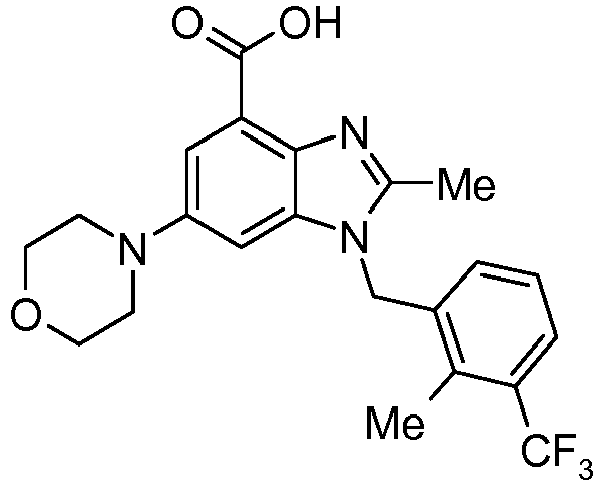
- An aqueous solution of 2 N LiOH (1.2 mL) was added to a solution of methyl 2-methyl-1-{[2-methyl-3-(trifluoromethyl)phenyl]methyl}-6-(4-morpholinyl)-1H-benzimidazole-4-carboxylate, prepared as described in Reference Example B (180 mg, 0.4 mmol) in THF (10 mL) and stirred at 50° C for 1 h. When TLC showed no starting material remaining, the mixture was cooled to rt and THF was removed under reduced pressure. The pH of the mixture was acidified to pH 3. The suspension was filtered and the filtrate was collected, and washed with water (10mL) to give the product as a white solid (152 mg, yield 88%). 1H NMR (300 MHz, DMSO-d6): δ ppm 2.46 (s, 3H), 2.54 (s, 3H), 3.10 (t, 4H, J=4.8 Hz), 3.73 (t, 4H, J=4.8 Hz), 5.63 (s, 2H), 6.37 (d, 1H, J=7.8 Hz), 7.26 (t, 1H, J=7.8 Hz), 7.35 (d, 1H, J=2.4 Hz), 7.44 (d, 1H, J=2.4 Hz), 7.62 (d, 1H, J=7.8 Hz); LC-MS: m/e = 434 [M+1]+.
-

- Seed crystal preparation - Batch 1: To the 2-methyl-1-{[2-methyl-3-(trifluoromethyl)phenyl]methyl}-6-(4-morpholinyl)-1H-benzimidazole-4-carboxylic acid (52.9 mg, 0.122 mmol), methanol (2.0 mL) was added. To the slurry, tromethamine (2-amino-2-(hydroxymethyl)-1,3-propanediol) (3.0 M solution in water, 1.0 equivalent) was added. The slurry was heated to 60C and kept stirring at 60C for 3 hours. The slurry was then cooled slowly (0.1C/min) to 20C. Once the temperature of the slurry reached 20C, the slurry was kept stirring at 20C for 8 hours. The crystalline solids were isolated by vacuum filtration. The yield of the desired salt was 57.2 mg (85% yield).
- Seed crystal preparation - Batch 2: To the 2-methyl-1-{[2-methyl-3-(trifluoromethyl)phenyl]methyl}-6-(4-morpholinyl)-1H-benzimidazole-4-carboxylic acid (353.0 mg), methanol (14.0 mL) was added. The slurry was heated to 60C and tromethamine (3.0 M solution in water, 1.0 equivalent) was added in four aliquots over 15 minutes followed by the addition of crystalline seeds of crystalline tromethamine salt from batch 1. The slurry was stirred at 60C for 3 hours, cooled (1C/min) to 20C, and stirred at 20C for 8 hours. The solids were isolated by vacuum filtration, dried at 60C under vacuum for 5 hours. The yield of the tromethamine salt was 401.5 mg (∼88.9% yield).
- Batch 3: 2-methyl-1-{[2-methyl-3-(trifluoromethyl)phenyl]methyl}-6-(4-morpholinyl)-1H-benzimidazole-4-carboxylic acid (40.0 g, 92 mmol) was suspended in Methanol (1.6 L) in a 3L rounded-bottom flask. The resulting slurry was heated to 60°C mixing on a buchii rotary evaporator water bath and tris(hydroxymethyl)aminomethane (3M solution in water) (0.031 L, 92 mmol) was added in four aliquots over 15 minutes followed by the addition of seed crystals as produced by method analogous to Example 86, Batch 2, above (108 mg). This slurry was stirred (flask rotated on buchii rotovap) at 60 °C for 3 hours, then cooled (∼1 °C/min) to 20 °C (room temperature), then finally magnetically stirred at 20 °C (room temperature) for 8 hours. The resulting white solid was isolated by vacuum filtration, dried under vacuum at 60 °C for 8 hours to provide 2-methyl-1-{[2-methyl-3-(trifluoromethyl)phenyl]methyl}-6-(4-morpholinyl)-1H-benzimidazole-4-carboxylic acid - 2-amino-2-(hydroxymethyl)-1,3-propanediol (1:1) (47.76 g, 86 mmol, 93 % yield) as a white solid. Both proton NMR and LCMS are consistent with the proposed structure. 1H NMR (400 MHz, DMSO-d6) δ ppm 7.61 (d, J=7.83 Hz, 1 H) 7.37 (d, J=2.27 Hz, 1 H) 7.17 - 7.33 (m, 2 H) 6.33 (d, J=7.83 Hz, 1 H) 5.59 (s, 2 H) 3.66 - 3.80 (m, 4 H) 2.98 - 3.15 (m, 4 H) 2.50 - 2.58 (m, 10 H) 2.43 (s, 3 H); LCMS m/z MH+ =434.3.
- The compound of the present invention was tested according to the following assays and found to be an inhibitor of PI3 kinases, particularly PI3Kβ. The activities (IC50) of exemplified compoundswere under 10 nM. The IC50 value can be converted and presented as pIC50 value.
- The PI3-Kinase profiling assays were developed to measure the compound-dependent inhibition of the alpha, beta, delta, and gamma isoforms of PI3Kin an in vitro catalytic assay. This assay was developed and optimized from a kit produced by Upstate (Millipore catalog # 33-017). Briefly, this procedure utilizes a pre-formed HTRF (Homogeneous Time-Resolved Fluorescence energy transfer) complex between four binding partners: 1) biotinylated PIP3, 2) GST tagged pleckstrin homology (PH) domain, 3) Europium labeled anti-GST monoclonal antibody, and 4) Streptavidin-Allophycocyanin (APC). The native PIP3 produced by PI 3-Kinase activity displaces biotin-PIP3 from the PH domain, resulting in the dissociation of the HTRF complex and a decrease in the fluorescence signal. The format of this assay is the same for all 4 isoforms of PI3K; the differences lie in the concentration of enzyme used to achieve the most robust signal. The alpha and delta assays are run at 400pM enzyme; the beta assay is at 200pM enzyme and the gamma assay is run at InM enzyme. In addition, the alpha, beta and delta assays are run with 150mM NaCl while the gamma assay is run in the absence of NaCl. The ATP concentration is 100uM in the alpha, beta, and delta assays and 15uM ATP in the gamma assay. All reactions are run at 10uM PIP2
- Compounds were serially diluted (3-fold in 100% DMSO) across a 384-well polypropylene mother plate from column 1 to column 12 and column 13 to column 24, to yield 11 concentrations for each test compound. Columns 6 and 18 contain only DMSO. Once titrations were made, 0.05µL was transferred to a 384-well low-volume assay plate (Greiner 784076). This assay plate contained three pharmacological controls (known PI3K inhibitors) and 3 assay controls: (1) Enzyme without inhibitor; (2) Buffer minus enzyme, and (3) Buffer minus enzyme plus native PIP3. DMSO was stamped into all wells of columns 6 and 18. PIP3 was added at 40 µM in 1X Reaction buffer (1µL of 200 µM PIP3) to alternating rows of column 18 (wells 18 B, D, F, H, J, L, N, P). The no-enzyme control reactions were run in wells 18 A, C, E, G, I, K, M, O (0.1µL of 100% DMSO).
- The PI3-Kinase profiling assay was optimized using the HTRF kit provided by Upstate (Millipore). The assay kit contained seven reagents: 1) 4X Reaction Buffer; 2) native PIP2 (substrate); 3) Stop A (EDTA); 4) Stop B (Biotin-PIP3); 5) Detection Mix A (Streptavidin-APC); 6) Detection Mix B (Eu-labeled Anti-GST plus GST-tagged PH-domain); 7) Detection Mix C (KF). In addition, the following items were obtained or purchased: PI3Kinase (prepared by GSK BR&AD), dithiothreitol (Sigma, D-5545), Adenosine-5'-triphosphate (ATP, Teknova cat. # A0220), native PIP3 (1,2-dioctanoyl-sn-glycero-3-[phosphoinositil-3,4,5-triphosphate] tetraammonium salt (Avanti polar lipids, 850186P), DMSO (Sigma, 472301).
- PI3Kinase Reaction Buffer was prepared by diluting the stock 1:4 with de-ionized water. Freshly prepared DTT was added at a final concentration of 5 mM on the day of use. Enzyme addition and compound pre-incubation were initiated by the addition of 2.5µL of PI3K (at twice its final concentration) in 1X reaction buffer to all wells using a Multidrop Combi. Plates were incubated at room temperature for 15 minutes. Reactions were initiated by addition of 2.5µL of 2X substrate solution (PIP2 and ATP in 1X reaction buffer) using a Multidrop Combi. Plates were incubated at room temperature for one hour. Reactions were quenched by the addition of 2.5µL of stop solution (Stop A and Stop B pre-mixed at a ratio of 5:1, respectively) to all wells using the Multidrop Combi. The quenched reactions were then processed to detect product formation by adding 2.5µL of Detection Solution to all wells using the Mulitdrop Combi (Detection mix C, Detection mix A, and Detection mix B combined together in an 18:1:1 ratio, i.e.: for a 6000 µL total volume, mix 5400 µL Detection mix C, 300µL Detection mix A, and 300 µL Detection mix B. Note: this solution should be prepared 2 hours prior to use). Following a one hour incubation in the dark, the HTRF signal was measured on the Envision plate reader set for 330nm excitation and dual emission detection at 620nm (Eu) and 665nm (APC).
- The loss of the HTRF signal is due to the displacement of biotinylated-PIP3 from the PH domain by the PI3K-dependent conversion of PIP2 to PIP3. This loss of signal is nonlinear with respect to both increasing product and time. This non-linear detection will impact accuracy of IC50 calculations; therefore, there is a need for a correction factor to obtain more accurate IC50 values. This correction is derived from the assay standards in the wells of column 6 and 18 of the assay plate.
- All data were calculated using the ratio of acceptor (APC) to donor (Europium) fluorescence in each well of the assay plate. The percent inhibition for each compound concentration was calculated as follows: %inhibition = 100*(fluorescence ratio - CtrlB)/(CtrlA - CtrlB) where CtrlA= (-) PI3Kinase reaction and CrtlB= PI3Kinase + DMSO.
- An IC50 was then calculated fitting the %inhibition data to the equation: %inhibition = min + (max-min)/(1 + ([inhibitor]/IC50)^n) where min is the %inhibition with no inhibitor (typically 0%), max is the signal in the (-) Enzyme control, and n is the Hill slope (typically 1). Finally, the IC50 was converted to pIC50 (pIC50 = -log(IC50)), and the pIC50 value was corrected by using plate controls and the equation below: pIC50 (corrected) = pIC50 (observed) + log10((CtrlA-CtrlB)/(CtrlB-CtrlC)), where CtrlA and CtrlB are as defined above and CrtlC= 10µM PI(3,4,5)P3, 100% displacement of biotinylated PI(3,4,5)P3.
- The compound listed in Table 1 was tested generally according to the assays described herein. Table 1 lists the pIC50 values for either an experimental run or an average of two or more experimental runs with the examples shown.
Table 1 Example # MW PI3KB PIC50 MEAN 1 433.43 8.2 - Twenty-two Phosphatase and Tensin Homolog (PTEN) wild-type or PTEN deficient tumor cell lines were cultured generally according to instructions supplied by cell culture supplier American Type Culture Collection, Manassas, VA, with 10% fetal bovine serum at 5% CO2 and 37°C. Cells were seeded into either a T-75 or a T-175 flask 3-4 days prior to 96-well assay plating such that the flasks were approximately 70-80% confluent of the time of harvest. Cells were harvested using 0.25% trypsin-EDTA (Invitrogen #25200056). Trypan Blue exclusion staining was used to determine cell number.
- Viable cells were plated in clear, flat bottom 96-well plates (BD #353075) under anchorage independent conditions at 2,000-10,000 cells per well depending on the cell line. To generate anchorage independent growth conditions, a 5% agar stock solution in water was made and autoclaved to melt and sterilize. From the 5% agar solution, a 0.6% agar/media + 10% fetal bovine serum (FBS) solution was made to generate a bottom agar layer in the plates to prevent cell attachment. Seventy five microliters per well of the 0.6% agar-media solution was added to the plates. After solidification, a cell solution of 266,870 to 1, 334,022 cells (depending on the cell line) in 10 ml of 0.3% agar/ media + 10% FBS was made and 75 µl of the cell/media/agar suspension was added to the plates. After the cell layer solidified, 50 µl of media + 10% FBS was added to the top of the cells. A 0.3% Brij 35 (Sigma B4184) solution in media + 10% FBS was added to column 12 as a background subtraction control. The cells were incubated overnight at 5% CO2 and 37°C. The next day one plate of cells was processed at the time of compound addition to quantify the starting number of cells (T = 0 or TO).
- To generate the compound titration plates, 15 µl of a 2 mM or 20 µl of a 20 mM solution of the compound of example 1 was diluted in clear bottom polypropylene 96-well plate (BD #351190) using a 10 point, 3-fold titration or a 20 point 2-fold titration, respectively. Three hundred microliters of media was added to the compound dilutions. Ten microliters per well of the serial dilutions was added to the cells and the plates incubated for 6 days at 5% CO2 and 37°C. The final concentration of DMSO in all wells was 0.15% and the highest final concentration of the compound of example 1 was 3.7 µM or 30.7 µM.
- Following the 6-day incubation, 20 µl of Alamar Blue (Invitrogen #DAL1100) was added to the cells, incubated at 5% CO2 and 37°C for 6 hours and the plates read on a Spectramax (Gemini EM) at 530nm (excitation) and 590nm (emission) with the auto cutoff disabled. For analysis of cell growth inhibition dose response curves, the data was plotted as the percent of the DMSO-treated control samples (DMSO samples set to 100%). The cellular response was determined for the compound of example 1 and control compounds by fitting the concentration response with a 4 parameter curve fit using XLfit software and determining the concentration that inhibits 50% of the Ymax-Ymin window (EC50). The EC50 is the midpoint of active compound effect window (between Ymax plateau and Ymin plateau of compound) and represents the concentration of the compound of example 1 where 50% of its maximal effect is observed. Values from wells containing 0.3% Brij 35 (under anchorage independent conditions) were subtracted from all samples for background correction.
- The results shown in Table 2 demonstrate that multiple cell lines with loss of the tumor supressor PTEN were sensitive, while relatively few wild-type PTEN tumor cell lines were sensitive.
Table 2 Anchorage Independent Soft Agar Tumor Growth Assay Cell Line Origin Type PTEN Mutation / Copy Number Status PTEN Western Analysis Compound EC50 (nM)± StDev Ymin ± StDev BT549 breast carcinoma p.V275fs*1 No protein 7 ± 2 52 ± 7 WM-115 skin melanoma p.165fs* No protein 8 ± 3 54 ± 14 C32 skin melanoma p.55fs* No protein 8 ± 2 20 ± 14 SW1783 CNS glioblastoma p.R233* No protein 10 ± 3 69 ± 4 UM-UC-3 bladder transitional Loss No protein 10 ± 8 83 ± 29 SW1088 CNS glioblastoma Loss No protein 12 ± 6 36 ± 8 H4 CNS glioblastoma Loss No protein 12 ± 8 55 ± 18 CHL-1 skin melanoma Wild-type Protein 14 ± 6 82 ± 2 UACC-62 skin melanoma p.P248fs*5 No protein 23 ± 27 76 ± 18 HCC19377 breast carcinoma Loss No protein 24 ± 8 67 ± 8 PC-3 prostate carcinoma Loss No protein 27 ± 12 82 ± 13 HCC70 breast carcinoma p.F90fs*9 No protein 53 ± 21 27 ± 8 MDA-MB-468 breast carcinoma p.?, L70Fs*7 No protein 89 ± 55 44 ± 6 HCC1395 breast carcinoma p.N212fs*3 No protein 114 ± 53 26 ± 9 U-87MG CNS glioblastoma p.? No protein 2975 ± 2771 34 ± 18 BT474 breast carcinoma Wild-type Protein 3360 ± 868 75 ± 3 U251 CNS glioblastoma p.E242fs*15 No protein 18996 ± 8625 80 ± 17 HCC1954 breast carcinoma Wild-type Protein >30722 >80 Colo205 colon carcinoma Wild-type ND >30722 >80 HCT-116 colon carcinoma Wild-type ND >30722 >80 SKOV-3 ovary adenocarcinoma Wild-type ND >30722 >80 LOXIMVI skin melanoma Wild-type Protein >30722 >90 p.? indicates a splice site mutation - The activity of the compound of example 1 was evaluated in vivo against PC-3 (prostate carcinoma cell line encoding a deficient PTEN protein) xenograft mouse model. The PC-3 tumor bearing mice were generated by injecting 2.5 x 10⁶ PC-3 cells suspended 1:1 in Matrigel subcutaneously in the flank of female nude mice (Charles River - Wilmington; strain Crl: CD-1-Foxn1). One set of mice, each approximately 19 weeks of age, were implanted with the cells for the 100, 30, and 10 mg/kg doses and another set of mice, each approximately 11 weeks of age, were implanted with the cells for the 10, 3, and 1 mg/kg doses.
- Mice bearing PC-3 xenografts were randomized into dosing groups of n=8 based on tumor volume 29 (100, 30, and 10 mg/kg) or 28 (1, 3, 10 mg/kg) days after tumor cells were implanted. Treatment of mice commenced the next day and continued for 21 days. Mice received once daily oral gavage with compound or vehicle at 10 mL/kg.
- Tumor growth was measured twice weekly in two dimensions with vernier callipers; the longest dimension was defined as the length (1), and the width (w) was measured perpendicular to the length. Tumor volumes (V) were calculated using the following equation: V = (½)1w2. Means of the tumor volumes were used to compare treatment groups. Stable disease for this study is defined as a tumor volume which during the course of compound treatment does not substantially increase or decrease but stays similar to the volume prior to drug treatment compared to vehicle treated in which the tumor volume continues to increase during the course of the study. Tumor growth delay is defined as tumor volume that is reduced during the course of the compound treatment relative to vehicle treated tumor volume.
- The results demonstrated that treatment of female nude mice bearing PC-3 prostate xenografts with 10, 30, and 100 mg/kg the compound of example 1 for 21 days resulted in stable disease with the 1 and 3 mg/kg doses resulting in tumor growth delay relative to vehicle during the dosing period.
- The activity of the compound of example 1 was evaluated in vivo against PC-3 (prostate carcinoma cell line encoding a deficient PTEN protein) xenograft mouse model. Female nude mice (Charles River Laboratories, Wilmington, DE; strain CD-1-Foxn1, ~6 weeks of age) were injected subcutaneously with 2 million PC-3 (human prostate carcinoma) cells mixed 1:1 with Matrigel in the flank. Tumors were allowed to grow for approximately 5 weeks.
- Mice bearing PC-3 xenografts were administered 3 mg/kg of the compound of example 1 or 10 mg/kg of the compound of example 1 and euthanized using carbon dioxide after 1, 2, 4, 6, 8, 10, and 24 hours (n=3 mice/treatment/timepoint); an additional 3 mice bearing PC-3 xenografts were administered vehicle and euthanized after 2 hours. The tumor was excised. Half of each tumor was immediately processed by Medicon (BD Catalog # 340592) in 1 mL Meso-Scale Discovery (MSD) lysis buffer with protease inhibitors (Roche complete protease cocktail, cat# 04 693 116 001) and phosphatase inhibitors (Sigma, cat # P2850 and P-5726) for 30-60 seconds and transferred to 1.5 mL Eppendorf tubes. Tubes remained on wet ice until they were centrifuged for 10 minutes at 4°C at maximum speed in a tabletop refrigerated centrifuge.
- Tumor lysates were serially diluted in 96-well polypropylene plates on wet ice. Lysates (150 µL) were loaded in row 1; rows 2-12 were loaded with 75 µL of complete Meso Scale Discovery (MSD) lysis buffer (supplied in MSD kit; # K15100D-3). Samples were serially diluted 2-fold across the plate by sequential transfer of 75 µL through well 11; row 12 contained lysis buffer only. MSD Multi-Spot assay plates (whole cell lysate kit: Phospho(ser473),Total AKT Assay, catalog # K15100D-3) were blocked with 150 µL of 3% Blocker A overnight at 4°C with shaking before being washed 4X with 200 µL MSD Tris wash buffer. Fifty microliters of the serially diluted lysates were pipetted onto the blocked MSD plates, covered, and incubated overnight at 4°C with shaking. Plates were washed with Tris buffer as before. Detection antibody was added (25 µL/well) at a final concentration of 10 nM in 1 mL Blocker A and 2 mLTris wash buffer and incubated for 1 hour at room temperature with shaking. Plates were washed as described above, before the addition of 150 µL of MSD read buffer and read immediately on a 6000 MSD plate reader. All work was performed in accordance with Institutional Animal Care and Use Committee (IACUC) protocols PA0079 and PA0271.
- The non-lysate controls in column 12 were averaged and used as background to subtract from all wells. P/T AKT was calculated as shown: (phospho AKT(Ser473) signal)/[(phospho AKT(Ser473) signal) + (total AKT signal)]. Values from three points in each row of diluted samples identified as being in the linear range of detection were averaged to represent each tumor sample's P/T AKT value. Averages and standard deviations of the P/T AKT value for each group of 3 mice were determined. Percent inhibition was calculated for each group as follows: 100-[(sample P/T AKT value)/(vehicle P/T AKT value)]*100.
- The the compound of example 1 exhibited dose dependent inhibition of the pharmacodynamic marker pAKT (pAKT/tAKT).
- The compounds of the present invention can also be tested to determine their inhibitory activity at PI3Kα, PI3Kδ PI3Kβ and PI3Kγ according to international patent publication No.
WO2009/039140 . - The pharmaceutically active compounds within the scope of this invention are useful as PI3 Kinase inhibitors in mammals, particularly humans, in need thereof.
- Disclosed is a method of treating diseases associated with PI3 kinase inhibition, particularly: autoimmune disorders, inflammatory diseases, cardiovascular diseases, neurodegenerative diseases, allergy, asthma, pancreatitis, multiorgan failure, kidney diseases, platelet aggregation, cancer, sperm motility, transplantation rejection, graft rejection and lung injuries and other conditions requiring PI3 kinase modulation/inhibition, which comprises administering an effective compound of Formula (I) or a pharmaceutically acceptable salt, hydrate, solvate or pro-drug thereof. The compounds of Formula (I) also provide for a method of treating the above indicated disease states because of their ability to act as PI3 inhibitors. The drug may be administered to a patient in need thereof by any conventional route of administration, including, but not limited to, intravenous, intramuscular, oral, subcutaneous, intradermal, and parenteral.
Claims (14)
- A compound of Formula (Ia)

- A compound according to claim 1 of Formula (Ia)

- A pharmaceutically acceptable salt of the compound of formula (Ia) according to claim 1.
- A pharmaceutically acceptable salt of the compound of formula (Ia) according to claim 3, wherein the salt is the 1:1 Tris salt.
- A pharmaceutical composition which comprises a compound of Formula (Ia) or a pharmaceutically acceptable salt thereof according to any of claims 1-4 and a pharmaceutically acceptable carrier.
- A pharmaceutical composition according to claim 5 for use in the treatment of a susceptible neoplasm in a mammal in need thereof.
- A compound of Formula (Ia) or a pharmaceutically acceptable salt thereof according to any of claims 1-4 for use in therapy.
- A combination of (a) 2-methyl-1-{[2-methyl-3-(trifluoromethyl)phenyl]methyl}-6-(4-morpholinyl)-1H-benzimidazole-4-carboxylic acid or a pharmaceutically acceptable salt thereof and (b) at least one anti-neoplastic agent; for use in the treatment of cancer.
- A compound of Formula (Ia) or a pharmaceutically acceptable salt thereof according to any of claims 1-4, or a pharmaceutical composition according to claim 5, or a combination according to claim 8, for use in the treatment of a PTEN-deficient susceptible neoplasm selected from brain (gliomas), glioblastomas, leukemias, Bannayan-Zonana syndrome, Cowden disease, Lhermitte-Duclos disease, breast cancer, inflammatory breast cancer, colorectal cancer, Wilm's tumor, Ewing's sarcoma, Rhabdomyosarcoma, ependymoma, medulloblastoma, colon cancer, head and neck cancer, kidney cancer, lung cancer, liver cancer, melanoma, squamous cell carcinoma, ovarian cancer, pancreatic cancer, prostate cancer, sarcoma, cancer, osteosarcoma, giant cell tumor of bone, thyroid cancer, lymphoblastic T cell, leukemia, chronic myelogenous leukemia, chronic lymphocytic leukemia, hairy-cell leukemia, acute lymphoblastic leukemia, acute myelogenous leukemia, chronic neutrophilic leukemia, acute lymphoblastic T cell leukemia, Plasmacytoma, Immunoblastic large cell leukemia, Mantle cell leukemia, Multiple myeloma, Megakaryoblastic leukemia, Acute megakaryocytic leukemia, promyelocytic leukemia, Erythroleukemia, malignant lymphoma, hodgkins lymphoma, non-hodgkins lymphoma, lymphoblastic T cell lymphoma, Burkitt's lymphoma, follicular lymphoma, neuroblastoma, bladder cancer, urothelial cancer, vulval cancer, cervical cancer, endometrial cancer, renal cancer, mesothelioma, esophageal cancer, salivary gland cancer, hepatocellular cancer, gastric cancer, nasopharangeal cancer, buccal cancer, cancer of the mouth, GIST (gastrointestinal stromal tumor), and testicular cancer.
- A compound of Formula (Ia) or a pharmaceutically acceptable salt thereof for use, or a pharmaceutical composition for use, or a combination for use, according to claim 9 wherein said PTEN-deficient neoplasm is selected from prostate cancer, non-small-cell lung cancer, endometrial cancer, gastric cancer, melanoma, head and neck cancer, breast cancer, including triple-negative breast cancer, and glioma.
- A compound of Formula (Ia) or a pharmaceutically acceptable salt thereof for use, or a pharmaceutical composition for use, or a combination for use, according to claim 10 wherein said prostate cancer is hormone refractory prostate cancer.
- Use of a compound of Formula (Ia), or a pharmaceutically acceptable salt thereof, according to any of claims 1-4 in the manufacture of a medicament for use in the treatment of a PTEN-deficient susceptible neoplasm which is selected from brain (gliomas), glioblastomas, leukemias, Bannayan-Zonana syndrome, Cowden disease, Lhermitte-Duclos disease, breast cancer, inflammatory breast cancer, colorectal cancer, Wilm's tumor, Ewing's sarcoma, Rhabdomyosarcoma, ependymoma, medulloblastoma, colon cancer, head and neck cancer, kidney cancer, lung cancer, liver cancer, melanoma, squamous cell carcinoma, ovarian cancer, pancreatic cancer, prostate cancer, sarcoma, cancer, osteosarcoma, giant cell tumor of bone, thyroid cancer, lymphoblastic T cell, leukemia, chronic myelogenous leukemia, chronic lymphocytic leukemia, hairy-cell leukemia, acute lymphoblastic leukemia, acute myelogenous leukemia, chronic neutrophilic leukemia, acute lymphoblastic T cell leukemia, Plasmacytoma, Immunoblastic large cell leukemia, Mantle cell leukemia, Multiple myeloma, Megakaryoblastic leukemia, Acute megakaryocytic leukemia, promyelocytic leukemia, Erythroleukemia, malignant lymphoma, hodgkins lymphoma, non-hodgkins lymphoma, lymphoblastic T cell lymphoma, Burkitt's lymphoma, follicular lymphoma, neuroblastoma, bladder cancer, urothelial cancer, vulval cancer, cervical cancer, endometrial cancer, renal cancer, mesothelioma, esophageal cancer, salivary gland cancer, hepatocellular cancer, gastric cancer, nasopharangeal cancer, buccal cancer, cancer of the mouth, GIST (gastrointestinal stromal tumor), and testicular cancer.
- Use according to claim 12, wherein said PTEN-deficient susceptible neoplasm is selected from prostate cancer, non-small-cell lung cancer, endometrial cancer, gastric cancer, melanoma, head and neck cancer, breast cancer, including triple-negative breast cancer, and glioma.
- Use according to claim 13, wherein said prostate cancer is hormone refractory prostate cancer.
Priority Applications (6)
| Application Number | Priority Date | Filing Date | Title |
|---|---|---|---|
| MEP-2017-59A ME02663B (en) | 2010-10-06 | 2011-09-23 | BENZIMIDAZOLE DERIVATIVES AS PI3 KINASE INHIBITORS |
| PL11831214T PL2624696T3 (en) | 2010-10-06 | 2011-09-23 | Benzimidazole derivatives as pi3 kinase inhibitors |
| EP16204387.1A EP3170813B1 (en) | 2010-10-06 | 2011-09-23 | Benzimidazole derivatives as pi3 kinase inhibitors |
| HRP20170279TT HRP20170279T1 (en) | 2010-10-06 | 2011-09-23 | BENZIMIDAZOL DERIVATIVES AS PI3-KINASE INHIBITORS |
| SM20170158T SMT201700158T1 (en) | 2010-10-06 | 2011-09-23 | Benzimidazole derivatives as pi3 kinase inhibitors |
| SI201131123A SI2624696T1 (en) | 2010-10-06 | 2011-09-23 | Benzimidazole derivatives as pi3 kinase inhibitors |
Applications Claiming Priority (3)
| Application Number | Priority Date | Filing Date | Title |
|---|---|---|---|
| US39031410P | 2010-10-06 | 2010-10-06 | |
| US201161528397P | 2011-08-29 | 2011-08-29 | |
| PCT/US2011/052857 WO2012047538A1 (en) | 2010-10-06 | 2011-09-23 | Benzimidazole derivatives as pi3 kinase inhibitors |
Related Child Applications (1)
| Application Number | Title | Priority Date | Filing Date |
|---|---|---|---|
| EP16204387.1A Division EP3170813B1 (en) | 2010-10-06 | 2011-09-23 | Benzimidazole derivatives as pi3 kinase inhibitors |
Publications (3)
| Publication Number | Publication Date |
|---|---|
| EP2624696A1 EP2624696A1 (en) | 2013-08-14 |
| EP2624696A4 EP2624696A4 (en) | 2014-03-26 |
| EP2624696B1 true EP2624696B1 (en) | 2016-12-21 |
Family
ID=45925614
Family Applications (2)
| Application Number | Title | Priority Date | Filing Date |
|---|---|---|---|
| EP11831214.9A Active EP2624696B1 (en) | 2010-10-06 | 2011-09-23 | Benzimidazole derivatives as pi3 kinase inhibitors |
| EP16204387.1A Active EP3170813B1 (en) | 2010-10-06 | 2011-09-23 | Benzimidazole derivatives as pi3 kinase inhibitors |
Family Applications After (1)
| Application Number | Title | Priority Date | Filing Date |
|---|---|---|---|
| EP16204387.1A Active EP3170813B1 (en) | 2010-10-06 | 2011-09-23 | Benzimidazole derivatives as pi3 kinase inhibitors |
Country Status (39)
| Country | Link |
|---|---|
| US (10) | US20130196990A1 (en) |
| EP (2) | EP2624696B1 (en) |
| JP (1) | JP5719028B2 (en) |
| KR (1) | KR101594002B1 (en) |
| CN (1) | CN103124496B (en) |
| AR (1) | AR083296A1 (en) |
| AU (1) | AU2011312594B2 (en) |
| BR (1) | BR112013008259A2 (en) |
| CA (1) | CA2812608C (en) |
| CL (1) | CL2013000935A1 (en) |
| CO (1) | CO6700852A2 (en) |
| CR (1) | CR20130192A (en) |
| CY (1) | CY1118792T1 (en) |
| DK (1) | DK2624696T3 (en) |
| DO (1) | DOP2013000059A (en) |
| EA (1) | EA022623B1 (en) |
| ES (2) | ES2616238T3 (en) |
| HR (1) | HRP20170279T1 (en) |
| HU (1) | HUE033209T2 (en) |
| IL (1) | IL225140A (en) |
| JO (1) | JO3194B1 (en) |
| LT (1) | LT2624696T (en) |
| MA (1) | MA34591B1 (en) |
| ME (1) | ME02663B (en) |
| MX (1) | MX337662B (en) |
| MY (1) | MY170236A (en) |
| NZ (1) | NZ608069A (en) |
| PE (1) | PE20140192A1 (en) |
| PH (1) | PH12013500646A1 (en) |
| PL (1) | PL2624696T3 (en) |
| PT (1) | PT2624696T (en) |
| RS (1) | RS55662B1 (en) |
| SG (1) | SG188974A1 (en) |
| SI (1) | SI2624696T1 (en) |
| SM (1) | SMT201700158T1 (en) |
| TW (1) | TWI513690B (en) |
| UY (1) | UY33648A (en) |
| WO (1) | WO2012047538A1 (en) |
| ZA (1) | ZA201301951B (en) |
Families Citing this family (32)
| Publication number | Priority date | Publication date | Assignee | Title |
|---|---|---|---|---|
| ES2616238T3 (en) | 2010-10-06 | 2017-06-12 | Glaxosmithkline Llc, Corporation Service Company | Benzimidazole derivatives as PI3 kinase inhibitors |
| US8778937B2 (en) * | 2011-12-20 | 2014-07-15 | Glaxosmithkline Llc | Benzimidazole boronic acid derivatives as PI3 kinase inhibitors |
| CN104902896A (en) * | 2013-01-09 | 2015-09-09 | 葛兰素史密斯克莱知识产权(第2号)有限公司 | combination |
| RU2016110546A (en) * | 2013-09-19 | 2017-10-24 | ГЛАКСОСМИТКЛАЙН ЭлЭлСи | Combination drug therapy |
| US20160287610A1 (en) * | 2013-09-19 | 2016-10-06 | GlaxoSmithKline LLCC | Combination Drug Therapy |
| WO2015055071A1 (en) * | 2013-10-16 | 2015-04-23 | 上海璎黎药业有限公司 | Fused heterocyclic compound, preparation method therefor, pharmaceutical composition, and uses thereof |
| CN103910682B (en) * | 2013-11-28 | 2016-03-02 | 大连理工大学 | A kind of benzimidazoles compound preparation method based on O-Phenylene Diamine cyclisation |
| US20160310477A1 (en) * | 2013-12-20 | 2016-10-27 | Biomed Valley Discoveries, Inc. | Cancer treatments using combinations of mek type 1 and erk inhibitors |
| US10308639B2 (en) | 2014-06-13 | 2019-06-04 | Gilead Sciences, Inc. | Phosphatidylinositol 3-kinase inhibitors |
| JP6455995B2 (en) | 2014-06-13 | 2019-01-23 | ギリアード サイエンシーズ, インコーポレイテッド | Phosphatidylinositol 3-kinase inhibitor |
| CA2952044C (en) | 2014-06-13 | 2019-01-29 | Gilead Sciences, Inc. | Phosphatidylinositol 3-kinase inhibitors |
| AU2015274635B2 (en) | 2014-06-13 | 2018-04-19 | Gilead Sciences, Inc. | Phosphatidylinositol 3-kinase inhibitors |
| NZ726052A (en) | 2014-06-13 | 2018-04-27 | Gilead Sciences Inc | Phosphatidylinositol 3-kinase inhibitors |
| MX2017008076A (en) | 2014-12-19 | 2018-01-09 | Janssen Pharmaceutica Nv | Heterocyclyl linked imidazopyridazine derivatives as pi3kbeta inhibitors. |
| HUE045220T2 (en) * | 2014-12-19 | 2019-12-30 | Janssen Pharmaceutica Nv | Imidazopyridazine derivatives as PI3Kbeta inhibitors |
| GB201504689D0 (en) | 2015-03-19 | 2015-05-06 | Glaxosmithkline Ip Dev Ltd | Chemical compounds |
| JP6912460B2 (en) | 2015-10-09 | 2021-08-04 | ヤンセン ファーマシューティカ エヌ.ベー. | Quinoxaline and pyridopyrazine derivatives as PI3Kβ inhibitors |
| CA3011189C (en) * | 2016-01-14 | 2024-02-20 | Bayer Pharma Aktiengesellschaft | 5-substituted 2-(morpholin-4-yl)-1,7-naphthyridines |
| US20190263804A1 (en) * | 2016-06-16 | 2019-08-29 | Janssen Pharmaceutica Nv | Azabenzimidazole derivatives as pi3k beta inhibitors |
| KR102472453B1 (en) | 2016-06-16 | 2022-11-29 | 얀센 파마슈티카 엔.브이. | Bicyclic Pyridine, Pyrazine, and Pyrimidine Derivatives as PI3K Beta Inhibitors |
| EP3481400A4 (en) * | 2016-07-11 | 2020-04-01 | Dana-Farber Cancer Institute, Inc. | METHOD FOR TREATING PTEN DEFICIENT EPITHELIC CARCINOMAS WITH A COMBINATION OF ANTI-PI3KBETA AND ANTI-IMMUNE CHECKPOINT ACTIVE SUBSTANCES |
| TW201815787A (en) | 2016-09-23 | 2018-05-01 | 美商基利科學股份有限公司 | Phosphatidylinositol 3-kinase inhibitors |
| TW201813963A (en) | 2016-09-23 | 2018-04-16 | 美商基利科學股份有限公司 | Phosphatidylinositol 3-kinase inhibitors |
| WO2018057808A1 (en) | 2016-09-23 | 2018-03-29 | Gilead Sciences, Inc. | Benzimidazole derivatives and their use as phosphatidylinositol 3-kinase inhibitors |
| TW201825465A (en) | 2016-09-23 | 2018-07-16 | 美商基利科學股份有限公司 | Phosphatidylinositol 3-kinase inhibitors |
| WO2018106667A1 (en) * | 2016-12-05 | 2018-06-14 | Microbiotix, Inc. | Broad-spectrum inhibitors of filoviruses |
| EP3601254B1 (en) | 2017-03-29 | 2022-05-25 | Janssen Pharmaceutica NV | Quinoxaline and pyridopyrazine derivatives as pi3k-beta inhibitors |
| IL271973B (en) | 2017-07-28 | 2022-08-01 | Yuhan Corp | Improved process for preparing aminopyrimidine derivatives |
| WO2019106605A1 (en) | 2017-12-01 | 2019-06-06 | Board Of Regents, The University Of Texas System | Combination treatment for cancer |
| US11253189B2 (en) | 2018-01-24 | 2022-02-22 | Medtronic Ardian Luxembourg S.A.R.L. | Systems, devices, and methods for evaluating neuromodulation therapy via detection of magnetic fields |
| CN111000847B (en) * | 2020-01-02 | 2021-03-19 | 黑龙江中医药大学 | A kind of pharmaceutical preparation for treating pulmonary fibrosis and use thereof |
| CN111346095B (en) * | 2020-03-14 | 2021-06-08 | 温州医科大学附属第二医院、温州医科大学附属育英儿童医院 | Pharmaceutical preparations for the treatment of post-neurosurgical headaches |
Family Cites Families (180)
| Publication number | Priority date | Publication date | Assignee | Title |
|---|---|---|---|---|
| EP0400835A1 (en) | 1989-05-15 | 1990-12-05 | Merck & Co. Inc. | Substituted benzimidazoles as angiotensin II antagonists |
| IL95975A (en) | 1989-10-24 | 1997-06-10 | Takeda Chemical Industries Ltd | N-benzyl- 2-alkylbenzimidazole derivatives, their production and pharmaceutical compositions containing them |
| US5559235A (en) | 1991-10-29 | 1996-09-24 | Glaxo Wellcome Inc. | Water soluble camptothecin derivatives |
| TW284688B (en) | 1991-11-20 | 1996-09-01 | Takeda Pharm Industry Co Ltd | |
| PT633886E (en) | 1992-04-03 | 2001-03-30 | Upjohn Co | PHARMACEUTICALLY ACTIVE BICYLIC ACID-HETEROCYCLIC AMINTS |
| US5502187A (en) | 1992-04-03 | 1996-03-26 | The Upjohn Company | Pharmaceutically active bicyclic-heterocyclic amines |
| GB9210400D0 (en) | 1992-05-15 | 1992-07-01 | Merck Sharp & Dohme | Therapeutic agents |
| US5342947A (en) | 1992-10-09 | 1994-08-30 | Glaxo Inc. | Preparation of water soluble camptothecin derivatives |
| JPH0867674A (en) | 1993-07-02 | 1996-03-12 | Senju Pharmaceut Co Ltd | Intraocular pressure lowering agent |
| CZ154994A3 (en) | 1993-07-02 | 1995-09-13 | Senju Pharma Co | Visual hypotensive agent |
| US5681835A (en) | 1994-04-25 | 1997-10-28 | Glaxo Wellcome Inc. | Non-steroidal ligands for the estrogen receptor |
| PE27997A1 (en) | 1994-04-29 | 1997-09-20 | Lilly Co Eli | TACHYCIN RECIPIENT ANTAGONISTS |
| US5491237A (en) | 1994-05-03 | 1996-02-13 | Glaxo Wellcome Inc. | Intermediates in pharmaceutical camptothecin preparation |
| US5563143A (en) | 1994-09-21 | 1996-10-08 | Pfizer Inc. | Catechol diether compounds as inhibitors of TNF release |
| DE19514579A1 (en) | 1995-04-20 | 1996-10-24 | Boehringer Ingelheim Kg | Use of alpha-1-olone agonists for the treatment of urinary incontinence |
| EP0871442A1 (en) | 1996-01-09 | 1998-10-21 | Eli Lilly And Company | Benzimidzolyl neuropeptide y receptor antagonists |
| AU2139097A (en) | 1996-03-01 | 1997-09-16 | Eli Lilly And Company | Methods of treating or preventing sleep apnea |
| JP2000506529A (en) | 1996-03-11 | 2000-05-30 | イーライ・リリー・アンド・カンパニー | Methods for treating or preventing interstitial cystitis |
| ZA981936B (en) | 1997-03-07 | 1999-09-06 | Metabasis Therapeutics Inc | Novel benzimidazole inhibitors of fructose 1,6-bisphosphatase. |
| GB9716557D0 (en) | 1997-08-06 | 1997-10-08 | Glaxo Group Ltd | Benzylidene-1,3-dihydro-indol-2-one derivatives having anti-cancer activity |
| JP2002541151A (en) | 1999-04-02 | 2002-12-03 | ニューロゲン コーポレイション | Aryl and heteroaryl fused aminoalkyl-imidazole derivatives: selective modulators of the GABAa receptor |
| US6380235B1 (en) | 1999-05-04 | 2002-04-30 | American Home Products Corporation | Benzimidazolones and analogues |
| JP2000323278A (en) | 1999-05-14 | 2000-11-24 | Toray Ind Inc | Light emitting element |
| AU5960300A (en) | 1999-07-15 | 2001-02-05 | Nps Allelix Corp. | Heterocyclic compounds for the treatment of migraine |
| US6534535B1 (en) | 1999-08-12 | 2003-03-18 | Millennium Pharmaceuticals, Inc. | Inhibitors of factor Xa |
| WO2001021634A1 (en) | 1999-09-21 | 2001-03-29 | Lion Bioscience Ag | Benzimidazole derivatives and combinatorial libraries thereof |
| PT1236726E (en) | 1999-12-03 | 2005-04-29 | Ono Pharmaceutical Co | TRIAZAESPIRO DERIVATIVES [5.5] UNDECANE AND DRUGS THAT CONTAIN THEM AS ACTIVE INGREDIENT |
| EP1255750A1 (en) | 2000-02-01 | 2002-11-13 | Millenium Pharmaceuticals, Inc. | INDOLE AND BENZIMIDAZOLE INHIBITORS OF FACTOR Xa |
| PA8535601A1 (en) | 2000-12-21 | 2002-11-28 | Pfizer | BENZIMIDAZOL AND PIRIDILIMIDAZOL DERIVATIVES AS LIGANDOS FOR GABAA |
| US6472095B2 (en) | 2000-12-29 | 2002-10-29 | Utc Fuel Cells, Llc | Hybrid fuel cell reactant flow fields |
| TW593278B (en) | 2001-01-23 | 2004-06-21 | Wyeth Corp | 1-aryl-or 1-alkylsulfonylbenzazole derivatives as 5-hydroxytryptamine-6 ligands |
| EP1377549A1 (en) | 2001-03-12 | 2004-01-07 | Millennium Pharmaceuticals, Inc. | Functionalized heterocycles as modulators of chemokine receptor function and methods of use therefor |
| IL157940A0 (en) | 2001-03-19 | 2004-03-28 | Ono Pharmaceutical Co | Drugs containing triazaspiro [5.5] undecane derivatives as the active ingredient |
| FR2822463B1 (en) | 2001-03-21 | 2004-07-30 | Lipha | BICYCLIC GUANIDINE DERIVATIVES AND THEIR THERAPEUTIC APPLICATIONS |
| US20030009034A1 (en) | 2001-03-22 | 2003-01-09 | Neil Wishart | Transition metal mediated process |
| KR20030083016A (en) * | 2001-03-28 | 2003-10-23 | 브리스톨-마이어스스퀴브컴파니 | Novel Tyrosine Kinase Inhibitors |
| US7081454B2 (en) * | 2001-03-28 | 2006-07-25 | Bristol-Myers Squibb Co. | Tyrosine kinase inhibitors |
| US6677365B2 (en) | 2001-04-03 | 2004-01-13 | Telik, Inc. | Antagonists of MCP-1 function and methods of use thereof |
| EA200301142A1 (en) | 2001-04-20 | 2004-02-26 | Уайт | DERIVATIVES OF HETEROCYCLILOXY-, -TIOOXY-AND-AMINOBENZAZOL AS A LYHANDS OF 5-HYDROXITRIPTAMINE-6 |
| IL158448A0 (en) | 2001-04-20 | 2004-05-12 | Wyeth Corp | Heterocyclylalkoxy- alkylthio-and-alkylaminobenzazole derivatives as 5-hydroxytryptamine-6 ligands |
| US7030150B2 (en) | 2001-05-11 | 2006-04-18 | Trimeris, Inc. | Benzimidazole compounds and antiviral uses thereof |
| US20030096852A1 (en) | 2001-06-15 | 2003-05-22 | Genentech, Inc. | Human growth hormone antagonists |
| WO2003007945A1 (en) | 2001-07-20 | 2003-01-30 | Boehringer Ingelheim (Canada) Ltd. | Viral polymerase inhibitors |
| FR2827862A1 (en) | 2001-07-27 | 2003-01-31 | Lipha | New imidazolyl alkyl aryl alkanoic acid derivatives useful for the treatment of hyperglycemia and related disorders, especially type II diabetes |
| DE10139416A1 (en) | 2001-08-17 | 2003-03-06 | Aventis Pharma Gmbh | Aminoalkyl substituted aromatic bicycles, process for their preparation and their use as medicaments |
| FR2829765A1 (en) | 2001-09-14 | 2003-03-21 | Lipha | Use of new and known benzimidazolyl alkoxyaryl alkanoic acid derivatives for treating pathologies associated with insulin resistance or hyperglycemia |
| WO2004089942A2 (en) | 2001-10-02 | 2004-10-21 | Acadia Pharmaceuticals Inc. | Benzimidazolidinone derivatives as muscarinic agents |
| WO2003028650A2 (en) | 2001-10-02 | 2003-04-10 | Acadia Pharmaceuticals, Inc. | Benzimidazolidinone derivatives as muscarinic agents |
| ES2367422T3 (en) | 2001-10-09 | 2011-11-03 | Amgen Inc. | IMIDAZOL DERIVATIVES AS ANTI-INFLAMMATORY AGENTS. |
| EP1442028A4 (en) | 2001-11-06 | 2009-11-04 | Bristol Myers Squibb Co | Substituted acid derivatives useful as antidiabetic and antiobesity agents and method |
| AU2002349477A1 (en) | 2001-11-26 | 2003-06-10 | Takeda Chemical Industries, Ltd. | Bicyclic derivative, process for producing the same, and use |
| JP2005519915A (en) | 2002-01-18 | 2005-07-07 | セレテック・リミテッド・ライアビリティ・カンパニー | Method for treating symptoms associated with Edg receptors |
| US20050176858A1 (en) | 2002-02-15 | 2005-08-11 | Bridgestone Corporation | Rubber composition and pneumatic tire made therefrom |
| BR0306016A (en) | 2002-03-13 | 2005-01-04 | Array Biopharma Inc | N3 alkylated benzimidazole derivatives as mek inhibitors |
| WO2003077855A2 (en) | 2002-03-13 | 2003-09-25 | Array Biopharma, Inc | N3 alkylated benzimidazole derivatives as mek inhibitors |
| TWI343377B (en) | 2002-03-13 | 2011-06-11 | Array Biopharma Inc | N3 alkylated benzimidazole derivatives as mek inhibitors |
| US7235537B2 (en) | 2002-03-13 | 2007-06-26 | Array Biopharma, Inc. | N3 alkylated benzimidazole derivatives as MEK inhibitors |
| SE0200843D0 (en) | 2002-03-19 | 2002-03-19 | Astrazeneca Ab | Chemical compounds |
| DE10228103A1 (en) | 2002-06-24 | 2004-01-15 | Bayer Cropscience Ag | Fungicidal active ingredient combinations |
| DE10229777A1 (en) | 2002-07-03 | 2004-01-29 | Bayer Ag | Indoline-phenylsulfonamide derivatives |
| US7205412B2 (en) | 2002-07-03 | 2007-04-17 | Samsung Electronics Co., Ltd. | Antibiotic additive and ink composition comprising the same |
| EP1529046A1 (en) | 2002-08-08 | 2005-05-11 | Boehringer Ingelheim Pharmaceuticals Inc. | Substituted benzimidazole compounds |
| US20040063938A1 (en) | 2002-09-30 | 2004-04-01 | Pfizer Inc | Process for preparing haloalkyl pyrimidines |
| WO2004043913A2 (en) | 2002-11-08 | 2004-05-27 | Trimeris, Inc. | Hetero-substituted benzimidazole compounds and antiviral uses thereof |
| WO2004052862A1 (en) | 2002-12-10 | 2004-06-24 | Ono Pharmaceutical Co., Ltd. | Nitrogen-containing heterocyclic compounds and medicinal use thereof |
| TW200418806A (en) | 2003-01-13 | 2004-10-01 | Fujisawa Pharmaceutical Co | HDAC inhibitor |
| US20050020654A1 (en) | 2003-03-15 | 2005-01-27 | Pershadsingh Harrihar A. | Novel PPAR agonists, pharmaceutical compositions and uses thereof |
| JP3819415B2 (en) * | 2003-04-09 | 2006-09-06 | 日本たばこ産業株式会社 | Heteroaromatic 5-membered ring compound and its pharmaceutical use |
| WO2004093912A1 (en) | 2003-04-23 | 2004-11-04 | Kyowa Hakko Kogyo Co. Ltd. | Preventive and/or therapeutic agent for neutrophil inflammation disease |
| EP1620413A2 (en) | 2003-04-30 | 2006-02-01 | Cytokinetics, Inc. | Compounds, compositions, and methods |
| SE0301699D0 (en) * | 2003-06-10 | 2003-06-10 | Astrazeneca Ab | Benzimidazole derivatives, compositions containing them, preparation thereof and uses thereof |
| US7563748B2 (en) | 2003-06-23 | 2009-07-21 | Cognis Ip Management Gmbh | Alcohol alkoxylate carriers for pesticide active ingredients |
| JP2007516180A (en) | 2003-07-02 | 2007-06-21 | スゲン,インコーポレイティド | Arylmethyltriazolo and imidazopyrazines as c-Met inhibitors |
| US7312215B2 (en) * | 2003-07-29 | 2007-12-25 | Bristol-Myers Squibb Company | Benzimidazole C-2 heterocycles as kinase inhibitors |
| DE10342503A1 (en) * | 2003-09-12 | 2005-04-14 | Merck Patent Gmbh | Benzyl-Benzimidazolylderivate |
| KR101127201B1 (en) | 2003-09-22 | 2012-04-12 | 에스*바이오 피티이 리미티드 | Benzimidazole derivatives: preparation and pharmaceutical applications |
| WO2005051929A1 (en) | 2003-11-28 | 2005-06-09 | Ranbaxy Laboratories Limited | Conversion of aromatic nitriles into tetrazoles |
| WO2005051928A1 (en) | 2003-11-28 | 2005-06-09 | Ranbaxy Laboratories Limited | Process for production of tetrazolyl compounds |
| WO2005066151A2 (en) | 2003-12-19 | 2005-07-21 | Takeda San Diego, Inc. | Histone deacetylase inhibitors |
| WO2005079791A1 (en) | 2004-02-12 | 2005-09-01 | Boehringer Ingelheim Pharmaceuticals, Inc. | Thiophene -2- carboxylic acid - (1h - benzimidazol - 2 yl) - amide derivatives and related compounds as inhibitors of the tec kinase itk (interleukin -2- inducible t cell kinase) for the treatment of inflammation, immunological and allergic disorders |
| EP1724271A4 (en) | 2004-02-26 | 2013-01-23 | Kyowa Hakko Kirin Co Ltd | Preventive and/or therapeutic agent for neutrophilic inflammation disease |
| WO2005090308A1 (en) | 2004-03-15 | 2005-09-29 | Anormed, Inc. | Process for the synthesis of a cxcr4 antagonist |
| DE602005012380D1 (en) | 2004-03-15 | 2009-03-05 | Lilly Co Eli | 4- (5- (AMINOMETHYL) -INDOL-1-YLMETHYL) BENZAMID DERIVATIVES AND RELATED COMPOUNDS AS OPIOID RECEPTOR ANTAGONISTS FOR THE TREATMENT OF GRAVITY |
| EP1751124A4 (en) | 2004-05-07 | 2010-04-14 | Exelixis Inc | Raf modulators and methods of use |
| JP2008501714A (en) | 2004-06-04 | 2008-01-24 | 武田薬品工業株式会社 | Dipeptidyl peptidase inhibitor |
| RU2346996C2 (en) | 2004-06-29 | 2009-02-20 | ЮРОПИЭН НИКЕЛЬ ПиЭлСи | Improved leaching of base metals |
| AR050522A1 (en) | 2004-08-16 | 2006-11-01 | Smithkline Beecham Corp | BENCIMIDAZOL DERIVATIVES AS MODULATORS OF THE ACTIVITY OF CHEMIOQUINE RECEPTORS; PHARMACEUTICAL COMPOSITIONS THAT CONTAIN THEM; METHODS FOR PREPARATION AND USE IN THE MANUFACTURE OF MEDICINES FOR THE TREATMENT AGAINST HIV INFECTIONS |
| NZ588432A (en) | 2004-09-17 | 2012-03-30 | Whitehead Biomedical Inst | Compounds, Compositions and Methods of Inhibiting Alpha-Synuclein Toxicity |
| EP1812451A4 (en) | 2004-11-01 | 2009-10-21 | Nuada Llc | Compounds and methods of use thereof |
| WO2007134169A2 (en) | 2006-05-10 | 2007-11-22 | Nuada, Llc | Indole, benzimidazole, and benzolactam boronic acid compounds, analogs thereof and methods of use thereof |
| US20090264384A1 (en) | 2004-11-01 | 2009-10-22 | Nuada, Inc. | Indole, benzimidazole, and benzolactam boronic acid compounds, analogs thereof and methods of use thereof |
| WO2006053342A2 (en) | 2004-11-12 | 2006-05-18 | Osi Pharmaceuticals, Inc. | Integrin antagonists useful as anticancer agents |
| WO2006060737A2 (en) | 2004-12-03 | 2006-06-08 | Takeda San Diego, Inc. | Mitotic kinesin inhibitors |
| ATE479676T1 (en) | 2005-01-10 | 2010-09-15 | Bristol Myers Squibb Co | PHENYLGLYCINAMIDE DERIVATIVES USABLE AS ANTICOAGULANTS |
| WO2006078907A1 (en) | 2005-01-20 | 2006-07-27 | Amgen Inc. | 2-substituted benzimidazole derivatives as vanilloid receptor ligands and their use in treatments |
| CN1834090B (en) | 2005-03-18 | 2011-06-29 | 中国科学院上海药物研究所 | Benzimidazole compounds, its preparation and uses |
| WO2007024294A2 (en) | 2005-05-03 | 2007-03-01 | Cgi Pharmaceuticals, Inc. | Certain substituted ureas, as modulators of kinase activity |
| US7470827B2 (en) | 2005-06-03 | 2008-12-30 | Ppg Industries Ohio, Inc. | Composition for the vapor phase dehydrohalogenation of 1,1,2-trihaloethane to 1,1-dihaloethylene and methods for preparing and using such composition |
| EP1895898B1 (en) | 2005-06-29 | 2011-02-16 | Compumedics Limited | Sensor assembly with conductive bridge |
| EP1904501A2 (en) | 2005-07-11 | 2008-04-02 | Smithkline Beecham Corporation | Chemical compounds |
| JP2007063261A (en) | 2005-08-01 | 2007-03-15 | Kyowa Hakko Kogyo Co Ltd | Preventive and / or therapeutic agent for lung injury caused by X-ray irradiation |
| WO2007023880A1 (en) | 2005-08-24 | 2007-03-01 | Kyowa Hakko Kogyo Co., Ltd. | Chemokine production inhibitor |
| ATE548363T1 (en) | 2005-08-29 | 2012-03-15 | Vertex Pharma | 3,5-DISUBSTITUTED PYRID-2-ONES, WHICH ARE SUITABLE AS INHIBITORS OF THE TEC FAMILY OF NON-RECEPTOR TYROSINE KINASES |
| TW200720261A (en) | 2005-08-31 | 2007-06-01 | Sankyo Co | Phenylene derivatives |
| DK1937650T3 (en) | 2005-09-08 | 2011-10-03 | S Bio Pte Ltd | Heterocyclic Compounds |
| WO2007054965A2 (en) | 2005-09-23 | 2007-05-18 | Alembic Limited | Process for preparation of tetrazoles from aromatic cyano derivatives |
| GB0520164D0 (en) | 2005-10-04 | 2005-11-09 | Novartis Ag | Organic compounds |
| JP5148507B2 (en) | 2005-12-20 | 2013-02-20 | アストラゼネカ・アクチエボラーグ | Substituted cinnoline derivatives as GABAA receptor modulators and their synthesis |
| US7465795B2 (en) | 2005-12-20 | 2008-12-16 | Astrazeneca Ab | Compounds and uses thereof |
| AU2006328196A1 (en) | 2005-12-23 | 2007-06-28 | Astrazeneca Ab | Antibacterial pyrrolopyridines, pyrrolopyrimidines, and pyrroloazepines |
| AU2006336504C9 (en) | 2005-12-28 | 2015-05-14 | Vertex Pharmaceuticals Incorporated | 1-(benzo [D] [1,3] dioxol-5-yl) -N- (phenyl) cyclopropane- carboxamide derivatives and related compounds as modulators of ATP-Binding Cassette transporters for the treatment of Cystic Fibrosis |
| WO2007084390A2 (en) | 2006-01-13 | 2007-07-26 | Takeda San Diego, Inc. | Histone deacetylase inhibitors |
| JP2009525966A (en) | 2006-01-26 | 2009-07-16 | フォールドアールエックス ファーマシューティカルズ インコーポレーティッド | Compounds and methods for modulating protein transport |
| WO2007091950A1 (en) | 2006-02-07 | 2007-08-16 | Astrazeneca Ab | Benzimidazoles and imidazopyridines useful in the treatment of diseases or disorders associated with cannabinoid receptor 2 (cb2) such as pain |
| WO2007101347A1 (en) | 2006-03-07 | 2007-09-13 | Aegera Therapeutics Inc. | Bir domain binding compounds |
| MX2008011968A (en) | 2006-03-31 | 2008-10-01 | Astrazeneca Ab | Bicyclic benzimidazole compounds and their use as metabotropic glutamate receptor potentiators. |
| DE102006025777A1 (en) | 2006-05-31 | 2007-12-06 | Merck Patent Gmbh | New materials for organic electroluminescent devices |
| EP1873157A1 (en) | 2006-06-21 | 2008-01-02 | Bayer Schering Pharma Aktiengesellschaft | Pyrazolopyrimidines and salts thereof, pharmaceutical compositions comprising same, methods of preparing same and uses of same |
| TW200801513A (en) | 2006-06-29 | 2008-01-01 | Fermiscan Australia Pty Ltd | Improved process |
| EP1878724A1 (en) | 2006-07-15 | 2008-01-16 | sanofi-aventis | A regioselective palladium catalyzed synthesis of benzimidazoles and azabenzimidazoles |
| WO2008012623A1 (en) | 2006-07-25 | 2008-01-31 | Pfizer Products Inc. | Benzimidazolyl compounds as potentiators of mglur2 subtype of glutamate receptor |
| WO2008019309A1 (en) | 2006-08-04 | 2008-02-14 | Metabasis Therapeutics, Inc. | Novel inhibitors of fructose 1,6-bisphosphatase |
| US8236783B2 (en) | 2006-08-15 | 2012-08-07 | Duke University | ROS-sensitive iron chelators and methods of using the same |
| EP2061784A1 (en) * | 2006-09-14 | 2009-05-27 | AstraZeneca AB | 2-benzimidazolyl-6-morpholino-4-phenylpyrimidine derivatives as pi3k and mtor inhibitors for the treatment of proliferative disorders |
| JO3598B1 (en) | 2006-10-10 | 2020-07-05 | Infinity Discovery Inc | Boronic acids and esters as inhibitors of fatty acid amide hydrolase |
| ES2383370T3 (en) | 2006-10-19 | 2012-06-20 | Signal Pharmaceuticals Llc | Heteroaryl compounds, their compositions and use thereof as protein kinase inhibitors |
| WO2008052072A2 (en) | 2006-10-24 | 2008-05-02 | Acadia Pharmaceuticals Inc. | Compounds for the treatment of pain and screening methods therefor |
| KR20090101281A (en) | 2007-01-23 | 2009-09-24 | 팔라우 파르마 에스에이 | Purine derivatives |
| US8242151B2 (en) | 2007-02-07 | 2012-08-14 | Kyowa Hakko Kirin Co., Ltd. | Tricyclic compounds |
| ES2703592T3 (en) | 2007-03-07 | 2019-03-11 | Mei Pharma Inc | Combination of a benzimidazole anticancer agent and a second anticancer agent |
| HRP20120346T1 (en) | 2007-03-08 | 2012-05-31 | Janssen Pharmaceutica N.V. | Quinolinone derivatives as parp and tank inhibitors |
| AR066721A1 (en) | 2007-05-24 | 2009-09-09 | Wyeth Corp | BENZO DERIVATIVES [D] IMIDAZOL-1-IL, PHARMACEUTICAL COMPOSITION, PREPARATION AND USE PROCESS. |
| TW200906825A (en) | 2007-05-30 | 2009-02-16 | Scripps Research Inst | Inhibitors of protein kinases |
| AU2008267444A1 (en) | 2007-06-26 | 2008-12-31 | Sanofi-Aventis | A regioselective copper catalyzed synthesis of benzimidazoles and azabenzimidazoles |
| EP2014663A1 (en) | 2007-07-12 | 2009-01-14 | Bayer Schering Pharma AG | Thieno-pyrimidyl amines as modulators of EP2 receptors |
| EP2014662A1 (en) | 2007-07-12 | 2009-01-14 | Bayer Schering Pharma Aktiengesellschaft | Indolyl alkyl thieno-pyrimidyl amines as modulators of EP2 receptors |
| ES2545121T3 (en) | 2007-08-21 | 2015-09-08 | Senomyx, Inc. | Compounds that inhibit (block) the bitter taste in compositions, and use thereof |
| WO2009027736A2 (en) | 2007-08-27 | 2009-03-05 | Astrazeneca Ab | 2,4 diaminopyrimid'lnes for the treatment of myeloproliferative disorders and cancer |
| EP2217590A4 (en) | 2007-09-17 | 2011-12-14 | Glaxosmithkline Llc | Pyridopyrimidine derivatives as pi3 kinase inhibitors |
| US20090118301A1 (en) | 2007-11-02 | 2009-05-07 | Arbor Vita Corporation | Compositions and Methods for Treating Cancer |
| EP2222674B8 (en) | 2007-11-27 | 2016-01-06 | Cellzome Limited | Amino triazoles as pi3k inhibitors |
| US20110052562A1 (en) | 2007-12-19 | 2011-03-03 | The Scripps Research Institute | Benzimidazoles and analogs as rho kinase inhibitors |
| EP2231642B1 (en) | 2008-01-11 | 2013-10-23 | Novartis AG | Pyrimidines as kinase inhibitors |
| AR070127A1 (en) | 2008-01-11 | 2010-03-17 | Novartis Ag | PIRROLO - PIRIMIDINAS AND PIRROLO -PIRIDINAS |
| MX2010007746A (en) | 2008-01-15 | 2010-08-18 | Wyeth Llc | 3h-[1,2,3]triazolo[4,5-d]pyrimidine compounds, their use as mtor kinase and pi3 kinase inhibitors, and their syntheses. |
| WO2009092566A1 (en) | 2008-01-22 | 2009-07-30 | Boehringer Ingelheim International Gmbh | Substituted amino-benzimidazoles, medicaments comprising said compound, their use and their method of manufacture |
| FR2928924B1 (en) | 2008-03-21 | 2010-04-23 | Sanofi Aventis | POLYSUBSTITUTED DERIVATIVES OF 6-HETEROARYL-IMIDAZO-1,2-A! PYRIDINES, THEIR PREPARATION AND THEIR THERAPEUTIC APPLICATION |
| JP5492183B2 (en) | 2008-03-27 | 2014-05-14 | ジヤンセン・フアーマシユーチカ・ナームローゼ・フエンノートシヤツプ | Tetrahydrophenanthridinone and tetrahydrocyclopentaquinolinone as PARP and tubulin polymerization inhibitors |
| AU2009228945B2 (en) | 2008-03-27 | 2013-05-02 | Janssen Pharmaceutica Nv | Quinazolinone derivatives as tubulin polymerization inhibitors |
| US20090253161A1 (en) | 2008-04-03 | 2009-10-08 | Duke University | Fluorescent prochelators for cellular iron detection |
| AU2009233711B2 (en) | 2008-04-09 | 2015-02-12 | Infinity Pharmaceuticals, Inc | Inhibitors of fatty acid amide hydrolase |
| BRPI0913300A2 (en) | 2008-06-04 | 2018-05-22 | Astrazeneca Ab | compound, process for preparation and use thereof, method of treating bacterial infection in an animal, and pharmaceutical composition. |
| JP2010031250A (en) | 2008-06-23 | 2010-02-12 | Sumitomo Chemical Co Ltd | Composition and light-emitting element using the composition |
| WO2010000020A1 (en) | 2008-06-30 | 2010-01-07 | Cathrx Ltd | A catheter |
| KR20110036602A (en) | 2008-07-03 | 2011-04-07 | 서트리스 파마슈티컬즈, 인코포레이티드 | Benzimidazole and related analogs as sirtuin modulators |
| JP2011527342A (en) * | 2008-07-07 | 2011-10-27 | エックスカバリー ホールディング カンパニー エルエルシー | PI3K isoform selective inhibitor |
| US20100029655A1 (en) | 2008-07-11 | 2010-02-04 | Martin Robert Leivers | Processes For The Preparation Of Anti-Viral Compounds And Compositions Containing Them |
| US8501957B2 (en) | 2008-12-10 | 2013-08-06 | China Medical University | Benzimidazole compounds and their use as anticancer agents |
| PL2389372T3 (en) | 2009-01-23 | 2016-02-29 | Rigel Pharmaceuticals Inc | Compositions and methods for inhibition of the jak pathway |
| ES2606717T3 (en) | 2009-02-27 | 2017-03-27 | Enanta Pharmaceuticals, Inc. | Hepatitis C virus inhibitors |
| US8975247B2 (en) | 2009-03-18 | 2015-03-10 | The Board Of Trustees Of The Leland Stanford Junion University | Methods and compositions of treating a flaviviridae family viral infection |
| WO2010106072A2 (en) | 2009-03-18 | 2010-09-23 | Basf Se | Electrolyte and surface-active additives for the galvanic deposition of smooth, dense aluminum layers from ionic liquids |
| EP2408753A4 (en) | 2009-03-20 | 2012-11-07 | Univ Brandeis | COMPOUNDS AND METHODS FOR TREATING MAMMALIAN GASTROINTESTINAL MICROBIAL INFECTIONS |
| WO2010114726A1 (en) | 2009-03-31 | 2010-10-07 | Merck Sharp & Dohme Corp. | Aminobenzotriazole derivatives |
| ES2548571T3 (en) | 2009-04-02 | 2015-10-19 | Fundación Centro Nacional De Investigaciones Oncológicas Carlos Iii | Imidazo derivatives [2,1-b] [1,3,4] thiadiazole |
| US20100305093A1 (en) | 2009-04-09 | 2010-12-02 | Exelixis, Inc. | Inhibitors of mTOR and Methods of Making and Using |
| CN102414210A (en) | 2009-04-27 | 2012-04-11 | 高点制药有限责任公司 | Substituted imidazo[1,2-a]pyridine derivatives as beta-secretase inhibitors, pharmaceutical compositions and methods of use |
| WO2010126922A1 (en) | 2009-04-30 | 2010-11-04 | Glaxosmithkline Llc | Benzimidazolecarboxamides as inhibitors of fak |
| EP2432779A1 (en) | 2009-05-22 | 2012-03-28 | Exelixis, Inc. | Benzoxazepines based p13k/mt0r inhibitors against proliferative diseases |
| CA2763008A1 (en) | 2009-05-26 | 2010-12-02 | Exelixis, Inc. | Benzoxazepines as inhibitors of pi3k/mtor and methods of their use and manufacture |
| WO2010141360A1 (en) | 2009-06-05 | 2010-12-09 | Merck Sharp & Dohme Corp. | Biaryl benzotriazole derivatives |
| WO2010144686A1 (en) | 2009-06-10 | 2010-12-16 | North Carolina State University | Inhibition and dispersion of bacterial biofilms with benzimidazole derivatives |
| WO2011000020A1 (en) | 2009-06-12 | 2011-01-06 | Sbc Research Pty Ltd | Enhanced method of detection |
| JP2011003793A (en) | 2009-06-19 | 2011-01-06 | Idemitsu Kosan Co Ltd | Organic el element |
| WO2011009010A1 (en) | 2009-07-15 | 2011-01-20 | University Of Medicine And Dentistry Of New Jersey | Novel compounds for inhibiting eef2 kinase activity |
| AU2009354790A1 (en) | 2009-10-29 | 2012-06-14 | Bristol-Myers Squibb Company | Quinuclidine compounds as alpha-7 nicotinic acetylcholine receptor ligands |
| CA2784710A1 (en) | 2009-12-15 | 2011-06-23 | Shionogi & Co., Ltd. | Oxadiazole derivative having endothelial lipase inhibitory activity |
| ES2362337B1 (en) | 2009-12-17 | 2012-05-16 | Consejo Superior De Investigaciones Cient�?Ficas (Csic) | DERIVATIVES OF AMINOCICLITOLS, PROCEDURE OF OBTAINING AND USES. |
| ES2616238T3 (en) * | 2010-10-06 | 2017-06-12 | Glaxosmithkline Llc, Corporation Service Company | Benzimidazole derivatives as PI3 kinase inhibitors |
| CN105611843A (en) | 2013-10-11 | 2016-05-25 | 尤妮佳股份有限公司 | pet food |
-
2011
- 2011-09-23 ES ES11831214.9T patent/ES2616238T3/en active Active
- 2011-09-23 PH PH1/2013/500646A patent/PH12013500646A1/en unknown
- 2011-09-23 EA EA201390302A patent/EA022623B1/en not_active IP Right Cessation
- 2011-09-23 EP EP11831214.9A patent/EP2624696B1/en active Active
- 2011-09-23 SM SM20170158T patent/SMT201700158T1/en unknown
- 2011-09-23 MX MX2013003918A patent/MX337662B/en active IP Right Grant
- 2011-09-23 AU AU2011312594A patent/AU2011312594B2/en not_active Ceased
- 2011-09-23 RS RS20170140A patent/RS55662B1/en unknown
- 2011-09-23 HU HUE11831214A patent/HUE033209T2/en unknown
- 2011-09-23 PL PL11831214T patent/PL2624696T3/en unknown
- 2011-09-23 SG SG2013018437A patent/SG188974A1/en unknown
- 2011-09-23 LT LTEP11831214.9T patent/LT2624696T/en unknown
- 2011-09-23 PE PE2013000787A patent/PE20140192A1/en active IP Right Grant
- 2011-09-23 HR HRP20170279TT patent/HRP20170279T1/en unknown
- 2011-09-23 CN CN201180048753.4A patent/CN103124496B/en active Active
- 2011-09-23 ME MEP-2017-59A patent/ME02663B/en unknown
- 2011-09-23 MY MYPI2013700531A patent/MY170236A/en unknown
- 2011-09-23 NZ NZ608069A patent/NZ608069A/en not_active IP Right Cessation
- 2011-09-23 CA CA2812608A patent/CA2812608C/en active Active
- 2011-09-23 PT PT118312149T patent/PT2624696T/en unknown
- 2011-09-23 ES ES16204387T patent/ES2714384T3/en active Active
- 2011-09-23 WO PCT/US2011/052857 patent/WO2012047538A1/en not_active Ceased
- 2011-09-23 DK DK11831214.9T patent/DK2624696T3/en active
- 2011-09-23 KR KR1020137011735A patent/KR101594002B1/en not_active Expired - Fee Related
- 2011-09-23 US US13/876,853 patent/US20130196990A1/en not_active Abandoned
- 2011-09-23 SI SI201131123A patent/SI2624696T1/en unknown
- 2011-09-23 JP JP2013532826A patent/JP5719028B2/en not_active Expired - Fee Related
- 2011-09-23 MA MA35789A patent/MA34591B1/en unknown
- 2011-09-23 BR BR112013008259A patent/BR112013008259A2/en not_active Application Discontinuation
- 2011-09-23 EP EP16204387.1A patent/EP3170813B1/en active Active
- 2011-10-03 US US13/251,476 patent/US8435988B2/en active Active
- 2011-10-04 UY UY0001033648A patent/UY33648A/en not_active Application Discontinuation
- 2011-10-04 JO JOP/2011/0306A patent/JO3194B1/en active
- 2011-10-04 TW TW100135950A patent/TWI513690B/en not_active IP Right Cessation
- 2011-10-04 AR ARP110103677A patent/AR083296A1/en unknown
-
2013
- 2013-03-10 IL IL225140A patent/IL225140A/en active IP Right Grant
- 2013-03-13 US US13/798,923 patent/US8541411B2/en not_active Expired - Fee Related
- 2013-03-14 ZA ZA2013/01951A patent/ZA201301951B/en unknown
- 2013-03-15 DO DO2013000059A patent/DOP2013000059A/en unknown
- 2013-04-05 CL CL2013000935A patent/CL2013000935A1/en unknown
- 2013-04-08 CO CO13090997A patent/CO6700852A2/en active IP Right Grant
- 2013-05-02 CR CR20130192A patent/CR20130192A/en unknown
- 2013-09-19 US US14/031,136 patent/US8674090B2/en not_active Expired - Fee Related
-
2014
- 2014-01-27 US US14/164,414 patent/US8865912B2/en active Active
- 2014-09-09 US US14/481,098 patent/US9062003B2/en active Active
-
2015
- 2015-05-15 US US14/712,991 patent/US9156797B2/en active Active
- 2015-09-03 US US14/844,051 patent/US9872860B2/en not_active Expired - Fee Related
-
2017
- 2017-03-03 CY CY20171100283T patent/CY1118792T1/en unknown
-
2018
- 2018-01-09 US US15/865,703 patent/US10314845B2/en active Active
-
2019
- 2019-04-24 US US16/393,210 patent/US10660898B2/en active Active
Non-Patent Citations (1)
| Title |
|---|
| None * |
Also Published As
Similar Documents
| Publication | Publication Date | Title |
|---|---|---|
| DK2624696T3 (en) | BENZIMIDAZOLD DERIVATIVES AS PI3-KINASE INHIBITORS | |
| US8906910B2 (en) | Imidazopyridine derivatives as PI3 kinase | |
| US8778937B2 (en) | Benzimidazole boronic acid derivatives as PI3 kinase inhibitors | |
| AU2014321456B2 (en) | Combination drug therapy | |
| HK1181971B (en) | Benzimidazole derivatives as pi3 kinase inhibitors | |
| HK1181971A (en) | Benzimidazole derivatives as pi3 kinase inhibitors | |
| HK1231854A1 (en) | Benzimidazole derivatives as pi3 kinase inhibitors | |
| HK1231854B (en) | Benzimidazole derivatives as pi3 kinase inhibitors | |
| HK1231854A (en) | Benzimidazole derivatives as pi3 kinase inhibitors |
Legal Events
| Date | Code | Title | Description |
|---|---|---|---|
| PUAI | Public reference made under article 153(3) epc to a published international application that has entered the european phase |
Free format text: ORIGINAL CODE: 0009012 |
|
| 17P | Request for examination filed |
Effective date: 20130424 |
|
| AK | Designated contracting states |
Kind code of ref document: A1 Designated state(s): AL AT BE BG CH CY CZ DE DK EE ES FI FR GB GR HR HU IE IS IT LI LT LU LV MC MK MT NL NO PL PT RO RS SE SI SK SM TR |
|
| AX | Request for extension of the european patent |
Extension state: BA ME |
|
| REG | Reference to a national code |
Ref country code: HK Ref legal event code: DE Ref document number: 1181971 Country of ref document: HK |
|
| REG | Reference to a national code |
Ref country code: DE Ref legal event code: R079 Ref document number: 602011033709 Country of ref document: DE Free format text: PREVIOUS MAIN CLASS: A01N0043520000 Ipc: C07D0235100000 |
|
| A4 | Supplementary search report drawn up and despatched |
Effective date: 20140221 |
|
| RIC1 | Information provided on ipc code assigned before grant |
Ipc: C07D 401/10 20060101ALI20140217BHEP Ipc: C07D 417/04 20060101ALI20140217BHEP Ipc: A01N 43/52 20060101ALI20140217BHEP Ipc: C07D 417/10 20060101ALI20140217BHEP Ipc: C07D 235/24 20060101ALI20140217BHEP Ipc: C07D 403/10 20060101ALI20140217BHEP Ipc: C07D 405/10 20060101ALI20140217BHEP Ipc: C07D 235/10 20060101AFI20140217BHEP Ipc: C07D 513/04 20060101ALI20140217BHEP Ipc: C07D 413/04 20060101ALI20140217BHEP Ipc: C07D 235/08 20060101ALI20140217BHEP Ipc: C07D 409/10 20060101ALI20140217BHEP Ipc: C07D 405/04 20060101ALI20140217BHEP Ipc: C07D 413/10 20060101ALI20140217BHEP Ipc: A61K 31/4164 20060101ALI20140217BHEP Ipc: C07D 403/04 20060101ALI20140217BHEP |
|
| RAP1 | Party data changed (applicant data changed or rights of an application transferred) |
Owner name: GLAXOSMITHKLINE LLC |
|
| GRAP | Despatch of communication of intention to grant a patent |
Free format text: ORIGINAL CODE: EPIDOSNIGR1 |
|
| INTG | Intention to grant announced |
Effective date: 20151006 |
|
| 17Q | First examination report despatched |
Effective date: 20160229 |
|
| RAP1 | Party data changed (applicant data changed or rights of an application transferred) |
Owner name: GLAXOSMITHKLINE LLC |
|
| GRAP | Despatch of communication of intention to grant a patent |
Free format text: ORIGINAL CODE: EPIDOSNIGR1 |
|
| INTG | Intention to grant announced |
Effective date: 20160728 |
|
| GRAJ | Information related to disapproval of communication of intention to grant by the applicant or resumption of examination proceedings by the epo deleted |
Free format text: ORIGINAL CODE: EPIDOSDIGR1 |
|
| GRAP | Despatch of communication of intention to grant a patent |
Free format text: ORIGINAL CODE: EPIDOSNIGR1 |
|
| GRAS | Grant fee paid |
Free format text: ORIGINAL CODE: EPIDOSNIGR3 |
|
| INTG | Intention to grant announced |
Effective date: 20161021 |
|
| GRAA | (expected) grant |
Free format text: ORIGINAL CODE: 0009210 |
|
| AK | Designated contracting states |
Kind code of ref document: B1 Designated state(s): AL AT BE BG CH CY CZ DE DK EE ES FI FR GB GR HR HU IE IS IT LI LT LU LV MC MK MT NL NO PL PT RO RS SE SI SK SM TR |
|
| AX | Request for extension of the european patent |
Extension state: BA ME |
|
| REG | Reference to a national code |
Ref country code: GB Ref legal event code: FG4D |
|
| REG | Reference to a national code |
Ref country code: CH Ref legal event code: EP |
|
| REG | Reference to a national code |
Ref country code: IE Ref legal event code: FG4D |
|
| REG | Reference to a national code |
Ref country code: AT Ref legal event code: REF Ref document number: 855341 Country of ref document: AT Kind code of ref document: T Effective date: 20170115 |
|
| REG | Reference to a national code |
Ref country code: DE Ref legal event code: R096 Ref document number: 602011033709 Country of ref document: DE |
|
| REG | Reference to a national code |
Ref country code: CH Ref legal event code: NV Representative=s name: E. BLUM AND CO. AG PATENT- UND MARKENANWAELTE , CH |
|
| REG | Reference to a national code |
Ref country code: HR Ref legal event code: TUEP Ref document number: P20170279 Country of ref document: HR |
|
| REG | Reference to a national code |
Ref country code: DK Ref legal event code: T3 Effective date: 20170309 |
|
| REG | Reference to a national code |
Ref country code: RO Ref legal event code: EPE |
|
| REG | Reference to a national code |
Ref country code: PT Ref legal event code: SC4A Ref document number: 2624696 Country of ref document: PT Date of ref document: 20170321 Kind code of ref document: T Free format text: AVAILABILITY OF NATIONAL TRANSLATION Effective date: 20170314 |
|
| REG | Reference to a national code |
Ref country code: NL Ref legal event code: FP |
|
| REG | Reference to a national code |
Ref country code: SE Ref legal event code: TRGR |
|
| REG | Reference to a national code |
Ref country code: HR Ref legal event code: T1PR Ref document number: P20170279 Country of ref document: HR |
|
| REG | Reference to a national code |
Ref country code: EE Ref legal event code: FG4A Ref document number: E013337 Country of ref document: EE Effective date: 20170307 |
|
| REG | Reference to a national code |
Ref country code: NO Ref legal event code: T2 Effective date: 20161221 |
|
| REG | Reference to a national code |
Ref country code: ES Ref legal event code: FG2A Ref document number: 2616238 Country of ref document: ES Kind code of ref document: T3 Effective date: 20170612 |
|
| REG | Reference to a national code |
Ref country code: GR Ref legal event code: EP Ref document number: 20170400699 Country of ref document: GR Effective date: 20170804 |
|
| REG | Reference to a national code |
Ref country code: FR Ref legal event code: PLFP Year of fee payment: 7 |
|
| REG | Reference to a national code |
Ref country code: CH Ref legal event code: PCOW Free format text: NEW ADDRESS: 251 LITTLE FALLS DRIVE, WILMINGTON, DE 19808 (US) |
|
| REG | Reference to a national code |
Ref country code: DE Ref legal event code: R097 Ref document number: 602011033709 Country of ref document: DE |
|
| RAP2 | Party data changed (patent owner data changed or rights of a patent transferred) |
Owner name: GLAXOSMITHKLINE LLC |
|
| PLBE | No opposition filed within time limit |
Free format text: ORIGINAL CODE: 0009261 |
|
| STAA | Information on the status of an ep patent application or granted ep patent |
Free format text: STATUS: NO OPPOSITION FILED WITHIN TIME LIMIT |
|
| REG | Reference to a national code |
Ref country code: HK Ref legal event code: GR Ref document number: 1181971 Country of ref document: HK Ref country code: SK Ref legal event code: T3 Ref document number: E 24541 Country of ref document: SK |
|
| REG | Reference to a national code |
Ref country code: NO Ref legal event code: CHAD Owner name: GLAXOSMITHKLINE LLC, US |
|
| REG | Reference to a national code |
Ref country code: HU Ref legal event code: AG4A Ref document number: E033209 Country of ref document: HU |
|
| 26N | No opposition filed |
Effective date: 20170922 |
|
| REG | Reference to a national code |
Ref country code: LU Ref legal event code: HC Owner name: GLAXOSMITHKLINE LLC; US Free format text: FORMER OWNER: GLAXOSMITHKLINE LLC Effective date: 20180110 |
|
| REG | Reference to a national code |
Ref country code: FR Ref legal event code: PLFP Year of fee payment: 8 |
|
| REG | Reference to a national code |
Ref country code: HR Ref legal event code: ODRP Ref document number: P20170279 Country of ref document: HR Payment date: 20190910 Year of fee payment: 9 |
|
| REG | Reference to a national code |
Ref country code: AT Ref legal event code: UEP Ref document number: 855341 Country of ref document: AT Kind code of ref document: T Effective date: 20161221 |
|
| PGFP | Annual fee paid to national office [announced via postgrant information from national office to epo] |
Ref country code: BG Payment date: 20200623 Year of fee payment: 10 Ref country code: SM Payment date: 20200623 Year of fee payment: 10 Ref country code: PL Payment date: 20200626 Year of fee payment: 10 |
|
| PGFP | Annual fee paid to national office [announced via postgrant information from national office to epo] |
Ref country code: MT Payment date: 20200625 Year of fee payment: 10 Ref country code: NL Payment date: 20200814 Year of fee payment: 10 |
|
| REG | Reference to a national code |
Ref country code: HR Ref legal event code: ODRP Ref document number: P20170279 Country of ref document: HR Payment date: 20200918 Year of fee payment: 10 |
|
| PGFP | Annual fee paid to national office [announced via postgrant information from national office to epo] |
Ref country code: IS Payment date: 20200808 Year of fee payment: 10 Ref country code: IE Payment date: 20200826 Year of fee payment: 10 Ref country code: DK Payment date: 20200826 Year of fee payment: 10 Ref country code: RO Payment date: 20200904 Year of fee payment: 10 Ref country code: FI Payment date: 20200826 Year of fee payment: 10 Ref country code: MC Payment date: 20200827 Year of fee payment: 10 Ref country code: LT Payment date: 20200831 Year of fee payment: 10 Ref country code: GR Payment date: 20200826 Year of fee payment: 10 Ref country code: CZ Payment date: 20200902 Year of fee payment: 10 Ref country code: PT Payment date: 20200827 Year of fee payment: 10 Ref country code: NO Payment date: 20200923 Year of fee payment: 10 Ref country code: LU Payment date: 20200817 Year of fee payment: 10 Ref country code: SK Payment date: 20200824 Year of fee payment: 10 Ref country code: TR Payment date: 20200911 Year of fee payment: 10 Ref country code: EE Payment date: 20200817 Year of fee payment: 10 |
|
| PGFP | Annual fee paid to national office [announced via postgrant information from national office to epo] |
Ref country code: SI Payment date: 20200901 Year of fee payment: 10 Ref country code: BE Payment date: 20200813 Year of fee payment: 10 Ref country code: LV Payment date: 20200817 Year of fee payment: 10 Ref country code: SE Payment date: 20200911 Year of fee payment: 10 Ref country code: AT Payment date: 20200826 Year of fee payment: 10 Ref country code: RS Payment date: 20200706 Year of fee payment: 10 Ref country code: MK Payment date: 20200814 Year of fee payment: 10 Ref country code: CH Payment date: 20200818 Year of fee payment: 10 Ref country code: HU Payment date: 20200830 Year of fee payment: 10 |
|
| PGFP | Annual fee paid to national office [announced via postgrant information from national office to epo] |
Ref country code: HR Payment date: 20200918 Year of fee payment: 10 |
|
| PGFP | Annual fee paid to national office [announced via postgrant information from national office to epo] |
Ref country code: CY Payment date: 20200827 Year of fee payment: 10 |
|
| REG | Reference to a national code |
Ref country code: FI Ref legal event code: MAE |
|
| REG | Reference to a national code |
Ref country code: EE Ref legal event code: MM4A Ref document number: E013337 Country of ref document: EE Effective date: 20210930 |
|
| REG | Reference to a national code |
Ref country code: HR Ref legal event code: PBON Ref document number: P20170279 Country of ref document: HR Effective date: 20210923 Ref country code: NO Ref legal event code: MMEP Ref country code: LT Ref legal event code: MM4D Effective date: 20210923 |
|
| PG25 | Lapsed in a contracting state [announced via postgrant information from national office to epo] |
Ref country code: RS Free format text: LAPSE BECAUSE OF NON-PAYMENT OF DUE FEES Effective date: 20210923 Ref country code: FI Free format text: LAPSE BECAUSE OF NON-PAYMENT OF DUE FEES Effective date: 20210923 |
|
| REG | Reference to a national code |
Ref country code: DK Ref legal event code: EBP Effective date: 20210930 |
|
| REG | Reference to a national code |
Ref country code: SE Ref legal event code: EUG |
|
| REG | Reference to a national code |
Ref country code: NL Ref legal event code: MM Effective date: 20211001 |
|
| REG | Reference to a national code |
Ref country code: SK Ref legal event code: MM4A Ref document number: E 24541 Country of ref document: SK Effective date: 20210923 |
|
| REG | Reference to a national code |
Ref country code: CH Ref legal event code: PL |
|
| REG | Reference to a national code |
Ref country code: AT Ref legal event code: MM01 Ref document number: 855341 Country of ref document: AT Kind code of ref document: T Effective date: 20210923 |
|
| REG | Reference to a national code |
Ref country code: BE Ref legal event code: MM Effective date: 20210930 |
|
| PG25 | Lapsed in a contracting state [announced via postgrant information from national office to epo] |
Ref country code: RO Free format text: LAPSE BECAUSE OF NON-PAYMENT OF DUE FEES Effective date: 20210923 Ref country code: PT Free format text: LAPSE BECAUSE OF NON-PAYMENT OF DUE FEES Effective date: 20220323 Ref country code: CY Free format text: LAPSE BECAUSE OF NON-PAYMENT OF DUE FEES Effective date: 20210923 Ref country code: MC Free format text: LAPSE BECAUSE OF NON-PAYMENT OF DUE FEES Effective date: 20210930 Ref country code: LV Free format text: LAPSE BECAUSE OF NON-PAYMENT OF DUE FEES Effective date: 20210923 Ref country code: CZ Free format text: LAPSE BECAUSE OF NON-PAYMENT OF DUE FEES Effective date: 20210923 |
|
| PG25 | Lapsed in a contracting state [announced via postgrant information from national office to epo] |
Ref country code: NL Free format text: LAPSE BECAUSE OF NON-PAYMENT OF DUE FEES Effective date: 20211001 |
|
| REG | Reference to a national code |
Ref country code: SI Ref legal event code: KO00 Effective date: 20220519 |
|
| PG25 | Lapsed in a contracting state [announced via postgrant information from national office to epo] |
Ref country code: SM Free format text: LAPSE BECAUSE OF NON-PAYMENT OF DUE FEES Effective date: 20220411 Ref country code: SK Free format text: LAPSE BECAUSE OF NON-PAYMENT OF DUE FEES Effective date: 20210923 Ref country code: SE Free format text: LAPSE BECAUSE OF NON-PAYMENT OF DUE FEES Effective date: 20210924 Ref country code: NO Free format text: LAPSE BECAUSE OF NON-PAYMENT OF DUE FEES Effective date: 20210930 Ref country code: LU Free format text: LAPSE BECAUSE OF NON-PAYMENT OF DUE FEES Effective date: 20210923 Ref country code: LT Free format text: LAPSE BECAUSE OF NON-PAYMENT OF DUE FEES Effective date: 20210923 Ref country code: IE Free format text: LAPSE BECAUSE OF NON-PAYMENT OF DUE FEES Effective date: 20210923 Ref country code: HU Free format text: LAPSE BECAUSE OF NON-PAYMENT OF DUE FEES Effective date: 20210924 Ref country code: HR Free format text: LAPSE BECAUSE OF NON-PAYMENT OF DUE FEES Effective date: 20210923 Ref country code: EE Free format text: LAPSE BECAUSE OF NON-PAYMENT OF DUE FEES Effective date: 20210930 Ref country code: BG Free format text: LAPSE BECAUSE OF NON-PAYMENT OF DUE FEES Effective date: 20220331 Ref country code: BE Free format text: LAPSE BECAUSE OF NON-PAYMENT OF DUE FEES Effective date: 20210930 |
|
| PG25 | Lapsed in a contracting state [announced via postgrant information from national office to epo] |
Ref country code: LI Free format text: LAPSE BECAUSE OF NON-PAYMENT OF DUE FEES Effective date: 20210930 Ref country code: GR Free format text: LAPSE BECAUSE OF NON-PAYMENT OF DUE FEES Effective date: 20220407 Ref country code: CH Free format text: LAPSE BECAUSE OF NON-PAYMENT OF DUE FEES Effective date: 20210930 Ref country code: AT Free format text: LAPSE BECAUSE OF NON-PAYMENT OF DUE FEES Effective date: 20210923 |
|
| PG25 | Lapsed in a contracting state [announced via postgrant information from national office to epo] |
Ref country code: DK Free format text: LAPSE BECAUSE OF NON-PAYMENT OF DUE FEES Effective date: 20210930 |
|
| PG25 | Lapsed in a contracting state [announced via postgrant information from national office to epo] |
Ref country code: PL Free format text: LAPSE BECAUSE OF NON-PAYMENT OF DUE FEES Effective date: 20210923 |
|
| PG25 | Lapsed in a contracting state [announced via postgrant information from national office to epo] |
Ref country code: AL Free format text: LAPSE BECAUSE OF NON-PAYMENT OF DUE FEES Effective date: 20210923 |
|
| PG25 | Lapsed in a contracting state [announced via postgrant information from national office to epo] |
Ref country code: MT Free format text: LAPSE BECAUSE OF NON-PAYMENT OF DUE FEES Effective date: 20210923 |
|
| PG25 | Lapsed in a contracting state [announced via postgrant information from national office to epo] |
Ref country code: TR Free format text: LAPSE BECAUSE OF NON-PAYMENT OF DUE FEES Effective date: 20210923 |
|
| PGFP | Annual fee paid to national office [announced via postgrant information from national office to epo] |
Ref country code: DE Payment date: 20240820 Year of fee payment: 14 |
|
| PGFP | Annual fee paid to national office [announced via postgrant information from national office to epo] |
Ref country code: GB Payment date: 20240822 Year of fee payment: 14 |
|
| PGFP | Annual fee paid to national office [announced via postgrant information from national office to epo] |
Ref country code: FR Payment date: 20240820 Year of fee payment: 14 |
|
| PGFP | Annual fee paid to national office [announced via postgrant information from national office to epo] |
Ref country code: IT Payment date: 20240820 Year of fee payment: 14 |
|
| PGFP | Annual fee paid to national office [announced via postgrant information from national office to epo] |
Ref country code: ES Payment date: 20241001 Year of fee payment: 14 |
|
| PG25 | Lapsed in a contracting state [announced via postgrant information from national office to epo] |
Ref country code: IS Free format text: LAPSE BECAUSE OF NON-PAYMENT OF DUE FEES Effective date: 20220404 |