EP2622020B1 - Polyimidharze für hochtemperaturanwendungen - Google Patents
Polyimidharze für hochtemperaturanwendungen Download PDFInfo
- Publication number
- EP2622020B1 EP2622020B1 EP11833112.3A EP11833112A EP2622020B1 EP 2622020 B1 EP2622020 B1 EP 2622020B1 EP 11833112 A EP11833112 A EP 11833112A EP 2622020 B1 EP2622020 B1 EP 2622020B1
- Authority
- EP
- European Patent Office
- Prior art keywords
- weight parts
- bushings
- amount
- systems
- aromatic
- Prior art date
- Legal status (The legal status is an assumption and is not a legal conclusion. Google has not performed a legal analysis and makes no representation as to the accuracy of the status listed.)
- Not-in-force
Links
- 0 C*N(C(*1(C(N2C)=O)C2=O)=O)C1=O Chemical compound C*N(C(*1(C(N2C)=O)C2=O)=O)C1=O 0.000 description 1
Classifications
-
- B—PERFORMING OPERATIONS; TRANSPORTING
- B29—WORKING OF PLASTICS; WORKING OF SUBSTANCES IN A PLASTIC STATE IN GENERAL
- B29D—PRODUCING PARTICULAR ARTICLES FROM PLASTICS OR FROM SUBSTANCES IN A PLASTIC STATE
- B29D22/00—Producing hollow articles
-
- C—CHEMISTRY; METALLURGY
- C08—ORGANIC MACROMOLECULAR COMPOUNDS; THEIR PREPARATION OR CHEMICAL WORKING-UP; COMPOSITIONS BASED THEREON
- C08L—COMPOSITIONS OF MACROMOLECULAR COMPOUNDS
- C08L79/00—Compositions of macromolecular compounds obtained by reactions forming in the main chain of the macromolecule a linkage containing nitrogen with or without oxygen or carbon only, not provided for in groups C08L61/00 - C08L77/00
- C08L79/04—Polycondensates having nitrogen-containing heterocyclic rings in the main chain; Polyhydrazides; Polyamide acids or similar polyimide precursors
- C08L79/08—Polyimides; Polyester-imides; Polyamide-imides; Polyamide acids or similar polyimide precursors
-
- B—PERFORMING OPERATIONS; TRANSPORTING
- B29—WORKING OF PLASTICS; WORKING OF SUBSTANCES IN A PLASTIC STATE IN GENERAL
- B29D—PRODUCING PARTICULAR ARTICLES FROM PLASTICS OR FROM SUBSTANCES IN A PLASTIC STATE
- B29D23/00—Producing tubular articles
-
- B—PERFORMING OPERATIONS; TRANSPORTING
- B32—LAYERED PRODUCTS
- B32B—LAYERED PRODUCTS, i.e. PRODUCTS BUILT-UP OF STRATA OF FLAT OR NON-FLAT, e.g. CELLULAR OR HONEYCOMB, FORM
- B32B1/00—Layered products having a non-planar shape
- B32B1/08—Tubular products
-
- B—PERFORMING OPERATIONS; TRANSPORTING
- B32—LAYERED PRODUCTS
- B32B—LAYERED PRODUCTS, i.e. PRODUCTS BUILT-UP OF STRATA OF FLAT OR NON-FLAT, e.g. CELLULAR OR HONEYCOMB, FORM
- B32B27/00—Layered products comprising a layer of synthetic resin
- B32B27/06—Layered products comprising a layer of synthetic resin as the main or only constituent of a layer, which is next to another layer of the same or of a different material
- B32B27/10—Layered products comprising a layer of synthetic resin as the main or only constituent of a layer, which is next to another layer of the same or of a different material of paper or cardboard
-
- C—CHEMISTRY; METALLURGY
- C08—ORGANIC MACROMOLECULAR COMPOUNDS; THEIR PREPARATION OR CHEMICAL WORKING-UP; COMPOSITIONS BASED THEREON
- C08G—MACROMOLECULAR COMPOUNDS OBTAINED OTHERWISE THAN BY REACTIONS ONLY INVOLVING UNSATURATED CARBON-TO-CARBON BONDS
- C08G73/00—Macromolecular compounds obtained by reactions forming a linkage containing nitrogen with or without oxygen or carbon in the main chain of the macromolecule, not provided for in groups C08G12/00 - C08G71/00
- C08G73/06—Polycondensates having nitrogen-containing heterocyclic rings in the main chain of the macromolecule
- C08G73/10—Polyimides; Polyester-imides; Polyamide-imides; Polyamide acids or similar polyimide precursors
-
- C—CHEMISTRY; METALLURGY
- C08—ORGANIC MACROMOLECULAR COMPOUNDS; THEIR PREPARATION OR CHEMICAL WORKING-UP; COMPOSITIONS BASED THEREON
- C08G—MACROMOLECULAR COMPOUNDS OBTAINED OTHERWISE THAN BY REACTIONS ONLY INVOLVING UNSATURATED CARBON-TO-CARBON BONDS
- C08G73/00—Macromolecular compounds obtained by reactions forming a linkage containing nitrogen with or without oxygen or carbon in the main chain of the macromolecule, not provided for in groups C08G12/00 - C08G71/00
- C08G73/06—Polycondensates having nitrogen-containing heterocyclic rings in the main chain of the macromolecule
- C08G73/10—Polyimides; Polyester-imides; Polyamide-imides; Polyamide acids or similar polyimide precursors
- C08G73/1042—Copolyimides derived from at least two different tetracarboxylic compounds or two different diamino compounds
-
- C—CHEMISTRY; METALLURGY
- C08—ORGANIC MACROMOLECULAR COMPOUNDS; THEIR PREPARATION OR CHEMICAL WORKING-UP; COMPOSITIONS BASED THEREON
- C08G—MACROMOLECULAR COMPOUNDS OBTAINED OTHERWISE THAN BY REACTIONS ONLY INVOLVING UNSATURATED CARBON-TO-CARBON BONDS
- C08G73/00—Macromolecular compounds obtained by reactions forming a linkage containing nitrogen with or without oxygen or carbon in the main chain of the macromolecule, not provided for in groups C08G12/00 - C08G71/00
- C08G73/06—Polycondensates having nitrogen-containing heterocyclic rings in the main chain of the macromolecule
- C08G73/10—Polyimides; Polyester-imides; Polyamide-imides; Polyamide acids or similar polyimide precursors
- C08G73/1067—Wholly aromatic polyimides, i.e. having both tetracarboxylic and diamino moieties aromatically bound
-
- C—CHEMISTRY; METALLURGY
- C08—ORGANIC MACROMOLECULAR COMPOUNDS; THEIR PREPARATION OR CHEMICAL WORKING-UP; COMPOSITIONS BASED THEREON
- C08K—Use of inorganic or non-macromolecular organic substances as compounding ingredients
- C08K3/00—Use of inorganic substances as compounding ingredients
- C08K3/02—Elements
- C08K3/04—Carbon
-
- C—CHEMISTRY; METALLURGY
- C08—ORGANIC MACROMOLECULAR COMPOUNDS; THEIR PREPARATION OR CHEMICAL WORKING-UP; COMPOSITIONS BASED THEREON
- C08K—Use of inorganic or non-macromolecular organic substances as compounding ingredients
- C08K3/00—Use of inorganic substances as compounding ingredients
- C08K3/18—Oxygen-containing compounds, e.g. metal carbonyls
- C08K3/20—Oxides; Hydroxides
- C08K3/22—Oxides; Hydroxides of metals
-
- C—CHEMISTRY; METALLURGY
- C08—ORGANIC MACROMOLECULAR COMPOUNDS; THEIR PREPARATION OR CHEMICAL WORKING-UP; COMPOSITIONS BASED THEREON
- C08K—Use of inorganic or non-macromolecular organic substances as compounding ingredients
- C08K7/00—Use of ingredients characterised by shape
- C08K7/02—Fibres or whiskers
- C08K7/04—Fibres or whiskers inorganic
- C08K7/08—Oxygen-containing compounds
-
- C—CHEMISTRY; METALLURGY
- C08—ORGANIC MACROMOLECULAR COMPOUNDS; THEIR PREPARATION OR CHEMICAL WORKING-UP; COMPOSITIONS BASED THEREON
- C08K—Use of inorganic or non-macromolecular organic substances as compounding ingredients
- C08K3/00—Use of inorganic substances as compounding ingredients
- C08K3/18—Oxygen-containing compounds, e.g. metal carbonyls
- C08K3/20—Oxides; Hydroxides
- C08K3/22—Oxides; Hydroxides of metals
- C08K2003/2237—Oxides; Hydroxides of metals of titanium
- C08K2003/2241—Titanium dioxide
-
- C—CHEMISTRY; METALLURGY
- C08—ORGANIC MACROMOLECULAR COMPOUNDS; THEIR PREPARATION OR CHEMICAL WORKING-UP; COMPOSITIONS BASED THEREON
- C08K—Use of inorganic or non-macromolecular organic substances as compounding ingredients
- C08K2201/00—Specific properties of additives
- C08K2201/002—Physical properties
- C08K2201/003—Additives being defined by their diameter
-
- C—CHEMISTRY; METALLURGY
- C08—ORGANIC MACROMOLECULAR COMPOUNDS; THEIR PREPARATION OR CHEMICAL WORKING-UP; COMPOSITIONS BASED THEREON
- C08K—Use of inorganic or non-macromolecular organic substances as compounding ingredients
- C08K2201/00—Specific properties of additives
- C08K2201/002—Physical properties
- C08K2201/004—Additives being defined by their length
-
- Y—GENERAL TAGGING OF NEW TECHNOLOGICAL DEVELOPMENTS; GENERAL TAGGING OF CROSS-SECTIONAL TECHNOLOGIES SPANNING OVER SEVERAL SECTIONS OF THE IPC; TECHNICAL SUBJECTS COVERED BY FORMER USPC CROSS-REFERENCE ART COLLECTIONS [XRACs] AND DIGESTS
- Y10—TECHNICAL SUBJECTS COVERED BY FORMER USPC
- Y10T—TECHNICAL SUBJECTS COVERED BY FORMER US CLASSIFICATION
- Y10T428/00—Stock material or miscellaneous articles
- Y10T428/13—Hollow or container type article [e.g., tube, vase, etc.]
- Y10T428/1352—Polymer or resin containing [i.e., natural or synthetic]
-
- Y—GENERAL TAGGING OF NEW TECHNOLOGICAL DEVELOPMENTS; GENERAL TAGGING OF CROSS-SECTIONAL TECHNOLOGIES SPANNING OVER SEVERAL SECTIONS OF THE IPC; TECHNICAL SUBJECTS COVERED BY FORMER USPC CROSS-REFERENCE ART COLLECTIONS [XRACs] AND DIGESTS
- Y10—TECHNICAL SUBJECTS COVERED BY FORMER USPC
- Y10T—TECHNICAL SUBJECTS COVERED BY FORMER US CLASSIFICATION
- Y10T428/00—Stock material or miscellaneous articles
- Y10T428/13—Hollow or container type article [e.g., tube, vase, etc.]
- Y10T428/1352—Polymer or resin containing [i.e., natural or synthetic]
- Y10T428/139—Open-ended, self-supporting conduit, cylinder, or tube-type article
-
- Y—GENERAL TAGGING OF NEW TECHNOLOGICAL DEVELOPMENTS; GENERAL TAGGING OF CROSS-SECTIONAL TECHNOLOGIES SPANNING OVER SEVERAL SECTIONS OF THE IPC; TECHNICAL SUBJECTS COVERED BY FORMER USPC CROSS-REFERENCE ART COLLECTIONS [XRACs] AND DIGESTS
- Y10—TECHNICAL SUBJECTS COVERED BY FORMER USPC
- Y10T—TECHNICAL SUBJECTS COVERED BY FORMER US CLASSIFICATION
- Y10T428/00—Stock material or miscellaneous articles
- Y10T428/21—Circular sheet or circular blank
-
- Y—GENERAL TAGGING OF NEW TECHNOLOGICAL DEVELOPMENTS; GENERAL TAGGING OF CROSS-SECTIONAL TECHNOLOGIES SPANNING OVER SEVERAL SECTIONS OF THE IPC; TECHNICAL SUBJECTS COVERED BY FORMER USPC CROSS-REFERENCE ART COLLECTIONS [XRACs] AND DIGESTS
- Y10—TECHNICAL SUBJECTS COVERED BY FORMER USPC
- Y10T—TECHNICAL SUBJECTS COVERED BY FORMER US CLASSIFICATION
- Y10T428/00—Stock material or miscellaneous articles
- Y10T428/24—Structurally defined web or sheet [e.g., overall dimension, etc.]
- Y10T428/24479—Structurally defined web or sheet [e.g., overall dimension, etc.] including variation in thickness
Definitions
- This disclosure relates to filled polyimide resin compositions that are useful for high temperature applications that require high thermal oxidative stability, such as aircraft engine parts.
- polyimide compositions under stress and at high temperatures have made them useful in applications requiring high thermal oxidative stability.
- Some examples of such applications are aircraft engine parts, aircraft wear pads, automatic transmission bushings and seal rings, tenter frame pads and bushings, material processing equipment parts, and pump bushings and seals.
- compositions comprising in admixture (a) an aromatic polyimide in an amount of about 30 weight parts to about 90 weight parts; (b) acicular titanium dioxide particles in an amount of about 0.5 weight parts to about 12 weight parts; and (c) graphite in an amount of about 0 weight parts to about 60 weight parts; wherein all weight parts combined together total to 100 weight parts.
- composition comprising in admixture (a) an aromatic polyimide in an amount between about 30 and about 90 weight parts; (b) acicular titanium dioxide particles in an amount between about 0.5 and about 10 weight parts, wherein the average particle diameter is between about 10 and about 500 nm and the average particle length is between about 1 and about 100 ⁇ m, provided that the particle aspect ratio is at least 3; and (c) graphite in an amount between about 10 and about 60 weight parts; wherein all weight parts combined together total to 100 weight parts.
- component (a) is present in an amount between about 40 and 54 weight parts; component (b) is present in an amount between about 0.5 and about 10 weight parts; and component (c) is present in an amount between about 46 and about 60 weight parts.
- composition comprising in admixture (a) an aromatic polyimide in an amount between about 35 and about 90 weight parts; (b) acicular titanium dioxide particles in an amount between about 0.5 and about 4.8 weight parts, wherein the average particle diameter is between about 10 and about 500 nm and the average particle length is between about 1 and about 100 ⁇ m, provided that the particle aspect ratio is at least 3; and (c) graphite in an amount between about 0 and about 60 weight parts; wherein all weight parts combined together total to 100 weight parts.
- a three-dimensional article comprising an aromatic polyimide resin composition
- said composition comprising in admixture (a) an aromatic polyimide in an amount between about 30 and about 90 weight parts; (b) acicular titanium dioxide particles in an amount between about 0.5 and about 10 weight parts, wherein the average particle diameter is between about 10 and about 500 nm and the average particle length is between about 1 and about 100 ⁇ m, provided that the particle aspect ratio is at least 3; and (c) graphite in an amount between about 0 and about 60 weight parts; wherein all weight parts combined together total to 100 weight parts.
- Other articles of manufacture are also disclosed.
- compositions that contain (a) an aromatic polyimide in an amount of about 30 weight parts to about 90 weight parts; (b) acicular titanium dioxide nanoparticles in an amount of about 0.5 weight to about 10 weight parts; and (c) graphite in an amount of about 0 weight parts to about 60 weight parts; where weight parts (a), (b), and (c) combined together total to 100 weight parts.
- a polyimide as used as the component "(a)" in a composition hereof is preferably a polymer in which at least about 80%, preferably at least about 90%, and more preferably essentially all (e.g. at least about 98%) of the linking groups between repeat units are imide groups.
- An aromatic polyimide as used herein includes an organic polymer in which about 60 to about 100 mol%, preferably about 70 mol% or more, and more preferably about 80 mol% or more of the repeating units of the polymer chain thereof have a structure as represented by the following Formula (I): wherein R 1 is a tetravalent aromatic radical and R 2 is a divalent aromatic radical, as described below.
- An aromatic polyimide as used herein is preferably a rigid aromatic polyimide.
- a polyimide polymer is considered rigid when there are no, or an insignificant amount (e.g. less than 10 mol%, less than 5 mol%, less than 1 mol% or less than 0.5 mol%) of, flexible linkages in the polyimide repeating unit.
- Flexible linkages are moieties that are predominantly composed of a small number of atoms, and that have an uncomplicated structure (such as straight-chain rather than branched or cyclic), and thus permit the polymer chain to bend or twist with relative ease at the location of the linkage.
- Examples of flexible linkages include without limitation: -O-, -N(H)-C(O)-, -S-, -SO 2 -, -C(O)-, -C(O)-O-, -C(CH 3 ) 2 -, -C(CF 3 ) 2 -, -(CH 2 )-, and -NH(CH 3 )-.
- a polyimide polymer suitable for use herein may be synthesized, for example, by reacting a monomeric aromatic diamine compound (which includes derivatives thereof) with a monomeric aromatic tetracarboxylic acid compound (which includes derivatives thereof), and the tetracarboxylic acid compound can thus be the tetracarboxylic acid itself, the corresponding dianhydride, or a derivative of the tetracarboxylic acid such as a diester diacid or a diester diacidchloride.
- the reaction of the aromatic diamine compound with an aromatic tetracarboxylic acid compound produces the corresponding polyamic acid ("PAA"), amic ester, amic acid ester, or other reaction product according to the selection of starting materials.
- PAA polyamic acid
- An aromatic diamine is typically polymerized with a dianhydride in preference to a tetracarboxylic acid, and in such a reaction a catalyst is frequently used in addition to a solvent.
- a nitrogen-containing base, phenol or an amphoteric material can be used as such a catalyst.
- a polyamic acid as a precursor to a polyimide, can be obtained by polymerizing an aromatic diamine compound and an aromatic tetracarboxylic acid compound, preferably in substantially equimolar amounts, in an organic polar solvent that is generally a high-boiling solvent such as pyridine, N-methylpyrrolidone, dimethylacetamide, dimethylformamide or mixtures thereof.
- the amount of all monomers in the solvent can be in the range of about 5 to about 40 wt%, in the range of about 6 to about 35 wt%, or in the range of about 8 to about 30 wt%, based on the combined weight of monomers and solvent.
- the temperature for the reaction is generally not higher than about 100°C, and may be in the range of about 10°C to 80°C.
- the time for the polymerization reaction generally is in the range of about 0.2 to 60 hours.
- Imidization to produce the polyimide i.e. ring closure in the polyamic acid
- thermal treatment e.g. as described in U.S. Patent 5,886,129
- chemical dehydration or both followed by the elimination of a condensate (typically, water or alcohol).
- ring closure can be effected by a cyclization agent such as pyridine and acetic anhydride, picoline and acetic anhydride, 2,6-lutidine and acetic anhydride, or the like.
- about 60 to 100 mole percent, preferably about 70 mole percent or more, more preferably about 80 mole percent or more, of the repeating units of the polymer chain thereof have a polyimide structure as represented by the following Formula (I): wherein R 1 is a tetravalent aromatic radical derived from the tetracarboxylic acid compound; and R 2 is a divalent aromatic radical derived from the diamine compound, which may typically be represented as H 2 N-R 2 -NH 2 .
- Formula (I) wherein R 1 is a tetravalent aromatic radical derived from the tetracarboxylic acid compound; and R 2 is a divalent aromatic radical derived from the diamine compound, which may typically be represented as H 2 N-R 2 -NH 2 .
- a diamine compound as used to prepare a polyimide for a composition hereof may be one or more of the aromatic diamines that can be represented by the structure H 2 N-R 2 -NH 2 , wherein R 2 is a divalent aromatic radical containing up to 16 carbon atoms and, optionally, containing one or more (but typically only one) heteroatoms in the aromatic ring, a heteroatom being, for example, selected from -N-, -O-, or -S-. Also included herein are those R 2 groups wherein R 2 is a biphenylene group.
- aromatic diamines suitable for use to make a polyimide for a composition hereof include without limitation 2,6-diaminopyridine, 3,5-diaminopyridine, 1,2-diaminobenzene, 1,3-diaminobenzene (also known as m-phenylenediamine or "MPD"), 1,4-diaminobenzene (also known as p-phenylenediamine or "PPD”), 2,6-diaminotoluene, 2,4-diaminotoluene, naphthalenediamines, and benzidines such as benzidine and 3,3'-dimethylbenzidine.
- the aromatic diamines can be employed singly or in combination.
- the aromatic diamine compound is 1,4-diaminobenzene (also known as p-phenylenediamine or "PPD”), 1,3-diaminobenzene (also known as m-phenylenediamine or "MPD”), or mixtures thereof.
- PPD p-phenylenediamine
- MPD m-phenylenediamine
- Aromatic tetracarboxylic acid compounds suitable for use to prepare a polyimide for a composition hereof may include without limitation aromatic tetracarboxylic acids, acid anhydrides thereof, salts thereof and esters thereof.
- An aromatic tetracarboxylic acid compound may be as represented by the general Formula (II): wherein R 1 is a tetravalent aromatic group and each R 3 is independently hydrogen or a lower alkyl ( e.g. a normal or branched C 1 ⁇ C 10 , C 1 ⁇ C 8 , C 1 ⁇ C 6 or C 1 ⁇ C 4 ) group.
- the alkyl group is a C 1 to C 3 alkyl group.
- the tetravalent organic group R 1 may have a structure as represented by one of the following formulae:
- aromatic tetracarboxylic acids examples include without limitation 3,3',4,4'-biphenyltetracarboxylic acid, 2,3,3',4'-biphenyltetracarboxylic acid, pyromellitic acid, 2,3,6,7-naphthalenetetracarboxylic acid, and 3,3',4,4'-benzophenonetetracarboxylic acid.
- the aromatic tetracarboxylic acids can be employed singly or in combination.
- the aromatic tetracarboxylic acid compound is an aromatic tetracarboxylic dianhydride.
- Examples include without limitation 3,3',4,4'-biphenyltetracarboxylic dianhydride ("BPDA”), pyromellitic dianhydride (“PMDA”), 3,3,4,4'-benzophenonetetracarboxylic dianhydride, 1,4,5,8-naphthalenetetracarboxylic dianhydride, 2,3,6,7-naphthalenetetracarboxylic dianhydride, 1,4,5,8-naphthalenetetracarboxylic acid, 2,3,6,7-naphthalenetetracarboxylic acid, and mixtures thereof.
- BPDA 3,3',4,4'-biphenyltetracarboxylic dianhydride
- PMDA pyromellitic dianhydride
- 3,3,4,4'-benzophenonetetracarboxylic dianhydride 1,4,5,8-naphthalenetetracarboxylic dianhydride
- a suitable polyimide polymer may be prepared from 3,3',4,4'-biphenyltetracarboxylic dianhydride ("BPDA") as the aromatic tetracarboxylic acid compound, and from a mixture of p-phenylenediamine (“PPD”) and m-phenylenediamine (“MPD”) as the aromatic diamine compound.
- BPDA 3,3',4,4'-biphenyltetracarboxylic dianhydride
- PPD p-phenylenediamine
- MPD m-phenylenediamine
- the aromatic diamine compound is greater than 60 to about 85 mol% p-phenylenediamine and 15 to less than 40 mol% m-phenylenediamine.
- Patent 5,886,129 and the repeat unit of such a polyimide may also be represented by the structure shown generally in the following Formula (III): wherein greater than 60 to about 85 mol% of the R 2 groups are p-phenylene radicals: and 15 to less than 40 mol% are m-phenylene radicals:
- a suitable polyimide polymer may be prepared from 3,3',4,4'-biphenyltetracarboxylic dianhydride ("BPDA") as a dianhydride derivative of the tetracarboxylic acid compound, and 70 mol% p -phenylenediamine and 30 mol% m -phenylenediamine as the diamine compound.
- BPDA 3,3',4,4'-biphenyltetracarboxylic dianhydride
- a polyimide as used herein is preferably an infusible polymer, which is a polymer that does not melt (i.e. liquefy or flow) below the temperature at which it decomposes.
- parts prepared from a composition of an infusible polyimide are formed under heat and pressure, much like powdered metals are formed into parts (as described, for example, in U.S. 4,360,626 , which is by this reference incorporated as a part hereof for all purposes).
- a polyimide as used herein preferably has a high degree of stability to thermal oxidation. At elevated temperature, the polymer will thus typically not undergo combustion through reaction with an oxidant such as air, but will instead vaporize in a thermolysis reaction.
- Acicular titanium dioxide particles are used as the component "(b)" in a composition hereof, and these typically take a rutile crystalline form.
- Acicular titanium dioxide particles suitable for use herein have an average particle diameter in a range (including the endpoints of the range) formed by taking any two of the values in the following list as the endpoints of the diameter range, viz: 10 nm, 30 nm, 50 nm, 70 nm, 90 nm, 110 nm, 130 nm, 150 nm, 200 nm, 250 nm, 300 nm, 400 nm and 500 nm.
- Acicular titanium dioxide particles suitable for use herein have an average particle length in a range (including the endpoints of the range) formed by taking any two of the values in the following list as the endpoints of the length range, viz : 1 ⁇ m, 5 ⁇ m, 10 ⁇ m, 20 ⁇ m, 30 ⁇ m, 40 ⁇ m, 50 ⁇ m, 60 ⁇ m, 70 ⁇ m, 80 ⁇ m, 90 ⁇ m and 100 ⁇ m.
- Acicular titanium dioxide particles suitable for use herein have an aspect ratio ( i.e.
- the acicular titanium dioxide particles may have a surface coating of another oxide, for example, Al 2 O 3 .
- Acicular titanium dioxide particles suitable for use herein can be made by processes described, for example, in European Patent 341703 , Japanese Unexamined Application 02239119 , and U. S. Patent No. 3,579,310 ; and are commercially available from Ishihara Sangyo Kaisha, Ltd. (ISK) (Osaka, Japan).
- Graphite is used as the component "(c)" in a composition hereof.
- Graphite is typically added to a polyimide composition to improve wear and frictional characteristics, and to control the coefficient of thermal expansion (CTE).
- CTE coefficient of thermal expansion
- the amount of graphite used in a polyimide composition for such purpose is thus sometimes advantageously chosen to match the CTE of the mating components.
- Graphite is commercially available in a variety of forms as a fine powder, and may have a widely varying average particle size that is, however, frequently in the range of from about 5 to about 75 microns. In one embodiment, the average particle size is in the range of from about 5 to about 25 microns. In another embodiment, graphite as used herein contains less than about 0.15 weight percent of reactive impurities, such as those selected from the group consisting of ferric sulfide, barium sulfide, calcium sulfide, copper sulfide, barium oxide, calcium oxide, and copper oxide.
- reactive impurities such as those selected from the group consisting of ferric sulfide, barium sulfide, calcium sulfide, copper sulfide, barium oxide, calcium oxide, and copper oxide.
- Graphite as suitable for use herein can be either naturally occurring graphite or synthetic graphite. Natural graphite generally has a wide range of impurity concentrations, while synthetically produced graphite is commercially available having low concentrations of reactive impurities. Graphite containing an unacceptably high concentration of impurities can be purified by any of a variety of known treatments including, for example, chemical treatment with a mineral acid. Treatment of impure graphite with sulfuric, nitric or hydrochloric acid, for example, at elevated or reflux temperatures can be used to reduce impurities to a desired level.
- the acicular TiO 2 , component (b), and graphite, component (c), as used in the compositions and articles hereof, are frequently incorporated into the heated solvent prior to transfer of the PAA polymer solution as described above, so that the resulting polyimide is precipitated in the presence of the components (b) and (c), which thereby become incorporated into the composition.
- the content of the various components includes all of the formulations in which the compositional content may be expressed by any combination of the various maxima and minima, as set forth below, for any one component of the composition together with any such combination of maxima and minima for either or both of the other two components, viz:
- composition hereof, the amounts of the respective weight parts of the three components as combined together in any particular formulation, taken from the ranges as set forth above, will total to 100 weight parts.
- the composition is formulated in the absence of graphite, which is excluded, and the weight parts of the component (a), a polyimide, and the component (b), an acicular TiO 2 , will total to 100 weight parts.
- component (a) is present in an amount between about 30 and about 80 weight parts; component (b) is present in an amount between about 0.5 and about 12 weight parts; and component (c) is present in an amount between about 0 and about 60 weight parts.
- component (a) is present in an amount between about 40 and about 70 weight parts; component (b) is present in an amount between about 0.5 and about 10 weight parts; and component (c) is present in an amount between about 0 and about 60 weight parts.
- component (a) is present in an amount between about 40 and about 70 weight parts; component (b) is present in an amount between about 1 and about 10 weight parts; and component (c) is present in an amount between about 5 and about 50 weight parts.
- component (a) is present in an amount between about 40 and about 70 weight parts; component (b) is present in an amount between about 1 and about 8 weight parts; and component (c) is present in an amount between about 5 and about 50 weight parts.
- additives may be used as an optional component "(d)" of a composition hereof.
- additive(s) may be used in an amount in the range of about 5 to about 70 wt% based on the total weight of all four components together in a 4-component [(a)+(b)+(c)+(d)] composition, with the total weight of three components together in a 3-component [(a)+(b)+(c)] composition being in the range of about 30 to about 95 wt% based on the total weight of all four components together in a 4-component [(a)+(b)+(c)+(d)] composition.
- Additives suitable for optional use in a composition hereof may include, without limitation, one or more of the following: pigments; antioxidants; materials to impart a lowered coefficient of thermal expansion, e.g. carbon fibers; materials to impart high strength properties e.g. glass fibers, ceramic fibers, boron fibers, glass beads, whiskers, graphite whiskers or diamond powders; materials to impart heat dissipation or heat resistance properties, e.g. aramid fibers, metal fibers, ceramic fibers, whiskers, silica, silicon carbide, silicon oxide, alumina, magnesium powder or titanium powder; materials to impart corona resistance, e.g. natural mica, synthetic mica or alumina; materials to impart electric conductivity, e.g.
- pigments e.g. carbon fibers
- materials to impart high strength properties e.g. glass fibers, ceramic fibers, boron fibers, glass beads, whiskers, graphite whiskers or diamond powders
- parts and other three-dimensional articles comprising a composition hereof.
- a "part” is meant a three-dimensional shaped object, that may be a final shape that is useful directly, or a "preform", "blank” or “standard shape” that will be cut and/or machined into its final shape.
- parts fabricated from a composition hereof may be made by techniques involving the application of heat and pressure (see, for example, U.S. Patent No. 4,360,626 ). Suitable conditions may include, for example, pressures in the range of from about from 50,000 to 100,000 psi (345 to 690 MPa) at ambient temperatures.
- Physical properties of articles molded from a composition hereof can be further improved by sintering, which may typically be performed at a temperature in the range of from about 300°C to about 450°C.
- Parts and other articles prepared from a composition hereof exhibit improved thermal oxidative stability over comparable compositions that do not comprise acicular titanium dioxide and are useful in, for example, aerospace, transportation, and materials handling and processing equipment applications.
- Articles prepared from a composition hereof are useful in aerospace applications such as aircraft engine parts, such as bushings (e.g., variable stator vane bushings), bearings, washers (e.g., thrust washers), seal rings, gaskets, wear pads, splines, wear strips, bumpers, and slide blocks.
- aircraft engine parts such as bushings (e.g., variable stator vane bushings), bearings, washers (e.g., thrust washers), seal rings, gaskets, wear pads, splines, wear strips, bumpers, and slide blocks.
- These aerospace application parts may be used in all types of aircraft engines such as reciprocating piston engines and, particularly, jet engines.
- aerospace applications include without limitation: turbochargers; shrouds, aircraft subsystems such as thrust reversers, nacelles, flaps systems and valves, and aircraft fasteners; airplane spline couplings used to drive generators, hydraulic pumps, and other equipment; tube clamps for an aircraft engine to attach hydraulic, hot air, and/or electrical lines on the engine housing; control linkage components, door mechanisms, and rocket and satellite components.
- Articles prepared from a composition hereof are also useful in transportation applications, for example, as components in vehicles such as but not limited to automobiles, recreational vehicles, off-road vehicles, military vehicles, commercial vehicles, farm and construction equipment and trucks.
- vehicular components include without limitation: automotive and other types of internal combustion engines; other vehicular subsystems such as exhaust gas recycle systems and clutch systems; fuel systems (e.g., bushings, seal rings, band springs, valve seats);pumps (e.g., vacuum pump vanes); transmission components (e.g., thrust washers, valve seats, and seal rings such as seal rings in a continuously variable transmission), transaxle components, drive-train components, non-aircraft jet engines; engine belt tensioners; rubbing blocks in ignition distributors; powertrain applications (e.g., emission components, variable valve systems, turbochargers (e.g., ball bearing retainers, wastegate bushings), air induction modules); driveline applications (e.g., seal rings, thrust washers and fork pads in manual and dual clutch transmissions, transfer cases);
- Articles prepared from a composition hereof are also useful in material handling equipment and materials processing equipment, such as injection molding machines and extrusion equipment (e.g., insulators, seals, bushings and bearings for plastic injection molding and extrusion equipment), conveyors, belt presses and tenter frames; and films, seals, washers, bearings, bushings, gaskets, wear pads, seal rings, slide blocks and push pins, glass handling parts such as clamps and pads, seals in aluminum casting machines, valves (e.g., valve seats, spools), gas compressors (e.g., piston rings, poppets, valve plates, labyrinth seals), hydraulic turbines, metering devices, electric motors (e.g., bushings, washers, thrust plugs), small-motor bushings and bearings for handheld tools appliance motors and fans, torch insulators, and other applications where low wear is desirable.
- injection molding machines and extrusion equipment e.g., insulators, seals, bushings and bearings
- Articles prepared from a composition hereof are also useful in the manufacture of beverage cans, for example, bushings in body makers that form the can shape, vacuum manifold parts, and shell press bands and plugs; in the steel and aluminum rolling mill industry as bushings and mandrel liners; in gas and oil exploration and refining equipment; and in textile machinery (e.g., bushings for weaving machines, ball cups for knitting looms, wear strips for textile finishing machines).
- an article prepared from a composition hereof is in contact with metal at least part of the time when the apparatus in which it resides is assembled and in normal use.
- compositions hereof may be seen in the examples (Examples 1 and 2) as described below.
- the embodiments of the composition on which the examples are based are representative only, and the selection of those embodiments to illustrate the invention does not indicate that materials, components, reactants, ingredients, formulations or specifications not described in these examples are not suitable for practicing the inventions herein, or that subject matter not described in these examples are excluded from the scope of the appended claims and equivalents thereof.
- the significance of the examples is better understood by comparing the results obtained therefrom with the results obtained from certain trial runs that are designed to serve as controlled experiments (Comparative Examples A ⁇ C) and provide a basis for such comparison since the compositions therein do not contain the acicular titanium dioxide.
- BPDA 3,3',4,4'-biphenyltetracarboxylic anhydride
- g is defined as gram(s)
- mL' is defined as milliliter(s)
- mmol is defined as millimole(s)
- MPa is defined as megapascal(s)
- MPD is defined as m-phenylenediamine
- nm is defined as nanometer(s)
- ⁇ m is defined as micrometer(s)
- PPD is defined as p -phenylenediamine
- psi is defined as pounds per square inch
- TOS is defined as thermal oxidative stability
- wt% is defined as weight percent(age).
- 3, 3', 4, 4'-biphenyltetracarboxylic anhydride was obtained from Mitsubishi Gas Chemical Co., Inc. (Tokyo, Japan).
- M -phenylenediamine and p -phenylenediamine were obtained from DuPont (Wilmington, Delaware, USA).
- the graphite used was a synthetic graphite, maximum 0.05% ash, with a median particle size of about 8 ⁇ m.
- Acicular TiO 2 having an average particle diameter of 130 nm and average particle length of 1.68 ⁇ m was obtained from Ishihara Sangyo Kaisha Ltd. (Osaka, Japan) and spherical TiO 2 having a median particle size of 135 nm was obtained from DuPont (Wilmington, Delaware, USA).
- Dried polyimide resin was fabricated into tensile bars for TOS measurements by direct forming according to ASTM E8 (2006), "Standard Tension Test Specimen for Powdered Metal Products-Flat Unmachined Tensile Test Bar", at room temperature and 100,000 psi (690 MPa) forming pressure.
- the tensile bars were sintered at 405°C for 3 hours with a nitrogen purge.
- Polyimide resin based on 3,3',4,4'-biphenyltetracarboxylic dianhydride (BPDA), m -phenylene diamine (MPD) and p -phenylene diamine (PPD) was prepared according to the method described in U.S. Patent 5,886,129 .
- Ingredients were 8.79 g MPD (81.3 mmol), 20.52 g (190 mmol) PPD, and 79.55 g (270 mmol) BPDA.
- the polyamic acid solution thereby produced (500 mL) was imidized in the presence of 1.78 g of acicular TiO 2 , to produce a polyimide resin containing 4 wt% acicular TiO 2 .
- the resin was isolated, washed, and dried. After drying, the resin was ground through a 20 mesh screen using a Wiley mill to form a powder.
- Thermooxidative stability (TOS) was measured under 5 atmospheres of air (0.5 MPa) and weight loss after 25 hours at 800°F (427°C) is given in Table 1. This determination is an average of two measurements on the same batch of resin.
- Polyimide resin based on 3,3',4,4'-biphenyltetracarboxylic dianhydride (BPDA), m -phenylene diamine (MPD) and p -phenylene diamine (PPD) was prepared according to the method of Comparative Example 1, but in the absence of TiO 2 .
- the TOS of the resulting resin is given in Table 1 and is the average of two measurements on the same batch of resin.
- This resin was prepared by the method of Comparative Example 1, except spherical TiO 2 was used in place of acicular TiO 2 .
- the TOS of the resulting resin is given in Table 1 and is the average of two measurements on the same batch of resin.
- This resin was prepared by the method of Comparative Example 1, except that the polyamic acid solution was imidized in the presence of 42.82 g of graphite and 1.78 g of acicular TiO 2 , thereby producing a polyimide resin containing 48 wt% graphite and 2 wt% acicular TiO 2 .
- the TOS of the resulting resin is given in Table 1 and is the average of two measurements on the same batch of resin.
- This resin was prepared by the method of Example 2, except that no acicular TiO 2 was used in the preparation.
- the TOS of the resulting resin is given in Table 1 and is the average of fourteen resin batches. Table 1.
- Example 2 Acicular 50 48 2 1.52
- the range includes the endpoints thereof and all the individual integers and fractions within the range, and also includes each of the narrower ranges therein formed by all the various possible combinations of those endpoints and internal integers and fractions to form subgroups of the larger group of values within the stated range to the same extent as if each of those narrower ranges was explicitly recited.
- a range of numerical values is stated herein as being greater than a stated value, the range is nevertheless finite and is bounded on its upper end by a value that is operable within the context of the invention as described herein.
- a range of numerical values is stated herein as being less than a stated value, the range is nevertheless bounded on its lower end by a non-zero value.
Landscapes
- Chemical & Material Sciences (AREA)
- Health & Medical Sciences (AREA)
- Chemical Kinetics & Catalysis (AREA)
- Medicinal Chemistry (AREA)
- Polymers & Plastics (AREA)
- Organic Chemistry (AREA)
- Engineering & Computer Science (AREA)
- Mechanical Engineering (AREA)
- Compositions Of Macromolecular Compounds (AREA)
- Macromolecular Compounds Obtained By Forming Nitrogen-Containing Linkages In General (AREA)
Claims (12)
- Zusammensetzung, umfassend eine Beimischung(a) eines aromatischen Polyimids in einer Menge zwischen ungefähr 30 und ungefähr 90 Gewichtsanteilen;(b) nadelförmige Titanoxidpartikel in einer Menge zwischen ungefähr 0,5 und ungefähr 12 Gewichtsanteilen, wobei der durchschnittliche Partikeldurchmesser zwischen ungefähr 10 und ungefähr 500 nm liegt und die durchschnittliche Partikellänge zwischen ungefähr 1 und ungefähr 100 µm liegt, vorausgesetzt, dass das Partikelverhältnis wenigstens 3 beträgt; und(c) Graphit in einer Menge zwischen ungefähr 10 und ungefähr 60 Gewichtsanteilen;wobei alle Gewichtsanteile miteinander kombiniert insgesamt 100 Gewichtsanteile ergeben.
- Zusammensetzung gemäß Anspruch 1, wobei die Verbindung (a) in einer Menge zwischen ungefähr 40 und 54 Gewichtsanteilen vorhanden ist; die Verbindung (b) in einer Menge zwischen ungefähr 0,5 und ungefähr 10 Gewichtsanteilen vorhanden ist; und die Verbindung (c) in einer Menge zwischen ungefähr 46 und ungefähr 60 Gewichtsanteilen vorhanden ist.
- Dreidimensionaler Artikel, umfassend eine aromatische Polyimidharz-Zusammensetzung, wobei die genannte Zusammensetzung in Beimischung umfasst:(a) ein aromatisches Polyimid in einer Menge zwischen ungefähr 30 und ungefähr 90 Gewichtsanteilen;(b) nadelförmige Titandioxidpartikel in einer Menge zwischen ungefähr 0,5 und ungefähr 10 Gewichtsanteilen, wobei der durchschnittliche Partikeldurchmesser zwischen ungefähr 10 und ungefähr 500 mm und die durchschnittliche Partikellänge zwischen ungefähr 1 und ungefähr 100 µm beträgt, vorausgesetzt, dass das Partikelverhältnis wenigstens 3 beträgt; und(c) Graphit in einer Menge zwischen ungefähr 0 und ungefähr 60 Gewichtsanteilen; wobei alle Gewichtsanteile miteinander kombiniert insgesamt 100 Gewichtsanteile ergeben.
- Artikel gemäß Anspruch 3, wobei das Polyimid zubereitet wird aus (a) einer / einem aromatischen Tetrakarbonsäure-Verbindung oder Derivat davon, wobei die aromatische Tetrakarbonsäure-Verbindung durch die Formel (II) dargestellt wird:

- Artikel gemäß Anspruch 4, wobei das Polyimid die rekurrente Einheit umfasst
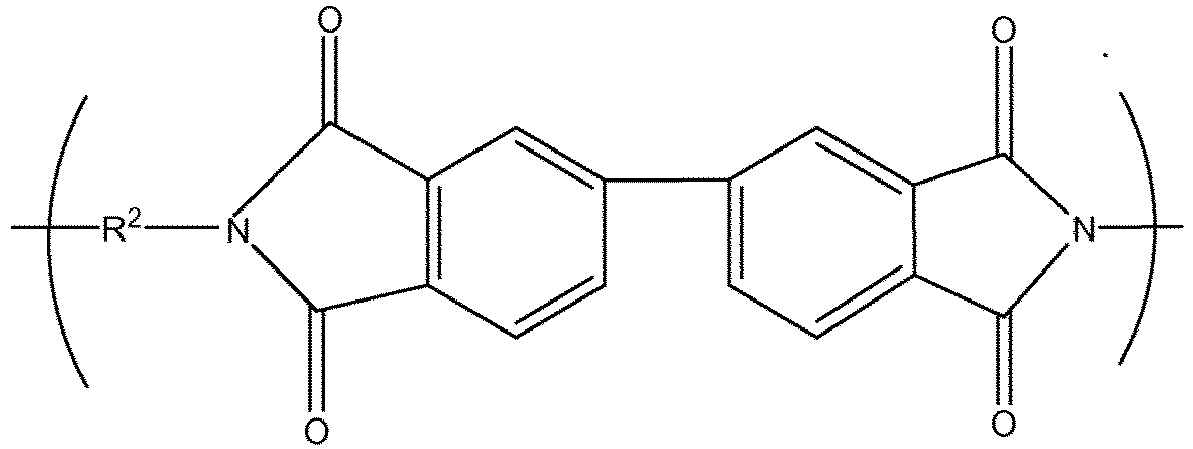


- Artikel gemäß Anspruch 5, wobei mehr als 60 bis 85 mol-% der R2-Gruppen p-Phenylenradikale umfassen und ungefähr 15 bis weniger als 40 mol-% m-Phenylenradikale umfassen.
- Artikel gemäß Anspruch 3, weiterhin umfassend als eine Komponente (d) einen oder mehrere Zusätze in einer Menge in einem Bereich von ungefähr 5 bis ungefähr 70 Gew.-% basierend auf dem Gewicht der gesamten Zusammensetzung (a) + (b) + (c) + (d).
- Artikel gemäß Anspruch 3, der die Form eines Stabes, einer Röhre, einer Platte, eines Rings, einer Scheibe oder einer Stange aufweist.
- Artikel gemäß Anspruch 3, der eine Muffe, eine Auflagerung, eine Unterlegscheibe, einen Dichtungsring, ein Verschleißkissen, ein Verschleißband, einen Keil, eine Dichtung, einen Schlitten oder eine Ventilkomponente umfasst.
- Artikel gemäß Anspruch 3, der ein Fahrzeugbauteil für ein Automobil, ein Wohnmobil, ein Geländefahrzeug, ein Militärfahrzeug, einen Lieferwagen, landwirtschaftliche Ausrüstungen und Ausrüstungen des Bausektors oder einen LKW umfasst, wobei das genannte Fahrzeugbauteil ausgewählt ist aus der Gruppe bestehend aus: Verbrennungsmotoren; Abgasrückführsystemen; Kupplungssystemen; Muffen, Dichtringen, Bandfedern und Ventilsitzen für Treibstoffsysteme; Pumpen; Vakuumpumpenflügeln; Druckscheiben, Ventilsitzen und Dichtringen in Getriebebauteilen; Kardanwellenbauteilen; Antriebssystembauteilen; nicht zu Flugzeugen gehörenden Strahltriebwerken; Zahnriemenstraffern; Rutschern in Zündverteilern; Antriebsstrang-Anwendungen; Emissionsbauteilen; variablen Ventilsystemen; Turboladern; Kugellagerhalterungen; Bypassventilmuffen; Luftinduktionsmodulen; Triebstranganwendungen; Dichtringen; Druckscheiben und Gabelblöcken für den Einsatz in der Automatik, kontinuierlich variablen und manuellen Getrieben; Verteilergetrieben; Drehmomentwandlern; Dichtringen und Druckscheiben für Hochleistungs-Geländegetriebe und Hydraulikmotoren; Muffen, Knöpfen und Kugellagern für kontinuierliche, variable Getriebe in Geländewagen und Schneemobilen; und Kettenspannern für Schneemobil-Getriebekästen; Bremssystemkomponenten; Verschleißkissen für Bremssysteme; Ventilbauteile für Antiblockier-Bremssysteme; Türscharniermuffen; Schalthebellager; Radscheibenmuttern; Steuersystemen; Klimaanlagensystemen; Aufhängungssystemen; Zu- und Abluftsystemen; Kolbenringen; und Stoßdämpfern.
- Artikel gemäß Anspruch 3, der einen Luftfahrtanwendungsteil umfasst, der ausgewählt ist aus der Gruppe bestehend aus: Luftfahrtmotorteilen, Turboladern, Schutzblechen, Luftfahrt-Teilsystemen, Schubumlenkern, Flugzeugrümpfen, Klappensystemen und Ventilen, Luftfahrthalterungen, Flugzeug-Keilwellenkupplungen, die zum Antrieb von Generatoren verwendet werden, Hydraulikpumpen, Rohrschellen für einen Luftfahrtmotor, Steuerkopplungsbauteilen, Türmechanismen, Raketen- und Satellitenbauteilen, Muffen, variablen Stator-Propellerflügelmuffen, Lagern, Unterlegscheiben, Druckscheiben, Dichtungsringen, Dichtungen, Verschleißkissen, Klötzen, Verschleißbändern, Stoßfängern und Schlitten.
- Artikel gemäß Anspruch 3, der ein Teil für die Materialtransportausrüstung oder Materialverarbeitungsausrüstung umfasst, das ausgewählt ist aus der Gruppe bestehend aus: Einspritz-Abformmaschinen; Isolatoren, Dichtungen, Muffen und Lagern für Kunststoffeinspritzabform- und Strangpress-Ausrüstungen; Förderern, Bandpressen und Aufspannrahmen; Folien, Dichtungen, Unterlegscheiben, Lagern, Muffen, Abdichtungen, Verschleißkissen, Dichtungsringen, Schlitten und Abdrückstiften; Heißglas-Handhabungshaken und Klötzen; Isolatoren; Dichtungen in Aluminium-Gussmaschinen, Ventilen, Ventilsitzen, Kolben; Gaskompressoren, Kolbenringen, Kolben, Ventilplatten, Labyrinthdichtungen; hydraulischen Turbinen, Messvorrichtungen; Muffen, Unterlegscheiben und Druckstopfen für Elektromotoren; kleine Motorbuchsen und Lager für tragbare Werkzeuggeräte-Motoren und Gebläse; Schweißbrennerisolierungen; Muffen in Formgebern, die Getränkedosenformen formen; Vakuumrohrleitungsteilen und Schalendruckbändern und -stopfen; Muffen und Spannfutterauskleidungen in der Stahl- und Aluminium-Walzwerkindustrie; Gas- und Ölschürf- und -raffinerieausrüstungen; und Textilmaschinen, Muffen für Webmaschinen, Kugelschalen für Wirkstühle und Verschleißbänder für Textil-Endbearbeitungsmaschinen.
Applications Claiming Priority (2)
| Application Number | Priority Date | Filing Date | Title |
|---|---|---|---|
| US38760510P | 2010-09-29 | 2010-09-29 | |
| PCT/US2011/053983 WO2012050972A2 (en) | 2010-09-29 | 2011-09-29 | Polyimide resins for high temperature applications |
Publications (3)
| Publication Number | Publication Date |
|---|---|
| EP2622020A2 EP2622020A2 (de) | 2013-08-07 |
| EP2622020A4 EP2622020A4 (de) | 2014-05-14 |
| EP2622020B1 true EP2622020B1 (de) | 2017-03-15 |
Family
ID=45938894
Family Applications (1)
| Application Number | Title | Priority Date | Filing Date |
|---|---|---|---|
| EP11833112.3A Not-in-force EP2622020B1 (de) | 2010-09-29 | 2011-09-29 | Polyimidharze für hochtemperaturanwendungen |
Country Status (5)
| Country | Link |
|---|---|
| US (1) | US8795799B2 (de) |
| EP (1) | EP2622020B1 (de) |
| KR (1) | KR20130097781A (de) |
| CN (1) | CN103154139B (de) |
| WO (1) | WO2012050972A2 (de) |
Families Citing this family (6)
| Publication number | Priority date | Publication date | Assignee | Title |
|---|---|---|---|---|
| CN109071874B (zh) * | 2016-05-12 | 2021-02-05 | 纳幕尔杜邦公司 | 聚酰亚胺组合物以及聚酰亚胺测试插座壳体 |
| US10428754B2 (en) * | 2016-11-18 | 2019-10-01 | Borgwarner Inc. | Inline sticky turbocharger component diagnostic device and system and method of using the same |
| CN111276287B (zh) * | 2020-02-13 | 2021-08-31 | 吕秀霞 | 一种耐拉伸耐高温航空航天电缆及其制备方法 |
| CN111243789B (zh) * | 2020-02-13 | 2021-06-04 | 国友线缆集团有限公司 | 一种耐高温航空航天电缆及其制备方法 |
| CN111205646B (zh) * | 2020-03-20 | 2022-09-09 | 株洲时代华鑫新材料技术有限公司 | 一种黑色哑光聚酰亚胺薄膜及其制备方法 |
| CN116175990B (zh) * | 2023-04-24 | 2023-07-11 | 国营川西机器厂 | 一组用于解决航空发动机加分薄膜漏油故障的装置及方法 |
Family Cites Families (10)
| Publication number | Priority date | Publication date | Assignee | Title |
|---|---|---|---|---|
| US3579310A (en) | 1967-06-28 | 1971-05-18 | Du Pont | Preparation of acicular rutile tio2 |
| JPS56103270A (en) * | 1980-01-22 | 1981-08-18 | Teijin Ltd | Friction material |
| JPH0624977B2 (ja) | 1988-05-11 | 1994-04-06 | 石原産業株式会社 | 針状二酸化チタン及びその製造方法 |
| US5886129A (en) | 1997-07-01 | 1999-03-23 | E. I. Du Pont De Nemours And Company | Oxidatively stable rigid aromatic polyimide compositions and process for their preparation |
| JP2003055473A (ja) * | 2001-08-17 | 2003-02-26 | Kanegafuchi Chem Ind Co Ltd | ポリイミド管状物および電子写真用管状物 |
| AT411261B (de) * | 2002-03-19 | 2003-11-25 | Intumex Gmbh | Intumeszierende elektrische installationssysteme enthaltend eine kombination aus polyimiden und vermikulargraphit und zu deren herstellung |
| CN101522808B (zh) * | 2006-10-11 | 2011-09-28 | 住友电气工业株式会社 | 聚酰亚胺管、其制备方法、聚酰亚胺清漆的制备方法、以及定影带 |
| JP5346078B2 (ja) * | 2008-05-20 | 2013-11-20 | イー・アイ・デュポン・ドウ・ヌムール・アンド・カンパニー | 熱および寸法安定性ポリイミドフィルム、ならびに、これに関する方法 |
| US7858687B2 (en) * | 2008-07-30 | 2010-12-28 | E.I. Du Pont De Nemours And Company | Polyimide resins for high temperature wear applications |
| US8324304B2 (en) * | 2008-07-30 | 2012-12-04 | E I Du Pont De Nemours And Company | Polyimide resins for high temperature wear applications |
-
2011
- 2011-09-29 EP EP11833112.3A patent/EP2622020B1/de not_active Not-in-force
- 2011-09-29 CN CN201180046524.9A patent/CN103154139B/zh not_active Expired - Fee Related
- 2011-09-29 WO PCT/US2011/053983 patent/WO2012050972A2/en not_active Ceased
- 2011-09-29 US US13/823,120 patent/US8795799B2/en not_active Expired - Fee Related
- 2011-09-29 KR KR1020137010834A patent/KR20130097781A/ko not_active Ceased
Non-Patent Citations (1)
| Title |
|---|
| None * |
Also Published As
| Publication number | Publication date |
|---|---|
| EP2622020A2 (de) | 2013-08-07 |
| US8795799B2 (en) | 2014-08-05 |
| WO2012050972A2 (en) | 2012-04-19 |
| CN103154139A (zh) | 2013-06-12 |
| KR20130097781A (ko) | 2013-09-03 |
| WO2012050972A3 (en) | 2012-06-21 |
| EP2622020A4 (de) | 2014-05-14 |
| US20130171396A1 (en) | 2013-07-04 |
| CN103154139B (zh) | 2016-09-07 |
Similar Documents
| Publication | Publication Date | Title |
|---|---|---|
| US8324304B2 (en) | Polyimide resins for high temperature wear applications | |
| US20120235071A1 (en) | Polyimide resins for high temperature wear applications | |
| US8795799B2 (en) | Polyimide resins for high temperature applications | |
| WO2013003397A2 (en) | Polyimide-coated fillers | |
| US8507615B2 (en) | Polyimide resins for high temperature wear applications | |
| EP2315797B1 (de) | Polyimidharze für hochtemperaturveschleissanwendungen | |
| WO2012050958A2 (en) | Polyimide resins for high temperature applications | |
| US20130171395A1 (en) | Polyimide resins for high temperature applications | |
| EP2794742B1 (de) | Polyimidharzzusammensetzung | |
| US20120053272A1 (en) | Polyimide resins for high temperature wear applications |
Legal Events
| Date | Code | Title | Description |
|---|---|---|---|
| PUAI | Public reference made under article 153(3) epc to a published international application that has entered the european phase |
Free format text: ORIGINAL CODE: 0009012 |
|
| 17P | Request for examination filed |
Effective date: 20130228 |
|
| AK | Designated contracting states |
Kind code of ref document: A2 Designated state(s): AL AT BE BG CH CY CZ DE DK EE ES FI FR GB GR HR HU IE IS IT LI LT LU LV MC MK MT NL NO PL PT RO RS SE SI SK SM TR |
|
| DAX | Request for extension of the european patent (deleted) | ||
| A4 | Supplementary search report drawn up and despatched |
Effective date: 20140416 |
|
| RIC1 | Information provided on ipc code assigned before grant |
Ipc: C08K 7/08 20060101ALI20140410BHEP Ipc: C08L 79/08 20060101AFI20140410BHEP Ipc: C08K 3/22 20060101ALI20140410BHEP Ipc: C08G 73/10 20060101ALI20140410BHEP Ipc: C08K 3/04 20060101ALI20140410BHEP Ipc: C08J 5/00 20060101ALI20140410BHEP |
|
| RAP1 | Party data changed (applicant data changed or rights of an application transferred) |
Owner name: E. I. DU PONT DE NEMOURS AND COMPANY |
|
| GRAP | Despatch of communication of intention to grant a patent |
Free format text: ORIGINAL CODE: EPIDOSNIGR1 |
|
| INTG | Intention to grant announced |
Effective date: 20160919 |
|
| GRAS | Grant fee paid |
Free format text: ORIGINAL CODE: EPIDOSNIGR3 |
|
| GRAA | (expected) grant |
Free format text: ORIGINAL CODE: 0009210 |
|
| AK | Designated contracting states |
Kind code of ref document: B1 Designated state(s): AL AT BE BG CH CY CZ DE DK EE ES FI FR GB GR HR HU IE IS IT LI LT LU LV MC MK MT NL NO PL PT RO RS SE SI SK SM TR |
|
| REG | Reference to a national code |
Ref country code: CH Ref legal event code: EP Ref country code: GB Ref legal event code: FG4D |
|
| REG | Reference to a national code |
Ref country code: IE Ref legal event code: FG4D |
|
| REG | Reference to a national code |
Ref country code: AT Ref legal event code: REF Ref document number: 875534 Country of ref document: AT Kind code of ref document: T Effective date: 20170415 |
|
| REG | Reference to a national code |
Ref country code: DE Ref legal event code: R096 Ref document number: 602011036067 Country of ref document: DE |
|
| REG | Reference to a national code |
Ref country code: NL Ref legal event code: MP Effective date: 20170315 |
|
| REG | Reference to a national code |
Ref country code: LT Ref legal event code: MG4D |
|
| PG25 | Lapsed in a contracting state [announced via postgrant information from national office to epo] |
Ref country code: NO Free format text: LAPSE BECAUSE OF FAILURE TO SUBMIT A TRANSLATION OF THE DESCRIPTION OR TO PAY THE FEE WITHIN THE PRESCRIBED TIME-LIMIT Effective date: 20170615 Ref country code: HR Free format text: LAPSE BECAUSE OF FAILURE TO SUBMIT A TRANSLATION OF THE DESCRIPTION OR TO PAY THE FEE WITHIN THE PRESCRIBED TIME-LIMIT Effective date: 20170315 Ref country code: LT Free format text: LAPSE BECAUSE OF FAILURE TO SUBMIT A TRANSLATION OF THE DESCRIPTION OR TO PAY THE FEE WITHIN THE PRESCRIBED TIME-LIMIT Effective date: 20170315 Ref country code: GR Free format text: LAPSE BECAUSE OF FAILURE TO SUBMIT A TRANSLATION OF THE DESCRIPTION OR TO PAY THE FEE WITHIN THE PRESCRIBED TIME-LIMIT Effective date: 20170616 Ref country code: FI Free format text: LAPSE BECAUSE OF FAILURE TO SUBMIT A TRANSLATION OF THE DESCRIPTION OR TO PAY THE FEE WITHIN THE PRESCRIBED TIME-LIMIT Effective date: 20170315 |
|
| REG | Reference to a national code |
Ref country code: FR Ref legal event code: PLFP Year of fee payment: 7 |
|
| REG | Reference to a national code |
Ref country code: AT Ref legal event code: MK05 Ref document number: 875534 Country of ref document: AT Kind code of ref document: T Effective date: 20170315 |
|
| PG25 | Lapsed in a contracting state [announced via postgrant information from national office to epo] |
Ref country code: SE Free format text: LAPSE BECAUSE OF FAILURE TO SUBMIT A TRANSLATION OF THE DESCRIPTION OR TO PAY THE FEE WITHIN THE PRESCRIBED TIME-LIMIT Effective date: 20170315 Ref country code: RS Free format text: LAPSE BECAUSE OF FAILURE TO SUBMIT A TRANSLATION OF THE DESCRIPTION OR TO PAY THE FEE WITHIN THE PRESCRIBED TIME-LIMIT Effective date: 20170315 Ref country code: LV Free format text: LAPSE BECAUSE OF FAILURE TO SUBMIT A TRANSLATION OF THE DESCRIPTION OR TO PAY THE FEE WITHIN THE PRESCRIBED TIME-LIMIT Effective date: 20170315 Ref country code: BG Free format text: LAPSE BECAUSE OF FAILURE TO SUBMIT A TRANSLATION OF THE DESCRIPTION OR TO PAY THE FEE WITHIN THE PRESCRIBED TIME-LIMIT Effective date: 20170615 |
|
| PG25 | Lapsed in a contracting state [announced via postgrant information from national office to epo] |
Ref country code: NL Free format text: LAPSE BECAUSE OF FAILURE TO SUBMIT A TRANSLATION OF THE DESCRIPTION OR TO PAY THE FEE WITHIN THE PRESCRIBED TIME-LIMIT Effective date: 20170315 |
|
| PG25 | Lapsed in a contracting state [announced via postgrant information from national office to epo] |
Ref country code: RO Free format text: LAPSE BECAUSE OF FAILURE TO SUBMIT A TRANSLATION OF THE DESCRIPTION OR TO PAY THE FEE WITHIN THE PRESCRIBED TIME-LIMIT Effective date: 20170315 Ref country code: IT Free format text: LAPSE BECAUSE OF FAILURE TO SUBMIT A TRANSLATION OF THE DESCRIPTION OR TO PAY THE FEE WITHIN THE PRESCRIBED TIME-LIMIT Effective date: 20170315 Ref country code: SK Free format text: LAPSE BECAUSE OF FAILURE TO SUBMIT A TRANSLATION OF THE DESCRIPTION OR TO PAY THE FEE WITHIN THE PRESCRIBED TIME-LIMIT Effective date: 20170315 Ref country code: CZ Free format text: LAPSE BECAUSE OF FAILURE TO SUBMIT A TRANSLATION OF THE DESCRIPTION OR TO PAY THE FEE WITHIN THE PRESCRIBED TIME-LIMIT Effective date: 20170315 Ref country code: AT Free format text: LAPSE BECAUSE OF FAILURE TO SUBMIT A TRANSLATION OF THE DESCRIPTION OR TO PAY THE FEE WITHIN THE PRESCRIBED TIME-LIMIT Effective date: 20170315 Ref country code: ES Free format text: LAPSE BECAUSE OF FAILURE TO SUBMIT A TRANSLATION OF THE DESCRIPTION OR TO PAY THE FEE WITHIN THE PRESCRIBED TIME-LIMIT Effective date: 20170315 Ref country code: EE Free format text: LAPSE BECAUSE OF FAILURE TO SUBMIT A TRANSLATION OF THE DESCRIPTION OR TO PAY THE FEE WITHIN THE PRESCRIBED TIME-LIMIT Effective date: 20170315 |
|
| PG25 | Lapsed in a contracting state [announced via postgrant information from national office to epo] |
Ref country code: IS Free format text: LAPSE BECAUSE OF FAILURE TO SUBMIT A TRANSLATION OF THE DESCRIPTION OR TO PAY THE FEE WITHIN THE PRESCRIBED TIME-LIMIT Effective date: 20170715 Ref country code: SM Free format text: LAPSE BECAUSE OF FAILURE TO SUBMIT A TRANSLATION OF THE DESCRIPTION OR TO PAY THE FEE WITHIN THE PRESCRIBED TIME-LIMIT Effective date: 20170315 Ref country code: PL Free format text: LAPSE BECAUSE OF FAILURE TO SUBMIT A TRANSLATION OF THE DESCRIPTION OR TO PAY THE FEE WITHIN THE PRESCRIBED TIME-LIMIT Effective date: 20170315 Ref country code: PT Free format text: LAPSE BECAUSE OF FAILURE TO SUBMIT A TRANSLATION OF THE DESCRIPTION OR TO PAY THE FEE WITHIN THE PRESCRIBED TIME-LIMIT Effective date: 20170717 |
|
| REG | Reference to a national code |
Ref country code: DE Ref legal event code: R097 Ref document number: 602011036067 Country of ref document: DE |
|
| PLBE | No opposition filed within time limit |
Free format text: ORIGINAL CODE: 0009261 |
|
| STAA | Information on the status of an ep patent application or granted ep patent |
Free format text: STATUS: NO OPPOSITION FILED WITHIN TIME LIMIT |
|
| PG25 | Lapsed in a contracting state [announced via postgrant information from national office to epo] |
Ref country code: DK Free format text: LAPSE BECAUSE OF FAILURE TO SUBMIT A TRANSLATION OF THE DESCRIPTION OR TO PAY THE FEE WITHIN THE PRESCRIBED TIME-LIMIT Effective date: 20170315 |
|
| 26N | No opposition filed |
Effective date: 20171218 |
|
| PG25 | Lapsed in a contracting state [announced via postgrant information from national office to epo] |
Ref country code: SI Free format text: LAPSE BECAUSE OF FAILURE TO SUBMIT A TRANSLATION OF THE DESCRIPTION OR TO PAY THE FEE WITHIN THE PRESCRIBED TIME-LIMIT Effective date: 20170315 |
|
| REG | Reference to a national code |
Ref country code: CH Ref legal event code: PL |
|
| PG25 | Lapsed in a contracting state [announced via postgrant information from national office to epo] |
Ref country code: MC Free format text: LAPSE BECAUSE OF FAILURE TO SUBMIT A TRANSLATION OF THE DESCRIPTION OR TO PAY THE FEE WITHIN THE PRESCRIBED TIME-LIMIT Effective date: 20170315 |
|
| REG | Reference to a national code |
Ref country code: IE Ref legal event code: MM4A |
|
| REG | Reference to a national code |
Ref country code: BE Ref legal event code: MM Effective date: 20170930 |
|
| PG25 | Lapsed in a contracting state [announced via postgrant information from national office to epo] |
Ref country code: LU Free format text: LAPSE BECAUSE OF NON-PAYMENT OF DUE FEES Effective date: 20170929 |
|
| PG25 | Lapsed in a contracting state [announced via postgrant information from national office to epo] |
Ref country code: IE Free format text: LAPSE BECAUSE OF NON-PAYMENT OF DUE FEES Effective date: 20170929 Ref country code: LI Free format text: LAPSE BECAUSE OF NON-PAYMENT OF DUE FEES Effective date: 20170930 Ref country code: CH Free format text: LAPSE BECAUSE OF NON-PAYMENT OF DUE FEES Effective date: 20170930 |
|
| REG | Reference to a national code |
Ref country code: FR Ref legal event code: PLFP Year of fee payment: 8 |
|
| PG25 | Lapsed in a contracting state [announced via postgrant information from national office to epo] |
Ref country code: BE Free format text: LAPSE BECAUSE OF NON-PAYMENT OF DUE FEES Effective date: 20170930 |
|
| PG25 | Lapsed in a contracting state [announced via postgrant information from national office to epo] |
Ref country code: MT Free format text: LAPSE BECAUSE OF NON-PAYMENT OF DUE FEES Effective date: 20170929 |
|
| PG25 | Lapsed in a contracting state [announced via postgrant information from national office to epo] |
Ref country code: HU Free format text: LAPSE BECAUSE OF FAILURE TO SUBMIT A TRANSLATION OF THE DESCRIPTION OR TO PAY THE FEE WITHIN THE PRESCRIBED TIME-LIMIT; INVALID AB INITIO Effective date: 20110929 |
|
| PG25 | Lapsed in a contracting state [announced via postgrant information from national office to epo] |
Ref country code: CY Free format text: LAPSE BECAUSE OF NON-PAYMENT OF DUE FEES Effective date: 20170315 |
|
| PGFP | Annual fee paid to national office [announced via postgrant information from national office to epo] |
Ref country code: DE Payment date: 20190917 Year of fee payment: 9 Ref country code: FR Payment date: 20190815 Year of fee payment: 9 |
|
| PG25 | Lapsed in a contracting state [announced via postgrant information from national office to epo] |
Ref country code: MK Free format text: LAPSE BECAUSE OF FAILURE TO SUBMIT A TRANSLATION OF THE DESCRIPTION OR TO PAY THE FEE WITHIN THE PRESCRIBED TIME-LIMIT Effective date: 20170315 |
|
| PGFP | Annual fee paid to national office [announced via postgrant information from national office to epo] |
Ref country code: GB Payment date: 20190926 Year of fee payment: 9 |
|
| PG25 | Lapsed in a contracting state [announced via postgrant information from national office to epo] |
Ref country code: TR Free format text: LAPSE BECAUSE OF FAILURE TO SUBMIT A TRANSLATION OF THE DESCRIPTION OR TO PAY THE FEE WITHIN THE PRESCRIBED TIME-LIMIT Effective date: 20170315 |
|
| PG25 | Lapsed in a contracting state [announced via postgrant information from national office to epo] |
Ref country code: AL Free format text: LAPSE BECAUSE OF FAILURE TO SUBMIT A TRANSLATION OF THE DESCRIPTION OR TO PAY THE FEE WITHIN THE PRESCRIBED TIME-LIMIT Effective date: 20170315 |
|
| REG | Reference to a national code |
Ref country code: DE Ref legal event code: R119 Ref document number: 602011036067 Country of ref document: DE |
|
| GBPC | Gb: european patent ceased through non-payment of renewal fee |
Effective date: 20200929 |
|
| PG25 | Lapsed in a contracting state [announced via postgrant information from national office to epo] |
Ref country code: DE Free format text: LAPSE BECAUSE OF NON-PAYMENT OF DUE FEES Effective date: 20210401 Ref country code: FR Free format text: LAPSE BECAUSE OF NON-PAYMENT OF DUE FEES Effective date: 20200930 |
|
| PG25 | Lapsed in a contracting state [announced via postgrant information from national office to epo] |
Ref country code: GB Free format text: LAPSE BECAUSE OF NON-PAYMENT OF DUE FEES Effective date: 20200929 |