EP2620536A1 - Method for cleaning a laundry washing machine and laundry washing machine implementing the method - Google Patents
Method for cleaning a laundry washing machine and laundry washing machine implementing the method Download PDFInfo
- Publication number
- EP2620536A1 EP2620536A1 EP12152299.9A EP12152299A EP2620536A1 EP 2620536 A1 EP2620536 A1 EP 2620536A1 EP 12152299 A EP12152299 A EP 12152299A EP 2620536 A1 EP2620536 A1 EP 2620536A1
- Authority
- EP
- European Patent Office
- Prior art keywords
- water
- tub
- polymer compound
- antimicrobial polymer
- washing
- Prior art date
- Legal status (The legal status is an assumption and is not a legal conclusion. Google has not performed a legal analysis and makes no representation as to the accuracy of the status listed.)
- Withdrawn
Links
- 238000000034 method Methods 0.000 title claims abstract description 74
- 238000010412 laundry washing Methods 0.000 title claims abstract description 62
- 238000004140 cleaning Methods 0.000 title claims abstract description 38
- XLYOFNOQVPJJNP-UHFFFAOYSA-N water Substances O XLYOFNOQVPJJNP-UHFFFAOYSA-N 0.000 claims abstract description 280
- 150000001875 compounds Chemical class 0.000 claims abstract description 122
- 238000005406 washing Methods 0.000 claims abstract description 114
- 229920002118 antimicrobial polymer Polymers 0.000 claims abstract description 109
- 239000007788 liquid Substances 0.000 claims abstract description 19
- 230000000844 anti-bacterial effect Effects 0.000 claims abstract description 14
- 239000003599 detergent Substances 0.000 claims description 30
- 125000002091 cationic group Chemical group 0.000 claims description 12
- 229920006317 cationic polymer Polymers 0.000 claims description 10
- 239000000203 mixture Substances 0.000 claims description 9
- NLXLAEXVIDQMFP-UHFFFAOYSA-N Ammonia chloride Chemical compound [NH4+].[Cl-] NLXLAEXVIDQMFP-UHFFFAOYSA-N 0.000 claims description 6
- 229920002413 Polyhexanide Polymers 0.000 claims description 6
- 238000001035 drying Methods 0.000 claims description 5
- -1 quaternary ammonium salt compound Chemical class 0.000 claims description 5
- VEXZGXHMUGYJMC-UHFFFAOYSA-M Chloride anion Chemical compound [Cl-] VEXZGXHMUGYJMC-UHFFFAOYSA-M 0.000 claims description 3
- 239000004952 Polyamide Substances 0.000 claims description 3
- 229920002873 Polyethylenimine Polymers 0.000 claims description 3
- 229920002472 Starch Polymers 0.000 claims description 3
- 125000000217 alkyl group Chemical group 0.000 claims description 3
- 235000019270 ammonium chloride Nutrition 0.000 claims description 3
- 125000004432 carbon atom Chemical group C* 0.000 claims description 3
- IMDSICMGTNDPHI-UHFFFAOYSA-M decyl-dimethyl-(3-trimethoxysilylpropyl)azanium;chloride Chemical compound [Cl-].CCCCCCCCCC[N+](C)(C)CCC[Si](OC)(OC)OC IMDSICMGTNDPHI-UHFFFAOYSA-M 0.000 claims description 3
- AXPYABZPAWSUMG-UHFFFAOYSA-M didecyl-methyl-(3-trimethoxysilylpropyl)azanium;chloride Chemical compound [Cl-].CCCCCCCCCC[N+](C)(CCC[Si](OC)(OC)OC)CCCCCCCCCC AXPYABZPAWSUMG-UHFFFAOYSA-M 0.000 claims description 3
- RFZWUAUXCKKETN-UHFFFAOYSA-M didodecyl-methyl-(3-trimethoxysilylpropyl)azanium;chloride Chemical compound [Cl-].CCCCCCCCCCCC[N+](C)(CCC[Si](OC)(OC)OC)CCCCCCCCCCCC RFZWUAUXCKKETN-UHFFFAOYSA-M 0.000 claims description 3
- DPBKKJPIRPNJMM-UHFFFAOYSA-M dihexadecyl-methyl-(3-trimethoxysilylpropyl)azanium;chloride Chemical compound [Cl-].CCCCCCCCCCCCCCCC[N+](C)(CCC[Si](OC)(OC)OC)CCCCCCCCCCCCCCCC DPBKKJPIRPNJMM-UHFFFAOYSA-M 0.000 claims description 3
- HRBYCVPFYWTROV-UHFFFAOYSA-M dimethyl-octadecyl-(3-triethoxysilylpropyl)azanium;chloride Chemical compound [Cl-].CCCCCCCCCCCCCCCCCC[N+](C)(C)CCC[Si](OCC)(OCC)OCC HRBYCVPFYWTROV-UHFFFAOYSA-M 0.000 claims description 3
- WSFMFXQNYPNYGG-UHFFFAOYSA-M dimethyl-octadecyl-(3-trimethoxysilylpropyl)azanium;chloride Chemical compound [Cl-].CCCCCCCCCCCCCCCCCC[N+](C)(C)CCC[Si](OC)(OC)OC WSFMFXQNYPNYGG-UHFFFAOYSA-M 0.000 claims description 3
- PHDAZHGCTGTQAS-UHFFFAOYSA-M dimethyl-tetradecyl-(3-trimethoxysilylpropyl)azanium;chloride Chemical compound [Cl-].CCCCCCCCCCCCCC[N+](C)(C)CCC[Si](OC)(OC)OC PHDAZHGCTGTQAS-UHFFFAOYSA-M 0.000 claims description 3
- UBMGRWRKCJIKMQ-UHFFFAOYSA-M dodecyl-dimethyl-(3-trimethoxysilylpropyl)azanium;chloride Chemical compound [Cl-].CCCCCCCCCCCC[N+](C)(C)CCC[Si](OC)(OC)OC UBMGRWRKCJIKMQ-UHFFFAOYSA-M 0.000 claims description 3
- 229920001477 hydrophilic polymer Polymers 0.000 claims description 3
- UZAWIPIKBVXYQT-UHFFFAOYSA-M methyl-dioctyl-(3-trimethoxysilylpropyl)azanium;chloride Chemical compound [Cl-].CCCCCCCC[N+](C)(CCC[Si](OC)(OC)OC)CCCCCCCC UZAWIPIKBVXYQT-UHFFFAOYSA-M 0.000 claims description 3
- 238000002156 mixing Methods 0.000 claims description 3
- 229920002401 polyacrylamide Polymers 0.000 claims description 3
- 229920002647 polyamide Polymers 0.000 claims description 3
- 229920000768 polyamine Polymers 0.000 claims description 3
- 229920005989 resin Polymers 0.000 claims description 3
- 239000011347 resin Substances 0.000 claims description 3
- 235000019698 starch Nutrition 0.000 claims description 3
- 239000008107 starch Substances 0.000 claims description 3
- 239000000243 solution Substances 0.000 description 59
- 244000005700 microbiome Species 0.000 description 11
- 241000894006 Bacteria Species 0.000 description 9
- 230000035755 proliferation Effects 0.000 description 9
- 230000000845 anti-microbial effect Effects 0.000 description 6
- 238000010438 heat treatment Methods 0.000 description 6
- 238000009987 spinning Methods 0.000 description 6
- 230000003213 activating effect Effects 0.000 description 4
- 238000011068 loading method Methods 0.000 description 4
- 239000004033 plastic Substances 0.000 description 4
- 229920003023 plastic Polymers 0.000 description 4
- 230000000694 effects Effects 0.000 description 3
- 238000001914 filtration Methods 0.000 description 3
- 229920000642 polymer Polymers 0.000 description 3
- 230000009471 action Effects 0.000 description 2
- 239000000654 additive Substances 0.000 description 2
- 239000007864 aqueous solution Substances 0.000 description 2
- 230000009286 beneficial effect Effects 0.000 description 2
- 239000007844 bleaching agent Substances 0.000 description 2
- 239000003344 environmental pollutant Substances 0.000 description 2
- 238000000605 extraction Methods 0.000 description 2
- 230000002349 favourable effect Effects 0.000 description 2
- 230000006870 function Effects 0.000 description 2
- 125000002887 hydroxy group Chemical group [H]O* 0.000 description 2
- 239000002184 metal Substances 0.000 description 2
- 150000001282 organosilanes Chemical class 0.000 description 2
- 231100000719 pollutant Toxicity 0.000 description 2
- 239000002699 waste material Substances 0.000 description 2
- 238000009736 wetting Methods 0.000 description 2
- 241000233866 Fungi Species 0.000 description 1
- 239000006096 absorbing agent Substances 0.000 description 1
- 239000002253 acid Substances 0.000 description 1
- 230000000996 additive effect Effects 0.000 description 1
- 230000006399 behavior Effects 0.000 description 1
- 230000032770 biofilm formation Effects 0.000 description 1
- 230000015572 biosynthetic process Effects 0.000 description 1
- 230000003247 decreasing effect Effects 0.000 description 1
- 230000000249 desinfective effect Effects 0.000 description 1
- 238000010586 diagram Methods 0.000 description 1
- 238000005530 etching Methods 0.000 description 1
- 238000007306 functionalization reaction Methods 0.000 description 1
- 230000036541 health Effects 0.000 description 1
- 239000011796 hollow space material Substances 0.000 description 1
- 239000011159 matrix material Substances 0.000 description 1
- 230000004048 modification Effects 0.000 description 1
- 238000012986 modification Methods 0.000 description 1
- 239000000178 monomer Substances 0.000 description 1
- 235000015097 nutrients Nutrition 0.000 description 1
- 230000003287 optical effect Effects 0.000 description 1
- 230000008569 process Effects 0.000 description 1
- 150000003242 quaternary ammonium salts Chemical class 0.000 description 1
- 239000002689 soil Substances 0.000 description 1
- 238000003980 solgel method Methods 0.000 description 1
- 239000008400 supply water Substances 0.000 description 1
- 229920002994 synthetic fiber Polymers 0.000 description 1
- 239000004758 synthetic textile Substances 0.000 description 1
- 238000011282 treatment Methods 0.000 description 1
Images



Classifications
-
- D—TEXTILES; PAPER
- D06—TREATMENT OF TEXTILES OR THE LIKE; LAUNDERING; FLEXIBLE MATERIALS NOT OTHERWISE PROVIDED FOR
- D06F—LAUNDERING, DRYING, IRONING, PRESSING OR FOLDING TEXTILE ARTICLES
- D06F35/00—Washing machines, apparatus, or methods not otherwise provided for
- D06F35/005—Methods for washing, rinsing or spin-drying
- D06F35/008—Methods for washing, rinsing or spin-drying for disinfecting the tub or the drum
-
- D—TEXTILES; PAPER
- D06—TREATMENT OF TEXTILES OR THE LIKE; LAUNDERING; FLEXIBLE MATERIALS NOT OTHERWISE PROVIDED FOR
- D06F—LAUNDERING, DRYING, IRONING, PRESSING OR FOLDING TEXTILE ARTICLES
- D06F39/00—Details of washing machines not specific to a single type of machines covered by groups D06F9/00 - D06F27/00
- D06F39/08—Liquid supply or discharge arrangements
Definitions
- the present invention relates to a method for cleaning a laundry washing machine, and to a laundry washing machine implementing the method.
- laundry washing machines both "simple” laundry washing machines (i.e. laundry washing machines which can only wash and rinse laundry) and laundry washing-drying machines (i.e. laundry washing machines which can also dry laundry), is widespread.
- laundry washing machine will refer to both simple laundry washing machines and laundry washing-drying machines.
- Laundry washing machines generally comprise an external casing provided with a washing tub which contains a rotatable perforated drum where the laundry is placed.
- a loading/unloading door ensures access to the tub and the drum.
- Laundry washing machines typically comprise a detergent supply unit (e.g. a detergent drawer) and a water inlet circuit for the introduction of water and washing/rinsing products (i.e. detergent, softener, etc.) into the tub.
- a detergent supply unit e.g. a detergent drawer
- a water inlet circuit for the introduction of water and washing/rinsing products (i.e. detergent, softener, etc.) into the tub.
- Known laundry washing machines are also provided with water draining circuit that may operate both during the initial phases of the washing cycle and at the end of the same to drain the dirty water.
- Some known laundry washing machines are also provided with a recirculation circuit adapted to drain liquid from a bottom region of the washing tub and to re-admit such a liquid into a higher region of the washing tub, so as to better wetting the laundry.
- a complete washing cycle typically includes different phases during which the laundry to be washed is subjected to adequate treatments.
- a washing cycle usually comprises a laundry wetting phase with addition of a washing detergent, and a main washing phase during which, according to the washing program selected by the user, the water contained in the tub is heated to a predetermined temperature and the drum is rotated, so as to apply a mechanical cleaning action to the laundry.
- a successive step of the cycle comprises a rinsing phase which usually comprises one or more rinsing cycles.
- a rinsing phase which usually comprises one or more rinsing cycles.
- clean rinse water is added to the laundry, the drum is rotated, and the water is then drained from the tub to the outside of the washing machine.
- a final spinning phase allows the extraction of the residual water contained in the wet laundry.
- the drum In the spinning phase the drum is rotated, typically at a high rotation speed, for example about 1300-1600 rpm, to obtain the extraction of the water from the laundry.
- the water extracted during the spinning phase is drained towards the outside by means of the water draining devices.
- washing behaviours even if beneficial on the environment point of view, have however the drawback that they promote, or at least not help to contrast/reduce/inactivate, the proliferation of microorganisms, like bacteria, mold, fungi.
- washing machines are typically subjected to proliferation of microorganisms (e.g. bacteria) which are generally introduced into the machine together with the laundry and/or the water and/or the air and/or detergent/softener.
- microorganisms e.g. bacteria
- Biofilm is a community or aggregate of microorganisms embedded in an extracellular polymer matrix; biofilm typically forms on boundary surfaces (e.g. water/plastic, water/metal, air/plastic, oil/water etc).
- biofilm can easily grow in all the surfaces (sometimes hidden to the user) exposed to water and air (e.g. the detergent drawer, the internal surface of the washing tub, the drain pump circuit, the door gasket etc.) in such a way that it is very difficult (even not always possible) to remove this aggregate from the surface.
- These bacteria may cause bad smell, stain of the laundry, biocorrosion on the metal and plastic components, and some of them may be also potentially dangerous for the health of the user.
- the washing machine industry has developed lots of strategies to try to improve the hygiene of washing machines.
- DE19751028 discloses a washing machine provided with an hygiene program in which water is supplied into the washing drum and it is heated to at least 70°C, preferably 80°C; the drum is rotated during the heating process and/or for a set first period of time after the reaching of the water temperature of at least 70°C. The revolution takes place at washing speed. The drum is subsequently rotated at an increased speed of 150-300 rpm (rounds per minute) for a set second period of time, so that hot water reaches also the higher part of the washing tub. Thanks to the high temperature of the water the internal of the washing tub is disinfected.
- the washing tub is effectively disinfected, while the other parts of the washing machine, in particular the water inlet circuit, the detergent drawer, the water outlet circuit, and, if provided, the recirculation circuit, are not efficiently disinfected, since they are not contacted by hot water (e.g. the water inlet circuit, the detergent drawer and the recirculation circuit), or are contacted by water which has been already cooled off, and therefore its disinfecting action is lower, or no more present.
- hot water e.g. the water inlet circuit, the detergent drawer and the recirculation circuit
- EP1945848 discloses a cleaning method for cleaning the washing tub and the gasket of a drum-type washing machine;
- the drum-type washing machine includes a tub mounted in a cabinet such that wash water is supplied into a tub, a drum rotatably mounted in the tub such that laundry is put into the drum, a motor for rotating the drum, and a control unit for controlling the driving of the motor such that, when the drum is rotated, the wash water supplied into the tub reaches the upper part of the inner circumferential surface of the tub so as to clean the inner circumferential surface of the tub.
- the washing method disclosed in EP1945848 is adapted only to remove pollutants or scale that may be accumulated on the inner circumferential surface of the washing tub and in the lower part of the water storage tub, but it is not able to clean the liquid outlet circuit, since the cleaning effect is due mainly to the circulation of wash water along the inner circumferential surface of the tub obtained by rotating the drum at a quite high speed, and therefore this effect is present only in the tub, but it doesn't relate the liquid outlet circuit; moreover, for the same reason, this known cleaning method is not able to clean the water inlet circuit and the detergent drawer, nor, if provided, the recirculation circuit.
- this known cleaning method is able only to exert a mechanical cleaning of the tub inner surface, adapted mainly to remove pollutants or scale, but it is not effective in preventing the proliferation of microorganisms like bacteria.
- the aim of the present invention is therefore to provide a method for cleaning a laundry washing machine, and laundry washing machine implementing the method, which overcome the above mentioned drawbacks.
- microorganisms e.g. bacteria
- Another object of the invention is reducing or impeding the proliferation of bacteria without requiring a high usage/wastage of energy.
- Another object of the invention is reducing or impeding the proliferation of bacteria without requiring a high usage/wastage of water.
- Applicant has found that by contacting one or more parts of a laundry washing machine with a solution formed by water and a water soluble antimicrobial polymer compound adapted to stick to a body if a solution containing water and this water soluble antimicrobial polymer compound contacts this body, it is possible to reduce/prevent the growth/proliferation of microorganisms (e.g. bacteria) on such parts of the machine.
- microorganisms e.g. bacteria
- a cleaning method for a laundry washing machine comprising a washing tub containing a rotatable drum, a water inlet circuit for supplying a washing liquid into the tub, a water outlet circuit for draining washing liquid from the tub; the method comprising the steps of:
- supplying into the tub a solution of water and a water soluble antimicrobial polymer compound has to be interpreted in a wide way, that is it comprises the embodiment in which the solution of water and compound is prepared before being introduced into the tub, and also the embodiment in which the solution is obtained directly inside the tub (or in a conduit flowing into the tub), by providing the water and compound separately (i.e. at different time, and/or from different inlets) into the tub (or conduit), in such a way that water and compound mix, forming the solution, directly in the tub (or in the conduit flowing into the tub). Therefore, in an advantageous embodiment, water and the water soluble antimicrobial polymer compound may be supplied into the tub contemporaneously, e.g. already mixed (i.e.
- water may be supplied into the tub before the antimicrobial polymer compound, in which case water and compound mix (i.e. form the solution) only once they have reached the internal of the tub.
- water is supplied into the tub after the antimicrobial polymer compound, in which case water and compound mix (i.e. form the solution) only once they have reached the internal of the tub.
- the laundry washing machine comprises a recirculation circuit, connected to the tub and adapted to circulate washing liquid from a bottom region of the tub to a higher region of the tub; in this case , the method may advantageously further comprise, after the steps of supplying a solution of water and water soluble antimicrobial polymer compound into the tub, a step of circulating the solution containing water and water soluble antimicrobial polymer compound in the recirculation circuit, so that the solution contacts and creates an antibacterial layer on at least some parts of the recirculation circuit and is then recirculated into the tub.
- the water inlet circuit comprises a detergent compartment, suited to be filled with washing and/or rinsing products and connected to the tub, and a water inlet circuit for supplying clean water into the detergent compartment; in this case the method may advantageously comprise the step of supplying the water soluble antimicrobial polymer compound into the detergent compartment and mixing the antimicrobial polymer compound with clean water into the detergent compartment before or during the step of supplying the antimicrobial polymer compound into the tub, so that the antibacterial layer is created also on at least some parts of the detergent compartment and/or the water inlet circuit.
- the amount of water supplied into the tub and forming the solution containing water and water soluble antimicrobial polymer compound is the minimum amount of water necessary for this solution to contact the outer surface of the drum.
- the method is either performed during a washing cycle of the laundry washing machine, or immediately after the end of a washing cycle of the laundry washing machine.
- the method is performed while the rotatable drum is not loaded with laundry.
- the method comprises also the step of drying at least some of the components of the laundry washing machine contacted by the solution containing water and water soluble antimicrobial polymer compound, for better fixing the antibacterial layer on the components.
- the water soluble antimicrobial polymer compound comprises an organosilicon quaternary ammonium salt compound or a quaternized organosilane. More preferably the water soluble antimicrobial polymer compound comprises a compound of formula (I): where:
- the water soluble antimicrobial polymer composition comprises one or more compounds selected in the group consisting of: 3-(triethoxysilyl)-propyl-dimethyloctadecyl ammonium chloride, 3-(tri-methoxysilyl)-propyl-methyl-dioctyl ammonium chloride, 3-(trimethoxysilyl)-propyl-dimethyldecyl ammonium chloride, 3-(trimethoxysilyl)-propyl-methyldidecyl ammonium chloride, 3-(trimethoxy-silyl)-propyl-dimethyldodecyl ammonium chloride, 3-(tri-methoxysilyl)-propyl-methyldidodecyl ammonium chloride, 3-(trimethoxy-silyl)-propyl-dimethyltetradecyl ammonium chloride, 3-(trimethoxy-silyl)-propyl-propyl-propy
- the water soluble antimicrobial polymer compound is mixed with one or more cationic polymers, preferably hydrophilic polymers, acting to increase the hydrophilic properties of a surface treated with the water soluble antimicrobial polymer compound.
- one or more cationic polymers preferably hydrophilic polymers, acting to increase the hydrophilic properties of a surface treated with the water soluble antimicrobial polymer compound.
- the cationic polymer is selected in the group consisting of: polyethylene imines, polyhexamethylene biguanide hydrochlorides (PHMB), cationic starch, polyDAD-MAC (polydimethyldiallyl ammonium chloride), polyaluminium chloride, cationic polyamides, cationic polyamines, such as polyamine-epichlorohydrin resins, and cationic derivatives of polyacrylamides.
- the ratio between the water soluble antimicrobial polymer compound and the one or more cationic polymers may be from 1:1 to 40:1.
- the cleaning method may be automatically activated during the last rinse of a rinsing phase (or the only one rinse, if the rinsing phase comprises only one rinse) of a washing cycle.
- the cleaning method according to the invention may be activated by the user after the end of a washing cycle (preferably, but not necessarily after removing the washed laundry from the tub), for example by a suitable input device (e.g. a switch or button, or knob) operatively connected to the control unit.
- a suitable input device e.g. a switch or button, or knob
- the method comprises counting, for example by a suitable programming of the control unit, or by a dedicated counter, preferably operatively connected to the control unit, the number of washing cycles (or the number of washing cycles performed at a low washing temperature) performed from the last submission to the washing tub of the solution of water and water soluble antimicrobial polymer compound; in this case, if this number of cycles reaches or exceed a certain threshold value, the method may advantageously comprise informing the user, for example by an alert message displayed preferably via the interface unit of the machine, or via a dedicated alert device that a submission of the solution to the machine is required. In this way user if alerted that a cleaning cycle according to the invention is required.
- the method advantageously comprises automatic providing the solution to the machine, for example during the last rinsing of the first following washing cycle, or by activating (optionally after asking the consent of the user) a dedicated "washing-machine-cleaning cycle". In this way the machine is automatically cleaned after a certain number of washing cycles (or of washing cycles at low temperature).
- the invention relates also to a laundry washing machine comprising a washing tub containing a rotatable drum, a water inlet circuit for supplying a washing liquid into the tub, a water draining outlet circuit for draining washing liquid from the washing tub; the washing machine comprising:
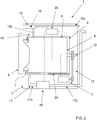
- FIG. 1 and Figure 2 a laundry washing machine 1 is shown, in which a method according to a first embodiment of the invention is advantageously implemented.
- the laundry washing machine 1 advantageously comprises an external casing or housing 2 in which a washing tub 3 is provided, containing a rotatable perforated drum 4 where the laundry to be washed, not shown, is loaded.
- Both the tub 3 and the drum 4 have preferably a substantially cylindrical shape.
- the tub 3 is preferably suspended in a floating manner inside the casing 2, advantageously by means of a number of coil springs and shock-absorbers that are not illustrated in the enclosed Figures.
- the tub 3 is preferably connected to the front wall of the casing 2 by means of an elastic bellows 7, or gasket.
- a front wall of the casing 2 is provided with a loading/unloading door 8 which allows access to the washing tub 3 and the drum 4.
- a hollow space 9 is defined between the tub 3 and the drum 4.
- the drum 4 is advantageously rotated by an electric motor 11 which preferably transmits the rotating motion to a shaft 12 of the drum 4, advantageously by means of a belt/pulley system 13.
- the motor 11 is directly connected with the shaft 12 of the drum 4.
- the laundry washing machine 1 is provided with a water inlet circuit 15, preferably positioned in the upper part of the machine 1, for supplying water and washing/rinsing products (i.e. detergent, softener, etc.) into the tub 3.
- a water inlet circuit 15 preferably positioned in the upper part of the machine 1, for supplying water and washing/rinsing products (i.e. detergent, softener, etc.) into the tub 3.
- the water inlet circuit 15 preferably comprises at least one first water inlet pipe 15a, having an inlet connectable to a water supplying mains and an outlet which is advantageously connected, preferably via one or more valves (not shown), to a detergent compartment 16, suited to be filled with washing and/or rinsing products and preferably comprising a removable drawer provided with various compartments for different washing and/or rinsing products, so as to supply clean water coming from the supply mains to the detergent compartment 16; the water inlet circuit 15 also comprises at least one second water inlet pipe 15b, having an inlet connected to the detergent compartment 16 and an outlet connected to the tub 3 or to the bellows 7, so as to supply water and/or water mixed with washing/rinsing products coming from the detergent compartment 16 into the tub 3.
- the water which reaches the tub 3 can selectively contain one of the products contained in the compartments of the compartment 16.
- a further separate water supply pipe can be provided, which supplies exclusively clean water into the tub 3.
- the water inlet circuit 15 also preferably comprises a water flow sensor, not illustrated, for example a flow meter, which makes it possible to calculate the quantity of water supplied into the tub 3.
- a water flow sensor not illustrated, for example a flow meter, which makes it possible to calculate the quantity of water supplied into the tub 3.
- the laundry washing machine 1 advantageously comprises also a water outlet circuit 17.
- the water outlet circuit 17 advantageously comprises a drain pump 18, a first pipe 17a connecting the tub 3 to the drain pump 18, and an outlet pipe 17b exiting from the casing 2.
- the water outlet circuit 17 is suited to drain waste liquid, i.e. dirty water or water mixed with washing and/or rinsing products, from the tub 3, advantageously to the outside of the machine 1.
- the water outlet circuit 17 preferably comprises a filtering device, not shown in the figures, placed between the bottom of the tub 3 and the drain pump 18 and adapted to retain all the undesirable bodies (for example buttons that have come off the laundry, coins erroneously introduced into the laundry washing machine, etc.) that have passed through the holes located on the surface of the drum 4, or fallen onto the bottom of the tub 3 while passing between the drum 4 and the tub 3, and which could damage or obstruct the drain pump 18.
- a filtering device not shown in the figures
- This filtering device is preferably removable, so as to be cleaned, e.g. through a gate placed advantageously on the front or back wall of the casing 2 of the laundry washing machine 1, not shown herein; in a further embodiment, not illustrated, the filtering device can be accessed for example by the internal of the drum 4, for example by a suitable opening obtained therein and selectively closed by a suitable cover, or by a removable lifter of the drum 4.
- the laundry washing machine 1 also comprises a recirculation circuit 20 (shown in Figure 1 only, and not in Figure 2 ) adapted to drain liquid from a bottom region of the tub 3 and to re-circulate such a liquid into a higher region of the tub 3.
- a recirculation circuit 20 shown in Figure 1 only, and not in Figure 2 ) adapted to drain liquid from a bottom region of the tub 3 and to re-circulate such a liquid into a higher region of the tub 3.
- the recirculation circuit 20 advantageously partially coincides with the water outlet circuit 17 and preferably comprises the first pipe 17a of the water outlet circuit 17 connecting the tub 3 to the drain pump 18, and a recirculation pipe 21 with a terminal nozzle 22 which is preferably positioned in an upper region of the tub 3.
- the recirculation circuit 20 advantageously comprises also a two-way valve 23 preferably interposed between the drain pump 18 and the outlet pipe 17b and the recirculation pipe 21.
- the two-way valve 23 is preferably controlled by a control unit 25, which will be better described in the following, in order to allow selective drainage towards the outside through the outlet pipe 17b or towards the upper region of the tub 3 through the recirculation pipe 21.
- the recirculation circuit 20 advantageously comprises a dedicated recirculation pipe connecting a bottom region of the tub with a higher region of the latter, and provided with a dedicated recirculation pump; in this case the recirculation circuit may be preferably completely separated from the water outlet circuit.
- the laundry washing machine 1 comprises a sensing device 29 for detecting the water level inside the tub 3.
- the sensing device 29 may comprise a pressure sensor which detects the pressure in the tub 3.
- the sensing device 29 may comprise a level sensor (for example mechanical, electro-mechanical, optical, etc.) adapted to detect the water level inside the tub 3.
- the laundry washing machine 1 also comprises a heating device 30, for example an electric resistor (or a microwaves source, a steam source, etc.), adapted to heat the laundry and/or the water inside the laundry and/or the free water inside the tub 3.
- a heating device 30 for example an electric resistor (or a microwaves source, a steam source, etc.), adapted to heat the laundry and/or the water inside the laundry and/or the free water inside the tub 3.
- the laundry washing machine 1 also comprises a temperature sensor, not illustrated in the figures, for sensing the temperature T inside the tub 3.
- the temperature sensor senses the temperature of the water present in the tub 3.
- the temperature sensor could sense the air temperature inside the tub 3.
- the sensed temperature T gives also an indication of the temperature Tr of the laundry.
- the weight of the laundry can be advantageously calculated in know manner, for example through the current absorbed by the motor 11, or by a weight sensor, or derived directly from the parameters inputted by the user.
- the laundry washing machine 1 advantageously comprises a control unit 25, which is connected to various components of the laundry washing machine 1 in order to ensure its operations.
- the control unit 25 is preferably, but not necessarily, connected to the water inlet circuit 15, the water outlet circuit 17, the heating device 30 and the motor 11 and receives information from the various sensors provided on the laundry washing machine 1, such as for example the flow meter of the water inlet circuit 15, the sensing device 29 on the bottom of the tub 3, the temperature sensor, etc.
- the laundry washing machine 1 advantageously comprises an interface unit (e.g. comprising one or more knobs and/o buttons and/or switch, one or more display, etc.), not visible in the enclosed Figures, connected to control unit 25 and accessible to the user and by means of which the user may select and set the washing parameters, such as, for example, a desired washing program.
- the washing parameters such as, for example, a desired washing program.
- other parameters can optionally be inserted by the user, for example the washing temperature, the spinning speed, the load in terms of weight of the laundry to be washed, etc.
- control unit 25 sets and controls the various parts of the laundry washing machine 1 in order to carry out the desired washing program.
- the machine 1 also comprises a delivery system 40, connected to the washing tub 3 for supplying into the washing tub 3 a water soluble antimicrobial polymer compound (described hereinafter) and/or a solution of water and water soluble antimicrobial polymer compound.
- a delivery system 40 connected to the washing tub 3 for supplying into the washing tub 3 a water soluble antimicrobial polymer compound (described hereinafter) and/or a solution of water and water soluble antimicrobial polymer compound.
- the delivery system 40 advantageously shares some components with the water inlet circuit: in this embodiment the delivery system 40 advantageously comprises the compartment 16, in which the water soluble antimicrobial polymer compound is stored/loaded, and the pipe 15b.
- the water inlet circuit 15 advantageously supplies water to the compartment 16 to form an aqueous solution of the water soluble antimicrobial polymer compound in the compartment 16; the solution of water and antimicrobial polymer compound is then supplied into the tub 3 via the pipe 15b.
- the method of the invention advantageously basically comprises the steps of:
- the method of the invention comprises the steps of:
- water and water soluble antimicrobial polymer compound are supplied into the tub 3 contemporaneously, e.g. the solution of water and antimicrobial polymer compound is prepared, for example in the compartment 16, before being supplied to the tub 3.
- the method of the invention may advantageously comprise the step of supplying the water soluble antimicrobial polymer compound into the detergent compartment 16 and mixing the antimicrobial polymer compound with clean water into the detergent compartment 16 before or during the step of supplying the antimicrobial polymer compound into the tub 3, so that said antibacterial layer is created also on at least some parts of the compartment 16 and/or of the water inlet circuit 15.
- water and the water soluble antimicrobial polymer compound may be supplied into the tub contemporaneously, but independently one another; for example water may be supplied via the water inlet circuit 15, and the water soluble antimicrobial polymer compound may be supplied via a dedicated supply circuit, not illustrated, fluidly connected to the tub, in such a way that water mixes with the water soluble antimicrobial polymer compound, so as to form a solution, directly inside the tub.
- water is supplied into the tub 3 separately from the antimicrobial polymer compound, either before or after the antimicrobial polymer compound.
- the solution of water and antimicrobial polymer compound is preferably supplied into the tub 3 in an amount sufficient to reach a preset minimum level L1 (see Figure 1 ), contacting an outer surface of the drum 4 at a lower end of the drum 4.
- the amount of solution supplied into the tub 3 reaches a level L2 which is higher than the minimum level L1.
- the method of the invention preferably comprises, after the steps of supplying water and supplying water soluble antimicrobial polymer compound into the tub 3, a step of circulating the solution containing water and water soluble antimicrobial polymer compound in the recirculation circuit 20, so as to circulate the solution (i.e. the antimicrobial polymer compound) through the recirculation circuit 20 and hence creating an antibacterial layer also on at least some parts of the recirculation circuit 20.
- the method of the invention may be advantageously implemented as a part of a laundry washing cycle of the laundry washing machine 1, i.e. while some laundry is washed in the machine 1.
- the method of the invention can also be performed independently from any laundry washing cycle, and hence be performed without laundry in the drum 4 (i.e. in a dedicated "washing-machine-cleaning cycle", which may be preferably selected/activated by a suitable input device -e.g. a switch or button, or knob-operatively connected to the control unit 25).
- a suitable input device e.g. a switch or button, or knob-operatively connected to the control unit 25.
- the control unit 25 has preferably a memory which is loaded with one or more programs for performing the method according to the invention, preferably either as a part of a laundry washing cycle program or as a separate cleaning cycle.
- the method of the invention comprises a step of drying, for example by means of the heating device 30, or by a different heating device, not illustrated, at least some of the components of the laundry washing machine 1 that have been contacted by the solution containing water and water soluble antimicrobial polymer compound, for better fixing said antibacterial layer on said components.
- the water soluble antimicrobial polymer compound comprises one or more organosilicon quaternary ammonium salt compounds and/or quaternized ammonium salt organosilanes.
- Particularly advantageous compounds includes both an organosilane structure, having the function to graft the molecules on the surface to treat, and a quaternary ammonium salt having an antimicrobial action.
- the molecule is able to graft on the surface to treat and guarantee the antimicrobial effect.
- the grafting on the surface is a sol-gel process.
- the organosilane OH group is idrolized by water and react with OH groups on the surfaces.
- the use of this kind of compounds increases the hydrophobicity of the treated surface.
- the increased hydrophobicity is not beneficial when the surface is in contact with water because the antimicrobial action is reduced due to the difficulty to transfer the microorganisms on the surface.
- the surface is not rich in OH groups, the surface could be activated by acid or basic etching.
- the advantages of this kind of compounds is that the functionalization of surface can be done in water.
- the water soluble antimicrobial polymer compound advantageously comprises a compound of formula (I): where each of R1, R2, R3, R4, R5 is an alkyl group having a number of carbon atoms ranging between 1 and 30; and X- is selected in the group consisting of Cl-, Br-, CH3COO-, I-.
- Preferred compounds are for example: 3-(triethoxysilyl)-propyl-dimethyloctadecyl ammonium chloride, 3-(tri-methoxysilyl)-propyl-methyl-dioctyl ammonium chloride, 3-(trimethoxysilyl)-propyl-dimethyldecyl ammonium chloride, 3-(trimethoxysilyl)-propyl-methyldecyl ammonium chloride, 3-(trimethoxy-silyl)-propyl-dimethyldodecyl ammonium chloride, 3-(tri-methoxysilyl)-propyl-methyldidodecyl ammonium chloride, 3-(trimethoxy-silyl)-propyl-dimethyltetradecyl ammonium chloride, 3-(trimethoxy-silyl)-propyl-methyldihexadecyl ammonium chloride, and 3-(trimethoxy
- the water soluble antimicrobial polymer compound is mixed with one or more cationic polymers, preferably hydrophilic polymers, acting to increase the hydrophilic properties of a surface treated with said water soluble antimicrobial polymer compound.
- one or more cationic polymers preferably hydrophilic polymers, acting to increase the hydrophilic properties of a surface treated with said water soluble antimicrobial polymer compound.
- the function of these compounds is to increase the hydrophilic properties of the surface treated with the antimicrobial polymer compound. In this way the antimicrobial effect is enhanced due to the better wettability of the antimicrobial treated surfaces. At the end the active antimicrobial effect is increased.
- cationic polymers for use according to the invention are polyethylene imines, polyhexamethylene biguanide hydrochloride (PHMB), cationic starch, polyDAD-MAC (polydimethyldiallyl ammonium chloride), polyaluminium chloride, cationic polyamides, cationic polyamines, such as polyamine-epichlorohydrin resins, and cationic derivatives of polyacrylamides.
- PHMB polyhexamethylene biguanide hydrochloride
- MAC polydimethyldiallyl ammonium chloride
- polyaluminium chloride cationic polyamides
- cationic polyamines such as polyamine-epichlorohydrin resins
- cationic derivatives of polyacrylamides such as polyamine-epichlorohydrin resins
- polymers having a low number of base unit monomers are used, having a weight in the range of 25-2000kDa, 100-1000kDa, 400-900 kDa, typically about 750 kDa.
- Example of suitable polymers are disclosed for example in published application n. US 2007/0042198 A1 .
- the ratio between the water soluble antimicrobial polymer compound and the cationic polymer or polymers is from 1:1 to 40:1.
- the method of the invention advantageously comprises, after supplying a solution of water and water soluble antimicrobial polymer compound into the tub 3 (as mentioned before, the solution may be supplied into the tub already mixed, or water and water soluble antimicrobial polymer compound may mix during or after their supplying into the tub), a step of circulating the solution containing water and water soluble antimicrobial polymer compound in the recirculation circuit 20, so that the solution contacts and creates an antibacterial layer on at least some parts of said recirculation circuit 20 and is then recirculated into the tub 3.
- the control unit 25 advantageously operates the drain pump 16 and the valve 23 to allow selective drainage towards the outside through the outlet pipe 17b or towards the upper region of the tub 3 through the recirculation pipe 21.
- the delivery system 40 of the machine 1 advantageously comprises a tank 41, housed in the casing 2 to store an amount of water soluble antimicrobial polymer compound, possibly already in a water solution; the tank 41 may be advantageously dimensioned to store an amount of water soluble antimicrobial polymer compound (or water/compound solution) sufficient for the complete lifetime of the washing machine 1.
- the tank 41 is preferably connected to the tub 3 by a first delivery conduit 42, that directly connects the tank 41 with an upper region of the tub 3, and/or by a second delivery conduit 43, that connects the tank 41 with the compartment 16, which is in turn connected to the tub 3 for example by the pipe 15b.
- the delivery conduits 42, 43 are advantageously provided with respective delivering pumps 44, set along the conduits 42, 43 and operated by the control unit 25.
- a single delivering pump may be provided, which inlet is connected to the tank 41 and which outlet is connected to a baffle or valve adapted to selectively fluidly connect the pump to the first or second delivery conduit.
- only one among the first and the single delivery conduits, provided with a respective delivery pump, may be provided.
- a recirculation conduit 46 may advantageously connect the water outlet circuit 17, for example a portion of the pipe 17a set downstream of the drain pump 18, to the tank 41, so as to recirculate the antimicrobial polymer compound from the tub 3 to the tank 41.
- the cleaning method of the invention may advantageously comprise the steps of:
- the cleaning method according to the invention may be automatically activated by the control unit 25 during the last rinse of the rinsing phase (or the only one rinse, if the rinsing phase comprises only one rinse) of the washing cycle.
- the cleaning method according to the invention may be activated by the user after the end of a washing cycle (preferably, but not necessarily after removing the washed laundry from the tub), for example by a suitable input device (e.g. a switch or button, or knob) operatively connected to the control unit 25.
- a suitable input device e.g. a switch or button, or knob
- the method comprises counting, for example by a suitable programming of the control unit 25, or by a dedicated counter, the number of washing cycles (or the number of washing cycles performed at a low washing temperature, e.g. 40°C) performed from the last submission to the washing tub of the solution of water and water soluble antimicrobial polymer compound; in this case if this number of cycles reaches or exceed a certain threshold value (for example five or ten), the method may advantageously comprise informing the user, for example by an alert message (e.g. a writing and/or a light and/or an icon and/or a sound) displayed preferably via the interface unit of the machine, or via a dedicated alert device (e.g. a speaker or buzzer, a light emitting device, etc.) that a submission of the solution to the machine is required. In this way the user is reminded that the machine needs the cleaning by the application of the method according to the invention.
- an alert message e.g. a writing and/or a light and/or an icon and/or a
- the method advantageously comprises automatic providing the solution to the machine (for example taking it from the tank 41 as described above in the embodiments illustrated with reference to Figure 3 ), for example during the last rinsing of the first following washing cycle, or by activating (optionally after asking the consent of the user) a dedicated "washing-machine-cleaning cycle".
Landscapes
- Engineering & Computer Science (AREA)
- Textile Engineering (AREA)
- Detail Structures Of Washing Machines And Dryers (AREA)
Abstract
Description
- The present invention relates to a method for cleaning a laundry washing machine, and to a laundry washing machine implementing the method.
- Nowadays the use of laundry washing machines, both "simple" laundry washing machines (i.e. laundry washing machines which can only wash and rinse laundry) and laundry washing-drying machines (i.e. laundry washing machines which can also dry laundry), is widespread.
- In the present description the term "laundry washing machine" will refer to both simple laundry washing machines and laundry washing-drying machines.
- Laundry washing machines generally comprise an external casing provided with a washing tub which contains a rotatable perforated drum where the laundry is placed.
- A loading/unloading door ensures access to the tub and the drum.
- Laundry washing machines typically comprise a detergent supply unit (e.g. a detergent drawer) and a water inlet circuit for the introduction of water and washing/rinsing products (i.e. detergent, softener, etc.) into the tub.
- Known laundry washing machines are also provided with water draining circuit that may operate both during the initial phases of the washing cycle and at the end of the same to drain the dirty water.
- Some known laundry washing machines are also provided with a recirculation circuit adapted to drain liquid from a bottom region of the washing tub and to re-admit such a liquid into a higher region of the washing tub, so as to better wetting the laundry. According to the known technique, a complete washing cycle typically includes different phases during which the laundry to be washed is subjected to adequate treatments.
- A washing cycle usually comprises a laundry wetting phase with addition of a washing detergent, and a main washing phase during which, according to the washing program selected by the user, the water contained in the tub is heated to a predetermined temperature and the drum is rotated, so as to apply a mechanical cleaning action to the laundry.
- After the main wash phase the water contained in the drum is drained from the tub.
- A successive step of the cycle comprises a rinsing phase which usually comprises one or more rinsing cycles. In each rinsing cycle, clean rinse water is added to the laundry, the drum is rotated, and the water is then drained from the tub to the outside of the washing machine.
- After the rinsing phase a final spinning phase allows the extraction of the residual water contained in the wet laundry.
- In the spinning phase the drum is rotated, typically at a high rotation speed, for example about 1300-1600 rpm, to obtain the extraction of the water from the laundry.
- The water extracted during the spinning phase is drained towards the outside by means of the water draining devices.
- Household laundry processes have changed in recent years following the development of synthetic textiles and due to the necessity of environment sustainability.
- In particular in recent years the use of bleach-containing detergents, the quantity of water used during a washing cycle, and the average temperature of the washing water have decreased.
- These washing behaviours, even if beneficial on the environment point of view, have however the drawback that they promote, or at least not help to contrast/reduce/inactivate, the proliferation of microorganisms, like bacteria, mold, fungi.
- In fact washing machines are typically subjected to proliferation of microorganisms (e.g. bacteria) which are generally introduced into the machine together with the laundry and/or the water and/or the air and/or detergent/softener. These microorganisms found in the washing machine an environment favourable to their grown due to the presence of water, warm temperature, and some nutrients (e.g. some components of the softener, soil residuals, additives of the plastic components etc).
- Limited use of bleach-containing detergents, low quantity of water used during a washing cycle, and relative low temperature of the washing water (nowadays washing cycles having a water temperature of 40°C or less -cold conditions- are more and more widespread), have the final effect of not efficiently contrasting the proliferation of microorganisms in laundry washing machines.
- These favourable conditions promote the formation and growth of the so called "biofilm" inside some components of known laundry washing machines.
- Biofilm is a community or aggregate of microorganisms embedded in an extracellular polymer matrix; biofilm typically forms on boundary surfaces (e.g. water/plastic, water/metal, air/plastic, oil/water etc).
- In the washing machines biofilm can easily grow in all the surfaces (sometimes hidden to the user) exposed to water and air (e.g. the detergent drawer, the internal surface of the washing tub, the drain pump circuit, the door gasket etc.) in such a way that it is very difficult (even not always possible) to remove this aggregate from the surface. These bacteria may cause bad smell, stain of the laundry, biocorrosion on the metal and plastic components, and some of them may be also potentially dangerous for the health of the user.
- The washing machine industry has developed lots of strategies to try to improve the hygiene of washing machines.
- For example
DE19751028 discloses a washing machine provided with an hygiene program in which water is supplied into the washing drum and it is heated to at least 70°C, preferably 80°C; the drum is rotated during the heating process and/or for a set first period of time after the reaching of the water temperature of at least 70°C. The revolution takes place at washing speed. The drum is subsequently rotated at an increased speed of 150-300 rpm (rounds per minute) for a set second period of time, so that hot water reaches also the higher part of the washing tub. Thanks to the high temperature of the water the internal of the washing tub is disinfected. - However this known solution has the drawback that it requires heating at high temperature a relatively high quantity of water, which causes a high waste of energy.
- Moreover, by using this known method, only the washing tub is effectively disinfected, while the other parts of the washing machine, in particular the water inlet circuit, the detergent drawer, the water outlet circuit, and, if provided, the recirculation circuit, are not efficiently disinfected, since they are not contacted by hot water (e.g. the water inlet circuit, the detergent drawer and the recirculation circuit), or are contacted by water which has been already cooled off, and therefore its disinfecting action is lower, or no more present.
-
EP1945848 discloses a cleaning method for cleaning the washing tub and the gasket of a drum-type washing machine; the drum-type washing machine includes a tub mounted in a cabinet such that wash water is supplied into a tub, a drum rotatably mounted in the tub such that laundry is put into the drum, a motor for rotating the drum, and a control unit for controlling the driving of the motor such that, when the drum is rotated, the wash water supplied into the tub reaches the upper part of the inner circumferential surface of the tub so as to clean the inner circumferential surface of the tub. - However, the washing method disclosed in
EP1945848 is adapted only to remove pollutants or scale that may be accumulated on the inner circumferential surface of the washing tub and in the lower part of the water storage tub, but it is not able to clean the liquid outlet circuit, since the cleaning effect is due mainly to the circulation of wash water along the inner circumferential surface of the tub obtained by rotating the drum at a quite high speed, and therefore this effect is present only in the tub, but it doesn't relate the liquid outlet circuit; moreover, for the same reason, this known cleaning method is not able to clean the water inlet circuit and the detergent drawer, nor, if provided, the recirculation circuit. - Moreover this known cleaning method is able only to exert a mechanical cleaning of the tub inner surface, adapted mainly to remove pollutants or scale, but it is not effective in preventing the proliferation of microorganisms like bacteria.
- The aim of the present invention is therefore to provide a method for cleaning a laundry washing machine, and laundry washing machine implementing the method, which overcome the above mentioned drawbacks.
- In particular, it is an object of the invention to provide a method that allows the growth/proliferation of microorganisms (e.g. bacteria) inside a laundry washing machine to be avoided or at least reduced, so as to inhibit or reduce the biofilm formation in the surfaces of the laundry washing machine (e.g. the inner surface of the washing tub, at least part of the water inlet circuit, the water outlet circuit, the detergent drawer, etc.) prone to microorganisms adhesion.
- Another object of the invention is reducing or impeding the proliferation of bacteria without requiring a high usage/wastage of energy.
- Another object of the invention is reducing or impeding the proliferation of bacteria without requiring a high usage/wastage of water.
- Applicant has found that by contacting one or more parts of a laundry washing machine with a solution formed by water and a water soluble antimicrobial polymer compound adapted to stick to a body if a solution containing water and this water soluble antimicrobial polymer compound contacts this body, it is possible to reduce/prevent the growth/proliferation of microorganisms (e.g. bacteria) on such parts of the machine.
- In particular the above aim and objects are fulfilled by a cleaning method for a laundry washing machine, the washing machine comprising a washing tub containing a rotatable drum, a water inlet circuit for supplying a washing liquid into the tub, a water outlet circuit for draining washing liquid from the tub; the method comprising the steps of:
- a) supplying into the tub a solution of water and a water soluble antimicrobial polymer compound, adapted to stick to a body if a solution containing water and the water soluble antimicrobial polymer compound contacts the body;
- b) performing one or more rotations of the rotatable drum and draining from the tub, via the water outlet circuit, the solution formed by water and water soluble antimicrobial polymer compound, in such a way that this solution contacts the tub, the drum and the water outlet circuit, and at least part of the water soluble antimicrobial polymer compound sticks to one or more parts of the tub, the drum and the water outlet circuit, so as to create an antibacterial layer on these one or more parts.
- It is highlighted that in present application expression "supplying into the tub a solution of water and a water soluble antimicrobial polymer compound" has to be interpreted in a wide way, that is it comprises the embodiment in which the solution of water and compound is prepared before being introduced into the tub, and also the embodiment in which the solution is obtained directly inside the tub (or in a conduit flowing into the tub), by providing the water and compound separately (i.e. at different time, and/or from different inlets) into the tub (or conduit), in such a way that water and compound mix, forming the solution, directly in the tub (or in the conduit flowing into the tub). Therefore, in an advantageous embodiment, water and the water soluble antimicrobial polymer compound may be supplied into the tub contemporaneously, e.g. already mixed (i.e. already forming the solution), or as separate components which mix during their supplying (i.e. forming the solution during their supplying, for example inside an inlet pipe), or which mix (i.e. form the solution) only once they have reached the internal of the washing tub (for example they may be supplied into the tub at the same time, but from different inlets, so that they mix only inside the tub).
- In a further advantageous embodiment, water may be supplied into the tub before the antimicrobial polymer compound, in which case water and compound mix (i.e. form the solution) only once they have reached the internal of the tub.
- In a further advantageous embodiment, water is supplied into the tub after the antimicrobial polymer compound, in which case water and compound mix (i.e. form the solution) only once they have reached the internal of the tub.
- In a further advantageous embodiment, the laundry washing machine comprises a recirculation circuit, connected to the tub and adapted to circulate washing liquid from a bottom region of the tub to a higher region of the tub; in this case , the method may advantageously further comprise, after the steps of supplying a solution of water and water soluble antimicrobial polymer compound into the tub, a step of circulating the solution containing water and water soluble antimicrobial polymer compound in the recirculation circuit, so that the solution contacts and creates an antibacterial layer on at least some parts of the recirculation circuit and is then recirculated into the tub.
- In a preferred embodiment, the water inlet circuit comprises a detergent compartment, suited to be filled with washing and/or rinsing products and connected to the tub, and a water inlet circuit for supplying clean water into the detergent compartment; in this case the method may advantageously comprise the step of supplying the water soluble antimicrobial polymer compound into the detergent compartment and mixing the antimicrobial polymer compound with clean water into the detergent compartment before or during the step of supplying the antimicrobial polymer compound into the tub, so that the antibacterial layer is created also on at least some parts of the detergent compartment and/or the water inlet circuit.
- Advantageously the amount of water supplied into the tub and forming the solution containing water and water soluble antimicrobial polymer compound is the minimum amount of water necessary for this solution to contact the outer surface of the drum. Preferably the method is either performed during a washing cycle of the laundry washing machine, or immediately after the end of a washing cycle of the laundry washing machine.
- Advantageously the method is performed while the rotatable drum is not loaded with laundry.
- Preferably the method comprises also the step of drying at least some of the components of the laundry washing machine contacted by the solution containing water and water soluble antimicrobial polymer compound, for better fixing the antibacterial layer on the components.
- Preferably, the water soluble antimicrobial polymer compound comprises an organosilicon quaternary ammonium salt compound or a quaternized organosilane. More preferably the water soluble antimicrobial polymer compound comprises a compound of formula (I):

- each of R1, R2, R3, R4, R5 is an alkyl group having a number of carbon atoms ranging between 1 and 30;
- X - is selected in the group consisting of Cl-, Br-, CH3COO-, I-
- In a further advantageous embodiment, the water soluble antimicrobial polymer composition comprises one or more compounds selected in the group consisting of: 3-(triethoxysilyl)-propyl-dimethyloctadecyl ammonium chloride, 3-(tri-methoxysilyl)-propyl-methyl-dioctyl ammonium chloride, 3-(trimethoxysilyl)-propyl-dimethyldecyl ammonium chloride, 3-(trimethoxysilyl)-propyl-methyldidecyl ammonium chloride, 3-(trimethoxy-silyl)-propyl-dimethyldodecyl ammonium chloride, 3-(tri-methoxysilyl)-propyl-methyldidodecyl ammonium chloride, 3-(trimethoxy-silyl)-propyl-dimethyltetradecyl ammonium chloride, 3-(trimethoxy-silyl)-propyl-methyldihexadecyl ammonium chloride, and 3-(trimethoxysilyl)-propyl-dimethyloctadecyl ammonium chloride.
- Preferably, the water soluble antimicrobial polymer compound is mixed with one or more cationic polymers, preferably hydrophilic polymers, acting to increase the hydrophilic properties of a surface treated with the water soluble antimicrobial polymer compound.
- More preferably, the cationic polymer is selected in the group consisting of: polyethylene imines, polyhexamethylene biguanide hydrochlorides (PHMB), cationic starch, polyDAD-MAC (polydimethyldiallyl ammonium chloride), polyaluminium chloride, cationic polyamides, cationic polyamines, such as polyamine-epichlorohydrin resins, and cationic derivatives of polyacrylamides.
- Advantageously the ratio between the water soluble antimicrobial polymer compound and the one or more cationic polymers may be from 1:1 to 40:1.
- In an advantageous embodiment of the invention, the cleaning method may be automatically activated during the last rinse of a rinsing phase (or the only one rinse, if the rinsing phase comprises only one rinse) of a washing cycle.
- In a further advantageous embodiment, the cleaning method according to the invention may be activated by the user after the end of a washing cycle (preferably, but not necessarily after removing the washed laundry from the tub), for example by a suitable input device (e.g. a switch or button, or knob) operatively connected to the control unit. In a further advantageous embodiment, the method comprises counting, for example by a suitable programming of the control unit, or by a dedicated counter, preferably operatively connected to the control unit, the number of washing cycles (or the number of washing cycles performed at a low washing temperature) performed from the last submission to the washing tub of the solution of water and water soluble antimicrobial polymer compound; in this case, if this number of cycles reaches or exceed a certain threshold value, the method may advantageously comprise informing the user, for example by an alert message displayed preferably via the interface unit of the machine, or via a dedicated alert device that a submission of the solution to the machine is required. In this way user if alerted that a cleaning cycle according to the invention is required.
- In a further advantageous embodiment, if the number of washing cycles (or the number of washing cycles performed at a low washing temperature) performed from the last submission to the washing tub of the solution of water and water soluble antimicrobial polymer compound reaches or exceed a certain threshold value, the method advantageously comprises automatic providing the solution to the machine, for example during the last rinsing of the first following washing cycle, or by activating (optionally after asking the consent of the user) a dedicated "washing-machine-cleaning cycle". In this way the machine is automatically cleaned after a certain number of washing cycles (or of washing cycles at low temperature).
- The invention relates also to a laundry washing machine comprising a washing tub containing a rotatable drum, a water inlet circuit for supplying a washing liquid into the tub, a water draining outlet circuit for draining washing liquid from the washing tub; the washing machine comprising:
- a delivery system, connected to the washing tub,
adapted to supply into the washing tub a water soluble antimicrobial polymer compound adapted to stick to a body if a solution containing water and this water soluble antimicrobial polymer contacts this body,
and/or
adapted to supply into the washing tub a solution containing water and the water soluble antimicrobial polymer compound, - a control unit having a program loaded on a memory of the control unit for performing the above described method according to the invention when the program is run on the control unit.
- Advantageously the delivery system may comprise:
- a tank to store an amount of additive placed in the machine, adapted to provide the water soluble antimicrobial polymer compound for the complete lifetime of the washing machine,
and/or - a detergent compartment adapted to be manually filled by the water soluble antimicrobial polymer compound,
and/or - a disposable or refillable cartridge for containing the water soluble antimicrobial polymer compound.
- Further characteristics and advantages of the present invention will be highlighted in greater detail in the following detailed description of some of its preferred embodiments, provided with reference to the enclosed drawings. In said drawings:
-
Figure 1 is a schematic front view of a laundry washing machine implementing the method according to the invention; -
Figure 2 is a schematic side view of the laundry washing machine shown inFigure 1 ; -
Figure 3 is a schematic front view of a further embodiment of a laundry washing machine implementing the method according to the invention; -
Figures 4 and5 are two operation flow chart diagrams showing the basic steps of respective washing cycles performed by the laundry washing machines ofFigures 1 and3 according to the method of the invention. - In
Figure 1 andFigure 2 , alaundry washing machine 1 is shown, in which a method according to a first embodiment of the invention is advantageously implemented. - The
laundry washing machine 1 advantageously comprises an external casing orhousing 2 in which awashing tub 3 is provided, containing a rotatableperforated drum 4 where the laundry to be washed, not shown, is loaded. - Both the
tub 3 and thedrum 4 have preferably a substantially cylindrical shape. - The
tub 3 is preferably suspended in a floating manner inside thecasing 2, advantageously by means of a number of coil springs and shock-absorbers that are not illustrated in the enclosed Figures. - The
tub 3 is preferably connected to the front wall of thecasing 2 by means of anelastic bellows 7, or gasket. - A front wall of the
casing 2 is provided with a loading/unloading door 8 which allows access to thewashing tub 3 and thedrum 4. - A
hollow space 9 is defined between thetub 3 and thedrum 4. - The
drum 4 is advantageously rotated by anelectric motor 11 which preferably transmits the rotating motion to ashaft 12 of thedrum 4, advantageously by means of a belt/pulley system 13. In a different embodiment of the invention (not shown), themotor 11 is directly connected with theshaft 12 of thedrum 4. - The
laundry washing machine 1 is provided with awater inlet circuit 15, preferably positioned in the upper part of themachine 1, for supplying water and washing/rinsing products (i.e. detergent, softener, etc.) into thetub 3. - The
water inlet circuit 15 preferably comprises at least one firstwater inlet pipe 15a, having an inlet connectable to a water supplying mains and an outlet which is advantageously connected, preferably via one or more valves (not shown), to adetergent compartment 16, suited to be filled with washing and/or rinsing products and preferably comprising a removable drawer provided with various compartments for different washing and/or rinsing products, so as to supply clean water coming from the supply mains to thedetergent compartment 16; thewater inlet circuit 15 also comprises at least one secondwater inlet pipe 15b, having an inlet connected to thedetergent compartment 16 and an outlet connected to thetub 3 or to thebellows 7, so as to supply water and/or water mixed with washing/rinsing products coming from thedetergent compartment 16 into thetub 3. - In a preferred embodiment, the water which reaches the
tub 3 can selectively contain one of the products contained in the compartments of thecompartment 16. - In an alternative embodiment of the invention, not illustrated, a further separate water supply pipe can be provided, which supplies exclusively clean water into the
tub 3. - The
water inlet circuit 15 also preferably comprises a water flow sensor, not illustrated, for example a flow meter, which makes it possible to calculate the quantity of water supplied into thetub 3. - The
laundry washing machine 1 advantageously comprises also awater outlet circuit 17. - The
water outlet circuit 17 advantageously comprises adrain pump 18, afirst pipe 17a connecting thetub 3 to thedrain pump 18, and anoutlet pipe 17b exiting from thecasing 2. Thewater outlet circuit 17 is suited to drain waste liquid, i.e. dirty water or water mixed with washing and/or rinsing products, from thetub 3, advantageously to the outside of themachine 1. - The
water outlet circuit 17 preferably comprises a filtering device, not shown in the figures, placed between the bottom of thetub 3 and thedrain pump 18 and adapted to retain all the undesirable bodies (for example buttons that have come off the laundry, coins erroneously introduced into the laundry washing machine, etc.) that have passed through the holes located on the surface of thedrum 4, or fallen onto the bottom of thetub 3 while passing between thedrum 4 and thetub 3, and which could damage or obstruct thedrain pump 18. - This filtering device is preferably removable, so as to be cleaned, e.g. through a gate placed advantageously on the front or back wall of the
casing 2 of thelaundry washing machine 1, not shown herein; in a further embodiment, not illustrated, the filtering device can be accessed for example by the internal of thedrum 4, for example by a suitable opening obtained therein and selectively closed by a suitable cover, or by a removable lifter of thedrum 4. - In an advantageous embodiment, the
laundry washing machine 1 also comprises a recirculation circuit 20 (shown inFigure 1 only, and not inFigure 2 ) adapted to drain liquid from a bottom region of thetub 3 and to re-circulate such a liquid into a higher region of thetub 3. - In the example illustrated in
Figure 1 , therecirculation circuit 20 advantageously partially coincides with thewater outlet circuit 17 and preferably comprises thefirst pipe 17a of thewater outlet circuit 17 connecting thetub 3 to thedrain pump 18, and arecirculation pipe 21 with a terminal nozzle 22 which is preferably positioned in an upper region of thetub 3. In the illustrated example, therecirculation circuit 20 advantageously comprises also a two-way valve 23 preferably interposed between thedrain pump 18 and theoutlet pipe 17b and therecirculation pipe 21. - The two-
way valve 23 is preferably controlled by acontrol unit 25, which will be better described in the following, in order to allow selective drainage towards the outside through theoutlet pipe 17b or towards the upper region of thetub 3 through therecirculation pipe 21. - In a further embodiment, not illustrated, the
recirculation circuit 20 advantageously comprises a dedicated recirculation pipe connecting a bottom region of the tub with a higher region of the latter, and provided with a dedicated recirculation pump; in this case the recirculation circuit may be preferably completely separated from the water outlet circuit. - Advantageously, the
laundry washing machine 1 comprises asensing device 29 for detecting the water level inside thetub 3. - For example, the
sensing device 29 may comprise a pressure sensor which detects the pressure in thetub 3. In another embodiment thesensing device 29 may comprise a level sensor (for example mechanical, electro-mechanical, optical, etc.) adapted to detect the water level inside thetub 3. - Advantageously, the
laundry washing machine 1 also comprises aheating device 30, for example an electric resistor (or a microwaves source, a steam source, etc.), adapted to heat the laundry and/or the water inside the laundry and/or the free water inside thetub 3. - Advantageously, the
laundry washing machine 1 also comprises a temperature sensor, not illustrated in the figures, for sensing the temperature T inside thetub 3. - In a preferred embodiment the temperature sensor senses the temperature of the water present in the
tub 3. In a further embodiment, the temperature sensor could sense the air temperature inside thetub 3. The sensed temperature T gives also an indication of the temperature Tr of the laundry. For example, it is possible to estimate the temperature Tr of the laundry from the sensed temperature T by knowing the weight of the laundry. The weight of the laundry can be advantageously calculated in know manner, for example through the current absorbed by themotor 11, or by a weight sensor, or derived directly from the parameters inputted by the user. - As mentioned above, the
laundry washing machine 1 advantageously comprises acontrol unit 25, which is connected to various components of thelaundry washing machine 1 in order to ensure its operations. Thecontrol unit 25 is preferably, but not necessarily, connected to thewater inlet circuit 15, thewater outlet circuit 17, theheating device 30 and themotor 11 and receives information from the various sensors provided on thelaundry washing machine 1, such as for example the flow meter of thewater inlet circuit 15, thesensing device 29 on the bottom of thetub 3, the temperature sensor, etc. - The
laundry washing machine 1 advantageously comprises an interface unit (e.g. comprising one or more knobs and/o buttons and/or switch, one or more display, etc.), not visible in the enclosed Figures, connected to controlunit 25 and accessible to the user and by means of which the user may select and set the washing parameters, such as, for example, a desired washing program. Preferably, other parameters can optionally be inserted by the user, for example the washing temperature, the spinning speed, the load in terms of weight of the laundry to be washed, etc. - Based on the parameters acquired by said interface unit, the
control unit 25 sets and controls the various parts of thelaundry washing machine 1 in order to carry out the desired washing program. - The
machine 1 also comprises adelivery system 40, connected to thewashing tub 3 for supplying into the washing tub 3 a water soluble antimicrobial polymer compound (described hereinafter) and/or a solution of water and water soluble antimicrobial polymer compound. - In the embodiments of
Figures 1-2 , thedelivery system 40 advantageously shares some components with the water inlet circuit: in this embodiment thedelivery system 40 advantageously comprises thecompartment 16, in which the water soluble antimicrobial polymer compound is stored/loaded, and thepipe 15b. - The
water inlet circuit 15 advantageously supplies water to thecompartment 16 to form an aqueous solution of the water soluble antimicrobial polymer compound in thecompartment 16; the solution of water and antimicrobial polymer compound is then supplied into thetub 3 via thepipe 15b. - A first advantageous embodiment of the washing method according to the invention is described hereinbelow with reference to the
washing machine 1 shown inFigures 1 and2 and with reference to the operation flow chart ofFigure 4 . - As shown in
Figure 4 , in this advantageous embodiment the method of the invention advantageously basically comprises the steps of: - starting a washing cycle (block 50), for example by selecting an appropriate program among a plurality of programs controlled by the
control unit 25; - delivering the water soluble antimicrobial polymer compound into the tub 3 (block 51), advantageously via the
delivery system 40, together with water supplied by thewater inlet circuit 15, to form a solution of the antimicrobial polymer compound in water (in this advantageous embodiment, therefore, water mixes with the water soluble antimicrobial polymer compound mainly inside thecompartment 16 and thewater inlet pipe 15b, so that the solution enters thetub 3 already formed); - rotating/spinning the drum 4 (block 52);
- draining the
tub 3 via the water outlet circuit 17 (block 53), i.e. removing the solution of water and antimicrobial polymer compound from thetub 3, for example via thewater outlet circuit 17; - ending the cycle (block 54).
- Preferably, the method of the invention comprises the steps of:
- supplying water into the
tub 3 via thewater inlet circuit 15; - supplying into the
tub 3 also a water soluble antimicrobial polymer compound, adapted to stick to a body if a solution containing water and said water soluble antimicrobial polymer compound contacts said body, in such a way that said water soluble antimicrobial polymer compound is dissolved in the water supplied into thetub 3 to form an aqueous solution; - performing one or more rotations of the
rotatable drum 4 and draining from thetub 3, via thewater outlet circuit 17, the solution formed by water and water soluble antimicrobial polymer compound, in such a way that the solution contacts thetub 3, thedrum 4 and thewater outlet circuit 17, and at least part of said water soluble antimicrobial polymer compound sticks to one or more parts of thetub 3, thedrum 4 and thewater outlet circuit 17 so as to create an antibacterial layer thereupon. - In an advantageous embodiment, water and water soluble antimicrobial polymer compound are supplied into the
tub 3 contemporaneously, e.g. the solution of water and antimicrobial polymer compound is prepared, for example in thecompartment 16, before being supplied to thetub 3. - In other words, the method of the invention may advantageously comprise the step of supplying the water soluble antimicrobial polymer compound into the
detergent compartment 16 and mixing the antimicrobial polymer compound with clean water into thedetergent compartment 16 before or during the step of supplying the antimicrobial polymer compound into thetub 3, so that said antibacterial layer is created also on at least some parts of thecompartment 16 and/or of thewater inlet circuit 15. - In a different advantageous embodiment water and the water soluble antimicrobial polymer compound may be supplied into the tub contemporaneously, but independently one another; for example water may be supplied via the
water inlet circuit 15, and the water soluble antimicrobial polymer compound may be supplied via a dedicated supply circuit, not illustrated, fluidly connected to the tub, in such a way that water mixes with the water soluble antimicrobial polymer compound, so as to form a solution, directly inside the tub. - In another advantageous embodiment, water is supplied into the
tub 3 separately from the antimicrobial polymer compound, either before or after the antimicrobial polymer compound. - In order to ensure a proper action of the antimicrobial polymer compound, the solution of water and antimicrobial polymer compound is preferably supplied into the
tub 3 in an amount sufficient to reach a preset minimum level L1 (seeFigure 1 ), contacting an outer surface of thedrum 4 at a lower end of thedrum 4. - Preferably, however, the amount of solution supplied into the
tub 3 reaches a level L2 which is higher than the minimum level L1. - If the
laundry washing machine 1 comprises therecirculation circuit 20, the method of the invention preferably comprises, after the steps of supplying water and supplying water soluble antimicrobial polymer compound into thetub 3, a step of circulating the solution containing water and water soluble antimicrobial polymer compound in therecirculation circuit 20, so as to circulate the solution (i.e. the antimicrobial polymer compound) through therecirculation circuit 20 and hence creating an antibacterial layer also on at least some parts of therecirculation circuit 20. - The method of the invention may be advantageously implemented as a part of a laundry washing cycle of the
laundry washing machine 1, i.e. while some laundry is washed in themachine 1. - However, the method of the invention can also be performed independently from any laundry washing cycle, and hence be performed without laundry in the drum 4 (i.e. in a dedicated "washing-machine-cleaning cycle", which may be preferably selected/activated by a suitable input device -e.g. a switch or button, or knob-operatively connected to the control unit 25).
- The
control unit 25 has preferably a memory which is loaded with one or more programs for performing the method according to the invention, preferably either as a part of a laundry washing cycle program or as a separate cleaning cycle. - Optionally, the method of the invention comprises a step of drying, for example by means of the
heating device 30, or by a different heating device, not illustrated, at least some of the components of thelaundry washing machine 1 that have been contacted by the solution containing water and water soluble antimicrobial polymer compound, for better fixing said antibacterial layer on said components. - According to preferred embodiments of the invention, the water soluble antimicrobial polymer compound comprises one or more organosilicon quaternary ammonium salt compounds and/or quaternized ammonium salt organosilanes.
- Particularly advantageous compounds includes both an organosilane structure, having the function to graft the molecules on the surface to treat, and a quaternary ammonium salt having an antimicrobial action.
- In this way the molecule is able to graft on the surface to treat and guarantee the antimicrobial effect. The grafting on the surface is a sol-gel process. The organosilane OH group is idrolized by water and react with OH groups on the surfaces. The use of this kind of compounds increases the hydrophobicity of the treated surface. The increased hydrophobicity is not beneficial when the surface is in contact with water because the antimicrobial action is reduced due to the difficulty to transfer the microorganisms on the surface. If the surface is not rich in OH groups, the surface could be activated by acid or basic etching. The advantages of this kind of compounds is that the functionalization of surface can be done in water.
- In particular, the water soluble antimicrobial polymer compound advantageously comprises a compound of formula (I):

- Preferred compounds are for example: 3-(triethoxysilyl)-propyl-dimethyloctadecyl ammonium chloride, 3-(tri-methoxysilyl)-propyl-methyl-dioctyl ammonium chloride, 3-(trimethoxysilyl)-propyl-dimethyldecyl ammonium chloride, 3-(trimethoxysilyl)-propyl-methyldidecyl ammonium chloride, 3-(trimethoxy-silyl)-propyl-dimethyldodecyl ammonium chloride, 3-(tri-methoxysilyl)-propyl-methyldidodecyl ammonium chloride, 3-(trimethoxy-silyl)-propyl-dimethyltetradecyl ammonium chloride, 3-(trimethoxy-silyl)-propyl-methyldihexadecyl ammonium chloride, and 3-(trimethoxysilyl)-propyl-dimethyloctadecyl ammonium chloride.
- Further examples of suitable water soluble antimicrobial polymer compound are disclosed for example in the published application
WO 2006/071191 A1 . - Preferably, the water soluble antimicrobial polymer compound is mixed with one or more cationic polymers, preferably hydrophilic polymers, acting to increase the hydrophilic properties of a surface treated with said water soluble antimicrobial polymer compound.
- The function of these compounds is to increase the hydrophilic properties of the surface treated with the antimicrobial polymer compound. In this way the antimicrobial effect is enhanced due to the better wettability of the antimicrobial treated surfaces. At the end the active antimicrobial effect is increased.
- Examples of cationic polymers for use according to the invention are polyethylene imines, polyhexamethylene biguanide hydrochloride (PHMB), cationic starch, polyDAD-MAC (polydimethyldiallyl ammonium chloride), polyaluminium chloride, cationic polyamides, cationic polyamines, such as polyamine-epichlorohydrin resins, and cationic derivatives of polyacrylamides.
- Preferably, polymers having a low number of base unit monomers (indicatively 10 to 20 units) are used, having a weight in the range of 25-2000kDa, 100-1000kDa, 400-900 kDa, typically about 750 kDa.
- Example of suitable polymers are disclosed for example in published application n.
US 2007/0042198 A1 . - Preferably, the ratio between the water soluble antimicrobial polymer compound and the cationic polymer or polymers is from 1:1 to 40:1.
- In another embodiment, the method of the invention advantageously comprises, after supplying a solution of water and water soluble antimicrobial polymer compound into the tub 3 (as mentioned before, the solution may be supplied into the tub already mixed, or water and water soluble antimicrobial polymer compound may mix during or after their supplying into the tub), a step of circulating the solution containing water and water soluble antimicrobial polymer compound in the
recirculation circuit 20, so that the solution contacts and creates an antibacterial layer on at least some parts of saidrecirculation circuit 20 and is then recirculated into thetub 3. - The
control unit 25, according to the program selected by the user, advantageously operates thedrain pump 16 and thevalve 23 to allow selective drainage towards the outside through theoutlet pipe 17b or towards the upper region of thetub 3 through therecirculation pipe 21. - According to the embodiment schematically illustrated in
Figure 3 , in which the details similar or identical to those already described are indicated by the same numbers, thedelivery system 40 of themachine 1 advantageously comprises atank 41, housed in thecasing 2 to store an amount of water soluble antimicrobial polymer compound, possibly already in a water solution; thetank 41 may be advantageously dimensioned to store an amount of water soluble antimicrobial polymer compound (or water/compound solution) sufficient for the complete lifetime of thewashing machine 1. - The
tank 41 is preferably connected to thetub 3 by afirst delivery conduit 42, that directly connects thetank 41 with an upper region of thetub 3, and/or by asecond delivery conduit 43, that connects thetank 41 with thecompartment 16, which is in turn connected to thetub 3 for example by thepipe 15b. - The
delivery conduits pumps 44, set along theconduits control unit 25. - In a further advantageous embodiment, not illustrated, a single delivering pump may be provided, which inlet is connected to the
tank 41 and which outlet is connected to a baffle or valve adapted to selectively fluidly connect the pump to the first or second delivery conduit. - In a further advantageous embodiment, not illustrated, only one among the first and the single delivery conduits, provided with a respective delivery pump, may be provided.
- A
recirculation conduit 46, preferably having avalve 47, may advantageously connect thewater outlet circuit 17, for example a portion of thepipe 17a set downstream of thedrain pump 18, to thetank 41, so as to recirculate the antimicrobial polymer compound from thetub 3 to thetank 41. - In this case, as shown in
Figure 5 , the cleaning method of the invention may advantageously comprise the steps of: - starting a washing cycle (block 50), for example by selecting an appropriate program among a plurality of programs controlled by the
control unit 25; - delivering the water soluble antimicrobial polymer compound into the tub 3 (block 51), preferably via the delivering
system 40, together with water supplied by thewater inlet circuit 15, to form a solution of the antimicrobial polymer compound in water; the solution is advantageously drawn from thetank 41, for example after activating at least one delivering pump 44 (block 56) (in a different advantageous embodiment thetank 41 may comprise the solution of water and water soluble antimicrobial polymer compound, in which case the solution may be supplied directly into the tub, for example after activating at least one deliveringpump 44, with or without the supplying of water from water supplied by the water inlet circuit 15); - rotating/spinning the drum 4 (block 52);
- draining the
tub 3 via the water outlet circuit 17 (block 53), i.e. removing the solution of water and antimicrobial polymer compound from thetub 3; - preferably, recovering and storing the antimicrobial polymer compound (or solution water/compound) in the
tank 41 by means of the recirculation conduit 46 (block 55); - ending the cycle (block 54).
- In an advantageous embodiment of the invention, the cleaning method according to the invention (some embodiments of which have been described above) may be automatically activated by the
control unit 25 during the last rinse of the rinsing phase (or the only one rinse, if the rinsing phase comprises only one rinse) of the washing cycle. - In a different advantageous embodiment, the cleaning method according to the invention may be activated by the user after the end of a washing cycle (preferably, but not necessarily after removing the washed laundry from the tub), for example by a suitable input device (e.g. a switch or button, or knob) operatively connected to the
control unit 25. - In a further advantageous embodiment, the method comprises counting, for example by a suitable programming of the
control unit 25, or by a dedicated counter, the number of washing cycles (or the number of washing cycles performed at a low washing temperature, e.g. 40°C) performed from the last submission to the washing tub of the solution of water and water soluble antimicrobial polymer compound; in this case if this number of cycles reaches or exceed a certain threshold value (for example five or ten), the method may advantageously comprise informing the user, for example by an alert message (e.g. a writing and/or a light and/or an icon and/or a sound) displayed preferably via the interface unit of the machine, or via a dedicated alert device (e.g. a speaker or buzzer, a light emitting device, etc.) that a submission of the solution to the machine is required. In this way the user is reminded that the machine needs the cleaning by the application of the method according to the invention. - In a further advantageous embodiment, in particular if the water soluble antimicrobial polymer compound is stored into the
storage tank 41, if the number of washing cycles (or the number of washing cycles performed at a low washing temperature, e.g. 40°C) performed from the last submission to the washing tub of the solution of water and water soluble antimicrobial polymer compound reaches or exceed a certain threshold value, the method advantageously comprises automatic providing the solution to the machine (for example taking it from thetank 41 as described above in the embodiments illustrated with reference toFigure 3 ), for example during the last rinsing of the first following washing cycle, or by activating (optionally after asking the consent of the user) a dedicated "washing-machine-cleaning cycle". - It is seen therefore how the invention achieves the proposed aim and objects, there being provided a method for cleaning a laundry washing machine and laundry washing machine implementing the method which allows reducing/preventing the growth/proliferation of microorganisms (e.g. bacteria) on many parts of the machine without requiring the use of high temperatures (and therefore reducing energy wastage) and without requiring a high use (and wastage) of water.
- While the present invention has been described with reference to the particular embodiments shown in the figures, it should be noted that the present invention is not limited to the specific embodiments illustrated and described herein; on the contrary, further variants of the embodiments described herein fall within the scope of the present invention, which is defined in the claims.
- In particular, it is underlined that the laundry washing machines illustrated in the enclosed figures, and with reference to which some embodiments of the method according to the invention have been described, are of the front-loading type; however it is clear that the method according to the invention can be applied as well to a top-loading washing machine, substantially without any modification.
Claims (15)
- Cleaning method for a laundry washing machine (1), the washing machine (1) comprising a washing tub (3) containing a rotatable drum (4), a water inlet circuit (15) for supplying a washing liquid into said tub (3), a water outlet circuit (17) for draining washing liquid from said tub (3),
the method being characterized by comprising the steps of:a) supplying into said tub (3) a solution of water and a water soluble antimicrobial polymer compound, adapted to stick to a body if a solution containing water and said water soluble antimicrobial polymer compound contacts said body;b) performing one or more rotations of said rotatable drum (4) and draining from said tub (3), via said water outlet circuit (17), said solution formed by water and water soluble antimicrobial polymer compound, in such a way that said solution contacts said tub (3), said drum (4) and said water outlet circuit (17), and at least part of said water soluble antimicrobial polymer compound sticks to one or more parts of said tub (3), said drum (4) and said water outlet circuit (17), so as to create an antibacterial layer on said one or more parts. - Cleaning method according to claim 1, wherein said water and said water soluble antimicrobial polymer compound composing said solution are supplied into said tub (3) contemporaneously, or said water is supplied into said tub (3) before said antimicrobial polymer compound, or said water is supplied into said tub (3) after said antimicrobial polymer compound.
- Cleaning method according to claim 1 or 2, wherein said laundry washing machine (1) comprises a recirculation circuit (20), connected to said tub (3) and adapted to circulate washing liquid from a bottom region of said tub (3) to a higher region of said tub (3), and wherein the method further comprises, after said steps of supplying a solution of water and a water soluble antimicrobial polymer compound into the tub (3), a step of circulating said solution containing water and water soluble antimicrobial polymer compound in the recirculation circuit (20), so that said solution contacts and creates an antibacterial layer on at least some parts of said recirculation circuit (20) and is then recirculated into the tub (3).
- Cleaning method according to one or more of the previous claims, wherein said water inlet circuit (15) comprises a detergent compartment (16), suited to be filled with washing and/or rinsing products and connected to said tub (3), and a water inlet circuit (15) for supplying clean water into said detergent compartment (16), and wherein the method comprises the step of supplying said water soluble antimicrobial polymer compound into said detergent compartment and mixing the antimicrobial polymer compound with clean water into said detergent compartment (16) before or during the step of supplying the antimicrobial polymer compound into said tub (3), so that said antibacterial layer is created also on at least some parts of said detergent compartment (16) and/or said water inlet circuit (15).
- Cleaning method according to one or more of previous claims, wherein the amount of water supplied into said tub (3) and forming said solution containing water and water soluble antimicrobial polymer compound is the minimum amount of water necessary for said solution to contact the outer surface of said drum (4).
- Cleaning method according to one or more of the previous claims, wherein the method is either performed during a washing cycle of said laundry washing machine (1), or immediately after the end of a washing cycle of said laundry washing machine (1).
- Cleaning method according to one or more of the previous claims, wherein the method is performed while said rotatable drum (4) is not loaded with laundry.
- Cleaning method according to one or more of the previous claims, comprising the step of drying at least some of the components of said laundry washing machine (1) contacted by said solution containing water and water soluble antimicrobial polymer compound, for better fixing said antibacterial layer on said components.
- Cleaning method according to one or more of the previous claims, wherein said water soluble antimicrobial polymer compound comprises an organosilicon quaternary ammonium salt compound or a quaternized ammonium salt organosilane.
- Cleaning method according to claim 9, wherein said water soluble antimicrobial polymer compound comprises a compound of formula (I):
 each of R1, R2, R3, R4, R5 is an alkyl group having a number of carbon atoms ranging between 1 and 30;x - is selected in the group consisting of Cl-, Br-, CH3COO-, I-
 - Cleaning method according to claim 9 or 10, wherein said water soluble antimicrobial polymer composition comprises one or more compounds selected in the group consisting of: 3-(triethoxysilyl)-propyl-dimethyloctadecyl ammonium chloride, 3-(tri-methoxysilyl)-propyl-methyl-dioctyl ammonium chloride, 3-(trimethoxysilyl)-propyl-dimethyldecyl ammonium chloride, 3-(trimethoxysilyl)-propyl-methyldidecyl ammonium chloride, 3-(trimethoxy-silyl)-propyl-dimethyldodecyl ammonium chloride, 3-(tri-methoxysilyl)-propyl-methyldidodecyl ammonium chloride, 3-(trimethoxy-silyl)-propyl-dimethyltetradecyl ammonium chloride, 3-(trimethoxy-silyl)-propyl-methyldihexadecyl ammonium chloride, and 3-(trimethoxysilyl)-propyl-dimethyloctadecyl ammonium chloride.
- Cleaning method according to any one of the previous claims, wherein said water soluble antimicrobial polymer compound is mixed with one or more cationic polymers, preferably hydrophilic polymers, acting to increase the hydrophilic properties of a surface treated with said water soluble antimicrobial polymer compound.
- Cleaning method according to claim 12, wherein said cationic polymer is selected in the group consisting of: polyethylene imines, polyhexamethylene biguanide hydrochlorides (PHMB), cationic starch, polyDAD-MAC (polydimethyldiallyl ammonium chloride), polyaluminium chloride, cationic polyamides, cationic polyamines, such as polyamine-epichlorohydrin resins, and cationic derivatives of polyacrylamides.
- Cleaning method according to claim 12 or 13, wherein the ratio between said water soluble antimicrobial polymer compound and said one or more cationic polymers is from 1:1 to 40:1.
- Laundry washing machine (1) comprising a washing tub (3) containing a rotatable drum (4), a water inlet circuit (15) for supplying a washing liquid into said tub (3), a water draining outlet circuit (17) for draining washing liquid from said washing tub (3),
characterized by comprising:- a delivery system (40), connected to said washing tub (3),
adapted to supply into said washing tub (3) a water soluble antimicrobial polymer compound adapted to stick to a body if a solution containing said water and said water soluble antimicrobial polymer contacts said body,
and/or
adapted to supply into said washing tub (3) a solution containing water and said water soluble antimicrobial polymer compound,- a control unit having a program loaded on a memory of the control unit for performing the method according to any one of the previous claims when the program is run on the control unit.
Priority Applications (2)
| Application Number | Priority Date | Filing Date | Title |
|---|---|---|---|
| EP12152299.9A EP2620536A1 (en) | 2012-01-24 | 2012-01-24 | Method for cleaning a laundry washing machine and laundry washing machine implementing the method |
| PCT/EP2013/051150 WO2013110614A1 (en) | 2012-01-24 | 2013-01-22 | Method for cleaning a laundry washing machine and laundry washing machine implementing the method |
Applications Claiming Priority (1)
| Application Number | Priority Date | Filing Date | Title |
|---|---|---|---|
| EP12152299.9A EP2620536A1 (en) | 2012-01-24 | 2012-01-24 | Method for cleaning a laundry washing machine and laundry washing machine implementing the method |
Publications (1)
| Publication Number | Publication Date |
|---|---|
| EP2620536A1 true EP2620536A1 (en) | 2013-07-31 |
Family
ID=47633013
Family Applications (1)
| Application Number | Title | Priority Date | Filing Date |
|---|---|---|---|
| EP12152299.9A Withdrawn EP2620536A1 (en) | 2012-01-24 | 2012-01-24 | Method for cleaning a laundry washing machine and laundry washing machine implementing the method |
Country Status (2)
| Country | Link |
|---|---|
| EP (1) | EP2620536A1 (en) |
| WO (1) | WO2013110614A1 (en) |
Cited By (1)
| Publication number | Priority date | Publication date | Assignee | Title |
|---|---|---|---|---|
| AU2017201528B2 (en) * | 2014-07-30 | 2018-10-11 | Lg Electronics Inc. | Laundry treatment apparatus |
Families Citing this family (1)
| Publication number | Priority date | Publication date | Assignee | Title |
|---|---|---|---|---|
| CN111139631B (en) * | 2018-11-06 | 2022-12-06 | 青岛海尔智能技术研发有限公司 | An intelligent laundry basket device |
Citations (10)
| Publication number | Priority date | Publication date | Assignee | Title |
|---|---|---|---|---|
| US3770376A (en) * | 1971-07-01 | 1973-11-06 | Gen Motors Corp | Method for sanitizing a domestic clothes washer |
| DE19751028A1 (en) | 1997-11-19 | 1999-05-20 | Miele & Cie | Executing hygiene program in washing machine |
| US20010010165A1 (en) * | 2000-01-28 | 2001-08-02 | Tooru Kubota | Washing machine with means for preventing propagation of microorganism |
| WO2006071191A1 (en) | 2004-12-30 | 2006-07-06 | Appeartex Ab | Antimicrobial and antiviral product |
| US20070042198A1 (en) | 2003-04-04 | 2007-02-22 | Lars Schonemyr | Antimicrobial substrate, a method and a composition for producing it |
| US20070094811A1 (en) * | 2003-06-23 | 2007-05-03 | Bsh Bosch Und Siemens Hausgerate Gmbh | Method for cleaning water-bearing domestic cleaning appliances |
| DE102006024505B3 (en) * | 2006-05-23 | 2007-05-31 | Miele & Cie. Kg | Method for operating a horizontal axis front loading washing machine has an additional program step at the end of the wash process to clean the wash drum |
| WO2007073013A1 (en) * | 2005-12-22 | 2007-06-28 | Lg Electronics Inc. | Method for cleaning a tub in a washing |
| EP1945848A1 (en) | 2005-11-11 | 2008-07-23 | LG Electronics Inc. | Drum-type washing machine and tub cleaning method of the same |
| DE102009046454A1 (en) * | 2009-11-06 | 2011-05-12 | BSH Bosch und Siemens Hausgeräte GmbH | Process for cleaning a washer-dryer and a suitable washer-dryer |
-
2012
- 2012-01-24 EP EP12152299.9A patent/EP2620536A1/en not_active Withdrawn
-
2013
- 2013-01-22 WO PCT/EP2013/051150 patent/WO2013110614A1/en not_active Ceased
Patent Citations (10)
| Publication number | Priority date | Publication date | Assignee | Title |
|---|---|---|---|---|
| US3770376A (en) * | 1971-07-01 | 1973-11-06 | Gen Motors Corp | Method for sanitizing a domestic clothes washer |
| DE19751028A1 (en) | 1997-11-19 | 1999-05-20 | Miele & Cie | Executing hygiene program in washing machine |
| US20010010165A1 (en) * | 2000-01-28 | 2001-08-02 | Tooru Kubota | Washing machine with means for preventing propagation of microorganism |
| US20070042198A1 (en) | 2003-04-04 | 2007-02-22 | Lars Schonemyr | Antimicrobial substrate, a method and a composition for producing it |
| US20070094811A1 (en) * | 2003-06-23 | 2007-05-03 | Bsh Bosch Und Siemens Hausgerate Gmbh | Method for cleaning water-bearing domestic cleaning appliances |
| WO2006071191A1 (en) | 2004-12-30 | 2006-07-06 | Appeartex Ab | Antimicrobial and antiviral product |
| EP1945848A1 (en) | 2005-11-11 | 2008-07-23 | LG Electronics Inc. | Drum-type washing machine and tub cleaning method of the same |
| WO2007073013A1 (en) * | 2005-12-22 | 2007-06-28 | Lg Electronics Inc. | Method for cleaning a tub in a washing |
| DE102006024505B3 (en) * | 2006-05-23 | 2007-05-31 | Miele & Cie. Kg | Method for operating a horizontal axis front loading washing machine has an additional program step at the end of the wash process to clean the wash drum |
| DE102009046454A1 (en) * | 2009-11-06 | 2011-05-12 | BSH Bosch und Siemens Hausgeräte GmbH | Process for cleaning a washer-dryer and a suitable washer-dryer |
Cited By (2)
| Publication number | Priority date | Publication date | Assignee | Title |
|---|---|---|---|---|
| AU2017201528B2 (en) * | 2014-07-30 | 2018-10-11 | Lg Electronics Inc. | Laundry treatment apparatus |
| US10465328B2 (en) | 2014-07-30 | 2019-11-05 | Lg Electronics Inc. | Laundry treatment apparatus |
Also Published As
| Publication number | Publication date |
|---|---|
| WO2013110614A1 (en) | 2013-08-01 |
Similar Documents
| Publication | Publication Date | Title |
|---|---|---|
| EP4180661B1 (en) | Washing agent pump and laundry treating apparatus having the same | |
| EP2540896B1 (en) | Method for washing laundry in a laundry washing machine | |
| RU2396385C1 (en) | Method to control machine for laundry treatment | |
| US9598808B2 (en) | Laundry treating appliance with method to detect the type and size of a load | |
| AU2013398102B2 (en) | Method for treating laundry in a laundry washing machine and laundry washing machine | |
| RU2009103625A (en) | WASHING MACHINE OF DRUM TYPE AND METHOD FOR CLEANING THE TANK OF THE WASHING MACHINE | |
| CN103502521B (en) | Method for washing clothes in washing machine and washing machine | |
| US8528139B2 (en) | Laundry treating appliance with biofilm treating cycle | |
| EP3209826B1 (en) | Laundry washing apparatus with vapor supply | |
| CN103789961B (en) | Tumbling-box washing machine | |
| US20160060800A1 (en) | Laundry treating appliance and method of control | |
| EP3237665A1 (en) | Method for washing laundry in a laundry washing machine with an automatic dosing device and laundry washing machine | |
| EP3931387B1 (en) | A method for washing laundry in a laundry washing machine and laundry washing machine implementig the method | |
| CN105849331A (en) | Laundry washing machine with water softening system and method for controlling a laundry washing machine | |
| EP3931388B1 (en) | A method for washing laundry in a laundry washing machine and laundry washing machine implementig the method | |
| CN105849334A (en) | Laundry washing machine and method for controlling a laundry washing machine | |
| US8844082B2 (en) | Laundry treating appliance with biofilm treating cycle | |
| EP2578739B1 (en) | Method for washing laundry in a laundry washing machine | |
| WO2013110614A1 (en) | Method for cleaning a laundry washing machine and laundry washing machine implementing the method | |
| WO2014032926A1 (en) | Method for washing laundry in a laundry washing machine and laundry washing machine | |
| EP3645779B1 (en) | Method for operating a laundry treatment machine and a laundry treatment machine | |
| JP7823824B2 (en) | Laundry equipment | |
| JP2004215817A (en) | Washing machine | |
| JP2025163538A (en) | Laundry equipment | |
| JP2026011200A (en) | Laundry equipment |
Legal Events
| Date | Code | Title | Description |
|---|---|---|---|
| PUAI | Public reference made under article 153(3) epc to a published international application that has entered the european phase |
Free format text: ORIGINAL CODE: 0009012 |
|
| AK | Designated contracting states |
Kind code of ref document: A1 Designated state(s): AL AT BE BG CH CY CZ DE DK EE ES FI FR GB GR HR HU IE IS IT LI LT LU LV MC MK MT NL NO PL PT RO RS SE SI SK SM TR |
|
| AX | Request for extension of the european patent |
Extension state: BA ME |
|
| 17P | Request for examination filed |
Effective date: 20140131 |
|
| RBV | Designated contracting states (corrected) |
Designated state(s): AL AT BE BG CH CY CZ DE DK EE ES FI FR GB GR HR HU IE IS IT LI LT LU LV MC MK MT NL NO PL PT RO RS SE SI SK SM TR |
|
| 17Q | First examination report despatched |
Effective date: 20140311 |
|
| STAA | Information on the status of an ep patent application or granted ep patent |
Free format text: STATUS: THE APPLICATION IS DEEMED TO BE WITHDRAWN |
|
| 18D | Application deemed to be withdrawn |
Effective date: 20140721 |