EP2618364A2 - Catalyst and formulations comprising same for alkoxysilanes hydrolysis reaction in semiconductor process - Google Patents
Catalyst and formulations comprising same for alkoxysilanes hydrolysis reaction in semiconductor process Download PDFInfo
- Publication number
- EP2618364A2 EP2618364A2 EP13151735.1A EP13151735A EP2618364A2 EP 2618364 A2 EP2618364 A2 EP 2618364A2 EP 13151735 A EP13151735 A EP 13151735A EP 2618364 A2 EP2618364 A2 EP 2618364A2
- Authority
- EP
- European Patent Office
- Prior art keywords
- group
- formulation
- bis
- methane
- butyl
- Prior art date
- Legal status (The legal status is an assumption and is not a legal conclusion. Google has not performed a legal analysis and makes no representation as to the accuracy of the status listed.)
- Withdrawn
Links
Classifications
-
- C—CHEMISTRY; METALLURGY
- C07—ORGANIC CHEMISTRY
- C07F—ACYCLIC, CARBOCYCLIC OR HETEROCYCLIC COMPOUNDS CONTAINING ELEMENTS OTHER THAN CARBON, HYDROGEN, HALOGEN, OXYGEN, NITROGEN, SULFUR, SELENIUM OR TELLURIUM
- C07F7/00—Compounds containing elements of Groups 4 or 14 of the Periodic Table
- C07F7/02—Silicon compounds
- C07F7/08—Compounds having one or more C—Si linkages
- C07F7/18—Compounds having one or more C—Si linkages as well as one or more C—O—Si linkages
-
- C—CHEMISTRY; METALLURGY
- C09—DYES; PAINTS; POLISHES; NATURAL RESINS; ADHESIVES; COMPOSITIONS NOT OTHERWISE PROVIDED FOR; APPLICATIONS OF MATERIALS NOT OTHERWISE PROVIDED FOR
- C09D—COATING COMPOSITIONS, e.g. PAINTS, VARNISHES OR LACQUERS; FILLING PASTES; CHEMICAL PAINT OR INK REMOVERS; INKS; CORRECTING FLUIDS; WOODSTAINS; PASTES OR SOLIDS FOR COLOURING OR PRINTING; USE OF MATERIALS THEREFOR
- C09D1/00—Coating compositions, e.g. paints, varnishes or lacquers, based on inorganic substances
-
- B—PERFORMING OPERATIONS; TRANSPORTING
- B01—PHYSICAL OR CHEMICAL PROCESSES OR APPARATUS IN GENERAL
- B01J—CHEMICAL OR PHYSICAL PROCESSES, e.g. CATALYSIS OR COLLOID CHEMISTRY; THEIR RELEVANT APPARATUS
- B01J31/00—Catalysts comprising hydrides, coordination complexes or organic compounds
- B01J31/16—Catalysts comprising hydrides, coordination complexes or organic compounds containing coordination complexes
-
- B—PERFORMING OPERATIONS; TRANSPORTING
- B65—CONVEYING; PACKING; STORING; HANDLING THIN OR FILAMENTARY MATERIAL
- B65B—MACHINES, APPARATUS OR DEVICES FOR, OR METHODS OF, PACKAGING ARTICLES OR MATERIALS; UNPACKING
- B65B1/00—Packaging fluent solid material, e.g. powders, granular or loose fibrous material, loose masses of small articles, in individual containers or receptacles, e.g. bags, sacks, boxes, cartons, cans, or jars
- B65B1/04—Methods of, or means for, filling the material into the containers or receptacles
-
- C—CHEMISTRY; METALLURGY
- C08—ORGANIC MACROMOLECULAR COMPOUNDS; THEIR PREPARATION OR CHEMICAL WORKING-UP; COMPOSITIONS BASED THEREON
- C08G—MACROMOLECULAR COMPOUNDS OBTAINED OTHERWISE THAN BY REACTIONS ONLY INVOLVING UNSATURATED CARBON-TO-CARBON BONDS
- C08G77/00—Macromolecular compounds obtained by reactions forming a linkage containing silicon with or without sulfur, nitrogen, oxygen or carbon in the main chain of the macromolecule
- C08G77/04—Polysiloxanes
-
- H—ELECTRICITY
- H10—SEMICONDUCTOR DEVICES; ELECTRIC SOLID-STATE DEVICES NOT OTHERWISE PROVIDED FOR
- H10P—GENERIC PROCESSES OR APPARATUS FOR THE MANUFACTURE OR TREATMENT OF DEVICES COVERED BY CLASS H10
- H10P14/00—Formation of materials, e.g. in the shape of layers or pillars
- H10P14/60—Formation of materials, e.g. in the shape of layers or pillars of insulating materials
- H10P14/63—Formation of materials, e.g. in the shape of layers or pillars of insulating materials characterised by the formation processes
- H10P14/6326—Deposition processes
- H10P14/6342—Liquid deposition, e.g. spin-coating, sol-gel techniques or spray coating
-
- H—ELECTRICITY
- H10—SEMICONDUCTOR DEVICES; ELECTRIC SOLID-STATE DEVICES NOT OTHERWISE PROVIDED FOR
- H10P—GENERIC PROCESSES OR APPARATUS FOR THE MANUFACTURE OR TREATMENT OF DEVICES COVERED BY CLASS H10
- H10P14/00—Formation of materials, e.g. in the shape of layers or pillars
- H10P14/60—Formation of materials, e.g. in the shape of layers or pillars of insulating materials
- H10P14/66—Formation of materials, e.g. in the shape of layers or pillars of insulating materials characterised by the type of materials
- H10P14/668—Formation of materials, e.g. in the shape of layers or pillars of insulating materials characterised by the type of materials the materials being characterised by the deposition precursor materials
- H10P14/6681—Formation of materials, e.g. in the shape of layers or pillars of insulating materials characterised by the type of materials the materials being characterised by the deposition precursor materials the precursor containing a compound comprising Si
- H10P14/6684—Formation of materials, e.g. in the shape of layers or pillars of insulating materials characterised by the type of materials the materials being characterised by the deposition precursor materials the precursor containing a compound comprising Si the compound comprising silicon and oxygen
- H10P14/6686—Formation of materials, e.g. in the shape of layers or pillars of insulating materials characterised by the type of materials the materials being characterised by the deposition precursor materials the precursor containing a compound comprising Si the compound comprising silicon and oxygen the compound being a molecule comprising at least one silicon-oxygen bond and the compound having hydrogen or an organic group attached to the silicon or oxygen, e.g. a siloxane
-
- H—ELECTRICITY
- H10—SEMICONDUCTOR DEVICES; ELECTRIC SOLID-STATE DEVICES NOT OTHERWISE PROVIDED FOR
- H10P—GENERIC PROCESSES OR APPARATUS FOR THE MANUFACTURE OR TREATMENT OF DEVICES COVERED BY CLASS H10
- H10P14/00—Formation of materials, e.g. in the shape of layers or pillars
- H10P14/60—Formation of materials, e.g. in the shape of layers or pillars of insulating materials
- H10P14/69—Inorganic materials
- H10P14/692—Inorganic materials composed of oxides, glassy oxides or oxide-based glasses
- H10P14/6921—Inorganic materials composed of oxides, glassy oxides or oxide-based glasses containing silicon
- H10P14/6922—Inorganic materials composed of oxides, glassy oxides or oxide-based glasses containing silicon the material containing Si, O and at least one of H, N, C, F or other non-metal elements, e.g. SiOC, SiOC:H or SiONC
Definitions
- Described herein is a process for the fabrication of an electronic device. More specifically, described herein are catalyst compounds, and pre-mixtures, mixtures, and formulations comprising same, that are used for an alkoxysilane hydrolysis reaction in a semiconductor deposition process, such as without limitation, in a flowable chemical vapor deposition of silicon oxide.
- Alkoxysilane compounds are useful as precursors for silicon-containing films (such as silicon oxide films) deposited by controlled hydrolysis and condensation reactions. Such films can be deposited onto a substrate, for example, by applying a mixture of water and alkoxysilanes, optionally with solvent and/or other additives such as surfactants and porogens, onto a substrate. Typical methods for the application of these mixtures include, without limitation, spin coating, dip coating, spray coating, screen printing, co-condensation, and ink jet printing.
- the water within the mixture can react with the alkoxysilanes to hydrolyze the alkoxide and/or aryloxide groups and generate silanol species, which further condense with other hydrolyzed molecules and form an oligomeric or network structure.
- energy sources such as, without limitation thermal, plasma, and/or other sources
- Vapor deposition processes using water and a silicon containing vapor source for flowable dielectric deposition have been described, for instance, in US Pat. Nos. 7,498,273 ; 7,074,690 ; 7,582,555 ; 7,888,233 ; and 7,915,131 .
- the resultant network may be beneficially functionalized with organic functional groups which impart desired chemical and physical properties to the resultant film. For example, the addition of carbon to the network may lower the dielectric constant of the resultant film.
- GB Pat. No. 653238 (“GB '238”) teaches a process for interchanging the alkoxy and chlorine substituents of silanes to form silanes having both chlorine and alkoxy substituents on the same silicon atom.
- the alkoxy chlorosilane reaction products may contain functionally inert monovalent alkyl or aryl radicals attached to the silicon atom through a carbon linkage in addition to the alkoxy and chlorine substituents (e.g., (CH 3 ) 2 Si(OC 2 H 5 )Cl, C 6 H 5 CH 3 Si(OCH 3 )Cl, (C 2 H 5 ) 2 Si(OC 2 H 5 )Cl, and CH 3 Si(OC 2 H 5 ) 2 Cl) and silanes containing only alkoxy and chlorine substituents (e.g., (C 2 H 5 O) 2 SiCl 2 , (CH 3 O 2 )SiCl 2 , and (C 2 H 5 O) 3 SiCl)
- Example 5 of GB '238 teaches the reaction of a mixture containing equimolar amounts of CH 3 Si(OC 2 H 5 ) and CH 3 SiCl 3 in the presence of HCl (which was contained in CH 3 SiCl 3 as an impurity). After heating the mixture to 70 °C, the mixture reacted to form CH 3 Si(OEt 2 )Cl 2 and CH 3 SiCl 2 OEt, which was 96.7% of theoretical.
- US Pat. No. 4,228,092 (“US '092”) teaches that the reaction of methyldichlorosilane (CH 3 SiCl 2 H) with methanol yielded a complex mixture of 92 percent methyldimethoxysilane with approximately 3 percent methylmethoxychlorosilane, approximately 4.7 percent methyltrimethoxysilane, and approximately 0.2 percent methyldimethoxychlorosilane (see US '092 at col. 5, lines 57-67 through col. 6, lines 1-33).
- US '092 further teaches that reaction of ethanol with methyltrichlorosilane yields a crude mixture that is 97% methyltriethoxysilane and contains 1.8% methyldiethoxychlorosilane and 1% higher boiling point materials (id. at col. 8, lines 51-68 through col. 9, lines 1-4). This crude mixture was not isolated and was distilled to make substantively pure methyltriethoxysilane.
- US Pat. No. 7,629,227 (“US '227) teaches a method for forming a flowable dielectric film that which involves a silicon-containing precursor and a catalyst selected from an ionizable species or a halosilane of formula R 3 SiX where R is independently selected from H, C 1 -C 5 alkoxy and X is a halogen, amine or phosphine (see US '227 at col. 6, lines 32-54).
- catalyst compounds include: (CH 3 O) 3 SiCl, (CH 3 CH 2 O) 3 SiCl, (CH 3 O) 2 Si(H)Cl, (CH 3 CH 2 O) 2 Si(H)Cl and (CH 3 ) 3 SiN(H)Si(CH 3 ) 3 (id.).
- These Si- containing catalyst compounds may also provide at least some of the silicon that reacts to form the flowable film and/or be mixed with the silicon-containing precursor (id.).
- the US '227 patent also teaches an embodiment wherein a trimethoxysilane ((CH 3 O) 3 SiH) precursor with a certain percentage of Cl impurity (in the form of (CH 3 O) 2 Si(H)Cl) is used ( id. ).
- its silicon-containing catalyst compound is not limited to use with its analogous non-halogenated form but may also be used with another silicon-containing precursor (e.g., (CH 3 O) 3 SiCl may be the catalyst compound and TEOS the precursor) ( id .).
- another silicon-containing precursor e.g., (CH 3 O) 3 SiCl may be the catalyst compound and TEOS the precursor
- chlorosilane species may also react with water rapidly to form hydrochloric acid in situ and could also serve as a catalyst for hydrolysis and condensation reactions.
- alkoxychlorosilanes, alkoxysilanes and other similar compounds are known to undergo ligand exchange with each other, effectively scrambling the substituents on silicon. Under mild conditions, however, alkyl, aryl, substituted aryl, alkenyl and alkynyl subsituents are largely immune to such scrambling.
- a formulation comprising a silicon precursor and a suitable catalyst used for alkoxyalkylsilane hydrolysis reaction in semiconductor process such as flowable silicon oxide.
- a formulation comprising a silicon-containing precursor and a catatyst compound that is selected to be mutually compatible with the silicon-containing precursor to provide a stable pre-mixture or formulation which can be stored, transported and delivered to an end user.
- a stable formulation which can be a premixture, preliminary formulation, or a formulation comprising a catalyst and a deposition or silicon-containing precursor. More specifically, the formulation comprises a silicon-containing precursor comprising an alkoxyalkylsilane, aryloxyalkylsilane, alkoxyarylsilane, aryloxyarylsilane, alkoxysilane, aryloxysilane or the like as the deposition precursor and a catalyst compound comprising a haloalkoxyalkylsilane, haloaryloxyalkysilane, haloalkoxyarylsilane, haloaryloxyarylsilane, haloalkoxysilane, haloaryloxysilane or the like.
- the silicon-containing precursor and catalyst compound are selected to provide a stable formulation by matching the alkoxy or aryloxy group(s) in the silicon-containing precursor with the alkoxy and aryloxy groups in the catalyst compound.
- a formulation selected from the group consisting of:
- a formulation also described herein as Formulation A, comprising: (a) a silicon-containing precursor comprising a compound (also referred to herein as an alkoxyalkylsilane) having a formula of Si(OR 1 ) n R 2 4-n ; and (b) a catalyst comprising a compound (also referred to herein as a haloalkoxyalkylsilane) having a formula of XSi(OR 1 ) n R 2 3-n ; wherein R 1 is selected from the group consisting of a C 1 -C 12 linear or branched alkyl group; a C 3 -C 12 aryl group; a C 3 -C 12 cycloalkyl group; a C 2 -C 12 alkenyl group; and a C 2 -C 12 alkynyl group; R 2 is selected from the group consisting of C 1 -C 12 linear or branched alkyl group; a C 3 -C 12
- n is an integer ranging from 1 to 4 inclusive and for the catalyst n is an integer ranging from 1 to 3 inclusive.
- n is an integer ranging from 2 to 4 inclusive for the silicon-containing precursor and is an integer ranging from 1 to 3 inclusive for the catalyst.
- the silicon-containing precursor has at least one R 2 group
- the catalyst has at least one R 2 group.
- the silicon-containing precursor and the catalyst each have the same number of R 2 groups (such that where n is 4 for the silicon-containing precursor n is 3 for the catalyst so that no R 2 groups are present in either, where n is 3 for the silicon-containing precursor n is 2 for the catalyst so that one R 2 groups is present in both, and where n is 2 for the silicon-containing precursor n is 1 for the catalyst so that two R 2 groups are present in both).
- R 1 in the silicon-containing precursor and R 1 in the catalyst compound are the same substituents, and/or R 2 in the silicon-containing precursor and R 2 in the catalyst compound are the same substituents.
- both R 1 and R 2 in the silicon-containing precursor and both R 1 and R 2 in the catalyst compound are the same substituents.
- a formulation also described herein as Formulation B, comprising a silicon-containing precursor comprising (a) a compound (also referred to herein as an alkoxysilane compound) having a formula R 2 3-p (R 1 O) p Si-R 3 -Si(OR 1 ) p R 2 3-p and (b) a catalyst comprising a compound (also referred to herein as a haloalkoxysilane compound) having a formula of (R 1 O) m R 2 2-m (X)Si-R 3 -Si(OR 4 ) 2 R 5 ; where R 1 and R 4 are each independently selected from a C 1 -C 12 linear or branched alkyl group; a C 3 -C 12 aryl group; a C 3 -C 12 cycloalkyl group; a C 2 -C 12 alkenyl group; and a C 2 -C 12 alkynyl group; R 2 is selected from a C 1
- the alkoxysilane or the silicon-containing precursor can mean an alkoxyalkylsilane and the haloalkoxysilane can mean a haloalkoxyalkylsilane.
- the alkoxysilane or the silicon-containing precursor can mean an aryloxyalkylsilane and the haloalkoxysilane can mean a haloalkoxyarylsilane.
- p is 2
- m is 1 and R 2 in the precursor, R 2 in the catalyst and R 5 in the catalyst are the same substituents.
- R 1 in the silicon-containing precursor and R 1 in the catalyst are the same substituents in both compounds.
- both of R 1 and R 2 in the silicon-containing precursor and all of R 1 , R 2 , R 4 , and R 5 in the catalyst are the same substituents in both compounds.
- a method of depositing a silicon containing film on a substrate comprising:
- a method of storing, transporting and delivering a formulation comprising:
- a system for storing, transporting and delivering a formulation comprising:
- the haloalkoxysilane catalyst in the formulation reacts with water, ethanol, or mixture thereof to generate HX in the semiconductor process, and then HX accelerates the hydrolysis of alkoxy groups in both the silicon-containing precursor and the catalyst compound to form a silicon-containing film such as carbon doped silicon oxide containing Si-R 3 -Si linkage.
- Hydrohalic acids such as HCl
- a mixture of aqueous HCl with alkoxysilane would not be sufficiently stable to be useful as precursor in semiconductor process due to the hydrolysis reaction of alkoxysilanes with water.
- the present invention discloses a stable formulation comprising a silicon-containing precursor as deposition precursor, more specifically, an alkoxyalkylsilane, an alkoxysilane, an aryloxysilanes or the like, and a catalyst, more specifically, a haloalkoxyalkylsilane, a haloaryloxyalkysilane or the like.
- a silicon-containing precursor as deposition precursor, more specifically, an alkoxyalkylsilane, an alkoxysilane, an aryloxysilanes or the like
- a catalyst more specifically, a haloalkoxyalkylsilane, a haloaryloxyalkysilane or the like.
- stable means that the pre-mixture or formulation described herein does not change 0.5 weight (wt)% or greater, 1 wt% or greater, 2 wt% or greater, 5 wt% or greater, or 10 wt% or greater from its initial composition after being stored for a time period of six (6) months or greater, one (1) year or greater, two (2) years or greater or such other time period which is indicative of being shelf stable.
- the concentration of the catalyst haloalkoxyalkylsilane or haloaryloxyalkysilane component should not compositionally change by more than 10% of its initial percentage based on gas chromatography (GC) or other analytical techniques after storage for 1 year in order to be considered stable as described herein.
- GC gas chromatography
- Substituents in alkoxysilanes and halosilanes, alkoxy groups and halogen atoms connected on silicon atom in silane derivatives are labile groups. These substituents scramble between molecules at room temperature via exchange reactions.
- the exchange reaction is a slow process which takes a relatively long time to reach equilibrium, especially at ambient temperature (e.g., 25°C) or below and in the absence of acidic or basic impurities.
- ambient temperature e.g. 25°C
- the following compounds can be observed due to the exchange of ethoxy group and chloride (as shown by Reaction Scheme 1 below):
- Precursor formulations containing different alkoxysilanes undergo substituent exchange reaction, especially when trace amount of acid or base exists as a catalyst.
- substituent exchange reaction especially when trace amount of acid or base exists as a catalyst.
- a formulation containing triethoxysilane and trimethoxysilane one may observe the generation of new species, HSi(OEt) 2 OMe and HSi(OEt)(OMe) 2 , at a relatively slow rate.
- the above mixtures would undergo constant compositional change during manufacture, transportation, and storage.
- the pre-mixtures, mixtures, and formulations described in this invention overcome the problems of the prior art shown by Reaction Schemes 1, 2, and 3 above by selecting the alkoxy group(s) or aryl group(s) in the catalyst to match the alkoxy group(s) or aryl group(s) in the silicon-containing precursor in the formulation.
- an alkoxyalkylsilane and a haloalkoxyalkylsilane catalyst may undergo chloride-alkoxy exchange reaction but not generate new compounds as exchange products.
- a pre-mixture, mixture or formulation comprising a silicon-containing precursor, more specifically, an alkoxyalkylsilane, such as an alkoxysilane or aryloxysilane, and a catalyst, more specifically, a haloalkoxyalkylsilane.
- the haloalkoxysilane within the formulation generates hydrogen halide (HX) upon contact with water, alcohol, or combination thereof in the process.
- the hydrogen halid i.e. HCl in the case that the halogen is Cl
- the alkoxysilane or the silicon-containing precursor can mean an alkoxyalkylsilane and the haloalkoxysilane can mean a haloalkoxyalkylsilane.
- the alkoxysilane or the silicon-containing precursor can mean an aryloxyalkylsilane and the haloalkoxysilane can mean a haloalkoxyarylsilane.
- the addition of the catalyst compound XSi(OR 1 ) n R 2 3-n , such as ClSi(OR 1 ) n R 2 3-n , to the silicon-containing compound alkoxyalkylsilane Si(OR 1 ) n R 2 4-n accelerates the hydrolysis and condensation reactions of Si(OR 1 ) n R 2 4-n when exposed to water and/or alcohols but yet remains as a stable mixture or a stable formulation prior to exposure to water and/or alcohol.
- the alkoxyalkylsilane Si(OR 1 ) n R 2 4-n and the chloroalkoxyalkylsilane ClSi(OR 1 ) n R 2 3-n in the formulation are mutually compatible wherein the silicon containing precursor and catalyst are freely miscible and do not react with each other to form other compounds or interfere in any way with their stability.
- a formulation or Formulation A comprising: a silicon-containing precursor comprising an alkoxyalkylsilane having a formula of Si(OR 1 ) n R 2 4-n ; and a catalyst comprising a haloalkoxyalkylsilane or haloaryloxyalkylsilane having a formula of XSi(OR 1 ) n R 2 3-n ; wherein R 1 is selected from the group consisting of a C 1 -C 12 linear or branched alkyl group; a C 3 -C 12 aryl group; a C 3 -C 12 cycloalkyl group; a C 2 -C 12 alkenyl group; and a C 2 -C 12 alkynyl group; R 2 is selected from the group consisting of a C 1 -C 12 linear or branched alkyl group; a C 3 -C 12 aryl group; a C 3 -C 12 cycloalkyl group;
- Formulation A comprises 50 weight% (wt%) Si(OR 1 ) n R 2 4-n , or greater, 60 wt% or greater, 70 wt% or greater, 80 wt% or greater, or 90 wt% or greater of the silicon-containing precursor having the formula Si(OR 1 ) n R 2 4-n .
- Formulation A further comprises 10wt% or less; 7.5 wt% or less, 5 wt% or less, 2.5 wt% or less, 50 parts per million (ppm) or less, 25 ppm or less of the catalyst compound having the formula XSi(OR 1 ) n R 2 3-n .
- the amount of silicon-containing precursor catalyst compound within the formulations can range from any one or more of the following end-points.
- suitable ranges of the amount of catalyst compound with the formula XSi(OR 1 ) n R 2 3-n . can include without limitation, 25 ppm to 10 wt% and 50 ppm to 5 wt%.
- Formulation A may further comprise one or more solvents, surfactants, porogens, and combinations thereof.
- R 1 and R 2 in the catalyst haloalkoxyalkylsilane and in silicon-containing precursor alkoxyalkylsilane are the same.
- the catalyst compound or haloalkoxyalkylsilane XSi(OR 1 ) n R 2 3-n reacts with water to generate HX in the semiconductor process, and then HX accelerates the hydrolysis of alkoxy groups in both alkoxyalkylsilane and haloalkoxyalkylsilane to form the Si-O-Si network.
- pre-mixtures and formulations described herein include but not limited to: methyltriethoxysilane and methylchlorodiethoxysilane; ethyltriethoxysilane and ethylbromodiethoxysilane; triethoxysilane and chlorodiethoxysilane; phenyltrimethoxysilane and phenylchlorodimethoxysilane; methyltriphenoxysilane and methylchlorodiphenoxysilane; and methyltrimethoxysilane and methylchlorodimethoxysilane.
- a formulation or Formulation B comprising a silicon-containing precursor comprising a compound having a formula R 2 3-p (R 1 O) p Si-R 3 -Si(OR 1 ) p R 2 3-p and a catalyst compound comprising a haloalkoxyalkylsilane having a formula of (R 1 O) m R 2 2-m (X)Si-R 3 -Si(OR 4 ) 2 R 5 ; where R 1 and R 4 are each independently selected from a C 1 -C 12 linear or branched alkyl group; a C3-C 12 aryl group; a C 3 -C 12 cycloalkyl group; a C 2 -C 12 alkenyl group; and a C 2 -C 12 alkynyl group; R 2 is selected from a C 1 -C 12 linear or branched alkyl group; a C 3 -C 12 aryl group; , a C 3 -C 12
- R 1 and R 4 in catalyst compound haloalkoxysilane and in precursor alkoxysilane are the same.
- Formulation B comprises 50 weight% (wt%) Si(OR 1 ) n R 2 4-n , or greater, 60 wt% or greater, 70 wt% or greater, 80 wt% or greater, or 90 wt% or greater of the silicon-containing precursor having the formula having a formula of R 2 3-p (R 1 O)pSi-R 3 -Si(OR 1 ) p R 2 3-p .
- Formulation B further comprises 10wt% or less; 7.5 wt% or less, 5 wt% or less, 2.5 wt% or less, 50 parts per million (ppm) or less, 25 ppm or less of the catalyst compound having the formula (R 1 O) m R 2 2-m (X)Si-R 3 -Si(OR 4 ) 2 R 5 .
- the amount of silicon-containing precursor catalyst compound within the formulations can range from any one or more of the following end-points.
- Examples of suitable ranges of the amount of catalyst compound the formula (R 1 O) m R 2 2-m (X)Si-R 3 -Si(OR 4 ) 2 R 5 can include without limitation, 25 ppm to 10 wt% and 50 ppm to 5 wt%.
- Formulation B may further comprise one or more solvents surfactants, porogens, and combinations thereof.
- the catalyst compound or haloalkoxyalkylsilane (R 1 O) m R 2 2-m (X)Si-R 3 -Si(OR 4 ) 3 can react with water to generate HX in the process, and then HX accelerates the hydrolysis of alkoxy groups in both alkoxysilane and haloalkoxysilane in a vapor deposition process to form carbon doped silicon oxide containing Si-R 3 -Si linkage.
- Examples of (R 1 O) m R 2 2-m (X)Si-R 3 -Si(OR 4 ) 2 R 5 or catalyst compounds of Formulation B include but are not limited to: (trimethoxysilyl)(dimethoxychlorosilyl)methane (MeO) 2 ClSi-CH 2 -Si(OMe) 3 , (triethoxysilyl)(diethoxychlorosilyl)methane (EtO) 2 ClSi-CH 2 -Si(OEt) 3 , 1-(trimethoxysilyl)-2-(dimethoxychlorosilyl)ethane (MeO) 2 ClSi-CH 2 CH 2 -Si(OMe) 3 , 1-(triethoxysilyl)-2-(diethoxychlorosilyl)ethane (EtO) 2 ClSi-CH 2 CH 2 -Si(OEt) 3 , (chloromethoxymethylsilyl)
- Examples of silicon-containing precursors in Formulation B having formula R 2 3-p (R 1 O) p Si-R 3 -Si(OR 1 ) p R 2 3-p include but not limited to: bis(trimethoxysilyl)methane (MeO) 3 Si-CH 2 -Si(OMe) 3 , bis(triethoxysilyl)methane (EtO) 3 Si-CH 2 -Si(OEt) 3 , bis(trimethoxysilyl)ethane (MeO) 3 Si-CH 2 CH 2 -Si(OMe) 3 , bis(triethoxysilyl)ethane (EtO) 3 Si-CH 2 CH 2 -Si(OEt) 3 , bis(dimethoxymethylsilyl)methane (MeO) 2 MeSi-CH 2 -SiMe(OMe) 2 , bis(diethoxymethylsilyl)methane (EtO) 2 MeSi-CH 2
- alkyl denotes a linear or branched functional group having from 1 to 12, 1 to 10, 3 to 10, or 1 to 6 carbon atoms.
- Exemplary linear alkyl groups include, but are not limited to, methyl, ethyl, propyl, butyl, pentyl, and hexyl groups.
- Exemplary branched alkyl groups include, but are not limited to, isopropyl, isobutyl, sec-butyl, tert-butyl, iso-pentyl, tert-pentyl, isohexyl, and neohexyl.
- the alkyl group may have one or more functional groups such as, but not limited to, an alkoxy group, a dialkylamino group or combinations thereof, attached thereto. In other embodiments, the alkyl group does not have one or more functional groups attached thereto.
- the alkyl group may be saturated or, alternatively, unsaturated.
- cyclic alkyl denotes a cyclic group having from 3 to 12 or 5 to 10 atoms.
- exemplary cyclic alkyl groups include, but are not limited to, cyclobutyl, cyclopentyl, cyclohexyl, and cyclooctyl groups.
- the cyclic alkyl group may have one or more C 1 to C 10 linear, branched substituents, or substituents containing oxygen or nitrogen atoms.
- the cyclic alkyl group may have one or more linear or branched alkyls or alkoxy groups as substituents, such as, for example, a methylcyclohexyl group or a methoxycyclohexyl group
- aryl denotes an aromatic cyclic functional group having from 3 to 10 carbon atoms, from 5 to 10 carbon atoms, or from 6 to 10 carbon atoms.
- exemplary aryl groups include, but are not limited to, phenyl, benzyl, chlorobenzyl, tolyl, and o-xylyl.
- alkenyl group denotes a group which has one or more carbon-carbon double bonds and has from 2 to 12, from 2 to 10, or from 2 to 6 carbon atoms.
- alkenyl groups include, but are not limited to, vinyl or allyl groups.
- alkynyl group denotes a group which has one or more carbon-carbon triple bonds and has from 2 to 12 or from 2 to 6 carbon atoms.
- alkoxy denotes an alkyl group which has is linked to an oxygen atom (e.g., R-O) and may have from 1 to 12 or from 1 to 6 carbon atoms.
- exemplary alkoxy groups include, but are not limited to, methoxy (-OCH 3 ), ethoxy(-OCH 2 CH 3 ), n-propoxy (-OCH 2 CH 2 CH 3 ), and iso-propoxy (-OCHMe 2 ).
- the term "unsaturated” as used herein means that the functional group, substituent, ring or bridge has one or more carbon double or triple bonds.
- An example of an unsaturated ring can be, without limitation, an aromatic ring such as a phenyl ring.
- saturated means that the functional group, substituent, ring or bridge does not have one or more double or triple bonds.
- alkylamino group denotes a group which has one or two alkyl groups attached to a nitrogen atom and has from 1 to 20 or from 2 to 12 or from 2 to 6 carbon atoms.
- An example of an alkylamino group can be, without limitation, a piperdine group.
- one or more of the alkyl group, alkenyl group, alkynyl group, alkoxyalkyl group, alkoxy group, alkylaminoalkyl group, aryl group, and/or aromatic group in the formulas may be substituted or have one or more atoms or group of atoms substituted in place of, for example, a hydrogen atom.
- substituents include, but are not limited to, oxygen, sulfur, halogen atoms (e.g., F, Cl, I, or Br), nitrogen, and phosphorous.
- one or more of the alkyl group, alkenyl group, alkynyl group, alkoxyalkyl group, alkoxy group, alkylaminoalkyl group, aromatic and/or aryl group in the formulas may be unsubstituted.
- substituent R 1 in the formulas described herein include, but are not limited to, methyl (CH 3 ), ethyl (C 2 H 5 ), n-propyl (C 3 H 7 ), isopropyl [(CH 3 ) 2 CH], n-butyl, 2-ethylhexyl, isobutyl, sec-butyl, n-pentyl, isopentyl, neopentyl and tert-pentyl, allyl (2-propenyl), homoallyl (3-butenyl), propargyl (2-propynyl), 2-hydroxyethyl, 2-hydroxypropyl, 2-methoxyethyl, phenyl, tolyl, xylyl, hydroxyphenyl, lauryl, napthyl, indenyl, and benzyl.
- Preferred R 1 includes: methyl, ethyl, isopropyl, tert-butyl and pheny
- R 2 Preferred embodiments for R 2 include: methyl, ethyl, isopropyl, vinyl, tert-butyl, phenyl and hydrogen.
- substituents R 2 in the formulas described herein include, but are not limited to, methyl (CH 3 ), ethyl (C 2 H 5 ), n-propyl (C 3 H 7 ), isopropyl [(CH 3 ) 2 CH], n-butyl, 2-ethylhexyl, isobutyl, sec-butyl, n-pentyl, isopentyl, neopentyl and tert-pentyl, vinyl (ethenyl), allyl (2-propenyl), homoallyl (3-butenyl), propargyl (2-propynyl), 2-hydroxyethyl, 2-hydroxypropyl, 2-methoxyethyl, pheny
- Examples for X in the formulas described herein include, but are not limited to, F, Cl, Br, and I.
- the preferred X is Cl.
- R 3 which is a di-radical and connected to two silicon atoms include but not limited to:
- the formulations may be stored, transported and delivered in glass, plastic, or metallic containers or other suitable containers known in the art, such as the containers disclosed in the following US Patents Nos.: 4,828,131 ; 6,077,356 ; 6,526,824 ; 7,124,913 ; and 7,261,118 , all of which are herein incorporated by reference in their entirety.
- Plastic or glass lined metallic containers may also be used.
- the material is stored and delivered from a hermetically sealed high purity stainless steel or nickel alloy vessel.
- the material is stored and delivered from a hermetically sealed high purity stainless steel or nickel alloy vessel equipped with a down tube and an outlet in communication with the vapor space within the vessel.
- the down tube and outlet of the vessel are arranged so as to allow the product to be delivered either as a liquid from the downtube.
- the down tube and outlet of the vessel are arranged so as to allow the product to be delivered as a vapor from the outlet connection in communication with the vapor phase.
- the down tube and outlet of the vessel are arranged so as to allow the product to be delivered either as a liquid from the downtube or as a vapor from the outlet connection in communication with the vapor phase.
- the down-tube may be optionally used to introduce a carrier gas into the vessel to promote the vaporization of the mixture.
- the downtube and vapor outlet connections are equipped with high integrity packless valves. While delivery of the liquid is preferred to avoid partitioning of the components of this formulation in the present invention, it should be noted that the formulations of the present invention match the vapor pressure of the components closely enough to enable the formulation to be delivered as a vapor mixture.
- Stainless steel may preferably be chosen from UNS alloy numbers S31600, S31603, S30400, S30403, S31700, S31703, S31500, S31803, S32750, and S31254.
- Nickel alloys may preferably be chosen from UNS alloy numbers N06625, N10665, N06022, N10276, and N06007.
- the vessels are made from alloys S31603 or N06022, either uncoated, internally electropolished or internally coated with a fluoropolymer.
- the formulations as the main deposition precursor may be used in a process to deposit a dielectric film by using techniques known in the art.
- the formulations can be pre-mixed mixtures, or premixtures (mixed before being used in the deposition process), or in-situ mixtures (mixed during the deposition process).
- premixtures mixed before being used in the deposition process
- in-situ mixtures mixed during the deposition process
- the formulation of the present invention may be combined with a second formulation containing water and optional co-solvents, surfactants and other additives and deposited onto a substrate. Distribution or delivery of this reaction formulation may be achieved by direct liquid injection, spraying, dipping, co-condensation or centrifugal spin-coating. The formulation is then allowed to react until a solid film or body is obtained.
- inert gas, vacuum, heat or external energy source light, heat, plasma, e-beam, etc.
- the formulations of the present invention may preferably be delivered to a substrate contained in a deposition chamber a process fluid such as without limitation, a gas phase, liquid droplets, mist, fog, aerosol, sublimed solid, or combination thereof with water and optionally co-solvents and other additives also added as a process fluid such as a gas, vapor, aerosol, mist, or combination thereof.
- a process fluid such as without limitation, a gas phase, liquid droplets, mist, fog, aerosol, sublimed solid, or combination thereof with water and optionally co-solvents and other additives also added as a process fluid such as a gas, vapor, aerosol, mist, or combination thereof.
- the formulation of the present invention condenses or dissolves into a condensed film on the surface of the substrate, which may advantageously be held at a temperature below that of the walls of the chamber.
- the co-mixed deposition precursor and catalyst of the present invention can react at a uniform rate on the surface of the substrate rendering the reaction products into
- formulations described herein are mutually compatible (e.g., are freely miscible and do not react with each other to generate other impuritiess). This advantage allows these formulations to be stored for an extended period without any compositional changes which can adversely affect the performance of the formulation. Preferably, these formulations have a usable shelf-life of 1 year or greater or 2 years or greater.
- premixtures as distinct from co-delivering the catalyst and silicon-containing or deposition precursors separately (thus forming an in-situ mixture), is that the premixtures promotes uniform deposition, since adding the catalyst as a separate stream can lead to non-uniform catalyst distribution, may be variable over time, and/or adds complexity and cost to the deposition process.
- Example 1 Formulation of chlorodiethoxymethylsilane and methyltriethoxysilane as a sol-gel precursor with enhanced hydrolysis rate.
- methyltriethoxysilane MTES
- chlorodiethoxymethylsilane Cl-DEMS
- He helium
- a mixture 88.2 g ethanol, 8.69 g water and 0.55 g dodecane was made.
- the small quantity of dodecane was added to the ethanol/water mixture to serve as an internal standard.
- a 4 milliliter (mL) glass vial containing 0.15 mL of the silicon containing mixture was treated with 1.5 g of the ethanol/water/dodecane mixture.
- the combined solutions were shaken for 1 minute and an aliquot was then analyzed by gas chromatography with a thermal conductivity detector. After 15 minutes, a second aliquot was analyzed by gas chromatography and the results were compared.
- Example 1a Methyltriethoxysilane (MTES) with No Chlorodiethoxymethylsilane (Cl-DEMS) Present (Comparative)
- Example 1b Formulation of MTES with 2.4% Cl-DEMS
- the mixture of 0.15 mL of a 2.4% Cl-DEMS in MTES with the ethanol/water mixture described above in Example 1 was analyzed in duplicate.
- the ratio of the MTES:dodecane peak areas was 0.71 ⁇ 0.02 after 1 minute and 0.107 ⁇ 0.002 after 15 minutes.
- the relative conversion of MTES was approximately 97% after 1 minute and 99.6% after 15 minutes.
- Example 1 a and 1 b Comparing the results of Example 1 a and 1 b shows that addition of the catalyst to the formulation significantly increased the reaction rate of both the halogen-containing catalyst component as well as the bulk silicon-containing component.
- This example demonstrated that chlorodiethoxymethylsilane is an effective hydrolysis and/or alcoholysis catalyst for methyltriethoxysilane even though the mixture is stable in the absence of water and/or alcohol.
- the mixture of 0.15 mL of MTES with the ethanol/water mixture described above was analyzed in duplicate.
- the ratio of the MTES:dodecane peak areas was 28.2 ⁇ 0.3 after 1 minute and 28.0 ⁇ 0.3 after 15 minutes. This corresponds to a negligible reaction rate.
- Example 3 Formulation of methyltriethoxysilane with chlorodiethoxymethylsilane
- the mixture remains stable since any scrambling of the alkoxy substituents and the chloride substituent that might occur do not produce any new components.
- Example 5 Formulation of methyltrimethoxysilane with methyldimethoxybromosilane
- the mixture remains stable since any scrambling of the alkoxy substituents and the bromide substituent that might occur do not produce any new components.
- Example 6 Formulation of n-hexyltrimethoxysilane with hexyldimethoxychlorosilane
- the mixture remains stable since any scrambling of the alkoxy substituents and the chloride substituent that might occur do not produce any new components.
- Example 7 Formulation of tetramethoxysilane with trimethoxychlorosilane
- the mixture remains stable since any scrambling of the alkoxy substituents and the chloride substituent that might occur do not produce any new components.
- Example 8 Formulation of methyltrimethoxysilane with methyldimethoxychlorosilane
- the mixture remains stable since any scrambling of the alkoxy substituents and the chloride substituent that might occur do not produce any new components.
- the mixture is rapidly hydrolyzed when mixed with an aqueous mixture to form a dielectric film after drying.
- Example 9 Formulation of 1,2-bis(trimethoxysilyl)ethane with 1-(trimethoxysilyl)-2-(dimethoxychlorosilyl)ethane
- the mixture remains stable since any scrambling of the alkoxy substituents and the chloride substituent that might occur do not produce significant quantities of any new
- the formulation comprising a silicon-containing precursor and a catalyst compound having at least the same R 1 present in both compounds remained stable when stored under ambient temperature conditions.
- other formulations where R 1 in the silicon-containing precursor and catalyst are not the same exhibit scrambling between the substituents within the silicon containing precursor and the catalyst and produce a non-productive reaction which indicates a marked instability of the formulation.
Landscapes
- Chemical & Material Sciences (AREA)
- Organic Chemistry (AREA)
- Engineering & Computer Science (AREA)
- Chemical Kinetics & Catalysis (AREA)
- Inorganic Chemistry (AREA)
- Materials Engineering (AREA)
- Medicinal Chemistry (AREA)
- Health & Medical Sciences (AREA)
- Polymers & Plastics (AREA)
- Mechanical Engineering (AREA)
- Life Sciences & Earth Sciences (AREA)
- Wood Science & Technology (AREA)
- Silicon Compounds (AREA)
- Catalysts (AREA)
- Formation Of Insulating Films (AREA)
- Physics & Mathematics (AREA)
- Spectroscopy & Molecular Physics (AREA)
Abstract
A stable formulation comprising a silicon containing precursor selected from an alkoxysilane, aryloxysilane, or alkylalkoxysilane and a catalyst compound comprising a haloalkoxyalkylsilane or haloaryloxyalkylsilane wherein the substitutents within the silicon-containing precursor and catalyst compound are the same are described herein. More specifically, the formulation comprises a silicon-containing precursor comprising an alkoxyalkylsilane or aryloxysilane having a formula of Si(OR1)nR2 4-n and a catalyst comprising haloalkoxyalkylsilane having a formula of XSi(OR1)nR2 3-n; or a silicon-containing precursor comprising an alkoxysilane or aryloxysilane having a formula of R2 3-p(R1O)pSi-R3-Si(OR1)pR2 3-p and a catalyst comprising a haloalkoxyalkylsilane or haloaryloxyalkylsilane having a formula of (R1O)mR2 2-m(X)Si-R3-Si(OR4)2R5 wherein at least one or all of the R1 and R2 substituents are the same in both the silicon-containing precursor and catalyst compound are described herein. The formulations can be used in semiconductor deposition process, such as for example, a flowable silicon oxide process.
Description
- Described herein is a process for the fabrication of an electronic device. More specifically, described herein are catalyst compounds, and pre-mixtures, mixtures, and formulations comprising same, that are used for an alkoxysilane hydrolysis reaction in a semiconductor deposition process, such as without limitation, in a flowable chemical vapor deposition of silicon oxide.
- Alkoxysilane compounds are useful as precursors for silicon-containing films (such as silicon oxide films) deposited by controlled hydrolysis and condensation reactions. Such films can be deposited onto a substrate, for example, by applying a mixture of water and alkoxysilanes, optionally with solvent and/or other additives such as surfactants and porogens, onto a substrate. Typical methods for the application of these mixtures include, without limitation, spin coating, dip coating, spray coating, screen printing, co-condensation, and ink jet printing. After application to the substrate and upon application of one or more energy sources such as, without limitation thermal, plasma, and/or other sources, the water within the mixture can react with the alkoxysilanes to hydrolyze the alkoxide and/or aryloxide groups and generate silanol species, which further condense with other hydrolyzed molecules and form an oligomeric or network structure.
- Vapor deposition processes using water and a silicon containing vapor source for flowable dielectric deposition have been described, for instance, in
US Pat. Nos. 7,498,273 ;7,074,690 ;7,582,555 ;7,888,233 ; and7,915,131 . Since the Si-C bond is relatively inert towards reaction with water, the resultant network may be beneficially functionalized with organic functional groups which impart desired chemical and physical properties to the resultant film. For example, the addition of carbon to the network may lower the dielectric constant of the resultant film. - Unfortunately, under certain deposition conditions, the hydrolysis and condensation reactions described above do not occur at a sufficiently fast rate to enable practical application of such precursors.
- In processes where alkoxysilanes were synthesized, particularly when the synthesis was done by reacting a halosilane with an alcohol, crude complex mixtures that contain chlorosilane as an impurity in the desired product may form transiently. Such mixtures were never isolated nor made sufficiently pure under controlled conditions to be useful as an item of commerce.
- The reference entitled "Alkoxysilated-Derivatives of Double-Four-Ring Silicate as Novel Building Blocks of Silica-Based Materials", Hagiwara, Y. et. al., Chem. Mater. 2008, 20, pp. 1147-1153 ("Hagiwara"), teaches alkoxysilylated-derivates of siloxane cage compounds having a double-four-ring unit and their use as building blocks for xerogels or mesostructured films (Hagiwara at pg. 1148). For this purpose, the authors teach the synthesis and reactivity of dimethylethoxychlorosilane (Me2(EtO)SiCl), methyldiethoxychlorosilane (Me(EtO)2SiCl), and triethoxychlorosilane (Si(EtO)3SiCl), respectively (id.). Hagiwara further teaches that "[t]he reaction relies on the much higher reactivity of Si-Cl groups than the Si-OEt groups; therefore, the Si-Cl groups preferentially react with the Si-OH (or O-) groups of silicate species (id; citing the reference entitled "Formation of a New Crystalline Silicate Structure by Grafting Dialkoxysilyl Groups on Layered Octosilicate", Mochizuki, D., et al., J. Am. Chem. Soc., 2002, 124, 12082-12083 ("As the silylating reagent, we used dialkoxydichlorosilane, (RO)2SiCl2, R=alkyl. Although both Si-OR and Si-Cl groups are reactive, the reaction rate of Si-Cl groups is much higher than that of Si-OR groups.")). In Hagiwara, methyldiethoxychlorosilane ((Me(EtO)2SiCl) was synthesized by combining MeSiCl3 with ethanol. After removing species containing more than two Si-Cl groups under reduced pressure, the reaction mixture contained approximately 30% of the silylating agent MeSi(OEt)3 with the bulk of the material being Me(EtO)2SiCl as evidenced by NMR (id.).
-
GB Pat. No. 653238 -
US Pat. No. 4,228,092 ("US '092") teaches that the reaction of methyldichlorosilane (CH3SiCl2H) with methanol yielded a complex mixture of 92 percent methyldimethoxysilane with approximately 3 percent methylmethoxychlorosilane, approximately 4.7 percent methyltrimethoxysilane, and approximately 0.2 percent methyldimethoxychlorosilane (see US '092 at col. 5, lines 57-67 through col. 6, lines 1-33). In example 3, US '092 further teaches that reaction of ethanol with methyltrichlorosilane yields a crude mixture that is 97% methyltriethoxysilane and contains 1.8% methyldiethoxychlorosilane and 1% higher boiling point materials (id. at col. 8, lines 51-68 through col. 9, lines 1-4). This crude mixture was not isolated and was distilled to make substantively pure methyltriethoxysilane. -
US Pat. No. 7,629,227 ("US '227) teaches a method for forming a flowable dielectric film that which involves a silicon-containing precursor and a catalyst selected from an ionizable species or a halosilane of formula R3SiX where R is independently selected from H, C1-C5 alkoxy and X is a halogen, amine or phosphine (see US '227 at col. 6, lines 32-54). Examples of catalyst compounds include: (CH3O)3SiCl, (CH3CH2O)3SiCl, (CH3O)2Si(H)Cl, (CH3CH2O)2Si(H)Cl and (CH3)3SiN(H)Si(CH3)3 (id.). These Si- containing catalyst compounds may also provide at least some of the silicon that reacts to form the flowable film and/or be mixed with the silicon-containing precursor (id.). The US '227 patent also teaches an embodiment wherein a trimethoxysilane ((CH3O)3SiH) precursor with a certain percentage of Cl impurity (in the form of (CH3O)2Si(H)Cl) is used (id.). The US '227 patent further teaches that its silicon-containing catalyst compound is not limited to use with its analogous non-halogenated form but may also be used with another silicon-containing precursor (e.g., (CH3O)3SiCl may be the catalyst compound and TEOS the precursor) (id.). - Other chlorosilane species may also react with water rapidly to form hydrochloric acid in situ and could also serve as a catalyst for hydrolysis and condensation reactions. Unfortunately, alkoxychlorosilanes, alkoxysilanes and other similar compounds are known to undergo ligand exchange with each other, effectively scrambling the substituents on silicon. Under mild conditions, however, alkyl, aryl, substituted aryl, alkenyl and alkynyl subsituents are largely immune to such scrambling.
- Thus, there is still a need of a formulation comprising a silicon precursor and a suitable catalyst used for alkoxyalkylsilane hydrolysis reaction in semiconductor process such as flowable silicon oxide. In addition, there is a need of a formulation comprising a silicon-containing precursor and a catatyst compound that is selected to be mutually compatible with the silicon-containing precursor to provide a stable pre-mixture or formulation which can be stored, transported and delivered to an end user.
- Described herein is a stable formulation, which can be a premixture, preliminary formulation, or a formulation comprising a catalyst and a deposition or silicon-containing precursor. More specifically, the formulation comprises a silicon-containing precursor comprising an alkoxyalkylsilane, aryloxyalkylsilane, alkoxyarylsilane, aryloxyarylsilane, alkoxysilane, aryloxysilane or the like as the deposition precursor and a catalyst compound comprising a haloalkoxyalkylsilane, haloaryloxyalkysilane, haloalkoxyarylsilane, haloaryloxyarylsilane, haloalkoxysilane, haloaryloxysilane or the like. The silicon-containing precursor and catalyst compound are selected to provide a stable formulation by matching the alkoxy or aryloxy group(s) in the silicon-containing precursor with the alkoxy and aryloxy groups in the catalyst compound.
- In one aspect, there is provided a formulation selected from the group consisting of:
- (1) a Formulation A comprising:
- (a) a silicon-containing precursor comprising a compound (also referred to herein as an alkoxyalkylsilane) having a formula of Si(OR1)nR2 4-n; and (b) a catalyst comprising a compound (also referred to herein as a haloalkoxyalkylsilane) having a formula of XSi(OR1)nR2 3-n; wherein R1 is selected from the group consisting of a C1-C12 linear or branched alkyl group; a C3-C12 aryl group, a C3-C12 cycloalkyl group, a C2-C12 alkenyl group, and a C2-C12 alkynyl group; R2 is selected from the group consisting of a C1-C12 linear or branched alkyl group; a C3-C12 aryl group; a C3-C12 cycloalkyl group; a C2-C12 alkenyl group; a C2-C12 alkynyl group; and a hydrogen atom; wherein when R1 is methyl, R2 is not hydrogen; n is an integer ranging from 1 to 4 inclusive; and X is selected from the group consisting of from F, Cl, Br and I;
- (2) a Formulation B comprising
- (a) a silicon-containing precursor comprising a compound having a formula R2 3-p(R1O)pSi-R3-Si(OR1)pR2 3-p and (b) a catalyst comprising a compound (also referred to herein as a haloalkoxyalkylsilane) having a formula of (R1O)mR2 2-m(X)Si-R3-Si(OR4)2R5; wherein R1 and R4 are each independently selected from a C1-C12 linear or branched alkyl group; a C3-C12 aryl group; a C3-C12 cycloalkyl group; a C2-C12 alkenyl group; and a C2-C12 alkynyl group; R2 is selected from a C1-C12 linear or branched alkyl group; a C3-C12 aryl group; a C3-C12 cycloalkyl group; a C2-C12 alkenyl group; a C2-C12 alkynyl group; and a hydrogen atom; wherein R1 and R2 may be the same or different; R3 is selected from a C1-10 alkanediyl group; a C2-10 alkenediyl group; a C2-10 alkynediyl group; a C3-10 cyclic alkanediyl; a C 5-10 cyclic alkenediyl group; a C6-10 bi-cyclic alkanediyl group; a C6-10 bi-cyclic alkenediyl group; a C6-10 cyclic alkenediyl group; a C6-10 arenediyl group; and R5 is selected from a linear or branched C1-C12 alkyl group; a C4-C12 aryl group; a C3-C12 cycloalkyl group; a C2-C12 alkenyl group; a C2-C12 alkynyl group; and a linear or branched C1-C12 alkoxy group; X is chosen from F, Cl, Br and I; m is an integer ranging from 1 to 2 inclusive; and p is an integer ranging from 1 to 3 inclusive.
- In one embodiment, there is provided a formulation, also described herein as Formulation A, comprising: (a) a silicon-containing precursor comprising a compound (also referred to herein as an alkoxyalkylsilane) having a formula of Si(OR1)nR2 4-n; and (b) a catalyst comprising a compound (also referred to herein as a haloalkoxyalkylsilane) having a formula of XSi(OR1)nR2 3-n; wherein R1is selected from the group consisting of a C1-C12 linear or branched alkyl group; a C3-C12 aryl group; a C3-C12 cycloalkyl group; a C2-C12 alkenyl group; and a C2-C12 alkynyl group; R2 is selected from the group consisting of C1-C12 linear or branched alkyl group; a C3-C12 aryl group; a C3-C12 cycloalkyl group; a C2-C12 alkenyl group, a C2-C12 alkynyl group; and a hydrogen atom; wherein when R1 is methyl, R2 is not hydrogen; n is an integer ranging from 1 to 4 inclusive; and X is selected from the group consisting of from F, Cl, Br and I. Typically, for the silicon-containing precursor n is an integer ranging from 1 to 4 inclusive and for the catalyst n is an integer ranging from 1 to 3 inclusive. Preferably, n is an integer ranging from 2 to 4 inclusive for the silicon-containing precursor and is an integer ranging from 1 to 3 inclusive for the catalyst. Preferably, where the silicon-containing precursor has at least one R2 group the catalyst has at least one R2 group. Preferably, the silicon-containing precursor and the catalyst each have the same number of R2 groups (such that where n is 4 for the silicon-containing precursor n is 3 for the catalyst so that no R2 groups are present in either, where n is 3 for the silicon-containing precursor n is 2 for the catalyst so that one R2 groups is present in both, and where n is 2 for the silicon-containing precursor n is 1 for the catalyst so that two R2 groups are present in both). In one particular embodiment of Formulation A, R1 in the silicon-containing precursor and R1 in the catalyst compound are the same substituents, and/or R2 in the silicon-containing precursor and R2 in the catalyst compound are the same substituents. In this or other embodiments of Formulation A, both R1 and R2 in the silicon-containing precursor and both R1 and R2 in the catalyst compound are the same substituents.
- In another embodiment, there is provided a formulation, also described herein as Formulation B, comprising a silicon-containing precursor comprising (a) a compound (also referred to herein as an alkoxysilane compound) having a formula R2 3-p(R1O)pSi-R3-Si(OR1)pR2 3-p and (b) a catalyst comprising a compound (also referred to herein as a haloalkoxysilane compound) having a formula of (R1O)mR2 2-m(X)Si-R3-Si(OR4)2R5; where R1 and R4 are each independently selected from a C1-C12 linear or branched alkyl group; a C3-C12 aryl group; a C3-C12 cycloalkyl group; a C2-C12 alkenyl group; and a C2-C12 alkynyl group; R2 is selected from a C1-C12 linear or branched alkyl group; a C3-C12 aryl group; a C3-C12 cycloalkyl group; a C2-C12 alkenyl group; a C2-C12 alkynyl group; and a hydrogen atom; wherein R1 and R2 may be the same or different; R3 is selected from a C1-10 alkanediyl group; a C2-10 alkenediyl group; a C2-10 alkynediyl group; a C3-10 cyclic alkanediyl; a C 5-10 cyclic alkenediyl group; a C6-10 bi-cyclic alkanediyl group; a C6-10 bi-cyclic alkenediyl group; a C6-10 cyclic alkenediyl group; a C6-10 arenediyl group and; R5 is selected from a linear or branched C1-C12 alkyl group; a C4-C12 aryl group; a C3-C12 cycloalkyl group; a C2-C12 alkenyl group; a C2-C12 alkynyl group; and a linear or branched C1-C12 alkoxy group; X is chosen from F, Cl, Br and I; m is an integer ranging from 1 to 2 inclusive; and p is an integer ranging from 1 to 3 inclusive. In one particular embodiment, the alkoxysilane or the silicon-containing precursor can mean an alkoxyalkylsilane and the haloalkoxysilane can mean a haloalkoxyalkylsilane. In another embodiment, the alkoxysilane or the silicon-containing precursor can mean an aryloxyalkylsilane and the haloalkoxysilane can mean a haloalkoxyarylsilane. In one particular embodiment of Formulation B, p is 2, m is 1 and R2 in the precursor, R2 in the catalyst and R5 in the catalyst are the same substituents. In another embodiment of Formulation B, p is 3, m is 2 and R1O, OR4 and R5 in the catalyst are the same substituents. In one particular embodiment of Formulation B, R1 in the silicon-containing precursor and R1 in the catalyst are the same substituents in both compounds. In this or other embodiments of Formulation B, both of R1 and R2 in the silicon-containing precursor and all of R1, R2, R4, and R5 in the catalyst are the same substituents in both compounds.
- In another aspect, there is provided a method of depositing a silicon containing film on a substrate comprising:
- a) providing a substrate to a reaction chamber;
- b) introducing a process fluid comprising a silicon-containing
precursor and a catalyst compound to the reaction chamber; and - c) exposing the substrate to the process fluid under conditions such that a condensed flowable film forms on the substrate surface;
- (i) Formulation A comprising, as described above: (a) the silicon-containing precursor comprising a compound (an alkoxyalkylsilane) having a formula of Si(OR1)nR2 4-n; and (b) the catalyst compound comprising a compound (a haloalkoxyalkylsilane) having a formula of XSi(OR1)nR2 3-n; wherein R1 is selected from the group consisting of a C1-C12 linear or branched alkyl group; a C3-C12 aryl group; a C3-C12 cycloalkyl group; a C2-C12 alkenyl group; and a C2-C12 alkynyl group; R2 is selected from the group consisting of a C1-C12 linear or branched alkyl group; a C3-C12 aryl group; a C3-C12 cycloalkyl group; a C2-C12 alkenyl group, a C2-C12 alkynyl group; and a hydrogen atom; wherein when R1 is methyl, R2 is not hydrogen; n is an integer ranging from 1 to 4 inclusive; and X is selected from the group consisting of from F, Cl, Br and I; and
- (ii) Formulation B comprising, as described above: (a) the silicon-containing precursor comprising a compound having a formula R2 3-p(R1O)pSi-R3-Si(OR1)pR2 3-p and (b) the catalyst comprising a compound (a haloalkoxysilane) having a formula of (R1O)mR2 2-m (X)Si-R3-Si(OR4)2R5; where R1 and R4 are each independently selected from a C1-C12 linear or branched alkyl group; a C3-C12 aryl group; a C3-C12 cycloalkyl group; a C2-C12 alkenyl group; and a C2-C12 alkynyl group; R2 is selected from a C1-C12 linear or branched alkyl group; a C3-C12 aryl group; a C3-C12 cycloalkyl group; a C2-C12 alkenyl group; a C2-C12 alkynyl group; and a hydrogen atom; wherein R1 and R2 may be the same or different; R3 is selected from a C1-10 alkanediyl group; a C2-10 alkenediyl group; a C2-10 alkynediyl group; a C3-10 cyclic alkanediyl; a C5-10 cyclic alkenediyl group; a C6-10 bi-cyclic alkanediyl group; a C6-10 bi-cyclic alkenediyl group; a C6-10 cyclic alkenediyl group; a C6-10 arenediyl group and; R5 is selected from a C1-C12 linear or branched alkyl group; a C4-C12 aryl group; a C3-C12 cycloalkyl group; a C2-C12 alkenyl group; a C2-C12 alkynyl group; and a linear or branched C1-C12 alkoxy group; X is chosen from F, Cl, Br and I; m is an integer ranging from 1 to 2 inclusive; and p is an integer ranging from 1 to 3 inclusive.
- In yet another aspect, there is provided a method of storing, transporting and delivering a formulation, comprising:
- providing the formulation;
- providing a container selected from the group consisting of a glass, plastic, metallic, and plastic or glass lined metallic container; and
- introducing the formulation into the container wherein the formulation is selected from
- (i) Formulation A comprising, as described above: (a) a silicon-containing precursor comprising a compound (an alkoxyalkylsilane) having a formula of Si(OR1)nR2 4-n; and (b) a catalyst comprising a compound (a haloalkoxyalkylsilane) having a formula of XSi(OR1)nR2 3-n; wherein R1 is selected from the group consisting of a C1-C12 linear or branched alkyl group; a C3-C12 aryl group, a C3-C12 cycloalkyl group, a C2-C12 alkenyl group, and a C2-C12 alkynyl groups; R2 is selected from the group consisting of C1-C12 linear or branched alkyl group; a C3-C12 aryl group; a C3-C12 cycloalkyl group; a C2-C12 alkenyl group; a C2-C12 alkynyl group; and a hydrogen atom; wherein when R1 is methyl, R2 is not hydrogen; n is an integer ranging from 1 to 4 inclusive; and X is selected from the group consisting of F, Cl, Br and I; and
- (ii) Formulation B comprising, as described above: (a) a silicon-containing precursor comprising a compound having a formula R2 3-p(R1O)pSi-R3-Si(OR1)pR2 3-p and (b) a catalyst comprising a compound (a haloalkoxysilane) having a formula of (R1O)mR2 2-m(X)Si-R3-Si(OR4)2R5; where R1 and R4 are each independently selected from a C1-C12 linear or branched alkyl group; a C3-C12 aryl group; a C6-C12 aryl group; a C3-C12 cycloalkyl group; a C2-C12 alkenyl group; and a C2-C12 alkynyl group; R2 is selected from a C1-C12 linear or branched alkyl group; a C3-C12 aryl group; a C3-C12 cycloalkyl group; a C2-C12 alkenyl group; a C2-C12 alkynyl group; and a hydrogen atom; wherein R1 and R2 may be the same or different; R3 is selected from a C1-10 alkanediyl group; a C2-10 alkenediyl group; a C2-10 alkynediyl group; a C3-10 cyclic alkanediyl; a C 5-10 cyclic alkenediyl group; a C6-10 bi-cyclic alkanediyl group; a C6-10 bi-cyclic alkenediyl group; a C6-10 cyclic alkenediyl group; a C6-10 arenediyl group and; R5 is selected from a linear or branched C1-C12 alkyl group; a C4-C12 aryl group; a C3-C12 cycloalkyl group; a C2-C12 alkenyl group; a C2-C12 alkynyl group; and a linear or branched C1-C12 alkoxy group; X is chosen from F, Cl, Br and I; m is an integer ranging from 1 to 2 inclusive; and p is an integer ranging from 1 to 3 inclusive.
- In yet another aspect, there is provided a system for storing, transporting and delivering a formulation, comprising:
- a container selected from the group consisting of a glass, plastic, metallic, and plastic or glass lined metallic container; and
- the formulation disposed within the container wherein the formulation is selected from the group consisting of:
- (1) Formulation A comprising, as described above:
- (a) a silicon-containing precursor comprising a compound (an alkoxyalkylsilane) having a formula of Si(OR1)nR2 4-n; and (b) a catalyst comprising a compound (a haloalkoxyalkylsilane) having a formula of XSi(OR1)nR2 3-n; wherein R1 is selected from the group consisting of a C1-C12 linear or branched alkyl group; a C3-C12 aryl group; a C3-C12 cycloalkyl group; a C2-C12 alkenyl group, and a C2-C12 alkynyl group; R2 is selected from the group consisting of C1-C12 linear or branched alkyl group; a C3-C12 aryl group; a C3-C12 cycloalkyl group; a C2-C12 alkenyl group; and a C2-C12 alkynyl group; and a hydrogen atom; wherein when R1 is methyl, R2 is not hydrogen; n is an integer ranging from 1 to 4 inclusive; and X is selected from the group consisting of F, Cl, Br and I; and
- (2) a Formulation B comprising, as described above:
- (a) a silicon-containing precursor comprising a compound having a formula R2 3-p (R1O)pSi-R3-Si(OR1)pR2 3-p and (b) a catalyst comprising a compound (a haloalkoxysilane) having a formula of (R1O)mR2 2-m(X)Si-R3-Si(OR4)2R5; wherein R1 and R4 are each independently selected from a C1-C12 linear or branched alkyl group; a C3-C12 aryl group; a C3-C12 cycloalkyl group; a C2-C12 alkenyl group; and a C2-C12 alkynyl group; R2 is selected from a C1-C12 linear or branched alkyl group; a C3-C12 aryl group; , a C3-C12 cycloalkyl group; a C2-C12 alkenyl group; a C2-C12 alkynyl group; and a hydrogen atom; wherein R1 and R2 may be the same or different; R3 is selected from a C1-10 alkanediyl group; a C2-10 alkenediyl group; a C2-10 alkynediyl group; a C3-10 cyclic alkanediyl; a C 5-10 cyclic alkenediyl group; a C6-10 bi-cyclic alkanediyl group; a C6-10 bi-cyclic alkenediyl group; a C6-10 cyclic alkenediyl group; a C6-10 arenediyl group and; R5 is selected from a linear or branched C1-C12 alkyl group; a C4-C12 aryl group; a C3-C12 cycloalkyl group; a C2-C12 alkenyl group; a C2-C12 alkynyl group; and a linear or branched C1-C12 alkoxy group; X is chosen from F, Cl, Br and I; m is an integer ranging from 1 to 2 inclusive; and p is an integer ranging from 1 to 3 inclusive.
- (1) Formulation A comprising, as described above:
- In one particular embodiment, the haloalkoxysilane catalyst in the formulation reacts with water, ethanol, or mixture thereof to generate HX in the semiconductor process, and then HX accelerates the hydrolysis of alkoxy groups in both the silicon-containing precursor and the catalyst compound to form a silicon-containing film such as carbon doped silicon oxide containing Si-R3-Si linkage.
- Hydrohalic acids, such as HCl, can act as a catalyst to increase the rate of hydrolysis and condensation of alkoxysilane. However, a mixture of aqueous HCl with alkoxysilane would not be sufficiently stable to be useful as precursor in semiconductor process due to the hydrolysis reaction of alkoxysilanes with water. Furthermore, it is not practical to mix anhydrous hydrogen chloride directly with alkoxysilane since the former is a gas, making the mixture unstable and difficult to store and dispense reliably.
- The present invention discloses a stable formulation comprising a silicon-containing precursor as deposition precursor, more specifically, an alkoxyalkylsilane, an alkoxysilane, an aryloxysilanes or the like, and a catalyst, more specifically, a haloalkoxyalkylsilane, a haloaryloxyalkysilane or the like. The pre-mixtures, mixtures, and formulations described herein overcome the compositional change problem and other problems in the prior art by selecting an alkoxy group(s) or aryloxy group(s) in the catalyst that matches the alkoxy group(s) or the aryloxy group(s) in the silicon-containing precursor.
- Formation of by-products decreases the purity level of the formulation and changes as small as 1-2% in chemical purity may be considered unacceptable for reliable semiconductor manufacture. The term "stable" as used herein means that the pre-mixture or formulation described herein does not change 0.5 weight (wt)% or greater, 1 wt% or greater, 2 wt% or greater, 5 wt% or greater, or 10 wt% or greater from its initial composition after being stored for a time period of six (6) months or greater, one (1) year or greater, two (2) years or greater or such other time period which is indicative of being shelf stable. For example, the concentration of the catalyst haloalkoxyalkylsilane or haloaryloxyalkysilane component should not compositionally change by more than 10% of its initial percentage based on gas chromatography (GC) or other analytical techniques after storage for 1 year in order to be considered stable as described herein.
- Substituents in alkoxysilanes and halosilanes, alkoxy groups and halogen atoms connected on silicon atom in silane derivatives are labile groups. These substituents scramble between molecules at room temperature via exchange reactions. The exchange reaction is a slow process which takes a relatively long time to reach equilibrium, especially at ambient temperature (e.g., 25°C) or below and in the absence of acidic or basic impurities. One may observe a constant compositional change in mixtures or formulations containing alkoxysilane and halosilane. For example, in the mixture of methyltriethoxysilane and methyltrichlorosilane, the following compounds can be observed due to the exchange of ethoxy group and chloride (as shown by Reaction Scheme 1 below):

- Precursor formulations containing different alkoxysilanes undergo substituent exchange reaction, especially when trace amount of acid or base exists as a catalyst. In a formulation containing triethoxysilane and trimethoxysilane, one may observe the generation of new species, HSi(OEt)2OMe and HSi(OEt)(OMe)2, at a relatively slow rate. The above mixtures would undergo constant compositional change during manufacture, transportation, and storage. Therefore, these formulations are chemically unstable as shown by Reaction Scheme 2 below:


- The pre-mixtures, mixtures, and formulations described in this invention overcome the problems of the prior art shown by Reaction Schemes 1, 2, and 3 above by selecting the alkoxy group(s) or aryl group(s) in the catalyst to match the alkoxy group(s) or aryl group(s) in the silicon-containing precursor in the formulation. For example, an alkoxyalkylsilane and a haloalkoxyalkylsilane catalyst may undergo chloride-alkoxy exchange reaction but not generate new compounds as exchange products. The matched alkoxy or aryl group in the both the haloalkoxysilane catalyst and the alkoxyalkylsilane makes the products of the chloride-alkoxy exchange reaction identical to the starting molecules as shown by Reaction Scheme 4 below:

- As previously mentioned, described herein is a pre-mixture, mixture or formulation comprising a silicon-containing precursor, more specifically, an alkoxyalkylsilane, such as an alkoxysilane or aryloxysilane, and a catalyst, more specifically, a haloalkoxyalkylsilane. The haloalkoxysilane within the formulation generates hydrogen halide (HX) upon contact with water, alcohol, or combination thereof in the process. The hydrogen halid (i.e. HCl in the case that the halogen is Cl) accelerates the hydrolysis reaction of the silicon-containing precursor and the condensation reaction to form crosslinked silicon oxide films. In these or other embodiments, the alkoxysilane or the silicon-containing precursor can mean an alkoxyalkylsilane and the haloalkoxysilane can mean a haloalkoxyalkylsilane. In further embodiments, the alkoxysilane or the silicon-containing precursor can mean an aryloxyalkylsilane and the haloalkoxysilane can mean a haloalkoxyarylsilane.
- In one particular embodiment, the addition of the catalyst compound XSi(OR1)nR2 3-n, such as ClSi(OR1)nR2 3-n, to the silicon-containing compound alkoxyalkylsilane Si(OR1)nR2 4-n accelerates the hydrolysis and condensation reactions of Si(OR1)nR2 4-n when exposed to water and/or alcohols but yet remains as a stable mixture or a stable formulation prior to exposure to water and/or alcohol. In this embodiment, the alkoxyalkylsilane Si(OR1)nR2 4-n and the chloroalkoxyalkylsilane ClSi(OR1)nR2 3-n in the formulation are mutually compatible wherein the silicon containing precursor and catalyst are freely miscible and do not react with each other to form other compounds or interfere in any way with their stability.
- In one embodiment, there is provided a formulation or Formulation A comprising: a silicon-containing precursor comprising an alkoxyalkylsilane having a formula of Si(OR1)nR2 4-n; and a catalyst comprising a haloalkoxyalkylsilane or haloaryloxyalkylsilane having a formula of XSi(OR1)nR2 3-n; wherein R1 is selected from the group consisting of a C1-C12 linear or branched alkyl group; a C3-C12 aryl group; a C3-C12 cycloalkyl group; a C2-C12 alkenyl group; and a C2-C12 alkynyl group; R2 is selected from the group consisting of a C1-C12 linear or branched alkyl group; a C3-C12 aryl group; a C3-C12 cycloalkyl group; a C2-C12 alkenyl group; a C2-C12 alkynyl group; and a hydrogen atom; wherein when R1 is methyl, R2 is not hydrogen; n is an integer ranging from 1 to 4 inclusive; and X is selected from the group consisting of from F, Cl, Br and I. R1 and R2 may be the same or different in the silicon-containing precursor. R1 and R2 may be the same or different in the catalyst precursor. However, when R1 is a methyl group, R2 cannot be hydrogen, since ClSiH(OMe)2 is not a stable compound (see Supporting Information of "Nonhydrolytic Synthesis of Branched Alkyoxysilane Oligomers Si[OSiH(OR2]4 (R= Me, Et)", Wakabayashi et al., Angewandte Chem., 2010, 49, pp. 5273-77 (e.g., "The silylating agent cannot be stored for a long time after the synthesis because ClSiH(OMe)2 degrades, even if it is stored in a refrigerator")).
- Formulation A comprises 50 weight% (wt%) Si(OR1)nR2 4-n, or greater, 60 wt% or greater, 70 wt% or greater, 80 wt% or greater, or 90 wt% or greater of the silicon-containing precursor having the formula Si(OR1)nR2 4-n. Formulation A further comprises 10wt% or less; 7.5 wt% or less, 5 wt% or less, 2.5 wt% or less, 50 parts per million (ppm) or less, 25 ppm or less of the catalyst compound having the formula XSi(OR1)nR2 3-n . In the foregoing, the amount of silicon-containing precursor catalyst compound within the formulations can range from any one or more of the following end-points. Examples of suitable ranges of the amount of catalyst compound with the formula XSi(OR1)nR2 3-n. can include without limitation, 25 ppm to 10 wt% and 50 ppm to 5 wt%. Formulation A may further comprise one or more solvents, surfactants, porogens, and combinations thereof.
- In one particular embodiment, R1 and R2 in the catalyst haloalkoxyalkylsilane and in silicon-containing precursor alkoxyalkylsilane are the same. The catalyst compound or haloalkoxyalkylsilane XSi(OR1)nR2 3-n reacts with water to generate HX in the semiconductor process, and then HX accelerates the hydrolysis of alkoxy groups in both alkoxyalkylsilane and haloalkoxyalkylsilane to form the Si-O-Si network.
- Examples of pre-mixtures and formulations described herein include but not limited to: methyltriethoxysilane and methylchlorodiethoxysilane; ethyltriethoxysilane and ethylbromodiethoxysilane; triethoxysilane and chlorodiethoxysilane; phenyltrimethoxysilane and phenylchlorodimethoxysilane; methyltriphenoxysilane and methylchlorodiphenoxysilane; and methyltrimethoxysilane and methylchlorodimethoxysilane.
- In a further embodiment, there is provided a formulation or Formulation B comprising a silicon-containing precursor comprising a compound having a formula R2 3-p (R1O)pSi-R3-Si(OR1)pR2 3-p and a catalyst compound comprising a haloalkoxyalkylsilane having a formula of (R1O)mR2 2-m(X)Si-R3-Si(OR4)2R5; where R1 and R4 are each independently selected from a C1-C12 linear or branched alkyl group; a C3-C12 aryl group; a C3-C12 cycloalkyl group; a C2-C12 alkenyl group; and a C2-C12 alkynyl group; R2 is selected from a C1-C12 linear or branched alkyl group; a C3-C12 aryl group; , a C3-C12 cycloalkyl group; a C2-C12 alkenyl group; a C2-C12 alkynyl group; and a hydrogen atom; wherein R1 and R2 may be the same or different; R3 is selected from a C1-10 alkanediyl group; a C2-10 alkenediyl group; a C2-10 alkynediyl group; a C3-10 cyclic alkanediyl; a C5-10 cyclic alkenediyl group; a C6-10 bi-cyclic alkanediyl group; a C6-10 cyclic alkenediyl group; a C6-10 arenediyl group and; R5 is selected from a linear or branched C1-C12 alkyl group; a C4-C12 aryl group; a C3-C12 cycloalkyl group; a C2-C12 alkenyl group; a C2-C12 alkynyl group; and a linear or branched C1-C12 alkoxy group; X is chosen from F, Cl, Br and I; m is an integer ranging from 1 to 2 inclusive; and p is an integer ranging from 1 to 3 inclusive. In one particular embodiment of Formulation B, R1 and R4 in catalyst compound haloalkoxysilane and in precursor alkoxysilane are the same. Formulation B comprises 50 weight% (wt%) Si(OR1)nR2 4-n, or greater, 60 wt% or greater, 70 wt% or greater, 80 wt% or greater, or 90 wt% or greater of the silicon-containing precursor having the formula having a formula of R2 3-p(R1O)pSi-R3-Si(OR1)pR2 3-p. Formulation B further comprises 10wt% or less; 7.5 wt% or less, 5 wt% or less, 2.5 wt% or less, 50 parts per million (ppm) or less, 25 ppm or less of the catalyst compound having the formula (R1O)mR2 2-m(X)Si-R3-Si(OR4)2R5. In the foregoing, the amount of silicon-containing precursor catalyst compound within the formulations can range from any one or more of the following end-points. Examples of suitable ranges of the amount of catalyst compound the formula (R1O)mR2 2-m(X)Si-R3-Si(OR4)2R5 can include without limitation, 25 ppm to 10 wt% and 50 ppm to 5 wt%. Formulation B may further comprise one or more solvents surfactants, porogens, and combinations thereof.
- In Formulation B, the catalyst compound or haloalkoxyalkylsilane (R1O)mR2 2-m (X)Si-R3-Si(OR4)3 can react with water to generate HX in the process, and then HX accelerates the hydrolysis of alkoxy groups in both alkoxysilane and haloalkoxysilane in a vapor deposition process to form carbon doped silicon oxide containing Si-R3-Si linkage. The addition of (R1O)mR2 2-m(X)Si-R3-Si(OR4)2R5 component, such as (R1O)mR2 2-mClSi-R3-Si(OR4)3 to the silicon-containing precursor R2 3-p(R1O)pSi-R3-Si(OR1)pR2 3-p is to accelerate the hydrolysis and condensation reactions of R2 3-p (R1O)pSi-R3-Si(OR1)pR2 3-p when exposed to water and/or alcohols but yet remain as a stable formulation prior to exposure to moisture. R3 can be incorporated into the resulting films, thus enhancing some of the physical properties of the films such as mechanical property, low k, etc.
- Examples of (R1O)mR2 2-m(X)Si-R3-Si(OR4)2R5 or catalyst compounds of Formulation B include but are not limited to: (trimethoxysilyl)(dimethoxychlorosilyl)methane (MeO)2ClSi-CH2-Si(OMe)3, (triethoxysilyl)(diethoxychlorosilyl)methane (EtO)2ClSi-CH2-Si(OEt)3, 1-(trimethoxysilyl)-2-(dimethoxychlorosilyl)ethane (MeO)2ClSi-CH2CH2-Si(OMe)3, 1-(triethoxysilyl)-2-(diethoxychlorosilyl)ethane (EtO)2ClSi-CH2CH2-Si(OEt)3, (chloromethoxymethylsilyl)(dimethoxymethylsilyl)methane (MeO)ClMeSi-CH2SiMe(OMe)2, (chloroethoxymethylsilyl)(diethoxymethylsilyl)methane (ETO)Cl MeSi-CH2-SiMe(OEt)2, 1-(chloromethoxymethylsilyl)-2-(dimethoxymethylsilyl)ethane (MeO)Clmesi-CH2CH2-Sime(OMe)2, 1-(chloroethoxymethylsilyl)-2-(diethoxymethylsilyl)ethane (EtO)ClMeSi-CH2CH2-SiMe(OEt)2.
- Examples of silicon-containing precursors in Formulation B having formula R2 3-p (R1O)pSi-R3-Si(OR1)pR2 3-p include but not limited to: bis(trimethoxysilyl)methane (MeO)3Si-CH2-Si(OMe)3, bis(triethoxysilyl)methane (EtO)3Si-CH2-Si(OEt)3, bis(trimethoxysilyl)ethane (MeO)3Si-CH2CH2-Si(OMe)3, bis(triethoxysilyl)ethane (EtO)3Si-CH2CH2-Si(OEt)3, bis(dimethoxymethylsilyl)methane (MeO)2MeSi-CH2-SiMe(OMe)2, bis(diethoxymethylsilyl)methane (EtO)2MeSi-CH2-SiMe(OEt)2, bis(dimethoxymethylsilyl)ethane (MeO)2MeSi-CH2CH2-SiMe(OMe)2, bis(diethoxymethylsilyl)ethane (EtO)2MeSi-CH2CH2-SiMe(OEt)2.
- In the formulas above and throughout the description, the term "alkyl" denotes a linear or branched functional group having from 1 to 12, 1 to 10, 3 to 10, or 1 to 6 carbon atoms. Exemplary linear alkyl groups include, but are not limited to, methyl, ethyl, propyl, butyl, pentyl, and hexyl groups. Exemplary branched alkyl groups include, but are not limited to, isopropyl, isobutyl, sec-butyl, tert-butyl, iso-pentyl, tert-pentyl, isohexyl, and neohexyl. In certain embodiments, the alkyl group may have one or more functional groups such as, but not limited to, an alkoxy group, a dialkylamino group or combinations thereof, attached thereto. In other embodiments, the alkyl group does not have one or more functional groups attached thereto. The alkyl group may be saturated or, alternatively, unsaturated.
- In the formulas above and throughout the description, the term "cyclic alkyl" denotes a cyclic group having from 3 to 12 or 5 to 10 atoms. Exemplary cyclic alkyl groups include, but are not limited to, cyclobutyl, cyclopentyl, cyclohexyl, and cyclooctyl groups. In certain embodiments, the cyclic alkyl group may have one or more C1 to C10 linear, branched substituents, or substituents containing oxygen or nitrogen atoms. In this or other embodiments, the cyclic alkyl group may have one or more linear or branched alkyls or alkoxy groups as substituents, such as, for example, a methylcyclohexyl group or a methoxycyclohexyl group
- In the formulas above and throughout the description, the term "aryl" denotes an aromatic cyclic functional group having from 3 to 10 carbon atoms, from 5 to 10 carbon atoms, or from 6 to 10 carbon atoms. Exemplary aryl groups include, but are not limited to, phenyl, benzyl, chlorobenzyl, tolyl, and o-xylyl.
- In the formulas above and throughout the description, the term "alkenyl group" denotes a group which has one or more carbon-carbon double bonds and has from 2 to 12, from 2 to 10, or from 2 to 6 carbon atoms. Exemplary alkenyl groups include, but are not limited to, vinyl or allyl groups.
- The term "alkynyl group" denotes a group which has one or more carbon-carbon triple bonds and has from 2 to 12 or from 2 to 6 carbon atoms.
- In the formulas above and throughout the description, the term "alkoxy" denotes an alkyl group which has is linked to an oxygen atom (e.g., R-O) and may have from 1 to 12 or from 1 to 6 carbon atoms. Exemplary alkoxy groups include, but are not limited to, methoxy (-OCH3), ethoxy(-OCH2CH3), n-propoxy (-OCH2CH2CH3), and iso-propoxy (-OCHMe2).
- In the formulas above and through the description, the term "unsaturated" as used herein means that the functional group, substituent, ring or bridge has one or more carbon double or triple bonds. An example of an unsaturated ring can be, without limitation, an aromatic ring such as a phenyl ring. The term "saturated" means that the functional group, substituent, ring or bridge does not have one or more double or triple bonds.
- In the formulas above and throughout the description, the term "alkylamino group" denotes a group which has one or two alkyl groups attached to a nitrogen atom and has from 1 to 20 or from 2 to 12 or from 2 to 6 carbon atoms. An example of an alkylamino group can be, without limitation, a piperdine group.
- In certain embodiments, one or more of the alkyl group, alkenyl group, alkynyl group, alkoxyalkyl group, alkoxy group, alkylaminoalkyl group, aryl group, and/or aromatic group in the formulas may be substituted or have one or more atoms or group of atoms substituted in place of, for example, a hydrogen atom. Exemplary substituents include, but are not limited to, oxygen, sulfur, halogen atoms (e.g., F, Cl, I, or Br), nitrogen, and phosphorous. In other embodiments, one or more of the alkyl group, alkenyl group, alkynyl group, alkoxyalkyl group, alkoxy group, alkylaminoalkyl group, aromatic and/or aryl group in the formulas may be unsubstituted.
- Examples of substituent R1 in the formulas described herein include, but are not limited to, methyl (CH3), ethyl (C2H5), n-propyl (C3H7), isopropyl [(CH3)2CH], n-butyl, 2-ethylhexyl, isobutyl, sec-butyl, n-pentyl, isopentyl, neopentyl and tert-pentyl, allyl (2-propenyl), homoallyl (3-butenyl), propargyl (2-propynyl), 2-hydroxyethyl, 2-hydroxypropyl, 2-methoxyethyl, phenyl, tolyl, xylyl, hydroxyphenyl, lauryl, napthyl, indenyl, and benzyl. Preferred R1 includes: methyl, ethyl, isopropyl, tert-butyl and phenyl.
- Preferred embodiments for R2 include: methyl, ethyl, isopropyl, vinyl, tert-butyl, phenyl and hydrogen. The most preferred for R1 includes: methyl and ethyl. Examples of substituents R2 in the formulas described herein include, but are not limited to, methyl (CH3), ethyl (C2H5), n-propyl (C3H7), isopropyl [(CH3)2CH], n-butyl, 2-ethylhexyl, isobutyl, sec-butyl, n-pentyl, isopentyl, neopentyl and tert-pentyl, vinyl (ethenyl), allyl (2-propenyl), homoallyl (3-butenyl), propargyl (2-propynyl), 2-hydroxyethyl, 2-hydroxypropyl, 2-methoxyethyl, phenyl, tolyl, xylyl, hydroxyphenyl, lauryl, napthyl, indenyl, benzyl, hydrogen and mixtures thereof. The most preferred R2 includes: methyl, ethyl, vinyl and hydrogen.
- Examples for X in the formulas described herein include, but are not limited to, F, Cl, Br, and I. The preferred X is Cl.
- Examples of R3 which is a di-radical and connected to two silicon atoms include but not limited to:
- methylene (·CH2·),
- ethanediyl (·CH2CH2·),
- ethenediyl (·CH=CH·),
- cyclopentanediyl,

- cyclohexanediyl

- cyclooctanediyl
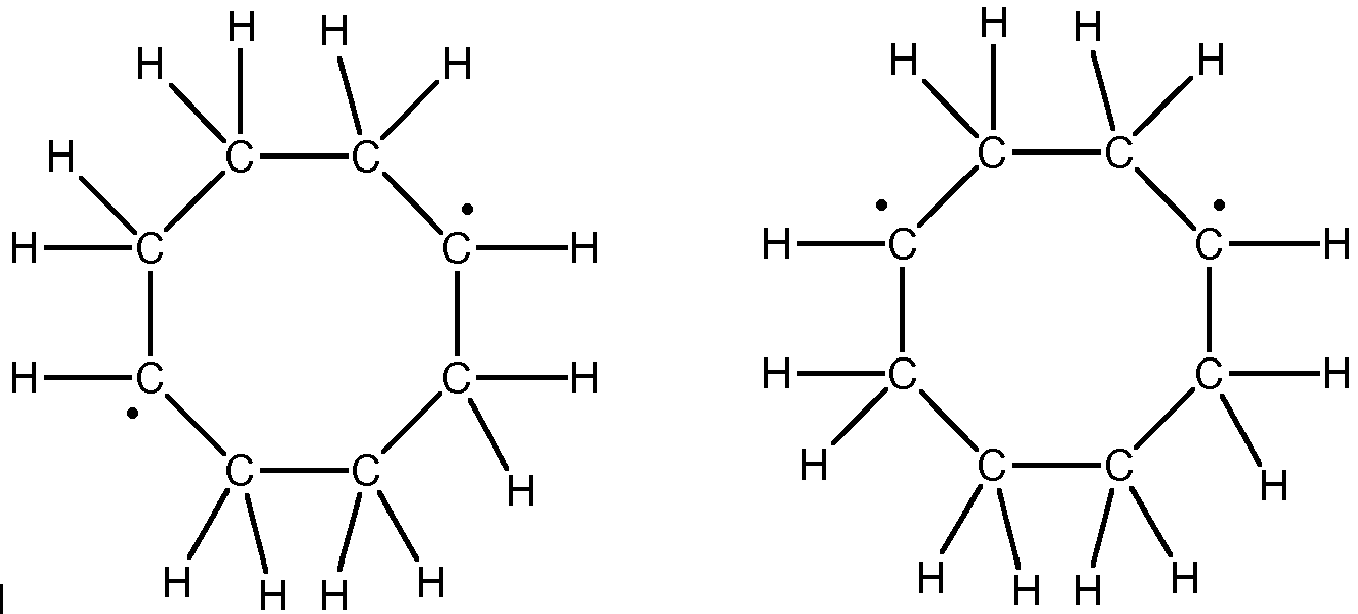
- bi-cycloheptanediyl

- Benzenediyl (·C6H4·).
- The formulations may be stored, transported and delivered in glass, plastic, or metallic containers or other suitable containers known in the art, such as the containers disclosed in the following
US Patents Nos.: 4,828,131 ;6,077,356 ;6,526,824 ;7,124,913 ; and7,261,118 , all of which are herein incorporated by reference in their entirety. Plastic or glass lined metallic containers may also be used. - Preferably, the material is stored and delivered from a hermetically sealed high purity stainless steel or nickel alloy vessel. Most preferably, the material is stored and delivered from a hermetically sealed high purity stainless steel or nickel alloy vessel equipped with a down tube and an outlet in communication with the vapor space within the vessel. In one embodiment the down tube and outlet of the vessel are arranged so as to allow the product to be delivered either as a liquid from the downtube. In another embodiment the down tube and outlet of the vessel are arranged so as to allow the product to be delivered as a vapor from the outlet connection in communication with the vapor phase. In a preferred embodiment the down tube and outlet of the vessel are arranged so as to allow the product to be delivered either as a liquid from the downtube or as a vapor from the outlet connection in communication with the vapor phase. In the latter case (i.e. where the product is to be delivered as a vapor from the outlet connection), the down-tube may be optionally used to introduce a carrier gas into the vessel to promote the vaporization of the mixture. In this embodiment, the downtube and vapor outlet connections are equipped with high integrity packless valves. While delivery of the liquid is preferred to avoid partitioning of the components of this formulation in the present invention, it should be noted that the formulations of the present invention match the vapor pressure of the components closely enough to enable the formulation to be delivered as a vapor mixture. Stainless steel may preferably be chosen from UNS alloy numbers S31600, S31603, S30400, S30403, S31700, S31703, S31500, S31803, S32750, and S31254. Nickel alloys may preferably be chosen from UNS alloy numbers N06625, N10665, N06022, N10276, and N06007. Most preferably, the vessels are made from alloys S31603 or N06022, either uncoated, internally electropolished or internally coated with a fluoropolymer.
- The formulations as the main deposition precursor may be used in a process to deposit a dielectric film by using techniques known in the art. The formulations can be pre-mixed mixtures, or premixtures (mixed before being used in the deposition process), or in-situ mixtures (mixed during the deposition process). Thus, in this disclosure the terms "mixture" and "formulation" are interchangeable.
- The formulation of the present invention may be combined with a second formulation containing water and optional co-solvents, surfactants and other additives and deposited onto a substrate. Distribution or delivery of this reaction formulation may be achieved by direct liquid injection, spraying, dipping, co-condensation or centrifugal spin-coating. The formulation is then allowed to react until a solid film or body is obtained. The use of inert gas, vacuum, heat or external energy source (light, heat, plasma, e-beam, etc.) to remove unreacted volatile species, including solvents and unreacted water may follow to facilitate the condensation of the film. The formulations of the present invention may preferably be delivered to a substrate contained in a deposition chamber a process fluid such as without limitation, a gas phase, liquid droplets, mist, fog, aerosol, sublimed solid, or combination thereof with water and optionally co-solvents and other additives also added as a process fluid such as a gas, vapor, aerosol, mist, or combination thereof. Preferably, the formulation of the present invention condenses or dissolves into a condensed film on the surface of the substrate, which may advantageously be held at a temperature below that of the walls of the chamber. The co-mixed deposition precursor and catalyst of the present invention can react at a uniform rate on the surface of the substrate rendering the reaction products into a non-volatile film. Unreacted precursors, water and optional co-solvents and additives may then be removed by gas purge, vacuum, heating, addition of external radiation (light, plasma, electron beam, etc.) until a stable solid silicon-containing film is obtained.
- One advantage of the formulations described herein is that the catalyst compounds and the silicon-containing precursor are mutually compatible (e.g., are freely miscible and do not react with each other to generate other impuritiess). This advantage allows these formulations to be stored for an extended period without any compositional changes which can adversely affect the performance of the formulation. Preferably, these formulations have a usable shelf-life of 1 year or greater or 2 years or greater. The use of a premixture, as distinct from co-delivering the catalyst and silicon-containing or deposition precursors separately (thus forming an in-situ mixture), is that the premixtures promotes uniform deposition, since adding the catalyst as a separate stream can lead to non-uniform catalyst distribution, may be variable over time, and/or adds complexity and cost to the deposition process.
- The following examples illustrate the mixtures, premixtures, formulations and components thereof described herein and are not intended to limit it in any way.
- To a closed container filled with 5857 g of methyltriethoxysilane (MTES) was added 143 g of chlorodiethoxymethylsilane (Cl-DEMS). The resulting mixture was sparged with helium (He) gas to combine the liquids. In order to measure the reaction rate of water with the silicon containing precursors, a mixture 88.2 g ethanol, 8.69 g water and 0.55 g dodecane was made. The small quantity of dodecane was added to the ethanol/water mixture to serve as an internal standard. A 4 milliliter (mL) glass vial containing 0.15 mL of the silicon containing mixture was treated with 1.5 g of the ethanol/water/dodecane mixture. The combined solutions were shaken for 1 minute and an aliquot was then analyzed by gas chromatography with a thermal conductivity detector. After 15 minutes, a second aliquot was analyzed by gas chromatography and the results were compared.
- The mixture of 0.15 mL of MTES with the ethanol/water mixture described above in Example 1 but without chlorodiethoxymethylsilane was analyzed in duplicate. The ratio of the MTES:dodecane peak areas was 28.2±0.3 after 1 minute and 28.0 ±0.3 after 15 minutes. This corresponds to a negligible reaction rate.
- The mixture of 0.15 mL of a 2.4% Cl-DEMS in MTES with the ethanol/water mixture described above in Example 1 was analyzed in duplicate. The ratio of the MTES:dodecane peak areas was 0.71±0.02 after 1 minute and 0.107 ±0.002 after 15 minutes. The relative conversion of MTES was approximately 97% after 1 minute and 99.6% after 15 minutes.
- Comparing the results of Example 1 a and 1 b shows that addition of the catalyst to the formulation significantly increased the reaction rate of both the halogen-containing catalyst component as well as the bulk silicon-containing component. This example demonstrated that chlorodiethoxymethylsilane is an effective hydrolysis and/or alcoholysis catalyst for methyltriethoxysilane even though the mixture is stable in the absence of water and/or alcohol.
- The mixture of 0.15 mL of MTES with the ethanol/water mixture described above was analyzed in duplicate. The ratio of the MTES:dodecane peak areas was 28.2±0.3 after 1 minute and 28.0 ±0.3 after 15 minutes. This corresponds to a negligible reaction rate.
- A 0.56 weight percent mixture of chlorotriethoxysilane (Cl-TES) in methyltriethoxysilane. The mixture was analyzed by gas chromatography with a thermal conductivity detector. Within one day, the bulk of the total chromatographic area was attributable to MTES with 0.40% of the total area associated with Cl-TES and 0.08% of the area associated with tetraethoxysilane (TEOS) and 0.003% of the area associated with Cl-DEMS. After storing this mixture for 34 days, the peak associated with Cl-TES decreased to 0.002% while TEOS increased to 0.54% and Cl-DEMS increased to 0.39%. After an additional three days, the Cl-TES was no longer detectable on the gas chromatogram and the TEOS area further increased to 0.58% and the Cl-DEMS increased to 0.40%. The presence of TEOS in the mixture, especially at varying levels is considered undesirable, while the changing nature of the chlorinated compound is unacceptable as it makes the performance of the mixture, including its reactivity, vary over time.
- A 2.4 weight percent mixture of chlorodiethoxymethylsilane (Cl-DEMS) in methltriethoxysilane was prepared. The area of the gas chromatographic peak corresponding to Cl-DEMS was 2.2% of the total chromatographic area. After 47 days, the mixture was re-analyzed and found to be essentially unchanged, with the corresponding peak area still at 2.2% of the total and no significant new peaks were observed.
- The working examples have shown that a mixture of methyltriethoxysilane (MTES) [R1 = ethyl, R2 = methyl], with chlorotriethoxysilane (Cl-TES) [R1 = ethyl, R2 not present] slowly over the course of several weeks at ambient temperature reacted to make a mixture of the starting compounds along with measurable amounts tetraethoxysilane (TEOS) and methyldiethoxychlorosilane (Cl-DEMS). This gradual change in the mixture as well as the appearance of an exogenous material (in this case TEOS) in varying concentrations over time is undesired, because film growth performance and composition varies depending on the age of the mixture. In contrast, a mixture of methyltriethoxysilane (MTES) [R1 = ethyl, R2 = methyl], with chlorodiethoxymethylsilane (Cl-DEMS)[R1=ethyl, R2=methyl], did not scramble and the mixtures remain stable over time.
- Stability of the mixtures of chlorinated catalysts in methyltriethoxysilane was shown in Table I below.
Table I. Stability of chlorinated catalysts in methyltriethoxysilane Example number Catalyst Compound Days at ambient temperature % Loss of catalyst 2 (comparative) chlorotriethoxysilane 1 29 2 (comparative) chlorotriethoxysilane 34 >99 3 chlorodiethoxymethylsilane 47 0 - A mixture of bis(tert-butoxy)silane (R1 = tert-C4H9; R2 = H, n = 2) containing 1% by weight of bis(tert-butoxy)chlorosilane is prepared. The mixture remains stable since any scrambling of the alkoxy substituents and the chloride substituent that might occur do not produce any new components.
- A mixture of methyltrimethoxysilane (R1 = CH3; R2 = CH3, n = 3) containing 1% by weight of methyldimethoxybromosilane (X=Br) is prepared. The mixture remains stable since any scrambling of the alkoxy substituents and the bromide substituent that might occur do not produce any new components.
- A mixture of n-hexyltrimethoxysilane (R1 = CH3; R2 = n-C6H13, n = 3) containing 2.5 % by weight of hexyldimethoxychlorosilane is prepared. The mixture remains stable since any scrambling of the alkoxy substituents and the chloride substituent that might occur do not produce any new components.
- A mixture of tetramethoxysilane (R1 = CH3, n = 4) containing 1 % by weight of chlorotrimethoxysilane is prepared. The mixture remains stable since any scrambling of the alkoxy substituents and the chloride substituent that might occur do not produce any new components.
- A mixture of methyltrimethoxysilane (R1 = CH3; R2 = CH3, n = 3) containing 2% by weight of methyldimethoxychlorosilane (X=Cl) is prepared. The mixture remains stable since any scrambling of the alkoxy substituents and the chloride substituent that might occur do not produce any new components. The mixture is rapidly hydrolyzed when mixed with an aqueous mixture to form a dielectric film after drying.
- A mixture of 1,2-bis(trimethoxysilyl)ethane, (CH3O)3Si-CH2-CH2-Si(OCH3)3, (R1 = CH3, R3 = -CH2CH2-, p=3 in the formula R2 3-p(R1O)pSi-R3-Si(OR1)pR2 3-p) containing 5% by weight of 1-(trimethoxysilyl)-2-(dimethoxychlorosilyl) (R1 = CH3, R3 = -CH2CH2-, R4 = CH3, R5 = OCH3, X=Cl, m=2 in the formula (R1O)mR2 2-m(X)Si-R3-Si(OR4)2R5) is prepared. The mixture remains stable since any scrambling of the alkoxy substituents and the chloride substituent that might occur do not produce significant quantities of any new components. The mixture is rapidly hydrolyzed when mixed with an aqueous mixture to form a silicon oxide film.
- In summary, the formulation comprising a silicon-containing precursor and a catalyst compound having at least the same R1 present in both compounds remained stable when stored under ambient temperature conditions. In contrast, other formulations where R1 in the silicon-containing precursor and catalyst are not the same exhibit scrambling between the substituents within the silicon containing precursor and the catalyst and produce a non-productive reaction which indicates a marked instability of the formulation.
Claims (16)
- A formulation selected from the group consisting of:(1) Formulation A comprising:(a) a silicon-containing precursor comprising a compound having a formula of Si(OR1)nR2 4-n; and (b) a catalyst comprising a compound having a formula of XSi(OR1)nR2 3-n; wherein R1 is selected from the group consisting of a C1-C12 linear or branched alkyl group; a C3-C12 aryl group, a C3-C12 cycloalkyl group, a C2-C12 alkenyl group, and a C2-C12 alkynyl group; R2 is selected from the group consisting of a C1-C12 linear or branched alkyl group; a C3-C12 aryl group; a C3-C12 cycloalkyl group; a C2-C12 alkenyl group; a C2-C12 alkynyl group; and a hydrogen atom; wherein when R1 is methyl, R2 is not hydrogen; n is an integer ranging from 1 to 4 inclusive; and X is selected from the group consisting of from F, Cl, Br and I;
and(2) Formulation B comprising(a) a silicon-containing precursor comprising a compound having a formula R2 3-p (R1O)pSi-R3-Si(OR1)pR2 3-p and (b) a catalyst comprising a compound having a formula of (R1O)mR22-m(X)Si-R3-Si(OR4)2R5; wherein R1 and R4 are each independently selected from a C1-C12 linear or branched alkyl group; a C3-C12 aryl group; a C3-C12 cycloalkyl group; a C2-C12 alkenyl group; and a C2-C12 alkynyl group; R2 is selected from a C1-C12 linear or branched alkyl group; a C3-C12 aryl group; a C3-C12 cycloalkyl group; a C2-C12 alkenyl group; a C2-C12 alkynyl group; and a hydrogen atom; wherein R1 and R2 may be the same or different; R3 is selected from a C1-10 alkanediyl group; a C2-10 alkenediyl group; a C2-10 alkynediyl group; a C3-10 cyclic alkanediyl; a C 5-10 cyclic alkenediyl group; a C6-10 bi-cyclic alkanediyl group; a C6-10 bi-cyclic alkenediyl group; a C6-10 arenediyl group; and R5 is selected from a linear or branched C1-C12 alkyl group; a C4-C12 aryl group; a C3-C12 cycloalkyl group; a C2-C12 alkenyl group; a C2-C12 alkynyl group; and a linear or branched C1-C12 alkoxy group; X is chosen from F, Cl, Br and I; m is an integer ranging from 1 to 2 inclusive; and p is an integer ranging from 1 to 3 inclusive. - The formulation of claim 1 comprising Formulation A wherein R1 is selected from the group consisting of methyl, ethyl, n-propyl, iso-propyl, n-butyl, 2-ethylhexyl, isobutyl, sec-butyl, tert-butyl, n-pentyl, isopentyl, neopentyl, tert-pentyl, n-hexyl, allyl (2-propenyl), homoallyl (3-butenyl), propargyl (2-propynyl), 2-hydroxyethyl, 2-hydroxypropyl, 2-methoxyethyl, phenyl, tolyl, xylyl, hydroxyphenyl, lauryl, napthyl, indenyl, benzyl, and mixtures thereof, and R2 is selected from the group consisting of methyl, ethyl, n-propyl, isopropyl, n-butyl, 2-ethylhexyl, isobutyl, sec-butyl, tert-butyl, n-pentyl, isopentyl, neopentyl, tert-pentyl, n-hexyl, vinyl, allyl, homoallyl (3-butenyl), propargyl (2-propynyl), 2-hydroxyethyl, 2-hydroxypropyl, 2-methoxyethyl, phenyl, tolyl, xylyl, hydroxyphenyl, lauryl, napthyl, indenyl, benzyl, hydrogen and mixtures thereof.
- The formulation of claim 1 comprising Formulation A, wherein R1 is selected from the group consisting of methyl, ethyl, iso-propyl, tert-butyl, n-hexyl, phenyl, and mixtures thereof and R2 is selected from the group consisting of methyl, ethyl, isopropyl, vinyl, tert-butyl, n-hexyl, phenyl, hydrogen, and mixtures thereof.
- The formulation of claim 1 comprising Formulation A wherein R1 is selected from the group consisting of methyl and ethyl; R2 is selected from the group consisting of methyl, ethyl, vinyl, tert-butyl, hydrogen, and mixtures thereof; and X is Cl.
- The formulation of claim 1 comprising Formulation A and selected from the group consisting of methyltriethoxysilane and chlorodiethoxymethylsilane (Cl-DEMS); bis(tert-butoxy)silane and bis(tert-butoxy)chlorosilane; methyltrimethoxysilane and methyldimethoxybromosilane; n-hexyltrimethoxysilane with n-hexyldimethoxychlorosilane; tetramethoxysilane with trimethoxychlorosilane; and methyltrimethoxysilane with methyldimethoxychlorosilane.
- The Formulation of claim 1 comprising Formulation B wherein R1 and R4 are selected from the group consisting of methyl, ethyl, n-propyl, isopropyl, n-butyl, 2-ethylhexyl, isobutyl, sec-butyl, t-butyl, n-pentyl, isopentyl, neopentyl and tert-pentyl, allyl (2-propenyl), homoallyl (3-butenyl), propargyl (2-propynyl), 2-hydroxyethyl, 2-hydroxypropyl, 2-methoxyethyl, phenyl, tolyl, xylyl, hydroxyphenyl, lauryl, napthyl, indenyl, benzyl, and mixtures thereof, and R2 is selected from the group consisting of methyl, ethyl, n-propyl, isopropyl, n-butyl, 2-ethylhexyl, isobutyl, sec-butyl, t-butyl, n-pentyl, isopentyl, neopentyl and tert-pentyl, vinyl (ethenyl), allyl (2-propenyl), homoallyl (3-butenyl), propargyl (2-propynyl), 2-hydroxyethyl, 2-hydroxypropyl, 2-methoxyethyl, phenyl, tolyl, xylyl, hydroxyphenyl, lauryl, napthyl, indenyl, benzyl, hydrogen and mixtures thereof.
- The formulation of Claim 1 comprising Formulation B wherein R1 and R4 are selected from the group consisting of methyl, ethyl, isopropyl, tert-butyl, phenyl, and mixtures thereof; R2 is selected from the group consisting of methyl, ethyl, isopropyl, vinyl, tert-butyl, phenyl, hydrogen, and mixtures thereof; R3 is selected from the group consisting of methylene (-CH2-), ethanediyl (-CH2CH2-), ethenediyl (-CH=CH), cyclopentenediyl, cyclohexenediyl, cycloctenediyl, tricycloheptanediyl, bi-cycloheptanediyl, benzenediyl.
- The formulation of Claim 1 comprising Formulation B wherein R1 and R4 are selected from the group consisting of methyl and ethyl; R2 is selected from the group consisting of methyl, ethyl, vinyl, tert-butyl, hydrogen, and mixtures thereof; R3 is selected from the group consisting of methylene, ethanediyl, ethenediyl, cyclopentenediyl, cyclohexenediyl, cycloctenediyl, bi-cycloheptanediyl, benzenediyl; R5 is selected from methyl, ethyl, methoxy, ethoxy, and X is Cl.
- The formulation of Claim 1 or any one of 6 to 8 comprising Formulation B wherein (R1O)mR2 2-m(X)Si-R3-Si(OR4)2R5 is selected from the group consisting of bis(trimethoxysilyl)(dimethoxychlorosilyl)methane (MeO)2ClSi-CH2-Si(OMe)3, (triethoxysilyl)(diethoxychlorosilyl)methane (EtO)2ClSi-CH2-Si(OEt)3, 1-(trimethoxysilyl)-2-(dimethoxychlorosilyl)ethane (MeO)2ClSi-CH2CH2-Si(OMe)3, 1-(triethoxysilyl)-2-(diethoxychlorosilyl)ethane (EtO)2ClSi-CH2CH2-Si(OEt)3, (chloromethoxymethylsilyl)(dimethoxymethylsilyl)methane (MeO)ClMeSi-CH2SiMe(OMe)2, (chloroethoxymethylsilyl)(diethoxymethylsilyl)methane (EtO)Cl MeSi-CH2-SiMe(OEt)2, 1-(chloromethoxymethylsilyl)-2-(dimethoxymethylsilyl)ethane (MeO)ClMeSi-CH2CH2-SiMe(OMe)2, 1-(chloroethoxymethylsilyl)-2-(diethoxymethylsilyl)ethane (EtO)ClMeSi-CH2CH2-SiMe(OEt)2, and combinations thereof.
- The formulation of Claim 1 or any one of 6 to 9 comprising Formulation B wherein R2 3-p(R1O)pSi-R3-Si(OR1)pR2 3-p is selected from the group consisting of bis(trimethoxysilyl)methane (MeO)3Si-CH2-Si(OMe)3, bis(triethoxysilyl)methane (EtO)3Si-CH2-Si(OEt)3, bis(trimethoxysilyl)ethane (MeO)3Si-CH2CH2-Si(OMe)3, bis(triethoxysilyl)ethane (EtO)3Si-CH2CH2-Si(OEt)3, bis(dimethoxymethylsilyl)methane (MeO)2MeSi-CH2-SiMe(OMe)2, bis(diethoxymethylsilyl)methane (EtO)2MeSi-CH2-SiMe(OEt)2, bis(dimethoxymethylsilyl)ethane (MeO)2MeSi-CH2CH2-SiMe(OMe)2, bis(diethoxymethylsilyl)ethane (EtO)2MeSi-CH2CH2-SiMe(OEt)2, and combinations thereof.
- The formulation of Claim 1 comprising Formulation B and wherein the formulation is selected from the group consisting of bis(trimethoxysilyl)methane and (trimethoxysilyl)(dimethoxychlorosilyl)methane; bis(triethoxysilyl)methane and (triethoxysilyl)(diethoxychlorosilyl)methane; 1,2-bis(trimethoxysilyl)ethane and 1-(trimethoxysilyl)-2-(dimethoxychlorosilyl)methane; 1,2-bis(triethoxysilyl)ethane and 1-(triethoxysilyl)-2-(diethoxychlorosilyl)ethane; bis(dimethoxymethylsilyl)methane and (trimethoxysilyl(dimethoxychlorosilyl)methane; bis(diethoxymethylsilyl)methane and (triethoxysilyl)(diethoxychlorosilyl)methane; 1,2-bis(dimethoxymethylsilyl)ethane and 1-(trimethoxysilyl)-2-(dimethoxychlorosilyl)methane; 1,2-bis(diethoxymethylsilyl)ethane and 1-(triethoxysilyl)-2-(diethoxychlorosilyl)ethane.
- The formulation of any preceding claim wherein the amount of the silicon-containing precursor present in the formulation is 50wt% or greater, or wherein the amount of the silicon-containing precursor present in the formulation is 80wt% or greater.
- The formulation of any preceding claim, wherein the amount of the catalyst compound in the formulation is 10 parts per million (ppm) by weight or greater, or wherein the amount of the catalyst compound in the formulation ranges from 25 ppm to 10wt%, or wherein the amount of the catalyst compound in the formulation ranges from 50 ppm to 5wt%.
- A method of storing, transporting and delivering a formulation, comprising:providing the formulation of any one of Claims 1 to 13,providing a container selected from the group consisting of a glass, plastic, metallic, and plastic or glass lined metallic container; andintroducing the formulation into the container.
- The method of Claim 14, wherein: the container is a hermetically sealed high purity stainless steel or nickel alloy vessel; the vessel further comprises a down tube and an outlet in communication with a vapor space within the vessel; and the formulation can be delivered as a fluid in a liquid form from the downtube; and/or the formulation can be delivered as a vapor from the outlet connection in communication with the vapor space.
- A method of depositing a silicon containing film on a substrate comprising:a) providing a substrate to a reaction chamber;b) introducing a process fluid comprising the formulation of any one of Claims 1 to 13 to the reaction chamber; andc) exposing the substrate to the process fluid under conditions such that a condensed flowable film forms on the substrate surface.
Applications Claiming Priority (3)
| Application Number | Priority Date | Filing Date | Title |
|---|---|---|---|
| US201261587388P | 2012-01-17 | 2012-01-17 | |
| US201261706809P | 2012-09-28 | 2012-09-28 | |
| US13/738,482 US9809711B2 (en) | 2012-01-17 | 2013-01-10 | Catalyst and formulations comprising same for alkoxysilanes hydrolysis reaction in semiconductor process |
Publications (1)
| Publication Number | Publication Date |
|---|---|
| EP2618364A2 true EP2618364A2 (en) | 2013-07-24 |
Family
ID=47598698
Family Applications (1)
| Application Number | Title | Priority Date | Filing Date |
|---|---|---|---|
| EP13151735.1A Withdrawn EP2618364A2 (en) | 2012-01-17 | 2013-01-17 | Catalyst and formulations comprising same for alkoxysilanes hydrolysis reaction in semiconductor process |
Country Status (6)
| Country | Link |
|---|---|
| US (1) | US9809711B2 (en) |
| EP (1) | EP2618364A2 (en) |
| JP (1) | JP5792752B2 (en) |
| KR (2) | KR101511191B1 (en) |
| CN (1) | CN103203250B (en) |
| TW (1) | TWI462929B (en) |
Families Citing this family (2)
| Publication number | Priority date | Publication date | Assignee | Title |
|---|---|---|---|---|
| US10170297B2 (en) | 2013-08-22 | 2019-01-01 | Versum Materials Us, Llc | Compositions and methods using same for flowable oxide deposition |
| CN109166787B (en) * | 2018-08-26 | 2019-06-28 | 合肥安德科铭半导体科技有限公司 | A flowable chemical vapor deposition method for silicon oxide films |
Family Cites Families (29)
| Publication number | Priority date | Publication date | Assignee | Title |
|---|---|---|---|---|
| GB653238A (en) | 1948-12-07 | 1951-05-09 | Dow Corning | A process for the manufacture of alkoxy chlorosilanes |
| US4228292A (en) | 1978-07-20 | 1980-10-14 | Monsanto Company | N-Substituted benzothiazolines and benzoxazolines and their use as herbicides and plant growth regulants |
| DE3636888A1 (en) | 1986-10-30 | 1988-05-11 | Merck Patent Gmbh | CONTAINER FOR HIGH-PURITY CHEMICALS |
| JPS6381132A (en) | 1987-09-10 | 1988-04-12 | Agency Of Ind Science & Technol | Hydrolyzing method for alkoxysilane |
| JP2668496B2 (en) | 1993-03-12 | 1997-10-27 | 信越化学工業株式会社 | Novel method for producing silicon-based powder material |
| US5478546A (en) * | 1993-03-12 | 1995-12-26 | Shin-Etsu Chemical Co., Ltd. | Process for preparing powder of silicon compound |
| US5386050A (en) | 1994-01-03 | 1995-01-31 | Korea Institute Of Science And Technology | (2-arylpropyl)alkylsilanes and their preparation methods |
| US5466850A (en) | 1995-04-07 | 1995-11-14 | Pcr, Inc. | Process for the preparation of fluorosilanes |
| DE19520737C2 (en) | 1995-06-07 | 2003-04-24 | Degussa | Process for the preparation of alkyl hydrogen chlorosilanes |
| KR100364115B1 (en) | 1996-12-17 | 2002-12-11 | 어드밴스드 테크놀러지 머티리얼즈, 인코포레이티드 | Reagent supply vessel for chemical vapor deposition |
| WO2001083369A1 (en) * | 2000-04-28 | 2001-11-08 | Mitsui Chemicals, Inc. | Water-repellent porous silica, method for preparation thereof and use thereof |
| JP4574054B2 (en) | 2000-04-28 | 2010-11-04 | 三井化学株式会社 | Water-repellent porous silica, its production method and use |
| US6526824B2 (en) | 2001-06-07 | 2003-03-04 | Air Products And Chemicals, Inc. | High purity chemical container with external level sensor and liquid sump |
| US7124913B2 (en) | 2003-06-24 | 2006-10-24 | Air Products And Chemicals, Inc. | High purity chemical container with diptube and level sensor terminating in lowest most point of concave floor |
| US7261118B2 (en) | 2003-08-19 | 2007-08-28 | Air Products And Chemicals, Inc. | Method and vessel for the delivery of precursor materials |
| US7524735B1 (en) | 2004-03-25 | 2009-04-28 | Novellus Systems, Inc | Flowable film dielectric gap fill process |
| US7074690B1 (en) | 2004-03-25 | 2006-07-11 | Novellus Systems, Inc. | Selective gap-fill process |
| US7582555B1 (en) | 2005-12-29 | 2009-09-01 | Novellus Systems, Inc. | CVD flowable gap fill |
| JP2005320362A (en) * | 2004-05-06 | 2005-11-17 | Toho Catalyst Co Ltd | Olefin polymerization catalyst and method for polymerizing olefin |
| US20060228903A1 (en) | 2005-03-30 | 2006-10-12 | Mcswiney Michael L | Precursors for the deposition of carbon-doped silicon nitride or silicon oxynitride films |
| RU2401846C2 (en) | 2006-04-25 | 2010-10-20 | Учреждение Российской академии наук Институт синтетических полимерных материалов им. Н.С. Ениколопова РАН (ИСПМ РАН) | Functional polyorganosiloxanes and curable composition based on said polyorganosiloxanes |
| US7498273B2 (en) | 2006-05-30 | 2009-03-03 | Applied Materials, Inc. | Formation of high quality dielectric films of silicon dioxide for STI: usage of different siloxane-based precursors for harp II—remote plasma enhanced deposition processes |
| US7888273B1 (en) | 2006-11-01 | 2011-02-15 | Novellus Systems, Inc. | Density gradient-free gap fill |
| US20080124946A1 (en) | 2006-11-28 | 2008-05-29 | Air Products And Chemicals, Inc. | Organosilane compounds for modifying dielectrical properties of silicon oxide and silicon nitride films |
| US7671227B2 (en) | 2007-02-28 | 2010-03-02 | Corning Incorporated | Asymmetric bis-silanes and methods for making and their use |
| WO2008114835A1 (en) | 2007-03-16 | 2008-09-25 | Jsr Corporation | Film-forming composition, silica film and method for forming the same |
| JP2009032962A (en) | 2007-07-27 | 2009-02-12 | Panasonic Corp | Semiconductor device and manufacturing method thereof |
| EP2714960B1 (en) | 2011-06-03 | 2018-02-28 | Versum Materials US, LLC | Compositions and processes for depositing carbon-doped silicon-containing films |
| JP5640997B2 (en) | 2012-01-31 | 2014-12-17 | 信越化学工業株式会社 | Method for producing organochlorosilane compound |
-
2013
- 2013-01-10 US US13/738,482 patent/US9809711B2/en active Active
- 2013-01-16 TW TW102101690A patent/TWI462929B/en active
- 2013-01-17 KR KR20130005510A patent/KR101511191B1/en active Active
- 2013-01-17 CN CN201310032372.8A patent/CN103203250B/en active Active
- 2013-01-17 JP JP2013006311A patent/JP5792752B2/en active Active
- 2013-01-17 EP EP13151735.1A patent/EP2618364A2/en not_active Withdrawn
-
2014
- 2014-05-23 KR KR1020140062220A patent/KR101961253B1/en active Active
Also Published As
| Publication number | Publication date |
|---|---|
| KR20140070518A (en) | 2014-06-10 |
| KR101511191B1 (en) | 2015-04-10 |
| KR20130084641A (en) | 2013-07-25 |
| CN103203250B (en) | 2018-01-09 |
| US9809711B2 (en) | 2017-11-07 |
| CN103203250A (en) | 2013-07-17 |
| US20130180215A1 (en) | 2013-07-18 |
| TWI462929B (en) | 2014-12-01 |
| JP2013154345A (en) | 2013-08-15 |
| TW201331216A (en) | 2013-08-01 |
| KR101961253B1 (en) | 2019-03-22 |
| JP5792752B2 (en) | 2015-10-14 |
Similar Documents
| Publication | Publication Date | Title |
|---|---|---|
| US10899500B2 (en) | Alkoxysilylamine compounds and applications thereof | |
| KR101820397B1 (en) | Alkoxyaminosilane compounds and applications thereof | |
| KR102430845B1 (en) | Functionalized cyclosilazanes as precursors for high growth rate silicon-containing films | |
| EP2944608B1 (en) | Organoaminodisilane precursors and methods for depositing films comprising same | |
| KR20210121310A (en) | Carbon bridged aminosilane compounds for high growth rate silicon-containing films | |
| US10170297B2 (en) | Compositions and methods using same for flowable oxide deposition | |
| JP2015227463A (en) | Catalyst synthesis for organosilane sol-gel reactions | |
| US9809711B2 (en) | Catalyst and formulations comprising same for alkoxysilanes hydrolysis reaction in semiconductor process | |
| US9677178B2 (en) | Alkoxyaminosilane compounds and applications thereof |
Legal Events
| Date | Code | Title | Description |
|---|---|---|---|
| PUAI | Public reference made under article 153(3) epc to a published international application that has entered the european phase |
Free format text: ORIGINAL CODE: 0009012 |
|
| AK | Designated contracting states |
Kind code of ref document: A2 Designated state(s): AL AT BE BG CH CY CZ DE DK EE ES FI FR GB GR HR HU IE IS IT LI LT LU LV MC MK MT NL NO PL PT RO RS SE SI SK SM TR |
|
| AX | Request for extension of the european patent |
Extension state: BA ME |
|
| STAA | Information on the status of an ep patent application or granted ep patent |
Free format text: STATUS: THE APPLICATION IS DEEMED TO BE WITHDRAWN |
|
| 18D | Application deemed to be withdrawn |
Effective date: 20160802 |