EP2616142B1 - Method and system for accelerated fitting of cochlear implants based on current spread - Google Patents
Method and system for accelerated fitting of cochlear implants based on current spread Download PDFInfo
- Publication number
- EP2616142B1 EP2616142B1 EP11758357.5A EP11758357A EP2616142B1 EP 2616142 B1 EP2616142 B1 EP 2616142B1 EP 11758357 A EP11758357 A EP 11758357A EP 2616142 B1 EP2616142 B1 EP 2616142B1
- Authority
- EP
- European Patent Office
- Prior art keywords
- electrode
- stimulation electrode
- fitting
- current
- stimulation
- Prior art date
- Legal status (The legal status is an assumption and is not a legal conclusion. Google has not performed a legal analysis and makes no representation as to the accuracy of the status listed.)
- Active
Links
Images


Classifications
-
- A—HUMAN NECESSITIES
- A61—MEDICAL OR VETERINARY SCIENCE; HYGIENE
- A61N—ELECTROTHERAPY; MAGNETOTHERAPY; RADIATION THERAPY; ULTRASOUND THERAPY
- A61N1/00—Electrotherapy; Circuits therefor
- A61N1/18—Applying electric currents by contact electrodes
- A61N1/32—Applying electric currents by contact electrodes alternating or intermittent currents
- A61N1/36—Applying electric currents by contact electrodes alternating or intermittent currents for stimulation
- A61N1/36036—Applying electric currents by contact electrodes alternating or intermittent currents for stimulation of the outer, middle or inner ear
- A61N1/36038—Cochlear stimulation
- A61N1/36039—Cochlear stimulation fitting procedures
Definitions
- the present invention relates to medical implants, and more specifically to fit customization in audio prosthesis systems such as cochlear implant systems.
- a normal ear transmits sounds as shown in Figure 1 through the outer ear 101 to the tympanic membrane (eardrum) 102 , which moves the bones of the middle ear 103 (malleus, incus, and stapes) that vibrate the oval window and round window openings of the cochlea 104 .
- the cochlea 104 is a long narrow duct wound spirally about its axis for approximately two and a half turns. It includes an upper channel known as the scala vestibuli and a lower channel known as the scala tympani, which are connected by the cochlear duct.
- the cochlea 104 forms an upright spiraling cone with a center called the modiolar where the spiral ganglion cells of the acoustic nerve 113 reside.
- the fluid-filled cochlea 104 functions as a transducer to generate electric pulses which are transmitted to the cochlear nerve 113 , and ultimately to the brain.
- Hearing is impaired when there are problems in the ability to transduce external sounds into meaningful action potentials along the neural substrate of the cochlea 104 .
- auditory prostheses have been developed.
- a conventional hearing aid may be used to provide acoustic-mechanical stimulation to the auditory system in the form of amplified sound.
- a cochlear implant with an implanted stimulation electrode can electrically stimulate auditory nerve tissue with small currents delivered by multiple electrode contacts distributed along the electrode.
- Figure 1 also shows some components of a typical cochlear implant system which includes an external microphone that provides an audio signal input to an external signal processor 111 where various signal processing schemes can be implemented.
- the processed signal is then converted into a digital data format, such as a sequence of data frames, for transmission into the implant 108 .
- the implant 108 also performs additional signal processing such as error correction, pulse formation, etc., and produces a stimulation pattern (based on the extracted audio information) that is sent through an electrode lead 109 to an implanted electrode array 110 .
- this electrode array 110 includes multiple electrodes on its surface that provide selective stimulation of the cochlea 104 .
- Cochlear implant systems employ stimulation strategies that provide high-rate pulsatile stimuli in multi-channel electrode arrays.
- One specific example is the "Continuous Interleaved Sampling (CIS)"- strategy, as described by Wilson et al., Better Speech Recognition With Cochlear Implants, Nature, vol. 352:236-238 (1991 ).
- CIS Continuous Interleaved Sampling
- symmetrical biphasic current pulses are used, which are strictly non-overlapping in time.
- the rate per channel typically is higher than 800 pulses/sec.
- Other stimulation strategies may be based on simultaneous activation of electrode currents. These approaches have proven to be successful in giving high levels of speech recognition.
- patient-specific operating parameters For an audio prosthesis such as a cochlear implant to work correctly, some patient-specific operating parameters need to be determined in a fit adjustment procedure where the type and number of operating parameters are device dependent and stimulation strategy dependent. Possible patient-specific operating parameters for a cochlear implant include:
- EAPs Electrically Evoked Action Potentials
- Gantz et al. Intraoperative Measures of Electrically Evoked Auditory Nerve Compound Action Potentials, American Journal of Otology 15 (2):137-144 (1994 ).
- a recording electrode in the scala tympani of the inner ear is used.
- the overall response of the auditory nerve to an electrical stimulus is measured very close to the position of the nerve excitation.
- This neural response is caused by the super-position of single neural responses at the outside of the axon membranes.
- the amplitude of the EAP at the measurement position is between 10 ⁇ V and 1800 ⁇ V.
- THR threshold
- MCL most comfortable loudness
- a third fitting approach does not start from zero current when fitting a channel, but rather from some other fixed initial value, but this initial value can sometimes be too high or too low for some channels.
- Embodiments of the present invention are directed to fitting an implanted cochlear implant electrode array having stimulation electrodes to the implanted patient.
- a first unfit stimulation electrode is fit to the patient by determining a most comfortable loudness (MCL) value. Then an MCL value is determined for each remaining unfit stimulation electrode starting from an initial fitting current based on current spread characteristics of at least one already fit stimulation electrode.
- MCL most comfortable loudness
- the current spread characteristics may be represented by an exponential decay function and/or may be based on a voltage profile measured along the electrode array.
- the initial fitting current may further be based on a fixed percentage of the MCL value for an already fit stimulation electrode.
- the at least one already fit stimulation electrode may be a next more apical or a next more basal stimulation electrode.
- Embodiments also include a cochlear implant fitting system using a method according to any of the above, and a computer program product implemented in a computer readable storage medium for fitting an implanted electrode of a cochlear implant to an implanted patient and including program code for performing a method according to any of the above.
- Embodiments of the present invention are directed to a method and a system which provides a starting point for the fitting of each stimulation electrode.
- Already fit stimulation electrode channels are used to quickly and accurately determine MCL values for each remaining stimulation electrodes taking into account current spread characteristics of the cochlea.
- FIG. 2 shows a block diagram of a cochlear implant fitting system according to one specific embodiment of the present invention.
- Control Unit 201 for Recording and Stimulation for example, a Med-El Maestro CI system, generates stimulation signals and analyzes response measurements.
- an Interface Box 202 Connected to the Control Unit 201 is an Interface Box 202 , for example, a Diagnostic Interface System such as the DIB II conventionally used with the Maestro CI system that formats and distributes the input and output signals between the Control Unit 201 and the system components implanted in the Patient 206 .
- a Diagnostic Interface System such as the DIB II conventionally used with the Maestro CI system that formats and distributes the input and output signals between the Control Unit 201 and the system components implanted in the Patient 206 .
- a Cochlear Implant Electrode 204 may be used as a sensing element to determine current and voltage characteristics of the adjacent tissue, for example, for use measuring current spread.
- Control Unit 201 fits a first unfit Cochlear Implant Electrode 204 to the patient by determining a most comfortable loudness (MCL) value for that electrode. Control Unit 201 then determines an MCL value for each remaining unfit Cochlear Implant Electrode 204 starting from an initial fitting current based on current spread characteristics of at least one already fit Cochlear Implant Electrode 204 .
- MCL most comfortable loudness
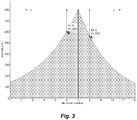
- ⁇ and ⁇ are typically around 0.75 and 0.70 respectively. Telemetry measurements can be taken inside the cochlea to measure the voltage profile along the electrode array when a stimulus pulse is applied on the electrode array. The two decay constants are reflected in the measured voltage profile and can then be assessed in each individual patient.
- Electrode 7 was the first electrode in the array to be fit to the MCL for the implanted patient.
- the next basally electrode E8 can only eliciting new neuronal structures if the released current exceeds Point A with 560 ⁇ A (800 ⁇ A * 0.70, as given by Equation 3).
- the initial fitting current needs to start at Point B with 600 ⁇ A (800 ⁇ A * 0.75, as given by Equation 3).
- the most efficient specific sequence is to fit electrode channels going in the direction of shallower current decay. This is because when assuming a relatively even MCL profile across the electrode channels, then the starting point for fitting of the next electrode as derived from Equation 3 will be closer to the final MCL if the decay is shallower.
- Embodiments of the present invention are only based on the electrically conductivity of the fluid and the resulting field distribution (channel crosstalk inside the scala tympani), and do not assume any particular kind of neural survival or neural responses.
- the amount of this channel crosstalk is directly affected by the distance between the electrodes (typically 0.75 - 2.4 mm). If some cases the amount of channel crosstalk may be higher, but this may not pose a problem because the initial fitting current starts at a lower level (assuming equal distances between electrodes).
- neural survival differences also should not be a problem-in the case that the region around a neighboring electrode delivers the biggest neural response (best neural survival), then the MCL of the current electrode is more related on the region of the neighboring electrode.
- the approach described above may be more accurate than interpolating unmeasured channels based on MCL values of measured channels. Nevertheless, in some arrangements it may be useful to combine both approaches. And rather than modeling current spread based on exponential functions as described above, some embodiments of the present invention may use other appropriate current spread modeling functions. Or rather than using a mathematical function to model electrode current spread, the measured voltage profile of the telemetry measurement itself may be used directly after removing/canceling any signal artifacts (stimulation and recording artifacts). Or instead of using a current spread function to estimate the starting point of the next electrode channel in a fitting, a fixed percentage of the lowest previous measured MCL can be used, or a combination of both.
- current spread approach can also be used as the basis for estimating other implant system values such as electrically evoked compound action potential (eCAP), electrically evoked auditory brain stem responses (EABR), and electrically elicited stapedius reflex threshold (ESRT) values.
- eCAP electrically evoked compound action potential
- EABR electrically evoked auditory brain stem responses
- ESRT stapedius reflex threshold
- Embodiments of the invention may be implemented in whole or in part in any conventional computer programming language.
- preferred embodiments may be implemented in a procedural programming language (e.g., "C") or an object oriented programming language (e.g., "C++", Python).
- Alternative embodiments of the invention may be implemented as pre-programmed hardware elements, other related components, or as a combination of hardware and software components.
- Embodiments can be implemented in whole or in part as a computer program product for use with a computer system.
- Such implementation may include a series of computer instructions fixed either on a tangible medium, such as a computer readable medium (e . g ., a diskette, CD-ROM, ROM, or fixed disk) or transmittable to a computer system, via a modem or other interface device, such as a communications adapter connected to a network over a medium.
- the medium may be either a tangible medium ( e . g ., optical or analog communications lines) or a medium implemented with wireless techniques ( e . g ., microwave, infrared or other transmission techniques).
- the series of computer instructions embodies all or part of the functionality previously described herein with respect to the system.
- Such computer instructions can be written in a number of programming languages for use with many computer architectures or operating systems. Furthermore, such instructions may be stored in any memory device, such as semiconductor, magnetic, optical or other memory devices, and may be transmitted using any communications technology, such as optical, infrared, microwave, or other transmission technologies. It is expected that such a computer program product may be distributed as a removable medium with accompanying printed or electronic documentation (e . g ., shrink wrapped software), preloaded with a computer system ( e . g ., on system ROM or fixed disk), or distributed from a server or electronic bulletin board over the network ( e . g ., the Internet or World Wide Web).
- printed or electronic documentation e . g ., shrink wrapped software
- preloaded with a computer system e . g ., on system ROM or fixed disk
- server or electronic bulletin board e . g ., the Internet or World Wide Web
- embodiments of the invention may be implemented as a combination of both software (e . g ., a computer program product) and hardware. Still other embodiments of the invention are implemented as entirely hardware, or entirely software ( e . g ., a computer program product).
Landscapes
- Health & Medical Sciences (AREA)
- Otolaryngology (AREA)
- Engineering & Computer Science (AREA)
- Biomedical Technology (AREA)
- Nuclear Medicine, Radiotherapy & Molecular Imaging (AREA)
- Radiology & Medical Imaging (AREA)
- Life Sciences & Earth Sciences (AREA)
- Animal Behavior & Ethology (AREA)
- General Health & Medical Sciences (AREA)
- Public Health (AREA)
- Veterinary Medicine (AREA)
- Electrotherapy Devices (AREA)
- Prostheses (AREA)
Priority Applications (1)
| Application Number | Priority Date | Filing Date | Title |
|---|---|---|---|
| PL11758357T PL2616142T3 (pl) | 2010-09-15 | 2011-09-15 | Sposób i układ do przyspieszonego dopasowywania implantów ślimakowych w oparciu o rozkład prądu |
Applications Claiming Priority (2)
| Application Number | Priority Date | Filing Date | Title |
|---|---|---|---|
| US38299610P | 2010-09-15 | 2010-09-15 | |
| PCT/US2011/051688 WO2012037305A1 (en) | 2010-09-15 | 2011-09-15 | Method and system for accelerated fitting of cochlear implants based on current spread |
Publications (2)
| Publication Number | Publication Date |
|---|---|
| EP2616142A1 EP2616142A1 (en) | 2013-07-24 |
| EP2616142B1 true EP2616142B1 (en) | 2019-01-09 |
Family
ID=44654526
Family Applications (1)
| Application Number | Title | Priority Date | Filing Date |
|---|---|---|---|
| EP11758357.5A Active EP2616142B1 (en) | 2010-09-15 | 2011-09-15 | Method and system for accelerated fitting of cochlear implants based on current spread |
Country Status (6)
| Country | Link |
|---|---|
| US (1) | US9320896B2 (pl) |
| EP (1) | EP2616142B1 (pl) |
| CN (1) | CN103108671B (pl) |
| AU (1) | AU2011302109B2 (pl) |
| PL (1) | PL2616142T3 (pl) |
| WO (1) | WO2012037305A1 (pl) |
Families Citing this family (12)
| Publication number | Priority date | Publication date | Assignee | Title |
|---|---|---|---|---|
| EP2833833B1 (en) | 2012-04-03 | 2017-10-25 | Vanderbilt University | Methods and systems for customizing cochlear implant stimulation and applications of same |
| US10413726B2 (en) * | 2013-06-28 | 2019-09-17 | MED-EL Elektronmedizinische Geraete GmbH | Fast fitting for cochlear implants |
| US9320887B2 (en) | 2013-10-17 | 2016-04-26 | Med-El Elektromedizinische Geraete Gmbh | Objective allocation of implant electrode bands based on excitation spread |
| DK2904972T3 (da) * | 2014-02-05 | 2021-08-16 | Oticon As | Indretning til bestemmelse af dødt cochlear-område |
| EP2982296A1 (en) * | 2014-08-07 | 2016-02-10 | Oticon A/s | A hearing assistance system with improved signal processing comprising an implanted part |
| US20160059014A1 (en) | 2014-09-02 | 2016-03-03 | Benjamin Peter Johnston | Event Detection In An Implantable Auditory Prosthesis |
| WO2016035027A1 (en) * | 2014-09-02 | 2016-03-10 | Cochlear Limited | Intra-cochlear stimulating assembly insertion |
| ES2733842T3 (es) * | 2015-01-09 | 2019-12-03 | Med El Elektromedizinische Geraete Gmbh | Ajuste de implante coclear mediante fibras nerviosas eferentes |
| US10537739B2 (en) | 2016-05-26 | 2020-01-21 | Cochlear Limited | Electrode selection |
| WO2018160450A1 (en) * | 2017-02-28 | 2018-09-07 | Med-El Elektromedizinische Geraete Gmbh | Fast objective fitting measurements for cochlear implants |
| US20210178160A1 (en) * | 2018-07-25 | 2021-06-17 | Med-El Elektromedizinische Geraete Gmbh | Background Stimulation for Fitting Cochlear Implants |
| CN113599700A (zh) * | 2021-09-09 | 2021-11-05 | 苏州景昱医疗器械有限公司 | 用于电活动感测的系统 |
Family Cites Families (33)
| Publication number | Priority date | Publication date | Assignee | Title |
|---|---|---|---|---|
| US4284856A (en) | 1979-09-24 | 1981-08-18 | Hochmair Ingeborg | Multi-frequency system and method for enhancing auditory stimulation and the like |
| CA1189147A (en) | 1980-12-12 | 1985-06-18 | James F. Patrick | Speech processors |
| US5938691A (en) | 1989-09-22 | 1999-08-17 | Alfred E. Mann Foundation | Multichannel implantable cochlear stimulator |
| US5549658A (en) | 1994-10-24 | 1996-08-27 | Advanced Bionics Corporation | Four-Channel cochlear system with a passive, non-hermetically sealed implant |
| US5601617A (en) | 1995-04-26 | 1997-02-11 | Advanced Bionics Corporation | Multichannel cochlear prosthesis with flexible control of stimulus waveforms |
| US6219580B1 (en) | 1995-04-26 | 2001-04-17 | Advanced Bionics Corporation | Multichannel cochlear prosthesis with flexible control of stimulus waveforms |
| US5626629A (en) | 1995-05-31 | 1997-05-06 | Advanced Bionics Corporation | Programming of a speech processor for an implantable cochlear stimulator |
| US6584525B1 (en) | 1998-11-19 | 2003-06-24 | Edwin E. Klingman | Adaptation of standard microprocessor architectures via an interface to a configurable subsystem |
| CA2318407C (en) | 1998-01-12 | 2008-07-29 | Imperial College Of Science, Technology & Medicine | Audio signal processors |
| US6078838A (en) | 1998-02-13 | 2000-06-20 | University Of Iowa Research Foundation | Pseudospontaneous neural stimulation system and method |
| AU745630B2 (en) | 1998-04-01 | 2002-03-28 | James H. Doyle Sr. | Multichannel implantable inner ear stimulator |
| US6175767B1 (en) | 1998-04-01 | 2001-01-16 | James H. Doyle, Sr. | Multichannel implantable inner ear stimulator |
| US6289247B1 (en) | 1998-06-02 | 2001-09-11 | Advanced Bionics Corporation | Strategy selector for multichannel cochlear prosthesis |
| US6600955B1 (en) | 1999-07-21 | 2003-07-29 | Med-El Elektromedizinishe Geraete Gmbh | Multichannel cochlear implant with neural response telemetry |
| AU775268B2 (en) | 1999-08-26 | 2004-07-29 | Med-El Elektromedizinische Gerate Gmbh | Electrical nerve stimulation based on channel specific sampling sequences |
| US8165686B2 (en) * | 1999-08-26 | 2012-04-24 | Med-El Elektromedizinische Geraete Gmbh | Simultaneous intracochlear stimulation |
| AUPQ261299A0 (en) | 1999-09-02 | 1999-09-23 | Bionic Ear Institute, The | Improved sound processor for cochlear implants |
| EP1216014B1 (en) * | 1999-09-16 | 2005-04-20 | Advanced Bionics N.V. | Cochlear implant |
| EP1267761B1 (en) | 2000-03-31 | 2004-11-10 | Advanced Bionics Corporation | High contact count, sub-miniature, fully implantable cochlear prosthesis |
| AUPS318202A0 (en) | 2002-06-26 | 2002-07-18 | Cochlear Limited | Parametric fitting of a cochlear implant |
| US7110821B1 (en) * | 2002-07-10 | 2006-09-19 | Advanced Bionics Corporation | Channel interaction cancellation within a multichannel neural stimulation system |
| US20060227986A1 (en) | 2002-09-02 | 2006-10-12 | Swanson Brett A | Method and apparatus for envelope detection and enhancement of pitch cue of audio signals |
| AU2003901025A0 (en) | 2003-02-28 | 2003-03-20 | The University Of Melbourne | Cochlear implant found processing method and system |
| US8023673B2 (en) | 2004-09-28 | 2011-09-20 | Hearworks Pty. Limited | Pitch perception in an auditory prosthesis |
| EP1722852B1 (en) | 2004-03-08 | 2015-06-03 | MED-EL Elektromedizinische Geräte GmbH | Electrical stimulation of the acoustic nerve based on selected groups |
| US7421298B2 (en) | 2004-09-07 | 2008-09-02 | Cochlear Limited | Multiple channel-electrode mapping |
| US7515966B1 (en) | 2005-03-14 | 2009-04-07 | Advanced Bionics, Llc | Sound processing and stimulation systems and methods for use with cochlear implant devices |
| CA2606787A1 (en) | 2005-04-29 | 2006-11-09 | Cochlear Americas | Focused stimulation in a medical stimulation device |
| US8369958B2 (en) | 2005-05-19 | 2013-02-05 | Cochlear Limited | Independent and concurrent processing multiple audio input signals in a prosthetic hearing implant |
| US7650194B2 (en) | 2006-03-22 | 2010-01-19 | Fritsch Michael H | Intracochlear nanotechnology and perfusion hearing aid device |
| US8571675B2 (en) * | 2006-04-21 | 2013-10-29 | Cochlear Limited | Determining operating parameters for a stimulating medical device |
| CN201290806Y (zh) * | 2008-11-27 | 2009-08-19 | 上海力声特医学科技有限公司 | 人工耳蜗map无线调试装置 |
| US8954158B2 (en) * | 2009-02-05 | 2015-02-10 | Cochlear Limited | Multi-electrode channel configurations |
-
2011
- 2011-09-15 PL PL11758357T patent/PL2616142T3/pl unknown
- 2011-09-15 EP EP11758357.5A patent/EP2616142B1/en active Active
- 2011-09-15 AU AU2011302109A patent/AU2011302109B2/en active Active
- 2011-09-15 WO PCT/US2011/051688 patent/WO2012037305A1/en not_active Ceased
- 2011-09-15 US US13/233,148 patent/US9320896B2/en active Active
- 2011-09-15 CN CN201180044670.8A patent/CN103108671B/zh active Active
Non-Patent Citations (1)
| Title |
|---|
| None * |
Also Published As
| Publication number | Publication date |
|---|---|
| CN103108671B (zh) | 2015-12-02 |
| PL2616142T3 (pl) | 2019-04-30 |
| EP2616142A1 (en) | 2013-07-24 |
| CN103108671A (zh) | 2013-05-15 |
| AU2011302109A1 (en) | 2013-03-21 |
| WO2012037305A1 (en) | 2012-03-22 |
| US20120065705A1 (en) | 2012-03-15 |
| US9320896B2 (en) | 2016-04-26 |
| AU2011302109B2 (en) | 2014-08-07 |
Similar Documents
| Publication | Publication Date | Title |
|---|---|---|
| EP2616142B1 (en) | Method and system for accelerated fitting of cochlear implants based on current spread | |
| EP2716073B1 (en) | Progressive parameter scan for cochlear implants | |
| US8086319B2 (en) | Cochlear implant fitting | |
| EP2707092B1 (en) | Optimal model constants for simultaneous stimulation with channel interaction compensation | |
| US10881855B2 (en) | Fast fitting for cochlear implants | |
| EP2758120B1 (en) | Accelerated fitting of ear implants | |
| US8892212B2 (en) | Fast fitting of cochlear implants | |
| EP3212280B1 (en) | Tinnitus fitting in ci and abi patients | |
| AU2015201407B2 (en) | Optimal model constants for simultaneous stimulation with channel interaction compensation | |
| AU2016213770B2 (en) | Optimal model constants for simultaneous stimulation with channel interaction compensation | |
| CN117042693A (zh) | 基于人体内bm延迟的优化声学啁啾 |
Legal Events
| Date | Code | Title | Description |
|---|---|---|---|
| PUAI | Public reference made under article 153(3) epc to a published international application that has entered the european phase |
Free format text: ORIGINAL CODE: 0009012 |
|
| 17P | Request for examination filed |
Effective date: 20130228 |
|
| AK | Designated contracting states |
Kind code of ref document: A1 Designated state(s): AL AT BE BG CH CY CZ DE DK EE ES FI FR GB GR HR HU IE IS IT LI LT LU LV MC MK MT NL NO PL PT RO RS SE SI SK SM TR |
|
| DAX | Request for extension of the european patent (deleted) | ||
| GRAP | Despatch of communication of intention to grant a patent |
Free format text: ORIGINAL CODE: EPIDOSNIGR1 |
|
| STAA | Information on the status of an ep patent application or granted ep patent |
Free format text: STATUS: GRANT OF PATENT IS INTENDED |
|
| INTG | Intention to grant announced |
Effective date: 20181002 |
|
| GRAS | Grant fee paid |
Free format text: ORIGINAL CODE: EPIDOSNIGR3 |
|
| GRAA | (expected) grant |
Free format text: ORIGINAL CODE: 0009210 |
|
| STAA | Information on the status of an ep patent application or granted ep patent |
Free format text: STATUS: THE PATENT HAS BEEN GRANTED |
|
| AK | Designated contracting states |
Kind code of ref document: B1 Designated state(s): AL AT BE BG CH CY CZ DE DK EE ES FI FR GB GR HR HU IE IS IT LI LT LU LV MC MK MT NL NO PL PT RO RS SE SI SK SM TR |
|
| REG | Reference to a national code |
Ref country code: GB Ref legal event code: FG4D |
|
| REG | Reference to a national code |
Ref country code: CH Ref legal event code: EP Ref country code: AT Ref legal event code: REF Ref document number: 1086565 Country of ref document: AT Kind code of ref document: T Effective date: 20190115 |
|
| REG | Reference to a national code |
Ref country code: DE Ref legal event code: R096 Ref document number: 602011055572 Country of ref document: DE |
|
| REG | Reference to a national code |
Ref country code: IE Ref legal event code: FG4D |
|
| REG | Reference to a national code |
Ref country code: NL Ref legal event code: MP Effective date: 20190109 |
|
| REG | Reference to a national code |
Ref country code: LT Ref legal event code: MG4D |
|
| PG25 | Lapsed in a contracting state [announced via postgrant information from national office to epo] |
Ref country code: NL Free format text: LAPSE BECAUSE OF FAILURE TO SUBMIT A TRANSLATION OF THE DESCRIPTION OR TO PAY THE FEE WITHIN THE PRESCRIBED TIME-LIMIT Effective date: 20190109 |
|
| REG | Reference to a national code |
Ref country code: AT Ref legal event code: MK05 Ref document number: 1086565 Country of ref document: AT Kind code of ref document: T Effective date: 20190109 |
|
| PG25 | Lapsed in a contracting state [announced via postgrant information from national office to epo] |
Ref country code: LT Free format text: LAPSE BECAUSE OF FAILURE TO SUBMIT A TRANSLATION OF THE DESCRIPTION OR TO PAY THE FEE WITHIN THE PRESCRIBED TIME-LIMIT Effective date: 20190109 Ref country code: FI Free format text: LAPSE BECAUSE OF FAILURE TO SUBMIT A TRANSLATION OF THE DESCRIPTION OR TO PAY THE FEE WITHIN THE PRESCRIBED TIME-LIMIT Effective date: 20190109 Ref country code: NO Free format text: LAPSE BECAUSE OF FAILURE TO SUBMIT A TRANSLATION OF THE DESCRIPTION OR TO PAY THE FEE WITHIN THE PRESCRIBED TIME-LIMIT Effective date: 20190409 Ref country code: PT Free format text: LAPSE BECAUSE OF FAILURE TO SUBMIT A TRANSLATION OF THE DESCRIPTION OR TO PAY THE FEE WITHIN THE PRESCRIBED TIME-LIMIT Effective date: 20190509 Ref country code: SE Free format text: LAPSE BECAUSE OF FAILURE TO SUBMIT A TRANSLATION OF THE DESCRIPTION OR TO PAY THE FEE WITHIN THE PRESCRIBED TIME-LIMIT Effective date: 20190109 Ref country code: ES Free format text: LAPSE BECAUSE OF FAILURE TO SUBMIT A TRANSLATION OF THE DESCRIPTION OR TO PAY THE FEE WITHIN THE PRESCRIBED TIME-LIMIT Effective date: 20190109 |
|
| PG25 | Lapsed in a contracting state [announced via postgrant information from national office to epo] |
Ref country code: GR Free format text: LAPSE BECAUSE OF FAILURE TO SUBMIT A TRANSLATION OF THE DESCRIPTION OR TO PAY THE FEE WITHIN THE PRESCRIBED TIME-LIMIT Effective date: 20190410 Ref country code: HR Free format text: LAPSE BECAUSE OF FAILURE TO SUBMIT A TRANSLATION OF THE DESCRIPTION OR TO PAY THE FEE WITHIN THE PRESCRIBED TIME-LIMIT Effective date: 20190109 Ref country code: RS Free format text: LAPSE BECAUSE OF FAILURE TO SUBMIT A TRANSLATION OF THE DESCRIPTION OR TO PAY THE FEE WITHIN THE PRESCRIBED TIME-LIMIT Effective date: 20190109 Ref country code: BG Free format text: LAPSE BECAUSE OF FAILURE TO SUBMIT A TRANSLATION OF THE DESCRIPTION OR TO PAY THE FEE WITHIN THE PRESCRIBED TIME-LIMIT Effective date: 20190409 Ref country code: IS Free format text: LAPSE BECAUSE OF FAILURE TO SUBMIT A TRANSLATION OF THE DESCRIPTION OR TO PAY THE FEE WITHIN THE PRESCRIBED TIME-LIMIT Effective date: 20190509 Ref country code: LV Free format text: LAPSE BECAUSE OF FAILURE TO SUBMIT A TRANSLATION OF THE DESCRIPTION OR TO PAY THE FEE WITHIN THE PRESCRIBED TIME-LIMIT Effective date: 20190109 |
|
| REG | Reference to a national code |
Ref country code: DE Ref legal event code: R097 Ref document number: 602011055572 Country of ref document: DE |
|
| PG25 | Lapsed in a contracting state [announced via postgrant information from national office to epo] |
Ref country code: AL Free format text: LAPSE BECAUSE OF FAILURE TO SUBMIT A TRANSLATION OF THE DESCRIPTION OR TO PAY THE FEE WITHIN THE PRESCRIBED TIME-LIMIT Effective date: 20190109 Ref country code: DK Free format text: LAPSE BECAUSE OF FAILURE TO SUBMIT A TRANSLATION OF THE DESCRIPTION OR TO PAY THE FEE WITHIN THE PRESCRIBED TIME-LIMIT Effective date: 20190109 Ref country code: AT Free format text: LAPSE BECAUSE OF FAILURE TO SUBMIT A TRANSLATION OF THE DESCRIPTION OR TO PAY THE FEE WITHIN THE PRESCRIBED TIME-LIMIT Effective date: 20190109 Ref country code: EE Free format text: LAPSE BECAUSE OF FAILURE TO SUBMIT A TRANSLATION OF THE DESCRIPTION OR TO PAY THE FEE WITHIN THE PRESCRIBED TIME-LIMIT Effective date: 20190109 Ref country code: IT Free format text: LAPSE BECAUSE OF FAILURE TO SUBMIT A TRANSLATION OF THE DESCRIPTION OR TO PAY THE FEE WITHIN THE PRESCRIBED TIME-LIMIT Effective date: 20190109 Ref country code: SK Free format text: LAPSE BECAUSE OF FAILURE TO SUBMIT A TRANSLATION OF THE DESCRIPTION OR TO PAY THE FEE WITHIN THE PRESCRIBED TIME-LIMIT Effective date: 20190109 Ref country code: RO Free format text: LAPSE BECAUSE OF FAILURE TO SUBMIT A TRANSLATION OF THE DESCRIPTION OR TO PAY THE FEE WITHIN THE PRESCRIBED TIME-LIMIT Effective date: 20190109 Ref country code: CZ Free format text: LAPSE BECAUSE OF FAILURE TO SUBMIT A TRANSLATION OF THE DESCRIPTION OR TO PAY THE FEE WITHIN THE PRESCRIBED TIME-LIMIT Effective date: 20190109 |
|
| PLBE | No opposition filed within time limit |
Free format text: ORIGINAL CODE: 0009261 |
|
| STAA | Information on the status of an ep patent application or granted ep patent |
Free format text: STATUS: NO OPPOSITION FILED WITHIN TIME LIMIT |
|
| PG25 | Lapsed in a contracting state [announced via postgrant information from national office to epo] |
Ref country code: SM Free format text: LAPSE BECAUSE OF FAILURE TO SUBMIT A TRANSLATION OF THE DESCRIPTION OR TO PAY THE FEE WITHIN THE PRESCRIBED TIME-LIMIT Effective date: 20190109 |
|
| 26N | No opposition filed |
Effective date: 20191010 |
|
| PG25 | Lapsed in a contracting state [announced via postgrant information from national office to epo] |
Ref country code: SI Free format text: LAPSE BECAUSE OF FAILURE TO SUBMIT A TRANSLATION OF THE DESCRIPTION OR TO PAY THE FEE WITHIN THE PRESCRIBED TIME-LIMIT Effective date: 20190109 |
|
| PG25 | Lapsed in a contracting state [announced via postgrant information from national office to epo] |
Ref country code: TR Free format text: LAPSE BECAUSE OF FAILURE TO SUBMIT A TRANSLATION OF THE DESCRIPTION OR TO PAY THE FEE WITHIN THE PRESCRIBED TIME-LIMIT Effective date: 20190109 |
|
| PG25 | Lapsed in a contracting state [announced via postgrant information from national office to epo] |
Ref country code: MC Free format text: LAPSE BECAUSE OF FAILURE TO SUBMIT A TRANSLATION OF THE DESCRIPTION OR TO PAY THE FEE WITHIN THE PRESCRIBED TIME-LIMIT Effective date: 20190109 |
|
| REG | Reference to a national code |
Ref country code: CH Ref legal event code: PL |
|
| PG25 | Lapsed in a contracting state [announced via postgrant information from national office to epo] |
Ref country code: LU Free format text: LAPSE BECAUSE OF NON-PAYMENT OF DUE FEES Effective date: 20190915 Ref country code: LI Free format text: LAPSE BECAUSE OF NON-PAYMENT OF DUE FEES Effective date: 20190930 Ref country code: IE Free format text: LAPSE BECAUSE OF NON-PAYMENT OF DUE FEES Effective date: 20190915 Ref country code: CH Free format text: LAPSE BECAUSE OF NON-PAYMENT OF DUE FEES Effective date: 20190930 |
|
| REG | Reference to a national code |
Ref country code: BE Ref legal event code: MM Effective date: 20190930 |
|
| PG25 | Lapsed in a contracting state [announced via postgrant information from national office to epo] |
Ref country code: BE Free format text: LAPSE BECAUSE OF NON-PAYMENT OF DUE FEES Effective date: 20190930 |
|
| PG25 | Lapsed in a contracting state [announced via postgrant information from national office to epo] |
Ref country code: CY Free format text: LAPSE BECAUSE OF FAILURE TO SUBMIT A TRANSLATION OF THE DESCRIPTION OR TO PAY THE FEE WITHIN THE PRESCRIBED TIME-LIMIT Effective date: 20190109 |
|
| PG25 | Lapsed in a contracting state [announced via postgrant information from national office to epo] |
Ref country code: MT Free format text: LAPSE BECAUSE OF FAILURE TO SUBMIT A TRANSLATION OF THE DESCRIPTION OR TO PAY THE FEE WITHIN THE PRESCRIBED TIME-LIMIT Effective date: 20190109 Ref country code: HU Free format text: LAPSE BECAUSE OF FAILURE TO SUBMIT A TRANSLATION OF THE DESCRIPTION OR TO PAY THE FEE WITHIN THE PRESCRIBED TIME-LIMIT; INVALID AB INITIO Effective date: 20110915 |
|
| PG25 | Lapsed in a contracting state [announced via postgrant information from national office to epo] |
Ref country code: MK Free format text: LAPSE BECAUSE OF FAILURE TO SUBMIT A TRANSLATION OF THE DESCRIPTION OR TO PAY THE FEE WITHIN THE PRESCRIBED TIME-LIMIT Effective date: 20190109 |
|
| PGFP | Annual fee paid to national office [announced via postgrant information from national office to epo] |
Ref country code: DE Payment date: 20250926 Year of fee payment: 15 |
|
| PGFP | Annual fee paid to national office [announced via postgrant information from national office to epo] |
Ref country code: PL Payment date: 20250822 Year of fee payment: 15 |
|
| PGFP | Annual fee paid to national office [announced via postgrant information from national office to epo] |
Ref country code: GB Payment date: 20250923 Year of fee payment: 15 |
|
| PGFP | Annual fee paid to national office [announced via postgrant information from national office to epo] |
Ref country code: FR Payment date: 20250925 Year of fee payment: 15 |