EP2613471A2 - Method of handling hybrid automatic repeat request acknowledgement responses in wireless communication system - Google Patents
Method of handling hybrid automatic repeat request acknowledgement responses in wireless communication system Download PDFInfo
- Publication number
- EP2613471A2 EP2613471A2 EP13150347.6A EP13150347A EP2613471A2 EP 2613471 A2 EP2613471 A2 EP 2613471A2 EP 13150347 A EP13150347 A EP 13150347A EP 2613471 A2 EP2613471 A2 EP 2613471A2
- Authority
- EP
- European Patent Office
- Prior art keywords
- phichs
- ephichs
- group
- ephich
- resources
- Prior art date
- Legal status (The legal status is an assumption and is not a legal conclusion. Google has not performed a legal analysis and makes no representation as to the accuracy of the status listed.)
- Granted
Links
Images



Classifications
-
- H—ELECTRICITY
- H04—ELECTRIC COMMUNICATION TECHNIQUE
- H04W—WIRELESS COMMUNICATION NETWORKS
- H04W72/00—Local resource management
- H04W72/04—Wireless resource allocation
- H04W72/044—Wireless resource allocation based on the type of the allocated resource
- H04W72/0446—Resources in time domain, e.g. slots or frames
-
- H—ELECTRICITY
- H04—ELECTRIC COMMUNICATION TECHNIQUE
- H04L—TRANSMISSION OF DIGITAL INFORMATION, e.g. TELEGRAPHIC COMMUNICATION
- H04L1/00—Arrangements for detecting or preventing errors in the information received
- H04L1/12—Arrangements for detecting or preventing errors in the information received by using return channel
- H04L1/16—Arrangements for detecting or preventing errors in the information received by using return channel in which the return channel carries supervisory signals, e.g. repetition request signals
- H04L1/18—Automatic repetition systems, e.g. Van Duuren systems
- H04L1/1829—Arrangements specially adapted for the receiver end
- H04L1/1861—Physical mapping arrangements
-
- H—ELECTRICITY
- H04—ELECTRIC COMMUNICATION TECHNIQUE
- H04L—TRANSMISSION OF DIGITAL INFORMATION, e.g. TELEGRAPHIC COMMUNICATION
- H04L5/00—Arrangements affording multiple use of the transmission path
- H04L5/0001—Arrangements for dividing the transmission path
- H04L5/0003—Two-dimensional division
- H04L5/0005—Time-frequency
- H04L5/0007—Time-frequency the frequencies being orthogonal, e.g. OFDM(A) or DMT
-
- H—ELECTRICITY
- H04—ELECTRIC COMMUNICATION TECHNIQUE
- H04L—TRANSMISSION OF DIGITAL INFORMATION, e.g. TELEGRAPHIC COMMUNICATION
- H04L5/00—Arrangements affording multiple use of the transmission path
- H04L5/0001—Arrangements for dividing the transmission path
- H04L5/0003—Two-dimensional division
- H04L5/0005—Time-frequency
- H04L5/0007—Time-frequency the frequencies being orthogonal, e.g. OFDM(A) or DMT
- H04L5/001—Time-frequency the frequencies being orthogonal, e.g. OFDM(A) or DMT the frequencies being arranged in component carriers
-
- H—ELECTRICITY
- H04—ELECTRIC COMMUNICATION TECHNIQUE
- H04L—TRANSMISSION OF DIGITAL INFORMATION, e.g. TELEGRAPHIC COMMUNICATION
- H04L5/00—Arrangements affording multiple use of the transmission path
- H04L5/003—Arrangements for allocating sub-channels of the transmission path
- H04L5/0053—Allocation of signalling, i.e. of overhead other than pilot signals
- H04L5/0055—Physical resource allocation for ACK/NACK
-
- H—ELECTRICITY
- H04—ELECTRIC COMMUNICATION TECHNIQUE
- H04W—WIRELESS COMMUNICATION NETWORKS
- H04W72/00—Local resource management
- H04W72/04—Wireless resource allocation
- H04W72/044—Wireless resource allocation based on the type of the allocated resource
-
- H—ELECTRICITY
- H04—ELECTRIC COMMUNICATION TECHNIQUE
- H04W—WIRELESS COMMUNICATION NETWORKS
- H04W72/00—Local resource management
- H04W72/04—Wireless resource allocation
- H04W72/044—Wireless resource allocation based on the type of the allocated resource
- H04W72/0453—Resources in frequency domain, e.g. a carrier in FDMA
-
- H—ELECTRICITY
- H04—ELECTRIC COMMUNICATION TECHNIQUE
- H04L—TRANSMISSION OF DIGITAL INFORMATION, e.g. TELEGRAPHIC COMMUNICATION
- H04L5/00—Arrangements affording multiple use of the transmission path
- H04L5/0001—Arrangements for dividing the transmission path
- H04L5/0014—Three-dimensional division
- H04L5/0023—Time-frequency-space
-
- H—ELECTRICITY
- H04—ELECTRIC COMMUNICATION TECHNIQUE
- H04L—TRANSMISSION OF DIGITAL INFORMATION, e.g. TELEGRAPHIC COMMUNICATION
- H04L5/00—Arrangements affording multiple use of the transmission path
- H04L5/003—Arrangements for allocating sub-channels of the transmission path
- H04L5/0032—Distributed allocation, i.e. involving a plurality of allocating devices, each making partial allocation
- H04L5/0035—Resource allocation in a cooperative multipoint environment
-
- H—ELECTRICITY
- H04—ELECTRIC COMMUNICATION TECHNIQUE
- H04L—TRANSMISSION OF DIGITAL INFORMATION, e.g. TELEGRAPHIC COMMUNICATION
- H04L5/00—Arrangements affording multiple use of the transmission path
- H04L5/14—Two-way operation using the same type of signal, i.e. duplex
-
- H—ELECTRICITY
- H04—ELECTRIC COMMUNICATION TECHNIQUE
- H04W—WIRELESS COMMUNICATION NETWORKS
- H04W76/00—Connection management
Definitions
- the application relates to a method utilized in a wireless communication system, and more particularly, to a method of handling hybrid automatic repeat request acknowledgement responses in a wireless communication system.
- LTE long-term evolution
- 3GPP 3rd Generation Partnership Project
- UMTS universal mobile telecommunication system
- the LTE system includes a new radio interface and a new radio network architecture that provides high data rate, low latency, packet optimization, and improved system capacity and coverage.
- a radio access network known as an evolved universal terrestrial radio access network (E-UTRAN) includes multiple evolved Node-Bs (eNBs) for communicating with multiple user equipments (UEs), and communicating with a core network including a mobility management entity (MME), a serving gateway, etc., for Non-Access Stratum (NAS) control.
- E-UTRAN evolved universal terrestrial radio access network
- eNBs evolved Node-Bs
- MME mobility management entity
- serving gateway etc.
- NAS Non-Access Stratum
- LTE-advanced (LTE-A) system is an evolution of the LTE system.
- the LTE-A system targets faster switching between power states, improves performance at the coverage edge of an eNB, and includes advanced techniques, such as carrier aggregation (CA), coordinated multipoint transmission/reception (CoMP), uplink (UL) multiple-input multiple-output (MIMO), etc.
- CA carrier aggregation
- CoMP coordinated multipoint transmission/reception
- UL multiple-input multiple-output
- MIMO multiple-input multiple-output
- the UE and the eNB must support standards developed for the LTE-A system, such as the 3GPP Rel-10 standard or later versions.
- enhanced physical downlink channels are provided to improve the related abilities.
- ePDCCHs enhanced physical downlink channels
- An obvious case is the heterogeneous network scenarios, where the ePDCCHs could be coordinated to avoid interference between macro and low power nodes.
- PDSCH physical downlink shared channel
- the uplink transmission will also benefit from the cell splitting gains, which will lead to a problem of collisions between physical indicator channels (PHICH). Therefore, it is natural to consider another type control channel, such as enhanced PHICHs (ePHICH), which is able to accompany the ePDCCH to support frequency domain ICIC and spatial reuse within the cell and capable of operating as PHICH operation.
- PHICH physical indicator channels
- the ePHICH design is necessary for the new carrier type and should have the same capacity as the PHICH design.
- the application aims at providing a method in a wireless communication system in order to solve the abovementioned problems.
- the claimed method includes the method including assigning resources for a plurality of physical hybrid indicator channels (PHICHs) and a plurality of extended physical hybrid indicator channels (ePHICHs); and transmitting a hybrid automatic repeat request (HARQ) acknowledgement message to a communication device of the wireless communication system on a channel selected from the plurality of PHICHs and the plurality of ePHICHs, after receiving an uplink transmission from the communication device.
- PHICHs physical hybrid indicator channels
- ePHICHs extended physical hybrid indicator channels
- the claimed method includes the method including receiving a configuration of a plurality of PHICHs and a plurality of ePHICHs from a network of the wireless communication system; triggering an uplink transmission; and receiving a HARQ acknowledgement message corresponding to the uplink transmission and transmitted from the network on a channel of the plurality of PHICHs and the plurality of ePHICHs according to the configuration.
- the claimed communication apparatus includes a processing means; a storage unit; and a program code, stored in the storage unit, wherein the program code instructs the processing mean to execute the following steps: assigning resources for a plurality of PHICHs and a plurality of ePHICHs; and transmitting a HARQ acknowledgement message to a communication device of the wireless communication system on a channel selected from the plurality of PHICHs and the plurality of ePHICHs, after receiving an uplink transmission from the communication device.
- the claimed communication apparatus includes a processing means; a storage unit; and a program code, stored in the storage unit, wherein the program code instructs the processing mean to execute the following steps: receiving a configuration of a plurality of PHICHs and a plurality of ePHICHs from a network of the wireless communication system; triggering an uplink transmission; and receiving a HARQ acknowledgement message corresponding to the uplink transmission and transmitted from the network on a channel of the plurality of PHICHs and the plurality of ePHICHs according to the configuration.
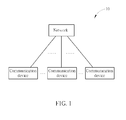
- Fig. 1 is a schematic diagram of a wireless communication system 10 according to an example of the present invention.
- the wireless communication system 10 is briefly composed of a network and a plurality of communication devices.
- the network and the communication devices are simply utilized for illustrating the structure of the wireless communication system 10.
- the network can be a universal terrestrial radio access network (UTRAN) comprising a plurality of Node-Bs (NBs) in a universal mobile telecommunications system (UMTS).
- UTRAN universal terrestrial radio access network
- NBs Node-Bs
- UMTS universal mobile telecommunications system
- the network can be an evolved UTRAN (E-UTRAN) comprising a plurality of evolved NBs (eNBs) and/or relays in a long term evolution (LTE) system or a LTE-Advanced (LTE-A) system.
- E-UTRAN evolved UTRAN
- eNBs evolved NBs
- LTE-A LTE-Advanced
- the network can also include both the UTRAN/E-UTRAN and a core network, wherein the core network includes network entities such as Mobility Management Entity (MME), Serving Gateway (S-GW), Packet Data Network (PDN) Gateway (P-GW), Self-Organizing Networks (SON) server and/or Radio Network Controller (RNC), etc.
- MME Mobility Management Entity
- S-GW Serving Gateway
- PDN Packet Data Network
- P-GW Packet Data Network Gateway
- SON Self-Organizing Networks
- RNC Radio Network Controller
- the network may be processed only by the UTRAN/E-UTRAN and decisions corresponding to the information are made at the UTRAN/E-UTRAN.
- the UTRAN/E-UTRAN may forward the information to the core network, and the decisions corresponding to the information are made at the core network after the core network processes the information.
- the information can be processed by both the UTRAN/E-UTRAN and the core network, and the decisions are made after coordination and/or cooperation are performed by the
- the communication devices can be mobile communication devices such as user equipments for performing speech and data communication through the network such as the UMTS, the LTE system or the LTE-A system.
- the network and one of the communication devices can be seen as a transmitter or a receiver according to transmission direction, e.g., for an uplink (UL), the one of the communication devices is the transmitter and the network is the receiver, and for a downlink (DL), the network is the transmitter and the one of the communication devices is the receiver.
- UL uplink
- DL downlink
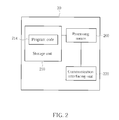
- Fig. 2 is a schematic diagram of a communication apparatus 20 according to an example of the present invention.
- the communication apparatus 20 can be the network or one of the communication devices shown in Fig. 1 , but is not limited herein.
- the communication apparatus 20 may include a processing means 200 such as a microprocessor or Application Specific Integrated Circuit (ASIC), a storage unit 210 and a communication interfacing unit 220.
- the storage unit 210 may be any data storage device that can store a program code 214, accessed and executed by the processing means 200.
- Examples of the storage unit 210 include but are not limited to read-only memory (ROM), flash memory, random-access memory (RAM), Compact Disc Read-Only Memory (CD-ROM)/Digital Video Disc-Read Only Memory (DVD-ROM), magnetic tape, hard disk and optical data storage device.
- the communication interfacing unit 220 is preferably a transceiver and is used to transmit and receive signals (e.g., messages or packets) according to processing results of the processing means 200.
- Fig. 3 is a flowchart of a process 30 according to an example of the present invention.
- the process 30 is utilized in the wireless communication system 10 shown in Fig. 1 , for handling hybrid automatic repeat request (HARQ) acknowledgement responses in the network.
- HARQ acknowledgement responses represent positive or negative HARQ acknowledgement responses, which should be well-known in this art.
- the process 30 can be utilized in the network and may be compiled into the program code 214.
- the process 30 includes the following steps:
- the network assigns the resources for the plurality of PHICHs and the plurality of ePHICHs. If the network receives an uplink transmission from a communication device, the network transmits a HARQ acknowledgement message to the communication device on a channel selected from the plurality of PHICHs and the plurality of ePHICHs.
- the plurality of ePHICHs are provided to handle the HARQ acknowledgement responses; thus, the capacity of acknowledgement transmissions and the rate of the uplink transmissions are improved.
- the uplink transmission may be granted by downlink control information (DCI) which is allocated in control channels such as physical downlink control channels (PDCCH) or enhanced physical downlink control channels (ePDCCH).
- DCI downlink control information
- PDCH physical downlink control channels
- ePDCCH enhanced physical downlink control channels
- a region 400 is assigned to original PHICHs of the network and the resources for the plurality of PHICHs are assigned in the region 400.
- a region 402 is assigned to an original physical downlink shared channel (PDSCH) of the network and the resources for the plurality of ePHICHs are assigned in a part of the region 402 as a region 406.
- a region 404 in the region 406 is allocated as the actual resources utilized for carrying the HARQ acknowledgement message.
- the actual amount of the resources capable of transmitting the HARQ acknowledgement message via the plurality of ePHICHs is smaller than the total amount of the resources assigned, such that the usage of the plurality of ePHICHs would not affect a downlink transmission on the PDSCH.
- the actual amount of the resources capable of transmitting the HARQ acknowledgement message via the plurality of ePHICHs would be increased, as shown in Fig. 4 .
- the actual amount of the resources capable of transmitting the HARQ acknowledgement message via the plurality of ePHICHs would be decreased, as shown in Fig. 5 .
- the region 404 can be flexibly adjusted according to the amount of the HARQ acknowledgement resources and the resources configured in the region 406 except the resources in the region 404 can be retrieved for the downlink transmission.
- the network supports carrier aggregation (CA) with a first component carrier CC_1 and a second component carrier CC_2 configured, where the first component carrier CC_1 and the second component carrier CC_2 have different frequencies
- the resources for the plurality of PHICHs and the plurality of ePHICHs are assigned to the first component carrier CC_1 and can be separately assigned according to resources of the first component carrier CC_1 and resources of the second component carrier CC_2.
- the number of component carriers is set to be 2 for simplicity, but not limited herein.
- Fig. 7 is a schematic diagram of resource assignment according to an example of the present invention.
- a region 500 is assigned to original PHICHs of the first component carrier CC_1 and the resources for the plurality of PHICHs are assigned in the region 500.
- a region 502 is assigned to original PHICHs of the second component carrier CC_2 and the resources for the plurality of ePHICHs are assigned in the region 502.
- the resources for the plurality of PHICHs are assigned as resources for a plurality of PHICHs of the first component carrier CC_1 and the resources for the plurality of ePHICHs are assigned as resources for a plurality of PHICHs of the second component carrier CC_2.
- Fig. 8 is a schematic diagram of resource assignment according to an example of the present invention.
- the resources of the plurality of PHICHs are still assigned in the region 500 as the example of Fig. 7 , but the resources of the plurality of ePHICHs are assigned in a region 602.
- the region 602 is a part of a region 600 which is assigned to an original PDSCH of the second component carrier CC_2.
- the resources for the plurality of PHICHs are assigned as resources for a plurality of PHICHs of the first component carrier CC_1 and the resources for the plurality of ePHICHs are assigned as resources for a PDSCH of the second component carrier CC_2.
- the resources of the second component carrier CC_2 can be reused for assigning the resources for the plurality of ePHICH; that is to say, no extra resources are required for the ePHICH design.
- the plurality of PHICHs may have higher priority to carry the acknowledgement responses than the plurality of ePHICHs do.
- the assigning method is also suitable.
- the network should inform the communication device of a configuration of the plurality of PHICHs and the plurality of ePHICHs, such that the communication device can receive the HARQ acknowledgement message according to the configuration after an uplink transmission starts.
- the network transmits the configuration by high layer signaling to the communication device.
- the configuration may include a total group number of the plurality of PHICHs N PHICH group , a total group number of the plurality of PHICHs and the plurality of ePHICHs N ePHICH group , an uplink resource allocation and a parameter of demodulation reference signals n DMRS which is configured for the uplink transmission.
- the network calculates a group index n ePHICH group and a sequence index n ePHICH seq according to the configuration, so that the network can transmit the HARQ acknowledgement message on the channel corresponding to the group index n ePHICH group and the sequence index n ePHICH seq .
- the communication device also calculates the group index n ePHICH group and the sequence index n ePHICH seq according to the configuration, so that the communication device can accurately receive the HARQ acknowledgement message on the channel corresponding to the group index n ePHICH group and the sequence index n ePHICH seq .
- the channel belongs to the plurality of PHICHs if the group index n ePHICH group is smaller than the total group number of the plurality of PHICHs N PHICH group , and the channel belongs to the plurality of ePHICHs if the group index n ePHICH group is greater than or equal to the total group number of the plurality of PHICHs N PHICH group .
- m i 1, and for a TDD system, m i depends on the specified uplink-downlink configuration and the subframe i .
- the network can interleave the plurality of ePHICHs per specific time to change the mapping relationship between the plurality of ePHICHs and the physical resource blocks, so as to improve the accuracy of acknowledgement transmissions.
- the equation is an example to obtain the group index n ePHICH group and the sequence index n ePHICH seq according to the configuration, but not limited herein.
- Those skilled in the art can modify the equation according to the relationship between the equation and the configuration. Besides, the equation should collocate with the configuration; that is to say, when one of the configuration and the equation is changed, the other one should be modified as well. In other aspects, the number of the component carriers can be larger than two.
- the resources of the plurality of ePHICH can be assigned as a combination of resources for a plurality of PHICHs of the component carriers, a combination of resources for a plurality of PDSCHs of the component carriers, or a combination of resources for a plurality of PHICHs of the component carriers and resources for a plurality of PDSCHs of the component carriers.
- Fig. 9 is a flowchart of the process 70 according to an example of the present invention.
- the process 70 can be compiled into the program code 214 and includes the following steps:
- the communication device receives the configuration of the plurality of PHICHs and the plurality of ePHICHs from the network in order to obtain the channel, so that the communication device can receive the HARQ acknowledgement message on the channel after starting the uplink transmission. Since the plurality of ePHICHs are provided to handle the HARQ acknowledgement transmissions, the capacity of acknowledgement transmissions and the rate of the uplink transmissions are improved.
- the network provides the plurality of ePHICHs for transmitting the HARQ acknowledgement message, and assigns the resources for the plurality of ePHICHs based on different scenarios and schedules the configuration to inform the communication device where to receive the corresponding HARQ acknowledgement message. Since the plurality of ePHICHs are provided to carry the HARQ acknowledgement responses, the capacity of the acknowledgement transmissions and the rate of the uplink transmissions can be improved.
- the present invention provides a method for handling the HARQ acknowledgement responses via a plurality of ePHICHs, to increase the capacity of acknowledgement transmissions, and further improve the rate of uplink transmissions.
Landscapes
- Engineering & Computer Science (AREA)
- Signal Processing (AREA)
- Computer Networks & Wireless Communication (AREA)
- Mobile Radio Communication Systems (AREA)
Abstract
Description
- The application relates to a method utilized in a wireless communication system, and more particularly, to a method of handling hybrid automatic repeat request acknowledgement responses in a wireless communication system.
- A long-term evolution (LTE) system supporting the 3GPP Rel-8 standard and/or the 3GPP Rel-9 standard are developed by the 3rd Generation Partnership Project (3GPP) as a successor of a universal mobile telecommunication system (UMTS) for further enhancing performance of the UMTS to satisfy increasing needs of users. The LTE system includes a new radio interface and a new radio network architecture that provides high data rate, low latency, packet optimization, and improved system capacity and coverage. In the LTE system, a radio access network known as an evolved universal terrestrial radio access network (E-UTRAN) includes multiple evolved Node-Bs (eNBs) for communicating with multiple user equipments (UEs), and communicating with a core network including a mobility management entity (MME), a serving gateway, etc., for Non-Access Stratum (NAS) control.
- A LTE-advanced (LTE-A) system, as its name implies, is an evolution of the LTE system. The LTE-A system targets faster switching between power states, improves performance at the coverage edge of an eNB, and includes advanced techniques, such as carrier aggregation (CA), coordinated multipoint transmission/reception (CoMP), uplink (UL) multiple-input multiple-output (MIMO), etc. For a UE and an eNB to communicate with each other in the LTE-A system, the UE and the eNB must support standards developed for the LTE-A system, such as the 3GPP Rel-10 standard or later versions.
- In the LTE-A system, since the advanced techniques are supported, such as new carrier type, frequency domain inter cell interference coordination (ICIC), spatial reuse of the resources in coordinated CoMP transmission and downlink MIMO, enhanced physical downlink channels (ePDCCHs) are provided to improve the related abilities. An obvious case is the heterogeneous network scenarios, where the ePDCCHs could be coordinated to avoid interference between macro and low power nodes. In a shared cell scenario, spatial reuse for the same enhanced control channel resource and a downlink transmission on a physical downlink shared channel (PDSCH) within the cell is possible, which provides higher spectrum efficiency. In the CoMP, the uplink transmission will also benefit from the cell splitting gains, which will lead to a problem of collisions between physical indicator channels (PHICH). Therefore, it is natural to consider another type control channel, such as enhanced PHICHs (ePHICH), which is able to accompany the ePDCCH to support frequency domain ICIC and spatial reuse within the cell and capable of operating as PHICH operation.
- Moreover, when considering the new carrier type which has reduced overhead of legacy of control signaling and cell-specific reference signal (CRS), the use of PHICHs may not be possible. Therefore, the ePHICH design is necessary for the new carrier type and should have the same capacity as the PHICH design.
- This in mind, the application aims at providing a method in a wireless communication system in order to solve the abovementioned problems.
- This is achieved by a method according to
claim 1. The dependent claims pertain to corresponding further developments and improvements. - As will be seen more clearly from the detailed description following below, the claimed method includes the method including assigning resources for a plurality of physical hybrid indicator channels (PHICHs) and a plurality of extended physical hybrid indicator channels (ePHICHs); and transmitting a hybrid automatic repeat request (HARQ) acknowledgement message to a communication device of the wireless communication system on a channel selected from the plurality of PHICHs and the plurality of ePHICHs, after receiving an uplink transmission from the communication device.
- In another aspect, as will be seen more clearly from the detailed description following below, the claimed method includes the method including receiving a configuration of a plurality of PHICHs and a plurality of ePHICHs from a network of the wireless communication system; triggering an uplink transmission; and receiving a HARQ acknowledgement message corresponding to the uplink transmission and transmitted from the network on a channel of the plurality of PHICHs and the plurality of ePHICHs according to the configuration.
- In another aspect, as will be seen more clearly from the detailed description following below, the claimed communication apparatus includes a processing means; a storage unit; and a program code, stored in the storage unit, wherein the program code instructs the processing mean to execute the following steps: assigning resources for a plurality of PHICHs and a plurality of ePHICHs; and transmitting a HARQ acknowledgement message to a communication device of the wireless communication system on a channel selected from the plurality of PHICHs and the plurality of ePHICHs, after receiving an uplink transmission from the communication device.
- In another aspect, as will be seen more clearly from the detailed description following below, the claimed communication apparatus includes a processing means; a storage unit; and a program code, stored in the storage unit, wherein the program code instructs the processing mean to execute the following steps: receiving a configuration of a plurality of PHICHs and a plurality of ePHICHs from a network of the wireless communication system; triggering an uplink transmission; and receiving a HARQ acknowledgement message corresponding to the uplink transmission and transmitted from the network on a channel of the plurality of PHICHs and the plurality of ePHICHs according to the configuration.
-
-
Fig. 1 is a schematic diagram of a wireless communication system according to an example of the present invention. -
Fig. 2 is a schematic diagram of a communication apparatus according to an example of the present invention. -
Fig. 3 is a flowchart of a process according to an example of the present invention. -
Fig. 4-6 is a schematic diagram of resource assignment according to an example of the present invention. -
Fig. 7 is a schematic diagram of resource assignment according to an example of the present invention. -
Fig. 8 is a schematic diagram of resource assignment according to an example of the present invention. -
Fig. 9 is a flowchart of a process according to an example of the present invention. - Please refer to
Fig. 1 , which is a schematic diagram of awireless communication system 10 according to an example of the present invention. Thewireless communication system 10 is briefly composed of a network and a plurality of communication devices. InFig. 1 , the network and the communication devices are simply utilized for illustrating the structure of thewireless communication system 10. Practically, the network can be a universal terrestrial radio access network (UTRAN) comprising a plurality of Node-Bs (NBs) in a universal mobile telecommunications system (UMTS). Alternatively, the network can be an evolved UTRAN (E-UTRAN) comprising a plurality of evolved NBs (eNBs) and/or relays in a long term evolution (LTE) system or a LTE-Advanced (LTE-A) system. - Furthermore, the network can also include both the UTRAN/E-UTRAN and a core network, wherein the core network includes network entities such as Mobility Management Entity (MME), Serving Gateway (S-GW), Packet Data Network (PDN) Gateway (P-GW), Self-Organizing Networks (SON) server and/or Radio Network Controller (RNC), etc. In other words, after the network receives information transmitted by a communication device, the information may be processed only by the UTRAN/E-UTRAN and decisions corresponding to the information are made at the UTRAN/E-UTRAN. Alternatively, the UTRAN/E-UTRAN may forward the information to the core network, and the decisions corresponding to the information are made at the core network after the core network processes the information. Besides, the information can be processed by both the UTRAN/E-UTRAN and the core network, and the decisions are made after coordination and/or cooperation are performed by the UTRAN/E-UTRAN and the core network.
- The communication devices can be mobile communication devices such as user equipments for performing speech and data communication through the network such as the UMTS, the LTE system or the LTE-A system. Besides, the network and one of the communication devices can be seen as a transmitter or a receiver according to transmission direction, e.g., for an uplink (UL), the one of the communication devices is the transmitter and the network is the receiver, and for a downlink (DL), the network is the transmitter and the one of the communication devices is the receiver.
- Please refer to
Fig. 2 , which is a schematic diagram of acommunication apparatus 20 according to an example of the present invention. Thecommunication apparatus 20 can be the network or one of the communication devices shown inFig. 1 , but is not limited herein. Thecommunication apparatus 20 may include a processing means 200 such as a microprocessor or Application Specific Integrated Circuit (ASIC), astorage unit 210 and acommunication interfacing unit 220. Thestorage unit 210 may be any data storage device that can store aprogram code 214, accessed and executed by the processing means 200. Examples of thestorage unit 210 include but are not limited to read-only memory (ROM), flash memory, random-access memory (RAM), Compact Disc Read-Only Memory (CD-ROM)/Digital Video Disc-Read Only Memory (DVD-ROM), magnetic tape, hard disk and optical data storage device. Thecommunication interfacing unit 220 is preferably a transceiver and is used to transmit and receive signals (e.g., messages or packets) according to processing results of the processing means 200. - Please refer to
Fig. 3 , which is a flowchart of aprocess 30 according to an example of the present invention. Theprocess 30 is utilized in thewireless communication system 10 shown inFig. 1 , for handling hybrid automatic repeat request (HARQ) acknowledgement responses in the network. The HARQ acknowledgement responses represent positive or negative HARQ acknowledgement responses, which should be well-known in this art. Theprocess 30 can be utilized in the network and may be compiled into theprogram code 214. Theprocess 30 includes the following steps: - Step 300:
- Start.
- Step 302:
- Assign resources for a plurality of physical hybrid indicator channels (PHICHs) and a plurality of enhanced physical hybrid indicator channels (ePHICHs).
- Step 304:
- Transmit a HARQ acknowledgement message to a communication device of the
wireless communication system 10 on a channel selected from the plurality of PHICHs and the plurality of ePHICHs, after receiving an uplink transmission from the communication device. - Step 306:
- End.
- According to the
process 30, the network assigns the resources for the plurality of PHICHs and the plurality of ePHICHs. If the network receives an uplink transmission from a communication device, the network transmits a HARQ acknowledgement message to the communication device on a channel selected from the plurality of PHICHs and the plurality of ePHICHs. The plurality of ePHICHs are provided to handle the HARQ acknowledgement responses; thus, the capacity of acknowledgement transmissions and the rate of the uplink transmissions are improved. - Note that, the
process 30 is an example of the present invention. Those skilled in the art should readily make combinations, modifications and/or alterations on the abovementioned description and examples. For example, the uplink transmission may be granted by downlink control information (DCI) which is allocated in control channels such as physical downlink control channels (PDCCH) or enhanced physical downlink control channels (ePDCCH). - Please refer to the
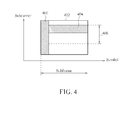
Fig. 4-6 , which is a schematic diagram of resource assignment according to an example of the present invention. InFig. 4-6 , aregion 400 is assigned to original PHICHs of the network and the resources for the plurality of PHICHs are assigned in theregion 400. Aregion 402 is assigned to an original physical downlink shared channel (PDSCH) of the network and the resources for the plurality of ePHICHs are assigned in a part of theregion 402 as aregion 406. Aregion 404 in theregion 406 is allocated as the actual resources utilized for carrying the HARQ acknowledgement message. In such a condition, the actual amount of the resources capable of transmitting the HARQ acknowledgement message via the plurality of ePHICHs is smaller than the total amount of the resources assigned, such that the usage of the plurality of ePHICHs would not affect a downlink transmission on the PDSCH. In brief, when a large number of HARQ acknowledgement resources are required, the actual amount of the resources capable of transmitting the HARQ acknowledgement message via the plurality of ePHICHs would be increased, as shown inFig. 4 . On the contrary, when a small number of HARQ acknowledgement resources are required, the actual amount of the resources capable of transmitting the HARQ acknowledgement message via the plurality of ePHICHs would be decreased, as shown inFig. 5 . Even when the resources of the plurality of PHICH are enough to handle the HARQ acknowledgement transmission, the resources configured to the plurality of ePHICH are retrieved for the downlink transmission, as shown inFig. 6 . As such, theregion 404 can be flexibly adjusted according to the amount of the HARQ acknowledgement resources and the resources configured in theregion 406 except the resources in theregion 404 can be retrieved for the downlink transmission. - In addition, when the network supports carrier aggregation (CA) with a first component carrier CC_1 and a second component carrier CC_2 configured, where the first component carrier CC_1 and the second component carrier CC_2 have different frequencies, the resources for the plurality of PHICHs and the plurality of ePHICHs are assigned to the first component carrier CC_1 and can be separately assigned according to resources of the first component carrier CC_1 and resources of the second component carrier CC_2. Note that, the number of component carriers is set to be 2 for simplicity, but not limited herein. Please refer to
Fig. 7 , which is a schematic diagram of resource assignment according to an example of the present invention. Aregion 500 is assigned to original PHICHs of the first component carrier CC_1 and the resources for the plurality of PHICHs are assigned in theregion 500. Aregion 502 is assigned to original PHICHs of the second component carrier CC_2 and the resources for the plurality of ePHICHs are assigned in theregion 502. In other words, the resources for the plurality of PHICHs are assigned as resources for a plurality of PHICHs of the first component carrier CC_1 and the resources for the plurality of ePHICHs are assigned as resources for a plurality of PHICHs of the second component carrier CC_2. - Please further refer to
Fig. 8 , which is a schematic diagram of resource assignment according to an example of the present invention. InFig. 8 , the resources of the plurality of PHICHs are still assigned in theregion 500 as the example ofFig. 7 , but the resources of the plurality of ePHICHs are assigned in aregion 602. Theregion 602 is a part of aregion 600 which is assigned to an original PDSCH of the second component carrier CC_2. In other words, the resources for the plurality of PHICHs are assigned as resources for a plurality of PHICHs of the first component carrier CC_1 and the resources for the plurality of ePHICHs are assigned as resources for a PDSCH of the second component carrier CC_2. Therefore, when the network supports CA, the resources of the second component carrier CC_2 can be reused for assigning the resources for the plurality of ePHICH; that is to say, no extra resources are required for the ePHICH design. Besides, the plurality of PHICHs may have higher priority to carry the acknowledgement responses than the plurality of ePHICHs do. Moreover, when the first and second component carriers have the same frequency but different locations, such as coordinated multipoint (CoMP), the assigning method is also suitable. - On the other hand, the network should inform the communication device of a configuration of the plurality of PHICHs and the plurality of ePHICHs, such that the communication device can receive the HARQ acknowledgement message according to the configuration after an uplink transmission starts. In detail, the network transmits the configuration by high layer signaling to the communication device. The configuration may include a total group number of the plurality of PHICHs





wherein

- Note that the equation is an example to obtain the group index


- As seen above, the operation of the communication device for handling the HARQ acknowledgement responses can be summarized to a
process 70. Please refer toFig. 9 , which is a flowchart of theprocess 70 according to an example of the present invention. Theprocess 70 can be compiled into theprogram code 214 and includes the following steps: - Step 700:
- Start.
- Step 702:
- Receive the configuration of the plurality of PHICHs and the plurality of ePHICHs from the network of the
wireless communication system 10. - Step 704:
- Trigger the uplink transmission.
- Step 706:
- Receive the HARQ acknowledgement message corresponding to the uplink transmission and transmitted from the network on the channel of the plurality of PHICHs and the plurality of ePHICHs according to the configuration.
- Step 708:
- End.
- In brief, the communication device receives the configuration of the plurality of PHICHs and the plurality of ePHICHs from the network in order to obtain the channel, so that the communication device can receive the HARQ acknowledgement message on the channel after starting the uplink transmission. Since the plurality of ePHICHs are provided to handle the HARQ acknowledgement transmissions, the capacity of acknowledgement transmissions and the rate of the uplink transmissions are improved.
- In the present invention, the network provides the plurality of ePHICHs for transmitting the HARQ acknowledgement message, and assigns the resources for the plurality of ePHICHs based on different scenarios and schedules the configuration to inform the communication device where to receive the corresponding HARQ acknowledgement message. Since the plurality of ePHICHs are provided to carry the HARQ acknowledgement responses, the capacity of the acknowledgement transmissions and the rate of the uplink transmissions can be improved.
- To sum up, the present invention provides a method for handling the HARQ acknowledgement responses via a plurality of ePHICHs, to increase the capacity of acknowledgement transmissions, and further improve the rate of uplink transmissions.
Claims (23)
- A method of handling hybrid automatic repeat request (HARQ) acknowledgement responses in a network of a wireless communication system, characterized by the method comprising:assigning resources for a plurality of physical hybrid indicator channels (PHICHs) and a plurality of extended physical hybrid indicator channels (ePHICHs) (302); andtransmitting a HARQ acknowledgement message to a communication device of the wireless communication system on a channel selected from the plurality of PHICHs and the plurality of ePHICHs, after receiving an uplink transmission from the communication device (304).
- A method of HARQ acknowledgement responses in a communication device of a wireless communication system, characterized by the method comprising:receiving a configuration of a plurality of PHICHs and a plurality of ePHICHs from a network of the wireless communication system (702);triggering an uplink transmission (704); andreceiving a HARQ acknowledgement message corresponding to the uplink transmission and transmitted from the network on a channel of the plurality of PHICHs and the plurality of ePHICHs according to the configuration (706).
- A communication apparatus (20) for a wireless communication system, characterized by comprising:a processing means (200);a storage unit (210); anda program code (214), stored in the storage unit, wherein the program code instructs the processing mean to execute the following steps:assigning resources for a plurality of PHICHs and a plurality of ePHICHs (302); andtransmitting a HARQ acknowledgement message to a communication device of the wireless communication system on a channel selected from the plurality of PHICHs and the plurality of ePHICHs, after receiving an uplink transmission from the communication device (304).
- A communication apparatus (20) for a wireless communication system, characterized by comprising:a processing means (200);a storage unit (210); anda program code (214), stored in the storage unit, wherein the program code instructs the processing mean to execute the following steps:receiving a configuration of a plurality of PHICHs and a plurality of ePHICHs from a network of the wireless communication system (702);triggering an uplink transmission (704); andreceiving a HARQ acknowledgement message corresponding to the uplink transmission and transmitted from the network on a channel of the plurality of PHICHs and the plurality of ePHICHs according to the configuration (706).
- The method of claim 1 or the method of claim 2 or the communication apparatus of claim 3 or the communication apparatus of claim 4, characterized in that an interleaving operation is performed in the plurality of ePHICHs.
- The method of claim 1 or the method of claim 2 or the communication apparatus of claim 3 or the communication apparatus of claim 4, characterized in that the HARQ acknowledgement responses are a positive HARQ acknowledgement response and a negative HARQ acknowledgement response.
- The method of claim 1 or the communication apparatus of claim 3, characterized in that the channel is selected from the plurality of PHICHs when the plurality of PHICHs are available.
- The method of claim 1 or the communication apparatus of claim 3, characterized in that assigning the resources for the plurality of PHICHs and the plurality of ePHICHs comprises assigning a region of a physical downlink shared channel as the resources for the plurality of ePHICHs.
- The method of claim 1, characterized in that the network comprises a first component carrier and at least a second component carrier.
- The communication apparatus of claim 3, characterized in that a first component carrier and at least a second component carrier are configured.
- The method of claim 9 or the communication apparatus of claim 10, characterized in that the first component carrier and at least the second component carrier have different frequencies.
- The method of claim 9 or the communication apparatus of claim 10, characterized in that the first component carrier and at least the second component carrier have the same frequency but different locations.
- The method of claim 9 or the communication apparatus of claim 10, characterized in that assigning the resources for the plurality of PHICHs and the plurality of ePHICHs comprises:assigning the resources for the plurality of PHICHs and the plurality of ePHICHs to the first component carrier;assigning the resources for the plurality of PHICHs as resources for a plurality of PHICHs of the first component carrier; andassigning the resources for the plurality of ePHICHs as resources for the plurality of PHICHs of at least the second component carrier.
- The method of claim 9 or the communication apparatus of claim 10, characterized in that assigning the resources for the plurality of PHICHs and the plurality of ePHICHs comprises:assigning the resources for the plurality of PHICHs and the plurality of ePHICHs to the first component carrier;assigning the resources for the plurality of PHICHs as resources for a plurality of PHICHs of the first component carrier; andassigning the resources for the plurality of ePHICHs as resources for a physical downlink shared channel of at least the second component carrier.
- The method of claim 1, characterized in that further comprising generating and sending a configuration of the plurality of PHICHs and the plurality of ePHICHs to the communication device before transmitting the HARQ acknowledgement message to the communication device, such that the communication device is capable of receiving the HARQ acknowledgement message via the channel.
- The communication apparatus of claim 3, characterized in that the program code further instructs the processing mean to execute the step of generating and sending a configuration of the plurality of PHICHs and the plurality of ePHICHs to the communication device before transmitting the HARQ acknowledgement message to the communication device, such that the communication device is capable of receiving the HARQ acknowledgement message via the channel.
- The method of claim 2 or the communication apparatus of claim 4 or the method of claim 15 or the communication apparatus of claim 16, characterized in that the configuration comprises a total group number of the plurality of PHICHs, a total group number of the plurality of PHICHs and the plurality of ePHICHs, an uplink resource allocation and a parameter of demodulation reference signals which is configured for the uplink transmission.
- The method of claim 2 or the method of claim 15 or the communication apparatus of claim 16, characterized in that the communication device calculates a group index and a sequence index according to the configuration.
- The communication apparatus of claim 4, characterized in that the program code instructs the processing mean to calculate a group index and a sequence index according to the configuration.
- The method or the communication apparatus of claim 17, characterized in that the total group number of the plurality of PHICHs, the total group number of the plurality of PHICHs and the plurality of ePHICHs, the spreading factor of the plurality of PHICHs, the uplink resource allocation and the parameter of demodulation reference signals are assigned by the network and signaled by higher layer signaling.
- The method or the communication apparatus of claim 18, characterized in that the communication device receives the HARQ acknowledgement message via the plurality of PHICHs if the group index is smaller than the total group number of the plurality of PHICHs, and receives the HARQ acknowledgement message via the plurality of ePHICHs if the group index is greater than or equal to the total group number of the plurality of PHICHs.
- The communication apparatus of claim 19, characterized in that the program code instructs the processing mean to receive the HARQ acknowledgement message via the plurality of PHICHs if the group index is smaller than the total group number of the plurality of PHICHs, and receive the HARQ acknowledgement message via the plurality of ePHICHs if the group index is greater than or equal to the total group number of the plurality of PHICHs.
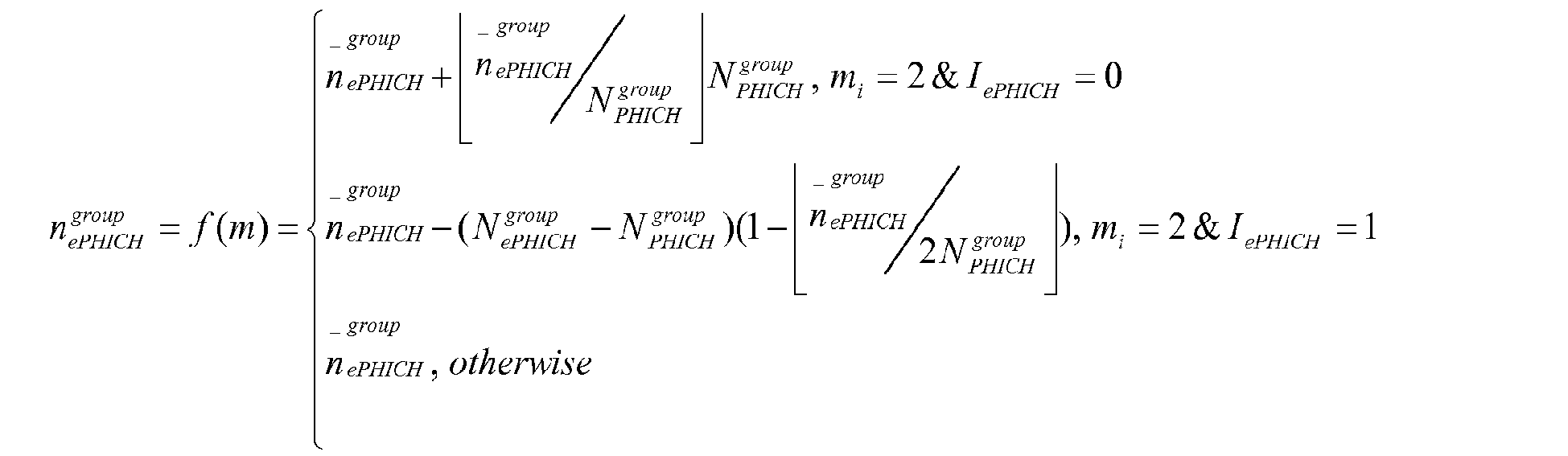
- The method or the communication apparatus of claim 18 or the communication apparatus of claim 19, characterized in that the group index and the sequence index are determined according to the following equations:

wherein



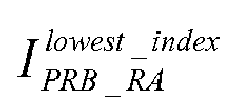
wherein for a FDD system, mi = 1, and for a TDD system, mi depends on the specified uplink-downlink configuration and the subframe i.
Applications Claiming Priority (2)
| Application Number | Priority Date | Filing Date | Title |
|---|---|---|---|
| US201261583614P | 2012-01-06 | 2012-01-06 | |
| US13/728,995 US9107214B2 (en) | 2012-01-06 | 2012-12-27 | Method of handling hybrid automatic repeat request acknowledgement responses in wireless communication system |
Publications (3)
| Publication Number | Publication Date |
|---|---|
| EP2613471A2 true EP2613471A2 (en) | 2013-07-10 |
| EP2613471A3 EP2613471A3 (en) | 2017-06-07 |
| EP2613471B1 EP2613471B1 (en) | 2021-08-11 |
Family
ID=47561341
Family Applications (1)
| Application Number | Title | Priority Date | Filing Date |
|---|---|---|---|
| EP13150347.6A Active EP2613471B1 (en) | 2012-01-06 | 2013-01-07 | Method of handling hybrid automatic repeat request acknowledgement responses in wireless communication system |
Country Status (4)
| Country | Link |
|---|---|
| US (1) | US9107214B2 (en) |
| EP (1) | EP2613471B1 (en) |
| CN (1) | CN103199969B (en) |
| TW (1) | TWI486021B (en) |
Cited By (1)
| Publication number | Priority date | Publication date | Assignee | Title |
|---|---|---|---|---|
| CN105471554A (en) * | 2014-09-26 | 2016-04-06 | 宏达国际电子股份有限公司 | Method of handling transmission in unlicensed band and communication device thereof |
Families Citing this family (8)
| Publication number | Priority date | Publication date | Assignee | Title |
|---|---|---|---|---|
| KR101829258B1 (en) * | 2011-07-18 | 2018-03-29 | 삼성전자 주식회사 | Method and apparatus for transmission of harq response channel in wireless ofdm communication system |
| US9215058B2 (en) * | 2012-03-06 | 2015-12-15 | Blackberry Limited | Enhanced PHICH transmission for LTE-advanced |
| US9198181B2 (en) | 2012-03-19 | 2015-11-24 | Blackberry Limited | Enhanced common downlink control channels |
| CN103716887B (en) * | 2012-09-28 | 2017-04-05 | 上海贝尔股份有限公司 | For determining method, device and the equipment of the device channel resource of user equipment |
| US9031090B2 (en) * | 2013-01-11 | 2015-05-12 | Sharp Laboratories Of America, Inc. | Devices for sending and receiving feedback information |
| US9031002B2 (en) * | 2013-01-11 | 2015-05-12 | Sharp Laboratories Of America, Inc. | Devices for sending and receiving feedback information |
| US10512065B2 (en) | 2016-05-31 | 2019-12-17 | Qualcomm Incorporated | Flexible control information reporting |
| EP4229963A1 (en) * | 2020-10-16 | 2023-08-23 | Sony Group Corporation | Control channel for reduced capability device |
Family Cites Families (37)
| Publication number | Priority date | Publication date | Assignee | Title |
|---|---|---|---|---|
| CN100344178C (en) | 2004-08-24 | 2007-10-17 | 华为技术有限公司 | Method for realizing multi broadcasting service |
| US20060251015A1 (en) | 2005-05-06 | 2006-11-09 | Samsung Electronics Co., Ltd. | System and method for dynamic allocation of ARQ feedback in a multi-carrier wireless network |
| US9209956B2 (en) | 2005-08-22 | 2015-12-08 | Qualcomm Incorporated | Segment sensitive scheduling |
| US8489128B2 (en) | 2005-10-31 | 2013-07-16 | Qualcomm Incorporated | Efficient transmission on a shared data channel for wireless communication |
| CA2654274A1 (en) | 2006-07-04 | 2008-01-10 | Telefonaktiebolaget L M Ericsson (Publ) | Broadcast amd multicast on high speed downlink channels |
| JP2008098798A (en) | 2006-10-10 | 2008-04-24 | Nec Corp | Method for determining data transmission state in communication system, and communication apparatus |
| US8312338B2 (en) | 2007-02-02 | 2012-11-13 | Lg Electronics Inc. | Methods of transmitting and receiving data in communication system |
| JP4889532B2 (en) * | 2007-03-20 | 2012-03-07 | 株式会社エヌ・ティ・ティ・ドコモ | Base station apparatus and method in mobile communication system |
| CN101137098A (en) * | 2007-09-28 | 2008-03-05 | 中兴通讯股份有限公司 | Uplink real-time packet service transmission method |
| KR101541910B1 (en) | 2007-11-29 | 2015-08-04 | 엘지전자 주식회사 | Method of transmitting ACK / NACK signal in wireless communication system |
| US8165066B2 (en) | 2008-01-03 | 2012-04-24 | Innovative Sonic Limited | Method and apparatus for performing buffer status reporting |
| US8116271B2 (en) * | 2008-02-07 | 2012-02-14 | Samsung Electronics Co., Ltd. | Methods and apparatus to allocate acknowledgement channels |
| KR101615231B1 (en) | 2008-03-17 | 2016-04-25 | 엘지전자 주식회사 | A method for transmitting group ack/nack in communication system |
| US8265021B2 (en) * | 2008-03-25 | 2012-09-11 | Samsung Electronics Co., Ltd. | Downlink phich mapping and channelization |
| EP2294744B1 (en) | 2008-04-28 | 2018-01-10 | Optis Wireless Technology, LLC | Method and arrangement in a telecommunication system with signalling of assigned data packets in a bundling window |
| US8276035B1 (en) | 2008-07-28 | 2012-09-25 | Netmotion Wireless, Inc. | High performance digital communications resiliency in a roamable virtual private network |
| US20100040127A1 (en) | 2008-08-12 | 2010-02-18 | Chao-Kai Wen | Circuit configuration for data combining |
| US20100110964A1 (en) | 2008-11-04 | 2010-05-06 | Motorola, Inc. | Method for Relays within Wireless Communication Systems |
| CN101465720B (en) | 2009-01-23 | 2013-08-21 | 中兴通讯股份有限公司 | Method and device for sending upward HARQ feedback information |
| US9450727B2 (en) * | 2009-02-03 | 2016-09-20 | Google Technology Holdings LLC | Physical layer acknowledgement signaling resource allocation in wireless communication systems |
| CN101854720B (en) * | 2009-04-01 | 2013-04-03 | 电信科学技术研究院 | Data transmission method, system and device |
| KR101670747B1 (en) * | 2009-06-30 | 2016-10-31 | 엘지전자 주식회사 | Flexible allocation of control signal resources |
| US20110205980A1 (en) | 2009-08-10 | 2011-08-25 | Qualcomm Incorporated | Multi-node resource request pipelining |
| JP5541548B2 (en) | 2009-10-19 | 2014-07-09 | サムスン エレクトロニクス カンパニー リミテッド | Transmission diversity and multiplexing for HARQ-ACK signals in a communication system |
| CN102056225B (en) * | 2009-11-05 | 2014-12-10 | 中兴通讯股份有限公司 | Distribution method and device for quick feedback channel |
| CN101741462B (en) | 2009-12-14 | 2014-03-12 | 中兴通讯股份有限公司 | Method for processing demodulation reference signal dynamic cyclic shift parameters |
| CN102724705B (en) | 2009-12-25 | 2015-04-29 | 华为技术有限公司 | Buffer status reporting method and apparatus thereof |
| KR101827584B1 (en) * | 2010-01-08 | 2018-02-08 | 인터디지탈 패튼 홀딩스, 인크 | Method and apparatus for channel resource mapping in carrier aggregation |
| CA2786804C (en) | 2010-01-11 | 2016-09-06 | Research In Motion Limited | System and method for control channel interference management and extended pdcch |
| KR20110090521A (en) | 2010-02-04 | 2011-08-10 | 주식회사 팬택 | Method for transmitting data and control information in a wireless communication system, apparatus for transmitting the same, apparatus for receiving the same |
| CN102202400B (en) * | 2011-05-31 | 2013-10-16 | 电信科学技术研究院 | Instruction and processing method and device for resource occupancy mode |
| US8582527B2 (en) * | 2011-07-01 | 2013-11-12 | Ofinno Technologies, Llc | Hybrid automatic repeat request in multicarrier systems |
| KR102087608B1 (en) * | 2011-08-11 | 2020-03-13 | 삼성전자주식회사 | Appratus and method for extension of physical downlink control channels in a communication system |
| US8983391B2 (en) * | 2011-08-12 | 2015-03-17 | Sharp Kabushiki Kaisha | Signaling power allocation parameters for uplink coordinated multipoint (CoMP) |
| US20130083746A1 (en) * | 2011-09-30 | 2013-04-04 | Interdigital Patent Holdings, Inc. | Method and apparatus for allocating resources for an enhanced physical hybrid automatic repeat request indicator channel |
| US20140079032A1 (en) | 2011-10-07 | 2014-03-20 | Telefonaktiebolaget L M Ericsson (Publ) | Uplink Synchronization Method and User Equipment |
| US9215058B2 (en) * | 2012-03-06 | 2015-12-15 | Blackberry Limited | Enhanced PHICH transmission for LTE-advanced |
-
2012
- 2012-12-27 US US13/728,995 patent/US9107214B2/en active Active
-
2013
- 2013-01-04 TW TW102100326A patent/TWI486021B/en active
- 2013-01-05 CN CN201310001438.7A patent/CN103199969B/en active Active
- 2013-01-07 EP EP13150347.6A patent/EP2613471B1/en active Active
Non-Patent Citations (1)
| Title |
|---|
| None |
Cited By (3)
| Publication number | Priority date | Publication date | Assignee | Title |
|---|---|---|---|---|
| CN105471554A (en) * | 2014-09-26 | 2016-04-06 | 宏达国际电子股份有限公司 | Method of handling transmission in unlicensed band and communication device thereof |
| US10057885B2 (en) | 2014-09-26 | 2018-08-21 | Htc Corporation | Device and method of handling transmission in unlicensed band |
| CN105471554B (en) * | 2014-09-26 | 2019-01-08 | 宏达国际电子股份有限公司 | Method of handling transmission in unlicensed band and communication device thereof |
Also Published As
| Publication number | Publication date |
|---|---|
| EP2613471B1 (en) | 2021-08-11 |
| US20130176917A1 (en) | 2013-07-11 |
| TWI486021B (en) | 2015-05-21 |
| CN103199969B (en) | 2016-06-29 |
| CN103199969A (en) | 2013-07-10 |
| EP2613471A3 (en) | 2017-06-07 |
| US9107214B2 (en) | 2015-08-11 |
| TW201330540A (en) | 2013-07-16 |
Similar Documents
| Publication | Publication Date | Title |
|---|---|---|
| US9107214B2 (en) | Method of handling hybrid automatic repeat request acknowledgement responses in wireless communication system | |
| KR102241077B1 (en) | Method for detecting search signal for device-to-device(d2d) communication in wireless communication system, and apparatus therefor | |
| KR101853914B1 (en) | Method for mitigating inter cell interference and device therefor | |
| US9155079B2 (en) | Communication method and device in a wireless communication system | |
| US9705644B2 (en) | Method for operating buffer for device-to-device (D2D) communication in wireless communication system, and apparatus for same | |
| US10284351B2 (en) | Method and apparatus for transmitting uplink control information (UCI) in wireless communication system | |
| CN108988997B (en) | Method and apparatus for multiplexing scheduling request information and HARQ ACK/NACK information when transmitting/receiving PUCCH | |
| WO2019029823A1 (en) | Dynamic management of uplink control signaling resources in wireless network | |
| KR20170044140A (en) | Coverage enhancement for time division duplex and enhanced interference mitigation and traffic adaptation in long term evolution systems | |
| CN105991243A (en) | Data repeat transmission method and device | |
| EP3211813B1 (en) | Device and method of handling hybrid automatic repeat request transmission | |
| JP2018512013A (en) | Multi-subband based transmission method and device for wireless transmit / receive unit (WTRU) with reduced functionality and coverage enhancement | |
| CN103297205B (en) | A kind of mixed automatic retransferring method and device of dynamic frame structure | |
| CN107079440A (en) | User terminal, wireless base station and wireless communications method | |
| JP7349479B2 (en) | Signaling of multiple short TTI transmissions | |
| EP2983321B1 (en) | Device and method of handling device-to-cellular communication | |
| EP2696529B1 (en) | Method of handling communication operation in TDD system and related apparatus | |
| CN107535001A (en) | User terminal, wireless base station, and wireless communication method | |
| US20150351077A1 (en) | Method of Handling Hybrid Automatic Repeat Request Resources in Wireless Communication System | |
| EP3190740A2 (en) | Device and method of handling transmission/reception for serving cell | |
| EP2757726A2 (en) | Method of handling communication operations and related communication device | |
| CN110089066B (en) | Collision avoidance between downlink control channel and aperiodic channel state information-reference signal | |
| KR20220053495A (en) | Device of Handling a HARQ Retransmission | |
| JP7277492B2 (en) | Apparatus and method for handling physical uplink control channel collisions | |
| KR20140080389A (en) | Method and apparatus for transmitting/receiving ack/nack in d2d communication |
Legal Events
| Date | Code | Title | Description |
|---|---|---|---|
| PUAI | Public reference made under article 153(3) epc to a published international application that has entered the european phase |
Free format text: ORIGINAL CODE: 0009012 |
|
| AK | Designated contracting states |
Kind code of ref document: A2 Designated state(s): AL AT BE BG CH CY CZ DE DK EE ES FI FR GB GR HR HU IE IS IT LI LT LU LV MC MK MT NL NO PL PT RO RS SE SI SK SM TR |
|
| AX | Request for extension of the european patent |
Extension state: BA ME |
|
| AK | Designated contracting states |
Kind code of ref document: A3 Designated state(s): AL AT BE BG CH CY CZ DE DK EE ES FI FR GB GR HR HU IE IS IT LI LT LU LV MC MK MT NL NO PL PT RO RS SE SI SK SM TR |
|
| AX | Request for extension of the european patent |
Extension state: BA ME |
|
| RIC1 | Information provided on ipc code assigned before grant |
Ipc: H04L 5/00 20060101ALI20170502BHEP Ipc: H04W 76/00 20090101ALI20170502BHEP Ipc: H04L 1/18 20060101AFI20170502BHEP Ipc: H04W 72/04 20090101ALI20170502BHEP |
|
| PUAL | Search report despatched |
Free format text: ORIGINAL CODE: 0009013 |
|
| STAA | Information on the status of an ep patent application or granted ep patent |
Free format text: STATUS: REQUEST FOR EXAMINATION WAS MADE |
|
| 17P | Request for examination filed |
Effective date: 20171130 |
|
| RBV | Designated contracting states (corrected) |
Designated state(s): AL AT BE BG CH CY CZ DE DK EE ES FI FR GB GR HR HU IE IS IT LI LT LU LV MC MK MT NL NO PL PT RO RS SE SI SK SM TR |
|
| RAP1 | Party data changed (applicant data changed or rights of an application transferred) |
Owner name: ACER INCORPORATED |
|
| STAA | Information on the status of an ep patent application or granted ep patent |
Free format text: STATUS: EXAMINATION IS IN PROGRESS |
|
| 17Q | First examination report despatched |
Effective date: 20190403 |
|
| GRAP | Despatch of communication of intention to grant a patent |
Free format text: ORIGINAL CODE: EPIDOSNIGR1 |
|
| STAA | Information on the status of an ep patent application or granted ep patent |
Free format text: STATUS: GRANT OF PATENT IS INTENDED |
|
| RIC1 | Information provided on ipc code assigned before grant |
Ipc: H04L 5/14 20060101ALI20210310BHEP Ipc: H04L 5/00 20060101ALI20210310BHEP Ipc: H04L 1/18 20060101AFI20210310BHEP |
|
| INTG | Intention to grant announced |
Effective date: 20210326 |
|
| GRAS | Grant fee paid |
Free format text: ORIGINAL CODE: EPIDOSNIGR3 |
|
| GRAA | (expected) grant |
Free format text: ORIGINAL CODE: 0009210 |
|
| STAA | Information on the status of an ep patent application or granted ep patent |
Free format text: STATUS: THE PATENT HAS BEEN GRANTED |
|
| AK | Designated contracting states |
Kind code of ref document: B1 Designated state(s): AL AT BE BG CH CY CZ DE DK EE ES FI FR GB GR HR HU IE IS IT LI LT LU LV MC MK MT NL NO PL PT RO RS SE SI SK SM TR |
|
| REG | Reference to a national code |
Ref country code: GB Ref legal event code: FG4D |
|
| REG | Reference to a national code |
Ref country code: CH Ref legal event code: EP |
|
| REG | Reference to a national code |
Ref country code: DE Ref legal event code: R096 Ref document number: 602013078717 Country of ref document: DE |
|
| REG | Reference to a national code |
Ref country code: IE Ref legal event code: FG4D Ref country code: AT Ref legal event code: REF Ref document number: 1420477 Country of ref document: AT Kind code of ref document: T Effective date: 20210915 |
|
| REG | Reference to a national code |
Ref country code: LT Ref legal event code: MG9D |
|
| REG | Reference to a national code |
Ref country code: NL Ref legal event code: MP Effective date: 20210811 |
|
| REG | Reference to a national code |
Ref country code: AT Ref legal event code: MK05 Ref document number: 1420477 Country of ref document: AT Kind code of ref document: T Effective date: 20210811 |
|
| PG25 | Lapsed in a contracting state [announced via postgrant information from national office to epo] |
Ref country code: SE Free format text: LAPSE BECAUSE OF FAILURE TO SUBMIT A TRANSLATION OF THE DESCRIPTION OR TO PAY THE FEE WITHIN THE PRESCRIBED TIME-LIMIT Effective date: 20210811 Ref country code: HR Free format text: LAPSE BECAUSE OF FAILURE TO SUBMIT A TRANSLATION OF THE DESCRIPTION OR TO PAY THE FEE WITHIN THE PRESCRIBED TIME-LIMIT Effective date: 20210811 Ref country code: PT Free format text: LAPSE BECAUSE OF FAILURE TO SUBMIT A TRANSLATION OF THE DESCRIPTION OR TO PAY THE FEE WITHIN THE PRESCRIBED TIME-LIMIT Effective date: 20211213 Ref country code: NO Free format text: LAPSE BECAUSE OF FAILURE TO SUBMIT A TRANSLATION OF THE DESCRIPTION OR TO PAY THE FEE WITHIN THE PRESCRIBED TIME-LIMIT Effective date: 20211111 Ref country code: RS Free format text: LAPSE BECAUSE OF FAILURE TO SUBMIT A TRANSLATION OF THE DESCRIPTION OR TO PAY THE FEE WITHIN THE PRESCRIBED TIME-LIMIT Effective date: 20210811 Ref country code: ES Free format text: LAPSE BECAUSE OF FAILURE TO SUBMIT A TRANSLATION OF THE DESCRIPTION OR TO PAY THE FEE WITHIN THE PRESCRIBED TIME-LIMIT Effective date: 20210811 Ref country code: FI Free format text: LAPSE BECAUSE OF FAILURE TO SUBMIT A TRANSLATION OF THE DESCRIPTION OR TO PAY THE FEE WITHIN THE PRESCRIBED TIME-LIMIT Effective date: 20210811 Ref country code: BG Free format text: LAPSE BECAUSE OF FAILURE TO SUBMIT A TRANSLATION OF THE DESCRIPTION OR TO PAY THE FEE WITHIN THE PRESCRIBED TIME-LIMIT Effective date: 20211111 Ref country code: AT Free format text: LAPSE BECAUSE OF FAILURE TO SUBMIT A TRANSLATION OF THE DESCRIPTION OR TO PAY THE FEE WITHIN THE PRESCRIBED TIME-LIMIT Effective date: 20210811 Ref country code: LT Free format text: LAPSE BECAUSE OF FAILURE TO SUBMIT A TRANSLATION OF THE DESCRIPTION OR TO PAY THE FEE WITHIN THE PRESCRIBED TIME-LIMIT Effective date: 20210811 |
|
| PG25 | Lapsed in a contracting state [announced via postgrant information from national office to epo] |
Ref country code: PL Free format text: LAPSE BECAUSE OF FAILURE TO SUBMIT A TRANSLATION OF THE DESCRIPTION OR TO PAY THE FEE WITHIN THE PRESCRIBED TIME-LIMIT Effective date: 20210811 Ref country code: LV Free format text: LAPSE BECAUSE OF FAILURE TO SUBMIT A TRANSLATION OF THE DESCRIPTION OR TO PAY THE FEE WITHIN THE PRESCRIBED TIME-LIMIT Effective date: 20210811 Ref country code: GR Free format text: LAPSE BECAUSE OF FAILURE TO SUBMIT A TRANSLATION OF THE DESCRIPTION OR TO PAY THE FEE WITHIN THE PRESCRIBED TIME-LIMIT Effective date: 20211112 |
|
| PG25 | Lapsed in a contracting state [announced via postgrant information from national office to epo] |
Ref country code: NL Free format text: LAPSE BECAUSE OF FAILURE TO SUBMIT A TRANSLATION OF THE DESCRIPTION OR TO PAY THE FEE WITHIN THE PRESCRIBED TIME-LIMIT Effective date: 20210811 |
|
| PG25 | Lapsed in a contracting state [announced via postgrant information from national office to epo] |
Ref country code: DK Free format text: LAPSE BECAUSE OF FAILURE TO SUBMIT A TRANSLATION OF THE DESCRIPTION OR TO PAY THE FEE WITHIN THE PRESCRIBED TIME-LIMIT Effective date: 20210811 |
|
| REG | Reference to a national code |
Ref country code: DE Ref legal event code: R097 Ref document number: 602013078717 Country of ref document: DE |
|
| PG25 | Lapsed in a contracting state [announced via postgrant information from national office to epo] |
Ref country code: SM Free format text: LAPSE BECAUSE OF FAILURE TO SUBMIT A TRANSLATION OF THE DESCRIPTION OR TO PAY THE FEE WITHIN THE PRESCRIBED TIME-LIMIT Effective date: 20210811 Ref country code: SK Free format text: LAPSE BECAUSE OF FAILURE TO SUBMIT A TRANSLATION OF THE DESCRIPTION OR TO PAY THE FEE WITHIN THE PRESCRIBED TIME-LIMIT Effective date: 20210811 Ref country code: RO Free format text: LAPSE BECAUSE OF FAILURE TO SUBMIT A TRANSLATION OF THE DESCRIPTION OR TO PAY THE FEE WITHIN THE PRESCRIBED TIME-LIMIT Effective date: 20210811 Ref country code: EE Free format text: LAPSE BECAUSE OF FAILURE TO SUBMIT A TRANSLATION OF THE DESCRIPTION OR TO PAY THE FEE WITHIN THE PRESCRIBED TIME-LIMIT Effective date: 20210811 Ref country code: CZ Free format text: LAPSE BECAUSE OF FAILURE TO SUBMIT A TRANSLATION OF THE DESCRIPTION OR TO PAY THE FEE WITHIN THE PRESCRIBED TIME-LIMIT Effective date: 20210811 Ref country code: AL Free format text: LAPSE BECAUSE OF FAILURE TO SUBMIT A TRANSLATION OF THE DESCRIPTION OR TO PAY THE FEE WITHIN THE PRESCRIBED TIME-LIMIT Effective date: 20210811 |
|
| PLBE | No opposition filed within time limit |
Free format text: ORIGINAL CODE: 0009261 |
|
| STAA | Information on the status of an ep patent application or granted ep patent |
Free format text: STATUS: NO OPPOSITION FILED WITHIN TIME LIMIT |
|
| 26N | No opposition filed |
Effective date: 20220512 |
|
| PG25 | Lapsed in a contracting state [announced via postgrant information from national office to epo] |
Ref country code: IT Free format text: LAPSE BECAUSE OF FAILURE TO SUBMIT A TRANSLATION OF THE DESCRIPTION OR TO PAY THE FEE WITHIN THE PRESCRIBED TIME-LIMIT Effective date: 20210811 |
|
| PG25 | Lapsed in a contracting state [announced via postgrant information from national office to epo] |
Ref country code: SI Free format text: LAPSE BECAUSE OF FAILURE TO SUBMIT A TRANSLATION OF THE DESCRIPTION OR TO PAY THE FEE WITHIN THE PRESCRIBED TIME-LIMIT Effective date: 20210811 Ref country code: MC Free format text: LAPSE BECAUSE OF FAILURE TO SUBMIT A TRANSLATION OF THE DESCRIPTION OR TO PAY THE FEE WITHIN THE PRESCRIBED TIME-LIMIT Effective date: 20210811 |
|
| REG | Reference to a national code |
Ref country code: CH Ref legal event code: PL |
|
| REG | Reference to a national code |
Ref country code: BE Ref legal event code: MM Effective date: 20220131 |
|
| PG25 | Lapsed in a contracting state [announced via postgrant information from national office to epo] |
Ref country code: LU Free format text: LAPSE BECAUSE OF NON-PAYMENT OF DUE FEES Effective date: 20220107 |
|
| PG25 | Lapsed in a contracting state [announced via postgrant information from national office to epo] |
Ref country code: BE Free format text: LAPSE BECAUSE OF NON-PAYMENT OF DUE FEES Effective date: 20220131 |
|
| PG25 | Lapsed in a contracting state [announced via postgrant information from national office to epo] |
Ref country code: LI Free format text: LAPSE BECAUSE OF NON-PAYMENT OF DUE FEES Effective date: 20220131 Ref country code: CH Free format text: LAPSE BECAUSE OF NON-PAYMENT OF DUE FEES Effective date: 20220131 |
|
| PG25 | Lapsed in a contracting state [announced via postgrant information from national office to epo] |
Ref country code: IE Free format text: LAPSE BECAUSE OF NON-PAYMENT OF DUE FEES Effective date: 20220107 |
|
| PG25 | Lapsed in a contracting state [announced via postgrant information from national office to epo] |
Ref country code: HU Free format text: LAPSE BECAUSE OF FAILURE TO SUBMIT A TRANSLATION OF THE DESCRIPTION OR TO PAY THE FEE WITHIN THE PRESCRIBED TIME-LIMIT; INVALID AB INITIO Effective date: 20130107 |
|
| PG25 | Lapsed in a contracting state [announced via postgrant information from national office to epo] |
Ref country code: MK Free format text: LAPSE BECAUSE OF FAILURE TO SUBMIT A TRANSLATION OF THE DESCRIPTION OR TO PAY THE FEE WITHIN THE PRESCRIBED TIME-LIMIT Effective date: 20210811 Ref country code: CY Free format text: LAPSE BECAUSE OF FAILURE TO SUBMIT A TRANSLATION OF THE DESCRIPTION OR TO PAY THE FEE WITHIN THE PRESCRIBED TIME-LIMIT Effective date: 20210811 |
|
| REG | Reference to a national code |
Ref country code: DE Ref legal event code: R082 Ref document number: 602013078717 Country of ref document: DE Representative=s name: STRAUS, ALEXANDER, DIPL.-CHEM.UNIV. DR.PHIL., DE |
|
| PG25 | Lapsed in a contracting state [announced via postgrant information from national office to epo] |
Ref country code: MT Free format text: LAPSE BECAUSE OF FAILURE TO SUBMIT A TRANSLATION OF THE DESCRIPTION OR TO PAY THE FEE WITHIN THE PRESCRIBED TIME-LIMIT Effective date: 20210811 |
|
| PG25 | Lapsed in a contracting state [announced via postgrant information from national office to epo] |
Ref country code: TR Free format text: LAPSE BECAUSE OF FAILURE TO SUBMIT A TRANSLATION OF THE DESCRIPTION OR TO PAY THE FEE WITHIN THE PRESCRIBED TIME-LIMIT Effective date: 20210811 |
|
| PGFP | Annual fee paid to national office [announced via postgrant information from national office to epo] |
Ref country code: GB Payment date: 20251211 Year of fee payment: 14 |
|
| PGFP | Annual fee paid to national office [announced via postgrant information from national office to epo] |
Ref country code: FR Payment date: 20251222 Year of fee payment: 14 |
|
| PGFP | Annual fee paid to national office [announced via postgrant information from national office to epo] |
Ref country code: DE Payment date: 20251216 Year of fee payment: 14 |