EP2607521A1 - Surface-treated metal material having excellent scale adhesion-suppressing properties, method for producing same, heat exchanger, and seawater evaporator - Google Patents
Surface-treated metal material having excellent scale adhesion-suppressing properties, method for producing same, heat exchanger, and seawater evaporator Download PDFInfo
- Publication number
- EP2607521A1 EP2607521A1 EP11818189.0A EP11818189A EP2607521A1 EP 2607521 A1 EP2607521 A1 EP 2607521A1 EP 11818189 A EP11818189 A EP 11818189A EP 2607521 A1 EP2607521 A1 EP 2607521A1
- Authority
- EP
- European Patent Office
- Prior art keywords
- concentration
- atom
- metal material
- treated metal
- test
- Prior art date
- Legal status (The legal status is an assumption and is not a legal conclusion. Google has not performed a legal analysis and makes no representation as to the accuracy of the status listed.)
- Withdrawn
Links
- 239000007769 metal material Substances 0.000 title claims abstract description 45
- 239000013535 sea water Substances 0.000 title claims description 23
- 238000004519 manufacturing process Methods 0.000 title claims description 8
- 239000000463 material Substances 0.000 claims abstract description 63
- 229910052751 metal Inorganic materials 0.000 claims abstract description 42
- 239000010936 titanium Substances 0.000 claims abstract description 34
- RTAQQCXQSZGOHL-UHFFFAOYSA-N Titanium Chemical compound [Ti] RTAQQCXQSZGOHL-UHFFFAOYSA-N 0.000 claims abstract description 33
- 229910052719 titanium Inorganic materials 0.000 claims abstract description 33
- 229910052742 iron Inorganic materials 0.000 claims abstract description 17
- 229910052749 magnesium Inorganic materials 0.000 claims abstract description 17
- 229910052759 nickel Inorganic materials 0.000 claims abstract description 17
- 229910052718 tin Inorganic materials 0.000 claims abstract description 17
- 229910052725 zinc Inorganic materials 0.000 claims abstract description 17
- 239000010935 stainless steel Substances 0.000 claims abstract description 15
- 229910001220 stainless steel Inorganic materials 0.000 claims abstract description 15
- 229910001069 Ti alloy Inorganic materials 0.000 claims abstract description 13
- XLYOFNOQVPJJNP-UHFFFAOYSA-N water Substances O XLYOFNOQVPJJNP-UHFFFAOYSA-N 0.000 claims description 26
- GRYLNZFGIOXLOG-UHFFFAOYSA-N Nitric acid Chemical compound O[N+]([O-])=O GRYLNZFGIOXLOG-UHFFFAOYSA-N 0.000 claims description 17
- 229910017604 nitric acid Inorganic materials 0.000 claims description 17
- KRHYYFGTRYWZRS-UHFFFAOYSA-N Fluorane Chemical compound F KRHYYFGTRYWZRS-UHFFFAOYSA-N 0.000 claims description 16
- 238000012546 transfer Methods 0.000 claims description 7
- 150000001875 compounds Chemical class 0.000 claims description 4
- 229910021645 metal ion Inorganic materials 0.000 claims description 3
- VTYYLEPIZMXCLO-UHFFFAOYSA-L Calcium carbonate Chemical compound [Ca+2].[O-]C([O-])=O VTYYLEPIZMXCLO-UHFFFAOYSA-L 0.000 abstract description 42
- 229910000019 calcium carbonate Inorganic materials 0.000 abstract description 21
- 238000012360 testing method Methods 0.000 description 71
- 229910018962 Nan+2PnO3n+1 Inorganic materials 0.000 description 28
- 150000003839 salts Chemical class 0.000 description 28
- 229920000388 Polyphosphate Polymers 0.000 description 26
- 239000001205 polyphosphate Substances 0.000 description 26
- 235000011176 polyphosphates Nutrition 0.000 description 26
- 239000002184 metal Substances 0.000 description 25
- 239000007864 aqueous solution Substances 0.000 description 22
- 239000007788 liquid Substances 0.000 description 15
- XEEYBQQBJWHFJM-UHFFFAOYSA-N iron Substances [Fe] XEEYBQQBJWHFJM-UHFFFAOYSA-N 0.000 description 14
- 229910021626 Tin(II) chloride Inorganic materials 0.000 description 10
- 238000004381 surface treatment Methods 0.000 description 10
- AXZWODMDQAVCJE-UHFFFAOYSA-L tin(II) chloride (anhydrous) Chemical compound [Cl-].[Cl-].[Sn+2] AXZWODMDQAVCJE-UHFFFAOYSA-L 0.000 description 10
- HPGGPRDJHPYFRM-UHFFFAOYSA-J tin(iv) chloride Chemical compound Cl[Sn](Cl)(Cl)Cl HPGGPRDJHPYFRM-UHFFFAOYSA-J 0.000 description 9
- CSCPPACGZOOCGX-UHFFFAOYSA-N Acetone Chemical compound CC(C)=O CSCPPACGZOOCGX-UHFFFAOYSA-N 0.000 description 8
- OAICVXFJPJFONN-UHFFFAOYSA-N Phosphorus Chemical compound [P] OAICVXFJPJFONN-UHFFFAOYSA-N 0.000 description 7
- 238000000034 method Methods 0.000 description 7
- 229910052698 phosphorus Inorganic materials 0.000 description 7
- 239000011574 phosphorus Substances 0.000 description 7
- TWRXJAOTZQYOKJ-UHFFFAOYSA-L Magnesium chloride Chemical compound [Mg+2].[Cl-].[Cl-] TWRXJAOTZQYOKJ-UHFFFAOYSA-L 0.000 description 6
- UIIMBOGNXHQVGW-UHFFFAOYSA-M Sodium bicarbonate Chemical compound [Na+].OC([O-])=O UIIMBOGNXHQVGW-UHFFFAOYSA-M 0.000 description 6
- 238000012423 maintenance Methods 0.000 description 6
- 238000005259 measurement Methods 0.000 description 6
- 238000011156 evaluation Methods 0.000 description 5
- 238000007654 immersion Methods 0.000 description 5
- 239000000243 solution Substances 0.000 description 5
- VEXZGXHMUGYJMC-UHFFFAOYSA-M Chloride anion Chemical compound [Cl-] VEXZGXHMUGYJMC-UHFFFAOYSA-M 0.000 description 4
- 239000002253 acid Substances 0.000 description 4
- 238000005516 engineering process Methods 0.000 description 4
- BHPQYMZQTOCNFJ-UHFFFAOYSA-N Calcium cation Chemical compound [Ca+2] BHPQYMZQTOCNFJ-UHFFFAOYSA-N 0.000 description 3
- UXVMQQNJUSDDNG-UHFFFAOYSA-L Calcium chloride Chemical compound [Cl-].[Cl-].[Ca+2] UXVMQQNJUSDDNG-UHFFFAOYSA-L 0.000 description 3
- 229910021580 Cobalt(II) chloride Inorganic materials 0.000 description 3
- 229910021578 Iron(III) chloride Inorganic materials 0.000 description 3
- 229910021586 Nickel(II) chloride Inorganic materials 0.000 description 3
- 238000004458 analytical method Methods 0.000 description 3
- QVGXLLKOCUKJST-UHFFFAOYSA-N atomic oxygen Chemical compound [O] QVGXLLKOCUKJST-UHFFFAOYSA-N 0.000 description 3
- 239000001110 calcium chloride Substances 0.000 description 3
- 229910001628 calcium chloride Inorganic materials 0.000 description 3
- 229910001424 calcium ion Inorganic materials 0.000 description 3
- 238000006243 chemical reaction Methods 0.000 description 3
- 230000000694 effects Effects 0.000 description 3
- 238000001336 glow discharge atomic emission spectroscopy Methods 0.000 description 3
- RBTARNINKXHZNM-UHFFFAOYSA-K iron trichloride Chemical compound Cl[Fe](Cl)Cl RBTARNINKXHZNM-UHFFFAOYSA-K 0.000 description 3
- 229910001629 magnesium chloride Inorganic materials 0.000 description 3
- QMMRZOWCJAIUJA-UHFFFAOYSA-L nickel dichloride Chemical compound Cl[Ni]Cl QMMRZOWCJAIUJA-UHFFFAOYSA-L 0.000 description 3
- 239000001301 oxygen Substances 0.000 description 3
- 229910052760 oxygen Inorganic materials 0.000 description 3
- 229910000030 sodium bicarbonate Inorganic materials 0.000 description 3
- 235000019830 sodium polyphosphate Nutrition 0.000 description 3
- XKRFYHLGVUSROY-UHFFFAOYSA-N Argon Chemical compound [Ar] XKRFYHLGVUSROY-UHFFFAOYSA-N 0.000 description 2
- NBIIXXVUZAFLBC-UHFFFAOYSA-N Phosphoric acid Chemical compound OP(O)(O)=O NBIIXXVUZAFLBC-UHFFFAOYSA-N 0.000 description 2
- 239000000956 alloy Substances 0.000 description 2
- 239000011651 chromium Substances 0.000 description 2
- 239000013078 crystal Substances 0.000 description 2
- 230000007423 decrease Effects 0.000 description 2
- 230000006866 deterioration Effects 0.000 description 2
- 235000011007 phosphoric acid Nutrition 0.000 description 2
- 235000017557 sodium bicarbonate Nutrition 0.000 description 2
- 239000002904 solvent Substances 0.000 description 2
- 239000011592 zinc chloride Substances 0.000 description 2
- JIAARYAFYJHUJI-UHFFFAOYSA-L zinc dichloride Chemical compound [Cl-].[Cl-].[Zn+2] JIAARYAFYJHUJI-UHFFFAOYSA-L 0.000 description 2
- WURBVZBTWMNKQT-UHFFFAOYSA-N 1-(4-chlorophenoxy)-3,3-dimethyl-1-(1,2,4-triazol-1-yl)butan-2-one Chemical compound C1=NC=NN1C(C(=O)C(C)(C)C)OC1=CC=C(Cl)C=C1 WURBVZBTWMNKQT-UHFFFAOYSA-N 0.000 description 1
- CUARLQDWYSRQDF-UHFFFAOYSA-N 5-Nitroacenaphthene Chemical compound C1CC2=CC=CC3=C2C1=CC=C3[N+](=O)[O-] CUARLQDWYSRQDF-UHFFFAOYSA-N 0.000 description 1
- QTBSBXVTEAMEQO-UHFFFAOYSA-M Acetate Chemical compound CC([O-])=O QTBSBXVTEAMEQO-UHFFFAOYSA-M 0.000 description 1
- BVKZGUZCCUSVTD-UHFFFAOYSA-M Bicarbonate Chemical compound OC([O-])=O BVKZGUZCCUSVTD-UHFFFAOYSA-M 0.000 description 1
- VYZAMTAEIAYCRO-UHFFFAOYSA-N Chromium Chemical compound [Cr] VYZAMTAEIAYCRO-UHFFFAOYSA-N 0.000 description 1
- 229910001252 Pd alloy Inorganic materials 0.000 description 1
- 229910000589 SAE 304 stainless steel Inorganic materials 0.000 description 1
- QAOWNCQODCNURD-UHFFFAOYSA-L Sulfate Chemical compound [O-]S([O-])(=O)=O QAOWNCQODCNURD-UHFFFAOYSA-L 0.000 description 1
- 229910000147 aluminium phosphate Inorganic materials 0.000 description 1
- BFNBIHQBYMNNAN-UHFFFAOYSA-N ammonium sulfate Chemical compound N.N.OS(O)(=O)=O BFNBIHQBYMNNAN-UHFFFAOYSA-N 0.000 description 1
- 229910052921 ammonium sulfate Inorganic materials 0.000 description 1
- 235000011130 ammonium sulphate Nutrition 0.000 description 1
- 229910052786 argon Inorganic materials 0.000 description 1
- 239000011575 calcium Substances 0.000 description 1
- 229910000020 calcium bicarbonate Inorganic materials 0.000 description 1
- 239000003153 chemical reaction reagent Substances 0.000 description 1
- 229910052804 chromium Inorganic materials 0.000 description 1
- 239000002826 coolant Substances 0.000 description 1
- 230000007797 corrosion Effects 0.000 description 1
- 238000005260 corrosion Methods 0.000 description 1
- 238000010612 desalination reaction Methods 0.000 description 1
- 239000007789 gas Substances 0.000 description 1
- 239000003673 groundwater Substances 0.000 description 1
- XLYOFNOQVPJJNP-ZSJDYOACSA-N heavy water Substances [2H]O[2H] XLYOFNOQVPJJNP-ZSJDYOACSA-N 0.000 description 1
- 229910052738 indium Inorganic materials 0.000 description 1
- APFVFJFRJDLVQX-UHFFFAOYSA-N indium atom Chemical compound [In] APFVFJFRJDLVQX-UHFFFAOYSA-N 0.000 description 1
- 150000002500 ions Chemical class 0.000 description 1
- 208000037805 labour Diseases 0.000 description 1
- 239000011777 magnesium Substances 0.000 description 1
- 230000003340 mental effect Effects 0.000 description 1
- LNOPIUAQISRISI-UHFFFAOYSA-N n'-hydroxy-2-propan-2-ylsulfonylethanimidamide Chemical compound CC(C)S(=O)(=O)CC(N)=NO LNOPIUAQISRISI-UHFFFAOYSA-N 0.000 description 1
- PXHVJJICTQNCMI-UHFFFAOYSA-N nickel Substances [Ni] PXHVJJICTQNCMI-UHFFFAOYSA-N 0.000 description 1
- 150000003016 phosphoric acids Chemical class 0.000 description 1
- 229920000137 polyphosphoric acid Polymers 0.000 description 1
- 239000000126 substance Substances 0.000 description 1
- ISIJQEHRDSCQIU-UHFFFAOYSA-N tert-butyl 2,7-diazaspiro[4.5]decane-7-carboxylate Chemical compound C1N(C(=O)OC(C)(C)C)CCCC11CNCC1 ISIJQEHRDSCQIU-UHFFFAOYSA-N 0.000 description 1
- 239000011701 zinc Substances 0.000 description 1
Images
Classifications
-
- C—CHEMISTRY; METALLURGY
- C23—COATING METALLIC MATERIAL; COATING MATERIAL WITH METALLIC MATERIAL; CHEMICAL SURFACE TREATMENT; DIFFUSION TREATMENT OF METALLIC MATERIAL; COATING BY VACUUM EVAPORATION, BY SPUTTERING, BY ION IMPLANTATION OR BY CHEMICAL VAPOUR DEPOSITION, IN GENERAL; INHIBITING CORROSION OF METALLIC MATERIAL OR INCRUSTATION IN GENERAL
- C23C—COATING METALLIC MATERIAL; COATING MATERIAL WITH METALLIC MATERIAL; SURFACE TREATMENT OF METALLIC MATERIAL BY DIFFUSION INTO THE SURFACE, BY CHEMICAL CONVERSION OR SUBSTITUTION; COATING BY VACUUM EVAPORATION, BY SPUTTERING, BY ION IMPLANTATION OR BY CHEMICAL VAPOUR DEPOSITION, IN GENERAL
- C23C22/00—Chemical surface treatment of metallic material by reaction of the surface with a reactive liquid, leaving reaction products of surface material in the coating, e.g. conversion coatings, passivation of metals
- C23C22/05—Chemical surface treatment of metallic material by reaction of the surface with a reactive liquid, leaving reaction products of surface material in the coating, e.g. conversion coatings, passivation of metals using aqueous solutions
- C23C22/06—Chemical surface treatment of metallic material by reaction of the surface with a reactive liquid, leaving reaction products of surface material in the coating, e.g. conversion coatings, passivation of metals using aqueous solutions using aqueous acidic solutions with pH less than 6
- C23C22/07—Chemical surface treatment of metallic material by reaction of the surface with a reactive liquid, leaving reaction products of surface material in the coating, e.g. conversion coatings, passivation of metals using aqueous solutions using aqueous acidic solutions with pH less than 6 containing phosphates
-
- B—PERFORMING OPERATIONS; TRANSPORTING
- B01—PHYSICAL OR CHEMICAL PROCESSES OR APPARATUS IN GENERAL
- B01D—SEPARATION
- B01D1/00—Evaporating
-
- C—CHEMISTRY; METALLURGY
- C02—TREATMENT OF WATER, WASTE WATER, SEWAGE, OR SLUDGE
- C02F—TREATMENT OF WATER, WASTE WATER, SEWAGE, OR SLUDGE
- C02F1/00—Treatment of water, waste water, or sewage
- C02F1/02—Treatment of water, waste water, or sewage by heating
- C02F1/04—Treatment of water, waste water, or sewage by heating by distillation or evaporation
- C02F1/042—Prevention of deposits
-
- C—CHEMISTRY; METALLURGY
- C23—COATING METALLIC MATERIAL; COATING MATERIAL WITH METALLIC MATERIAL; CHEMICAL SURFACE TREATMENT; DIFFUSION TREATMENT OF METALLIC MATERIAL; COATING BY VACUUM EVAPORATION, BY SPUTTERING, BY ION IMPLANTATION OR BY CHEMICAL VAPOUR DEPOSITION, IN GENERAL; INHIBITING CORROSION OF METALLIC MATERIAL OR INCRUSTATION IN GENERAL
- C23C—COATING METALLIC MATERIAL; COATING MATERIAL WITH METALLIC MATERIAL; SURFACE TREATMENT OF METALLIC MATERIAL BY DIFFUSION INTO THE SURFACE, BY CHEMICAL CONVERSION OR SUBSTITUTION; COATING BY VACUUM EVAPORATION, BY SPUTTERING, BY ION IMPLANTATION OR BY CHEMICAL VAPOUR DEPOSITION, IN GENERAL
- C23C22/00—Chemical surface treatment of metallic material by reaction of the surface with a reactive liquid, leaving reaction products of surface material in the coating, e.g. conversion coatings, passivation of metals
- C23C22/05—Chemical surface treatment of metallic material by reaction of the surface with a reactive liquid, leaving reaction products of surface material in the coating, e.g. conversion coatings, passivation of metals using aqueous solutions
- C23C22/06—Chemical surface treatment of metallic material by reaction of the surface with a reactive liquid, leaving reaction products of surface material in the coating, e.g. conversion coatings, passivation of metals using aqueous solutions using aqueous acidic solutions with pH less than 6
- C23C22/07—Chemical surface treatment of metallic material by reaction of the surface with a reactive liquid, leaving reaction products of surface material in the coating, e.g. conversion coatings, passivation of metals using aqueous solutions using aqueous acidic solutions with pH less than 6 containing phosphates
- C23C22/23—Condensed phosphates
-
- C—CHEMISTRY; METALLURGY
- C23—COATING METALLIC MATERIAL; COATING MATERIAL WITH METALLIC MATERIAL; CHEMICAL SURFACE TREATMENT; DIFFUSION TREATMENT OF METALLIC MATERIAL; COATING BY VACUUM EVAPORATION, BY SPUTTERING, BY ION IMPLANTATION OR BY CHEMICAL VAPOUR DEPOSITION, IN GENERAL; INHIBITING CORROSION OF METALLIC MATERIAL OR INCRUSTATION IN GENERAL
- C23C—COATING METALLIC MATERIAL; COATING MATERIAL WITH METALLIC MATERIAL; SURFACE TREATMENT OF METALLIC MATERIAL BY DIFFUSION INTO THE SURFACE, BY CHEMICAL CONVERSION OR SUBSTITUTION; COATING BY VACUUM EVAPORATION, BY SPUTTERING, BY ION IMPLANTATION OR BY CHEMICAL VAPOUR DEPOSITION, IN GENERAL
- C23C22/00—Chemical surface treatment of metallic material by reaction of the surface with a reactive liquid, leaving reaction products of surface material in the coating, e.g. conversion coatings, passivation of metals
- C23C22/05—Chemical surface treatment of metallic material by reaction of the surface with a reactive liquid, leaving reaction products of surface material in the coating, e.g. conversion coatings, passivation of metals using aqueous solutions
- C23C22/06—Chemical surface treatment of metallic material by reaction of the surface with a reactive liquid, leaving reaction products of surface material in the coating, e.g. conversion coatings, passivation of metals using aqueous solutions using aqueous acidic solutions with pH less than 6
- C23C22/34—Chemical surface treatment of metallic material by reaction of the surface with a reactive liquid, leaving reaction products of surface material in the coating, e.g. conversion coatings, passivation of metals using aqueous solutions using aqueous acidic solutions with pH less than 6 containing fluorides or complex fluorides
- C23C22/36—Chemical surface treatment of metallic material by reaction of the surface with a reactive liquid, leaving reaction products of surface material in the coating, e.g. conversion coatings, passivation of metals using aqueous solutions using aqueous acidic solutions with pH less than 6 containing fluorides or complex fluorides containing also phosphates
-
- C—CHEMISTRY; METALLURGY
- C23—COATING METALLIC MATERIAL; COATING MATERIAL WITH METALLIC MATERIAL; CHEMICAL SURFACE TREATMENT; DIFFUSION TREATMENT OF METALLIC MATERIAL; COATING BY VACUUM EVAPORATION, BY SPUTTERING, BY ION IMPLANTATION OR BY CHEMICAL VAPOUR DEPOSITION, IN GENERAL; INHIBITING CORROSION OF METALLIC MATERIAL OR INCRUSTATION IN GENERAL
- C23C—COATING METALLIC MATERIAL; COATING MATERIAL WITH METALLIC MATERIAL; SURFACE TREATMENT OF METALLIC MATERIAL BY DIFFUSION INTO THE SURFACE, BY CHEMICAL CONVERSION OR SUBSTITUTION; COATING BY VACUUM EVAPORATION, BY SPUTTERING, BY ION IMPLANTATION OR BY CHEMICAL VAPOUR DEPOSITION, IN GENERAL
- C23C22/00—Chemical surface treatment of metallic material by reaction of the surface with a reactive liquid, leaving reaction products of surface material in the coating, e.g. conversion coatings, passivation of metals
- C23C22/05—Chemical surface treatment of metallic material by reaction of the surface with a reactive liquid, leaving reaction products of surface material in the coating, e.g. conversion coatings, passivation of metals using aqueous solutions
- C23C22/06—Chemical surface treatment of metallic material by reaction of the surface with a reactive liquid, leaving reaction products of surface material in the coating, e.g. conversion coatings, passivation of metals using aqueous solutions using aqueous acidic solutions with pH less than 6
- C23C22/34—Chemical surface treatment of metallic material by reaction of the surface with a reactive liquid, leaving reaction products of surface material in the coating, e.g. conversion coatings, passivation of metals using aqueous solutions using aqueous acidic solutions with pH less than 6 containing fluorides or complex fluorides
- C23C22/36—Chemical surface treatment of metallic material by reaction of the surface with a reactive liquid, leaving reaction products of surface material in the coating, e.g. conversion coatings, passivation of metals using aqueous solutions using aqueous acidic solutions with pH less than 6 containing fluorides or complex fluorides containing also phosphates
- C23C22/362—Chemical surface treatment of metallic material by reaction of the surface with a reactive liquid, leaving reaction products of surface material in the coating, e.g. conversion coatings, passivation of metals using aqueous solutions using aqueous acidic solutions with pH less than 6 containing fluorides or complex fluorides containing also phosphates containing also zinc cations
-
- C—CHEMISTRY; METALLURGY
- C23—COATING METALLIC MATERIAL; COATING MATERIAL WITH METALLIC MATERIAL; CHEMICAL SURFACE TREATMENT; DIFFUSION TREATMENT OF METALLIC MATERIAL; COATING BY VACUUM EVAPORATION, BY SPUTTERING, BY ION IMPLANTATION OR BY CHEMICAL VAPOUR DEPOSITION, IN GENERAL; INHIBITING CORROSION OF METALLIC MATERIAL OR INCRUSTATION IN GENERAL
- C23C—COATING METALLIC MATERIAL; COATING MATERIAL WITH METALLIC MATERIAL; SURFACE TREATMENT OF METALLIC MATERIAL BY DIFFUSION INTO THE SURFACE, BY CHEMICAL CONVERSION OR SUBSTITUTION; COATING BY VACUUM EVAPORATION, BY SPUTTERING, BY ION IMPLANTATION OR BY CHEMICAL VAPOUR DEPOSITION, IN GENERAL
- C23C22/00—Chemical surface treatment of metallic material by reaction of the surface with a reactive liquid, leaving reaction products of surface material in the coating, e.g. conversion coatings, passivation of metals
- C23C22/05—Chemical surface treatment of metallic material by reaction of the surface with a reactive liquid, leaving reaction products of surface material in the coating, e.g. conversion coatings, passivation of metals using aqueous solutions
- C23C22/06—Chemical surface treatment of metallic material by reaction of the surface with a reactive liquid, leaving reaction products of surface material in the coating, e.g. conversion coatings, passivation of metals using aqueous solutions using aqueous acidic solutions with pH less than 6
- C23C22/34—Chemical surface treatment of metallic material by reaction of the surface with a reactive liquid, leaving reaction products of surface material in the coating, e.g. conversion coatings, passivation of metals using aqueous solutions using aqueous acidic solutions with pH less than 6 containing fluorides or complex fluorides
- C23C22/36—Chemical surface treatment of metallic material by reaction of the surface with a reactive liquid, leaving reaction products of surface material in the coating, e.g. conversion coatings, passivation of metals using aqueous solutions using aqueous acidic solutions with pH less than 6 containing fluorides or complex fluorides containing also phosphates
- C23C22/368—Chemical surface treatment of metallic material by reaction of the surface with a reactive liquid, leaving reaction products of surface material in the coating, e.g. conversion coatings, passivation of metals using aqueous solutions using aqueous acidic solutions with pH less than 6 containing fluorides or complex fluorides containing also phosphates containing magnesium cations
-
- C—CHEMISTRY; METALLURGY
- C23—COATING METALLIC MATERIAL; COATING MATERIAL WITH METALLIC MATERIAL; CHEMICAL SURFACE TREATMENT; DIFFUSION TREATMENT OF METALLIC MATERIAL; COATING BY VACUUM EVAPORATION, BY SPUTTERING, BY ION IMPLANTATION OR BY CHEMICAL VAPOUR DEPOSITION, IN GENERAL; INHIBITING CORROSION OF METALLIC MATERIAL OR INCRUSTATION IN GENERAL
- C23C—COATING METALLIC MATERIAL; COATING MATERIAL WITH METALLIC MATERIAL; SURFACE TREATMENT OF METALLIC MATERIAL BY DIFFUSION INTO THE SURFACE, BY CHEMICAL CONVERSION OR SUBSTITUTION; COATING BY VACUUM EVAPORATION, BY SPUTTERING, BY ION IMPLANTATION OR BY CHEMICAL VAPOUR DEPOSITION, IN GENERAL
- C23C22/00—Chemical surface treatment of metallic material by reaction of the surface with a reactive liquid, leaving reaction products of surface material in the coating, e.g. conversion coatings, passivation of metals
- C23C22/78—Pretreatment of the material to be coated
-
- F—MECHANICAL ENGINEERING; LIGHTING; HEATING; WEAPONS; BLASTING
- F28—HEAT EXCHANGE IN GENERAL
- F28F—DETAILS OF HEAT-EXCHANGE AND HEAT-TRANSFER APPARATUS, OF GENERAL APPLICATION
- F28F19/00—Preventing the formation of deposits or corrosion, e.g. by using filters or scrapers
- F28F19/02—Preventing the formation of deposits or corrosion, e.g. by using filters or scrapers by using coatings, e.g. vitreous or enamel coatings
- F28F19/06—Preventing the formation of deposits or corrosion, e.g. by using filters or scrapers by using coatings, e.g. vitreous or enamel coatings of metal
-
- F—MECHANICAL ENGINEERING; LIGHTING; HEATING; WEAPONS; BLASTING
- F28—HEAT EXCHANGE IN GENERAL
- F28F—DETAILS OF HEAT-EXCHANGE AND HEAT-TRANSFER APPARATUS, OF GENERAL APPLICATION
- F28F21/00—Constructions of heat-exchange apparatus characterised by the selection of particular materials
- F28F21/08—Constructions of heat-exchange apparatus characterised by the selection of particular materials of metal
- F28F21/081—Heat exchange elements made from metals or metal alloys
- F28F21/082—Heat exchange elements made from metals or metal alloys from steel or ferrous alloys
- F28F21/083—Heat exchange elements made from metals or metal alloys from steel or ferrous alloys from stainless steel
-
- F—MECHANICAL ENGINEERING; LIGHTING; HEATING; WEAPONS; BLASTING
- F28—HEAT EXCHANGE IN GENERAL
- F28F—DETAILS OF HEAT-EXCHANGE AND HEAT-TRANSFER APPARATUS, OF GENERAL APPLICATION
- F28F21/00—Constructions of heat-exchange apparatus characterised by the selection of particular materials
- F28F21/08—Constructions of heat-exchange apparatus characterised by the selection of particular materials of metal
- F28F21/081—Heat exchange elements made from metals or metal alloys
- F28F21/086—Heat exchange elements made from metals or metal alloys from titanium or titanium alloys
-
- C—CHEMISTRY; METALLURGY
- C02—TREATMENT OF WATER, WASTE WATER, SEWAGE, OR SLUDGE
- C02F—TREATMENT OF WATER, WASTE WATER, SEWAGE, OR SLUDGE
- C02F2103/00—Nature of the water, waste water, sewage or sludge to be treated
- C02F2103/08—Seawater, e.g. for desalination
-
- Y—GENERAL TAGGING OF NEW TECHNOLOGICAL DEVELOPMENTS; GENERAL TAGGING OF CROSS-SECTIONAL TECHNOLOGIES SPANNING OVER SEVERAL SECTIONS OF THE IPC; TECHNICAL SUBJECTS COVERED BY FORMER USPC CROSS-REFERENCE ART COLLECTIONS [XRACs] AND DIGESTS
- Y02—TECHNOLOGIES OR APPLICATIONS FOR MITIGATION OR ADAPTATION AGAINST CLIMATE CHANGE
- Y02A—TECHNOLOGIES FOR ADAPTATION TO CLIMATE CHANGE
- Y02A20/00—Water conservation; Efficient water supply; Efficient water use
- Y02A20/124—Water desalination
Definitions
- the present invention relates: to a surface-treated metal material used for a heat exchanger, a seawater evaporator, etc., a method for producing the material, and a heat exchanger, a seawater evaporator, etc. formed by disposing the surface-treated metal material; and in particular to a surface-treated metal material or the like excellently suppressing adhesion of scale that is mainly composed of calcium carbonate.
- a titanium material, a titanium alloy material, or stainless steel having corrosion resistance and good heat conductivity is heavily used for a heat exchanger (for example, a plate type heat exchanger) and a seawater evaporator (seawater desalination equipment) (those materials are collectively referred to as "a metal material” in some cases).
- a heat exchanger for example, a plate type heat exchanger
- seawater evaporator seawater desalination equipment
- Small amounts of calcium ions (Ca 2+ ) and hydrogen carbonate ions (HCO 3 -) are contained in water, such as ground water and service water, being in contact with a metal material.
- the above reaction tends to advance as a temperature rises.
- the temperature of water being in contact with a metal material used in a heat exchanger or a seawater evaporator rises to about 60°C to 90°C and scale mainly composed of the calcium carbonate (hereunder referred to merely as "scale” in some cases) is likely to be formed in such an environment.
- scale adheres to a metal material abundantly and the heat conductivity of such equipment deteriorates. For that reason, presently labors for removing scale adhering to the surface of a metal material are required periodically at a frequency of once a month to once a year and a problem here is that maintenance cost increases.
- a scale remover used for effectively carrying out maintenance for the removal of scale is proposed (for example, Patent Literature 1).
- a scale remover containing oxycarboxylic acid, sulfamic acid, and ammonium sulfate as active components is proposed and it is shown that scale adhering to the surface of a metal material can be removed with a high degree of efficiency.
- the above technology however is a technology of neither suppressing the adhesion itself of scale nor reducing maintenance frequency and is not a technology of solving the deterioration of heat conductivity itself caused by the adhesion of scale mainly composed of calcium carbonate to a metal material.
- the present invention has been established in view of the above situation and an object of the present invention is to provide a surface-treated metal material excellently suppressing adhesion of scale that is mainly composed of calcium carbonate, a method for effectively producing such a surface-treated metal material, and a heat exchanger, a seawater evaporator, etc. formed by disposing such a surface-treated metal material.
- a surface-treated metal material according to the present invention that has solved the above problems is characterized by a surface-treated metal material formed by modifying the surface of a base material comprising titanium, a titanium alloy, or stainless steel (in particular, comprising titanium or a titanium alloy), wherein, from the outermost surface to a depth of 10 nm, a P concentration is not less than 1.0% by atom and a total concentration of one or more metal elements selected from the group consisting of Sn, Co, Ni, Fe, Zn, and Mg is not less than 1.0% by atom.
- a surface-treated metal material formed by modifying the surface of a base material comprising titanium, a titanium alloy, or stainless steel (in particular, comprising titanium or a titanium alloy), wherein, from the outermost surface to a depth of 200 nm, a P concentration is not less than 1.0% by atom and a total concentration of one or more metal elements selected from the group consisting of Sn, Co, Ni, Fe, Zn, and Mg is not less than 1.0% by atom.
- a P concentration is not less than 1.0% by atom and a total concentration of one or more metal elements selected from the group consisting of Sn, Co, Ni, Fe, Zn, and Mg is not less than 1.0% by atom
- a P concentration is not less than 1.0% by atom and a total concentration of one or more metal elements selected from the group consisting of Sn, Co, Ni, Fe, Zn, and Mg is not less than 1.0% by atom.
- Such a surface-treated metal material can be produced by immersing a base material in a solution containing a chemical compound containing P and one or more metal ions selected from the group consisting of Sn, Co, Ni, Fe, Zn, and Mg.
- the solution further contains hydrofluoric acid and nitric acid.
- a surface-treated metal material according to the present invention by controlling a P concentration to not less than 1.0% by atom and a total concentration of one or more metal elements selected from the group consisting of Sn, Co, Ni, Fe, Zn, and Mg to not less than 1.0% by atom from the outermost surface to a depth of 10 or 200 nm, adhesion of scale mainly composed of calcium carbonate is suppressed and the surface-treated metal material is very useful as a base material of a metal-made heat exchanger or seawater evaporator that can reduce maintenance frequency.
- the present inventors have studied from various angles in order to materialize a surface-treated metal material suppressing the adhesion of scale mainly composed of calcium carbonate. As a result, the present inventors: have found that excellent scale adhesion-suppressing properties can be obtained by forming a layer allowing P (phosphorus) and one or more metal elements selected from the group consisting of Sn, Co, Ni, Fe, Zn, and Mg (hereunder referred to as "a modified layer" for convenience in some cases) to coexist on the surface of a metal base material; and have completed the present invention.
- the thickness of the modified layer is judged to be not less than 10 nm or not less than 200 nm because a P concentration and a metal element concentration are in the above ranges from the outermost surface (surface of the modified layer) to a depth of 10 nm or a depth of 200 nm and the thickness of not less than 10 nm or not less than 200 nm causes the effect of the present invention to be exhibited. That is, since a concentration at a deepest location (10 nm or 200 nm from the outermost surface) is the smallest, it is possible to know a concentration in a modified layer by investigating a concentration at such a deepest location.
- a P concentration to not less than 1.0% by atom and a total concentration of one or more metal elements selected from the group consisting of Sn, Co, Ni, Fe, Zn, and Mg to not less than 1.0% by atom.
- a P concentration is higher at a location shallower than such a location. If either of the concentrations is less than 1.0% by atom, the quantity of a dissolved element is insufficient and the growth of calcium carbonate cannot sufficiently be suppressed.
- Such a concentration is preferably not less than 2% by atom (yet preferably not less than 3% by atom) and, from the viewpoint of real manufacturability, preferably not more than 50% by atom (for example, not more than 30% by atom, particularly not more than 10% by atom).
- the reason why the measurement location of each component concentration is standardized as "a location from a modified layer surface to a depth of 10 nm” or "a location from a modified layer surface to a depth of 200 nm” is based on the viewpoint that the thickness of each modified layer formed is taken into consideration and the depth at which each element dissolves in a real environment during service is "10 nm” or "200 nm” in each thickness.
- P (phosphorus) and the metal elements (Sn, Co, Ni, Fe, Zn, and Mg) are contained at prescribed proportions and the other (remainder) comprises basically oxygen (O) and titanium (Ti) in the case where a metal base material is titanium or a titanium alloy.
- the other (remainder) comprises basically oxygen (O), iron (Fe), and chromium (Cr). It is estimated that such a modified layer exists in the state where P (phosphorus) and the metal elements combine with oxygen in an oxide film on the surface of a metal material.
- a surface-treated metal material according to the present invention can be produced by immersing a base material comprising titanium, a titanium alloy, or stainless steel in an aqueous solution (the metal elements are in the state of ions) formed by dissolving both (a) a chemical compound containing P (phosphorus) (for example, phosphoric acids such as phosphoric acid, phosphorous acid, and polyphosphoric acid and the salts thereof) and (b) salts of the metal elements (one or more metal elements selected from the group consisting of Sn, Co, Ni, Fe, Zn, and Mg) (for example, a sulfate, a chloride, and an acetate).
- P phosphorus
- salts of the metal elements one or more metal elements selected from the group consisting of Sn, Co, Ni, Fe, Zn, and Mg
- a relatively thick surface modified layer can be formed by immersing a base material comprising titanium, a titanium alloy, or stainless steel in a solution containing a chemical compound containing P (phosphorus), one or more metal ions selected from the group consisting of Sn, Co, Ni, Fe, Zn, and Mg, and hydrofluoric acid and nitric acid.
- a chemical compound containing P (phosphorus) selected from the group consisting of Sn, Co, Ni, Fe, Zn, and Mg
- hydrofluoric acid and nitric acid hydrofluoric acid and nitric acid.
- the thickness of a modified layer formed in this way can be adjusted by changing immersion time (total time when immersed more than once).
- each of the contents of hydrofluoric acid and nitric acid in the solution is preferably about 0.05% to 1.0%.
- titanium materials used as a base material in the present invention industrial pure titanium Categories 1 to 4 (JIS H4600) are named for example.
- a titanium alloy material a Ti-0.15 mass% Pd alloy is named for example.
- stainless steel used as a base material in the present invention SUS304 (JIS G4304) is named as a representative example but the stainless steel is not limited to SUS 304 and stainless steel of SUS403 and SUS 430 can also be used for example.
- such a base material may be washed by acetone, an acid solution, or the like before it is subjected to surface treatment.
- the shape of a surface-treated metal material according to the present invention can be either a tabular shape or a tubular shape.
- a surface-treated metal material is used as a heat exchanger member in the state (of a plate) having many wavy protrusions formed on the surface of a tabular metal material.
- a metal material formed into a tubular shape is used as a heat-transfer tube.
- a surface modified layer is allocated on the side where wavy protrusions are formed in the case of a plate type heat exchanger and on the outside surface of a heat-transfer tube in the case of a seawater evaporator, and a cooling medium (water or seawater) is brought into contact with the surface modified layer.
- a plate (0.5 mm in thickness) comprising industrial pure titanium Category 2 (JIS H4600) is used as titanium for a base material, cut out into a size of 10 mm x 50 mm, washed by acetone, and then air-dried at room temperature.
- the titanium plate is immersed in a mixed acid aqueous solution (2%HF-10%HNO 3 ) comprising hydrofluoric acid and nitric acid for 15 sec.
- the concentration of each of elements in a modified layer is measured by a glow discharge optical emission spectrometry (GD-OES).
- GD-OES glow discharge optical emission spectrometry
- a test material is cut into about 10 mm square, embedded into indium (In), and used for measurement. Analysis is carried out under the conditions of anode diameter (analysis area): 4 mm ⁇ , discharge power: 35 W, and argon (Ar) gas pressure: 600 Pa in a pulse sputter analysis mode with a GD-PROFILER 2 type GD-OES apparatus made by HORIBA, Ltd.
- the depth of the outermost surface (surface of a modified layer) of a test material is defined as zero, an element distribution in the direction of the material depth is investigated, and an element concentration at a location 10 nm deep from the outermost surface is defined as an evaluation indicator of the modified layer.
- an element concentration is measured at "a location 10 nm deep from the outermost surface” is that an element concentration decreases as the depth from the outermost surface increases, the concentration at the location comes to be the lowest concentration in the range, and hence it is possible to judge what degree or more "a concentration from the outermost surface to the depth of 10 nm" is by the concentration at the location.
- a mixed aqueous solution (Ca concentration: 354 ppm) comprising 1.5 g/L (liter) of sodium bicarbonate (NaHCO 3 ) and 1.3 g/L of calcium chloride (CaCl 2 ⁇ 2H 2 O) is prepared at 20°C (sodium bicarbonate and calcium chloride are special grade reagents made by Wako Pure Chemical Industries, Ltd.).
- aqueous solution of 30 mL is poured into a slender beaker and a test material the mass of which has been measured beforehand is immersed. Then a cycle is defined as finished when a test liquid in the slender beaker rises to 90°C from room temperature (20°C) after the slender beaker is put in a water bath of 90°C. As a next cycle, the test liquid in the slender beaker is replaced with a new test liquid (20°C, 30 mL) and the temperature is raised repeatedly likewise (scale adhesion process). Here, it takes about 6 min. for raising the temperature of a test liquid to 90°C in a cycle.
- Scale adherability is evaluated by taking out a test material from the mixed aqueous solution and measuring the mass of the air-dried titanium material after the scale adhesion of 10 cycles. After the scale adhesion process, a titanium plate taken out from the scale forming liquid is dried and weighed and the mass of the titanium plate is measured. Then the quantity of adhering scale per unit area (mg/mm 2 ) is computed through the difference from the mass of the titanium material before subjected to the scale adhesion process (titanium material before scale adhesion).
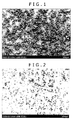
- Test No. 1 is the case of immersing a test material in ion-exchanged water containing neither polyphosphate nor a metallic salt and, in the case, each of the concentrations of P and a metal element existing at the location 10 nm deep from the outermost surface (location from the outermost surface to a depth of 10 nm) is only less than 0.01% by atom, the adhering scale quantity is 16.0x10 -4 mg/mm 2 , and the surface is in the state of being covered with scale of calcium carbonate. The state of adhering scale on the surface of the titanium material on this occasion is shown in Fig. 1 (drawing-substitute SEM photograph).
- Test No. 2 is the case of immersing a test material in an aqueous solution containing polyphosphate but not containing a metallic salt and, in the case, the P concentration is 4.5% by atom but the concentration of the existing metal element is only less than 0.01% by atom at the location 10 nm deep, and the adhering scale quantity reduces scarcely in comparison with Test No. 1.
- Test No. 3 is the case of immersing a test material in an aqueous solution containing both polyphosphate and a metallic salt (tin chloride) and, in the case, the immersion time is as short as 3 min., each of the concentrations of P and the metal element (Sn) existing at the location 10 nm deep is only less than 1.0% by atom, and the adhering scale quantity reduces scarcely in comparison with Test No. 1.
- Test No. 4 is the case of immersing a test material in an aqueous solution containing a metallic salt (tin chloride) but not containing polyphosphate and, in the case, the Sn concentration is 3.5% by atom but the p concentration is only less than 0.01% by atom at the location 10 nm deep, and the adhering scale quantity reduces scarcely in comparison with Test No. 1.
- a metallic salt tin chloride
- Test No. 5 is the case of sufficiently immersing a test material in an aqueous solution containing both polyphosphate and a metallic salt (tin chloride) and, in the case, a modified layer having the P concentration of 4.6% by atom and the metal element (Sn) of 3.5% by atom at the location 10 nm deep is formed and hence the adhering scale quantity reduces to about 13% of Test No. 1.
- the state of adhering scale on the surface of the titanium material on this occasion is shown in Fig. 2 (drawing-substitute SEM photograph).
- Test No. 6 is the case of immersing a test material in an aqueous solution containing both polyphosphate and a metallic salt (tin chloride) for 3 hours and, in the case, a modified layer having the P concentration of 1.3% by atom and the metal element (Sn) concentration of 1.1% by atom at the location 10 nm deep is formed and hence the adhering scale quantity reduces to about a half of Test No. 1.
- Test Nos. 7 to 11 are the cases of sufficiently immersing test materials in aqueous solutions containing both polyphosphate and a metallic salt and, in the cases therefore, modified layers having the P concentrations of 2.8% to 5.0% by atom and the metal element concentrations of 2.2% to 4.7% by atom are formed at the locations 10 nm deep and hence the adhering scale quantities reduce to not more than one-third of Test No. 1.
- a plate (0.5 mm in thickness) comprising SUS304 (JIS G4304) is used as stainless steel for a base material, cut out into a size of 10 mm x 50 mm, washed by acetone, and then air-dried at room temperature.
- the stainless steel plate is washed by ion-exchanged water and immersed in a mixed aqueous solution (surface treatment liquid) of polyphosphate (sodium polyphosphate: Na n+2 P n O 3n+1 ) and a metallic salt (chloride), those being shown in Table 2 below, for 3 min. or 3 to 12 hours, successively washed by ion-exchanged water again, and air-dried at room temperature.
- a mixed aqueous solution surface treatment liquid
- polyphosphate sodium polyphosphate: Na n+2 P n O 3n+1
- a metallic salt chloride
- Test No. 12 is the case of immersing a test material in ion-exchanged water containing neither polyphosphate nor a metallic salt and, in the case, each of the concentrations of P and a metal element existing at the location 10 nm deep from the outermost surface (location from the outermost surface to a depth of 10 nm) is only less than 0.01% by atom, the adhering scale quantity is 20.1x10 -4 mg/mm 2 , and the surface is in the state of being covered with scale of calcium carbonate.
- Test No. 13 is the case of immersing a test material in an aqueous solution containing polyphosphate but not containing a metallic salt and, in the case, the P concentration is 3.9% by atom but the concentration of the existing metal element is only less than 0.01% by atom at the location 10 nm deep, and the adhering scale quantity reduces scarcely in comparison with Test No. 12.
- Test No. 14 is the case of immersing a test material in an aqueous solution containing both polyphosphate and a metallic salt (tin chloride) and, in the case, the immersion time is as short as 3 min., each of the concentrations of P and the metal element (Sn) existing at the location 10 nm deep is only less than 1.0% by atom, and the adhering scale quantity reduces scarcely in comparison with Test No. 12.
- Test No. 15 is the case of immersing a test material in an aqueous solution containing a metallic salt (tin chloride) but not containing polyphosphate and, in the case, the Sn concentration is 2.8% by atom but the p concentration is only less than 0.01% by atom at the location 10 nm deep, and the adhering scale quantity reduces scarcely in comparison with Test No. 12.
- a metallic salt titanium chloride
- Test No. 16 is the case of sufficiently immersing a test material in an aqueous solution containing both polyphosphate and a metallic salt (tin chloride) and, in the case, a modified layer having the P concentration of 5.5% by atom and the metal element (Sn) concentration of 4.0% by atom at the location 10 nm deep is formed and hence the adhering scale quantity reduces to about a half of Test No. 12.
- Test No. 17 is the case of immersing a test material in an aqueous solution containing both polyphosphate and a metallic salt (tin chloride) for 3 hours and, in the case, a modified layer having the P concentration of 1.6% by atom and the metal element (Sn) concentration of 1.2% by atom at the location 10 nm deep is formed and hence the adhering scale quantity reduces to about 70% of Test No. 12.
- Test Nos. 18 to 22 are the cases of sufficiently immersing test materials in aqueous solutions containing both polyphosphate and a metallic salt and, in the cases therefore, modified layers having the P concentrations of 2.3% to 4.4% by atom and the metal element concentrations of 2.0% to 4.1% by atom are formed at the locations 10 nm deep and hence the adhering scale quantities reduce to not more than 60% of Test No. 12.
- a plate (0.5 mm in thickness) comprising industrial pure titanium Category 2 (JIS H4600) is used as titanium for a base material, cut out into a size of 10 mm x 50 mm, washed by acetone, and then air-dried at room temperature.
- the titanium plate is immersed in a mixed acid aqueous solution (2%HF-10%HNO 3 ) comprising hydrofluoric acid and nitric acid for 15 sec.
- the measurement of a surface element concentration and the evaluation of scale adherability are carried out by the following methods.
- a surface element concentration is measured in the same manner as Example 1 except that the element concentration is measured at "a location 200 nm deep from the outermost surface".
- the reason why an element concentration is measured at "a location 200 nm deep from the outermost surface” is that an element concentration decreases as the depth from the outermost surface increases in the same manner as stated above, the concentration at the location comes to be the lowest concentration in the range, and hence it is possible to judge what degree or more "a concentration from the outermost surface to the depth of 200 nm" is by the concentration at the location.
- Scale adherability is measured in the same manner as Example 1 except that 20 cycles are applied to each of the test materials in the scale adhesion process.
- Test No. 23 is the case of immersing a test material in ion-exchanged water containing neither polyphosphate nor a metallic salt and, in the case, each of the concentrations of P and a metal element existing at the location 200 nm deep from the outermost surface (location from the outermost surface to a depth of 200 nm) is only less than 0.01% by atom, the adhering scale quantity is 28.0x10 -4 mg/mm 2 , and the surface is in the state of being covered with scale of calcium carbonate.
- Test No. 24 is the case of immersing a test material in an aqueous solution containing both polyphosphate and a metallic salt (tin chloride) and, in the case, although each of the concentrations of P and the metal element (Sn) existing at the location 200 nm deep is only less than 0.01% by atom and the adhering scale quantity reduces in comparison with Test No. 23, the surface is in the state of being covered with scale of calcium carbonate.
- a thin surface modified layer is formed (refer to Table 3) and hence the adhering scale quantity reduces in comparison with Test No. 23.
- Test Nos. 25 to 30 are the cases of sufficiently immersing test materials in aqueous solutions containing both polyphosphate and a metallic salt and, in the cases therefore, modified layers having the P concentrations of 1.6% to 8.0% by atom and the metal element concentrations of 1.9% to 4.3% by atom are formed at the locations 200 nm deep and hence the adhering scale quantities reduce to not more than 13% of Test No. 23.
- a surface-treated metal material according to the present invention is suitable for a heat exchanger, a seawater evaporator, etc. because the adhesion of scale mainly composed of calcium carbonate can be suppressed.
Landscapes
- Chemical & Material Sciences (AREA)
- Engineering & Computer Science (AREA)
- Mechanical Engineering (AREA)
- Chemical Kinetics & Catalysis (AREA)
- Organic Chemistry (AREA)
- General Chemical & Material Sciences (AREA)
- Materials Engineering (AREA)
- Metallurgy (AREA)
- Physics & Mathematics (AREA)
- Thermal Sciences (AREA)
- General Engineering & Computer Science (AREA)
- Life Sciences & Earth Sciences (AREA)
- Hydrology & Water Resources (AREA)
- Environmental & Geological Engineering (AREA)
- Water Supply & Treatment (AREA)
- Chemical Treatment Of Metals (AREA)
- Preventing Corrosion Or Incrustation Of Metals (AREA)
- Other Surface Treatments For Metallic Materials (AREA)
- Cleaning And De-Greasing Of Metallic Materials By Chemical Methods (AREA)
Abstract
Description
- The present invention relates: to a surface-treated metal material used for a heat exchanger, a seawater evaporator, etc., a method for producing the material, and a heat exchanger, a seawater evaporator, etc. formed by disposing the surface-treated metal material; and in particular to a surface-treated metal material or the like excellently suppressing adhesion of scale that is mainly composed of calcium carbonate.
- A titanium material, a titanium alloy material, or stainless steel having corrosion resistance and good heat conductivity is heavily used for a heat exchanger (for example, a plate type heat exchanger) and a seawater evaporator (seawater desalination equipment) (those materials are collectively referred to as "a metal material" in some cases). Small amounts of calcium ions (Ca2+) and hydrogen carbonate ions (HCO3-) are contained in water, such as ground water and service water, being in contact with a metal material. It is known that, for that reason, when water is heated with a heat exchanger or a seawater evaporator, calcium carbonate (CaCO3) is formed through the reaction formula (1) below and scale mainly composed of the calcium carbonate adheres to the surface of a metal material:
Ca2+ + 2HCO3- → Ca(HCO3)2 → CO2 + H2O + CaCO3 (1).
- The above reaction tends to advance as a temperature rises. In particular, the temperature of water being in contact with a metal material used in a heat exchanger or a seawater evaporator rises to about 60°C to 90°C and scale mainly composed of the calcium carbonate (hereunder referred to merely as "scale" in some cases) is likely to be formed in such an environment. When a heat exchanger or a seawater evaporator is used for a long period of time, scale adheres to a metal material abundantly and the heat conductivity of such equipment deteriorates. For that reason, presently labors for removing scale adhering to the surface of a metal material are required periodically at a frequency of once a month to once a year and a problem here is that maintenance cost increases.
- A scale remover used for effectively carrying out maintenance for the removal of scale is proposed (for example, Patent Literature 1). In the technology, a scale remover containing oxycarboxylic acid, sulfamic acid, and ammonium sulfate as active components is proposed and it is shown that scale adhering to the surface of a metal material can be removed with a high degree of efficiency.
- The above technology however is a technology of neither suppressing the adhesion itself of scale nor reducing maintenance frequency and is not a technology of solving the deterioration of heat conductivity itself caused by the adhesion of scale mainly composed of calcium carbonate to a metal material.
-
- Patent Literature 1: Japanese Patent No.
3647843 - The present invention has been established in view of the above situation and an object of the present invention is to provide a surface-treated metal material excellently suppressing adhesion of scale that is mainly composed of calcium carbonate, a method for effectively producing such a surface-treated metal material, and a heat exchanger, a seawater evaporator, etc. formed by disposing such a surface-treated metal material.
- A surface-treated metal material according to the present invention that has solved the above problems is characterized by a surface-treated metal material formed by modifying the surface of a base material comprising titanium, a titanium alloy, or stainless steel (in particular, comprising titanium or a titanium alloy), wherein, from the outermost surface to a depth of 10 nm, a P concentration is not less than 1.0% by atom and a total concentration of one or more metal elements selected from the group consisting of Sn, Co, Ni, Fe, Zn, and Mg is not less than 1.0% by atom.
- The above problems of the present invention can be solved also by adopting a surface-treated metal material formed by modifying the surface of a base material comprising titanium, a titanium alloy, or stainless steel (in particular, comprising titanium or a titanium alloy), wherein, from the outermost surface to a depth of 200 nm, a P concentration is not less than 1.0% by atom and a total concentration of one or more metal elements selected from the group consisting of Sn, Co, Ni, Fe, Zn, and Mg is not less than 1.0% by atom. Here, "from the outermost surface to a depth of 10 or 200 nm, a P concentration is not less than 1.0% by atom and a total concentration of one or more metal elements selected from the group consisting of Sn, Co, Ni, Fe, Zn, and Mg is not less than 1.0% by atom" means "at any position from the outermost surface to a depth of 10 or 200 nm, a P concentration is not less than 1.0% by atom and a total concentration of one or more metal elements selected from the group consisting of Sn, Co, Ni, Fe, Zn, and Mg is not less than 1.0% by atom".
- Such a surface-treated metal material can be produced by immersing a base material in a solution containing a chemical compound containing P and one or more metal ions selected from the group consisting of Sn, Co, Ni, Fe, Zn, and Mg.
- In such a production method, it is preferable that the solution further contains hydrofluoric acid and nitric acid.
- By disposing such a surface-treated metal material at a heat-transfer part where water or seawater is circulated as a medium so that the modified surface may be brought into contact with the water or seawater, it is possible to: suppress adhesion of scale mainly composed of calcium carbonate to the surface-treated metal material; and materialize a metal-made heat exchanger or seawater evaporator that allows maintenance frequency to be reduced.
- In a surface-treated metal material according to the present invention, by controlling a P concentration to not less than 1.0% by atom and a total concentration of one or more metal elements selected from the group consisting of Sn, Co, Ni, Fe, Zn, and Mg to not less than 1.0% by atom from the outermost surface to a depth of 10 or 200 nm, adhesion of scale mainly composed of calcium carbonate is suppressed and the surface-treated metal material is very useful as a base material of a metal-made heat exchanger or seawater evaporator that can reduce maintenance frequency.
-
-
Fig. 1 is a drawing-substitute SEM photograph showing a scale adhesion state on a titanium material surface in Test No. 1. -
Fig. 2 is a drawing-substitute SEM photograph showing a scale adhesion state on a titanium material surface in Test No. 5. - The present inventors have studied from various angles in order to materialize a surface-treated metal material suppressing the adhesion of scale mainly composed of calcium carbonate. As a result, the present inventors: have found that excellent scale adhesion-suppressing properties can be obtained by forming a layer allowing P (phosphorus) and one or more metal elements selected from the group consisting of Sn, Co, Ni, Fe, Zn, and Mg (hereunder referred to as "a modified layer" for convenience in some cases) to coexist on the surface of a metal base material; and have completed the present invention.
- It has been further found that, in the case where a layer allowing P (phosphorus) and one or more metal elements selected from the group consisting of Sn, Co, Ni, Fe, Zn, and Mg to coexist is formed on the surface of a base material comprising titanium or a titanium alloy (hereunder represented by "a titanium material" in some cases) or stainless steel, those elements are taken in and the layer comes to be a relatively thick modified layer (surface modified layer) when a passive film is reproduced by nitric acid while titanium is dissolved by hydrofluoric acid. Even in the case of forming such a surface modified layer, excellent scale adhesion-suppressing properties are obtained.
- Although the reason why excellent scale adhesion-suppressing properties are obtained by forming such a modified layer on the surface of a metal material is not completely clarified, a presumable reason is as follows. That is, it is estimated that, in a modified layer containing a specific quantity of a specific metal element together with P, when the modified layer comes into contact with water (water and seawater), P and the metal component in the modified layer dissolve gradually in the water, adsorb to the crystal growth plane of calcium carbonate, and resultantly hinder the crystal growth of calcium carbonate (suppress the advance of the reaction of the formula (1)), and hence the adhesion of scale is suppressed.
- Although a modified layer formed on the surface of a metal base material is in the state of not being clearly distinguishable from an interface (boundary) with the mother metal material, the thickness of the modified layer is judged to be not less than 10 nm or not less than 200 nm because a P concentration and a metal element concentration are in the above ranges from the outermost surface (surface of the modified layer) to a depth of 10 nm or a depth of 200 nm and the thickness of not less than 10 nm or not less than 200 nm causes the effect of the present invention to be exhibited. That is, since a concentration at a deepest location (10 nm or 200 nm from the outermost surface) is the smallest, it is possible to know a concentration in a modified layer by investigating a concentration at such a deepest location.
- In order to suppress the adhesion of scale, it is necessary to control, from the outermost surface (surface of a modified layer) to a depth of 10 nm or 200 nm, a P concentration to not less than 1.0% by atom and a total concentration of one or more metal elements selected from the group consisting of Sn, Co, Ni, Fe, Zn, and Mg to not less than 1.0% by atom. A P concentration is higher at a location shallower than such a location. If either of the concentrations is less than 1.0% by atom, the quantity of a dissolved element is insufficient and the growth of calcium carbonate cannot sufficiently be suppressed. Such a concentration (each of a P concentration and a metal element concentration) is preferably not less than 2% by atom (yet preferably not less than 3% by atom) and, from the viewpoint of real manufacturability, preferably not more than 50% by atom (for example, not more than 30% by atom, particularly not more than 10% by atom). The reason why the measurement location of each component concentration is standardized as "a location from a modified layer surface to a depth of 10 nm" or "a location from a modified layer surface to a depth of 200 nm" is based on the viewpoint that the thickness of each modified layer formed is taken into consideration and the depth at which each element dissolves in a real environment during service is "10 nm" or "200 nm" in each thickness.
- As the elements constituting such a modified layer, P (phosphorus) and the metal elements (Sn, Co, Ni, Fe, Zn, and Mg) are contained at prescribed proportions and the other (remainder) comprises basically oxygen (O) and titanium (Ti) in the case where a metal base material is titanium or a titanium alloy. In the case where a metal base material is stainless steel, as the elements constituting such a modified layer, also P (phosphorus) and the metal elements (Sn, Co, Ni, Fe, Zn, and Mg) are contained at prescribed proportions but the other (remainder) comprises basically oxygen (O), iron (Fe), and chromium (Cr). It is estimated that such a modified layer exists in the state where P (phosphorus) and the metal elements combine with oxygen in an oxide film on the surface of a metal material.
- By applying a surface-treated metal material having such a modified layer to a heat-transfer part of a heat exchanger or a seawater evaporator where water or seawater is circulated under a high temperature condition of being likely to generate scale mainly composed of calcium carbonate, it is possible to reduce the deterioration of heat-transfer efficiency and reduce maintenance frequency.
- A surface-treated metal material according to the present invention can be produced by immersing a base material comprising titanium, a titanium alloy, or stainless steel in an aqueous solution (the metal elements are in the state of ions) formed by dissolving both (a) a chemical compound containing P (phosphorus) (for example, phosphoric acids such as phosphoric acid, phosphorous acid, and polyphosphoric acid and the salts thereof) and (b) salts of the metal elements (one or more metal elements selected from the group consisting of Sn, Co, Ni, Fe, Zn, and Mg) (for example, a sulfate, a chloride, and an acetate). Further, a relatively thick surface modified layer can be formed by immersing a base material comprising titanium, a titanium alloy, or stainless steel in a solution containing a chemical compound containing P (phosphorus), one or more metal ions selected from the group consisting of Sn, Co, Ni, Fe, Zn, and Mg, and hydrofluoric acid and nitric acid. Here, the thickness of a modified layer formed in this way can be adjusted by changing immersion time (total time when immersed more than once). Further, each of the contents of hydrofluoric acid and nitric acid in the solution is preferably about 0.05% to 1.0%.
- As titanium materials used as a base material in the present invention, industrial pure titanium Categories 1 to 4 (JIS H4600) are named for example. As a titanium alloy material, a Ti-0.15 mass% Pd alloy is named for example. Further, as stainless steel used as a base material in the present invention, SUS304 (JIS G4304) is named as a representative example but the stainless steel is not limited to SUS 304 and stainless steel of SUS403 and SUS 430 can also be used for example. Furthermore, such a base material may be washed by acetone, an acid solution, or the like before it is subjected to surface treatment.
- The shape of a surface-treated metal material according to the present invention can be either a tabular shape or a tubular shape. For example, in the case of a plate type heat exchanger, a surface-treated metal material is used as a heat exchanger member in the state (of a plate) having many wavy protrusions formed on the surface of a tabular metal material. In a seawater evaporator, a metal material formed into a tubular shape is used as a heat-transfer tube. On this occasion, a surface modified layer is allocated on the side where wavy protrusions are formed in the case of a plate type heat exchanger and on the outside surface of a heat-transfer tube in the case of a seawater evaporator, and a cooling medium (water or seawater) is brought into contact with the surface modified layer.
- Although the configuration and function effect of the present invention are hereunder explained more concretely on the basis of examples, the present invention is of course not limited to the examples below and can be applied by appropriately changing within a range conforming to above- and after-mentioned tenor and the changes are all included in the technological scope of the present invention.
- A plate (0.5 mm in thickness) comprising industrial pure titanium Category 2 (JIS H4600) is used as titanium for a base material, cut out into a size of 10 mm x 50 mm, washed by acetone, and then air-dried at room temperature. The titanium plate is immersed in a mixed acid aqueous solution (2%HF-10%HNO3) comprising hydrofluoric acid and nitric acid for 15 sec. at room temperature, successively washed by ion-exchanged water, immersed in a mixed aqueous solution (surface treatment liquid) of polyphosphate (sodium polyphosphate: Nan+2PnO3n+1) and a metallic salt (chloride), those being shown in Table 1 below, for 3 min. or 3 to 12 hours, successively washed by ion-exchanged water again, and air-dried at room temperature.
- The concentration of each of elements in a modified layer is measured by a glow discharge optical emission spectrometry (GD-OES). A test material is cut into about 10 mm square, embedded into indium (In), and used for measurement. Analysis is carried out under the conditions of anode diameter (analysis area): 4 mmφ, discharge power: 35 W, and argon (Ar) gas pressure: 600 Pa in a pulse sputter analysis mode with a GD-PROFILER 2 type GD-OES apparatus made by HORIBA, Ltd. The depth of the outermost surface (surface of a modified layer) of a test material is defined as zero, an element distribution in the direction of the material depth is investigated, and an element concentration at a location 10 nm deep from the outermost surface is defined as an evaluation indicator of the modified layer. Here, the reason why an element concentration is measured at "a location 10 nm deep from the outermost surface" is that an element concentration decreases as the depth from the outermost surface increases, the concentration at the location comes to be the lowest concentration in the range, and hence it is possible to judge what degree or more "a concentration from the outermost surface to the depth of 10 nm" is by the concentration at the location.
- As a scale adhesion liquid, a mixed aqueous solution (Ca concentration: 354 ppm) comprising 1.5 g/L (liter) of sodium bicarbonate (NaHCO3) and 1.3 g/L of calcium chloride (CaCl2 ·2H2O) is prepared at 20°C (sodium bicarbonate and calcium chloride are special grade reagents made by Wako Pure Chemical Industries, Ltd.).
- The above aqueous solution of 30 mL is poured into a slender beaker and a test material the mass of which has been measured beforehand is immersed. Then a cycle is defined as finished when a test liquid in the slender beaker rises to 90°C from room temperature (20°C) after the slender beaker is put in a water bath of 90°C. As a next cycle, the test liquid in the slender beaker is replaced with a new test liquid (20°C, 30 mL) and the temperature is raised repeatedly likewise (scale adhesion process). Here, it takes about 6 min. for raising the temperature of a test liquid to 90°C in a cycle.
- In the scale adhesion process, 10 cycles are applied to each of the test materials. Scale adherability is evaluated by taking out a test material from the mixed aqueous solution and measuring the mass of the air-dried titanium material after the scale adhesion of 10 cycles. After the scale adhesion process, a titanium plate taken out from the scale forming liquid is dried and weighed and the mass of the titanium plate is measured. Then the quantity of adhering scale per unit area (mg/mm2) is computed through the difference from the mass of the titanium material before subjected to the scale adhesion process (titanium material before scale adhesion).
- The results are shown in Table 1 (Test Nos. 1 to 11) below together with the types of surface treatment liquids.
-
TABLE 1 Test No. Surface treatment liquid Immersion time Concentration at location 10 nm deep Adhering scale quantity (× 10-4mg/mm2) Polyphosphate Polyphosphate concentration (g/L) Metallic salt Metallic salt concentration (g/L) P (% by atom) Metal element (% by atom) 1 - 0 - 0 12 Hr. <0. 01 <0. 01 16. 0 2 Nan+2PnO3n+1 20 - 0 12 Hr. 4. 5 <0. 01 13. 8 3 Nan+2PnO3n+1 20 SnCl2 19 3 Min. 0. 7 0. 5 13. 2 4 - 0 SnCl2 19 12 Hr. <0. 01 3. 5 14. 9 5 Nan+2PnO3n+1 20 SnCl2 19 12 Hr. 4. 6 3. 5 2. 1 6 Nan+2PnO3n+1 20 SnCl2 19 3 Hr. 1. 3 1. 1 7. 9 7 Nan+2PnO3n+1 20 FeCl3 16 12 Hr. 5. 0 4. 7 5. 0 8 Nan+2PnO3n+1 20 CoCl2 13 12 Hr. 2. 8 3. 5 4. 6 9 Nan+2PnO3n+1 20 NiCl2 13 12 Hr. 3. 4 2. 2 5. 2 10 Nan+2PnO3n+1 20 ZnCl2 15 12 Hr. 4. 6 4. 1 3. 0 11 Nan+2PnO3n+1 20 MgCl2 16 12 Hr. 4. 3 3. 9 2. 8 - The results can be discussed as follows. Firstly Test No. 1 is the case of immersing a test material in ion-exchanged water containing neither polyphosphate nor a metallic salt and, in the case, each of the concentrations of P and a metal element existing at the location 10 nm deep from the outermost surface (location from the outermost surface to a depth of 10 nm) is only less than 0.01% by atom, the adhering scale quantity is 16.0x10⁻⁴ mg/mm2, and the surface is in the state of being covered with scale of calcium carbonate. The state of adhering scale on the surface of the titanium material on this occasion is shown in
Fig. 1 (drawing-substitute SEM photograph). - Test No. 2 is the case of immersing a test material in an aqueous solution containing polyphosphate but not containing a metallic salt and, in the case, the P concentration is 4.5% by atom but the concentration of the existing metal element is only less than 0.01% by atom at the location 10 nm deep, and the adhering scale quantity reduces scarcely in comparison with Test No. 1.
- Test No. 3 is the case of immersing a test material in an aqueous solution containing both polyphosphate and a metallic salt (tin chloride) and, in the case, the immersion time is as short as 3 min., each of the concentrations of P and the metal element (Sn) existing at the location 10 nm deep is only less than 1.0% by atom, and the adhering scale quantity reduces scarcely in comparison with Test No. 1.
- Test No. 4 is the case of immersing a test material in an aqueous solution containing a metallic salt (tin chloride) but not containing polyphosphate and, in the case, the Sn concentration is 3.5% by atom but the p concentration is only less than 0.01% by atom at the location 10 nm deep, and the adhering scale quantity reduces scarcely in comparison with Test No. 1.
- Test No. 5 is the case of sufficiently immersing a test material in an aqueous solution containing both polyphosphate and a metallic salt (tin chloride) and, in the case, a modified layer having the P concentration of 4.6% by atom and the metal element (Sn) of 3.5% by atom at the location 10 nm deep is formed and hence the adhering scale quantity reduces to about 13% of Test No. 1. The state of adhering scale on the surface of the titanium material on this occasion is shown in
Fig. 2 (drawing-substitute SEM photograph). - Test No. 6 is the case of immersing a test material in an aqueous solution containing both polyphosphate and a metallic salt (tin chloride) for 3 hours and, in the case, a modified layer having the P concentration of 1.3% by atom and the metal element (Sn) concentration of 1.1% by atom at the location 10 nm deep is formed and hence the adhering scale quantity reduces to about a half of Test No. 1.
- Test Nos. 7 to 11 are the cases of sufficiently immersing test materials in aqueous solutions containing both polyphosphate and a metallic salt and, in the cases therefore, modified layers having the P concentrations of 2.8% to 5.0% by atom and the metal element concentrations of 2.2% to 4.7% by atom are formed at the locations 10 nm deep and hence the adhering scale quantities reduce to not more than one-third of Test No. 1.
- A plate (0.5 mm in thickness) comprising SUS304 (JIS G4304) is used as stainless steel for a base material, cut out into a size of 10 mm x 50 mm, washed by acetone, and then air-dried at room temperature. The stainless steel plate is washed by ion-exchanged water and immersed in a mixed aqueous solution (surface treatment liquid) of polyphosphate (sodium polyphosphate: Nan+2PnO3n+1) and a metallic salt (chloride), those being shown in Table 2 below, for 3 min. or 3 to 12 hours, successively washed by ion-exchanged water again, and air-dried at room temperature.
- With regard to the surface-treated stainless steel materials, the measurement of a surface element concentration and the evaluation of scale adherability are carried out in the same manner as Example 1.
- The results are shown in Table 2 (Test Nos. 12 to 22) below together with the types of surface treatment liquids.
-
TABLE 2 Test No. Surface treatment liquid Immersion time Concentration at location 10 nm deep Adhering scale quantity (× 10-4mg/mm2) Polyphosphate Polyphosphate concentration (g/L) Metallic salt Metallic salt concentration (g/L) P (% by atom) Mental element (% by atom) 12 - 0 - 0 12 Hr. <0. 01 <0. 01 20. 1 13 Nan+2PnO3n+1 20 - 0 12 Hr. 3. 9 <0. 01 18. 0 14 Nan+2PnO3n+1 20 SnCl2 19 3 Min. 0. 6 0. 5 18. 3 15 - 0 SnCl2 19 12 Hr. <0. 01 2. 8 19. 2 16 Nan+2PnO3n+1 20 SnCl2 19 12 Hr. 5. 5 4. 0 10. 1 17 Nan+2PnO3n+1 20 SnCl2 19 3 Hr. 1. 6 1. 2 14. 2 18 Nan+2PnO3n+1 20 FeCl3 16 12 Hr. 3. 6 4. 0 9. 3 19 Nan+2PnO3n+1 20 CoCl2 13 12 Hr. 3. 0 2. 8 10. 5 20 Nan+2PnO3n+1 20 NiCl2 13 12 Hr. 2. 3 2. 2 11. 0 21 Nan+2PnO3n+1 20 ZnCl2 15 12 Hr. 4. 4 4. 1 11. 9 22 Nan+2PnO3n+1 20 MgCl2 16 12 Hr. 2. 6 2. 0 9. 9 - The results can be discussed as follows. Firstly Test No. 12 is the case of immersing a test material in ion-exchanged water containing neither polyphosphate nor a metallic salt and, in the case, each of the concentrations of P and a metal element existing at the location 10 nm deep from the outermost surface (location from the outermost surface to a depth of 10 nm) is only less than 0.01% by atom, the adhering scale quantity is 20.1x10⁻⁴ mg/mm2, and the surface is in the state of being covered with scale of calcium carbonate.
- Test No. 13 is the case of immersing a test material in an aqueous solution containing polyphosphate but not containing a metallic salt and, in the case, the P concentration is 3.9% by atom but the concentration of the existing metal element is only less than 0.01% by atom at the location 10 nm deep, and the adhering scale quantity reduces scarcely in comparison with Test No. 12.
- Test No. 14 is the case of immersing a test material in an aqueous solution containing both polyphosphate and a metallic salt (tin chloride) and, in the case, the immersion time is as short as 3 min., each of the concentrations of P and the metal element (Sn) existing at the location 10 nm deep is only less than 1.0% by atom, and the adhering scale quantity reduces scarcely in comparison with Test No. 12.
- Test No. 15 is the case of immersing a test material in an aqueous solution containing a metallic salt (tin chloride) but not containing polyphosphate and, in the case, the Sn concentration is 2.8% by atom but the p concentration is only less than 0.01% by atom at the location 10 nm deep, and the adhering scale quantity reduces scarcely in comparison with Test No. 12.
- Test No. 16 is the case of sufficiently immersing a test material in an aqueous solution containing both polyphosphate and a metallic salt (tin chloride) and, in the case, a modified layer having the P concentration of 5.5% by atom and the metal element (Sn) concentration of 4.0% by atom at the location 10 nm deep is formed and hence the adhering scale quantity reduces to about a half of Test No. 12.
- Test No. 17 is the case of immersing a test material in an aqueous solution containing both polyphosphate and a metallic salt (tin chloride) for 3 hours and, in the case, a modified layer having the P concentration of 1.6% by atom and the metal element (Sn) concentration of 1.2% by atom at the location 10 nm deep is formed and hence the adhering scale quantity reduces to about 70% of Test No. 12.
- Test Nos. 18 to 22 are the cases of sufficiently immersing test materials in aqueous solutions containing both polyphosphate and a metallic salt and, in the cases therefore, modified layers having the P concentrations of 2.3% to 4.4% by atom and the metal element concentrations of 2.0% to 4.1% by atom are formed at the locations 10 nm deep and hence the adhering scale quantities reduce to not more than 60% of Test No. 12.
- A plate (0.5 mm in thickness) comprising industrial pure titanium Category 2 (JIS H4600) is used as titanium for a base material, cut out into a size of 10 mm x 50 mm, washed by acetone, and then air-dried at room temperature. The titanium plate is immersed in a mixed acid aqueous solution (2%HF-10%HNO3) comprising hydrofluoric acid and nitric acid for 15 sec. at room temperature, successively washed by ion-exchanged water, immersed in a surface treatment liquid of polyphosphate (sodium polyphosphate: Nan+2PnO3n+1) and a metallic salt (chloride) containing water or hydrofluoric acid and nitric acid (0.1%HF-0.5%HNO3) as a solvent, those being shown in Table 3 below, for 12 hours, successively washed by ion-exchanged water again, and air-dried at room temperature.
- With regard to the surface-treated titanium materials, the measurement of a surface element concentration and the evaluation of scale adherability are carried out by the following methods.
- A surface element concentration is measured in the same manner as Example 1 except that the element concentration is measured at "a location 200 nm deep from the outermost surface". Here, the reason why an element concentration is measured at "a location 200 nm deep from the outermost surface" is that an element concentration decreases as the depth from the outermost surface increases in the same manner as stated above, the concentration at the location comes to be the lowest concentration in the range, and hence it is possible to judge what degree or more "a concentration from the outermost surface to the depth of 200 nm" is by the concentration at the location.
- Scale adherability is measured in the same manner as Example 1 except that 20 cycles are applied to each of the test materials in the scale adhesion process.
- The results are shown in Table 3 (Test Nos. 23 to 30) below together with the types of surface treatment liquids.
-
TABLE 3 Test No. Surface treatment liquid Concentration at location 200 nm deep Adhering scale quantity (× 10-4mg/mm2) Polyphosphate Polyphosphate concentration (g/L) Metallic salt Metallic salt concentration (g/L) Solvent P (% by atom) Metal element (% by atom) 23 - 0 - 0 Pure water <0. 01 <0. 01 28. 0 24 Nan+2PnO3n+1 20 SnCl2 19 Pure water <0. 01 <0. 01 15. 3 25 Nan+2PnO3n+1 20 SnCl2 19 0.1%HF-0.5%HNO3 8. 0 4. 3 1. 5 26 Nan+2PnO3n+1 20 FeCl3 16 0.1%HF-0.5%HNO3 6. 2 4. 1 3. 0 27 Nan+2PnO3n+1 20 CoCl2 13 0.1%HF-0.5%HNO3 3. 8 3. 9 2. 2 28 Nan+2PnO3n+1 20 NiCl2 13 0.1%HF-0.5%HNO3 2. 4 3. 2 1. 8 29 Nan+2PnO3n+1 20 ZnCl3 15 0.1%HF-0.5%HNO3 1. 6 1. 9 3. 8 30 Nan+2PnO3n+1 20 MgCl2 16 0.1%HF-0.5%HNO3 4. 2 2. 5 2. 7 - The results can be discussed as follows. Firstly Test No. 23 is the case of immersing a test material in ion-exchanged water containing neither polyphosphate nor a metallic salt and, in the case, each of the concentrations of P and a metal element existing at the location 200 nm deep from the outermost surface (location from the outermost surface to a depth of 200 nm) is only less than 0.01% by atom, the adhering scale quantity is 28.0x10⁻⁴ mg/mm2, and the surface is in the state of being covered with scale of calcium carbonate.
- Test No. 24 is the case of immersing a test material in an aqueous solution containing both polyphosphate and a metallic salt (tin chloride) and, in the case, although each of the concentrations of P and the metal element (Sn) existing at the location 200 nm deep is only less than 0.01% by atom and the adhering scale quantity reduces in comparison with Test No. 23, the surface is in the state of being covered with scale of calcium carbonate. Here, even in Test No. 24, a thin surface modified layer is formed (refer to Table 3) and hence the adhering scale quantity reduces in comparison with Test No. 23.
- Test Nos. 25 to 30 are the cases of sufficiently immersing test materials in aqueous solutions containing both polyphosphate and a metallic salt and, in the cases therefore, modified layers having the P concentrations of 1.6% to 8.0% by atom and the metal element concentrations of 1.9% to 4.3% by atom are formed at the locations 200 nm deep and hence the adhering scale quantities reduce to not more than 13% of Test No. 23.
- Although the present invention has been explained in detail or in reference to specific embodiments, it is obvious for those skilled in the art that the present invention can be changed and modified variously without departing from the spirit and scope of the present invention. The present application is based on Japanese Patent Application No.
2010-184450 filed on August 19, 2010 2011-024106 filed on February 7, 2011 2011-137067 filed on June 21, 2011 - A surface-treated metal material according to the present invention is suitable for a heat exchanger, a seawater evaporator, etc. because the adhesion of scale mainly composed of calcium carbonate can be suppressed.
Claims (7)
- A surface-treated metal material having excellent scale adhesion-suppressing properties, formed by modifying the surface of a base material comprising titanium, a titanium alloy, or stainless steel, wherein, from the outermost surface to a depth of 10 nm, a P concentration is not less than 1.0% by atom and a total concentration of one or more metal elements selected from the group consisting of Sn, Co, Ni, Fe, Zn, and Mg is not less than 1.0% by atom.
- The surface-treated metal material of claim 1, wherein the base material comprises titanium or a titanium alloy.
- The surface-treated metal material of claim 1 or 2, wherein, from the outermost surface to a depth of 200 nm, a P concentration is not less than 1.0% by atom and a total concentration of one or more metal elements selected from the group consisting of Sn, Co, Ni, Fe, Zn, and Mg is not less than 1.0% by atom.
- A method for producing a surface-treated metal material having excellent scale adhesion-suppressing properties, wherein a base material is immersed in a solution containing a chemical compound containing P and one or more metal ions selected from the group consisting of Sn, Co, Ni, Fe, Zn, and Mg when the surface-treated metal material of any one of claims 1 to 3 is produced.
- The method for producing a surface-treated metal material of claim 4, wherein the solution further contains hydrofluoric acid and nitric acid.
- A metal-made heat exchanger formed by disposing the surface-treated metal material of any one of claims 1 to 3 at a heat-transfer part where water is circulated as a medium so that the modified surface may be brought into contact with the water.
- A seawater evaporator formed by disposing the surface-treated metal material of any one of Claims 1 to 3 at a heat-transfer part where seawater is circulated as a medium so that the modified surface may be brought into contact with the seawater.
Applications Claiming Priority (4)
| Application Number | Priority Date | Filing Date | Title |
|---|---|---|---|
| JP2010184450 | 2010-08-19 | ||
| JP2011024106 | 2011-02-07 | ||
| JP2011137067A JP5852338B2 (en) | 2010-08-19 | 2011-06-21 | Method for producing surface-treated metal material excellent in scale adhesion control and seawater evaporator |
| PCT/JP2011/068542 WO2012023548A1 (en) | 2010-08-19 | 2011-08-16 | Surface-treated metal material having excellent scale adhesion-suppressing properties, method for producing same, heat exchanger, and seawater evaporator |
Publications (2)
| Publication Number | Publication Date |
|---|---|
| EP2607521A1 true EP2607521A1 (en) | 2013-06-26 |
| EP2607521A4 EP2607521A4 (en) | 2016-03-30 |
Family
ID=45605201
Family Applications (1)
| Application Number | Title | Priority Date | Filing Date |
|---|---|---|---|
| EP11818189.0A Withdrawn EP2607521A4 (en) | 2010-08-19 | 2011-08-16 | Surface-treated metal material having excellent scale adhesion-suppressing properties, method for producing same, heat exchanger, and seawater evaporator |
Country Status (5)
| Country | Link |
|---|---|
| EP (1) | EP2607521A4 (en) |
| JP (1) | JP5852338B2 (en) |
| KR (1) | KR20130031919A (en) |
| CN (1) | CN103052737B (en) |
| WO (1) | WO2012023548A1 (en) |
Families Citing this family (4)
| Publication number | Priority date | Publication date | Assignee | Title |
|---|---|---|---|---|
| JP6085211B2 (en) * | 2012-06-04 | 2017-02-22 | 株式会社神戸製鋼所 | Titanium alloy material excellent in scale adhesion control and formability, its manufacturing method, and heat exchanger or seawater evaporator |
| WO2020067510A1 (en) * | 2018-09-27 | 2020-04-02 | Toto株式会社 | Faucet fixture |
| US11535911B2 (en) * | 2019-10-29 | 2022-12-27 | Solenis Technologies, L.P. | Method for reducing formation of CaSO4 and Fe2O3 containing deposits in a pressure oxidation autoclave and/or adjacent circuits during pressure oxidation of gold-containing ore |
| KR102666572B1 (en) | 2022-12-15 | 2024-05-16 | (주) 지오그리드 | System and Method for Processing Surface by Electrode for Scale Removal |
Family Cites Families (13)
| Publication number | Priority date | Publication date | Assignee | Title |
|---|---|---|---|---|
| JPS6349299A (en) * | 1986-08-19 | 1988-03-02 | Kouriyuu Kogyo Kk | Scale formation inhibitive and corrosion inhibitive agent for metallic surface |
| JPS63262500A (en) * | 1987-04-20 | 1988-10-28 | Nippon Parkerizing Co Ltd | Lubricity improvement treatment method for titanium or titanium alloy |
| US4865653A (en) * | 1987-10-30 | 1989-09-12 | Henkel Corporation | Zinc phosphate coating process |
| JPH11256374A (en) * | 1997-07-08 | 1999-09-21 | Aichi Steel Works Ltd | Pickling liquid for stainless steel and titanium and its pickling method |
| JP3867357B2 (en) * | 1997-08-07 | 2007-01-10 | 栗田工業株式会社 | Metal corrosion monitoring method |
| KR20030037230A (en) * | 2000-06-16 | 2003-05-12 | 헨켈 코포레이션 | Improved phosphating operation |
| EP1378492B1 (en) | 2001-02-21 | 2008-04-02 | Seiwa Pro Co., Ltd. | Remover for scale deposited on titanium material |
| US8062435B2 (en) * | 2001-06-18 | 2011-11-22 | Henkel Kommanditgesellschaft Auf Aktien | Phosphating operation |
| JP4334205B2 (en) * | 2002-11-25 | 2009-09-30 | 株式会社片山化学工業研究所 | Plate type heat exchanger and its antifouling device |
| US20040118483A1 (en) * | 2002-12-24 | 2004-06-24 | Michael Deemer | Process and solution for providing a thin corrosion inhibiting coating on a metallic surface |
| JP5305152B2 (en) | 2009-02-13 | 2013-10-02 | 株式会社リコー | Inkjet recording device |
| JP2011024106A (en) | 2009-07-17 | 2011-02-03 | Sharp Corp | Image processing apparatus |
| JP5547471B2 (en) | 2009-12-28 | 2014-07-16 | テクノポリマー株式会社 | Automotive interior parts with reduced squeaking noise |
-
2011
- 2011-06-21 JP JP2011137067A patent/JP5852338B2/en not_active Expired - Fee Related
- 2011-08-16 EP EP11818189.0A patent/EP2607521A4/en not_active Withdrawn
- 2011-08-16 KR KR1020137004009A patent/KR20130031919A/en not_active Ceased
- 2011-08-16 CN CN201180037029.1A patent/CN103052737B/en not_active Expired - Fee Related
- 2011-08-16 WO PCT/JP2011/068542 patent/WO2012023548A1/en not_active Ceased
Also Published As
| Publication number | Publication date |
|---|---|
| JP5852338B2 (en) | 2016-02-03 |
| WO2012023548A1 (en) | 2012-02-23 |
| EP2607521A4 (en) | 2016-03-30 |
| CN103052737A (en) | 2013-04-17 |
| CN103052737B (en) | 2015-07-15 |
| JP2012180587A (en) | 2012-09-20 |
| KR20130031919A (en) | 2013-03-29 |
Similar Documents
| Publication | Publication Date | Title |
|---|---|---|
| CN102197160B (en) | Chemical conversion treatment liquid for metal material and treatment method | |
| AU2012274018B2 (en) | Anode for oxygen evolution | |
| EP3000917A1 (en) | Steel sheet for containers, and method for producing steel sheet for container | |
| Williams et al. | Inhibition of the localized corrosion of Mg alloy AZ31 in chloride containing electrolyte | |
| Jakab et al. | Critical concentrations associated with cobalt, cerium, and molybdenum inhibition of AA2024-T3 corrosion: Delivery from Al-Co-Ce (-Mo) alloys | |
| JP5777098B2 (en) | Method for measuring amount of hydrogen penetrating into metal and method for monitoring amount of hydrogen penetrating into metal part of moving body | |
| KR20180132119A (en) | Sn-coated steel sheet | |
| JP5852338B2 (en) | Method for producing surface-treated metal material excellent in scale adhesion control and seawater evaporator | |
| KR20180132120A (en) | Sn-based alloy coated steel sheet | |
| Alon et al. | Influence of halides in phosphoric acid on the corrosion behavior of stainless steels | |
| WO2020079215A1 (en) | A method for electrolytically passivating a surface of silver, silver alloy, gold, or gold alloy | |
| JP5365153B2 (en) | Surface-treated steel with excellent corrosion resistance | |
| EP2818579A1 (en) | Metal material, and surface treatment method and device | |
| JP4506306B2 (en) | Corrosion-resistant rare earth permanent magnet and method for producing the same | |
| JP4800865B2 (en) | Method for producing catalyst body | |
| US12064937B2 (en) | Laminate and method for producing same | |
| Lichti et al. | Heavy Metal Galvanic Corrosion of Carbon Steel in Geothermal Brines | |
| CN100497751C (en) | Weak corrosive agent of external lead wire of electronic device | |
| EP4182495B1 (en) | Method for electrodepositing a functional or decorative chromium layer from a trivalent chromium electrolyte | |
| AU2012201976B2 (en) | Treatment of metals | |
| JP2003213459A (en) | Surface treated steel sheet having excellent corrosion resistance and spot weldability and production method therefor | |
| CN110042377A (en) | The preparation method of metal surface silicomanganese molybdenum system chemical composition coating | |
| Wang | Protection of magnesium alloys from corrosion using magnesium rich surfaces. | |
| Gojić et al. | Ponašanje čelika AISI 316L izloženog demineraliziranoj vodi | |
| Rebak et al. | Enhanced corrosion resistance of iron-based amorphous alloys |
Legal Events
| Date | Code | Title | Description |
|---|---|---|---|
| PUAI | Public reference made under article 153(3) epc to a published international application that has entered the european phase |
Free format text: ORIGINAL CODE: 0009012 |
|
| 17P | Request for examination filed |
Effective date: 20130214 |
|
| AK | Designated contracting states |
Kind code of ref document: A1 Designated state(s): AL AT BE BG CH CY CZ DE DK EE ES FI FR GB GR HR HU IE IS IT LI LT LU LV MC MK MT NL NO PL PT RO RS SE SI SK SM TR |
|
| DAX | Request for extension of the european patent (deleted) | ||
| RA4 | Supplementary search report drawn up and despatched (corrected) |
Effective date: 20160225 |
|
| RIC1 | Information provided on ipc code assigned before grant |
Ipc: C23C 22/07 20060101AFI20160219BHEP Ipc: C23C 22/23 20060101ALI20160219BHEP Ipc: F28F 21/08 20060101ALI20160219BHEP Ipc: C02F 103/08 20060101ALI20160219BHEP Ipc: C23C 22/36 20060101ALI20160219BHEP Ipc: B01D 1/00 20060101ALI20160219BHEP Ipc: C02F 1/04 20060101ALI20160219BHEP Ipc: C23C 22/78 20060101ALI20160219BHEP Ipc: F28F 19/06 20060101ALI20160219BHEP |
|
| 17Q | First examination report despatched |
Effective date: 20180903 |
|
| STAA | Information on the status of an ep patent application or granted ep patent |
Free format text: STATUS: THE APPLICATION IS DEEMED TO BE WITHDRAWN |
|
| 18D | Application deemed to be withdrawn |
Effective date: 20190314 |