EP2607381A1 - Functionalized elastomer, rubber composition and tire - Google Patents
Functionalized elastomer, rubber composition and tire Download PDFInfo
- Publication number
- EP2607381A1 EP2607381A1 EP12197565.0A EP12197565A EP2607381A1 EP 2607381 A1 EP2607381 A1 EP 2607381A1 EP 12197565 A EP12197565 A EP 12197565A EP 2607381 A1 EP2607381 A1 EP 2607381A1
- Authority
- EP
- European Patent Office
- Prior art keywords
- metal ion
- group
- groups
- rubber composition
- rubber
- Prior art date
- Legal status (The legal status is an assumption and is not a legal conclusion. Google has not performed a legal analysis and makes no representation as to the accuracy of the status listed.)
- Granted
Links
- 229920001971 elastomer Polymers 0.000 title claims abstract description 215
- 239000005060 rubber Substances 0.000 title claims abstract description 129
- 239000000806 elastomer Substances 0.000 title claims abstract description 83
- 239000000203 mixture Substances 0.000 title claims abstract description 60
- 229910021645 metal ion Inorganic materials 0.000 claims abstract description 82
- 239000003446 ligand Substances 0.000 claims abstract description 39
- 239000000178 monomer Substances 0.000 claims abstract description 34
- 125000000524 functional group Chemical group 0.000 claims abstract description 27
- 150000001993 dienes Chemical class 0.000 claims abstract description 25
- 229920000642 polymer Polymers 0.000 claims abstract description 24
- 230000000536 complexating effect Effects 0.000 claims abstract description 15
- 229920002554 vinyl polymer Polymers 0.000 claims abstract description 10
- 229920003048 styrene butadiene rubber Polymers 0.000 claims description 43
- 239000000463 material Substances 0.000 claims description 26
- 229910052751 metal Inorganic materials 0.000 claims description 24
- 239000002184 metal Substances 0.000 claims description 24
- 239000011248 coating agent Substances 0.000 claims description 23
- 238000000576 coating method Methods 0.000 claims description 23
- VYPSYNLAJGMNEJ-UHFFFAOYSA-N Silicium dioxide Chemical compound O=[Si]=O VYPSYNLAJGMNEJ-UHFFFAOYSA-N 0.000 claims description 21
- NINIDFKCEFEMDL-UHFFFAOYSA-N Sulfur Chemical compound [S] NINIDFKCEFEMDL-UHFFFAOYSA-N 0.000 claims description 21
- 229910052717 sulfur Inorganic materials 0.000 claims description 20
- 239000011593 sulfur Substances 0.000 claims description 20
- 239000000835 fiber Substances 0.000 claims description 15
- 150000003839 salts Chemical class 0.000 claims description 13
- 239000006229 carbon black Substances 0.000 claims description 12
- 239000000945 filler Substances 0.000 claims description 11
- 229920002857 polybutadiene Polymers 0.000 claims description 11
- 239000000377 silicon dioxide Substances 0.000 claims description 10
- 125000000217 alkyl group Chemical group 0.000 claims description 7
- 125000003118 aryl group Chemical group 0.000 claims description 7
- 229920001195 polyisoprene Polymers 0.000 claims description 7
- 229910000831 Steel Inorganic materials 0.000 claims description 6
- 239000010959 steel Substances 0.000 claims description 6
- OKTJSMMVPCPJKN-UHFFFAOYSA-N Carbon Chemical compound [C] OKTJSMMVPCPJKN-UHFFFAOYSA-N 0.000 claims description 5
- RYGMFSIKBFXOCR-UHFFFAOYSA-N Copper Chemical compound [Cu] RYGMFSIKBFXOCR-UHFFFAOYSA-N 0.000 claims description 5
- 239000010949 copper Substances 0.000 claims description 5
- 229910052802 copper Inorganic materials 0.000 claims description 5
- 239000001257 hydrogen Substances 0.000 claims description 5
- 229910052739 hydrogen Inorganic materials 0.000 claims description 5
- 125000004625 phenanthrolinyl group Chemical group N1=C(C=CC2=CC=C3C=CC=NC3=C12)* 0.000 claims description 5
- 125000003373 pyrazinyl group Chemical group 0.000 claims description 5
- 229920005989 resin Polymers 0.000 claims description 5
- 239000011347 resin Substances 0.000 claims description 5
- 125000002947 alkylene group Chemical group 0.000 claims description 4
- 125000000732 arylene group Chemical group 0.000 claims description 4
- 239000002082 metal nanoparticle Substances 0.000 claims description 4
- 239000001993 wax Substances 0.000 claims description 4
- ROFVEXUMMXZLPA-UHFFFAOYSA-N Bipyridyl Chemical group N1=CC=CC=C1C1=CC=CC=N1 ROFVEXUMMXZLPA-UHFFFAOYSA-N 0.000 claims description 3
- 229910019891 RuCl3 Inorganic materials 0.000 claims description 3
- 229910052799 carbon Inorganic materials 0.000 claims description 3
- BAUYGSIQEAFULO-UHFFFAOYSA-L iron(2+) sulfate (anhydrous) Chemical compound [Fe+2].[O-]S([O-])(=O)=O BAUYGSIQEAFULO-UHFFFAOYSA-L 0.000 claims description 3
- 229910000359 iron(II) sulfate Inorganic materials 0.000 claims description 3
- YBCAZPLXEGKKFM-UHFFFAOYSA-K ruthenium(iii) chloride Chemical compound [Cl-].[Cl-].[Cl-].[Ru+3] YBCAZPLXEGKKFM-UHFFFAOYSA-K 0.000 claims description 3
- 229910021577 Iron(II) chloride Inorganic materials 0.000 claims description 2
- 229910021586 Nickel(II) chloride Inorganic materials 0.000 claims description 2
- AMFIJXSMYBKJQV-UHFFFAOYSA-L cobalt(2+);octadecanoate Chemical compound [Co+2].CCCCCCCCCCCCCCCCCC([O-])=O.CCCCCCCCCCCCCCCCCC([O-])=O AMFIJXSMYBKJQV-UHFFFAOYSA-L 0.000 claims description 2
- NMCUIPGRVMDVDB-UHFFFAOYSA-L iron dichloride Chemical compound Cl[Fe]Cl NMCUIPGRVMDVDB-UHFFFAOYSA-L 0.000 claims description 2
- QMMRZOWCJAIUJA-UHFFFAOYSA-L nickel dichloride Chemical compound Cl[Ni]Cl QMMRZOWCJAIUJA-UHFFFAOYSA-L 0.000 claims description 2
- 239000011295 pitch Substances 0.000 claims description 2
- 229920001169 thermoplastic Polymers 0.000 claims description 2
- 229920002725 thermoplastic elastomer Polymers 0.000 claims description 2
- 239000004416 thermosoftening plastic Substances 0.000 claims description 2
- XOOUIPVCVHRTMJ-UHFFFAOYSA-L zinc stearate Chemical compound [Zn+2].CCCCCCCCCCCCCCCCCC([O-])=O.CCCCCCCCCCCCCCCCCC([O-])=O XOOUIPVCVHRTMJ-UHFFFAOYSA-L 0.000 claims description 2
- 125000004435 hydrogen atom Chemical class [H]* 0.000 claims 1
- PPBRXRYQALVLMV-UHFFFAOYSA-N Styrene Chemical compound C=CC1=CC=CC=C1 PPBRXRYQALVLMV-UHFFFAOYSA-N 0.000 description 38
- KAKZBPTYRLMSJV-UHFFFAOYSA-N Butadiene Chemical compound C=CC=C KAKZBPTYRLMSJV-UHFFFAOYSA-N 0.000 description 30
- 238000000034 method Methods 0.000 description 24
- 239000002174 Styrene-butadiene Substances 0.000 description 23
- HEDRZPFGACZZDS-MICDWDOJSA-N Trichloro(2H)methane Chemical compound [2H]C(Cl)(Cl)Cl HEDRZPFGACZZDS-MICDWDOJSA-N 0.000 description 22
- -1 alkyl benzoates Chemical class 0.000 description 20
- 239000004568 cement Substances 0.000 description 20
- 238000006243 chemical reaction Methods 0.000 description 19
- JFJNVIPVOCESGZ-UHFFFAOYSA-N 2,3-dipyridin-2-ylpyridine Chemical compound N1=CC=CC=C1C1=CC=CN=C1C1=CC=CC=N1 JFJNVIPVOCESGZ-UHFFFAOYSA-N 0.000 description 17
- 238000012545 processing Methods 0.000 description 16
- 239000005062 Polybutadiene Substances 0.000 description 14
- 238000005160 1H NMR spectroscopy Methods 0.000 description 13
- 150000001875 compounds Chemical class 0.000 description 13
- 239000003921 oil Substances 0.000 description 13
- 235000019198 oils Nutrition 0.000 description 13
- 239000000047 product Substances 0.000 description 13
- WYURNTSHIVDZCO-UHFFFAOYSA-N Tetrahydrofuran Chemical compound C1CCOC1 WYURNTSHIVDZCO-UHFFFAOYSA-N 0.000 description 12
- 239000003795 chemical substances by application Substances 0.000 description 12
- 150000003573 thiols Chemical class 0.000 description 12
- 125000000391 vinyl group Chemical group [H]C([*])=C([H])[H] 0.000 description 12
- 238000007306 functionalization reaction Methods 0.000 description 11
- 238000001228 spectrum Methods 0.000 description 11
- NLHHRLWOUZZQLW-UHFFFAOYSA-N Acrylonitrile Chemical compound C=CC#N NLHHRLWOUZZQLW-UHFFFAOYSA-N 0.000 description 10
- RRHGJUQNOFWUDK-UHFFFAOYSA-N Isoprene Chemical compound CC(=C)C=C RRHGJUQNOFWUDK-UHFFFAOYSA-N 0.000 description 10
- 230000015572 biosynthetic process Effects 0.000 description 10
- 235000019241 carbon black Nutrition 0.000 description 10
- 229920001577 copolymer Polymers 0.000 description 10
- 239000003094 microcapsule Substances 0.000 description 10
- RFCQDOVPMUSZMN-UHFFFAOYSA-N 2-Naphthalenethiol Chemical compound C1=CC=CC2=CC(S)=CC=C21 RFCQDOVPMUSZMN-UHFFFAOYSA-N 0.000 description 9
- 150000004696 coordination complex Chemical class 0.000 description 9
- 150000003961 organosilicon compounds Chemical class 0.000 description 9
- 125000004432 carbon atom Chemical group C* 0.000 description 8
- 238000007720 emulsion polymerization reaction Methods 0.000 description 8
- 238000002156 mixing Methods 0.000 description 8
- 229920001897 terpolymer Polymers 0.000 description 8
- 238000002371 ultraviolet--visible spectrum Methods 0.000 description 8
- 238000004073 vulcanization Methods 0.000 description 8
- 238000003786 synthesis reaction Methods 0.000 description 7
- LFQSCWFLJHTTHZ-UHFFFAOYSA-N Ethanol Chemical compound CCO LFQSCWFLJHTTHZ-UHFFFAOYSA-N 0.000 description 6
- ZMXDDKWLCZADIW-UHFFFAOYSA-N N,N-Dimethylformamide Chemical compound CN(C)C=O ZMXDDKWLCZADIW-UHFFFAOYSA-N 0.000 description 6
- KWYUFKZDYYNOTN-UHFFFAOYSA-M Potassium hydroxide Chemical compound [OH-].[K+] KWYUFKZDYYNOTN-UHFFFAOYSA-M 0.000 description 6
- XLOMVQKBTHCTTD-UHFFFAOYSA-N Zinc monoxide Chemical compound [Zn]=O XLOMVQKBTHCTTD-UHFFFAOYSA-N 0.000 description 6
- HQQADJVZYDDRJT-UHFFFAOYSA-N ethene;prop-1-ene Chemical group C=C.CC=C HQQADJVZYDDRJT-UHFFFAOYSA-N 0.000 description 6
- OXBLVCZKDOZZOJ-UHFFFAOYSA-N 2,3-Dihydrothiophene Chemical compound C1CC=CS1 OXBLVCZKDOZZOJ-UHFFFAOYSA-N 0.000 description 5
- 238000006596 Alder-ene reaction Methods 0.000 description 5
- MTAZNLWOLGHBHU-UHFFFAOYSA-N butadiene-styrene rubber Chemical compound C=CC=C.C=CC1=CC=CC=C1 MTAZNLWOLGHBHU-UHFFFAOYSA-N 0.000 description 5
- 229920003193 cis-1,4-polybutadiene polymer Polymers 0.000 description 5
- 239000013078 crystal Substances 0.000 description 5
- 230000000694 effects Effects 0.000 description 5
- 238000010528 free radical solution polymerization reaction Methods 0.000 description 5
- 239000003999 initiator Substances 0.000 description 5
- 230000003993 interaction Effects 0.000 description 5
- 238000000425 proton nuclear magnetic resonance spectrum Methods 0.000 description 5
- 239000002904 solvent Substances 0.000 description 5
- 229920003051 synthetic elastomer Polymers 0.000 description 5
- 239000005061 synthetic rubber Substances 0.000 description 5
- 230000000930 thermomechanical effect Effects 0.000 description 5
- ZGHFDIIVVIFNPS-UHFFFAOYSA-N 3-Methyl-3-buten-2-one Chemical compound CC(=C)C(C)=O ZGHFDIIVVIFNPS-UHFFFAOYSA-N 0.000 description 4
- HGINCPLSRVDWNT-UHFFFAOYSA-N Acrolein Chemical compound C=CC=O HGINCPLSRVDWNT-UHFFFAOYSA-N 0.000 description 4
- XKRFYHLGVUSROY-UHFFFAOYSA-N Argon Chemical compound [Ar] XKRFYHLGVUSROY-UHFFFAOYSA-N 0.000 description 4
- 239000004215 Carbon black (E152) Substances 0.000 description 4
- 238000005033 Fourier transform infrared spectroscopy Methods 0.000 description 4
- 239000000654 additive Substances 0.000 description 4
- 229920005549 butyl rubber Polymers 0.000 description 4
- 239000000839 emulsion Substances 0.000 description 4
- FJKIXWOMBXYWOQ-UHFFFAOYSA-N ethenoxyethane Chemical compound CCOC=C FJKIXWOMBXYWOQ-UHFFFAOYSA-N 0.000 description 4
- 229930195733 hydrocarbon Natural products 0.000 description 4
- 150000002430 hydrocarbons Chemical class 0.000 description 4
- 229920001084 poly(chloroprene) Polymers 0.000 description 4
- 230000008569 process Effects 0.000 description 4
- 238000010058 rubber compounding Methods 0.000 description 4
- 239000011833 salt mixture Substances 0.000 description 4
- QTBSBXVTEAMEQO-UHFFFAOYSA-N Acetic acid Chemical compound CC(O)=O QTBSBXVTEAMEQO-UHFFFAOYSA-N 0.000 description 3
- CSCPPACGZOOCGX-UHFFFAOYSA-N Acetone Chemical compound CC(C)=O CSCPPACGZOOCGX-UHFFFAOYSA-N 0.000 description 3
- UHOVQNZJYSORNB-UHFFFAOYSA-N Benzene Chemical compound C1=CC=CC=C1 UHOVQNZJYSORNB-UHFFFAOYSA-N 0.000 description 3
- UFHFLCQGNIYNRP-UHFFFAOYSA-N Hydrogen Chemical compound [H][H] UFHFLCQGNIYNRP-UHFFFAOYSA-N 0.000 description 3
- OKKJLVBELUTLKV-UHFFFAOYSA-N Methanol Chemical compound OC OKKJLVBELUTLKV-UHFFFAOYSA-N 0.000 description 3
- 239000004743 Polypropylene Substances 0.000 description 3
- HEMHJVSKTPXQMS-UHFFFAOYSA-M Sodium hydroxide Chemical compound [OH-].[Na+] HEMHJVSKTPXQMS-UHFFFAOYSA-M 0.000 description 3
- 150000001336 alkenes Chemical class 0.000 description 3
- 239000003963 antioxidant agent Substances 0.000 description 3
- 239000011324 bead Substances 0.000 description 3
- RTACIUYXLGWTAE-UHFFFAOYSA-N buta-1,3-diene;2-methylbuta-1,3-diene;styrene Chemical compound C=CC=C.CC(=C)C=C.C=CC1=CC=CC=C1 RTACIUYXLGWTAE-UHFFFAOYSA-N 0.000 description 3
- 239000011203 carbon fibre reinforced carbon Substances 0.000 description 3
- 229920003211 cis-1,4-polyisoprene Polymers 0.000 description 3
- 238000010668 complexation reaction Methods 0.000 description 3
- 238000001723 curing Methods 0.000 description 3
- JXJJAJPVIQQBKL-UHFFFAOYSA-N hexane-1-thiol Chemical compound CCCCCCS.CCCCCCS JXJJAJPVIQQBKL-UHFFFAOYSA-N 0.000 description 3
- 239000004615 ingredient Substances 0.000 description 3
- XEEYBQQBJWHFJM-UHFFFAOYSA-N iron Substances [Fe] XEEYBQQBJWHFJM-UHFFFAOYSA-N 0.000 description 3
- 229920002521 macromolecule Polymers 0.000 description 3
- 238000005259 measurement Methods 0.000 description 3
- 238000002844 melting Methods 0.000 description 3
- 230000008018 melting Effects 0.000 description 3
- 150000002825 nitriles Chemical group 0.000 description 3
- 239000002245 particle Substances 0.000 description 3
- 229920001155 polypropylene Polymers 0.000 description 3
- 238000010992 reflux Methods 0.000 description 3
- 238000010074 rubber mixing Methods 0.000 description 3
- 239000011787 zinc oxide Substances 0.000 description 3
- PMJHHCWVYXUKFD-SNAWJCMRSA-N (E)-1,3-pentadiene Chemical compound C\C=C\C=C PMJHHCWVYXUKFD-SNAWJCMRSA-N 0.000 description 2
- HECLRDQVFMWTQS-RGOKHQFPSA-N 1755-01-7 Chemical compound C1[C@H]2[C@@H]3CC=C[C@@H]3[C@@H]1C=C2 HECLRDQVFMWTQS-RGOKHQFPSA-N 0.000 description 2
- SDJHPPZKZZWAKF-UHFFFAOYSA-N 2,3-dimethylbuta-1,3-diene Chemical compound CC(=C)C(C)=C SDJHPPZKZZWAKF-UHFFFAOYSA-N 0.000 description 2
- SMZOUWXMTYCWNB-UHFFFAOYSA-N 2-(2-methoxy-5-methylphenyl)ethanamine Chemical compound COC1=CC=C(C)C=C1CCN SMZOUWXMTYCWNB-UHFFFAOYSA-N 0.000 description 2
- NIXOWILDQLNWCW-UHFFFAOYSA-N 2-Propenoic acid Natural products OC(=O)C=C NIXOWILDQLNWCW-UHFFFAOYSA-N 0.000 description 2
- USFZMSVCRYTOJT-UHFFFAOYSA-N Ammonium acetate Chemical compound N.CC(O)=O USFZMSVCRYTOJT-UHFFFAOYSA-N 0.000 description 2
- JPVYNHNXODAKFH-UHFFFAOYSA-N Cu2+ Chemical compound [Cu+2] JPVYNHNXODAKFH-UHFFFAOYSA-N 0.000 description 2
- IAZDPXIOMUYVGZ-UHFFFAOYSA-N Dimethylsulphoxide Chemical compound CS(C)=O IAZDPXIOMUYVGZ-UHFFFAOYSA-N 0.000 description 2
- ZRALSGWEFCBTJO-UHFFFAOYSA-N Guanidine Chemical compound NC(N)=N ZRALSGWEFCBTJO-UHFFFAOYSA-N 0.000 description 2
- 244000043261 Hevea brasiliensis Species 0.000 description 2
- 241001441571 Hiodontidae Species 0.000 description 2
- VQTUBCCKSQIDNK-UHFFFAOYSA-N Isobutene Chemical group CC(C)=C VQTUBCCKSQIDNK-UHFFFAOYSA-N 0.000 description 2
- 241000254043 Melolonthinae Species 0.000 description 2
- CERQOIWHTDAKMF-UHFFFAOYSA-N Methacrylic acid Chemical compound CC(=C)C(O)=O CERQOIWHTDAKMF-UHFFFAOYSA-N 0.000 description 2
- VVQNEPGJFQJSBK-UHFFFAOYSA-N Methyl methacrylate Chemical compound COC(=O)C(C)=C VVQNEPGJFQJSBK-UHFFFAOYSA-N 0.000 description 2
- PXHVJJICTQNCMI-UHFFFAOYSA-N Nickel Chemical compound [Ni] PXHVJJICTQNCMI-UHFFFAOYSA-N 0.000 description 2
- VEQPNABPJHWNSG-UHFFFAOYSA-N Nickel(2+) Chemical compound [Ni+2] VEQPNABPJHWNSG-UHFFFAOYSA-N 0.000 description 2
- OFBQJSOFQDEBGM-UHFFFAOYSA-N Pentane Chemical compound CCCCC OFBQJSOFQDEBGM-UHFFFAOYSA-N 0.000 description 2
- 239000004698 Polyethylene Substances 0.000 description 2
- 229920005683 SIBR Polymers 0.000 description 2
- XUIMIQQOPSSXEZ-UHFFFAOYSA-N Silicon Chemical compound [Si] XUIMIQQOPSSXEZ-UHFFFAOYSA-N 0.000 description 2
- ATJFFYVFTNAWJD-UHFFFAOYSA-N Tin Chemical compound [Sn] ATJFFYVFTNAWJD-UHFFFAOYSA-N 0.000 description 2
- 229920001807 Urea-formaldehyde Polymers 0.000 description 2
- PTFCDOFLOPIGGS-UHFFFAOYSA-N Zinc dication Chemical compound [Zn+2] PTFCDOFLOPIGGS-UHFFFAOYSA-N 0.000 description 2
- 238000002835 absorbance Methods 0.000 description 2
- 150000001299 aldehydes Chemical class 0.000 description 2
- 125000003545 alkoxy group Chemical group 0.000 description 2
- 125000005370 alkoxysilyl group Chemical group 0.000 description 2
- 150000001412 amines Chemical class 0.000 description 2
- 238000004458 analytical method Methods 0.000 description 2
- 229910052786 argon Inorganic materials 0.000 description 2
- 229920005557 bromobutyl Polymers 0.000 description 2
- WFYPICNXBKQZGB-UHFFFAOYSA-N butenyne Chemical group C=CC#C WFYPICNXBKQZGB-UHFFFAOYSA-N 0.000 description 2
- 229920005556 chlorobutyl Polymers 0.000 description 2
- 239000010941 cobalt Substances 0.000 description 2
- 229910017052 cobalt Inorganic materials 0.000 description 2
- GUTLYIVDDKVIGB-UHFFFAOYSA-N cobalt atom Chemical compound [Co] GUTLYIVDDKVIGB-UHFFFAOYSA-N 0.000 description 2
- 238000001816 cooling Methods 0.000 description 2
- 235000014113 dietary fatty acids Nutrition 0.000 description 2
- CJSBUWDGPXGFGA-UHFFFAOYSA-N dimethyl-butadiene Natural products CC(C)=CC=C CJSBUWDGPXGFGA-UHFFFAOYSA-N 0.000 description 2
- PODOEQVNFJSWIK-UHFFFAOYSA-N diphenylphosphoryl-(2,4,6-trimethoxyphenyl)methanone Chemical compound COC1=CC(OC)=CC(OC)=C1C(=O)P(=O)(C=1C=CC=CC=1)C1=CC=CC=C1 PODOEQVNFJSWIK-UHFFFAOYSA-N 0.000 description 2
- 239000012990 dithiocarbamate Substances 0.000 description 2
- 150000002170 ethers Chemical class 0.000 description 2
- 125000005677 ethinylene group Chemical class [*:2]C#C[*:1] 0.000 description 2
- 239000000194 fatty acid Substances 0.000 description 2
- 229930195729 fatty acid Natural products 0.000 description 2
- 150000004665 fatty acids Chemical class 0.000 description 2
- 229920005555 halobutyl Polymers 0.000 description 2
- 125000004968 halobutyl group Chemical group 0.000 description 2
- 238000010438 heat treatment Methods 0.000 description 2
- 150000002505 iron Chemical class 0.000 description 2
- 229910052742 iron Inorganic materials 0.000 description 2
- 150000002576 ketones Chemical class 0.000 description 2
- 239000002105 nanoparticle Substances 0.000 description 2
- 229920003052 natural elastomer Polymers 0.000 description 2
- 229920001194 natural rubber Polymers 0.000 description 2
- 125000001979 organolithium group Chemical group 0.000 description 2
- PMJHHCWVYXUKFD-UHFFFAOYSA-N penta-1,3-diene Chemical compound CC=CC=C PMJHHCWVYXUKFD-UHFFFAOYSA-N 0.000 description 2
- XHXFXVLFKHQFAL-UHFFFAOYSA-N phosphoryl trichloride Chemical compound ClP(Cl)(Cl)=O XHXFXVLFKHQFAL-UHFFFAOYSA-N 0.000 description 2
- 229920003229 poly(methyl methacrylate) Polymers 0.000 description 2
- 229920000573 polyethylene Polymers 0.000 description 2
- 238000006116 polymerization reaction Methods 0.000 description 2
- 230000000379 polymerizing effect Effects 0.000 description 2
- 239000004926 polymethyl methacrylate Substances 0.000 description 2
- ODGAOXROABLFNM-UHFFFAOYSA-N polynoxylin Chemical compound O=C.NC(N)=O ODGAOXROABLFNM-UHFFFAOYSA-N 0.000 description 2
- 239000005077 polysulfide Substances 0.000 description 2
- 229920001021 polysulfide Polymers 0.000 description 2
- 150000008117 polysulfides Polymers 0.000 description 2
- 229920002451 polyvinyl alcohol Polymers 0.000 description 2
- 235000019422 polyvinyl alcohol Nutrition 0.000 description 2
- 239000000843 powder Substances 0.000 description 2
- 239000010734 process oil Substances 0.000 description 2
- 239000011541 reaction mixture Substances 0.000 description 2
- 230000002787 reinforcement Effects 0.000 description 2
- 150000003303 ruthenium Chemical class 0.000 description 2
- 229910052707 ruthenium Inorganic materials 0.000 description 2
- 229910052710 silicon Inorganic materials 0.000 description 2
- 239000010703 silicon Substances 0.000 description 2
- KZNICNPSHKQLFF-UHFFFAOYSA-N succinimide Chemical compound O=C1CCC(=O)N1 KZNICNPSHKQLFF-UHFFFAOYSA-N 0.000 description 2
- 239000000725 suspension Substances 0.000 description 2
- 238000012360 testing method Methods 0.000 description 2
- 150000003568 thioethers Chemical class 0.000 description 2
- 229920001567 vinyl ester resin Polymers 0.000 description 2
- 238000011179 visual inspection Methods 0.000 description 2
- SRZXCOWFGPICGA-UHFFFAOYSA-N 1,6-Hexanedithiol Chemical compound SCCCCCCS SRZXCOWFGPICGA-UHFFFAOYSA-N 0.000 description 1
- CBXRMKZFYQISIV-UHFFFAOYSA-N 1-n,1-n,1-n',1-n',2-n,2-n,2-n',2-n'-octamethylethene-1,1,2,2-tetramine Chemical compound CN(C)C(N(C)C)=C(N(C)C)N(C)C CBXRMKZFYQISIV-UHFFFAOYSA-N 0.000 description 1
- LLMLGZUZTFMXSA-UHFFFAOYSA-N 2,3,4,5,6-pentachlorobenzenethiol Chemical compound SC1=C(Cl)C(Cl)=C(Cl)C(Cl)=C1Cl LLMLGZUZTFMXSA-UHFFFAOYSA-N 0.000 description 1
- OVSKIKFHRZPJSS-UHFFFAOYSA-N 2,4-D Chemical compound OC(=O)COC1=CC=C(Cl)C=C1Cl OVSKIKFHRZPJSS-UHFFFAOYSA-N 0.000 description 1
- AJKVQEKCUACUMD-UHFFFAOYSA-N 2-Acetylpyridine Chemical compound CC(=O)C1=CC=CC=N1 AJKVQEKCUACUMD-UHFFFAOYSA-N 0.000 description 1
- ZCYVEMRRCGMTRW-UHFFFAOYSA-N 7553-56-2 Chemical compound [I] ZCYVEMRRCGMTRW-UHFFFAOYSA-N 0.000 description 1
- 239000005695 Ammonium acetate Substances 0.000 description 1
- 229910001369 Brass Inorganic materials 0.000 description 1
- 229920000049 Carbon (fiber) Polymers 0.000 description 1
- 229920003043 Cellulose fiber Polymers 0.000 description 1
- BWGNESOTFCXPMA-UHFFFAOYSA-N Dihydrogen disulfide Chemical compound SS BWGNESOTFCXPMA-UHFFFAOYSA-N 0.000 description 1
- CWYNVVGOOAEACU-UHFFFAOYSA-N Fe2+ Chemical compound [Fe+2] CWYNVVGOOAEACU-UHFFFAOYSA-N 0.000 description 1
- 238000012695 Interfacial polymerization Methods 0.000 description 1
- UTGQNNCQYDRXCH-UHFFFAOYSA-N N,N'-diphenyl-1,4-phenylenediamine Chemical compound C=1C=C(NC=2C=CC=CC=2)C=CC=1NC1=CC=CC=C1 UTGQNNCQYDRXCH-UHFFFAOYSA-N 0.000 description 1
- PCLIMKBDDGJMGD-UHFFFAOYSA-N N-bromosuccinimide Chemical compound BrN1C(=O)CCC1=O PCLIMKBDDGJMGD-UHFFFAOYSA-N 0.000 description 1
- CHJJGSNFBQVOTG-UHFFFAOYSA-N N-methyl-guanidine Natural products CNC(N)=N CHJJGSNFBQVOTG-UHFFFAOYSA-N 0.000 description 1
- 239000006057 Non-nutritive feed additive Substances 0.000 description 1
- 229920003171 Poly (ethylene oxide) Polymers 0.000 description 1
- 239000004952 Polyamide Substances 0.000 description 1
- 229920001710 Polyorthoester Polymers 0.000 description 1
- 229920000297 Rayon Polymers 0.000 description 1
- 229910001294 Reinforcing steel Inorganic materials 0.000 description 1
- KJTLSVCANCCWHF-UHFFFAOYSA-N Ruthenium Chemical compound [Ru] KJTLSVCANCCWHF-UHFFFAOYSA-N 0.000 description 1
- 229920000026 Si 363 Polymers 0.000 description 1
- 229920002125 Sokalan® Polymers 0.000 description 1
- 229920002472 Starch Polymers 0.000 description 1
- 235000021355 Stearic acid Nutrition 0.000 description 1
- 229920010741 Ultra High Molecular Weight Polyethylene (UHMWPE) Polymers 0.000 description 1
- RXLFOXNVRRSHRN-UHFFFAOYSA-I [Cl-].[Cl-].[Cl-].[Cl-].[Cl-].[K+].[K+].[K+].[K+].[K+] Chemical compound [Cl-].[Cl-].[Cl-].[Cl-].[Cl-].[K+].[K+].[K+].[K+].[K+] RXLFOXNVRRSHRN-UHFFFAOYSA-I 0.000 description 1
- 230000009102 absorption Effects 0.000 description 1
- 238000010521 absorption reaction Methods 0.000 description 1
- 230000009471 action Effects 0.000 description 1
- 239000012190 activator Substances 0.000 description 1
- 230000000996 additive effect Effects 0.000 description 1
- 229940043376 ammonium acetate Drugs 0.000 description 1
- 235000019257 ammonium acetate Nutrition 0.000 description 1
- 125000006615 aromatic heterocyclic group Chemical group 0.000 description 1
- 229920003235 aromatic polyamide Polymers 0.000 description 1
- QVGXLLKOCUKJST-UHFFFAOYSA-N atomic oxygen Chemical group [O] QVGXLLKOCUKJST-UHFFFAOYSA-N 0.000 description 1
- 230000005540 biological transmission Effects 0.000 description 1
- 239000010951 brass Substances 0.000 description 1
- 238000003490 calendering Methods 0.000 description 1
- DKVNPHBNOWQYFE-UHFFFAOYSA-N carbamodithioic acid Chemical compound NC(S)=S DKVNPHBNOWQYFE-UHFFFAOYSA-N 0.000 description 1
- 239000004917 carbon fiber Substances 0.000 description 1
- 230000008859 change Effects 0.000 description 1
- 125000000259 cinnolinyl group Chemical group N1=NC(=CC2=CC=CC=C12)* 0.000 description 1
- XLJKHNWPARRRJB-UHFFFAOYSA-N cobalt(2+) Chemical compound [Co+2] XLJKHNWPARRRJB-UHFFFAOYSA-N 0.000 description 1
- 239000002131 composite material Substances 0.000 description 1
- 238000013329 compounding Methods 0.000 description 1
- 239000000470 constituent Substances 0.000 description 1
- 229910001431 copper ion Inorganic materials 0.000 description 1
- 238000004132 cross linking Methods 0.000 description 1
- 125000000000 cycloalkoxy group Chemical group 0.000 description 1
- 125000000113 cyclohexyl group Chemical group [H]C1([H])C([H])([H])C([H])([H])C([H])(*)C([H])([H])C1([H])[H] 0.000 description 1
- 230000003111 delayed effect Effects 0.000 description 1
- 230000001419 dependent effect Effects 0.000 description 1
- SWSQBOPZIKWTGO-UHFFFAOYSA-N dimethylaminoamidine Natural products CN(C)C(N)=N SWSQBOPZIKWTGO-UHFFFAOYSA-N 0.000 description 1
- VFHVQBAGLAREND-UHFFFAOYSA-N diphenylphosphoryl-(2,4,6-trimethylphenyl)methanone Chemical group CC1=CC(C)=CC(C)=C1C(=O)P(=O)(C=1C=CC=CC=1)C1=CC=CC=C1 VFHVQBAGLAREND-UHFFFAOYSA-N 0.000 description 1
- 239000002270 dispersing agent Substances 0.000 description 1
- 150000002019 disulfides Chemical class 0.000 description 1
- 150000004659 dithiocarbamates Chemical class 0.000 description 1
- DLAHAXOYRFRPFQ-UHFFFAOYSA-N dodecyl benzoate Chemical compound CCCCCCCCCCCCOC(=O)C1=CC=CC=C1 DLAHAXOYRFRPFQ-UHFFFAOYSA-N 0.000 description 1
- FQYYIPZPELSLDK-UHFFFAOYSA-N ethyl pyridine-2-carboxylate Chemical compound CCOC(=O)C1=CC=CC=N1 FQYYIPZPELSLDK-UHFFFAOYSA-N 0.000 description 1
- 238000001125 extrusion Methods 0.000 description 1
- 239000000706 filtrate Substances 0.000 description 1
- SLGWESQGEUXWJQ-UHFFFAOYSA-N formaldehyde;phenol Chemical compound O=C.OC1=CC=CC=C1 SLGWESQGEUXWJQ-UHFFFAOYSA-N 0.000 description 1
- 239000000499 gel Substances 0.000 description 1
- 239000003365 glass fiber Substances 0.000 description 1
- 230000009477 glass transition Effects 0.000 description 1
- 150000002357 guanidines Chemical class 0.000 description 1
- 150000002431 hydrogen Chemical class 0.000 description 1
- 125000002883 imidazolyl group Chemical group 0.000 description 1
- 238000011065 in-situ storage Methods 0.000 description 1
- 125000003406 indolizinyl group Chemical group C=1(C=CN2C=CC=CC12)* 0.000 description 1
- 239000011630 iodine Substances 0.000 description 1
- 229910052740 iodine Inorganic materials 0.000 description 1
- 150000002500 ions Chemical class 0.000 description 1
- 125000000904 isoindolyl group Chemical group C=1(NC=C2C=CC=CC12)* 0.000 description 1
- 238000004519 manufacturing process Methods 0.000 description 1
- 230000007246 mechanism Effects 0.000 description 1
- 239000004200 microcrystalline wax Substances 0.000 description 1
- 235000019808 microcrystalline wax Nutrition 0.000 description 1
- 230000004048 modification Effects 0.000 description 1
- 238000012986 modification Methods 0.000 description 1
- 239000004570 mortar (masonry) Substances 0.000 description 1
- 229910052759 nickel Inorganic materials 0.000 description 1
- 229910001453 nickel ion Inorganic materials 0.000 description 1
- 150000002826 nitrites Chemical class 0.000 description 1
- QJGQUHMNIGDVPM-UHFFFAOYSA-N nitrogen group Chemical group [N] QJGQUHMNIGDVPM-UHFFFAOYSA-N 0.000 description 1
- QIQXTHQIDYTFRH-UHFFFAOYSA-N octadecanoic acid Chemical compound CCCCCCCCCCCCCCCCCC(O)=O QIQXTHQIDYTFRH-UHFFFAOYSA-N 0.000 description 1
- OQCDKBAXFALNLD-UHFFFAOYSA-N octadecanoic acid Natural products CCCCCCCC(C)CCCCCCCCC(O)=O OQCDKBAXFALNLD-UHFFFAOYSA-N 0.000 description 1
- JRZJOMJEPLMPRA-UHFFFAOYSA-N olefin Natural products CCCCCCCC=C JRZJOMJEPLMPRA-UHFFFAOYSA-N 0.000 description 1
- 239000001301 oxygen Chemical group 0.000 description 1
- 229910052760 oxygen Chemical group 0.000 description 1
- FXLOVSHXALFLKQ-UHFFFAOYSA-N p-tolualdehyde Chemical compound CC1=CC=C(C=O)C=C1 FXLOVSHXALFLKQ-UHFFFAOYSA-N 0.000 description 1
- 239000012188 paraffin wax Substances 0.000 description 1
- 239000013500 performance material Substances 0.000 description 1
- 125000005327 perimidinyl group Chemical group N1C(=NC2=CC=CC3=CC=CC1=C23)* 0.000 description 1
- 239000003208 petroleum Substances 0.000 description 1
- 229920001568 phenolic resin Polymers 0.000 description 1
- 125000001997 phenyl group Chemical group [H]C1=C([H])C([H])=C(*)C([H])=C1[H] 0.000 description 1
- 239000000049 pigment Substances 0.000 description 1
- 239000004014 plasticizer Substances 0.000 description 1
- 229920001200 poly(ethylene-vinyl acetate) Polymers 0.000 description 1
- 239000002745 poly(ortho ester) Substances 0.000 description 1
- 239000004584 polyacrylic acid Substances 0.000 description 1
- 229920002647 polyamide Polymers 0.000 description 1
- 239000004417 polycarbonate Substances 0.000 description 1
- 229920000515 polycarbonate Polymers 0.000 description 1
- 229920000728 polyester Polymers 0.000 description 1
- 229920001470 polyketone Polymers 0.000 description 1
- 229920002689 polyvinyl acetate Polymers 0.000 description 1
- 239000011118 polyvinyl acetate Substances 0.000 description 1
- 229920000036 polyvinylpyrrolidone Polymers 0.000 description 1
- 239000001267 polyvinylpyrrolidone Substances 0.000 description 1
- 235000013855 polyvinylpyrrolidone Nutrition 0.000 description 1
- 238000001556 precipitation Methods 0.000 description 1
- 238000002360 preparation method Methods 0.000 description 1
- 125000001042 pteridinyl group Chemical group N1=C(N=CC2=NC=CN=C12)* 0.000 description 1
- 125000003226 pyrazolyl group Chemical group 0.000 description 1
- 125000002098 pyridazinyl group Chemical group 0.000 description 1
- 125000004076 pyridyl group Chemical group 0.000 description 1
- 125000000714 pyrimidinyl group Chemical group 0.000 description 1
- 125000000168 pyrrolyl group Chemical group 0.000 description 1
- 239000002964 rayon Substances 0.000 description 1
- 230000009257 reactivity Effects 0.000 description 1
- 230000009467 reduction Effects 0.000 description 1
- 230000003014 reinforcing effect Effects 0.000 description 1
- JPPLPDOXWBVPCW-UHFFFAOYSA-N s-(3-triethoxysilylpropyl) octanethioate Chemical compound CCCCCCCC(=O)SCCC[Si](OCC)(OCC)OCC JPPLPDOXWBVPCW-UHFFFAOYSA-N 0.000 description 1
- HYHCSLBZRBJJCH-UHFFFAOYSA-M sodium hydrosulfide Chemical compound [Na+].[SH-] HYHCSLBZRBJJCH-UHFFFAOYSA-M 0.000 description 1
- 239000007787 solid Substances 0.000 description 1
- 241000894007 species Species 0.000 description 1
- 238000001694 spray drying Methods 0.000 description 1
- 238000010561 standard procedure Methods 0.000 description 1
- 239000008107 starch Substances 0.000 description 1
- 235000019698 starch Nutrition 0.000 description 1
- 239000008117 stearic acid Substances 0.000 description 1
- 229960002317 succinimide Drugs 0.000 description 1
- QAZLUNIWYYOJPC-UHFFFAOYSA-M sulfenamide Chemical group [Cl-].COC1=C(C)C=[N+]2C3=NC4=CC=C(OC)C=C4N3SCC2=C1C QAZLUNIWYYOJPC-UHFFFAOYSA-M 0.000 description 1
- 239000004094 surface-active agent Substances 0.000 description 1
- 230000002195 synergetic effect Effects 0.000 description 1
- 229920001059 synthetic polymer Polymers 0.000 description 1
- 229920003002 synthetic resin Polymers 0.000 description 1
- 239000000057 synthetic resin Substances 0.000 description 1
- YLQBMQCUIZJEEH-UHFFFAOYSA-N tetrahydrofuran Natural products C=1C=COC=1 YLQBMQCUIZJEEH-UHFFFAOYSA-N 0.000 description 1
- 150000003557 thiazoles Chemical class 0.000 description 1
- 150000003585 thioureas Chemical class 0.000 description 1
- 229960002447 thiram Drugs 0.000 description 1
- VTHOKNTVYKTUPI-UHFFFAOYSA-N triethoxy-[3-(3-triethoxysilylpropyltetrasulfanyl)propyl]silane Chemical compound CCO[Si](OCC)(OCC)CCCSSSSCCC[Si](OCC)(OCC)OCC VTHOKNTVYKTUPI-UHFFFAOYSA-N 0.000 description 1
- 235000015112 vegetable and seed oil Nutrition 0.000 description 1
- 239000008158 vegetable oil Substances 0.000 description 1
- XLYOFNOQVPJJNP-UHFFFAOYSA-N water Substances O XLYOFNOQVPJJNP-UHFFFAOYSA-N 0.000 description 1
- 239000012991 xanthate Substances 0.000 description 1
- 125000004933 β-carbolinyl group Chemical group C1(=NC=CC=2C3=CC=CC=C3NC12)* 0.000 description 1
Images


Classifications
-
- C—CHEMISTRY; METALLURGY
- C08—ORGANIC MACROMOLECULAR COMPOUNDS; THEIR PREPARATION OR CHEMICAL WORKING-UP; COMPOSITIONS BASED THEREON
- C08C—TREATMENT OR CHEMICAL MODIFICATION OF RUBBERS
- C08C19/00—Chemical modification of rubber
- C08C19/30—Addition of a reagent which reacts with a hetero atom or a group containing hetero atoms of the macromolecule
- C08C19/42—Addition of a reagent which reacts with a hetero atom or a group containing hetero atoms of the macromolecule reacting with metals or metal-containing groups
- C08C19/44—Addition of a reagent which reacts with a hetero atom or a group containing hetero atoms of the macromolecule reacting with metals or metal-containing groups of polymers containing metal atoms exclusively at one or both ends of the skeleton
-
- C—CHEMISTRY; METALLURGY
- C08—ORGANIC MACROMOLECULAR COMPOUNDS; THEIR PREPARATION OR CHEMICAL WORKING-UP; COMPOSITIONS BASED THEREON
- C08L—COMPOSITIONS OF MACROMOLECULAR COMPOUNDS
- C08L19/00—Compositions of rubbers not provided for in groups C08L7/00 - C08L17/00
- C08L19/006—Rubber characterised by functional groups, e.g. telechelic diene polymers
Definitions
- US-B-4,935,471 discloses a process for preparing a polydiene having a high level of affinity for carbon black which comprises reacting a metal terminated polydiene with a capping agent selected from the group consisting of (a) halogenated nitrites, (b) heterocyclic aromatic nitrogen containing compounds, and (c) alkyl benzoates.
- the capping agents disclosed by US-A- 4,935,471 react with metal terminated polydienes and replace the metal with a terminal cyanide group, a heterocyclic aromatic nitrogen containing group or a terminal group which is derived from an alkyl benzoate.
- a terminal cyanide group a heterocyclic aromatic nitrogen containing group or a terminal group which is derived from an alkyl benzoate.
- the metal terminated polydiene is capped with a nitrile, it will result in the polydiene chains being terminated with cyanide groups.
- heterocyclic aromatic nitrogen containing compounds as capping agents can result in the polydiene chains being terminated with a pyrrolyl group, an imidazolyl group, a pyrazolyl group, a pyridyl group, a pyrazinyl group, a pyrimidinyl group, a pyridazinyl group, an indolizinyl group, an isoindolyl group, a 3-H-indolyl group, a cinnolinyl group, a pteridinyl group, a ⁇ -carbolinyl group, a perimidinyl group, a phenanthrolinyl group or the like.
- the invention is directed to a functionalized elastomer in accordance with claim 1 or 2, a rubber composition in accordance with claim 9, and to a tire in accordance with claim 13.
- the present invention is directed to a rubber composition
- a functionalized elastomer comprising a polymeric backbone chain derived from a monomer comprising at least one conjugated diene monomer and optionally at least one vinyl aromatic monomer; and a functional group bonded to the backbone chain, the functional group comprising a multidentate ligand capable of complexing with a metal ion; and an encapsulated metal salt.
- a functionalized elastomer comprising: a polymeric backbone chain derived from a monomer comprising at least one conjugated diene monomer and optionally at least one vinyl aromatic monomer; and a functional group bonded to the backbone chain, the functional group comprising a multidentate ligand capable of complexing with a metal ion.
- a rubber composition comprising: a functionalized elastomer comprising a polymeric backbone chain derived from a monomer comprising at least one conjugated diene monomer and optionally at least one vinyl aromatic monomer; and a functional group bonded to the backbone chain, the functional group comprising a multidentate ligand capable of complexing with a metal ion; and a metal ion.
- a rubber composition comprising: a functionalized elastomer comprising a polymeric backbone chain derived from a monomer comprising at least one conjugated diene monomer and optionally at least one vinyl aromatic monomer; and a functional group bonded to the backbone chain, the functional group comprising a multidentate ligand capable of complexing with a metal ion; and an encapsulated metal salt.
- the functionalized elastomer has the structure I where X is a polymer derived from a monomer comprising at least one conjugated diene monomer and optionally at least one vinyl aromatic monomer; Z is a functional group comprising a multidentate ligand capable of complexing with a metal ion; Y is a divalent group bonded to both X and Z; and n is the number of ⁇ -Y-Z] groups bonded to X.
- the polymer X is a diene based elastomer comprising at least one carbon-carbon double bond.
- rubber or elastomer containing olefinic unsaturation or "diene based elastomer” as used herein are equivalent and are intended to include both natural rubber and its various raw and reclaim forms as well as various synthetic rubbers.
- the terms “rubber” and “elastomer” may be used interchangeably, unless otherwise prescribed.
- the terms “rubber composition,” “compounded rubber” and “rubber compound” are used interchangeably to refer to rubber which has been blended or mixed with various ingredients and materials and such terms are well known to those having skill in the rubber mixing or rubber compounding art.
- Representative synthetic rubbers are the homopolymerization products of butadiene and its homologues and derivatives, for example, methylbutadiene (i.e., isoprene), dimethylbutadiene and pentadiene as well as copolymers such as those formed from butadiene or its homologues or derivatives with other unsaturated monomers.
- methylbutadiene i.e., isoprene
- dimethylbutadiene and pentadiene as well as copolymers such as those formed from butadiene or its homologues or derivatives with other unsaturated monomers.
- acetylenes for example, vinyl acetylene
- olefins for example, isobutylene, which copolymerizes with isoprene to form butyl rubber
- vinyl compounds for example, acrylic acid, acrylonitrile (which polymerize with butadiene to form NBR), methacrylic acid and styrene, the latter compound polymerizing with butadiene to form SBR, as well as vinyl esters and various unsaturated aldehydes, ketones and ethers, e.g., acrolein, methyl isopropenyl ketone and vinylethyl ether.
- synthetic rubbers include neoprene (polychloroprene), polybutadiene (including cis-1,4-polybutadiene), polyisoprene (including cis-1,4-polyisoprene), butyl rubber, halobutyl rubber such as chlorobutyl rubber or bromobutyl rubber, styrene/isoprene/butadiene rubber, copolymers of 1,3-butadiene or isoprene with monomers such as styrene, acrylonitrile and methyl methacrylate, as well as ethylene/propylene terpolymers, also known as ethylene/propylene/diene monomer (EPDM), and in particular, ethylene/propylene/ dicyclopentadiene terpolymers.
- neoprene polychloroprene
- polybutadiene including cis-1,4-polybutadiene
- rubbers which may be used include alkoxy-silyl end functionalized solution polymerized polymers (SBR, PBR, IBR and SIBR), silicon-coupled and tin-coupled star-branched polymers.
- SBR alkoxy-silyl end functionalized solution polymerized polymers
- PBR polybutadiene
- SIBR silicon-coupled and tin-coupled star-branched polymers.
- the preferred rubber or elastomers for use as polymer X are polyisoprene (natural or synthetic), polybutadiene and SBR.
- polymer X may be an emulsion polymerization derived styrene/butadiene (E-SBR) might be used having a relatively conventional styrene content of 20 to 28 percent bound styrene or, for some applications, an E-SBR having a medium to relatively high bound styrene content, namely, a bound styrene content of 30 to 45 percent.
- E-SBR emulsion polymerization derived styrene/butadiene
- E-SBR emulsion polymerization prepared E-SBR
- styrene and 1,3-butadiene are copolymerized as an aqueous emulsion.
- the bound styrene content can vary, for example, from 5 to 50 percent.
- the E-SBR may also contain acrylonitrile to form a terpolymer rubber, as E-SBAR, in amounts, for example, of 2 to 30 weight percent bound acrylonitrile in the terpolymer.
- Emulsion polymerization prepared styrene/butadiene/acrylonitrile copolymer rubbers containing 2 to 40 weight percent bound acrylonitrile in the copolymer are also contemplated as diene based rubbers for use as polymer X in this invention.
- the solution polymerization prepared SBR (S-SBR) suitable for use as polymer X typically has a bound styrene content in a range of 5 to 50, preferably 9 to 36, percent.
- S-SBR can be conveniently prepared, for example, by organo lithium catalyzation in the presence of an organic hydrocarbon solvent.
- cis 1,4-polybutadiene rubber may be used as polymer X.
- BR cis 1,4-polybutadiene rubber
- Such BR can be prepared, for example, by organic solution polymerization of 1,3-butadiene.
- the BR may be conveniently characterized, for example, by having at least a 90 percent cis 1,4-content.
- the functional group Z comprising a multidentate ligand capable of complexing with a metal ion includes but is not limited to substituted or unsubstituted bipyridinyl groups, substituted or unsubstituted terpyridinyl groups, substituted or unsubstituted phenanthrolinyl groups, and substituted or unsubstituted pyrazinyl groups, and the like.
- the functional group Z comprising a multidentate ligand capable of complexing with a metal ion is selected from the group consisting of substituted or unsubstituted bipyridinyl groups, substituted or unsubstituted terpyridinyl group, substituted or unsubstituted phenanthrolinyl group, or substituted or unsubstituted pyrazinyl group.
- the functional group Z comprising a multidentate ligand capable of complexing with a metal ion is a substituted or unsubstituted terpyridinyl group of formula II, or substituted or unsubstituted bipyridinyl group of formula III or IV where R 1 forms the linkage from Z to Y in formula I and R 1 is a covalent bond, C2 to C8 linear alkylene, arylene, alkyl substituted arylene , aryl substituted alkylene, thioalkylene, or thioarylene, and R 2 are independently selected from the group consisting of hydrogen, C2 to C6 linear alkyl, and C2 to C6 branched alkyl.
- the functional group Z comprising a multidentate ligand is a substituted or unsubstituted 2,2';6',2"-terpyridinyl group.
- the functional group Z comprising a multidentate ligand is a substituted or unsubstituted 2,2'-bipyridinyl group.
- the ⁇ -Y-Z] group is selected from the group consisting of 6-(2,2';6',2"-terpyridin-4'-ylsulfanyl)hexyl-1-sulfanyl, 2,2';6',2"-terpyridin-4'-ylsulfanyl, and 4-(2,2';6',2"-terpyridin-4'-yl)phenylmethylsulfanyl.
- Y is a divalent group bonded to both X and Z.
- Y is sulfur or oxygen.
- Y is sulfur.
- n of ⁇ -Y-Z] groups bonded to X ranges from 2 to 30 in a given copolymer molecule.
- the functional group Z may form a complex structure with a metal ion; such a metal ion may be present for example by addition of a metal salt during mixing of the functionalized elastomer in a rubber composition.
- Suitable metal ions include those known to complex with ligands, including but not limited to zinc ions, copper ions, iron ions, nickel ions and ruthenium ions.
- the complexation of the functional group Z with a metal ion may exist as a complex between a single functional group Z and the metal ion, or as a coordination complex between 2 or more functional groups Z and a metal ion.
- Figure 1 shows schematically such a coordination complex between an elastomer (1) shown as a wavy line functionalized through a sulfur linkage (2) with a terpyridine group (3) as the ligand.
- the addition of a metal ion M (4) is shown to form a coordination complex (5) between the metal ion M (4) and two of the ligand groups (3) of the functionalized elastomer.
- the functionalized elastomer may be produced by various methods.
- the functionalized elastomer may be produced by functionalizing the polymer X with functional group Z comprising a multidentate ligand capable of complexing with a metal ion.
- a convenient way for the functionalization of a variety of elastomers is the thiol-ene reaction during which alkene moieties being present in the elastomers are transformed into thioethers by reaction with thiols. This reaction proceeds preferably with vinyl groups as they are present in styrene-butadiene rubbers, butadiene rubbers, and polyisoprene rubbers.
- the ⁇ -Y-Z] grouping where Y is sulfur, may be linked to the elastomer X through reaction of the thiol HS-Z with vinyl groups of the elastomer X to form a thioether of formula I, where Y is sulfur. Further details of the thiol-ene reaction as it relates to elastomers may be found by reference to US-B- 6,365,668 and US-B-7,847,019 .
- One step of the method to produce the functionalized elastomer is to obtain as a first polymer X, an elastomer comprising at least one carbon-carbon double bond.
- a second step of the method is obtaining a functionalizing agent including a functional group Z comprising a multidentate ligand capable of complexing with a metal ion, and a functional group Y capable of reacting with the carbon-carbon double bond of the first polymer.
- a third step of the method is reacting the first polymer X with the functionalizing agent to form the functionalized elastomer.
- the functional group Z is linked to the first polymer through reaction of the functional group Y with the unsaturated carbon-carbon bond of the first polymer.
- the functionalizing agent is reacted with the first polymer in a suitable solvent in the presence of a free-radical initiator via a thiol-ene reaction as is known in the art, see for example Macromolecules 2008, 41, 9946-9947 .
- the free-radical initiator is selected from the group consisting of 2,4,6-Trimethylbenzoyldiphenylphosphine oxide and azobisisobutyonitrile (AIBN).
- the rubber composition includes a metal ion. While not wishing to be bound by any theory, when in the presence of the functionalized elastomer, the metal ion may complex with the functionalized elastomer in a manner similar to that illustrated in Figure 1 and described earlier herein.
- the metal ion M is illustrated as freely associated with the functionalized elastomer, such a through addition of a metal salt to the rubber composition.
- the complexation may be as illustrated in Figure 2 .
- the metal ion M (4) is disposed on a surface (7) and forms a complex (6) with the ligand (3).
- Surface 7 may be the surface of for example a metallic tire cord, a metal nanoparticle, a metalated filler such as metalated carbon black or metalated silica, or a metalated short fiber.
- the interaction of the metal ion with the functionalized elastomer as depicted in Figures 1 or 2 may result for example in an increase in modulus of the rubber composition, improved interaction with fillers, or improved adhesion of the rubber composition to a reinforcement.
- the metal ion may be present in the rubber composition as an encapsulated metal ion.
- the disposition of the encapsulated metal ion is illustrated for example in the embodiment illustrated in Figures 3 and 4 .
- Figure 3 shows a fragmentary cross-section of a runflat tire 101, its tread 102, bead portion 103, sidewall or sidewall region 104, inextensible wire bead core 105, rubber chafer 106, rubber toeguard 107, rubber composition innerliner 108, belt structure 109 underlying a portion of the tread 102, carcass ply 110, carcass ply turnup 111, rubbery sidewall insert 112 and apex 113.
- the sidewall insert 112 may extend from each bead region radially to the edge of the tread, usually to just beneath the reinforcing belt structures 109.
- An encapsulated metal ion 118 is provided dispersed in sidewall insert 112 of the runflat tire 101.
- the encapsulated metal ion 118 includes a metal ion 120 encapsulated by a coating material defining a microcapsule 122.
- the rubbery sidewall insert 112, containing the encapsulated metal ion 118 generally can be formulated by means and methods known to those having ordinary skill in the art.
- the coating material of the microcapsule can be selected from a multitude of materials or mixtures thereof.
- the coating may include waxes such as paraffins, resins such as phenol formaldehyde or urea formaldehyde, carbon pitches, thermoplastic elastomers such as KratonTM and thermoplastics such as syndiotactic polybutadiene, polyethylene (PE), polyethylene oxide, polyvinyl acetate, ethylene-vinyl acetate copolymers, polyvinyl alcohols (PVA), polyacrylic acid and derivatives, polycarbonates, polymethylmethacrylate (PMMA), polyorthoester, polyvinylpyrrolidone, or polypropylene (PP).
- the coating material is polypropylene.
- the coating material is paraffin.
- the coating material is urea formaldehyde.
- the coating material selected must be able to withstand the processing temperatures.
- processing can include mixing, calendaring, extrusion, and curing (or vulcanization) steps, for example.
- vulcanization includes the highest temperature encountered by the coating material of the encapsulated metal ion, which may be from 120 °C to 180 °C depending on the characteristics of the rubber composition, for example as used in tire 101.
- the coating material of the microcapsule 122 is chosen so as to be thermally stable at the temperatures it encounters during processing of the rubber compound, which includes curing, yet, selected to be thermally unstable at a desired operating temperature which may be greater than those processing temperatures.
- the insert 112 is exposed not only to high temperatures but also to high mechanical stress.
- the combination of this mechanical stress with the high temperature operates as a release mechanism (i.e thermo-mechanical release) to rupture the coating material and release the metal ion. Accordingly, while the temperature experienced during the deflated run flat event may be similar to that experienced by the encapsulated metal ion during processing, the added mechanical stress during the run flat event is likely much higher that that experienced during processing.
- the operating temperature where the coating material is thermally unstable under the stress conditions experienced during a run flat event is referred to herein as the release temperature.
- the coating material for the microcapsule 122 is selected to both prevent release of the metal ion 120 during the processing steps, such as can occur through melting or softening of the coating material, and to release the metal ion 120, such as via melting or softening and rupture due to mechanical stress, at the release temperature of the rubber composition, for example, as used in tire 112.
- This release can allow the metal ion 120 to interact with the functionalized elastomer, by reacting with the surrounding rubber. In this way, that area of the rubber compound can be reinforced, for example, via stiffening of the compound.
- such stiffening of the insert 112 thereby supports the sidewall 104 during a deflation event of the tire 101.
- the point at which the coating material becomes thermally unstable may be defined by its glass transition temperature rather than its melting point.
- the release temperature may be greater than the processing temperatures encountered by the coating materials of the encapsulated metal ion
- Such release temperatures generally vary according to tire characteristics.
- the insert compound of a passenger tire may experience a temperature of up to 200 °C during a runflat event.
- the coating thickness of the microcapsule also must provide enough durability for the encapsulated metal ion to withstand the rigors of processing, such as mixing, but allow for rupture during the mechanical stress experienced during a deflation event. As such, in one example, the coating thickness is 18 nm to 6000 nm thick. Also, the diameter of the microcapsules can vary widely but generally may be from 1 micron to 2000 microns. In one embodiment, the diameter is from 10 micron to 150 microns.
- microencapsulation techniques are known to those having ordinary skill in the art.
- the encapsulated metal ion can be prepared in a variety of ways.
- One feature of the processes is that microcapsules are formed completely encasing metal ion to provide microcapsules of the type and size described above.
- the microcapsule is formed of a synthetic resin material, and may be produced by well-known polymerization methods, such as interfacial polymerization or in-situ polymerization.
- the encapsulated metal ion may be prepared by allowing a mixture, which contains metal ion, molten coating material, and optionally other auxiliaries such as surfactants or dispersants, to flow in a cooling column onto a rapidly rotating device such as a rotary table and migrate to the outside because of the high centrifugal force. Because the diameter is greater at the edge, the particles are separated and the formation of agglomerates avoided. After being flung off from the edge of the rotating device, the particles, or encapsulated metal ion, fly away to the outside individually and cool in the process, as a result of which the coating solidifies.
- auxiliaries such as surfactants or dispersants
- the metal ion Upon attained the release temperature of the encapsulated metal ion, as for example during a deflation invention in a runflat tire, the metal ion is released from the microcapsule and exposed to the surrounding rubber composition, including the functionalized elastomer.
- the metal ion is generally added to the rubber composition in an amount sufficient to complex with the functionalized elastomer; depending on the amount of functionalized elastomer present in the rubber composition and the number of ligand groups in an elastomer molecule, the amount of metal ion required can be easily determined by one skilled in the art. Amounts of metal ion in excess of, or less than, the stoichiometric amount of metal ion may be used, depending on the desired effect.
- the metal ion includes divalent copper, divalent iron, divalent cobalt, divalent nickel, and divalent ruthenium , i.e., Cu 2+ , Fe 2+ , Co 2+ , Ni 2+ , Zn 2+ and Ru 2+ .
- the metal ion is added to the rubber composition as a metal salt. In one embodiment, the metal ion is added to the rubber composition as a metal salt including FeSO 4 ⁇ 7H 2 O, FeCl 2 , NiCl 2 , RuCl 3 , cobalt stearate or zinc stearate.
- the metal ion is present in the rubber composition as a metal ion disposed on the surface of a metallic tire cord as is known in the art, such as a steel tire cord.
- a metallic tire cord as is known in the art, such as a steel tire cord.
- Such steel cords may be used for example in reinforcing steel belts in the tire.
- Suitable steel tire cords may have for example surfaces treated with brass, copper, or cobalt.
- the rubber composition as a wirecoat or skim coat contacts the surface of the metallic cord; sufficient adhesion of the rubber composition to the metallic tire cord is important in performance of the tire. Interaction of the functionalized elastomer with the metal ions disposed on the surface of the metallic tire cord may enhance adhesion of the rubber composition to the metallic tire cord.
- the metal ion is added to the rubber composition as a metal disposed on the surface of a metalated short fiber.
- Suitable short fibers include those commonly used in rubber compositions, having a length ranging from 0.1 to 10 mm.
- the metalated short fiber may be metalated polybisbenzoxazole fibers, metalated polyaramid fibers, metalated glass fibers, metalated carbon fibers, metalated polyamide fibers, metalated cellulose fibers, metalated polyester fibers, metalated rayon fibers, and metalated polyketone fibers.
- Suitable metalated short fibers include those disclosed in US-A- 2010/0319827 .
- the metalated short fibers are present in the rubber composition in an amount sufficient to impart the desired effect, such as a reinforcement effect or enhancement of the modulus. In one embodiment, the metalated short fibers are present in an amount ranging from 1 to 100 phr.
- the metal ion is added in the form of metal nanoparticles.
- Suitable nanoparticles include copper nanoparticles with particle sizes ranging from 10 to 100 nm, available from American Elements of Los Angeles, CA.
- the metal ion is added to the rubber composition as a metal disposed on the surface of a metalated carbon black.
- Suitable metalated carbon black include aggregates of a carbon phase and a metal-containing species phase, for example as disclosed in US-B- 6,017,980 .
- the metalated carbon black is present in an amount ranging from 1 to 100 phr.
- the metal ion is added to the rubber composition as a metal diposed on the surface of a metalated silica.
- Suitable metalated silica include silica having metal diposed on the surface thereof, for example as disclosed in US-B- 7,943,693 .
- the metalated silica is present in an amount ranging from 1 to 100 phr.
- the rubber composition may optionally include, in addition to the functionalized elastomer and the metal ion, one or more rubbers or elastomers containing olefinic unsaturation.
- the phrases "rubber or elastomer containing olefinic unsaturation” or “diene based elastomer” are intended to include both natural rubber and its various raw and reclaim forms as well as various synthetic rubbers. In the description of this invention, the terms “rubber” and “elastomer” may be used interchangeably, unless otherwise prescribed.
- rubber composition refers to rubber which has been blended or mixed with various ingredients and materials and such terms are well known to those having skill in the rubber mixing or rubber compounding art.
- Representative synthetic polymers are the homopolymerization products of butadiene and its homologues and derivatives, for example, methylbutadiene, dimethylbutadiene and pentadiene as well as copolymers such as those formed from butadiene or its homologues or derivatives with other unsaturated monomers.
- acetylenes for example, vinyl acetylene
- olefins for example, isobutylene, which copolymerizes with isoprene to form butyl rubber
- vinyl compounds for example, acrylic acid, acrylonitrile (which polymerize with butadiene to form NBR), methacrylic acid and styrene, the latter compound polymerizing with butadiene to form SBR, as well as vinyl esters and various unsaturated aldehydes, ketones and ethers, e.g., acrolein, methyl isopropenyl ketone and vinylethyl ether.
- synthetic rubbers include neoprene (polychloroprene), polybutadiene (including cis-1,4-polybutadiene), polyisoprene (including cis-1,4-polyisoprene), butyl rubber, halobutyl rubber such as chlorobutyl rubber or bromobutyl rubber, styrene/isoprene/butadiene rubber, copolymers of 1,3-butadiene or isoprene with monomers such as styrene, acrylonitrile and methyl methacrylate, as well as ethylene/propylene terpolymers, also known as ethylene/propylene/diene monomer (EPDM), and in particular, ethylene/propylene/dicyclopentadiene terpolymers.
- neoprene polychloroprene
- polybutadiene including cis-1,4-polybutadiene
- rubbers which may be used include alkoxy-silyl end functionalized solution polymerized polymers (SBR, PBR, IBR and SIBR), silicon-coupled and tin-coupled star-branched polymers.
- SBR alkoxy-silyl end functionalized solution polymerized polymers
- PBR polybutadiene
- SIBR silicon-coupled and tin-coupled star-branched polymers.
- the preferred rubber or elastomers are polyisoprene (natural or synthetic), polybutadiene and SBR.
- the at least one additional rubber is preferably of at least two of diene based rubbers.
- a combination of two or more rubbers is preferred such as cis 1,4-polyisoprene rubber (natural or synthetic, although natural is preferred), 3,4-polyisoprene rubber, styrene/isoprene/butadiene rubber, emulsion and solution polymerization derived styrene/butadiene rubbers, cis 1,4-polybutadiene rubbers and emulsion polymerization prepared butadiene/acrylonitrile copolymers.
- an emulsion polymerization derived styrene/butadiene might be used having a relatively conventional styrene content of 20 to 28 percent bound styrene or, for some applications, an E-SBR having a medium to relatively high bound styrene content, namely, a bound styrene content of 30 to 45 percent.
- E-SBR emulsion polymerization prepared E-SBR
- styrene and 1,3-butadiene are copolymerized as an aqueous emulsion.
- the bound styrene content can vary, for example, from 5 to 50 percent.
- the E-SBR may also contain acrylonitrile to form a terpolymer rubber, as E-SBAR, in amounts, for example, of 2 to 30 weight percent bound acrylonitrile in the terpolymer.
- Emulsion polymerization prepared styrene/butadiene/acrylonitrile copolymer rubbers containing 2 to 40 weight percent bound acrylonitrile in the copolymer are also contemplated as diene based rubbers for use in this invention.
- S-SBR solution polymerization prepared SBR
- S-SBR typically has a bound styrene content in a range of 5 to 50, preferably 9 to 36, percent.
- the S-SBR can be conveniently prepared, for example, by organo lithium catalyzation in the presence of an organic hydrocarbon solvent.
- cis 1,4-polybutadiene rubber may be used.
- BR cis 1,4-polybutadiene rubber
- Such BR can be prepared, for example, by organic solution polymerization of 1,3-butadiene.
- the BR may be conveniently characterized, for example, by having at least a 90 percent cis 1,4-content.
- the rubber composition may also include up to 70 phr of processing oil.
- Processing oil may be included in the rubber composition as extending oil typically used to extend elastomers. Processing oil may also be included in the rubber composition by addition of the oil directly during rubber compounding.
- the processing oil used may include both extending oil present in the elastomers, and process oil added during compounding.
- Suitable process oils include various oils as are known in the art, including aromatic, paraffinic, naphthenic, vegetable oils, and low PCA oils, such as MES, TDAE, SRAE and heavy naphthenic oils.
- Suitable low PCA oils include those having a polycyclic aromatic content of less than 3 percent by weight as determined by the IP346 method. Procedures for the IP346 method may be found in Standard Methods for Analysis & Testing of Petroleum and Related Products and British Standard 2000 Parts, 2003, 62nd edition, published by the Institute of Petroleum, United Kingdom .
- the rubber composition may include from 10 to 150 phr of silica. In another embodiment, from 20 to 80 phr of silica may be used.
- silicas such as, only for example herein, and without limitation, silicas commercially available from PPG Industries under the Hi-Sil trademark with designations 210 or 243; silicas available from Rhodia, with, for example, designations of Z1165MP or Z165GR and silicas available from Degussa AG with, for example, designations VN2 or VN3.
- Commonly employed carbon blacks can be used as a conventional filler in an amount ranging from 10 to 150 phr. In another embodiment, from 20 to 80 phr of carbon black may be used.
- Representative examples of such carbon blacks include N110, N121, N134, N220, N231, N234, N242, N293, N299, N315, N326, N330, N332, N339, N343, N347, N351, N358, N375, N539, N550, N582, N630, N642, N650, N683, N754, N762, N765, N774, N787, N907, N908, N990 and N991.
- These carbon blacks have iodine absorptions ranging from 9 to 145 g/kg and DBP number ranging from 34 to 150 cm 3 /100 g.
- fillers may be used in the rubber composition including, but not limited to, particulate fillers including ultra high molecular weight polyethylene (UHMWPE), crosslinked particulate polymer gels including but not limited to those disclosed in US-B- 6,242,534 ; US-B- 6,207,757 ; US-B- 6,133,364 ; US-B- 6,372,857 ; US-B- 5,395,891 ; or US-B-6,127,488 , and plasticized starch composite filler including but not limited to that disclosed in US-A- 5,672,639 .
- Such other fillers may be used in an amount ranging from 1 to 30 phr.
- the rubber composition may contain a conventional sulfur containing organosilicon compound.
- suitable sulfur containing organosilicon compounds are of the formula: Q-Alk-S q -Alk-Q V in which Q is selected from the group consisting of where R 3 is an alkyl group of 1 to 4 carbon atoms, cyclohexyl or phenyl; R 4 is alkoxy of 1 to 8 carbon atoms, or cycloalkoxy of 5 to 8 carbon atoms; Alk is a divalent hydrocarbon of 1 to 18 carbon atoms and q is an integer of 2 to 8.
- the sulfur containing organosilicon compounds are the 3,3'-bis(trimethoxy or triethoxy silylpropyl) polysulfides. In one embodiment, the sulfur containing organosilicon compounds are 3,3'-bis(triethoxysilylpropyl) disulfide and/or 3,3'-bis(triethoxysilylpropyl) tetrasulfide. Therefore, as to formula V, Q may be where R 4 is an alkoxy of 2 to 4 carbon atoms, alternatively 2 carbon atoms; alk is a divalent hydrocarbon of 2 to 4 carbon atoms, alternatively with 3 carbon atoms; and q is an integer of from 2 to 5, alternatively 2 or 4.
- suitable sulfur containing organosilicon compounds include compounds disclosed in US-B- 6,608,125 .
- suitable sulfur containing organosilicon compounds include those disclosed in US-A- 2003/0130535 .
- the sulfur containing organosilicon compound is Si-363 from Degussa.
- the amount of the sulfur containing organosilicon compound in a rubber composition will vary depending on the level of other additives that are used. Generally speaking, the amount of the compound will range from 0.5 to 20 phr. In one embodiment, the amount will range from 1 to 10 phr.
- the rubber composition would be compounded by methods generally known in the rubber compounding art, such as mixing the various sulfur-vulcanizable constituent rubbers with various commonly used additive materials such as, for example, sulfur donors, curing aids, such as activators and retarders and processing additives, such as oils, resins including tackifying resins and plasticizers, fillers, pigments, fatty acid, zinc oxide, waxes, antioxidants and antiozonants and peptizing agents.
- additives mentioned above are selected and commonly used in conventional amounts.
- sulfur donors include elemental sulfur (free sulfur), an amine disulfide, polymeric polysulfide and sulfur olefin adducts.
- the sulfur-vulcanizing agent is elemental sulfur.
- the sulfur-vulcanizing agent may be used in an amount ranging from 0.5 to 8 phr.
- Typical amounts of tackifier resins, if used, comprise 0.5 to 10 phr.
- Typical amounts of processing aids comprise 1 to 50 phr.
- Typical amounts of antioxidants comprise 1 to 5 phr.
- Representative antioxidants may be, for example, diphenyl-p-phenylenediamine and others, such as, for example, those disclosed in The Vanderbilt Rubber Handbook (1978), Pages 344 through 346 .
- Typical amounts of antiozonants comprise 1 to 5 phr.
- Typical amounts of fatty acids, if used, which can include stearic acid comprise 0.5 to 3 phr.
- Typical amounts of zinc oxide comprise 0.1 to 5 phr. Lower amounts of zinc oxide may be used to avoid complexation with the functionalized elastomer.
- Typical amounts of waxes comprise 1 to 5 phr. Often microcrystalline waxes are used.
- Typical amounts of peptizers comprise 0.1 to 1 phr. Typical peptizers may be, for example, pentachlorothiophenol and dibenzamidodiphenyl disulfide.
- Accelerators are used to control the time and/or temperature required for vulcanization and to improve the properties of the vulcanizate.
- a single accelerator system may be used, i.e., primary accelerator.
- the primary accelerator(s) may be used in total amounts ranging from 0.5 to 4, alternatively 0.8 to 1.5, phr.
- combinations of a primary and a secondary accelerator might be used with the secondary accelerator being used in smaller amounts, such as from 0.05 to 3 phr, in order to activate and to improve the properties of the vulcanizate. Combinations of these accelerators might be expected to produce a synergistic effect on the final properties and are somewhat better than those produced by use of either accelerator alone.
- delayed action accelerators may be used which are not affected by normal processing temperatures but produce a satisfactory cure at ordinary vulcanization temperatures.
- Vulcanization retarders might also be used.
- Suitable types of accelerators that may be used in the present invention are amines, disulfides, guanidines, thioureas, thiazoles, thiurams, sulfenamides, dithiocarbamates and xanthates.
- the primary accelerator is a sulfenamide. If a second accelerator is used, the secondary accelerator may be a guanidine, dithiocarbamate or thiuram compound.
- the mixing of the rubber composition can be accomplished by methods known to those having skill in the rubber mixing art.
- the ingredients are typically mixed in at least two stages, namely, at least one non-productive stage followed by a productive mix stage.
- the final curatives including sulfur-vulcanizing agents are typically mixed in the final stage which is conventionally called the "productive" mix stage in which the mixing typically occurs at a temperature, or ultimate temperature, lower than the mix temperature(s) than the preceding non-productive mix stage(s).
- the rubber composition may be subjected to a thermomechanical mixing step.
- the thermomechanical mixing step generally comprises a mechanical working in a mixer or extruder for a period of time suitable in order to produce a rubber temperature between 140°C and 190°C.
- the appropriate duration of the thermomechanical working varies as a function of the operating conditions, and the volume and nature of the components.
- the thermomechanical working may be from 1 to 20 minutes.
- the rubber composition may be incorporated in a variety of rubber components of the tire as are known in the art.
- the rubber component may be a tread (including tread cap and tread base), sidewall, apex, chafer, sidewall insert, wirecoat or innerliner.
- the pneumatic tire of the present invention may be a race tire, passenger tire, aircraft tire, agricultural, earthmover, off-the-road or truck tire.
- the tire is a passenger or truck tire.
- the tire may also be a radial or bias.
- Vulcanization of the pneumatic tire of the present invention is generally carried out at conventional temperatures ranging from 100°C to 200°C. In one embodiment, the vulcanization is conducted at temperatures ranging from about 110°C to 180°C. Any of the usual vulcanization processes may be used such as heating in a press or mold, heating with superheated steam or hot air. Such tires can be built, shaped, molded and cured by various methods which are known and will be readily apparent to those having skill in such art.
- This compound was synthesized twice, once with AIBN as initiator for the reaction and once with an acylphosphine oxide photoinitiator (Lucirin TPO).
- a mixture of 1 g SBR, 1.40 g 2-mercaptonaphthalene and 0.30 g Lucirin TPO was degassed under a stream of argon for 2 hours and then was placed under a UV-lamp (320-380 nm) for 14.5 hours.
- both reaction mixtures were dialyzed against THF for two days. Afterwards the solvent was evaporated and the product was dried under vacuum.
- Figure 6 shows the UV-vis spectrum of the elastomer before (1) and after the reaction with 2-mercaptonaphtalene (2) and the spectrum of the pure thiol (3).
- Figure 7 shows the same for the reaction which was initiated by AIBN, with the UV-vis spectrum of the elastomer before (1) and after the reaction with 2-mercaptonaphthanline (2) and the spectrum of the pure thiol (3).
- Figure 8 shows the 1 H-NMR spectrum of the elastomer before (1) and after reaction with the thiol in the presence of AIBN (2) and Lucirin (3).
- the SBR was successfully functionalized with 2-mercaptonaphthalene.
- GPC-measurement (in THF) as shown in Figure 9 for the SBR (1), the SBR functionlized in the presence of AIBN (2) and in the presence of Lucirin (3) confirmed that the product is not greatly cross linked.
- the curve of the AIBN-initiated product (2) shows very little cross linking (small shoulder), so that the decrease of the signal of vinyl protons can be assigned to functionalization.
- the terpyridine of formula VI was obtained in a 4 step reaction using literature procedures [ U. S. Schubert, C. Eschbaumer, O. Hien, P. R. Andres, Tetrahedron Lett. 2001, 42, 4705 ; U. S. Schubert, S. Schmatloch, A. A. Precup, Designed Monomers and Polymers 2002, 5, 211 .].
- the yield and analysis at each step was as follows:
- step 1 The product of step 1 was reacted with ammonium acetate with a 48 hour reflux. Yield: 67 % light pink crystals 1 H-NMR (CDCl 3 / 300 MHz): [ppm]: 6.77 (s, 2H); 7.24 (s, CDCl3); 7.36-7.38 (m, 2H); 7.77-7.86 (m, 4H); 8.64-8.66 (m, 2H)
- step 2 The product of step 2 was reacted with potassium pentachloride in phosphoryl chloride with a 24 hour reflux. Yield: 55 % light purple 1 H-NMR (CDCl 3 / 300 MHz): [ppm]: 7.24 (s, CDCl3); 7.80-7.86 (m, 2H); 8.46 (s, 2H); 8.55 (t, 2H); 8.58 (t, 2H); 8.66-8.69 (m, 2H)
- step 3 The product of step 3 was reacted with 1,6-hexanedithiol in the presence of potassium hydroxide in dimethylsulfoxide. Yield: 35 % colorless crystals
- 1 H-NMR (CDCl 3 / 300 MHz): [ppm]: 1.32-1.63 (m, 4H), 1.79-1.88 (m, 4H), 3.63 (q, 2H), 4.7 (t, 2H), 7.24 (s, CDCl3); 7.27-7.32 (m, 2H); 7.78-7.84 (m, 2H); 7.96 (s, 2H); 8.56-8.65 (m, 4H)
- the styrene butadiene rubber of Example 1 was functionalized with 6-(2,2;6',2"-terpyridin-4'-ylsulfanyl)hexane-1-thiol following the procedures of Example 1 for 2-mercaptonaphthalene.
- Figure 10 shows the 1 H-NMR of the unfunctionalized elastomer (1) compared to the rubber functionalized with the terpyridine ligand (2), and the terpyridine (3).
- a small amount of the ligand has reacted with the vinylgroups of the elastomer.
- Very small signals in the aromatic region of the functionalized rubber spectrum (2) between 8 and 9 ppm belonging to the hydrogen of the ligand can be observed, indicating a successful functionalization.
- Figure 11 shows a GPC graph for the SBR (1) and the functionalized SBR (2). As seen in Figure 11 , essentially no change in molecular weight could be observed in the GPC measurement, so that the reduction of vinylprotons can be assigned to functionalization.
- the terpyridine of formula VII was obtained using the 4 step procedure as given in Example 2, with the modification that in step 4, the 4'-chloro-2,2';6',2"-terpyridine product of step 3 was reacted with sodium hydrogensulfide (NaSH) in the presence of potassium hydroxide in dimethylformamide (DMF).
- NaSH sodium hydrogensulfide
- DMF dimethylformamide
- FIG. 12 shows the 1 H-NMR of the unfunctionalized elastomer (1) compared to the rubber functionalized with the terpyridine ligand (2). As seen in Figure 12 , a small amount of the ligand has reacted with the vinylgroups of the elastomer. Very small signals in the aromatic region of the functionalized rubber spectrum (2) between 8 and 9 ppm belonging to the hydrogen of the ligand can be observed, indicating a successful functionalization.
- the terpyridine of formula VIII was obtained following a synthesis route as shown in Figure 13 .
- Step 3 4'-(4-isothiouroniumbromidemethylphenyl)-2,2':6,2"-terpyridine
- the styrene butadiene rubber of Example 1 was functionalized with 4: 4'-(4-mercaptomethylphenyl)-2,2':6,2"-terpyridine following the procedures of Example 1 for 2-mercaptonaphthalene.
- Figure 14 shows the 1 H-NMR of the rubber functionalized with the terpyridine ligand (2), and the terpyridine (1). As seen in Figure 14 , a small amount of the ligand has reacted with the vinylgroups of the elastomer. Very small signals in the aromatic region of the functionalized rubber spectrum (2) between 8 and 9 ppm belonging to the hydrogen of the ligand can be observed, indicating a successful functionalization.
- a rubber cement was prepared by adding 0,4 g of the functionalized elastomer of Example 4 to 4 ml of THF in a small vial. The rubber cement was combined with 0,02 g of FeSO 4 ⁇ 7H 2 O and the vial was shaken for 7 hours. Visual inspection of the rubber cement/metal salt mixture showed a purple color, as compared with the colorless rubber cement.
- UV-vis spectra for the rubber cement/metal salt and rubber cement are shown in Figure 15 .
- the rubber cement/metal salt spectrum (2) shows an absorbance peak at about 571 nm, indicating the formation of a coordination complex between the terpyridine moieties of the functionalized elastomer and the Fe 2+ ion.
- the rubber cement spectrum (1) shows no such peak.
- a rubber cement was prepared by adding 0.03 g of the functionalized elastomer of Example 4 to 5ml THF and 0,25 ml MeOH in a small vial. The rubber cement was combined with 0.02 g of RuCl 3 and the vial was heated up to 65 °C for 20 hours and shaken. Visual inspection of the rubber cement/metal salt mixture showed a dark red color, as compared with the colorless rubber cement.
- UV-vis spectra for the rubber cement/metal salt and rubber cement are shown in Figure 16 .
- the rubber cement/metal salt spectrum (2) shows an absorbance peak at about 490 nm, indicating the formation of a coordination complex between the terpyridine moieties of the functionalized elastomer and the Ru 2+ ion.
- the rubber cement spectrum (1) shows no such peak.
Landscapes
- Chemical & Material Sciences (AREA)
- Health & Medical Sciences (AREA)
- Chemical Kinetics & Catalysis (AREA)
- Medicinal Chemistry (AREA)
- Polymers & Plastics (AREA)
- Organic Chemistry (AREA)
- General Chemical & Material Sciences (AREA)
- Compositions Of Macromolecular Compounds (AREA)
- Addition Polymer Or Copolymer, Post-Treatments, Or Chemical Modifications (AREA)
- Tires In General (AREA)
- Pyridine Compounds (AREA)
Abstract

Description
- It is important for rubbery polymers that are used in tires, hoses, power transmission belts and other industrial products to have good compatibility with fillers, such as carbon black and silica. To attain improved interaction with fillers such rubbery polymers can be functionalized with various compounds, such as amines.
US-B-4,935,471 discloses a process for preparing a polydiene having a high level of affinity for carbon black which comprises reacting a metal terminated polydiene with a capping agent selected from the group consisting of (a) halogenated nitrites, (b) heterocyclic aromatic nitrogen containing compounds, and (c) alkyl benzoates. The capping agents disclosed byUS-A- 4,935,471 react with metal terminated polydienes and replace the metal with a terminal cyanide group, a heterocyclic aromatic nitrogen containing group or a terminal group which is derived from an alkyl benzoate. For example, if the metal terminated polydiene is capped with a nitrile, it will result in the polydiene chains being terminated with cyanide groups. The use of heterocyclic aromatic nitrogen containing compounds as capping agents can result in the polydiene chains being terminated with a pyrrolyl group, an imidazolyl group, a pyrazolyl group, a pyridyl group, a pyrazinyl group, a pyrimidinyl group, a pyridazinyl group, an indolizinyl group, an isoindolyl group, a 3-H-indolyl group, a cinnolinyl group, a pteridinyl group, a β-carbolinyl group, a perimidinyl group, a phenanthrolinyl group or the like. - The invention is directed to a functionalized elastomer in accordance with
claim - Dependent claims refer to preferred embodiments of the invention.
- In one preferred aspect, the present invention is directed to a rubber composition comprising: a functionalized elastomer comprising a polymeric backbone chain derived from a monomer comprising at least one conjugated diene monomer and optionally at least one vinyl aromatic monomer; and a functional group bonded to the backbone chain, the functional group comprising a multidentate ligand capable of complexing with a metal ion; and an encapsulated metal salt.
-
-
Figure 1 shows a schematic representation of a coordination complex between a metal ion and a functionalized elastomer. -
Figure 2 shows a schematic representation of a coordination complex between a metal ion disposed on a surface and a functionalized elastomer. -
Figure 3 shows a fragmentary cross-sectional view of a runflat tire showing its tread and carcass with one ply and one insert axially inward of the ply in the sidewall region of the tire as an embodiment of the invention. -
Figure 4 shows an enlarged view of the in-circle portion ofFigure 2 showing, in cross-section, the encapsulated metal ion in accordance with an embodiment of the present invention. -
Figure 5 shows the 1H-NMR spectrum of a styrene-butadiene elastomer. -
Figure 6 shows the UV-vis spectrum of a styrene-butadiene elastomer before and after the reaction with 2-mercaptonaphtalene and the spectrum of the pure thiol. -
Figure 7 shows the UV-vis spectrum of a styrene-butadiene elastomer before and after the reaction with 2-mercaptonaphtalene and the spectrum of the pure thiol. -
Figure 8 shows the 1H-NMR spectrum of a styrene-butadiene elastomer before and after reaction with a thiol in the presence of different initiators. -
Figure 9 shows a GPC-measurement for a styrene-butadiene elastomer, and the elastomer functionalized with a thiol in the presence of different initiators. -
Figure 10 shows an 1H-NMR of an unfunctionalized styrene-butadiene elastomer compared to the elastomer functionalized with a terpyridine ligand. -
Figure 11 shows a GPC graph for an unfunctionalized styrene-butadiene elastomer compared to the elastomer functionalized with a terpyridine ligand. -
Figure 12 shows an 1H-NMR of an unfunctionalized styrene-butadiene elastomer compared to the elastomer functionalized with a terpyridine ligand. -
Figure 13 a synthesis scheme for synthesis of a terpyridine ligand. -
Figure 14 shows an 1H-NMR of a terpyridine ligand compared to a styrene-butadiene elastomer functionalized with the terpyridine ligand. -
Figure 15 shows UV-vis spectra for a rubber cement/iron salt mixture and for rubber cement. -
Figure 16 shows UV-vis spectra for a rubber cement/ruthenium salt mixture and for a rubber cement. - There is disclosed a functionalized elastomer comprising: a polymeric backbone chain derived from a monomer comprising at least one conjugated diene monomer and optionally at least one vinyl aromatic monomer; and a functional group bonded to the backbone chain, the functional group comprising a multidentate ligand capable of complexing with a metal ion.
- There is further disclosed a rubber composition comprising: a functionalized elastomer comprising a polymeric backbone chain derived from a monomer comprising at least one conjugated diene monomer and optionally at least one vinyl aromatic monomer; and a functional group bonded to the backbone chain, the functional group comprising a multidentate ligand capable of complexing with a metal ion; and a metal ion.
- There is further disclosed a rubber composition comprising: a functionalized elastomer comprising a polymeric backbone chain derived from a monomer comprising at least one conjugated diene monomer and optionally at least one vinyl aromatic monomer; and a functional group bonded to the backbone chain, the functional group comprising a multidentate ligand capable of complexing with a metal ion; and an encapsulated metal salt.
- There is further disclosed a pneumatic tire comprising the rubber composition.
- In one embodiment, the functionalized elastomer has the structure I

- In one embodiment, the polymer X is a diene based elastomer comprising at least one carbon-carbon double bond. The phrases "rubber or elastomer containing olefinic unsaturation" or "diene based elastomer" as used herein are equivalent and are intended to include both natural rubber and its various raw and reclaim forms as well as various synthetic rubbers. In the description of this invention, the terms "rubber" and "elastomer" may be used interchangeably, unless otherwise prescribed. The terms "rubber composition," "compounded rubber" and "rubber compound" are used interchangeably to refer to rubber which has been blended or mixed with various ingredients and materials and such terms are well known to those having skill in the rubber mixing or rubber compounding art. Representative synthetic rubbers are the homopolymerization products of butadiene and its homologues and derivatives, for example, methylbutadiene (i.e., isoprene), dimethylbutadiene and pentadiene as well as copolymers such as those formed from butadiene or its homologues or derivatives with other unsaturated monomers. Among the latter are acetylenes, for example, vinyl acetylene; olefins, for example, isobutylene, which copolymerizes with isoprene to form butyl rubber; vinyl compounds, for example, acrylic acid, acrylonitrile (which polymerize with butadiene to form NBR), methacrylic acid and styrene, the latter compound polymerizing with butadiene to form SBR, as well as vinyl esters and various unsaturated aldehydes, ketones and ethers, e.g., acrolein, methyl isopropenyl ketone and vinylethyl ether. Specific examples of synthetic rubbers include neoprene (polychloroprene), polybutadiene (including cis-1,4-polybutadiene), polyisoprene (including cis-1,4-polyisoprene), butyl rubber, halobutyl rubber such as chlorobutyl rubber or bromobutyl rubber, styrene/isoprene/butadiene rubber, copolymers of 1,3-butadiene or isoprene with monomers such as styrene, acrylonitrile and methyl methacrylate, as well as ethylene/propylene terpolymers, also known as ethylene/propylene/diene monomer (EPDM), and in particular, ethylene/propylene/ dicyclopentadiene terpolymers. Additional examples of rubbers which may be used include alkoxy-silyl end functionalized solution polymerized polymers (SBR, PBR, IBR and SIBR), silicon-coupled and tin-coupled star-branched polymers. The preferred rubber or elastomers for use as polymer X are polyisoprene (natural or synthetic), polybutadiene and SBR.
- In one embodiment, polymer X may be an emulsion polymerization derived styrene/butadiene (E-SBR) might be used having a relatively conventional styrene content of 20 to 28 percent bound styrene or, for some applications, an E-SBR having a medium to relatively high bound styrene content, namely, a bound styrene content of 30 to 45 percent.
- By emulsion polymerization prepared E-SBR, it is meant that styrene and 1,3-butadiene are copolymerized as an aqueous emulsion. The bound styrene content can vary, for example, from 5 to 50 percent. In one aspect, the E-SBR may also contain acrylonitrile to form a terpolymer rubber, as E-SBAR, in amounts, for example, of 2 to 30 weight percent bound acrylonitrile in the terpolymer.
- Emulsion polymerization prepared styrene/butadiene/acrylonitrile copolymer rubbers containing 2 to 40 weight percent bound acrylonitrile in the copolymer are also contemplated as diene based rubbers for use as polymer X in this invention.
- The solution polymerization prepared SBR (S-SBR) suitable for use as polymer X typically has a bound styrene content in a range of 5 to 50, preferably 9 to 36, percent. The S-SBR can be conveniently prepared, for example, by organo lithium catalyzation in the presence of an organic hydrocarbon solvent.
- In one embodiment,
cis 1,4-polybutadiene rubber (BR) may be used as polymer X. Such BR can be prepared, for example, by organic solution polymerization of 1,3-butadiene. The BR may be conveniently characterized, for example, by having at least a 90percent cis 1,4-content. - The term "phr" as used herein, and according to conventional practice, refers to "parts by weight of a respective material per 100 parts by weight of rubber, or elastomer."
- In one embodiment, the functional group Z comprising a multidentate ligand capable of complexing with a metal ion, includes but is not limited to substituted or unsubstituted bipyridinyl groups, substituted or unsubstituted terpyridinyl groups, substituted or unsubstituted phenanthrolinyl groups, and substituted or unsubstituted pyrazinyl groups, and the like.
- In one embodiment, the functional group Z comprising a multidentate ligand capable of complexing with a metal ion is selected from the group consisting of substituted or unsubstituted bipyridinyl groups, substituted or unsubstituted terpyridinyl group, substituted or unsubstituted phenanthrolinyl group, or substituted or unsubstituted pyrazinyl group.
- In one embodiment, the functional group Z comprising a multidentate ligand capable of complexing with a metal ion is a substituted or unsubstituted terpyridinyl group of formula II, or substituted or unsubstituted bipyridinyl group of formula III or IV


- In one embodiment, the functional group Z comprising a multidentate ligand is a substituted or unsubstituted 2,2';6',2"-terpyridinyl group.
- In one embodiment, the functional group Z comprising a multidentate ligand is a substituted or unsubstituted 2,2'-bipyridinyl group.
- In one embodiment, the ⁅-Y-Z] group is selected from the group consisting of 6-(2,2';6',2"-terpyridin-4'-ylsulfanyl)hexyl-1-sulfanyl, 2,2';6',2"-terpyridin-4'-ylsulfanyl, and 4-(2,2';6',2"-terpyridin-4'-yl)phenylmethylsulfanyl.
- Y is a divalent group bonded to both X and Z. In one embodiment, Y is sulfur or oxygen. In one embodiment, Y is sulfur.
- The number n of ⁅-Y-Z] groups bonded to X ranges from 2 to 30 in a given copolymer molecule.
- By "capable of complexing with a metal ion," it is meant that as part of the functionalized elastomer of formula I, the functional group Z may form a complex structure with a metal ion; such a metal ion may be present for example by addition of a metal salt during mixing of the functionalized elastomer in a rubber composition. Suitable metal ions include those known to complex with ligands, including but not limited to zinc ions, copper ions, iron ions, nickel ions and ruthenium ions. The complexation of the functional group Z with a metal ion may exist as a complex between a single functional group Z and the metal ion, or as a coordination complex between 2 or more functional groups Z and a metal ion.
Figure 1 shows schematically such a coordination complex between an elastomer (1) shown as a wavy line functionalized through a sulfur linkage (2) with a terpyridine group (3) as the ligand. The addition of a metal ion M (4) is shown to form a coordination complex (5) between the metal ion M (4) and two of the ligand groups (3) of the functionalized elastomer. - The functionalized elastomer may be produced by various methods. In one embodiment, the functionalized elastomer may be produced by functionalizing the polymer X with functional group Z comprising a multidentate ligand capable of complexing with a metal ion. A convenient way for the functionalization of a variety of elastomers is the thiol-ene reaction during which alkene moieties being present in the elastomers are transformed into thioethers by reaction with thiols. This reaction proceeds preferably with vinyl groups as they are present in styrene-butadiene rubbers, butadiene rubbers, and polyisoprene rubbers. In order to allow the functionalization of the elastomers, the ⁅-Y-Z] grouping, where Y is sulfur, may be linked to the elastomer X through reaction of the thiol HS-Z with vinyl groups of the elastomer X to form a thioether of formula I, where Y is sulfur. Further details of the thiol-ene reaction as it relates to elastomers may be found by reference to
US-B- 6,365,668 andUS-B-7,847,019 . - One step of the method to produce the functionalized elastomer is to obtain as a first polymer X, an elastomer comprising at least one carbon-carbon double bond.
- A second step of the method is obtaining a functionalizing agent including a functional group Z comprising a multidentate ligand capable of complexing with a metal ion, and a functional group Y capable of reacting with the carbon-carbon double bond of the first polymer.
- A third step of the method is reacting the first polymer X with the functionalizing agent to form the functionalized elastomer. During reacting of the functionalizing agent with the first polymer, the functional group Z is linked to the first polymer through reaction of the functional group Y with the unsaturated carbon-carbon bond of the first polymer.
- In one embodiment, the functionalizing agent is reacted with the first polymer in a suitable solvent in the presence of a free-radical initiator via a thiol-ene reaction as is known in the art, see for example Macromolecules 2008, 41, 9946-9947. In one embodiment, the free-radical initiator is selected from the group consisting of 2,4,6-Trimethylbenzoyldiphenylphosphine oxide and azobisisobutyonitrile (AIBN).
- In addition to the functionalized elastomer, the rubber composition includes a metal ion. While not wishing to be bound by any theory, when in the presence of the functionalized elastomer, the metal ion may complex with the functionalized elastomer in a manner similar to that illustrated in
Figure 1 and described earlier herein. InFigure 1 , the metal ion M is illustrated as freely associated with the functionalized elastomer, such a through addition of a metal salt to the rubber composition. In another embodiment, the complexation may be as illustrated inFigure 2 . As seen inFigure 2 , the metal ion M (4) is disposed on a surface (7) and forms a complex (6) with the ligand (3).Surface 7 may be the surface of for example a metallic tire cord, a metal nanoparticle, a metalated filler such as metalated carbon black or metalated silica, or a metalated short fiber. The interaction of the metal ion with the functionalized elastomer as depicted inFigures 1 or2 may result for example in an increase in modulus of the rubber composition, improved interaction with fillers, or improved adhesion of the rubber composition to a reinforcement. - In one embodiment, the metal ion may be present in the rubber composition as an encapsulated metal ion. The disposition of the encapsulated metal ion is illustrated for example in the embodiment illustrated in
Figures 3 and 4 . -
Figure 3 shows a fragmentary cross-section of arunflat tire 101, itstread 102,bead portion 103, sidewall orsidewall region 104, inextensiblewire bead core 105,rubber chafer 106,rubber toeguard 107,rubber composition innerliner 108,belt structure 109 underlying a portion of thetread 102, carcass ply 110,carcass ply turnup 111,rubbery sidewall insert 112 andapex 113. Thesidewall insert 112 may extend from each bead region radially to the edge of the tread, usually to just beneath the reinforcingbelt structures 109. - An encapsulated
metal ion 118, as shown inFigure 4 , is provided dispersed insidewall insert 112 of therunflat tire 101. The encapsulatedmetal ion 118 includes ametal ion 120 encapsulated by a coating material defining amicrocapsule 122. Therubbery sidewall insert 112, containing the encapsulatedmetal ion 118, generally can be formulated by means and methods known to those having ordinary skill in the art. - The coating material of the microcapsule can be selected from a multitude of materials or mixtures thereof. For example, the coating may include waxes such as paraffins, resins such as phenol formaldehyde or urea formaldehyde, carbon pitches, thermoplastic elastomers such as Kraton™ and thermoplastics such as syndiotactic polybutadiene, polyethylene (PE), polyethylene oxide, polyvinyl acetate, ethylene-vinyl acetate copolymers, polyvinyl alcohols (PVA), polyacrylic acid and derivatives, polycarbonates, polymethylmethacrylate (PMMA), polyorthoester, polyvinylpyrrolidone, or polypropylene (PP). In one embodiment, the coating material is polypropylene. In another embodiment, the coating material is paraffin. In yet another embodiment, the coating material is urea formaldehyde.
- Since the encapsulated metal ion is processed with rubbery polymers, as further discussed below, to ultimately provide a rubber compound, e.g.,
rubbery sidewall insert 112 which is suitable for use intire 101, the coating material selected must be able to withstand the processing temperatures. Such processing can include mixing, calendaring, extrusion, and curing (or vulcanization) steps, for example. Of the processing steps, vulcanization includes the highest temperature encountered by the coating material of the encapsulated metal ion, which may be from 120 °C to 180 °C depending on the characteristics of the rubber composition, for example as used intire 101. - To that end, the coating material of the
microcapsule 122 is chosen so as to be thermally stable at the temperatures it encounters during processing of the rubber compound, which includes curing, yet, selected to be thermally unstable at a desired operating temperature which may be greater than those processing temperatures. In particular, during a deflation event experienced by the runflat tire 101, theinsert 112 is exposed not only to high temperatures but also to high mechanical stress. The combination of this mechanical stress with the high temperature operates as a release mechanism (i.e thermo-mechanical release) to rupture the coating material and release the metal ion. Accordingly, while the temperature experienced during the deflated run flat event may be similar to that experienced by the encapsulated metal ion during processing, the added mechanical stress during the run flat event is likely much higher that that experienced during processing. The operating temperature where the coating material is thermally unstable under the stress conditions experienced during a run flat event is referred to herein as the release temperature. Accordingly, the coating material for themicrocapsule 122 is selected to both prevent release of themetal ion 120 during the processing steps, such as can occur through melting or softening of the coating material, and to release themetal ion 120, such as via melting or softening and rupture due to mechanical stress, at the release temperature of the rubber composition, for example, as used intire 112. This release can allow themetal ion 120 to interact with the functionalized elastomer, by reacting with the surrounding rubber. In this way, that area of the rubber compound can be reinforced, for example, via stiffening of the compound. In the embodiment shown inFigures 3 and 4 , such stiffening of theinsert 112 thereby supports thesidewall 104 during a deflation event of thetire 101. Depending upon the type of coating material used, the point at which the coating material becomes thermally unstable may be defined by its glass transition temperature rather than its melting point. - As already discussed, the release temperature may be greater than the processing temperatures encountered by the coating materials of the encapsulated metal ion Such release temperatures generally vary according to tire characteristics. In one example, the insert compound of a passenger tire may experience a temperature of up to 200 °C during a runflat event. However, it may be desirable to use a release temperature somewhat lower than the ultimate temperature experienced during a run flat event, to allow release of the metal ion at a lower temperature and consequent interaction of the metal ion with the functionalized elastomer to avoid exposure of the tire to the undesirable high temperatures. In this way, the mileage obtained by the
runflat tire 101 during a deflation event is increased due to the stiffening of theinsert 112 upon release of the metal ion. - The coating thickness of the microcapsule also must provide enough durability for the encapsulated metal ion to withstand the rigors of processing, such as mixing, but allow for rupture during the mechanical stress experienced during a deflation event. As such, in one example, the coating thickness is 18 nm to 6000 nm thick. Also, the diameter of the microcapsules can vary widely but generally may be from 1 micron to 2000 microns. In one embodiment, the diameter is from 10 micron to 150 microns.
- Microencapsulation techniques are known to those having ordinary skill in the art. To that end, the encapsulated metal ion can be prepared in a variety of ways. One feature of the processes is that microcapsules are formed completely encasing metal ion to provide microcapsules of the type and size described above. In one example, the microcapsule is formed of a synthetic resin material, and may be produced by well-known polymerization methods, such as interfacial polymerization or in-situ polymerization. In another example, the encapsulated metal ion may be prepared by allowing a mixture, which contains metal ion, molten coating material, and optionally other auxiliaries such as surfactants or dispersants, to flow in a cooling column onto a rapidly rotating device such as a rotary table and migrate to the outside because of the high centrifugal force. Because the diameter is greater at the edge, the particles are separated and the formation of agglomerates avoided. After being flung off from the edge of the rotating device, the particles, or encapsulated metal ion, fly away to the outside individually and cool in the process, as a result of which the coating solidifies.
- Other processes, such as spray-drying, fluidized-bed coating, emulsion or suspension processes and precipitation also come into consideration for the preparation of the encapsulated metal ion.
- Upon attained the release temperature of the encapsulated metal ion, as for example during a deflation invention in a runflat tire, the metal ion is released from the microcapsule and exposed to the surrounding rubber composition, including the functionalized elastomer.
- The metal ion is generally added to the rubber composition in an amount sufficient to complex with the functionalized elastomer; depending on the amount of functionalized elastomer present in the rubber composition and the number of ligand groups in an elastomer molecule, the amount of metal ion required can be easily determined by one skilled in the art. Amounts of metal ion in excess of, or less than, the stoichiometric amount of metal ion may be used, depending on the desired effect.
- In one embodiment, the metal ion includes divalent copper, divalent iron, divalent cobalt, divalent nickel, and divalent ruthenium , i.e., Cu2+, Fe2+, Co2+, Ni2+, Zn2+ and Ru2+.
- In one embodiment, the metal ion is added to the rubber composition as a metal salt. In one embodiment, the metal ion is added to the rubber composition as a metal salt including FeSO4 ■ 7H2O, FeCl2, NiCl2, RuCl3, cobalt stearate or zinc stearate.
- In one embodiment, the metal ion is present in the rubber composition as a metal ion disposed on the surface of a metallic tire cord as is known in the art, such as a steel tire cord. Such steel cords may be used for example in reinforcing steel belts in the tire. Suitable steel tire cords may have for example surfaces treated with brass, copper, or cobalt. The rubber composition as a wirecoat or skim coat contacts the surface of the metallic cord; sufficient adhesion of the rubber composition to the metallic tire cord is important in performance of the tire. Interaction of the functionalized elastomer with the metal ions disposed on the surface of the metallic tire cord may enhance adhesion of the rubber composition to the metallic tire cord.
- In one embodiment, the metal ion is added to the rubber composition as a metal disposed on the surface of a metalated short fiber. Suitable short fibers include those commonly used in rubber compositions, having a length ranging from 0.1 to 10 mm. In various embodiments, the metalated short fiber may be metalated polybisbenzoxazole fibers, metalated polyaramid fibers, metalated glass fibers, metalated carbon fibers, metalated polyamide fibers, metalated cellulose fibers, metalated polyester fibers, metalated rayon fibers, and metalated polyketone fibers. Suitable metalated short fibers include those disclosed in
US-A- 2010/0319827 . The metalated short fibers are present in the rubber composition in an amount sufficient to impart the desired effect, such as a reinforcement effect or enhancement of the modulus. In one embodiment, the metalated short fibers are present in an amount ranging from 1 to 100 phr. - In one embodiment, the metal ion is added in the form of metal nanoparticles. Suitable nanoparticles include copper nanoparticles with particle sizes ranging from 10 to 100 nm, available from American Elements of Los Angeles, CA.
- In one embodiment, the metal ion is added to the rubber composition as a metal disposed on the surface of a metalated carbon black. Suitable metalated carbon black include aggregates of a carbon phase and a metal-containing species phase, for example as disclosed in
US-B- 6,017,980 . In one embodiment, the metalated carbon black is present in an amount ranging from 1 to 100 phr. - In one embodiment, the metal ion is added to the rubber composition as a metal diposed on the surface of a metalated silica. Suitable metalated silica include silica having metal diposed on the surface thereof, for example as disclosed in
US-B- 7,943,693 . In one embodiment, the metalated silica is present in an amount ranging from 1 to 100 phr. - The rubber composition may optionally include, in addition to the functionalized elastomer and the metal ion, one or more rubbers or elastomers containing olefinic unsaturation. The phrases "rubber or elastomer containing olefinic unsaturation" or "diene based elastomer" are intended to include both natural rubber and its various raw and reclaim forms as well as various synthetic rubbers. In the description of this invention, the terms "rubber" and "elastomer" may be used interchangeably, unless otherwise prescribed. The terms "rubber composition," "compounded rubber" and "rubber compound" are used interchangeably to refer to rubber which has been blended or mixed with various ingredients and materials and such terms are well known to those having skill in the rubber mixing or rubber compounding art. Representative synthetic polymers are the homopolymerization products of butadiene and its homologues and derivatives, for example, methylbutadiene, dimethylbutadiene and pentadiene as well as copolymers such as those formed from butadiene or its homologues or derivatives with other unsaturated monomers. Among the latter are acetylenes, for example, vinyl acetylene; olefins, for example, isobutylene, which copolymerizes with isoprene to form butyl rubber; vinyl compounds, for example, acrylic acid, acrylonitrile (which polymerize with butadiene to form NBR), methacrylic acid and styrene, the latter compound polymerizing with butadiene to form SBR, as well as vinyl esters and various unsaturated aldehydes, ketones and ethers, e.g., acrolein, methyl isopropenyl ketone and vinylethyl ether. Specific examples of synthetic rubbers include neoprene (polychloroprene), polybutadiene (including cis-1,4-polybutadiene), polyisoprene (including cis-1,4-polyisoprene), butyl rubber, halobutyl rubber such as chlorobutyl rubber or bromobutyl rubber, styrene/isoprene/butadiene rubber, copolymers of 1,3-butadiene or isoprene with monomers such as styrene, acrylonitrile and methyl methacrylate, as well as ethylene/propylene terpolymers, also known as ethylene/propylene/diene monomer (EPDM), and in particular, ethylene/propylene/dicyclopentadiene terpolymers. Additional examples of rubbers which may be used include alkoxy-silyl end functionalized solution polymerized polymers (SBR, PBR, IBR and SIBR), silicon-coupled and tin-coupled star-branched polymers. The preferred rubber or elastomers are polyisoprene (natural or synthetic), polybutadiene and SBR.
- In one aspect the at least one additional rubber is preferably of at least two of diene based rubbers. For example, a combination of two or more rubbers is preferred such as cis 1,4-polyisoprene rubber (natural or synthetic, although natural is preferred), 3,4-polyisoprene rubber, styrene/isoprene/butadiene rubber, emulsion and solution polymerization derived styrene/butadiene rubbers, cis 1,4-polybutadiene rubbers and emulsion polymerization prepared butadiene/acrylonitrile copolymers.
- In one aspect of this invention, an emulsion polymerization derived styrene/butadiene (E-SBR) might be used having a relatively conventional styrene content of 20 to 28 percent bound styrene or, for some applications, an E-SBR having a medium to relatively high bound styrene content, namely, a bound styrene content of 30 to 45 percent.
- By emulsion polymerization prepared E-SBR, it is meant that styrene and 1,3-butadiene are copolymerized as an aqueous emulsion. Such are well known to those skilled in such art. The bound styrene content can vary, for example, from 5 to 50 percent. In one aspect, the E-SBR may also contain acrylonitrile to form a terpolymer rubber, as E-SBAR, in amounts, for example, of 2 to 30 weight percent bound acrylonitrile in the terpolymer.
- Emulsion polymerization prepared styrene/butadiene/acrylonitrile copolymer rubbers containing 2 to 40 weight percent bound acrylonitrile in the copolymer are also contemplated as diene based rubbers for use in this invention.
- The solution polymerization prepared SBR (S-SBR) typically has a bound styrene content in a range of 5 to 50, preferably 9 to 36, percent. The S-SBR can be conveniently prepared, for example, by organo lithium catalyzation in the presence of an organic hydrocarbon solvent.
- In one embodiment, cis 1,4-polybutadiene rubber (BR) may be used. Such BR can be prepared, for example, by organic solution polymerization of 1,3-butadiene. The BR may be conveniently characterized, for example, by having at least a 90 percent cis 1,4-content.
- The term "phr" as used herein, and according to conventional practice, refers to "parts by weight of a respective material per 100 parts by weight of rubber, or elastomer."
- The rubber composition may also include up to 70 phr of processing oil. Processing oil may be included in the rubber composition as extending oil typically used to extend elastomers. Processing oil may also be included in the rubber composition by addition of the oil directly during rubber compounding. The processing oil used may include both extending oil present in the elastomers, and process oil added during compounding. Suitable process oils include various oils as are known in the art, including aromatic, paraffinic, naphthenic, vegetable oils, and low PCA oils, such as MES, TDAE, SRAE and heavy naphthenic oils. Suitable low PCA oils include those having a polycyclic aromatic content of less than 3 percent by weight as determined by the IP346 method. Procedures for the IP346 method may be found in Standard Methods for Analysis & Testing of Petroleum and Related Products and British Standard 2000 Parts, 2003, 62nd edition, published by the Institute of Petroleum, United Kingdom.
- The rubber composition may include from 10 to 150 phr of silica. In another embodiment, from 20 to 80 phr of silica may be used.
- Various commercially available silicas may be used, such as, only for example herein, and without limitation, silicas commercially available from PPG Industries under the Hi-Sil trademark with designations 210 or 243; silicas available from Rhodia, with, for example, designations of Z1165MP or Z165GR and silicas available from Degussa AG with, for example, designations VN2 or VN3.
- Commonly employed carbon blacks can be used as a conventional filler in an amount ranging from 10 to 150 phr. In another embodiment, from 20 to 80 phr of carbon black may be used. Representative examples of such carbon blacks include N110, N121, N134, N220, N231, N234, N242, N293, N299, N315, N326, N330, N332, N339, N343, N347, N351, N358, N375, N539, N550, N582, N630, N642, N650, N683, N754, N762, N765, N774, N787, N907, N908, N990 and N991. These carbon blacks have iodine absorptions ranging from 9 to 145 g/kg and DBP number ranging from 34 to 150 cm3/100 g.
- Other fillers may be used in the rubber composition including, but not limited to, particulate fillers including ultra high molecular weight polyethylene (UHMWPE), crosslinked particulate polymer gels including but not limited to those disclosed in
US-B- 6,242,534 ;US-B- 6,207,757 ;US-B- 6,133,364 ;US-B- 6,372,857 ;US-B- 5,395,891 ; orUS-B-6,127,488 , and plasticized starch composite filler including but not limited to that disclosed inUS-A- 5,672,639 . Such other fillers may be used in an amount ranging from 1 to 30 phr. - In one embodiment the rubber composition may contain a conventional sulfur containing organosilicon compound. Examples of suitable sulfur containing organosilicon compounds are of the formula:
Q-Alk-Sq-Alk-Q V
in which Q is selected from the group consisting of
- In one embodiment, the sulfur containing organosilicon compounds are the 3,3'-bis(trimethoxy or triethoxy silylpropyl) polysulfides. In one embodiment, the sulfur containing organosilicon compounds are 3,3'-bis(triethoxysilylpropyl) disulfide and/or 3,3'-bis(triethoxysilylpropyl) tetrasulfide. Therefore, as to formula V, Q may be

- In another embodiment, suitable sulfur containing organosilicon compounds include compounds disclosed in
US-B- 6,608,125 . In one embodiment, the sulfur containing organosilicon compounds includes 3-(octanoylthio)-1-propyltriethoxysilane, CH3(CH2)6C(=O)-S-CH2CH2CH2Si(OCH2CH3)3, which is available commercially as NXT™ from Momentive Performance Materials. - In another embodiment, suitable sulfur containing organosilicon compounds include those disclosed in
US-A- 2003/0130535 . In one embodiment, the sulfur containing organosilicon compound is Si-363 from Degussa. - The amount of the sulfur containing organosilicon compound in a rubber composition will vary depending on the level of other additives that are used. Generally speaking, the amount of the compound will range from 0.5 to 20 phr. In one embodiment, the amount will range from 1 to 10 phr.
- It is readily understood by those having skill in the art that the rubber composition would be compounded by methods generally known in the rubber compounding art, such as mixing the various sulfur-vulcanizable constituent rubbers with various commonly used additive materials such as, for example, sulfur donors, curing aids, such as activators and retarders and processing additives, such as oils, resins including tackifying resins and plasticizers, fillers, pigments, fatty acid, zinc oxide, waxes, antioxidants and antiozonants and peptizing agents. As known to those skilled in the art, depending on the intended use of the sulfur vulcanizable and sulfur-vulcanized material (rubbers), the additives mentioned above are selected and commonly used in conventional amounts. Representative examples of sulfur donors include elemental sulfur (free sulfur), an amine disulfide, polymeric polysulfide and sulfur olefin adducts. In one embodiment, the sulfur-vulcanizing agent is elemental sulfur. The sulfur-vulcanizing agent may be used in an amount ranging from 0.5 to 8 phr. Typical amounts of tackifier resins, if used, comprise 0.5 to 10 phr. Typical amounts of processing aids comprise 1 to 50 phr. Typical amounts of antioxidants comprise 1 to 5 phr. Representative antioxidants may be, for example, diphenyl-p-phenylenediamine and others, such as, for example, those disclosed in The Vanderbilt Rubber Handbook (1978), Pages 344 through 346. Typical amounts of antiozonants comprise 1 to 5 phr. Typical amounts of fatty acids, if used, which can include stearic acid comprise 0.5 to 3 phr. Typical amounts of zinc oxide comprise 0.1 to 5 phr. Lower amounts of zinc oxide may be used to avoid complexation with the functionalized elastomer. Typical amounts of waxes comprise 1 to 5 phr. Often microcrystalline waxes are used. Typical amounts of peptizers comprise 0.1 to 1 phr. Typical peptizers may be, for example, pentachlorothiophenol and dibenzamidodiphenyl disulfide.
- Accelerators are used to control the time and/or temperature required for vulcanization and to improve the properties of the vulcanizate. In one embodiment, a single accelerator system may be used, i.e., primary accelerator. The primary accelerator(s) may be used in total amounts ranging from 0.5 to 4, alternatively 0.8 to 1.5, phr. In another embodiment, combinations of a primary and a secondary accelerator might be used with the secondary accelerator being used in smaller amounts, such as from 0.05 to 3 phr, in order to activate and to improve the properties of the vulcanizate. Combinations of these accelerators might be expected to produce a synergistic effect on the final properties and are somewhat better than those produced by use of either accelerator alone. In addition, delayed action accelerators may be used which are not affected by normal processing temperatures but produce a satisfactory cure at ordinary vulcanization temperatures. Vulcanization retarders might also be used. Suitable types of accelerators that may be used in the present invention are amines, disulfides, guanidines, thioureas, thiazoles, thiurams, sulfenamides, dithiocarbamates and xanthates. In one embodiment, the primary accelerator is a sulfenamide. If a second accelerator is used, the secondary accelerator may be a guanidine, dithiocarbamate or thiuram compound.
- The mixing of the rubber composition can be accomplished by methods known to those having skill in the rubber mixing art. For example, the ingredients are typically mixed in at least two stages, namely, at least one non-productive stage followed by a productive mix stage. The final curatives including sulfur-vulcanizing agents are typically mixed in the final stage which is conventionally called the "productive" mix stage in which the mixing typically occurs at a temperature, or ultimate temperature, lower than the mix temperature(s) than the preceding non-productive mix stage(s). The rubber composition may be subjected to a thermomechanical mixing step. The thermomechanical mixing step generally comprises a mechanical working in a mixer or extruder for a period of time suitable in order to produce a rubber temperature between 140°C and 190°C. The appropriate duration of the thermomechanical working varies as a function of the operating conditions, and the volume and nature of the components. For example, the thermomechanical working may be from 1 to 20 minutes.
- The rubber composition may be incorporated in a variety of rubber components of the tire as are known in the art. For example, the rubber component may be a tread (including tread cap and tread base), sidewall, apex, chafer, sidewall insert, wirecoat or innerliner.
- The pneumatic tire of the present invention may be a race tire, passenger tire, aircraft tire, agricultural, earthmover, off-the-road or truck tire. In one embodiment, the tire is a passenger or truck tire. The tire may also be a radial or bias.
- Vulcanization of the pneumatic tire of the present invention is generally carried out at conventional temperatures ranging from 100°C to 200°C. In one embodiment, the vulcanization is conducted at temperatures ranging from about 110°C to 180°C. Any of the usual vulcanization processes may be used such as heating in a press or mold, heating with superheated steam or hot air. Such tires can be built, shaped, molded and cured by various methods which are known and will be readily apparent to those having skill in such art.
- The invention is further illustrated by the following examples.
- In this example, functionalization of a styrene-butadiene rubber with 2-mercaptonaphthalene is illustrated to demonstrate the thiol-ene reaction.
- To test the reactivity and reaction conditions of the styrene-butadiene rubber in a thiol-ene reaction, some reactions with a model thiol were made. The chosen thiol was 2-mercaptonaphthalene, from Aldrich.
- The properties of the used styrene-butadiene rubber are summarized in Table 1.
Figure 5 shows the 1H-NMR spectrum of the elastomer.Table 1 Mooney (avg) 27.6 Finished Mooney 23.1 Tg (onset)/ °C -21.74 Tg (midpoint) / °C -17.52 FTIR Styrene 25.392 FTIR Vinyl 47.506 FTIR Cis 13.144 FTIR Trans 13.058 Mn / g/mol 124122 Mw / g/mol 207982 Mz / g/mol 327454 PDI 1.67 - This compound was synthesized twice, once with AIBN as initiator for the reaction and once with an acylphosphine oxide photoinitiator (Lucirin TPO).
- For the reaction initiated by AIBN, 1 g of SBR was dissolved in 50 ml dry THF and 1.40 g of 2-mercaptonaphthalene and 0.14 g AIBN were added. The solution was degassed under a stream of argon for 2 hours and was then placed in a preheated oil bath at 75 °C. The reaction was stirred for 14.5 hours at that temperature.
- For the reaction initiated by the photoinitiator, a mixture of 1 g SBR, 1.40 g 2-mercaptonaphthalene and 0.30 g Lucirin TPO was degassed under a stream of argon for 2 hours and then was placed under a UV-lamp (320-380 nm) for 14.5 hours.
- To make sure that no free thiol was present in the product, both reaction mixtures were dialyzed against THF for two days. Afterwards the solvent was evaporated and the product was dried under vacuum.
-
Figure 6 shows the UV-vis spectrum of the elastomer before (1) and after the reaction with 2-mercaptonaphtalene (2) and the spectrum of the pure thiol (3). Here the photoinitiator was used.Figure 7 shows the same for the reaction which was initiated by AIBN, with the UV-vis spectrum of the elastomer before (1) and after the reaction with 2-mercaptonaphthanline (2) and the spectrum of the pure thiol (3). -
Figure 8 shows the 1H-NMR spectrum of the elastomer before (1) and after reaction with the thiol in the presence of AIBN (2) and Lucirin (3). Compared to the 1H-NMR spectrum of the unfunctionalized rubber, there is an increase of the signals for the aromatic protons and a decrease for the vinyl groups after the polymer analogous reaction, confirming that the SBR was successfully functionalized with 2-mercaptonaphthalene. GPC-measurement (in THF) as shown inFigure 9 for the SBR (1), the SBR functionlized in the presence of AIBN (2) and in the presence of Lucirin (3) confirmed that the product is not greatly cross linked. As seen inFigure 9 , especially the curve of the AIBN-initiated product (2) shows very little cross linking (small shoulder), so that the decrease of the signal of vinyl protons can be assigned to functionalization. - In this example, functionalization of a styrene-butadiene rubber with 6-(2,2';6',2"-terpyridin-4'-ylsulfanyl)hexane-1-thiole (formula IV )is illustrated.

- The terpyridine of formula VI was obtained in a 4 step reaction using literature procedures [U. S. Schubert, C. Eschbaumer, O. Hien, P. R. Andres, Tetrahedron Lett. 2001, 42, 4705; U. S. Schubert, S. Schmatloch, A. A. Precup, Designed Monomers and .]. The yield and analysis at each step was as follows:
- Ethylpicolinate was reacted with acetone in the presence of NaH in tetrahydrofuran. The reaction mixture was refluxed for eight hours.
Yield: 41 % yellow crystals
1H-NMR (CDCl3 / 300 MHz): [ppm]: 2.10 (s, 4H); 7.24 (s, CDCl3); 7.40-7.44 (m, 2H); 7.84-7.95 (m, 4H); 8.76-8.77 (m, 2H) - The product of
step 1 was reacted with ammonium acetate with a 48 hour reflux.
Yield: 67 % light pink crystals
1H-NMR (CDCl3 / 300 MHz): [ppm]: 6.77 (s, 2H); 7.24 (s, CDCl3); 7.36-7.38 (m, 2H); 7.77-7.86 (m, 4H); 8.64-8.66 (m, 2H) - The product of
step 2 was reacted with potassium pentachloride in phosphoryl chloride with a 24 hour reflux.
Yield: 55 % light purple
1H-NMR (CDCl3 / 300 MHz): [ppm]: 7.24 (s, CDCl3); 7.80-7.86 (m, 2H); 8.46 (s, 2H); 8.55 (t, 2H); 8.58 (t, 2H); 8.66-8.69 (m, 2H) - The product of
step 3 was reacted with 1,6-hexanedithiol in the presence of potassium hydroxide in dimethylsulfoxide.
Yield: 35 % colorless crystals
1H-NMR (CDCl3 / 300 MHz): [ppm]: 1.32-1.63 (m, 4H), 1.79-1.88 (m, 4H), 3.63 (q, 2H), 4.7 (t, 2H), 7.24 (s, CDCl3); 7.27-7.32 (m, 2H); 7.78-7.84 (m, 2H); 7.96 (s, 2H); 8.56-8.65 (m, 4H) - The styrene butadiene rubber of Example 1 was functionalized with 6-(2,2;6',2"-terpyridin-4'-ylsulfanyl)hexane-1-thiol following the procedures of Example 1 for 2-mercaptonaphthalene.
-
Figure 10 shows the 1H-NMR of the unfunctionalized elastomer (1) compared to the rubber functionalized with the terpyridine ligand (2), and the terpyridine (3). As seen inFigure 10 , a small amount of the ligand has reacted with the vinylgroups of the elastomer. Very small signals in the aromatic region of the functionalized rubber spectrum (2) between 8 and 9 ppm belonging to the hydrogen of the ligand can be observed, indicating a successful functionalization.Figure 11 shows a GPC graph for the SBR (1) and the functionalized SBR (2). As seen inFigure 11 , essentially no change in molecular weight could be observed in the GPC measurement, so that the reduction of vinylprotons can be assigned to functionalization. - In this example, functionalization of a styrene-butadiene rubber with 4'-mercapto-2,2':6',2"-terpyridine (formula VII) is illustrated

- The terpyridine of formula VII was obtained using the 4 step procedure as given in Example 2, with the modification that in
step 4, the 4'-chloro-2,2';6',2"-terpyridine product ofstep 3 was reacted with sodium hydrogensulfide (NaSH) in the presence of potassium hydroxide in dimethylformamide (DMF). - The styrene butadiene rubber of Example 1 was functionalized with 4'-mercapto-2,2':6',2"-terpyridine following the procedures of Example 1 for 2-mercaptonaphthalene.
Figure 12 shows the 1H-NMR of the unfunctionalized elastomer (1) compared to the rubber functionalized with the terpyridine ligand (2). As seen inFigure 12 , a small amount of the ligand has reacted with the vinylgroups of the elastomer. Very small signals in the aromatic region of the functionalized rubber spectrum (2) between 8 and 9 ppm belonging to the hydrogen of the ligand can be observed, indicating a successful functionalization. - In this example, functionalization of a styrene-butadiene rubber with 4'-(4-mercaptomethylphenyl)-2,2':6,2"-terpyridine (formula VIII) is illustrated.
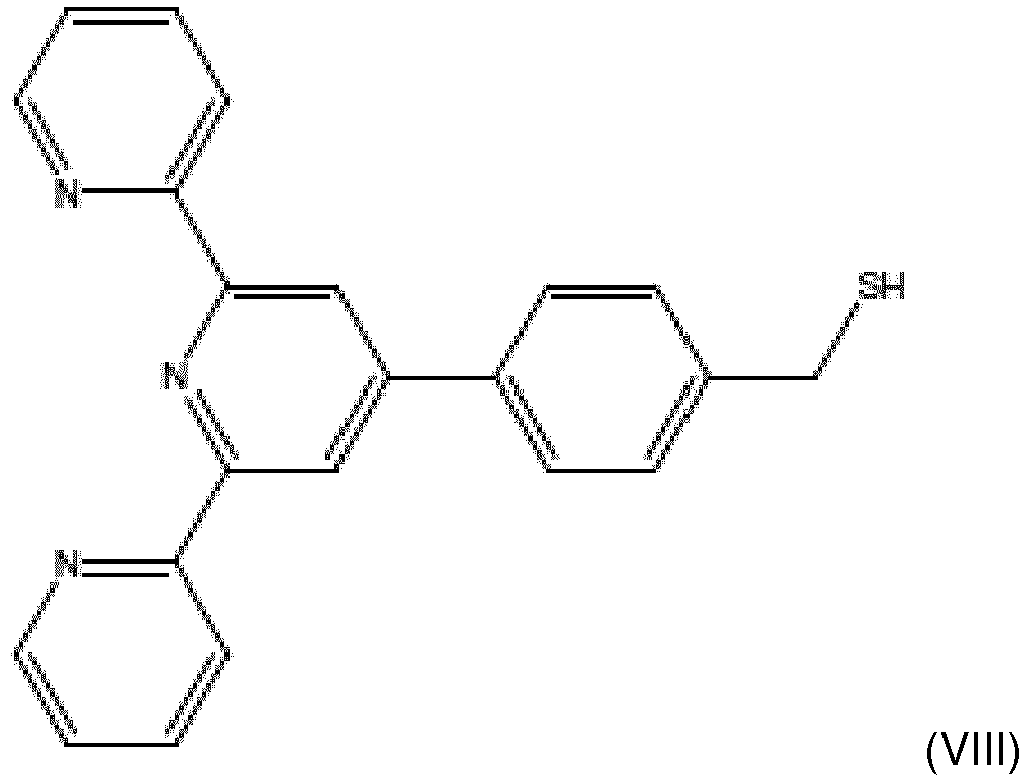
- The terpyridine of formula VIII was obtained following a synthesis route as shown in
Figure 13 . - IX. J. Zhang, D. Li, X. P. Zhou, New J. Chem. 2006, 30, 706.]
4.6 g (0.115 mol) NaOH was mixed with 6.4 g (0.05 mol) p-tolylaldehyde and 12.8 g (0.10 mol) 2-acetylpyridine in a mortar, until a yellow powder was produced. The powder was transferred to a flask which contained 35 g ammonia acetate (excess) and 90 ml acetic acid (100%). The mixture was heated under reflux for three hours. Afterwards 50 ml ethanol and 68 ml water were added. Upon cooling the red solution the product crystallized. It was recrystallized from ethanol twice.
Yield: 65 % light yellow crystals
1H-NMR (CDCl3 / 300 MHz): [ppm]: 2.41 (s, 3H); 7.29-7.37 (m, 4H); 7.81 (d, 2H); 7,87 (td, 2H); 8.66 (d, 2H); 8.71-8,73 (m, 4H) - 7.07 g 4'-methylphenyl-2,2':6,2"-terpyridine, 0.28 g AIBN and 4.67 g N-Bromsuccinimide were dissolved in 70 ml benzene and heated under refux for 6 hours. The resulting suspension was filtered hot to remove the succinimide. The solvent of the filtrate was evaporated and the resulting solid was recrystallized from ethanol/aceton 2:1. Yield: 60 % dark yellow crystals
1H-NMR (CDCl3 / 300 MHz): [ppm]: 4.55 (s, 2H); 7.33-7.38 (m, 2H); 7.52 (d, 2H); 7,85-7.92 (m, 4H); 8.66 (td, 2H); 8.71-8,73 (m, 4H) - This step was carried out according to the literature procedure [G. C. Zhou, Harruna, II, Macromolecules 2005, 38, 4114 ].
Yield: 75 % - This step was carried out according to the literature procedure [G. C. Zhou, Harruna, II, Macromolecules 2005, 38, 4114 ].
Yield: 95 %
1H-NMR (CDCl3 / 300 MHz): [ppm]: 3.69 (s, 2H); 7.28-7.38 (m, 4H); 7.81-7.88 (m, 4H); 8.61-8.70 (m, 6H) - The styrene butadiene rubber of Example 1 was functionalized with 4: 4'-(4-mercaptomethylphenyl)-2,2':6,2"-terpyridine following the procedures of Example 1 for 2-mercaptonaphthalene.
-
Figure 14 shows the 1H-NMR of the rubber functionalized with the terpyridine ligand (2), and the terpyridine (1). As seen inFigure 14 , a small amount of the ligand has reacted with the vinylgroups of the elastomer. Very small signals in the aromatic region of the functionalized rubber spectrum (2) between 8 and 9 ppm belonging to the hydrogen of the ligand can be observed, indicating a successful functionalization. - In this example, the effect of adding a iron salt to a functionalized elastomer is illustrated. A rubber cement was prepared by adding 0,4 g of the functionalized elastomer of Example 4 to 4 ml of THF in a small vial. The rubber cement was combined with 0,02 g of FeSO4 ■ 7H2O and the vial was shaken for 7 hours. Visual inspection of the rubber cement/metal salt mixture showed a purple color, as compared with the colorless rubber cement.
- UV-vis spectra for the rubber cement/metal salt and rubber cement are shown in
Figure 15 . As seen inFigure 15 , the rubber cement/metal salt spectrum (2) shows an absorbance peak at about 571 nm, indicating the formation of a coordination complex between the terpyridine moieties of the functionalized elastomer and the Fe2+ ion. The rubber cement spectrum (1) shows no such peak. - In this example, the effect of adding a ruthenium salt to a functionalized elastomer is illustrated. A rubber cement was prepared by adding 0.03 g of the functionalized elastomer of Example 4 to 5ml THF and 0,25 ml MeOH in a small vial. The rubber cement was combined with 0.02 g of RuCl3 and the vial was heated up to 65 °C for 20 hours and shaken. Visual inspection of the rubber cement/metal salt mixture showed a dark red color, as compared with the colorless rubber cement.
- UV-vis spectra for the rubber cement/metal salt and rubber cement are shown in
Figure 16 . As seen inFigure 16 , the rubber cement/metal salt spectrum (2) shows an absorbance peak at about 490 nm, indicating the formation of a coordination complex between the terpyridine moieties of the functionalized elastomer and the Ru2+ ion. The rubber cement spectrum (1) shows no such peak.
Claims (15)
- A functionalized elastomer comprising:a polymeric backbone chain derived from a monomer comprising at least one conjugated diene monomer and optionally at least one vinyl aromatic monomer; anda functional group bonded to the backbone chain, the functional group comprising a multidentate ligand capable of complexing with a metal ion.
- A functionalized diene-based elastomer of formula I

- The functionalized diene-based elastomer of claim 2, wherein Z comprises a ligand selected from the group consisting of a substituted bipyridinyl groups, unsubstituted bipyridinyl groups, substituted terpyridinyl groups, unsubstituted terpyridinyl groups, substituted phenanthrolinyl groups, unsubstituted phenanthrolinyl groups, substituted pyrazinyl groups, and unsubstituted pyrazinyl groups.
- The functionalized diene-based elastomer of claim 2, wherein Z comprises a ligand of formula II, III or IV


- The functionalized diene-based elastomer of claim 2, where Y is divalent sulfur; and/or wherein X is selected from the group consisting of styrene-butadiene rubbers, polybutadiene rubbers, and polyisoprene rubbers.
- The functionalized diene-based elastomer of claim 2, wherein Z comprises a ligand selected from the group consisting of substituted 2,2';6'2"-terpyridinyl groups, unsubstituted 2,2';6'2"-terpyridinyl groups, substituted 2,2'-bipyridinyl groups, and unsubstituted 2,2'-bipyridinyl groups.
- The functionalized diene-based elastomer of claim 2, wherein ⁅-Y-Z] group is selected from the group consisting of 6-(2,2';6',2"-terpyridin-4'-ylsulfanyl)hexyl-1-sulfanyl, 2,2';6',2"-terpyridin-4'-ylsulfanyl, and 4-(2,2';6',2"-terpyridin-4'-yl)phenylmethylsulfanyl.
- The functionalized diene-based elastomer of claim 2, wherein n ranges from 2 to 30.
- A rubber composition comprising the functionalized elastomer of at least one of the previous claims and a metal ion.
- The rubber composition of claim 9, wherein the metal ion comprises or is provided in the form of or by:(i) a metal salt; or(ii) a metal nanoparticle; or(iii) a metalated filler selected from the group consisting of a metalated carbon black and a metalated silica; or(iv) a metalated short fiber; or(v) an encapsulated metal ion.
- The rubber composition of claim 10 wherein the encapsulated metal ion comprises or is provided in the form of or by a metal salt encapsulated by a coating material, prefereably by a coating material selected from the group consisting of waxes, resins, carbon pitches, thermoplastic elastomers, and thermoplastics.
- The rubber composition of claim 9, 10 or 11, wherein(i) the metal ion comprises or is provided in the form of or by a metal salt selected from the group consisting of FeSO4 ■ 7H2O, FeCl2, NiCl2, RuCl3, cobalt stearate, and zinc stearate; or(ii) the metal ion comprises or is provided in the form of or by at least one member selected from the group consisting of metalated carbon black, metalated silica, copper disposed on the surface of a steel cord, metalated short fibers, and metal nanoparticles.
- A tire comprising the rubber composition in accordance with at least one of the previous claims 9 to 12.
- The tire of claim 13, wherein the metal ion comprises or is provided in the form of or by copper disposed on the surface of a steel tire cord, and wherein the rubber composition is in contact with the steel tire cord.
- The tire of claim 13 or 14 wherein the tire is a pneumatic runflat tire comprising a sidewall insert, the sidewall insert comprising the rubber composition in accordance with at least one of the previous claims 9 to 12.
Applications Claiming Priority (3)
| Application Number | Priority Date | Filing Date | Title |
|---|---|---|---|
| US13/332,989 US9163101B2 (en) | 2011-12-21 | 2011-12-21 | Rubber composition and pneumatic tire |
| US13/332,934 US8859687B2 (en) | 2011-12-21 | 2011-12-21 | Functiontionalized elastomer |
| US13/333,033 US9050856B2 (en) | 2011-12-21 | 2011-12-21 | Rubber composition and runflat tire |
Publications (2)
| Publication Number | Publication Date |
|---|---|
| EP2607381A1 true EP2607381A1 (en) | 2013-06-26 |
| EP2607381B1 EP2607381B1 (en) | 2018-01-24 |
Family
ID=47435773
Family Applications (1)
| Application Number | Title | Priority Date | Filing Date |
|---|---|---|---|
| EP12197565.0A Not-in-force EP2607381B1 (en) | 2011-12-21 | 2012-12-17 | Functionalized elastomer, rubber composition and tire |
Country Status (3)
| Country | Link |
|---|---|
| EP (1) | EP2607381B1 (en) |
| JP (1) | JP6207834B2 (en) |
| CN (1) | CN103172916B (en) |
Cited By (5)
| Publication number | Priority date | Publication date | Assignee | Title |
|---|---|---|---|---|
| EP2735587A3 (en) * | 2012-11-27 | 2015-01-07 | The Goodyear Tire & Rubber Company | Self-healing rubber composition and tire or article of manufacture |
| CN108136836A (en) * | 2015-11-13 | 2018-06-08 | 米其林集团总公司 | Composites Comprising Metal Parts and Functional Polymer Matrix |
| BE1025614B1 (en) * | 2017-09-13 | 2019-05-06 | China Petroleum & Chemical Corporation | Linear butadiene-styrene copolymer, production method and composition thereof, and aromatic vinyl resin and production method thereof |
| WO2022137099A1 (en) * | 2020-12-22 | 2022-06-30 | Pirelli Tyre S.P.A. | Compositions for elastomeric compounds and tyres for vehicles comprising reversible cross-linking agent |
| US12460111B2 (en) | 2018-05-29 | 2025-11-04 | Kuraray Co., Ltd. | Reinforcing fibers and production method therefor, and molded article using same |
Families Citing this family (7)
| Publication number | Priority date | Publication date | Assignee | Title |
|---|---|---|---|---|
| JP6187443B2 (en) * | 2014-12-11 | 2017-08-30 | 横浜ゴム株式会社 | Pneumatic tire |
| WO2016024606A1 (en) * | 2014-08-12 | 2016-02-18 | 横浜ゴム株式会社 | Rubber composition for tires and pneumatic tire |
| JP6307385B2 (en) * | 2014-08-12 | 2018-04-04 | 横浜ゴム株式会社 | Pneumatic tire |
| EP3042786B1 (en) | 2014-12-19 | 2017-11-22 | The Goodyear Tire & Rubber Company | Functionalized elastomer |
| DE102016207744A1 (en) * | 2016-05-04 | 2017-11-09 | Continental Reifen Deutschland Gmbh | Rubber mixture, vulcanizate of the rubber mixture and vehicle tires |
| CN116034038B (en) * | 2020-09-04 | 2025-08-08 | 株式会社普利司通 | Complex polymer, rubber composition, method for producing rubber composition, and rubber product |
| DE102021120597B3 (en) | 2021-08-09 | 2022-12-22 | Audi Aktiengesellschaft | Device for reducing fine dust pollution by collecting the tire abrasion particles produced when a motor vehicle tire rolls off |
Citations (19)
| Publication number | Priority date | Publication date | Assignee | Title |
|---|---|---|---|---|
| FR2416908A1 (en) * | 1978-02-08 | 1979-09-07 | Rhone Poulenc Ind | Polymers useful as lubricant additives - prepd. from anionic diene! polymers by reaction with nitrogen cpd. and hydrogenation |
| US4229308A (en) * | 1978-02-08 | 1980-10-21 | Rhone-Poulenc Industries | Polymer lubricating oil additives bearing nitrogen groups and their use as additives for lubricating oils |
| EP0316255A2 (en) * | 1987-10-15 | 1989-05-17 | The Goodyear Tire & Rubber Company | Capping polydienes |
| US5395891A (en) | 1992-06-24 | 1995-03-07 | Bayer Aktiengesellschaft | Rubber mixtures containing polybutadiene gel |
| US5672639A (en) | 1996-03-12 | 1997-09-30 | The Goodyear Tire & Rubber Company | Starch composite reinforced rubber composition and tire with at least one component thereof |
| US6017980A (en) | 1997-03-27 | 2000-01-25 | Cabot Corporation | Elastomeric compounds incorporating metal-treated carbon blacks |
| US6127488A (en) | 1997-01-17 | 2000-10-03 | Bayer Ag | Rubber mixtures which contain SBR rubber gels |
| US6133364A (en) | 1998-08-01 | 2000-10-17 | Continental Aktiengesellschaft | Rubber composition, method of formulating the composition and vehicle tire made from the composition |
| US6207757B1 (en) | 1998-08-01 | 2001-03-27 | Continental Aktiengesellschaft | Rubber composition, method of adding and blending the composition and vehicle tire made from the composition |
| US6242534B1 (en) | 1998-08-01 | 2001-06-05 | Continental Aktiengesellschaft | Rubber composition, method of formulating and blending the same and article and tires made therefrom |
| US6365668B1 (en) | 1998-11-16 | 2002-04-02 | Bayer Aktiengesellschaft | Rubber compounds containing solution rubbers which contain carboxyl groups |
| US6372857B1 (en) | 1999-09-07 | 2002-04-16 | Bayer Aktiengesellschaft | Microgel-containing rubber mixtures with masked bi-functional mercaptans and vulcanization products produced therefrom |
| US20030130535A1 (en) | 2001-08-06 | 2003-07-10 | Degussa Ag, | Organosilicon compounds |
| US6608125B2 (en) | 1997-08-21 | 2003-08-19 | Crompton Corporation | Blocked mercaptosilane coupling agents for filled rubbers |
| US20040063884A1 (en) * | 2002-08-16 | 2004-04-01 | Halasa Adel Farhan | Functionalized monomers for synthesis of rubbery polymers |
| US20040116635A1 (en) * | 2002-08-16 | 2004-06-17 | Halasa Adel Farhan | Functionalized monomers for synthesis of rubbery polymers |
| US7847019B2 (en) | 2007-10-15 | 2010-12-07 | California Institute Of Technology | Functionalized polymers using protected thiols |
| US20100319827A1 (en) | 2009-06-19 | 2010-12-23 | Serge Julien Auguste Imhoff | Tire with metallized organic short fibers |
| US7943693B2 (en) | 2007-05-31 | 2011-05-17 | The Goodyear Tire & Rubber Company | Elastomers containing surface metalated siliceous fillers |
Family Cites Families (3)
| Publication number | Priority date | Publication date | Assignee | Title |
|---|---|---|---|---|
| US4937290A (en) * | 1988-09-26 | 1990-06-26 | The Goodyear Tire & Rubber Company | Nylon modified rubber composition wherein either nylon or rubber or both are reacted with a thio acid |
| US8324329B2 (en) * | 2007-08-07 | 2012-12-04 | Bridgestone Corporation | Process for producing functionalized polymers |
| JP5707049B2 (en) * | 2010-04-08 | 2015-04-22 | 株式会社ブリヂストン | Pneumatic tire |
-
2012
- 2012-12-17 EP EP12197565.0A patent/EP2607381B1/en not_active Not-in-force
- 2012-12-19 JP JP2012277191A patent/JP6207834B2/en not_active Expired - Fee Related
- 2012-12-21 CN CN201210561475.9A patent/CN103172916B/en not_active Expired - Fee Related
Patent Citations (20)
| Publication number | Priority date | Publication date | Assignee | Title |
|---|---|---|---|---|
| FR2416908A1 (en) * | 1978-02-08 | 1979-09-07 | Rhone Poulenc Ind | Polymers useful as lubricant additives - prepd. from anionic diene! polymers by reaction with nitrogen cpd. and hydrogenation |
| US4229308A (en) * | 1978-02-08 | 1980-10-21 | Rhone-Poulenc Industries | Polymer lubricating oil additives bearing nitrogen groups and their use as additives for lubricating oils |
| EP0316255A2 (en) * | 1987-10-15 | 1989-05-17 | The Goodyear Tire & Rubber Company | Capping polydienes |
| US4935471A (en) | 1987-10-15 | 1990-06-19 | The Goodyear Tire & Rubber Company | Capped polydienes |
| US5395891A (en) | 1992-06-24 | 1995-03-07 | Bayer Aktiengesellschaft | Rubber mixtures containing polybutadiene gel |
| US5672639A (en) | 1996-03-12 | 1997-09-30 | The Goodyear Tire & Rubber Company | Starch composite reinforced rubber composition and tire with at least one component thereof |
| US6127488A (en) | 1997-01-17 | 2000-10-03 | Bayer Ag | Rubber mixtures which contain SBR rubber gels |
| US6017980A (en) | 1997-03-27 | 2000-01-25 | Cabot Corporation | Elastomeric compounds incorporating metal-treated carbon blacks |
| US6608125B2 (en) | 1997-08-21 | 2003-08-19 | Crompton Corporation | Blocked mercaptosilane coupling agents for filled rubbers |
| US6242534B1 (en) | 1998-08-01 | 2001-06-05 | Continental Aktiengesellschaft | Rubber composition, method of formulating and blending the same and article and tires made therefrom |
| US6207757B1 (en) | 1998-08-01 | 2001-03-27 | Continental Aktiengesellschaft | Rubber composition, method of adding and blending the composition and vehicle tire made from the composition |
| US6133364A (en) | 1998-08-01 | 2000-10-17 | Continental Aktiengesellschaft | Rubber composition, method of formulating the composition and vehicle tire made from the composition |
| US6365668B1 (en) | 1998-11-16 | 2002-04-02 | Bayer Aktiengesellschaft | Rubber compounds containing solution rubbers which contain carboxyl groups |
| US6372857B1 (en) | 1999-09-07 | 2002-04-16 | Bayer Aktiengesellschaft | Microgel-containing rubber mixtures with masked bi-functional mercaptans and vulcanization products produced therefrom |
| US20030130535A1 (en) | 2001-08-06 | 2003-07-10 | Degussa Ag, | Organosilicon compounds |
| US20040063884A1 (en) * | 2002-08-16 | 2004-04-01 | Halasa Adel Farhan | Functionalized monomers for synthesis of rubbery polymers |
| US20040116635A1 (en) * | 2002-08-16 | 2004-06-17 | Halasa Adel Farhan | Functionalized monomers for synthesis of rubbery polymers |
| US7943693B2 (en) | 2007-05-31 | 2011-05-17 | The Goodyear Tire & Rubber Company | Elastomers containing surface metalated siliceous fillers |
| US7847019B2 (en) | 2007-10-15 | 2010-12-07 | California Institute Of Technology | Functionalized polymers using protected thiols |
| US20100319827A1 (en) | 2009-06-19 | 2010-12-23 | Serge Julien Auguste Imhoff | Tire with metallized organic short fibers |
Non-Patent Citations (7)
| Title |
|---|
| "Standard Methods for Analysis & Testing of Petroleum and Related Products and British Standard 2000 Parts", 2003, INSTITUTE OF PETROLEUM |
| "The Vanderbilt Rubber Handbook", 1978, pages: 344 - 346 |
| G. C. ZHOU; HARRUNA, II, MACROMOLECULES, vol. 38, 2005, pages 4114 |
| IX. J. ZHANG; D. LI; X. P. ZHOU, NEW J. CHEM., vol. 30, 2006, pages 706 |
| MACROMOLECULES, vol. 41, 2008, pages 9946 - 9947 |
| U. S. SCHUBERT; C. ESCHBAUMER; O. HIEN; P. R. ANDRES, TETRAHEDRON LETT., vol. 42, 2001, pages 4705 |
| U. S. SCHUBERT; S. SCHMATLOCH; A. A. PRECUP, DESIGNED MONOMERS AND POLYMERS, vol. 5, 2002, pages 211 |
Cited By (6)
| Publication number | Priority date | Publication date | Assignee | Title |
|---|---|---|---|---|
| EP2735587A3 (en) * | 2012-11-27 | 2015-01-07 | The Goodyear Tire & Rubber Company | Self-healing rubber composition and tire or article of manufacture |
| US8962730B2 (en) | 2012-11-27 | 2015-02-24 | The Goodyear Tire & Rubber Company | Self-healing rubber composition and tire |
| CN108136836A (en) * | 2015-11-13 | 2018-06-08 | 米其林集团总公司 | Composites Comprising Metal Parts and Functional Polymer Matrix |
| BE1025614B1 (en) * | 2017-09-13 | 2019-05-06 | China Petroleum & Chemical Corporation | Linear butadiene-styrene copolymer, production method and composition thereof, and aromatic vinyl resin and production method thereof |
| US12460111B2 (en) | 2018-05-29 | 2025-11-04 | Kuraray Co., Ltd. | Reinforcing fibers and production method therefor, and molded article using same |
| WO2022137099A1 (en) * | 2020-12-22 | 2022-06-30 | Pirelli Tyre S.P.A. | Compositions for elastomeric compounds and tyres for vehicles comprising reversible cross-linking agent |
Also Published As
| Publication number | Publication date |
|---|---|
| JP6207834B2 (en) | 2017-10-04 |
| CN103172916B (en) | 2015-05-27 |
| JP2013136747A (en) | 2013-07-11 |
| EP2607381B1 (en) | 2018-01-24 |
| CN103172916A (en) | 2013-06-26 |
Similar Documents
| Publication | Publication Date | Title |
|---|---|---|
| EP2607381B1 (en) | Functionalized elastomer, rubber composition and tire | |
| EP2735587B1 (en) | Self-healing rubber composition and tire or article of manufacture | |
| US9994663B2 (en) | Functionalized elastomer containing a sulfur group | |
| EP2194090A1 (en) | Rubber composition and pneumatic tire with low zinc content | |
| EP2639245A1 (en) | Rubber composition and pneumatic tire | |
| US9580532B1 (en) | Functionalized elastomer via allylboration | |
| US9243135B2 (en) | Rubber composition and runflat tire | |
| US9416211B2 (en) | Rubber composition and pneumatic tire | |
| EP3181593B1 (en) | Functionalized elastomer containing a nitrogen group | |
| EP3181592B1 (en) | Functionalized elastomer containing a sulfur group | |
| US11440878B2 (en) | Functional disulfide vegetable oils, method of making and use in rubber compositions and tires | |
| US10081694B2 (en) | Functionalized elastomer containing a boron group | |
| EP3246177A1 (en) | Rubber composition and pneumatic tire with amine compound | |
| EP3181603B1 (en) | Functionalized elastomer containing boron group |
Legal Events
| Date | Code | Title | Description |
|---|---|---|---|
| AK | Designated contracting states |
Kind code of ref document: A1 Designated state(s): AL AT BE BG CH CY CZ DE DK EE ES FI FR GB GR HR HU IE IS IT LI LT LU LV MC MK MT NL NO PL PT RO RS SE SI SK SM TR |
|
| AX | Request for extension of the european patent |
Extension state: BA ME |
|
| PUAI | Public reference made under article 153(3) epc to a published international application that has entered the european phase |
Free format text: ORIGINAL CODE: 0009012 |
|
| 17P | Request for examination filed |
Effective date: 20140102 |
|
| RBV | Designated contracting states (corrected) |
Designated state(s): AL AT BE BG CH CY CZ DE DK EE ES FI FR GB GR HR HU IE IS IT LI LT LU LV MC MK MT NL NO PL PT RO RS SE SI SK SM TR |
|
| 17Q | First examination report despatched |
Effective date: 20170310 |
|
| GRAP | Despatch of communication of intention to grant a patent |
Free format text: ORIGINAL CODE: EPIDOSNIGR1 |
|
| INTG | Intention to grant announced |
Effective date: 20170814 |
|
| GRAS | Grant fee paid |
Free format text: ORIGINAL CODE: EPIDOSNIGR3 |
|
| GRAA | (expected) grant |
Free format text: ORIGINAL CODE: 0009210 |
|
| AK | Designated contracting states |
Kind code of ref document: B1 Designated state(s): AL AT BE BG CH CY CZ DE DK EE ES FI FR GB GR HR HU IE IS IT LI LT LU LV MC MK MT NL NO PL PT RO RS SE SI SK SM TR |
|
| REG | Reference to a national code |
Ref country code: GB Ref legal event code: FG4D |
|
| REG | Reference to a national code |
Ref country code: CH Ref legal event code: EP |
|
| REG | Reference to a national code |
Ref country code: AT Ref legal event code: REF Ref document number: 965719 Country of ref document: AT Kind code of ref document: T Effective date: 20180215 |
|
| REG | Reference to a national code |
Ref country code: IE Ref legal event code: FG4D |
|
| REG | Reference to a national code |
Ref country code: DE Ref legal event code: R096 Ref document number: 602012042286 Country of ref document: DE |
|
| REG | Reference to a national code |
Ref country code: NL Ref legal event code: MP Effective date: 20180124 |
|
| REG | Reference to a national code |
Ref country code: LT Ref legal event code: MG4D |
|
| REG | Reference to a national code |
Ref country code: AT Ref legal event code: MK05 Ref document number: 965719 Country of ref document: AT Kind code of ref document: T Effective date: 20180124 |
|
| PG25 | Lapsed in a contracting state [announced via postgrant information from national office to epo] |
Ref country code: NL Free format text: LAPSE BECAUSE OF FAILURE TO SUBMIT A TRANSLATION OF THE DESCRIPTION OR TO PAY THE FEE WITHIN THE PRESCRIBED TIME-LIMIT Effective date: 20180124 |
|
| PG25 | Lapsed in a contracting state [announced via postgrant information from national office to epo] |
Ref country code: LT Free format text: LAPSE BECAUSE OF FAILURE TO SUBMIT A TRANSLATION OF THE DESCRIPTION OR TO PAY THE FEE WITHIN THE PRESCRIBED TIME-LIMIT Effective date: 20180124 Ref country code: ES Free format text: LAPSE BECAUSE OF FAILURE TO SUBMIT A TRANSLATION OF THE DESCRIPTION OR TO PAY THE FEE WITHIN THE PRESCRIBED TIME-LIMIT Effective date: 20180124 Ref country code: CY Free format text: LAPSE BECAUSE OF FAILURE TO SUBMIT A TRANSLATION OF THE DESCRIPTION OR TO PAY THE FEE WITHIN THE PRESCRIBED TIME-LIMIT Effective date: 20180124 Ref country code: FI Free format text: LAPSE BECAUSE OF FAILURE TO SUBMIT A TRANSLATION OF THE DESCRIPTION OR TO PAY THE FEE WITHIN THE PRESCRIBED TIME-LIMIT Effective date: 20180124 Ref country code: NO Free format text: LAPSE BECAUSE OF FAILURE TO SUBMIT A TRANSLATION OF THE DESCRIPTION OR TO PAY THE FEE WITHIN THE PRESCRIBED TIME-LIMIT Effective date: 20180424 Ref country code: HR Free format text: LAPSE BECAUSE OF FAILURE TO SUBMIT A TRANSLATION OF THE DESCRIPTION OR TO PAY THE FEE WITHIN THE PRESCRIBED TIME-LIMIT Effective date: 20180124 |
|
| PG25 | Lapsed in a contracting state [announced via postgrant information from national office to epo] |
Ref country code: LV Free format text: LAPSE BECAUSE OF FAILURE TO SUBMIT A TRANSLATION OF THE DESCRIPTION OR TO PAY THE FEE WITHIN THE PRESCRIBED TIME-LIMIT Effective date: 20180124 Ref country code: SE Free format text: LAPSE BECAUSE OF FAILURE TO SUBMIT A TRANSLATION OF THE DESCRIPTION OR TO PAY THE FEE WITHIN THE PRESCRIBED TIME-LIMIT Effective date: 20180124 Ref country code: RS Free format text: LAPSE BECAUSE OF FAILURE TO SUBMIT A TRANSLATION OF THE DESCRIPTION OR TO PAY THE FEE WITHIN THE PRESCRIBED TIME-LIMIT Effective date: 20180124 Ref country code: AT Free format text: LAPSE BECAUSE OF FAILURE TO SUBMIT A TRANSLATION OF THE DESCRIPTION OR TO PAY THE FEE WITHIN THE PRESCRIBED TIME-LIMIT Effective date: 20180124 Ref country code: BG Free format text: LAPSE BECAUSE OF FAILURE TO SUBMIT A TRANSLATION OF THE DESCRIPTION OR TO PAY THE FEE WITHIN THE PRESCRIBED TIME-LIMIT Effective date: 20180424 Ref country code: IS Free format text: LAPSE BECAUSE OF FAILURE TO SUBMIT A TRANSLATION OF THE DESCRIPTION OR TO PAY THE FEE WITHIN THE PRESCRIBED TIME-LIMIT Effective date: 20180524 Ref country code: PL Free format text: LAPSE BECAUSE OF FAILURE TO SUBMIT A TRANSLATION OF THE DESCRIPTION OR TO PAY THE FEE WITHIN THE PRESCRIBED TIME-LIMIT Effective date: 20180124 Ref country code: GR Free format text: LAPSE BECAUSE OF FAILURE TO SUBMIT A TRANSLATION OF THE DESCRIPTION OR TO PAY THE FEE WITHIN THE PRESCRIBED TIME-LIMIT Effective date: 20180425 |
|
| REG | Reference to a national code |
Ref country code: DE Ref legal event code: R097 Ref document number: 602012042286 Country of ref document: DE |
|
| PG25 | Lapsed in a contracting state [announced via postgrant information from national office to epo] |
Ref country code: AL Free format text: LAPSE BECAUSE OF FAILURE TO SUBMIT A TRANSLATION OF THE DESCRIPTION OR TO PAY THE FEE WITHIN THE PRESCRIBED TIME-LIMIT Effective date: 20180124 Ref country code: RO Free format text: LAPSE BECAUSE OF FAILURE TO SUBMIT A TRANSLATION OF THE DESCRIPTION OR TO PAY THE FEE WITHIN THE PRESCRIBED TIME-LIMIT Effective date: 20180124 Ref country code: EE Free format text: LAPSE BECAUSE OF FAILURE TO SUBMIT A TRANSLATION OF THE DESCRIPTION OR TO PAY THE FEE WITHIN THE PRESCRIBED TIME-LIMIT Effective date: 20180124 |
|
| PG25 | Lapsed in a contracting state [announced via postgrant information from national office to epo] |
Ref country code: SM Free format text: LAPSE BECAUSE OF FAILURE TO SUBMIT A TRANSLATION OF THE DESCRIPTION OR TO PAY THE FEE WITHIN THE PRESCRIBED TIME-LIMIT Effective date: 20180124 Ref country code: SK Free format text: LAPSE BECAUSE OF FAILURE TO SUBMIT A TRANSLATION OF THE DESCRIPTION OR TO PAY THE FEE WITHIN THE PRESCRIBED TIME-LIMIT Effective date: 20180124 Ref country code: DK Free format text: LAPSE BECAUSE OF FAILURE TO SUBMIT A TRANSLATION OF THE DESCRIPTION OR TO PAY THE FEE WITHIN THE PRESCRIBED TIME-LIMIT Effective date: 20180124 Ref country code: CZ Free format text: LAPSE BECAUSE OF FAILURE TO SUBMIT A TRANSLATION OF THE DESCRIPTION OR TO PAY THE FEE WITHIN THE PRESCRIBED TIME-LIMIT Effective date: 20180124 |
|
| PLBE | No opposition filed within time limit |
Free format text: ORIGINAL CODE: 0009261 |
|
| STAA | Information on the status of an ep patent application or granted ep patent |
Free format text: STATUS: NO OPPOSITION FILED WITHIN TIME LIMIT |
|
| 26N | No opposition filed |
Effective date: 20181025 |
|
| PG25 | Lapsed in a contracting state [announced via postgrant information from national office to epo] |
Ref country code: SI Free format text: LAPSE BECAUSE OF FAILURE TO SUBMIT A TRANSLATION OF THE DESCRIPTION OR TO PAY THE FEE WITHIN THE PRESCRIBED TIME-LIMIT Effective date: 20180124 |
|
| REG | Reference to a national code |
Ref country code: DE Ref legal event code: R119 Ref document number: 602012042286 Country of ref document: DE |
|
| REG | Reference to a national code |
Ref country code: CH Ref legal event code: PL |
|
| GBPC | Gb: european patent ceased through non-payment of renewal fee |
Effective date: 20181217 |
|
| PG25 | Lapsed in a contracting state [announced via postgrant information from national office to epo] |
Ref country code: LU Free format text: LAPSE BECAUSE OF NON-PAYMENT OF DUE FEES Effective date: 20181217 Ref country code: MC Free format text: LAPSE BECAUSE OF FAILURE TO SUBMIT A TRANSLATION OF THE DESCRIPTION OR TO PAY THE FEE WITHIN THE PRESCRIBED TIME-LIMIT Effective date: 20180124 |
|
| REG | Reference to a national code |
Ref country code: IE Ref legal event code: MM4A |
|
| REG | Reference to a national code |
Ref country code: BE Ref legal event code: MM Effective date: 20181231 |
|
| PG25 | Lapsed in a contracting state [announced via postgrant information from national office to epo] |
Ref country code: FR Free format text: LAPSE BECAUSE OF NON-PAYMENT OF DUE FEES Effective date: 20181231 Ref country code: DE Free format text: LAPSE BECAUSE OF NON-PAYMENT OF DUE FEES Effective date: 20190702 Ref country code: IT Free format text: LAPSE BECAUSE OF NON-PAYMENT OF DUE FEES Effective date: 20181217 Ref country code: IE Free format text: LAPSE BECAUSE OF NON-PAYMENT OF DUE FEES Effective date: 20181217 |
|
| PG25 | Lapsed in a contracting state [announced via postgrant information from national office to epo] |
Ref country code: BE Free format text: LAPSE BECAUSE OF NON-PAYMENT OF DUE FEES Effective date: 20181231 |
|
| PG25 | Lapsed in a contracting state [announced via postgrant information from national office to epo] |
Ref country code: GB Free format text: LAPSE BECAUSE OF NON-PAYMENT OF DUE FEES Effective date: 20181217 Ref country code: LI Free format text: LAPSE BECAUSE OF NON-PAYMENT OF DUE FEES Effective date: 20181231 Ref country code: CH Free format text: LAPSE BECAUSE OF NON-PAYMENT OF DUE FEES Effective date: 20181231 |
|
| PG25 | Lapsed in a contracting state [announced via postgrant information from national office to epo] |
Ref country code: MT Free format text: LAPSE BECAUSE OF NON-PAYMENT OF DUE FEES Effective date: 20181217 |
|
| PG25 | Lapsed in a contracting state [announced via postgrant information from national office to epo] |
Ref country code: TR Free format text: LAPSE BECAUSE OF FAILURE TO SUBMIT A TRANSLATION OF THE DESCRIPTION OR TO PAY THE FEE WITHIN THE PRESCRIBED TIME-LIMIT Effective date: 20180124 |
|
| PG25 | Lapsed in a contracting state [announced via postgrant information from national office to epo] |
Ref country code: PT Free format text: LAPSE BECAUSE OF FAILURE TO SUBMIT A TRANSLATION OF THE DESCRIPTION OR TO PAY THE FEE WITHIN THE PRESCRIBED TIME-LIMIT Effective date: 20180124 |
|
| PG25 | Lapsed in a contracting state [announced via postgrant information from national office to epo] |
Ref country code: MK Free format text: LAPSE BECAUSE OF NON-PAYMENT OF DUE FEES Effective date: 20180124 Ref country code: HU Free format text: LAPSE BECAUSE OF FAILURE TO SUBMIT A TRANSLATION OF THE DESCRIPTION OR TO PAY THE FEE WITHIN THE PRESCRIBED TIME-LIMIT; INVALID AB INITIO Effective date: 20121217 |