EP2605315A1 - Negative electrode active material and Secondary battery including the same - Google Patents
Negative electrode active material and Secondary battery including the same Download PDFInfo
- Publication number
- EP2605315A1 EP2605315A1 EP12162303.7A EP12162303A EP2605315A1 EP 2605315 A1 EP2605315 A1 EP 2605315A1 EP 12162303 A EP12162303 A EP 12162303A EP 2605315 A1 EP2605315 A1 EP 2605315A1
- Authority
- EP
- European Patent Office
- Prior art keywords
- negative electrode
- active material
- electrode active
- metal
- metal alloy
- Prior art date
- Legal status (The legal status is an assumption and is not a legal conclusion. Google has not performed a legal analysis and makes no representation as to the accuracy of the status listed.)
- Granted
Links
Images





Classifications
-
- H—ELECTRICITY
- H01—ELECTRIC ELEMENTS
- H01M—PROCESSES OR MEANS, e.g. BATTERIES, FOR THE DIRECT CONVERSION OF CHEMICAL ENERGY INTO ELECTRICAL ENERGY
- H01M4/00—Electrodes
- H01M4/02—Electrodes composed of, or comprising, active material
- H01M4/36—Selection of substances as active materials, active masses, active liquids
- H01M4/38—Selection of substances as active materials, active masses, active liquids of elements or alloys
- H01M4/386—Silicon or alloys based on silicon
-
- C—CHEMISTRY; METALLURGY
- C22—METALLURGY; FERROUS OR NON-FERROUS ALLOYS; TREATMENT OF ALLOYS OR NON-FERROUS METALS
- C22C—ALLOYS
- C22C28/00—Alloys based on a metal not provided for in groups C22C5/00 - C22C27/00
-
- C—CHEMISTRY; METALLURGY
- C22—METALLURGY; FERROUS OR NON-FERROUS ALLOYS; TREATMENT OF ALLOYS OR NON-FERROUS METALS
- C22C—ALLOYS
- C22C30/00—Alloys containing less than 50% by weight of each constituent
-
- H—ELECTRICITY
- H01—ELECTRIC ELEMENTS
- H01M—PROCESSES OR MEANS, e.g. BATTERIES, FOR THE DIRECT CONVERSION OF CHEMICAL ENERGY INTO ELECTRICAL ENERGY
- H01M4/00—Electrodes
- H01M4/02—Electrodes composed of, or comprising, active material
- H01M4/36—Selection of substances as active materials, active masses, active liquids
- H01M4/38—Selection of substances as active materials, active masses, active liquids of elements or alloys
-
- H—ELECTRICITY
- H01—ELECTRIC ELEMENTS
- H01M—PROCESSES OR MEANS, e.g. BATTERIES, FOR THE DIRECT CONVERSION OF CHEMICAL ENERGY INTO ELECTRICAL ENERGY
- H01M10/00—Secondary cells; Manufacture thereof
- H01M10/05—Accumulators with non-aqueous electrolyte
- H01M10/052—Li-accumulators
- H01M10/0525—Rocking-chair batteries, i.e. batteries with lithium insertion or intercalation in both electrodes; Lithium-ion batteries
-
- H—ELECTRICITY
- H01—ELECTRIC ELEMENTS
- H01M—PROCESSES OR MEANS, e.g. BATTERIES, FOR THE DIRECT CONVERSION OF CHEMICAL ENERGY INTO ELECTRICAL ENERGY
- H01M4/00—Electrodes
- H01M4/02—Electrodes composed of, or comprising, active material
- H01M4/13—Electrodes for accumulators with non-aqueous electrolyte, e.g. for lithium-accumulators; Processes of manufacture thereof
- H01M4/134—Electrodes based on metals, Si or alloys
-
- H—ELECTRICITY
- H01—ELECTRIC ELEMENTS
- H01M—PROCESSES OR MEANS, e.g. BATTERIES, FOR THE DIRECT CONVERSION OF CHEMICAL ENERGY INTO ELECTRICAL ENERGY
- H01M4/00—Electrodes
- H01M4/02—Electrodes composed of, or comprising, active material
- H01M4/13—Electrodes for accumulators with non-aqueous electrolyte, e.g. for lithium-accumulators; Processes of manufacture thereof
- H01M4/139—Processes of manufacture
- H01M4/1395—Processes of manufacture of electrodes based on metals, Si or alloys
-
- Y—GENERAL TAGGING OF NEW TECHNOLOGICAL DEVELOPMENTS; GENERAL TAGGING OF CROSS-SECTIONAL TECHNOLOGIES SPANNING OVER SEVERAL SECTIONS OF THE IPC; TECHNICAL SUBJECTS COVERED BY FORMER USPC CROSS-REFERENCE ART COLLECTIONS [XRACs] AND DIGESTS
- Y02—TECHNOLOGIES OR APPLICATIONS FOR MITIGATION OR ADAPTATION AGAINST CLIMATE CHANGE
- Y02E—REDUCTION OF GREENHOUSE GAS [GHG] EMISSIONS, RELATED TO ENERGY GENERATION, TRANSMISSION OR DISTRIBUTION
- Y02E60/00—Enabling technologies; Technologies with a potential or indirect contribution to GHG emissions mitigation
- Y02E60/10—Energy storage using batteries
-
- Y—GENERAL TAGGING OF NEW TECHNOLOGICAL DEVELOPMENTS; GENERAL TAGGING OF CROSS-SECTIONAL TECHNOLOGIES SPANNING OVER SEVERAL SECTIONS OF THE IPC; TECHNICAL SUBJECTS COVERED BY FORMER USPC CROSS-REFERENCE ART COLLECTIONS [XRACs] AND DIGESTS
- Y02—TECHNOLOGIES OR APPLICATIONS FOR MITIGATION OR ADAPTATION AGAINST CLIMATE CHANGE
- Y02P—CLIMATE CHANGE MITIGATION TECHNOLOGIES IN THE PRODUCTION OR PROCESSING OF GOODS
- Y02P70/00—Climate change mitigation technologies in the production process for final industrial or consumer products
- Y02P70/50—Manufacturing or production processes characterised by the final manufactured product
-
- Y—GENERAL TAGGING OF NEW TECHNOLOGICAL DEVELOPMENTS; GENERAL TAGGING OF CROSS-SECTIONAL TECHNOLOGIES SPANNING OVER SEVERAL SECTIONS OF THE IPC; TECHNICAL SUBJECTS COVERED BY FORMER USPC CROSS-REFERENCE ART COLLECTIONS [XRACs] AND DIGESTS
- Y10—TECHNICAL SUBJECTS COVERED BY FORMER USPC
- Y10T—TECHNICAL SUBJECTS COVERED BY FORMER US CLASSIFICATION
- Y10T29/00—Metal working
- Y10T29/49—Method of mechanical manufacture
- Y10T29/49002—Electrical device making
- Y10T29/49108—Electric battery cell making
Definitions
- the present invention relates to a negative electrode active material and a secondary battery including the same.
- the present invention more particularly relates to a negative electrode active material including a Si-metal alloy, which can provide a high-capacity battery, and a secondary battery which can retain a high capacity due to little volumetric expansion during charging and discharging, thereby demonstrating an excellent life characteristic of the secondary battery.
- a carbonaceous material such as graphite is mainly used as a negative electrode active material, which has become allowed by currently developed high-density graphite having a capacity of 360 mAh/g or higher by weight.
- An object of the present invention is to provide a negative electrode active material including a Si-metal alloy, which can retain a high capacity due to little volumetric expansion during charging and discharging while providing a high-capacity battery.
- a negative electrode active material including a Si-metal alloy comprising Si having crystal grain size of 35 nm or less.
- a secondary battery including a positive electrode, a negative electrode and a nonaqueous electrolyte, the negative electrode including a negative electrode active material comprising a Si-metal alloy of embodiments according to the present invention.
- a method of preparing a nonaqueous electrolyte secondary battery including preparing a positive electrode, preparing a negative electrode, and accommodating the positive electrode and the negative electrode with the nonaqueous electrolyte in a battery case, wherein the preparing of the negative electrode comprises preparing a Si-metal alloy including Si and one or more metals selected from the group consisting of Ca, Sc, Ti, V, Cr, Mn, Fe, Co, Ni, Cu, Zn, Sr, Y, Zr, Nb, Ba, Lu, Hf, Ta and lanthanoids by mechanical alloying, and the crystalline Si in the Si-metal alloy have a crystal grain size of 35 nm or less.
- the secondary battery formed of a negative electrode active material including a Si-metal alloy according to the present invention has an excellent capacity retention ratio without a sharp reduction in the capacity even after repeated charging and discharging cycles.
- a crystal grain size of crystalline Si included in the Si-metal alloy can be controlled by simply adjusting an amount of Si contained in the Si-metal alloy, and a life characteristic of the secondary battery can be greatly improved by controlling the crystal grain size.
- the present invention provides an improved negative electrode of a nonaqueous electrolyte secondary battery, which has a high capacity and excellent charging/discharging cycle characteristics.
- a negative electrode can provide a battery having excellent cycle life and safety and capable of reversibly intercalating and deintercalating lithium ion even if the capacity is low.
- a carbonaceous material has been used in the negative electrode, and a lithium ion battery including a negative electrode using a graphite-based carbonaceous material has put into practice.
- a graphite material has a relatively low capacity, it has been expected to use a metallic material in the negative electrode, the metallic material capable of achieving a higher capacity than the graphite material.
- Si demonstrates a high theoretical capacity of 4200 mAh/g.
- a sharp reduction in the capacity is demonstrated due to volumetric expansion during charging and discharging. The volumetric expansion may occur until approximately 400% is reached. Cracks may be created in particles due to excessive expansion and new particle surfaces may be formed due to broken cracks, thereby newly forming a solid electrolyte interface (SEI) film on the surface of the negative electrode.
- SEI solid electrolyte interface
- the present invention provides a negative electrode active material including a Si-metal alloy.
- the negative electrode active material comprises less than or equal to 67.0 at% of silicon, wherein the silicon metal alloy has a silicon crystal grain size of less than or equal to 35 nm.
- the silicon-metal further comprises 10 to 30 at% of a first metal and 10 to 30 at% of a second metal, wherein the first and second metals are different.
- the silicon crystal grain size is preferably from 35 nm to 15 nm, preferably from 30 nm to 18 nm, more preferably from 28 nm to 20 nm.
- crystalline Si having a crystal grain size not greater than a predetermined level exists between alloy metal atoms, a high capacity can be imparted to the secondary battery.
- the crystal grain size of crystalline Si is limited even during expansion and shrinkage according to charging and discharging, a network frame of the alloy metal can be maintained without being broken, thereby retaining the capacity even after repeated charging and discharging cycles.
- the Si-metal alloy preferably may be in the form of a powder, wherein the powder particles preferably have an average diameter (D 50 ) of 3 to 10 ⁇ m, preferably between 3.5 and 6 ⁇ m, more preferably between 4.0 and 5.0 ⁇ m. If the average diameter (D 50 ) of the Si-metal alloy powder particles is out of the range stated above, the life and initial efficiency characteristics of the manufactured secondary battery are degraded.
- D 50 average diameter
- An amount of Si contained in the Si-metal alloy is less than or equal to 67.0 at%, preferably 66.4 at% or less, preferably 66.0 at% or less, preferably from 66.0 at% to 60.0 at%, and more preferably from 65.0 at% to 62.0 at%.
- the first and second metals forming the Si-metal alloy preferably may be selected from the group consisting of Ca, Sc, Ti, V, Cr, Mn, Fe, Co, Ni, Cu, Zn, Sr, Y, Zr, Nb, Ba, Lu, Hf, Ta and lanthanoids, preferably Co, Cu, Zn, Ni, Ti or the like, more preferably Ti and Ni.
- Si-metal alloy examples include the following combinations SiTiNi, SiFeAl, SiMnAl, SiFeTi, SiFeMn, and SiAlNi (these just state what elements are present; they are not in atomic ratios).
- the bimetals other than Si are preferably contained such that an amount of one metal (e.g., Ni) ranges from 10 to 25 at%, preferably 10 to 20 at%, more preferably 12.5 to 18 at%, and more preferably 15 to 18 at%.
- An amount of the other metal (e.g., Ti) independently ranges from 10 to 25 at%, preferably 10 to 20 at%, more preferably 12.5 to 18 at%, and more preferably 15 to 18 at%.
- the crystalline Si is preferably spherically shaped.
- types of raw materials for preparing a negative electrode active material are not particularly limited as long as the raw materials can implement a composition ratio necessary for the negative electrode active material.
- the negative electrode active material contains the silicon-metal alloy in an amount from 20 to 98 wt%, more preferably 50 to 95 wt%, more preferably 80 to 90 wt%.
- the negative electrode active material according to the present invention is preferably prepared by weighing Si and at least one metal, e.g. Ni, Ti or the like, according to the composition ratio of the present invention, mixing the same to prepare an Si-containing alloy through a vacuum induction melting furnace.
- the vacuum induction melting furnace is equipment that can melt metal melted at high temperature using high-frequency induction.
- the inside of the vacuum induction melting furnace is preferably made into a vacuum state, followed by injecting an inert gas such as argon (Ar) into the vacuum induction melting furnace, thereby preventing the prepared alloy from being oxidized.
- the thus-prepared master alloy is preferably melted using melt spinner equipment, that is, using high-frequency induction, and the molten metal is preferably sprayed into a wheel rotating at high speed, thereby preparing a ribbon-shaped alloy.
- melt spinner equipment that is, using high-frequency induction
- the molten metal is preferably sprayed into a wheel rotating at high speed, thereby preparing a ribbon-shaped alloy.
- a current applying time or the intensity of high frequency applied can be appropriately adjusted while visually confirming that the alloy is melted.
- the high frequency is applied for less than 5 minutes.
- a mixture of the raw materials preferably may be melted before the alloying, and the melted product may preferably be rapidly cooled and solidified.
- the crystal grain size of the crystalline Si may be observed by TEM photograph.
- the crystal grain size can be calculated using a full width at half maximum of a main peak, as analyzed by XRD.
- the XRD method is used.
- CuK- ⁇ radiation and X-ray wavelength 1.541 ⁇ are used.
- the following equipment and experimental protocol is preferably used to obtain the XRD spectra:
- the crystal grain size of the crystalline Si can be calculated by using equations known in the related art.
- the K is shape factor
- ⁇ is x-ray wavelength
- ⁇ is a full width at half maximum
- ⁇ is Bragg angle.
- shape factor 0.9 is usually used but it may be changed depending on the crystallite of an object crystal grain. In an embodiment the value 0.9 is used.
- an average crystal grain size of the crystalline Si in the Si-metal alloy can be obtained by using the above Scherrer Equation with full width at half maximum respect to Si (111) surface from X-ray diffraction spectrum in which CuK- ⁇ radiation and X-ray wavelength 1.541 ⁇ are used.
- the average crystal grain sizes of the crystalline Si can be calculated with a full width at half maximum of the peak at 28.5 ⁇ 0.2 which is Bragg angle2 ⁇ .
- the crystal grain size of the crystalline Si is controlled by adjusting the amount of Si, thereby preparing the negative electrode active material according to the present invention, including a Si-metal alloy having a crystal grain size of crystalline Si in a range of 35 nm or less.
- the Si-metal alloy may preferably be used in the form of powder.
- the Si-metal alloy powder can be obtained by alloying Si and the other metals to be alloyed and then pulverizing the alloy materials.
- the pulverizing may be performed by a method generally used in the related art.
- an apparatus used for pulverizing may include an atomizer, a vacuum mill, a ball mill, a planetary ball mill, a beads mill, a jet mill and so on.
- the pulverizing method is largely classified into a dry type and a wet type, and either method can be applied to the present invention.
- the thus-prepared Si-metal alloy powder has an average particle diameter (D 50 ) can be measured by, for example, a micro track method.
- D 50 average particle diameter
- the particle distribution of the Si-metal alloy powder is measured by laser diffraction particle size analysis, e.g. a LS 13320, Beckman Coulter.
- the pulverizing method may be controlled so as to provide the above-mentioned particle distribution. The necessary parameter conditions for this are not recited here as they are wildly known.
- the negative electrode according to the present invention can be prepared by a conventional method generally known in the related art.
- the negative electrode can be prepared by mixing a binder, a solvent, if necessary, a conductive material, and optionally a dispersant agent with the negative electrode active material according to the present invention, optionally stirring the mixture to give a slurry, optionally coating the slurry on a current collector made of a metallic material, compressing and drying the same.
- the negative electrode active material may be used in an amount of 20 to 98 wt%, more preferably 50 to 95 wt%, more preferably 80 to 90 wt% of the total weight of the electrode.
- An embodiment of the invention provides a negative electrode comprising 70 to 98 wt%, of the Si-metal alloy, a binder may be present in an amount of 1 to 30 wt% and a conductive material may be present in an amount of 1 to 25 wt%.
- binder may include any binder materials without limitation as long as they can form an electrode.
- specific examples of the binder may include polyamide imide (PAI), polyvinylidene fluoride (PVdF), polyethylene, polypropylene, polytetrafluoroethylene (PTFE), styrene butadiene rubber, and polyamide imide (PAI) is preferred.
- PAI polyamide imide
- PVdF polyvinylidene fluoride
- PTFE polytetrafluoroethylene
- styrene butadiene rubber styrene butadiene rubber
- PAI polyamide imide
- the conductive material may include carbon black, Ketjen black, acetylene black, artificial graphite, carbon fiber, carbon nanotube, amorphous carbon, and so on.
- the binder is dissolved in a solvent such as NMP (N-methylpyrrolidone) and homogenized with Si-metal alloy powder, or a conductive material, thereby preparing slurry.
- a solvent such as NMP (N-methylpyrrolidone) and homogenized with Si-metal alloy powder, or a conductive material, thereby preparing slurry.
- any metal to which the slurry of the negative electrode active material is easily adhered, may be used as a highly conductive metal as long as it shows no reactivity in a voltage range of battery.
- Representative examples of the current collector may include a mesh or foil formed of aluminum, copper, gold, nickel or combinations thereof.
- the method of coating the slurry on the current collector is not particularly limited.
- the slurry may be coated on the current collector by doctor blade, dipping, brushing or the like.
- a dosage of the slurry is not particularly limited.
- a thickness of an active material layer formed after removing the solvent or the dispersion medium is generally in a range of 0.005 to 5 mm, preferably in a range of 0.01 to 0.1 mm.
- the method of removing the solvent or the dispersion medium is not particularly limited.
- the solvent or the dispersion medium may be removed by adjusting the solvent or the dispersion medium to be evaporated as rapidly as possible as long as cracks of the active material layer are not created due to stress concentration, or as long as the active material layer is not separated from the current collector.
- the solvent or the dispersion medium may be dried in a vacuum oven of 50 ⁇ 200 °C for 0.5 to 3 days.
- a lithium-containing transition metal oxide may be used as the positive electrode active material for the positive electrode of the secondary battery according to the present invention.
- the positive electrode is prepared using the positive electrode active material by the general method known in the related art. Since contents of the positive electrode are generally known, a description thereof will be omitted.
- the secondary battery according to the present invention including a negative electrode containing a negative electrode active material according to the present invention, may be formed by a general method known in the related art.
- the secondary battery may be formed by providing a porous separator between a positive electrode and a negative electrode and injecting an electrolyte solution.
- the secondary battery may include a lithium ion secondary battery, a lithium polymer secondary battery, a lithium ion polymer secondary battery, and the like.
- a secondary battery including a negative electrode according to an embodiment of the present invention will be described below in detail.
- FIG. 18 illustrates a partial cross-sectional view of the lithium secondary battery according to an embodiment of the present invention. While a method of manufacturing a lithium secondary battery as described below is provided for the purpose of understanding, it will be understood by those of ordinary skill in the art that various changes may be made without departing from the scope of the present invention.
- a lithium secondary battery includes a can 10, an electrode assembly 20, a cap assembly 30, and an electrolyte.
- the electrode assembly 20 and electrolyte are accommodated in the can 10, and the cap assembly 30 is formed by sealing a top part of the can.
- the electrode assembly 20 may include a positive electrode plate 21, a negative electrode plate 23, and a separator 22.
- the electrode assembly 20 may be formed by winding the laminated layers after sequentially laminating the positive electrode plate 21, separator 22, and negative electrode plate 23.
- the cap assembly 30 may include a cap plate 40, an insulation plate 50, a terminal plate 60, and an electrode terminal 80.
- the cap assembly 30 may be assembled with an insulation case 70 to seal the can 10.
- the electrode terminal 80 may be inserted into a terminal through-hole 41 formed in the center of the cap plate 40.
- the electrode terminal 80 may be inserted into the terminal through-hole 41 together with the tube type gasket in a state that a tube type gasket 46 is coupled to the outer face of the electrode terminal 80 when inserting the electrode terminal 80 into the terminal through-hole 41. Therefore, the electrode terminal 80 may be electrically insulated with the cap plate 40.
- the electrolyte may be injected into the can 10 through an electrolyte injection hole 42 after the cap assembly 30 is assembled onto the top part of the can 10.
- the electrolyte injection hole 42 may be sealed by a separate stopper 43.
- the electrode terminal 30 may be connected to a negative electrode tab 17 of the negative electrode plate 23 or a positive electrode tab 16 of the positive electrode plate 21 such that the electrode terminal 80 is operated as a negative terminal or a positive terminal.
- the separator is disposed between the positive electrode and the negative electrode, and an insulating thin film having high ionic transmissivity and mechanical strength is used as the separator.
- the separator has a porosity having a diameter ranging from 0.01 to 10 ⁇ m and a thickness ranging from 5 to 300 ⁇ m.
- the separator may include olefin-based polymers having chemical resistance and hydrophobicity, such as polypropylene; a sheet or nonwoven fiber made of polyethylene or glass fiber.
- the electrolyte may serve as the separator.
- olefin-based polymers may include polyethylene, polypropylene, polyvinylidene fluoride, or a plurality of layers formed of two or more of these materials, or may include composite multi-layer separators, such as a polyethylene/polypropylene two-layer separator, a polyethylene/polypropylene/polyethylene three-layer separator, a polypropylene/polyethylene/polypropylene three-layer separator, or the like.
- the lithium salt containing nonaqueous electrolyte includes a nonaqueous electrolyte and a lithium salt.
- a nonaqueous electrolyte solution, a solid electrolyte, or an inorganic solid electrolyte may be used as the nonaqueous electrolyte.
- nonaqueous electrolyte may include aprotic organic solvents such as N-methyl-2-pyrrolidone, ethylene carbonate, propylene carbonate, butylene carbonate, dimethyl carbonate, diethyl carbonate, ⁇ -butyrolactone, 1,2-dimethoxy ethane, tetrahydroxy franc, 2-methyl tetrahydrofuran, dimethyl sulfoxide, 1,3-dioxolone, formamide, dimethyl formamide, dioxolone, acetonitrile, nitromethane, methyl formate, methyl acetate, triester phosphate, trimethoxy methane, dioxolone derivative, sulforane, methyl sulforane, 1,3-dimethyl-2-imidazolidinone, propylene carbonate derivative, tetrahydrofuran derivative, ether, methyl propionate, or ethyl propionate.
- organic solid electrolyte may include polyethylene derivatives, polyethylene oxide derivatives, poly propylene oxide derivatives, phosphoric acid ester polymers, polyagitation lysine, polyester sulfide, polyvinylalcohol, poly fluorovinylidene, polymers containing ionic disintegrators, and the like.
- the inorganic solid electrolyte may include Li-based nitrides, such as Li 3 N, LiI, Li 5 NI 2 , Li 3 N-LiI-LiOH, LiSi0 4 , LiSiO 4 -LiI-LiO Li 2 SiS 3 , Li 4 SiO 4 , Li 4 SiO 4 -LiI-LiOH, Li 3 PO 4 -Li 2 S-SiS 2 . etc., halides, sulfates, and the like.
- Li-based nitrides such as Li 3 N, LiI, Li 5 NI 2 , Li 3 N-LiI-LiOH, LiSi0 4 , LiSiO 4 -LiI-LiO Li 2 SiS 3 , Li 4 SiO 4 , Li 4 SiO 4 -LiI-LiOH, Li 3 PO 4 -Li 2 S-SiS 2 . etc., halides, sulfates, and the like.
- the lithium salt is a material sufficiently soluble in the non-aqueous electrolyte and for example, may be LiCl, LiBr, LiI, LiClO 4 , LiBF 4 , LiB 10 Cl 10 , LiPF 6 , LiCF 3 SO 3 , LiCF 3 CO 2 , LiAsF 6 , LiSbF 6 , LiAlCl 4 , CH 3 SO 3 Li, CF 3 SO 3 Li, (CF 3 SO 2 ) 2 NLi, chloroboranlithium, low-grade aliphatic carbonic acid lithium, 4-penyl-boric acid lithium, imides, and the like.
- pyridine, triethylphosphite, triethanolamine, cyclic ether, ethylene diamine, n-glyme, hexa phosphoric acid tri amide, nitrobenzene derivative, sulfur, quinone imine colorant, N-substituted oxasolidinone, N,N-substituted imidasolidine, ethylene glycol dialkyl ether, ammonium salt, pyrrole, 2-methoxy ethanol, trichloro aluminum, etc. may be added to the non-aqueous electrolyte.
- a halogen containing solvent such as tetrachlorocarbon, trifluoroethylene, etc.
- carbon dioxide gas may be further added to the non-aqueous electrolyte.
- Si:Ti:Ni were mixed in an atomic ratio of 66:17:17 and injected into a vacuum induction melting furnace (commercially available from Yein Tech, Korea), and the inside of the vacuum induction melting furnace was made into a vacuum state using a vacuum pump, followed by injecting argon (Ar) as an inert gas.
- argon Ar
- an alloy was melted to prepare a master alloy under the condition that a high frequency was induced from a high frequency inducing apparatus with power of 8 kW or less for 5 minutes or less.
- a ribbon-shaped alloy (Si 50.57864; Ti 22.20158; Ni 27.21978) containing Si-66 at% was prepared by jetting the master alloy melted by high frequency induction into a rotating wheel.
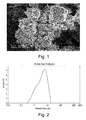
- Fig. 1 An FE-SEM image of the Si-alloy powder is illustrated in Fig. 1 , and a particle size distribution is illustrated in Fig. 2 (D 50 : 4.155 ⁇ m).
- Si-metal alloy Si 49.47232; Ti 22.69858; Ni 27.82911
- Si-65 at% was prepared in the same manner as in Preparation Example 1, except that Si:Ti:Ni were mixed in an atomic ratio of 65:17.5:17.5.
- Si-metal alloy Si-44.15972; Ti-25.08515; Ni-30.75512
- Si-60 at% Si-60 at% was prepared in the same manner as in Preparation Example 1, except that Si:Ti:Ni were mixed in an atomic ratio of 60:20:20.
- a Si-metal alloy (Si-52.83756; Ti-21.18681; Ni-25.97564) containing Si-68 at% was prepared in the same manner as in Preparation Example 1, except that Si:Ti:Ni were mixed in an atomic ratio of 68:16:16.
- An FE-SEM image of the Si-alloy powder is illustrated in Fig. 3
- a particle size distribution is illustrated in Fig. 4 (D 50 : 4.692 ⁇ m).
- Si-metal alloy Si-51.70029; Ti-21.6977; Ni-26.60201
- Si-67 at% Si-67 at% was prepared in the same manner as in Preparation Example 1, except that Si:Ti:Ni were mixed in an atomic ratio of 67:16.5:16.5.
- the time for ball milling were controlled such that the values of the D 50 are within 3-10 ⁇ m.
- the Si-metal alloys prepared in Preparation Examples 1-3 were pulverized using a ball mill to obtain negative electrode active material powder.
- the negative electrode active material powder was mixed with polyamideimide (PAI) as a binder, Ketjen Black as a conductive material and N-methylpyrrolidone (NMP) as a solvent to prepare a negative electrode active material slurry.
- PAI polyamideimide
- Ketjen Black as a conductive material
- NMP N-methylpyrrolidone
- the negative electrode active material powder, the conductive material and the binder were mixed in a weight ratio of 88:4:8.
- the prepared negative electrode slurry was coated on a copper current collector to a thickness of 20 to 60 ⁇ m and dried at 110 °C for 15 minutes.
- the dried negative electrode plate was annealed in a vacuum atmosphere of 350 °C for one hour.
- the resultant electrode plate (it will be used for working electrode) was cut into a size of 16 mm in diameter, a 700 ⁇ m lithium metal was used as a reference electrode (control electrode), and 1.5M LiPF6 EC/DEC/FEC mixed in a ratio of 5/70/25 was used as an electrolyte solution to manufacture 2016 size coin cells, respectively.
- the crystal grain sizes were confirmed by a full width at half maximum of a silicon (Si) peak at 28.5 degrees 2 ⁇ , as analyzed by XRD.
- the crystal grain sizes of the crystalline Si identified by XRD were 30 nm, 22 nm and 18 nm in Preparation Example 1 (66 at%), Preparation Example 2 (65 at%) and Preparation Example 3 (60 at%), respectively, and 47 nm and 38 nm in Comparative Preparation Example 1 (68 at%) and Comparative Preparation Example 2 (67 at%), respectively.
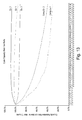
- the batteries manufactured in Examples 1-3 and Comparative Examples 1-2 were repeatedly charged/discharged 50 times at a 1.0 C rate. Battery characteristics were evaluated and the evaluation results are shown in Figs. 12 and 13 .
- a discharge capacity of the battery manufactured in Example 1 was approximately 720 mAh/g
- a discharge capacity of the battery manufactured in Example 2 was approximately 550 mAh/g
- a discharge capacity of the battery manufactured in Comparative Example 1 was approximately 205 mAh/g
- a discharge capacity of the battery manufactured in Comparative Example 2 was approximately 241 mAh/g.
- the cycle retention efficiency of each of the batteries manufactured in Examples 1-3 was 100%, which was much better than that of each of the batteries manufactured in Comparative Example 1 or 2.
Landscapes
- Chemical & Material Sciences (AREA)
- Engineering & Computer Science (AREA)
- Materials Engineering (AREA)
- Chemical Kinetics & Catalysis (AREA)
- Electrochemistry (AREA)
- General Chemical & Material Sciences (AREA)
- Mechanical Engineering (AREA)
- Metallurgy (AREA)
- Organic Chemistry (AREA)
- Manufacturing & Machinery (AREA)
- Battery Electrode And Active Subsutance (AREA)
- Silicon Compounds (AREA)
Abstract
Description
- The present invention relates to a negative electrode active material and a secondary battery including the same. The present invention more particularly relates to a negative electrode active material including a Si-metal alloy, which can provide a high-capacity battery, and a secondary battery which can retain a high capacity due to little volumetric expansion during charging and discharging, thereby demonstrating an excellent life characteristic of the secondary battery.
- Up to now since a lithium ion secondary battery was developed and used in the early 1990s, initially starting from amorphous hard carbon, a carbonaceous material such as graphite is mainly used as a negative electrode active material, which has become allowed by currently developed high-density graphite having a capacity of 360 mAh/g or higher by weight.
- However, according to the recent development of a variety of information technology (IT) devices, development of high capacity secondary batteries has become an important issue and limits of graphite are reached. Currently used graphite has a theoretical limit capacity of 360 mAh/g. Thus, in order to overcome the problems, there is an urgent need for development of new negative electrode active materials.
- An object of the present invention is to provide a negative electrode active material including a Si-metal alloy, which can retain a high capacity due to little volumetric expansion during charging and discharging while providing a high-capacity battery.
- According to an aspect of the present invention, there is provided a negative electrode active material including a Si-metal alloy comprising Si having crystal grain size of 35 nm or less.
- According to another aspect of the present invention, there is provided a secondary battery including a positive electrode, a negative electrode and a nonaqueous electrolyte, the negative electrode including a negative electrode active material comprising a Si-metal alloy of embodiments according to the present invention.
- According to still another aspect of the present invention, there is provided a method of preparing a nonaqueous electrolyte secondary battery, the method including preparing a positive electrode, preparing a negative electrode, and accommodating the positive electrode and the negative electrode with the nonaqueous electrolyte in a battery case, wherein the preparing of the negative electrode comprises preparing a Si-metal alloy including Si and one or more metals selected from the group consisting of Ca, Sc, Ti, V, Cr, Mn, Fe, Co, Ni, Cu, Zn, Sr, Y, Zr, Nb, Ba, Lu, Hf, Ta and lanthanoids by mechanical alloying, and the crystalline Si in the Si-metal alloy have a crystal grain size of 35 nm or less.
- The secondary battery formed of a negative electrode active material including a Si-metal alloy according to the present invention has an excellent capacity retention ratio without a sharp reduction in the capacity even after repeated charging and discharging cycles.
- In the Si-metal alloy according to the present invention, a crystal grain size of crystalline Si included in the Si-metal alloy can be controlled by simply adjusting an amount of Si contained in the Si-metal alloy, and a life characteristic of the secondary battery can be greatly improved by controlling the crystal grain size.
-
-
Fig. 1 illustrates an FE-SEM (Field Emission Scanning Electron Microscope) image in Preparation Example 1 of the present invention; -
Fig. 2 illustrates a particle size distribution in Preparation Example 1 of the present invention; -
Fig. 3 illustrates an FE-SEM image in Comparative Preparation Example 1; -
Fig. 4 illustrates a particle size distribution in Comparative Preparation Example 1; -
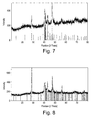
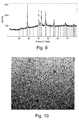
Figs. 5 to 9 are XRD (X-ray diffraction) graphs of Si-metal alloy powders prepared in Preparation Examples 1 to 3 of the present invention and Comparative Preparation Examples 1 and 2; -
Figs. 10 and11 are TEM (Transmission Electron Microscope) photographs in Preparation Example 1 of the present invention and Comparative Preparation Example 1; -
Figs. 12 and13 are graphs illustrating capacity retention ratios of batteries prepared in Preparation Examples 1 to 3 of the present invention and Comparative Preparation Examples 1 and 2; and -
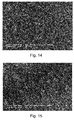
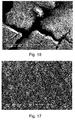
Figs. 14 to 17 illustrate FE-SEM images of coin cell electrode plates after charging and discharging batteries prepared in Preparation Examples 1 and 3 of the present invention and Comparative Preparation Examples 1 and 2. -
FIG. 18 illustrates a partial cross-sectional view of a lithium secondary battery according to an embodiment of the present invention. - Example embodiments will now be described more fully hereinafter with reference to the accompanying drawings.
- The present invention provides an improved negative electrode of a nonaqueous electrolyte secondary battery, which has a high capacity and excellent charging/discharging cycle characteristics.
- In general, a negative electrode can provide a battery having excellent cycle life and safety and capable of reversibly intercalating and deintercalating lithium ion even if the capacity is low. A carbonaceous material has been used in the negative electrode, and a lithium ion battery including a negative electrode using a graphite-based carbonaceous material has put into practice.
- However, since a graphite material has a relatively low capacity, it has been expected to use a metallic material in the negative electrode, the metallic material capable of achieving a higher capacity than the graphite material. Among other materials, Si demonstrates a high theoretical capacity of 4200 mAh/g. However, when Si is used alone, a sharp reduction in the capacity is demonstrated due to volumetric expansion during charging and discharging. The volumetric expansion may occur until approximately 400% is reached. Cracks may be created in particles due to excessive expansion and new particle surfaces may be formed due to broken cracks, thereby newly forming a solid electrolyte interface (SEI) film on the surface of the negative electrode. Here, since the cracks of particles are created in an irregular manner, isolated broken particles cannot participate in electrochemical reactions, resulting in a loss of battery capacity.
- To solve these problems, the present invention provides a negative electrode active material including a Si-metal alloy.
- According to one embodiment of the present invention, the negative electrode active material comprises less than or equal to 67.0 at% of silicon, wherein the silicon metal alloy has a silicon crystal grain size of less than or equal to 35 nm.
- In a preferred embodiment of the present invention the silicon-metal further comprises 10 to 30 at% of a first metal and 10 to 30 at% of a second metal, wherein the first and second metals are different.
- In an embodiment the silicon crystal grain size is preferably from 35 nm to 15 nm, preferably from 30 nm to 18 nm, more preferably from 28 nm to 20 nm.
- According to the present invention, since crystalline Si having a crystal grain size not greater than a predetermined level exists between alloy metal atoms, a high capacity can be imparted to the secondary battery. In addition, since the crystal grain size of crystalline Si is limited even during expansion and shrinkage according to charging and discharging, a network frame of the alloy metal can be maintained without being broken, thereby retaining the capacity even after repeated charging and discharging cycles.
- The Si-metal alloy preferably may be in the form of a powder, wherein the powder particles preferably have an average diameter (D50) of 3 to 10 µm, preferably between 3.5 and 6 µm, more preferably between 4.0 and 5.0 µm. If the average diameter (D50) of the Si-metal alloy powder particles is out of the range stated above, the life and initial efficiency characteristics of the manufactured secondary battery are degraded.
- An amount of Si contained in the Si-metal alloy is less than or equal to 67.0 at%, preferably 66.4 at% or less, preferably 66.0 at% or less, preferably from 66.0 at% to 60.0 at%, and more preferably from 65.0 at% to 62.0 at%.
- The first and second metals forming the Si-metal alloy preferably may be selected from the group consisting of Ca, Sc, Ti, V, Cr, Mn, Fe, Co, Ni, Cu, Zn, Sr, Y, Zr, Nb, Ba, Lu, Hf, Ta and lanthanoids, preferably Co, Cu, Zn, Ni, Ti or the like, more preferably Ti and Ni.
- Examples of the Si-metal alloy include the following combinations SiTiNi, SiFeAl, SiMnAl, SiFeTi, SiFeMn, and SiAlNi (these just state what elements are present; they are not in atomic ratios).
- The bimetals other than Si are preferably contained such that an amount of one metal (e.g., Ni) ranges from 10 to 25 at%, preferably 10 to 20 at%, more preferably 12.5 to 18 at%, and more preferably 15 to 18 at%. An amount of the other metal (e.g., Ti) independently ranges from 10 to 25 at%, preferably 10 to 20 at%, more preferably 12.5 to 18 at%, and more preferably 15 to 18 at%.
- According to one embodiment of the present invention, the crystalline Si is preferably spherically shaped.
- In the present invention, types of raw materials for preparing a negative electrode active material are not particularly limited as long as the raw materials can implement a composition ratio necessary for the negative electrode active material. For example, in order to mix elements forming the negative electrode active material in a desired composition ratio, elements, alloys, solid solutions, intermetal compounds or the like can be used. In an embodiment of the present invention the negative electrode active material contains the silicon-metal alloy in an amount from 20 to 98 wt%, more preferably 50 to 95 wt%, more preferably 80 to 90 wt%.
- The negative electrode active material according to the present invention is preferably prepared by weighing Si and at least one metal, e.g. Ni, Ti or the like, according to the composition ratio of the present invention, mixing the same to prepare an Si-containing alloy through a vacuum induction melting furnace. The vacuum induction melting furnace is equipment that can melt metal melted at high temperature using high-frequency induction. At an initial melting stage, the inside of the vacuum induction melting furnace is preferably made into a vacuum state, followed by injecting an inert gas such as argon (Ar) into the vacuum induction melting furnace, thereby preventing the prepared alloy from being oxidized.
- The thus-prepared master alloy is preferably melted using melt spinner equipment, that is, using high-frequency induction, and the molten metal is preferably sprayed into a wheel rotating at high speed, thereby preparing a ribbon-shaped alloy. Here, since it is important to melt a tri-metal, a current applying time or the intensity of high frequency applied can be appropriately adjusted while visually confirming that the alloy is melted. Preferably, the high frequency is applied for less than 5 minutes.
- According to one embodiment of the present invention, a mixture of the raw materials preferably may be melted before the alloying, and the melted product may preferably be rapidly cooled and solidified.
- In the thus-prepared Si-metal alloy used in the present invention, the crystal grain size of the crystalline Si may be observed by TEM photograph. In addition, the crystal grain size can be calculated using a full width at half maximum of a main peak, as analyzed by XRD. Preferably, the XRD method is used. Preferably, CuK-α radiation and X-ray wavelength 1.541Å are used.
- In an embodiment of the present invention, the following equipment and experimental protocol is preferably used to obtain the XRD spectra:
- XRD producer: PANalytical
- Model: X'pert PRO MPD
- Specification:
Maximum rated power: 3kW
Maximum voltage/current: 60kV/60mA
Min. Step Size: 0.001°
2Θ range : -40∼+220
Diffractometer Diameter: 430mm - Preferred Experimental conditions:
2Theta : 10 ∼ 80degree
Step size : 0.02
Time per step: 0.50s - For example, the crystal grain size of the crystalline Si can be calculated by using equations known in the related art. The crystal grain size according to an embodiment of the present invention can be calculated by the following Scherrer Equation.
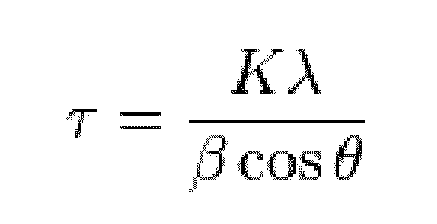
- In the above equation, the K is shape factor, λ is x-ray wavelength, β is a full width at half maximum, and θ is Bragg angle. As the shape factor, 0.9 is usually used but it may be changed depending on the crystallite of an object crystal grain. In an embodiment the value 0.9 is used.
- Therefore, according to one embodiment of the present invention, an average crystal grain size of the crystalline Si in the Si-metal alloy can be obtained by using the above Scherrer Equation with full width at half maximum respect to Si (111) surface from X-ray diffraction spectrum in which CuK- α radiation and X-ray wavelength 1.541Å are used.
- For example, referring as to
Figs. 5 to 9 , the average crystal grain sizes of the crystalline Si can be calculated with a full width at half maximum of the peak at 28.5 ± 0.2 which is Bragg angle2Θ. - The crystal grain size of the crystalline Si is controlled by adjusting the amount of Si, thereby preparing the negative electrode active material according to the present invention, including a Si-metal alloy having a crystal grain size of crystalline Si in a range of 35 nm or less.
- In the present invention, the Si-metal alloy may preferably be used in the form of powder. The Si-metal alloy powder can be obtained by alloying Si and the other metals to be alloyed and then pulverizing the alloy materials. The pulverizing may be performed by a method generally used in the related art.
- For example, an apparatus used for pulverizing may include an atomizer, a vacuum mill, a ball mill, a planetary ball mill, a beads mill, a jet mill and so on.
- The pulverizing method is largely classified into a dry type and a wet type, and either method can be applied to the present invention.
- The thus-prepared Si-metal alloy powder has an average particle diameter (D50) can be measured by, for example, a micro track method. Preferably the particle distribution of the Si-metal alloy powder is measured by laser diffraction particle size analysis, e.g. a LS 13320, Beckman Coulter. The pulverizing method may be controlled so as to provide the above-mentioned particle distribution. The necessary parameter conditions for this are not recited here as they are wildly known.
- The negative electrode according to the present invention can be prepared by a conventional method generally known in the related art. For example, the negative electrode can be prepared by mixing a binder, a solvent, if necessary, a conductive material, and optionally a dispersant agent with the negative electrode active material according to the present invention, optionally stirring the mixture to give a slurry, optionally coating the slurry on a current collector made of a metallic material, compressing and drying the same.
- According to an embodiment of the present invention, the negative electrode active material may be used in an amount of 20 to 98 wt%, more preferably 50 to 95 wt%, more preferably 80 to 90 wt% of the total weight of the electrode. An embodiment of the invention provides a negative electrode comprising 70 to 98 wt%, of the Si-metal alloy, a binder may be present in an amount of 1 to 30 wt% and a conductive material may be present in an amount of 1 to 25 wt%.
- Usable examples of the binder may include any binder materials without limitation as long as they can form an electrode. Specific examples of the binder may include polyamide imide (PAI), polyvinylidene fluoride (PVdF), polyethylene, polypropylene, polytetrafluoroethylene (PTFE), styrene butadiene rubber, and polyamide imide (PAI) is preferred.
- Usable examples of the conductive material may include carbon black, Ketjen black, acetylene black, artificial graphite, carbon fiber, carbon nanotube, amorphous carbon, and so on.
- The binder is dissolved in a solvent such as NMP (N-methylpyrrolidone) and homogenized with Si-metal alloy powder, or a conductive material, thereby preparing slurry.
- In the current collector made of a metallic material, any metal, to which the slurry of the negative electrode active material is easily adhered, may be used as a highly conductive metal as long as it shows no reactivity in a voltage range of battery. Representative examples of the current collector may include a mesh or foil formed of aluminum, copper, gold, nickel or combinations thereof.
- The method of coating the slurry on the current collector is not particularly limited. For example, the slurry may be coated on the current collector by doctor blade, dipping, brushing or the like. A dosage of the slurry is not particularly limited. However, a thickness of an active material layer formed after removing the solvent or the dispersion medium is generally in a range of 0.005 to 5 mm, preferably in a range of 0.01 to 0.1 mm.
- The method of removing the solvent or the dispersion medium is not particularly limited. However, the solvent or the dispersion medium may be removed by adjusting the solvent or the dispersion medium to be evaporated as rapidly as possible as long as cracks of the active material layer are not created due to stress concentration, or as long as the active material layer is not separated from the current collector. For example, the solvent or the dispersion medium may be dried in a vacuum oven of 50∼200 °C for 0.5 to 3 days.
- A lithium-containing transition metal oxide may be used as the positive electrode active material for the positive electrode of the secondary battery according to the present invention. Specific examples of the positive electrode active material may include one or more materials selected from the group consisting of LiCoO2, LiNiO2, LiMnO2, LiMn2O4, Li(NiaCobMnc)O2 (0<a<1, 0<b<1, 0<c<1, a+b+c=1), LiNi1-YCoYO2, LiCo1-YMnYO2, LiNi1-YMnYO2 (Here, 0=Y<1), Li(NiaCobMnc)O4 (0<a<2, 0<b<2, 0<c<2, a+b+c=2), LiMn2-zNizO4, LiMn2-ZCoZO4 (Here, 0<Z<2), LiCoPO4, and LiFePO4.
- The positive electrode is prepared using the positive electrode active material by the general method known in the related art. Since contents of the positive electrode are generally known, a description thereof will be omitted.
- The secondary battery according to the present invention, including a negative electrode containing a negative electrode active material according to the present invention, may be formed by a general method known in the related art. For example, the secondary battery may be formed by providing a porous separator between a positive electrode and a negative electrode and injecting an electrolyte solution. The secondary battery may include a lithium ion secondary battery, a lithium polymer secondary battery, a lithium ion polymer secondary battery, and the like.
- A secondary battery including a negative electrode according to an embodiment of the present invention will be described below in detail.
-
FIG. 18 illustrates a partial cross-sectional view of the lithium secondary battery according to an embodiment of the present invention. While a method of manufacturing a lithium secondary battery as described below is provided for the purpose of understanding, it will be understood by those of ordinary skill in the art that various changes may be made without departing from the scope of the present invention. - Referring to
FIG. 18 , a lithium secondary battery according to embodiments of the present invention includes acan 10, anelectrode assembly 20, acap assembly 30, and an electrolyte. In the lithium secondary battery, theelectrode assembly 20 and electrolyte are accommodated in thecan 10, and thecap assembly 30 is formed by sealing a top part of the can. - The
electrode assembly 20 may include apositive electrode plate 21, anegative electrode plate 23, and aseparator 22. Theelectrode assembly 20 may be formed by winding the laminated layers after sequentially laminating thepositive electrode plate 21,separator 22, andnegative electrode plate 23. - In more detail, the
cap assembly 30 may include acap plate 40, aninsulation plate 50, aterminal plate 60, and anelectrode terminal 80. Thecap assembly 30 may be assembled with aninsulation case 70 to seal thecan 10. - The
electrode terminal 80 may be inserted into a terminal through-hole 41 formed in the center of thecap plate 40. Theelectrode terminal 80 may be inserted into the terminal through-hole 41 together with the tube type gasket in a state that atube type gasket 46 is coupled to the outer face of theelectrode terminal 80 when inserting theelectrode terminal 80 into the terminal through-hole 41. Therefore, theelectrode terminal 80 may be electrically insulated with thecap plate 40. - The electrolyte may be injected into the
can 10 through anelectrolyte injection hole 42 after thecap assembly 30 is assembled onto the top part of thecan 10. Theelectrolyte injection hole 42 may be sealed by aseparate stopper 43. Theelectrode terminal 30 may be connected to anegative electrode tab 17 of thenegative electrode plate 23 or apositive electrode tab 16 of thepositive electrode plate 21 such that theelectrode terminal 80 is operated as a negative terminal or a positive terminal. - The separator is disposed between the positive electrode and the negative electrode, and an insulating thin film having high ionic transmissivity and mechanical strength is used as the separator.
- The separator has a porosity having a diameter ranging from 0.01 to 10 µm and a thickness ranging from 5 to 300 µm. Examples of the separator may include olefin-based polymers having chemical resistance and hydrophobicity, such as polypropylene; a sheet or nonwoven fiber made of polyethylene or glass fiber. When a solid electrolyte such as a polymer is used as the electrolyte, the solid electrolyte may serve as the separator.
- In the separator, specific examples of olefin-based polymers may include polyethylene, polypropylene, polyvinylidene fluoride, or a plurality of layers formed of two or more of these materials, or may include composite multi-layer separators, such as a polyethylene/polypropylene two-layer separator, a polyethylene/polypropylene/polyethylene three-layer separator, a polypropylene/polyethylene/polypropylene three-layer separator, or the like.
- The lithium salt containing nonaqueous electrolyte includes a nonaqueous electrolyte and a lithium salt.
- A nonaqueous electrolyte solution, a solid electrolyte, or an inorganic solid electrolyte may be used as the nonaqueous electrolyte.
- Examples of the nonaqueous electrolyte may include aprotic organic solvents such as N-methyl-2-pyrrolidone, ethylene carbonate, propylene carbonate, butylene carbonate, dimethyl carbonate, diethyl carbonate, γ-butyrolactone, 1,2-dimethoxy ethane, tetrahydroxy franc, 2-methyl tetrahydrofuran, dimethyl sulfoxide, 1,3-dioxolone, formamide, dimethyl formamide, dioxolone, acetonitrile, nitromethane, methyl formate, methyl acetate, triester phosphate, trimethoxy methane, dioxolone derivative, sulforane, methyl sulforane, 1,3-dimethyl-2-imidazolidinone, propylene carbonate derivative, tetrahydrofuran derivative, ether, methyl propionate, or ethyl propionate.
- Examples of the organic solid electrolyte may include polyethylene derivatives, polyethylene oxide derivatives, poly propylene oxide derivatives, phosphoric acid ester polymers, polyagitation lysine, polyester sulfide, polyvinylalcohol, poly fluorovinylidene, polymers containing ionic disintegrators, and the like.
- The inorganic solid electrolyte, for example, may include Li-based nitrides, such as Li3N, LiI, Li5NI2, Li3N-LiI-LiOH, LiSi04, LiSiO4-LiI-LiO Li2SiS3, Li4SiO4, Li4SiO4-LiI-LiOH, Li3PO4-Li2S-SiS2. etc., halides, sulfates, and the like.
- The lithium salt is a material sufficiently soluble in the non-aqueous electrolyte and for example, may be LiCl, LiBr, LiI, LiClO4, LiBF4, LiB10Cl10, LiPF6, LiCF3SO3, LiCF3CO2, LiAsF6, LiSbF6, LiAlCl4, CH3SO3Li, CF3SO3Li, (CF3SO2)2NLi, chloroboranlithium, low-grade aliphatic carbonic acid lithium, 4-penyl-boric acid lithium, imides, and the like. For the purpose of enhancing charge and discharge characteristics, fire-retardancy, etc., for example, pyridine, triethylphosphite, triethanolamine, cyclic ether, ethylene diamine, n-glyme, hexa phosphoric acid tri amide, nitrobenzene derivative, sulfur, quinone imine colorant, N-substituted oxasolidinone, N,N-substituted imidasolidine, ethylene glycol dialkyl ether, ammonium salt, pyrrole, 2-methoxy ethanol, trichloro aluminum, etc. may be added to the non-aqueous electrolyte. As occasion demands, to endow incombustibility, a halogen containing solvent, such as tetrachlorocarbon, trifluoroethylene, etc., may be added to the non-aqueous electrolyte. Further, to improve high-temperature maintenance characteristics, carbon dioxide gas may be further added to the non-aqueous electrolyte.
- Hereinafter, the present invention will be described in more detail with reference to the following examples. However, the following examples are only for illustrative purposes and are not intended to be limiting.
- Si:Ti:Ni were mixed in an atomic ratio of 66:17:17 and injected into a vacuum induction melting furnace (commercially available from Yein Tech, Korea), and the inside of the vacuum induction melting furnace was made into a vacuum state using a vacuum pump, followed by injecting argon (Ar) as an inert gas. As observed by naked eye, an alloy was melted to prepare a master alloy under the condition that a high frequency was induced from a high frequency inducing apparatus with power of 8 kW or less for 5 minutes or less. A ribbon-shaped alloy (Si 50.57864; Ti 22.20158; Ni 27.21978) containing Si-66 at% was prepared by jetting the master alloy melted by high frequency induction into a rotating wheel.
- An FE-SEM image of the Si-alloy powder is illustrated in
Fig. 1 , and a particle size distribution is illustrated inFig. 2 (D50: 4.155 µm). - A Si-metal alloy (Si 49.47232; Ti 22.69858; Ni 27.82911) containing Si-65 at% was prepared in the same manner as in Preparation Example 1, except that Si:Ti:Ni were mixed in an atomic ratio of 65:17.5:17.5.
- A Si-metal alloy (Si-44.15972; Ti-25.08515; Ni-30.75512) containing Si-60 at% was prepared in the same manner as in Preparation Example 1, except that Si:Ti:Ni were mixed in an atomic ratio of 60:20:20.
- A Si-metal alloy (Si-52.83756; Ti-21.18681; Ni-25.97564) containing Si-68 at% was prepared in the same manner as in Preparation Example 1, except that Si:Ti:Ni were mixed in an atomic ratio of 68:16:16. An FE-SEM image of the Si-alloy powder is illustrated in
Fig. 3 , and a particle size distribution is illustrated inFig. 4 (D50: 4.692 µm). - A Si-metal alloy (Si-51.70029; Ti-21.6977; Ni-26.60201) containing Si-67 at% was prepared in the same manner as in Preparation Example 1, except that Si:Ti:Ni were mixed in an atomic ratio of 67:16.5:16.5.
- In the preparation examples and the comparative preparation examples, the time for ball milling were controlled such that the values of the D50 are within 3-10 µm.
- The Si-metal alloys prepared in Preparation Examples 1-3 were pulverized using a ball mill to obtain negative electrode active material powder.
- The negative electrode active material powder was mixed with polyamideimide (PAI) as a binder, Ketjen Black as a conductive material and N-methylpyrrolidone (NMP) as a solvent to prepare a negative electrode active material slurry.
- Here, the negative electrode active material powder, the conductive material and the binder were mixed in a weight ratio of 88:4:8.
- The prepared negative electrode slurry was coated on a copper current collector to a thickness of 20 to 60 µm and dried at 110 °C for 15 minutes.
- The dried negative electrode plate was annealed in a vacuum atmosphere of 350 °C for one hour.
- The resultant electrode plate (it will be used for working electrode) was cut into a size of 16 mm in diameter, a 700 µm lithium metal was used as a reference electrode (control electrode), and 1.5M LiPF6 EC/DEC/FEC mixed in a ratio of 5/70/25 was used as an electrolyte solution to manufacture 2016 size coin cells, respectively.
- Secondary batteries were manufactured in the same manner as in Example 1, except that the Si-metal alloys prepared in Comparative Preparation Examples 1 and 2.
- In order to identify crystal grain sizes of the crystalline Si included in Si-metal alloy powder particles prepared in Preparation Examples 1-3 and Comparative Preparation Examples 1-2, XRD analysis was conducted, and the results thereof are shown in
Figs. 5 to 9 . The following equipment and experimental protocol were used to obtain the XRD spectra: - XRD producer: PANalytical
- Model: X'pert PRO MPD
- Specification:
Maximum rated power: 3kW
Maximum voltage/current: 60kV/60mA
Min. Step Size: 0.001°
2Θ range : -40∼+220
Diffractometer Diameter: 430mm - Experimental conditions:
2Theta : 10 ∼ 80degree
Step size : 0.02
Time per step: 0.50s
CuK- α radiation and X-ray wavelength 1.541Å were used - The crystal grain sizes were confirmed by a full width at half maximum of a silicon (Si) peak at 28.5 degrees 2θ, as analyzed by XRD.
- The crystal grain sizes of the crystalline Si identified by XRD were 30 nm, 22 nm and 18 nm in Preparation Example 1 (66 at%), Preparation Example 2 (65 at%) and Preparation Example 3 (60 at%), respectively, and 47 nm and 38 nm in Comparative Preparation Example 1 (68 at%) and Comparative Preparation Example 2 (67 at%), respectively.
- In addition, in order to identify crystal grain sizes of crystalline Si, TEM analysis was conducted. TEM analysis results confirmed that while the crystalline Si having crystal grain size of 50 nm or greater exist in the SiTiNi alloy of Si-68 at%, the crystalline Si having crystal grain size of 50 nm or less exists in the SiTiNi alloy of Si-65 at%, as shown in
Figs. 10 and11 . - The batteries manufactured in Examples 1-3 and Comparative Examples 1-2 were repeatedly charged/discharged 50 times at a 1.0 C rate. Battery characteristics were evaluated and the evaluation results are shown in
Figs. 12 and13 . - Referring to
Figs. 12 and13 , a discharge capacity of the battery manufactured in Example 1 was approximately 720 mAh/g, a discharge capacity of the battery manufactured in Example 2 was approximately 550 mAh/g, a discharge capacity of the battery manufactured in Comparative Example 1 was approximately 205 mAh/g, and a discharge capacity of the battery manufactured in Comparative Example 2 was approximately 241 mAh/g. After 50 cycles, the cycle retention efficiency of each of the batteries manufactured in Examples 1-3 was 100%, which was much better than that of each of the batteries manufactured in Comparative Example 1 or 2. - After the batteries manufactured in Examples 1-3 (
Figs. 14 and 15 ) and the batteries manufactured in Comparative Examples 1-2 (Figs. 16 and 17 ) were charged and discharged, surfaces of coin cell electrode plates were analyzed by FE-SEM. As confirmed by FE-SEM, severe cracks were created on the surfaces of the coin cell electrode plates fabricated in Comparative Examples 1-2 showing a sharp reduction in the capacity retention ratio. By contrast, even after the coin cell electrode plate fabricated in Example 1 was charged and discharged, the surface of the coin cell electrode plate was good without cracks occurring to the surface. - While this invention has been particularly shown and described with reference to preferred embodiments thereof, it will be understood by those skilled in the art that various changes in form and details may be made therein without departing from the scope of the invention.
Claims (13)
- A negative electrode active material comprising a silicon metal alloy comprising less than 67.0 at% of silicon, wherein the silicon metal alloy has a silicon crystal grain size of less than or equal to 35 nm.
- A silicon-metal alloy according to claim 1 further comprising 10 to 30 at% of a first metal and 10 to 30 at% of a second metal, wherein the first and second metals are different.
- A negative electrode active material according to claim 2 wherein the first and second metals are selected from the group consisting of Ca, Sc, Ti, V, Cr, Mn, Fe, Co, Ni, Cu, Zn, Sr, Y, Zr, Nb, Ba, Lu, Hf, Ta and lanthanoids, preferably Co, Cu, Zn, Ni, and Ti, preferably the first and second metals are Ti and Ni.
- A negative electrode active material according to any of claims 1 to 3 wherein the amount of silicon is 66.4% or less, preferably 66.0 at% or less, preferably from 66.0 at% to 60.0 at%, and preferably from 65.0 at% to 62.0 at%.
- A negative electrode active material according to any of claims 2 to 4 wherein the amount of the first metal is from 10 to 25 at%, preferably 10 to 20 at%, more preferably 12.5 to 18 at%, and more preferably 15 to 18 at%.
- A negative electrode active material according to any of claims 2 to 5 wherein the amount of the second metal is from 10 to 25 at%, preferably 10 to 20 at%, more preferably 12.5 to 18 at%, and more preferably 15 to 18 at%.
- A negative electrode active material according to any of claims 1 to 6 in the form of a powder, preferably the powder particles have an average diameter (D50) of 3 to 10 µm.
- A negative electrode active material according to any of claims 1 to 7 wherein the silicon crystal grain size is from 35 nm to 15 nm, preferably from 30 nm to 18 nm, more preferably from 28 to 20 nm.
- A negative electrode comprising the negative electrode active material according to any of claims 1 to 8 wherein the silicon-metal alloy is present in an amount from 20 to 98 wt%, more preferably 50 to 95 wt%, more preferably 80 to 90 wt%.
- A negative electrode according to claim 9 wherein the negative electrode further comprises a binder and a conductive agent.
- A rechargeable lithium battery that comprises a negative electrode according to claim 9 or 10.
- A process for preparing a negative electrode active material according to any of claims 1 to 8 comprising mixing silicon and at least one metal in a vacuum induction melting furnace.
- A process according to claim 12 further including the step of forming a powder of the alloy using an atomizer, vacuum mill, a ball mill, a planetary ball mill, a beads mill or a jet mill.
Applications Claiming Priority (2)
| Application Number | Priority Date | Filing Date | Title |
|---|---|---|---|
| US201161570096P | 2011-12-13 | 2011-12-13 | |
| US13/363,206 US9373839B2 (en) | 2011-12-13 | 2012-01-31 | Negative electrode active material and secondary battery including the same |
Publications (2)
| Publication Number | Publication Date |
|---|---|
| EP2605315A1 true EP2605315A1 (en) | 2013-06-19 |
| EP2605315B1 EP2605315B1 (en) | 2016-12-28 |
Family
ID=45894343
Family Applications (1)
| Application Number | Title | Priority Date | Filing Date |
|---|---|---|---|
| EP12162303.7A Active EP2605315B1 (en) | 2011-12-13 | 2012-03-29 | Negative electrode active material and Secondary battery including the same |
Country Status (4)
| Country | Link |
|---|---|
| US (1) | US9373839B2 (en) |
| EP (1) | EP2605315B1 (en) |
| JP (1) | JP6116138B2 (en) |
| KR (1) | KR20130067199A (en) |
Cited By (3)
| Publication number | Priority date | Publication date | Assignee | Title |
|---|---|---|---|---|
| WO2017198795A1 (en) * | 2016-05-19 | 2017-11-23 | Centre National D'etudes Spatiales | Novel silicon-enriched composite material, production method thereof and use of said material as an electrode |
| DE112015002533B4 (en) * | 2014-05-29 | 2018-01-11 | Kabushiki Kaisha Toyota Jidoshokki | Copper-containing silicon material, process for its production, negative electrode active material and secondary battery |
| WO2022112556A1 (en) | 2020-11-30 | 2022-06-02 | Centre National De La Recherche Scientifique | Catalyst, electrode and manufacturing methods thereof |
Families Citing this family (12)
| Publication number | Priority date | Publication date | Assignee | Title |
|---|---|---|---|---|
| US9947925B2 (en) | 2012-05-11 | 2018-04-17 | Santoku Corporation | Negative electrode for lithium-ion secondary battery |
| JP6245954B2 (en) * | 2012-11-14 | 2017-12-13 | 株式会社三徳 | Negative electrode active material for lithium ion secondary battery |
| KR101825921B1 (en) * | 2013-07-05 | 2018-02-06 | 삼성에스디아이 주식회사 | Electrode for lithium secondary battery and lithium secondary battery comprising the same |
| JP6329888B2 (en) * | 2013-12-13 | 2018-05-23 | エルジー・ケム・リミテッド | Anode material for secondary battery and secondary battery using the same |
| KR102152883B1 (en) * | 2014-01-27 | 2020-09-07 | 삼성에스디아이 주식회사 | Negative active material, negative electrode and lithium battery including the negative active material, and method for manufacturing the negative active material |
| JP6371635B2 (en) * | 2014-08-11 | 2018-08-08 | 山陽特殊製鋼株式会社 | Si-based alloy negative electrode material for power storage device and electrode using the same |
| JP6735060B2 (en) * | 2014-09-16 | 2020-08-05 | 山陽特殊製鋼株式会社 | Si-based alloy negative electrode material for power storage device and electrode using the same |
| JP6587394B2 (en) * | 2015-02-12 | 2019-10-09 | 富士フイルム株式会社 | Solid electrolyte composition, battery electrode sheet and all solid secondary battery, and battery electrode sheet and method for producing all solid secondary battery |
| CN110945691A (en) * | 2017-08-10 | 2020-03-31 | 三井金属矿业株式会社 | Si-based negative electrode active material |
| EP3776693B1 (en) * | 2018-04-12 | 2025-08-27 | Sicona Battery Technologies Pty Ltd | Anode materials for and methods of making and using same |
| JP7099969B2 (en) * | 2019-02-07 | 2022-07-12 | トヨタ自動車株式会社 | Manufacturing method of negative electrode active material, all-solid-state battery and negative electrode active material |
| KR102920164B1 (en) * | 2024-12-31 | 2026-01-30 | 일진전기 주식회사 | Silicon alloy-based negative electrode active material, negative electrode, and lithium secondary battery including the same |
Citations (1)
| Publication number | Priority date | Publication date | Assignee | Title |
|---|---|---|---|---|
| US20060046144A1 (en) * | 2004-09-01 | 2006-03-02 | 3M Innovative Properties Company | Anode composition for lithium ion battery |
Family Cites Families (13)
| Publication number | Priority date | Publication date | Assignee | Title |
|---|---|---|---|---|
| PT1033767E (en) | 1998-09-18 | 2010-07-13 | Canon Kk | Electrode material for negative pole of lithium secondary cell, electrode structure using said electrode material, lithium secondary cell using said electrode structure, and method for manufacturing said electrode structure and said lithium secondary |
| JP4464173B2 (en) | 2003-03-26 | 2010-05-19 | キヤノン株式会社 | Electrode material for lithium secondary battery, electrode structure having the electrode material, and secondary battery having the electrode structure |
| JP2004362895A (en) | 2003-06-03 | 2004-12-24 | Sony Corp | Negative electrode material and battery using the same |
| WO2006129415A1 (en) | 2005-06-03 | 2006-12-07 | Matsushita Electric Industrial Co., Ltd. | Rechargeable battery with nonaqueous electrolyte and process for producing negative electrode |
| CN100426563C (en) | 2005-08-03 | 2008-10-15 | 北京科技大学 | Production of negative material of high-capacity lithium-ion battery with tin-antimony-silicon alloy |
| KR100814816B1 (en) | 2006-11-27 | 2008-03-20 | 삼성에스디아이 주식회사 | Anode active material for lithium secondary battery and lithium secondary battery comprising same |
| KR100796664B1 (en) | 2007-03-21 | 2008-01-22 | 삼성에스디아이 주식회사 | Anode active material for lithium secondary battery and lithium secondary battery comprising same |
| KR101352672B1 (en) | 2008-12-30 | 2014-01-16 | 주식회사 엘지화학 | Anode active material for secondary battery |
| JP5761758B2 (en) | 2008-12-30 | 2015-08-12 | エルジー・ケム・リミテッド | Anode active material for secondary battery |
| US8287772B2 (en) * | 2009-05-14 | 2012-10-16 | 3M Innovative Properties Company | Low energy milling method, low crystallinity alloy, and negative electrode composition |
| WO2011155770A2 (en) * | 2010-06-10 | 2011-12-15 | 주식회사 엘지화학 | Cathode active material for lithium secondary battery and lithium secondary battery provided with same |
| JP4739462B1 (en) | 2010-07-16 | 2011-08-03 | 山陽特殊製鋼株式会社 | Si-based alloy negative electrode material with excellent conductivity |
| JP5621753B2 (en) | 2011-11-15 | 2014-11-12 | 信越化学工業株式会社 | Anode material for lithium ion battery |
-
2012
- 2012-01-31 US US13/363,206 patent/US9373839B2/en active Active
- 2012-03-16 KR KR1020120027379A patent/KR20130067199A/en not_active Ceased
- 2012-03-29 EP EP12162303.7A patent/EP2605315B1/en active Active
- 2012-06-01 JP JP2012126305A patent/JP6116138B2/en active Active
Patent Citations (1)
| Publication number | Priority date | Publication date | Assignee | Title |
|---|---|---|---|---|
| US20060046144A1 (en) * | 2004-09-01 | 2006-03-02 | 3M Innovative Properties Company | Anode composition for lithium ion battery |
Cited By (5)
| Publication number | Priority date | Publication date | Assignee | Title |
|---|---|---|---|---|
| DE112015002533B4 (en) * | 2014-05-29 | 2018-01-11 | Kabushiki Kaisha Toyota Jidoshokki | Copper-containing silicon material, process for its production, negative electrode active material and secondary battery |
| WO2017198795A1 (en) * | 2016-05-19 | 2017-11-23 | Centre National D'etudes Spatiales | Novel silicon-enriched composite material, production method thereof and use of said material as an electrode |
| FR3051483A1 (en) * | 2016-05-19 | 2017-11-24 | Centre Nat D'etudes Spatiales (Cnes) | NOVEL SILICON ENRICHED COMPOSITE MATERIAL, METHOD FOR MANUFACTURING SAME, AND USE THEREOF AS ELECTRODE |
| WO2022112556A1 (en) | 2020-11-30 | 2022-06-02 | Centre National De La Recherche Scientifique | Catalyst, electrode and manufacturing methods thereof |
| FR3116837A1 (en) | 2020-11-30 | 2022-06-03 | Université D'aix-Marseille | Catalyst, electrode, and methods of making them |
Also Published As
| Publication number | Publication date |
|---|---|
| EP2605315B1 (en) | 2016-12-28 |
| US20130149594A1 (en) | 2013-06-13 |
| JP6116138B2 (en) | 2017-04-19 |
| KR20130067199A (en) | 2013-06-21 |
| CN103165872A (en) | 2013-06-19 |
| US9373839B2 (en) | 2016-06-21 |
| JP2013125743A (en) | 2013-06-24 |
Similar Documents
| Publication | Publication Date | Title |
|---|---|---|
| EP2605315B1 (en) | Negative electrode active material and Secondary battery including the same | |
| JP5725054B2 (en) | Composite active material and method for producing the same | |
| KR101749506B1 (en) | Negative active material, lithium battery including the material, and method for manufacturing the material | |
| US9203077B2 (en) | Positive electrode active material for a lithium secondary battery, method for producing same, and lithium secondary battery comprising same | |
| KR102119156B1 (en) | Positive active material, lithium battery containing the material and manufacturing method of the material | |
| US20110053003A1 (en) | Lithium ion secondary battery and method for producing lithium ion secondary battery | |
| KR102425828B1 (en) | Positive active material, positive electrode and lithium battery containing the material, method of manufacturing the material | |
| JP2021507488A (en) | A composition for forming an insulating layer for a lithium secondary battery, and a method for manufacturing an electrode for a lithium secondary battery using the composition. | |
| JP6601937B2 (en) | Negative electrode active material, negative electrode employing the same, lithium battery, and method for producing the negative electrode active material | |
| KR20180103507A (en) | Negative active material, negative electrode and lithium battery including the same, and method of preparing the negative active material | |
| CN106953090B (en) | Negative active material and negative electrode and lithium battery including the same | |
| JP5564872B2 (en) | Nonaqueous electrolyte secondary battery | |
| JP7803871B2 (en) | New solid sulfide electrolytes | |
| CN113784916B (en) | Method for preparing negative electrode active material | |
| CN111052455A (en) | Electrode and nonaqueous electrolyte battery | |
| US7556887B2 (en) | Nonaqueous electrolyte secondary battery with negative electrode having a La3Co2Sn7 type crystal structure | |
| EP3255707A1 (en) | Process to prepare an electrode for an electrochemical storage device | |
| US20240072252A1 (en) | Positive electrode for secondary battery, and secondary battery | |
| JP2018063755A (en) | Stabilized lithium powder and lithium ion secondary battery using the same | |
| KR20170042115A (en) | Negative active material, and negative electrode and lithium battery including the material | |
| JP2020158834A (en) | Metal halide particle, and all-solid battery and nonaqueous lithium ion battery including the same | |
| US12209156B2 (en) | Production method of sulfur-modified polyacrylonitrile | |
| KR20110128591A (en) | Lithium secondary battery | |
| CN103165872B (en) | Negative active core-shell material including its secondary cell and the method for preparing secondary cell | |
| KR102955407B1 (en) | Method for preparing positive electrode active material for secondary battery, positive electrode active material manufactured through the method and lithium secondary battery comprising the same |
Legal Events
| Date | Code | Title | Description |
|---|---|---|---|
| PUAI | Public reference made under article 153(3) epc to a published international application that has entered the european phase |
Free format text: ORIGINAL CODE: 0009012 |
|
| 17P | Request for examination filed |
Effective date: 20120329 |
|
| AK | Designated contracting states |
Kind code of ref document: A1 Designated state(s): AL AT BE BG CH CY CZ DE DK EE ES FI FR GB GR HR HU IE IS IT LI LT LU LV MC MK MT NL NO PL PT RO RS SE SI SK SM TR |
|
| AX | Request for extension of the european patent |
Extension state: BA ME |
|
| 17Q | First examination report despatched |
Effective date: 20160104 |
|
| REG | Reference to a national code |
Ref country code: DE Ref legal event code: R079 Ref document number: 602012027018 Country of ref document: DE Free format text: PREVIOUS MAIN CLASS: H01M0004040000 Ipc: H01M0004380000 |
|
| GRAP | Despatch of communication of intention to grant a patent |
Free format text: ORIGINAL CODE: EPIDOSNIGR1 |
|
| RIC1 | Information provided on ipc code assigned before grant |
Ipc: H01M 4/1395 20100101ALN20160616BHEP Ipc: C22C 28/00 20060101ALI20160616BHEP Ipc: H01M 4/38 20060101AFI20160616BHEP Ipc: C22C 30/00 20060101ALI20160616BHEP Ipc: H01M 10/0525 20100101ALN20160616BHEP Ipc: H01M 4/134 20100101ALN20160616BHEP |
|
| INTG | Intention to grant announced |
Effective date: 20160706 |
|
| RIN1 | Information on inventor provided before grant (corrected) |
Inventor name: JEONG, CHANGUI Inventor name: PARK, YOHAN Inventor name: LEE, CHUNGYOO Inventor name: MOON, SUNGHWAN Inventor name: KIM, JAEHYUK Inventor name: KWON, SEUNGUK Inventor name: CHOI, JONGSEO Inventor name: MATULEVICH, YURY |
|
| GRAS | Grant fee paid |
Free format text: ORIGINAL CODE: EPIDOSNIGR3 |
|
| GRAA | (expected) grant |
Free format text: ORIGINAL CODE: 0009210 |
|
| AK | Designated contracting states |
Kind code of ref document: B1 Designated state(s): AL AT BE BG CH CY CZ DE DK EE ES FI FR GB GR HR HU IE IS IT LI LT LU LV MC MK MT NL NO PL PT RO RS SE SI SK SM TR |
|
| REG | Reference to a national code |
Ref country code: GB Ref legal event code: FG4D |
|
| REG | Reference to a national code |
Ref country code: CH Ref legal event code: EP |
|
| REG | Reference to a national code |
Ref country code: AT Ref legal event code: REF Ref document number: 857985 Country of ref document: AT Kind code of ref document: T Effective date: 20170115 |
|
| REG | Reference to a national code |
Ref country code: IE Ref legal event code: FG4D |
|
| REG | Reference to a national code |
Ref country code: DE Ref legal event code: R096 Ref document number: 602012027018 Country of ref document: DE |
|
| REG | Reference to a national code |
Ref country code: FR Ref legal event code: PLFP Year of fee payment: 6 |
|
| PG25 | Lapsed in a contracting state [announced via postgrant information from national office to epo] |
Ref country code: LV Free format text: LAPSE BECAUSE OF FAILURE TO SUBMIT A TRANSLATION OF THE DESCRIPTION OR TO PAY THE FEE WITHIN THE PRESCRIBED TIME-LIMIT Effective date: 20161228 |
|
| REG | Reference to a national code |
Ref country code: LT Ref legal event code: MG4D |
|
| PG25 | Lapsed in a contracting state [announced via postgrant information from national office to epo] |
Ref country code: GR Free format text: LAPSE BECAUSE OF FAILURE TO SUBMIT A TRANSLATION OF THE DESCRIPTION OR TO PAY THE FEE WITHIN THE PRESCRIBED TIME-LIMIT Effective date: 20170329 Ref country code: LT Free format text: LAPSE BECAUSE OF FAILURE TO SUBMIT A TRANSLATION OF THE DESCRIPTION OR TO PAY THE FEE WITHIN THE PRESCRIBED TIME-LIMIT Effective date: 20161228 Ref country code: SE Free format text: LAPSE BECAUSE OF FAILURE TO SUBMIT A TRANSLATION OF THE DESCRIPTION OR TO PAY THE FEE WITHIN THE PRESCRIBED TIME-LIMIT Effective date: 20161228 Ref country code: NO Free format text: LAPSE BECAUSE OF FAILURE TO SUBMIT A TRANSLATION OF THE DESCRIPTION OR TO PAY THE FEE WITHIN THE PRESCRIBED TIME-LIMIT Effective date: 20170328 |
|
| REG | Reference to a national code |
Ref country code: NL Ref legal event code: MP Effective date: 20161228 |
|
| REG | Reference to a national code |
Ref country code: AT Ref legal event code: MK05 Ref document number: 857985 Country of ref document: AT Kind code of ref document: T Effective date: 20161228 |
|
| PG25 | Lapsed in a contracting state [announced via postgrant information from national office to epo] |
Ref country code: FI Free format text: LAPSE BECAUSE OF FAILURE TO SUBMIT A TRANSLATION OF THE DESCRIPTION OR TO PAY THE FEE WITHIN THE PRESCRIBED TIME-LIMIT Effective date: 20161228 Ref country code: RS Free format text: LAPSE BECAUSE OF FAILURE TO SUBMIT A TRANSLATION OF THE DESCRIPTION OR TO PAY THE FEE WITHIN THE PRESCRIBED TIME-LIMIT Effective date: 20161228 Ref country code: HR Free format text: LAPSE BECAUSE OF FAILURE TO SUBMIT A TRANSLATION OF THE DESCRIPTION OR TO PAY THE FEE WITHIN THE PRESCRIBED TIME-LIMIT Effective date: 20161228 |
|
| PG25 | Lapsed in a contracting state [announced via postgrant information from national office to epo] |
Ref country code: NL Free format text: LAPSE BECAUSE OF FAILURE TO SUBMIT A TRANSLATION OF THE DESCRIPTION OR TO PAY THE FEE WITHIN THE PRESCRIBED TIME-LIMIT Effective date: 20161228 |
|
| PG25 | Lapsed in a contracting state [announced via postgrant information from national office to epo] |
Ref country code: RO Free format text: LAPSE BECAUSE OF FAILURE TO SUBMIT A TRANSLATION OF THE DESCRIPTION OR TO PAY THE FEE WITHIN THE PRESCRIBED TIME-LIMIT Effective date: 20161228 Ref country code: SK Free format text: LAPSE BECAUSE OF FAILURE TO SUBMIT A TRANSLATION OF THE DESCRIPTION OR TO PAY THE FEE WITHIN THE PRESCRIBED TIME-LIMIT Effective date: 20161228 Ref country code: CZ Free format text: LAPSE BECAUSE OF FAILURE TO SUBMIT A TRANSLATION OF THE DESCRIPTION OR TO PAY THE FEE WITHIN THE PRESCRIBED TIME-LIMIT Effective date: 20161228 Ref country code: IS Free format text: LAPSE BECAUSE OF FAILURE TO SUBMIT A TRANSLATION OF THE DESCRIPTION OR TO PAY THE FEE WITHIN THE PRESCRIBED TIME-LIMIT Effective date: 20170428 Ref country code: EE Free format text: LAPSE BECAUSE OF FAILURE TO SUBMIT A TRANSLATION OF THE DESCRIPTION OR TO PAY THE FEE WITHIN THE PRESCRIBED TIME-LIMIT Effective date: 20161228 |
|
| PG25 | Lapsed in a contracting state [announced via postgrant information from national office to epo] |
Ref country code: IT Free format text: LAPSE BECAUSE OF FAILURE TO SUBMIT A TRANSLATION OF THE DESCRIPTION OR TO PAY THE FEE WITHIN THE PRESCRIBED TIME-LIMIT Effective date: 20161228 Ref country code: BG Free format text: LAPSE BECAUSE OF FAILURE TO SUBMIT A TRANSLATION OF THE DESCRIPTION OR TO PAY THE FEE WITHIN THE PRESCRIBED TIME-LIMIT Effective date: 20170328 Ref country code: PL Free format text: LAPSE BECAUSE OF FAILURE TO SUBMIT A TRANSLATION OF THE DESCRIPTION OR TO PAY THE FEE WITHIN THE PRESCRIBED TIME-LIMIT Effective date: 20161228 Ref country code: ES Free format text: LAPSE BECAUSE OF FAILURE TO SUBMIT A TRANSLATION OF THE DESCRIPTION OR TO PAY THE FEE WITHIN THE PRESCRIBED TIME-LIMIT Effective date: 20161228 Ref country code: PT Free format text: LAPSE BECAUSE OF FAILURE TO SUBMIT A TRANSLATION OF THE DESCRIPTION OR TO PAY THE FEE WITHIN THE PRESCRIBED TIME-LIMIT Effective date: 20170428 Ref country code: AT Free format text: LAPSE BECAUSE OF FAILURE TO SUBMIT A TRANSLATION OF THE DESCRIPTION OR TO PAY THE FEE WITHIN THE PRESCRIBED TIME-LIMIT Effective date: 20161228 Ref country code: SM Free format text: LAPSE BECAUSE OF FAILURE TO SUBMIT A TRANSLATION OF THE DESCRIPTION OR TO PAY THE FEE WITHIN THE PRESCRIBED TIME-LIMIT Effective date: 20161228 Ref country code: BE Free format text: LAPSE BECAUSE OF FAILURE TO SUBMIT A TRANSLATION OF THE DESCRIPTION OR TO PAY THE FEE WITHIN THE PRESCRIBED TIME-LIMIT Effective date: 20161228 |
|
| REG | Reference to a national code |
Ref country code: DE Ref legal event code: R097 Ref document number: 602012027018 Country of ref document: DE |
|
| REG | Reference to a national code |
Ref country code: CH Ref legal event code: PL |
|
| PLBE | No opposition filed within time limit |
Free format text: ORIGINAL CODE: 0009261 |
|
| STAA | Information on the status of an ep patent application or granted ep patent |
Free format text: STATUS: NO OPPOSITION FILED WITHIN TIME LIMIT |
|
| PG25 | Lapsed in a contracting state [announced via postgrant information from national office to epo] |
Ref country code: MC Free format text: LAPSE BECAUSE OF FAILURE TO SUBMIT A TRANSLATION OF THE DESCRIPTION OR TO PAY THE FEE WITHIN THE PRESCRIBED TIME-LIMIT Effective date: 20161228 Ref country code: DK Free format text: LAPSE BECAUSE OF FAILURE TO SUBMIT A TRANSLATION OF THE DESCRIPTION OR TO PAY THE FEE WITHIN THE PRESCRIBED TIME-LIMIT Effective date: 20161228 |
|
| 26N | No opposition filed |
Effective date: 20170929 |
|
| REG | Reference to a national code |
Ref country code: IE Ref legal event code: MM4A |
|
| PG25 | Lapsed in a contracting state [announced via postgrant information from national office to epo] |
Ref country code: LU Free format text: LAPSE BECAUSE OF NON-PAYMENT OF DUE FEES Effective date: 20170329 |
|
| REG | Reference to a national code |
Ref country code: FR Ref legal event code: PLFP Year of fee payment: 7 |
|
| PG25 | Lapsed in a contracting state [announced via postgrant information from national office to epo] |
Ref country code: CH Free format text: LAPSE BECAUSE OF NON-PAYMENT OF DUE FEES Effective date: 20170331 Ref country code: LI Free format text: LAPSE BECAUSE OF NON-PAYMENT OF DUE FEES Effective date: 20170331 Ref country code: SI Free format text: LAPSE BECAUSE OF FAILURE TO SUBMIT A TRANSLATION OF THE DESCRIPTION OR TO PAY THE FEE WITHIN THE PRESCRIBED TIME-LIMIT Effective date: 20161228 Ref country code: IE Free format text: LAPSE BECAUSE OF NON-PAYMENT OF DUE FEES Effective date: 20170329 |
|
| PG25 | Lapsed in a contracting state [announced via postgrant information from national office to epo] |
Ref country code: MT Free format text: LAPSE BECAUSE OF NON-PAYMENT OF DUE FEES Effective date: 20170329 |
|
| PG25 | Lapsed in a contracting state [announced via postgrant information from national office to epo] |
Ref country code: HU Free format text: LAPSE BECAUSE OF FAILURE TO SUBMIT A TRANSLATION OF THE DESCRIPTION OR TO PAY THE FEE WITHIN THE PRESCRIBED TIME-LIMIT; INVALID AB INITIO Effective date: 20120329 |
|
| PG25 | Lapsed in a contracting state [announced via postgrant information from national office to epo] |
Ref country code: CY Free format text: LAPSE BECAUSE OF NON-PAYMENT OF DUE FEES Effective date: 20161228 |
|
| PG25 | Lapsed in a contracting state [announced via postgrant information from national office to epo] |
Ref country code: MK Free format text: LAPSE BECAUSE OF FAILURE TO SUBMIT A TRANSLATION OF THE DESCRIPTION OR TO PAY THE FEE WITHIN THE PRESCRIBED TIME-LIMIT Effective date: 20161228 |
|
| PG25 | Lapsed in a contracting state [announced via postgrant information from national office to epo] |
Ref country code: TR Free format text: LAPSE BECAUSE OF FAILURE TO SUBMIT A TRANSLATION OF THE DESCRIPTION OR TO PAY THE FEE WITHIN THE PRESCRIBED TIME-LIMIT Effective date: 20161228 |
|
| PG25 | Lapsed in a contracting state [announced via postgrant information from national office to epo] |
Ref country code: AL Free format text: LAPSE BECAUSE OF FAILURE TO SUBMIT A TRANSLATION OF THE DESCRIPTION OR TO PAY THE FEE WITHIN THE PRESCRIBED TIME-LIMIT Effective date: 20161228 |
|
| P01 | Opt-out of the competence of the unified patent court (upc) registered |
Effective date: 20230528 |
|
| PGFP | Annual fee paid to national office [announced via postgrant information from national office to epo] |
Ref country code: GB Payment date: 20260303 Year of fee payment: 15 |
|
| PGFP | Annual fee paid to national office [announced via postgrant information from national office to epo] |
Ref country code: DE Payment date: 20260305 Year of fee payment: 15 |
|
| PGFP | Annual fee paid to national office [announced via postgrant information from national office to epo] |
Ref country code: FR Payment date: 20260309 Year of fee payment: 15 |