EP2600234A1 - Information processing device, method for controlling information processing device, program, and information storage medium - Google Patents
Information processing device, method for controlling information processing device, program, and information storage medium Download PDFInfo
- Publication number
- EP2600234A1 EP2600234A1 EP12824893.7A EP12824893A EP2600234A1 EP 2600234 A1 EP2600234 A1 EP 2600234A1 EP 12824893 A EP12824893 A EP 12824893A EP 2600234 A1 EP2600234 A1 EP 2600234A1
- Authority
- EP
- European Patent Office
- Prior art keywords
- designated position
- objects
- information
- user
- determination
- Prior art date
- Legal status (The legal status is an assumption and is not a legal conclusion. Google has not performed a legal analysis and makes no representation as to the accuracy of the status listed.)
- Granted
Links
Images






Classifications
-
- G—PHYSICS
- G06—COMPUTING OR CALCULATING; COUNTING
- G06F—ELECTRIC DIGITAL DATA PROCESSING
- G06F3/00—Input arrangements for transferring data to be processed into a form capable of being handled by the computer; Output arrangements for transferring data from processing unit to output unit, e.g. interface arrangements
- G06F3/01—Input arrangements or combined input and output arrangements for interaction between user and computer
- G06F3/048—Interaction techniques based on graphical user interfaces [GUI]
- G06F3/0481—Interaction techniques based on graphical user interfaces [GUI] based on specific properties of the displayed interaction object or a metaphor-based environment, e.g. interaction with desktop elements like windows or icons, or assisted by a cursor's changing behaviour or appearance
- G06F3/0482—Interaction with lists of selectable items, e.g. menus
-
- G—PHYSICS
- G06—COMPUTING OR CALCULATING; COUNTING
- G06T—IMAGE DATA PROCESSING OR GENERATION, IN GENERAL
- G06T3/00—Geometric image transformations in the plane of the image
-
- G—PHYSICS
- G06—COMPUTING OR CALCULATING; COUNTING
- G06F—ELECTRIC DIGITAL DATA PROCESSING
- G06F3/00—Input arrangements for transferring data to be processed into a form capable of being handled by the computer; Output arrangements for transferring data from processing unit to output unit, e.g. interface arrangements
- G06F3/01—Input arrangements or combined input and output arrangements for interaction between user and computer
- G06F3/048—Interaction techniques based on graphical user interfaces [GUI]
- G06F3/0484—Interaction techniques based on graphical user interfaces [GUI] for the control of specific functions or operations, e.g. selecting or manipulating an object, an image or a displayed text element, setting a parameter value or selecting a range
- G06F3/0486—Drag-and-drop
-
- G—PHYSICS
- G06—COMPUTING OR CALCULATING; COUNTING
- G06F—ELECTRIC DIGITAL DATA PROCESSING
- G06F3/00—Input arrangements for transferring data to be processed into a form capable of being handled by the computer; Output arrangements for transferring data from processing unit to output unit, e.g. interface arrangements
- G06F3/01—Input arrangements or combined input and output arrangements for interaction between user and computer
- G06F3/048—Interaction techniques based on graphical user interfaces [GUI]
- G06F3/0487—Interaction techniques based on graphical user interfaces [GUI] using specific features provided by the input device, e.g. functions controlled by the rotation of a mouse with dual sensing arrangements, or of the nature of the input device, e.g. tap gestures based on pressure sensed by a digitiser
- G06F3/0488—Interaction techniques based on graphical user interfaces [GUI] using specific features provided by the input device, e.g. functions controlled by the rotation of a mouse with dual sensing arrangements, or of the nature of the input device, e.g. tap gestures based on pressure sensed by a digitiser using a touch-screen or digitiser, e.g. input of commands through traced gestures
- G06F3/04883—Interaction techniques based on graphical user interfaces [GUI] using specific features provided by the input device, e.g. functions controlled by the rotation of a mouse with dual sensing arrangements, or of the nature of the input device, e.g. tap gestures based on pressure sensed by a digitiser using a touch-screen or digitiser, e.g. input of commands through traced gestures for inputting data by handwriting, e.g. gesture or text
-
- G—PHYSICS
- G06—COMPUTING OR CALCULATING; COUNTING
- G06Q—INFORMATION AND COMMUNICATION TECHNOLOGY [ICT] SPECIALLY ADAPTED FOR ADMINISTRATIVE, COMMERCIAL, FINANCIAL, MANAGERIAL OR SUPERVISORY PURPOSES; SYSTEMS OR METHODS SPECIALLY ADAPTED FOR ADMINISTRATIVE, COMMERCIAL, FINANCIAL, MANAGERIAL OR SUPERVISORY PURPOSES, NOT OTHERWISE PROVIDED FOR
- G06Q30/00—Commerce
- G06Q30/06—Buying, selling or leasing transactions
- G06Q30/0601—Electronic shopping [e-shopping]
- G06Q30/0623—Electronic shopping [e-shopping] by investigating goods or services
-
- G—PHYSICS
- G06—COMPUTING OR CALCULATING; COUNTING
- G06Q—INFORMATION AND COMMUNICATION TECHNOLOGY [ICT] SPECIALLY ADAPTED FOR ADMINISTRATIVE, COMMERCIAL, FINANCIAL, MANAGERIAL OR SUPERVISORY PURPOSES; SYSTEMS OR METHODS SPECIALLY ADAPTED FOR ADMINISTRATIVE, COMMERCIAL, FINANCIAL, MANAGERIAL OR SUPERVISORY PURPOSES, NOT OTHERWISE PROVIDED FOR
- G06Q30/00—Commerce
- G06Q30/06—Buying, selling or leasing transactions
- G06Q30/0601—Electronic shopping [e-shopping]
- G06Q30/0623—Electronic shopping [e-shopping] by investigating goods or services
- G06Q30/0625—Electronic shopping [e-shopping] by investigating goods or services by formulating product or service queries, e.g. using keywords or predefined options
- G06Q30/0629—Electronic shopping [e-shopping] by investigating goods or services by formulating product or service queries, e.g. using keywords or predefined options by pre-processing results, e.g. ranking or ordering results
Definitions
- the present invention relates to an information processing device, a control method for an information processing device, a program, and an information storage medium.
- Patent Literature 1 discloses change of a display position of a scroll button displayed in a screen, depending on a user's dominant hand.
- Patent Literature 1 JP 5-66888 A
- Patent Literature 1 For example, a user needs to input information on his/her dominant hand in advance.
- the present invention has been conceived in view of the above, and aims to provide an information processing device, a control method for an information processing device, a program, and an information storage medium capable of enhancing convenience of a user using an information processing device by considering the dominant hand, habit, or the like, of the user without imposing on the user a task of inputting information on his/her dominant hand, habit or the like.
- an information processing device includes display control means for displaying a screen including a plurality of objects on display means; detection result obtaining means for obtaining a result of detection by detection means capable of detecting a plurality of positions in the screen designated by a user; determination means for determining whether or not the user's designated position is included in a determination area set based on a position of any object among the plurality of objects; object moving means, in a case where it is determined that the designated position is included in the determination area set based on the position of any object among the plurality of objects, for moving the object in accordance with movement of the designated position; collision determination means, in a case where it is determined that the user's one designated position is included in a determination area set based on a position of one object among the plurality of objects and that the user's another designated position is included in a determination area set based on a position of another object among the plurality of objects, and at least one of the one object and the other obj
- a control method for an information processing device includes a display control step of displaying a screen including a plurality of objects on display means; a detection result obtaining step of obtaining a result of detection by detection means capable of detecting a plurality of positions in the screen designated by a user; a determination step of determining whether or not the user's designated position is included in a determination area set based on a position of any object among the plurality of objects; an object moving step, in a case where it is determined that the designated position is included in the determination area set based on the position of any object among the plurality of objects, of moving the object in accordance with movement of the designated position; a collision determination step, in a case where it is determined that the user's one designated position is included in a determination area set based on a position of one object among the plurality of objects and that the user's another designated position is included in a determination area set based on a position of another object among the plurality of objects, and at least one of the one object
- a program according to the present invention is a program for causing computer to function as display control means for displaying a screen including a plurality of objects on display means; detection result obtaining means for obtaining a result of detection by detection means capable of detecting a plurality of positions in the screen designated by a user; determination means for determining whether or not the user's designated position is included in a determination area set based on a position of any object among the plurality of objects; object moving means, in a case where it is determined that the designated position is included in the determination area set based on the position of any object among the plurality of objects, for moving the object in accordance with movement of the designated position; collision determination means, in a case where it is determined that the user' s one designated position is included in a determination area set based on a position of one object among the plurality of objects and that the user's another designated position is included in a determination area set based on a position of another object among the plurality of objects, and at least one of the one object and the other object is moved
- An information storage medium is a computer readable information storage medium storing a program for causing a computer to function as display control means for displaying a screen including a plurality of objects on display means; detection result obtaining means for obtaining a result of detection by detection means capable of detecting a plurality of positions in the screen designated by a user; determination means for determining whether or not the user's designated position is included in a determination area set based on a position of any object among the plurality of objects; object moving means, in a case where it is determined that the designated position is included in the determination area set based on the position of any object among the plurality of objects, for moving the object in accordance with movement of the designated position; collision determination means, in a case where it is determined that the user's one designated position is included in a determination area set based on a position of one object among the plurality of objects and that the user's another designated position is included in a determination area set based on a position of another object among the plurality of objects, and at
- the positional relationship may be a positional relationship between the one object or the one designated position and the other object or the other designated position in a case in a past in which it is determined that the one object and the other object collide with each other.
- the second processing executing means may include a dominant hand determination means for determining a document hand of the user by executing dominant hand determination processing for determining the dominant hand of the user based on the positional relationship information.
- the positional relationship information may include direction information on a direction from the one object or the one designated position to the other object or the other designated position in a case in a past in which it is determined that the one designated position is included in the determination area set based on the position of the one object and the other designated position is included in the determination area set based on the position of the other object, and the dominant hand determination means may determine the dominant hand of the user based on the direction information.
- attribute information may be correlated to each of the plurality of objects
- the display control means may include comparing means for comparing attribute information items of two objects among the plurality of objects, and means for setting initial display positions of two objects leading to a result of comparison by the comparing means being a predetermined result, based on a result of determination by the dominant hand determination means.
- the information processing device may further include means for storing in storage means information on a combination of two objects that are determined by the collision determination means as having collided with each other in a past, wherein the display control means may include means for setting initial display positions of two objects selected from among the plurality of objects based on at least a part of content stored in the storage means, based on a result of determination by the dominant hand determination means.
- the information processing device may further include means for obtaining a list of information satisfying a search condition, and means for displaying a search result screen showing the list of information on the display means, wherein the search condition may be set based on a result of determination by the dominant hand determination means.
- the second processing executing means may include initial display position setting means for setting initial display positions of the plurality of objects by executing processing for setting the initial display positions of the plurality of objects based on the positional relationship information.
- the positional relationship information may include direction information on a direction from the one object or the one designated position to the other object or the other designated position in a case in a past in which it is determined that the one designated position is included in the determination area set based on the position of the one object and the other designated position is included in the determination area set based on the position of the other object, attribute information may be correlated to each of the plurality of objects, and the initial display position setting means may include comparing means for comparing attribute information items of two objects among the plurality of objects, and means for setting a direction from an initial display position of one of two objects leading to a result of comparison by the comparing means being a predetermined result to an initial display position of the other of the two objects, based on the direction information.
- the positional relationship information may include distance information on a distance between the one object or the one designated position and the other object or the other designated position in a case in a past in which it is determined that the one designated position is included in the determination area set based on the position of the one object and the other designated position is included in the determination area set based on the position of the other object, attribute information may be correlated to each of the plurality of objects, and the initial display position setting means may include comparing means for comparing attribute information items of two objects among the plurality of objects, and means for setting a distance between initial display positions of two objects leading to a result of comparison by the comparing means being a predetermined result, based on the distance information.
- the positional relationship information may include direction information on a direction from the one object or the one designated position to the other object or the other designated position in a case in a past in which it is determined that the one designated position is included in the determination area set based on the position of the one object and the other designated position is included in the determination area set based on the position of the other object
- the information processing device may further includes means for storing in storage means information on a combination of two objects that are determined in a past by the collision determination means as having been collided with each other
- the initial display position setting means may include means for setting a direction from an initial display position of one of two objects selected from among the plurality of objects based on at least a part of content stored in the storage means, to an initial display position of the other of the two objects, based on the direction information.
- the positional relationship information may include distance information on a distance between the one object or the one designated position and the other object or the other designated position in a case in a past in which it is determined that the one designated position is included in the determination area set based on the position of the one object and the other designated position is included in the determination area set based on the position of the other object
- the information processing device may further include means for storing in storage means information on a combination of two objects that are determined in a past by the collision determination means as having been collided with each other
- the initial display position setting means may include means for setting a distance between initial display positions of two objects selected from among the plurality of objects based on at least a part of content stored in the storage means, based on the distance information.
- the present invention it is possible to enhance convenience of a user using an information processing device by considering a dominant hand, habit, or the like, of the user without imposing on the user a task of inputting information on a dominant hand, habit or the like.
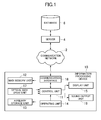
- FIG. 1 shows one example of a hardware structure of an information processing device 10 in this embodiment.
- the information processing device 10 includes a control unit 11, a main memory unit 12, an auxiliary storage unit 13, an operating unit 14, a display unit 15, a sound output unit 16, an optical disk drive unit 17, and a communication interface 18.
- the control unit 11 includes, for example, one or more CPUs, and executes information processing according to an operation system or a program stored in the auxiliary storage unit 13.
- the main memory unit 12 is a RAM, for example, while the auxiliary storage unit 13 is a hard disk or a solid state drive, for example.
- the operating unit 14 is used for user operation.
- a designation unit for a user to designate a position in a screen displayed on the display unit 15 is provided as the operating unit 14. That is, a pointing device, such as, for example, a touch panel, a mouse, a stick, or the like, is provided as the operating unit 14. Note that the following description is based on an assumption that the information processing device 10 has a touch panel provided on the display unit 15.
- the touch panel provided to the information processing device 10 is a general touch panel, and capable of detecting one or more positions touched by a user.
- a touch panel a touch panel employing a static capacitance method, for example, is used. With the touch panel employing the static capacitance method, one or more positions touched by a user is/are detected, based on change in the charge that is caused upon a user's touching the surface of the touch panel.
- the touch panel supplies information indicative of one or more positions touched by the user.
- the control unit 11 obtains the one or more positions touched by the user, based on the information supplied from the touch panel.
- the display unit 15 is a liquid crystal display, or the like, for example, and the sound output unit 16 is a speaker or the like, for example.
- the optical disk drive unit 17 reads a program and/or data stored in an optical disk (an information storage medium).
- a program and data is supplied to the auxiliary storage unit 13 via an optical disk. That is, an optical disk with a program and data recorded thereon is inserted in the optical disk drive unit 17, and the program and/or data recorded on the optical disk is read by the optical disk drive unit 17 and then stored in the auxiliary storage unit 13.
- the optical disk drive unit 17 is not an essential structural element.
- a structural element for reading a program or data stored in an information storage medium (for example, a memory card) other than an optical disk may be included, instead of the optical disk drive unit 17, so that a program and/or data may be supplied to the auxiliary storage unit 13 via an information storage medium other than an optical disk.
- a program and/or data may be supplied to the auxiliary storage unit 13 via a communication network 2 including, for example, the Internet or the like.
- the communication interface 18 is an interface for connecting the information processing device 10 to the communication network 2.
- the information processing device 10 can access the server 4 via the communication network 2.
- the server 4 executes processing based on a processing request received from the information processing device 10. For example, a demon program is activated in the server 4, and upon receipt of a processing request from the information processing device 10, the server 4 accesses the database 6, when necessary, and sends a processing result in response to the processing request to the information processing device 10.
- the database 6 may be ensured in a server computer different from the server 4 or in the server 4.
- FIG. 2 shows one example of a search result screen.
- the search result screen is a screen showing a list of products that satisfy a search condition set based on an input by a user in a search screen (not shown).
- the search result screen shown in FIG. 2 is a screen showing a list of products satisfying a search result among products that are available for purchase in an electronic commercial site.
- the information processing device 10 obtains a list of products satisfying the search condition that is set based on an input by a user in the search screen. For example, the information processing device 10 (the above-described application program) sends a search condition to the server 4. Having received the search condition, the server 4 accesses the database 6 to obtain a list of products satisfying the search condition. Then, the server 4 sends the obtained product list to the information processing device 10. The information processing device 10 displays the search result screen showing the product list sent from the server 4.
- the search result screen shown in FIG. 2 has a list area 20.
- a list of products satisfying the search condition is displayed in the list area 20.
- a product image 22 of each product satisfying the search condition is displayed in the list area 20.
- the product image 22 includes a thumb nail image of the product, and the name and price of the product are attached to the product image 22.
- the search result screen includes a favorite area 24.
- the favorite area 24 is used for registration of a product as a favorite among the products displayed in the list area 20.
- FIG. 3 shows one example of the favorite screen.
- Product images 22 of the products registered as favorites are displayed in the favorite screen.
- FIG. 3 shows one example of the favorite screen with the products "A”, “B”, “C”, and “D” registered as favorite products.
- the product images 22A, 22B, 22C, and 22D of the products "A”, "B", “C”, and “D” are displayed in the favorite screen shown in FIG. 3 .
- the product images 22 are displayed scattered, like the product images 22A to 22D shown in FIG. 3 .
- This favorite screen as well is displayed through data exchange between the information processing device 10 (the above-described application program) and the server 4. That is, when the product image 22 of any product moves to the favorite area 24 in the search result screen, the above-described application program sends the product ID of the product, together with the user ID, to the server 4.
- a table showing a product registered by a user as a favorite is stored in the database 6, and the server 4 updates the table based on the above-described user ID and product ID received from the information processing device 10. Further, the server 4 obtains information on a product registered by a user as a favorite from the database 6, and sends the obtained information to the information processing device 10. In the information processing device 10, the information sent from the server 4 is stored in the auxiliary storage unit 13 (see FIG. 7 to be described later), and the favorite screen is displayed based on the information.
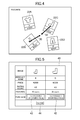
- FIG. 4 is a diagram explaining this operation. Assume a case here in which the products "B" and "C" are compared with each other.
- a user performs, for example, a "pinching operation” to collide the product image 22B of the produce “B” and the produce image 22C of the produce “C” against each other. That is, the user puts one finger (for example, the thumb) of his/her one hand (for example, the right hand) on the touch panel so as to point out the product image 22B of the produce "B", and another finger (for example, the index finger) on the touch panel so as to point out the product image 22C of the produce "C”. Thereafter, the user slides these fingers so as to get closer to each other on the touch panel. With such an operation, the product image 22B of the produce "B” and the product image 22C of the produce “C” move getting closer to each other in accordance with the movement of the fingers, as indicated by the arrows 30, 32.
- FIG. 5 shows one example of the comparison screen in this case.
- a comparison table 40 showing various information (attribute information) on the products "B" and “C” is displayed in the comparison screen in this case.
- a purchaser of a product can rate the product with the full score of five points, for example, in the electronic commercial site. That is, the average of the ratings registered by purchasers of the product is displayed in the "rating score" section in the comparison table 40.
- the server 4 is notified of the fact that the product is registered as a favorite, and the number of users having registered the product as a favorite is stored in the database 6.
- the "favorite" section in the comparison table 40 shows the number of users having registered the product as a favorite.
- a link button 42 for jumping to a shopping screen for buying a respective product is displayed in the comparison screen. Selection of the link button 42 causes a shopping screen (not shown) for buying a concerned product to appear. Further, a close button 44 is also displayed in the comparison screen. Selection of the close button 44 causes the comparison screen to close and the favorite screen to appear again.
- the user can instruct the information processing device 10 to display a comparison screen for two products through an intuitive operation of pointing out to thereby select the two product images 22 and moving the two fingers to thereby move the two product images 22 so as to collide.
- a drag and drop operation may be employed as an operation for instructing the information processing device 10 to display a comparison screen for two products. That is, it is feasible to display, when a user performs a drag operation to thereby move one product image 22 onto another product image 22 and then a drop operation with the products images 22 placed one on the other, a comparison screen for two products of those product images 22.
- a user initially selects both of the product images 22 of two products for comparison, and then the user moves the product images 22 so as to collide.
- a comparison screen for the two products is displayed.
- the above described inconvenience is unlikely caused. That is, even if a product image 22 other than a desired product image 22 is selected, unless the product image 22 is caused to collide against another product image 22, a comparison screen for these products is not displayed. In this case, the user simply detaches his/her finger from the touch panel, and selects again a product image 22.
- a comparison screen for two products not intended by a user is unlikely displayed.
- the above described inconvenience is not caused. That is, even when a user detaches his/her finger from the touch panel to select again a different product image 22 after selection of a product image 22 other than a desired product image 22, the user does not need to particularly care whether or not the selected product image 22 happens to be positioned on another product image 22. This is because a comparison screen for products is not displayed even though the product image 22 selected by a user is placed on another product image 22 unless the product images 22 collide with each other.
- FIG. 6 is a functional block diagram showing a functional block relevant to the present invention among those implemented in the information processing device 10 in this embodiment.
- the information processing device 10 includes a storage unit 50, a display control unit 52, a detection result obtaining unit 54, a selection determination unit 56, an object moving unit 58, a collision determination unit 60, a first processing executing unit 62, and a second processing executing unit 64.
- the storage unit 50 is implemented using the main memory unit 12 and the auxiliary storage unit 13.
- the display control unit 52, the detection result obtaining unit 54, the selection determination unit 56, the object moving unit 58, the collision determination unit 60, a first processing executing unit 62, and a second processing executing unit 64 are implemented by the control unit 11. That is, the control unit 11 executing processing according to a program functions as these functional blocks.
- the storage unit 50 will be described.
- the storage unit 50 stores various data.
- FIGs. 7 to 9 show one example of data stored in the storage unit 50.
- FIG. 7 shows one example of a favorite table.
- the favorite table is a table showing information on a product registered as a favorite. As described above, in displaying the favorite screen, information on a product registered by a user as a favorite is obtained from the server 4 (database 6). The obtained information is registered in the favorite table.
- the favorite table shown in FIG. 7 incudes "product ID”, "product name”, “price”, “category”, “rating score”, "number of registrants to favorite", "image”, and “shopping page” fields.
- product ID identification information
- product name the name and price of a product are respectively registered.
- category the category of a product is registered.
- rating score the average of the rating scores made by purchasers of the product is registered.
- number of users having registered the product as a favorite is registered.
- image link information (URL) to a normal image and a thumb nail image of the product is registered.
- “shopping page” field link information (URL) to a shopping page (shopping screen) for the product is registered.
- FIG. 8 shows one example of the object table.
- the object table is a table for managing an object (product image 22) displayed in the favorite screen.
- the object table includes "object ID", "product ID”, and "position” fields.
- identification information object ID
- product ID uniquely identifying an object (product image 22) is registered.
- product ID the product ID of a product correlated to an object (product image 22) is registered.
- product ID the product ID of a product correlated to an object
- the product ID of the product "A” is registered in the “product ID” field.
- a display position of an object (product image 22) is registered.
- the screen coordinates of a representative position for example, the center position of an object (product image 22) is registered.
- a screen coordinate system is a coordinate system having the origin defined at the upper left corner of a screen, the X axis being positive in the rightward direction, and the Y axis being positive in the downward direction.
- the display control unit 52 displays a screen including a plurality of objects on the display unit 15.
- the display control unit 52 displays a favorite screen on the display unit 15. That is, in this embodiment, the favorite screen corresponds to the above-described "screen”, and a plurality of product images 22 displayed in the favorite screen correspond to the above-described "plurality of objects".
- the detection result obtaining unit 54 obtains a result of detection by a detection unit capable of detecting two or more positions designated by a user in a screen.
- the pointing device corresponds to the "detection unit”.
- the touch panel corresponds to the "detection unit”
- the detection result obtaining unit 54 obtains a user' s designated position (a position designated by a user) and detected by the touch panel.
- the touch panel detects the first designated position and the second designated position.
- the detection result obtaining unit 54 obtains the first designated position and the second designated position detected by the touch panel.
- the detection result obtaining unit 54 obtains designated position data, such as is shown in FIG. 9 , for example. Note that a user's designated position is expressed using the coordinates of the screen coordinate system.
- the selection determination unit 56 determines whether or not a user's designated position is included in any of a plurality of determination areas set corresponding to the respective positions of a plurality of objects. When it is determined that a user's designated position is included in any determination area, the selection determination unit 56 determines that the object corresponding to the determination area is selected by a user.
- the selection determination unit 56 determines whether or not the first designated position is included in any determination area. Further, when the user's second designation position (another designated position) is detected by the detection unit, besides the first designated position, the selection determination unit 56 determines whether or not the second designated position is included in another determination area.
- a determination area is an area that is set for determining whether or not a user is pointing out an object.
- a determination area is set based on the display position of an object, and moves in accordance with movement of the object. For example, an area where an object is displayed is set as a determination area.
- the determination area may not necessarily coincide with the area where the object is displayed. For example, an area including the entire area where an object is displayed and also being larger than the area where the object is displayed may be set as a determination area. Further, for example, for an object in a relatively complicated shape, a determination area having a relatively simpler shape may be set.
- FIG. 10 is a diagram explaining a determination area in a case where the favorite screen, such as is shown in FIG. 3 , is displayed. Note that the reference numeral "70A" in FIG. 10 indicates a user' s first designated position, and “70B" indicates the user's second designated position.
- determination areas 72A to 72D are set in the example shown in FIG. 10 . Note that, in the following, the determination areas 72A to 72D may be collectively referred to as a "determination area 72".
- the determination area 72A is a determination area corresponding to the product image 22A of the product "A", and the area where the product image 22A is displayed is set as the determination area 72A.
- the determination area 72B is a determination area corresponding to the product image 22B of the produce "B”, and the area where the product image 22B is displayed is set as the determination area 72B.
- the determination area 72C is a determination area corresponding to the product image 22C of the produce "C”, and the area where the product image 22C is displayed is set as the determination area 72C.
- the determination area 72D is a determination area corresponding to the product image 22D of the produce "D", and the area where the product image 22D is displayed is set as the determination area 72D.
- the selection determination unit 56 determines whether or not the first designated position 70A is included in any of the determination areas 72A to 72D. In the example shown in FIG. 10 , as the first designated position 70A is included in the determination area 72B, the selection determination unit 56 determines that the first designated position 70A is included in the determination area 72B. As a result, the selection determination unit 56 determines that the product image 22B is selected by a user. Further, the selection determination unit 56 determines whether or not the second designated position 70B is included in any of the determination areas 72A to 72D. In the example shown in FIG.
- the selection determination unit 56 determines that the second designated position 70B is included in the determination area 72C. As a result, the selection determination unit 56 determines that the product image 22C is selected by a user.
- the object moving unit 58 When it is determined that a user's designated position is included in the determination area corresponding to any object (that is, when it is determined that an object is selected by a user), the object moving unit 58 moves the object in accordance with movement of the designated position.
- the object moving unit 58 moves the first object in accordance with movement of the first designated position. Further, when it is determined that the second designated position is included in the second determination area corresponding to the second object, the object moving unit 58 moves the second object in accordance with movement of the second designated position.
- the object moving unit 58 moves the product image 22B in accordance with movement of the first designated position 70A. That is, the object moving unit 58 causes the product image 22B to follow the first designated position 70A.
- the object moving unit 58 moves the product image 22C in accordance with movement of the second designated position 70B. That is, the object moving unit 58 causes the product image 22C to follow the second designated position 70B.
- the collision determination unit 60 determines whether or not a first object and a second object have collided with each other when it is determined that the first designated position is included in the determination area corresponding to the first object and the second designated position is included in the determination area corresponding to the second object and at least one of the first and second objects is moved by the object moving unit 58.
- the collision determination unit 60 determines whether or not the first object and the second object have collided with each other by determining whether or not the distance between the first designated position and the second designated position is equal to or smaller than a threshold. The collision determination unit 60 determines that the first object and the second object have collided with each other when at least one of the first and second objects is moved by the object moving unit 58 and the distance between the first designated position and the second designated position is equal to or smaller than the threshold.
- the first designated position 70A is included in the determination area 72B
- the second designated position 70B is included in the determination area 72C.
- the object moving unit 58 moves the product image 22B in accordance with movement of the first designated position 70A and the product image 22C in accordance with movement of the second designated position 70B.
- the collision determination unit 60 obtains the distance (d) between the first designated position 70A and the second designated position 70B, and determines whether or not the distance (d) is equal to or smaller than the threshold to thereby determine whether or not the product image 22B and the product image 22C have collided with each other.
- the collision determination unit 60 determines that the product image 22B and the product image 22C have collided with each other.
- the collision determination unit 60 does not determine the product image 22B and the product image 22C have collided with each other unless the above-described distance (d) is equal to or smaller than the threshold.
- the collision determination unit 60 does not determine that the product image 22B and the product image 22D have collided with each other as a user' s designated position is not included in the determination area 72D.
- a collision determining method for an object is not limited to the above described method.
- the collision determination unit 60 may determine whether or not the first object overlaps the second object, to thereby determine whether or not the first object and the second object have collided with each other. Further, for example, the collision determination unit 60 may determine whether or not the determination area corresponding to the first object overlaps the determination area corresponding to the second object, to thereby determine whether or not the first object and the second object have collided with each other.
- the first processing executing unit 62 executes processing relevant to the first object and the second object, based on a result of determination by the collision determination unit 60. For example, when it is determined that the first object and the second object have collided with each other, the first processing executing unit 62 displays a comparison screen for comparing attribute information correlated to the first object and attribute information correlated to the second object on the display unit 15.
- the first processing executing unit 62 executes processing relevant to the product image 22B and the product image 22C.
- the first processing executing unit 62 displays a comparison screen, such as is shown in FIG. 5 , on the display unit 15. That is, the first processing executing unit 62 shows a comparison screen for comparing information on the product "B" correlated to the product image 22B and information on the product "C" correlated to the product image 22C on the display unit 15.
- FIG. 12 is a flowchart of an example of processing that is repetitively executed for every predetermined period of time (for example, 1/60 th of a second) in the information processing device 10 while the favorite screen is displayed. Note that processing for moving the product image 22 in accordance with change of a user' s designated position is also executed while the favorite screen is displayed, which, however, is not shown in FIG. 12.
- FIG. 12 mainly shows processing for determining whether or not the product images 22 have collided.
- the control unit 11 executes the processing shown in FIG. 12 according to the program, and as a result, the control unit 11 functions as the detection result obtaining unit 54, the selection determination unit 56, the object moving unit 58, the collision determination unit 60, and the first processing executing unit 62.
- the control unit 11 obtains the number (N) of a user's designated positions detected by the detection unit (touch panel) (S101). Then, the control unit 11 determines whether or not the obtained number (N) is two or larger (S102). If the obtained number (N) is not two or larger, the control unit 11 terminates this processing.
- the control unit 11 initialize the value of the variable i to 1 (S103). Then, the control unit 11 (selection determination unit 56) determines whether or not the i th designated position is included in any determination area 72 (S104). Note that "the i th designated position” refers to the i th designated position among the designated positions detected by the detection unit (touch panel) .
- the control unit 11 selects whether or not the j th designated position is included in any determination area 72.
- selection determination unit 56 initializes the value of the variable j to i+1 (S105), and determines whether or not the j th designated position is included in another determination area 72 (S106).
- another determination area 72 refers to a determination area 72 other than the determination area 72 that is determined at step S104 as including the i th designated position.
- the control unit 11 obtains the distance (d) between the i th designated position and the j th designated position (S107). Then, the control unit 11 (collision determination unit 60) determines whether or not the distance (d) is equal to or smaller than the threshold (D) (S108). If the distance (d) is equal to or smaller than the threshold (D), the control unit 11 (first processing executing unit 62) determines the product images 22 have collided, and displays the comparison screen ( FIG. 5 ) on the display unit 15.
- a comparison screen for the product of the product image 22 corresponding to the determination area that is determined at step S104 as including the i th designated position and the product of the product image 22 corresponding to the determination area 72 that is determined at step S106 as including the j th designated position is displayed.
- the comparison screen is displayed based on the favorite table shown in FIG. 7 .
- the control unit 11 increments the value of the variable i (S112), and then determines whether or not the variable i is smaller than the number (N) of the user's designated positions detected (S113). If it is determined that the variable i is smaller than the number (N) of the user' s designated positions detected, the control unit 11 executes the processing at step S104. Meanwhile, if it is not determined that the variable i is smaller than the number (N) of the user's designated positions detected, the control unit 11 terminates this processing.
- the control unit 11 increments the value of the variable j (S110), and then determines whether or not the value of the variable j is equal to or smaller than the number (N) of the user's designated positions detected (S111). If it is determined that the variable j is equal to or smaller than the number (N) of the user's designated positions detected, the control unit 11 executes the processing at step S106. Meanwhile, if it is not determined that the variable j is equal to or smaller than the number (N) of the user's designated positions detected, the control unit 11 executes the processing at step S112. Description on the processing shown in FIG. 12 is completed with the above.
- the second processing executing unit 64 is a functional block for enhancing user convenience by considering a dominant hand, habit, or the like, of a user.
- the second processing executing unit 64 executes predetermined processing, based on positional relationship information on a positional relationship between "the one object or the one designated position" and "the other object or the other designated position” in a case in the past in which it is determined that a user's one designated position is included in the determination area corresponding to one object of a plurality of objects and the user's another designated position is included in the determination area corresponding to another object of the plurality of objects.
- positional relationship information is direction information on a direction from “the one object or the one designated position” to “the other object or the other designated position” in a case in the past in which it is determined that the one designated position is included in the determination area corresponding to the one object and the other designated position is included in the determination area corresponding to the other object.
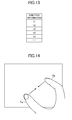
- FIG. 13 shows one example of history data stored in the storage unit 50.
- the history data shown in FIG. 13 shows history of direction information indicating the direction from one object to the other object at a moment in the past at which it is determined that two objects are selected by a user.
- the direction information is, for example, vector information indicating the direction from the representative position (for example, the center position) of one of the two objects in collision that has smaller X axial coordinates than those of the other to the representative position (for example, the center position) of the other object.
- the direction information may be vector information indicating the direction from one designated position to the other designated position.
- the direction information may be vector information indicating the direction from the representative position of one object to a designated position corresponding to the other object (that is, a designated position determined as being included in the determination area corresponding to the other object), or vector information indicating the direction from a designated position corresponding to one object to the representative position of the other object.
- the direction information may be vector information indicating the direction from one object to the other object at a moment other than a moment of determination that two objects are selected by a user.
- the direction information may be vector information indicating the direction from one object to the other object at a moment of determination that two objects have collide.
- Predetermined processing is processing for enhancing user convenience.
- predetermined processing includes dominant hand determination processing for determining a user's dominant hand. That is, in this embodiment, the second processing executing unit 64 includes a dominant hand determination unit 66. The dominant hand determination unit 66 executes the above-described dominant hand determination processing based on the above-described positional relationship information, to thereby determine a user's dominant hand. For example, the dominant hand determination unit 66 determines a user's dominant hand based on the above-described history data ( FIG. 13 ).
- a right handed user can readily perform a pinching operation such as is shown in FIG. 14 . That is, a right handed user can readily perform a pinching operation of getting his/her thumb Fa and index finger Fb closer to each other from a state in which the index finger Fb is positioned on the upper right side of the thumb Fa.
- a right handed user tends to collide two product images 22 having such a positional relationship that one product image 22 is positioned on the upper right side of the other product image 22.
- a left handed user can readily perform a pinching operation such as is shown in FIG. 15 . That is, a left handed user can readily perform a pinching operation of getting his/her thumb Fa and index finger Fb closer to each other from a state in which the thumb Fa is positioned on the lower right side of the index finger Fb.
- a left handed user tends to collide two product images 22 having such a positional relationship that one product image 22 is positioned on the lower right side of the other product image 22.
- Determination on a user's dominant hand may be made in consideration of the above described tendency.
- processing for determining a user's dominant hand is described, which, however, is not limiting.
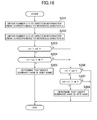
- FIG. 16 is a flowchart of one example of a user's dominant hand determination processing.
- the control unit 11 executes the processing shown in FIG. 16 according to a program, and as a result, the control unit 11 functions as the dominant hand determination unit 66 (second processing executing unit 64).
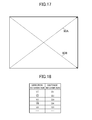
- FIG. 17 is a diagram explaining the processing shown in FIG. 16 .
- "Reference direction A" at step S201 in FIG. 16 indicates the reference direction 80A shown in FIG. 17 .
- the reference direction 80A is a reference direction corresponding to a pinching operation readily performed by a right handed user ( FIG. 14 ).
- the reference direction 80A is a direction from the lower left vertex of a screen to the upper right vertex.
- "reference direction B" at step S202 in FIG. 16 corresponds to the reference direction 80B shown in FIG. 17 .
- the reference direction 80B is a reference direction corresponding to a pinching operation readily performed by a left handed user ( FIG. 15 ).
- the reference direction 80B is a direction from the upper left vertex of a screen to the lower right vertex.
- the control unit 11 obtains the number (m1) of direction information items corresponding to the reference direction 80A from among a plurality of direction information items included in the history data ( FIG. 13 ) (S201).
- direction information corresponding to the reference direction 80A is, for example, direction information indicating a direction in parallel to or in substantially parallel to the reference direction 80A.
- direction information corresponding to the reference direction 80A is, for example, direction information with the angle formed by the direction indicated by the direction information and the reference direction 80A being equal to or smaller than a reference angle.
- control unit 11 obtains the number (m2) of direction information items corresponding to the reference direction 80B from among a plurality of direction information items included in the history data ( FIG. 13 ) (S202).
- direction information corresponding to the reference direction 80B is, for example, direction information indicating a direction in parallel to or in substantially parallel to the reference direction 80B.
- direction information corresponding to the reference direction 80B is, for example, direction information with the angle formed by the direction indicated by the direction information and the reference direction 80B being equal to or smaller than a reference angle.
- the control unit 11 (dominant hand determination unit 66) compares the above-described number (m1) and the above-described number (m2) to determine a user' s dominant hand based on the result of comparison (S203 to S208).
- the control unit 11 determines whether or not the above-described number (m1) is larger than the above-described number (m2) (S203). If the above-described number (m1) is larger than the above-described number (m2), the control unit 11 determines whether or not the difference between the above-described number (m1) and the above-described number (m2) is equal to or larger than a reference value (M) (S204). If the difference between the above-described number (m1) and the above-described number (m2) is larger than the reference value (M), the control unit 11 determines that the user's dominant hand is a right hand (S205).
- processing at step S204 may be omitted.
- it may be determined that the user's dominant hand is a right hand when it is determined that the above-described number (m1) is larger than the above-described number (m2).
- control unit 11 determines whether or not the above-described number (m2) is larger than the above-described number (m1) (S206).
- the control unit 11 determines whether or not the difference between the above-described number (m2) and the above-described number (m1) is larger than the reference value (M) (S207). Then, if the difference between the above-described number (m2) and the above-described number (m1) is larger than the reference value (M), the control unit 11 (dominant hand determination unit 66) determines that the user's dominant hand is a left hand (S208).
- processing at step S207 may be omitted.
- it may be determined that the user's dominant hand is a left hand when it is determined that the above-described number (m2) is larger than the above-described number (m1).
- control unit 11 terminates the processing without determining the user's dominant hand. Description on the processing shown in FIG. 16 is completed with the above.
- a user's dominant hand is determined based on the direction information on the direction from one product image 22 to the other product image 22 at a moment in the past at which it is determined that two product images 22 are selected by a user. That is, it is possible to determine a user's dominant hand without imposing on the user a task of inputting information on his/her dominant hand.
- distance information on the distance between two products objects 22 at a moment in the past at which it is determined that the two product images 22 are selected by a user may be considered.
- the distance information may be information on the distance between one designated position and the other designated position.
- the distance information may be information on the distance between the representative position of one object and a designated position corresponding to the other object (that is, a designated position determined as being included in the determination area corresponding to the other object), or the distance between a designated position corresponding to one object and the representative position of the other object.
- the dominant hand determination unit 66 may not use the above described direction information in such a case in determination of a user's dominant hand.
- the above described direction information in the above described case may not be included in the history data ( FIG. 13 ).
- history data such as is shown in FIG. 18 may be stored instead of the history data shown in FIG. 13 . That is, the history data shown in FIG. 18 is data correlating the above described direction information and the above described distance information.
- direction information correlated to distance information indicating a distance larger than a reference distance may be ignored at steps S201 and S202 in FIG. 16 .
- the dominant hand determination unit 66 In a case where a user's dominant hand is determined by the dominant hand determination unit 66, data indicating the result of determination is stored in the storage unit 50.
- the data will be hereinafter referred to as "dominant hand data".
- the dominant hand data is used in various processing.
- the dominant hand data is used in displaying the favorite screen.
- the display control unit 52 sets the initial display positions of the plurality of product images 22 displayed in the favorite screen, based on the dominant hand data. In the following, one example of processing for setting the initial display position of the product image 22 will be described.
- the display control unit 52 obtains a combination of two product images 22 which a user highly likely collide. That is, the display control unit 52 obtains a combination of two products which a user highly likely selects as comparison targets.
- a combination of two products which a user highly likely select as comparison targets can be obtained based on product attribute information, for example. For example, generally, it is considered that a user highly likely selects as comparison targets two products having attribute information of high similarity. Specifically, generally, it is considered that a user highly likely selects two products of the same kind as comparison targets. Further, generally, it is considered that a user highly likely selects two products at a similar price level as comparison targets.
- the display control unit 52 compares the product attribute information correlated to the product image 22 and that correlated to another image 22. Then, the display control unit 52 determines two product images 22 leading to a comparison result being a predetermined result as a combination of two product images 22 which a user highly likely collide.
- a "predetermined result” is a comparison result that, for example, the categories are the same or similar, that the prices are the same or similar (in other words, the difference in price is equal to or smaller than a reference value), or so forth.
- a combination of two products which a user highly likely select as comparison targets can be obtained based on, for example, a combination of two products selected by the user in the past as comparison targets. For example, generally, it is considered that a combination of products having been selected as comparison targets many times in the past is highly likely selected as comparison targets by a user.
- information on a combination of product images 22 having been collided by a user in the past may be stored in the storage unit 50.
- the display control unit 52 may obtain a combination of two product images 22 which the user highly likely collide.
- the display control unit 52 may obtain a combination of product images 22 having been collided a larger number of times than a reference number of times as a combination of two product images 22 which a user highly likely collide.
- the display control unit 52 sets the initial display positions of these two product images 22 based on the dominant hand data.
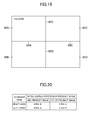
- FIGs. 19 and 20 are diagrams explaining the initial display position data.
- a plurality of areas 90A, 90B, 90C, and 90D such as are shown in FIG. 19 are virtually set in the favorite screen.
- the favorite screen is halved horizontally and vertically so that four areas 90A, 90B, 90C, and 90D are virtually set in the favorite screen.
- the area 90A is an upper left area in the favorite screen; the area 90B is a lower left area in the favorite screen; the area 90C is an upper right area in the favorite screen; and the area 90D is a lower right area in the favorite screen.
- the areas 90A and 90D have a positional relationship in which the area 90D is positioned on the lower right side of the area 90A, and the areas 90B and 90C have a positional relationship in which the area 90C is positioned on the upper right side of the area 90B.
- the reference numeral "92A” indicates the boundary between the areas 90A and 90B
- the reference numeral “92B” indicates the boundary between the areas 90B and 90D
- the reference numeral “92C” indicates the boundary between the areas 90A and 90C
- the reference numeral “92D” indicates the boundary between the areas 90C and 90D.
- FIG. 20 shows one example of the initial display position data.
- the initial display position data shown in FIG. 20 correlates a user' s dominant hand and the initial display position of the product image 22.
- the respective areas A, B, C, and D shown in FIG. 20 correspond to the respective areas 90A, 90B, 90C, and 90D shown in FIG. 19 .
- the areas 90B and 90C are correlated to a "right hand" as a dominant hand, while the areas 90A and 90D are correlated to a "left hand” as a dominant hand.
- the display control unit 52 obtains the initial display position (areas 90B and 90C) correlated to a "right hand" as the dominant hand, with reference to the initial display position data. In this case, the display control unit 52 sets the initial display position of one of the two product images 22 which a user highly likely select as comparison targets in the area 90B and the initial display position of the other in the area 90C.
- the display control unit 52 obtains the initial display position (areas 90A and 90D) correlated to a "left hand" as a dominant hand, with reference to the initial display position data. In this case, the display control unit 52 sets the initial display position of one of the two product images 22 which a user highly likely select as comparison targets in the area 90A and the initial display position of the other in the area 90D.
- the product images 22A to 22D shown in FIG. 3 are displayed in the favorite screen.
- the product images 22B and 22C belong to the same product category (that is, socks) and are priced similar, the product images 22B and 22C are determined as two product images 22 which a user highly likely collide.
- the initial display position of one of the product images 22B and 22C is set in the area 90A, and that of the other in the area 90D, as showing FIG. 21 , for example.
- either of the product images 22B and 22C is selected at random as a product image 22 to be initially displayed in the area 90A, and the product image 22 not selected as a product image 22 to be initially displayed in the area 90A is selected as a product image 22 to be initially displayed in the area 90D.
- the product image 22B is selected as a product image 22 to be initially displayed in the area 90A
- the product image 22C is selected as a product image 22 to be initially displayed in the area 90D.
- a position in the area 90A at which to initially display the product image 22B is determined at random.
- a position in the area 90D at which to initially display the product image 22C is determined at random.
- Orientations of the product images 22B and 22C are also determined at random.
- the initial display positions of the product images 22A and 22D are set in the areas 90B and 90C other than the areas 90A and 90D, respectively. That is, in this case, positions in the areas 90B and 90C are determined at random as the initial display positions of the product images 22A and 22D. Orientations of the product images 22A and 22D are also determined at random.
- the initial display position of one of the product images 22B and 22C is set in the area 90B, and that of the other in the area 90C.
- the initial display positions of the product images 22A and 22D are set in the areas 90B and 90C other than the areas 90A and 90D, respectively.
- one of the product images 22B and 22C which a user highly likely collide may be displayed in both of the areas 90A and 90B and the other in both of the areas 90C and 90D in the favorite screen shown in FIG. 21 , for example, before completion of determination by the dominant hand determination unit 66 (that is, when the dominant hand data indicating whether a user's dominant hand is a right hand or a left hand is not stored in the storage unit 50).
- the dominant hand determination unit 66 that is, when the dominant hand data indicating whether a user's dominant hand is a right hand or a left hand is not stored in the storage unit 50.
- the dominant hand data can be used not only in displaying the favorite screen.
- the dominant hand data can be used in searching for a product (information search) as well.
- a right handed product and a left handed product are both available for some kinds of products.
- stationery for example, right handed stationery and left handed stationery may be both available.
- right handed scissors and left handed scissors are available. Therefore, for example, when a user designates a specific product category (for example, stationery) as a search condition in a search screen, the user' s dominant hand may be automatically added as a part of the search condition based on the dominant hand. This enables a search in consideration of a user's dominant hand.
- a specific product category for example, stationery
- the information processing device 10 in the first embodiment described above it is possible to enhance user convenience by considering a user's dominant hand without imposing on the user a task of inputting information on the user's dominant hand.
- An information processing device 10 in the second embodiment has a hardware structure similar to that of the information processing device 10 in the first embodiment (see FIG. 1 ).
- an electronic commercial site is provided by the server 4, and an application program for using the above described electronic commercial site is executed in the information processing device 10. That is, in the second embodiment as well, the search result screen shown in FIG. 2 , the favorite screen shown in FIG. 3 , and the comparison screen shown in FIG. 5 are displayed on the display unit 15.
- the information processing device 10 in the first embodiment determines a user' s dominant hand and sets the initial display position of the product image 22 displayed in the favorite screen based on the user's dominant hand
- the information processing device 10 in the second embodiment differs from the first embodiment in that the initial display position of the product image 22 displayed in the favorite screen is set without determining a user's dominant hand.
- FIG. 22 is a functional block diagram showing a functional block relevant to the present invention among those achieved in the information processing device 10 in the second embodiment.
- the information processing device 10 in the second embodiment includes a storage unit 50, a display control unit 52, a detection result obtaining unit 54, a selection determination unit 56, an object moving unit 58, a collision determination unit 60, a first processing executing unit 62, and a second processing executing unit 64.
- the information processing device 10 in the second embodiment differs from the first embodiment in that the initial display position setting unit 68 is included in the second processing executing unit 64 instead of the dominant hand determination unit 66.
- the second processing executing unit 64 and the initial display position setting unit 68 will be mainly described. Note that the functions of the other functional blocks are similar to those in the first embodiment, and thus not described again here.
- the second processing executing unit 64 executes predetermined processing, based on a positional relationship between the one object or the one designated position and the other object or the other designated position in a case in the past in which it is determined that the one designated position is included in the determination area corresponding to the one object among the plurality of objects and the other designated position is included in the determination area corresponding to the other object among the plurality of objects.
- positional relationship information is direction information on a direction from “the one object or the one designated position” to "the other object or the other designated position” in a case in the past in which it is determined that the one designated position is included in the determination area corresponding to the one object and the other designated position is included in the determination area corresponding to the other object.
- the history data shown in FIG. 13 is stored in the storage unit 50.
- Predetermined process is processing for setting the initial display positions of a plurality of objects in a screen, for example. That is, the second processing executing unit 64 includes the initial display position setting unit 68.
- the initial display position setting unit 68 executes processing for setting the initial display positions of the plurality of objects in a screen based on the above described positional relationship information, to thereby set the initial display positions of the plurality of objects in the screen.
- the initial display position setting unit 68 sets the initial display positions of the plurality of product images 22 displayed in the favorite screen based on the history data ( FIG. 13 ).
- FIGs. 23 and 24 explain the initial display position data.
- a plurality of reference directions 80A, 80B, 80C, and 80D such as are shown in FIG. 23 , for example, are virtually set in the favorite screen.
- the reference direction 80A is a direction extending from the lower left vertex of the favorite screen to the upper right vertex;
- the reference direction 80B is a direction extending from the upper left vertex of the favorite screen to the lower right vertex;
- the reference direction 80C is a direction extending from the left side of the favorite screen to the right side (that is, the x axial positive direction) ;
- the reference direction 80D is a direction extending in the up-down direction of the favorite screen (that is, the y axial positive or negative direction). Note that although four reference directions 80A to 80D are set here in the description, five or more reference directions may be set.
- FIG. 24 shows one example of the initial position data.
- the initial position data shown in FIG. 24 correlates initial display positions of the product image 22 to the respective reference directions 80A to 80D.
- the respective reference directions A, B, C, and D shown in FIG. 24 correspond to the respective reference directions 80A, 80B, 80C, and 80D shown in FIG. 23 .
- the respective areas A, B, C, and D shown in FIG. 24 correspond to the respective areas 90A, 90B, 90C, and 90D shown in FIG. 19 .
- respective boundaries A, B, C, and D shown in FIG. 24 correspond to the respective boundaries 92A, 92B, 92C, and 92D shown in FIG. 19 .
- the initial display position setting unit 68 obtains a combination of two product images 22 which a user highly likely collide. That is, the initial display position setting unit 68 obtains a combination of two products which a user highly likely selects as comparison targets.
- a method for obtaining a combination of two product images 22 which a user highly likely collide is similar to that in the first embodiment.
- the initial display position setting unit 68 sets the initial display positions of these two product images 22 based on the history data ( FIG. 13 ). That is, the initial display position setting unit 68 sets the direction from the initial display position of one of the two product images 22 to that of the other based on the direction information included in the history data ( FIG. 13 ). Specifically, the initial display position setting unit 68 sets the initial display positions of these two product images 22 such that the direction from one of the two product images 22 to that of the other coincides with the direction based on the direction information included in the history data ( FIG. 13 ).
- the initial display position setting unit 68 determines whether or not the direction information corresponds to any of the reference directions 80A to 80D. Specifically, the initial display position setting unit 68 determines whether or not the angle formed by the direction indicated by the direction information and the reference direction is equal to or smaller than a reference angle, to thereby determine whether or not the direction information corresponds to the reference direction. For example, if the angle formed by the direction indicated by the direction information and the reference direction 80A is equal to or smaller than a reference angle, the initial display position setting unit 68 determines that the direction information corresponds to the reference direction 80A.
- the initial display position setting unit 68 determines that the direction information does not correspond to any of the reference directions 80A to 80D.
- the initial display position setting unit 68 obtains the number of direction information items corresponding to the reference direction. That is, the initial display position setting unit 68 obtains the number of direction information items corresponding to the reference direction 80A among the plurality of direction information items included in the history data ( FIG. 13 ). Further, the initial display position setting unit 68 obtains the number of direction information items corresponding to the reference direction 80B among the plurality of direction information items included in the history data ( FIG. 13 ). Similarly, the initial display position setting unit 68 obtains the number of direction information items corresponding to the reference direction 80C among the plurality of direction information items included in the history data ( FIG. 13 ).
- the initial display position setting unit 68 obtains the number of direction information items corresponding to the reference direction 80D among the plurality of direction information items included in the history data ( FIG. 13 ). Then, the initial display position setting unit 68 obtains reference direction having the largest number of the above described direction information items from among the reference directions 80A to 80D.
- the initial display position setting unit 68 obtains the initial display position correlated to the reference direction having the largest number of the above described direction information items. For example, if the reference direction having the largest number of the above described direction information items is the reference direction 80B, the initial display position setting unit 68 obtains the areas 90A and 90D as the initial display positions. In this case, the initial display position setting unit 68 displays one of the two product images 22 which a user highly likely collide in the area 90A and the other in the area 90D.
- the product images 22A to 22D shown in FIG. 3 are displayed in the favorite screen.
- the product images 22B and 22C belong to the same product category (that is, socks) and are priced similar, the product image 22B, 22C are determined as two product images 22 which a user highly likely collide.
- the initial display position of one of the product images 22B and 22C is set in the area 90A and that of the other in the area 90D, as shown in FIG. 21 , for example.
- either of the product images 22B and 22C is selected at random as a product image 22 to be initially displayed in the area 90A.
- the product image 22 not selected as a product image 22 to be initially displayed in the area 90A is selected as a product image 22 to be initially displayed in the area 90D.
- the product image 22B is selected as a product image 22 to be initially displayed in the area 90A
- the product image 22C is selected as a product image 22 to be initially displayed in the area 90D.
- a position in the area 90A at which to initially display the product image 22B is determined at random.
- a position in the area 90D at which to initially display the product image 22C is determined at random.
- Orientations of the product images 22B and 22C are also determined at random.
- the initial display positions of the product images 22A and 22D are set in the areas 90B and 90C other than the areas 90A and 90D, respectively.
- positions in the areas 90B and 90C are determined at random as the initial display positions of the product images 22A and 22D.
- Orientations of the product images 22A and 22D are also determined at random.
- the initial display position setting unit 68 obtains the boundaries 92A and 92D as the initial display positions.
- the initial display position setting unit 68 shows one of the two product images 22 which a user highly likely collide on the boundary 92A and the other in the boundary 92D.
- the above described information processing device 10 in the second embodiment it is possible to enhance user convenience by considering a user' s habit without imposing on the user a task of inputting information on the user's habit.
- distance information on the distance between two product images 22 at a moment in the past at which it is determined that the two product images 22 are selected by a user may be considered.
- This distance information may be information on the distance between one designated position and the other designated position.
- the distance information may be information on the distance between the representative position of one object and a designated position corresponding to the other object (that is, a designated position determined as being included in the determination area corresponding to the other object), or information on the distance between a designated position corresponding to one object and the representative position of the other object.
- the display position setting unit 68 is a functional block for setting the initial display position of the product image 22 so that a user can readily collide two product images 22 through a pinching operation using two fingers of his/her one hand, it is not desirable to use the above described direction information in the above described case in setting the initial display position of the product image 22.
- the initial display position setting unit 68 may not use the above described direction information in the above described case in setting the initial display position of the product image 22.
- the above described direction information in the above described case may not be included in the history data ( FIG. 13 ), for example.
- history data shown in FIG. 18 may be stored instead of the history data shown in FIG. 13 .
- direction information correlated to distance information indicating a distance larger than a reference distance may be ignored in setting the initial display position of the product image 22.
- the initial display position setting unit 68 may use the above described direction information and the above described distance information in setting the initial display position of the product image 22. For example, in setting the initial display positions of two product images 22 which a user highly likely collide, the initial display position setting unit 68 may set the distance between the initial display positions of these two product images 22 based on the distance information. Specifically, the initial display position setting unit 68 may set the initial display positions of these two product images 22 such that the distance between the initial display positions of these two product images 22 becomes a distance based on the above described distance information.
- history data such as is shown in FIG. 18 needs to be stored in the storage unit 50.
- the direction information need not be stored so as to be correlated to the distance information, and data indicating the history of the direction information may be stored separately from data indicating the history of the distance information.
- the initial display position setting unit 68 may calculate a statistic (for example, the average value, an intermediate value, or the like) of the distances indicated by a plurality of respective distance information items included in the history data ( FIG. 18 ).
- the initial display position setting unit 68 may set the distance between the initial display positions of two product images 22 which a user highly likely collide, based on the above described statistic.
- the initial display position setting unit 68 may set the initial display positions of these two product images 22 such that the distance between the initial display positions of these two product images 22 which a user highly likely collide becomes the above described statistic.
Landscapes
- Engineering & Computer Science (AREA)
- Theoretical Computer Science (AREA)
- General Engineering & Computer Science (AREA)
- General Physics & Mathematics (AREA)
- Physics & Mathematics (AREA)
- Business, Economics & Management (AREA)
- Accounting & Taxation (AREA)
- Finance (AREA)
- Human Computer Interaction (AREA)
- Development Economics (AREA)
- General Business, Economics & Management (AREA)
- Strategic Management (AREA)
- Marketing (AREA)
- Economics (AREA)
- User Interface Of Digital Computer (AREA)
Abstract
Description
- The present invention relates to an information processing device, a control method for an information processing device, a program, and an information storage medium.
- There has been known a technique for enhancing convenience of a user using an information processing device by considering a dominant hand, habit, or the like, of the user. As such a technique, for example, there has been known a technique for changing the layout of a screen displayed on a display unit of the information processing device, depending on a user's dominant hand. For example,
Patent Literature 1 discloses change of a display position of a scroll button displayed in a screen, depending on a user's dominant hand. - Patent Literature 1:
JP 5-66888 A - However, according to the information processing device disclosed in
Patent Literature 1, for example, a user needs to input information on his/her dominant hand in advance. - The present invention has been conceived in view of the above, and aims to provide an information processing device, a control method for an information processing device, a program, and an information storage medium capable of enhancing convenience of a user using an information processing device by considering the dominant hand, habit, or the like, of the user without imposing on the user a task of inputting information on his/her dominant hand, habit or the like.
- In order to achieve the above described object, an information processing device according to the present invention includes display control means for displaying a screen including a plurality of objects on display means; detection result obtaining means for obtaining a result of detection by detection means capable of detecting a plurality of positions in the screen designated by a user; determination means for determining whether or not the user's designated position is included in a determination area set based on a position of any object among the plurality of objects; object moving means, in a case where it is determined that the designated position is included in the determination area set based on the position of any object among the plurality of objects, for moving the object in accordance with movement of the designated position; collision determination means, in a case where it is determined that the user's one designated position is included in a determination area set based on a position of one object among the plurality of objects and that the user's another designated position is included in a determination area set based on a position of another object among the plurality of objects, and at least one of the one object and the other obj ect is moved by the obj et moving means, for determining whether or not the one object and the other object collide with each other; first processing executing means for executing processing relevant to the one object and the other object based on a result of determination by the collision determination means; and second processing executing means for executing predetermined processing based on positional relationship information on a positional relationship between the one object or the one designated position and the other object or the other designated position in a case in a past in which it is determined that the one designated position is included in the determination area set based on the position of the one object and that the other designated position is included in the determination area set based on the position of the other object.
- Further, a control method for an information processing device according to the present invention includes a display control step of displaying a screen including a plurality of objects on display means; a detection result obtaining step of obtaining a result of detection by detection means capable of detecting a plurality of positions in the screen designated by a user; a determination step of determining whether or not the user's designated position is included in a determination area set based on a position of any object among the plurality of objects; an object moving step, in a case where it is determined that the designated position is included in the determination area set based on the position of any object among the plurality of objects, of moving the object in accordance with movement of the designated position; a collision determination step, in a case where it is determined that the user's one designated position is included in a determination area set based on a position of one object among the plurality of objects and that the user's another designated position is included in a determination area set based on a position of another object among the plurality of objects, and at least one of the one object and the other object is moved at the objet moving step, of determining whether or not the one object and the other object collide with each other; a first processing executing step of executing processing relevant to the one object and the other object based on a result of determination at the collision determination step; and a second processing executing step of executing predetermined processing based on positional relationship information on a positional relationship between the one object or the one designated position and the other object or the other designated position in a case in a past in which it is determined that the one designated position is included in the determination area set based on the position of the one obj ect and that the other designated position is included in the determination area set based on the position of the other object.
- A program according to the present invention is a program for causing computer to function as display control means for displaying a screen including a plurality of objects on display means; detection result obtaining means for obtaining a result of detection by detection means capable of detecting a plurality of positions in the screen designated by a user; determination means for determining whether or not the user's designated position is included in a determination area set based on a position of any object among the plurality of objects; object moving means, in a case where it is determined that the designated position is included in the determination area set based on the position of any object among the plurality of objects, for moving the object in accordance with movement of the designated position; collision determination means, in a case where it is determined that the user' s one designated position is included in a determination area set based on a position of one object among the plurality of objects and that the user's another designated position is included in a determination area set based on a position of another object among the plurality of objects, and at least one of the one object and the other object is moved by the objet moving means, for determining whether or not the one object and the other object collide with each other; first processing executing means for executing processing relevant to the one object and the other object based on a result of determination by the collision determination means; and second processing executing means for executing predetermined processing based on positional relationship information on a positional relationship between the one object or the one designated position and the other object or the other designated position in a case in a past in which it is determined that the one designated position is included in the determination area set based on the position of the one object and that the other designated position is included in the determination area set based on the position of the other object.
- An information storage medium according to the present invention is a computer readable information storage medium storing a program for causing a computer to function as display control means for displaying a screen including a plurality of objects on display means; detection result obtaining means for obtaining a result of detection by detection means capable of detecting a plurality of positions in the screen designated by a user; determination means for determining whether or not the user's designated position is included in a determination area set based on a position of any object among the plurality of objects; object moving means, in a case where it is determined that the designated position is included in the determination area set based on the position of any object among the plurality of objects, for moving the object in accordance with movement of the designated position; collision determination means, in a case where it is determined that the user's one designated position is included in a determination area set based on a position of one object among the plurality of objects and that the user's another designated position is included in a determination area set based on a position of another object among the plurality of objects, and at least one of the one object and the other object is moved by the objet moving means, for determining whether or not the one object and the other object collide with each other; first processing executing means for executing processing relevant to the one object and the other object based on a result of determination by the collision determination means; and second processing executing means for executing predetermined processing based on positional relationship information on a positional relationship between the one object or the one designated position and the other object or the other designated position in a case in a past in which it is determined that the one designated position is included in the determination area set based on the position of the one obj ect and that the other designated position is included in the determination area set based on the position of the other object.
- In an embodiment of the present invention, the positional relationship may be a positional relationship between the one object or the one designated position and the other object or the other designated position in a case in a past in which it is determined that the one object and the other object collide with each other.
- In an embodiment of the present invention, the second processing executing means may include a dominant hand determination means for determining a document hand of the user by executing dominant hand determination processing for determining the dominant hand of the user based on the positional relationship information.
- In an embodiment of the present invention, the positional relationship information may include direction information on a direction from the one object or the one designated position to the other object or the other designated position in a case in a past in which it is determined that the one designated position is included in the determination area set based on the position of the one object and the other designated position is included in the determination area set based on the position of the other object, and the dominant hand determination means may determine the dominant hand of the user based on the direction information.
- In an embodiment of the present invention, attribute information may be correlated to each of the plurality of objects, and the display control means may include comparing means for comparing attribute information items of two objects among the plurality of objects, and means for setting initial display positions of two objects leading to a result of comparison by the comparing means being a predetermined result, based on a result of determination by the dominant hand determination means.
- In an embodiment of the present invention, the information processing device may further include means for storing in storage means information on a combination of two objects that are determined by the collision determination means as having collided with each other in a past, wherein the display control means may include means for setting initial display positions of two objects selected from among the plurality of objects based on at least a part of content stored in the storage means, based on a result of determination by the dominant hand determination means.
- In an embodiment of the present invention, the information processing device may further include means for obtaining a list of information satisfying a search condition, and means for displaying a search result screen showing the list of information on the display means, wherein the search condition may be set based on a result of determination by the dominant hand determination means.
- In an embodiment of the present invention, the second processing executing means may include initial display position setting means for setting initial display positions of the plurality of objects by executing processing for setting the initial display positions of the plurality of objects based on the positional relationship information.
- In an embodiment of the present invention, the positional relationship information may include direction information on a direction from the one object or the one designated position to the other object or the other designated position in a case in a past in which it is determined that the one designated position is included in the determination area set based on the position of the one object and the other designated position is included in the determination area set based on the position of the other object, attribute information may be correlated to each of the plurality of objects, and the initial display position setting means may include comparing means for comparing attribute information items of two objects among the plurality of objects, and means for setting a direction from an initial display position of one of two objects leading to a result of comparison by the comparing means being a predetermined result to an initial display position of the other of the two objects, based on the direction information.
- In an embodiment of the present invention, the positional relationship information may include distance information on a distance between the one object or the one designated position and the other object or the other designated position in a case in a past in which it is determined that the one designated position is included in the determination area set based on the position of the one object and the other designated position is included in the determination area set based on the position of the other object, attribute information may be correlated to each of the plurality of objects, and the initial display position setting means may include comparing means for comparing attribute information items of two objects among the plurality of objects, and means for setting a distance between initial display positions of two objects leading to a result of comparison by the comparing means being a predetermined result, based on the distance information.
- In an embodiment of the present invention, the positional relationship information may include direction information on a direction from the one object or the one designated position to the other object or the other designated position in a case in a past in which it is determined that the one designated position is included in the determination area set based on the position of the one object and the other designated position is included in the determination area set based on the position of the other object, the information processing device may further includes means for storing in storage means information on a combination of two objects that are determined in a past by the collision determination means as having been collided with each other, and the initial display position setting means may include means for setting a direction from an initial display position of one of two objects selected from among the plurality of objects based on at least a part of content stored in the storage means, to an initial display position of the other of the two objects, based on the direction information.
- In an embodiment of the present invention, the positional relationship information may include distance information on a distance between the one object or the one designated position and the other object or the other designated position in a case in a past in which it is determined that the one designated position is included in the determination area set based on the position of the one object and the other designated position is included in the determination area set based on the position of the other object, the information processing device may further include means for storing in storage means information on a combination of two objects that are determined in a past by the collision determination means as having been collided with each other, and the initial display position setting means may include means for setting a distance between initial display positions of two objects selected from among the plurality of objects based on at least a part of content stored in the storage means, based on the distance information.
- According to the present invention, it is possible to enhance convenience of a user using an information processing device by considering a dominant hand, habit, or the like, of the user without imposing on the user a task of inputting information on a dominant hand, habit or the like.
-
-
FIG. 1 shows one example of a hardware structure of an information processing device according to an embodiment of the present invention; -
FIG. 2 shows one example of a search result screen; -
FIG. 3 shows one example of a favorite screen; -
FIG. 4 is a diagram explaining an operation for comparing two products; -
FIG. 5 shows one example of a comparison screen; -
FIG. 6 is a functional block diagram of an information processing device according to first embodiment; -
FIG. 7 shows one example of a favorite table; -
FIG. 8 shows one example of an object table; -
FIG. 9 shows one example of designated position data; -
FIG. 10 is a diagram explaining a determination area; -
FIG. 11 is a diagram explaining a collision determining method; -
FIG. 12 is a flowchart of an example of processing executed in the information processing device; -
FIG. 13 shows one example of history data; -
FIG. 14 is a diagram explaining a pinching operation readily performed by a right-handed user; -
FIG. 15 is a diagram explaining a pinching operation readily performed by a left-handed user; -
FIG. 16 is a flowchart of an example of processing executed in the information processing device; -
FIG. 17 is a diagram explaining processing executed in the information processing device; and -
Fig. 18 shows another example of history data; -
Fig. 19 is a diagram explaining initial display position data; -
Fig. 20 shows one example of initial display position data; -
Fig. 21 shows one example of the initial display position of a product image; -
Fig. 22 is a functional block diagram of an information processing device according to a second embodiment; -
Fig. 23 is a diagram explaining initial display position data; and -
Fig. 24 shows another example of initial display position data. - In the following, examples of embodiments of the present invention will be described in detail with reference to the accompanying drawings.
- Initially, an information processing device according to the first embodiment of the present invention will be described. The information processing device according to the first embodiment is implemented using, for example, a portable phone, a portable information terminal, a personal computer, a game device, or the like.
FIG. 1 shows one example of a hardware structure of aninformation processing device 10 in this embodiment. As shown inFIG. 1 , theinformation processing device 10 includes acontrol unit 11, amain memory unit 12, anauxiliary storage unit 13, anoperating unit 14, adisplay unit 15, asound output unit 16, an opticaldisk drive unit 17, and acommunication interface 18. - The
control unit 11 includes, for example, one or more CPUs, and executes information processing according to an operation system or a program stored in theauxiliary storage unit 13. Themain memory unit 12 is a RAM, for example, while theauxiliary storage unit 13 is a hard disk or a solid state drive, for example. - The
operating unit 14 is used for user operation. In this embodiment, a designation unit for a user to designate a position in a screen displayed on thedisplay unit 15 is provided as theoperating unit 14. That is, a pointing device, such as, for example, a touch panel, a mouse, a stick, or the like, is provided as the operatingunit 14. Note that the following description is based on an assumption that theinformation processing device 10 has a touch panel provided on thedisplay unit 15. - The touch panel provided to the
information processing device 10 is a general touch panel, and capable of detecting one or more positions touched by a user. As a touch panel, a touch panel employing a static capacitance method, for example, is used. With the touch panel employing the static capacitance method, one or more positions touched by a user is/are detected, based on change in the charge that is caused upon a user's touching the surface of the touch panel. The touch panel supplies information indicative of one or more positions touched by the user. Thecontrol unit 11 obtains the one or more positions touched by the user, based on the information supplied from the touch panel. - The
display unit 15 is a liquid crystal display, or the like, for example, and thesound output unit 16 is a speaker or the like, for example. The opticaldisk drive unit 17 reads a program and/or data stored in an optical disk (an information storage medium). - Note that, for example, a program and data is supplied to the
auxiliary storage unit 13 via an optical disk. That is, an optical disk with a program and data recorded thereon is inserted in the opticaldisk drive unit 17, and the program and/or data recorded on the optical disk is read by the opticaldisk drive unit 17 and then stored in theauxiliary storage unit 13. Note that the opticaldisk drive unit 17 is not an essential structural element. A structural element for reading a program or data stored in an information storage medium (for example, a memory card) other than an optical disk may be included, instead of the opticaldisk drive unit 17, so that a program and/or data may be supplied to theauxiliary storage unit 13 via an information storage medium other than an optical disk. Alternatively, a program and/or data may be supplied to theauxiliary storage unit 13 via acommunication network 2 including, for example, the Internet or the like. - The
communication interface 18 is an interface for connecting theinformation processing device 10 to thecommunication network 2. Theinformation processing device 10 can access theserver 4 via thecommunication network 2. - The
server 4 executes processing based on a processing request received from theinformation processing device 10. For example, a demon program is activated in theserver 4, and upon receipt of a processing request from theinformation processing device 10, theserver 4 accesses thedatabase 6, when necessary, and sends a processing result in response to the processing request to theinformation processing device 10. Thedatabase 6 may be ensured in a server computer different from theserver 4 or in theserver 4. - In the following, a case will be described in which an electronic commercial site where a user can buy a product via the
communication network 2 is provided by theserver 4, and an application program for using the electronic commercial site is executed in theinformation processing device 10. - Initially, the above-described application program will be described. Below, an example of a screen displayed on the
display unit 15 of theinformation processing device 10 in a case where the above-described application program is executed will be described. -
FIG. 2 shows one example of a search result screen. The search result screen is a screen showing a list of products that satisfy a search condition set based on an input by a user in a search screen (not shown). The search result screen shown inFIG. 2 is a screen showing a list of products satisfying a search result among products that are available for purchase in an electronic commercial site. - In order to show the search result screen, the
information processing device 10 obtains a list of products satisfying the search condition that is set based on an input by a user in the search screen. For example, the information processing device 10 (the above-described application program) sends a search condition to theserver 4. Having received the search condition, theserver 4 accesses thedatabase 6 to obtain a list of products satisfying the search condition. Then, theserver 4 sends the obtained product list to theinformation processing device 10. Theinformation processing device 10 displays the search result screen showing the product list sent from theserver 4. - The search result screen shown in
FIG. 2 has alist area 20. A list of products satisfying the search condition is displayed in thelist area 20. Specifically, aproduct image 22 of each product satisfying the search condition is displayed in thelist area 20. Theproduct image 22 includes a thumb nail image of the product, and the name and price of the product are attached to theproduct image 22. - The search result screen includes a
favorite area 24. Thefavorite area 24 is used for registration of a product as a favorite among the products displayed in thelist area 20. - In the following, an operation for registering a product as a favorite will be described. Assume a case in which a user registers a product "D" as a favorite. In this case, the user touches the touch panel with his/her finger so as to point out the
product image 22 of the product "D", then slides the finger to thefavorite area 24 on the touch panel, as indicated by thearrow 26. In response to such an operation, theproduct image 22 of the produce "D" moves to thefavorite area 24 in accordance with the movement of the finger, and the product "D" is resultantly registered as a favorite. Upon new registration of a product as a favorite, a favorite screen showing a list of products registered as favorites is displayed. -
FIG. 3 shows one example of the favorite screen.Product images 22 of the products registered as favorites are displayed in the favorite screen.FIG. 3 shows one example of the favorite screen with the products "A", "B", "C", and "D" registered as favorite products. Theproduct images FIG. 3 . In the favorite screen, theproduct images 22 are displayed scattered, like theproduct images 22A to 22D shown inFIG. 3 . - This favorite screen as well is displayed through data exchange between the information processing device 10 (the above-described application program) and the
server 4. That is, when theproduct image 22 of any product moves to thefavorite area 24 in the search result screen, the above-described application program sends the product ID of the product, together with the user ID, to theserver 4. - A table showing a product registered by a user as a favorite is stored in the
database 6, and theserver 4 updates the table based on the above-described user ID and product ID received from theinformation processing device 10. Further, theserver 4 obtains information on a product registered by a user as a favorite from thedatabase 6, and sends the obtained information to theinformation processing device 10. In theinformation processing device 10, the information sent from theserver 4 is stored in the auxiliary storage unit 13 (seeFIG. 7 to be described later), and the favorite screen is displayed based on the information. - In the favorite screen, a user can select and compare two products with each other. In the following, an operation for comparing two products will be described.
FIG. 4 is a diagram explaining this operation. Assume a case here in which the products "B" and "C" are compared with each other. - In comparing the products "B" and "C", a user performs, for example, a "pinching operation" to collide the
product image 22B of the produce "B" and theproduce image 22C of the produce "C" against each other. That is, the user puts one finger (for example, the thumb) of his/her one hand (for example, the right hand) on the touch panel so as to point out theproduct image 22B of the produce "B", and another finger (for example, the index finger) on the touch panel so as to point out theproduct image 22C of the produce "C". Thereafter, the user slides these fingers so as to get closer to each other on the touch panel. With such an operation, theproduct image 22B of the produce "B" and theproduct image 22C of the produce "C" move getting closer to each other in accordance with the movement of the fingers, as indicated by thearrows - Then, if it is determined that the
product image 22B of the produce "B" and theproduct image 22C of the produce "C" have collided with each other, a comparison screen for comparing the products "B" and "C" is displayed.FIG. 5 shows one example of the comparison screen in this case. A comparison table 40 showing various information (attribute information) on the products "B" and "C" is displayed in the comparison screen in this case. - A purchaser of a product can rate the product with the full score of five points, for example, in the electronic commercial site. That is, the average of the ratings registered by purchasers of the product is displayed in the "rating score" section in the comparison table 40. When a product is registered as a favorite in the above-described search result screen, the
server 4 is notified of the fact that the product is registered as a favorite, and the number of users having registered the product as a favorite is stored in thedatabase 6. The "favorite" section in the comparison table 40 shows the number of users having registered the product as a favorite. - A
link button 42 for jumping to a shopping screen for buying a respective product is displayed in the comparison screen. Selection of thelink button 42 causes a shopping screen (not shown) for buying a concerned product to appear. Further, aclose button 44 is also displayed in the comparison screen. Selection of theclose button 44 causes the comparison screen to close and the favorite screen to appear again. - In the above described favorite screen, the user can instruct the
information processing device 10 to display a comparison screen for two products through an intuitive operation of pointing out to thereby select the twoproduct images 22 and moving the two fingers to thereby move the twoproduct images 22 so as to collide. - Note that a drag and drop operation may be employed as an operation for instructing the
information processing device 10 to display a comparison screen for two products. That is, it is feasible to display, when a user performs a drag operation to thereby move oneproduct image 22 onto anotherproduct image 22 and then a drop operation with theproducts images 22 placed one on the other, a comparison screen for two products of thoseproduct images 22. - With the above described drag and drop operation employed, however, there may be a case in which, when intending to move, through a drag operation, one
product image 22 onto his/her desiredproduct image 22 among a plurality of densely placedproduct images 22 and then perform a drop operation, a user may perform a drop operation with the oneproduct image 22 erroneously placed on aproduct image 22 other than his/her desiredproduct image 22. In such a case, a comparison screen for two products not intended by the user is displayed. - On the contrary, according to the
information processing device 10 in this embodiment, a user initially selects both of theproduct images 22 of two products for comparison, and then the user moves theproduct images 22 so as to collide. As a result, a comparison screen for the two products is displayed. With the above, the above described inconvenience is unlikely caused. That is, even if aproduct image 22 other than a desiredproduct image 22 is selected, unless theproduct image 22 is caused to collide against anotherproduct image 22, a comparison screen for these products is not displayed. In this case, the user simply detaches his/her finger from the touch panel, and selects again aproduct image 22. As described above, according to theinformation processing device 10 in this embodiment, a comparison screen for two products not intended by a user is unlikely displayed. - Further, with the above described drag and drop operation employed, when a user stops the ongoing drag operation halfway in moving one
product image 22, which then happens to be placed on anotherproduct image 22, a comparison screen for these products is displayed. That is, a comparison screen for two products not intended by the user is displayed. To address the above, the user needs to move the oneproduct image 22 to a position not overlapping anotherproduct image 22 before stopping the drag operation. - On the contrary, according to the
information processing device 10 in this embodiment, the above described inconvenience is not caused. That is, even when a user detaches his/her finger from the touch panel to select again adifferent product image 22 after selection of aproduct image 22 other than a desiredproduct image 22, the user does not need to particularly care whether or not the selectedproduct image 22 happens to be positioned on anotherproduct image 22. This is because a comparison screen for products is not displayed even though theproduct image 22 selected by a user is placed on anotherproduct image 22 unless theproduct images 22 collide with each other. - In the following, a structure for improving user convenience by considering a user's dominant hand, habit, or the like in the
information processing device 10 having a user interface (a favorite screen), such as is described above, will be described. In the following, in particular, a structure for enhancing user convenience by considering a user's dominant hand, habit, or the like without imposing on the user a task of inputting information on his/her a dominant hand, habit, or the like will be described. -
FIG. 6 is a functional block diagram showing a functional block relevant to the present invention among those implemented in theinformation processing device 10 in this embodiment. As shown inFIG. 6 , theinformation processing device 10 includes astorage unit 50, adisplay control unit 52, a detectionresult obtaining unit 54, aselection determination unit 56, anobject moving unit 58, acollision determination unit 60, a firstprocessing executing unit 62, and a secondprocessing executing unit 64. - For example, the
storage unit 50 is implemented using themain memory unit 12 and theauxiliary storage unit 13. Thedisplay control unit 52, the detectionresult obtaining unit 54, theselection determination unit 56, theobject moving unit 58, thecollision determination unit 60, a firstprocessing executing unit 62, and a secondprocessing executing unit 64 are implemented by thecontrol unit 11. That is, thecontrol unit 11 executing processing according to a program functions as these functional blocks. - The
storage unit 50 will be described. Thestorage unit 50 stores various data.FIGs. 7 to 9 show one example of data stored in thestorage unit 50. -
FIG. 7 shows one example of a favorite table. The favorite table is a table showing information on a product registered as a favorite. As described above, in displaying the favorite screen, information on a product registered by a user as a favorite is obtained from the server 4 (database 6). The obtained information is registered in the favorite table. - The favorite table shown in
FIG. 7 incudes "product ID", "product name", "price", "category", "rating score", "number of registrants to favorite", "image", and "shopping page" fields. In the "product ID" field, identification information (product ID) for uniquely identifying a product is registered. In the "product name" and "price" fields, the name and price of a product are respectively registered. In the "category" field, the category of a product is registered. In the "rating score" field, the average of the rating scores made by purchasers of the product is registered. In the "number of registrants to favorite" field, the number of users having registered the product as a favorite is registered. In the "image" field, link information (URL) to a normal image and a thumb nail image of the product is registered. In the "shopping page" field, link information (URL) to a shopping page (shopping screen) for the product is registered. -
FIG. 8 shows one example of the object table. The object table is a table for managing an object (product image 22) displayed in the favorite screen. The object table includes "object ID", "product ID", and "position" fields. In the "object ID" field, identification information (object ID) uniquely identifying an object (product image 22) is registered. In the "product ID" field, the product ID of a product correlated to an object (product image 22) is registered. For example, for theproduct image 22 of the product "A", the product ID of the product "A" is registered in the "product ID" field. In the "position" field, a display position of an object (product image 22) is registered. For example, the screen coordinates of a representative position (for example, the center position) of an object (product image 22) is registered. Note that a screen coordinate system is a coordinate system having the origin defined at the upper left corner of a screen, the X axis being positive in the rightward direction, and the Y axis being positive in the downward direction. - In the following, the
display control unit 52 will be described. Thedisplay control unit 52 displays a screen including a plurality of objects on thedisplay unit 15. In this embodiment, thedisplay control unit 52 displays a favorite screen on thedisplay unit 15. That is, in this embodiment, the favorite screen corresponds to the above-described "screen", and a plurality ofproduct images 22 displayed in the favorite screen correspond to the above-described "plurality of objects". - In the following, the detection
result obtaining unit 54 will be described. The detectionresult obtaining unit 54 obtains a result of detection by a detection unit capable of detecting two or more positions designated by a user in a screen. For example, the pointing device corresponds to the "detection unit". In this embodiment, the touch panel corresponds to the "detection unit", and the detectionresult obtaining unit 54 obtains a user' s designated position (a position designated by a user) and detected by the touch panel. For example, when a user designates two positions (a first designated position and a second designated position) in a screen, the touch panel detects the first designated position and the second designated position. Then, the detectionresult obtaining unit 54 obtains the first designated position and the second designated position detected by the touch panel. In this case, the detectionresult obtaining unit 54 obtains designated position data, such as is shown inFIG. 9 , for example. Note that a user's designated position is expressed using the coordinates of the screen coordinate system. - In the following, the
selection determination unit 56 will be described. Theselection determination unit 56 determines whether or not a user's designated position is included in any of a plurality of determination areas set corresponding to the respective positions of a plurality of objects. When it is determined that a user's designated position is included in any determination area, theselection determination unit 56 determines that the object corresponding to the determination area is selected by a user. - For example, when a user's first designated position (one designated position) is detected by the detection unit, the
selection determination unit 56 determines whether or not the first designated position is included in any determination area. Further, when the user's second designation position (another designated position) is detected by the detection unit, besides the first designated position, theselection determination unit 56 determines whether or not the second designated position is included in another determination area. - Below, the "determination area" will be described. A determination area is an area that is set for determining whether or not a user is pointing out an object. A determination area is set based on the display position of an object, and moves in accordance with movement of the object. For example, an area where an object is displayed is set as a determination area. The determination area may not necessarily coincide with the area where the object is displayed. For example, an area including the entire area where an object is displayed and also being larger than the area where the object is displayed may be set as a determination area. Further, for example, for an object in a relatively complicated shape, a determination area having a relatively simpler shape may be set.
-
FIG. 10 is a diagram explaining a determination area in a case where the favorite screen, such as is shown inFIG. 3 , is displayed. Note that the reference numeral "70A" inFIG. 10 indicates a user' s first designated position, and "70B" indicates the user's second designated position. - As
product images 22A to 22D are displayed in the favorite screen shown inFIG. 3 ,determination areas 72A to 72D are set in the example shown inFIG. 10 . Note that, in the following, thedetermination areas 72A to 72D may be collectively referred to as a "determination area 72". - The
determination area 72A is a determination area corresponding to theproduct image 22A of the product "A", and the area where theproduct image 22A is displayed is set as thedetermination area 72A. Similarly, thedetermination area 72B is a determination area corresponding to theproduct image 22B of the produce "B", and the area where theproduct image 22B is displayed is set as thedetermination area 72B. Thedetermination area 72C is a determination area corresponding to theproduct image 22C of the produce "C", and the area where theproduct image 22C is displayed is set as thedetermination area 72C. Thedetermination area 72D is a determination area corresponding to theproduct image 22D of the produce "D", and the area where theproduct image 22D is displayed is set as thedetermination area 72D. - In the example shown in
FIG. 10 , for example, theselection determination unit 56 determines whether or not the first designatedposition 70A is included in any of thedetermination areas 72A to 72D. In the example shown inFIG. 10 , as the first designatedposition 70A is included in thedetermination area 72B, theselection determination unit 56 determines that the first designatedposition 70A is included in thedetermination area 72B. As a result, theselection determination unit 56 determines that theproduct image 22B is selected by a user. Further, theselection determination unit 56 determines whether or not the second designatedposition 70B is included in any of thedetermination areas 72A to 72D. In the example shown inFIG. 10 , as the second designatedposition 70B is included in thedetermination area 72C, theselection determination unit 56 determines that the second designatedposition 70B is included in thedetermination area 72C. As a result, theselection determination unit 56 determines that theproduct image 22C is selected by a user. - In the following, the
object moving unit 58 will be described. When it is determined that a user's designated position is included in the determination area corresponding to any object (that is, when it is determined that an object is selected by a user), theobject moving unit 58 moves the object in accordance with movement of the designated position. - For example, when it is determined that the first designated position is included in the first determination area corresponding to the first object, the
object moving unit 58 moves the first object in accordance with movement of the first designated position. Further, when it is determined that the second designated position is included in the second determination area corresponding to the second object, theobject moving unit 58 moves the second object in accordance with movement of the second designated position. - In the example shown in
FIG. 10 , for example, as the first designatedposition 70A is included in thedetermination area 72B corresponding to theproduct image 22B, theobject moving unit 58 moves theproduct image 22B in accordance with movement of the first designatedposition 70A. That is, theobject moving unit 58 causes theproduct image 22B to follow the first designatedposition 70A. - In the example shown in
FIG. 10 , as the second designatedposition 70B is included in thedetermination area 72C corresponding to theproduct image 22C, theobject moving unit 58 moves theproduct image 22C in accordance with movement of the second designatedposition 70B. That is, theobject moving unit 58 causes theproduct image 22C to follow the second designatedposition 70B. - In the following, the
collision determination unit 60 will be described. Thecollision determination unit 60 determines whether or not a first object and a second object have collided with each other when it is determined that the first designated position is included in the determination area corresponding to the first object and the second designated position is included in the determination area corresponding to the second object and at least one of the first and second objects is moved by theobject moving unit 58. - For example, the
collision determination unit 60 determines whether or not the first object and the second object have collided with each other by determining whether or not the distance between the first designated position and the second designated position is equal to or smaller than a threshold. Thecollision determination unit 60 determines that the first object and the second object have collided with each other when at least one of the first and second objects is moved by theobject moving unit 58 and the distance between the first designated position and the second designated position is equal to or smaller than the threshold. - In the example shown in
FIG. 10 , for example, the first designatedposition 70A is included in thedetermination area 72B, and the second designatedposition 70B is included in thedetermination area 72C. In this case, as described above, theobject moving unit 58 moves theproduct image 22B in accordance with movement of the first designatedposition 70A and theproduct image 22C in accordance with movement of the second designatedposition 70B. In this case, as shown inFIG. 11 , thecollision determination unit 60 obtains the distance (d) between the first designatedposition 70A and the second designatedposition 70B, and determines whether or not the distance (d) is equal to or smaller than the threshold to thereby determine whether or not theproduct image 22B and theproduct image 22C have collided with each other. - When it is determined that the above-described distance (d) is equal to or smaller than the threshold, the
collision determination unit 60 determines that theproduct image 22B and theproduct image 22C have collided with each other. In the example shown inFIG. 11 , although thedetermination area 72B overlaps thedetermination area 72C (that is, theproduct image 22B overlaps theproduct image 22C), thecollision determination unit 60 does not determine theproduct image 22B and theproduct image 22C have collided with each other unless the above-described distance (d) is equal to or smaller than the threshold. - In the example shown in
FIG. 11 , although thedetermination area 72C overlaps thedetermination area 72D (that is, theproduct image 22C overlaps theproduct image 22D), thecollision determination unit 60 does not determine that theproduct image 22B and theproduct image 22D have collided with each other as a user' s designated position is not included in thedetermination area 72D. - Note that a collision determining method for an object (product image 22) is not limited to the above described method. For example, the
collision determination unit 60 may determine whether or not the first object overlaps the second object, to thereby determine whether or not the first object and the second object have collided with each other. Further, for example, thecollision determination unit 60 may determine whether or not the determination area corresponding to the first object overlaps the determination area corresponding to the second object, to thereby determine whether or not the first object and the second object have collided with each other. - In the following, the first
processing executing unit 62 will be described. The firstprocessing executing unit 62 executes processing relevant to the first object and the second object, based on a result of determination by thecollision determination unit 60. For example, when it is determined that the first object and the second object have collided with each other, the firstprocessing executing unit 62 displays a comparison screen for comparing attribute information correlated to the first object and attribute information correlated to the second object on thedisplay unit 15. - For example, in the example shown in
FIG. 11 , when it is determined that theproduct image 22B and theproduct image 22C have collided with each other, the firstprocessing executing unit 62 executes processing relevant to theproduct image 22B and theproduct image 22C. In this case, the firstprocessing executing unit 62 displays a comparison screen, such as is shown inFIG. 5 , on thedisplay unit 15. That is, the firstprocessing executing unit 62 shows a comparison screen for comparing information on the product "B" correlated to theproduct image 22B and information on the product "C" correlated to theproduct image 22C on thedisplay unit 15. - In the following, processing for implementing the above described detection
result obtaining unit 54,selection determination unit 56,object moving unit 58,collision determination unit 60, and firstprocessing executing unit 62 will be described.FIG. 12 is a flowchart of an example of processing that is repetitively executed for every predetermined period of time (for example, 1/60th of a second) in theinformation processing device 10 while the favorite screen is displayed. Note that processing for moving theproduct image 22 in accordance with change of a user' s designated position is also executed while the favorite screen is displayed, which, however, is not shown inFIG. 12. FIG. 12 mainly shows processing for determining whether or not theproduct images 22 have collided. Thecontrol unit 11 executes the processing shown inFIG. 12 according to the program, and as a result, thecontrol unit 11 functions as the detectionresult obtaining unit 54, theselection determination unit 56, theobject moving unit 58, thecollision determination unit 60, and the firstprocessing executing unit 62. - As shown in
FIG. 12 , initially, the control unit 11 (detection result obtaining unit 54) obtains the number (N) of a user's designated positions detected by the detection unit (touch panel) (S101). Then, thecontrol unit 11 determines whether or not the obtained number (N) is two or larger (S102). If the obtained number (N) is not two or larger, thecontrol unit 11 terminates this processing. - Meanwhile, if the obtained number (N) is two or larger, the
control unit 11 initialize the value of the variable i to 1 (S103). Then, the control unit 11 (selection determination unit 56) determines whether or not the ith designated position is included in any determination area 72 (S104). Note that "the ith designated position" refers to the ith designated position among the designated positions detected by the detection unit (touch panel) . - If the ith designated position is included in any determination area 72, the control unit 11 (selection determination unit 56) initializes the value of the variable j to i+1 (S105), and determines whether or not the jth designated position is included in another determination area 72 (S106). Note that "another determination area 72" refers to a determination area 72 other than the determination area 72 that is determined at step S104 as including the ith designated position.
- If the jth designated position is included in another determination area 72, the
control unit 11 obtains the distance (d) between the ith designated position and the jth designated position (S107). Then, the control unit 11 (collision determination unit 60) determines whether or not the distance (d) is equal to or smaller than the threshold (D) (S108). If the distance (d) is equal to or smaller than the threshold (D), the control unit 11 (first processing executing unit 62) determines theproduct images 22 have collided, and displays the comparison screen (FIG. 5 ) on thedisplay unit 15. In this case, a comparison screen for the product of theproduct image 22 corresponding to the determination area that is determined at step S104 as including the ith designated position and the product of theproduct image 22 corresponding to the determination area 72 that is determined at step S106 as including the jth designated position is displayed. The comparison screen is displayed based on the favorite table shown inFIG. 7 . - Meanwhile, if it is not determined at step S104 that the ith designated position is included in any determination area 72, the
control unit 11 increments the value of the variable i (S112), and then determines whether or not the variable i is smaller than the number (N) of the user's designated positions detected (S113). If it is determined that the variable i is smaller than the number (N) of the user' s designated positions detected, thecontrol unit 11 executes the processing at step S104. Meanwhile, if it is not determined that the variable i is smaller than the number (N) of the user's designated positions detected, thecontrol unit 11 terminates this processing. - Further, if it is not determined at step S106 that the jth designated position is included in another determination area 72 or if it is not determined at step S108 that the distance (d) is equal to or smaller than the threshold (D), the
control unit 11 increments the value of the variable j (S110), and then determines whether or not the value of the variable j is equal to or smaller than the number (N) of the user's designated positions detected (S111). If it is determined that the variable j is equal to or smaller than the number (N) of the user's designated positions detected, thecontrol unit 11 executes the processing at step S106. Meanwhile, if it is not determined that the variable j is equal to or smaller than the number (N) of the user's designated positions detected, thecontrol unit 11 executes the processing at step S112. Description on the processing shown inFIG. 12 is completed with the above. - In the following, the second
processing executing unit 64 will be described. The secondprocessing executing unit 64 is a functional block for enhancing user convenience by considering a dominant hand, habit, or the like, of a user. - The second
processing executing unit 64 executes predetermined processing, based on positional relationship information on a positional relationship between "the one object or the one designated position" and "the other object or the other designated position" in a case in the past in which it is determined that a user's one designated position is included in the determination area corresponding to one object of a plurality of objects and the user's another designated position is included in the determination area corresponding to another object of the plurality of objects. - In the following, the above mentioned "positional relationship information" and "predetermined processing" will be described.
- Initially, "positional relationship information" will be described. For example, "positional relationship information" is direction information on a direction from "the one object or the one designated position" to "the other object or the other designated position" in a case in the past in which it is determined that the one designated position is included in the determination area corresponding to the one object and the other designated position is included in the determination area corresponding to the other object.
-
FIG. 13 shows one example of history data stored in thestorage unit 50. The history data shown inFIG. 13 shows history of direction information indicating the direction from one object to the other object at a moment in the past at which it is determined that two objects are selected by a user. The direction information is, for example, vector information indicating the direction from the representative position (for example, the center position) of one of the two objects in collision that has smaller X axial coordinates than those of the other to the representative position (for example, the center position) of the other object. - Note that the direction information may be vector information indicating the direction from one designated position to the other designated position. Alternatively, the direction information may be vector information indicating the direction from the representative position of one object to a designated position corresponding to the other object (that is, a designated position determined as being included in the determination area corresponding to the other object), or vector information indicating the direction from a designated position corresponding to one object to the representative position of the other object.
- Still alternatively, the direction information may be vector information indicating the direction from one object to the other object at a moment other than a moment of determination that two objects are selected by a user. For example, the direction information may be vector information indicating the direction from one object to the other object at a moment of determination that two objects have collide.
- In the following, "predetermined processing" will be described. "Predetermined processing" is processing for enhancing user convenience.
- In this embodiment, "predetermined processing" includes dominant hand determination processing for determining a user's dominant hand. That is, in this embodiment, the second
processing executing unit 64 includes a dominanthand determination unit 66. The dominanthand determination unit 66 executes the above-described dominant hand determination processing based on the above-described positional relationship information, to thereby determine a user's dominant hand. For example, the dominanthand determination unit 66 determines a user's dominant hand based on the above-described history data (FIG. 13 ). - For example, it is considered that, generally, a right handed user can readily perform a pinching operation such as is shown in
FIG. 14 . That is, a right handed user can readily perform a pinching operation of getting his/her thumb Fa and index finger Fb closer to each other from a state in which the index finger Fb is positioned on the upper right side of the thumb Fa. Thus, a right handed user tends to collide twoproduct images 22 having such a positional relationship that oneproduct image 22 is positioned on the upper right side of theother product image 22. - Meanwhile, it is considered that, generally, a left handed user can readily perform a pinching operation such as is shown in
FIG. 15 . That is, a left handed user can readily perform a pinching operation of getting his/her thumb Fa and index finger Fb closer to each other from a state in which the thumb Fa is positioned on the lower right side of the index finger Fb. Thus, a left handed user tends to collide twoproduct images 22 having such a positional relationship that oneproduct image 22 is positioned on the lower right side of theother product image 22. - Determination on a user's dominant hand may be made in consideration of the above described tendency. In the following, one example of processing for determining a user's dominant hand is described, which, however, is not limiting.
-
FIG. 16 is a flowchart of one example of a user's dominant hand determination processing. Thecontrol unit 11 executes the processing shown inFIG. 16 according to a program, and as a result, thecontrol unit 11 functions as the dominant hand determination unit 66 (second processing executing unit 64). -
FIG. 17 is a diagram explaining the processing shown inFIG. 16 . "Reference direction A" at step S201 inFIG. 16 indicates thereference direction 80A shown inFIG. 17 . Thereference direction 80A is a reference direction corresponding to a pinching operation readily performed by a right handed user (FIG. 14 ). For example, thereference direction 80A is a direction from the lower left vertex of a screen to the upper right vertex. Meanwhile, "reference direction B" at step S202 inFIG. 16 corresponds to thereference direction 80B shown inFIG. 17 . Thereference direction 80B is a reference direction corresponding to a pinching operation readily performed by a left handed user (FIG. 15 ). For example, thereference direction 80B is a direction from the upper left vertex of a screen to the lower right vertex. - As shown in
FIG. 16 , initially, the control unit 11 (dominant hand determination unit 66) obtains the number (m1) of direction information items corresponding to thereference direction 80A from among a plurality of direction information items included in the history data (FIG. 13 ) (S201). Note that "direction information corresponding to thereference direction 80A" is, for example, direction information indicating a direction in parallel to or in substantially parallel to thereference direction 80A. Specifically, "direction information corresponding to thereference direction 80A" is, for example, direction information with the angle formed by the direction indicated by the direction information and thereference direction 80A being equal to or smaller than a reference angle. - Further, the control unit 11 (dominant hand determination unit 66) obtains the number (m2) of direction information items corresponding to the
reference direction 80B from among a plurality of direction information items included in the history data (FIG. 13 ) (S202). Note that "direction information corresponding to thereference direction 80B" is, for example, direction information indicating a direction in parallel to or in substantially parallel to thereference direction 80B. Specifically, "direction information corresponding to thereference direction 80B" is, for example, direction information with the angle formed by the direction indicated by the direction information and thereference direction 80B being equal to or smaller than a reference angle. - The control unit 11 (dominant hand determination unit 66) compares the above-described number (m1) and the above-described number (m2) to determine a user' s dominant hand based on the result of comparison (S203 to S208).
- That is, the
control unit 11 determines whether or not the above-described number (m1) is larger than the above-described number (m2) (S203). If the above-described number (m1) is larger than the above-described number (m2), thecontrol unit 11 determines whether or not the difference between the above-described number (m1) and the above-described number (m2) is equal to or larger than a reference value (M) (S204). If the difference between the above-described number (m1) and the above-described number (m2) is larger than the reference value (M), thecontrol unit 11 determines that the user's dominant hand is a right hand (S205). - Note that the processing at step S204 may be omitted. In the above described manner, it may be determined that the user's dominant hand is a right hand when it is determined that the above-described number (m1) is larger than the above-described number (m2).
- Meanwhile, if it is not determined at step S203 that the above-described number (m1) is larger than the above-described number (m2) or if it is not determined at step S204 that the difference between the above-described number (m1) and the above-described number (m2) is larger than the reference value (M), the
control unit 11 determines whether or not the above-described number (m2) is larger than the above-described number (m1) (S206). - If the above-described number (m2) is larger than the above-described number (m1), the
control unit 11 determines whether or not the difference between the above-described number (m2) and the above-described number (m1) is larger than the reference value (M) (S207). Then, if the difference between the above-described number (m2) and the above-described number (m1) is larger than the reference value (M), the control unit 11 (dominant hand determination unit 66) determines that the user's dominant hand is a left hand (S208). - Note that the processing at step S207 may be omitted. In the above described manner, it may be determined that the user's dominant hand is a left hand when it is determined that the above-described number (m2) is larger than the above-described number (m1).
- Meanwhile, if it is not determined at step S206 that the above-described number (m2) is larger than the above-described number (m1) or if it is not determined at step S207 that the difference between the above-described number (m2) and the above-described number (m1) is larger than the reference value (M), the
control unit 11 terminates the processing without determining the user's dominant hand. Description on the processing shown inFIG. 16 is completed with the above. - As described above, according to the
information processing device 10 in this embodiment, a user's dominant hand is determined based on the direction information on the direction from oneproduct image 22 to theother product image 22 at a moment in the past at which it is determined that twoproduct images 22 are selected by a user. That is, it is possible to determine a user's dominant hand without imposing on the user a task of inputting information on his/her dominant hand. - Besides, in determining a user's dominant hand, distance information (positional relationship information) on the distance between two products objects 22 at a moment in the past at which it is determined that the two
product images 22 are selected by a user may be considered. Note that the distance information may be information on the distance between one designated position and the other designated position. Alternatively, the distance information may be information on the distance between the representative position of one object and a designated position corresponding to the other object (that is, a designated position determined as being included in the determination area corresponding to the other object), or the distance between a designated position corresponding to one object and the representative position of the other object. - For example, when the distance between two
product images 22 at a moment in the past at which it is determined that the twoproduct images 22 are selected by a user is large, it is highly likely that the user is selecting oneproduct image 22 with his/her right hand finger and theother product image 22 with his/her left hand finger. It is not desirable to use the direction information (that is, direction information on the direction from oneproduct image 22 to the other product image 22) in such a case in determination of a user's dominant hand. Therefore, the dominanthand determination unit 66 may not use the above described direction information in such a case in determination of a user's dominant hand. - In order not to use the above described direction information in the above described case in determination of a user's dominant hand, for example, the above described direction information in the above described case may not be included in the history data (
FIG. 13 ). Alternatively, for example, history data such as is shown inFIG. 18 may be stored instead of the history data shown inFIG. 13 . That is, the history data shown inFIG. 18 is data correlating the above described direction information and the above described distance information. In addition, direction information correlated to distance information indicating a distance larger than a reference distance may be ignored at steps S201 and S202 inFIG. 16 . With the above, it is possible to improve accuracy in determination of a user's dominant hand. - In a case where a user's dominant hand is determined by the dominant
hand determination unit 66, data indicating the result of determination is stored in thestorage unit 50. The data will be hereinafter referred to as "dominant hand data". The dominant hand data is used in various processing. - For example, the dominant hand data is used in displaying the favorite screen. For example, the
display control unit 52 sets the initial display positions of the plurality ofproduct images 22 displayed in the favorite screen, based on the dominant hand data. In the following, one example of processing for setting the initial display position of theproduct image 22 will be described. - Initially, the
display control unit 52 obtains a combination of twoproduct images 22 which a user highly likely collide. That is, thedisplay control unit 52 obtains a combination of two products which a user highly likely selects as comparison targets. - A combination of two products which a user highly likely select as comparison targets can be obtained based on product attribute information, for example. For example, generally, it is considered that a user highly likely selects as comparison targets two products having attribute information of high similarity. Specifically, generally, it is considered that a user highly likely selects two products of the same kind as comparison targets. Further, generally, it is considered that a user highly likely selects two products at a similar price level as comparison targets.
- Therefore, in order to obtain a combination of two
product images 22 which a user highly likely collide, as to each of the plurality ofproduct images 22 shown in the favorite screen, the display control unit 52 (comparing means) compares the product attribute information correlated to theproduct image 22 and that correlated to anotherimage 22. Then, thedisplay control unit 52 determines twoproduct images 22 leading to a comparison result being a predetermined result as a combination of twoproduct images 22 which a user highly likely collide. Note that a "predetermined result" is a comparison result that, for example, the categories are the same or similar, that the prices are the same or similar (in other words, the difference in price is equal to or smaller than a reference value), or so forth. - Note that a combination of two products which a user highly likely select as comparison targets can be obtained based on, for example, a combination of two products selected by the user in the past as comparison targets. For example, generally, it is considered that a combination of products having been selected as comparison targets many times in the past is highly likely selected as comparison targets by a user.
- Thus, information on a combination of
product images 22 having been collided by a user in the past (that is, a combination of products having been selected as comparison targets in the past by a user) may be stored in thestorage unit 50. Based on the information, thedisplay control unit 52 may obtain a combination of twoproduct images 22 which the user highly likely collide. For example, thedisplay control unit 52 may obtain a combination ofproduct images 22 having been collided a larger number of times than a reference number of times as a combination of twoproduct images 22 which a user highly likely collide. - When a combination of two
product images 22 which a user highly likely collide is obtained, thedisplay control unit 52 sets the initial display positions of these twoproduct images 22 based on the dominant hand data. - In order to set the initial display position of the
product image 22 based on the dominant hand data, data correlating the dominant hand data (a user' s dominant hand) and the initial display position of theproduct image 22 is necessary. In the following, the data will be referred to as "initial display position data".FIGs. 19 and 20 are diagrams explaining the initial display position data. - In this embodiment, for example, a plurality of
areas FIG. 19 are virtually set in the favorite screen. In the example shown inFIG. 19 , the favorite screen is halved horizontally and vertically so that fourareas - The
area 90A is an upper left area in the favorite screen; thearea 90B is a lower left area in the favorite screen; thearea 90C is an upper right area in the favorite screen; and thearea 90D is a lower right area in the favorite screen. Theareas area 90D is positioned on the lower right side of thearea 90A, and theareas area 90C is positioned on the upper right side of thearea 90B. - Note that in
FIG. 19 , the reference numeral "92A" indicates the boundary between theareas areas areas areas -
FIG. 20 shows one example of the initial display position data. The initial display position data shown inFIG. 20 correlates a user' s dominant hand and the initial display position of theproduct image 22. Note that the respective areas A, B, C, and D shown inFIG. 20 correspond to therespective areas FIG. 19 . According to the initial display position data shown inFIG. 20 , as the initial display position of theproduct image 22, theareas areas - For example, if the dominant hand data indicates that a user's dominant hand is a right hand, the
display control unit 52 obtains the initial display position (areas display control unit 52 sets the initial display position of one of the twoproduct images 22 which a user highly likely select as comparison targets in thearea 90B and the initial display position of the other in thearea 90C. - Meanwhile, if the dominant hand data indicates that a user' s dominant hand is a left hand, the
display control unit 52 obtains the initial display position (areas display control unit 52 sets the initial display position of one of the twoproduct images 22 which a user highly likely select as comparison targets in thearea 90A and the initial display position of the other in thearea 90D. - Assume here that the
product images 22A to 22D shown inFIG. 3 are displayed in the favorite screen. In this case, as theproduct images product images product images 22 which a user highly likely collide. - Further, if the dominant hand data indicates that a user's dominant hand is a left hand, the initial display position of one of the
product images area 90A, and that of the other in thearea 90D, as showingFIG. 21 , for example. In this case, for example, either of theproduct images product image 22 to be initially displayed in thearea 90A, and theproduct image 22 not selected as aproduct image 22 to be initially displayed in thearea 90A is selected as aproduct image 22 to be initially displayed in thearea 90D. - In the example shown in
FIG. 21 , theproduct image 22B is selected as aproduct image 22 to be initially displayed in thearea 90A, and theproduct image 22C is selected as aproduct image 22 to be initially displayed in thearea 90D. Note that, in this case, a position in thearea 90A at which to initially display theproduct image 22B is determined at random. Similarly, a position in thearea 90D at which to initially display theproduct image 22C is determined at random. Orientations of theproduct images - Note that the initial display positions of the
product images product images 22 which a user highly likely collide, are set in theareas areas areas product images product images - Meanwhile, if the dominant hand data indicates that a user' s dominant hand is a right hand, the initial display position of one of the
product images area 90B, and that of the other in thearea 90C. In this case, the initial display positions of theproduct images product images 22 which a user highly likely collide, are set in theareas areas - In this manner, it is possible to assist a user to readily collide the
product images 22 by considering the user's dominant hand. That is, it is possible to assist a user to readily select two products as comparison targets. - Note that one of the
product images areas areas FIG. 21 , for example, before completion of determination by the dominant hand determination unit 66 (that is, when the dominant hand data indicating whether a user's dominant hand is a right hand or a left hand is not stored in the storage unit 50). With the above, it is possible to assist a user to readily collide theproduct images 22 even before the dominanthand determination unit 66 determines the user's dominant hand. That is, it is possible to assist a user to readily select two products as comparison targets. - Note that although a case is described above in which the dominant hand data is used in displaying the favorite screen, the dominant hand data can be used not only in displaying the favorite screen. For example, the dominant hand data can be used in searching for a product (information search) as well.
- For example, there is a case in which a right handed product and a left handed product are both available for some kinds of products. As to stationery, for example, right handed stationery and left handed stationery may be both available. Specifically, right handed scissors and left handed scissors are available. Therefore, for example, when a user designates a specific product category (for example, stationery) as a search condition in a search screen, the user' s dominant hand may be automatically added as a part of the search condition based on the dominant hand. This enables a search in consideration of a user's dominant hand.
- According to the
information processing device 10 in the first embodiment described above, it is possible to enhance user convenience by considering a user's dominant hand without imposing on the user a task of inputting information on the user's dominant hand. - An information processing device according to a second embodiment of the present invention will be described. An
information processing device 10 in the second embodiment has a hardware structure similar to that of theinformation processing device 10 in the first embodiment (seeFIG. 1 ). - In the second embodiment as well, an electronic commercial site is provided by the
server 4, and an application program for using the above described electronic commercial site is executed in theinformation processing device 10. That is, in the second embodiment as well, the search result screen shown inFIG. 2 , the favorite screen shown inFIG. 3 , and the comparison screen shown inFIG. 5 are displayed on thedisplay unit 15. - Whereas the
information processing device 10 in the first embodiment determines a user' s dominant hand and sets the initial display position of theproduct image 22 displayed in the favorite screen based on the user's dominant hand, theinformation processing device 10 in the second embodiment differs from the first embodiment in that the initial display position of theproduct image 22 displayed in the favorite screen is set without determining a user's dominant hand. -
FIG. 22 is a functional block diagram showing a functional block relevant to the present invention among those achieved in theinformation processing device 10 in the second embodiment. As shown inFig. 22 , theinformation processing device 10 in the second embodiment includes astorage unit 50, adisplay control unit 52, a detectionresult obtaining unit 54, aselection determination unit 56, anobject moving unit 58, acollision determination unit 60, a firstprocessing executing unit 62, and a secondprocessing executing unit 64. - The
information processing device 10 in the second embodiment differs from the first embodiment in that the initial displayposition setting unit 68 is included in the secondprocessing executing unit 64 instead of the dominanthand determination unit 66. Thus, in the following, the secondprocessing executing unit 64 and the initial displayposition setting unit 68 will be mainly described. Note that the functions of the other functional blocks are similar to those in the first embodiment, and thus not described again here. - Similar to the first embodiment, in the second embodiment as well, the second
processing executing unit 64 executes predetermined processing, based on a positional relationship between the one object or the one designated position and the other object or the other designated position in a case in the past in which it is determined that the one designated position is included in the determination area corresponding to the one object among the plurality of objects and the other designated position is included in the determination area corresponding to the other object among the plurality of objects. - Note that, similar to the first embodiment, "positional relationship information" is direction information on a direction from "the one object or the one designated position" to "the other object or the other designated position" in a case in the past in which it is determined that the one designated position is included in the determination area corresponding to the one object and the other designated position is included in the determination area corresponding to the other object. In the second embodiment as well, for example, the history data shown in
FIG. 13 is stored in thestorage unit 50. - "Predetermined process" is processing for setting the initial display positions of a plurality of objects in a screen, for example. That is, the second
processing executing unit 64 includes the initial displayposition setting unit 68. The initial displayposition setting unit 68 executes processing for setting the initial display positions of the plurality of objects in a screen based on the above described positional relationship information, to thereby set the initial display positions of the plurality of objects in the screen. In the second embodiment as well, similar to the first embodiment, as the favorite screen corresponds to the above described "screen", and the plurality ofproduct images 22 correspond to "the plurality of objects", the initial displayposition setting unit 68 sets the initial display positions of the plurality ofproduct images 22 displayed in the favorite screen based on the history data (FIG. 13 ). - In order to set the initial display position of the
product image 22, based on the history data, data correlating the history data and the initial display position of theproduct image 22 is necessary. The data will be hereinafter referred to as "initial display position data".FIGs. 23 and 24 explain the initial display position data. - In this embodiment, a plurality of
reference directions FIG. 23 , for example, are virtually set in the favorite screen. Thereference direction 80A is a direction extending from the lower left vertex of the favorite screen to the upper right vertex; thereference direction 80B is a direction extending from the upper left vertex of the favorite screen to the lower right vertex; thereference direction 80C is a direction extending from the left side of the favorite screen to the right side (that is, the x axial positive direction) ; thereference direction 80D is a direction extending in the up-down direction of the favorite screen (that is, the y axial positive or negative direction). Note that although fourreference directions 80A to 80D are set here in the description, five or more reference directions may be set. -
FIG. 24 shows one example of the initial position data. The initial position data shown inFIG. 24 correlates initial display positions of theproduct image 22 to therespective reference directions 80A to 80D. The respective reference directions A, B, C, and D shown inFIG. 24 correspond to therespective reference directions FIG. 23 . The respective areas A, B, C, and D shown inFIG. 24 correspond to therespective areas FIG. 19 . Further, respective boundaries A, B, C, and D shown inFIG. 24 correspond to therespective boundaries FIG. 19 . - Initially, the initial display
position setting unit 68 obtains a combination of twoproduct images 22 which a user highly likely collide. That is, the initial displayposition setting unit 68 obtains a combination of two products which a user highly likely selects as comparison targets. A method for obtaining a combination of twoproduct images 22 which a user highly likely collide is similar to that in the first embodiment. - When two
product images 22 which a user highly likely collide are obtained, the initial displayposition setting unit 68 sets the initial display positions of these twoproduct images 22 based on the history data (FIG. 13 ). That is, the initial displayposition setting unit 68 sets the direction from the initial display position of one of the twoproduct images 22 to that of the other based on the direction information included in the history data (FIG. 13 ). Specifically, the initial displayposition setting unit 68 sets the initial display positions of these twoproduct images 22 such that the direction from one of the twoproduct images 22 to that of the other coincides with the direction based on the direction information included in the history data (FIG. 13 ). - For example, as to each of the plurality of direction information items included in the history data (
FIG. 13 ), the initial displayposition setting unit 68 determines whether or not the direction information corresponds to any of thereference directions 80A to 80D. Specifically, the initial displayposition setting unit 68 determines whether or not the angle formed by the direction indicated by the direction information and the reference direction is equal to or smaller than a reference angle, to thereby determine whether or not the direction information corresponds to the reference direction. For example, if the angle formed by the direction indicated by the direction information and thereference direction 80A is equal to or smaller than a reference angle, the initial displayposition setting unit 68 determines that the direction information corresponds to thereference direction 80A. If none of the angles formed by the direction indicated by the direction information and therespective reference directions 80A to 80D is equal to or smaller than a reference angle, the initial displayposition setting unit 68 determines that the direction information does not correspond to any of thereference directions 80A to 80D. - As to each of the
reference directions 80A to 80D, the initial displayposition setting unit 68 obtains the number of direction information items corresponding to the reference direction. That is, the initial displayposition setting unit 68 obtains the number of direction information items corresponding to thereference direction 80A among the plurality of direction information items included in the history data (FIG. 13 ). Further, the initial displayposition setting unit 68 obtains the number of direction information items corresponding to thereference direction 80B among the plurality of direction information items included in the history data (FIG. 13 ). Similarly, the initial displayposition setting unit 68 obtains the number of direction information items corresponding to thereference direction 80C among the plurality of direction information items included in the history data (FIG. 13 ). Further, the initial displayposition setting unit 68 obtains the number of direction information items corresponding to thereference direction 80D among the plurality of direction information items included in the history data (FIG. 13 ). Then, the initial displayposition setting unit 68 obtains reference direction having the largest number of the above described direction information items from among thereference directions 80A to 80D. - Then, with reference to the initial display position data (
FIG. 24 ), the initial displayposition setting unit 68 obtains the initial display position correlated to the reference direction having the largest number of the above described direction information items. For example, if the reference direction having the largest number of the above described direction information items is thereference direction 80B, the initial displayposition setting unit 68 obtains theareas position setting unit 68 displays one of the twoproduct images 22 which a user highly likely collide in thearea 90A and the other in thearea 90D. - Assume here a case in which the
product images 22A to 22D shown inFIG. 3 are displayed in the favorite screen. In this case, as theproduct images product image product images 22 which a user highly likely collide. - For example, if the reference direction having the largest number of the above described direction information items is the
reference direction 80B, the initial display position of one of theproduct images area 90A and that of the other in thearea 90D, as shown inFIG. 21 , for example. In this case, for example, either of theproduct images product image 22 to be initially displayed in thearea 90A. Then, theproduct image 22 not selected as aproduct image 22 to be initially displayed in thearea 90A is selected as aproduct image 22 to be initially displayed in thearea 90D. - In the example shown in
FIG. 21 , theproduct image 22B is selected as aproduct image 22 to be initially displayed in thearea 90A, and theproduct image 22C is selected as aproduct image 22 to be initially displayed in thearea 90D. Note that, in this case, a position in thearea 90A at which to initially display theproduct image 22B is determined at random. Similarly, a position in thearea 90D at which to initially display theproduct image 22C is determined at random. Orientations of theproduct images - Note that the initial display positions of the
product images product images 22 which a user highly likely collide, are set in theareas areas areas product images product images - Note that, for example, when the reference direction having the largest number of the above described direction information items is the
reference direction 80C, the initial displayposition setting unit 68 obtains theboundaries position setting unit 68 shows one of the twoproduct images 22 which a user highly likely collide on theboundary 92A and the other in theboundary 92D. - With the above, it is possible to assist a user to readily collide the
product images 22 by considering the user's habit. That is, it is possible to assist a user to readily select two products as comparison targets. - According to the above described
information processing device 10 in the second embodiment, it is possible to enhance user convenience by considering a user' s habit without imposing on the user a task of inputting information on the user's habit. - Note here that in setting the initial display position of the
product image 22, distance information (positional relationship information) on the distance between twoproduct images 22 at a moment in the past at which it is determined that the twoproduct images 22 are selected by a user may be considered. This distance information may be information on the distance between one designated position and the other designated position. Alternatively, the distance information may be information on the distance between the representative position of one object and a designated position corresponding to the other object (that is, a designated position determined as being included in the determination area corresponding to the other object), or information on the distance between a designated position corresponding to one object and the representative position of the other object. - In the following, an example will be described in which the initial display position of the
product image 22 is set in consideration of the above-described distance information. In the following, two examples will be described. - Initially, a first example will be described. For example, if the distance between two
product images 22 at a moment in the past at which it is determined that the twoproduct images 22 are selected by a user is large, it is highly likely that the user selects oneproduct image 22 with his/her right hand finger and theother product image 22 with his/her left hand finger. As the displayposition setting unit 68 is a functional block for setting the initial display position of theproduct image 22 so that a user can readily collide twoproduct images 22 through a pinching operation using two fingers of his/her one hand, it is not desirable to use the above described direction information in the above described case in setting the initial display position of theproduct image 22. Thus, the initial displayposition setting unit 68 may not use the above described direction information in the above described case in setting the initial display position of theproduct image 22. - In order not to use the above described direction information in the above described case in setting the initial display position of the
product image 22, the above described direction information in the above described case may not be included in the history data (FIG. 13 ), for example. Alternatively, history data shown inFIG. 18 may be stored instead of the history data shown inFIG. 13 . In this case, direction information correlated to distance information indicating a distance larger than a reference distance may be ignored in setting the initial display position of theproduct image 22. - A second example will be described. The initial display
position setting unit 68 may use the above described direction information and the above described distance information in setting the initial display position of theproduct image 22. For example, in setting the initial display positions of twoproduct images 22 which a user highly likely collide, the initial displayposition setting unit 68 may set the distance between the initial display positions of these twoproduct images 22 based on the distance information. Specifically, the initial displayposition setting unit 68 may set the initial display positions of these twoproduct images 22 such that the distance between the initial display positions of these twoproduct images 22 becomes a distance based on the above described distance information. - In order to implement such an operation of the initial display
position setting unit 68, for example, history data such as is shown inFIG. 18 needs to be stored in thestorage unit 50. Note that, in this case, the direction information need not be stored so as to be correlated to the distance information, and data indicating the history of the direction information may be stored separately from data indicating the history of the distance information. - Then, the initial display
position setting unit 68 may calculate a statistic (for example, the average value, an intermediate value, or the like) of the distances indicated by a plurality of respective distance information items included in the history data (FIG. 18 ). Alternatively, the initial displayposition setting unit 68 may set the distance between the initial display positions of twoproduct images 22 which a user highly likely collide, based on the above described statistic. For example, the initial displayposition setting unit 68 may set the initial display positions of these twoproduct images 22 such that the distance between the initial display positions of these twoproduct images 22 which a user highly likely collide becomes the above described statistic. - Note that the present invention is not limited to the above described first and second embodiments.
- [1] For example, although a case in which an application program for searching for a product is executed in the
information processing device 10 is described in the above, an application program for searching for information other than a product may be executed in theinformation processing device 10.
Further, although a case in which information to be searched for is stored in thedatabase 6 is described in the above, information to be searched for may be stored in theauxiliary storage unit 13 of theinformation processing device 10. In this case, theinformation processing device 10 obtains a list of information items satisfying a search condition from theauxiliary storage unit 13. - [2] Further, for example, although a case in which the present invention is applied to an
information processing device 10 for displaying a plurality ofproduct images 22 in a screen (a favorite screen) is described in the above, the present invention can be applied to an information processing device for displaying an object other than theproduct image 22 in a screen. - [2-1] For example, the present invention can be applied to an information processing device for displaying a plurality of icons (objects) each correlated to a file or a folder in a screen.
Note that in the information processing device in this case, when a user has collided icons, the files (folders) correlated to the two respective icons may be unified. Alternatively, a difference between the files (folders) correlated to the two respective icons maybe displayed. Alternatively, a file (folder) correlated to one icon may be overwritten by a file (folder) correlated to the other icon. Still alternatively, the files (folders) correlated to the two respective icons may be erased. If image data is correlated to an icon, image data obtained by combining image data items correlated to two respective icons in collision may be displayed. - [2-2] Further, for example, the present invention can be applied to an information processing device (game device) for displaying a plurality of game characters (objects) in a game screen.
That is, in the image processing device (game device) in this case, when a user collides game characters in the game screen, a comparison screen for comparing parameter information items (attribute information) of these game characters may be displayed. Alternatively, the game characters may talk with each other. Further alternatively, these game characters may fight. In a case in which game characters are caused to fight against each other when a user collides the game characters, a winner and a lower may be determined by comparing the parameter information items (attribute information) of these game characters. Then, a winner game character may be left in game screen, while a loser game character may disappear from the game screen. Note that the loser game character may move to an end of the game screen. - [2-3] Further, the present invention can be applied to an image processing device for displaying a plurality of icons (objects) correlated to raw materials (materials) in a screen (recipe search screen).
That is, if a user collides icons in the recipe search screen, a menu which can be made using the materials correlated to these icons may be searched for, and a recipe of the menu may be displayed. - [3] It is described in the above that two objects are movable when being pointed out by a user with his/her two fingers. That is, one object moves in accordance with movement of one finger, and the other object moves in accordance with movement of the other finger.
However, only one of the two objects pointed out by a user with his/her two fingers may be movable. In this case, for example, only the object first pointed out by the user may be movable, or only the object second pointed out by the user may be movable.
Here, assume a case of an example shown inFIGs. 4 ,10, and 11 , for example. Further, assume a case in which only theproduct image 22 first pointed out by a user is movable. In this case, if the user points out theproduct image 22C prior to theproduct image 22B, the user can move only theproduct image 22C. In this case, the user moves the finger pointing out theproduct image 22C toward the finger pointing out theproduct image 22B, whereby theproduct image 22C is made colliding against theproduct image 22B. - [4] For example, the screen displayed on the
display unit 15 may be generated using a 3D computer graphics technique. For example, a screen showing a picture of a 3D space where a plurality of objects is placed viewed from a virtual camera may be displayed on thedisplay unit 15. - [5] For example, the designation unit (operating unit 14) for use by a user to designate a position in a screen displayed on the
display unit 15 may not be provided overlapping thedisplay unit 15, but apart from thedisplay unit 15.
Claims (15)
- An information processing device, comprising:display control means for displaying a screen including a plurality of objects on display means;detection result obtaining means for obtaining a result of detection by detection means capable of detecting a plurality of positions in the screen designated by the user;determination means for determining whether or not the user's designated position is included in a determination area set based on a position of any object among the plurality of objects;object moving means, in a case where it is determined that the designated position is included in the determination area set based on the position of any object among the plurality of objects, for moving the object in accordance with movement of the designated position;collision determination means, in a case where it is determined that the user's one designated position is included in a determination area set based on a position of one object among the plurality of objects and that the user's another designated position is included in a determination area set based on a position of another object among the plurality of objects, and at least one of the one object and the other object is moved by the objet moving means, for determining whether or not the one object and the other object collide with each other;first processing executing means for executing processing relevant to the one object and the other object based on a result of determination by the collision determination means; andsecond processing executing means for executing predetermined processing based on positional relationship information on a positional relationship between the one object or the one designated position and the other object or the other designated position in a case in a past in which it is determined that the one designated position is included in the determination area set based on the position of the one object and that the other designated position is included in the determination area set based on the position of the other object.
- The information processing device according to claim 1, wherein the positional relationship is a positional relationship between the one object or the one designated position and the other object or the other designated position in a case in a past in which it is determined that the one object and the other object collide with each other.
- The information processing device according to claim 1 or 2, wherein the second processing executing means includes dominant hand determination means for determining a document hand of the user by executing dominant hand determination processing for determining the dominant hand of the user based on the positional relationship information.
- The information processing device according to claim 3, wherein
the positional relationship information includes direction information on a direction from the one object or the one designated position to the other object or the other designated position in a case in a past in which it is determined that the one designated position is included in the determination area set based on the position of the one object and the other designated position is included in the determination area set based on the position of the other object, and
the dominant hand determination means determines the dominant hand of the user based on the direction information. - The information processing device according to claim 3 or 4, wherein
attribute information is correlated to each of the plurality of objects, and
the display control means includes
comparing means for comparing attribute information items of two objects among the plurality of objects, and
means for setting initial display positions of two objects leading to a result of comparison by the comparing means being a predetermined result, based on a result of determination by the dominant hand determination means. - The information processing device according to any one of claims 3 to 5, further comprising means for storing in storage means information on a combination of two objects that are determined by the collision determination means as having collided with each other in a past,
wherein the display control means includes means for setting initial display positions of two objects selected from among the plurality of objects based on at least a part of content stored in the storage means, based on a result of determination by the dominant hand determination means. - The information processing device according to any one of claims 3 to 6, further comprising:means for obtaining a list of information satisfying a search condition, andmeans for displaying a search result screen showing the list of information on the display means,wherein the search condition is set based on a result of determination by the dominant hand determination means.
- The information processing device according to claim 1 or 2, wherein the second processing executing means includes initial display position setting means for setting initial display positions of the plurality of objects by executing processing for setting the initial display positions of the plurality of objects based on the positional relationship information.
- The information processing device according to claim 8, wherein
the positional relationship information includes direction information on a direction from the one object or the one designated position to the other object or the other designated position in a case in a past in which it is determined that the one designated position is included in the determination area set based on the position of the one object and the other designated position is included in the determination area set based on the position of the other object,
attribute information is correlated to each of the plurality of objects, and
the initial display position setting means includes
comparing means for comparing attribute information items of two objects among the plurality of objects, and
means for setting a direction from an initial display position of one of two objects leading to a result of comparison by the comparing means being a predetermined result to an initial display position of the other of the two objects, based on the direction information. - The information processing device according to claim 8 or 9,
the positional relationship information includes distance information on a distance between the one object or the one designated position and the other object or the other designated position in a case in a past in which it is determined that the one designated position is included in the determination area set based on the position of the one object and the other designated position is included in the determination area set based on the position of the other object,
attribute information is correlated to each of the plurality of objects, and
the initial display position setting means includes
comparing means for comparing attribute information items of two objects among the plurality of objects, and
means for setting a distance between initial display positions of two objects leading to a result of comparison by the comparing means being a predetermined result, based on the distance information. - The information processing device according to claim 8, wherein
the positional relationship information includes direction information on a direction from the one object or the one designated position to the other object or the other designated position in a case in a past in which it is determined that the one designated position is included in the determination area set based on the position of the one object and the other designated position is included in the determination area set based on the position of the other object,
the information processing device further comprises means for storing in storage means information on a combination of two objects that are determined in a past by the collision determination means as having been collided with each other, and
the initial display position setting means includes means for setting a direction from an initial display position of one of two objects selected from among the plurality of objects based on at least a part of content stored in the storage means, to an initial display position of the other of the two objects, based on the direction information. - The information processing device according to claim 8 or 11,
the positional relationship information includes distance information on a distance between the one object or the one designated position and the other object or the other designated position in a case in a past in which it is determined that the one designated position is included in the determination area set based on the position of the one object and the other designated position is included in the determination area set based on the position of the other object,
the information processing device further comprises means for storing in storage means information on a combination of two objects that are determined in a past by the collision determination means as having been collided with each other, and
the initial display position setting means includes means for setting a distance between initial display positions of two objects selected from among the plurality of objects based on at least a part of content stored in the storage means, based on the distance information. - A control method for an information processing device, the control method comprising:a display control step of displaying a screen including a plurality of objects on display means;a detection result obtaining step of obtaining a result of detection by detection means capable of detecting a plurality of positions in the screen designated by a user;a determination step of determining whether or not the user' s designated position is included in a determination area set based on a position of any object among the plurality of objects;an object moving step, in a case where it is determined that the designated position is included in the determination area set based on the position of any object among the plurality of objects, of moving the object in accordance with movement of the designated position;a collision determination step, in a case where it is determined that the user's one designated position is included in a determination area set based on a position of one object among the plurality of objects and that the user's another designated position is included in a determination area set based on a position of another object among the plurality of objects, and at least one of the one object and the other object is moved at the objet moving step, of determining whether or not the one object and the other object collide with each other;a first processing executing step of executing processing relevant to the one object and the other object based on a result of determination at the collision determination step; anda second processing executing step of executing predetermined processing based on positional relationship information on a positional relationship between the one object or the one designated position and the other object or the other designated position in a case in a past in which it is determined that the one designated position is included in the determination area set based on the position of the one object and that the other designated position is included in the determination area set based on the position of the other object.
- A program for causing a computer to function as:display control means for displaying a screen including a plurality of objects on display means;detection result obtaining means for obtaining a result of detection by detection means capable of detecting a plurality of positions in the screen designated by a user;determination means for determining whether or not the user's designated position is included in a determination area set based on a position of any object among the plurality of objects;object moving means, in a case where it is determined that the designated position is included in the determination area set based on the position of any object among the plurality of objects, for moving the object in accordance with movement of the designated position;collision determination means, in a case where it is determined that the user's one designated position is included in a determination area set based on a position of one object among the plurality of objects and that the user's another designated position is included in a determination area set based on a position of another object among the plurality of objects, and at least one of the one object and the other object is moved by the objet moving means, for determining whether or not the one object and the other object collide with each other;first processing executing means for executing processing relevant to the one object and the other object based on a result of determination by the collision determination means; andsecond processing executing means for executing predetermined processing based on positional relationship information on a positional relationship between the one object or the one designated position and the other object or the other designated position in a case in a past in which it is determined that the one designated position is included in the determination area set based on the position of the one object and that the other designated position is included in the determination area set based on the position of the other object.
- A computer readable information storage medium storing a program for causing a computer to function as:display control means for displaying a screen including a plurality of objects on display means;detection result obtaining means for obtaining a result of detection by detection means capable of detecting a plurality of positions in the screen designated by a user;determination means for determining whether or not the user's designated position is included in a determination area set based on a position of any object among the plurality of objects;object moving means, in a case where it is determined that the designated position is included in the determination area set based on the position of any object among the plurality of objects, for moving the object in accordance with movement of the designated position;collision determination means, in a case where it is determined that the user's one designated position is included in a determination area set based on a position of one object among the plurality of objects and that the user's another designated position is included in a determination area set based on a position of another object among the plurality of objects, and at least one of the one object and the other object is moved by the objet moving means, for determining whether or not the one object and the other object collide with each other;first processing executing means for executing processing relevant to the one object and the other object based on a result of determination by the collision determination means; andsecond processing executing means for executing predetermined processing based on positional relationship information on a positional relationship between the one object or the one designated position and the other object or the other designated position in a case in a past in which it is determined that the one designated position is included in the determination area set based on the position of the one object and that the other designated position is included in the determination area set based on the position of the other object.
Applications Claiming Priority (2)
| Application Number | Priority Date | Filing Date | Title |
|---|---|---|---|
| JP2011190121A JP4929414B1 (en) | 2011-08-31 | 2011-08-31 | Information processing apparatus, information processing apparatus control method, program, and information storage medium |
| PCT/JP2012/066807 WO2013031373A1 (en) | 2011-08-31 | 2012-06-29 | Information processing device, method for controlling information processing device, program, and information storage medium |
Publications (3)
| Publication Number | Publication Date |
|---|---|
| EP2600234A1 true EP2600234A1 (en) | 2013-06-05 |
| EP2600234A4 EP2600234A4 (en) | 2013-07-10 |
| EP2600234B1 EP2600234B1 (en) | 2015-06-03 |
Family
ID=46261532
Family Applications (1)
| Application Number | Title | Priority Date | Filing Date |
|---|---|---|---|
| EP12824893.7A Active EP2600234B1 (en) | 2011-08-31 | 2012-06-29 | Information processing device, method for controlling information processing device, program, and information storage medium |
Country Status (7)
| Country | Link |
|---|---|
| US (1) | US8952994B2 (en) |
| EP (1) | EP2600234B1 (en) |
| JP (1) | JP4929414B1 (en) |
| CN (1) | CN103098013B (en) |
| ES (1) | ES2545660T3 (en) |
| TW (1) | TWI416376B (en) |
| WO (1) | WO2013031373A1 (en) |
Cited By (1)
| Publication number | Priority date | Publication date | Assignee | Title |
|---|---|---|---|---|
| EP3021203A4 (en) * | 2013-07-12 | 2017-03-15 | Sony Corporation | Information processing device, information processing method, and computer program |
Families Citing this family (6)
| Publication number | Priority date | Publication date | Assignee | Title |
|---|---|---|---|---|
| JP2014186366A (en) * | 2013-03-21 | 2014-10-02 | Toshiba Corp | Commodity comparison device, method and program |
| JP7019967B2 (en) | 2017-05-29 | 2022-02-16 | 富士通株式会社 | Display control program, display control method and display control device |
| US10643362B2 (en) * | 2018-03-26 | 2020-05-05 | Lenovo (Singapore) Pte Ltd | Message location based on limb location |
| JP7322406B2 (en) * | 2019-01-11 | 2023-08-08 | 富士フイルムビジネスイノベーション株式会社 | Information processing device and information processing program |
| CN109871176A (en) * | 2019-01-31 | 2019-06-11 | 维沃移动通信有限公司 | A kind of object displaying method and terminal device |
| US11270367B2 (en) * | 2019-04-19 | 2022-03-08 | Apple Inc. | Product comparison techniques using augmented reality |
Family Cites Families (15)
| Publication number | Priority date | Publication date | Assignee | Title |
|---|---|---|---|---|
| JP3311025B2 (en) * | 1991-07-12 | 2002-08-05 | 株式会社東芝 | Information retrieval device |
| JPH0566888A (en) | 1991-09-09 | 1993-03-19 | Matsushita Electric Ind Co Ltd | Touch panel device |
| US5821933A (en) | 1995-09-14 | 1998-10-13 | International Business Machines Corporation | Visual access to restricted functions represented on a graphical user interface |
| WO2003031005A2 (en) * | 2001-10-09 | 2003-04-17 | Massachusetts Institute Of Technology | Methods and apparatus for detecting and correcting penetration between objects |
| TWI256006B (en) * | 2004-12-27 | 2006-06-01 | Ind Tech Res Inst | Shopping assistant method and system |
| US9063647B2 (en) * | 2006-05-12 | 2015-06-23 | Microsoft Technology Licensing, Llc | Multi-touch uses, gestures, and implementation |
| EP2060970A1 (en) * | 2007-11-12 | 2009-05-20 | Research In Motion Limited | User interface for touchscreen device |
| CN102027439A (en) * | 2008-05-12 | 2011-04-20 | 夏普株式会社 | Display device and control method |
| TWM364233U (en) * | 2008-06-25 | 2009-09-01 | Kuo Min Yun | System for promoting commodity |
| JP4632102B2 (en) * | 2008-07-17 | 2011-02-16 | ソニー株式会社 | Information processing apparatus, information processing method, and information processing program |
| JP4979659B2 (en) * | 2008-09-02 | 2012-07-18 | 任天堂株式会社 | GAME PROGRAM, GAME DEVICE, GAME SYSTEM, AND GAME PROCESSING METHOD |
| KR101586627B1 (en) * | 2008-10-06 | 2016-01-19 | 삼성전자주식회사 | A method for controlling of list with multi touch and apparatus thereof |
| JP5552767B2 (en) * | 2009-07-27 | 2014-07-16 | ソニー株式会社 | Display processing apparatus, display processing method, and display processing program |
| KR20110014040A (en) * | 2009-08-04 | 2011-02-10 | 엘지전자 주식회사 | Mobile terminal and its icon collision control method |
| US9250800B2 (en) * | 2010-02-18 | 2016-02-02 | Rohm Co., Ltd. | Touch-panel input device |
-
2011
- 2011-08-31 JP JP2011190121A patent/JP4929414B1/en active Active
-
2012
- 2012-06-29 EP EP12824893.7A patent/EP2600234B1/en active Active
- 2012-06-29 CN CN201280002497.XA patent/CN103098013B/en active Active
- 2012-06-29 TW TW101123497A patent/TWI416376B/en active
- 2012-06-29 ES ES12824893.7T patent/ES2545660T3/en active Active
- 2012-06-29 US US13/819,937 patent/US8952994B2/en active Active
- 2012-06-29 WO PCT/JP2012/066807 patent/WO2013031373A1/en not_active Ceased
Cited By (3)
| Publication number | Priority date | Publication date | Assignee | Title |
|---|---|---|---|---|
| EP3021203A4 (en) * | 2013-07-12 | 2017-03-15 | Sony Corporation | Information processing device, information processing method, and computer program |
| TWI669652B (en) * | 2013-07-12 | 2019-08-21 | 日商新力股份有限公司 | Information processing device, information processing method and computer program |
| US10705702B2 (en) | 2013-07-12 | 2020-07-07 | Sony Corporation | Information processing device, information processing method, and computer program |
Also Published As
| Publication number | Publication date |
|---|---|
| ES2545660T3 (en) | 2015-09-14 |
| US8952994B2 (en) | 2015-02-10 |
| JP4929414B1 (en) | 2012-05-09 |
| JP2013054405A (en) | 2013-03-21 |
| US20130241957A1 (en) | 2013-09-19 |
| EP2600234B1 (en) | 2015-06-03 |
| CN103098013B (en) | 2016-08-31 |
| EP2600234A4 (en) | 2013-07-10 |
| CN103098013A (en) | 2013-05-08 |
| WO2013031373A1 (en) | 2013-03-07 |
| TWI416376B (en) | 2013-11-21 |
| TW201303646A (en) | 2013-01-16 |
Similar Documents
| Publication | Publication Date | Title |
|---|---|---|
| EP2600234B1 (en) | Information processing device, method for controlling information processing device, program, and information storage medium | |
| CN109643210B (en) | Device manipulation using hovering | |
| JP6665180B2 (en) | Method, apparatus, and electronic device for manipulating page information | |
| RU2654145C2 (en) | Information search method and device and computer readable recording medium thereof | |
| EP2252926B1 (en) | Interpreting ambiguous inputs on a touch-screen | |
| JP6021335B2 (en) | Information processing program, information processing apparatus, information processing system, and information processing method | |
| US9619134B2 (en) | Information processing device, control method for information processing device, program, and information storage medium | |
| EP3100151B1 (en) | Virtual mouse for a touch screen device | |
| EP2699986B1 (en) | Touch screen selection | |
| WO2011142317A1 (en) | Gesture recognition device, method, program, and computer-readable medium upon which program is stored | |
| WO2012157562A1 (en) | Display device, user interface method, and program | |
| US20150309681A1 (en) | Depth-based mode switching for touchless gestural interfaces | |
| KR102186548B1 (en) | Method, apparatus and recovering medium for screen display by executing scroll | |
| US20150268736A1 (en) | Information processing method and electronic device | |
| JP2014109888A (en) | Input device and program | |
| CN117654045A (en) | Operation control methods, devices and electronic equipment for virtual items | |
| CN103885673B (en) | Object Selection equipment and object selection method | |
| KR101750253B1 (en) | Method of controlling application for shopping in portable device having large touch screen | |
| CN113064544B (en) | Touch screen gesture interaction method and device | |
| CN121177745A (en) | Interactive control methods, devices, and electronic devices for object display | |
| KR20160000785A (en) | Touch control method in portable device having large touch screen |
Legal Events
| Date | Code | Title | Description |
|---|---|---|---|
| PUAI | Public reference made under article 153(3) epc to a published international application that has entered the european phase |
Free format text: ORIGINAL CODE: 0009012 |
|
| 17P | Request for examination filed |
Effective date: 20130228 |
|
| AK | Designated contracting states |
Kind code of ref document: A1 Designated state(s): AL AT BE BG CH CY CZ DE DK EE ES FI FR GB GR HR HU IE IS IT LI LT LU LV MC MK MT NL NO PL PT RO RS SE SI SK SM TR |
|
| A4 | Supplementary search report drawn up and despatched |
Effective date: 20130607 |
|
| RIC1 | Information provided on ipc code assigned before grant |
Ipc: G06F 3/0482 20130101ALI20130603BHEP Ipc: G06Q 30/06 20120101ALI20130603BHEP Ipc: G06F 3/048 20130101AFI20130603BHEP Ipc: G06F 3/0486 20130101ALI20130603BHEP Ipc: G06F 3/0488 20130101ALI20130603BHEP |
|
| 17Q | First examination report despatched |
Effective date: 20140415 |
|
| DAX | Request for extension of the european patent (deleted) | ||
| GRAP | Despatch of communication of intention to grant a patent |
Free format text: ORIGINAL CODE: EPIDOSNIGR1 |
|
| INTG | Intention to grant announced |
Effective date: 20141222 |
|
| GRAS | Grant fee paid |
Free format text: ORIGINAL CODE: EPIDOSNIGR3 |
|
| GRAA | (expected) grant |
Free format text: ORIGINAL CODE: 0009210 |
|
| AK | Designated contracting states |
Kind code of ref document: B1 Designated state(s): AL AT BE BG CH CY CZ DE DK EE ES FI FR GB GR HR HU IE IS IT LI LT LU LV MC MK MT NL NO PL PT RO RS SE SI SK SM TR |
|
| REG | Reference to a national code |
Ref country code: GB Ref legal event code: FG4D |
|
| REG | Reference to a national code |
Ref country code: CH Ref legal event code: EP |
|
| REG | Reference to a national code |
Ref country code: AT Ref legal event code: REF Ref document number: 730232 Country of ref document: AT Kind code of ref document: T Effective date: 20150715 Ref country code: IE Ref legal event code: FG4D |
|
| REG | Reference to a national code |
Ref country code: DE Ref legal event code: R096 Ref document number: 602012007822 Country of ref document: DE |
|
| REG | Reference to a national code |
Ref country code: ES Ref legal event code: FG2A Ref document number: 2545660 Country of ref document: ES Kind code of ref document: T3 Effective date: 20150914 |
|
| PG25 | Lapsed in a contracting state [announced via postgrant information from national office to epo] |
Ref country code: NO Free format text: LAPSE BECAUSE OF FAILURE TO SUBMIT A TRANSLATION OF THE DESCRIPTION OR TO PAY THE FEE WITHIN THE PRESCRIBED TIME-LIMIT Effective date: 20150903 Ref country code: LT Free format text: LAPSE BECAUSE OF FAILURE TO SUBMIT A TRANSLATION OF THE DESCRIPTION OR TO PAY THE FEE WITHIN THE PRESCRIBED TIME-LIMIT Effective date: 20150603 Ref country code: HR Free format text: LAPSE BECAUSE OF FAILURE TO SUBMIT A TRANSLATION OF THE DESCRIPTION OR TO PAY THE FEE WITHIN THE PRESCRIBED TIME-LIMIT Effective date: 20150603 Ref country code: FI Free format text: LAPSE BECAUSE OF FAILURE TO SUBMIT A TRANSLATION OF THE DESCRIPTION OR TO PAY THE FEE WITHIN THE PRESCRIBED TIME-LIMIT Effective date: 20150603 |
|
| RAP2 | Party data changed (patent owner data changed or rights of a patent transferred) |
Owner name: RAKUTEN, INC. |
|
| REG | Reference to a national code |
Ref country code: NL Ref legal event code: MP Effective date: 20150603 |
|
| REG | Reference to a national code |
Ref country code: LT Ref legal event code: MG4D |
|
| PG25 | Lapsed in a contracting state [announced via postgrant information from national office to epo] |
Ref country code: BG Free format text: LAPSE BECAUSE OF FAILURE TO SUBMIT A TRANSLATION OF THE DESCRIPTION OR TO PAY THE FEE WITHIN THE PRESCRIBED TIME-LIMIT Effective date: 20150903 Ref country code: LV Free format text: LAPSE BECAUSE OF FAILURE TO SUBMIT A TRANSLATION OF THE DESCRIPTION OR TO PAY THE FEE WITHIN THE PRESCRIBED TIME-LIMIT Effective date: 20150603 Ref country code: RS Free format text: LAPSE BECAUSE OF FAILURE TO SUBMIT A TRANSLATION OF THE DESCRIPTION OR TO PAY THE FEE WITHIN THE PRESCRIBED TIME-LIMIT Effective date: 20150603 Ref country code: GR Free format text: LAPSE BECAUSE OF FAILURE TO SUBMIT A TRANSLATION OF THE DESCRIPTION OR TO PAY THE FEE WITHIN THE PRESCRIBED TIME-LIMIT Effective date: 20150904 |
|
| PG25 | Lapsed in a contracting state [announced via postgrant information from national office to epo] |
Ref country code: IT Free format text: LAPSE BECAUSE OF FAILURE TO SUBMIT A TRANSLATION OF THE DESCRIPTION OR TO PAY THE FEE WITHIN THE PRESCRIBED TIME-LIMIT Effective date: 20150603 Ref country code: EE Free format text: LAPSE BECAUSE OF FAILURE TO SUBMIT A TRANSLATION OF THE DESCRIPTION OR TO PAY THE FEE WITHIN THE PRESCRIBED TIME-LIMIT Effective date: 20150603 |
|
| REG | Reference to a national code |
Ref country code: CH Ref legal event code: PL |
|
| PG25 | Lapsed in a contracting state [announced via postgrant information from national office to epo] |
Ref country code: CZ Free format text: LAPSE BECAUSE OF FAILURE TO SUBMIT A TRANSLATION OF THE DESCRIPTION OR TO PAY THE FEE WITHIN THE PRESCRIBED TIME-LIMIT Effective date: 20150603 Ref country code: IS Free format text: LAPSE BECAUSE OF FAILURE TO SUBMIT A TRANSLATION OF THE DESCRIPTION OR TO PAY THE FEE WITHIN THE PRESCRIBED TIME-LIMIT Effective date: 20151003 Ref country code: PT Free format text: LAPSE BECAUSE OF FAILURE TO SUBMIT A TRANSLATION OF THE DESCRIPTION OR TO PAY THE FEE WITHIN THE PRESCRIBED TIME-LIMIT Effective date: 20151006 Ref country code: PL Free format text: LAPSE BECAUSE OF FAILURE TO SUBMIT A TRANSLATION OF THE DESCRIPTION OR TO PAY THE FEE WITHIN THE PRESCRIBED TIME-LIMIT Effective date: 20150603 Ref country code: SK Free format text: LAPSE BECAUSE OF FAILURE TO SUBMIT A TRANSLATION OF THE DESCRIPTION OR TO PAY THE FEE WITHIN THE PRESCRIBED TIME-LIMIT Effective date: 20150603 Ref country code: RO Free format text: LAPSE BECAUSE OF NON-PAYMENT OF DUE FEES Effective date: 20150603 |
|
| REG | Reference to a national code |
Ref country code: DE Ref legal event code: R097 Ref document number: 602012007822 Country of ref document: DE |
|
| REG | Reference to a national code |
Ref country code: IE Ref legal event code: MM4A |
|
| PG25 | Lapsed in a contracting state [announced via postgrant information from national office to epo] |
Ref country code: MC Free format text: LAPSE BECAUSE OF FAILURE TO SUBMIT A TRANSLATION OF THE DESCRIPTION OR TO PAY THE FEE WITHIN THE PRESCRIBED TIME-LIMIT Effective date: 20150603 |
|
| PLBE | No opposition filed within time limit |
Free format text: ORIGINAL CODE: 0009261 |
|
| STAA | Information on the status of an ep patent application or granted ep patent |
Free format text: STATUS: NO OPPOSITION FILED WITHIN TIME LIMIT |
|
| PG25 | Lapsed in a contracting state [announced via postgrant information from national office to epo] |
Ref country code: LI Free format text: LAPSE BECAUSE OF NON-PAYMENT OF DUE FEES Effective date: 20150630 Ref country code: CH Free format text: LAPSE BECAUSE OF NON-PAYMENT OF DUE FEES Effective date: 20150630 Ref country code: IE Free format text: LAPSE BECAUSE OF NON-PAYMENT OF DUE FEES Effective date: 20150629 Ref country code: DK Free format text: LAPSE BECAUSE OF FAILURE TO SUBMIT A TRANSLATION OF THE DESCRIPTION OR TO PAY THE FEE WITHIN THE PRESCRIBED TIME-LIMIT Effective date: 20150603 |
|
| 26N | No opposition filed |
Effective date: 20160304 |
|
| PG25 | Lapsed in a contracting state [announced via postgrant information from national office to epo] |
Ref country code: SI Free format text: LAPSE BECAUSE OF FAILURE TO SUBMIT A TRANSLATION OF THE DESCRIPTION OR TO PAY THE FEE WITHIN THE PRESCRIBED TIME-LIMIT Effective date: 20150603 |
|
| REG | Reference to a national code |
Ref country code: FR Ref legal event code: PLFP Year of fee payment: 5 |
|
| PG25 | Lapsed in a contracting state [announced via postgrant information from national office to epo] |
Ref country code: BE Free format text: LAPSE BECAUSE OF FAILURE TO SUBMIT A TRANSLATION OF THE DESCRIPTION OR TO PAY THE FEE WITHIN THE PRESCRIBED TIME-LIMIT Effective date: 20150603 Ref country code: MT Free format text: LAPSE BECAUSE OF FAILURE TO SUBMIT A TRANSLATION OF THE DESCRIPTION OR TO PAY THE FEE WITHIN THE PRESCRIBED TIME-LIMIT Effective date: 20150603 |
|
| REG | Reference to a national code |
Ref country code: AT Ref legal event code: UEP Ref document number: 730232 Country of ref document: AT Kind code of ref document: T Effective date: 20150603 |
|
| PG25 | Lapsed in a contracting state [announced via postgrant information from national office to epo] |
Ref country code: SM Free format text: LAPSE BECAUSE OF FAILURE TO SUBMIT A TRANSLATION OF THE DESCRIPTION OR TO PAY THE FEE WITHIN THE PRESCRIBED TIME-LIMIT Effective date: 20150603 Ref country code: HU Free format text: LAPSE BECAUSE OF FAILURE TO SUBMIT A TRANSLATION OF THE DESCRIPTION OR TO PAY THE FEE WITHIN THE PRESCRIBED TIME-LIMIT; INVALID AB INITIO Effective date: 20120629 |
|
| REG | Reference to a national code |
Ref country code: FR Ref legal event code: PLFP Year of fee payment: 6 |
|
| PG25 | Lapsed in a contracting state [announced via postgrant information from national office to epo] |
Ref country code: SE Free format text: LAPSE BECAUSE OF FAILURE TO SUBMIT A TRANSLATION OF THE DESCRIPTION OR TO PAY THE FEE WITHIN THE PRESCRIBED TIME-LIMIT Effective date: 20150603 Ref country code: CY Free format text: LAPSE BECAUSE OF FAILURE TO SUBMIT A TRANSLATION OF THE DESCRIPTION OR TO PAY THE FEE WITHIN THE PRESCRIBED TIME-LIMIT Effective date: 20150603 Ref country code: NL Free format text: LAPSE BECAUSE OF FAILURE TO SUBMIT A TRANSLATION OF THE DESCRIPTION OR TO PAY THE FEE WITHIN THE PRESCRIBED TIME-LIMIT Effective date: 20150603 |
|
| PG25 | Lapsed in a contracting state [announced via postgrant information from national office to epo] |
Ref country code: TR Free format text: LAPSE BECAUSE OF FAILURE TO SUBMIT A TRANSLATION OF THE DESCRIPTION OR TO PAY THE FEE WITHIN THE PRESCRIBED TIME-LIMIT Effective date: 20150603 |
|
| PG25 | Lapsed in a contracting state [announced via postgrant information from national office to epo] |
Ref country code: LU Free format text: LAPSE BECAUSE OF NON-PAYMENT OF DUE FEES Effective date: 20150629 |
|
| REG | Reference to a national code |
Ref country code: FR Ref legal event code: PLFP Year of fee payment: 7 |
|
| PG25 | Lapsed in a contracting state [announced via postgrant information from national office to epo] |
Ref country code: MK Free format text: LAPSE BECAUSE OF FAILURE TO SUBMIT A TRANSLATION OF THE DESCRIPTION OR TO PAY THE FEE WITHIN THE PRESCRIBED TIME-LIMIT Effective date: 20150603 |
|
| PG25 | Lapsed in a contracting state [announced via postgrant information from national office to epo] |
Ref country code: AL Free format text: LAPSE BECAUSE OF FAILURE TO SUBMIT A TRANSLATION OF THE DESCRIPTION OR TO PAY THE FEE WITHIN THE PRESCRIBED TIME-LIMIT Effective date: 20150603 |
|
| REG | Reference to a national code |
Ref country code: DE Ref legal event code: R082 Ref document number: 602012007822 Country of ref document: DE Representative=s name: DENNEMEYER & ASSOCIATES RECHTSANWALTSGESELLSCH, DE Ref country code: DE Ref legal event code: R081 Ref document number: 602012007822 Country of ref document: DE Owner name: RAKUTEN GROUP, INC., JP Free format text: FORMER OWNER: RAKUTEN, INC, TOKYO, JP Ref country code: DE Ref legal event code: R082 Ref document number: 602012007822 Country of ref document: DE Representative=s name: DENNEMEYER & ASSOCIATES S.A., DE |
|
| REG | Reference to a national code |
Ref country code: ES Ref legal event code: PC2A Owner name: RAKUTEN GROUP, INC. Effective date: 20220121 |
|
| REG | Reference to a national code |
Ref country code: AT Ref legal event code: HC Ref document number: 730232 Country of ref document: AT Kind code of ref document: T Owner name: RAKUTEN GROUP, INC., JP Effective date: 20220719 |
|
| REG | Reference to a national code |
Ref country code: DE Ref legal event code: R082 Ref document number: 602012007822 Country of ref document: DE Representative=s name: DENNEMEYER & ASSOCIATES RECHTSANWALTSGESELLSCH, DE |
|
| PGFP | Annual fee paid to national office [announced via postgrant information from national office to epo] |
Ref country code: DE Payment date: 20250520 Year of fee payment: 14 |
|
| PGFP | Annual fee paid to national office [announced via postgrant information from national office to epo] |
Ref country code: GB Payment date: 20250520 Year of fee payment: 14 |
|
| PGFP | Annual fee paid to national office [announced via postgrant information from national office to epo] |
Ref country code: FR Payment date: 20250520 Year of fee payment: 14 |
|
| PGFP | Annual fee paid to national office [announced via postgrant information from national office to epo] |
Ref country code: AT Payment date: 20250522 Year of fee payment: 14 |
|
| PGFP | Annual fee paid to national office [announced via postgrant information from national office to epo] |
Ref country code: ES Payment date: 20250701 Year of fee payment: 14 |