EP2599784B1 - Nucleotide and/or oligonucleotide and preparation process thereof - Google Patents
Nucleotide and/or oligonucleotide and preparation process thereof Download PDFInfo
- Publication number
- EP2599784B1 EP2599784B1 EP11811828.0A EP11811828A EP2599784B1 EP 2599784 B1 EP2599784 B1 EP 2599784B1 EP 11811828 A EP11811828 A EP 11811828A EP 2599784 B1 EP2599784 B1 EP 2599784B1
- Authority
- EP
- European Patent Office
- Prior art keywords
- formula
- product
- compound
- reaction
- group
- Prior art date
- Legal status (The legal status is an assumption and is not a legal conclusion. Google has not performed a legal analysis and makes no representation as to the accuracy of the status listed.)
- Active
Links
- 0 B[C@@](C1(C)*)O[C@](C)(COC(*)CC)C1(C)OP(C(*)(CC)OCCC#N)(Oc1ccccc1Cl)=O Chemical compound B[C@@](C1(C)*)O[C@](C)(COC(*)CC)C1(C)OP(C(*)(CC)OCCC#N)(Oc1ccccc1Cl)=O 0.000 description 1
- IBSQPLPBRSHTTG-UHFFFAOYSA-N Cc1ccccc1Cl Chemical compound Cc1ccccc1Cl IBSQPLPBRSHTTG-UHFFFAOYSA-N 0.000 description 1
Images


Classifications
-
- C—CHEMISTRY; METALLURGY
- C07—ORGANIC CHEMISTRY
- C07H—SUGARS; DERIVATIVES THEREOF; NUCLEOSIDES; NUCLEOTIDES; NUCLEIC ACIDS
- C07H21/00—Compounds containing two or more mononucleotide units having separate phosphate or polyphosphate groups linked by saccharide radicals of nucleoside groups, e.g. nucleic acids
- C07H21/02—Compounds containing two or more mononucleotide units having separate phosphate or polyphosphate groups linked by saccharide radicals of nucleoside groups, e.g. nucleic acids with ribosyl as saccharide radical
-
- C—CHEMISTRY; METALLURGY
- C07—ORGANIC CHEMISTRY
- C07H—SUGARS; DERIVATIVES THEREOF; NUCLEOSIDES; NUCLEOTIDES; NUCLEIC ACIDS
- C07H19/00—Compounds containing a hetero ring sharing one ring hetero atom with a saccharide radical; Nucleosides; Mononucleotides; Anhydro-derivatives thereof
- C07H19/02—Compounds containing a hetero ring sharing one ring hetero atom with a saccharide radical; Nucleosides; Mononucleotides; Anhydro-derivatives thereof sharing nitrogen
- C07H19/04—Heterocyclic radicals containing only nitrogen atoms as ring hetero atom
- C07H19/06—Pyrimidine radicals
- C07H19/10—Pyrimidine radicals with the saccharide radical esterified by phosphoric or polyphosphoric acids
-
- C—CHEMISTRY; METALLURGY
- C07—ORGANIC CHEMISTRY
- C07H—SUGARS; DERIVATIVES THEREOF; NUCLEOSIDES; NUCLEOTIDES; NUCLEIC ACIDS
- C07H19/00—Compounds containing a hetero ring sharing one ring hetero atom with a saccharide radical; Nucleosides; Mononucleotides; Anhydro-derivatives thereof
- C07H19/02—Compounds containing a hetero ring sharing one ring hetero atom with a saccharide radical; Nucleosides; Mononucleotides; Anhydro-derivatives thereof sharing nitrogen
- C07H19/04—Heterocyclic radicals containing only nitrogen atoms as ring hetero atom
- C07H19/16—Purine radicals
- C07H19/167—Purine radicals with ribosyl as the saccharide radical
-
- C—CHEMISTRY; METALLURGY
- C07—ORGANIC CHEMISTRY
- C07H—SUGARS; DERIVATIVES THEREOF; NUCLEOSIDES; NUCLEOTIDES; NUCLEIC ACIDS
- C07H19/00—Compounds containing a hetero ring sharing one ring hetero atom with a saccharide radical; Nucleosides; Mononucleotides; Anhydro-derivatives thereof
- C07H19/02—Compounds containing a hetero ring sharing one ring hetero atom with a saccharide radical; Nucleosides; Mononucleotides; Anhydro-derivatives thereof sharing nitrogen
- C07H19/04—Heterocyclic radicals containing only nitrogen atoms as ring hetero atom
- C07H19/16—Purine radicals
- C07H19/20—Purine radicals with the saccharide radical esterified by phosphoric or polyphosphoric acids
-
- C—CHEMISTRY; METALLURGY
- C07—ORGANIC CHEMISTRY
- C07H—SUGARS; DERIVATIVES THEREOF; NUCLEOSIDES; NUCLEOTIDES; NUCLEIC ACIDS
- C07H21/00—Compounds containing two or more mononucleotide units having separate phosphate or polyphosphate groups linked by saccharide radicals of nucleoside groups, e.g. nucleic acids
- C07H21/04—Compounds containing two or more mononucleotide units having separate phosphate or polyphosphate groups linked by saccharide radicals of nucleoside groups, e.g. nucleic acids with deoxyribosyl as saccharide radical
-
- Y—GENERAL TAGGING OF NEW TECHNOLOGICAL DEVELOPMENTS; GENERAL TAGGING OF CROSS-SECTIONAL TECHNOLOGIES SPANNING OVER SEVERAL SECTIONS OF THE IPC; TECHNICAL SUBJECTS COVERED BY FORMER USPC CROSS-REFERENCE ART COLLECTIONS [XRACs] AND DIGESTS
- Y02—TECHNOLOGIES OR APPLICATIONS FOR MITIGATION OR ADAPTATION AGAINST CLIMATE CHANGE
- Y02P—CLIMATE CHANGE MITIGATION TECHNOLOGIES IN THE PRODUCTION OR PROCESSING OF GOODS
- Y02P20/00—Technologies relating to chemical industry
- Y02P20/50—Improvements relating to the production of bulk chemicals
- Y02P20/55—Design of synthesis routes, e.g. reducing the use of auxiliary or protecting groups
Definitions
- the present invention relates to a nucleotide and/or oligonucleotide and its preparation process.
- oligonucleotide refers to the process of connecting nucleotide units into an oligonucleotide chain by prompting the formation of 5'-3' phosphate diester bonds between nucleotide monomers. It relates to the synthesis of protected nucleotides.
- the common synthesis process of oligonucleotide is solid-phase synthesis process: firstly, the 5'-OH on nucleotide is protected by 4,4'-dimethoxytrityl (DMT), the amino on the base is protected by benzoyl, and the 3'-OH is activated by amino phosphite compound.
- DMT 4,4'-dimethoxytrityl
- benzoyl the amino on the base
- the 3'-OH is activated by amino phosphite compound.
- the 3'-OH on the first nucleotide is combined with solid-phase resin, the protective group on 5'-OH is removed, a phosphite trimester is formed between the exposed 5'-OH and the 3'-OH of the second nucleotide, which is activated by amino phosphite compound, the phosphite trimester forms phosphotriester through iodination, and then trichloroacetic acid is added to remove the protective group on the 5'-OH of the second nucleotide.
- the oligonucleotide chain is extended by one nucleotide unit, and may be put into the next round of extension reaction.
- oligonucleotide After the synthesis of the whole oligonucleotide segment is completed through several rounds of extension reaction, concentrated ammonium hydroxide is used to remove the oligonucleotide segment from the solid-phase resin, and after deprotection and purification, oligonucleotide is obtained.
- the advantages of the said solid-phase synthesis process lie in: 1) automation: all the synthetic reactions are automatically completed by a synthesizer; 2) short synthetic cycle; 3) high yield: the yield of single-step condensation reaction is greater than 98% in general.
- the solid-phase synthesis process also has some defects: 1) small synthetic scale: the scale of solid-phase synthesis does not exceed 100 ⁇ mol in general, which is far from meeting the requirement of the use in pharmaceutical raw materials; 2) difficulty in achieving high purity: due to the limitation of the synthesis process, it is inevitable that the obtained oligonucleotide contains non-target oligonucleotide segments with N-1, N-2 of base number, which are rather detrimental to pharmaceutical application; 3) serious waste: to realize sufficient reaction, in each synthetic cycle, often phosphoramidite monomers that are several times as much as the amount actually consumed by the reaction need to be added to realize excess, and after the cycle, a large amount of organic solvent has to be used as a washing solvent to wash away the unreacted phosphoramidite monomers;
- oligonucleotide Due to the important function of oligonucleotide in life activities and the fast development of nucleic acid research technology, particularly the development of RNA interference technology and its potential clinical application value, large-scale synthesis of oligonucleotide is a matter of significance.
- the object of the present invention is to overcome the defects of the current synthetic process of oligonucleotide, such as: small scale and high cost, and provide a process for large-scale synthesis of oligonucleotide.
- the present invention provides a nucleotide and/or oligonucleotide as represented by Formula (1):
- the acyl may be benzoyl, isobutyryl or acetyl.
- Formula (1) when R is H, Formula (1) is equivalent to the following Formula (2) with x equal to or greater than 1; and when R is R 1 , Formula (1) is equivalent to the following Formula (4).
- the present invention further provides a process for liquid-phase synthesis of nucleotide and/or oligonucleotide, characterized in that this process includes: with the presence of a condensing agent and under the conditions of condensation reaction, the compound of Formula (2) is contacted with the compound of Formula (3) in the first liquid reaction medium to obtain the compound of Formula (4); wherein,
- R 1 and R 2 are as described in Formula (1);
- a + represents trialkylammonium ion or dialkylammonium ion.
- the oligonucleotide with protective group removed obtained by the process provided by the present invention may possess bioactivity and may be used for various purposes, such as: RNA interference.
- the process provided by the present invention for liquid-phase synthesis of nucleotide and/or oligonucleotide includes a process for combining the protective groups of nucleotide and/or oligonucleotide. Under the precondition that 2'-OH is protected by a group with a sterically hindered silane structure, ⁇ -cyanoethyl directly protects 3' phosphate group of nucleotide and/or oligonucleotide, without using a solid-phase carrier so that the compound of Formula (4) can directly participate in the next round of synthesis after removing ⁇ -cyanoethyl, and the synthesis product is consistent with the deprotection procedure of the solid-phase synthesis process and purer.
- the present invention as the reaction takes place in a liquid phase, no solid-phase carrier is needed, and as multi-fold excess of the substrate is not needed, the raw material is saved and the cost is reduced.
- the present invention adopts protected nucleotide and/or oligonucleotide salt as a raw material, and the synthetic reaction takes place in a reaction flask or a reaction kettle without the restriction of the solid-phase carrier or synthesizer and large-scale preparation of nucleotide and/or oligonucleotide can be realized.
- the present invention provides a nucleotide and/or oligonucleotide as represented by Formula (1).
- Formula (1) represents nucleotide, and when n is an integer greater than 1, Formula (1) represents oligonucleotide.
- each of the acyl as a protective group may be identical or different and may be benzoyl, isobutyryl or acetyl respectively.
- Formula (1) when R is H, Formula (1) is equivalent to the following Formula (2) with x equal to or greater than 1; and when R is R 1 , Formula (1) is equivalent to the following Formula (4) and when R is R 1 , Formula (1) is equivalent to the following Formula (6).
- the present invention further provides a process for liquid-phase synthesis of nucleotide and/or oligonucleotide, characterized in that this process includes: with the presence of a condensing agent and under the conditions of condensation reaction, the compound of Formula (2) is contacted with the compound of Formula (3) in the first liquid reaction medium to obtain the compound of Formula (4).
- B 1 and B 2 represent guanine group with exocyclic amino group protected by acyl, adenine group with exocyclic amino group protected by acyl, cytosine group with exocyclic amino group protected by acyl, thymine group or uracil group, respectively, and B 1 and B 2 of each repeat unit are identical or different.
- the definition of acyl is as described in Formula (1).
- R 1 and R 2 are as described in Formula (1);
- a + represents trialkylammonium ion or dialkylammonium ion.
- the alkyl groups in the ion may be identical or different and each may have 1-6 carbon atoms, preferably 1-4 carbon atoms.
- the condensing agent may be one or more of 1-mesitylene-sulfonyl-triazole, 1-mesitylene-sulfonyl-(3-nitro)-triazole, 1-mesitylene-sulfonyl-tetrazole, 1-triisopropyl-phenyl-sulphonyl-triazole, 1-triisopropyl- phenyl-sulphonyl-(3-nitro)-triazole and 1-triisopropyl-phenyl-sulphonyl-tetrazole
- the first liquid reaction medium may be one or more of pyridine, dichloromethane, acetonitrile, dioxane and tetrahydrofuran;
- the conditions of the condensation reaction may include: relative to 1 mol of the compound of Formula (3), when x is equal to 0, i.e.: the compound of Formula (2) is 3-hydroxypropionitrile, the amount of the compound of Formula (2) may be 1-5 mol, preferably 1.2-3 mol, more preferably 1.5-2 mol; when x is greater than or equal to 1, the amount of the compound of Formula (2) maybe 0.3-1.25 mol.
- the amount of the condensing agent may be 2-20 mol, preferably 2-5 mol.
- the amount of the first liquid reaction medium may be 2-50 L, preferably 2-30 L.
- the reaction temperature may be 0-50 °C, preferably 20-40 °C; the reaction time may be 0.5-100 h, preferably 1-10 h.
- the condensation reaction may be terminated and the product is separated.
- the process for terminating the condensation reaction and the process for separating the product are known to those of ordinary skill in the art.
- the present invention does not have particular limitation to them.
- the process for terminating the condensation reaction may be: mixing the reaction solution with water at 0-15 °C for 5-30 min. Relative to 1 L of the first liquid reaction medium, the amount of water may be 0.05-0.2 L.
- the process for terminating the condensation reaction may also be: mixing the reaction solution with a saturated sodium bicarbonate solution, and keeping stirring the mixed solution at 0-50 °C for 5-10 min.
- the volume ratio between the saturated sodium bicarbonate solution and the first liquid reaction medium may be 0.05-0.2: 1.
- the separation process may include: removing the solvent from the reaction solution by rotary evaporation after the reaction is terminated, dissolving remnant in an organic solvent, regulating pH value to 3-5 with an acid and washing it with water once or multiple times. Relative to 1 L of the first liquid reaction medium, the amount of the organic solvent is 2-20 L and the amount of the water for wash is 2-20 L. After the organic phase is dried with anhydrous sodium sulfate, the solvent is removed by rotary evaporation again and the product is obtained after separation by an ordinary-pressure column.
- the organic solvent may be one or more of dichloromethane, trichloromethane and ethyl acetate.
- the acid may be oxalic acid and/or acetic acid with a concentration of 1-10wt%.
- the separation process may include: removing the solvent from the reaction solution by rotary evaporation after the reaction is terminated, mixing the remnant with an organic solvent, adding a saturate sodium bicarbonate solution to wash it, and drying, filtering, concentrating and separating in an ordinary-pressure column the organic phase to obtain the product.
- the organic solvent may be one or more of dichloromethane, trichloromethane and ethyl acetate.
- the volume ratio between the organic solvent and the first liquid reaction medium may be 2-20 : 1.
- the washing may be conducted once or multiple times.
- the ratio between the total volume of the saturated sodium bicarbonate solution used in washing and the volume of the first liquid reaction medium may be 2-20 : 1.
- the processes of drying, filtration, concentration and separation in an ordinary-pressure column are known to those skilled in the art, so they are not further described here.
- the process provided by the present invention for liquid-phase synthesis of nucleotide and/or oligonucleotide may further includes: in the second liquid reaction medium, with the presence of trialkylamine or dialkylamine and under the conditions of hydrolysis reaction, the compound of Formula (4) is contacted with water and undergoes hydrolysis reaction to remove ⁇ -cyanoethyl and obtain a hydrolytic product with ⁇ -cyanoethyl removed.
- the conditions of the hydrolysis reaction may include: relative to 1 mol of the compound of Formula (4), the amount of trialkylamine or dialkylamine may be 1-200 mol, preferably 40-150 mol; the amount of the second liquid reaction medium may be 5-50 L, preferably 5-40 L; the amount of water may be 2-20 L, preferably 2-15 L; the reaction temperature may be 0-50 °C, preferably 10-35 °C; the reaction time may be 0.25-2 h, preferably 0.25-1 h.
- the preferred second liquid reaction medium is pyridine and/or acetonitrile.
- the alkyl groups in the trialkylamine or dialkylamine are identical or different, and each has 1-6 carbon atoms.
- the trialkylamine may be one or more of trimethylamine, triethylamine and diisopropylethylamine
- the dialkylamine may be one or more of dimethylamine, diethylamine and diisopropylamine.
- the product obtained after the hydrolysis reaction may be separated.
- the separation process is known to those of ordinary skill in the art and not particularly limited by the present invention.
- this separation process may include: the solvent of the reaction solution is removed by rotary evaporation, then the remnant is dissolved in an organic solvent, a washing solution is added to wash it, an organic phase is obtained through liquid division and the solvent is removed by rotary evaporation after drying with anhydrous sodium sulfate to obtain the product.
- the organic solvent may be one or more of dichloromethane, trichloromethane or ethyl acetate.
- the volume ratio between the organic solvent and the second liquid reaction medium may be 1-10: 1.
- the wash solution may be 0.1-1mol/L triethylamine bicarbonate (TEAB) water solution or saturated sodium bicarbonate solution.
- TEAB triethylamine bicarbonate
- the washing may be conducted once or a number of times.
- the ratio between the total volume of the TEAB water solution used in washing and the second liquid reaction medium maybe 1-10: 1.
- the separated hydrolytic product is used as the compound of Formula (3) and undergoes the said condensation reaction with the compound of Formula (2) again.
- the process provided by the present invention for liquid-phase synthesis of nucleotide and/or oligonucleotide may further includes: in the third liquid reaction medium, with the presence of an organic acid and under the conditions of displacement reaction, the R 1 group in the compound of Formula (4) is replaced with H to obtain a product generated by replacing R 1 group with H.
- the conditions of the displacement reaction may be: relative to 1 mol of the compound of Formula (4), the amount of the organic acid may be 2-20 mol, preferably 2-10 mol; the amount of the third liquid reaction medium maybe 10-150 L, preferably 10-130 L; the reaction temperature may be -10°C to 40°C, preferably -10°C to 30°C; the reaction time may be 1-60 min, preferably 1-20 min; the organic acid is preferably one or more of methyl benzenesulfonic acid, benzenesulfonic acid, trichloroacetic acid, dichloroacetic acid and trifluoroacetic acid; the third liquid reaction medium may be one or more of dichloromethane, trichloromethane, acetonitrile and methanol.
- this separation and purification process may include: using aqueous alkali to neutralize the mixture obtained from the displacement reaction, obtaining an organic solvent through liquid division, washing it with aqueous alkali once or a number of times and drying, filtering, concentrating and separating in an ordinary-pressure column the organic phase to obtain a purified product after the displacement reaction. Relative to 1 L of the third liquid reaction medium, the amount of the aqueous alkali used in washing may be 0.2-1 L.
- the aqueous alkali may be a saturated sodium bicarbonate water solution, a saturated potassium bicarbonate water solution or a saturated sodium carbonate solution.
- the processes of drying, filtration, concentration and separation in an ordinary-pressure column are known to those skilled in the art, so they are not further described here.
- the separated product generated by replacing R 1 group with H may be used as the compound of Formula (2) and undergoes the said condensation reaction with the compound of Formula (3) again.
- the compound of Formula (2) may be obtained by replacing R 1 group in the compound of Formula (6) with H.
- the process for replacing the R 1 group in the compound of Formula (6) with H is identical as the process for replacing the R 1 group in the compound of Formula (4) with H except that the compound of Formula (6) is adopted instead of the compound of Formula (4).
- the process for preparing the compound of Formula (6) includes: using the compound of Formula (5) as the compound of Formula (3) and taking the said condensation reaction with the compound of Formula (2) with x equal to 0, i.e.: 3-hydroxypropionitrile.
- x, B 1 and R 2 are as described in Formula (2), but x is greater than or equal to 1; the definitions of R 1 and A + are as described in Formula (3).
- the present invention provides a modular synthesis strategy. For example, a henicosamer nucleic acid chain is split into four parallel segments of pentamer to hexamer, which will be further split into more parallel short segments of dimer to trimer. After synthesis of the short dimer segments, the trimers may be synthesized into n-mer (n is the target length) oligonucleotide chain. Therefore, theoretically, by the process provided by the present invention, the oligonucleotide chains of any length can be synthesized. The embodiments below describe the present invention by only taking dotetracontamer in the longest for example.
- fully protected nucleotide and/or oligonucleotide of Formula (4) may be synthesized. All the protective groups of the fully protected nucleotide and/or oligonucleotide include: acyl, ⁇ -cyanoethyl, group of Formula (7), R 1 and R 2 in Formula (4).
- the fourth liquid reaction medium may be one or more of dioxane, acetonitrile, pyridine, ethanol and methanol;
- the first deprotection reaction conditions include: relative to 1 g of the compound of Formula (4), the amount of aqua ammonia may be 0.02-0.5 L, preferably 0.05-0.3 L; the amount of the fourth liquid reaction medium may be 0.01-0.2 L, preferably 0.02-0.1 L; the reaction temperature may be 10-60 °C, preferably 10-30 °C; the reaction time may be 5-100 h, preferably 10-60 h; the concentration of the aqua ammonia is 25-28 mass%.
- concentration under reduced pressure may be adopted to remove the solvent till fully dry.
- the obtained solid is a product with one proportion of protective groups removed.
- Step 2 in the fifth liquid reaction medium, under the second deprotection reaction conditions, the product with one proportion of protective groups removed is contacted with triethylamine trihydrofluoric acid (TEA ⁇ 3HF) to remove the remaining protective groups to obtain a product with all protective groups removed.
- the said remaining protective groups are R 1 and R 2 .
- the definitions of R 1 and R 2 are the same as those in Formula (4).
- the fifth liquid reaction medium is dimethyl sulfoxide;
- the second deprotection reaction conditions include: relative to 1 g of the product with some protective groups removed, the amount of TEA ⁇ 3HF is 0.002-0.05 L, preferably 0.005-0.03 L; the amount of the fifth liquid reaction medium is 0.002-0.05 L, preferably 0.005-0.03 L; the reaction temperature is 40-85 °C, preferably 50-75 °C; the reaction time is 1-5 h, preferably 2-4 h.
- the product obtained from the deprotection reaction may be separated.
- the separation process is known to those of ordinary skill in the art and not particularly limited by the present invention.
- the separation process may be: adding precooled normal butanol into the reaction solution, settling nucleotide and/or oligonucleotide and collecting the precipitate by centrifuge to obtain a crude product of nucleotide and/or oligonucleotide.
- the obtained crude product of nucleotide and/or oligonucleotide may be purified.
- the purification process is known to those of ordinary skill in the art and is not particularly limited by the present invention.
- the purification process may be: injecting the crude product of nucleotide and/or oligonucleotide into reverse phase octadecyl silane bonding silica gel packing (ODS) chromatograph, collecting the eluate and freezing and drying the eluate to obtain the target product.
- ODS octadecyl silane bonding silica gel packing
- the oligonucleotide with protective groups removed obtained by the process provided by the present invention is bioactive and may be used for various purposes, such as: RNA interference.
- the volume of the gases and liquids used in the present invention refers to the volume at one standard atmospheric pressure and 20°C.
- This example synthesizes oligonucleotide.
- the group on the left of the square bracket represents the protective group at the terminal of 5', which is 4,4'-dimethoxytrityl (DMTr), and may also be OH.
- DMTr 4,4'-dimethoxytrityl
- the group on the right of the square bracket represents the protective group at the terminal of 3', which is propionitrile phosphate (OE), and may also be phosphate (PO - ).
- the synthesis in this embodiment includes 30 steps according to the synthesis strategy represented by FIG. 4 .
- 1,2,4-triazole (13.8g, 200mmol) and anhydrous pyridine (31.6g, 400mmol) are added to a 1L round-bottomed flask and dissolved in 130ml of dichloromethane.
- 65ml of 2-phenyl dichlorophosphate (19.6g, 80mmol) dichloromethane solution is dropwise added under the condition of an ice bath and reacts while stirred for 0.5h.
- 150ml of protected adenine ribonucleotide (39.4g, 50mmol) dichloromethane solution is dropwise added and reacts while stirred under the condition of an ice bath for 2h.
- 150ml of 1M TEAB solution is added. The stirring is continued for 10min.
- the M - of the product detected by ESI-MS is 976.2915, which is fully consistent with the theoretical value of M - of the target product, proving this product indeed has the structure of Formula (3).
- Step (1) It is synthesized by a process same as Step (1) except that protected uracil ribonucleotide substitutes protected adenine ribonucleotide.
- Step (1) It is synthesized by a process same as Step (1) except that protected guanine ribonucleotide substitutes protected adenine ribonucleotide.
- Step (1) It is synthesized by a process same as Step (1) except that protected cytosine ribonucleotide substitutes protected adenine ribonucleotide.
- DMTr[A]PO - (17.3g, 16mmol) obtained in Step (1) is added to a 250ml round-bottomed flask and dissolved in anhydrous pyridine (100ml). 3-hydroxypropionitrile (1.70g, 24mmol) is added and then MSNT (13.3g, 44.8mmol) is added. The reaction lasts 2h at 20°C. After thin layer chromatography (TLC) indicates thorough reaction, water (10ml) is added to terminate the reaction. After the solvent is removed by rotary evaporation, it is redissolved in CH 2 Cl 2 (200ml). An appropriate amount of 5wt% oxalic acid water solution is added to regulate pH value to 3-4. An organic phase is obtained through liquid division.
- Step (5) It is synthesized by a process same as Step (5) except that DMTr[U]PO - obtained in Step (2) substitutes DMTr[A]PO - obtained in Step (1).
- Step (3) It is synthesized by a process same as Step (5) except that DMTr[G]PO - obtained in Step (3) substitutes DMTr[A]PO - obtained in Step (1).
- Step (5) It is synthesized by a process same as Step (5) except that DMTr[C]PO - obtained in Step (4) substitutes DMTr[A]PO - obtained in Step (1).
- the M - of the product detected by ESI-MS is 1687.64, which is consistent with the theoretical value of M - of the target product, proving this product indeed has the structure of Formula (4).
- the yield is the percentage of the weight of the product to the theoretical output calculated based on HO[A]OE.
- the 31 PNMR spectrum and M - of the product are detected. They are fully consistent with the theoretical values of 31 PNMR spectrum and M - of the target compound, proving this product indeed has the structure of Formula (3).
- Step (3) DMTr[G]PO - obtained in Step (3) substitutes DMTr[A]PO - obtained in Step (1) and HO[G]OE obtained in Step (7) substitutes HO[A]OE obtained in Step (5).
- Step (8) It is synthesized by a process same as Step (9) and Step (10) except that HO[C]OE obtained in Step (8) substitutes HO[A]OE obtained in Step (5).
- DMTr[A]PO - (16.2g, 15mmol) obtained in Step (1) is added to a 500ml round-bottomed flask. After they are dissolved in 100ml of anhydrous pyridine, HO[U]OE (7.53g, 12.5mmol) obtained in Step (6) is added. MSNT (10.4g, 35mmol) is added. The reaction lasts 2h at room temperature. After TLC indicates thorough reaction, 10ml of water is added to terminate the reaction. After the solvent is removed by rotary evaporation, the remnant is redissolved in 300ml of CH 2 Cl 2 . An appropriate amount of 5% oxalic acid water solution is added to regulate pH value to 3-4. An organic phase is obtained through liquid division.
- Step (13) It is synthesized by a process same as Step (13) except that DMTr[C]PO - obtained in Step (4) substitutes DMTr[A]PO - obtained in Step (1).
- Step (13) It is synthesized by a process same as Step (13) except that DMTr[G]PO - obtained in Step (3) substitutes DMTr[A]PO - obtained in Step (1) and HO[A]OE obtained in Step (5) substitutes HO[U]OE obtained in Step (6).
- Step (13) It is synthesized by a process same as Step (13) except that DMTr[U]PO - obtained in Step (2) substitutes DMTr[A]PO - obtained in Step (1) and HO[C]OE obtained in Step (8) substitutes HO[U]OE obtained in Step (6).
- Step (13) It is synthesized by a process same as Step (13) except that DMTr[U]PO - obtained in Step (2) substitutes DMTr[A]PO - obtained in Step (1).
- Step 15 It is synthesized by a process same as Step (19) except that DMTr[C]PO- obtained in Step (4) substitutes DMTr[U]PO - obtained in Step (2) and HO[AU]OE obtained in Step (13) substitutes HO[GA]OE obtained in Step (15).
- Step 15 It is synthesized by a process same as Step (19) except that DMTr[A]PO - obtained in Step (1) substitutes DMTr[U]PO - obtained in Step (2) and HO[UU]OE obtained in Step (17) substitutes HO[GA]OE obtained in Step (15).
- Step (23) It is synthesized by a process same as Step (23) except that DMTr[AC]PO - obtained in Step (12) substitutes DMTr[CCU]PO - obtained in Step (18) and HO[UUC]OE obtained in Step (21) substitutes HO[UGA]OE obtained in Step (19).
- Step (25) It is synthesized by a process same as Step (25) except that DMTr[AA]PO - obtained in Step (10) substitutes DMTr[GG]PO - obtained in Step (11) and HO[UUC]OE obtained in Step (22) substitutes HO[CAU]OE obtained in Step (20).
- RNA DMTr[CCUUGAGGCAUACUUCAAAUU]OE obtained in Step (29) is dissolved in 0.5ml of dioxane. 1ml of 25mass% aqua ammonia is added. The solution is shaken and mixed evenly and rests at room temperature for 40h. After the reaction is completed, the solution is concentrated under reduced pressure to remove the solvent till fully dry. The remaining solid is redissolved in 100 ⁇ l of dimethyl sulfoxide. 125 ⁇ l of TEA ⁇ 3HF is added. After even mixing, the solution is heated to 65°C and reacts 2.5h. 1ml of normal butanol precooled to -20°C is added. Oligonucleotide settles.
- the precipitate is collected by centrifuge, and 3mg of a crude product is obtained.
- the product is refined and purified by reverse phase ODS column chromatograph.
- the concrete operation steps refer to literature ( Molecular Cloning: A Laboratory Manual (Edition 3), published by Science Press in September 2002 ). Then it is frozen and dried to obtain 1.6mg of the target product.
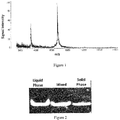
- Mass spectrometry of Shimadzu AXIMA-CFR plus MALDI-TOF is used to analyze the mass of the target product obtained in Step (30), the obtained mass spectrum is represented by FIG. 1 .
- the result of mass spectrometry indicates: The oligonucleotide obtained in Step (30) has two peaks of which m/z is 6701.97 and 3351.22 respectively. The two peaks are the single-charge peak and double-charge peak of the oligonucleotide and are consistent with theoretic charge peaks (m/z: 6702 and 3351). There aren't other impurity peaks in the mass spectrum. Therefore, the result of mass spectrometry indicates: the oligonucleotide obtained in Step (30) has correct mass and high purity.
- the detection result is represented by FIG. 2 .
- the result indicates: The oligonucleotides of a same sequence synthesized by two different processes have the same band position on PAGE. After mixing of the two samples, the band positions are still same without obvious impurity bands.
- RNA cloning and sequencing techniques Bartel, D. P., (2004), Cell, Issue 116, page 281
- a small RNA cloning kit of TaKaRa product No.: DRR065
- the oligonucleotide of the product obtained in Step (30) is cloned.
- kit specification After successful cloning, it is sent to Invitrogen to determine the sequence of bases.
- the concrete operation steps refer to literature ( Poth, M.J et al, (1985), Journal of Biological Chemistry, Issue 260, page 9326 ).
- the cloning and sequencing result is as follows: 5'-CCUUGAGGCAUACUUCAAAUU-3' (SEQ ID NO. 1), proving the base sequence of the product obtained in Step (30) is indeed the target sequence.
- This example synthesizes deprotected oligonucleotide with a target sequence 5'-UUUGAAGUAUGCCUCAAGGUU-3' (SEQ ID NO. 2).
- This target sequence and the base sequence of the product in Example 1 are partially reversely complementary.
- the synthesis in this example includes 19 steps according to the synthesis strategy represented by FIG. 5 .
- Example 1 It is synthesized by a process same as Step (9) and Step (10) in Example 1 except that DMTr[C]PO - obtained in Step (4) in Example 1 substitutes DMTr[A]PO - obtained in Step (1) in Example 1, and HO[C]OE obtained in Step (8) in Example 1 substitutes HO[A]OE obtained in Step (5) in Example 1.
- Example 1 It is synthesized by a process same as Step (9) and Step (10) in Example 1 except that DMTr[U]PO - obtained in Step (2) in Example 1 substitutes DMTr[A]PO - obtained in Step (1) in Example 1, and HO[C]OE obtained in Step (8) in Example 1 substitutes HO[A]OE obtained in Step (5) in Example 1.
- Step (18) in Example 1 It is synthesized by a process same as Step (18) in Example 1 except that DMTr[U]PO - obtained in Step (6) in Example 1 substitutes DMTr[C]PO - obtained in Step (4) in Example 1, and HO[UU]OE obtained in Step (17) in Example 1 substitutes HO[CU]OE obtained in Step (14) in Example 1.
- Step (23) in Example 1 It is synthesized by a process same as Step (23) in Example 1 except that DMTr[UUU]PO - obtained in Step (7) in Example 2 substitutes DMTr[CCU]PO - obtained in Step (18) in Example 1, and HO[GAA]OE obtained in Step (8) in Example 2 substitutes HO[UGA]OE obtained in Step (19) in Example 1.
- Step (25) in Example 1 It is synthesized by a process same as Step (25) in Example 1 except that DMTr[GU]PO - obtained in Step (2) in Example 2 substitutes DMTr[GG]PO - obtained in Step (11) in Example 1, and HO[AUG]OE obtained in Step (9) in Example 1 substitutes HO[CAU]OE obtained in Step (20) in Example 1.
- Step (23) in Example 1 It is synthesized by a process same as Step (23) in Example 1 except that DMTr[CC]PO - obtained in Step (4) in Example 2 substitutes DMTr[CC]PO - obtained in Step (18) in Example 1, and HO[UCA]OE obtained in Step (10) in Example 2 substitutes HO[UGA]OE obtained in Step (19) in Example 1.
- Step (25) in Example 1 It is synthesized by a process same as Step (25) in Example 1 except that DMTr[AG]PO - obtained in Step (6) in Example 2 substitutes DMTr[GG]PO - obtained in Step (11) in Example 1, and HO[GUU]OE obtained in Step (11) in Example 2 substitutes HO[CAU]OE obtained in Step (20) in Example 1.
- Step (27) in Example 1 It is synthesized by a process same as Step (27) in Example 1 except that DMTr[UUUGAA]PO - obtained in Step (12) in Example 2 substitutes DMTr[CCUUGA]PO - obtained in Step (23) in Example 1, and HO[GUAUG]OE obtained in Step (13) in Example 2 substitutes HO[GGCAU]OE obtained in Step (25) in Example 1.
- Step (28) in Example 1 It is synthesized by a process same as Step (28) in Example 1 except that DMTr[CCUCA]PO - obtained in Step (14) in Example 2 substitutes DMTr[ACUUC]PO - obtained in Step (24) in Example 1, and HO[AGGUU]OE obtained in Step (15) in Example 2 substitutes HO[AAAUU]OE obtained in Step (26) in Example 1.
- Step (29) in Example 1 It is synthesized by a process same as Step (29) in Example 1 except that DMTr[UUUGAAGUAUG]PO - obtained in Step (16) in Example 2 substitutes DMTr[CCUUGAGGCAU]PO - obtained in Step (27) in Example 1, and HO[ACUUCAAAUU]OE obtained in Step (17) in Example 2 substitutes HO[ACUUCAAAUU]OE obtained in Step (28) in Example 1.
- Deprotection is conducted by a process same as Step (30) in Example 1 except that DMTr[UUUGAAGUAUGCCUCAAGGUU]OE obtained in Step (18) in Example 2 substitutes DMTr[CCUUGAGGCAUACUUCAAAUU]OE obtained in Step (29) in Example 1.
- this example detects the bioactivity consistence between the product obtained by the process provided by the present invention for liquid-phase synthesis and the product of a same sequence obtained by solid-phase synthesis process.
- Example 1 and the product in Example 2 are equally mixed (5nmol) and heated to 75°C. The temperature is held for 10min. Then it is naturally and slowly cooled to room temperature to obtain double-chain siRNA with the following sequence.
- siRNA small interference RNA
- HBV-X hepatitis B virus X protein
- a complete medium containing 10% fetal calf serum, 2mM L-glutamine and 380 ⁇ g/ml G418 DMEM is used to inoculate HepG2.2.15 cells (purchased from the People's Hospital of Peking University) on a 24-well culture plate at a density of 1 ⁇ 10 5 cells/well and cultivated in an incubator with a temperature of 37°C and a CO 2 concentration of 5%.
- LipofectamineTM2000 liposome bought from Invitrogen is used to compare the double-chain siRNA obtained in Example 7, the double-chain siRNA of a same sequence synthesized by solid-phase synthesis process (purchased from Shanghai GenePharma Co., Ltd.), the double-chain siRNA(PC) with a positive effect reported in literature (the sequence is 5'-UCACCAUACUGCACUCAGG-3', Wu Ying et al , Apply RNA interference to treat acute heptatitis B virus infection of mice, 2005) and the irrelevant double-chain siRNA (NC) (all purchased from Shanghai GenePharma Co., Ltd.). They are transfected to the HepG2.2.15 cells in Step (1) of this example according to the transfection amount of 0.06nmol/well.
- sequences of the used primers are as follows: Gene Upstream primer Downstream primer HBV-X 5'- actctctcgtccccttctcc-3' (SEQ ID NO. 3) 5'-ggtcgttgacattgcagaga-3' (SEQ ID NO. 4) GAPDH 5'- ctctgctcctcctgttcgac-3' (SEQ ID NO. 5) 5'- acgaccaaatccgttgactc-3' (SEQ ID NO. 6)
- Inhibitory activity of siRNA 1-(copy number of HBV gene after siRNA transfection/ copy number of GAPDH after siRNA transfection) /(copy number of HBV gene in the blank control/ copy number of GAPDH in the blank control).
- FIG. 3 The result of cell siRNA interference test is represented by FIG. 3 :
- the mRNA level of HBV-X gene in negative irrelevant siRNA (NC) control group is not be lowered, while liquid-phase synthesis product siRNA and solid-phase synthesis product siRNA have the same ability as the positive control (PC) in inhibiting HBV-X gene expression.
- PC positive control
- This example synthesizes dotetracontamer oligonucleotide DMTr[CCUUGAGGCAUACUUCAAAUUUUUGAAGUAUGCCUCAAGGUU]OE.
- DMTr[CCUUGAGGCAUACUUCAAAUUUUUGAAGUAUGCCUCAAGGUU]OE It is synthesized by a process same as Step (29) in Example 1 except that DMTr[CCUUGAGGCAUACUUCAAAUU]PO- obtained in Step (1) in Example 4 substitutes DMTr[CCUUGAGGCAU]PO - obtained in Step (27) in Example 1, and HO[UUUGAAGUAUGCCUCAAGGUU]OE obtained in Step (2) in Example 4 substitutes HO[ACUUCAAAUU]OE obtained in Step (28) in Example 1. 1.21g of the product is obtained. The yield is 30.1%. The yield is the percentage of the weight of the product to the theoretical output calculated based on HO[UUUGAAGUAUGCCUCAAGGUU]OE.
- RNA DMTr[CUUGAGGCAUACUUCAAAUUUUUGAAGUAUGCCUCAAGGUU]OE is obtained by liquid-phase synthesis.
Landscapes
- Chemical & Material Sciences (AREA)
- Organic Chemistry (AREA)
- Health & Medical Sciences (AREA)
- Life Sciences & Earth Sciences (AREA)
- Biochemistry (AREA)
- Molecular Biology (AREA)
- Engineering & Computer Science (AREA)
- Biotechnology (AREA)
- General Health & Medical Sciences (AREA)
- Genetics & Genomics (AREA)
- Saccharide Compounds (AREA)
- Preparation Of Compounds By Using Micro-Organisms (AREA)
Description
- The present invention relates to a nucleotide and/or oligonucleotide and its preparation process.
- The chemical synthesis of oligonucleotide refers to the process of connecting nucleotide units into an oligonucleotide chain by prompting the formation of 5'-3' phosphate diester bonds between nucleotide monomers. It relates to the synthesis of protected nucleotides.
- At present, the common synthesis process of oligonucleotide is solid-phase synthesis process: firstly, the 5'-OH on nucleotide is protected by 4,4'-dimethoxytrityl (DMT), the amino on the base is protected by benzoyl, and the 3'-OH is activated by amino phosphite compound. The 3'-OH on the first nucleotide is combined with solid-phase resin, the protective group on 5'-OH is removed, a phosphite trimester is formed between the exposed 5'-OH and the 3'-OH of the second nucleotide, which is activated by amino phosphite compound, the phosphite trimester forms phosphotriester through iodination, and then trichloroacetic acid is added to remove the protective group on the 5'-OH of the second nucleotide. By now, the oligonucleotide chain is extended by one nucleotide unit, and may be put into the next round of extension reaction. After the synthesis of the whole oligonucleotide segment is completed through several rounds of extension reaction, concentrated ammonium hydroxide is used to remove the oligonucleotide segment from the solid-phase resin, and after deprotection and purification, oligonucleotide is obtained.
- The advantages of the said solid-phase synthesis process lie in: 1) automation: all the synthetic reactions are automatically completed by a synthesizer; 2) short synthetic cycle; 3) high yield: the yield of single-step condensation reaction is greater than 98% in general. However, the solid-phase synthesis process also has some defects: 1) small synthetic scale: the scale of solid-phase synthesis does not exceed 100 µmol in general, which is far from meeting the requirement of the use in pharmaceutical raw materials; 2) difficulty in achieving high purity: due to the limitation of the synthesis process, it is inevitable that the obtained oligonucleotide contains non-target oligonucleotide segments with N-1, N-2 of base number, which are rather detrimental to pharmaceutical application; 3) serious waste: to realize sufficient reaction, in each synthetic cycle, often phosphoramidite monomers that are several times as much as the amount actually consumed by the reaction need to be added to realize excess, and after the cycle, a large amount of organic solvent has to be used as a washing solvent to wash away the unreacted phosphoramidite monomers; 4) high cost: the solid-phase carrier and phosphoramidite monomers needed by the reaction are expensive, resulting in high cost of oligonucleotide synthesis.
- Due to the important function of oligonucleotide in life activities and the fast development of nucleic acid research technology, particularly the development of RNA interference technology and its potential clinical application value, large-scale synthesis of oligonucleotide is a matter of significance.
- The object of the present invention is to overcome the defects of the current synthetic process of oligonucleotide, such as: small scale and high cost, and provide a process for large-scale synthesis of oligonucleotide.
- The present invention provides a nucleotide and/or oligonucleotide as represented by Formula (1):

- wherein, R is H or R1, and R1 represents 4,4'-dimethoxytrityl;
- n is an integer in the range of 1-100;
- B represents guanine group with exocyclic amino group protected by acyl, adenine group with exocyclic amino group protected by acyl, cytosine group with exocyclic amino group protected by acyl, thymine group or uracil group, and B of each repeat unit is identical or different;
- R2 is tert-butyl dimethyl silicomethane group ;
- Wherein, the acyl may be benzoyl, isobutyryl or acetyl.
- In the compound of Formula (1) provided by the present invention, when R is H, Formula (1) is equivalent to the following Formula (2) with x equal to or greater than 1; and when R is R1, Formula (1) is equivalent to the following Formula (4).
- The present invention further provides a process for liquid-phase synthesis of nucleotide and/or oligonucleotide, characterized in that this process includes: with the presence of a condensing agent and under the conditions of condensation reaction, the compound of Formula (2) is contacted with the compound of Formula (3) in the first liquid reaction medium to obtain the compound of Formula (4);


- x is an integer in the range of 0-50; y is an integer in the range of 1-50;
- B1 and B2 represent guanine group with exocyclic amino group protected by acyl, adenine group with exocyclic amino group protected by acyl, cytosine group with exocyclic amino group protected by acyl, thymine group or uracil group, respectively, and B1 and B2 of each repeat unit are identical or different;
- The definitions of R1 and R2 are as described in Formula (1);
A+ represents trialkylammonium ion or dialkylammonium ion. - The oligonucleotide with protective group removed obtained by the process provided by the present invention may possess bioactivity and may be used for various purposes, such as: RNA interference.
- The process provided by the present invention for liquid-phase synthesis of nucleotide and/or oligonucleotide includes a process for combining the protective groups of nucleotide and/or oligonucleotide. Under the precondition that 2'-OH is protected by a group with a sterically hindered silane structure, β-cyanoethyl directly protects 3' phosphate group of nucleotide and/or oligonucleotide, without using a solid-phase carrier so that the compound of Formula (4) can directly participate in the next round of synthesis after removing β-cyanoethyl, and the synthesis product is consistent with the deprotection procedure of the solid-phase synthesis process and purer.
- According to the present invention, as the reaction takes place in a liquid phase, no solid-phase carrier is needed, and as multi-fold excess of the substrate is not needed, the raw material is saved and the cost is reduced. The present invention adopts protected nucleotide and/or oligonucleotide salt as a raw material, and the synthetic reaction takes place in a reaction flask or a reaction kettle without the restriction of the solid-phase carrier or synthesizer and large-scale preparation of nucleotide and/or oligonucleotide can be realized.
-
-
FIG. 1 is a mass spectrometry analysis chart of the deprotected henicosamer RNA CCUUGAGGCAUACUUCAAAUU obtained in Example 1. -
FIG. 2 is a chart for polyacrylamide gel electrophoresis (PAGE) of the deprotected henicosamer RNA CCUUGAGGCAUACUUCAAAUU obtained in Example 1 and the product with a same sequence obtained by solid-phase synthesis process. -
FIG. 3 is a drawing showing the result of RNA interference test in Example 3. -
FIG. 4 is a schematic of the synthesis strategy of Example 1. -
FIG. 5 is a schematic of the synthesis strategy of Example 2. - The present invention provides a nucleotide and/or oligonucleotide as represented by Formula (1).
- In Formula (1):
- R is H or R1, and R1 represents 4,4'-dimethoxytrityl;
- n is an integer in the range of 1-100, more preferably an integer in the range of 1-50, still more preferably an integer in the range of 1-30;
- B represents guanine group with exocyclic amino group protected by acyl, adenine group with exocyclic amino group protected by acyl, cytosine group with exocyclic amino group protected by acyl, thymine group or uracil group, and B of each repeat unit is identical or different.
- R2 is tert-butyl dimethyl silicomethane group.
- Wherein, when n=1, Formula (1) represents nucleotide, and when n is an integer greater than 1, Formula (1) represents oligonucleotide.
- In Formula (1), each of the acyl as a protective group may be identical or different and may be benzoyl, isobutyryl or acetyl respectively.
- In the compound of Formula (1) provided by the present invention, when R is H, Formula (1) is equivalent to the following Formula (2) with x equal to or greater than 1; and when R is R1, Formula (1) is equivalent to the following Formula (4) and when R is R1, Formula (1) is equivalent to the following Formula (6).
- The present invention further provides a process for liquid-phase synthesis of nucleotide and/or oligonucleotide, characterized in that this process includes: with the presence of a condensing agent and under the conditions of condensation reaction, the compound of Formula (2) is contacted with the compound of Formula (3) in the first liquid reaction medium to obtain the compound of Formula (4).
- In Formula (2), (3) or (4),
x is an integer in the range of 0-50, more preferably an integer in the range of 0-25, still more preferably an integer in the range of 0-15; y is an integer in the range of 1-50, more preferably an integer in the range of 1-25, still more preferably an integer in the range of 1-15. - B1 and B2 represent guanine group with exocyclic amino group protected by acyl, adenine group with exocyclic amino group protected by acyl, cytosine group with exocyclic amino group protected by acyl, thymine group or uracil group, respectively, and B1 and B2 of each repeat unit are identical or different. The definition of acyl is as described in Formula (1).
- The definitions of R1 and R2 are as described in Formula (1);
A+ represents trialkylammonium ion or dialkylammonium ion. The alkyl groups in the ion may be identical or different and each may have 1-6 carbon atoms, preferably 1-4 carbon atoms. - The condensing agents used in the condensation reaction and the conditions of the condensation reaction are known to those of ordinary skill in the art. The present invention does not have particular limitation to them. For example, the condensing agent may be one or more of 1-mesitylene-sulfonyl-triazole, 1-mesitylene-sulfonyl-(3-nitro)-triazole, 1-mesitylene-sulfonyl-tetrazole, 1-triisopropyl-phenyl-sulphonyl-triazole, 1-triisopropyl- phenyl-sulphonyl-(3-nitro)-triazole and 1-triisopropyl-phenyl-sulphonyl-tetrazole, and the first liquid reaction medium may be one or more of pyridine, dichloromethane, acetonitrile, dioxane and tetrahydrofuran;
- The conditions of the condensation reaction may include: relative to 1 mol of the compound of Formula (3), when x is equal to 0, i.e.: the compound of Formula (2) is 3-hydroxypropionitrile, the amount of the compound of Formula (2) may be 1-5 mol, preferably 1.2-3 mol, more preferably 1.5-2 mol; when x is greater than or equal to 1, the amount of the compound of Formula (2) maybe 0.3-1.25 mol.
- Relative to 1 mol of the compound of Formula (3), the amount of the condensing agent may be 2-20 mol, preferably 2-5 mol.
- Relative to 1 mol of the compound of Formula (3), the amount of the first liquid reaction medium may be 2-50 L, preferably 2-30 L.
- The reaction temperature may be 0-50 °C, preferably 20-40 °C; the reaction time may be 0.5-100 h, preferably 1-10 h.
- After the condensation reaction is completed, the condensation reaction may be terminated and the product is separated. The process for terminating the condensation reaction and the process for separating the product are known to those of ordinary skill in the art. The present invention does not have particular limitation to them.
- For example, the process for terminating the condensation reaction may be: mixing the reaction solution with water at 0-15 °C for 5-30 min. Relative to 1 L of the first liquid reaction medium, the amount of water may be 0.05-0.2 L.
- The process for terminating the condensation reaction may also be: mixing the reaction solution with a saturated sodium bicarbonate solution, and keeping stirring the mixed solution at 0-50 °C for 5-10 min. The volume ratio between the saturated sodium bicarbonate solution and the first liquid reaction medium may be 0.05-0.2: 1.
- When the compound of Formula (4) needs to take the following displacement reaction, the separation process may include: removing the solvent from the reaction solution by rotary evaporation after the reaction is terminated, dissolving remnant in an organic solvent, regulating pH value to 3-5 with an acid and washing it with water once or multiple times. Relative to 1 L of the first liquid reaction medium, the amount of the organic solvent is 2-20 L and the amount of the water for wash is 2-20 L. After the organic phase is dried with anhydrous sodium sulfate, the solvent is removed by rotary evaporation again and the product is obtained after separation by an ordinary-pressure column. The organic solvent may be one or more of dichloromethane, trichloromethane and ethyl acetate. The acid may be oxalic acid and/or acetic acid with a concentration of 1-10wt%.
- When the compound of Formula (4) needs to be carried out the following hydrolysis reaction or removed all protective groups, the separation process may include: removing the solvent from the reaction solution by rotary evaporation after the reaction is terminated, mixing the remnant with an organic solvent, adding a saturate sodium bicarbonate solution to wash it, and drying, filtering, concentrating and separating in an ordinary-pressure column the organic phase to obtain the product. The organic solvent may be one or more of dichloromethane, trichloromethane and ethyl acetate. The volume ratio between the organic solvent and the first liquid reaction medium may be 2-20 : 1. The washing may be conducted once or multiple times. The ratio between the total volume of the saturated sodium bicarbonate solution used in washing and the volume of the first liquid reaction medium may be 2-20 : 1. The processes of drying, filtration, concentration and separation in an ordinary-pressure column are known to those skilled in the art, so they are not further described here.
- Therefore, according to the first embodiment of the present invention, the process provided by the present invention for liquid-phase synthesis of nucleotide and/or oligonucleotide may further includes: in the second liquid reaction medium, with the presence of trialkylamine or dialkylamine and under the conditions of hydrolysis reaction, the compound of Formula (4) is contacted with water and undergoes hydrolysis reaction to remove β-cyanoethyl and obtain a hydrolytic product with β-cyanoethyl removed.
- Wherein, the conditions of the hydrolysis reaction may include: relative to 1 mol of the compound of Formula (4), the amount of trialkylamine or dialkylamine may be 1-200 mol, preferably 40-150 mol; the amount of the second liquid reaction medium may be 5-50 L, preferably 5-40 L; the amount of water may be 2-20 L, preferably 2-15 L; the reaction temperature may be 0-50 °C, preferably 10-35 °C; the reaction time may be 0.25-2 h, preferably 0.25-1 h.
- Wherein, the preferred second liquid reaction medium is pyridine and/or acetonitrile.
- The alkyl groups in the trialkylamine or dialkylamine are identical or different, and each has 1-6 carbon atoms. For example, the trialkylamine may be one or more of trimethylamine, triethylamine and diisopropylethylamine, and the dialkylamine may be one or more of dimethylamine, diethylamine and diisopropylamine.
- After the hydrolysis reaction is completed, the product obtained after the hydrolysis reaction may be separated. The separation process is known to those of ordinary skill in the art and not particularly limited by the present invention. For example, this separation process may include: the solvent of the reaction solution is removed by rotary evaporation, then the remnant is dissolved in an organic solvent, a washing solution is added to wash it, an organic phase is obtained through liquid division and the solvent is removed by rotary evaporation after drying with anhydrous sodium sulfate to obtain the product. The organic solvent may be one or more of dichloromethane, trichloromethane or ethyl acetate. The volume ratio between the organic solvent and the second liquid reaction medium may be 1-10: 1. The wash solution may be 0.1-1mol/L triethylamine bicarbonate (TEAB) water solution or saturated sodium bicarbonate solution. The washing may be conducted once or a number of times. The ratio between the total volume of the TEAB water solution used in washing and the second liquid reaction medium maybe 1-10: 1.
- Then, the separated hydrolytic product is used as the compound of Formula (3) and undergoes the said condensation reaction with the compound of Formula (2) again.
- According to the second embodiment of the present invention, the process provided by the present invention for liquid-phase synthesis of nucleotide and/or oligonucleotide may further includes: in the third liquid reaction medium, with the presence of an organic acid and under the conditions of displacement reaction, the R1 group in the compound of Formula (4) is replaced with H to obtain a product generated by replacing R1 group with H.
- Wherein, the conditions of the displacement reaction may be: relative to 1 mol of the compound of Formula (4), the amount of the organic acid may be 2-20 mol, preferably 2-10 mol; the amount of the third liquid reaction medium maybe 10-150 L, preferably 10-130 L; the reaction temperature may be -10°C to 40°C, preferably -10°C to 30°C; the reaction time may be 1-60 min, preferably 1-20 min; the organic acid is preferably one or more of methyl benzenesulfonic acid, benzenesulfonic acid, trichloroacetic acid, dichloroacetic acid and trifluoroacetic acid; the third liquid reaction medium may be one or more of dichloromethane, trichloromethane, acetonitrile and methanol.
- Wherein, after the displacement reaction is completed, a product generated by replacing R1 group with H may be separated. The separation process is known to those of ordinary skill in the art and not particularly limited by the present invention. For example, this separation and purification process may include: using aqueous alkali to neutralize the mixture obtained from the displacement reaction, obtaining an organic solvent through liquid division, washing it with aqueous alkali once or a number of times and drying, filtering, concentrating and separating in an ordinary-pressure column the organic phase to obtain a purified product after the displacement reaction. Relative to 1 L of the third liquid reaction medium, the amount of the aqueous alkali used in washing may be 0.2-1 L. The aqueous alkali may be a saturated sodium bicarbonate water solution, a saturated potassium bicarbonate water solution or a saturated sodium carbonate solution. The processes of drying, filtration, concentration and separation in an ordinary-pressure column are known to those skilled in the art, so they are not further described here.
- Then, the separated product generated by replacing R1 group with H may be used as the compound of Formula (2) and undergoes the said condensation reaction with the compound of Formula (3) again.
- When x is greater than or equal to 1, the compound of Formula (2) may be obtained by replacing R1 group in the compound of Formula (6) with H.

- Where, the definitions of x, B1 and R2 are as described in Formula (2), but x is greater than or equal to 1; the definition of R1 is as described in Formula (3).
- The process for replacing the R1 group in the compound of Formula (6) with H is identical as the process for replacing the R1 group in the compound of Formula (4) with H except that the compound of Formula (6) is adopted instead of the compound of Formula (4).
- The process for preparing the compound of Formula (6) includes: using the compound of Formula (5) as the compound of Formula (3) and taking the said condensation reaction with the compound of Formula (2) with x equal to 0, i.e.: 3-hydroxypropionitrile.

- Wherein, the definitions of x, B1 and R2 are as described in Formula (2), but x is greater than or equal to 1; the definitions of R1 and A+ are as described in Formula (3).
- When y in Formula (3) is equal to x in Formula (5), Formula (3) is equivalent to Formula (5).
- The processes for preparing the compound of Formula (3) and/or the compound of Formula (5) have been recorded in details in the disclosed document
PCT/CN2009/074101 - In respect to long-segment small nucleic acid, the present invention provides a modular synthesis strategy. For example, a henicosamer nucleic acid chain is split into four parallel segments of pentamer to hexamer, which will be further split into more parallel short segments of dimer to trimer. After synthesis of the short dimer segments, the trimers may be synthesized into n-mer (n is the target length) oligonucleotide chain. Therefore, theoretically, by the process provided by the present invention, the oligonucleotide chains of any length can be synthesized. The embodiments below describe the present invention by only taking dotetracontamer in the longest for example.
- By the process provided by the present invention, fully protected nucleotide and/or oligonucleotide of Formula (4) may be synthesized. All the protective groups of the fully protected nucleotide and/or oligonucleotide include: acyl, β-cyanoethyl, group of Formula (7), R1 and R2 in Formula (4).

- All the protective groups in the fully protected nucleotide and/or oligonucleotide may be removed in two steps:
- Step 1: The compound of Formula (4) is contacted with aqua ammonia in the fourth liquid reaction medium under the first deprotection reaction conditions to remove one proportion of protective groups to obtain a product with one proportion of protective groups removed. The said one proportion of protective groups refer to acyl, β-cyanoethyl and group of Formula (7) in Formula (4).
- Wherein, the fourth liquid reaction medium may be one or more of dioxane, acetonitrile, pyridine, ethanol and methanol; the first deprotection reaction conditions include: relative to 1 g of the compound of Formula (4), the amount of aqua ammonia may be 0.02-0.5 L, preferably 0.05-0.3 L; the amount of the fourth liquid reaction medium may be 0.01-0.2 L, preferably 0.02-0.1 L; the reaction temperature may be 10-60 °C, preferably 10-30 °C; the reaction time may be 5-100 h, preferably 10-60 h; the concentration of the aqua ammonia is 25-28 mass%. After the first deprotection reaction is completed, concentration under reduced pressure may be adopted to remove the solvent till fully dry. The obtained solid is a product with one proportion of protective groups removed.
- Step 2: in the fifth liquid reaction medium, under the second deprotection reaction conditions, the product with one proportion of protective groups removed is contacted with triethylamine trihydrofluoric acid (TEA·3HF) to remove the remaining protective groups to obtain a product with all protective groups removed. The said remaining protective groups are R1 and R2. The definitions of R1 and R2 are the same as those in Formula (4).
- Wherein, the fifth liquid reaction medium is dimethyl sulfoxide; the second deprotection reaction conditions include: relative to 1 g of the product with some protective groups removed, the amount of TEA·3HF is 0.002-0.05 L, preferably 0.005-0.03 L; the amount of the fifth liquid reaction medium is 0.002-0.05 L, preferably 0.005-0.03 L; the reaction temperature is 40-85 °C, preferably 50-75 °C; the reaction time is 1-5 h, preferably 2-4 h.
- After the deprotection reaction is completed, the product obtained from the deprotection reaction may be separated. The separation process is known to those of ordinary skill in the art and not particularly limited by the present invention. For example, the separation process may be: adding precooled normal butanol into the reaction solution, settling nucleotide and/or oligonucleotide and collecting the precipitate by centrifuge to obtain a crude product of nucleotide and/or oligonucleotide.
- The obtained crude product of nucleotide and/or oligonucleotide may be purified. The purification process is known to those of ordinary skill in the art and is not particularly limited by the present invention. For example, the purification process may be: injecting the crude product of nucleotide and/or oligonucleotide into reverse phase octadecyl silane bonding silica gel packing (ODS) chromatograph, collecting the eluate and freezing and drying the eluate to obtain the target product.
- The oligonucleotide with protective groups removed obtained by the process provided by the present invention is bioactive and may be used for various purposes, such as: RNA interference. The volume of the gases and liquids used in the present invention refers to the volume at one standard atmospheric pressure and 20°C.
- Below the present invention is described in details by the embodiments, but the scope of the present invention is not limited to the examples in the embodiments.
- The raw materials used in the embodiments are obtained by the following processes:
- Four types of protected ribonucleotides, including adenine ribonucleotide (A), uracil ribonucleotide (U), cytosine ribonucleotide (C) and guanine ribonucleotide (G) where benzoyl protects the exocyclic amino of the base, tert-butyl dimethyl silicomethane group protects 2'OH, and 4,4'-dimethoxytrityl protects 5'OH; all of the four types of protected nucleotides are purchased from Shanghai GenePharma Co., Ltd.;
- Triethylamine: purchased from Tianjin Beifang Tianyi Chemical Reagent Factory; 1,2,4-triazole: purchased from Alfa Aesar;
- 2-phenyl dichlorophosphate: purchased from Alfa Aesar;
- 1-mesitylene-sulfonyl-(3-nitro)-triazole (MSNT): purchased from Sigma Aldrich.
- This example synthesizes oligonucleotide.
- Synthesis target: henicosamer fully protected oligoribo-oligonucleotide
- Sequence: DMTr[CCUUGAGGCAUACUUCAAAUU]OE
- Notes: The four letters A, U, C and G in the square brackets represent four types of protected ribonucleotides. Their exocyclic amino groups are protected by benzoyl. 2'OHs are protected by tert-butyl dimethyl silicomethane group. The protective groups: phosphate and phenol phosphate between bases are omitted.
- The group on the left of the square bracket represents the protective group at the terminal of 5', which is 4,4'-dimethoxytrityl (DMTr), and may also be OH.
- The group on the right of the square bracket represents the protective group at the terminal of 3', which is propionitrile phosphate (OE), and may also be phosphate (PO-).
- The synthesis in this embodiment includes 30 steps according to the synthesis strategy represented by
FIG. 4 . - 1,2,4-triazole (13.8g, 200mmol) and anhydrous pyridine (31.6g, 400mmol) are added to a 1L round-bottomed flask and dissolved in 130ml of dichloromethane. 65ml of 2-phenyl dichlorophosphate (19.6g, 80mmol) dichloromethane solution is dropwise added under the condition of an ice bath and reacts while stirred for 0.5h. Then 150ml of protected adenine ribonucleotide (39.4g, 50mmol) dichloromethane solution is dropwise added and reacts while stirred under the condition of an ice bath for 2h. Then 150ml of 1M TEAB solution is added. The stirring is continued for 10min. After washing with 1M TEAB solution three times (90ml a time), all organic phase is dried with anhydrous Na2SO4. After filtration and removal of the solvent by rotary evaporation, 54.0g of the product is obtained. The yield is 100%. The yield is the percentage of the weight of the product to the theoretical output calculated based on the protected adenine ribonucleotide.
- The 31PNMR spectrum of the product is detected to obtain 31PNMR (CDCl3, 121M) δ-6.09, which is consistent with the range of the theoretical values of 31PNMR of pentavalent phosphodiester (refer to literature Tetrahedron, 1980(36), page 3075-3085), proving this product indeed has the structure of Formula (3).
- The M- of the product detected by ESI-MS is 976.2915, which is fully consistent with the theoretical value of M- of the target product, proving this product indeed has the structure of Formula (3).
- It is synthesized by a process same as Step (1) except that protected uracil ribonucleotide substitutes protected adenine ribonucleotide.
- The 31PNMR spectrum and M- of the product are detected. They are fully consistent with the theoretical values of 31PNMR spectrum and M- of the target product, proving this product indeed has the structure of Formula (3).
- It is synthesized by a process same as Step (1) except that protected guanine ribonucleotide substitutes protected adenine ribonucleotide.
- The 31PNMR spectrum and M- of the product are detected. They are fully consistent with the theoretical values of 31PNMR spectrum and M- of the target product, proving this product indeed has the structure of Formula (3).
- It is synthesized by a process same as Step (1) except that protected cytosine ribonucleotide substitutes protected adenine ribonucleotide.
- The 31PNMR spectrum and M- of the product are detected. They are fully consistent with the theoretical values of 31PNMR spectrum and M- of the target product, proving this product indeed has the structure of Formula (3).
- DMTr[A]PO-(17.3g, 16mmol) obtained in Step (1) is added to a 250ml round-bottomed flask and dissolved in anhydrous pyridine (100ml). 3-hydroxypropionitrile (1.70g, 24mmol) is added and then MSNT (13.3g, 44.8mmol) is added. The reaction lasts 2h at 20°C. After thin layer chromatography (TLC) indicates thorough reaction, water (10ml) is added to terminate the reaction. After the solvent is removed by rotary evaporation, it is redissolved in CH2Cl2 (200ml). An appropriate amount of 5wt% oxalic acid water solution is added to regulate pH value to 3-4. An organic phase is obtained through liquid division. It is washed with water (100ml) once. The organic phase is dried with anhydrous Na2SO4. Then the solvent is removed by rotary evaporation again. 2wt% para-toluenesulfonic acid (TsOH) CH2Cl2/CH3OH (v: v=7: 3) solution (700ml) is added and violently stirred at 0°C for 5min. Then the solution is immediately neutralized with a saturated NaHCO3 solution. An organic phase is obtained through liquid division. It is washed with a saturated NaHCO3 solution (300ml) once again. After the organic phase is dried with anhydrous Na2SO4, the solvent is removed. After purification by column chromatography (the eluent is CH2Cl2/CH3OH (v: v=10: 1)), 10.9g of the product is obtained. The yield is 93.4%. The yield is the percentage of the weight of the product to the theoretical output calculated based on DMTr[A]PO-.
- The 31PNMR spectrum of the product is detected to obtain 31PNMR (CDCl3, 121M) δ-7.66, - 7.79, which are consistent with the theoretical value of 31PNMR of pentavalent phosphodiester, proving this product indeed has the structure of Formula (2).
- The M- of the product detected by ESI-MS is 728.1956, which is fully consistent with the theoretical value of M- of the target product, proving this product indeed has the structure of Formula (2).
- It is synthesized by a process same as Step (5) except that DMTr[U]PO- obtained in Step (2) substitutes DMTr[A]PO- obtained in Step (1).
- The 31PNMR spectrum and M- of the product are detected. They are fully consistent with the theoretical values of 31PNMR spectrum and M- of the target product, proving this product indeed has the structure of Formula (2).
- It is synthesized by a process same as Step (5) except that DMTr[G]PO- obtained in Step (3) substitutes DMTr[A]PO- obtained in Step (1).
- The 31PNMR spectrum and M- of the product are detected. They are fully consistent with the theoretical values of 31PNMR spectrum and M- of the target product, proving this product indeed has the structure of Formula (2).
- It is synthesized by a process same as Step (5) except that DMTr[C]PO- obtained in Step (4) substitutes DMTr[A]PO- obtained in Step (1).
- The 31PNMR spectrum and M- of the product are detected. They are fully consistent with the theoretical values of 31PNMR spectrum and M- of the target product, proving this product indeed has the structure of Formula (2).
- DMTr[A]PO- (2.59g, 2.40mmol) obtained in Step (1) and HO[A]OE (1.46g, 2.00mmol) obtained in Step (5) are added to a 100ml round-bottomed flask. After they are dissolved in 10ml of anhydrous pyridine, MSNT (1.66g, 5.60mmol) is added. The reaction lasts 2h at room temperature. After TLC indicates thorough reaction, 2ml of saturated NaHCO3 solution is added to terminate the reaction. After the solvent is removed by rotary evaporation, the remnant is redissolved in 50ml of CH2Cl2 and washed with a saturated NaHCO3 solution twice (30ml per time). After the organic phase is dried with anhydrous Na2SO4, the solvent is removed. After purification by column chromatography (the eluent is CH2Cl2/CH3OH (v: v=10: 1)), 3.26g of the product is obtained.
- The 31PNMR spectrum of the product is detected to obtain 31PNMR (CDCl3, 121M) δ-7.36, - 7.46, -7.55, -7.90, which are consistent with the theoretical value of 31PNMR of pentavalent phosphodiester, proving this product indeed has the structure of Formula (4).
- The M- of the product detected by ESI-MS is 1687.64, which is consistent with the theoretical value of M- of the target product, proving this product indeed has the structure of Formula (4).
- DMTr[AA]OE purified in Step (9) is dissolved in 60ml of pyridine/triethylamine/water (v: v: v=3: 1: 1) and stirred at room temperature for 30min. After TLC indicates thorough reaction, the solvent is removed from the reaction solution by rotary evaporation. Then the remnant is dissolved in 100ml of CH2Cl2 again and washed with 1M TEAB solution three times (50ml per time). An organic phase is obtained through liquid division. The solvent is removed from the organic phase after drying of anhydrous Na2SO4 to obtain 3.20g of the product. The total yield of the reactions in Step (9) and Step (10) is 93.9%. The yield is the percentage of the weight of the product to the theoretical output calculated based on HO[A]OE. The 31PNMR spectrum and M- of the product are detected. They are fully consistent with the theoretical values of 31PNMR spectrum and M- of the target compound, proving this product indeed has the structure of Formula (3).
- It is synthesized by a process same as Step (9) and Step (10) except that DMTr[G]PO- obtained in Step (3) substitutes DMTr[A]PO- obtained in Step (1) and HO[G]OE obtained in Step (7) substitutes HO[A]OE obtained in Step (5).
- The 31PNMR spectrum and M- of the product are detected. They are fully consistent with the theoretical values of 31PNMR spectrum and M- of the target compound, proving this product indeed has the structure of Formula (3).
- It is synthesized by a process same as Step (9) and Step (10) except that HO[C]OE obtained in Step (8) substitutes HO[A]OE obtained in Step (5).
- The 31PNMR spectrum and M- of the product are detected. They are fully consistent with the theoretical values of 31PNMR spectrum and M- of the target compound, proving this product indeed has the structure of Formula (3).
- DMTr[A]PO- (16.2g, 15mmol) obtained in Step (1) is added to a 500ml round-bottomed flask. After they are dissolved in 100ml of anhydrous pyridine, HO[U]OE (7.53g, 12.5mmol) obtained in Step (6) is added. MSNT (10.4g, 35mmol) is added. The reaction lasts 2h at room temperature. After TLC indicates thorough reaction, 10ml of water is added to terminate the reaction. After the solvent is removed by rotary evaporation, the remnant is redissolved in 300ml of CH2Cl2. An appropriate amount of 5% oxalic acid water solution is added to regulate pH value to 3-4. An organic phase is obtained through liquid division. It is washed with 150ml of water once. The organic phase is dried with anhydrous Na2SO4. Then the solvent is removed by rotary evaporation again. 2wt% toluenesulfonic acid (TsOH) CH2Cl2/CH3OH (v: v=7: 3) solution (700ml) is added and violently stirred at 0°C for 5min. Then the solution is immediately neutralized with a saturated NaHCO3 solution. An organic phase is obtained through liquid division. It is washed with a saturated NaHCO3 solution (300ml) once again. After the organic phase is dried with anhydrous Na2SO4, the solvent is removed. After purification by column chromatography (the eluent is CH2Cl2/CH3OH (v: v=10: 1)), 12.9g of the product is obtained. The yield is 81.8%. The yield is the percentage of the weight of the product to the theoretical output calculated based on HO[U]OE.
- The 31PNMR spectrum and M- of the product are detected. They are fully consistent with the theoretical values of 31PNMR spectrum and M- of the target compound, proving this product indeed has the structure of Formula (2).
- It is synthesized by a process same as Step (13) except that DMTr[C]PO- obtained in Step (4) substitutes DMTr[A]PO- obtained in Step (1).
- The 31PNMR spectrum and M- of the product are detected. They are fully consistent with the theoretical values of 31PNMR spectrum and M- of the target compound, proving this product indeed has the structure of Formula (2).
- It is synthesized by a process same as Step (13) except that DMTr[G]PO- obtained in Step (3) substitutes DMTr[A]PO- obtained in Step (1) and HO[A]OE obtained in Step (5) substitutes HO[U]OE obtained in Step (6).
- The 31PNMR spectrum and M- of the product are detected. They are fully consistent with the theoretical values of 31PNMR spectrum and M- of the target compound, proving this product indeed has the structure of Formula (2).
- It is synthesized by a process same as Step (13) except that DMTr[U]PO- obtained in Step (2) substitutes DMTr[A]PO- obtained in Step (1) and HO[C]OE obtained in Step (8) substitutes HO[U]OE obtained in Step (6).
- The 31PNMR spectrum and M- of the product are detected. They are fully consistent with the theoretical values of 31PNMR spectrum and M- of the target compound, proving this product indeed has the structure of Formula (2).
- It is synthesized by a process same as Step (13) except that DMTr[U]PO- obtained in Step (2) substitutes DMTr[A]PO- obtained in Step (1).
- The 31PNMR spectrum and M- of the product are detected. They are fully consistent with the theoretical values of 31PNMR spectrum and M- of the target compound, proving this product indeed has the structure of Formula (2).
- DMTr[C]PO- (3.17g, 3.00mmol) obtained in Step (4) and HO[CU]OE (3.09g, 2.50mmol) obtained in Step (14) are added to a 100ml round-bottomed flask and dissolved in 20ml of anhydrous pyridine. MSNT (2.08g, 7.00mmol) is added. The reaction lasts 2h at room temperature. After TLC indicates thorough reaction, 2ml of saturated NaHCO3 solution is added to terminate the reaction. After the solvent is removed by rotary evaporation, the remnant is redissolved in 100ml of CH2Cl2 and washed with 50ml of saturated NaHCO3 solution. An organic phase is obtained through liquid division. After the organic phase is dried with anhydrous Na2SO4, the solvent is removed. After purification by column chromatography (the eluent is CH2Cl2/CH3OH (v: v=10: 1)), a purified product is obtained. The purified product is dissolved in 60ml of pyridine/triethylamine/water (v: v: v=3: 1: 1). The solution is stirred for 30min at room temperature. After TLC indicates thorough reaction, the solvent is removed from the reaction solution by rotary evaporation. The remnant is redissolved in 100ml of CH2Cl2 and washed with 1M TEAB solution three times (50ml per time). An organic phase is separated. After it is dried with anhydrous Na2SO4, the solvent is removed. 4.89g of the product is obtained. The yield is 88.5%. The yield is the percentage of the weight of the product to the theoretical output calculated based on HO[CU]OE.
- The 31PNMR spectrum and M- of the product are detected. They are fully consistent with the theoretical values of 31PNMR spectrum and M- of the target compound, proving this product indeed has the structure of Formula (3).
- DMTr[U]PO- (10.0g, 10.5mmol) obtained in Step (2) and HO[GA]OE (12.0g, 8.76mmol) obtained in Step (15) are added to a 250ml round-bottomed flask and dissolved in 50ml of anhydrous pyridine. MSNT (7.31g, 24.5mmol) is added by three times. The reaction lasts 2h at room temperature. After TLC indicates thorough reaction, 5ml of water is added to terminate the reaction. After the solvent is removed by rotary evaporation, the remnant is redissolved in 200ml of CH2Cl2. An appropriate amount of 5% oxalic acid water solution is added to regulate pH value to 3-4. An organic phase is separated. It is washed with 100ml of water once. The organic phase is dried with anhydrous Na2SO4. Then the solvent is removed by rotary evaporation again. 550ml of 2% TsOH CH2Cl2/CH3OH (v: v=7: 3) solution is added and violently stirred at 0°C for 5min. Then the solution is immediately neutralized with a saturated NaHCO3 solution. An organic phase is separated. It is washed with 200ml of saturated NaHCO3 solution once. After the organic phase is dried with anhydrous Na2SO4, the solvent is removed. After purification by column chromatography (the eluent is CH2Cl2/CH3OH (v: v=10: 1)), 13.0g of the product is obtained. The yield is 78.0%. The yield is the percentage of the weight of the product to the theoretical output calculated based on HO[GA]OE.
- The 31PNMR spectrum and M- of the product are detected. They are fully consistent with the theoretical values of 31PNMR spectrum and M- of the target compound, proving this product indeed has the structure of Formula (2).
- It is synthesized by a process same as Step (19) except that DMTr[C]PO- obtained in Step (4) substitutes DMTr[U]PO- obtained in Step (2) and HO[AU]OE obtained in Step (13) substitutes HO[GA]OE obtained in Step (15).
- The 31PNMR spectrum and M- of the product are detected. They are fully consistent with the theoretical values of 31PNMR spectrum and M- of the target compound, proving this product indeed has the structure of Formula (2).
- It is synthesized by a process same as Step (19) except that HO[UC]OE obtained in Step (16) substitutes HO[GA]OE obtained in Step (15).
- The 31PNMR spectrum and M- of the product are detected. They are fully consistent with the theoretical values of 31PNMR spectrum and M- of the target compound, proving this product indeed has the structure of Formula (2).
- It is synthesized by a process same as Step (19) except that DMTr[A]PO- obtained in Step (1) substitutes DMTr[U]PO- obtained in Step (2) and HO[UU]OE obtained in Step (17) substitutes HO[GA]OE obtained in Step (15).
- The 31PNMR spectrum and M- of the product are detected. They are fully consistent with the theoretical values of 31PNMR spectrum and M- of the target compound, proving this product indeed has the structure of Formula (2).
- DMTr[CCU]PO- (4.18g, 1.89mmol) obtained in Step (18) and HO[UGA]OE (3.00g, 1.58mmol) obtained in Step (19) are added to a 100ml round-bottomed flask and dissolved in 10ml of anhydrous pyridine. MSNT (1.31g, 4.42mmol) is added. The reaction lasts 3h at room temperature. After TLC indicates thorough reaction, 2ml of saturated NaHCO3 solution is added to terminate the reaction. After the solvent is removed by rotary evaporation, the product is purified by column chromatography (the eluent is CH2Cl2/CH3OH (v: v=10: 1)). The purified product is dissolved in 60ml of pyridine/triethylamine/water (v: v: v=3: 1: 1). The solution is stirred at room temperature for 30min. After TLC indicates thorough reaction and the solvent is removed by rotary evaporation, the remnant is redissolved in 100ml of CH2Cl2 and washed with 1M TEAB solution three times (50ml per time). An organic phase is separated. After it is dried with anhydrous Na2SO4, the solvent is removed to obtain 5.00g of the product. The yield is 79.3%. The yield is the percentage of the weight of the product to the theoretical output calculated based on HO[UGA]OE.
- The 31PNMR spectrum and M- of the product are detected. They are fully consistent with the theoretical values of 31PNMR spectrum and M- of the target compound, proving this product indeed has the structure of Formula (3).
- It is synthesized by a process same as Step (23) except that DMTr[AC]PO- obtained in Step (12) substitutes DMTr[CCU]PO- obtained in Step (18) and HO[UUC]OE obtained in Step (21) substitutes HO[UGA]OE obtained in Step (19).
- The 31PNMR spectrum and M- of the product are detected. They are fully consistent with the theoretical values of 31PNMR spectrum and M- of the target compound, proving this product indeed has the structure of Formula (3).
- DMTr[GG]PO-(5.72g, 3.36mmol) obtained in Step (11) and HO[CAU]OE (5.30g, 2.80mmol) obtained in Step (20) are added to a 250ml round-bottomed flask and dissolved in 15ml of anhydrous pyridine. MSNT (2.34g, 7.84mmol) is added. The reaction lasts 2h at room temperature. After TLC indicates thorough reaction, 1.5ml of water is added to terminate the reaction. After the solvent is removed by rotary evaporation, the remnant is redissolved in 100ml of CH2Cl2. An appropriate amount of 5% oxalic acid water solution is added to regulate pH value to 3-4. An organic phase is separated and washed with 50ml of water once. The organic phase is dried with anhydrous Na2SO4. The solvent is removed by rotary evaporation again. 170ml of 2% TsOH CH2Cl2/CH3OH (v: v=7: 3) solution is added and violently stirred at 0°C. The solution is immediately neutralized with a saturated NaHCO3 solution. An organic phase is separated. It is washed with 80ml of saturated NaHCO3 solution once. After the organic phase is dried with anhydrous Na2SO4, the solvent is removed. After purification by column chromatography (the eluent is CH2Cl2/CH3OH (v: v=10: 1)), 5.3g of the product is obtained. The yield is 59.6%. The yield is the percentage of the weight of the product to the theoretical output calculated based on HO[CAU]OE.
- The 31PNMR spectrum and M- of the product are detected. They are fully consistent with the theoretical values of 31PNMR spectrum and M- of the target compound, proving this product indeed has the structure of Formula (2).
- It is synthesized by a process same as Step (25) except that DMTr[AA]PO- obtained in Step (10) substitutes DMTr[GG]PO- obtained in Step (11) and HO[UUC]OE obtained in Step (22) substitutes HO[CAU]OE obtained in Step (20).
- The 31PNMR spectrum and M- of the product are detected. They are fully consistent with the theoretical values of 31PNMR spectrum and M- of the target compound, proving this product indeed has the structure of Formula (2).
- DMTr[CCUUGA]PO- (4.86g, 1.20mmol) obtained in Step (23) and HO[GGCAU]OE (3.18g, 1.0mmol) obtained in Step (25) are added to a 100ml round-bottomed flask and dissolved in 10ml of anhydrous pyridine. MSNT (0.83g, 2.80mmol) is added. The reaction lasts 4h at room temperature. After TLC indicates thorough reaction, 1ml of saturated NaHCO3 solution is added to terminate the reaction. 100ml of CH2Cl2 is added. It is washed with 50ml of saturated NaHCO3 solution once and with 50ml of water once. It is dried with anhydrous Na2SO4. The solvent is removed by rotary evaporation. After purification by column chromatography (the eluent is CH2Cl2/CH3OH (v: v=10: 1)), the purified product is dissolved in 40ml of pyridine/triethylamine/water (v: v: v=3: 1: 1). The solution is stirred at room temperature for 30min. After TLC indicates thorough reaction and the solvent is removed by rotary evaporation, the remnant is redissolved in 100ml of CH2Cl2 and washed with 1M TEAB solution three times (50ml per time). An organic phase is separated. After it is dried with anhydrous Na2SO4, the solvent is removed to obtain 2.89g of the product. The yield is 42.7%. The yield is the percentage of the weight of the product to the theoretical output calculated based on HO[GGCAU]OE.
- The 31PNMR spectrum and M- of the product are detected. They are fully consistent with the theoretical values of 31PNMR spectrum and M- of the target compound, proving this product indeed has the structure of Formula (3).
- DMTr[ACUUC]PO- (4.86g, 1.43mmol) obtained in Step (24) and HO[AAAUU]OE (3.70g, 1.19mmol) obtained in Step (26) are added to a 100ml round-bottomed flask and dissolved in 10ml of anhydrous pyridine. MSNT (0.99g, 3.33mmol) is added. The reaction lasts 4h at room temperature. After TLC indicates thorough reaction, 1ml of saturated NaHCO3 solution is added to terminate the reaction. 100ml of CH2Cl2 is added. Then it is washed with 50ml of saturated NaHCO3 solution once and with 50ml of water once. It is dried with anhydrous Na2SO4. The solvent is removed by rotary evaporation. After separation in a column, 150ml of 2% TsOH CH2Cl2/CH3OH (v: v=7: 3) solution is added to the obtained product and violently stirred at 0°C for 10min. The solution is immediately neutralized with a saturated NaHCO3 solution. An organic phase is separated. It is washed with 50ml of saturated NaHCO3 solution once. After the organic phase is dried with anhydrous Na2SO4, the solvent is removed. After purification by column chromatography (the eluent is CH2Cl2/CH3OH (v: v=10: 1)), 4.6g of the product is obtained. The yield is 63.5%. The yield is the percentage of the weight of the product to the theoretical output calculated based on HO[AAAUU]OE.
- The 31PNMR spectrum and M- of the product are detected. They are fully consistent with the theoretical values of 31PNMR spectrum and M- of the target compound, proving this product indeed has the structure of Formula (2).
- DMTr[CCUUGAGGCAU]PO- (2.80g, 0.39mmol) obtained in Step (27) and HO[ACUUCAAAUU]OE (2.17g, 0.36mmol) obtained in Step (28) are added to a 50ml round-bottomed flask and dissolved in 10ml of anhydrous pyridine. MSNT (321mg, 1.08mmol) is added. The reaction lasts 10h at room temperature. 1ml of saturated NaHCO3 solution is added to terminate the reaction. 100ml of CH2Cl2 is added. It is washed with 50ml of saturated NaHCO3 solution once and with 50ml of water once. It is dried with anhydrous Na2SO4. The solvent is removed by rotary evaporation. After purification by column chromatography (the eluent is CH2Cl2/CH3OH (v: v=10: 1)), 2.48g of the product is obtained. The yield is 50.1%. The yield is the percentage of the weight of the product to the theoretical output calculated based on HO[ACUUCAAAUU]OE.
- The 31PNMR spectrum and M- of the product are detected. They are fully consistent with the theoretical values of 31PNMR spectrum and M- of the target compound, proving this product indeed has the structure of Formula (4).
- By now, fully protected henicosamer RNA DMTr[CCUUGAGGCAUACUUCAAAUU]OE is obtained through synthesis by liquid-phase process.
- 10mg of fully protected henicosamer RNA DMTr[CCUUGAGGCAUACUUCAAAUU]OE obtained in Step (29) is dissolved in 0.5ml of dioxane. 1ml of 25mass% aqua ammonia is added. The solution is shaken and mixed evenly and rests at room temperature for 40h. After the reaction is completed, the solution is concentrated under reduced pressure to remove the solvent till fully dry. The remaining solid is redissolved in 100µl of dimethyl sulfoxide. 125µl of TEA·3HF is added. After even mixing, the solution is heated to 65°C and reacts 2.5h. 1ml of normal butanol precooled to -20°C is added. Oligonucleotide settles. The precipitate is collected by centrifuge, and 3mg of a crude product is obtained. The product is refined and purified by reverse phase ODS column chromatograph. The concrete operation steps refer to literature (Molecular Cloning: A Laboratory Manual (Edition 3), published by Science Press in September 2002). Then it is frozen and dried to obtain 1.6mg of the target product.
- Mass spectrometry of Shimadzu AXIMA-CFR plus MALDI-TOF is used to analyze the mass of the target product obtained in Step (30), the obtained mass spectrum is represented by
FIG. 1 . - The result of mass spectrometry indicates: The oligonucleotide obtained in Step (30) has two peaks of which m/z is 6701.97 and 3351.22 respectively. The two peaks are the single-charge peak and double-charge peak of the oligonucleotide and are consistent with theoretic charge peaks (m/z: 6702 and 3351). There aren't other impurity peaks in the mass spectrum. Therefore, the result of mass spectrometry indicates: the oligonucleotide obtained in Step (30) has correct mass and high purity.
- 300ng of the product obtained in Step (30), 300ng of the product obtained from solid-phase synthesis in ABI3900 RNA solid-phase synthesizer and having the target sequence (5'-CCUUGAGGCAUACUUCAAAUU-3') (Shanghai GenePharma Co., Ltd.), and 300ng of a sample made by equally mixing the above two products undergo PAGE detection. The detection result is represented by
FIG. 2 . The result indicates: The oligonucleotides of a same sequence synthesized by two different processes have the same band position on PAGE. After mixing of the two samples, the band positions are still same without obvious impurity bands. - This proves the oligonucleotides of a same target sequence synthesized by two different processes have a same electrophoretic mobility
- By applying small RNA cloning and sequencing techniques (Bartel, D. P., (2004), Cell, Issue 116, page 281) and using a small RNA cloning kit of TaKaRa (product No.: DRR065), the oligonucleotide of the product obtained in Step (30) is cloned. For concrete operation steps, please refer to kit specification. After successful cloning, it is sent to Invitrogen to determine the sequence of bases. The concrete operation steps refer to literature (Poth, M.J et al, (1985), Journal of Biological Chemistry, Issue 260, page 9326).
- The cloning and sequencing result is as follows: 5'-CCUUGAGGCAUACUUCAAAUU-3' (SEQ ID NO. 1), proving the base sequence of the product obtained in Step (30) is indeed the target sequence.
- This example synthesizes deprotected oligonucleotide with a target sequence 5'-UUUGAAGUAUGCCUCAAGGUU-3' (SEQ ID NO. 2). This target sequence and the base sequence of the product in Example 1 are partially reversely complementary.
- The synthesis in this example includes 19 steps according to the synthesis strategy represented by
FIG. 5 . - It is synthesized by a process same as Step (13) in Example 1 except that HO[A]OE obtained in Step (5) in Example 1 substitutes HO[U]OE obtained in Step (6) in Example 1.
- The 31PNMR spectrum and M- of the product are detected. They are fully consistent with the theoretical values of 31PNMR spectrum and M- of the target compound, proving this product indeed has the structure of Formula (2).
- It is synthesized by a process same as Step (9) and Step (10) in Example 1 except that DMTr[G]PO- obtained in Step (3) in Example 1 substitutes DMTr[A]PO- obtained in Step (1) in Example 1, and HO[U]OE obtained in Step (6) in Example 1 substitutes HO[A]OE obtained in Step (5) in Example 1.
- The 31PNMR spectrum and M- of the product are detected. They are fully consistent with the theoretical values of 31PNMR spectrum and M- of the target compound, proving this product indeed has the structure of Formula (3).
- It is synthesized by a process same as Step (9) and Step (10) in Example 1 except that HO[U]OE obtained in Step (6) in Example 1 substitutes HO[A]OE obtained in Step (5) in Example 1.
- The 31PNMR spectrum and M- of the product are detected. They are fully consistent with the theoretical values of 31PNMR spectrum and M- of the target compound, proving this product indeed has the structure of Formula (3).
- It is synthesized by a process same as Step (9) and Step (10) in Example 1 except that DMTr[C]PO- obtained in Step (4) in Example 1 substitutes DMTr[A]PO- obtained in Step (1) in Example 1, and HO[C]OE obtained in Step (8) in Example 1 substitutes HO[A]OE obtained in Step (5) in Example 1.
- The 31PNMR spectrum and M- of the product are detected. They are fully consistent with the theoretical values of 31PNMR spectrum and M- of the target compound, proving this product indeed has the structure of Formula (3).
- It is synthesized by a process same as Step (9) and Step (10) in Example 1 except that DMTr[U]PO- obtained in Step (2) in Example 1 substitutes DMTr[A]PO- obtained in Step (1) in Example 1, and HO[C]OE obtained in Step (8) in Example 1 substitutes HO[A]OE obtained in Step (5) in Example 1.
- The 31PNMR spectrum and M- of the product are detected. They are fully consistent with the theoretical values of 31PNMR spectrum and M- of the target compound, proving this product indeed has the structure of Formula (3).
- It is synthesized by a process same as Step (9) and Step (10) in Example 1 except that HO[G]OE obtained in Step (7) in Example 1 substitutes HO[A]OE obtained in Step (5) in Example 1.
- The 31PNMR spectrum and M- of the product are detected. They are fully consistent with the theoretical values of 31PNMR spectrum and M- of the target compound, proving this product indeed has the structure of Formula (3).
- It is synthesized by a process same as Step (18) in Example 1 except that DMTr[U]PO- obtained in Step (6) in Example 1 substitutes DMTr[C]PO- obtained in Step (4) in Example 1, and HO[UU]OE obtained in Step (17) in Example 1 substitutes HO[CU]OE obtained in Step (14) in Example 1.
- The 31PNMR spectrum and M- of the product are detected. They are fully consistent with the theoretical values of 31PNMR spectrum and M- of the target compound, proving this product indeed has the structure of Formula (3).
- It is synthesized by a process same as Step (19) in Example 1 except that DMTr[G]PO- obtained in Step (3) in Example 1 substitutes DMTr[U]PO- obtained in Step (2) in Example 1, and HO[AA]OE obtained in Step (1) in Example 1 substitutes HO[GA]OE obtained in Step (15) in Example 1.
- The 31PNMR spectrum and M- of the product are detected. They are fully consistent with the theoretical values of 31PNMR spectrum and M- of the target compound, proving this product indeed has the structure of Formula (2).
- It is synthesized by a process same as Step (19) in Example 1 except that DMTr[AU]PO- obtained in Step (3) in Example 2 substitutes DMTr[U]PO- obtained in Step (2) in Example 1, and HO[G]OE obtained in Step (7) in Example 1 substitutes HO[GA]OE obtained in Step (15) in Example 1.
- The 31PNMR spectrum and M- of the product are detected. They are fully consistent with the theoretical values of 31PNMR spectrum and M- of the target compound, proving this product indeed has the structure of Formula (2).
- It is synthesized by a process same as Step (19) in Example 1 except that DMTr[UC]PO- obtained in Step (5) in Example 2 substitutes DMTr[U]PO- obtained in Step (5) in Example 1, and HO[A]OE obtained in Step (5) in Example 1 substitutes HO[GA]OE obtained in Step (15) in Example 1.
- The 31PNMR spectrum and M- of the product are detected. They are fully consistent with the theoretical values of 31PNMR spectrum and M- of the target compound, proving this product indeed has the structure of Formula (2).
- It is synthesized by a process same as Step (19) in Example 1 except that DMTr[G]PO- obtained in Step (3) in Example 1 substitutes DMTr[U]PO- obtained in Step (2) in Example 1, and HO[UU]OE obtained in Step (17) in Example 1 substitutes HO[GA]OE obtained in Step (15) in Example 1.
- The 31PNMR spectrum and M- of the product are detected. They are fully consistent with the theoretical values of 31PNMR spectrum and M- of the target compound, proving this product indeed has the structure of Formula (2).
- It is synthesized by a process same as Step (23) in Example 1 except that DMTr[UUU]PO- obtained in Step (7) in Example 2 substitutes DMTr[CCU]PO- obtained in Step (18) in Example 1, and HO[GAA]OE obtained in Step (8) in Example 2 substitutes HO[UGA]OE obtained in Step (19) in Example 1.
- The 31PNMR spectrum and M- of the product are detected. They are fully consistent with the theoretical values of 31PNMR spectrum and M- of the target compound, proving this product indeed has the structure of Formula (3).
- It is synthesized by a process same as Step (25) in Example 1 except that DMTr[GU]PO- obtained in Step (2) in Example 2 substitutes DMTr[GG]PO- obtained in Step (11) in Example 1, and HO[AUG]OE obtained in Step (9) in Example 1 substitutes HO[CAU]OE obtained in Step (20) in Example 1.
- The 31PNMR spectrum and M- of the product are detected. They are fully consistent with the theoretical values of 31PNMR spectrum and M- of the target compound, proving this product indeed has the structure of Formula (2).
- It is synthesized by a process same as Step (23) in Example 1 except that DMTr[CC]PO- obtained in Step (4) in Example 2 substitutes DMTr[CC]PO- obtained in Step (18) in Example 1, and HO[UCA]OE obtained in Step (10) in Example 2 substitutes HO[UGA]OE obtained in Step (19) in Example 1.
- The 31PNMR spectrum and M- of the product are detected. They are fully consistent with the theoretical values of 31PNMR spectrum and M- of the target compound, proving this product indeed has the structure of Formula (3).
- It is synthesized by a process same as Step (25) in Example 1 except that DMTr[AG]PO- obtained in Step (6) in Example 2 substitutes DMTr[GG]PO- obtained in Step (11) in Example 1, and HO[GUU]OE obtained in Step (11) in Example 2 substitutes HO[CAU]OE obtained in Step (20) in Example 1.
- The 31PNMR spectrum and M- of the product are detected. They are fully consistent with the theoretical values of 31PNMR spectrum and M- of the target compound, proving this product indeed has the structure of Formula (2).
- It is synthesized by a process same as Step (27) in Example 1 except that DMTr[UUUGAA]PO- obtained in Step (12) in Example 2 substitutes DMTr[CCUUGA]PO- obtained in Step (23) in Example 1, and HO[GUAUG]OE obtained in Step (13) in Example 2 substitutes HO[GGCAU]OE obtained in Step (25) in Example 1.
- The 31PNMR spectrum and M- of the product are detected. They are fully consistent with the theoretical values of 31PNMR spectrum and M- of the target compound, proving this product indeed has the structure of Formula (3).
- It is synthesized by a process same as Step (28) in Example 1 except that DMTr[CCUCA]PO- obtained in Step (14) in Example 2 substitutes DMTr[ACUUC]PO- obtained in Step (24) in Example 1, and HO[AGGUU]OE obtained in Step (15) in Example 2 substitutes HO[AAAUU]OE obtained in Step (26) in Example 1.
- The 31PNMR spectrum and M- of the product are detected. They are fully consistent with the theoretical values of 31PNMR spectrum and M- of the target compound, proving this product indeed has the structure of Formula (2).
- It is synthesized by a process same as Step (29) in Example 1 except that DMTr[UUUGAAGUAUG]PO- obtained in Step (16) in Example 2 substitutes DMTr[CCUUGAGGCAU]PO- obtained in Step (27) in Example 1, and HO[ACUUCAAAUU]OE obtained in Step (17) in Example 2 substitutes HO[ACUUCAAAUU]OE obtained in Step (28) in Example 1.
- The 31PNMR spectrum and M- of the product are detected. They are fully consistent with the theoretical values of 31PNMR spectrum and M- of the target compound, proving this product indeed has the structure of Formula (4).
- By now, fully protected henicosamer RNA DMTr[UUUGAAGUAUGCCUCAAGGUU]OE is obtained through synthesis by liquid-phase process.
- Deprotection is conducted by a process same as Step (30) in Example 1 except that DMTr[UUUGAAGUAUGCCUCAAGGUU]OE obtained in Step (18) in Example 2 substitutes DMTr[CCUUGAGGCAUACUUCAAAUU]OE obtained in Step (29) in Example 1.
- Mass spectrometry, electrophoresis result and sequencing result all support that the base sequence of the product in Step (19) is indeed the target sequence.
- By an RNA interference test, this example detects the bioactivity consistence between the product obtained by the process provided by the present invention for liquid-phase synthesis and the product of a same sequence obtained by solid-phase synthesis process.
- The product in Example 1 and the product in Example 2 are equally mixed (5nmol) and heated to 75°C. The temperature is held for 10min. Then it is naturally and slowly cooled to room temperature to obtain double-chain siRNA with the following sequence.

- The target gene of small interference RNA (siRNA) with a known sequence of CCUUGAGGCAUACUUCAAA is hepatitis B virus X protein (HBV-X). Therefore, theoretically the said double-chain siRNA has the activity inhibiting the expression of HBX gene.
- Through quantitative PCR, the inhibitory activities of the product obtained by the process provided by the present invention for liquid-phase synthesis and the product of a same sequence obtained by solid-phase synthesis process to HBV-X gene expression in HepG2.2.15 cells are detected.
- A complete medium containing 10% fetal calf serum, 2mM L-glutamine and 380µg/ml G418 DMEM is used to inoculate HepG2.2.15 cells (purchased from the People's Hospital of Peking University) on a 24-well culture plate at a density of 1×10⁵ cells/well and cultivated in an incubator with a temperature of 37°C and a CO2 concentration of 5%.
-
Lipofectamine™ 2000 liposome bought from Invitrogen is used to compare the double-chain siRNA obtained in Example 7, the double-chain siRNA of a same sequence synthesized by solid-phase synthesis process (purchased from Shanghai GenePharma Co., Ltd.), the double-chain siRNA(PC) with a positive effect reported in literature (the sequence is 5'-UCACCAUACUGCACUCAGG-3', Wu Ying et al, Apply RNA interference to treat acute heptatitis B virus infection of mice, 2005) and the irrelevant double-chain siRNA (NC) (all purchased from Shanghai GenePharma Co., Ltd.). They are transfected to the HepG2.2.15 cells in Step (1) of this example according to the transfection amount of 0.06nmol/well. Meanwhile, sterilized deionized water is used as a blank control of siRNA transfection. For concrete operation steps, please refer to the specification ofLipofectamine™ 2000 and literature (Wu Ying et al, Apply RNA interference to treat acute heptatitis B virus infection of mice, 2005). (3) The expression level of mRNA of HBX gene in HepG2.2.15 cells transfected with siRNA in Step (2) of this example is detected by Real Time-PCR process. Glyceraldehyde-3-phosphate dehydrogenase (GAPDH) is set as an internal control gene. The sequences of the used primers are as follows:Gene Upstream primer Downstream primer HBV-X 5'- actctctcgtccccttctcc-3' (SEQ ID NO. 3) 5'-ggtcgttgacattgcagaga-3' (SEQ ID NO. 4) GAPDH 5'- ctctgctcctcctgttcgac-3' (SEQ ID NO. 5) 5'- acgaccaaatccgttgactc-3' (SEQ ID NO. 6) - The concrete operation steps refer to literature (Molecular Cloning (Edition 3), published by Science Press in September 2002). The inhibitory activity of siRNA is calculated with the following formula.
- Inhibitory activity of siRNA=1-(copy number of HBV gene after siRNA transfection/ copy number of GAPDH after siRNA transfection) /(copy number of HBV gene in the blank control/ copy number of GAPDH in the blank control).
- The result of cell siRNA interference test is represented by
FIG. 3 : The mRNA level of HBV-X gene in negative irrelevant siRNA (NC) control group is not be lowered, while liquid-phase synthesis product siRNA and solid-phase synthesis product siRNA have the same ability as the positive control (PC) in inhibiting HBV-X gene expression. This proves liquid-phase synthesis product siRNA and solid-phase synthesis product siRNA obtained in Example 2 have same bioactivity in inhibiting expression of target genes. - This example synthesizes dotetracontamer oligonucleotide DMTr[CCUUGAGGCAUACUUCAAAUUUUUGAAGUAUGCCUCAAGGUU]OE.
- 3.18g (0.24mmol) of DMTr[CCUUGAGGCAUACUUCAAAUU]OE obtained in Step (29) of Example 1 is dissolved in 10ml of pyridine/triethylamine/water (v: v: v=3: 1: 1) and stirred at room temperature for 30min. After TLC indicates thorough reaction and the solvent is removed by rotary evaporation, the remnant is redissolved in 100ml of CH2Cl2 and washed with 1M TEAB solution three times (50ml per time). An organic phase is separated and dried with anhydrous Na2SO4. After the solvent is removed, 2.64g of the product is obtained.
- 2.84 g (0.2mmol) of DMTr[UUUGAAGUAUGCCUCAAGGUU]OE obtained in Step (18) of Example 2 is added to 25ml of 2% TsOH in CH2Cl2/CH3OH(v: v=7: 3) solution and violently stirred at 0°C for 10min. It is immediately neutralized with a saturated NaHCO3 solution. An organic phase is separated. Then it is washed with 25ml of saturated NaHCO3 solution once. After the organic phase is dried with anhydrous Na2SO4, the solvent is removed. After purification by column chromatography (the used eluent is CH2Cl2/CH3OH(v: v=10: 1)), 2.56g of the product is obtained.
- DMTr[CCUUGAGGCAUACUUCAAAUUUUUGAAGUAUGCCUCAAGGUU]OE: It is synthesized by a process same as Step (29) in Example 1 except that DMTr[CCUUGAGGCAUACUUCAAAUU]PO- obtained in Step (1) in Example 4 substitutes DMTr[CCUUGAGGCAU]PO- obtained in Step (27) in Example 1, and HO[UUUGAAGUAUGCCUCAAGGUU]OE obtained in Step (2) in Example 4 substitutes HO[ACUUCAAAUU]OE obtained in Step (28) in Example 1. 1.21g of the product is obtained. The yield is 30.1%. The yield is the percentage of the weight of the product to the theoretical output calculated based on HO[UUUGAAGUAUGCCUCAAGGUU]OE.
- The 31PNMR spectrum and M- of the product are detected. They are fully consistent with the theoretical values of 31PNMR spectrum and M- of the target product, proving this product indeed has the structure of Formula (4).
- By now, fully protected dotetracontamer RNA DMTr[CUUGAGGCAUACUUCAAAUUUUUGAAGUAUGCCUCAAGGUU]OE is obtained by liquid-phase synthesis.
Claims (16)
- A nucleotide and/or oligonucleotide represented by Formula (1):
 wherein, R is H or R1, and R1 represents 4,4'-dimethoxytrityl; n is an integer in the range of 1-100;B represents guanine group with exocyclic amino group protected by acyl, adenine group with exocyclic amino group protected by acyl, cytosine group with exocyclic amino group protected by acyl, thymine group or uracil group, and B of each repeat unit is identical or different;R2 is tert-butyl dimethyl silicomethane group.
 - The nucleotide and/or oligonucleotide according to claim 1, wherein the acyl is benzoyl, isobutyryl or acetyl.
- A process for liquid-phase synthesis of nucleotide and/or oligonucleotide, characterized in that this process includes: with the presence of a condensing agent and under the conditions of condensation reaction, the compound of Formula (2) is contacted with the compound of Formula (3) in the first liquid reaction medium to obtain the compound of Formula (4);
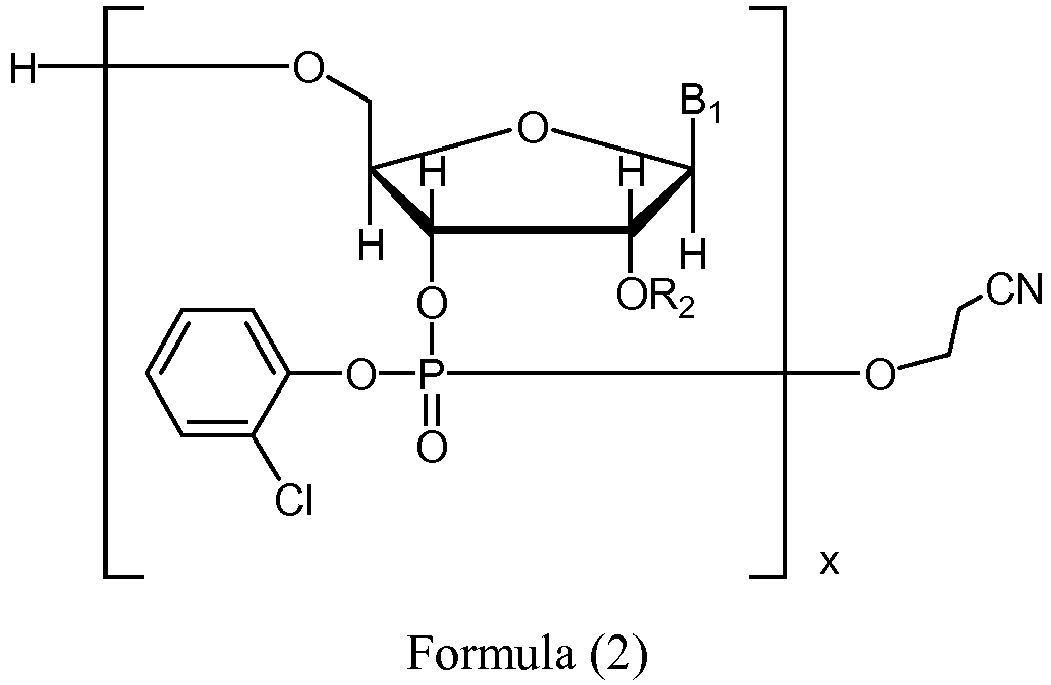

 wherein, R1 represents 4,4'-dimethoxytrityl; x is an integer in the range 0-50; y is an integer in the range of 1-50;B1 and B2 represent guanine group with exocyclic amino group protected by acyl, adenine group with exocyclic amino group protected by acyl, cytosine group with exocyclic amino group protected by acyl, thymine group or uracil group, respectively, and B1 and B2 of each repeat unit are identical or different;R2 is tert-butyl dimethyl silicomethane group; A+ represents trialkylammonium ion or dialkylammonium ion.
 - The process according to claim 3, wherein the acyl is benzoyl, isobutyryl or acetyl; the alkyl groups in the trialkylammonium ion or dialkylammonium ion are identical or different and each has 1-6 carbon atoms.
- The process according to claim 3 or 4, wherein the condensing agent is one or more of 1-mesitylene-sulfonyl-triazole, 1-mesitylene-sulfonyl-(3-nitro)-triazole, 1-mesitylene-sulfonyl-tetrazole, 1-triisopropyl-phenyl-sulphonyl-triazole, 1-triisopropyl-phenyl-sulphonyl-(3-nitro)-triazole and 1-triisopropyl-phenyl-sulphonyl-tetrazole; and the first liquid reaction medium is one or more of pyridine, dichloromethane, acetonitrile, dioxane and tetrahydrofuran;
the conditions of the condensation reaction include: relative to 1 mol of the compound of Formula (3), the amount of the condensing agent is 2-20 mol, the amount of the first liquid reaction medium is 2-50 L, and when x is equal to 0, the amount of the compound of Formula (2) is 1-5 mol, and when x is greater than or equal to 1, the amount of the compound of Formula (2) is 0.3-1.25 mol; the reaction temperature is 0-50 °C; the reaction time is 0.5-100 h. - The process according to any of claims 3-5, further includes: in the second liquid reaction medium, with the presence of trialkylamine or dialkylamine and under the conditions of hydrolysis reaction, the compound of Formula (4) is contacted with water and undergoes hydrolysis reaction to obtain a hydrolytic product with β-cyanoethyl removed.
- The process according to claim 6, wherein the conditions of the hydrolysis reaction include: relative to 1 mol of the compound of Formula (4), the amount of trialkylamine or dialkylamine is 1-200 mol; the amount of the second liquid reaction medium is 5-50 L; the amount of water is 2-20 L; the reaction temperature is 0-50 °C; the reaction time is 0.25-2 h.
- The process according to claim 6 or 7, wherein the second liquid reaction medium is pyridine and/or acetonitrile; and the alkyl groups in the trialkylamine or dialkylamine are identical or different, and each has 1-6 carbon atoms.
- The process according to any of claims 6-8, further includes: the hydrolytic product is used as the compound of Formula (3) and undergoes the said condensation reaction with the compound of Formula (2) again.
- The process according to any of claims 3-5, further includes: in the third liquid reaction medium, with the presence of an organic acid and under the conditions of displacement reaction, the R1 group in the compound of Formula (4) is replaced with H to obtain a product generated by replacing R1 group with H.
- The process according to claim 10, wherein the conditions of the displacement reaction is: relative to 1 mol of the compound of Formula (4), the amount of the organic acid is 2-20 mol; the amount of the third liquid reaction medium is 10-150 L; the reaction temperature is -10°C to 40°C; the reaction time is 1-60 min; the organic acid is one or more of methyl benzenesulfonic acid, benzenesulfonic acid, trichloroacetic acid, dichloroacetic acid and trifluoroacetic acid; the third liquid reaction medium is one or more of dichloromethane, trichloromethane, acetonitrile and methanol.
- The process according to claim 10 or 11, further includes: the product generated by replacing R1 group with H is used as the compound of Formula (2) and undergoes condensation reaction with the compound of Formula (3) again.
- The process according to any of claims 3 to 5, further includes: the compound of Formula (4) is contacted with aqua ammonia in the fourth liquid reaction medium under the first deprotection reaction conditions to remove one proportion of protective groups to obtain a product with one proportion of protective groups removed; the said one proportion of protective groups refer to acyl, β-cyanoethyl and group of Formula (7) in Formula (4);

- The process according to claim 13, wherein the fourth liquid reaction medium is one or more of dioxane, acetonitrile, pyridine, ethanol and methanol; the first deprotection reaction conditions include: relative to 1 g of the compound of Formula (4), the amount of aqua ammonia is 0.02-0.5 L; the amount of the fourth liquid reaction medium is 0.01-0.2 L; the reaction temperature is 10-60 °C; the reaction time is 5-100 h.
- The process according to claim 13 or 14, further includes: in the fifth liquid reaction medium, under the second deprotection reaction conditions, the product with one proportion of protective groups removed is contacted with triethylamine trihydrofluoric acid (TEA·3HF) to remove the remaining protective groups and obtain a product with all protective groups removed; the said remaining protective groups are R1 and R2, wherein, the definitions of R1 and R2 are the same as claim 4.
- The process according to claim 15, wherein the fifth liquid reaction medium is dimethyl sulfoxide; the second deprotection reaction conditions include: relative to 1 g of the product with one proportion of protective groups removed, the amount of TEA·3HF is 0.002-0.05 L; the amount of the fifth liquid reaction medium is 0.002-0.05 L; the reaction temperature is 40-85 °C; the reaction time is 1-5 h.
Applications Claiming Priority (2)
| Application Number | Priority Date | Filing Date | Title |
|---|---|---|---|
| CN201010240545.1A CN102344477B (en) | 2010-07-27 | 2010-07-27 | Nucleotide and / or oligonucleotide and preparation method thereof |
| PCT/CN2011/077353 WO2012013127A1 (en) | 2010-07-27 | 2011-07-20 | Nucleotide and/or oligonucleotide and preparation process thereof |
Publications (3)
| Publication Number | Publication Date |
|---|---|
| EP2599784A1 EP2599784A1 (en) | 2013-06-05 |
| EP2599784A4 EP2599784A4 (en) | 2013-06-05 |
| EP2599784B1 true EP2599784B1 (en) | 2016-06-29 |
Family
ID=45529416
Family Applications (1)
| Application Number | Title | Priority Date | Filing Date |
|---|---|---|---|
| EP11811828.0A Active EP2599784B1 (en) | 2010-07-27 | 2011-07-20 | Nucleotide and/or oligonucleotide and preparation process thereof |
Country Status (6)
| Country | Link |
|---|---|
| US (1) | US9567364B2 (en) |
| EP (1) | EP2599784B1 (en) |
| JP (1) | JP5728086B2 (en) |
| CN (1) | CN102344477B (en) |
| DK (1) | DK2599784T3 (en) |
| WO (1) | WO2012013127A1 (en) |
Families Citing this family (18)
| Publication number | Priority date | Publication date | Assignee | Title |
|---|---|---|---|---|
| CN108210510B (en) * | 2016-12-21 | 2021-04-27 | 苏州瑞博生物技术股份有限公司 | A kind of small interfering nucleic acid pharmaceutical composition and use thereof |
| CN111050807B (en) * | 2017-12-01 | 2024-05-28 | 苏州瑞博生物技术股份有限公司 | Nucleic acid, composition and conjugate containing the nucleic acid, preparation method and use thereof |
| JP7261494B2 (en) | 2017-12-01 | 2023-04-20 | スーチョウ リボ ライフ サイエンス カンパニー、リミテッド | Nucleic acids, compositions and complexes containing said nucleic acids, preparation methods and uses |
| CN118236391A (en) * | 2017-12-01 | 2024-06-25 | 苏州瑞博生物技术股份有限公司 | Nucleic acid, composition and conjugate containing the nucleic acid, preparation method and use thereof |
| CN110997919B (en) | 2017-12-01 | 2024-04-02 | 苏州瑞博生物技术股份有限公司 | Double-stranded oligonucleotide, composition containing double-stranded oligonucleotide, conjugate, preparation method and application |
| WO2019105435A1 (en) | 2017-12-01 | 2019-06-06 | 苏州瑞博生物技术有限公司 | Nucleic acid, composition and conjugate containing nucleic acid, preparation method and use |
| US11660347B2 (en) | 2017-12-01 | 2023-05-30 | Suzhou Ribo Life Science Co., Ltd. | Nucleic acid, composition and conjugate containing same, preparation method, and use thereof |
| CN110945131B (en) * | 2017-12-01 | 2024-05-28 | 苏州瑞博生物技术股份有限公司 | Nucleic acid, composition and conjugate containing the nucleic acid, preparation method and use thereof |
| CN110959011B (en) | 2017-12-29 | 2023-03-28 | 苏州瑞博生物技术股份有限公司 | Conjugate, preparation method and application thereof |
| EP3842534A4 (en) * | 2018-08-21 | 2022-07-06 | Suzhou Ribo Life Science Co., Ltd. | NUCLEIC ACID, COMPOSITION AND CONJUGATE CONTAINING NUCLEIC ACID AND METHOD OF USE THEREOF |
| EP3862024A4 (en) * | 2018-09-30 | 2022-08-17 | Suzhou Ribo Life Science Co., Ltd. | SHORT INTERFERENT RNA CONJUGATE, METHOD FOR PREPARATION AND USE THEREOF |
| CN112423794A (en) | 2018-12-28 | 2021-02-26 | 苏州瑞博生物技术股份有限公司 | Nucleic acid, composition containing nucleic acid, conjugate, preparation method and application |
| WO2020147847A1 (en) * | 2019-01-18 | 2020-07-23 | 苏州瑞博生物技术有限公司 | Nucleic acid, composition and conjugate containing nucleic acid, preparation method, and use |
| AU2020280439B2 (en) | 2019-05-22 | 2025-08-14 | Suzhou Ribo Life Science Co., Ltd. | Nucleic acid, pharmaceutical composition, conjugate, preparation method, and use |
| CN113811613B (en) | 2019-05-22 | 2024-04-05 | 苏州瑞博生物技术股份有限公司 | Nucleic acid, pharmaceutical composition and conjugate, and preparation method and application thereof |
| JP7663951B2 (en) | 2019-05-22 | 2025-04-17 | スーチョウ リボ ライフ サイエンス カンパニー、リミテッド | Nucleic acids, drug compositions and complexes and methods of preparation and use |
| WO2020238766A1 (en) | 2019-05-24 | 2020-12-03 | 苏州瑞博生物技术股份有限公司 | Nucleic acid, pharmaceutical composition, conjugate, preparation method, and use |
| CN110468171B (en) * | 2019-09-20 | 2021-10-29 | 凯莱英医药集团(天津)股份有限公司 | Nucleic acid synthesis method |
Family Cites Families (8)
| Publication number | Priority date | Publication date | Assignee | Title |
|---|---|---|---|---|
| US5003097A (en) * | 1989-10-02 | 1991-03-26 | The United States Of America As Represented By The Department Of Health And Human Services | Method for the sulfurization of phosphorous groups in compounds |
| WO1992004358A1 (en) * | 1990-09-04 | 1992-03-19 | Gen-Probe Incorporated | Method and reagent for sulfurization of organophosphorous compounds |
| EP0678096B1 (en) * | 1993-01-08 | 1997-03-19 | HYBRIDON, Inc. | Synthesis of dimmer blocks and their use in assembling oligonucleotides |
| ATE159949T1 (en) | 1993-09-17 | 1997-11-15 | Ciba Geigy Ag | TTTR AS A PROTECTIVE GROUP IN NUCLEOTIDE SYNTHESIS |
| US5856464A (en) * | 1995-06-07 | 1999-01-05 | Lajolla Pharmaceutical Company | Selective capping solution phase oligonucleotide synthesis |
| JP4887500B2 (en) * | 2004-09-16 | 2012-02-29 | 国立大学法人岐阜大学 | Nucleoside analogue or salt thereof |
| JP4797156B2 (en) * | 2005-03-09 | 2011-10-19 | 国立大学法人東京工業大学 | Method for deprotecting 2 'hydroxyl group of ribonucleoside |
| CN101684136A (en) * | 2008-09-23 | 2010-03-31 | 苏州瑞博生物技术有限公司 | Method for preparing oligonucleotides |
-
2010
- 2010-07-27 CN CN201010240545.1A patent/CN102344477B/en not_active Expired - Fee Related
-
2011
- 2011-07-20 DK DK11811828.0T patent/DK2599784T3/en active
- 2011-07-20 EP EP11811828.0A patent/EP2599784B1/en active Active
- 2011-07-20 JP JP2013520954A patent/JP5728086B2/en not_active Expired - Fee Related
- 2011-07-20 US US13/811,295 patent/US9567364B2/en not_active Expired - Fee Related
- 2011-07-20 WO PCT/CN2011/077353 patent/WO2012013127A1/en not_active Ceased
Also Published As
| Publication number | Publication date |
|---|---|
| WO2012013127A1 (en) | 2012-02-02 |
| JP2013533274A (en) | 2013-08-22 |
| EP2599784A1 (en) | 2013-06-05 |
| US20130123482A1 (en) | 2013-05-16 |
| JP5728086B2 (en) | 2015-06-03 |
| CN102344477B (en) | 2015-04-08 |
| DK2599784T3 (en) | 2016-09-26 |
| EP2599784A4 (en) | 2013-06-05 |
| US9567364B2 (en) | 2017-02-14 |
| CN102344477A (en) | 2012-02-08 |
Similar Documents
| Publication | Publication Date | Title |
|---|---|---|
| EP2599784A1 (en) | Nucleotide and/or oligonucleotide and preparation process thereof | |
| KR20180103166A (en) | Nucleic acid complex | |
| US5869696A (en) | Universal solid supports and methods for their use | |
| WO2005014609A2 (en) | Method of producing a highly stereoregular phosphorus atom-modified nucleotide analogue | |
| JP2002536381A5 (en) | ||
| EP3498724A1 (en) | Nucleic acid complex | |
| CN116003496A (en) | Modified mRNA5' -cap analogues | |
| EP2006293B1 (en) | 2'-hydroxyl-modified ribonucleoside derivative | |
| Johannsen et al. | Amino acids attached to 2′-amino-LNA: synthesis and excellent duplex stability | |
| RU2111971C1 (en) | Modified oligodeoxyribonucleotides, composition based on thereof and intermediate compounds | |
| JPWO1992001704A1 (en) | Oligodeoxyribonucleotides | |
| EP4047004A1 (en) | Phosphoramidite activator | |
| US7723495B2 (en) | Amidite for nucleic acid synthesis and nucleic acid synthesizing method | |
| Fang et al. | Dim and dmoc protecting groups for oligodeoxynucleotide synthesis | |
| CN102827225B (en) | A kind of Nucleotide and/or oligonucleotide and preparation method thereof | |
| EP2380896A1 (en) | A method for preparing oligonucleotide | |
| CN108997462A (en) | The fluoro- 2`-C- methyl adenine nucleoside phosphoramidites monomer of 2`- deoxidation -2`- and its synthetic method | |
| EP1710249A1 (en) | Ribonucleic acid compound and method of liquid-phase synthesis of oligonucleic acid compound | |
| Her et al. | Biomimetic protecting-group-free 2′, 3′-selective aminoacylation of nucleosides and nucleotides | |
| CN120904263B (en) | 2' -Ribose modified nucleotide compound with function of increasing in-vivo stability of oligonucleotide, and synthetic method and application thereof | |
| CN106467565A (en) | A kind of deoxyribose oligonucleotide and preparation method thereof | |
| EP4249495A1 (en) | Method for the purification of polynucleotides and analogues thereof | |
| CN108948103A (en) | The fluoro- 2`-C- methyl guanosine phosphoramidite monomer of 2`- deoxidation -2`- and its synthetic method | |
| WO2020102980A1 (en) | Preparation method for nucleotide for sequencing | |
| Efimov et al. | N-azidomethylbenzoyl blocking group in the phosphotriester synthesis of oligoribonucleotides |
Legal Events
| Date | Code | Title | Description |
|---|---|---|---|
| PUAI | Public reference made under article 153(3) epc to a published international application that has entered the european phase |
Free format text: ORIGINAL CODE: 0009012 |
|
| 17P | Request for examination filed |
Effective date: 20130130 |
|
| A4 | Supplementary search report drawn up and despatched |
Effective date: 20130404 |
|
| AK | Designated contracting states |
Kind code of ref document: A1 Designated state(s): AL AT BE BG CH CY CZ DE DK EE ES FI FR GB GR HR HU IE IS IT LI LT LU LV MC MK MT NL NO PL PT RO RS SE SI SK SM TR |
|
| DAX | Request for extension of the european patent (deleted) | ||
| 17Q | First examination report despatched |
Effective date: 20140213 |
|
| GRAP | Despatch of communication of intention to grant a patent |
Free format text: ORIGINAL CODE: EPIDOSNIGR1 |
|
| INTG | Intention to grant announced |
Effective date: 20160115 |
|
| GRAS | Grant fee paid |
Free format text: ORIGINAL CODE: EPIDOSNIGR3 |
|
| GRAA | (expected) grant |
Free format text: ORIGINAL CODE: 0009210 |
|
| AK | Designated contracting states |
Kind code of ref document: B1 Designated state(s): AL AT BE BG CH CY CZ DE DK EE ES FI FR GB GR HR HU IE IS IT LI LT LU LV MC MK MT NL NO PL PT RO RS SE SI SK SM TR |
|
| REG | Reference to a national code |
Ref country code: GB Ref legal event code: FG4D |
|
| REG | Reference to a national code |
Ref country code: CH Ref legal event code: EP |
|
| REG | Reference to a national code |
Ref country code: AT Ref legal event code: REF Ref document number: 809023 Country of ref document: AT Kind code of ref document: T Effective date: 20160715 |
|
| REG | Reference to a national code |
Ref country code: IE Ref legal event code: FG4D |
|
| REG | Reference to a national code |
Ref country code: FR Ref legal event code: PLFP Year of fee payment: 6 |
|
| REG | Reference to a national code |
Ref country code: DE Ref legal event code: R096 Ref document number: 602011027817 Country of ref document: DE |
|
| REG | Reference to a national code |
Ref country code: CH Ref legal event code: NV Representative=s name: ING. MARCO ZARDI C/O M. ZARDI AND CO. S.A., CH |
|
| REG | Reference to a national code |
Ref country code: NL Ref legal event code: FP |
|
| REG | Reference to a national code |
Ref country code: SE Ref legal event code: TRGR |
|
| REG | Reference to a national code |
Ref country code: DK Ref legal event code: T3 Effective date: 20160921 |
|
| REG | Reference to a national code |
Ref country code: LT Ref legal event code: MG4D |
|
| PG25 | Lapsed in a contracting state [announced via postgrant information from national office to epo] |
Ref country code: LT Free format text: LAPSE BECAUSE OF FAILURE TO SUBMIT A TRANSLATION OF THE DESCRIPTION OR TO PAY THE FEE WITHIN THE PRESCRIBED TIME-LIMIT Effective date: 20160629 Ref country code: NO Free format text: LAPSE BECAUSE OF FAILURE TO SUBMIT A TRANSLATION OF THE DESCRIPTION OR TO PAY THE FEE WITHIN THE PRESCRIBED TIME-LIMIT Effective date: 20160929 Ref country code: FI Free format text: LAPSE BECAUSE OF FAILURE TO SUBMIT A TRANSLATION OF THE DESCRIPTION OR TO PAY THE FEE WITHIN THE PRESCRIBED TIME-LIMIT Effective date: 20160629 |
|
| PG25 | Lapsed in a contracting state [announced via postgrant information from national office to epo] |
Ref country code: HR Free format text: LAPSE BECAUSE OF FAILURE TO SUBMIT A TRANSLATION OF THE DESCRIPTION OR TO PAY THE FEE WITHIN THE PRESCRIBED TIME-LIMIT Effective date: 20160629 Ref country code: RS Free format text: LAPSE BECAUSE OF FAILURE TO SUBMIT A TRANSLATION OF THE DESCRIPTION OR TO PAY THE FEE WITHIN THE PRESCRIBED TIME-LIMIT Effective date: 20160629 Ref country code: LV Free format text: LAPSE BECAUSE OF FAILURE TO SUBMIT A TRANSLATION OF THE DESCRIPTION OR TO PAY THE FEE WITHIN THE PRESCRIBED TIME-LIMIT Effective date: 20160629 Ref country code: GR Free format text: LAPSE BECAUSE OF FAILURE TO SUBMIT A TRANSLATION OF THE DESCRIPTION OR TO PAY THE FEE WITHIN THE PRESCRIBED TIME-LIMIT Effective date: 20160930 |
|
| REG | Reference to a national code |
Ref country code: AT Ref legal event code: MK05 Ref document number: 809023 Country of ref document: AT Kind code of ref document: T Effective date: 20160629 |
|
| PG25 | Lapsed in a contracting state [announced via postgrant information from national office to epo] |
Ref country code: BE Free format text: LAPSE BECAUSE OF NON-PAYMENT OF DUE FEES Effective date: 20160731 |
|
| PG25 | Lapsed in a contracting state [announced via postgrant information from national office to epo] |
Ref country code: SK Free format text: LAPSE BECAUSE OF FAILURE TO SUBMIT A TRANSLATION OF THE DESCRIPTION OR TO PAY THE FEE WITHIN THE PRESCRIBED TIME-LIMIT Effective date: 20160629 Ref country code: RO Free format text: LAPSE BECAUSE OF FAILURE TO SUBMIT A TRANSLATION OF THE DESCRIPTION OR TO PAY THE FEE WITHIN THE PRESCRIBED TIME-LIMIT Effective date: 20160629 Ref country code: EE Free format text: LAPSE BECAUSE OF FAILURE TO SUBMIT A TRANSLATION OF THE DESCRIPTION OR TO PAY THE FEE WITHIN THE PRESCRIBED TIME-LIMIT Effective date: 20160629 Ref country code: CZ Free format text: LAPSE BECAUSE OF FAILURE TO SUBMIT A TRANSLATION OF THE DESCRIPTION OR TO PAY THE FEE WITHIN THE PRESCRIBED TIME-LIMIT Effective date: 20160629 Ref country code: IS Free format text: LAPSE BECAUSE OF FAILURE TO SUBMIT A TRANSLATION OF THE DESCRIPTION OR TO PAY THE FEE WITHIN THE PRESCRIBED TIME-LIMIT Effective date: 20161029 Ref country code: IT Free format text: LAPSE BECAUSE OF FAILURE TO SUBMIT A TRANSLATION OF THE DESCRIPTION OR TO PAY THE FEE WITHIN THE PRESCRIBED TIME-LIMIT Effective date: 20160629 |
|
| PG25 | Lapsed in a contracting state [announced via postgrant information from national office to epo] |
Ref country code: PT Free format text: LAPSE BECAUSE OF FAILURE TO SUBMIT A TRANSLATION OF THE DESCRIPTION OR TO PAY THE FEE WITHIN THE PRESCRIBED TIME-LIMIT Effective date: 20161031 Ref country code: PL Free format text: LAPSE BECAUSE OF FAILURE TO SUBMIT A TRANSLATION OF THE DESCRIPTION OR TO PAY THE FEE WITHIN THE PRESCRIBED TIME-LIMIT Effective date: 20160629 Ref country code: SM Free format text: LAPSE BECAUSE OF FAILURE TO SUBMIT A TRANSLATION OF THE DESCRIPTION OR TO PAY THE FEE WITHIN THE PRESCRIBED TIME-LIMIT Effective date: 20160629 Ref country code: AT Free format text: LAPSE BECAUSE OF FAILURE TO SUBMIT A TRANSLATION OF THE DESCRIPTION OR TO PAY THE FEE WITHIN THE PRESCRIBED TIME-LIMIT Effective date: 20160629 Ref country code: BE Free format text: LAPSE BECAUSE OF FAILURE TO SUBMIT A TRANSLATION OF THE DESCRIPTION OR TO PAY THE FEE WITHIN THE PRESCRIBED TIME-LIMIT Effective date: 20160629 Ref country code: ES Free format text: LAPSE BECAUSE OF FAILURE TO SUBMIT A TRANSLATION OF THE DESCRIPTION OR TO PAY THE FEE WITHIN THE PRESCRIBED TIME-LIMIT Effective date: 20160629 |
|
| REG | Reference to a national code |
Ref country code: DE Ref legal event code: R097 Ref document number: 602011027817 Country of ref document: DE |
|
| REG | Reference to a national code |
Ref country code: IE Ref legal event code: MM4A |
|
| PLBE | No opposition filed within time limit |
Free format text: ORIGINAL CODE: 0009261 |
|
| STAA | Information on the status of an ep patent application or granted ep patent |
Free format text: STATUS: NO OPPOSITION FILED WITHIN TIME LIMIT |
|
| 26N | No opposition filed |
Effective date: 20170330 |
|
| PG25 | Lapsed in a contracting state [announced via postgrant information from national office to epo] |
Ref country code: IE Free format text: LAPSE BECAUSE OF NON-PAYMENT OF DUE FEES Effective date: 20160720 |
|
| REG | Reference to a national code |
Ref country code: FR Ref legal event code: PLFP Year of fee payment: 7 |
|
| PG25 | Lapsed in a contracting state [announced via postgrant information from national office to epo] |
Ref country code: LU Free format text: LAPSE BECAUSE OF NON-PAYMENT OF DUE FEES Effective date: 20160720 Ref country code: SI Free format text: LAPSE BECAUSE OF FAILURE TO SUBMIT A TRANSLATION OF THE DESCRIPTION OR TO PAY THE FEE WITHIN THE PRESCRIBED TIME-LIMIT Effective date: 20160629 Ref country code: BG Free format text: LAPSE BECAUSE OF FAILURE TO SUBMIT A TRANSLATION OF THE DESCRIPTION OR TO PAY THE FEE WITHIN THE PRESCRIBED TIME-LIMIT Effective date: 20160929 |
|
| PG25 | Lapsed in a contracting state [announced via postgrant information from national office to epo] |
Ref country code: HU Free format text: LAPSE BECAUSE OF FAILURE TO SUBMIT A TRANSLATION OF THE DESCRIPTION OR TO PAY THE FEE WITHIN THE PRESCRIBED TIME-LIMIT; INVALID AB INITIO Effective date: 20110720 Ref country code: CY Free format text: LAPSE BECAUSE OF FAILURE TO SUBMIT A TRANSLATION OF THE DESCRIPTION OR TO PAY THE FEE WITHIN THE PRESCRIBED TIME-LIMIT Effective date: 20160629 |
|
| PG25 | Lapsed in a contracting state [announced via postgrant information from national office to epo] |
Ref country code: MC Free format text: LAPSE BECAUSE OF FAILURE TO SUBMIT A TRANSLATION OF THE DESCRIPTION OR TO PAY THE FEE WITHIN THE PRESCRIBED TIME-LIMIT Effective date: 20160629 Ref country code: MT Free format text: LAPSE BECAUSE OF NON-PAYMENT OF DUE FEES Effective date: 20160731 Ref country code: TR Free format text: LAPSE BECAUSE OF FAILURE TO SUBMIT A TRANSLATION OF THE DESCRIPTION OR TO PAY THE FEE WITHIN THE PRESCRIBED TIME-LIMIT Effective date: 20160629 Ref country code: MK Free format text: LAPSE BECAUSE OF FAILURE TO SUBMIT A TRANSLATION OF THE DESCRIPTION OR TO PAY THE FEE WITHIN THE PRESCRIBED TIME-LIMIT Effective date: 20160629 |
|
| REG | Reference to a national code |
Ref country code: FR Ref legal event code: PLFP Year of fee payment: 8 |
|
| PG25 | Lapsed in a contracting state [announced via postgrant information from national office to epo] |
Ref country code: AL Free format text: LAPSE BECAUSE OF FAILURE TO SUBMIT A TRANSLATION OF THE DESCRIPTION OR TO PAY THE FEE WITHIN THE PRESCRIBED TIME-LIMIT Effective date: 20160629 |
|
| PGFP | Annual fee paid to national office [announced via postgrant information from national office to epo] |
Ref country code: NL Payment date: 20230622 Year of fee payment: 13 Ref country code: DK Payment date: 20230626 Year of fee payment: 13 |
|
| PGFP | Annual fee paid to national office [announced via postgrant information from national office to epo] |
Ref country code: GB Payment date: 20230725 Year of fee payment: 13 Ref country code: CH Payment date: 20230802 Year of fee payment: 13 |
|
| PGFP | Annual fee paid to national office [announced via postgrant information from national office to epo] |
Ref country code: SE Payment date: 20230721 Year of fee payment: 13 Ref country code: FR Payment date: 20230727 Year of fee payment: 13 Ref country code: DE Payment date: 20230712 Year of fee payment: 13 |
|
| REG | Reference to a national code |
Ref country code: DE Ref legal event code: R119 Ref document number: 602011027817 Country of ref document: DE |
|
| REG | Reference to a national code |
Ref country code: DK Ref legal event code: EBP Effective date: 20240731 |
|
| REG | Reference to a national code |
Ref country code: CH Ref legal event code: PL |
|
| REG | Reference to a national code |
Ref country code: SE Ref legal event code: EUG |
|
| REG | Reference to a national code |
Ref country code: NL Ref legal event code: MM Effective date: 20240801 |
|
| GBPC | Gb: european patent ceased through non-payment of renewal fee |
Effective date: 20240720 |
|
| PG25 | Lapsed in a contracting state [announced via postgrant information from national office to epo] |
Ref country code: DE Free format text: LAPSE BECAUSE OF NON-PAYMENT OF DUE FEES Effective date: 20250201 |
|
| PG25 | Lapsed in a contracting state [announced via postgrant information from national office to epo] |
Ref country code: NL Free format text: LAPSE BECAUSE OF NON-PAYMENT OF DUE FEES Effective date: 20240801 |
|
| PG25 | Lapsed in a contracting state [announced via postgrant information from national office to epo] |
Ref country code: CH Free format text: LAPSE BECAUSE OF NON-PAYMENT OF DUE FEES Effective date: 20240731 |
|
| PG25 | Lapsed in a contracting state [announced via postgrant information from national office to epo] |
Ref country code: FR Free format text: LAPSE BECAUSE OF NON-PAYMENT OF DUE FEES Effective date: 20240731 |
|
| PG25 | Lapsed in a contracting state [announced via postgrant information from national office to epo] |
Ref country code: GB Free format text: LAPSE BECAUSE OF NON-PAYMENT OF DUE FEES Effective date: 20240720 |
|
| PG25 | Lapsed in a contracting state [announced via postgrant information from national office to epo] |
Ref country code: DK Free format text: LAPSE BECAUSE OF NON-PAYMENT OF DUE FEES Effective date: 20240731 |
|
| PG25 | Lapsed in a contracting state [announced via postgrant information from national office to epo] |
Ref country code: SE Free format text: LAPSE BECAUSE OF NON-PAYMENT OF DUE FEES Effective date: 20240721 |