EP2597870B1 - Verfahren zum senden von mediendateien - Google Patents
Verfahren zum senden von mediendateien Download PDFInfo
- Publication number
- EP2597870B1 EP2597870B1 EP11809851.6A EP11809851A EP2597870B1 EP 2597870 B1 EP2597870 B1 EP 2597870B1 EP 11809851 A EP11809851 A EP 11809851A EP 2597870 B1 EP2597870 B1 EP 2597870B1
- Authority
- EP
- European Patent Office
- Prior art keywords
- pts
- media
- mpeg2
- media file
- mpt
- Prior art date
- Legal status (The legal status is an assumption and is not a legal conclusion. Google has not performed a legal analysis and makes no representation as to the accuracy of the status listed.)
- Not-in-force
Links
Images









Classifications
-
- H—ELECTRICITY
- H04—ELECTRIC COMMUNICATION TECHNIQUE
- H04N—PICTORIAL COMMUNICATION, e.g. TELEVISION
- H04N21/00—Selective content distribution, e.g. interactive television or video on demand [VOD]
- H04N21/20—Servers specifically adapted for the distribution of content, e.g. VOD servers; Operations thereof
- H04N21/23—Processing of content or additional data; Elementary server operations; Server middleware
- H04N21/235—Processing of additional data, e.g. scrambling of additional data or processing content descriptors
-
- H—ELECTRICITY
- H04—ELECTRIC COMMUNICATION TECHNIQUE
- H04N—PICTORIAL COMMUNICATION, e.g. TELEVISION
- H04N21/00—Selective content distribution, e.g. interactive television or video on demand [VOD]
- H04N21/80—Generation or processing of content or additional data by content creator independently of the distribution process; Content per se
- H04N21/83—Generation or processing of protective or descriptive data associated with content; Content structuring
- H04N21/845—Structuring of content, e.g. decomposing content into time segments
- H04N21/8456—Structuring of content, e.g. decomposing content into time segments by decomposing the content in the time domain, e.g. in time segments
-
- H—ELECTRICITY
- H04—ELECTRIC COMMUNICATION TECHNIQUE
- H04N—PICTORIAL COMMUNICATION, e.g. TELEVISION
- H04N21/00—Selective content distribution, e.g. interactive television or video on demand [VOD]
- H04N21/20—Servers specifically adapted for the distribution of content, e.g. VOD servers; Operations thereof
- H04N21/23—Processing of content or additional data; Elementary server operations; Server middleware
- H04N21/236—Assembling of a multiplex stream, e.g. transport stream, by combining a video stream with other content or additional data, e.g. inserting a URL [Uniform Resource Locator] into a video stream, multiplexing software data into a video stream; Remultiplexing of multiplex streams; Insertion of stuffing bits into the multiplex stream, e.g. to obtain a constant bit-rate; Assembling of a packetised elementary stream
- H04N21/23608—Remultiplexing multiplex streams, e.g. involving modifying time stamps or remapping the packet identifiers
-
- H—ELECTRICITY
- H04—ELECTRIC COMMUNICATION TECHNIQUE
- H04N—PICTORIAL COMMUNICATION, e.g. TELEVISION
- H04N21/00—Selective content distribution, e.g. interactive television or video on demand [VOD]
- H04N21/20—Servers specifically adapted for the distribution of content, e.g. VOD servers; Operations thereof
- H04N21/23—Processing of content or additional data; Elementary server operations; Server middleware
- H04N21/238—Interfacing the downstream path of the transmission network, e.g. adapting the transmission rate of a video stream to network bandwidth; Processing of multiplex streams
- H04N21/2381—Adapting the multiplex stream to a specific network, e.g. an Internet Protocol [IP] network
-
- H—ELECTRICITY
- H04—ELECTRIC COMMUNICATION TECHNIQUE
- H04N—PICTORIAL COMMUNICATION, e.g. TELEVISION
- H04N21/00—Selective content distribution, e.g. interactive television or video on demand [VOD]
- H04N21/40—Client devices specifically adapted for the reception of or interaction with content, e.g. set-top-box [STB]; Operations thereof
- H04N21/43—Processing of content or additional data, e.g. demultiplexing additional data from a digital video stream; Elementary client operations, e.g. monitoring of home network or synchronising decoder's clock; Client middleware
- H04N21/4302—Content synchronisation processes, e.g. decoder synchronisation
- H04N21/4307—Synchronising the rendering of multiple content streams or additional data on devices, e.g. synchronisation of audio on a mobile phone with the video output on the TV screen
- H04N21/43072—Synchronising the rendering of multiple content streams or additional data on devices, e.g. synchronisation of audio on a mobile phone with the video output on the TV screen of multiple content streams on the same device
-
- H—ELECTRICITY
- H04—ELECTRIC COMMUNICATION TECHNIQUE
- H04N—PICTORIAL COMMUNICATION, e.g. TELEVISION
- H04N21/00—Selective content distribution, e.g. interactive television or video on demand [VOD]
- H04N21/40—Client devices specifically adapted for the reception of or interaction with content, e.g. set-top-box [STB]; Operations thereof
- H04N21/43—Processing of content or additional data, e.g. demultiplexing additional data from a digital video stream; Elementary client operations, e.g. monitoring of home network or synchronising decoder's clock; Client middleware
- H04N21/4302—Content synchronisation processes, e.g. decoder synchronisation
- H04N21/4307—Synchronising the rendering of multiple content streams or additional data on devices, e.g. synchronisation of audio on a mobile phone with the video output on the TV screen
- H04N21/43076—Synchronising the rendering of multiple content streams or additional data on devices, e.g. synchronisation of audio on a mobile phone with the video output on the TV screen of the same content streams on multiple devices, e.g. when family members are watching the same movie on different devices
-
- H—ELECTRICITY
- H04—ELECTRIC COMMUNICATION TECHNIQUE
- H04N—PICTORIAL COMMUNICATION, e.g. TELEVISION
- H04N21/00—Selective content distribution, e.g. interactive television or video on demand [VOD]
- H04N21/40—Client devices specifically adapted for the reception of or interaction with content, e.g. set-top-box [STB]; Operations thereof
- H04N21/43—Processing of content or additional data, e.g. demultiplexing additional data from a digital video stream; Elementary client operations, e.g. monitoring of home network or synchronising decoder's clock; Client middleware
- H04N21/438—Interfacing the downstream path of the transmission network originating from a server, e.g. retrieving encoded video stream packets from an IP network
- H04N21/4385—Multiplex stream processing, e.g. multiplex stream decrypting
-
- H—ELECTRICITY
- H04—ELECTRIC COMMUNICATION TECHNIQUE
- H04N—PICTORIAL COMMUNICATION, e.g. TELEVISION
- H04N21/00—Selective content distribution, e.g. interactive television or video on demand [VOD]
- H04N21/40—Client devices specifically adapted for the reception of or interaction with content, e.g. set-top-box [STB]; Operations thereof
- H04N21/45—Management operations performed by the client for facilitating the reception of or the interaction with the content or administrating data related to the end-user or to the client device itself, e.g. learning user preferences for recommending movies, resolving scheduling conflicts
- H04N21/462—Content or additional data management e.g. creating a master electronic programme guide from data received from the Internet and a Head-end or controlling the complexity of a video stream by scaling the resolution or bit-rate based on the client capabilities
- H04N21/4622—Retrieving content or additional data from different sources, e.g. from a broadcast channel and the Internet
-
- H—ELECTRICITY
- H04—ELECTRIC COMMUNICATION TECHNIQUE
- H04N—PICTORIAL COMMUNICATION, e.g. TELEVISION
- H04N21/00—Selective content distribution, e.g. interactive television or video on demand [VOD]
- H04N21/80—Generation or processing of content or additional data by content creator independently of the distribution process; Content per se
- H04N21/85—Assembly of content; Generation of multimedia applications
- H04N21/854—Content authoring
- H04N21/85406—Content authoring involving a specific file format, e.g. MP4 format
-
- H—ELECTRICITY
- H04—ELECTRIC COMMUNICATION TECHNIQUE
- H04N—PICTORIAL COMMUNICATION, e.g. TELEVISION
- H04N21/00—Selective content distribution, e.g. interactive television or video on demand [VOD]
- H04N21/80—Generation or processing of content or additional data by content creator independently of the distribution process; Content per se
- H04N21/85—Assembly of content; Generation of multimedia applications
- H04N21/854—Content authoring
- H04N21/8547—Content authoring involving timestamps for synchronizing content
-
- H—ELECTRICITY
- H04—ELECTRIC COMMUNICATION TECHNIQUE
- H04N—PICTORIAL COMMUNICATION, e.g. TELEVISION
- H04N21/00—Selective content distribution, e.g. interactive television or video on demand [VOD]
- H04N21/20—Servers specifically adapted for the distribution of content, e.g. VOD servers; Operations thereof
- H04N21/23—Processing of content or additional data; Elementary server operations; Server middleware
- H04N21/234—Processing of video elementary streams, e.g. splicing of video streams or manipulating encoded video stream scene graphs
- H04N21/2343—Processing of video elementary streams, e.g. splicing of video streams or manipulating encoded video stream scene graphs involving reformatting operations of video signals for distribution or compliance with end-user requests or end-user device requirements
- H04N21/23439—Processing of video elementary streams, e.g. splicing of video streams or manipulating encoded video stream scene graphs involving reformatting operations of video signals for distribution or compliance with end-user requests or end-user device requirements for generating different versions
Definitions
- the present disclosure relates to a method and apparatus for transmitting and receiving an MPEG-2 Transport Stream (TS)-based media file.
- TS MPEG-2 Transport Stream
- Digital Multimedia Broadcasting nowadays, digital broadcasting such as terrestrial, cable or satellite broadcasting, or Digital Multimedia Broadcasting (DMB) mostly streams AV (Audio/Video) contents using MPEG-2 TS.
- DMB Digital Multimedia Broadcasting
- a multimedia service which provides contents over an Internet Protocol (IP) network as a main transport network, is activated according to a rapid growth of the internet.
- IP Internet Protocol
- the digital broadcasting is developing towards the direction of requiring more traffic like stereoscopic 3-dimensional (3D) video broadcasting, Ultra High Definition (UHD) broadcasting, 3D multi-view video broadcasting or hologram broadcasting.
- US 2010/135646 A1 discloses a method to store an MPEG-2 TS to enable random access playback.
- WO 2006/126852 A1 discloses a method for synchronizing data service with video service in digital multimedia broadcasting (DMB).
- Embodiments provide a method for transmitting and receiving an MPEG-2 TS-based media file for playing the same back in synchronization with another media.
- MPEG-2 TS-based media file is transported with synchronization information including media presentation time, it is possible to randomly access to the media file and to easily synchronize the media file to other media installed inside a receiving apparatus or attached externally and play the media file.
- the media file can be played back in synchronization with the media presentation time even in a case where the PTS discontinuity occurs.
- PTS Presentation Time Stamp
- Fig. 1 illustrates a configuration of an ISO Base Media file format.
- a "fragmented file” format may be adopted.
- the fragmented file may be formed by dividing media tracks into plural fragments, each of which includes a movie fragment (moof) box and a media data (mdat) box.
- the mdat box after the moof box includes fragment media data and this combined moof-mdat pair may form a single fragment.
- Timing fields may be provided a Sample Table (ST) box such as a decoding time-to-sample (stts) box or a composition time-to-sample (ctts) box.
- ST Sample Table
- stts decoding time-to-sample
- ctts composition time-to-sample
- a Movie Fragment Random Access (mfra) file positioned at the end of a media file may be used to provide a reference to fragments including random access points.
- the mfra box uses an absolute byte offset from the beginning of a file referring to the fragments and is not fragmented. Therefore it can provide timing information of a fragmented media file in a stored state like a recording process but is not possibly used in streaming application.
- the ISO Base Media file format as shown in Fig. 1 does not provide timing information for streaming the fragmented tracks.
- a segment is a unit that a media file is transmitted and received and a configuration thereof may be variously defined.
- the segment includes one or more movie fragments and each segment has approximately identical duration in one period.
- AHS 3GPP Adaptive HTTP Streaming
- HAS HTTP Adaptive Streaming
- HTTP Streaming of MPEG media the segment includes one or more movie fragments and each segment has approximately identical duration in one period.
- 3GPP AHS the entire structure of the segment is defined and it is allowed to use the segment as a fine download unit or to download a portion of the segment using a byte range.
- a 3GPP file format may include a Segment Index (sidx) box which provides a track play start time for the tracks in the fragment in order to provide timing information on lost tracks and the play times may be recovered from decoding times.
- sidx Segment Index
- a "3GPP AHS” client may fetch a segment using an approximately created timeline and reconstruct a timing of each track using the sidx box. Once the entire segment or a portion of the segment is downloaded, the timing information may be included in the file in order to be used for playing afterward.
- the segment may be defined as one fragment, and the one fragment may include one track.
- the fragment is a basic unit for downloading and the term 'segment' is not used.
- the "MS SS" may provide a FragmentTime attribute for each fragment within a ManifestResponse file and the information may be provided in a StreamFragmentElement field.
- a timing of the track fragment can be sufficiently represented by a single FragmentTime.
- the timing information may be requested for each track in order to enable a start of a synchronized presentation after a random access and a switch between replaceable presentations.
- Storing of the "MS SS" media file is performed in a file in which the timing information is stored, which is performed by storing the media file in the MS PIFF or including the timing information in a mfra box.
- Fig. 2 illustrates an MPEG2 PES packet structure
- Fig. 3 illustrates a MPEG2 TS structure.
- an MPEG2 video stream compressed by an MPEG encoder may be packetized into a PES packet having a predetermined size.
- the PES packet includes a PES header and a PES packet data field and the PES header may include an optional PES HEADER.
- the optional PES HEADER includes an optional field and the optional field includes a PTS field and a DTS field.
- the PTS field may include Presentation Time Stamp (PTS) information and the DTS field may have Decoding Time Stamp (DTS) information.
- PTS Presentation Time Stamp
- DTS Decoding Time Stamp
- Synchronization between a video stream and an audio stream may be achieved with Time Stamp, which is time information representing when to present each decoding unit called an access unit of the video and audio streams.
- a PTS in the audio stream and a PTS and a DTS in video stream may be provided as the time information.
- the video and audio streams may be synchronized with each other by comparing the foregoing time stamp and a System Time Clock (STC) which is a time reference of a decoder and determining whether to present them.
- STC System Time Clock
- a transport packet of MPEG2 TS includes 4 byte header and a following 184 byte payload and has total 188 byte size regardless of an intended transport mechanism.
- the payload may include a PES packet, a Program Association Table (PAT), a Program Map Table (PMT) or the like, and the header may include a plurality of fields such as a sync byte and an adaptation field.
- PES Program Association Table
- PMT Program Map Table
- the adaptation field may include an optional field and the optional field may include a Program Clock Reference (PCR) field to which PCR information of time reference information is written.
- PCR Program Clock Reference
- the PCR is inserted to a header of MPEG2 TS for synchronization between an encoder and a decoder as a reference clock for PTS and STS.
- the PTS is used for synchronized-presentation of element streams included in one program, but does not have any relationship of synchronization with an external clock such as the Universal Time Coordinated (UTC).
- UTC Universal Time Coordinated
- the foregoing discontinuity of the PTS may be delivered by the PCR and a discontinuity indicator as shown in Fig. 3 immediately before the corresponding event occurs.
- the PTS may be used for synchronized presentation of one program, but is not sufficient to be used in presentation in synchronization with a general presentation timeline, for example, a media presentation timeline used in a HTTP streaming service.
- initial synchronization, synchronization after a random access and synchronization after the PTS discontinuity are needed to be considered.
- Fig. 4 illustrates a graph of relationship between PTS of MPEG2 TS and Media Presentation Time (MPT).
- a solid line indicates a media presentation timeline with which the presentations in all the media are synchronized
- a dashed line indicates a PTS timeline representing a local presentation time within a program.
- the MPT indicates times within the corresponding file as defined in the ISO Base Media file format and starts from '0'.
- the PTS may be represented as a time-scaled PTS timeline that a value measured in 90 KHz clock is represented as a 33bit size.
- the media presentation timeline may start from presentation start offset provided in a manifest file such as Media Presentation Description (MPD).
- MPD Media Presentation Description
- the PTS timeline may start from any point and have discontinuity d in some cases.
- MPEG TS allows direct fragmentation within a range where the fragment has a 188 byte size.
- MPEG2 TS-based "Apple HTTP Streaming" or “OIPF HAS” uses the same scheme as the one that the MPEG2 TS is segmented into segments in a predetermined period.
- the segment period is not generally precise for each media component.
- the media component of a program included in the MPEG2 TS divides the MPEG2 TS into segments in a rough period using a PCR or a PTS as a reference, so the segment periods may vary among tracks.
- “Apple HTTP Streaming” and “OIPF HAS” do not designate or refer to additional ways representing timing information for MPEG2 TS, downloads MPEG TS using a rough timeline and sets a start time of the segment to the rough timeline.
- MS SS is not related to delivery of MEG2 TS media files, it may be difficult to directly apply “MS SS” to the transporting of the MPEG2 TS.
- MS SS allows only one track for each fragment, so “MS SS” is not suitable to a transport stream having a plurality of multiplexed programs.
- the corresponding file After downloading a portion of or the entire file, the corresponding file is required to be stored as an MPEG TS file and the timing information is require to be valid for future playback. Accordingly perfect synchronization with the media presentation timeline in the MPEG2 TS file transport using "MS SS" may be hard to achieve.
- Fig. 5 illustrates an embodiment of a method of presenting any presentation unit (PU) included in MPEG2 TS.
- MPEG2 TS packets respectively have a fixed 188 byte size and may be transported in a segment unit including one or more packets, for example, 3 MPEG2 TS packets.
- a client side for example, a receiving apparatus may try to receive any segment, synchronize any presentation unit PU y with the media presentation line and present PU y .
- a PTS discontinuity may occur in a previous segment of a segment including the presentation unit PU y to be presented and thus the corresponding segment may not be received to be valid due to the PTS discontinuity in a random access case.
- MPEG2 TS When the MPEG2 TS is not synchronized with the media presentation time, internally stored or streamed MPECG2 TS-based media file and other media, for example, ISO Bas Media file format media or another MPEG TS-based media are not synchronized with each other and the media file may not be played back.
- MPECG2 TS-based media file and other media for example, ISO Bas Media file format media or another MPEG TS-based media are not synchronized with each other and the media file may not be played back.
- MPEG2 TS media file may be synchronized with other media by signaling to map a timeline of MPEG2 TS-based media file to the media presentation time.
- a transmitting apparatus may map a PTS of a PU for at least one program element forming a program included in the media file to the media presentation time and synchronization information (abbreviated as sync information) including the mapped media presentation time may be transported with the mapped media presentation time.
- sync information synchronization information
- Fig. 6 illustrates a block diagram of a schematic configuration of a media file transmitting apparatus according to an embodiment.
- the illustrated transmitting apparatus may include a controller 110 and a network interface unit 120.
- the controller 110 may generate sync information to be provided to a client side, for example, a receiving apparatus, by mapping a PTS of a PU for a program element forming a program included in an MPEG2 TS-based media file to a media presentation time.
- the network interface unit 120 may transmits sync information including the mapped media presentation time to the receiving apparatus with the MPEG2 TS-based media file.
- the sync information transmitted to the client side may be provided to a first PU of each segment included in any one program element.
- the sync information may be used to recover a presentation time for all the PUs from the first PU of a specific segment to a next PTS discontinuity occurring point included in MPEG2 TS.
- the sync information may be provided for a first PU after the PTS discontinuity occur in the segment, and the sync information may be used to recover the presentation time for all the PUs from the PTS discontinuity occurring point to a next PTS discontinuity occurring point of a next PTS discontinuity included in an MPEG2 TS.
- the sync information occurring point may be used to recover a presentation time for all the PUs from the PTS discontinuity occurring point to an end of the corresponding segment included in the MPEG2 TS.
- the MPEG2 TS-based playback may include a plurality of program elements belonging to one program and the sync information for any one of the program elements may be transported to the client side.
- the rest of the program elements may be synchronized with one program using a synchronization mechanism provided by the MPEG2 TS.
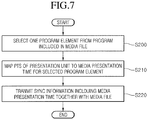
- Fig. 7 is a flowchart illustrating a method of transmitting a media file according to an embodiment. The illustrated method of transmitting a media file will be described in connection with the apparatus for transmitting a media file according to the embodiment illustrated in Fig. 6 .
- the controller 100 of the transmitting apparatus 100 selects one of program elements included in a media file to be transmitted (operation S200).
- the controller 100 may select video tracks among video tracks and audio tracks forming the program as a reference program element.
- controller 110 maps a PTS of a PU for the selected program element to a media presentation time (operation S210) .
- media presentation times for example, MPT 1 to MPT n for a first PU of a segment among PUs belonging to a specific program element may be transported to the client side as sync information.
- PTS 1 denotes a PTS of PU y
- PTS k denotes a PTS of a presentation unit PU x positioned before the PU y
- MPT n denotes a media presentation time for the PU x .
- timescale PTS denotes a clock of the PTS, for example 90kHz
- timescale denotes a clock of the MPT.
- the controller 110 of the transmitting apparatus 100 recovers PTS s , namely, PTS 1 and PTS k for PU y and PU x respectively, and calculates a next media presentation time MPT 0 by linear interpolation like equation 1 using the recovered PTS 1 and PTS k .
- a media presentation time for example, MPT m for the first PU may transported to the client side as sync information.
- the media presentation time for the specific presentation unit may be calculated by the foregoing linear interpolation with reference to the equation 1.
- a method of mapping the PTS of the presentation unit to a media presentation time is described for an exemplary case where PU x and PU y are included in one program element with reference to Fig. 8 .
- a media presentation time for a specific presentation unit may be calculated using the foregoing method.
- the network interface unit 120 transports sync information including the calculated media presentation times to the client side with the media file (operation S220).
- a specific presentation unit may be searched for on the basis of the PTS for a given media presentation time, which may be used in random access or stream switching.
- PTS1 which is a PTS value for any media presentation time MPT0 may be calculated as the following equation 2.
- PTS 1 MPT o ⁇ MPT n / timescale * timescale PTS + PTS k
- the transmitting apparatus 100 transmits media presentation times (MP 1 , MP m and MPT n ) for the first PU or a first PU after the occurrence of the PTS discontinuity among the PUs included in the segment as shown in Fig. 8 , or obtains a media presentation time MPT 0 for another PU according to the foregoing mapping method and transports the obtained MPT to the client side as the sync information.
- media presentation times MP 1 , MP m and MPT n
- the sync information may be structuralized as the following way.
- any one of a plurality of the program elements included in a program of an MPEG2 TS media file is selected as a reference program element and a media presentation time for a first PU of the selected reference program is provided to the client side.
- a duration from the first PU of the selected reference program to a time point of a next PTS discontinuity occurrence (or to an end of the corresponding segment when the PTS discontinuity does not occur) is provided to the client.
- the duration from any one PTS discontinuity to a next PTS discontinuity (or to an end of the corresponding segment when the PTS discontinuity does not occur) is provided to the client side.
- a PTS of a PU of the reference program element immediately after the PTS discontinuity occurrence may be also provided to the client side.
- a media presentation time for all the PUs included in the segment may be recovered by using the sync information created as the forgoing.
- a duration before and after the PTS discontinuity may be more divided into smaller durations and this additional signaling may be used by the client side for a random access or the like.
- syntax of the sync information may enable signaling of presentation times for a plurality of program elements.
- an MPEG2 TS program when an MPEG2 TS program includes two audio tracks L1 and L2 of different languages, the client may want to playback only L1 track between the audio tracks.
- signaling for the media presentation time is provided only to L2, the client needs to extract PTS information from L1 to recover presentation times.
- signaling for media presentation time is provided to both L1 and L2, the client does not need to extract separate PTS information to recover the presentation times.
- the media file is roughly segmented according to a reference track period as required from a transport protocol and boundaries of the segments may be adjusted to MPEG2 TS packets.
- the foregoing sync information may be represented as a binary coded format file or an XML file.
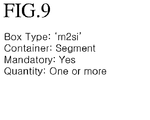
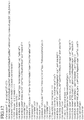
- Figs. 9 and 10 illustrate embodiments of a configuration of a segment index box including sync information, which is an example representing the sync information in a binary format.
- the sync information as described in relation to Figs 6 to 8 may be represented in a binary format on the basis of general ISO Base Media file format data types and has a similar structure to a sidx box used in 3GPP AHS.
- the sync information may be formed of an MPEG2 segment index box m2si, and the m2si box may be included one or more in a specific segment.
- the m2si box may provide media presentation time for PUs included in MPEG2 TS with respect to one or more program elements of MPEG2 TS.
- the segment may be subdivided into a plurality of MPEG2 TS packet groups (MTPGs) and the MTPGs may be formed of a set of adjacent MPEG2 TS packets.
- MTPGs MPEG2 TS packet groups
- At least a first sample namely, a presentation time for a PU of the reference program element may be provided in a first loop.
- a second loop may be performed on each MTPG included in a segment starting from the first MTPG.
- a presentation duration of a reference program element of each MTPG may be provided with byte offsets from a first byte of an MPEG2 TS to a corresponding MTPG in the segment.
- the presentation duration of the MTPG may be a sum of presentation durations of all the PUs of the reference program elements belong to the MTPG.
- a random access point RAP
- a presentation time offset from a presentation time for a first sample in the corresponding segment may be more provided.
- the m2si box may be positioned at a start portion of the segment and does not allow a hierarchical structure, so that the m2si box may be easily removed.
- flags may form a 24-bit integer flag and defined as follows.
- timescale-present represents whether time scale of a media presentation time exists in the corresponding box and a flag value thereof may be '0x000001'.
- pts-present represents whether a PTS of a first PU of a reference track is included for all the written MTPGs and a flag value thereof may be '0x000002'.
- timescale is a time scale of media presentation timeline.
- a value thereof may be identical for all the presentations.
- reference-PID provides packet identifiers (PIDs) of MPEG2 TS packets transporting a reference program element.
- program_element_count represents the number of program elements indexed in a next loop and may be designated 1 or a greater value.
- referenc_count represents the number of program elements indexed in a second loop and may have 1 or a greater value.
- PID represents PIDs of MPEG2 TS packets transporting program elements therein to which representation_time is provided and a PID in the corresponding loop is identical to the reference_PID.
- presentation_time may represent a presentation time for a first sample in a program element identified by the PID expressed in the timescale.
- Reference_offset may represent a byte distance from a first byte of an MPEG2 TS segment to a first byte of an MPTG referred by repeating of the corresponding loop.
- MTPG _duration provides a presentation period of a reference program element for the referred MPTG and may be represented in a time scale of a corresponding track.
- PTS may represent an MPEG2 TS PTS of a first PU of a reference program element of the corresponding MPTG.
- contains_RAP may be set to '1' in order to represent that the reference program element in the referred MPTG includes a RAP.
- discontinuity may be set to '1' in order to represent that the corresponding MPTG starts from discontinuity.
- RAP_delta_time may provide a presentation time offset of a RAP in order to correspond to a presentation time for a first sample of the reference program element in the segment, when contains_RAP is set to '1'.
- the RAP_delta_time may be maintained as '0'.
- Figs. 11 and 12 illustrate embodiments of a configuration of an XML file including sync information.
- an XML file may include a media presentation time for PUs of one or more program elements of an MPEG2 TS and the segment may be subdivided into adjacent MTPGs.
- a presentation time for at least a first sample, namely, a presentation unit of the reference program element is provided in a first element.
- a second element is for each MTPG included in a segment starting from a first MTPG.
- the second element may provide presentation periods of a reference program element for each MTPG of the segment.
- the presentation period of the MTPG may be a sum of presentation periods of all the PUs of a reference program element belonging to the corresponding group.
- the second element may be provided information on whether the reference program element of the MTPG includes a RAP.
- a presentation time offset may be further provided to a presentation time for a first sample in the corresponding segment.
- Fig. 11 illustrates a schema of sync information having a configuration as shown in Fig. 10 and the detailed description for the illustrated schema is the same as described above in relation to Figs 9 and 10 . Therefore description thereof will be omitted.
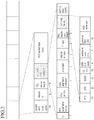
- Fig. 13 illustrates an embodiment of a file structure of a media file transmitted from a transmitting apparatus according to an embodiment.
- an m2si box described in relation to Figs. 9 and 10 may be attached before an MPEG2 TS divided into a segment unit.
- the MPEG2 TS data may be selectively encapsulated in a mdat box to make an access and demarcation easy.
- the m2si box may be attached before the mdat box.
- the media file format may start from a segment type (styp) box, the styp box may have a boxtype set as 'styp', a brand of 'etsf' and a minor_version set to '1'. Except this, the styp box may have the same syntax structure as a file type box (ftyp) defined in the ISO/IEC 14496-12 ISO Base Media file format.
- a receiving apparatus 300 may receive a media file with sync information, extract a media presentation time of a PU from the received sync information and then playback the media file using the extracted media presentation time.
- a configuration of the sync information received by the receiving apparatus 300 may be the same as described above in relation to Figs. 6 to 13 . Therefore detailed description thereof will be omitted.
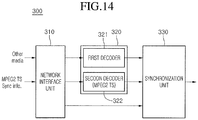
- Fig. 14 illustrates a block diagram of a configuration of a media file receiving apparatus according to an embodiment.
- the illustrated receiving apparatus 300 may include a network interface unit 310, a decoding unit 320 and a synchronization unit 330.
- the network interface unit 310 of the receiving apparatus 300 receives a media file with the sync information and the decoding unit 320 may decode the received media file and output the decoded media file.
- the synchronization unit 330 may synchronize the decoded media file with a media presentation timeline using a media presentation time included in the sync information.
- the network interface unit 310 may receive sync information having the configuration as described above in relation to Figs. 6 to 13 with an MPEG2 TS from the transmitting unit 100.
- the decoding unit 320 may include a second decoder 322 for decoding the MPEG2 TS and the second decoder 322 may be a general MPEG2 TS decoder.
- the second decoder 322 may receive to decode the MPEG2 TS from the network interface unit 310 and output the decoded PUs and PTSs thereof.
- the synchronization unit 330 may identify a presentation unit to which a media presentation time is provided through the received sync information. For this, the network interface unit 310 recovers the PTSs of the PUs of which presentation times are provided and transfers the recovered PTSs to the synchronization unit 330 or receives the presentation time and PTSs of the corresponding unit from the transmitting apparatus 100.
- elementary stream time recovery may be used.
- the decoding unit 320 may further include a first decoder 321 to decode another media file received through the network interface unit 310, the first decoder 321 may be a decoder for recovering another format media file such as in a 3GPP file format or an MPEG2 TS decoder which is the same as the second decoder 322.
- the synchronization unit 330 may synchronize an MPEG2 TS-based media file output from the second decoder 322 with another media file output from the first decoder 321 using decoding information transmitted from the transmitting apparatus 100, for example, media presentation times for the PUs.
- the receiving apparatus 300 may playback the MPEG2 TS-based media file synchronized by the synchronization unit 330 and another media file together.
- the decoded MPEG2 TS may be stored in a memory (not shown) prepared in the receiving apparatus 300.
- the sync information included in the received m2si box or xml file may be also stored in the receiving apparatus 300.
- the stored sync information may be used later for synchronized presentation with other media components.
- the byte offsets for the PTS discontinuities may be stored as attributes in the m2si box or the xml file including the sync information.
- the byte offsets provided in the synchronization box or file should correspond to a start of the MPEG2 TS file.
- Fig. 16 illustrates an embodiment of a segment list created by using an MPD.
- the client performing HTTP streaming may access to the MPD and create the segment list as shown in Fig. 16 from the MPD at a specific client-local time "NOW".
- NOW may represent a current value of a clock in the reference client when an MPD instance is formed from the MPD.
- HTTP streaming clients should synchronize their own clocks with a precise universal time.
- Fig. 17 illustrates an embodiment of a method of synchronizing an MPEG2 TS-based media file with a 3GPP media file and playing back.
- a specific PU PU y included in an MPEG2 TS media file may be synchronized with a sample corresponding to the 3GPP media file and played back using the sync information as described above in relation to Figs. 6 to 12 .
- the m2si box including MPD information, 3GPP file format information for segment and sync information may be given as follows.
- the UTC used for rendering PU y which is a PU played back according to the mapping method as described above in relation to Figs. 5 to 8 may be calculated as the following equation 4.
- PU y PTS 1 ⁇ PTS k / time_scale_ext + presentation _ time / time_scale + availabilityStartTir
- the UTC "2010-05-30T 09:31:02.07Z" used for rendering PU y may be obtained by substituting PTS 1 with PTS “43249500” of PU y , PTS k with PTS “43245300” of a PU to which media presentation time “29977120” is provided, time_scale_ext with clock “90000” of PTS, time_scale with "48000” given in 3GPP file format information, and availabilityStartTime with "2010-05-30T 09:30:10Z” given in the MDP information.
- Figs. 18 and 19 illustrate embodiments of a method of implementing a media file using a MPD of MPEG Dynamic Adaptive Streaming over HTTP (DASH).
- DASH Dynamic Adaptive Streaming over HTTP
- an index segment which is sync information as described above in relation to Figs. 6 to 17 may exist separately in MPEG-DASH.
- the media file may be implemented with syntax having the same media file structure as the described above in relation to Fig. 13 and the index data may be stored after the MPEG2 TS media file. Therefore the number of stored files may be greatly reduced.
- the client may confirm how many bytes correspond to the index data and how many tailings correspond to the media data in the media file.
- the client may recognize that a Universal Resource Locator (URL) for a media segment coincides with a URL of the index segment corresponding to the media segment. Accordingly the client may divide the segments in combination with a request.
- URL Universal Resource Locator
- a general client may not use this optimization and may obtain the same effect through two ttp requests.
- Another client which is not able to use the index data may neglect the same and just fetch the media data.
- a method of receiving and processing the MPEG2 TS-based media file as described in relation to Figs. 1 to 19 may be performed by an IPTV receiver according to an embodiment.
- the IPTV receiver may receive a media file transmitted from a transmitting side, for example, a media server, and a format of the media file may have a configuration as described in relation to Figs. 6 to 19 .
- the IPTV receiver may synchronize an MPEG2 TS with other media and play back using sync information received from the transmitting side.
- the IPTV receiver may perform a method of receiving a media file as described in relation to Figs. 14 and 15 .
- Fig. 20 illustrates a block diagram of an IPTV receiver configuration according to an embodiment.
- An IPTV receiver may include a separate tuner for receiving terrestrial broadcasting, cable broadcasting or satellite broadcasting.
- the IPTV receiver having a configuration of receiving an IPTV service provided over an IP network will be mainly described for convenience.
- An ITF indicates Open IPTV Terminal Function and may suggest a receiver formed of function modules necessary for supporting the IPTV service.
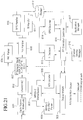
- the IPTV receiver may include a network interface unit 501, a TCP/IP manager 502, a service delivery manager 504, a PVR manager 505, a demultiplexer (Demux) 508, a data decoder 507, an audio/video decoder 512, an display and OSD unit 515, an application manager 513 and 514, a service information (SI) and Metadata database (DB) 511, a service discovery manager 509, a service control manager 503, a metadata manager 510 and a content DB 506.
- SI service information
- DB Metadata database
- the network interface unit 501 receives and transmits packets from and to a network. Namely, the network interface unit 501 receives a service or media contents from a service provider over the network.
- the TCP/IP manager 502 manages packet delivery from a source to a destination with respect to packets received by the IPTV receiver and packets transmitted from the IPTV receiver. In addition, the TCP/IP manager 502 classifies the received packets so as to correspond to a proper protocol, and outputs the classified packets to the service discovery manager 509, the service control manager 503 and the metadata manager 510.
- the service delivery manager 504 controls the received service data.
- the service delivery manager 504 may use a RTP/RTCP.
- the service delivery manager 504 parses the received data packet according to the RTP and transports the parsed data packet to the Demux 508 or stores the same to the content DB 506 according to a control of the service manager 514. In addition, the service delivery manager 504 feeds the network reception information back to a server side providing the service using the RTCP.
- the Demux 508 demultiplexes the received packets into audio, video and Program Specific Information data and transports the demultiplexed data respectively to the audio/video decoder 512 and the data decoder 507.
- the data decoder 507 decodes, for example, service information such as PSI. Namely, the data decoder 507 receives a PSI section, a program and Service Information Protocol (PSIP) section or a DVB-SI section demultiplexed by the Demux 508 and decodes the received sections.
- PSIP program and Service Information Protocol
- DVB-SI DVB-SI section demultiplexed by the Demux 508 and decodes the received sections.
- the data decoder 507 decodes the received sections to make a database for service information and the database for service information is stored in the SI & Metadata DB 511.
- the audio/video decoder 512 decodes video data and audio data received from the Demux 508.
- the video data and audio data decoded in the audio/video decoder 512 are provided to a user through the display and OSD unit 515.
- the application manager 513 and 514 manages the entire state of the IPTV receiver, provides a user interface and manages other managers.
- the application manager includes a user interface manager 513 and a service manager 514.
- the user interface manager 513 provides a Graphic User Interface (GUI) for a user using an On Screen Display (OSD), and performs receiver operations according to a key input from the user. For example, when receiving a key input for a channel selection from the user, the user interface manager 513 transports the key input signal to the service manager 514.
- GUI Graphic User Interface
- OSD On Screen Display
- the service manager 514 controls managers related to a service such as the service delivery manager 504, the service discovery manager 509, the service control manager 503 and the metadata manager 510.
- the service manager 514 makes a channel map and selects a channel using the channel map according to the key input received from the user interface manager 513.
- the service manager 514 receives channel service information for the data decoder 507 and sets audio and video PIDs of the selected channel to the Demux 508.
- the service discovery manager 509 provides information necessary to select a service provider which provides services. When receiving a signal for the channel selection from the service manager 514, the service discovery manager 509 searches for a service using the information.
- the service control manager 503 selects and controls the service.
- the service control manager 503 uses the Internet Group Management Protocol (IGMP) or RTSP when the user selects a live broadcasting service which has the same scheme as the prior art, or selects and controls the service using the RTSP when the user selects a service of Video on Demand (VOD) .
- IGMP Internet Group Management Protocol
- RTSP Video on Demand
- the RTP may provide a trick mode for the real time streaming.
- the service control manager 503 may initialize and manage sessions using an IP Multimedia Subsystem (IMS) through an IMC gateway.
- IMS IP Multimedia Subsystem
- the metadata manager 510 manages metadata associated with the services and stores the metadata in the SI and metadata DB 511.
- the SI and metadata DB 511 and the content DB 506 may be respectively implemented using a nonvolatile RAM (NVRAM) or a flash memory and may also be implemented in logically separated two regions on the same storage area.
- NVRAM nonvolatile RAM
- the PVR manager 505 is a module for recording and presenting live streaming contents, and may collect metadata for the recorded content and create additional information to be provided to the user such as a thumbnail image or an index.
- a function of a controller of the IPTV receiver may be implemented as divided into a plurality of modules like the TCP/IP manager 502, the service delivery manager 504, a PVR manager 505, the application manager 513 and 514, the service discovery manager 509, the service control manager 503 and the metadata manager 510 as shown in Fig. 20 .
- the TCP/IP manager 502 may filter SD&S information using the foregoing target package information and control the network interface unit 501 to request only a payload or a segment corresponding to a specific package, for example, a package to which the IPTV receiver is subscribed, to a server and receive the same.
- the TCP/IP manager 502 may filter SD&S information received in a multicast scheme using the target package information and cause the decoder 507 to parse and process only a payload or a segment corresponding to a specific package.
- Fig. 21 illustrates a functional block diagram of a configuration of the IPTV according to another embodiment.
- a solid line indicates a data path and a dashed line indicates a control signal path.
- a cable modem or a DSL modem, etc 601 which is an interface causing the ITF to connect to an IP network in a physical level, demodulates a signal transmitted through a physical medium and recovers a digital signal.
- An Ethernet NIC 602 recovers IP data from a signal received through the physical interface.
- An IP network stack 607 processes each layer according to the IP protocol stack.
- An XML parser 609 parses an XML document from among received IP data.
- a file handler 608 processes data transported in a file type through FLUTE or the like from among the received IP data.
- An SI handler 611 processes a portion corresponding to IPTV service information from among the receive file type data and stores the processed data in a storage 612.
- An EPG handler 610 processes a portion corresponding to IPTV EPG information from among the receive file type data and stores the processed data in the storage 612.
- the storage 612 stores various data such as the SI data and the EPG information data and the like.
- An SI decoder 613 reads the SI data from the storage 612, and then, analyzes and obtains channel map information.
- An EPG decoder 614 analyzes EPG data stored in the storage 612 and recovers information necessary to form an EPG.
- An ITF operation controller 615 is a main controller controlling an ITF operation of a channel change or an EPG display.
- a channel service manager 616 may perform an operation such as a channel change according to a user input.
- An application manager 617 may perform an application service such as an EPG display according to a user input.
- An MPEG-2 demultiplexer 603 extracts MPEG2 TS data from a received IP datagram and transports the extracted data to a corresponding module according to the PID.
- An MPEG2 PSI/PSIP parser 604 extracts the PID of A/V data or PSI/PSIP data including connection information on program elements, and parses the extracted data.
- An A/V decoder 605 decodes input audio and video data and delivers the decoded data to a display module 606.
- the display module 606 displays the decoded A/V data or application.
- the invention can also be embodied as computer readable codes on a computer readable recording medium.
- the computer readable recording medium is any data storage device that can store data which can be thereafter read by a computer system. Examples of the computer readable recording medium include read-only memory (ROM), random-access memory (RAM), CD-ROMs, magnetic tapes, floppy disks, and optical data storage.
- the computer readable recording medium can also be distributed over network coupled computer systems so that the computer readable code is stored and executed in a distributed fashion. Also, functional programs, codes, and code segments for accomplishing the present invention can be easily construed by programmers skilled in the art to which the present invention pertains.
Landscapes
- Engineering & Computer Science (AREA)
- Multimedia (AREA)
- Signal Processing (AREA)
- Databases & Information Systems (AREA)
- Computer Security & Cryptography (AREA)
- Two-Way Televisions, Distribution Of Moving Picture Or The Like (AREA)
Claims (2)
- Verfahren zum Senden einer auf einem Moving Picture Experts Group 2, MPEG2, Transportdatenstrom, TS, basierten Mediendatei, wobei das Verfahren umfasst:Abbilden (S210) eines Präsentationszeitstempels, PTS, einer ersten Präsentationseinheit, PU, von MPEG2-TS-Paketen in jedem Segment der Mediendatei auf eine Medienpräsentationszeit, MPT, der ersten PU in einer Medienpräsentationszeitleiste zur Synchronisation mindestens eines Programmelements, das ein in der Mediendatei enthaltenes Programm bildet, mit anderen in einer anderen Mediendatei enthalten Medien; undSenden (S220) einer Synchronisationsinformation einschließlich der abgebildeten MPT der ersten PU zusammen mit dem Segment einschließlich der MPEG2-TS-Pakete der Mediendatei,wobei die Synchronisationsinformation ein Segmentindexfeld in einem auf International Organization for Standardization, ISO, basierten Mediendateiformat für die MPEG2-TS-Pakete ist,wobei die Synchronisationsinformation vor den MPEG2-TS-Paketen im Segment der Mediendatei angeordnet ist,wobei die Synchronisationsinformation ferner eine Zeitskaleninformation, die eine Taktfrequenz der Medienpräsentationszeitlinie darstellt, und eine Paketkennzeichnungs-, PID, Information der MPEG2-TS-Pakete, die Programmelemente tragen, für welche die MPT bereitgestellt wird, enthält,wobei eine MPT einer zweiten PU in der Mediendatei oder der anderen Mediendatei unter Verwendung einer PTS-Differenz zwischen dem PTS der ersten PU und einem PTS der zweiten PU, einer Taktfrequenz des PTS, 90000 Hz, der Taktfrequenz der Medienpräsentationszeitleiste und der MPT der ersten PU berechnet wird.
- Verfahren nach Anspruch 1, wobei das Abbilden des PTS durchgeführt wird unter Verwendung einer folgenden Gleichung:

Applications Claiming Priority (3)
| Application Number | Priority Date | Filing Date | Title |
|---|---|---|---|
| US36574610P | 2010-07-19 | 2010-07-19 | |
| US201161453948P | 2011-03-17 | 2011-03-17 | |
| PCT/KR2011/005307 WO2012011724A2 (ko) | 2010-07-19 | 2011-07-19 | 미디어 파일 송수신 방법 및 그를 이용한 송수신 장치 |
Publications (3)
| Publication Number | Publication Date |
|---|---|
| EP2597870A2 EP2597870A2 (de) | 2013-05-29 |
| EP2597870A4 EP2597870A4 (de) | 2014-01-22 |
| EP2597870B1 true EP2597870B1 (de) | 2019-05-22 |
Family
ID=45497289
Family Applications (1)
| Application Number | Title | Priority Date | Filing Date |
|---|---|---|---|
| EP11809851.6A Not-in-force EP2597870B1 (de) | 2010-07-19 | 2011-07-19 | Verfahren zum senden von mediendateien |
Country Status (5)
| Country | Link |
|---|---|
| US (4) | US9131274B2 (de) |
| EP (1) | EP2597870B1 (de) |
| KR (6) | KR101476934B1 (de) |
| CN (2) | CN105611320B (de) |
| WO (1) | WO2012011724A2 (de) |
Cited By (1)
| Publication number | Priority date | Publication date | Assignee | Title |
|---|---|---|---|---|
| US11849166B2 (en) | 2013-10-11 | 2023-12-19 | Panasonic Intellectual Property Corporation Of America | Transmitting method, receiving method, transmitting device, and receiving device |
Families Citing this family (32)
| Publication number | Priority date | Publication date | Assignee | Title |
|---|---|---|---|---|
| KR101476934B1 (ko) | 2010-07-19 | 2014-12-30 | 엘지전자 주식회사 | 미디어 파일 송수신 방법 및 그를 이용한 송수신 장치 |
| EP2625867A1 (de) * | 2010-10-05 | 2013-08-14 | Telefonaktiebolaget L M Ericsson (publ) | Client, inhaltserstellungsinstanz und media-streaming-verfahren dafür |
| TW201246873A (en) * | 2011-02-11 | 2012-11-16 | Interdigital Patent Holdings | Method and apparatus for updating metadata cross reference to related applications |
| EP2924989A1 (de) * | 2011-03-16 | 2015-09-30 | Electronics and Telecommunications Research Institute | Vorrichtung und verfahren zur bereitstellung von streaming-inhalten mithilfe von darstellungen |
| JP6062363B2 (ja) * | 2011-07-29 | 2017-01-18 | サターン ライセンシング エルエルシーSaturn Licensing LLC | ストリーミング配信装置および方法、ストリーミング受信装置および方法、ストリーミングシステム、プログラム、並びに記録媒体 |
| US9590814B2 (en) * | 2011-08-01 | 2017-03-07 | Qualcomm Incorporated | Method and apparatus for transport of dynamic adaptive streaming over HTTP (DASH) initialization segment description fragments as user service description fragments |
| US9286384B2 (en) | 2011-09-21 | 2016-03-15 | Sonos, Inc. | Methods and systems to share media |
| EP2793479A4 (de) * | 2011-12-12 | 2015-07-01 | Lg Electronics Inc | Vorrichtung und verfahren zum empfangen von medieninhalten |
| US9425948B2 (en) * | 2012-01-26 | 2016-08-23 | Qualcomm Incorporated | Techniques for synchronizing a clock of a wired connection when transmitted over a wireless channel |
| CN105393548A (zh) * | 2013-04-16 | 2016-03-09 | Lg电子株式会社 | 广播发射设备、广播接收设备、操作广播发射设备的方法和操作广播接收设备的方法 |
| KR102210509B1 (ko) * | 2013-06-24 | 2021-02-01 | 삼성전자주식회사 | 멀티미디어 시스템에서 컨텐츠를 변환하는 방법 및 장치 |
| JP2015015706A (ja) * | 2013-07-03 | 2015-01-22 | パナソニック インテレクチュアル プロパティ コーポレーション オブアメリカPanasonic Intellectual Property Corporation of America | データ送信方法、データ再生方法、データ送信装置およびデータ再生装置 |
| JP6498882B2 (ja) * | 2013-07-22 | 2019-04-10 | パナソニック インテレクチュアル プロパティ コーポレーション オブ アメリカPanasonic Intellectual Property Corporation of America | 蓄積方法、再生方法、蓄積装置、および再生装置 |
| WO2015052908A1 (ja) | 2013-10-11 | 2015-04-16 | パナソニック インテレクチュアル プロパティ コーポレーション オブ アメリカ | 送信方法、受信方法、送信装置および受信装置 |
| US9838729B2 (en) * | 2013-11-06 | 2017-12-05 | Avago Technologies General Ip (Singapore) Pte. Ltd. | Recovering channel bonded program streams |
| US20150201253A1 (en) * | 2014-01-10 | 2015-07-16 | Samsung Electronics Co., Ltd. | Methods and apparatus for universal presentation timeline alignment |
| KR101789641B1 (ko) | 2014-01-13 | 2017-11-20 | 엘지전자 주식회사 | 하나 이상의 네트워크를 통하여 방송 컨텐트를 송신 또는 수신하기 위한 방법 및 장치 |
| JPWO2015115171A1 (ja) * | 2014-01-31 | 2017-03-23 | ソニー株式会社 | 送信装置、送信方法、受信装置および受信方法 |
| EP3131253A4 (de) * | 2014-04-09 | 2017-11-15 | LG Electronics Inc. | Verfahren und vorrichtung zum senden/empfangen von rundfunksignalen |
| CN104079957B (zh) * | 2014-06-25 | 2017-09-01 | 广东欧珀移动通信有限公司 | 一种多媒体设备同步操作的方法及系统 |
| CN107251521B (zh) * | 2015-01-07 | 2021-01-12 | 三星电子株式会社 | 用于在通信系统中发送和接收媒体信息的方法 |
| US10085051B2 (en) * | 2015-02-13 | 2018-09-25 | Samsung Electronics Co., Ltd. | Method and apparatus for converting MMTP stream to MPEG-2TS |
| CN106034262B (zh) * | 2015-03-13 | 2021-01-22 | 中兴通讯股份有限公司 | 自适应流媒体处理方法及装置 |
| US11272241B2 (en) * | 2015-08-06 | 2022-03-08 | Maxell, Ltd. | Broadcast receiving apparatus, output video information generating method, broadcast receiving method, and video recording method |
| CN106470291A (zh) * | 2015-08-19 | 2017-03-01 | 飞思卡尔半导体公司 | 从音频/视频解码器中的时间同步中的中断中恢复 |
| US11533521B2 (en) | 2015-12-11 | 2022-12-20 | Interdigital Madison Patent Holdings, Sas | Scheduling multiple-layer video segments |
| US10098082B2 (en) | 2015-12-16 | 2018-10-09 | Sonos, Inc. | Synchronization of content between networked devices |
| TWI559753B (zh) * | 2016-03-16 | 2016-11-21 | 晶睿通訊股份有限公司 | 傳輸隨選影音檔案的方法 |
| CN105872484B (zh) * | 2016-06-04 | 2017-07-21 | 武汉诚迈科技有限公司 | 一种监控录像异常的保护方法 |
| US9967689B1 (en) | 2016-09-29 | 2018-05-08 | Sonos, Inc. | Conditional content enhancement |
| KR102090070B1 (ko) * | 2018-10-31 | 2020-03-17 | 카테노이드 주식회사 | 스트리밍 서버, 클라이언트 단말 및 이를 이용한 av 라이브 스트리밍 시스템 |
| US12346291B2 (en) * | 2021-11-03 | 2025-07-01 | Vimeo.Com, Inc. | On-the-fly/transparent fragmented ISOBMFF to progressive ISOBMFF transmultiplexing proxy |
Citations (1)
| Publication number | Priority date | Publication date | Assignee | Title |
|---|---|---|---|---|
| US20040103430A1 (en) * | 2002-10-26 | 2004-05-27 | Lee Yong Ju | Apparatus and method for injecting synchronized stream data in digital broadcasting environment |
Family Cites Families (11)
| Publication number | Priority date | Publication date | Assignee | Title |
|---|---|---|---|---|
| DE10355345A1 (de) * | 2003-11-25 | 2005-06-23 | Deutsche Thomson-Brandt Gmbh | Verfahren und Vorrichtung zum Speichern oder Wiederfinden von definierten Positionen in einem Datenstrom |
| KR100646851B1 (ko) * | 2004-11-03 | 2006-11-23 | 한국전자통신연구원 | 오디오/비디오 서비스와 데이터 서비스의 동기화를 위한지상파 디지털멀티미디어방송 송/수신 시스템 |
| EP1884115A4 (de) * | 2005-05-26 | 2008-08-06 | Korea Electronics Telecomm | Verfahren und vorrichtung zum synchronisieren eines datendienstes mit einem videodienst bei der digital-multimedia-ausstrahlung |
| KR20060131502A (ko) * | 2005-06-16 | 2006-12-20 | 삼성전자주식회사 | 멀티미디어 데이터 서비스 방법 및 이를 위한 장치 |
| KR100724867B1 (ko) | 2005-07-28 | 2007-06-04 | 삼성전자주식회사 | 디지털 멀티미디어 방송 시스템에서 멀티 채널 전송을 위한멀티 채널 생성 및 재생 방법 |
| US9209934B2 (en) * | 2006-06-09 | 2015-12-08 | Qualcomm Incorporated | Enhanced block-request streaming using cooperative parallel HTTP and forward error correction |
| CN101188589B (zh) | 2006-11-15 | 2012-06-06 | 上海瑞高信息技术有限公司 | 广播数据在卫星同步分配网中的同步适配方法及装置 |
| WO2008123712A1 (en) * | 2007-04-04 | 2008-10-16 | Electronics And Telecommunications Research Institute | Storage/playback method and apparatus for mpeg-2 transport stream based on iso base media file format |
| CN101282230B (zh) | 2007-04-05 | 2011-04-20 | 中兴通讯股份有限公司 | 广播数据全网同步的实现方法 |
| KR101580516B1 (ko) | 2008-04-07 | 2015-12-28 | 엘지전자 주식회사 | 방송 신호 수신 방법 및 방송 신호 수신 장치 |
| KR101476934B1 (ko) | 2010-07-19 | 2014-12-30 | 엘지전자 주식회사 | 미디어 파일 송수신 방법 및 그를 이용한 송수신 장치 |
-
2011
- 2011-07-19 KR KR1020137001532A patent/KR101476934B1/ko active Active
- 2011-07-19 EP EP11809851.6A patent/EP2597870B1/de not_active Not-in-force
- 2011-07-19 WO PCT/KR2011/005307 patent/WO2012011724A2/ko not_active Ceased
- 2011-07-19 CN CN201610186917.4A patent/CN105611320B/zh active Active
- 2011-07-19 KR KR1020147020005A patent/KR101651137B1/ko active Active
- 2011-07-19 KR KR1020167022031A patent/KR101689616B1/ko active Active
- 2011-07-19 US US13/811,198 patent/US9131274B2/en active Active
- 2011-07-19 KR KR1020177009516A patent/KR101759959B1/ko active Active
- 2011-07-19 CN CN201180044822.4A patent/CN103109540B/zh active Active
- 2011-07-19 KR KR1020147000387A patent/KR20140008478A/ko not_active Ceased
- 2011-07-19 KR KR1020167035531A patent/KR101727050B1/ko active Active
-
2015
- 2015-07-28 US US14/811,321 patent/US9699521B2/en active Active
- 2015-11-17 US US14/943,346 patent/US9699522B2/en active Active
-
2017
- 2017-06-05 US US15/613,723 patent/US10129609B2/en active Active
Patent Citations (1)
| Publication number | Priority date | Publication date | Assignee | Title |
|---|---|---|---|---|
| US20040103430A1 (en) * | 2002-10-26 | 2004-05-27 | Lee Yong Ju | Apparatus and method for injecting synchronized stream data in digital broadcasting environment |
Non-Patent Citations (2)
| Title |
|---|
| "A Guide to MPEG Fundamentals and Protocol Analysis", 1 March 2007 (2007-03-01), pages 1 - 101, XP002505551, Retrieved from the Internet <URL:http://www.tek.com/products/video_test/mpeg_monitors.html> [retrieved on 20081125] * |
| HJ LEE ET AL: "Response to CfP on HTTP Streaming of MPEG Media", 93. MPEG MEETING; 26-7-2010 - 30-7-2010; GENEVA; (MOTION PICTURE EXPERT GROUP OR ISO/IEC JTC1/SC29/WG11),, no. M17898, 21 July 2010 (2010-07-21), XP030046488 * |
Cited By (1)
| Publication number | Priority date | Publication date | Assignee | Title |
|---|---|---|---|---|
| US11849166B2 (en) | 2013-10-11 | 2023-12-19 | Panasonic Intellectual Property Corporation Of America | Transmitting method, receiving method, transmitting device, and receiving device |
Also Published As
| Publication number | Publication date |
|---|---|
| KR20160150111A (ko) | 2016-12-28 |
| CN105611320B (zh) | 2018-10-19 |
| US20170272840A1 (en) | 2017-09-21 |
| US20130125187A1 (en) | 2013-05-16 |
| KR101759959B1 (ko) | 2017-07-20 |
| KR101651137B1 (ko) | 2016-08-25 |
| US9699521B2 (en) | 2017-07-04 |
| KR20170042811A (ko) | 2017-04-19 |
| WO2012011724A3 (ko) | 2012-05-03 |
| US9131274B2 (en) | 2015-09-08 |
| KR101476934B1 (ko) | 2014-12-30 |
| KR20140008478A (ko) | 2014-01-21 |
| US10129609B2 (en) | 2018-11-13 |
| CN105611320A (zh) | 2016-05-25 |
| KR101689616B1 (ko) | 2016-12-26 |
| KR20160099736A (ko) | 2016-08-22 |
| CN103109540B (zh) | 2016-04-27 |
| KR20130050953A (ko) | 2013-05-16 |
| KR101727050B1 (ko) | 2017-04-14 |
| KR20140093763A (ko) | 2014-07-28 |
| US9699522B2 (en) | 2017-07-04 |
| WO2012011724A2 (ko) | 2012-01-26 |
| US20160073178A1 (en) | 2016-03-10 |
| EP2597870A4 (de) | 2014-01-22 |
| CN103109540A (zh) | 2013-05-15 |
| US20160029068A1 (en) | 2016-01-28 |
| EP2597870A2 (de) | 2013-05-29 |
Similar Documents
| Publication | Publication Date | Title |
|---|---|---|
| US10129609B2 (en) | Method for transceiving media files and device for transmitting/receiving using same | |
| US10009660B2 (en) | Media content transceiving method and transceiving apparatus using same | |
| US9781188B2 (en) | Method for transreceiving media content and device for transreceiving using same | |
| Köhnen et al. | A DVB/IP streaming testbed for hybrid digital media content synchronization | |
| GB2499539A (en) | Method for transreceiving media content and device for transreceiving using same |
Legal Events
| Date | Code | Title | Description |
|---|---|---|---|
| PUAI | Public reference made under article 153(3) epc to a published international application that has entered the european phase |
Free format text: ORIGINAL CODE: 0009012 |
|
| 17P | Request for examination filed |
Effective date: 20130214 |
|
| AK | Designated contracting states |
Kind code of ref document: A2 Designated state(s): AL AT BE BG CH CY CZ DE DK EE ES FI FR GB GR HR HU IE IS IT LI LT LU LV MC MK MT NL NO PL PT RO RS SE SI SK SM TR |
|
| DAX | Request for extension of the european patent (deleted) | ||
| A4 | Supplementary search report drawn up and despatched |
Effective date: 20140107 |
|
| RIC1 | Information provided on ipc code assigned before grant |
Ipc: H04N 7/24 20110101AFI20131219BHEP Ipc: H04N 21/236 20110101ALI20131219BHEP Ipc: H04N 5/91 20060101ALI20131219BHEP Ipc: H04N 21/2343 20110101ALN20131219BHEP Ipc: H04N 21/43 20110101ALI20131219BHEP Ipc: H04N 21/845 20110101ALN20131219BHEP Ipc: H04N 21/854 20110101ALI20131219BHEP Ipc: H04N 21/462 20110101ALI20131219BHEP Ipc: H04N 21/8547 20110101ALI20131219BHEP |
|
| 17Q | First examination report despatched |
Effective date: 20150805 |
|
| STAA | Information on the status of an ep patent application or granted ep patent |
Free format text: STATUS: EXAMINATION IS IN PROGRESS |
|
| REG | Reference to a national code |
Ref country code: DE Ref legal event code: R079 Ref document number: 602011059237 Country of ref document: DE Free format text: PREVIOUS MAIN CLASS: H04N0007240000 Ipc: H04N0021236000 |
|
| GRAP | Despatch of communication of intention to grant a patent |
Free format text: ORIGINAL CODE: EPIDOSNIGR1 |
|
| STAA | Information on the status of an ep patent application or granted ep patent |
Free format text: STATUS: GRANT OF PATENT IS INTENDED |
|
| RIC1 | Information provided on ipc code assigned before grant |
Ipc: H04N 5/91 20060101ALI20181206BHEP Ipc: H04N 21/43 20110101ALI20181206BHEP Ipc: H04N 21/845 20110101ALN20181206BHEP Ipc: H04N 21/236 20110101AFI20181206BHEP Ipc: H04N 21/462 20110101ALI20181206BHEP Ipc: H04N 21/4385 20110101ALI20181206BHEP Ipc: H04N 7/24 20110101ALI20181206BHEP Ipc: H04N 21/8547 20110101ALI20181206BHEP Ipc: H04N 21/854 20110101ALI20181206BHEP Ipc: H04N 21/2343 20110101ALN20181206BHEP |
|
| INTG | Intention to grant announced |
Effective date: 20181221 |
|
| GRAS | Grant fee paid |
Free format text: ORIGINAL CODE: EPIDOSNIGR3 |
|
| GRAA | (expected) grant |
Free format text: ORIGINAL CODE: 0009210 |
|
| STAA | Information on the status of an ep patent application or granted ep patent |
Free format text: STATUS: THE PATENT HAS BEEN GRANTED |
|
| AK | Designated contracting states |
Kind code of ref document: B1 Designated state(s): AL AT BE BG CH CY CZ DE DK EE ES FI FR GB GR HR HU IE IS IT LI LT LU LV MC MK MT NL NO PL PT RO RS SE SI SK SM TR |
|
| REG | Reference to a national code |
Ref country code: GB Ref legal event code: FG4D |
|
| REG | Reference to a national code |
Ref country code: CH Ref legal event code: EP |
|
| REG | Reference to a national code |
Ref country code: IE Ref legal event code: FG4D |
|
| REG | Reference to a national code |
Ref country code: DE Ref legal event code: R096 Ref document number: 602011059237 Country of ref document: DE |
|
| REG | Reference to a national code |
Ref country code: AT Ref legal event code: REF Ref document number: 1137527 Country of ref document: AT Kind code of ref document: T Effective date: 20190615 |
|
| REG | Reference to a national code |
Ref country code: NL Ref legal event code: MP Effective date: 20190522 |
|
| REG | Reference to a national code |
Ref country code: LT Ref legal event code: MG4D |
|
| PG25 | Lapsed in a contracting state [announced via postgrant information from national office to epo] |
Ref country code: ES Free format text: LAPSE BECAUSE OF FAILURE TO SUBMIT A TRANSLATION OF THE DESCRIPTION OR TO PAY THE FEE WITHIN THE PRESCRIBED TIME-LIMIT Effective date: 20190522 Ref country code: NL Free format text: LAPSE BECAUSE OF FAILURE TO SUBMIT A TRANSLATION OF THE DESCRIPTION OR TO PAY THE FEE WITHIN THE PRESCRIBED TIME-LIMIT Effective date: 20190522 Ref country code: LT Free format text: LAPSE BECAUSE OF FAILURE TO SUBMIT A TRANSLATION OF THE DESCRIPTION OR TO PAY THE FEE WITHIN THE PRESCRIBED TIME-LIMIT Effective date: 20190522 Ref country code: HR Free format text: LAPSE BECAUSE OF FAILURE TO SUBMIT A TRANSLATION OF THE DESCRIPTION OR TO PAY THE FEE WITHIN THE PRESCRIBED TIME-LIMIT Effective date: 20190522 Ref country code: FI Free format text: LAPSE BECAUSE OF FAILURE TO SUBMIT A TRANSLATION OF THE DESCRIPTION OR TO PAY THE FEE WITHIN THE PRESCRIBED TIME-LIMIT Effective date: 20190522 Ref country code: PT Free format text: LAPSE BECAUSE OF FAILURE TO SUBMIT A TRANSLATION OF THE DESCRIPTION OR TO PAY THE FEE WITHIN THE PRESCRIBED TIME-LIMIT Effective date: 20190922 Ref country code: AL Free format text: LAPSE BECAUSE OF FAILURE TO SUBMIT A TRANSLATION OF THE DESCRIPTION OR TO PAY THE FEE WITHIN THE PRESCRIBED TIME-LIMIT Effective date: 20190522 Ref country code: SE Free format text: LAPSE BECAUSE OF FAILURE TO SUBMIT A TRANSLATION OF THE DESCRIPTION OR TO PAY THE FEE WITHIN THE PRESCRIBED TIME-LIMIT Effective date: 20190522 Ref country code: NO Free format text: LAPSE BECAUSE OF FAILURE TO SUBMIT A TRANSLATION OF THE DESCRIPTION OR TO PAY THE FEE WITHIN THE PRESCRIBED TIME-LIMIT Effective date: 20190822 |
|
| PG25 | Lapsed in a contracting state [announced via postgrant information from national office to epo] |
Ref country code: LV Free format text: LAPSE BECAUSE OF FAILURE TO SUBMIT A TRANSLATION OF THE DESCRIPTION OR TO PAY THE FEE WITHIN THE PRESCRIBED TIME-LIMIT Effective date: 20190522 Ref country code: GR Free format text: LAPSE BECAUSE OF FAILURE TO SUBMIT A TRANSLATION OF THE DESCRIPTION OR TO PAY THE FEE WITHIN THE PRESCRIBED TIME-LIMIT Effective date: 20190823 Ref country code: RS Free format text: LAPSE BECAUSE OF FAILURE TO SUBMIT A TRANSLATION OF THE DESCRIPTION OR TO PAY THE FEE WITHIN THE PRESCRIBED TIME-LIMIT Effective date: 20190522 Ref country code: BG Free format text: LAPSE BECAUSE OF FAILURE TO SUBMIT A TRANSLATION OF THE DESCRIPTION OR TO PAY THE FEE WITHIN THE PRESCRIBED TIME-LIMIT Effective date: 20190822 |
|
| REG | Reference to a national code |
Ref country code: AT Ref legal event code: MK05 Ref document number: 1137527 Country of ref document: AT Kind code of ref document: T Effective date: 20190522 |
|
| PG25 | Lapsed in a contracting state [announced via postgrant information from national office to epo] |
Ref country code: CZ Free format text: LAPSE BECAUSE OF FAILURE TO SUBMIT A TRANSLATION OF THE DESCRIPTION OR TO PAY THE FEE WITHIN THE PRESCRIBED TIME-LIMIT Effective date: 20190522 Ref country code: RO Free format text: LAPSE BECAUSE OF FAILURE TO SUBMIT A TRANSLATION OF THE DESCRIPTION OR TO PAY THE FEE WITHIN THE PRESCRIBED TIME-LIMIT Effective date: 20190522 Ref country code: EE Free format text: LAPSE BECAUSE OF FAILURE TO SUBMIT A TRANSLATION OF THE DESCRIPTION OR TO PAY THE FEE WITHIN THE PRESCRIBED TIME-LIMIT Effective date: 20190522 Ref country code: AT Free format text: LAPSE BECAUSE OF FAILURE TO SUBMIT A TRANSLATION OF THE DESCRIPTION OR TO PAY THE FEE WITHIN THE PRESCRIBED TIME-LIMIT Effective date: 20190522 Ref country code: DK Free format text: LAPSE BECAUSE OF FAILURE TO SUBMIT A TRANSLATION OF THE DESCRIPTION OR TO PAY THE FEE WITHIN THE PRESCRIBED TIME-LIMIT Effective date: 20190522 Ref country code: SK Free format text: LAPSE BECAUSE OF FAILURE TO SUBMIT A TRANSLATION OF THE DESCRIPTION OR TO PAY THE FEE WITHIN THE PRESCRIBED TIME-LIMIT Effective date: 20190522 |
|
| REG | Reference to a national code |
Ref country code: DE Ref legal event code: R097 Ref document number: 602011059237 Country of ref document: DE |
|
| PG25 | Lapsed in a contracting state [announced via postgrant information from national office to epo] |
Ref country code: IT Free format text: LAPSE BECAUSE OF FAILURE TO SUBMIT A TRANSLATION OF THE DESCRIPTION OR TO PAY THE FEE WITHIN THE PRESCRIBED TIME-LIMIT Effective date: 20190522 Ref country code: SM Free format text: LAPSE BECAUSE OF FAILURE TO SUBMIT A TRANSLATION OF THE DESCRIPTION OR TO PAY THE FEE WITHIN THE PRESCRIBED TIME-LIMIT Effective date: 20190522 Ref country code: MC Free format text: LAPSE BECAUSE OF FAILURE TO SUBMIT A TRANSLATION OF THE DESCRIPTION OR TO PAY THE FEE WITHIN THE PRESCRIBED TIME-LIMIT Effective date: 20190522 |
|
| REG | Reference to a national code |
Ref country code: CH Ref legal event code: PL |
|
| PLBE | No opposition filed within time limit |
Free format text: ORIGINAL CODE: 0009261 |
|
| STAA | Information on the status of an ep patent application or granted ep patent |
Free format text: STATUS: NO OPPOSITION FILED WITHIN TIME LIMIT |
|
| PG25 | Lapsed in a contracting state [announced via postgrant information from national office to epo] |
Ref country code: TR Free format text: LAPSE BECAUSE OF FAILURE TO SUBMIT A TRANSLATION OF THE DESCRIPTION OR TO PAY THE FEE WITHIN THE PRESCRIBED TIME-LIMIT Effective date: 20190522 |
|
| REG | Reference to a national code |
Ref country code: BE Ref legal event code: MM Effective date: 20190731 |
|
| 26N | No opposition filed |
Effective date: 20200225 |
|
| GBPC | Gb: european patent ceased through non-payment of renewal fee |
Effective date: 20190822 |
|
| PG25 | Lapsed in a contracting state [announced via postgrant information from national office to epo] |
Ref country code: PL Free format text: LAPSE BECAUSE OF FAILURE TO SUBMIT A TRANSLATION OF THE DESCRIPTION OR TO PAY THE FEE WITHIN THE PRESCRIBED TIME-LIMIT Effective date: 20190522 |
|
| PG25 | Lapsed in a contracting state [announced via postgrant information from national office to epo] |
Ref country code: SI Free format text: LAPSE BECAUSE OF FAILURE TO SUBMIT A TRANSLATION OF THE DESCRIPTION OR TO PAY THE FEE WITHIN THE PRESCRIBED TIME-LIMIT Effective date: 20190522 Ref country code: LI Free format text: LAPSE BECAUSE OF NON-PAYMENT OF DUE FEES Effective date: 20190731 Ref country code: CH Free format text: LAPSE BECAUSE OF NON-PAYMENT OF DUE FEES Effective date: 20190731 Ref country code: BE Free format text: LAPSE BECAUSE OF NON-PAYMENT OF DUE FEES Effective date: 20190731 Ref country code: LU Free format text: LAPSE BECAUSE OF NON-PAYMENT OF DUE FEES Effective date: 20190719 |
|
| PG25 | Lapsed in a contracting state [announced via postgrant information from national office to epo] |
Ref country code: FR Free format text: LAPSE BECAUSE OF NON-PAYMENT OF DUE FEES Effective date: 20190722 |
|
| PG25 | Lapsed in a contracting state [announced via postgrant information from national office to epo] |
Ref country code: IE Free format text: LAPSE BECAUSE OF NON-PAYMENT OF DUE FEES Effective date: 20190719 |
|
| PG25 | Lapsed in a contracting state [announced via postgrant information from national office to epo] |
Ref country code: GB Free format text: LAPSE BECAUSE OF NON-PAYMENT OF DUE FEES Effective date: 20190822 |
|
| PG25 | Lapsed in a contracting state [announced via postgrant information from national office to epo] |
Ref country code: CY Free format text: LAPSE BECAUSE OF FAILURE TO SUBMIT A TRANSLATION OF THE DESCRIPTION OR TO PAY THE FEE WITHIN THE PRESCRIBED TIME-LIMIT Effective date: 20190522 |
|
| PG25 | Lapsed in a contracting state [announced via postgrant information from national office to epo] |
Ref country code: IS Free format text: LAPSE BECAUSE OF FAILURE TO SUBMIT A TRANSLATION OF THE DESCRIPTION OR TO PAY THE FEE WITHIN THE PRESCRIBED TIME-LIMIT Effective date: 20190922 |
|
| PG25 | Lapsed in a contracting state [announced via postgrant information from national office to epo] |
Ref country code: MT Free format text: LAPSE BECAUSE OF FAILURE TO SUBMIT A TRANSLATION OF THE DESCRIPTION OR TO PAY THE FEE WITHIN THE PRESCRIBED TIME-LIMIT Effective date: 20190522 Ref country code: HU Free format text: LAPSE BECAUSE OF FAILURE TO SUBMIT A TRANSLATION OF THE DESCRIPTION OR TO PAY THE FEE WITHIN THE PRESCRIBED TIME-LIMIT; INVALID AB INITIO Effective date: 20110719 |
|
| PG25 | Lapsed in a contracting state [announced via postgrant information from national office to epo] |
Ref country code: MK Free format text: LAPSE BECAUSE OF FAILURE TO SUBMIT A TRANSLATION OF THE DESCRIPTION OR TO PAY THE FEE WITHIN THE PRESCRIBED TIME-LIMIT Effective date: 20190522 |
|
| PGFP | Annual fee paid to national office [announced via postgrant information from national office to epo] |
Ref country code: DE Payment date: 20240604 Year of fee payment: 14 |
|
| REG | Reference to a national code |
Ref country code: DE Ref legal event code: R119 Ref document number: 602011059237 Country of ref document: DE |
|
| PG25 | Lapsed in a contracting state [announced via postgrant information from national office to epo] |
Ref country code: DE Free format text: LAPSE BECAUSE OF NON-PAYMENT OF DUE FEES Effective date: 20260203 |