EP2593778B1 - Verwendung eines sensors zur erkennung von flüssikgeitsauslauf - Google Patents
Verwendung eines sensors zur erkennung von flüssikgeitsauslauf Download PDFInfo
- Publication number
- EP2593778B1 EP2593778B1 EP11760391.0A EP11760391A EP2593778B1 EP 2593778 B1 EP2593778 B1 EP 2593778B1 EP 11760391 A EP11760391 A EP 11760391A EP 2593778 B1 EP2593778 B1 EP 2593778B1
- Authority
- EP
- European Patent Office
- Prior art keywords
- composite
- floor
- monitor
- sensor
- particles
- Prior art date
- Legal status (The legal status is an assumption and is not a legal conclusion. Google has not performed a legal analysis and makes no representation as to the accuracy of the status listed.)
- Active
Links
Images



Classifications
-
- G—PHYSICS
- G01—MEASURING; TESTING
- G01N—INVESTIGATING OR ANALYSING MATERIALS BY DETERMINING THEIR CHEMICAL OR PHYSICAL PROPERTIES
- G01N27/00—Investigating or analysing materials by the use of electric, electrochemical, or magnetic means
- G01N27/02—Investigating or analysing materials by the use of electric, electrochemical, or magnetic means by investigating impedance
- G01N27/04—Investigating or analysing materials by the use of electric, electrochemical, or magnetic means by investigating impedance by investigating resistance
- G01N27/12—Investigating or analysing materials by the use of electric, electrochemical, or magnetic means by investigating impedance by investigating resistance of a solid body in dependence upon absorption of a fluid; of a solid body in dependence upon reaction with a fluid, for detecting components in the fluid
- G01N27/125—Composition of the body, e.g. the composition of its sensitive layer
- G01N27/126—Composition of the body, e.g. the composition of its sensitive layer comprising organic polymers
-
- G—PHYSICS
- G01—MEASURING; TESTING
- G01N—INVESTIGATING OR ANALYSING MATERIALS BY DETERMINING THEIR CHEMICAL OR PHYSICAL PROPERTIES
- G01N27/00—Investigating or analysing materials by the use of electric, electrochemical, or magnetic means
- G01N27/02—Investigating or analysing materials by the use of electric, electrochemical, or magnetic means by investigating impedance
- G01N27/04—Investigating or analysing materials by the use of electric, electrochemical, or magnetic means by investigating impedance by investigating resistance
- G01N27/12—Investigating or analysing materials by the use of electric, electrochemical, or magnetic means by investigating impedance by investigating resistance of a solid body in dependence upon absorption of a fluid; of a solid body in dependence upon reaction with a fluid, for detecting components in the fluid
-
- G—PHYSICS
- G01—MEASURING; TESTING
- G01R—MEASURING ELECTRIC VARIABLES; MEASURING MAGNETIC VARIABLES
- G01R27/00—Arrangements for measuring resistance, reactance, impedance, or electric characteristics derived therefrom
- G01R27/02—Measuring real or complex resistance, reactance, impedance, or other two-pole characteristics derived therefrom, e.g. time constant
-
- Y—GENERAL TAGGING OF NEW TECHNOLOGICAL DEVELOPMENTS; GENERAL TAGGING OF CROSS-SECTIONAL TECHNOLOGIES SPANNING OVER SEVERAL SECTIONS OF THE IPC; TECHNICAL SUBJECTS COVERED BY FORMER USPC CROSS-REFERENCE ART COLLECTIONS [XRACs] AND DIGESTS
- Y10—TECHNICAL SUBJECTS COVERED BY FORMER USPC
- Y10T—TECHNICAL SUBJECTS COVERED BY FORMER US CLASSIFICATION
- Y10T436/00—Chemistry: analytical and immunological testing
- Y10T436/21—Hydrocarbon
- Y10T436/218—Total hydrocarbon, flammability, combustibility [e.g., air-fuel mixture, etc.]
Definitions
- Present description concerns generally to a sensor or a sensor system for detecting spilling of aqueous liquids, for instance in confined spaces were such is critical such as in an airplane.
- the system of present description is an early warning system or sentinel for the prevention of corrosion by corrosive liquids. Corrosion caused by corrosive liquids can rapidly change the surface properties of components in engineering structures, and that will finally endanger the functionality of structural parts.
- monitoring technologies are in place providing continuous information on the presence of corrosive liquids, corrosion treatment and even corrosion prevention can start at a very early stage.
- Present invention provides such by early detection of corrosive liquids by extended sensors based on the collapse of percolation conductivity (COPC).
- COPC percolation conductivity
- various leakage sensors for aqueous liquids could be used to monitor the floor beam.
- the challenge is always the limited space available in the floor beam structure, the difference between baseline variations at normal operations and the signals after ingressing liquids, the price of the instrumentation, certification issues etc.
- Such monitoring system must accurately detect intrusion or ingression of aqueous liquids spills into or under the floor cover (e.g. the carpet) for instance in the floor beam area. But the monitoring system may not be disturbed for instance by normal variations of the atmospheric humidity in the confined environment above the floor cover.
- US2005/150778 describes a sensor comprising regions of an amine-containing material (e.g. a polyimine) and regions of a conductive material, wherein the sensor provides an electrical path through the regions of the amine-containing material and the conductive material.
- the sensor is constructed to provide a first response when contacted with a first chemical analyte and a second different response when contacted with a second different chemical analyte.
- US 5256574 describes a chemically actuated electronic switch comprising from 10-30 weight percent of a small particle size, high structure carbon black homogeneously dispersed in a silicone matrix.
- the switch is normally conductive but switches to a high resistance state when contacted with and swollen by liquid hydrocarbons.
- a typical example is the floor beam area in aircraft; the floor beams are covered by protective coatings, and the joints between floor panels are equipped with sophisticated sealing systems.
- a reliable sensor or sensor network for aqueous liquids which is interrogated in the time frame of days, or even more frequently, could help to the reduce repair costs of floor beams considerably and they can even lead to a reduction of the number of inspections.
- An important challenge concerning the installation of sensors in the floor beam area is the limited space available. Furthermore, the sensor has to cover an extended area.
- a sensor is presented that is based on the transition of the percolation threshold of a composite comprising a conducting compound which is embedded in a hydrophilic matrix.
- the components are mixed in an appropriate ratio, resulting in a composition so that the composite is above the percolation threshold, i.e. in the conducting state.
- the disclosure is broadly drawn to a gauge comprising a sensing material that is a composite comprising at least two components.
- a dispersed electrically-conductive material b) a lyophilic matrix for embedding the dispersed electrically-conductive material (usually, but not necessarily performed as a polymer).
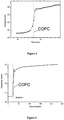
- concentration, dispersion and/or orientation of the electrically-conductive particles are tailored to be as far as possible from the percolation threshold (see gap between operational range "A" and the leakage case "B" in figure 1 ) in a way that the composite itself is always in the electrically-conductive state at normal operations.
- the percolation conductivity is essentially interrupted if a relevant amount of solvent (less than 0.5 ml, harmful quantity of aqueous solvents or oily liquids or harmful organic solvents) has entered the lyophilic composite, i.e. the disappearance of conductivity is a consequence of the swelling of the lyophilic embedding matrix (thus by transition through the threshold of percolation conductivity (collapse of percolation conductivity, COPC) into the non-conductive state).
- solvent less than 0.5 ml, harmful quantity of aqueous solvents or oily liquids or harmful organic solvents
- Another aspect is the transition through a threshold of percolation conductivity (collapse of percolation conductivity (COPC)), instead of a gradual measure of the conductivity for instance as a function of water vapour pressure.
- COPC percolation conductivity
- the sensor of present invention explicitly uses that collapse of percolation conductivity (COPC), and variations of the conductivity in the conducting state according to the previous sensor just appear as baseline variations in our applications that are not used for sensing purposes.
- the conductivity changes many orders of magnitude.
- the final resistance in the non-conducting state can go beyond approximately 100 MOhm (depending on the sensor size), and it is mainly determined by the remaining conductivity of the aqueous phase forming an own percolation network.
- the sensors function as an electrical safety fuse that after exposing to a harmful event, it loses its conductivity for a sufficient long time.
- An embodiment concerns a monitor adapted to monitor a floor structure in a confined environment, whereby the monitor comprises a sensing material [1] and at least one electrode [3] for measuring resistance in the sensing material [1], whereby the sensing material [1], which is adapted to detect hidden aqueous liquids and/or corrosive liquids under a carpet or protective cover of an underlying floor structure (e.g.
- the floor beam structure comprises a composite and the composite comprises at least two components: 1) particles or powder of an electrically-conductive material dispersed in 2) a matrix that is hydrophilic or that is highly solvable to aqueous fluids and whereby the concentration, dispersion and/or orientation of the electrically-conductive particles or powder are tailored to grow resistance until a conductivity percolation threshold after entering of a liquid, for instance spilled liquids or condensation liquids, into the composite.
- the monitor is adapted to monitor a floor structure in a confined environment, whereby the monitor, comprises a sensing material [1] and an electrode or plurality of electrodes [3] for measuring resistance in the sensing material [1], which sensing material [1] is adapted to detect hidden aqueous liquids and/or corrosive liquids, under a carpet or protective cover of an underlying floor structure (e.g.
- the sensing material [1] comprises a composite which comprises at least two components: 1) particles or powder of an electrically-conductive material dispersed in 2) a matrix that is hydrophilic or that is highly solvable to aqueous fluids and whereby the concentration, dispersion and/or orientation of the electrically-conductive particles or powder are tailored above a percolation threshold or are tailored to be as far as possible from the percolation threshold (see gap between operational range "A” and the leakage case "B” in figure 1 ) in a way that the composite itself is always in the electrically-conductive state at normal aircraft operations, but has the percolation conductivity interrupted after entering of aqueous liquid into the composite.
- a monitor is adapted to monitor a floor structure in a confined environment, whereby the monitor, comprises a sensing material [1] and an electrode or a plurality of electrodes [3] for measuring resistance in the sensing material [1], whereby the sensing material [1] is adapted to detect hidden aqueous liquids and/or corrosive liquids, for instance spilled liquids or condensation liquids under a carpet or protective cover of the underlying floor structure (e.g.
- the sensing material [1] is in the form of a wired sensor and comprises a composite which comprises itself at least two components: 1) particles or powder of an electrically-conductive material dispersed in 2) an matrix that is hydrophilic or that is highly solvable to aqueous fluids with the concentration, dispersion and/or orientation of the electrically-conductive particles or powder being adapted to induce a resistance jump in said composite (the percolation threshold) if part of the wire is exposed to an aqueous liquid (for instance a water drop).
- the monitor as described above is characterized by any of the following features explained hereunder.
- the monitor is characterised in that the conductivity percolation threshold is sudden collapse of percolation conductivity.
- the monitor is characterised in that the resistance grows until a conductivity percolation threshold is reached followed by a consequent sudden collapse of percolation conductivity.
- the monitor is characterised in that said monitor does not changes its conductivity as a function of water vapour pressure in a confined environment above the carpet or protective cover of floor beams.
- the monitor is characterised in that collapse of percolation conductivity or sudden increase of the resistance is only due to the ingress of aqueous liquid when its composite is exposed to the aqueous liquid.
- the monitor is characterised in that the conductivity is essentially lost when the sensing material [1] placed under the carpet or protective cover of the floor beams takes up the liquid.
- the monitor is characterised in that it is insensitive to an alteration of the atmospheric humidity or the water vapour above the carpet or protective cover of floor beams.
- the monitor is characterised in that the monitor is insensitive to humidity variations under 70%.
- the monitor is characterised in that ingress of aqueous liquid into the floor structure causes collapse of percolation conductivity in said sensing material of said monitor.
- the monitor is characterised in that the monitor operates real-time.
- the monitor is characterised in that the sensing material forms a sensor or sensors. Or the monitor is characterised in that the sensing material forms an in situ sensor or in situ sensors.
- the monitor as embodied in the description above is in a particular embodiment characterized in that the confined environment is an area in an aircraft and the floor structure is the sealed floor beam area in the aircraft.
- the confined environment can be a passengers room, a cargo room or a cockpit room in an aircraft.
- the monitor comprises a sensing system of elongated sensors, sensor tubings, sensor cables, cord sensor or sensor fibres.
- Such sensing system in a particular embodiment comprises a multiple sensor arrangement.
- the multiple sensor arrangement can form an array for instance a regular periodic array.
- the sensing system comprises sensing fibre channels; or the sensing system a multiple fibre arrangement, the multiple fibre arrangement can form a net.
- Another aspect concerns specific features of the elongated sensor so can the elongated sensors be coated by an isolating coating or a fabric [2] that is permeable for the aqueous liquids, for instance a coating comprising nylon cord; the elongated sensors can be channelled in liquid collecting sinks in the floor or between the floor plates above the floor beams; the elongated sensors can be attached to the floor carpet or the floor protection; the elongated sensors can be integrated in the floor carpet or the floor protection; the elongated sensors can be multicore sensor cord cables each sensor cord having a different percolation threshold.
- the isolating coating of said sensor core does not resist an attack by spilled corrosive fluids.
- the monitor according to the embodied invention described above comprises sensors which are elongated sensors, sensor tubings, sensor cables, cord sensor or sensor fibres and the eventually elongated sensors are multicore sensor cord cables and eventually elongated sensors are multicore sensor cord cables each sensor cord having a different percolation threshold which sensors are incorporated in a tape, sheet or fabric for attaching to a surface for instance an the aircraft floor such to capture into the sensing materials the spilled aqueous liquids.
- a preferred embodiment of the monitor is characterized in that the conductivity of the sensing material is interrupted as consequence of the absorption of the aqueous fluid into the matrix embedding the electrically-conductive material powder or particles by transition through the threshold of percolation conductivity (collapse of percolation conductivity into the non-conductive state).
- the disclosure furthermore relates to a monitor according to any of the above described embodiments 1) whereby the conductive particles are of the group consisting metal particle (which can be the metal particle is nickel, cupper or silver or a particle coated with nickel, cupper or silver), a particle coated by said metal, a carbon black particles and particles of conductive ceramics or 2) whereby the conductive particles are a titantiumcarbonitride (TiCN) powder.
- the conductive particles are of the group consisting metal particle (which can be the metal particle is nickel, cupper or silver or a particle coated with nickel, cupper or silver), a particle coated by said metal, a carbon black particles and particles of conductive ceramics or 2) whereby the conductive particles are a titantiumcarbonitride (TiCN) powder.
- the monitor comprises a matrix which is a hydrophilic matrix.
- the matrix comprises a polymer that is hygroscopic, or the matrix comprises polyvinyl alcohol and/or the matrix swells when it is exposed to a liquid water phase.
- the resistance in the composite increases which can be displayed on a screen after processing in that the curve of resistance (Ohm) vs. time (min) shows an increase in the resistance.
- the monitor comprises elongated sensors whereby the integral length of the elongated sensors, sensor tubings, sensor cables, cord sensor or sensor fibres has 2 m or more than 0,2 m; whereby the diameter of elongated sensors, sensor tubings, sensor cables, cord sensor or sensor fibres has a diameter of 1 mm or more than 0.5 mm, whereby the diameter of elongated sensors, sensor tubings, sensor cables, cord sensor or sensor fibres has a diameter of 1 between 0.7 and 1,2 mm, whereby the sensing material covered surface is about 0,30 cm 2 , whereby volume to add when layers have approx.
- 100 micron is between 25 - 35 cm 3 and preferably 29 - 31 cm 3 , whereby the matrix is a polymer with a density between 0.5 to 1.5 g/cm 3 , preferably between 0.8 and 1.2 g/cm 3 , more preferably 0.9 and 1.1 g/cm 3 and most preferably around 1 g/cm 3 .
- the monitor comprises a controller based on a software assisted measurement system and control algorithm.
- the controller can have a computer readable medium tangibly embodying computer code executable on a processor.
- Particular aspects hereby are a processor connected to provide a control signal to an actuator configured to signal or alarm the aqueous liquid spillage, or a processor is connected to provide a control signal to an actuator configured to alert pilot or third party, or the processor is connected to provide a control signal to an actuator configured to locate the aircraft aqueous liquid spillage defect.
- the controller of the monitor operates as a safety fuse for spilling aqueous liquids whereby the noise caused by small conductance variations that occur during operations (temperature variations, aging of adhesives etc) is disregarded by the processor but whereby an essentially loss of conductivity is regarded as an aircraft aqueous liquid spillage.
- the monitor comprises further a memory for storing the information signals and at least one transmitter for transmitting information signals to a base station adapted to receive information signals.
- this base station is adapted to transmit interrogation signals.
- at least one transmitter can be formed by a transponder which is adapted to receive the interrogation signals and to transmit information signals stored in the memory in response to receiving an interrogation signal and furthermore the at least one transmitter or transponder can be adapted to receive and transmit signals in the ether or the at least the base station is adapted to receive and transmit signals via a telephone network or the transmitter or transponder is adapted for information communication via a mobile telephone network.
- the increase of the resistance due to the ingress of water is monitored by a digital multi-channel multimeter that is equipped with appropriate data logging facilities.
- Yet another preferred embodiment concerns a self monitoring floor comprising the monitor according to any one of the above described embodiments, further comprising 1) joining floor panels, 2) joints between the floor panels and eventually a sealing system between said floor panel joints, 3) a cover or protective coating and 4) a floor structure or a floor beam area.
- the invention concerns the use of the above described monitors.
- Particular uses of the monitor according to any one of the previous embodiments or of the self monitoring floor described here above are 1) as a continuous or a intermediate but automated early warning system or sentinel for the prevention of corrosion by corrosive liquids; or 2) as a continuous or a intermediate but automated early warning system or sentinel for the prevention of corrosion by corrosive liquids; or 3) for in-situ providing continuous information and/or monitoring the presence of corrosive liquids so that corrosion treatment or corrosion prevention can start at a very early stage, or 4) to monitor the floor beam for hidden aqueous liquids in an aircraft for instance under a carpet or a protective coating of the floor beam, or 5) to protect underlying floor structure.
- the monitor is particular suitable for a floor structure which comprises or is essentially composed of a corrosive material or for a floor structure which comprises or is essentially composed of aluminium alloys.
- TiCN titaniumcarbonitride
- PVA polyvinyl alcohol
- the matrix material (PVA), a polymer that is hygroscopic, i.e. it swells when it is exposed to a gaseous or liquid water phase.
- the components were mixed with an appropriate amount of water and sufficiently stirred until a homogenous substance was obtained.
- a wire was drawn on an acrylic plate (width of about 2 mm and a length of 150 mm). The material at both ends was in direct contact with respective electrodes. The thickness was slightly varying and estimated to be in the range of 500 micrometer. After a drying time of 16 hours, the resistance was measured with a digital multimeter to be in the range of 25 Ohm. This means an estimated specific resistance of about 3000 S/m. After exposing a part of the wire to a water drop, the resistance grows gradually until the range of 100 Ohm. From this point on, a resistance jump occurred until the range of 100 kOhm and that jump could finally be identified as the percolation threshold.
- the final resistance was reached at about 600 kOhm.
- the corresponding specific resistance can be estimated to be in the range of 2 S/m.
- the curve shown in the diagram ( figure 2 ) represents a kinetic process driven by the diffusion of water into the PVA matrix, i.e. when changing e.g. the mass of the sample, the initial water amount, exposed surface etc. the curve would change its kinetic parameters.
- the conductivity above the percolation threshold is not due to the percolated ceramic powder, but due to the ions dissolved in the aqueous phase that on its own has started to create a percolation network.
- a new sample was prepared with the same specifications such as described above.
- the starting substance (PVA+TiCN+H 2 O) was deposited on a cord of polyamides. That cord is sometimes implemented in aircraft floor beam sealings to enable a proper removal of the sealings between the floor beams during regular maintenance operations.
- an isolated electric wire was mounted into the core of the polyamide cord for the required electric connections.
- the composite was uniformly deposited on the polyamide cord using a specific vessel, i.e. deposition occurred when the cord was pulled through this vessel. At the edges, the composite was in contact with the flex wires of the electrical cable to establish a continuous circuit if resistance measurements are performed.
- An important feature of this invention is the stability of the non-conducting state. Once, a relevant amount of liquid has entered the floor beam area, the sensor will absorb this liquid because ingressing liquid has to pass the positions of the sensor ( figures 4 and 5 , drawings 1 and 2). The absorbed liquid interrupts the electrical contact at a certain position. Due to the relatively high sample amount, the thickness of the coating and the length of the sensor, the drying time of the sensor is extremely long, especially in the confined space of floor plate joints in aircraft. It could be shown that in a lab experiment, the extraordinary high resistance will be maintained for many days. This means that the read-out of the sensor must not necessary be done during flight operations, but it can be done by electronic devices that are not part of the operational electronics. This essentially reduces the certification efforts when implementing the sensors reducing the costs of the overall system.
Landscapes
- Chemical & Material Sciences (AREA)
- Chemical Kinetics & Catalysis (AREA)
- Electrochemistry (AREA)
- Physics & Mathematics (AREA)
- Health & Medical Sciences (AREA)
- Life Sciences & Earth Sciences (AREA)
- Analytical Chemistry (AREA)
- Biochemistry (AREA)
- General Health & Medical Sciences (AREA)
- General Physics & Mathematics (AREA)
- Immunology (AREA)
- Pathology (AREA)
- Investigating Or Analyzing Materials By The Use Of Electric Means (AREA)
Claims (14)
- Verwendung einer Überwachungseinrichtung zum Überwachen einer Boden- oder Wandstruktur in einer begrenzten Umgebung für verborgene Flüssigkeiten, wobei die Überwachungseinrichtung ein Sensormaterial (1) und eine Mehrzahl von Elektroden (3) zum Messen des Widerstands im Sensormaterial (1) umfasst, wobei das Sensormaterial (1), das zum Detektieren der verborgenen Flüssigkeiten in der Lage ist, einen Verbundstoff umfasst, und der Verbundstoff Teilchen oder Pulver eines elektrisch leitenden Materials umfasst, die in einer Matrix dispergiert sind, die für die Flüssigkeit lyophil ist, und wobei die Konzentration, die Dispersion und/oder die Orientierung der elektrisch leitenden Teilchen oder des elektrisch leitenden Pulvers derart zugeschnitten sind, dass der Verbundstoff eine Versagensschwelle von Perkolationsleitfähigkeit aufweist, und dass der Widerstand einen Übergang durch die Schwelle nach dem Eindringen der Flüssigkeit in den Verbundstoff zeigt.
- Verwendung nach Anspruch 1, wobei die begrenzte Umgebung ein Luftfahrzeug ist, und es sich bei der Boden- oder Wandstruktur um einen Boden- oder Wandbalken handelt.
- Verwendung nach Anspruch 1 oder 2, wobei das Sensormaterial unterhalb einer Schutzbeschichtung der Boden- oder Wandstruktur angeordnet ist.
- Verwendung nach einem der vorhergehenden Ansprüche, wobei die lyophile Matrix so ausgelegt ist, dass sie nach dem Eindringen der Flüssigkeit in den Verbundstoff anschwillt.
- Verwendung nach einem der vorhergehenden Ansprüche, wobei die lyophile Matrix zum Erfassen des Eintritts von wässrigen Flüssigkeiten hydrophil ist.
- Verwendung nach einem der vorhergehenden Ansprüche, wobei die Überwachungseinrichtung einen elektrischen Kern, der aus isoliertem elektrischen Draht besteht, und eine Beschichtung umfasst, die aus einer mit dem Verbundstoff imprägnierten Nylonschnur besteht, wobei eine Elektrode mit dem Verbundstoff verbunden ist, und wobei ein Kurzweg zwischen dem Verbundstoff und dem elektrischen Kern vorgesehen ist.
- Verwendung nach einem der vorhergehenden Ansprüche, wobei die Überwachungseinrichtung länglich und in Flüssigkeitssammelwannen in der Boden- oder Wandstruktur kanalisiert ist.
- Verwendung der Überwachungseinrichtung nach einem der vorhergehenden Ansprüche, wobei der Verbundstoff leitende Teilchen umfasst, die ausgewählt sind aus der Gruppe bestehend aus: Metallteilchen, metallbeschichteten Teilchen, Rußteilchen und Teilchen aus leitenden Keramiken.
- Verwendung nach Anspruch 8, wobei die Metallteilchen Nickel-, Kupfer- oder Silberteilchen oder mit Nickel, Kupfer oder Silber beschichtete Teilchen sind.
- Verwendung nach einem der vorhergehenden Ansprüche, wobei der Verbundstoff Titancarbonitrid (TiCN)-Pulver umfasst.
- Verwendung nach einem der vorhergehenden Ansprüche, wobei die Matrix ein Polymer umfasst, das hygroskopisch ist.
- Verwendung nach einem der vorhergehenden Ansprüche, wobei die Matrix Polyvinylalkohol umfasst.
- Verwendung nach einem der vorhergehenden Ansprüche, wobei die Matrix aus einem Polymer mit einer Dichte von 0,5 bis 1,5 g/cm3 gebildet ist.
- Verwendung nach einem der vorhergehenden Ansprüche, wobei die Boden- oder Wandstruktur Aluminiumlegierungen umfasst oder sich im Wesentlichen daraus zusammensetzt.
Applications Claiming Priority (3)
| Application Number | Priority Date | Filing Date | Title |
|---|---|---|---|
| US39951410P | 2010-07-12 | 2010-07-12 | |
| GBGB1107664.3A GB201107664D0 (en) | 2011-05-09 | 2011-05-09 | Sensor for detecting liquid spilling |
| PCT/BE2011/000046 WO2012006692A1 (en) | 2010-07-12 | 2011-07-12 | Sensor for detecting liquid spilling |
Publications (2)
| Publication Number | Publication Date |
|---|---|
| EP2593778A1 EP2593778A1 (de) | 2013-05-22 |
| EP2593778B1 true EP2593778B1 (de) | 2018-04-11 |
Family
ID=44243788
Family Applications (1)
| Application Number | Title | Priority Date | Filing Date |
|---|---|---|---|
| EP11760391.0A Active EP2593778B1 (de) | 2010-07-12 | 2011-07-12 | Verwendung eines sensors zur erkennung von flüssikgeitsauslauf |
Country Status (4)
| Country | Link |
|---|---|
| US (1) | US8963565B2 (de) |
| EP (1) | EP2593778B1 (de) |
| GB (1) | GB201107664D0 (de) |
| WO (1) | WO2012006692A1 (de) |
Families Citing this family (9)
| Publication number | Priority date | Publication date | Assignee | Title |
|---|---|---|---|---|
| BRPI0409322B8 (pt) | 2003-04-11 | 2021-05-25 | Antriabio Inc | método para preparar um conjugado de insulina-polímero |
| GB201017238D0 (en) * | 2010-10-13 | 2010-11-24 | Univ Leuven Kath | Sensor for planes |
| US20140317954A1 (en) * | 2012-05-10 | 2014-10-30 | Norgren Automation Solutions, Llc | Method and apparatus for automatically drying wet floors |
| CA2873102A1 (en) * | 2012-05-10 | 2013-11-14 | Norgren Automation Solutions, Llc | Method and apparatus for automatically drying wet floors |
| RU2603555C1 (ru) * | 2015-09-30 | 2016-11-27 | Федеральное государственное бюджетное образовательное учреждение высшего образования "Московский технологический университет" | Сенсорный кабель-датчик |
| WO2018126326A1 (en) * | 2017-01-06 | 2018-07-12 | Direct-C Limited | Polymeric nanocomposite based sensor and coating systems and their applications |
| US10490430B2 (en) * | 2017-10-30 | 2019-11-26 | Taiwan Semiconductor Manufacturing Co., Ltd. | Flexible linear sensor |
| CN110687378A (zh) * | 2019-10-17 | 2020-01-14 | 中国人民解放军海军工程大学 | 异种金属电隔离监测装置 |
| US11815428B1 (en) * | 2021-07-29 | 2023-11-14 | ZT Group Int'l, Inc. | Direct leak detection for liquid cooled servers |
Family Cites Families (10)
| Publication number | Priority date | Publication date | Assignee | Title |
|---|---|---|---|---|
| JPS6156952A (ja) * | 1984-08-28 | 1986-03-22 | Sharp Corp | 感湿抵抗素子 |
| US5256574A (en) * | 1989-06-26 | 1993-10-26 | Bell Communications Research, Inc. | Method for selective detection of liquid phase hydrocarbons |
| JP3625348B2 (ja) | 1996-12-10 | 2005-03-02 | Tdk株式会社 | 感湿素子 |
| TW571093B (en) | 1998-12-28 | 2004-01-11 | Tdk Corp | Moisture sensor |
| US6717664B2 (en) | 2002-06-14 | 2004-04-06 | The Boeing Company | System and method for inspecting a beam using micro fiber-optic technology |
| US20050150778A1 (en) * | 2002-11-18 | 2005-07-14 | Lewis Nathan S. | Use of basic polymers in carbon black composite vapor detectors to obtain enhanced sensitivity and classification performance for volatile fatty acids |
| US6894512B2 (en) * | 2003-03-24 | 2005-05-17 | Israel Aircraft Industries Ltd. | Method for detecting hidden corrosion and a sensor for use in the same |
| NO327090B1 (no) * | 2007-06-28 | 2009-04-20 | Asle Ingmar Johnsen | Detektorsystem |
| GB0912444D0 (en) * | 2009-07-17 | 2009-08-26 | Kitchener Renato | Differential, low conductivity to iec61158-2 physical layer converter |
| WO2012054894A2 (en) * | 2010-10-21 | 2012-04-26 | Raymond & Lae Engineering, Inc. | Liquid detection cable |
-
2011
- 2011-05-09 GB GBGB1107664.3A patent/GB201107664D0/en not_active Ceased
- 2011-07-12 US US13/809,517 patent/US8963565B2/en active Active
- 2011-07-12 EP EP11760391.0A patent/EP2593778B1/de active Active
- 2011-07-12 WO PCT/BE2011/000046 patent/WO2012006692A1/en not_active Ceased
Also Published As
| Publication number | Publication date |
|---|---|
| US8963565B2 (en) | 2015-02-24 |
| WO2012006692A1 (en) | 2012-01-19 |
| GB201107664D0 (en) | 2011-06-22 |
| EP2593778A1 (de) | 2013-05-22 |
| US20130113505A1 (en) | 2013-05-09 |
Similar Documents
| Publication | Publication Date | Title |
|---|---|---|
| US8963565B2 (en) | Sensor for detecting liquid spilling | |
| US8400171B2 (en) | Transmission line moisture sensor | |
| EP2063243B1 (de) | Intelligente beschichtung für beschädigungsdetektierte informationen, untersuchungseinrichtung und die beschichtung verwendendes beschädigungsuntersuchungsverfahren | |
| EP3635347B1 (de) | Kraftstofftank mit integrierten füllstandsensoren, insbesondere für luftfahrzeuge | |
| US11614378B2 (en) | Polymeric nanocomposite based sensor and coating systems and their applications | |
| US6894512B2 (en) | Method for detecting hidden corrosion and a sensor for use in the same | |
| WO1993024819A1 (en) | Detecting degradation of non-conductive inert wall layers in fluid containers | |
| CA3074601A1 (en) | Hydrocarbon leak detection system and method for pipelines | |
| KR101489891B1 (ko) | 인듐 주석 산화물 박막 센서를 이용한 해상 유류 및 위험유해물질 유출 감지장치 | |
| Pfeiffer et al. | Leakage monitoring using percolation sensors for revealing structural damage in engineering structures | |
| HK1185413A (en) | Use of a sensor for detecting liquid spilling | |
| HK1185413B (en) | Use of a sensor for detecting liquid spilling | |
| EP1955377B1 (de) | Sensor zur erkennung organischer flüssigkeiten | |
| US7421883B2 (en) | Capacitive vapor sensor | |
| Pfeiffer et al. | Liquid detection in confined aircraft structures based on lyotropic percolation thresholds | |
| US3715598A (en) | Integral fault detection system for operating electronics equipment | |
| Pfeiffer et al. | Structural Health Monitoring in an Operational Airliner: An Intermediate Report on Leakage Monitoring with Percolation Sensors | |
| EP2627562B1 (de) | Sensor zur detektion von hydraulischen flüssigkeiten in flugzeugen | |
| Pfeiffer et al. | Sigmoidal Sensing Devices for Monitoring to improve Maintenance Operations in Aeronautics | |
| Pfeiffer et al. | The potential of highly non-linear sensing systems in engineering structures–operating applications in civil aircraft and chemical installations | |
| Pfeiffer et al. | Project Overview AISHA-II and Detection of Corrosive and Hydraulic Liquids by Gauges Based On the Collapse of Percolation Conductivity | |
| Schoess | Conductive Polymer Sensor Arrays-A New Frontier Technology for CBM | |
| WO2015182825A1 (ko) | 접착 구조물의 손상 탐지 장치 | |
| Pfeiffer et al. | Highly non-linear sensing devices in structural health monitoring | |
| Pfeiffer et al. | Monitoring of structures and systems of aircraft by highly non‐linear sensing devices |
Legal Events
| Date | Code | Title | Description |
|---|---|---|---|
| PUAI | Public reference made under article 153(3) epc to a published international application that has entered the european phase |
Free format text: ORIGINAL CODE: 0009012 |
|
| 17P | Request for examination filed |
Effective date: 20130206 |
|
| AK | Designated contracting states |
Kind code of ref document: A1 Designated state(s): AL AT BE BG CH CY CZ DE DK EE ES FI FR GB GR HR HU IE IS IT LI LT LU LV MC MK MT NL NO PL PT RO RS SE SI SK SM TR |
|
| DAX | Request for extension of the european patent (deleted) | ||
| REG | Reference to a national code |
Ref country code: HK Ref legal event code: DE Ref document number: 1185413 Country of ref document: HK |
|
| GRAP | Despatch of communication of intention to grant a patent |
Free format text: ORIGINAL CODE: EPIDOSNIGR1 |
|
| INTG | Intention to grant announced |
Effective date: 20171102 |
|
| GRAS | Grant fee paid |
Free format text: ORIGINAL CODE: EPIDOSNIGR3 |
|
| GRAA | (expected) grant |
Free format text: ORIGINAL CODE: 0009210 |
|
| AK | Designated contracting states |
Kind code of ref document: B1 Designated state(s): AL AT BE BG CH CY CZ DE DK EE ES FI FR GB GR HR HU IE IS IT LI LT LU LV MC MK MT NL NO PL PT RO RS SE SI SK SM TR |
|
| REG | Reference to a national code |
Ref country code: GB Ref legal event code: FG4D |
|
| REG | Reference to a national code |
Ref country code: CH Ref legal event code: EP |
|
| REG | Reference to a national code |
Ref country code: AT Ref legal event code: REF Ref document number: 988585 Country of ref document: AT Kind code of ref document: T Effective date: 20180415 |
|
| REG | Reference to a national code |
Ref country code: IE Ref legal event code: FG4D |
|
| REG | Reference to a national code |
Ref country code: DE Ref legal event code: R096 Ref document number: 602011047420 Country of ref document: DE |
|
| REG | Reference to a national code |
Ref country code: FR Ref legal event code: PLFP Year of fee payment: 8 |
|
| REG | Reference to a national code |
Ref country code: NL Ref legal event code: MP Effective date: 20180411 |
|
| REG | Reference to a national code |
Ref country code: LT Ref legal event code: MG4D |
|
| PG25 | Lapsed in a contracting state [announced via postgrant information from national office to epo] |
Ref country code: NL Free format text: LAPSE BECAUSE OF FAILURE TO SUBMIT A TRANSLATION OF THE DESCRIPTION OR TO PAY THE FEE WITHIN THE PRESCRIBED TIME-LIMIT Effective date: 20180411 |
|
| PG25 | Lapsed in a contracting state [announced via postgrant information from national office to epo] |
Ref country code: NO Free format text: LAPSE BECAUSE OF FAILURE TO SUBMIT A TRANSLATION OF THE DESCRIPTION OR TO PAY THE FEE WITHIN THE PRESCRIBED TIME-LIMIT Effective date: 20180711 Ref country code: PL Free format text: LAPSE BECAUSE OF FAILURE TO SUBMIT A TRANSLATION OF THE DESCRIPTION OR TO PAY THE FEE WITHIN THE PRESCRIBED TIME-LIMIT Effective date: 20180411 Ref country code: ES Free format text: LAPSE BECAUSE OF FAILURE TO SUBMIT A TRANSLATION OF THE DESCRIPTION OR TO PAY THE FEE WITHIN THE PRESCRIBED TIME-LIMIT Effective date: 20180411 Ref country code: LT Free format text: LAPSE BECAUSE OF FAILURE TO SUBMIT A TRANSLATION OF THE DESCRIPTION OR TO PAY THE FEE WITHIN THE PRESCRIBED TIME-LIMIT Effective date: 20180411 Ref country code: AL Free format text: LAPSE BECAUSE OF FAILURE TO SUBMIT A TRANSLATION OF THE DESCRIPTION OR TO PAY THE FEE WITHIN THE PRESCRIBED TIME-LIMIT Effective date: 20180411 Ref country code: SE Free format text: LAPSE BECAUSE OF FAILURE TO SUBMIT A TRANSLATION OF THE DESCRIPTION OR TO PAY THE FEE WITHIN THE PRESCRIBED TIME-LIMIT Effective date: 20180411 Ref country code: BG Free format text: LAPSE BECAUSE OF FAILURE TO SUBMIT A TRANSLATION OF THE DESCRIPTION OR TO PAY THE FEE WITHIN THE PRESCRIBED TIME-LIMIT Effective date: 20180711 Ref country code: FI Free format text: LAPSE BECAUSE OF FAILURE TO SUBMIT A TRANSLATION OF THE DESCRIPTION OR TO PAY THE FEE WITHIN THE PRESCRIBED TIME-LIMIT Effective date: 20180411 |
|
| PG25 | Lapsed in a contracting state [announced via postgrant information from national office to epo] |
Ref country code: LV Free format text: LAPSE BECAUSE OF FAILURE TO SUBMIT A TRANSLATION OF THE DESCRIPTION OR TO PAY THE FEE WITHIN THE PRESCRIBED TIME-LIMIT Effective date: 20180411 Ref country code: RS Free format text: LAPSE BECAUSE OF FAILURE TO SUBMIT A TRANSLATION OF THE DESCRIPTION OR TO PAY THE FEE WITHIN THE PRESCRIBED TIME-LIMIT Effective date: 20180411 Ref country code: GR Free format text: LAPSE BECAUSE OF FAILURE TO SUBMIT A TRANSLATION OF THE DESCRIPTION OR TO PAY THE FEE WITHIN THE PRESCRIBED TIME-LIMIT Effective date: 20180712 Ref country code: HR Free format text: LAPSE BECAUSE OF FAILURE TO SUBMIT A TRANSLATION OF THE DESCRIPTION OR TO PAY THE FEE WITHIN THE PRESCRIBED TIME-LIMIT Effective date: 20180411 |
|
| REG | Reference to a national code |
Ref country code: AT Ref legal event code: MK05 Ref document number: 988585 Country of ref document: AT Kind code of ref document: T Effective date: 20180411 |
|
| PG25 | Lapsed in a contracting state [announced via postgrant information from national office to epo] |
Ref country code: PT Free format text: LAPSE BECAUSE OF FAILURE TO SUBMIT A TRANSLATION OF THE DESCRIPTION OR TO PAY THE FEE WITHIN THE PRESCRIBED TIME-LIMIT Effective date: 20180813 |
|
| REG | Reference to a national code |
Ref country code: DE Ref legal event code: R097 Ref document number: 602011047420 Country of ref document: DE |
|
| PG25 | Lapsed in a contracting state [announced via postgrant information from national office to epo] |
Ref country code: AT Free format text: LAPSE BECAUSE OF FAILURE TO SUBMIT A TRANSLATION OF THE DESCRIPTION OR TO PAY THE FEE WITHIN THE PRESCRIBED TIME-LIMIT Effective date: 20180411 Ref country code: DK Free format text: LAPSE BECAUSE OF FAILURE TO SUBMIT A TRANSLATION OF THE DESCRIPTION OR TO PAY THE FEE WITHIN THE PRESCRIBED TIME-LIMIT Effective date: 20180411 Ref country code: SK Free format text: LAPSE BECAUSE OF FAILURE TO SUBMIT A TRANSLATION OF THE DESCRIPTION OR TO PAY THE FEE WITHIN THE PRESCRIBED TIME-LIMIT Effective date: 20180411 Ref country code: RO Free format text: LAPSE BECAUSE OF FAILURE TO SUBMIT A TRANSLATION OF THE DESCRIPTION OR TO PAY THE FEE WITHIN THE PRESCRIBED TIME-LIMIT Effective date: 20180411 Ref country code: CZ Free format text: LAPSE BECAUSE OF FAILURE TO SUBMIT A TRANSLATION OF THE DESCRIPTION OR TO PAY THE FEE WITHIN THE PRESCRIBED TIME-LIMIT Effective date: 20180411 Ref country code: EE Free format text: LAPSE BECAUSE OF FAILURE TO SUBMIT A TRANSLATION OF THE DESCRIPTION OR TO PAY THE FEE WITHIN THE PRESCRIBED TIME-LIMIT Effective date: 20180411 |
|
| PLBE | No opposition filed within time limit |
Free format text: ORIGINAL CODE: 0009261 |
|
| STAA | Information on the status of an ep patent application or granted ep patent |
Free format text: STATUS: NO OPPOSITION FILED WITHIN TIME LIMIT |
|
| PG25 | Lapsed in a contracting state [announced via postgrant information from national office to epo] |
Ref country code: IT Free format text: LAPSE BECAUSE OF FAILURE TO SUBMIT A TRANSLATION OF THE DESCRIPTION OR TO PAY THE FEE WITHIN THE PRESCRIBED TIME-LIMIT Effective date: 20180411 Ref country code: SM Free format text: LAPSE BECAUSE OF FAILURE TO SUBMIT A TRANSLATION OF THE DESCRIPTION OR TO PAY THE FEE WITHIN THE PRESCRIBED TIME-LIMIT Effective date: 20180411 |
|
| REG | Reference to a national code |
Ref country code: CH Ref legal event code: PL |
|
| 26N | No opposition filed |
Effective date: 20190114 |
|
| PG25 | Lapsed in a contracting state [announced via postgrant information from national office to epo] |
Ref country code: LU Free format text: LAPSE BECAUSE OF NON-PAYMENT OF DUE FEES Effective date: 20180712 Ref country code: MC Free format text: LAPSE BECAUSE OF FAILURE TO SUBMIT A TRANSLATION OF THE DESCRIPTION OR TO PAY THE FEE WITHIN THE PRESCRIBED TIME-LIMIT Effective date: 20180411 |
|
| REG | Reference to a national code |
Ref country code: IE Ref legal event code: MM4A |
|
| PG25 | Lapsed in a contracting state [announced via postgrant information from national office to epo] |
Ref country code: LI Free format text: LAPSE BECAUSE OF NON-PAYMENT OF DUE FEES Effective date: 20180731 Ref country code: IE Free format text: LAPSE BECAUSE OF NON-PAYMENT OF DUE FEES Effective date: 20180712 Ref country code: CH Free format text: LAPSE BECAUSE OF NON-PAYMENT OF DUE FEES Effective date: 20180731 |
|
| PG25 | Lapsed in a contracting state [announced via postgrant information from national office to epo] |
Ref country code: SI Free format text: LAPSE BECAUSE OF FAILURE TO SUBMIT A TRANSLATION OF THE DESCRIPTION OR TO PAY THE FEE WITHIN THE PRESCRIBED TIME-LIMIT Effective date: 20180411 |
|
| PG25 | Lapsed in a contracting state [announced via postgrant information from national office to epo] |
Ref country code: MT Free format text: LAPSE BECAUSE OF NON-PAYMENT OF DUE FEES Effective date: 20180712 |
|
| PG25 | Lapsed in a contracting state [announced via postgrant information from national office to epo] |
Ref country code: TR Free format text: LAPSE BECAUSE OF FAILURE TO SUBMIT A TRANSLATION OF THE DESCRIPTION OR TO PAY THE FEE WITHIN THE PRESCRIBED TIME-LIMIT Effective date: 20180411 |
|
| PG25 | Lapsed in a contracting state [announced via postgrant information from national office to epo] |
Ref country code: HU Free format text: LAPSE BECAUSE OF FAILURE TO SUBMIT A TRANSLATION OF THE DESCRIPTION OR TO PAY THE FEE WITHIN THE PRESCRIBED TIME-LIMIT; INVALID AB INITIO Effective date: 20110712 |
|
| PG25 | Lapsed in a contracting state [announced via postgrant information from national office to epo] |
Ref country code: MK Free format text: LAPSE BECAUSE OF NON-PAYMENT OF DUE FEES Effective date: 20180411 Ref country code: CY Free format text: LAPSE BECAUSE OF FAILURE TO SUBMIT A TRANSLATION OF THE DESCRIPTION OR TO PAY THE FEE WITHIN THE PRESCRIBED TIME-LIMIT Effective date: 20180411 |
|
| PG25 | Lapsed in a contracting state [announced via postgrant information from national office to epo] |
Ref country code: IS Free format text: LAPSE BECAUSE OF FAILURE TO SUBMIT A TRANSLATION OF THE DESCRIPTION OR TO PAY THE FEE WITHIN THE PRESCRIBED TIME-LIMIT Effective date: 20180811 |
|
| PGFP | Annual fee paid to national office [announced via postgrant information from national office to epo] |
Ref country code: GB Payment date: 20250619 Year of fee payment: 15 |
|
| PGFP | Annual fee paid to national office [announced via postgrant information from national office to epo] |
Ref country code: BE Payment date: 20250619 Year of fee payment: 15 |
|
| PGFP | Annual fee paid to national office [announced via postgrant information from national office to epo] |
Ref country code: FR Payment date: 20250619 Year of fee payment: 15 |
|
| PGFP | Annual fee paid to national office [announced via postgrant information from national office to epo] |
Ref country code: DE Payment date: 20250620 Year of fee payment: 15 |