EP2592677A1 - Cathode active material for a lithium secondary battery containing phosphate fluoride and preparation method thereof - Google Patents
Cathode active material for a lithium secondary battery containing phosphate fluoride and preparation method thereof Download PDFInfo
- Publication number
- EP2592677A1 EP2592677A1 EP12192127.4A EP12192127A EP2592677A1 EP 2592677 A1 EP2592677 A1 EP 2592677A1 EP 12192127 A EP12192127 A EP 12192127A EP 2592677 A1 EP2592677 A1 EP 2592677A1
- Authority
- EP
- European Patent Office
- Prior art keywords
- cathode active
- active material
- containing compound
- phosphate
- group
- Prior art date
- Legal status (The legal status is an assumption and is not a legal conclusion. Google has not performed a legal analysis and makes no representation as to the accuracy of the status listed.)
- Granted
Links
- 239000006182 cathode active material Substances 0.000 title claims abstract description 63
- 229910052744 lithium Inorganic materials 0.000 title claims abstract description 47
- WHXSMMKQMYFTQS-UHFFFAOYSA-N Lithium Chemical compound [Li] WHXSMMKQMYFTQS-UHFFFAOYSA-N 0.000 title claims abstract description 44
- FQKMRXHEIPOETF-UHFFFAOYSA-N F.OP(O)(O)=O Chemical compound F.OP(O)(O)=O FQKMRXHEIPOETF-UHFFFAOYSA-N 0.000 title claims abstract description 37
- 238000002360 preparation method Methods 0.000 title description 15
- 150000001875 compounds Chemical class 0.000 claims abstract description 54
- 238000000034 method Methods 0.000 claims abstract description 33
- 238000010438 heat treatment Methods 0.000 claims abstract description 26
- 238000005245 sintering Methods 0.000 claims abstract description 17
- 239000002243 precursor Substances 0.000 claims abstract description 13
- 229910019142 PO4 Inorganic materials 0.000 claims description 36
- 239000011572 manganese Substances 0.000 claims description 35
- PXHVJJICTQNCMI-UHFFFAOYSA-N nickel Substances [Ni] PXHVJJICTQNCMI-UHFFFAOYSA-N 0.000 claims description 35
- 239000010452 phosphate Substances 0.000 claims description 29
- NBIIXXVUZAFLBC-UHFFFAOYSA-K phosphate Chemical compound [O-]P([O-])([O-])=O NBIIXXVUZAFLBC-UHFFFAOYSA-K 0.000 claims description 28
- 239000000203 mixture Substances 0.000 claims description 27
- 229910052748 manganese Inorganic materials 0.000 claims description 19
- 229910052751 metal Inorganic materials 0.000 claims description 19
- 239000002184 metal Substances 0.000 claims description 19
- 229910052759 nickel Inorganic materials 0.000 claims description 19
- YCKRFDGAMUMZLT-UHFFFAOYSA-N Fluorine atom Chemical compound [F] YCKRFDGAMUMZLT-UHFFFAOYSA-N 0.000 claims description 18
- 239000011737 fluorine Substances 0.000 claims description 18
- 229910052731 fluorine Inorganic materials 0.000 claims description 18
- 238000002156 mixing Methods 0.000 claims description 15
- KLZUFWVZNOTSEM-UHFFFAOYSA-K Aluminium flouride Chemical compound F[Al](F)F KLZUFWVZNOTSEM-UHFFFAOYSA-K 0.000 claims description 14
- PQXKHYXIUOZZFA-UHFFFAOYSA-M lithium fluoride Inorganic materials [Li+].[F-] PQXKHYXIUOZZFA-UHFFFAOYSA-M 0.000 claims description 14
- 238000001816 cooling Methods 0.000 claims description 13
- 229910052782 aluminium Inorganic materials 0.000 claims description 12
- 229910052749 magnesium Inorganic materials 0.000 claims description 12
- 229910052742 iron Inorganic materials 0.000 claims description 11
- 229910052796 boron Inorganic materials 0.000 claims description 10
- BHHYHSUAOQUXJK-UHFFFAOYSA-L zinc fluoride Chemical compound F[Zn]F BHHYHSUAOQUXJK-UHFFFAOYSA-L 0.000 claims description 10
- 229910052791 calcium Inorganic materials 0.000 claims description 9
- 229910052802 copper Inorganic materials 0.000 claims description 9
- 229910052758 niobium Inorganic materials 0.000 claims description 9
- 229910052719 titanium Inorganic materials 0.000 claims description 9
- 229910052727 yttrium Inorganic materials 0.000 claims description 9
- 229910052725 zinc Inorganic materials 0.000 claims description 9
- 229910052726 zirconium Inorganic materials 0.000 claims description 9
- 150000003839 salts Chemical class 0.000 claims description 8
- 239000002033 PVDF binder Substances 0.000 claims description 7
- 229910000388 diammonium phosphate Inorganic materials 0.000 claims description 7
- 229920002981 polyvinylidene fluoride Polymers 0.000 claims description 7
- PWHULOQIROXLJO-UHFFFAOYSA-N Manganese Chemical compound [Mn] PWHULOQIROXLJO-UHFFFAOYSA-N 0.000 claims description 6
- 229910000147 aluminium phosphate Inorganic materials 0.000 claims description 6
- 229910017052 cobalt Inorganic materials 0.000 claims description 6
- 239000010941 cobalt Substances 0.000 claims description 6
- GUTLYIVDDKVIGB-UHFFFAOYSA-N cobalt atom Chemical compound [Co] GUTLYIVDDKVIGB-UHFFFAOYSA-N 0.000 claims description 6
- MNNHAPBLZZVQHP-UHFFFAOYSA-N diammonium hydrogen phosphate Chemical compound [NH4+].[NH4+].OP([O-])([O-])=O MNNHAPBLZZVQHP-UHFFFAOYSA-N 0.000 claims description 6
- MHJAJDCZWVHCPF-UHFFFAOYSA-L dimagnesium phosphate Chemical compound [Mg+2].OP([O-])([O-])=O MHJAJDCZWVHCPF-UHFFFAOYSA-L 0.000 claims description 6
- 229910000157 magnesium phosphate Inorganic materials 0.000 claims description 6
- XDJWZONZDVNKDU-UHFFFAOYSA-N 1314-24-5 Chemical compound O=POP=O XDJWZONZDVNKDU-UHFFFAOYSA-N 0.000 claims description 5
- 229910021582 Cobalt(II) fluoride Inorganic materials 0.000 claims description 5
- 229910021583 Cobalt(III) fluoride Inorganic materials 0.000 claims description 5
- 229910021593 Copper(I) fluoride Inorganic materials 0.000 claims description 5
- 229910021594 Copper(II) fluoride Inorganic materials 0.000 claims description 5
- 229910010951 LiH2 Inorganic materials 0.000 claims description 5
- 229910021570 Manganese(II) fluoride Inorganic materials 0.000 claims description 5
- 229910021571 Manganese(III) fluoride Inorganic materials 0.000 claims description 5
- 229910017665 NH4HF2 Inorganic materials 0.000 claims description 5
- 229910017673 NH4PF6 Inorganic materials 0.000 claims description 5
- 229910021587 Nickel(II) fluoride Inorganic materials 0.000 claims description 5
- NBIIXXVUZAFLBC-UHFFFAOYSA-N Phosphoric acid Chemical compound OP(O)(O)=O NBIIXXVUZAFLBC-UHFFFAOYSA-N 0.000 claims description 5
- 229910010342 TiF4 Inorganic materials 0.000 claims description 5
- LFVGISIMTYGQHF-UHFFFAOYSA-N ammonium dihydrogen phosphate Chemical compound [NH4+].OP(O)([O-])=O LFVGISIMTYGQHF-UHFFFAOYSA-N 0.000 claims description 5
- LDDQLRUQCUTJBB-UHFFFAOYSA-N ammonium fluoride Chemical compound [NH4+].[F-] LDDQLRUQCUTJBB-UHFFFAOYSA-N 0.000 claims description 5
- WUKWITHWXAAZEY-UHFFFAOYSA-L calcium difluoride Chemical compound [F-].[F-].[Ca+2] WUKWITHWXAAZEY-UHFFFAOYSA-L 0.000 claims description 5
- 229910001634 calcium fluoride Inorganic materials 0.000 claims description 5
- WZJQNLGQTOCWDS-UHFFFAOYSA-K cobalt(iii) fluoride Chemical compound F[Co](F)F WZJQNLGQTOCWDS-UHFFFAOYSA-K 0.000 claims description 5
- GWFAVIIMQDUCRA-UHFFFAOYSA-L copper(ii) fluoride Chemical compound [F-].[F-].[Cu+2] GWFAVIIMQDUCRA-UHFFFAOYSA-L 0.000 claims description 5
- CTNMMTCXUUFYAP-UHFFFAOYSA-L difluoromanganese Chemical compound F[Mn]F CTNMMTCXUUFYAP-UHFFFAOYSA-L 0.000 claims description 5
- YWEUIGNSBFLMFL-UHFFFAOYSA-N diphosphonate Chemical compound O=P(=O)OP(=O)=O YWEUIGNSBFLMFL-UHFFFAOYSA-N 0.000 claims description 5
- 239000003792 electrolyte Substances 0.000 claims description 5
- 229910000399 iron(III) phosphate Inorganic materials 0.000 claims description 5
- FZGIHSNZYGFUGM-UHFFFAOYSA-L iron(ii) fluoride Chemical compound [F-].[F-].[Fe+2] FZGIHSNZYGFUGM-UHFFFAOYSA-L 0.000 claims description 5
- SHXXPRJOPFJRHA-UHFFFAOYSA-K iron(iii) fluoride Chemical compound F[Fe](F)F SHXXPRJOPFJRHA-UHFFFAOYSA-K 0.000 claims description 5
- 229910001386 lithium phosphate Inorganic materials 0.000 claims description 5
- 229910001635 magnesium fluoride Inorganic materials 0.000 claims description 5
- SRVINXWCFNHIQZ-UHFFFAOYSA-K manganese(iii) fluoride Chemical compound [F-].[F-].[F-].[Mn+3] SRVINXWCFNHIQZ-UHFFFAOYSA-K 0.000 claims description 5
- DBJLJFTWODWSOF-UHFFFAOYSA-L nickel(ii) fluoride Chemical compound F[Ni]F DBJLJFTWODWSOF-UHFFFAOYSA-L 0.000 claims description 5
- DLYUQMMRRRQYAE-UHFFFAOYSA-N phosphorus pentoxide Inorganic materials O1P(O2)(=O)OP3(=O)OP1(=O)OP2(=O)O3 DLYUQMMRRRQYAE-UHFFFAOYSA-N 0.000 claims description 5
- VSAISIQCTGDGPU-UHFFFAOYSA-N phosphorus trioxide Inorganic materials O1P(O2)OP3OP1OP2O3 VSAISIQCTGDGPU-UHFFFAOYSA-N 0.000 claims description 5
- 229920005569 poly(vinylidene fluoride-co-hexafluoropropylene) Polymers 0.000 claims description 5
- XROWMBWRMNHXMF-UHFFFAOYSA-J titanium tetrafluoride Chemical compound [F-].[F-].[F-].[F-].[Ti+4] XROWMBWRMNHXMF-UHFFFAOYSA-J 0.000 claims description 5
- TWQULNDIKKJZPH-UHFFFAOYSA-K trilithium;phosphate Chemical compound [Li+].[Li+].[Li+].[O-]P([O-])([O-])=O TWQULNDIKKJZPH-UHFFFAOYSA-K 0.000 claims description 5
- 229910000165 zinc phosphate Inorganic materials 0.000 claims description 5
- 238000001035 drying Methods 0.000 claims description 4
- WBJZTOZJJYAKHQ-UHFFFAOYSA-K iron(3+) phosphate Chemical compound [Fe+3].[O-]P([O-])([O-])=O WBJZTOZJJYAKHQ-UHFFFAOYSA-K 0.000 claims description 4
- 239000000843 powder Substances 0.000 description 26
- HEMHJVSKTPXQMS-UHFFFAOYSA-M Sodium hydroxide Chemical compound [OH-].[Na+] HEMHJVSKTPXQMS-UHFFFAOYSA-M 0.000 description 15
- 239000002002 slurry Substances 0.000 description 14
- 230000000052 comparative effect Effects 0.000 description 13
- 239000011777 magnesium Substances 0.000 description 13
- XLYOFNOQVPJJNP-UHFFFAOYSA-N water Chemical compound O XLYOFNOQVPJJNP-UHFFFAOYSA-N 0.000 description 12
- 239000000243 solution Substances 0.000 description 9
- XGZVUEUWXADBQD-UHFFFAOYSA-L lithium carbonate Chemical compound [Li+].[Li+].[O-]C([O-])=O XGZVUEUWXADBQD-UHFFFAOYSA-L 0.000 description 8
- 229910052808 lithium carbonate Inorganic materials 0.000 description 8
- 239000012153 distilled water Substances 0.000 description 7
- SEVNKUSLDMZOTL-UHFFFAOYSA-H cobalt(2+);manganese(2+);nickel(2+);hexahydroxide Chemical compound [OH-].[OH-].[OH-].[OH-].[OH-].[OH-].[Mn+2].[Co+2].[Ni+2] SEVNKUSLDMZOTL-UHFFFAOYSA-H 0.000 description 6
- 239000007787 solid Substances 0.000 description 6
- -1 LiAlF6 Chemical compound 0.000 description 5
- 239000011230 binding agent Substances 0.000 description 5
- 239000000463 material Substances 0.000 description 5
- 239000011812 mixed powder Substances 0.000 description 5
- 239000002245 particle Substances 0.000 description 5
- 239000012266 salt solution Substances 0.000 description 5
- NLXLAEXVIDQMFP-UHFFFAOYSA-N Ammonium chloride Substances [NH4+].[Cl-] NLXLAEXVIDQMFP-UHFFFAOYSA-N 0.000 description 4
- VHUUQVKOLVNVRT-UHFFFAOYSA-N Ammonium hydroxide Chemical compound [NH4+].[OH-] VHUUQVKOLVNVRT-UHFFFAOYSA-N 0.000 description 4
- PNEYBMLMFCGWSK-UHFFFAOYSA-N aluminium oxide Inorganic materials [O-2].[O-2].[O-2].[Al+3].[Al+3] PNEYBMLMFCGWSK-UHFFFAOYSA-N 0.000 description 4
- QGZKDVFQNNGYKY-UHFFFAOYSA-N ammonia Natural products N QGZKDVFQNNGYKY-UHFFFAOYSA-N 0.000 description 4
- 235000011114 ammonium hydroxide Nutrition 0.000 description 4
- 229910052593 corundum Inorganic materials 0.000 description 4
- NUJOXMJBOLGQSY-UHFFFAOYSA-N manganese dioxide Chemical compound O=[Mn]=O NUJOXMJBOLGQSY-UHFFFAOYSA-N 0.000 description 4
- 238000001694 spray drying Methods 0.000 description 4
- 229910001845 yogo sapphire Inorganic materials 0.000 description 4
- 229910052493 LiFePO4 Inorganic materials 0.000 description 3
- 229910001290 LiPF6 Inorganic materials 0.000 description 3
- 229910002651 NO3 Inorganic materials 0.000 description 3
- NHNBFGGVMKEFGY-UHFFFAOYSA-N Nitrate Chemical compound [O-][N+]([O-])=O NHNBFGGVMKEFGY-UHFFFAOYSA-N 0.000 description 3
- QAOWNCQODCNURD-UHFFFAOYSA-L Sulfate Chemical compound [O-]S([O-])(=O)=O QAOWNCQODCNURD-UHFFFAOYSA-L 0.000 description 3
- 239000011324 bead Substances 0.000 description 3
- 239000011248 coating agent Substances 0.000 description 3
- 238000000576 coating method Methods 0.000 description 3
- 150000001868 cobalt Chemical class 0.000 description 3
- 238000011156 evaluation Methods 0.000 description 3
- 238000000227 grinding Methods 0.000 description 3
- 150000002696 manganese Chemical class 0.000 description 3
- 150000002739 metals Chemical class 0.000 description 3
- 150000002815 nickel Chemical class 0.000 description 3
- 239000011541 reaction mixture Substances 0.000 description 3
- 239000011163 secondary particle Substances 0.000 description 3
- VEXZGXHMUGYJMC-UHFFFAOYSA-N Hydrochloric acid Chemical compound Cl VEXZGXHMUGYJMC-UHFFFAOYSA-N 0.000 description 2
- 229920002125 Sokalan® Polymers 0.000 description 2
- XLOMVQKBTHCTTD-UHFFFAOYSA-N Zinc monoxide Chemical compound [Zn]=O XLOMVQKBTHCTTD-UHFFFAOYSA-N 0.000 description 2
- MCMNRKCIXSYSNV-UHFFFAOYSA-N Zirconium dioxide Chemical compound O=[Zr]=O MCMNRKCIXSYSNV-UHFFFAOYSA-N 0.000 description 2
- 239000011149 active material Substances 0.000 description 2
- 229910021502 aluminium hydroxide Inorganic materials 0.000 description 2
- WNROFYMDJYEPJX-UHFFFAOYSA-K aluminium hydroxide Chemical compound [OH-].[OH-].[OH-].[Al+3] WNROFYMDJYEPJX-UHFFFAOYSA-K 0.000 description 2
- QVGXLLKOCUKJST-UHFFFAOYSA-N atomic oxygen Chemical compound [O] QVGXLLKOCUKJST-UHFFFAOYSA-N 0.000 description 2
- KGBXLFKZBHKPEV-UHFFFAOYSA-N boric acid Chemical compound OB(O)O KGBXLFKZBHKPEV-UHFFFAOYSA-N 0.000 description 2
- 238000000975 co-precipitation Methods 0.000 description 2
- KTVIXTQDYHMGHF-UHFFFAOYSA-L cobalt(2+) sulfate Chemical compound [Co+2].[O-]S([O-])(=O)=O KTVIXTQDYHMGHF-UHFFFAOYSA-L 0.000 description 2
- 229910001679 gibbsite Inorganic materials 0.000 description 2
- 239000001095 magnesium carbonate Substances 0.000 description 2
- 229910000021 magnesium carbonate Inorganic materials 0.000 description 2
- ZLNQQNXFFQJAID-UHFFFAOYSA-L magnesium carbonate Chemical compound [Mg+2].[O-]C([O-])=O ZLNQQNXFFQJAID-UHFFFAOYSA-L 0.000 description 2
- 230000014759 maintenance of location Effects 0.000 description 2
- 229910000158 manganese(II) phosphate Inorganic materials 0.000 description 2
- SQQMAOCOWKFBNP-UHFFFAOYSA-L manganese(II) sulfate Chemical compound [Mn+2].[O-]S([O-])(=O)=O SQQMAOCOWKFBNP-UHFFFAOYSA-L 0.000 description 2
- 229910000357 manganese(II) sulfate Inorganic materials 0.000 description 2
- 239000011259 mixed solution Substances 0.000 description 2
- LGQLOGILCSXPEA-UHFFFAOYSA-L nickel sulfate Chemical compound [Ni+2].[O-]S([O-])(=O)=O LGQLOGILCSXPEA-UHFFFAOYSA-L 0.000 description 2
- 229910000363 nickel(II) sulfate Inorganic materials 0.000 description 2
- 229910052760 oxygen Inorganic materials 0.000 description 2
- 239000001301 oxygen Substances 0.000 description 2
- 239000007921 spray Substances 0.000 description 2
- 238000001238 wet grinding Methods 0.000 description 2
- 229910017117 AlPO4F Inorganic materials 0.000 description 1
- BVKZGUZCCUSVTD-UHFFFAOYSA-L Carbonate Chemical compound [O-]C([O-])=O BVKZGUZCCUSVTD-UHFFFAOYSA-L 0.000 description 1
- 239000005696 Diammonium phosphate Substances 0.000 description 1
- LFQSCWFLJHTTHZ-UHFFFAOYSA-N Ethanol Chemical compound CCO LFQSCWFLJHTTHZ-UHFFFAOYSA-N 0.000 description 1
- 229910009731 Li2FeSiO4 Inorganic materials 0.000 description 1
- 229910017974 NH40H Inorganic materials 0.000 description 1
- BPQQTUXANYXVAA-UHFFFAOYSA-N Orthosilicate Chemical compound [O-][Si]([O-])([O-])[O-] BPQQTUXANYXVAA-UHFFFAOYSA-N 0.000 description 1
- 239000005456 alcohol based solvent Substances 0.000 description 1
- 238000006243 chemical reaction Methods 0.000 description 1
- 239000004020 conductor Substances 0.000 description 1
- 230000006866 deterioration Effects 0.000 description 1
- 235000019838 diammonium phosphate Nutrition 0.000 description 1
- 238000007599 discharging Methods 0.000 description 1
- 238000007606 doctor blade method Methods 0.000 description 1
- 230000000694 effects Effects 0.000 description 1
- 238000005516 engineering process Methods 0.000 description 1
- 239000012467 final product Substances 0.000 description 1
- 239000011888 foil Substances 0.000 description 1
- 150000003840 hydrochlorides Chemical class 0.000 description 1
- 229910003002 lithium salt Inorganic materials 0.000 description 1
- 159000000002 lithium salts Chemical class 0.000 description 1
- GVALZJMUIHGIMD-UHFFFAOYSA-H magnesium phosphate Chemical compound [Mg+2].[Mg+2].[Mg+2].[O-]P([O-])([O-])=O.[O-]P([O-])([O-])=O GVALZJMUIHGIMD-UHFFFAOYSA-H 0.000 description 1
- 239000004137 magnesium phosphate Substances 0.000 description 1
- 229960002261 magnesium phosphate Drugs 0.000 description 1
- 235000010994 magnesium phosphates Nutrition 0.000 description 1
- 229910044991 metal oxide Inorganic materials 0.000 description 1
- 150000004706 metal oxides Chemical class 0.000 description 1
- 229910001463 metal phosphate Inorganic materials 0.000 description 1
- 238000007086 side reaction Methods 0.000 description 1
- 239000002904 solvent Substances 0.000 description 1
- 239000007858 starting material Substances 0.000 description 1
- 239000000126 substance Substances 0.000 description 1
- 229910052717 sulfur Inorganic materials 0.000 description 1
- 229910021653 sulphate ion Inorganic materials 0.000 description 1
- 229910052723 transition metal Inorganic materials 0.000 description 1
- 150000003624 transition metals Chemical class 0.000 description 1
Images


Classifications
-
- H—ELECTRICITY
- H01—ELECTRIC ELEMENTS
- H01M—PROCESSES OR MEANS, e.g. BATTERIES, FOR THE DIRECT CONVERSION OF CHEMICAL ENERGY INTO ELECTRICAL ENERGY
- H01M4/00—Electrodes
- H01M4/02—Electrodes composed of, or comprising, active material
- H01M4/36—Selection of substances as active materials, active masses, active liquids
- H01M4/58—Selection of substances as active materials, active masses, active liquids of inorganic compounds other than oxides or hydroxides, e.g. sulfides, selenides, tellurides, halogenides or LiCoFy; of polyanionic structures, e.g. phosphates, silicates or borates
- H01M4/5825—Oxygenated metallic salts or polyanionic structures, e.g. borates, phosphates, silicates, olivines
-
- H—ELECTRICITY
- H01—ELECTRIC ELEMENTS
- H01M—PROCESSES OR MEANS, e.g. BATTERIES, FOR THE DIRECT CONVERSION OF CHEMICAL ENERGY INTO ELECTRICAL ENERGY
- H01M4/00—Electrodes
- H01M4/02—Electrodes composed of, or comprising, active material
- H01M4/36—Selection of substances as active materials, active masses, active liquids
- H01M4/48—Selection of substances as active materials, active masses, active liquids of inorganic oxides or hydroxides
- H01M4/52—Selection of substances as active materials, active masses, active liquids of inorganic oxides or hydroxides of nickel, cobalt or iron
- H01M4/525—Selection of substances as active materials, active masses, active liquids of inorganic oxides or hydroxides of nickel, cobalt or iron of mixed oxides or hydroxides containing iron, cobalt or nickel for inserting or intercalating light metals, e.g. LiNiO2, LiCoO2 or LiCoOxFy
-
- H—ELECTRICITY
- H01—ELECTRIC ELEMENTS
- H01M—PROCESSES OR MEANS, e.g. BATTERIES, FOR THE DIRECT CONVERSION OF CHEMICAL ENERGY INTO ELECTRICAL ENERGY
- H01M10/00—Secondary cells; Manufacture thereof
- H01M10/05—Accumulators with non-aqueous electrolyte
- H01M10/052—Li-accumulators
-
- H—ELECTRICITY
- H01—ELECTRIC ELEMENTS
- H01M—PROCESSES OR MEANS, e.g. BATTERIES, FOR THE DIRECT CONVERSION OF CHEMICAL ENERGY INTO ELECTRICAL ENERGY
- H01M10/00—Secondary cells; Manufacture thereof
- H01M10/05—Accumulators with non-aqueous electrolyte
- H01M10/052—Li-accumulators
- H01M10/0525—Rocking-chair batteries, i.e. batteries with lithium insertion or intercalation in both electrodes; Lithium-ion batteries
-
- H—ELECTRICITY
- H01—ELECTRIC ELEMENTS
- H01M—PROCESSES OR MEANS, e.g. BATTERIES, FOR THE DIRECT CONVERSION OF CHEMICAL ENERGY INTO ELECTRICAL ENERGY
- H01M4/00—Electrodes
- H01M4/02—Electrodes composed of, or comprising, active material
- H01M4/36—Selection of substances as active materials, active masses, active liquids
- H01M4/362—Composites
- H01M4/364—Composites as mixtures
-
- H—ELECTRICITY
- H01—ELECTRIC ELEMENTS
- H01M—PROCESSES OR MEANS, e.g. BATTERIES, FOR THE DIRECT CONVERSION OF CHEMICAL ENERGY INTO ELECTRICAL ENERGY
- H01M4/00—Electrodes
- H01M4/02—Electrodes composed of, or comprising, active material
- H01M4/36—Selection of substances as active materials, active masses, active liquids
- H01M4/362—Composites
- H01M4/366—Composites as layered products
-
- H—ELECTRICITY
- H01—ELECTRIC ELEMENTS
- H01M—PROCESSES OR MEANS, e.g. BATTERIES, FOR THE DIRECT CONVERSION OF CHEMICAL ENERGY INTO ELECTRICAL ENERGY
- H01M4/00—Electrodes
- H01M4/02—Electrodes composed of, or comprising, active material
- H01M4/36—Selection of substances as active materials, active masses, active liquids
- H01M4/48—Selection of substances as active materials, active masses, active liquids of inorganic oxides or hydroxides
- H01M4/485—Selection of substances as active materials, active masses, active liquids of inorganic oxides or hydroxides of mixed oxides or hydroxides for inserting or intercalating light metals, e.g. LiTi2O4 or LiTi2OxFy
-
- H—ELECTRICITY
- H01—ELECTRIC ELEMENTS
- H01M—PROCESSES OR MEANS, e.g. BATTERIES, FOR THE DIRECT CONVERSION OF CHEMICAL ENERGY INTO ELECTRICAL ENERGY
- H01M4/00—Electrodes
- H01M4/02—Electrodes composed of, or comprising, active material
- H01M4/36—Selection of substances as active materials, active masses, active liquids
- H01M4/48—Selection of substances as active materials, active masses, active liquids of inorganic oxides or hydroxides
- H01M4/50—Selection of substances as active materials, active masses, active liquids of inorganic oxides or hydroxides of manganese
- H01M4/505—Selection of substances as active materials, active masses, active liquids of inorganic oxides or hydroxides of manganese of mixed oxides or hydroxides containing manganese for inserting or intercalating light metals, e.g. LiMn2O4 or LiMn2OxFy
-
- H—ELECTRICITY
- H01—ELECTRIC ELEMENTS
- H01M—PROCESSES OR MEANS, e.g. BATTERIES, FOR THE DIRECT CONVERSION OF CHEMICAL ENERGY INTO ELECTRICAL ENERGY
- H01M4/00—Electrodes
- H01M4/02—Electrodes composed of, or comprising, active material
- H01M4/36—Selection of substances as active materials, active masses, active liquids
- H01M4/58—Selection of substances as active materials, active masses, active liquids of inorganic compounds other than oxides or hydroxides, e.g. sulfides, selenides, tellurides, halogenides or LiCoFy; of polyanionic structures, e.g. phosphates, silicates or borates
-
- Y—GENERAL TAGGING OF NEW TECHNOLOGICAL DEVELOPMENTS; GENERAL TAGGING OF CROSS-SECTIONAL TECHNOLOGIES SPANNING OVER SEVERAL SECTIONS OF THE IPC; TECHNICAL SUBJECTS COVERED BY FORMER USPC CROSS-REFERENCE ART COLLECTIONS [XRACs] AND DIGESTS
- Y02—TECHNOLOGIES OR APPLICATIONS FOR MITIGATION OR ADAPTATION AGAINST CLIMATE CHANGE
- Y02E—REDUCTION OF GREENHOUSE GAS [GHG] EMISSIONS, RELATED TO ENERGY GENERATION, TRANSMISSION OR DISTRIBUTION
- Y02E60/00—Enabling technologies; Technologies with a potential or indirect contribution to GHG emissions mitigation
- Y02E60/10—Energy storage using batteries
Definitions
- the present invention relates to a cathode active material for a lithium secondary battery containing phosphate fluoride and a method for preparing the same.
- lithium secondary batteries are commonly and widely used because they have a high energy density, a high operating voltage, a long lifecycle and a low self-discharge rate.
- Typical lithium secondary batteries comprise LiPF 6 salts as an electrolyte.
- the LiPF 6 salts easily react with moisture, i.e., H 2 O, in the atmosphere to form HF molecules, which sequentially react with the surface of cathode to release oxygen and elute transition metals, leading to a drastic reduction in the lifecycle of the battery.
- the surfaces of cathodes have been coated with metal oxides that are stable but highly reactive with fluorine so as to prevent reaction between cathode active materials and HF and thus improve overall performance of the battery.
- Exemplary coating materials are oxide materials such as Al 2 O 3 , ZrO 2 , ZnO, AlPO 4 and the like, and non-oxide materials such as AlF 3 .
- phosphate or silicate materials have been employed as active materials in cathode due to their strong chemical bonding so as to prevent the release of oxygen and the side reaction with electrolytes during charging/discharging of the batteries, which stabilize their crystalline structures during charging or at high temperature.
- active materials include LiFePO 4 , Li 2 FeSiO 4 and the like, particularly, LiFePO 4 has been commercially used in cathode active materials for power storage batteries due to its excellent stability.
- cathode active materials such as LiFePO 4 could significantly enhance stability of the batteries, their applications are limited due to low energy density, etc. Further, some electrochemically inactive materials such as Al 2 O 3 and AlF 3 could improve the lifecycle of batteries but their effects on stability improvement are limited.
- cathode active material for a lithium secondary battery having improved lifecycle and stability and a method for preparing the same.
- a cathode active material for a lithium secondary battery containing the compound of Formula 1 which is further doped or coated with phosphate fluoride:
- Formula 1 Li a Ni x Co y M' z Mn (1-x-y-z) O 2 wherein M' is selected from the group consisting of Ca, Mg, Al, Ti, Mn, Fe, Co, Ni, Cu, Zn, Y, Zr, Nb, B, and a combination thereof; and 0.4 ⁇ a ⁇ 1.3, 0 ⁇ x ⁇ 0.8, 0 ⁇ y ⁇ 0.33, 0 ⁇ z ⁇ 0.33, and 0 ⁇ x+y+z ⁇ 1.
- a method for preparing the cathode active material for a lithium secondary battery comprising the steps of (a) mixing a lithium-containing compound with one or more precursors containing at least one of nickel, cobalt and manganese and (b) subjecting the resulting mixture to sintering and optional heat-treatment, wherein the sintering, the heat-treatment, or both are conducted after adding i) a fluorine (F)-containing compound and a phosphate (PO 4 )-containing compound, or ii) a phosphate fluoride (PO 4 F)-containing compound, to the mixture to be sintered or heat-treated so as to obtain the compound of Formula 1 above which is further doped or coated with phosphate fluoride.
- the cathode active material for lithium secondary battery can improve performance of a lithium secondary battery as compared to conventional lithium secondary batteries due to its enhanced lifecycle and stability.
- the cathode active material of the present invention contains the compound of Formula 1 above which is further doped or coated with a phosphate fluoride.
- the phosphate fluoride may be a metal phosphate fluoride, wherein the metal is selected from the group consisting of Ca, Mg, Al, Ti, Mn, Fe, Co, Ni, Cu, Zn, Y, Zr, Nb, B, and a combination thereof.
- the cathode active material may be represented by Formula 2 below: Formula 2 Li a Ni x Co y M' z Mn (1-x-y-z) O (2-p-q) (M"PO 4 F r ) p F q wherein M' and M" are each independently selected from the group consisting of Ca, Mg, Al, Ti, Mn, Fe, Co, Ni, Cu, Zn, Y, Zr, Nb, B, and a combination thereof.
- M' and M" are each independently selected from the group consisting of Mg, Al, Mn, Fe, Co, Ni, and a combination thereof. More preferably, M' and M" are each independently selected from the group consisting of Mg and Al in order to improve lifecycle property and capacity of batteries.
- 0.9 ⁇ a ⁇ 1.2, 0.33 ⁇ x ⁇ 0.8, 0 ⁇ y ⁇ 0.3, 0 ⁇ z ⁇ 0.3, 0.33 ⁇ x+y+z ⁇ 1, 0 ⁇ p ⁇ 0.01, 0 ⁇ q ⁇ 0.01, and r 0 or 1.
- 0.4 ⁇ a ⁇ 0.6, 0 ⁇ x ⁇ 0.25, 0 ⁇ y ⁇ 0.25, 0 ⁇ z ⁇ 0.25, 0 ⁇ x+y+z ⁇ 0.3, 0 ⁇ p ⁇ 0.01, 0 ⁇ q ⁇ 0.01, and r 0 or 1.
- the cathode active material may have an average particle diameter of 3 to 20 ⁇ m. When the average diameter falls within the above range, lifecycle property and capacity of batteries can be more improved.
- the present invention also provides a method for preparing a cathode active material for a lithium secondary battery.
- the inventive method comprises the steps of (a) mixing a lithium-containing compound with one or more precursors containing at least one of nickel, cobalt and manganese and (b) subjecting the resulting mixture to sintering and optional heat-treatment, wherein the sintering, the heat-treatment, or the both are conducted after adding i) a fluorine (F)-containing compound and a phosphate (PO 4 )-containing compound, or ii) a phosphate fluoride (PO 4 F)-containing compound, to the mixture to be sintered or heat-treated so as to obtain the compound of Formula 1 above which is further doped or coated with phosphate fluoride.
- the examples of the fluorine-containing compound comprise NH 4 F, NH 4 HF 2 , NH 4 PF 6 , LiF, LiAlF 6 , AlF 3 , MgF 2 , CaF 2 , MnF 2 , MnF 3 , FeF 2 , FeF 3 , CoF 2 , CoF 3 , NiF 2 , TiF 4 , CuF, CuF 2 , ZnF 2 , polyvinylidene fluoride (PVdF), poly(vinylidene fluoride-co-hexafluoropropylene) (PVdF-HFP), and a mixture thereof.
- PVdF polyvinylidene fluoride
- PVdF-HFP poly(vinylidene fluoride-co-hexafluoropropylene)
- the examples of the phosphate-containing compound comprise NH 4 H 2 PO 4 , (NH 4 ) 2 HPO 4 , H 3 PO 4 , Li 3 PO 4 , LiH 2 PO 4 , MgHPO 4 , Mg 3 (PO 4 ) 2 , Mg(H 2 PO 4 ) 2 , NH 4 MgPO 4 , AlPO 4 , FePO 4 , Zn 3 (PO 4 ) 2 , phosphorus trioxide, phosphorus pentoxide, and a mixture thereof.
- the examples of the phosphate fluoride-containing compound comprise PO 4 F metal salts, wherein the metal is selected from the group consisting of Ca, Mg, Al, Ti, Mn, Fe, Co, Ni, Cu, Zn, Y, Zr, Nb, B, and a combination thereof.
- the compounds containing fluorine, phosphate or phosphate fluoride have an average particle diameter of less than 1 ⁇ m in order to improve electrochemical properties.
- additional metals other than Li, Ni, Co, and Mn may be further employed during the sintering and/or heat-treatment process of step (b).
- additional metal examples include Ca, Mg, Al, Ti, Mn, Fe, Co, Ni, Cu, Zn, Y, Zr, Nb, B, and a combination thereof.
- Such additional metals may be employed in the form of metal salts combined with fluorine, phosphate or phosphate fluoride, or in the form of metal salts such as nitrate, sulfate, and hydrochloride salts.
- Each of said compounds may be added in an amount corresponding to the molar ratio of each element represented in Formula 1 or 2.
- the addition of the compound containing fluorine, phosphate or phosphate fluoride may be conducted by wet or dry process.
- the wet process allows homogeneous doping or coating of phosphate fluoride, and the dry process can yield locally inhomogeneous phosphate fluoride doping or coating.
- a fluorine-containing compound and/or a phosphate-containing compound are added during the mixing process of step (a), and the mixture is sintered to obtain a sintered powder containing fluorine and/or phosphate.
- previously unused fluorine or phosphate compound may be added to the sintered powder.
- the compounds containing metals other than Li, Ni, Co and Mn may be added to the sintered powder. Then, the powder is homogeneously mixed and heat-treated to obtain cathode active material powder which is doped or coated with phosphate fluoride.
- M"PO 4 F-containing compound (wherein M" is the same as defined in Formula 2) or a mixture thereof is added after the sintering process, and then heat-treated to obtain cathode active material powder which is coated with phosphate fluoride on the surface thereof.
- the sintering in step (b) may be conducted at 650 to 1000 °C for 4 to 24 hours under the condition of heating and cooling for 3 to 8 hours each.
- the heat-treatment in step (c) may be conducted at 300 to 900 °C for 2 to 8 hours under the condition of heating and cooling for 1 to 6 hours each.
- the cathode active material of the present invention is prepared by a method comprising the steps of: (a) mixing a precursor containing nickel, cobalt and manganese together with a lithium-containing compound, a fluorine (F)-containing compound and a phosphate (PO 4 )-containing compound; and (b) sintering the mixture obtained in step (a) so as to obtain the compound of Formula 1 above which is further doped or coated with phosphate fluoride.
- the fluorine-containing compound may be selected from the group consisting of NH 4 F, NH 4 HF 2 , NH 4 PF 6 , LiF, LiAlF 6 , AlF 3 , MgF 2 , CaF 2 , MnF 2 , MnF 3 , FeF 2 , FeF 3 , CoF 2 , CoF 3 , NiF 2 , TiF 4 , CuF, CuF 2 , ZnF 2 , polyvinylidene fluoride, poly(vinylidene fluoride-co-hexafluoropropylene), and a mixture thereof.
- the phosphate-containing compound may be selected from the group consisting of NH 4 H 2 PO 4 , (NH 4 ) 2 HP0 4 , H 3 PO 4 , Li 3 PO 4 , LiH 2 PO 4 , MgHPO 4 , Mg 3 (PO 4 ) 2 , Mg(H 2 PO 4 ) 2 , NH 4 MgPO 4 , AlPO 4 , FePO 4 , Zn 3 (PO 4 ) 2 , phosphorus trioxide, phosphorus pentoxide, and a mixture thereof.
- the sintering in step (b) may be conducted at 650 to 1000 °C for 4 to 24 hours under the condition of heating and cooling for 3 to 8 hours each.
- the cathode active material of the present invention is prepared by a method comprising the steps of: (a) mixing a precursor containing nickel, cobalt and manganese together with a lithium-containing compound and a fluorine (F)-containing compound; (b) sintering the mixture obtained in step (a), followed by mixing the sintered mixture with a phosphate (PO 4 )-containing compound or a phosphate fluoride (PO 4 F)-containing compound; and (c) subjecting the mixture obtained in step (b) to heat-treatment so as to obtain the compound of Formula 1 above which is further doped or coated with phosphate fluoride.
- the fluorine-containing compound may be selected from the group consisting of NH 4 F, NH 4 HF 2 , NH 4 PF 6 , LiF, LiAlF 6 , AlF 3 , MgF 2 , CaF 2 , MnF 2 , MnF 3 , FeF 2 , FeF 3 , CoF 2 , CoF 3 , NiF 2 , TiF 4 , CuF, CuF 2 , ZnF 2 , polyvinylidene fluoride, poly(vinylidene fluoride-co-hexafluoropropylene), and a mixture thereof.
- the phosphate-containing compound may be selected from the group consisting of NH 4 H 2 PO 4 , (NH 4 ) 2 HPO 4 , H 3 PO 4 , Li 3 PO 4 , LiH 2 PO 4 , MgHPO 4 , Mg 3 (PO 4 ) 2 , Mg(H 2 PO 4 ) 2 , NH 4 MgPO 4 , AlPO 4 , FePO 4 , Zn 3 (PO 4 ) 2 , phosphorus trioxide, phosphorus pentoxide, and a mixture thereof.
- the phosphate fluoride-containing compound may be a PO 4 F metal salt, the metal being selected from the group consisting of Ca, Mg, Al, Ti, Mn, Fe, Co, Ni, Cu, Zn, Y, Zr, Nb, B, and a combination thereof
- the mixing in step (b) may be conducted by wet or dry process.
- the sintering in step (b) may be conducted at 650 to 1000 °C for 4 to 24 hours under the condition of heating and cooling for 3 to 8 hours each.
- the heat-treatment in step (c) may be conducted at 300 to 900 °C for 2 to 8 hours under the condition of heating and cooling for 1 to 6 hours each.
- the precursor which is used as a starting material in the inventive method may be in the form of a mixture of a nickel salt, a cobalt salt, a manganese salt, and/or other metal salts.
- the precursor may also be a nickel-cobalt-manganese hydroxide represented by Formula 3: Formula 3 Ni x Co y Mn (1-x-y) (OH) 2 wherein 0 ⁇ x ⁇ 0.8, 0 ⁇ y ⁇ 0.33, and 0 ⁇ x+y ⁇ 1.
- the compound of Formula 3 may be prepared by co-precipitation or spray-drying method.
- a nickel salt, a cobalt salt and a manganese salt e.g., nitrate, sulfate, hydrochloride
- a nickel salt, a cobalt salt and a manganese salt are mixed in a desired molar ratio, and then dissolved in distilled water.
- the resulting solution is poured into a continuous reactor or a Couette-Taylor reactor at a flow rate of 150-300 mL/hr.
- 20-30% aqueous NH 4 0H solution is poured into the reactor at a flow rate of 30-50 mL/hr.
- 30-50% aqueous NaOH solution is poured into the reactor to maintain a pH range of 10-13.
- the reaction mixture is stirred at 600-900 rpm to prepare the cathode active material precursor.
- the resulting solution is washed with distilled water to remove Na and S which are contained in the solution, and then dried to obtain the final precursor particles.
- a lithium salt, a nickel salt, a cobalt salt and a manganese salt e.g., oxide, carbonate, sulphate, nitrate, hydrochloride
- a lithium salt, a nickel salt, a cobalt salt and a manganese salt are mixed in a desired molar ratio, and then the mixture is poured into distilled water or alcohol-based solvent to form a slurry having a solid content of 20-50%.
- the slurry is subjected to a grinding process using a ball mill or a bead mill until the average diameter of the solid content becomes 0.5-1 ⁇ m, and then mixed with a binder.
- the mixture is dried using a spray-dryer to obtain the final product in the form of agglomerated secondary particles.
- the binder may be added before or after the grinding process, but usually it may be added after the grinding process.
- the present invention provides a lithium secondary battery comprising a lithium anode, an electrolyte, and a cathode containing the inventive cathode active material.
- the cathode active material in accordance with the present invention can enhance electrical properties of a lithium secondary battery such as capacity, output power and the like, and improve lifecycle as well as thermal stability thereof.
- a lithium secondary battery containing the inventive cathode active material can show an improved charge-discharge property, e.g., an increase of 4% or more in the initial capacity when measured at 3.0-4.3 V charge-discharge cut-off voltage, and also maintain 99% or more of normalized capacity even after 50 cycles during the lifecycle test.
- NiSO 4 ⁇ 6H 2 O, CoSO 4 ⁇ 7H 2 O and MnSO 4 ⁇ H 2 O were mixed at a molar ratio of 6:2:2, and N 2 -purged distilled water was added thereto to prepare 2M metal salt solution.
- the metal salt solution was poured into a continuous stirred-tank reactor (CSTR) at a flow rate of 250 mL/hr.
- CSTR continuous stirred-tank reactor
- 25% aqueous ammonia solution was poured into the reactor at a flow rate of 40 mL/hr through an inlet for aqueous ammonia solution. Further, 40% aqueous NaOH solution was automatically poured into the reactor at a flow rate of 105-120 mL/hr through an inlet for NaOH solution while maintaining the pH to be 11.3 using a pH meter and a controller. The temperature of the reactor was set at 40°C, the retention time (RT) was controlled to 10 hr, and the mixed solution was stirred at 800 rpm.
- Ni:Co:Mn 6:2:2
- NiSO 4 ⁇ 6H 2 O, CoSO 4 ⁇ 7H 2 O and MnSO 4 ⁇ H 2 O were mixed at a molar ratio of 7:1:2, and N 2 -purged distilled water was added thereto to prepare 2M metal salt solution.
- the metal salt solution was poured into a Couette-Taylor reactor having 1L capacity at a flow rate of 200 mL/hr through an inlet for metal salt solution.
- 25% aqueous ammonia solution was poured into the reactor at a flow rate of 35 mL/hr through an inlet for aqueous ammonia solution. Further, 40% aqueous NaOH solution was automatically poured into the reactor at a flow rate of 85-100 mL/hr through an inlet for NaOH solution while maintaining the pH to be 11.2 using a pH meter and a controller.
- the temperature of the reactor was set at 40°C, the retention time (RT) was controlled to 3 hr, and the mixed solution was stirred at 600 rpm.
- Ni:Co:Mn 7:1:2).
- the mixed powder was sintered at 870°C for 12 hours under the condition of heating and cooling for 6 hours each.
- Diammonium phosphate ((NH 4 ) 2 HPO 4 , Aldrich Co.) powder was added to the sintered powder in an amount of 0.01 mole per 1 mol of the sintered powder, and then homogeneously mixed.
- the mixed powder was subjected to heat-treatment at 400°C for 3 hours under the condition of heating and cooling for 1.5 hours each to obtain the cathode active material having the formula of Li 1.06 Ni 0.7 Co 0.1 Al 0.01 Mn 0.19 O 1.99 (AlPO 4 F) 0.01 .
- Li 2 CO 3 , LiF, MnO 2 , Al(OH) 3 , MgCO 3 , and H 3 BO 3 were mixed in a molar ratio of 0.260 : 0.010 : 0.885 : 0.050 : 0.060 : 0.005, followed by mixing with water to form a slurry having a solid content of 30 wt%.
- Polyacrylic acid was added as a binder to the slurry in an amount of 0.1 wt%, based on 100 g of the solid content of the slurry, and the slurry was subjected to a wet-grinding process using a bead mill (MiniCer, Netzsch Co.) The slurry was then subjected to a spray-drying process using a spray dryer (Mobile MINOR, GEA-NIRO Co.) with the inlet and outlet temperatures of 240°C and 100°C, respectively, to obtain powder in the form of agglomerated secondary particles.
- a spray dryer Mobile MINOR, GEA-NIRO Co.
- the powder was then sintered at 850°C in the air for 8 hours.
- Magnesium phosphate (MgHPO 4 , Aldrich Co.) powder was added to the sintered powder in an amount of 0.01 mole per 1 mole of the sintered powder, and then wet-blended using a solvent of alcohol.
- the mixed powder was subjected to heat-treatment at 500°C for 3 hours under the condition of heating and cooling for 1.5 hours each to obtain the cathode active material having the formula of Li 0.52 Mn 0.885 Al 0.05 Mg 0.06 B 0.005 O 1.99 (MgPO 4 F) 0.01 .
- the mixed powder was sintered at 870°C for 12 hours under the condition of heating and cooling for 6 hours each to obtain the cathode active material having the formula of Li 1.06 Ni 0.6 CO 0.2 Mn 0.2 O 2 .
- Li 2 CO 3 , MnO 2 , Al(OH) 3 , MgCO 3 , and H 3 BO 3 were mixed in a molar ratio of 0.520 : 1.885 : 0.050 : 0.060 : 0.005, followed by mixing with water to form a slurry having a solid content of 30 wt%.
- Polyacrylic acid was added as a binder to the slurry in an amount of 0.1 wt% based on 100g of the solid content of the slurry, and the slurry was subjected to a wet-grinding process using a bead mill (MiniCer, Netzsch Co.)
- the resulting slurry was then subjected to a spray-drying process using a spray dryer (Mobile MINOR, GEA-NIRO Co.) with the inlet and outlet temperatures of 240°C and 100°C, respectively, to obtain powder in the form of agglomerated secondary particle.
- a spray dryer Mobile MINOR, GEA-NIRO Co.
- the resulting powder was sintered at 850°C in the air for 8 hours to obtain the cathode active material having the formula of Li 0.52 Mn 0.9425 Al 0.025 Mg 0.03 B 0.0025 O 2 .
- Each of the cathode active materials prepared in Examples 1 to 3 and Comparative Examples 1 and 2 was mixed with a binder (PVdF, Kureha Co.) and a conducting material (Super P, Timcal Co.) in a weight ratio of 95 : 2 : 3 to obtain a slurry.
- the slurry was coated on Al foil by doctor blade method to obtain a cathode.
- Lithium metal was used as an anode, which was loaded in an amount of 12 mg/cm 2 .
- 1M LiPF 6 in EC/DMC (1:2) was used as an electrolyte.
- a separator was disposed between the anode and the cathode to prepare a lithium secondary battery.
- Fig. 1 shows the result of the charge-discharge capacity test of the lithium secondary batteries using the cathode active material prepared in Example 1. As can be seen from Fig. 1 , no deterioration in capacity due to the phosphate fluoride content was observed, whereas the output was significantly improved.
- Fig. 2 shows the result of the initial capacity test of the lithium secondary battery using the cathode active material prepared in Example 1 depending on amount of phosphate fluoride. As shown in Fig. 2 , although the capacity has a tendency to decrease as the amount of phosphate fluoride increases, the capacity was still higher as compared to that of Comparative Example 1.
- Fig. 3 shows the result of the output test of the lithium secondary battery using the cathode active material prepared in Example 1 when measured at 2C in percentage over the output at 0.1C depending on the amount of phosphate fluoride. As can be seen from Fig. 3 , depending on the output property increased as the amount of phosphate fluoride increased and the graph converged at the value of 0.2 mol% or more.
- Fig. 4 shows the result of the initial charge-discharge capacity test of the lithium secondary battery using the cathode active material prepared in Example 2. As shown in Fig. 4 , the initial capacity and output properties are excellent.
- Fig. 5 shows the result of the lifecycle property after 50 cycles of the lithium secondary battery using the cathode active material prepared in Example 1 depending on the amount of phosphate fluoride. It was observed that the lifecycle property significantly increased as the amount of phosphate fluoride increased.
- Fig. 6 shows the result of the lifecycle properties of the lithium secondary batteries using the cathode active materials prepared in Examples 1, 2 and Comparative Example 1, respectively.
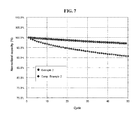
- Fig. 7 shows the result of the lifecycle properties at 60°C of the lithium secondary batteries using the cathode active materials prepared in Example 2 and Comparative Example 2, respectively.
- the batteries using the cathode active materials in accordance with the present invention maintained the capacity of 95% or more as time went by, whereas the batteries using the cathode active materials prepared in Comparative Example 2, a conventional manner, resulted the capacity of less than 95% as time went by.
Landscapes
- Chemical & Material Sciences (AREA)
- Chemical Kinetics & Catalysis (AREA)
- Electrochemistry (AREA)
- General Chemical & Material Sciences (AREA)
- Inorganic Chemistry (AREA)
- Composite Materials (AREA)
- Engineering & Computer Science (AREA)
- Manufacturing & Machinery (AREA)
- Crystallography & Structural Chemistry (AREA)
- Materials Engineering (AREA)
- Battery Electrode And Active Subsutance (AREA)
- Secondary Cells (AREA)
Abstract
Description
- The present invention relates to a cathode active material for a lithium secondary battery containing phosphate fluoride and a method for preparing the same.
- As technologies for mobile appliances become more advanced and the demand for mobile appliances increases, there has been a rapid rise in the demand for secondary batteries as an energy source. Among such secondary batteries, lithium secondary batteries are commonly and widely used because they have a high energy density, a high operating voltage, a long lifecycle and a low self-discharge rate.
- Typical lithium secondary batteries comprise LiPF6 salts as an electrolyte. However, the LiPF6 salts easily react with moisture, i.e., H2O, in the atmosphere to form HF molecules, which sequentially react with the surface of cathode to release oxygen and elute transition metals, leading to a drastic reduction in the lifecycle of the battery. For such reason, the surfaces of cathodes have been coated with metal oxides that are stable but highly reactive with fluorine so as to prevent reaction between cathode active materials and HF and thus improve overall performance of the battery. Exemplary coating materials are oxide materials such as Al2O3, ZrO2, ZnO, AlPO4 and the like, and non-oxide materials such as AlF3.
- Also, phosphate or silicate materials have been employed as active materials in cathode due to their strong chemical bonding so as to prevent the release of oxygen and the side reaction with electrolytes during charging/discharging of the batteries, which stabilize their crystalline structures during charging or at high temperature. Exemplary active materials include LiFePO4, Li2FeSiO4 and the like, particularly, LiFePO4 has been commercially used in cathode active materials for power storage batteries due to its excellent stability.
- However, although cathode active materials such as LiFePO4 could significantly enhance stability of the batteries, their applications are limited due to low energy density, etc. Further, some electrochemically inactive materials such as Al2O3 and AlF3 could improve the lifecycle of batteries but their effects on stability improvement are limited.
- Accordingly, it is an object of the present invention to provide a cathode active material for a lithium secondary battery having improved lifecycle and stability and a method for preparing the same.
- In accordance with one aspect of the present invention, there is provided a cathode active material for a lithium secondary battery containing the compound of Formula 1 which is further doped or coated with phosphate fluoride:
Formula 1 LiaNixCoyM'zMn(1-x-y-z)O2
wherein M' is selected from the group consisting of Ca, Mg, Al, Ti, Mn, Fe, Co, Ni, Cu, Zn, Y, Zr, Nb, B, and a combination thereof; and 0.4 < a ≤ 1.3, 0 ≤ x ≤ 0.8, 0 ≤ y ≤ 0.33, 0 ≤ z ≤ 0.33, and 0 ≤ x+y+z < 1. - In accordance with another aspect of the present invention, there is provided a method for preparing the cathode active material for a lithium secondary battery, comprising the steps of (a) mixing a lithium-containing compound with one or more precursors containing at least one of nickel, cobalt and manganese and (b) subjecting the resulting mixture to sintering and optional heat-treatment, wherein the sintering, the heat-treatment, or both are conducted after adding i) a fluorine (F)-containing compound and a phosphate (PO4)-containing compound, or ii) a phosphate fluoride (PO4F)-containing compound, to the mixture to be sintered or heat-treated so as to obtain the compound of
Formula 1 above which is further doped or coated with phosphate fluoride. - The cathode active material for lithium secondary battery can improve performance of a lithium secondary battery as compared to conventional lithium secondary batteries due to its enhanced lifecycle and stability.
- The above and other objects and features of the present invention will become apparent from the following description of the invention, when taken in conjunction with the accompanying drawings, which respectively show:
-
Fig. 1 : the charge-discharge capacity of the lithium secondary battery using the cathode active material prepared in Example 1; -
Fig. 2 : the initial capacity of the lithium secondary battery using the cathode active material prepared in Example 1 depending on the amount of phosphate fluoride; -
Fig. 3 : the output of the lithium secondary battery using the cathode active material prepared in Example 1 when measured at 2C in percentage over the output at 0.1C depending on the amount of phosphate fluoride; -
Fig. 4 : the charge-discharge capacity of the lithium secondary battery using the cathode active material prepared in Example 2; -
Fig. 5 : the lifecycle property of the lithium secondary battery using the cathode active material prepared in Example 1 depending on the amount of phosphate fluoride; -
Fig. 6 : the lifecycle properties of the lithium secondary batteries using the cathode active materials prepared in Examples 1, 2 and Comparative Example 1, respectively; and -
Fig. 7 : the lifecycle properties at 60°C of the lithium secondary batteries using the cathode active materials prepared in Example 2 and Comparative Example 2, respectively. - The cathode active material of the present invention contains the compound of Formula 1 above which is further doped or coated with a phosphate fluoride.
- The phosphate fluoride may be a metal phosphate fluoride, wherein the metal is selected from the group consisting of Ca, Mg, Al, Ti, Mn, Fe, Co, Ni, Cu, Zn, Y, Zr, Nb, B, and a combination thereof.
- The cathode active material may be represented by Formula 2 below:
Formula 2 LiaNixCoyM'zMn(1-x-y-z)O(2-p-q)(M"PO4Fr)pFq
wherein M' and M" are each independently selected from the group consisting of Ca, Mg, Al, Ti, Mn, Fe, Co, Ni, Cu, Zn, Y, Zr, Nb, B, and a combination thereof. Preferably, M' and M" are each independently selected from the group consisting of Mg, Al, Mn, Fe, Co, Ni, and a combination thereof. More preferably, M' and M" are each independently selected from the group consisting of Mg and Al in order to improve lifecycle property and capacity of batteries. - In Formula 2, 0.4 ≤ a ≤ 1.3, 0 ≤ x ≤ 0.8, 0 ≤ y ≤ 0.33, 0 ≤ z ≤ 0.33, 0 ≤ x+y+z < 1,0 < p ≤ 0.5, 0 ≤ q ≤ 0.1, and r = 0 or 1. In one embodiment, 0.9 < a ≤ 1.2, 0.33 ≤ x ≤ 0.8, 0 ≤ y ≤ 0.3, 0 ≤ z ≤ 0.3, 0.33 ≤ x+y+z < 1, 0 < p ≤ 0.5, 0 ≤ q ≤ 0.01, and r = 0 or 1. In another embodiment, 0.9 < a ≤ 1.2, 0.33 ≤ x ≤ 0.8, 0 ≤ y ≤ 0.3, 0 ≤ z ≤ 0.3, 0.33 ≤ x+y+z < 1, 0 < p ≤ 0.01, 0 ≤ q ≤ 0.01, and r = 0 or 1. In a further embodiment, 0.4 < a ≤ 0.6, 0 ≤ x ≤ 0.25, 0 ≤ y ≤ 0.25, 0 < z ≤ 0.25, 0 ≤ x+y+z < 0.3, 0 < p ≤ 0.01, 0 ≤ q ≤ 0.01, and r = 0 or 1.
- The cathode active material may have an average particle diameter of 3 to 20 µm. When the average diameter falls within the above range, lifecycle property and capacity of batteries can be more improved.
- The present invention also provides a method for preparing a cathode active material for a lithium secondary battery.
- The inventive method comprises the steps of (a) mixing a lithium-containing compound with one or more precursors containing at least one of nickel, cobalt and manganese and (b) subjecting the resulting mixture to sintering and optional heat-treatment, wherein the sintering, the heat-treatment, or the both are conducted after adding i) a fluorine (F)-containing compound and a phosphate (PO4)-containing compound, or ii) a phosphate fluoride (PO4F)-containing compound, to the mixture to be sintered or heat-treated so as to obtain the compound of
Formula 1 above which is further doped or coated with phosphate fluoride. - The examples of the fluorine-containing compound comprise NH4F, NH4HF2, NH4PF6, LiF, LiAlF6, AlF3, MgF2, CaF2, MnF2, MnF3, FeF2, FeF3, CoF2, CoF3, NiF2, TiF4, CuF, CuF2, ZnF2, polyvinylidene fluoride (PVdF), poly(vinylidene fluoride-co-hexafluoropropylene) (PVdF-HFP), and a mixture thereof. The examples of the phosphate-containing compound comprise NH4H2PO4, (NH4)2HPO4, H3PO4, Li3PO4, LiH2PO4, MgHPO4, Mg3(PO4)2, Mg(H2PO4)2, NH4MgPO4, AlPO4, FePO4, Zn3(PO4)2, phosphorus trioxide, phosphorus pentoxide, and a mixture thereof. The examples of the phosphate fluoride-containing compound comprise PO4F metal salts, wherein the metal is selected from the group consisting of Ca, Mg, Al, Ti, Mn, Fe, Co, Ni, Cu, Zn, Y, Zr, Nb, B, and a combination thereof.
- Preferably, the compounds containing fluorine, phosphate or phosphate fluoride have an average particle diameter of less than 1 µm in order to improve electrochemical properties.
- Moreover, additional metals other than Li, Ni, Co, and Mn may be further employed during the sintering and/or heat-treatment process of step (b). Examples of the additional metal are Ca, Mg, Al, Ti, Mn, Fe, Co, Ni, Cu, Zn, Y, Zr, Nb, B, and a combination thereof. Such additional metals may be employed in the form of metal salts combined with fluorine, phosphate or phosphate fluoride, or in the form of metal salts such as nitrate, sulfate, and hydrochloride salts.
- Each of said compounds may be added in an amount corresponding to the molar ratio of each element represented in
Formula - In the preparation method, the addition of the compound containing fluorine, phosphate or phosphate fluoride may be conducted by wet or dry process. The wet process allows homogeneous doping or coating of phosphate fluoride, and the dry process can yield locally inhomogeneous phosphate fluoride doping or coating.
- In one embodiment of the mixing process, a fluorine-containing compound and/or a phosphate-containing compound are added during the mixing process of step (a), and the mixture is sintered to obtain a sintered powder containing fluorine and/or phosphate. After the sintering process, previously unused fluorine or phosphate compound may be added to the sintered powder. Further, the compounds containing metals other than Li, Ni, Co and Mn may be added to the sintered powder. Then, the powder is homogeneously mixed and heat-treated to obtain cathode active material powder which is doped or coated with phosphate fluoride.
- In another embodiment of the mixing process, M"PO4F-containing compound (wherein M" is the same as defined in Formula 2) or a mixture thereof is added after the sintering process, and then heat-treated to obtain cathode active material powder which is coated with phosphate fluoride on the surface thereof.
- The sintering in step (b) may be conducted at 650 to 1000 °C for 4 to 24 hours under the condition of heating and cooling for 3 to 8 hours each. The heat-treatment in step (c) may be conducted at 300 to 900 °C for 2 to 8 hours under the condition of heating and cooling for 1 to 6 hours each.
- In one embodiment, the cathode active material of the present invention is prepared by a method comprising the steps of: (a) mixing a precursor containing nickel, cobalt and manganese together with a lithium-containing compound, a fluorine (F)-containing compound and a phosphate (PO4)-containing compound; and (b) sintering the mixture obtained in step (a) so as to obtain the compound of
Formula 1 above which is further doped or coated with phosphate fluoride. - The fluorine-containing compound may be selected from the group consisting of NH4F, NH4HF2, NH4PF6, LiF, LiAlF6, AlF3, MgF2, CaF2, MnF2, MnF3, FeF2, FeF3, CoF2, CoF3, NiF2, TiF4, CuF, CuF2, ZnF2, polyvinylidene fluoride, poly(vinylidene fluoride-co-hexafluoropropylene), and a mixture thereof. The phosphate-containing compound may be selected from the group consisting of NH4H2PO4, (NH4)2HP04, H3PO4, Li3PO4, LiH2PO4, MgHPO4, Mg3(PO4)2, Mg(H2PO4)2, NH4MgPO4, AlPO4, FePO4, Zn3(PO4)2, phosphorus trioxide, phosphorus pentoxide, and a mixture thereof.
- The sintering in step (b) may be conducted at 650 to 1000 °C for 4 to 24 hours under the condition of heating and cooling for 3 to 8 hours each.
- In another embodiment, the cathode active material of the present invention is prepared by a method comprising the steps of: (a) mixing a precursor containing nickel, cobalt and manganese together with a lithium-containing compound and a fluorine (F)-containing compound; (b) sintering the mixture obtained in step (a), followed by mixing the sintered mixture with a phosphate (PO4)-containing compound or a phosphate fluoride (PO4F)-containing compound; and (c) subjecting the mixture obtained in step (b) to heat-treatment so as to obtain the compound of
Formula 1 above which is further doped or coated with phosphate fluoride. - The fluorine-containing compound may be selected from the group consisting of NH4F, NH4HF2, NH4PF6, LiF, LiAlF6, AlF3, MgF2, CaF2, MnF2, MnF3, FeF2, FeF3, CoF2, CoF3, NiF2, TiF4, CuF, CuF2, ZnF2, polyvinylidene fluoride, poly(vinylidene fluoride-co-hexafluoropropylene), and a mixture thereof. The phosphate-containing compound may be selected from the group consisting of NH4H2PO4, (NH4)2HPO4, H3PO4, Li3PO4, LiH2PO4, MgHPO4, Mg3(PO4)2, Mg(H2PO4)2, NH4MgPO4, AlPO4, FePO4, Zn3(PO4)2, phosphorus trioxide, phosphorus pentoxide, and a mixture thereof. The phosphate fluoride-containing compound may be a PO4F metal salt, the metal being selected from the group consisting of Ca, Mg, Al, Ti, Mn, Fe, Co, Ni, Cu, Zn, Y, Zr, Nb, B, and a combination thereof
- The mixing in step (b) may be conducted by wet or dry process.
- The sintering in step (b) may be conducted at 650 to 1000 °C for 4 to 24 hours under the condition of heating and cooling for 3 to 8 hours each. The heat-treatment in step (c) may be conducted at 300 to 900 °C for 2 to 8 hours under the condition of heating and cooling for 1 to 6 hours each.
- The precursor which is used as a starting material in the inventive method, may be in the form of a mixture of a nickel salt, a cobalt salt, a manganese salt, and/or other metal salts.
- The precursor may also be a nickel-cobalt-manganese hydroxide represented by Formula 3:
Formula 3 Nix Coy Mn(1-x-y) (OH)2
wherein 0 ≤ x ≤ 0.8, 0 ≤ y ≤ 0.33, and 0 ≤ x+y < 1. - The compound of
Formula 3 may be prepared by co-precipitation or spray-drying method. - In one embodiment of preparing the compound of
Formula 3 by employing the co-precipitation method, a nickel salt, a cobalt salt and a manganese salt, e.g., nitrate, sulfate, hydrochloride, are mixed in a desired molar ratio, and then dissolved in distilled water. The resulting solution is poured into a continuous reactor or a Couette-Taylor reactor at a flow rate of 150-300 mL/hr. At the same time, 20-30% aqueous NH40H solution is poured into the reactor at a flow rate of 30-50 mL/hr. And then, 30-50% aqueous NaOH solution is poured into the reactor to maintain a pH range of 10-13. The reaction mixture is stirred at 600-900 rpm to prepare the cathode active material precursor. Finally, the resulting solution is washed with distilled water to remove Na and S which are contained in the solution, and then dried to obtain the final precursor particles. - In another embodiment of preparing the compound of
Formula 3 by employing the spray-drying method, a lithium salt, a nickel salt, a cobalt salt and a manganese salt, e.g., oxide, carbonate, sulphate, nitrate, hydrochloride, are mixed in a desired molar ratio, and then the mixture is poured into distilled water or alcohol-based solvent to form a slurry having a solid content of 20-50%. The slurry is subjected to a grinding process using a ball mill or a bead mill until the average diameter of the solid content becomes 0.5-1 µm, and then mixed with a binder. The mixture is dried using a spray-dryer to obtain the final product in the form of agglomerated secondary particles. The binder may be added before or after the grinding process, but usually it may be added after the grinding process. - Further, the present invention provides a lithium secondary battery comprising a lithium anode, an electrolyte, and a cathode containing the inventive cathode active material.
- As described above, the cathode active material in accordance with the present invention can enhance electrical properties of a lithium secondary battery such as capacity, output power and the like, and improve lifecycle as well as thermal stability thereof.
- In particular, a lithium secondary battery containing the inventive cathode active material can show an improved charge-discharge property, e.g., an increase of 4% or more in the initial capacity when measured at 3.0-4.3 V charge-discharge cut-off voltage, and also maintain 99% or more of normalized capacity even after 50 cycles during the lifecycle test.
- The following examples are intended to further illustrate the present invention without limiting its scope.
- NiSO4·6H2O, CoSO4·7H2O and MnSO4·H2O were mixed at a molar ratio of 6:2:2, and N2-purged distilled water was added thereto to prepare 2M metal salt solution. The metal salt solution was poured into a continuous stirred-tank reactor (CSTR) at a flow rate of 250 mL/hr.
- 25% aqueous ammonia solution was poured into the reactor at a flow rate of 40 mL/hr through an inlet for aqueous ammonia solution. Further, 40% aqueous NaOH solution was automatically poured into the reactor at a flow rate of 105-120 mL/hr through an inlet for NaOH solution while maintaining the pH to be 11.3 using a pH meter and a controller. The temperature of the reactor was set at 40°C, the retention time (RT) was controlled to 10 hr, and the mixed solution was stirred at 800 rpm.
- The reaction mixture obtained was filtered, purified with distilled water, and dried to obtain nickel-cobalt-manganese hydroxide particles (Ni:Co:Mn = 6:2:2).
- NiSO4·6H2O, CoSO4·7H2O and MnSO4·H2O were mixed at a molar ratio of 7:1:2, and N2-purged distilled water was added thereto to prepare 2M metal salt solution. The metal salt solution was poured into a Couette-Taylor reactor having 1L capacity at a flow rate of 200 mL/hr through an inlet for metal salt solution.
- 25% aqueous ammonia solution was poured into the reactor at a flow rate of 35 mL/hr through an inlet for aqueous ammonia solution. Further, 40% aqueous NaOH solution was automatically poured into the reactor at a flow rate of 85-100 mL/hr through an inlet for NaOH solution while maintaining the pH to be 11.2 using a pH meter and a controller. The temperature of the reactor was set at 40°C, the retention time (RT) was controlled to 3 hr, and the mixed solution was stirred at 600 rpm.
- The reaction mixture obtained was filtered, purified with distilled water, and dried to obtain nickel-cobalt-manganese hydroxide particles (Ni:Co:Mn = 7:1:2).
- Li2CO3 powder, LiF powder, and Mn3(PO4)2 powder were added to the nickel-cobalt-manganese hydroxide (Ni:Co:Mn = 6:2:2) powder obtained in Preparation Example 1 so as to allow a molar ratio of Li2CO3 : LiF : Mn3(PO4)2 : Ni-Co-Mn-OH = 0.52 : 0.02 : 0.025-0.2 : 1, and then homogeneously mixed.
- The mixed powder was sintered at 870°C for 12 hours under the condition of heating and cooling for 6 hours each to obtain the cathode active material having the formula of Li1.06 Ni0.6 Co0.2 Mn0.2 O2-x (MnPO4F)x (x = 0.05-0.4).
- Li2CO3 powder, LiF powder, and Al2O3 powder (Aldrich Co.) were added to the nickel-cobalt-manganese hydroxide (Ni:Co:Mn = 7:1:2) powder obtained in Preparation Example 2 so as to allow a molar ratio of Li2CO3 : LiF : Al2O3 : Ni-Co-Mn-OH = 0.52 : 0.02 : 0.01 : 1, and then homogeneously mixed.
- The mixed powder was sintered at 870°C for 12 hours under the condition of heating and cooling for 6 hours each.
- Diammonium phosphate ((NH4)2HPO4, Aldrich Co.) powder was added to the sintered powder in an amount of 0.01 mole per 1 mol of the sintered powder, and then homogeneously mixed.
- The mixed powder was subjected to heat-treatment at 400°C for 3 hours under the condition of heating and cooling for 1.5 hours each to obtain the cathode active material having the formula of Li1.06Ni0.7Co0.1Al0.01 Mn0.19O1.99(AlPO4F)0.01.
- Li2CO3, LiF, MnO2, Al(OH)3, MgCO3, and H3BO3 were mixed in a molar ratio of 0.260 : 0.010 : 0.885 : 0.050 : 0.060 : 0.005, followed by mixing with water to form a slurry having a solid content of 30 wt%.
- Polyacrylic acid (PAA) was added as a binder to the slurry in an amount of 0.1 wt%, based on 100 g of the solid content of the slurry, and the slurry was subjected to a wet-grinding process using a bead mill (MiniCer, Netzsch Co.) The slurry was then subjected to a spray-drying process using a spray dryer (Mobile MINOR, GEA-NIRO Co.) with the inlet and outlet temperatures of 240°C and 100°C, respectively, to obtain powder in the form of agglomerated secondary particles.
- The powder was then sintered at 850°C in the air for 8 hours.
- Magnesium phosphate (MgHPO4, Aldrich Co.) powder was added to the sintered powder in an amount of 0.01 mole per 1 mole of the sintered powder, and then wet-blended using a solvent of alcohol.
- The mixed powder was subjected to heat-treatment at 500°C for 3 hours under the condition of heating and cooling for 1.5 hours each to obtain the cathode active material having the formula of Li0.52Mn0.885Al0.05Mg0.06 B0.005O1.99(MgPO4F)0.01.
- Li2CO3 powder was added to the nickel-cobalt-manganese hydroxide (Ni:Co:Mn = 6:2:2) powder obtained in Preparation Example 1 so as to allow a molar ratio of Li2CO3 : Ni-Co-Mn-OH = 0.53 : 1, and then homogeneously mixed.
- The mixed powder was sintered at 870°C for 12 hours under the condition of heating and cooling for 6 hours each to obtain the cathode active material having the formula of Li1.06Ni0.6CO0.2Mn0.2O2.
- Li2CO3, MnO2, Al(OH)3, MgCO3, and H3BO3 were mixed in a molar ratio of 0.520 : 1.885 : 0.050 : 0.060 : 0.005, followed by mixing with water to form a slurry having a solid content of 30 wt%.
- Polyacrylic acid (PAA) was added as a binder to the slurry in an amount of 0.1 wt% based on 100g of the solid content of the slurry, and the slurry was subjected to a wet-grinding process using a bead mill (MiniCer, Netzsch Co.)
- The resulting slurry was then subjected to a spray-drying process using a spray dryer (Mobile MINOR, GEA-NIRO Co.) with the inlet and outlet temperatures of 240°C and 100°C, respectively, to obtain powder in the form of agglomerated secondary particle.
- The resulting powder was sintered at 850°C in the air for 8 hours to obtain the cathode active material having the formula of Li0.52Mn0.9425Al0.025 Mg0.03B0.0025O2.
- Each of the cathode active materials prepared in Examples 1 to 3 and Comparative Examples 1 and 2 was mixed with a binder (PVdF, Kureha Co.) and a conducting material (Super P, Timcal Co.) in a weight ratio of 95 : 2 : 3 to obtain a slurry. The slurry was coated on Al foil by doctor blade method to obtain a cathode. Lithium metal was used as an anode, which was loaded in an amount of 12 mg/cm2. 1M LiPF6 in EC/DMC (1:2) was used as an electrolyte. A separator was disposed between the anode and the cathode to prepare a lithium secondary battery.
- The charge-discharge capacities of lithium secondary batteries using the cathode active materials prepared in Examples 1 to 3 and Comparative Examples 1 and 2 were evaluated. The evaluation was performed at the charge/discharge cut-off voltages set to 3.0-4.3 V, and under the condition of 0.2C, 0.5C, 1C, 2C and 3C after initial charge/discharge at 0.1C at room temperature. 1C capacity was measured based on 140 mAh/g for Examples 1, 2 and Comparative Example 1, and 100 mAh/g for Example 3 and Comparative Example 2, respectively.
-
Fig. 1 shows the result of the charge-discharge capacity test of the lithium secondary batteries using the cathode active material prepared in Example 1. As can be seen fromFig. 1 , no deterioration in capacity due to the phosphate fluoride content was observed, whereas the output was significantly improved. -
Fig. 2 shows the result of the initial capacity test of the lithium secondary battery using the cathode active material prepared in Example 1 depending on amount of phosphate fluoride. As shown inFig. 2 , although the capacity has a tendency to decrease as the amount of phosphate fluoride increases, the capacity was still higher as compared to that of Comparative Example 1. -
Fig. 3 shows the result of the output test of the lithium secondary battery using the cathode active material prepared in Example 1 when measured at 2C in percentage over the output at 0.1C depending on the amount of phosphate fluoride. As can be seen fromFig. 3 , depending on the output property increased as the amount of phosphate fluoride increased and the graph converged at the value of 0.2 mol% or more. -
Fig. 4 shows the result of the initial charge-discharge capacity test of the lithium secondary battery using the cathode active material prepared in Example 2. As shown inFig. 4 , the initial capacity and output properties are excellent. - The lifecycle properties of lithium secondary batteries using the cathode active materials prepared in Examples 1 to 3 and Comparative Examples 1 and 2 were evaluated. 1C capacity was measured based on 140 mAh/g at room temperature or 60°C and at the charge/discharge cut-off voltages of 3.0-4.3 V.
-
Fig. 5 shows the result of the lifecycle property after 50 cycles of the lithium secondary battery using the cathode active material prepared in Example 1 depending on the amount of phosphate fluoride. It was observed that the lifecycle property significantly increased as the amount of phosphate fluoride increased. -
Fig. 6 shows the result of the lifecycle properties of the lithium secondary batteries using the cathode active materials prepared in Examples 1, 2 and Comparative Example 1, respectively.Fig. 7 shows the result of the lifecycle properties at 60°C of the lithium secondary batteries using the cathode active materials prepared in Example 2 and Comparative Example 2, respectively. As shown inFigs. 6 and7 , the batteries using the cathode active materials in accordance with the present invention maintained the capacity of 95% or more as time went by, whereas the batteries using the cathode active materials prepared in Comparative Example 2, a conventional manner, resulted the capacity of less than 95% as time went by.
Claims (13)
- A cathode active material for a lithium secondary battery comprising the compound of Formula 1 which is further doped or coated with a phosphate fluoride:
Formula 1 LiaNixCoyM'zMn(1-x-y-z)O2
wherein M' is selected from the group consisting of Ca, Mg, Al, Ti, Mn, Fe, Co, Ni, Cu, Zn, Y, Zr, Nb, B, and a combination thereof; and 0.4 < a ≤ 1.3, 0 ≤ x < 0.8, 0 ≤ y ≤ 0.33, 0 ≤ z ≤ 0.33, and 0 ≤ x+y+z < 1. - The cathode active material of claim 1, which is represented by Formula 2:
Formula 2 LiaNixCoyM'zMn(1-x_y-z)O(2-p-q)(M"PO4Fr)pFq
wherein M' and M" are each independently selected from the group consisting of Ca, Mg, Al, Ti, Mn, Fe, Co, Ni, Cu, Zn, Y, Zr, Nb, B, and a combination thereof; and 0.4 < a ≤ 1.3, 0 ≤ x ≤ 0.8, 0 ≤ y ≤ 0.33, 0 ≤ z ≤ 0.33, 0 ≤ x+y+z < 1,0 < p ≤ 0.5, 0 ≤ q ≤ 0.1, and r= 0 or 1. - The cathode active material of claim 2, wherein M' and M" are each independently selected from the group consisting of Mg, Al, Mn, Fe, Co, Ni, B, and a combination thereof.
- The cathode active material of claim 2 or claim 3, wherein 0.9 < a ≤ 1.2, 0.33 ≤ x ≤ 0.8, 0 ≤ y ≤ 0.3, 0 < z ≤ 0.3, 0.33 ≤ x+y+z < 1, 0 < p ≤ 0.01, 0 ≤ q ≤ 0.01, and r = 0 or 1.
- The cathode active material of claim 2 or claim 3, wherein 0.4 < a ≤ 0.6, 0 ≤ x ≤ 0.25, 0 ≤ y ≤ 0.25, 0 < z ≤ 0.25, 0 ≤ x+y+z < 0.3, 0 < p ≤ 0.01, 0 ≤ q ≤ 0.01, and r = 0 or 1.
- A method for preparing the cathode active material as defined in any of claims 1 to 5, comprising the steps of:(a) mixing a precursor containing nickel, cobalt and manganese together with a lithium-containing compound, a fluorine (F)-containing compound and a phosphate (PO4)-containing compound; and(b) sintering the mixture obtained in step (a) so as to obtain the cathode active material.
- The method of claim 6, wherein
the fluorine-containing compound is selected from the group consisting of NH4F, NH4HF2, NH4PF6, LiF, LiAlF6, AlF3, MgF2, CaF2, MnF2, MnF3, FeF2, FeF3, CoF2, CoF3, NiF2, TiF4, CuF, CuF2, ZnF2, polyvinylidene fluoride, poly(vinylidene fluoride-co-hexafluoropropylene), and a mixture thereof; and
the phosphate-containing compound is selected from the group consisting of NH4H2PO4, (NH4)2HPO4, H3PO4, Li3PO4, LiH2PO4, MgHPO4, Mg3(PO4)2, Mg(H2PO4)2, NH4MgPO4, AlPO4, FePO4, Zn3(PO4)2, phosphorus trioxide, phosphorus pentoxide, and a mixture thereof. - The method of claim 6 or claim 7, wherein the sintering in step (b) is conducted at 650 to 1000 °C for 4 to 24 hours under the condition of heating and cooling for 3 to 8 hours each.
- A method for preparing the cathode active material as defined in any of claims 1 to 5, comprising the steps of:(a) mixing a precursor containing nickel, cobalt and manganese together with a lithium-containing compound and a fluorine (F)-containing compound;(b) sintering the mixture obtained in step (a), followed by mixing the sintered mixture with a phosphate (PO4)-containing compound or a phosphate fluoride (PO4F)-containing compound; and(c) subjecting the mixture obtained in step (b) to heat-treatment so as to obtain the cathode active material.
- The method of claim 9, wherein
the fluorine-containing compound is selected from the group consisting of NH4F, NH4HF2, NH4PF6, LiF, LiAlF6, AlF3, MgF2, CaF2, MnF2, MnF3, FeF2, FeF3, CoF2, CoF3, NiF2, TiF4, CuF, CuF2, ZnF2, polyvinylidene fluoride, poly(vinylidene fluoride-co-hexafluoropropylene), and a mixture thereof;
the phosphate-containing compound is selected from the group consisting of NH4H2PO4, (NH4)2HPO4, H3PO4, Li3PO4, LiH2PO4, MgHPO4, Mg3(PO4)2, Mg(H2PO4)2, NH4MgPO4, AlPO4, FeP04, Zn3(PO4)2, phosphorus trioxide, phosphorus pentoxide, and a mixture thereof; and
the phosphate fluoride-containing compound is a PO4F metal salt, the metal being selected from the group consisting of Ca, Mg, Al, Ti, Mn, Fe, Co, Ni, Cu, Zn, Y, Zr, Nb, B, and a combination thereof. - The method of claim 9 or claim 10, wherein the mixing in step (b) is conducted by a wet or dry process.
- The method of claim 9 or claim 10, wherein
the sintering in step (b) is conducted at 650 to 1000 °C for 4 to 24 hours under the condition of heating and cooling for 3 to 8 hours each; and
the heat-treatment in step (c) is conducted at 300 to 900 °C for 2 to 8 hours under the condition of heating and cooling for 1 to 6 hours each. - A lithium secondary battery comprising a lithium anode, an electrolyte, and a cathode containing the cathode active material as defined in any one of claims 1 to 5.
Applications Claiming Priority (1)
| Application Number | Priority Date | Filing Date | Title |
|---|---|---|---|
| KR1020110117804A KR101375701B1 (en) | 2011-11-11 | 2011-11-11 | Cathode active material for lithium secondary battery containing phosphate fluoride and preparation method thereof |
Publications (2)
| Publication Number | Publication Date |
|---|---|
| EP2592677A1 true EP2592677A1 (en) | 2013-05-15 |
| EP2592677B1 EP2592677B1 (en) | 2016-06-22 |
Family
ID=47146264
Family Applications (1)
| Application Number | Title | Priority Date | Filing Date |
|---|---|---|---|
| EP12192127.4A Not-in-force EP2592677B1 (en) | 2011-11-11 | 2012-11-09 | Cathode active material for a lithium secondary battery containing phosphate fluoride and preparation method thereof |
Country Status (5)
| Country | Link |
|---|---|
| US (1) | US20130122370A1 (en) |
| EP (1) | EP2592677B1 (en) |
| JP (1) | JP5726839B2 (en) |
| KR (1) | KR101375701B1 (en) |
| CN (1) | CN103107325B (en) |
Cited By (4)
| Publication number | Priority date | Publication date | Assignee | Title |
|---|---|---|---|---|
| CN106918785A (en) * | 2015-12-27 | 2017-07-04 | 深圳市沃特玛电池有限公司 | One kind detection self discharge of lithium iron phosphate battery method |
| EP3168907A4 (en) * | 2014-07-11 | 2017-08-23 | Lg Chem, Ltd. | Cathode material of secondary battery, and production method therefor |
| CN108767229A (en) * | 2018-05-30 | 2018-11-06 | 天津巴莫科技股份有限公司 | Stepped combined rich oxidate for lithium solid-solution material of one kind and preparation method thereof |
| CN111363422A (en) * | 2020-03-03 | 2020-07-03 | 博罗冠业电子有限公司 | Method for preparing titanium carbon foil and titanium carbon foil for solid capacitor |
Families Citing this family (34)
| Publication number | Priority date | Publication date | Assignee | Title |
|---|---|---|---|---|
| KR101371368B1 (en) | 2012-02-01 | 2014-03-12 | 주식회사 엘지화학 | Reactor For Manufacturing Precursor of Lithium Composite Transition Metal Hydroxide and Method for Manufacturing Precursor |
| KR101658503B1 (en) * | 2012-11-06 | 2016-09-21 | 주식회사 엘지화학 | Cathode Active Material for Secondary Battery and Secondary Battery Containing the Same |
| US9601755B2 (en) * | 2013-03-14 | 2017-03-21 | Ovonic Battery Company, Inc. | Composite cathode materials having improved cycle life |
| US9595708B2 (en) * | 2013-03-14 | 2017-03-14 | Ovonic Battery Company, Inc. | Composite cathode materials having improved cycle life |
| CN103367723B (en) * | 2013-07-23 | 2017-02-01 | 深圳市嘉里能科技有限公司 | Method for coating nickel cobalt lithium manganate positive-electrode material with calcium fluophosphate |
| CN103515598B (en) * | 2013-09-18 | 2016-05-25 | 宁波大学 | The two component surface modification ferric fluoride anode materials of a kind of aluminium zirconate doping phosphoric acid titanium lithium and preparation method |
| KR101646729B1 (en) * | 2013-10-11 | 2016-08-08 | 주식회사 엘 앤 에프 | Positive electrode active material for rechargeable lithium battery, method of preparing the same, and rechargeable lithium battery including the same |
| JP6359323B2 (en) * | 2013-12-27 | 2018-07-18 | 住友化学株式会社 | Surface-modified lithium-containing composite oxide for lithium ion secondary battery positive electrode |
| CN104752709B (en) * | 2013-12-30 | 2017-03-01 | 北京有色金属研究总院 | A kind of preparation method of lithium-rich manganese-based anode material hydroxide precursor |
| KR101564009B1 (en) * | 2014-02-13 | 2015-10-28 | 주식회사 이엔드디 | Continuously preparing method for Ni-Co-Mn composite precursor using Couette-Taylor vortix reactor |
| WO2015130831A1 (en) | 2014-02-25 | 2015-09-03 | Quantumscape Corporation | Hybrid electrodes with both intercalation and conversion materials |
| KR102217753B1 (en) * | 2014-03-20 | 2021-02-22 | 주식회사 엘 앤 에프 | Positive active material for rechargeable lithium battery, method of preparing the same, and rechargeable lithium battery including the same |
| CN104237799A (en) * | 2014-09-04 | 2014-12-24 | 中天储能科技有限公司 | Method for fast judging self-discharging ratio of lithium iron phosphate battery |
| US10355269B2 (en) * | 2015-01-14 | 2019-07-16 | Toyota Jidosha Kabushiki Kaisha | Lithium ion secondary battery having positive electrode active material particle with fluorine and phosphorous containing film, and method of manufacturing the same |
| EP3248232B1 (en) * | 2015-01-23 | 2019-07-03 | Umicore | Lithium nickel-manganese-cobalt oxide cathode powders for high voltage lithium-ion batteries |
| US10854874B2 (en) * | 2015-01-23 | 2020-12-01 | Umicore | Lithium metal oxide cathode powders for high voltage lithium-ion batteries |
| KR102368363B1 (en) * | 2015-01-30 | 2022-03-02 | 주식회사 엘 앤 에프 | Positive active material for rechargeable lithium battery, method of preparing the same, and rechargeable lithium battery including the same |
| WO2016186479A1 (en) * | 2015-05-21 | 2016-11-24 | 주식회사 엘앤에프 | Cathode active material for lithium secondary battery, method for preparing same, and lithium secondary battery comprising same |
| KR102425828B1 (en) * | 2015-06-02 | 2022-07-27 | 삼성에스디아이 주식회사 | Positive active material, positive electrode and lithium battery containing the material, method of manufacturing the material |
| US10333140B2 (en) * | 2015-07-02 | 2019-06-25 | Umicore | Cobalt-based lithium metal oxide cathode material |
| CN105070908B (en) * | 2015-08-31 | 2018-02-13 | 宁波金和锂电材料有限公司 | A kind of preparation method and lithium ion battery of nickelic positive electrode |
| CN105470509A (en) * | 2015-12-22 | 2016-04-06 | 合肥融捷能源材料有限公司 | Novel NCA material and preparation method thereof |
| CN110776019A (en) * | 2018-07-27 | 2020-02-11 | 纳米及先进材料研发院有限公司 | Synthesis of high-voltage cathode materials and preparation of high-voltage electrolytes for lithium-ion batteries |
| CN108987737A (en) * | 2018-10-24 | 2018-12-11 | 遵义源创生产力促进中心有限公司 | A kind of fluorapatite cladding nickel-cobalt lithium manganate cathode material method |
| CN109860509B (en) * | 2019-01-14 | 2021-02-26 | 中国电力科学研究院有限公司 | A kind of preparation method of anion co-doped lithium-rich manganese-based solid solution cathode material |
| CN110797529A (en) * | 2019-11-06 | 2020-02-14 | 四川富骅新能源科技有限公司 | Doped high-nickel high-voltage NCM positive electrode material and preparation method thereof |
| WO2021171843A1 (en) * | 2020-02-26 | 2021-09-02 | パナソニックIpマネジメント株式会社 | Positive electrode active material for non-aqueous electrolyte secondary battery, and non-aqueous electrolyte secondary battery |
| JP7702630B2 (en) * | 2020-09-30 | 2025-07-04 | パナソニックIpマネジメント株式会社 | Positive electrode active material for non-aqueous electrolyte secondary battery and non-aqueous electrolyte secondary battery |
| CN114512660B (en) * | 2020-11-17 | 2022-12-02 | 松山湖材料实验室 | Positive active material precursor, preparation method thereof and positive active material |
| CN112993260B (en) * | 2021-05-12 | 2021-08-17 | 蜂巢能源科技有限公司 | A doped ternary precursor, preparation method, positive electrode material and battery |
| US20240243281A1 (en) * | 2021-11-08 | 2024-07-18 | Advanced Cell Engineering, Inc. | Lithium ion cathodes and cells suitable for large-format batteries and large-format batteries containing lithium ion cathodes |
| CN115295781B (en) * | 2022-08-10 | 2023-11-14 | 广东比沃新能源有限公司 | Manganese-based positive electrode material and application thereof in lithium battery |
| CN117254112B (en) * | 2023-11-14 | 2024-03-05 | 蓝固(湖州)新能源科技有限公司 | Secondary battery |
| CN121054642A (en) * | 2024-05-29 | 2025-12-02 | 宁德时代新能源科技股份有限公司 | Secondary batteries, electrical devices, lithium-rich manganese-based positive electrode active materials and their preparation methods |
Citations (2)
| Publication number | Priority date | Publication date | Assignee | Title |
|---|---|---|---|---|
| US20030013019A1 (en) * | 2000-04-27 | 2003-01-16 | Jeremy Barker | Alkali/transition metal halo - and hydroxy-phosphates and related electrode active materials |
| US20110129732A1 (en) * | 2009-12-01 | 2011-06-02 | Applied Materials, Inc. | Compressed powder 3d battery electrode manufacturing |
Family Cites Families (8)
| Publication number | Priority date | Publication date | Assignee | Title |
|---|---|---|---|---|
| KR100570638B1 (en) * | 2004-02-17 | 2006-04-12 | 삼성에스디아이 주식회사 | Cathode active material for lithium secondary battery and its manufacturing method |
| US7364793B2 (en) * | 2004-09-24 | 2008-04-29 | Lg Chem, Ltd. | Powdered lithium transition metal oxide having doped interface layer and outer layer and method for preparation of the same |
| JP5277686B2 (en) * | 2007-03-29 | 2013-08-28 | 三菱化学株式会社 | Lithium secondary battery and positive electrode for lithium secondary battery used therefor |
| EP2349924B1 (en) * | 2008-10-23 | 2017-02-08 | Centre National De La Recherche Scientifique | Fluorosulphates useful as electrode materials |
| JP5111421B2 (en) * | 2009-03-27 | 2013-01-09 | 株式会社日立製作所 | Positive electrode material for lithium secondary battery, lithium secondary battery, and secondary battery module using the same |
| JP5526636B2 (en) * | 2009-07-24 | 2014-06-18 | ソニー株式会社 | Non-aqueous electrolyte secondary battery positive electrode active material, non-aqueous electrolyte secondary battery positive electrode and non-aqueous electrolyte secondary battery |
| JP5205424B2 (en) * | 2010-08-06 | 2013-06-05 | 株式会社日立製作所 | Positive electrode material for lithium secondary battery, lithium secondary battery, and secondary battery module using the same |
| JP5692599B2 (en) * | 2011-09-22 | 2015-04-01 | トヨタ自動車株式会社 | Lithium ion secondary battery and manufacturing method thereof |
-
2011
- 2011-11-11 KR KR1020110117804A patent/KR101375701B1/en not_active Expired - Fee Related
-
2012
- 2012-11-06 US US13/670,045 patent/US20130122370A1/en not_active Abandoned
- 2012-11-09 JP JP2012247549A patent/JP5726839B2/en not_active Expired - Fee Related
- 2012-11-09 EP EP12192127.4A patent/EP2592677B1/en not_active Not-in-force
- 2012-11-12 CN CN201210450382.9A patent/CN103107325B/en not_active Expired - Fee Related
Patent Citations (2)
| Publication number | Priority date | Publication date | Assignee | Title |
|---|---|---|---|---|
| US20030013019A1 (en) * | 2000-04-27 | 2003-01-16 | Jeremy Barker | Alkali/transition metal halo - and hydroxy-phosphates and related electrode active materials |
| US20110129732A1 (en) * | 2009-12-01 | 2011-06-02 | Applied Materials, Inc. | Compressed powder 3d battery electrode manufacturing |
Non-Patent Citations (2)
| Title |
|---|
| LIAO X Z ET AL: "Effects of fluorine-substitution on the electrochemical behavior of LiFePO4/C cathode materials", JOURNAL OF POWER SOURCES, ELSEVIER SA, CH, vol. 174, no. 2, 6 December 2007 (2007-12-06), pages 720 - 725, XP025917632, ISSN: 0378-7753, [retrieved on 20071206], DOI: 10.1016/J.JPOWSOUR.2007.06.146 * |
| ZHI-MING LIU ET AL: "Preparation of NaV1-xAlxPO4F cathode materials for application of sodium-ion battery", TRANSACTIONS OF NONFERROUS METALS SOCIETY OF CHINA, vol. 18, no. 2, 1 April 2008 (2008-04-01), pages 346 - 350, XP055050701, ISSN: 1003-6326, DOI: 10.1016/S1003-6326(08)60060-6 * |
Cited By (6)
| Publication number | Priority date | Publication date | Assignee | Title |
|---|---|---|---|---|
| EP3168907A4 (en) * | 2014-07-11 | 2017-08-23 | Lg Chem, Ltd. | Cathode material of secondary battery, and production method therefor |
| US10490806B2 (en) | 2014-07-11 | 2019-11-26 | Lg Chem, Ltd. | Positive electrode material of secondary battery and preparation method thereof |
| CN106918785A (en) * | 2015-12-27 | 2017-07-04 | 深圳市沃特玛电池有限公司 | One kind detection self discharge of lithium iron phosphate battery method |
| CN108767229A (en) * | 2018-05-30 | 2018-11-06 | 天津巴莫科技股份有限公司 | Stepped combined rich oxidate for lithium solid-solution material of one kind and preparation method thereof |
| CN108767229B (en) * | 2018-05-30 | 2021-03-23 | 天津巴莫科技股份有限公司 | Step-by-step composite lithium-rich oxide solid solution material and preparation method thereof |
| CN111363422A (en) * | 2020-03-03 | 2020-07-03 | 博罗冠业电子有限公司 | Method for preparing titanium carbon foil and titanium carbon foil for solid capacitor |
Also Published As
| Publication number | Publication date |
|---|---|
| JP2013105749A (en) | 2013-05-30 |
| KR101375701B1 (en) | 2014-03-20 |
| JP5726839B2 (en) | 2015-06-03 |
| US20130122370A1 (en) | 2013-05-16 |
| KR20130052394A (en) | 2013-05-22 |
| CN103107325B (en) | 2015-04-29 |
| EP2592677B1 (en) | 2016-06-22 |
| CN103107325A (en) | 2013-05-15 |
Similar Documents
| Publication | Publication Date | Title |
|---|---|---|
| EP2592677B1 (en) | Cathode active material for a lithium secondary battery containing phosphate fluoride and preparation method thereof | |
| US10319996B2 (en) | Cathode material for lithium ion secondary battery, method of producing the same, and lithium ion secondary battery | |
| EP2737565B1 (en) | Blended cathode materials | |
| JP5268134B2 (en) | Method for producing positive electrode active material and non-aqueous electrolyte battery using the same | |
| US9306210B2 (en) | Surface protected lithium-metal-oxide electrodes | |
| KR101794097B1 (en) | Positive active material for rechargeable lithium battery, method of preparing the same, and positive electrode for rechargeable lithium battery and rechargeable lithium battery including the same | |
| EP2936590B1 (en) | Lmfp cathode materials with improved electrochemical performance | |
| CN101946346B (en) | Mixed metal olivine electrode materials for lithium ion batteries | |
| US10164249B2 (en) | Positive active material for secondary lithium battery, method for preparing the same and secondary lithium battery containing the positive active material | |
| US20230053984A1 (en) | Positive active material, preparation method therefor, and lithium secondary battery having positive electrode comprising same | |
| US20150311522A1 (en) | Positive active material for use in a lithium ion battery and method for preparing the same | |
| US20250070117A1 (en) | Methods and systems for dry surface doping of cathode materials | |
| CA2750328A1 (en) | Electrode-active anion-deficient lithium transition-metal phosphate, method for preparing the same, and electrochemical device using the same | |
| JP7230227B2 (en) | Positive electrode active material, manufacturing method thereof, and lithium secondary battery including positive electrode containing the same | |
| JP7320418B2 (en) | Mixed positive electrode active material for lithium ion secondary battery and method for manufacturing positive electrode for lithium ion secondary battery | |
| JP2022523183A (en) | A lithium secondary battery containing a positive electrode active material, a method for producing the same, and a positive electrode containing the positive electrode. | |
| US11309543B2 (en) | Electrode active composition with reduced amount of cobalt | |
| KR20140082635A (en) | Lithiated manganese phosphate and composite material comprising same | |
| JP2022138053A (en) | Positive electrode active material for lithium ion secondary battery and method for producing the same | |
| KR102936321B1 (en) | Positive electrode active material precursor for secondary battery, positive electrode active material and lithium secondary battery comprising the same | |
| JP2023047468A (en) | Positive electrode active material composite particle for lithium ion secondary battery | |
| KR101589293B1 (en) | Spinel type lithium manganese complex oxide and method of preparing the same | |
| JP2023047467A (en) | Positive electrode active material composite particle for lithium ion secondary battery |
Legal Events
| Date | Code | Title | Description |
|---|---|---|---|
| PUAI | Public reference made under article 153(3) epc to a published international application that has entered the european phase |
Free format text: ORIGINAL CODE: 0009012 |
|
| AK | Designated contracting states |
Kind code of ref document: A1 Designated state(s): AL AT BE BG CH CY CZ DE DK EE ES FI FR GB GR HR HU IE IS IT LI LT LU LV MC MK MT NL NO PL PT RO RS SE SI SK SM TR |
|
| AX | Request for extension of the european patent |
Extension state: BA ME |
|
| 17P | Request for examination filed |
Effective date: 20131101 |
|
| RBV | Designated contracting states (corrected) |
Designated state(s): AL AT BE BG CH CY CZ DE DK EE ES FI FR GB GR HR HU IE IS IT LI LT LU LV MC MK MT NL NO PL PT RO RS SE SI SK SM TR |
|
| RAP1 | Party data changed (applicant data changed or rights of an application transferred) |
Owner name: SK (CHONGQING) LITHIUM ION BATTERY MATERIALS CO., |
|
| RIC1 | Information provided on ipc code assigned before grant |
Ipc: H01M 4/58 20100101AFI20151118BHEP Ipc: H01M 10/0525 20100101ALI20151118BHEP Ipc: H01M 4/525 20100101ALI20151118BHEP Ipc: H01M 4/485 20100101ALI20151118BHEP Ipc: H01M 4/505 20100101ALI20151118BHEP Ipc: H01M 4/36 20060101ALI20151118BHEP |
|
| GRAP | Despatch of communication of intention to grant a patent |
Free format text: ORIGINAL CODE: EPIDOSNIGR1 |
|
| INTG | Intention to grant announced |
Effective date: 20160104 |
|
| GRAS | Grant fee paid |
Free format text: ORIGINAL CODE: EPIDOSNIGR3 |
|
| GRAA | (expected) grant |
Free format text: ORIGINAL CODE: 0009210 |
|
| RAP1 | Party data changed (applicant data changed or rights of an application transferred) |
Owner name: FDG KINETIC (CHONGQING) LITHIUM ION BATTERY MATERI |
|
| AK | Designated contracting states |
Kind code of ref document: B1 Designated state(s): AL AT BE BG CH CY CZ DE DK EE ES FI FR GB GR HR HU IE IS IT LI LT LU LV MC MK MT NL NO PL PT RO RS SE SI SK SM TR |
|
| REG | Reference to a national code |
Ref country code: GB Ref legal event code: FG4D |
|
| REG | Reference to a national code |
Ref country code: CH Ref legal event code: EP |
|
| REG | Reference to a national code |
Ref country code: IE Ref legal event code: FG4D |
|
| REG | Reference to a national code |
Ref country code: AT Ref legal event code: REF Ref document number: 808137 Country of ref document: AT Kind code of ref document: T Effective date: 20160715 |
|
| REG | Reference to a national code |
Ref country code: DE Ref legal event code: R096 Ref document number: 602012019702 Country of ref document: DE |
|
| REG | Reference to a national code |
Ref country code: LT Ref legal event code: MG4D |
|
| REG | Reference to a national code |
Ref country code: NL Ref legal event code: MP Effective date: 20160622 |
|
| PG25 | Lapsed in a contracting state [announced via postgrant information from national office to epo] |
Ref country code: NO Free format text: LAPSE BECAUSE OF FAILURE TO SUBMIT A TRANSLATION OF THE DESCRIPTION OR TO PAY THE FEE WITHIN THE PRESCRIBED TIME-LIMIT Effective date: 20160922 Ref country code: FI Free format text: LAPSE BECAUSE OF FAILURE TO SUBMIT A TRANSLATION OF THE DESCRIPTION OR TO PAY THE FEE WITHIN THE PRESCRIBED TIME-LIMIT Effective date: 20160622 Ref country code: LT Free format text: LAPSE BECAUSE OF FAILURE TO SUBMIT A TRANSLATION OF THE DESCRIPTION OR TO PAY THE FEE WITHIN THE PRESCRIBED TIME-LIMIT Effective date: 20160622 |
|
| REG | Reference to a national code |
Ref country code: AT Ref legal event code: MK05 Ref document number: 808137 Country of ref document: AT Kind code of ref document: T Effective date: 20160622 |
|
| REG | Reference to a national code |
Ref country code: FR Ref legal event code: PLFP Year of fee payment: 5 |
|
| PG25 | Lapsed in a contracting state [announced via postgrant information from national office to epo] |
Ref country code: LV Free format text: LAPSE BECAUSE OF FAILURE TO SUBMIT A TRANSLATION OF THE DESCRIPTION OR TO PAY THE FEE WITHIN THE PRESCRIBED TIME-LIMIT Effective date: 20160622 Ref country code: HR Free format text: LAPSE BECAUSE OF FAILURE TO SUBMIT A TRANSLATION OF THE DESCRIPTION OR TO PAY THE FEE WITHIN THE PRESCRIBED TIME-LIMIT Effective date: 20160622 Ref country code: NL Free format text: LAPSE BECAUSE OF FAILURE TO SUBMIT A TRANSLATION OF THE DESCRIPTION OR TO PAY THE FEE WITHIN THE PRESCRIBED TIME-LIMIT Effective date: 20160622 Ref country code: GR Free format text: LAPSE BECAUSE OF FAILURE TO SUBMIT A TRANSLATION OF THE DESCRIPTION OR TO PAY THE FEE WITHIN THE PRESCRIBED TIME-LIMIT Effective date: 20160923 Ref country code: SE Free format text: LAPSE BECAUSE OF FAILURE TO SUBMIT A TRANSLATION OF THE DESCRIPTION OR TO PAY THE FEE WITHIN THE PRESCRIBED TIME-LIMIT Effective date: 20160622 Ref country code: RS Free format text: LAPSE BECAUSE OF FAILURE TO SUBMIT A TRANSLATION OF THE DESCRIPTION OR TO PAY THE FEE WITHIN THE PRESCRIBED TIME-LIMIT Effective date: 20160622 |
|
| PG25 | Lapsed in a contracting state [announced via postgrant information from national office to epo] |
Ref country code: CZ Free format text: LAPSE BECAUSE OF FAILURE TO SUBMIT A TRANSLATION OF THE DESCRIPTION OR TO PAY THE FEE WITHIN THE PRESCRIBED TIME-LIMIT Effective date: 20160622 Ref country code: IT Free format text: LAPSE BECAUSE OF FAILURE TO SUBMIT A TRANSLATION OF THE DESCRIPTION OR TO PAY THE FEE WITHIN THE PRESCRIBED TIME-LIMIT Effective date: 20160622 Ref country code: IS Free format text: LAPSE BECAUSE OF FAILURE TO SUBMIT A TRANSLATION OF THE DESCRIPTION OR TO PAY THE FEE WITHIN THE PRESCRIBED TIME-LIMIT Effective date: 20161022 Ref country code: EE Free format text: LAPSE BECAUSE OF FAILURE TO SUBMIT A TRANSLATION OF THE DESCRIPTION OR TO PAY THE FEE WITHIN THE PRESCRIBED TIME-LIMIT Effective date: 20160622 Ref country code: RO Free format text: LAPSE BECAUSE OF FAILURE TO SUBMIT A TRANSLATION OF THE DESCRIPTION OR TO PAY THE FEE WITHIN THE PRESCRIBED TIME-LIMIT Effective date: 20160622 Ref country code: SK Free format text: LAPSE BECAUSE OF FAILURE TO SUBMIT A TRANSLATION OF THE DESCRIPTION OR TO PAY THE FEE WITHIN THE PRESCRIBED TIME-LIMIT Effective date: 20160622 |
|
| PG25 | Lapsed in a contracting state [announced via postgrant information from national office to epo] |
Ref country code: BE Free format text: LAPSE BECAUSE OF FAILURE TO SUBMIT A TRANSLATION OF THE DESCRIPTION OR TO PAY THE FEE WITHIN THE PRESCRIBED TIME-LIMIT Effective date: 20160622 Ref country code: PT Free format text: LAPSE BECAUSE OF FAILURE TO SUBMIT A TRANSLATION OF THE DESCRIPTION OR TO PAY THE FEE WITHIN THE PRESCRIBED TIME-LIMIT Effective date: 20161024 Ref country code: ES Free format text: LAPSE BECAUSE OF FAILURE TO SUBMIT A TRANSLATION OF THE DESCRIPTION OR TO PAY THE FEE WITHIN THE PRESCRIBED TIME-LIMIT Effective date: 20160622 Ref country code: AT Free format text: LAPSE BECAUSE OF FAILURE TO SUBMIT A TRANSLATION OF THE DESCRIPTION OR TO PAY THE FEE WITHIN THE PRESCRIBED TIME-LIMIT Effective date: 20160622 Ref country code: PL Free format text: LAPSE BECAUSE OF FAILURE TO SUBMIT A TRANSLATION OF THE DESCRIPTION OR TO PAY THE FEE WITHIN THE PRESCRIBED TIME-LIMIT Effective date: 20160622 Ref country code: SM Free format text: LAPSE BECAUSE OF FAILURE TO SUBMIT A TRANSLATION OF THE DESCRIPTION OR TO PAY THE FEE WITHIN THE PRESCRIBED TIME-LIMIT Effective date: 20160622 |
|
| REG | Reference to a national code |
Ref country code: DE Ref legal event code: R097 Ref document number: 602012019702 Country of ref document: DE |
|
| PLBE | No opposition filed within time limit |
Free format text: ORIGINAL CODE: 0009261 |
|
| STAA | Information on the status of an ep patent application or granted ep patent |
Free format text: STATUS: NO OPPOSITION FILED WITHIN TIME LIMIT |
|
| 26N | No opposition filed |
Effective date: 20170323 |
|
| PG25 | Lapsed in a contracting state [announced via postgrant information from national office to epo] |
Ref country code: DK Free format text: LAPSE BECAUSE OF FAILURE TO SUBMIT A TRANSLATION OF THE DESCRIPTION OR TO PAY THE FEE WITHIN THE PRESCRIBED TIME-LIMIT Effective date: 20160622 |
|
| REG | Reference to a national code |
Ref country code: CH Ref legal event code: PL |
|
| PG25 | Lapsed in a contracting state [announced via postgrant information from national office to epo] |
Ref country code: CH Free format text: LAPSE BECAUSE OF NON-PAYMENT OF DUE FEES Effective date: 20161130 Ref country code: LI Free format text: LAPSE BECAUSE OF NON-PAYMENT OF DUE FEES Effective date: 20161130 |
|
| REG | Reference to a national code |
Ref country code: IE Ref legal event code: MM4A |
|
| PG25 | Lapsed in a contracting state [announced via postgrant information from national office to epo] |
Ref country code: SI Free format text: LAPSE BECAUSE OF FAILURE TO SUBMIT A TRANSLATION OF THE DESCRIPTION OR TO PAY THE FEE WITHIN THE PRESCRIBED TIME-LIMIT Effective date: 20160622 |
|
| PG25 | Lapsed in a contracting state [announced via postgrant information from national office to epo] |
Ref country code: LU Free format text: LAPSE BECAUSE OF NON-PAYMENT OF DUE FEES Effective date: 20161130 |
|
| REG | Reference to a national code |
Ref country code: FR Ref legal event code: PLFP Year of fee payment: 6 |
|
| PG25 | Lapsed in a contracting state [announced via postgrant information from national office to epo] |
Ref country code: IE Free format text: LAPSE BECAUSE OF NON-PAYMENT OF DUE FEES Effective date: 20161109 |
|
| PG25 | Lapsed in a contracting state [announced via postgrant information from national office to epo] |
Ref country code: CY Free format text: LAPSE BECAUSE OF FAILURE TO SUBMIT A TRANSLATION OF THE DESCRIPTION OR TO PAY THE FEE WITHIN THE PRESCRIBED TIME-LIMIT Effective date: 20160622 Ref country code: HU Free format text: LAPSE BECAUSE OF FAILURE TO SUBMIT A TRANSLATION OF THE DESCRIPTION OR TO PAY THE FEE WITHIN THE PRESCRIBED TIME-LIMIT; INVALID AB INITIO Effective date: 20121109 |
|
| PG25 | Lapsed in a contracting state [announced via postgrant information from national office to epo] |
Ref country code: MK Free format text: LAPSE BECAUSE OF FAILURE TO SUBMIT A TRANSLATION OF THE DESCRIPTION OR TO PAY THE FEE WITHIN THE PRESCRIBED TIME-LIMIT Effective date: 20160622 Ref country code: MC Free format text: LAPSE BECAUSE OF FAILURE TO SUBMIT A TRANSLATION OF THE DESCRIPTION OR TO PAY THE FEE WITHIN THE PRESCRIBED TIME-LIMIT Effective date: 20160622 Ref country code: TR Free format text: LAPSE BECAUSE OF FAILURE TO SUBMIT A TRANSLATION OF THE DESCRIPTION OR TO PAY THE FEE WITHIN THE PRESCRIBED TIME-LIMIT Effective date: 20160622 |
|
| PG25 | Lapsed in a contracting state [announced via postgrant information from national office to epo] |
Ref country code: BG Free format text: LAPSE BECAUSE OF FAILURE TO SUBMIT A TRANSLATION OF THE DESCRIPTION OR TO PAY THE FEE WITHIN THE PRESCRIBED TIME-LIMIT Effective date: 20160622 |
|
| PG25 | Lapsed in a contracting state [announced via postgrant information from national office to epo] |
Ref country code: MT Free format text: LAPSE BECAUSE OF NON-PAYMENT OF DUE FEES Effective date: 20161109 |
|
| PG25 | Lapsed in a contracting state [announced via postgrant information from national office to epo] |
Ref country code: AL Free format text: LAPSE BECAUSE OF FAILURE TO SUBMIT A TRANSLATION OF THE DESCRIPTION OR TO PAY THE FEE WITHIN THE PRESCRIBED TIME-LIMIT Effective date: 20160622 |
|
| PGFP | Annual fee paid to national office [announced via postgrant information from national office to epo] |
Ref country code: FR Payment date: 20201116 Year of fee payment: 9 Ref country code: DE Payment date: 20201125 Year of fee payment: 9 Ref country code: GB Payment date: 20201105 Year of fee payment: 9 |
|
| REG | Reference to a national code |
Ref country code: DE Ref legal event code: R082 Ref document number: 602012019702 Country of ref document: DE |
|
| REG | Reference to a national code |
Ref country code: DE Ref legal event code: R119 Ref document number: 602012019702 Country of ref document: DE |
|
| GBPC | Gb: european patent ceased through non-payment of renewal fee |
Effective date: 20211109 |
|
| PG25 | Lapsed in a contracting state [announced via postgrant information from national office to epo] |
Ref country code: GB Free format text: LAPSE BECAUSE OF NON-PAYMENT OF DUE FEES Effective date: 20211109 Ref country code: DE Free format text: LAPSE BECAUSE OF NON-PAYMENT OF DUE FEES Effective date: 20220601 |
|
| PG25 | Lapsed in a contracting state [announced via postgrant information from national office to epo] |
Ref country code: FR Free format text: LAPSE BECAUSE OF NON-PAYMENT OF DUE FEES Effective date: 20211130 |