EP2592122A1 - Polishing liquid for polishing process based on metal co and use thereof - Google Patents
Polishing liquid for polishing process based on metal co and use thereof Download PDFInfo
- Publication number
- EP2592122A1 EP2592122A1 EP11867101.5A EP11867101A EP2592122A1 EP 2592122 A1 EP2592122 A1 EP 2592122A1 EP 11867101 A EP11867101 A EP 11867101A EP 2592122 A1 EP2592122 A1 EP 2592122A1
- Authority
- EP
- European Patent Office
- Prior art keywords
- slurry
- chosen
- chemical mechanical
- mechanical polishing
- polishing
- Prior art date
- Legal status (The legal status is an assumption and is not a legal conclusion. Google has not performed a legal analysis and makes no representation as to the accuracy of the status listed.)
- Withdrawn
Links
Images


Classifications
-
- C—CHEMISTRY; METALLURGY
- C23—COATING METALLIC MATERIAL; COATING MATERIAL WITH METALLIC MATERIAL; CHEMICAL SURFACE TREATMENT; DIFFUSION TREATMENT OF METALLIC MATERIAL; COATING BY VACUUM EVAPORATION, BY SPUTTERING, BY ION IMPLANTATION OR BY CHEMICAL VAPOUR DEPOSITION, IN GENERAL; INHIBITING CORROSION OF METALLIC MATERIAL OR INCRUSTATION IN GENERAL
- C23F—NON-MECHANICAL REMOVAL OF METALLIC MATERIAL FROM SURFACE; INHIBITING CORROSION OF METALLIC MATERIAL OR INCRUSTATION IN GENERAL; MULTI-STEP PROCESSES FOR SURFACE TREATMENT OF METALLIC MATERIAL INVOLVING AT LEAST ONE PROCESS PROVIDED FOR IN CLASS C23 AND AT LEAST ONE PROCESS COVERED BY SUBCLASS C21D OR C22F OR CLASS C25
- C23F1/00—Etching metallic material by chemical means
- C23F1/10—Etching compositions
- C23F1/14—Aqueous compositions
- C23F1/16—Acidic compositions
- C23F1/28—Acidic compositions for etching iron group metals
-
- C—CHEMISTRY; METALLURGY
- C09—DYES; PAINTS; POLISHES; NATURAL RESINS; ADHESIVES; COMPOSITIONS NOT OTHERWISE PROVIDED FOR; APPLICATIONS OF MATERIALS NOT OTHERWISE PROVIDED FOR
- C09G—POLISHING COMPOSITIONS; SKI WAXES
- C09G1/00—Polishing compositions
- C09G1/02—Polishing compositions containing abrasives or grinding agents
-
- C—CHEMISTRY; METALLURGY
- C09—DYES; PAINTS; POLISHES; NATURAL RESINS; ADHESIVES; COMPOSITIONS NOT OTHERWISE PROVIDED FOR; APPLICATIONS OF MATERIALS NOT OTHERWISE PROVIDED FOR
- C09K—MATERIALS FOR MISCELLANEOUS APPLICATIONS, NOT PROVIDED FOR ELSEWHERE
- C09K3/00—Materials not provided for elsewhere
- C09K3/14—Anti-slip materials; Abrasives
-
- H—ELECTRICITY
- H10—SEMICONDUCTOR DEVICES; ELECTRIC SOLID-STATE DEVICES NOT OTHERWISE PROVIDED FOR
- H10P—GENERIC PROCESSES OR APPARATUS FOR THE MANUFACTURE OR TREATMENT OF DEVICES COVERED BY CLASS H10
- H10P52/00—Grinding, lapping or polishing of wafers, substrates or parts of devices
- H10P52/40—Chemomechanical polishing [CMP]
- H10P52/403—Chemomechanical polishing [CMP] of conductive or resistive materials
Definitions
- the present invention relates to microelectronics technology, especially relates to chemical mechanical polishing (CMP) slurries and related applications.
- CMP chemical mechanical polishing
- the size of the copper interconnect structure is getting more and more smaller.
- the thickness of barrier or adhesion layer in the copper interconnect structure is getting thinner.
- the traditional copper barrier/adhesion layer stack-Ta/TaN is not suitable any more, as the resistivity of Ta is relatively high and copper cannot be directlyelectroplatedonto Ta. Compared with Ta, cobalt has lower resistivity and is relatively cheaper.
- the adhesion between Cu and Co is good. Cu can easily nucleate on Co, also copper can be directlyelectroplatedon cobalt.
- Porous low k dielectrics material has been already used in the current interconnect structures. It is reported that low k can be easily damaged by plasma or polishing slurries. In current chemical mechanical polishing processing, to reduce the damage to low-k dielectrics, most of the current slurries used for copper and barriers are acidic. But it is observed that copper and cobalt easily suffered from dissolution in acidic solution containing oxidant (H 2 O 2 ). This makes the polishing rate of copper and cobalt is sohigh that it willinduce the dishing of copper line.
- the dissolution of the cobalt adhesion layer on the sidewall of the copper interconnect structure can lead to the delamination of copper lines and cause reliabilityproblem.
- Soadding effective inhibitors in the acid slurry is very important, which can reduce the polishing rate of Co, and prevent the dissolution of Co layer, along the sidewall of the copper interconnect structure.
- the present invention is to provide a kind of slurry used for chemical mechanical polishing in microelectronics technology.
- the slurries of the present invention can effectively inhibit the cobalt corrosion rate in the acid slurry, which can prevent the reliability problem caused by over polishing or corrosion.
- the present invention provides a kind of slurry for chemical mechanical polishing of cobalt, which comprises components by weight as follows, inhibitor 0.01-2%, oxidant 0-5%, abrasive 0.1-10%, complexing agent 0.001-10%, and the rest of water.
- the pH value of the slurries is adjusted to 3-5 by pH value adjustor.
- the inhibitor is chosen one or more from the five-membered heterocycle compound containing S and N atoms or containing S or N atom, and their derivatives.
- the role of the inhibitor is to reduce the corrosion rate of Cu and Co in the slurry, which can improve the efficiency of planarization , reduce the dishing defects and prevent the dissolution of adhesion layer along the sidewall of the interconnect structure.
- the oxidant is chosen one or more from H 2 O 2 , (NH 4 ) 2 S 2 O 8 , KIO 4 , KClO 5 .
- the role of oxidant is to oxidize Cu, Co and the barrier metal into the corresponding metal oxides, hydroxides or ions.
- the best choice is H 2 O 2 .
- the weight proportion of the oxidant in the slurry is in the range of 0-5%, and the best weight proportion is 0.5%-5%.
- the abrasive is chosen one or more from SiO 2 , CeO 2 , and Al 2 O 3 .
- the role of abrasive is to remove the metal or metal reaction products which contact with abrasive particles through mechanical friction force.
- the best choice is colloidal SiO 2 .
- the size of the abrasive particles has influence on the polishing rate and surface roughness. In the present invention, the size of the abrasive is in the range of 10-100nm.
- the complexing agent is chosen one or more from amino acid and citric acid.
- the role of the complexing agent is to react with the metal ions on the metal surface or in the slurry, which reduces the metal particles in the slurry and prevents the metal ions contamination.
- Said slurry for chemical mechanical polishing of cobalt therein the slurries have the list proportion of components by weight: inhibitor 0.01-1%, oxidant 0.5-2%, abrasives 1-5%, complexing agent 0.4%, and the rest of water.
- the inhibitor can be chosen one or more from Benzotriazole, 2-mercaptothiazole, 2-mercaptobenzothiazole, imidazole, 2-Aminobenzimidazole, 2-Mercaptobenzimidazole and 2-Methylbenzimidazole.
- the best choice is Benzotriazole and 2-mercaptothiazole, Benzotriazole and 2-mercaptothiazole can effectively prevent the corrosion of Cu and Co.
- Said slurry for chemical mechanical polishing of cobalt therein the chosen complexing agent can be one or more kinds of amino acid, such as glycine, glutamic, leucine and arginine acid.
- the complexing agent can also be other organic acid, such as citric acid. The best choice is glycine as complexing agent.
- Said slurry for chemical mechanical polishing of cobalt therein the pH value adjustor is chosen one or more from nitric acid, sulphuric acid, dilute acetic acid, hydrochloric acid, potassium hydroxide, sodium hydroxide, sodium carbonate and sodium bicarbonate.
- the best choices are nitric acid and potassium hydroxide.
- Co is used as adhesion or barrier layer for copper interconnects
- Co can also be used as nano-crystalline in memory device and metal gate in MOSFET. All the use of Co, cobalt alloy and cobalt compounds in the electric circuit, and the process needing polishing process, are included in the applications of the present invention.
- the provided slurries in the present invention have the pH value in the range of 3-5. If the pH value of the slurry is too low, especially when the pH value is lower than 2, the CMP slurry can causecorrosion on the copper lines and the polishing equipment. If the pH value is in the range of 6-8, the SiO 2 abrasives are not stable. If the pH value of the slurry is very high, especially when the pH value is higher than 9, the slurries can damage the low-k dielectrics. So in the present invention, the pH values of the slurries are adjusted in the range of 3-5.
- Theslurries for chemical mechanical polishing of Co in the present invention can effectively inhibit Co corrosion rate and reduce the polishing rate of Co, which can effectively reduce the defects after polishing process.
- the method of applying the slurries in the present invention is similar as the applying of traditional slurries.
- wafer is held face down by the polishing head on the polishing pad, and the slurries are pumped on the polishing pad and is spread uniformly on the wafer surface withthe rotation of polishing platen.
- the copper and adhesion/barrier layers on the top of the dielectrics are polishedaway as the pressure is added between wafer and polishing pad, withthe rotation of polishing head and platen. Itshould be noticed that, the method of applying the slurries described above is based on the traditional polishing equipments in this field. For the special polishing equipment, reasonably adjusting the applying method based on the real case can also achieve the role of chemical mechanical planarization.
- Figure 1a is the cross-sectional schematic structure of the dual damascene structure before polishing.
- Figure 1b is the crosssectional schematic structure of the dual damascene structure after polishing by using the slurries in the present invention.
- dielectrics 10 could be silicon dioxide, or low-k dielectrics.
- the materials of copper adhesion/barrier layer 20 could be stack containing Co and metal nitrides or metal carbon nitrides, such as Co/TaN, Co/TiN, Co/TaCN, Co/TiCN, or could be a single cobalt alloy layer, such as CoMo, CoTa, CoTiand CoW.
- the method of depositing adhesion/barrier layer could be Physical vapor deposition (PVD), Atomic layer deposition(ALD), or chemical vapor deposition(CVD).
- the material of etch stop layer 30 could be SiN, SiC, SiCN and other hard etching dielectrics materials.
- the components of slurries 1wt% colloidal SiO 2; 0.75wt% glycine; 0.12wt% 2-mercaptothiazole; and the rest of water. Using the diluted nitric acid and potassium hydroxide to adjust the pH value to 3.
- the polishing equipment and mechanical parameters the polisher is CP-4 bench top polisher made by CETR Company in this embodiment.
- the polishing pressure is 2psi
- flow rate is 100ml/min
- rotation rate is 150rpm for both of polishing head and platen.
- the slurries is the same as those in embodiment 1 except without 2-mercaptothiazole;
- the polishing equipment and mechanical parameters are also the same as those in embodiment 1.
- Table 1 lists the corrosion rate and polishing rate of Co in embodiment 1 and Contrast 1.
- the components of slurries 5wt% colloidal SiO 2 : 0.5wt% H 2 O 2 ; 0.75wt% glycine; 0-0.24wt% Benzotriazole; and the rest of water.
- the pH value of the slurry is adjust to 5.
- the concentrations of Benzotriazole are controlled to 0.06wt%, 0.12wt%, 0.18wt%, 0.24wt% for all the slurries.
- the polishing equipment and mechanical parameters the polisher is CP-4 bench top polisher made by CETR Company in this embodiment.
- the polishing pressure is 2psi
- flow rate is 100ml/min
- rotation rate is 150rpm for both of polishing head and platen.
- Table 2 lists the corrosion rate of Co in the slurries with different concentrations of Benzotriazole. Table 2: corrosion rate of Co in embodiment 2 Concentrations of Benzotriazole (wt%) 0 0.06 0.12 0.18 0.24 Corrosion rate of Co (nm/min) 50 14 9 6 2
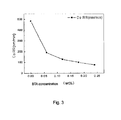
- Figure 3 shows the polishing rate of Co as a function of concentrations of Benzotriazole in embodiment 2.
- the polishing rate of Co is reduced steadily as the increase of Benzotriazole concentration.
- the polishing rate is reduced from 484nm/min to 75nm/min.
- the corrosion rate of Co is small(2nm/min) when Benzotriazole concentration is 0.24wt%.
- the polishing rate of 75nm/min is enough for polishing the Co or Co alloy adhesion layer with thickness less than 5nm.
- the present invention involves a polishing technology using Co or Co alloy as a metal layer in the integrated circuit.
- Co is mainly used as a barrier layer or adhesion layer for copper metallization, but Co could also be used as nano-crystalline in memory devises, self-aligned silicide and metal gate for MOSFET. All the use of Co, cobalt alloy and cobalt compounds in the electric circuits, and the processes needing polishing process, are included in the applications of the present invention.
Landscapes
- Chemical & Material Sciences (AREA)
- Organic Chemistry (AREA)
- Engineering & Computer Science (AREA)
- Materials Engineering (AREA)
- Chemical Kinetics & Catalysis (AREA)
- General Chemical & Material Sciences (AREA)
- Mechanical Engineering (AREA)
- Metallurgy (AREA)
- Mechanical Treatment Of Semiconductor (AREA)
- Finish Polishing, Edge Sharpening, And Grinding By Specific Grinding Devices (AREA)
Abstract
Description
- The present invention relates to microelectronics technology, especially relates to chemical mechanical polishing (CMP) slurries and related applications.
- With the continuous shrink of feature size in ultra large scale integrated circuits(ULSI) technology, the size of the copper interconnect structure is getting more and more smaller. To reduce the RC delay, the thickness of barrier or adhesion layer in the copper interconnect structure is getting thinner. The traditional copper barrier/adhesion layer stack-Ta/TaN is not suitable any more, as the resistivity of Ta is relatively high and copper cannot be directlyelectroplatedonto Ta. Compared with Ta, cobalt has lower resistivity and is relatively cheaper. The adhesion between Cu and Co is good. Cu can easily nucleate on Co, also copper can be directlyelectroplatedon cobalt.
- Porous low k dielectrics material has been already used in the current interconnect structures. It is reported that low k can be easily damaged by plasma or polishing slurries. In current chemical mechanical polishing processing, to reduce the damage to low-k dielectrics, most of the current slurries used for copper and barriers are acidic. But it is observed that copper and cobalt easily suffered from dissolution in acidic solution containing oxidant (H2O2). This makes the polishing rate of copper and cobalt is sohigh that it willinduce the dishing of copper line. The dissolution of the cobalt adhesion layer on the sidewall of the copper interconnect structure can lead to the delamination of copper lines and cause reliabilityproblem.Soadding effective inhibitors in the acid slurry is very important, which can reduce the polishing rate of Co, and prevent the dissolution of Co layer, along the sidewall of the copper interconnect structure.
- The present invention is to provide a kind of slurry used for chemical mechanical polishing in microelectronics technology. The slurries of the present invention can effectively inhibit the cobalt corrosion rate in the acid slurry, which can prevent the reliability problem caused by over polishing or corrosion.
- To achieve the said object, the present invention provides a kind of slurry for chemical mechanical polishing of cobalt, which comprises components by weight as follows, inhibitor 0.01-2%, oxidant 0-5%, abrasive 0.1-10%, complexing agent 0.001-10%, and the rest of water.The pH value of the slurries is adjusted to 3-5 by pH value adjustor.
- The inhibitor is chosen one or more from the five-membered heterocycle compound containing S and N atoms or containing S or N atom, and their derivatives. The role of the inhibitor is to reduce the corrosion rate of Cu and Co in the slurry, which can improve the efficiency of planarization , reduce the dishing defects and prevent the dissolution of adhesion layer along the sidewall of the interconnect structure.
- The oxidant is chosen one or more from H2O2, (NH4)2S2O8, KIO4, KClO5. The role of oxidant is to oxidize Cu, Co and the barrier metal into the corresponding metal oxides, hydroxides or ions. Among all the oxidants, the best choice is H2O2. The weight proportion of the oxidant in the slurry is in the range of 0-5%, and the best weight proportion is 0.5%-5%.
- The abrasive is chosen one or more from SiO2, CeO2, and Al2O3. The role of abrasive is to remove the metal or metal reaction products which contact with abrasive particles through mechanical friction force. Among all the abrasives, the best choice is colloidal SiO2. The size of the abrasive particles has influence on the polishing rate and surface roughness. In the present invention, the size of the abrasive is in the range of 10-100nm.
- The complexing agent is chosen one or more from amino acid and citric acid. The role of the complexing agent is to react with the metal ions on the metal surface or in the slurry, which reduces the metal particles in the slurry and prevents the metal ions contamination.
- Said slurry for chemical mechanical polishing of cobalt, therein the slurries have the list proportion of components by weight: inhibitor 0.01-1%, oxidant 0.5-2%, abrasives 1-5%, complexing agent 0.4%, and the rest of water.
- Said slurry for chemical mechanical polishing of cobalt, therein the chosenfive-membered heterocycle compound as inhibitors has two heteroatoms in ring. More detailedly speaking, the inhibitor can be chosen one or more from Benzotriazole, 2-mercaptothiazole, 2-mercaptobenzothiazole, imidazole, 2-Aminobenzimidazole, 2-Mercaptobenzimidazole and 2-Methylbenzimidazole. Among all the inhibitors, the best choice is Benzotriazole and 2-mercaptothiazole, Benzotriazole and 2-mercaptothiazole can effectively prevent the corrosion of Cu and Co.
- Said slurry for chemical mechanical polishing of cobalt, therein the chosen complexing agent can be one or more kinds of amino acid, such as glycine, glutamic, leucine and arginine acid. The complexing agent can also be other organic acid, such as citric acid. The best choice is glycine as complexing agent.
- Said slurry for chemical mechanical polishing of cobalt, therein the pH value adjustor is chosen one or more from nitric acid, sulphuric acid, dilute acetic acid, hydrochloric acid, potassium hydroxide, sodium hydroxide, sodium carbonate and sodium bicarbonate. The best choices are nitric acid and potassium hydroxide.
- In the present invention, we also provide the application of the slurries on chemical mechanical polishing of Co technology. In integrated circuits, Co is used as adhesion or barrier layer for copper interconnects, while Co can also be used as nano-crystalline in memory device and metal gate in MOSFET. All the use of Co, cobalt alloy and cobalt compounds in the electric circuit, and the process needing polishing process, are included in the applications of the present invention.
- The provided slurries in the present invention have the pH value in the range of 3-5. If the pH value of the slurry is too low, especially when the pH value is lower than 2, the CMP slurry can causecorrosion on the copper lines and the polishing equipment. If the pH value is in the range of 6-8, the SiO2 abrasives are not stable. If the pH value of the slurry is very high, especially when the pH value is higher than 9, the slurries can damage the low-k dielectrics. So in the present invention, the pH values of the slurries are adjusted in the range of 3-5.
- Theslurries for chemical mechanical polishing of Co in the present invention can effectively inhibit Co corrosion rate and reduce the polishing rate of Co, which can effectively reduce the defects after polishing process.
-
-
Figure 1a is the cross-sectional schematic structure of the dual damascene structure before polishing.Figure 1b is the cross-sectional schematic structure of the dual damascene structure after polishing. -
Figure 2a is the compared potentiodynamic polarization plots of Co in the slurries(pH=3) inembodiment 1 andcontrast 1.Figure 2b is the compared potentiodynamic polarization plots of Co in the slurries (pH=5) in embodiment I andcontrast 1. -
Figure 3 is the polishing rate of Co as a function of Benzotriazole concentration in the slurries inembodiment 2. - Combined with figures and embodiments, the best method of applying the present invention is described as following:
- The method of applying the slurries in the present invention is similar as the applying of traditional slurries. In the polishing process, wafer is held face down by the polishing head on the polishing pad, and the slurries are pumped on the polishing pad and is spread uniformly on the wafer surface withthe rotation of polishing platen. The copper and adhesion/barrier layers on the top of the dielectrics are polishedaway as the pressure is added between wafer and polishing pad, withthe rotation of polishing head and platen. Itshould be noticed that, the method of applying the slurries described above is based on the traditional polishing equipments in this field. For the special polishing equipment, reasonably adjusting the applying method based on the real case can also achieve the role of chemical mechanical planarization.
Figure 1a is the cross-sectional schematic structure of the dual damascene structure before polishing.Figure 1b is the crosssectional schematic structure of the dual damascene structure after polishing by using the slurries in the present invention. InFigure 1a and 1b ,dielectrics 10 could be silicon dioxide, or low-k dielectrics. The materials of copper adhesion/barrier layer 20 could be stack containing Co and metal nitrides or metal carbon nitrides, such as Co/TaN, Co/TiN, Co/TaCN, Co/TiCN, or could be a single cobalt alloy layer, such as CoMo, CoTa, CoTiand CoW. The method of depositing adhesion/barrier layer could be Physical vapor deposition (PVD), Atomic layer deposition(ALD), or chemical vapor deposition(CVD). The material ofetch stop layer 30 could be SiN, SiC, SiCN and other hard etching dielectrics materials. By using the slurries in the present invention, the excess copper and the adhesion layer andbarrier layer 20 abovedielectrics 10 are removed, and the structure shown inFig 1a is changed into the structure shown inFig 1b . Through the following embodiments the method of applying the slurries in the present invention is further described. - The components of slurries: 1wt% colloidal SiO2; 0.75wt% glycine; 0.12wt% 2-mercaptothiazole; and the rest of water. Using the diluted nitric acid and potassium hydroxide to adjust the pH value to 3.
- The polishing equipment and mechanical parameters: the polisher is CP-4 bench top polisher made by CETR Company in this embodiment. The polishing pressure is 2psi, flow rate is 100ml/min, and rotation rate is 150rpm for both of polishing head and platen.
- The slurries is the same as those in
embodiment 1 except without 2-mercaptothiazole; The polishing equipment and mechanical parameters are also the same as those inembodiment 1. - Table 1 lists the corrosion rate and polishing rate of Co in
embodiment 1 andContrast 1.
- Shown in table 1, after adding 2-mercaptothiazole in the slurry, the polishing rate and corrosion rate of Co are obviously reduced. As in the real interconnect structure. the thickness of the adhesion layer is notgreaterthan 5nm, preventing the corrosion of Co is very important. In
embodiment 1, by adding 2-mercaptothiazole in the slurry, the corrosion rate of Co is controlled to a low value and the polishing rate of Co is controlled to 27nm/min. this indicates 2-mercaptothiazole is a good inhibitor for Co corrosion. -
Figure 2a is the compared potentiodynamic polarization plots of Co in the slurries(pH=3) inembodiment 1 andcontrast 1.Figure 2b is the compared potentiodynamic polarization plots of Co in the slurries (pH=5) inembodiment 1 andcontrast 1. Fromfigure 2a and figure 2b , we can see that both of the anodic and cathodic current are reduced obviously no matter the pH value of slurry is at 3 or 5 after adding 0.12wt% 2-mercaptothiazole, and corrosion current also reducesobviously. There is a passivation region on the anodic potentiodynamic polarization plots of Co in the slurries containing 0.12wt% 2-mercaptothiazole, and these indicate 2-mercaptothiazole can adsorb on the surface of Co and then prevent Co corrosion. - The components of slurries; 5wt% colloidal SiO2: 0.5wt% H2O2; 0.75wt% glycine; 0-0.24wt% Benzotriazole; and the rest of water. The pH value of the slurry is adjust to 5. The concentrations of Benzotriazole are controlled to 0.06wt%, 0.12wt%, 0.18wt%, 0.24wt% for all the slurries.
- The polishing equipment and mechanical parameters: the polisher is CP-4 bench top polisher made by CETR Company in this embodiment. The polishing pressure is 2psi, flow rate is 100ml/min, and rotation rate is 150rpm for both of polishing head and platen.
- Table 2 lists the corrosion rate of Co in the slurries with different concentrations of Benzotriazole.
Table 2: corrosion rate of Co in embodiment 2Concentrations of Benzotriazole (wt%) 0 0.06 0.12 0.18 0.24 Corrosion rate of Co (nm/min) 50 14 9 6 2 - From the data in table 2, we can see that the corrosion rate of Co is decreased as the increase of concentration of Benzotriazole. When the concentration of Benzotriazole is up to 0.24wt%, the corrosion rate of Co is reduced to 2nm/min. Thisindicates that Benzotriazole is a good inhibitor for Co corrosion. The mechanism of Benzotriazole inhibiting Co corrosion could be described asthe adsorption of Benzotriazole on Co surface and then preventing the contact between Co and the slurry, finally preventing the corrosion of Co.
-
Figure 3 shows the polishing rate of Co as a function of concentrations of Benzotriazole inembodiment 2. As it is shown inFig 3 , the polishing rate of Co is reduced steadily as the increase of Benzotriazole concentration. When the Benzotriazole concentration is up to 0.24wt%, the polishing rate is reduced from 484nm/min to 75nm/min. and the corrosion rate of Co is small(2nm/min) when Benzotriazole concentration is 0.24wt%. The polishing rate of 75nm/min is enough for polishing the Co or Co alloy adhesion layer with thickness less than 5nm. - The components of the slurries (the rest is water) and the experimental data of embodiments 3-8 are listed in table 3.
- Table 3: components of the slurries and experiment results of embodiments
- The present invention involves a polishing technology using Co or Co alloy as a metal layer in the integrated circuit. In integrated circuit, Co is mainly used as a barrier layer or adhesion layer for copper metallization, but Co could also be used as nano-crystalline in memory devises, self-aligned silicide and metal gate for MOSFET. All the use of Co, cobalt alloy and cobalt compounds in the electric circuits, and the processes needing polishing process, are included in the applications of the present invention.
- Although the content of the present invention has been detailed introduced by the embodiments above, we should notice that the description about the present invention above should not be a limitation for the present invention. The expert in this filed can change or replace the present invention after reading the content above. So the protected range of this invention should be limited by the claims of the present invention.

Claims (10)
- A slurry for chemical mechanical polishing of Co, comprises components by weight as follows, inhibitor 0.01-2%, oxidant 0-5%, abrasive 0.1-10%, complexing agent 0.001-10%, and the rest of water; the pH value of the slurry is adjusted to 3-5 by pH value adjustor;
said inhibitor is chosen from one or more kinds of five-membered heterocycle compound containing S and N atoms or containing S or N atom;
said oxidant is chosen one or more from H2O2, (NH4)2S2O8, KIO4, KClO5;
said abrasive is chosen one or more from SiO2, CeO2, and Al2O3; saidcomplexing agent is chosen one or more from amino acid and citric acid. - The slurry for chemical mechanical polishing of Co of claim 1, wherein said slurry comprises components by weight as follows, inhibitor 0.01-1%, oxidant 0.5-2%, abrasive 1-5%, complexing agent 0.4%, and the rest of water.
- The slurry for chemical mechanical polishing of Co of claim 1 or claim 2, wherein said five-membered heterocycle compound chosen as inhibitor has two heteroatoms in ring.
- The slurry for chemical mechanical polishing of Co of claim 3, wherein said inhibitor is chosen one or more from Benzotriazole, 2-mercaptothiazole, 2-mercaptobenzothiazole, imidazole, 2-Aminobenzimidazole, 2-Mercaptobenzimidazole and 2-Methylbenzimidazole.
- The slurry for chemical mechanical polishing of Co of claim 4, wherein said inhibitor is mixing of Benzotriazole and 2-mercaptothiazole.
- The slurry for chemical mechanical polishing of Co of claim 1 or claim 2 or claim 4 or claim 5, wherein said particle size of the abrasive is in the range of 10-100nm.
- The slurry for chemical mechanical polishing of Co of claim 1 or claim 2 or claim 4 or claim 5, wherein said complexing agent is chosen one or more from glycine, glutamic, leucine and arginine acid.
- The slurry for chemical mechanical polishing of Co of claim 7, wherein said complexing agent is glycine acid.
- The slurry for chemical mechanical polishing of Co of claim 1, the pH value adjustor is chosen one or more from nitric acid, sulphuric acid, dilute acetic acid, hydrochloric acid, potassium hydroxide, sodium hydroxide, sodium carbonate and sodium bicarbonate.
- The application of the slurry for chemical mechanical polishing of Co according to claim 1 in polishing process.
Applications Claiming Priority (3)
| Application Number | Priority Date | Filing Date | Title |
|---|---|---|---|
| CN201110186116A CN102304327A (en) | 2011-07-05 | 2011-07-05 | Polishing solution based on metal Co for polishing process |
| CN201110372757.XA CN102516875B (en) | 2011-07-05 | 2011-11-22 | Polishing solution based on polishing process of metal Co and application thereof |
| PCT/CN2011/002027 WO2013003991A1 (en) | 2011-07-05 | 2011-12-05 | Polishing liquid for polishing process based on metal co and use thereof |
Publications (2)
| Publication Number | Publication Date |
|---|---|
| EP2592122A1 true EP2592122A1 (en) | 2013-05-15 |
| EP2592122A4 EP2592122A4 (en) | 2014-01-22 |
Family
ID=45378248
Family Applications (1)
| Application Number | Title | Priority Date | Filing Date |
|---|---|---|---|
| EP11867101.5A Withdrawn EP2592122A4 (en) | 2011-07-05 | 2011-12-05 | POLISHING LIQUID FOR POLISHING PROCESS BASED ON METAL CO AND USE THEREOF |
Country Status (6)
| Country | Link |
|---|---|
| US (1) | US20130140273A1 (en) |
| EP (1) | EP2592122A4 (en) |
| JP (1) | JP2014509064A (en) |
| KR (1) | KR101439797B1 (en) |
| CN (2) | CN102304327A (en) |
| WO (1) | WO2013003991A1 (en) |
Cited By (6)
| Publication number | Priority date | Publication date | Assignee | Title |
|---|---|---|---|---|
| WO2016008896A1 (en) * | 2014-07-15 | 2016-01-21 | Basf Se | A chemical mechanical polishing (cmp) composition |
| CN106661382A (en) * | 2014-07-15 | 2017-05-10 | 巴斯夫欧洲公司 | Chemical Mechanical Polishing (CMP) Compositions |
| EP3210237A4 (en) * | 2014-10-21 | 2018-04-11 | Cabot Microelectronics Corporation | Cobalt dishing control agents |
| EP3210238A4 (en) * | 2014-10-21 | 2018-04-18 | Cabot Microelectronics Corporation | Cobalt polishing accelerators |
| US10032644B2 (en) | 2015-06-05 | 2018-07-24 | Versum Materials Us, Llc | Barrier chemical mechanical planarization slurries using ceria-coated silica abrasives |
| EP3209815B1 (en) * | 2014-10-21 | 2021-12-29 | CMC Materials, Inc. | Corrosion inhibitors and related compositions and methods |
Families Citing this family (36)
| Publication number | Priority date | Publication date | Assignee | Title |
|---|---|---|---|---|
| CN102786879B (en) * | 2012-07-17 | 2014-04-23 | 清华大学 | Barium titanate chemico-mechanical polishing aqueous composition and its application |
| JP6156630B2 (en) * | 2013-05-24 | 2017-07-05 | Jsr株式会社 | Chemical mechanical polishing aqueous dispersion and chemical mechanical polishing method |
| CN103265893B (en) * | 2013-06-04 | 2015-12-09 | 复旦大学 | A kind of polishing fluid of the glossing based on metal M o, its preparation method and application |
| CN104745085B (en) * | 2013-12-25 | 2018-08-21 | 安集微电子(上海)有限公司 | A kind of chemical mechanical polishing liquid for cobalt barrier polishing |
| US10059860B2 (en) | 2014-02-26 | 2018-08-28 | Fujimi Incorporated | Polishing composition |
| WO2016006631A1 (en) * | 2014-07-09 | 2016-01-14 | 日立化成株式会社 | Cmp polishing solution and polishing method |
| JP6379764B2 (en) * | 2014-07-10 | 2018-08-29 | 日立化成株式会社 | Polishing liquid and polishing method |
| US10217645B2 (en) * | 2014-07-25 | 2019-02-26 | Versum Materials Us, Llc | Chemical mechanical polishing (CMP) of cobalt-containing substrate |
| US9735030B2 (en) * | 2014-09-05 | 2017-08-15 | Fujifilm Planar Solutions, LLC | Polishing compositions and methods for polishing cobalt films |
| JP2016056254A (en) * | 2014-09-08 | 2016-04-21 | 株式会社フジミインコーポレーテッド | Polishing composition |
| US9944828B2 (en) * | 2014-10-21 | 2018-04-17 | Cabot Microelectronics Corporation | Slurry for chemical mechanical polishing of cobalt |
| WO2016102279A1 (en) | 2014-12-22 | 2016-06-30 | Basf Se | Use of a chemical mechanical polishing (cmp) composition for polishing of cobalt and / or co-balt alloy comprising substrates |
| KR101733162B1 (en) * | 2015-03-20 | 2017-05-08 | 유비머트리얼즈주식회사 | Polishing slurry and substrate polishing method using the same |
| CN104830235B (en) * | 2015-04-29 | 2017-06-23 | 清华大学 | Polishing fluid and its application for the chemically mechanical polishing of cobalt barrier layer structure |
| US9528030B1 (en) * | 2015-10-21 | 2016-12-27 | Cabot Microelectronics Corporation | Cobalt inhibitor combination for improved dishing |
| US9534148B1 (en) | 2015-12-21 | 2017-01-03 | Rohm And Haas Electronic Materials Cmp Holdings, Inc. | Method of polishing semiconductor substrate |
| JP6641980B2 (en) * | 2015-12-22 | 2020-02-05 | 日立化成株式会社 | Polishing liquid and polishing method |
| US10745589B2 (en) | 2016-06-16 | 2020-08-18 | Versum Materials Us, Llc | Chemical mechanical polishing (CMP) of cobalt-containing substrate |
| US10570315B2 (en) | 2016-11-08 | 2020-02-25 | Fujimi Incorporated | Buffered slurry formulation for cobalt CMP |
| US10233356B2 (en) | 2017-03-06 | 2019-03-19 | Rohm And Haas Electronic Materials Cmp Holdings, Inc. | Polishing slurry for cobalt-containing substrate |
| US10077382B1 (en) | 2017-03-06 | 2018-09-18 | Rohm And Haas Electronic Materials Cmp Holdings, Inc. | Method for polishing cobalt-containing substrate |
| US10676646B2 (en) | 2017-05-25 | 2020-06-09 | Fujifilm Electronic Materials U.S.A., Inc. | Chemical mechanical polishing slurry for cobalt applications |
| WO2019006668A1 (en) * | 2017-07-04 | 2019-01-10 | 深圳市恒兆智科技有限公司 | Polishing agent, copper part and polishing process therefor |
| US10522398B2 (en) | 2017-08-31 | 2019-12-31 | International Business Machines Corporation | Modulating metal interconnect surface topography |
| US10170335B1 (en) | 2017-09-21 | 2019-01-01 | Rohm And Haas Electronic Materials Cmp Holdings, Inc. | Chemical mechanical polishing method for cobalt |
| US10377921B2 (en) | 2017-09-21 | 2019-08-13 | Rohm and Haas Electronics Materials CMP Holdings, Inc. | Chemical mechanical polishing method for cobalt |
| WO2019065994A1 (en) * | 2017-09-29 | 2019-04-04 | 株式会社フジミインコーポレーテッド | Polishing composition |
| RU2687649C2 (en) * | 2017-10-04 | 2019-05-15 | Общество с ограниченной ответственностью "КРОКУС НАНОЭЛЕКТРОНИКА" | Method of chemical-mechanical polishing of thick layers of cobalt-containing alloys |
| US10727076B2 (en) * | 2018-10-25 | 2020-07-28 | Taiwan Semiconductor Manufacturing Company Ltd. | Slurry and manufacturing semiconductor using the slurry |
| US10676647B1 (en) * | 2018-12-31 | 2020-06-09 | Cabot Microelectronics Corporation | Composition for tungsten CMP |
| US20200263056A1 (en) | 2019-02-19 | 2020-08-20 | AGC Inc. | Polishing composition and polishing method |
| US12516421B2 (en) | 2020-03-25 | 2026-01-06 | Versum Materials Us, Llc | Barrier chemical mechanical planarization slurries for cobalt films |
| CN113652317A (en) * | 2021-07-16 | 2021-11-16 | 张家港安储科技有限公司 | post-CMP cleaning composition for use in semiconductor wafer cleaning |
| CN115160933B (en) * | 2022-07-27 | 2023-11-28 | 河北工业大学 | Alkaline polishing solution for cobalt CMP of cobalt interconnection integrated circuit and preparation method thereof |
| CN115820127B (en) * | 2022-11-07 | 2024-12-06 | 上海交通大学 | A chemical mechanical polishing liquid suitable for copper-cobalt interconnect structure and preparation method thereof |
| CN118791973B (en) * | 2024-06-19 | 2025-09-02 | 中国矿业大学(北京) | A chemical mechanical polishing liquid and chemical mechanical polishing method for cobalt interconnect barrier layer titanium |
Family Cites Families (15)
| Publication number | Priority date | Publication date | Assignee | Title |
|---|---|---|---|---|
| JP3397501B2 (en) * | 1994-07-12 | 2003-04-14 | 株式会社東芝 | Abrasive and polishing method |
| US6068879A (en) * | 1997-08-26 | 2000-05-30 | Lsi Logic Corporation | Use of corrosion inhibiting compounds to inhibit corrosion of metal plugs in chemical-mechanical polishing |
| US6117795A (en) * | 1998-02-12 | 2000-09-12 | Lsi Logic Corporation | Use of corrosion inhibiting compounds in post-etch cleaning processes of an integrated circuit |
| ATE405618T1 (en) * | 1999-08-13 | 2008-09-15 | Cabot Microelectronics Corp | CHEMICAL-MECHANICAL POLISHING SYSTEMS AND METHODS OF USE THEREOF |
| JP2002231666A (en) * | 2001-01-31 | 2002-08-16 | Fujimi Inc | Polishing composition and polishing method using the same |
| SG144688A1 (en) * | 2001-07-23 | 2008-08-28 | Fujimi Inc | Polishing composition and polishing method employing it |
| US7300480B2 (en) * | 2003-09-25 | 2007-11-27 | Rohm And Haas Electronic Materials Cmp Holdings, Inc. | High-rate barrier polishing composition |
| US20050076580A1 (en) * | 2003-10-10 | 2005-04-14 | Air Products And Chemicals, Inc. | Polishing composition and use thereof |
| WO2005047410A1 (en) * | 2003-11-14 | 2005-05-26 | Showa Denko K.K. | Polishing composition and polishing method |
| JP2008543060A (en) * | 2005-05-26 | 2008-11-27 | アドバンスド テクノロジー マテリアルズ,インコーポレイテッド | Copper-inactivated chemical mechanical post-polishing cleaning composition and method of use |
| JP5317436B2 (en) * | 2007-06-26 | 2013-10-16 | 富士フイルム株式会社 | Polishing liquid for metal and polishing method using the same |
| CN101358107A (en) * | 2007-08-03 | 2009-02-04 | 安集微电子(上海)有限公司 | Polishing solution for polishing semiconductor close over layer |
| JP5428205B2 (en) * | 2008-06-04 | 2014-02-26 | 日立化成株式会社 | Polishing liquid for metal |
| JP2011003665A (en) * | 2009-06-17 | 2011-01-06 | Jsr Corp | Aqueous dispersant for chemical-mechanical polishing, and chemical-mechanical polishing method using the same |
| CN102101982A (en) * | 2009-12-18 | 2011-06-22 | 安集微电子(上海)有限公司 | Chemical mechanical polishing solution |
-
2011
- 2011-07-05 CN CN201110186116A patent/CN102304327A/en active Pending
- 2011-11-22 CN CN201110372757.XA patent/CN102516875B/en not_active Expired - Fee Related
- 2011-12-05 US US13/813,699 patent/US20130140273A1/en not_active Abandoned
- 2011-12-05 WO PCT/CN2011/002027 patent/WO2013003991A1/en not_active Ceased
- 2011-12-05 JP JP2013523470A patent/JP2014509064A/en active Pending
- 2011-12-05 EP EP11867101.5A patent/EP2592122A4/en not_active Withdrawn
- 2011-12-05 KR KR1020137002473A patent/KR101439797B1/en not_active Expired - Fee Related
Cited By (8)
| Publication number | Priority date | Publication date | Assignee | Title |
|---|---|---|---|---|
| WO2016008896A1 (en) * | 2014-07-15 | 2016-01-21 | Basf Se | A chemical mechanical polishing (cmp) composition |
| CN106661382A (en) * | 2014-07-15 | 2017-05-10 | 巴斯夫欧洲公司 | Chemical Mechanical Polishing (CMP) Compositions |
| US10570316B2 (en) | 2014-07-15 | 2020-02-25 | Basf Se | Chemical mechanical polishing (CMP) composition |
| CN106661382B (en) * | 2014-07-15 | 2020-03-24 | 巴斯夫欧洲公司 | Chemical Mechanical Polishing (CMP) Compositions |
| EP3210237A4 (en) * | 2014-10-21 | 2018-04-11 | Cabot Microelectronics Corporation | Cobalt dishing control agents |
| EP3210238A4 (en) * | 2014-10-21 | 2018-04-18 | Cabot Microelectronics Corporation | Cobalt polishing accelerators |
| EP3209815B1 (en) * | 2014-10-21 | 2021-12-29 | CMC Materials, Inc. | Corrosion inhibitors and related compositions and methods |
| US10032644B2 (en) | 2015-06-05 | 2018-07-24 | Versum Materials Us, Llc | Barrier chemical mechanical planarization slurries using ceria-coated silica abrasives |
Also Published As
| Publication number | Publication date |
|---|---|
| US20130140273A1 (en) | 2013-06-06 |
| CN102516875B (en) | 2014-01-08 |
| JP2014509064A (en) | 2014-04-10 |
| KR20130132389A (en) | 2013-12-04 |
| WO2013003991A8 (en) | 2013-04-04 |
| CN102304327A (en) | 2012-01-04 |
| CN102516875A (en) | 2012-06-27 |
| EP2592122A4 (en) | 2014-01-22 |
| WO2013003991A1 (en) | 2013-01-10 |
| KR101439797B1 (en) | 2014-09-11 |
Similar Documents
| Publication | Publication Date | Title |
|---|---|---|
| EP2592122A1 (en) | Polishing liquid for polishing process based on metal co and use thereof | |
| US10217645B2 (en) | Chemical mechanical polishing (CMP) of cobalt-containing substrate | |
| CN100462415C (en) | High Speed Barrier Polishing Composition | |
| EP3444309B1 (en) | Chemical mechanical planarization (cmp) composition and methods therefore for copper and through silica via (tsv) applications | |
| CN104830235B (en) | Polishing fluid and its application for the chemically mechanical polishing of cobalt barrier layer structure | |
| EP2779216A1 (en) | Polishing composition and polishing method using same, and substrate manufacturing method | |
| JP2018093204A (en) | Polishing composition and cobalt film polishing method | |
| EP1570015A2 (en) | Passivative chemical mechanical polishing composition for copper film planarization | |
| US9163314B2 (en) | CMP slurry composition for tungsten | |
| CN102604542A (en) | Polishing solution used in polishing process with metal ruthenium as adhesive barrier layer in copper interconnection | |
| CN107109135A (en) | For polishing the slurry composition for CMP of copper cash and using its polishing method | |
| TW201905129A (en) | Buffered CMP polishing solution | |
| TWI850355B (en) | CMP composition and method of using the same | |
| KR101526006B1 (en) | Cmp slurry composition for copper and polishing method using the same | |
| KR20120117513A (en) | Slurry composition for copper chemical mechanical polishing | |
| KR102767720B1 (en) | Integrated slurry composition for chemical mechanical polishing and polishing method using the same | |
| KR101854510B1 (en) | Cmp slurry composition for metal wiring and polishing method using the same | |
| US7422700B1 (en) | Compositions and methods of electrochemical removal of material from a barrier layer of a wafer | |
| TW201026833A (en) | Chemical mechanical polishing slurry composition | |
| Cheng et al. | Ruthenium and Copper CMP in periodate-based slurry with BTA and K 2 MoO 4 as compound corrosion inhibitors | |
| KR102699885B1 (en) | Slurry composition for chemical mechanical polishing and polishing method using the same | |
| JP2017038070A (en) | Method for producing polishing composition |
Legal Events
| Date | Code | Title | Description |
|---|---|---|---|
| PUAI | Public reference made under article 153(3) epc to a published international application that has entered the european phase |
Free format text: ORIGINAL CODE: 0009012 |
|
| 17P | Request for examination filed |
Effective date: 20121210 |
|
| AK | Designated contracting states |
Kind code of ref document: A1 Designated state(s): AL AT BE BG CH CY CZ DE DK EE ES FI FR GB GR HR HU IE IS IT LI LT LU LV MC MK MT NL NO PL PT RO RS SE SI SK SM TR |
|
| A4 | Supplementary search report drawn up and despatched |
Effective date: 20131220 |
|
| RIC1 | Information provided on ipc code assigned before grant |
Ipc: H01L 21/321 20060101ALI20131216BHEP Ipc: C09G 1/02 20060101AFI20131216BHEP |
|
| DAX | Request for extension of the european patent (deleted) | ||
| STAA | Information on the status of an ep patent application or granted ep patent |
Free format text: STATUS: THE APPLICATION IS DEEMED TO BE WITHDRAWN |
|
| 18D | Application deemed to be withdrawn |
Effective date: 20140722 |