EP2590889B1 - Umschaltbare oberflächen auf basis frei fliessender kolloidteilchen - Google Patents
Umschaltbare oberflächen auf basis frei fliessender kolloidteilchen Download PDFInfo
- Publication number
- EP2590889B1 EP2590889B1 EP11730333.9A EP11730333A EP2590889B1 EP 2590889 B1 EP2590889 B1 EP 2590889B1 EP 11730333 A EP11730333 A EP 11730333A EP 2590889 B1 EP2590889 B1 EP 2590889B1
- Authority
- EP
- European Patent Office
- Prior art keywords
- particles
- colloidal particles
- switchable element
- immersion
- degree
- Prior art date
- Legal status (The legal status is an assumption and is not a legal conclusion. Google has not performed a legal analysis and makes no representation as to the accuracy of the status listed.)
- Not-in-force
Links
- 239000002245 particle Substances 0.000 title claims description 240
- 239000000463 material Substances 0.000 claims description 169
- 239000001993 wax Substances 0.000 claims description 73
- XLYOFNOQVPJJNP-UHFFFAOYSA-N water Substances O XLYOFNOQVPJJNP-UHFFFAOYSA-N 0.000 claims description 62
- 239000000758 substrate Substances 0.000 claims description 54
- 238000007654 immersion Methods 0.000 claims description 48
- VYPSYNLAJGMNEJ-UHFFFAOYSA-N Silicium dioxide Chemical compound O=[Si]=O VYPSYNLAJGMNEJ-UHFFFAOYSA-N 0.000 claims description 34
- 238000000034 method Methods 0.000 claims description 33
- 239000000203 mixture Substances 0.000 claims description 23
- 239000000839 emulsion Substances 0.000 claims description 19
- 238000002844 melting Methods 0.000 claims description 19
- 230000008018 melting Effects 0.000 claims description 19
- 238000000576 coating method Methods 0.000 claims description 15
- -1 polyethylene adipate Polymers 0.000 claims description 15
- 239000012530 fluid Substances 0.000 claims description 12
- 229920000642 polymer Polymers 0.000 claims description 12
- XUIMIQQOPSSXEZ-UHFFFAOYSA-N Silicon Chemical compound [Si] XUIMIQQOPSSXEZ-UHFFFAOYSA-N 0.000 claims description 11
- 239000010703 silicon Substances 0.000 claims description 11
- 229910052710 silicon Inorganic materials 0.000 claims description 11
- WYTZZXDRDKSJID-UHFFFAOYSA-N (3-aminopropyl)triethoxysilane Chemical compound CCO[Si](OCC)(OCC)CCCN WYTZZXDRDKSJID-UHFFFAOYSA-N 0.000 claims description 9
- 239000000377 silicon dioxide Substances 0.000 claims description 9
- 238000002360 preparation method Methods 0.000 claims description 8
- 229910052751 metal Inorganic materials 0.000 claims description 7
- 239000002184 metal Substances 0.000 claims description 7
- 230000008859 change Effects 0.000 claims description 6
- 229920001577 copolymer Polymers 0.000 claims description 6
- 239000004065 semiconductor Substances 0.000 claims description 6
- 239000004698 Polyethylene Substances 0.000 claims description 5
- 238000013461 design Methods 0.000 claims description 5
- 229910044991 metal oxide Inorganic materials 0.000 claims description 5
- 150000004706 metal oxides Chemical class 0.000 claims description 5
- 229920000728 polyester Polymers 0.000 claims description 5
- 229920000573 polyethylene Polymers 0.000 claims description 5
- 229920002943 EPDM rubber Polymers 0.000 claims description 4
- 229920000181 Ethylene propylene rubber Polymers 0.000 claims description 4
- 239000005038 ethylene vinyl acetate Substances 0.000 claims description 4
- 239000010954 inorganic particle Substances 0.000 claims description 4
- 239000011146 organic particle Substances 0.000 claims description 4
- 229920001200 poly(ethylene-vinyl acetate) Polymers 0.000 claims description 4
- 230000005855 radiation Effects 0.000 claims description 4
- 229920001935 styrene-ethylene-butadiene-styrene Polymers 0.000 claims description 4
- 229920003171 Poly (ethylene oxide) Polymers 0.000 claims description 3
- 239000004721 Polyphenylene oxide Substances 0.000 claims description 3
- GOOHAUXETOMSMM-UHFFFAOYSA-N Propylene oxide Chemical compound CC1CO1 GOOHAUXETOMSMM-UHFFFAOYSA-N 0.000 claims description 3
- DHKHKXVYLBGOIT-UHFFFAOYSA-N acetaldehyde Diethyl Acetal Natural products CCOC(C)OCC DHKHKXVYLBGOIT-UHFFFAOYSA-N 0.000 claims description 3
- 125000002777 acetyl group Chemical class [H]C([H])([H])C(*)=O 0.000 claims description 3
- UQSXHKLRYXJYBZ-UHFFFAOYSA-N iron oxide Inorganic materials [Fe]=O UQSXHKLRYXJYBZ-UHFFFAOYSA-N 0.000 claims description 3
- JEIPFZHSYJVQDO-UHFFFAOYSA-N iron(III) oxide Inorganic materials O=[Fe]O[Fe]=O JEIPFZHSYJVQDO-UHFFFAOYSA-N 0.000 claims description 3
- 150000002739 metals Chemical class 0.000 claims description 3
- 239000012811 non-conductive material Substances 0.000 claims description 3
- 230000005693 optoelectronics Effects 0.000 claims description 3
- 239000003960 organic solvent Substances 0.000 claims description 3
- 229920002037 poly(vinyl butyral) polymer Polymers 0.000 claims description 3
- 229920000570 polyether Polymers 0.000 claims description 3
- 229920000921 polyethylene adipate Polymers 0.000 claims description 3
- 229920002554 vinyl polymer Polymers 0.000 claims description 3
- KUDUQBURMYMBIJ-UHFFFAOYSA-N 2-prop-2-enoyloxyethyl prop-2-enoate Chemical compound C=CC(=O)OCCOC(=O)C=C KUDUQBURMYMBIJ-UHFFFAOYSA-N 0.000 claims description 2
- 229920000459 Nitrile rubber Polymers 0.000 claims description 2
- 239000004952 Polyamide Substances 0.000 claims description 2
- 239000004642 Polyimide Substances 0.000 claims description 2
- 239000004743 Polypropylene Substances 0.000 claims description 2
- 239000004793 Polystyrene Substances 0.000 claims description 2
- NTXGQCSETZTARF-UHFFFAOYSA-N buta-1,3-diene;prop-2-enenitrile Chemical compound C=CC=C.C=CC#N NTXGQCSETZTARF-UHFFFAOYSA-N 0.000 claims description 2
- 229920005549 butyl rubber Polymers 0.000 claims description 2
- 229910052681 coesite Inorganic materials 0.000 claims description 2
- 229910052906 cristobalite Inorganic materials 0.000 claims description 2
- 229920000578 graft copolymer Polymers 0.000 claims description 2
- FPYJFEHAWHCUMM-UHFFFAOYSA-N maleic anhydride Chemical compound O=C1OC(=O)C=C1 FPYJFEHAWHCUMM-UHFFFAOYSA-N 0.000 claims description 2
- 229910000000 metal hydroxide Inorganic materials 0.000 claims description 2
- 150000004692 metal hydroxides Chemical class 0.000 claims description 2
- 229920000058 polyacrylate Polymers 0.000 claims description 2
- 229920002647 polyamide Polymers 0.000 claims description 2
- 239000004417 polycarbonate Substances 0.000 claims description 2
- 229920000515 polycarbonate Polymers 0.000 claims description 2
- 229920006393 polyether sulfone Polymers 0.000 claims description 2
- 229920001721 polyimide Polymers 0.000 claims description 2
- 229920000193 polymethacrylate Polymers 0.000 claims description 2
- 229920000098 polyolefin Polymers 0.000 claims description 2
- 229920001155 polypropylene Polymers 0.000 claims description 2
- 229920002223 polystyrene Polymers 0.000 claims description 2
- 229920000915 polyvinyl chloride Polymers 0.000 claims description 2
- 150000004756 silanes Chemical class 0.000 claims description 2
- 229910052682 stishovite Inorganic materials 0.000 claims description 2
- 229920003048 styrene butadiene rubber Polymers 0.000 claims description 2
- 239000012815 thermoplastic material Substances 0.000 claims description 2
- 229910052905 tridymite Inorganic materials 0.000 claims description 2
- 238000000137 annealing Methods 0.000 description 23
- 239000010410 layer Substances 0.000 description 23
- 238000009736 wetting Methods 0.000 description 15
- 230000002209 hydrophobic effect Effects 0.000 description 13
- 239000011248 coating agent Substances 0.000 description 12
- 239000007787 solid Substances 0.000 description 10
- LFQSCWFLJHTTHZ-UHFFFAOYSA-N Ethanol Chemical compound CCO LFQSCWFLJHTTHZ-UHFFFAOYSA-N 0.000 description 9
- 235000012431 wafers Nutrition 0.000 description 9
- DCAYPVUWAIABOU-UHFFFAOYSA-N hexadecane Chemical compound CCCCCCCCCCCCCCCC DCAYPVUWAIABOU-UHFFFAOYSA-N 0.000 description 8
- 239000000243 solution Substances 0.000 description 8
- 238000004630 atomic force microscopy Methods 0.000 description 7
- 230000015572 biosynthetic process Effects 0.000 description 7
- 239000007788 liquid Substances 0.000 description 7
- 239000012188 paraffin wax Substances 0.000 description 7
- 238000004519 manufacturing process Methods 0.000 description 6
- 238000005516 engineering process Methods 0.000 description 5
- 230000002441 reversible effect Effects 0.000 description 5
- 239000002904 solvent Substances 0.000 description 5
- 239000000126 substance Substances 0.000 description 5
- YMWUJEATGCHHMB-UHFFFAOYSA-N Dichloromethane Chemical compound ClCCl YMWUJEATGCHHMB-UHFFFAOYSA-N 0.000 description 4
- 239000002131 composite material Substances 0.000 description 4
- 238000004626 scanning electron microscopy Methods 0.000 description 4
- 239000013545 self-assembled monolayer Substances 0.000 description 4
- QTBSBXVTEAMEQO-UHFFFAOYSA-N Acetic acid Chemical compound CC(O)=O QTBSBXVTEAMEQO-UHFFFAOYSA-N 0.000 description 3
- CSCPPACGZOOCGX-UHFFFAOYSA-N Acetone Chemical compound CC(C)=O CSCPPACGZOOCGX-UHFFFAOYSA-N 0.000 description 3
- WEVYAHXRMPXWCK-UHFFFAOYSA-N Acetonitrile Chemical compound CC#N WEVYAHXRMPXWCK-UHFFFAOYSA-N 0.000 description 3
- UHOVQNZJYSORNB-UHFFFAOYSA-N Benzene Chemical compound C1=CC=CC=C1 UHOVQNZJYSORNB-UHFFFAOYSA-N 0.000 description 3
- XEKOWRVHYACXOJ-UHFFFAOYSA-N Ethyl acetate Chemical compound CCOC(C)=O XEKOWRVHYACXOJ-UHFFFAOYSA-N 0.000 description 3
- WMFOQBRAJBCJND-UHFFFAOYSA-M Lithium hydroxide Chemical compound [Li+].[OH-] WMFOQBRAJBCJND-UHFFFAOYSA-M 0.000 description 3
- OKKJLVBELUTLKV-UHFFFAOYSA-N Methanol Chemical compound OC OKKJLVBELUTLKV-UHFFFAOYSA-N 0.000 description 3
- ZMXDDKWLCZADIW-UHFFFAOYSA-N N,N-Dimethylformamide Chemical compound CN(C)C=O ZMXDDKWLCZADIW-UHFFFAOYSA-N 0.000 description 3
- KWYUFKZDYYNOTN-UHFFFAOYSA-M Potassium hydroxide Chemical compound [OH-].[K+] KWYUFKZDYYNOTN-UHFFFAOYSA-M 0.000 description 3
- HEMHJVSKTPXQMS-UHFFFAOYSA-M Sodium hydroxide Chemical compound [OH-].[Na+] HEMHJVSKTPXQMS-UHFFFAOYSA-M 0.000 description 3
- YXFVVABEGXRONW-UHFFFAOYSA-N Toluene Chemical compound CC1=CC=CC=C1 YXFVVABEGXRONW-UHFFFAOYSA-N 0.000 description 3
- KRKNYBCHXYNGOX-UHFFFAOYSA-N citric acid Chemical compound OC(=O)CC(O)(C(O)=O)CC(O)=O KRKNYBCHXYNGOX-UHFFFAOYSA-N 0.000 description 3
- 238000000151 deposition Methods 0.000 description 3
- 230000005484 gravity Effects 0.000 description 3
- 238000005259 measurement Methods 0.000 description 3
- 239000002052 molecular layer Substances 0.000 description 3
- 238000000059 patterning Methods 0.000 description 3
- 230000008569 process Effects 0.000 description 3
- 102000004169 proteins and genes Human genes 0.000 description 3
- 108090000623 proteins and genes Proteins 0.000 description 3
- IAZDPXIOMUYVGZ-UHFFFAOYSA-N Dimethylsulphoxide Chemical compound CS(C)=O IAZDPXIOMUYVGZ-UHFFFAOYSA-N 0.000 description 2
- 241000238631 Hexapoda Species 0.000 description 2
- VEXZGXHMUGYJMC-UHFFFAOYSA-N Hydrochloric acid Chemical compound Cl VEXZGXHMUGYJMC-UHFFFAOYSA-N 0.000 description 2
- LRHPLDYGYMQRHN-UHFFFAOYSA-N N-Butanol Chemical compound CCCCO LRHPLDYGYMQRHN-UHFFFAOYSA-N 0.000 description 2
- NBIIXXVUZAFLBC-UHFFFAOYSA-N Phosphoric acid Chemical compound OP(O)(O)=O NBIIXXVUZAFLBC-UHFFFAOYSA-N 0.000 description 2
- QAOWNCQODCNURD-UHFFFAOYSA-N Sulfuric acid Chemical compound OS(O)(=O)=O QAOWNCQODCNURD-UHFFFAOYSA-N 0.000 description 2
- WYURNTSHIVDZCO-UHFFFAOYSA-N Tetrahydrofuran Chemical compound C1CCOC1 WYURNTSHIVDZCO-UHFFFAOYSA-N 0.000 description 2
- GWEVSGVZZGPLCZ-UHFFFAOYSA-N Titan oxide Chemical compound O=[Ti]=O GWEVSGVZZGPLCZ-UHFFFAOYSA-N 0.000 description 2
- XLOMVQKBTHCTTD-UHFFFAOYSA-N Zinc monoxide Chemical compound [Zn]=O XLOMVQKBTHCTTD-UHFFFAOYSA-N 0.000 description 2
- 238000004458 analytical method Methods 0.000 description 2
- 239000012620 biological material Substances 0.000 description 2
- 238000012790 confirmation Methods 0.000 description 2
- 238000001816 cooling Methods 0.000 description 2
- 238000004132 cross linking Methods 0.000 description 2
- 230000001419 dependent effect Effects 0.000 description 2
- SNRUBQQJIBEYMU-UHFFFAOYSA-N dodecane Chemical compound CCCCCCCCCCCC SNRUBQQJIBEYMU-UHFFFAOYSA-N 0.000 description 2
- 238000002296 dynamic light scattering Methods 0.000 description 2
- 230000000694 effects Effects 0.000 description 2
- 238000002474 experimental method Methods 0.000 description 2
- SZVJSHCCFOBDDC-UHFFFAOYSA-N ferrosoferric oxide Chemical compound O=[Fe]O[Fe]O[Fe]=O SZVJSHCCFOBDDC-UHFFFAOYSA-N 0.000 description 2
- 239000011888 foil Substances 0.000 description 2
- 239000011521 glass Substances 0.000 description 2
- PCHJSUWPFVWCPO-UHFFFAOYSA-N gold Chemical compound [Au] PCHJSUWPFVWCPO-UHFFFAOYSA-N 0.000 description 2
- 229910052737 gold Inorganic materials 0.000 description 2
- 239000010931 gold Substances 0.000 description 2
- 229920001477 hydrophilic polymer Polymers 0.000 description 2
- 230000005660 hydrophilic surface Effects 0.000 description 2
- 229920001600 hydrophobic polymer Polymers 0.000 description 2
- 150000007529 inorganic bases Chemical class 0.000 description 2
- 235000019388 lanolin Nutrition 0.000 description 2
- BDAGIHXWWSANSR-UHFFFAOYSA-N methanoic acid Natural products OC=O BDAGIHXWWSANSR-UHFFFAOYSA-N 0.000 description 2
- 150000007522 mineralic acids Chemical class 0.000 description 2
- 238000012986 modification Methods 0.000 description 2
- 230000004048 modification Effects 0.000 description 2
- 230000003287 optical effect Effects 0.000 description 2
- 150000007524 organic acids Chemical class 0.000 description 2
- SSZBUIDZHHWXNJ-UHFFFAOYSA-N palmityl stearate Chemical compound CCCCCCCCCCCCCCCCCC(=O)OCCCCCCCCCCCCCCCC SSZBUIDZHHWXNJ-UHFFFAOYSA-N 0.000 description 2
- BASFCYQUMIYNBI-UHFFFAOYSA-N platinum Chemical compound [Pt] BASFCYQUMIYNBI-UHFFFAOYSA-N 0.000 description 2
- BDERNNFJNOPAEC-UHFFFAOYSA-N propan-1-ol Chemical compound CCCO BDERNNFJNOPAEC-UHFFFAOYSA-N 0.000 description 2
- 235000012239 silicon dioxide Nutrition 0.000 description 2
- 239000002356 single layer Substances 0.000 description 2
- 239000002344 surface layer Substances 0.000 description 2
- 230000003746 surface roughness Effects 0.000 description 2
- 238000003786 synthesis reaction Methods 0.000 description 2
- 230000007704 transition Effects 0.000 description 2
- 238000004627 transmission electron microscopy Methods 0.000 description 2
- KMEHEQFDWWYZIO-UHFFFAOYSA-N triacontyl hexadecanoate Chemical compound CCCCCCCCCCCCCCCCCCCCCCCCCCCCCCOC(=O)CCCCCCCCCCCCCCC KMEHEQFDWWYZIO-UHFFFAOYSA-N 0.000 description 2
- YBNMDCCMCLUHBL-UHFFFAOYSA-N (2,5-dioxopyrrolidin-1-yl) 4-pyren-1-ylbutanoate Chemical compound C=1C=C(C2=C34)C=CC3=CC=CC4=CC=C2C=1CCCC(=O)ON1C(=O)CCC1=O YBNMDCCMCLUHBL-UHFFFAOYSA-N 0.000 description 1
- FLPJVCMIKUWSDR-UHFFFAOYSA-N 2-(4-formylphenoxy)acetamide Chemical compound NC(=O)COC1=CC=C(C=O)C=C1 FLPJVCMIKUWSDR-UHFFFAOYSA-N 0.000 description 1
- BMYNFMYTOJXKLE-UHFFFAOYSA-N 3-azaniumyl-2-hydroxypropanoate Chemical compound NCC(O)C(O)=O BMYNFMYTOJXKLE-UHFFFAOYSA-N 0.000 description 1
- OSWFIVFLDKOXQC-UHFFFAOYSA-N 4-(3-methoxyphenyl)aniline Chemical compound COC1=CC=CC(C=2C=CC(N)=CC=2)=C1 OSWFIVFLDKOXQC-UHFFFAOYSA-N 0.000 description 1
- 244000020998 Acacia farnesiana Species 0.000 description 1
- VHUUQVKOLVNVRT-UHFFFAOYSA-N Ammonium hydroxide Chemical compound [NH4+].[OH-] VHUUQVKOLVNVRT-UHFFFAOYSA-N 0.000 description 1
- 241000894006 Bacteria Species 0.000 description 1
- XMWRBQBLMFGWIX-UHFFFAOYSA-N C60 fullerene Chemical compound C12=C3C(C4=C56)=C7C8=C5C5=C9C%10=C6C6=C4C1=C1C4=C6C6=C%10C%10=C9C9=C%11C5=C8C5=C8C7=C3C3=C7C2=C1C1=C2C4=C6C4=C%10C6=C9C9=C%11C5=C5C8=C3C3=C7C1=C1C2=C4C6=C2C9=C5C3=C12 XMWRBQBLMFGWIX-UHFFFAOYSA-N 0.000 description 1
- 241000219357 Cactaceae Species 0.000 description 1
- OKTJSMMVPCPJKN-UHFFFAOYSA-N Carbon Chemical compound [C] OKTJSMMVPCPJKN-UHFFFAOYSA-N 0.000 description 1
- 229910004613 CdTe Inorganic materials 0.000 description 1
- 241001478240 Coccus Species 0.000 description 1
- RYGMFSIKBFXOCR-UHFFFAOYSA-N Copper Chemical compound [Cu] RYGMFSIKBFXOCR-UHFFFAOYSA-N 0.000 description 1
- 229920000742 Cotton Polymers 0.000 description 1
- 241000195493 Cryptophyta Species 0.000 description 1
- 241000196324 Embryophyta Species 0.000 description 1
- 241000233866 Fungi Species 0.000 description 1
- 229910001218 Gallium arsenide Inorganic materials 0.000 description 1
- 229920000028 Gradient copolymer Polymers 0.000 description 1
- 229910000673 Indium arsenide Inorganic materials 0.000 description 1
- 239000004166 Lanolin Substances 0.000 description 1
- 235000010643 Leucaena leucocephala Nutrition 0.000 description 1
- 241001465754 Metazoa Species 0.000 description 1
- GRYLNZFGIOXLOG-UHFFFAOYSA-N Nitric acid Chemical compound O[N+]([O-])=O GRYLNZFGIOXLOG-UHFFFAOYSA-N 0.000 description 1
- 229910002665 PbTe Inorganic materials 0.000 description 1
- 241000345276 Raphia <palm> Species 0.000 description 1
- BQCADISMDOOEFD-UHFFFAOYSA-N Silver Chemical compound [Ag] BQCADISMDOOEFD-UHFFFAOYSA-N 0.000 description 1
- 241001455273 Tetrapoda Species 0.000 description 1
- 240000001717 Vaccinium macrocarpon Species 0.000 description 1
- 235000012545 Vaccinium macrocarpon Nutrition 0.000 description 1
- 235000002118 Vaccinium oxycoccus Nutrition 0.000 description 1
- 238000005411 Van der Waals force Methods 0.000 description 1
- 239000004164 Wax ester Substances 0.000 description 1
- 229910007709 ZnTe Inorganic materials 0.000 description 1
- 230000003044 adaptive effect Effects 0.000 description 1
- 239000012615 aggregate Substances 0.000 description 1
- 238000004220 aggregation Methods 0.000 description 1
- 230000002776 aggregation Effects 0.000 description 1
- 150000001298 alcohols Chemical class 0.000 description 1
- 150000001335 aliphatic alkanes Chemical class 0.000 description 1
- 229910045601 alloy Inorganic materials 0.000 description 1
- 239000000956 alloy Substances 0.000 description 1
- WNROFYMDJYEPJX-UHFFFAOYSA-K aluminium hydroxide Chemical compound [OH-].[OH-].[OH-].[Al+3] WNROFYMDJYEPJX-UHFFFAOYSA-K 0.000 description 1
- 229910021502 aluminium hydroxide Inorganic materials 0.000 description 1
- 229910000147 aluminium phosphate Inorganic materials 0.000 description 1
- 239000000908 ammonium hydroxide Substances 0.000 description 1
- 239000007864 aqueous solution Substances 0.000 description 1
- 150000004945 aromatic hydrocarbons Chemical class 0.000 description 1
- 238000000429 assembly Methods 0.000 description 1
- 230000000712 assembly Effects 0.000 description 1
- 238000000089 atomic force micrograph Methods 0.000 description 1
- 235000013871 bee wax Nutrition 0.000 description 1
- 239000012166 beeswax Substances 0.000 description 1
- 239000008280 blood Substances 0.000 description 1
- 210000004369 blood Anatomy 0.000 description 1
- KGBXLFKZBHKPEV-UHFFFAOYSA-N boric acid Chemical compound OB(O)O KGBXLFKZBHKPEV-UHFFFAOYSA-N 0.000 description 1
- 239000004327 boric acid Substances 0.000 description 1
- UHYPYGJEEGLRJD-UHFFFAOYSA-N cadmium(2+);selenium(2-) Chemical compound [Se-2].[Cd+2] UHYPYGJEEGLRJD-UHFFFAOYSA-N 0.000 description 1
- 238000004364 calculation method Methods 0.000 description 1
- 235000013868 candelilla wax Nutrition 0.000 description 1
- 239000004204 candelilla wax Substances 0.000 description 1
- 229940073532 candelilla wax Drugs 0.000 description 1
- 238000005251 capillar electrophoresis Methods 0.000 description 1
- 239000002041 carbon nanotube Substances 0.000 description 1
- 229910021393 carbon nanotube Inorganic materials 0.000 description 1
- 239000004106 carminic acid Substances 0.000 description 1
- 235000012730 carminic acid Nutrition 0.000 description 1
- 235000013869 carnauba wax Nutrition 0.000 description 1
- 239000004203 carnauba wax Substances 0.000 description 1
- 239000000969 carrier Substances 0.000 description 1
- 239000000919 ceramic Substances 0.000 description 1
- 229940074979 cetyl palmitate Drugs 0.000 description 1
- 238000012512 characterization method Methods 0.000 description 1
- 238000010382 chemical cross-linking Methods 0.000 description 1
- 239000003153 chemical reaction reagent Substances 0.000 description 1
- 229940080423 cochineal Drugs 0.000 description 1
- 239000000084 colloidal system Substances 0.000 description 1
- 150000001875 compounds Chemical class 0.000 description 1
- 229910052802 copper Inorganic materials 0.000 description 1
- 239000010949 copper Substances 0.000 description 1
- 235000004634 cranberry Nutrition 0.000 description 1
- 239000003431 cross linking reagent Substances 0.000 description 1
- 239000002178 crystalline material Substances 0.000 description 1
- 239000008367 deionised water Substances 0.000 description 1
- 229910021641 deionized water Inorganic materials 0.000 description 1
- 238000012938 design process Methods 0.000 description 1
- 238000009792 diffusion process Methods 0.000 description 1
- 238000009826 distribution Methods 0.000 description 1
- 239000003814 drug Substances 0.000 description 1
- 238000001035 drying Methods 0.000 description 1
- 230000009881 electrostatic interaction Effects 0.000 description 1
- 230000007613 environmental effect Effects 0.000 description 1
- 239000000284 extract Substances 0.000 description 1
- 239000003925 fat Substances 0.000 description 1
- 238000000684 flow cytometry Methods 0.000 description 1
- 238000001506 fluorescence spectroscopy Methods 0.000 description 1
- 235000019253 formic acid Nutrition 0.000 description 1
- 229910003472 fullerene Inorganic materials 0.000 description 1
- 238000007306 functionalization reaction Methods 0.000 description 1
- 239000007789 gas Substances 0.000 description 1
- 238000010448 genetic screening Methods 0.000 description 1
- IUJAMGNYPWYUPM-UHFFFAOYSA-N hentriacontane Chemical compound CCCCCCCCCCCCCCCCCCCCCCCCCCCCCCC IUJAMGNYPWYUPM-UHFFFAOYSA-N 0.000 description 1
- PXDJXZJSCPSGGI-UHFFFAOYSA-N hexadecanoic acid hexadecyl ester Natural products CCCCCCCCCCCCCCCCOC(=O)CCCCCCCCCCCCCCC PXDJXZJSCPSGGI-UHFFFAOYSA-N 0.000 description 1
- 229920001519 homopolymer Polymers 0.000 description 1
- 229930195733 hydrocarbon Natural products 0.000 description 1
- 150000002430 hydrocarbons Chemical class 0.000 description 1
- 239000000017 hydrogel Substances 0.000 description 1
- 230000005661 hydrophobic surface Effects 0.000 description 1
- 150000004679 hydroxides Chemical class 0.000 description 1
- 238000003018 immunoassay Methods 0.000 description 1
- RPQDHPTXJYYUPQ-UHFFFAOYSA-N indium arsenide Chemical compound [In]#[As] RPQDHPTXJYYUPQ-UHFFFAOYSA-N 0.000 description 1
- PJXISJQVUVHSOJ-UHFFFAOYSA-N indium(III) oxide Inorganic materials [O-2].[O-2].[O-2].[In+3].[In+3] PJXISJQVUVHSOJ-UHFFFAOYSA-N 0.000 description 1
- 238000002347 injection Methods 0.000 description 1
- 239000007924 injection Substances 0.000 description 1
- 238000011835 investigation Methods 0.000 description 1
- 230000001788 irregular Effects 0.000 description 1
- 238000001155 isoelectric focusing Methods 0.000 description 1
- 229940039717 lanolin Drugs 0.000 description 1
- 239000007791 liquid phase Substances 0.000 description 1
- VTHJTEIRLNZDEV-UHFFFAOYSA-L magnesium dihydroxide Chemical compound [OH-].[OH-].[Mg+2] VTHJTEIRLNZDEV-UHFFFAOYSA-L 0.000 description 1
- 239000000347 magnesium hydroxide Substances 0.000 description 1
- 229910001862 magnesium hydroxide Inorganic materials 0.000 description 1
- 238000003760 magnetic stirring Methods 0.000 description 1
- 238000004949 mass spectrometry Methods 0.000 description 1
- 239000000155 melt Substances 0.000 description 1
- YFDLHELOZYVNJE-UHFFFAOYSA-L mercury diiodide Chemical compound I[Hg]I YFDLHELOZYVNJE-UHFFFAOYSA-L 0.000 description 1
- 238000004452 microanalysis Methods 0.000 description 1
- 238000004377 microelectronic Methods 0.000 description 1
- 239000011859 microparticle Substances 0.000 description 1
- 239000013580 millipore water Substances 0.000 description 1
- 238000002156 mixing Methods 0.000 description 1
- 239000002105 nanoparticle Substances 0.000 description 1
- 230000007935 neutral effect Effects 0.000 description 1
- 229910017604 nitric acid Inorganic materials 0.000 description 1
- 238000007645 offset printing Methods 0.000 description 1
- 239000003921 oil Substances 0.000 description 1
- 238000005457 optimization Methods 0.000 description 1
- 235000005985 organic acids Nutrition 0.000 description 1
- 239000011368 organic material Substances 0.000 description 1
- 229920000620 organic polymer Polymers 0.000 description 1
- 239000012071 phase Substances 0.000 description 1
- 230000000704 physical effect Effects 0.000 description 1
- 239000000049 pigment Substances 0.000 description 1
- 229920003023 plastic Polymers 0.000 description 1
- 239000004033 plastic Substances 0.000 description 1
- 229910052697 platinum Inorganic materials 0.000 description 1
- 229920000867 polyelectrolyte Polymers 0.000 description 1
- 229920001296 polysiloxane Polymers 0.000 description 1
- 239000010453 quartz Substances 0.000 description 1
- PYWVYCXTNDRMGF-UHFFFAOYSA-N rhodamine B Chemical compound [Cl-].C=12C=CC(=[N+](CC)CC)C=C2OC2=CC(N(CC)CC)=CC=C2C=1C1=CC=CC=C1C(O)=O PYWVYCXTNDRMGF-UHFFFAOYSA-N 0.000 description 1
- SBIBMFFZSBJNJF-UHFFFAOYSA-N selenium;zinc Chemical compound [Se]=[Zn] SBIBMFFZSBJNJF-UHFFFAOYSA-N 0.000 description 1
- 239000002094 self assembled monolayer Substances 0.000 description 1
- 238000000926 separation method Methods 0.000 description 1
- 229910052709 silver Inorganic materials 0.000 description 1
- 239000004332 silver Substances 0.000 description 1
- 238000004088 simulation Methods 0.000 description 1
- 239000011343 solid material Substances 0.000 description 1
- 238000007711 solidification Methods 0.000 description 1
- 230000008023 solidification Effects 0.000 description 1
- 238000001228 spectrum Methods 0.000 description 1
- 239000012177 spermaceti Substances 0.000 description 1
- 229940084106 spermaceti Drugs 0.000 description 1
- 239000003381 stabilizer Substances 0.000 description 1
- 238000003756 stirring Methods 0.000 description 1
- 230000003075 superhydrophobic effect Effects 0.000 description 1
- 238000002198 surface plasmon resonance spectroscopy Methods 0.000 description 1
- 239000004094 surface-active agent Substances 0.000 description 1
- OCGWQDWYSQAFTO-UHFFFAOYSA-N tellanylidenelead Chemical compound [Pb]=[Te] OCGWQDWYSQAFTO-UHFFFAOYSA-N 0.000 description 1
- YLQBMQCUIZJEEH-UHFFFAOYSA-N tetrahydrofuran Natural products C=1C=COC=1 YLQBMQCUIZJEEH-UHFFFAOYSA-N 0.000 description 1
- 150000003626 triacylglycerols Chemical class 0.000 description 1
- BPSIOYPQMFLKFR-UHFFFAOYSA-N trimethoxy-[3-(oxiran-2-ylmethoxy)propyl]silane Chemical compound CO[Si](OC)(OC)CCCOCC1CO1 BPSIOYPQMFLKFR-UHFFFAOYSA-N 0.000 description 1
- 238000000870 ultraviolet spectroscopy Methods 0.000 description 1
- 235000019386 wax ester Nutrition 0.000 description 1
Images



Classifications
-
- B—PERFORMING OPERATIONS; TRANSPORTING
- B81—MICROSTRUCTURAL TECHNOLOGY
- B81C—PROCESSES OR APPARATUS SPECIALLY ADAPTED FOR THE MANUFACTURE OR TREATMENT OF MICROSTRUCTURAL DEVICES OR SYSTEMS
- B81C1/00—Manufacture or treatment of devices or systems in or on a substrate
- B81C1/00015—Manufacture or treatment of devices or systems in or on a substrate for manufacturing microsystems
- B81C1/00206—Processes for functionalising a surface, e.g. provide the surface with specific mechanical, chemical or biological properties
-
- B—PERFORMING OPERATIONS; TRANSPORTING
- B05—SPRAYING OR ATOMISING IN GENERAL; APPLYING FLUENT MATERIALS TO SURFACES, IN GENERAL
- B05D—PROCESSES FOR APPLYING FLUENT MATERIALS TO SURFACES, IN GENERAL
- B05D5/00—Processes for applying liquids or other fluent materials to surfaces to obtain special surface effects, finishes or structures
-
- B—PERFORMING OPERATIONS; TRANSPORTING
- B81—MICROSTRUCTURAL TECHNOLOGY
- B81B—MICROSTRUCTURAL DEVICES OR SYSTEMS, e.g. MICROMECHANICAL DEVICES
- B81B1/00—Devices without movable or flexible elements, e.g. microcapillary devices
-
- B—PERFORMING OPERATIONS; TRANSPORTING
- B81—MICROSTRUCTURAL TECHNOLOGY
- B81B—MICROSTRUCTURAL DEVICES OR SYSTEMS, e.g. MICROMECHANICAL DEVICES
- B81B3/00—Devices comprising flexible or deformable elements, e.g. comprising elastic tongues or membranes
- B81B3/0064—Constitution or structural means for improving or controlling the physical properties of a device
- B81B3/0089—Chemical or biological characteristics, e.g. layer which makes a surface chemically active
-
- B—PERFORMING OPERATIONS; TRANSPORTING
- B05—SPRAYING OR ATOMISING IN GENERAL; APPLYING FLUENT MATERIALS TO SURFACES, IN GENERAL
- B05D—PROCESSES FOR APPLYING FLUENT MATERIALS TO SURFACES, IN GENERAL
- B05D5/00—Processes for applying liquids or other fluent materials to surfaces to obtain special surface effects, finishes or structures
- B05D5/04—Processes for applying liquids or other fluent materials to surfaces to obtain special surface effects, finishes or structures to obtain a surface receptive to ink or other liquid
-
- B—PERFORMING OPERATIONS; TRANSPORTING
- B05—SPRAYING OR ATOMISING IN GENERAL; APPLYING FLUENT MATERIALS TO SURFACES, IN GENERAL
- B05D—PROCESSES FOR APPLYING FLUENT MATERIALS TO SURFACES, IN GENERAL
- B05D5/00—Processes for applying liquids or other fluent materials to surfaces to obtain special surface effects, finishes or structures
- B05D5/08—Processes for applying liquids or other fluent materials to surfaces to obtain special surface effects, finishes or structures to obtain an anti-friction or anti-adhesive surface
Definitions
- the invention relates to a switchable element comprising a substrate, a first material and colloidal particles; a method for the preparation of said switchable element; a method for preparing said switchable element having on a surface a pattern of at least one first area, wherein the colloidal particles have a first degree of immersion, and at least one second area, wherein the colloidal particles have a second degree of immersion different from said first degree of immersion; a method of physical switching said switchable element; and the use of said switchable element.
- switchable surfaces can be potentially used in a wide spectrum of applications that range from optoelectronic devices to biological sensors.
- environmental stimulus or stimuli such as solvent, pH, temperature and/or light (e.g. UV light)
- a magnetic field or an electrostatic charge e.g. a change in capacitance and any combinations of the above
- US 7,020,335 B2 reported the fabrication of a surface with reversible switchable properties comprising a nanolayer of a material, in particular a self-assembled monolayer.
- the nanolayer may include a plurality of molecular assemblies each having at least first and second information carriers. When an external stimulus is applied the nanolayer switches from a first confirmation state to a second confirmation state.
- Minko et al. fabricated mixed hydrophobic-hydrophilic brushes grafted to rough substrates, which demonstrate very broad switching ranges between absolute wetting (water contact angle is close to 0°) and ultrahydrophobicity (water contact angle is more then 150°) ( Minko, S.; Muller, M.; Motornov, M.; Nitschke, M.; Grundke, K.; Stamm, M. Journal of the American Chemical Society 2003, 125, 3896 ).
- US 2007/0190299 A1 discloses the fabrication of a responsive coated substrate, said substrate comprising an interfacial surface to which a responsive coating attaches, said responsive coating comprising (a) at least one silicon-based, substantially hydrophobic polymer; and (b) at least one substantially hydrophilic polymer, wherein said responsive coating substrate is in a first state.
- the application of an external stimulus to said responsive coated substrate results in switching of said substrate from a first state to a second state.
- US 2007/0190327 A1 relates to the fabrication of a responsive coated particle comprising at least one particle comprising an interfacial surface to which a responsive coating attaches, said responsive coating comprising (a) at least one silicone-based, substantially hydrophobic polymer; and (b) at least one substantially hydrophilic polymer, wherein said responsive coating particle is in a first state.
- the application of an external stimulus to said responsive coated particle results in switching of said particle from a first state to a second state.
- CHUNDER A ET AL "Conformal switchable superhydrophobic/hydrophilic surfaces for microscale flow control", COLLOIDS AND SURFACES.
- A, PHYSICACHEMICAL AND ENGINEERING ASPECTS, ELSEVIER, AMSTERDAM, NL, vol. 333, no. 1-3, 5 February 2009 (2009-02-05), pages 187-193, XP025760623, ISSN: 0927-7757 discloses a switchable element comprising a substrate, a first material and colloidal particles, wherein the first material in a fluid state allows the colloidal particles to at least partially immerse into the first material and wherein the colloidal particles have a diameter between 20 nm and 500 nm.
- Sidorenko et al. Sidorenko, A.; Krupenkin, T.; Taylor, A.; Fratzl, P.; Aizenberg, J. Science 2007, 315, 487 ) reported that surface roughness and resulting wetting properties of composite hydrogels can be switched by deformation.
- switchable elements are suitable for some applications, there is still a need for new switchable elements having improved properties, and there is still further a need for improved method for preparing an advantageous switchable element.
- this object is achieved by the switchable element according to claim 1.
- Preferred embodiments of the switchable element of the present invention are described in the dependent claims.
- the object of the invention can be achieved by the preparation of a specific switchable element where roughness depending on the degree of immersion of the colloidal particles in the first material can be switched by an external stimulus.
- switchable elements comprising a substrate, a first material and colloidal particles can be obtained having improved properties compared to switchable elements already known in the art or prepared by known methods.
- the surface properties of the switchable element can be frozen by cooling said element below the melting temperature of the first material.
- the present invention thus provides a switchable element comprising a substrate covered by a first material and colloidal particles, which at least partially immerse into the first material, wherein the first material in a fluid state allows the colloidal particles to at least partially immerse into the first material, and wherein the colloidal particles are responsive to an external stimulus that changes their degree of immersion in the first material, and wherein at a temperature below the melting point of the first material the colloidal particles are fixed in their degree of immersion, wherein the first material is selected from the group consisting of polybutylvinylether, poly-cis-chlorobutadiene, polyethylene adipate, polyethylene oxide, poly-cis-isoprene, poly-trans-isoprene, propylene oxide, polyvinyl acetal or polyvinyl butyral, polyethylene or compositions or mixtures thereof, and of natural wax and synthetic wax, preferably paraffins, silicon waxes, polyether waxes and polyester waxes, or compositions or
- the substrate may play a neutral role and may e.g. act only as a basis for a first material, i.e. as a solid material or support.
- the substrate may also take an active position and may act e.g. as an electrode.
- the substrate may have a reflective surface or may be provided with a metal layer, e.g. gold layer.
- the substrate preferably should have a regular planar surface such that a regular and defined structure of the switchable element may be obtained. Suitable substrates are e.g. a glass /quartz plate or a silicon wafer. However, other materials may also be used.
- the substrate may be stiff or may be flexible and take e.g. the form of a thin foil.
- a thin foil may be made, without limitation to those examples, from a metal, a metal oxide, or a plastic material, i.e. comprising an organic polymer.
- the substrate may be formed homogeneously of a particular material. However, it is also possible to use a substrate comprising several layers made of different materials. An example for such a substrate is e.g. a silicon wafer, on top of which is provided a layer of silicon dioxide.
- any substrate including all classes of materials, such as metals, ceramics, glasses, non-crystalline materials, semiconductors, polymers and composites may be used in the present invention.
- Substrates may also be combined with each other, e.g. a substrate of one material may be coated or patterned with a second or different material.
- colloidal particles refers to single microparticles and nanoparticles or aggregates of particles. As described herein, the colloidal particles are capable of at least partially immersion into the first material as described herein. According to one embodiment of the invention, the colloidal particles can have an additional functionality and can for example be used for a desired technical application, e.g. act as an electrode.
- the colloidal particles can e.g. comprise a reflective surface or a metal layer, a semiconductor layer or a magnetic layer coating, allowing usage of Surface Plasmon Resonance or UV-Vis spectroscopy or fluorescence spectroscopy as an analytical tool for detecting e.g. a stimulus.
- an isolating material for the colloidal particles e.g. metal oxide or a material that has photo-luminescent properties or fluorescent properties.
- the material of the colloidal particles may be selected depending on the technical application for which the switchable element is used. According to one embodiment, the colloidal particles are not covered with a polymer on only one side thereof or with different polymers on opposite sides.
- Colloidal particles suitable for the present invention have a mean diameter within the range of 20 nm to 500 nm.
- the size of the colloidal particles is selected depending on the technical application for which the colloidal particles are used.
- the colloidal particles have a mean diameter in the range of from 50 nm to 300 nm.
- the diameter is the largest dimension of a particle.
- the mean value is the arithmetic mean value.
- the colloidal particles have a narrow size distribution.
- more than 80 % by number of the particles have a size within a range of ⁇ 25 %, further preferred of ⁇ 10 % of the mean diameter of the particles.
- the size of the particles may be determined e.g. by TEM (Transmission Electron Microscopy), DLS (Dynamic Light Scattering), SEM (Scanning Electron Microscopy) or AFM (Atomic Force Microscopy).
- the colloidal particles preferably have a spherical shape but can also have another shape, e.g. the shape of a small platelet or a rod. Further preferred, the colloidal particles have a branched shape such as tetrapod. Alternatively, the colloidal particles can also have an irregular morphology.
- the colloidal particles can be massive or can be hollow. An example for hollow particles is e.g. a fullerene or a carbon nanotube. Massive colloidal particles having a spherical shape are preferred.
- the colloidal particles according to the present invention may be made from any kind of material.
- the colloidal particles consist of materials selected from silica or other oxides or hydroxides, e.g. TiO 2 , In 2 O 3 , ZnO, Fe 3 O 4 , Fe 2 O 3 , magnesium hydroxide, aluminium hydroxide, metal, e.g. gold, silver, copper, platinum and alloys thereof, semiconductor e.g.
- the colloidal particles are inorganic or organic particles, wherein the inorganic particles are preferably selected from the group consisting of metals, metal oxides, metal hydroxides, semiconductor materials, non-conductive materials and silica, preferably FeO, Fe 2 O 3 and SiO 2 , or compositions or mixtures thereof; and wherein the organic particles are preferably polymer or (co)polymer particles, which are preferably selected from the group of thermoplastic materials comprising polystyrene, polyolefins, in particular polyethylene or polypropylene; polyacrylates, polymethacrylates; polyimides, polycarbonates, polyethersulfones, polyamides, polyesters; and polyvinyl chlorides; styrene-butadiene rubber (SBR); styrene-ethylene-butadiene-styrene copolymers (SEBS); butyl rubber; ethylene-propylene rubber (EPR); ethylene-propylene-diene-monomer
- the colloidal particles may be unmodified or modified particles.
- unmodified particles refers to the particles, wherein no functionalization step comprising bearing chemically reactive moieties to the surface of the particles was used.
- the colloidal particles are functionalized ("modified particles") with at least one reactive group in order to, for example, decrease aggregation of the colloidal particles.
- An exemplary compound that may be used in the present invention to modify particles is a silane derivative, preferably 3-aminopropyl-triethoxysilane or 3-glycidoxypropyl trimethoxysilane.
- first material refers to a substance which behaves as a solid under certain conditions and as a fluid under other conditions. According to one embodiment, it may behave as a fluid under an applied stress, e.g. temperature or pressure, or as a solid or semi-solid then this stress is not applied anymore.
- the first material is selected from polymers and waxes as defined by claim 1.
- Waxes are water insoluble, organic materials that are solid or semi-solid at a temperature between 22 and 25°C (room temperature), usually of lower density than water, and typically can be melted above said temperature to form a fluid.
- Preferred waxes include any unmodified or modified naturally occurring and synthetic waxes, wax esters, and greases. Modified waxes according to the invention are (without limitation) e.g.
- waxes including greases
- various plant derived waxes, greases and oils including carnauba wax, cranberry wax, ouricuri wax, candelilla wax, raphia wax, apple, cotton and cactus waxes
- waxes including greases
- bacteria for example, cetylstearate
- fungi protozoa and algae
- various invertebrate waxes and greases including insect waxes such as beeswaxes (for example, triacontylpalmitate, palmatylpalmitate), and Coccus sp.
- derived waxes for example, lac, cochineal and Chinese insect
- other animal fats for example, triglycerides
- waxes including spermaceti (for example, cetylpalmitate), lanolin and wool grease.
- spermaceti for example, cetylpalmitate
- lanolin for example, lanolin and wool grease.
- derivatives, extracts, and combinations of these materials are also included.
- polymer means e.g. a homopolymer and (co)polymer having from 2 to 50,000 repeating units, which may include block, random, alternate or gradient (co)polymers or combinations thereof and have wax-like chemical or physical properties. Polymers may also be combined with other above-mentioned waxes. In the melt, polymer or (co)polymer interfaces can be considered as "fluid” with dynamics much slower than for conventional liquids.
- the first material is selected from the group consisting of polybutylvinylether, poly-cis-chlorobutadiene, polyethylene adipate, polyethylene oxide, poly-cis-isoprene, poly-trans-isoprene, propylene oxide, polyvinyl acetal or polyvinyl butyral, polyethylene or compositions or mixtures thereof; and of natural wax and synthetic wax, preferably paraffins, silicon waxes, polyether waxes and polyester waxes, or compositions or mixtures thereof.
- the melting temperature or melting point is an important characteristic of the first material of the present invention in the sense that the first material is capable of reaching a fluid or liquid-like state in which the colloidal particles can at least partially immerse in the first material.
- the term "melting point", when applied to the first material, suggests not a solid-liquid phase transition but a transition from a solid or semi-solid state to a fluid (liquid-like) state.
- the first material has a melting temperature from 25°C to 150°C, preferably from 30 to 85°C, particularly preferred from 35 to 65°C. Further preferred, the first material is non-reactive with the reagents or solvents to which it is exposed.
- the switchable element according to the invention comprises a substrate covered by a first material and colloidal particles, which at least partially immerse into the first material.
- immersion or “immersed colloidal particles” refers to the colloidal particles, which are partially immersed or incorporated / integrated into the first material.
- degree of immersion refers to a height of particles above the surface of a first material.
- the degree of immersion may be determined using different analytical techniques such as contact angle measurement, AFM or other kind of specific microscopes known to the skilled person.
- the degree of immersion of the colloidal particles in the first material is between 0 and 100 %, preferably between 5 and 95 %.
- the surface of the switchable element according to the present invention can be further modified on nanometer, micrometer or higher scale to generate a patterned surface.
- the term "pattern" refers to a specific structure of a surface, which, according to a preferred embodiment, repeats on this surface in a predictable manner. For example, a template or a special mask can be used to generate said specific structure or a part of said structure. According to one embodiment, the patterns are based on repetition and reproducibility.
- the switchable element provides a surface of a pattern of at least one first area, wherein the colloidal particles have a first degree of immersion, and at least one second area, wherein the colloidal particles have a second degree of immersion different from said first degree of immersion.
- Such patterns may have any desired form and are advantageous to provide different areas or spots having different surface properties.
- the degree of immersion of the colloidal particles in a first area (on the surface) of the switchable element is different from the degree of immersion in a second area of the switchable element.
- the first area and second area are arranged in a pattern at the surface of the switchable element.
- a switchable element wherein a substrate (as described herein) is coated with a first material (as described herein).
- the first material forms a layer directly on the surface of the substrate, preferably only on one surface or side of the (planar) substrate.
- the colloidal particles are partially immersed in the first material, but not completely covered by or immersed in the first material.
- the colloidal particles can change their degree of immersion in the first material when the first material is in a molten state.
- the colloidal particles do not form a layer between the substrate and the first material.
- the colloidal particles are present (partially immersed) on the surface of the first material (layer) facing the ambient medium, but not the surface facing the substrate.
- a preferred sequence of "layers" in the switchable element of the invention is: substrate, first material, colloidal particles (partially immersed in the first material).
- the invention is further directed to a method for the preparation of a switchable element according to the invention, comprising the steps of:
- step (a) of the method according to the invention the colloidal particles, a first material and a second material are provided.
- second material refers to any material which is substantially immiscible with the first material, i.e. forms a separate phase and preferably does not solidify under the same conditions as the first material.
- the second material is selected from the group consisting of water, organic solvents, organic solutions and inorganic solutions.
- the second material is water.
- Preferred inorganic solutions include water-based solutions comprising an inorganic acid or base.
- inorganic acids include hydrochloric acid, sulfuric acid, nitric acid, phosphoric acid, hydrobromic acid and boric acid.
- inorganic bases include potassium hydroxide, sodium hydroxide, lithium hydroxide and ammonium hydroxide.
- Preferred organic solutions include water-based solutions comprising an organic acid. Examples of organic acids include formic acid, acetic acid and citric acid.
- Preferred organic solvents include dicloro-methane, tetrahydrofuran, ethyl acetate, acetone, dimethylformamide, acetonitrile, dimethylsulfoxide and alcohols, e.g. n-butanol, n-propanol, ethanol and methanol, hydrocarbons including alkanes such as dodecane and hexadecane, aromatic hydrocarbons including toluene and benzene, other similar solvents and combinations thereof.
- the choice of the second material selected is dependent on the nature of the first material and the colloidal particles used to form an emulsion.
- step (b) of the method according to the invention an emulsion comprising the colloidal particles, the first material and the second material from step (a) is formed / provided.
- emulsion refers to a combination of at least two components, wherein one of the components is present in the form of droplets in the other component.
- the emulsion can be obtained by mixing or stirring the corresponding components and with or without adding subsequent stabilizing agent.
- the components may be added to each other simultaneously or consecutively.
- two components may be at first mixed together and then added to the third component.
- the first material particles comprising colloidal particles are formed from the emulsion.
- particles are formed comprising the first material and the colloidal particles.
- the emulsion is formed by adding or otherwise suspending colloidal particles and the first material in the second material, or otherwise combining those components.
- the first material is in the form of small drops or droplets and is substantially immiscible in the second material.
- the emulsion is made at a temperature where the first material is in a molten (liquid or fluid) state.
- the colloidal particles self-assemble at the interface between the two materials.
- the self-assembling is generally driven by the minimization of total interfacial energies, in particular first material/second material, first material/colloidal particles, second material/colloidal particles.
- at least about 90%, preferably at least about 95%, particularly preferred at least about 99% of the surface area of the droplets comprising the first material is covered with colloidal particles.
- the first material particles comprising colloidal particles may then be stabilized in a variety of ways.
- the particles may be linked to each other by van der Waals forces or other electrostatic interactions, with use e.g. of chemical cross-linking agents for interfacial cross-linking.
- the latter processes can lead to physical linking or attachment of the particles to each other.
- the colloidal particles are linked by cross-linking between reactive surfaces of neighboring particles.
- the emulsion comprising the first material particles comprising colloidal particles is stabilized by adding a surfactant or a polyelectrolyte.
- the emulsion is cooled down to a temperature sufficiently low to fix the colloidal particles at the first material / second material interface and thus to form the first material particles comprising colloidal particles, preferably below the solidification point of the first material, e.g. down to a temperature of 25°C or below.
- the first material particles comprising colloidal particles are separated from the second material by known means. According to one embodiment, this may be easily achieved if the second material is in a liquid state (and the first material particles are solidified).
- step (d) of the method according to the invention the first material particles comprising colloidal particles are brought into contact with the surface of a substrate.
- several techniques in particular horizontal- and vertical-deposition techniques, can be used for the preparation of a layer of the first material particles comprising colloidal particles on the surface of a substrate.
- the second material is removed in the process.
- an emulsion comprising the first material particles comprising colloidal particles and the second material are deposited on the surface of a substrate.
- the second material is (partially) e.g. evaporated. In this way, a well-ordered layer comprising the first material particles comprising colloidal particles on the surface of a substrate was obtained.
- the homogeneous formation of a layer in particular a monolayer
- a layer in particular a monolayer
- the substrate to be coated is immersed in an emulsion and withdrawn vertically at a well defined speed.
- the withdrawal rate of a substrate equals to the layer formation rate.
- step (e) of the method according to the invention the first material particles comprising colloidal particles are melted on the surface of the substrate in order to obtain a switchable element.
- the melting of the first material particles comprising colloidal particles on a substrate surface can be done under different conditions depending on the properties of a switchable element to be achieved, preferably:
- the melting can be done under any desired condition and using any ambient medium.
- the ambient medium can be liquid or gaseous (or dry). If the ambient medium is e.g. air, for example the degree of humidity can be varied. As explained further below, depending on the ambient medium chosen, the degree of immersion of the colloidal particles in the first material can be varied.
- the first material is preferably solidified (e.g. by cooling) to "fix" the particles in/on the first material.
- the colloidal particles are fixed in their state of immersion, whereas their degree of immersion can be adjusted in the molten state of the first material, depending on the ambient medium and conditions.
- a further object of the invention therefore is directed to a method for preparing a switchable element according to the present invention, having on a surface at least one first area, wherein the colloidal particles have a first degree of immersion, and at least one second area, wherein the colloidal particles have a second degree of immersion different from said first degree of immersion, the method comprising:
- the first and second areas, respectively, or a pattern of such areas according to the present invention are formed on the surface of the already formed switchable element by treating the first or the second area(s) with at least one external stimulus in order to change the degree of immersion of the colloidal particles.
- Controlled manufacturing of the areas and patterns, respectively can be achieved by treating with at least one external stimulus under controlled conditions.
- a stimulus such as temperature (e.g. hot needle or laser beam), radiation (e.g. UV- or IR-radiation), humidity (e.g. water steam), solvent or combination thereof.
- the method according to the invention might be used, for example, to form areas or precise patterns containing areas that have hydrophobic properties and other that have hydrophilic properties. Depending on the design of such patterns, specific cells or molecules will stick to the switchable element.
- Such a technology can e.g. be used in the laboratory for speedy chemical or genetic screening of blood and other biological materials.
- the switchable element according to the invention may be used to detect a stimulus, such as temperature, radiation or humidity.
- a further object of the invention is directed to a method of physical switching the switchable element according to the present invention, comprising the steps of:
- modified and unmodified colloidal particles deeply immerse in the first material after treatment with an external stimulus, in particular when applying a temperature above the melting point of the first material, in dry environment (e.g. absence of water in the ambient medium). Further, the colloidal particles e.g. immerse only slightly in the first material when applying temperature and in the presence of water in the ambient medium.
- the surface properties of the switchable element can be switched, in particular reversibly switched, between hydrophobic and hydrophilic states by applying at least one external stimulus.
- a switchable element is provided.
- the suitable embodiment of the switchable element is selected according to the analytical problem to be solved, in particular the stimulus to be applied to the switchable element.
- the external stimulus is selected from the group consisting of temperature, radiation, preferably UV- of IR-radiation, humidity and presence or absence of water in the ambient medium surrounding the switchable element.
- a switchable element comprising non-patterned or patterned surface.
- the colloidal particles comprised in the switchable element may be selected e.g. according to the physical parameter of the switchable element used to detect the presence or absence of a stimulus.
- a reference value the corresponding physical parameter of the switchable element, such as degree of immersion of the colloidal particles in the first material, is detected in the absence of the stimulus.
- a reference value may be obtained from a switchable element in a dry state or from a switchable element in a defined state. The determination of a reference value may be interpreted as calibration of the switchable element.
- the switchable element is then contacted with at least one external stimulus to be determined. After obtaining equilibrium between the switchable element and applied stimulus, the degree of immersion of the colloidal particles in the first material is determined again thereby obtaining a measured value. The presence, absence or intensity of the stimulus may then be determined by comparing the reference value and the measured value.
- the present invention is therefore also directed to the method of using of a switchable element according to the invention in optoelectronic, sensor or biotechnological applications.
- the present invention is directed to the method of using of a switchable element according to the invention for the design of microfluidic devices, functional coatings, logical devices or a pattern.
- the present invention is directed to the method of using of a switchable element for design of switchable surfaces for offset printing of pigments, proteins as well as cells.
- Microfluidics is a new technology platform that deals with the behavior, precise control and manipulation of fluids that are geometrically constrained to a small, typically sub-millimeter, scale.
- the term "microfluidic device” refers to a device comprising one or more channels with at least one dimension less than 1 mm.
- Microfluidic systems analyze by controlling the flow of liquids or gases through a series of tiny channels and valves, thereby sorting them, much as a computer circuit sorts data through wires and logic gates. This allows them to handle biological materials such as DNA, proteins or cells in minute quantities - usually nano-liters or pico-liters (1000 times smaller than a nano-liter).
- Microfluidic devices can be used to obtain a variety of interesting measurements including molecular diffusion coefficients, fluid viscosity and chemical binding coefficients. Other applications for microfluidic devices include capillary electrophoresis, isoelectric focusing, immunoassays, flow cytometry, sample injection of proteins for analysis via mass spectrometry, cell manipulation, cell separation and cell patterning.
- Functional surface coating is now widely recognized as an enabling technology of major importance in the successful, effective, and efficient exploitation of materials in e.g. engineering practice.
- the term "functional coating” refers to a system which possesses, besides the classical properties of a coating, an additional functionality. This additional functionality may be diverse, and depend upon the actual application of a coated substrate. Creation and synthesis of advanced and novel materials, functional coating may be broadly regarded as embracing activities such as surface properties optimization, as an integral part of the design process and synthesis and fabrication technologies.
- logical device refers to an electronic component used in electronic industry.
- the present invention is directed to the use of first material particles comprising colloidal particles as described herein, for the preparation of a switchable element, wherein the switchable element further comprises a solid substrate carrying the first material.
- Fig. 1 schematically shows switching of the first material / particle surface of the switchable element, in particular wax-particle surface, wherein the hydrophilic particles were mixed with hydrophobic wax (the first material). Annealing in water and in air changes the degree of immersion (depth of immersion) of the particles in wax layer that switches properties of the layer between hydrophilic and hydrophobic states.
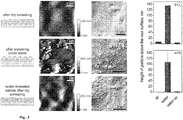
- Fig. 2 shows switching of the switchable element comprising unmodified silica particles as colloidal particles, wax as a first material and silicon wafer as a substrate.
- Three panels show changing the degree of immersion of unmodified silica particles in wax: after annealing on air (upper panel), annealing in water (middle panel) and annealing on air of the sample preliminary annealed in water (lower panel).
- Corresponding AFM (second from left) and SEM (third from left) images show the surface of the switchable element.
- Fig. 3 shows differences in hydrophobisity / hydrophilicity of modified and unmodified with APS silica particles upon treating said particles with one external stimulus such as temperature and with two external stimulus such as temperature and water (ambient medium).
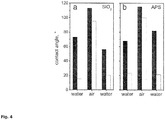
- Fig. 4 shows reversible switching of the switchable elements comprising wax-silica particle (a) and wax-APS particle (b) on silicon wafer as a substrate.
- Fig. 5 shows hydrophilic/hydrophobic patterning of APS-particle/wax surface using heated needle.
- APS-particle/wax surface was switched to hydrophilic state by annealing in aqueous environment. Applying heated needle locally switches the surface into hydrophobic state.
- Water colored with rhodamine) selectively wets the hydrophilic areas and is unable to wet the areas where the need was applied.
- Example 1 Preparation of modified silica particles:
- silica particles were washed three times in dichloromethane followed by drying in vacuum oven at 110°C.
- 3-aminopropyltriethoxysilane (APS) was chemisorbed from a 2wt.-% ethanol solution for 24 hours. To remove nonadsorbed APS, the particles were rinsed and centrifuged five times in ethanol.
- 0.2 g of unmodified (native) or 3-aminopropyltriethoxysilane (APS)-modified 200 nm silica particles was dispersed homogeneously in 1 g of paraffin wax at 75°C and then mixed with 10 g of Millipore water.
- the emulsions were produced using magnetic stirring at 1600 rpm for 1 hour and then were cooled to room temperature (25°C), at which paraffin wax is solid.
- Deionized water was used to wash the wax emulsions multiple times to remove particles in the aqueous solution as well as weakly attached particles.
- the formed film was then brought in contact with a silicon wafer.
- the coated substrate was heated up to a temperature of 60°C to melt the paraffin wax and to allow the silica particles to migrate through the paraffin wax to the surface of the switchable element.
- Silicon wafers coated with the layer comprising paraffin wax / silica particles were prepared according to Example 2. One part of said coated silica wafers was positioned horizontally and another part was positioned vertically. Both parts were heated up to a melting point of the paraffin wax (57-59°C). Degree of immersion of the silica particles in the paraffin wax has been studied using Atomic Force Microscopy (AFM).
- AFM Atomic Force Microscopy
- a switchable element was prepared according to Example 2. Treating with a temperature of 57-59°C was done in aqueous (under water) and dry (in air) environments. It has been found (see Fig. 2 ) that both unmodified and APS-modified silica particles were almost completely immersed into wax at the wax-air interface. On the other hand, particles were found to be only slightly immersed in wax at the water-wax interface.
- H degree of immersion
- Hexadecane contact angles in aqueous environment were calculated as difference of 180° and water contact angle on wafer immersed in hexadecane.
- Table 2 Experimentally obtained and estimated degree of immersion of unmodified and APS-modified silica particles in wax depending on the environment. particles annealing conditions degree of particle immersion in wax, % experimental estimated using contact angles from Table 1 unmodified air 95 100 water 35 5 APS-modified air 100 100 water 45 23
- the switchable element was prepared according to Example 2. Wetting properties said switchable element comprising composite wax-particle surface have been investigated in theoretical and experimental way as shown below.
- the wetting properties of wax-particle surface are determined by several parameters: hydrophobicity and surface roughness provided by the particles as well as hydrophobicity of the wax. Although there are many models, which may be used to simulate wetting behavior of wax surfaces with particles, we applied the Cassie-Baxter equation (1).
- the wax surface becomes slightly more hydrophilic after annealing in aqueous environment which is seen from the expresses in decrease of the receding contact angle ( Fig. 3d ).
- the advancing water contact angles on the wax surfaces annealed in dry and aqueous environments are nearly the same. Therefore, it can be concluded that the difference in wetting properties of wax-particle surface annealed at different conditions originates from the different degrees of immersion of particles into wax surface.
- the switchable element was prepared according to Example 2.
- the reversible switching of the switchable element is shown in Fig. 4 .
- the hydrophilic wax-particle film which was preliminary annealed in water, was used for the switching experiments. This film was melted in a dry state. It was found that the particle-wax films switch into hydrophobic state after annealing in air. The second annealing in water switches the layer back into the hydrophilic state.
- the wax-particle layer demonstrates fully reversible switching of wetting properties after annealing in dry and aqueous environment.
- Example 7 APS-particle/wax patterned surface
- the switchable element which was preliminary switched to hydrophilic state by annealing in water (prepared according to Example 2) was used to study the applicability of the developed stimuli-responsive surfaces for hydrophilic-hydrophobic patterning.
- a hot needle was locally applied to the surface of the switchable element.
- a locally applied hot needle switches the particle-wax surface to hydrophobic state.
- water readily wets areas where no needle was applied (hydrophilic areas) while water does not wet the areas where the needle was applied (hydrophobic area). In this way it was possible to produce a patterned structure on the surface of the switchable element.
Landscapes
- Engineering & Computer Science (AREA)
- Microelectronics & Electronic Packaging (AREA)
- Health & Medical Sciences (AREA)
- Life Sciences & Earth Sciences (AREA)
- General Health & Medical Sciences (AREA)
- Molecular Biology (AREA)
- Manufacturing & Machinery (AREA)
- Computer Hardware Design (AREA)
- Paints Or Removers (AREA)
- Application Of Or Painting With Fluid Materials (AREA)
Claims (13)
- Schaltbares Element, umfassend ein Substrat, das mit einem ersten Material und kolloidalen Teilchen, die mindestens teilweise in das erste Material eintauchen, bedeckt ist,
wobei das erste Material in einem fluiden Zustand ermöglicht, dass die kolloidalen Teilchen mindestens teilweise in das erste Material eintauchen, und wobei die kolloidalen Teilchen auf einen externen Stimulus, der ihr Ausmaß von Eintauchen in das erste Material verändert, ansprechen, und wobei bei einer Temperatur unter dem Schmelzpunkt des ersten Materials die kolloidalen Teilchen in ihrem Ausmaß von Eintauchen fixiert sind,
wobei das erste Material aus der Gruppe, bestehend aus Polybutylvinylether, Poly-cischlorbutadien, Polyethylenadipat, Polyethylenoxid, Poly-cis-isopren, Poly-transisopren, Propylenoxid, Polyvinylacetal oder Polyvinylbutyral, Polyethylen oder Zusammensetzungen oder Gemischen davon, und aus natürlichem Wachs und synthetischem Wachs, bevorzugt Paraffinen, Siliciumwachsen, Polyetherwachsen und Polyesterwachsen, oder Zusammensetzungen oder Gemischen davon, ausgewählt ist, und wobei die kolloidalen Teilchen einen Durchmesser zwischen 20 nm und 500 nm aufweisen. - Schaltbares Element gemäß Anspruch 1, wobei die Schmelztemperatur des ersten Materials 25 bis 150°C, bevorzugt 30 bis 85°C beträgt.
- Schaltbares Element gemäß einem der Ansprüche 1 bis 2, wobei das Ausmaß von Eintauchen der kolloidalen Teilchen in einem ersten Bereich auf der Oberfläche des schaltbaren Elements unterschiedlich ist vom Ausmaß von Eintauchen in einem zweiten Bereich auf der Oberfläche des schaltbaren Elements.
- Schaltbares Element gemäß Anspruch 3, wobei erster Bereich und zweite Bereiche in einem Muster an der Oberfläche des schaltbaren Elements angeordnet sind.
- Schaltbares Element gemäß einem der Ansprüche 1 bis 4, wobei die kolloidalen Teilchen anorganische oder organische Teilchen sind,
wobei die anorganischen Teilchen bevorzugt aus der Gruppe, bestehend aus Metallen, Metalloxiden, Metallhydroxiden, Halbleitermaterialien, nicht-leitenden Materialien und Siliciumdioxid, bevorzugt FeO, Fe2O3 und SiO2, oder Zusammensetzungen oder Gemischen davon, ausgewählt sind; und
wobei die organischen Teilchen bevorzugt Polymer- oder (Co)polymerteilchen sind, welche bevorzugt aus der Gruppe von thermoplastischen Materialien ausgewählt sind, umfassend Polystyren, Polyolefine, insbesondere Polyethylen oder Polypropylen; Polyacrylate, Polymethacrylate; Polyimide, Polycarbonate, Polyethersulfone, Polyamide, Polyester; und Polyvinylchloride; Styren-Butadien-Kautschuk (SBR); Styren-Ethylen-Butadien-Styren-Copolymere (SEBS); Butylkautschuk; Ethylen-Propylen-Kautschuk (EPR); Ethylen-Propylen-Dien-Monomer-Kautschuk (EPDM); Ethylen-Vinylacetat-Copolymer (EVA); Ethylenacrylat oder Butadienacrylnitril; Maleinsäureanhydrid-modifizierte Polymere und Copolymere; und Pfropfcopolymere; oder Zusammensetzungen oder Gemische davon. - Schaltbares Element gemäß einem der Ansprüche 1 bis 5, wobei die kolloidalen Teilchen modifizierte Teilchen sind, und wobei die modifizierten Teilchen bevorzugt durch mindestens ein organisches Molekül, bevorzugt durch ein Silanderivat, bevorzugt durch 3-Aminopropyltriethoxysilan, funktionalisiert sind.
- Verfahren zur Herstellung eines schaltbaren Elements wie in einem der Ansprüche 1 bis 6 definiert, umfassend die Schritte von:(a) Bereitstellen von kolloidalen Teilchen, einem ersten Material und einem zweiten Material;(b) Bilden einer Emulsion, umfassend die kolloidalen Teilchen, das erste Material und das zweite Material von Schritt (a);(c) Bilden von erstes Material-Teilchen, umfassend kolloidale Teilchen, von der Emulsion;(d) Aufbringen der erstes Material-Teilchen, umfassend kolloidale Teilchen, auf die Oberfläche eines Substrats;(e) Schmelzen der erstes Material-Teilchen, umfassend kolloidale Teilchen, auf der Oberfläche des Substrats,wobei das zweite Material jedwedes Material, das im Wesentlichen mit dem ersten Material nicht mischbar ist, ist,
und wobei nach dem Schmelzen der erstes Material-Teilchen, umfassend kolloidale Teilchen, in Schritt e) das erste Material verfestigt wird, um die Teilchen in oder auf dem ersten Material zu fixieren. - Verfahren gemäß Anspruch 7, wobei das zweite Material aus der Gruppe, bestehend aus Wasser, organischen Lösungsmitteln, organischen Lösungen und anorganischen Lösungen, bevorzugt aus Wasser, ausgewählt ist.
- Verfahren zum Herstellen eines schaltbaren Elements wie in einem der Ansprüche 1 bis 6 definiert oder hergestellt gemäß einem der Ansprüche 7 und 8, wobei auf einer Oberfläche davon ein Muster von mindestens einem ersten Bereich, in dem die kolloidalen Teilchen ein erstes Ausmaß von Eintauchen aufweisen, und mindestens einem zweiten Bereich, in dem die kolloidalen Teilchen ein zweites Ausmaß von Eintauchen aufweisen, das unterschiedlich von dem ersten Ausmaß von Eintauchen ist, vorhanden ist, wobei das Verfahren umfasst:(a) Bereitstellen eines schaltbaren Elements wie in einem der Ansprüche 1 bis 6 definiert oder hergestellt gemäß einem der Ansprüche 6 und 8;(b) Behandeln des ersten Bereichs bzw. der ersten Bereiche, aber nicht des zweiten Bereichs bzw. der zweiten Bereiche, oder des zweiten Bereichs bzw. der zweiten Bereiche, aber nicht des ersten Bereichs bzw. der ersten Bereiche mit mindestens einem externen Stimulus, um das Ausmaß von Eintauchen der kolloidalen Teilchen in dem behandelten Bereich bzw. den behandelten Bereichen zu verändern und um das Muster auf der Oberfläche des schaltbaren Elements zu erzeugen.
- Verfahren von physikalischem Schalten des schaltbaren Elements wie in einem der Ansprüche 1 bis 6 definiert oder hergestellt gemäß einem der Ansprüche 7 bis 9, umfassend die Schritte von:(a) Bereitstellen des schaltbaren Elements;(b) Aufbringen von mindestens einem externen Stimulus auf das schaltbare Element; wobei das schaltbare Element auf den mindestens einen externen Stimulus durch Verändern des Ausmaßes von Eintauchen der kolloidalen Teilchen in das erste Material anspricht.
- Verfahren gemäß Anspruch 9 oder 10, wobei der externe Stimulus aus der Gruppe, bestehend aus Temperatur, Strahlung, bevorzugt UV- oder IR-Strahlung, Feuchtigkeit und Gegenwart oder Abwesenheit von Wasser in dem ambienten Medium, welches das schaltbare Element umgibt, ausgewählt ist.
- Verwendung eines schaltbaren Elements gemäß einem der Ansprüche 1 bis 6 oder hergestellt gemäß einem der Ansprüche 7 bis 9 in optoelektronischen, Sensor- oder biotechnologischen Anwendungen.
- Verwendung eines schaltbaren Elements gemäß Anspruch 12 für das Design von mikrofluiden Vorrichtungen, funktionellen Beschichtungen, Logik-Vorrichtungen oder eines Musters.
Priority Applications (1)
| Application Number | Priority Date | Filing Date | Title |
|---|---|---|---|
| EP11730333.9A EP2590889B1 (de) | 2010-07-09 | 2011-07-11 | Umschaltbare oberflächen auf basis frei fliessender kolloidteilchen |
Applications Claiming Priority (3)
| Application Number | Priority Date | Filing Date | Title |
|---|---|---|---|
| EP10169077A EP2404866A1 (de) | 2010-07-09 | 2010-07-09 | Umschaltbare Oberflächen auf Basis frei fließender Kolloidteilchen |
| EP11730333.9A EP2590889B1 (de) | 2010-07-09 | 2011-07-11 | Umschaltbare oberflächen auf basis frei fliessender kolloidteilchen |
| PCT/EP2011/061778 WO2012004415A1 (en) | 2010-07-09 | 2011-07-11 | Switchable surfaces based on freely floating colloidal particles |
Publications (2)
| Publication Number | Publication Date |
|---|---|
| EP2590889A1 EP2590889A1 (de) | 2013-05-15 |
| EP2590889B1 true EP2590889B1 (de) | 2017-12-20 |
Family
ID=43393731
Family Applications (2)
| Application Number | Title | Priority Date | Filing Date |
|---|---|---|---|
| EP10169077A Withdrawn EP2404866A1 (de) | 2010-07-09 | 2010-07-09 | Umschaltbare Oberflächen auf Basis frei fließender Kolloidteilchen |
| EP11730333.9A Not-in-force EP2590889B1 (de) | 2010-07-09 | 2011-07-11 | Umschaltbare oberflächen auf basis frei fliessender kolloidteilchen |
Family Applications Before (1)
| Application Number | Title | Priority Date | Filing Date |
|---|---|---|---|
| EP10169077A Withdrawn EP2404866A1 (de) | 2010-07-09 | 2010-07-09 | Umschaltbare Oberflächen auf Basis frei fließender Kolloidteilchen |
Country Status (2)
| Country | Link |
|---|---|
| EP (2) | EP2404866A1 (de) |
| WO (1) | WO2012004415A1 (de) |
Families Citing this family (1)
| Publication number | Priority date | Publication date | Assignee | Title |
|---|---|---|---|---|
| DE102013210997B4 (de) * | 2013-06-13 | 2022-09-08 | BSH Hausgeräte GmbH | Haushaltsgerät mit mindestens teilweise mit einer Polymermischung beschichteter innerer Oberfläche sowie Verfahren zu seinem Betrieb |
Family Cites Families (6)
| Publication number | Priority date | Publication date | Assignee | Title |
|---|---|---|---|---|
| US7020335B1 (en) | 2000-11-21 | 2006-03-28 | General Dynamics Decision Systems, Inc. | Methods and apparatus for object recognition and compression |
| US7117807B2 (en) * | 2004-02-17 | 2006-10-10 | University Of Florida Research Foundation, Inc. | Dynamically modifiable polymer coatings and devices |
| EP1760527B1 (de) * | 2005-09-05 | 2012-06-06 | DWI an der RWTH Aachen e.V. | Photochemische Methode für die Produktion von oberflächenverzierten Substraten im Nanometerbereich |
| EP1984465B1 (de) | 2006-02-14 | 2012-01-25 | The Procter & Gamble Company | Reaktionsfähige beschichtete substrate |
| WO2007095106A1 (en) | 2006-02-14 | 2007-08-23 | The Procter & Gamble Company | Responsive coated particles |
| US7430073B2 (en) * | 2006-05-19 | 2008-09-30 | Xerox Corporation | Electrophoretic display device and method of displaying image |
-
2010
- 2010-07-09 EP EP10169077A patent/EP2404866A1/de not_active Withdrawn
-
2011
- 2011-07-11 WO PCT/EP2011/061778 patent/WO2012004415A1/en not_active Ceased
- 2011-07-11 EP EP11730333.9A patent/EP2590889B1/de not_active Not-in-force
Also Published As
| Publication number | Publication date |
|---|---|
| EP2590889A1 (de) | 2013-05-15 |
| EP2404866A1 (de) | 2012-01-11 |
| WO2012004415A1 (en) | 2012-01-12 |
Similar Documents
| Publication | Publication Date | Title |
|---|---|---|
| Jambhulkar et al. | Nanoparticle assembly: From self‐organization to controlled micropatterning for enhanced functionalities | |
| Santhanam et al. | Self-assembly of uniform monolayer arrays of nanoparticles | |
| Xu et al. | A review on colloidal self-assembly and their applications | |
| Maenosono et al. | Overview of nanoparticle array formation by wet coating | |
| Vakarelski et al. | Assembly of gold nanoparticles into microwire networks induced by drying liquid bridges | |
| Gentili et al. | Applications of dewetting in micro and nanotechnology | |
| Salamanca et al. | Lateral drying in thick films of waterborne colloidal particles | |
| EP2483919B1 (de) | Verfahren zur Herstellung nanoskaliger Verbindungen | |
| US7520933B2 (en) | Method for manufacturing colloidal crystals via confined convective assembly | |
| Li et al. | Precise droplet manipulation based on surface heterogeneity | |
| Chang et al. | Ultra-fast responsive colloidal–polymer composite-based volatile organic compounds (VOC) sensor using nanoscale easy tear process | |
| Huwiler et al. | Functionalizable nanomorphology gradients via colloidal self-assembly | |
| Van Geite et al. | Vacuum-driven assembly of electrostatically levitated microspheres on perforated surfaces | |
| Kalkman et al. | Bisecting microfluidic channels with metallic nanowires fabricated by nanoskiving | |
| Parsa et al. | Effect of substrate temperature on pattern formation of bidispersed particles from volatile drops | |
| Velegol | Assembling colloidal devices by controlling interparticle forces | |
| Thokchom et al. | Dynamical clustering and band formation of particles in a marangoni vortexing droplet | |
| EP2404866A1 (de) | Umschaltbare Oberflächen auf Basis frei fließender Kolloidteilchen | |
| WO2013023110A2 (en) | Uniform coatings produced by suspensions of anisotropic particles | |
| Wang et al. | Large-area self assembled monolayers of silica microspheres formed by dip coating | |
| Wang et al. | Micropatterning of polystyrene nanoparticles and its bioapplications | |
| Alazzam et al. | Transparent, patterned graphene oxide films with tunable electrical conductivity using thermal, chemical, and photoreduction techniques for lab-on-a-chip applications | |
| Zhu et al. | Evaporation of water droplets on “lock-and-key” structures with nanoscale features | |
| KR100683942B1 (ko) | 미세 공간 대류 조립 방법을 이용한 콜로이드 결정의제조방법 | |
| Puretskiy | Design of self-repairable superhydrophobic and switchable surfaces using colloidal particles |
Legal Events
| Date | Code | Title | Description |
|---|---|---|---|
| PUAI | Public reference made under article 153(3) epc to a published international application that has entered the european phase |
Free format text: ORIGINAL CODE: 0009012 |
|
| 17P | Request for examination filed |
Effective date: 20121228 |
|
| AK | Designated contracting states |
Kind code of ref document: A1 Designated state(s): AL AT BE BG CH CY CZ DE DK EE ES FI FR GB GR HR HU IE IS IT LI LT LU LV MC MK MT NL NO PL PT RO RS SE SI SK SM TR |
|
| RIN1 | Information on inventor provided before grant (corrected) |
Inventor name: STAMM, MANFRED Inventor name: STOYCHEV, GEORGY Inventor name: PURETSKIY, NIKOLAY Inventor name: IONOV, LEONID |
|
| DAX | Request for extension of the european patent (deleted) | ||
| 17Q | First examination report despatched |
Effective date: 20170313 |
|
| GRAP | Despatch of communication of intention to grant a patent |
Free format text: ORIGINAL CODE: EPIDOSNIGR1 |
|
| RIC1 | Information provided on ipc code assigned before grant |
Ipc: B81C 1/00 20060101ALI20170614BHEP Ipc: B05D 5/00 20060101ALI20170614BHEP Ipc: B81B 3/00 20060101ALI20170614BHEP Ipc: B81B 1/00 20060101AFI20170614BHEP Ipc: B05D 5/08 20060101ALN20170614BHEP Ipc: B05D 5/04 20060101ALN20170614BHEP |
|
| INTG | Intention to grant announced |
Effective date: 20170718 |
|
| RIN1 | Information on inventor provided before grant (corrected) |
Inventor name: STAMM, MANFRED Inventor name: PURETSKIY, NIKOLAY Inventor name: STOYCHEV, GEORGY Inventor name: IONOV, LEONID |
|
| GRAS | Grant fee paid |
Free format text: ORIGINAL CODE: EPIDOSNIGR3 |
|
| GRAA | (expected) grant |
Free format text: ORIGINAL CODE: 0009210 |
|
| AK | Designated contracting states |
Kind code of ref document: B1 Designated state(s): AL AT BE BG CH CY CZ DE DK EE ES FI FR GB GR HR HU IE IS IT LI LT LU LV MC MK MT NL NO PL PT RO RS SE SI SK SM TR |
|
| REG | Reference to a national code |
Ref country code: GB Ref legal event code: FG4D |
|
| REG | Reference to a national code |
Ref country code: CH Ref legal event code: EP |
|
| REG | Reference to a national code |
Ref country code: IE Ref legal event code: FG4D |
|
| REG | Reference to a national code |
Ref country code: AT Ref legal event code: REF Ref document number: 956180 Country of ref document: AT Kind code of ref document: T Effective date: 20180115 |
|
| REG | Reference to a national code |
Ref country code: DE Ref legal event code: R096 Ref document number: 602011044343 Country of ref document: DE |
|
| REG | Reference to a national code |
Ref country code: NL Ref legal event code: FP |
|
| PG25 | Lapsed in a contracting state [announced via postgrant information from national office to epo] |
Ref country code: FI Free format text: LAPSE BECAUSE OF FAILURE TO SUBMIT A TRANSLATION OF THE DESCRIPTION OR TO PAY THE FEE WITHIN THE PRESCRIBED TIME-LIMIT Effective date: 20171220 Ref country code: LT Free format text: LAPSE BECAUSE OF FAILURE TO SUBMIT A TRANSLATION OF THE DESCRIPTION OR TO PAY THE FEE WITHIN THE PRESCRIBED TIME-LIMIT Effective date: 20171220 Ref country code: SE Free format text: LAPSE BECAUSE OF FAILURE TO SUBMIT A TRANSLATION OF THE DESCRIPTION OR TO PAY THE FEE WITHIN THE PRESCRIBED TIME-LIMIT Effective date: 20171220 Ref country code: NO Free format text: LAPSE BECAUSE OF FAILURE TO SUBMIT A TRANSLATION OF THE DESCRIPTION OR TO PAY THE FEE WITHIN THE PRESCRIBED TIME-LIMIT Effective date: 20180320 |
|
| REG | Reference to a national code |
Ref country code: LT Ref legal event code: MG4D |
|
| REG | Reference to a national code |
Ref country code: AT Ref legal event code: MK05 Ref document number: 956180 Country of ref document: AT Kind code of ref document: T Effective date: 20171220 |
|
| PG25 | Lapsed in a contracting state [announced via postgrant information from national office to epo] |
Ref country code: HR Free format text: LAPSE BECAUSE OF FAILURE TO SUBMIT A TRANSLATION OF THE DESCRIPTION OR TO PAY THE FEE WITHIN THE PRESCRIBED TIME-LIMIT Effective date: 20171220 Ref country code: RS Free format text: LAPSE BECAUSE OF FAILURE TO SUBMIT A TRANSLATION OF THE DESCRIPTION OR TO PAY THE FEE WITHIN THE PRESCRIBED TIME-LIMIT Effective date: 20171220 Ref country code: BG Free format text: LAPSE BECAUSE OF FAILURE TO SUBMIT A TRANSLATION OF THE DESCRIPTION OR TO PAY THE FEE WITHIN THE PRESCRIBED TIME-LIMIT Effective date: 20180320 Ref country code: GR Free format text: LAPSE BECAUSE OF FAILURE TO SUBMIT A TRANSLATION OF THE DESCRIPTION OR TO PAY THE FEE WITHIN THE PRESCRIBED TIME-LIMIT Effective date: 20180321 Ref country code: LV Free format text: LAPSE BECAUSE OF FAILURE TO SUBMIT A TRANSLATION OF THE DESCRIPTION OR TO PAY THE FEE WITHIN THE PRESCRIBED TIME-LIMIT Effective date: 20171220 |
|
| REG | Reference to a national code |
Ref country code: FR Ref legal event code: PLFP Year of fee payment: 8 |
|
| PG25 | Lapsed in a contracting state [announced via postgrant information from national office to epo] |
Ref country code: EE Free format text: LAPSE BECAUSE OF FAILURE TO SUBMIT A TRANSLATION OF THE DESCRIPTION OR TO PAY THE FEE WITHIN THE PRESCRIBED TIME-LIMIT Effective date: 20171220 Ref country code: CY Free format text: LAPSE BECAUSE OF FAILURE TO SUBMIT A TRANSLATION OF THE DESCRIPTION OR TO PAY THE FEE WITHIN THE PRESCRIBED TIME-LIMIT Effective date: 20171220 Ref country code: SK Free format text: LAPSE BECAUSE OF FAILURE TO SUBMIT A TRANSLATION OF THE DESCRIPTION OR TO PAY THE FEE WITHIN THE PRESCRIBED TIME-LIMIT Effective date: 20171220 Ref country code: CZ Free format text: LAPSE BECAUSE OF FAILURE TO SUBMIT A TRANSLATION OF THE DESCRIPTION OR TO PAY THE FEE WITHIN THE PRESCRIBED TIME-LIMIT Effective date: 20171220 Ref country code: ES Free format text: LAPSE BECAUSE OF FAILURE TO SUBMIT A TRANSLATION OF THE DESCRIPTION OR TO PAY THE FEE WITHIN THE PRESCRIBED TIME-LIMIT Effective date: 20171220 |
|
| REG | Reference to a national code |
Ref country code: DE Ref legal event code: R082 Ref document number: 602011044343 Country of ref document: DE Representative=s name: HOEFER & PARTNER PATENTANWAELTE MBB, DE |
|
| PG25 | Lapsed in a contracting state [announced via postgrant information from national office to epo] |
Ref country code: PL Free format text: LAPSE BECAUSE OF FAILURE TO SUBMIT A TRANSLATION OF THE DESCRIPTION OR TO PAY THE FEE WITHIN THE PRESCRIBED TIME-LIMIT Effective date: 20171220 Ref country code: SM Free format text: LAPSE BECAUSE OF FAILURE TO SUBMIT A TRANSLATION OF THE DESCRIPTION OR TO PAY THE FEE WITHIN THE PRESCRIBED TIME-LIMIT Effective date: 20171220 Ref country code: AT Free format text: LAPSE BECAUSE OF FAILURE TO SUBMIT A TRANSLATION OF THE DESCRIPTION OR TO PAY THE FEE WITHIN THE PRESCRIBED TIME-LIMIT Effective date: 20171220 Ref country code: IT Free format text: LAPSE BECAUSE OF FAILURE TO SUBMIT A TRANSLATION OF THE DESCRIPTION OR TO PAY THE FEE WITHIN THE PRESCRIBED TIME-LIMIT Effective date: 20171220 Ref country code: IS Free format text: LAPSE BECAUSE OF FAILURE TO SUBMIT A TRANSLATION OF THE DESCRIPTION OR TO PAY THE FEE WITHIN THE PRESCRIBED TIME-LIMIT Effective date: 20180420 Ref country code: RO Free format text: LAPSE BECAUSE OF FAILURE TO SUBMIT A TRANSLATION OF THE DESCRIPTION OR TO PAY THE FEE WITHIN THE PRESCRIBED TIME-LIMIT Effective date: 20171220 |
|
| REG | Reference to a national code |
Ref country code: DE Ref legal event code: R097 Ref document number: 602011044343 Country of ref document: DE |
|
| PLBE | No opposition filed within time limit |
Free format text: ORIGINAL CODE: 0009261 |
|
| STAA | Information on the status of an ep patent application or granted ep patent |
Free format text: STATUS: NO OPPOSITION FILED WITHIN TIME LIMIT |
|
| 26N | No opposition filed |
Effective date: 20180921 |
|
| PG25 | Lapsed in a contracting state [announced via postgrant information from national office to epo] |
Ref country code: DK Free format text: LAPSE BECAUSE OF FAILURE TO SUBMIT A TRANSLATION OF THE DESCRIPTION OR TO PAY THE FEE WITHIN THE PRESCRIBED TIME-LIMIT Effective date: 20171220 |
|
| PG25 | Lapsed in a contracting state [announced via postgrant information from national office to epo] |
Ref country code: SI Free format text: LAPSE BECAUSE OF FAILURE TO SUBMIT A TRANSLATION OF THE DESCRIPTION OR TO PAY THE FEE WITHIN THE PRESCRIBED TIME-LIMIT Effective date: 20171220 |
|
| REG | Reference to a national code |
Ref country code: CH Ref legal event code: PL |
|
| PG25 | Lapsed in a contracting state [announced via postgrant information from national office to epo] |
Ref country code: MC Free format text: LAPSE BECAUSE OF FAILURE TO SUBMIT A TRANSLATION OF THE DESCRIPTION OR TO PAY THE FEE WITHIN THE PRESCRIBED TIME-LIMIT Effective date: 20171220 Ref country code: LU Free format text: LAPSE BECAUSE OF NON-PAYMENT OF DUE FEES Effective date: 20180711 |
|
| REG | Reference to a national code |
Ref country code: IE Ref legal event code: MM4A |
|
| PG25 | Lapsed in a contracting state [announced via postgrant information from national office to epo] |
Ref country code: LI Free format text: LAPSE BECAUSE OF NON-PAYMENT OF DUE FEES Effective date: 20180731 Ref country code: IE Free format text: LAPSE BECAUSE OF NON-PAYMENT OF DUE FEES Effective date: 20180711 Ref country code: CH Free format text: LAPSE BECAUSE OF NON-PAYMENT OF DUE FEES Effective date: 20180731 |
|
| PGFP | Annual fee paid to national office [announced via postgrant information from national office to epo] |
Ref country code: NL Payment date: 20190722 Year of fee payment: 9 |
|
| PGFP | Annual fee paid to national office [announced via postgrant information from national office to epo] |
Ref country code: DE Payment date: 20190730 Year of fee payment: 9 Ref country code: FR Payment date: 20190724 Year of fee payment: 9 |
|
| PGFP | Annual fee paid to national office [announced via postgrant information from national office to epo] |
Ref country code: BE Payment date: 20190722 Year of fee payment: 9 |
|
| PGFP | Annual fee paid to national office [announced via postgrant information from national office to epo] |
Ref country code: GB Payment date: 20190725 Year of fee payment: 9 |
|
| PG25 | Lapsed in a contracting state [announced via postgrant information from national office to epo] |
Ref country code: MT Free format text: LAPSE BECAUSE OF NON-PAYMENT OF DUE FEES Effective date: 20180711 |
|
| PG25 | Lapsed in a contracting state [announced via postgrant information from national office to epo] |
Ref country code: TR Free format text: LAPSE BECAUSE OF FAILURE TO SUBMIT A TRANSLATION OF THE DESCRIPTION OR TO PAY THE FEE WITHIN THE PRESCRIBED TIME-LIMIT Effective date: 20171220 |
|
| PG25 | Lapsed in a contracting state [announced via postgrant information from national office to epo] |
Ref country code: PT Free format text: LAPSE BECAUSE OF FAILURE TO SUBMIT A TRANSLATION OF THE DESCRIPTION OR TO PAY THE FEE WITHIN THE PRESCRIBED TIME-LIMIT Effective date: 20171220 Ref country code: HU Free format text: LAPSE BECAUSE OF FAILURE TO SUBMIT A TRANSLATION OF THE DESCRIPTION OR TO PAY THE FEE WITHIN THE PRESCRIBED TIME-LIMIT; INVALID AB INITIO Effective date: 20110711 |
|
| PG25 | Lapsed in a contracting state [announced via postgrant information from national office to epo] |
Ref country code: MK Free format text: LAPSE BECAUSE OF NON-PAYMENT OF DUE FEES Effective date: 20171220 |
|
| PG25 | Lapsed in a contracting state [announced via postgrant information from national office to epo] |
Ref country code: AL Free format text: LAPSE BECAUSE OF FAILURE TO SUBMIT A TRANSLATION OF THE DESCRIPTION OR TO PAY THE FEE WITHIN THE PRESCRIBED TIME-LIMIT Effective date: 20171220 |
|
| REG | Reference to a national code |
Ref country code: DE Ref legal event code: R119 Ref document number: 602011044343 Country of ref document: DE |
|
| REG | Reference to a national code |
Ref country code: NL Ref legal event code: MM Effective date: 20200801 |
|
| GBPC | Gb: european patent ceased through non-payment of renewal fee |
Effective date: 20200711 |
|
| REG | Reference to a national code |
Ref country code: BE Ref legal event code: MM Effective date: 20200731 |
|
| PG25 | Lapsed in a contracting state [announced via postgrant information from national office to epo] |
Ref country code: NL Free format text: LAPSE BECAUSE OF NON-PAYMENT OF DUE FEES Effective date: 20200801 Ref country code: FR Free format text: LAPSE BECAUSE OF NON-PAYMENT OF DUE FEES Effective date: 20200731 Ref country code: GB Free format text: LAPSE BECAUSE OF NON-PAYMENT OF DUE FEES Effective date: 20200711 |
|
| PG25 | Lapsed in a contracting state [announced via postgrant information from national office to epo] |
Ref country code: BE Free format text: LAPSE BECAUSE OF NON-PAYMENT OF DUE FEES Effective date: 20200731 Ref country code: DE Free format text: LAPSE BECAUSE OF NON-PAYMENT OF DUE FEES Effective date: 20210202 |