EP2589954B1 - Articles detection device and detection method thereof - Google Patents
Articles detection device and detection method thereof Download PDFInfo
- Publication number
- EP2589954B1 EP2589954B1 EP10854001.4A EP10854001A EP2589954B1 EP 2589954 B1 EP2589954 B1 EP 2589954B1 EP 10854001 A EP10854001 A EP 10854001A EP 2589954 B1 EP2589954 B1 EP 2589954B1
- Authority
- EP
- European Patent Office
- Prior art keywords
- article
- scattering
- detector
- photons
- sub
- Prior art date
- Legal status (The legal status is an assumption and is not a legal conclusion. Google has not performed a legal analysis and makes no representation as to the accuracy of the status listed.)
- Active
Links
Images

Classifications
-
- G—PHYSICS
- G01—MEASURING; TESTING
- G01V—GEOPHYSICS; GRAVITATIONAL MEASUREMENTS; DETECTING MASSES OR OBJECTS; TAGS
- G01V5/00—Prospecting or detecting by the use of ionising radiation, e.g. of natural or induced radioactivity
- G01V5/20—Detecting prohibited goods, e.g. weapons, explosives, hazardous substances, contraband or smuggled objects
- G01V5/22—Active interrogation, i.e. by irradiating objects or goods using external radiation sources, e.g. using gamma rays or cosmic rays
-
- G—PHYSICS
- G01—MEASURING; TESTING
- G01N—INVESTIGATING OR ANALYSING MATERIALS BY DETERMINING THEIR CHEMICAL OR PHYSICAL PROPERTIES
- G01N23/00—Investigating or analysing materials by the use of wave or particle radiation, e.g. X-rays or neutrons, not covered by groups G01N3/00 – G01N17/00, G01N21/00 or G01N22/00
- G01N23/02—Investigating or analysing materials by the use of wave or particle radiation, e.g. X-rays or neutrons, not covered by groups G01N3/00 – G01N17/00, G01N21/00 or G01N22/00 by transmitting the radiation through the material
- G01N23/04—Investigating or analysing materials by the use of wave or particle radiation, e.g. X-rays or neutrons, not covered by groups G01N3/00 – G01N17/00, G01N21/00 or G01N22/00 by transmitting the radiation through the material and forming images of the material
- G01N23/046—Investigating or analysing materials by the use of wave or particle radiation, e.g. X-rays or neutrons, not covered by groups G01N3/00 – G01N17/00, G01N21/00 or G01N22/00 by transmitting the radiation through the material and forming images of the material using tomography, e.g. computed tomography [CT]
-
- G—PHYSICS
- G01—MEASURING; TESTING
- G01N—INVESTIGATING OR ANALYSING MATERIALS BY DETERMINING THEIR CHEMICAL OR PHYSICAL PROPERTIES
- G01N23/00—Investigating or analysing materials by the use of wave or particle radiation, e.g. X-rays or neutrons, not covered by groups G01N3/00 – G01N17/00, G01N21/00 or G01N22/00
- G01N23/02—Investigating or analysing materials by the use of wave or particle radiation, e.g. X-rays or neutrons, not covered by groups G01N3/00 – G01N17/00, G01N21/00 or G01N22/00 by transmitting the radiation through the material
- G01N23/04—Investigating or analysing materials by the use of wave or particle radiation, e.g. X-rays or neutrons, not covered by groups G01N3/00 – G01N17/00, G01N21/00 or G01N22/00 by transmitting the radiation through the material and forming images of the material
- G01N23/05—Investigating or analysing materials by the use of wave or particle radiation, e.g. X-rays or neutrons, not covered by groups G01N3/00 – G01N17/00, G01N21/00 or G01N22/00 by transmitting the radiation through the material and forming images of the material using neutrons
-
- G—PHYSICS
- G01—MEASURING; TESTING
- G01V—GEOPHYSICS; GRAVITATIONAL MEASUREMENTS; DETECTING MASSES OR OBJECTS; TAGS
- G01V5/00—Prospecting or detecting by the use of ionising radiation, e.g. of natural or induced radioactivity
- G01V5/20—Detecting prohibited goods, e.g. weapons, explosives, hazardous substances, contraband or smuggled objects
- G01V5/22—Active interrogation, i.e. by irradiating objects or goods using external radiation sources, e.g. using gamma rays or cosmic rays
- G01V5/222—Active interrogation, i.e. by irradiating objects or goods using external radiation sources, e.g. using gamma rays or cosmic rays measuring scattered radiation
-
- G—PHYSICS
- G01—MEASURING; TESTING
- G01N—INVESTIGATING OR ANALYSING MATERIALS BY DETERMINING THEIR CHEMICAL OR PHYSICAL PROPERTIES
- G01N2223/00—Investigating materials by wave or particle radiation
- G01N2223/40—Imaging
- G01N2223/419—Imaging computed tomograph
Definitions
- the present invention relates to an article inspection device for inspecting dangerous goods, such as explosive materials, chemicals, biological weapons, nuclear materials and drugs, hidden in an article.
- dangerous goods such as explosive materials, chemicals, biological weapons, nuclear materials and drugs
- the present invention also relates to an article inspection method.
- the conventional x-ray transmission solution includes a monoenergetic x-ray transmission method and a polyenergetic x-ray transmission method.
- attenuation information of x-rays transmitting through an article to be inspected is firstly detected by use of a transmission detector array, and then a two-dimensional image of the article is formed based on the attenuation information.
- the two-dimensional image is representative of mass thickness information of the article along the x-rays transmission path. In this way, by analyzing the shape of the two-dimensional image, an operator can determine whether the article contains dangerous goods therein.
- the x-ray transmission solution can only obtain an integration of attenuation ability of the article to be inspected along the x-rays transmission path, thereby it can not discriminate a thinner article having a high atomic number and a high atomic density from a thicker article having a low atomic number and a low atomic density. Therefore, it can not detect nuclear materials hidden in the article with enough accuracy.
- the conventional nuclear resonance fluorescence solution comprises firstly adopting x-rays to excite an atomic nucleus, and then detecting gamma photons generated by the atomic nucleus after being excited. In this way, the conventional nuclear resonance fluorescence solution can obtain "fingerprint information" of the atomic nucleus of interest.
- the x-rays that can generate resonance absorption have a very small energy spectrum width, which causes the article to generate a few number of resonance fluorescence but a great number of scattering photons after being irradiated by the x-rays, thereby the conventional nuclear resonance fluorescence solution is disadvantageously interfered by background information from the scattering photons, and has a poor detection sensitivity.
- another new method of using an adjustable monoenergetic x-ray source is recently proposed, but it needs an electron accelerator with energy of more than 100MeV.
- the conventional neutron transmission solution is similar with the above conventional x-ray transmission solution.
- the neutron is sensitive to materials having a low atomic number, particularly hydrogen, but usually is not sensitive to those having a high atomic number.
- the conventional neutron transmission solution is good at detecting materials containing a great deal of hydrogen.
- the neutron transmission solution also can only obtain integration information along the neutron transmission path, thereby it can not discriminate chemical elements of materials arranged at various spatial locations. Therefore, it can not detect nuclear materials hidden in the article, either.
- the elements concentration analysis solution can discriminate different elements based on gamma rays induced by reaction of neutrons with nuclear. Furthermore, another elements concentration analysis solution that can discriminate different elements arranged in three-dimensional space is recently proposed, wherein a three-dimensional space element image of an article to be inspected, such as a container or a vehicle, can be formed in a 5cm ⁇ 5cm ⁇ 5cm spatial resolution.
- the elements concentration analysis solution can only be adapted to nuclides having a large neutron reaction cross section, such as Nitrogen, Carbon, Oxygen and Hydrogen, and can not be adapted to nuclear elements having a small neutron reaction cross section.
- a prior art article inspection device is known from US 5940468 .
- NQR nuclear quadrupole resonance
- the present invention has been made to overcome or alleviate at least one aspect of the above mentioned disadvantages.
- an article inspection , device according to claim 1.
- each of the scattering detector modules comprises:
- the detector is a LaBr 3 (Ce) detector, a LaCl 3 (Ce) detector, a HPGe detector or a CdZnTe detector.
- the collimator is made of lead, steel or copper.
- each of the scattering detector modules further comprises: a shield for preventing the pair production effect annihilation photons and the Compton-effect scattering photons, from sub-regions not corresponding to the collimator of the scattering detector module, from entering the detector.
- the shield is made of lead, steel or copper.
- each of the scattering detector modules further comprises: a hardenite for decreasing the intensity of the pair production effect annihilation photons and the Compton-effect scattering photons from the one sub-region corresponding to the collimator of the scattering detector module.
- the hardenite is made of lead, steel or copper.
- the detector is located in a collimation slit of the collimator; the shield is disposed at one side of the collimator opposite to the article, and seals an opening of the collimation slit at the one side; and the hardenite is disposed at the other side of the collimator facing the article, and seals the other opening of the collimation slit at the other side.
- the shield and the collimator are formed into a piece.
- the x-ray machine is a monoenergetic x-ray machine or a polyenergetic x-ray machine.
- the x-rays generated by the x-ray machine have energy of more than 1.022MeV.
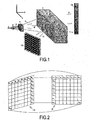
- Fig.1 1 is a schematic view of an article inspection device according to an embodiment of the present invention.
- the article inspection device mainly comprises an x-ray machine, a collimation unit 4, a transmission detector array 10 and a scattering detector array 12.
- the x-ray machine generates x-rays 3 by applying an electron beam 1 to bombard an electron target 2.
- the collimation unit 4 forms or shapes the x-rays 3 generated by the x-ray machine into a sector beam 5, and projects x-rays 6 of the sector beam 5 to an article 7.
- the sector beam 5 will transmit through the article 7 along a transmission cross section 8.
- the transmission detector array 10 is provided at an opposite side to the x-ray machine for detecting the x-rays 9 transmitting through the article 7 so as to form a two-dimensional image of the article 7.
- the scattering detector array 12 is provided at an opposite side to the transmission detector array 10 for detecting scattering photons 11 from the article 7 so as to form a three-dimensional image of the article7.
- the x-ray machine, the collimation unit 4 and the transmission detector array 10 each may be a conventional one that has been applied in a traditional x-ray imaging device.
- the x-ray machine, the collimation unit 4 and the transmission detector array 10 each may be a conventional one that has been applied in a traditional x-ray imaging device.
- the x-ray machine, the collimation unit 4 and the transmission detector array 10 each may be a conventional one that has been applied in a traditional x-ray imaging device.
- the x-ray machine, the collimation unit 4 and the transmission detector array 10 each may be a conventional one that has been applied in a traditional x-ray imaging device.
- the electron beam 1 of the x-ray machine should have enough energy to excite the electron target 2 after the electron target 2 is bombarded by the electron beam I to generate the x-rays 3 having energy enough to produce an pair production effect, for example, the electron beam 1 of the x-ray machine may have energy of more than 1.022MeV.
- the electron target 2 may be a composite target composed of wolfram and gold, or may be any one of conventional targets that can be adapted to the present invention.
- the x-rays 6 of the sector beam 5 transmit through the transmission cross section 8 of the article 7, the x-rays 6 of the sector beam 5 are attenuated because the photoelectric effect, the Compton effect, the pair production effect and the Rayleigh scattering effect occur.
- the scattering detector array 12 is provided at the same side of the article 7 as the x-ray machine, but the scattering detector array 12 may be provided at an opposite side of the article 7 to the x-ray machine.
- Fig.2 shows a corresponding relation between each of sub-regions of a transmission cross section of the article and each of the scattering detector modules.
- the scattering detector array 12 comprises sixty-four scattering detector modules arranged in a matrix of 8-rows and 8-columns, and all the scattering detector modules are exactly the same as one another.
- the sixty-four scattering detector modules arranged in the matrix of 8-rows and 8-columns comprises:
- the transmission cross section 8 of the article 7 is divided into sixty-four sub-regions arranged in a matrix of 8-rows and 8-columns, and all the sub-regions are exactly the same as one another.
- the sixty-four sub-regions arranged in the matrix of 8-rows and 8-columns comprises:
- each of the sub-regions of the transmission cross section 8 corresponds to each of the scattering detector modules of the scattering detector array 12.
- the sub-region A11 corresponds to the scattering detector module B 11;
- the sub-region A81 corresponds to the scattering detector module B81;
- the sub-region A88 corresponds to the scattering detector module B88.
- each of the scattering detector modules can only detect scattering photons from the corresponding one sub-region of the transmission cross section.
- the scattering detector array 12 each may comprise a plurality of same scattering detector modules arranged in a matrix of i-rows and j-columns, such as four same scattering detector modules arranged in a matrix of 2-rows and 2-columns, six same scattering detector modules arranged in a matrix of 2-rows and 3-columns, six same scattering detector modules arranged in a matrix of 3-rows and 2-columns, nine same scattering detector modules arranged in a matrix of 3-rows and 3-columns, twelve same scattering detector modules arranged in a matrix of 3-rows and 4-columns, and so on.
- four same scattering detector modules arranged in a matrix of 2-rows and 2-columns such as four same scattering detector modules arranged in a matrix of 2-rows and 2-columns, six same scattering detector modules arranged in a matrix of 2-rows and 3-columns, six same scattering detector modules arranged in a matrix of 3-rows and 2-column
- 'i' may be a positive integer equal to or greater than 2
- 'j' may be a positive integer equal to or greater than 2.
- the transmission cross section 8 may be divided into a plurality of same sub-regions arranged in a matrix of i-rows and j-columns.
- the resolution of the three-dimensional image formed by the article inspection device is proportional to parameters 'i' and 'j'. That is, when the parameters 'i' and 'j' become larger, the resolution of the three-dimensional image becomes higher. But the parameters 'i' and 'j' can not be too large, otherwise it makes the cost of the article inspection device very high.
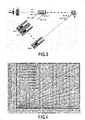
- Fig.3 is a cross section view along a plane perpendicular to Z-axis shown in Fig.1 .
- Fig.3 is a cross section view along a plane perpendicular to Z-axis shown in Fig.1 .
- the photoelectric effect In the photoelectric effect, photons are absorbed and their energy is converted into the energy of photoelectrons and characteristic x-rays. Generally, the photoelectrons can not be detected by the scattering detector modules, and the characteristic x-rays do not have enough energy to pass through the article and thus can not be detected by the scattering detector modules. But because of bremsstrahlung effect, the photoelectrons may be converted into x-rays having high energy and thus can be detected by the scattering detector modules. However, the present invention takes no interest in x-rays entering the scattering detector modules at all.
- the Compton-effect scattering photons A11_1 may enter a scattering detector of a scattering detector module B11.
- the scattering detector module B11 is designed and arranged so that only the Compton-effect scattering photons A11_1 from the sub-region A 11 corresponding to the scattering detector module B11 can enter the scattering detector module B 11.
- any one of other scattering detector modules B12-B18 is also designed and arranged to only receive the Compton-effect scattering photons from one sub-region corresponding to it.
- the scattering detector module B 12 can only receive the Compton-effect scattering photons A12_1 from the sub-region A 12 ...
- the scattering detector module B 18 can only receive the Compton-effect scattering photons A18_1 from the sub-region A18.
- the Compton scattering cross section is proportional to the atomic number when the energy of the incident x-rays 6 is constant. Therefore, in case respective sub-regions of the article have a same atomic density, the larger is the atomic number of one sub-region of the article, the larger is the Compton-effect scattering photon count detected by a scattering detector module corresponding to the one sub-region.
- the pair production effect may occur.
- flight in a solid of positron produced by the pair production effect is in the order of millimeter, each positron is annihilated and finally becomes two gamma photons each having energy of 511KeV, , the position where the two gamma photons are produced is in the sub-region A11.
- the scattering detector module B11 is designed and arranged so that only the pair production effect annihilation photons A11_2 from a sub-region A11 corresponding to the scattering detector module B I I can enter the scattering detector module B11.
- any one of the other scattering detector modules B12-B18 is also designed and arranged to only receive the pair production effect annihilation photons from one sub-region corresponding to it.
- the scattering detector module B12 can only receive the pair production effect annihilation photons A 12_2 from the sub-region A 12 ...
- the scattering detector module B18 can only receive the pair production effect annihilation photons A18_2 from the sub-region A 18.
- the pair production effect cross section is proportional to the second power of the atomic number. Therefore, in case respective sub-regions of the article have a same atomic density, the larger is the atomic number of one sub-region of the article, the larger is the pair production effect annihilation photon count detected by a scattering detector module corresponding to the one sub-region.
- the Rayleigh scattering effect can be omitted because Rayleigh scattering cross section is very small.
- the scattering detector array 12 takes interest in only the Compton scattering effect and the pair production effect.
- the Compton-effect scattering photon count and the pair production effect annihilation photon count are proportional to the first power and the second power of the atomic number, respectively. Therefore, the ratio of the pair production effect annihilation photon count detected by scattering detector array 12 to the Compton-effect scattering photon count detected by scattering detector array 12 is proportional to the first power of the atomic number. Accordingly, the atomic number information of respective sub-regions of the article can be obtained by the ratio of the pair production effect annihilation photon count to the Compton-effect scattering photon count.
- Fig.4 shows a relation between the ratio of the pair production effect annihilation photon count to the Compton-effect scattering photon count and the atomic number when incident x-rays 6 have different energies.
- the transmission cross section 8 of the article 7 is divided into a plurality of same sub-regions arranged in a matrix of i-rows and j-columns, and the scattering detector array 12 each correspondingly comprises a plurality of same scattering detector modules arranged in a matrix of i-rows and j-columns.
- the atomic numbers at all sub-regions, arranged in a matrix of i-rows and j-columns, of the transmission cross section 8 can be obtained by the detection information from the scattering detector modules, arranged in a matrix of i-rows and j-columns, of the scattering detector array 12.
- the atomic numbers at every sub-region of every transmission cross section 8 of the article can be obtained, and then a three-dimensional image of the whole article can be formed according to the atomic numbers at every sub-region of every transmission cross section 8 of the article.
- Fig.5 is a schematic structure view of each of scattering detector modules of the scattering detector array.
- each of the scattering detector modules of the scattering detector array 12 is exactly the same as one another, herein will only describe the scattering detector module B11 corresponding to the sub-region A11, as shown in Fig.5 .
- the scattering detector module B11 comprises a detector B11_1 and a collimator B11_2.
- the collimator B11_2 is configured to permit only the pair production effect annihilation photons A11_2 and the Compton effect scattered photons A11_1 from the sub-region A11 corresponding to the collimator B11_2 to enter the detector B11_1, that is, the collimator B11_2 is configured to substantially absorb the pair production effect annihilation photons and the Compton effect scattered photons from other sub-regions not corresponding to the collimator B11_2.
- the detector B11_1 may be a type of detector with a high energy resolution and a quick time response characteristic.
- the detector B11_1 may be a plastic scintillator detector or a liquid scintillator detector.
- the plastic scintillator detector and the liquid scintillator detector both have a quick time response characteristic and can detect the gamma photons within nanoseconds.
- the detector B11_1 may be a LaBr 3 (Ce) detector or a LaCl 3 (Ce) detector.
- the LaBr 3 (Ce) detector and the LaCl 3 (Ce) detector both have a high energy resolution and a quick time response characteristic.
- the detector B11_1 may be an HPGe detector.
- the HPGe detector has an excellent energy resolution, but has a poor time response characteristic.
- the detector B11_1 may be a CdZnTe detector.
- the CdZnTe detector also has an excellent energy resolution, but has a poor time response characteristic and its price is very high.
- the collimator B 11_2 may be made of lead, steel or copper. In this way, the collimator B 11_2 may effectively absorb the pair production effect annihilation photons and the Compton effect scattered photons from other sub-regions not corresponding to it, and permits only the pair production effect annihilation photons and the Compton effect scattered photons from the sub-region A11 corresponding to it to enter its detector.
- the scattering detector module B I 1 further comprises a shield B 11_3 for preventing the pair production effect annihilation photons A11_2 and the Compton effect scattered photons A11_1 from sub-regions not corresponding to the scattering detector module B11 from entering the detector B11_1, and particularly, preventing various transmitting or scattering x-rays from the electron target 2 from entering the detector B11_1.
- the shield B11_3 may be made of lead, steel or copper, or other suitable material.
- the scattering detector module B I 1 further comprises a hardenite B 11_4 for decreasing the intensity of the pair production effect annihilation photons A11_2 and the Compton effect scattered photons A11_1 from the sub-region A11 corresponding to the scattering detector module B11 so as to decrease the intensity of the pair production effect annihilation photons A11_2 and the Compton effect scattered photons A11_1 entering the detector B11_1. Otherwise, the detector B11_1 may be in an abnormal operation state because the counting rate is too high.
- the hardenite B11_4 may be made of lead, steel or copper, or other suitable material.
- the detector B11_1 is located in a collimation slit of the collimator B11_2.
- the shield B11_3 is disposed at one side of the collimator B11_2 opposite to the hardenite B11_4 and seals an opening of the collimation slit at the one side.
- the hardenite B11_4 is disposed at the other side of the collimator B11_2, and seals the other opening of the collimation slit at the other side.
- the shield B11_3 and the collimator B11_2 are formed into a piece. But please be noted that the shield B11_3 and the collimator B 11_2 may be formed into two individual pieces.
- Fig.6 shows energy spectrums of the pair production effect annihilation photons and the Compton effect scattered photons entering the scattering detector array 12.
- the pair production effect annihilation photons have energy of 511 KeV.
- the energy of the Compton-effect scattering photons is mainly related to two parameters: Compton scattering angle ⁇ (please see Fig.3 ) and the energy hv of the incident x-rays 6. Because the energy spectrum of the incident x-rays 6 is a continuous energy spectrum, the energy spectrum of the Compton-effect scattering photons is also a continuous energy spectrum, as shown in Fig.6 .
Landscapes
- Physics & Mathematics (AREA)
- General Physics & Mathematics (AREA)
- Life Sciences & Earth Sciences (AREA)
- Health & Medical Sciences (AREA)
- High Energy & Nuclear Physics (AREA)
- General Health & Medical Sciences (AREA)
- Geophysics (AREA)
- General Life Sciences & Earth Sciences (AREA)
- Chemical & Material Sciences (AREA)
- Analytical Chemistry (AREA)
- Biochemistry (AREA)
- Pathology (AREA)
- Immunology (AREA)
- Nuclear Medicine, Radiotherapy & Molecular Imaging (AREA)
- Theoretical Computer Science (AREA)
- Engineering & Computer Science (AREA)
- Pulmonology (AREA)
- Radiology & Medical Imaging (AREA)
- Analysing Materials By The Use Of Radiation (AREA)
- Measurement Of Radiation (AREA)
Priority Applications (1)
| Application Number | Priority Date | Filing Date | Title |
|---|---|---|---|
| PL10854001T PL2589954T3 (pl) | 2010-06-30 | 2010-12-28 | Urządzenie do wykrywania przedmiotów i sposób ich wykrywania |
Applications Claiming Priority (2)
| Application Number | Priority Date | Filing Date | Title |
|---|---|---|---|
| CN201010223292.7A CN102313752B (zh) | 2010-06-30 | 2010-06-30 | 物品检测设备及其检测方法 |
| PCT/CN2010/080369 WO2012000298A1 (zh) | 2010-06-30 | 2010-12-28 | 物品检测设备及其检测方法 |
Publications (3)
| Publication Number | Publication Date |
|---|---|
| EP2589954A1 EP2589954A1 (en) | 2013-05-08 |
| EP2589954A4 EP2589954A4 (en) | 2013-11-20 |
| EP2589954B1 true EP2589954B1 (en) | 2015-07-01 |
Family
ID=45401360
Family Applications (1)
| Application Number | Title | Priority Date | Filing Date |
|---|---|---|---|
| EP10854001.4A Active EP2589954B1 (en) | 2010-06-30 | 2010-12-28 | Articles detection device and detection method thereof |
Country Status (5)
| Country | Link |
|---|---|
| US (1) | US8406375B2 (pl) |
| EP (1) | EP2589954B1 (pl) |
| CN (1) | CN102313752B (pl) |
| PL (1) | PL2589954T3 (pl) |
| WO (1) | WO2012000298A1 (pl) |
Families Citing this family (17)
| Publication number | Priority date | Publication date | Assignee | Title |
|---|---|---|---|---|
| CN103728324B (zh) * | 2013-12-18 | 2016-08-17 | 中国原子能科学研究院 | 一种核燃料组件高能x射线无损检测装置 |
| CN104062308B (zh) * | 2014-07-04 | 2017-02-15 | 天津三英精密仪器有限公司 | 一种岩石无损矿物成分检测方法 |
| CN105445290A (zh) | 2014-09-02 | 2016-03-30 | 同方威视技术股份有限公司 | X射线产品质量在线检测装置 |
| CN104792805B (zh) * | 2015-04-16 | 2017-09-12 | 中国原子能科学研究院 | 一种透射探测器和插值数据计算方法 |
| CN106353828B (zh) * | 2015-07-22 | 2018-09-21 | 清华大学 | 在安检系统中估算被检查物体重量的方法和装置 |
| CN108475423B (zh) * | 2015-11-05 | 2022-05-24 | 唯盼健康科技有限公司 | 量化图像的方法 |
| US9528952B1 (en) * | 2016-05-17 | 2016-12-27 | Westinghouse Electric Company Llc | Pulsed neutron generated prompt gamma emission measurement system for surface defect detection and analysis |
| BR112018074796B1 (pt) * | 2016-05-30 | 2023-03-28 | Southern Innovation International Pty Ltd | Sistema e método de caracterização de material |
| GB2555564B (en) * | 2016-07-28 | 2020-09-09 | Smiths Heimann Sas | Scatter imaging |
| GB2552535B (en) * | 2016-07-28 | 2020-09-09 | Smiths Heimann Sas | Detection of scatter radiation |
| US11016218B2 (en) | 2016-07-28 | 2021-05-25 | Smiths Heimann Sas | Scatter imaging |
| EP3435325A1 (en) * | 2017-07-26 | 2019-01-30 | Koninklijke Philips N.V. | Scatter correction for dark field imaging |
| EP3877754A4 (en) | 2018-11-06 | 2022-06-08 | Shenzhen Xpectvision Technology Co., Ltd. | X-RAY SYSTEM WITH BACK SCATTER |
| CN113887572B (zh) * | 2021-09-10 | 2025-05-30 | 中国核电工程有限公司 | 一种基于灵敏度包覆的评定核系统相似性方法 |
| CN116699669A (zh) * | 2023-07-13 | 2023-09-05 | 合肥综合性国家科学中心能源研究院(安徽省能源实验室) | 一种iv型钢箱放射性固体废物无损检测系统 |
| CN117571543B (zh) * | 2024-01-16 | 2024-04-09 | 清华大学 | 一种利用X/γ射线在线测量散状物料真密度的方法及系统 |
| CN118311072A (zh) * | 2024-05-31 | 2024-07-09 | 清华大学 | 一种利用散射和吸收信息的x射线能谱成像定量分析方法 |
Family Cites Families (13)
| Publication number | Priority date | Publication date | Assignee | Title |
|---|---|---|---|---|
| SU707403A1 (ru) * | 1978-05-30 | 1981-06-15 | Научно-Исследовательский Институт Ядерной Физикиэлектроники И Автоматики При Tomckom Орденаоктябрьской Революции И Ордена Трудового Ккрасного Знамени Политехническом Институте Им.C.M.Кирова | Способ рационального измерени плотности |
| FR2442042A1 (fr) * | 1978-11-27 | 1980-06-20 | Labo Electronique Physique | Procede et appareil d'examen tomographique par exploration de milieux aux rayons x ou gamma |
| WO1992003722A1 (en) * | 1990-08-15 | 1992-03-05 | Massachusetts Institute Of Technology | Detection of explosives and other materials using resonance fluorescence, resonance absorption, and other electromagnetic processes with bremsstrahlung radiation |
| WO1998020366A1 (en) * | 1996-11-08 | 1998-05-14 | American Science And Engineering, Inc. | Coded aperture x-ray imaging system |
| CA2348150C (en) * | 2000-05-25 | 2007-03-13 | Esam M.A. Hussein | Non-rotating x-ray system for three-dimensional, three-parameter imaging |
| CN1164928C (zh) * | 2001-09-21 | 2004-09-01 | 清华大学 | 一种X或γ辐射成像无损检测方法与装置 |
| CN1179207C (zh) * | 2001-11-27 | 2004-12-08 | 丹东东方测控技术有限公司 | 电子对湮没辐射效应大块矿石品位在线检测方法及其系统 |
| US7078699B2 (en) * | 2002-10-04 | 2006-07-18 | Varian Medical Systems Technologies, Inc. | Imaging apparatus and method with event sensitive photon detection |
| SE0302900L (sv) | 2003-11-03 | 2005-05-04 | Xcounter Ab | Koherent spridningsavbildning |
| DE102005024892B3 (de) * | 2005-05-31 | 2006-09-28 | Yxlon International Security Gmbh | Gantry zur Aufnahme einer Röntgenquelle und Verfahren zur Überprüfung eines Prüfteils mittels Röntgenstrahlung |
| US20090168958A1 (en) * | 2008-01-02 | 2009-07-02 | Cristina Francesca Cozzini | Apparatus and method for identifying components in a container |
| CN101629917B (zh) * | 2008-07-16 | 2011-09-14 | 清华大学 | 一种测量物质有效原子序数的方法和装置 |
| US8588370B2 (en) * | 2010-06-30 | 2013-11-19 | Tsinghua University | Article inspection device and inspection method |
-
2010
- 2010-06-30 CN CN201010223292.7A patent/CN102313752B/zh active Active
- 2010-12-28 EP EP10854001.4A patent/EP2589954B1/en active Active
- 2010-12-28 US US13/142,712 patent/US8406375B2/en active Active
- 2010-12-28 PL PL10854001T patent/PL2589954T3/pl unknown
- 2010-12-28 WO PCT/CN2010/080369 patent/WO2012000298A1/zh not_active Ceased
Also Published As
| Publication number | Publication date |
|---|---|
| EP2589954A4 (en) | 2013-11-20 |
| EP2589954A1 (en) | 2013-05-08 |
| CN102313752A (zh) | 2012-01-11 |
| CN102313752B (zh) | 2014-07-23 |
| US8406375B2 (en) | 2013-03-26 |
| US20120207271A1 (en) | 2012-08-16 |
| PL2589954T3 (pl) | 2016-04-29 |
| WO2012000298A1 (zh) | 2012-01-05 |
Similar Documents
| Publication | Publication Date | Title |
|---|---|---|
| EP2589954B1 (en) | Articles detection device and detection method thereof | |
| EP2589955B1 (en) | Articles detecting device and detecting method thereof | |
| US9268043B2 (en) | Radiation-monitoring system with correlated hodoscopes | |
| CN101329284B (zh) | 一种γ射线探测器 | |
| JP4995905B2 (ja) | 角度分解能をもって放射線を検出するための検出器アセンブリ及び方法 | |
| Harding et al. | X-ray diffraction imaging with the Multiple Inverse Fan Beam topology: Principles, performance and potential for security screening | |
| US20050195931A1 (en) | Binocular method and apparatus for stoichiometric analysis and imaging using subatomic particle activation | |
| Buffler et al. | Detecting contraband using neutrons: challenges and future directions | |
| US8588370B2 (en) | Article inspection device and inspection method | |
| US6693281B2 (en) | Fast neutron resonance radiography for elemental mapping | |
| EP2074413B1 (en) | Method for detecting nitrogenous materials via gamma-resonance absorption (gra) | |
| CN201286191Y (zh) | 一种光中子转换靶 | |
| CN201286192Y (zh) | 一种光中子转换靶和光中子-x射线源 | |
| Martz et al. | Summary of technologies for national security needs | |
| Peerani et al. | The EURITRACK concept for cargo inspection with tagged neutrons | |
| Lanza | Detection of fissionable materials in cargoes using monochromatic photon radiography | |
| Pugliatti | Particle scintillating trackers: design and read-out of real-time, large-area, highly segmented detectors | |
| Mayer et al. | The Bariloche Neutron Physics Group Current Activities |
Legal Events
| Date | Code | Title | Description |
|---|---|---|---|
| PUAI | Public reference made under article 153(3) epc to a published international application that has entered the european phase |
Free format text: ORIGINAL CODE: 0009012 |
|
| 17P | Request for examination filed |
Effective date: 20121018 |
|
| AK | Designated contracting states |
Kind code of ref document: A1 Designated state(s): AL AT BE BG CH CY CZ DE DK EE ES FI FR GB GR HR HU IE IS IT LI LT LU LV MC MK MT NL NO PL PT RO RS SE SI SK SM TR |
|
| DAX | Request for extension of the european patent (deleted) | ||
| REG | Reference to a national code |
Ref country code: DE Ref legal event code: R079 Ref document number: 602010025649 Country of ref document: DE Free format text: PREVIOUS MAIN CLASS: G01N0023040000 Ipc: G01V0005000000 |
|
| A4 | Supplementary search report drawn up and despatched |
Effective date: 20131018 |
|
| RIC1 | Information provided on ipc code assigned before grant |
Ipc: G01N 23/04 20060101ALI20131014BHEP Ipc: G01V 5/00 20060101AFI20131014BHEP |
|
| 17Q | First examination report despatched |
Effective date: 20140526 |
|
| GRAP | Despatch of communication of intention to grant a patent |
Free format text: ORIGINAL CODE: EPIDOSNIGR1 |
|
| INTG | Intention to grant announced |
Effective date: 20150107 |
|
| RIN1 | Information on inventor provided before grant (corrected) |
Inventor name: JIN, YINGKANG Inventor name: ZHANG, QINJIAN Inventor name: LI, TIEZHU Inventor name: ZHANG, YI Inventor name: LIU, YINONG Inventor name: YANG, YIGANG Inventor name: LI, YUANJING Inventor name: CHEN, QINGHAO |
|
| GRAS | Grant fee paid |
Free format text: ORIGINAL CODE: EPIDOSNIGR3 |
|
| GRAA | (expected) grant |
Free format text: ORIGINAL CODE: 0009210 |
|
| AK | Designated contracting states |
Kind code of ref document: B1 Designated state(s): AL AT BE BG CH CY CZ DE DK EE ES FI FR GB GR HR HU IE IS IT LI LT LU LV MC MK MT NL NO PL PT RO RS SE SI SK SM TR |
|
| REG | Reference to a national code |
Ref country code: GB Ref legal event code: FG4D |
|
| REG | Reference to a national code |
Ref country code: AT Ref legal event code: REF Ref document number: 734288 Country of ref document: AT Kind code of ref document: T Effective date: 20150715 Ref country code: CH Ref legal event code: EP |
|
| REG | Reference to a national code |
Ref country code: IE Ref legal event code: FG4D |
|
| REG | Reference to a national code |
Ref country code: DE Ref legal event code: R096 Ref document number: 602010025649 Country of ref document: DE |
|
| REG | Reference to a national code |
Ref country code: NL Ref legal event code: FP |
|
| REG | Reference to a national code |
Ref country code: AT Ref legal event code: MK05 Ref document number: 734288 Country of ref document: AT Kind code of ref document: T Effective date: 20150701 |
|
| REG | Reference to a national code |
Ref country code: FR Ref legal event code: PLFP Year of fee payment: 6 |
|
| REG | Reference to a national code |
Ref country code: LT Ref legal event code: MG4D |
|
| PG25 | Lapsed in a contracting state [announced via postgrant information from national office to epo] |
Ref country code: LV Free format text: LAPSE BECAUSE OF FAILURE TO SUBMIT A TRANSLATION OF THE DESCRIPTION OR TO PAY THE FEE WITHIN THE PRESCRIBED TIME-LIMIT Effective date: 20150701 Ref country code: LT Free format text: LAPSE BECAUSE OF FAILURE TO SUBMIT A TRANSLATION OF THE DESCRIPTION OR TO PAY THE FEE WITHIN THE PRESCRIBED TIME-LIMIT Effective date: 20150701 Ref country code: NO Free format text: LAPSE BECAUSE OF FAILURE TO SUBMIT A TRANSLATION OF THE DESCRIPTION OR TO PAY THE FEE WITHIN THE PRESCRIBED TIME-LIMIT Effective date: 20151001 Ref country code: GR Free format text: LAPSE BECAUSE OF FAILURE TO SUBMIT A TRANSLATION OF THE DESCRIPTION OR TO PAY THE FEE WITHIN THE PRESCRIBED TIME-LIMIT Effective date: 20151002 Ref country code: FI Free format text: LAPSE BECAUSE OF FAILURE TO SUBMIT A TRANSLATION OF THE DESCRIPTION OR TO PAY THE FEE WITHIN THE PRESCRIBED TIME-LIMIT Effective date: 20150701 |
|
| PG25 | Lapsed in a contracting state [announced via postgrant information from national office to epo] |
Ref country code: RS Free format text: LAPSE BECAUSE OF FAILURE TO SUBMIT A TRANSLATION OF THE DESCRIPTION OR TO PAY THE FEE WITHIN THE PRESCRIBED TIME-LIMIT Effective date: 20150701 Ref country code: HR Free format text: LAPSE BECAUSE OF FAILURE TO SUBMIT A TRANSLATION OF THE DESCRIPTION OR TO PAY THE FEE WITHIN THE PRESCRIBED TIME-LIMIT Effective date: 20150701 Ref country code: ES Free format text: LAPSE BECAUSE OF FAILURE TO SUBMIT A TRANSLATION OF THE DESCRIPTION OR TO PAY THE FEE WITHIN THE PRESCRIBED TIME-LIMIT Effective date: 20150701 Ref country code: SE Free format text: LAPSE BECAUSE OF FAILURE TO SUBMIT A TRANSLATION OF THE DESCRIPTION OR TO PAY THE FEE WITHIN THE PRESCRIBED TIME-LIMIT Effective date: 20150701 Ref country code: PT Free format text: LAPSE BECAUSE OF FAILURE TO SUBMIT A TRANSLATION OF THE DESCRIPTION OR TO PAY THE FEE WITHIN THE PRESCRIBED TIME-LIMIT Effective date: 20151102 Ref country code: AT Free format text: LAPSE BECAUSE OF FAILURE TO SUBMIT A TRANSLATION OF THE DESCRIPTION OR TO PAY THE FEE WITHIN THE PRESCRIBED TIME-LIMIT Effective date: 20150701 Ref country code: IS Free format text: LAPSE BECAUSE OF FAILURE TO SUBMIT A TRANSLATION OF THE DESCRIPTION OR TO PAY THE FEE WITHIN THE PRESCRIBED TIME-LIMIT Effective date: 20151101 |
|
| REG | Reference to a national code |
Ref country code: DE Ref legal event code: R097 Ref document number: 602010025649 Country of ref document: DE |
|
| PG25 | Lapsed in a contracting state [announced via postgrant information from national office to epo] |
Ref country code: SK Free format text: LAPSE BECAUSE OF FAILURE TO SUBMIT A TRANSLATION OF THE DESCRIPTION OR TO PAY THE FEE WITHIN THE PRESCRIBED TIME-LIMIT Effective date: 20150701 Ref country code: IT Free format text: LAPSE BECAUSE OF FAILURE TO SUBMIT A TRANSLATION OF THE DESCRIPTION OR TO PAY THE FEE WITHIN THE PRESCRIBED TIME-LIMIT Effective date: 20150701 Ref country code: CZ Free format text: LAPSE BECAUSE OF FAILURE TO SUBMIT A TRANSLATION OF THE DESCRIPTION OR TO PAY THE FEE WITHIN THE PRESCRIBED TIME-LIMIT Effective date: 20150701 Ref country code: EE Free format text: LAPSE BECAUSE OF FAILURE TO SUBMIT A TRANSLATION OF THE DESCRIPTION OR TO PAY THE FEE WITHIN THE PRESCRIBED TIME-LIMIT Effective date: 20150701 Ref country code: DK Free format text: LAPSE BECAUSE OF FAILURE TO SUBMIT A TRANSLATION OF THE DESCRIPTION OR TO PAY THE FEE WITHIN THE PRESCRIBED TIME-LIMIT Effective date: 20150701 |
|
| PLBE | No opposition filed within time limit |
Free format text: ORIGINAL CODE: 0009261 |
|
| STAA | Information on the status of an ep patent application or granted ep patent |
Free format text: STATUS: NO OPPOSITION FILED WITHIN TIME LIMIT |
|
| PG25 | Lapsed in a contracting state [announced via postgrant information from national office to epo] |
Ref country code: BE Free format text: LAPSE BECAUSE OF NON-PAYMENT OF DUE FEES Effective date: 20151231 Ref country code: RO Free format text: LAPSE BECAUSE OF FAILURE TO SUBMIT A TRANSLATION OF THE DESCRIPTION OR TO PAY THE FEE WITHIN THE PRESCRIBED TIME-LIMIT Effective date: 20150701 |
|
| 26N | No opposition filed |
Effective date: 20160404 |
|
| PG25 | Lapsed in a contracting state [announced via postgrant information from national office to epo] |
Ref country code: MC Free format text: LAPSE BECAUSE OF FAILURE TO SUBMIT A TRANSLATION OF THE DESCRIPTION OR TO PAY THE FEE WITHIN THE PRESCRIBED TIME-LIMIT Effective date: 20150701 Ref country code: LU Free format text: LAPSE BECAUSE OF FAILURE TO SUBMIT A TRANSLATION OF THE DESCRIPTION OR TO PAY THE FEE WITHIN THE PRESCRIBED TIME-LIMIT Effective date: 20151228 |
|
| REG | Reference to a national code |
Ref country code: CH Ref legal event code: PL |
|
| PG25 | Lapsed in a contracting state [announced via postgrant information from national office to epo] |
Ref country code: SI Free format text: LAPSE BECAUSE OF FAILURE TO SUBMIT A TRANSLATION OF THE DESCRIPTION OR TO PAY THE FEE WITHIN THE PRESCRIBED TIME-LIMIT Effective date: 20150701 |
|
| REG | Reference to a national code |
Ref country code: IE Ref legal event code: MM4A |
|
| PG25 | Lapsed in a contracting state [announced via postgrant information from national office to epo] |
Ref country code: LI Free format text: LAPSE BECAUSE OF NON-PAYMENT OF DUE FEES Effective date: 20151231 Ref country code: IE Free format text: LAPSE BECAUSE OF NON-PAYMENT OF DUE FEES Effective date: 20151228 Ref country code: CH Free format text: LAPSE BECAUSE OF NON-PAYMENT OF DUE FEES Effective date: 20151231 |
|
| REG | Reference to a national code |
Ref country code: FR Ref legal event code: PLFP Year of fee payment: 7 |
|
| PG25 | Lapsed in a contracting state [announced via postgrant information from national office to epo] |
Ref country code: BE Free format text: LAPSE BECAUSE OF FAILURE TO SUBMIT A TRANSLATION OF THE DESCRIPTION OR TO PAY THE FEE WITHIN THE PRESCRIBED TIME-LIMIT Effective date: 20150701 |
|
| PG25 | Lapsed in a contracting state [announced via postgrant information from national office to epo] |
Ref country code: HU Free format text: LAPSE BECAUSE OF FAILURE TO SUBMIT A TRANSLATION OF THE DESCRIPTION OR TO PAY THE FEE WITHIN THE PRESCRIBED TIME-LIMIT; INVALID AB INITIO Effective date: 20101228 Ref country code: BG Free format text: LAPSE BECAUSE OF FAILURE TO SUBMIT A TRANSLATION OF THE DESCRIPTION OR TO PAY THE FEE WITHIN THE PRESCRIBED TIME-LIMIT Effective date: 20150701 Ref country code: SM Free format text: LAPSE BECAUSE OF FAILURE TO SUBMIT A TRANSLATION OF THE DESCRIPTION OR TO PAY THE FEE WITHIN THE PRESCRIBED TIME-LIMIT Effective date: 20150701 |
|
| PG25 | Lapsed in a contracting state [announced via postgrant information from national office to epo] |
Ref country code: CY Free format text: LAPSE BECAUSE OF FAILURE TO SUBMIT A TRANSLATION OF THE DESCRIPTION OR TO PAY THE FEE WITHIN THE PRESCRIBED TIME-LIMIT Effective date: 20150701 |
|
| PG25 | Lapsed in a contracting state [announced via postgrant information from national office to epo] |
Ref country code: MT Free format text: LAPSE BECAUSE OF FAILURE TO SUBMIT A TRANSLATION OF THE DESCRIPTION OR TO PAY THE FEE WITHIN THE PRESCRIBED TIME-LIMIT Effective date: 20150701 |
|
| REG | Reference to a national code |
Ref country code: FR Ref legal event code: PLFP Year of fee payment: 8 |
|
| PG25 | Lapsed in a contracting state [announced via postgrant information from national office to epo] |
Ref country code: TR Free format text: LAPSE BECAUSE OF FAILURE TO SUBMIT A TRANSLATION OF THE DESCRIPTION OR TO PAY THE FEE WITHIN THE PRESCRIBED TIME-LIMIT Effective date: 20150701 Ref country code: MK Free format text: LAPSE BECAUSE OF FAILURE TO SUBMIT A TRANSLATION OF THE DESCRIPTION OR TO PAY THE FEE WITHIN THE PRESCRIBED TIME-LIMIT Effective date: 20150701 |
|
| PG25 | Lapsed in a contracting state [announced via postgrant information from national office to epo] |
Ref country code: AL Free format text: LAPSE BECAUSE OF FAILURE TO SUBMIT A TRANSLATION OF THE DESCRIPTION OR TO PAY THE FEE WITHIN THE PRESCRIBED TIME-LIMIT Effective date: 20150701 |
|
| PGFP | Annual fee paid to national office [announced via postgrant information from national office to epo] |
Ref country code: GB Payment date: 20201216 Year of fee payment: 11 |
|
| PGFP | Annual fee paid to national office [announced via postgrant information from national office to epo] |
Ref country code: PL Payment date: 20201113 Year of fee payment: 11 |
|
| PGFP | Annual fee paid to national office [announced via postgrant information from national office to epo] |
Ref country code: NL Payment date: 20201223 Year of fee payment: 11 |
|
| REG | Reference to a national code |
Ref country code: NL Ref legal event code: MM Effective date: 20220101 |
|
| GBPC | Gb: european patent ceased through non-payment of renewal fee |
Effective date: 20211228 |
|
| PG25 | Lapsed in a contracting state [announced via postgrant information from national office to epo] |
Ref country code: NL Free format text: LAPSE BECAUSE OF NON-PAYMENT OF DUE FEES Effective date: 20220101 |
|
| PG25 | Lapsed in a contracting state [announced via postgrant information from national office to epo] |
Ref country code: GB Free format text: LAPSE BECAUSE OF NON-PAYMENT OF DUE FEES Effective date: 20211228 |
|
| REG | Reference to a national code |
Ref country code: DE Ref legal event code: R082 Ref document number: 602010025649 Country of ref document: DE Representative=s name: CBDL PATENTANWAELTE GBR, DE Ref country code: DE Ref legal event code: R082 Ref document number: 602010025649 Country of ref document: DE Representative=s name: CBDL PATENTANWAELTE EGBR, DE |
|
| PG25 | Lapsed in a contracting state [announced via postgrant information from national office to epo] |
Ref country code: PL Free format text: LAPSE BECAUSE OF NON-PAYMENT OF DUE FEES Effective date: 20211228 |
|
| P01 | Opt-out of the competence of the unified patent court (upc) registered |
Effective date: 20230526 |
|
| PGFP | Annual fee paid to national office [announced via postgrant information from national office to epo] |
Ref country code: FR Payment date: 20251125 Year of fee payment: 16 |
|
| PGFP | Annual fee paid to national office [announced via postgrant information from national office to epo] |
Ref country code: DE Payment date: 20251222 Year of fee payment: 16 |