EP2589582A2 - Pyrotechnic millisecond delay charge for industrial detonators with delay time of explosion of 25 to 1,000 ms from initiation, the way of manufacture of the delay charge, and electric and non-electric detonator - Google Patents
Pyrotechnic millisecond delay charge for industrial detonators with delay time of explosion of 25 to 1,000 ms from initiation, the way of manufacture of the delay charge, and electric and non-electric detonator Download PDFInfo
- Publication number
- EP2589582A2 EP2589582A2 EP12466011.9A EP12466011A EP2589582A2 EP 2589582 A2 EP2589582 A2 EP 2589582A2 EP 12466011 A EP12466011 A EP 12466011A EP 2589582 A2 EP2589582 A2 EP 2589582A2
- Authority
- EP
- European Patent Office
- Prior art keywords
- fesizr
- pyrotechnic
- delay
- shell
- delay charge
- Prior art date
- Legal status (The legal status is an assumption and is not a legal conclusion. Google has not performed a legal analysis and makes no representation as to the accuracy of the status listed.)
- Granted
Links
Images

Classifications
-
- C—CHEMISTRY; METALLURGY
- C06—EXPLOSIVES; MATCHES
- C06C—DETONATING OR PRIMING DEVICES; FUSES; CHEMICAL LIGHTERS; PYROPHORIC COMPOSITIONS
- C06C5/00—Fuses, e.g. fuse cords
- C06C5/06—Fuse igniting means; Fuse connectors
-
- C—CHEMISTRY; METALLURGY
- C06—EXPLOSIVES; MATCHES
- C06C—DETONATING OR PRIMING DEVICES; FUSES; CHEMICAL LIGHTERS; PYROPHORIC COMPOSITIONS
- C06C7/00—Non-electric detonators; Blasting caps; Primers
Definitions
- the invention relates to pyrotechnic millisecond delay charge for industrial detonators with explosion delay time of 25 to 1,000 ms from initiation.
- the charge is intended to be compacted into the delay tube, for detonators initiated by fusehead, by a blasting machine generated pulse, and also for detonators initiated by detonation tube non-electrically - by detonating wave, or by a blasting machine generated spark.
- It relates to electric detonators in a series connection or a series-parallel connection and to non-electric detonators as well, where the firing circuit is created by connecting of detonation tubes of non-electric detonators, especially in aboveground destruction of rocks, mining in stone quarries, underground mining of rocks and driving of tunnels.
- the invention also relates to the way of manufacture of the said charge.
- the invention also relates to electric detonator on its own and is also meant as an independent invention of non-electric detonator, to be used together with the pyrotechnic delay charge.
- pyrotechnic delay charges containing combustible matter and oxidizer are used. It is altogether Si, B, Zr, Ti metallic powders and Fe+Si+Cr, Si+Se+Fe, Zr+B, Zr+Ni alloys and others that are used as combustibles. Lead monoxide-dioxide and lead dioxide are mostly used as oxidizers. However, such charges contain heavy metals, which get into the environment after the detonator has been used. Therefore, there has been general endeavour aiming at excluding of heavy metals. There are known designs, e.g.
- the objective of the invention is to develop such a charge and weight ratios of combustible and oxidizer, which would not be intensive in terms of manufacture and costs, with minimum need of completive additives to achieve time variability and delay exactness.
- the solution should above all meet the condition of absence of heavy metals.
- the objective of the invention is to develop such a way of manufacture of the created delay charge that the resulting parameters agree with the defined objective, and minimum manufacture costs are kept.
- the objective of the invention is also to create electric and non-electric detonator, in which the created composition can be employed.
- the specified objective is reached by a pyrotechnic millisecond delay charge for both electric and non-electric industrial detonators with delay time of explosion of 25 to 1,000 ms from initiation, the subject-matter of which is the proportion according to the invention. It contains ferrosilliconzirconium (hereinafter referred to as FeSiZr) as combustible matter and bismuth ochre (hereinafter referred to as Bi 2 O 3 ) as oxidizer. These are in proportion of 50 ⁇ 15 wt. % FeSiZr and 50 ⁇ 15 wt. % Bi 2 O 3 .
- FeSiZr is an alloy of dominant elements Si, Zr, Fe and Ti, containing also trace impurities originating from aluminosillicates, which are input substances in manufacture of alloys.
- the limit representation of dominant elements in FeSiZr according to the invention is as follows: Si at least 30 wt. %, Zr at least 10 wt. %, Fe at the most 25 wt. %, Ti at least 1 wt. %.
- the pyrotechnic charge can contain the additive, titanic oxide (hereinafter referred to as TiO 2 ) in the amount of up to 5 wt. % as combustion speed controller.
- TiO 2 titanic oxide
- the purity of the substance Bi 2 O 3 is at least 90%.
- the FeSiZr alloy consists of Si 52.1 wt. %, Zr 27.4 wt. %, Fe 12.7 wt. %, Ti 5.8 wt. % and impurities 2 wt %, with Bi 2 O 3 of purity 99.8 wt. %, in proportion of 52.8 wt % Bi 2 O 3 and 47.2 wt. % FeSiZr.
- the FeSiZr alloy consists of Si 52.1 wt. %, Zr 27.4 wt. %, Fe 12.7 wt. %, Ti 5.8 wt. %, impurities 2 wt %, with Bi 2 O 3 of purity 99.8 wt %, in proportion 60.0 wt % Bi 2 O 3 and 40.0 wt. % FeSiZr.
- the FeSiZr alloy consists of Si 63.5 wt. %, Zr 21.3 wt. %, Fe 11.7 wt. %, Ti 1.1 wt. %, impurities 2.4 wt %, with Bi 2 O 3 of purity 99.8 wt %, in proportion 60.0 wt % Bi 2 O 3 and 40.0 wt. % FeSiZr.
- the FeSiZr alloy consists of Si 63.5 wt. %, Zr 21.3 wt. %, Fe 11.7 wt. %, Ti 1.1 wt. %, impurities 2.4 wt %, with Bi 2 O 3 of purity 99.8 wt % , in proportion 50.0 wt % Bi 2 O 3 and 50.0 wt. % FeSiZr, eventually the FeSiZr alloy consists of 63.5 wt. %, Zr 21.3 wt. %, Fe 11.7 wt. %, Ti 1.1 wt. %, impurities 2,4 wt %, with Bi 2 O 3 of purity 99.8 wt % ,in proportion 55.0 wt % Bi 2 O 3 an d 45.0 wt. % FeSiZr.
- the FeSiZr alloy can consist of Si 63.5 wt. %, Zr 21.3 wt. %, Fe 11.7 wt. %, Ti 1.1 wt. %, impurities 2,4 wt %, with Bi 2 O 3 of purity 99.8 wt % and with TiO 2 of purity 98 wt. %, in proportion 53..9 wt % Bi 2 O 3 , 44.1 wt. % FeSiZr and 2.0 wt. % TiO 2 .
- the FeSiZr alloy consists of Si 63.5 wt. %, Zr 21.3 wt. %, Fe 11.7 wt. %, Ti 1.1 wt. %, impurities 2.4 wt %, with Bi 2 O 3 of purity 99.8 wt % and with TiO 2 of purity 98 wt. % , in proportion 52.3 wt % Bi 2 O 3 , 42.7 wt. % FeSiZr and 5.0 wt. % TiO 2 .
- the subject matter of the invention is also the way of manufacture of the pyrotechnic millisecond delay charge for electric and non-electric industrial detonators with delay time of explosion of 25 up to 1,000 ms from initiation.
- the principle of the way of manufacture consists in that ferrosilliconzirconium (hereinafter referred to as FeSiZr) with limit representation of the dominant elements Si at least 30 wt. %, Zr at least 10 wt. %, Fe at the most 25 wt. % and Ti at least 1 wt.
- Bi 2 O 3 bismuth ochre
- these two components in proportion 50 ⁇ 10 wt. % FeSiZr and 50 ⁇ 15 wt. % Bi 2 O 3 are mechanically homogenized and pelletized with pressure of 255 MPa. Next, they are crushed to grading of 0.2 - 0.8 mm grain size.
- the charge is pressed into the delay tube of the detonator under pressure of 280 MPa with the column height of 20 mm.
- the principle of the way of manufacture according to the invention is also that up to 5 wt. % TiO 2 of purity at least 95%, prepared to particle size in the range of 1- 10 ⁇ m, is added to FeSiZr and Bi 2 O 3 before homogenization.
- the subject matter of the non-electric industrial detonator with enclosure in the shape of a shell with inserted detonation tube is the fact that in the enclosure there is created a space at least for primary explosive and for delay charge, and the shell, which is closed at the bottom, has a space in the bottom part that has been created for secondary explosive, which space is closed with the delay tube from above.
- primary explosive In its cylindrical box there is arranged primary explosive, and delay charge is above it.
- a sleeve with amplifying composition is above the delay tube.
- a detonation tube, fitted with insulation against the enclosure, is inserted into the shell from the upper side.
- the subject matter of the electric industrial detonator is that in the shell it has a fusehead inserted, with lead-in wires, which are fitted with insulation against the shell enclosure, the other technical features are the same as those of ther non-electric detonator described above.
- the main advantage is the absence of heavy metals, seeing that the presence of heavy metals even in consumables, e.g. in mineral salt, apparently due to the way of mining, is a great issue in those parts of the world that are actively used for industry.
- the pyrotechnic charge is free of lead oxides or chromates, and free of barium.
- the benefit of this solution is that while the above mentioned main advantage is preserved, simplicity of manufacture and versatility of use for various intervals of required delay, even at high accuracy, are provided.
- the variability of delay is achieved due to the proportion of the basic components and it is not necessaryy to add any other additives. As far as the field of application is concerned, this solution appears to be very simple and practical and not demanding for technology or investment in terms of production.
- FeSiZr Ferrosilliconzirconium
- the FeSiZr alloy is prepared in the physical process of grinding to the particle size in the range of 1- 10 ⁇ m.
- Bismuth ochre acts as oxidizer in the delay charge.
- Bi 2 O 3 Bismuth ochre
- Titanium dioxide acts as additive in the delay charge, it does not participate actively in the process of combustion, it influences the combustion speed in the desired way.
- a substance of purity at least 95% prepared, usually by physical grinding, to the particle size in the range of 1- 10 ⁇ m.
- FeSiZr alloy with the following composition was used:
- FeSiZr and Bi 2 O 3 were used in proportion 52.8 wt % Bi 2 O 3 and 47.2 wt. % FeSiZr.
- the FeSiZr alloy was prepared to particle size 1.86 ⁇ m and Bi 2 O 3 was prepared to particle size 1.98 ⁇ m.
- the mixture was mechanically homogenized and pelletized with pressure of 255 MPa. Next, it was crushed to grading of grain size of 0.2 - 0.8 mm.
- composition so prepared is pressed into the delay tube of the non-electric detonator by means of pressure of 280 MPa with column height of 20 mm.
- the average delay time of detonator explosion with this composition of delay charge is 267.4 ms and standard deviation 3.3 ms.
- FeSiZr alloy with the following composition was used:
- FeSiZr and Bi 2 O 3 were used in proportion 60.0 wt % Bi 2 O 3 and 40.0 wt. % FeSiZr.
- the FeSiZr alloy was prepared to particle size 1.86 ⁇ m and Bi 2 O 3 was prepared to particle size 1.98 ⁇ m.
- the mixture was mechanically homogenized and pelletized with pressure of 255 MPa. Next, it was crushed to grading of grain size of 0.2 - 0.8 mm.
- composition so prepared is pressed into the delay tube of the non-electric detonator with pressure of 280 MPa with height of the column of 20 mm.
- the average delay time of detonator explosion with this composition of delay charge is 235.8 ms and standard deviation 3.4 ms.
- FeSiZr alloy with the following composition was used:
- FeSiZr and Bi 2 O 3 were used in proportion 60.0 wt % Bi 2 O 3 and 40.0 wt. % FeSiZr.
- the FeSiZr alloy was prepared to particle size 2.09 ⁇ m and Bi 2 O 3 was prepared to particle size 1.98 ⁇ m.
- the mixture was mechanically homogenized and pelletized with pressure of 255 MPa. Next, it was crushed to grading of grain size of 0.2 - 0.8 mm.
- composition so prepared is pressed into the delay tube of the non-electric detonator with pressure of 280 MPa with height of the column of 20 mm.
- the average delay time of detonator explosion with this composition of delay charge is 247.5 ms and standard deviation 2.8 ms.
- FeSiZr alloy with the following composition was used:
- FeSiZr a Bi 2 O 3 were used in proportion 50.0 wt % Bi 2 O 3 and 50.0 wt. % FeSiZr.
- the FeSiZr alloy was prepared to particle size 2.09 ⁇ m and Bi 2 O 3 was prepared to particle size 1.98 ⁇ m.
- the mixture was mechanically homogenized and pelletized with pressure of 255 MPa. Next, it was crushed to grading of grain size of 0.2 - 0.8 mm.
- the composition so prepared is pressed into the delay tube of the non-electric detonator with pressure of 280 MPa and with height of the column of 20 mm.
- the average delay time of detonator explosion with this composition of delay charge is 372.4 ms and standard deviation 3.4 ms.
- FeSiZr alloy with the following composition was used:
- FeSiZr and Bi 2 O 3 were used in proportion 55.0 wt % Bi 2 O 3 and 45.0 wt. % FeSiZr.
- the FeSiZr alloy was prepared to particle size 4.88 ⁇ m and Bi 2 O 3 was prepared to particle size 1.98 ⁇ m.
- the mixture was mechanically homogenized and pelletized with pressure of 255 MPa. Next, it was crushed to grading of grain size of 0.2 - 0.8 mm.
- composition so prepared is pressed into the delay tube of the non-electric detonator with pressure of 280 MPa with height of the column of 20 mm.
- the average delay time of detonator explosion with this composition of delay charge is 347.7 ms and standard deviation 3.7 ms.
- FeSiZr alloy with the following composition was used:
- Bi 2 O 3 of purity 99.8 wt % and TiO 2 of purity 98 wt. % were used.
- FeSiZr, Bi 2 O 3 and TiO 2 were used in proportion 53.9 wt % Bi 2 O 3 , 44.1 wt. % FeSiZr and 2.0 wt. % TiO 2 .
- the FeSiZr alloy was prepared to particle size 4.88 ⁇ m and Bi 2 O 3 was prepared to particle size 1.98 ⁇ m and TiO 2 was prepared to particle size 0.45 ⁇ m.
- the mixture was mechanically homogenized and pelletized with pressure of 255 MPa. Next, it was crushed to grading of grain size of 0.2 - 0.8 mm.
- composition so prepared is pressed into the delay tube of the non-electric detonator with pressure of 280 MPa with height of the column of 20 mm.
- the average delay time of detonator explosion with this composition of delay charge is 405.0 ms and standard deviation 3.5 ms.
- FeSiZr alloy with the following composition was used:
- Bi 2 O 3 of purity 99.8 wt % and TiO 2 of purity 98 wt. % were used.
- the FeSiZr alloy, Bi 2 O 3 and TiO 2 were used in proportion 52.3 wt % Bi 2 O 3 , 42.7 wt. % FeSiZr and 5.0 wt. % TiO 2 .
- the FeSiZr alloy was prepared to particle size 4,88 ⁇ m and Bi 2 O 3 was prepared to particle size 1.98 ⁇ m and TiO 2 was prepared to particle size 0.45 ⁇ m.
- the mixture was mechanically homogenized and pelletized with pressure of 255 MPa. Next, it was crushed to grading of grain size of 0.2 - 0.8 mm.
- composition so prepared is pressed into the delay tube of the non-electric detonator with pressure of 280 MPa with height of the column of 20 mm.
- the average delay time of detonator explosion with this composition of delay charge is 640.4 ms and standard deviation 6.5 ms.
- This example of execution describes an industrial non-electric detonator, in which the pyrotechnic delay charge according to the above given examples of execution is used.
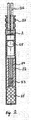
- the detonator has an enclosure in the shape of a shell 1 with inserted detonation tube 17 . In the bottom part of the enclosure there has been created a space for secondary explosive 11
- An industrial non-electric detonator with pyrotechnic delay charge that has an enclosure in the shape of a shell with inserted detonation tube 17 .
- space 11 for secondary explosive has been created in its bottom part, which is closed from above with the delay tube 12 , in the cylindrical box of which primary explosive 13 is arranged and delay charge 14 over it.
- the sleeve 15 with amplifying composition 16 is inserted, which is closed with cover 17 .
- detonation tube 19 fitted with insulation (18) against the enclosure of the shell 1, is inserted into shell 1.
- This example of execution describes an industrial electric detonator, in which the pyrotechnic delay charge 24 according to the above given examples of execution is used.
- the industrial electric detonator with pyrotechnic delay charge 24 has an enclosure in the shape of shell 2 with inserted fusehead 25 and it is fitted with in-lead wires 26 .
- space 21 for secondary explosive which is closed with the delay tube 22 from above.
- primary explosive 23 and delay charge 24 is placed over it.
- Over the delay tube 22 in the shell 2 there is inserted the fusehead 25 with in-lead wires 26 . These are fitted with insulation 27 against the enclosure of shell 2.
- the pyrotechnic delay charge according to the invention, the way of manufacture thereof and also industrial detonators with the delay charge can be employed in industrial applications.
- the charge can be employed especially in detonators in aboveground excavation of rocks and mining in stone quarries, in underground mining or driving of tunnels, in destructions and other similar specialized works.
Landscapes
- Chemical & Material Sciences (AREA)
- Organic Chemistry (AREA)
- Air Bags (AREA)
- Developing Agents For Electrophotography (AREA)
- Soft Magnetic Materials (AREA)
- Powder Metallurgy (AREA)
Abstract
Description
- The invention relates to pyrotechnic millisecond delay charge for industrial detonators with explosion delay time of 25 to 1,000 ms from initiation. The charge is intended to be compacted into the delay tube, for detonators initiated by fusehead, by a blasting machine generated pulse, and also for detonators initiated by detonation tube non-electrically - by detonating wave, or by a blasting machine generated spark. It relates to electric detonators in a series connection or a series-parallel connection and to non-electric detonators as well, where the firing circuit is created by connecting of detonation tubes of non-electric detonators, especially in aboveground destruction of rocks, mining in stone quarries, underground mining of rocks and driving of tunnels.
- The invention also relates to the way of manufacture of the said charge.
- The invention also relates to electric detonator on its own and is also meant as an independent invention of non-electric detonator, to be used together with the pyrotechnic delay charge.
- At present, to reach the delay of detonators in the range of up to 1, 000 milliseconds, pyrotechnic delay charges containing combustible matter and oxidizer are used. It is altogether Si, B, Zr, Ti metallic powders and Fe+Si+Cr, Si+Se+Fe, Zr+B, Zr+Ni alloys and others that are used as combustibles. Lead monoxide-dioxide and lead dioxide are mostly used as oxidizers. However, such charges contain heavy metals, which get into the environment after the detonator has been used. Therefore, there has been general endeavour aiming at excluding of heavy metals. There are known designs, e.g. according to
SE patents 446180 457380 US patent 5654520 is known, where bismuth ochre is used as oxidizer and elementary silicon is used as combustible. A disadvantage of the solution according to this patent is the necessity of adding a big amount of various additives to achieve the function needed. - The objective of the invention is to develop such a charge and weight ratios of combustible and oxidizer, which would not be intensive in terms of manufacture and costs, with minimum need of completive additives to achieve time variability and delay exactness. However, the solution should above all meet the condition of absence of heavy metals.
- Again, the objective of the invention is to develop such a way of manufacture of the created delay charge that the resulting parameters agree with the defined objective, and minimum manufacture costs are kept.
- The objective of the invention is also to create electric and non-electric detonator, in which the created composition can be employed.
- Both the electric and non-electric detonator is described in examples of execution by means of attached drawings where
Figure 1 shows a non-electric detonator andFigure 2 shows an electric detonator. - The specified objective is reached by a pyrotechnic millisecond delay charge for both electric and non-electric industrial detonators with delay time of explosion of 25 to 1,000 ms from initiation, the subject-matter of which is the proportion according to the invention. It contains ferrosilliconzirconium (hereinafter referred to as FeSiZr) as combustible matter and bismuth ochre (hereinafter referred to as Bi2O3) as oxidizer. These are in proportion of 50 ± 15 wt. % FeSiZr and 50 ± 15 wt. % Bi2O3. FeSiZr is an alloy of dominant elements Si, Zr, Fe and Ti, containing also trace impurities originating from aluminosillicates, which are input substances in manufacture of alloys. The limit representation of dominant elements in FeSiZr according to the invention is as follows: Si at least 30 wt. %, Zr at least 10 wt. %, Fe at the most 25 wt. %, Ti at least 1 wt. %.
- The pyrotechnic charge can contain the additive, titanic oxide (hereinafter referred to as TiO2) in the amount of up to 5 wt. % as combustion speed controller.
- In the pyrotechnic millisecond delay charge, the purity of the substance Bi2O3 is at least 90%.
- In one of the advantageous executions of the pyrotechnic millisecond charge, the FeSiZr alloy consists of Si 52.1 wt. %, Zr 27.4 wt. %, Fe 12.7 wt. %, Ti 5.8 wt. % and
impurities 2 wt %, with Bi2O3 of purity 99.8 wt. %, in proportion of 52.8 wt % Bi2O3 and 47.2 wt. % FeSiZr. - In another execution, depending on the required qualities, the FeSiZr alloy consists of Si 52.1 wt. %, Zr 27.4 wt. %, Fe 12.7 wt. %, Ti 5.8 wt. %,
impurities 2 wt %, with Bi2O3 of purity 99.8 wt %, in proportion 60.0 wt % Bi2O3 and 40.0 wt. % FeSiZr. - In another advantageous execution, which proves the variability of final qualities, the FeSiZr alloy consists of Si 63.5 wt. %, Zr 21.3 wt. %, Fe 11.7 wt. %, Ti 1.1 wt. %, impurities 2.4 wt %, with Bi2O3 of purity 99.8 wt %, in proportion 60.0 wt % Bi2O3 and 40.0 wt. % FeSiZr.
- In another advantageous execution, the FeSiZr alloy consists of Si 63.5 wt. %, Zr 21.3 wt. %, Fe 11.7 wt. %, Ti 1.1 wt. %, impurities 2.4 wt %, with Bi2O3 of purity 99.8 wt % , in proportion 50.0 wt % Bi2O3 and 50.0 wt. % FeSiZr, eventually the FeSiZr alloy consists of 63.5 wt. %, Zr 21.3 wt. %, Fe 11.7 wt. %, Ti 1.1 wt. %,
impurities 2,4 wt %, with Bi2O3 of purity 99.8 wt % ,in proportion 55.0 wt % Bi2O3 an d 45.0 wt. % FeSiZr. - In an execution with TiO2 additive, the FeSiZr alloy can consist of Si 63.5 wt. %, Zr 21.3 wt. %, Fe 11.7 wt. %, Ti 1.1 wt. %,
impurities 2,4 wt %, with Bi2O3 of purity 99.8 wt % and with TiO2 of purity 98 wt. %, in proportion 53..9 wt % Bi2O3, 44.1 wt. % FeSiZr and 2.0 wt. % TiO2. - In another advantageous execution with TiO2 additive, the FeSiZr alloy consists of Si 63.5 wt. %, Zr 21.3 wt. %, Fe 11.7 wt. %, Ti 1.1 wt. %, impurities 2.4 wt %, with Bi2O3 of purity 99.8 wt % and with TiO2 of purity 98 wt. % , in proportion 52.3 wt % Bi2O3, 42.7 wt. % FeSiZr and 5.0 wt. % TiO2.
- The subject matter of the invention is also the way of manufacture of the pyrotechnic millisecond delay charge for electric and non-electric industrial detonators with delay time of explosion of 25 up to 1,000 ms from initiation. The principle of the way of manufacture consists in that ferrosilliconzirconium (hereinafter referred to as FeSiZr) with limit representation of the dominant elements Si at least 30 wt. %, Zr at least 10 wt. %, Fe at the most 25 wt. % and Ti at least 1 wt. %, is prepared in the physical process of grinding to the particle size in the range from 1-10 µm, bismuth ochre (hereinafter referred to as Bi2O3) of purity at least 95% is also prepared to the particle size in the range of 1- 10 µm. Then these two components in proportion 50 ± 10 wt. % FeSiZr and 50 ± 15 wt. % Bi2O3 are mechanically homogenized and pelletized with pressure of 255 MPa. Next, they are crushed to grading of 0.2 - 0.8 mm grain size.
- Afterwards, the charge is pressed into the delay tube of the detonator under pressure of 280 MPa with the column height of 20 mm.
- The principle of the way of manufacture according to the invention is also that up to 5 wt. % TiO2 of purity at least 95%, prepared to particle size in the range of 1- 10 µm, is added to FeSiZr and Bi2O3 before homogenization.
- The subject matter of the non-electric industrial detonator with enclosure in the shape of a shell with inserted detonation tube is the fact that in the enclosure there is created a space at least for primary explosive and for delay charge, and the shell, which is closed at the bottom, has a space in the bottom part that has been created for secondary explosive, which space is closed with the delay tube from above. In its cylindrical box there is arranged primary explosive, and delay charge is above it. Above the delay tube, in the shell there is inserted a sleeve with amplifying composition, closed with a cover. A detonation tube, fitted with insulation against the enclosure, is inserted into the shell from the upper side.
- The subject matter of the electric industrial detonator is that in the shell it has a fusehead inserted, with lead-in wires, which are fitted with insulation against the shell enclosure, the other technical features are the same as those of ther non-electric detonator described above.
- The main advantage, and at present a particularly appreciated enhanced effect, is the absence of heavy metals, seeing that the presence of heavy metals even in consumables, e.g. in mineral salt, apparently due to the way of mining, is a great issue in those parts of the world that are actively used for industry. The pyrotechnic charge is free of lead oxides or chromates, and free of barium. The benefit of this solution is that while the above mentioned main advantage is preserved, simplicity of manufacture and versatility of use for various intervals of required delay, even at high accuracy, are provided. The variability of delay is achieved due to the proportion of the basic components and it is not necesary to add any other additives. As far as the field of application is concerned, this solution appears to be very simple and practical and not demanding for technology or investment in terms of production.
- Ferrosilliconzirconium (hereinafter referred to as FeSiZr) acts as combustible in the delay charge. Here is the definition thereof for the purposes of description of the invention:
- An alloy of dominant elements Si, Zr, Fe, Ti with content of trace impurities originating from aluminosillicates, which are input substances in manufacture of alloys. The limit representation of dominant elements in FeSiZr for the purposes of the invention is as follows:
- Si at least 30 wt. %
- Zr at least 10 wt. %
- Fe at the most 25 wt. %
- Ti at least 1 wt. %.
- The FeSiZr alloy is prepared in the physical process of grinding to the particle size in the range of 1- 10 µm.
- Bismuth ochre (hereinfter referred to as Bi2O3) acts as oxidizer in the delay charge. Here is the definition thereof for the purposes of description of the invention:
- A substance of purity at least 90%, prepared, usually by physical grinding, to the particle size in the range of 1- 10 µm.
- Titanium dioxide (hereinfter referred to as TiO2) acts as additive in the delay charge, it does not participate actively in the process of combustion, it influences the combustion speed in the desired way.
- A substance of purity at least 95%, prepared, usually by physical grinding, to the particle size in the range of 1- 10 µm.
- In this example of execution, FeSiZr alloy with the following composition was used:
- Si 52.1 wt. %
- Zr 27.4 wt. %
- Fe 12.7 wt. %
- Ti 5.8 wt. %
-
impurities 2 wt %. - Further, Bi2O3 of purity 99.8 wt % was used.
- FeSiZr and Bi2O3 were used in proportion 52.8 wt % Bi2O3 and 47.2 wt. % FeSiZr.
- The FeSiZr alloy was prepared to particle size 1.86 µm and Bi2O3 was prepared to particle size 1.98 µm.
- The mixture was mechanically homogenized and pelletized with pressure of 255 MPa. Next, it was crushed to grading of grain size of 0.2 - 0.8 mm.
- The composition so prepared is pressed into the delay tube of the non-electric detonator by means of pressure of 280 MPa with column height of 20 mm.
- The average delay time of detonator explosion with this composition of delay charge is 267.4 ms and standard deviation 3.3 ms.
- In this example of execution, FeSiZr alloy with the following composition was used:
- Si 52.1 wt. %
- Zr 27.4 wt. %
- Fe 12.7 wt. %
- Ti 5.8 wt. %
-
impurities 2 wt %. - Further, Bi2O3 of purity 99.8 wt % was used.
- FeSiZr and Bi2O3 were used in proportion 60.0 wt % Bi2O3 and 40.0 wt. % FeSiZr.
- The FeSiZr alloy was prepared to particle size 1.86 µm and Bi2O3 was prepared to particle size 1.98 µm.
- The mixture was mechanically homogenized and pelletized with pressure of 255 MPa. Next, it was crushed to grading of grain size of 0.2 - 0.8 mm.
- The composition so prepared is pressed into the delay tube of the non-electric detonator with pressure of 280 MPa with height of the column of 20 mm.
- The average delay time of detonator explosion with this composition of delay charge is 235.8 ms and standard deviation 3.4 ms.
- In this example of execution, FeSiZr alloy with the following composition was used:
- Si 63.5 wt. %
- Zr 21.3 wt. %
- Fe 11.7 wt. %
- Ti 1.1 wt. %
- impurities 2.4 wt %.
- Further, Bi2O3 of purity 99.8 wt % was used.
- FeSiZr and Bi2O3 were used in proportion 60.0 wt % Bi2O3 and 40.0 wt. % FeSiZr.
- The FeSiZr alloy was prepared to particle size 2.09 µm and Bi2O3 was prepared to particle size 1.98 µm.
- The mixture was mechanically homogenized and pelletized with pressure of 255 MPa. Next, it was crushed to grading of grain size of 0.2 - 0.8 mm.
- The composition so prepared is pressed into the delay tube of the non-electric detonator with pressure of 280 MPa with height of the column of 20 mm.
- The average delay time of detonator explosion with this composition of delay charge is 247.5 ms and standard deviation 2.8 ms.
- In this example of execution, FeSiZr alloy with the following composition was used:
- Si 63.5 wt. %
- Zr 21.3 wt. %
- Fe 11.7 wt. %
- Ti 1.1 wt. %
-
impurities 2,4 wt %. - Further, Bi2O3 of purity 99.8 wt % was used.
- FeSiZr a Bi2O3 were used in proportion 50.0 wt % Bi2O3 and 50.0 wt. % FeSiZr. The FeSiZr alloy was prepared to particle size 2.09 µm and Bi2O3 was prepared to particle size 1.98 µm.
- The mixture was mechanically homogenized and pelletized with pressure of 255 MPa. Next, it was crushed to grading of grain size of 0.2 - 0.8 mm.
- The composition so prepared is pressed into the delay tube of the non-electric detonator with pressure of 280 MPa and with height of the column of 20 mm. The average delay time of detonator explosion with this composition of delay charge is 372.4 ms and standard deviation 3.4 ms.
- In this example of execution, FeSiZr alloy with the following composition was used:
- Si 63.5 wt. %
- Zr 21.3 wt. %
- Fe 11.7 wt. %
- Ti 1.1 wt. %
- impurities 2.4 wt %.
- Further, Bi2O3 of purity 99.8 wt % was used.
- FeSiZr and Bi2O3 were used in proportion 55.0 wt % Bi2O3 and 45.0 wt. % FeSiZr.
- The FeSiZr alloy was prepared to particle size 4.88 µm and Bi2O3 was prepared to particle size 1.98 µm.
- The mixture was mechanically homogenized and pelletized with pressure of 255 MPa. Next, it was crushed to grading of grain size of 0.2 - 0.8 mm.
- The composition so prepared is pressed into the delay tube of the non-electric detonator with pressure of 280 MPa with height of the column of 20 mm.
- The average delay time of detonator explosion with this composition of delay charge is 347.7 ms and standard deviation 3.7 ms.
- In this example of execution, FeSiZr alloy with the following composition was used:
- Si 63.5 wt. %
- Zr 21.3 wt. %
- Fe 11.7 wt. %
- Ti 1.1 wt. %
- impurities 2.4 wt %.
- Further, Bi2O3 of purity 99.8 wt % and TiO2 of purity 98 wt. % were used.
- FeSiZr, Bi2O3 and TiO2 were used in proportion 53.9 wt % Bi2O3 , 44.1 wt. % FeSiZr and 2.0 wt. % TiO2.
- The FeSiZr alloy was prepared to particle size 4.88 µm and Bi2O3 was prepared to particle size 1.98 µm and TiO2 was prepared to particle size 0.45 µm.
- The mixture was mechanically homogenized and pelletized with pressure of 255 MPa. Next, it was crushed to grading of grain size of 0.2 - 0.8 mm.
- The composition so prepared is pressed into the delay tube of the non-electric detonator with pressure of 280 MPa with height of the column of 20 mm.
- The average delay time of detonator explosion with this composition of delay charge is 405.0 ms and standard deviation 3.5 ms.
- In this example of execution, FeSiZr alloy with the following composition was used:
- Si 63.5 wt. %
- Zr 21.3 wt. %
- Fe 11.7 wt. %
-
Ti 11 wt. % - impurities 2.4 wt %.
- Further, Bi2O3 of purity 99.8 wt % and TiO2 of purity 98 wt. % were used.
- The FeSiZr alloy, Bi2O3 and TiO2 were used in proportion 52.3 wt % Bi2O3, 42.7 wt. % FeSiZr and 5.0 wt. % TiO2.
- The FeSiZr alloy was prepared to particle size 4,88 µm and Bi2O3 was prepared to particle size 1.98 µm and TiO2 was prepared to particle size 0.45 µm.
- The mixture was mechanically homogenized and pelletized with pressure of 255 MPa. Next, it was crushed to grading of grain size of 0.2 - 0.8 mm.
- The composition so prepared is pressed into the delay tube of the non-electric detonator with pressure of 280 MPa with height of the column of 20 mm.
- The average delay time of detonator explosion with this composition of delay charge is 640.4 ms and standard deviation 6.5 ms.
- This example of execution describes an industrial non-electric detonator, in which the pyrotechnic delay charge according to the above given examples of execution is used. The detonator has an enclosure in the shape of a shell 1 with inserted
detonation tube 17. In the bottom part of the enclosure there has been created a space for secondary explosive 11 - An industrial non-electric detonator with pyrotechnic delay charge that has an enclosure in the shape of a shell with inserted
detonation tube 17. In the shell 1, which is closed at the bottom,space 11 for secondary explosive has been created in its bottom part, which is closed from above with the delay tube 12, in the cylindrical box of whichprimary explosive 13 is arranged and delay charge 14 over it. Over the delay tube 12 in the shell 1, thesleeve 15 with amplifyingcomposition 16 is inserted, which is closed withcover 17. From above,detonation tube 19, fitted with insulation (18) against the enclosure of the shell 1, is inserted into shell 1. - This example of execution describes an industrial electric detonator, in which the
pyrotechnic delay charge 24 according to the above given examples of execution is used. The industrial electric detonator withpyrotechnic delay charge 24 has an enclosure in the shape ofshell 2 with inserted fusehead 25 and it is fitted with in-lead wires 26 . In the lower part of the enclosure there has been createdspace 21 for secondary explosive, which is closed with thedelay tube 22 from above. In the cylindrical box of thedelay tube 22 there is placed primary explosive 23 and delaycharge 24 is placed over it. Over thedelay tube 22 , in theshell 2 there is inserted thefusehead 25 with in-lead wires 26. These are fitted withinsulation 27 against the enclosure ofshell 2. - The function of both detonator types is apparent from their design and does not differ from that of commonly used detonators.
- The pyrotechnic delay charge according to the invention, the way of manufacture thereof and also industrial detonators with the delay charge can be employed in industrial applications. The charge can be employed especially in detonators in aboveground excavation of rocks and mining in stone quarries, in underground mining or driving of tunnels, in destructions and other similar specialized works.
Claims (17)
- Pyrotechnic millisecond delay charge for electric and non-electric industrial detonators with delay time of explosion of 25 to 1,000 ms from initiation, characterized in that it contains ferrosilliconzirconium (hereinafter referred to as FeSiZr) as combustible matter and bismuth ochre (hereinafter referred to as Bi2O3) as oxidizer in proportion 50 ± 15 wt. % FeSiZr and 50 ± 15 wt. % Bi2O3, where FeSiZr is a an alloy of dominant elements Si, Zr, Fe and Ti with content of trace impurities originating from from aluminosillicates, which are input substances in manufacture of alloys, where the limit representation of dominant elements in FeSiZr is as follows: Si at least 30 wt. %, Zr at least 10 wt. %, Fe at the most 25 wt. %.
- Pyrotechnic millisecond delay charge according to claim 1, characterized in that the combustible matter FeSiZr contains Ti at least 1 wt. %.
- Pyrotechnic millisecond delay charge according to claim 1, characterized in that it contains the additive titanic oxide (hereinafter referred to as TiO2) in the amount of up to 5 wt. % out of the total weight and in purity of the substance at least 95 wt. %. as combustion speed controller.
- Pyrotechnic millisecond delay charge according to claim 1, characterized in that Bi2O3 is a subtance of at least 90% purity.
- Pyrotechnic millisecond delay charge according to claim 1, characterized in that the FeSiZr alloy consists of Si 52.1 wt. %, Zr 27.4 wt. %, Fe 12.7 wt. %, Ti 5.8 wt. % and impurities 2 wt %, with Bi2O3 of purity 99.8 wt %, in proportion 52.8 wt % Bi2O3 and 47.2 wt. % FeSiZr.
- Pyrotechnic millisecond delay charge according to claim 1, characterized in that the FeSiZr contains Si 52.1 wt. %, Zr 27.4 wt. %, Fe 12.7 wt. %, Ti 5.8 wt. %, impurities 2 wt %, with Bi2O3 of purity 99.8 wt %, in proportion 60.0 wt % Bi2O3 and 40.0 wt. % FeSiZr.
- Pyrotechnic millisecond delay charge according to claim 1, characterized in that the FeSiZr alloys contains Si 63.5 wt. %, Zr 21.3 wt. %, Fe 11.7 wt. %, Ti 1.1 wt. %, impurities 2.4 wt %, with Bi2O3 of purity 99.8 wt %, in proportion 60.0 wt % Bi2O3 and 40.0 wt. % FeSiZr.
- Pyrotechnic millisecond delay charge according to claim 1, characterized in that the FeSiZr alloy contains Si 63.5 wt. %, Zr 21.3 wt. %, Fe 11.7 wt. %, Ti 1.1 wt. %, impurities 2.4 wt %, with Bi2O3 of purity 99.8 wt %, in proportion 50.0 wt % Bi2O3 nd 50.0 wt. % FeSiZr.
- Pyrotechnic millisecond delay charge according to claim 1, characterized in that the FeSiZr alloy contains Si 63.5 wt. %, Zr 21.3 wt. %, Fe 11.7 wt. %, Ti 1.1 wt. %, impurities 2.4 wt %, with Bi2O3 of purity 99.8 wt %, in proportion 55.0 wt % Bi2O3 and 45.0 wt. % FeSiZr.
- Pyrotechnic millisecond delay charge according to claim 2, characterized in that the FeSiZr alloy contains Si 63.5 wt. %, Zr 21.3 wt. %, Fe 11.7 wt. %, Ti 1.1 wt. %, impurities 2.4 wt %, with Bi2O3 of purity 99,8 wt % and with TiO2 of purity 98 wt. %, in proportion 53.9 wt % Bi2O3 , 44.1 wt. % FeSiZr and 2.0 wt. % TiO2.
- Pyrotechnic millisecond delay charge according to claim 2, characterized in that the FeSiZr alloy contains Si 63.5 wt. %, Zr 2.3 wt. %, Fe 11.7 wt. %, Ti 1.1 wt. %, impurities 2.4 wt %, with Bi2O3 of purity 99.8 wt % and with TiO2 of purity 98 wt. %, in proportion 52.3 wt % Bi2O3 , 42.7 wt. % FeSiZr and 5.0 wt. % TiO2.
- The way of manufacture of pyrotechnic millisecond delay charge for electric and non-electric industrial detonators with delay time of explosion of 25 to 1,000 ms from initiation, characterized in that ferrosilliconzirconium (hereinafter referred to as FeSiZr) with the limit representation of dominant elements Si at least 30 wt. %, Zr at least 10 wt. %, Fe at the most 12 wt. % and Ti at least 1 wt. % are prepared in the physical process of grinding to particle size in range of 1- 10 µm, bismuth ochre (hereinfter referred to as Bi2O3) of purity at least 90% is prepared to particle size in range of 1- 10 µm, whereupon these two components in proportion 50 ± 10 wt. % FeSiZr and 50 ± 10 wt. % Bi2O3 are mechanically homogenized and pelletized with pressure of 255 MPa, and after that crushed to grading of grain size of 0.2 - 0.8 mm.
- The way of manufacture of pyrotechnic millisecond delay charge according to claim 12, characterized in that FeSiZr is used containing at least 1 wt.% Ti /or Ti is added to FeSiZr.
- The way of manufacture of pyrotechnic millisecond delay charge according to claim 12, characterized in that the charge is pressed into the delay tube of the detonator with pressure of 280 MPa with column height of 5 to 40 mm.
- The way of manufacture of pyrotechnic millisecond delay charge according to claim 10, characterized in that up to 5 wt. % TiO2 of purity at least 95%, prepared to particle size in the range of 1- 10 µm, is added to FeSiZr and Bi2O3 before homogenization.
- Industrial non-electric detonator with pyrotechnic delay charge, which has an enclosure in the shape of a shell with inserted detonation tube, and in the enclosure there is created a space at least for primary explosive and for the delay charge, characterized in that the shell (1) closed at the bottom side has in its bottom part a space (11) created for secondary explosive, which is from above closed with the delay tube (12), in the cylindrical box of which there is placed primary explosive (13) and the delay charge (14) over it, where over the delay tube (12) in the shell (1) is inserted a sleeve (15) with amplifying charge (16) closed with cover (17), and there is inserted from above into shell (1) the detonation tube (19), fitted with insulation (18) against the enclosure of the shell (1).
- Industrial electric detonator with pyrotechnic delay charge, which has an enclosure in the shape of a shell with inserted fusehead and is fitted with in-lead wires, and in the enclosure there is created a space at least for primary explosive and for the delay charge, characterized in that the shell (2) closed at the bottom side has in its bottom part a space (21) created for secondary explosive, which is from above closed with the delay tube (22), in the cylindrical box of which there is placed primary explosive (23) and the delay charge (24) over it, where over the delay tube (22) in the shell (2) there is inserted fusehead (25) with in-lead wires (26) fitted with insulation (27) against the enclosure of the shell (2).
Priority Applications (1)
| Application Number | Priority Date | Filing Date | Title |
|---|---|---|---|
| HRP20192092TT HRP20192092T1 (en) | 2011-07-28 | 2019-11-21 | Pyrotechnic millisecond delay charge for industrial detonators with delay time of explosion of 25 to 1,000 ms from initiation, the way of manufacture of the delay charge, and electric and non-electric detonator |
Applications Claiming Priority (1)
| Application Number | Priority Date | Filing Date | Title |
|---|---|---|---|
| CZ2011-463A CZ306594B6 (en) | 2011-07-28 | 2011-07-28 | A millisecond delay pyrotechnic composition for industrial detonators with explosion delay time of 25-1000 ms from the initiation, the method of manufacturing the delay composition and an electric and non-electric detonator |
Related Parent Applications (1)
| Application Number | Title | Priority Date | Filing Date |
|---|---|---|---|
| CZ20110463 Previously-Filed-Application | 2011-07-28 |
Publications (3)
| Publication Number | Publication Date |
|---|---|
| EP2589582A2 true EP2589582A2 (en) | 2013-05-08 |
| EP2589582A3 EP2589582A3 (en) | 2016-01-06 |
| EP2589582B1 EP2589582B1 (en) | 2019-07-31 |
Family
ID=47088777
Family Applications (1)
| Application Number | Title | Priority Date | Filing Date |
|---|---|---|---|
| EP12466011.9A Active EP2589582B1 (en) | 2011-07-28 | 2012-06-26 | Pyrotechnic millisecond delay charge for industrial detonators with delay time of explosion of 25 to 1,000 ms from initiation and the way of manufacture of the delay charge |
Country Status (4)
| Country | Link |
|---|---|
| EP (1) | EP2589582B1 (en) |
| CZ (1) | CZ306594B6 (en) |
| ES (1) | ES2761302T3 (en) |
| HR (1) | HRP20192092T1 (en) |
Citations (3)
| Publication number | Priority date | Publication date | Assignee | Title |
|---|---|---|---|---|
| SE446180B (en) | 1981-05-21 | 1986-08-18 | Bofors Ab | PYROTECHNICAL DELAY RATE |
| SE457380B (en) | 1980-10-10 | 1988-12-19 | Cxa Ltd | DEFROST EXPLOSION Capsule with pre-drying agent |
| US5654520A (en) | 1992-11-27 | 1997-08-05 | Nitro Nobel Ab | Delay charge and element, and detonator containing such a charge |
Family Cites Families (5)
| Publication number | Priority date | Publication date | Assignee | Title |
|---|---|---|---|---|
| CS226817B1 (en) * | 1982-02-01 | 1984-04-16 | Richard Cunek | Electric denonator with ultra-short time delay of up to ten milliseconds |
| CS253609B1 (en) * | 1985-12-23 | 1987-11-12 | Jiri Martinek | Millisecond type delay mixture |
| CS263506B1 (en) * | 1987-04-02 | 1989-04-14 | Pavel Ing Valenta | Delay of the millisecond type |
| CZ287322B6 (en) * | 1995-10-27 | 2000-10-11 | Austin Detonator S.R.O. | Pyrotechnic retarding mixture |
| AP2640A (en) * | 2006-03-24 | 2013-04-11 | Ael Mining Services Ltd | Detonation of explosives |
-
2011
- 2011-07-28 CZ CZ2011-463A patent/CZ306594B6/en unknown
-
2012
- 2012-06-26 EP EP12466011.9A patent/EP2589582B1/en active Active
- 2012-06-26 ES ES12466011T patent/ES2761302T3/en active Active
-
2019
- 2019-11-21 HR HRP20192092TT patent/HRP20192092T1/en unknown
Patent Citations (3)
| Publication number | Priority date | Publication date | Assignee | Title |
|---|---|---|---|---|
| SE457380B (en) | 1980-10-10 | 1988-12-19 | Cxa Ltd | DEFROST EXPLOSION Capsule with pre-drying agent |
| SE446180B (en) | 1981-05-21 | 1986-08-18 | Bofors Ab | PYROTECHNICAL DELAY RATE |
| US5654520A (en) | 1992-11-27 | 1997-08-05 | Nitro Nobel Ab | Delay charge and element, and detonator containing such a charge |
Also Published As
| Publication number | Publication date |
|---|---|
| HRP20192092T1 (en) | 2020-05-29 |
| EP2589582B1 (en) | 2019-07-31 |
| EP2589582A3 (en) | 2016-01-06 |
| CZ2011463A3 (en) | 2013-02-20 |
| CZ306594B6 (en) | 2017-03-22 |
| ES2761302T3 (en) | 2020-05-19 |
Similar Documents
| Publication | Publication Date | Title |
|---|---|---|
| US8037829B1 (en) | Reactive shaped charge, reactive liner, and method for target penetration using a reactive shaped charge | |
| EP0860679B1 (en) | Shaped charge | |
| GB0323717D0 (en) | Improvements in and relating to oil well perforators | |
| CN107003104B (en) | Method of blasting with delay between holes in the shortest row and tools for blasting and delaying | |
| WO2012013926A8 (en) | Improvements in and relating to oil well perforators | |
| CN105444623A (en) | Energy-gathered cutting device for all-size gas blasting test of gas transmission steel pipe | |
| CN110981660B (en) | Rock coal pre-cracking agent and preparation method thereof | |
| Zygmunt et al. | Application and properties of aluminum in primary and secondary explosives | |
| EP2589582B1 (en) | Pyrotechnic millisecond delay charge for industrial detonators with delay time of explosion of 25 to 1,000 ms from initiation and the way of manufacture of the delay charge | |
| CN100570272C (en) | Industrial Explosives Shaped Energy Linear Cutter | |
| CN113340165B (en) | Tunnel blasting structure and blasting method | |
| US3894489A (en) | Explosive assemblies and method of utilizing the same | |
| US1185830A (en) | Detonator. | |
| JP2012021700A (en) | Pyrotechnics | |
| CN202814234U (en) | High-explosive type initiating tool | |
| CN202228052U (en) | Secondary explosion cladding synergistic perforator | |
| WO2024042390A1 (en) | Safe initiation of shock tubes (nonel) connected to mineral detonators based on nanotechnology | |
| RU2546914C1 (en) | Device of initiation of explosive charges | |
| US11692798B2 (en) | Electrical igniter assembly for incendiary and explosive devices | |
| Jhon Gladious et al. | Nonel Initiation for eco-friendly blasting | |
| CN203083443U (en) | Nonel exciter | |
| RU2579586C1 (en) | Composite material for implementation of explosion penetrating action | |
| CZ24976U1 (en) | Pyrotechnical short-delay composition for industrial electric blasting caps with explosion delay time of 25 to 1000 ms from initiation and electric and non-electric electric blasting caps | |
| JPS61117188A (en) | Electric primer and initiation | |
| US3474729A (en) | Ammonium nitrate explosive package and three-stage method of initiation |
Legal Events
| Date | Code | Title | Description |
|---|---|---|---|
| PUAI | Public reference made under article 153(3) epc to a published international application that has entered the european phase |
Free format text: ORIGINAL CODE: 0009012 |
|
| 17P | Request for examination filed |
Effective date: 20120718 |
|
| AK | Designated contracting states |
Kind code of ref document: A2 Designated state(s): AL AT BE BG CH CY CZ DE DK EE ES FI FR GB GR HR HU IE IS IT LI LT LU LV MC MK MT NL NO PL PT RO RS SE SI SK SM TR |
|
| AX | Request for extension of the european patent |
Extension state: BA ME |
|
| RIN1 | Information on inventor provided before grant (corrected) |
Inventor name: VALENTA, PAVEL Inventor name: HNAT, IGOR |
|
| PUAL | Search report despatched |
Free format text: ORIGINAL CODE: 0009013 |
|
| AK | Designated contracting states |
Kind code of ref document: A3 Designated state(s): AL AT BE BG CH CY CZ DE DK EE ES FI FR GB GR HR HU IE IS IT LI LT LU LV MC MK MT NL NO PL PT RO RS SE SI SK SM TR |
|
| AX | Request for extension of the european patent |
Extension state: BA ME |
|
| RIC1 | Information provided on ipc code assigned before grant |
Ipc: C06C 5/06 20060101AFI20151130BHEP Ipc: C06C 7/00 20060101ALI20151130BHEP |
|
| RBV | Designated contracting states (corrected) |
Designated state(s): AL AT BE BG CH CY CZ DE DK EE ES FI FR GB GR HR HU IE IS IT LI LT LU LV MC MK MT NL NO PL PT RO RS SE SI SK SM TR |
|
| STAA | Information on the status of an ep patent application or granted ep patent |
Free format text: STATUS: REQUEST FOR EXAMINATION WAS MADE |
|
| GRAP | Despatch of communication of intention to grant a patent |
Free format text: ORIGINAL CODE: EPIDOSNIGR1 |
|
| STAA | Information on the status of an ep patent application or granted ep patent |
Free format text: STATUS: GRANT OF PATENT IS INTENDED |
|
| INTG | Intention to grant announced |
Effective date: 20180102 |
|
| GRAS | Grant fee paid |
Free format text: ORIGINAL CODE: EPIDOSNIGR3 |
|
| GRAA | (expected) grant |
Free format text: ORIGINAL CODE: 0009210 |
|
| STAA | Information on the status of an ep patent application or granted ep patent |
Free format text: STATUS: THE PATENT HAS BEEN GRANTED |
|
| AK | Designated contracting states |
Kind code of ref document: B1 Designated state(s): AL AT BE BG CH CY CZ DE DK EE ES FI FR GB GR HR HU IE IS IT LI LT LU LV MC MK MT NL NO PL PT RO RS SE SI SK SM TR |
|
| REG | Reference to a national code |
Ref country code: CH Ref legal event code: EP Ref country code: GB Ref legal event code: FG4D |
|
| REG | Reference to a national code |
Ref country code: DE Ref legal event code: R096 Ref document number: 602012062419 Country of ref document: DE |
|
| REG | Reference to a national code |
Ref country code: AT Ref legal event code: REF Ref document number: 1160728 Country of ref document: AT Kind code of ref document: T Effective date: 20190815 |
|
| REG | Reference to a national code |
Ref country code: IE Ref legal event code: FG4D |
|
| REG | Reference to a national code |
Ref country code: HR Ref legal event code: TUEP Ref document number: P20192092T Country of ref document: HR Ref country code: HR Ref legal event code: NPPZ Ref document number: P20192092T Country of ref document: HR |
|
| REG | Reference to a national code |
Ref country code: NL Ref legal event code: MP Effective date: 20190731 |
|
| REG | Reference to a national code |
Ref country code: LT Ref legal event code: MG4D |
|
| REG | Reference to a national code |
Ref country code: AT Ref legal event code: MK05 Ref document number: 1160728 Country of ref document: AT Kind code of ref document: T Effective date: 20190731 |
|
| PG25 | Lapsed in a contracting state [announced via postgrant information from national office to epo] |
Ref country code: FI Free format text: LAPSE BECAUSE OF FAILURE TO SUBMIT A TRANSLATION OF THE DESCRIPTION OR TO PAY THE FEE WITHIN THE PRESCRIBED TIME-LIMIT Effective date: 20190731 Ref country code: NL Free format text: LAPSE BECAUSE OF FAILURE TO SUBMIT A TRANSLATION OF THE DESCRIPTION OR TO PAY THE FEE WITHIN THE PRESCRIBED TIME-LIMIT Effective date: 20190731 Ref country code: SE Free format text: LAPSE BECAUSE OF FAILURE TO SUBMIT A TRANSLATION OF THE DESCRIPTION OR TO PAY THE FEE WITHIN THE PRESCRIBED TIME-LIMIT Effective date: 20190731 Ref country code: BG Free format text: LAPSE BECAUSE OF FAILURE TO SUBMIT A TRANSLATION OF THE DESCRIPTION OR TO PAY THE FEE WITHIN THE PRESCRIBED TIME-LIMIT Effective date: 20191031 Ref country code: LT Free format text: LAPSE BECAUSE OF FAILURE TO SUBMIT A TRANSLATION OF THE DESCRIPTION OR TO PAY THE FEE WITHIN THE PRESCRIBED TIME-LIMIT Effective date: 20190731 Ref country code: NO Free format text: LAPSE BECAUSE OF FAILURE TO SUBMIT A TRANSLATION OF THE DESCRIPTION OR TO PAY THE FEE WITHIN THE PRESCRIBED TIME-LIMIT Effective date: 20191031 Ref country code: PT Free format text: LAPSE BECAUSE OF FAILURE TO SUBMIT A TRANSLATION OF THE DESCRIPTION OR TO PAY THE FEE WITHIN THE PRESCRIBED TIME-LIMIT Effective date: 20191202 Ref country code: AT Free format text: LAPSE BECAUSE OF FAILURE TO SUBMIT A TRANSLATION OF THE DESCRIPTION OR TO PAY THE FEE WITHIN THE PRESCRIBED TIME-LIMIT Effective date: 20190731 |
|
| PG25 | Lapsed in a contracting state [announced via postgrant information from national office to epo] |
Ref country code: IS Free format text: LAPSE BECAUSE OF FAILURE TO SUBMIT A TRANSLATION OF THE DESCRIPTION OR TO PAY THE FEE WITHIN THE PRESCRIBED TIME-LIMIT Effective date: 20191130 Ref country code: GR Free format text: LAPSE BECAUSE OF FAILURE TO SUBMIT A TRANSLATION OF THE DESCRIPTION OR TO PAY THE FEE WITHIN THE PRESCRIBED TIME-LIMIT Effective date: 20191101 Ref country code: ES Free format text: LAPSE BECAUSE OF FAILURE TO SUBMIT A TRANSLATION OF THE DESCRIPTION OR TO PAY THE FEE WITHIN THE PRESCRIBED TIME-LIMIT Effective date: 20190731 Ref country code: LV Free format text: LAPSE BECAUSE OF FAILURE TO SUBMIT A TRANSLATION OF THE DESCRIPTION OR TO PAY THE FEE WITHIN THE PRESCRIBED TIME-LIMIT Effective date: 20190731 Ref country code: AL Free format text: LAPSE BECAUSE OF FAILURE TO SUBMIT A TRANSLATION OF THE DESCRIPTION OR TO PAY THE FEE WITHIN THE PRESCRIBED TIME-LIMIT Effective date: 20190731 Ref country code: RS Free format text: LAPSE BECAUSE OF FAILURE TO SUBMIT A TRANSLATION OF THE DESCRIPTION OR TO PAY THE FEE WITHIN THE PRESCRIBED TIME-LIMIT Effective date: 20190731 |
|
| PG25 | Lapsed in a contracting state [announced via postgrant information from national office to epo] |
Ref country code: TR Free format text: LAPSE BECAUSE OF FAILURE TO SUBMIT A TRANSLATION OF THE DESCRIPTION OR TO PAY THE FEE WITHIN THE PRESCRIBED TIME-LIMIT Effective date: 20190731 |
|
| PG25 | Lapsed in a contracting state [announced via postgrant information from national office to epo] |
Ref country code: IT Free format text: LAPSE BECAUSE OF FAILURE TO SUBMIT A TRANSLATION OF THE DESCRIPTION OR TO PAY THE FEE WITHIN THE PRESCRIBED TIME-LIMIT Effective date: 20190731 Ref country code: EE Free format text: LAPSE BECAUSE OF FAILURE TO SUBMIT A TRANSLATION OF THE DESCRIPTION OR TO PAY THE FEE WITHIN THE PRESCRIBED TIME-LIMIT Effective date: 20190731 Ref country code: RO Free format text: LAPSE BECAUSE OF FAILURE TO SUBMIT A TRANSLATION OF THE DESCRIPTION OR TO PAY THE FEE WITHIN THE PRESCRIBED TIME-LIMIT Effective date: 20190731 Ref country code: DK Free format text: LAPSE BECAUSE OF FAILURE TO SUBMIT A TRANSLATION OF THE DESCRIPTION OR TO PAY THE FEE WITHIN THE PRESCRIBED TIME-LIMIT Effective date: 20190731 |
|
| REG | Reference to a national code |
Ref country code: ES Ref legal event code: NE2A Effective date: 20200430 |
|
| REG | Reference to a national code |
Ref country code: HR Ref legal event code: NPPU Ref document number: P20192092T Country of ref document: HR |
|
| REG | Reference to a national code |
Ref country code: ES Ref legal event code: FG2A Ref document number: 2761302 Country of ref document: ES Kind code of ref document: T3 Effective date: 20200519 |
|
| REG | Reference to a national code |
Ref country code: SE Ref legal event code: RINS Effective date: 20200505 |
|
| PG25 | Lapsed in a contracting state [announced via postgrant information from national office to epo] |
Ref country code: CZ Free format text: LAPSE BECAUSE OF FAILURE TO SUBMIT A TRANSLATION OF THE DESCRIPTION OR TO PAY THE FEE WITHIN THE PRESCRIBED TIME-LIMIT Effective date: 20190731 Ref country code: SK Free format text: LAPSE BECAUSE OF FAILURE TO SUBMIT A TRANSLATION OF THE DESCRIPTION OR TO PAY THE FEE WITHIN THE PRESCRIBED TIME-LIMIT Effective date: 20190731 Ref country code: SM Free format text: LAPSE BECAUSE OF FAILURE TO SUBMIT A TRANSLATION OF THE DESCRIPTION OR TO PAY THE FEE WITHIN THE PRESCRIBED TIME-LIMIT Effective date: 20190731 Ref country code: IS Free format text: LAPSE BECAUSE OF FAILURE TO SUBMIT A TRANSLATION OF THE DESCRIPTION OR TO PAY THE FEE WITHIN THE PRESCRIBED TIME-LIMIT Effective date: 20200224 |
|
| REG | Reference to a national code |
Ref country code: HR Ref legal event code: T1PR Ref document number: P20192092 Country of ref document: HR |
|
| REG | Reference to a national code |
Ref country code: SE Ref legal event code: TRGR |
|
| REG | Reference to a national code |
Ref country code: DE Ref legal event code: R097 Ref document number: 602012062419 Country of ref document: DE |
|
| PLBE | No opposition filed within time limit |
Free format text: ORIGINAL CODE: 0009261 |
|
| STAA | Information on the status of an ep patent application or granted ep patent |
Free format text: STATUS: NO OPPOSITION FILED WITHIN TIME LIMIT |
|
| REG | Reference to a national code |
Ref country code: HR Ref legal event code: ODRP Ref document number: P20192092 Country of ref document: HR Payment date: 20200522 Year of fee payment: 9 |
|
| PG2D | Information on lapse in contracting state deleted |
Ref country code: IS |
|
| PG25 | Lapsed in a contracting state [announced via postgrant information from national office to epo] |
Ref country code: ES Free format text: LAPSE BECAUSE OF FAILURE TO SUBMIT A TRANSLATION OF THE DESCRIPTION OR TO PAY THE FEE WITHIN THE PRESCRIBED TIME-LIMIT Effective date: 20190731 Ref country code: IS Free format text: LAPSE BECAUSE OF FAILURE TO SUBMIT A TRANSLATION OF THE DESCRIPTION OR TO PAY THE FEE WITHIN THE PRESCRIBED TIME-LIMIT Effective date: 20191030 |
|
| PGRI | Patent reinstated in contracting state [announced from national office to epo] |
Ref country code: ES Effective date: 20200430 |
|
| 26N | No opposition filed |
Effective date: 20200603 |
|
| PG25 | Lapsed in a contracting state [announced via postgrant information from national office to epo] |
Ref country code: SI Free format text: LAPSE BECAUSE OF FAILURE TO SUBMIT A TRANSLATION OF THE DESCRIPTION OR TO PAY THE FEE WITHIN THE PRESCRIBED TIME-LIMIT Effective date: 20190731 |
|
| REG | Reference to a national code |
Ref country code: DE Ref legal event code: R119 Ref document number: 602012062419 Country of ref document: DE |
|
| PG25 | Lapsed in a contracting state [announced via postgrant information from national office to epo] |
Ref country code: MC Free format text: LAPSE BECAUSE OF FAILURE TO SUBMIT A TRANSLATION OF THE DESCRIPTION OR TO PAY THE FEE WITHIN THE PRESCRIBED TIME-LIMIT Effective date: 20190731 Ref country code: SE Free format text: LAPSE BECAUSE OF FAILURE TO SUBMIT A TRANSLATION OF THE DESCRIPTION OR TO PAY THE FEE WITHIN THE PRESCRIBED TIME-LIMIT Effective date: 20190731 |
|
| PGRI | Patent reinstated in contracting state [announced from national office to epo] |
Ref country code: SE Effective date: 20200505 |
|
| REG | Reference to a national code |
Ref country code: CH Ref legal event code: PL |
|
| GBPC | Gb: european patent ceased through non-payment of renewal fee |
Effective date: 20200626 |
|
| PG25 | Lapsed in a contracting state [announced via postgrant information from national office to epo] |
Ref country code: LU Free format text: LAPSE BECAUSE OF NON-PAYMENT OF DUE FEES Effective date: 20200626 |
|
| REG | Reference to a national code |
Ref country code: BE Ref legal event code: MM Effective date: 20200630 |
|
| PG25 | Lapsed in a contracting state [announced via postgrant information from national office to epo] |
Ref country code: CH Free format text: LAPSE BECAUSE OF NON-PAYMENT OF DUE FEES Effective date: 20200630 Ref country code: IE Free format text: LAPSE BECAUSE OF NON-PAYMENT OF DUE FEES Effective date: 20200626 Ref country code: LI Free format text: LAPSE BECAUSE OF NON-PAYMENT OF DUE FEES Effective date: 20200630 Ref country code: GB Free format text: LAPSE BECAUSE OF NON-PAYMENT OF DUE FEES Effective date: 20200626 |
|
| PG25 | Lapsed in a contracting state [announced via postgrant information from national office to epo] |
Ref country code: BE Free format text: LAPSE BECAUSE OF NON-PAYMENT OF DUE FEES Effective date: 20200630 Ref country code: DE Free format text: LAPSE BECAUSE OF NON-PAYMENT OF DUE FEES Effective date: 20210101 |
|
| REG | Reference to a national code |
Ref country code: HR Ref legal event code: ODRP Ref document number: P20192092 Country of ref document: HR Payment date: 20210427 Year of fee payment: 10 |
|
| PG25 | Lapsed in a contracting state [announced via postgrant information from national office to epo] |
Ref country code: MT Free format text: LAPSE BECAUSE OF FAILURE TO SUBMIT A TRANSLATION OF THE DESCRIPTION OR TO PAY THE FEE WITHIN THE PRESCRIBED TIME-LIMIT Effective date: 20190731 Ref country code: CY Free format text: LAPSE BECAUSE OF FAILURE TO SUBMIT A TRANSLATION OF THE DESCRIPTION OR TO PAY THE FEE WITHIN THE PRESCRIBED TIME-LIMIT Effective date: 20190731 |
|
| PG25 | Lapsed in a contracting state [announced via postgrant information from national office to epo] |
Ref country code: MK Free format text: LAPSE BECAUSE OF FAILURE TO SUBMIT A TRANSLATION OF THE DESCRIPTION OR TO PAY THE FEE WITHIN THE PRESCRIBED TIME-LIMIT Effective date: 20190731 |
|
| REG | Reference to a national code |
Ref country code: HR Ref legal event code: ODRP Ref document number: P20192092 Country of ref document: HR Payment date: 20220509 Year of fee payment: 11 |
|
| PG25 | Lapsed in a contracting state [announced via postgrant information from national office to epo] |
Ref country code: PL Free format text: LAPSE BECAUSE OF FAILURE TO SUBMIT A TRANSLATION OF THE DESCRIPTION OR TO PAY THE FEE WITHIN THE PRESCRIBED TIME-LIMIT Effective date: 20190731 |
|
| REG | Reference to a national code |
Ref country code: HR Ref legal event code: ODRP Ref document number: P20192092 Country of ref document: HR Payment date: 20230605 Year of fee payment: 12 |
|
| REG | Reference to a national code |
Ref country code: HR Ref legal event code: ODRP Ref document number: P20192092 Country of ref document: HR Payment date: 20240425 Year of fee payment: 13 |
|
| REG | Reference to a national code |
Ref country code: HR Ref legal event code: ODRP Ref document number: P20192092 Country of ref document: HR Payment date: 20250604 Year of fee payment: 14 |
|
| PGFP | Annual fee paid to national office [announced via postgrant information from national office to epo] |
Ref country code: HR Payment date: 20250604 Year of fee payment: 14 |
|
| PGFP | Annual fee paid to national office [announced via postgrant information from national office to epo] |
Ref country code: FR Payment date: 20250612 Year of fee payment: 14 |
|
| PGFP | Annual fee paid to national office [announced via postgrant information from national office to epo] |
Ref country code: SE Payment date: 20250604 Year of fee payment: 14 |
|
| PGFP | Annual fee paid to national office [announced via postgrant information from national office to epo] |
Ref country code: ES Payment date: 20250903 Year of fee payment: 14 |