EP2584307A1 - Glass bottle inspection device - Google Patents
Glass bottle inspection device Download PDFInfo
- Publication number
- EP2584307A1 EP2584307A1 EP10857798.2A EP10857798A EP2584307A1 EP 2584307 A1 EP2584307 A1 EP 2584307A1 EP 10857798 A EP10857798 A EP 10857798A EP 2584307 A1 EP2584307 A1 EP 2584307A1
- Authority
- EP
- European Patent Office
- Prior art keywords
- bottle
- sealing surface
- base portion
- mouth portion
- points
- Prior art date
- Legal status (The legal status is an assumption and is not a legal conclusion. Google has not performed a legal analysis and makes no representation as to the accuracy of the status listed.)
- Granted
Links
Images


Classifications
-
- G—PHYSICS
- G01—MEASURING; TESTING
- G01N—INVESTIGATING OR ANALYSING MATERIALS BY DETERMINING THEIR CHEMICAL OR PHYSICAL PROPERTIES
- G01N21/00—Investigating or analysing materials by the use of optical means, i.e. using sub-millimetre waves, infrared, visible or ultraviolet light
- G01N21/84—Systems specially adapted for particular applications
- G01N21/88—Investigating the presence of flaws or contamination
- G01N21/90—Investigating the presence of flaws or contamination in a container or its contents
-
- G—PHYSICS
- G01—MEASURING; TESTING
- G01B—MEASURING LENGTH, THICKNESS OR SIMILAR LINEAR DIMENSIONS; MEASURING ANGLES; MEASURING AREAS; MEASURING IRREGULARITIES OF SURFACES OR CONTOURS
- G01B11/00—Measuring arrangements characterised by the use of optical techniques
- G01B11/26—Measuring arrangements characterised by the use of optical techniques for measuring angles or tapers; for testing the alignment of axes
-
- G—PHYSICS
- G01—MEASURING; TESTING
- G01N—INVESTIGATING OR ANALYSING MATERIALS BY DETERMINING THEIR CHEMICAL OR PHYSICAL PROPERTIES
- G01N21/00—Investigating or analysing materials by the use of optical means, i.e. using sub-millimetre waves, infrared, visible or ultraviolet light
- G01N21/84—Systems specially adapted for particular applications
- G01N21/88—Investigating the presence of flaws or contamination
- G01N21/90—Investigating the presence of flaws or contamination in a container or its contents
- G01N21/9054—Inspection of sealing surface and container finish
Definitions
- the present invention relates to a technology with which a sealing surface of a mouth portion of a glass bottle is inspected, and in particular, relates to a technology with which inclination of the sealing surface of the mouth portion of the glass bottle (sealing surface inclination) is inspected at high speed.
- glass bottles manufactured in a bottle manufacturing machine are guided to a glass bottle inspection device and whether or not there are defects in the bottles is inspected by the glass bottle inspection device.
- Glass bottles with specified flaws are rejected as defective bottles.
- an inspection device, with which inclination of the sealing surface of the mouth (referred to as “sealing surface inclination” hereafter) of a bottle is inspected is known. By rejecting glass bottles with large sealing surface inclination using such a glass bottle inspection device, leakage of liquids contained in bottles and troubles occurring when bottles are capped are prevented.
- Inspection devices that inspect sealing surface inclination have been disclosed in, for example, Patent Literatures 1 and 2 cited below.
- images static images
- image taking means In the images having been taken, two points on the sealing surface of the bottle mouth are detected and the difference between the two points in the vertical direction is calculated. The calculated difference is regarded as the sealing surface inclination.
- the bottle When a bottle is rotated, the bottle may wobble or be inclined by a shock caused by rotation. Detecting inclination of the sealing surface of a bottle in an inclined position does not lead to correct inspection of the sealing surface inclination of the bottle. Thus, related-art sealing-surface inclination measurement devices have a problem in correctness.
- a task of the present invention is to allow sealing surface inclination of a bottle to be correctly inspected even when the bottle wobbles or is inclined due to rotation of the bottle while the bottle is being rotated on an inspection table.
- a glass bottle inspection device includes a rotating means that causes a glass bottle to rotate about a bottle axis, a mouth portion illuminating means that emits light toward a bottle mouth of the glass bottle, a mouth portion image taking means that takes an image of the bottle mouth illuminated by the light emitted from the mouth portion illuminating means, a base portion illuminating means that emits light toward a base portion of the glass bottle, and a base portion image taking means that takes an image of the base portion illuminated by the light emitted from the base portion illuminating means.
- two points G and H on a sealing surface of the bottle mouth are detected in a mouth portion image taken by the mouth portion image taking means.
- two points M and N at a bottom end of the bottle are detected in a base portion image taken by the base portion image taking means at the same time as mouth portion image is taken, and sealing surface inclination of the bottle in a vertically standing position is calculated by using the two points G and H of the mouth portion and the two points M and N of the base portion.
- (Gy - Hy) is a vertical distance between the two points G and H of the mouth portion
- (My - Ny) is a vertical distance between the two points M and N at the bottom end
- (Gx - Hx) is a horizontal distance between the two points G and H of the mouth portion
- (Mx - Nx) is a horizontal distance between the two points M and N at the bottom end.
- sealing surface inclination of a bottle in a vertically standing position can be correctly calculated even when inspecting the bottle that wobbles on an inspection table. Thus, inspection can be correctly performed.
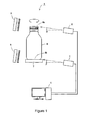
- Fig. 1 illustrates a general structure of a glass bottle inspection device 1 according to the present embodiment.
- a glass bottle 8 is guided onto an inspection table 7 by a guiding means (not shown) and rotated on the inspection table 7 about a bottle axis by a rotating means (not shown).
- the guiding means for a bottle and the rotating means for a bottle may use known means such as means described in the aforementioned PTL 1 and PTL 2.
- a mouth portion image taking means 2 and a mouth portion illuminating means 3 are disposed so as to oppose each other with a mouth portion 8a of a glass bottle 3 interposed therebetween.
- a base portion image taking means 4 and a base portion illuminating means 5 are disposed so as to oppose each other with a base portion 8b of the glass bottle interposed therebetween.
- the image taking means 2 and 4 may use, for example, a high-speed area sensor camera to which a telecentric lens with fixed image magnification is attached.
- the illuminating means 3 and 5 may use, for example, a diffusing planar light source including blue LEDs that emit blue light and are arranged in a matrix.
- a single large illuminating means may be used instead of the separate mouth portion illuminating means and base portion illuminating means.
- the optical axis of the mouth portion image taking means 2 is inclined upward relative to a horizontal line by an angle ⁇ , thereby taking images of the bottle mouth portion 8a from slightly below the bottle mouth portion 8a. This prevents the image taking means from taking an image of part of the edge of the bottle mouth portion, the part being located behind the bottle mouth portion when seen from the image taking means.
- the optical axis of the base portion image taking means 4 is inclined upward relative to a horizontal line by an angle ⁇ , thereby taking images of the base portion 8b from slightly below the base portion 8b. This prevents the image taking means from taking an image of part of the edge of the base portion, the part being located behind the base portion when seen from the image taking means. It is suitable that both ⁇ and ⁇ be set to 1° to 3°.
- Images (still images) taken by the image taking means 2 and 4 are transmitted to an image processing means 6 and used to calculate sealing surface inclination and determine whether or not the glass bottle is good.
- the image processing means 6 may use a personal computer with a monitor.
- the monitor is capable of displaying necessary information such as images taken by the image taking means 2 and 4 and sealing surface inclination having been calculated.
- Image taking is performed, for example, 24 times per one rotation of the glass bottle (interval of 15°).
- images of the mouth portion and the base portion can be simultaneously taken and the sealing surface inclination can be calculated using the mouth portion image and the base portion image having been taken simultaneously.
- the image processing means performs the following image processing every time the mouth portion image and the base portion image simultaneously taken by the image taking means 2 and 4, respectively, are received.
- Fig. 2 schematically illustrates the mouth portion image of the mouth portion 8a of the glass bottle taken by the mouth portion image taking means 2. Since the mouth portion of the glass bottle appears dark and the background appears bright in the images, the following image processing can be easily performed by binarizing the images.
- the image processing means 6 Upon receipt of a single mouth portion image, the image processing means 6 detects an intersection A, at which a vertical line a set to pass through an arbitrary X-coordinate position near the bottle central axis intersects the bottle mouth portion 8a.
- a point B is determined at a position shifted from the intersection A downward along the Y-axis by a specified distance (specified so that the point B does not interfere with a threaded portion), and intersections C and D, at which a horizontal line b that passes through the point B intersects both ends of the bottle mouth portion 8a, are calculated.
- points E and F are determined at positions respectively shifted from the intersections C and D inward with respect to the bottle mouth portion along the X-axis by specified distances, and intersections G and H are determined such that vertical lines c and d, which are respectively pass through the points E and F, intersect the sealing surface of the mouth portion.
- intersections G and H are determined such that vertical lines c and d, which are respectively pass through the points E and F, intersect the sealing surface of the mouth portion.
- Fig. 3 schematically illustrates the base portion image of the base portion 8b of the glass bottle taken by the base portion image taking means 4. Since the base portion 8b of the glass bottle and the inspection table 7 appear dark and the background appears bright in the image, the following image processing can be easily performed by binarizing the image.
- the image processing means 6 detects intersections I and J, at which a horizontal line e, which is set to pass through an arbitrary Y-coordinate position slightly above an upper surface of the inspection table 7, intersects both ends of the bottle base portion 8b in the base portion image taken at the same time as the mouth portion image. Then, points K and L are determined at positions respectively shifted from the intersections I and J inward with respect to the bottle base portion along the X-axis by specified distances, and intersections M and N, at which vertical lines f and g that respectively pass through the points K and L intersect the bottom end of the base portion, are calculated.
- the point N is set at a position on the upper surface of the inspection table.
- the positions of measurement points M and N, with which inclination of the base portion is measured can be always similarly obtained.
- Fig. 4 illustrates a method of calculating sealing surface inclination.
- a line connecting the two measurement points G and H of the bottle mouth portion is inclined, and the difference between the measurement points G and H in the vertical direction is expressed by (Gy - Hy).
- This inclination includes the sealing surface inclination and inclination of the bottle itself.
- a line connecting the two measurement points M and N of the bottle base portion is also inclined, and this inclination corresponds to the inclination of the bottle itself.
- the result of the above-described expression may be negative. For this reason, the absolute value of the result is used.
- the unit of the sealing surface inclination calculated here is the number of pixels. Thus, in the case where conversion of the result into mm is desired, it can be obtained by multiplying the number of pixels by the length (mm) of a single pixel.
- the image processing means 6 may determine whether or not a glass bottle is good in accordance with the calculated sealing surface inclination.
- a variety of methods may be used for the good/bad determination.
- An example of the determination methods is as follows: In the case where images of the mouth portion and the base portion are taken 24 times per one rotation of a single glass bottle (interval of 15°), sealing surface inclination is calculated 24 times. In the case where the sum of the amounts of calculated sealing surface inclination is greater than a specified threshold value, the bottle can be determined to be defective, and otherwise, the bottle can be determined to be good. Alternatively, in the case where the maximum value among 24 amounts of calculated sealing surface inclination per bottle is greater than a specified threshold value, the bottle can be determine to be defective, and otherwise, the bottle can be determined to be good.
Landscapes
- Physics & Mathematics (AREA)
- General Physics & Mathematics (AREA)
- General Health & Medical Sciences (AREA)
- Chemical & Material Sciences (AREA)
- Analytical Chemistry (AREA)
- Biochemistry (AREA)
- Life Sciences & Earth Sciences (AREA)
- Health & Medical Sciences (AREA)
- Immunology (AREA)
- Pathology (AREA)
- Length Measuring Devices By Optical Means (AREA)
- Investigating Materials By The Use Of Optical Means Adapted For Particular Applications (AREA)
- Image Analysis (AREA)
Abstract
Description
- The present invention relates to a technology with which a sealing surface of a mouth portion of a glass bottle is inspected, and in particular, relates to a technology with which inclination of the sealing surface of the mouth portion of the glass bottle (sealing surface inclination) is inspected at high speed.
- In general, in a process of manufacturing glass bottles, glass bottles manufactured in a bottle manufacturing machine are guided to a glass bottle inspection device and whether or not there are defects in the bottles is inspected by the glass bottle inspection device. Glass bottles with specified flaws are rejected as defective bottles. As an example of such a glass bottle inspection device, an inspection device, with which inclination of the sealing surface of the mouth (referred to as "sealing surface inclination" hereafter) of a bottle is inspected, is known. By rejecting glass bottles with large sealing surface inclination using such a glass bottle inspection device, leakage of liquids contained in bottles and troubles occurring when bottles are capped are prevented.
- Inspection devices that inspect sealing surface inclination have been disclosed in, for example,
Patent Literatures -
- PTL 1: Japanese Unexamined Patent Application Publication No.
2007-240468 - PTL 2: Japanese Unexamined Patent Application Publication No.
2007-240469 - When a bottle is rotated, the bottle may wobble or be inclined by a shock caused by rotation. Detecting inclination of the sealing surface of a bottle in an inclined position does not lead to correct inspection of the sealing surface inclination of the bottle. Thus, related-art sealing-surface inclination measurement devices have a problem in correctness.
- A task of the present invention is to allow sealing surface inclination of a bottle to be correctly inspected even when the bottle wobbles or is inclined due to rotation of the bottle while the bottle is being rotated on an inspection table.
- According to the present invention, a glass bottle inspection device includes
a rotating means that causes a glass bottle to rotate about a bottle axis,
a mouth portion illuminating means that emits light toward a bottle mouth of the glass bottle,
a mouth portion image taking means that takes an image of the bottle mouth illuminated by the light emitted from the mouth portion illuminating means,
a base portion illuminating means that emits light toward a base portion of the glass bottle, and
a base portion image taking means that takes an image of the base portion illuminated by the light emitted from the base portion illuminating means. In the glass bottle inspection device, two points G and H on a sealing surface of the bottle mouth are detected in a mouth portion image taken by the mouth portion image taking means.
Also in the glass bottle inspection device, two points M and N at a bottom end of the bottle are detected in a base portion image taken by the base portion image taking means at the same time as mouth portion image is taken, and sealing surface inclination of the bottle in a vertically standing position is calculated by using the two points G and H of the mouth portion and the two points M and N of the base portion. - By detecting the two points M and N at the bottom end, inclination of the bottle itself can be obtained. By subtracting the inclination of the bottle itself from the inclination of the sealing surface of the bottle mouth calculated by using the two points G and H on the sealing surface of the bottle mouth, sealing surface inclination of the bottle in the vertically standing position can be calculated.
- The sealing surface inclination of the bottle in the vertically standing position may be calculated by using the two points G and H of the mouth portion and the two points M and N of the base portion in, for example, the following specific method. That is, when coordinates of the two points G and H on the sealing surface of the bottle mouth portion are respectively (Gx, Gy) and (Hx, Hy) and coordinates of the two points M and N at the bottom end of the bottle are respectively (Mx, My) and (Nx, Ny), the sealing surface inclination of the bottle in the vertically standing position is calculated by using the following expression:

- (Gy - Hy) is a vertical distance between the two points G and H of the mouth portion, (My - Ny) is a vertical distance between the two points M and N at the bottom end, (Gx - Hx) is a horizontal distance between the two points G and H of the mouth portion, and (Mx - Nx) is a horizontal distance between the two points M and N at the bottom end. Advantageous Effects of Invention
- With a glass bottle inspection device according to the present invention, sealing surface inclination of a bottle in a vertically standing position can be correctly calculated even when inspecting the bottle that wobbles on an inspection table. Thus, inspection can be correctly performed.
-
- [
Fig. 1] Fig. 1 generally illustrates a glass bottle inspection device according to the present invention. - [
Fig. 2] Fig. 2 illustrates image processing of a mouth portion. - [
Fig. 3] Fig. 3 illustrates image processing of a base portion. - [
Fig. 4] Fig. 4 illustrates a method of calculating sealing surface inclination. - An embodiment according to the present invention will be described below with reference to the drawings.
Fig. 1 illustrates a general structure of a glassbottle inspection device 1 according to the present embodiment. InFig. 1 , aglass bottle 8 is guided onto an inspection table 7 by a guiding means (not shown) and rotated on the inspection table 7 about a bottle axis by a rotating means (not shown).
The guiding means for a bottle and the rotating means for a bottle may use known means such as means described in theaforementioned PTL 1 andPTL 2. - A mouth portion
image taking means 2 and a mouth portion illuminating means 3 are disposed so as to oppose each other with amouth portion 8a of aglass bottle 3 interposed therebetween. A base portionimage taking means 4 and a baseportion illuminating means 5 are disposed so as to oppose each other with abase portion 8b of the glass bottle interposed therebetween.
The image taking means 2 and 4 may use, for example, a high-speed area sensor camera to which a telecentric lens with fixed image magnification is attached. The illuminating means 3 and 5 may use, for example, a diffusing planar light source including blue LEDs that emit blue light and are arranged in a matrix. A single large illuminating means may be used instead of the separate mouth portion illuminating means and base portion illuminating means. - The optical axis of the mouth portion
image taking means 2 is inclined upward relative to a horizontal line by an angle α, thereby taking images of thebottle mouth portion 8a from slightly below thebottle mouth portion 8a. This prevents the image taking means from taking an image of part of the edge of the bottle mouth portion, the part being located behind the bottle mouth portion when seen from the image taking means.
The optical axis of the base portionimage taking means 4 is inclined upward relative to a horizontal line by an angle β, thereby taking images of thebase portion 8b from slightly below thebase portion 8b. This prevents the image taking means from taking an image of part of the edge of the base portion, the part being located behind the base portion when seen from the image taking means.
It is suitable that both α and β be set to 1° to 3°. - Images (still images) taken by the
image taking means image taking means - Image taking is performed, for example, 24 times per one rotation of the glass bottle (interval of 15°). In every image taking, images of the mouth portion and the base portion can be simultaneously taken and the sealing surface inclination can be calculated using the mouth portion image and the base portion image having been taken simultaneously.
The image processing means performs the following image processing every time the mouth portion image and the base portion image simultaneously taken by theimage taking means -
Fig. 2 schematically illustrates the mouth portion image of themouth portion 8a of the glass bottle taken by the mouth portionimage taking means 2. Since the mouth portion of the glass bottle appears dark and the background appears bright in the images, the following image processing can be easily performed by binarizing the images.
Upon receipt of a single mouth portion image, the image processing means 6 detects an intersection A, at which a vertical line a set to pass through an arbitrary X-coordinate position near the bottle central axis intersects thebottle mouth portion 8a. Then, a point B is determined at a position shifted from the intersection A downward along the Y-axis by a specified distance (specified so that the point B does not interfere with a threaded portion), and intersections C and D, at which a horizontal line b that passes through the point B intersects both ends of thebottle mouth portion 8a, are calculated. - Then, points E and F are determined at positions respectively shifted from the intersections C and D inward with respect to the bottle mouth portion along the X-axis by specified distances, and intersections G and H are determined such that vertical lines c and d, which are respectively pass through the points E and F, intersect the sealing surface of the mouth portion.
Thus, the positions of measurement points G and H, with which inclination of the sealing surface of the bottle mouth portion is measured, can be always similarly obtained. -
Fig. 3 schematically illustrates the base portion image of thebase portion 8b of the glass bottle taken by the base portion image taking means 4. Since thebase portion 8b of the glass bottle and the inspection table 7 appear dark and the background appears bright in the image, the following image processing can be easily performed by binarizing the image. - The image processing means 6 detects intersections I and J, at which a horizontal line e, which is set to pass through an arbitrary Y-coordinate position slightly above an upper surface of the inspection table 7, intersects both ends of the
bottle base portion 8b in the base portion image taken at the same time as the mouth portion image.
Then, points K and L are determined at positions respectively shifted from the intersections I and J inward with respect to the bottle base portion along the X-axis by specified distances, and intersections M and N, at which vertical lines f and g that respectively pass through the points K and L intersect the bottom end of the base portion, are calculated. In the case where there is no bright portion, for example, on the line g (the case where the point N is in contact with the inspection table 7), the point N is set at a position on the upper surface of the inspection table.
Thus, the positions of measurement points M and N, with which inclination of the base portion is measured, can be always similarly obtained. -
Fig. 4 illustrates a method of calculating sealing surface inclination.
A line connecting the two measurement points G and H of the bottle mouth portion is inclined, and the difference between the measurement points G and H in the vertical direction is expressed by (Gy - Hy). This inclination includes the sealing surface inclination and inclination of the bottle itself.
A line connecting the two measurement points M and N of the bottle base portion is also inclined, and this inclination corresponds to the inclination of the bottle itself. Since the amount of inclination of the bottle (inclination of the base portion) in the vertical direction affecting inclination of the sealing surface of the mouth portion is expressed by (My - Ny) (Gx - Hx) / (Mx - Nx), the difference in the vertical direction between the two points of the bottle mouth (= sealing surface inclination) of the bottle in a vertically standing position can be obtained by subtracting (My - Ny)(Gx - Hx)/(Mx - Nx) from the difference between the two points in the bottle mouth portion in the vertical direction (Gy - Hy). The result of the above-described expression may be negative. For this reason, the absolute value of the result is used.
The unit of the sealing surface inclination calculated here is the number of pixels. Thus, in the case where conversion of the result into mm is desired, it can be obtained by multiplying the number of pixels by the length (mm) of a single pixel. - The image processing means 6 may determine whether or not a glass bottle is good in accordance with the calculated sealing surface inclination.
A variety of methods may be used for the good/bad determination. An example of the determination methods is as follows: In the case where images of the mouth portion and the base portion are taken 24 times per one rotation of a single glass bottle (interval of 15°), sealing surface inclination is calculated 24 times. In the case where the sum of the amounts of calculated sealing surface inclination is greater than a specified threshold value, the bottle can be determined to be defective, and otherwise, the bottle can be determined to be good.
Alternatively, in the case where the maximum value among 24 amounts of calculated sealing surface inclination per bottle is greater than a specified threshold value, the bottle can be determine to be defective, and otherwise, the bottle can be determined to be good. -
1 glass bottle inspection device 2 mouth portion image taking means 3 mouth portion illuminating means 4 base portion image taking means 5 base portion illuminating means 6 image processing means 7 inspection table 8 glass bottle 8a mouth portion 8b base portion
Claims (2)
- A glass bottle inspection device comprising:rotating means that causes a glass bottle to rotate about a bottle axis;mouth portion illuminating means that emits light toward a bottle mouth of the glass bottle;mouth portion image taking means that takes an image of the bottle mouth illuminated by the light emitted from the mouth portion illuminating means;base portion illuminating means that emits light toward a base portion of the glass bottle; andbase portion image taking means that takes an image of the base portion illuminated by the light emitted from the base portion illuminating means,wherein two points G and H on a sealing surface of the bottle mouth are detected in a mouth portion image taken by the mouth portion image taking means,wherein two points M and N at a bottom end of the bottle are detected in a base portion image taken by the base portion image taking means at the same time as the mouth portion image is taken, andwherein sealing surface inclination of the bottle in a vertically standing position is calculated by using the two points G and H of the mouth portion and the two points M and N of the base portion.
- The glass bottle inspection device according to Claim 1,
wherein, when coordinates of the two points G and H on the sealing surface of the bottle mouth portion are respectively (Gx, Gy) and (Hx, Hy) and coordinates of the two points M and N at the bottom end of the bottle are respectively (Mx, My) and (Nx, Ny), the sealing surface inclination of the bottle in the vertically standing position is calculated by using the following expression:
Applications Claiming Priority (1)
| Application Number | Priority Date | Filing Date | Title |
|---|---|---|---|
| PCT/JP2010/066644 WO2012042582A1 (en) | 2010-09-27 | 2010-09-27 | Glass bottle inspection device |
Publications (3)
| Publication Number | Publication Date |
|---|---|
| EP2584307A1 true EP2584307A1 (en) | 2013-04-24 |
| EP2584307A4 EP2584307A4 (en) | 2017-11-15 |
| EP2584307B1 EP2584307B1 (en) | 2021-03-03 |
Family
ID=45892088
Family Applications (1)
| Application Number | Title | Priority Date | Filing Date |
|---|---|---|---|
| EP10857798.2A Active EP2584307B1 (en) | 2010-09-27 | 2010-09-27 | Glass bottle inspection device |
Country Status (5)
| Country | Link |
|---|---|
| EP (1) | EP2584307B1 (en) |
| JP (1) | JP5294427B2 (en) |
| KR (1) | KR101440302B1 (en) |
| CN (1) | CN103119395B (en) |
| WO (1) | WO2012042582A1 (en) |
Cited By (1)
| Publication number | Priority date | Publication date | Assignee | Title |
|---|---|---|---|---|
| RU2727082C2 (en) * | 2015-10-21 | 2020-07-17 | Тиама | Method and apparatus for providing optical inspection of vessels by their profile, including a bottom |
Families Citing this family (6)
| Publication number | Priority date | Publication date | Assignee | Title |
|---|---|---|---|---|
| FR3000193B1 (en) | 2012-12-20 | 2015-01-16 | Msc & Sgcc | METHOD AND DEVICE FOR MEASURING VERTICALITY ON A CONTAINER |
| CN105241888B (en) * | 2015-09-25 | 2018-11-02 | 上海金啤包装检测科技有限公司 | A kind of detection method and detection device of bottle mouth defect |
| CN106382907A (en) * | 2016-09-29 | 2017-02-08 | 南京林业大学 | Plate inclination detection method of floor production line |
| JP7185819B2 (en) * | 2018-11-30 | 2022-12-08 | キョーラク株式会社 | Container inspection method |
| JP7192682B2 (en) * | 2019-07-03 | 2022-12-20 | 株式会社ダイフク | inspection system |
| CN116147539B (en) * | 2023-03-31 | 2023-10-17 | 山东曦伴机电技术服务有限公司 | Novel measuring method and device for straightness of gas cylinder |
Family Cites Families (8)
| Publication number | Priority date | Publication date | Assignee | Title |
|---|---|---|---|---|
| CH672955A5 (en) * | 1987-05-12 | 1990-01-15 | Elpatronic Ag | |
| GB2288016B (en) * | 1994-03-31 | 1998-05-13 | Tomra Systems As | Device for generating,detecting and recognizing a contour image of a liquid container |
| CH688663A5 (en) * | 1994-10-20 | 1997-12-31 | Elpatronic Ag | Method and apparatus for inspecting objects, particularly bottles. |
| JP2971021B2 (en) * | 1995-12-27 | 1999-11-02 | 東洋ガラス株式会社 | Glass bottle top tilt inspection system |
| JP4328333B2 (en) * | 2006-03-13 | 2009-09-09 | 東洋ガラス株式会社 | Glass bottle inspection equipment |
| JP4309405B2 (en) | 2006-03-13 | 2009-08-05 | 東洋ガラス株式会社 | Glass bottle inspection equipment |
| JP4359293B2 (en) * | 2006-04-27 | 2009-11-04 | 東洋ガラス株式会社 | Glass bottle inspection equipment |
| DE102008063076B3 (en) * | 2008-12-24 | 2010-04-29 | Krones Ag | Bottle inspection device with image-corrected mirror cabinet |
-
2010
- 2010-09-27 WO PCT/JP2010/066644 patent/WO2012042582A1/en not_active Ceased
- 2010-09-27 CN CN201080068397.8A patent/CN103119395B/en not_active Expired - Fee Related
- 2010-09-27 EP EP10857798.2A patent/EP2584307B1/en active Active
- 2010-09-27 KR KR1020137000747A patent/KR101440302B1/en active Active
- 2010-09-27 JP JP2010546138A patent/JP5294427B2/en active Active
Non-Patent Citations (1)
| Title |
|---|
| See references of WO2012042582A1 * |
Cited By (1)
| Publication number | Priority date | Publication date | Assignee | Title |
|---|---|---|---|---|
| RU2727082C2 (en) * | 2015-10-21 | 2020-07-17 | Тиама | Method and apparatus for providing optical inspection of vessels by their profile, including a bottom |
Also Published As
| Publication number | Publication date |
|---|---|
| JP5294427B2 (en) | 2013-09-18 |
| JPWO2012042582A1 (en) | 2014-02-03 |
| CN103119395B (en) | 2016-05-11 |
| KR101440302B1 (en) | 2014-09-15 |
| EP2584307A4 (en) | 2017-11-15 |
| KR20130031330A (en) | 2013-03-28 |
| WO2012042582A1 (en) | 2012-04-05 |
| EP2584307B1 (en) | 2021-03-03 |
| CN103119395A (en) | 2013-05-22 |
Similar Documents
| Publication | Publication Date | Title |
|---|---|---|
| EP2685209B1 (en) | Glass bottle inspection device with telecentric lens unit | |
| EP2584307B1 (en) | Glass bottle inspection device | |
| JP3518596B2 (en) | Soft bag comprehensive inspection system | |
| EP1560018B1 (en) | Method and device for preparing reference image in glass bottle inspection device | |
| CN104081192B (en) | Apparatus and method for photographing glass defects in multiple layers | |
| EP1560017A1 (en) | Glass bottle inspection device | |
| US20160223429A1 (en) | Contact lens inspection system and method | |
| CN116997927B (en) | Method and System for Detecting Bubbles on Curved Substrates | |
| JP2015105930A (en) | Minute defect inspection method for translucent substrate and minute defect inspection device for translucent substrate | |
| CN106556607A (en) | The device and method of identification panel surface dust | |
| EP2623928B1 (en) | Glass bottle inspection device | |
| JP2015004674A (en) | Method for discriminating defect of optical film | |
| CN211403010U (en) | Foreign body positioning device for display panel | |
| CN108663376A (en) | A kind of seamless steel pipe quality detection device and detection method | |
| KR20100004994A (en) | Container mouth portion defect inspection method and device | |
| JP5187851B2 (en) | Inspection apparatus and inspection method | |
| JP2006276025A (en) | Apparatus for inspecting glass bottle | |
| CN205573324U (en) | Printing fault automatic check out system | |
| CN107843604A (en) | A kind of device and detection method for being used to detect double layer substrate edge defect | |
| US9243893B2 (en) | Optoelectronic method and appliance for measuring the inside diameter of a hollow body | |
| CN104865271A (en) | Detection method for distinguishing upper and lower surface image of transparent thin plate | |
| JP4309405B2 (en) | Glass bottle inspection equipment | |
| CN223581804U (en) | Automatic inspection and glue drawing vision device | |
| CN207163926U (en) | Glass substrate inspection system | |
| JP2018112515A (en) | Panel inspection system |
Legal Events
| Date | Code | Title | Description |
|---|---|---|---|
| PUAI | Public reference made under article 153(3) epc to a published international application that has entered the european phase |
Free format text: ORIGINAL CODE: 0009012 |
|
| 17P | Request for examination filed |
Effective date: 20130116 |
|
| AK | Designated contracting states |
Kind code of ref document: A1 Designated state(s): AL AT BE BG CH CY CZ DE DK EE ES FI FR GB GR HR HU IE IS IT LI LT LU LV MC MK MT NL NO PL PT RO SE SI SK SM TR |
|
| DAX | Request for extension of the european patent (deleted) | ||
| RA4 | Supplementary search report drawn up and despatched (corrected) |
Effective date: 20171017 |
|
| RIC1 | Information provided on ipc code assigned before grant |
Ipc: G01B 11/26 20060101AFI20171011BHEP Ipc: G01N 21/90 20060101ALI20171011BHEP |
|
| STAA | Information on the status of an ep patent application or granted ep patent |
Free format text: STATUS: EXAMINATION IS IN PROGRESS |
|
| 17Q | First examination report despatched |
Effective date: 20200130 |
|
| GRAP | Despatch of communication of intention to grant a patent |
Free format text: ORIGINAL CODE: EPIDOSNIGR1 |
|
| STAA | Information on the status of an ep patent application or granted ep patent |
Free format text: STATUS: GRANT OF PATENT IS INTENDED |
|
| INTG | Intention to grant announced |
Effective date: 20201119 |
|
| GRAS | Grant fee paid |
Free format text: ORIGINAL CODE: EPIDOSNIGR3 |
|
| GRAA | (expected) grant |
Free format text: ORIGINAL CODE: 0009210 |
|
| STAA | Information on the status of an ep patent application or granted ep patent |
Free format text: STATUS: THE PATENT HAS BEEN GRANTED |
|
| AK | Designated contracting states |
Kind code of ref document: B1 Designated state(s): AL AT BE BG CH CY CZ DE DK EE ES FI FR GB GR HR HU IE IS IT LI LT LU LV MC MK MT NL NO PL PT RO SE SI SK SM TR |
|
| RAP1 | Party data changed (applicant data changed or rights of an application transferred) |
Owner name: TOYO GLASS CO., LTD. |
|
| REG | Reference to a national code |
Ref country code: GB Ref legal event code: FG4D |
|
| REG | Reference to a national code |
Ref country code: AT Ref legal event code: REF Ref document number: 1367680 Country of ref document: AT Kind code of ref document: T Effective date: 20210315 Ref country code: CH Ref legal event code: EP |
|
| REG | Reference to a national code |
Ref country code: DE Ref legal event code: R096 Ref document number: 602010066544 Country of ref document: DE |
|
| REG | Reference to a national code |
Ref country code: IE Ref legal event code: FG4D |
|
| REG | Reference to a national code |
Ref country code: LT Ref legal event code: MG9D |
|
| PG25 | Lapsed in a contracting state [announced via postgrant information from national office to epo] |
Ref country code: BG Free format text: LAPSE BECAUSE OF FAILURE TO SUBMIT A TRANSLATION OF THE DESCRIPTION OR TO PAY THE FEE WITHIN THE PRESCRIBED TIME-LIMIT Effective date: 20210603 Ref country code: NO Free format text: LAPSE BECAUSE OF FAILURE TO SUBMIT A TRANSLATION OF THE DESCRIPTION OR TO PAY THE FEE WITHIN THE PRESCRIBED TIME-LIMIT Effective date: 20210603 Ref country code: LT Free format text: LAPSE BECAUSE OF FAILURE TO SUBMIT A TRANSLATION OF THE DESCRIPTION OR TO PAY THE FEE WITHIN THE PRESCRIBED TIME-LIMIT Effective date: 20210303 Ref country code: GR Free format text: LAPSE BECAUSE OF FAILURE TO SUBMIT A TRANSLATION OF THE DESCRIPTION OR TO PAY THE FEE WITHIN THE PRESCRIBED TIME-LIMIT Effective date: 20210604 Ref country code: FI Free format text: LAPSE BECAUSE OF FAILURE TO SUBMIT A TRANSLATION OF THE DESCRIPTION OR TO PAY THE FEE WITHIN THE PRESCRIBED TIME-LIMIT Effective date: 20210303 Ref country code: HR Free format text: LAPSE BECAUSE OF FAILURE TO SUBMIT A TRANSLATION OF THE DESCRIPTION OR TO PAY THE FEE WITHIN THE PRESCRIBED TIME-LIMIT Effective date: 20210303 |
|
| REG | Reference to a national code |
Ref country code: NL Ref legal event code: MP Effective date: 20210303 |
|
| REG | Reference to a national code |
Ref country code: AT Ref legal event code: MK05 Ref document number: 1367680 Country of ref document: AT Kind code of ref document: T Effective date: 20210303 |
|
| PG25 | Lapsed in a contracting state [announced via postgrant information from national office to epo] |
Ref country code: LV Free format text: LAPSE BECAUSE OF FAILURE TO SUBMIT A TRANSLATION OF THE DESCRIPTION OR TO PAY THE FEE WITHIN THE PRESCRIBED TIME-LIMIT Effective date: 20210303 Ref country code: PL Free format text: LAPSE BECAUSE OF FAILURE TO SUBMIT A TRANSLATION OF THE DESCRIPTION OR TO PAY THE FEE WITHIN THE PRESCRIBED TIME-LIMIT Effective date: 20210303 Ref country code: SE Free format text: LAPSE BECAUSE OF FAILURE TO SUBMIT A TRANSLATION OF THE DESCRIPTION OR TO PAY THE FEE WITHIN THE PRESCRIBED TIME-LIMIT Effective date: 20210303 |
|
| PG25 | Lapsed in a contracting state [announced via postgrant information from national office to epo] |
Ref country code: NL Free format text: LAPSE BECAUSE OF FAILURE TO SUBMIT A TRANSLATION OF THE DESCRIPTION OR TO PAY THE FEE WITHIN THE PRESCRIBED TIME-LIMIT Effective date: 20210303 |
|
| PG25 | Lapsed in a contracting state [announced via postgrant information from national office to epo] |
Ref country code: SM Free format text: LAPSE BECAUSE OF FAILURE TO SUBMIT A TRANSLATION OF THE DESCRIPTION OR TO PAY THE FEE WITHIN THE PRESCRIBED TIME-LIMIT Effective date: 20210303 Ref country code: AT Free format text: LAPSE BECAUSE OF FAILURE TO SUBMIT A TRANSLATION OF THE DESCRIPTION OR TO PAY THE FEE WITHIN THE PRESCRIBED TIME-LIMIT Effective date: 20210303 Ref country code: EE Free format text: LAPSE BECAUSE OF FAILURE TO SUBMIT A TRANSLATION OF THE DESCRIPTION OR TO PAY THE FEE WITHIN THE PRESCRIBED TIME-LIMIT Effective date: 20210303 Ref country code: CZ Free format text: LAPSE BECAUSE OF FAILURE TO SUBMIT A TRANSLATION OF THE DESCRIPTION OR TO PAY THE FEE WITHIN THE PRESCRIBED TIME-LIMIT Effective date: 20210303 |
|
| PG25 | Lapsed in a contracting state [announced via postgrant information from national office to epo] |
Ref country code: PT Free format text: LAPSE BECAUSE OF FAILURE TO SUBMIT A TRANSLATION OF THE DESCRIPTION OR TO PAY THE FEE WITHIN THE PRESCRIBED TIME-LIMIT Effective date: 20210705 Ref country code: SK Free format text: LAPSE BECAUSE OF FAILURE TO SUBMIT A TRANSLATION OF THE DESCRIPTION OR TO PAY THE FEE WITHIN THE PRESCRIBED TIME-LIMIT Effective date: 20210303 Ref country code: ES Free format text: LAPSE BECAUSE OF FAILURE TO SUBMIT A TRANSLATION OF THE DESCRIPTION OR TO PAY THE FEE WITHIN THE PRESCRIBED TIME-LIMIT Effective date: 20210303 Ref country code: IS Free format text: LAPSE BECAUSE OF FAILURE TO SUBMIT A TRANSLATION OF THE DESCRIPTION OR TO PAY THE FEE WITHIN THE PRESCRIBED TIME-LIMIT Effective date: 20210703 Ref country code: RO Free format text: LAPSE BECAUSE OF FAILURE TO SUBMIT A TRANSLATION OF THE DESCRIPTION OR TO PAY THE FEE WITHIN THE PRESCRIBED TIME-LIMIT Effective date: 20210303 |
|
| REG | Reference to a national code |
Ref country code: DE Ref legal event code: R097 Ref document number: 602010066544 Country of ref document: DE |
|
| PLBE | No opposition filed within time limit |
Free format text: ORIGINAL CODE: 0009261 |
|
| STAA | Information on the status of an ep patent application or granted ep patent |
Free format text: STATUS: NO OPPOSITION FILED WITHIN TIME LIMIT |
|
| PG25 | Lapsed in a contracting state [announced via postgrant information from national office to epo] |
Ref country code: AL Free format text: LAPSE BECAUSE OF FAILURE TO SUBMIT A TRANSLATION OF THE DESCRIPTION OR TO PAY THE FEE WITHIN THE PRESCRIBED TIME-LIMIT Effective date: 20210303 Ref country code: DK Free format text: LAPSE BECAUSE OF FAILURE TO SUBMIT A TRANSLATION OF THE DESCRIPTION OR TO PAY THE FEE WITHIN THE PRESCRIBED TIME-LIMIT Effective date: 20210303 |
|
| 26N | No opposition filed |
Effective date: 20211206 |
|
| PG25 | Lapsed in a contracting state [announced via postgrant information from national office to epo] |
Ref country code: SI Free format text: LAPSE BECAUSE OF FAILURE TO SUBMIT A TRANSLATION OF THE DESCRIPTION OR TO PAY THE FEE WITHIN THE PRESCRIBED TIME-LIMIT Effective date: 20210303 |
|
| REG | Reference to a national code |
Ref country code: CH Ref legal event code: PL |
|
| REG | Reference to a national code |
Ref country code: BE Ref legal event code: MM Effective date: 20210930 |
|
| GBPC | Gb: european patent ceased through non-payment of renewal fee |
Effective date: 20210927 |
|
| PG25 | Lapsed in a contracting state [announced via postgrant information from national office to epo] |
Ref country code: IS Free format text: LAPSE BECAUSE OF FAILURE TO SUBMIT A TRANSLATION OF THE DESCRIPTION OR TO PAY THE FEE WITHIN THE PRESCRIBED TIME-LIMIT Effective date: 20210703 Ref country code: MC Free format text: LAPSE BECAUSE OF FAILURE TO SUBMIT A TRANSLATION OF THE DESCRIPTION OR TO PAY THE FEE WITHIN THE PRESCRIBED TIME-LIMIT Effective date: 20210303 |
|
| PG25 | Lapsed in a contracting state [announced via postgrant information from national office to epo] |
Ref country code: LU Free format text: LAPSE BECAUSE OF NON-PAYMENT OF DUE FEES Effective date: 20210927 Ref country code: IE Free format text: LAPSE BECAUSE OF NON-PAYMENT OF DUE FEES Effective date: 20210927 Ref country code: GB Free format text: LAPSE BECAUSE OF NON-PAYMENT OF DUE FEES Effective date: 20210927 Ref country code: BE Free format text: LAPSE BECAUSE OF NON-PAYMENT OF DUE FEES Effective date: 20210930 |
|
| PG25 | Lapsed in a contracting state [announced via postgrant information from national office to epo] |
Ref country code: LI Free format text: LAPSE BECAUSE OF NON-PAYMENT OF DUE FEES Effective date: 20210930 Ref country code: CH Free format text: LAPSE BECAUSE OF NON-PAYMENT OF DUE FEES Effective date: 20210930 |
|
| PG25 | Lapsed in a contracting state [announced via postgrant information from national office to epo] |
Ref country code: HU Free format text: LAPSE BECAUSE OF FAILURE TO SUBMIT A TRANSLATION OF THE DESCRIPTION OR TO PAY THE FEE WITHIN THE PRESCRIBED TIME-LIMIT; INVALID AB INITIO Effective date: 20100927 Ref country code: CY Free format text: LAPSE BECAUSE OF FAILURE TO SUBMIT A TRANSLATION OF THE DESCRIPTION OR TO PAY THE FEE WITHIN THE PRESCRIBED TIME-LIMIT Effective date: 20210303 |
|
| PG25 | Lapsed in a contracting state [announced via postgrant information from national office to epo] |
Ref country code: MK Free format text: LAPSE BECAUSE OF FAILURE TO SUBMIT A TRANSLATION OF THE DESCRIPTION OR TO PAY THE FEE WITHIN THE PRESCRIBED TIME-LIMIT Effective date: 20210303 |
|
| PG25 | Lapsed in a contracting state [announced via postgrant information from national office to epo] |
Ref country code: TR Free format text: LAPSE BECAUSE OF FAILURE TO SUBMIT A TRANSLATION OF THE DESCRIPTION OR TO PAY THE FEE WITHIN THE PRESCRIBED TIME-LIMIT Effective date: 20210303 |
|
| PG25 | Lapsed in a contracting state [announced via postgrant information from national office to epo] |
Ref country code: MT Free format text: LAPSE BECAUSE OF FAILURE TO SUBMIT A TRANSLATION OF THE DESCRIPTION OR TO PAY THE FEE WITHIN THE PRESCRIBED TIME-LIMIT Effective date: 20210303 |
|
| PGFP | Annual fee paid to national office [announced via postgrant information from national office to epo] |
Ref country code: DE Payment date: 20240918 Year of fee payment: 15 |
|
| PGFP | Annual fee paid to national office [announced via postgrant information from national office to epo] |
Ref country code: IT Payment date: 20240924 Year of fee payment: 15 |
|
| PGFP | Annual fee paid to national office [announced via postgrant information from national office to epo] |
Ref country code: FR Payment date: 20250922 Year of fee payment: 16 |
|
| REG | Reference to a national code |
Ref country code: DE Ref legal event code: R119 Ref document number: 602010066544 Country of ref document: DE |
|
| PG25 | Lapsed in a contracting state [announced via postgrant information from national office to epo] |
Ref country code: IT Free format text: LAPSE BECAUSE OF NON-PAYMENT OF DUE FEES Effective date: 20250927 |
|
| PG25 | Lapsed in a contracting state [announced via postgrant information from national office to epo] |
Ref country code: DE Free format text: LAPSE BECAUSE OF NON-PAYMENT OF DUE FEES Effective date: 20260401 |