EP2581977A1 - Rechargeable lithium battery - Google Patents
Rechargeable lithium battery Download PDFInfo
- Publication number
- EP2581977A1 EP2581977A1 EP20120175618 EP12175618A EP2581977A1 EP 2581977 A1 EP2581977 A1 EP 2581977A1 EP 20120175618 EP20120175618 EP 20120175618 EP 12175618 A EP12175618 A EP 12175618A EP 2581977 A1 EP2581977 A1 EP 2581977A1
- Authority
- EP
- European Patent Office
- Prior art keywords
- carbonate
- battery according
- electrolyte solution
- alkyl propionate
- propionate
- Prior art date
- Legal status (The legal status is an assumption and is not a legal conclusion. Google has not performed a legal analysis and makes no representation as to the accuracy of the status listed.)
- Granted
Links
Images



Classifications
-
- H—ELECTRICITY
- H01—ELECTRIC ELEMENTS
- H01M—PROCESSES OR MEANS, e.g. BATTERIES, FOR THE DIRECT CONVERSION OF CHEMICAL ENERGY INTO ELECTRICAL ENERGY
- H01M50/00—Constructional details or processes of manufacture of the non-active parts of electrochemical cells other than fuel cells, e.g. hybrid cells
- H01M50/40—Separators; Membranes; Diaphragms; Spacing elements inside cells
- H01M50/409—Separators, membranes or diaphragms characterised by the material
- H01M50/411—Organic material
- H01M50/414—Synthetic resins, e.g. thermoplastics or thermosetting resins
- H01M50/426—Fluorocarbon polymers
-
- H—ELECTRICITY
- H01—ELECTRIC ELEMENTS
- H01M—PROCESSES OR MEANS, e.g. BATTERIES, FOR THE DIRECT CONVERSION OF CHEMICAL ENERGY INTO ELECTRICAL ENERGY
- H01M10/00—Secondary cells; Manufacture thereof
- H01M10/05—Accumulators with non-aqueous electrolyte
- H01M10/052—Li-accumulators
-
- H—ELECTRICITY
- H01—ELECTRIC ELEMENTS
- H01M—PROCESSES OR MEANS, e.g. BATTERIES, FOR THE DIRECT CONVERSION OF CHEMICAL ENERGY INTO ELECTRICAL ENERGY
- H01M10/00—Secondary cells; Manufacture thereof
- H01M10/05—Accumulators with non-aqueous electrolyte
- H01M10/056—Accumulators with non-aqueous electrolyte characterised by the materials used as electrolytes, e.g. mixed inorganic/organic electrolytes
-
- H—ELECTRICITY
- H01—ELECTRIC ELEMENTS
- H01M—PROCESSES OR MEANS, e.g. BATTERIES, FOR THE DIRECT CONVERSION OF CHEMICAL ENERGY INTO ELECTRICAL ENERGY
- H01M10/00—Secondary cells; Manufacture thereof
- H01M10/05—Accumulators with non-aqueous electrolyte
- H01M10/056—Accumulators with non-aqueous electrolyte characterised by the materials used as electrolytes, e.g. mixed inorganic/organic electrolytes
- H01M10/0564—Accumulators with non-aqueous electrolyte characterised by the materials used as electrolytes, e.g. mixed inorganic/organic electrolytes the electrolyte being constituted of organic materials only
- H01M10/0566—Liquid materials
- H01M10/0567—Liquid materials characterised by the additives
-
- H—ELECTRICITY
- H01—ELECTRIC ELEMENTS
- H01M—PROCESSES OR MEANS, e.g. BATTERIES, FOR THE DIRECT CONVERSION OF CHEMICAL ENERGY INTO ELECTRICAL ENERGY
- H01M10/00—Secondary cells; Manufacture thereof
- H01M10/05—Accumulators with non-aqueous electrolyte
- H01M10/056—Accumulators with non-aqueous electrolyte characterised by the materials used as electrolytes, e.g. mixed inorganic/organic electrolytes
- H01M10/0564—Accumulators with non-aqueous electrolyte characterised by the materials used as electrolytes, e.g. mixed inorganic/organic electrolytes the electrolyte being constituted of organic materials only
- H01M10/0566—Liquid materials
- H01M10/0569—Liquid materials characterised by the solvents
-
- H—ELECTRICITY
- H01—ELECTRIC ELEMENTS
- H01M—PROCESSES OR MEANS, e.g. BATTERIES, FOR THE DIRECT CONVERSION OF CHEMICAL ENERGY INTO ELECTRICAL ENERGY
- H01M4/00—Electrodes
- H01M4/02—Electrodes composed of, or comprising, active material
- H01M4/13—Electrodes for accumulators with non-aqueous electrolyte, e.g. for lithium-accumulators; Processes of manufacture thereof
-
- H—ELECTRICITY
- H01—ELECTRIC ELEMENTS
- H01M—PROCESSES OR MEANS, e.g. BATTERIES, FOR THE DIRECT CONVERSION OF CHEMICAL ENERGY INTO ELECTRICAL ENERGY
- H01M50/00—Constructional details or processes of manufacture of the non-active parts of electrochemical cells other than fuel cells, e.g. hybrid cells
- H01M50/40—Separators; Membranes; Diaphragms; Spacing elements inside cells
- H01M50/409—Separators, membranes or diaphragms characterised by the material
-
- H—ELECTRICITY
- H01—ELECTRIC ELEMENTS
- H01M—PROCESSES OR MEANS, e.g. BATTERIES, FOR THE DIRECT CONVERSION OF CHEMICAL ENERGY INTO ELECTRICAL ENERGY
- H01M50/00—Constructional details or processes of manufacture of the non-active parts of electrochemical cells other than fuel cells, e.g. hybrid cells
- H01M50/40—Separators; Membranes; Diaphragms; Spacing elements inside cells
- H01M50/409—Separators, membranes or diaphragms characterised by the material
- H01M50/411—Organic material
- H01M50/414—Synthetic resins, e.g. thermoplastics or thermosetting resins
-
- H—ELECTRICITY
- H01—ELECTRIC ELEMENTS
- H01M—PROCESSES OR MEANS, e.g. BATTERIES, FOR THE DIRECT CONVERSION OF CHEMICAL ENERGY INTO ELECTRICAL ENERGY
- H01M50/00—Constructional details or processes of manufacture of the non-active parts of electrochemical cells other than fuel cells, e.g. hybrid cells
- H01M50/40—Separators; Membranes; Diaphragms; Spacing elements inside cells
- H01M50/409—Separators, membranes or diaphragms characterised by the material
- H01M50/411—Organic material
- H01M50/414—Synthetic resins, e.g. thermoplastics or thermosetting resins
- H01M50/42—Acrylic resins
-
- H—ELECTRICITY
- H01—ELECTRIC ELEMENTS
- H01M—PROCESSES OR MEANS, e.g. BATTERIES, FOR THE DIRECT CONVERSION OF CHEMICAL ENERGY INTO ELECTRICAL ENERGY
- H01M50/00—Constructional details or processes of manufacture of the non-active parts of electrochemical cells other than fuel cells, e.g. hybrid cells
- H01M50/40—Separators; Membranes; Diaphragms; Spacing elements inside cells
- H01M50/409—Separators, membranes or diaphragms characterised by the material
- H01M50/431—Inorganic material
- H01M50/434—Ceramics
-
- H—ELECTRICITY
- H01—ELECTRIC ELEMENTS
- H01M—PROCESSES OR MEANS, e.g. BATTERIES, FOR THE DIRECT CONVERSION OF CHEMICAL ENERGY INTO ELECTRICAL ENERGY
- H01M50/00—Constructional details or processes of manufacture of the non-active parts of electrochemical cells other than fuel cells, e.g. hybrid cells
- H01M50/40—Separators; Membranes; Diaphragms; Spacing elements inside cells
- H01M50/409—Separators, membranes or diaphragms characterised by the material
- H01M50/443—Particulate material
-
- H—ELECTRICITY
- H01—ELECTRIC ELEMENTS
- H01M—PROCESSES OR MEANS, e.g. BATTERIES, FOR THE DIRECT CONVERSION OF CHEMICAL ENERGY INTO ELECTRICAL ENERGY
- H01M50/00—Constructional details or processes of manufacture of the non-active parts of electrochemical cells other than fuel cells, e.g. hybrid cells
- H01M50/40—Separators; Membranes; Diaphragms; Spacing elements inside cells
- H01M50/409—Separators, membranes or diaphragms characterised by the material
- H01M50/449—Separators, membranes or diaphragms characterised by the material having a layered structure
-
- H—ELECTRICITY
- H01—ELECTRIC ELEMENTS
- H01M—PROCESSES OR MEANS, e.g. BATTERIES, FOR THE DIRECT CONVERSION OF CHEMICAL ENERGY INTO ELECTRICAL ENERGY
- H01M50/00—Constructional details or processes of manufacture of the non-active parts of electrochemical cells other than fuel cells, e.g. hybrid cells
- H01M50/40—Separators; Membranes; Diaphragms; Spacing elements inside cells
- H01M50/409—Separators, membranes or diaphragms characterised by the material
- H01M50/449—Separators, membranes or diaphragms characterised by the material having a layered structure
- H01M50/451—Separators, membranes or diaphragms characterised by the material having a layered structure comprising layers of only organic material and layers containing inorganic material
-
- Y—GENERAL TAGGING OF NEW TECHNOLOGICAL DEVELOPMENTS; GENERAL TAGGING OF CROSS-SECTIONAL TECHNOLOGIES SPANNING OVER SEVERAL SECTIONS OF THE IPC; TECHNICAL SUBJECTS COVERED BY FORMER USPC CROSS-REFERENCE ART COLLECTIONS [XRACs] AND DIGESTS
- Y02—TECHNOLOGIES OR APPLICATIONS FOR MITIGATION OR ADAPTATION AGAINST CLIMATE CHANGE
- Y02E—REDUCTION OF GREENHOUSE GAS [GHG] EMISSIONS, RELATED TO ENERGY GENERATION, TRANSMISSION OR DISTRIBUTION
- Y02E60/00—Enabling technologies; Technologies with a potential or indirect contribution to GHG emissions mitigation
- Y02E60/10—Energy storage using batteries
Definitions
- This disclosure relates to a rechargeable lithium battery.
- a lithium rechargeable battery has recently drawn attention as a power source for a small portable electronic device. It uses an organic electrolyte solution and thereby has twice the discharge voltage of a conventional battery using an alkali aqueous solution and as a result, has high energy density.
- the rechargeable lithium battery includes an electrode assembly including a positive electrode, a negative electrode facing the positive electrode, a separator interposed between the positive and negative electrodes, and an electrolyte solution impregnating the positive electrode, the negative electrode, and the separator.
- the electrolyte solution mainly includes a mixture of a lithium salt and a non-aqueous organic solvent.
- the non-aqueous organic solvent mainly includes a mixture of linear carbonate and cyclic carbonate.
- a rechargeable lithium battery fabricated by impregnating a positive electrode, a negative electrode, and a separator in the electrolyte solution has a limit in improving a cycle-life.
- One exemplary embodiment provides a rechargeable lithium battery with excellent cycle-life characteristic at overcharge.
- a rechargeable lithium battery includes a positive electrode; a negative electrode; a separator that is coated on the surface with a polymer layer including a polyvinylidene fluoride based polymer interposed between the positive electrode and the negative electrode; and an electrolyte solution that comprises an alkyl propionate.
- the polymer layer is disposed between the surface of the separator and the positive electrode and/or between the surface of the separator and the negative electrode.
- the polyvinylidene fluoride based polymer includes a polymer selected from the group consisting of polyvinylidene fluoride, polyvinylidene fluoride-hexafluoropropylene copolymer, and a combination thereof.
- the polyvinylidene fluoride based polymer is loaded at a loading level ranging from 0.5 to 3.0 g/m 2 .
- the polymer layer may further include a filler selected from the group consisting of organic powder, ceramic powder, and a combination thereof.
- the organic powder may include polymethylmethacrylate (PMMA), and the ceramic powder may include at least one selected from Al 2 O 3 , Mg(OH) 2 , and a combination thereof.
- the ceramic powder may be included in an amount of 0.1 to 98 wt% based on the total weight of the polymer layer.
- the alkyl propionate is be a C1 to C10 alkyl propionate and may include one selected from methyl propionate, ethyl propionate, and a combination thereof.
- the alkyl propionate is included in an amount of 10 to 70 volume% and specifically, 20 to 70 volume% based on the total weight of the electrolyte solution (e.g. 30 to 70% volume based on the total volume of the electrolyte solution).
- the electrolyte solution can further include a lithium salt and a non-aqueous organic solvent other than an alkyl propionate and, optionally an overcharge-inhibiting additive.
- the present invention provides a rechargeable lithium battery with excellent cycle-life characteristic at overcharge.
- a rechargeable lithium battery according to one embodiment is illustrated referring to FIG. 1 .
- FIG. 1 is the schematic view of a rechargeable lithium battery according to one embodiment.
- a rechargeable lithium battery 100 includes an electrode assembly 10, a pouch case 20 containing the electrode assembly, and an electrode tab 13 electrically channeling a current generated from the electrode assembly to the outside.
- the pouch case 20 is sealed by overlapping the two sides facing each other.
- the electrode assembly 10 includes a positive electrode, a negative electrode facing the positive electrode, a separator interposed between the positive electrode and the negative electrode, and an electrolyte solution impregnating the negative and positive electrodes and the separator.
- a rechargeable lithium battery can be cylindrical, prismatic, coin-type, pouch-type, and the like but specifically, pouch-type as shown in FIG. 1 .
- the separator may be a single layer or a multi-layer, and made of for example glass fiber, polyester, teflon, polyethylene, polypropylene, polytetrafluoroethylene or a combination thereof.
- the separator includes a polymer layer on the surface.
- the polymer layer may be disposed at least either between the surface of the separator and the surface of the positive electrode or between the surface of the separator and the surface of the negative electrode.
- the polymer layer includes polyvinylidene fluoride based polymer.
- the polyvinylidene fluoride based polymer includes a polymer selected from the group consisting of polyvinylidene fluoride, polyvinylidene fluoride-hexafluoropropylene copolymer, and a combination thereof.
- the separator may be well impregnated in an electrolyte solution and thus, improve cycle-life characteristic of a rechargeable lithium battery at overcharge and also, more adhered to a substrate and thus, increase strength of the rechargeable lithium battery and make the rechargeable lithium battery thinner.
- the polyvinylidene fluoride based polymer can be loaded at a loading level ranging from 0.5 to 3.0 g/m 2 and specifically, from 1.5 to 2.5 g/m 2 (e.g. 2.0 to 2.4 g/m 2 , such as 2.3 g/m 2 ).
- the loading level indicates a polymer weight per unit area on the surface of a separator.
- the separator may be well impregnated in an electrolyte solution, accomplishing a rechargeable lithium battery with excellent electric conductivity and also, more adhered to a binder in a substrate, fabricating a rechargeable lithium battery with excellent strength.
- the polymer layer may be formed by mixing the polyvinylidene fluoride based polymer and a filler.
- the filler includes one selected from organic powder, ceramic powder, and a combination thereof.
- the organic powder includes polymethylmethacrylate (PMMA), and the ceramic powder includes one selected from Al 2 O 3 , Mg(OH) 2 , and a combination thereof.
- PMMA polymethylmethacrylate
- the ceramic powder includes one selected from Al 2 O 3 , Mg(OH) 2 , and a combination thereof.
- the ceramic powder is included in an amount of 0.1 to 98 wt% and specifically, 3 to 20 wt% based on the total weight of the polymer layer. When the ceramic powder is included within the range, static electricity is lowered, and friction is decreased, bringing about excellent process property.
- the electrolyte solution includes an alkyl propionate.
- the polyvinylidene fluoride based polymer and the alkyl propionate forming the polymer layer on the surface of the separator has excellent compatibility and thus helps the separator and the negative and positive electrodes to be well impregnated in an electrolyte solution. Accordingly, the present invention may provide a rechargeable lithium battery with excellent cycle-life characteristic at overcharge.
- the alkyl propionate includes an alkyl group having C1 to C10.
- the alkyl group may be selected from a C1 to C10 linear type, a C3 to C10 branched type, and a C3 to C10 cyclic type.
- the alkyl propionate may be selected from methyl propionate, ethyl propionate, and a combination thereof. These materials have low viscosity and more excellent compatibility with the polyvinylidene fluoride based polymer, fabricating a rechargeable lithium battery with improved cycle-life characteristic at overcharge.
- the alkyl propionate can be included in an amount of 10 to 70 volume%, specifically, 20 to 70 volume%, more specifically, 30 to 70 volume%, more specifically, 40 to 70 volume%, and most specifically 50 to 60 volume% based on the total weight of the electrolyte solution.
- the alkyl propionate may have more excellent compatibility with the polyvinylidene fluoride based polymer forming the polymer layer on the surface of a separator and thus, better impregnate the separator and the negative and positive electrodes. Accordingly, the present invention may realize a rechargeable lithium battery with excellent cycle-life characteristic at overcharge.
- the electrolyte solution may include a lithium salt and a non-aqueous organic solvent other than the alkyl propionate.
- the lithium salt dissolved in the non-aqueous organic solvent supplies lithium ions in the battery, and operates a basic operation of a rechargeable lithium battery and improves lithium ion transportation between positive and negative electrodes.
- the lithium salt includes one selected from LiPF 6 , LiBF 4 , LiSbF 6 , LiAsF 6 , LiN(SO 3 C 2 F 5 ) 2 , LiC 4 F 9 SO 3 , LiClO 4 , LiAlO 2 , LiAlCl 4 , LiN(C x F 2x+1 SO 2 )(CyF 2y+1 SO 2 ) (wherein x and y are natural numbers), LiCl, Lil, LiB(C 2 O 4 ) 2 (lithium bis(oxalato) borate; LiBOB) and a combination thereof.
- the lithium salt may be used at a concentration ranging from about 0.1 M to about 2.0 M.
- an electrolyte solution may have excellent performance and lithium ion mobility due to appropriate conductivity and viscosity of an electrolyte solution.
- the non-aqueous organic solvent serves as a medium for transmitting ions taking part in the electrochemical reaction of a battery.
- the non-aqueous organic solvent includes one selected from a carbonate-based solvent, an ester-based solvent, an ether-based solvent, a ketone-based solvent, an alcohol-based solvent, or an aprotic solvent, and a combination thereof.
- the carbonate-based solvent includes, for example dimethyl carbonate (DMC), diethyl carbonate (DEC), dipropyl carbonate (DPC), methylpropyl carbonate (MPC), ethylpropyl carbonate (EPC), methylethyl carbonate (MEC), ethylmethyl carbonate (EMC), ethylene carbonate (EC), propylene carbonate (PC), butylene carbonate (BC), and the like.
- DMC dimethyl carbonate
- DEC diethyl carbonate
- DPC dipropyl carbonate
- MPC methylpropyl carbonate
- EPC methylethylpropyl carbonate
- MEC methylethyl carbonate
- EMC ethylmethyl carbonate
- EMC ethylene carbonate
- PC propylene carbonate
- BC butylene carbonate
- the carbonate-based solvent is prepared by mixing a cyclic carbonate and a linear carbonate, a solvent having a low viscosity while having an increased dielectric constant may be obtained.
- the cyclic carbonate and the linear carbonate are mixed together inat the volume ratio of about 1:1 to 1:9.
- the ester-based solvent may include, for example methyl acetate, ethyl acetate, n-propyl acetate, methyl propionate, ethyl propionate, ⁇ -butyrolactone, decanolide, valerolactone, mevalonolactone, caprolactone, or the like.
- the ether-based solvent may include, for example dibutylether, tetraglyme, diglyme, dimethoxyethane, 2-methyltetrahydrofuran, tetrahydrofuran, and the like.
- the ketone-based solvent may include cyclohexanone, and the like.
- the alcohol-based solvent may include ethanol, isopropyl alcohol, and the like.
- the non-aqueous organic solvent may be used singularly or in a mixture.
- the mixture ratio can be controlled in accordance with a desirable battery performance.
- the non-aqueous electrolyte solution may further include an overcharge-inhibiting additive such as ethylene carbonate, pyrocarbonate, and like.
- an overcharge-inhibiting additive such as ethylene carbonate, pyrocarbonate, and like.
- the positive electrode may include a current collector and a positive active material layer on the current collector.
- the positive active material layer may include a positive active material, a binder, and optionally, a conductive material.
- the current collector may be Al (aluminum), but is not limited thereto.
- the positive active material includes a lithiated intercalation compound that reversibly intercalates and deintercalates lithium ions.
- the positive active material may include a composite oxide including at least one of cobalt, manganese, nickel, or combination thereof as well as lithium.
- the following lithium-containing compounds may be used:
- A is Ni, Co, Mn, or a combination thereof
- B is Al, Ni, Co, Mn, Cr, Fe, Mg, Sr, V, a rare earth element, or a combination thereof
- D is O, F, S, P,, or a combination thereof
- E is Co, Mn, or a combination thereof
- F is F, S, P, or a combination thereof
- G is Al, Cr, Mn, Fe, Mg, La, Ce, Sr, V, or a combination thereof
- Q is Ti, Mo, Mn, or a combination thereof
- I is Cr, V, Fe, Sc, Y, or a combination thereof
- J is V, Cr, Mn, Co, Ni, Cu, or a combination thereof.
- the compounds may have a coating layer on the surface, or may be mixed with another compound having a coating layer.
- the coating layer may include at least one coating element compound selected from the group consisting of an oxide of a coating element, a hydroxide of a coating element, an oxyhydroxide of a coating element, an oxycarbonate of a coating element, and a hydroxyl carbonate of a coating element.
- the compound for the coating layer may be amorphous or crystalline.
- the coating element included in the coating layer may include Mg, Al, Co, K, Na, Ca, Si, Ti, V, Sn, Ge, Ga, B, As, Zr, or a mixture thereof.
- the coating layer may be disposed in a method having no adverse influence on properties of a positive active material by using these elements in the compound.
- the method may include any coating method such as spray coating, dipping, and the like, but is not illustrated in more detail since it is well-known to those who work in the related field.
- the binder improves binding properties of the positive active material particles to each other and to a current collector.
- the binder include polyvinylalcohol, carboxylmethylcellulose, hydroxypropylcellulose, diacetylcellulose, polyvinylchloride, carboxylated polyvinylchloride, polyvinylfluoride, an ethylene oxide-containing polymer, polyvinylpyrrolidone, polyurethane, polytetrafluoroethylene, polyvinylidene fluoride, polyethylene, polypropylene, a styrene-butadiene rubber, an acrylated styrene-butadiene rubber, an epoxy resin, nylon, and the like, but are not limited thereto.
- any electrically conductive material may be used as a conductive material unless it causes a chemical change.
- the conductive material include: one or more of natural graphite, artificial graphite, carbon black, acetylene black, ketjen black, a carbon fiber, copper, a metal powder or a metal fiber including nickel, aluminum, silver, and the like, and a polyphenylene derivative.
- the negative electrode includes a negative current collector and a negative active material layer disposed thereon.
- the negative current collector may be a copper foil.
- the negative active material layer may include a negative active material, a binder, and optionally a conductive material.
- the negative active material includes a material that reversibly intercalates/deintercalates lithium ions, a lithium metal, a lithium metal alloy, a material being capable of doping/dedoping lithium, or a transition metal oxide.
- the material that can reversibly intercalate/deintercalate lithium ions includes a carbon material.
- the carbon material may be any generally-used carbon-based negative active material in a lithium ion rechargeable battery.
- Examples of the carbon material include crystalline carbon, amorphous carbon, and mixtures thereof.
- the crystalline carbon may be non-shaped, or sheet, flake, spherical, or fiber shaped natural graphite or artificial graphite.
- the amorphous carbon may be a soft carbon, a hard carbon, a mesophase pitch carbonization product, fired coke, and the like.
- lithium metal alloy examples include lithium and a metal selected from Na, K, Rb, Cs, Fr, Be, Mg, Ca, Sr, Si, Sb, Pb, In, Zn, Ba, Ra, Ge, Al, and Sn.
- the material being capable of doping/dedoping lithium may include Si, SiO x (0 ⁇ x ⁇ 2), a Si-C composite, a Si-Y alloy (wherein Y is selected from an alkali metal, an alkaline-earth metal, Group 13 to Group 16 elements, a transition element, a rare earth element, and a combination thereof, and not Si), Sn, SnO 2 , a Sn-C composite, a Sn-Y alloy (wherein Y is selected from an alkali metal, an alkaline-earth metal, Group 13 to Group 16 elements, a transition element, a rare earth element, and a combination thereof, and not Sn), and the like. At least one of these materials may be mixed with SiO 2 .
- the element Y may be selected from the group consisting of Mg, Ca, Sr, Ba, Ra, Sc, Y, Ti, Zr, Hf, Rf, V, Nb, Ta, Db, Cr, Mo, W, Sg, Tc, Re, Bh, Fe, Pb, Ru, Os, Hs, Rh, Ir, Pd, Pt, Cu, Ag, Au, Zn, Cd, B, Al, Ga, Sn, In, Ti, Ge, P, As, Sb, Bi, S, Se, Te, Po, and a combination thereof.
- the transition metal oxide may include vanadium oxide, lithium vanadium oxide, and the like.
- the binder improves binding properties of negative active material particles with one another and with a current collector.
- the binder include polyvinylalcohol, carboxylmethylcellulose, hydroxypropylcellulose, polyvinylchloride, carboxylated polyvinylchloride, polyvinylfluoride, an ethylene oxide-containing polymer, polyvinylpyrrolidone, polyurethane, polytetrafluoroethylene, polyvinylidene fluoride, polyethylene, polypropylene, a styrene-butadiene rubber, an acrylated styrene-butadiene rubber, an epoxy resin, nylon, and the like, but are not limited thereto.
- the conductive material is included to improve electrode conductivity. Any electrically conductive material may be used as a conductive material unless it causes a chemical change. Examples of the conductive material include carbon-based materials such as natural graphite, artificial graphite, carbon black, acetylene black, ketjen black, carbon fibers, and the like; metal-based materials of metal powder or metal fiber including copper, nickel, aluminum, silver; conductive polymers such as polyphenylene derivatives; or a mixture thereof.
- the negative electrode and positive electrode may be respectively fabricated by a method including mixing an active material, a conductive material, and a binder into an active material composition and coating the composition on a current collector.
- the electrode manufacturing method is well known, and thus is not described in detail in the present specification.
- the solvent can be N-methylpyrrolidone but it is not limited thereto.
- a positive active material layer composition was prepared by mixing LiCoO 2 a positive active material, polyvinylidene fluoride (PVDF) as a binder, and carbon as a conductive material at a weight ratio of 92:4:4 and dispersing the mixture in N-methyl-2-pyrrolidone.
- the positive active material layer composition was coated on a 12 ⁇ m-thick aluminum foil and compressed, fabricating a positive electrode.
- a negative active material layer composition was prepared by mixing graphite as a negative active material, styrene-butadiene rubber (SBR) as a binder, and carboxylmethylcellulose (CMC) as a thickener at a weight ratio of 98:1:1 and dispersing the mixture in water.
- the negative active material layer composition was coated on a 8 ⁇ m-thick copper foil and then, dried and compressed, fabricating a negative electrode.
- an electrolyte solution was prepared by mixing ethylene carbonate (EC), propylene carbonate (PC), and ethyl propionate (EP) at a volume ratio of 3:1:6 and dissolving LiPF 6 at 1.3M concentration and 0.2 parts by weight of LiBF 4 (100 parts by weight of the mixed solution) therein.
- EC ethylene carbonate
- PC propylene carbonate
- EP ethyl propionate
- the positive and negative electrodes and the electrolyte solution were used with a polyethylene separator to fabricate a laminate-type battery cell having capacity of 1400 mAh/g at 1C.
- the polyethylene separator was coated with polyvinylidene fluoride at a loading level of 2.3 g/m 2 .
- a half-cell was fabricated according to the same method as Example 1 except for using a mixed solution prepared by mixing ethylene carbonate (EC), ethylmethyl carbonate (EMC), and ethyl propionate (EP) at a volume ratio of 3:1:6 to prepare an electrolyte solution.
- EC ethylene carbonate
- EMC ethylmethyl carbonate
- EP ethyl propionate
- a half-cell was fabricated according to the same method as Example 1 except for using a mixed solution prepared by mixing ethylene carbonate (EC), diethyl carbonate (DEC), and ethyl propionate (EP) at a volume ratio of 3:1:6 to prepare an electrolyte solution.
- EC ethylene carbonate
- DEC diethyl carbonate
- EP ethyl propionate
- a half-cell was fabricated according to the same method as Example 1 except for using a mixed solution prepared by mixing ethylene carbonate (EC), propylene carbonate (PC), ethylmethyl carbonate (EMC), and ethyl propionate (EP) at a volume ratio of 3:1:1:5 to prepare an electrolyte solution.
- EC ethylene carbonate
- PC propylene carbonate
- EMC ethylmethyl carbonate
- EP ethyl propionate
- a half-cell was fabricated according to the same method as Example 1 except for using a mixed solution prepared by mixing ethylene carbonate (EC), ethylmethyl carbonate (EMC), diethylcarbonate (DEC), and ethyl propionate (EP) at a volume ratio of 3:1:1:5 to prepare an electrolyte solution.
- EC ethylene carbonate
- EMC ethylmethyl carbonate
- DEC diethylcarbonate
- EP ethyl propionate
- a half-cell was fabricated according to the same method as Example 1 except for using a mixed solution prepared by mixing ethylene carbonate (EC), propylene carbonate (PC), diethylcarbonate (DEC), and ethyl propionate (EP) at a volume ratio of 3:1:1:5 to prepare an electrolyte solution.
- EC ethylene carbonate
- PC propylene carbonate
- DEC diethylcarbonate
- EP ethyl propionate
- a half-cell was fabricated according to the same method as Example 1 except for using an electrolyte solution prepared by using a mixed solution including ethylene carbonate (EC), ethylmethyl carbonate (EMC), and diethylcarbonate (DEC) at a volume ratio of 3:5:2 and dissolving LiPF 6 with 1.15M concentration and 0.2 parts by weight of LiBF 4 based on 100 parts by weight of the mixed solution.
- EC ethylene carbonate
- EMC ethylmethyl carbonate
- DEC diethylcarbonate
- a half-cell was fabricated according to the same method as Example 1 except for using the polyethylene separator not coated with polyvinylidene fluoride.
- Each rechargeable lithium battery cells according to Examples 1 to 6 and Comparative Examples 1 and 2 were charged with 2A, 5.25V, and 950mAh.
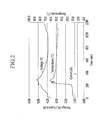
- FIGS. 2 to 9 are graphs respectively showing state of the rechargeable lithium battery cells according to Examples 1 to 6 and Comparative Examples 1 and 2 at overcharge.
- the rechargeable lithium battery cells using a separator coated with a polymer layer including polyvinylidene fluoride based polymer on the surface and an electrolyte solution including alkyl propionate according to Examples 1 to 6 turned out to be more safe at overcharge than the rechargeable lithium battery cell using an electrolyte solution including no alkyl propionate according to Comparative Example 1, and the rechargeable lithium battery cell using a separator that is not coated with a polymer layer including polyvinylidene fluoride based polymer on the surface according to Comparative Example 2.
- the rechargeable lithium battery cells of 3.8V that were charged to exist in a shipping state according to Examples 1 to 6 were overcharged with 700 mA and 5.25V for 10 hours, and the rechargeable lithium battery cells that were charged to exist in a full charged state according to Comparative Examples 1 and 2 were overcharged with 2A and 5.25V for 230 min. They were examined regarding state and appearance to evaluate safety at overcharge. The results are provided in the following Table 1.
- the rechargeable lithium battery cells using a separator including a polymer layer including polyvinylidene fluoride based polymer on the surface and an electrolyte solution including alkyl propionate according to Examples 1 to 6 turned out to be safer at overcharge than the rechargeable lithium battery cell using an electrolyte solution including no alkyl propionate according to Comparative Example 1, and the rechargeable lithium battery cell using a separator that is not coated with a polymer layer including polyvinylidene fluoride based polymer on the surface according to Comparative Example 2.
Landscapes
- Chemical & Material Sciences (AREA)
- Electrochemistry (AREA)
- General Chemical & Material Sciences (AREA)
- Chemical Kinetics & Catalysis (AREA)
- Engineering & Computer Science (AREA)
- Manufacturing & Machinery (AREA)
- Inorganic Chemistry (AREA)
- Physics & Mathematics (AREA)
- Condensed Matter Physics & Semiconductors (AREA)
- General Physics & Mathematics (AREA)
- Materials Engineering (AREA)
- Ceramic Engineering (AREA)
- Secondary Cells (AREA)
- Cell Separators (AREA)
Abstract
Description
- This disclosure relates to a rechargeable lithium battery.
- A lithium rechargeable battery has recently drawn attention as a power source for a small portable electronic device. It uses an organic electrolyte solution and thereby has twice the discharge voltage of a conventional battery using an alkali aqueous solution and as a result, has high energy density.
- The rechargeable lithium battery includes an electrode assembly including a positive electrode, a negative electrode facing the positive electrode, a separator interposed between the positive and negative electrodes, and an electrolyte solution impregnating the positive electrode, the negative electrode, and the separator.
- The electrolyte solution mainly includes a mixture of a lithium salt and a non-aqueous organic solvent. The non-aqueous organic solvent mainly includes a mixture of linear carbonate and cyclic carbonate.
- However, a rechargeable lithium battery fabricated by impregnating a positive electrode, a negative electrode, and a separator in the electrolyte solution has a limit in improving a cycle-life.
- One exemplary embodiment provides a rechargeable lithium battery with excellent cycle-life characteristic at overcharge.
- According to one embodiment, a rechargeable lithium battery includes a positive electrode; a negative electrode; a separator that is coated on the surface with a polymer layer including a polyvinylidene fluoride based polymer interposed between the positive electrode and the negative electrode; and an electrolyte solution that comprises an alkyl propionate.
- The polymer layer is disposed between the surface of the separator and the positive electrode and/or between the surface of the separator and the negative electrode.
- The polyvinylidene fluoride based polymer includes a polymer selected from the group consisting of polyvinylidene fluoride, polyvinylidene fluoride-hexafluoropropylene copolymer, and a combination thereof.
- The polyvinylidene fluoride based polymer is loaded at a loading level ranging from 0.5 to 3.0 g/m2.
- The polymer layer may further include a filler selected from the group consisting of organic powder, ceramic powder, and a combination thereof. The organic powder may include polymethylmethacrylate (PMMA), and the ceramic powder may include at least one selected from Al2O3, Mg(OH)2, and a combination thereof.
- The ceramic powder may be included in an amount of 0.1 to 98 wt% based on the total weight of the polymer layer.
- The alkyl propionate is be a C1 to C10 alkyl propionate and may include one selected from methyl propionate, ethyl propionate, and a combination thereof.
- The alkyl propionate is included in an amount of 10 to 70 volume% and specifically, 20 to 70 volume% based on the total weight of the electrolyte solution (e.g. 30 to 70% volume based on the total volume of the electrolyte solution).
- The electrolyte solution can further include a lithium salt and a non-aqueous organic solvent other than an alkyl propionate and, optionally an overcharge-inhibiting additive.
- Additional preferred features of the invention are set out in claims 2 to 15.
- Hereinafter, further embodiments will be described in the detailed description.
- Accordingly, the present invention provides a rechargeable lithium battery with excellent cycle-life characteristic at overcharge.
-
-
FIG. 1 is a schematic view of a rechargeable lithium battery according to one embodiment. -
FIGS. 2 to 8 are graphs respectively showing the state of rechargeable lithium batteries according to Examples 1 to 6 and Comparative Example 1 at overcharge. - Embodiments of this disclosure will hereinafter be described in detail.
- A rechargeable lithium battery according to one embodiment is illustrated referring to
FIG. 1 . -
FIG. 1 is the schematic view of a rechargeable lithium battery according to one embodiment. - Referring to
FIG. 1 , arechargeable lithium battery 100 according to one embodiment includes anelectrode assembly 10, apouch case 20 containing the electrode assembly, and anelectrode tab 13 electrically channeling a current generated from the electrode assembly to the outside. Thepouch case 20 is sealed by overlapping the two sides facing each other. - The
electrode assembly 10 includes a positive electrode, a negative electrode facing the positive electrode, a separator interposed between the positive electrode and the negative electrode, and an electrolyte solution impregnating the negative and positive electrodes and the separator. - According to one embodiment, a rechargeable lithium battery can be cylindrical, prismatic, coin-type, pouch-type, and the like but specifically, pouch-type as shown in
FIG. 1 . - The separator may be a single layer or a multi-layer, and made of for example glass fiber, polyester, teflon, polyethylene, polypropylene, polytetrafluoroethylene or a combination thereof.
- The separator includes a polymer layer on the surface. In particular, the polymer layer may be disposed at least either between the surface of the separator and the surface of the positive electrode or between the surface of the separator and the surface of the negative electrode.
- The polymer layer includes polyvinylidene fluoride based polymer. The polyvinylidene fluoride based polymer includes a polymer selected from the group consisting of polyvinylidene fluoride, polyvinylidene fluoride-hexafluoropropylene copolymer, and a combination thereof.
- When the polymer layer including the polyvinylidene fluoride based polymer is formed on the surface of the separator, the separator may be well impregnated in an electrolyte solution and thus, improve cycle-life characteristic of a rechargeable lithium battery at overcharge and also, more adhered to a substrate and thus, increase strength of the rechargeable lithium battery and make the rechargeable lithium battery thinner.
- The polyvinylidene fluoride based polymer can be loaded at a loading level ranging from 0.5 to 3.0 g/m2 and specifically, from 1.5 to 2.5 g/m2 (e.g. 2.0 to 2.4 g/m2, such as 2.3 g/m2). The loading level indicates a polymer weight per unit area on the surface of a separator. When the polyvinylidene fluoride based polymer is loaded within the range, the separator may be well impregnated in an electrolyte solution, accomplishing a rechargeable lithium battery with excellent electric conductivity and also, more adhered to a binder in a substrate, fabricating a rechargeable lithium battery with excellent strength.
- The polymer layer may be formed by mixing the polyvinylidene fluoride based polymer and a filler.
- The filler includes one selected from organic powder, ceramic powder, and a combination thereof.
- The organic powder includes polymethylmethacrylate (PMMA), and the ceramic powder includes one selected from Al2O3, Mg(OH)2, and a combination thereof.
- The ceramic powder is included in an amount of 0.1 to 98 wt% and specifically, 3 to 20 wt% based on the total weight of the polymer layer. When the ceramic powder is included within the range, static electricity is lowered, and friction is decreased, bringing about excellent process property.
- The electrolyte solution includes an alkyl propionate.
- When the alkyl propionate is included in an electrolyte solution, the polyvinylidene fluoride based polymer and the alkyl propionate forming the polymer layer on the surface of the separator has excellent compatibility and thus helps the separator and the negative and positive electrodes to be well impregnated in an electrolyte solution. Accordingly, the present invention may provide a rechargeable lithium battery with excellent cycle-life characteristic at overcharge.
- The alkyl propionate includes an alkyl group having C1 to C10. The alkyl group may be selected from a C1 to C10 linear type, a C3 to C10 branched type, and a C3 to C10 cyclic type.
- The alkyl propionate may be selected from methyl propionate, ethyl propionate, and a combination thereof. These materials have low viscosity and more excellent compatibility with the polyvinylidene fluoride based polymer, fabricating a rechargeable lithium battery with improved cycle-life characteristic at overcharge.
- The alkyl propionate can be included in an amount of 10 to 70 volume%, specifically, 20 to 70 volume%, more specifically, 30 to 70 volume%, more specifically, 40 to 70 volume%, and most specifically 50 to 60 volume% based on the total weight of the electrolyte solution. When the alkyl propionate is included in an electrolyte solution within the range, the alkyl propionate may have more excellent compatibility with the polyvinylidene fluoride based polymer forming the polymer layer on the surface of a separator and thus, better impregnate the separator and the negative and positive electrodes. Accordingly, the present invention may realize a rechargeable lithium battery with excellent cycle-life characteristic at overcharge.
- The electrolyte solution may include a lithium salt and a non-aqueous organic solvent other than the alkyl propionate.
- The lithium salt dissolved in the non-aqueous organic solvent supplies lithium ions in the battery, and operates a basic operation of a rechargeable lithium battery and improves lithium ion transportation between positive and negative electrodes.
- The lithium salt includes one selected from LiPF6, LiBF4, LiSbF6, LiAsF6, LiN(SO3C2F5)2, LiC4F9SO3, LiClO4, LiAlO2, LiAlCl4, LiN(CxF2x+1SO2)(CyF2y+1SO2) (wherein x and y are natural numbers), LiCl, Lil, LiB(C2O4)2 (lithium bis(oxalato) borate; LiBOB) and a combination thereof.
- The lithium salt may be used at a concentration ranging from about 0.1 M to about 2.0 M. When the lithium salt is included at the above concentration range, an electrolyte solution may have excellent performance and lithium ion mobility due to appropriate conductivity and viscosity of an electrolyte solution.
- The non-aqueous organic solvent serves as a medium for transmitting ions taking part in the electrochemical reaction of a battery. The non-aqueous organic solvent includes one selected from a carbonate-based solvent, an ester-based solvent, an ether-based solvent, a ketone-based solvent, an alcohol-based solvent, or an aprotic solvent, and a combination thereof.
- The carbonate-based solvent includes, for example dimethyl carbonate (DMC), diethyl carbonate (DEC), dipropyl carbonate (DPC), methylpropyl carbonate (MPC), ethylpropyl carbonate (EPC), methylethyl carbonate (MEC), ethylmethyl carbonate (EMC), ethylene carbonate (EC), propylene carbonate (PC), butylene carbonate (BC), and the like.
- When the carbonate-based solvent is prepared by mixing a cyclic carbonate and a linear carbonate, a solvent having a low viscosity while having an increased dielectric constant may be obtained. The cyclic carbonate and the linear carbonate are mixed together inat the volume ratio of about 1:1 to 1:9.
- The ester-based solvent may include, for example methyl acetate, ethyl acetate, n-propyl acetate, methyl propionate, ethyl propionate, γ-butyrolactone, decanolide, valerolactone, mevalonolactone, caprolactone, or the like.
- The ether-based solvent may include, for example dibutylether, tetraglyme, diglyme, dimethoxyethane, 2-methyltetrahydrofuran, tetrahydrofuran, and the like.
- The ketone-based solvent may include cyclohexanone, and the like.
- The alcohol-based solvent may include ethanol, isopropyl alcohol, and the like.
- The non-aqueous organic solvent may be used singularly or in a mixture. When the organic solvent is used in a mixture, the mixture ratio can be controlled in accordance with a desirable battery performance.
- The non-aqueous electrolyte solution may further include an overcharge-inhibiting additive such as ethylene carbonate, pyrocarbonate, and like.
- The positive electrode may include a current collector and a positive active material layer on the current collector. The positive active material layer may include a positive active material, a binder, and optionally, a conductive material.
- The current collector may be Al (aluminum), but is not limited thereto.
- The positive active material includes a lithiated intercalation compound that reversibly intercalates and deintercalates lithium ions. The positive active material may include a composite oxide including at least one of cobalt, manganese, nickel, or combination thereof as well as lithium. In particular, the following lithium-containing compounds may be used:
- LiaA1-bBbD2 (wherein, in the above formula, 0.90 ≤ a ≤ 1.8 and 0 ≤ b ≤ 0.5); LiaE1-bBbO2-cDc (wherein, in the above formula, 0.90 ≤ a ≤ 1.8, 0 ≤ b ≤ 0.5, 0 ≤ c ≤ 0.05); LiE2-bBbO4-cDc (wherein, in the above formula, 0 ≤ b ≤ 0.5, and 0 ≤ c ≤ 0.05); LiaNi1-b-cCobBcDα (wherein, in the above formula, 0.90 ≤ a ≤ 1.8, 0 ≤ b ≤ 0.5, 0 ≤ c ≤ 0.05, and 0 < α ≤ 2); LiaNi1-b-cCobBcO2-αFα (wherein, in the above formula, 0.90 ≤ a ≤ 1.8, 0 ≤ b ≤ 0.5, 0 ≤ c ≤ 0.05, and 0 < α < 2); LiaNi1-b-cCobBcO2-αF2 (wherein, in the above formula, 0.90 ≤ a ≤ 1.8, 0 ≤ b ≤ 0.5, 0 ≤ c ≤ 0.05, and 0 < α < 2); LiaNi1-b-cMnbBcDα (wherein, in the above formula, 0.90 ≤ a ≤ 1.8, 0 ≤ b ≤ 0.5, 0 ≤ c ≤ 0.05, and 0 < α ≤ 2); LiaNi1-b-cMnbBcO2-αFα (wherein, in the above formula, 0.90 ≤ a ≤ 1.8, 0 ≤ b ≤ 0.5, 0 ≤ c ≤ 0.05, and 0 < α < 2); LiaNi1-b-cMnbBcO2-αF2 (wherein, in the above formula, 0.90 ≤ a ≤ 1.8, 0 ≤ b ≤ 0.5, 0 ≤ c ≤ 0.05, and 0 < α < 2); LiaNibEcGdO2 (wherein, in the above formula, 0.90 ≤ a ≤ 1.8, 0 ≤ b ≤ 0.9, 0 ≤ c ≤ 0.5, and 0.001 ≤ d ≤ 0.1); LiaNibCocMndGeO2 (wherein, in the above formula, 0.90 ≤ a ≤ 1.8, 0 ≤ b ≤ 0.9, 0 ≤ c ≤ 0.5, 0 ≤ d ≤ 0.5, and 0.001 ≤ e ≤ 0.1); LiaNiGbO2 (wherein, in the above formula, 0.90 ≤ a ≤ 1.8, and 0.001 ≤ b ≤ 0.1); LiaCoGbO2 (wherein, in the above formula, 0.90 ≤ a ≤ 1.8, and 0.001 ≤ b ≤ 0.1); LiaMnGbO2 (wherein, in the above formula, 0.90 ≤ a ≤ 1.8, and 0.001 ≤ b ≤ 0.1); LiaMn2GbO4 (wherein, in the above formula, 0.90 ≤ a ≤ 1.8, and 0.001 ≤ b ≤ 0.1); QO2; QS2; LiQS2; V2O5; LiV2O5; LiIO2; LiNiVO4; Li(3-f)J2(PO4)3(0 ≤ f ≤ 2); Li(3-f)Fe2(PO4)3 (0 ≤ f ≤ 2); and LiFePO4.
- In the above formulas, A is Ni, Co, Mn, or a combination thereof; B is Al, Ni, Co, Mn, Cr, Fe, Mg, Sr, V, a rare earth element, or a combination thereof; D is O, F, S, P,, or a combination thereof; E is Co, Mn, or a combination thereof; F is F, S, P, or a combination thereof; G is Al, Cr, Mn, Fe, Mg, La, Ce, Sr, V, or a combination thereof; Q is Ti, Mo, Mn, or a combination thereof; I is Cr, V, Fe, Sc, Y, or a combination thereof; and J is V, Cr, Mn, Co, Ni, Cu, or a combination thereof.
- The compounds may have a coating layer on the surface, or may be mixed with another compound having a coating layer. The coating layer may include at least one coating element compound selected from the group consisting of an oxide of a coating element, a hydroxide of a coating element, an oxyhydroxide of a coating element, an oxycarbonate of a coating element, and a hydroxyl carbonate of a coating element. The compound for the coating layer may be amorphous or crystalline. The coating element included in the coating layer may include Mg, Al, Co, K, Na, Ca, Si, Ti, V, Sn, Ge, Ga, B, As, Zr, or a mixture thereof. The coating layer may be disposed in a method having no adverse influence on properties of a positive active material by using these elements in the compound. For example, the method may include any coating method such as spray coating, dipping, and the like, but is not illustrated in more detail since it is well-known to those who work in the related field.
- The binder improves binding properties of the positive active material particles to each other and to a current collector. Examples of the binder include polyvinylalcohol, carboxylmethylcellulose, hydroxypropylcellulose, diacetylcellulose, polyvinylchloride, carboxylated polyvinylchloride, polyvinylfluoride, an ethylene oxide-containing polymer, polyvinylpyrrolidone, polyurethane, polytetrafluoroethylene, polyvinylidene fluoride, polyethylene, polypropylene, a styrene-butadiene rubber, an acrylated styrene-butadiene rubber, an epoxy resin, nylon, and the like, but are not limited thereto.
- Any electrically conductive material may be used as a conductive material unless it causes a chemical change. Examples of the conductive material include: one or more of natural graphite, artificial graphite, carbon black, acetylene black, ketjen black, a carbon fiber, copper, a metal powder or a metal fiber including nickel, aluminum, silver, and the like, and a polyphenylene derivative.
- The negative electrode includes a negative current collector and a negative active material layer disposed thereon.
- The negative current collector may be a copper foil.
- The negative active material layer may include a negative active material, a binder, and optionally a conductive material.
- The negative active material includes a material that reversibly intercalates/deintercalates lithium ions, a lithium metal, a lithium metal alloy, a material being capable of doping/dedoping lithium, or a transition metal oxide.
- The material that can reversibly intercalate/deintercalate lithium ions includes a carbon material. The carbon material may be any generally-used carbon-based negative active material in a lithium ion rechargeable battery. Examples of the carbon material include crystalline carbon, amorphous carbon, and mixtures thereof. The crystalline carbon may be non-shaped, or sheet, flake, spherical, or fiber shaped natural graphite or artificial graphite. The amorphous carbon may be a soft carbon, a hard carbon, a mesophase pitch carbonization product, fired coke, and the like.
- Examples of the lithium metal alloy include lithium and a metal selected from Na, K, Rb, Cs, Fr, Be, Mg, Ca, Sr, Si, Sb, Pb, In, Zn, Ba, Ra, Ge, Al, and Sn.
- The material being capable of doping/dedoping lithium may include Si, SiOx (0 < x < 2), a Si-C composite, a Si-Y alloy (wherein Y is selected from an alkali metal, an alkaline-earth metal,
Group 13 to Group 16 elements, a transition element, a rare earth element, and a combination thereof, and not Si), Sn, SnO2, a Sn-C composite, a Sn-Y alloy (wherein Y is selected from an alkali metal, an alkaline-earth metal,Group 13 to Group 16 elements, a transition element, a rare earth element, and a combination thereof, and not Sn), and the like. At least one of these materials may be mixed with SiO2. The element Y may be selected from the group consisting of Mg, Ca, Sr, Ba, Ra, Sc, Y, Ti, Zr, Hf, Rf, V, Nb, Ta, Db, Cr, Mo, W, Sg, Tc, Re, Bh, Fe, Pb, Ru, Os, Hs, Rh, Ir, Pd, Pt, Cu, Ag, Au, Zn, Cd, B, Al, Ga, Sn, In, Ti, Ge, P, As, Sb, Bi, S, Se, Te, Po, and a combination thereof. - The transition metal oxide may include vanadium oxide, lithium vanadium oxide, and the like.
- The binder improves binding properties of negative active material particles with one another and with a current collector. Examples of the binder include polyvinylalcohol, carboxylmethylcellulose, hydroxypropylcellulose, polyvinylchloride, carboxylated polyvinylchloride, polyvinylfluoride, an ethylene oxide-containing polymer, polyvinylpyrrolidone, polyurethane, polytetrafluoroethylene, polyvinylidene fluoride, polyethylene, polypropylene, a styrene-butadiene rubber, an acrylated styrene-butadiene rubber, an epoxy resin, nylon, and the like, but are not limited thereto.
- The conductive material is included to improve electrode conductivity. Any electrically conductive material may be used as a conductive material unless it causes a chemical change. Examples of the conductive material include carbon-based materials such as natural graphite, artificial graphite, carbon black, acetylene black, ketjen black, carbon fibers, and the like; metal-based materials of metal powder or metal fiber including copper, nickel, aluminum, silver; conductive polymers such as polyphenylene derivatives; or a mixture thereof.
- The negative electrode and positive electrode may be respectively fabricated by a method including mixing an active material, a conductive material, and a binder into an active material composition and coating the composition on a current collector.
- The electrode manufacturing method is well known, and thus is not described in detail in the present specification. The solvent can be N-methylpyrrolidone but it is not limited thereto.
- Hereinafter, the embodiments are illustrated in more detail with reference to examples. However, the following are exemplary embodiments and are not limiting.
- Furthermore, what is not described in this specification can be sufficiently understood by those who have knowledge in this field and will not be illustrated here.
- A positive active material layer composition was prepared by mixing LiCoO2 a positive active material, polyvinylidene fluoride (PVDF) as a binder, and carbon as a conductive material at a weight ratio of 92:4:4 and dispersing the mixture in N-methyl-2-pyrrolidone. The positive active material layer composition was coated on a 12 µm-thick aluminum foil and compressed, fabricating a positive electrode.
- On the other hand, a negative active material layer composition was prepared by mixing graphite as a negative active material, styrene-butadiene rubber (SBR) as a binder, and carboxylmethylcellulose (CMC) as a thickener at a weight ratio of 98:1:1 and dispersing the mixture in water. The negative active material layer composition was coated on a 8 µm-thick copper foil and then, dried and compressed, fabricating a negative electrode.
- Then, an electrolyte solution was prepared by mixing ethylene carbonate (EC), propylene carbonate (PC), and ethyl propionate (EP) at a volume ratio of 3:1:6 and dissolving LiPF6 at 1.3M concentration and 0.2 parts by weight of LiBF4 (100 parts by weight of the mixed solution) therein.
- The positive and negative electrodes and the electrolyte solution were used with a polyethylene separator to fabricate a laminate-type battery cell having capacity of 1400 mAh/g at 1C. The polyethylene separator was coated with polyvinylidene fluoride at a loading level of 2.3 g/m2.
- A half-cell was fabricated according to the same method as Example 1 except for using a mixed solution prepared by mixing ethylene carbonate (EC), ethylmethyl carbonate (EMC), and ethyl propionate (EP) at a volume ratio of 3:1:6 to prepare an electrolyte solution.
- A half-cell was fabricated according to the same method as Example 1 except for using a mixed solution prepared by mixing ethylene carbonate (EC), diethyl carbonate (DEC), and ethyl propionate (EP) at a volume ratio of 3:1:6 to prepare an electrolyte solution.
- A half-cell was fabricated according to the same method as Example 1 except for using a mixed solution prepared by mixing ethylene carbonate (EC), propylene carbonate (PC), ethylmethyl carbonate (EMC), and ethyl propionate (EP) at a volume ratio of 3:1:1:5 to prepare an electrolyte solution.
- A half-cell was fabricated according to the same method as Example 1 except for using a mixed solution prepared by mixing ethylene carbonate (EC), ethylmethyl carbonate (EMC), diethylcarbonate (DEC), and ethyl propionate (EP) at a volume ratio of 3:1:1:5 to prepare an electrolyte solution.
- A half-cell was fabricated according to the same method as Example 1 except for using a mixed solution prepared by mixing ethylene carbonate (EC), propylene carbonate (PC), diethylcarbonate (DEC), and ethyl propionate (EP) at a volume ratio of 3:1:1:5 to prepare an electrolyte solution.
- A half-cell was fabricated according to the same method as Example 1 except for using an electrolyte solution prepared by using a mixed solution including ethylene carbonate (EC), ethylmethyl carbonate (EMC), and diethylcarbonate (DEC) at a volume ratio of 3:5:2 and dissolving LiPF6 with 1.15M concentration and 0.2 parts by weight of LiBF4 based on 100 parts by weight of the mixed solution.
- A half-cell was fabricated according to the same method as Example 1 except for using the polyethylene separator not coated with polyvinylidene fluoride.
- Each rechargeable lithium battery cell according to Examples 1 to 6 and Comparative Examples 1 and 2 were overcharged and measured regarding voltage and temperature. The results are provided in
FIGS. 2 to 9. - Each rechargeable lithium battery cells according to Examples 1 to 6 and Comparative Examples 1 and 2 were charged with 2A, 5.25V, and 950mAh.
-
FIGS. 2 to 9 are graphs respectively showing state of the rechargeable lithium battery cells according to Examples 1 to 6 and Comparative Examples 1 and 2 at overcharge. - Referring to
FIGS. 2 to 9, the rechargeable lithium battery cells using a separator coated with a polymer layer including polyvinylidene fluoride based polymer on the surface and an electrolyte solution including alkyl propionate according to Examples 1 to 6 turned out to be more safe at overcharge than the rechargeable lithium battery cell using an electrolyte solution including no alkyl propionate according to Comparative Example 1, and the rechargeable lithium battery cell using a separator that is not coated with a polymer layer including polyvinylidene fluoride based polymer on the surface according to Comparative Example 2. - The rechargeable lithium battery cells of 3.8V that were charged to exist in a shipping state according to Examples 1 to 6 were overcharged with 700 mA and 5.25V for 10 hours, and the rechargeable lithium battery cells that were charged to exist in a full charged state according to Comparative Examples 1 and 2 were overcharged with 2A and 5.25V for 230 min. They were examined regarding state and appearance to evaluate safety at overcharge. The results are provided in the following Table 1.
- The safety at overcharge was evaluated according to the following criteria.
L1: Ignition, L5: Rupture, L10: Good[Table 1] Mixed composition of electrolyte solution (volume ratio) Discharge capacity (mAh) at formation Safety at overcharge Example 1 EC/PC/ EP (3/1/6 1453.1 L5 Example 2 EC/EMC/ EP (3/1/6 1418.9 L10 Example 3 EC/DEC/ EP (3/1/6 1466.4 L10 Example 4 EC/PC/EMC/EP (3/1/1/5) 1471.9 L5 Example 5 EC/EMC/DEC/EP (3/1/1/5) 1440.5 L10 Example 6 EC/PC/DEC/EP (3/1/1/5) 1475.9 L5 Comparative Example 1 EC/EMC/DEC (3/5/2) 1402 L1 Comparative Example 2 EC/PC/ EP (3/1/6 1410.4 L1 - Referring to Table 1, the rechargeable lithium battery cells using a separator including a polymer layer including polyvinylidene fluoride based polymer on the surface and an electrolyte solution including alkyl propionate according to Examples 1 to 6 turned out to be safer at overcharge than the rechargeable lithium battery cell using an electrolyte solution including no alkyl propionate according to Comparative Example 1, and the rechargeable lithium battery cell using a separator that is not coated with a polymer layer including polyvinylidene fluoride based polymer on the surface according to Comparative Example 2.
- While this disclosure has been described in connection with what is presently considered to be practical exemplary embodiments, it is to be understood that the invention is not limited to the disclosed embodiments, but, on the contrary, is intended to cover various modifications and equivalent arrangements included within the scope of the appended claims.
-
- 100: rechargeable lithium battery
- 10: electrode assembly
- 20: pouch case
- 13: electrode tab
Claims (15)
- A rechargeable lithium battery comprising a positive electrode, a negative electrode, a separator that is coated on the surface with a polymer layer interposed between the positive electrode and negative electrode, and an electrolyte solution, wherein the polymer layer includes a polyvinylidene fluoride based polymer, wherein the electrolyte solution comprises an alkyl propionate.
- A battery according to Claim 1, wherein the polymer is selected from the group consisting of polyvinylidene fluoride, polyvinylidene fluoride-hexafluoropropylene copolymer, and a combination thereof.
- A battery according to Claim 1 or 2, wherein the polyvinylidenefluoride based polymer is loaded at a loading level ranging from 0.5 to 3.0 g/m2.
- A battery according to any one of Claims 1 to 3, wherein the polymer layer further comprises a filler selected from the group consisting of organic powder, ceramic powder and a combination thereof.
- A battery according to Claim 4, wherein the organic powder comprises polymethylmethacrylate.
- A battery according to Claim 3 or 4, wherein the ceramic powder comprises at least one selected from Al2O3, Mg(OH)2 and a combination thereof, optionally wherein the ceramic powder is included in an amount of 0.1 to 98 wt% based on the total weight of the polymer layer, further optionally in an amount of 3 to 20 wt% based on the total weight of the polymer layer.
- A battery according to any one of Claims 1 to 6, wherein the alkyl propionate is a C1 to C10 alkyl propionate.
- A battery according to Claim 7, wherein the alkyl propionate is methyl propionate, ethyl propionate or a combination thereof.
- A battery according to any one of Claims 1 to 8, wherein the alkyl propionate forms 10 to 70% volume% based on the total volume of the electrolyte solution, optionally 20 to 70 volume% based on the total volume of the electrolyte solution, further optionally 30 to 70 volume% based on the total volume of the electrolyte solution.
- A battery according to any one of Claims 1 to 9, wherein the electrolyte solution further comprises a lithium salt and a non-aqueous organic solvent other than an alkyl propionate and, optionally an overcharge-inhibiting additive.
- A battery according to Claim 10, wherein the non-aqueous organic solvent other than an alkyl propionate comprises one selected from a carbonate-based solvent, an ester-based solvent, an ether-based solvent, a ketone-based solvent, an alcohol-based solvent, an aprotic solvent and a combination thereof.
- A battery according to Claim 11, wherein the non-aqueous organic solvent other than an alkyl propionate is a carbonate-based solvent selected from dimethyl carbonate, diethyl carbonate, dipropyl carbonate, methylpropyl carbonate, ethylpropyl carbonate, methylethyl carbonate, ethylmethyl carbonate, ethylene carbonate, propylene carbonate, butylene carbonate and a combination thereof.
- A battery according to Claim 12, wherein the non-aqueous organic solvent other than an alkyl propionate contains ethylene carbonate and either one or more further cyclic carbonates in a ratio between 2:1 and 4:1 or one or more linear carbonates in a ratio between 2:1 and 4:1.
- A battery according to Claim 12, wherein the non-aqueous organic solvent other than an alkyl propionate contains ethylene carbonate and one or more further cyclic carbonates, and one or more linear carbonates in a ratio between 2:1:1 to 6:1:3 ethylene carbonate: further cyclic carbonate(s): linear carbonate(s), optionally in a ratio of 3:1:1.
- A battery according to any one of Claims 12 to 14, wherein the alkyl propionate and the non-aqueous organic solvent other than an alkyl propionate are present in a ratio of between 3:1 to 0.5:1, optionally in a ratio of 2:1 to 0.75:1, further optionally in a ratio of 1.5:1 to 1:1.
Applications Claiming Priority (2)
| Application Number | Priority Date | Filing Date | Title |
|---|---|---|---|
| US201161545857P | 2011-10-11 | 2011-10-11 | |
| US13/537,042 US10461358B2 (en) | 2011-10-11 | 2012-06-28 | Rechargeable lithium battery |
Publications (2)
| Publication Number | Publication Date |
|---|---|
| EP2581977A1 true EP2581977A1 (en) | 2013-04-17 |
| EP2581977B1 EP2581977B1 (en) | 2015-03-18 |
Family
ID=46466309
Family Applications (1)
| Application Number | Title | Priority Date | Filing Date |
|---|---|---|---|
| EP20120175618 Active EP2581977B1 (en) | 2011-10-11 | 2012-07-09 | Rechargeable lithium battery |
Country Status (5)
| Country | Link |
|---|---|
| US (1) | US10461358B2 (en) |
| EP (1) | EP2581977B1 (en) |
| JP (1) | JP6071389B2 (en) |
| KR (1) | KR101744088B1 (en) |
| CN (1) | CN103050707B (en) |
Cited By (9)
| Publication number | Priority date | Publication date | Assignee | Title |
|---|---|---|---|---|
| EP3739673A1 (en) * | 2019-05-03 | 2020-11-18 | Samsung SDI Co., Ltd. | Rechargeable lithium battery |
| US11430987B2 (en) | 2018-12-12 | 2022-08-30 | Samsung Sdi Co., Ltd. | Electrode and a rechargeable lithium battery including the electrode |
| US11515523B2 (en) | 2019-05-03 | 2022-11-29 | Samsung Sdi Co., Ltd. | Rechargeable lithium battery |
| US11522185B2 (en) | 2019-05-03 | 2022-12-06 | Samsung Sdi Co., Ltd. | Rechargeable lithium battery |
| US11522183B2 (en) | 2019-05-03 | 2022-12-06 | Samsung Sdi Co., Ltd. | Rechargeable lithium battery |
| US11658287B2 (en) | 2019-05-03 | 2023-05-23 | Samsung Sdi Co., Ltd. | Rechargeable lithium battery |
| US11705585B2 (en) | 2018-07-03 | 2023-07-18 | Samsung Sdi Co., Ltd. | Rechargeable lithium battery |
| US11710820B2 (en) | 2019-05-03 | 2023-07-25 | Samsung Sdi Co., Ltd. | Rechargeable lithium battery |
| US11728522B2 (en) | 2018-07-03 | 2023-08-15 | Samsung Sdi Co., Ltd. | Electrode for rechargeable lithium battery, and rechargeable lithium battery including the same |
Families Citing this family (16)
| Publication number | Priority date | Publication date | Assignee | Title |
|---|---|---|---|---|
| KR20150004678A (en) * | 2013-07-03 | 2015-01-13 | 삼성에스디아이 주식회사 | Lithium pouch type battery |
| CN204614858U (en) * | 2013-10-31 | 2015-09-02 | 株式会社Lg化学 | electrode assembly and lithium secondary battery comprising the same |
| JP6285263B2 (en) * | 2014-04-17 | 2018-02-28 | トヨタ自動車株式会社 | Electrolyte for fluoride ion battery and fluoride ion battery |
| JPWO2015186517A1 (en) * | 2014-06-05 | 2017-04-20 | ソニー株式会社 | Secondary battery electrolyte, secondary battery, battery pack, electric vehicle, power storage system, electric tool and electronic device |
| JP6257087B2 (en) | 2014-10-14 | 2018-01-10 | 株式会社村田製作所 | Secondary battery, battery pack, electric vehicle, power storage system, electric tool and electronic device |
| KR102297823B1 (en) * | 2014-11-21 | 2021-09-02 | 삼성에스디아이 주식회사 | Separator for rechargeable lithium battery and rechargeable lithium battery including the same |
| WO2017057588A1 (en) * | 2015-10-01 | 2017-04-06 | 宇部興産株式会社 | Non-aqueous electrolyte for lithium secondary cell or lithium-ion capacitor, and lithium secondary cell or lithium-ion capacitor in which same is used |
| JP6083459B1 (en) * | 2015-10-01 | 2017-02-22 | 宇部興産株式会社 | Non-aqueous electrolyte for lithium secondary battery or lithium ion capacitor and lithium secondary battery or lithium ion capacitor using the same |
| JP6766818B2 (en) * | 2015-12-22 | 2020-10-14 | 宇部興産株式会社 | Non-aqueous electrolyte for lithium secondary batteries or lithium ion capacitors and lithium secondary batteries or lithium ion capacitors using it |
| KR102294961B1 (en) | 2016-04-04 | 2021-08-26 | 삼성에스디아이 주식회사 | Electrolyte for rechargeable lithium battery and rechargeable lithium battery including the same |
| JP6986077B2 (en) * | 2017-07-04 | 2021-12-22 | マクセル株式会社 | Lithium-ion secondary battery and its manufacturing method |
| US11437685B2 (en) | 2018-03-27 | 2022-09-06 | Grst International Limited | Lithium-ion battery |
| WO2020138318A1 (en) * | 2018-12-28 | 2020-07-02 | 株式会社村田製作所 | Battery, battery pack, electronic apparatus, electric vehicle, and electric power system |
| KR102194075B1 (en) * | 2020-03-03 | 2020-12-22 | 삼성에스디아이 주식회사 | Lithium pouch type battery |
| CN112289975A (en) * | 2020-10-12 | 2021-01-29 | 常州高态信息科技有限公司 | A low temperature lithium ion battery |
| CN119965210A (en) * | 2020-10-15 | 2025-05-09 | 宁德新能源科技有限公司 | Electrochemical devices and electronic devices |
Citations (3)
| Publication number | Priority date | Publication date | Assignee | Title |
|---|---|---|---|---|
| WO2002061872A1 (en) * | 2001-01-31 | 2002-08-08 | Korea Institute Of Science And Technology | A multi-layered polymer electrolyte and lithium secondary battery comprising the same |
| US20070254215A1 (en) * | 2004-09-03 | 2007-11-01 | Takaharu Morikawa | Non-Aqueous Electrolyte and Secondary Battery Containing the Same |
| EP2031690A1 (en) * | 2007-08-23 | 2009-03-04 | Air Products and Chemicals, Inc. | Electrolytes, cells and methods of forming passivation layers |
Family Cites Families (31)
| Publication number | Priority date | Publication date | Assignee | Title |
|---|---|---|---|---|
| JP2970086B2 (en) | 1991-06-28 | 1999-11-02 | ソニー株式会社 | Non-aqueous electrolyte battery |
| US5681357A (en) * | 1996-09-23 | 1997-10-28 | Motorola, Inc. | Gel electrolyte bonded rechargeable electrochemical cell and method of making same |
| US6753114B2 (en) * | 1998-04-20 | 2004-06-22 | Electrovaya Inc. | Composite electrolyte for a rechargeable lithium battery |
| JP4518583B2 (en) | 1998-08-19 | 2010-08-04 | ソニー株式会社 | Solid electrolyte battery |
| JP3471238B2 (en) | 1998-08-31 | 2003-12-02 | 株式会社東芝 | Manufacturing method of non-aqueous electrolyte secondary battery |
| US6465125B1 (en) | 1998-09-17 | 2002-10-15 | Kabushiki Kaisha Toshiba | Nonaqueous electrolyte secondary battery and method of manufacturing nonaqueous electrolyte secondary battery |
| JP3728162B2 (en) | 1999-12-15 | 2005-12-21 | 三洋電機株式会社 | Non-aqueous electrolyte secondary battery |
| KR100497147B1 (en) * | 2000-02-08 | 2005-06-29 | 주식회사 엘지화학 | Multiply stacked electrochemical cell and method for preparing the same |
| KR100370386B1 (en) | 2000-11-28 | 2003-01-30 | 제일모직주식회사 | Non-aqueous electrolyte solution for lithium battery |
| DE10208277A1 (en) | 2002-02-26 | 2003-09-04 | Creavis Tech & Innovation Gmbh | Electrical separator, process for its production and use |
| JP4368114B2 (en) | 2003-02-03 | 2009-11-18 | パナソニック株式会社 | Lithium ion secondary battery and method for producing secondary battery |
| JP4055642B2 (en) * | 2003-05-01 | 2008-03-05 | 日産自動車株式会社 | High speed charge / discharge electrodes and batteries |
| JP2006120462A (en) | 2004-10-21 | 2006-05-11 | Sanyo Electric Co Ltd | Nonaqueous electrolyte battery |
| KR100770105B1 (en) * | 2005-07-06 | 2007-10-24 | 삼성에스디아이 주식회사 | Lithium secondary battery |
| KR101183912B1 (en) * | 2005-08-25 | 2012-09-21 | 토레이 밧데리 세퍼레이터 필름 고도 가이샤 | Polyethylene multilayer microporous membrane, battery separator using same, and battery |
| JP4151852B2 (en) * | 2005-12-08 | 2008-09-17 | 日立マクセル株式会社 | Electrochemical element separator and manufacturing method thereof, and electrochemical element and manufacturing method thereof |
| JP4421570B2 (en) * | 2006-03-30 | 2010-02-24 | 株式会社東芝 | Non-aqueous electrolyte battery, battery pack and automobile |
| KR100845239B1 (en) * | 2006-08-07 | 2008-07-10 | 한국과학기술연구원 | Separator with heat-resistant ultra-fine fiber layer and secondary battery using same |
| US7955731B2 (en) * | 2006-08-14 | 2011-06-07 | Sony Corporation | Nonaqueous electrolyte secondary cell |
| JP4297166B2 (en) | 2006-08-14 | 2009-07-15 | ソニー株式会社 | Nonaqueous electrolyte secondary battery |
| US9825327B2 (en) | 2007-08-16 | 2017-11-21 | Lg Chem, Ltd. | Non-aqueous electrolyte lithium secondary battery |
| JP5323837B2 (en) * | 2007-09-12 | 2013-10-23 | エルジー・ケム・リミテッド | Non-aqueous electrolyte lithium secondary battery |
| US20100266905A1 (en) * | 2007-09-19 | 2010-10-21 | Lg Chem, Ltd. | Non-aqueous electrolyte lithium secondary battery |
| KR100947181B1 (en) | 2007-11-19 | 2010-03-15 | 주식회사 엘지화학 | Separator with a porous coating layer and an electrochemical device having the same |
| KR101002161B1 (en) * | 2007-11-29 | 2010-12-17 | 주식회사 엘지화학 | Separator with a porous coating layer, a manufacturing method and an electrochemical device having the same |
| JP5059643B2 (en) | 2008-02-04 | 2012-10-24 | ソニー株式会社 | Non-aqueous electrolyte battery |
| WO2010002089A1 (en) | 2008-06-30 | 2010-01-07 | Lg Chem, Ltd. | Cylindrical lithium secondary battery |
| KR100995413B1 (en) | 2008-08-01 | 2010-11-18 | 삼성에스디아이 주식회사 | Electrolyte for lithium ion secondary battery and lithium ion secondary battery comprising same |
| KR101091228B1 (en) | 2008-12-30 | 2011-12-07 | 주식회사 엘지화학 | Separator having a porous coating layer and an electrochemical device having the same |
| JP2012527518A (en) * | 2009-05-18 | 2012-11-08 | ザ、リージェンツ、オブ、ザ、ユニバーシティ、オブ、カリフォルニア | Conductive polymer binder for lithium ion battery electrodes |
| KR101716900B1 (en) | 2009-12-04 | 2017-03-15 | 소니 주식회사 | Separator and battery |
-
2012
- 2012-06-28 US US13/537,042 patent/US10461358B2/en active Active
- 2012-07-09 EP EP20120175618 patent/EP2581977B1/en active Active
- 2012-08-01 KR KR1020120084564A patent/KR101744088B1/en active Active
- 2012-08-07 CN CN201210279223.7A patent/CN103050707B/en active Active
- 2012-10-01 JP JP2012219629A patent/JP6071389B2/en active Active
Patent Citations (3)
| Publication number | Priority date | Publication date | Assignee | Title |
|---|---|---|---|---|
| WO2002061872A1 (en) * | 2001-01-31 | 2002-08-08 | Korea Institute Of Science And Technology | A multi-layered polymer electrolyte and lithium secondary battery comprising the same |
| US20070254215A1 (en) * | 2004-09-03 | 2007-11-01 | Takaharu Morikawa | Non-Aqueous Electrolyte and Secondary Battery Containing the Same |
| EP2031690A1 (en) * | 2007-08-23 | 2009-03-04 | Air Products and Chemicals, Inc. | Electrolytes, cells and methods of forming passivation layers |
Cited By (11)
| Publication number | Priority date | Publication date | Assignee | Title |
|---|---|---|---|---|
| US11705585B2 (en) | 2018-07-03 | 2023-07-18 | Samsung Sdi Co., Ltd. | Rechargeable lithium battery |
| US11728522B2 (en) | 2018-07-03 | 2023-08-15 | Samsung Sdi Co., Ltd. | Electrode for rechargeable lithium battery, and rechargeable lithium battery including the same |
| US12334517B2 (en) | 2018-07-03 | 2025-06-17 | Samsung Sdi Co., Ltd. | Rechargeable lithium battery |
| US11430987B2 (en) | 2018-12-12 | 2022-08-30 | Samsung Sdi Co., Ltd. | Electrode and a rechargeable lithium battery including the electrode |
| EP3739673A1 (en) * | 2019-05-03 | 2020-11-18 | Samsung SDI Co., Ltd. | Rechargeable lithium battery |
| US11508992B2 (en) | 2019-05-03 | 2022-11-22 | Samsung Sdi Co. Ltd. | Rechargeable lithium battery |
| US11515523B2 (en) | 2019-05-03 | 2022-11-29 | Samsung Sdi Co., Ltd. | Rechargeable lithium battery |
| US11522185B2 (en) | 2019-05-03 | 2022-12-06 | Samsung Sdi Co., Ltd. | Rechargeable lithium battery |
| US11522183B2 (en) | 2019-05-03 | 2022-12-06 | Samsung Sdi Co., Ltd. | Rechargeable lithium battery |
| US11658287B2 (en) | 2019-05-03 | 2023-05-23 | Samsung Sdi Co., Ltd. | Rechargeable lithium battery |
| US11710820B2 (en) | 2019-05-03 | 2023-07-25 | Samsung Sdi Co., Ltd. | Rechargeable lithium battery |
Also Published As
| Publication number | Publication date |
|---|---|
| JP6071389B2 (en) | 2017-02-01 |
| US10461358B2 (en) | 2019-10-29 |
| CN103050707B (en) | 2017-04-05 |
| CN103050707A (en) | 2013-04-17 |
| KR20130039294A (en) | 2013-04-19 |
| JP2013084598A (en) | 2013-05-09 |
| EP2581977B1 (en) | 2015-03-18 |
| KR101744088B1 (en) | 2017-06-07 |
| US20130089794A1 (en) | 2013-04-11 |
Similar Documents
| Publication | Publication Date | Title |
|---|---|---|
| EP2581977B1 (en) | Rechargeable lithium battery | |
| US9196928B2 (en) | Electrolyte solution for rechargeable lithium battery, and rechargeable lithium battery including the same | |
| US9263764B2 (en) | Electrolyte for lithium ion battery, and lithium ion battery including same | |
| EP2838142B1 (en) | Negative electrode for a rechargeable lithium battery and a rechargeable lithium battery including the same | |
| US9413009B2 (en) | Binder composition for rechargeable lithium battery, and electrode and rechargeable lithium battery including the same | |
| US8349499B2 (en) | Electrolyte for rechargeable lithium battery and rechargeable lithium battery including the same | |
| EP2660906B1 (en) | Electrolyte for rechargeable lithium battery and rechargeable lithium battery including same | |
| EP2538484B1 (en) | Negative active material for rechargeable lithium battery, method of preparing the same, and negative electrode and rechargeable lithium battery including the same | |
| EP2822058B1 (en) | Lithium pouch battery | |
| EP2639854A1 (en) | Separator for lithium secondary battery | |
| US8771878B2 (en) | Positive electrode for rechargeable lithium battery, method of preparing the same, and rechargeable lithium battery including the same | |
| EP2741351B1 (en) | Rechargeable lithium battery | |
| US20120045697A1 (en) | Electrolyte for rechargeable lithium battery, and rechargeable lithium battery including same | |
| EP2843733A1 (en) | Electrode for rechargeable lithium battery and rechargeable lithium battery including the same | |
| KR101297174B1 (en) | Lithium secondary battery | |
| US9385375B2 (en) | Positive electrode for rechargeable lithium battery and rechargeable lithium battery including same | |
| EP2701220B1 (en) | Separator for rechargeable lithium battery | |
| US9136537B2 (en) | Rechargeable lithium battery including heat-treated negative current collector | |
| KR101646703B1 (en) | Positive electrode active material for rechargeable lithium battery, method of preparing the same, and rechargeable lithium battery including the same | |
| US20160126556A1 (en) | Negative electrode for rechargeable lithium battery and rechargeable lithium battery including same | |
| KR101319379B1 (en) | Electrolyte for rechargeable lithium battery, and rechargeable lithium battery including the same |
Legal Events
| Date | Code | Title | Description |
|---|---|---|---|
| PUAI | Public reference made under article 153(3) epc to a published international application that has entered the european phase |
Free format text: ORIGINAL CODE: 0009012 |
|
| AK | Designated contracting states |
Kind code of ref document: A1 Designated state(s): AL AT BE BG CH CY CZ DE DK EE ES FI FR GB GR HR HU IE IS IT LI LT LU LV MC MK MT NL NO PL PT RO RS SE SI SK SM TR |
|
| AX | Request for extension of the european patent |
Extension state: BA ME |
|
| 17P | Request for examination filed |
Effective date: 20131017 |
|
| RBV | Designated contracting states (corrected) |
Designated state(s): AL AT BE BG CH CY CZ DE DK EE ES FI FR GB GR HR HU IE IS IT LI LT LU LV MC MK MT NL NO PL PT RO RS SE SI SK SM TR |
|
| GRAP | Despatch of communication of intention to grant a patent |
Free format text: ORIGINAL CODE: EPIDOSNIGR1 |
|
| RIC1 | Information provided on ipc code assigned before grant |
Ipc: H01M 4/13 20100101ALI20140923BHEP Ipc: H01M 2/16 20060101ALI20140923BHEP Ipc: H01M 10/056 20100101ALI20140923BHEP Ipc: H01M 10/052 20100101AFI20140923BHEP Ipc: H01M 10/0569 20100101ALI20140923BHEP |
|
| INTG | Intention to grant announced |
Effective date: 20141007 |
|
| GRAS | Grant fee paid |
Free format text: ORIGINAL CODE: EPIDOSNIGR3 |
|
| GRAA | (expected) grant |
Free format text: ORIGINAL CODE: 0009210 |
|
| AK | Designated contracting states |
Kind code of ref document: B1 Designated state(s): AL AT BE BG CH CY CZ DE DK EE ES FI FR GB GR HR HU IE IS IT LI LT LU LV MC MK MT NL NO PL PT RO RS SE SI SK SM TR |
|
| REG | Reference to a national code |
Ref country code: GB Ref legal event code: FG4D |
|
| REG | Reference to a national code |
Ref country code: CH Ref legal event code: EP |
|
| REG | Reference to a national code |
Ref country code: IE Ref legal event code: FG4D |
|
| REG | Reference to a national code |
Ref country code: AT Ref legal event code: REF Ref document number: 717082 Country of ref document: AT Kind code of ref document: T Effective date: 20150415 |
|
| REG | Reference to a national code |
Ref country code: DE Ref legal event code: R096 Ref document number: 602012005924 Country of ref document: DE Effective date: 20150430 |
|
| REG | Reference to a national code |
Ref country code: NL Ref legal event code: VDEP Effective date: 20150318 |
|
| REG | Reference to a national code |
Ref country code: NL Ref legal event code: VDEP Effective date: 20150318 |
|
| PG25 | Lapsed in a contracting state [announced via postgrant information from national office to epo] |
Ref country code: SE Free format text: LAPSE BECAUSE OF FAILURE TO SUBMIT A TRANSLATION OF THE DESCRIPTION OR TO PAY THE FEE WITHIN THE PRESCRIBED TIME-LIMIT Effective date: 20150318 Ref country code: FI Free format text: LAPSE BECAUSE OF FAILURE TO SUBMIT A TRANSLATION OF THE DESCRIPTION OR TO PAY THE FEE WITHIN THE PRESCRIBED TIME-LIMIT Effective date: 20150318 Ref country code: HR Free format text: LAPSE BECAUSE OF FAILURE TO SUBMIT A TRANSLATION OF THE DESCRIPTION OR TO PAY THE FEE WITHIN THE PRESCRIBED TIME-LIMIT Effective date: 20150318 Ref country code: NO Free format text: LAPSE BECAUSE OF FAILURE TO SUBMIT A TRANSLATION OF THE DESCRIPTION OR TO PAY THE FEE WITHIN THE PRESCRIBED TIME-LIMIT Effective date: 20150618 Ref country code: LT Free format text: LAPSE BECAUSE OF FAILURE TO SUBMIT A TRANSLATION OF THE DESCRIPTION OR TO PAY THE FEE WITHIN THE PRESCRIBED TIME-LIMIT Effective date: 20150318 |
|
| REG | Reference to a national code |
Ref country code: AT Ref legal event code: MK05 Ref document number: 717082 Country of ref document: AT Kind code of ref document: T Effective date: 20150318 |
|
| REG | Reference to a national code |
Ref country code: LT Ref legal event code: MG4D |
|
| PG25 | Lapsed in a contracting state [announced via postgrant information from national office to epo] |
Ref country code: LV Free format text: LAPSE BECAUSE OF FAILURE TO SUBMIT A TRANSLATION OF THE DESCRIPTION OR TO PAY THE FEE WITHIN THE PRESCRIBED TIME-LIMIT Effective date: 20150318 Ref country code: GR Free format text: LAPSE BECAUSE OF FAILURE TO SUBMIT A TRANSLATION OF THE DESCRIPTION OR TO PAY THE FEE WITHIN THE PRESCRIBED TIME-LIMIT Effective date: 20150619 Ref country code: RS Free format text: LAPSE BECAUSE OF FAILURE TO SUBMIT A TRANSLATION OF THE DESCRIPTION OR TO PAY THE FEE WITHIN THE PRESCRIBED TIME-LIMIT Effective date: 20150318 |
|
| PG25 | Lapsed in a contracting state [announced via postgrant information from national office to epo] |
Ref country code: NL Free format text: LAPSE BECAUSE OF FAILURE TO SUBMIT A TRANSLATION OF THE DESCRIPTION OR TO PAY THE FEE WITHIN THE PRESCRIBED TIME-LIMIT Effective date: 20150318 |
|
| PG25 | Lapsed in a contracting state [announced via postgrant information from national office to epo] |
Ref country code: CZ Free format text: LAPSE BECAUSE OF FAILURE TO SUBMIT A TRANSLATION OF THE DESCRIPTION OR TO PAY THE FEE WITHIN THE PRESCRIBED TIME-LIMIT Effective date: 20150318 Ref country code: SK Free format text: LAPSE BECAUSE OF FAILURE TO SUBMIT A TRANSLATION OF THE DESCRIPTION OR TO PAY THE FEE WITHIN THE PRESCRIBED TIME-LIMIT Effective date: 20150318 Ref country code: RO Free format text: LAPSE BECAUSE OF FAILURE TO SUBMIT A TRANSLATION OF THE DESCRIPTION OR TO PAY THE FEE WITHIN THE PRESCRIBED TIME-LIMIT Effective date: 20150318 Ref country code: PT Free format text: LAPSE BECAUSE OF FAILURE TO SUBMIT A TRANSLATION OF THE DESCRIPTION OR TO PAY THE FEE WITHIN THE PRESCRIBED TIME-LIMIT Effective date: 20150720 Ref country code: EE Free format text: LAPSE BECAUSE OF FAILURE TO SUBMIT A TRANSLATION OF THE DESCRIPTION OR TO PAY THE FEE WITHIN THE PRESCRIBED TIME-LIMIT Effective date: 20150318 Ref country code: ES Free format text: LAPSE BECAUSE OF FAILURE TO SUBMIT A TRANSLATION OF THE DESCRIPTION OR TO PAY THE FEE WITHIN THE PRESCRIBED TIME-LIMIT Effective date: 20150318 |
|
| PG25 | Lapsed in a contracting state [announced via postgrant information from national office to epo] |
Ref country code: AT Free format text: LAPSE BECAUSE OF FAILURE TO SUBMIT A TRANSLATION OF THE DESCRIPTION OR TO PAY THE FEE WITHIN THE PRESCRIBED TIME-LIMIT Effective date: 20150318 Ref country code: IS Free format text: LAPSE BECAUSE OF FAILURE TO SUBMIT A TRANSLATION OF THE DESCRIPTION OR TO PAY THE FEE WITHIN THE PRESCRIBED TIME-LIMIT Effective date: 20150718 Ref country code: PL Free format text: LAPSE BECAUSE OF FAILURE TO SUBMIT A TRANSLATION OF THE DESCRIPTION OR TO PAY THE FEE WITHIN THE PRESCRIBED TIME-LIMIT Effective date: 20150318 |
|
| REG | Reference to a national code |
Ref country code: DE Ref legal event code: R097 Ref document number: 602012005924 Country of ref document: DE |
|
| PG25 | Lapsed in a contracting state [announced via postgrant information from national office to epo] |
Ref country code: IT Free format text: LAPSE BECAUSE OF FAILURE TO SUBMIT A TRANSLATION OF THE DESCRIPTION OR TO PAY THE FEE WITHIN THE PRESCRIBED TIME-LIMIT Effective date: 20150318 |
|
| PLBE | No opposition filed within time limit |
Free format text: ORIGINAL CODE: 0009261 |
|
| STAA | Information on the status of an ep patent application or granted ep patent |
Free format text: STATUS: NO OPPOSITION FILED WITHIN TIME LIMIT |
|
| PG25 | Lapsed in a contracting state [announced via postgrant information from national office to epo] |
Ref country code: DK Free format text: LAPSE BECAUSE OF FAILURE TO SUBMIT A TRANSLATION OF THE DESCRIPTION OR TO PAY THE FEE WITHIN THE PRESCRIBED TIME-LIMIT Effective date: 20150318 |
|
| 26N | No opposition filed |
Effective date: 20151221 |
|
| PG25 | Lapsed in a contracting state [announced via postgrant information from national office to epo] |
Ref country code: MC Free format text: LAPSE BECAUSE OF FAILURE TO SUBMIT A TRANSLATION OF THE DESCRIPTION OR TO PAY THE FEE WITHIN THE PRESCRIBED TIME-LIMIT Effective date: 20150318 Ref country code: SI Free format text: LAPSE BECAUSE OF FAILURE TO SUBMIT A TRANSLATION OF THE DESCRIPTION OR TO PAY THE FEE WITHIN THE PRESCRIBED TIME-LIMIT Effective date: 20150318 |
|
| REG | Reference to a national code |
Ref country code: CH Ref legal event code: PL |
|
| PG25 | Lapsed in a contracting state [announced via postgrant information from national office to epo] |
Ref country code: LU Free format text: LAPSE BECAUSE OF FAILURE TO SUBMIT A TRANSLATION OF THE DESCRIPTION OR TO PAY THE FEE WITHIN THE PRESCRIBED TIME-LIMIT Effective date: 20150709 |
|
| REG | Reference to a national code |
Ref country code: IE Ref legal event code: MM4A |
|
| PG25 | Lapsed in a contracting state [announced via postgrant information from national office to epo] |
Ref country code: LI Free format text: LAPSE BECAUSE OF NON-PAYMENT OF DUE FEES Effective date: 20150731 Ref country code: CH Free format text: LAPSE BECAUSE OF NON-PAYMENT OF DUE FEES Effective date: 20150731 |
|
| REG | Reference to a national code |
Ref country code: FR Ref legal event code: PLFP Year of fee payment: 5 |
|
| PG25 | Lapsed in a contracting state [announced via postgrant information from national office to epo] |
Ref country code: IE Free format text: LAPSE BECAUSE OF NON-PAYMENT OF DUE FEES Effective date: 20150709 |
|
| PG25 | Lapsed in a contracting state [announced via postgrant information from national office to epo] |
Ref country code: BE Free format text: LAPSE BECAUSE OF FAILURE TO SUBMIT A TRANSLATION OF THE DESCRIPTION OR TO PAY THE FEE WITHIN THE PRESCRIBED TIME-LIMIT Effective date: 20150318 |
|
| PG25 | Lapsed in a contracting state [announced via postgrant information from national office to epo] |
Ref country code: MT Free format text: LAPSE BECAUSE OF FAILURE TO SUBMIT A TRANSLATION OF THE DESCRIPTION OR TO PAY THE FEE WITHIN THE PRESCRIBED TIME-LIMIT Effective date: 20150318 |
|
| PG25 | Lapsed in a contracting state [announced via postgrant information from national office to epo] |
Ref country code: HU Free format text: LAPSE BECAUSE OF FAILURE TO SUBMIT A TRANSLATION OF THE DESCRIPTION OR TO PAY THE FEE WITHIN THE PRESCRIBED TIME-LIMIT; INVALID AB INITIO Effective date: 20120709 Ref country code: BG Free format text: LAPSE BECAUSE OF FAILURE TO SUBMIT A TRANSLATION OF THE DESCRIPTION OR TO PAY THE FEE WITHIN THE PRESCRIBED TIME-LIMIT Effective date: 20150318 Ref country code: SM Free format text: LAPSE BECAUSE OF FAILURE TO SUBMIT A TRANSLATION OF THE DESCRIPTION OR TO PAY THE FEE WITHIN THE PRESCRIBED TIME-LIMIT Effective date: 20150318 |
|
| REG | Reference to a national code |
Ref country code: FR Ref legal event code: PLFP Year of fee payment: 6 |
|
| PG25 | Lapsed in a contracting state [announced via postgrant information from national office to epo] |
Ref country code: CY Free format text: LAPSE BECAUSE OF FAILURE TO SUBMIT A TRANSLATION OF THE DESCRIPTION OR TO PAY THE FEE WITHIN THE PRESCRIBED TIME-LIMIT Effective date: 20150318 |
|
| PG25 | Lapsed in a contracting state [announced via postgrant information from national office to epo] |
Ref country code: TR Free format text: LAPSE BECAUSE OF FAILURE TO SUBMIT A TRANSLATION OF THE DESCRIPTION OR TO PAY THE FEE WITHIN THE PRESCRIBED TIME-LIMIT Effective date: 20150318 |
|
| PG25 | Lapsed in a contracting state [announced via postgrant information from national office to epo] |
Ref country code: MK Free format text: LAPSE BECAUSE OF FAILURE TO SUBMIT A TRANSLATION OF THE DESCRIPTION OR TO PAY THE FEE WITHIN THE PRESCRIBED TIME-LIMIT Effective date: 20150318 |
|
| REG | Reference to a national code |
Ref country code: FR Ref legal event code: PLFP Year of fee payment: 7 |
|
| PG25 | Lapsed in a contracting state [announced via postgrant information from national office to epo] |
Ref country code: AL Free format text: LAPSE BECAUSE OF FAILURE TO SUBMIT A TRANSLATION OF THE DESCRIPTION OR TO PAY THE FEE WITHIN THE PRESCRIBED TIME-LIMIT Effective date: 20150318 |
|
| P01 | Opt-out of the competence of the unified patent court (upc) registered |
Effective date: 20230528 |
|
| PGFP | Annual fee paid to national office [announced via postgrant information from national office to epo] |
Ref country code: GB Payment date: 20250626 Year of fee payment: 14 |
|
| PGFP | Annual fee paid to national office [announced via postgrant information from national office to epo] |
Ref country code: FR Payment date: 20250623 Year of fee payment: 14 |
|
| PGFP | Annual fee paid to national office [announced via postgrant information from national office to epo] |
Ref country code: DE Payment date: 20250624 Year of fee payment: 14 |