EP2581902A1 - Audiohybrid-kodierungsvorrichtung und audiohybrid-dekodierungsvorrichtung - Google Patents
Audiohybrid-kodierungsvorrichtung und audiohybrid-dekodierungsvorrichtung Download PDFInfo
- Publication number
- EP2581902A1 EP2581902A1 EP11795393.5A EP11795393A EP2581902A1 EP 2581902 A1 EP2581902 A1 EP 2581902A1 EP 11795393 A EP11795393 A EP 11795393A EP 2581902 A1 EP2581902 A1 EP 2581902A1
- Authority
- EP
- European Patent Office
- Prior art keywords
- signal
- frame
- transform
- coding mode
- inverse
- Prior art date
- Legal status (The legal status is an assumption and is not a legal conclusion. Google has not performed a legal analysis and makes no representation as to the accuracy of the status listed.)
- Withdrawn
Links
- 238000000034 method Methods 0.000 claims abstract description 76
- 230000007704 transition Effects 0.000 claims description 61
- 230000008569 process Effects 0.000 claims description 56
- 238000012545 processing Methods 0.000 claims description 34
- 230000005284 excitation Effects 0.000 claims description 18
- 230000005236 sound signal Effects 0.000 abstract description 7
- 238000005516 engineering process Methods 0.000 description 28
- 238000010586 diagram Methods 0.000 description 25
- 230000001052 transient effect Effects 0.000 description 23
- 230000000694 effects Effects 0.000 description 14
- 239000013598 vector Substances 0.000 description 9
- 230000002441 reversible effect Effects 0.000 description 8
- 238000004458 analytical method Methods 0.000 description 5
- 230000006866 deterioration Effects 0.000 description 3
- 238000009499 grossing Methods 0.000 description 3
- NRNCYVBFPDDJNE-UHFFFAOYSA-N pemoline Chemical compound O1C(N)=NC(=O)C1C1=CC=CC=C1 NRNCYVBFPDDJNE-UHFFFAOYSA-N 0.000 description 3
- 230000015572 biosynthetic process Effects 0.000 description 2
- 230000008859 change Effects 0.000 description 2
- 238000004891 communication Methods 0.000 description 2
- 230000006870 function Effects 0.000 description 2
- 230000004048 modification Effects 0.000 description 2
- 238000012986 modification Methods 0.000 description 2
- 238000013139 quantization Methods 0.000 description 2
- 230000003595 spectral effect Effects 0.000 description 2
- 238000003786 synthesis reaction Methods 0.000 description 2
- 230000008901 benefit Effects 0.000 description 1
- 238000006243 chemical reaction Methods 0.000 description 1
- 230000007774 longterm Effects 0.000 description 1
- 230000007246 mechanism Effects 0.000 description 1
- 238000007493 shaping process Methods 0.000 description 1
- 238000001308 synthesis method Methods 0.000 description 1
- 230000002123 temporal effect Effects 0.000 description 1
- 238000012800 visualization Methods 0.000 description 1
Images









Classifications
-
- G—PHYSICS
- G10—MUSICAL INSTRUMENTS; ACOUSTICS
- G10L—SPEECH ANALYSIS TECHNIQUES OR SPEECH SYNTHESIS; SPEECH RECOGNITION; SPEECH OR VOICE PROCESSING TECHNIQUES; SPEECH OR AUDIO CODING OR DECODING
- G10L19/00—Speech or audio signals analysis-synthesis techniques for redundancy reduction, e.g. in vocoders; Coding or decoding of speech or audio signals, using source filter models or psychoacoustic analysis
- G10L19/02—Speech or audio signals analysis-synthesis techniques for redundancy reduction, e.g. in vocoders; Coding or decoding of speech or audio signals, using source filter models or psychoacoustic analysis using spectral analysis, e.g. transform vocoders or subband vocoders
-
- G—PHYSICS
- G10—MUSICAL INSTRUMENTS; ACOUSTICS
- G10L—SPEECH ANALYSIS TECHNIQUES OR SPEECH SYNTHESIS; SPEECH RECOGNITION; SPEECH OR VOICE PROCESSING TECHNIQUES; SPEECH OR AUDIO CODING OR DECODING
- G10L19/00—Speech or audio signals analysis-synthesis techniques for redundancy reduction, e.g. in vocoders; Coding or decoding of speech or audio signals, using source filter models or psychoacoustic analysis
- G10L19/02—Speech or audio signals analysis-synthesis techniques for redundancy reduction, e.g. in vocoders; Coding or decoding of speech or audio signals, using source filter models or psychoacoustic analysis using spectral analysis, e.g. transform vocoders or subband vocoders
- G10L19/0212—Speech or audio signals analysis-synthesis techniques for redundancy reduction, e.g. in vocoders; Coding or decoding of speech or audio signals, using source filter models or psychoacoustic analysis using spectral analysis, e.g. transform vocoders or subband vocoders using orthogonal transformation
-
- G—PHYSICS
- G10—MUSICAL INSTRUMENTS; ACOUSTICS
- G10L—SPEECH ANALYSIS TECHNIQUES OR SPEECH SYNTHESIS; SPEECH RECOGNITION; SPEECH OR VOICE PROCESSING TECHNIQUES; SPEECH OR AUDIO CODING OR DECODING
- G10L19/00—Speech or audio signals analysis-synthesis techniques for redundancy reduction, e.g. in vocoders; Coding or decoding of speech or audio signals, using source filter models or psychoacoustic analysis
- G10L19/02—Speech or audio signals analysis-synthesis techniques for redundancy reduction, e.g. in vocoders; Coding or decoding of speech or audio signals, using source filter models or psychoacoustic analysis using spectral analysis, e.g. transform vocoders or subband vocoders
- G10L19/022—Blocking, i.e. grouping of samples in time; Choice of analysis windows; Overlap factoring
- G10L19/025—Detection of transients or attacks for time/frequency resolution switching
-
- G—PHYSICS
- G10—MUSICAL INSTRUMENTS; ACOUSTICS
- G10L—SPEECH ANALYSIS TECHNIQUES OR SPEECH SYNTHESIS; SPEECH RECOGNITION; SPEECH OR VOICE PROCESSING TECHNIQUES; SPEECH OR AUDIO CODING OR DECODING
- G10L19/00—Speech or audio signals analysis-synthesis techniques for redundancy reduction, e.g. in vocoders; Coding or decoding of speech or audio signals, using source filter models or psychoacoustic analysis
- G10L19/02—Speech or audio signals analysis-synthesis techniques for redundancy reduction, e.g. in vocoders; Coding or decoding of speech or audio signals, using source filter models or psychoacoustic analysis using spectral analysis, e.g. transform vocoders or subband vocoders
- G10L19/032—Quantisation or dequantisation of spectral components
-
- G—PHYSICS
- G10—MUSICAL INSTRUMENTS; ACOUSTICS
- G10L—SPEECH ANALYSIS TECHNIQUES OR SPEECH SYNTHESIS; SPEECH RECOGNITION; SPEECH OR VOICE PROCESSING TECHNIQUES; SPEECH OR AUDIO CODING OR DECODING
- G10L19/00—Speech or audio signals analysis-synthesis techniques for redundancy reduction, e.g. in vocoders; Coding or decoding of speech or audio signals, using source filter models or psychoacoustic analysis
- G10L19/04—Speech or audio signals analysis-synthesis techniques for redundancy reduction, e.g. in vocoders; Coding or decoding of speech or audio signals, using source filter models or psychoacoustic analysis using predictive techniques
-
- G—PHYSICS
- G10—MUSICAL INSTRUMENTS; ACOUSTICS
- G10L—SPEECH ANALYSIS TECHNIQUES OR SPEECH SYNTHESIS; SPEECH RECOGNITION; SPEECH OR VOICE PROCESSING TECHNIQUES; SPEECH OR AUDIO CODING OR DECODING
- G10L19/00—Speech or audio signals analysis-synthesis techniques for redundancy reduction, e.g. in vocoders; Coding or decoding of speech or audio signals, using source filter models or psychoacoustic analysis
- G10L19/04—Speech or audio signals analysis-synthesis techniques for redundancy reduction, e.g. in vocoders; Coding or decoding of speech or audio signals, using source filter models or psychoacoustic analysis using predictive techniques
- G10L19/08—Determination or coding of the excitation function; Determination or coding of the long-term prediction parameters
- G10L19/09—Long term prediction, i.e. removing periodical redundancies, e.g. by using adaptive codebook or pitch predictor
-
- G—PHYSICS
- G10—MUSICAL INSTRUMENTS; ACOUSTICS
- G10L—SPEECH ANALYSIS TECHNIQUES OR SPEECH SYNTHESIS; SPEECH RECOGNITION; SPEECH OR VOICE PROCESSING TECHNIQUES; SPEECH OR AUDIO CODING OR DECODING
- G10L19/00—Speech or audio signals analysis-synthesis techniques for redundancy reduction, e.g. in vocoders; Coding or decoding of speech or audio signals, using source filter models or psychoacoustic analysis
- G10L19/04—Speech or audio signals analysis-synthesis techniques for redundancy reduction, e.g. in vocoders; Coding or decoding of speech or audio signals, using source filter models or psychoacoustic analysis using predictive techniques
- G10L19/08—Determination or coding of the excitation function; Determination or coding of the long-term prediction parameters
- G10L19/10—Determination or coding of the excitation function; Determination or coding of the long-term prediction parameters the excitation function being a multipulse excitation
- G10L19/107—Sparse pulse excitation, e.g. by using algebraic codebook
-
- G—PHYSICS
- G10—MUSICAL INSTRUMENTS; ACOUSTICS
- G10L—SPEECH ANALYSIS TECHNIQUES OR SPEECH SYNTHESIS; SPEECH RECOGNITION; SPEECH OR VOICE PROCESSING TECHNIQUES; SPEECH OR AUDIO CODING OR DECODING
- G10L19/00—Speech or audio signals analysis-synthesis techniques for redundancy reduction, e.g. in vocoders; Coding or decoding of speech or audio signals, using source filter models or psychoacoustic analysis
- G10L19/04—Speech or audio signals analysis-synthesis techniques for redundancy reduction, e.g. in vocoders; Coding or decoding of speech or audio signals, using source filter models or psychoacoustic analysis using predictive techniques
- G10L19/08—Determination or coding of the excitation function; Determination or coding of the long-term prediction parameters
- G10L19/12—Determination or coding of the excitation function; Determination or coding of the long-term prediction parameters the excitation function being a code excitation, e.g. in code excited linear prediction [CELP] vocoders
-
- G—PHYSICS
- G10—MUSICAL INSTRUMENTS; ACOUSTICS
- G10L—SPEECH ANALYSIS TECHNIQUES OR SPEECH SYNTHESIS; SPEECH RECOGNITION; SPEECH OR VOICE PROCESSING TECHNIQUES; SPEECH OR AUDIO CODING OR DECODING
- G10L19/00—Speech or audio signals analysis-synthesis techniques for redundancy reduction, e.g. in vocoders; Coding or decoding of speech or audio signals, using source filter models or psychoacoustic analysis
- G10L19/04—Speech or audio signals analysis-synthesis techniques for redundancy reduction, e.g. in vocoders; Coding or decoding of speech or audio signals, using source filter models or psychoacoustic analysis using predictive techniques
- G10L19/16—Vocoder architecture
-
- G—PHYSICS
- G10—MUSICAL INSTRUMENTS; ACOUSTICS
- G10L—SPEECH ANALYSIS TECHNIQUES OR SPEECH SYNTHESIS; SPEECH RECOGNITION; SPEECH OR VOICE PROCESSING TECHNIQUES; SPEECH OR AUDIO CODING OR DECODING
- G10L19/00—Speech or audio signals analysis-synthesis techniques for redundancy reduction, e.g. in vocoders; Coding or decoding of speech or audio signals, using source filter models or psychoacoustic analysis
- G10L19/04—Speech or audio signals analysis-synthesis techniques for redundancy reduction, e.g. in vocoders; Coding or decoding of speech or audio signals, using source filter models or psychoacoustic analysis using predictive techniques
- G10L19/16—Vocoder architecture
- G10L19/18—Vocoders using multiple modes
-
- G—PHYSICS
- G10—MUSICAL INSTRUMENTS; ACOUSTICS
- G10L—SPEECH ANALYSIS TECHNIQUES OR SPEECH SYNTHESIS; SPEECH RECOGNITION; SPEECH OR VOICE PROCESSING TECHNIQUES; SPEECH OR AUDIO CODING OR DECODING
- G10L19/00—Speech or audio signals analysis-synthesis techniques for redundancy reduction, e.g. in vocoders; Coding or decoding of speech or audio signals, using source filter models or psychoacoustic analysis
- G10L19/04—Speech or audio signals analysis-synthesis techniques for redundancy reduction, e.g. in vocoders; Coding or decoding of speech or audio signals, using source filter models or psychoacoustic analysis using predictive techniques
- G10L19/16—Vocoder architecture
- G10L19/18—Vocoders using multiple modes
- G10L19/20—Vocoders using multiple modes using sound class specific coding, hybrid encoders or object based coding
-
- G—PHYSICS
- G10—MUSICAL INSTRUMENTS; ACOUSTICS
- G10L—SPEECH ANALYSIS TECHNIQUES OR SPEECH SYNTHESIS; SPEECH RECOGNITION; SPEECH OR VOICE PROCESSING TECHNIQUES; SPEECH OR AUDIO CODING OR DECODING
- G10L19/00—Speech or audio signals analysis-synthesis techniques for redundancy reduction, e.g. in vocoders; Coding or decoding of speech or audio signals, using source filter models or psychoacoustic analysis
- G10L19/04—Speech or audio signals analysis-synthesis techniques for redundancy reduction, e.g. in vocoders; Coding or decoding of speech or audio signals, using source filter models or psychoacoustic analysis using predictive techniques
- G10L19/16—Vocoder architecture
- G10L19/18—Vocoders using multiple modes
- G10L19/24—Variable rate codecs, e.g. for generating different qualities using a scalable representation such as hierarchical encoding or layered encoding
-
- G—PHYSICS
- G10—MUSICAL INSTRUMENTS; ACOUSTICS
- G10L—SPEECH ANALYSIS TECHNIQUES OR SPEECH SYNTHESIS; SPEECH RECOGNITION; SPEECH OR VOICE PROCESSING TECHNIQUES; SPEECH OR AUDIO CODING OR DECODING
- G10L19/00—Speech or audio signals analysis-synthesis techniques for redundancy reduction, e.g. in vocoders; Coding or decoding of speech or audio signals, using source filter models or psychoacoustic analysis
- G10L19/02—Speech or audio signals analysis-synthesis techniques for redundancy reduction, e.g. in vocoders; Coding or decoding of speech or audio signals, using source filter models or psychoacoustic analysis using spectral analysis, e.g. transform vocoders or subband vocoders
- G10L19/022—Blocking, i.e. grouping of samples in time; Choice of analysis windows; Overlap factoring
Definitions
- the present invention relates to a hybrid audio encoder and a hybrid audio decoder which perform coding or decoding while switching between different codecs.
- Speech codec is designed specially according to the characteristics of a speech signal [NPL 1].
- the speech codec has the advantage of efficiently coding a speech signal. For example, the sound quality is high when a speech signal is coded in low bitrate, and the delay is low. However, the sound quality in coding an audio signal that is wideband compared to the speech signal is not as good as in the case of using some transform codecs such as the AAC scheme.
- the transform codec represented by the AAC scheme is suitable for coding an audio signal, but it requires higher bitrate to code a speech signal in order to achieve the same sound quality as the speech codec.
- the hybrid codec can code a speech signal and an audio signal with high sound quality at low bitrate. The hybrid codec combines the merits of the two different codecs in order to achieve coding with high sound quality at low bitrate.
- a low delay hybrid codec is desired for real-time communication applications such as a teleconference system.
- One low delay hybrid codec combines the AAC-LD (low-delay AAC) coding technology with the speech coding technology.
- the AAC-LD provides a mode with an algorithm delay not exceeding 20 ms.
- the AAC-LD is derived from the normal AAC coding technology.
- the AAC-LD has some modifications on AAC. Firstly, the frame size of the AAC-LD is reduced to 1024 or 960 time domain samples, and thus the output spectral values of the MDCT filter bank are reduced to 512 and 480 spectral values, respectively.
- a low-overlap window is used to replace the Kaiser-Bessel window used in the window function processing in the normal delay AAC.
- the low-overlap window is used for efficiently coding transient signals in the AAC-LD.
- the bit reservoir is minimized or not used at all.
- the temporal noise shaping and long-term prediction functions are adapted according to the low delay frame size.
- the speech codec is based on linear prediction coding (algebraic code-excited linear prediction (ACELP)) [NPL 1].
- ACELP algebraic code-excited linear prediction
- NPL 1 linear prediction coding
- ACELP algebraic code-excited linear prediction
- TCX coding transform coded excitation coding
- transform coding is applied on the excitation signal.
- the Fourier transformed weighted signal is quantized using algebraic vector quantization. Different frame sizes are available for speech codec, for example, 1024 time domain samples, 512 time domain samples, and 256 time domain samples.
- the coding mode is selected using the closed-loop analysis-by-synthesis method.
- a low delay hybrid codec has three different coding modes, namely, the AAC-LD coding mode, the ACELP mode and the TCX mode. Since each mode codes a signal in a different domain and has a different frame size, the hybrid codec needs to have block switching methods for transition frames in which the coding mode switches.
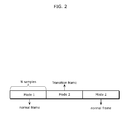
- An example of the transition frame is illustrated in FIG. 2 .
- a pervious frame is coded in the AAC-ELD mode and a current frame is to be coded in the ACELP mode, the current frame is defined as a transition frame.
- the number of processed AAC-ELD frames is 4.
- a frame i-1 is concatenated with three previous frames to form an extended frame with a length of 4N.
- N is the size of the input frame. That is to say, to code a current picture to be coded, the AAC-ELD mode requires not only a sample of the current frame but also samples of the three frames previous to the current frame.
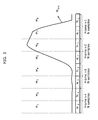
- FIG. 3 illustrates the encoder window shape in the AAC-ELD mode of the encoder.
- the window in the encoder is defined as W enc .
- the encoder window is divided into eight parts, denoted as [w 1 , w 2 , w 3 , w 4 , w 5 , w 6 , w 7 , w 8 ].
- the length of the encoder window is 4N.
- the encoder window in the AAC-ELD mode is designed to match the low delay filter banks used in the AAC-ELD mode.
- one frame is divided into two parts as shown in FIG. 3 .
- the frame i-1 is divided into two vectors [a i-1 , b i-1 ].
- a i-1 has N/2 samples
- b i-1 has N/2 samples. Therefore, the encoder window is applied on the vectors denoted as [a i-4 , b i-4 , a i-3 , b i-3 , a i-2 , b i-2 , a i-1 , b i-1 ], to obtain the windowed signal [a i-4 w 1 , b i-4 w 2 , a i-3 w 3 , b i-3 w 4 , a i-2 w 5 , b i-2 w 6 , a i-1 w 7 , b i-1 w 8 ].
- the low delay filter banks are used to transform the windowed signals.
- the low delay filter banks are defined as following:
- x n [a i-4 W 1 , b i-4 w 2 , a i-3 w 3 , b i-3 w 4 , a i-2 w 5 , b i-2 w 6 , a i-1 w 7 , b i-1 w 8 ].
- the length of the output coefficients is N while the processing frame length is 4N.
- the low delay filter bank can be expressed in terms of DCT-IV.
- the DCT-IV definition is shown as follows:
- the signal of the frame i-1 transformed by the low delay filter banks can be expressed in term of DCT-IV as follows: [DCT-IV (-(a i-4 w 1 ) R - b i-4 w 2 + (a i-2 w 5 ) R + b i-2 w 6 ), DCT-IV (-a i-3 w 3 + (b i-3 w 4 ) R + a i-1 w 7 - (b i-1 w 8 ) R )], where (a i-4 w 1 ) R , (a i-2 w 5 ) R , (b i-3 w 4 ) R , (b i-1 w 8 ) R denote the reverse order of vectors a i-4 w 1 , a i-2 w 5 , b i-3 w 4 , b i-1 w 8 respectively.
- FIG. 7 illustrates the inverse transform processes in the AAC-ELD mode.
- the inverse low delay filter banks of the AAC-ELD mode in the decoder are shown below.
- the length of the inverse transform signals of the low delay filter banks is 4N.
- the inverse transform signals for the frame i-1 are as follows:
- y i - 1 [ - a i - 4 ⁇ w 1 - b i - 4 ⁇ w 2 R + a i - 2 ⁇ w 5 + b i - 2 ⁇ w 6 R , - a i - 4 ⁇ w 1 R - b i - 4 ⁇ w 2 + a i - 2 ⁇ w 5 R + b i - 2 ⁇ w 6 , - a i - 3 ⁇ w 3 + b i - 3 ⁇ w 4 R + a i - 1 ⁇ w 7 - b i - 1 ⁇ w 8 R , a i - 3 ⁇ w 3 R - i - 3 ⁇ w 4 - a i - 1 ⁇ w 7 R + b i - 1 ⁇ w 8 , a i - 4 ⁇ w 1 + b i
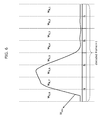
- FIG. 6 illustrates the decoder window shape in the AAC-ELD mode.
- the length of the window in the AAC-ELD mode is 4N. It is the reverse order of the encoder window in the AAC-ELD mode.
- the window in the decoder is denoted as w dec .
- the decoder window is divided into eight parts [w R,8 , w R,7 , w R,6 , w R,5 , w R,4 , w R,3 , w R,2 , w R,1 ] as shown in FIG. 6 .
- the windowed inverse transform signals y ⁇ i - 1 are as follows:
- y ⁇ i - 1 [ - a i - 4 ⁇ w 1 - b i - 4 ⁇ w 2 R + a i - 2 ⁇ w 5 + b i - 2 ⁇ w 6 R ⁇ w R , 8 , - a i - 4 ⁇ w 1 R - b i - 4 ⁇ w 2 + a i - 2 ⁇ w 5 R + b i - 2 ⁇ w 6 ⁇ w R , 7 , - a i - 3 ⁇ w 3 + b i - 3 ⁇ w 4 R + a i - 1 ⁇ w 7 - b i - 1 ⁇ w 8 R ⁇ w R , 6 , a i - 3 ⁇ w 3 R - i - 3 ⁇ w 4 - a i - 1 ⁇ w 7 - b i
- the windowed inverse transform signals y ⁇ i are as follows:
- y ⁇ i [ - a i - 3 ⁇ w 1 - b i - 3 ⁇ w 2 R + a i - 1 ⁇ w 5 + b i - 1 ⁇ w 6 R ⁇ w R , 8 , - a i - 3 ⁇ w 1 R - b i - 3 ⁇ w 2 + a i - 1 ⁇ w 5 R + b i - 1 ⁇ w 6 ⁇ w R , 7 , - a i - 2 ⁇ w 3 + b i - 2 ⁇ w 4 R + a i ⁇ w 7 - b i ⁇ w 8 R ⁇ w R , 6 , a i - 2 ⁇ w 3 R - b i - 2 ⁇ w 4 - a i ⁇ w 7 - b i ⁇ w 8 R ⁇ w R
- FIG. 7 illustrates the overlapping and adding process in the AAC-ELD mode.
- the length of the reconstructed signals out; is N.
- n y ⁇ i , n + y ⁇ i - 1 , n + N + y ⁇ i - 2 , n + 2 ⁇ N + y ⁇ i - 3 , n + 3 ⁇ N , 0 ⁇ n ⁇ N
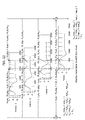
- the aliasing cancellation mechanism of the AAC-ELD is illustrated in FIG. 22 .
- the windowed inverse transform signal of the frame i, the frame i-1, the frame i-2, and the frame i-3 are shown in FIG. 22 .
- the window is designed to possess the following properties:
- a signal a i-1 is reconstructed after the overlapping and adding.
- a signal b i-1 is reconstructed after the overlapping and adding.
- the sound quality of the low delay hybrid codec which uses the AAC-LD is relatively narrowband and is thus not satisfactory although it has low delay compared to when the normal delay AAC is used.
- the AAC-LD mode can be replaced by the AAC-ELD coding mode.
- the AAC-ELD further reduces the delay of the hybrid codec which employs the AAC-LD.
- the other problem of the low delay hybrid codec is the low sound quality, because it lacks a good scheme for coding the transient signal.
- the AAC-ELD uses only one type of window shape which adapts to the low delay filter bank.
- the window shape in the AAC-ELD is long.
- the long window shape of the AAC-ELD causes a poor coding quality for the transient signal.
- a better transient signal coding method for the AAC-ELD is necessary to improve the sound quality of the low delay hybrid codec.
- An object of the present invention is to solve the deterioration in the sound quality caused when different coding modes are switched in the low delay hybrid codec.
- the present invention provides optimal block switching algorithms in an encoder and a decoder for a hybrid speech and audio codec in order to switch coding modes seamlessly to reduce the deterioration in the sound quality caused at the time of switching.
- the switching schemes according to an aspect of the present invention are different from the prior art which processed the aliasing portion of the windowed block differently compared to the subsequent portion of the transition block. That is to say, the non-aliasing portions of the previous frames are processed and used to cancel the aliasing in the current switching frame. No different coding technology is used for different portions of the frames.
- the block switching algorithms are used to handle the transition frames where:
- bitrate of block switching from the ACELP mode to the AAC-ELD mode for the low delay hybrid codec may be reduced.
- the normal MDCT filter bank similar to the low delay filter banks is used for the purpose of reducing the bitrate required for the switching from the ACELP mode to the AAC-ELD mode.
- the sound quality may be improved by designing a block switching scheme for handing the transient signal in the low delay hybrid codec.
- Short windowing may be used for encoding the transient signal because of the abrupt energy change in the transient signal. This allows seamless connection from the short window to the long window in the AAC-ELD mode.
- Embodiment 1 a hybrid speech and audio encoder having block switching algorithms is invented to code a transition frame that is a frame where the AAC-ELD mode is being switched to the ACELP mode.
- the frame size of the ACELP is extended.
- the aliasing which occurs when the AAC-ELD mode is switched to the ACELP mode is attributable to the fact that while the AAC-ELD mode requires a sample of the previous frame to code a current frame to be coded, the ACELP only uses a sample of the current frame, i.e., one frame, to code the current frame.
- the second half of the previous frame preceding the current frame is concatenated with the current frame to form an extended frame, which is longer than a normal input frame size.
- the extended frame is coded in the ACELP mode by the encoder.
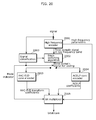
- FIG. 20 is a block diagram illustrating a framework of a hybrid encoder which combines the AAC-ELD coding technology with the ACELP coding technology.
- an incoming signal is sent to a high frequency encoder 2001.
- the coded high frequency parameters are sent to a bit multiplexer block 2006.
- the incoming signal is also sent to a signal classification block 2003.
- the signal classification decides which coding mode is selected for a time domain signal in low frequency band.
- a mode indicator from the signal classification block 2003 is sent to the bit multiplexer block 2006.
- the mode indicator is also used for controlling a block switching algorithm 2002.
- the current time domain signal in low frequency band to be coded is sent to a corresponding encoder 2004, 2005 according to the mode indicator.
- the bit multiplexer block 2006 generates a bitstream.
- the incoming signal is coded on a frame-by-frame basis.
- the input frame size is defined as N in the present embodiment.
- FIG. 20 the block switching algorithms 2002 are used to handle the transition frames where the coding mode is switched.
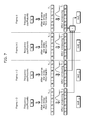
- FIG. 4 illustrates the block switching algorithm for switching from the AAC-ELD mode to the ACELP mode in Embodiment 1.
- the block switching algorithm concatenates the second half of the previous frame i-1 to form an extended frame having a processing frame length of N + 1 2 ⁇ N .
- This processed frame is sent to the ACELP mode for coding.
- the encoder having the block switching algorithm according to the present embodiment facilitates the aliasing cancellation in the decoder when the coding mode is switched from the AAC-ELD mode to the ACELP mode, and realizes a seamless combination of the AAC-ELD coding technology and the ACELP coding technology in the low delay hybrid speech and audio codec having two coding modes of the audio coding mode and the speech coding mode.
- Embodiment 2 a hybrid speech and audio encoder having block switching algorithms is invented to code the transition frame where the AAC-ELD mode is switched to the ACELP mode.
- Embodiment 2 the principle of Embodiment 2 is to extend the frame length of the ACELP frame.
- the encoder framework is different from Embodiment 1.
- FIG. 1 illustrates a framework which combines the AAC-ELD that is an audio codec with the ACELP coding technology and the TCX coding technology that are speed codecs.
- an incoming signal is sent to a high frequency encoder 101.
- the coded high frequency parameters are sent to a bit multiplexer block 107.
- the incoming signal is also sent to a signal classification block 103.
- the signal classification decides which coding mode is selected.
- a mode indicator from the signal classification block is sent to the bit multiplexer block 107.
- the mode indicator is also used for controlling a block switching algorithm 102.
- the current time domain signal in low frequency band to be coded is sent to a corresponding encoder 104, 105, 106 according to the mode indicator.
- the bit multiplexer block 107 generates a bitstream.
- the encoder having the block switching algorithm according to the present embodiment facilitates the aliasing cancellation in the decoder when the coding mode is switched from the AAC-ELD mode to the ACELP mode, and realizes a seamless combination of the AAC-ELD coding technology and the ACELP coding technology in the low delay hybrid speech and audio codec having three coding modes.
- Embodiment 3 a hybrid speech and audio decoder having block switching algorithms is invented to decode the transition frame where the AAC-ELD mode is switched to the ACELP mode.
- the current frame is denoted as frame i.
- the block switching algorithms In order to cancel the aliasing of a frame i-1 introduced by the AAC-ELD coding mode, the block switching algorithms generate the inverse aliasing components using the non-aliasing portion of an ACELP synthesized signal of the frame i and a reconstructed signal of a frame i-2.
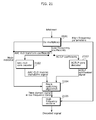
- FIG. 21 illustrates a hybrid speech and audio decoder which combines the AAC-ELD coding technology with the ACELP decoding technologies.
- an input bitstream is de-multiplexed in 2101.
- a mode indicator is sent to control the selecting of the decoding mode and the block switching algorithm 2104.
- High frequency parameters are sent to a high frequency decoder 2105 to reconstruct a high frequency signal.
- the low frequency coefficients are sent to the corresponding decoder 2102 or 2103 according the mode indicator.
- the inverse transform signals and the synthesized signals are sent to the block switching algorithm.
- the block switching algorithm 2104 reconstructs the time domain signal of the low frequency band according to different switching situations.
- the high frequency decoder 2105 reconstructs the signals base on the high frequency parameters and the time domain signal of the low frequency band.
- FIG. 23 illustrates the transition from the AAC-ELD mode to the ACELP mode.
- the frame i-1 is inverse transformed in the AAC-ELD mode as a normal frame.
- the frame i is synthesized in the ACELP mode as a normal frame.
- the non-aliasing portion denoted as a sub-frame 2301 and the decoded signal of the frame i-2 denoted as a sub-frame 2304 and a sub-frame 2305 are processed and used to cancel the aliasing in the aliasing portion denoted as a sub-frame 2302.
- FIG. 8 illustrates one example of the block switching.
- the ACELP synthesized signal is denoted as y i , n acelp , 0 ⁇ n ⁇ 3 2 ⁇ N .
- the length of the ACELP synthesized signal is 3 2 ⁇ N .
- a part of the non-aliasing portion, denoted as the sub-frame 2301 in FIG. 23 is extracted for aliasing cancellation:
- the AAC-ELD inverse transform signals of the previous frame i-1 are denoted as y i-1 with a length of 4N.
- One aliasing portion denoted as the sub-frame 2302 in FIG. 23 is extracted and expressed as follows according to the AAC-ELD inverse transform explained in the background section:
- the window w 8 is applied to the non-aliasing portion b i-1 , as shown in FIG. 8 , to obtain b i-1 w 8 .
- the window w 3 is applied to the non-aliasing portion a i-3 to obtain a i-3 w 3 , as shown in FIG. 8 .
- the window w 4 is applied to the non-aliasing portion b i-3 to obtain b i-3 w 4 , as shown in FIG. 8 .
- the reverse order of b i-3 w 4 is obtained as shown in 901, and is denoted as (b i-3 w 4 ) R .
- components -a i-3 W 3 + (b i-3 w 4 ) R + a i-1 w 7 - (b i-1 w 8 ) R , (b i-1 w 8 ) R , a i-3 w 3 , and (b i-3 w 4 ) R are added as shown in FIG. 8 .
- the outputs of the frame i are signals [a i-1 , b i-1 ] reconstructed by concatenation of the sub-frame 2301 and the sub-frame 801.
- the decoder according to the present embodiment having the block switching algorithm can cancel the aliasing introduced in the transition frame where the AAC-ELD mode is switched to the ACELP mode, by performing signal processing using the non-aliasing portion of the previous frame. This enables a seamless combination of the AAC-ELD coding technology and the ACELP coding technology in the low delay hybrid decoder having two decoding modes.
- Embodiment 4 a hybrid speech and audio decoder having block switching algorithms is invented to decode the transition frame where the AAC-ELD mode is switched to the ACELP mode.
- Embodiment 4 The principle of Embodiment 4 is the same as Embodiment 3.
- the decoder framework is different from Embodiment 3.
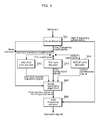
- FIG. 5 illustrates the hybrid speech and audio decoder which combines the AAC-ELD coding technology with the ACELP and TCX coding technologies.
- the input bitstream is de-multiplexed in 501.
- a mode indicator is sent to control the selecting one from decoders 502, 503, and 504 and is sent to a block switching algorithm 505.
- the high frequency parameters are sent to a high frequency decoder 506 to reconstruct a high frequency signal.
- the low frequency coefficients are sent to the corresponding decoding mode according the mode indicator.
- the inverse transform signals and synthesized signals are sent to the block switching algorithm 505.
- the block switching algorithm 505 reconstructs the time domain signal of the low frequency band according to different switching situations.
- the high frequency decoder 506 reconstructs the signals base on the high frequency parameters and the time domain signal of the low frequency band.
- the decoder having the block switching algorithm according to the present embodiment solves the aliasing cancellation problem at the transition frame where AAC-ELD mode is switched to the ACELP mode, and realizes a seamless combination of the AAC-ELD coding technology and the ACELP coding technology in the low delay hybrid codec having three decoding modes.
- Embodiment 5 a hybrid speech and audio encoder having block switching algorithm is invented to code the transition frame where the ACELP mode is switched to the AAC-ELD mode.
- the decoding process switches back to the normal AAC-ELD overlapping and adding process.
- this transition frame is coded by normal AAC-ELD low delay filter banks.
- the encoder of the present embodiment uses MDCT filter banks.
- the encoder framework is the same as Embodiment 1.
- the block switching method in the present embodiment is different from Embodiment 1.
- the present embodiment is to code the transition frame where the ACELP mode is switched to the AAC-ELD mode.
- FIG. 10 illustrates the coding method for the transition frame according to the present embodiment.
- the current frame i [a i , b i ] is extended to the length of 2N by zero padding, denoted as [a i , b i , 0, 0]. Windowing is applied to this vector to obtain a vector [a i w 7 , b i w 8 , 0, 0].
- MDCT filter banks are used to transform the windowed vector:
- the MDCT transform coefficients can be expressed in terms of DCT-IV as follows: a i ⁇ w 7 , b i ⁇ w 8 , 0 , 0
- the coefficients of the portion N/2 are all zero, and thus only the DCT-IV (a i w 7 - (b i w 8 ) R ) having the length of N/2 needs to be sent to the decoder.
- the length of the AAC-ELD coefficients is N. Therefore, by using the method according to the present embodiment, the bitrate is saved by half.
- the encoder according to the present embodiment having the block switching algorithm helps prepare the aliasing components of the frame i in order to perform aliasing cancellation with following frames coded in the AAC-ELD mode, when the coding mode is switched from the ACELP mode to the AAC-ELD mode. It reduces the computation complexity of the coding operation and reduces the bitrate compared to when using the AAC-ELD mode on the transition frame directly.
- Embodiment 6 a hybrid speech and audio encoder having a block switching algorithm is invented to code the transition frame where the ACELP mode is switched to the AAC-ELD mode.
- Embodiment 6 The principle of Embodiment 6 is the same as Embodiment 5, but the encoder framework is different from Embodiment 5.
- Embodiment 6 There are three coding modes in the encoder of Embodiment 6, namely the AAC-ELD mode, the ACELP mode, and the TCX mode.
- the encoder frame work of Embodiment 6 is the same as Embodiment 2.
- Embodiment 7 a hybrid speech and audio decoder with block switching algorithms is invented to decode the transition frame where the ACELP mode is switched to the AAC-ELD mode.
- block switching in the decoder from the ACELP mode to the AAC-ELD mode is performed according to the encoder in Embodiment 5.
- the following frames are switched back to the AAC-ELD overlapping and adding mode.
- Aliasing of the AAC-ELD are produced by using the aliasing portions of the inverse MDCT transform signal of the frame i, the non-aliasing portion of the ACELP synthesized signal of the frame i-1, and the reconstructed signal of the frame i-2 and the frame i-3.
- FIG. 9 illustrates the transition from the ACELP mode to the AAC-ELD mode in the decoder.
- the decoder framework is the same as Embodiment 3.
- the block switching method in the present embodiment is different from Embodiment 3.
- FIGS. 9 , 11 , and 12 illustrate one example of the decoding processes.
- the received low band coefficients are MDCT transform coefficients DCT-IV (a i w 7 - (b i w 8 ) R ) in this transition frame i. Therefore, the corresponding inverse filter banks are IMDCT in Embodiment 7.
- the aliasing outputs of the IMDCT are denoted as [a i w 7 - (b i w 8 ) R , -(a i w 7 ) R + b i w 8 ] having a length of N, shown as a sub-frame 901 and a sub-frame 902 in FIG. 9 .
- the non-aliasing portions of ACELP synthesized signals from the previous frame i-1 are denoted as [a i-1 , b i-1 ] having a length of N, shown as a sub-frame 903 and a sub-frame 904 in FIG. 9 .
- the outputs of the previous two frames are denoted as [a i-2 , b i-2 ] and [a i-3 , b i-3 ], shown as sub-frames 905, 906, 907, and 908, respectively in FIG. 9 .
- the aliasing portions of the inverse AAC-ELD are produced by using the sub-frames mentioned above.
- the purpose is to prepare the aliasing components for overlapping and adding with the following frames coded in the AAC-ELD mode, so that the coding mode can switch back to the normal AAC-ELD mode.
- FIGS. 11 and 12 illustrate the detail processes of how to produce the aliasing elements of the AAC-ELD.
- the decoded signal of a frame i-3 a i-3 is windowed to obtain a i-3 w 1 .
- Folding is applied to obtain the reverse order (a i-3 w 1 ) R .
- the second half of the decoded signal of the frame i-3 b i-3 is windowed to obtain b i-3 w 2 .
- the first part of the non-aliasing portion of the ACELP synthesized signal a i-1 of the frame i-1 is windowed to obtain a i-1 w 5 . Folding is applied to obtain the reverse order (a i-1 w 5 ) R .
- the second part of the non-aliasing portion of the ACELP synthesized signal is denoted as b i-1 . Windowed is applied to b i-1 to obtain b i-1 w 6 .
- A - a i - 3 ⁇ w 1 R - b i - 3 ⁇ w 2 + a i - 1 ⁇ w 5 R + b i - 1 ⁇ w 6
- a R - a i - 3 ⁇ w 1 - b i - 3 ⁇ w 2 R + a i - 1 ⁇ w 5 + b i - 1 ⁇ w 6 R - A
- R a i - 3 ⁇ w 1 + b i - 3 ⁇ w 2 R - a i - 1 ⁇ w 5 - b i - 1 ⁇ w 6
- R - A a i - 3 ⁇ w 1 R + b i - 3 ⁇ w 2 - a i - 1 ⁇ w 5 - b i - 1 ⁇ w 6
- A a i - 3 ⁇ w 1 R +
- FIG. 12 illustrates the detail of the processes of producing the aliasing portions of the AAC-ELD.
- the aliasing portions of the AAC-ELD frame i are obtained, as shown in FIG. 12 .
- y i R A , A , B , R - B , R - A , - A , - B , R B
- Decoder window [w R,8 , w R,7 , w R,6 , w R,5 , w R,4 , w R,3 , w R,2 , w R,1 ] is applied to obtain the windowed aliasing portions: y ⁇ i
- the aliasing cancellation with following AAC-ELD frames can be continued.
- the decoder according to the present embodiment having the block switching algorithm generates the aliasing components of the AAC-ELD mode using the MDCT coefficients, to facilitate the aliasing cancellation with the following frames coded in the AAC-ELD mode. According to an aspect of the present invention, it is possible to realize a seamless transition from the ACELP mode to the AAC-ELD mode in the low delay hybrid speech and audio codec having two coding modes.
- Embodiment 8 a hybrid speech and audio decoder having block switching algorithms is invented to decode the transition frame where the ACELP mode is switched to the AAC-ELD mode.
- Embodiment 8 The principle of Embodiment 8 is the same as Embodiment 7.
- the decoder framework is different from Embodiment 7.
- Embodiment 8 There are three decoding modes in Embodiment 8, namely the AAC-ELD mode, the ACELP mode, and the TCX mode.
- the frame work of Embodiment 8 is the same as Embodiment 4.
- the decoder according to the present embodiment having the block switching algorithm generates the aliasing of the AAC-ELD mode to facilitate the aliasing cancellation with the following frames coded in the AAC-ELD mode. According to an aspect of the present invention, it is possible to realize a seamless transition from the ACELP mode to the AAC-ELD mode in the low delay hybrid speech and audio codec having three coding modes.
- Embodiment 9 a speech and audio encoder having a block switching algorithm is invented to code the transition frame where the AAC-ELD mode is switched to the TCX mode.
- the TCX frame size is extended.
- the block switching algorithms concatenate the current frame with the previous frame to form an extended frame, whose length is longer than the normal frame size. This extended frame is coded in the TCX mode in the encoder.
- the encoder frame work is the same as Embodiment 2.
- the block switching method in the present embodiment is different from Embodiment 2.
- the present embodiment is to code the transition frame where the AAC-ELD mode is switched to the TCX mode.
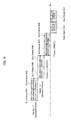
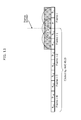
- FIG. 13 illustrates the coding process.
- the previous frame is coded in the AAC-ELD mode.
- the current frame i is concatenated with the previous frame i-1 to form a long frame.
- the processing frame size is 2N, where N is the frame size.
- the extended frame is coded in the TCX mode as shown in FIG. 13 .
- the window size of the TCX mode is N.
- the overlapping length of the TCX mode is 1 2 ⁇ N Therefore, the extended frame contains three TCX windows as shown in FIG. 13 .
- the encoder according to the present embodiment having the block switching algorithm facilitates the aliasing cancellation in the decoder when the coding mode is switched from the AAC-ELD mode to the TCX mode, and realizes a seamless combination of the AAC-ELD coding technology and the TCX coding technology in the low delay hybrid speech and audio codec having three coding modes.
- Embodiment 10 a hybrid speech and audio decoder having a block switching algorithm is invented to decode the transition frame where the AAC-ELD mode is switched to the TCX mode.
- the current frame is denoted as the frame i.
- the block switching algorithm In order to cancel the aliasing of the frame i-1 introduced by the AAC-ELD mode, the block switching algorithm generates the inverse aliasing components using the TCX synthesized signal of the frame i and the reconstructed signal of the frame i-2.
- the decoder framework is the same as Embodiment 4.
- the block switching method in the present embodiment is different from Embodiment 4.
- FIG. 14 illustrates the block switching process.
- the current transition frame is coded in the TCX mode using a processing frame size of 2N, where N is the frame size.
- the TCX synthesis is used to synthesize in the decoder.
- the TCX synthesized signals are [a i-1 + aliasing, b i-1 , a i , b i + aliasing] with a length of 2N.
- the non-aliasing portion b i-1 shown as a sub-frame 1401 in FIG. 14 , is used for generation the aliasing component of a sub-frame 1402.
- the AAC-ELD synthesized signals of the previous frame i-1 is denoted as y i-1 , and has a length of 4N.
- the y i-1 is shown as follows:
- y i - 1 [ - a i - 4 ⁇ w 1 - b i - 4 ⁇ w 2 R + a i - 2 ⁇ w 5 + b i - 2 ⁇ w 6 R , - a i - 4 ⁇ w 1 R - b i - 4 ⁇ w 2 + a i - 2 ⁇ w 5 R + b i - 2 ⁇ w 6 , - a i - 3 ⁇ w 3 + b i - 3 ⁇ w 4 R + a i - 1 ⁇ w 7 - b i - 1 ⁇ w 8 R , a i - 3 ⁇ w 3 R - i - 3 ⁇ w 4 - a i - 1 ⁇ w 7 R + b i - 1 ⁇ w 8 , a i - 4 ⁇ w 1 + b i
- the AAC-ELD aliasing component -a i-3 w 3 + (b i-3 w 4 ) R + a i-1 w 7 - (b i-1 w 8 ) R , shown as the sub-frame 1402, is cancelled by using the TCX synthesized signal b i-1 sub-frame 1401, and the reconstructed signal of i-2 out i-2 [a i-3 , b i-3 ], shown as sub-frame 1403 and 1040.
- the transition frame is reconstructed.
- the details of the aliasing cancellation processes in FIG. 14 are the same as the description of FIG. 8 .
- the sub-frame 2301 in FIG. 23 is replaced by the non-aliasing portion b i-1 1401.
- the sub-frame 2302 that is the aliasing portion is replaced by 1402 in FIG. 14 .
- the reconstructed signal of the transition frame i is [a i-1 , b i-1 ].
- the decoder according to the present embodiment having the block switching algorithm cancels the aliasing of the frame i-1 introduced by the AAC-ELD mode. This enables a seamless transition from the AAC-ELD mode to the TCX mode in the low delay hybrid speech and audio codec.
- Embodiment 11 a hybrid speech and audio encoder having a block switching algorithm is invented to code the transition frame where the TCX mode is switched to the AAC-ELD mode.
- the current transition frame is denoted as the frame i and it is coded in the AAC-ELD mode.
- the previous frame is coded in the TCX mode.
- the block switching algorithm codes the current frame together with three previous frames in the AAC-ELD mode.
- the encoder framework is the same as Embodiment 2.
- the block switching method in the present embodiment is different from Embodiment 2.
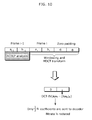
- FIG. 15 illustrates the coding process for the transition frame where the TCX mode is switched to the AAC-ELD mode in the encoder.
- the length of overlapping, in the TCX mode is 1 2 ⁇ N where N is the frame size.
- two TCX windows are applied as shown in FIG. 15 .
- the AAC-ELD mode is directly applied as shown in FIG. 15 .
- the encoder in Embodiment 11 facilitates the aliasing cancelling performed in the decoder when the TCX mode is switched to the AAC-ELD mode.
- the block switching algorithm in the present embodiment realizes the seamless combination of the AAC-ELD coding technology and the TCX coding technology in the low delay hybrid speech and audio codec.
- Embodiment 12 a hybrid speech and audio decoder having a block switching algorithm is invented to decode the transition frame where the TCX mode is switched to the AAC-ELD mode.
- the block switching algorithm in the present embodiment generates the aliasing of the AAC-ELD using the TCX synthesized signals and the reconstructed signal of the frame i-2, and cancels the aliasing of the AAC-ELD for the block switching purpose.
- FIG. 16 illustrates the corresponding decoding processes for the transition frame where the TCX mode is switched to the AAC-ELD mode.
- the previous frame is coded in the TCX mode.
- the TCX synthesized signals are [b i-2 + aliasing, a i-1 , b i-1 + aliasing], and have a length of 3 2 ⁇ N a i-1 is shown as a sub-frame 1601 in FIG. 16 .
- the inverse transform signal is denoted as y i and has a length of 4N as shown below.
- the aliasing portion - (a i-3 w 1 )R - b i-3 w 2 + (a i-1 w 5 ) R + b i-1 w 6 , shown as a sub-frame 1602, is cancelled by the TCX synthesized signal a i-1 and the frame i-2 out i-2 [a i-3 , b i-3 ] of the reconstructed signal shown as sub-frames 1603 and 1604 to reconstruct the signal of the transition frame [a i-1 , b i-1 ].
- FIG. 17 illustrates one example of aliasing cancellation.
- the reconstructed signal of the frame i-2 a i-3 is windowed to obtain a i-3 w 1 as shown in FIG. 17 .
- the reverse vector of a i-3 w 1 is denoted as (a i-3 w 1 ) R .
- the second half of the out i-2 is windowed to obtain b i-3 w 2 .
- the TCX synthesized signal a i-1 is windowed to obtain a i-1 w 5 .
- the reverse order of a i-1 w 5 is (a i-1 w 5 ) R .
- a sub-frame 1701 b i-1 is reconstructed.
- the sub-frame 1701 is concatenated with the sub-frame 1601 as shown in FIG. 17 .
- FIG. 24 is illustrates the sub-frame border smoothing processes.
- the sub-frame 1701 b i-1 is windowed by the TCX window shape. Folding and unfolding processes are applied to generate the MDCT-TCX aliasing components. The outcome is overlapped with the aliasing portions of the sub-frame 1605, which are originally from the MDCT-TCX inverse transform, to obtain a sub-frame 2401. The border between the sub-frames 1601 and 2401 is smoothed by the overlapping and adding processes. The transient signal [a i-1 , b i-1 ] is reconstructed.
- the decoder according to the present embodiment having the block switching algorithm cancels the aliasing of the frame i introduced by the AAC-ELD mode. This enables a seamless transition from the TCX mode to the AAC-ELD mode.
- Embodiment 13 a coding method for coding the transient signal in the low delay hybrid speech and audio codec is invented.
- a transient signal coding algorithm is invented in the present embodiment.
- the current frame i having a transient signal is concatenated with the previous frame to form an extended frame having a longer frame size.
- Multiple short windows and an MDCT filter bank are used to code this processed frame.
- FIG. 18 illustrates the coding processed in the encoder.
- the previous frame i-1 is coded together with three previous frames in the AAC-ELD mode.
- the frame i is concatenated with the previous frame as shown in FIG. 18 .
- the length of the long extended transient frame is N + 1 2 ⁇ N + 1 4 ⁇ N .
- Six short windows having a length of 1 2 ⁇ N are applied on the extended frame.
- the shape of the short window can be any symmetric window used by the MDCT filter banks.
- the MDCT filer banks are applied to short windowed signals.
- the encoder according to the present embodiment provides the transient signal handling algorithm to improve the sound quality of the low delay hybrid codec which uses the AAC-ELD coding technology.
- Embodiment 14 a hybrid speech and audio decoder for decoding the transient signal is invented.
- the transient frame i is coded by the short window MDCT as explained in Embodiment 13.
- the transient decoding method in the present embodiment uses the inverse MDCT transform signal of the frame i and the reconstructed signal of the frame i-3 to generate the inverse aliasing of the AAC-ELD mode.
- a signal 1902 is [a i-1 + aliasing, b i-1 , a i , b i + aliasing] with a length of N + 1 2 ⁇ N + 1 4 ⁇ N .
- the processes of the block 1901 in FIG. 19 are the same as FIG. 8 .
- the sub-frame 2301 in FIG. 23 is replaced by the non-aliasing portion 1902.
- the sub-frame 2302 that is the aliasing portion is replaced by 1904 in FIG. 19 .
- the invented decoder provides a transient signal handling method to improve the coding performance of the transient signal. As a result, the sound quality of the low delay hybrid codec which employs the AAC-ELD coding technology is improved.
- the present invention relates, in general, to hybrid audio coding systems, and is more particularly related to hybrid coding systems which support audio coding and speech coding in low bitrate.
- the hybrid coding system combines the transform coding and the time domain coding. It can be used in broadcasting systems, mobile
Landscapes
- Engineering & Computer Science (AREA)
- Physics & Mathematics (AREA)
- Multimedia (AREA)
- Health & Medical Sciences (AREA)
- Audiology, Speech & Language Pathology (AREA)
- Human Computer Interaction (AREA)
- Signal Processing (AREA)
- Acoustics & Sound (AREA)
- Computational Linguistics (AREA)
- Spectroscopy & Molecular Physics (AREA)
- Algebra (AREA)
- General Physics & Mathematics (AREA)
- Mathematical Analysis (AREA)
- Mathematical Optimization (AREA)
- Mathematical Physics (AREA)
- Pure & Applied Mathematics (AREA)
- Theoretical Computer Science (AREA)
- Quality & Reliability (AREA)
- Compression, Expansion, Code Conversion, And Decoders (AREA)
Applications Claiming Priority (2)
| Application Number | Priority Date | Filing Date | Title |
|---|---|---|---|
| JP2010134848 | 2010-06-14 | ||
| PCT/JP2011/003352 WO2011158485A2 (ja) | 2010-06-14 | 2011-06-14 | オーディオハイブリッド符号化装置およびオーディオハイブリッド復号装置 |
Publications (2)
| Publication Number | Publication Date |
|---|---|
| EP2581902A1 true EP2581902A1 (de) | 2013-04-17 |
| EP2581902A4 EP2581902A4 (de) | 2015-04-08 |
Family
ID=45348685
Family Applications (1)
| Application Number | Title | Priority Date | Filing Date |
|---|---|---|---|
| EP11795393.5A Withdrawn EP2581902A4 (de) | 2010-06-14 | 2011-06-14 | Audiohybrid-kodierungsvorrichtung und audiohybrid-dekodierungsvorrichtung |
Country Status (6)
| Country | Link |
|---|---|
| US (1) | US9275650B2 (de) |
| EP (1) | EP2581902A4 (de) |
| JP (1) | JP5882895B2 (de) |
| KR (1) | KR101790373B1 (de) |
| CN (1) | CN102934161B (de) |
| WO (1) | WO2011158485A2 (de) |
Cited By (1)
| Publication number | Priority date | Publication date | Assignee | Title |
|---|---|---|---|---|
| EP2863386A1 (de) * | 2013-10-18 | 2015-04-22 | Fraunhofer-Gesellschaft zur Förderung der angewandten Forschung e.V. | Audiodecodierer, Vorrichtung zur Erzeugung von codierten Audioausgangsdaten und Verfahren zur Initialisierung eines Decodierers |
Families Citing this family (14)
| Publication number | Priority date | Publication date | Assignee | Title |
|---|---|---|---|---|
| EP2301020B1 (de) * | 2008-07-11 | 2013-01-02 | Fraunhofer-Gesellschaft zur Förderung der angewandten Forschung e.V. | Vorrichtung und verfahren zur kodierung/dekodierung eines tonsignals anhand eines aliasing-schaltschemas |
| ES2930103T3 (es) * | 2010-07-08 | 2022-12-05 | Fraunhofer Ges Forschung | Codificador que utiliza cancelación del efecto de solapamiento hacia delante |
| JPWO2013061584A1 (ja) * | 2011-10-28 | 2015-04-02 | パナソニック株式会社 | 音信号ハイブリッドデコーダ、音信号ハイブリッドエンコーダ、音信号復号方法、及び音信号符号化方法 |
| JP6126006B2 (ja) * | 2012-05-11 | 2017-05-10 | パナソニック株式会社 | 音信号ハイブリッドエンコーダ、音信号ハイブリッドデコーダ、音信号符号化方法、及び音信号復号方法 |
| CN103714821A (zh) | 2012-09-28 | 2014-04-09 | 杜比实验室特许公司 | 基于位置的混合域数据包丢失隐藏 |
| CN106024008B (zh) | 2013-04-05 | 2020-01-14 | 杜比实验室特许公司 | 使用高级频谱延拓降低量化噪声的压扩装置和方法 |
| BR112015025022B1 (pt) | 2013-04-05 | 2022-03-29 | Dolby International Ab | Método de decodificação, decodificador em um sistema de processamento de áudio, método de codificação, e codificador em um sistema de processamento de áudio |
| FR3013496A1 (fr) * | 2013-11-15 | 2015-05-22 | Orange | Transition d'un codage/decodage par transformee vers un codage/decodage predictif |
| CN107452391B (zh) * | 2014-04-29 | 2020-08-25 | 华为技术有限公司 | 音频编码方法及相关装置 |
| CN104143335B (zh) | 2014-07-28 | 2017-02-01 | 华为技术有限公司 | 音频编码方法及相关装置 |
| WO2017050398A1 (en) * | 2015-09-25 | 2017-03-30 | Fraunhofer-Gesellschaft zur Förderung der angewandten Forschung e.V. | Encoder, decoder and methods for signal-adaptive switching of the overlap ratio in audio transform coding |
| US10499229B2 (en) * | 2016-01-24 | 2019-12-03 | Qualcomm Incorporated | Enhanced fallback to in-band mode for emergency calling |
| IL324371A (en) * | 2018-04-25 | 2026-01-01 | Dolby Int Ab | Integration of high frequency reconstruction techniques with reduced post-processing delay |
| US20250201255A1 (en) * | 2023-12-13 | 2025-06-19 | Qualcomm Incorporated | Content-based switchable audio codec |
Family Cites Families (20)
| Publication number | Priority date | Publication date | Assignee | Title |
|---|---|---|---|---|
| US7394833B2 (en) * | 2003-02-11 | 2008-07-01 | Nokia Corporation | Method and apparatus for reducing synchronization delay in packet switched voice terminals using speech decoder modification |
| WO2004093494A1 (en) | 2003-04-17 | 2004-10-28 | Koninklijke Philips Electronics N.V. | Audio signal generation |
| KR101169596B1 (ko) | 2003-04-17 | 2012-07-30 | 코닌클리케 필립스 일렉트로닉스 엔.브이. | 오디오 신호 합성 |
| US7596486B2 (en) | 2004-05-19 | 2009-09-29 | Nokia Corporation | Encoding an audio signal using different audio coder modes |
| US20060294312A1 (en) | 2004-05-27 | 2006-12-28 | Silverbrook Research Pty Ltd | Generation sequences |
| EP1841072B1 (de) | 2006-03-30 | 2016-06-01 | Unify GmbH & Co. KG | Verfahren und Einrichtung zum Dekodieren von schichtkodierten Daten |
| CN101231850B (zh) * | 2007-01-23 | 2012-02-29 | 华为技术有限公司 | 编解码方法及装置 |
| EP2015293A1 (de) | 2007-06-14 | 2009-01-14 | Deutsche Thomson OHG | Verfahren und Vorrichtung zur Kodierung und Dekodierung von Audiosignalen über adaptiv geschaltete temporäre Auflösung in einer Spektraldomäne |
| KR101490246B1 (ko) * | 2007-07-02 | 2015-02-05 | 엘지전자 주식회사 | 방송 수신기 및 방송신호 처리방법 |
| KR101405971B1 (ko) * | 2007-07-02 | 2014-06-12 | 엘지전자 주식회사 | 방송 수신기 및 방송신호 처리방법 |
| WO2009114656A1 (en) * | 2008-03-14 | 2009-09-17 | Dolby Laboratories Licensing Corporation | Multimode coding of speech-like and non-speech-like signals |
| CN102089810B (zh) * | 2008-07-10 | 2013-05-08 | 沃伊斯亚吉公司 | 多基准线性预测系数滤波器量化和逆量化设备及方法 |
| CA2871498C (en) | 2008-07-11 | 2017-10-17 | Fraunhofer-Gesellschaft Zur Foerderung Der Angewandten Forschung E.V. | Audio encoder and decoder for encoding and decoding audio samples |
| RU2498419C2 (ru) | 2008-07-11 | 2013-11-10 | Фраунхофер-Гезелльшафт цур Фёердерунг дер ангевандтен | Устройство аудио кодирования и декодирования для кодирования фреймов, представленных в виде выборок звуковых сигналов |
| MX2011000375A (es) | 2008-07-11 | 2011-05-19 | Fraunhofer Ges Forschung | Codificador y decodificador de audio para codificar y decodificar tramas de una señal de audio muestreada. |
| EP2144230A1 (de) | 2008-07-11 | 2010-01-13 | Fraunhofer-Gesellschaft zur Förderung der angewandten Forschung e.V. | Audiokodierungs-/Audiodekodierungsschema geringer Bitrate mit kaskadierten Schaltvorrichtungen |
| EP2301020B1 (de) | 2008-07-11 | 2013-01-02 | Fraunhofer-Gesellschaft zur Förderung der angewandten Forschung e.V. | Vorrichtung und verfahren zur kodierung/dekodierung eines tonsignals anhand eines aliasing-schaltschemas |
| KR20130133917A (ko) | 2008-10-08 | 2013-12-09 | 프라운호퍼 게젤샤프트 쭈르 푀르데룽 데어 안겐반텐 포르슝 에. 베. | 다중 분해능 스위치드 오디오 부호화/복호화 방법 |
| JP5547810B2 (ja) | 2009-07-27 | 2014-07-16 | インダストリー−アカデミック コーペレイション ファウンデイション, ヨンセイ ユニバーシティ | オーディオ信号を処理する方法及び装置 |
| CN101661749A (zh) | 2009-09-23 | 2010-03-03 | 清华大学 | 一种语音和音乐双模切换编/解码的方法 |
-
2011
- 2011-06-14 EP EP11795393.5A patent/EP2581902A4/de not_active Withdrawn
- 2011-06-14 US US13/703,044 patent/US9275650B2/en active Active
- 2011-06-14 WO PCT/JP2011/003352 patent/WO2011158485A2/ja not_active Ceased
- 2011-06-14 CN CN201180028085.9A patent/CN102934161B/zh active Active
- 2011-06-14 KR KR1020127031469A patent/KR101790373B1/ko active Active
- 2011-06-14 JP JP2012520286A patent/JP5882895B2/ja active Active
Cited By (16)
| Publication number | Priority date | Publication date | Assignee | Title |
|---|---|---|---|---|
| EP2863386A1 (de) * | 2013-10-18 | 2015-04-22 | Fraunhofer-Gesellschaft zur Förderung der angewandten Forschung e.V. | Audiodecodierer, Vorrichtung zur Erzeugung von codierten Audioausgangsdaten und Verfahren zur Initialisierung eines Decodierers |
| WO2015055683A1 (en) * | 2013-10-18 | 2015-04-23 | Fraunhofer-Gesellschaft zur Förderung der angewandten Forschung e.V. | Audio decoder, apparatus for generating encoded audio output data and methods permitting initializing a decoder |
| CN105745704A (zh) * | 2013-10-18 | 2016-07-06 | 弗朗霍夫应用科学研究促进协会 | 音频解码器、用于生成经编码的音频输出数据的装置以及允许将解码器初始化的方法 |
| TWI579832B (zh) * | 2013-10-18 | 2017-04-21 | 弗勞恩霍夫爾協會 | 音訊解碼器、用以產生編碼音訊輸出資料之裝置以及允許將解碼器初始化之方法 |
| US9928845B2 (en) | 2013-10-18 | 2018-03-27 | Fraunhofer-Gesellschaft Zur Foerderung Der Angewandten Forschung E.V. | Audio decoder, apparatus for generating encoded audio output data and methods permitting initializing a decoder |
| RU2651190C2 (ru) * | 2013-10-18 | 2018-04-18 | Фраунхофер-Гезелльшафт Цур Фердерунг Дер Ангевандтен Форшунг Е.Ф. | Аудиодекодер, устройство формирования выходных кодированных аудиоданных и способы, позволяющие инициализацию декодера |
| US10229694B2 (en) | 2013-10-18 | 2019-03-12 | Fraunhofer-Gesellschaft Zur Foerderung Der Angewandten Forschung E.V. | Audio decoder, apparatus for generating encoded audio output data and methods permitting initializing a decoder |
| CN105745704B (zh) * | 2013-10-18 | 2019-08-23 | 弗朗霍夫应用科学研究促进协会 | 用于编码和解码音频数据的装置以及方法 |
| US10614824B2 (en) | 2013-10-18 | 2020-04-07 | Fraunhofer-Gesellschaft Zur Foerderung Der Angewandten Forschung E.V. | Audio decoder, apparatus for generating encoded audio output data and methods permitting initializing a decoder |
| US11423919B2 (en) | 2013-10-18 | 2022-08-23 | Fraunhofer-Gesellschaft Zur Foerderung Der Angewandten Forschung E.V. | Audio decoder, apparatus for generating encoded audio output data and methods permitting initializing a decoder |
| US11670314B2 (en) | 2013-10-18 | 2023-06-06 | Fraunhofer-Gesellschaft Zur Foerderung Der Angewandten Forschung E.V. | Audio decoder, apparatus for generating encoded audio output data and methods permitting initializing a decoder |
| US12080309B2 (en) | 2013-10-18 | 2024-09-03 | Fraunhofer-Gesellschaft Zur Foerderung Der Angewandten Forschung E.V. | Audio decoder, apparatus for generating encoded audio output data and methods permitting initializing a decoder |
| US12094478B2 (en) | 2013-10-18 | 2024-09-17 | Fraunhofer-Gesellschaft Zur Foerderung Der Angewandten Forschung E.V. | Audio decoder, apparatus for generating encoded audio output data and methods permitting initializing a decoder |
| US12094479B2 (en) | 2013-10-18 | 2024-09-17 | Fraunhofer-Gesellschaft Zur Foerderung Der Angewandten Forschung E.V. | Audio decoder, apparatus for generating encoded audio output data and methods permitting initializing a decoder |
| US12165664B2 (en) | 2013-10-18 | 2024-12-10 | Fraunhofer-Gesellschaft Zur Foerderung Der Angewandten Forschung E.V. | Audio decoder, apparatus for generating encoded audio output data and methods permitting initializing a decoder |
| US12170093B2 (en) | 2013-10-18 | 2024-12-17 | Fraunhofer-Gesellschaft Zur Foerderung Der Angewandten Forschung E.V. | Audio decoder, apparatus for generating encoded audio output data and methods permitting initializing a decoder |
Also Published As
| Publication number | Publication date |
|---|---|
| EP2581902A4 (de) | 2015-04-08 |
| JP5882895B2 (ja) | 2016-03-09 |
| KR101790373B1 (ko) | 2017-10-25 |
| KR20130028751A (ko) | 2013-03-19 |
| JPWO2011158485A1 (ja) | 2013-08-19 |
| US20130090929A1 (en) | 2013-04-11 |
| WO2011158485A2 (ja) | 2011-12-22 |
| US9275650B2 (en) | 2016-03-01 |
| CN102934161B (zh) | 2015-08-26 |
| CN102934161A (zh) | 2013-02-13 |
Similar Documents
| Publication | Publication Date | Title |
|---|---|---|
| US9275650B2 (en) | Hybrid audio encoder and hybrid audio decoder which perform coding or decoding while switching between different codecs | |
| AU2006252962B2 (en) | Audio CODEC post-filter | |
| KR101508819B1 (ko) | 멀티 모드 오디오 코덱 및 이를 위해 적응된 celp 코딩 | |
| KR101699898B1 (ko) | 스펙트럼 영역에서 디코딩된 오디오 신호를 처리하기 위한 방법 및 장치 | |
| KR101366124B1 (ko) | 오디오 인코딩/디코딩에서의 인지 가중 장치 | |
| KR102152004B1 (ko) | 선형 예측 코딩을 사용하여 감소된 배경 잡음을 갖는 오디오 신호를 인코딩하기 위한 인코더 및 방법 | |
| EP2849180B1 (de) | Kodierer für hybride audiosignale, dekodierer für hybride audiosignale, verfahren zur kodierung von audiosignalen und verfahren zur dekodierung von audiosignalen | |
| US20130030798A1 (en) | Method and apparatus for audio coding and decoding | |
| MX2011000366A (es) | Codificador y decodificador de audio para codificar y decodificar muestras de audio. | |
| CN102884574A (zh) | 音频信号编码器、音频信号解码器、使用混迭抵消来将音频信号编码或解码的方法 | |
| KR20130133846A (ko) | 정렬된 예견 부를 사용하여 오디오 신호를 인코딩하고 디코딩하기 위한 장치 및 방법 | |
| EP2772914A1 (de) | Dekodierer für hybride klangsignale, kodierer für hybride klangsignale, dekodierungsverfahren für klangsignale und kodierungsverfahren für klangsignale | |
| CN103384900A (zh) | 在预测编码与变换编码之间交替的低延迟声音编码 | |
| Ragot et al. | A 8-32 kbit/s scalable wideband speech and audio coding candidate for ITU-T G729EV standardization | |
| JP3598111B2 (ja) | 広帯域音声復元装置 | |
| JP3560964B2 (ja) | 広帯域音声復元装置及び広帯域音声復元方法及び音声伝送システム及び音声伝送方法 | |
| JP3636327B2 (ja) | 広帯域音声復元方法及び広帯域音声復元装置 | |
| JP3748083B2 (ja) | 広帯域音声復元方法及び広帯域音声復元装置 | |
| JP3748082B2 (ja) | 広帯域音声復元方法及び広帯域音声復元装置 | |
| Livshitz et al. | Perceptually Constrained Variable Bitrate Wideband Speech Coder | |
| JP2006065362A (ja) | 広帯域音声復元装置 | |
| JP2005092246A (ja) | 広帯域音声復元方法及び広帯域音声復元装置 | |
| TR201900830T4 (tr) | Karmaşık öngörü ve gerçek gösterge kullanarak çok kanallı ses kodlama. | |
| JP2005284315A (ja) | 広帯域音声復元方法及び広帯域音声復元装置 | |
| HK1192048B (en) | Apparatus and method for processing a decoded audio signal in a spectral domain |
Legal Events
| Date | Code | Title | Description |
|---|---|---|---|
| PUAI | Public reference made under article 153(3) epc to a published international application that has entered the european phase |
Free format text: ORIGINAL CODE: 0009012 |
|
| 17P | Request for examination filed |
Effective date: 20121210 |
|
| AK | Designated contracting states |
Kind code of ref document: A1 Designated state(s): AL AT BE BG CH CY CZ DE DK EE ES FI FR GB GR HR HU IE IS IT LI LT LU LV MC MK MT NL NO PL PT RO RS SE SI SK SM TR |
|
| RIN1 | Information on inventor provided before grant (corrected) |
Inventor name: NORIMATSU, TAKESHI Inventor name: ZHONG, HAISHAN Inventor name: ZHOU, HUAN Inventor name: CHONG, KOK SENG Inventor name: ISHIKAWA, TOMOKAZU |
|
| DAX | Request for extension of the european patent (deleted) | ||
| RA4 | Supplementary search report drawn up and despatched (corrected) |
Effective date: 20150306 |
|
| RIC1 | Information provided on ipc code assigned before grant |
Ipc: G10L 19/02 20130101AFI20150302BHEP Ipc: G10L 19/20 20130101ALI20150302BHEP Ipc: G10L 19/107 20130101ALI20150302BHEP Ipc: G10L 19/022 20130101ALN20150302BHEP |
|
| STAA | Information on the status of an ep patent application or granted ep patent |
Free format text: STATUS: THE APPLICATION HAS BEEN WITHDRAWN |
|
| 18W | Application withdrawn |
Effective date: 20150706 |