EP2581579A2 - Exhaust gas control system and exhaust gas control method for internal combustion engine - Google Patents
Exhaust gas control system and exhaust gas control method for internal combustion engine Download PDFInfo
- Publication number
- EP2581579A2 EP2581579A2 EP12187087.7A EP12187087A EP2581579A2 EP 2581579 A2 EP2581579 A2 EP 2581579A2 EP 12187087 A EP12187087 A EP 12187087A EP 2581579 A2 EP2581579 A2 EP 2581579A2
- Authority
- EP
- European Patent Office
- Prior art keywords
- exhaust gas
- filter
- flow rate
- temperature
- deposition
- Prior art date
- Legal status (The legal status is an assumption and is not a legal conclusion. Google has not performed a legal analysis and makes no representation as to the accuracy of the status listed.)
- Granted
Links
Images




Classifications
-
- F—MECHANICAL ENGINEERING; LIGHTING; HEATING; WEAPONS; BLASTING
- F01—MACHINES OR ENGINES IN GENERAL; ENGINE PLANTS IN GENERAL; STEAM ENGINES
- F01N—GAS-FLOW SILENCERS OR EXHAUST APPARATUS FOR MACHINES OR ENGINES IN GENERAL; GAS-FLOW SILENCERS OR EXHAUST APPARATUS FOR INTERNAL-COMBUSTION ENGINES
- F01N9/00—Electrical control of exhaust gas treating apparatus
- F01N9/002—Electrical control of exhaust gas treating apparatus of filter regeneration
-
- F—MECHANICAL ENGINEERING; LIGHTING; HEATING; WEAPONS; BLASTING
- F01—MACHINES OR ENGINES IN GENERAL; ENGINE PLANTS IN GENERAL; STEAM ENGINES
- F01N—GAS-FLOW SILENCERS OR EXHAUST APPARATUS FOR MACHINES OR ENGINES IN GENERAL; GAS-FLOW SILENCERS OR EXHAUST APPARATUS FOR INTERNAL-COMBUSTION ENGINES
- F01N3/00—Exhaust or silencing apparatus having means for purifying, rendering innocuous, or otherwise treating exhaust
- F01N3/02—Exhaust or silencing apparatus having means for purifying, rendering innocuous, or otherwise treating exhaust for cooling, or for removing solid constituents of, exhaust
- F01N3/021—Exhaust or silencing apparatus having means for purifying, rendering innocuous, or otherwise treating exhaust for cooling, or for removing solid constituents of, exhaust by means of filters
- F01N3/033—Exhaust or silencing apparatus having means for purifying, rendering innocuous, or otherwise treating exhaust for cooling, or for removing solid constituents of, exhaust by means of filters in combination with other devices
- F01N3/035—Exhaust or silencing apparatus having means for purifying, rendering innocuous, or otherwise treating exhaust for cooling, or for removing solid constituents of, exhaust by means of filters in combination with other devices with catalytic reactors
-
- F—MECHANICAL ENGINEERING; LIGHTING; HEATING; WEAPONS; BLASTING
- F01—MACHINES OR ENGINES IN GENERAL; ENGINE PLANTS IN GENERAL; STEAM ENGINES
- F01N—GAS-FLOW SILENCERS OR EXHAUST APPARATUS FOR MACHINES OR ENGINES IN GENERAL; GAS-FLOW SILENCERS OR EXHAUST APPARATUS FOR INTERNAL-COMBUSTION ENGINES
- F01N2560/00—Exhaust systems with means for detecting or measuring exhaust gas components or characteristics
- F01N2560/06—Exhaust systems with means for detecting or measuring exhaust gas components or characteristics the means being a temperature sensor
-
- F—MECHANICAL ENGINEERING; LIGHTING; HEATING; WEAPONS; BLASTING
- F01—MACHINES OR ENGINES IN GENERAL; ENGINE PLANTS IN GENERAL; STEAM ENGINES
- F01N—GAS-FLOW SILENCERS OR EXHAUST APPARATUS FOR MACHINES OR ENGINES IN GENERAL; GAS-FLOW SILENCERS OR EXHAUST APPARATUS FOR INTERNAL-COMBUSTION ENGINES
- F01N2560/00—Exhaust systems with means for detecting or measuring exhaust gas components or characteristics
- F01N2560/07—Exhaust systems with means for detecting or measuring exhaust gas components or characteristics the means being an exhaust gas flow rate or velocity meter or sensor, intake flow meters only when exclusively used to determine exhaust gas parameters
-
- F—MECHANICAL ENGINEERING; LIGHTING; HEATING; WEAPONS; BLASTING
- F01—MACHINES OR ENGINES IN GENERAL; ENGINE PLANTS IN GENERAL; STEAM ENGINES
- F01N—GAS-FLOW SILENCERS OR EXHAUST APPARATUS FOR MACHINES OR ENGINES IN GENERAL; GAS-FLOW SILENCERS OR EXHAUST APPARATUS FOR INTERNAL-COMBUSTION ENGINES
- F01N2560/00—Exhaust systems with means for detecting or measuring exhaust gas components or characteristics
- F01N2560/08—Exhaust systems with means for detecting or measuring exhaust gas components or characteristics the means being a pressure sensor
-
- F—MECHANICAL ENGINEERING; LIGHTING; HEATING; WEAPONS; BLASTING
- F01—MACHINES OR ENGINES IN GENERAL; ENGINE PLANTS IN GENERAL; STEAM ENGINES
- F01N—GAS-FLOW SILENCERS OR EXHAUST APPARATUS FOR MACHINES OR ENGINES IN GENERAL; GAS-FLOW SILENCERS OR EXHAUST APPARATUS FOR INTERNAL-COMBUSTION ENGINES
- F01N2900/00—Details of electrical control or of the monitoring of the exhaust gas treating apparatus
- F01N2900/06—Parameters used for exhaust control or diagnosing
- F01N2900/14—Parameters used for exhaust control or diagnosing said parameters being related to the exhaust gas
- F01N2900/1406—Exhaust gas pressure
-
- F—MECHANICAL ENGINEERING; LIGHTING; HEATING; WEAPONS; BLASTING
- F01—MACHINES OR ENGINES IN GENERAL; ENGINE PLANTS IN GENERAL; STEAM ENGINES
- F01N—GAS-FLOW SILENCERS OR EXHAUST APPARATUS FOR MACHINES OR ENGINES IN GENERAL; GAS-FLOW SILENCERS OR EXHAUST APPARATUS FOR INTERNAL-COMBUSTION ENGINES
- F01N2900/00—Details of electrical control or of the monitoring of the exhaust gas treating apparatus
- F01N2900/06—Parameters used for exhaust control or diagnosing
- F01N2900/16—Parameters used for exhaust control or diagnosing said parameters being related to the exhaust apparatus, e.g. particulate filter or catalyst
- F01N2900/1606—Particle filter loading or soot amount
-
- F—MECHANICAL ENGINEERING; LIGHTING; HEATING; WEAPONS; BLASTING
- F01—MACHINES OR ENGINES IN GENERAL; ENGINE PLANTS IN GENERAL; STEAM ENGINES
- F01N—GAS-FLOW SILENCERS OR EXHAUST APPARATUS FOR MACHINES OR ENGINES IN GENERAL; GAS-FLOW SILENCERS OR EXHAUST APPARATUS FOR INTERNAL-COMBUSTION ENGINES
- F01N2900/00—Details of electrical control or of the monitoring of the exhaust gas treating apparatus
- F01N2900/06—Parameters used for exhaust control or diagnosing
- F01N2900/16—Parameters used for exhaust control or diagnosing said parameters being related to the exhaust apparatus, e.g. particulate filter or catalyst
- F01N2900/1628—Moisture amount in exhaust apparatus
-
- F—MECHANICAL ENGINEERING; LIGHTING; HEATING; WEAPONS; BLASTING
- F02—COMBUSTION ENGINES; HOT-GAS OR COMBUSTION-PRODUCT ENGINE PLANTS
- F02D—CONTROLLING COMBUSTION ENGINES
- F02D2200/00—Input parameters for engine control
- F02D2200/02—Input parameters for engine control the parameters being related to the engine
- F02D2200/08—Exhaust gas treatment apparatus parameters
- F02D2200/0812—Particle filter loading
-
- F—MECHANICAL ENGINEERING; LIGHTING; HEATING; WEAPONS; BLASTING
- F02—COMBUSTION ENGINES; HOT-GAS OR COMBUSTION-PRODUCT ENGINE PLANTS
- F02D—CONTROLLING COMBUSTION ENGINES
- F02D41/00—Electrical control of supply of combustible mixture or its constituents
- F02D41/02—Circuit arrangements for generating control signals
- F02D41/021—Introducing corrections for particular conditions exterior to the engine
- F02D41/0235—Introducing corrections for particular conditions exterior to the engine in relation with the state of the exhaust gas treating apparatus
- F02D41/027—Introducing corrections for particular conditions exterior to the engine in relation with the state of the exhaust gas treating apparatus to purge or regenerate the exhaust gas treating apparatus
- F02D41/029—Introducing corrections for particular conditions exterior to the engine in relation with the state of the exhaust gas treating apparatus to purge or regenerate the exhaust gas treating apparatus the exhaust gas treating apparatus being a particulate filter
-
- F—MECHANICAL ENGINEERING; LIGHTING; HEATING; WEAPONS; BLASTING
- F02—COMBUSTION ENGINES; HOT-GAS OR COMBUSTION-PRODUCT ENGINE PLANTS
- F02D—CONTROLLING COMBUSTION ENGINES
- F02D41/00—Electrical control of supply of combustible mixture or its constituents
- F02D41/02—Circuit arrangements for generating control signals
- F02D41/04—Introducing corrections for particular operating conditions
- F02D41/06—Introducing corrections for particular operating conditions for engine starting or warming up
- F02D41/062—Introducing corrections for particular operating conditions for engine starting or warming up for starting
- F02D41/064—Introducing corrections for particular operating conditions for engine starting or warming up for starting at cold start
-
- F—MECHANICAL ENGINEERING; LIGHTING; HEATING; WEAPONS; BLASTING
- F02—COMBUSTION ENGINES; HOT-GAS OR COMBUSTION-PRODUCT ENGINE PLANTS
- F02D—CONTROLLING COMBUSTION ENGINES
- F02D41/00—Electrical control of supply of combustible mixture or its constituents
- F02D41/02—Circuit arrangements for generating control signals
- F02D41/14—Introducing closed-loop corrections
- F02D41/1438—Introducing closed-loop corrections using means for determining characteristics of the combustion gases; Sensors therefor
- F02D41/1444—Introducing closed-loop corrections using means for determining characteristics of the combustion gases; Sensors therefor characterised by the characteristics of the combustion gases
- F02D41/1446—Introducing closed-loop corrections using means for determining characteristics of the combustion gases; Sensors therefor characterised by the characteristics of the combustion gases the characteristics being exhaust temperatures
-
- F—MECHANICAL ENGINEERING; LIGHTING; HEATING; WEAPONS; BLASTING
- F02—COMBUSTION ENGINES; HOT-GAS OR COMBUSTION-PRODUCT ENGINE PLANTS
- F02D—CONTROLLING COMBUSTION ENGINES
- F02D41/00—Electrical control of supply of combustible mixture or its constituents
- F02D41/02—Circuit arrangements for generating control signals
- F02D41/14—Introducing closed-loop corrections
- F02D41/1438—Introducing closed-loop corrections using means for determining characteristics of the combustion gases; Sensors therefor
- F02D41/1444—Introducing closed-loop corrections using means for determining characteristics of the combustion gases; Sensors therefor characterised by the characteristics of the combustion gases
- F02D41/1466—Introducing closed-loop corrections using means for determining characteristics of the combustion gases; Sensors therefor characterised by the characteristics of the combustion gases the characteristics being a soot concentration or content
- F02D41/1467—Introducing closed-loop corrections using means for determining characteristics of the combustion gases; Sensors therefor characterised by the characteristics of the combustion gases the characteristics being a soot concentration or content with determination means using an estimation
-
- Y—GENERAL TAGGING OF NEW TECHNOLOGICAL DEVELOPMENTS; GENERAL TAGGING OF CROSS-SECTIONAL TECHNOLOGIES SPANNING OVER SEVERAL SECTIONS OF THE IPC; TECHNICAL SUBJECTS COVERED BY FORMER USPC CROSS-REFERENCE ART COLLECTIONS [XRACs] AND DIGESTS
- Y02—TECHNOLOGIES OR APPLICATIONS FOR MITIGATION OR ADAPTATION AGAINST CLIMATE CHANGE
- Y02T—CLIMATE CHANGE MITIGATION TECHNOLOGIES RELATED TO TRANSPORTATION
- Y02T10/00—Road transport of goods or passengers
- Y02T10/10—Internal combustion engine [ICE] based vehicles
- Y02T10/40—Engine management systems
Definitions
- the invention relates to an exhaust gas control system and exhaust gas control method for an internal combustion engine (mainly, a diesel engine) that includes a filter that traps particulate matter contained in exhaust gas emitted from the internal combustion engine.
- an internal combustion engine mainly, a diesel engine
- a filter that traps particulate matter contained in exhaust gas emitted from the internal combustion engine.
- Particulate matter contained in exhaust gas emitted from an internal combustion engine is trapped by a filter, such as a diesel particulate filter (DPF).
- a filter such as a diesel particulate filter (DPF).
- DPF diesel particulate filter
- an exhaust gas control system for an engine see Japanese Patent Application Publication No. 2004-197722 ( JP 2004-197722 A )).
- a first particulate matter deposition amount is estimated on the basis of a filter differential pressure
- a second particulate matter deposition amount is estimated by accumulating the amount of particulate matter emission
- a larger one of the first particulate matter deposition amount and the second particulate matter deposition amount is selected as a finally estimated particulate matter deposition amount.
- the particulate matter deposition amount is obtained as an excessive value as described above, it may be erroneously determined that "because the amount of particulate matter deposited on the filter is excessive, the temperature in the filter may exceed the heatproof temperature of a filter base material when the deposited particulate matter is burned" and it may be erroneously determined that the amount of deposition of particulate matter is abnormal (so-called “excessive deposition").
- the invention provides an exhaust gas control system and exhaust gas control method for an internal combustion engine, which are able to prevent erroneous determination, due to absorbed moisture, that the amount of deposition of particulate matter is abnormal (excessive deposition).
- An aspect of the invention provides an exhaust gas control system for an internal combustion engine that includes a filter that traps particulate matter contained in exhaust gas emitted from the internal combustion engine.
- the exhaust gas control system includes: differential pressure detecting means for detecting a filter differential pressure that is a difference in pressure, obtained by subtracting a pressure downstream of the filter from a pressure upstream of the filter; deposition amount estimating means for estimating an amount of deposition of particulate matter trapped in the filter on the basis of the filter differential pressure; excessive deposition determination means for determining that the amount of deposition of particulate matter trapped in the filter is abnormal when the amount of deposition of particulate matter, estimated by the deposition amount estimating means, is larger than or equal to a preset excessive deposition determination value; vaporization determination means for determining whether moisture absorbed in the filter has vaporized; and prohibiting means for prohibiting the deposition amount estimating means from estimating the amount of deposition of particulate matter when the vaporization determination means determines that moisture absorbed in the filter has not vapor
- a filter differential pressure that is a difference in pressure, obtained by subtracting a pressure downstream of the filter from a pressure upstream of the filter, and an amount of deposition of particulate matter trapped in the filter is estimated on the basis of the detected filter differential pressure. Then, when the estimated amount of deposition of particulate matter is larger than or equal to the preset excessive deposition determination value, it is determined that the amount of deposition of particulate matter trapped in the filter is abnormal.
- the exhaust gas control system may further include emission amount accumulation means for calculating an amount of emission of particulate matter from the internal combustion engine and calculating an accumulated amount of emission, obtained by accumulating the calculated amount of emission, wherein, when the prohibiting means prohibits the deposition amount estimating means from estimating the amount of deposition of particulate matter, the excessive deposition determination means may determine whether the amount of deposition of particulate matter trapped in the filter is abnormal on the basis of the accumulated amount of emission, calculated by the emission amount accumulation means.
- an amount of emission of particulate matter from the internal combustion engine is calculated, and an accumulated amount of emission is calculated by accumulating the calculated amount of emission. Then, when estimating the amount of deposition of particulate matter on the basis of the filter differential pressure is prohibited, it is determined whether the amount of deposition of particulate matter trapped in the filter is abnormal on the basis of the accumulated amount of emission, so it is possible to determine whether the amount of deposition of particulate matter trapped in the filter is abnormal even when estimating the amount of deposition of particulate matter on the basis of the filter differential pressure is prohibited.
- the exhaust gas control system may further include temperature recognition means for recognizing a temperature of exhaust gas flowing into the filter, wherein the vaporization determination means may determine whether moisture absorbed in the filter has vaporized on the basis of the temperature of exhaust gas, recognized by the temperature recognition means.
- recognizing a temperature of exhaust gas is a broader-concept expression that encompasses meanings of "detecting a temperature of exhaust gas”, “acquiring a temperature of exhaust gas” and “estimating a temperature of exhaust gas” in this specification.
- recognizing is a broader-concept expression that encompasses meanings of "detecting”, “acquiring” and “estimating”.
- a temperature of exhaust gas flowing into the filter is recognized, and it is determined whether moisture absorbed in the filter has vaporized on the basis of the recognized temperature of exhaust gas, so it is possible to accurately determine whether moisture absorbed in the filter has vaporized.
- the exhaust gas control system may further include a temperature sensor that detects a temperature of exhaust gas flowing into the filter, wherein the temperature recognition means may recognize the temperature of exhaust gas flowing into the filter on the basis of the temperature of exhaust gas, detected by the temperature sensor.
- a temperature of exhaust gas flowing into the filter is detected by the temperature sensor, and the temperature of exhaust gas flowing into the filter is recognized on the basis of the detected temperature of exhaust gas, so it is possible to accurately recognize the temperature of exhaust gas flowing into the filter.
- the exhaust gas control system may further include period calculation means for calculating a period during which the temperature of exhaust gas, recognized by the temperature recognition means, is higher than or equal to a preset determination temperature, wherein the vaporization determination means may determine that moisture absorbed in the filter has vaporized when the period calculated by the period calculation means is longer than or equal to a preset determination period.
- a period during which the recognized temperature of exhaust gas is higher than or equal to a preset determination temperature is calculated, and, when the calculated period is longer than or equal to the present determination period, it is determined that moisture absorbed in the filter has vaporized, so it is possible to further accurately determine whether moisture absorbed in the filter has vaporized.
- the exhaust gas control system may further include flow rate recognition means for recognizing a flow rate of exhaust gas flowing into the filter, wherein the vaporization determination means may determine whether moisture absorbed in the filter has vaporized on the basis of the flow rate of exhaust gas, recognized by the flow rate recognition means.
- a flow rate of exhaust gas flowing into the filter is recognized, and it is determined whether moisture absorbed in the filter has vaporized on the basis of the recognized flow rate of exhaust gas, so it is possible to accurately determine whether moisture absorbed in the filter has vaporized.
- the exhaust gas control system may further include a flow rate sensor that detects a flow rate of exhaust gas flowing into the filter, wherein the flow rate recognition means may recognize the flow rate of exhaust gas flowing into the filter on the basis of the flow rate of exhaust gas, detected by the flow rate sensor.
- a flow rate of exhaust gas flowing into the filter is detected by the flow rate sensor, and the flow rate of exhaust gas flowing into the filter is recognized by the detected flow rate of exhaust gas, so it is possible to accurately recognize the flow rate of exhaust gas flowing into the filter.
- the exhaust gas control system may further include period calculation means for calculating a period during which the flow rate of exhaust gas, recognized by the flow rate recognition means, is higher than or equal to a preset determination flow rate, wherein the vaporization determination means may determine that moisture absorbed in the filter has vaporized when the period calculated by the period calculation means is longer than or equal to a preset determination period.
- a period during which the recognized flow rate of exhaust gas is higher than or equal to the preset determination flow rate is calculated and, when the calculated period is longer than or equal to the preset determination period, it is determined that moisture absorbed in the filter has vaporized, so it is possible to further accurately determine whether moisture absorbed in the filter has vaporized.
- the exhaust gas control system may further include: temperature recognition means for recognizing a temperature of exhaust gas flowing into the filter; and flow rate recognition means for recognizing a flow rate of exhaust gas flowing into the filter, wherein the vaporization determination means may determine whether moisture absorbed in the filter has vaporized on the basis of the temperature of exhaust gas, recognized by the temperature recognition means, and the flow rate of exhaust gas, recognized by the flow rate recognition means.
- a temperature of exhaust gas flowing into the filter is recognized, and a flow rate of exhaust gas flowing into the filter is recognized. Then, it is determined whether moisture absorbed in the filter has vaporized on the basis of the recognized temperature of exhaust gas and the recognized flow rate of exhaust gas, so it is possible to accurately determine whether moisture absorbed in the filter has vaporized.
- the exhaust gas control system may further include period setting means for setting a determination period that is a period by which it is determined whether moisture absorbed in the filter has vaporized on the basis of the temperature of exhaust gas, recognized by the temperature recognition means, and the flow rate of exhaust gas, recognized by the flow rate recognition means, wherein the vaporization determination means may determine that moisture absorbed in the filter has vaporized when the determination period set by the period setting means has elapsed.
- a determination period that is a period by which it is determined whether moisture absorbed in the filter has vaporized is set on the basis of the recognized temperature of exhaust gas and the recognized flow rate of exhaust gas. Then, when the set determination period has elapsed, it is determined that moisture absorbed in the filter has vaporized, so it is possible to further accurately determine whether moisture absorbed in the filter has vaporized.
- the exhaust gas control method includes: a differential pressure detecting step of detecting a filter differential pressure that is a difference in pressure, obtained by subtracting a pressure downstream of the filter from a pressure upstream of the filter; a deposition amount estimating step of estimating an amount of deposition of particulate matter trapped in the filter on the basis of the filter differential pressure; an excessive deposition determination step of determining that the amount of deposition of particulate matter trapped in the filter is abnormal when the amount of deposition of particulate matter, estimated in the deposition amount estimating step, is larger than or equal to a preset excessive deposition determination value; a vaporization determination step of determining whether moisture absorbed in the filter has vaporized; and a prohibiting step of prohibiting the deposition amount estimating step from estimating the amount of deposition of particulate matter when it is determined in the vaporization determination step that moisture
- a filter differential pressure that is a difference in pressure, obtained by subtracting a pressure downstream of the filter from a pressure upstream of the filter, and an amount of deposition of particulate matter trapped in the filter is estimated on the basis of the detected filter differential pressure. Then, when the estimated amount of deposition of particulate matter is larger than or equal to the preset excessive deposition determination value, it is determined that the amount of deposition of particulate matter trapped in the filter is abnormal.
- FIG. 1 is a configuration diagram that shows an example of the schematic configuration of a diesel engine 1 and its supply and exhaust system according to an embodiment of the invention.
- the diesel engine 1 (hereinafter, referred to as "engine 1") is, for example, a common-rail direct-injection four-cylinder engine.
- An injector (fuel injection valve) 2 is arranged in each of combustion chambers 1a of cylinders of the engine 1. Each injector 2 injects fuel subjected to combustion in the corresponding combustion chamber 1a.
- the adding injector 2 of each cylinder is connected to a common rail 11.
- a supply pump 10 is connected to the common rail 11.
- the supply pump 10 draws fuel from a fuel tank, pressurizes the drawn fuel to a high pressure, and supplies the high-pressure fuel to the common rail 11 via a fuel passage 10a.
- the common rail 11 serves as an accumulator that keeps (accumulates) the high-pressure fuel, supplied from the supply pump 10, at a predetermined pressure, and distributes the accumulated fuel to the adding injectors 2.
- Each adding injector 2 is an electromagnetically-driven on-off valve that, when a predetermined voltage is applied, opens to inject and supply fuel into a corresponding one of the combustion chambers 1a.
- the open/closed states (fuel injection amount and injection timing) of each adding injector 2 undergo duty control executed by the ECU 100.
- an intake passage 3 and an exhaust passage 4 are connected to the engine 1.
- an air cleaner 9, an air flow meter 33, a compressor impeller 63 of a turbocharger 6, an intercooler 8 and a throttle valve 5 are arranged in the stated order from the upstream side of flow of intake air to the downstream side thereof.
- the throttle valve 5 is a valve that adjusts an intake air flow rate.
- a throttle opening degree that is an opening degree of the throttle valve 5 is adjusted by a throttle motor 51.
- the throttle opening degree of the throttle valve 5 is detected by a throttle opening degree sensor 41.
- the intake passage 3 is branched at an intake manifold 3a in correspondence with the cylinders.
- the intake manifold 3a is arranged downstream of the throttle valve 5.
- the exhaust passage 4 is configured to be collected from a state, branched into the cylinders, into one at an exhaust manifold 4a.
- the exhaust manifold 4a is connected to the combustion chambers 1a of the cylinders of the engine 1.
- a CCO 21 and a DPF 22 are arranged in the exhaust passage 4 in the stated order from the upstream side of flow of exhaust gas toward the downstream side thereof. Exhaust gas produced through combustion of fuel in the combustion chambers 1a is fed to the CCO 21 and the DPF 22.
- the catalytic converter oxidation (CCO) 21 oxidizes and purifies HC (hydrocarbons) and CO (carbon monoxide) contains in exhaust gas.
- the DPF 22 is a filter that traps particulate matter (hereinafter, referred to as "PM"). Note that the DPF 22 corresponds to a “filter” according to the aspect of the invention.
- a first exhaust temperature sensor 36 is arranged in the exhaust passage 4 at a portion upstream of the CCO 21 (upstream side of flow of exhaust gas).
- the first exhaust temperature sensor 36 detects the temperature of exhaust gas flowing into the CCO 21.
- a second exhaust temperature sensor 37 and an exhaust flow rate sensor 38 are arranged in the exhaust passage 4 between the CCO 21 and the DPF 22.
- the second exhaust temperature sensor 37 detects the temperature of exhaust gas flowing into the DPF 22.
- the exhaust flow rate sensor 38 detects the flow rate of exhaust gas flowing into the DPF 22.
- a differential pressure sensor 39 is arranged so as to detect a differential pressure between a pressure upstream of the DPF 22 and a pressure downstream of the DPF 22.
- Output signals of the first exhaust temperature sensor 36, the second exhaust temperature sensor 37, the exhaust flow rate sensor 38 and the differential pressure sensor 39 are input to an ECU 100 (100A, 100B) (see FIG. 2 ).
- the second exhaust temperature sensor 37 corresponds to a "temperature sensor” according to the aspect of the invention.
- the exhaust flow rate sensor 38 corresponds to a "flow rate sensor” according to the aspect of the invention.
- turbocharger 6 is arranged for the engine 1.
- the turbocharger 6 includes a turbine wheel 62 and the compressor impeller 63 that are coupled via a rotor shaft 61.
- the compressor impeller 63 is provided in the intake passage 3.
- the turbine wheel 62 is provided in the exhaust passage 4.
- the turbocharger 6 utilizes exhaust flow (exhaust pressure) received by the turbine wheel 62 to rotate the compressor impeller 63 to thereby supercharge intake air.
- the turbocharger 6 is, for example, a variable nozzle turbocharger in which a variable nozzle vane mechanism 64 is provided adjacent to the turbine wheel 62 and it is possible to adjust the supercharging pressure of the engine 1 by adjusting the opening degree of the variable nozzle vane mechanism 64. Note that intake air increased in temperature through supercharging of the turbocharger 6 is forcibly cooled by the intercooler 8 arranged in the intake passage 3.
- an EGR device 7 is arranged at the engine 1.
- the EGR device 7 returns part of exhaust gas, flowing through the exhaust passage 4, to the intake passage 3, and supplies the exhaust gas to the combustion chambers 1a of the cylinders again to decrease combustion temperature. By so doing, the amount of generated NOx is reduced.
- the EGR device 7 includes an EGR passage 71 that connects the intake manifold 3a to the exhaust manifold 4a.
- An EGR cooler 73 and an EGR valve 72 are arranged in the EGR passage 71 in the stated order from the upstream side of flow of EGR gas toward the downstream side thereof.
- the EGR cooler 73 cools EGR gas that passes (returns) through the EGR passage 71.
- the EGR valve 72 adjusts the amount of EGR gas (the amount of returned exhaust gas) introduced from the exhaust passage 4 (exhaust manifold 4a) into the intake passage 3 (intake manifold 3a).
- FIG. 2 is a configuration diagram that shows an example of a control system, such as the ECU, according to the embodiment of the invention.
- the electronic control unit (ECU) 100 (100A, 100B) includes a CPU 101, a ROM 102, a RAM 103 and a backup RAM 104.
- the read only memory (ROM) 102 is a nonvolatile memory that stores various control programs, and look-up tables (LUT), maps, and the like, that are consulted at the time of executing the various control programs.
- the central processing unit (CPU) 101 executes computation processing on the basis of the various control programs, the look-up tables, the maps, and the like, stored in the ROM 102.
- the random access memory (RAM) 103 temporarily stores computation results of the CPU 101, data input from the sensors, and the like.
- the backup RAM 104 is a nonvolatile memory that stores, for example, data to be saved at the time of a stop of the engine 1 or at the time of turning off the ignition.
- the CPU 101, the ROM 102, the RAM 103 and the backup RAM 104 are connected to one another via a bus 107, and are connected to an input interface 105 and an output interface 106.
- the input interface 105 executes processing, such as A/D conversion, over detected signals from the sensors and converts the detected signals to detected information processable by the CPU 101.
- An engine rotation speed sensor 31, a coolant temperature sensor 32, an air flow meter 33, an intake air temperature sensor 34, an intake air pressure sensor 35, the first exhaust temperature sensor 36, the second exhaust temperature sensor 37, the exhaust flow rate sensor 38, the differential pressure sensor 39, a rail pressure sensor 40, the throttle opening degree sensor 41, an accelerator operation amount sensor 42, a vehicle speed sensor 43, and the like, are communicably connected to the input interface 105.
- the engine rotation speed sensor 31 detects the rotation speed of a crankshaft that is an output shaft of the engine 1.
- the coolant temperature sensor 32 detects an engine coolant temperature (coolant temperature).
- the air flow meter 33 detects an intake air flow rate.
- the intake air temperature sensor 34 is arranged in the intake manifold 3a, and detects the temperature of intake air.
- the intake air pressure sensor 35 detects the pressure of intake air.
- the rail pressure sensor 40 detects the pressure of high-pressure fuel in the common rail 11.
- the output interface 106 executes processing, such as D/A conversion, over information, such as command information, output from the CPU 101, and converts the information to command signals, and the like, receivable by the units (or devices).
- the adding injectors 2, the supply pump 10, the throttle motor 51 of the throttle valve 5, the variable nozzle vane mechanism 64 of the turbocharger 6, the EGR valve 72, and the like, are communicably connected to the output interface 106.
- the ECU 100 (100A, 100B) executes various controls over the engine 1 on the basis of output signals from the various sensors.
- the various controls over the engine 1 include control over the opening degree of the throttle valve 5 of the engine 1, fuel injection amount control, fuel injection timing control (open/close control over the adding injectors 2), and the like.
- the ECU 100 (100A, 100B) carries out a fault diagnosis of exhaust devices (the exhaust flow rate sensor 38, the differential pressure sensor 39, and the like).
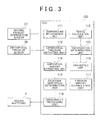
- FIG. 3 is a functional configuration diagram that shows an example (first embodiment) of the configuration of the main portion of the exhaust gas control system for an internal combustion engine according to the aspect of the invention.
- the ECU 100 when the CPU 101 loads the control programs stored in the ROM 102, or the like, and executes the control programs, the ECU 100 functions as functional units, such as a temperature recognition unit 111, a period calculation unit 112, a vaporization determination unit 113, a prohibiting unit 114, a differential pressure detecting unit 115, a deposition amount estimating unit 116, an emission amount accumulation unit 117, an excessive deposition determination unit 118 and an abnormality processing unit 119.
- a temperature recognition unit 111 a period calculation unit 112
- a vaporization determination unit 113 a vaporization determination unit 113
- a prohibiting unit 114 a differential pressure detecting unit 115
- a deposition amount estimating unit 116 an emission amount accumulation unit 117
- an excessive deposition determination unit 118 an abnormality processing unit 119.
- the temperature recognition unit 111, the period calculation unit 112, the vaporization determination unit 113, the prohibiting unit 114, the differential pressure detecting unit 115, the deposition amount estimating unit 116, the emission amount accumulation unit 117 and the excessive deposition determination unit 118 constitute the exhaust gas control system for an internal combustion engine according to the aspect of the invention.
- the temperature recognition unit 111, the period calculation unit 112, the vaporization determination unit 113, the prohibiting unit 114, the differential pressure detecting unit 115, the deposition amount estimating unit 116, the emission amount accumulation unit 117 and the excessive deposition determination unit 118 that constitute the exhaust gas control system for an internal combustion engine are configured as functional units; instead, at least one of the temperature recognition unit 111, the period calculation unit 112, the vaporization determination unit 113, the prohibiting unit 114, the differential pressure detecting unit 115, the deposition amount estimating unit 116, the emission amount accumulation unit 117 and the excessive deposition determination unit 118 may be formed of a hardware device, such as an electronic circuit.
- the temperature recognition unit 111 is a functional unit that recognizes the temperature TE of exhaust gas flowing into the DPF 22. Note that the temperature recognition unit 111 corresponds to "temperature recognition means" according to the aspect of the invention. Specifically, the temperature recognition unit 111 recognizes the temperature TE of exhaust gas flowing into the DPF 22 on the basis of the temperature TE of exhaust gas flowing into the DPF 22, detected by the second exhaust temperature sensor 37 (see FIG. 1 ).
- the temperature TE of exhaust gas flowing into the DPF 22 is detected by the second exhaust temperature sensor 37, and the temperature TE of exhaust gas flowing into the DPF 22 is recognized on the basis of the detected temperature TE of exhaust gas, so it is possible to accurately recognize the temperature TE of exhaust gas flowing into the DPF 22.
- the temperature recognition unit 111 may be configured to estimate the temperature TE of exhaust gas flowing into the DPF 22.
- the temperature recognition unit 111 may be configured to estimate the temperature TE of exhaust gas flowing into the DPF 22 on the basis of the temperature of exhaust gas flowing into the CCO 21, detected by the first exhaust temperature sensor 36. In this case, it is not necessary to arrange the second exhaust temperature sensor 37, so it is possible to reduce manufacturing cost.
- the period calculation unit 112 is a functional unit that calculates a period during which the temperature TE of exhaust gas, recognized by the temperature recognition unit 111, is higher than or equal to a preset determination temperature TE0 (for example, 100°C). Note that the period calculation unit 112 corresponds to "period calculation means" according to the aspect of the invention.
- the period calculation unit 112 calculates a period, during which the temperature TE is continuously higher than or equal to the determination temperature TE0, as a continuous period PT.
- the function of the period calculation unit 112 will be specifically described with reference to FIG. 4A and FIG. 4B.
- FIG. 4A is a graph G1 that shows an example of a temporal variation in exhaust gas temperature TE after a start of the engine 1.
- FIG. 4B is a graph G2 that shows an example of a temporal variation in exhaust gas flow rate FE after a start of the engine 1.
- the abscissa axis represents a time elapsed after a start of the engine 1
- the ordinate axis represents a temperature TE of exhaust gas, detected by the second exhaust temperature sensor 37.
- the temperature TE of exhaust gas is lower than the determination temperature TE0, and, at time T11, the temperature TE of exhaust gas reaches the determination temperature TE0.
- the temperature TE of exhaust gas is kept higher than or equal to the determination temperature TE0, and then the temperature TE of exhaust gas reaches the determination temperature TE0 at time T12. That is, during a period P11 from time T11 to time T12, the temperature TE of exhaust gas is higher than or equal to the determination temperature TE0.
- the period P11 is calculated as the continuous period PT.
- the temperature TE of exhaust gas is kept lower than the determination temperature TE0, and then the temperature TE of exhaust gas reaches the determination temperature TE0 at time T13.
- the continuous period PT is calculated as "0".
- the temperature TE of exhaust gas is kept higher than or equal to the determination temperature TE0, and then the temperature TE of exhaust gas reaches the determination temperature TE0 at time T14. That is, during a period P12 from time T13 to time T14, the temperature TE of exhaust gas is higher than or equal to the determination temperature TE0.
- the period P12 is calculated as the continuous period PT.
- the vaporization determination unit 113 is a functional unit that determines whether moisture absorbed in the DPF 22 has vaporized. Note that the vaporization determination unit 113 corresponds to "vaporization determination means" according to the aspect of the invention. Specifically, the vaporization determination unit 113 determines whether moisture absorbed in the DPF 22 has vaporized on the basis of the temperature TE of exhaust gas, recognized by the temperature recognition unit 111.
- the vaporization determination unit 113 determines that moisture absorbed in the DPF 22 has vaporized when the continuous period PT calculated by the period calculation unit 112 is longer than or equal to a preset determination period PA (for example, 10 minutes).
- FIG. 5 shows a graph G3 and a graph G4 that respectively show examples of a temporal variation in filter differential pressure ⁇ PA after a start of the engine 1.
- the graph G3 shows the case where the temperature TE of exhaust gas is 100°C.
- the graph G4 shows the case where the temperature TE of exhaust gas is 80°C.
- the abscissa axis represents a time elapsed after a start of the engine 1
- the ordinate axis represents a filter differential pressure ⁇ PA detected by the differential pressure sensor 39.
- the period calculation unit 112 calculates the continuous period PT during which the temperature TE of exhaust gas is higher than or equal to the preset determination temperature TE0, and the vaporization determination unit 113 determines that moisture absorbed in the DPF 22 has vaporized when the continuous period PT is longer than or equal to the present determination period PA, so it is possible to further accurately determine whether moisture absorbed in the DPF 22 has vaporized.
- the description is made on the case where the vaporization determination unit 113 determines that moisture absorbed in the DPF 22 has vaporized when the continuous period PT is longer than or equal to the determination period PA; instead, the vaporization determination unit 113 may be configured to determine whether moisture absorbed in the DPF 22 has vaporized with the use of another method.
- the vaporization determination unit 113 may be configured to determine that moisture absorbed in the DPF 22 has vaporized when an accumulated value of a period during which the temperature TE of exhaust gas is higher than or equal to the determination temperature TE0 (hereinafter, referred to as "accumulated period") is longer than or equal to the determination period PA.
- an "accumulated period" at time T14 is calculated as the sum of the period P11 and the period P12.
- the prohibiting unit 114 is a functional unit that prohibits the deposition amount estimating unit 116 from estimating the amount of deposition QP when the vaporization determination unit 113 determines that moisture absorbed in the DPF 22 has not vaporized. Note that the prohibiting unit 114 corresponds to "prohibiting means" according to the aspect of the invention.
- the prohibiting unit 114 determines whether a preset period P0 has elapsed after a start of the engine 1, and, when it is determined that the period P0 has elapsed, the prohibiting unit 114 permits the deposition amount estimating unit 116 to execute the process of estimating the amount of deposition QP even when the vaporization determination unit 113 determines that moisture absorbed in the DPF 22 has not vaporized yet.
- the period P0 is set to a value (for example, 30 minutes) by which it is allowed to determine that moisture absorbed in the DPF 22 has vaporized when the period P0 has elapsed from a start of the engine 1.
- the period P0 is set so as to be longer (for example, 1 hour) as the outside air temperature decreases. This is because, as the outside air temperature decreases, it requires time until the temperature increases to a temperature at which condensed water vaporizes.
- the differential pressure detecting unit 115 is a functional unit that detects a filter differential pressure ⁇ PA that is a difference in pressure, obtained by subtracting the pressure downstream of the DPF 22 from the pressure upstream of the DPF 22. Note that the differential pressure detecting unit 115 corresponds to "differential pressure detecting means" according to the aspect of the invention. Specifically, the differential pressure detecting unit 115 detects a filter differential pressure ⁇ PA by acquiring the filter differential pressure ⁇ PA detected by the differential pressure sensor 39.
- the deposition amount estimating unit 116 is a functional unit that estimates the amount of deposition QP of PM trapped in the DPF 22 on the basis of the filter differential pressure ⁇ PA detected by the differential pressure detecting unit 115. Note that the deposition amount estimating unit 116 corresponds to "deposition amount estimating means" according to the aspect of the invention.
- a map (or LUT) that shows the correlation between a filter differential pressure ⁇ PA and an amount of deposition QP of PM is stored in the ROM 102, or the like, and the deposition amount estimating unit 116 loads the amount of deposition QP of PM, corresponding to the filter differential pressure ⁇ PA detected by the differential pressure detecting unit 115, from the map (or LUT) stored in the ROM 102, or the like, to estimate the amount of deposition QP of PM.
- the deposition amount estimating unit 116 does not execute the process of estimating the amount of deposition QP when estimating the amount of deposition QP is prohibited by the prohibiting unit 114.
- the emission amount accumulation unit 117 is a functional unit that calculates the amount of emission of PM from the engine 1 and accumulates the calculated amount of emission to calculate an accumulated amount of emission QE.
- the emission amount accumulation unit 117 corresponds to "emission amount accumulation means" according to the aspect of the invention.
- an amount of emission of PM is stored in the ROM 102, or the like, in association with an operating state (for example, engine rotation speed and fuel injection amount) of the engine 1, and the emission amount accumulation unit 117 loads the amount of emission of PM corresponding to the operating state of the engine 1 from the map (or LUT) stored in the ROM 102, or the like, to calculate the amount of emission of PM (see, for example, Japanese Patent Application Publication No. 2010-196498 ( JP 2010-196498 A ) in more detail).
- the excessive deposition determination unit 118 is a functional unit that determines that the amount of deposition QP of PM trapped in the DPF 22 is abnormal when the amount of deposition QP of PM estimated by the deposition amount estimating unit 116 is larger than or equal to a preset excessive deposition determination value QPth. Note that the excessive deposition determination unit 118 corresponds to "excessive deposition determination means" according to the aspect of the invention.
- the excessive deposition determination unit 118 estimates the amount of deposition QP of PM trapped in the DPF 22 on the basis of the accumulated amount of emission QE calculated by the emission amount accumulation unit 117, and determines whether the estimated amount of deposition QP of PM is abnormal.
- the emission amount accumulation unit 117 calculates the amount of emission of PM from the engine 1, and calculates the accumulated amount of emission QE by accumulating the calculated amount of emission. Then, when the prohibiting unit 114 prohibits the deposition amount estimating unit 116 from executing the process of estimating the amount of deposition QP on the basis of the filter differential pressure ⁇ PA, it is determined whether the amount of deposition QP of PM trapped in the DPF 22 is abnormal on the basis of the accumulated amount of emission QE. Therefore, even when estimating the amount of deposition QP on the basis of the filter differential pressure ⁇ PA is prohibited, it is possible to determine whether the amount of deposition QP of PM trapped in the DPF 22 is abnormal.
- the description is made on the case where, when the prohibiting unit 114 prohibits the deposition amount estimating unit 116 from executing the process of estimating the amount of deposition QP, the excessive deposition determination unit 118 determines whether the amount of deposition QP of PM trapped in the DPF 22 is abnormal on the basis of the accumulated amount of emission QE calculated by the emission amount accumulation unit 117; instead, the excessive deposition determination unit 118 may be configured to determine whether the amount of deposition QP of PM trapped in the DPF 22 is abnormal with the use of another method.
- the prohibiting unit 114 prohibits the deposition amount estimating unit 116 from executing the process of estimating the amount of deposition QP
- a history of the amount of deposition QP calculated by the deposition amount estimating unit 116 is stored in the backup RAM 104, or the like, and the excessive deposition determination unit 118 estimates the amount of deposition QP on the basis of the history of the amount of deposition QP.
- the emission amount accumulation unit 117 is not required.
- the abnormality processing unit 119 is a functional unit that executes preset "abnormality process" when the excessive deposition determination unit 118 determines that the amount of deposition QP of PM trapped in the DPF 22 is abnormal. Specifically, when it is determined that the amount of deposition QP of PM is abnormal, for example, the abnormality processing unit 119 announces an alarm that indicates that the amount of deposition QP of PM is abnormal, and prohibits the process of burning the deposited PM (particulate matter).
- the alarm that indicates that the amount of deposition QP of PM is abnormal is to, for example, turn on a light emitting diode (LED) that indicates that the amount of deposition QP of PM is abnormal and outputs voice of a message that the amount of deposition QP of PM is abnormal.
- the abnormality processing unit 119 stops injection of fuel from the adding injectors 2 for burning deposited PM (particulate matter) to stop the process of burning the deposited PM (particulate matter).
- FIG. 6 is a flowchart that shows an example of operations of the ECU 100 according to the first embodiment of the invention, shown in FIG. 3 .
- the prohibiting unit 114 determines whether the period P0 has elapsed after a start of the engine 1 (S101). When affirmative determination is made in step S101, the process proceeds to step S109. When negative determination is made in step S101, the process proceeds to step S103.
- the temperature recognition unit 111 acquires the temperature TE of exhaust gas, detected by the second exhaust temperature sensor 37 (step S103). Then, the period calculation unit 112 calculates the continuous period PT during which the temperature TE acquired in step S103 is continuously higher than or equal to the determination temperature TE0 (step S105). Subsequently, the vaporization determination unit 113 determines whether the continuous period PT calculated in step S105 is longer than or equal to the determination period PA (step S107).
- step S107 When negative determination is made in step S107, the vaporization determination unit 113 determines that moisture absorbed in the DPF 22 has not vaporized yet, and the prohibiting unit 114 prohibits the process of estimating the amount of deposition QP on the basis of the filter differential pressure ⁇ PA, after which the process proceeds to step S113.
- step S107 When affirmative determination is made in step S107, the vaporization determination unit 113 determines that moisture absorbed in the DPF 22 has vaporized, and the process proceeds to step S109. Subsequently, the differential pressure detecting unit 115 detects the filter differential pressure ⁇ PA (step S109). After that, the deposition amount estimating unit 116 estimates the amount of deposition QP of PM trapped in the DPF 22 on the basis of the filter differential pressure ⁇ PA detected in step S109 (step S111). Then, the process proceeds to step S117.
- step S107 when negative determination is made in step S107, the emission amount accumulation unit 117 calculates an accumulated amount of emission QE that is an accumulated value of the amount of emission of PM emitted from the engine 1 (step S113). Subsequently, the excessive deposition determination unit 118 estimates the amount of deposition QP on the basis of the accumulated amount of emission QE calculated in step S113 (step S115). Then, the process proceeds to step S117.
- step S111 ends or when the process of step S115 ends, the excessive deposition determination unit 118 determines whether the amount of deposition QP calculated in step S111 or step S115 is larger than or equal to the excessive deposition determination value QPth (step S117).
- step S117 determines that the amount of deposition QP is not abnormal, and the process returns to step S101, after which the process of step S101 and the following processes are executed again.
- step S117 When affirmative determination is made in step S117, the process proceeds to step S119. Then, the excessive deposition determination unit 118 determines that the amount of deposition QP is abnormal, and the abnormality processing unit 119 announces an alarm and stops injection of fuel from the adding injectors 2, after which the process ends.
- FIG. 7 is a functional configuration diagram that shows an example (second embodiment) of the configuration of the main portion of the exhaust gas control system for an internal combustion engine according to the aspect of the invention.
- the ECU 100A functions as functional units, such as a flow rate recognition unit 121, a period calculation unit 122, a vaporization determination unit 123, a prohibiting unit 124, a differential pressure detecting unit 125, a deposition amount estimating unit 126, an emission amount accumulation unit 127, an excessive deposition determination unit 128 and an abnormality processing unit 129.
- the flow rate recognition unit 121, the period calculation unit 122, the vaporization determination unit 123, the prohibiting unit 124, the differential pressure detecting unit 125, the deposition amount estimating unit 126, the emission amount accumulation unit 127 and the excessive deposition determination unit 128 constitute the exhaust gas control system for an internal combustion engine according to the aspect of the invention.
- the flow rate recognition unit 121, the period calculation unit 122, the vaporization determination unit 123, the prohibiting unit 124, the differential pressure detecting unit 125, the deposition amount estimating unit 126, the emission amount accumulation unit 127 and the excessive deposition determination unit 128 that constitute the exhaust gas control system for an internal combustion engine are configured as functional units; instead, at least one of the flow rate recognition unit 121, the period calculation unit 122, the vaporization determination unit 123, the prohibiting unit 124, the differential pressure detecting unit 125, the deposition amount estimating unit 126, the emission amount accumulation unit 127 and the excessive deposition determination unit 128 may be formed of a hardware device, such as an electronic circuit.
- the ECU 100A according to the second embodiment differs from the ECU 100 (see FIG. 3 ) according to the first embodiment in that the flow rate recognition unit 121, the period calculation unit 122 and the vaporization determination unit 123 are provided instead of the temperature recognition unit 111, the period calculation unit 112 and the vaporization determination unit 113.
- the configuration (the flow rate recognition unit 121, the period calculation unit 122 and the vaporization determination unit 123) different from the ECU 100 according to the first embodiment will be mainly described.
- the prohibiting unit 124, the differential pressure detecting unit 125, the deposition amount estimating unit 126, the emission amount accumulation unit 127, the excessive deposition determination unit 128 and the abnormality processing unit 129 of the ECU 100A are respectively the functional units having substantially the same functions as the prohibiting unit 114, the differential pressure detecting unit 115, the deposition amount estimating unit 116, the emission amount accumulation unit 117, the excessive deposition determination unit 118 and the abnormality processing unit 119 of the ECU 100 (see FIG. 3 ) according to the first embodiment.
- the flow rate recognition unit 121 is a functional unit that recognizes the flow rate FE of exhaust gas flowing into the DPF 22. Note that the flow rate recognition unit 121 corresponds to "flow rate recognition means" according to the aspect of the invention. Specifically, the flow rate recognition unit 121 recognizes the flow rate FE of exhaust gas flowing into the DPF 22 on the basis of the flow rate FE of exhaust gas flowing into the DPF 22, detected by the exhaust flow rate sensor 38 (see FIG. 1 ).
- the flow rate FE of exhaust gas flowing into the DPF 22 is detected by the exhaust flow rate sensor 38, and the flow rate FE of exhaust gas flowing into the DPF 22 is recognized on the basis of the detected flow rate FE of exhaust gas, so it is possible to accurately recognize the flow rate FE of exhaust gas flowing into the DPF 22.
- the flow rate recognition unit 121 may be configured to estimate the flow rate FE of exhaust gas flowing into the DPF 22.
- the flow rate recognition unit 121 may be configured to estimate the flow rate FE of exhaust gas flowing into the DPF 22 on the basis of the intake air flow rate detected by the air flow meter 33. In this case, it is not necessary to arrange the exhaust flow rate sensor 38, so it is possible to reduce manufacturing cost.
- the flow rate recognition unit 121 may be configured to estimate the flow rate FE of exhaust gas flowing into the DPF 22 on the basis of the flow rate of exhaust gas flowing into the CCO 21, detected by the air flow meter.
- the period calculation unit 122 is a functional unit that calculates a period during which the flow rate FE of exhaust gas, recognized by the flow rate recognition unit 121, is higher than or equal to a preset determination flow rate FE0 (for example, 10 g/s). Note that the period calculation unit 112 corresponds to "period calculation means) according to the aspect of the invention.
- the period calculation unit 112 calculates a period, during which the flow rate FE is continuously higher than or equal to the determination flow rate FE0, as the continuous period PF.
- the function of the period calculation unit 122 will be specifically described with reference to FIG. 4A and FIG. 4B.
- FIG. 4A is a graph G1 that shows an example of a temporal variation in exhaust gas temperature TE after a start of the engine 1.
- FIG. 4B is a graph G2 that shows an example of a temporal variation in exhaust gas flow rate FE after a start of the engine 1.
- the abscissa axis represents a time elapsed after a start of the engine 1
- the ordinate axis represents a flow rate FE of exhaust gas, detected by the exhaust flow rate sensor 38.
- the flow rate FE of exhaust gas is lower than the determination flow rate FE0, and, at time T21, the flow rate FE of exhaust gas reaches the determination flow rate FE0.
- the flow rate FE of exhaust gas is kept higher than or equal to the determination flow rate FE0, and then the flow rate FE of exhaust gas reaches the determination flow rate FE0 at time T22. That is, during a period P21 from time T21 to time T22, the flow rate FE of exhaust gas is higher than or equal to the determination flow rate FE0.
- the period P21 is calculated as the continuous period PF.
- the flow rate FE of exhaust gas is kept lower than the determination flow rate FE0, and then the flow rate FE of exhaust gas reaches the determination flow rate FE0 at time T23.
- the continuous period PF is calculated as "0".
- the flow rate FE of exhaust gas is kept higher than or equal to the determination flow rate FE0, and then the flow rate FE of exhaust gas reaches the determination flow rate FE0 at time T24. That is, during a period P22 from time T23 to time T24, the flow rate FE of exhaust gas is higher than or equal to the determination flow rate FE0.
- the period P22 is calculated as the continuous period PT.
- the vaporization determination unit 123 is a functional unit that determines whether moisture absorbed in the DPF 22 has vaporized. Note that the vaporization determination unit 123 corresponds to "vaporization determination means" according to the aspect of the invention. Specifically, the vaporization determination unit 123 determines whether moisture absorbed in the DPF 22 has vaporized on the basis of the flow rate FE of exhaust gas, recognized by the flow rate recognition unit 121.
- the vaporization determination unit 123 determines that moisture absorbed in the DPF 22 has vaporized when the continuous period PT calculated by the period calculation unit 122 is longer than or equal to a preset determination period PB (for example, 20 minutes).
- the period calculation unit 122 calculates the continuous period PF during which the flow rate FE of exhaust gas is higher than or equal to the preset determination flow rate FE0, and the vaporization determination unit 123 determines that moisture absorbed in the DPF 22 has vaporized when the continuous period PT is longer than or equal to the present determination period PB, so it is possible to further accurately determine whether moisture absorbed in the DPF 22 has vaporized.
- the description is made on the case where the vaporization determination unit 123 determines that moisture absorbed in the DPF 22 has vaporized when the continuous period PT is longer than or equal to the determination period PB; instead, the vaporization determination unit 123 may be configured to determine whether moisture absorbed in the DPF 22 has vaporized with the use of another method.
- the vaporization determination unit 123 may be configured to determine that moisture absorbed in the DPF 22 has vaporized when an accumulated value of a period during which the flow rate FE of exhaust gas is higher than or equal to the determination flow rate FE0 (hereinafter, referred to as "accumulated period") is longer than or equal to the determination period PB.
- an "accumulated period" at time T24 is calculated as the sum of the period P21 and the period P22.
- FIG. 8 is a flowchart that shows an example of operations of the ECU 100A according to the second embodiment of the invention, shown in FIG. 7 .
- the prohibiting unit 124 determines whether the period P0 has elapsed after a start of the engine 1 (S201). When affirmative determination is made in step S201, the process proceeds to step S209. When negative determination is made in step S201, the process proceeds to step S203.
- the flow rate recognition unit 121 acquires the flow rate FE of exhaust gas, detected by the exhaust flow rate sensor 38 (step S203). Then, the period calculation unit 122 calculates the continuous period PF during which the flow rate FE acquired in step S203 is continuously higher than or equal to the determination flow rate FE0 (step S205). Subsequently, the vaporization determination unit 123 determines whether the continuous period PT calculated in step S205 is longer than or equal to the determination period PB (step S207). When affirmative determination is made in step S207, the vaporization determination unit 123 determines that moisture absorbed in the DPF 22 has vaporized, and the process proceeds to step S209.
- step S207 When negative determination is made in step S207, the vaporization determination unit 123 determines that moisture absorbed in the DPF 22 has not vaporized yet, and the prohibiting unit 124 prohibits the process of estimating the amount of deposition QP on the basis of the filter differential pressure ⁇ PA, after which the process proceeds to step S213.
- step S209 and the following processes and the process of step S213 and the following processes are respectively substantially the same as the process of step S109 and the following processes in the flowchart shown in FIG. 6 and the process of step S113 and the following processes in the flowchart shown in FIG. 6 , so the description thereof is omitted.
- the flow rate FE of exhaust gas flowing into the DPF 22 is recognized, and it is determined whether moisture absorbed in the DPF 22 has vaporized on the basis of the recognized flow rate FE of exhaust gas, so it is possible to accurately determine whether moisture absorbed in the DPF 22 has vaporized.
- FIG. 9 is a functional configuration diagram that shows an example (third embodiment) of the configuration of the main portion of the exhaust gas control system for an internal combustion engine according to the aspect of the invention.
- the ECU 100B functions as functional units, such as a flow rate recognition unit 131a, a temperature recognition unit 131b, a period storage unit 131c, a period setting unit 132, a vaporization determination unit 133, a prohibiting unit 134, a differential pressure detecting unit 135, a deposition amount estimating unit 136, an emission amount accumulation unit 137, an excessive deposition determination unit 138 and an abnormality processing unit 139.
- the flow rate recognition unit 131a, the temperature recognition unit 131b, the period storage unit 131c, the period setting unit 132, the vaporization determination unit 133, the prohibiting unit 134, the differential pressure detecting unit 135, the deposition amount estimating unit 136, the emission amount accumulation unit 137 and the excessive deposition determination unit 138 constitute the exhaust gas control system for an internal combustion engine according to the aspect of the invention.
- the flow rate recognition unit 131a, the temperature recognition unit 131b, the period storage unit 131c, the period setting unit 132, the vaporization determination unit 133, the prohibiting unit 134, the differential pressure detecting unit 135, the deposition amount estimating unit 136, the emission amount accumulation unit 137 and the excessive deposition determination unit 138 that constitute the exhaust gas control system for an internal combustion engine are configured as functional units; instead, at least one of the flow rate recognition unit 131a, the temperature recognition unit 131b, the period storage unit 131c, the period setting unit 132, the vaporization determination unit 133, the prohibiting unit 134, the differential pressure detecting unit 135, the deposition amount estimating unit 136, the emission amount accumulation unit 137 and the excessive deposition determination unit 138 may be formed of a hardware device, such as an electronic circuit.
- the ECU 100B according to the third embodiment differs from the ECU 100 (see FIG. 3 ) according to the first embodiment in that the flow rate recognition unit 131a, the temperature recognition unit 131b, the period storage unit 131c, the period setting unit 132 and the vaporization determination unit 133 are provided instead of the temperature recognition unit 111, the period calculation unit 112 and the vaporization determination unit 113.
- the configuration (the flow rate recognition unit 131a, the temperature recognition unit 131b, the period storage unit 131c, the period setting unit 132 and the vaporization determination unit 133) different from the ECU 100 according to the first embodiment will be mainly described.
- the prohibiting unit 134, the differential pressure detecting unit 135, the deposition amount estimating unit 136, the emission amount accumulation unit 137, the excessive deposition determination unit 138 and the abnormality processing unit 139 of the ECU 100B are respectively the functional units having substantially the same functions as the prohibiting unit 114, the differential pressure detecting unit 115, the deposition amount estimating unit 116, the emission amount accumulation unit 117, the excessive deposition determination unit 118 and the abnormality processing unit 119 of the ECU 100 (see FIG. 3 ) according to the first embodiment.
- the flow rate recognition unit 131a is a functional unit that recognizes the flow rate FE of exhaust gas flowing into the DPF 22. Note that the flow rate recognition unit 131a corresponds to "flow rate recognition means" according to the aspect of the invention. Specifically, the flow rate recognition unit 131a recognizes the flow rate FE of exhaust gas flowing into the DPF 22 on the basis of the flow rate FE of exhaust gas flowing into the DPF 22, detected by the exhaust flow rate sensor 38 (see FIG. 1 ).
- the flow rate FE of exhaust gas flowing into the DPF 22 is detected by the exhaust flow rate sensor 38, and the flow rate FE of exhaust gas flowing into the DPF 22 is recognized on the basis of the detected flow rate FE of exhaust gas, so it is possible to accurately recognize the flow rate FE of exhaust gas flowing into the DPF 22.
- the flow rate recognition unit 131a may be configured to estimate the flow rate FE of exhaust gas flowing into the DPF 22.
- the flow rate recognition unit 131a may be configured to estimate the flow rate FE of exhaust gas flowing into the DPF 22 on the basis of the intake air flow rate detected by the air flow meter 33. In this case, it is not necessary to arrange the exhaust flow rate sensor 38, so it is possible to reduce manufacturing cost.
- the flow rate recognition unit 131a may be configured to estimate the flow rate FE of exhaust gas flowing into the DPF 22 on the basis of the flow rate of exhaust gas flowing into the CCO 21, detected by the exhaust flow rate sensor.
- the temperature recognition unit 131b is a functional unit that recognizes the temperature TE of exhaust gas flowing into the DPF 22. Note that the temperature recognition unit 131b corresponds to "temperature recognition means" according to the aspect of the invention. Specifically, the temperature recognition unit 131b recognizes the temperature TE of exhaust gas flowing into the DPF 22 on the basis of the temperature TE of exhaust gas flowing into the DPF 22, detected by the second exhaust temperature sensor 37 (see FIG. 1 ).
- the temperature TE of exhaust gas flowing into the DPF 22 is detected by the second exhaust temperature sensor 37, and the temperature TE of exhaust gas flowing into the DPF 22 is recognized on the basis of the detected temperature TE of exhaust gas, so it is possible to accurately recognize the temperature TE of exhaust gas flowing into the DPF 22.
- the temperature recognition unit 131b may be configured to estimate the temperature TE of exhaust gas flowing into the DPF 22.
- the temperature recognition unit 131b may be configured to estimate the temperature TE of exhaust gas flowing into the DPF 22 on the basis of the temperature of exhaust gas flowing into the CCO 21, detected by the first exhaust temperature sensor 36. In this case, it is not necessary to arrange the second exhaust temperature sensor 37, so it is possible to reduce manufacturing cost.
- the period storage unit 131c is a functional unit that stores a determination period PC0 in association with the flow rate FE of exhaust gas and the temperature TE of exhaust gas.
- the determination period PC0 is a period by which it is determined whether moisture absorbed in the DPF 22 has vaporized.
- the period storage unit 131c corresponds to part of "period setting means" according to the aspect of the invention. Specifically, the period storage unit 131c, for example, stores the determination period PC0 in association with the flow rate FE of exhaust gas and the temperature TE of exhaust gas as a map or LUT in the ROM 102.
- the determination period PC0 stored in the period storage unit 131c is loaded by the period setting unit 132.
- the period setting unit 132 is a functional unit that sets a determination period PC on the basis of the temperature TE of exhaust gas, recognized by the temperature recognition unit 131b, and the flow rate FE of exhaust gas, recognized by the flow rate recognition unit 131a.
- the determination period PC is a period by which it is determined whether moisture absorbed in the DPF 22 has vaporized. Note that the period setting unit 132 corresponds to part of the "period setting means" according to the aspect of the invention.
- the period setting unit 132 loads the determination period PC0 corresponding to the temperature TE of exhaust gas, recognized by the temperature recognition unit 131b, and the flow rate FE of exhaust gas, recognized by the flow rate recognition unit 131a, from the period storage unit 131c, and corrects the determination period PC previously set by the period setting unit 132 with the use of the loaded determination period PC0 to thereby set a determination period PC.
- the period setting unit 132 calculates the determination period PC by the following mathematical expression (1).
- PC PC ⁇ 1 + PC ⁇ 2 + ... + PCN / N That is, the period setting unit 132 calculates the determination period PC by simply averaging the determination periods PC0 loaded from the period storage unit 131c.
- the process expressed by the above mathematical expression (1) is expressed as a process in which the period setting unit 132 corrects the determination period PC previously set by the period setting unit 132 with the use of the loaded determination periods PC0 by the following mathematical expression (2).
- PC ⁇ PC ⁇ N - 1 + PC ⁇ 0 / N That is, the current determination period PC may be obtained as follows.
- the previous determination period PC is multiplied by (N-1) that is the number of times loaded from the period storage unit 131c until the last time, the obtained value is added to the currently loaded determination period PC0, and then the obtained value is divided by the loaded number of times N.
- the period setting unit 132 calculates the determination period PC by simply averaging the determination periods PC0 loaded from the period storage unit 131c; instead, the period setting unit 132 may be configured to calculate the determination period PC with the use of another method.
- the determination period PC may be calculated with the use of a weighted mean method. In this case, by appropriately setting weights, it is possible to set a further appropriate determination period PC.
- the vaporization determination unit 133 is a functional unit that determines whether moisture absorbed in the DPF 22 has vaporized. Note that the vaporization determination unit 133 corresponds to "vaporization determination means" according to the aspect of the invention. Specifically, the vaporization determination unit 133 determines whether moisture absorbed in the DPF 22 has vaporized on the basis of the determination period PC set by the period setting unit 132. More specifically, the vaporization determination unit 133 determines that moisture absorbed in the DPF 22 has vaporized when the determination period PC set by the period setting unit 132 has elapsed.
- the determination period PC that is a period by which it is determined whether moisture absorbed in the DPF 22 has vaporized is set on the basis of the temperature TE of exhaust gas, recognized by the temperature recognition unit 131b, and the flow rate FE of exhaust gas, recognized by the flow rate recognition unit 131a. Then, it is determined that moisture absorbed in the DPF 22 has vaporized when the set determination period PC has elapsed, so it is possible to accurately determine whether moisture absorbed in the DPF 22 has vaporized.
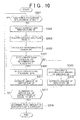
- FIG. 10 is a flowchart that shows an example of operations of the ECU 100B according to the third embodiment of the invention, shown in FIG. 9 .
- the prohibiting unit 134 determines whether the period P0 has elapsed after a start of the engine 1 (S301). When affirmative determination is made in step S301, the process proceeds to step S309. When negative determination is made in step S301, the process proceeds to step S302.
- the temperature recognition unit 131b acquires the temperature TE of exhaust gas, detected by the second exhaust temperature sensor 37 (step S302).
- the flow rate recognition unit 131a acquires the flow rate FE of exhaust gas, detected by the exhaust flow rate sensor 38 (step S303).
- the period setting unit 132 loads the determination period PC0 corresponding to the temperature TE acquired in step S302 and the flow rate FE acquired in step S303 from the period storage unit 131c, and sets the determination period PC that is a period by which it is determined whether moisture absorbed in the DPF 22 has vaporized (step S305).
- the vaporization determination unit 133 determines whether the determination period PC calculated in step S305 has elapsed (step S307).
- step S307 When affirmative determination is made in step S307, the vaporization determination unit 133 determines that moisture absorbed in the DPF 22 has vaporized, and the process proceeds to step S309.
- step S307 When negative determination is made in step S307, the vaporization determination unit 133 determines that moisture absorbed in the DPF 22 has not vaporized yet, and the prohibiting unit 134 prohibits the process of estimating the amount of deposition QP on the basis of the filter differential pressure ⁇ PA, after which the process proceeds to step S313.
- step S309 and the following processes and the process of step S313 and the following processes are respectively substantially the same as the process of step S109 and the following processes in the flowchart shown in FIG. 6 and the process of step S113 and the following processes in the flowchart shown in FIG. 6 , so the description thereof is omitted.
- the temperature TE of exhaust gas flowing into the DPF 22 is recognized, and the flow rate FE of exhaust gas flowing into the DPF 22 is recognized. Then, it is determined whether moisture absorbed in the DPF 22 has vaporized on the basis of the recognized temperature TE of exhaust gas and the recognized flow rate FE of exhaust gas, so it is possible to accurately determine whether moisture absorbed in the
- the description is made on the case where the internal combustion engine is the diesel engine 1; instead, the internal combustion engine may be a gasoline engine, or the like.
- the filter that traps PM contained in exhaust gas may be a diesel particulate active reduction system (DPR) that is a filter with a catalyst, which combines an oxidation catalyst with a DPF for trapping PM or a diesel particulate-NOx reduction system (DPNR) that includes an NOx storage reduction (NSR) and a diesel particulate active reduction system (DPR).
- DPR diesel particulate active reduction system
- DPNR diesel particulate-NOx reduction system
- NSR NOx storage reduction
- DPR diesel particulate active reduction system
- the aspect of the invention may be used in an exhaust gas control system for an internal combustion engine that includes a filter that traps particulate matter contained in exhaust gas emitted from the internal combustion engine (mainly, a diesel engine).
Landscapes
- Engineering & Computer Science (AREA)
- Chemical & Material Sciences (AREA)
- Combustion & Propulsion (AREA)
- Mechanical Engineering (AREA)
- General Engineering & Computer Science (AREA)
- Chemical Kinetics & Catalysis (AREA)
- Processes For Solid Components From Exhaust (AREA)
- Exhaust Gas After Treatment (AREA)
- Combined Controls Of Internal Combustion Engines (AREA)
Abstract
Description
- The invention relates to an exhaust gas control system and exhaust gas control method for an internal combustion engine (mainly, a diesel engine) that includes a filter that traps particulate matter contained in exhaust gas emitted from the internal combustion engine.
- Particulate matter contained in exhaust gas emitted from an internal combustion engine (mainly, a diesel engine) is trapped by a filter, such as a diesel particulate filter (DPF). In addition, in a related art, there is known a technique for calculating the amount of deposition of particulate matter deposited on the filter on the basis of a filter differential pressure that is a differential pressure obtained by subtracting a pressure downstream of the filter from a pressure upstream of the filter.
- For example, there is disclosed an exhaust gas control system for an engine (see Japanese Patent Application Publication No.
2004-197722 JP 2004-197722 A - However, in the exhaust gas control system described in
JP 2004-197722 A - In addition, when the particulate matter deposition amount is obtained as an excessive value as described above, it may be erroneously determined that "because the amount of particulate matter deposited on the filter is excessive, the temperature in the filter may exceed the heatproof temperature of a filter base material when the deposited particulate matter is burned" and it may be erroneously determined that the amount of deposition of particulate matter is abnormal (so-called "excessive deposition").
- The invention provides an exhaust gas control system and exhaust gas control method for an internal combustion engine, which are able to prevent erroneous determination, due to absorbed moisture, that the amount of deposition of particulate matter is abnormal (excessive deposition).
- An aspect of the invention provides an exhaust gas control system for an internal combustion engine that includes a filter that traps particulate matter contained in exhaust gas emitted from the internal combustion engine. The exhaust gas control system includes: differential pressure detecting means for detecting a filter differential pressure that is a difference in pressure, obtained by subtracting a pressure downstream of the filter from a pressure upstream of the filter; deposition amount estimating means for estimating an amount of deposition of particulate matter trapped in the filter on the basis of the filter differential pressure; excessive deposition determination means for determining that the amount of deposition of particulate matter trapped in the filter is abnormal when the amount of deposition of particulate matter, estimated by the deposition amount estimating means, is larger than or equal to a preset excessive deposition determination value; vaporization determination means for determining whether moisture absorbed in the filter has vaporized; and prohibiting means for prohibiting the deposition amount estimating means from estimating the amount of deposition of particulate matter when the vaporization determination means determines that moisture absorbed in the filter has not vaporized yet.
- With the thus configured exhaust gas control system, a filter differential pressure that is a difference in pressure, obtained by subtracting a pressure downstream of the filter from a pressure upstream of the filter, and an amount of deposition of particulate matter trapped in the filter is estimated on the basis of the detected filter differential pressure. Then, when the estimated amount of deposition of particulate matter is larger than or equal to the preset excessive deposition determination value, it is determined that the amount of deposition of particulate matter trapped in the filter is abnormal. In addition, it is determined whether moisture absorbed in the filter has vaporized, and, when it is determined that moisture absorbed in the filter has not vaporized yet, estimating the amount of deposition of particulate matter on the basis of the filter differential pressure is prohibited, so it is possible to prevent erroneous determination, due to absorbed moisture, that the amount of deposition of particulate matter is abnormal (excessive deposition).
- That is, when it is determined that moisture absorbed in the filter has not vaporized yet, estimating the amount of deposition of particulate matter on the basis of the filter differential pressure is prohibited. This avoids a situation that a filter differential pressure is detected to be excessive due to moisture absorbed in the filter and the amount of deposition of particulate matter trapped in the filter is estimated to be excessive on the basis of the excessive filter differential pressure. Thus, it is possible to prevent determination, due to absorbed moisture, that the amount of deposition of particulate matter trapped in the filter is abnormal.
- In addition, the exhaust gas control system may further include emission amount accumulation means for calculating an amount of emission of particulate matter from the internal combustion engine and calculating an accumulated amount of emission, obtained by accumulating the calculated amount of emission, wherein, when the prohibiting means prohibits the deposition amount estimating means from estimating the amount of deposition of particulate matter, the excessive deposition determination means may determine whether the amount of deposition of particulate matter trapped in the filter is abnormal on the basis of the accumulated amount of emission, calculated by the emission amount accumulation means.
- With the thus configured exhaust gas control system, an amount of emission of particulate matter from the internal combustion engine is calculated, and an accumulated amount of emission is calculated by accumulating the calculated amount of emission. Then, when estimating the amount of deposition of particulate matter on the basis of the filter differential pressure is prohibited, it is determined whether the amount of deposition of particulate matter trapped in the filter is abnormal on the basis of the accumulated amount of emission, so it is possible to determine whether the amount of deposition of particulate matter trapped in the filter is abnormal even when estimating the amount of deposition of particulate matter on the basis of the filter differential pressure is prohibited.
- In addition, the exhaust gas control system according to the aspect of the invention may further include temperature recognition means for recognizing a temperature of exhaust gas flowing into the filter, wherein the vaporization determination means may determine whether moisture absorbed in the filter has vaporized on the basis of the temperature of exhaust gas, recognized by the temperature recognition means.
- Note that "recognizing a temperature of exhaust gas" is a broader-concept expression that encompasses meanings of "detecting a temperature of exhaust gas", "acquiring a temperature of exhaust gas" and "estimating a temperature of exhaust gas" in this specification. In addition, in the specification, "recognizing" is a broader-concept expression that encompasses meanings of "detecting", "acquiring" and "estimating".
- With the thus configured exhaust gas control system, a temperature of exhaust gas flowing into the filter is recognized, and it is determined whether moisture absorbed in the filter has vaporized on the basis of the recognized temperature of exhaust gas, so it is possible to accurately determine whether moisture absorbed in the filter has vaporized.
- That is, as the temperature of exhaust gas flowing into the filter increases, moisture absorbed in the filter more easily vaporizes, so moisture absorbed in the filter vaporizes in a short period of time. Thus, by determining whether moisture absorbed in the filter has vaporized on the basis of the recognized temperature of exhaust gas, it is possible to accurately determine whether moisture absorbed in the filter has vaporized.
- In addition, the exhaust gas control system according to the aspect of the invention may further include a temperature sensor that detects a temperature of exhaust gas flowing into the filter, wherein the temperature recognition means may recognize the temperature of exhaust gas flowing into the filter on the basis of the temperature of exhaust gas, detected by the temperature sensor.
- With the thus configured exhaust gas control system, a temperature of exhaust gas flowing into the filter is detected by the temperature sensor, and the temperature of exhaust gas flowing into the filter is recognized on the basis of the detected temperature of exhaust gas, so it is possible to accurately recognize the temperature of exhaust gas flowing into the filter.
- In addition, the exhaust gas control system according to the aspect of the invention may further include period calculation means for calculating a period during which the temperature of exhaust gas, recognized by the temperature recognition means, is higher than or equal to a preset determination temperature, wherein the vaporization determination means may determine that moisture absorbed in the filter has vaporized when the period calculated by the period calculation means is longer than or equal to a preset determination period.
- With the thus configured exhaust gas control system, a period during which the recognized temperature of exhaust gas is higher than or equal to a preset determination temperature is calculated, and, when the calculated period is longer than or equal to the present determination period, it is determined that moisture absorbed in the filter has vaporized, so it is possible to further accurately determine whether moisture absorbed in the filter has vaporized.
- In addition, the exhaust gas control system according to the aspect of the invention may further include flow rate recognition means for recognizing a flow rate of exhaust gas flowing into the filter, wherein the vaporization determination means may determine whether moisture absorbed in the filter has vaporized on the basis of the flow rate of exhaust gas, recognized by the flow rate recognition means.
- With the thus configured exhaust gas control system, a flow rate of exhaust gas flowing into the filter is recognized, and it is determined whether moisture absorbed in the filter has vaporized on the basis of the recognized flow rate of exhaust gas, so it is possible to accurately determine whether moisture absorbed in the filter has vaporized.
- That is, as the flow rate of exhaust gas flowing into the filter increases, moisture absorbed in the filter more easily vaporizes, so moisture absorbed in the filter vaporizes in a short period of time. Thus, by determining whether moisture absorbed in the filter has vaporized on the basis of the recognized flow rate of exhaust gas, it is possible to accurately determine whether moisture absorbed in the filter has vaporized.
- In addition, the exhaust gas control system according to the aspect of the invention may further include a flow rate sensor that detects a flow rate of exhaust gas flowing into the filter, wherein the flow rate recognition means may recognize the flow rate of exhaust gas flowing into the filter on the basis of the flow rate of exhaust gas, detected by the flow rate sensor.
- With the thus configured exhaust gas control system, a flow rate of exhaust gas flowing into the filter is detected by the flow rate sensor, and the flow rate of exhaust gas flowing into the filter is recognized by the detected flow rate of exhaust gas, so it is possible to accurately recognize the flow rate of exhaust gas flowing into the filter.
- In addition, the exhaust gas control system according to the aspect of the invention may further include period calculation means for calculating a period during which the flow rate of exhaust gas, recognized by the flow rate recognition means, is higher than or equal to a preset determination flow rate, wherein the vaporization determination means may determine that moisture absorbed in the filter has vaporized when the period calculated by the period calculation means is longer than or equal to a preset determination period.
- With the thus configured exhaust gas control system, a period during which the recognized flow rate of exhaust gas is higher than or equal to the preset determination flow rate is calculated and, when the calculated period is longer than or equal to the preset determination period, it is determined that moisture absorbed in the filter has vaporized, so it is possible to further accurately determine whether moisture absorbed in the filter has vaporized.
- In addition, the exhaust gas control system according to the aspect of the invention may further include: temperature recognition means for recognizing a temperature of exhaust gas flowing into the filter; and flow rate recognition means for recognizing a flow rate of exhaust gas flowing into the filter, wherein the vaporization determination means may determine whether moisture absorbed in the filter has vaporized on the basis of the temperature of exhaust gas, recognized by the temperature recognition means, and the flow rate of exhaust gas, recognized by the flow rate recognition means.
- With the thus configured exhaust gas control system, a temperature of exhaust gas flowing into the filter is recognized, and a flow rate of exhaust gas flowing into the filter is recognized. Then, it is determined whether moisture absorbed in the filter has vaporized on the basis of the recognized temperature of exhaust gas and the recognized flow rate of exhaust gas, so it is possible to accurately determine whether moisture absorbed in the filter has vaporized.
- That is, as the temperature of exhaust gas flowing into the filter increases, moisture absorbed in the filter more easily vaporizes, so moisture absorbed in the filter vaporizes in a short period of time. In addition, as the flow rate of exhaust gas flowing into the filter increases, moisture absorbed in the filter more easily vaporizes, so moisture absorbed in the filter vaporizes in a short period of time. Then, by determining whether moisture absorbed in the filter has vaporized on the basis of the recognized temperature of exhaust gas and the recognized flow rate of exhaust gas, it is possible to accurately determine whether moisture absorbed in the filter has vaporized.
- In addition, the exhaust gas control system according to the aspect of the invention may further include period setting means for setting a determination period that is a period by which it is determined whether moisture absorbed in the filter has vaporized on the basis of the temperature of exhaust gas, recognized by the temperature recognition means, and the flow rate of exhaust gas, recognized by the flow rate recognition means, wherein the vaporization determination means may determine that moisture absorbed in the filter has vaporized when the determination period set by the period setting means has elapsed.
- With the thus configured exhaust gas control system, a determination period that is a period by which it is determined whether moisture absorbed in the filter has vaporized is set on the basis of the recognized temperature of exhaust gas and the recognized flow rate of exhaust gas. Then, when the set determination period has elapsed, it is determined that moisture absorbed in the filter has vaporized, so it is possible to further accurately determine whether moisture absorbed in the filter has vaporized.
- Another aspect of the invention provides an exhaust gas control method for an internal combustion engine that includes a filter that traps particulate matter contained in exhaust gas emitted from the internal combustion engine. The exhaust gas control method includes: a differential pressure detecting step of detecting a filter differential pressure that is a difference in pressure, obtained by subtracting a pressure downstream of the filter from a pressure upstream of the filter; a deposition amount estimating step of estimating an amount of deposition of particulate matter trapped in the filter on the basis of the filter differential pressure; an excessive deposition determination step of determining that the amount of deposition of particulate matter trapped in the filter is abnormal when the amount of deposition of particulate matter, estimated in the deposition amount estimating step, is larger than or equal to a preset excessive deposition determination value; a vaporization determination step of determining whether moisture absorbed in the filter has vaporized; and a prohibiting step of prohibiting the deposition amount estimating step from estimating the amount of deposition of particulate matter when it is determined in the vaporization determination step that moisture absorbed in the filter has not vaporized yet.
- With the exhaust gas control system and exhaust gas control method according to the aspects of the invention, a filter differential pressure that is a difference in pressure, obtained by subtracting a pressure downstream of the filter from a pressure upstream of the filter, and an amount of deposition of particulate matter trapped in the filter is estimated on the basis of the detected filter differential pressure. Then, when the estimated amount of deposition of particulate matter is larger than or equal to the preset excessive deposition determination value, it is determined that the amount of deposition of particulate matter trapped in the filter is abnormal. In addition, it is determined whether moisture absorbed in the filter has vaporized, and, when it is determined that moisture absorbed in the filter has not vaporized yet, estimating the amount of deposition of particulate matter on the basis of the filter differential pressure is prohibited, so it is possible to prevent erroneous determination, due to absorbed moisture, that the amount of deposition of particulate matter is abnormal.
- Features, advantages, and technical and industrial significance of exemplary embodiments of the invention will be described below with reference to the accompanying drawings, in which like numerals denote like elements, and wherein:
-
FIG. 1 is a configuration diagram that shows an example of the schematic configuration of a diesel engine and its supply and exhaust system according to an embodiment of the invention; -
FIG. 2 is a configuration diagram that shows an example of a control system, such as an ECU, according to the embodiment of the invention; -
FIG. 3 is a functional configuration diagram that shows an example (first embodiment) of the configuration of a main portion of an exhaust gas control system for an internal combustion engine according to the aspect of the invention; -
FIG. 4A is a graph that shows an example of a temporal variation in exhaust gas temperature after a start of the engine; -
FIG. 4B is a graph that shows an example of a temporal variation in exhaust gas flow rate after a start of the engine; -
FIG. 5 shows graphs that show examples of temporal variations in filter differential pressure after a start of the engine; -
FIG. 6 is a flowchart that shows an example of operations of the ECU according to the first embodiment of the invention, shown inFIG. 3 ; -
FIG. 7 is a functional configuration diagram that shows another example (second embodiment) of the configuration of the main portion of the exhaust gas control system for an internal combustion engine according to the aspect of the invention; -
FIG. 8 is a flowchart that shows an example of operations of an ECU according to the second embodiment of the invention, shown inFIG. 7 ; -
FIG. 9 is a functional configuration diagram that shows further another example (third embodiment) of the configuration of the main portion of the exhaust gas control system for an internal combustion engine according to the aspect of the invention; and -
FIG. 10 is a flowchart that shows an example of operations of an ECU according to the third embodiment of the invention, shown inFIG. 9 . - Hereinafter, embodiments of the exhaust gas control system for an internal combustion engine according to the aspect of the invention will be described with reference to the accompanying drawings.
- First, the schematic configuration of a diesel engine to which the exhaust gas control system for an internal combustion engine according to the aspect of the invention is applied will be described with reference to
FIG. 1. FIG. 1 is a configuration diagram that shows an example of the schematic configuration of adiesel engine 1 and its supply and exhaust system according to an embodiment of the invention. - The diesel engine 1 (hereinafter, referred to as "
engine 1") is, for example, a common-rail direct-injection four-cylinder engine. An injector (fuel injection valve) 2 is arranged in each ofcombustion chambers 1a of cylinders of theengine 1. Eachinjector 2 injects fuel subjected to combustion in the correspondingcombustion chamber 1a. The addinginjector 2 of each cylinder is connected to a common rail 11. In addition, asupply pump 10 is connected to the common rail 11. - The
supply pump 10 draws fuel from a fuel tank, pressurizes the drawn fuel to a high pressure, and supplies the high-pressure fuel to the common rail 11 via afuel passage 10a. The common rail 11 serves as an accumulator that keeps (accumulates) the high-pressure fuel, supplied from thesupply pump 10, at a predetermined pressure, and distributes the accumulated fuel to the addinginjectors 2. Each addinginjector 2 is an electromagnetically-driven on-off valve that, when a predetermined voltage is applied, opens to inject and supply fuel into a corresponding one of thecombustion chambers 1a. The open/closed states (fuel injection amount and injection timing) of each addinginjector 2 undergo duty control executed by theECU 100. - In addition, an
intake passage 3 and anexhaust passage 4 are connected to theengine 1. In theintake passage 3, anair cleaner 9, anair flow meter 33, acompressor impeller 63 of aturbocharger 6, anintercooler 8 and athrottle valve 5 are arranged in the stated order from the upstream side of flow of intake air to the downstream side thereof. - The
throttle valve 5 is a valve that adjusts an intake air flow rate. A throttle opening degree that is an opening degree of thethrottle valve 5 is adjusted by athrottle motor 51. In addition, the throttle opening degree of thethrottle valve 5 is detected by a throttleopening degree sensor 41. Note that theintake passage 3 is branched at an intake manifold 3a in correspondence with the cylinders. The intake manifold 3a is arranged downstream of thethrottle valve 5. - The
exhaust passage 4 is configured to be collected from a state, branched into the cylinders, into one at anexhaust manifold 4a. Theexhaust manifold 4a is connected to thecombustion chambers 1a of the cylinders of theengine 1. ACCO 21 and aDPF 22 are arranged in theexhaust passage 4 in the stated order from the upstream side of flow of exhaust gas toward the downstream side thereof. Exhaust gas produced through combustion of fuel in thecombustion chambers 1a is fed to theCCO 21 and theDPF 22. - The catalytic converter oxidation (CCO) 21 oxidizes and purifies HC (hydrocarbons) and CO (carbon monoxide) contains in exhaust gas. The
DPF 22 is a filter that traps particulate matter (hereinafter, referred to as "PM"). Note that theDPF 22 corresponds to a "filter" according to the aspect of the invention. - A first
exhaust temperature sensor 36 is arranged in theexhaust passage 4 at a portion upstream of the CCO 21 (upstream side of flow of exhaust gas). The firstexhaust temperature sensor 36 detects the temperature of exhaust gas flowing into theCCO 21. In addition, a secondexhaust temperature sensor 37 and an exhaustflow rate sensor 38 are arranged in theexhaust passage 4 between theCCO 21 and theDPF 22. The secondexhaust temperature sensor 37 detects the temperature of exhaust gas flowing into theDPF 22. The exhaustflow rate sensor 38 detects the flow rate of exhaust gas flowing into theDPF 22. In addition, adifferential pressure sensor 39 is arranged so as to detect a differential pressure between a pressure upstream of theDPF 22 and a pressure downstream of theDPF 22. - Output signals of the first
exhaust temperature sensor 36, the secondexhaust temperature sensor 37, the exhaustflow rate sensor 38 and thedifferential pressure sensor 39 are input to an ECU 100 (100A, 100B) (seeFIG. 2 ). Note that the secondexhaust temperature sensor 37 corresponds to a "temperature sensor" according to the aspect of the invention. In addition, the exhaustflow rate sensor 38 corresponds to a "flow rate sensor" according to the aspect of the invention. - In addition, the
turbocharger 6 is arranged for theengine 1. Theturbocharger 6 includes aturbine wheel 62 and thecompressor impeller 63 that are coupled via arotor shaft 61. Thecompressor impeller 63 is provided in theintake passage 3. Theturbine wheel 62 is provided in theexhaust passage 4. In addition, theturbocharger 6 utilizes exhaust flow (exhaust pressure) received by theturbine wheel 62 to rotate thecompressor impeller 63 to thereby supercharge intake air. Theturbocharger 6 is, for example, a variable nozzle turbocharger in which a variablenozzle vane mechanism 64 is provided adjacent to theturbine wheel 62 and it is possible to adjust the supercharging pressure of theengine 1 by adjusting the opening degree of the variablenozzle vane mechanism 64. Note that intake air increased in temperature through supercharging of theturbocharger 6 is forcibly cooled by theintercooler 8 arranged in theintake passage 3. - In addition, an EGR device 7 is arranged at the
engine 1. The EGR device 7 returns part of exhaust gas, flowing through theexhaust passage 4, to theintake passage 3, and supplies the exhaust gas to thecombustion chambers 1a of the cylinders again to decrease combustion temperature. By so doing, the amount of generated NOx is reduced. The EGR device 7 includes anEGR passage 71 that connects the intake manifold 3a to theexhaust manifold 4a. AnEGR cooler 73 and anEGR valve 72 are arranged in theEGR passage 71 in the stated order from the upstream side of flow of EGR gas toward the downstream side thereof. TheEGR cooler 73 cools EGR gas that passes (returns) through theEGR passage 71. TheEGR valve 72 adjusts the amount of EGR gas (the amount of returned exhaust gas) introduced from the exhaust passage 4 (exhaust manifold 4a) into the intake passage 3 (intake manifold 3a). - Next, the configuration of the ECU 100 (100A, 100B) will be described with reference to
FIG. 2. FIG. 2 is a configuration diagram that shows an example of a control system, such as the ECU, according to the embodiment of the invention. As shown inFIG 2 , the electronic control unit (ECU) 100 (100A, 100B) includes aCPU 101, aROM 102, aRAM 103 and abackup RAM 104. - The read only memory (ROM) 102 is a nonvolatile memory that stores various control programs, and look-up tables (LUT), maps, and the like, that are consulted at the time of executing the various control programs. The central processing unit (CPU) 101 executes computation processing on the basis of the various control programs, the look-up tables, the maps, and the like, stored in the
ROM 102. In addition, the random access memory (RAM) 103 temporarily stores computation results of theCPU 101, data input from the sensors, and the like. Thebackup RAM 104 is a nonvolatile memory that stores, for example, data to be saved at the time of a stop of theengine 1 or at the time of turning off the ignition. - The
CPU 101, theROM 102, theRAM 103 and thebackup RAM 104 are connected to one another via abus 107, and are connected to aninput interface 105 and anoutput interface 106. - The
input interface 105 executes processing, such as A/D conversion, over detected signals from the sensors and converts the detected signals to detected information processable by theCPU 101. An enginerotation speed sensor 31, acoolant temperature sensor 32, anair flow meter 33, an intakeair temperature sensor 34, an intakeair pressure sensor 35, the firstexhaust temperature sensor 36, the secondexhaust temperature sensor 37, the exhaustflow rate sensor 38, thedifferential pressure sensor 39, arail pressure sensor 40, the throttleopening degree sensor 41, an acceleratoroperation amount sensor 42, avehicle speed sensor 43, and the like, are communicably connected to theinput interface 105. - The engine
rotation speed sensor 31 detects the rotation speed of a crankshaft that is an output shaft of theengine 1. Thecoolant temperature sensor 32 detects an engine coolant temperature (coolant temperature). Theair flow meter 33 detects an intake air flow rate. The intakeair temperature sensor 34 is arranged in the intake manifold 3a, and detects the temperature of intake air. The intakeair pressure sensor 35 detects the pressure of intake air. Therail pressure sensor 40 detects the pressure of high-pressure fuel in the common rail 11. - The
output interface 106 executes processing, such as D/A conversion, over information, such as command information, output from theCPU 101, and converts the information to command signals, and the like, receivable by the units (or devices). The addinginjectors 2, thesupply pump 10, thethrottle motor 51 of thethrottle valve 5, the variablenozzle vane mechanism 64 of theturbocharger 6, theEGR valve 72, and the like, are communicably connected to theoutput interface 106. - The ECU 100 (100A, 100B) executes various controls over the
engine 1 on the basis of output signals from the various sensors. The various controls over theengine 1 include control over the opening degree of thethrottle valve 5 of theengine 1, fuel injection amount control, fuel injection timing control (open/close control over the adding injectors 2), and the like. In addition, the ECU 100 (100A, 100B) carries out a fault diagnosis of exhaust devices (the exhaustflow rate sensor 38, thedifferential pressure sensor 39, and the like). - Next, the configuration of a main portion of the exhaust gas control system for an internal combustion engine according to the aspect of the invention will be described with reference to
FIG. 3. FIG. 3 is a functional configuration diagram that shows an example (first embodiment) of the configuration of the main portion of the exhaust gas control system for an internal combustion engine according to the aspect of the invention. - As shown in
FIG. 3 , when theCPU 101 loads the control programs stored in theROM 102, or the like, and executes the control programs, theECU 100 functions as functional units, such as atemperature recognition unit 111, aperiod calculation unit 112, avaporization determination unit 113, a prohibitingunit 114, a differentialpressure detecting unit 115, a depositionamount estimating unit 116, an emissionamount accumulation unit 117, an excessivedeposition determination unit 118 and anabnormality processing unit 119. Here, thetemperature recognition unit 111, theperiod calculation unit 112, thevaporization determination unit 113, the prohibitingunit 114, the differentialpressure detecting unit 115, the depositionamount estimating unit 116, the emissionamount accumulation unit 117 and the excessivedeposition determination unit 118 constitute the exhaust gas control system for an internal combustion engine according to the aspect of the invention. - Note that, in the first embodiment, description will be made on the case where the
temperature recognition unit 111, theperiod calculation unit 112, thevaporization determination unit 113, the prohibitingunit 114, the differentialpressure detecting unit 115, the depositionamount estimating unit 116, the emissionamount accumulation unit 117 and the excessivedeposition determination unit 118 that constitute the exhaust gas control system for an internal combustion engine are configured as functional units; instead, at least one of thetemperature recognition unit 111, theperiod calculation unit 112, thevaporization determination unit 113, the prohibitingunit 114, the differentialpressure detecting unit 115, the depositionamount estimating unit 116, the emissionamount accumulation unit 117 and the excessivedeposition determination unit 118 may be formed of a hardware device, such as an electronic circuit. - The
temperature recognition unit 111 is a functional unit that recognizes the temperature TE of exhaust gas flowing into theDPF 22. Note that thetemperature recognition unit 111 corresponds to "temperature recognition means" according to the aspect of the invention. Specifically, thetemperature recognition unit 111 recognizes the temperature TE of exhaust gas flowing into theDPF 22 on the basis of the temperature TE of exhaust gas flowing into theDPF 22, detected by the second exhaust temperature sensor 37 (seeFIG. 1 ). - In this way, the temperature TE of exhaust gas flowing into the
DPF 22 is detected by the secondexhaust temperature sensor 37, and the temperature TE of exhaust gas flowing into theDPF 22 is recognized on the basis of the detected temperature TE of exhaust gas, so it is possible to accurately recognize the temperature TE of exhaust gas flowing into theDPF 22. - In the first embodiment, description will be made on the case where the temperature TE of exhaust gas flowing into the
DPF 22 is detected; instead, thetemperature recognition unit 111 may be configured to estimate the temperature TE of exhaust gas flowing into theDPF 22. For example, thetemperature recognition unit 111 may be configured to estimate the temperature TE of exhaust gas flowing into theDPF 22 on the basis of the temperature of exhaust gas flowing into theCCO 21, detected by the firstexhaust temperature sensor 36. In this case, it is not necessary to arrange the secondexhaust temperature sensor 37, so it is possible to reduce manufacturing cost. - The
period calculation unit 112 is a functional unit that calculates a period during which the temperature TE of exhaust gas, recognized by thetemperature recognition unit 111, is higher than or equal to a preset determination temperature TE0 (for example, 100°C). Note that theperiod calculation unit 112 corresponds to "period calculation means" according to the aspect of the invention. - Specifically, the
period calculation unit 112, for example, calculates a period, during which the temperature TE is continuously higher than or equal to the determination temperature TE0, as a continuous period PT. Here, the function of theperiod calculation unit 112 will be specifically described with reference toFIG. 4A and FIG. 4B. FIG. 4A is a graph G1 that shows an example of a temporal variation in exhaust gas temperature TE after a start of theengine 1.FIG. 4B is a graph G2 that shows an example of a temporal variation in exhaust gas flow rate FE after a start of theengine 1. - In
FIG. 4A , the abscissa axis represents a time elapsed after a start of theengine 1, the ordinate axis represents a temperature TE of exhaust gas, detected by the secondexhaust temperature sensor 37. As shown inFIG. 4A , at the time of a start of theengine 1, the temperature TE of exhaust gas is lower than the determination temperature TE0, and, at time T11, the temperature TE of exhaust gas reaches the determination temperature TE0. Then, after time T11, the temperature TE of exhaust gas is kept higher than or equal to the determination temperature TE0, and then the temperature TE of exhaust gas reaches the determination temperature TE0 at time T12. That is, during a period P11 from time T11 to time T12, the temperature TE of exhaust gas is higher than or equal to the determination temperature TE0. Thus, the period P11 is calculated as the continuous period PT. - Subsequently, after time T12, the temperature TE of exhaust gas is kept lower than the determination temperature TE0, and then the temperature TE of exhaust gas reaches the determination temperature TE0 at time T13. Thus, during a period from time T12 to time T13, the continuous period PT is calculated as "0". Then, after time T13, the temperature TE of exhaust gas is kept higher than or equal to the determination temperature TE0, and then the temperature TE of exhaust gas reaches the determination temperature TE0 at time T14. That is, during a period P12 from time T13 to time T14, the temperature TE of exhaust gas is higher than or equal to the determination temperature TE0. Thus, the period P12 is calculated as the continuous period PT.
- Referring back to
FIG. 3 , the functional configuration of theECU 100 will be described. Thevaporization determination unit 113 is a functional unit that determines whether moisture absorbed in theDPF 22 has vaporized. Note that thevaporization determination unit 113 corresponds to "vaporization determination means" according to the aspect of the invention. Specifically, thevaporization determination unit 113 determines whether moisture absorbed in theDPF 22 has vaporized on the basis of the temperature TE of exhaust gas, recognized by thetemperature recognition unit 111. - More specifically, the
vaporization determination unit 113 determines that moisture absorbed in theDPF 22 has vaporized when the continuous period PT calculated by theperiod calculation unit 112 is longer than or equal to a preset determination period PA (for example, 10 minutes). - Here, the correlation between a temperature TE of exhaust gas and a period required for moisture to vaporize will be described with reference to
FIG. 5. FIG. 5 shows a graph G3 and a graph G4 that respectively show examples of a temporal variation in filter differential pressure ΔPA after a start of theengine 1. The graph G3 shows the case where the temperature TE of exhaust gas is 100°C. The graph G4 shows the case where the temperature TE of exhaust gas is 80°C. InFIG. 5 , the abscissa axis represents a time elapsed after a start of theengine 1, and the ordinate axis represents a filter differential pressure ΔPA detected by thedifferential pressure sensor 39. - As shown by the graph G4, when the temperature TE of exhaust gas is 100°C, moisture absorbed in the
DPF 22 boils and steeply vaporizes, and, accordingly, the filter differential pressure ΔPA steeply decreases. In contrast to this, as shown by the graph G3, when the temperature TE of exhaust gas is 80°C, the amount of vaporization of moisture absorbed in theDPF 22 is small, and a decrease in the filter differential pressure ΔPA is gentle. - As shown in
FIG. 5 , as the temperature TE of exhaust gas flowing into theDPF 22 increases, moisture absorbed in theDPF 22 more easily vaporizes, so moisture absorbed in theDPF 22 vaporizes in a short period of time. Thus, by determining whether moisture absorbed in theDPF 22 has vaporized' on the basis of the temperature TE of exhaust gas, it is possible to accurately determine whether moisture absorbed in theDPF 22 has vaporized. - In addition, as described above, the
period calculation unit 112 calculates the continuous period PT during which the temperature TE of exhaust gas is higher than or equal to the preset determination temperature TE0, and thevaporization determination unit 113 determines that moisture absorbed in theDPF 22 has vaporized when the continuous period PT is longer than or equal to the present determination period PA, so it is possible to further accurately determine whether moisture absorbed in theDPF 22 has vaporized. - In the first embodiment, the description is made on the case where the
vaporization determination unit 113 determines that moisture absorbed in theDPF 22 has vaporized when the continuous period PT is longer than or equal to the determination period PA; instead, thevaporization determination unit 113 may be configured to determine whether moisture absorbed in theDPF 22 has vaporized with the use of another method. For example, thevaporization determination unit 113 may be configured to determine that moisture absorbed in theDPF 22 has vaporized when an accumulated value of a period during which the temperature TE of exhaust gas is higher than or equal to the determination temperature TE0 (hereinafter, referred to as "accumulated period") is longer than or equal to the determination period PA. In this embodiment, in the case of the above-describedFIG. 4A , an "accumulated period" at time T14 is calculated as the sum of the period P11 and the period P12. - Referring back to
FIG. 3 , the functional configuration of theECU 100 will be described. The prohibitingunit 114 is a functional unit that prohibits the depositionamount estimating unit 116 from estimating the amount of deposition QP when thevaporization determination unit 113 determines that moisture absorbed in theDPF 22 has not vaporized. Note that the prohibitingunit 114 corresponds to "prohibiting means" according to the aspect of the invention. - In addition, the prohibiting
unit 114 determines whether a preset period P0 has elapsed after a start of theengine 1, and, when it is determined that the period P0 has elapsed, the prohibitingunit 114 permits the depositionamount estimating unit 116 to execute the process of estimating the amount of deposition QP even when thevaporization determination unit 113 determines that moisture absorbed in theDPF 22 has not vaporized yet. Here, the period P0 is set to a value (for example, 30 minutes) by which it is allowed to determine that moisture absorbed in theDPF 22 has vaporized when the period P0 has elapsed from a start of theengine 1. Note that the period P0 is set so as to be longer (for example, 1 hour) as the outside air temperature decreases. This is because, as the outside air temperature decreases, it requires time until the temperature increases to a temperature at which condensed water vaporizes. - The differential
pressure detecting unit 115 is a functional unit that detects a filter differential pressure ΔPA that is a difference in pressure, obtained by subtracting the pressure downstream of theDPF 22 from the pressure upstream of theDPF 22. Note that the differentialpressure detecting unit 115 corresponds to "differential pressure detecting means" according to the aspect of the invention. Specifically, the differentialpressure detecting unit 115 detects a filter differential pressure ΔPA by acquiring the filter differential pressure ΔPA detected by thedifferential pressure sensor 39. - The deposition
amount estimating unit 116 is a functional unit that estimates the amount of deposition QP of PM trapped in theDPF 22 on the basis of the filter differential pressure ΔPA detected by the differentialpressure detecting unit 115. Note that the depositionamount estimating unit 116 corresponds to "deposition amount estimating means" according to the aspect of the invention. Specifically, for example, a map (or LUT) that shows the correlation between a filter differential pressure ΔPA and an amount of deposition QP of PM is stored in theROM 102, or the like, and the depositionamount estimating unit 116 loads the amount of deposition QP of PM, corresponding to the filter differential pressure ΔPA detected by the differentialpressure detecting unit 115, from the map (or LUT) stored in theROM 102, or the like, to estimate the amount of deposition QP of PM. In addition, the depositionamount estimating unit 116 does not execute the process of estimating the amount of deposition QP when estimating the amount of deposition QP is prohibited by the prohibitingunit 114. - The emission
amount accumulation unit 117 is a functional unit that calculates the amount of emission of PM from theengine 1 and accumulates the calculated amount of emission to calculate an accumulated amount of emission QE. Note that the emissionamount accumulation unit 117 corresponds to "emission amount accumulation means" according to the aspect of the invention. Specifically, for example, an amount of emission of PM is stored in theROM 102, or the like, in association with an operating state (for example, engine rotation speed and fuel injection amount) of theengine 1, and the emissionamount accumulation unit 117 loads the amount of emission of PM corresponding to the operating state of theengine 1 from the map (or LUT) stored in theROM 102, or the like, to calculate the amount of emission of PM (see, for example, Japanese Patent Application Publication No.2010-196498 JP 2010-196498 A - The excessive
deposition determination unit 118 is a functional unit that determines that the amount of deposition QP of PM trapped in theDPF 22 is abnormal when the amount of deposition QP of PM estimated by the depositionamount estimating unit 116 is larger than or equal to a preset excessive deposition determination value QPth. Note that the excessivedeposition determination unit 118 corresponds to "excessive deposition determination means" according to the aspect of the invention. In addition, when the prohibitingunit 114 prohibits the depositionamount estimating unit 116 from estimating the amount of deposition QP, the excessivedeposition determination unit 118 estimates the amount of deposition QP of PM trapped in theDPF 22 on the basis of the accumulated amount of emission QE calculated by the emissionamount accumulation unit 117, and determines whether the estimated amount of deposition QP of PM is abnormal. - As described above, the emission
amount accumulation unit 117 calculates the amount of emission of PM from theengine 1, and calculates the accumulated amount of emission QE by accumulating the calculated amount of emission. Then, when the prohibitingunit 114 prohibits the depositionamount estimating unit 116 from executing the process of estimating the amount of deposition QP on the basis of the filter differential pressure ΔPA, it is determined whether the amount of deposition QP of PM trapped in theDPF 22 is abnormal on the basis of the accumulated amount of emission QE. Therefore, even when estimating the amount of deposition QP on the basis of the filter differential pressure ΔPA is prohibited, it is possible to determine whether the amount of deposition QP of PM trapped in theDPF 22 is abnormal. - In the first embodiment, the description is made on the case where, when the prohibiting
unit 114 prohibits the depositionamount estimating unit 116 from executing the process of estimating the amount of deposition QP, the excessivedeposition determination unit 118 determines whether the amount of deposition QP of PM trapped in theDPF 22 is abnormal on the basis of the accumulated amount of emission QE calculated by the emissionamount accumulation unit 117; instead, the excessivedeposition determination unit 118 may be configured to determine whether the amount of deposition QP of PM trapped in theDPF 22 is abnormal with the use of another method. For example, it is applicable that, before the prohibitingunit 114 prohibits the depositionamount estimating unit 116 from executing the process of estimating the amount of deposition QP, a history of the amount of deposition QP calculated by the depositionamount estimating unit 116 is stored in thebackup RAM 104, or the like, and the excessivedeposition determination unit 118 estimates the amount of deposition QP on the basis of the history of the amount of deposition QP. In this case, the emissionamount accumulation unit 117 is not required. - The
abnormality processing unit 119 is a functional unit that executes preset "abnormality process" when the excessivedeposition determination unit 118 determines that the amount of deposition QP of PM trapped in theDPF 22 is abnormal. Specifically, when it is determined that the amount of deposition QP of PM is abnormal, for example, theabnormality processing unit 119 announces an alarm that indicates that the amount of deposition QP of PM is abnormal, and prohibits the process of burning the deposited PM (particulate matter). - Specifically, the alarm that indicates that the amount of deposition QP of PM is abnormal is to, for example, turn on a light emitting diode (LED) that indicates that the amount of deposition QP of PM is abnormal and outputs voice of a message that the amount of deposition QP of PM is abnormal. In addition, the
abnormality processing unit 119 stops injection of fuel from the addinginjectors 2 for burning deposited PM (particulate matter) to stop the process of burning the deposited PM (particulate matter). - Next, the operations of the
ECU 100 will be described with reference toFIG. 6. FIG. 6 is a flowchart that shows an example of operations of theECU 100 according to the first embodiment of the invention, shown inFIG. 3 . As shown inFIG. 6 , first, the prohibitingunit 114 determines whether the period P0 has elapsed after a start of the engine 1 (S101). When affirmative determination is made in step S101, the process proceeds to step S109. When negative determination is made in step S101, the process proceeds to step S103. - Subsequently, the
temperature recognition unit 111 acquires the temperature TE of exhaust gas, detected by the second exhaust temperature sensor 37 (step S103). Then, theperiod calculation unit 112 calculates the continuous period PT during which the temperature TE acquired in step S103 is continuously higher than or equal to the determination temperature TE0 (step S105). Subsequently, thevaporization determination unit 113 determines whether the continuous period PT calculated in step S105 is longer than or equal to the determination period PA (step S107). When negative determination is made in step S107, thevaporization determination unit 113 determines that moisture absorbed in theDPF 22 has not vaporized yet, and the prohibitingunit 114 prohibits the process of estimating the amount of deposition QP on the basis of the filter differential pressure ΔPA, after which the process proceeds to step S113. - When affirmative determination is made in step S107, the
vaporization determination unit 113 determines that moisture absorbed in theDPF 22 has vaporized, and the process proceeds to step S109. Subsequently, the differentialpressure detecting unit 115 detects the filter differential pressure ΔPA (step S109). After that, the depositionamount estimating unit 116 estimates the amount of deposition QP of PM trapped in theDPF 22 on the basis of the filter differential pressure ΔPA detected in step S109 (step S111). Then, the process proceeds to step S117. - On the other hand, when negative determination is made in step S107, the emission
amount accumulation unit 117 calculates an accumulated amount of emission QE that is an accumulated value of the amount of emission of PM emitted from the engine 1 (step S113). Subsequently, the excessivedeposition determination unit 118 estimates the amount of deposition QP on the basis of the accumulated amount of emission QE calculated in step S113 (step S115). Then, the process proceeds to step S117. - When the process of step S111 ends or when the process of step S115 ends, the excessive
deposition determination unit 118 determines whether the amount of deposition QP calculated in step S111 or step S115 is larger than or equal to the excessive deposition determination value QPth (step S117). When negative determination is made in step S117, the excessivedeposition determination unit 118 determines that the amount of deposition QP is not abnormal, and the process returns to step S101, after which the process of step S101 and the following processes are executed again. - When affirmative determination is made in step S117, the process proceeds to step S119. Then, the excessive
deposition determination unit 118 determines that the amount of deposition QP is abnormal, and theabnormality processing unit 119 announces an alarm and stops injection of fuel from the addinginjectors 2, after which the process ends. - In this way, when it is determined that moisture absorbed in the
DPF 22 has not vaporized yet, estimating the amount of deposition QP on the basis of the filter differential pressure ΔPA is prohibited. This avoids a situation that a filter differential pressure ΔPA is detected to be excessive due to moisture absorbed in theDPF 22 and the amount of deposition QP of PM trapped in theDPF 22 is estimated to be excessive on the basis of the excessive filter differential pressure ΔPA. Thus, it is possible to prevent determination, due to absorbed moisture, that the amount of deposition QP of PM trapped in theDPF 22 is abnormal (excessive deposition). - Next, the configuration of a main portion of the exhaust gas control system for an internal combustion engine according to the aspect of the invention will be described with reference to
FIG. 7. FIG. 7 is a functional configuration diagram that shows an example (second embodiment) of the configuration of the main portion of the exhaust gas control system for an internal combustion engine according to the aspect of the invention. - As shown in
FIG. 7 , when theCPU 101 loads the control programs stored in theROM 102, or the like, and executes the control programs, theECU 100A functions as functional units, such as a flowrate recognition unit 121, aperiod calculation unit 122, avaporization determination unit 123, a prohibitingunit 124, a differentialpressure detecting unit 125, a depositionamount estimating unit 126, an emissionamount accumulation unit 127, an excessivedeposition determination unit 128 and anabnormality processing unit 129. Here, the flowrate recognition unit 121, theperiod calculation unit 122, thevaporization determination unit 123, the prohibitingunit 124, the differentialpressure detecting unit 125, the depositionamount estimating unit 126, the emissionamount accumulation unit 127 and the excessivedeposition determination unit 128 constitute the exhaust gas control system for an internal combustion engine according to the aspect of the invention. - Note that, in the second embodiment, description will be made on the case where the flow
rate recognition unit 121, theperiod calculation unit 122, thevaporization determination unit 123, the prohibitingunit 124, the differentialpressure detecting unit 125, the depositionamount estimating unit 126, the emissionamount accumulation unit 127 and the excessivedeposition determination unit 128 that constitute the exhaust gas control system for an internal combustion engine are configured as functional units; instead, at least one of the flowrate recognition unit 121, theperiod calculation unit 122, thevaporization determination unit 123, the prohibitingunit 124, the differentialpressure detecting unit 125, the depositionamount estimating unit 126, the emissionamount accumulation unit 127 and the excessivedeposition determination unit 128 may be formed of a hardware device, such as an electronic circuit. - In addition, the
ECU 100A according to the second embodiment differs from the ECU 100 (seeFIG. 3 ) according to the first embodiment in that the flowrate recognition unit 121, theperiod calculation unit 122 and thevaporization determination unit 123 are provided instead of thetemperature recognition unit 111, theperiod calculation unit 112 and thevaporization determination unit 113. Thus, in the following description, the configuration (the flowrate recognition unit 121, theperiod calculation unit 122 and the vaporization determination unit 123) different from theECU 100 according to the first embodiment will be mainly described. - In addition, the prohibiting
unit 124, the differentialpressure detecting unit 125, the depositionamount estimating unit 126, the emissionamount accumulation unit 127, the excessivedeposition determination unit 128 and theabnormality processing unit 129 of theECU 100A are respectively the functional units having substantially the same functions as the prohibitingunit 114, the differentialpressure detecting unit 115, the depositionamount estimating unit 116, the emissionamount accumulation unit 117, the excessivedeposition determination unit 118 and theabnormality processing unit 119 of the ECU 100 (seeFIG. 3 ) according to the first embodiment. - The flow
rate recognition unit 121 is a functional unit that recognizes the flow rate FE of exhaust gas flowing into theDPF 22. Note that the flowrate recognition unit 121 corresponds to "flow rate recognition means" according to the aspect of the invention. Specifically, the flowrate recognition unit 121 recognizes the flow rate FE of exhaust gas flowing into theDPF 22 on the basis of the flow rate FE of exhaust gas flowing into theDPF 22, detected by the exhaust flow rate sensor 38 (seeFIG. 1 ). - In this way, the flow rate FE of exhaust gas flowing into the
DPF 22 is detected by the exhaustflow rate sensor 38, and the flow rate FE of exhaust gas flowing into theDPF 22 is recognized on the basis of the detected flow rate FE of exhaust gas, so it is possible to accurately recognize the flow rate FE of exhaust gas flowing into theDPF 22. - In the second embodiment, description will be made on the case where the flow rate FE of exhaust gas flowing into the
DPF 22 is detected; instead, the flowrate recognition unit 121 may be configured to estimate the flow rate FE of exhaust gas flowing into theDPF 22. For example, the flowrate recognition unit 121 may be configured to estimate the flow rate FE of exhaust gas flowing into theDPF 22 on the basis of the intake air flow rate detected by theair flow meter 33. In this case, it is not necessary to arrange the exhaustflow rate sensor 38, so it is possible to reduce manufacturing cost. In addition, for example, when an air flow meter is arranged in theexhaust passage 4 at a portion upstream of theCCO 21, the flowrate recognition unit 121 may be configured to estimate the flow rate FE of exhaust gas flowing into theDPF 22 on the basis of the flow rate of exhaust gas flowing into theCCO 21, detected by the air flow meter. - The
period calculation unit 122 is a functional unit that calculates a period during which the flow rate FE of exhaust gas, recognized by the flowrate recognition unit 121, is higher than or equal to a preset determination flow rate FE0 (for example, 10 g/s). Note that theperiod calculation unit 112 corresponds to "period calculation means) according to the aspect of the invention. - Specifically, the
period calculation unit 112, for example, calculates a period, during which the flow rate FE is continuously higher than or equal to the determination flow rate FE0, as the continuous period PF. Here, the function of theperiod calculation unit 122 will be specifically described with reference toFIG. 4A and FIG. 4B. FIG. 4A is a graph G1 that shows an example of a temporal variation in exhaust gas temperature TE after a start of theengine 1.FIG. 4B is a graph G2 that shows an example of a temporal variation in exhaust gas flow rate FE after a start of theengine 1. - In
FIG. 4B , the abscissa axis represents a time elapsed after a start of theengine 1, and the ordinate axis represents a flow rate FE of exhaust gas, detected by the exhaustflow rate sensor 38. As shown inFIG. 4B , at the time of a start of theengine 1, the flow rate FE of exhaust gas is lower than the determination flow rate FE0, and, at time T21, the flow rate FE of exhaust gas reaches the determination flow rate FE0. Then, after time T21, the flow rate FE of exhaust gas is kept higher than or equal to the determination flow rate FE0, and then the flow rate FE of exhaust gas reaches the determination flow rate FE0 at time T22. That is, during a period P21 from time T21 to time T22, the flow rate FE of exhaust gas is higher than or equal to the determination flow rate FE0. Thus, the period P21 is calculated as the continuous period PF. - Subsequently, after time T22, the flow rate FE of exhaust gas is kept lower than the determination flow rate FE0, and then the flow rate FE of exhaust gas reaches the determination flow rate FE0 at time T23. Thus, during a period from time T22 to time T23, the continuous period PF is calculated as "0". Then, after time T23, the flow rate FE of exhaust gas is kept higher than or equal to the determination flow rate FE0, and then the flow rate FE of exhaust gas reaches the determination flow rate FE0 at time T24. That is, during a period P22 from time T23 to time T24, the flow rate FE of exhaust gas is higher than or equal to the determination flow rate FE0. Thus, the period P22 is calculated as the continuous period PT.
- Referring back to
FIG. 7 , the functional configuration of theECU 100A will be described. Thevaporization determination unit 123 is a functional unit that determines whether moisture absorbed in theDPF 22 has vaporized. Note that thevaporization determination unit 123 corresponds to "vaporization determination means" according to the aspect of the invention. Specifically, thevaporization determination unit 123 determines whether moisture absorbed in theDPF 22 has vaporized on the basis of the flow rate FE of exhaust gas, recognized by the flowrate recognition unit 121. - More specifically, the
vaporization determination unit 123 determines that moisture absorbed in theDPF 22 has vaporized when the continuous period PT calculated by theperiod calculation unit 122 is longer than or equal to a preset determination period PB (for example, 20 minutes). - In addition, as the flow rate FE of exhaust gas flowing into the
DPF 22 increases, moisture absorbed in theDPF 22 more easily vaporizes, so moisture absorbed in theDPF 22 vaporizes in a short period of time. Thus, by determining whether moisture absorbed in theDPF 22 has vaporized on the basis of the flow rate FE of exhaust gas, it is possible to accurately determine whether moisture absorbed in theDPF 22 has vaporized. - Furthermore, as described above, the
period calculation unit 122 calculates the continuous period PF during which the flow rate FE of exhaust gas is higher than or equal to the preset determination flow rate FE0, and thevaporization determination unit 123 determines that moisture absorbed in theDPF 22 has vaporized when the continuous period PT is longer than or equal to the present determination period PB, so it is possible to further accurately determine whether moisture absorbed in theDPF 22 has vaporized. - In the second embodiment, the description is made on the case where the
vaporization determination unit 123 determines that moisture absorbed in theDPF 22 has vaporized when the continuous period PT is longer than or equal to the determination period PB; instead, thevaporization determination unit 123 may be configured to determine whether moisture absorbed in theDPF 22 has vaporized with the use of another method. For example, thevaporization determination unit 123 may be configured to determine that moisture absorbed in theDPF 22 has vaporized when an accumulated value of a period during which the flow rate FE of exhaust gas is higher than or equal to the determination flow rate FE0 (hereinafter, referred to as "accumulated period") is longer than or equal to the determination period PB. In this embodiment, in the case of the above-describedFIG. 4B , an "accumulated period" at time T24 is calculated as the sum of the period P21 and the period P22. - Next, the operations of the
ECU 100A will be described with reference toFIG. 8. FIG. 8 is a flowchart that shows an example of operations of theECU 100A according to the second embodiment of the invention, shown inFIG. 7 . As shown inFIG. 8 , first, the prohibitingunit 124 determines whether the period P0 has elapsed after a start of the engine 1 (S201). When affirmative determination is made in step S201, the process proceeds to step S209. When negative determination is made in step S201, the process proceeds to step S203. - Subsequently, the flow
rate recognition unit 121 acquires the flow rate FE of exhaust gas, detected by the exhaust flow rate sensor 38 (step S203). Then, theperiod calculation unit 122 calculates the continuous period PF during which the flow rate FE acquired in step S203 is continuously higher than or equal to the determination flow rate FE0 (step S205). Subsequently, thevaporization determination unit 123 determines whether the continuous period PT calculated in step S205 is longer than or equal to the determination period PB (step S207). When affirmative determination is made in step S207, thevaporization determination unit 123 determines that moisture absorbed in theDPF 22 has vaporized, and the process proceeds to step S209. When negative determination is made in step S207, thevaporization determination unit 123 determines that moisture absorbed in theDPF 22 has not vaporized yet, and the prohibitingunit 124 prohibits the process of estimating the amount of deposition QP on the basis of the filter differential pressure ΔPA, after which the process proceeds to step S213. - The process of step S209 and the following processes and the process of step S213 and the following processes are respectively substantially the same as the process of step S109 and the following processes in the flowchart shown in
FIG. 6 and the process of step S113 and the following processes in the flowchart shown inFIG. 6 , so the description thereof is omitted. - In this way, the flow rate FE of exhaust gas flowing into the
DPF 22 is recognized, and it is determined whether moisture absorbed in theDPF 22 has vaporized on the basis of the recognized flow rate FE of exhaust gas, so it is possible to accurately determine whether moisture absorbed in theDPF 22 has vaporized. - That is, as the flow rate FE of exhaust gas flowing into the
DPF 22 increases, moisture absorbed in theDPF 22 more easily vaporizes, so moisture absorbed in theDPF 22 vaporizes in a short period of time. Thus, by determining whether moisture absorbed in theDPF 22 has vaporized on the basis of the flow rate FE of exhaust gas, recognized in the flowrate recognition unit 121, it is possible to accurately determine whether moisture absorbed in theDPF 22 has vaporized. - Next, the configuration of a main portion of the exhaust gas control system for an internal combustion engine according to the aspect of the invention will be described with reference to
FIG. 9. FIG. 9 is a functional configuration diagram that shows an example (third embodiment) of the configuration of the main portion of the exhaust gas control system for an internal combustion engine according to the aspect of the invention. - As shown in
FIG. 9 , when theCPU 101 loads the control programs stored in theROM 102, or the like, and executes the control programs, theECU 100B functions as functional units, such as a flowrate recognition unit 131a, atemperature recognition unit 131b, aperiod storage unit 131c, aperiod setting unit 132, avaporization determination unit 133, a prohibitingunit 134, a differentialpressure detecting unit 135, a depositionamount estimating unit 136, an emissionamount accumulation unit 137, an excessivedeposition determination unit 138 and anabnormality processing unit 139. Here, the flowrate recognition unit 131a, thetemperature recognition unit 131b, theperiod storage unit 131c, theperiod setting unit 132, thevaporization determination unit 133, the prohibitingunit 134, the differentialpressure detecting unit 135, the depositionamount estimating unit 136, the emissionamount accumulation unit 137 and the excessivedeposition determination unit 138 constitute the exhaust gas control system for an internal combustion engine according to the aspect of the invention. - Note that, in the third embodiment, description will be made on the case where the flow
rate recognition unit 131a, thetemperature recognition unit 131b, theperiod storage unit 131c, theperiod setting unit 132, thevaporization determination unit 133, the prohibitingunit 134, the differentialpressure detecting unit 135, the depositionamount estimating unit 136, the emissionamount accumulation unit 137 and the excessivedeposition determination unit 138 that constitute the exhaust gas control system for an internal combustion engine are configured as functional units; instead, at least one of the flowrate recognition unit 131a, thetemperature recognition unit 131b, theperiod storage unit 131c, theperiod setting unit 132, thevaporization determination unit 133, the prohibitingunit 134, the differentialpressure detecting unit 135, the depositionamount estimating unit 136, the emissionamount accumulation unit 137 and the excessivedeposition determination unit 138 may be formed of a hardware device, such as an electronic circuit. - In addition, the
ECU 100B according to the third embodiment differs from the ECU 100 (seeFIG. 3 ) according to the first embodiment in that the flowrate recognition unit 131a, thetemperature recognition unit 131b, theperiod storage unit 131c, theperiod setting unit 132 and thevaporization determination unit 133 are provided instead of thetemperature recognition unit 111, theperiod calculation unit 112 and thevaporization determination unit 113. Thus, in the following description, the configuration (the flowrate recognition unit 131a, thetemperature recognition unit 131b, theperiod storage unit 131c, theperiod setting unit 132 and the vaporization determination unit 133) different from theECU 100 according to the first embodiment will be mainly described. - In addition, the prohibiting
unit 134, the differentialpressure detecting unit 135, the depositionamount estimating unit 136, the emissionamount accumulation unit 137, the excessivedeposition determination unit 138 and theabnormality processing unit 139 of theECU 100B are respectively the functional units having substantially the same functions as the prohibitingunit 114, the differentialpressure detecting unit 115, the depositionamount estimating unit 116, the emissionamount accumulation unit 117, the excessivedeposition determination unit 118 and theabnormality processing unit 119 of the ECU 100 (seeFIG. 3 ) according to the first embodiment. - The flow
rate recognition unit 131a is a functional unit that recognizes the flow rate FE of exhaust gas flowing into theDPF 22. Note that the flowrate recognition unit 131a corresponds to "flow rate recognition means" according to the aspect of the invention. Specifically, the flowrate recognition unit 131a recognizes the flow rate FE of exhaust gas flowing into theDPF 22 on the basis of the flow rate FE of exhaust gas flowing into theDPF 22, detected by the exhaust flow rate sensor 38 (seeFIG. 1 ). - In this way, the flow rate FE of exhaust gas flowing into the
DPF 22 is detected by the exhaustflow rate sensor 38, and the flow rate FE of exhaust gas flowing into theDPF 22 is recognized on the basis of the detected flow rate FE of exhaust gas, so it is possible to accurately recognize the flow rate FE of exhaust gas flowing into theDPF 22. - In the third embodiment, description will be made on the case where the flow rate FE of exhaust gas flowing into the
DPF 22 is detected; instead, the flowrate recognition unit 131a may be configured to estimate the flow rate FE of exhaust gas flowing into theDPF 22. For example, the flowrate recognition unit 131a may be configured to estimate the flow rate FE of exhaust gas flowing into theDPF 22 on the basis of the intake air flow rate detected by theair flow meter 33. In this case, it is not necessary to arrange the exhaustflow rate sensor 38, so it is possible to reduce manufacturing cost. In addition, for example, when an exhaust flow rate sensor is arranged in theexhaust passage 4 at a portion upstream of theCCO 21, the flowrate recognition unit 131a may be configured to estimate the flow rate FE of exhaust gas flowing into theDPF 22 on the basis of the flow rate of exhaust gas flowing into theCCO 21, detected by the exhaust flow rate sensor. - The
temperature recognition unit 131b is a functional unit that recognizes the temperature TE of exhaust gas flowing into theDPF 22. Note that thetemperature recognition unit 131b corresponds to "temperature recognition means" according to the aspect of the invention. Specifically, thetemperature recognition unit 131b recognizes the temperature TE of exhaust gas flowing into theDPF 22 on the basis of the temperature TE of exhaust gas flowing into theDPF 22, detected by the second exhaust temperature sensor 37 (seeFIG. 1 ). - In this way, the temperature TE of exhaust gas flowing into the
DPF 22 is detected by the secondexhaust temperature sensor 37, and the temperature TE of exhaust gas flowing into theDPF 22 is recognized on the basis of the detected temperature TE of exhaust gas, so it is possible to accurately recognize the temperature TE of exhaust gas flowing into theDPF 22. - In the third embodiment, description will be made on the case where the temperature TE of exhaust gas flowing into the
DPF 22 is detected; instead, thetemperature recognition unit 131b may be configured to estimate the temperature TE of exhaust gas flowing into theDPF 22. For example, thetemperature recognition unit 131b may be configured to estimate the temperature TE of exhaust gas flowing into theDPF 22 on the basis of the temperature of exhaust gas flowing into theCCO 21, detected by the firstexhaust temperature sensor 36. In this case, it is not necessary to arrange the secondexhaust temperature sensor 37, so it is possible to reduce manufacturing cost. - The
period storage unit 131c is a functional unit that stores a determination period PC0 in association with the flow rate FE of exhaust gas and the temperature TE of exhaust gas. The determination period PC0 is a period by which it is determined whether moisture absorbed in theDPF 22 has vaporized. Note that theperiod storage unit 131c corresponds to part of "period setting means" according to the aspect of the invention. Specifically, theperiod storage unit 131c, for example, stores the determination period PC0 in association with the flow rate FE of exhaust gas and the temperature TE of exhaust gas as a map or LUT in theROM 102. The determination period PC0 stored in theperiod storage unit 131c is loaded by theperiod setting unit 132. - The
period setting unit 132 is a functional unit that sets a determination period PC on the basis of the temperature TE of exhaust gas, recognized by thetemperature recognition unit 131b, and the flow rate FE of exhaust gas, recognized by the flowrate recognition unit 131a. The determination period PC is a period by which it is determined whether moisture absorbed in theDPF 22 has vaporized. Note that theperiod setting unit 132 corresponds to part of the "period setting means" according to the aspect of the invention. - Specifically, the
period setting unit 132, for example, loads the determination period PC0 corresponding to the temperature TE of exhaust gas, recognized by thetemperature recognition unit 131b, and the flow rate FE of exhaust gas, recognized by the flowrate recognition unit 131a, from theperiod storage unit 131c, and corrects the determination period PC previously set by theperiod setting unit 132 with the use of the loaded determination period PC0 to thereby set a determination period PC. - More specifically, where the determination periods PC0 loaded by the
period setting unit 132 from theperiod storage unit 131c after a start of theengine 1 are determination periods PC1, PC2, ..., PCN (here, N is the number of times the determination period PC0 is loaded by theperiod setting unit 132 from theperiod storage unit 131c) in time sequence, theperiod setting unit 132, for example, calculates the determination period PC by the following mathematical expression (1).
That is, theperiod setting unit 132 calculates the determination period PC by simply averaging the determination periods PC0 loaded from theperiod storage unit 131c. The process expressed by the above mathematical expression (1) is expressed as a process in which theperiod setting unit 132 corrects the determination period PC previously set by theperiod setting unit 132 with the use of the loaded determination periods PC0 by the following mathematical expression (2).
That is, the current determination period PC may be obtained as follows. The previous determination period PC is multiplied by (N-1) that is the number of times loaded from theperiod storage unit 131c until the last time, the obtained value is added to the currently loaded determination period PC0, and then the obtained value is divided by the loaded number of times N. - Note that, in the third embodiment, description will be made on the case where the
period setting unit 132 calculates the determination period PC by simply averaging the determination periods PC0 loaded from theperiod storage unit 131c; instead, theperiod setting unit 132 may be configured to calculate the determination period PC with the use of another method. For example, the determination period PC may be calculated with the use of a weighted mean method. In this case, by appropriately setting weights, it is possible to set a further appropriate determination period PC. - The
vaporization determination unit 133 is a functional unit that determines whether moisture absorbed in theDPF 22 has vaporized. Note that thevaporization determination unit 133 corresponds to "vaporization determination means" according to the aspect of the invention. Specifically, thevaporization determination unit 133 determines whether moisture absorbed in theDPF 22 has vaporized on the basis of the determination period PC set by theperiod setting unit 132. More specifically, thevaporization determination unit 133 determines that moisture absorbed in theDPF 22 has vaporized when the determination period PC set by theperiod setting unit 132 has elapsed. - In this way, the determination period PC that is a period by which it is determined whether moisture absorbed in the
DPF 22 has vaporized is set on the basis of the temperature TE of exhaust gas, recognized by thetemperature recognition unit 131b, and the flow rate FE of exhaust gas, recognized by the flowrate recognition unit 131a. Then, it is determined that moisture absorbed in theDPF 22 has vaporized when the set determination period PC has elapsed, so it is possible to accurately determine whether moisture absorbed in theDPF 22 has vaporized. - Next, the operations of the
ECU 100B will be described with reference toFIG. 10. FIG. 10 is a flowchart that shows an example of operations of theECU 100B according to the third embodiment of the invention, shown inFIG. 9 . As shown inFIG. 10 , first, the prohibitingunit 134 determines whether the period P0 has elapsed after a start of the engine 1 (S301). When affirmative determination is made in step S301, the process proceeds to step S309. When negative determination is made in step S301, the process proceeds to step S302. - Subsequently, the
temperature recognition unit 131b acquires the temperature TE of exhaust gas, detected by the second exhaust temperature sensor 37 (step S302). Then, the flowrate recognition unit 131a acquires the flow rate FE of exhaust gas, detected by the exhaust flow rate sensor 38 (step S303). After that, theperiod setting unit 132 loads the determination period PC0 corresponding to the temperature TE acquired in step S302 and the flow rate FE acquired in step S303 from theperiod storage unit 131c, and sets the determination period PC that is a period by which it is determined whether moisture absorbed in theDPF 22 has vaporized (step S305). Subsequently, thevaporization determination unit 133 determines whether the determination period PC calculated in step S305 has elapsed (step S307). When affirmative determination is made in step S307, thevaporization determination unit 133 determines that moisture absorbed in theDPF 22 has vaporized, and the process proceeds to step S309. When negative determination is made in step S307, thevaporization determination unit 133 determines that moisture absorbed in theDPF 22 has not vaporized yet, and the prohibitingunit 134 prohibits the process of estimating the amount of deposition QP on the basis of the filter differential pressure ΔPA, after which the process proceeds to step S313. - The process of step S309 and the following processes and the process of step S313 and the following processes are respectively substantially the same as the process of step S109 and the following processes in the flowchart shown in
FIG. 6 and the process of step S113 and the following processes in the flowchart shown inFIG. 6 , so the description thereof is omitted. - In this way, the temperature TE of exhaust gas flowing into the
DPF 22 is recognized, and the flow rate FE of exhaust gas flowing into theDPF 22 is recognized. Then, it is determined whether moisture absorbed in theDPF 22 has vaporized on the basis of the recognized temperature TE of exhaust gas and the recognized flow rate FE of exhaust gas, so it is possible to accurately determine whether moisture absorbed in the - That is, as the temperature TE of exhaust gas flowing into the
DPF 22 increases, moisture absorbed in theDPF 22 more easily vaporizes, so moisture absorbed in theDPF 22 vaporizes in a short period of time. In addition, as the flow rate FE of exhaust gas flowing into theDPF 22 increases, moisture absorbed in theDPF 22 more easily vaporizes, so moisture absorbed in theDPF 22 vaporizes in a short period of time. Thus, by determining whether moisture absorbed in theDPF 22 has vaporized on the basis of the recognized temperature TE of exhaust gas and the recognized flow rate FE of exhaust gas, it is possible to accurately determine whether moisture absorbed in theDPF 22 has vaporized. - In the first embodiment, the second embodiment and the third embodiment (hereinafter, collectively referred to as "present embodiments"), the description is made on the case where the internal combustion engine is the
diesel engine 1; instead, the internal combustion engine may be a gasoline engine, or the like. - In the present embodiments, the description is made on the case where the filter that traps PM contained in exhaust gas is the
DPF 22; instead, the filter may be of other types. The filter that traps PM contained in exhaust gas may be a diesel particulate active reduction system (DPR) that is a filter with a catalyst, which combines an oxidation catalyst with a DPF for trapping PM or a diesel particulate-NOx reduction system (DPNR) that includes an NOx storage reduction (NSR) and a diesel particulate active reduction system (DPR). - The aspect of the invention may be used in an exhaust gas control system for an internal combustion engine that includes a filter that traps particulate matter contained in exhaust gas emitted from the internal combustion engine (mainly, a diesel engine).
Claims (18)
- An exhaust gas control system for an internal combustion engine that includes a filter that traps particulate matter contained in exhaust gas emitted from the internal combustion engine, characterized by comprising:differential pressure detecting means (115) for detecting a filter differential pressure that is a difference in pressure, obtained by subtracting a pressure downstream of the filter from a pressure upstream of the filter;deposition amount estimating means (116) for estimating an amount of deposition of particulate matter trapped in the filter on the basis of the filter differential pressure;excessive deposition determination means (118) for determining that the amount of deposition of particulate matter trapped in the filter is abnormal when the amount of deposition of particulate matter, estimated by the deposition amount estimating means, is larger than or equal to a preset excessive deposition determination value;vaporization determination means (113) for determining whether moisture absorbed in the filter has vaporized; andprohibiting means (114) for prohibiting the deposition amount estimating means from estimating the amount of deposition of particulate matter when the vaporization determination means determines that moisture absorbed in the filter has not vaporized yet.
- The exhaust gas control system according to claim 1, further comprising:emission amount accumulation means (117) for calculating an amount of emission of particulate matter from the internal combustion engine and calculating an accumulated amount of emission by accumulating the calculated amount of emission, whereinwhen the prohibiting means prohibits the deposition amount estimating means from estimating the amount of deposition of particulate matter, the excessive deposition determination means determines whether the amount of deposition of particulate matter trapped in the filter is abnormal on the basis of the accumulated amount of emission, calculated by the emission amount accumulation means.
- The exhaust gas control system according to claim 1 or 2, further comprising:temperature recognition means (111) for recognizing a temperature of exhaust gas flowing into the filter, whereinthe vaporization determination means determines whether moisture absorbed in the filter has vaporized on the basis of the temperature of exhaust gas, recognized by the temperature recognition means.
- The exhaust gas control system according to claim 3, further comprising:a temperature sensor (36) that detects a temperature of exhaust gas flowing into the filter, whereinthe temperature recognition means recognizes the temperature of exhaust gas flowing into the filter on the basis of the temperature of exhaust gas, detected by the temperature sensor.
- The exhaust gas control system according to claim 3 or 4, further comprising:period calculation means (112) for calculating a period during which the temperature of exhaust gas, recognized by the temperature recognition means, is higher than or equal to a preset determination temperature, whereinthe vaporization determination means determines that moisture absorbed in the filter has vaporized when the period calculated by the period calculation means is longer than or equal to a preset determination period.
- The exhaust gas control system according to claim 1 or 2, further comprising:flow rate recognition means (121) for recognizing a flow rate of exhaust gas flowing into the filter, whereinthe vaporization determination means determines whether moisture absorbed in the filter has vaporized on the basis of the flow rate of exhaust gas, recognized by the flow rate recognition means.
- The exhaust gas control system according to claim 6, further comprising:a flow rate sensor (38) that detects a flow rate of exhaust gas flowing into the filter, whereinthe flow rate recognition means recognizes the flow rate of exhaust gas flowing into the filter on the basis of the flow rate of exhaust gas, detected by the flow rate sensor.
- The exhaust gas control system according to claim 6 or 7, further comprising:period calculation means (112) for calculating a period during which the flow rate of exhaust gas, recognized by the flow rate recognition means, is higher than or equal to a preset determination flow rate, whereinthe vaporization determination means determines that moisture absorbed in the filter has vaporized when the period calculated by the period calculation means is longer than or equal to a preset determination period.
- The exhaust gas control system according to claim 1 or 2, further comprising:temperature recognition means (111) for recognizing a temperature of exhaust gas flowing into the filter; andflow rate recognition means (121) for recognizing a flow rate of exhaust gas flowing into the filter, whereinthe vaporization determination means determines whether moisture absorbed in the filter has vaporized on the basis of the temperature of exhaust gas, recognized by the temperature recognition means, and the flow rate of exhaust gas, recognized by the flow rate recognition means.
- The exhaust gas control system according to claim 9, further comprising:period setting means (132) for setting a determination period that is a period by which it is determined whether moisture absorbed in the filter has vaporized on the basis of the temperature of exhaust gas, recognized by the temperature recognition means, and the flow rate of exhaust gas, recognized by the flow rate recognition means, whereinthe vaporization determination means determines that moisture absorbed in the filter has vaporized when the determination period set by the period setting means has elapsed.
- An exhaust gas control method for an internal combustion engine that includes a filter that traps particulate matter contained in exhaust gas emitted from the internal combustion engine, characterized by comprising:a differential pressure detecting step of detecting a filter differential pressure that is a difference in pressure, obtained by subtracting a pressure downstream of the filter from a pressure upstream of the filter;a deposition amount estimating step of estimating an amount of deposition of particulate matter trapped in the filter on the basis of the filter differential pressure;an excessive deposition determination step of determining that the amount of deposition of particulate matter trapped in the filter is abnormal when the amount of deposition of particulate matter, estimated in the deposition amount estimating step, is larger than or equal to a preset excessive deposition determination value;a vaporization determination step of determining whether moisture absorbed in the filter has vaporized; anda prohibiting step of prohibiting the deposition amount estimating step from estimating the amount of deposition of particulate matter when it is determined in the vaporization determination step that moisture absorbed in the filter has not vaporized yet.
- The exhaust gas control method according to claim 11, further comprising:an emission amount accumulation step of calculating an amount of emission of particulate matter from the internal combustion engine and calculating an accumulated amount of emission, obtained by accumulating the calculated amount of emission, whereinwhen the deposition amount estimating step is prohibited from estimating the amount of deposition of particulate matter in the prohibiting step, it is determined in the excessive deposition determination step whether the amount of deposition of particulate matter trapped in the filter is abnormal on the basis of the accumulated amount of emission, calculated in the emission amount accumulation step.
- The exhaust gas control method according to claim 11 or 12, further comprising:a temperature recognition step of recognizing a temperature of exhaust gas flowing into the filter, whereinit is determined in the vaporization determination step whether moisture absorbed in the filter has vaporized on the basis of the temperature of exhaust gas, recognized in the temperature recognition step.
- The exhaust gas control method according to claim 13, further comprising:a period calculation step of calculating a period during which the temperature of exhaust gas, recognized in the temperature recognition step, is higher than or equal to a preset determination temperature, whereinit is determined in the vaporization determination step that moisture absorbed in the filter has vaporized when the period calculated in the period calculation step is longer than or equal to a preset determination period.
- The exhaust gas control method according to claim 11 or 12, further comprising:a flow rate recognition step of recognizing a flow rate of exhaust gas flowing into the filter, whereinit is determined in the vaporization determination step whether moisture absorbed in the filter has vaporized on the basis of the flow rate of exhaust gas, recognized in the flow rate recognition step.
- The exhaust gas control method according to claim 15, further comprising:a period calculation step of calculating a period during which the flow rate of exhaust gas, recognized in the flow rate recognition step, is higher than or equal to a preset determination flow rate, whereinit is determined in the vaporization determination step that moisture absorbed in the filter has vaporized when the period calculated in the period calculation step is longer than or equal to a preset determination period.
- The exhaust gas control method according to claim 11 or 12, further comprising:a temperature recognition step of recognizing a temperature of exhaust gas flowing into the filter; anda flow rate recognition step of recognizing a flow rate of exhaust gas flowing into the filter, whereinit is determined in the vaporization determination step whether moisture absorbed in the filter has vaporized on the basis of the temperature of exhaust gas, recognized in the temperature recognition step, and the flow rate of exhaust gas, recognized in the flow rate recognition step.
- The exhaust gas control method according to claim 17, further comprising:a period setting step of setting a determination period that is a period by which it is determined whether moisture absorbed in the filter has vaporized on the basis of the temperature of exhaust gas, recognized in the temperature recognition step, and the flow rate of exhaust gas, recognized in the flow rate recognition step, whereinit is determined in the vaporization determination step that moisture absorbed in the filter has vaporized when the determination period set in the period setting step has elapsed.
Applications Claiming Priority (1)
| Application Number | Priority Date | Filing Date | Title |
|---|---|---|---|
| JP2011226621A JP5906655B2 (en) | 2011-10-14 | 2011-10-14 | Exhaust control device for internal combustion engine |
Publications (3)
| Publication Number | Publication Date |
|---|---|
| EP2581579A2 true EP2581579A2 (en) | 2013-04-17 |
| EP2581579A3 EP2581579A3 (en) | 2014-10-22 |
| EP2581579B1 EP2581579B1 (en) | 2017-02-22 |
Family
ID=46970135
Family Applications (1)
| Application Number | Title | Priority Date | Filing Date |
|---|---|---|---|
| EP12187087.7A Not-in-force EP2581579B1 (en) | 2011-10-14 | 2012-10-03 | Exhaust gas control system and exhaust gas control method for internal combustion engine |
Country Status (2)
| Country | Link |
|---|---|
| EP (1) | EP2581579B1 (en) |
| JP (1) | JP5906655B2 (en) |
Families Citing this family (1)
| Publication number | Priority date | Publication date | Assignee | Title |
|---|---|---|---|---|
| JP7447822B2 (en) * | 2021-01-07 | 2024-03-12 | 株式会社豊田自動織機 | Exhaust gas purification device |
Citations (2)
| Publication number | Priority date | Publication date | Assignee | Title |
|---|---|---|---|---|
| JP2004197722A (en) | 2002-12-20 | 2004-07-15 | Nissan Motor Co Ltd | Regeneration device for particulate filter and exhaust gas purification device for engine |
| JP2010196498A (en) | 2009-02-23 | 2010-09-09 | Toyota Motor Corp | Pm emission estimation device |
Family Cites Families (9)
| Publication number | Priority date | Publication date | Assignee | Title |
|---|---|---|---|---|
| JP3775021B2 (en) * | 1997-11-20 | 2006-05-17 | 日産自動車株式会社 | Engine exhaust particle processing equipment |
| JP4496126B2 (en) * | 2005-05-13 | 2010-07-07 | 本田技研工業株式会社 | Exhaust gas purification device for internal combustion engine |
| JP2007262956A (en) * | 2006-03-28 | 2007-10-11 | Toyota Motor Corp | Control device for internal combustion engine with EGR device |
| DE502006004445D1 (en) * | 2006-05-09 | 2009-09-17 | Ford Global Tech Llc | Method and apparatus for estimating soot loading of a diesel particulate filter |
| JP2007303381A (en) * | 2006-05-11 | 2007-11-22 | Toyota Motor Corp | Exhaust gas recirculation device for internal combustion engine |
| JP2009144577A (en) * | 2007-12-13 | 2009-07-02 | Mitsubishi Motors Corp | Particulate filter failure judgment device |
| DE102008058280B4 (en) * | 2007-12-18 | 2022-09-29 | Ford Global Technologies, Llc | Determination of the load of a diesel particle filter under transient as well as stationary driving cycles |
| JP5093617B2 (en) * | 2009-02-18 | 2012-12-12 | 株式会社デンソー | Exhaust gas purification device for internal combustion engine |
| SE535155C2 (en) * | 2010-08-31 | 2012-05-02 | Scania Cv Ab | Procedure and systems for exhaust gas purification |
-
2011
- 2011-10-14 JP JP2011226621A patent/JP5906655B2/en not_active Expired - Fee Related
-
2012
- 2012-10-03 EP EP12187087.7A patent/EP2581579B1/en not_active Not-in-force
Patent Citations (2)
| Publication number | Priority date | Publication date | Assignee | Title |
|---|---|---|---|---|
| JP2004197722A (en) | 2002-12-20 | 2004-07-15 | Nissan Motor Co Ltd | Regeneration device for particulate filter and exhaust gas purification device for engine |
| JP2010196498A (en) | 2009-02-23 | 2010-09-09 | Toyota Motor Corp | Pm emission estimation device |
Also Published As
| Publication number | Publication date |
|---|---|
| JP5906655B2 (en) | 2016-04-20 |
| EP2581579A3 (en) | 2014-10-22 |
| JP2013087645A (en) | 2013-05-13 |
| EP2581579B1 (en) | 2017-02-22 |
Similar Documents
| Publication | Publication Date | Title |
|---|---|---|
| EP3025033B1 (en) | Exhaust emission control system for internal combustion engine, and control method for exhaust emission control system | |
| US7325393B2 (en) | Deterioration diagnosing device and diagnosing method for exhaust gas purification catalyst | |
| JP4816739B2 (en) | Exhaust gas purification device for internal combustion engine | |
| EP2816208B1 (en) | Control device for internal combustion engine | |
| JP2010112220A (en) | Catalyst diagnostic device | |
| CN101473127A (en) | Exhaust gas purification system for internal combustion engine | |
| JP4240025B2 (en) | Exhaust purification equipment | |
| EP3073078B1 (en) | Exhaust gas purification control apparatus | |
| JP5370252B2 (en) | Exhaust gas purification device for internal combustion engine | |
| EP2581579B1 (en) | Exhaust gas control system and exhaust gas control method for internal combustion engine | |
| RU143034U1 (en) | VEHICLE SYSTEM FOR IDENTIFICATION OF DIESEL FUEL GEL FORMATION | |
| CN107035488B (en) | Method of controlling operation of an aftertreatment system of a motor vehicle | |
| EP2216531A1 (en) | Internal combustion engine exhaust gas control apparatus | |
| EP1493483A1 (en) | Exhaust purification device of internal combustion engine | |
| CN116057259B (en) | Exhaust purification system for internal combustion engines | |
| JP5803726B2 (en) | Control device for idling stop vehicle | |
| JP2011241783A (en) | Exhaust emission control device for internal combustion engine | |
| US10781737B1 (en) | Regeneration of automotive exhaust aftertreatment device using diverted boost air during deceleration | |
| KR101013964B1 (en) | Post-processing system regeneration device and method for diesel vehicle | |
| EP1764497B1 (en) | Fuel supply control device for internal combustion engine | |
| EP1647688B1 (en) | Fuel injection control device for internal combustion engine | |
| JP6520410B2 (en) | Engine control device | |
| CN112282899B (en) | Regeneration control system for oxidation catalyst regeneration in an internal combustion engine | |
| EP2182187B1 (en) | Exhaust gas purification system for internal combustion engine and exhaust gas purification method | |
| EP2826968A1 (en) | Exhaust gas purification device for internal combustion engine |
Legal Events
| Date | Code | Title | Description |
|---|---|---|---|
| PUAI | Public reference made under article 153(3) epc to a published international application that has entered the european phase |
Free format text: ORIGINAL CODE: 0009012 |
|
| 17P | Request for examination filed |
Effective date: 20121011 |
|
| AK | Designated contracting states |
Kind code of ref document: A2 Designated state(s): AL AT BE BG CH CY CZ DE DK EE ES FI FR GB GR HR HU IE IS IT LI LT LU LV MC MK MT NL NO PL PT RO RS SE SI SK SM TR |
|
| AX | Request for extension of the european patent |
Extension state: BA ME |
|
| PUAL | Search report despatched |
Free format text: ORIGINAL CODE: 0009013 |
|
| AK | Designated contracting states |
Kind code of ref document: A3 Designated state(s): AL AT BE BG CH CY CZ DE DK EE ES FI FR GB GR HR HU IE IS IT LI LT LU LV MC MK MT NL NO PL PT RO RS SE SI SK SM TR |
|
| AX | Request for extension of the european patent |
Extension state: BA ME |
|
| RIC1 | Information provided on ipc code assigned before grant |
Ipc: F01N 9/00 20060101AFI20140912BHEP Ipc: F02D 41/14 20060101ALI20140912BHEP |
|
| 17Q | First examination report despatched |
Effective date: 20160121 |
|
| GRAP | Despatch of communication of intention to grant a patent |
Free format text: ORIGINAL CODE: EPIDOSNIGR1 |
|
| INTG | Intention to grant announced |
Effective date: 20160908 |
|
| STAA | Information on the status of an ep patent application or granted ep patent |
Free format text: STATUS: GRANT OF PATENT IS INTENDED |
|
| GRAS | Grant fee paid |
Free format text: ORIGINAL CODE: EPIDOSNIGR3 |
|
| GRAA | (expected) grant |
Free format text: ORIGINAL CODE: 0009210 |
|
| STAA | Information on the status of an ep patent application or granted ep patent |
Free format text: STATUS: THE PATENT HAS BEEN GRANTED |
|
| AK | Designated contracting states |
Kind code of ref document: B1 Designated state(s): AL AT BE BG CH CY CZ DE DK EE ES FI FR GB GR HR HU IE IS IT LI LT LU LV MC MK MT NL NO PL PT RO RS SE SI SK SM TR |
|
| REG | Reference to a national code |
Ref country code: GB Ref legal event code: FG4D |
|
| REG | Reference to a national code |
Ref country code: CH Ref legal event code: EP |
|
| REG | Reference to a national code |
Ref country code: AT Ref legal event code: REF Ref document number: 869461 Country of ref document: AT Kind code of ref document: T Effective date: 20170315 |
|
| REG | Reference to a national code |
Ref country code: IE Ref legal event code: FG4D |
|
| REG | Reference to a national code |
Ref country code: DE Ref legal event code: R096 Ref document number: 602012028878 Country of ref document: DE |
|
| REG | Reference to a national code |
Ref country code: LT Ref legal event code: MG4D |
|
| REG | Reference to a national code |
Ref country code: NL Ref legal event code: MP Effective date: 20170222 |
|
| REG | Reference to a national code |
Ref country code: AT Ref legal event code: MK05 Ref document number: 869461 Country of ref document: AT Kind code of ref document: T Effective date: 20170222 |
|
| REG | Reference to a national code |
Ref country code: DE Ref legal event code: R084 Ref document number: 602012028878 Country of ref document: DE |
|
| PG25 | Lapsed in a contracting state [announced via postgrant information from national office to epo] |
Ref country code: NO Free format text: LAPSE BECAUSE OF FAILURE TO SUBMIT A TRANSLATION OF THE DESCRIPTION OR TO PAY THE FEE WITHIN THE PRESCRIBED TIME-LIMIT Effective date: 20170522 Ref country code: HR Free format text: LAPSE BECAUSE OF FAILURE TO SUBMIT A TRANSLATION OF THE DESCRIPTION OR TO PAY THE FEE WITHIN THE PRESCRIBED TIME-LIMIT Effective date: 20170222 Ref country code: GR Free format text: LAPSE BECAUSE OF FAILURE TO SUBMIT A TRANSLATION OF THE DESCRIPTION OR TO PAY THE FEE WITHIN THE PRESCRIBED TIME-LIMIT Effective date: 20170523 Ref country code: LT Free format text: LAPSE BECAUSE OF FAILURE TO SUBMIT A TRANSLATION OF THE DESCRIPTION OR TO PAY THE FEE WITHIN THE PRESCRIBED TIME-LIMIT Effective date: 20170222 Ref country code: FI Free format text: LAPSE BECAUSE OF FAILURE TO SUBMIT A TRANSLATION OF THE DESCRIPTION OR TO PAY THE FEE WITHIN THE PRESCRIBED TIME-LIMIT Effective date: 20170222 |
|
| REG | Reference to a national code |
Ref country code: GB Ref legal event code: 746 Effective date: 20170725 |
|
| PG25 | Lapsed in a contracting state [announced via postgrant information from national office to epo] |
Ref country code: ES Free format text: LAPSE BECAUSE OF FAILURE TO SUBMIT A TRANSLATION OF THE DESCRIPTION OR TO PAY THE FEE WITHIN THE PRESCRIBED TIME-LIMIT Effective date: 20170222 Ref country code: SE Free format text: LAPSE BECAUSE OF FAILURE TO SUBMIT A TRANSLATION OF THE DESCRIPTION OR TO PAY THE FEE WITHIN THE PRESCRIBED TIME-LIMIT Effective date: 20170222 Ref country code: PT Free format text: LAPSE BECAUSE OF FAILURE TO SUBMIT A TRANSLATION OF THE DESCRIPTION OR TO PAY THE FEE WITHIN THE PRESCRIBED TIME-LIMIT Effective date: 20170622 Ref country code: BG Free format text: LAPSE BECAUSE OF FAILURE TO SUBMIT A TRANSLATION OF THE DESCRIPTION OR TO PAY THE FEE WITHIN THE PRESCRIBED TIME-LIMIT Effective date: 20170522 Ref country code: LV Free format text: LAPSE BECAUSE OF FAILURE TO SUBMIT A TRANSLATION OF THE DESCRIPTION OR TO PAY THE FEE WITHIN THE PRESCRIBED TIME-LIMIT Effective date: 20170222 Ref country code: NL Free format text: LAPSE BECAUSE OF FAILURE TO SUBMIT A TRANSLATION OF THE DESCRIPTION OR TO PAY THE FEE WITHIN THE PRESCRIBED TIME-LIMIT Effective date: 20170222 Ref country code: RS Free format text: LAPSE BECAUSE OF FAILURE TO SUBMIT A TRANSLATION OF THE DESCRIPTION OR TO PAY THE FEE WITHIN THE PRESCRIBED TIME-LIMIT Effective date: 20170222 Ref country code: AT Free format text: LAPSE BECAUSE OF FAILURE TO SUBMIT A TRANSLATION OF THE DESCRIPTION OR TO PAY THE FEE WITHIN THE PRESCRIBED TIME-LIMIT Effective date: 20170222 |
|
| REG | Reference to a national code |
Ref country code: FR Ref legal event code: PLFP Year of fee payment: 6 |
|
| PG25 | Lapsed in a contracting state [announced via postgrant information from national office to epo] |
Ref country code: IT Free format text: LAPSE BECAUSE OF FAILURE TO SUBMIT A TRANSLATION OF THE DESCRIPTION OR TO PAY THE FEE WITHIN THE PRESCRIBED TIME-LIMIT Effective date: 20170222 Ref country code: RO Free format text: LAPSE BECAUSE OF FAILURE TO SUBMIT A TRANSLATION OF THE DESCRIPTION OR TO PAY THE FEE WITHIN THE PRESCRIBED TIME-LIMIT Effective date: 20170222 Ref country code: SK Free format text: LAPSE BECAUSE OF FAILURE TO SUBMIT A TRANSLATION OF THE DESCRIPTION OR TO PAY THE FEE WITHIN THE PRESCRIBED TIME-LIMIT Effective date: 20170222 Ref country code: EE Free format text: LAPSE BECAUSE OF FAILURE TO SUBMIT A TRANSLATION OF THE DESCRIPTION OR TO PAY THE FEE WITHIN THE PRESCRIBED TIME-LIMIT Effective date: 20170222 Ref country code: CZ Free format text: LAPSE BECAUSE OF FAILURE TO SUBMIT A TRANSLATION OF THE DESCRIPTION OR TO PAY THE FEE WITHIN THE PRESCRIBED TIME-LIMIT Effective date: 20170222 |
|
| REG | Reference to a national code |
Ref country code: DE Ref legal event code: R097 Ref document number: 602012028878 Country of ref document: DE |
|
| PG25 | Lapsed in a contracting state [announced via postgrant information from national office to epo] |
Ref country code: PL Free format text: LAPSE BECAUSE OF FAILURE TO SUBMIT A TRANSLATION OF THE DESCRIPTION OR TO PAY THE FEE WITHIN THE PRESCRIBED TIME-LIMIT Effective date: 20170222 Ref country code: DK Free format text: LAPSE BECAUSE OF FAILURE TO SUBMIT A TRANSLATION OF THE DESCRIPTION OR TO PAY THE FEE WITHIN THE PRESCRIBED TIME-LIMIT Effective date: 20170222 Ref country code: SM Free format text: LAPSE BECAUSE OF FAILURE TO SUBMIT A TRANSLATION OF THE DESCRIPTION OR TO PAY THE FEE WITHIN THE PRESCRIBED TIME-LIMIT Effective date: 20170222 |
|
| PLBE | No opposition filed within time limit |
Free format text: ORIGINAL CODE: 0009261 |
|
| STAA | Information on the status of an ep patent application or granted ep patent |
Free format text: STATUS: NO OPPOSITION FILED WITHIN TIME LIMIT |
|
| 26N | No opposition filed |
Effective date: 20171123 |
|
| PG25 | Lapsed in a contracting state [announced via postgrant information from national office to epo] |
Ref country code: SI Free format text: LAPSE BECAUSE OF FAILURE TO SUBMIT A TRANSLATION OF THE DESCRIPTION OR TO PAY THE FEE WITHIN THE PRESCRIBED TIME-LIMIT Effective date: 20170222 |
|
| PG25 | Lapsed in a contracting state [announced via postgrant information from national office to epo] |
Ref country code: MC Free format text: LAPSE BECAUSE OF FAILURE TO SUBMIT A TRANSLATION OF THE DESCRIPTION OR TO PAY THE FEE WITHIN THE PRESCRIBED TIME-LIMIT Effective date: 20170222 |
|
| REG | Reference to a national code |
Ref country code: CH Ref legal event code: PL |
|
| REG | Reference to a national code |
Ref country code: IE Ref legal event code: MM4A |
|
| PG25 | Lapsed in a contracting state [announced via postgrant information from national office to epo] |
Ref country code: LU Free format text: LAPSE BECAUSE OF NON-PAYMENT OF DUE FEES Effective date: 20171003 Ref country code: CH Free format text: LAPSE BECAUSE OF NON-PAYMENT OF DUE FEES Effective date: 20171031 Ref country code: LI Free format text: LAPSE BECAUSE OF NON-PAYMENT OF DUE FEES Effective date: 20171031 |
|
| REG | Reference to a national code |
Ref country code: BE Ref legal event code: MM Effective date: 20171031 |
|
| PG25 | Lapsed in a contracting state [announced via postgrant information from national office to epo] |
Ref country code: BE Free format text: LAPSE BECAUSE OF NON-PAYMENT OF DUE FEES Effective date: 20171031 |
|
| REG | Reference to a national code |
Ref country code: FR Ref legal event code: PLFP Year of fee payment: 7 |
|
| PG25 | Lapsed in a contracting state [announced via postgrant information from national office to epo] |
Ref country code: MT Free format text: LAPSE BECAUSE OF NON-PAYMENT OF DUE FEES Effective date: 20171003 |
|
| PG25 | Lapsed in a contracting state [announced via postgrant information from national office to epo] |
Ref country code: IE Free format text: LAPSE BECAUSE OF NON-PAYMENT OF DUE FEES Effective date: 20171003 |
|
| PG25 | Lapsed in a contracting state [announced via postgrant information from national office to epo] |
Ref country code: HU Free format text: LAPSE BECAUSE OF FAILURE TO SUBMIT A TRANSLATION OF THE DESCRIPTION OR TO PAY THE FEE WITHIN THE PRESCRIBED TIME-LIMIT; INVALID AB INITIO Effective date: 20121003 |
|
| PG25 | Lapsed in a contracting state [announced via postgrant information from national office to epo] |
Ref country code: CY Free format text: LAPSE BECAUSE OF NON-PAYMENT OF DUE FEES Effective date: 20170222 |
|
| PG25 | Lapsed in a contracting state [announced via postgrant information from national office to epo] |
Ref country code: MK Free format text: LAPSE BECAUSE OF FAILURE TO SUBMIT A TRANSLATION OF THE DESCRIPTION OR TO PAY THE FEE WITHIN THE PRESCRIBED TIME-LIMIT Effective date: 20170222 |
|
| PG25 | Lapsed in a contracting state [announced via postgrant information from national office to epo] |
Ref country code: TR Free format text: LAPSE BECAUSE OF FAILURE TO SUBMIT A TRANSLATION OF THE DESCRIPTION OR TO PAY THE FEE WITHIN THE PRESCRIBED TIME-LIMIT Effective date: 20170222 |
|
| PG25 | Lapsed in a contracting state [announced via postgrant information from national office to epo] |
Ref country code: AL Free format text: LAPSE BECAUSE OF FAILURE TO SUBMIT A TRANSLATION OF THE DESCRIPTION OR TO PAY THE FEE WITHIN THE PRESCRIBED TIME-LIMIT Effective date: 20170222 Ref country code: IS Free format text: LAPSE BECAUSE OF FAILURE TO SUBMIT A TRANSLATION OF THE DESCRIPTION OR TO PAY THE FEE WITHIN THE PRESCRIBED TIME-LIMIT Effective date: 20170622 |
|
| PGFP | Annual fee paid to national office [announced via postgrant information from national office to epo] |
Ref country code: FR Payment date: 20210913 Year of fee payment: 10 |
|
| PGFP | Annual fee paid to national office [announced via postgrant information from national office to epo] |
Ref country code: GB Payment date: 20210901 Year of fee payment: 10 |
|
| PGFP | Annual fee paid to national office [announced via postgrant information from national office to epo] |
Ref country code: DE Payment date: 20210831 Year of fee payment: 10 |
|
| REG | Reference to a national code |
Ref country code: DE Ref legal event code: R119 Ref document number: 602012028878 Country of ref document: DE |
|
| GBPC | Gb: european patent ceased through non-payment of renewal fee |
Effective date: 20221003 |
|
| PG25 | Lapsed in a contracting state [announced via postgrant information from national office to epo] |
Ref country code: FR Free format text: LAPSE BECAUSE OF NON-PAYMENT OF DUE FEES Effective date: 20221031 Ref country code: DE Free format text: LAPSE BECAUSE OF NON-PAYMENT OF DUE FEES Effective date: 20230503 |
|
| PG25 | Lapsed in a contracting state [announced via postgrant information from national office to epo] |
Ref country code: GB Free format text: LAPSE BECAUSE OF NON-PAYMENT OF DUE FEES Effective date: 20221003 |