EP2579404A1 - Wire harness and method of assembling thereof - Google Patents
Wire harness and method of assembling thereof Download PDFInfo
- Publication number
- EP2579404A1 EP2579404A1 EP11789770.2A EP11789770A EP2579404A1 EP 2579404 A1 EP2579404 A1 EP 2579404A1 EP 11789770 A EP11789770 A EP 11789770A EP 2579404 A1 EP2579404 A1 EP 2579404A1
- Authority
- EP
- European Patent Office
- Prior art keywords
- protectors
- cables
- cable
- wiring harness
- assembling
- Prior art date
- Legal status (The legal status is an assumption and is not a legal conclusion. Google has not performed a legal analysis and makes no representation as to the accuracy of the status listed.)
- Granted
Links
Images




Classifications
-
- H—ELECTRICITY
- H02—GENERATION; CONVERSION OR DISTRIBUTION OF ELECTRIC POWER
- H02G—INSTALLATION OF ELECTRIC CABLES OR LINES, OR OF COMBINED OPTICAL AND ELECTRIC CABLES OR LINES
- H02G3/00—Installations of electric cables or lines or protective tubing therefor in or on buildings, equivalent structures or vehicles
- H02G3/02—Details
- H02G3/04—Protective tubing or conduits, e.g. cable ladders or cable troughs
- H02G3/0406—Details thereof
-
- B—PERFORMING OPERATIONS; TRANSPORTING
- B60—VEHICLES IN GENERAL
- B60R—VEHICLES, VEHICLE FITTINGS, OR VEHICLE PARTS, NOT OTHERWISE PROVIDED FOR
- B60R16/00—Electric or fluid circuits specially adapted for vehicles and not otherwise provided for; Arrangement of elements of electric or fluid circuits specially adapted for vehicles and not otherwise provided for
- B60R16/02—Electric or fluid circuits specially adapted for vehicles and not otherwise provided for; Arrangement of elements of electric or fluid circuits specially adapted for vehicles and not otherwise provided for electric constitutive elements
- B60R16/0207—Wire harnesses
- B60R16/0215—Protecting, fastening and routing means therefor
-
- H—ELECTRICITY
- H01—ELECTRIC ELEMENTS
- H01R—ELECTRICALLY-CONDUCTIVE CONNECTIONS; STRUCTURAL ASSOCIATIONS OF A PLURALITY OF MUTUALLY-INSULATED ELECTRICAL CONNECTING ELEMENTS; COUPLING DEVICES; CURRENT COLLECTORS
- H01R43/00—Apparatus or processes specially adapted for manufacturing, assembling, maintaining, or repairing of line connectors or current collectors or for joining electric conductors
- H01R43/28—Apparatus or processes specially adapted for manufacturing, assembling, maintaining, or repairing of line connectors or current collectors or for joining electric conductors for wire processing before connecting to contact members, not provided for in groups H01R43/02 - H01R43/26
-
- H—ELECTRICITY
- H02—GENERATION; CONVERSION OR DISTRIBUTION OF ELECTRIC POWER
- H02G—INSTALLATION OF ELECTRIC CABLES OR LINES, OR OF COMBINED OPTICAL AND ELECTRIC CABLES OR LINES
- H02G3/00—Installations of electric cables or lines or protective tubing therefor in or on buildings, equivalent structures or vehicles
-
- H—ELECTRICITY
- H02—GENERATION; CONVERSION OR DISTRIBUTION OF ELECTRIC POWER
- H02G—INSTALLATION OF ELECTRIC CABLES OR LINES, OR OF COMBINED OPTICAL AND ELECTRIC CABLES OR LINES
- H02G3/00—Installations of electric cables or lines or protective tubing therefor in or on buildings, equivalent structures or vehicles
- H02G3/30—Installations of cables or lines on walls, floors or ceilings
- H02G3/32—Installations of cables or lines on walls, floors or ceilings using mounting clamps
-
- Y—GENERAL TAGGING OF NEW TECHNOLOGICAL DEVELOPMENTS; GENERAL TAGGING OF CROSS-SECTIONAL TECHNOLOGIES SPANNING OVER SEVERAL SECTIONS OF THE IPC; TECHNICAL SUBJECTS COVERED BY FORMER USPC CROSS-REFERENCE ART COLLECTIONS [XRACs] AND DIGESTS
- Y10—TECHNICAL SUBJECTS COVERED BY FORMER USPC
- Y10T—TECHNICAL SUBJECTS COVERED BY FORMER US CLASSIFICATION
- Y10T29/00—Metal working
- Y10T29/49—Method of mechanical manufacture
- Y10T29/49002—Electrical device making
- Y10T29/49117—Conductor or circuit manufacturing
- Y10T29/49194—Assembling elongated conductors, e.g., splicing, etc.
Definitions
- the present invention relates to a wiring harness for a vehicle such as an automobile, and a method of assembling the wiring harness.
- a wiring harness for a vehicle such as an automobile is configured by collectively lumping a plurality of cables (electric wires) with protectors and the like, and is fixed to the frame of a vehicle body (see Patent Documents 1 to 4, for instance). Then, a plurality of portions of the wiring harness is fixed to the frame of the vehicle body by the protectors, such that the wiring harness is routed along the frame of the vehicle body.
- the plurality of cables are bound with the protectors while being bent, whereby the wiring harness is made in a shape according to an arranging path.
- each of these cables for a wiring harness has the property of being rigid and hard to be bent.
- the present invention was made in view of the above-mentioned circumferences, and an object of the present invention is to provide a wiring harness which can suppress bulkiness before routing, and be easily made in a shape according to an arranging path, and a method of assembling the wiring harness.
- the lengths of at least one cable between the protectors are made different from the lengths of the other cables between the protectors such that the cables can be bent between the protectors. Therefore, it is possible to easily arrange the cables in a shape according to the bent arranging path. Further, before the cables are held by the protectors, the individual cables are in a separated and straight state. Therefore, it is possible to suppress bulkiness before routing, and to facilitate storage and transfer.
- the cables are twisted between adjacent protectors, whereby the bending direction between the protectors is changed. Therefore, it is possible to make the cables correspond to the stereoscopic arranging path of a fixed portion.
- the protectors are mounted at the predetermined positions of the one cable, and the other cables are held by each protector such that between adjacent protectors, the length of the one cable are different from the lengths of the other cables. Therefore, it is possible to easily bend the cables between the protectors due to the differences between the lengths of the individual cables between the protectors, thereby making a wiring harness which can be easily routed in a shape according to the bent arranging path. Further, before the cables are held by the protectors, the individual cables are in a separated and straight state. Therefore, it is possible to suppress bulkiness before routing, and to facilitate storage and transfer.
- the cables between adjacent protectors are twisted. Therefore, it is possible to very easily change the bending direction of the cables between the protectors such that the cables correspond to the stereoscopic arranging path of a fixed portion.
- the present invention it is possible to provide a wiring harness which can suppress bulkiness before routing, and be easily made in a shape and form according to an arranging path, and a method of assembling the wiring harness.
- FIG. 1 is a perspective view of a wiring harness according to the present invention.
- a wiring harness 11 is for a vehicle such as an electric automobile and a hybrid car, and thus can be electrically connected to a battery (not shown) and an inverter (not shown) for instance.
- the wiring harness 11 includes two cables 21a and 21b which allows a high-voltage high current to flow and have large diameters and high rigidity.
- corrugated tubes 22 are hollow tubes formed in a bellows form, and are made of flame retardant polypropylene and the like, for instance.
- the cables 21a and 21 b are routed along an arranging path of a vehicle body frame (not shown) formed in a complicated stereoscopic shape, and are fixed to the vehicle body frame at clamping positions spaced in a longitudinal direction by protectors 24A, 24B, 24C, and 24D.
- the protectors 24A, 24B, 24C, and 24D are formed in shapes according to the fixing portions of the vehicle body frame.
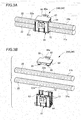
- the protector 24A is made of a resin, and includes a cable holding portion 31 and a plurality of fixed portions 32 and 33 extending from the cable holding portion 31, as shown in FIGS. 2A and 2B .
- the cable holding portion 31 has a holding groove 42 which has a U shape in a side view, and in the holding groove 42, the two cables 21 a and 21 b are stacked and disposed in an inserted state.
- a plurality of locking protrusions 43 are formed at intervals in the wiring direction of the cables 21a and 21b. Then, corrugated tubes 22 having the cables 21a and 21b inserted therein are disposed in the holding groove 42, whereby the locking protrusions 43 get into grooves 22a of the corrugated tubes 22.
- a lid body 53 may be attached to cover the open upper portion. At both end portions of the lid body 53, arc-like locking claws 54 are formed to protrude toward the cable holding portion 31. Then, the lid body 53 is attached to the cable holding portion 31, whereby the locking claws 54 get into grooves 22a of the corrugated tube 22 which is disposed on the upper side in the cable holding portion 31 and has the cable 21b inserted therein.
- the locking protrusions 43 of the cable holding portion 31 and the locking claws 54 of the lid body 53 lock the grooves 22a of the bellows of the corrugated tubes 22 of the cables 21a and 21 b, whereby the cables 21a and 21b are disposed in a fixed state in the protector 24A.
- engaging holes 34 are formed, and at the lid body 53, fixed claws 55 are formed to protrude toward the cable holding portion 31. Then, the cable holding portion 31 is covered with the lid body 53, whereby the fixed claws 55 are engaged with the engaging holes 34 such that the lid body 53 is fixed.
- a through-hole 32a is formed, and at the fixed portion 33, a notched portion 33a is formed.
- stud bolts (not shown) provided in a standing manner at the vehicle body frame are inserted.
- nuts (not shown) are fastened to the stud bolts, whereby the protector 24A holding the cables 21a and 21 b is fixed at a clamping position.
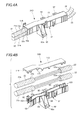
- the protectors 24B and 24C are formed almost in the same shape, and each of the protectors 24B and 24C is made of a resin, like the protector 24A, and includes a cable holding portion 61 as shown in FIGS. 3A and 3B .
- the cable holding portion 61 has a holding groove 72 which has a U shape in a side view, and in the holding groove 72, the two cables 21a and 21b are stacked and disposed in an inserted state.
- a plurality of locking protrusions 73 are formed at intervals in the wiring direction of the cables 21 a and 21 b. Then, the corrugated tubes 22 having the cables 21a and 21 b inserted therein are disposed in the holding groove 72, whereby the locking protrusions 73 get into grooves 22a of the corrugated tubes 22.
- a lid body 83 may be attached to cover the open upper portion.
- arc-like locking claws 84 are formed to protrude toward the cable holding portion 61. Then, the lid body 83 is attached to the cable holding portion 61, whereby the locking claws 84 of the lid body 83 get into grooves 22a of the corrugated tube 22 which is disposed on the upper side in the holding groove 72 of the cable holding portion 61 and has the cable 21 b inserted therein.
- the locking protrusions 73 of the cable holding portion 61 and the locking claws 84 of the lid body 83 lock the grooves 22a of the bellows of the corrugated tubes 22 of the cables 21a and 21 b, whereby the cables 21a and 21 b are disposed in a fixed state in the protector 24B or 24C.
- engaging holes 64 are formed, and at the lid body 83, fixed claws 85 are formed to protrude toward the cable holding portion 61. Then, the cable holding portion 61 is covered with the lid body 83, whereby the fixed claws 85 are engaged with the engaging holes 64 such that the lid body 53 is fixed.
- a fixing portion 86 having a through-hole 86a is formed.
- a stud bolt (not shown) provided in a standing manner at the vehicle body frame is inserted.
- a nut (not shown) is fastened to the stud bolt, whereby the protector 24B or 24C holding the cables 21 a and 21 b is fixed at a clamping position.
- the protector 24D is also made of a resin, and includes a cable holding portion 91 and a plurality of fixed portions 92 extending from the cable holding portion 91 as shown in FIGS. 4A and 4B .
- the cable holding portion 91 has a holding groove 102 which has a U shape in a side view, and in the holding groove 102, the two cables 21a and 21b are stacked and disposed in an inserted state.
- a plurality of locking protrusions 103 are formed at intervals in the wiring direction of the cables 21 a and 21 b. Then, the corrugated tubes 22 having the cables 21a and 21b inserted therein are disposed in the holding groove 102, whereby the locking protrusions 103 get into grooves 22a of the corrugated tubes 22.
- a lid body 113 may be attached to cover the open upper portion. At both end portions of the lid body 113, arc-like locking claws 114 are formed to protrude toward the cable holding portion 91. Then, the lid body 113 is attached to the cable holding portion 91, whereby the locking claws 114 of the lid body 113 get into grooves 22a of the corrugated tube 22 which is disposed on the upper side in the holding groove 102 of the cable holding portion 91 and has the cable 21b inserted therein.
- the locking protrusions 103 of the cable holding portion 91 and the locking claws 114 of the lid body 113 lock the grooves 22a of the bel lows of the corrugated tubes 22 of the cables 21a and 21 b, whereby the cables 21a and 21 b are disposed in a fixed state in the protector 24D.
- engaging holes 94 are formed, and at the lid body 113, fixed claws 115 are formed to protrude toward the cable holding portion 91. Then, the cable holding portion 91 is covered with the lid body 113, whereby the fixed claws 115 are engaged with the engaging holes 94 such that the lid body 113 is fixed.
- through-holes 92a are formed, and into the through-holes 92a, stud bolts (not shown) provided in a standing manner at the vehicle body frame are inserted. In this state, nuts (not shown) are fastened to the stud bolts, whereby the protector 24D holding the cables 21a and 21 b is fixed at a clamping position.
- the protector 24D is formed such that the holding groove 102 for accommodating the cables 21a and 21 b is long in the longitudinal direction of the cables. Therefore, in the protector 24D, as shown in FIG. 4B , it is possible to omit the corrugated tubes 22 of portions of the cables 21 a and 21b wired in the holding groove 102. In this case, the end portions of each of the corrugated tubes 22 of the cables 21a and 21b are locked by the locking protrusions 103 at both end portions of the cable holding portion 91. Then, the portions of the cables 21a and 21 b where the corrugated tubes 22 have been omitted are covered and protected by the protector 24D. Also, since the corrugated tubes 22 are omitted, the rigidity of the cables 21a and 21 b is reduced, and thus it is possible to facilitate wiring into the cable holding portion 91.
- the lengths of the individual cables 21a and 21b between the protectors 24A, 24B, 24C, and 24D are made different, whereby the cables 21a and 21b are bent according to the shape of the vehicle body frame for wiring.
- the assembly positions of the protectors 24A, 24B, 24C, and 24D with respect to the cables 21 a and 21 b constituting the wiring harness 11 are determined according to the final stereoscopic shape.
- the interval length A1 of one cable 21a and the interval length A2 of the other cable 21 b are set to be different from each other.
- the interval length B1 of the one cable 21a and the interval length B2 of the other cable 21 b are set to be different from each other.
- the interval length C1 of the one cable 21a and the interval length C2 of the other cable 21 b are set to be different from each other.
- the one cable 21a is held by the protectors 24A, 24B, 24C, and 24D such that the intervals between the protectors 24A and 24B, between the protectors 24B and 24C, and between the protectors 24C and 24D become the interval lengths A1, B1, and C1, respectively.
- the other cable 21b is held by the protectors 24A, 24B, 24C, and 24D.
- the interval lengths A2, B2, and C2 of the other cable 21 b are different from the interval lengths A1, B1, and C1 of the one cable 21a, if the other cable 21b is held by the protectors 24A, 24B, 24C, and 24D, as shown in FIG. 6 , in a plane, the cables 21a and 21b are bent toward the shorter interval length sides between the protectors 24A, 24B, 24C, and 24D.
- the bending direction of the cables 21a and 21 b bent in the plane is changed by the twisting, such that the wiring harness 11 is formed in an arranging path bent in a three-dimensional shape according to the vehicle body frame.
- the lengths of the cable 21a and the lengths of the cable 21b are made different from each other, such that the cables are bent between the protectors 24A, 24B, 24C, and 24D. Therefore, it is possible to easily arrange the cables with respect to the bent arranging path.
- the cables 21a and 21 b are in a separated state. Therefore, it is possible to suppress bulkiness before routing, and to facilitate storage and transfer.
- the arranging path of the vehicle body frame is a three-dimensional route, since it is possible to twist the cables between the protectors 24A, 24B, 24C, and 24D adjacent in the longitudinal direction, thereby changing the bending direction between the protectors 24A, 24B, 24C, and 24D, it is possible to very easily make the cables in a shape according to the stereoscopic arranging path of the vehicle body frame.
- the present invention is not limited to the above-mentioned embodiment, but can be appropriately modified and improved. Further, the material, shape, size, number, disposed position, etc. of each of the constituent elements of the aforesaid embodiment are not limited thereto and may be arbitrary so long as the invention is attained.
- the wiring harness 11 including the two cables 21a and 21b bound has been described as an example.
- the number of cables constituting the wiring harness 11 is not limited to two as long as the number of cables is more than one.
- the wiring harness is assembled by applying the protectors with respect to the plurality of cables bent on a routing plate. However, it is possible to assemble the wiring harness by detaching the cables from the routing plate, aligning marks, and applying the protectors to the mark positions.
Landscapes
- Engineering & Computer Science (AREA)
- Architecture (AREA)
- Civil Engineering (AREA)
- Structural Engineering (AREA)
- Mechanical Engineering (AREA)
- Manufacturing & Machinery (AREA)
- Details Of Indoor Wiring (AREA)
Abstract
Description
- The present invention relates to a wiring harness for a vehicle such as an automobile, and a method of assembling the wiring harness.
- A wiring harness for a vehicle such as an automobile is configured by collectively lumping a plurality of cables (electric wires) with protectors and the like, and is fixed to the frame of a vehicle body (see Patent Documents 1 to 4, for instance). Then, a plurality of portions of the wiring harness is fixed to the frame of the vehicle body by the protectors, such that the wiring harness is routed along the frame of the vehicle body.
-
- Patent Document 1:
JP-A-2005-295728 - Patent Document 2:
JP-A-7-298446 - Patent Document 3:
JP-A-2002-225648 - Patent Document 4:
JP-A-2001-359217 - In order to arrange the above-mentioned wiring harness along the frame of the vehicle body, the plurality of cables are bound with the protectors while being bent, whereby the wiring harness is made in a shape according to an arranging path.
- However, for a wiring harness which can be mounted on an electric automobile, a hybrid car, or the like and allows a high-voltage high current to flow, in general, cables having large diameters and high rigidity are used. Therefore, each of these cables for a wiring harness has the property of being rigid and hard to be bent.
- Therefore, it takes considerable effort and time to bend the plurality of cables having high rigidity and bind the cables with the protectors.
- Also, since the bound and bent wiring harness is bulky, it is difficult to secure a storage place, and transfer efficiency is also not good.
- The present invention was made in view of the above-mentioned circumferences, and an object of the present invention is to provide a wiring harness which can suppress bulkiness before routing, and be easily made in a shape according to an arranging path, and a method of assembling the wiring harness.
- The above-mentioned object related to the present invention can be achieved by the following configurations.
- (1) A wiring harness in which a plurality of cables are bound by a plurality of protectors provided at intervals in a longitudinal direction, the wiring harness arranged along an arranging path of a fixed portion, wherein: the cables are collectively held by the protectors, and the lengths of the plurality of cables between the protectors are made different such that the cables are bent between the protectors.
- According to this wiring harness, the lengths of at least one cable between the protectors are made different from the lengths of the other cables between the protectors such that the cables can be bent between the protectors. Therefore, it is possible to easily arrange the cables in a shape according to the bent arranging path.
Further, before the cables are held by the protectors, the individual cables are in a separated and straight state. Therefore, it is possible to suppress bulkiness before routing, and to facilitate storage and transfer. - (2) The wiring harness according to (1), wherein the cables are twisted between adjacent protectors such that a bending direction is changed.
- According to this wiring harness, the cables are twisted between adjacent protectors, whereby the bending direction between the protectors is changed. Therefore, it is possible to make the cables correspond to the stereoscopic arranging path of a fixed portion.
- (3) The wiring harness according to (1) or (2), wherein marks put at different positions of at least one cable and the other cable in the longitudinal direction exist at positions to be mounted on the protectors.
- According to this wiring harness, marks put at different positions of the one cable and another cable in the longitudinal direction exist at the held positions by one protector. Therefore, the cables are bent between the protectors.
- (4) A method of assembling a wiring harness in which a plurality of cables are bound by a plurality of protectors provided at intervals in a longitudinal direction, the wiring harness arranged along an arranging path of a fixed portion, comprising: mounting the plurality of protectors at predetermined positions of one cable, respecitvely; and making the other cable be held by each protector such that the length of the other cable between adjacent protectors is different from the length of the one cable, thereby bending the cables between the protectors due to the difference between the lengths of the cables between the protectors.
- According to this method of assembling a wiring harness, the protectors are mounted at the predetermined positions of the one cable, and the other cables are held by each protector such that between adjacent protectors, the length of the one cable are different from the lengths of the other cables. Therefore, it is possible to easily bend the cables between the protectors due to the differences between the lengths of the individual cables between the protectors, thereby making a wiring harness which can be easily routed in a shape according to the bent arranging path.
Further, before the cables are held by the protectors, the individual cables are in a separated and straight state. Therefore, it is possible to suppress bulkiness before routing, and to facilitate storage and transfer. - (5) The method of assembling a wiring harness according to (4), wherein marks indicating positions to be mounted on the protectors are put on the other cable, and the other cables are held by the protectors such that the marks are positioned at the protectors.
- According to this method of assembling a wiring harness, it is possible to easily make the lengths of the individual cables between the protectors different by holding the other cable while positioning the marks at the protectors, thereby bending the cables between the protectors.
- (6) The method of assembling a wiring harness according to (4) or (5), wherein when the other cable is held by the protectors, a cable whose length between the protectors needs to be elongated is caught with a jig, whereby the length of the cable between the protectors is changed.
- According to this method of assembling a wiring harness, when the other cables are held by the protectors, the cable whose length between the protectors needs to be elongated is caught with the jig, whereby the length of the cable between the protectors can be easily changed. Therefore, it is possible to bend the cables between the protectors.
- (7) The method of assembling a wiring harness according to any one of (4) to (6), wherein the cables are twisted between adjacent protectors such that the bending direction is changed.
- According to this method of assembling a wiring harness, the cables between adjacent protectors are twisted. Therefore, it is possible to very easily change the bending direction of the cables between the protectors such that the cables correspond to the stereoscopic arranging path of a fixed portion.
- According to the present invention, it is possible to provide a wiring harness which can suppress bulkiness before routing, and be easily made in a shape and form according to an arranging path, and a method of assembling the wiring harness.
-
-
FIG. 1 is a perspective view of a wiring harness according to the present invention. -
FIGS. 2A and 2B are views illustrating a protector provided in the wiring harness,FIG. 2A is a perspective view, andFIG. 2B is an exploded perspective view. -
FIGS. 3A and 3B are views illustrating another protector provided in the wiring harness,FIG. 3A is a perspective view, andFIG. 3B is an exploded perspective view. -
FIGS. 4A and 4B are views illustrating another protector provided in the wiring harness,FIG. 4A is a perspective view, andFIG. 4B is an exploded perspective view. -
FIG. 5 is a schematic plan view illustrating the wiring harness in a separated state. -
FIG. 6 is a schematic plan view illustrating the assembled wiring harness. -
FIG. 7 is a schematic plan view illustrating a method of mounting the other cable on protectors. -
FIG. 8 is a schematic plan view illustrating anther method of mounting the other cable on the protectors. - Hereinafter, an example of an embodiment according to the present invention will be described with reference to the drawings.
FIG. 1 is a perspective view of a wiring harness according to the present invention.
As shown inFIG. 1 , awiring harness 11 is for a vehicle such as an electric automobile and a hybrid car, and thus can be electrically connected to a battery (not shown) and an inverter (not shown) for instance. - The
wiring harness 11 includes twocables - The outer circumferences of the
cables corrugated tubes 22. Thesecorrugated tubes 22 are hollow tubes formed in a bellows form, and are made of flame retardant polypropylene and the like, for instance. - The
cables protectors - The
protectors
Theprotector 24A is made of a resin, and includes acable holding portion 31 and a plurality of fixedportions cable holding portion 31, as shown inFIGS. 2A and 2B . - The
cable holding portion 31 has a holdinggroove 42 which has a U shape in a side view, and in the holdinggroove 42, the twocables - At the inner surface of the holding
groove 42 of thecable holding portion 31, a plurality of lockingprotrusions 43 are formed at intervals in the wiring direction of thecables corrugated tubes 22 having thecables groove 42, whereby the lockingprotrusions 43 get intogrooves 22a of thecorrugated tubes 22. - Also, on the open upper portion of the
cable holding portion 31, alid body 53 may be attached to cover the open upper portion. At both end portions of thelid body 53, arc-like locking claws 54 are formed to protrude toward thecable holding portion 31. Then, thelid body 53 is attached to thecable holding portion 31, whereby the lockingclaws 54 get intogrooves 22a of thecorrugated tube 22 which is disposed on the upper side in thecable holding portion 31 and has thecable 21b inserted therein. - As described above, in the
protector 24A, the lockingprotrusions 43 of thecable holding portion 31 and the lockingclaws 54 of thelid body 53 lock thegrooves 22a of the bellows of thecorrugated tubes 22 of thecables cables protector 24A. - Also, at the upper end portion of the
cable holding portion 31, engagingholes 34 are formed, and at thelid body 53, fixedclaws 55 are formed to protrude toward thecable holding portion 31. Then, thecable holding portion 31 is covered with thelid body 53, whereby the fixedclaws 55 are engaged with the engagingholes 34 such that thelid body 53 is fixed. - At the fixed
portion 32, a through-hole 32a is formed, and at the fixedportion 33, a notchedportion 33a is formed. Into the through-hole 32a of the fixedportion 32 and the notchedportion 33a of the fixedportion 33, stud bolts (not shown) provided in a standing manner at the vehicle body frame are inserted. In this state, nuts (not shown) are fastened to the stud bolts, whereby theprotector 24A holding thecables - The
protectors protectors protector 24A, and includes acable holding portion 61 as shown inFIGS. 3A and 3B . - The
cable holding portion 61 has a holdinggroove 72 which has a U shape in a side view, and in the holdinggroove 72, the twocables - At the inner surface of the holding
groove 72 of thecable holding portion 61, a plurality of lockingprotrusions 73 are formed at intervals in the wiring direction of thecables corrugated tubes 22 having thecables groove 72, whereby the lockingprotrusions 73 get intogrooves 22a of thecorrugated tubes 22. - Also, on the open upper portion of the
cable holding portion 61, alid body 83 may be attached to cover the open upper portion. At both end portions of thelid body 83, arc-like locking claws 84 are formed to protrude toward thecable holding portion 61. Then, thelid body 83 is attached to thecable holding portion 61, whereby the lockingclaws 84 of thelid body 83 get intogrooves 22a of thecorrugated tube 22 which is disposed on the upper side in the holdinggroove 72 of thecable holding portion 61 and has thecable 21 b inserted therein. - As described above, in the
protector protrusions 73 of thecable holding portion 61 and the lockingclaws 84 of thelid body 83 lock thegrooves 22a of the bellows of thecorrugated tubes 22 of thecables cables protector - Also, at the upper end portion of the
cable holding portion 61, engagingholes 64 are formed, and at thelid body 83, fixedclaws 85 are formed to protrude toward thecable holding portion 61. Then, thecable holding portion 61 is covered with thelid body 83, whereby the fixedclaws 85 are engaged with the engagingholes 64 such that thelid body 53 is fixed. - At the
lid body 83, a fixingportion 86 having a through-hole 86a is formed. Into the through-hole 86a of the fixingportion 86, a stud bolt (not shown) provided in a standing manner at the vehicle body frame is inserted. In this state, a nut (not shown) is fastened to the stud bolt, whereby theprotector cables - The
protector 24D is also made of a resin, and includes acable holding portion 91 and a plurality of fixedportions 92 extending from thecable holding portion 91 as shown inFIGS. 4A and 4B . - The
cable holding portion 91 has a holdinggroove 102 which has a U shape in a side view, and in the holdinggroove 102, the twocables - At the inner surface of the holding
groove 102 in the vicinities of both ends of thecable holding portion 91, a plurality of lockingprotrusions 103 are formed at intervals in the wiring direction of thecables corrugated tubes 22 having thecables groove 102, whereby the lockingprotrusions 103 get intogrooves 22a of thecorrugated tubes 22. - Also, on the open upper portion of the
cable holding portion 91, alid body 113 may be attached to cover the open upper portion. At both end portions of thelid body 113, arc-like locking claws 114 are formed to protrude toward thecable holding portion 91. Then, thelid body 113 is attached to thecable holding portion 91, whereby the lockingclaws 114 of thelid body 113 get intogrooves 22a of thecorrugated tube 22 which is disposed on the upper side in the holdinggroove 102 of thecable holding portion 91 and has thecable 21b inserted therein. - As described above, in the
protector 24D, the lockingprotrusions 103 of thecable holding portion 91 and the lockingclaws 114 of thelid body 113 lock thegrooves 22a of the bel lows of thecorrugated tubes 22 of thecables cables protector 24D. - Also, at the upper end portion of the
cable holding portion 91, engagingholes 94 are formed, and at thelid body 113, fixedclaws 115 are formed to protrude toward thecable holding portion 91. Then, thecable holding portion 91 is covered with thelid body 113, whereby the fixedclaws 115 are engaged with the engagingholes 94 such that thelid body 113 is fixed. - At the fixed
portions 92, through-holes 92a are formed, and into the through-holes 92a, stud bolts (not shown) provided in a standing manner at the vehicle body frame are inserted. In this state, nuts (not shown) are fastened to the stud bolts, whereby theprotector 24D holding thecables - The
protector 24D is formed such that the holdinggroove 102 for accommodating thecables protector 24D, as shown inFIG. 4B , it is possible to omit thecorrugated tubes 22 of portions of thecables groove 102. In this case, the end portions of each of thecorrugated tubes 22 of thecables protrusions 103 at both end portions of thecable holding portion 91. Then, the portions of thecables corrugated tubes 22 have been omitted are covered and protected by theprotector 24D. Also, since thecorrugated tubes 22 are omitted, the rigidity of thecables cable holding portion 91. - Further, in the case of omitting the
corrugated tubes 22, it is preferable to provide abutting portions in the vicinities of the both end portions of the holdinggroove 102 of thecable holding portion 91, and to bring the end portions of thecorrugated tubes 22 into contact with the abutting portions such that thecables cables groove 102. - In the above-mentioned
wiring harness 11, the lengths of theindividual cables protectors cables - Now, a case of assembling the
wiring harness 11 will be described.
As shown inFIG. 5 , the assembly positions of theprotectors cables wiring harness 11 are determined according to the final stereoscopic shape. - Specifically, in the
protector 24A and theprotector 24B adjacent to each other in the longitudinal direction, the interval length A1 of onecable 21a and the interval length A2 of theother cable 21 b are set to be different from each other.
Even in theprotector 24B and theprotector 24C adjacent to each other in the longitudinal direction, the interval length B1 of the onecable 21a and the interval length B2 of theother cable 21 b are set to be different from each other.
Similarly, even in theprotector 24C and theprotector 24D adjacent to each other in the longitudinal direction, the interval length C1 of the onecable 21a and the interval length C2 of theother cable 21 b are set to be different from each other. - Then, the one
cable 21a is held by theprotectors protectors protectors protectors - Next, the
other cable 21b is held by theprotectors other cable 21 b are different from the interval lengths A1, B1, and C1 of the onecable 21a, if theother cable 21b is held by theprotectors FIG. 6 , in a plane, thecables protectors - Here, with respect to a method of mounting the
cables protectors protectors cables protectors - In a case of mounting the
other cable 21b having the different interval length A2 on theprotectors cable 21a having the interval length A1 is mounted, as shown inFIG. 7 , it is possible to put marks X at the positions of theother cable 21b, to be mounted on theprotectors other cable 21 b on theprotectors protectors cables protectors cables protectors - Also, as shown in
FIG. 8 , when theother cable 21b is mounted on theprotectors other cable 21b, which is the longer interval length side, with a jig Y such as a pin so as to bend theother cable 21b, thereby elongating the path length of theother cable 21b, and mount theother cable 21 b on theprotectors cables protectors cables protectors - Then, as described above, in the
wiring harness 11 bent in a plane, if thecables protectors protectors protectors cables wiring harness 11 is formed in an arranging path bent in a three-dimensional shape according to the vehicle body frame. - As described above, according to the wiring harness and the method of assembling the wiring harness related to the above-mentioned embodiment, between the
protectors cable 21a and the lengths of thecable 21b are made different from each other, such that the cables are bent between theprotectors - Also, before being held by the
protectors cables - Further, even when the arranging path of the vehicle body frame is a three-dimensional route, since it is possible to twist the cables between the
protectors protectors - The present invention is not limited to the above-mentioned embodiment, but can be appropriately modified and improved. Further, the material, shape, size, number, disposed position, etc. of each of the constituent elements of the aforesaid embodiment are not limited thereto and may be arbitrary so long as the invention is attained.
For example, in the above-mentioned embodiment, thewiring harness 11 including the twocables wiring harness 11 is not limited to two as long as the number of cables is more than one.
Also, in the above-mentioned embodiment, although not described in detail, the wiring harness is assembled by applying the protectors with respect to the plurality of cables bent on a routing plate. However, it is possible to assemble the wiring harness by detaching the cables from the routing plate, aligning marks, and applying the protectors to the mark positions. - Although the present invention has been described in detail or with reference to a specific embodiment, it is apparent to those skilled in the art that it is possible to add various changes or modifications without departing from the sprit and scope of the present invention.
This application is based on Japanese Patent Application (Application No.2010-124966) filed on May 31, 2010 -
- 11 Wiring Harness
- 21a, 21b Cable
- 24a, 24b, 24c, 24d Protector
- A1, A2, B1, B2, C1, C2 Interval Length
- X Mark
- Y Jig
Claims (8)
- A wiring harness in which a plurality of cables are bound by a plurality of protectors provided at intervals in a longitudinal direction, the wiring harness arranged along an arranging path of a fixed portion, wherein:the cables are collectively held by the protectors, andthe lengths of the plurality of cables between the protectors are made different such that the cables are bent between the protectors.
- The wiring harness according to claim 1, wherein the cables are twisted between adjacent protectors such that a bending direction is changed.
- The wiring harness according to claim 1 or 2, wherein marks put at different positions of at least one cable and the other cable in the longitudinal direction exist at positions to be mounted on the protectors.
- A method of assembling a wiring harness in which a plurality of cables are bound by a plurality of protectors provided at intervals in a longitudinal direction, the wiring harness arranged along an arranging path of a fixed portion, comprising:mounting the plurality of protectors at predetermined positions of one cable, respecitvely; andmaking the other cable be held by each protector such that the length of the other cable between adjacent protectors is different from the length of the one cable, thereby bending the cables between the protectors due to the difference between the lengths of the cables between the protectors.
- The method of assembling a wiring harness according to claim 4, wherein marks indicating positions to be mounted on the protectors are put on the other cable, and the other cables are held by the protectors such that the marks are positioned at the protectors.
- The method of assembling a wiring harness according to claim 4 or 5, wherein when the other cable is held by the protectors, a cable whose length between the protectors needs to be elongated is caught with a jig, whereby the length of the cable between the protectors is changed.
- The method of assembling a wiring harness according to claim 4 or 5, wherein the cables are twisted between adjacent protectors such that the bending direction is changed.
- The method of assembling a wiring harness according to claim 6, wherein the cables are twisted between adjacent protectors such that the bending direction is changed.
Applications Claiming Priority (2)
| Application Number | Priority Date | Filing Date | Title |
|---|---|---|---|
| JP2010124966A JP5618632B2 (en) | 2010-05-31 | 2010-05-31 | Wire harness |
| PCT/JP2011/062425 WO2011152367A1 (en) | 2010-05-31 | 2011-05-30 | Wire harness and method of assembling thereof |
Publications (3)
| Publication Number | Publication Date |
|---|---|
| EP2579404A1 true EP2579404A1 (en) | 2013-04-10 |
| EP2579404A4 EP2579404A4 (en) | 2013-11-27 |
| EP2579404B1 EP2579404B1 (en) | 2021-03-03 |
Family
ID=45066733
Family Applications (1)
| Application Number | Title | Priority Date | Filing Date |
|---|---|---|---|
| EP11789770.2A Active EP2579404B1 (en) | 2010-05-31 | 2011-05-30 | Wiring harness and method of assembling the same |
Country Status (5)
| Country | Link |
|---|---|
| US (1) | US9762040B2 (en) |
| EP (1) | EP2579404B1 (en) |
| JP (1) | JP5618632B2 (en) |
| CN (1) | CN102934305B (en) |
| WO (1) | WO2011152367A1 (en) |
Cited By (1)
| Publication number | Priority date | Publication date | Assignee | Title |
|---|---|---|---|---|
| WO2019215077A1 (en) * | 2018-05-07 | 2019-11-14 | A. Raymond Et Cie | Device for accommodating a cable assembly |
Families Citing this family (26)
| Publication number | Priority date | Publication date | Assignee | Title |
|---|---|---|---|---|
| US9590403B2 (en) * | 2013-01-25 | 2017-03-07 | A. Raymond Et Cie | Wire management system |
| US9162550B2 (en) * | 2013-10-08 | 2015-10-20 | Denso International America, Inc. | Wire harness mounting assembly |
| WO2016031814A1 (en) * | 2014-08-25 | 2016-03-03 | 矢崎総業株式会社 | Outer cover member for wire harness, and wire harness |
| CN104300467A (en) * | 2014-11-17 | 2015-01-21 | 苏州戴尔曼电器有限公司 | Novel antiskid insulating electrical conduit |
| CN105186252B (en) * | 2015-10-13 | 2017-07-07 | 资阳中车电气科技有限公司 | A kind of combined bellows compression tooling |
| JP6519797B2 (en) * | 2015-11-10 | 2019-05-29 | 住友電装株式会社 | Shield conductive path |
| JP6744584B2 (en) * | 2017-03-30 | 2020-08-19 | 株式会社オートネットワーク技術研究所 | Route control member, clamp, and wire harness |
| JP6744583B2 (en) * | 2017-03-30 | 2020-08-19 | 株式会社オートネットワーク技術研究所 | Route control member, clamp, and wire harness |
| JP6744582B2 (en) * | 2017-03-30 | 2020-08-19 | 株式会社オートネットワーク技術研究所 | Wire harness |
| JP6744585B2 (en) * | 2017-03-30 | 2020-08-19 | 株式会社オートネットワーク技術研究所 | Protective member and wire harness |
| JP7136542B2 (en) * | 2017-08-07 | 2022-09-13 | 矢崎総業株式会社 | wire harness |
| JP2019139852A (en) * | 2018-02-06 | 2019-08-22 | トヨタ自動車株式会社 | Wiring, and vehicle having same |
| JP6730352B2 (en) * | 2018-03-20 | 2020-07-29 | ファナック株式会社 | Cable clamps and robots |
| JP6644824B2 (en) * | 2018-04-04 | 2020-02-12 | 矢崎総業株式会社 | Branch circuit body and branching method of electric wire |
| JP6691164B2 (en) * | 2018-04-04 | 2020-04-28 | 矢崎総業株式会社 | Branching circuit body and wire branching method |
| JP7047649B2 (en) * | 2018-07-30 | 2022-04-05 | 株式会社オートネットワーク技術研究所 | Wire harness |
| JP6781224B2 (en) * | 2018-09-25 | 2020-11-04 | 矢崎総業株式会社 | Wire harness |
| JP7131439B2 (en) * | 2019-03-07 | 2022-09-06 | 株式会社オートネットワーク技術研究所 | Exterior materials and wire harnesses |
| JP7188559B2 (en) * | 2019-03-27 | 2022-12-13 | 住友電装株式会社 | wire harness |
| JP7172814B2 (en) * | 2019-04-10 | 2022-11-16 | 株式会社オートネットワーク技術研究所 | Wiring material |
| JP6918860B2 (en) * | 2019-04-24 | 2021-08-11 | 矢崎総業株式会社 | Wire harness |
| JP7346943B2 (en) * | 2019-07-02 | 2023-09-20 | 株式会社オートネットワーク技術研究所 | Wiring system and modified wiring system manufacturing method |
| DE102019211202A1 (en) * | 2019-07-29 | 2021-02-04 | Zf Friedrichshafen Ag | Electric drive device of a motor vehicle |
| JP7046899B2 (en) * | 2019-12-05 | 2022-04-04 | 矢崎総業株式会社 | Exterior members and wire harnesses |
| JP7269209B2 (en) * | 2020-11-16 | 2023-05-08 | 矢崎総業株式会社 | Corrugated tube mounting structure |
| DE102020131199A1 (en) | 2020-11-25 | 2022-05-25 | Brose Fahrzeugteile Se & Co. Kommanditgesellschaft, Bamberg | Subassembly for a vehicle with a line unit having a rigid wire and manufacturing method |
Family Cites Families (30)
| Publication number | Priority date | Publication date | Assignee | Title |
|---|---|---|---|---|
| GB555745A (en) * | 1942-04-08 | 1943-09-06 | Vickers Armstrong Ltd | Improvements relating to electrical wiring systems |
| FR1256715A (en) * | 1960-04-06 | 1961-03-24 | Cance Vought Aircraft | Multi-conductor cable and its manufacturing process |
| DE3616649A1 (en) * | 1986-05-16 | 1987-11-19 | Bosch Siemens Hausgeraete | WIRING HARNESS, IN PARTICULAR FOR HOUSEHOLD APPLIANCES |
| US4874908A (en) * | 1987-07-08 | 1989-10-17 | Minnesota Mining And Manufacturing Company | Wiring harness |
| CN1029359C (en) | 1989-04-11 | 1995-07-19 | 明尼苏达州探矿制造公司 | Wiring harness |
| JPH04206314A (en) * | 1990-11-30 | 1992-07-28 | Yazaki Corp | Manufacturing method and device for wire harness with bent part |
| JPH07298446A (en) | 1994-04-20 | 1995-11-10 | Yazaki Corp | Wire protector and wire storage method |
| CA2211192A1 (en) * | 1995-01-25 | 1996-08-01 | Haworth, Inc. | Modular communication cabling arrangement |
| JP3196165B2 (en) * | 1995-06-30 | 2001-08-06 | アロン化成株式会社 | Pipe bundle connection structure |
| JP3446445B2 (en) * | 1996-01-30 | 2003-09-16 | 住友電装株式会社 | How to prevent twisting of wire harness |
| DE19822020C2 (en) * | 1998-05-15 | 2001-05-17 | Siemens Ag | Connection unit and use of the connection unit for a medical work station |
| US6334284B1 (en) * | 1999-03-26 | 2002-01-01 | Anthony Italo Provitola | Structural system of torsion elements and method of construction therewith |
| JP3685387B2 (en) | 2000-06-12 | 2005-08-17 | 矢崎総業株式会社 | Wire harness protector |
| JP2002225648A (en) * | 2001-02-01 | 2002-08-14 | Sumitomo Wiring Syst Ltd | Wire harness protector and wire harness mounting method and structure using the same |
| US6521837B2 (en) * | 2001-02-23 | 2003-02-18 | Universal Electric Corporation | Electrical busway housing system and connection means therefor |
| JP2005057968A (en) * | 2003-08-07 | 2005-03-03 | Yazaki Corp | Harness fixing protector |
| US7119280B1 (en) * | 2003-11-24 | 2006-10-10 | Extreme Networks, Inc. | System and method for cable management on rack mounted installations |
| JP4469648B2 (en) * | 2004-04-02 | 2010-05-26 | 矢崎総業株式会社 | Wire harness protector |
| JP2006352977A (en) * | 2005-06-14 | 2006-12-28 | Yazaki Corp | Wire harness fixing member and wire harness fixing method |
| US20090272576A1 (en) * | 2008-04-30 | 2009-11-05 | Ise Corporation | Vehicle High Power Cable Fastening System and Method |
| ATE535978T1 (en) * | 2008-05-20 | 2011-12-15 | Panduit Corp | CONNECTING CABLE SYSTEM |
| DE202009007626U1 (en) * | 2009-05-29 | 2009-10-08 | Kunststoffwerke Ggk Gmbh & Co. Kg | Cable fixing device |
| CN102474085B (en) * | 2009-08-06 | 2015-11-25 | 3M创新有限公司 | Adhesive-backed tubing for cable applications |
| JP5478169B2 (en) * | 2009-09-14 | 2014-04-23 | 矢崎総業株式会社 | Wire harness routing method |
| JP5643080B2 (en) * | 2010-12-28 | 2014-12-17 | 矢崎総業株式会社 | Wire harness and method of manufacturing wire harness |
| JP5638939B2 (en) * | 2010-12-28 | 2014-12-10 | 矢崎総業株式会社 | Wire harness and method of manufacturing wire harness |
| GB2501629A (en) * | 2011-01-27 | 2013-10-30 | Commscope Inc | Datacommunications/telecommunications patching systems with bundled patch cord assembly |
| JP5709799B2 (en) * | 2012-05-28 | 2015-04-30 | 株式会社椿本チエイン | Cable protection guide member |
| JP5948653B2 (en) * | 2012-05-29 | 2016-07-06 | 矢崎総業株式会社 | Wire harness wiring structure |
| JP6184161B2 (en) * | 2012-07-12 | 2017-08-23 | キヤノン株式会社 | robot |
-
2010
- 2010-05-31 JP JP2010124966A patent/JP5618632B2/en active Active
-
2011
- 2011-05-30 US US13/700,626 patent/US9762040B2/en active Active
- 2011-05-30 EP EP11789770.2A patent/EP2579404B1/en active Active
- 2011-05-30 WO PCT/JP2011/062425 patent/WO2011152367A1/en not_active Ceased
- 2011-05-30 CN CN201180027197.2A patent/CN102934305B/en active Active
Cited By (2)
| Publication number | Priority date | Publication date | Assignee | Title |
|---|---|---|---|---|
| WO2019215077A1 (en) * | 2018-05-07 | 2019-11-14 | A. Raymond Et Cie | Device for accommodating a cable assembly |
| US12009646B2 (en) | 2018-05-07 | 2024-06-11 | A Raymond Et Cie | Device for accommodating a cable assembly |
Also Published As
| Publication number | Publication date |
|---|---|
| EP2579404A4 (en) | 2013-11-27 |
| US20130068522A1 (en) | 2013-03-21 |
| JP5618632B2 (en) | 2014-11-05 |
| CN102934305A (en) | 2013-02-13 |
| CN102934305B (en) | 2018-05-04 |
| WO2011152367A1 (en) | 2011-12-08 |
| US9762040B2 (en) | 2017-09-12 |
| JP2011254588A (en) | 2011-12-15 |
| EP2579404B1 (en) | 2021-03-03 |
Similar Documents
| Publication | Publication Date | Title |
|---|---|---|
| EP2579404B1 (en) | Wiring harness and method of assembling the same | |
| US11146051B2 (en) | Wire harness | |
| JP5500940B2 (en) | Wire harness | |
| JP5504979B2 (en) | Battery connection assembly | |
| JP5985309B2 (en) | Protector | |
| JP2016046943A (en) | Protector | |
| JP7687470B2 (en) | Battery Wiring Module | |
| JP6563746B2 (en) | Electrical junction box and wire harness | |
| JP2012110100A (en) | Wire harness | |
| JP2009055740A (en) | Wire harness to which protective member is attached and method for manufacturing the protective member | |
| JP2022109563A (en) | Wiring harness routing structure and protector | |
| JP5432611B2 (en) | Electrical junction box | |
| JP6233195B2 (en) | Wire module with protective member | |
| JP5881211B2 (en) | Wire harness wiring structure | |
| JP7090401B2 (en) | Protector, wire harness, and fixed structure | |
| JP6878105B2 (en) | Electrical junction box and wire harness | |
| JP5437728B2 (en) | Wire harness | |
| JP5500939B2 (en) | Wiring harness wiring structure | |
| WO2022249711A1 (en) | Electrical wiring for adding functions, and wire harness | |
| JP2016116335A (en) | Junction box and wiring harness | |
| JP7264647B2 (en) | wire harness | |
| JP7154975B2 (en) | electric junction box | |
| JP2004052903A (en) | Flat wire harness routing method and routing structure | |
| JP2024022970A (en) | protector | |
| JP2024120459A (en) | Mounting member, protective member with mounting member, and wire harness with protective member |
Legal Events
| Date | Code | Title | Description |
|---|---|---|---|
| PUAI | Public reference made under article 153(3) epc to a published international application that has entered the european phase |
Free format text: ORIGINAL CODE: 0009012 |
|
| 17P | Request for examination filed |
Effective date: 20121129 |
|
| AK | Designated contracting states |
Kind code of ref document: A1 Designated state(s): AL AT BE BG CH CY CZ DE DK EE ES FI FR GB GR HR HU IE IS IT LI LT LU LV MC MK MT NL NO PL PT RO RS SE SI SK SM TR |
|
| DAX | Request for extension of the european patent (deleted) | ||
| A4 | Supplementary search report drawn up and despatched |
Effective date: 20131024 |
|
| RIC1 | Information provided on ipc code assigned before grant |
Ipc: H02G 3/00 20060101ALI20131018BHEP Ipc: H02G 3/04 20060101AFI20131018BHEP Ipc: H01R 43/28 20060101ALI20131018BHEP Ipc: B60R 16/02 20060101ALI20131018BHEP Ipc: H02G 3/32 20060101ALI20131018BHEP |
|
| 17Q | First examination report despatched |
Effective date: 20150724 |
|
| STAA | Information on the status of an ep patent application or granted ep patent |
Free format text: STATUS: EXAMINATION IS IN PROGRESS |
|
| GRAP | Despatch of communication of intention to grant a patent |
Free format text: ORIGINAL CODE: EPIDOSNIGR1 |
|
| STAA | Information on the status of an ep patent application or granted ep patent |
Free format text: STATUS: GRANT OF PATENT IS INTENDED |
|
| INTG | Intention to grant announced |
Effective date: 20201015 |
|
| GRAS | Grant fee paid |
Free format text: ORIGINAL CODE: EPIDOSNIGR3 |
|
| GRAA | (expected) grant |
Free format text: ORIGINAL CODE: 0009210 |
|
| STAA | Information on the status of an ep patent application or granted ep patent |
Free format text: STATUS: THE PATENT HAS BEEN GRANTED |
|
| RIN1 | Information on inventor provided before grant (corrected) |
Inventor name: IKENO MASAYUKI Inventor name: OGAWA TATSUO Inventor name: KATO, KEISUKE |
|
| AK | Designated contracting states |
Kind code of ref document: B1 Designated state(s): AL AT BE BG CH CY CZ DE DK EE ES FI FR GB GR HR HU IE IS IT LI LT LU LV MC MK MT NL NO PL PT RO RS SE SI SK SM TR |
|
| REG | Reference to a national code |
Ref country code: GB Ref legal event code: FG4D |
|
| REG | Reference to a national code |
Ref country code: AT Ref legal event code: REF Ref document number: 1368260 Country of ref document: AT Kind code of ref document: T Effective date: 20210315 Ref country code: CH Ref legal event code: EP |
|
| REG | Reference to a national code |
Ref country code: DE Ref legal event code: R096 Ref document number: 602011070295 Country of ref document: DE |
|
| REG | Reference to a national code |
Ref country code: IE Ref legal event code: FG4D |
|
| REG | Reference to a national code |
Ref country code: LT Ref legal event code: MG9D |
|
| PG25 | Lapsed in a contracting state [announced via postgrant information from national office to epo] |
Ref country code: LT Free format text: LAPSE BECAUSE OF FAILURE TO SUBMIT A TRANSLATION OF THE DESCRIPTION OR TO PAY THE FEE WITHIN THE PRESCRIBED TIME-LIMIT Effective date: 20210303 Ref country code: HR Free format text: LAPSE BECAUSE OF FAILURE TO SUBMIT A TRANSLATION OF THE DESCRIPTION OR TO PAY THE FEE WITHIN THE PRESCRIBED TIME-LIMIT Effective date: 20210303 Ref country code: GR Free format text: LAPSE BECAUSE OF FAILURE TO SUBMIT A TRANSLATION OF THE DESCRIPTION OR TO PAY THE FEE WITHIN THE PRESCRIBED TIME-LIMIT Effective date: 20210604 Ref country code: FI Free format text: LAPSE BECAUSE OF FAILURE TO SUBMIT A TRANSLATION OF THE DESCRIPTION OR TO PAY THE FEE WITHIN THE PRESCRIBED TIME-LIMIT Effective date: 20210303 Ref country code: NO Free format text: LAPSE BECAUSE OF FAILURE TO SUBMIT A TRANSLATION OF THE DESCRIPTION OR TO PAY THE FEE WITHIN THE PRESCRIBED TIME-LIMIT Effective date: 20210603 Ref country code: BG Free format text: LAPSE BECAUSE OF FAILURE TO SUBMIT A TRANSLATION OF THE DESCRIPTION OR TO PAY THE FEE WITHIN THE PRESCRIBED TIME-LIMIT Effective date: 20210603 |
|
| REG | Reference to a national code |
Ref country code: NL Ref legal event code: MP Effective date: 20210303 |
|
| REG | Reference to a national code |
Ref country code: AT Ref legal event code: MK05 Ref document number: 1368260 Country of ref document: AT Kind code of ref document: T Effective date: 20210303 |
|
| PG25 | Lapsed in a contracting state [announced via postgrant information from national office to epo] |
Ref country code: SE Free format text: LAPSE BECAUSE OF FAILURE TO SUBMIT A TRANSLATION OF THE DESCRIPTION OR TO PAY THE FEE WITHIN THE PRESCRIBED TIME-LIMIT Effective date: 20210303 Ref country code: RS Free format text: LAPSE BECAUSE OF FAILURE TO SUBMIT A TRANSLATION OF THE DESCRIPTION OR TO PAY THE FEE WITHIN THE PRESCRIBED TIME-LIMIT Effective date: 20210303 Ref country code: PL Free format text: LAPSE BECAUSE OF FAILURE TO SUBMIT A TRANSLATION OF THE DESCRIPTION OR TO PAY THE FEE WITHIN THE PRESCRIBED TIME-LIMIT Effective date: 20210303 Ref country code: LV Free format text: LAPSE BECAUSE OF FAILURE TO SUBMIT A TRANSLATION OF THE DESCRIPTION OR TO PAY THE FEE WITHIN THE PRESCRIBED TIME-LIMIT Effective date: 20210303 |
|
| PG25 | Lapsed in a contracting state [announced via postgrant information from national office to epo] |
Ref country code: NL Free format text: LAPSE BECAUSE OF FAILURE TO SUBMIT A TRANSLATION OF THE DESCRIPTION OR TO PAY THE FEE WITHIN THE PRESCRIBED TIME-LIMIT Effective date: 20210303 |
|
| PG25 | Lapsed in a contracting state [announced via postgrant information from national office to epo] |
Ref country code: CZ Free format text: LAPSE BECAUSE OF FAILURE TO SUBMIT A TRANSLATION OF THE DESCRIPTION OR TO PAY THE FEE WITHIN THE PRESCRIBED TIME-LIMIT Effective date: 20210303 Ref country code: EE Free format text: LAPSE BECAUSE OF FAILURE TO SUBMIT A TRANSLATION OF THE DESCRIPTION OR TO PAY THE FEE WITHIN THE PRESCRIBED TIME-LIMIT Effective date: 20210303 Ref country code: AT Free format text: LAPSE BECAUSE OF FAILURE TO SUBMIT A TRANSLATION OF THE DESCRIPTION OR TO PAY THE FEE WITHIN THE PRESCRIBED TIME-LIMIT Effective date: 20210303 Ref country code: SM Free format text: LAPSE BECAUSE OF FAILURE TO SUBMIT A TRANSLATION OF THE DESCRIPTION OR TO PAY THE FEE WITHIN THE PRESCRIBED TIME-LIMIT Effective date: 20210303 |
|
| PG25 | Lapsed in a contracting state [announced via postgrant information from national office to epo] |
Ref country code: IS Free format text: LAPSE BECAUSE OF FAILURE TO SUBMIT A TRANSLATION OF THE DESCRIPTION OR TO PAY THE FEE WITHIN THE PRESCRIBED TIME-LIMIT Effective date: 20210703 Ref country code: RO Free format text: LAPSE BECAUSE OF FAILURE TO SUBMIT A TRANSLATION OF THE DESCRIPTION OR TO PAY THE FEE WITHIN THE PRESCRIBED TIME-LIMIT Effective date: 20210303 Ref country code: PT Free format text: LAPSE BECAUSE OF FAILURE TO SUBMIT A TRANSLATION OF THE DESCRIPTION OR TO PAY THE FEE WITHIN THE PRESCRIBED TIME-LIMIT Effective date: 20210705 Ref country code: SK Free format text: LAPSE BECAUSE OF FAILURE TO SUBMIT A TRANSLATION OF THE DESCRIPTION OR TO PAY THE FEE WITHIN THE PRESCRIBED TIME-LIMIT Effective date: 20210303 Ref country code: ES Free format text: LAPSE BECAUSE OF FAILURE TO SUBMIT A TRANSLATION OF THE DESCRIPTION OR TO PAY THE FEE WITHIN THE PRESCRIBED TIME-LIMIT Effective date: 20210303 |
|
| REG | Reference to a national code |
Ref country code: DE Ref legal event code: R097 Ref document number: 602011070295 Country of ref document: DE |
|
| REG | Reference to a national code |
Ref country code: CH Ref legal event code: PL |
|
| PLBE | No opposition filed within time limit |
Free format text: ORIGINAL CODE: 0009261 |
|
| STAA | Information on the status of an ep patent application or granted ep patent |
Free format text: STATUS: NO OPPOSITION FILED WITHIN TIME LIMIT |
|
| PG25 | Lapsed in a contracting state [announced via postgrant information from national office to epo] |
Ref country code: CH Free format text: LAPSE BECAUSE OF NON-PAYMENT OF DUE FEES Effective date: 20210531 Ref country code: AL Free format text: LAPSE BECAUSE OF FAILURE TO SUBMIT A TRANSLATION OF THE DESCRIPTION OR TO PAY THE FEE WITHIN THE PRESCRIBED TIME-LIMIT Effective date: 20210303 Ref country code: LI Free format text: LAPSE BECAUSE OF NON-PAYMENT OF DUE FEES Effective date: 20210531 Ref country code: LU Free format text: LAPSE BECAUSE OF NON-PAYMENT OF DUE FEES Effective date: 20210530 Ref country code: MC Free format text: LAPSE BECAUSE OF FAILURE TO SUBMIT A TRANSLATION OF THE DESCRIPTION OR TO PAY THE FEE WITHIN THE PRESCRIBED TIME-LIMIT Effective date: 20210303 Ref country code: DK Free format text: LAPSE BECAUSE OF FAILURE TO SUBMIT A TRANSLATION OF THE DESCRIPTION OR TO PAY THE FEE WITHIN THE PRESCRIBED TIME-LIMIT Effective date: 20210303 |
|
| 26N | No opposition filed |
Effective date: 20211206 |
|
| REG | Reference to a national code |
Ref country code: BE Ref legal event code: MM Effective date: 20210531 |
|
| PG25 | Lapsed in a contracting state [announced via postgrant information from national office to epo] |
Ref country code: SI Free format text: LAPSE BECAUSE OF FAILURE TO SUBMIT A TRANSLATION OF THE DESCRIPTION OR TO PAY THE FEE WITHIN THE PRESCRIBED TIME-LIMIT Effective date: 20210303 |
|
| PG25 | Lapsed in a contracting state [announced via postgrant information from national office to epo] |
Ref country code: IT Free format text: LAPSE BECAUSE OF FAILURE TO SUBMIT A TRANSLATION OF THE DESCRIPTION OR TO PAY THE FEE WITHIN THE PRESCRIBED TIME-LIMIT Effective date: 20210303 Ref country code: IE Free format text: LAPSE BECAUSE OF NON-PAYMENT OF DUE FEES Effective date: 20210530 |
|
| PG25 | Lapsed in a contracting state [announced via postgrant information from national office to epo] |
Ref country code: IS Free format text: LAPSE BECAUSE OF FAILURE TO SUBMIT A TRANSLATION OF THE DESCRIPTION OR TO PAY THE FEE WITHIN THE PRESCRIBED TIME-LIMIT Effective date: 20210703 |
|
| PG25 | Lapsed in a contracting state [announced via postgrant information from national office to epo] |
Ref country code: BE Free format text: LAPSE BECAUSE OF NON-PAYMENT OF DUE FEES Effective date: 20210531 |
|
| REG | Reference to a national code |
Ref country code: FR Ref legal event code: PLFP Year of fee payment: 13 |
|
| PG25 | Lapsed in a contracting state [announced via postgrant information from national office to epo] |
Ref country code: HU Free format text: LAPSE BECAUSE OF FAILURE TO SUBMIT A TRANSLATION OF THE DESCRIPTION OR TO PAY THE FEE WITHIN THE PRESCRIBED TIME-LIMIT; INVALID AB INITIO Effective date: 20110530 Ref country code: CY Free format text: LAPSE BECAUSE OF FAILURE TO SUBMIT A TRANSLATION OF THE DESCRIPTION OR TO PAY THE FEE WITHIN THE PRESCRIBED TIME-LIMIT Effective date: 20210303 |
|
| PG25 | Lapsed in a contracting state [announced via postgrant information from national office to epo] |
Ref country code: MK Free format text: LAPSE BECAUSE OF FAILURE TO SUBMIT A TRANSLATION OF THE DESCRIPTION OR TO PAY THE FEE WITHIN THE PRESCRIBED TIME-LIMIT Effective date: 20210303 |
|
| PG25 | Lapsed in a contracting state [announced via postgrant information from national office to epo] |
Ref country code: TR Free format text: LAPSE BECAUSE OF FAILURE TO SUBMIT A TRANSLATION OF THE DESCRIPTION OR TO PAY THE FEE WITHIN THE PRESCRIBED TIME-LIMIT Effective date: 20210303 |
|
| PG25 | Lapsed in a contracting state [announced via postgrant information from national office to epo] |
Ref country code: MT Free format text: LAPSE BECAUSE OF FAILURE TO SUBMIT A TRANSLATION OF THE DESCRIPTION OR TO PAY THE FEE WITHIN THE PRESCRIBED TIME-LIMIT Effective date: 20210303 |
|
| PGFP | Annual fee paid to national office [announced via postgrant information from national office to epo] |
Ref country code: DE Payment date: 20250402 Year of fee payment: 15 |
|
| PGFP | Annual fee paid to national office [announced via postgrant information from national office to epo] |
Ref country code: GB Payment date: 20250401 Year of fee payment: 15 |
|
| PGFP | Annual fee paid to national office [announced via postgrant information from national office to epo] |
Ref country code: FR Payment date: 20250401 Year of fee payment: 15 |