EP2578632A1 - Prepreg, metal-clad laminate, and printed circuit board - Google Patents
Prepreg, metal-clad laminate, and printed circuit board Download PDFInfo
- Publication number
- EP2578632A1 EP2578632A1 EP11789816.3A EP11789816A EP2578632A1 EP 2578632 A1 EP2578632 A1 EP 2578632A1 EP 11789816 A EP11789816 A EP 11789816A EP 2578632 A1 EP2578632 A1 EP 2578632A1
- Authority
- EP
- European Patent Office
- Prior art keywords
- parts
- mass
- resin
- resin composition
- chemical formula
- Prior art date
- Legal status (The legal status is an assumption and is not a legal conclusion. Google has not performed a legal analysis and makes no representation as to the accuracy of the status listed.)
- Granted
Links
- 0 Cc(cc1)cc(-c(cccc2)c2O2)c1P2(*)=O Chemical compound Cc(cc1)cc(-c(cccc2)c2O2)c1P2(*)=O 0.000 description 5
- IISBACLAFKSPIT-UHFFFAOYSA-N CC(C)(c(cc1)ccc1O)c(cc1)ccc1O Chemical compound CC(C)(c(cc1)ccc1O)c(cc1)ccc1O IISBACLAFKSPIT-UHFFFAOYSA-N 0.000 description 1
Classifications
-
- H—ELECTRICITY
- H05—ELECTRIC TECHNIQUES NOT OTHERWISE PROVIDED FOR
- H05K—PRINTED CIRCUITS; CASINGS OR CONSTRUCTIONAL DETAILS OF ELECTRIC APPARATUS; MANUFACTURE OF ASSEMBLAGES OF ELECTRICAL COMPONENTS
- H05K1/00—Printed circuits
- H05K1/02—Details
- H05K1/03—Use of materials for the substrate
- H05K1/0313—Organic insulating material
- H05K1/032—Organic insulating material consisting of one material
- H05K1/0326—Organic insulating material consisting of one material containing O
-
- C—CHEMISTRY; METALLURGY
- C08—ORGANIC MACROMOLECULAR COMPOUNDS; THEIR PREPARATION OR CHEMICAL WORKING-UP; COMPOSITIONS BASED THEREON
- C08G—MACROMOLECULAR COMPOUNDS OBTAINED OTHERWISE THAN BY REACTIONS ONLY INVOLVING UNSATURATED CARBON-TO-CARBON BONDS
- C08G59/00—Polycondensates containing more than one epoxy group per molecule; Macromolecules obtained by polymerising compounds containing more than one epoxy group per molecule using curing agents or catalysts which react with the epoxy groups
- C08G59/18—Macromolecules obtained by polymerising compounds containing more than one epoxy group per molecule using curing agents or catalysts which react with the epoxy groups ; e.g. general methods of curing
- C08G59/40—Macromolecules obtained by polymerising compounds containing more than one epoxy group per molecule using curing agents or catalysts which react with the epoxy groups ; e.g. general methods of curing characterised by the curing agents used
- C08G59/62—Alcohols or phenols
- C08G59/621—Phenols
-
- B—PERFORMING OPERATIONS; TRANSPORTING
- B32—LAYERED PRODUCTS
- B32B—LAYERED PRODUCTS, i.e. PRODUCTS BUILT-UP OF STRATA OF FLAT OR NON-FLAT, e.g. CELLULAR OR HONEYCOMB, FORM
- B32B15/00—Layered products comprising a layer of metal
- B32B15/04—Layered products comprising a layer of metal comprising metal as the main or only constituent of a layer, which is next to another layer of the same or of a different material
- B32B15/08—Layered products comprising a layer of metal comprising metal as the main or only constituent of a layer, which is next to another layer of the same or of a different material of synthetic resin
-
- B—PERFORMING OPERATIONS; TRANSPORTING
- B32—LAYERED PRODUCTS
- B32B—LAYERED PRODUCTS, i.e. PRODUCTS BUILT-UP OF STRATA OF FLAT OR NON-FLAT, e.g. CELLULAR OR HONEYCOMB, FORM
- B32B15/00—Layered products comprising a layer of metal
- B32B15/04—Layered products comprising a layer of metal comprising metal as the main or only constituent of a layer, which is next to another layer of the same or of a different material
- B32B15/08—Layered products comprising a layer of metal comprising metal as the main or only constituent of a layer, which is next to another layer of the same or of a different material of synthetic resin
- B32B15/092—Layered products comprising a layer of metal comprising metal as the main or only constituent of a layer, which is next to another layer of the same or of a different material of synthetic resin comprising epoxy resins
-
- B—PERFORMING OPERATIONS; TRANSPORTING
- B32—LAYERED PRODUCTS
- B32B—LAYERED PRODUCTS, i.e. PRODUCTS BUILT-UP OF STRATA OF FLAT OR NON-FLAT, e.g. CELLULAR OR HONEYCOMB, FORM
- B32B15/00—Layered products comprising a layer of metal
- B32B15/20—Layered products comprising a layer of metal comprising aluminium or copper
-
- B—PERFORMING OPERATIONS; TRANSPORTING
- B32—LAYERED PRODUCTS
- B32B—LAYERED PRODUCTS, i.e. PRODUCTS BUILT-UP OF STRATA OF FLAT OR NON-FLAT, e.g. CELLULAR OR HONEYCOMB, FORM
- B32B27/00—Layered products comprising a layer of synthetic resin
- B32B27/38—Layered products comprising a layer of synthetic resin comprising epoxy resins
-
- B—PERFORMING OPERATIONS; TRANSPORTING
- B32—LAYERED PRODUCTS
- B32B—LAYERED PRODUCTS, i.e. PRODUCTS BUILT-UP OF STRATA OF FLAT OR NON-FLAT, e.g. CELLULAR OR HONEYCOMB, FORM
- B32B3/00—Layered products comprising a layer with external or internal discontinuities or unevennesses, or a layer of non-planar shape; Layered products comprising a layer having particular features of form
- B32B3/10—Layered products comprising a layer with external or internal discontinuities or unevennesses, or a layer of non-planar shape; Layered products comprising a layer having particular features of form characterised by a discontinuous layer, i.e. formed of separate pieces of material
-
- C—CHEMISTRY; METALLURGY
- C08—ORGANIC MACROMOLECULAR COMPOUNDS; THEIR PREPARATION OR CHEMICAL WORKING-UP; COMPOSITIONS BASED THEREON
- C08G—MACROMOLECULAR COMPOUNDS OBTAINED OTHERWISE THAN BY REACTIONS ONLY INVOLVING UNSATURATED CARBON-TO-CARBON BONDS
- C08G59/00—Polycondensates containing more than one epoxy group per molecule; Macromolecules obtained by polymerising compounds containing more than one epoxy group per molecule using curing agents or catalysts which react with the epoxy groups
- C08G59/02—Polycondensates containing more than one epoxy group per molecule
- C08G59/04—Polycondensates containing more than one epoxy group per molecule of polyhydroxy compounds with epihalohydrins or precursors thereof
- C08G59/06—Polycondensates containing more than one epoxy group per molecule of polyhydroxy compounds with epihalohydrins or precursors thereof of polyhydric phenols
- C08G59/08—Polycondensates containing more than one epoxy group per molecule of polyhydroxy compounds with epihalohydrins or precursors thereof of polyhydric phenols from phenol-aldehyde condensates
-
- C—CHEMISTRY; METALLURGY
- C08—ORGANIC MACROMOLECULAR COMPOUNDS; THEIR PREPARATION OR CHEMICAL WORKING-UP; COMPOSITIONS BASED THEREON
- C08G—MACROMOLECULAR COMPOUNDS OBTAINED OTHERWISE THAN BY REACTIONS ONLY INVOLVING UNSATURATED CARBON-TO-CARBON BONDS
- C08G59/00—Polycondensates containing more than one epoxy group per molecule; Macromolecules obtained by polymerising compounds containing more than one epoxy group per molecule using curing agents or catalysts which react with the epoxy groups
- C08G59/18—Macromolecules obtained by polymerising compounds containing more than one epoxy group per molecule using curing agents or catalysts which react with the epoxy groups ; e.g. general methods of curing
- C08G59/20—Macromolecules obtained by polymerising compounds containing more than one epoxy group per molecule using curing agents or catalysts which react with the epoxy groups ; e.g. general methods of curing characterised by the epoxy compounds used
- C08G59/22—Di-epoxy compounds
- C08G59/30—Di-epoxy compounds containing atoms other than carbon, hydrogen, oxygen and nitrogen
- C08G59/304—Di-epoxy compounds containing atoms other than carbon, hydrogen, oxygen and nitrogen containing phosphorus
-
- C—CHEMISTRY; METALLURGY
- C08—ORGANIC MACROMOLECULAR COMPOUNDS; THEIR PREPARATION OR CHEMICAL WORKING-UP; COMPOSITIONS BASED THEREON
- C08G—MACROMOLECULAR COMPOUNDS OBTAINED OTHERWISE THAN BY REACTIONS ONLY INVOLVING UNSATURATED CARBON-TO-CARBON BONDS
- C08G59/00—Polycondensates containing more than one epoxy group per molecule; Macromolecules obtained by polymerising compounds containing more than one epoxy group per molecule using curing agents or catalysts which react with the epoxy groups
- C08G59/18—Macromolecules obtained by polymerising compounds containing more than one epoxy group per molecule using curing agents or catalysts which react with the epoxy groups ; e.g. general methods of curing
- C08G59/40—Macromolecules obtained by polymerising compounds containing more than one epoxy group per molecule using curing agents or catalysts which react with the epoxy groups ; e.g. general methods of curing characterised by the curing agents used
- C08G59/4007—Curing agents not provided for by the groups C08G59/42 - C08G59/66
- C08G59/4071—Curing agents not provided for by the groups C08G59/42 - C08G59/66 phosphorus containing compounds
-
- C—CHEMISTRY; METALLURGY
- C08—ORGANIC MACROMOLECULAR COMPOUNDS; THEIR PREPARATION OR CHEMICAL WORKING-UP; COMPOSITIONS BASED THEREON
- C08J—WORKING-UP; GENERAL PROCESSES OF COMPOUNDING; AFTER-TREATMENT NOT COVERED BY SUBCLASSES C08B, C08C, C08F, C08G or C08H
- C08J5/00—Manufacture of articles or shaped materials containing macromolecular substances
- C08J5/04—Reinforcing macromolecular compounds with loose or coherent fibrous material
- C08J5/0405—Reinforcing macromolecular compounds with loose or coherent fibrous material with inorganic fibres
- C08J5/042—Reinforcing macromolecular compounds with loose or coherent fibrous material with inorganic fibres with carbon fibres
-
- C—CHEMISTRY; METALLURGY
- C08—ORGANIC MACROMOLECULAR COMPOUNDS; THEIR PREPARATION OR CHEMICAL WORKING-UP; COMPOSITIONS BASED THEREON
- C08J—WORKING-UP; GENERAL PROCESSES OF COMPOUNDING; AFTER-TREATMENT NOT COVERED BY SUBCLASSES C08B, C08C, C08F, C08G or C08H
- C08J5/00—Manufacture of articles or shaped materials containing macromolecular substances
- C08J5/24—Impregnating materials with prepolymers which can be polymerised in situ, e.g. manufacture of prepregs
- C08J5/241—Impregnating materials with prepolymers which can be polymerised in situ, e.g. manufacture of prepregs using inorganic fibres
- C08J5/244—Impregnating materials with prepolymers which can be polymerised in situ, e.g. manufacture of prepregs using inorganic fibres using glass fibres
-
- C—CHEMISTRY; METALLURGY
- C08—ORGANIC MACROMOLECULAR COMPOUNDS; THEIR PREPARATION OR CHEMICAL WORKING-UP; COMPOSITIONS BASED THEREON
- C08J—WORKING-UP; GENERAL PROCESSES OF COMPOUNDING; AFTER-TREATMENT NOT COVERED BY SUBCLASSES C08B, C08C, C08F, C08G or C08H
- C08J5/00—Manufacture of articles or shaped materials containing macromolecular substances
- C08J5/24—Impregnating materials with prepolymers which can be polymerised in situ, e.g. manufacture of prepregs
- C08J5/249—Impregnating materials with prepolymers which can be polymerised in situ, e.g. manufacture of prepregs characterised by the additives used in the prepolymer mixture
-
- C—CHEMISTRY; METALLURGY
- C08—ORGANIC MACROMOLECULAR COMPOUNDS; THEIR PREPARATION OR CHEMICAL WORKING-UP; COMPOSITIONS BASED THEREON
- C08K—Use of inorganic or non-macromolecular organic substances as compounding ingredients
- C08K5/00—Use of organic ingredients
- C08K5/49—Phosphorus-containing compounds
- C08K5/51—Phosphorus bound to oxygen
-
- C—CHEMISTRY; METALLURGY
- C08—ORGANIC MACROMOLECULAR COMPOUNDS; THEIR PREPARATION OR CHEMICAL WORKING-UP; COMPOSITIONS BASED THEREON
- C08L—COMPOSITIONS OF MACROMOLECULAR COMPOUNDS
- C08L63/00—Compositions of epoxy resins; Compositions of derivatives of epoxy resins
-
- H—ELECTRICITY
- H05—ELECTRIC TECHNIQUES NOT OTHERWISE PROVIDED FOR
- H05K—PRINTED CIRCUITS; CASINGS OR CONSTRUCTIONAL DETAILS OF ELECTRIC APPARATUS; MANUFACTURE OF ASSEMBLAGES OF ELECTRICAL COMPONENTS
- H05K1/00—Printed circuits
- H05K1/02—Details
- H05K1/03—Use of materials for the substrate
- H05K1/0313—Organic insulating material
- H05K1/0353—Organic insulating material consisting of two or more materials, e.g. two or more polymers, polymer + filler, + reinforcement
-
- H—ELECTRICITY
- H05—ELECTRIC TECHNIQUES NOT OTHERWISE PROVIDED FOR
- H05K—PRINTED CIRCUITS; CASINGS OR CONSTRUCTIONAL DETAILS OF ELECTRIC APPARATUS; MANUFACTURE OF ASSEMBLAGES OF ELECTRICAL COMPONENTS
- H05K1/00—Printed circuits
- H05K1/02—Details
- H05K1/03—Use of materials for the substrate
- H05K1/0313—Organic insulating material
- H05K1/0353—Organic insulating material consisting of two or more materials, e.g. two or more polymers, polymer + filler, + reinforcement
- H05K1/0366—Organic insulating material consisting of two or more materials, e.g. two or more polymers, polymer + filler, + reinforcement reinforced, e.g. by fibres, fabrics
-
- C—CHEMISTRY; METALLURGY
- C08—ORGANIC MACROMOLECULAR COMPOUNDS; THEIR PREPARATION OR CHEMICAL WORKING-UP; COMPOSITIONS BASED THEREON
- C08J—WORKING-UP; GENERAL PROCESSES OF COMPOUNDING; AFTER-TREATMENT NOT COVERED BY SUBCLASSES C08B, C08C, C08F, C08G or C08H
- C08J2363/00—Characterised by the use of epoxy resins; Derivatives of epoxy resins
-
- C—CHEMISTRY; METALLURGY
- C08—ORGANIC MACROMOLECULAR COMPOUNDS; THEIR PREPARATION OR CHEMICAL WORKING-UP; COMPOSITIONS BASED THEREON
- C08K—Use of inorganic or non-macromolecular organic substances as compounding ingredients
- C08K5/00—Use of organic ingredients
- C08K5/49—Phosphorus-containing compounds
- C08K5/51—Phosphorus bound to oxygen
- C08K5/53—Phosphorus bound to oxygen bound to oxygen and to carbon only
- C08K5/5313—Phosphinic compounds, e.g. R2=P(:O)OR'
-
- H—ELECTRICITY
- H05—ELECTRIC TECHNIQUES NOT OTHERWISE PROVIDED FOR
- H05K—PRINTED CIRCUITS; CASINGS OR CONSTRUCTIONAL DETAILS OF ELECTRIC APPARATUS; MANUFACTURE OF ASSEMBLAGES OF ELECTRICAL COMPONENTS
- H05K1/00—Printed circuits
- H05K1/02—Details
- H05K1/03—Use of materials for the substrate
- H05K1/0306—Inorganic insulating substrates, e.g. ceramic, glass
-
- H—ELECTRICITY
- H05—ELECTRIC TECHNIQUES NOT OTHERWISE PROVIDED FOR
- H05K—PRINTED CIRCUITS; CASINGS OR CONSTRUCTIONAL DETAILS OF ELECTRIC APPARATUS; MANUFACTURE OF ASSEMBLAGES OF ELECTRICAL COMPONENTS
- H05K3/00—Apparatus or processes for manufacturing printed circuits
- H05K3/02—Apparatus or processes for manufacturing printed circuits in which the conductive material is applied to the surface of the insulating support and is thereafter removed from such areas of the surface which are not intended for current conducting or shielding
- H05K3/022—Processes for manufacturing precursors of printed circuits, i.e. copper-clad substrates
-
- Y—GENERAL TAGGING OF NEW TECHNOLOGICAL DEVELOPMENTS; GENERAL TAGGING OF CROSS-SECTIONAL TECHNOLOGIES SPANNING OVER SEVERAL SECTIONS OF THE IPC; TECHNICAL SUBJECTS COVERED BY FORMER USPC CROSS-REFERENCE ART COLLECTIONS [XRACs] AND DIGESTS
- Y10—TECHNICAL SUBJECTS COVERED BY FORMER USPC
- Y10T—TECHNICAL SUBJECTS COVERED BY FORMER US CLASSIFICATION
- Y10T428/00—Stock material or miscellaneous articles
- Y10T428/24—Structurally defined web or sheet [e.g., overall dimension, etc.]
- Y10T428/24802—Discontinuous or differential coating, impregnation or bond [e.g., artwork, printing, retouched photograph, etc.]
-
- Y—GENERAL TAGGING OF NEW TECHNOLOGICAL DEVELOPMENTS; GENERAL TAGGING OF CROSS-SECTIONAL TECHNOLOGIES SPANNING OVER SEVERAL SECTIONS OF THE IPC; TECHNICAL SUBJECTS COVERED BY FORMER USPC CROSS-REFERENCE ART COLLECTIONS [XRACs] AND DIGESTS
- Y10—TECHNICAL SUBJECTS COVERED BY FORMER USPC
- Y10T—TECHNICAL SUBJECTS COVERED BY FORMER US CLASSIFICATION
- Y10T428/00—Stock material or miscellaneous articles
- Y10T428/24—Structurally defined web or sheet [e.g., overall dimension, etc.]
- Y10T428/24802—Discontinuous or differential coating, impregnation or bond [e.g., artwork, printing, retouched photograph, etc.]
- Y10T428/24917—Discontinuous or differential coating, impregnation or bond [e.g., artwork, printing, retouched photograph, etc.] including metal layer
-
- Y—GENERAL TAGGING OF NEW TECHNOLOGICAL DEVELOPMENTS; GENERAL TAGGING OF CROSS-SECTIONAL TECHNOLOGIES SPANNING OVER SEVERAL SECTIONS OF THE IPC; TECHNICAL SUBJECTS COVERED BY FORMER USPC CROSS-REFERENCE ART COLLECTIONS [XRACs] AND DIGESTS
- Y10—TECHNICAL SUBJECTS COVERED BY FORMER USPC
- Y10T—TECHNICAL SUBJECTS COVERED BY FORMER US CLASSIFICATION
- Y10T428/00—Stock material or miscellaneous articles
- Y10T428/249921—Web or sheet containing structurally defined element or component
- Y10T428/249924—Noninterengaged fiber-containing paper-free web or sheet which is not of specified porosity
- Y10T428/24994—Fiber embedded in or on the surface of a polymeric matrix
- Y10T428/24995—Two or more layers
- Y10T428/249951—Including a free metal or alloy constituent
-
- Y—GENERAL TAGGING OF NEW TECHNOLOGICAL DEVELOPMENTS; GENERAL TAGGING OF CROSS-SECTIONAL TECHNOLOGIES SPANNING OVER SEVERAL SECTIONS OF THE IPC; TECHNICAL SUBJECTS COVERED BY FORMER USPC CROSS-REFERENCE ART COLLECTIONS [XRACs] AND DIGESTS
- Y10—TECHNICAL SUBJECTS COVERED BY FORMER USPC
- Y10T—TECHNICAL SUBJECTS COVERED BY FORMER US CLASSIFICATION
- Y10T428/00—Stock material or miscellaneous articles
- Y10T428/249921—Web or sheet containing structurally defined element or component
- Y10T428/249924—Noninterengaged fiber-containing paper-free web or sheet which is not of specified porosity
- Y10T428/24994—Fiber embedded in or on the surface of a polymeric matrix
- Y10T428/24995—Two or more layers
- Y10T428/249952—At least one thermosetting synthetic polymeric material layer
-
- Y—GENERAL TAGGING OF NEW TECHNOLOGICAL DEVELOPMENTS; GENERAL TAGGING OF CROSS-SECTIONAL TECHNOLOGIES SPANNING OVER SEVERAL SECTIONS OF THE IPC; TECHNICAL SUBJECTS COVERED BY FORMER USPC CROSS-REFERENCE ART COLLECTIONS [XRACs] AND DIGESTS
- Y10—TECHNICAL SUBJECTS COVERED BY FORMER USPC
- Y10T—TECHNICAL SUBJECTS COVERED BY FORMER US CLASSIFICATION
- Y10T428/00—Stock material or miscellaneous articles
- Y10T428/25—Web or sheet containing structurally defined element or component and including a second component containing structurally defined particles
-
- Y—GENERAL TAGGING OF NEW TECHNOLOGICAL DEVELOPMENTS; GENERAL TAGGING OF CROSS-SECTIONAL TECHNOLOGIES SPANNING OVER SEVERAL SECTIONS OF THE IPC; TECHNICAL SUBJECTS COVERED BY FORMER USPC CROSS-REFERENCE ART COLLECTIONS [XRACs] AND DIGESTS
- Y10—TECHNICAL SUBJECTS COVERED BY FORMER USPC
- Y10T—TECHNICAL SUBJECTS COVERED BY FORMER US CLASSIFICATION
- Y10T428/00—Stock material or miscellaneous articles
- Y10T428/25—Web or sheet containing structurally defined element or component and including a second component containing structurally defined particles
- Y10T428/252—Glass or ceramic [i.e., fired or glazed clay, cement, etc.] [porcelain, quartz, etc.]
-
- Y—GENERAL TAGGING OF NEW TECHNOLOGICAL DEVELOPMENTS; GENERAL TAGGING OF CROSS-SECTIONAL TECHNOLOGIES SPANNING OVER SEVERAL SECTIONS OF THE IPC; TECHNICAL SUBJECTS COVERED BY FORMER USPC CROSS-REFERENCE ART COLLECTIONS [XRACs] AND DIGESTS
- Y10—TECHNICAL SUBJECTS COVERED BY FORMER USPC
- Y10T—TECHNICAL SUBJECTS COVERED BY FORMER US CLASSIFICATION
- Y10T428/00—Stock material or miscellaneous articles
- Y10T428/25—Web or sheet containing structurally defined element or component and including a second component containing structurally defined particles
- Y10T428/256—Heavy metal or aluminum or compound thereof
- Y10T428/257—Iron oxide or aluminum oxide
-
- Y—GENERAL TAGGING OF NEW TECHNOLOGICAL DEVELOPMENTS; GENERAL TAGGING OF CROSS-SECTIONAL TECHNOLOGIES SPANNING OVER SEVERAL SECTIONS OF THE IPC; TECHNICAL SUBJECTS COVERED BY FORMER USPC CROSS-REFERENCE ART COLLECTIONS [XRACs] AND DIGESTS
- Y10—TECHNICAL SUBJECTS COVERED BY FORMER USPC
- Y10T—TECHNICAL SUBJECTS COVERED BY FORMER US CLASSIFICATION
- Y10T428/00—Stock material or miscellaneous articles
- Y10T428/31504—Composite [nonstructural laminate]
- Y10T428/31511—Of epoxy ether
- Y10T428/31515—As intermediate layer
- Y10T428/31522—Next to metal
-
- Y—GENERAL TAGGING OF NEW TECHNOLOGICAL DEVELOPMENTS; GENERAL TAGGING OF CROSS-SECTIONAL TECHNOLOGIES SPANNING OVER SEVERAL SECTIONS OF THE IPC; TECHNICAL SUBJECTS COVERED BY FORMER USPC CROSS-REFERENCE ART COLLECTIONS [XRACs] AND DIGESTS
- Y10—TECHNICAL SUBJECTS COVERED BY FORMER USPC
- Y10T—TECHNICAL SUBJECTS COVERED BY FORMER US CLASSIFICATION
- Y10T428/00—Stock material or miscellaneous articles
- Y10T428/31504—Composite [nonstructural laminate]
- Y10T428/31511—Of epoxy ether
- Y10T428/31529—Next to metal
Definitions
- the present invention relates to a prepreg, a metal clad laminated plate and a printed wiring board prepared by using the above prepreg.
- Patent documents are:
- prepregs prepared by blending a glass filler such as silica and the like for the purpose of reducing a thermal expansion coefficient and using aluminum hydroxide in combination for the purpose of ensuring a flame retardance and enhancing a processability when preparing a base material by using the above prepregs, stripes formed by the flowing resin are produced at an end part of the base material due to an ununiformity of a fluidity between the glass filler and aluminum hydroxide to bring about the problems that the base material is deteriorated in an appearance and reduced in characteristics at an end part as compared with a central part and that the base material is reduced in a drilling processability.
- an object of the present invention is to provide a prepreg in which in spite of using aluminum hydroxide in combination with a glass filler such as silica and the like for the purpose of ensuring a flame retardance and enhancing a processability, the glass filler is evenly dispersed to ensure a fluidity of the resin and which makes it possible to obtain a metal clad laminated plate having an excellent circuit formability and an excellent drilling processability and provided with low thermal expansion, a metal clad laminated plate prepared by using the above prepreg and a printed wiring board.
- a glass filler such as silica and the like for the purpose of ensuring a flame retardance and enhancing a processability
- the present invention shall provide inventions shown in the following items [1] to [7].
- a prepreg capable of being provided are a prepreg in which in spite of using a glass filler and aluminum hydroxide in combination, the glass filler is evenly dispersed and which makes it possible to obtain a metal clad laminated plate having an excellent drilling processability and a low thermal expansion coefficient, a metal clad laminated plate prepared by using the above prepreg and a printed wiring board.
- a prepreg used in the present invention is prepared by impregnating a base material with a specific resin composition.
- the base material shall not specifically be restricted as long as it is used in producing metal foil clad laminated plates and multilayer printed wiring boards, and fibrous base materials such as woven fabrics, non-woven fabrics and the like are usually used.
- the material of the fibrous base materials includes inorganic fibers such as glass, alumina, boron, silica alumina glass, silica glass, tyranno, silicon carbide, silicon nitride, zirconia and the like, organic fibers such as aramid, polyether ether ketone, polyetherimide, polyethersulfone, carbon, cellulose and the like and mixtures thereof.
- woven fabrics of glass fibers are preferably used. Glass woven fabrics of 10 to 200 ⁇ m are particularly suitably used as the base material used for the prepreg.
- the resin composition described above contains aluminum hydroxide having an average particle diameter of 2.5 to 4.5 ⁇ m and a glass filler having an average particle diameter of 1.0 to 3.0 ⁇ m, a specific gravity of 2.3 to 2.6 g/cm 3 and a SiO 2 percentage of 50 to 65 % by mass, and a sum of blending amounts of aluminum hydroxide and the glass filler is 30 to 50 % by mass based on a whole amount of solid matters in the resin composition.
- the respective components of the resin composition shall be explained.
- the resin composition described above contains aluminum hydroxide.
- Aluminum hydroxide has a large number of hydrated water as compared with magnesium hydroxide and other inorganic hydrates, and it has a good flame retardance and is relatively stable against alkalis, so that it is suited to applications of laminated plates.
- an average particle diameter of aluminum hydroxide has to be 2.5 to 4.5 ⁇ m. If it is lower than 2.5 ⁇ m, a chemical resistance thereof is reduced due to an increase in a specific surface area thereof. On the other hand, if it is higher than 4.5 ⁇ m, aluminum hydroxide settles down faster in the varnish. Accordingly, both are not preferred.
- the average particle diameter can be measured by means of, for example, a laser dispersion particle size distribution meter MT3000 manufactured by Nikkiso Co., Ltd., wherein water is used as a dispersion liquid.
- a filler having a SiO 2 content of 50 to 65 % by mass is used as the glass filler. If the SiO 2 content is less than 50 % by mass, the thermal expansion reduction effect is reduced, and if it is larger than 65 % by mass, the processability such as drilling and the like is deteriorated. Accordingly, both are not preferred.
- Components other than SiO 2 in the glass filler include Al 2 O 3 , K 2 O, Na 2 O, CaO, Fe 2 O 3 , B 2 O 3 , SrO, MgO, MnO, GeO 2 , P 2 O 3 , P 2 O 5 , Y 2 O 5 , ZrO 2 and the like, and they shall not be restricted thereto.
- the glass filler has an average particle diameter of 1.0 to 3.0 ⁇ m and a specific gravity of 2.3 to 2.5 g/cm 3 .
- the prepreg containing a glass filler falling outside the above ranges is reduced in a fluidity of the resin to a large extent and brings about coagulation, and it is inferior in a circuit formability.
- the thermal expansion coefficient in Tg or lower is preferably 40 ppm/°C. Also, if a melting temperature of the glass filler is 1700°C or higher, stirring is evenly carried out, and the quality is stabilized, so that it is preferred.
- a sum of blending amounts of aluminum hydroxide and the glass filler is 30 to 50 % by mass based on a whole amount of solid matters in the resin composition. If the above sum is lower than 30 % by mass, low thermal expansion characteristic for ensuring the connection reliability is not obtained, and if is higher than 50 % by mass, a reduction in the outer layer peeling strength, an increase in the drilling abrasion amount and a reduction in the circuit formability are observed.
- a use ratio of aluminum hydroxide and the glass filler can optionally be set, and it is preferably 4 : 6 to 6 : 4. If it falls in the above range, the copper clad laminated plate has a high flame resistance and a small drilling abrasion amount, and the resin composition is excellent in a fluidity.
- the resin contained in the resin composition shall not specifically be restricted, and it is preferably a thermosetting resin and may be a thermoplastic resin having a high heat resistance.
- Used as the resin are, for example, epoxy resins, polyimide resins, triazine resins, melamine resins, phenol resins and the like. Also, these resins may be used in combination of two or more kinds thereof and may be blended, if necessary, with various kinds of curing agents and curing accelerating agents each described later, and they may be blended as a solvent and a solution.
- Epoxy resins having at least two or more epoxy groups in a molecule are preferably used as the epoxy resin described above.
- a non-halogenated epoxy compound having at least two or more epoxy groups in a molecule and containing no halogen atoms is preferably contained therein. This prevents poisonous gases originating in halogen elements from being generated in combustion brought about by a fire and the like and prevents as well the heat resistance and the reliability from being reduced by decomposition of halogen elements in heating.
- the above non-halogenated epoxy compound includes, for example, bisphenol A epoxy resins, bisphenol F epoxy resins, bisphenol S type epoxy resins, biphenyl type epoxy resins, alicyclic epoxy resins, phenol novolac epoxy resins, bisphenol A novolac epoxy resins, cresol novolac epoxy resins, diglycidyl ether compounds of multifunctional phenols, diglycidyl ether compounds of polyhydric alcohols, hydrogenated products thereof and the like, but it shall not be restricted to the above compounds.
- the above non-halogenated epoxy compounds may be used alone or in combination of several kinds thereof.
- novolac type epoxy resins such as phenol novolac epoxy resins, bisphenol A novolac epoxy resins, cresol novolac epoxy resins and the like are preferred considering a heat resistance and a high glass transition temperature.
- epoxy resins such as tetramethylbiphenyl type epoxy resins, phenol aralkyl epoxy resins, naphthalene aralkyl epoxy resins, cyclopentadiene type epoxy resins and the like are preferably used.
- Various compounds which have so far been publicly known can be used as the curing agent, and when epoxy resins are used as the resin, capable of being listed are amine compounds such as dicyandiamide, diaminodiphenylmethane, diaminodiphenylsulfone and the like, acid anhydride compounds such as phthalic anhydride, pyromellitic anhydride and the like and multifunctional phenol compounds such as phenol novolac resins, cresol novolac resins and the like.
- the above curing agents can be used as well in combination of several kinds thereof.
- Phosphorus-containing curing agent Phosphorus-containing curing agent
- a phosphorus-containing curing agent can be used as well.
- a phosphorus-containing curing agent represented by the following Chemical Formula (1) can suitably be used as the above phosphorus-containing curing agent:
- R is an organic group having two or more phenolic hydroxyl groups and a molecular weight of 180 or more.
- Molded articles such as prepregs and metal clad laminated plates which are prepared by using the above phosphorus-containing curing agent have a flame retardance, and characteristics thereof such as a heat resistance, electric characteristics, a water resistance and the like are very good as well.
- R is preferably an organic group having two or more phenolic hydroxyl groups and a molecular weight of 180 or more, more preferably an organic group having a molecular weight of 190 or more. If the molecular weight is 180 or more, the phosphorus curing agent is enhanced in a solvent solubility and improved in a handling property.
- the phosphorus-containing curing agent includes, for example, HCA-HQ (10-(2,5-dihydroxyphenyl)-10H-9-oxa-10-phosphaphenanthrene-10-oxide), HCA-NQ (10-(2,7-dihydroxynaphthyl)-10-dihydro-9-oxa-10-phosphaphenanthrene-10-oxide) and the like.
- HCA-HQ 10-(2,5-dihydroxyphenyl)-10H-9-oxa-10-phosphaphenanthrene-10-oxide
- HCA-NQ 10-(2,7-dihydroxynaphthyl)-10-dihydro-9-oxa-10-phosphaphenanthrene-10-oxide
- the above compounds have a low solubility in solvents, and therefore they are blended usually after carrying out pre-reaction.
- the organic group (R) has preferably a structure represented by a chemical formula (-(CH 2 )-) in a structure thereof.
- a phosphorus content in the resin composition is preferably 0.8 to 5.0 % by mass, more preferably 1.0 to 2.5 % by mass based on a whole solid matter of the resin composition.
- the phosphorus content is less than 0.8 % by mass based on a whole solid matter of the resin composition, the stable flame retardance is less liable to be obtained, and when it exceeds 5.0 % by mass, the characteristics of the cured matter are deteriorated.
- the organic group represented by R in Chemical Formula (1) comprises at least one structure selected from structures represented by the following Chemical Formulas (2), (3), (4), (5) and (6) and has two or more phenolic hydroxyl groups.
- a mark * in Chemical Formulas (2) to (6) shows a part bonded directly to a phosphorus atom in Chemical Formula (1):
- R 1 in Chemical Formula (5) is a hydrogen atom or an alkyl group having 1 to 3 carbon atoms, and R 2 is an alkyl group having 1 to 4 carbon atoms; n is a number of a OR 2 group in the aromatic ring and is any of 1 to 3; and R A is an organic group having two or more phenolic hydroxyl groups);
- R 1 in Formula (6) is a hydrogen atom or an alkyl group having 1 to 3 carbon atoms, and R 2 is an alkyl group having 1 to 4 carbon atoms; n is a number of a OR 2 group in the aromatic ring and is any of 1 to 3; and R B is an organic group having two or more phenolic hydroxyl groups).
- the organic group represented by R in Chemical Formula (1) can be an organic group comprising at least one structure selected from structures represented by the following Chemical Formulas (7), (8) and (9) and having two or more phenolic hydroxyl groups.
- a mark * in Formulas (7) to (9) shows a part bonded directly to a phosphorus atom in Chemical Formula (1):
- the resin composition containing the above phosphorus-containing curing agent is enhanced in a heat resistance.
- the phosphorus-containing curing agent is improved in a solubility in a solvent which is the reaction system and therefore enhanced in a handling property.
- the resin composition containing the above phosphorus-containing curing agent is improved in a reactivity with the resin.
- the resin composition containing the above phosphorus-containing curing agent is improved in a heat resistance.
- the resin compositions containing the above phosphorus-containing curing agents are improved in a heat resistance.
- the phosphorus-containing curing agent having the structure represented by Chemical Formula (2) described above has a low viscosity, and therefore it is excellent in a handling property and can be enhanced in a productivity.
- Phosphorus-containing curing agent 1 Phosphorus-containing curing agent 1:
- the phosphorus-containing curing agent can be, for example, a resin having a structural unit A represented by the following Chemical Formula (10) and a structural unit B represented by the following Chemical Formula (11):
- the above resin may have a unit in which plural structural units A are continuously connected, a unit in which plural structural units B are continuously connected, a unit in which the structural units A and the structural units B are alternately connected or a structure in which the three units described above are mixed.
- the epoxy resin composition is enhanced in a heat resistance.
- Phosphorus-containing curing agent 5 Phosphorus-containing curing agent 5:
- the phosphorus-containing curing agent (A) can be a resin having a structural unit C represented by the following Chemical Formula (12) and a structural unit D represented by the following Chemical Formula (13):
- the above resin may have a unit in which plural structural units C are continuously connected, a unit in which plural structural units D are continuously connected, a unit in which the structural units C and the structural units D are alternately connected or a structure in which the three units described above are mixed.
- the epoxy resin composition is enhanced in a heat resistance.
- Phosphorus-containing curing agent 6 Phosphorus-containing curing agent 6:
- the phosphorus-containing curing agent (A) can be a resin having a structural unit E represented by the following Chemical Formula (14) and a structural unit F represented by the following Chemical Formula (15):
- the above resin may have a unit in which plural structural units E are continuously connected, a unit in which plural structural units F are continuously connected, a unit in which the structural units E and the structural units F are alternately connected or a structure in which the three units described above are mixed.
- the epoxy resin composition is enhanced in a heat resistance.
- the phosphorus-containing curing agent represented by Chemical Formula (1) is obtained by reacting a phosphorus compound represented by the following Chemical Formula (16) with a compound having a phenolic hydroxyl group. Also, p-anisaldehyde may be added thereto in a certain case.
- X in Chemical Formula (10) is a hydrogen atom or a halogen atom.
- the compound having a phenolic hydroxyl group which can be used for producing the phosphorus-containing curing agent is preferably a compound having two or more phenolic hydroxyl groups in a molecule, and it includes resins (novolac resins) obtained by condensing or co-condensing phenols such as phenol, cresol, xylenol, resorcin, catechol, bisphenol A, bisphenol F and the like or naphthols such as ⁇ -naphthol, ⁇ -naphthol, dihydroxynaphthalene and the like with aldehydes such as formaldehyde, acetaldehyde, propionaldehyde, benzaldehyde, salicylaldehyde and the like under the presence of an acid catalyst, poly-para-vinylphenol resins and phenol ⁇ aralkyl resins having a xylylene group which are synthesized from phenols and dimethoxyparaxy
- the kind and a blending amount of the curing accelerating agent shall not specifically be restricted, and imidazole base compounds, organic phosphorus base compounds, secondary amines, tertiary amines, quaternary ammonium salts and the like are used. They may be used in combination of two or more kinds thereof.
- a blending amount of the curing accelerating agent shall not specifically be restricted as well, and it is preferably 0.01 to 10.0 parts by mass based on 100 parts by mass of the resin which is the main ingredient.
- a coupling agent may be added to the resin composition. Addition of the coupling agent makes it possible to enhance a dispersibility of the inorganic fillers and obtain the material which is excellent in a chemical resistance and a peeling strength.
- the coupling agent shall not specifically be restricted as long as it is used usually for thermosetting resin compositions, and it includes, for example, silane compounds having primary and/or secondary and/or tertiary amino groups, various silane base compounds such as epoxysilanes, mercaptosilanes, alkylsilanes, ureidosilanes, vinylsilanes and the like, titanium base compounds, aluminum chelates, aluminum/zirconium base compounds and the like.
- a method for impregnating a base material with the resin composition shall not specifically be restricted. It is, for example, a wet method and a dry method and includes a method in which a base material is impregnated with the resin composition varnish, a method in which the resin composition is coated on a base material and the like. For example, a glass cloth and a glass nonwoven fabric are coated and impregnated with the thermosetting resin composition described above, and they are dried by heating continuously or discontinuously to be turned into a B stage, whereby a prepreg can be obtained.
- a metal foil is superposed on, if necessary, one face or both faces of the prepreg described above or a laminate obtained by laminating plural sheets of the prepreg, and it is molded by heating and pressurizing, whereby a metal foil clad laminated plate is prepared.
- a heating temperature thereof is preferably 170 to 240°C, and a pressure thereof is preferably 1 to 8 MPa.
- a metal layer of the above metal clad laminated plate can be subjected to wiring processing (circuit processing) to prepare a printed wiring board (circuit board).
- a thickness of the above metal foil is usually 8 to 80 ⁇ m, and a thickness of the above laminate is usually 20 to 200 ⁇ m.
- a resin face is oppositely laminated via the prepreg described above on both faces or one face of the metal foil clad laminated plate or a board for an inner layer on which a circuit pattern is formed, and the laminated matter is heated and molded. Further, a circuit is formed on an outer layer thereof, whereby a multilayer printed wiring board can be obtained.
- An inorganic matter containing 53 % by mass of SiO 2 , 14 % by mass of Al 2 O 3 , 20 % by mass of CaO, 3 % by mass of MgO and 10 % by mass of B 2 O 3 was molten at high temperature and cooled down, and then it was crushed by means of a ball mill and classified by means of a cyclone classifier to prepared a glass filler (crushed inorganic filler) A having an average particle diameter of 2.0 ⁇ m and a specific gravity of 2.5 g/cm 3 .
- the average particle diameter was measured by means of a laser dispersion particle size distribution meter MT3000 manufactured by Nikkiso Co., Ltd., wherein water was used as a dispersion liquid.
- An inorganic matter containing 62 % by mass of SiO 2 , 18 % by mass of Al 2 O 3 , 8 % by mass of CaO and 12 % by mass of B 2 O 3 was molten at high temperature and cooled down, and then it was crushed by means of a ball mill and classified by means of a cyclone classifier to prepared a glass filler (crushed inorganic filler) B having an average particle diameter of 2.0 ⁇ m and a specific gravity of 2.4 g/cm 3 .
- a synthetic method for a phosphorus base resin (curing agent) 1 shall be described below.
- the melt viscosity at 180°C was measured according to ASTM D4287, and the softening point was measured according to JIS K7234.
- a flask equipped with a thermometer, a cooling tube, a fractioning column, a nitrogen gas introducing tube and a stirrer was charged with 192.4 g (1.85 mole) of a phenol novolac resin, 68.0 g (0.50 mole) of p-anisaldehyded and 108.0 g (0.50 mole) of 9,10-dihydro-9-oxa-10-phosphaphenanthrene-10-oxide (hereinafter abbreviated as HCA), and the mixture was heated up to 180°C to react them at 180°C for 8 hours.
- HCA 9,10-dihydro-9-oxa-10-phosphaphenanthrene-10-oxide
- the phenol resin (phosphorus base resin (curing agent)) 1 thus obtained had a softening point of 125°C (B & R method), a melt viscosity (measuring method: ICI viscometer method, measuring temperature: 180°C) of 13 dPa ⁇ s, a hydroxyl equivalent of 190 g/eq and a phosphorus content of 4.2 % by mass.
- the above phenol resin (phosphorus base resin (curing agent)) 2 had a softening point of 139°C (B & R method), a melt viscosity (measuring method: ICI viscometer method, measuring temperature: 180°C) of 65 dPa ⁇ s, a hydroxyl equivalent of 232 g/eq and a phosphorus content of 3.1 % by mass.
- the phenol resin (phosphorus base resin (curing agent)) 3 thus obtained had a softening point of 102°C (B & R method), a melt viscosity (measuring method: ICI viscometer method, measuring temperature: 150°C) of 2.5 dPa ⁇ s, a hydroxyl equivalent of 232 g/eq and a phosphorus content of 2.7 % by mass.
- a glass flask equipped with a stirring device, a condenser and a thermometer was charged with 25.0 parts by mass of a phenol novolac type epoxy resin (Epikote 154, manufactured by Mitsubishi Chemical Corporation, epoxy equivalent: 178) and 75.0 parts by mass of a brominated epoxy resin (Epikote 5046, manufactured by Mitsubishi Chemical Corporation, epoxy equivalent: 475) as epoxy resins, 31.3 parts by mass of a phenol novolac resin (HP-1100, manufactured by Hitachi Chemical Co., Ltd.) as a curing agent (phenol resin), 30.0 parts by mass of aluminum hydroxide (CL-303, average particle diameter: 4.1 ⁇ m, manufactured by Sumitomo Chemical Co., Ltd.) as a filler (1), 30.0 parts by mass of the glass filler A as a filler (2) and 0.1 part by mass of 2E4MZ (manufactured by Shikoku Chemicals Corporation) as a curing accelerating agent to obtain a mixture.
- the mixture thus obtained was dissolved in MEK (methyl ethyl ketone) at a varnish temperature of 40°C and diluted, and the solution was stirred at room temperature for 1 hour and controlled by MEK so that a resin composition varnish having a solid content of 60 % by mass was obtained.
- MEK methyl ethyl ketone
- a glass cloth style 2116, E glass having a thickness of about 100 ⁇ m was impregnated with the above varnish and then dried at 150°C for 5 minutes to obtain a prepreg having a resin content of 50 % by mass.
- a prepreg and a copper clad laminated plate were obtained in the same manner as in Example 1, except that used were 15.0 parts by mass of the phenol novolac type epoxy resin (Epikote 154, manufactured by Mitsubishi Chemical Corporation, epoxy equivalent: 178), 3.0 parts by mass of a tetrakishydroxyphenylmethane type epoxy resin (Epikote 1031S, manufactured by Mitsubishi Chemical Corporation, epoxy equivalent: 200) and 82.0 parts by mass of the brominated epoxy resin (Epikote 5046, manufactured by Mitsubishi Chemical Corporation, epoxy equivalent: 475) as the epoxy resins, 28.6 parts by mass of the phenol novolac resin (HP-1100, manufactured by Hitachi Chemical Co., Ltd.) as the curing agent (phenol resin), 43.0 parts by mass of aluminum hydroxide (CL-303, manufactured by Sumitomo Chemical Co., Ltd.) as the filler (1) and 43.0 parts by mass of the glass filler A as the filler (2).
- the phenol novolac type epoxy resin Epiko
- a prepreg and a copper clad laminated plate were obtained in the same manner as in Example 1, except that used were 100.0 parts by mass of the phenol novolac type epoxy resin (Epikote 154, manufactured by Mitsubishi Chemical Corporation, epoxy equivalent: 178) as the epoxy resin, 59.0 parts by mass of the phenol novolac resin (HP-1100, manufactured by Hitachi Chemical Co., Ltd.) as the curing agent (phenol resin), 79.0 parts by mass of aluminum hydroxide (CL-303, manufactured by Sumitomo Chemical Co., Ltd.) as the filler (1) and 79.0 parts by mass of the glass filler A as the filler (2).
- the phenol novolac type epoxy resin Epikote 154, manufactured by Mitsubishi Chemical Corporation, epoxy equivalent: 178
- the epoxy resin 59.0 parts by mass of the phenol novolac resin (HP-1100, manufactured by Hitachi Chemical Co., Ltd.) as the curing agent (phenol resin)
- phenol novolac resin HP-1100, manufactured by Hitachi
- a prepreg and a copper clad laminated plate were obtained in the same manner as in Example 1, except that used were 80.0 parts by mass of the phenol novolac type epoxy resin (Epikote 154, manufactured by Mitsubishi Chemical Corporation, epoxy equivalent: 178) and 20.0 parts by mass of the tetrakishydroxyphenylmethane type epoxy resin (Epikote 1031S, manufactured by Mitsubishi Chemical Corporation, epoxy equivalent: 200) as the epoxy resins, 53.0 parts by mass of the phenol novolac resin (HP-1100, manufactured by Hitachi Chemical Co., Ltd.) as the curing agent (phenol resin), 33.5 parts by mass of a phosphorus phenol resin (XZ-92741, manufactured by The Dow Chemical Company) as a phosphorus base resin (curing agent), 60.0 parts by mass of aluminum hydroxide (CL-303, manufactured by Sumitomo Chemical Co., Ltd.) as the filler (1) and 60.0 parts by mass of the glass filler B as the filler (2).
- a prepreg and a copper clad laminated plate were obtained in the same manner as in Example 4, except that 40.0 parts by mass of the glass filler B was used as the filler (2).
- a prepreg and a copper clad laminated plate were obtained in the same manner as in Example 1, except that used were 80.0 parts by mass of the phenol novolac type epoxy resin (Epikote 154, manufactured by Mitsubishi Chemical Corporation, epoxy equivalent: 178) and 20.0 parts by mass of a bisphenol A novolac type epoxy resin (Epikote 157, manufactured by Mitsubishi Chemical Corporation, epoxy equivalent: 210) as the epoxy resins, 103.5 parts by mass of the resin synthesized in Synthetic Example 1 described above as a phosphorus base resin (curing agent), 45.0 parts by mass of aluminum hydroxide (CL-303, manufactured by Sumitomo Chemical Co., Ltd.) as the filler (1) and 45.0 parts by mass of the glass filler A as the filler (2) and that the curing agent (phenol resin) was omitted.
- the phenol novolac type epoxy resin Epikote 154, manufactured by Mitsubishi Chemical Corporation, epoxy equivalent: 178
- a bisphenol A novolac type epoxy resin Epikote 157, manufactured
- a prepreg and a copper clad laminated plate were obtained in the same manner as in Example 1, except that used were 50.0 parts by mass of the phenol novolac type epoxy resin (Epikote 154, manufactured by Mitsubishi Chemical Corporation, epoxy equivalent: 178) and 50.0 parts by mass of the bisphenol A novolac type epoxy resin (Epikote 157, manufactured by Mitsubishi Chemical Corporation, epoxy equivalent: 210) as the epoxy resins, 119.0 parts by mass of the resin synthesized in Synthetic Example 2 described above as a phosphorus base resin (curing agent), 60.0 parts by mass of aluminum hydroxide (CL-303, manufactured by Sumitomo Chemical Co., Ltd.) as the filler (1) and 90.0 parts by mass of the glass filler A as the filler (2) and that the curing agent (phenol resin) was omitted.
- the phenol novolac type epoxy resin Epikote 154, manufactured by Mitsubishi Chemical Corporation, epoxy equivalent: 178
- the bisphenol A novolac type epoxy resin Epikote 157, manufactured
- a prepreg and a copper clad laminated plate were obtained in the same manner as in Example 1, except that used were 30.0 parts by mass of the phenol novolac type epoxy resin (Epikote 154, manufactured by Mitsubishi Chemical Corporation, epoxy equivalent: 178) and 70.0 parts by mass of a bisphenol A novolac type epoxy resin (Epikote 157, manufactured by Mitsubishi Chemical Corporation, epoxy equivalent: 210) as the epoxy resins, 100.0 parts by mass of the resin synthesized in Synthetic Example 3 described above as a phosphorus base resin (curing agent), 120.0 parts by mass of aluminum hydroxide (CL-303, manufactured by Sumitomo Chemical Co., Ltd.) as the filler (1) and 80.0 parts by mass of the glass filler B as the filler (2) and that the curing agent (phenol resin) was omitted.
- the phenol novolac type epoxy resin Epikote 154, manufactured by Mitsubishi Chemical Corporation, epoxy equivalent: 178
- a bisphenol A novolac type epoxy resin Epikote 157, manufactured
- a prepreg and a copper clad laminated plate were obtained in the same manner as in Example 1, except that 30.0 parts by mass of silica (SO-25R, manufactured by Admatechs Co., Ltd., amorphous silica powder, average particle diameter: 0.5 ⁇ m) was used as a filler (3) in place of the filler (2).
- silica SO-25R, manufactured by Admatechs Co., Ltd., amorphous silica powder, average particle diameter: 0.5 ⁇ m
- a prepreg and a copper clad laminated plate were obtained in the same manner as in Example 2, except that 43.0 parts by mass of silica (SO-25R, manufactured by Admatechs Co., Ltd., amorphous silica powder, average particle diameter: 0.5 ⁇ m) was used as a filler (3) in place of the filler (1).
- silica SO-25R, manufactured by Admatechs Co., Ltd., amorphous silica powder, average particle diameter: 0.5 ⁇ m
- a prepreg and a copper clad laminated plate were obtained in the same manner as in Example 2, except that the filler (1) and the filler (2) were not added.
- the principal components used in Examples 1 to 8 and Comparative Examples 1 to 3 are summarized in Table 1 and Table 2.
- the samples described above were used to measure thermal expansion coefficients in a range of 50 to 120°C in a surface direction and a thickness direction according to a compression method by means of TMA2940 (manufactured by TA Instruments Inc.).
- the samples described above were subjected to drilling processing of 20,000 holes in a drill diameter of 0.2 mm at a revolution number of 300 krpm and a feed speed of 2.1 m/minute with two sheets superposed using an aluminum plate of 150 ⁇ m for an entry board to measure a blade edge abrasion amount of the drill.
- a product number: MD E747S manufactured by Union Tool Co. was used for the drill.
- the copper clad laminated plates prepared in the examples are excellent in a base material appearance and have a small thermal expansion coefficient and an excellent drilling processability (life).
Landscapes
- Chemical & Material Sciences (AREA)
- Engineering & Computer Science (AREA)
- Organic Chemistry (AREA)
- Health & Medical Sciences (AREA)
- Chemical Kinetics & Catalysis (AREA)
- Medicinal Chemistry (AREA)
- Polymers & Plastics (AREA)
- Materials Engineering (AREA)
- Manufacturing & Machinery (AREA)
- Microelectronics & Electronic Packaging (AREA)
- Inorganic Chemistry (AREA)
- Reinforced Plastic Materials (AREA)
- Epoxy Resins (AREA)
- Compositions Of Macromolecular Compounds (AREA)
- Laminated Bodies (AREA)
- Ceramic Engineering (AREA)
Abstract
Description
- The present invention relates to a prepreg, a metal clad laminated plate and a printed wiring board prepared by using the above prepreg.
- In recent years, a trend in which mounting is transferred from conventional surface mounting to area mounting due to progress of high density mounting technologies proceeds in the fields of electronic devices such as semiconductors and the like, and new packages such as BGA (ball grid ally), CSP (chip size package) and the like appear and are increasing. Accordingly, boards for interposers come to attract attentions more than before, and requirements to glass epoxy boards having a high heat resistance and a low thermal expansion are increased.
Under such circumstances, inorganic fillers, particularly spherical molten silicas are usually used in many cases in order to reduce usually a thermal expansion coefficient. Further, as environmental problems grow high, resins containing no halides are required and used as a flame retardant in combination with inorganic hydroxides including aluminum hydroxide in many cases (for example, patent documents 1 to 3). -
- Patent document 1: Japanese Patent Application Laid-Open No.
31263/2010 - Patent document 2: Japanese Patent Application Laid-Open No.
74036/2009 - Patent document 3: Japanese Patent Application Laid-Open No.
155398/2009 - In prepregs prepared by blending a glass filler such as silica and the like for the purpose of reducing a thermal expansion coefficient and using aluminum hydroxide in combination for the purpose of ensuring a flame retardance and enhancing a processability, when preparing a base material by using the above prepregs, stripes formed by the flowing resin are produced at an end part of the base material due to an ununiformity of a fluidity between the glass filler and aluminum hydroxide to bring about the problems that the base material is deteriorated in an appearance and reduced in characteristics at an end part as compared with a central part and that the base material is reduced in a drilling processability.
- Accordingly, an object of the present invention is to provide a prepreg in which in spite of using aluminum hydroxide in combination with a glass filler such as silica and the like for the purpose of ensuring a flame retardance and enhancing a processability, the glass filler is evenly dispersed to ensure a fluidity of the resin and which makes it possible to obtain a metal clad laminated plate having an excellent circuit formability and an excellent drilling processability and provided with low thermal expansion, a metal clad laminated plate prepared by using the above prepreg and a printed wiring board.
- The present invention shall provide inventions shown in the following items [1] to [7].
- [1] A prepreg prepared by impregnating a base material with a resin composition, wherein the resin composition contains aluminum hydroxide having an average particle diameter of 2.5 to 4.5 µm and a glass filler having an average particle diameter of 1.0 to 3.0 µm, a specific gravity of 2.3 to 2.6 g/cm3 and a SiO2 content of 50 to 65 % by mass; and a sum of blending amounts of aluminum hydroxide and the glass filler is 30 to 50 % by mass based on a whole amount of solid matters in the resin composition.
- [2] The prepreg according to the item [1] described above, wherein the resin composition contains a non-halogenated epoxy compound having at least two or more epoxy groups in a molecule.
- [3] The prepreg according to the item [1] or [2] described above, wherein the resin composition contains a phosphorus-containing curing agent represented by the following Chemical Formula (1):

- [4] The prepreg according to the item [3] described above, wherein the organic group represented by R in Chemical Formula (1) comprises at least one structure selected from structures represented by the following Chemical Formulas (2), (3), (4), (5) and (6) and has two or more phenolic hydroxyl groups: (* in Formulas (2) to (6) shows a part bonded directly to a phosphorus atom in Chemical Formula (1)):


- [5] The prepreg according to the item [4] described above, wherein the organic group represented by R in Chemical Formula (1) comprises at least one structure selected from structures represented by the following Chemical Formulas (7), (8) and (9) and has two or more phenolic hydroxyl groups:
(* in Chemical Formulas (7) to (9) shows a part bonded directly to a phosphorus atom in Chemical Formula (1):


- [6] A metal clad laminated plate prepared by superposing one or plural plates of the prepreg according to any of the items [1] to [5], providing a metal foil on both faces or one face thereof and heating and pressurizing it.
- [7] A printed wiring board prepared by subjecting a metal layer of the metal clad laminated plate according to the item [6] to wiring processing.
- According to the present invention, capable of being provided are a prepreg in which in spite of using a glass filler and aluminum hydroxide in combination, the glass filler is evenly dispersed and which makes it possible to obtain a metal clad laminated plate having an excellent drilling processability and a low thermal expansion coefficient, a metal clad laminated plate prepared by using the above prepreg and a printed wiring board.
- A prepreg used in the present invention is prepared by impregnating a base material with a specific resin composition.
- The base material shall not specifically be restricted as long as it is used in producing metal foil clad laminated plates and multilayer printed wiring boards, and fibrous base materials such as woven fabrics, non-woven fabrics and the like are usually used. The material of the fibrous base materials includes inorganic fibers such as glass, alumina, boron, silica alumina glass, silica glass, tyranno, silicon carbide, silicon nitride, zirconia and the like, organic fibers such as aramid, polyether ether ketone, polyetherimide, polyethersulfone, carbon, cellulose and the like and mixtures thereof. In particular, woven fabrics of glass fibers are preferably used. Glass woven fabrics of 10 to 200 µm are particularly suitably used as the base material used for the prepreg.
- The resin composition described above contains aluminum hydroxide having an average particle diameter of 2.5 to 4.5 µm and a glass filler having an average particle diameter of 1.0 to 3.0 µm, a specific gravity of 2.3 to 2.6 g/cm3 and a SiO2 percentage of 50 to 65 % by mass, and a sum of blending amounts of aluminum hydroxide and the glass filler is 30 to 50 % by mass based on a whole amount of solid matters in the resin composition.
Next, the respective components of the resin composition shall be explained. - The resin composition described above contains aluminum hydroxide. Aluminum hydroxide has a large number of hydrated water as compared with magnesium hydroxide and other inorganic hydrates, and it has a good flame retardance and is relatively stable against alkalis, so that it is suited to applications of laminated plates. Also, taking a fluidity of the resin into consideration, an average particle diameter of aluminum hydroxide has to be 2.5 to 4.5 µm. If it is lower than 2.5 µm, a chemical resistance thereof is reduced due to an increase in a specific surface area thereof. On the other hand, if it is higher than 4.5 µm, aluminum hydroxide settles down faster in the varnish. Accordingly, both are not preferred.
The average particle diameter can be measured by means of, for example, a laser dispersion particle size distribution meter MT3000 manufactured by Nikkiso Co., Ltd., wherein water is used as a dispersion liquid. - A filler having a SiO2 content of 50 to 65 % by mass is used as the glass filler. If the SiO2 content is less than 50 % by mass, the thermal expansion reduction effect is reduced, and if it is larger than 65 % by mass, the processability such as drilling and the like is deteriorated. Accordingly, both are not preferred.
Components other than SiO2 in the glass filler include Al2O3, K2O, Na2O, CaO, Fe2O3, B2O3, SrO, MgO, MnO, GeO2, P2O3, P2O5, Y2O5, ZrO2 and the like, and they shall not be restricted thereto.
Also, the glass filler has an average particle diameter of 1.0 to 3.0 µm and a specific gravity of 2.3 to 2.5 g/cm3. The prepreg containing a glass filler falling outside the above ranges is reduced in a fluidity of the resin to a large extent and brings about coagulation, and it is inferior in a circuit formability.
In respect to the thermal expansion characteristics, the thermal expansion coefficient in Tg or lower is preferably 40 ppm/°C. Also, if a melting temperature of the glass filler is 1700°C or higher, stirring is evenly carried out, and the quality is stabilized, so that it is preferred. - A sum of blending amounts of aluminum hydroxide and the glass filler is 30 to 50 % by mass based on a whole amount of solid matters in the resin composition. If the above sum is lower than 30 % by mass, low thermal expansion characteristic for ensuring the connection reliability is not obtained, and if is higher than 50 % by mass, a reduction in the outer layer peeling strength, an increase in the drilling abrasion amount and a reduction in the circuit formability are observed.
A use ratio of aluminum hydroxide and the glass filler can optionally be set, and it is preferably 4 : 6 to 6 : 4. If it falls in the above range, the copper clad laminated plate has a high flame resistance and a small drilling abrasion amount, and the resin composition is excellent in a fluidity. - The resin contained in the resin composition shall not specifically be restricted, and it is preferably a thermosetting resin and may be a thermoplastic resin having a high heat resistance. Used as the resin are, for example, epoxy resins, polyimide resins, triazine resins, melamine resins, phenol resins and the like. Also, these resins may be used in combination of two or more kinds thereof and may be blended, if necessary, with various kinds of curing agents and curing accelerating agents each described later, and they may be blended as a solvent and a solution.
- Epoxy resins having at least two or more epoxy groups in a molecule are preferably used as the epoxy resin described above. In particular, a non-halogenated epoxy compound having at least two or more epoxy groups in a molecule and containing no halogen atoms is preferably contained therein. This prevents poisonous gases originating in halogen elements from being generated in combustion brought about by a fire and the like and prevents as well the heat resistance and the reliability from being reduced by decomposition of halogen elements in heating. The above non-halogenated epoxy compound includes, for example, bisphenol A epoxy resins, bisphenol F epoxy resins, bisphenol S type epoxy resins, biphenyl type epoxy resins, alicyclic epoxy resins, phenol novolac epoxy resins, bisphenol A novolac epoxy resins, cresol novolac epoxy resins, diglycidyl ether compounds of multifunctional phenols, diglycidyl ether compounds of polyhydric alcohols, hydrogenated products thereof and the like, but it shall not be restricted to the above compounds. The above non-halogenated epoxy compounds may be used alone or in combination of several kinds thereof. Among them, novolac type epoxy resins such as phenol novolac epoxy resins, bisphenol A novolac epoxy resins, cresol novolac epoxy resins and the like are preferred considering a heat resistance and a high glass transition temperature. Also, considering electric characteristics, epoxy resins such as tetramethylbiphenyl type epoxy resins, phenol aralkyl epoxy resins, naphthalene aralkyl epoxy resins, cyclopentadiene type epoxy resins and the like are preferably used.
- Various compounds which have so far been publicly known can be used as the curing agent, and when epoxy resins are used as the resin, capable of being listed are amine compounds such as dicyandiamide, diaminodiphenylmethane, diaminodiphenylsulfone and the like, acid anhydride compounds such as phthalic anhydride, pyromellitic anhydride and the like and multifunctional phenol compounds such as phenol novolac resins, cresol novolac resins and the like. The above curing agents can be used as well in combination of several kinds thereof.
- Further, a phosphorus-containing curing agent can be used as well. A phosphorus-containing curing agent represented by the following Chemical Formula (1) can suitably be used as the above phosphorus-containing curing agent:
-
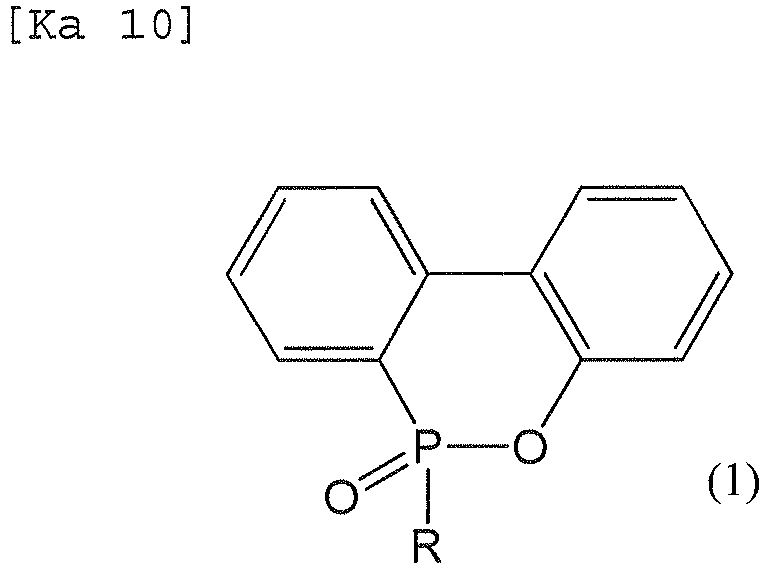
- (wherein R is an organic group having two or more phenolic hydroxyl groups and a molecular weight of 180 or more).
- Molded articles such as prepregs and metal clad laminated plates which are prepared by using the above phosphorus-containing curing agent have a flame retardance, and characteristics thereof such as a heat resistance, electric characteristics, a water resistance and the like are very good as well.
In Chemical Formula (1) described above, R is preferably an organic group having two or more phenolic hydroxyl groups and a molecular weight of 180 or more, more preferably an organic group having a molecular weight of 190 or more. If the molecular weight is 180 or more, the phosphorus curing agent is enhanced in a solvent solubility and improved in a handling property. The phosphorus-containing curing agent includes, for example, HCA-HQ (10-(2,5-dihydroxyphenyl)-10H-9-oxa-10-phosphaphenanthrene-10-oxide), HCA-NQ (10-(2,7-dihydroxynaphthyl)-10-dihydro-9-oxa-10-phosphaphenanthrene-10-oxide) and the like.
The above compounds have a low solubility in solvents, and therefore they are blended usually after carrying out pre-reaction. Further, the organic group (R) has preferably a structure represented by a chemical formula (-(CH2)-) in a structure thereof. When the organic group has the structure represented by the chemical formula (-(CH2)-), the heat resistance is enhanced, and the handling property is improved. - From the viewpoint of the flame retardance, a phosphorus content in the resin composition is preferably 0.8 to 5.0 % by mass, more preferably 1.0 to 2.5 % by mass based on a whole solid matter of the resin composition. When the phosphorus content is less than 0.8 % by mass based on a whole solid matter of the resin composition, the stable flame retardance is less liable to be obtained, and when it exceeds 5.0 % by mass, the characteristics of the cured matter are deteriorated.
In this connection, the phosphorus content is a content of phosphorus atoms in the resin composition, and for example, in a case in which one phosphorus atom is present in a substance having a molecular weight of 620 and in which 50 % by mass of the above substance is contained in the composition, a phosphorus component content thereof is 2.5 % by mass (an atomic weight of a phosphorus atom is about 31, and therefore 31/620 × 0.5 = 0.025). - The organic group represented by R in Chemical Formula (1) comprises at least one structure selected from structures represented by the following Chemical Formulas (2), (3), (4), (5) and (6) and has two or more phenolic hydroxyl groups. A mark * in Chemical Formulas (2) to (6) shows a part bonded directly to a phosphorus atom in Chemical Formula (1):
-

-

-


-

- Also, the organic group represented by R in Chemical Formula (1) can be an organic group comprising at least one structure selected from structures represented by the following Chemical Formulas (7), (8) and (9) and having two or more phenolic hydroxyl groups. A mark * in Formulas (7) to (9) shows a part bonded directly to a phosphorus atom in Chemical Formula (1):
-

-

-

- When provided with the structure represented by Chemical Formula (2) described above, the resin composition containing the above phosphorus-containing curing agent is enhanced in a heat resistance. Also, the phosphorus-containing curing agent is improved in a solubility in a solvent which is the reaction system and therefore enhanced in a handling property.
When provided with the structure represented by Chemical Formula (3) described above, the resin composition containing the above phosphorus-containing curing agent is improved in a reactivity with the resin.
When provided with the structure represented by Chemical Formula (4) described above, the resin composition containing the above phosphorus-containing curing agent is improved in a heat resistance.
When provided with the structures represented by Chemical Formulas (5) to (9) described above, the resin compositions containing the above phosphorus-containing curing agents are improved in a heat resistance.
In particular, the phosphorus-containing curing agent having the structure represented by Chemical Formula (2) described above has a low viscosity, and therefore it is excellent in a handling property and can be enhanced in a productivity. - The phosphorus-containing curing agent can be, for example, a resin having a structural unit A represented by the following Chemical Formula (10) and a structural unit B represented by the following Chemical Formula (11):
-

-

- That is, the above resin may have a unit in which plural structural units A are continuously connected, a unit in which plural structural units B are continuously connected, a unit in which the structural units A and the structural units B are alternately connected or a structure in which the three units described above are mixed.
When a phenol resin having the structural unit described above is used as the phosphorus-containing curing agent, the epoxy resin composition is enhanced in a heat resistance. - The phosphorus-containing curing agent (A) can be a resin having a structural unit C represented by the following Chemical Formula (12) and a structural unit D represented by the following Chemical Formula (13):
-

-

- That is, the above resin may have a unit in which plural structural units C are continuously connected, a unit in which plural structural units D are continuously connected, a unit in which the structural units C and the structural units D are alternately connected or a structure in which the three units described above are mixed.
When a phenol resin having the structural unit described above is used as the phosphorus-containing curing agent, the epoxy resin composition is enhanced in a heat resistance. - The phosphorus-containing curing agent (A) can be a resin having a structural unit E represented by the following Chemical Formula (14) and a structural unit F represented by the following Chemical Formula (15):
-

-
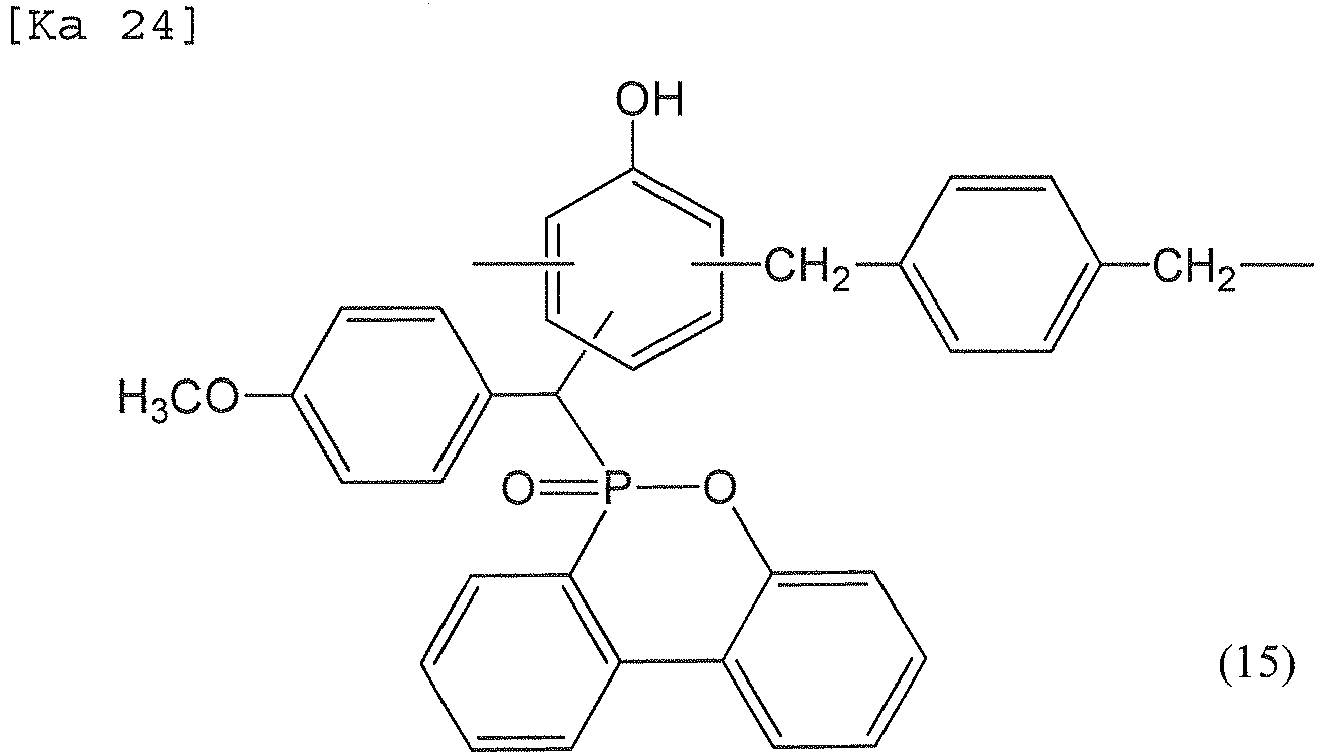
- That is, the above resin may have a unit in which plural structural units E are continuously connected, a unit in which plural structural units F are continuously connected, a unit in which the structural units E and the structural units F are alternately connected or a structure in which the three units described above are mixed.
When a phenol resin having the structural unit described above is used as the phosphorus-containing curing agent, the epoxy resin composition is enhanced in a heat resistance. - The phosphorus-containing curing agent represented by Chemical Formula (1) is obtained by reacting a phosphorus compound represented by the following Chemical Formula (16) with a compound having a phenolic hydroxyl group. Also, p-anisaldehyde may be added thereto in a certain case.
-

- The compound having a phenolic hydroxyl group which can be used for producing the phosphorus-containing curing agent is preferably a compound having two or more phenolic hydroxyl groups in a molecule, and it includes resins (novolac resins) obtained by condensing or co-condensing phenols such as phenol, cresol, xylenol, resorcin, catechol, bisphenol A, bisphenol F and the like or naphthols such as α-naphthol, β-naphthol, dihydroxynaphthalene and the like with aldehydes such as formaldehyde, acetaldehyde, propionaldehyde, benzaldehyde, salicylaldehyde and the like under the presence of an acid catalyst, poly-para-vinylphenol resins and phenol·aralkyl resins having a xylylene group which are synthesized from phenols and dimethoxyparaxylylene. They may be used alone or in combination of two or more kinds thereof.
- The kind and a blending amount of the curing accelerating agent shall not specifically be restricted, and imidazole base compounds, organic phosphorus base compounds, secondary amines, tertiary amines, quaternary ammonium salts and the like are used. They may be used in combination of two or more kinds thereof. A blending amount of the curing accelerating agent shall not specifically be restricted as well, and it is preferably 0.01 to 10.0 parts by mass based on 100 parts by mass of the resin which is the main ingredient.
- A coupling agent may be added to the resin composition. Addition of the coupling agent makes it possible to enhance a dispersibility of the inorganic fillers and obtain the material which is excellent in a chemical resistance and a peeling strength.
The coupling agent shall not specifically be restricted as long as it is used usually for thermosetting resin compositions, and it includes, for example, silane compounds having primary and/or secondary and/or tertiary amino groups, various silane base compounds such as epoxysilanes, mercaptosilanes, alkylsilanes, ureidosilanes, vinylsilanes and the like, titanium base compounds, aluminum chelates, aluminum/zirconium base compounds and the like. - A method for impregnating a base material with the resin composition shall not specifically be restricted. It is, for example, a wet method and a dry method and includes a method in which a base material is impregnated with the resin composition varnish, a method in which the resin composition is coated on a base material and the like. For example, a glass cloth and a glass nonwoven fabric are coated and impregnated with the thermosetting resin composition described above, and they are dried by heating continuously or discontinuously to be turned into a B stage, whereby a prepreg can be obtained.
- A metal foil is superposed on, if necessary, one face or both faces of the prepreg described above or a laminate obtained by laminating plural sheets of the prepreg, and it is molded by heating and pressurizing, whereby a metal foil clad laminated plate is prepared. A heating temperature thereof is preferably 170 to 240°C, and a pressure thereof is preferably 1 to 8 MPa.
Also, a metal layer of the above metal clad laminated plate can be subjected to wiring processing (circuit processing) to prepare a printed wiring board (circuit board).
A thickness of the above metal foil is usually 8 to 80 µm, and a thickness of the above laminate is usually 20 to 200 µm. - Further, a resin face is oppositely laminated via the prepreg described above on both faces or one face of the metal foil clad laminated plate or a board for an inner layer on which a circuit pattern is formed, and the laminated matter is heated and molded. Further, a circuit is formed on an outer layer thereof, whereby a multilayer printed wiring board can be obtained.
- The present invention shall specifically be explained below with reference to examples, but the present invention shall not be restricted to these examples as long as they do not deviate from the technical idea of the present invention.
- An inorganic matter containing 53 % by mass of SiO2, 14 % by mass of Al2O3, 20 % by mass of CaO, 3 % by mass of MgO and 10 % by mass of B2O3 was molten at high temperature and cooled down, and then it was crushed by means of a ball mill and classified by means of a cyclone classifier to prepared a glass filler (crushed inorganic filler) A having an average particle diameter of 2.0 µm and a specific gravity of 2.5 g/cm3.
The average particle diameter was measured by means of a laser dispersion particle size distribution meter MT3000 manufactured by Nikkiso Co., Ltd., wherein water was used as a dispersion liquid. - An inorganic matter containing 62 % by mass of SiO2, 18 % by mass of Al2O3, 8 % by mass of CaO and 12 % by mass of B2O3 was molten at high temperature and cooled down, and then it was crushed by means of a ball mill and classified by means of a cyclone classifier to prepared a glass filler (crushed inorganic filler) B having an average particle diameter of 2.0 µm and a specific gravity of 2.4 g/cm3.
- A synthetic method for a phosphorus base resin (curing agent) 1 shall be described below.
The melt viscosity at 180°C was measured according to ASTM D4287, and the softening point was measured according to JIS K7234.
A flask equipped with a thermometer, a cooling tube, a fractioning column, a nitrogen gas introducing tube and a stirrer was charged with 192.4 g (1.85 mole) of a phenol novolac resin, 68.0 g (0.50 mole) of p-anisaldehyded and 108.0 g (0.50 mole) of 9,10-dihydro-9-oxa-10-phosphaphenanthrene-10-oxide (hereinafter abbreviated as HCA), and the mixture was heated up to 180°C to react them at 180°C for 8 hours.
Then, water was removed while heating under a reduced pressure to obtain 355 g of a phenol resin (phosphorus base resin (curing agent)) 1 having a structural unit represented by the following Chemical Formula (10) and a structural unit represented by the following Chemical Formula (11). The phenol resin (phosphorus base resin (curing agent)) 1 thus obtained had a softening point of 125°C (B & R method), a melt viscosity (measuring method: ICI viscometer method, measuring temperature: 180°C) of 13 dPa·s, a hydroxyl equivalent of 190 g/eq and a phosphorus content of 4.2 % by mass. -

-

- The same procedure as in Synthetic Example 1 was carried out to obtain 490 g of a phenol resin (phosphorus base resin (curing agent)) 2 having a structural unit represented by the following Chemical Formula (12) and a structural unit represented by the following Chemical Formula (13), except that in Synthetic Example 1, 330.4 g (2.80 mole) of a bisphenol A novolac resin was used in place of the phenol novolac resin. The above phenol resin (phosphorus base resin (curing agent)) 2 had a softening point of 139°C (B & R method), a melt viscosity (measuring method: ICI viscometer method, measuring temperature: 180°C) of 65 dPa·s, a hydroxyl equivalent of 232 g/eq and a phosphorus content of 3.1 % by mass.
-

-

- The same procedure as in Synthetic Example 1 was carried out to obtain 550 g of a phenol resin (phosphorus base resin (curing agent)) 3 having a structural unit represented by the following Chemical Formula (14) and a structural unit represented by the following Chemical Formula (15), except that in Synthetic Example 1, 392.9 g (2.35 mole) of a phenol aralkyl resin was used in place of the phenol novolac resin. The phenol resin (phosphorus base resin (curing agent)) 3 thus obtained had a softening point of 102°C (B & R method), a melt viscosity (measuring method: ICI viscometer method, measuring temperature: 150°C) of 2.5 dPa·s, a hydroxyl equivalent of 232 g/eq and a phosphorus content of 2.7 % by mass.
-

-

- A glass flask equipped with a stirring device, a condenser and a thermometer was charged with 25.0 parts by mass of a phenol novolac type epoxy resin (Epikote 154, manufactured by Mitsubishi Chemical Corporation, epoxy equivalent: 178) and 75.0 parts by mass of a brominated epoxy resin (Epikote 5046, manufactured by Mitsubishi Chemical Corporation, epoxy equivalent: 475) as epoxy resins, 31.3 parts by mass of a phenol novolac resin (HP-1100, manufactured by Hitachi Chemical Co., Ltd.) as a curing agent (phenol resin), 30.0 parts by mass of aluminum hydroxide (CL-303, average particle diameter: 4.1 µm, manufactured by Sumitomo Chemical Co., Ltd.) as a filler (1), 30.0 parts by mass of the glass filler A as a filler (2) and 0.1 part by mass of 2E4MZ (manufactured by Shikoku Chemicals Corporation) as a curing accelerating agent to obtain a mixture. The mixture thus obtained was dissolved in MEK (methyl ethyl ketone) at a varnish temperature of 40°C and diluted, and the solution was stirred at room temperature for 1 hour and controlled by MEK so that a resin composition varnish having a solid content of 60 % by mass was obtained.
A glass cloth (style 2116, E glass) having a thickness of about 100 µm was impregnated with the above varnish and then dried at 150°C for 5 minutes to obtain a prepreg having a resin content of 50 % by mass. Sixteen sheets of the above prepreg were superposed, and copper foils of 12 µm were superposed on both sides thereof, followed by heating and pressurizing it at 170°C for 90 minutes on a press condition of 4.0 MPa to prepare a copper clad laminated plate having a thickness of about 1.6 mm. - A prepreg and a copper clad laminated plate were obtained in the same manner as in Example 1, except that used were 15.0 parts by mass of the phenol novolac type epoxy resin (Epikote 154, manufactured by Mitsubishi Chemical Corporation, epoxy equivalent: 178), 3.0 parts by mass of a tetrakishydroxyphenylmethane type epoxy resin (Epikote 1031S, manufactured by Mitsubishi Chemical Corporation, epoxy equivalent: 200) and 82.0 parts by mass of the brominated epoxy resin (Epikote 5046, manufactured by Mitsubishi Chemical Corporation, epoxy equivalent: 475) as the epoxy resins, 28.6 parts by mass of the phenol novolac resin (HP-1100, manufactured by Hitachi Chemical Co., Ltd.) as the curing agent (phenol resin), 43.0 parts by mass of aluminum hydroxide (CL-303, manufactured by Sumitomo Chemical Co., Ltd.) as the filler (1) and 43.0 parts by mass of the glass filler A as the filler (2).
- A prepreg and a copper clad laminated plate were obtained in the same manner as in Example 1, except that used were 100.0 parts by mass of the phenol novolac type epoxy resin (Epikote 154, manufactured by Mitsubishi Chemical Corporation, epoxy equivalent: 178) as the epoxy resin, 59.0 parts by mass of the phenol novolac resin (HP-1100, manufactured by Hitachi Chemical Co., Ltd.) as the curing agent (phenol resin), 79.0 parts by mass of aluminum hydroxide (CL-303, manufactured by Sumitomo Chemical Co., Ltd.) as the filler (1) and 79.0 parts by mass of the glass filler A as the filler (2).
- A prepreg and a copper clad laminated plate were obtained in the same manner as in Example 1, except that used were 80.0 parts by mass of the phenol novolac type epoxy resin (Epikote 154, manufactured by Mitsubishi Chemical Corporation, epoxy equivalent: 178) and 20.0 parts by mass of the tetrakishydroxyphenylmethane type epoxy resin (Epikote 1031S, manufactured by Mitsubishi Chemical Corporation, epoxy equivalent: 200) as the epoxy resins, 53.0 parts by mass of the phenol novolac resin (HP-1100, manufactured by Hitachi Chemical Co., Ltd.) as the curing agent (phenol resin), 33.5 parts by mass of a phosphorus phenol resin (XZ-92741, manufactured by The Dow Chemical Company) as a phosphorus base resin (curing agent), 60.0 parts by mass of aluminum hydroxide (CL-303, manufactured by Sumitomo Chemical Co., Ltd.) as the filler (1) and 60.0 parts by mass of the glass filler B as the filler (2).
- A prepreg and a copper clad laminated plate were obtained in the same manner as in Example 4, except that 40.0 parts by mass of the glass filler B was used as the filler (2).
- A prepreg and a copper clad laminated plate were obtained in the same manner as in Example 1, except that used were 80.0 parts by mass of the phenol novolac type epoxy resin (Epikote 154, manufactured by Mitsubishi Chemical Corporation, epoxy equivalent: 178) and 20.0 parts by mass of a bisphenol A novolac type epoxy resin (Epikote 157, manufactured by Mitsubishi Chemical Corporation, epoxy equivalent: 210) as the epoxy resins, 103.5 parts by mass of the resin synthesized in Synthetic Example 1 described above as a phosphorus base resin (curing agent), 45.0 parts by mass of aluminum hydroxide (CL-303, manufactured by Sumitomo Chemical Co., Ltd.) as the filler (1) and 45.0 parts by mass of the glass filler A as the filler (2) and that the curing agent (phenol resin) was omitted.
- A prepreg and a copper clad laminated plate were obtained in the same manner as in Example 1, except that used were 50.0 parts by mass of the phenol novolac type epoxy resin (Epikote 154, manufactured by Mitsubishi Chemical Corporation, epoxy equivalent: 178) and 50.0 parts by mass of the bisphenol A novolac type epoxy resin (Epikote 157, manufactured by Mitsubishi Chemical Corporation, epoxy equivalent: 210) as the epoxy resins, 119.0 parts by mass of the resin synthesized in Synthetic Example 2 described above as a phosphorus base resin (curing agent), 60.0 parts by mass of aluminum hydroxide (CL-303, manufactured by Sumitomo Chemical Co., Ltd.) as the filler (1) and 90.0 parts by mass of the glass filler A as the filler (2) and that the curing agent (phenol resin) was omitted.
- A prepreg and a copper clad laminated plate were obtained in the same manner as in Example 1, except that used were 30.0 parts by mass of the phenol novolac type epoxy resin (Epikote 154, manufactured by Mitsubishi Chemical Corporation, epoxy equivalent: 178) and 70.0 parts by mass of a bisphenol A novolac type epoxy resin (Epikote 157, manufactured by Mitsubishi Chemical Corporation, epoxy equivalent: 210) as the epoxy resins, 100.0 parts by mass of the resin synthesized in Synthetic Example 3 described above as a phosphorus base resin (curing agent), 120.0 parts by mass of aluminum hydroxide (CL-303, manufactured by Sumitomo Chemical Co., Ltd.) as the filler (1) and 80.0 parts by mass of the glass filler B as the filler (2) and that the curing agent (phenol resin) was omitted.
- A prepreg and a copper clad laminated plate were obtained in the same manner as in Example 1, except that 30.0 parts by mass of silica (SO-25R, manufactured by Admatechs Co., Ltd., amorphous silica powder, average particle diameter: 0.5 µm) was used as a filler (3) in place of the filler (2).
- A prepreg and a copper clad laminated plate were obtained in the same manner as in Example 2, except that 43.0 parts by mass of silica (SO-25R, manufactured by Admatechs Co., Ltd., amorphous silica powder, average particle diameter: 0.5 µm) was used as a filler (3) in place of the filler (1).
- A prepreg and a copper clad laminated plate were obtained in the same manner as in Example 2, except that the filler (1) and the filler (2) were not added.
The principal components used in Examples 1 to 8 and Comparative Examples 1 to 3 are summarized in Table 1 and Table 2. -
Table 1 Items Example 1 2 3 4 5 6 7 8 Epoxy resin Epikote 154
25 partsEpikote 154
15 partsEpikote 154
100 partsEpikote 154
80 partsEpikote 154
80 partsEpikote 154
80 partsEpikote 154
50 partsEpikote 154
30 partsEpikote 5046
75 partsEpikote 5046
82 parts- - - - - - - Epikote 1031S
3 parts- Epikote 1031S
20 partsEpikote 1031S
20 parts- - - - Epikote 1031S
3 parts- Epikote 1031S
20 partsEpikote 1031S
20 partsEpikote 157
20 partsEpikote 157
50 partsEpikote 157
70 partsCuring agent (phenol resin) HP-1100
31.3 partsHP-1100
28.6 partsHP-1100
59.0 partsHP-1100
53.0 partsHP-1100
53.0 parts- - - Phosphorus base resin (curing agent) - - - XZ92741
33.5XZ92741
33.5Synthetic Example 1
103.5Synthetic Example 2
119.0Synthetic Example 3
100.0Filler (1) (aluminum hydroxide) CL-303
30 partsCL-303
43 partsCL-303
79 partsCL-303
60 partsCL-303
60 partsCL-303
45 partsCL-303
60 partsCL-303
120 partsFiller (2) (inorganic matter comprising mainly SiO2) Glass filler A
30 partsGlass filler A
43 partsGlass filler A
79 partsGlass filler B
60 partsGlass filler B
40 partsGlass filler A
45 partsGlass filler A
90 partsGlass filler A
80 partsFiller (3) - - - - - - - - Curing accelerating agent 2E4MZ
0.1 part2E4MZ
0.1 part2E4MZ
0.1 part2E4MZ
0.1 part2E4MZ
0.1 part2E4MZ
0.1 part2E4MZ
0.1 part2E4MZ
0.1 partFiller ratio (whole resin composition) 31.3 % 40.1 % 49.8 % 39.1 % 34.9 % 30.7 % 40.6 % 50.0 % -
Table 2 Items Comparative Example 1 2 3 Epoxy resin Epikote 154 25 parts Epikote 154 15 parts Epikote 154 15 parts Epikote 5046 75 parts Epikote 5046 82 parts Epikote 5046 82 parts - Epikote 1031S 3 parts Epikote 1031S 3 parts Curing agent (phenol resin) HP-1100 31.3 parts HP-1100 28.6 parts HP-1100 28.6 parts Phosphorus base resin (curing agent) - - - Filler (1) (Aluminum hydroxide) CL-303 30 parts - - Filler (2) (inorganic matter comprising mainly SiO2) - Glass filler A 43 parts - Filler (3) SO25R 30 parts S025R 43 parts - Curing accelerating agent 2E4MZ 0.1 part 2E4MZ 0.1 part 2E4MZ 0.1 part Filler ratio (whole resin composition) 42.9 % 40.1 % 0.0 % - The copper foils on the outer layers of the copper clad laminated plates prepared in Examples 1 to 8 and Comparative Examples 1 to 3 were removed on whole surfaces by etching to preparer samples, and the samples thus obtained were used to evaluate the following items. The results thereof are shown in Table 3.
- The samples in which stripes formed by the flowing resin were not generated on a surface were rated as "good". Also, the samples in which the stripes were generated were rated as "stripes", and a generating spot thereof was specified.
- The samples described above were used to measure thermal expansion coefficients in a range of 50 to 120°C in a surface direction and a thickness direction according to a compression method by means of TMA2940 (manufactured by TA Instruments Inc.).
- The samples described above were subjected to drilling processing of 20,000 holes in a drill diameter of 0.2 mm at a revolution number of 300 krpm and a feed speed of 2.1 m/minute with two sheets superposed using an aluminum plate of 150 µm for an entry board to measure a blade edge abrasion amount of the drill. A product number: MD E747S manufactured by Union Tool Co. was used for the drill.
-
Table 3 Example Comparative Example 1 2 3 4 5 6 7 8 1 2 3 Base material appearance Good Good Good Good Good Good Good Good End part stripes Good Good Thermal expansion coefficient ppm/°C 39 34 28 35 37 40 33 28 37 32 55 Drilling processability 20,000 holes 20,000 holes 20,000 holes 20,000 holes 20,000 holes 20,000 holes 20,000 holes 20,000 holes 20,000 holes 8,000 holes 20,000 holes OK OK OK OK OK OK OK OK OK Drill broken OK - It has become clear that the copper clad laminated plates prepared in the examples are excellent in a base material appearance and have a small thermal expansion coefficient and an excellent drilling processability (life).
- In contrast with this, in Comparative Example 1 in which silica having a small average particle diameter (average particle diameter: 0.5 µm) was used in place of the filler (2), stripes formed by the flowing resin were generated at an end part on a surface of the base material due to an ununiformity of a fluidity between silica and aluminum hydroxide to deteriorate the base material appearance.
- Further, in Comparative Example 2 in which silica having a small average particle diameter (average particle diameter: 0.5 µm) was used together with the filler (2), the drilling processability was inferior.
- In Comparative Example 3 in which the fillers were not added, the thermal expansion coefficient was high.
Claims (7)
- A prepreg prepared by impregnating a base material with a resin composition, wherein the resin composition contains aluminum hydroxide having an average particle diameter of 2.5 to 4.5 µm and a glass filler having an average particle diameter of 1.0 to 3.0 µm, a specific gravity of 2.3 to 2.6 g/cm3 and a SiO2 content of 50 to 65 % by mass; and a sum of blending amounts of aluminum hydroxide and the glass filler is 30 to 50 % by mass based on a whole amount of solid matters in the resin composition.
- The prepreg according to claim 1, wherein the resin composition contains a non-halogenated epoxy compound having at least two or more epoxy groups in a molecule.
- The prepreg according to claim 1 or 2, wherein the resin composition contains a phosphorus-containing curing agent represented by the following Chemical Formula (1):

- The prepreg according to claim 3, wherein the organic group represented by R in Chemical Formula (1) comprises at least one structure selected from structures represented by the following Chemical Formulas (2), (3), (4), (5) and (6) and has two or more phenolic hydroxyl groups:(* in Formulas (2) to (6) shows a part bonded directly to a phosphorus atom in Chemical Formula (1)):

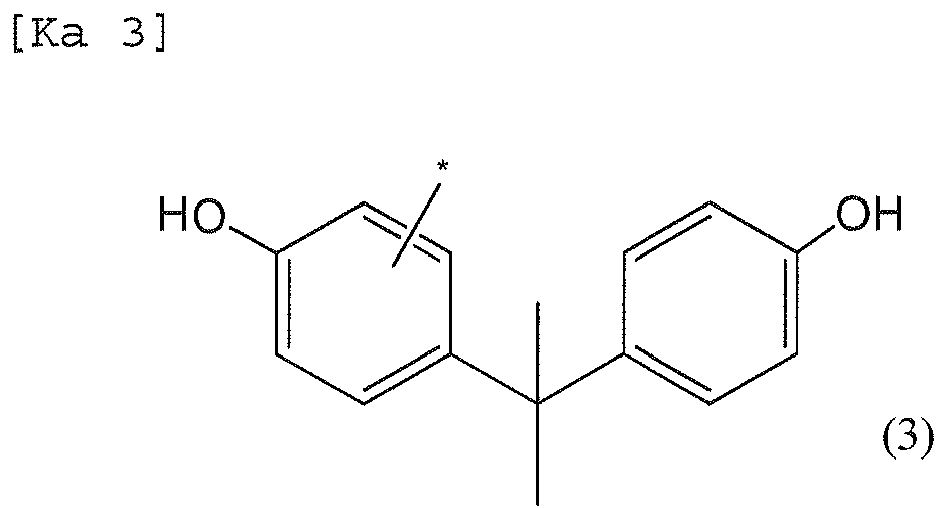


- The prepreg according to claim 4, wherein the organic group represented by R in Chemical Formula (1) comprises at least one structure selected from structures represented by the following Chemical Formulas (7), (8) and (9) and has two or more phenolic hydroxyl groups:(* in Chemical Formulas (7) to (9) shows a part bonded directly to a phosphorus atom in Chemical Formula (1):


- A metal clad laminated plate prepared by superposing one or plural plates of the prepreg according to any of claims 1 to 5, providing a metal foil on both faces or one face thereof and heating and pressurizing it.
- A printed wiring board prepared by subjecting a metal layer of the metal clad laminated plate according to claim 6 to wiring processing.
Applications Claiming Priority (5)
| Application Number | Priority Date | Filing Date | Title |
|---|---|---|---|
| JP2010124327 | 2010-05-31 | ||
| JP2010124326 | 2010-05-31 | ||
| JP2010124328 | 2010-05-31 | ||
| JP2010124325 | 2010-05-31 | ||
| PCT/JP2011/062517 WO2011152413A1 (en) | 2010-05-31 | 2011-05-31 | Prepreg, metal-clad laminate, and printed circuit board |
Publications (3)
| Publication Number | Publication Date |
|---|---|
| EP2578632A1 true EP2578632A1 (en) | 2013-04-10 |
| EP2578632A4 EP2578632A4 (en) | 2014-01-22 |
| EP2578632B1 EP2578632B1 (en) | 2019-10-30 |
Family
ID=45066775
Family Applications (2)
| Application Number | Title | Priority Date | Filing Date |
|---|---|---|---|
| EP11789815.5A Active EP2578613B8 (en) | 2010-05-31 | 2011-05-31 | Epoxy resin composition and pre-preg, support-provided resin film, metallic foil clad laminate plate and multilayer printed circuit board utilizing said composition |
| EP11789816.3A Active EP2578632B1 (en) | 2010-05-31 | 2011-05-31 | Prepreg, metal-clad laminate, and printed circuit board |
Family Applications Before (1)
| Application Number | Title | Priority Date | Filing Date |
|---|---|---|---|
| EP11789815.5A Active EP2578613B8 (en) | 2010-05-31 | 2011-05-31 | Epoxy resin composition and pre-preg, support-provided resin film, metallic foil clad laminate plate and multilayer printed circuit board utilizing said composition |
Country Status (6)
| Country | Link |
|---|---|
| US (2) | US9215803B2 (en) |
| EP (2) | EP2578613B8 (en) |
| KR (2) | KR101938895B1 (en) |
| CN (3) | CN105669952B (en) |
| TW (2) | TWI516518B (en) |
| WO (2) | WO2011152413A1 (en) |
Families Citing this family (13)
| Publication number | Priority date | Publication date | Assignee | Title |
|---|---|---|---|---|
| CN105669952B (en) | 2010-05-31 | 2018-05-29 | 日立化成工业株式会社 | Composition epoxy resin uses its prepreg, band supporter resin film, metal layers of foil lamination and multilayer board |
| JP5891435B2 (en) * | 2012-04-05 | 2016-03-23 | パナソニックIpマネジメント株式会社 | Epoxy resin composition, prepreg, metal-clad laminate, printed wiring board |
| CN103694455B (en) * | 2012-09-28 | 2015-12-02 | 中国石油天然气股份有限公司 | A preparation method of epoxy resin suitable for preparing carbon fiber prepreg by medium temperature hot melt method |
| CN104119639B (en) * | 2013-04-24 | 2016-08-03 | 台光电子材料(昆山)有限公司 | Non-halogen resin composition and apply its copper clad laminate and printed circuit board (PCB) |
| JP6671958B2 (en) * | 2013-10-09 | 2020-03-25 | 日本化薬株式会社 | Phenol resin, epoxy resin, epoxy resin composition, prepreg and cured product thereof |
| CN103724944A (en) * | 2013-12-31 | 2014-04-16 | 广东生益科技股份有限公司 | Halogen-free epoxy resin composition and application thereof |
| WO2016029451A1 (en) * | 2014-08-29 | 2016-03-03 | Blue Cube Ip Llc | Synthesis of naphthol novolac |
| US9822227B2 (en) | 2014-09-16 | 2017-11-21 | Isola Usa Corp. | High Tg epoxy formulation with good thermal properties |
| US10577475B1 (en) | 2016-10-17 | 2020-03-03 | Rgf Materials Company | Epoxy with photoluminescent pigment |
| CN108117634B (en) * | 2016-11-30 | 2019-08-27 | 广东生益科技股份有限公司 | A kind of compositions of thermosetting resin |
| CN108164684B (en) * | 2016-12-07 | 2019-08-27 | 广东生益科技股份有限公司 | A kind of compositions of thermosetting resin |
| CN106632997B (en) * | 2016-12-22 | 2019-02-12 | 四川东方绝缘材料股份有限公司 | A kind of phosphorus-containing phenolic aldehyde epoxy hardener and preparation method thereof |
| WO2021044946A1 (en) * | 2019-09-06 | 2021-03-11 | パナソニックIpマネジメント株式会社 | Resin composition, prepreg, resin-equipped film, resin-equipped metal foil, metal-cladded laminated plate, and printed wiring board |
Family Cites Families (31)
| Publication number | Priority date | Publication date | Assignee | Title |
|---|---|---|---|---|
| JP2853550B2 (en) * | 1994-01-25 | 1999-02-03 | 松下電工株式会社 | Epoxy resin composition, method for producing the same, and semiconductor device using the same |
| JP2000264956A (en) * | 1999-03-12 | 2000-09-26 | Dainippon Ink & Chem Inc | Epoxy resin composition for laminate and laminate |
| JP2001131393A (en) | 1999-10-29 | 2001-05-15 | Hitachi Chem Co Ltd | Epoxy resin molding material for sealing and electronic part device |
| TW490474B (en) * | 2000-01-04 | 2002-06-11 | Nat Science Council | Phosphorus group containing flame retardant hardener, advanced epoxy resins and cured epoxy resins thereof |
| JP2001261933A (en) | 2000-03-15 | 2001-09-26 | Nitto Denko Corp | Epoxy resin composition for encapsulating optical semiconductor element and optical semiconductor device |
| JP2001283639A (en) * | 2000-03-30 | 2001-10-12 | Fujitsu Ltd | Insulating resin composition for build-up substrate |
| JP4588834B2 (en) * | 2000-04-06 | 2010-12-01 | パナソニック電工株式会社 | Phosphorus-containing epoxy resin composition, flame-retardant resin sheet using the phosphorus-containing epoxy resin, metal foil with resin, prepreg and laminate, multilayer board |
| TW498084B (en) | 2000-07-19 | 2002-08-11 | Chang Chun Plastics Co Ltd | Flame-retardant resin and flame retardant composition containing the same |
| JP2002265562A (en) | 2001-03-08 | 2002-09-18 | Japan Epoxy Resin Kk | Phosphorus-containing epoxy resin and flame retardant composition |
| TW513482B (en) | 2001-08-31 | 2002-12-11 | Chang Chun Plastics Co Ltd | Nitrogen-containing flame-retardant epoxy resin and its compositions |
| JP2003201332A (en) | 2002-01-10 | 2003-07-18 | Hitachi Chem Co Ltd | Epoxy resin composition for printed wiring board and laminate using the same used for printed wiring board |
| JP2003231762A (en) * | 2002-02-13 | 2003-08-19 | Mitsubishi Gas Chem Co Inc | Prepreg and laminate |
| TWI296001B (en) | 2002-10-22 | 2008-04-21 | Chang Chun Plastics Co Ltd | |
| JP2004182850A (en) | 2002-12-03 | 2004-07-02 | Mitsubishi Gas Chem Co Inc | Prepreg and laminate with excellent property balance |
| JP4174355B2 (en) * | 2003-03-10 | 2008-10-29 | 住友ベークライト株式会社 | Transparent composite composition |
| ATE459676T1 (en) * | 2004-03-04 | 2010-03-15 | Hitachi Chemical Co Ltd | PREPREG, METAL COVERED LAMINATE AND CIRCUIT BOARD USING THEREOF |
| KR101134492B1 (en) | 2004-04-30 | 2012-04-13 | 곽상운 | Foaming type chemical grout material |
| CN102653598B (en) * | 2004-05-28 | 2015-05-13 | 陶氏环球技术有限责任公司 | Phosphorus-containing compounds useful for making halogen-free, ignition-resistant polymers |
| EP1785441B1 (en) | 2004-09-01 | 2011-06-08 | DIC Corporation | Epoxy resin composition, products of curing thereof, material for the encapsulation of semiconductors, novel phenol resin, novel epoxy resin, process for production of novel phenol resin and process for production of novel epoxy resin |
| EP2113524A4 (en) | 2007-02-23 | 2011-03-30 | Panasonic Elec Works Co Ltd | EPOXY RESIN COMPOSITION, PREPREG, LAMINATE AND PRINTED WIRING BOARDS |
| WO2008140059A1 (en) | 2007-05-09 | 2008-11-20 | Nippon Sheet Glass Company, Limited | Glass filler, photocurable coating composition and photocurable resin composition using the same, and photocurable adhesive |
| WO2009070488A1 (en) * | 2007-11-29 | 2009-06-04 | Dow Global Technologies Inc. | Dimethylformamide-free formulations using dicyanadiamide as curing agent for thermosetting epoxy resins |
| JP5281280B2 (en) | 2007-12-25 | 2013-09-04 | パナソニック株式会社 | Epoxy resin composition, prepreg, metal-clad laminate, multilayer printed wiring board |
| JP5206600B2 (en) | 2008-06-30 | 2013-06-12 | 住友ベークライト株式会社 | Epoxy resin composition, prepreg, laminate, resin sheet, multilayer printed wiring board, and semiconductor device |
| JP5448414B2 (en) | 2008-10-29 | 2014-03-19 | 住友ベークライト株式会社 | Resin composition, prepreg, laminate, multilayer printed wiring board, and semiconductor device |
| CN101457012B (en) * | 2008-12-31 | 2011-06-15 | 广东生益科技股份有限公司 | Resin composition and copper clad laminate prepared by metal foil coated with resin composition |
| KR101310697B1 (en) * | 2009-03-18 | 2013-09-25 | 디아이씨 가부시끼가이샤 | Process for production of phosphorus-atom-containing phenol, novel phosphorus-atom-containing phenol, curable resin composition, cured product thereof, printed circuit board, and semiconductor sealing material |
| WO2011011920A1 (en) * | 2009-07-31 | 2011-02-03 | Dow Global Technologies Inc. | Amine-phenolic dual cure hardener blend for resin compositions |
| US9267030B2 (en) * | 2010-01-29 | 2016-02-23 | Blue Cube Ip Llc | Compositions having phosphorus-containing compounds |
| JP5458916B2 (en) | 2010-01-29 | 2014-04-02 | Dic株式会社 | Method for producing phosphorus atom-containing phenols, phosphorus atom-containing phenols, curable resin composition, cured product thereof, printed wiring board resin composition, printed wiring board, flexible wiring board resin composition, for semiconductor sealing material Resin composition and resin composition for interlayer insulation material for build-up substrate |
| CN105669952B (en) | 2010-05-31 | 2018-05-29 | 日立化成工业株式会社 | Composition epoxy resin uses its prepreg, band supporter resin film, metal layers of foil lamination and multilayer board |
-
2011
- 2011-05-31 CN CN201610032246.6A patent/CN105669952B/en active Active
- 2011-05-31 US US13/700,561 patent/US9215803B2/en active Active
- 2011-05-31 TW TW100119154A patent/TWI516518B/en active
- 2011-05-31 WO PCT/JP2011/062517 patent/WO2011152413A1/en not_active Ceased
- 2011-05-31 TW TW100119153A patent/TWI527850B/en active
- 2011-05-31 CN CN201180026869.8A patent/CN102918107B/en active Active
- 2011-05-31 EP EP11789815.5A patent/EP2578613B8/en active Active
- 2011-05-31 US US13/700,587 patent/US8980424B2/en active Active
- 2011-05-31 EP EP11789816.3A patent/EP2578632B1/en active Active
- 2011-05-31 CN CN2011800261928A patent/CN102918076A/en active Pending
- 2011-05-31 WO PCT/JP2011/062516 patent/WO2011152412A1/en not_active Ceased
- 2011-05-31 KR KR1020127030557A patent/KR101938895B1/en active Active
- 2011-05-31 KR KR1020127031123A patent/KR101803115B1/en active Active
Also Published As
| Publication number | Publication date |
|---|---|
| EP2578613B1 (en) | 2018-11-07 |
| KR20130103331A (en) | 2013-09-23 |
| TWI527850B (en) | 2016-04-01 |
| US8980424B2 (en) | 2015-03-17 |
| TW201213410A (en) | 2012-04-01 |
| HK1179290A1 (en) | 2013-09-27 |
| TW201213381A (en) | 2012-04-01 |
| US9215803B2 (en) | 2015-12-15 |
| TWI516518B (en) | 2016-01-11 |
| KR101803115B1 (en) | 2017-11-29 |
| EP2578613A4 (en) | 2014-01-15 |
| US20130126218A1 (en) | 2013-05-23 |
| US20130108843A1 (en) | 2013-05-02 |
| CN102918076A (en) | 2013-02-06 |
| WO2011152413A1 (en) | 2011-12-08 |
| KR101938895B1 (en) | 2019-01-15 |
| CN102918107A (en) | 2013-02-06 |
| CN102918107B (en) | 2016-10-05 |
| EP2578632A4 (en) | 2014-01-22 |
| EP2578632B1 (en) | 2019-10-30 |
| EP2578613B8 (en) | 2018-12-19 |
| CN105669952A (en) | 2016-06-15 |
| KR20130082448A (en) | 2013-07-19 |
| WO2011152412A1 (en) | 2011-12-08 |
| EP2578613A1 (en) | 2013-04-10 |
| CN105669952B (en) | 2018-05-29 |
Similar Documents
| Publication | Publication Date | Title |
|---|---|---|
| EP2578632B1 (en) | Prepreg, metal-clad laminate, and printed circuit board | |
| TWI572651B (en) | Resin composition, prepreg and laminate | |
| EP3006503B1 (en) | Resin composition for printed wiring board material and prepreg, resin sheet, metal foil-clad laminate, and printed wiring board using the same | |
| JP5397717B2 (en) | Molybdenum compound powder, prepreg and laminate | |
| EP2612885B1 (en) | Prepreg and laminate | |
| TWI512042B (en) | Prepreg and laminate | |
| JP6168308B2 (en) | Resin composition, prepreg, metal foil-clad laminate and printed wiring board | |
| EP2557121B1 (en) | Resin composition, prepreg and laminate | |
| KR20150073965A (en) | Resin composition, pre-preg, laminate, metal foil-clad laminate, and printed wiring board | |
| TWI548690B (en) | High performance thermoset useful for electrical laminate, high density interconnect and interconnect substrate applications | |
| KR100624028B1 (en) | Resin composition, prepreg and laminate using the composition | |
| US20070111010A1 (en) | Flame retardant prepregs and laminates for printed circuit boards | |
| JP5830940B2 (en) | Prepreg, metal-clad laminate and printed wiring board | |
| TWI460199B (en) | Flame retardant phosphorus-containing epoxy resin composition and cured product thereof | |
| US20110303446A1 (en) | Epoxy resin composition, and prepreg and printed circuit board using the same | |
| HK1179290B (en) | Prepreg, metal-clad laminate, and printed circuit board | |
| JP2013189579A (en) | Thermosetting resin composition, and prepreg and laminated plate using the same | |
| JP2001261786A (en) | Epoxy resin composition for electric laminate |
Legal Events
| Date | Code | Title | Description |
|---|---|---|---|
| PUAI | Public reference made under article 153(3) epc to a published international application that has entered the european phase |
Free format text: ORIGINAL CODE: 0009012 |
|
| 17P | Request for examination filed |
Effective date: 20121128 |
|
| AK | Designated contracting states |
Kind code of ref document: A1 Designated state(s): AL AT BE BG CH CY CZ DE DK EE ES FI FR GB GR HR HU IE IS IT LI LT LU LV MC MK MT NL NO PL PT RO RS SE SI SK SM TR |
|
| DAX | Request for extension of the european patent (deleted) | ||
| RIC1 | Information provided on ipc code assigned before grant |
Ipc: C08L 63/00 20060101AFI20131212BHEP Ipc: C08J 5/24 20060101ALI20131212BHEP Ipc: C08G 59/62 20060101ALI20131212BHEP Ipc: C08K 3/40 20060101ALI20131212BHEP Ipc: H05K 1/03 20060101ALI20131212BHEP Ipc: C08K 3/20 20060101ALI20131212BHEP Ipc: B32B 15/08 20060101ALI20131212BHEP |
|
| A4 | Supplementary search report drawn up and despatched |
Effective date: 20131219 |
|
| STAA | Information on the status of an ep patent application or granted ep patent |
Free format text: STATUS: EXAMINATION IS IN PROGRESS |
|
| 17Q | First examination report despatched |
Effective date: 20170407 |
|
| GRAP | Despatch of communication of intention to grant a patent |
Free format text: ORIGINAL CODE: EPIDOSNIGR1 |
|
| STAA | Information on the status of an ep patent application or granted ep patent |
Free format text: STATUS: GRANT OF PATENT IS INTENDED |
|
| GRAJ | Information related to disapproval of communication of intention to grant by the applicant or resumption of examination proceedings by the epo deleted |
Free format text: ORIGINAL CODE: EPIDOSDIGR1 |
|
| STAA | Information on the status of an ep patent application or granted ep patent |
Free format text: STATUS: EXAMINATION IS IN PROGRESS |
|
| GRAP | Despatch of communication of intention to grant a patent |
Free format text: ORIGINAL CODE: EPIDOSNIGR1 |
|
| STAA | Information on the status of an ep patent application or granted ep patent |
Free format text: STATUS: GRANT OF PATENT IS INTENDED |
|
| INTG | Intention to grant announced |
Effective date: 20190412 |
|
| INTG | Intention to grant announced |
Effective date: 20190425 |
|
| GRAS | Grant fee paid |
Free format text: ORIGINAL CODE: EPIDOSNIGR3 |
|
| GRAA | (expected) grant |
Free format text: ORIGINAL CODE: 0009210 |
|
| STAA | Information on the status of an ep patent application or granted ep patent |
Free format text: STATUS: THE PATENT HAS BEEN GRANTED |
|
| RAP1 | Party data changed (applicant data changed or rights of an application transferred) |
Owner name: HITACHI CHEMICAL COMPANY, LTD. |
|
| AK | Designated contracting states |
Kind code of ref document: B1 Designated state(s): AL AT BE BG CH CY CZ DE DK EE ES FI FR GB GR HR HU IE IS IT LI LT LU LV MC MK MT NL NO PL PT RO RS SE SI SK SM TR |
|
| REG | Reference to a national code |
Ref country code: GB Ref legal event code: FG4D |
|
| REG | Reference to a national code |
Ref country code: CH Ref legal event code: EP |
|
| REG | Reference to a national code |
Ref country code: AT Ref legal event code: REF Ref document number: 1196093 Country of ref document: AT Kind code of ref document: T Effective date: 20191115 |
|
| REG | Reference to a national code |
Ref country code: DE Ref legal event code: R096 Ref document number: 602011063079 Country of ref document: DE |
|
| REG | Reference to a national code |
Ref country code: IE Ref legal event code: FG4D |
|
| REG | Reference to a national code |
Ref country code: LT Ref legal event code: MG4D |
|
| PG25 | Lapsed in a contracting state [announced via postgrant information from national office to epo] |
Ref country code: BG Free format text: LAPSE BECAUSE OF FAILURE TO SUBMIT A TRANSLATION OF THE DESCRIPTION OR TO PAY THE FEE WITHIN THE PRESCRIBED TIME-LIMIT Effective date: 20200130 Ref country code: NO Free format text: LAPSE BECAUSE OF FAILURE TO SUBMIT A TRANSLATION OF THE DESCRIPTION OR TO PAY THE FEE WITHIN THE PRESCRIBED TIME-LIMIT Effective date: 20200130 Ref country code: GR Free format text: LAPSE BECAUSE OF FAILURE TO SUBMIT A TRANSLATION OF THE DESCRIPTION OR TO PAY THE FEE WITHIN THE PRESCRIBED TIME-LIMIT Effective date: 20200131 Ref country code: PL Free format text: LAPSE BECAUSE OF FAILURE TO SUBMIT A TRANSLATION OF THE DESCRIPTION OR TO PAY THE FEE WITHIN THE PRESCRIBED TIME-LIMIT Effective date: 20191030 Ref country code: NL Free format text: LAPSE BECAUSE OF FAILURE TO SUBMIT A TRANSLATION OF THE DESCRIPTION OR TO PAY THE FEE WITHIN THE PRESCRIBED TIME-LIMIT Effective date: 20191030 Ref country code: LT Free format text: LAPSE BECAUSE OF FAILURE TO SUBMIT A TRANSLATION OF THE DESCRIPTION OR TO PAY THE FEE WITHIN THE PRESCRIBED TIME-LIMIT Effective date: 20191030 Ref country code: ES Free format text: LAPSE BECAUSE OF FAILURE TO SUBMIT A TRANSLATION OF THE DESCRIPTION OR TO PAY THE FEE WITHIN THE PRESCRIBED TIME-LIMIT Effective date: 20191030 Ref country code: PT Free format text: LAPSE BECAUSE OF FAILURE TO SUBMIT A TRANSLATION OF THE DESCRIPTION OR TO PAY THE FEE WITHIN THE PRESCRIBED TIME-LIMIT Effective date: 20200302 Ref country code: LV Free format text: LAPSE BECAUSE OF FAILURE TO SUBMIT A TRANSLATION OF THE DESCRIPTION OR TO PAY THE FEE WITHIN THE PRESCRIBED TIME-LIMIT Effective date: 20191030 Ref country code: SE Free format text: LAPSE BECAUSE OF FAILURE TO SUBMIT A TRANSLATION OF THE DESCRIPTION OR TO PAY THE FEE WITHIN THE PRESCRIBED TIME-LIMIT Effective date: 20191030 |
|
| REG | Reference to a national code |
Ref country code: NL Ref legal event code: MP Effective date: 20191030 |
|
| PG25 | Lapsed in a contracting state [announced via postgrant information from national office to epo] |
Ref country code: RS Free format text: LAPSE BECAUSE OF FAILURE TO SUBMIT A TRANSLATION OF THE DESCRIPTION OR TO PAY THE FEE WITHIN THE PRESCRIBED TIME-LIMIT Effective date: 20191030 Ref country code: IS Free format text: LAPSE BECAUSE OF FAILURE TO SUBMIT A TRANSLATION OF THE DESCRIPTION OR TO PAY THE FEE WITHIN THE PRESCRIBED TIME-LIMIT Effective date: 20200229 Ref country code: HR Free format text: LAPSE BECAUSE OF FAILURE TO SUBMIT A TRANSLATION OF THE DESCRIPTION OR TO PAY THE FEE WITHIN THE PRESCRIBED TIME-LIMIT Effective date: 20191030 |
|
| PG25 | Lapsed in a contracting state [announced via postgrant information from national office to epo] |
Ref country code: AL Free format text: LAPSE BECAUSE OF FAILURE TO SUBMIT A TRANSLATION OF THE DESCRIPTION OR TO PAY THE FEE WITHIN THE PRESCRIBED TIME-LIMIT Effective date: 20191030 |
|
| PG25 | Lapsed in a contracting state [announced via postgrant information from national office to epo] |
Ref country code: DK Free format text: LAPSE BECAUSE OF FAILURE TO SUBMIT A TRANSLATION OF THE DESCRIPTION OR TO PAY THE FEE WITHIN THE PRESCRIBED TIME-LIMIT Effective date: 20191030 Ref country code: RO Free format text: LAPSE BECAUSE OF FAILURE TO SUBMIT A TRANSLATION OF THE DESCRIPTION OR TO PAY THE FEE WITHIN THE PRESCRIBED TIME-LIMIT Effective date: 20191030 Ref country code: EE Free format text: LAPSE BECAUSE OF FAILURE TO SUBMIT A TRANSLATION OF THE DESCRIPTION OR TO PAY THE FEE WITHIN THE PRESCRIBED TIME-LIMIT Effective date: 20191030 Ref country code: CZ Free format text: LAPSE BECAUSE OF FAILURE TO SUBMIT A TRANSLATION OF THE DESCRIPTION OR TO PAY THE FEE WITHIN THE PRESCRIBED TIME-LIMIT Effective date: 20191030 |
|
| REG | Reference to a national code |
Ref country code: DE Ref legal event code: R097 Ref document number: 602011063079 Country of ref document: DE |
|
| PG25 | Lapsed in a contracting state [announced via postgrant information from national office to epo] |
Ref country code: SK Free format text: LAPSE BECAUSE OF FAILURE TO SUBMIT A TRANSLATION OF THE DESCRIPTION OR TO PAY THE FEE WITHIN THE PRESCRIBED TIME-LIMIT Effective date: 20191030 Ref country code: SM Free format text: LAPSE BECAUSE OF FAILURE TO SUBMIT A TRANSLATION OF THE DESCRIPTION OR TO PAY THE FEE WITHIN THE PRESCRIBED TIME-LIMIT Effective date: 20191030 Ref country code: IT Free format text: LAPSE BECAUSE OF FAILURE TO SUBMIT A TRANSLATION OF THE DESCRIPTION OR TO PAY THE FEE WITHIN THE PRESCRIBED TIME-LIMIT Effective date: 20191030 |
|
| PLBE | No opposition filed within time limit |
Free format text: ORIGINAL CODE: 0009261 |
|
| STAA | Information on the status of an ep patent application or granted ep patent |
Free format text: STATUS: NO OPPOSITION FILED WITHIN TIME LIMIT |
|
| 26N | No opposition filed |
Effective date: 20200731 |
|
| PG25 | Lapsed in a contracting state [announced via postgrant information from national office to epo] |
Ref country code: SI Free format text: LAPSE BECAUSE OF FAILURE TO SUBMIT A TRANSLATION OF THE DESCRIPTION OR TO PAY THE FEE WITHIN THE PRESCRIBED TIME-LIMIT Effective date: 20191030 |
|
| PG25 | Lapsed in a contracting state [announced via postgrant information from national office to epo] |
Ref country code: MC Free format text: LAPSE BECAUSE OF FAILURE TO SUBMIT A TRANSLATION OF THE DESCRIPTION OR TO PAY THE FEE WITHIN THE PRESCRIBED TIME-LIMIT Effective date: 20191030 Ref country code: CH Free format text: LAPSE BECAUSE OF NON-PAYMENT OF DUE FEES Effective date: 20200531 Ref country code: LI Free format text: LAPSE BECAUSE OF NON-PAYMENT OF DUE FEES Effective date: 20200531 |
|
| REG | Reference to a national code |
Ref country code: BE Ref legal event code: MM Effective date: 20200531 |
|
| GBPC | Gb: european patent ceased through non-payment of renewal fee |
Effective date: 20200531 |
|
| REG | Reference to a national code |
Ref country code: AT Ref legal event code: UEP Ref document number: 1196093 Country of ref document: AT Kind code of ref document: T Effective date: 20191030 |
|
| PG25 | Lapsed in a contracting state [announced via postgrant information from national office to epo] |
Ref country code: IE Free format text: LAPSE BECAUSE OF NON-PAYMENT OF DUE FEES Effective date: 20200531 Ref country code: GB Free format text: LAPSE BECAUSE OF NON-PAYMENT OF DUE FEES Effective date: 20200531 Ref country code: FR Free format text: LAPSE BECAUSE OF NON-PAYMENT OF DUE FEES Effective date: 20200531 |
|
| PG25 | Lapsed in a contracting state [announced via postgrant information from national office to epo] |
Ref country code: BE Free format text: LAPSE BECAUSE OF NON-PAYMENT OF DUE FEES Effective date: 20200531 |
|
| PG25 | Lapsed in a contracting state [announced via postgrant information from national office to epo] |
Ref country code: TR Free format text: LAPSE BECAUSE OF FAILURE TO SUBMIT A TRANSLATION OF THE DESCRIPTION OR TO PAY THE FEE WITHIN THE PRESCRIBED TIME-LIMIT Effective date: 20191030 Ref country code: MT Free format text: LAPSE BECAUSE OF FAILURE TO SUBMIT A TRANSLATION OF THE DESCRIPTION OR TO PAY THE FEE WITHIN THE PRESCRIBED TIME-LIMIT Effective date: 20191030 Ref country code: CY Free format text: LAPSE BECAUSE OF FAILURE TO SUBMIT A TRANSLATION OF THE DESCRIPTION OR TO PAY THE FEE WITHIN THE PRESCRIBED TIME-LIMIT Effective date: 20191030 |
|
| PG25 | Lapsed in a contracting state [announced via postgrant information from national office to epo] |
Ref country code: MK Free format text: LAPSE BECAUSE OF FAILURE TO SUBMIT A TRANSLATION OF THE DESCRIPTION OR TO PAY THE FEE WITHIN THE PRESCRIBED TIME-LIMIT Effective date: 20191030 |
|
| REG | Reference to a national code |
Ref country code: LU Ref legal event code: HC Owner name: RESONAC CORPORATION; JP Free format text: FORMER OWNER: SHOWA DENKO MATERIALS CO. Effective date: 20230216 Ref country code: LU Ref legal event code: HC Owner name: SHOWA DENKO MATERIALS CO.; JP Free format text: FORMER OWNER: HITACHI CHEMICAL COMPANY, LTD. Effective date: 20230216 |
|
| REG | Reference to a national code |
Ref country code: DE Ref legal event code: R081 Ref document number: 602011063079 Country of ref document: DE Owner name: RESONAC CORPORATION, JP Free format text: FORMER OWNER: HITACHI CHEMICAL COMPANY, LTD., TOKYO, JP |
|
| REG | Reference to a national code |
Ref country code: AT Ref legal event code: HC Ref document number: 1196093 Country of ref document: AT Kind code of ref document: T Owner name: RESONAC CORPORATION, JP Effective date: 20230713 |
|
| REG | Reference to a national code |
Ref country code: LU Ref legal event code: HC Owner name: RESONAC CORPORATION; JP Free format text: FORMER OWNER: RESONAC CORPORATION Effective date: 20240216 |
|
| PGFP | Annual fee paid to national office [announced via postgrant information from national office to epo] |
Ref country code: FI Payment date: 20250513 Year of fee payment: 15 |
|
| PGFP | Annual fee paid to national office [announced via postgrant information from national office to epo] |
Ref country code: DE Payment date: 20250402 Year of fee payment: 15 |
|
| PGFP | Annual fee paid to national office [announced via postgrant information from national office to epo] |
Ref country code: LU Payment date: 20250516 Year of fee payment: 15 |
|
| PGFP | Annual fee paid to national office [announced via postgrant information from national office to epo] |
Ref country code: AT Payment date: 20250425 Year of fee payment: 15 |